Archives for category: Uncategorized
Leon Chew and Andrew Curtis

Leon Chew and Andrew Curtis

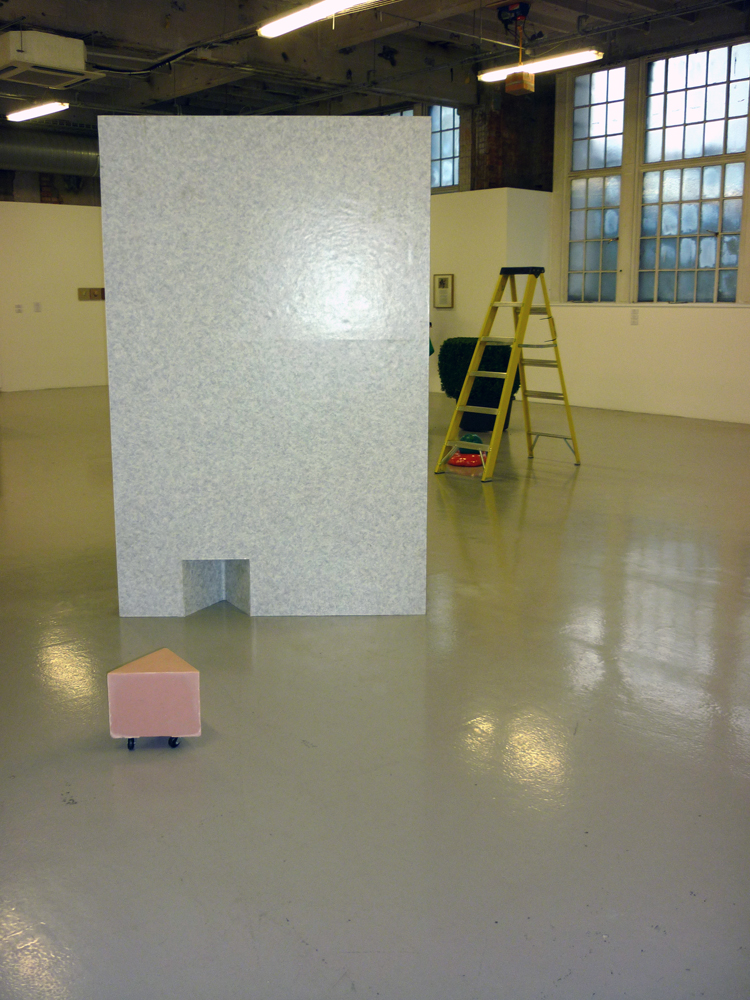
New neighbours to the RCA, Dark Matter Studios is a workshop and gallery space opened by Zoe Dorelli and Dan Faine that both shows, edits and produces prints.

The opening show in this new space featured Leon Chew and Andrew Curtis (an alumni from RCA Printmaking) collaborating in ‘post industrial aesthetics’.

Concrete and discarded objects are given a wonderfully light touch in photographs which celebrate the surface textures, and architectural lines creating beautiful sculptures and narratives from things that might usually be overlooked.

Leon Chew and Andrew Curtis

Leon Chew and Andrew Curtis

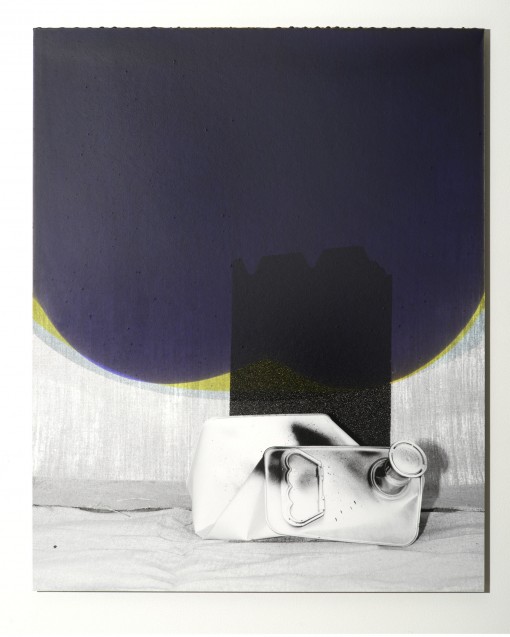
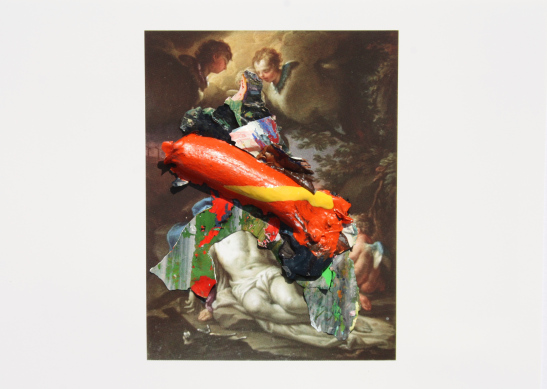
Left over printing inks are poured and allowed to spread across the image giving a glow of warmth and new life.

Leon Chew and Andrew Curtis

Leon Chew and Andrew Curtis

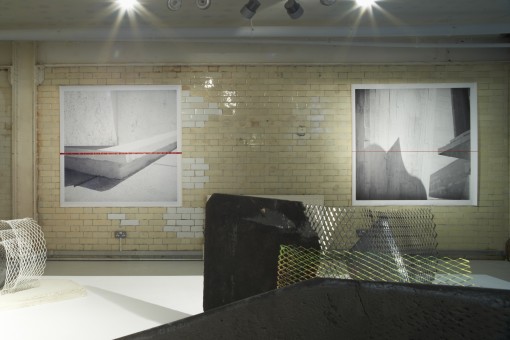
The large scale monochrome photographs shown were taken at Le Corbusier’s Unité d’habitation of the rough cast concrete surfaces employed in this modernist utopia.

Leon Chew and Andrew Curtis

Leon Chew and Andrew Curtis

There is a dramatic blood red line that runs horizontally through each monochromatic image.

( the colour for a reason and the line for a reason I have forgotten.)

A laser level was used to mark a line around the gallery walls once the work had been hung and then the line was hand painted on so that it slices through each photograph at precisely the same height.

Leon Chew and Andrew Curtis

Leon Chew and Andrew Curtis

It’s looking close up at the materials that go into the structure that create the spectacle.

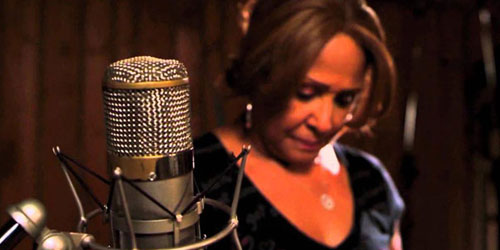
Twenty Feet From Stardom directed by Morgan Neville is a film with a similar principle. The backing singers that were the backbone of the Motown revolution have never been acknowledged for their talents until now.

The voices we thought we were hearing on the most famous popular songs were very often not the big stars but the unnamed session singer.

Finally their story (well a few of them) is told in this really moving film and it is astonishing how they were treated. Their soulful voices were used yet the soul of the person inside was ignored.

Twenty Feet From Stardom

Twenty Feet From Stardom

The good news is they are back on stage, there is going to be a soundtrack album released and next year possibly even a tour which would be amazing.

These ladies took their treatment on the chin but in another festival release the unsung hero took his revenge when he felt undervalued. The film 11.6 tells the true story of security van driver Tony Musulin who executed an 11.6 million euro heist to humiliate his boss. This story isn’t over yet.

11.6

These people working behind the scenes make me think about ownership and authenticity.

Ideas explored in the exhibition at the British Museum earlier this year ‘The Tomb of the Unknown Craftsman’

‘… a memorial to all the anonymous craftsmen that over the centuries have fashioned the manmade wonders of the world… The craftsman’s anonymity I find especially resonant in an age of the celebrity artist.”  Grayson Perry

Incidence

Incidence

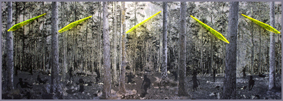
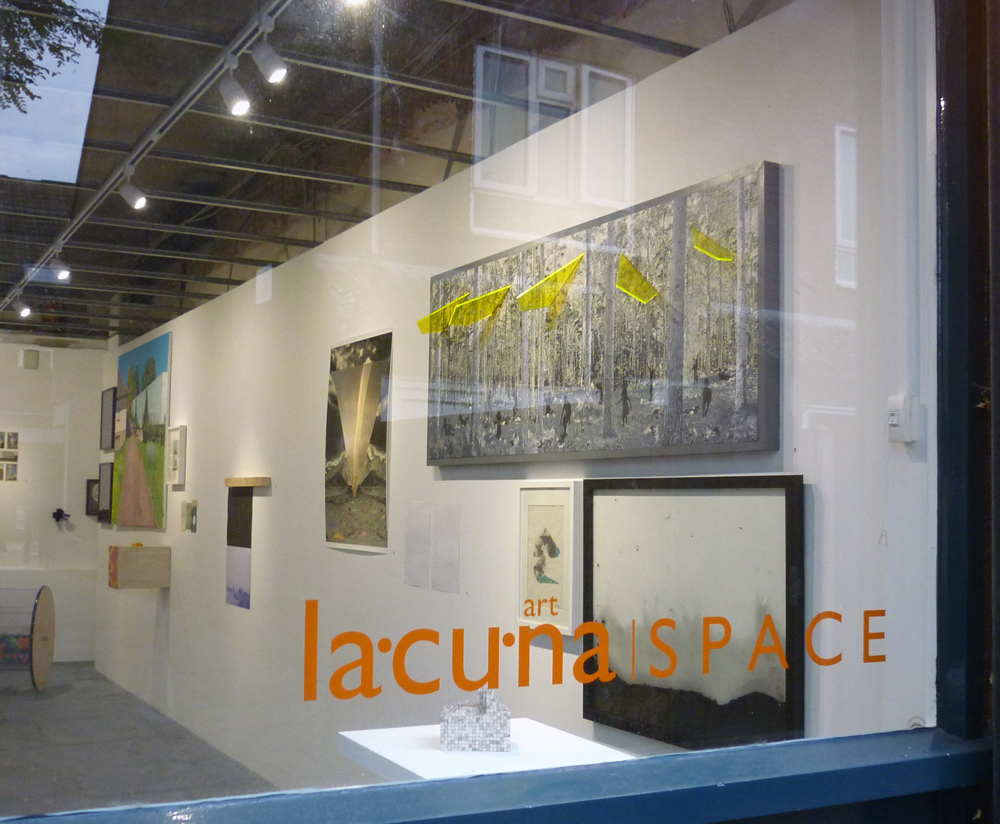
Delighted to have my work ‘Incidence’ selected for the ArtLacuna Prize.

The selection panel included Julia Alvarez, Sonia Boyce and Jamie Shovlin so that made it even more special to be included.

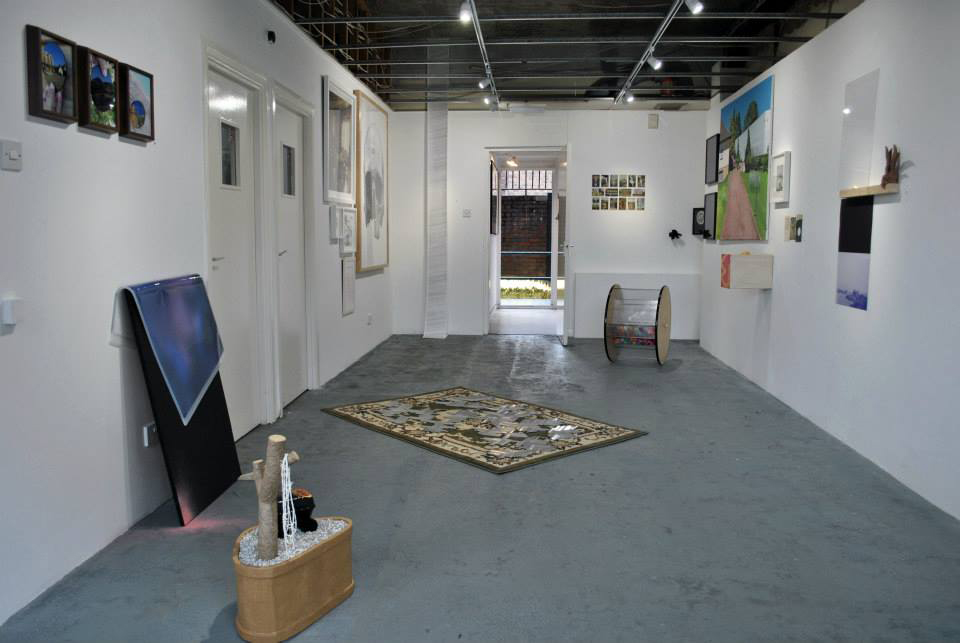
ArtLacuna is an artist collective space set up by Wimbledon College of Art MA alumni.

The lacuna, or lexical gap, represents a gap in translation, a place where multiple meanings are applied, where meanings shift and new interpretations can be made.

ArtLacuna Prize Exhibition

Great spot by the window. Also next to Jess Littlewood’s work which I am a big fan of.

ArtLacuna Prize Exhibition

ArtLacuna Prize Exhibition

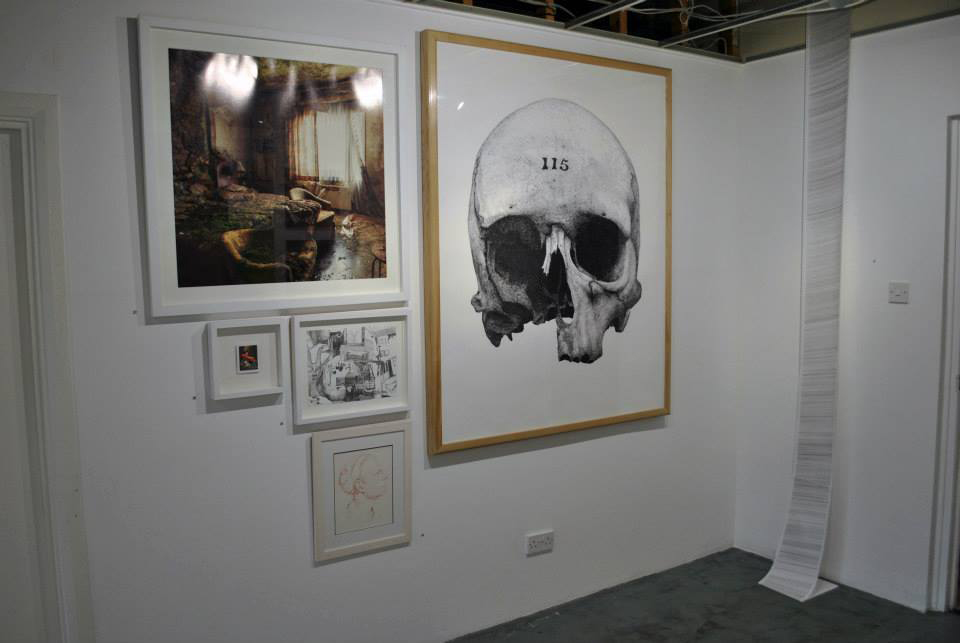
Nice to meet up with old friends from previous exhibitions together – one of Euan G, Stewart’ s giant skulls here and also one of Hannah Williamson’s delicious tiny paintings.

ArtLacuna Prize exhibition

ArtLacuna Prize exhibition

The photograph ‘Moss’ is by Gina Soden who I recently saw in Natural Selection at the Fine Art Contemporary Society.

Hannah Williamson Pieta

Hannah Williamson Pieta

Loved this static projection by Laura Marker.

Laura Marker 'The Order of Things'

Laura Marker ‘The Order of Things’

Another favourite was the installation of 16 postcards by Holly Stevenson.

Holly Stevenson 'Naturally we are all going to have a palmy time'

Holly Stevenson ‘Naturally We Are All Going To Have A Palmy Time’

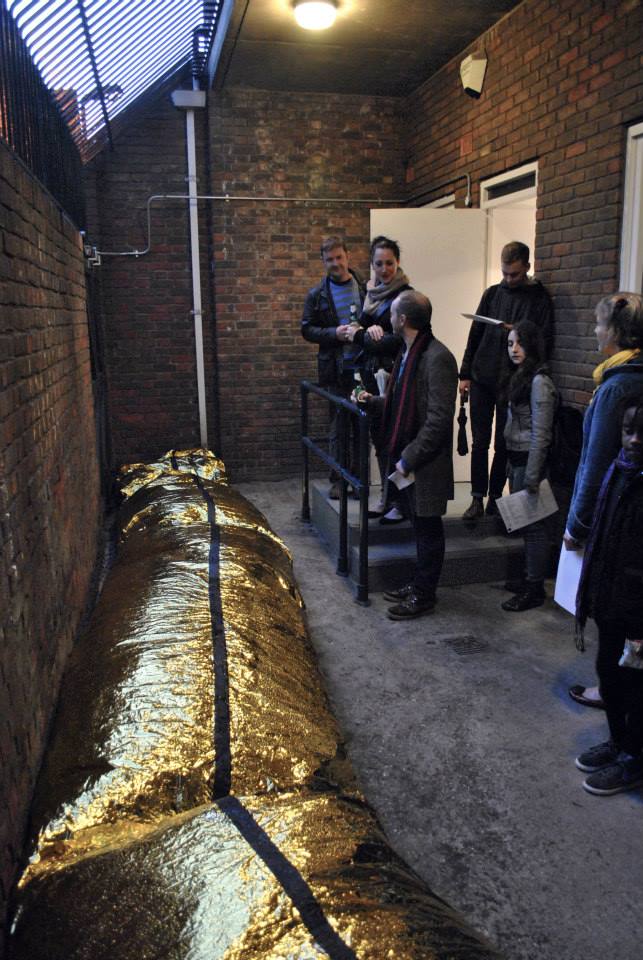
Tracey Payne’s installation in the back yard caused a lot of interest as it inflated and deflated (in the rain).

Tracey Payne 'Wishful Thinking (Falcon Road)'

Tracey Payne ‘Wishful Thinking (Falcon Road)’

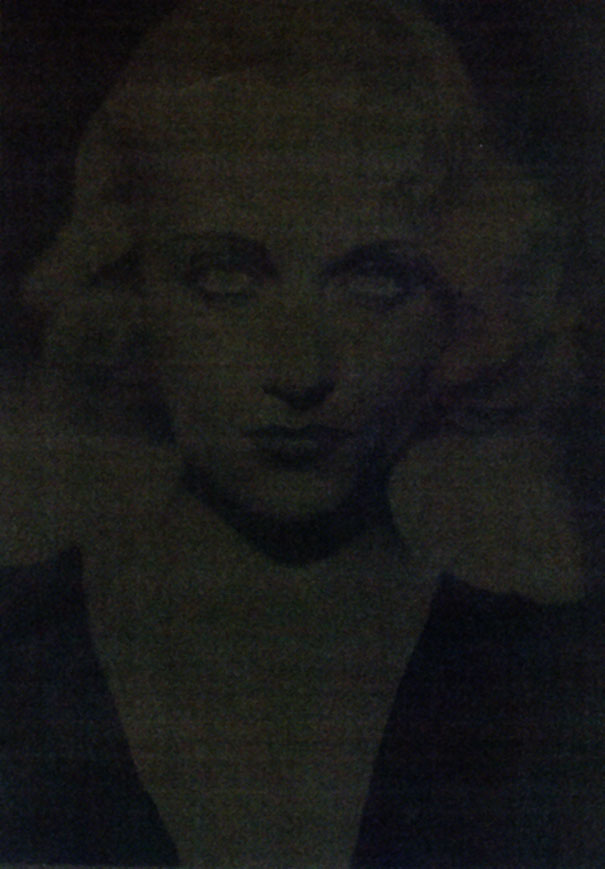
A familiar face from SHOW 2013 – Nicola Thomas had a couple of her black on black etched prints here.

A new graduate from the RCA Printmaking course, was really nice to meet her.

Nicola Thomas - Carole #3 etched print

Nicola Thomas – Carole #3
etched print

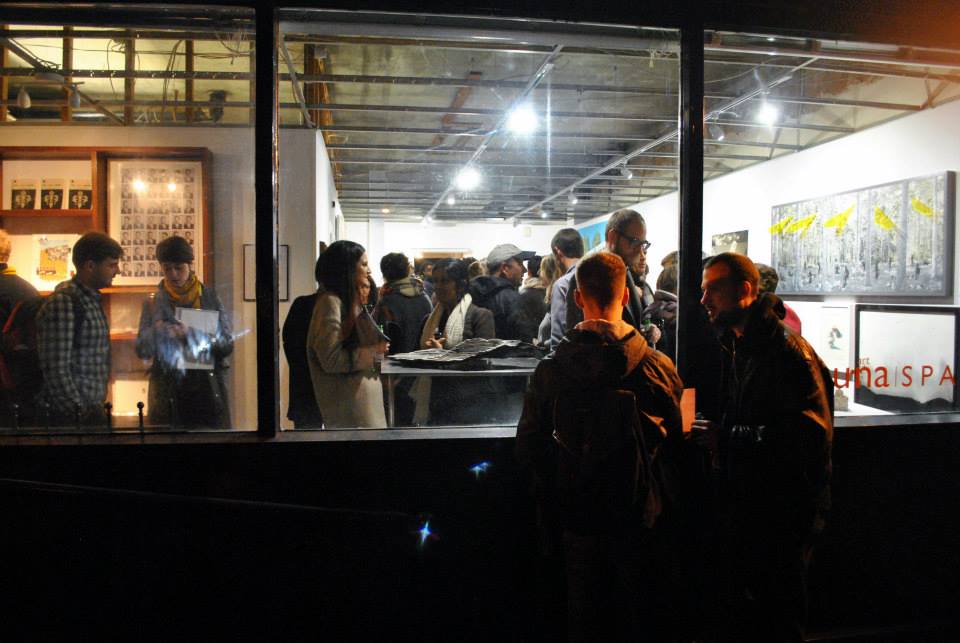
The Private View was really busy despite the awful weather and hidden gallery location.

ArtLacuna Private View

ArtLacuna Private View

1310 ArtLacuna PV 2

After a couple of hours the announcement was finally made for the winner of the residency and solo show.

1310 ArtLacuna announcement

Congratulations to Noemi Niederhauser who’s work appeared quite a quiet participant of the show, looking at her website I think she will put on a really interesting exhibition.

Prize Winner Noemi Niederhauser 'A sense of place'

Prize Winner Noemi Niederhauser ‘A sense of place’

I have had a fabulous three weeks of inductions at the RCA. This was all about learning processes, getting to know the technicians and finding our way around the workshops.

1310 Inductions

First week was screenprinting.

Screenprinting

Screenprinting

Then a week of etching.

Etching

Etching

Followed by a week of lithography.

Lithography

Lithography

The technicians are amazing, approachable and enthusiastic, we couldn’t have asked for a better team to support us.

As the indomitable Alan Smith summed up – it was all about the transference of knowledge.

There was a lot of knowledge to transfer.

So we have had a feast laid out before us and now we must eat as much as we can before it is all taken away again.

Moving into my new space at the RCA. There was some swapping and shuffling around. The second years had had first dibs at the studio spaces and then the tutors stuck post it notes with our first year names over the remaining desks. Like wedding guests we searched for our place  and eyed up our immediate neighbours. Had we been placed in proximity for a reason?

1310 susan eyre

Our little walking tour around the Tate Modern area ended up with a visit to see the ‘New Graduates’ exhibition at the Embassy Tea Gallery.

Victoria Arney and Marianne Keating are the winners of the Bainbridge Print Award 2013 for the excellence of work they displayed at their University post-graduate shows.

They both gave a talk.

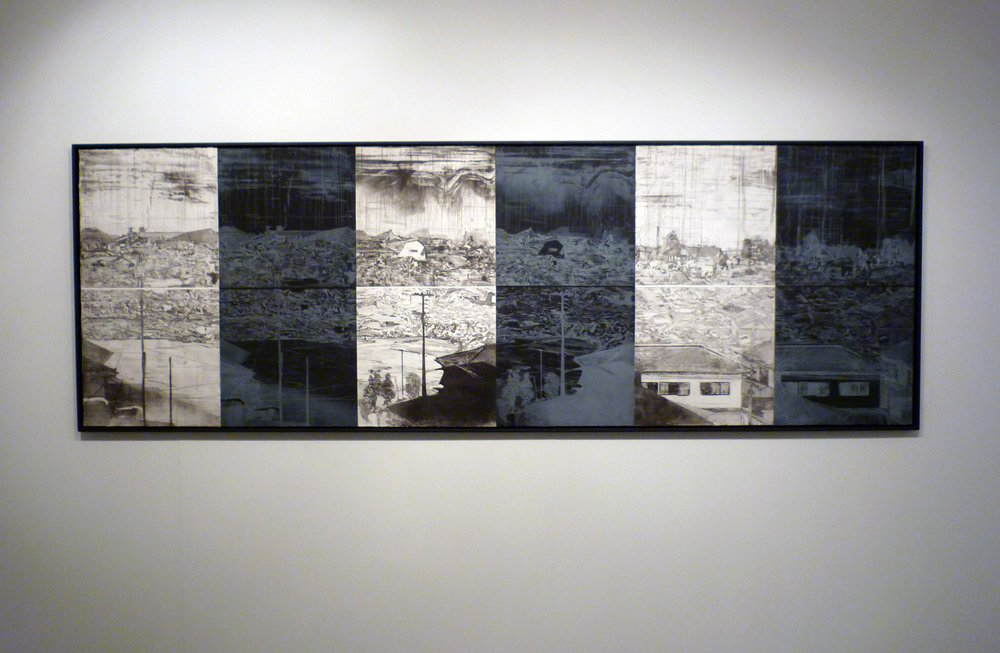
Victoria Arney is interested in ruins.

Victoria Arney 'Boundary'

Victoria Arney ‘Boundary’

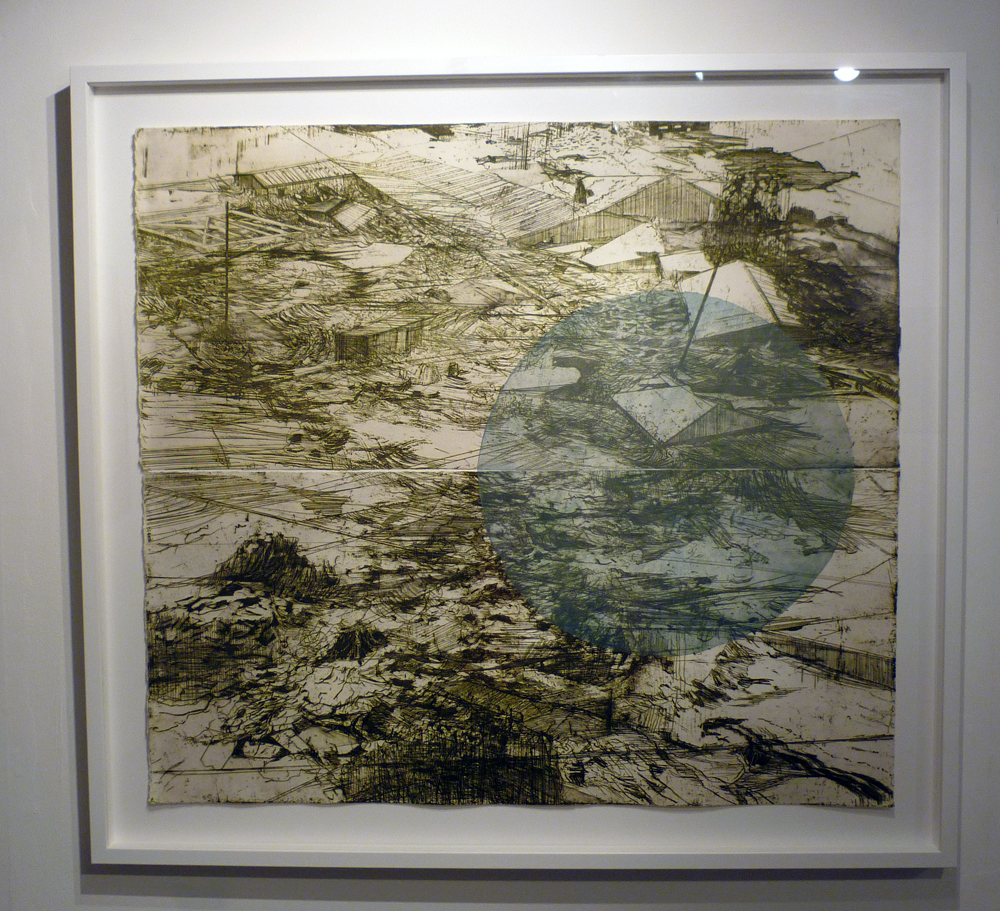
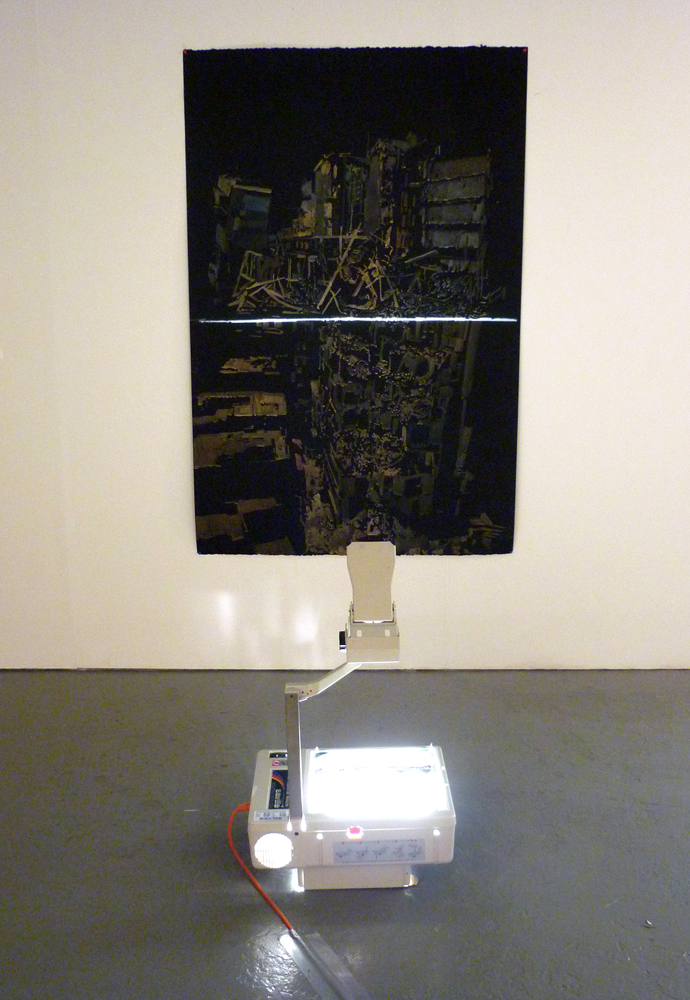
She photographs emotionally moving images of natural disasters on the TV news. She then uses these images of destruction for her hand drawn etchings.

Victoria Arney 200,000

Victoria Arney ‘200,000’

Victoria Arney Lacuna

Victoria Arney ‘Lacuna’

She achieves a 3D effect in her work using chine colle over her etching which is slightly offset. This mis-registration gives the impression of movement – that the dust is still settling on the final judders of collapse.

Victoria Arney

Victoria Arney

Marianne Keating also deals with moving emotions, asking the public to confess their secrets, these moving words are then projected, physically moving around the gallery walls.

Marianne Keating

Marianne Keating

She collects anonymous responses to questions like ‘What do you do that causes you to blame yourself?’

‘What have you confided to a friend that you haven’t confided to your lover?’

There is a lot of regret in the responses she has obtained.

Marianne Keating

Marianne Keating

While at Tate Modern I had a look at  the Saloua Raouda Choucair exhibition.

I watched the short video about her life and work on the Tate website and admired her focus and passion for her art, to keep making work despite the political upheaval and destruction going on around her in Beirut during the 1980’s. Like the lines she explored in her work she kept to her path and followed her own trajectory.

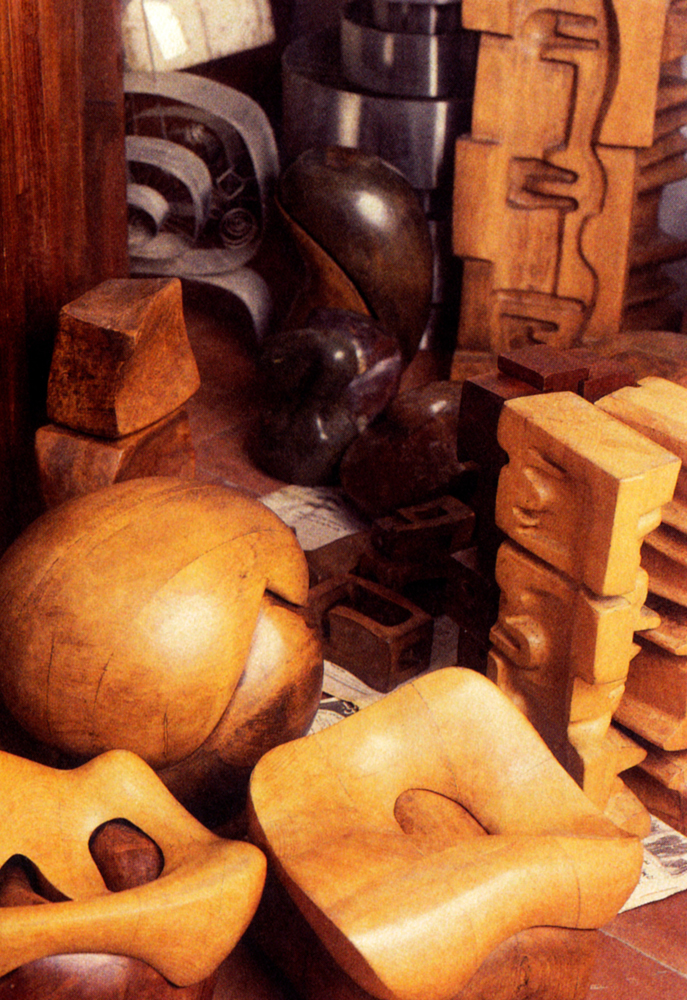
I like her architecturally inspired sculpture and the rich wooden interlocking pieces.

Saloua Raouda Choucair

Saloua Raouda Choucair

Some of the surfaces could be woodblocks and make interesting prints.

They look good together here, better than in the gallery space where they are placed in a clinical row along a shelf.

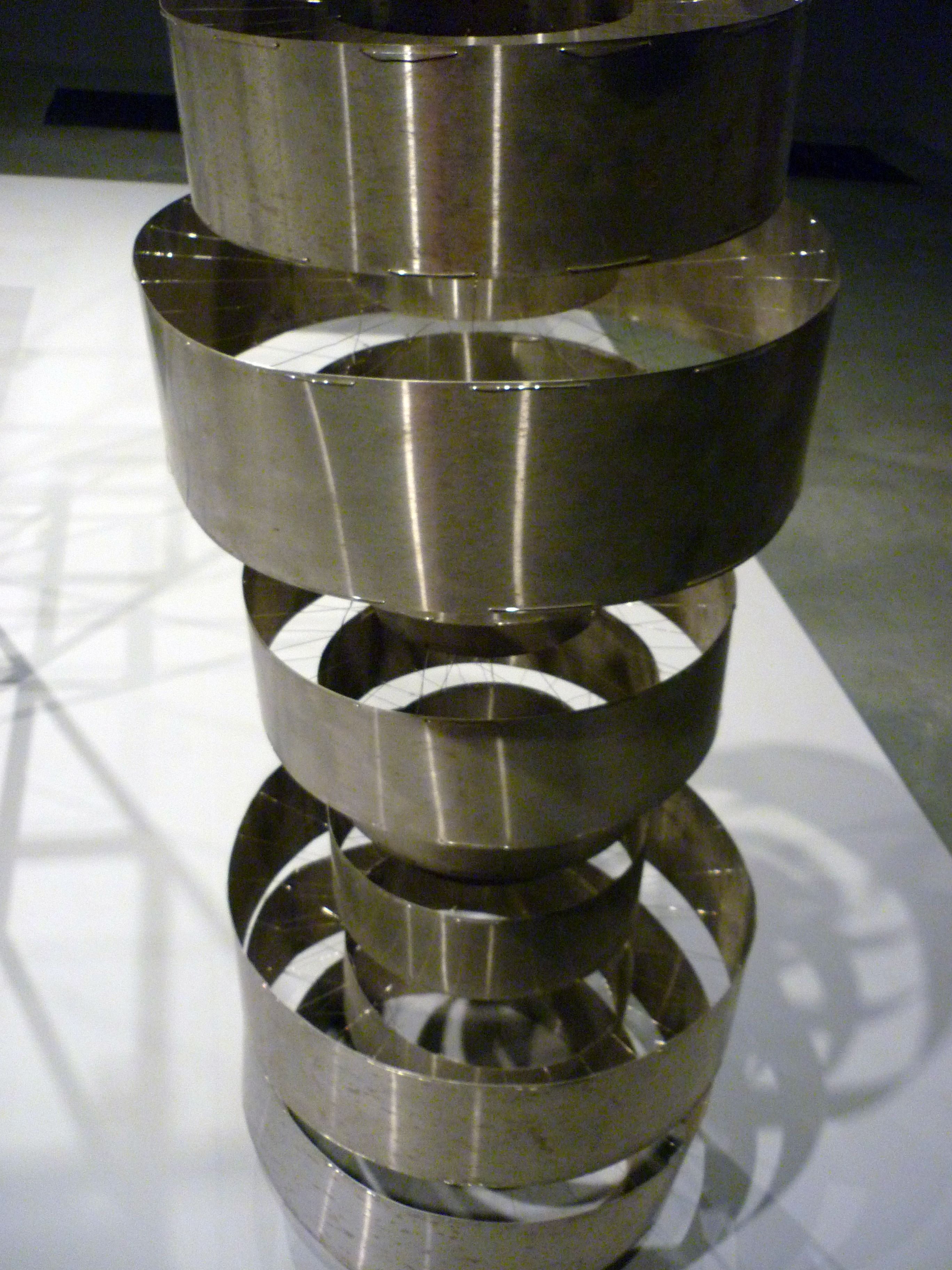
Saloua Raouda Choucair

Saloua Raouda Choucair

Her use of monofilament as a support mechanism was interesting in her metal, plastic and fibreglass pieces.

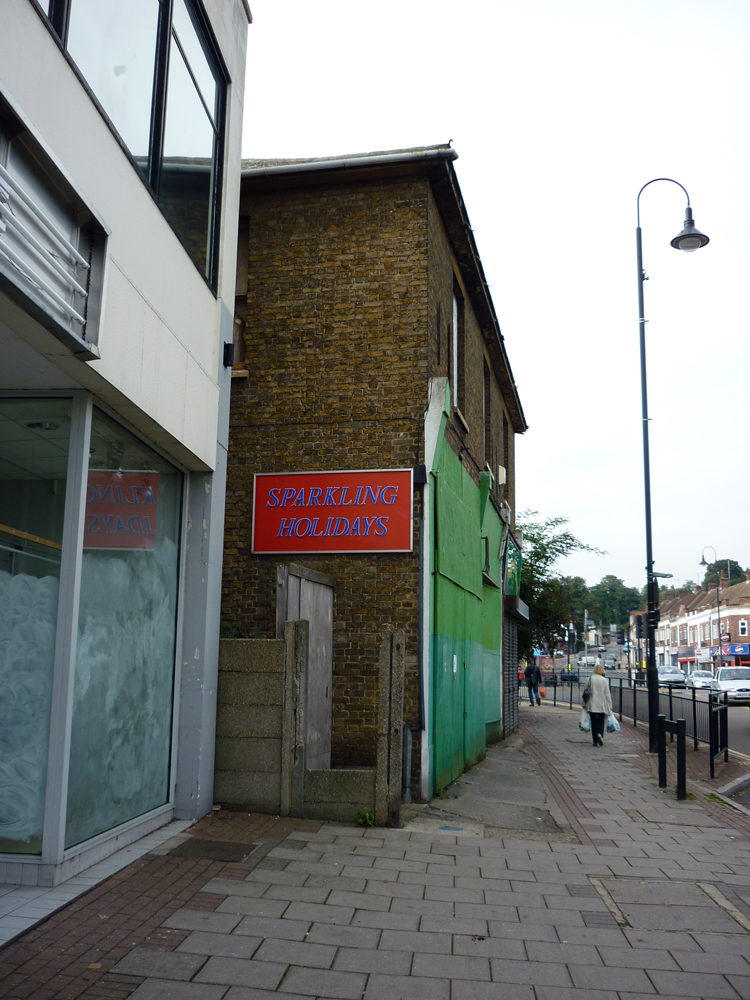
When I was last in Crayford picking up my sublimation prints from Promptside I noticed an incongruous sign I hadn’t seen or maybe paid attention to before.

Sparkling Holidays were offered – though the building was less than sparkling, it was boarded up.

It was intriguing because it had no contact details. A bit Bob & Roberta Smith. Was this an art installation?

1310 Sparkling

Well it just took a google when I got home to discover the company Sparkling Holidays based in Crayford do seem to offer a holiday experience.


Sparkling Holidays is your helper to ensure – home away from home!

 
Our friendly and helpful staff will make sure you have a comfortable and enjoyable trip.  This is our passion, and it’s our mission to help you enjoy your holidays and travel too!

Customer Reviews

Peter ensured our short break to  Wales went without complications and all our concerns about Disabled access for my friend was sorted without the usual headaches – it was so perfect we extended by another 3 days ” — Lee, Dartford

The staff are so helpful, I know that they will find the perfect holiday for me, they also told me what I needed to do to make my last Cruise go so smoothly . I will book with them again.” — Josephine, Bexleyheath

In search of aspirational landscapes.

Danson House – an amazing setting for ‘Couriers of Taste’ curated by Day + Gluckman.

Danson House

Danson House

‘Couriers of Taste’ explores trade routes, global consumerism and cross-cultural influences. Danson House was built for leisure and decadence but that lifestyle was supported by a dark history in colonial exploitation.

The works shown are by artists who are interested in how the history of trade and cultural appropriation influences our understanding of the world today.

The fascination with the East dates back to the days of the China export trade and Silk Road. Even at the height of chinoiserie, as the Western market was being flooded with Chinese products the Chinese people themselves were unwelcome aliens and were targeted overseas by racist laws.

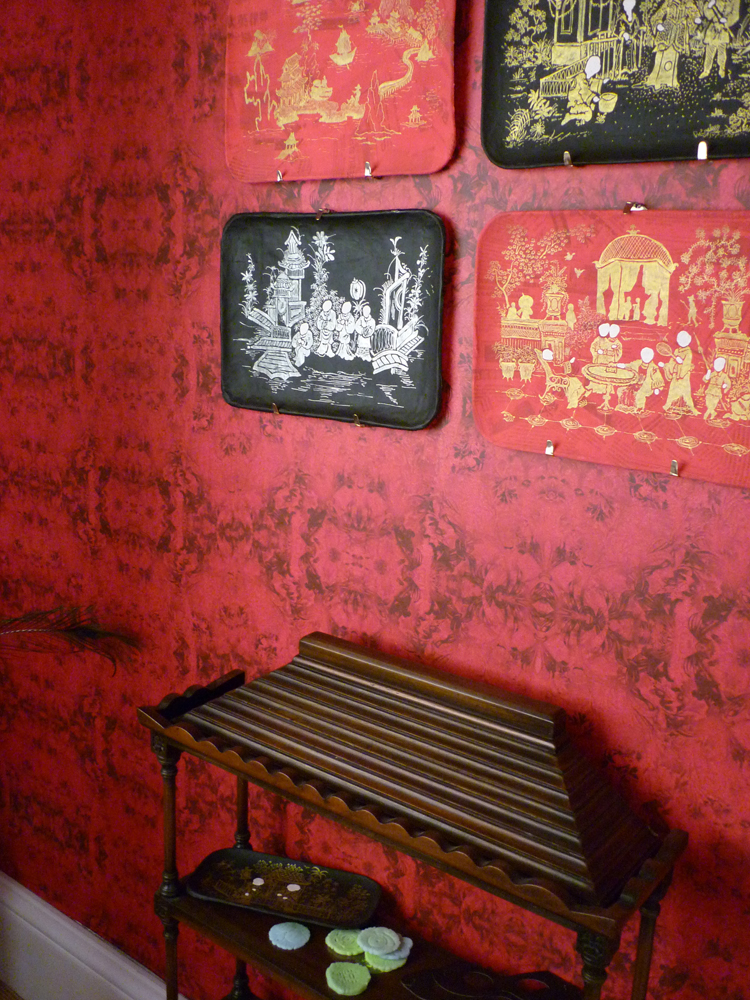
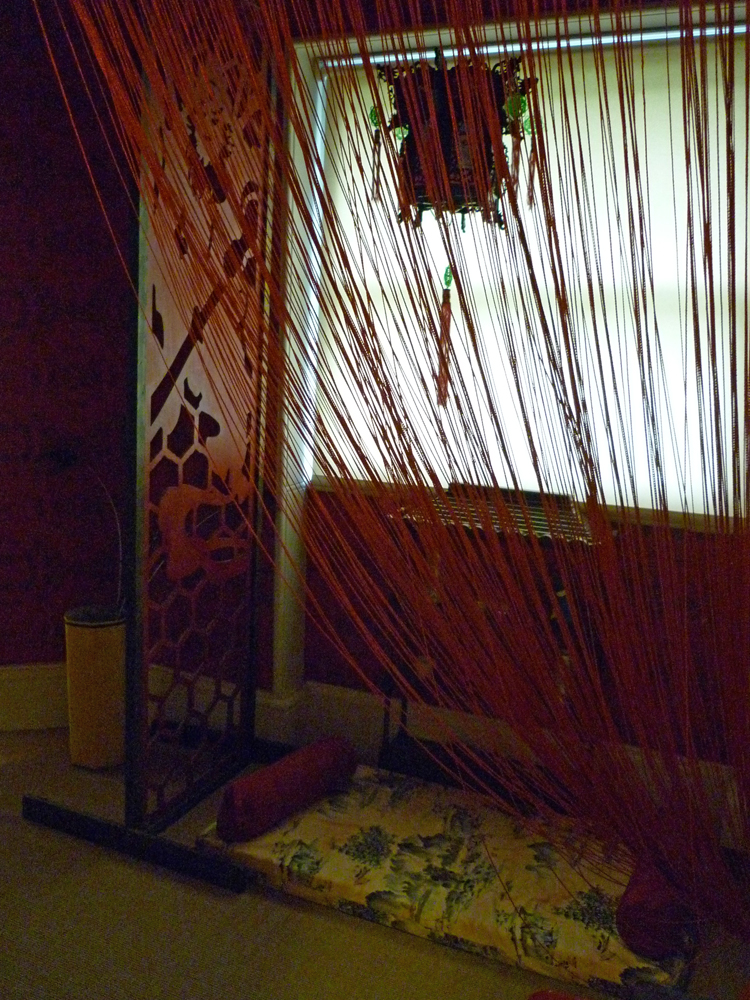
Karen Tam’s work looks at the infiltration of chinoiserie, and the continuing, conflicted relationships between “East” and “West”.

Karen Tam's recreation of an opium den

Karen Tam’s recreation of an opium den

Karen Tam believes the fear of China’s rising status as a superpower, its economic strength, position as the world’s manufacturer, and host of the 2008 Olympics is causing a current recurrence of racist attitudes towards Chinese people today.

Karen Tam's recreation of an opium den

Karen Tam’s recreation of an opium den

I think she is right that there is a lot of uncertainty around and this can fuel fears that might result in negative attitudes. The balance of economic power has shifted entirely since the term Oriental was first coined but China remains a mystery to most westerners. The fears we have are a lot to do with the messages we receive about life in China and its political system such as the treatment of Ai Wei Wei.

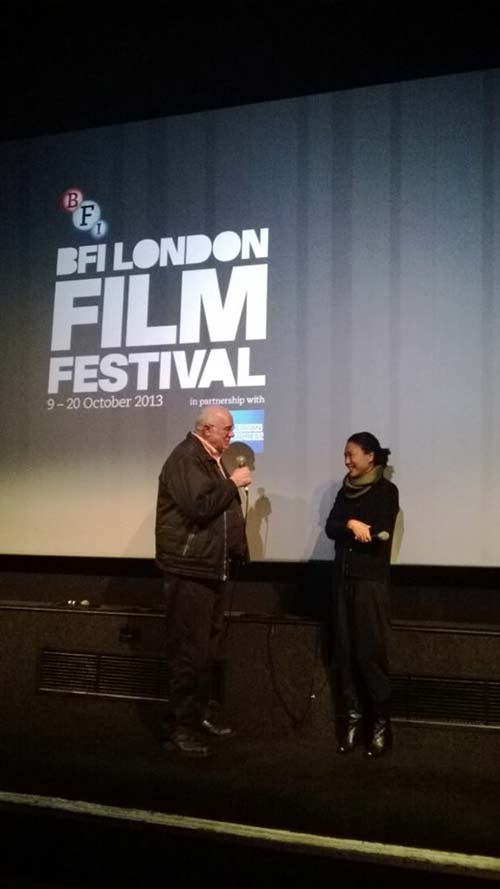
Vivien Qu

Vivien Qu

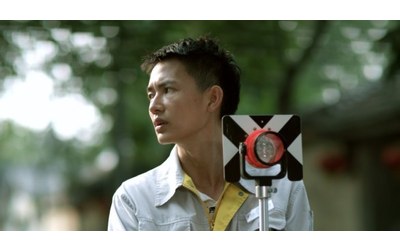
The film Trap Street an independent film directed by Vivien Qu showing at the London Film Festival about the authorities detaining and torturing innocent/naive people who’s lives can be suddenly destroyed with no recourse, not that this doesn’t happen in every other country up to a point, but Qu says these detentions in China are on the increase and the possibility to make independent films about such matters is declining. The reasons for this seem to be economic to some degree as Qu explained that investors now have the opportunity to make big money in commercial films so there is less for the small independent companies. As to the increase in detentions could this be down to more technology, more surveillance, more paranoia.

Trap Street

Trap Street

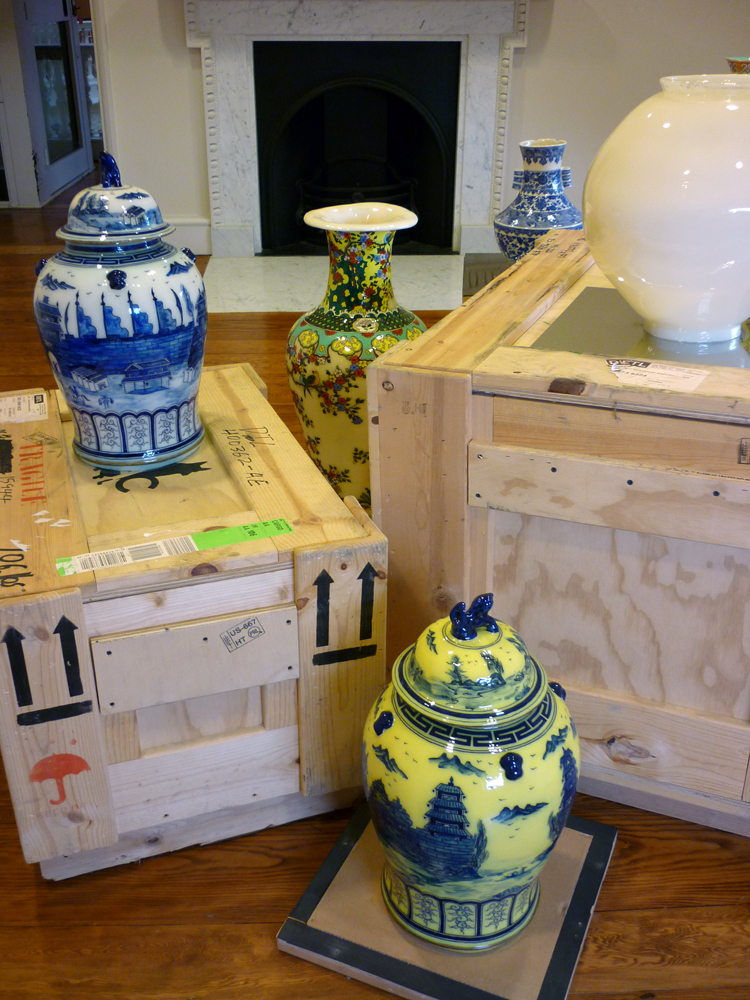
Meekyoung Shin copies Chinese porcelain vases. She transplants a foreign cultural tradition not only geographically from east to west but also in terms of media (from marble or porcelain to soap).

Meekyoung Shin Translation

Meekyoung Shin Translation

Shin’s use of soap, a transient and unstable material, questions the authority and originality that the original vases demand. Presenting the vases on the packing crates in which they are shipped from location to location, further emphasizes the sense of dislocation and transformation.

Like most 18th century houses Danson House would have housed ceramics and possibly wall papers from China, and would almost certainly have housed furniture and collectible items which borrowed chinoiserie elements.

Meekyoung Shin Translation

Meekyoung Shin Translation

In the 18th century new goods from around the world were influencing consumption, tea, coffee, sugar, tobacco, spices, cottons and silks, changing the habits and fashions of society.

Stephanie Douet is interested in chinoiserie as the birth of leisure in Europe.

Stephanie Douet

Stephanie Douet

The fractured, fictional, idyllic life of the aristocracy in Europe imitating China is explored in Douet’s sculptures. She sees a similar distance in Europe’s understanding of the country today and a continuation of trade and misunderstanding from that of the seventeenth and eighteenth century.

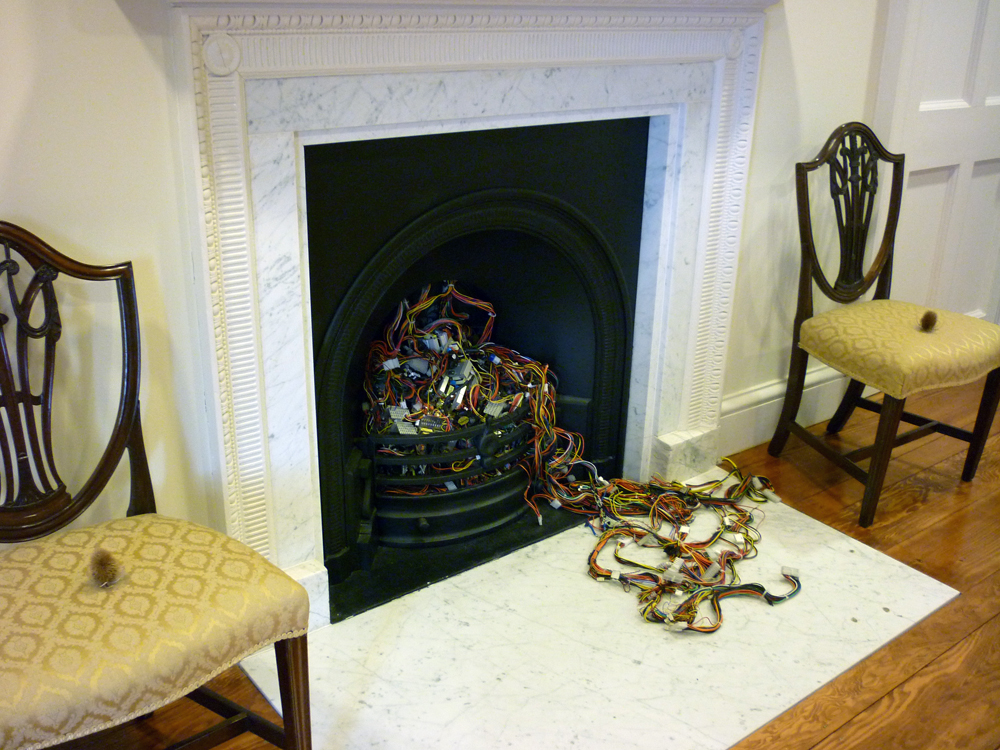
Rapid growth in contemporary hi-tech consumerism and global manufacture is epitomised by Susan Stockwell’s installation of computer cables tumbling down through an antique Western fireplace.

Susan Stockwell

Susan Stockwell ‘Firewire’

Our reliance on technology and the huge impact that online shopping has had on production and global trade creeps into the imaginary trader’s bedroom at Danson House and begins to encroach on every aspect of his world.

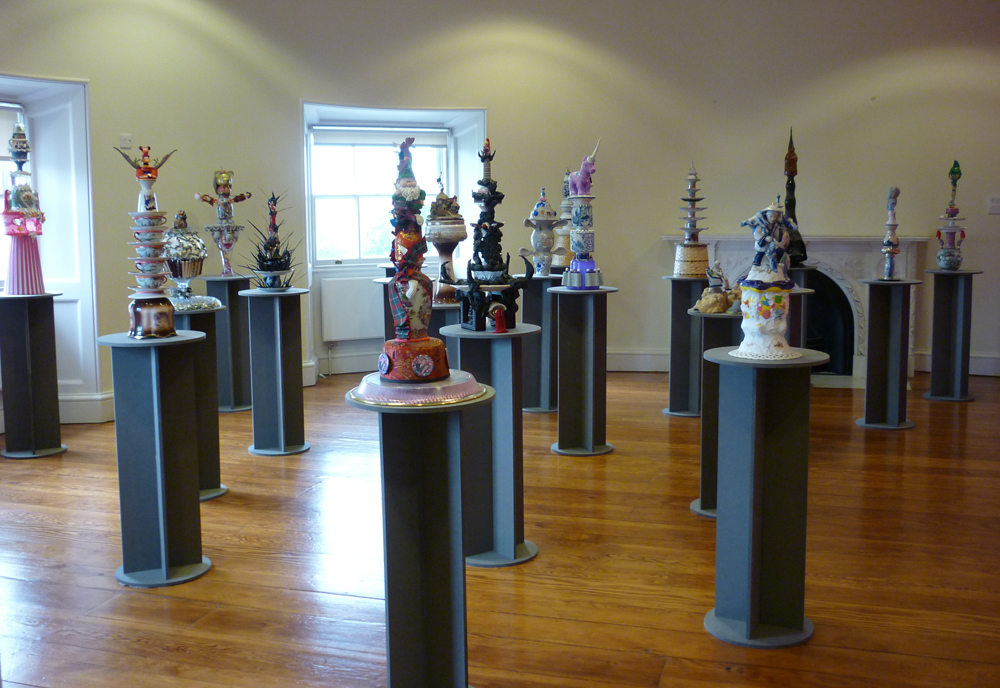
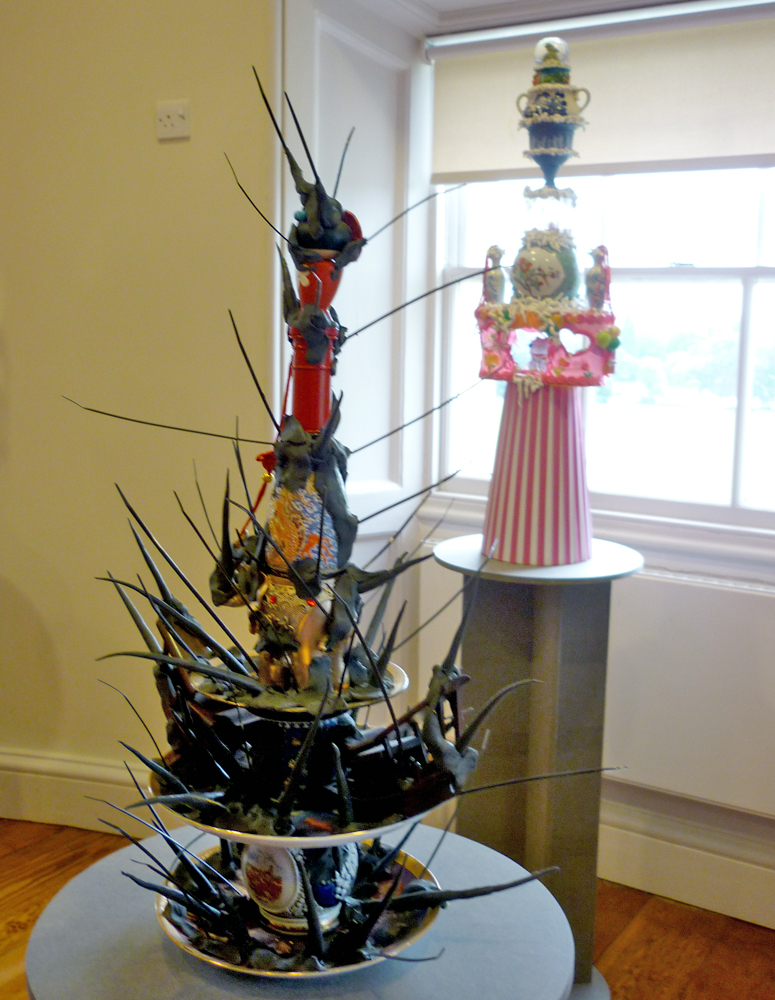
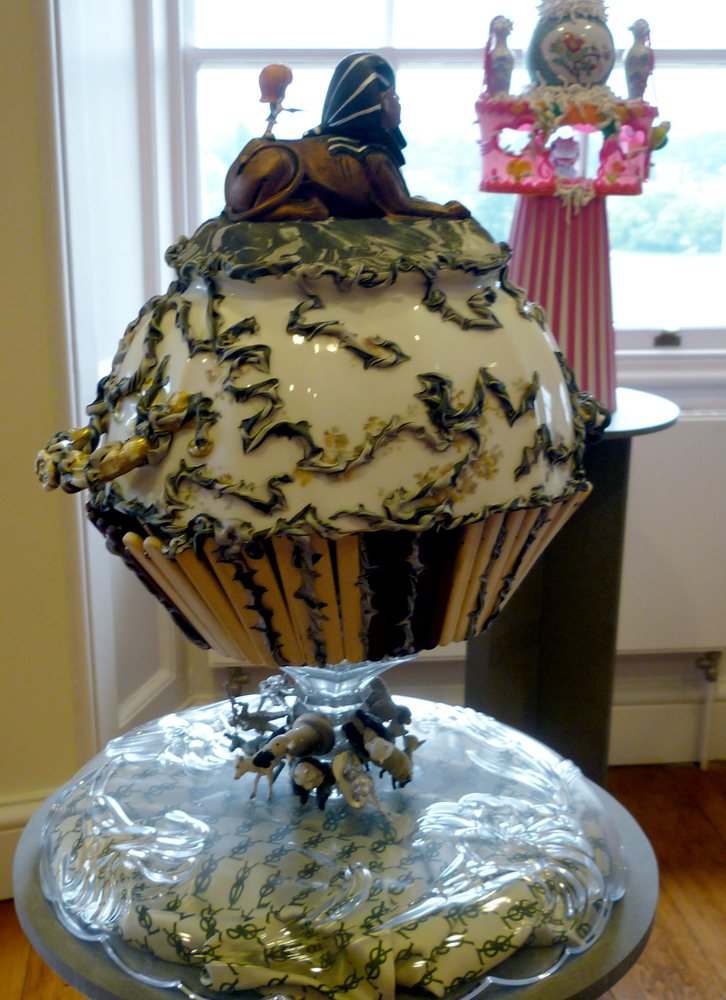
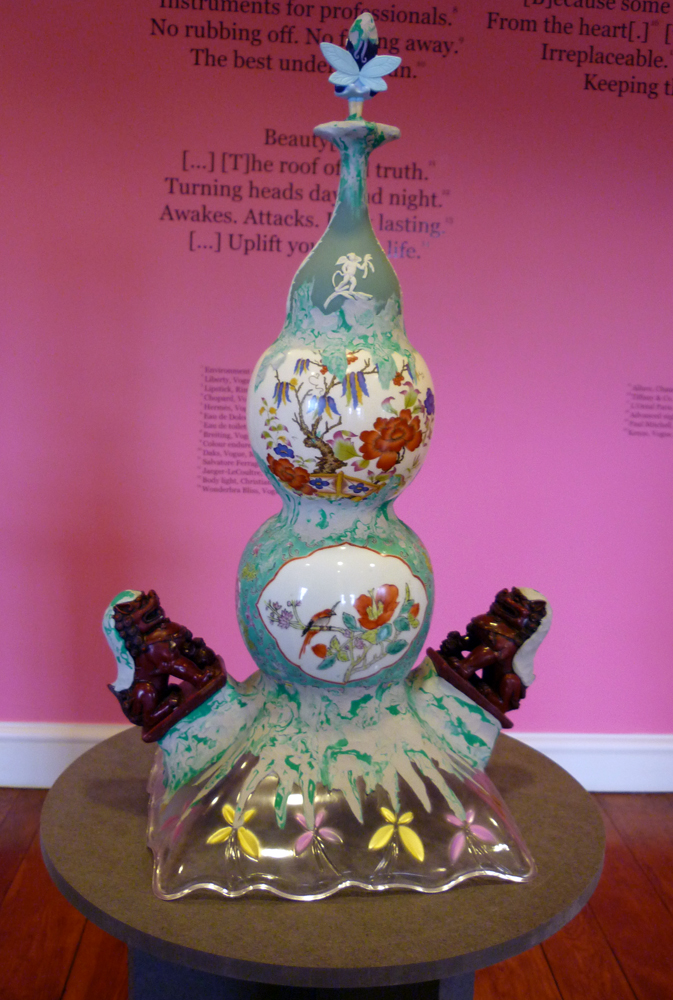
The spectacle of Laura White’s ‘Esque Collection’ of sculptures pulls together ideas of hybridity, the pagoda dotted landscape, porcelain ware, shop display stands and the seduction of opulence.

Laura White

Laura White

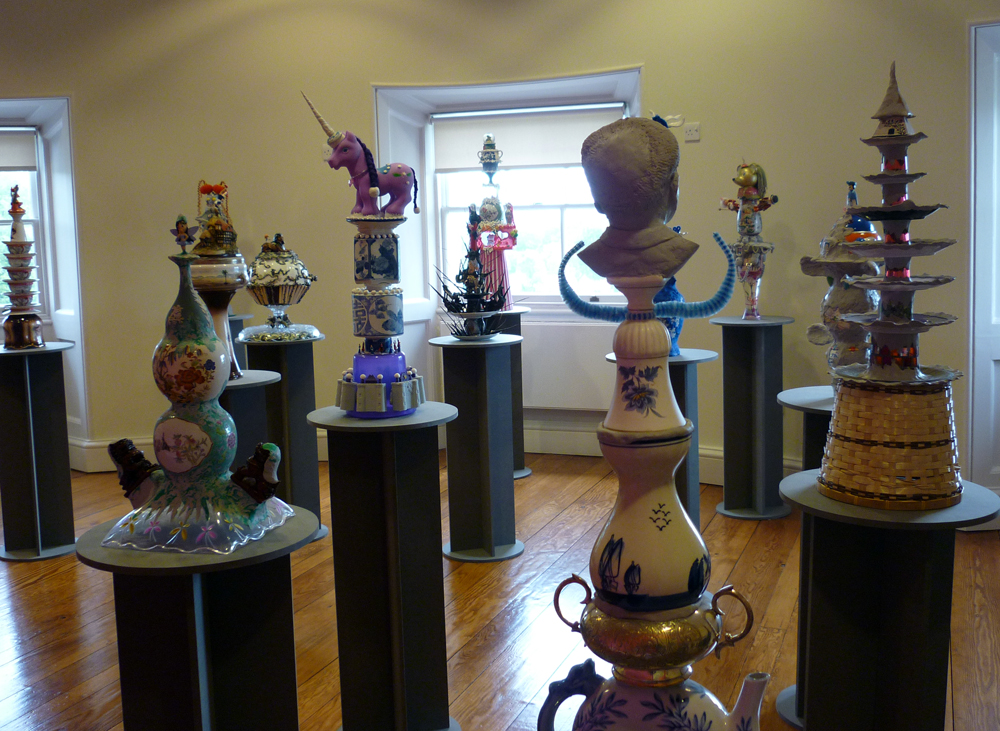
These look magnificent highly prized items but close up it is apparent they are constructed from the back self of a charity shop and held together with plasticine.

Laura White

Laura White

They are confections.

Laura White

Laura White

Little towers to consumerism.

Laura White

Laura White

I found them joyful. They have a happy Frankenstein quality.

Laura White

Laura White

A tangle of origins melded together to create something new.

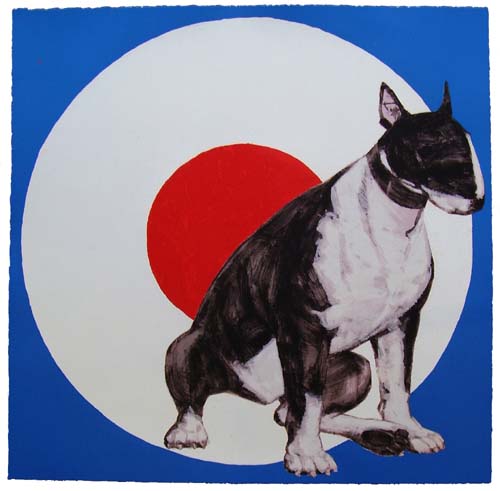
Ray Richardson is an artist whose roots in East London are very important to him. His work features his local landscape, his friends and family and a lot of dogs.

Ray Richardson

Ray Richardson

English bull terrier dogs who he sees as representing himself.

Ray Richardson Irish Frank

Ray Richardson Irish Frank

At his talk at Ochre Print Studio he told us about the local characters in his life and how his love of soul music and football influences his work.

It was hard to imagine him teaching at a public school but he spent a year in residency at Eton College.

He had a very philosophical attitude to his experience and as he said he was paid.

As he was to do this commission.

Ray Richardson

Ray Richardson

A another clash of cultures.

I have just started reading A History of the World in Twelve Maps by Jerry Brotton.

Came across this wonderful quote in it from Oscar Wilde –

‘a map of the world that does not include Utopia is not even worth glancing at, for it leaves out the one country at which Humanity is always landing. And when Humanity lands there, it looks out, and seeing a better country, sets sail’.

Surveillance, voyeurism, participation and looking within oneself. The need for private space.

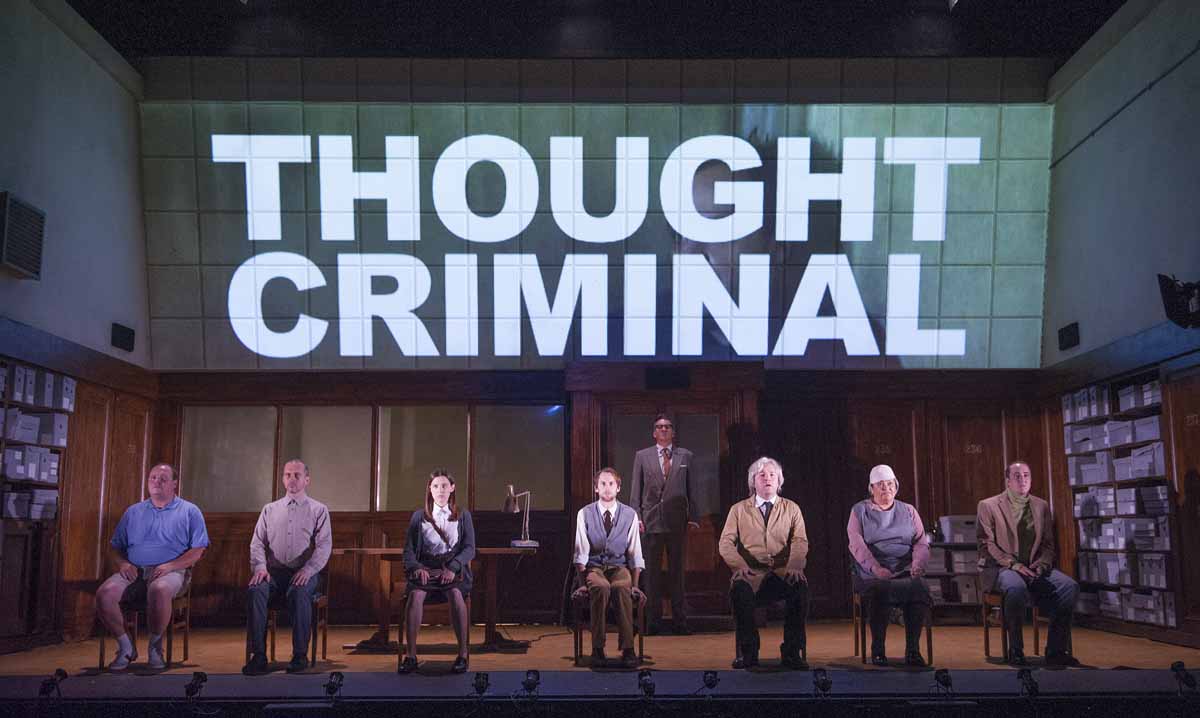
All of these ideas are encapsulated in George Orwell’s 1984 which I have recently seen interpreted by the brilliant and innovative Headlong Theatre Company.

Headlong Production of 1984

Headlong Production of 1984

This production explores the world inside Winston Smith’s head, as well as the world without, and catches the euphoria and bliss buried deep underneath the cold face of Big Brother. Headlong’s version explores why Orwell’s gaze is as relevant today as it ever was.

The series of short film screenings at Dilston Grove under the banner ‘Lawns and Hedges’ seemed very relevant to my interest in the manicured public space.

The programme was put together by Anna Gritz and Jennifer Teets as part of ‘Wendel! Open Your Door’ a Woodmill collaboration.

The films were chosen in relation to a text from the entry submitted by Lewis Masquerier in the 1858  competition to design Central Park.

‘To the Commissioners of Central Park:

I have planned purposely to effect a double object. Not only to give a pleasing landscape, but also an instructive one. For amusement and instruction combined, certainly intensify each other. I propose then to lay off the southern half of the park in a miniature representation of the continents of the earth.

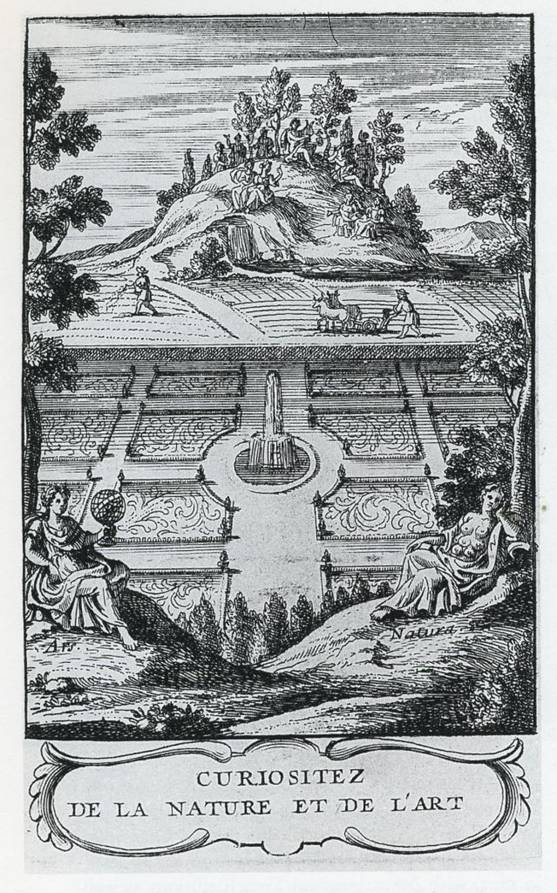
Unfortunately, no one would ever get the pleasure to stroll through Masquerier’s vision for Central Park, as Frederick Law Olmstead’s proposal would be the winning one. Yet nevertheless his vision for a landscape that would promise both pleasure and instruction is very much in line with the history of garden architecture.

Frontispiece to l'Abbé de Vallemont's Curiositez de la nature et de l'art (1705)

Frontispiece to l’Abbé de Vallemont’s Curiositez
de la nature et de l’art (1705)

From the gardens of the antiquity, to the French and English landscape gardens and the park designs of Frederick Law Olmsted and Walt Disney, nature has been used to choreograph our physical movements and emotional states.

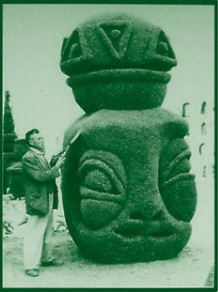
Azael José María Franco Guerrero and one of its 'living sculptures' in Tulcán Cemetery, Ecuador

Azael José María Franco Guerrero and one of its
‘living sculptures’ in Tulcán Cemetery, Ecuador

This screening looks at landscaping as a process of cultivation, one that creates sites suspended between exercised control and escapist diversion whilst offering the potential for political subversion.

Nature is featured here as a manicured stage set that guides and hosts the theatrics of the human condition. The environment is reconsidered not just as a dramatic backdrop that illustrates the psychological condition, but also as an active player in the sculpting of social unconscious. The individual films are entwined within a scroll of still vignettes, interlacing imagery and rhythm to mimic the peripatetic nature of human perception.

The screening opened with a rapid scroll through a selection of source material and images on the themes outlined in the programme.
I would have liked to have had longer to see each image and more information on the research undertaken as it looked extensive and fascinating.
The films shown were:
Julia Rometti and Victor Costales, Plantas Populares – Movimiento: Agitato, 2013, 14’56”
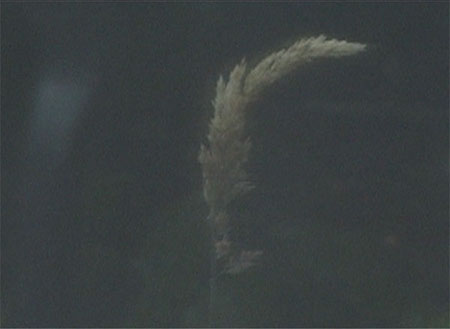
‘A film in black and white of tropical plants being agitated by the wind. These are ‘house plants’ seen in their natural habitat of the Amazon jungle.
Olga Chernysheva, Anonymous. Part 1 & 2, 2004, 19’
This is a film where a middle aged lady gradually plucks up the courage to change into her swimming costume in a public park.
It is sad in a way that she is obviously so self conscious yet ‘the public’ are oblivious to her trauma and exposure.
Deimantas Narkevicius, The Role of a Lifetime, 2003, 16′
Deimantas Narkevicius 'The Role of a Lifetime'

Deimantas Narkevicius ‘The Role of a Lifetime’

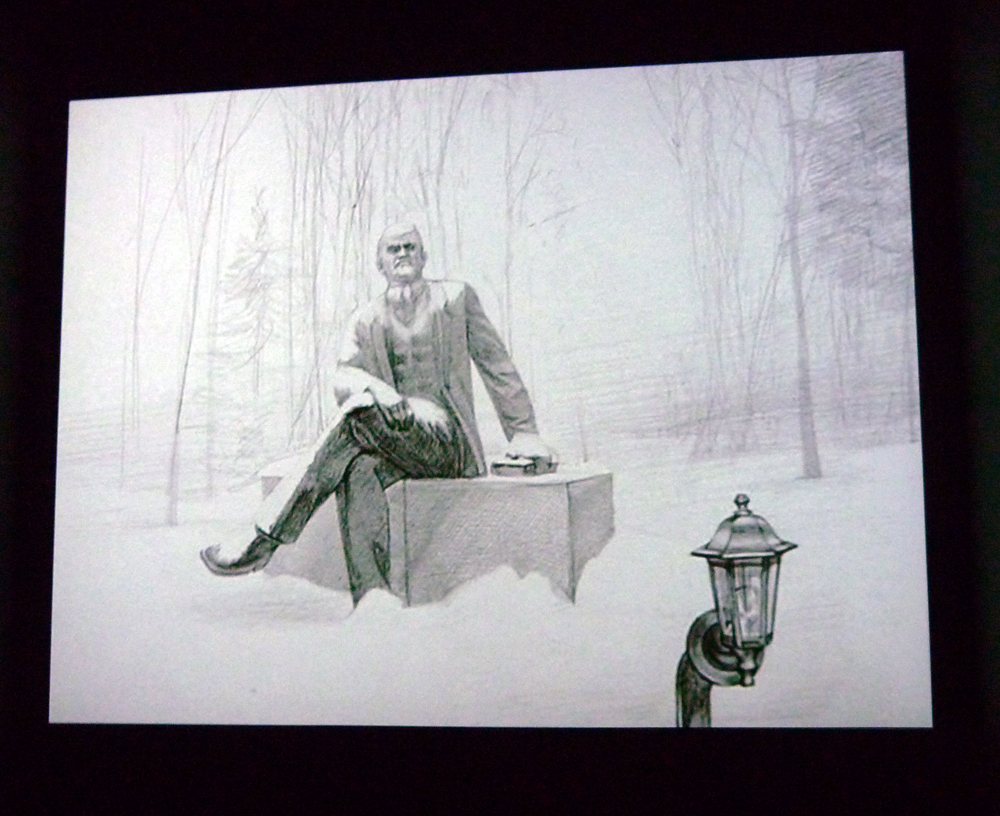
This film also on show at Tate Modern pans across a series of drawings from Gruto Park in Lithuania where a lot of old post war sculptures have been abandoned.

Should these murderers end their days in such arcadian settings. Filmmaker Peter Watkins adds a self reflective commentary on his personal creative journey.

Rosalind Nashashibi, Jack Straw’s Castle, 2009, 17’20”

Rosalind Nashashibi 'Jack Straw's Castle'

Rosalind Nashashibi ‘Jack Straw’s Castle’

Amy Granat, Landscape Film, 2009, 8’45”
TJ Wilcox, A Fair Tale (Extended Mix), 2006/2007 8’47”
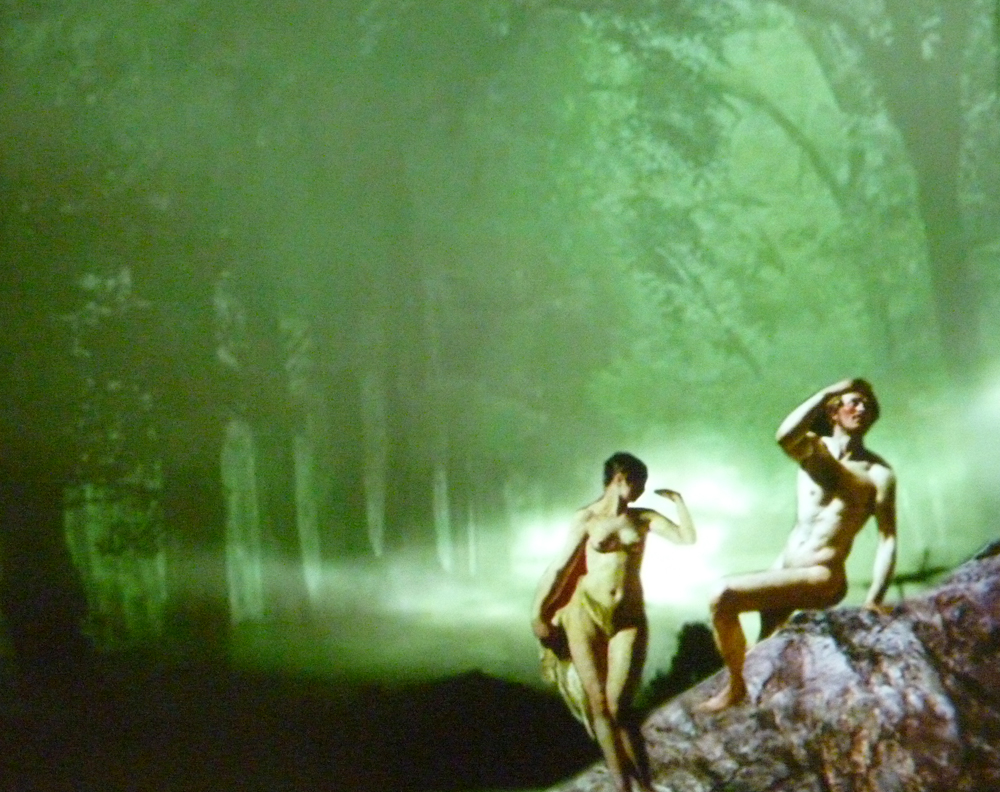
Jessica Warboys, La Fôret de Fontainbleau, 2010, 4′
The exhibition ‘Surveillance’ at Gimpel Fils  had work by Seamus Harahan and Christopher Stewart who create work about watching and being watched.
Seamus Harahan Torch extended

Seamus Harahan Torch (extended) video still

Seamus Harahan films human behaviour from a distance, giving little away as to what activity we are witnessing but holding our attention as we become the detective searching for clues.

The long lens perspective gives us the sense that we are witnessing a private moment of an unguarded subject of our gaze.

Christopher Stewart

Christopher Stewart ‘Germany’

This series of photographs from Christopher Stewart are loaded with tension. This is not idle waiting and watching, these are covert operations.

Christopher Stewart Insecurity

Christopher Stewart ‘Insecurity’

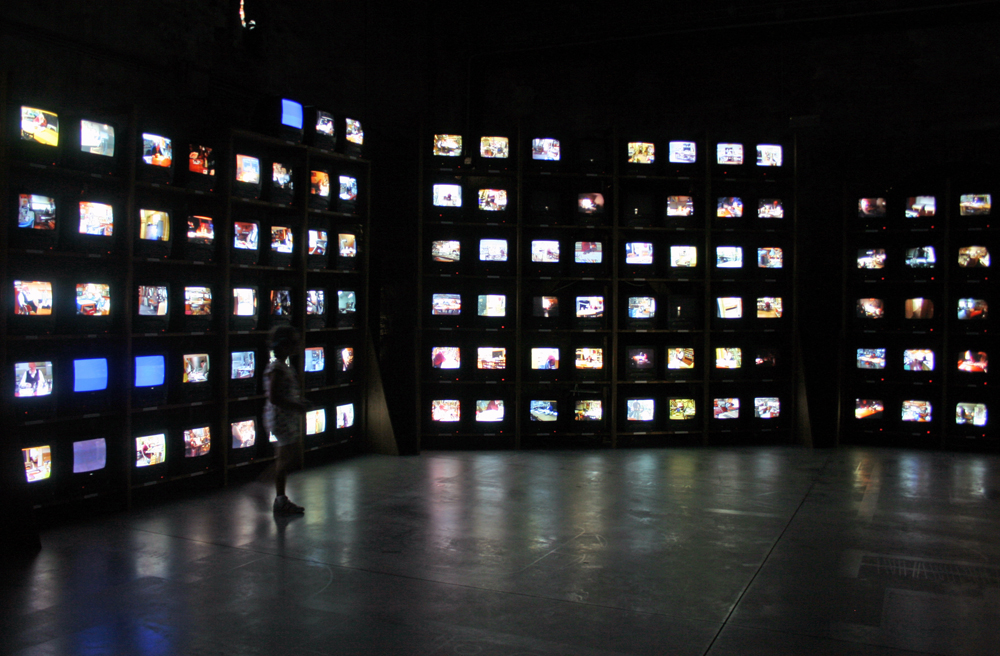
At the Venice Biennale Dieter Roth presented video surveillance as a sort of diary to record his everyday activities.

The minutiae of his life, eating, sleeping and working in his studio over a period of a few years are shown simultaneously on 131 monitors.

Dieter Roth

Dieter Roth ‘Solo Scenes’

The effect is to condense a series of events into one happening, it is impossible to witness everything on the monitors at once. Scattered like memories,  the linear narrative of life breaks down into fragments yet produces an overall  essence. A self portrait.

Do it 2013 a group art show at the Manchester International Festival was billed as turning the notion of viewing into an active and performative encounter between artist and visitor.
11 Rooms which was staged at the Manchester Gallery in 2011 felt more engaging than this years show for me. 11 Rooms was secretive and beguiling. You had to enter an unknown encounter through a closed door into an intimate space. This year the open plan space gave participation a self consciousness.

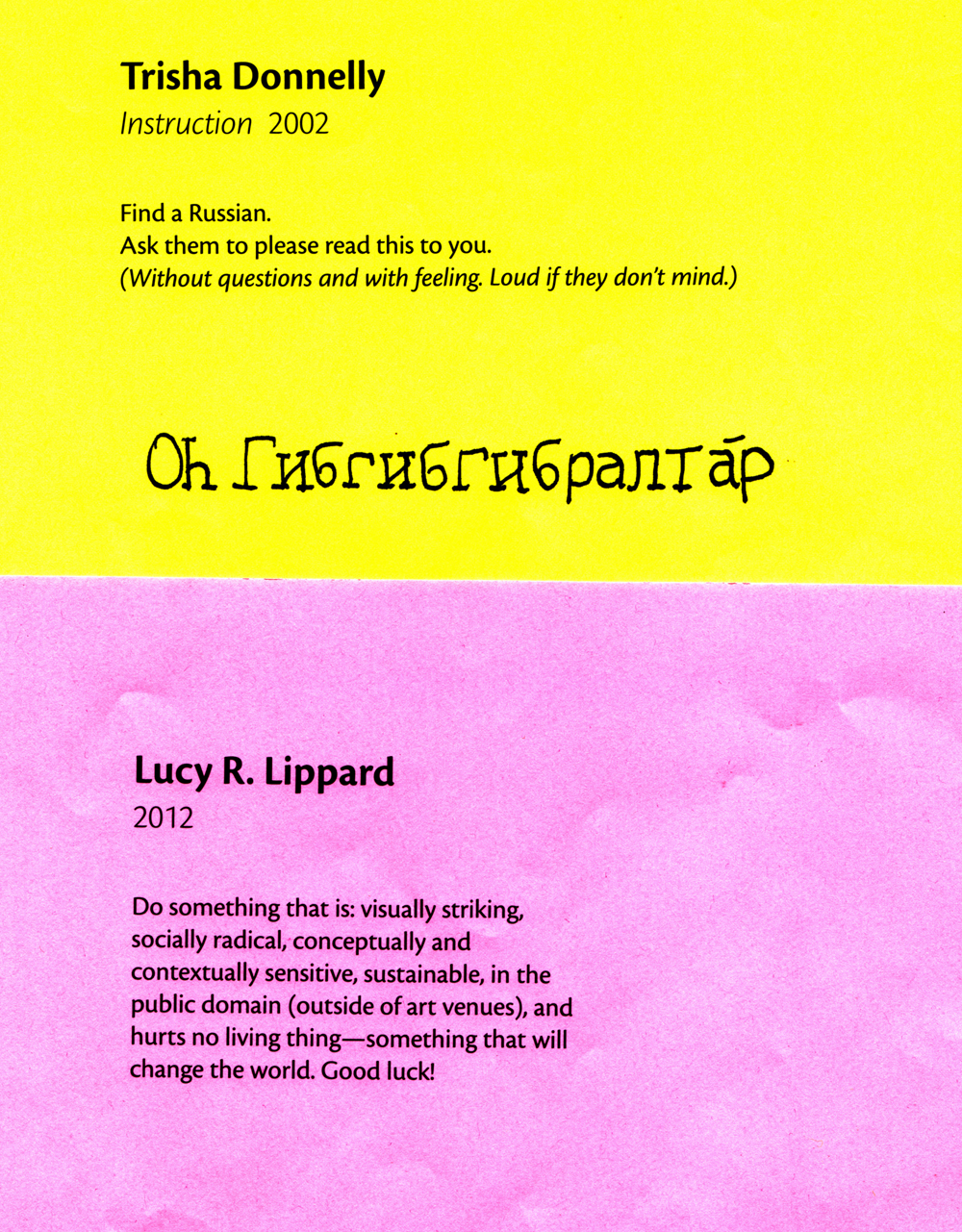
do it 2013 consists of a growing series of written artists instructions, each reinterpreted each time it is enacted.

Some of the instructions have been written specially for do it 2013 and some date back to 1993 when the project first began from a conversation between Christian Boltanski and Bertrand Lavier curated by Hans Ulrich Obrist.

Manchester Gallery Do It Yourself

Manchester Gallery Do It 2013

Some instructions were absurd, some fun and some impossible to carry out.

Manchester Gallery Do IT Yourself

Manchester Gallery Do IT 2013

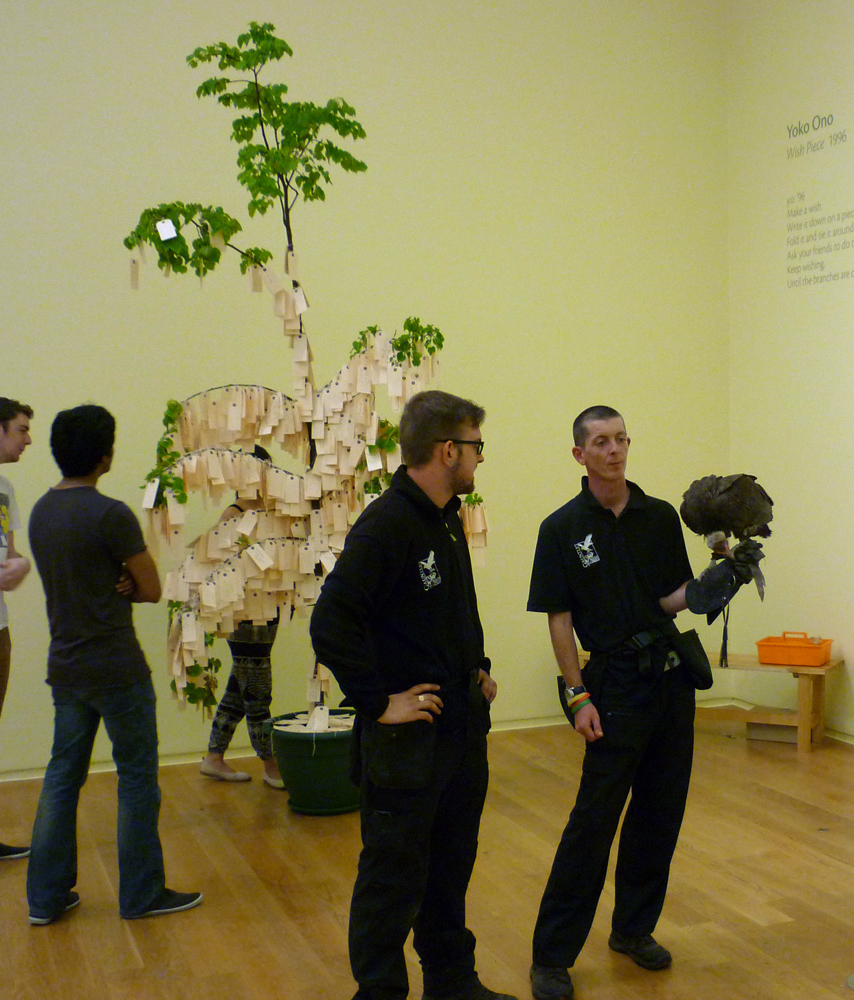
The re-enacted instruction I enjoyed the most was the live performance with a vulture.

Maria José Arjona a Columbian performance artist paid homage to her mentor María Teresa Hincapié
who died a few years ago with the performance ‘Second Messenger: Performance with vulture and writings’.

Manchester International Festival

Manchester International Festival

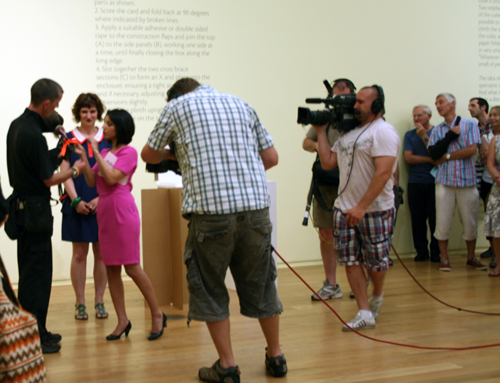
The film crew were on hand which heightened expectations of a performance but also killed any spirituality at the heart of the enactment.

Shadow the Vulture

Shadow the Vulture

The Amazon rainforest felt very far away.

María Teresa Hincapié left instructions for her student to go into the Amazon rainforest, drink only water and eat only fruit and obtain a spiritual experience.
So Maria José Arjona went into the forest with a shaman who made a potion from plant bark for her to drink. This potion gave her an experience which she described as ‘seeing clearly’ and she spent 12 hours writing messages while under the influence of the potion. A message that she wrote while in her transcendent state is delivered to the Manchester Gallery by a vulture, a bird of sacred symbolism in Columbia.
The message reads
‘ The future is uncertain. Words are traps for innocent animals. You must know that knowing too many secrets delivers some sort of damages.’

The ancient forests of Europe used also to be a place to go to for adventure, to confront the power of nature and to face danger.

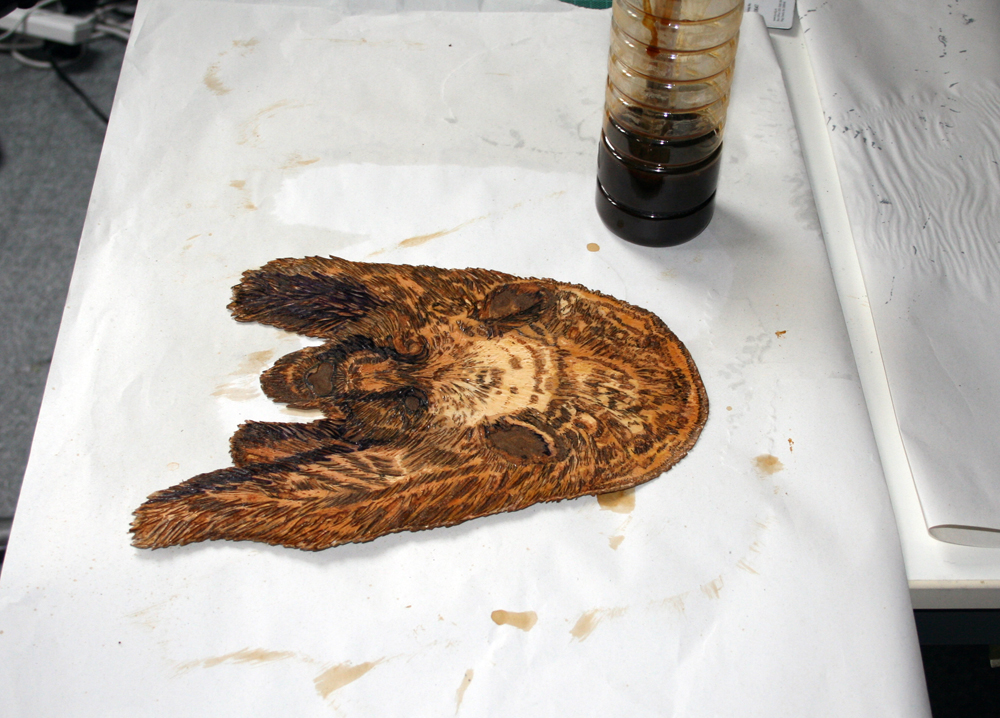
Bear Collagraph

Bear Collagraph

I made a collagraph of a bear. Partly to see how this would translate through the cardboard of the plate but also as I was thinking about the beasts of the ancient forest.

Bear test prints

Bear test prints

The reaction in the studio was that the bear was cute not fearsome.

Thinking about things that compel us as humans in one way or another – the work ethic, the need for order, physical survival, lust and greed, mythology and religion, spirituality, humanity and identity.

Having heard Antii Laitinen talk about his Venice Biennale project a while back it was great to see it in the flesh.
Antii Laitinen

Antii Laitinen

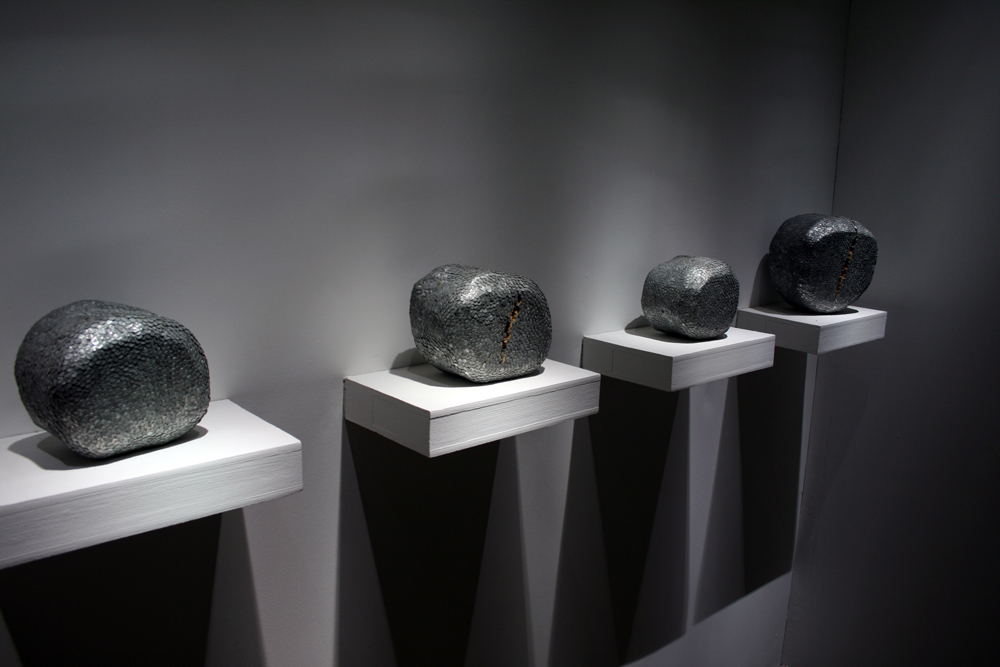
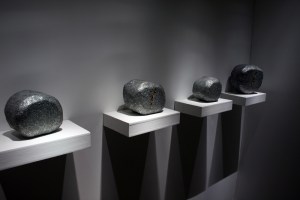
All his work takes hours of patience, these woodblocks have hundreds of nails hammered into the surface.

In 2011 at the Venice Biennale a large tree fell on the Finnish Pavilion. This disaster has given inspiration to this years exhibition ‘Falling Trees’.
Antii Laitinen

Antii Laitinen

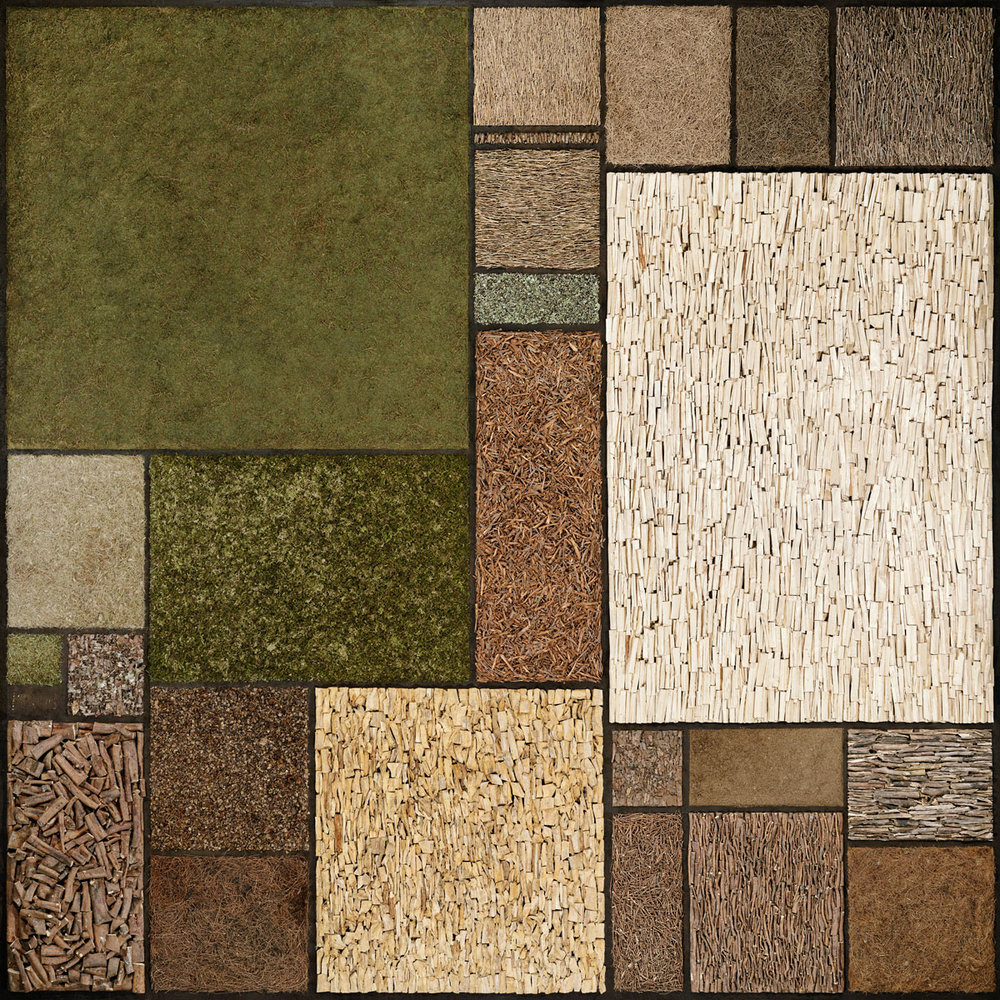
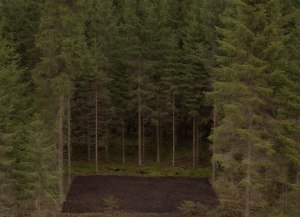
Laitinen felled 100sqm of forest, tore the roots from the ground and removed the covering layer of soil from the area. After this, he started to sort the materials into constituent parts and finally to assemble the material into a carefully composed area for photography.

Antii Laitinen 'Forest Square'

Antii Laitinen ‘Forest Square’

Inspired by the philosophy of Piet Mondrian  – “I construct lines and colour combinations on a flat surface, in order to express general beauty with the utmost awareness. Nature (or, that which I see) inspires me, puts me, as with any painter, in an emotional state so that an urge comes about to make something, but I want to come as close as possible to the truth and abstract everything from that, until I reach the foundation (still just an external foundation!) of things… I believe it is possible that, through horizontal and vertical lines constructed with awareness, but not with calculation, led by high intuition, and brought to harmony and rhythm, these basic forms of beauty, supplemented if necessary by other direct lines or curves, can become a work of art, as strong as it is”

Sorting the forest and the layer of peat in a factory hall took several months. The sorted forest takes exactly one hundred square metres of space, just like the original patch of forest.

The process of photographing the composition proved challenging, and the final work of photography consists of over 60 photographs needed to show the smallest of details. The two other images in the triptych show the forest area before and after the clearing.

This work characterises Antti Laitinen work through it’s craftsmanship, concrete thinking, repetition, the coexistence of exhausting persistence, the transience of the blink of an eye and tragicomedy. The viewers find themselves questioning the rationality of both their everyday use of time and the society around them.

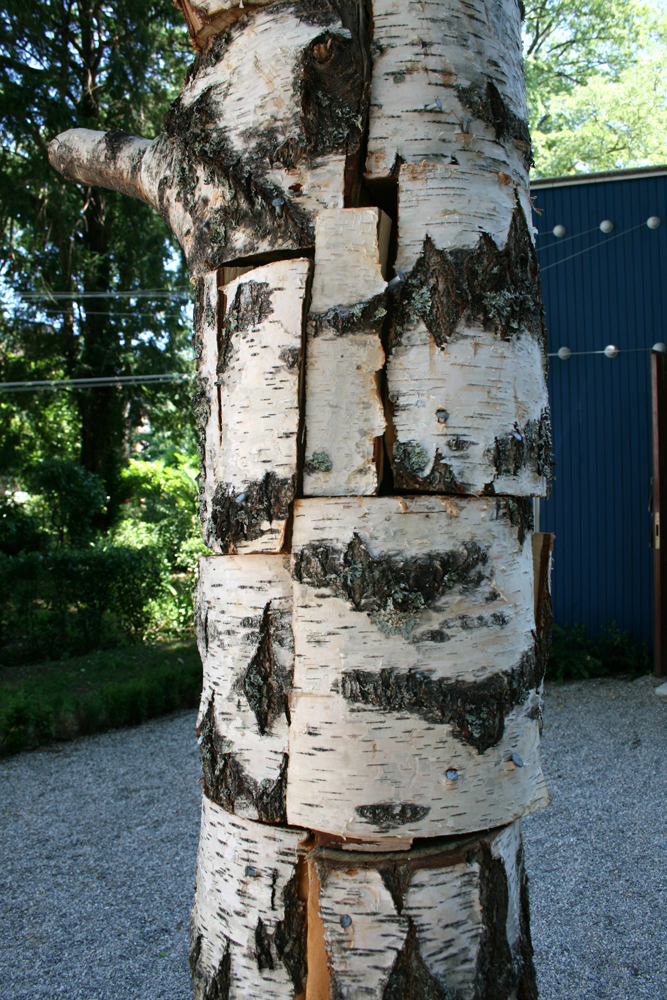
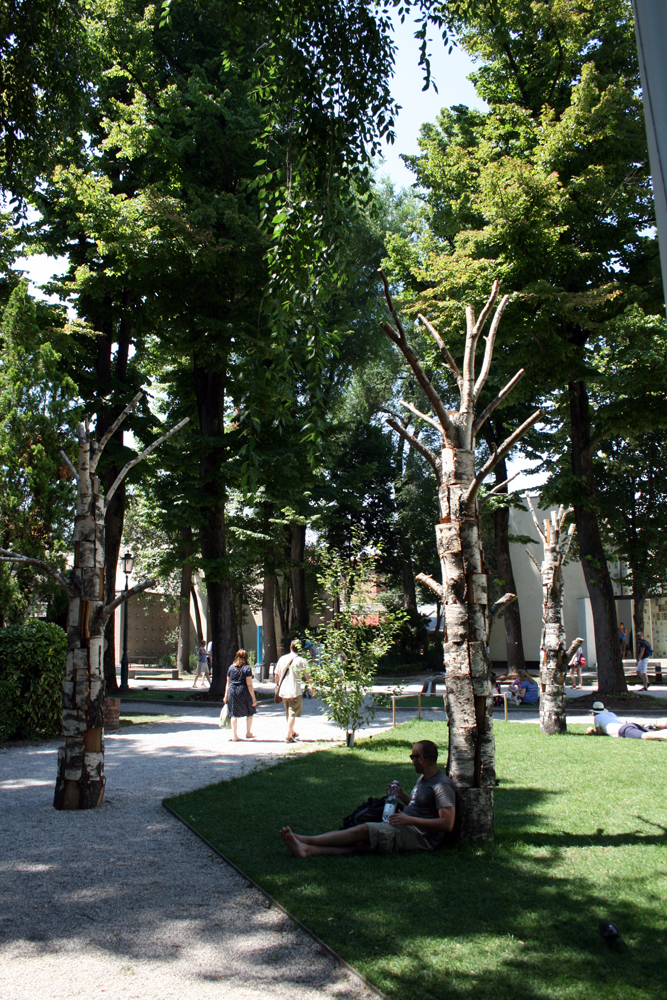
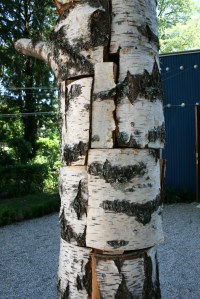
Outside the pavilion is a small Frankenstein forest. Laitinen has himself felled and chopped a number of trees into small logs which he then fits back together into a tree with hammer and nails. The construction of the  trees is both performance and installation.
Antii Laitinen

Antii Laitinen

“The working method is like when you’re putting a puzzle together and can’t find the right pieces, so you force them in place anyway. Fun and comedy are important in my work. There isn’t always much sense in making the work, but I do it anyway”  Laitinen.
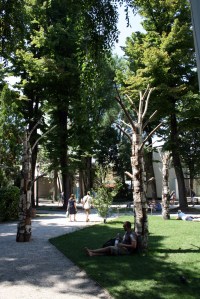
Antii Laitinen at Finnish Pavilion

Antii Laitinen Finnish Pavilion

Norays Kaspar also looks at work and purpose, exposing the human cost of a life spent in effectively futile labour.

Norays Kaspar

Norays Kaspar ‘What is to be Done?’

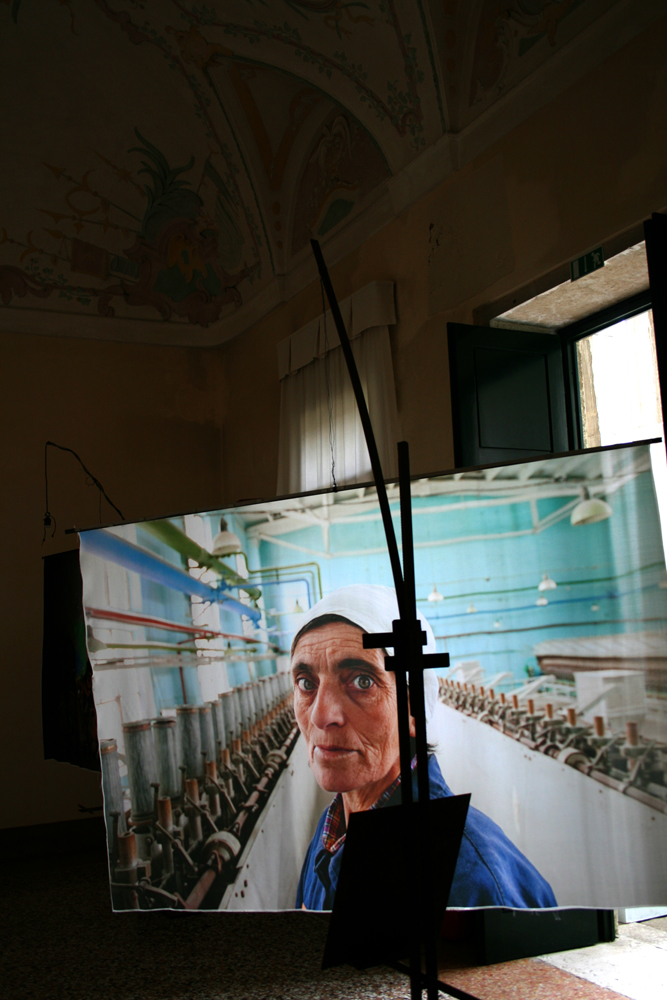
The exhibition “Steel-Lives, Still-Life” is inspired by the remnants of post-Soviet industrial legacy in Armenia.

It attempts to give form to the loss of relevance of both machine and man. Vast expanses of desolate and abandoned buildings trace the tale of a once vibrant industry. Inside those still surviving factories, are the portraits of workers, in age-old canvas uniforms, still tending to the odd machine in dim light and textured shadows of rust and grease.

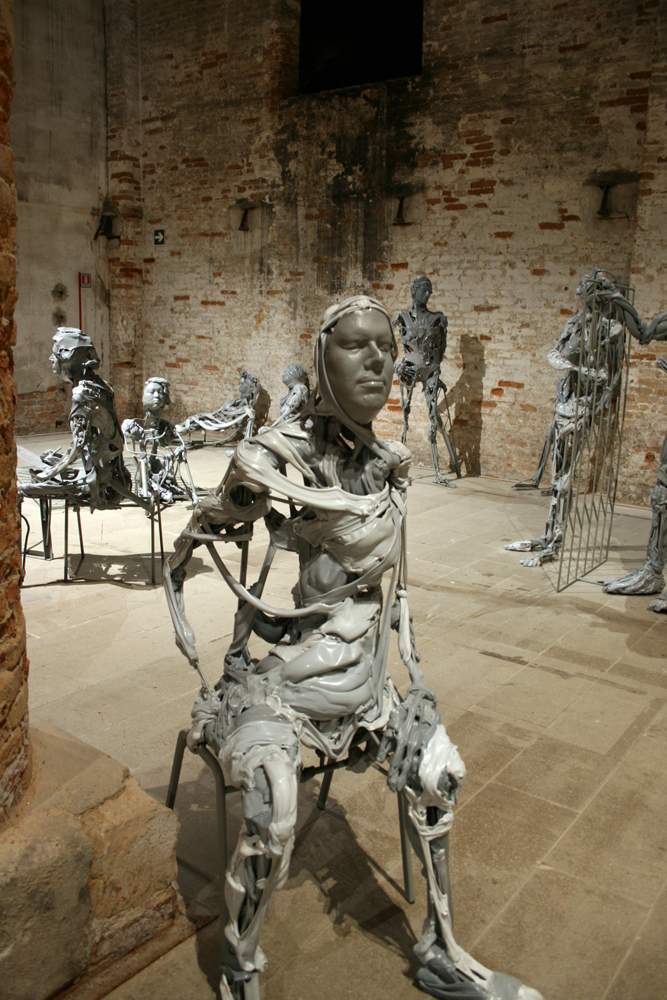
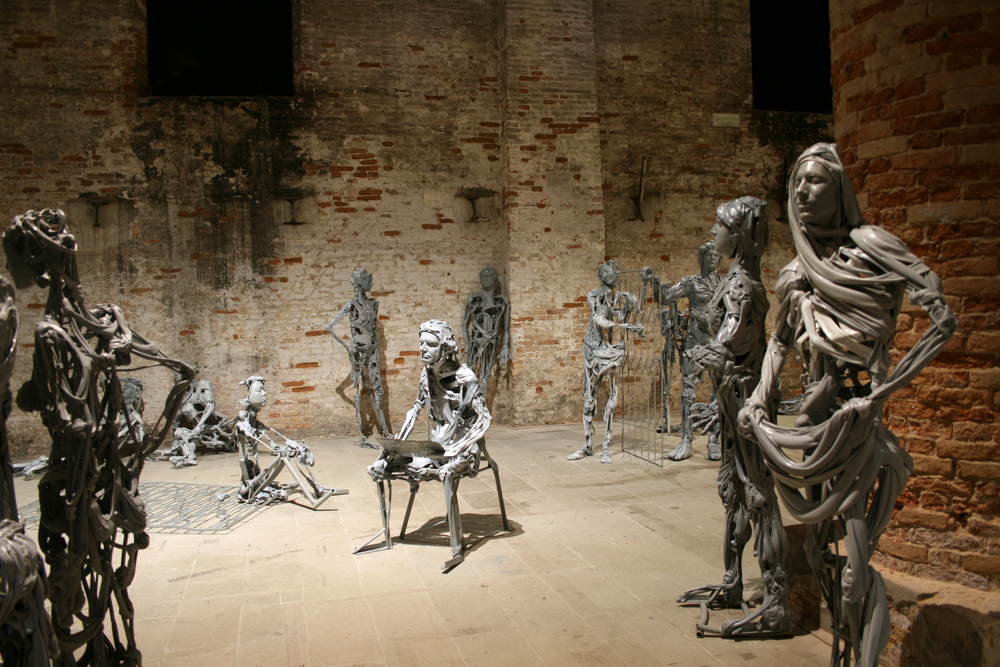
Pawel Althamer made an impact with a cavernous space peopled with life size sculptures, sitting, standing, not really interacting – like a railway station concourse frozen in a Pompeii moment of destruction. These bodies are shredded yet the faces remain intact, eyes closed in repose.
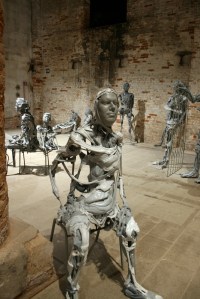
Pawel Althamer 'Venetians'

Pawel Althamer ‘Venetians’

They are the faces of the city cast in plaster, Venetians rendered grey and mummified.
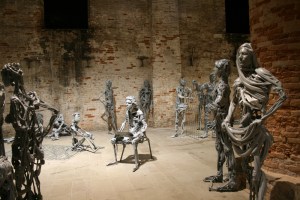
Pawel Althamer 'Venetians'

Pawel Althamer ‘Venetians’

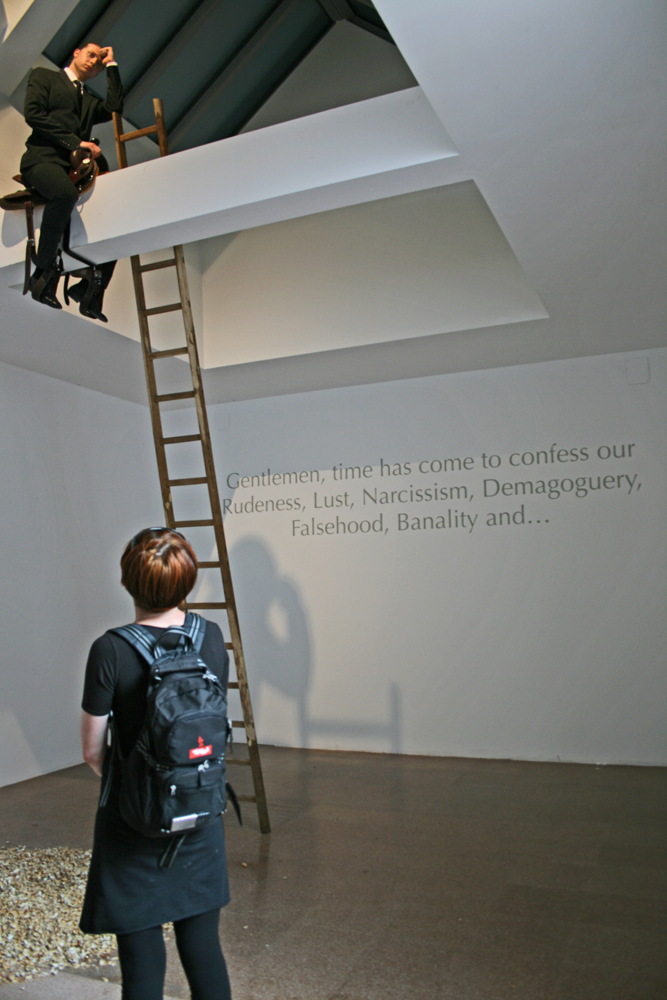
Human frailty of another kind is explored by Vadim Zakharov for the Russian Pavilion.

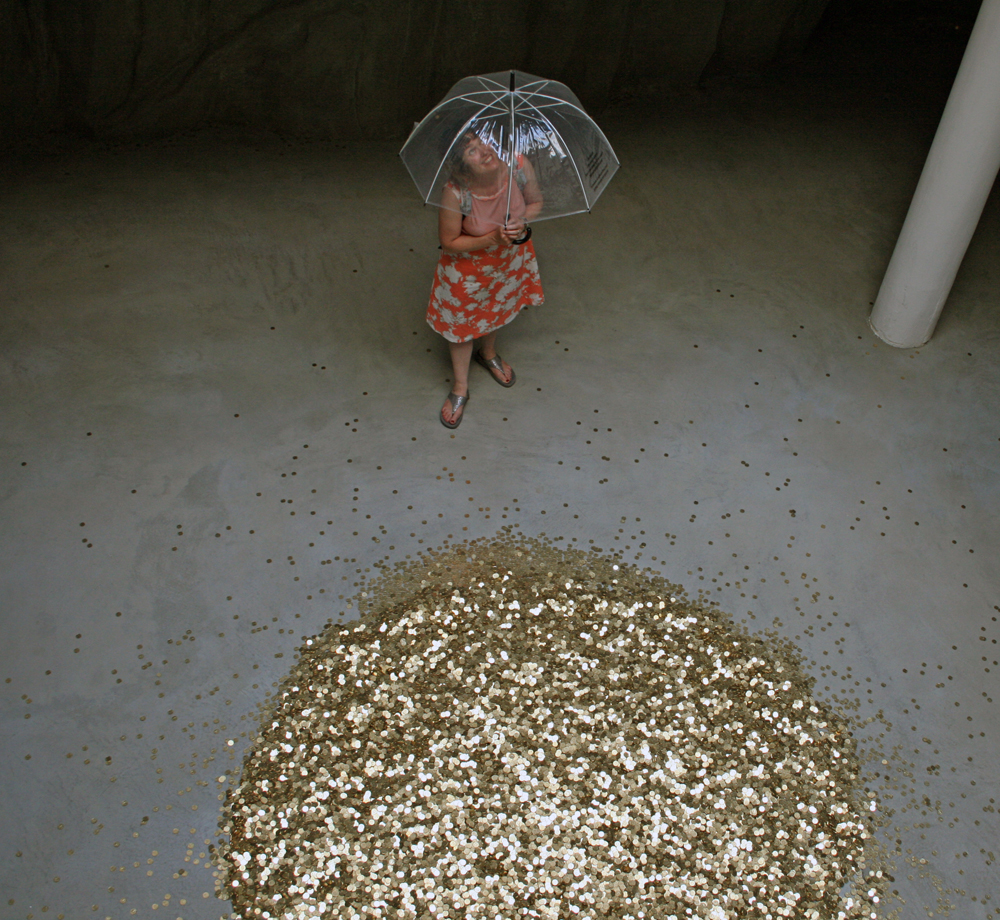
This is all about seduction – lust and greed –  and the corruption of money.
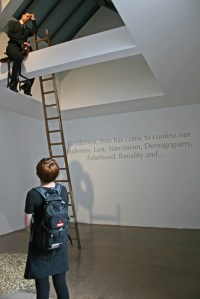
Russian Pavillion

Russian Pavillion

A young man sits astride a saddle on a beam high up in the eaves, shelling and eating peanuts and disdainfully tossing the husks to form a growing mound on the floor.
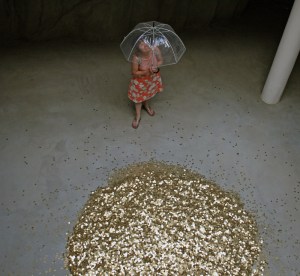
Vadim Zakharov 'Danae'

Vadim Zakharov ‘Danae’

We women re-enact the seduction of Danae as we enter a darkened space and look up to the heavens to be showered with gold coins while the men survey us from the balcony.

Under the protection of an umbrella we collect handfuls of coins and place them into a bucket which is drawn up and emptied onto a conveyor belt to send the coins on their cyclical journey skywards to cascade once more.
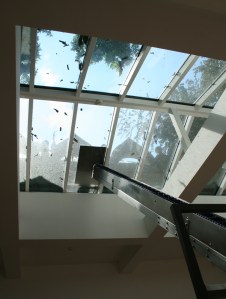
Vadim Zakharov 'Danae'

Vadim Zakharov ‘Danae’

Zakharov aims to demonstrate the contemporary relevance of mythological personifications.

Sex, greed and the corruption of money are still at the heart of our failings. Our gods haven’t changed.

Russian Pavillion

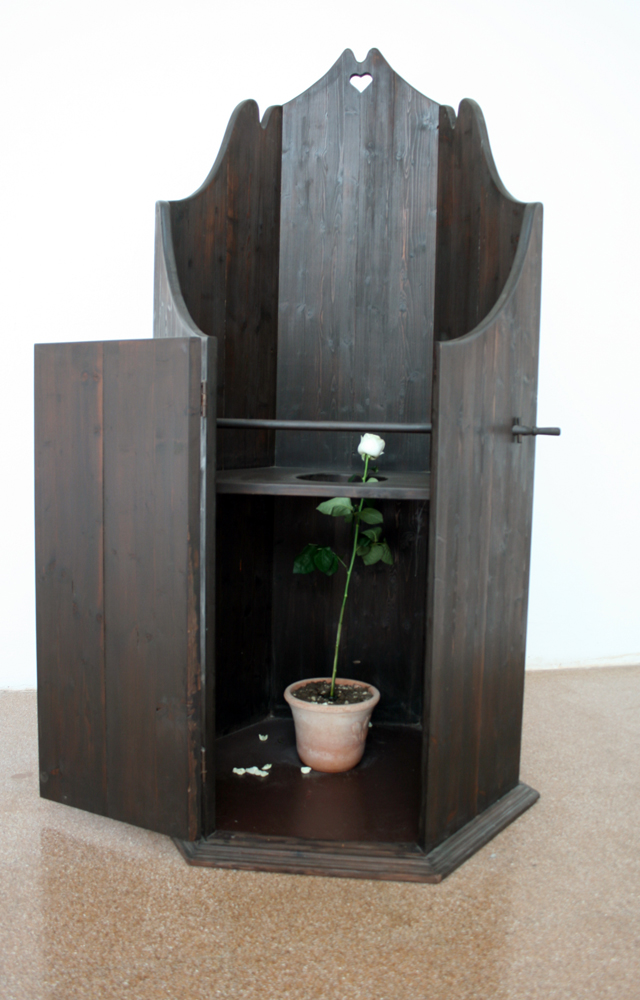
Execution chair of love

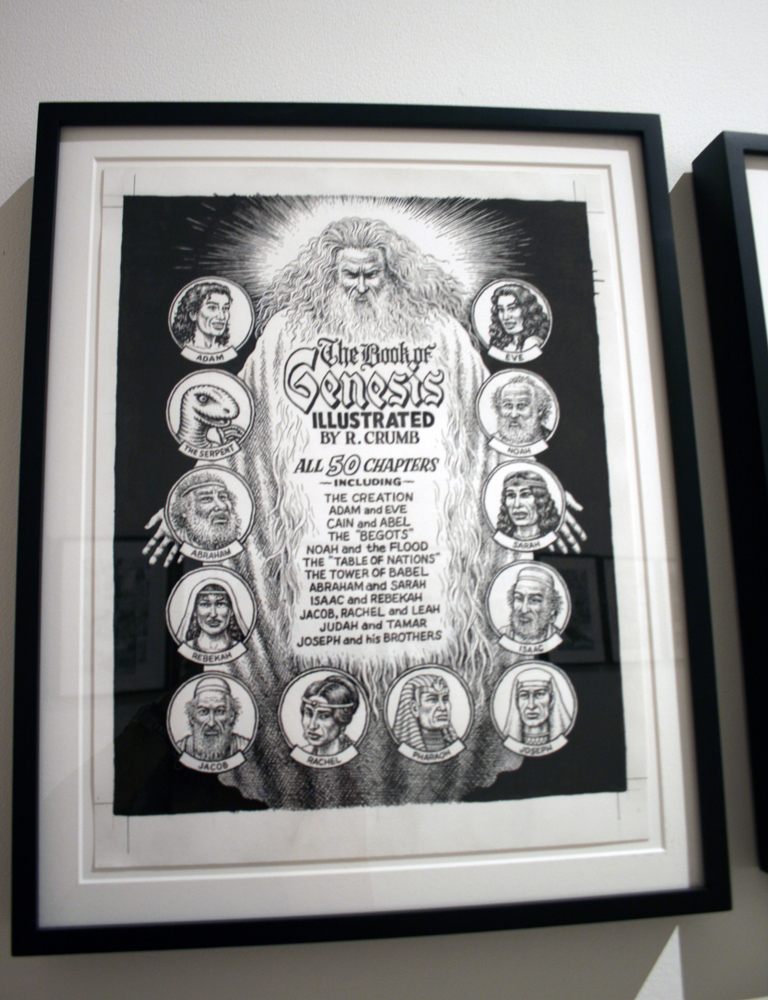
Robert Crumb has produced work on a biblical scale. He has spent 5 years illustrating all fifty chapters of the book of Genesis and turned it into a graphic novel.
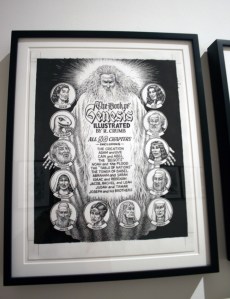
Robert Crumb

Robert Crumb

Overwhelmed by the number of illustrations on display coupled with the vast array of other work in the Central Pavilion to be viewed in a limited time mega work doesn’t get the attention I would have liked to have given it.

I would like to have the time to follow the story through, it would be relevant to my thoughts at the moment about the origin of religion.

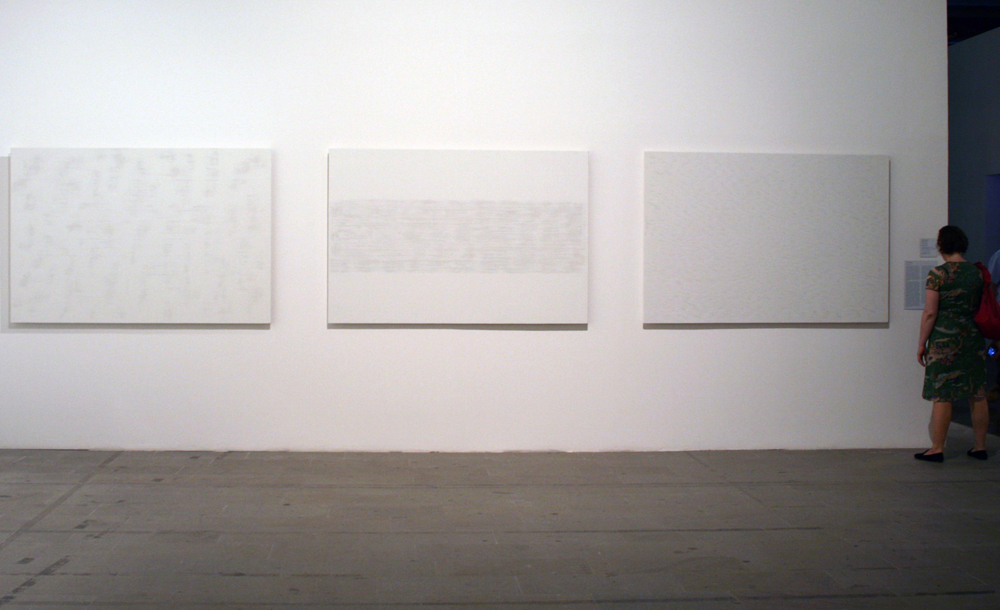
Prabhavathi Meppayil’s work is al about surface, quiet and calm and the human touch of tradition and craft which can inspire meditation.

Prabhavathi Meppayil

Prabhavathi Meppayil

Copper, silver and gold wire is embedded in thick gesso giving a cool look of stone revealing flashes of shine like seams of precious metals or water rippling, gently breaking a still surface.

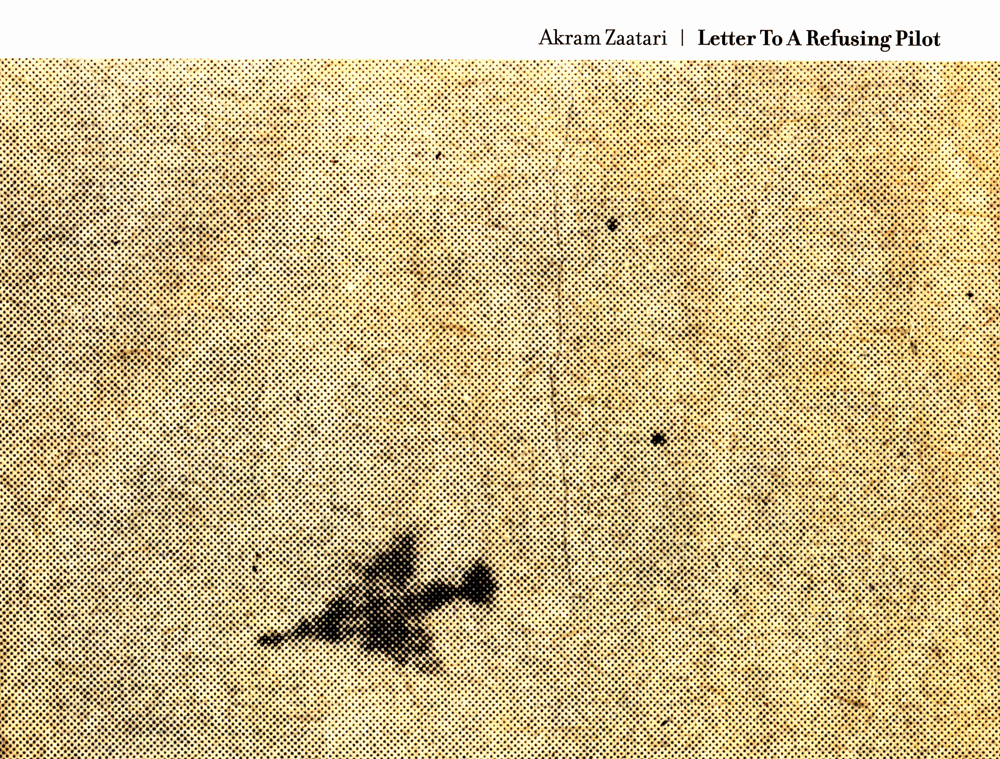
Akram Zaatari presents ‘Letter to a refusing Pilot’ for the Lebanon Pavilion. This is a moving story about justice, nationalism, belonging, rebellion and humanity explored through film and video.
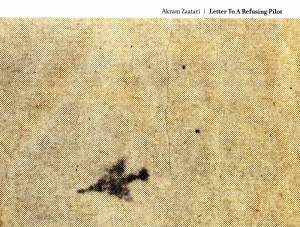
1309 Akram Zaatari 2

What the artist grew up believing to be an urban myth turned out to be a true story and he was able to meet the figure of local legend 40 years after the event.

Akram Zaatari Letter to a Refusing Pilot

Akram Zaatari Letter to a Refusing Pilot

There are parallels to the story told in Lucy Kirkwood’s play Chimerica about ‘tank man’ the anonymous lone hero who stood for justice in front of the tank in Tiananmen Square. The tank driver refused to shoot the protester and lost his own life as a result and ‘tank man’ was shot anyway. The identity of  those involved at Tiananmen Square was never discovered but in Lebanon through a series of chance encounters over many years the pilots identity is revealed as Hagai Tamir. In 1982 he was an Israeli pilot sent on a bombing campaign to Lebanon but when he saw the target for his bombs was a high school he passed over the building and dropped the bombs in the sea. Unfortunately a colleague followed up and bombed the school anyway rendering Tamil’s refusal futile yet still resonant for its humanity.

I thought the writing of Santu Mofokeng in The German Pavilion at the Biennale was interesting, about ancestors and memory.

‘Who needs ancestors? This is a question of belief and of religion, one is compelled to suppose – but is it? Marx’s remark about “opium for the masses” resonates. Religious extrusions are everywhere on the landscape, both virtual and real. Ancestors lived here once and their signature masks and accoutrements are sometimes preserved and coveted to attract tourism. Marx notwithstanding, many people will tell you that you are nothing without a past, or that you are not “together” without belonging. Another issue is the matter of national and quasi-religious holidays and monuments and memorials and anniversaries, so coveted by governments and politicians to dust up waning popularity and to mesmerize crowds.

I write elsewhere that nothing forces a backward glance like a threat. The Chinese say that our body is the memory of out ancestors. This is an omninous proposition since apartheid is an impossible ancestor, inappropriate and unsuitable. Whenever we come under threat we remember who we are and act accordingly. The word “remember” needs elaboration. Re/member is a process by which we restore to the body forgotten memories. The body in this case is the landscape – on whose skin and belly histories and myths are projected – which is central to the forging of national identity.

When I see air turbulence my sister sees a snake. As a photographer I hunt for things ephemeral, such as shadows, in order to creat things. Interpretation I leave to the beholder.’

Sakti is an understanding of Hindu origin which has become integrated into Indonesia’s local cosmology, it denotes a strong creative energy, it is divine and indestructible.
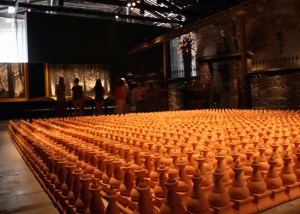
Indonesian Pavilion

Indonesian Pavilion

This basic creative principle is the capacity for achievement beyond mere human ability.
Artists Albert Yonathan Setyawan, Entang Wiharso, Eko Nugroho, Rahayu Supanggah, Sri Astari and Titarubi have contributed to the theme of the Indonesian Pavilion.

Some work I have on the go at the moment touches on these ideas of compulsion – things we are drawn irresistibly towards.

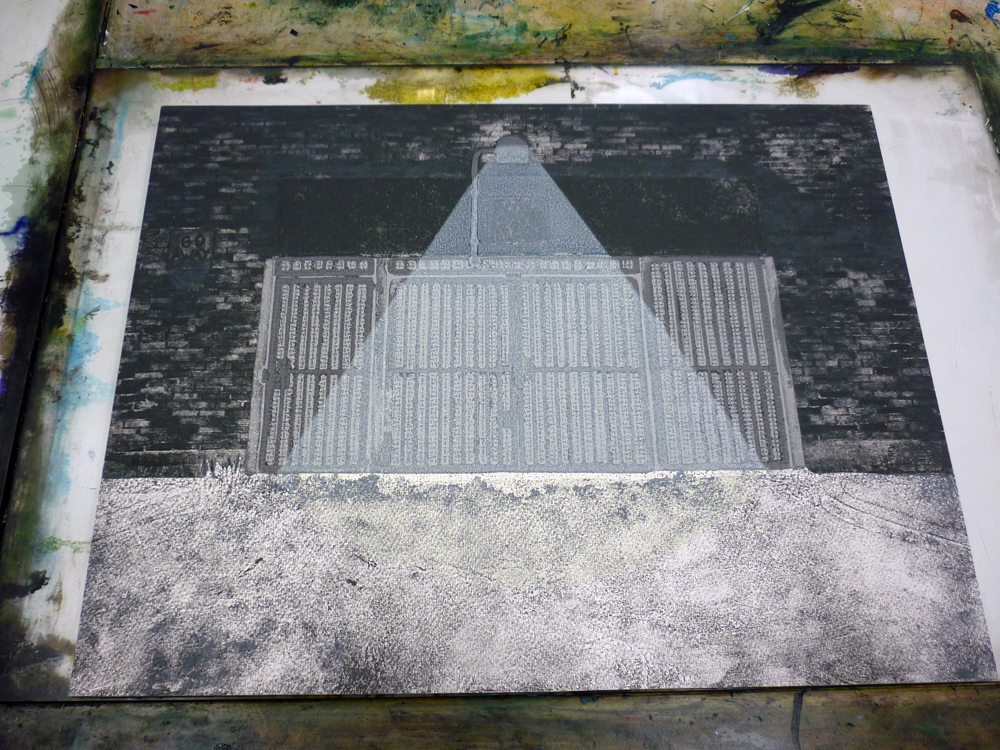
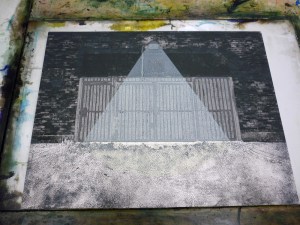
I have added a beam of light with a relief plate to a collagraph from the garage gates series.
1309 Compulsion

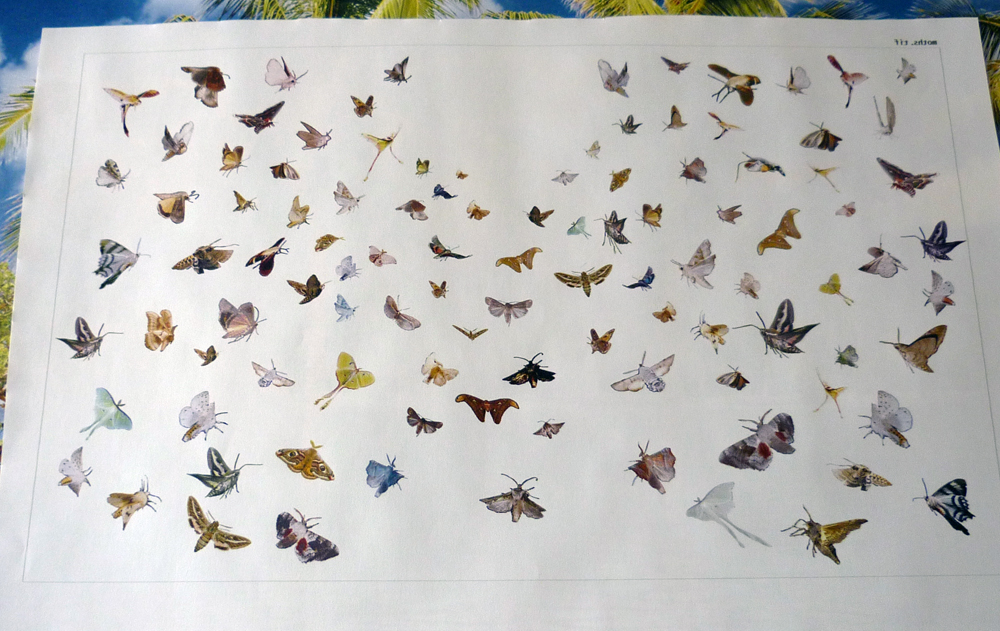
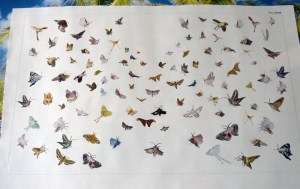
Moths to a flame. Drawn towards the light. Not necessarily the safest option.
1309 Moths

These moths will be transferred onto fabric and appropriately burned on to the collagraph surface.
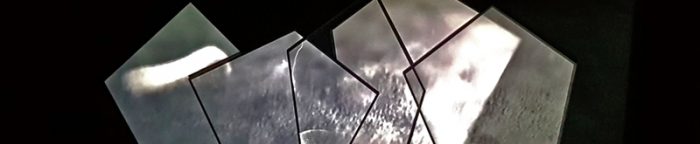
1309 Palazzo Zenobio

Space, a nebulous concept, we tend to like to measure and quantify it.

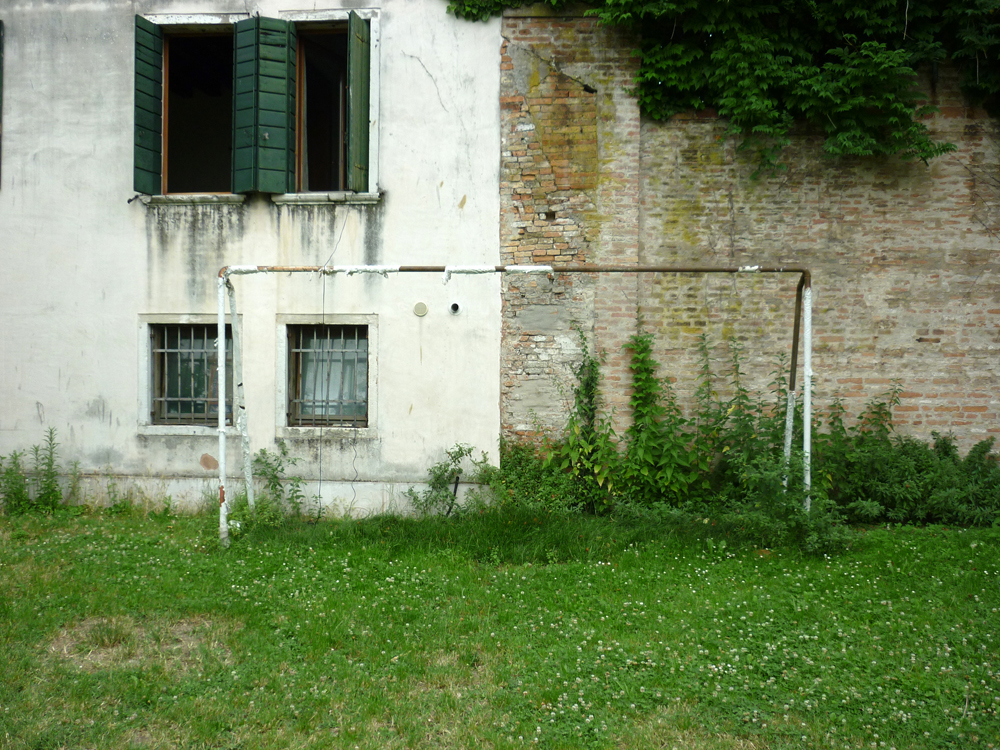
1309 goal

Marking out a space for a purpose.

The Icelandic Pavilion at the Venice Biennale investigated architectural drawings to contrast the function of a workplace  with the opulence of leisure pursuits.

One blueprint is placed over another.

Katrin Sigurdardottir 'Foundation'

Katrin Sigurdardottir ‘Foundation’

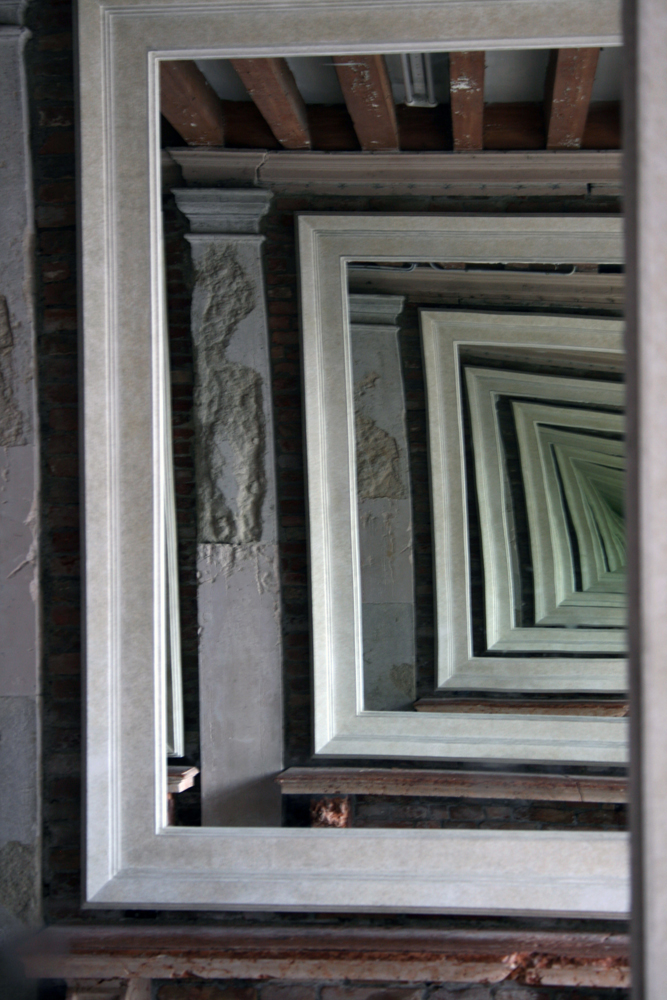
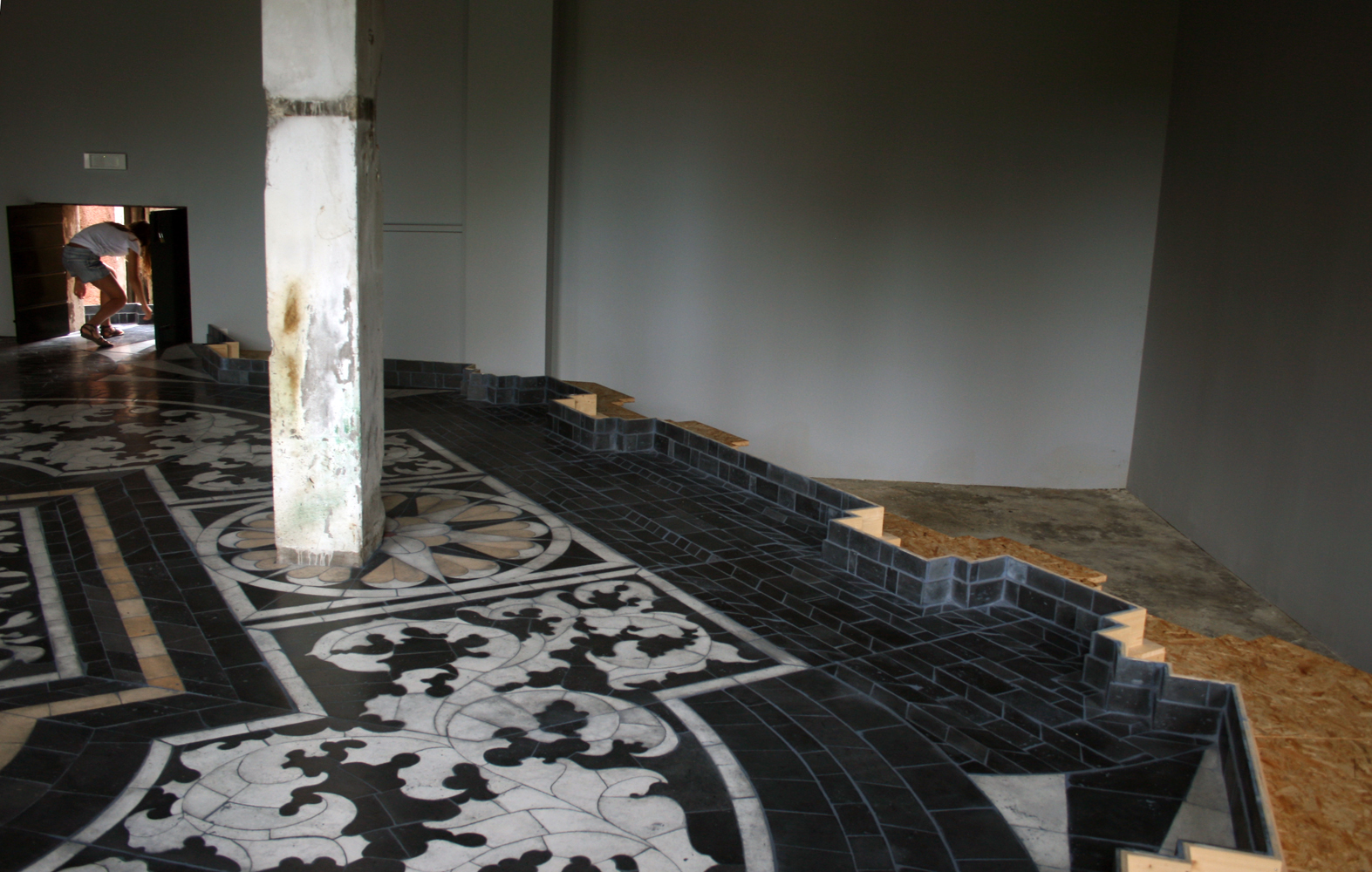
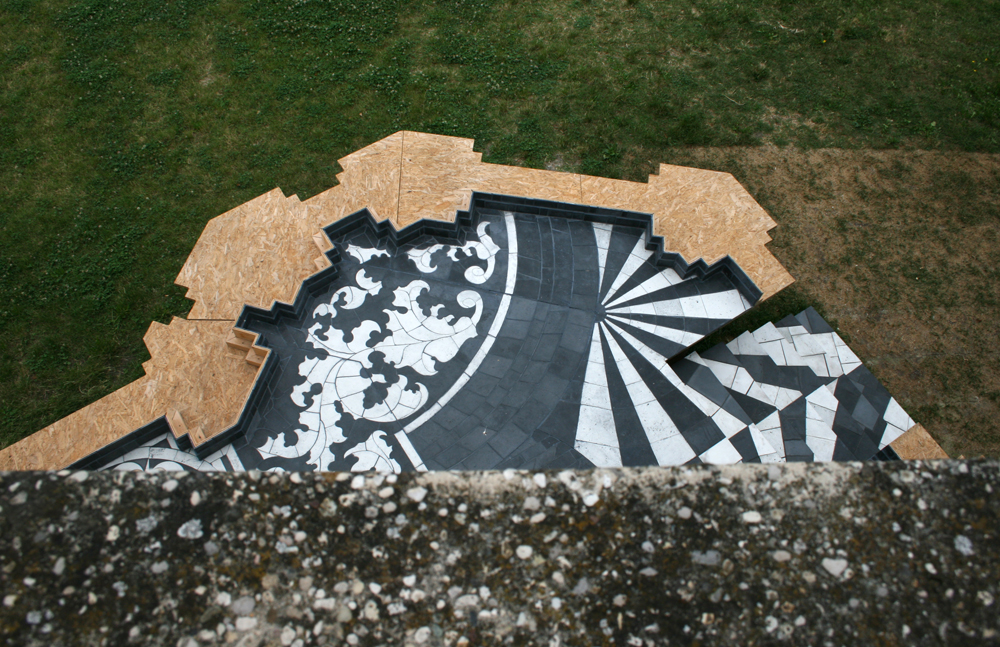
Using the site of an old laundry in the grounds of Palazzo Zenobia, Katrin Sigurdardottir imposes an ornate tiled floor with opposing dimensions into the structure of the former workplace.

Katrin Sigurdardottir 'Foundation'

Katrin Sigurdardottir ‘Foundation’

The swirling baroque inspired patterned floor spills out from the old foundations.

Katrin Sigurdardottir 'Foundation'

Katrin Sigurdardottir ‘Foundation’

The audience is directed through the space by the curiosity to explore the openings and exits that lead through the building and up onto the roof.

It is an Alice in Wonderland experience of displacement.

It also makes you think of the people that worked in the laundry and those that danced on such a floor, and how those disparate worlds may have intersected.

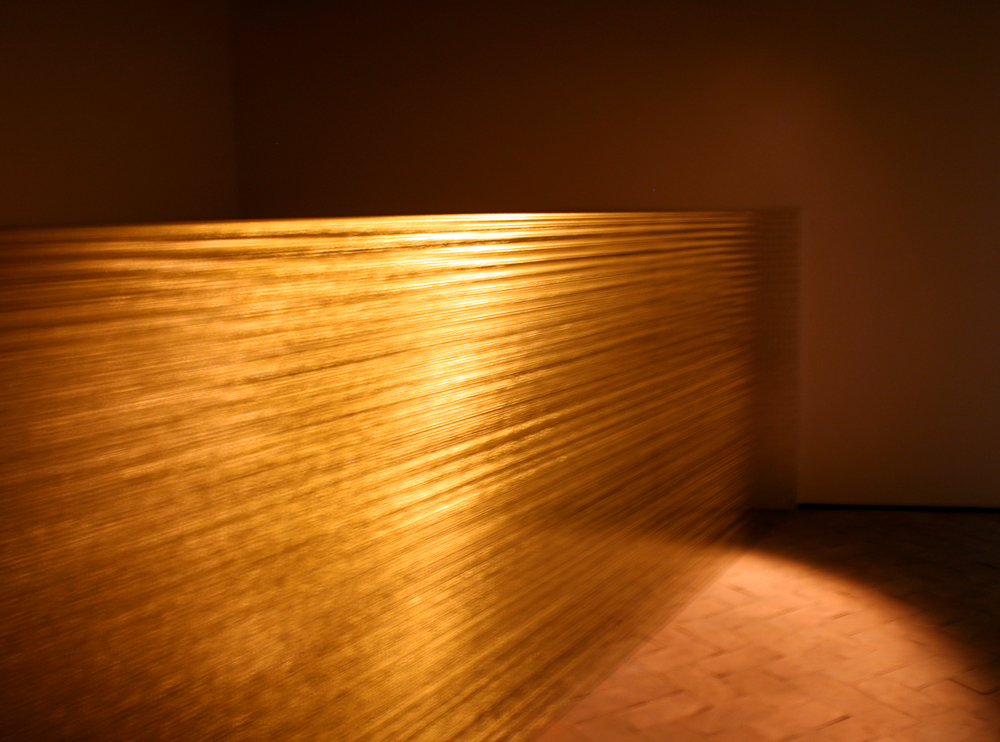
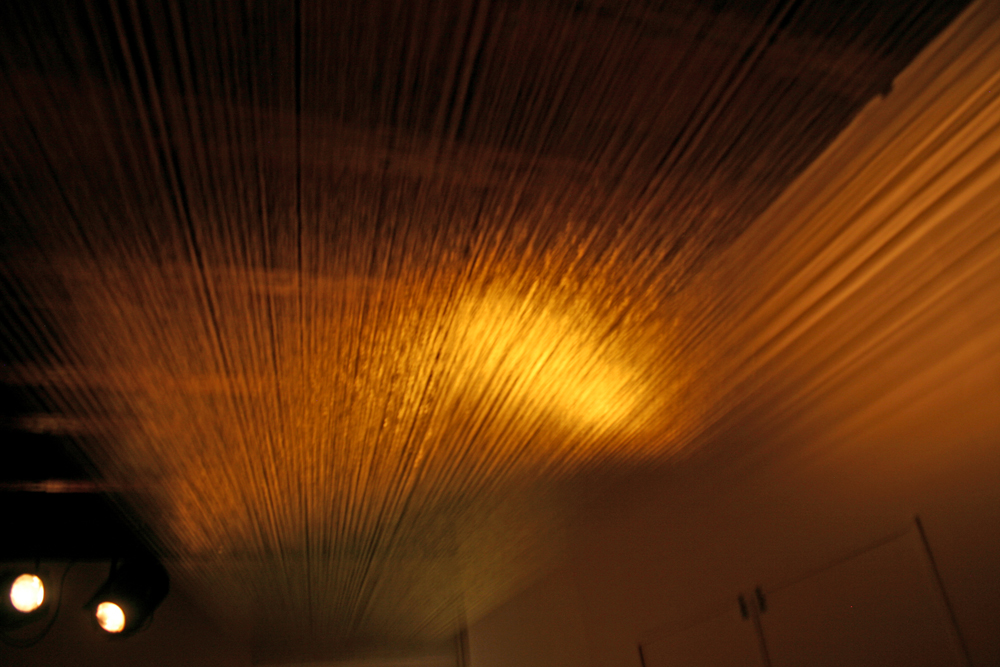
At the Montenegro Pavillion Irene Lagator Pejovic has not drawn a line around space but filled it up with the finest wires strung taught across the dark room and lit so as to appear ethereal.

Irena Lagator Pejovic

Irena Lagator Pejovic

It gives the impression of making light itself tangible.

Irena Lagator Pejovic

Irena Lagator Pejovic

She wants us to think about perceptual awareness, to be conscious of our body in space.

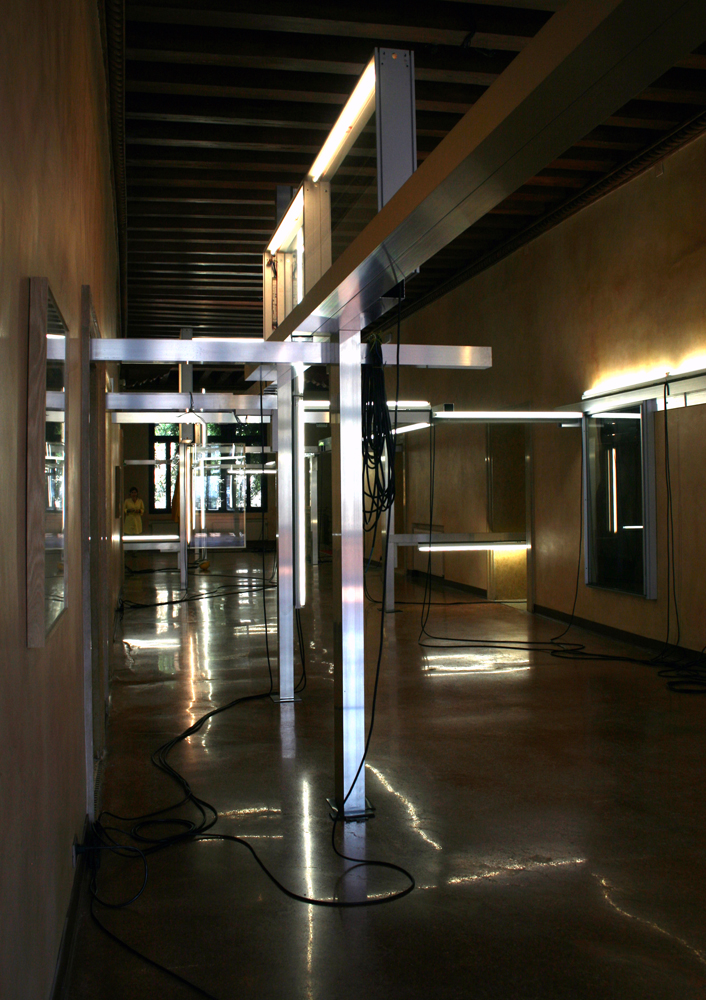
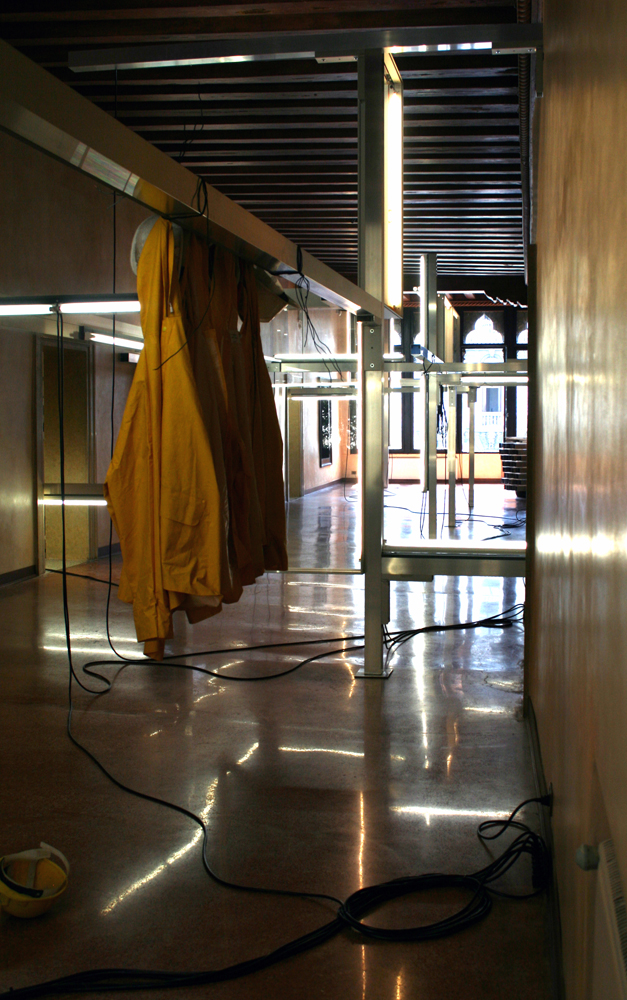
One of my favourite exhibitions which really defined space through line was ‘A remote whisper’ from Portuguese artist Pedro Cabrita Reis.

Pedro Cabrita Reis

Pedro Cabrita Reis

Drawings in space.

Pedro Cabrita Reis

Pedro Cabrita Reis

Aluminium tubes, fluorescent lights and cables flow through the corridors and rooms of Palazzo Falier adding a new vibrancy to the magnificent ancient building.

Another artist using the fluorescent tube as a drawn line is Bill Culbert for the New Zealand Pavilion.

A sculptural meditation on shelter, habitation and dwelling.

Bill Culbert

Bill Culbert

It was a building shot through with light, like a ricochetting laser beam had caused havoc, piercing and displacing objects in its path.

Bill Culbert

Bill Culbert

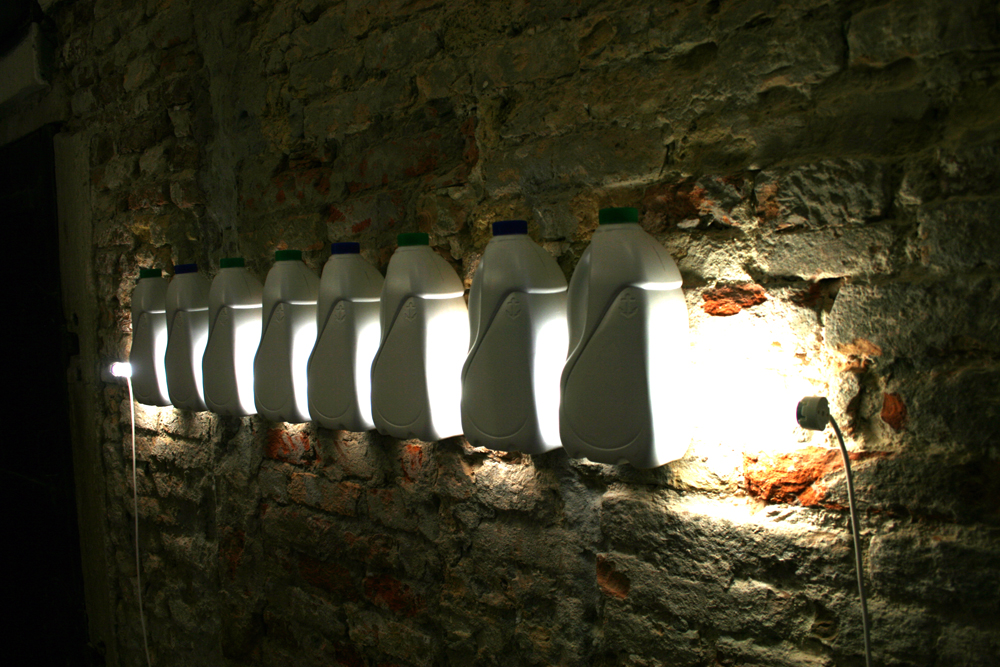
I was interested in his use of recycled plastics.

Bill Culbert

Bill Culbert

The catalogue accompanying this exhibition cites the historic image of Adam’s Hut in Paradise as a possible point of reference  for Bill Culbert’s Hut, made in Christchurch.

Bill Culbert Hut

Bill Culbert Hut, made in Christchurch

I had a quick look to see what references I could find about this mythic hut, there is a book called On Adam’s House in Paradise by Joseph Rykwert that looks like it could be interesting.

It has a look back through history to try and trace the first ideas about a place of dwelling.

Christchurch being the site where many buildings were recently destroyed by earthquakes for me it looks like a memorial to those buildings that fell.

The bare bones of a structure, no roof, no walls – the space that once held a dwelling marked out in light .

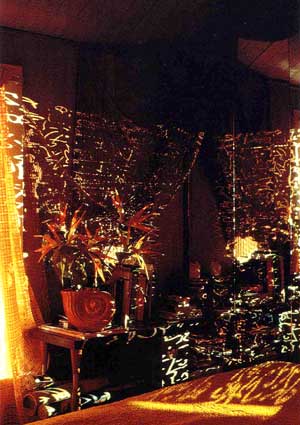
Susan Hiller was showing her series of photographs The Secrets of Sunset Beach at Timothy Taylor Gallery in an exhibition looking at interpretations of the American Landscape.

Susan Hiller Secrets of Sunset Beach

Susan Hiller Secrets of Sunset Beach

Through the use of projected light these spaces become magical, alive with weird hieroglyphs.

Susan Hiller

Susan Hiller

The inner space of the beach hut mirrors the dappling of sunlight outside.

Planes are distorted and the edges of space become blurred.

Had another chance to see the amazing work of Jane Ward.

These two images are a couple of favourites.

Jane Ward Inland

Jane Ward Inland

Space is not so much delineated as exploded.

Jane Ward In the Bay Shining

Jane Ward In the Bay Shining

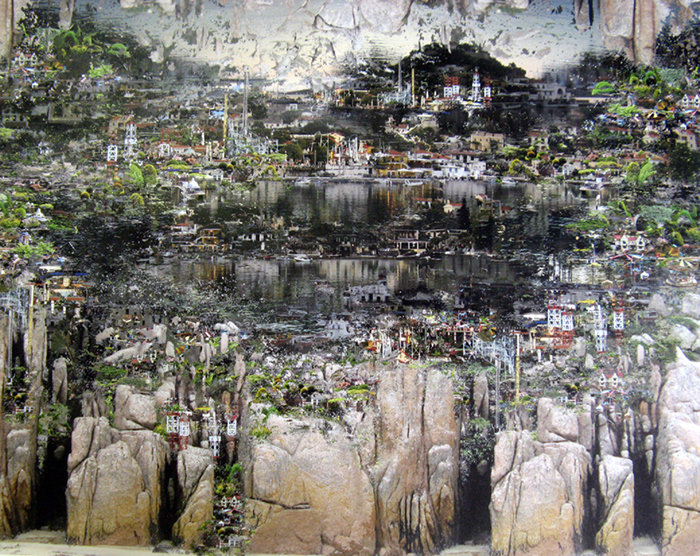
What is wonderful about Jane’s work is that it works from a distance, a spectacle of dissolving worlds but it also works up close where the minute detail is crisp and intricate.

They look like landscapes from The Fifth Element where flying cars would come in handy.

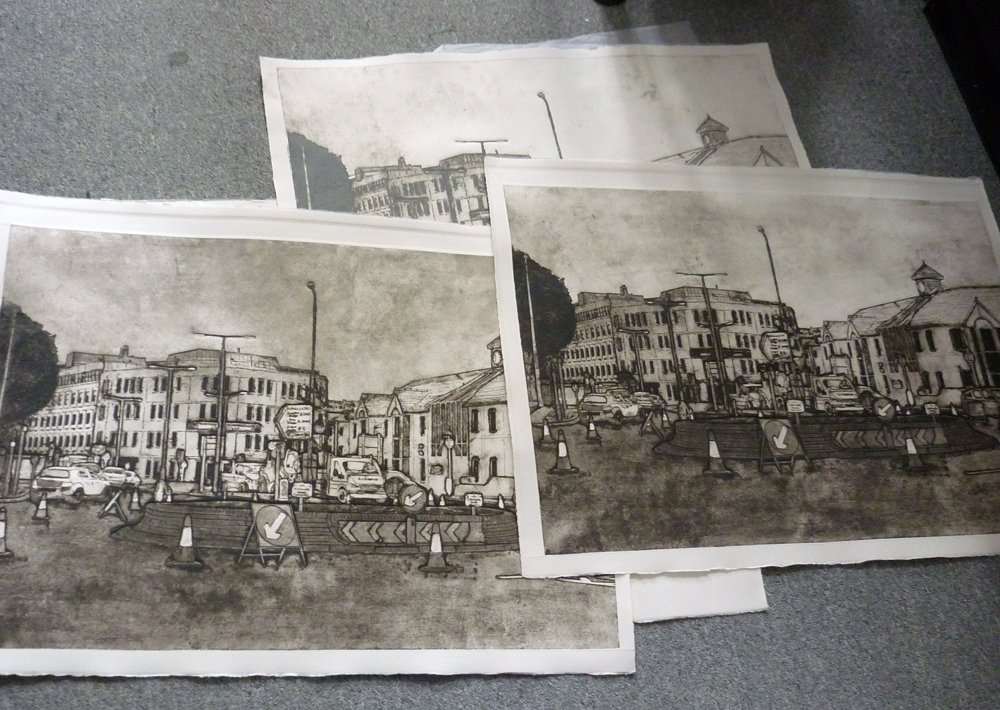
I have been working on the more local urban landscape of the roundabout.

Following directions, a flow.

Collagraph Prints

Collagraph Prints

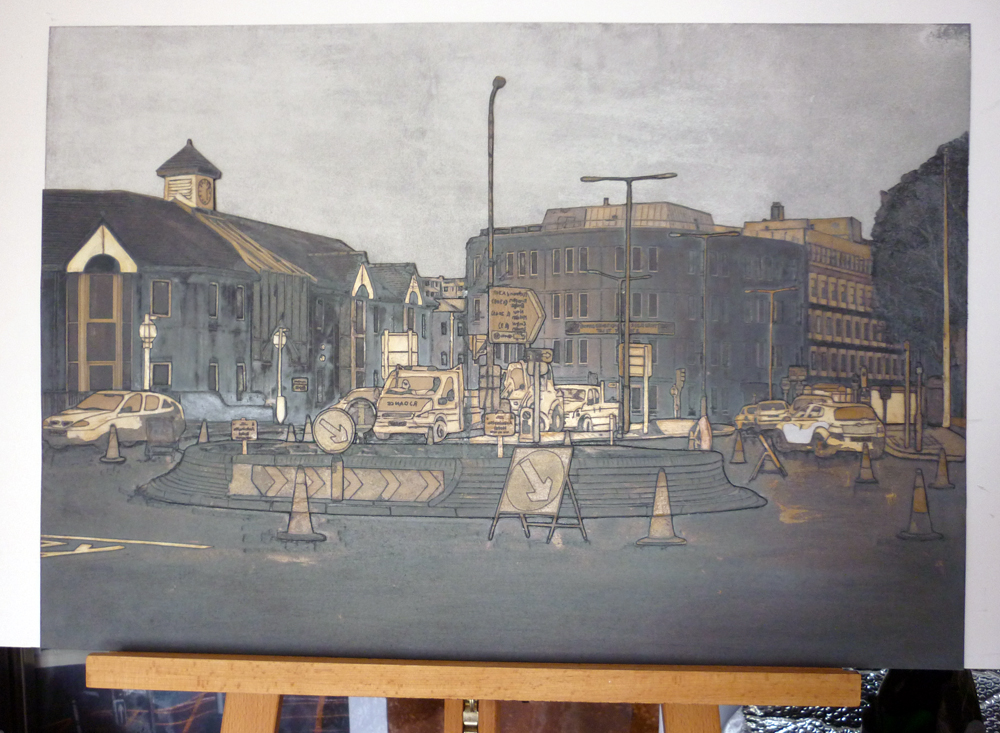
These was a meagre tree on the roundabout – an attempt at a green oasis in the grey. I did have the tree in the first collagraph I made but have removed it. It needed to be intaglio not relief – something to bear in mind for next time I want clear dark lines with no ink pooling around the edges.

Collagraph plate

Collagraph plate

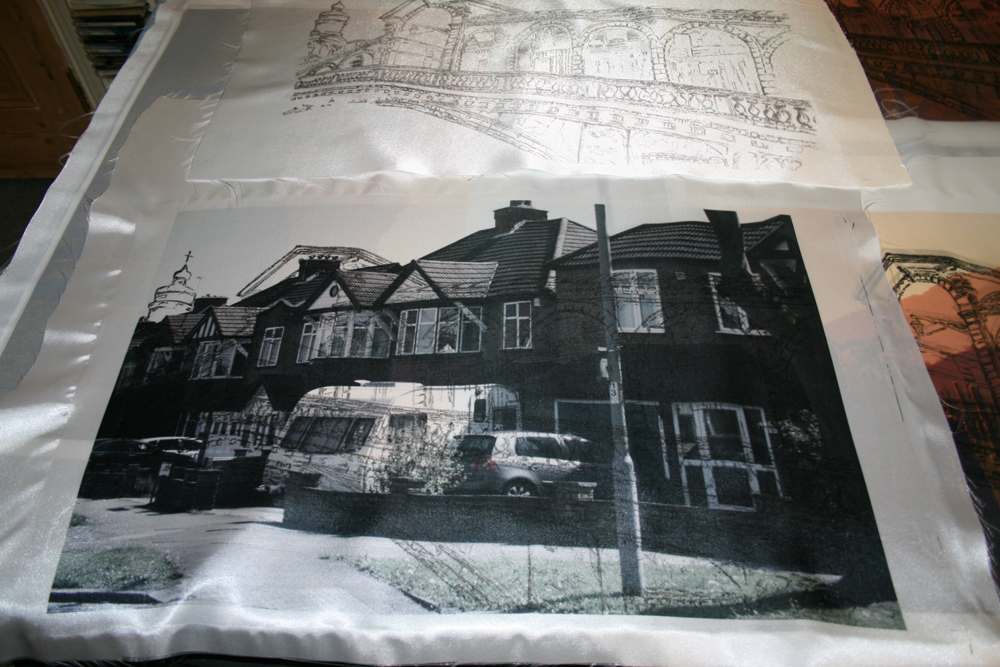
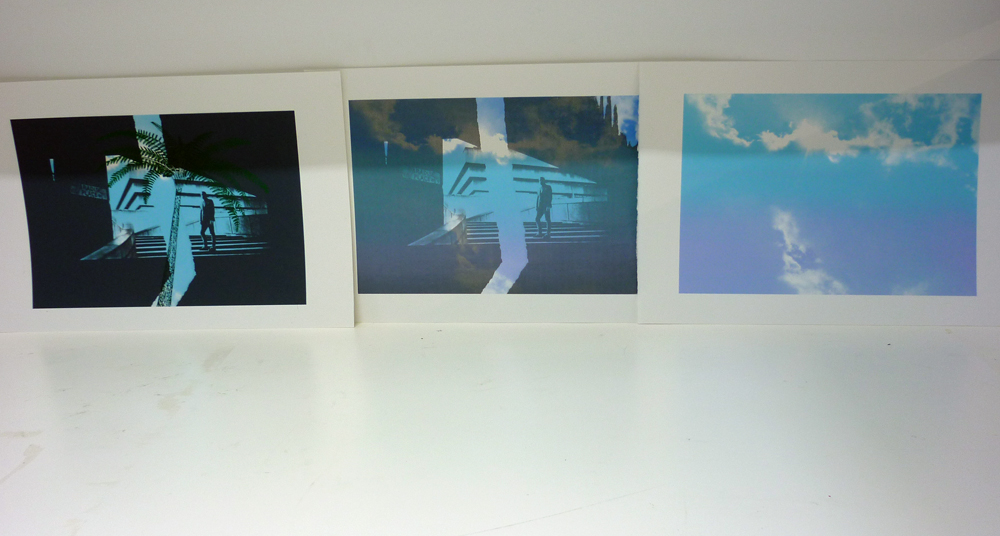
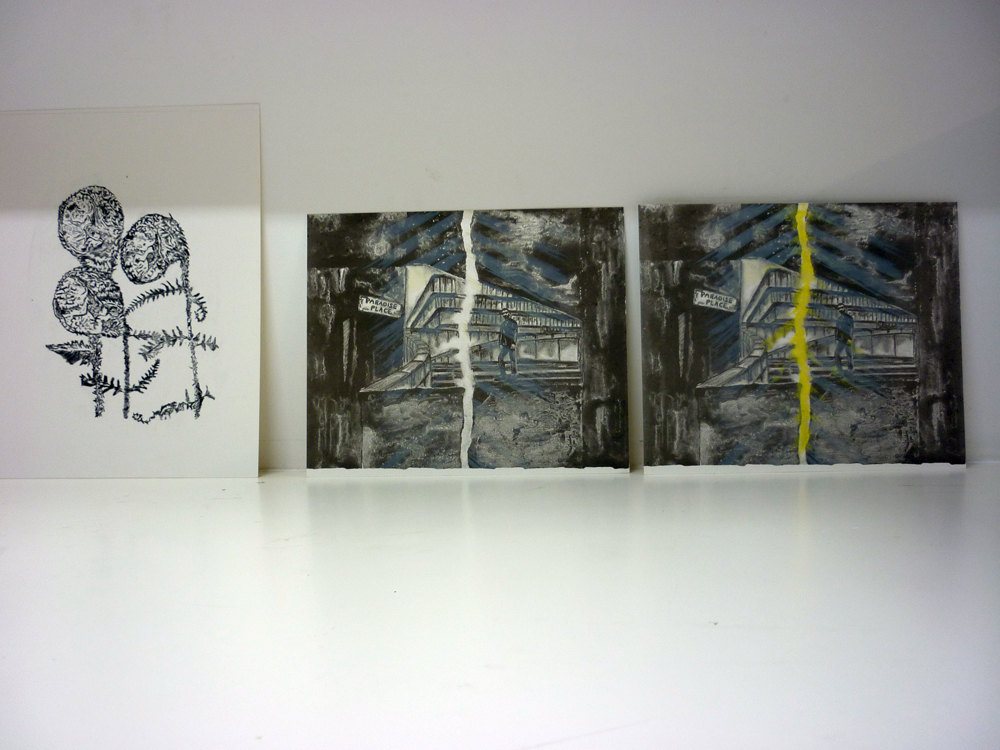
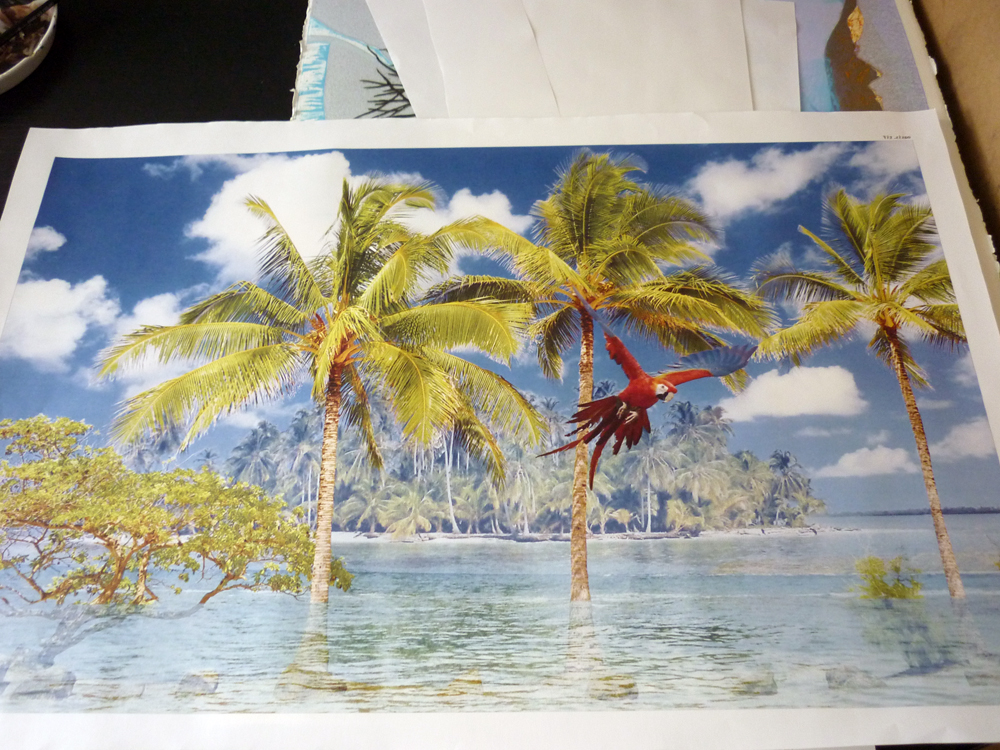
I also ended up cutting the collagraph so the sky was printed separately. I have to decide which print to use for the tear across the surface. Opening a space to fantasy. I have had the ‘paradise’ image printed which will go behind the collagraph print once it is transferred to polyester – only a small fragment will show but because the tear will be random I have had it printed full size. Even though most of the image won’t be shown I think it is important it is there.

1309 paradise

The pleasure of live performance.
It can have the feeling of a fiesta or a therapy group or a sinister encounter, there is so much to experience.

With Punchdrunk’s ‘The Drowned Man’ it was like being dropped into the middle of a David Lynch film.

Punchdrunk's The Drowned Man

Punchdrunk’s The Drowned Man

Bewildering yet sexy and beguiling.

Punchdrunk's The Drowned man

Punchdrunk’s The Drowned man

If there was a linear plot I didn’t follow it. Stories were told through dance and physical theatre with a little dialogue and a fair amount of miming to sultry soundtracks,

The dance was extraordinary, fast and furious as characters appeared, flung each other around and ran off before you could catch your breath.

I spent a lot of time wandering around deserted corridors, entering mysterious rooms labelled prosthetics or suchlike, seeing other masked figures slide into the gloom.

Suddenly a door would open onto a scene, sometimes disturbing, descending into violence as we stood anonymously and silently circling the victim.

Punchdrunk's The Drowned Man

Punchdrunk’s The Drowned Man

Through some subtle kettling the audience were amassed in one vast space for the final explosion of dance.

Separated at entry we were able to meet up in the bar with our friends to share impressions and find that we had all experienced something completely different.

I missed a whole floor of this vast space – maybe two even.

It’s running for a bit longer and I would love to go back.

Timepiece from Conrad Shawcross at The Roundhouse was a more controlled affair.

Conrad Shawcross 'Timepiece'

Conrad Shawcross ‘Timepiece’

Seeking to reimagine our experience of time passing through the mechanical movements and shadows passing across the huge dome.

I wanted to try to make the familiar the peculiar again; to turn
time and the clock back into the celestial, primeval experience that it once was
for us all.

Conrad Shawcross

It was kind of meditative.

Siobhan Davies Dance Studio performers responded to the space with a reworking of Rotor.

While wheels and arms shifted above the four dancers mirrored the movements of a clock hand walking in concentric circles.

Siobhan Davies Dance ROTOR

Siobhan Davies Dance ROTOR

The concentration was intense.

There was a follow up wonderful idiosyncratic piece Songbook composed by Matteo Fargion. The performers stood in line making expressive sounds with accompanying physical expression.

1309 Siobhan Davies Dance
Like a human instrument. An investigation into how and why we make sound. It was fun and slightly ridiculous.

The complete giving over to the production of a sound, feeling its shape as it leaves the body.

Much like Bjork sings. Every nuance is felt.

Amazing to see the very last performance of the touring show Biophilia at Alexandra Palace.

Bjork Biophilia

Bjork Biophilia

In a dress that looked like a multitude of breasts, Bjork charmed us with the intense beauty of a performance that makes you cry it’s so perfect.

‘This is kind of without humans and both zooming out like the planets but also zooming in into the atoms and in that way aesthetically sympathising with sound and how sound moves and physics of sound and how notes in a room behave, how they bounce off walls and between objects and its kind of more similar to how planets and microscopic things work.’ Bjork

Each section is introduced by the familiar tones of Sir David Attenborough giving insight into the infinite connections of the biosphere.

With bolts of electricity triggering sound and handcrafted instruments that ranged from a combination fusing the Celesta and the gamelan, a traditional Indonesian percussion ensemble to a giant pendulum contraption designed and programmed by musical robot maker from MIT, Andy Cavatorta, the ancient crafts collided with futuristic  technology.

The spectacle was completed by the soaring voices of her Icelandic choir drumming their bare feet like frenzied maenads.

Bjork Biophilia

Bjork Biophilia

Icelandic artist Ragnar Kjartansson stages large scale durational performances which can become feats of endurance for his performers and audience.

Ragnar Kjatansson

Ragnar Kjatansson

At the Venice Biennale he turns an old fishing boat into a floating stage carrying a troupe of musicians sending plaintive notes across the water. It has a rather comedic appearance as it traverses slowly back and forth across the docks at the Arsenale.  A deflated sort of pomp and circumstance.

A more introspective performance is seen in Tino Sehgal’ s Golden Lion Award winning piece at The Venice Biennale.

Tino Sehgal

Tino Sehgal’s perfomance piece

We witness communication from a new perspective.

Animalistic, primeval it takes us away from our known language of words. The performers were immersed in the dialogue between themselves.

Using song, beatboxing, humming the piece develops freely between the participants like any conversation might.

Tino Sehgal

Lizzie Sells and Frank performing for Tino Sehgal in the Central Pavilion Venice

It was like watching someone being massaged by sound as one body responded in movement to the sounds from the other.

Tino Sehgal

Lizzie Sells performing in Tino Sehgal’s piece at the Venice Biennale

Speaking to Lizzie Sells afterwards she explained how she becomes so involved in her performance that she is unaware of the audience around her, even when they are being loud and intrusive.

An oasis of calm.

Illusion, as in the romantic notion, suggested in Ibsen’s play The Master Builder, of building ‘castles in the air’ as a refuge from reality is something I am trying to capture in new work.

I have not settled on a title yet but the work involves an urban roundabout scene and a tear through reality to a paradise behind.

The first few prints from a collagraph are not very successful as the plate must settle and mature so I have used one of the unsuccessful prints to test the tear.

1309 roundabout tear

These tiny dogs, examples of Victorian taxidermy, were on display at Hall Place in Bexley, Kent.

There is something so appealing about the miniature, but it questions our expectations when scale is distorted beyond what feels natural.

1309 Victorian Taxidermy (1)

Although there were attempts by the Victorians to breed such minute specimens these particular ones are fakes. An X-ray proves a lack of skeleton.

VictorianTaxidermy

VictorianTaxidermy

These strange little creatures were an appropriate taster for the exhibition ‘Beastly Hall’, inspired by the resident  topiary of the Queen’s Beasts.

The Queen's Beasts

The Queen’s Beasts

Originally carved in stone to commemorate the Queen’s coronation in 1953, these living sentinels are based on real and mythical creatures.

Artists had been selected for the exhibition who explored all aspects of what might be considered something ‘beastly’.

HyungKoo Lee works in reverse to the Victorian taxidermist – he creates a fake skeleton.

Hyungkoo Lee 'Ridicularis'

Hyungkoo Lee ‘Ridicularis’

Transporting Goofy from popular culture to natural history.

Carsten Holler’s Red Walrus has a cartoon appearance with its plasticised body and unnatural colouring.

Carsten Holler 'Red Walrus'

Carsten Holler ‘Red Walrus’

It has however been given human eyes which gaze out from within a fabricated world.

Joana Vasconcelos takes a kitsch ornament and adds another skin, a layer of decoration.

Joana Vasconcelos 'Flibbertigibbet'

Joana Vasconcelos ‘Flibbertigibbet’

We were told when we got our cat – it is not an ornament, don’t expect it to behave like one.

Thomas Grunfeld has created a whole series of ‘Misfits’ through mixing species.

1309 Thomas Grunfeld 2

Thomas Grunfeld ‘Misfits’

Questioning our manipulation of nature.

1309 Thomas Grunfeld 1

Thomas Grunfeld ‘Misfits’

Creating a modern mythology.

Thomas Grunfeld 'Misfits'

Thomas Grunfeld ‘Misfits’

Exploring the fear of genetic engineering and what it might create.

Polly Morgan doesn’t always deal in horror but in ‘Blue Fever’ the melding together of so many bodies through a thrashing of wings creates something disturbing.

Polly Morgan 'Blue Fever'

Polly Morgan ‘Blue Fever’

An entity that cannot breathe, suspended in continuous flight with no escape.

Tessa Farmer explores flesh under attack.

Tessa Farmer 'A wounded Herring Gull'

Tessa Farmer ‘A wounded Herring Gull’

Her trademark tiny skeletons in league with the insect world bring down a much larger life force.

Tessa Farmer

Tessa Farmer

Claire Morgan’s installation of blue bottles suspended in flight creates  a geometric order from an association of disgust, germs and disease.

Claire Morgan 'Heart of Darkness'

Claire Morgan ‘Heart of Darkness’

Damien Hirst puts the visceral into the kitsch.

Damien Hirst 'Sacred Heart (with hope)'

Damien Hirst ‘Sacred Heart (with hope)’

Hope and treachery are preserved in perpetual limbo.

I really liked Rachel Goodyear’s delicate drawings of spirits escaping earthly vessels.

Rachel Goodyear

Rachel Goodyear

Her drawings incorporate 3D paper cuts which flow out from and off the page.

Rachel Goodyear

Rachel Goodyear

Her organic ceramic pieces hold strange images, transitory moments like worrisome memories best tucked away.

Rachel Goodyear 'curling up into more comfortable positions'

Rachel Goodyear ‘curling up into more comfortable positions’

The spiritual theme is continued with Jodie Carey’s funeral flowers bleached of colour.

Jodie Carey

Jodie Carey

These flowers are made of plaster, chiffon and ground up bone,

Throughout the exhibition there is the uplifting sound of birdsong.

It comes from Matt Collishaw’s truncated tree trunks where LP’s mimicking the age rings of trees spin and fill the space with the sounds of woodland.

Matt Collishaw 'Total Recall'

Matt Collishaw ‘Total Recall’

The birds recorded are actually mimicking chain saws. With this knowledge the jolly suddenly becomes sinister.

Susie MacMurray filled a room with peacock feathers echoing the crowds drawn to watch the spectacle of the coronation.

Susie MacMurray 'Spectacle'

Susie MacMurray ‘Spectacle’

These fragile remains of the male peacocks display act as an unexpected barrier.

Susie MacMurray 'Spectacle'

Susie MacMurray ‘Spectacle’

The idea of the voyeur is further expressed by Francis Alys in his footage of a fox let loose in The National Portrait Gallery.

Francis Alys 'The Nightwatch'

Francis Alys ‘The Nightwatch’

Trapped and confined to relentless meanderings the fox is exposed to the sort of CCTV surveillance that we are subject to as we traverse the city while similarly unaware of our voyeurs.

Peter Blake’s ‘Tarzan Box’ from 1965 expresses a clash of cultures and clichéd fears of what the exotic might hold.

Peter Blake 'Tarzan Box'

Peter Blake ‘Tarzan Box’

The exploration of dark spaces could reveal fantastical creatures of horror.

Charles Avery 'Duculi (The Indescribable)'

Charles Avery ‘Duculi (The Indescribable)’

There were also lots of artists showing at the Venice Biennale who engage in fantasy and myth.

Levi Fisher Ames sculpted his fantastical creatures in wood and displayed them as specimens in glass cases.

Levi Fisher Ames

Levi Fisher Ames

‘Animals Wild and Tame – Whittled Out of Wood – Nothing Like It Shown Anywhere’

Levi Fisher Ames

Levi Fisher Ames

Ames took his collection on tour around Wisconsin in the 1880’s telling outlandish tales about his creatures to his audience while simultaneously  carving more figures.

Severely autistic Shinichi Sawada has created a very personal mythology with his clay figures.

Shinichi Sawada

Shinichi Sawada

These beasts look like they come from a ritualistic and totemic past, but are recent creations, combining spiky defence in a fragile form.

Domenico Gnoli’s beasts also ‘hail from a vast storehouse in the human imagination’.

Domenico Gnoli

Domenico Gnoli

His series of drawings ‘What is a Monster’ from 1967 place surrealist creatures into everyday settings.

Anna Zemankova is growing flowers that are not grown anywhere else.

Anna Zemankova

Anna Zemankova

Produced during frantic early morning reveries she allowed her mind to flow freely recalling cultural influences entwined in her fantasies.

Ivan Morison also loves to create myths. His talk at the Whitechapel Gallery was peppered with stories of the fantastical, almost believable sort. Is there really a village in Italy that strings goats up from a tree and shoots at them? Was the world’s biggest dinosaur really the victim of arson?    Storytelling is part of the work and has been formalised in the traveling puppet theatre of Mr Clevver, based on a character from the post-apocalyptic novel, Riddley Walker by Russell Hoban.

Heather and Ivan Morrison

Heather and Ivan Morrison

Another of the Morrison’s escape vehicles. They travel through rural landscapes setting up camp unannounced and putting on a show to whichever locals turn up..

Heather and Ivan Morrison

Heather and Ivan Morrison

Telling stories that blend factual recall with fiction, merging information into a narrative that builds on the mythology of their own lives and also the lives of people they encounter.
Out of its time, part medieval part futuristic, Mr Clevver is an evolving work about the coming together of different people in differing places.

'Mr Clevver' Ivan and Heather Morrison

‘Mr Clevver’ Ivan and Heather Morrison

Kay Harwood showing at Simon Oldfield Gallery also deals in mystery and suggestion.

Kay Harwood

Kay Harwood

Exploring iconography and mythology her paintings have a wonderful pure surface, like porcelain. The muted and restricted palette gives a timeless quality.

Kay Harwood

Kay Harwood

These men look like contemporary apostles in meditation on some spiritual truth.

The quest for inner retrospection. A solitary wanderer.

I wanted to capture something of an enchanted wood in these images.

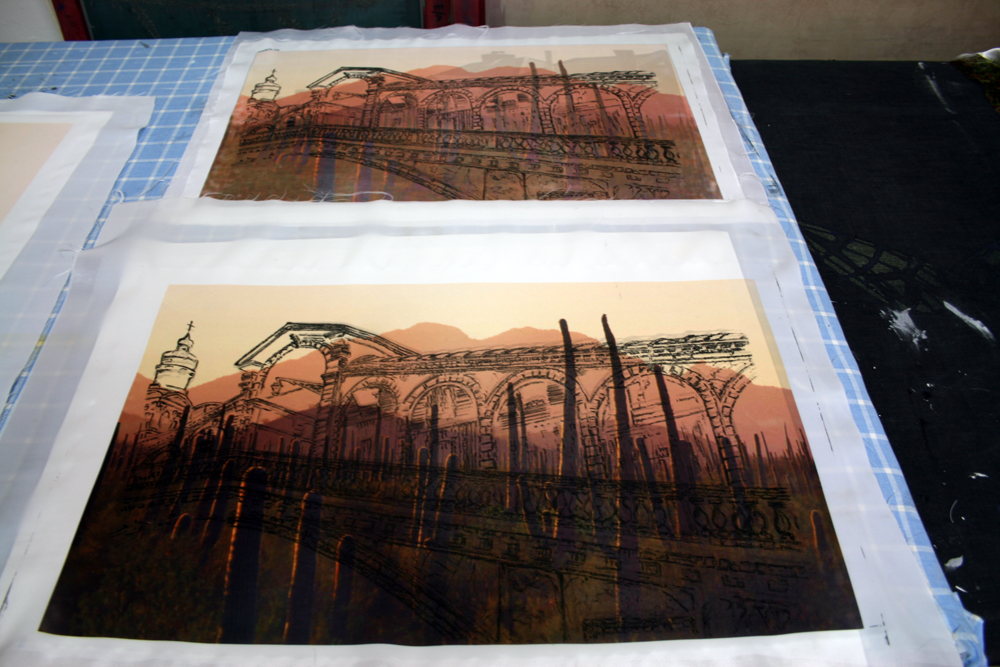
These are screen prints with sublimation inks transferred onto polyester. I printed 3 layers separately onto paper and then heat-pressed them on top of each other blending the colours.

1309 woods

Layering the shadow of a rose garden on organza over the grey woods.
I have been thinking about whether to add a figure in the woods.

Also have been working on one ‘return of the forest ‘ collagraph, cutting sublimation printed organza onto the collagraph.

The forests disappeared under the advancing ice and then reappeared as the ice retreated.

Going back to a time before civilization, before religion. Right back to the beginning to see where the first dislocation took place, looking back for the myth of living in harmony with nature in some idyllic context and the start of nostalgia.

1309 return of the forest

Thinking about fantastical creatures and myth has been helpful for the new work I am planning about beasts of the forest.

The final talk in the Whitechapel Gallery programme ‘To Make a Tree’ was from Ivan Morrison (Heather was busy in rehearsals for their travelling puppet show tour of Wales)
A great raconteur Ivan presented an overview of their practise concentrating on key interests and their overriding belief in the importance of integrity of materials.
Making something have more depth by doing it the long way even if the end result looks the same, he strongly believes that the commitment to an object though a long making process imbues it with a value beyond the visual.
He is also a great believer in the importance of failure –  natural entropy. From the ashes of disaster…

He decided the best way of forming a direct engagement with nature within an urban environment was to become involved in gardening.
This involvement was to become one of his first projects; the documentation of his gardening experience in Birmingham.

Postcards were printed and sent out to selected people stating the progress of his gardening endeavours.

Heather and Ivan Morrison

Ivan Morrison

He listed the colours to be found in the garden at certain times of the year.

Ivan Morrison

Ivan Morrison

As time went on the success and more often the failures were documented in what became an ongoing narrative of the battle every gardener faces in order to maintain control and defy attack.

Ivan Morrison

Ivan Morrison

The Morrisons are inspired by the passions of other people, the importance of family and ancestors, of staking a claim in the soil by planting an arboretum tended through generations, or the spirit of the idealist who builds an escape vehicle on the back of a truck and heads for the open road.

Heather and Ivan Morrison Tales of Space and Time

Heather and Ivan Morrison ‘Tales of Space and Time’. Converted Bedford Green Goddess, Douglas Fir, books, other media

This idea of an escape vehicle became translated into other forms of refuge.

Heather and Ivan Morrison 'I am so sorry, Goodbye'

Heather and Ivan Morrison ‘I am so sorry, Goodbye’

Ivan Morison explains; ‘The conjoined domes of ‘I am so sorry. Goodbye.’ are inhabited by a guardian whose task it is to keep the stove lit, water boiled and visitors supplied with hibiscus tea. The guardian has the vocabulary of the words: I, am, so, sorry and goodbye. These words were first conveyed to us whilst staying in an old upmarket hotel on Alexandria’s corniche. Late one night I received a call in which the only words that were said, by the slow doleful male foreign voice, were ” I am so sorry sir… I am so sorry sir… Goodbye sir.” After putting the phone down I felt witness to something I didn’t fully understand, but felt that we had been given the task to pass on this cryptic message.’
The refuge is hand built from naturally fallen trees in Tatton Park. Made from its own environment it looks both archaic and futuristic. Dystopian or utopian it could come from any era. An apocalyptic future or the idealisms of a hippy commune. The Morrisons are interested in social architecture and how architecture impacts social behaviour. These thoughts are also influenced by science fiction and dystopian novels such as  J.G. Ballard’s 1975 novel, High-Rise. The idea of the building design having a direct effect on the social relationships of the inhabitants was part of the thought process for the Morrisons in creating a site specific structure ‘Plaza’ in Vancouver.

Heather and Ivan Morrison Plaza

Heather and Ivan Morrison Plaza

‘Plaza’ looks about to fall down. It is made of reclaimed dark heavy wood, burnt black. In contrast to the pale linear city it looks like the bones exposed at the moment of collapse.

A reminder of all the great cities that have fallen over time. It is an exciting place because it is dynamic. It creates a shift in perception.

The Maldives are facing a very direct impact on their environment from climate change, not a natural entropy.

Communities come together to build sandbanks to try to keep the sea at bay.

Portable Nation

Portable Nation

At the Venice Biennale the art collective Chamber of Public Secrets explored east west views of nature. Where western thought considers nature and culture to be in opposition, eastern thought considers nature as a guide, a source of inspiration and harmony.

Portable Nation

Portable Nation

For the pavilion they presented the culture and nature of the Maldives as one aesthetic experience in line with the concept of contemporary Environmental Romanticism.

Portable Nation

Portable Nation

The crumbling brickwork of the pavilion was a perfect backdrop to the video projections of nature giving an ethereal ghostlike quality to the images – a disappearing landscape.

Portable Nation

Portable Nation

For many the Maldives is synonymous with paradise.

Portable Nation

Portable Nation

A place for the western romantic to escape to has become a place that its own people want to escape from.

Portable Nation

Portable Nation

Simryn Gill for the Australian pavilion fully embraced entropy in her work.

Australian Pavillion

Australian Pavilion

‘Here art grows on trees’  allows the elements into the Pavilion.

The drawings of insects on paper made from the pulp of decayed plants will over the seasons return to a state of decay, exposed to the rain and sun and insects of the Giardini.

The work is about the passage through time of paper, the artwork, the pavilion, the artist.

Simryn Gill Eyes and Storms

Simryn Gill ‘Eyes and Storms’

Looking at cycles, at circles. Eyes and Storms are photographs of mines. Huge circles carved into the earth.

It will be interesting to see how the work has changed when I return in November with the RCA study trip.

Another artist undertaking a similar project at the moment is Matt Calderwood on the roof of the De La Warr Pavilion in Bexhill.

Matt Calderwood Exposure Sculpture

Matt Calderwood Exposure Sculpture

The paper covered steel frames of ‘Exposure Sculpture’ will remain on the roof, at the mercy of the elements, over the summer period to be taken into the gallery and reconfigured later in the year.

Terike Haapoja in the Nordic Pavillion at the Biennale questioned the human view of nature and wanted to express the interdependency of all living things, the energy passing between us and through us.

Nordic Pavillion

Nordic Pavillion

By talking or breathing to the CO2 sensor next to a branch on the trees in the Pavilion the visitor can activate the lights and open the glass chambers.

Terike Haapoja

Terike Haapoja

Breathing together.

Nordic Pavillion

Nordic Pavillion

The loss of heat from a body at the moment of death is recorded. It is a poignant witness to the warmth of life slowly dispersing.

Terike Haapoja

Terike Haapoja

Thinking about the natural processes of life and death can lead to thoughts of the spiritual.

Our ancestors had other than scientific explanations for things they didn’t understand and believed in spirits.

Mark Leckey’s exhibition ‘The Universal Addressability of Dumb Things’  looks at the objects we interact with today in a similar vein. As things possessed.

His concept is of ‘techno-animism’ – the blurring of the animate and the inanimate.

Mark Leckey

Mark Leckey

At the Biennale a digital taster was showing of the main exhibition held at the De La Warr pavilion in Bexhill on Sea.

Mark Leckey at The De La Warr Pavilion

Mark Leckey at The De La Warr Pavilion

Felix the Cat – the first image ever transmitted on TV

Mark Leckey The Universal Addressability of Dumb Things

Mark Leckey The Universal Addressability of Dumb Things

The exhibition was presented as a collection of objects that all talk, literally or metaphorically, to each other.

Mark Leckey The Universal Addressability of Dumb Things

Mark Leckey The Universal Addressability of Dumb Things

I was interested in the backdrop image which is Piero di Cosimo The Forest Fire c1495-1508.

The painting is thought to show the birth of civilization as man gained supremacy over the animals through the use of fire and language.

Concerned with the history of early man, inspired by passages from Book 5 of De Rerum Natura by Lucretius (98–c.55 BC), who traces the origins of life on earth and the birth of community life, emphasizing the role of fire as a catalyst for change.

Roger Hiorns

Roger Hiorns

The machine encrusted with crystals making its original purpose defunct it becomes something else.

Nicola Hicks Maquette for Crouching Minotaur

Nicola Hicks Maquette for Crouching Minotaur

Imposing presence of a minotaur skull, a symbol of the unnatural. A monster created from desire that cannot be controlled.

Doesn’t feel impossible.

William Blake believed he was visited by spirits from other worlds in his imagination.

William Blake The Ghost of a Flea

William Blake The Ghost of a Flea

This is his record of the spirit of a flea which has undergone a demonic transformation inhabited by the souls of bloodthirsty men.

Possession.

At the Biennale in the Belgium pavilion Berlinde De Bruyckere created a mausoleum.

Berlinde De Bruyckere's 'Cripplewood'

Berlinde De Bruyckere’s ‘Cripplewood’

A tree is cast in wax, it is then traced with blood red veins and pink mottled flesh. A process of metamorphosis has begun.

Berlinde De Bruyckere's 'Cripplewood'

Berlinde De Bruyckere’s ‘Cripplewood’

Bound with what appears to be bloodied bandages and laying on its side, the trees limbs take on the fragile nature of the bones of a giant disfigured human corpse.

The circle of life, the exchange of energy is something that Lin Xue wanted to convey in his detailed fantastical landscape drawings made with sharpened bamboo and ink.

Lin Xue

Lin Xue

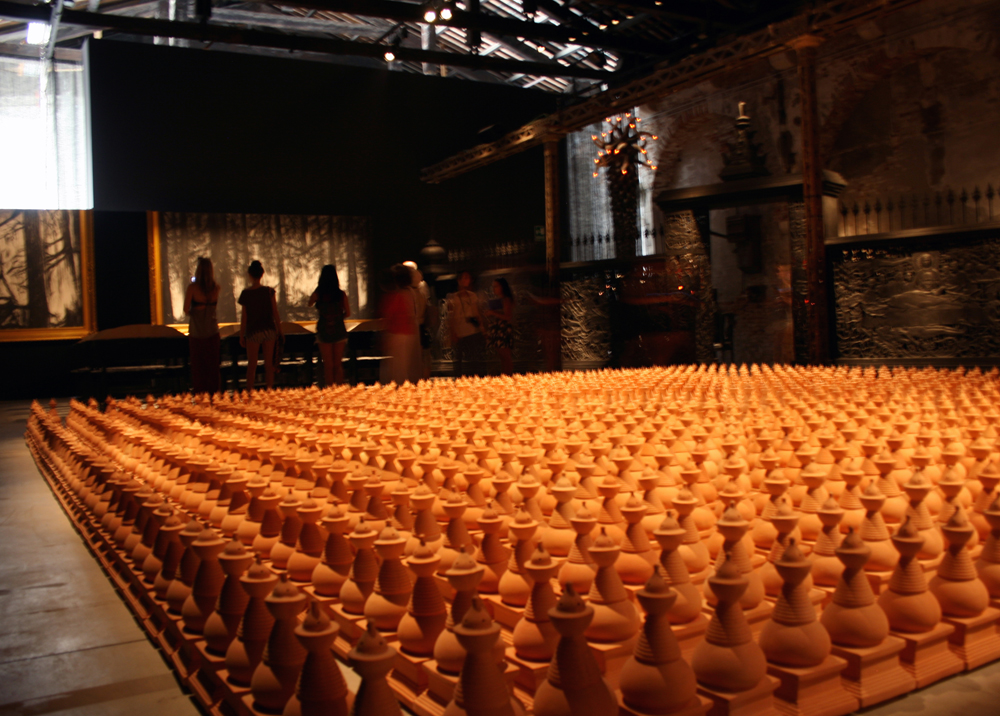
The “Treasuries of Knowledge” exhibition by Khaled Zaki and Muhammad Banaw for Egypt looked at the two cycles of the universe – the first infinite cycle of nature and the second cycle of humanity continuously walking the earth.

“Treasure of Knowledge”  Khaled Zaki and Muhammad Banaw

“Treasuries of Knowledge” Khaled Zaki and Muhammad Banaw

At the point where the two cycles overlap is the point of creation, of wisdom and where such mysteries as knowledge of the afterlife might be found.

Lara Almarcegui is also interested in renewal.

Lara Almarcegui

Lara Almarcegui

Working at the boundary of urban regeneration and natural decay she filled the Spanish pavilion with builders rubble.

Mirroring the unpredictable power of a landslide the mounds of rock look like they could keep pouring into the room.

There is a strong smell of brick dust also filling the space and adding to the slight sense of claustrophobia, that you might be trapped, or can’t breathe.

Lara Almarcegui

Lara Almarcegui

The mound of smashed glass though is quite seductive, it sparkles like ice. You want to make crunching footsteps over it and gather it up to see the light play on its shattered surface.
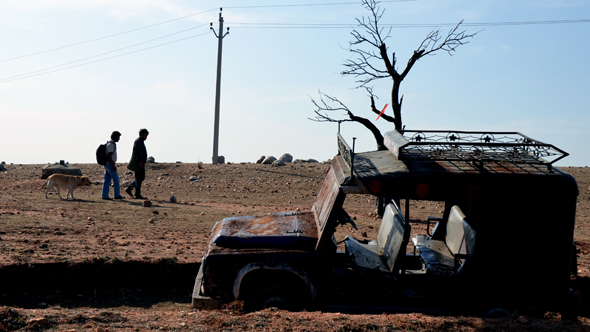
The materials of construction are presented in their raw form. Buildings mechanically broken down to be reused and dispersed into other landscapes.

Gina Soden’s painterly photographs on the other hand depict nature slowly reclaiming abandoned and derelict buildings left to ruin.

Gina Soden

Gina Soden

Showing at ‘Natural Selection’ at The Fine Art Society she captures the beauty of decay. There is a nostalgia here, a sense of the past crumbling away before us, returning to the earth.

Where Gina Soden looks at nature reclaiming ancient buildings, Paul Davies celebrates the dynamic juxtaposition of the clean lines of architecture in an organic setting.

Paul Davies

Paul Davies Modern Cathedral Invert

The balance of power between nature and the manmade is explored in his highly textured paintings of modernist buildings in dramatic landscapes.

The forest becomes the cathedral.

I was intrigued to find that the name for the unfurled heads of fern is shared by a Bishop’s staff of office – Crosier.

1308 Succession ve 1 1308 Succession ve 3 1308 Succession ve 6

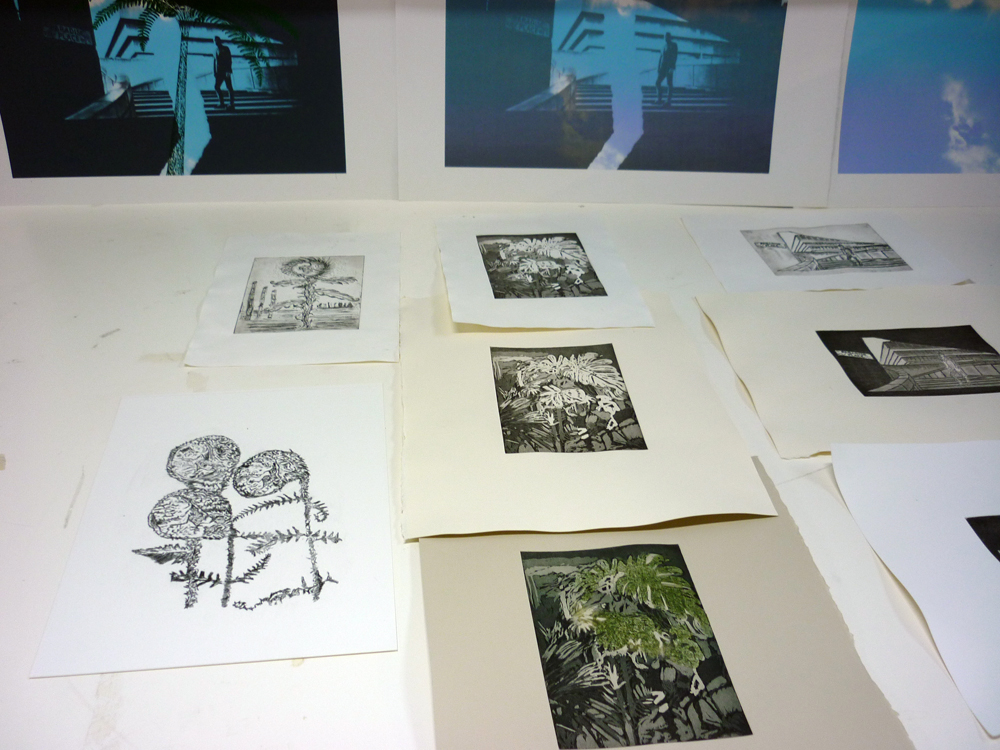
I have finished this set of prints. The title is ‘Succession’.

As the ice retreats; from first life to ferns to first trees to forests to man to religion.

A few people have seen the prints now, the majority do not spot the embryos tucked in the furls of the fern unless I push them to look harder.

I like things to be hidden so I think it’s OK this is the case.
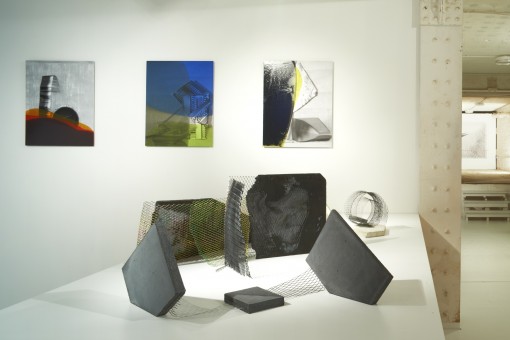
I also did some with more colour but am happiest with the grey tone ones.
1308 Succession ve 2 1308 Succession ve 4 1308 Succession ve 5