Archives for posts with tag: Hiroshi Sugimoto

Delighted to share the news that I have been longlisted for The Aesthetica Art Prize 2024. A live recording of The Breath of Stars will be included in the digital showcase at York Gallery. The Aesthetica Art Prize celebrates contemporary art across a range of media and I’m looking forward to joining the Future Now conference for critical and cultural debate running alongside the art prize exhibition.

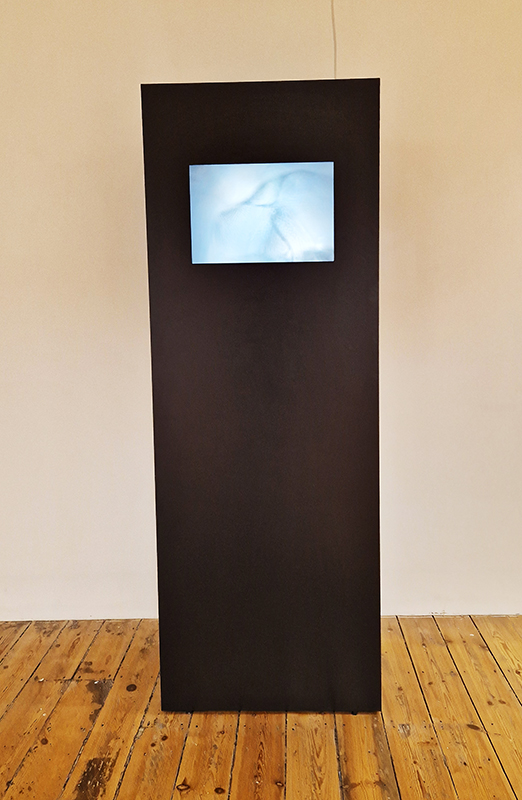
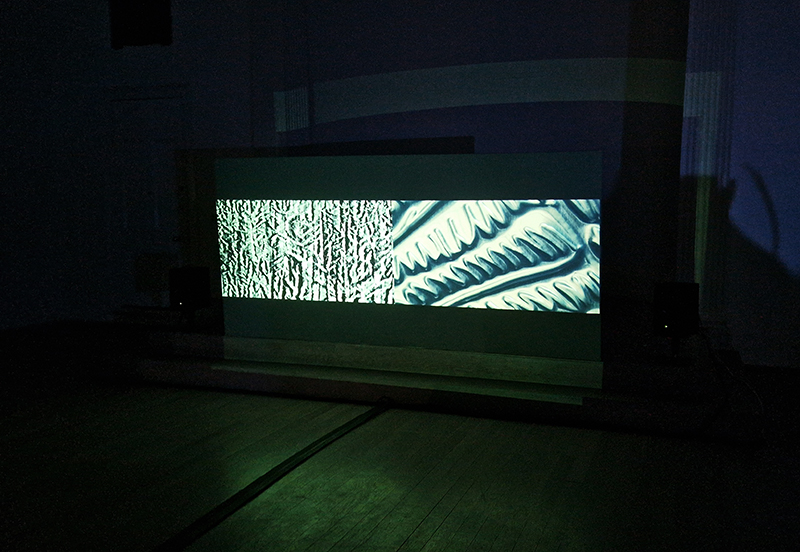
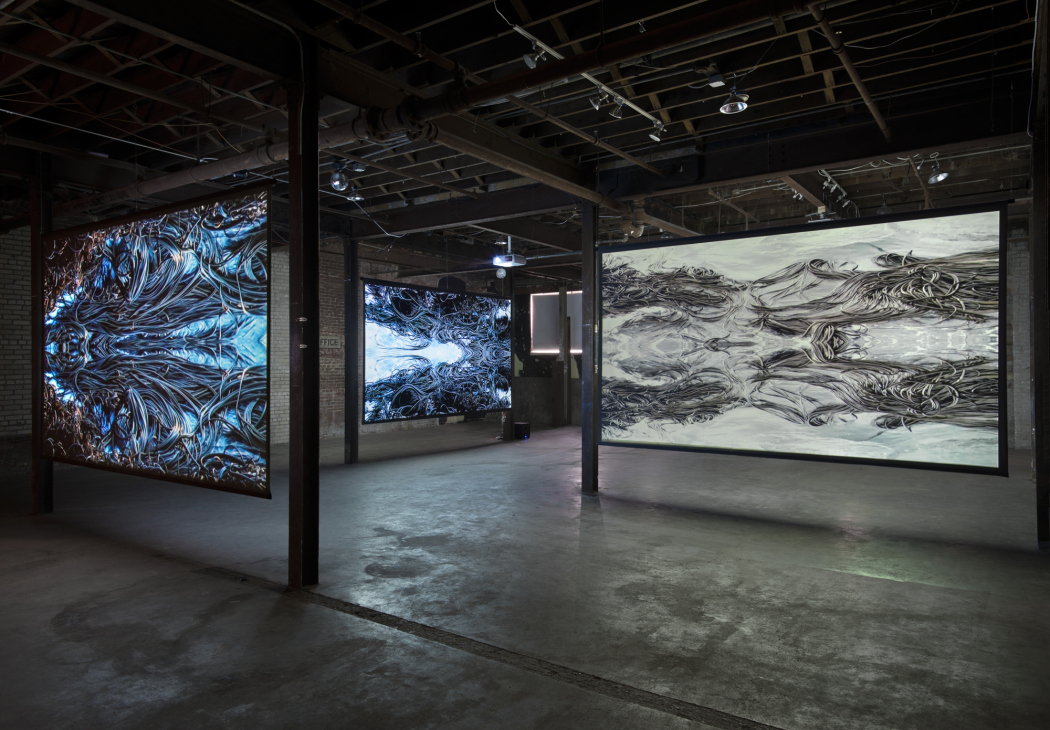
The Breath of Stars (Cosmic ray detectors, mini computers, wooden box (20×20 cm), video projection; live duration) is a digital video work activated in real time by the passage of cosmic rays through a pair of scintillator detectors. Cosmic rays from exploding stars or other extreme events, power across the universe, collide with atoms in the Earth’s atmosphere, break apart, and shower down upon us. Some particles silently interact technology on Earth. In this work, particle detectors and mini computers are connected to a projector. Every time a cosmic ray passes through the plastic scintillator blocks inside the detectors, its energy is recorded, and a starburst video is displayed.

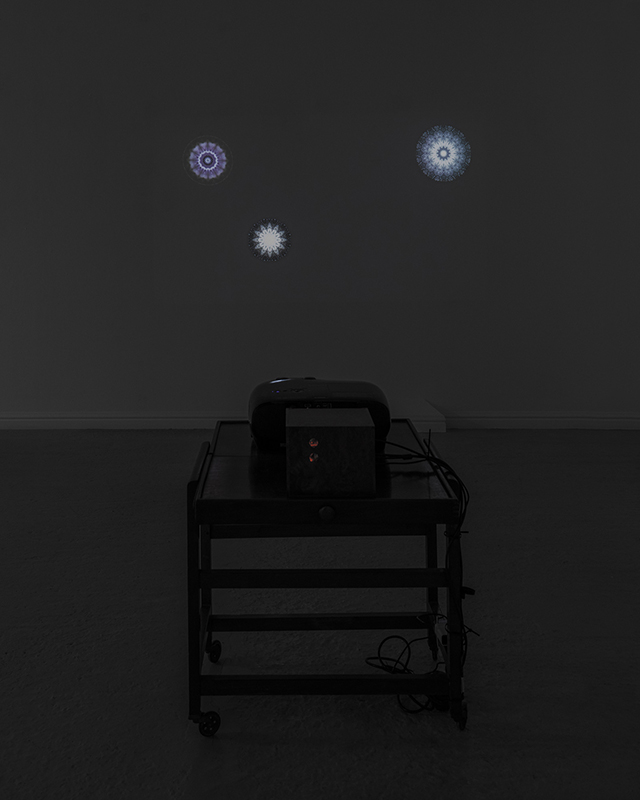
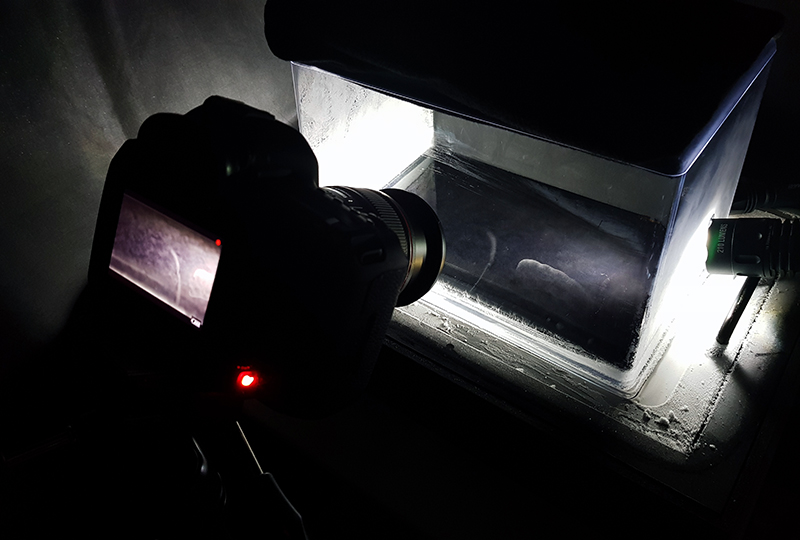
The kaleidoscopic video images that appear are created from mirrored footage of cosmic ray trails filmed during my cloud chamber experiments. Cosmic rays are subatomic  – smaller than an atom – they are protons or the nuclei of an atom which has had its electrons ripped away. We can’t see the actual particles but we can see the trails of condensation they leave behind as they whizz through a cloud chamber.
Cosmic rays arrive at Earth randomly, and this can be witnessed by the sudden flurries and silent gaps of the video imagery. The kinetic energy in just one particle can be equivalent to the energy of a cricket ball bowled by the fastest bowler on the planet  – so much energy squeezed into one tiny particle gives it a huge velocity. Light travels a thousand billion kilometres in one year – a light year – no object with mass can travel at the speed of light but an ultra-high energy cosmic ray would only lag behind the photon by 100th of the diameter of human hair. Most cosmic rays heading for Earth are deflected by the planet’s magnetic field – without this protection, life on Earth, as we experience it, could not survive this bombardment of radioactive matter.

Around 95% of the universe is ‘dark’ to us, formed of unknown and possibly unknowable matter. Phenomenon such as dark matter may be inaccessible to us, but cosmic rays offer a more tangible contact with outer space as they have mass. Although too small to see, we can witness their effects via technology, such as that used in The Breath of Stars, which affords us the opportunity to gaze beyond and between the stars to gain an insight into the structures of the cosmos and imagine what might be hidden in those dark spaces.

I am very excited that Cosmic Chiasmus: crossing the universe is showing at the super brand new Science Gallery Bengaluru in their inaugural exhibition CARBON: under pressure.
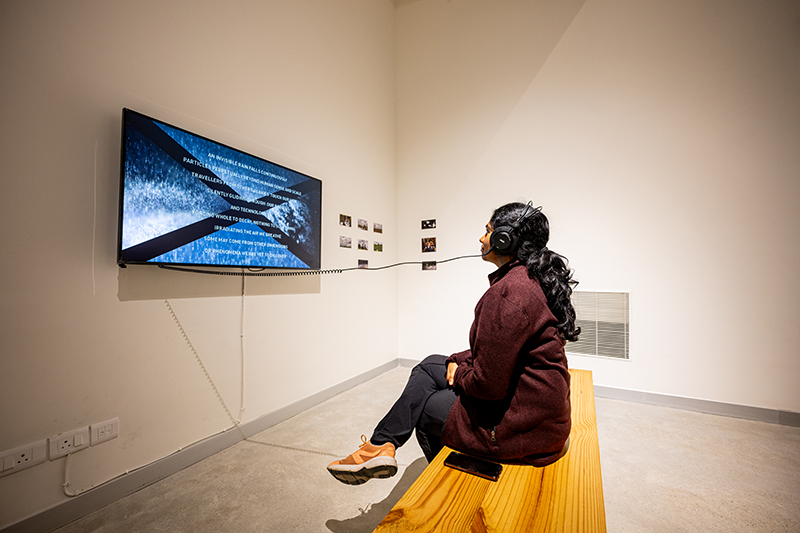
Science Gallery Bengaluru (SGB) is part of the Science Gallery International Network pioneered by Trinity College Dublin. The exhibition explores the ubiquitous nature of carbon, its energy history and the potential futures it enables. Given its unique capability to form bonds and compounds carbon is a foundational element of both life and non-organic matter and its properties have been harnessed as fullerenes, graphene, nanobuds, nanotori, nanocones, and nanohorns, enabling the creation of new screens, batteries, ultra-fast computers, ultra-thin sensors and cables of braided nanotubes. Carbon-14 in organic materials serves as the basis for radiocarbon dating, and Carbon-12 was the standard Dmitri Mendeleev used to determine the atomic weights—and now mass—of all other elements. Carbon dioxide is used as the standard to understand and regulate the flow of exchanges between ecology and economy. Industry driven by coal and oil-fired productivity have triggered alarming climatic effects and created a chasm between geo-biological time as shaped by the material memories of the planet and historical time—that shaped by human action. Carbon is an archive of buried sunshine, bridging the divide between substance and phenomena; caught between the finitude of nature’s resources and the near infinite wonderous potential it holds.

Cosmic Chiasmus: crossing the universe offers a glimpse into a subatomic world where cosmic rays travel from distant galaxies to collide and silently interact with atoms and technology on Earth. Cosmic rays are particles that move extremely fast. They are raining down on planet Earth all the time. Although they are called rays they are not like photons, as light is made of, because they have mass, but they do travel at nearly the speed of light. Cosmic rays go through a violent process of creation, transformation and decay. From the heart of stars or the depths of black holes these particles power across the universe with unimaginable energy colliding with life on Earth and triggering other processes such as cell mutation, computer data corruption and carbon-14 formation. Above our heads where cosmic rays collide with atoms in Earth’s atmosphere radioactive carbon-14 is formed. This radioactive carbon-dioxide in our atmosphere is absorbed by plants and enters the food chain. The radiocarbon decays while an organism is alive but is continually replenished as long as the organism takes in air or food. When an organism dies no more Carbon-14 is absorbed and that which is present starts to decay at a constant rate. By measuring the radioactivity of dead organic matter, the carbon-14 content can be determined and the time of death established. Cosmic ray activity gives us carbon dating techniques. It is an incredible journey that cosmic rays make, blasted across space, spiralling along magnetic field lines to end up entangled with carbon in our bodies.

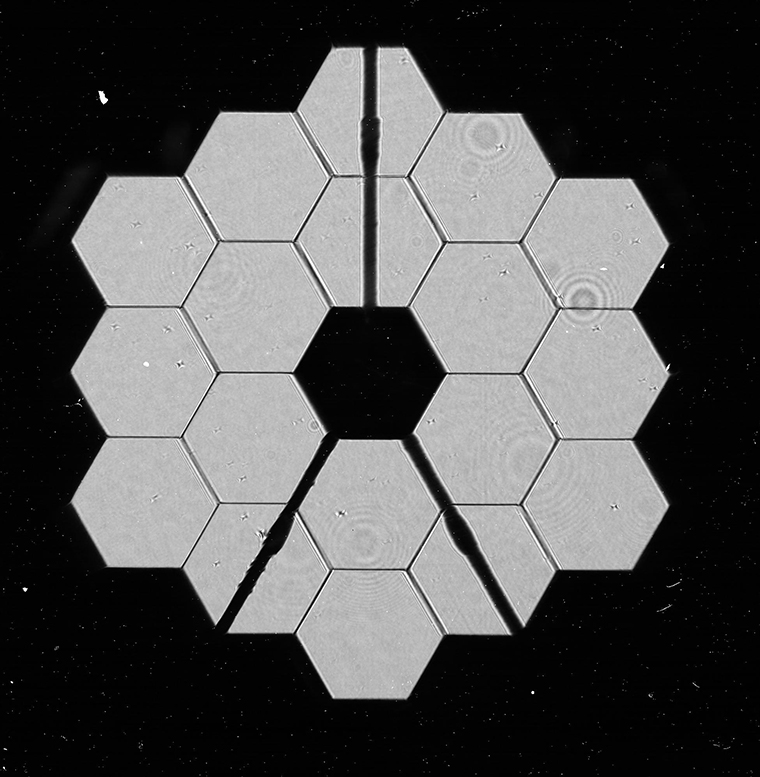
The James Webb Space Telescope selfies of its own light searching mirrors shows cosmic ray activity impact. Space weather can have serious implications for technology. Satellites are particularly vulnerable. and can be sent off-orbit or suffer electrical interference. The satellite population orbiting Earth has more than doubled since 2020, and with more satellites launched in the past year than during the first thirty years of the Space Age, reliance on this technology is increasing at a rapid rate.
I am making new work looking at information insecurity caused by space weather for an upcoming group show at APT Gallery which takes the lifeboat as a metaphor for precarity. Participating artists: Rachael Allain / Caroline AreskogJones / Beverley Duckworth / Liz Elton / Susan Eyre / Kathleen Herbert / Kaori Homma / Anne Krinsky.   
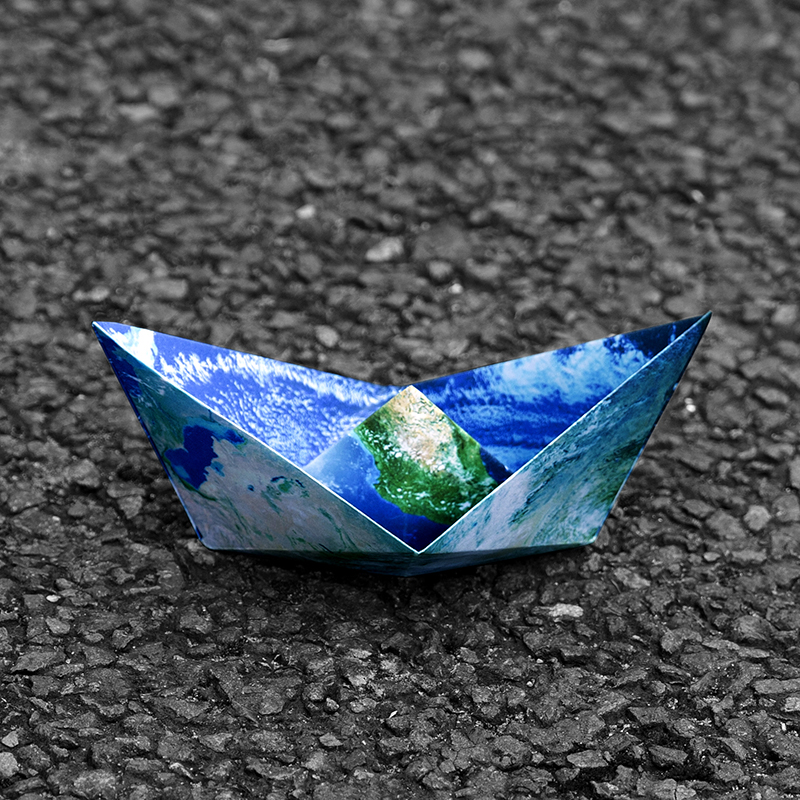
Life Boat brings together artists with a shared interest in exploring precarity as a site of dynamic transition. Each takes an investigative approach to the environmental, social and historical themes evoked by the lifeboat, as a means of addressing ecological crisis, liminal landscapes, close and distant horizons, boundaries and displacement, lines of rescue, navigation and transformation.

“How do you calculate upon the unforeseen? It seems to be an art of recognizing the role of the unforeseen, of keeping your balance amid surprises, of collaborating with chance, of recognizing that there are some essential mysteries in the world and thereby a limit to calculation, to plan, to control.” Rebecca Solnit, A Field Guide to Getting Lost

Gallery Visits

Tania Kovats as above so below at Parafin. She says: ‘I make drawings more than I draw drawings.’ There is something captured in the simplicity of her work, a haptic viscerallity that is very emotionally stirring.
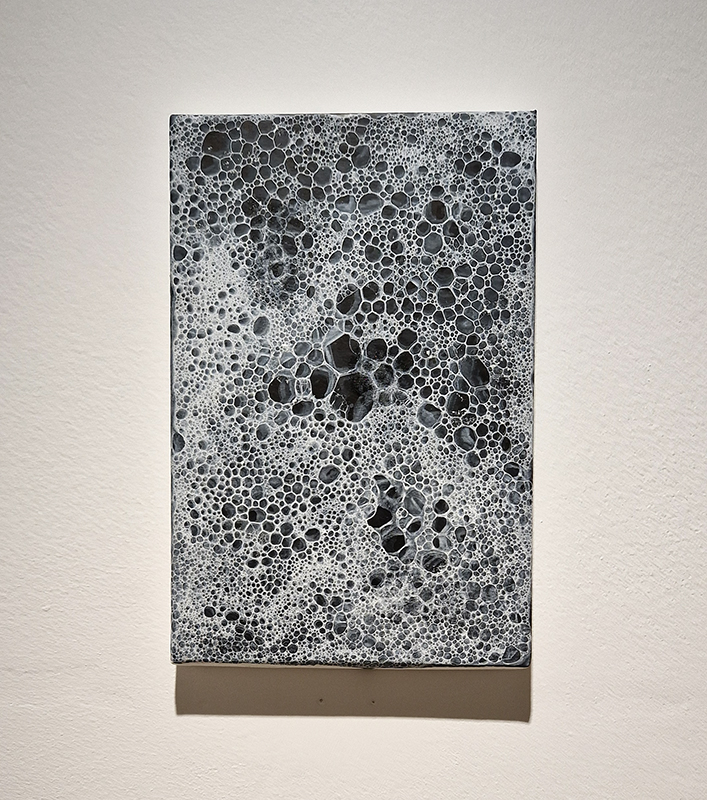
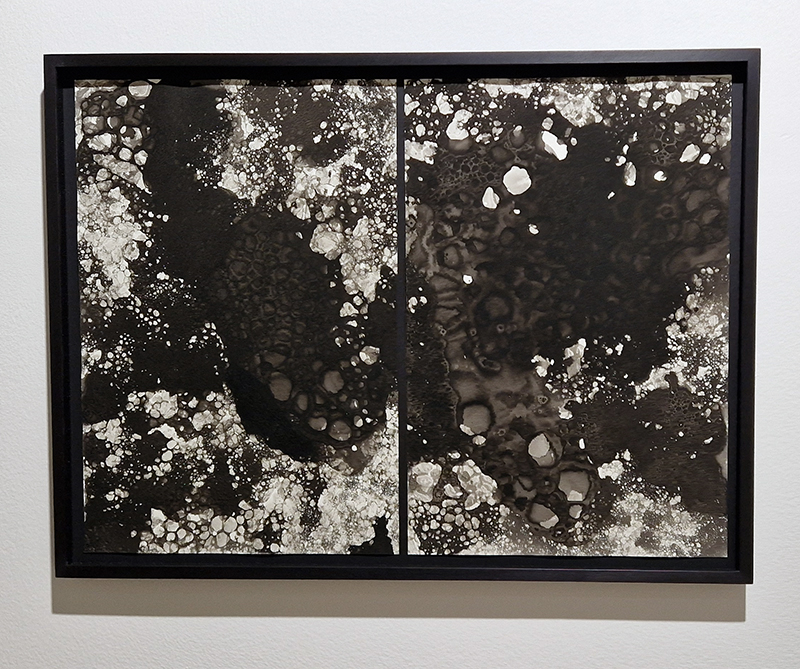
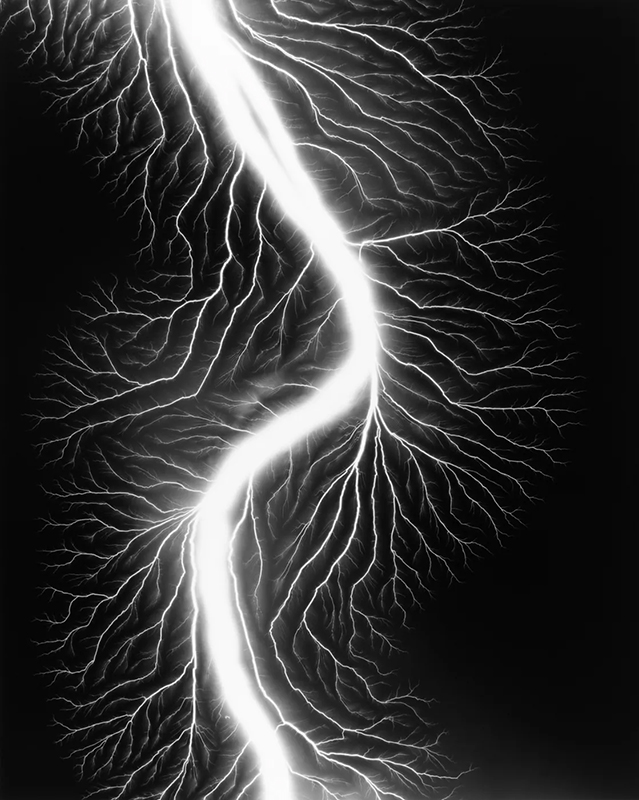
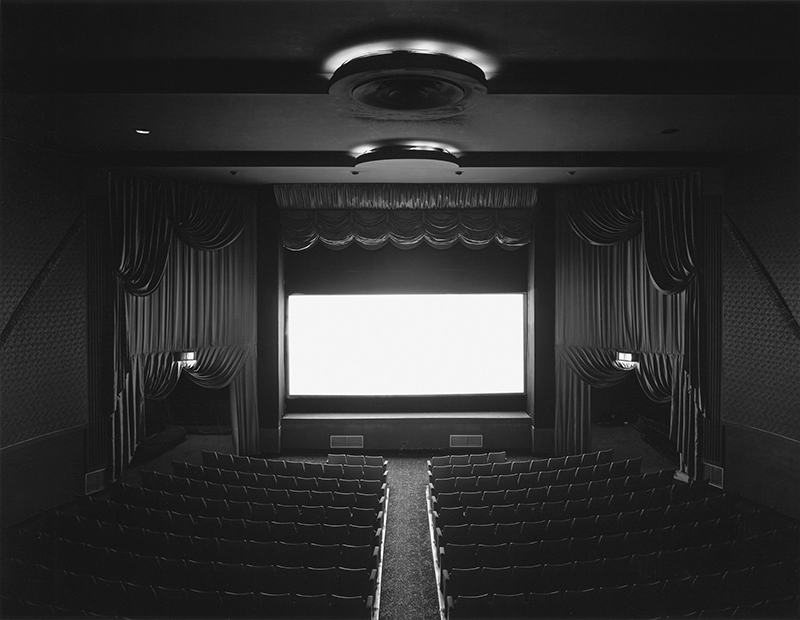
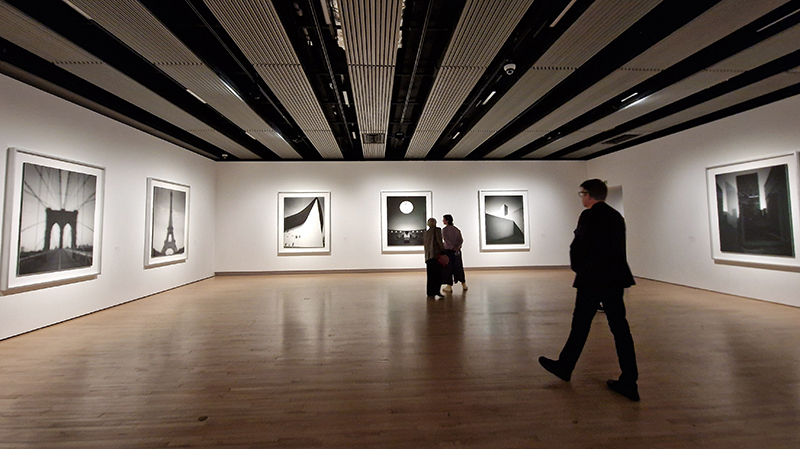
Hiroshi Sugimoto: Time Machine at Hayward Gallery. Beautifully crafted, astonishing work. Hard to believe his models are waxworks or museum taxidermy dioramas, not living subjects and that it is his studied use of light that so cleverly activates his images. I particularly like the Theatres series where he set his camera on an exposure equal to the length of the film being projected into an otherwise dark and empty cinema. The resulting images of a blinding white screen bleeding light like an opening to heaven are remarkable records of passing time. I also loved the work stemming from his interest in mathematics and optical sciences and his experiments with different electrical discharge tools. Sugimoto discovered that he could produce shapes that looked like amoeboid organisms, so he set out to recreate the conditions of the ocean from the time that life began. Using rock salt from the Himalayas (today’s mountain range was once the ocean floor), he mixed his own primaeval seawater. Submerging electrically charged film into the water, the artist was amazed to see light particles move across the surface like microorganisms.

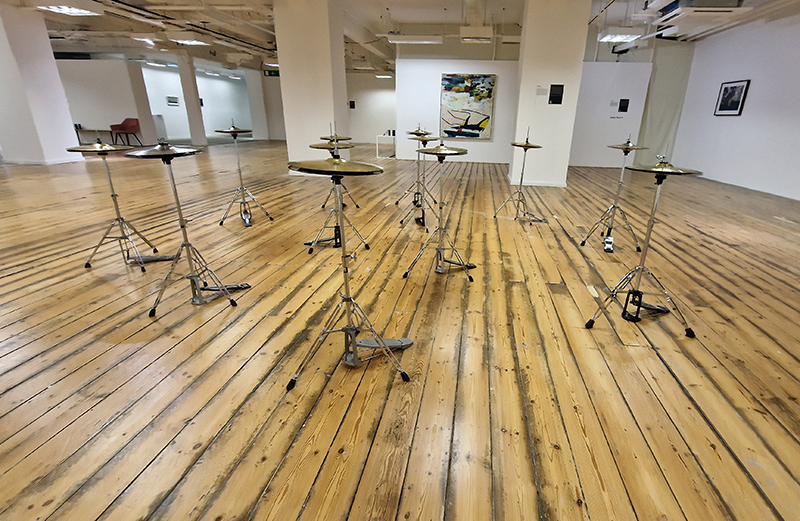
SEISMIC: ART MEETS SCIENCE at GIANT Gallery, Bournemouth, a collaboration with SEISMA Magazine curated by Paul Carey-Kent who was leading a tour of the works when I visited. Artists: Uli Ap, Edward Burtynsky, 0rphan Drift, Peter Matthews, Claire Morgan, Elpida Hadzi-Vasileva, Lisa Pettibone, Shuster + Moseley, David Rickard, Troika. Scientists from corresponding fields of interest are called upon to comment on the work of the curated artists. I was curious to see David Rickards Cosmic Field (3.7mHZ) – a commission by Seisma magazine – which sees cymbals clash when a cosmic rays passes through a hidden Geiger counter. Unfortunately, I didn’t get to witness the full effect as the detector mechanisms hadn’t been charged up, and so only one cymbal was responding with an occasional clash. There are some clever maths in the title and references to John Cages silent composition and the oscillations of the sun. I would like to have learnt more about how the Geiger counters can be sure they are recoding cosmic rays and not just background radiation. It was interesting to read about how stars have sound trapped within and resonate at natural frequencies, like waves inside a wind instrument. Astrophysicist Dr William Chaplin refers to this process as gentle breathing which can be seen in periodic changes in brightness as the stars breathe in ( compressed and bright ) breathe out (relaxed and darker). Other work in the show included Lisa Pettibone’s Truth to Illusion a screen that appears to show a digital undulating image is revealed through a peep hole to be caused by a rotating light and glass mechanism. Light can reveal and mislead in the quest for an understanding of reality. Jewell of Space by Claudia Moseley and Edward Shuster is a mesmerising moving sculpture of light refracting and scattering across a constellation of glass, shadowing the lensing effects of light across the galaxy. Clare Morgan’s Heart of Darkness – a grid of bluebottle flies – a comment on complexity in a system and the importance of each individual to create a whole. Elpida Hadzi-Vasileva’s animal organs given new context – the body turned inside out (cow’s stomach) – the unseen revealed (lamb intestine).
The Accurate Perception Available When Our Eye Becomes Single at The Cut, Halesworth, Suffolk. A lucky chance to see another iteration of this impressive collaboration between Richard Ducker (video) and Ian Thompson (sound). This atmospheric multi-screen installation transports you to the remote otherness of Orford Ness with its innate aura gained from status as a top secret military site and atomic development centre of the 1950’s.
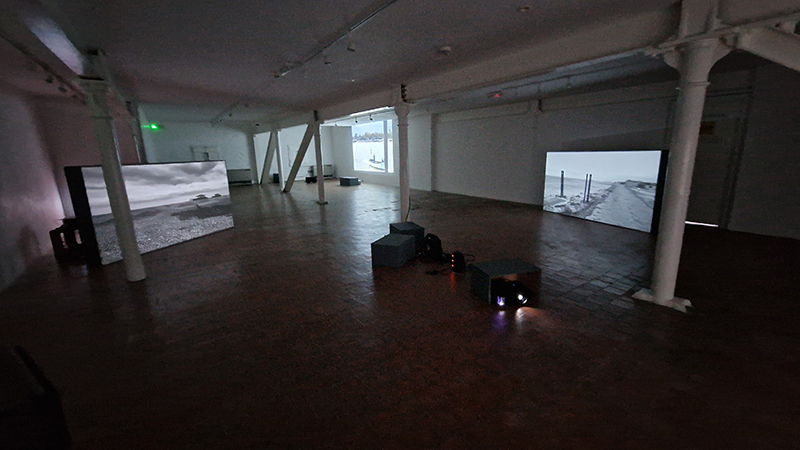
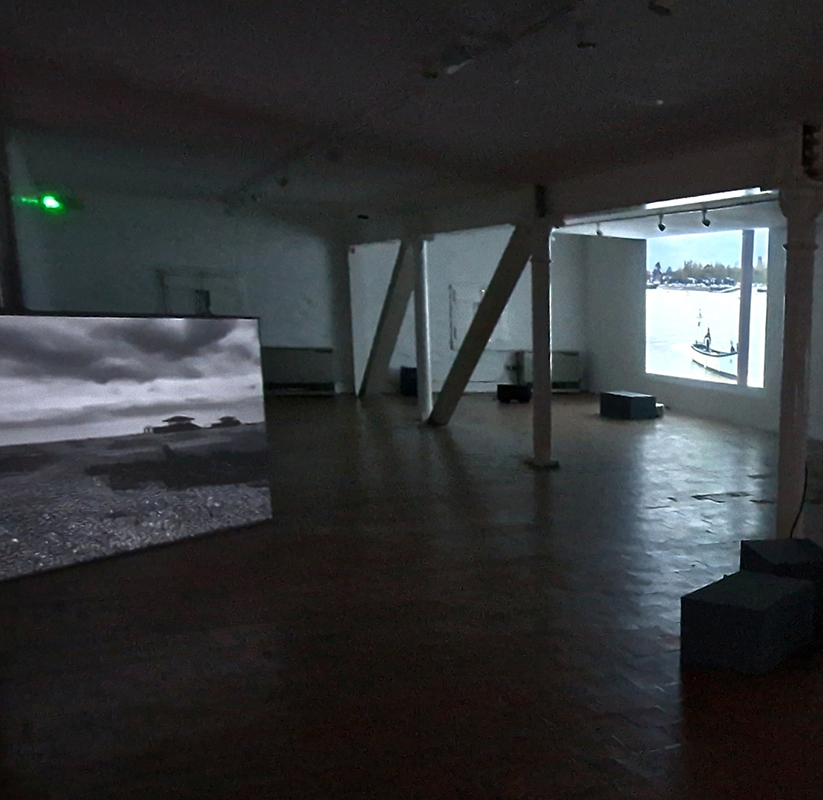
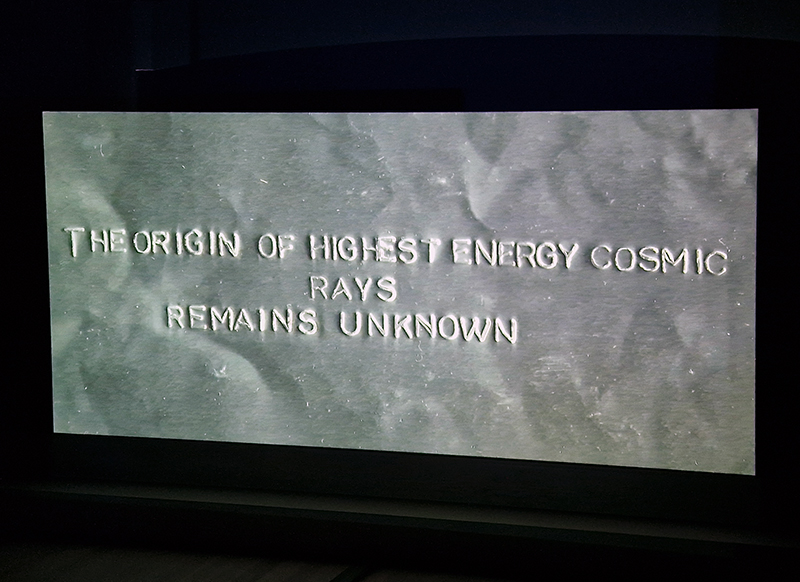
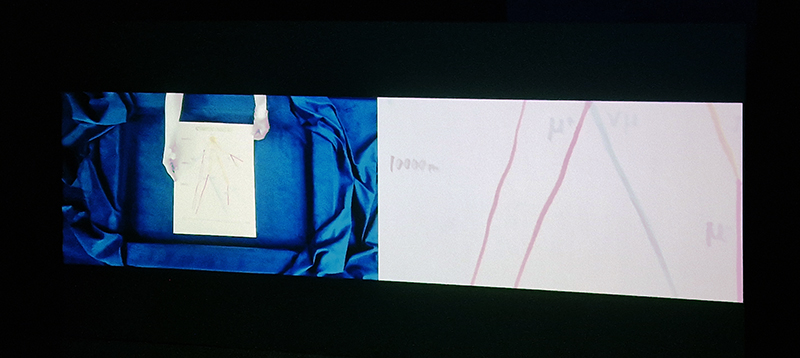
Holding Cosmic Dust: An Almanac, a video installation at The Swiss Church in London by Hot Desque. I enjoyed their previous theatrical inspired installation at Thames-side Studios Gallery where lighting played a key role in creating atmosphere. Again lighting was key, this time very low lighting meant identifying friends at the event was unpredictable. This installation is partnered with an intervention within the permanent, archaeological collection of the Corinium Museum, in Cirencester, positing a speculative archaeological dig in which a matriarchal society is uncovered. The installation draws out connections between archaeology, history and fantasy. There was in conversation with historian Frederika Tevebring about the speculative nature of archeology and evidence of matriarchal societies, but due to challenging acoustics and lighting much of this fascinating talk was lost. I would have liked to hear about the cosmic ray connections. Was it to do with Carbon dating? Participating artists: Holly Graham, Rubie Green, Rebeca Romero, Amba Sayal-Bennett, Abel Shah and Suzanne Treister.
Reading

All The Light We Cannot See by Anthoney Doerr. An extraordinary evocation of the depths of human tenderness and cruelty and the power of knowledge. This is a beautifully written fiction spanning the decades from the 1930’s into the 21st century when advances in radio technology went from a being a source of public information and enlightenment to a weapon of war. Through the wonder of the young protagonists in discovering the magic of radio transmissions, the author also stirs in the reader a reminder that it is invisible waves crisscrossing our world, carrying information vast distances, across political and geographic boundaries. I loved this book.

The Future of Geography: how power and politics in space will change our world by Tim Marshall. Clear and accessible writing takes the reader through the history of the space race to the ubiquity of orbiting satellites and on to the era of astropolitics, military strategy and the battle for future resources. The stakes are high.

Entangle: Physics and the Artistic Imagination edited by Ariane Koek, written in conjunction with an exhibition at Bildmuseet in Sweden. The book is filled with fascinating essays from both artists and scientists giving personal perspectives on their interest in and interaction with particle physics. The importance of an open imagination, the thrill of the unknown, the quest for knowledge that may never be accessible, are relevant to all participants. The common ground between art and science, and the benefits to both fields of joint conversations, is increasingly being acknowledged. Scientists offer the abstract theories, controlled experiments or new technologies that feed artists imaginations, throwing up new questions for both to consider and relate to the human experience.

Watched the deeply moving film by Werner Herzog, The Enigma of Kaspar Hauser – a fictionalised documentary of a teenager suddenly released from an existence of inexplicable confinement chained in a cellar with no human contact other than his captor. The film follows the internal struggle of Kaspar as he is subjected to the demands of society, and take on the current belief systems of the Church. His confusion at the world and despair at how much he doesn’t understand is an allegory for the limitations of human knowledge. The film spotlights the failure of logic and science to provide answers to the human condition.
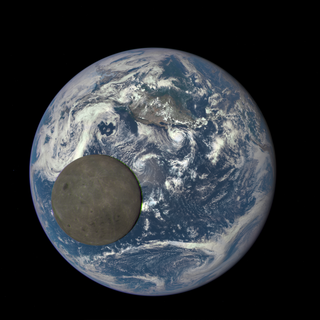
Lots of interesting things are happening urging us to cast our eyes and thoughts skyward. A Blood Moon Lunar eclipse. Salty water on Mars.

I have to include this image of the dark side of the moon captured by a NASA camera aboard the Deep Space Climate Observatory (DSCOVR) satellite  showing a view of the moon we don’t get to see from earth.

1509 dark side of the moon

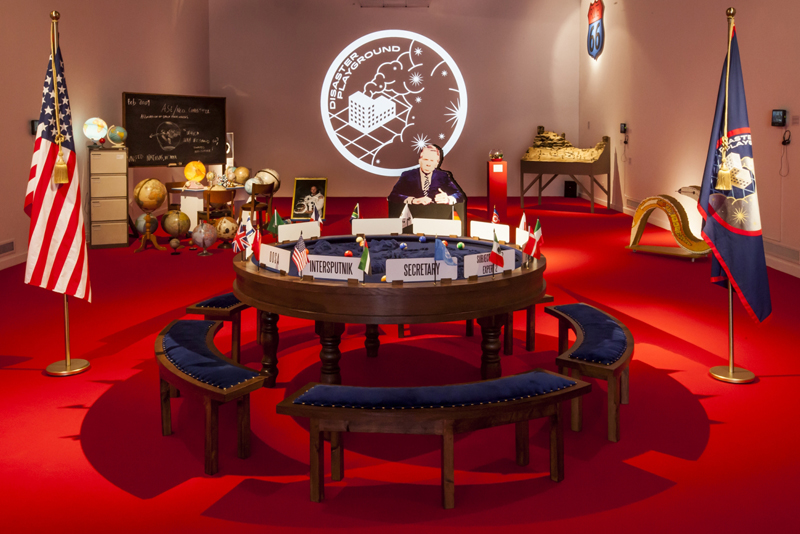
I went to see the London Premiere of Disaster Playground – Nelly Ben Hayoun’s wonderful investigation into who is watching the skies for us.

1509 Disaster playground

Through a series of talking heads and re-enactments we meet the real scientists from NASA and SETI (Search for Extra Terrestrial Intelligence) whose daily job is to scan the skies for possible objects that might collide with earth.

Nelly Ben Hayoun Disaster Playground

Nelly Ben Hayoun Disaster Playground

The difficulty is not so much spotting the object but negotiating the appropriate response in time to avert disaster. Through this documentary we come to understand that technology is way ahead of the machinations of the committees who tread the delicate path of ultimate responsibility.

Nelly Ben Hayoun Disaster Playground

Nelly Ben Hayoun Disaster Playground

Which nations are actually accurately capable of blasting an asteroid  off its course. A minute error could mean one nation is obliterated instead of another. We leave the film feeling a little anxious that for all the good intentions of these scientists the safety net has not been properly hoisted just yet.

Bas Jan Ader Falling

Bas Jan Ader Fall

The Whitechapel Gallery hosted a touching tribute to Bas Jan Ader marking the 40th anniversary of his disappearance at sea.

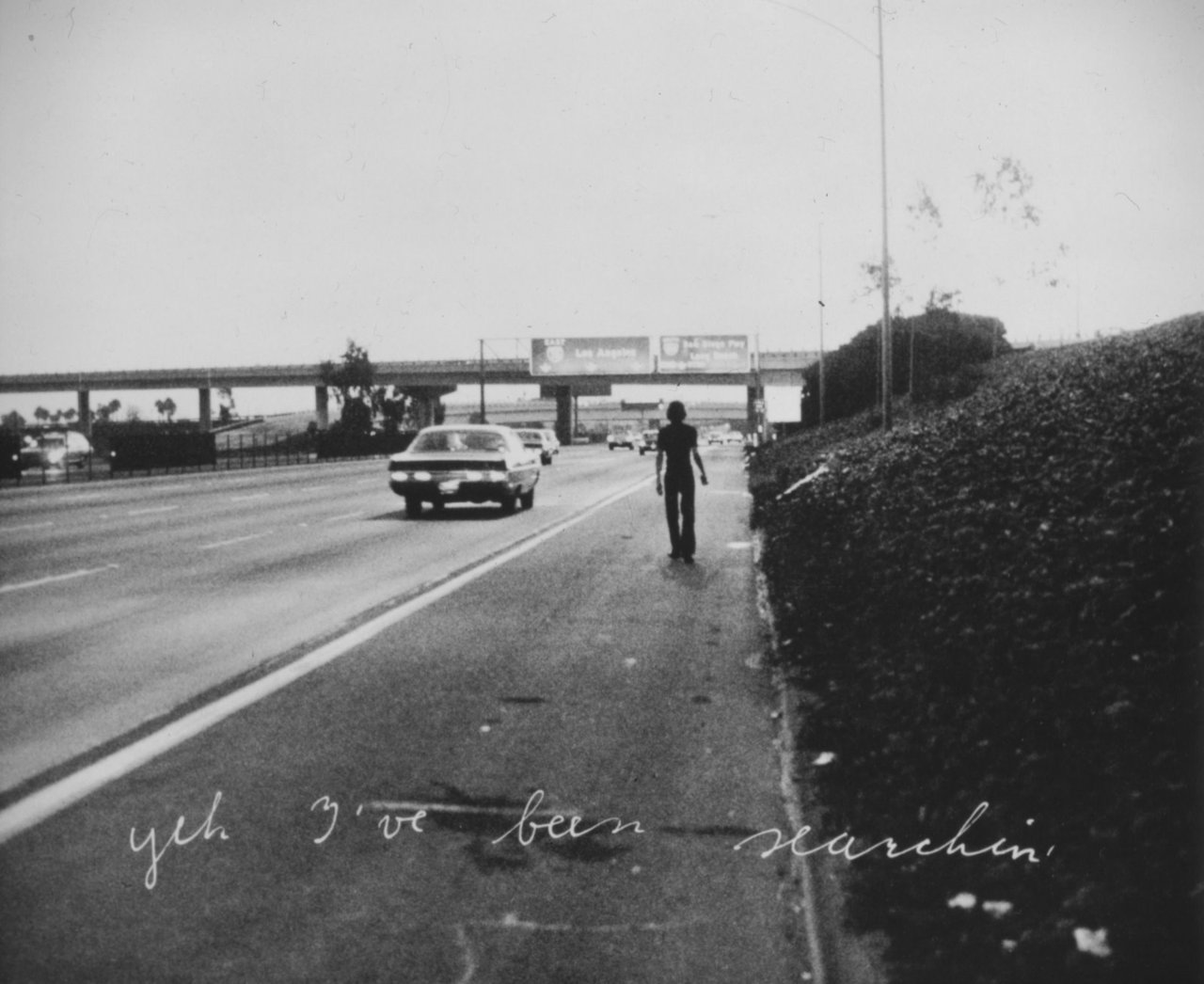
In 1973 Bas Jan Ader took a solitary walk through the city of Los Angeles towards the ocean. The journey was documented in a series of 18 indistinct black and white photos subtitled with the lyrics from a trashy 50’s pop song ‘Searchin’.

Bas Jan Ader In search of the Miraculous

Bas Jan Ader In Search of the Miraculous

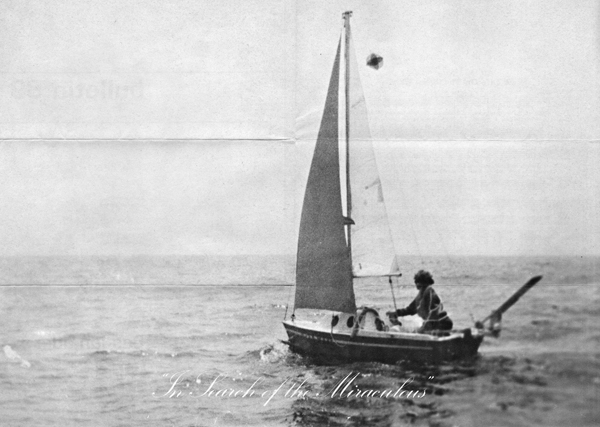
Ader borrowed the title of this work ‘In Search of The Miraculous’ from Ouspensky’s book on occult theory which promotes self improvement as the destiny of man. He uses this epithet as subtext for man’s eternally unsatisfied desire for some unknown missing element. He intended the work to have three parts, planning to continue his search across the ocean, to leave the limits of society and go beyond into the unknown. The solitary journey over the sea was to culminate with another night time walk, this time across Amsterdam. It would be a homecoming. In his preparations and framing of the work he deliberately used the iconography of the romantic quest and chose signifiers which denoted a prefabricated romanticism, one that has been commoditized and packaged. He appeared to be searching for the sublime in its very opposite; the banal. Throughout his practise Ader interrogated conditions of pain and endurance; the prerequisites to experience ecstasy.

 Bas Jan Ader I'm too sad to tell you

Bas Jan Ader I’m too sad to tell you

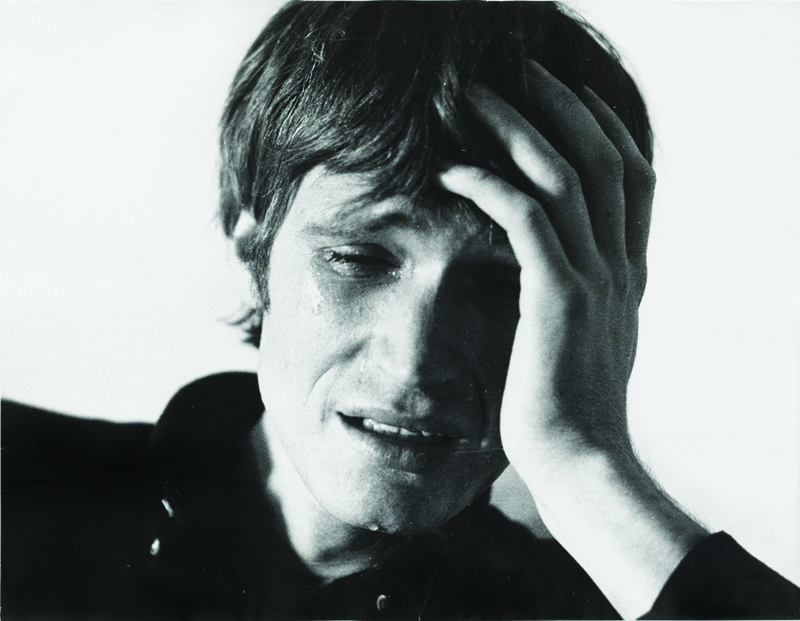
The tragic elements in Ader’s work are presented in a way to highlight pure emotion and offer no explanation for the scenarios he performs. As in reality when we experience grief there is no explanation able to comfort us.

On 9 July 1975, Bas Jan Ader set sail in a 12 foot dinghy called Ocean Wave. He was shipwrecked and his body never found.

Bas Jan Ader In Search of the Miraculous

Bas Jan Ader In Search of the Miraculous

On the evening before his departure, a student choir sang sea shanties in the gallery of his Los Angeles dealer.  He was to be received by a shanty choir in Falmouth.

Forty years later this Whitechapel event celebrated his all too short life and extraordinary work. Poet Stephen Watts read beautifully on the discovery of Ouspensky before we watched a poignant interview with Jan Bas Ader’s widow followed by  a rare 16mm screening of six of his films: Fall I; Fall II; I’m Too Sad to Tell You; Broken Fall (Geometric); Broken Fall (Organic) and Nightfall. As the horizon faded on the screen we quietly filed out to be met by the stirring songs from the London Trad Academy Sea Shanty Choir.

Celebrating current artists The Whitechapel Gallery was packed and buzzing for the Private View of the London Open.  I had to return another day to be able see the works. As a cross section of what is going on in London studios you expect diversity, yet themes do emerge, though selection and curation. So good our RCA classmate Julie Roch- Cuerrier was selected for this exciting show.

Julie Roche-

Julie Roche-Cuerrier

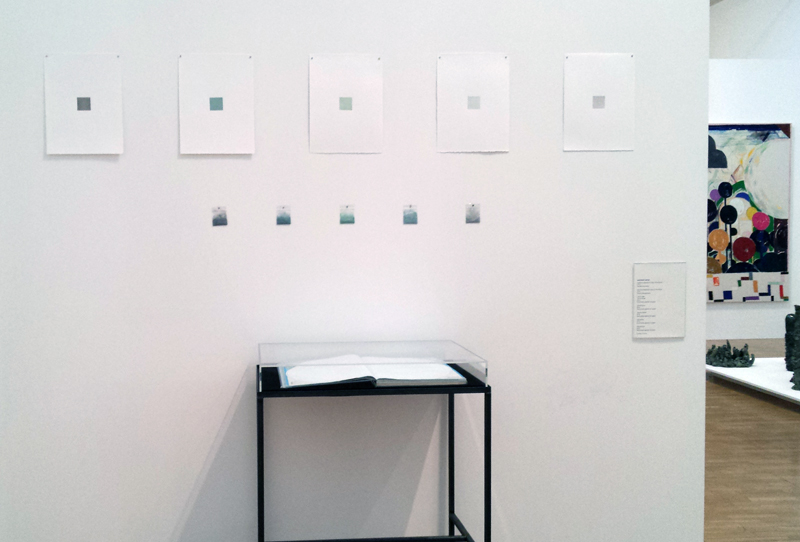
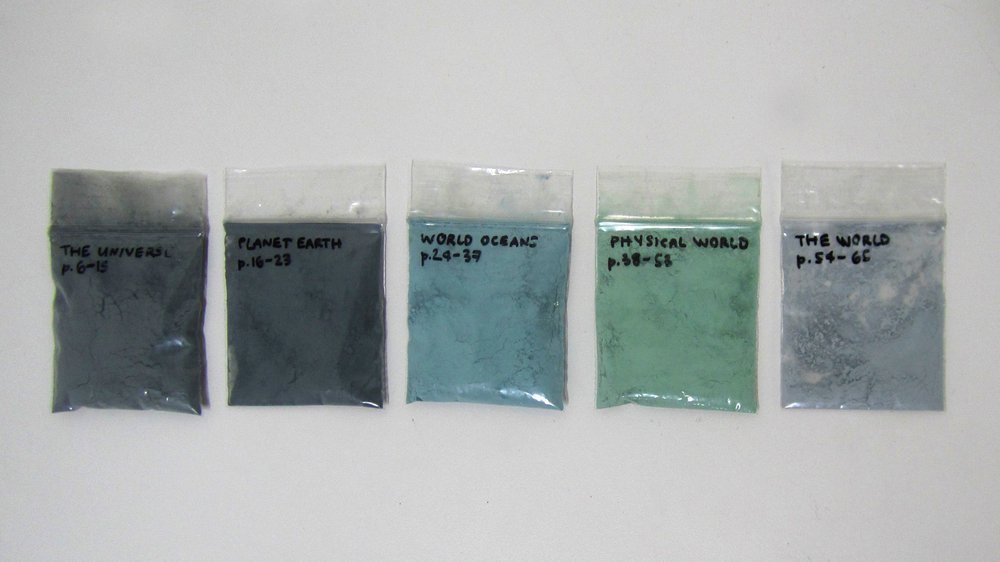
Her subtle intervention of sanding away the detail from every page of a world atlas, just leaving the titles and borders pulls on the strings of displacement and loss while her carefully capturing the dust from each page brings an alchemical magic to the work.

Julie

Julie Roche-Cuerrier

Displayed in little plastic bags are the ingredients of the oceans or the universe. The delicate blue and green powders speaking of matter and its transformation, precious and mysterious.

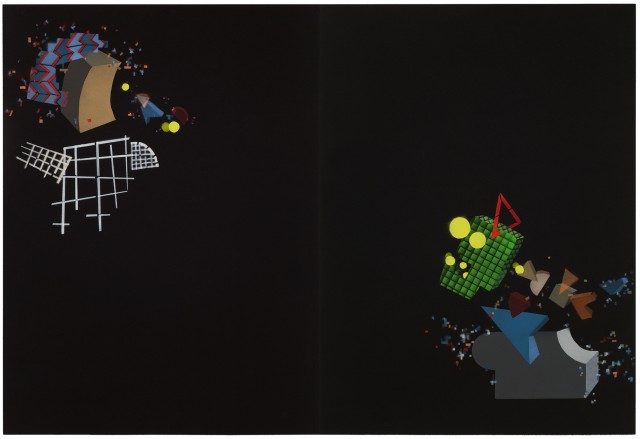
Having lost access to the print facilities at the RCA its time to start thinking about where I can continue making work. I paid a visit to Thames Barrier Print Studios. It all looks wonderful here, loads of space, etching presses and screen-beds, digital printing, exposure units and an aquatint box.  First I need to get some new work started. I am looking at Obelisks and Standing Stones, ritual places and also thinking about ideas of the multi-verse. Brain loading.

1509 Glitch

Called in to see Delta at Five Years, Regents Studios where RCA tutor Oona Grimes was showing alongside Mark Jackson, James Lowne, Clare Mitten and Mia Taylor.

Oona Grimes Slightly Foxed

Oona Grimes Slightly Foxed

‘Worlds collide, meet, touch, overlap and become absorbed. Worlds become world; expanded, inconsistent and multi faceted. Some don’t stop, don’t crash, they keep moving, a sign in space, until they are singular and alone. No matter, we are only concerned with what remains. We built this world top down and outside-in, we chose the planets and engineered the collision; a shared universe intended to be used by many authors.’

1509 Delta

1509 Delta 2

James Lowne’s very funny video, a kind of in joke for artists explores the constant lure of the prize – the open call – scrubbing around for the opportunity. It has an air of subjugation I think. As artists we have to play a game we’d rather not, putting ourselves up for a fall, laying ourselves bare, in competition with our peers, the fear of missing out is BIG, do we know about the next opportunity will someone else get there first, we don’t want to be played like this, we want to opt out but we can’t. It’s a bit addictive.

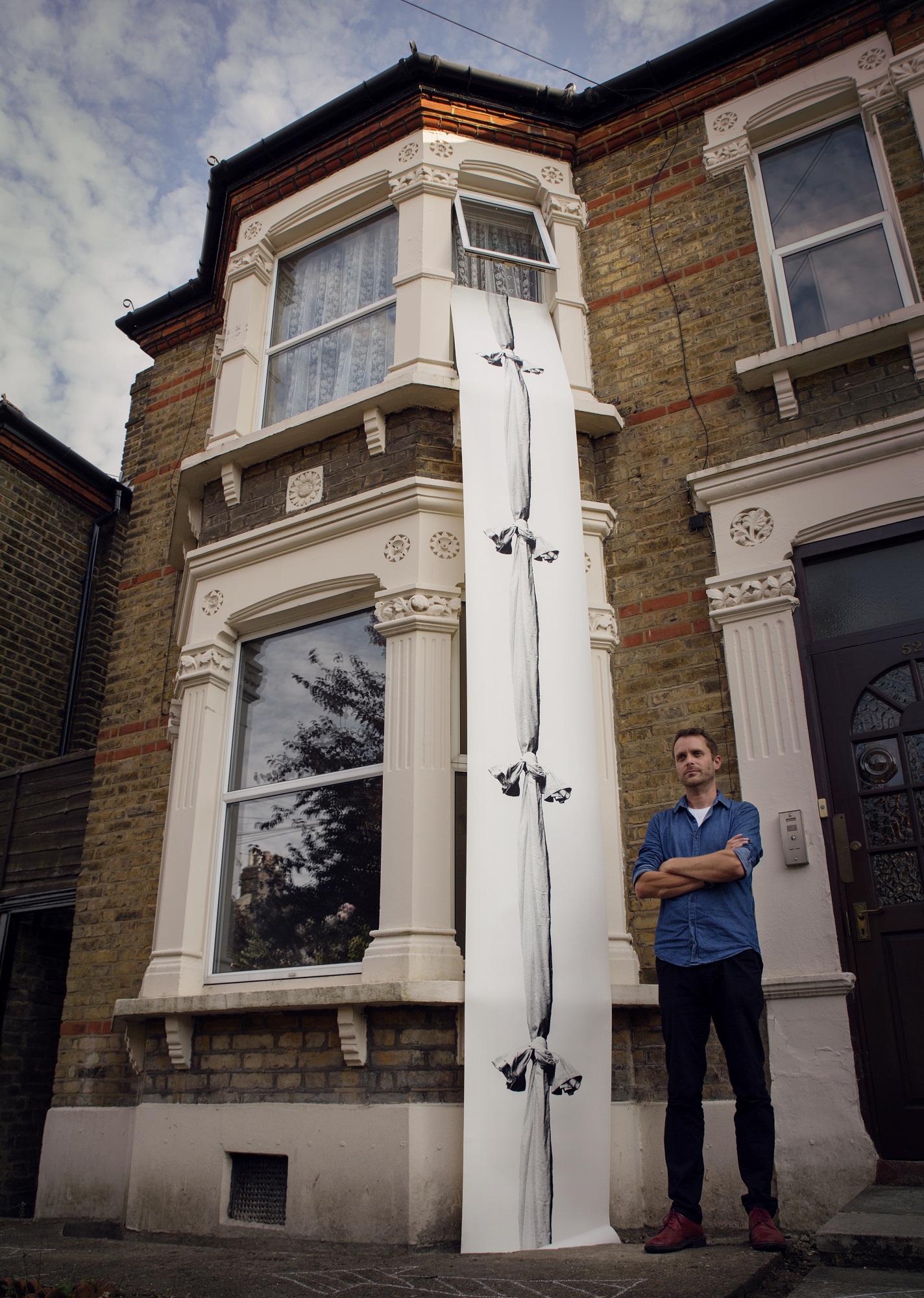
The owners of  a stripped and soon to be refurbished Victorian house in Brockley gave their premises over to host Bread and Jam I an exhibition of site specific work by 11 artists.

Joby Williamson

Joby Williamson

Each artist was given free rein of their chosen space in the house to make new work in response to the dilapidated surroundings.  The concept of Bread and Jam is to take basic staple ingredients and make a meal that transports you somewhere else, that can be shared at any time of day and continues to sustain after consumption.
Fritha Jenkins

Fritha Jenkins Reception

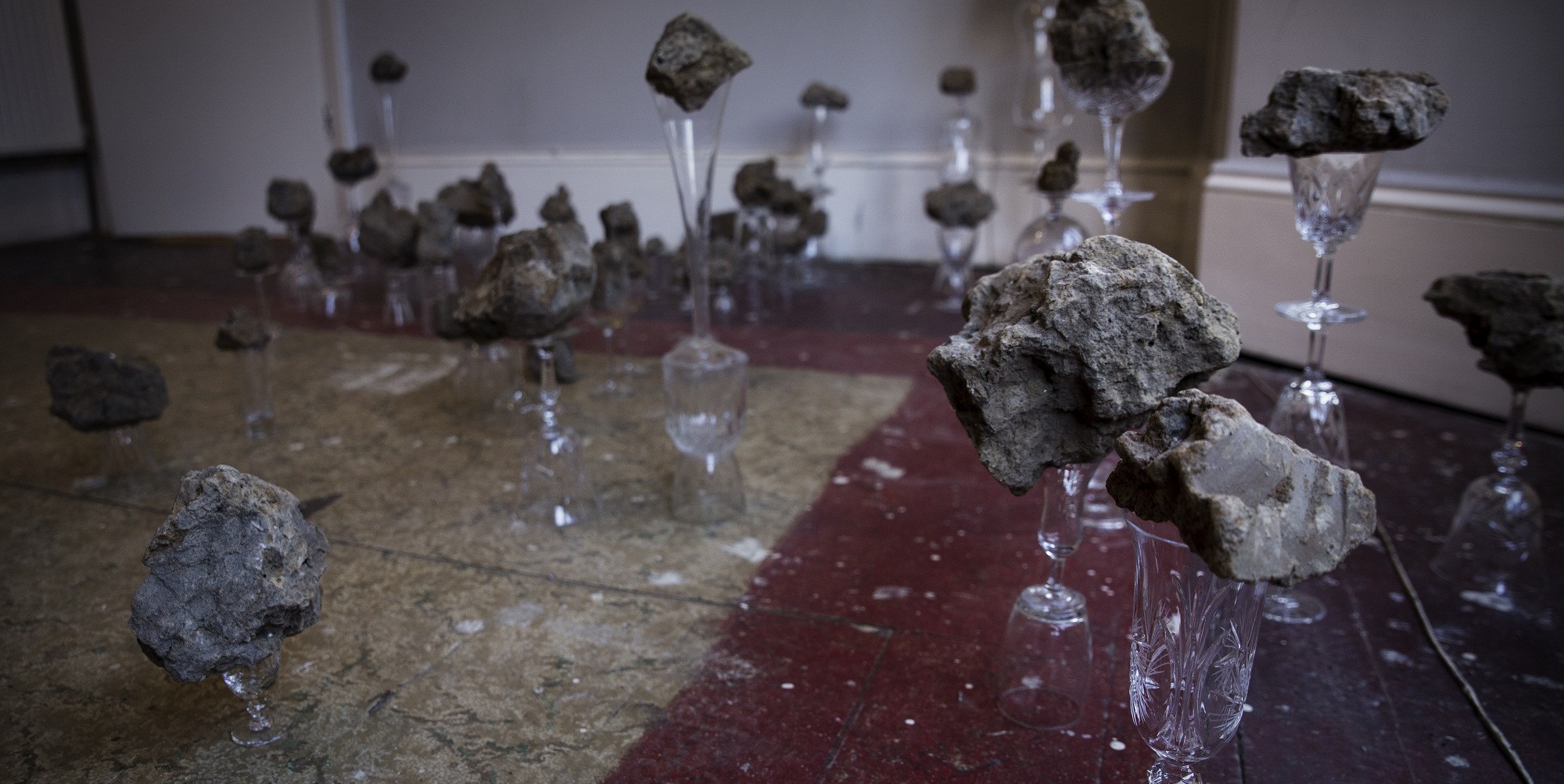
Fritha Jenkin’s work Reception looking like a meteorite storm  frozen in free fall turns the living room into a site of physical negotiation with hundreds of carefully balanced glasses topped with lumps of clay dug from the basement foundations of the house.

Kate Murdoch

Kate Murdoch Poor Lamb

Kate Murdoch creates an unsettling atmosphere with carefully chosen objects that act as signifiers for trauma and vulnerability.

I attended the Material Environments Symposium : Sensing Time and Matter in Digital and Visual Culture at The University of Greenwich.  It felt good to be in an academic environment again and wonderful to know there is free access opportunities to high quality events like this. I enjoyed Sarah Cefai’s references to primordial time and the affect sensation that arises from rain, earth, heat and light experienced though landscape. Her concerns are about how these sensations are mediated and politicised particularly in relation to indigenous as opposed to colonial Australia.

1509 ten canoes

She uses the films of Rolf de Heer (Charlie’s Country, The Tracker, Ten Canoes) as examples of truth to materials, the rain must be real rain. Made me want to see Ten Canoes again.

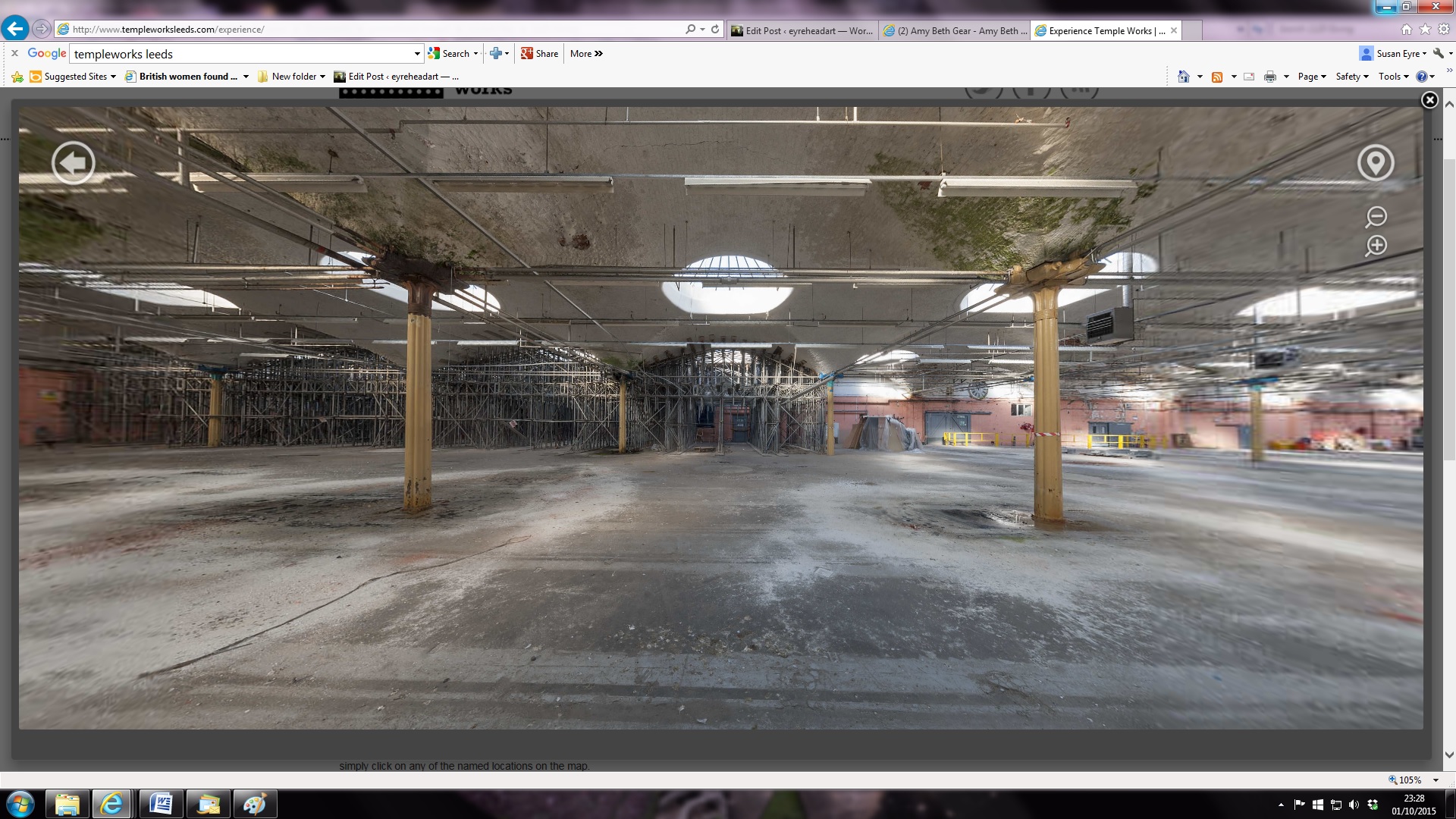
Tom Jackson also spoke about mediated sensation. His use of environment as archive demonstrated at Temple Works Leeds offers a 360º enplaced experience of space in high resolution with pioneering new design binaural audio recordings.

Temple Works

Temple Works

Not only does this combination of technology offer a haptic experience of a removed space, but also a temporal, one as searches can be made through the palimpsest of activities, interventions and architectural changes that have occurred in a given location. Using this method, virtual access to privileged spaces can be offered to the public.

Blythe House Archive

Blythe House Archive

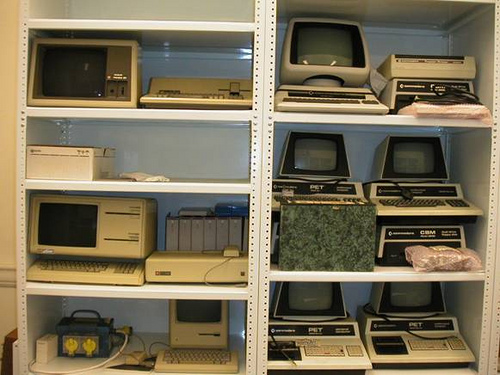
The physical archive such as that of the Victoria and Albert Museum stored at Blythe House can be archived and viewed remotely and there is the opportunity of archiving objects without having to remove them from the context of their original environment thereby retaining a layer of history usually destroyed as objects are moved to storage facilities or museums.

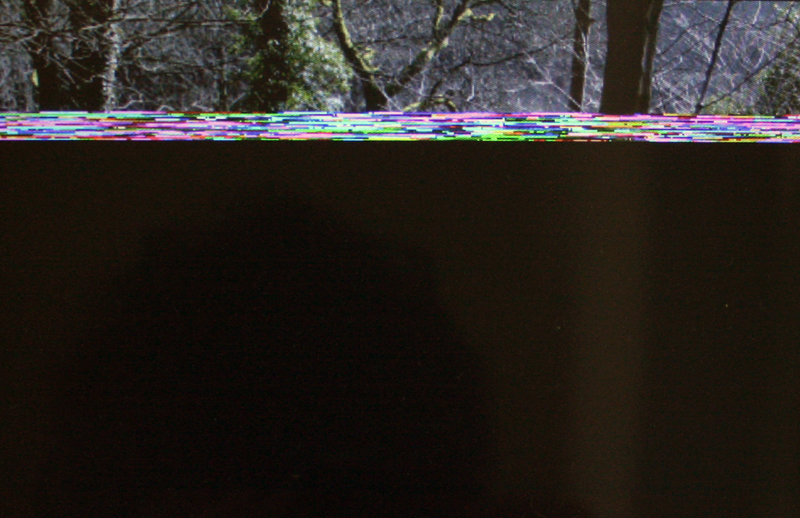
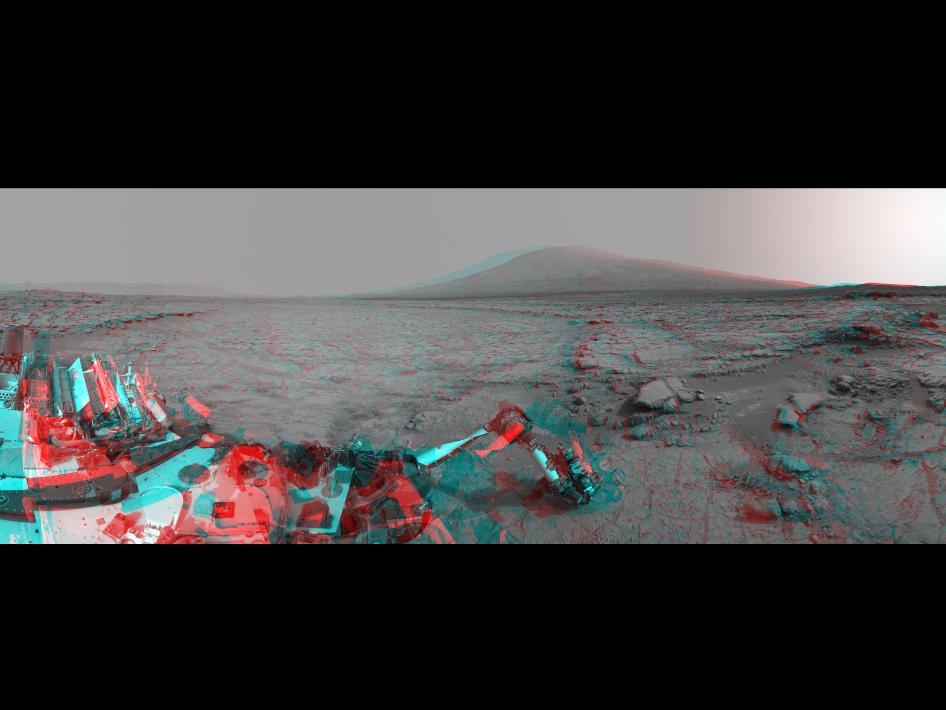
Luci Eldridge found comparisons between the analogue and the digital in the material decay of  archived images she has viewed and the disrupting imperfection of the digital glitch. Analysing the composite landscape images of Mars patchworked together from data retrieved by non human space explorers she draws awareness to the construction of landscapes that are only ever viewed remotely via technology that does not relay a sense of scale and perspective that we naturally relate to.

Mars Stereo View from 'John Klein' to Mount Sharp

Mars Stereo View from ‘John Klein’ to Mount Sharp

Seams have been eliminated from the sky portion of the mosaic to better simulate the vista a person standing on Mars would see.

Laurel Johannesson makes work that does not conform to the current passion for speed and instantaneous gratification.

Laurel Johannesson

Laurel Johannesson

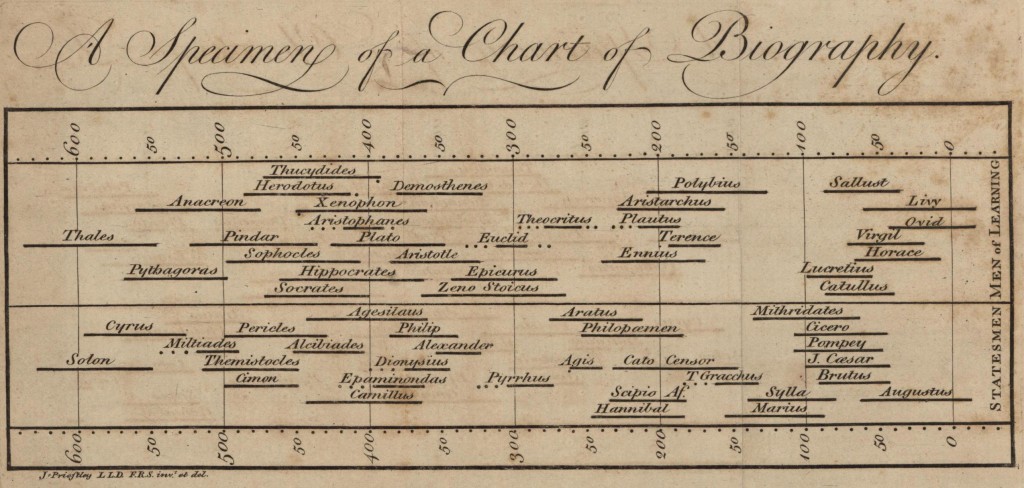
Her generative digital images coalless slowly and in reaction to her audience. The viewer that spends time with her work is rewarded, the swift passer by misses out. She is interested in how we perceive time and the visualization of time. She cites Joseph Priestley who published A Chart of Biography in 1765 and has had a profound influence on our visualization of time as linear, travelling along a horizontal line, ever moving forward.

1509 Joseph Priestley

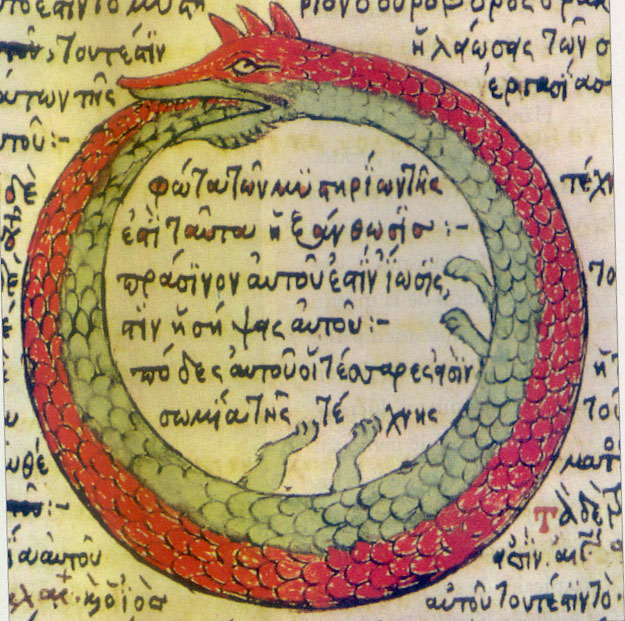
She also talked about other visualisations of time as being circular and represented by the ouroboros, the ancient symbol of a serpent eating its own tail in perpetual motion of renewal and destruction signifying eternal return.

1509 Theodoros Pelecanos 1478 copy

Using Nobuhiro Nakaishi as an example of an artist who mediates the temporal experience through his work she reflects on how the understanding of time is challenged by new technology and the ways artists are exploiting technology to create work but also the need for a direct interaction with materials.

Nobuhiro Nakanishi

Nobuhiro Nakanishi

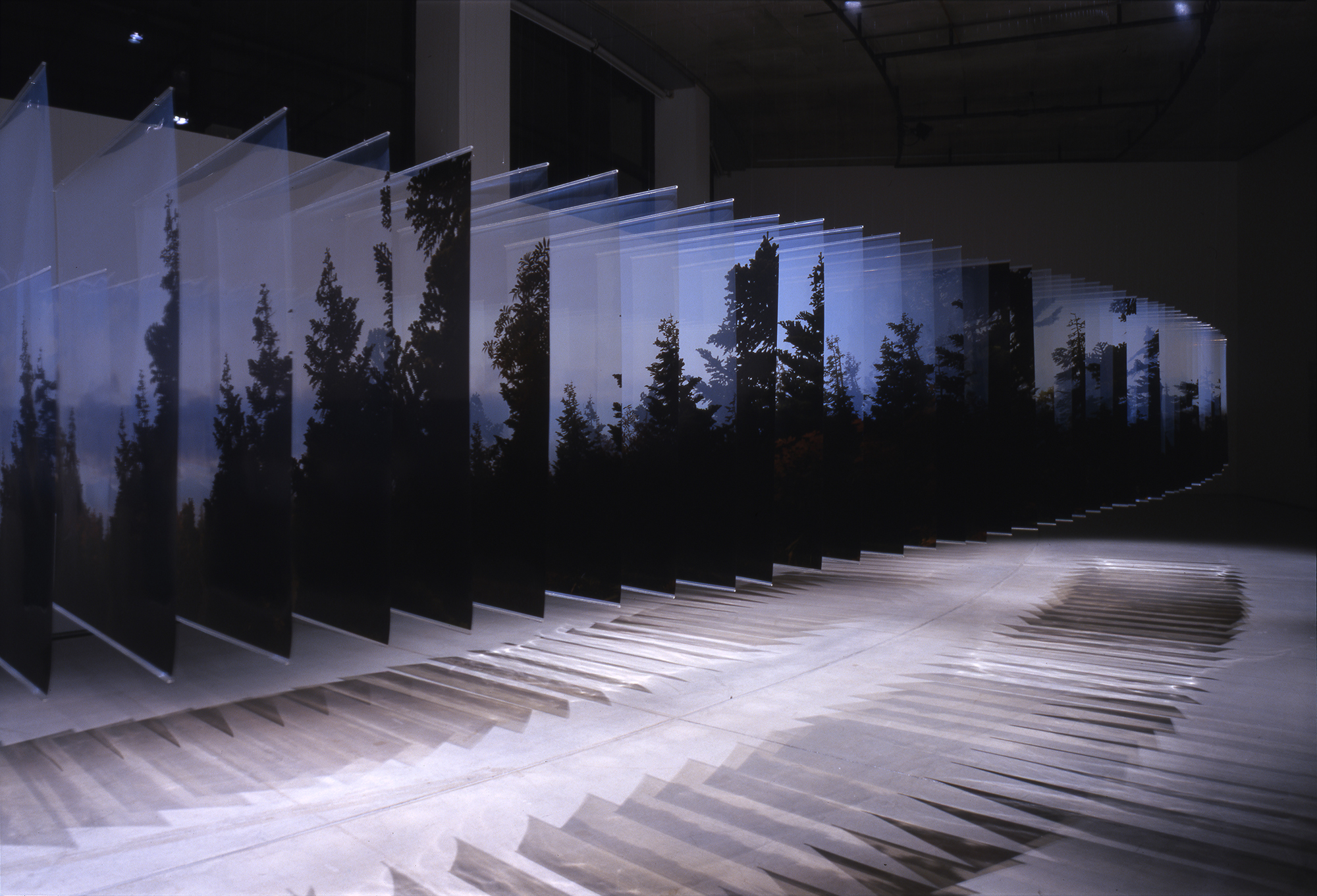
In his layer drawings Nobuhiro Nakanishi captures the passage of time in a series of still photographs which he then layers in series on acrylic sheets so the movement of time passes through the images. He is looking to evoke a common sensation in his audience. The acknowledgement of the passage of time is universal, it is one of the primordial senses and also personal as we see our own entropy come to pass.

Nobuhiro Nakanishi

Nobuhiro Nakanishi

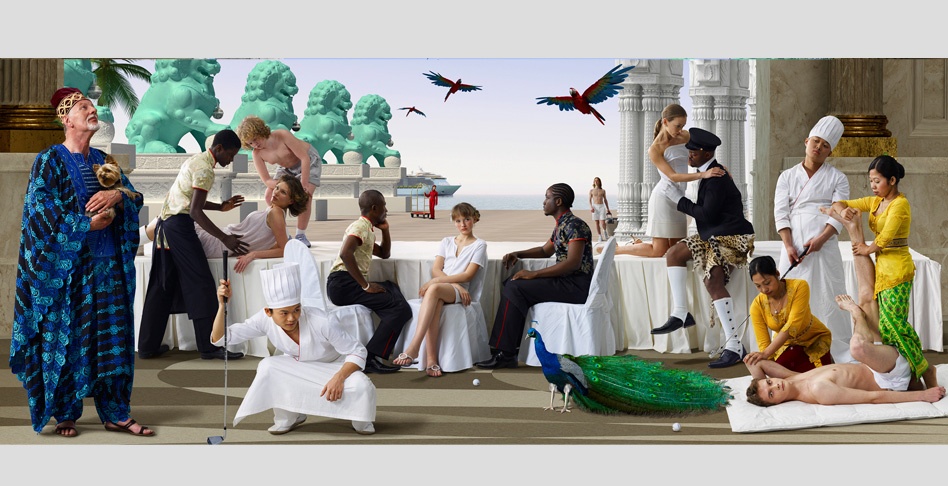
Laurel Johannesson is interested in art that offers a multiplicity of possible orders and disturbs the accepted time based narrative. Another of her examples is the collective AES+F a group of four Russian artists: Tatiana Arzamasova, Lev Evzovich, Evgeny Svyatsky, and Vladimir Fridkes working with video and digital generation.

AES+F

AES+F

Their films have a balletic quality that create a hypnotic rhythm as time is slowed, drawing you in to a world of beautiful people with smooth supple bodies moving trance like though exaggerated motions. It is like being gently suffocated with silk having been given the most delicious sleeping draught. Willingly falling into the embrace of this clean and perfect world as into a dream before realising there is an unsettling undercurrent that drags you under and it is too late to swim to the surface and escape. Mesmerizing.

AES+F

AES+F

A link here to a trailer for Trimalchio.

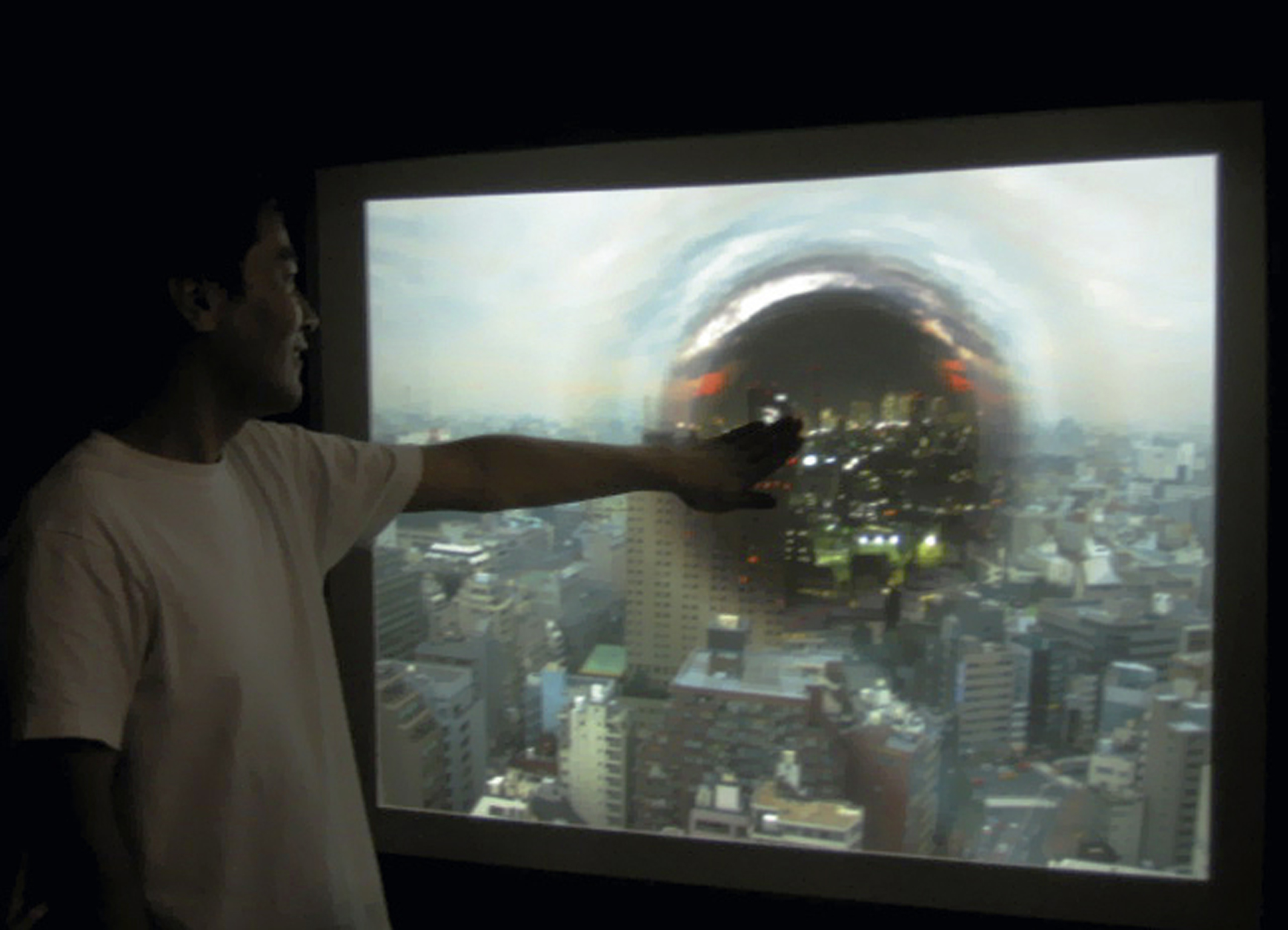
Other interesting speakers were Marisa Gomez who is interested in the re-presentation of time and the new technologies that facilitate new approaches to temporality such as the Khronos Projector which allows the user to sculpt time through a screen interface. By touching the screen the user can send parts of an image backwards or forwards in time.

Alvaro Cassinelli Khronos Projector

Alvaro Cassinelli Khronos Projector

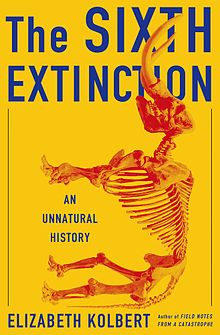
Joanna Zylinska’s paper Sensing Deep Time: Photography after Extinction drew parallels between photography and fossils as recording mechanisms of time. She recommended the book The Sixth Extinction; an unnatural history by Elizabeth Kolbert which documents the past five mass extinctions of species on earth turning the spotlight on us humans as we watch the sixth mass extinction unfold before us, unable to act.  Transfixed by affective facts, those overwhelming concepts that are so huge to comprehend that we ignore them.

1509 Sixth-extinction

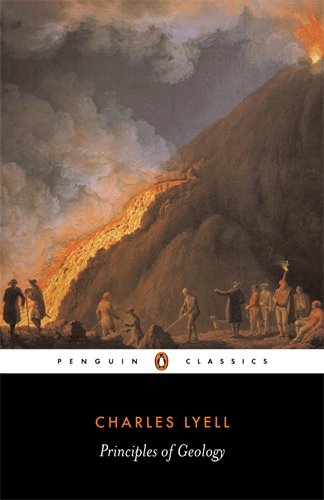
She is interested in how time is recorded through natural phenomenon such as the deep time of geology. Charles Lyell’s Principles of Geology (1830-33)  was an early radical attempt to explain the geological state of modern Earth by considering the effects of observable natural phenomena over time. By exploring the evidence for changes in climate and geography across the ages  Lyell speculated on the progressive development of life, transforming science with depictions of the powerful forces that shape the natural world.

1509 Lyell

Light, energy from the sun is used in the photographic process. Our perceptions and familiarity with recording phenomenon changes with each new technology. When Photography first appeared and Henry Fox Talbot published the first  wholly photographically illustrated book The Pencil of Nature in 1844 he felt it necessary  to insert the following notice into his book: The plates of the present work are impressed by the agency of Light alone, without any aid whatever from the artist’s pencil. They are the sun-pictures themselves, and not, as some persons have imagined, engravings in imitation

Henry Fox Talbot The Pencil of Nature

Henry Fox Talbot  The Ladder  in The Pencil of Nature

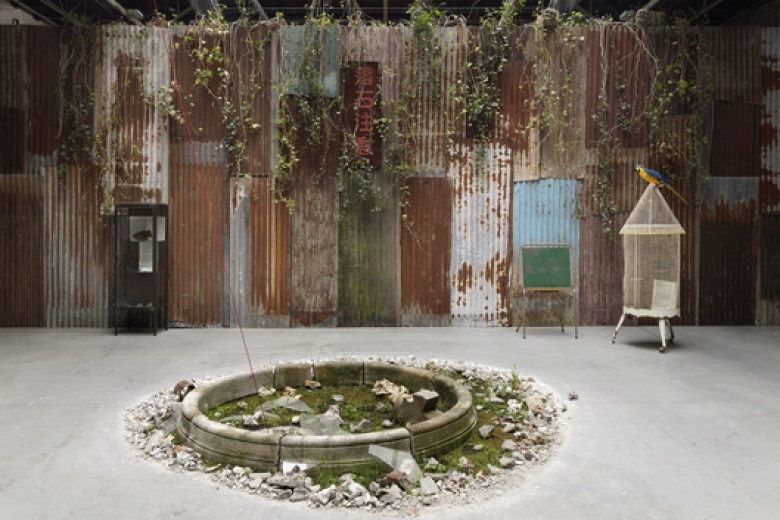
Hiroshi Sugimoto’s Lost Human Genetic Archive at Palais de Tokyo was a poignant look at what remains after devastation.  Over thirty notices, all beginning ‘Today, the world died’, offered explanations by characters from all walks of life as to why everything ended, and these relate to the otherwise random objects beside them. An astronaut, for example, tells of how Earth had become encircled by orbiting human shit, next to a display containing the cosmonaut’s space-food and urine collector.

Hiroshi Sugimoto Lost Human Genetic Archive

Hiroshi Sugimoto Lost Human Genetic Archive

The exhibition Club Disminución (“Club of Diminishing Returns”) was instigated by Alexa Horochowski’s artist residency at Casa Poli, Coliumo, Chile, 2012/2013. Designed by architects Maurizio Pezo and Sofía Von Ellrichshausen, Casa Poli, a minimalist, cement cube, functions as a cultural art center/artist studio.  In this environment the separation between landscape and architecture is indistinct.

Horochowski aims to depict the struggle between the human drive to create lasting symbols of culture, and Nature’s indifferent, persistent erasure of these symbols. His work explores entropy and the passing of time by imitating the natural processes of accretion and aggregation found in caves or the persistent impression left by fauna and water on architecture and the landscape.

Alexa Horochowski: Club Disminución

Alexa Horochowski: Club Disminución

“Horochowski suggests a posthuman future, where assorted beach debris attests to the former glory of human civilization. In enlarged black-and-white digital scans of barnacles, minerals, and wasp nests, a quasi-organic architecture takes shape, poised to outlast us all. A Gothic sensibility reverberates throughout: evocative, sinister, and auguring the fall of the Anthropocene.” — Christina Schmid

Penelope Umbrico found 541,795 pictures of sunsets when searching the word “sunset” on Flickr. This became the basis for her installations Flickr suns.

Penelope Umbrico Flickr Suns

Penelope Umbrico Flickr Suns

Another body of work by Penelope Umbrico is her Sun/Screen series.

Penelope Umbrico Sunscreen

Penelope Umbrico Sunscreen

She uses an iPhone to re-photograph images of the sun she has cropped from thousands of sunset images shared on the web.  The process of photographing images directly from the computer screen creates a moiré pattern – an optical illusion, which is the consequence of the pixel grids, meshes or dot patterns being superimposed. They draw attention to the materiality of the screen and further distance us from the natural sunlight source of the original images.