Archives for posts with tag: James Webb Space Telescope

Delighted to share the news that I have been longlisted for The Aesthetica Art Prize 2024. A live recording of The Breath of Stars will be included in the digital showcase at York Gallery. The Aesthetica Art Prize celebrates contemporary art across a range of media and I’m looking forward to joining the Future Now conference for critical and cultural debate running alongside the art prize exhibition.

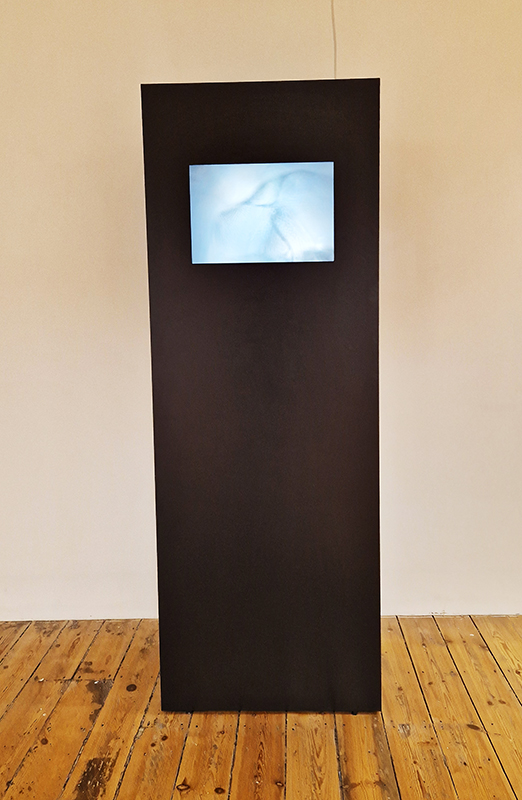
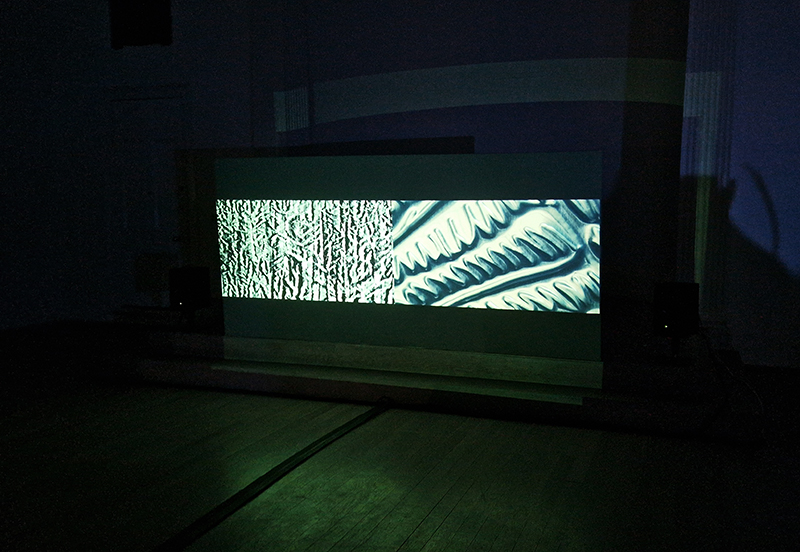
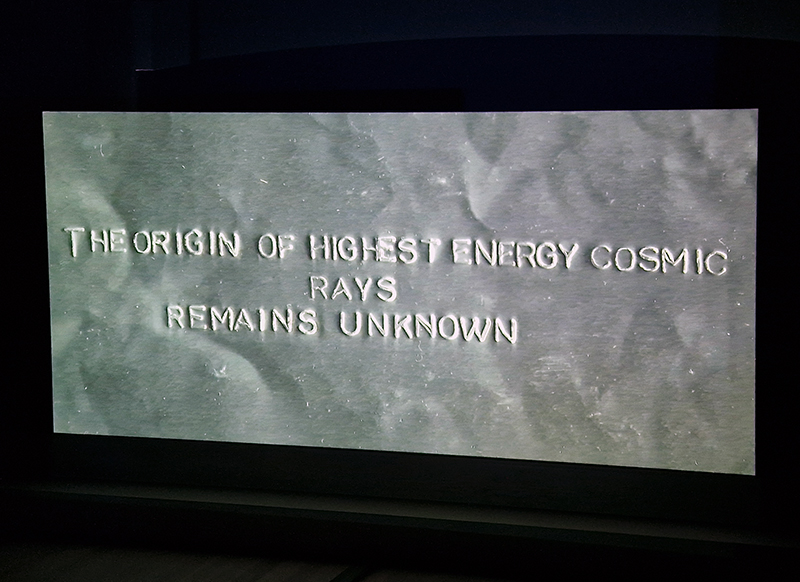
The Breath of Stars (Cosmic ray detectors, mini computers, wooden box (20×20 cm), video projection; live duration) is a digital video work activated in real time by the passage of cosmic rays through a pair of scintillator detectors. Cosmic rays from exploding stars or other extreme events, power across the universe, collide with atoms in the Earth’s atmosphere, break apart, and shower down upon us. Some particles silently interact technology on Earth. In this work, particle detectors and mini computers are connected to a projector. Every time a cosmic ray passes through the plastic scintillator blocks inside the detectors, its energy is recorded, and a starburst video is displayed.

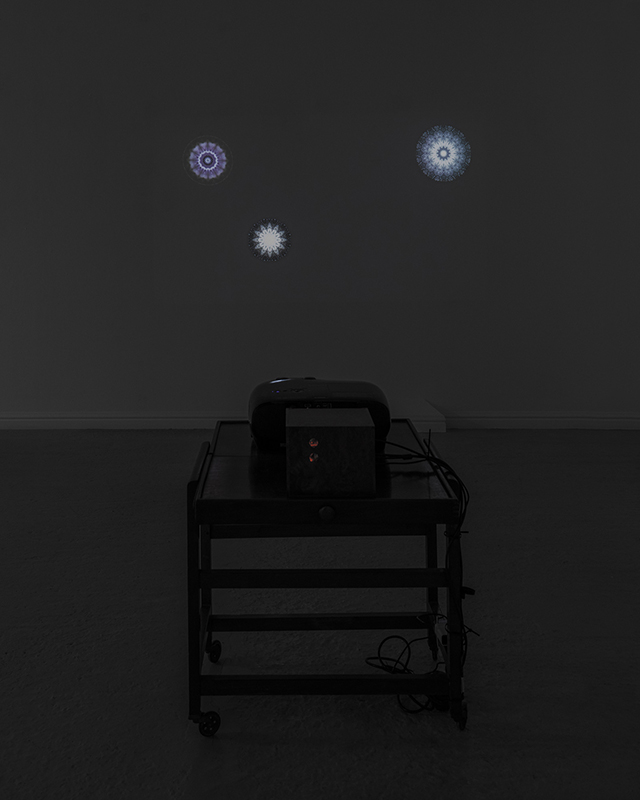
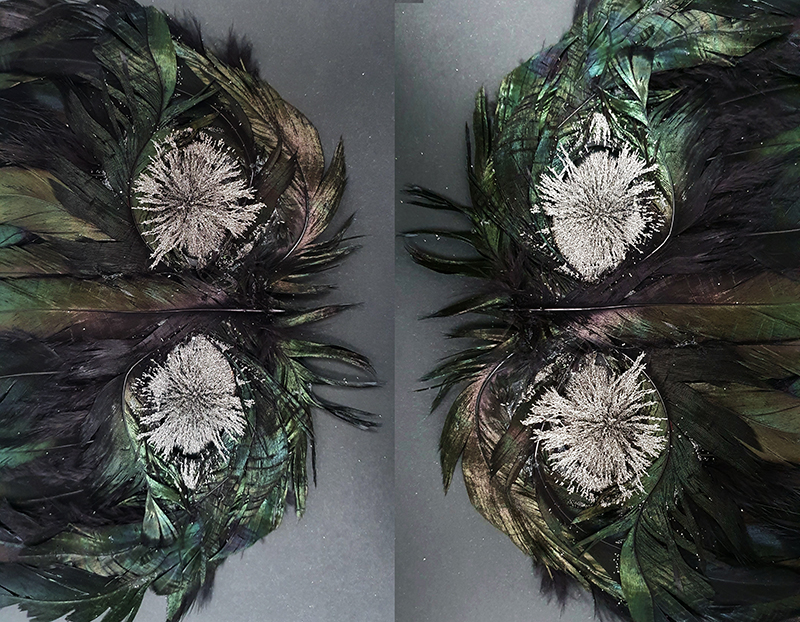
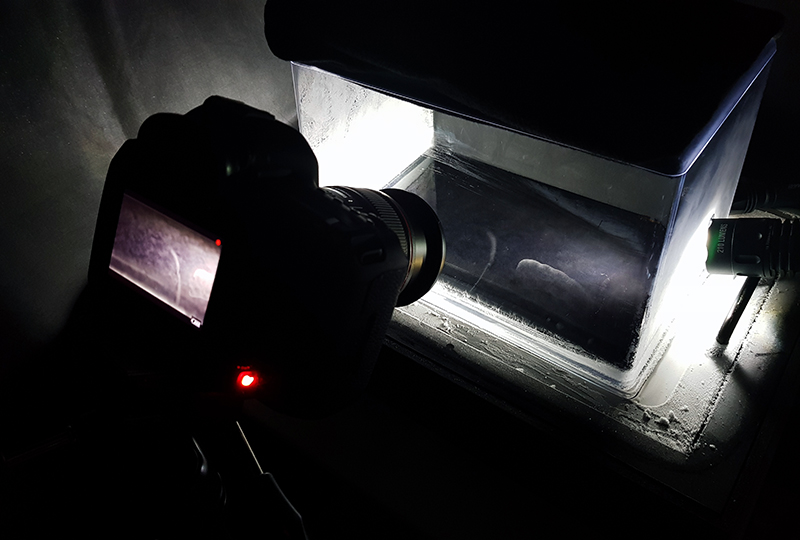
The kaleidoscopic video images that appear are created from mirrored footage of cosmic ray trails filmed during my cloud chamber experiments. Cosmic rays are subatomic  – smaller than an atom – they are protons or the nuclei of an atom which has had its electrons ripped away. We can’t see the actual particles but we can see the trails of condensation they leave behind as they whizz through a cloud chamber.
Cosmic rays arrive at Earth randomly, and this can be witnessed by the sudden flurries and silent gaps of the video imagery. The kinetic energy in just one particle can be equivalent to the energy of a cricket ball bowled by the fastest bowler on the planet  – so much energy squeezed into one tiny particle gives it a huge velocity. Light travels a thousand billion kilometres in one year – a light year – no object with mass can travel at the speed of light but an ultra-high energy cosmic ray would only lag behind the photon by 100th of the diameter of human hair. Most cosmic rays heading for Earth are deflected by the planet’s magnetic field – without this protection, life on Earth, as we experience it, could not survive this bombardment of radioactive matter.

Around 95% of the universe is ‘dark’ to us, formed of unknown and possibly unknowable matter. Phenomenon such as dark matter may be inaccessible to us, but cosmic rays offer a more tangible contact with outer space as they have mass. Although too small to see, we can witness their effects via technology, such as that used in The Breath of Stars, which affords us the opportunity to gaze beyond and between the stars to gain an insight into the structures of the cosmos and imagine what might be hidden in those dark spaces.

I am very excited that Cosmic Chiasmus: crossing the universe is showing at the super brand new Science Gallery Bengaluru in their inaugural exhibition CARBON: under pressure.
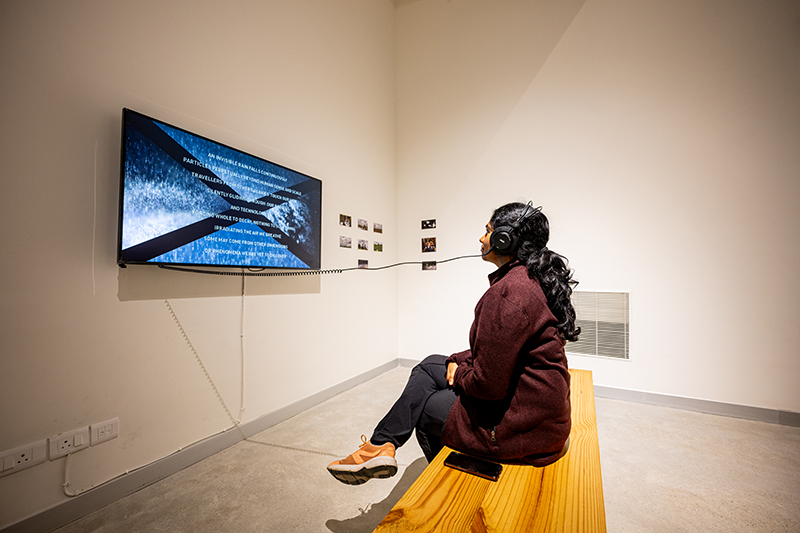
Science Gallery Bengaluru (SGB) is part of the Science Gallery International Network pioneered by Trinity College Dublin. The exhibition explores the ubiquitous nature of carbon, its energy history and the potential futures it enables. Given its unique capability to form bonds and compounds carbon is a foundational element of both life and non-organic matter and its properties have been harnessed as fullerenes, graphene, nanobuds, nanotori, nanocones, and nanohorns, enabling the creation of new screens, batteries, ultra-fast computers, ultra-thin sensors and cables of braided nanotubes. Carbon-14 in organic materials serves as the basis for radiocarbon dating, and Carbon-12 was the standard Dmitri Mendeleev used to determine the atomic weights—and now mass—of all other elements. Carbon dioxide is used as the standard to understand and regulate the flow of exchanges between ecology and economy. Industry driven by coal and oil-fired productivity have triggered alarming climatic effects and created a chasm between geo-biological time as shaped by the material memories of the planet and historical time—that shaped by human action. Carbon is an archive of buried sunshine, bridging the divide between substance and phenomena; caught between the finitude of nature’s resources and the near infinite wonderous potential it holds.

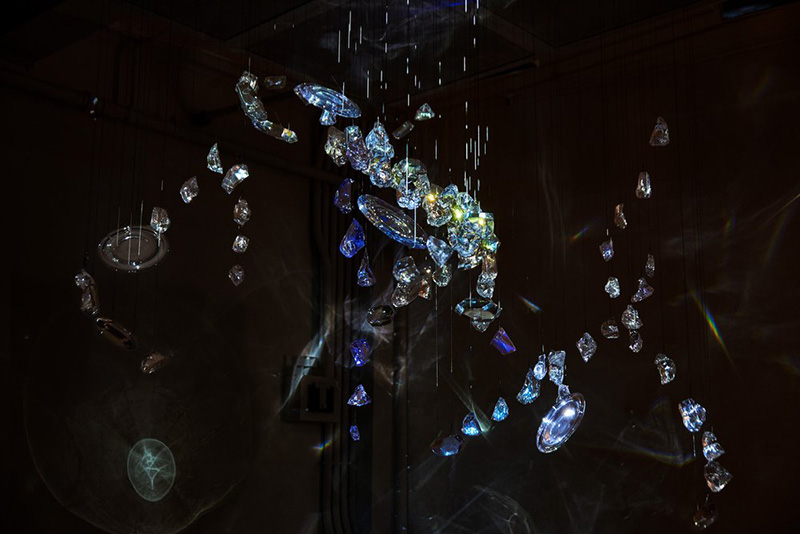
Cosmic Chiasmus: crossing the universe offers a glimpse into a subatomic world where cosmic rays travel from distant galaxies to collide and silently interact with atoms and technology on Earth. Cosmic rays are particles that move extremely fast. They are raining down on planet Earth all the time. Although they are called rays they are not like photons, as light is made of, because they have mass, but they do travel at nearly the speed of light. Cosmic rays go through a violent process of creation, transformation and decay. From the heart of stars or the depths of black holes these particles power across the universe with unimaginable energy colliding with life on Earth and triggering other processes such as cell mutation, computer data corruption and carbon-14 formation. Above our heads where cosmic rays collide with atoms in Earth’s atmosphere radioactive carbon-14 is formed. This radioactive carbon-dioxide in our atmosphere is absorbed by plants and enters the food chain. The radiocarbon decays while an organism is alive but is continually replenished as long as the organism takes in air or food. When an organism dies no more Carbon-14 is absorbed and that which is present starts to decay at a constant rate. By measuring the radioactivity of dead organic matter, the carbon-14 content can be determined and the time of death established. Cosmic ray activity gives us carbon dating techniques. It is an incredible journey that cosmic rays make, blasted across space, spiralling along magnetic field lines to end up entangled with carbon in our bodies.

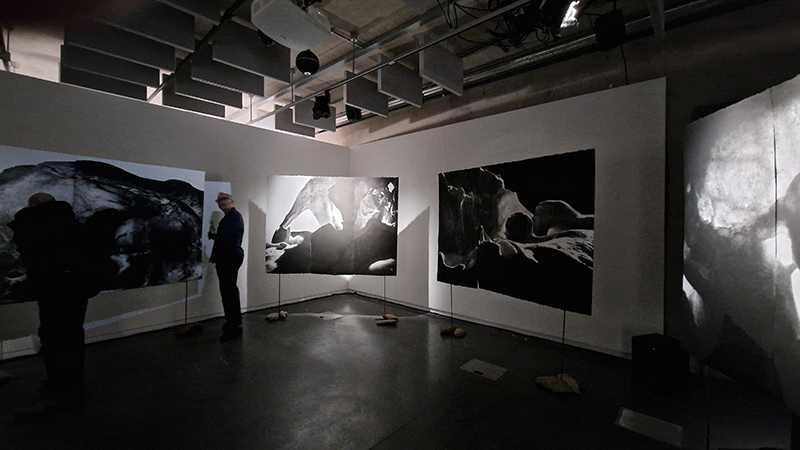
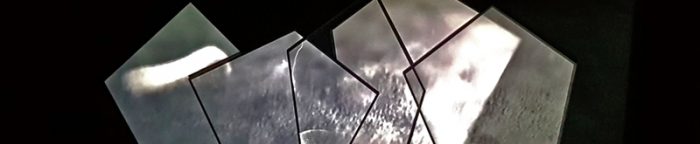
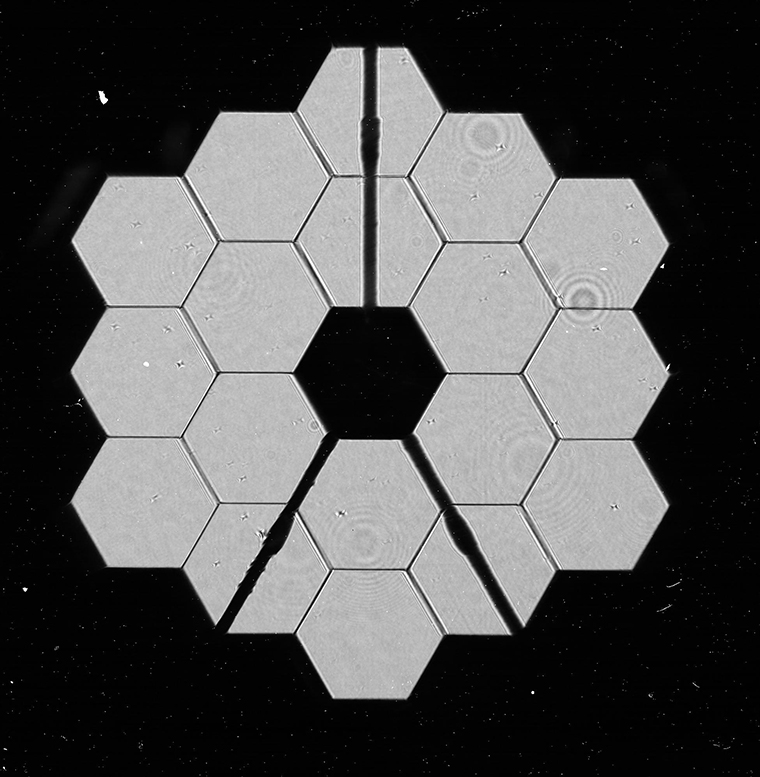
The James Webb Space Telescope selfies of its own light searching mirrors shows cosmic ray activity impact. Space weather can have serious implications for technology. Satellites are particularly vulnerable. and can be sent off-orbit or suffer electrical interference. The satellite population orbiting Earth has more than doubled since 2020, and with more satellites launched in the past year than during the first thirty years of the Space Age, reliance on this technology is increasing at a rapid rate.
I am making new work looking at information insecurity caused by space weather for an upcoming group show at APT Gallery which takes the lifeboat as a metaphor for precarity. Participating artists: Rachael Allain / Caroline AreskogJones / Beverley Duckworth / Liz Elton / Susan Eyre / Kathleen Herbert / Kaori Homma / Anne Krinsky.   
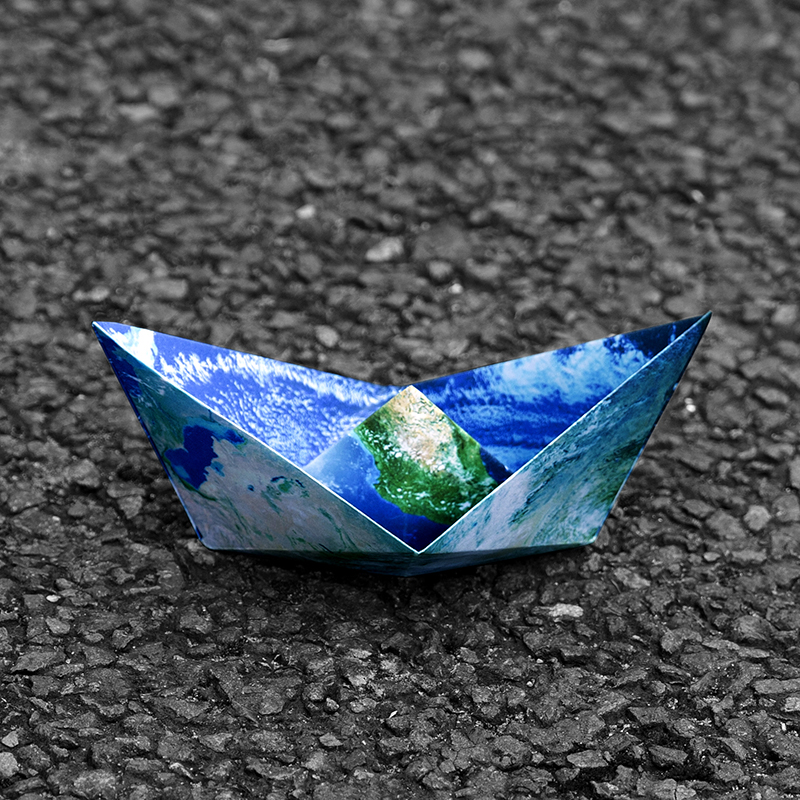
Life Boat brings together artists with a shared interest in exploring precarity as a site of dynamic transition. Each takes an investigative approach to the environmental, social and historical themes evoked by the lifeboat, as a means of addressing ecological crisis, liminal landscapes, close and distant horizons, boundaries and displacement, lines of rescue, navigation and transformation.

“How do you calculate upon the unforeseen? It seems to be an art of recognizing the role of the unforeseen, of keeping your balance amid surprises, of collaborating with chance, of recognizing that there are some essential mysteries in the world and thereby a limit to calculation, to plan, to control.” Rebecca Solnit, A Field Guide to Getting Lost

Gallery Visits

Tania Kovats as above so below at Parafin. She says: ‘I make drawings more than I draw drawings.’ There is something captured in the simplicity of her work, a haptic viscerallity that is very emotionally stirring.
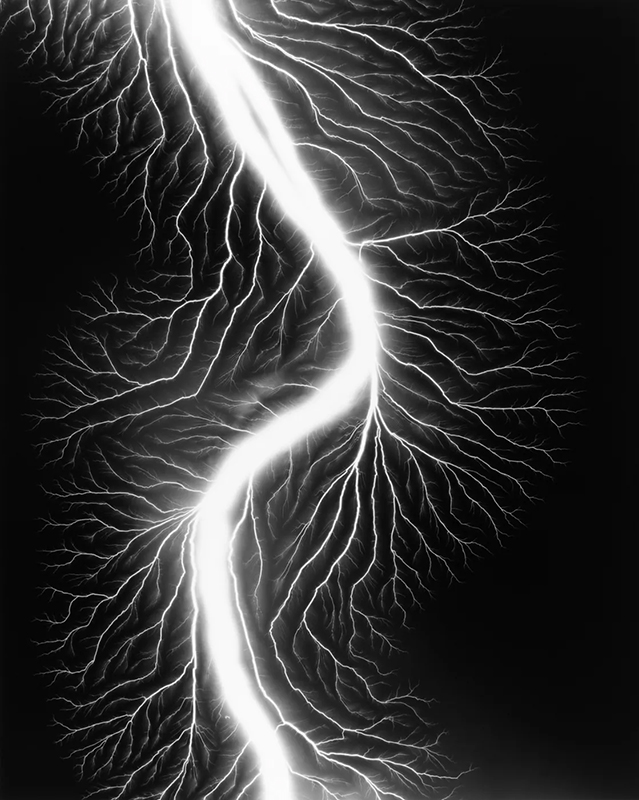
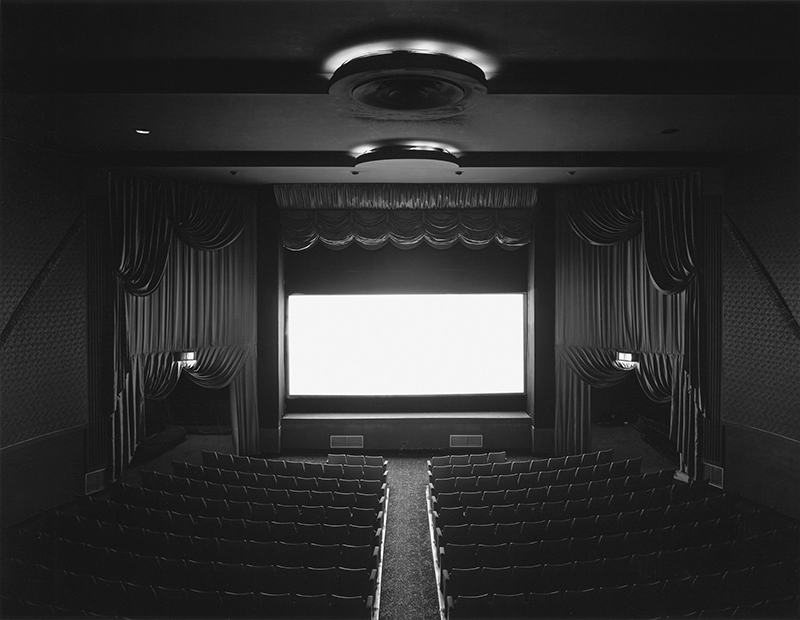
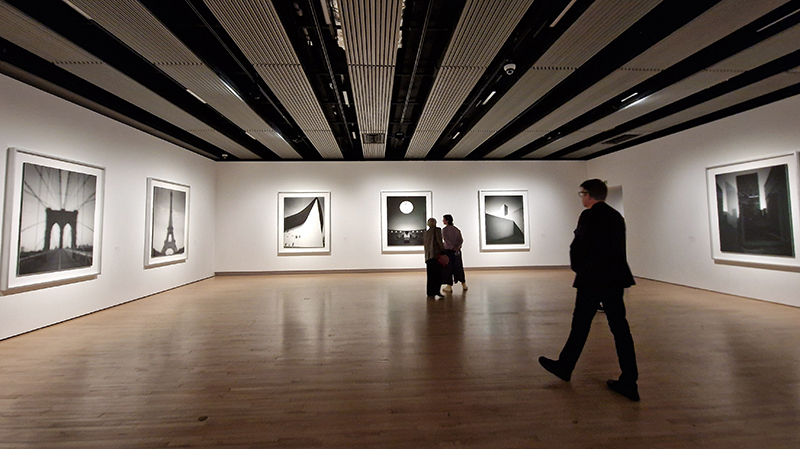
Hiroshi Sugimoto: Time Machine at Hayward Gallery. Beautifully crafted, astonishing work. Hard to believe his models are waxworks or museum taxidermy dioramas, not living subjects and that it is his studied use of light that so cleverly activates his images. I particularly like the Theatres series where he set his camera on an exposure equal to the length of the film being projected into an otherwise dark and empty cinema. The resulting images of a blinding white screen bleeding light like an opening to heaven are remarkable records of passing time. I also loved the work stemming from his interest in mathematics and optical sciences and his experiments with different electrical discharge tools. Sugimoto discovered that he could produce shapes that looked like amoeboid organisms, so he set out to recreate the conditions of the ocean from the time that life began. Using rock salt from the Himalayas (today’s mountain range was once the ocean floor), he mixed his own primaeval seawater. Submerging electrically charged film into the water, the artist was amazed to see light particles move across the surface like microorganisms.

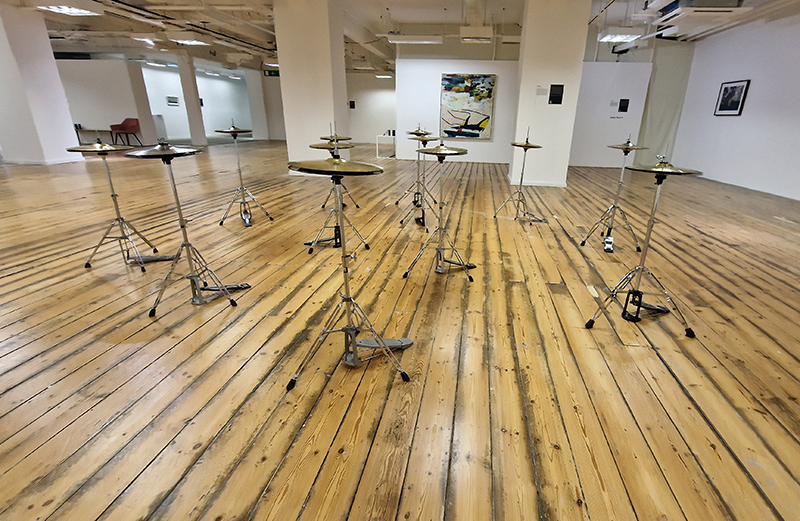
SEISMIC: ART MEETS SCIENCE at GIANT Gallery, Bournemouth, a collaboration with SEISMA Magazine curated by Paul Carey-Kent who was leading a tour of the works when I visited. Artists: Uli Ap, Edward Burtynsky, 0rphan Drift, Peter Matthews, Claire Morgan, Elpida Hadzi-Vasileva, Lisa Pettibone, Shuster + Moseley, David Rickard, Troika. Scientists from corresponding fields of interest are called upon to comment on the work of the curated artists. I was curious to see David Rickards Cosmic Field (3.7mHZ) – a commission by Seisma magazine – which sees cymbals clash when a cosmic rays passes through a hidden Geiger counter. Unfortunately, I didn’t get to witness the full effect as the detector mechanisms hadn’t been charged up, and so only one cymbal was responding with an occasional clash. There are some clever maths in the title and references to John Cages silent composition and the oscillations of the sun. I would like to have learnt more about how the Geiger counters can be sure they are recoding cosmic rays and not just background radiation. It was interesting to read about how stars have sound trapped within and resonate at natural frequencies, like waves inside a wind instrument. Astrophysicist Dr William Chaplin refers to this process as gentle breathing which can be seen in periodic changes in brightness as the stars breathe in ( compressed and bright ) breathe out (relaxed and darker). Other work in the show included Lisa Pettibone’s Truth to Illusion a screen that appears to show a digital undulating image is revealed through a peep hole to be caused by a rotating light and glass mechanism. Light can reveal and mislead in the quest for an understanding of reality. Jewell of Space by Claudia Moseley and Edward Shuster is a mesmerising moving sculpture of light refracting and scattering across a constellation of glass, shadowing the lensing effects of light across the galaxy. Clare Morgan’s Heart of Darkness – a grid of bluebottle flies – a comment on complexity in a system and the importance of each individual to create a whole. Elpida Hadzi-Vasileva’s animal organs given new context – the body turned inside out (cow’s stomach) – the unseen revealed (lamb intestine).
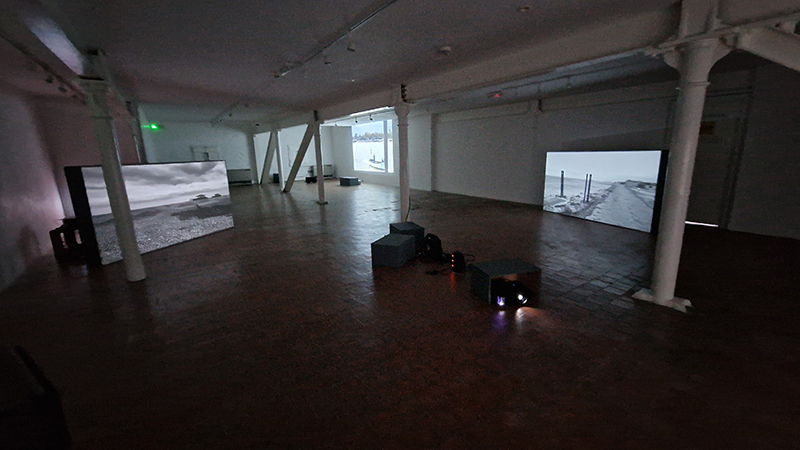
The Accurate Perception Available When Our Eye Becomes Single at The Cut, Halesworth, Suffolk. A lucky chance to see another iteration of this impressive collaboration between Richard Ducker (video) and Ian Thompson (sound). This atmospheric multi-screen installation transports you to the remote otherness of Orford Ness with its innate aura gained from status as a top secret military site and atomic development centre of the 1950’s.
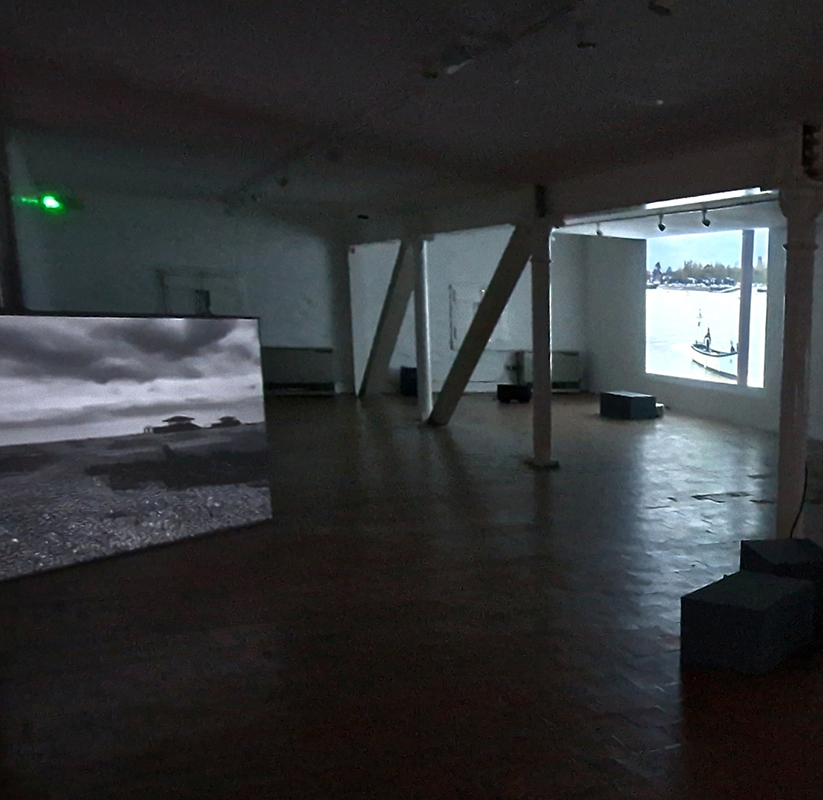
Holding Cosmic Dust: An Almanac, a video installation at The Swiss Church in London by Hot Desque. I enjoyed their previous theatrical inspired installation at Thames-side Studios Gallery where lighting played a key role in creating atmosphere. Again lighting was key, this time very low lighting meant identifying friends at the event was unpredictable. This installation is partnered with an intervention within the permanent, archaeological collection of the Corinium Museum, in Cirencester, positing a speculative archaeological dig in which a matriarchal society is uncovered. The installation draws out connections between archaeology, history and fantasy. There was in conversation with historian Frederika Tevebring about the speculative nature of archeology and evidence of matriarchal societies, but due to challenging acoustics and lighting much of this fascinating talk was lost. I would have liked to hear about the cosmic ray connections. Was it to do with Carbon dating? Participating artists: Holly Graham, Rubie Green, Rebeca Romero, Amba Sayal-Bennett, Abel Shah and Suzanne Treister.
Reading

All The Light We Cannot See by Anthoney Doerr. An extraordinary evocation of the depths of human tenderness and cruelty and the power of knowledge. This is a beautifully written fiction spanning the decades from the 1930’s into the 21st century when advances in radio technology went from a being a source of public information and enlightenment to a weapon of war. Through the wonder of the young protagonists in discovering the magic of radio transmissions, the author also stirs in the reader a reminder that it is invisible waves crisscrossing our world, carrying information vast distances, across political and geographic boundaries. I loved this book.

The Future of Geography: how power and politics in space will change our world by Tim Marshall. Clear and accessible writing takes the reader through the history of the space race to the ubiquity of orbiting satellites and on to the era of astropolitics, military strategy and the battle for future resources. The stakes are high.

Entangle: Physics and the Artistic Imagination edited by Ariane Koek, written in conjunction with an exhibition at Bildmuseet in Sweden. The book is filled with fascinating essays from both artists and scientists giving personal perspectives on their interest in and interaction with particle physics. The importance of an open imagination, the thrill of the unknown, the quest for knowledge that may never be accessible, are relevant to all participants. The common ground between art and science, and the benefits to both fields of joint conversations, is increasingly being acknowledged. Scientists offer the abstract theories, controlled experiments or new technologies that feed artists imaginations, throwing up new questions for both to consider and relate to the human experience.

Watched the deeply moving film by Werner Herzog, The Enigma of Kaspar Hauser – a fictionalised documentary of a teenager suddenly released from an existence of inexplicable confinement chained in a cellar with no human contact other than his captor. The film follows the internal struggle of Kaspar as he is subjected to the demands of society, and take on the current belief systems of the Church. His confusion at the world and despair at how much he doesn’t understand is an allegory for the limitations of human knowledge. The film spotlights the failure of logic and science to provide answers to the human condition.
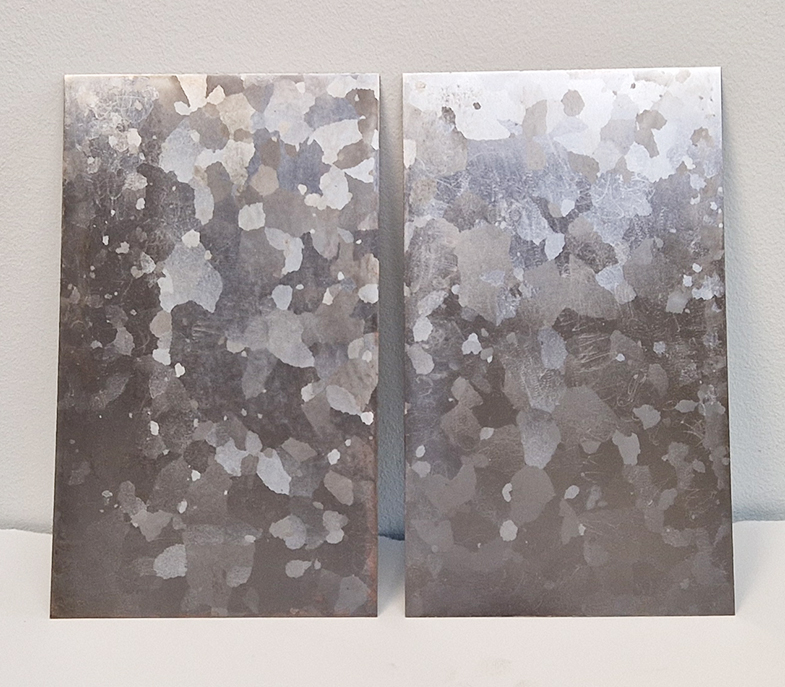
Really pleased with the results I am getting from the new batch of directional magnetic steel sent from Union Steel Products. These are coming out better than in previous tests.

Norman P. Goss invented grain-orientated steel in 1934. It was produced through a two-stage cold rolling process with intermediate annealing between the cold rolling stages. Grain-oriented electrical steel enabled the development of highly efficient electrical machines, especially transformers. Today, the magnetic cores of all high-voltage high-power transformers are made of grain-oriented electrical steel. The strong preferred crystallographic orientation is known as a Goss texture.

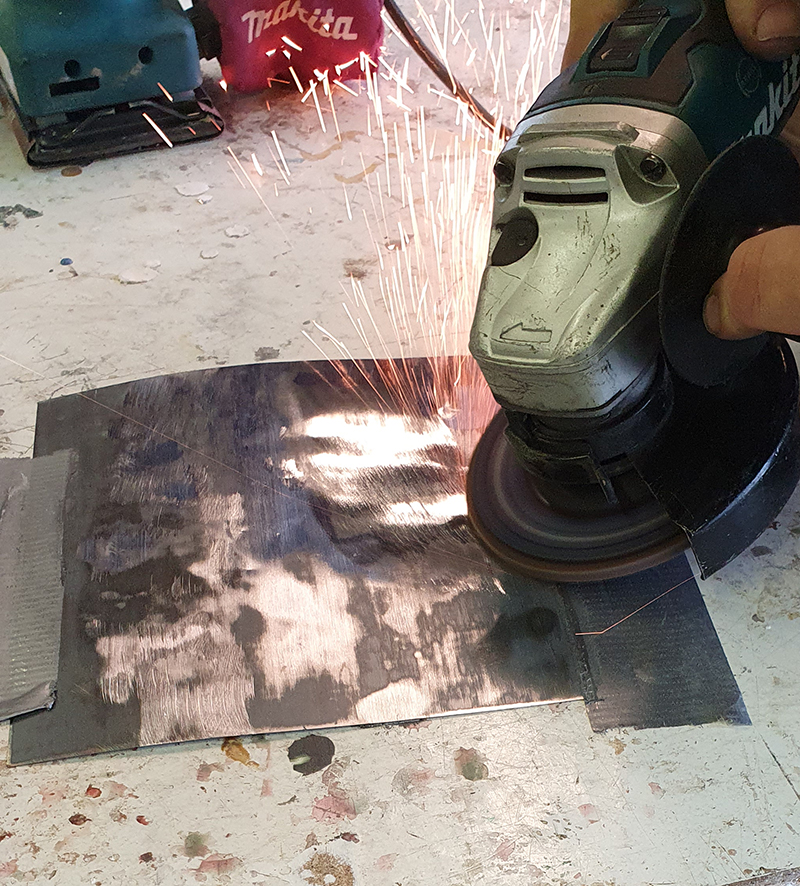
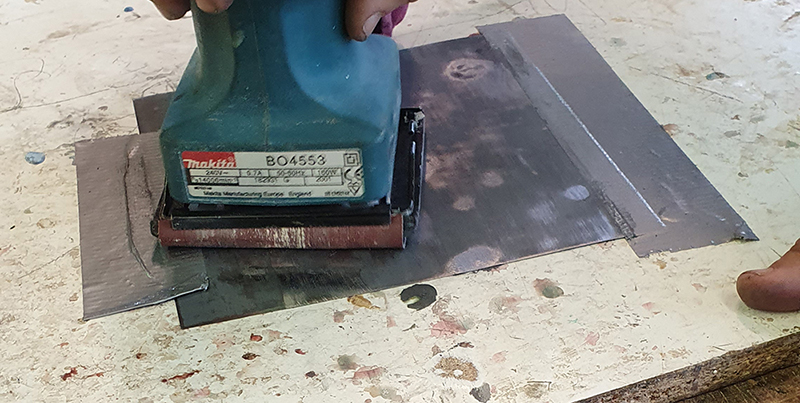
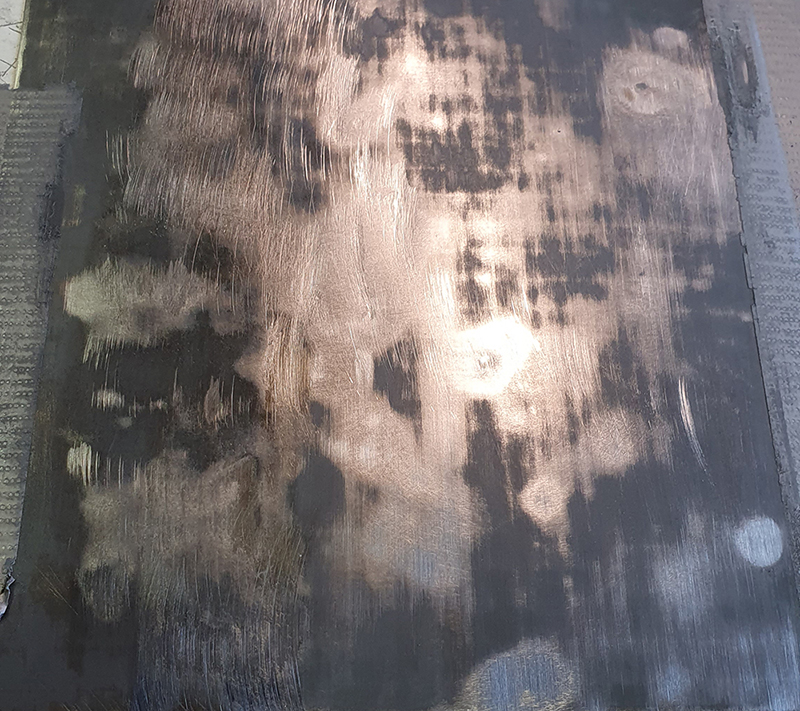
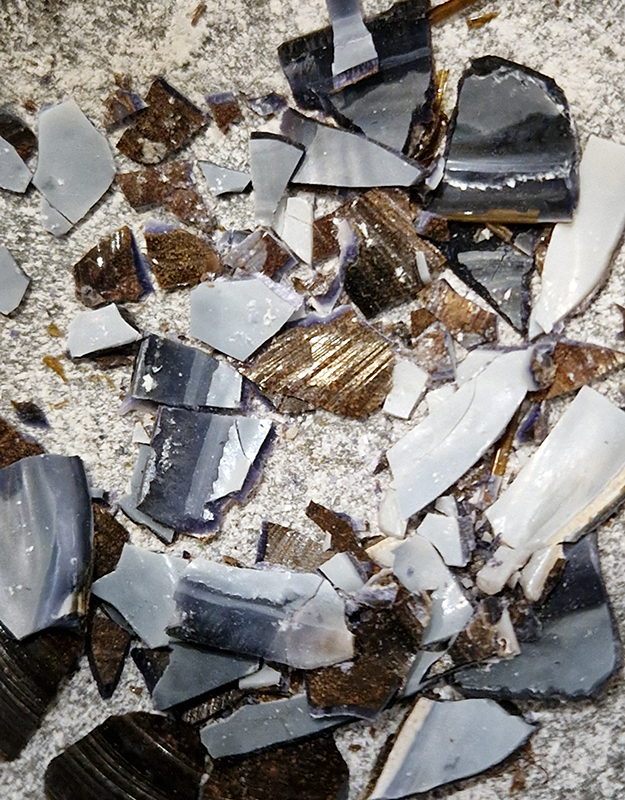
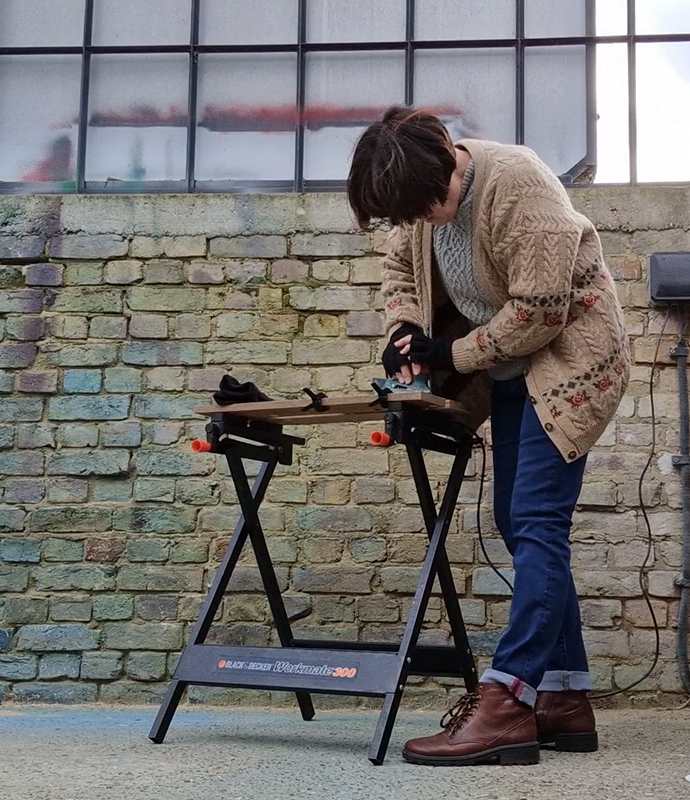
When I receive the electrical steel it has a grey insulation coating which has been applied to both sides of the sheet to avoid eddy currents between the stacked sheets when used in a transformer core. I am removing this coating by sanding. I then etch the sheets in copper sulphate solution for 20 minutes. The plate must be dried very quickly when it is taken out of the etching bath. I then lightly polish and wax the surface. Some detail is lost quite quickly and areas can become muddy after etching so I still need to experiment a little more with alternative cleaning and sealing methods.

A previous batch had a different coating that proved impossible to remove cleanly even with the most extreme methods. This new batch has two different types of sheet which have a slightly different pattern to reveal. It is quite hard work but a fascinating material to experiment with.

I have been considering using the Directional Magnetic Steel Pieces in some form of suspended sculpture as movement causes the surface to catch the light revealing the patterned surface of this material. I might use it to mark the line of declination across the gallery floor from True North to Magnetic North at the time of installation.
Thinking about moving sculptures –

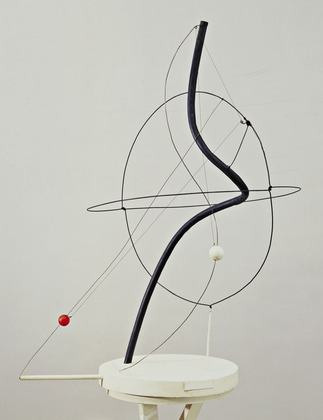
Imagine holding Einstein’s attention for the forty minutes it takes your work to revolve. A Universe by Alexander Calder 1934, painted iron pipe, steel wire, motor, and wood with string. One of the first artists to explore kinetic and motor driven sculpture, expanding drawing into 3D and painting into motion. A nice intro to Calder from 2016 – The Universe of Alexander Calder with Dara Ó Briain.
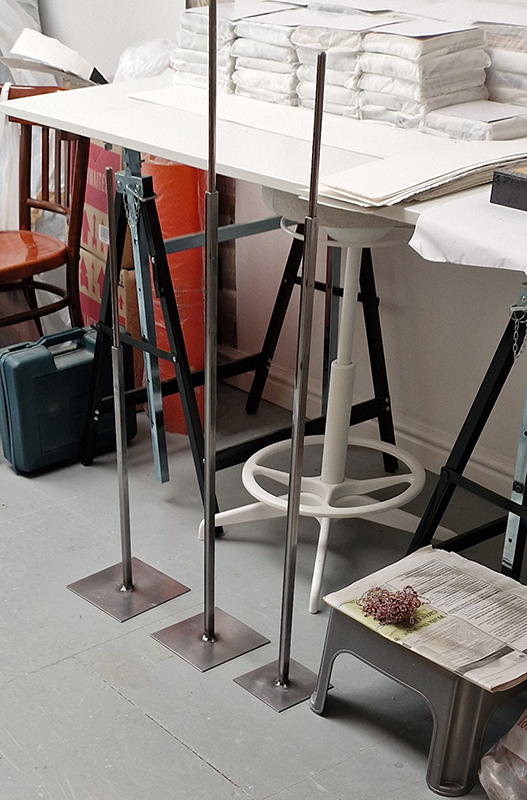
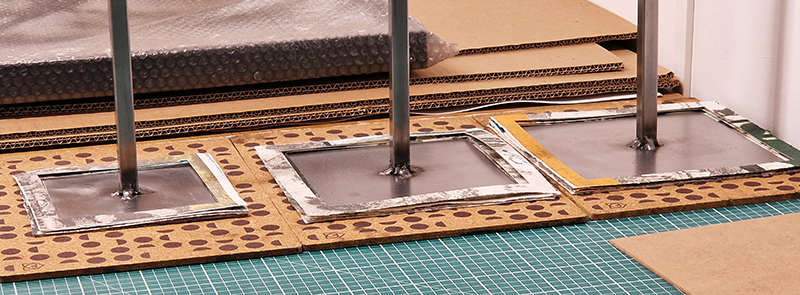
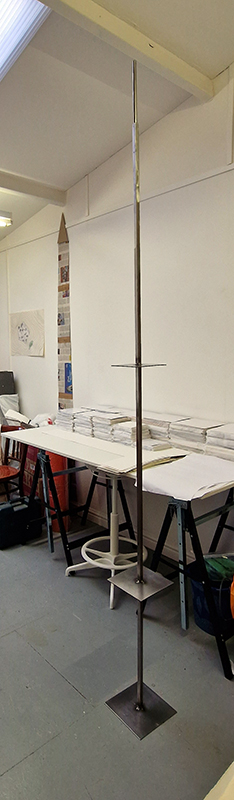
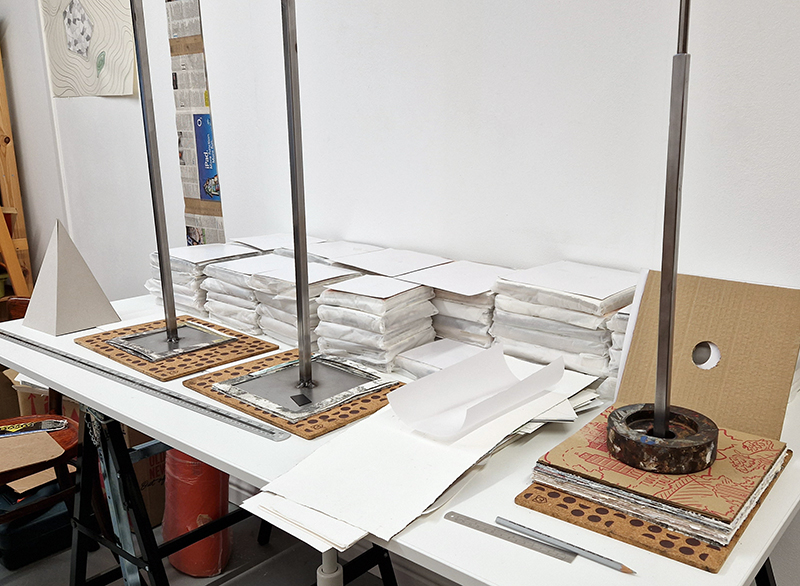
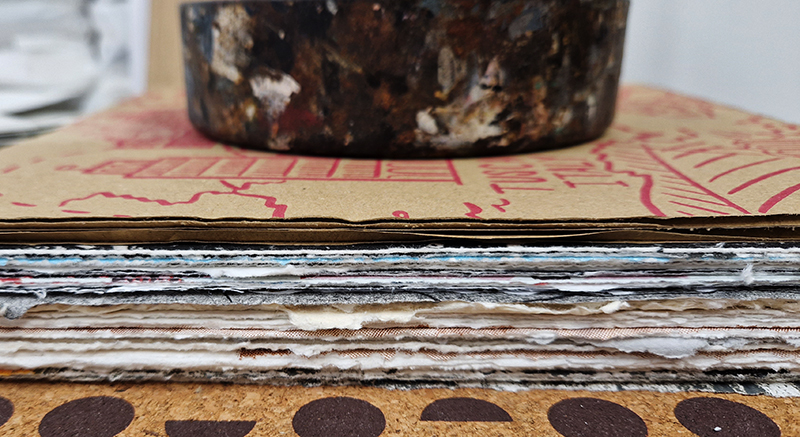
Work continues on the Azimuth Obelisk with the construction of the metal frame to support the structure and hold the layered paper sheets. Thanks to Giles Corby of the London Sculpture Workshop for getting to grips with my diagrams and welding the frame. The frame is made in three interlocking parts to distribute the weight and make for easier storage and transportation. This sculpture is a response to the concrete obelisk erected in 1955 at Hartland Magnetic Observatory, near the site’s northern boundary as a permanent azimuth mark. It is viewed via a theodolite through a window in the north wall of the Absolute Hut, its azimuth being 11º27’54” E of N and marks the point from which the magnetic north pole is tracked as it drifts westwards.

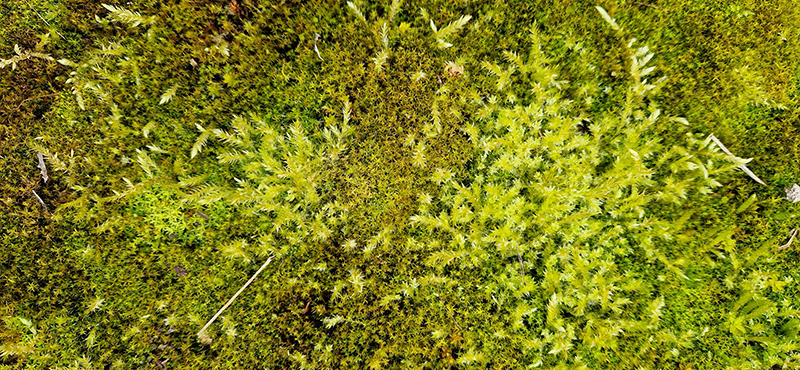
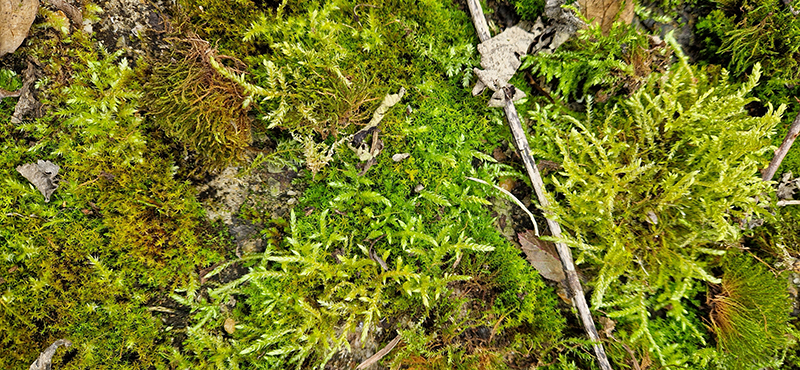
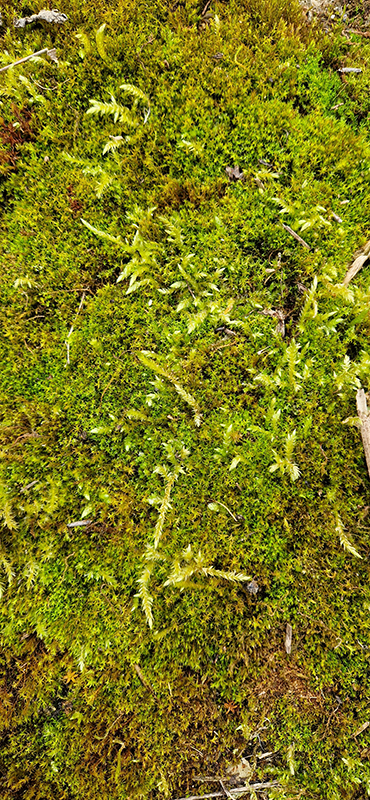
The British Bryological Society celebrates its centenary this year, promoting the study of mosses and liverworts. I have been searching their website for clues on growing moss. Most of the information is on the identification of mosses but I did find a useful downloadable pdf of The Moss Growers Handbook by Michael Fletcher. No mention of liquidising moss with yoghurt as a starter culture though.

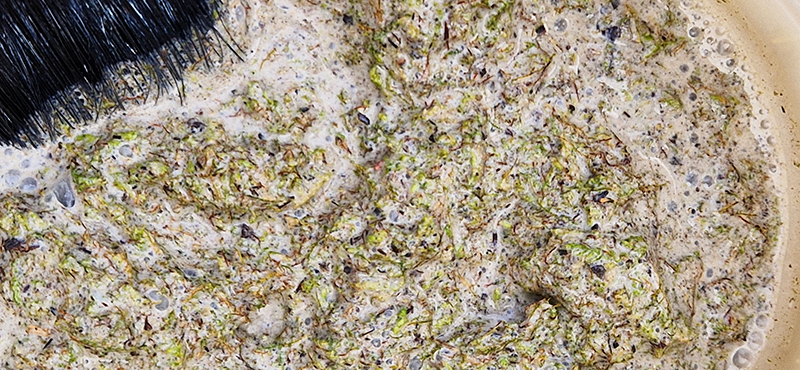
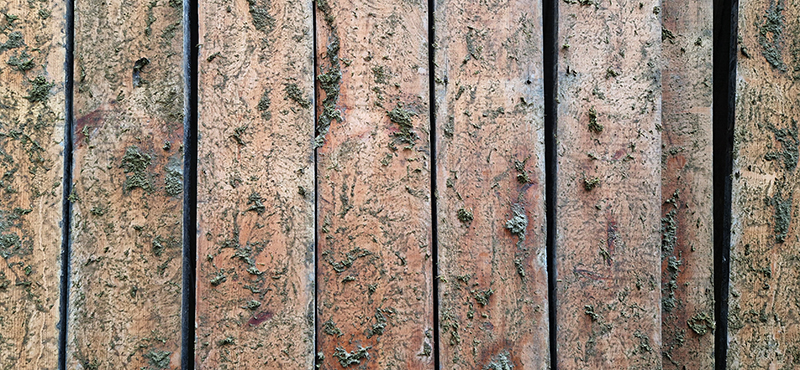
Gathering moss, liquidising with yoghurt and painting on to reclaimed old boards.

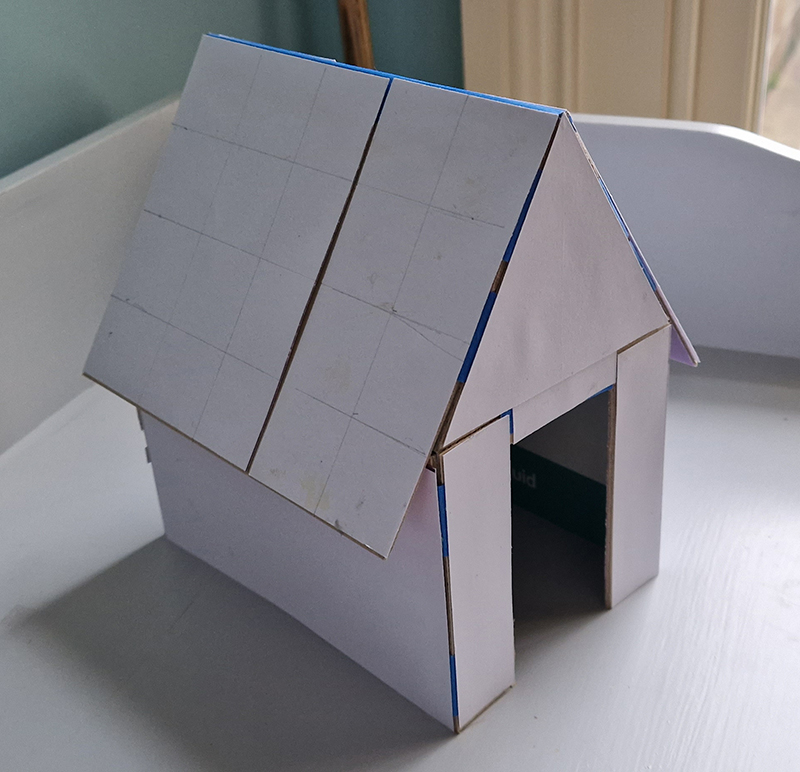
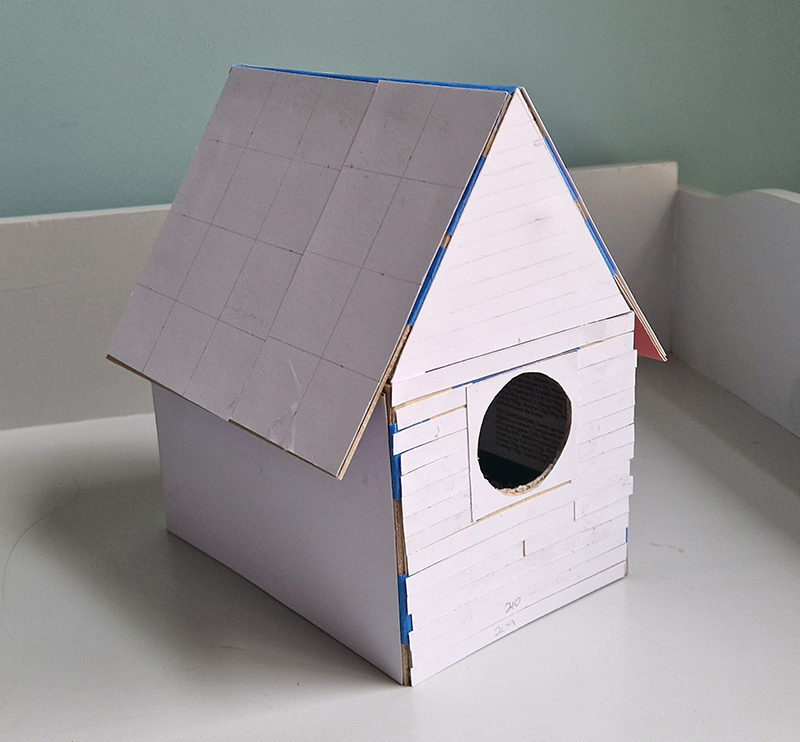
I made a rough model of The Absolute Hut to work out how many boards I will need for the north facing wall to try and grow moss on. I like that it turned out looking like a bird house as inside will be video exploring the magnetoreception of birds. This work is a reimagining of the Absolute Hut at Hartland Magnetic Observatory where monitoring of the Earth’s magnetic field takes place.
Some speculation on human magnetoreception:

Neurons send information electrochemically around the body. The signals they send are called action potentials which is a temporary shift from negative to positive within the cell caused by certain ions entering the cell. Research has proven that some animals can sense the magnetic field via cryptochrome molecules in the retina which trigger action potentials. New studies have been carried out looking at iron particles (Fe3O4) found in the brain using supersensitive magnetic sensors to read the brain’s magnetic field. Receptor cells containing crystals of magnetite could register changes in magnetic fields and report this information to the brain.  

One study suggests that it could be possible for the magnetic field in one animal’s brain to transmit information to another animal’s brain by triggering action potentials creating the same thoughts and emotions. There have been experiments with rats and fruit bats which claim brain to brain communication has occurred. Alpha waves in the human brain have been shown to respond to magnetic fields. Alpha waves are always present, but are more prominent when at rest. The experiment, carried out at Caltech, mimicked how a person might experience the Earth’s magnetic field when turning their head. 

Maybe putting our heads together can exchange thoughts telepathically.

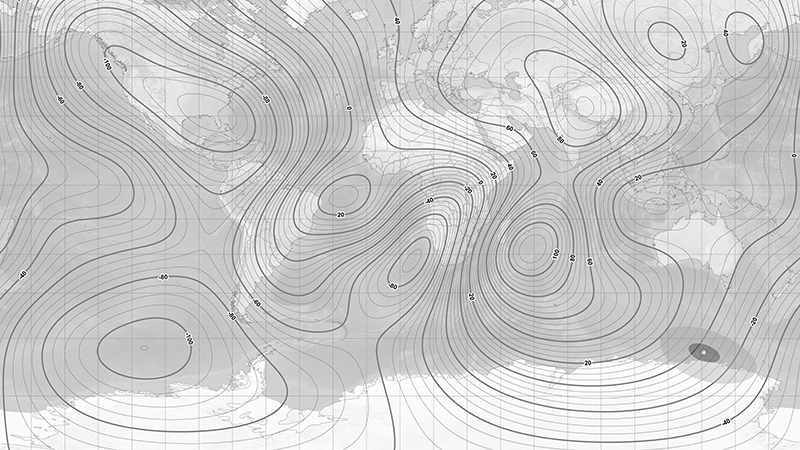
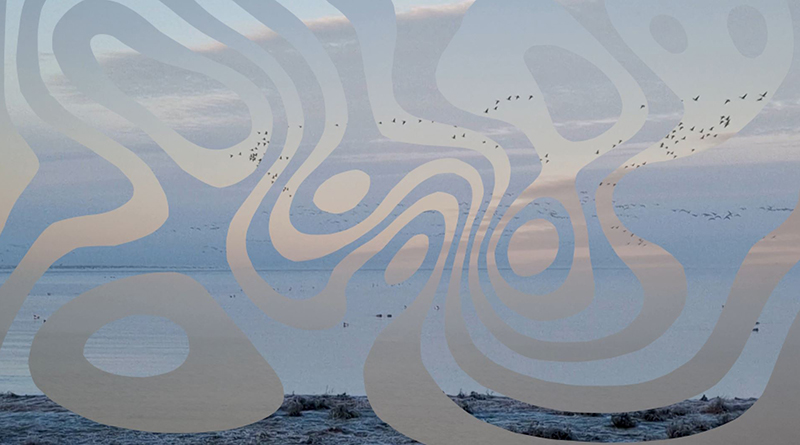
I have taken the contour lines from a publicly available World Magnetic Model Field Map as a framework for layering in the video work on bird magnetoreception.

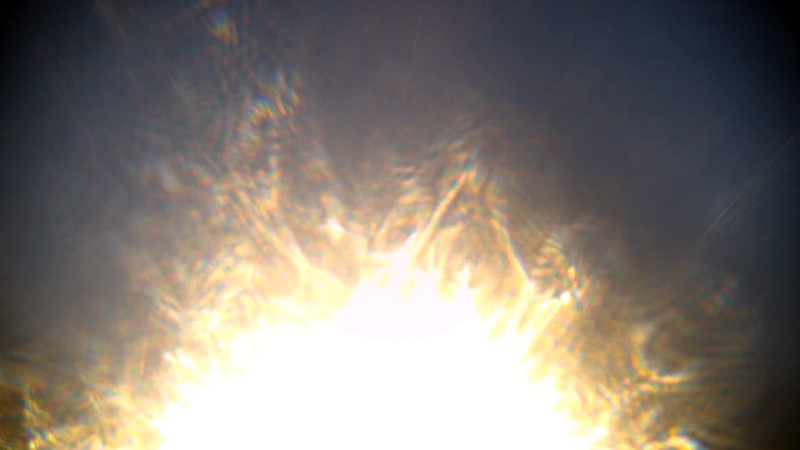
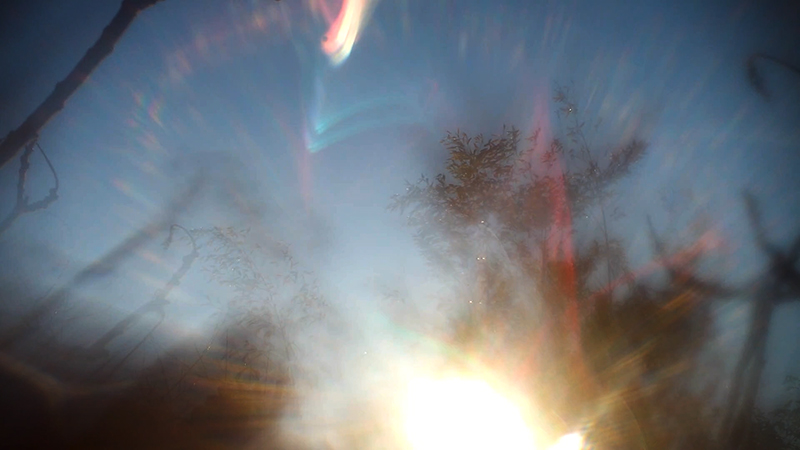
An early frosty morning captured the sun melting the ice on the lens of the spy cam in the garden.

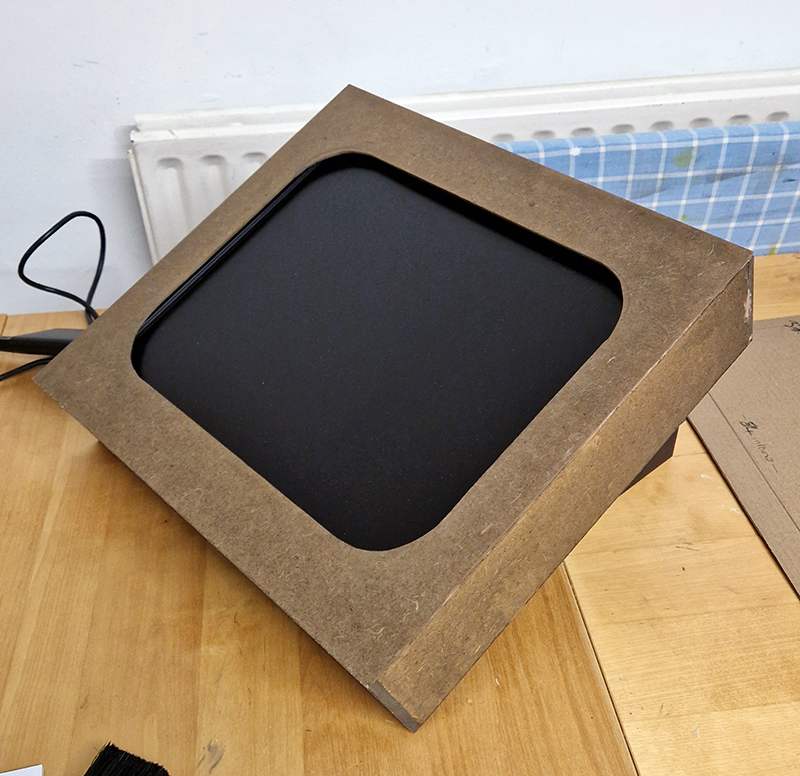
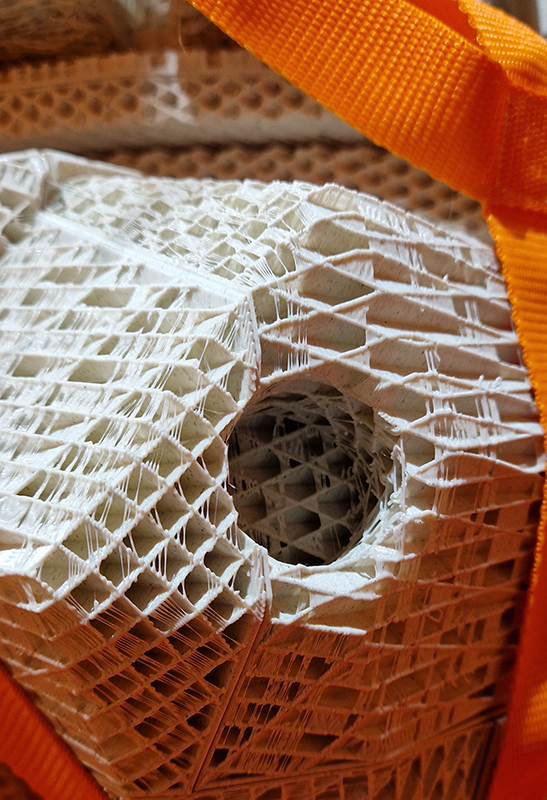
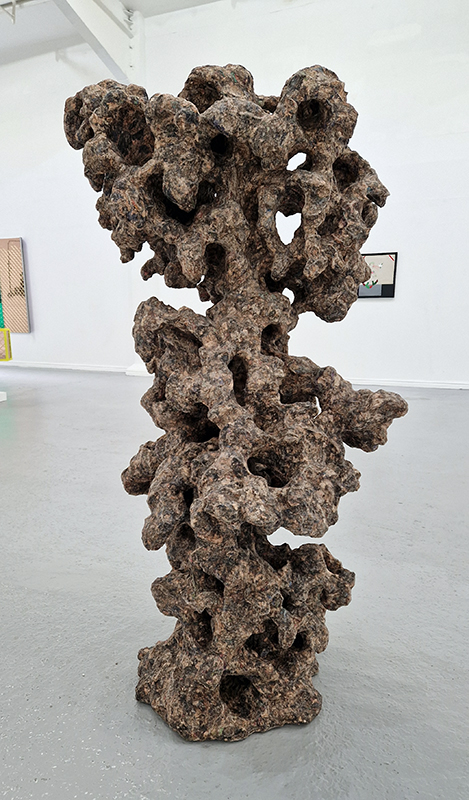
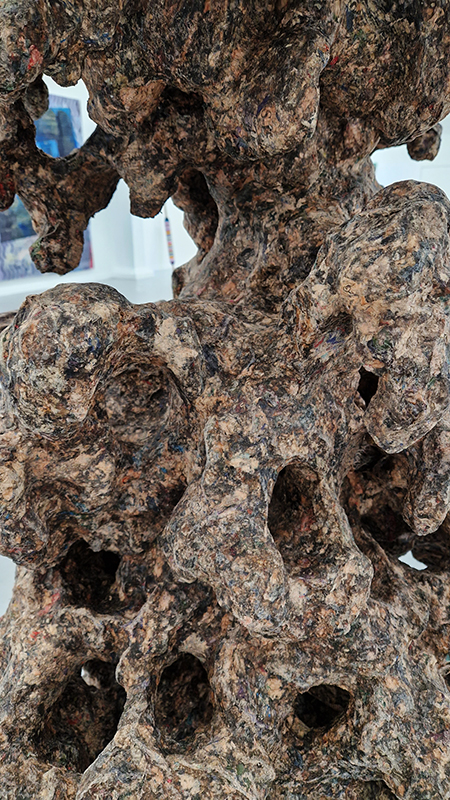
I have built the protective box frame for the monitor that will be inside the mollusc/rock sculpture Belly of a Rock. Thanks to Pete next door for cutting the wood for me. I plan to build the shape up with mesh covered in paper clay. I have had the idea to make small circular paper clay clumps with swirls of crushed shell on each one and build the form up from these. I have been given a lot of oyster shells and have collected mussel shells which I have tested crushing with a pestle and mortar.

The drift of the magnetic North pole was first recorded in 1831 and historically would wander between 0–15 km a year but since the 1990’s it has sped up to drift 50–60 km a year. Tracking changes in the magnetic field can tell researchers how the iron in Earth’s core moves.

Earth’s magnetic field is created in the swirling outer core. Magnetism in the outer core is about fifty times stronger than it is on the rocky surface of the Earth. At the centre of the Earth is the inner core which is divided into eastern and western hemispheres. In the inner core, the temperature is so high, materials lose their permanent magnetic properties as the atoms are so thermally excited they can no longer align to a magnetic point. This is known as the Curie temperature.

The hemispheres of the inner core have distinct crystalline structures and the western hemisphere seems to be crystallizing rapidly whereas the eastern hemisphere may actually be melting.  Geoscientists have also recently discovered that the inner core has an inner core. A radical geologic change about 500 million years ago may have caused this inner inner core to develop. Here the crystals are oriented east-west instead of north-south and are not aligned with either Earth’s rotational axis or magnetic field. The inner inner core crystals may have a completely different structure to the hexagonal close-packed (HCP) phase of iron that is stable only at extremely high pressure and so may exist at a different phase.

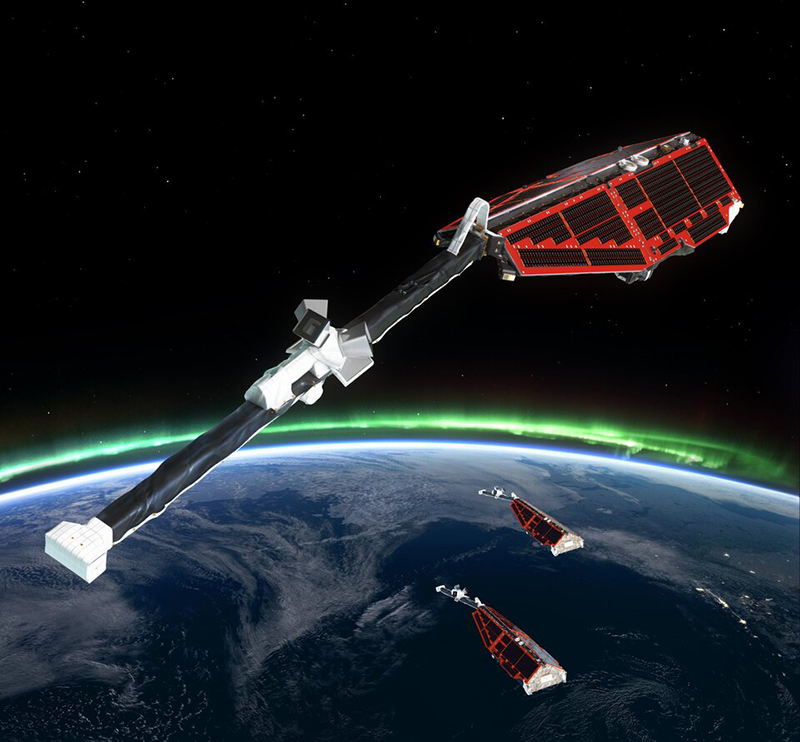
ESA’s three-satellite Swarm mission was launched in 2013 to monitor Earth’s magnetic field by measuring magnetic signals from Earth’s core, the crust, oceans, ionosphere and magnetosphere. Using data from the Swarm mission, scientists have discovered energy generated by electrically-charged particles in the solar wind, which can be disruptive to communication systems, flows asymmetrically into Earth’s atmosphere towards the magnetic north pole more than towards the magnetic south pole. They have also discovered a completely new type of magnetic wave that sweeps across the outermost part of Earth’s outer core every seven years. These magnetic waves are likely to be triggered by disturbances deep within the Earth’s fluid core. Research suggests that other such waves are likely to exist, probably with longer periods.

Geomagnetic jerks are sudden powerful waves that occur about every three to 12 years and are not consistent across the globe. It seems these jerks originate from rising blobs of molten matter that form in the planet’s core up to twenty five years before the related jerk takes place. The current findings from Swarm are part of a long-term project to predict the evolution of the geomagnetic field over the coming decades.

Polarised light is when the waves of electric and magnetic fields vibrate preferentially in certain directions. This can happen when light bounces off a reflective surface like a mirror or the sea. It can also happen in space as starlight travels through gas and dust clouds. Polarisation carries a wealth of information about what happened along a light ray’s path and astronomers can study the physical processes that caused the polarisation.

The Milky Way is filled with a mixture of gas and dust from which stars are born. Cosmic dust grains are almost always spinning rapidly, tens of millions of times per second, due to collisions with photons and rapidly moving atoms. The spinning dust grains become aligned to the direction of the magnetic field. They emit light at very long wavelengths from the infrared to the microwave domain which comes out vibrating parallel to the longest axis of the grain, making the light polarised.

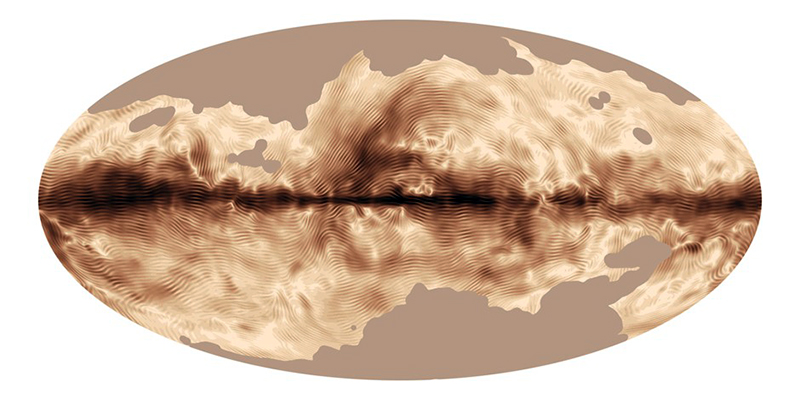
Visualisation of data from ESA’s Planck satellite shows the interaction between interstellar dust in the Milky Way and the structure of our Galaxy’s magnetic field. Polarisation-sensitive detectors were able to capture the data as interstellar dust grains tend to align their longest axis at right angles to the direction of the magnetic field resulting in light emitted by clouds of gas and dust being partly ‘polarised’. Researchers are using the polarised light from interstellar dust to reconstruct the Galaxy’s magnetic field and study its role in galaxy evolution and star formation. From this data it can be seen that across the galactic plane there is a strong regular pattern but in some areas there are tangled features where the local magnetic field is particularly disorganised.

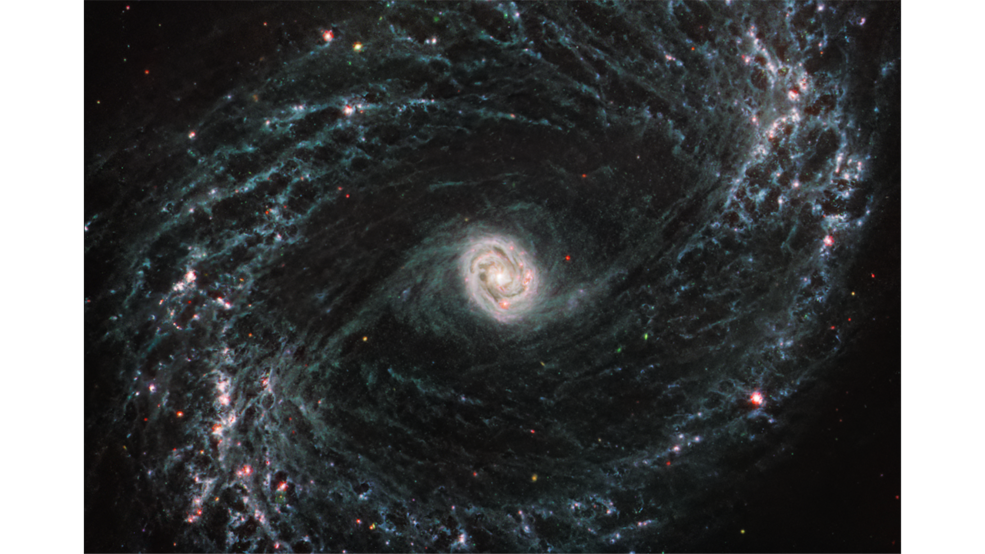
New images from NASA’s James Webb Space Telescope show star formation, gas, and dust in nearby galaxies with unprecedented resolution at infrared wavelengths. NGC 1433 is a barred spiral galaxy with a particularly bright core surrounded by double star forming rings. For the first time, in Webb’s infrared images, scientists can see cavernous bubbles of gas where forming stars have released energy into their surrounding environment.

The Observable Universe 2018 by Pablo Carlos Budasi. The furthest we can see is the faint glow from the cosmic microwave background emitted 13.8 billion years ago.

From Earth we become the centre of the eye that gazes out but we have no idea of the full size of the universe or if we are embedded in a multiverse.

The unobservable universe makes up the vast majority, around 95% of the universe. Zero, a symbol to mark nothing, sits on the boundary between absence and presence indicating what might have been or might come to be. Where we thought there was nothing we have found so much.

Gallery Visits

Preconscious Landscape at Exposed Arts Projects – an interesting space for arts based research projects. Artists: Lynne Abrahamson, Gabriele Beveridge, Matilde Cerruti Quara, Konstantinos Giotis, Sotiris Gonis, Ramona Güntert, Raksha Patel, Hamish Pearch, Anna Perach, Chantal Powell, Candida Powell-Williams, Paloma Proudfoot, Aziza Shadenova, Holly Stevenson, Maro Theodorou, Adia Wahid & Meng Zhou all grapple with an unresolvable psychoanalytic question: what does it mean for the conscious mind to try to understand its own preconsciousness?

Richard Mosse Broken Spectre at 180 The Strand. Seventy minutes of emotionally uncomfortable yet beautifully riveting viewing. Endless overwhelming destruction. Burnt forest. Subterranean fires. Intensive cattle farming. Aggressive gold mining. Wide wide screen images that slip between dreamlike garish colour and chilling monochrome with a soundtrack that sounds like the forest itself crying. The brutal disrespect for the land, the non-human and the people of the Amazon rainforest captured in heartbreaking detail as it slips through our fingers. Having been looking at moss recently the large photographic works at the entrance to the film come across very moss like and emphasises the micro and macro nature of the world.

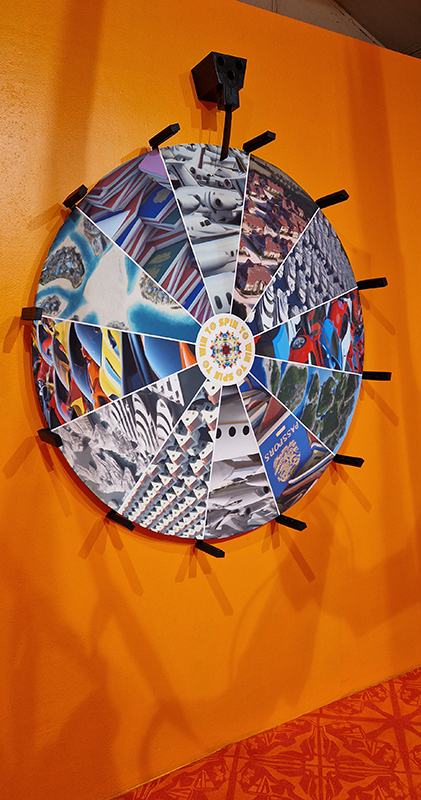
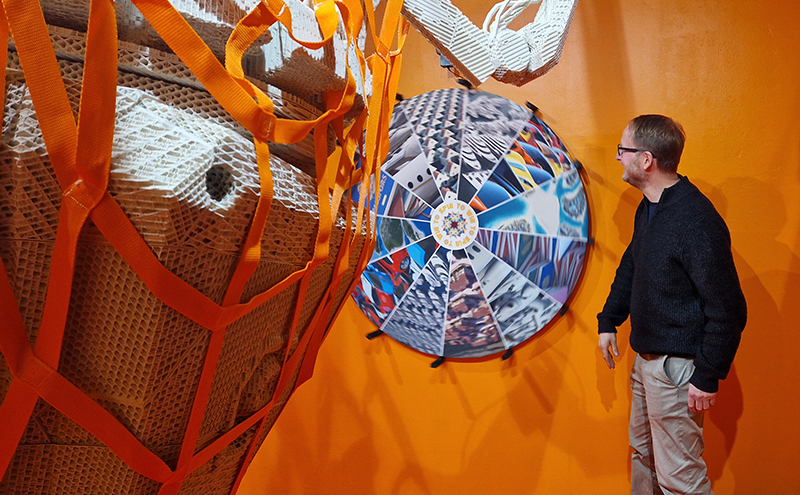
Cable Depot presents Insert Coin, a project by Bob Bicknell-Knight exploring predatory monetisation practices within video games, specifically loot boxes, and the ongoing insertion of gambling mechanics into virtual experiences. Tapping into our desires and the addictive thrill of winning Bob Bicknell-Knight invites us across the digital divide into a luminous world of pixels and 3D printing. I was delighted to win an island. Here everything is free so there is no uncertainty and debt to mar the experience.

As our physical lives are becoming increasingly gamified the game industry has, for almost twenty years, been inserting ways of gambling real world money into video games. From purchasing extra lives to play another level in Candy Crush to buying new cosmetic options for your guns in Call of Duty, spending money within video games has become increasingly prevalent.

One of the most prevalent and destructive forms of monetization are loot boxes, consumable virtual items that are bought within video games which can be redeemed to receive a randomised selection of further virtual items, ranging from simple customization options for a player’s avatar or character to game-changing equipment such as weapons and armour. As the items are randomised players have previously spent thousands of pounds attempting to gain specific products in different games. As these gambling mechanics have become more prevalent, with considerable harm being done to young people and players with gambling addictions, loot boxes are now illegal in several countries, whereas recently the UK government decided that loot boxes will not be regulated under betting laws.

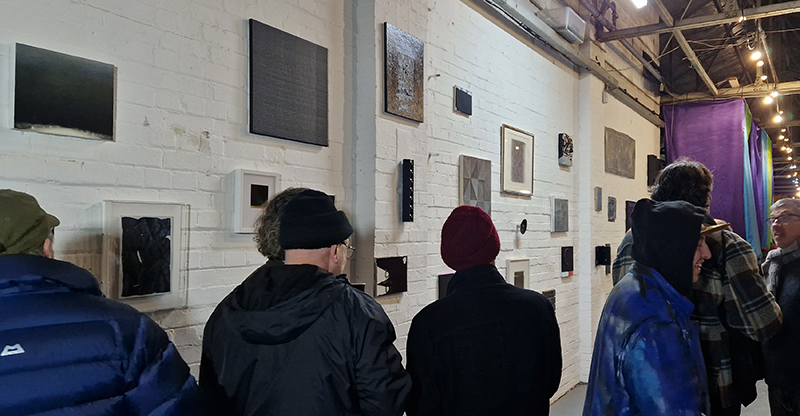
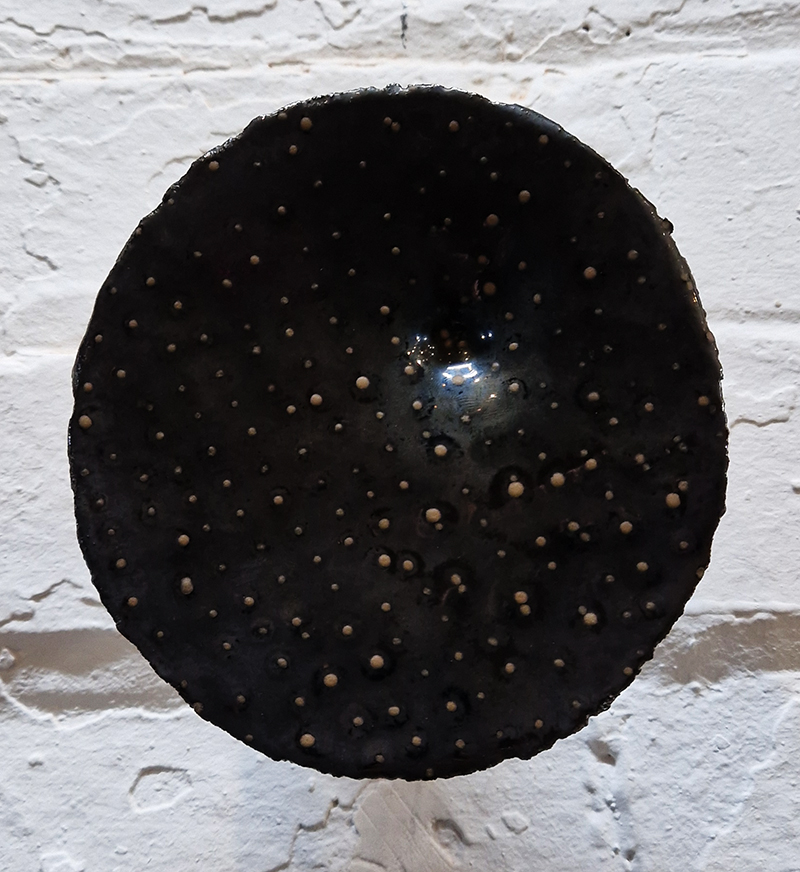
Champs Noir curated by Simon Leahy-Clark at Terrace Gallery. A carefully chosen collection of works in black from a great catalogue of artists. Featuring: Michael Ashcroft, Bensley and Dipre, Diane Bielik, Andy Black, Cedric Christie, Gemma Cosse, Graham Crowley, A Ee, Nicky Hodge, Mandy Hudson, Michael Kaul, Sarah Ken, Sharon Leahy-Clark, Simon Leahy-Clark, Graham Lister, Brendan Lyons, Alistair MacKillop, Mutalib Man, Enzo Marr, Donna Mclean, Neil Metzner, Jane Millar, Josh Mitchell, Jost Munster, Stephen Palmer, Kasper Pincis, Andrew Seto, Peter Suchi, Sally Taylor, Chris Tosic, Mark Wainwright & Tom Wilmott. Selected image: Jane Millar: Test Bed, ceramic media, 12cm diameter, 2019.

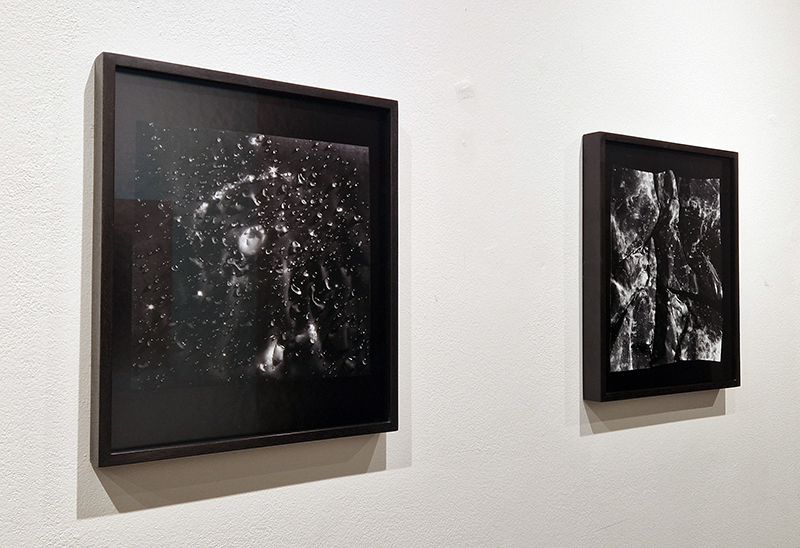
Julie F Hill Earth, Water, Night at The Stone Space

We so often look out at the night sky forgetting it is gazing back at us.

‘… The [pool] is the very eye of the landscape, the reflection in water the first view that the universe has of itself …’ —Gaston Bachelard,

Holding the poetic and alchemical in contrast to the objective and scientific, astronomical data of deep space folds into Earth’s deep time. Light and shadow gather in pools of water, forming images that suggest consciousness is a fundamental property of all matter.

Beautiful and contemplative works capturing the milkyness of the Milky Way caught in the folds of the night sky; distorted reflections rippling across dark pools; illusory depths oscillating between dimensions.

Sam Williams Deep in The Eye and The Belly (Part One) at San Mei Gallery. It was a busy night at the opening and I didn’t take any photos. There was a large projection on one wall and two other films showing on monitors with headphones. The work describes stories of cetacean bodies, interlacing actual historical events with speculative narratives. The camp narration of the main film deliberately jars with the emotive subject matter, but is given context through the supporting films as the protagonist who features across each film is seen reclining wearing feathers and glittery regalia speaking in long drawn and world weary sentences or lamenting the loss of the whale in absurd song from the vantage of a lighthouse.

Reverse Parking at Thames-side Gallery curated by Peter Lamb and Katie Pratt.

Reverse Parking presents seven artists (Gordon Cheung, Will Cruickshank, Cristallina Fischetti, Oona Grimes, Paul Hosking, Peter Lamb and Katie Pratt) whose work explores the duality of reality and the technological sublime. A bold and vibrant show. Good to see some large work from Oona Grimes and to chat with her in the gallery; her battle scenes encompassing battles down the ages coincidentally emerged at the onset of war in Ukraine. Also interesting to hear Katy Pratt discuss her language of abstract painting on the excellent Art Fictions podcast.

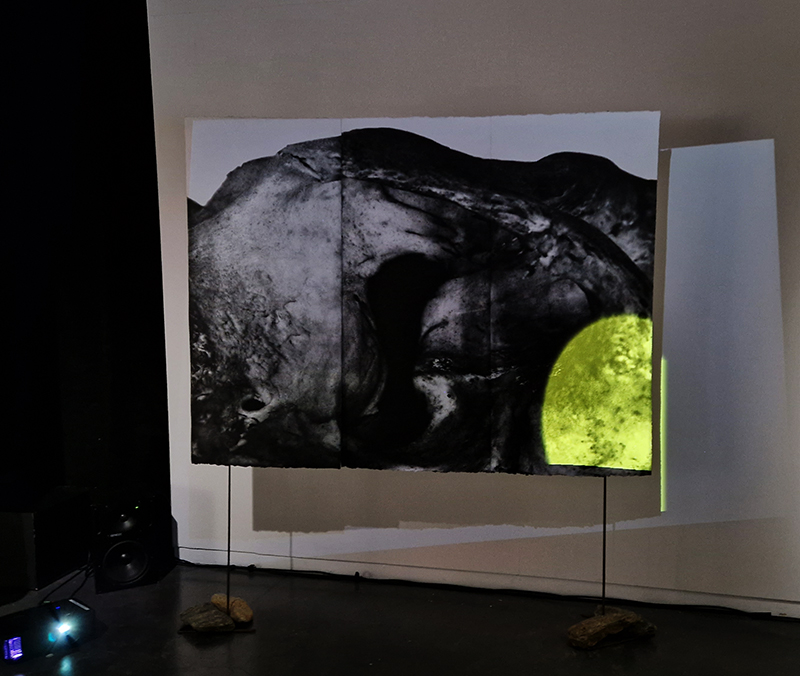
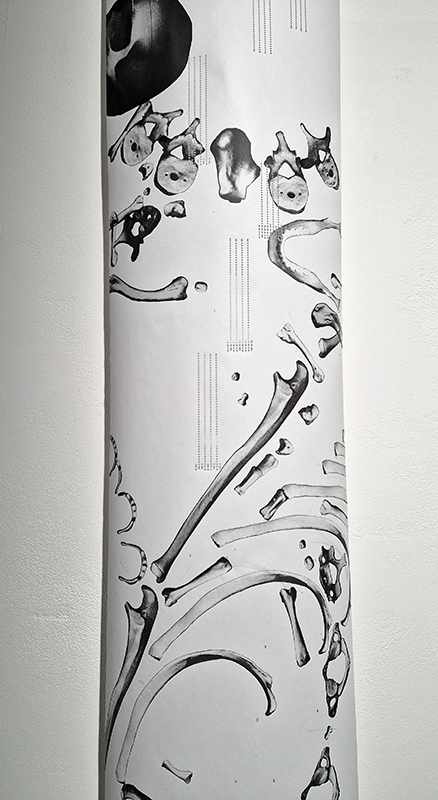
…not necessarily in the right order at Stephen Lawrence Gallery takes a playful cue from the Morecambe and Wise sketch with special guest Andre Previn which is embedded in British cultural history. Work from the featured artists (Carol Wyss, Dominic Murcott, Graeme Miller, Dirty Electronics and Dushume) overlaps and layers through still image, sound and projection. Exhibited is the third iteration of Carol Wyss’s giant etchings that expose the inner recesses of the human skull. Here they are made luminous and their sculpted landscapes all the more surreal by the animated light sequences traversing their surfaces.

Reading

Not observant enough to realise I bought the pocket guide version of The Natural Navigator by Tristan Gooley I ended up with an unembellished rather prosaic read with lots of facts and charts and possibly useful information that requires a large investment of dedication to the cause to learn many of these techniques. What was amusing though was finding the section headed Mosses and Lichens opens with the paragraph –

‘There is a commonly held belief that “Moss grows on the north side of trees and buildings.” It does, sometimes, but will also grow on every other side.

He goes on to say that moss doesn’t care about direction, but it does care about moisture. So in the northern hemisphere the side away from the sun is preferred by moss as it retains moisture for longer. Gradient is also important to prevent run off of water. I have tried to prop my planks at as low an angle as possible in the side passage but may need to find somewhere I can lie them down more.

I am enjoying dipping in to Florian Freistetter’s A History of the Universe in 100 Stars. No longer a swathe of uniform twinkling points of light but each star has its own character and story. It starts with 100 stories but we can extrapolate that to consider each of the many billion stars as individuals.

Listening

In Our Time – Superconductivity Excellent guest speakers (Nigel Hussey, Professor of Experimental Condensed Matter Physics at the University of Bristol; Suchitra Sebastian, Professor of Physics at the Cavendish Laboratory at the University of Cambridge; Stephen Blundell, Professor of Physics at the University of Oxford) on this podcast. Superconductivity was a surprising discovery in 1911 by the Dutch physicist Heike Kamerlingh Onnes who found that when he lowered the temperature of mercury close to absolute zero and ran an electrical current through it, there was no resistance to the current. Many other materials have also been found to share this property when cooled to a pivotal temperature when the material suddenly enters a different phase and behaves in a completely different way. As water moves from solid to liquid to gas at different temperatures so metals can move between solid, liquid and superconductor. Further research found that a superconductor also expels magnetic fields and this has been exploited in the making of MRI scanners and to speed particles through the Large Hadron Collider.

I also enjoyed hearing how, what were once impossible numbers, called imaginary numbers by Descartes, have turned out to be fundamental and integral to explaining oscillations and the sort of wave like structures in the universe that we encounter when diving into a quantum world.

The Curious cases of Rutherford and Fry – The impossible number