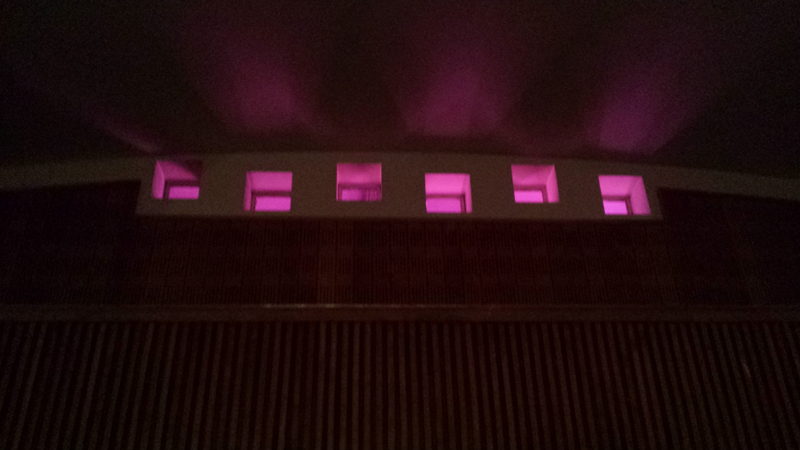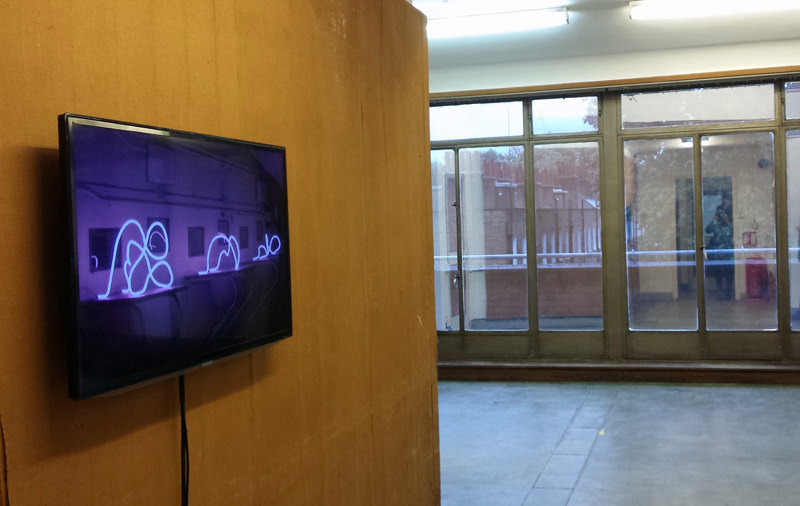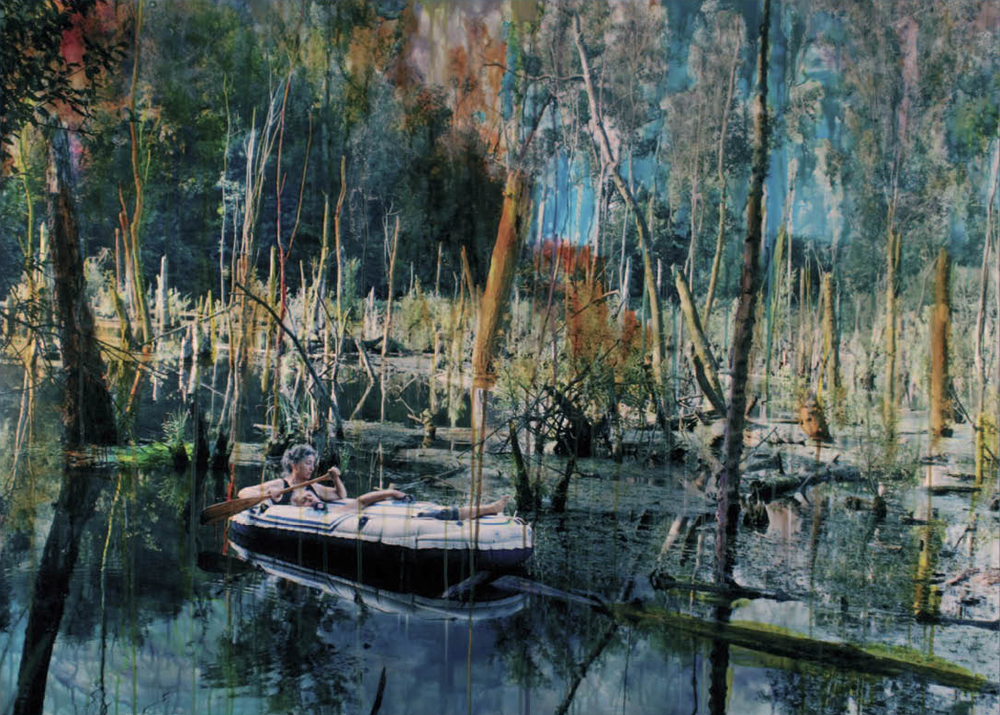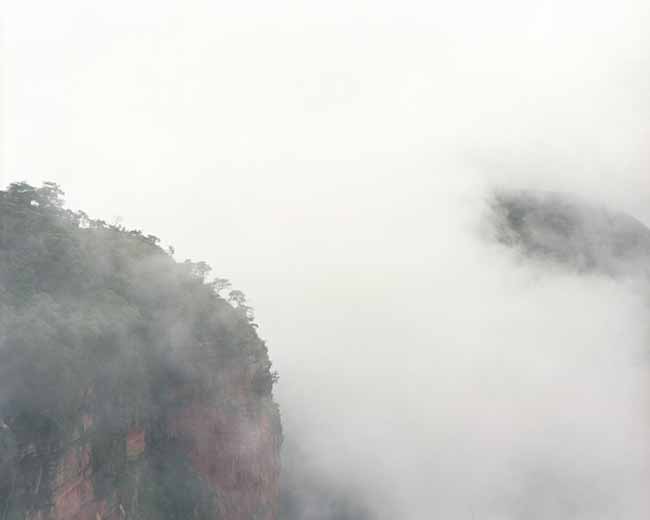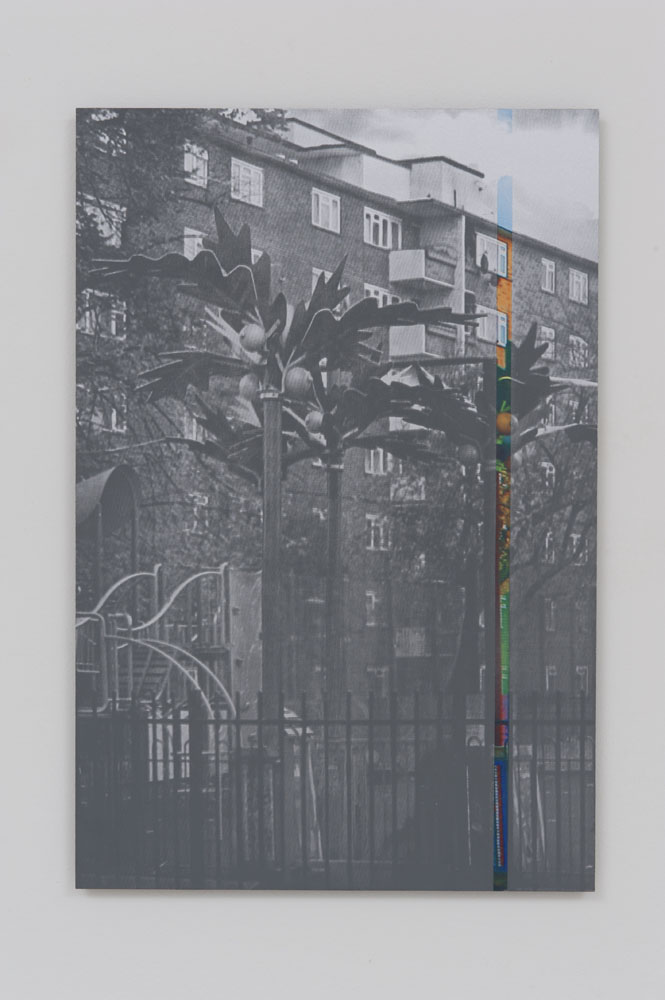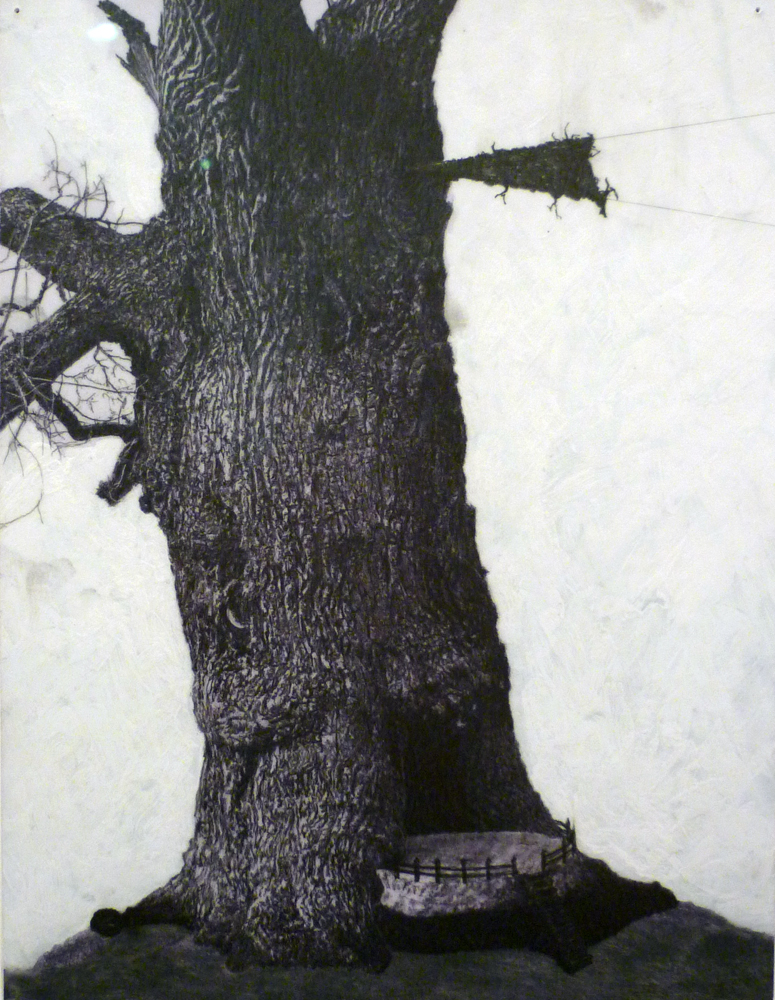
“the lamps are going out all over Europe, we shall not see them lit again in our life-time”

Sir Edward Grey, foreign secretary 1914

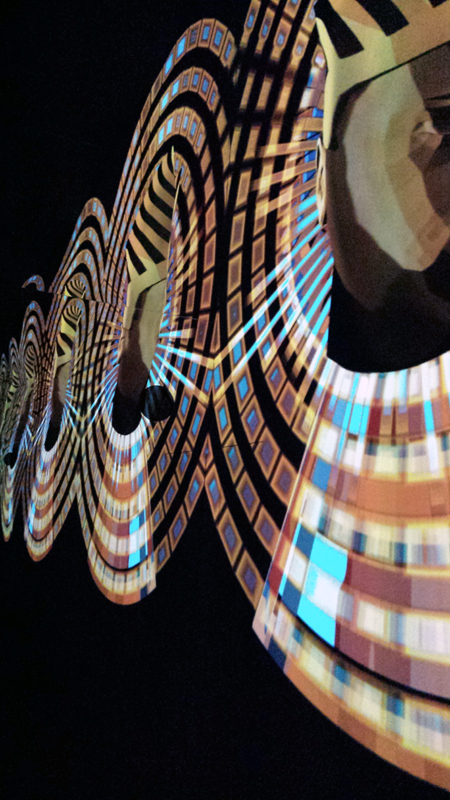
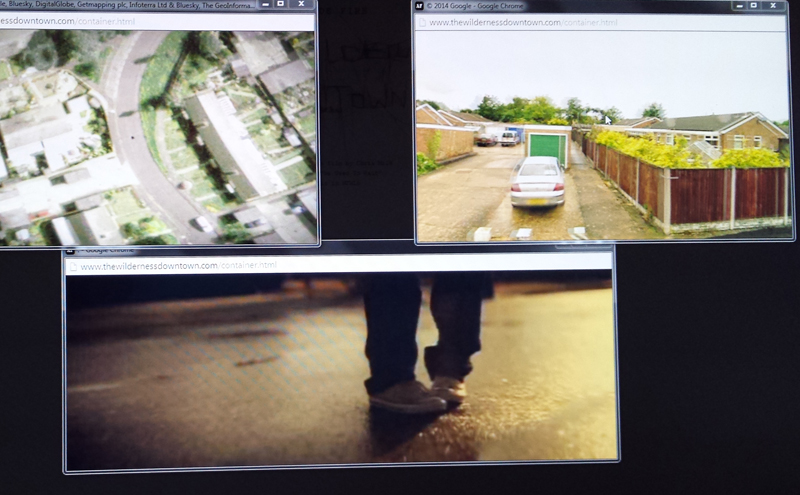
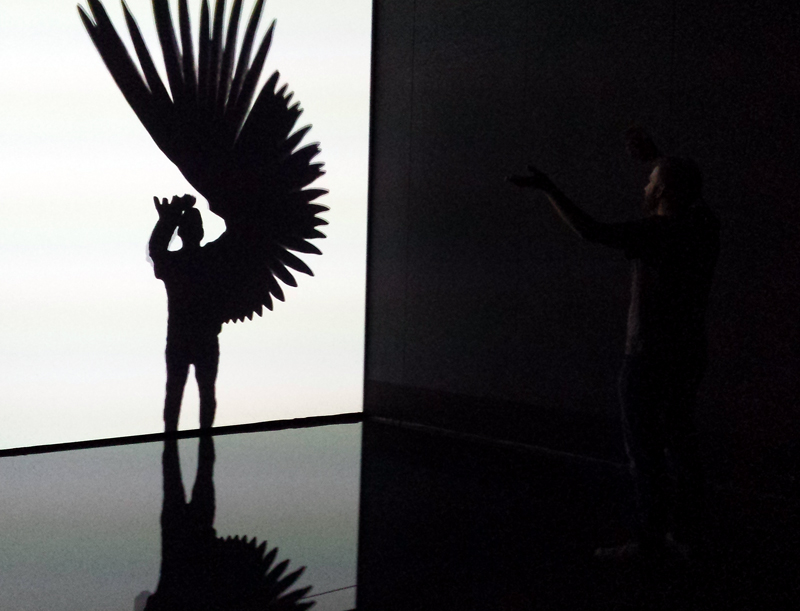
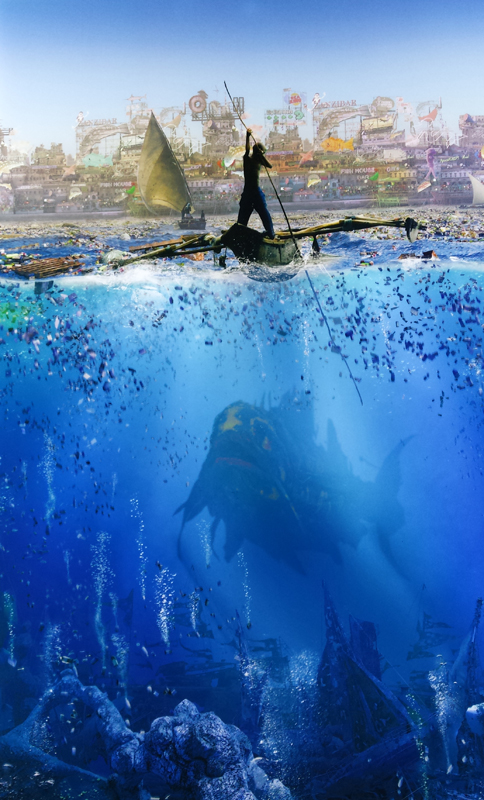
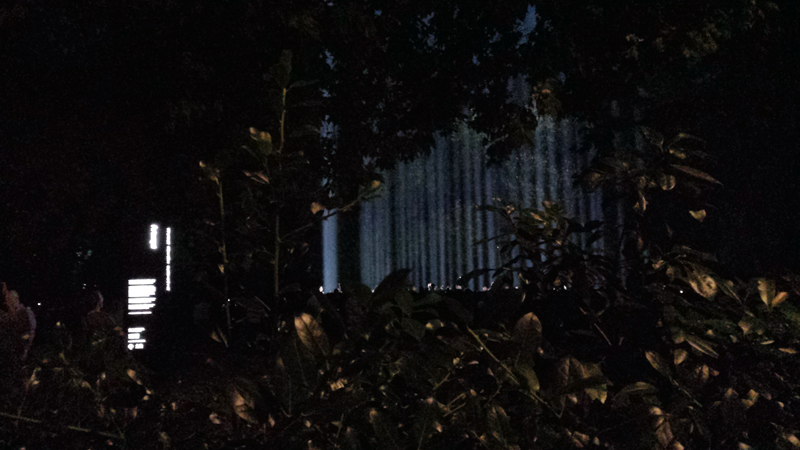
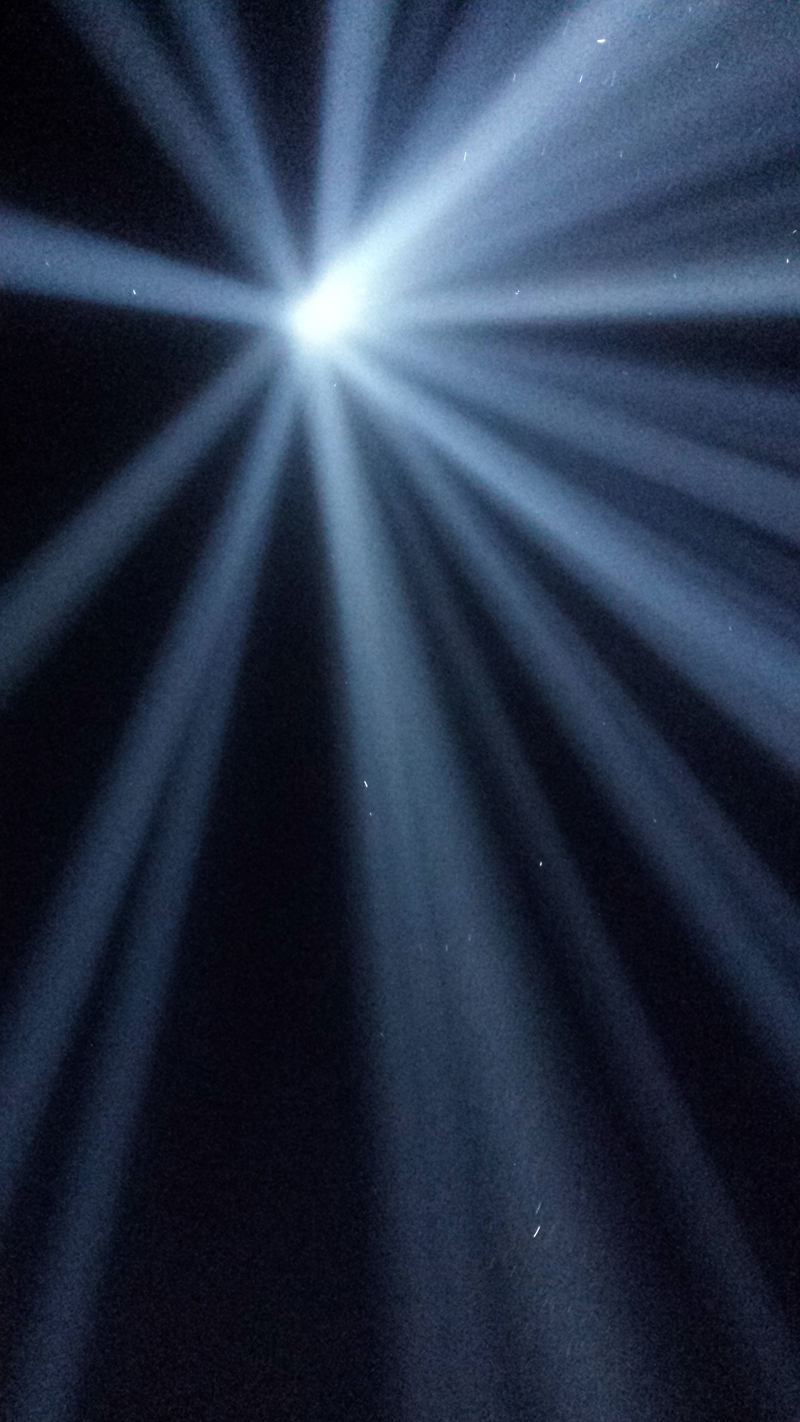
Ryoji Ikeda Spectra

Ryoji Ikeda Spectra

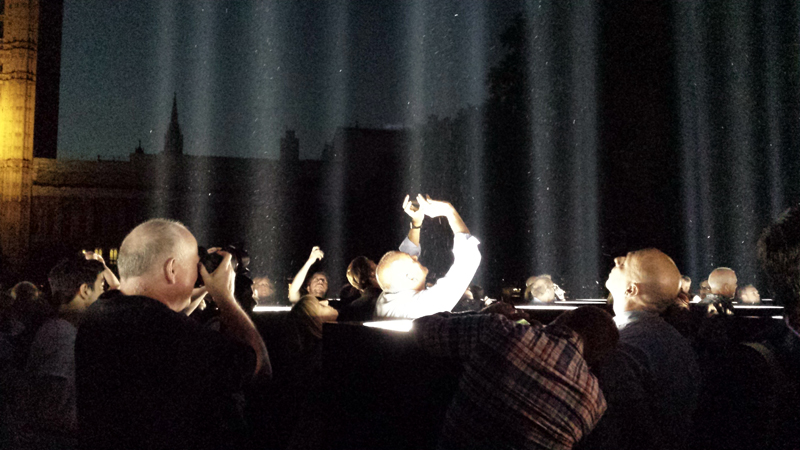
Seven days of light piercing the London sky to commemorate the anniversary of WWI

Ryoji Ikeda Spectra

Ryoji Ikeda Spectra

Artangel commission by Ryoji Ikeda acted as the beacon it represented

Ryoji Ikeda Spectra

Ryoji Ikeda Spectra

We are drawn to the light

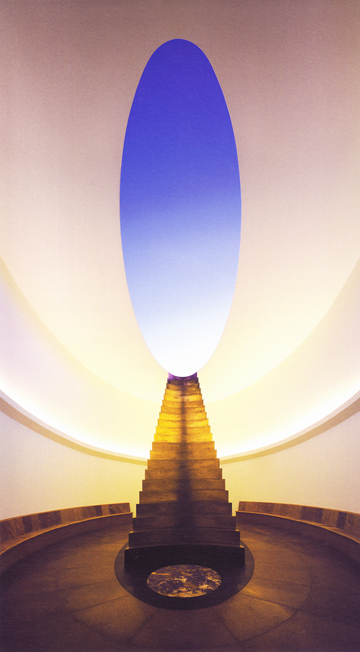
I have been writing and reading about James Turrell for my dissertation. His use of light as medium for his work is poetic and magical.

James Turrell - Roden Crater

James Turrell – Roden Crater

Light is the materialization of energy. We are naturally eaters of light, our whole body is scattered with stray rods and cones outside of the retinal area which makes our relationship to light very primal.

Our bodies are made from matter fed by the fruits of photosynthesis.

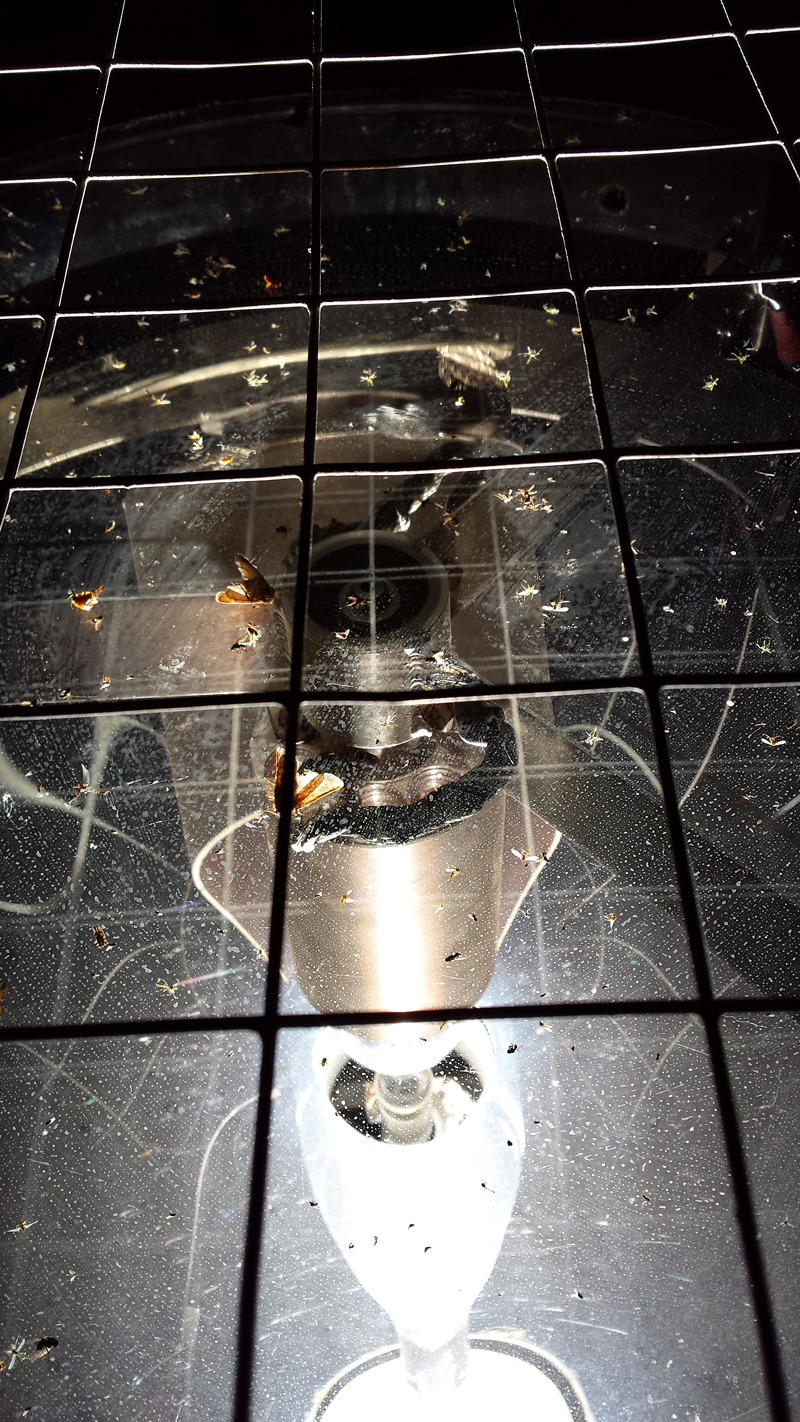
Luckily we don’t suffer instant death like all the moths and flying insects

Ryoji Ikeda Spectra

Ryoji Ikeda Spectra

but it was a chance to think about the brutality of war and those that did suffer a terrible fate

With all that is happening now in Palestine, Iraq, Ukraine and elsewhere those words spoken a hundred years ago resonate, what progress have we made

when will the lamps be lit again

Social adhesion was a topic in our discussions during a workshop run by Sean Lynch at Flat Time House.

Flat Time House was the studio home of John Latham  who died in 2006. Before he died he declared the house a living sculpture, naming it FTHo after his theory of time, ‘Flat Time’.

Flat Time House aims to make a wider audience aware of Latham’s work and ideas, his spirit of discovery, and through his example to understand and appreciate the crucial role of art and the artist in society.

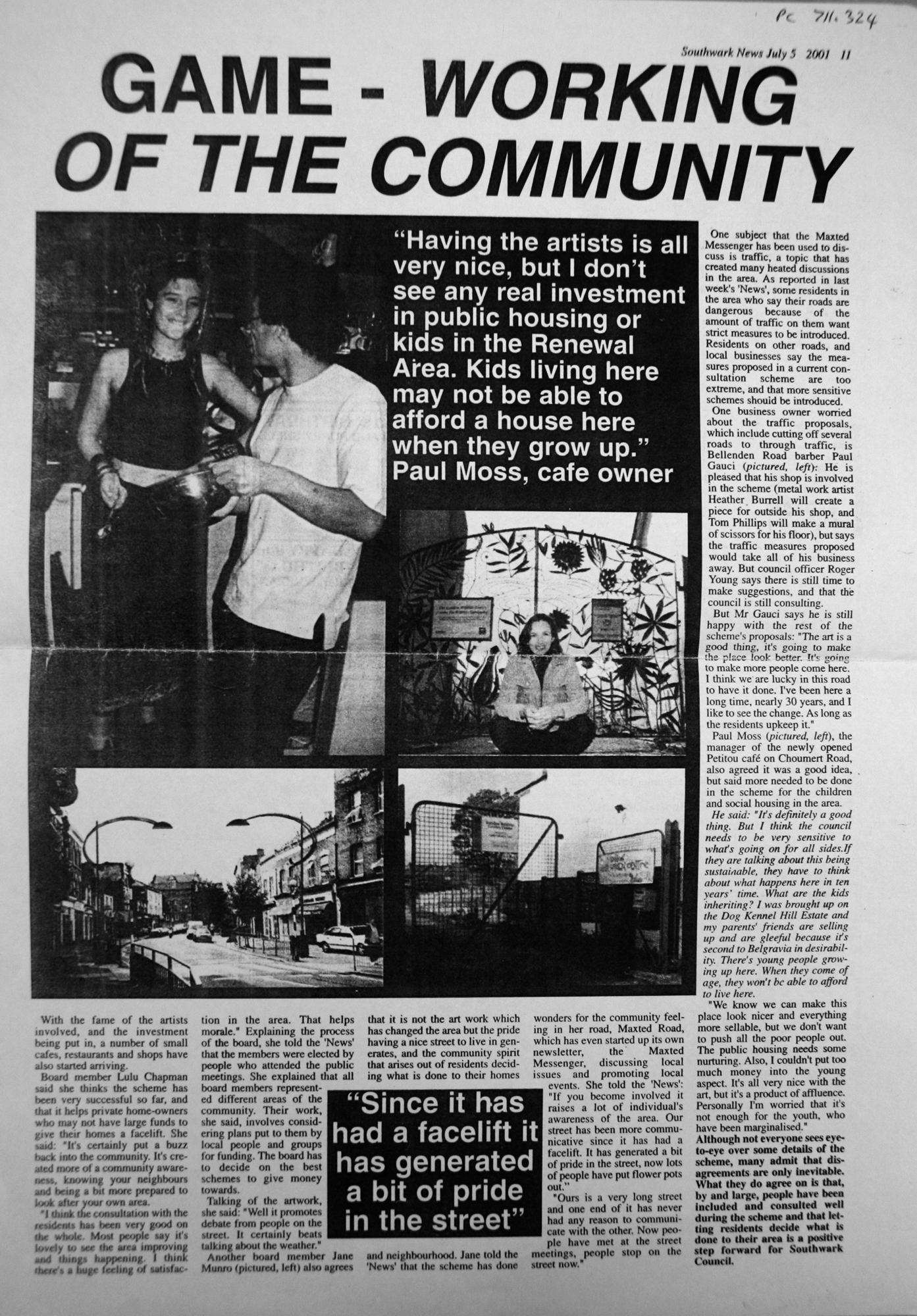
Starting from a series of photographs of Bellenden Road taken by John Latham in 1986 a weekend workshop led by the generous and entertaining artist Sean Lynch aimed to speculate about how urban space and environment is constructed, and what allegories and associations we can draw from it. It was purely about discussion of ideas and sharing stories. Sean’s own work is about urban environments and interventions, looking at the crafts people involved in construction as well as how art is received within a community. He has extensive knowledge of the O’Shea brothers who were stone carvers in Oxford revered at one moment and shunned the next. Details of his exhibition on the subject at Modern Art Oxford here

Sean is brimming with idiosyncratic stories gleaned from newspapers or local characters telling of encounters with faeries and magic bushes or pub crawls as performance art.

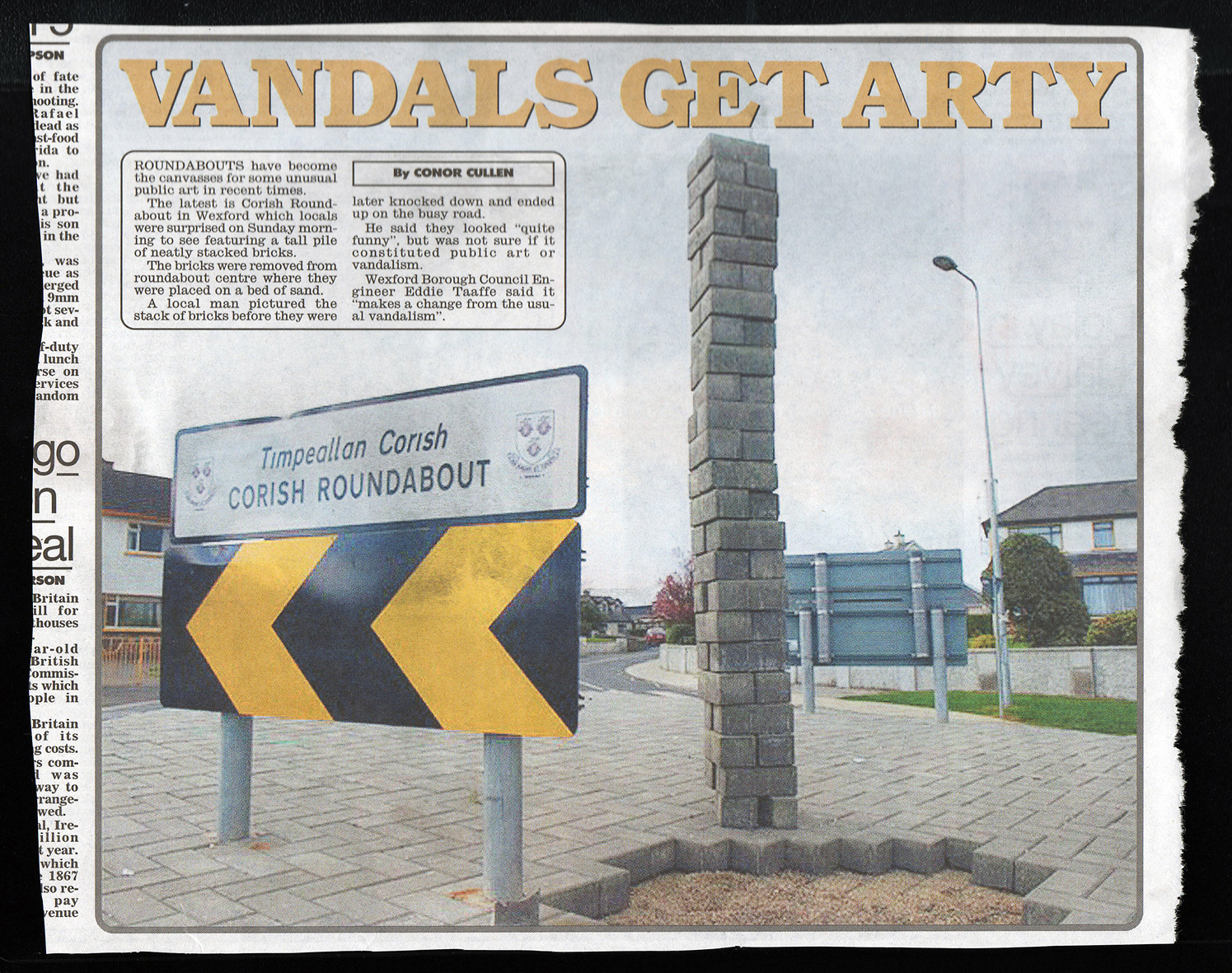
1409 vandals

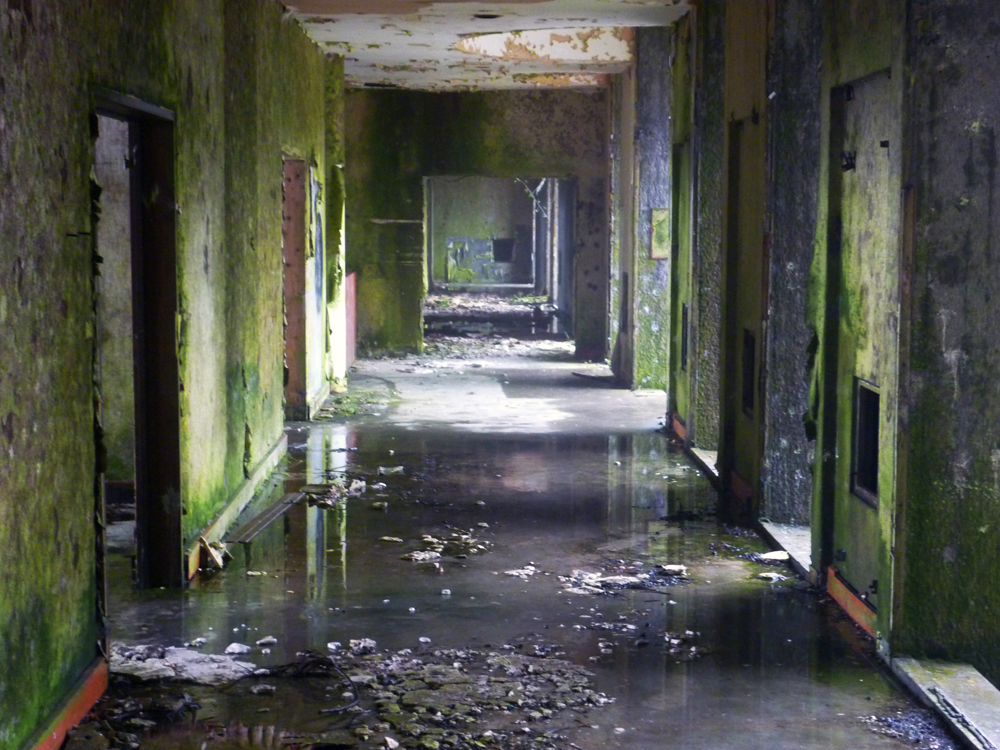
Sean also talked about Robert Smithson who went to Mexico and was captivated by the delapidation of his hotel rather than the Mayan Ruins that most people would expect to be the focus of such an expedition.

Read the enigmatic essay ‘Yucatan is Elsewhere’ at this link – essay

Reminded me of visiting the ruins of a hotel on the Azores earlier this year

1409 Azores

For the workshop we were asked to bring along our own thoughts on public space.

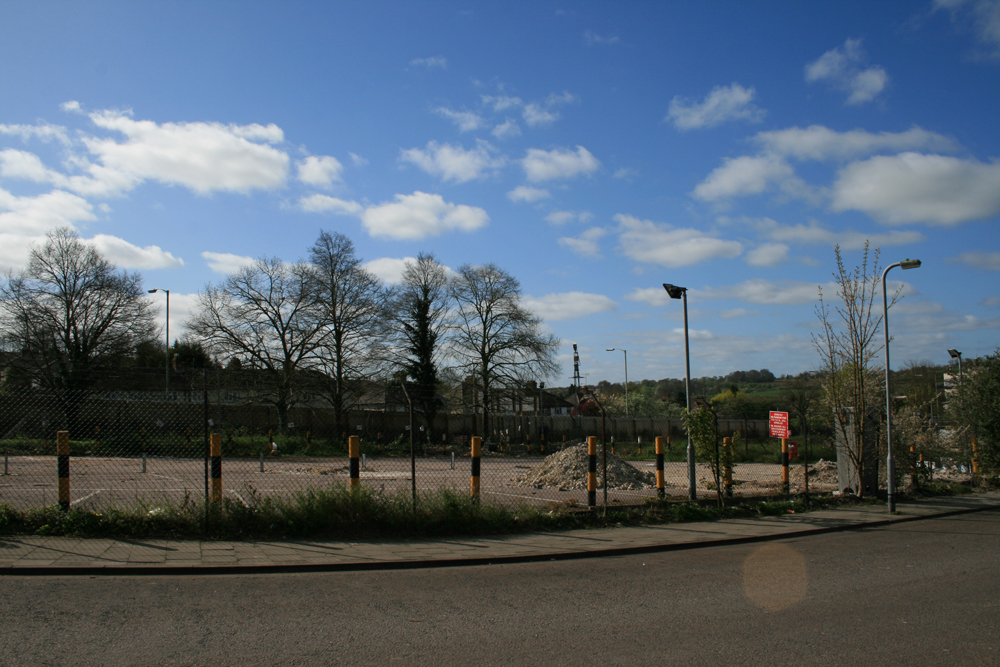
I read a section from my in progress dissertation about my visit to Paradise Industrial Estate.

1409 paradise

We went for a couple of walks around Peckham looking at the local architecture and the council interventions.

1409 Bellenden Road

We were joined on one walk by vocal local campaigner Eileen Conn who has a dream for a new society based on community and gave us the low down on the Bellenden Road area make over.

John Latham’s wife Barbara turned up too with more stories.

1409 Peckham Mural (2)

We walked down to the green to look at where in the 1760’s William Blake had his vision of shining angels in the tree.

For a local community project Artist, The Guy – created a mural on the side of a house for the Dulwich Festival 1993 with the help of local volunteers.

 1409 Peckham Mural (1)

Great news –  Sean Lynch will be representing Ireland at the 2015 Venice Biennale.

Also interested in how the values of society are articulated in public spaces is 2014 RCA graduate James Seow.

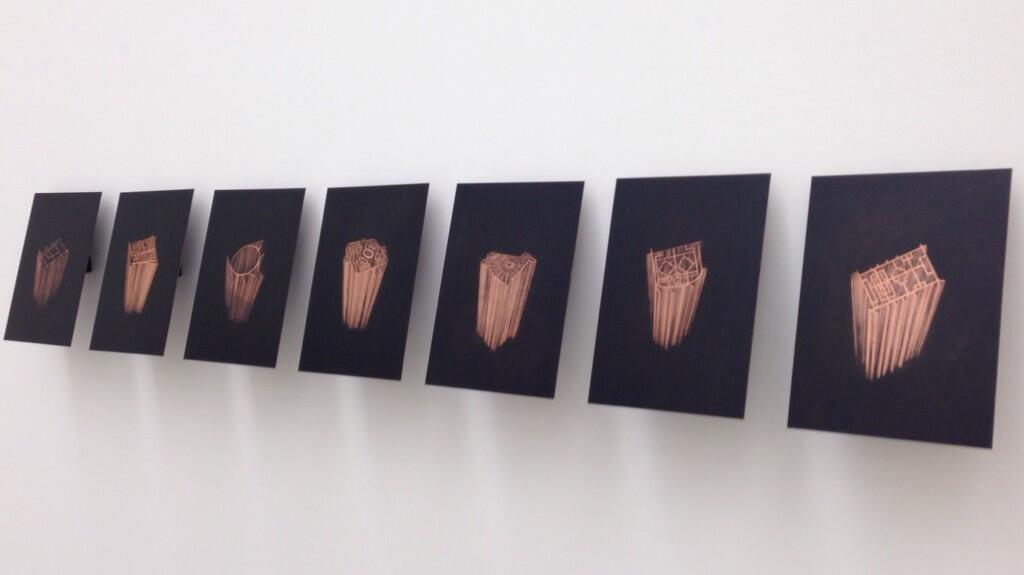
His beautiful inked etching plates on show at Anise Gallery depict iconic public squares such as 9/11 Memorial Plaza, Tiananmen Square and Paternoster Square in extruded structural form giving them the aura of sacred space.

James Seow  Always Feel Safe

James Seow Always feel safe…

The gallery exhibits chosen artists that capture architecture through a variety of architectural forms.

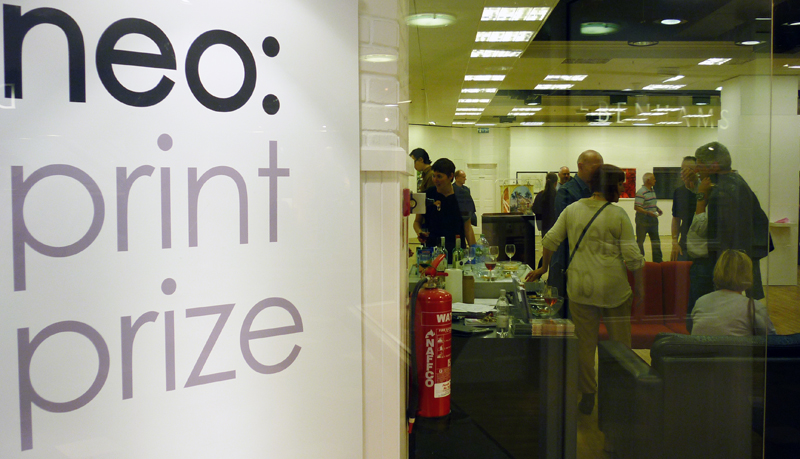
1409 neoprintprize

Delighted to have work selected by Gordon Cheung, Paul Coldwell, David Cleaton-Roberts and Eileen Cooper for the neo:print prize in Bolton.

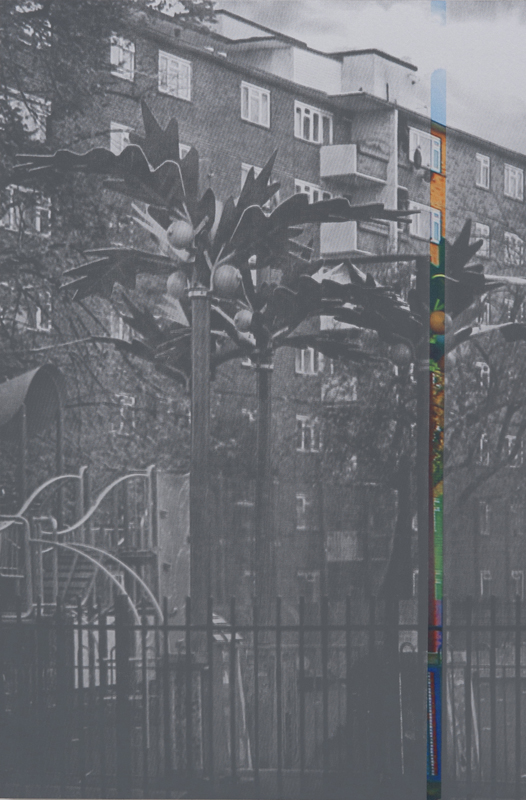
Paradise Road SW4

Paradise Road SW4

A great team of selectors so feel really proud.

An extra bonus was to win an award sponsored by Hawthorn Printmaker Supplies for my etching ‘Forest of Eden’

Forest of Eden

Forest of Eden

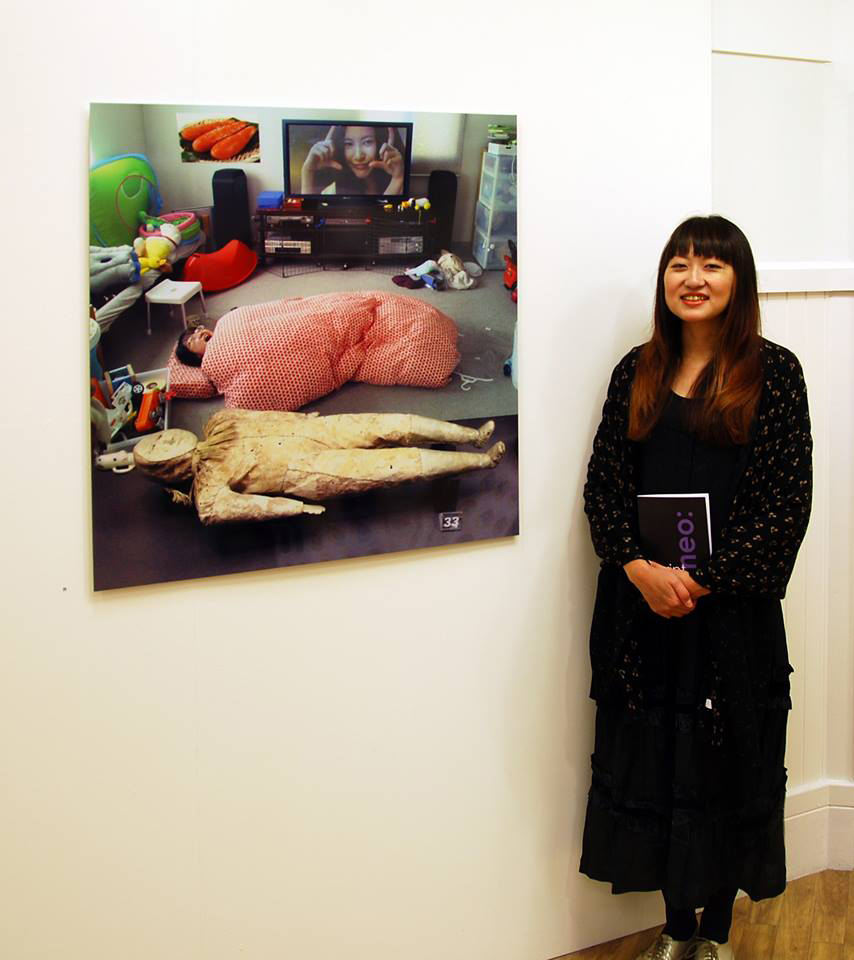
Rei Matsushima who has just graduated from the RCA also won a prize for her wonderful print ‘Mentaiko (cod roe)’

Rei Matsushima

Rei Matsushima

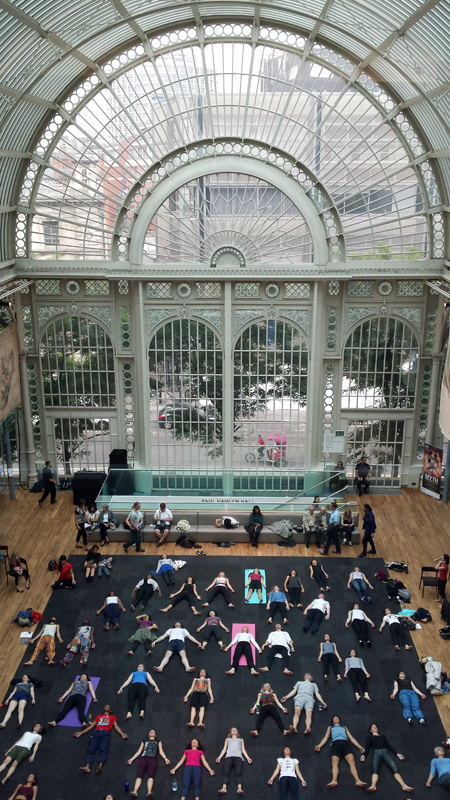
A series of events were held as a celebration of ‘Myth’ at the Royal Opera House.

The ‘breath of life’ and ‘the sacred fire within’ could be experienced through yoga in the great hall

1409 ROH

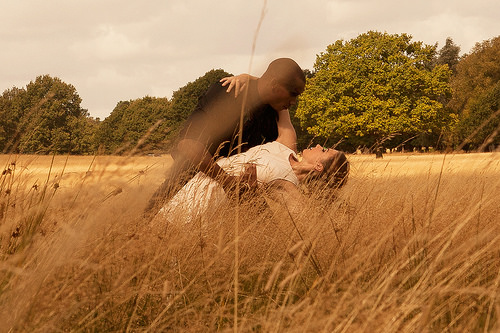
A screening of the stunning film interpretation of Leda and the Swan featuring Eric Underwood and Claire Calvert dancing in Richmond Park

Leda and The  Swan

The Indifferent Beak

A sudden blow: the great wings beating still

Above the staggering girl, her thighs caressed

By the dark webs, her nape caught in his bill, He holds her helpless breast upon his breast.


How can those terrified vague fingers push

The feathered glory from her loosening thighs?

And how can body, laid in that white rush,

But feel the strange heart beating where it lies?


A shudder in the loins engenders there

The broken wall, the burning roof and tower

And Agamemnon dead.

Being so caught up,

So mastered by the brute blood of the air,

Did she put on his knowledge with his power

Before the indifferent beak could let her drop?


Inspired by Yeats 1923 poem, choreographer Charlotte Edmonds wanted to convey the entwining bodies and passion of the encounter

Leda and the Swan

The Indifferent Beak

Matt Collishaw also sought to convey burning passions

Matt Collishaw

Matt Collishaw

The dangers of desire.

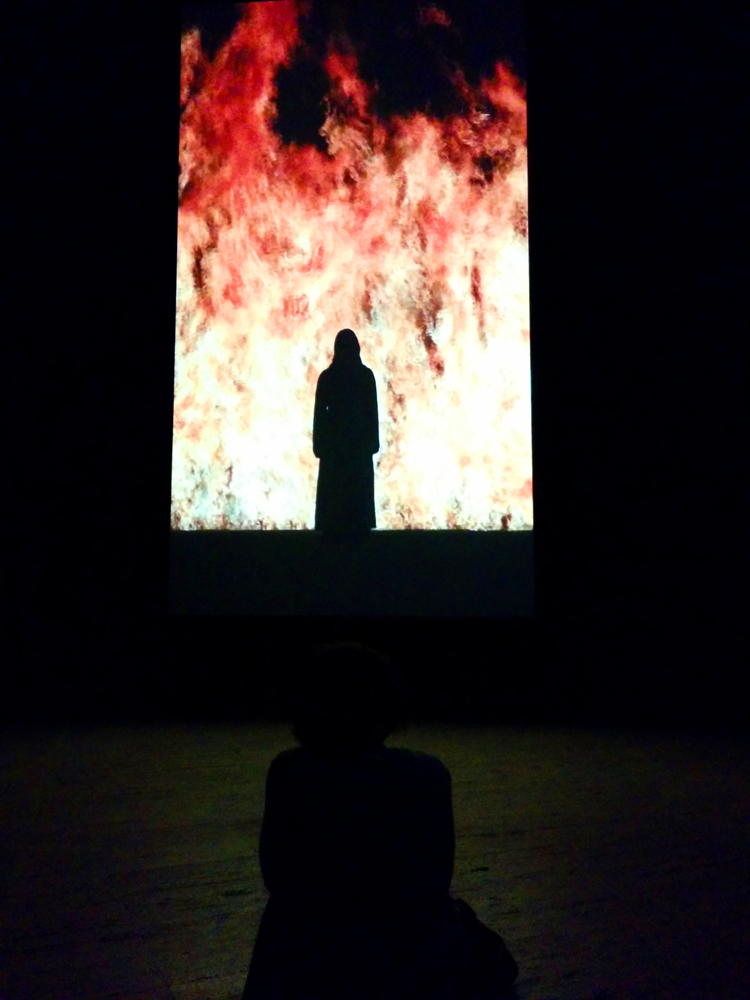
Bill Viola gave us suffering for transcendence.

Bill Viola - Fire Martyr

Bill Viola – Fire Martyr

Andrea Büttner is interested in ideas of spirituality on a quieter scale.

The ‘Little Works’  of the Carmelite nuns of Notting Hill, ‘The Little Way’ of St. Thérèse of Lisieux, a carmelite saint which influenced the delicate drawings of Gwen John.

Noticing the small and lowly she makes connections between the humility of the nuns with the unobtrusive yet persistent spreading of moss.

Lives lived in the background.

She discussed her ideas with insightful curator Chus Martinez, Head of the Art Institute, Basel at Tate Britain. She was launching her book Hidden Marriages which draws inspiration from the National Museum of Wales collection of drawings by Gwen John (1876–1939) and the extensive collection of mosses preserved in its herbarium.

Much of her work makes connections between art history and social or ethical issues, with a particular interest in notions of poverty, shame, vulnerability and sexuality, and the belief systems that underpin them. Although working a hundred years apart, Gwen John and Andrea Büttner share an interest in the spiritual, social and aesthetic notions of ‘littleness.’

Mosses fall under the term cryptogam (meaning hidden sexuality). Moss is also described as a ‘lower plant’— implying a lesser, or more primitive, evolutionary development than flowering or ‘higher plants.’ Hidden Marriages: Gwen John and Moss draws these two seemingly unconnected collection areas together, making links between the reproductive processes of ‘lower plants’ and the contested sexuality of Gwen John; between littleness as an aesthetic, biological, and social discourse; between the scientific ordering of the Museum and the harmony and beauty that John sought in her work; and, ultimately, the way institutions ascribe relative importance to objects, ideas and people.

Büttner makes large woodcuts about lowly things like tents.

Andrea Buttner Tent

Andrea Büttner Tent

She said she views her woodcuts almost as brochures or advertisements to her videos.

Andrea Büttner Piano

Andrea Büttner Piano

She had some great duo scope images on slides and in her book of moss collectors intently surveying the ground, heads down, eyes lowered, kneeling as though in prayer

1306 Moss


I so loved Nick Abrahams exhibition at The Horse Hospital.

“Lions and Tigers and Bears” – the fears of the forest that haunted Dorothy and her companions as they followed the yellow brick road

1408 nick abrahams_0001

Nick Abrahams makes short films, sculptural and installation pieces.

A wild man sings power ballads around Hampstead Heath and explores the suburban streets by night

Nick Abrahams 'The Wild Man'

Nick Abrahams ‘The Wild Man’

Dogs perform dance routines to the music of Iggy Pop

Nick Abrahams - Doghouse

Nick Abrahams – Doghouse

His award winning film Ekki Mukk is a beautiful and poignant story of a man, a snail and a fox.

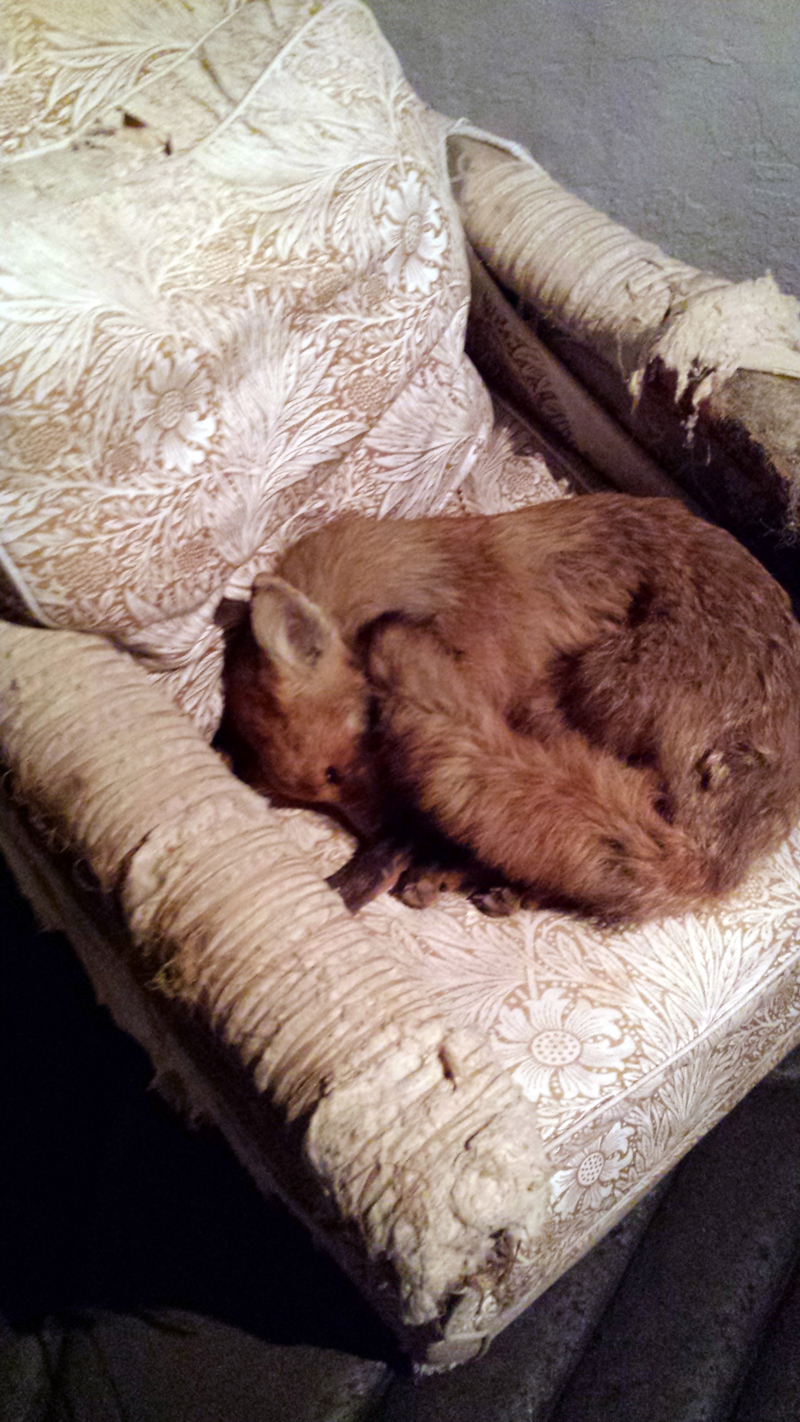
I bought the 7″ single with recordings of a snail eating, a fox sleeping and sounds recorded of nature under the Tolpuddle Tree, the site of the birth of the first trade union.

Shirley Collins the film narrator tells a magical tale.

Nick Abrahams 7" single

Nick Abrahams 7″ single

These pieces are suggesting a way to look with your eyes shut,

Nick Abrahams - Fox Sleeping

Nick Abrahams – Fox Sleeping

bearing witness to the British countryside that you may not always be able to notice, a landscape that is both political and mystical, alive as it is with ‘animal magick’.

Nick Abrahams - wild man illustations

Nick Abrahams – wild man illustrations

Rachel Champion looks at urban architecture and energy in her installation at Hales gallery.

Pools of green algae sit in what might have been an abandoned attempt at some suburban municipal space.

Rachel Champion - Primary Producers

Rachel Champion – Primary Producers

Pebbledash has such resonance of the cheap and ugly that walking around this work is a bit of a dour experience.

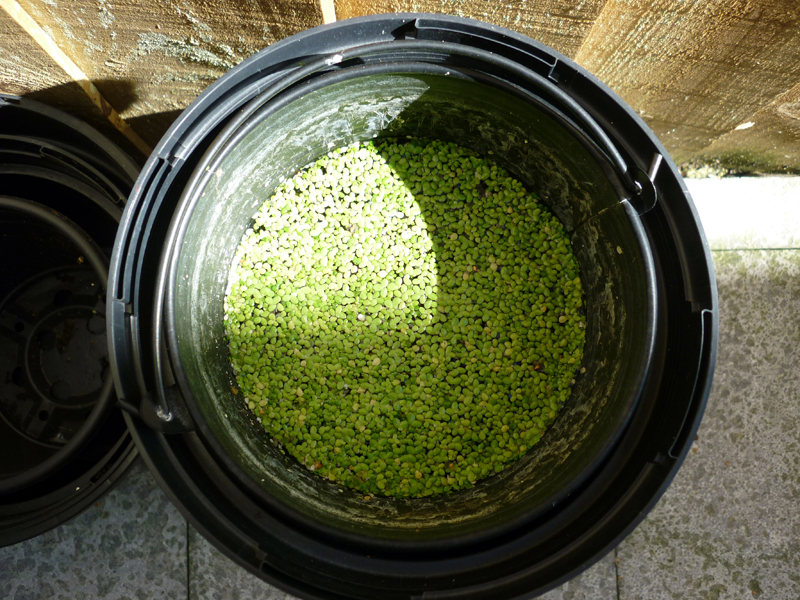
The punched out circles glinting with the promise of little worlds, maybe offering the wonder of the rock pool, instead present a prosaic stagnant puddle more reminiscent of the back yard bucket.

Or flowerpot in my case.

1408 back yard algae

In its aim to highlight the successes and failures of the cheap fix and reassess materials it is an effective installation. The artist is hoping that we will look with new eyes for unexpected saviours to our urban afflicted energy crisis.

I went to the WYSIWYG? (What you see is what you get?) discussion evening at South London Gallery to hear more about What happens to Art in a Digital World.

Too many speakers had been booked for the time available so it was a shame they had to rush, rather like me in my end of year exam with 58 images in 15 minutes.

I was hoping for a bit more discussion about the immersive possibilities of virtual gallery spaces but the focus was more how technology is used in institutions or by artists rather than the experience of entering a new space online.

It was still interesting and we could try out some technological innovations.

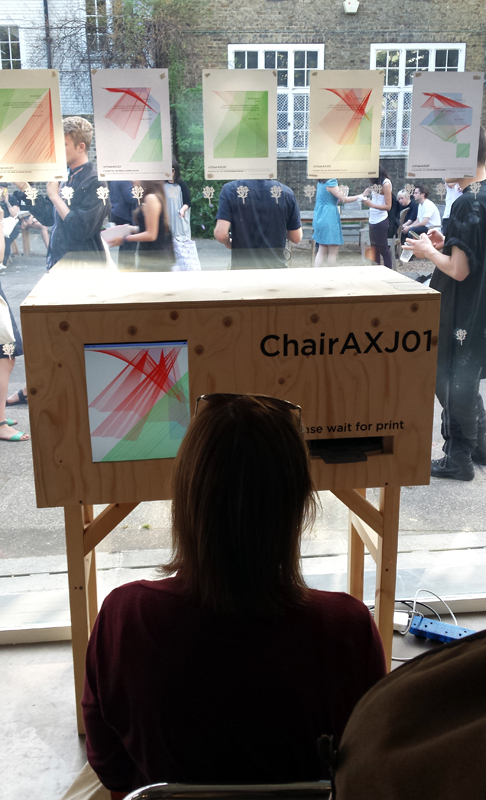
ChairAXJ01 designed by Joe Want and Andrea Concha

ChairAXJ01 designed by Joe Want and Andrea Concha

Joe Want and Andrea Concha have designed a chair that records the unique movements of the sitter and creates a graphic depiction that can be controlled a bit by wriggling around  in your seat.

My personal graphic made by sitting in ChairAXJ01

My personal graphic made by sitting in ChairAXJ01

Melanie Lenz from the V&A talked about the difficulties of archiving digital art due to commercial upgrades of the necessary hardware and software.

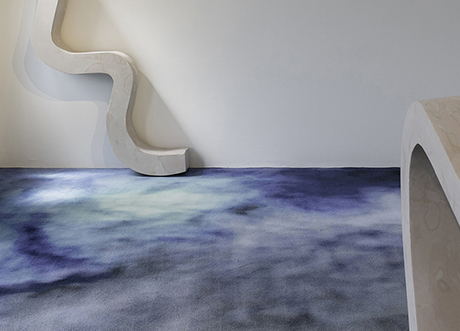
Julia Crabtree and William Evans spoke about their exhibition at South London Gallery made by using 3d imaging techniques to create digital smoke then capturing the image and finally printing it onto carpet so in fact the image begins digitally and then ends up in a physical form.

Julia Crabtree and William Evans

Julia Crabtree and William Evans

Natalie Kane spoke about the power of  algorithms in connection with the artist Jonus Lund and his exhibition Fear of Missing Out, and TED talks from Christopher Steiner and Kevin Slater.

An essay by Christopher Pinney – Future Travel: Anthropology and Cultural Distance in an age of Virtual Reality; Or, A Past Seen From a Possible Future which was recommended to me by Esther Teichmann is interesting reading on the possible effects of digital technologies on everyday life. Thinking about cyberspace in terms of a space for a new paradise tailored to your own specification. Pinney’s view, looking back from an imagined future, sees physical and moral boundaries being broken with total sensual experiences allowing unlimited sex and no need to travel.

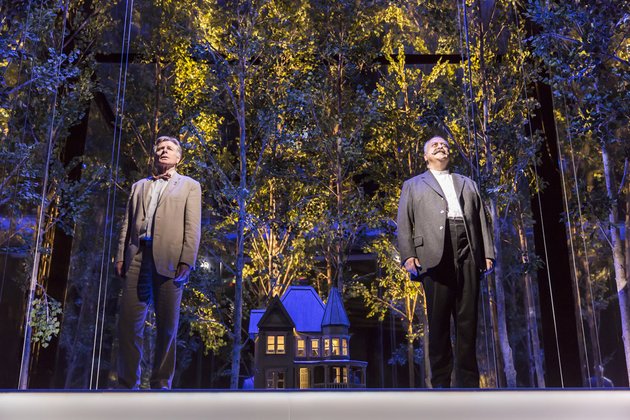
‘The Nether’ a new play by Jennifer Haley at The Royal Court Theatre tackles similar issues.

The Nether

The Nether

Popa has created his own dream space, a house populated by young children in Victorian dress with whom he and the guests to his world can have sex and then axe to death.

An argument unfolds on stage about the need for the same moral codes we employ in reality to be enforced in cyberspace. Popa’s plea is that no real children are harmed, the characters are avatars of adult participants in this world.

The Nether

The Nether

This virtual world felt very visceral when reaction to such a dilemma is sort.

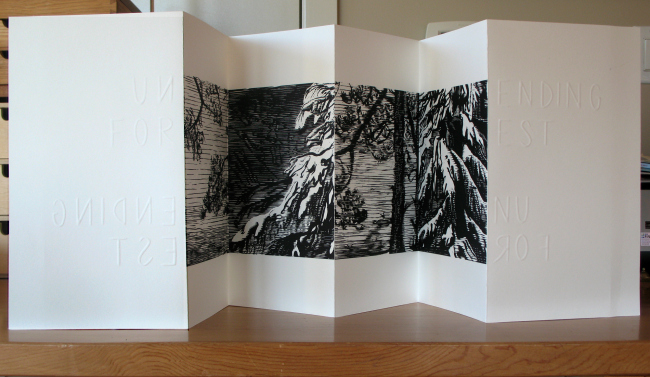
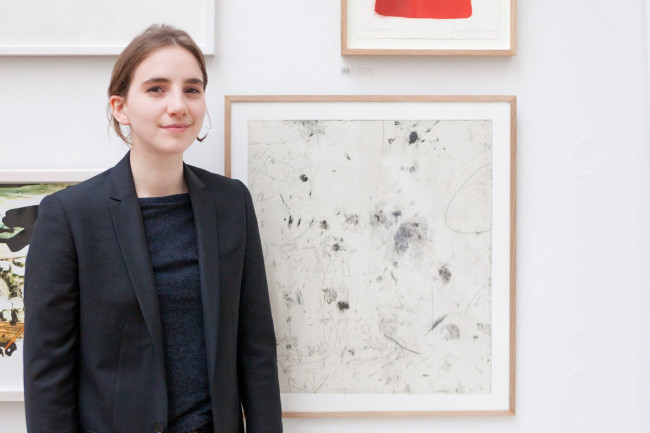
Entering a very different staged environment I finally stepped over the threshold of the RA annual summer exhibition  My first visit to this annual institution  was in the belief that things are changing backstage, its updating and bringing in new blood. Also two of my RCA classmates had won a prize and a few other people I know were in it. Time to stop being sniffy. It was good to see Pauline Emond’s etching and Wuon-Geon Ho’s artist book.

Wuon-Gean Ho receiving her prize for 'unending forest'

Wuon-Gean Ho receiving her prize for ‘Unending Forest’

Wuon-Gean Ho - unending forest

Wuon-Gean Ho – Unending Forest

Pauline Emond with her winning work Regarde De Tous Tes Yeux

Pauline Emond with her winning work ‘Regarde De Tous Tes Yeux’

I was surprised how many names I recognised in the selection and how many red dots there were.

Maybe I’ll even have a go in future.

1408 Azores 9

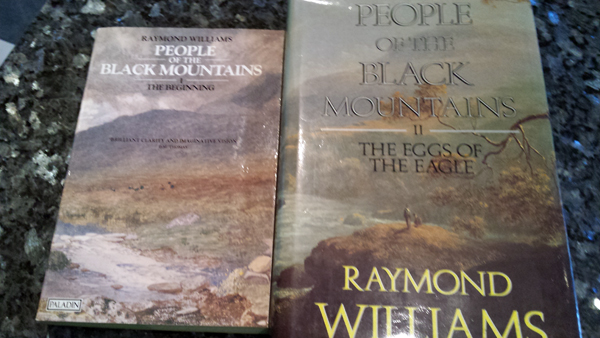
It seemed appropriate to be reading Raymond Williams ‘People of the Black Mountains’ in the Azores even though the book is set in Wales.

1408 Raymond Williams

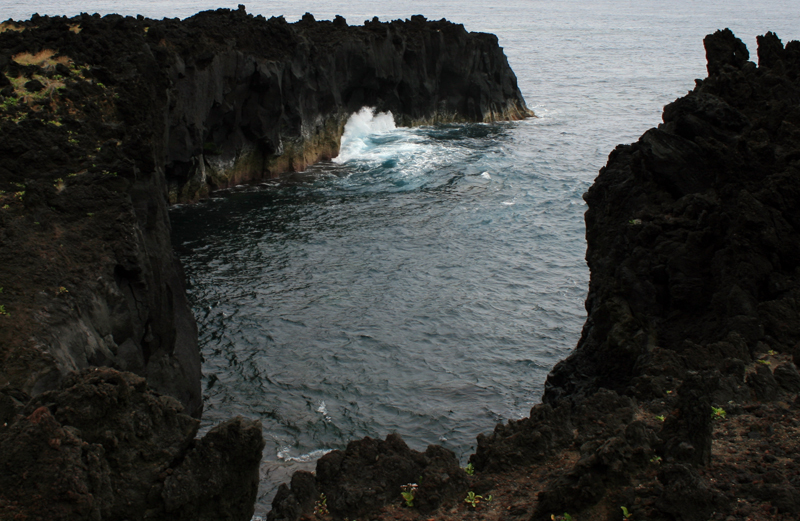
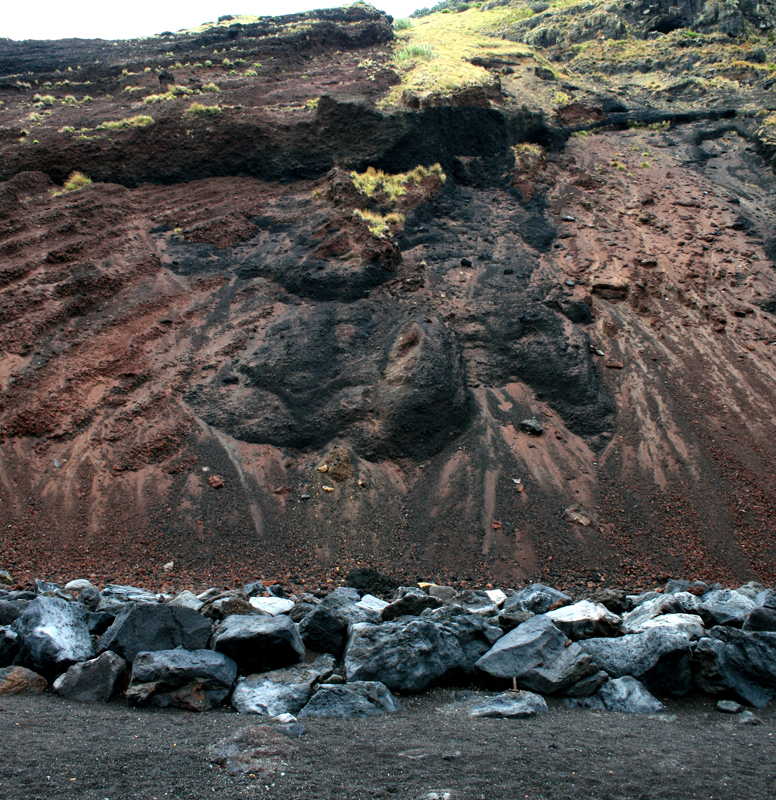
The islands have a black volcanic landscape, still very primeval in parts with bubbling hot springs and paralysed lava flows.


1408 Azores 7

These tiny islands are also a mixture of the pastoral

1408 Azores 6

and the tropical – in a garden setting

1408 Azores 8

there are inaccessible forest covered mountains

1408 Azores 3

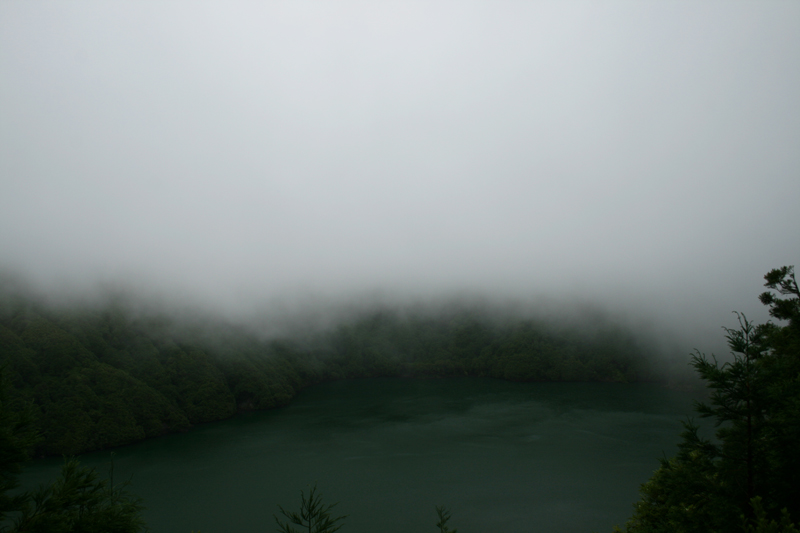
and the blazing sun can turn to thick fog in minutes

1408 Azores 4

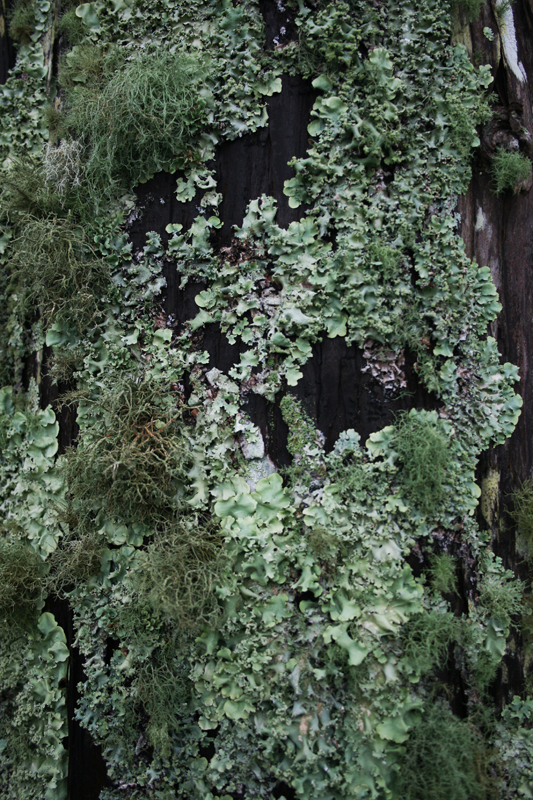
With all the rain and fog it’s moist and things grow

1408 Azores 2

everywhere

1408 Azores 1

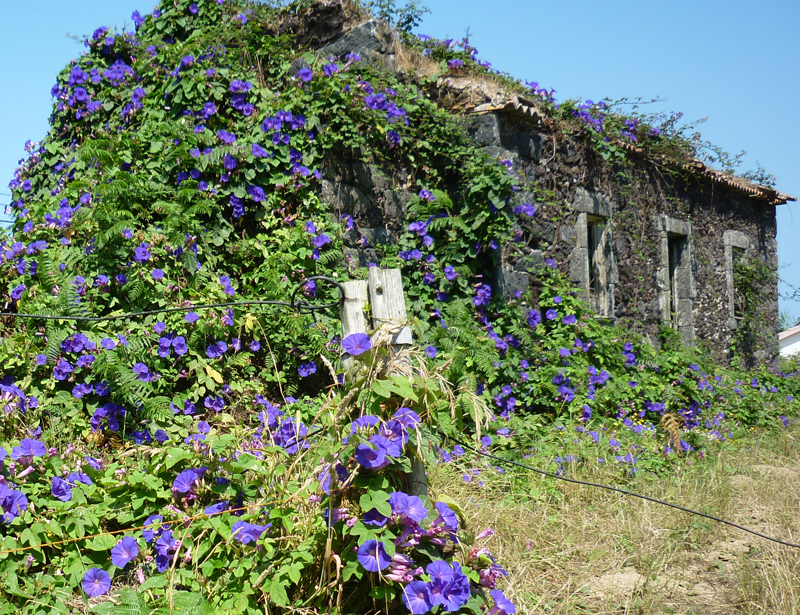
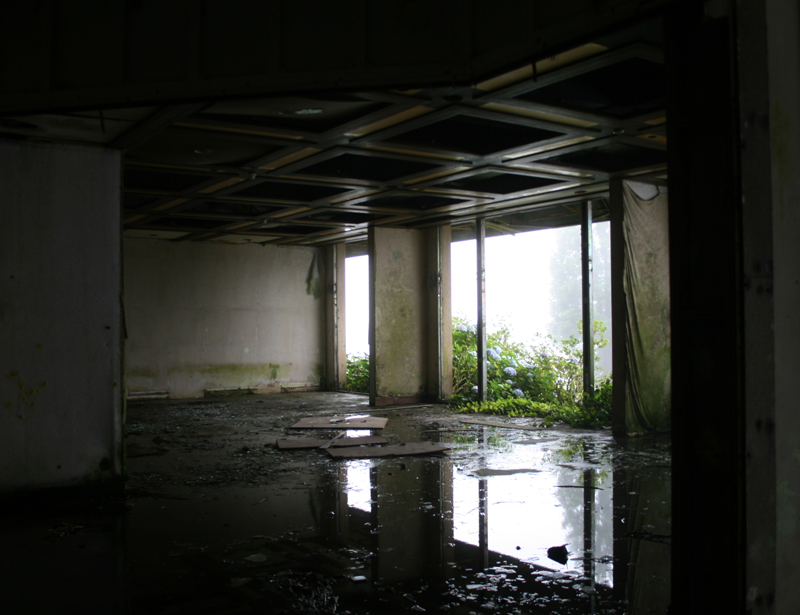
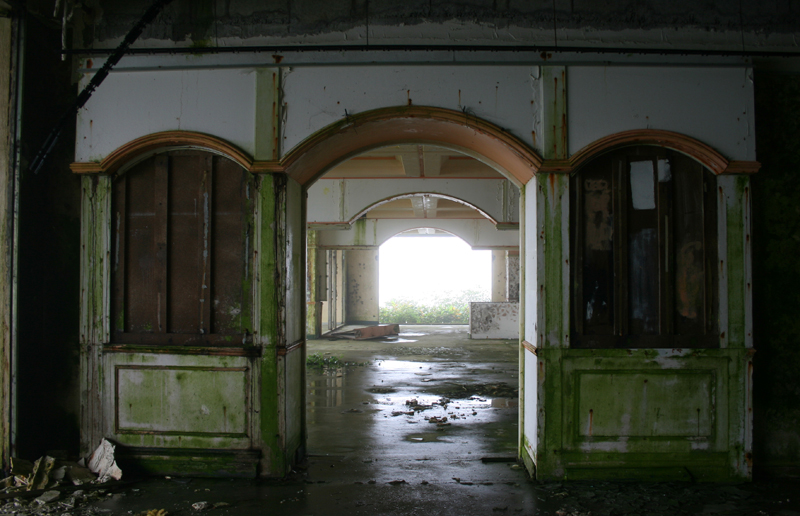
best discovery was the crumbling ruin of 5* Hotel Monte Palace high on a volcanic ridge

1408 Azores 11

emerging from thick fog at the end of a tortuous jeep ride along tiny precipitous roads

1408 Azores 5

built only 30 years ago it never fulfilled its owner’s dream and has been left to rot

1408 Azores 10

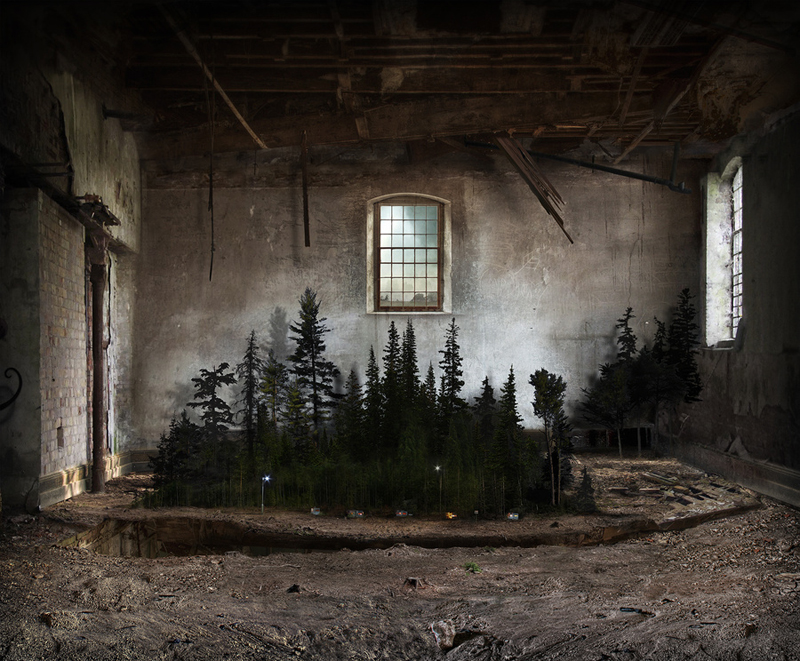
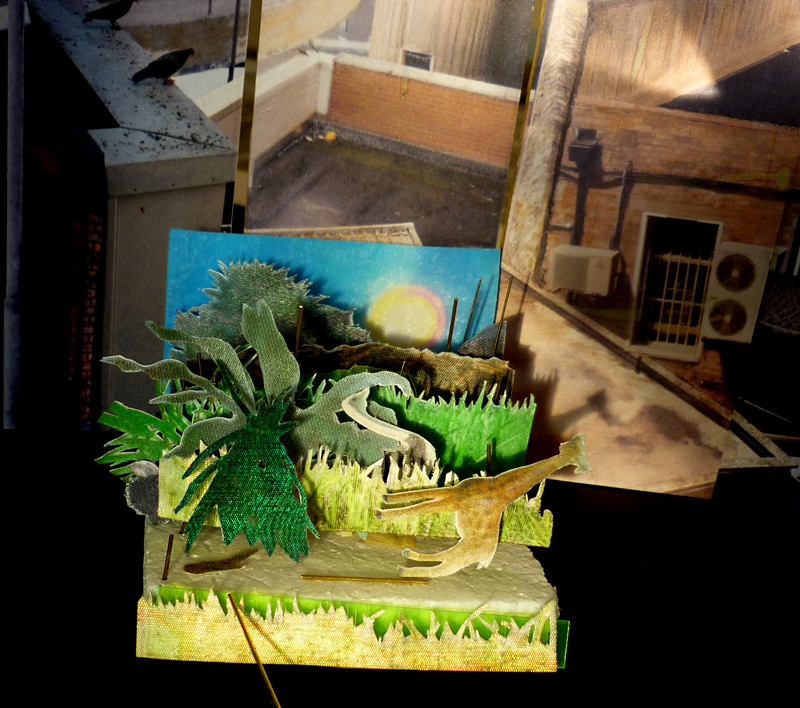
The eerie atmosphere of abandoned space is echoed in Suzanne Moxhay’s constructed images

Suzanne Moxhay  - Copse

Suzanne Moxhay – Copse

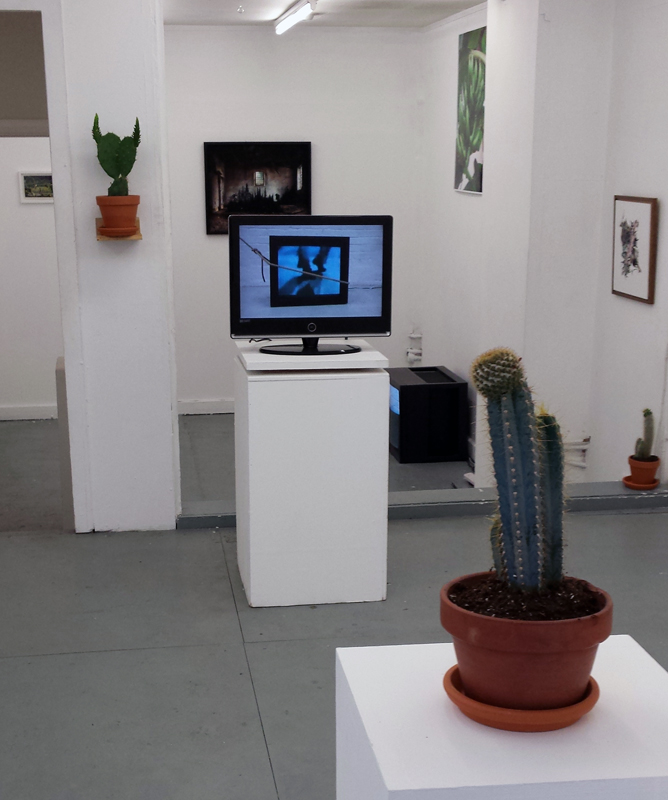
Her work was part of ‘The Combinational’ at Studio 1.1 curated by Paul Carey-Kent, last years gallery fund-raiser ‘lottery winner’

'The Combinational' at Studio 1.1

‘The Combinational’ at Studio 1.1

I was drawn to the ethos of the show-

“The found and the collaged are dominant modern modes; what artists choose to use, and how and why they present or combine them, count for more than their ability with traditional techniques.

One could also say that life in most of the world is less about individual survival than it would have been in pre-modern eras, more about how we live together and whether we can survive that.”

I bought a ticket for this years lottery, so fingers crossed.

Despite a raging thunder storm the opening of Ochre Originals showing two pieces of my work at New Ashgate Gallery was really busy.

My work at New Ashgate Gallery

Rainforest Section 1 and 2

I have been reading in my research about paradise how the botanical garden emulates ideas of Eden with its mix of species cultivated together in a garden.

It offers a tame nature, we look like we are in control

and then this happened

Collapse of paradise

Collapse of paradise

Enclosure is a word that has connotations of the comfort of an embrace and also the isolation of the prison yard.

In my thinking around ideas of paradise it reflects the dilemma of accepting sanctuary but also confinement.

Expulsion from Eden was surely a release not a punishment, for in reality the delights of an earthly paradise where all is provided and nothing changes would not satisfy our hungry curiosity and need for stimulation.

The exhibition ‘Enclosure’ at Danielle Arnaud covered similar opposing themes.

Gabriela Schutz’s wall sized graphite drawings ‘Holyland’ capture the bleak beauty of a territory divided by religious belief.

Gabriela Schutz - Holyland (Beit Arye)

Gabriela Schutz – Holyland (Beit Arye)

Particularly emotionally charged at the moment with the terrifying escalation of animosity and violence that the people caught between these fragile borders are suffering.

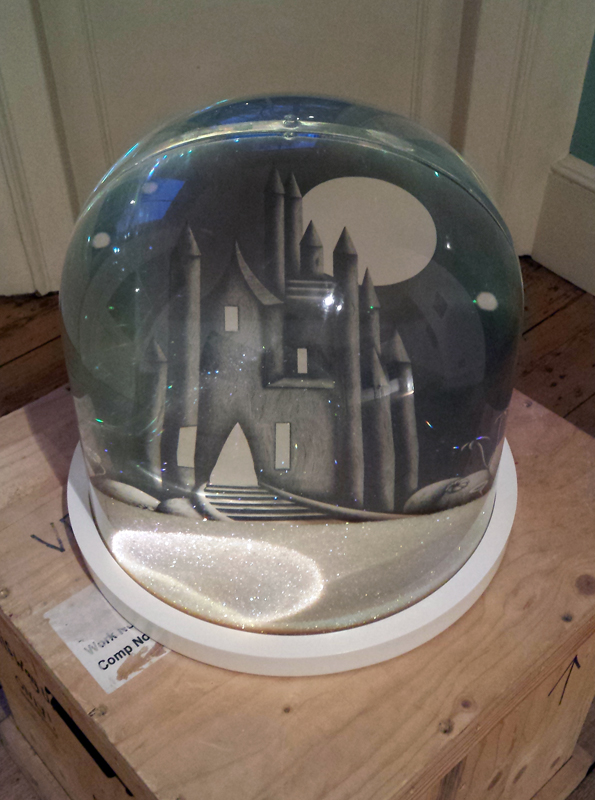
From stark realism to enchanted fantasy. Sarah Woodfine seduces us with glitter and glass in a sealed world.

Sarah Woodfine Castle

Sarah Woodfine Castle

But this is a grey landscape, a place of possibly macabre incarceration.

Also alluringly claustrophobic are Stephen Walter’s dense drawings of woodland. The eye scans the scene for an opening, as if you were within the wood hearing a sudden crack in the undergrowth…

Stephen Walter - Of This Wood Men Shall Know Nothing

Stephen Walter – Of This Wood Men Shall Know Nothing

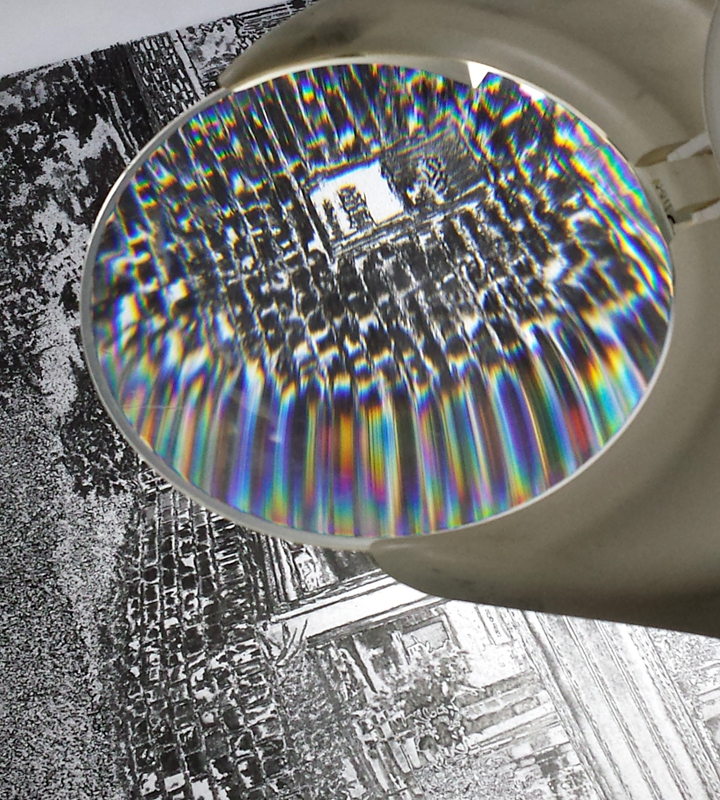
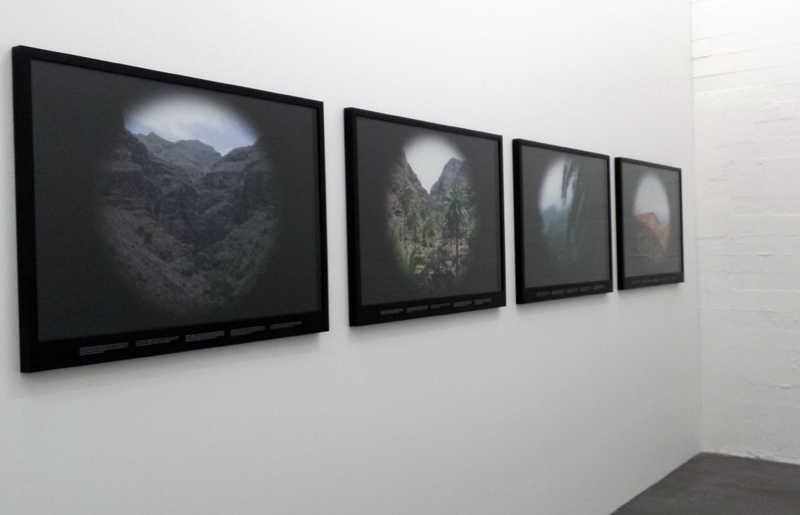
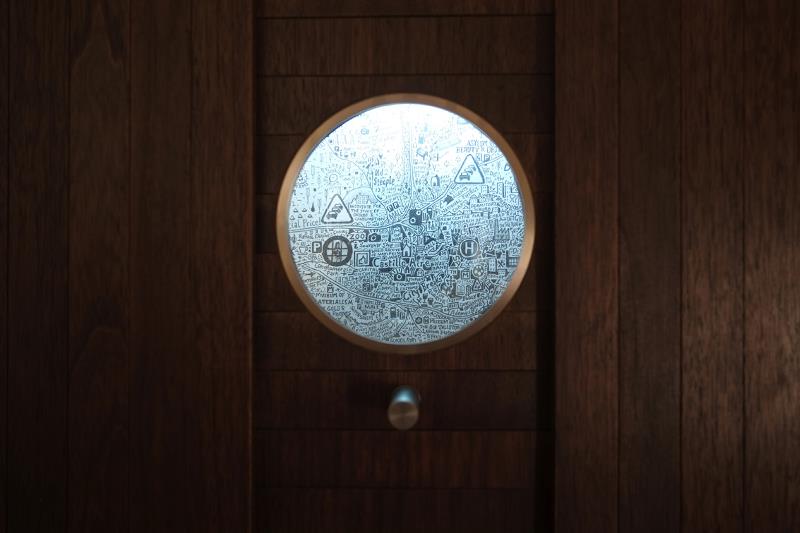
Walter’s witty idea of using a hagioscope to scan the intensely detailed map of his invented ‘Nova Utopia’ is good fun.

The back history that he has established in his conception of this world is obsessive.

It has some of the same social and cultural grammatics  that Grayson Perry uses in his contemporary commentaries on society.

Stephen Walter - Nova Utopia

Stephen Walter – Nova Utopia

The circular peephole can be manually slid across the map revealing new zones and topographies. It is not a world view but a segmented journey across the land as through an ancient voyagers telescope.

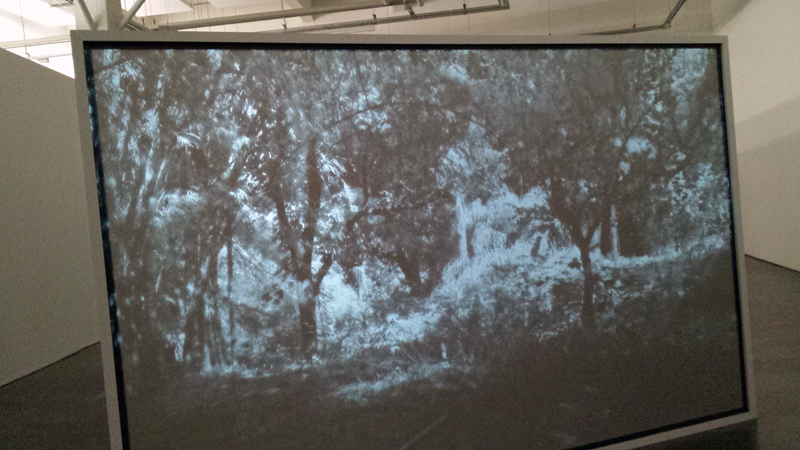
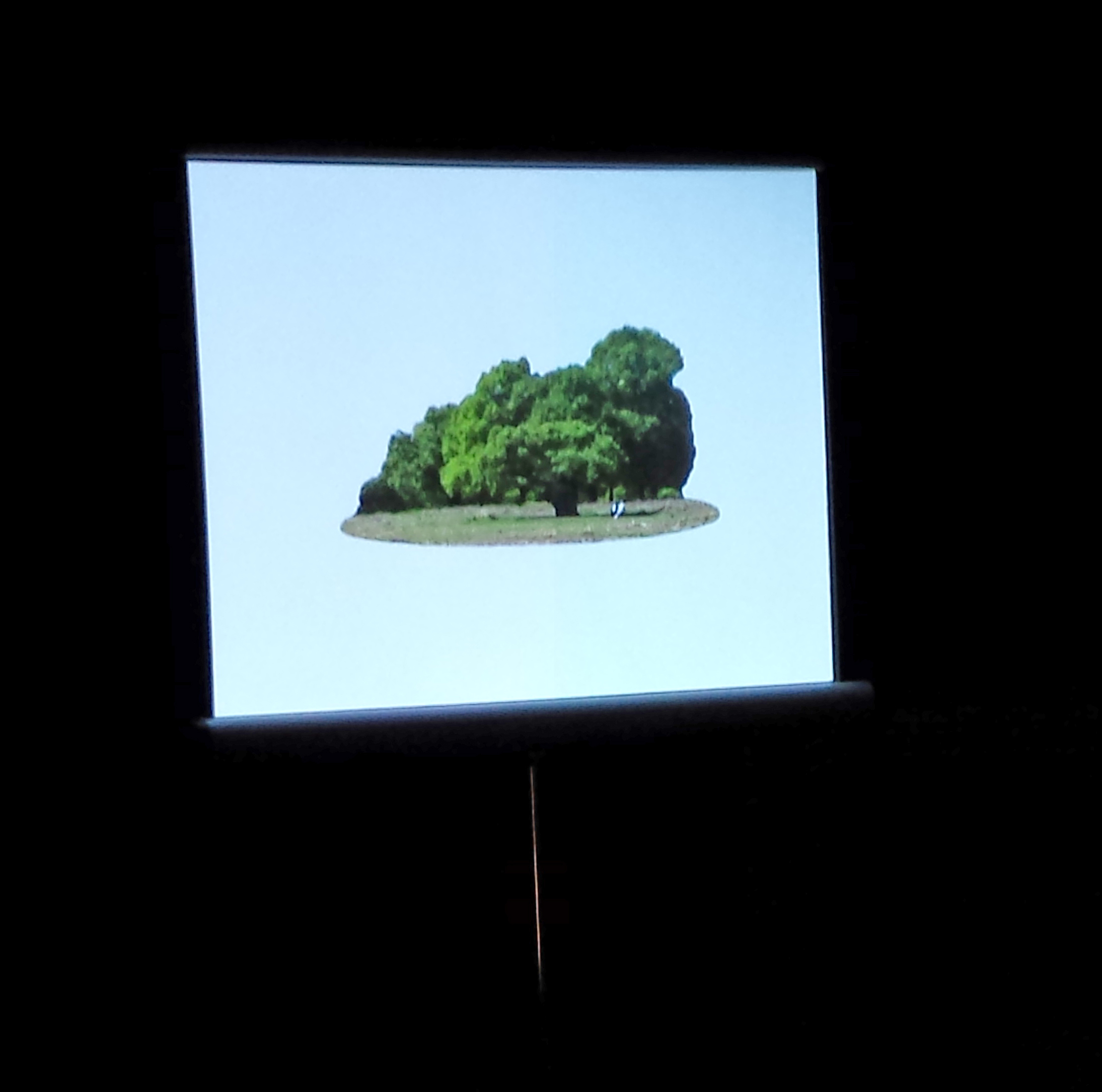
Marion Coutts also edits her landscape to a vignette. With laborious care she removes the borders from the frame of the film leaving behind a floating island.

Marion Coutts - Everglade

Marion Coutts – Everglade

Only subtle movement within the image reveals it to be a film rather than a static projection.

My pieces ‘Would’ (1&2) hung for the Summer exhibition at Ochre Print Studio have a layered translucent surface which adds suggested movement.

1407 SAOS

This work reflects the aura of an imagined event.

2014 Would

A magical space, like an abandoned walled garden.

1407 Henstead Garden

The remnants from an age of explorers who brought back the first examples of exotic flora now thriving in the Suffolk landscape.

1407 Henstead Garden 3

Just a few miles from where I was born is the Henstead Exotic Garden.

Planted 10 years ago by Andrew Brogan it seems impossible that these sun worshippers would survive those icy easterly winds from Siberia that gave us all chilblains.

1407 Henstead Garden 2

I have met a lot of special people at the RCA – the graduates of printmaking 2014 are ALL amazing people

Here is some of their work

Vangeli Moschopoulos

Vangeli Moschopoulos

Sophia Jones

Sophia Jones

Rei Matsushima

Rei Matsushima

Pauline Emond

Pauline Emond

Pauline Emond

Pauline Emond

Jian Zhou

Jian Zhou

James Seow

James Seow

Holly Graham

Holly Graham

Hadas Auerbach

Hadas Auerbach

Gabriele Dini

Gabriele Dini

Danny Augustine

Danny Augustine

Chud Clowes

Chud Clowes

Lisa Lee

Lisa Lee

Christian Jaskolka

Christian Jaskolka

Ben Zawalich

Ben Zawalich

Theo Eriera-Guyer

Theo Eriera-Guyer

Anastasia Mina

Anastasia Mina

Alice Gauthier

Alice Gauthier

Weixin Chong

Weixin Chong

Sad to see them move on but hopefully to amazing new adventures.

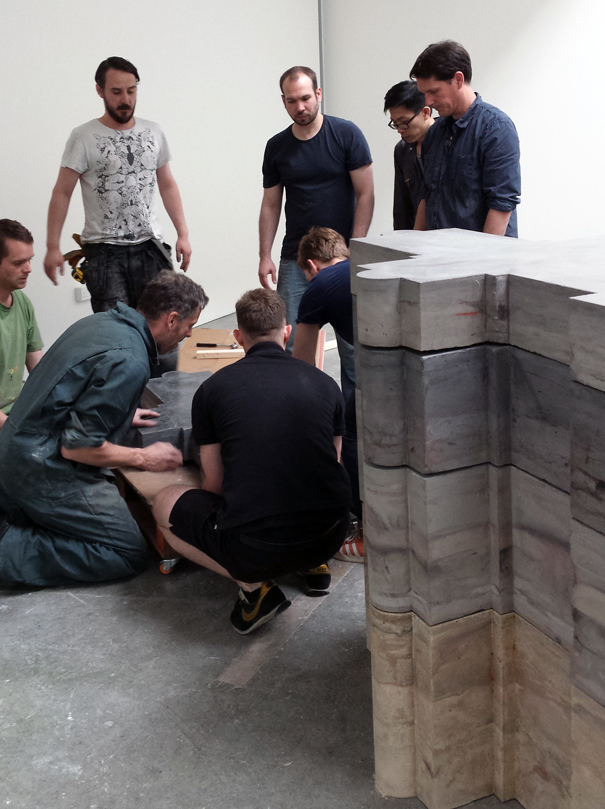
It was a privilege to help with all the prep work involved in setting up the show. Now we know what to expect next year…

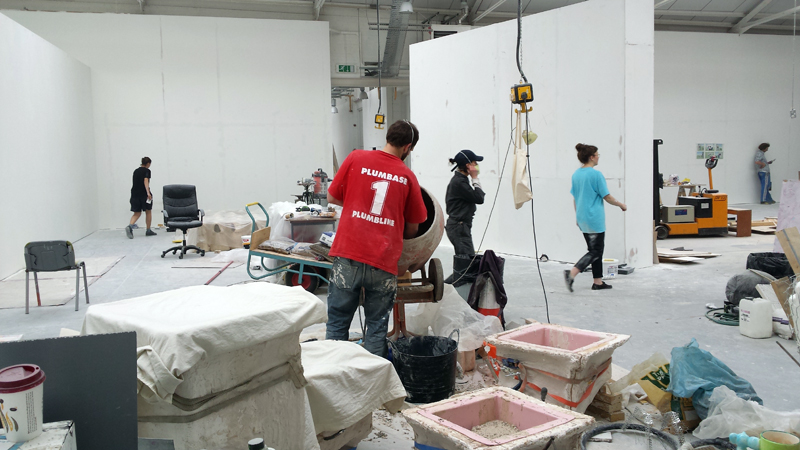
1407 Show prep

Such a buzz when the whole college comes together

1407 Team work

A strange bubble of expectation is created

1407 Show 2014

To see a short film of SHOW2014 click on this link

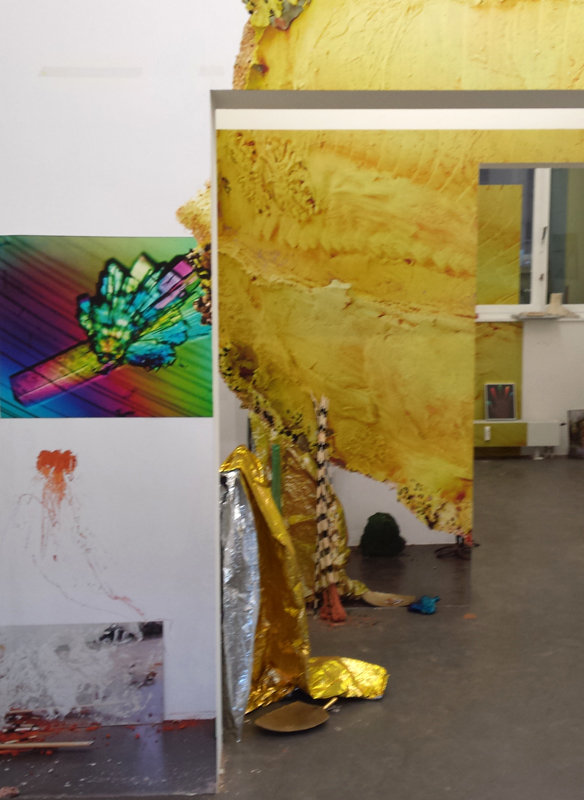
One room which stood out for me at Show2014 was a collaboration between two artists Marlene Steyn and Abraham Kritzman

1407 Abraham Kritzman Marlene Steyn 3

Abraham Kritzman and Marlene Steyn

It wasn’t clear who made which pieces but the room worked as a whole

1407 Abraham Kritzman Marlene Steyn 1

Abraham Kritzman and Marlene Steyn

1407 Abraham Kritzman Marlene Steyn 6

Abraham Kritzman and Marlene Steyn

1407 Abraham Kritzman Marlene Steyn 2

Abraham Kritzman and Marlene Steyn

1407 Abraham Kritzman Marlene Steyn 4

so much to engage with

Abraham Kritzman and Marlene Steyn

Abraham Kritzman and Marlene Steyn

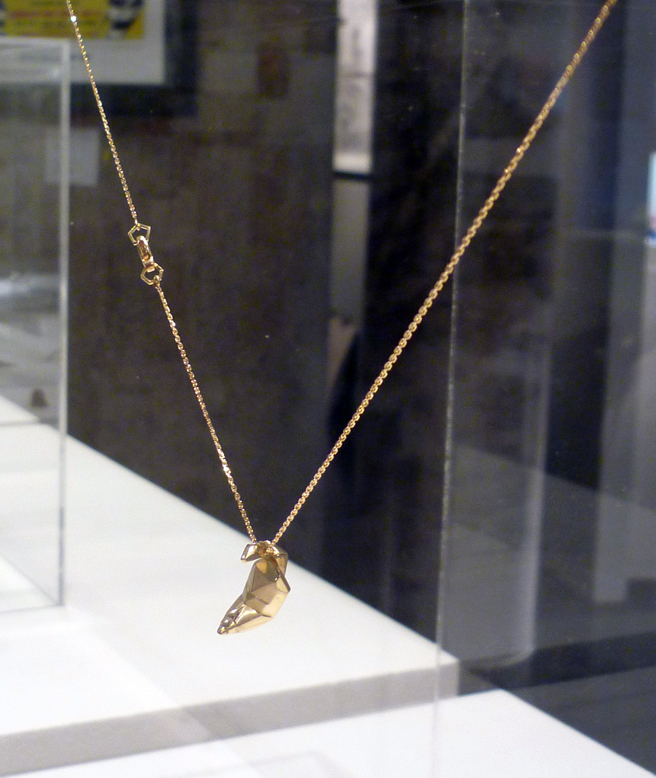
and from the RCA jewellery department the talent of Max Danger –

Max Danger

Max Danger

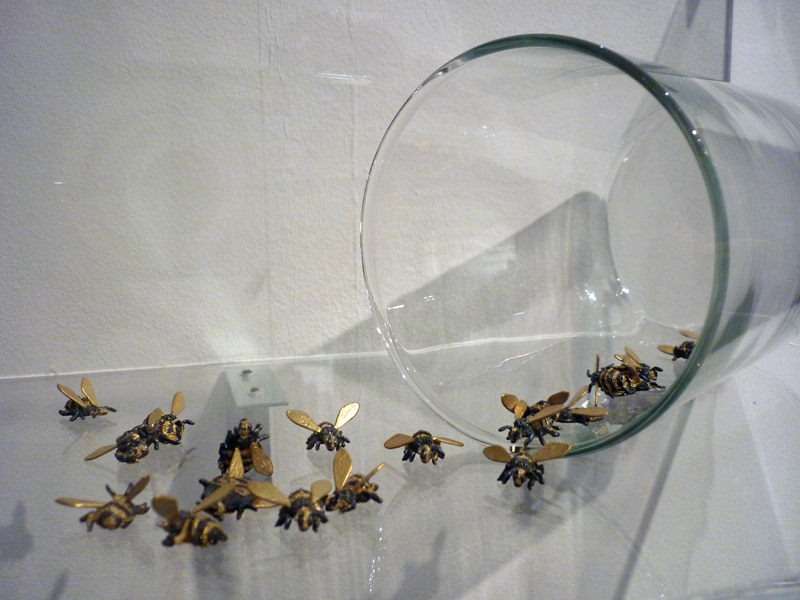
Bees are precious as demonstrated in these beautiful pieces

Max Danger - Bees

Max Danger – Worker Bees

with an eye on the ecological importance of bees as well as a sense of humour

Max Danger  - Robot Bee

Max Danger – Robot Bee

Confinement. I don’t like boundaries that restrict and I don’t want to lose being an artist to being a printmaker.

I don’t really like a show that is put together based on process yet I seem to be more and more being involved with such projects.

I went to see IMPRESS at the Courtauld Gallery Somerset House – the strapline was Print Making expanded in contemporary art.

Some works were as clunky as the premise, and no show transports you when there are wires marking your viewing boundaries and officious invigilators watching your every move.

Nicky Hirst - Wall 1

Nicky Hirst – Wall 1

Filigree in silver onto a printed circuit board – Cornelia Parker and silver work well together

Cornelia Parker - Small Thought

Cornelia Parker – Small Thought

A favourite was the impressions of controlled combustions taken onto photo-sensitive paper of spores from lycopodium plants.

Raphael Hefti - from the Lycopodium Series

Raphael Hefti – from the Lycopodium Series

Definitely an opening here for the imagination.


Gaining knowledge is a thread woven through my current thinking for my dissertation. From the first knowledge of conscious thought – that we are separate from nature, the temptation of the tree of knowledge and its consequences, to self knowledge through the grand Romantic quest and the furthering of knowledge to pass on to future generations.

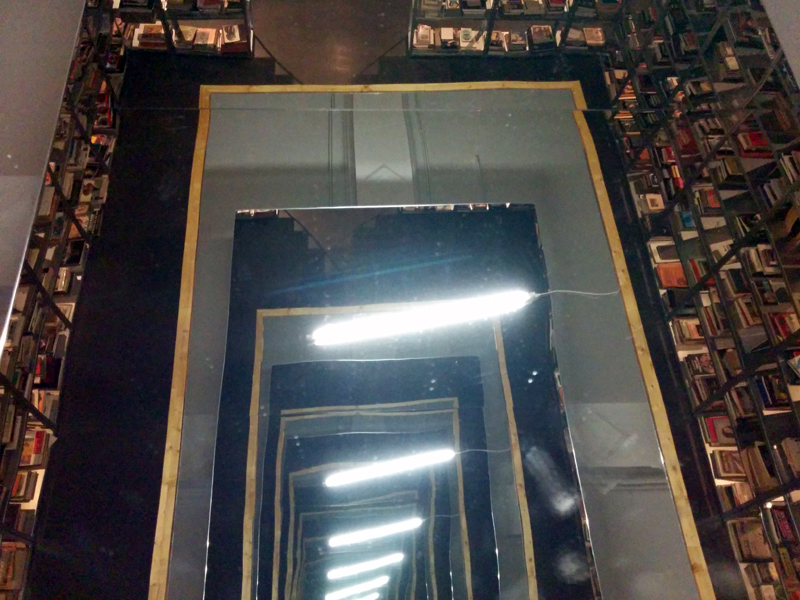
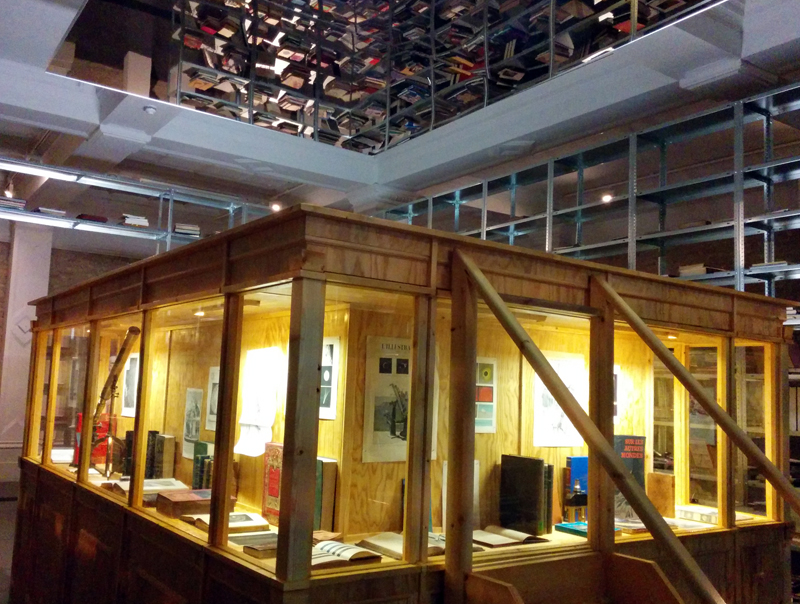
Kadar Attia – Continuum of Repair: The Light of Jacob’s Ladder at Whitechapel Gallery was interesting to me because of the focus given to the value of knowledge.

Books as receptacles of history.

Kader Attia _ The Light of Jacob's Ladder

Kader Attia   The Light of Jacob’s Ladder

The shelves which rise up to the gallery ceiling are full of books with evocative titles and inspiring covers from science, anthropology, politics and physics – they are mostly in French though so for me the knowledge they contain is frustratingly inaccessible. Attia talks about repair as a principle of evolution and development – that we plug holes and fill gaps – holding it all together with sticky tape. I enjoyed seeing the physical manifestation of knowledge. The internet holds so much and offers so much so quickly but the material sight of so many books is uplifting.

Kader Attia

Kader Attia

The installation at Whitechapel is about conveying knowledge from different ideologies, it refers to Michel Foucault – The Archeology of Knowledge and uses the symbolism from Christian, Islamic and Judaic traditions of a ladder of light – a link between the terrestrial nad the celestial. Within the installation the telescope and the microscope embody two alternative ways of looking at the world.

Revelation through scale.

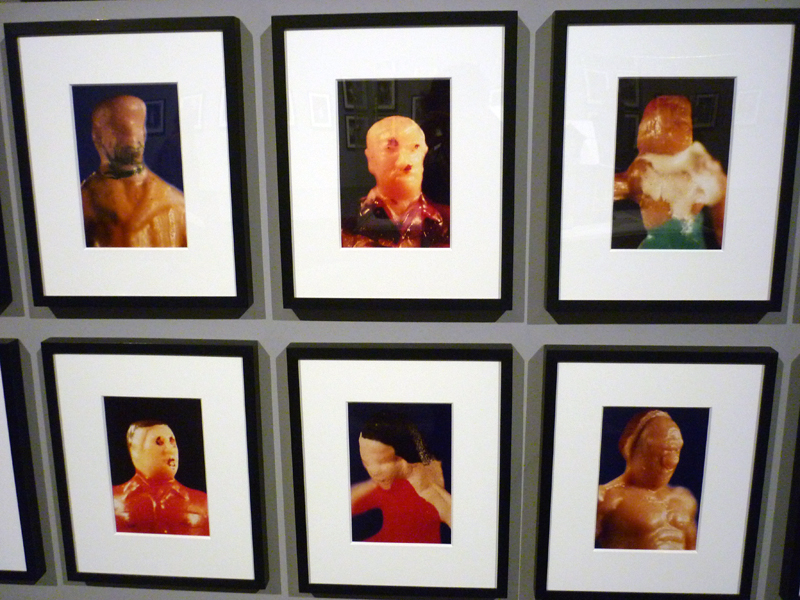
Simmons and McCollum 'The Actual Photos'

Simmons and McCollum ‘The Actual Photos’

This collection of portraits by Laurie Simmons and Allan McCollum manipulate scale through photography – enlarging the tiny to life size.

These melting features are portraits of model railroad figures used to add human presence to the constructed landscapes of the hobbyist.

Simmons and McCollum 'The Actual Photos'

Simmons and McCollum ‘The Actual Photos’

A land of the disfigured is revealed. Disrupting the symmetry and expectations of the human face.

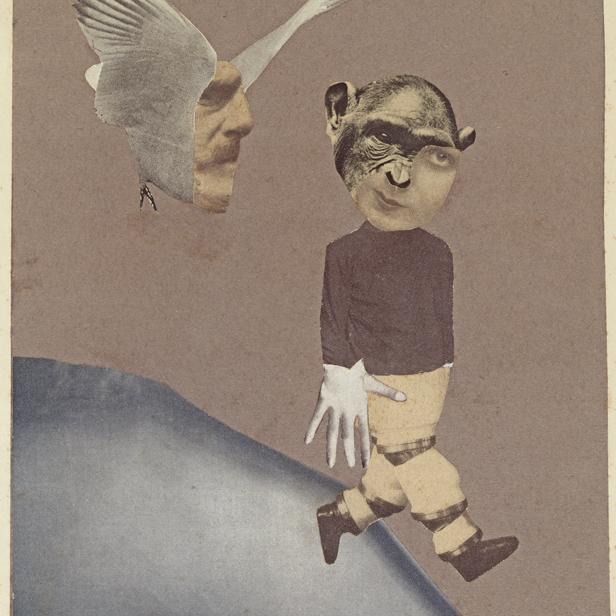
Hannah Hoch also uses this approach of disruption of the human form to pose questions about our inner humanity – it’s amazing to think when she was making this work – the early work, particularly in the 1920’s how different the world was and yet how the same. Like the ever on-going topicality of Shakespeare – we struggle with the same issues in every generation – money/power, image, gender. It still seems so fresh though I found the volume of works at her Whitechapel  retrospective a bit overwhelming.

Hannah Hoch

Hannah Hoch

I joined the RCA school trip to see The Negligent Eye exhibition at The Bluecoat Gallery in Liverpool curated by our own RCA head of printmaking Jo Stockham

– she questions;  ‘scanning is riddled with an internal contradiction: is it a close reading or a glance?’

The artists in this show all use some form of scanning, experimenting with translations across digital media into various print processes

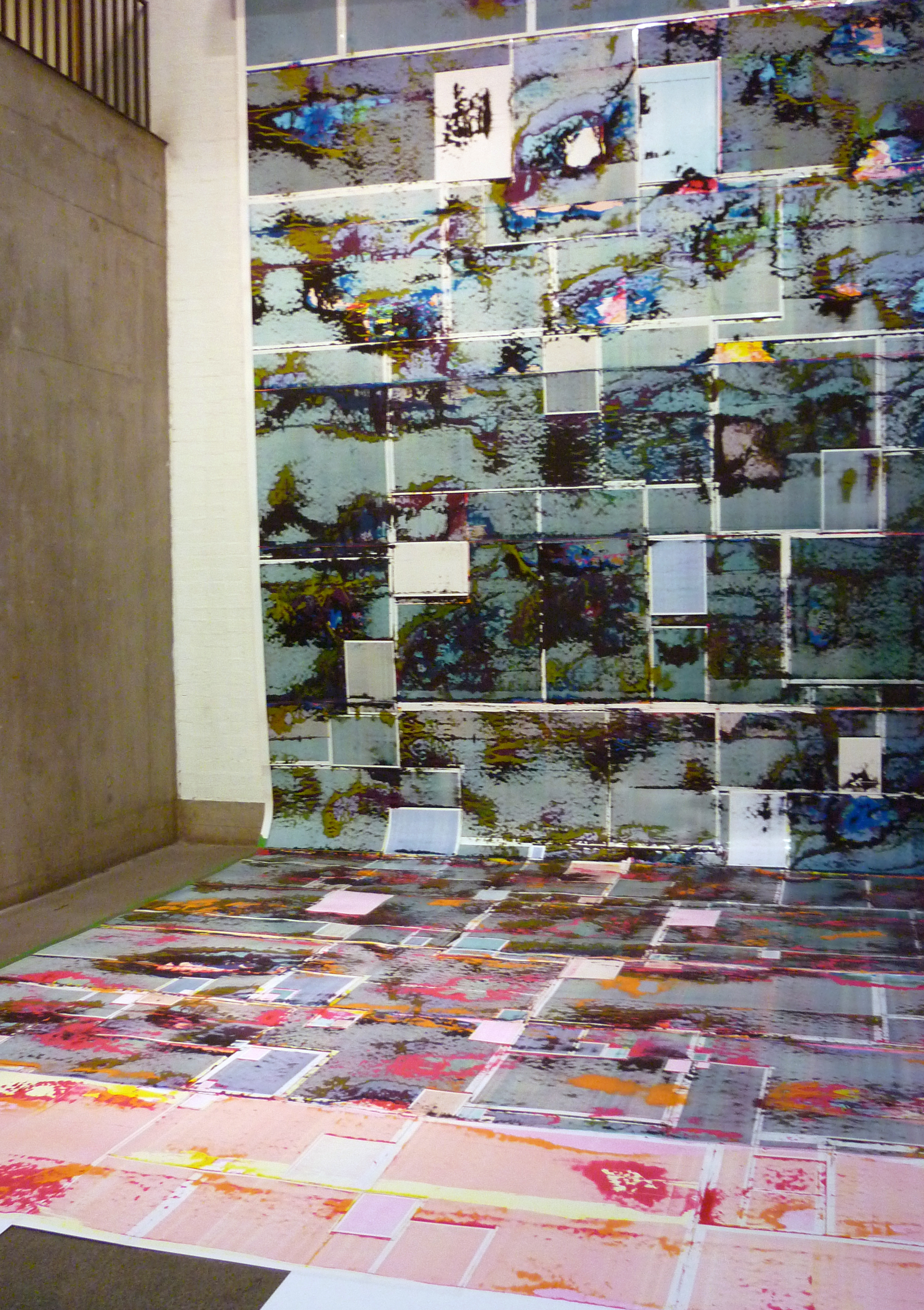
Maurice Carlin

Maurice Carlin

Endless Pageless is performance screen printing on a vast scale. The surface of the gallery floor is recorded though an analogue scan; the pressure of the screen over paper on the floor gradually building up the image in coded blocks.

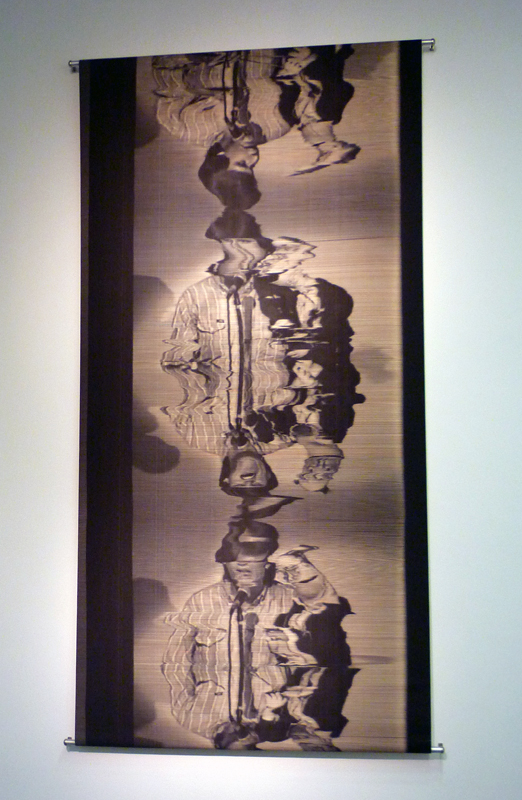
Rebecca Gossling

Elizabeth Gossling

Gossling scans from a computer or tv screen with a hand held recording device which results in a distorted image that highlights the waves of transmission – like the image on the edge of tuning in to a channel, you are aware of the process.

A feeling reminiscent of having one of those little tellys with a bent wire ariel – not going to happen with a digital signal.

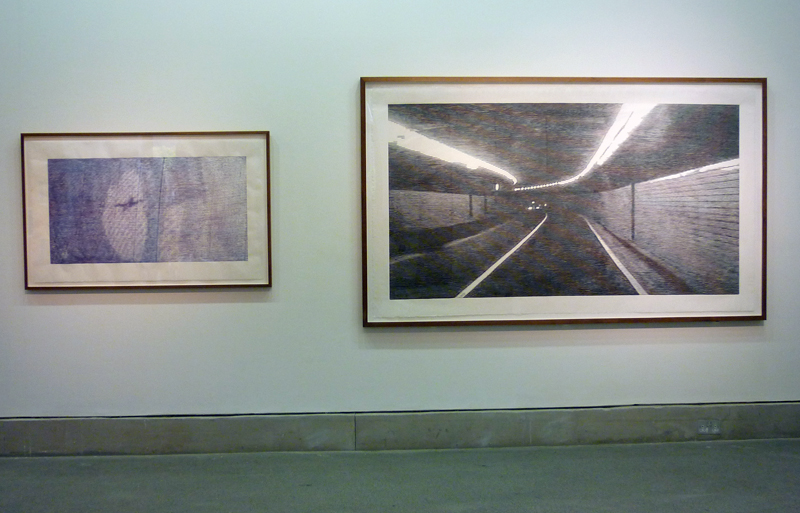
Christiane Baumgartner

Christiane Baumgartner

Also taken from the screen Baumgartner translates the media image from tiny pixels to giant woodcut

Juneau Projects

Juneau Projects

Hand held scanners traversing the lawn

Helen Chadwick

Helen Chadwick

viral attack

Bob Matthews

Bob Matthews

A reimagining of the landscape, Bob Matthews  explores architecture within the environment, painting by pixels

Jo Stockham

Jo Stockham

value, discarded and reborn

Jo Stockham

Jo Stockham

Some good thoughts on the show at
http://www.furtherfield.org/features/reviews/digital-autopsies-negligent-eye-bluecoat

The book ‘Keywords’ by Raymond Williams was recommended to me by my tutor Faisal Abdu’Allah when we were discussing the etymology of words and personal interpretations of paradise or utopia.

The guiding principle in the composition of Keywords was to look at historical changes in the meaning of 109 key words, in order to bring out the significance of the facts of these changes. As Williams put it in the book’s Introduction:

This is not a neutral review of meanings. It is an exploration of the vocabulary of a crucial area of social and cultural discussion, which has been inherited within precise historical and social conditions and which has to be made at once conscious and critical – subject to change as well as to continuity.

While in  Liverpool we visited the Keywords exhibition at the Tate. The idea offered really interesting possibilities, juxtaposing works from the Tate’s collection with keywords from the book.

Some good work but the strange display with blocks of carpet and the words in giant cursive script on the walls destroyed any magic the theme evoked.

Keywords Tate Liverpool

Keywords Tate Liverpool

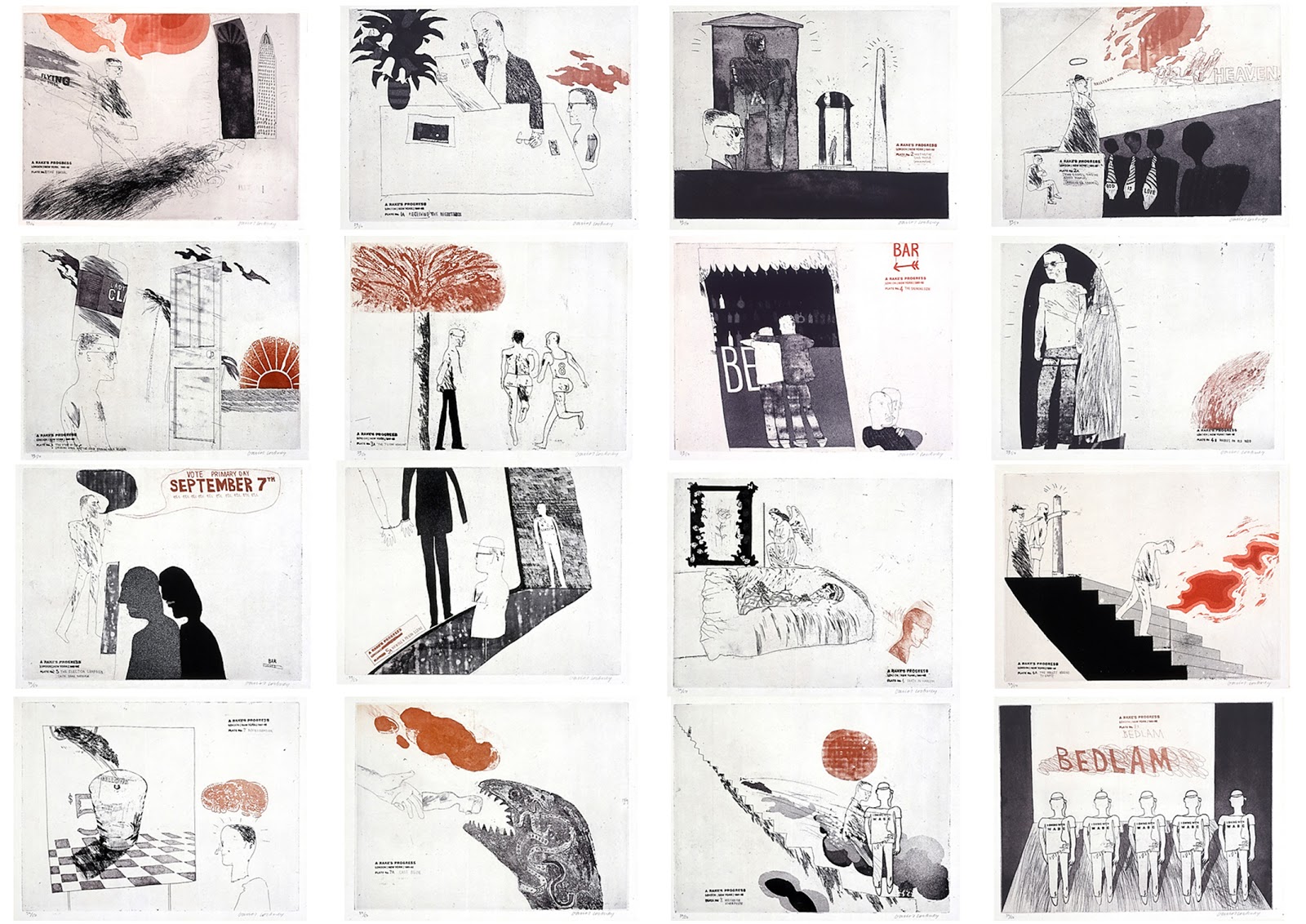
Another school trip was to see the David Hockney prints at Dulwich Picture Gallery.

It wasn’t something I would have gone along to myself but I enjoyed the humour in his early etchings done while at the RCA and our technician Alan Smith was able to show off his knowledge of the etching process

David Hockney - A Rake's Progress

David Hockney – A Rake’s Progress

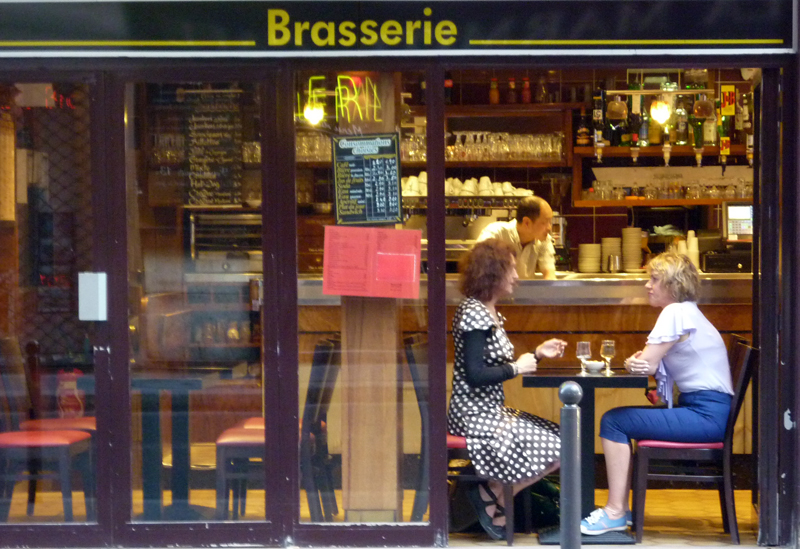
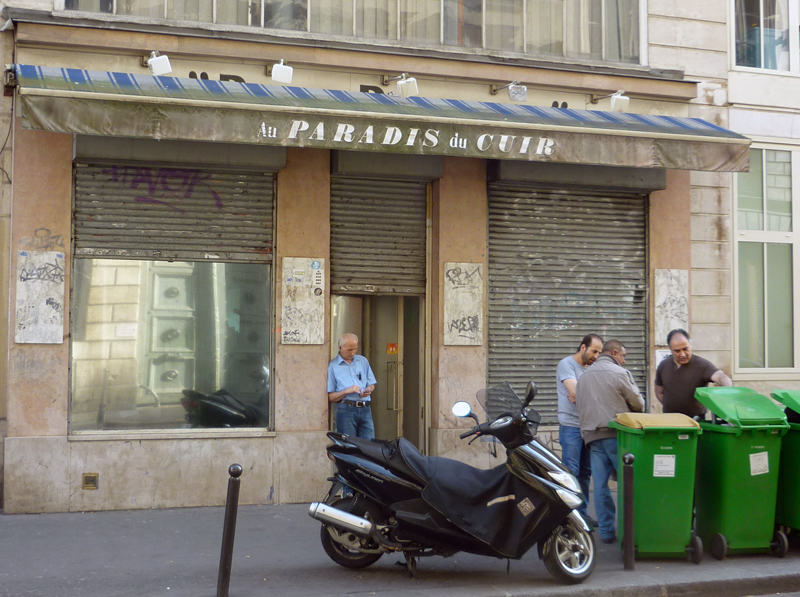
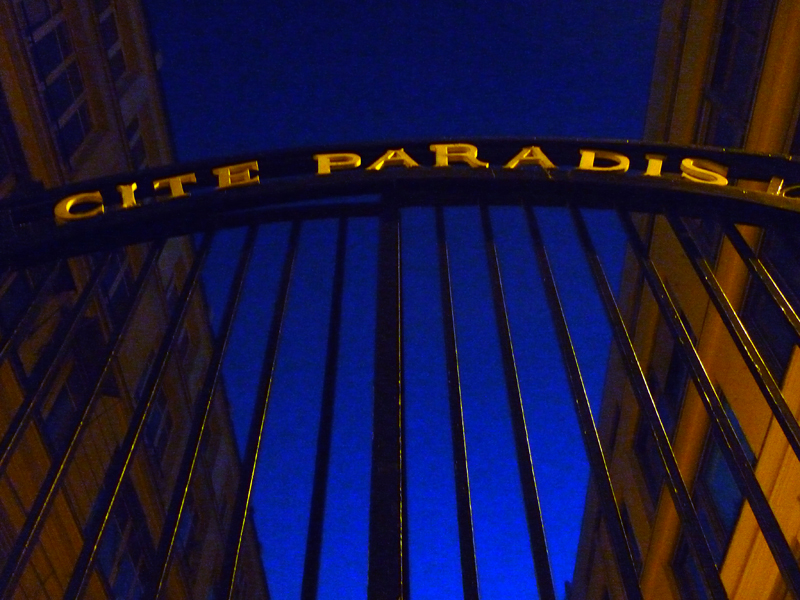
Some fragments of Rue de Paradis

1406 Rue de Paradis 1

Paradise – prison

1406 Rue de Paradis 2

or sanctuary

1406 Rue de Paradis 3

discover

1406 Rue de Paradis 4

a place of false riches

1406 Rue de Paradis 5

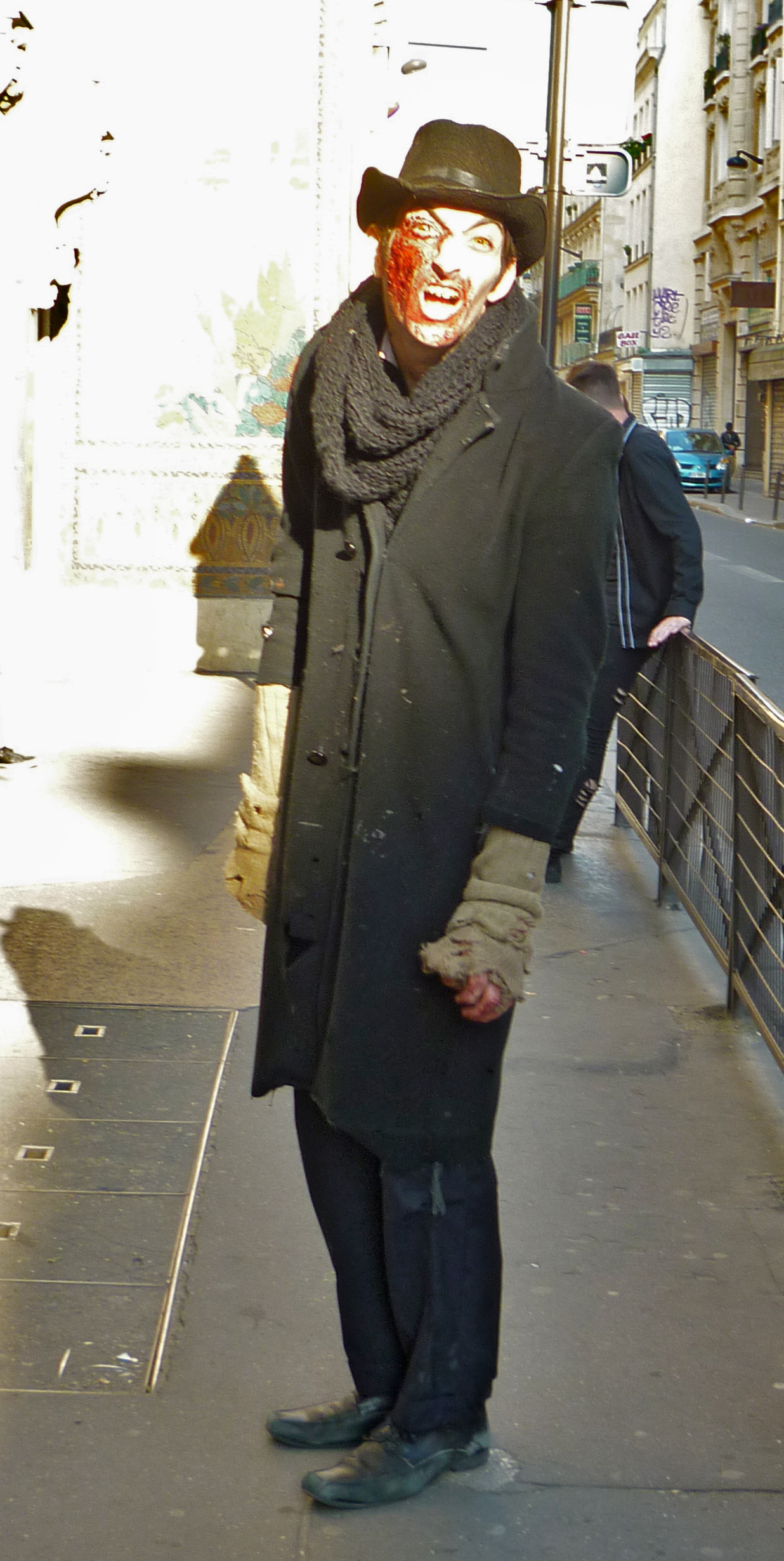
a place to be wary who you trust

1406 Rue de Paradis 6

like reaching for a reflection

1406 Rue de Paradis 7

always unattainable

1406 Rue de Paradis 8

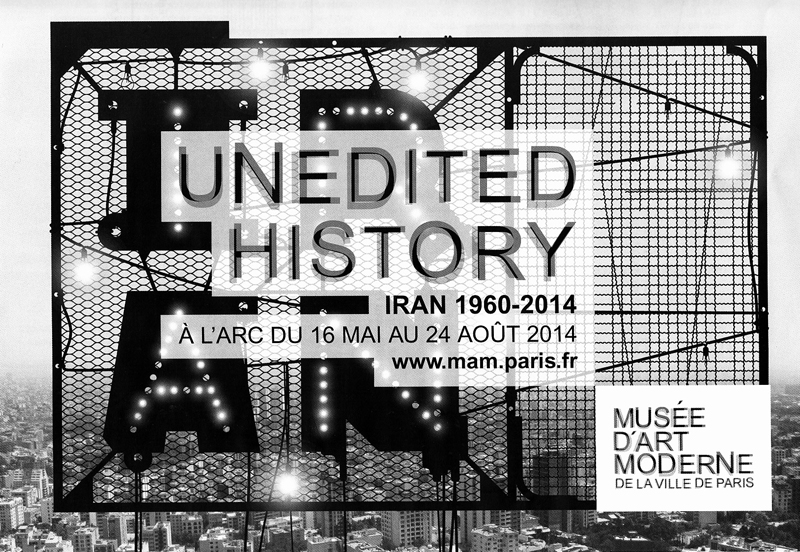
While in Paris also had a look at the Unedited History of Iran exhibition at The Musee D’art Moderne

1406 Unedited History


Behdjat Sadr

Behdjat Sadr

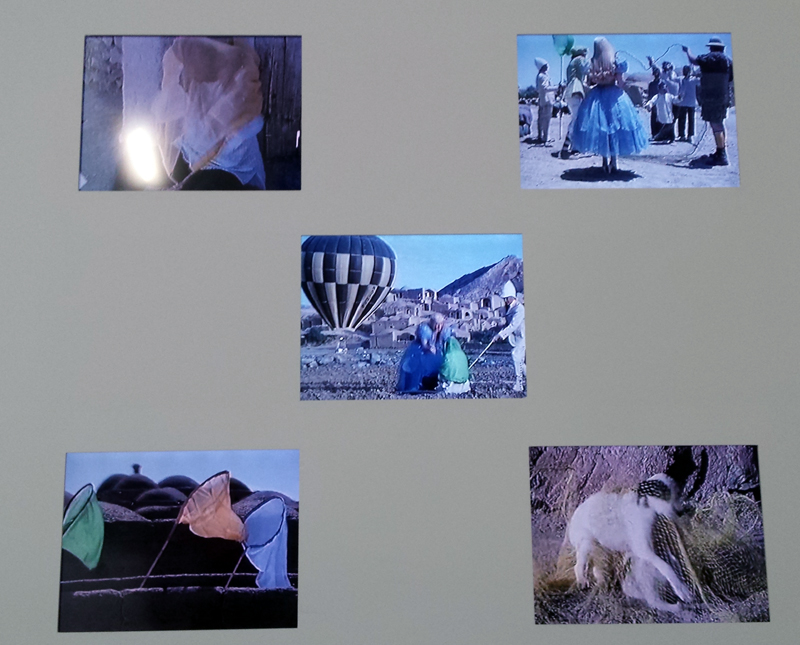
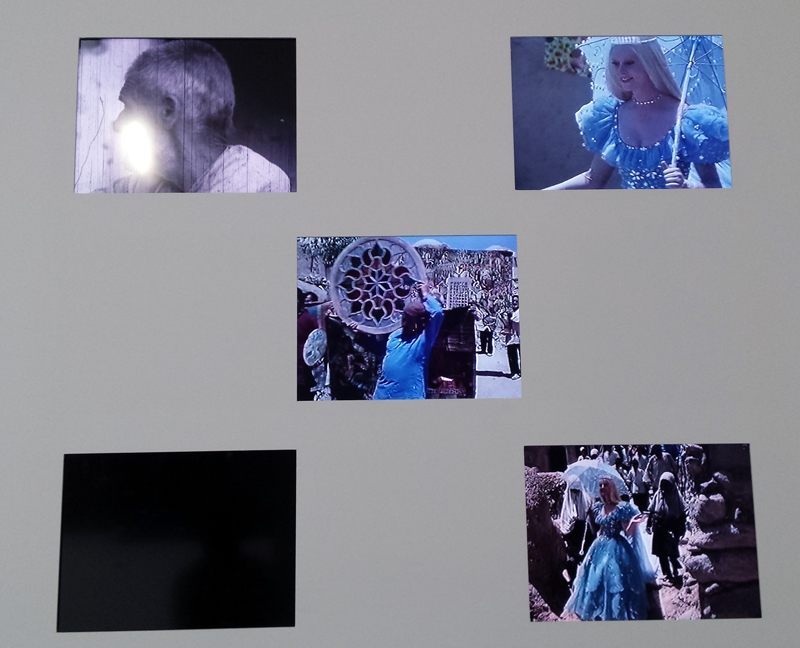
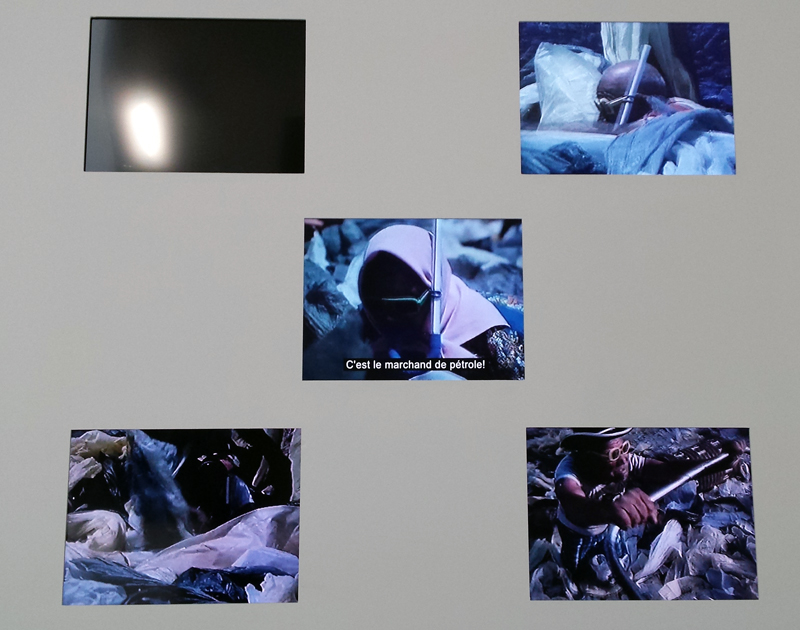
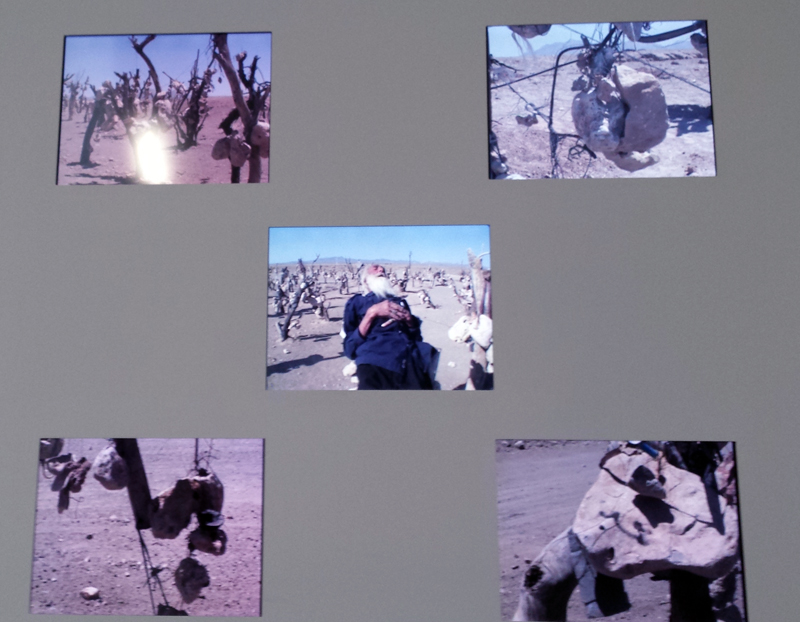
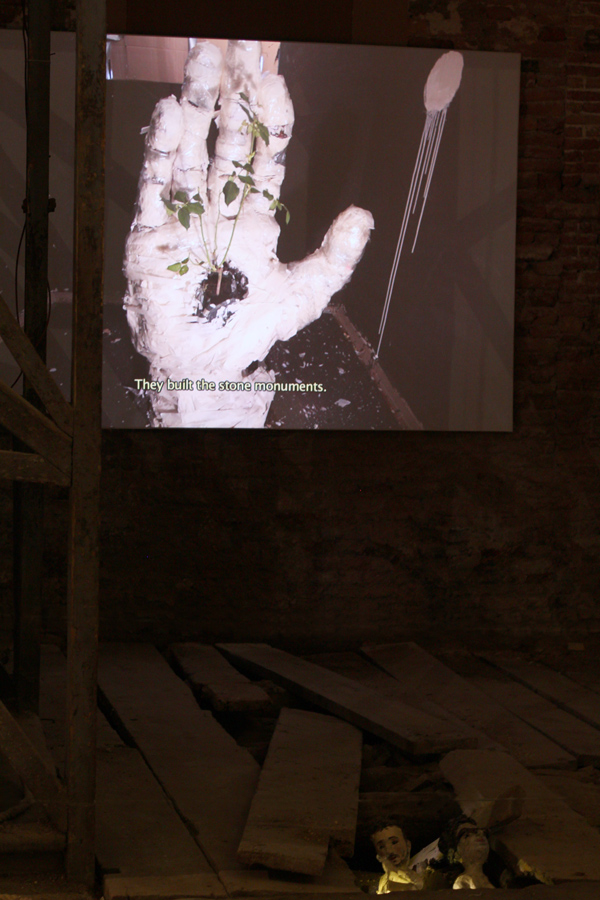
Was captivated by the surreal images in the video installation of Parviz Kimiavi – a mixture of Oz and world pollution, will the good fairy come to save us all from drowning in our own filth

Parviz Kimiavi

Parviz Kimiavi

Parviz Kimiavi

Parviz Kimiavi

Parviz Kimiavi

Parviz Kimiavi

does the yellow brick road end here

Parviz Kimiavi

Parviz Kimiavi

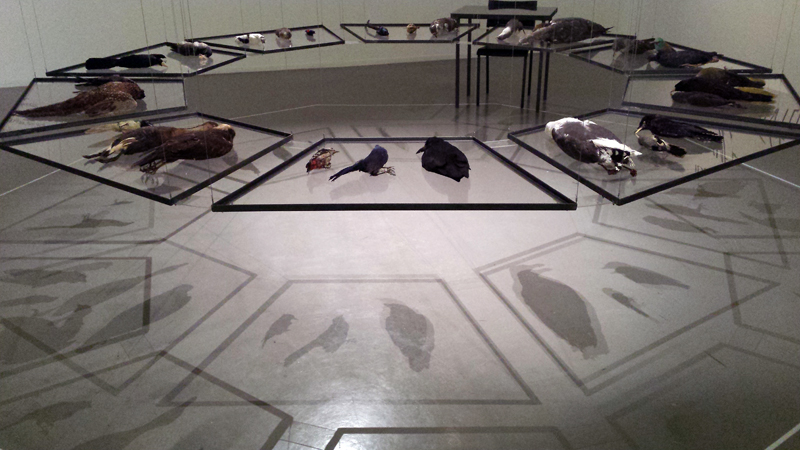
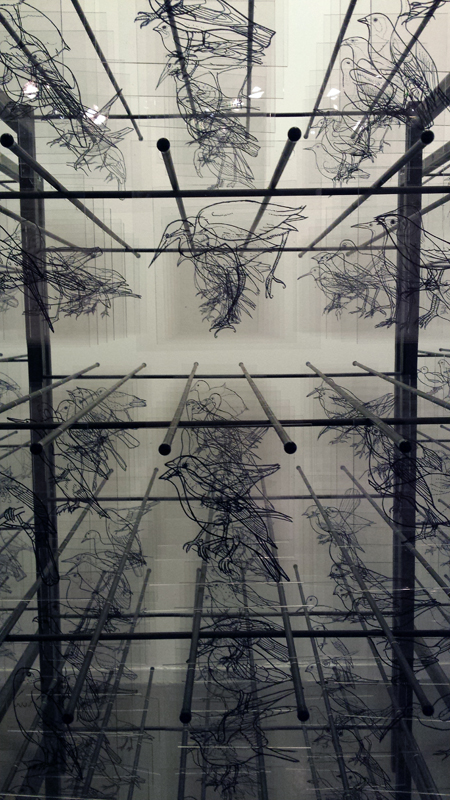
‘Office of Investigation into Diverted Trajectories’ – the dead birds

Narmine Sadeg

Narmine Sadeg

This was poetic

Narmine Sadeg

Narmine Sadeg

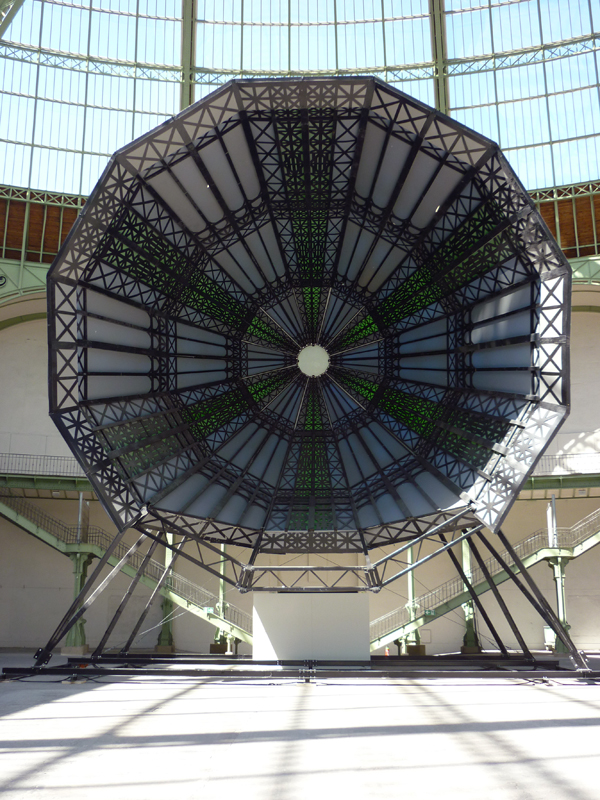
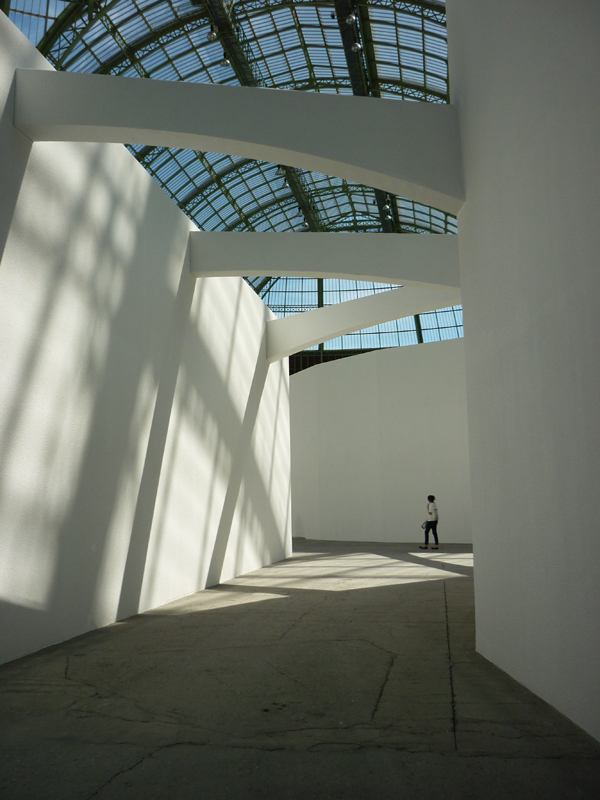
Also while in Paris visited the vast installation at the Grand Palais” by Ilya and Emilia Kabakov.

We came across the exhibition by chance but it turned out to explore many of the themes I am currently interested in.

Ilya’s background is questioning the totalitarian regime of his childhood in soviet society – in the end he believes every -ism ends in disaster so there is no point in trying to build Utopia in reality – better to keep it in the realm of the art-world.

Ilya and Emilia Kabakov  'Strange City'

Ilya and Emilia Kabakov
‘Strange City’

In exploring the maze of the city the viewer is exploring the dreams of individuals that are shared across all nations

'Stange City'

‘Strange City’

The installation is made up of many buildings. There is the empty museum reflecting a yearning towards the sacred as a shrine to our values.

There is the model mythical Tibetan city where the world is in duplicate – one celestial, one terrestrial but it is not known which is heaven and which is earth.

'Strange City'

‘Strange City’

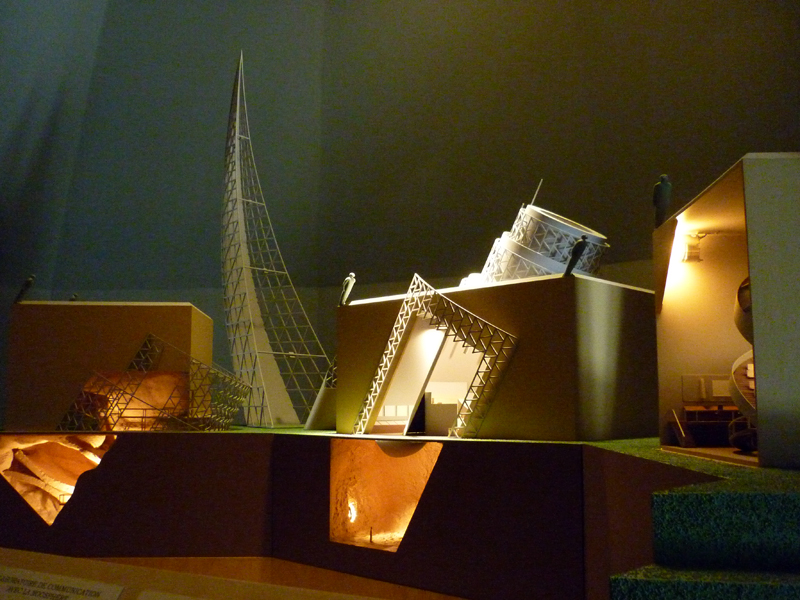
There is the centre for cosmic energy built on an archaeological dig uncovering a time when contact was established with alien life.

'Strange City'

‘Strange City’

Instructions on how to meet an angel.

'Starnage City'

‘Strange City’

The artists are not religious but like many people still hope for miracles.

Axisweb ran a competition for curators to select work from their database for a theorectical exhibition.

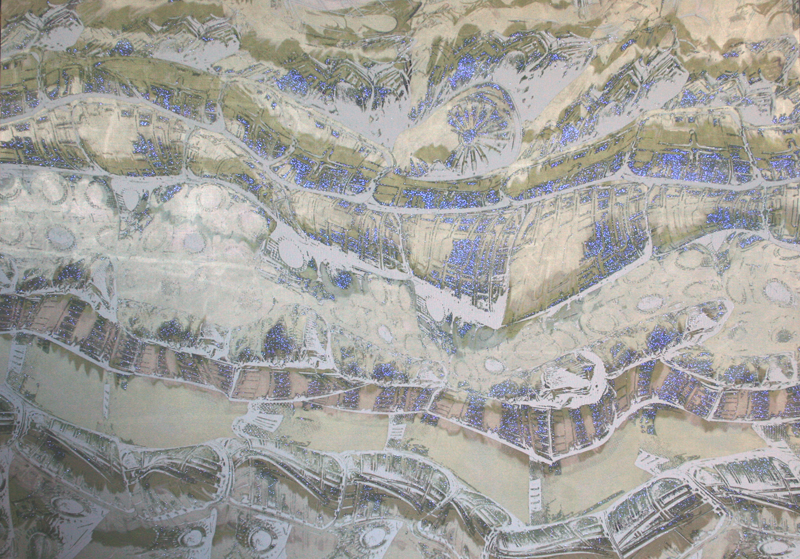
It was a nice surprise to find Laura Dennis won the competition with one of my pieces included in her selection for her proposal ‘Synthetic Landscapes’

StrataGem(ii)

StrataGem(ii)

She writes: ‘In the screen print StrataGem(ii), Susan Eyre has created a mesmerising image of geological strata using items of plastic landfill. Shimmering, iridescent layers of waste packaging form the imagined rock structures and gemstones of a distant future. Despite its apparent beauty, the image is unsettling: it prompts us to contemplate the far-reaching impact of human activity upon the earth, and a legacy in which the man-made and natural worlds have become indistinguishable.’

My themes have shifted slightly since I made work with a more ecological slant. Still interested in the human connection to nature I have been looking at a more emotional relationship.

From my research into the stimulus for the first conscious thought, when man looked at nature and found it ‘other’ I have been thinking about basic instincts. The line between civilization and savagery.

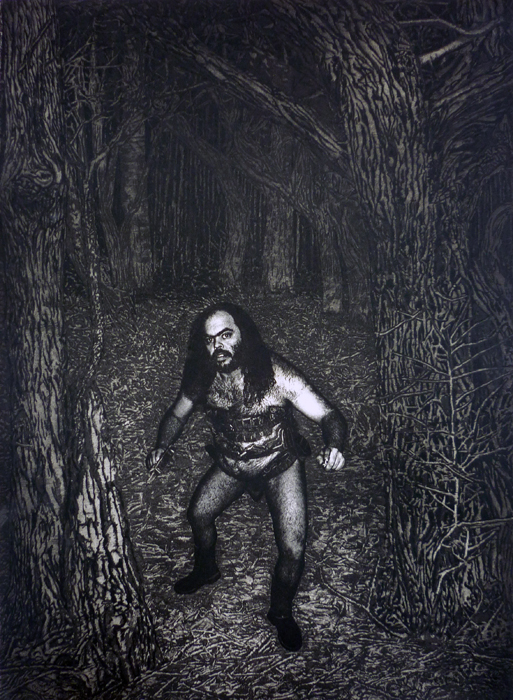
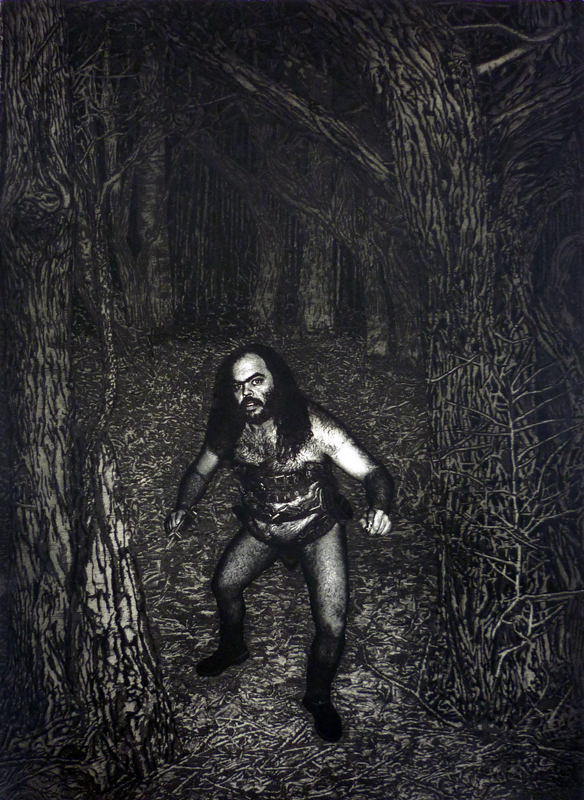
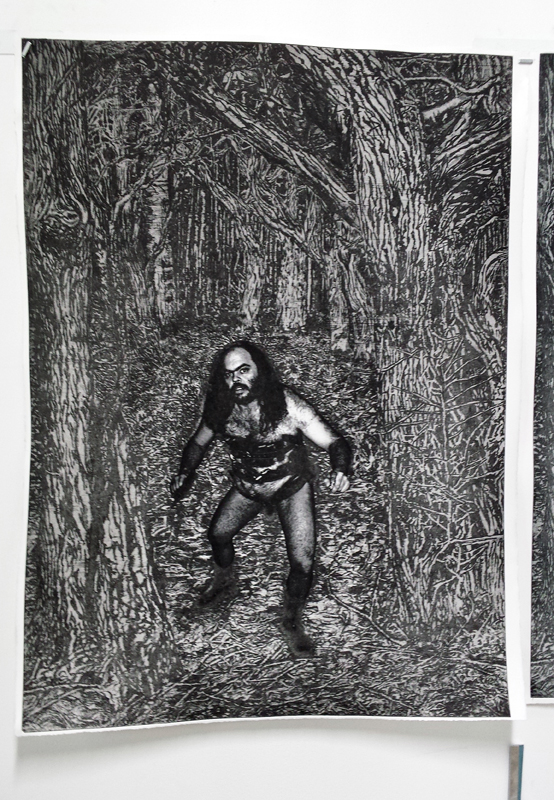
I went back to an image I found on the internet a couple of years ago when I was making the installation ‘Syndrome’ of a guy in his room posing almost naked with guns and weapons strapped to his body.

I felt he might embody the contemporary wild man. I have gone back to the source of the image and found he has become a meme with many postings and comments.

This furthers the idea of identity and illusion. Someone on the edges of society.

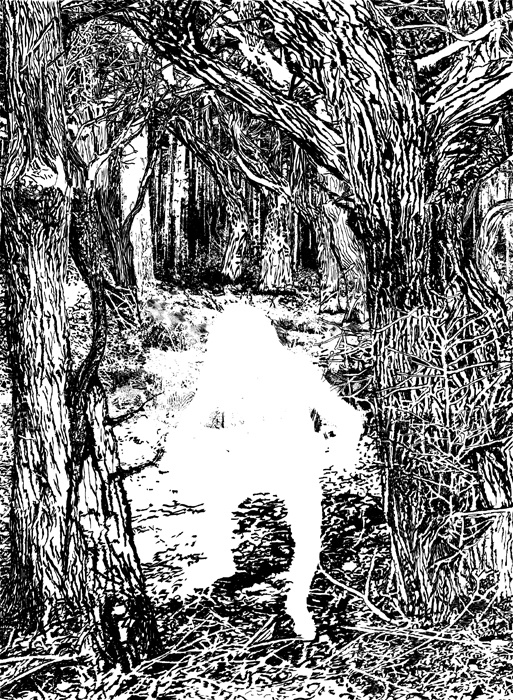
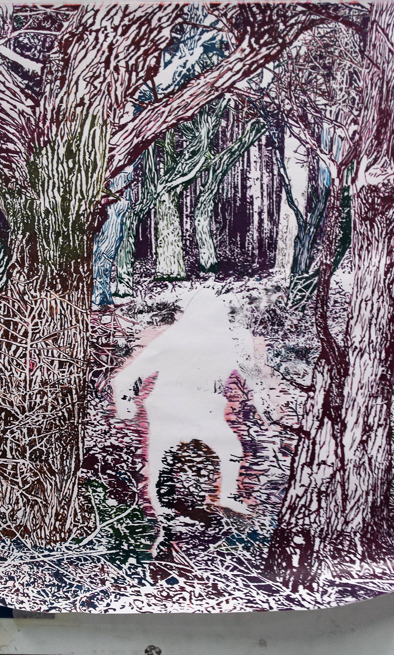
Through a laborious process of drawing and soft-ground etching with aquatint I have placed him into the ancient forest of all our origins.

Forst drawing printed onto thin paper

Final drawing printed onto thin paper

I polished a steel plate and added the photo etching around which I would draw the forest.

Soft ground (a sort of wax) is rolled onto the plate and the paper drawing is placed on top.

The pressure of the pencil on the paper pushes into the wax beneath. I used coloured pencils to see where I had drawn.

Drawing into soft ground using coloured pencils

Drawing into soft ground using coloured pencils

After the dark areas are drawn over, the paper is peeled away, the wax sticks to the paper leaving the metal exposed for etching.

The plate is etched in acid, then placed back under the paper and drawing continues to add midtones.

Soft Ground Peel

Soft Ground Peel

The paper is peeled away and more drawing is done and etched until the range of tone is acheived

Peeling away paper from plate

Peeling away paper from plate

Between each drawing and etching the plate is printed to see how the tones are looking and which areas need more work.

A dusting of aquatint added a final depth of tone.

Test print

Test print

I wanted the forest to appear dark and primordial, the forest of Grimm brothers imaginination

Final print - Forest of Eden

Final print – Forest of Eden

Not the Garden of Eden but the land before, of after, the garden existed.

Dissertation sickness. Gaining knowledge should be enriching – Bill Viola talks about a pollution of the mind from too much information, he means a flooding from advertising and media and such like that has a negative impact on our well being. Walter Benjamin was also concerned that post industrial life was overwhelming our senses in such a way that we couldn’t process the volume of experiences we had in order to gain any knowledge or understanding. I think I may be overloading my mind with too many books – too many threads to follow – so that I can no longer process meaningfully.
Nostalgia – the wounds of returning.
Ruin Lust at Tate Britain was a chance to revel in the beauty of decay – to feed desire for the lost idyll. Desire is such that it is eternal.

Jane and Louise Wilson - Azeville

Jane and Louise Wilson – Azeville

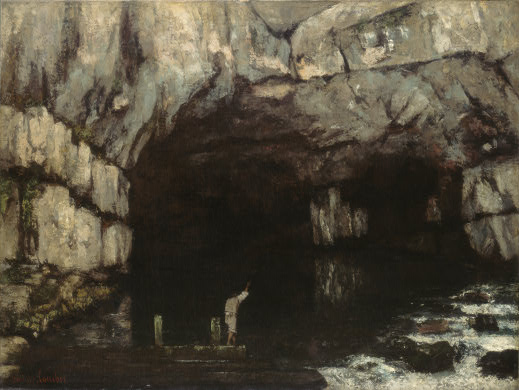
I have just been reading about critic Neil Hertz comments on Gustave Coubet’s La Grotte de la Loue 1864 as an example of the move from the romantic sublime to the post modern sublime.

Gustave Courbet - La Grotte de la Loue

Gustave Courbet – La Grotte de la Loue

The Wilson’s photograph Azeville seems to share the same unnerving dark space where there is no escape into infinity only a reflection back to self meditation.

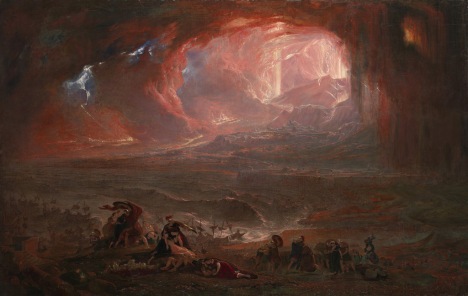
John Martin the master of the fantastical sublime shows the devastation of Pompeii.

John Martin - The Destruction of Pompeii and Herculaneum

John Martin – The Destruction of Pompeii and Herculaneum

With the sublime there is always the possibility of death.

If a dark space of contemplation is post modern sublime what is this …

1405 Pompeii

feels like a brash disrespect for the dead to me.

Finlay Taylor, tutor in printmaking at RCA, brought together an impressive selection of works for an exhibition at Camberwell Space – Against Nature.

In his introductory speech at the symposium held in conjunction with the show he spoke about cause and effect of environmental interventions.

The extinction of the Large Blue Butterfly in Britain as habitat is eroded as land use changes and the introduction of a butterfly from Scandinavia as replacement – a near match.

The high mercury levels at the top of Mount Fuji brought on the winds from China’s expanding coal mining industry.

Dr Joy Sleeman and David Cross, speakers at the symposium, discussed our shift in perception of landscape after the moon landings.

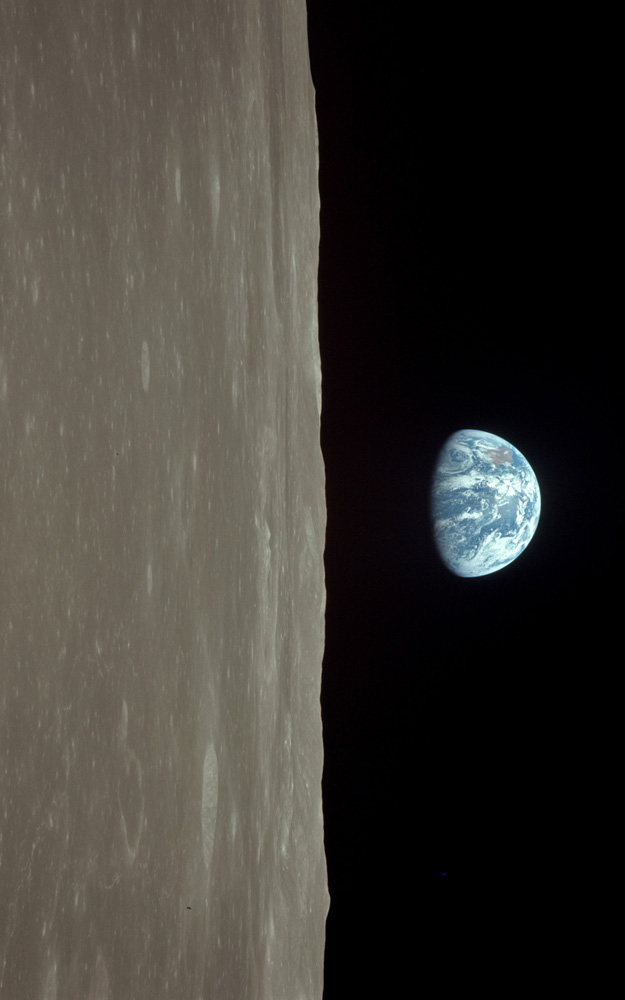
The iconic image earthrise – looking back at earth from space apparently very nearly didn’t happen.

The highly trained military scientists had been instructed to only photograph the surface of the moon with the precious amount of film that they had taken into space with them.

1405 earthrise

However, when they saw the earth as it had never been seen before and it was so beautiful they disobeyed command and pressed the shutter.

Optimum selfie.  It’s been a while now since the reverberations of that image were first felt, it was supposed to unite us as a planet, to position us within the enormity of the universe so that we could appreciate our lives as being part of something amazing and vast.

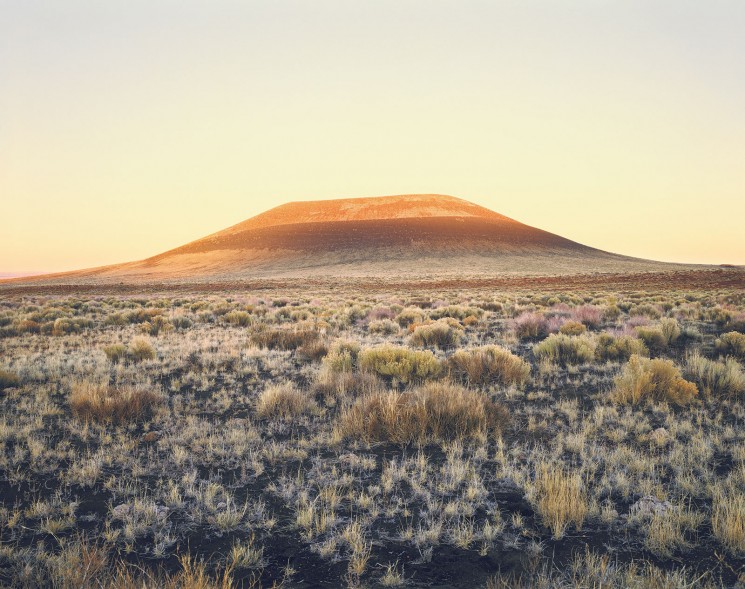
Our skies, flooded with artificial light means we can no longer see the stars. Our territory has shrunk. James Turrell makes work to try and open up our skies to us again. By creating an enclosure to look out from, a vaulting occurs in our perception, bringing the sky closer, and as the light changes throughout the day and the seasons a myriad range of colours can be observed.

James Turrell - Roden Crater

James Turrell – Roden Crater

His friend and art collector Count Giuseppe Panza di Biumo believes that if everyone could visit The Roden Crater then all violence would stop.

Also we wouldn’t need any hallucinogens.

Crossing the channel to see Bill Viola in Paris. Dissertation research isn’t all sitting in the library.

Bill Viola - Fire Woman

Bill Viola – Fire Woman

Enjoyed some favourite pieces and saw some new ones.

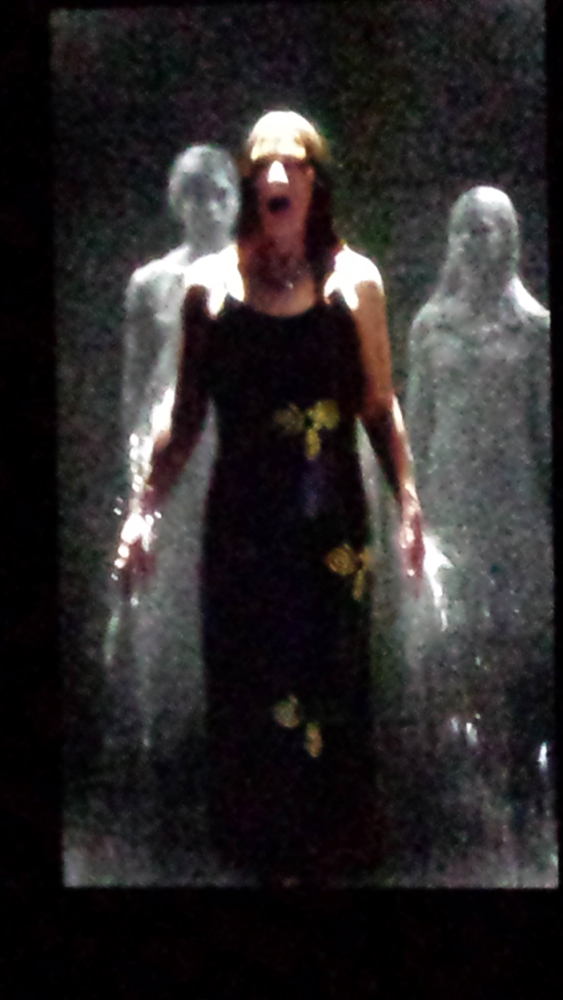
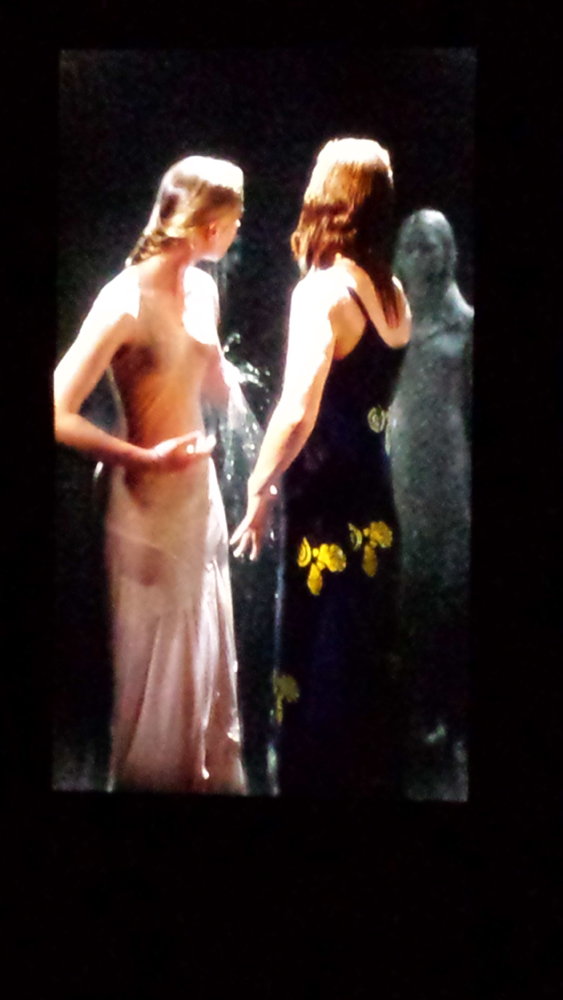
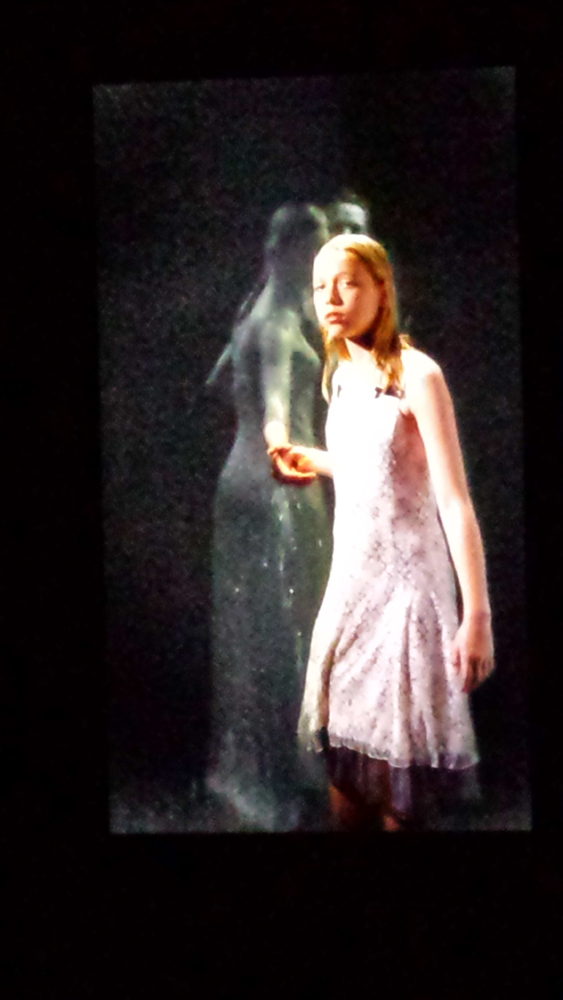
I found ‘Three Women’ very hypnotic and moving. For me it was about cycles of separation.

The mother figure steps out from a grey mist through a wall of water, with all the wetness and rupture of birth, she emerges glistening into full colour.

Bill Viola - Three Women

Bill Viola – Three Women

She reaches back for the older girl and guides her on her journey through the baptism of water to be at her side, the older girl in turn then takes her sister by the hand to join them.

Bill Viola - Three Women

Bill Viola – Three Women

No sooner are they all together than the mother figure steps back through the veil, the older girl soon follows, leaving the young girl suddenly alone.

As she reaches back and takes her older sister’s hand to return from where she came, she turns directly to the viewer, her gaze holds us in a grief of separation.

Bill Viola - Three Women

Bill Viola – Three Women

Who steps over the threshold willingly?

Crossing Oceans – ‘The Stuart Hall Project’ film is a poetic collage of archive footage set to the music of Miles Davis, directed by John Akomfrah. Stuart Hall emigrated from Jamaica to the UK in 1951 to take up a place at Oxford University, and became a founding figure of cultural studies in Britain.

Stuart Hall

I have Jo Stockham (head of printmaking at the RCA) to thank for screening this film of a wonderful man sadly no longer with us.

This film is now part of an exhibition at the Stanley Picker Gallery in Kingston Upon Thames – Your Tongue in My Mouth

1405 Standing on the Frontier (22)

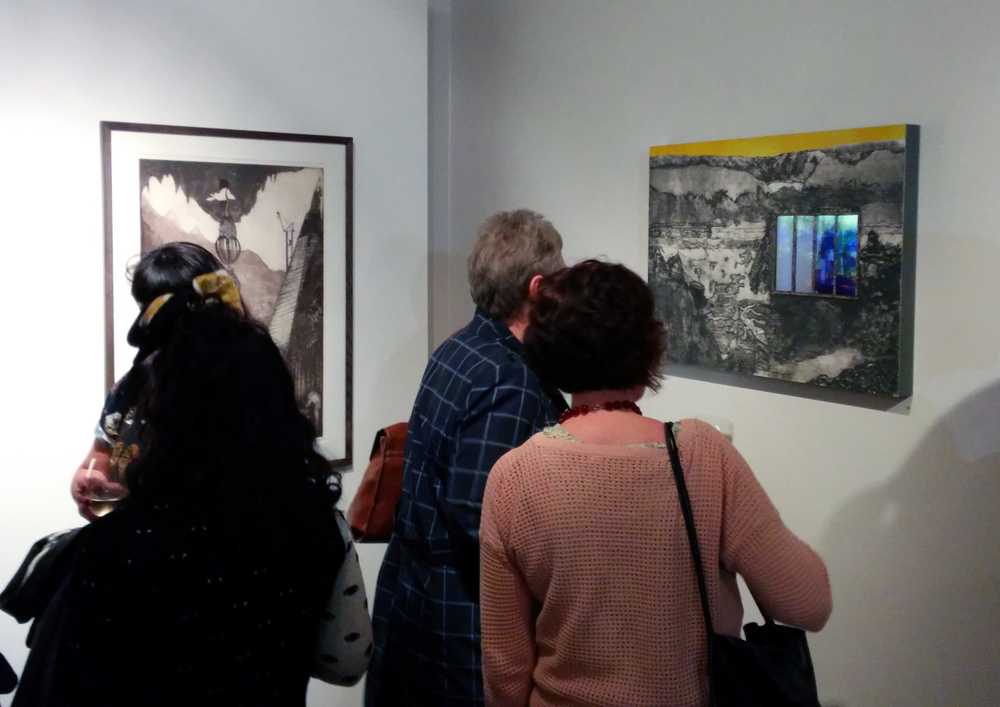
Honoured to be invited to join the artists in Standing on the Frontier, a group show at Unit 24 Gallery curated by Takayuki Hari and Noa Edwards.

“One of the tasks art has assumed is making forays into and taking up positions on the frontiers of consciousness (….) and reporting back what’s there.” –Susan Sontag, ‘The Pornographic Imagination’.

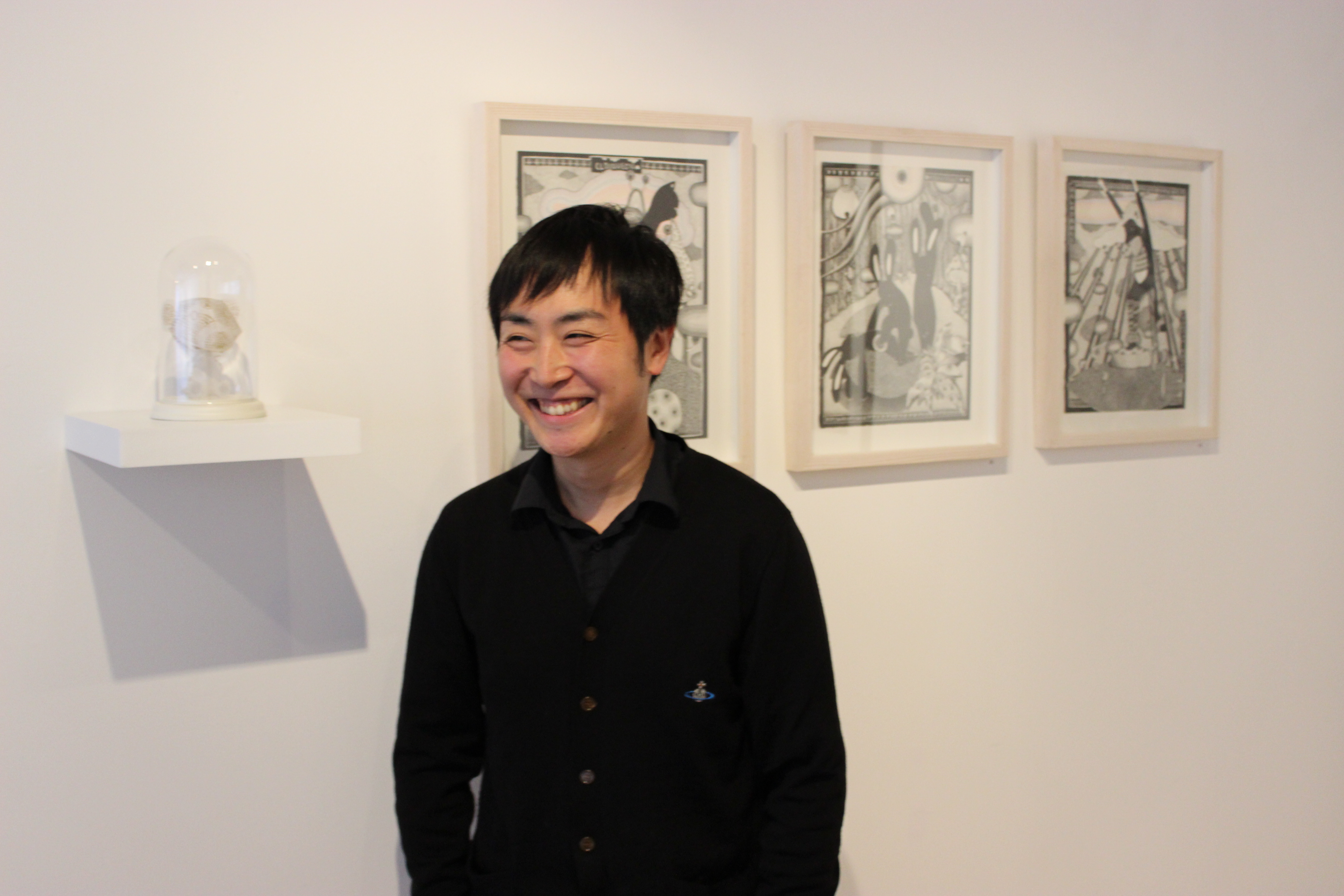
Takayuki Hara with his work

Takayuki Hara with his work

The images presented by the artists in Standing on the Frontier depict views taken on a redefining the frontier between reality and the imagination. On this meandering journey the viewer weaves his or her way across the line that demarcates the boundary between the mundane scenery of familiar places and the surreal landscapes of the individual mind.

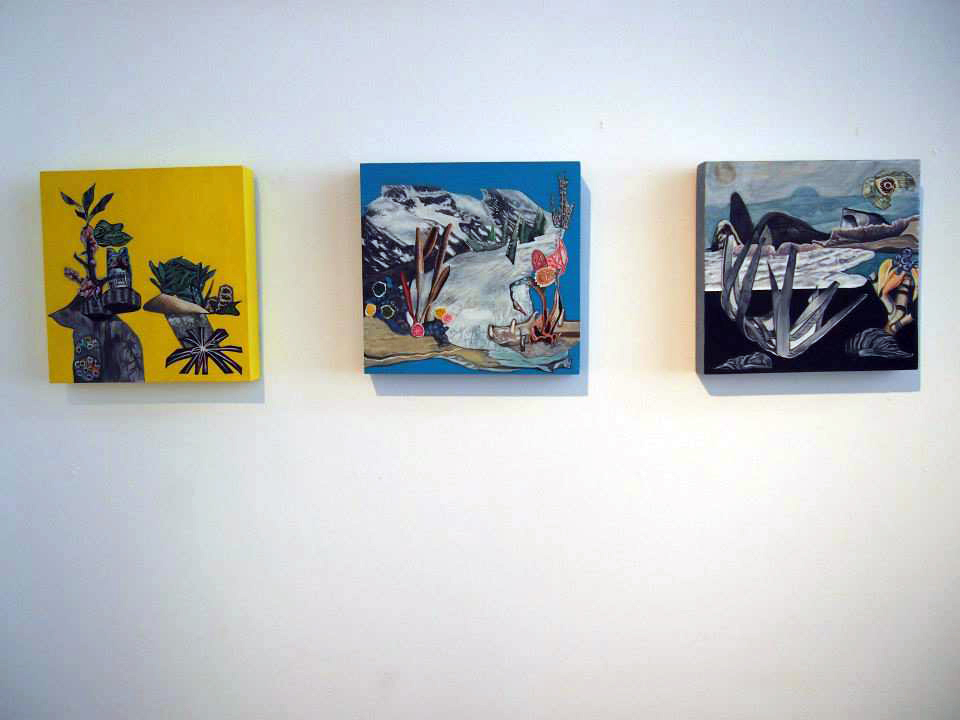
Noa Edwards paintings

Noa Edwards paintings

A review can be read here

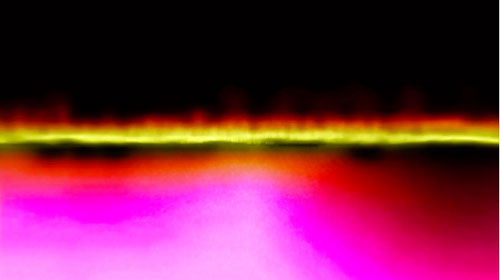
Susan Eyre - Yellow Sky

Susan Eyre – Yellow Sky

The boundary I was thinking about here was the one between outside and inside a controlled environment.

A dystopian future where all life is sheltered in a sort of Eden project.

Coming up soon –

I have some work in the Ochre Print Studio Summer exhibition

Would 1/2 ve

Would 1/2 ve

Some exhibitions I hope to visit –

Arkipelagos at Beaconsfield

Fleursdumal at Charlie Smith

Suky Best at Danielle Arnoud

Laurence Kavanagh at Marlborough Contemporary

Chris Marker at Whitechapel

TTTT at Jerwood Space

Daniel Malva at ArtEco

and of course Royal College of Art SHOW 2014


I have been lucky enough to be assigned Esther Teichmann as my dissertation supervisor.
I fell in love with Esther’s work when I first saw it at the ArtSway Open 2008.

She was showing hand coloured photographs from the Mythologies series.

Esther Teichmann - Mythologies

Esther Teichmann – Mythologies

It has been inspiring to able to talk with her and discover a mutual interest in lightning and the remarkable Litchenberg Figures that are left by a strike on skin

Litchenberg Figure

Litchenberg Figure

Also inspiring to see her sensuous show Fractal Scars, Salt Water and Tears at Flowers Gallery.

Esther Teichmann installation view at Flowers Gallery

Esther Teichmann installation view at Flowers Gallery

In a gallery talk Carol Mavor, in response to Esther’s work, spoke of shells, grottoes, sleeping beauty (someone who has forgotten her clitoris) and the proposition to ‘Let your lids drop the fall is always worth it’ .

Esther Teichmann

Esther Teichmann

We are taken deep inside the grotto, the dark space of desire.

I have been re- reading through the journal of Sergio Vega who ends up in a grotto at the centre of Paradise as defined by the mapping of Don Antonio de Leon Pinelo undertaken in 1650.

Sergio Vega followed the ancient map to a location in Brazil and finds himself having a transcendental experience in the cool waters of a secluded cavern.

Sergio Vega Windows on the Sublime 1

Sergio Vega Windows on the Sublime 1

I have spent my first day in the British Library Reading Room soaking in the atmosphere of investigative minds.

My first enquiry has been to try and find out who decided to name Paradise Road, Paradise Walk etc with such aplomb.

Paradise Road SW4

Paradise Road SW4

One book cites a profusion of Paradise Rows springing up in Victorian times so named by mendatious developers to attract customers to their mews squatting in not so desirable locations such as along railway embankments. Another book dates the Paradises to the 1700’s. The Victorian’s maybe just ran with the theme, the advertisers sleight of hand to gloss over the facts with hyperbole. Paradise Road in Islington had previously been Named Love Walk – this usually meant where the prostitutes hung out.  A day can easily slip by in the library and maybe only one small paragraph might be gleaned for the dissertation.

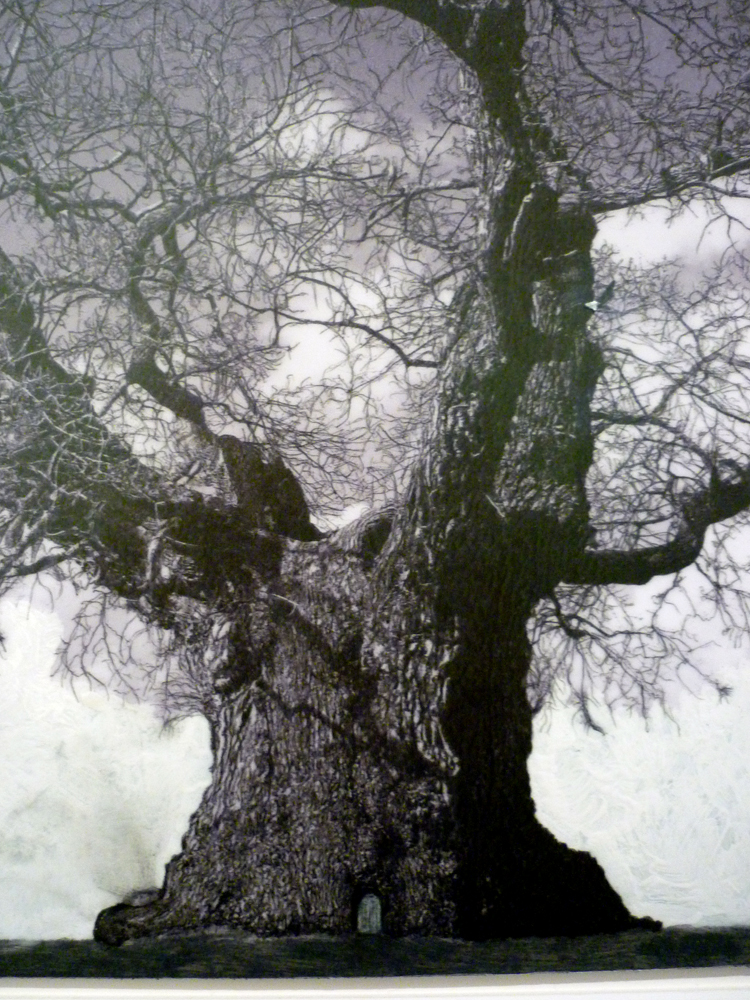
I really like these drawings by Patrick Van Caeckenbergh. I have ancient forests in my head at the moment and I like his little interventions.

Patrick Van Caeckenbergh

Patrick Van Caeckenbergh


Patrick Van Caeckenbergh

Patrick Van Caeckenbergh

I think he has a sense of humour

Patrick Van Caekenbergh

Patrick Van Caekenbergh

Also obsessive as he lived in a piece of art for 4 years.

This is a link to the website of Cristobel Leon and Joaquin Cocina – they make amazing inventive films

http://leoncocina.com/los-andes/

In ‘Los Andes’, a restless primal spirit takes possession of an office room.

Cristóbal León and Joaquín Cociña Los Andes

Cristóbal León and Joaquín Cociña Los Andes


Again a bit out of date with my life. Rewind, fast forward. A week after my interview at the RCA I went to see the current MA Printmaking student show at Café Gallery Projects – that was a year ago. I left in awe and apprehension. Suddenly here I am participating.
There was a vague concensus that we should have some kind of unifying theme but we knew that couldn’t be through the work shown as we were all individual practises. So we thought we would choose a text we could respond to through a group publication.
Rob being our show rep came up with a suggestion to use Air Guitar, an essay by Dave Hickey.

Rob Miles

My initial reaction was I didn’t like Hickey’s style and it took a few readings for me to appreciate some of his points.
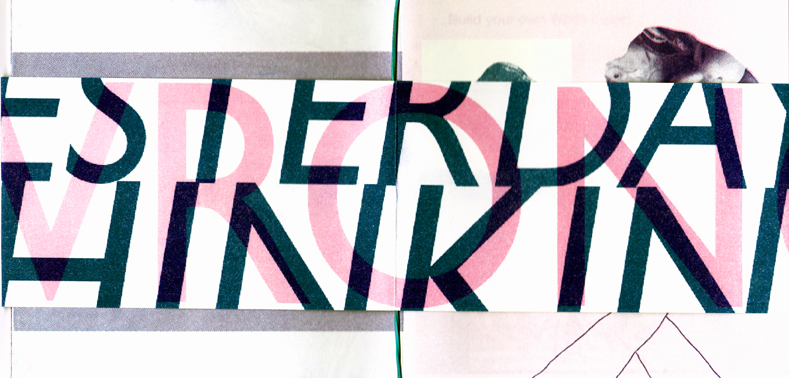
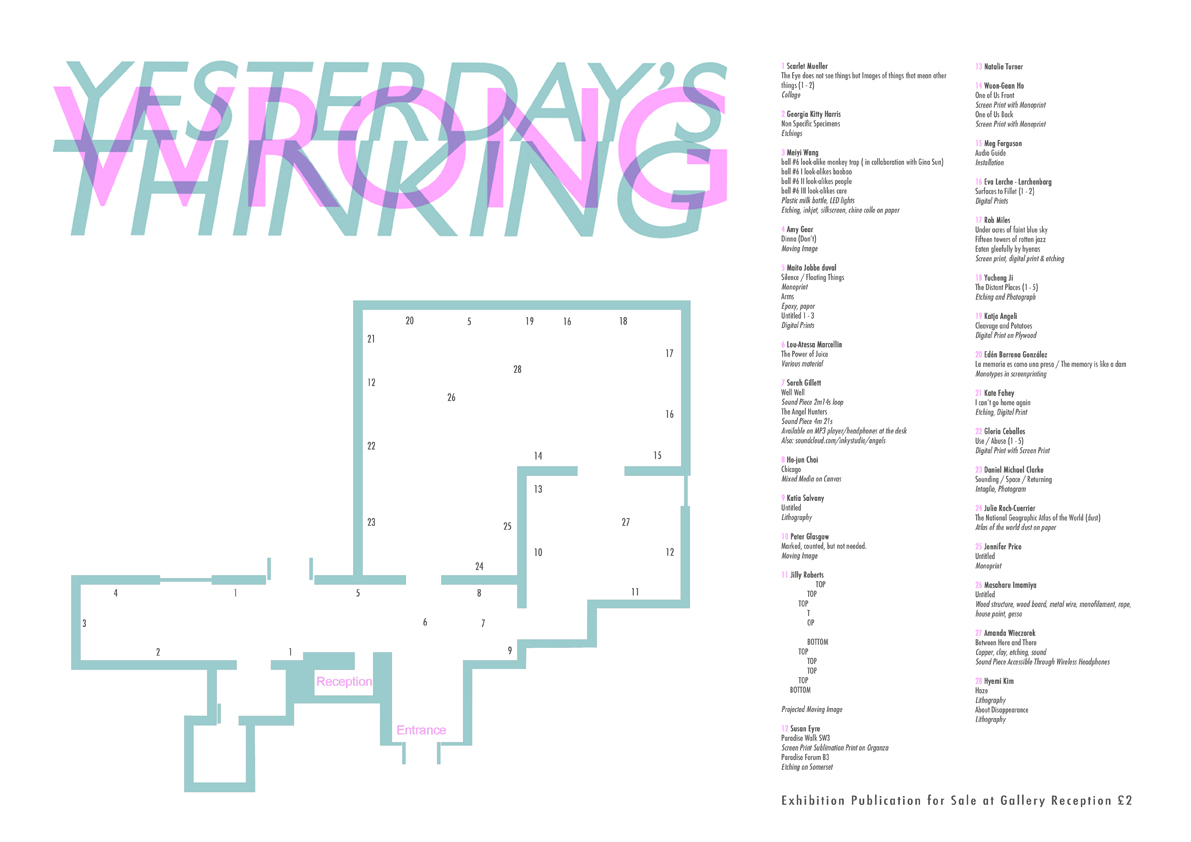
From this text we managed to wrestle the title YESTERDAY’S WRONG THINKING.

The title became autonomous. It spoke of tomorrow’s world.

1404 YWT publication_0001
We made a neat little risograph publication in teal and fleuro pink.

1404 YWT publication_0002


Loading

Day one it felt impossible that we could all fit in the space.

But by day 3 we had a plan.

1404 Floor Plan


I was showing the next two from the Paradise on Earth series

Paradise Forum B3

Paradise Forum B3

The etching that had taken so long to get a decent copy mounted on steel and hung in the room with the videos for a low level light

1404 YWT Paradise Forum B3 3

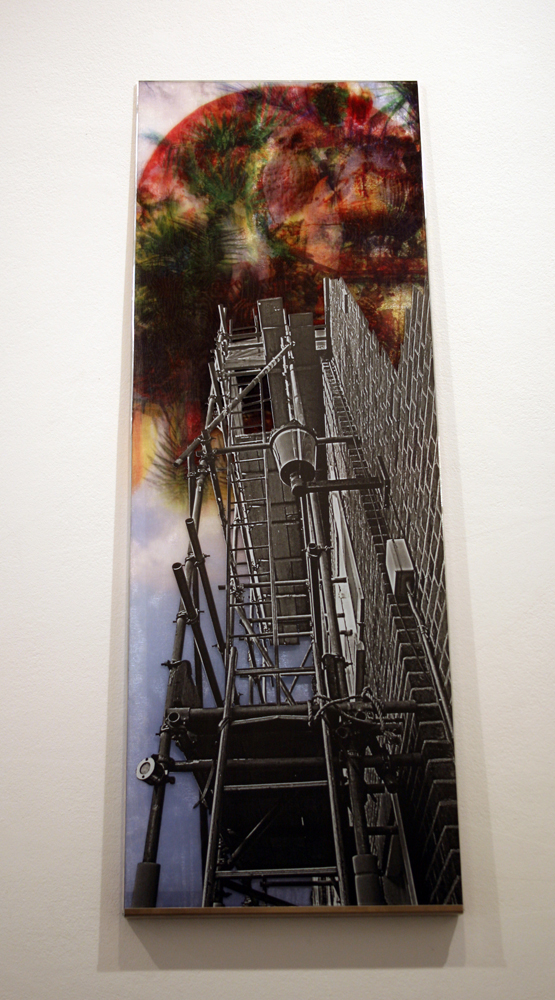
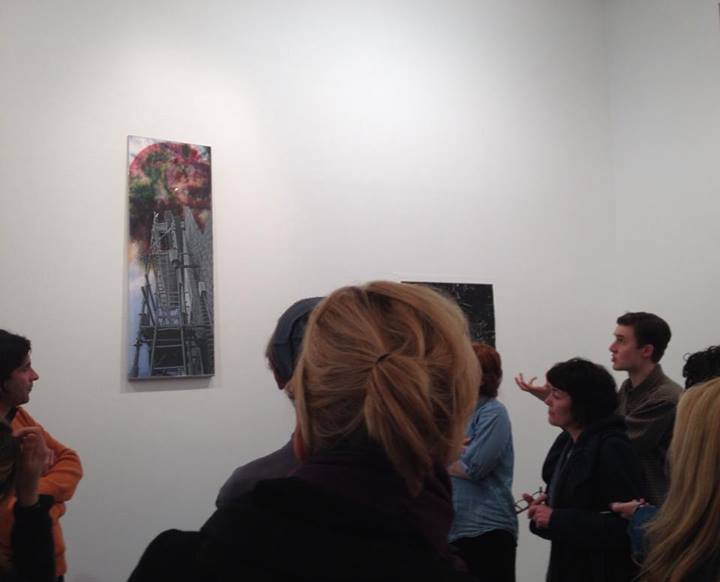
and the mixed media piece on Perspex with organza which had also been a technical challenge hung high on the wall to force perspective

Paradise Walk SW3

Paradise Walk SW3

And here we are for the crits

Crit pic

Only had about 3 minutes to discuss Paradise Walk SW3 but Paradise Forum B3 received a good crit and as Rob kindly pointed out the basis of the discussion was the content of the work and not the medium or technique.

That’s a step forward for me as so often I get asked how rather than what or why when it comes to my work.

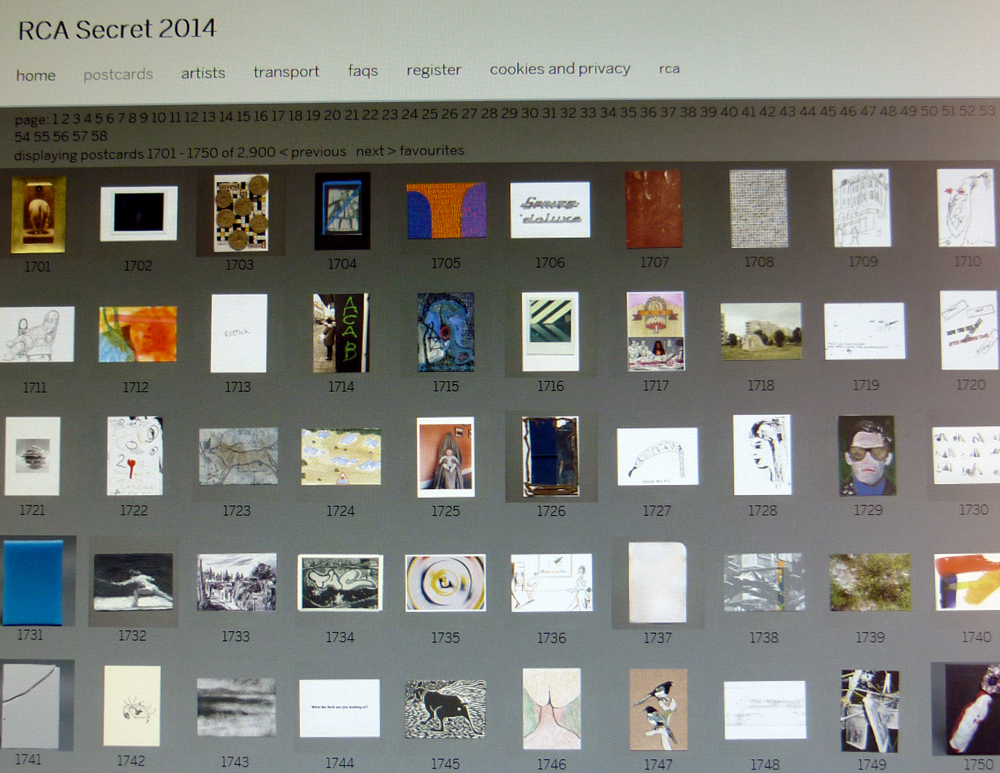
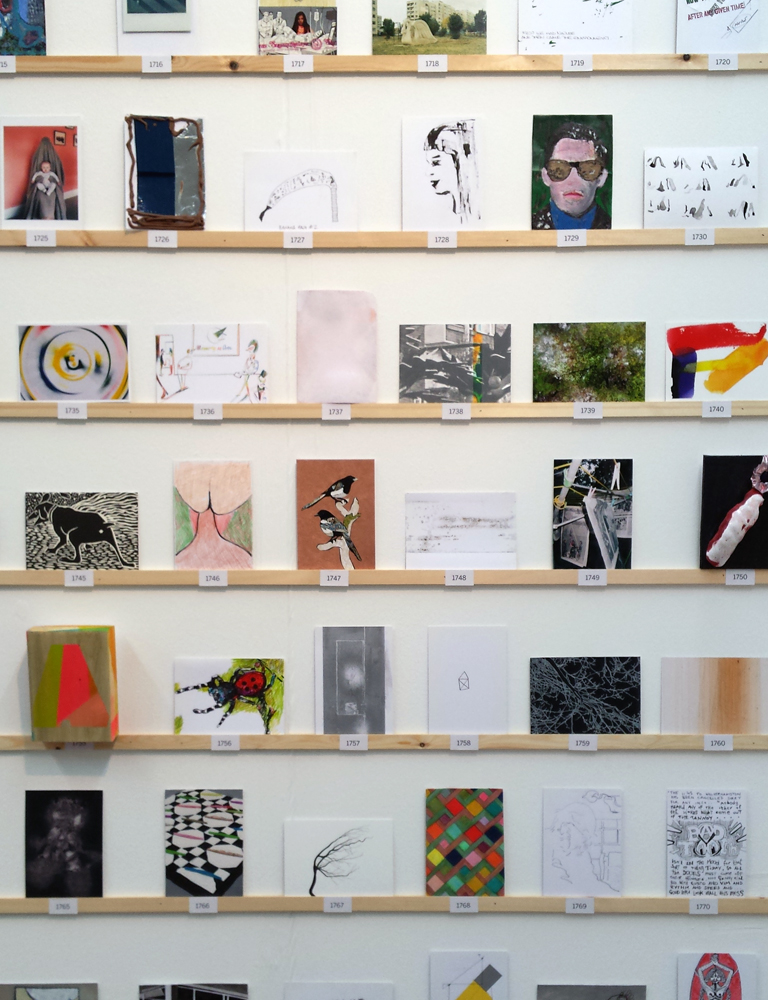
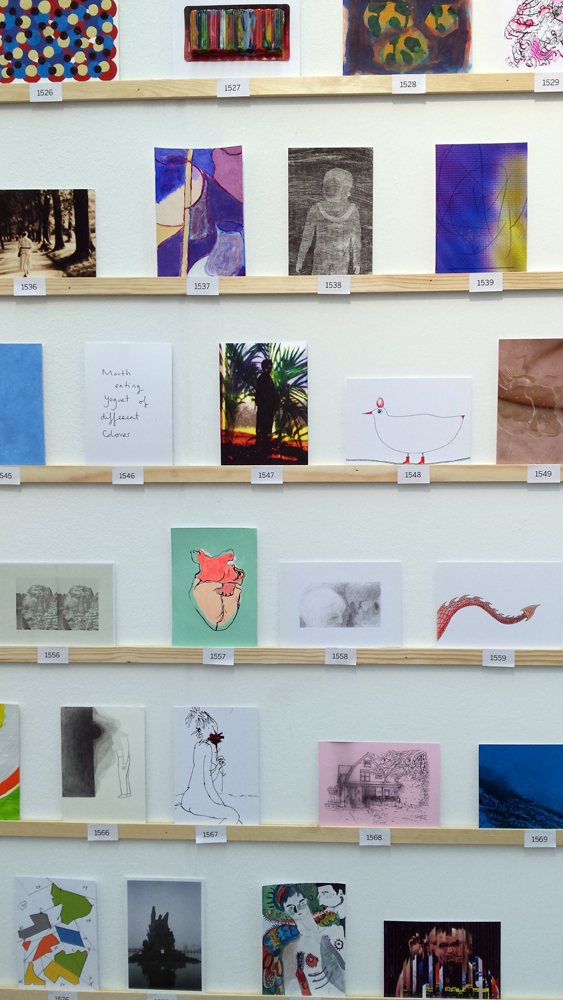
Also had the privelige to participate in RCA Secret 2014.

All current students plus celebrated alumni make 3 postcards that can be viewed online.

1404 postcard online

Or in person.

1404 postcard secret

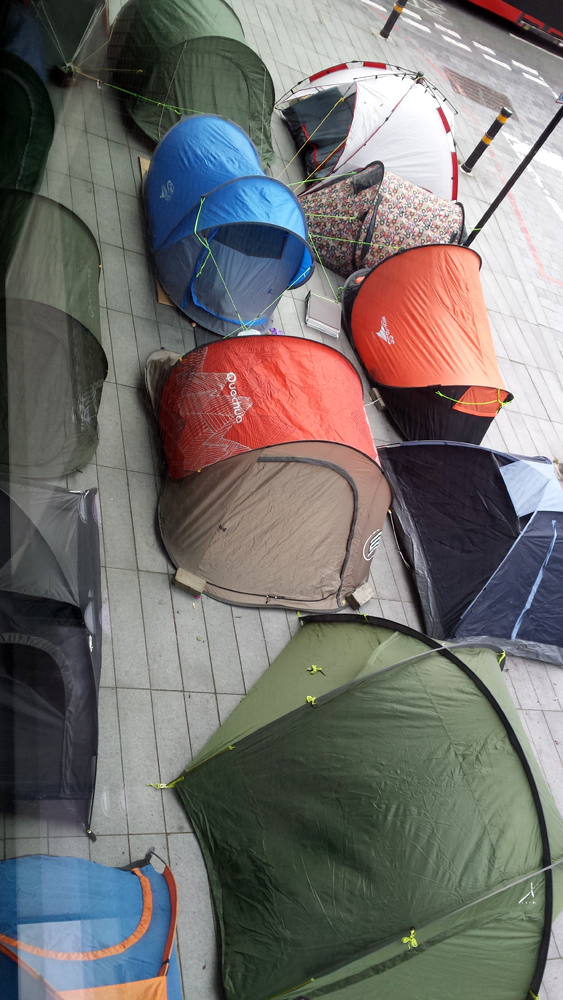
There is a lot of interest and the queuing starts days before

1404 Gathering

It’s a secret who made what until the purchase is made

1404 postcard 3

So if you can spot your favourite artist’s work you may get lucky

1404 postcard 2

Or you may discover someone new

1404 postcard

The next event I will be participating in is Standing on the Frontier Vol 2

at Unit24 Gallery Great Guildford Street SE1 oFD

Standin On The Frontier V2 flyer

Really excited about this.

Yellow Sky ready to hang.

Yellow Sky

Yellow Sky


Been spending a lot of time in the etching workshop.
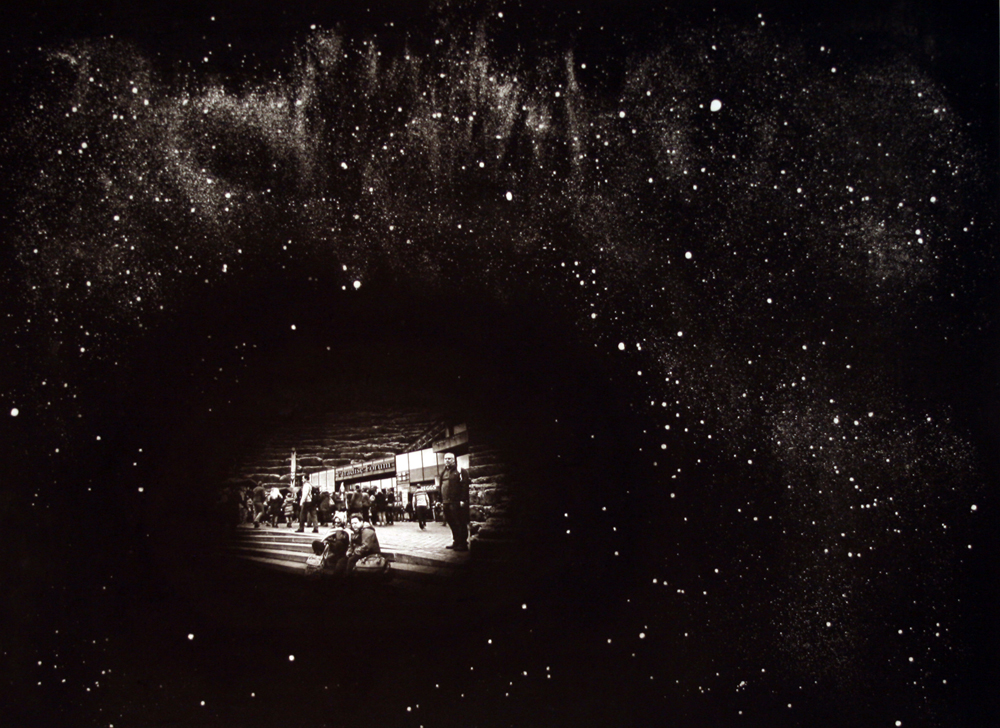
It all started with a photo of Paradise Forum shopping mall in Birmingham.
Everyone looked so pissed off – yet if they just looked beyond to the cosmos, wouldn’t they be dazzled.
I thought the two girls on the steps looked like they had their feet dangling in space, that they were sitting on the edge of something, awaiting their escape.

Of course the word Forum conjures up ideas of a Roman Forum, from which I segue to amphitheatre, a place of gathering, like a shopping mall. A sense of history of construction, of public space.
This small exert of life on earth in fadeout – a temporal moment.

Paradise Forum B3

Paradise Forum B3

I listened to Bill Viola being interviewed about his current retrospective at the Grand Palais in Paris which I hope to visit shortly. He talks about the brevity of our lives and how it is really important to leave behind some knowledge or some new thing for the next generation, it can be something really simple. Through knowledge we gain transformation. But beware, too much information can become a pollution and we have to separate out the unnecessary bombardment of advertising and media sources from the good stuff that enriches us.

1404 Bill Viola

Also looking at  the work and ideas of James Turrell. His formless landscapes of light with no object, no image and no focus leaves us only with an awareness of ourselves looking and an experience only felt otherwise in dreams, meditation or near death experiences. I can remember my visit to Gagosian a few years back to see Dhatu – staring into a pink misty void, anticipating angels.


JAMES TURRELL  Dhātu, 2010

JAMES TURRELL
Dhātu, 2010


In ‘Once Upon a Time’ Steve McQueen presents 116 images from Karl Sagan’s Golden Record which was launched into space in 1977 to enlighten any extraterrestrials about life on earth. McQueen overlays geographical images and scientific diagrams with the sounds of people speaking in tongues. The highly factual with the highly emotional – potentially equally indecipherable to aliens but showing an alternative side to human nature other than the one NASA documented.
Steve McQueen - Once Upon a Time

Steve McQueen – Once Upon a Time

In ‘The Dry Salvages’ Elisabetta Benassi presents 10,000 bricks made from clay taken from the 1951 Polesine flood area (one of the largest natural disasters in Italy) that are printed with the names and codes of the largest space debris orbiting the earth.

1404 Elisabetta Benassi (2)

Elisabetta Benassi – The Dry Salvages

Power of nature, power of nations.

Elisabetta Benassi - The Dry Salvages

Elisabetta Benassi – The Dry Salvages

The regeneration of matter. The impossibility of control.
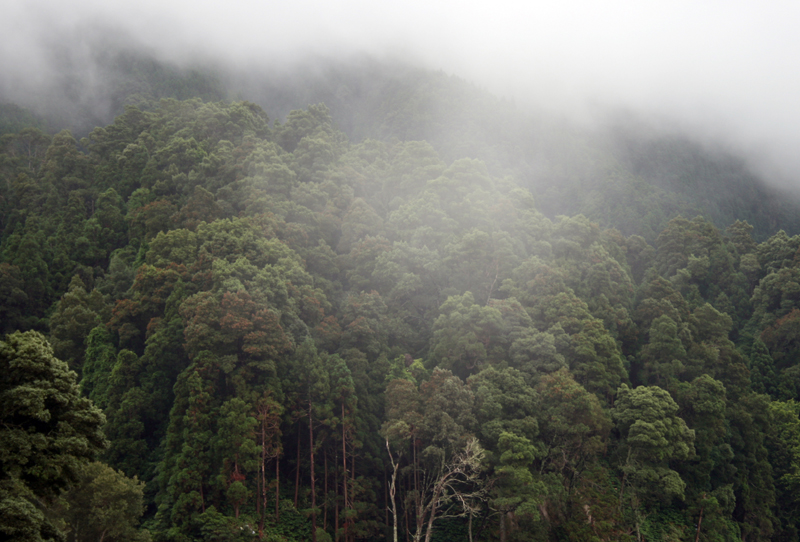
I have been considering the impact and use of different materials in some of the shows I have seen lately.

The weight of Phyllida Barlow’s sculptures

Phyllida Barlow

Phyllida Barlow

Because of their displacive presence and the stillness, they look heavy, immovable;but maybe they are not and if you pushed against them they would swing lightly away.

Phylida Barlow

Phylida Barlow

The frozen painting of Lawrence Carroll.

Lawrence Carroll

Lawrence Carroll

In the Holy See Pavilion at the Venice Biennale tasked with the theme of re-creation after the cleansing of the great flood Carroll (click for interview) chose to use ice as the medium of a new beginning.

Noemi Niederhauser, winner of the ArtLacuna Prize created an installation during her residency at the gallery – Vista Follies explored themes of artifice and a fetishized view of nature.

Noemi Niederhauser

Noemi Niederhauser

Her chosen materials are at odds with the objects they form.

Noemi Niederhauser

Noemi Niederhauser

Out of the mud. Like ice, mud talks of beginnings.

In the exhibition Delve at Leyden Gallery Atsuko Nakamura uses salt crystals as metaphors for natural evolution and time passing.

Atsuko Nakamura

Atsuko Nakamura

The land has all been cut from this atlas encrusted with salt crystals leaving only the oceans

Atsuko Nakamura

Atsuko Nakamura

after the tsunami the sea has grasped attention away from the land where power is usually described.

Glass Cat at Danielle Arnaud Gallery modest and even abject objects are hieroglyphs in whose dark prism social relations lay congealed and in fragments..In this perspective, a thing is never just an object, but a fossil in which a constellation of forces are petrified. Things are never just inert objects, passive items or lifeless shucks, but consist of tensions, forces, hidden powers, all being constantly exchanged.’ Hito Steyerl
William Waterhouse uses glycerine to repeatedly form a bubble – surface tension plus emotional tension.

William Waterhouse

William Waterhouse

Sophie Lascelles uses an unfolded cardboard box as low key screen for her projection ‘In the grasslands’

Sophie Lascelles

Sophie Lascelles

Sarah Woodfine’s sculptures are so smooth and solid. The pencil drawings on paper are immaculately pressed to a curved block of mdf – mdf made sexy

Sarah Woodfine

Sarah Woodfine

Helen Maurer uses light through cut glass and shadows to create mini animations in space

Helen Maurer

Helen Maurer

James Ireland uses materials found at the local diy centre, mock mini waterfalls in lumpy resin on garage shelving

James Ireland

James Ireland

There is a certain beauty through lighting and repetition and exposure, this can be the new sublime. The work is called ‘Epic’

Is a symbol now enough. This idea of the authenticity of the fake is something I will be tussling with in my dissertation. I have had a look at Jean Baudrillard on simulation but am not quite grasping his language yet.  So, first order simulation is an artificial copy of an original. Second order simulation blurs the boundaries between the authentic and the fake so they are hard to tell apart. Third order simulation is hyperreality which is artifice with no original. But wouldn’t that mean that the first of anything man made was an example of hyperreality. What about the first garden centre, the first cathedral. I got on better with Umberto Eco, Travels in Hyperreality.

Barton Hargreave gave an interesting talk at Ochre Print Studio about his work. Combining print with photography and sculpture to create simple silhouettes of figures in frozen movement.

Barton Hargreaves

Barton Hargreaves

The figures have a lightness about them which comes from the photographic origin and staging of his models who are captured climbing, suspended, or mid jump. Much of his work is installed in site specific locations and so he uses locally photographed images randomly collaged to inhabit the silhouettes.

Barton Hargreaves 'Promised Land'

Barton Hargreaves ‘Promised Land’

He also deals with images of the crowd, multiplying the figure. He has a wealth of knowledge about print surfaces and new technologies that are available. Wallwrap sounds an interesting material for outside installations and dibond was not something I was familiar with.

It’s been a crazy busy few weeks at the RCA making new work for the show at Café Gallery Projects so my blogs have got rather behind yet again.

Etching

Etching – work in progress

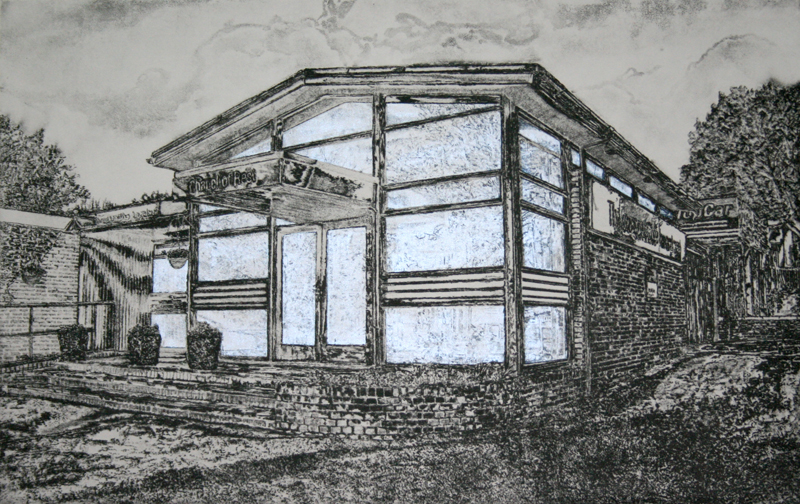
I have been working on the Paradise Forum piece as an etching. Etching is good for getting a really velvety black for the universe. It has been a real struggle to get the blend right between the photo etch and the aquatint. The problem of a dark or a light circle as one surface changes to another. I have learnt a lot about etching along the way.

Also had Paradise Walk SW3 piece on the go as well. From the photos I took on location I liked the scaffolding at one house – a Jacobs ladder.

Screenprint on Perspex

Screen print on Perspex – work in progress

Work In Progress. So good to mix with people from painting, sculpture and photography. To negotiate our spaces, to look at each others work and discuss relationships between the works. To see how consensus forms and finally to install the show.  Really exciting to see what had been created during the past term, to see work emerging from the chaos of the studios.
I took the two images of Paradise Road SW4 to the gallery not sure if I would hang one or both but found they worked well directly opposite each other.

Paradise Road SW4

Paradise Road SW4

It was appropriate you couldn’t see them both at the same time initiating a forced extra looking as people tried to see the difference between them, were they the same image, a mirror or what.

Paradise Road SW4

Paradise Road SW4

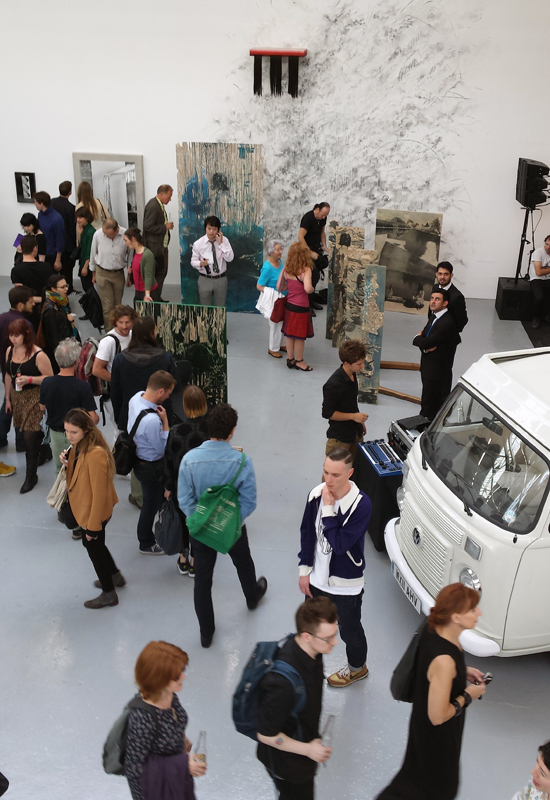
With around 150 students showing new work the private view was noisy and vibrant.

Then there were the cross programme group crits. Freezing under scrutiny, it all becomes a blur of half remembered phrases.
Felt rather deflated afterwards, really questioning my themes and motives which is a good thing though tough to process.

RCA Work In Progress

RCA Work In Progress

The most encouraging thing was that during the exhibition people stopped to look at my work and spent time looking.

RCA Work in Progress

RCA Work in Progress

It was also encouraging to find an image of my work included on the RCA website write up of the exhibition.

Printmaking students met at the new Serpentine Sackler Gallery to discuss the current show of Jake and Dinos Chapman – Come and See. There was discussion about who the Chapman brothers make their work for (the media) and whether they were taking the piss out of us, the audience.

Jake and Dinos Chapman

Jake and Dinos Chapman

The excessive lathering on of depictions of horror and violence, the mix of Nazi skeletons and dinosaurs and Ronald McDonald all amid scenes of torture and piles of bloodied bodies reflects the tropes of the horror film and video game industry and bears little relation to real life and therefore was not shocking. I don’t think this is a desensitization of our feelings but just the fact that the depictions are so unreal, like a war hammer game. Maybe they are labouring a point that we can no longer differentiate between reality and fantasy or that we enjoy looking at depictions of horror. This is something worth discussing but it all felt rather heavy handed. It seems they may have drawn themselves into a corner and can no longer surprise their audience.

Jake and Dinos Chapman

Jake and Dinos Chapman

They obviously have a big fan base but the general consensus of the seminar was one of boredom by these repeated depictions. I think there are probably lots of codes to decipher and art history references to acknowledge if you can be bothered. The attention to detail is astonishing from the accuracy of every minute figure in Hell to the layer of aging dust on the crude corrugated cardboard models of earlier work complete with cardboard audience displaying a gamut of emotions (children allowed in this cardboard world).

It felt a great contrast to the very moving and immersive experience of Richard Mosse’s ‘The Enclave’ for the Irish Pavillion at the Venice Biennale. Also work about horrors of war and man’s inhumanity to man.

Richard Mosse 'The Enclave'

Richard Mosse ‘The Enclave’

Filmed in Eastern Congo amongst violent armed rebels using a discontinued military reconnaissance film that registers infrared light which is normally invisible but here turns the landscape into a kaleidoscopic dreamscape where the vegetation registers in shocking pink. Hauntingly beautiful the film reflects a real nightmare scenario. We enter an alien world with a heightened sense of dislocation and confusion. Surrounded by giant screens we are trapped in a cycle, not knowing where to look or where the next assault may come from.

Richard Mosse 'The Enclave'

Richard Mosse ‘The Enclave’

After all the conflict looking for a quiet space for contemplation.

Woods v/e 1

Wood v/e 1

Woods v/e 2

Wood v/e 2

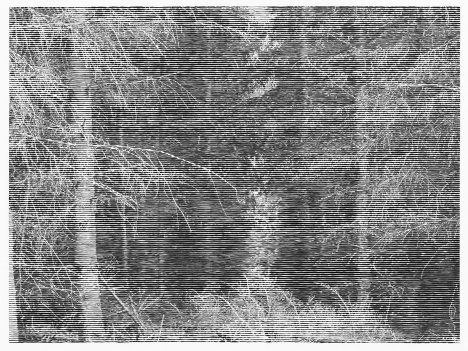
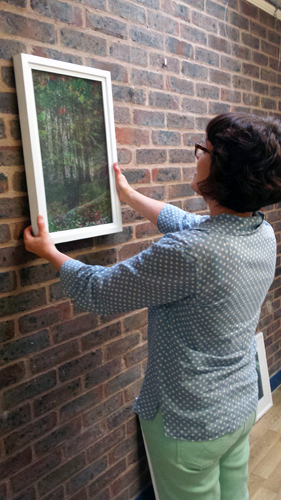
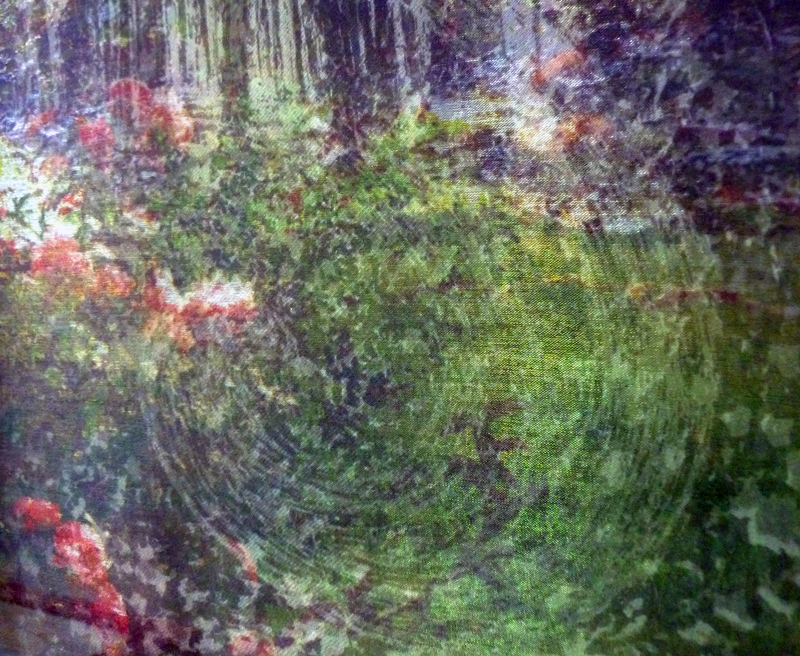
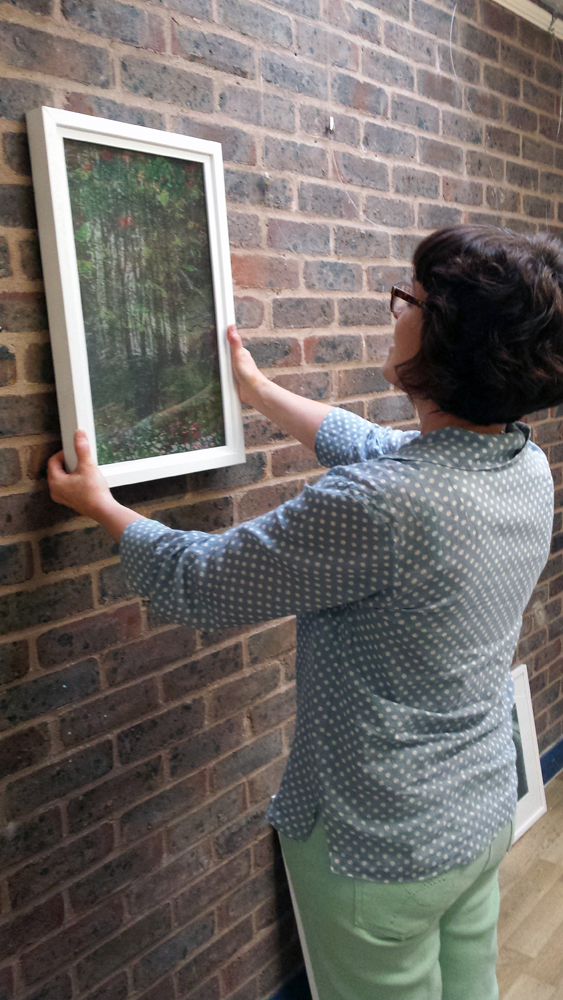
Finally managed to get these works which for now are just titled ‘Wood’ into frames. Greyscale sublimation print from a screen print of disperse dye on polyester under a layer of sublimation print organza.