Archives for posts with tag: A Stone Sky

In classical antiquity, a time stretching from Homer to the early middle ages, geographic orientation usually referred to landmarks or astral phenomena to determine direction. Eos, meaning dawn, and Hesperus, meaning evening, were named for sunrise and sunset with north (arctos) being marked by the constellation Ursa Major and later the Pole Star. The winds also became associated with direction and named in accordance with their qualities such as hot and humid or cold and dry.

The number of points on a wind rose began with the four cardinal points that were added to and refined over time. Aristotle designed an asymmetrical 10 point wind rose for “the study of things high in the air” (meteorology) which was later refigured by Timosthenes, a 3rd century BCE Admiral and geographer, naming a system of twelve winds and using this as a tool for navigation. The contemporary compass has its roots in the ancient classification of winds.

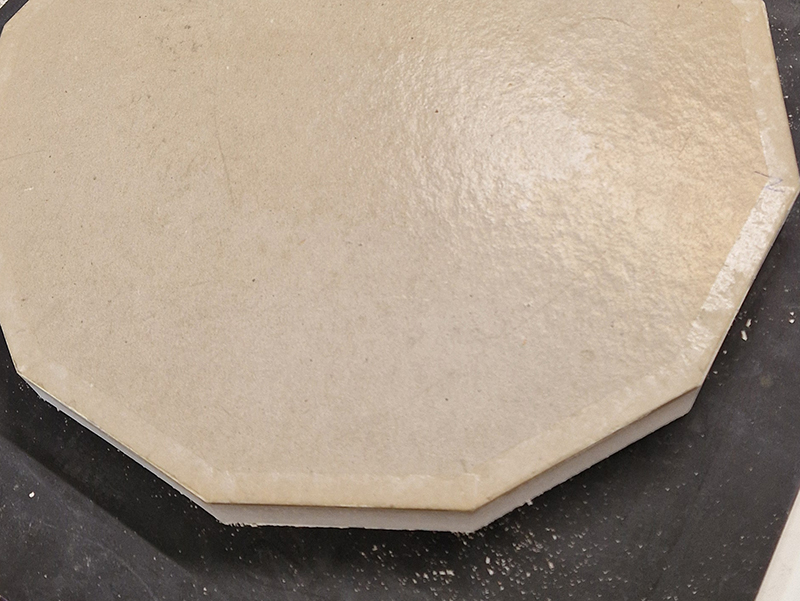
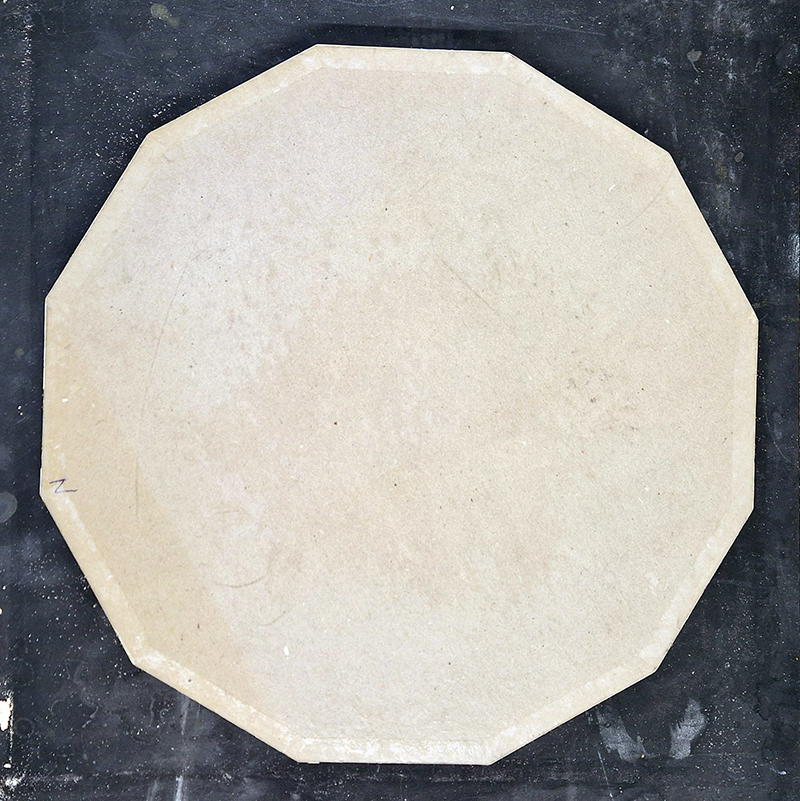
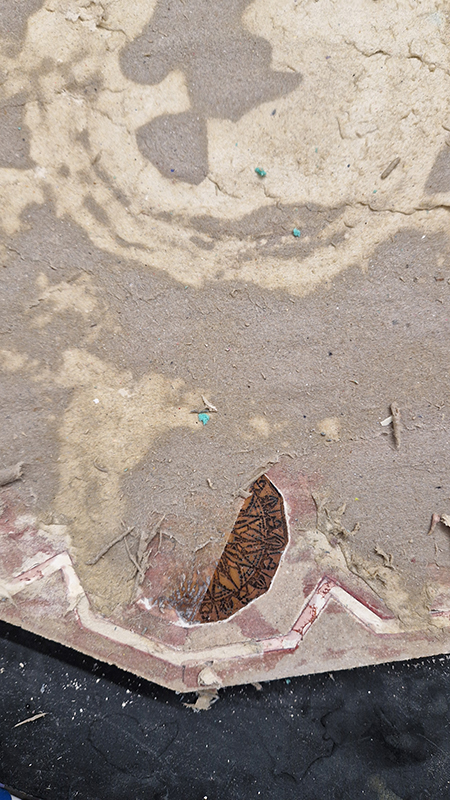
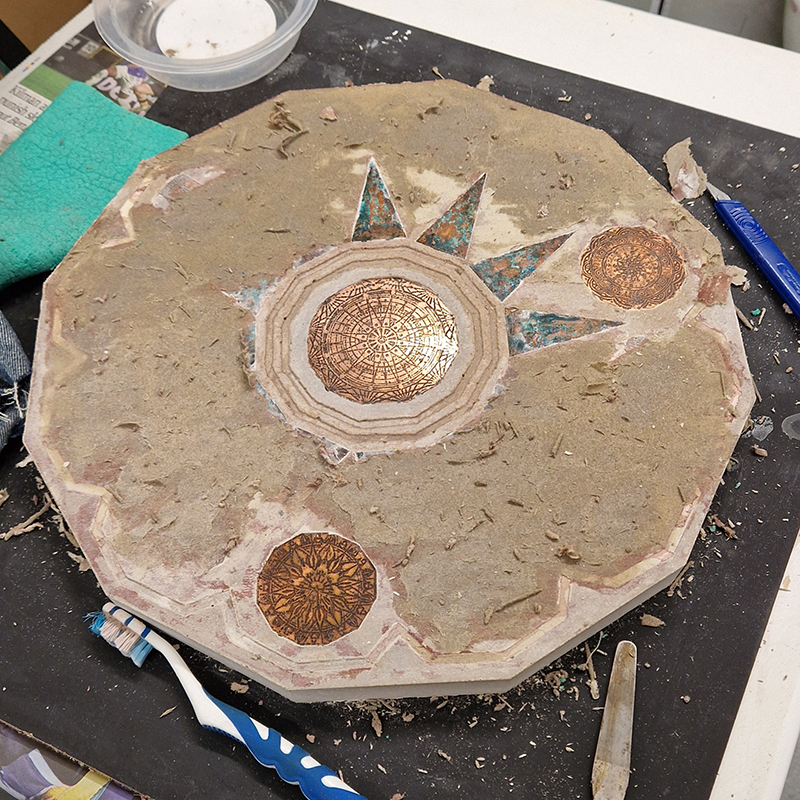
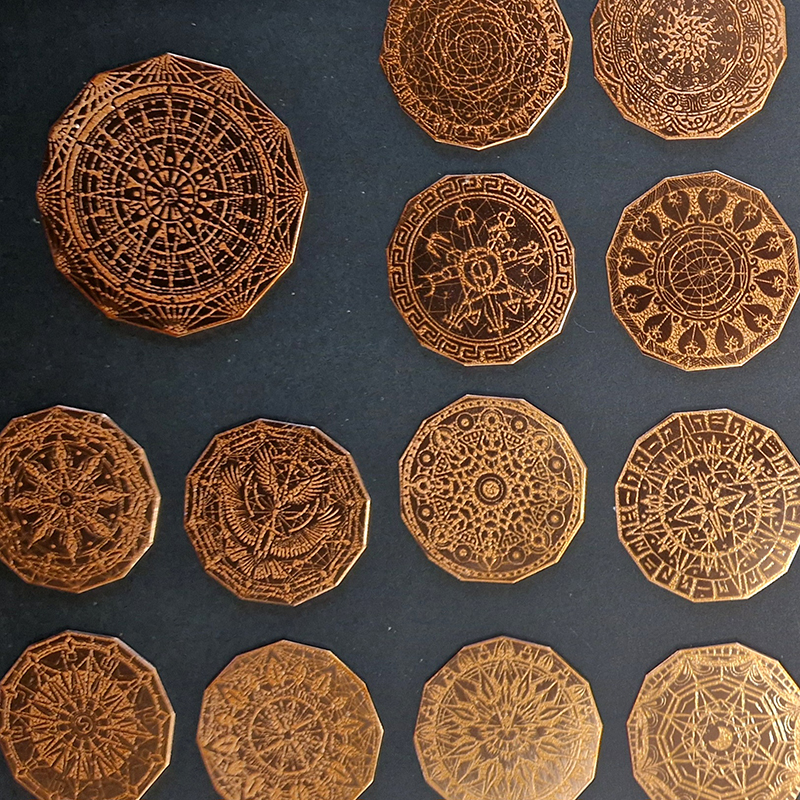
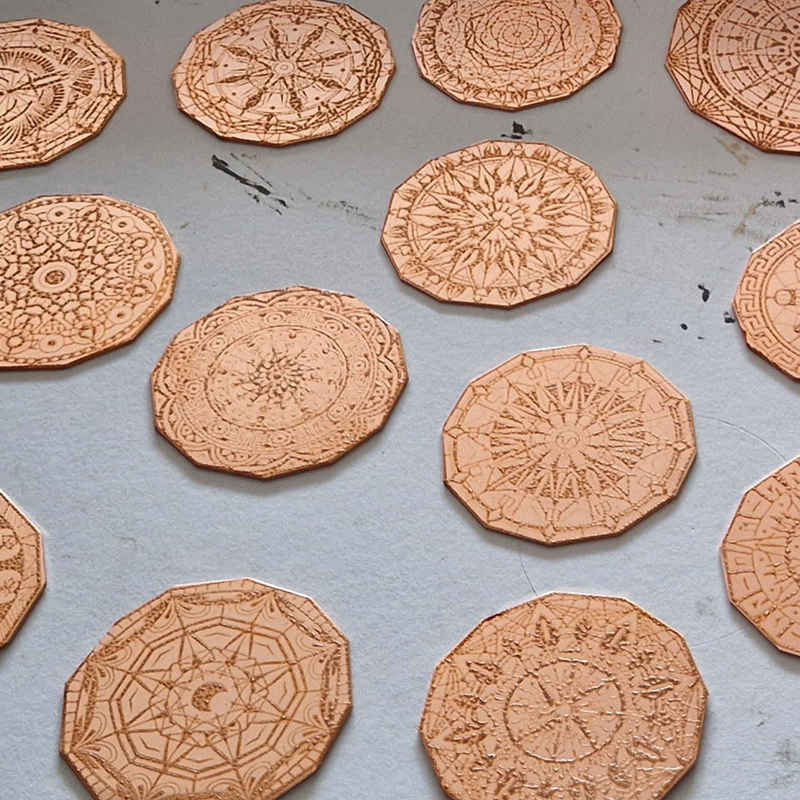
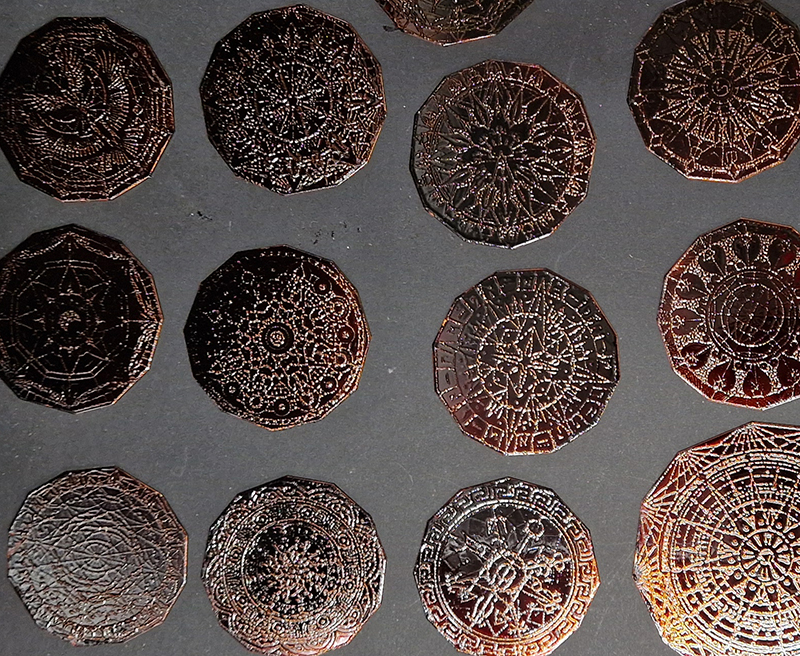
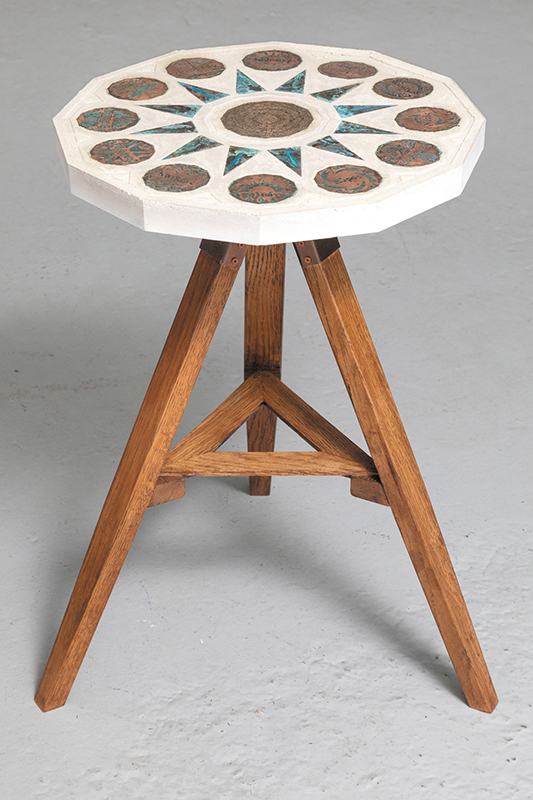
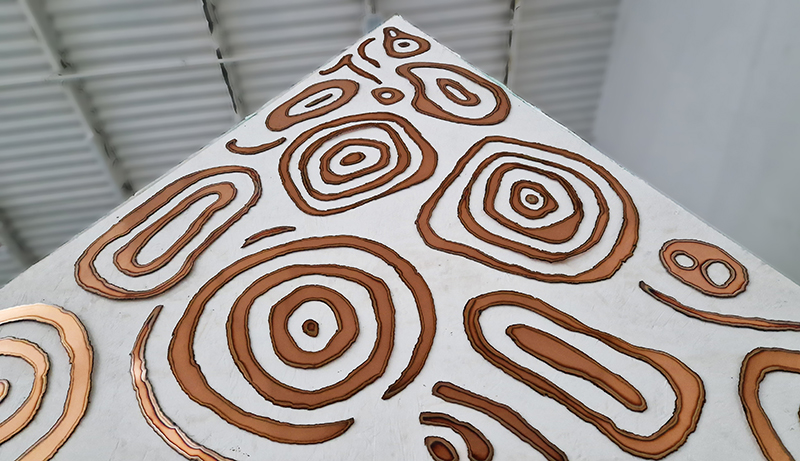
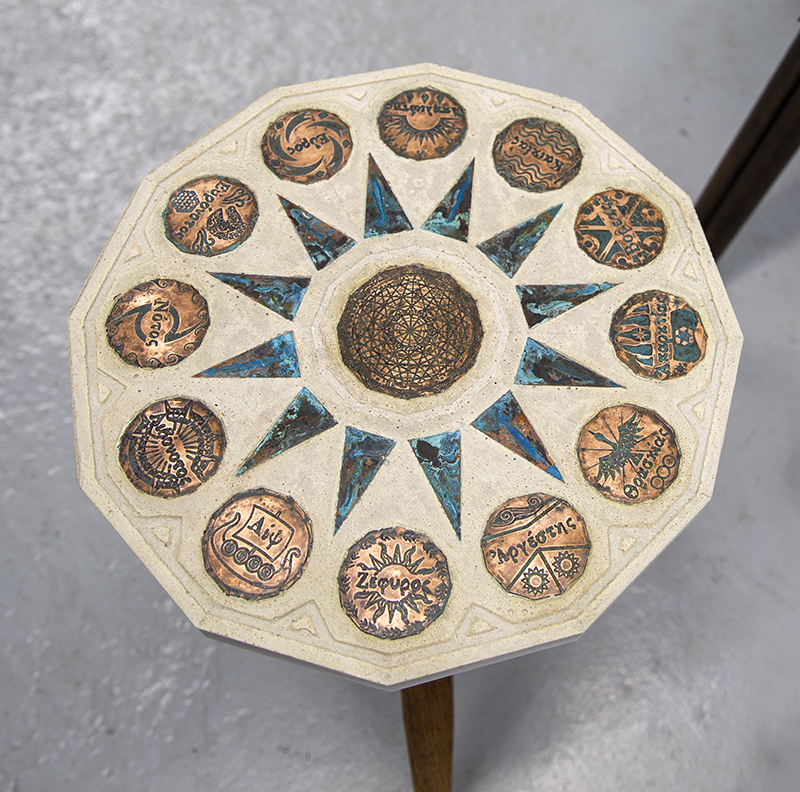
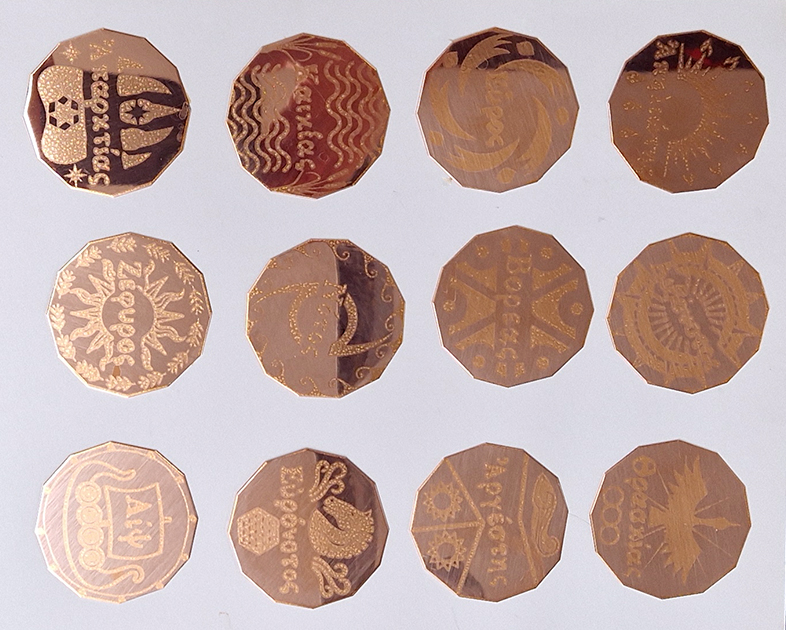
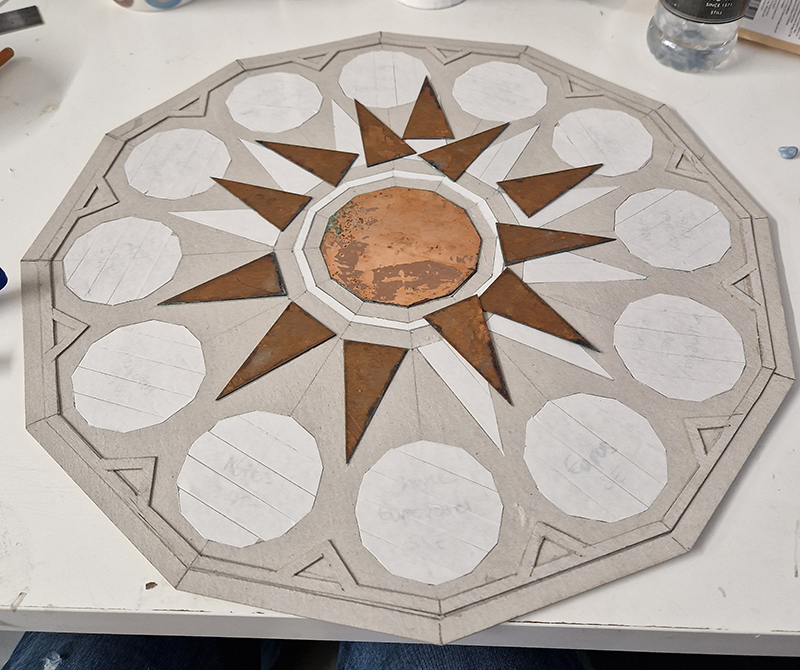
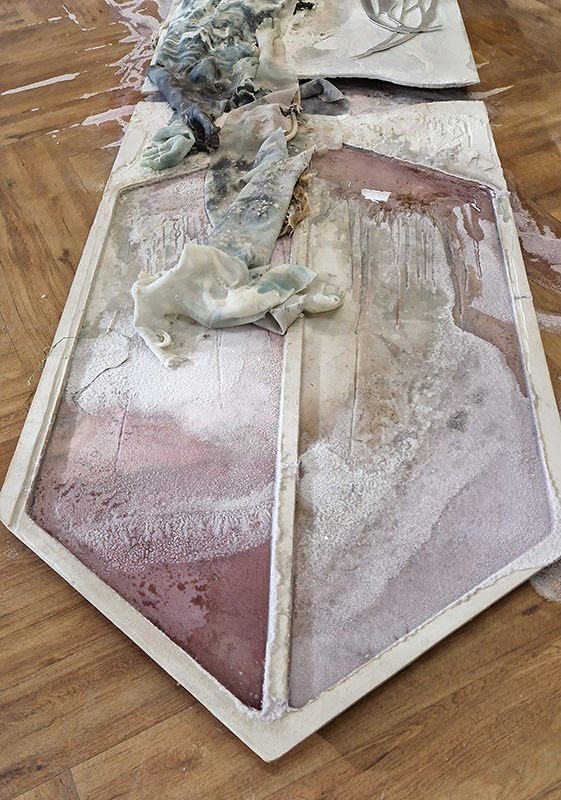
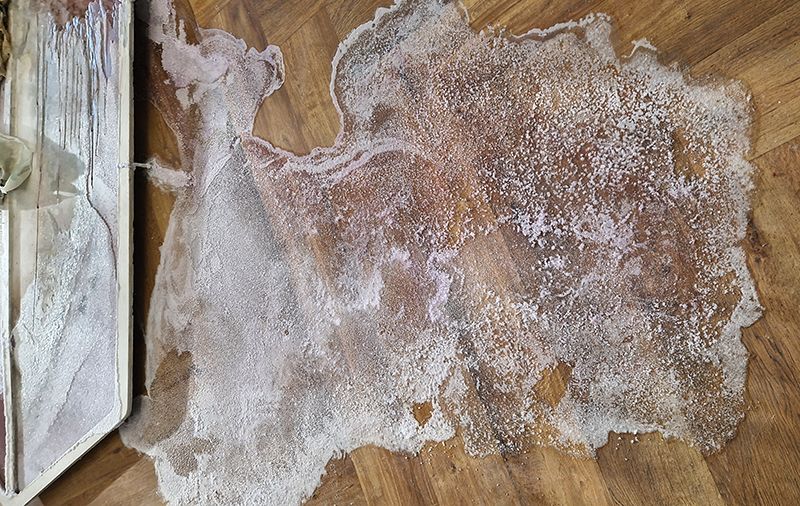
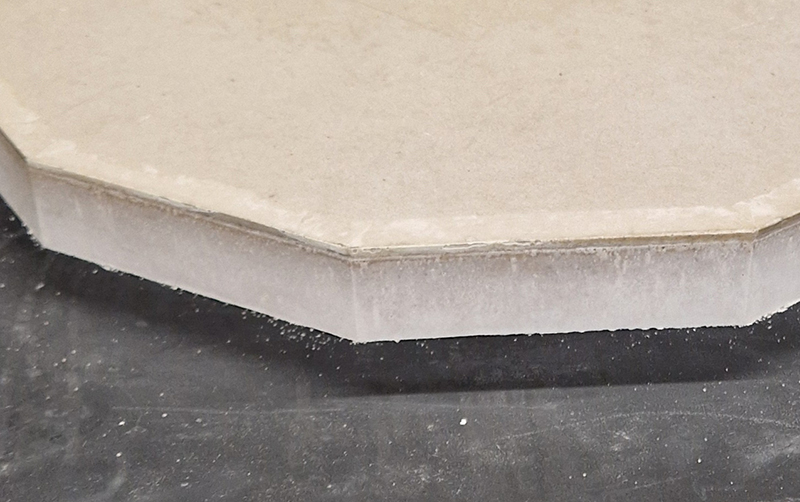
Freshly excavated. A new tablet for the series Instruments of the Anemoi, replacing a previous one based on the idea of a wind rose and set with etched copper markers, the designs of which are influenced by characteristics of the gods (anemoi) represented by each of the twelve winds.
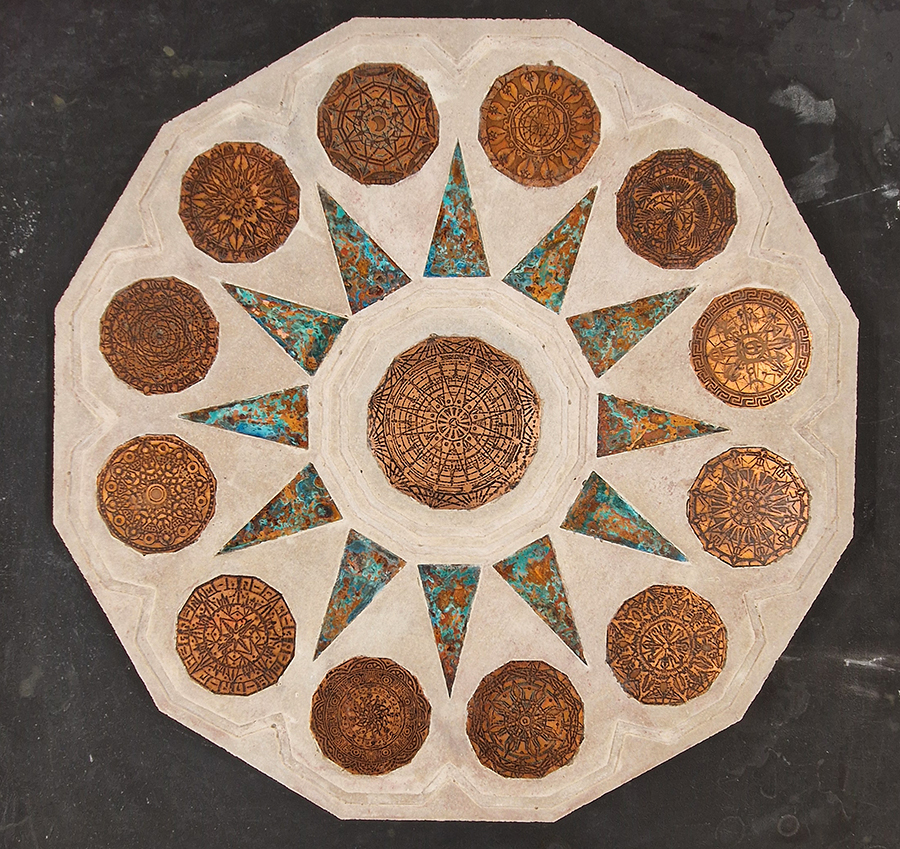
Instruments of the Anemoi are a set of dodecagon tablets cast in Snowcrete, a cement with no magnetic minerals, as is used for instrument pedestals at a magnetic observatory. They also respond to a twelve sided anemoscope “table of the winds” carved in marble around eighteen hundred years ago and held at the Vatican Museums. Releasing the cast from the mould and collagraph is a rewarding process – if all the pieces have held their position during the concrete pour and vibrating to release trapped air bubbles. Luckily this time was a success.

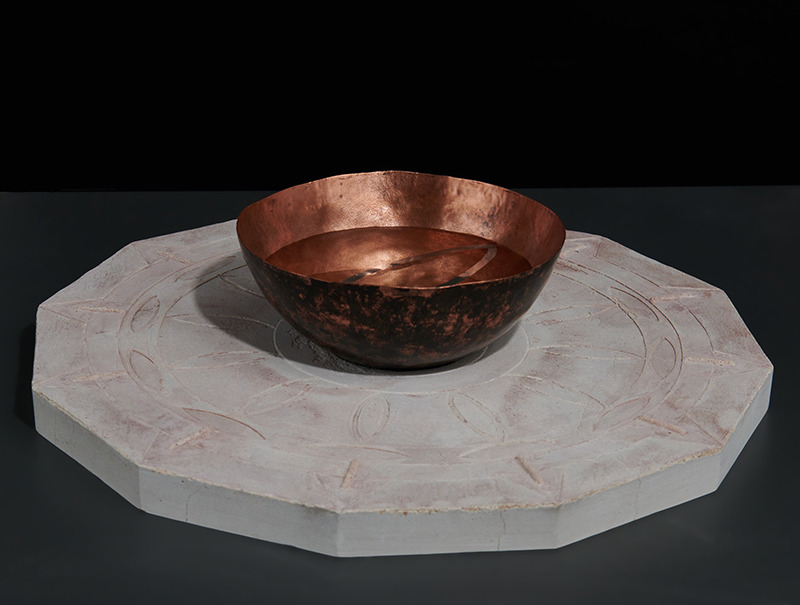
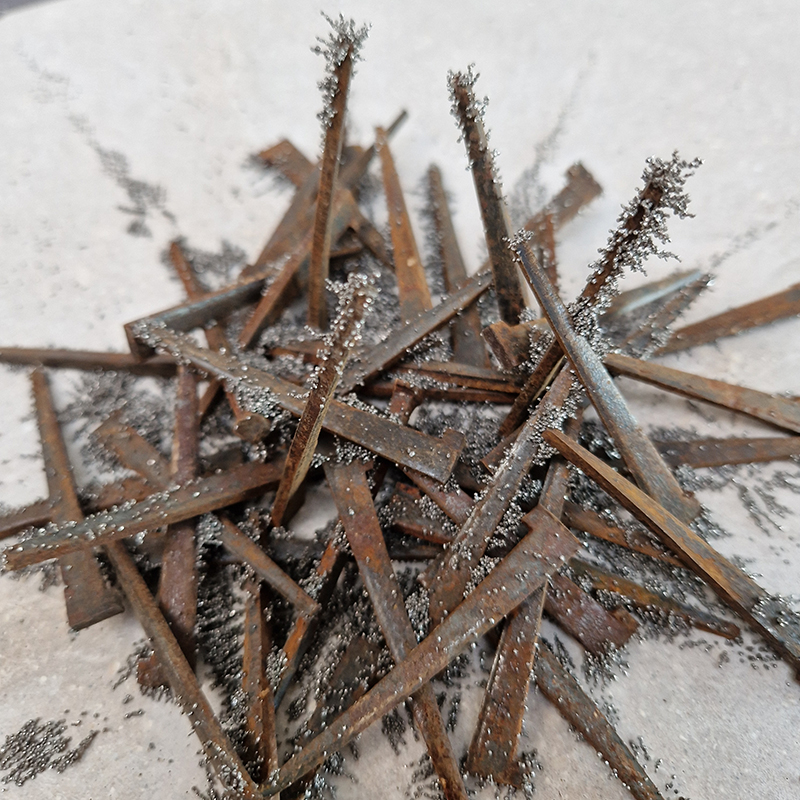
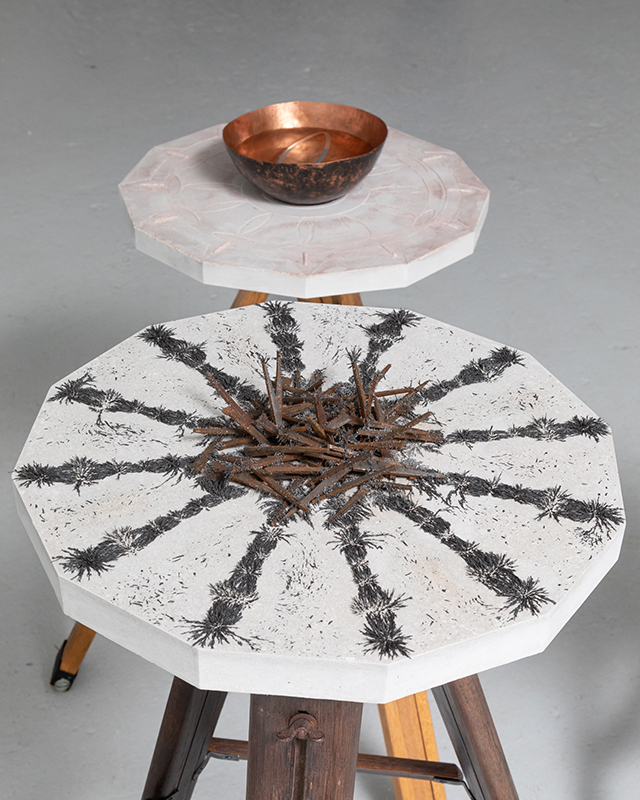
The other two sculptures in the series. A hand beaten copper bowl with a ‘silver fish’ floating in water based on the oval shaped compass needle illustrated in Breve Compendio de la Sphera de la arte Navegar by Martin Cortes 155. Wafer thin fish shaped iron leaves were also used by 11th century Chinese geomancers. Nails and iron filings reveal an embedded magnetic field and hark back to a legend on the discovery of the lodestone, a naturally magnetic mineral, which recalls a Greek shepherd who noticed the nails in his boots were attracted to the rock beneath his feet.
Unsettling to find it is already one year on since A Stone Sky duo exhibition with Julie F Hill opened at Thames-side Studios Gallery and this work was first shown.

Around 95% of the universe is ‘dark’ to us, formed of unknown and possibly unknowable matter which may be inaccessible to us, but cosmic rays offer a tangible contact with outer space.   

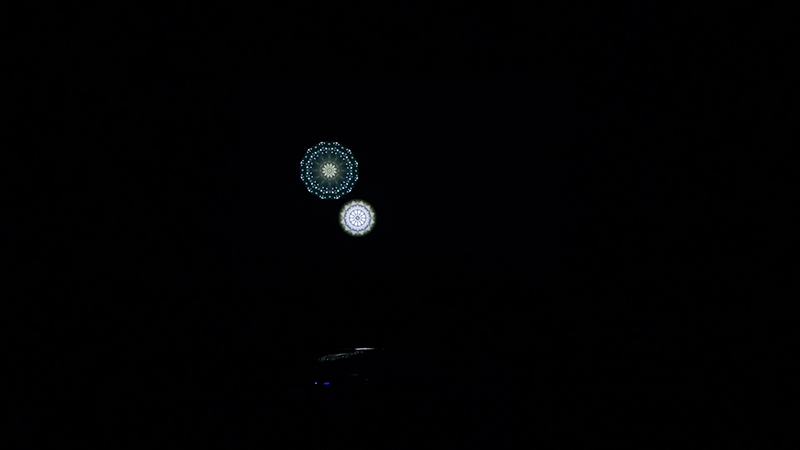
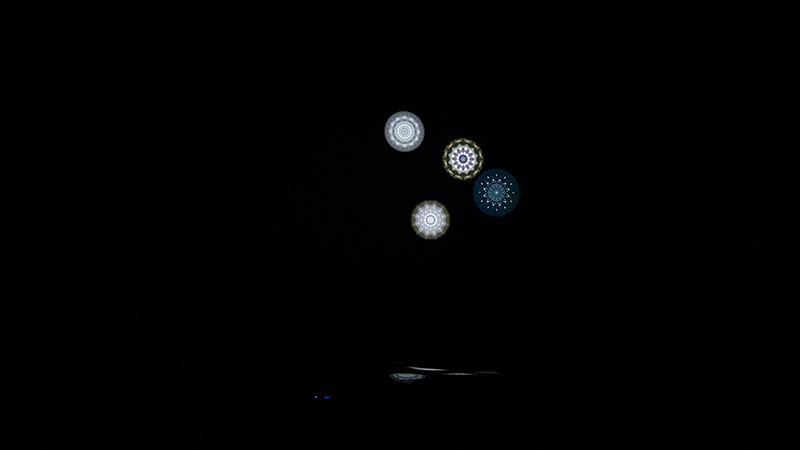
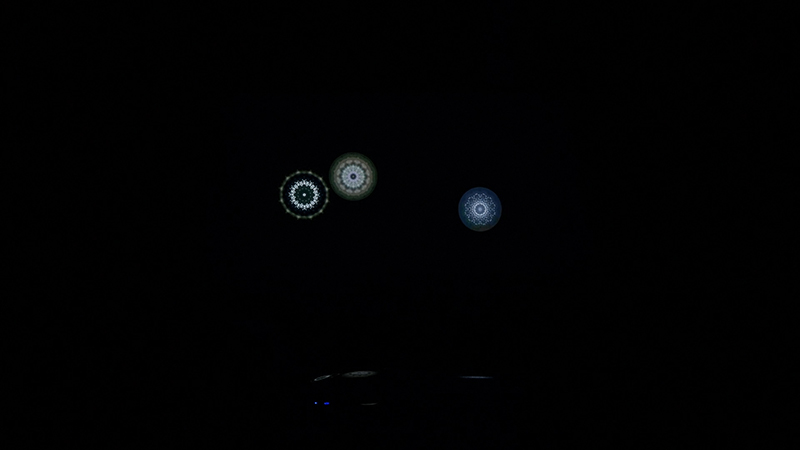
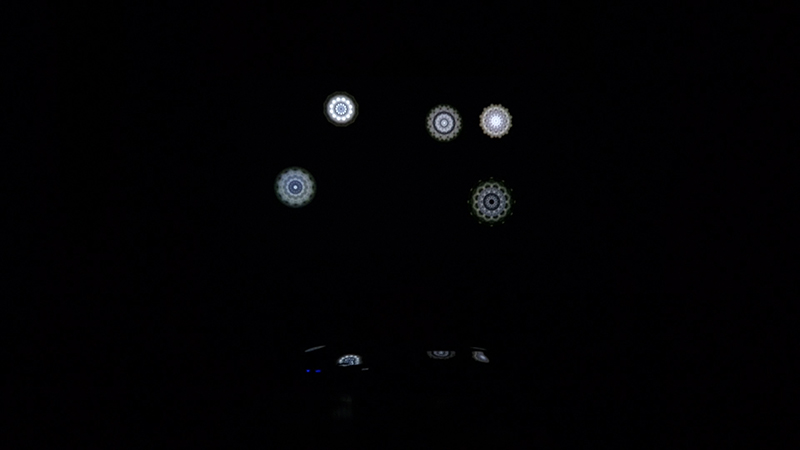
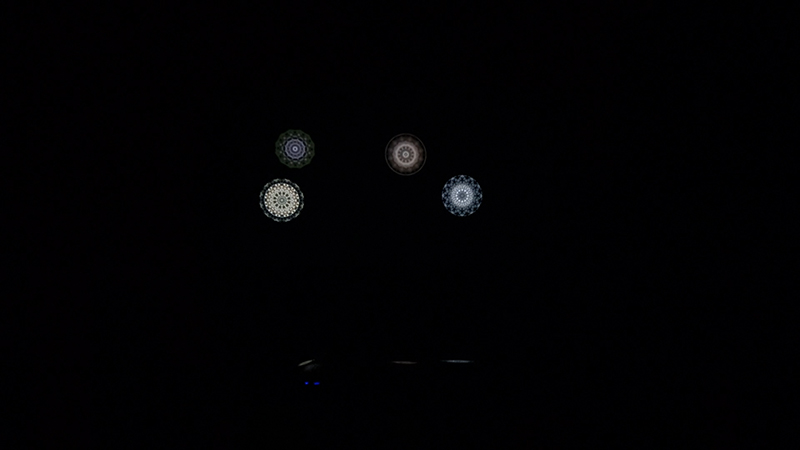
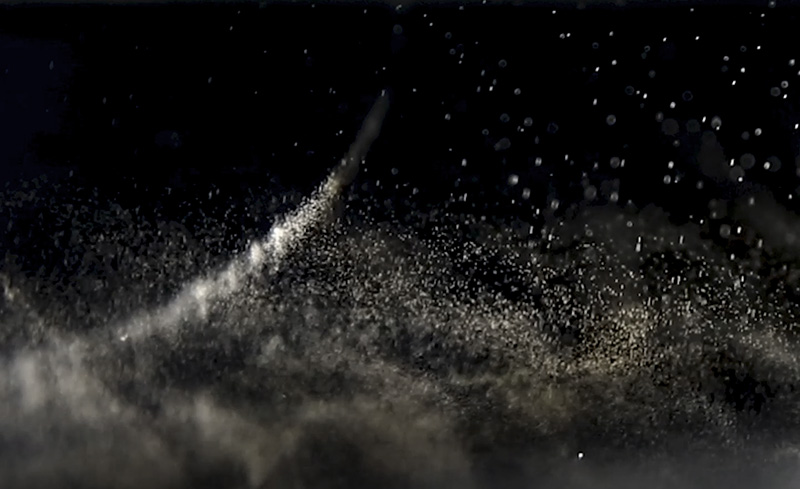
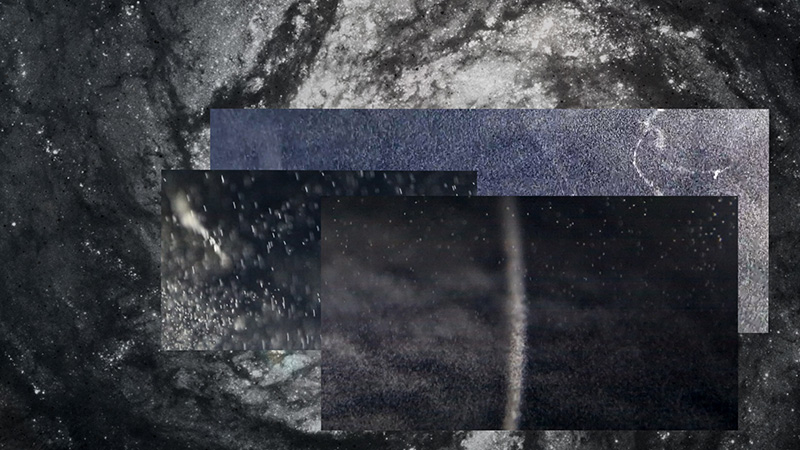
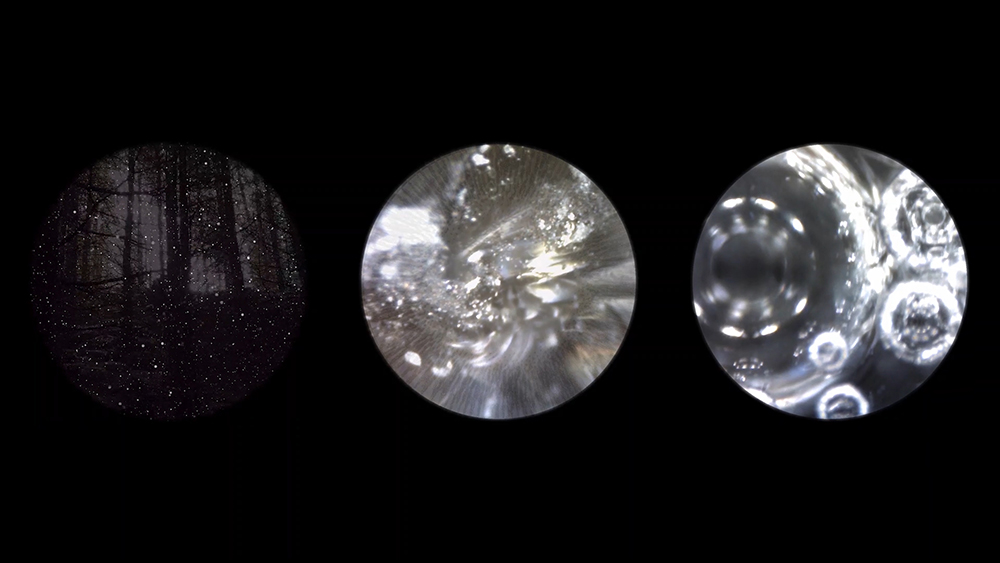
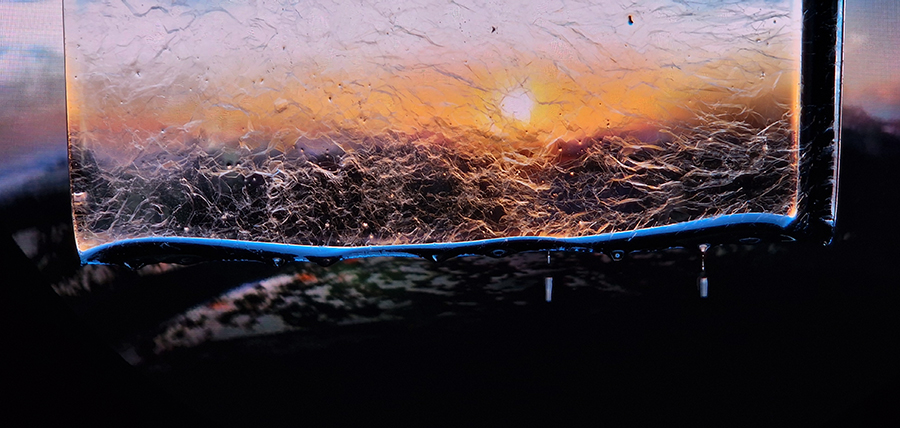
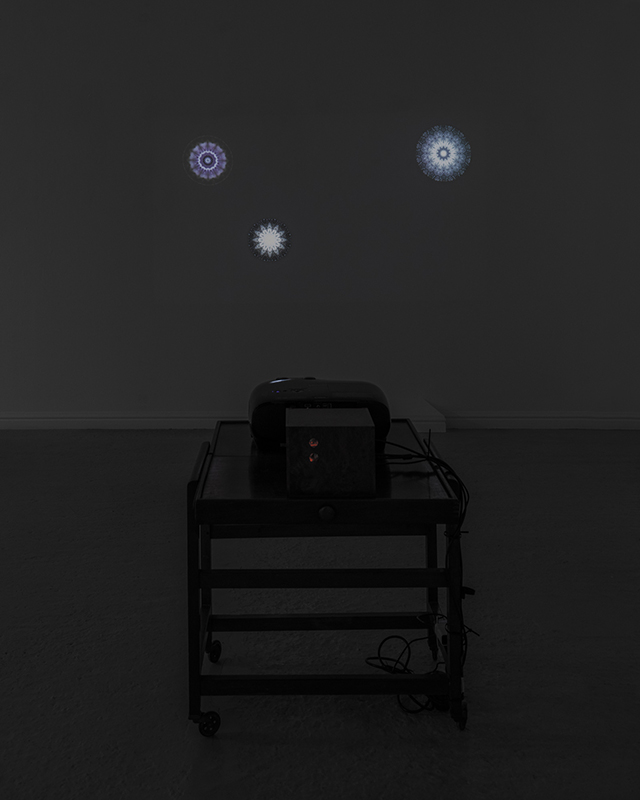
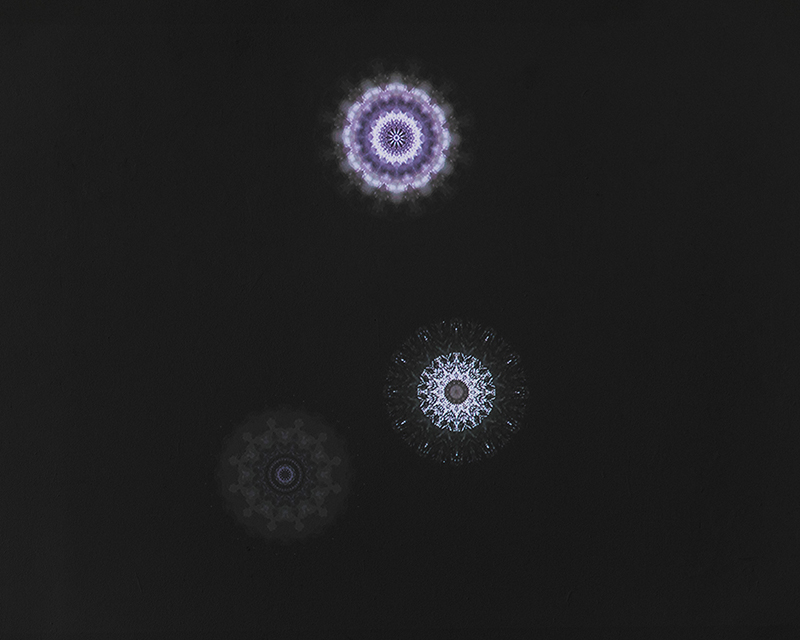
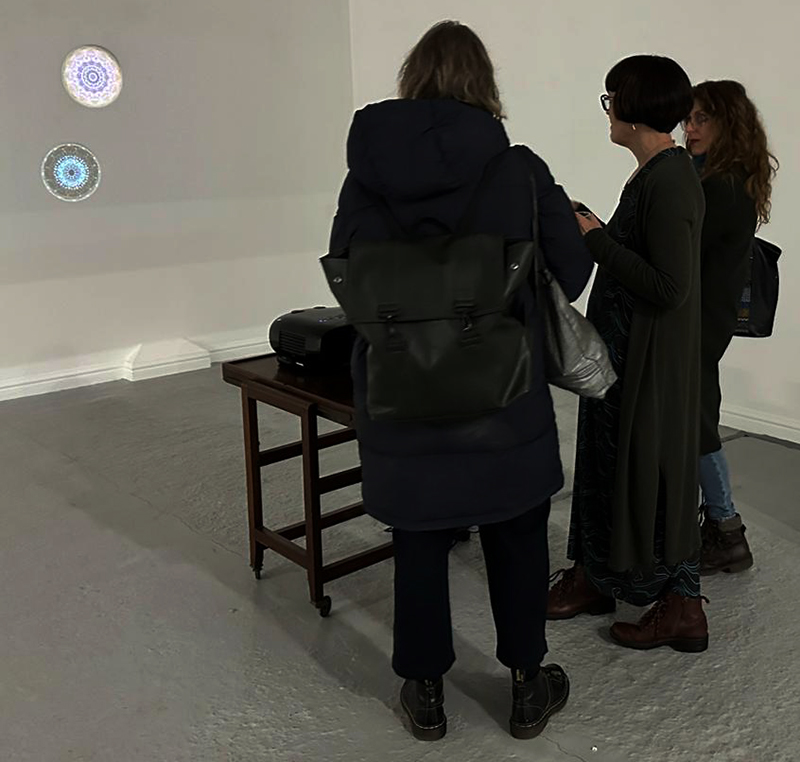
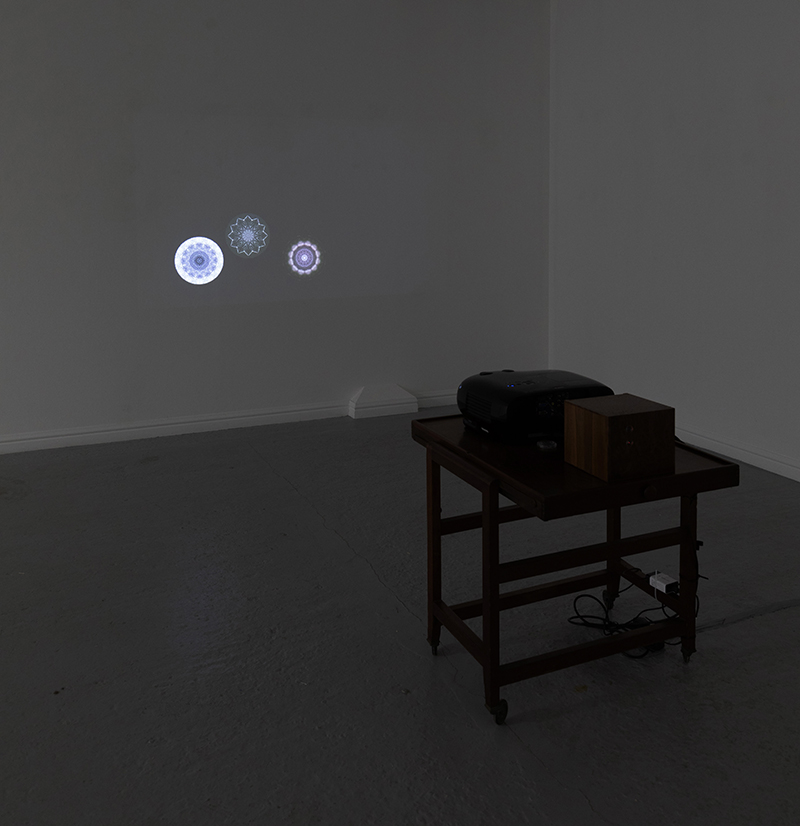
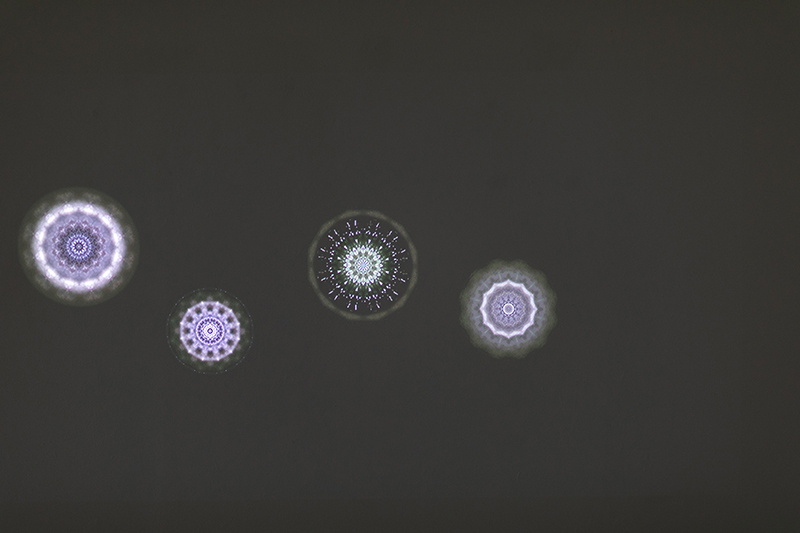
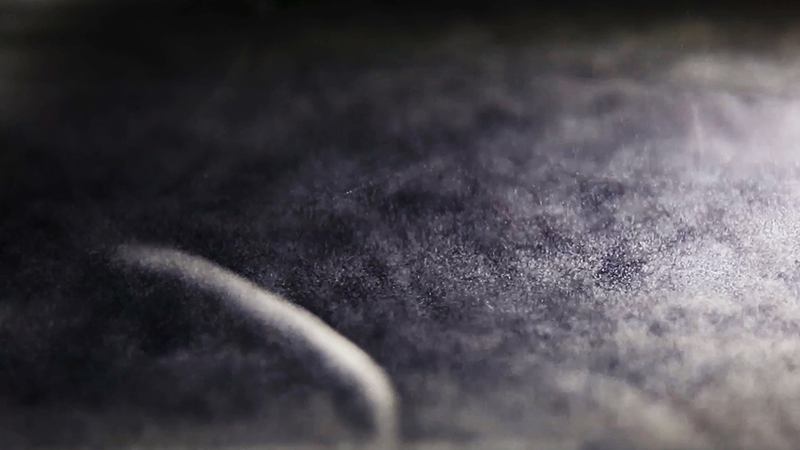
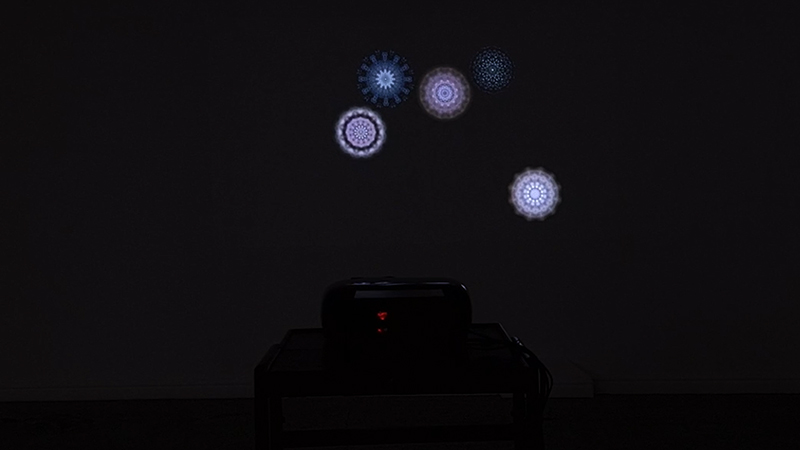
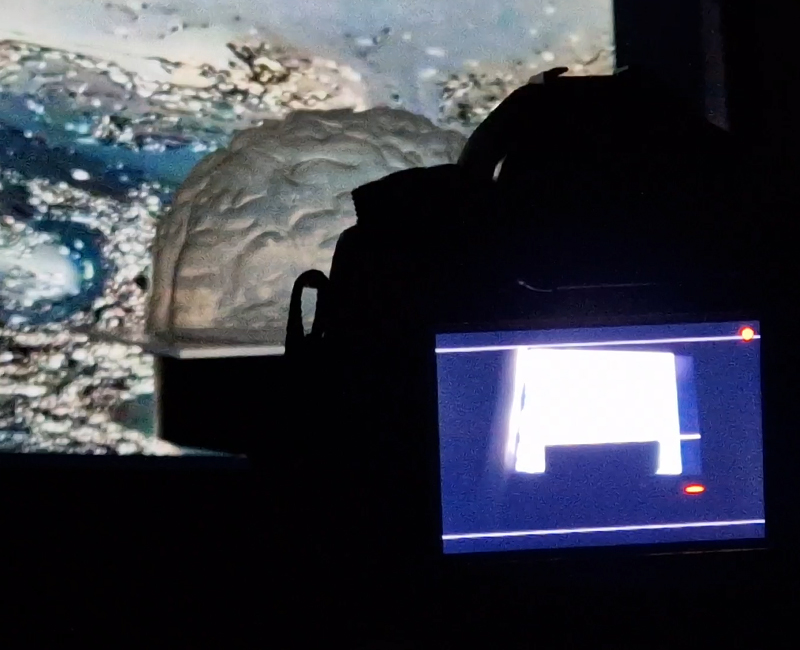
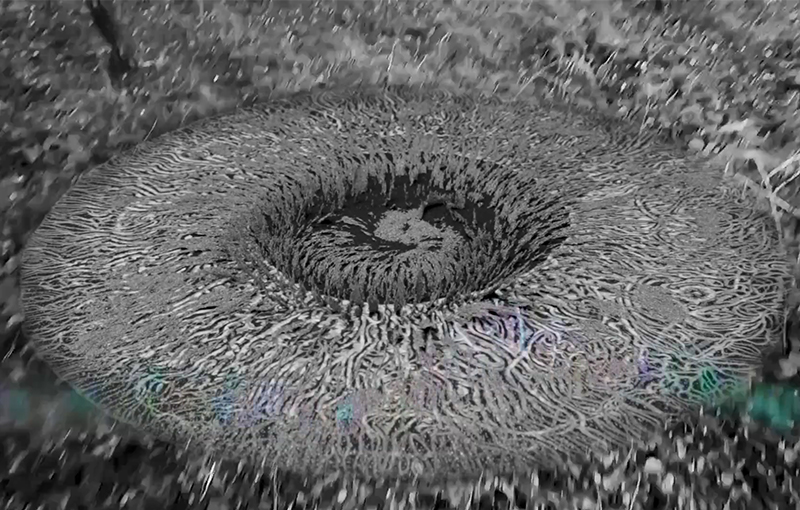
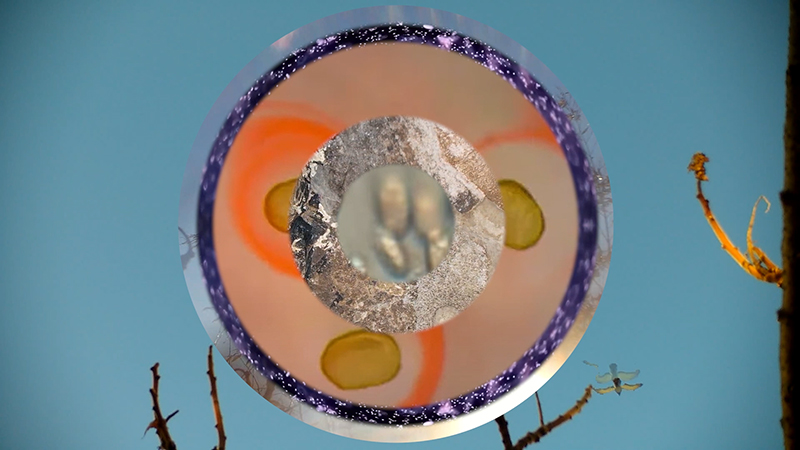
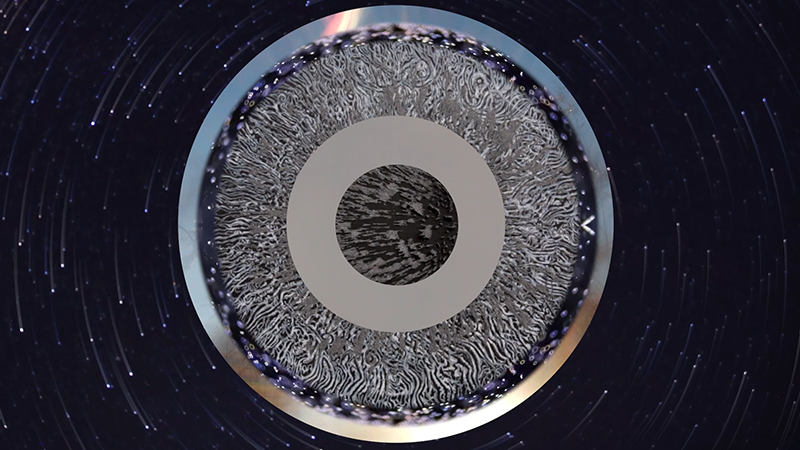
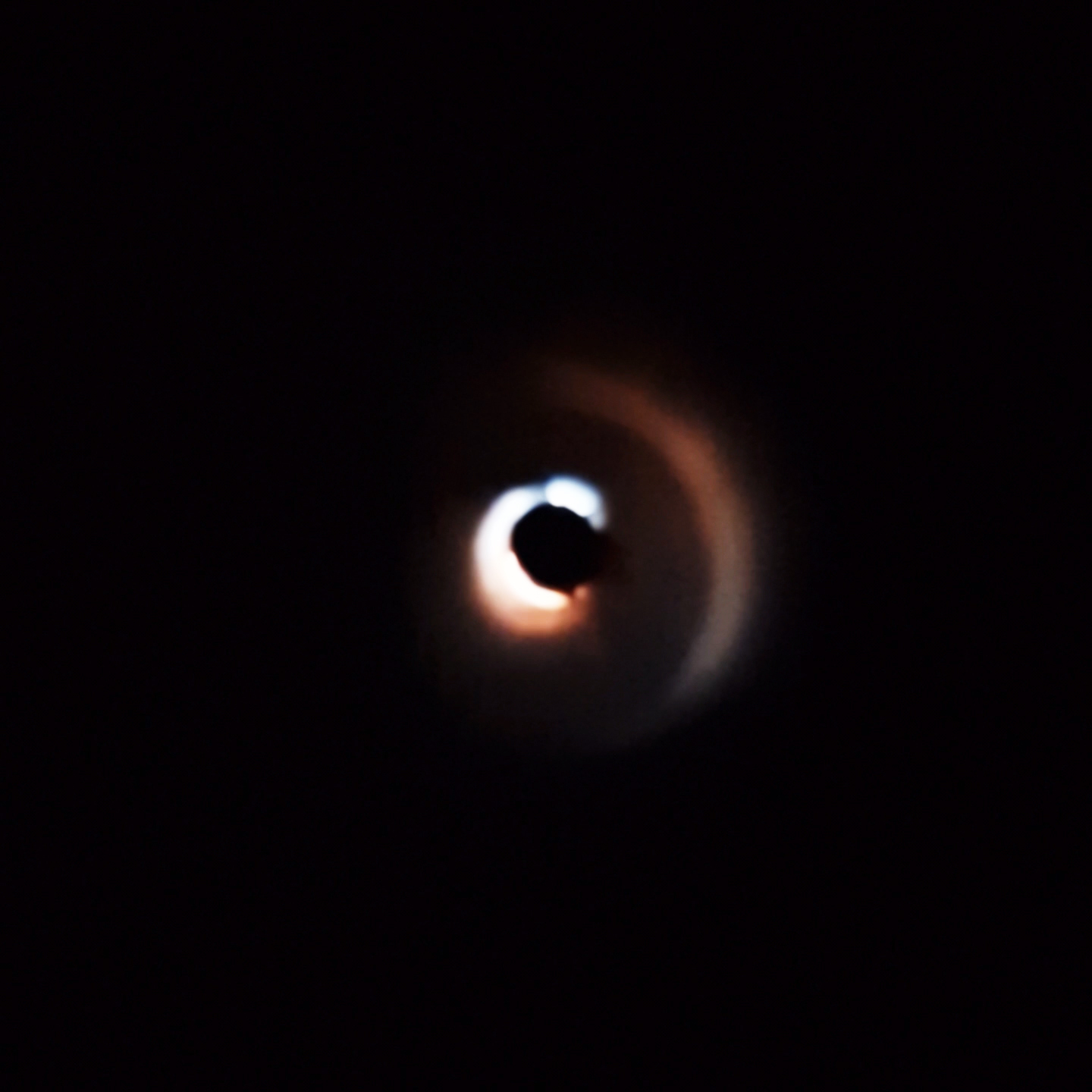
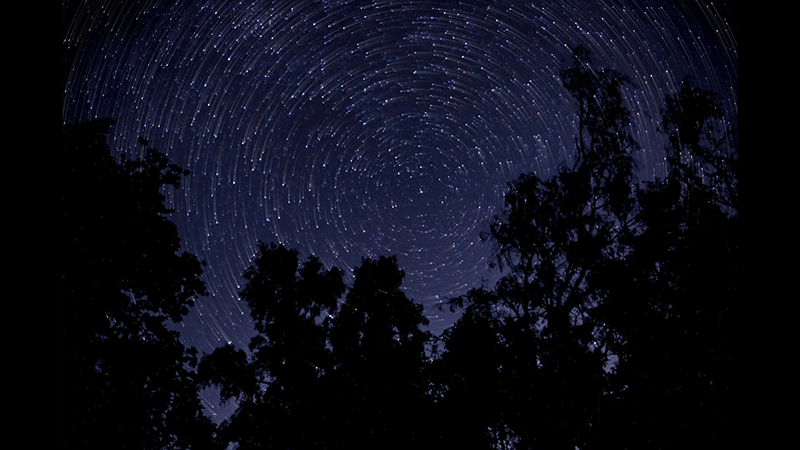
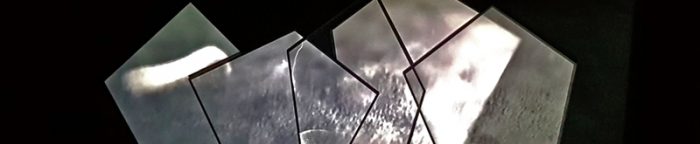
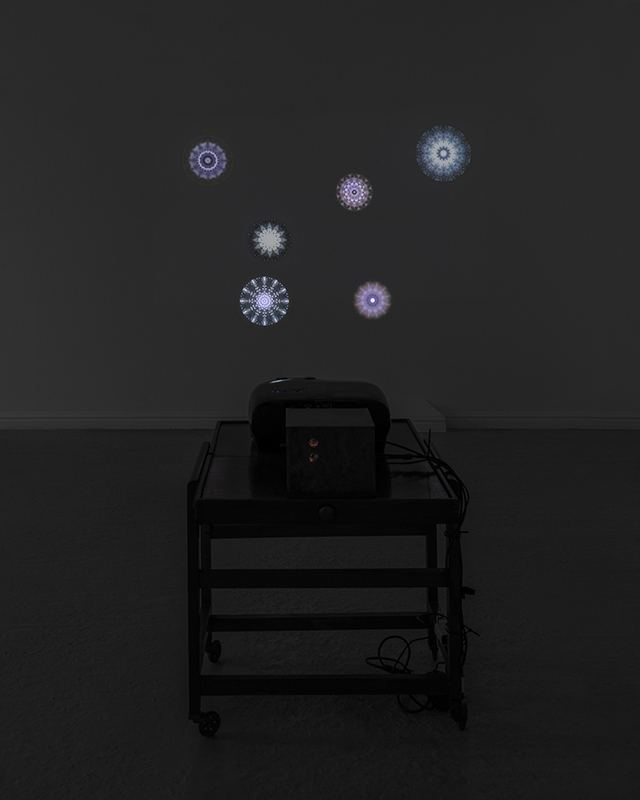
Giving The Breath of Stars a run to see if the cosmic rays are still there 😉 These images are stills of live action.
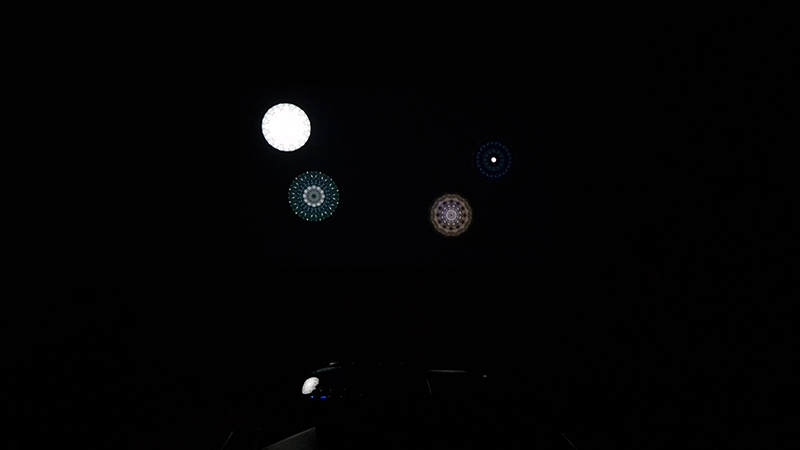
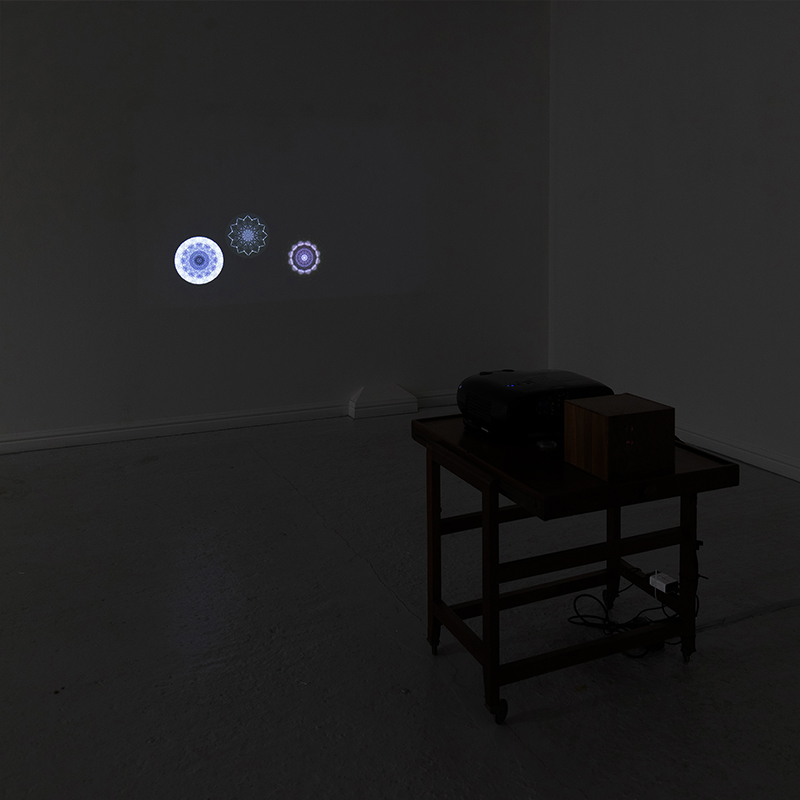
Cosmic ray detectors, mini computers, wooden box (20 x20 cm), video projection; live duration.

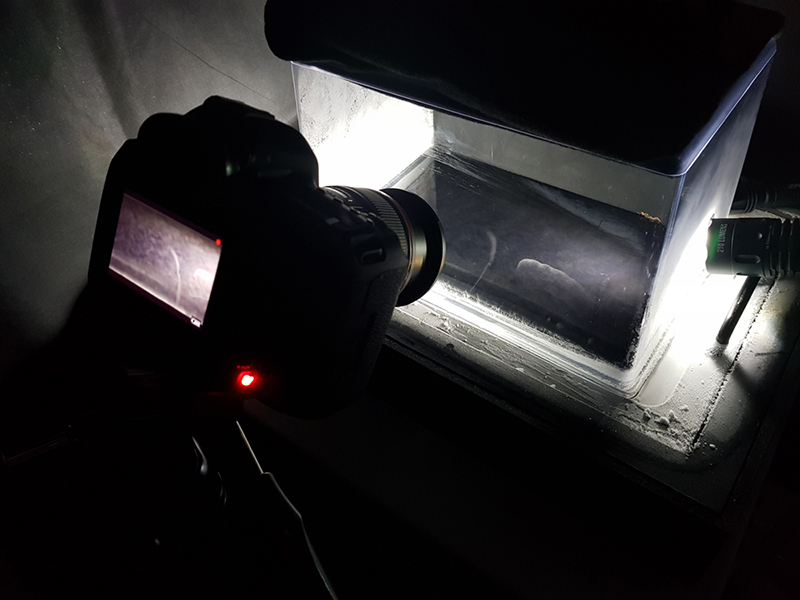
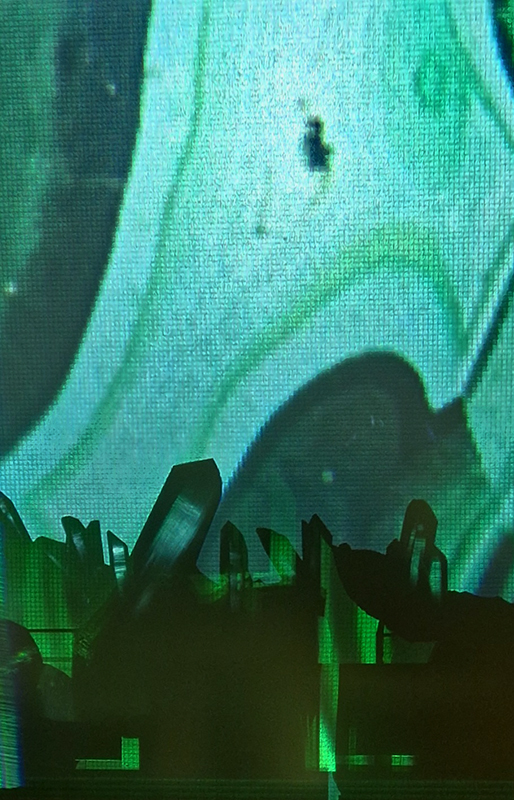
The Breath of Stars is a digital video work activated in real time by cosmic rays. These high energy particles arrive from outer space, interacting with life and technology on Earth. Coming from the heart of exploding stars or the depths of black holes, cosmic rays power across the universe with unimaginable energy. Some may come from phenomena yet to be discovered or even from other dimensions. A kaleidoscopic animation is projected every time a cosmic ray is recorded passing through the detectors. The animations are created from footage of cosmic ray trails filmed in my cloud chamber.
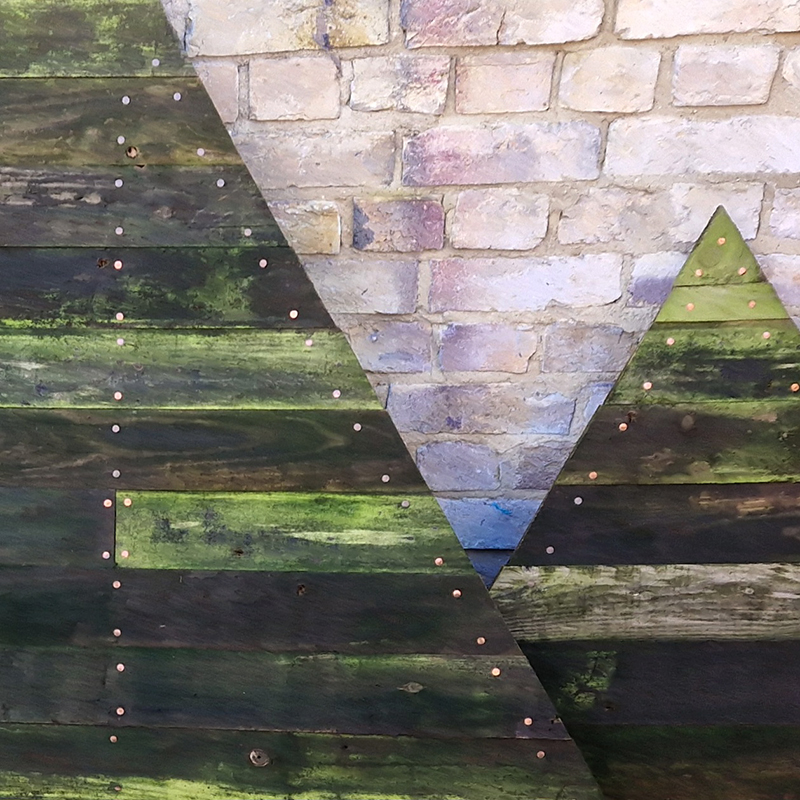
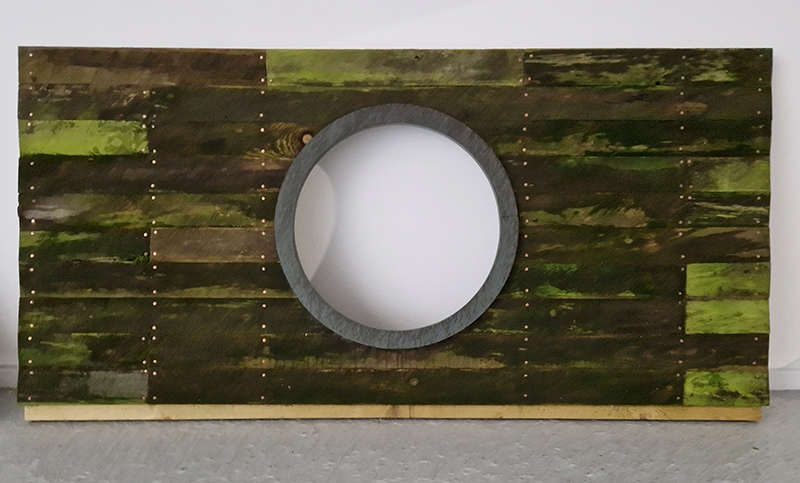
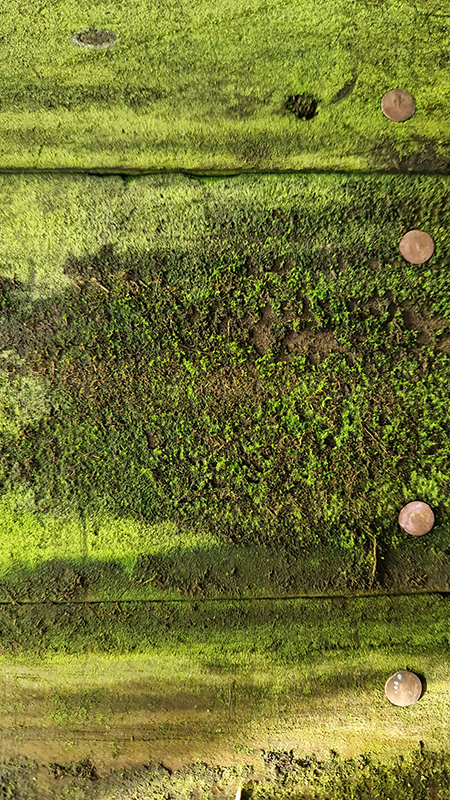
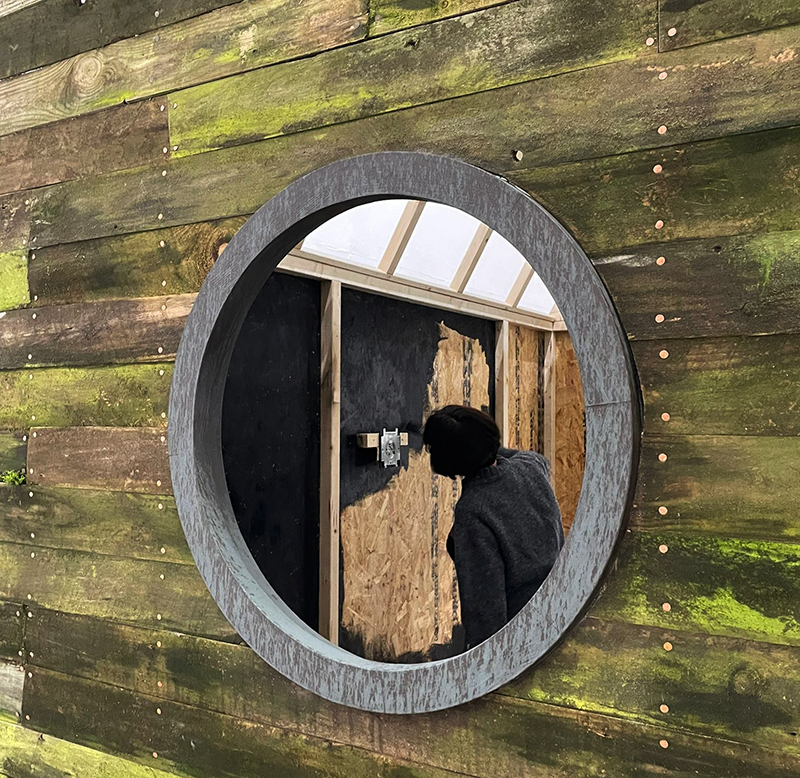
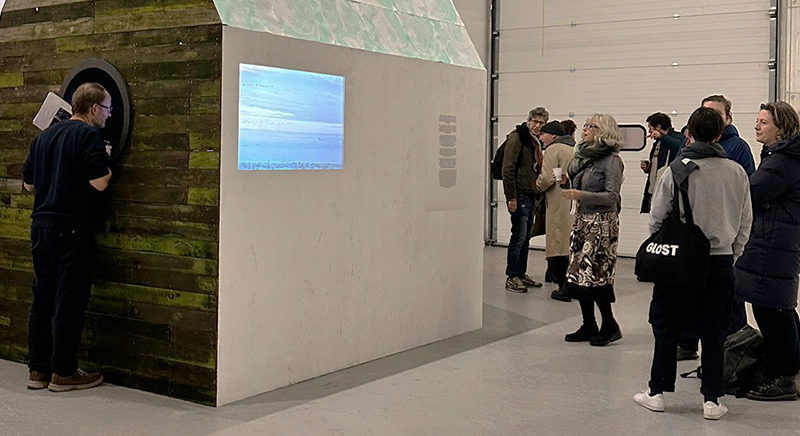
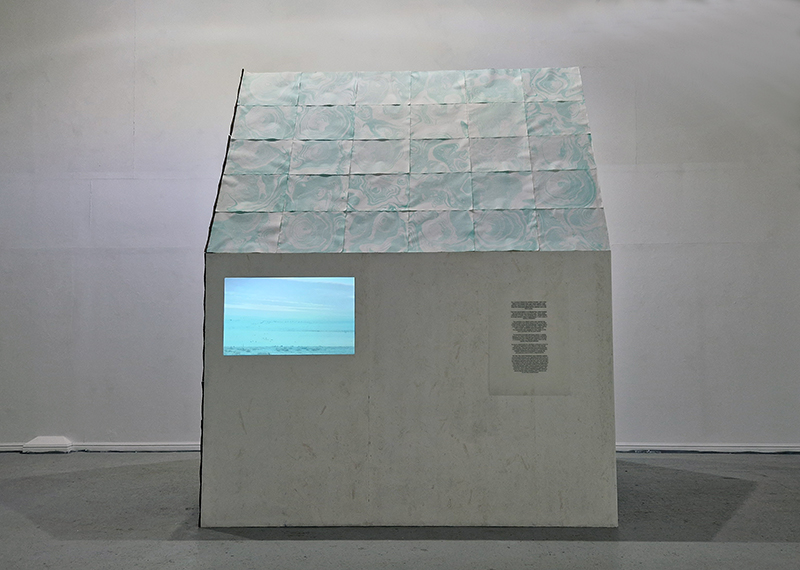
This cold damp weather is stimulating the moss regrowth on the apex pinnacle of The Absolute Hut (of action potential) that found a space in my garden after The Stone Sky exhibition this time last year. I had spent weeks preparing the recycled fence boards to make the North facing wall of the hut, painting them with various mixtures of buttermilk and yogurt blended with moss and was so excited when it began to grow. During the exhibition I would mist it every day. The beginning of my fascination with huts!
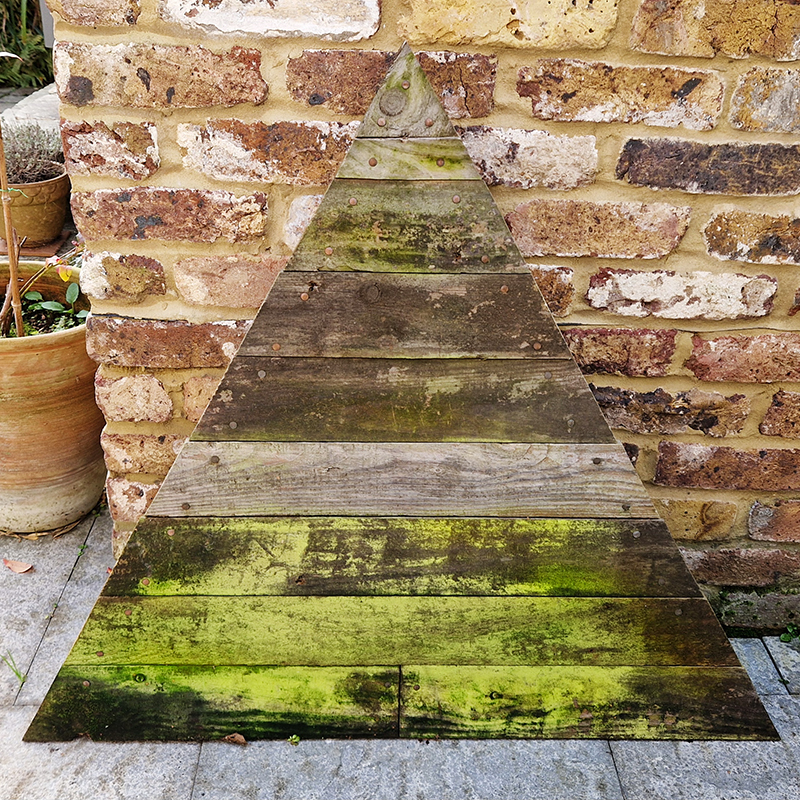
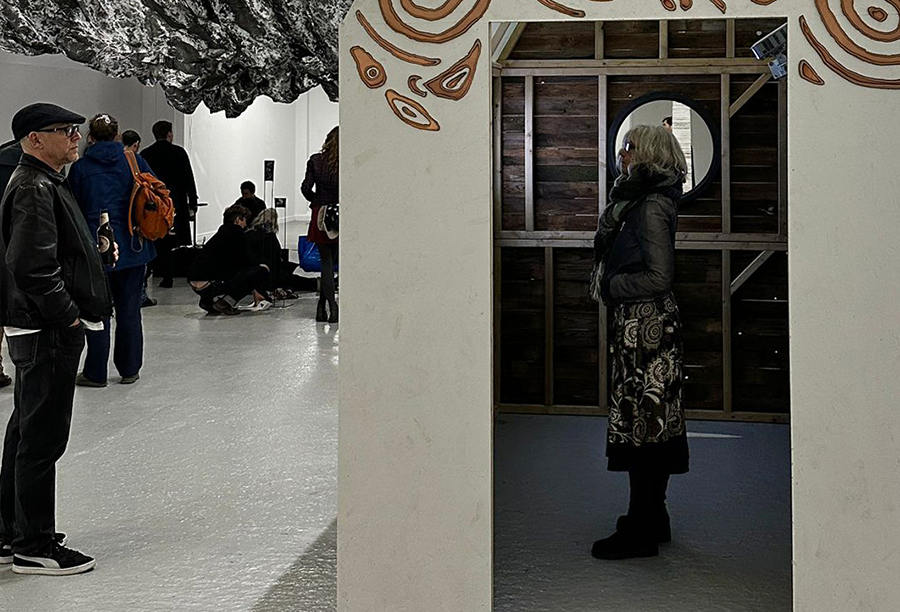
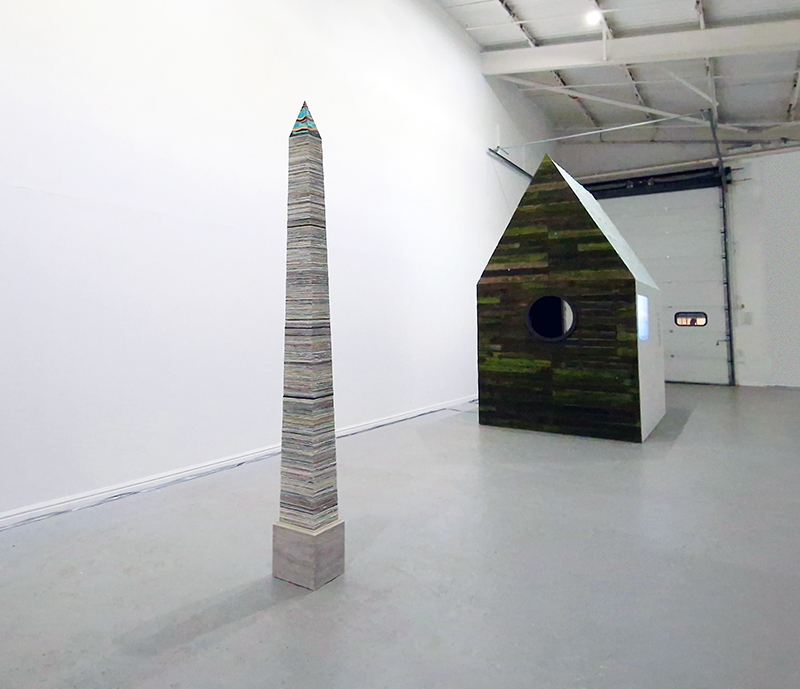
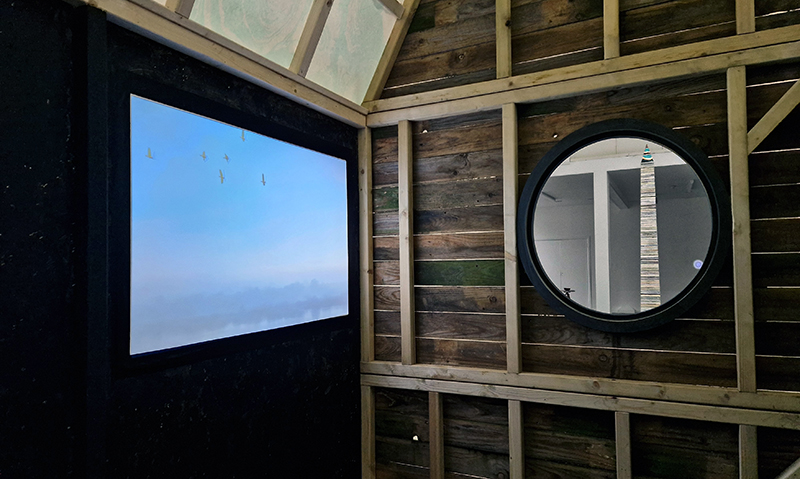
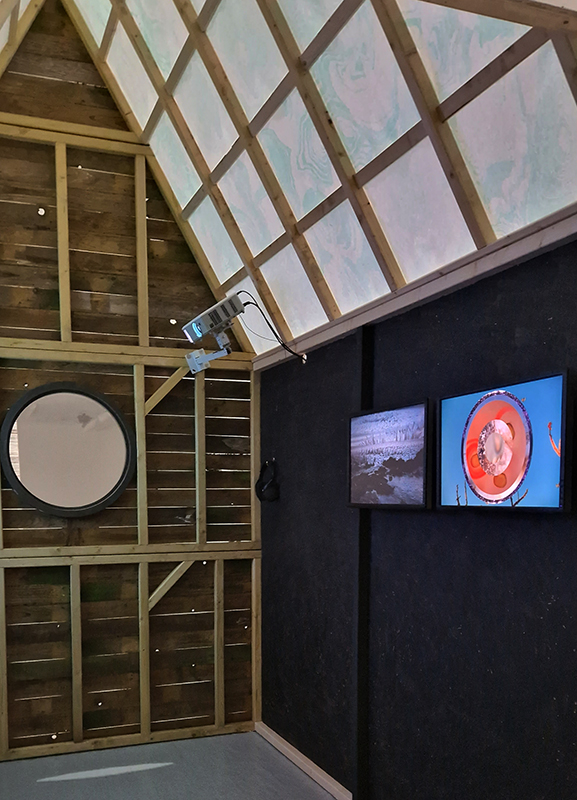
The Absolute Hut (of action potential) Wood, moss, paper, copper, video projection, video monitors ; 200 x 300 x 375 cm

Operating as a sensory hub where a range of actions and processes are running concurrently reflecting on the dynamics between the Earth’s geologic structure and navigation using the magnetic field. Neurons in the brain and nervous system send information electrochemically around the body. The signals they send are called action potentials, which is a temporary shift from negative to positive within the cell caused by certain ions entering the cell. Action potentials can be triggered by an interaction with the magnetic field, causing a reaction in the body.

Interference 2023 (video still)

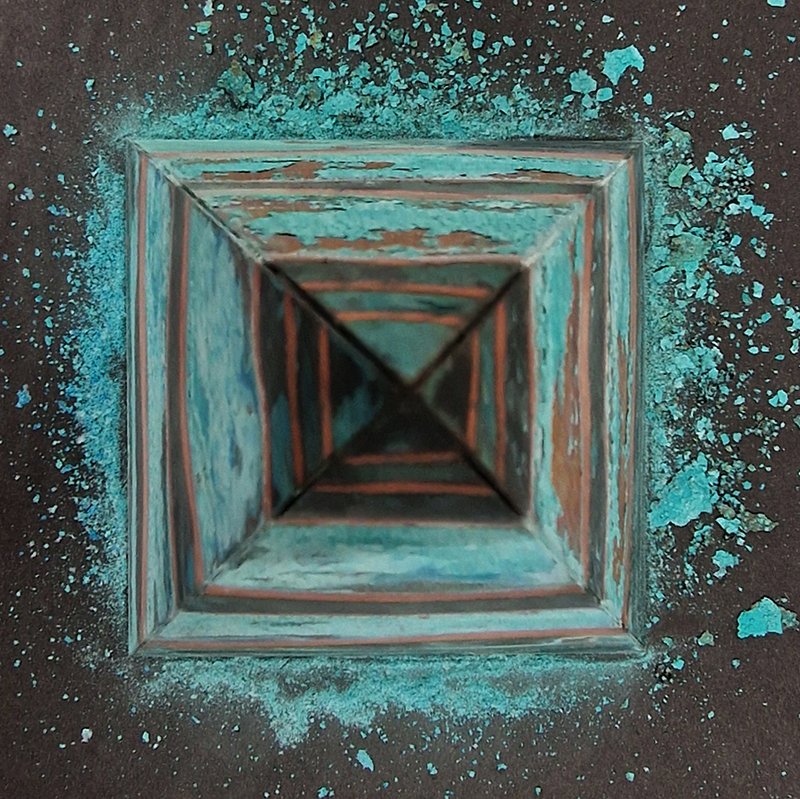
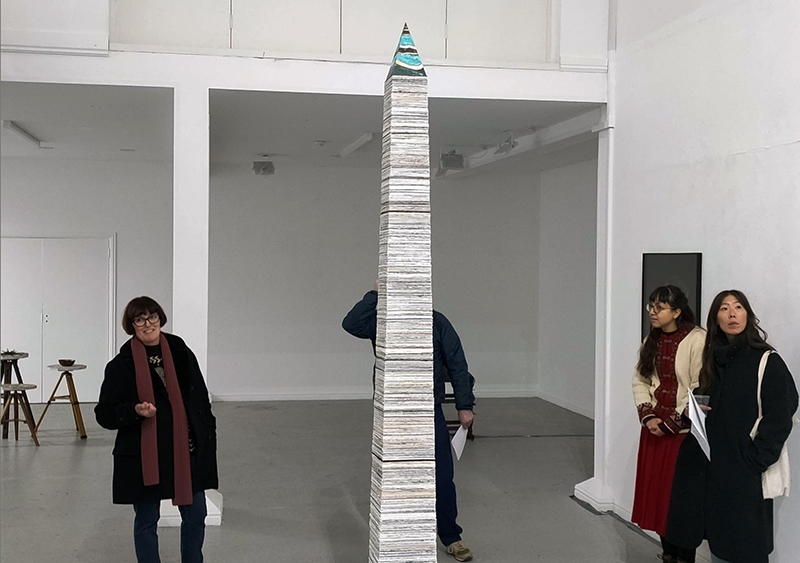
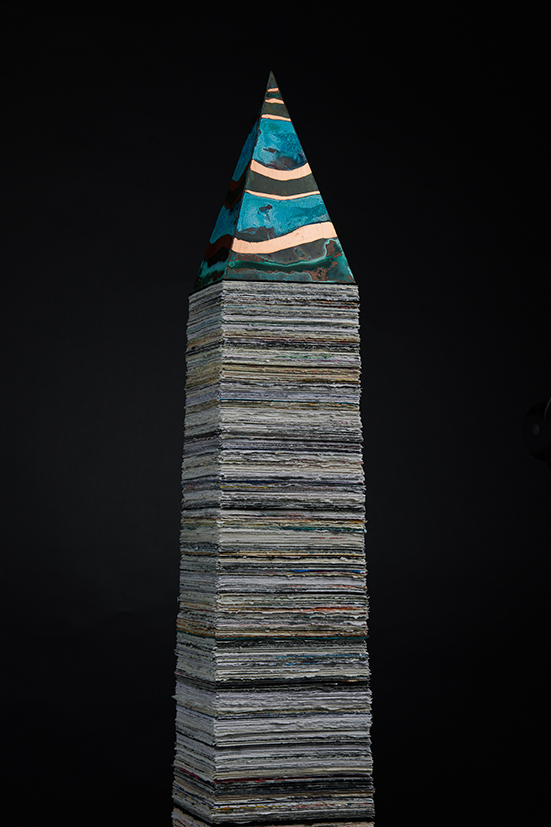
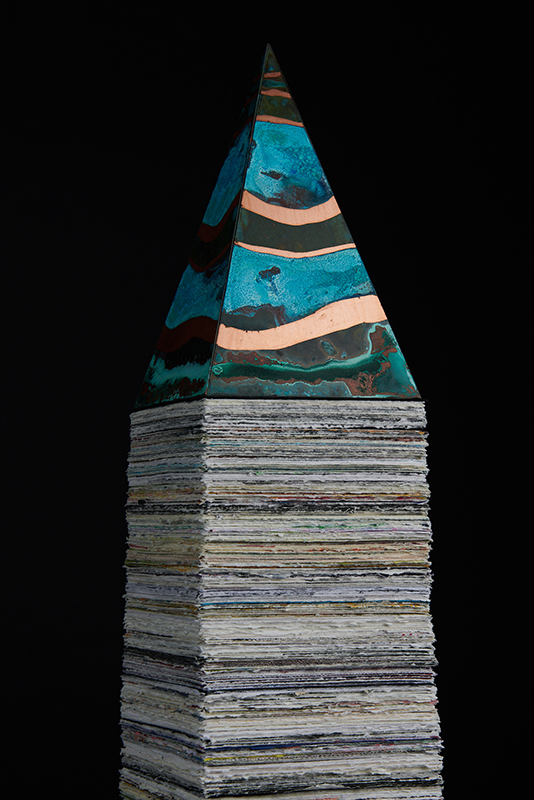
A year on and the pyramidion that sits on top of The Azimuth Obelisk (of sedimentary knowledge) is evolving. The patination, which involved a variety of chemicals being applied to the copper in layers, is an ongoing process.
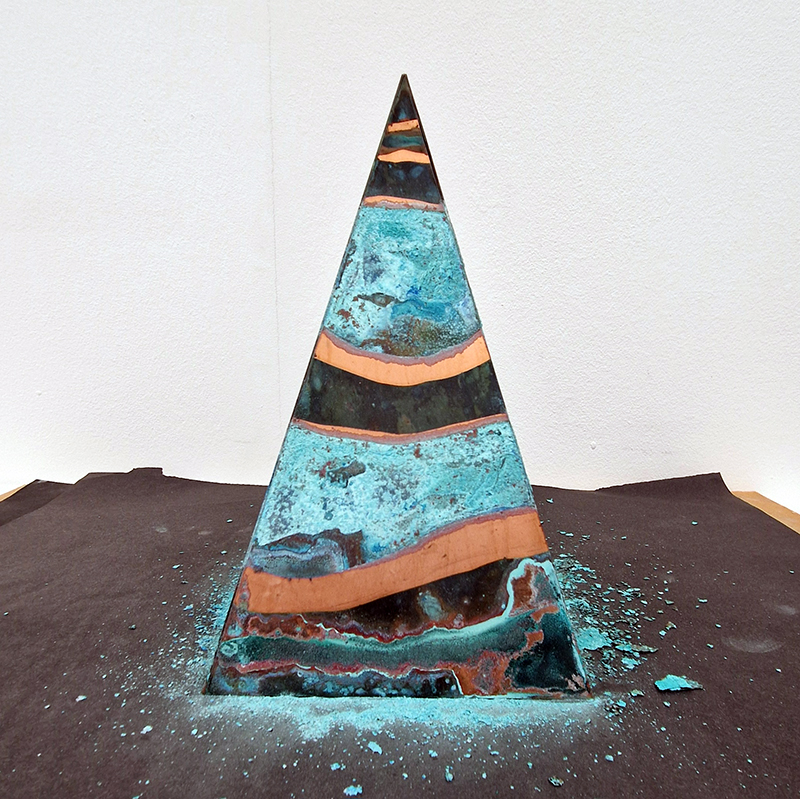
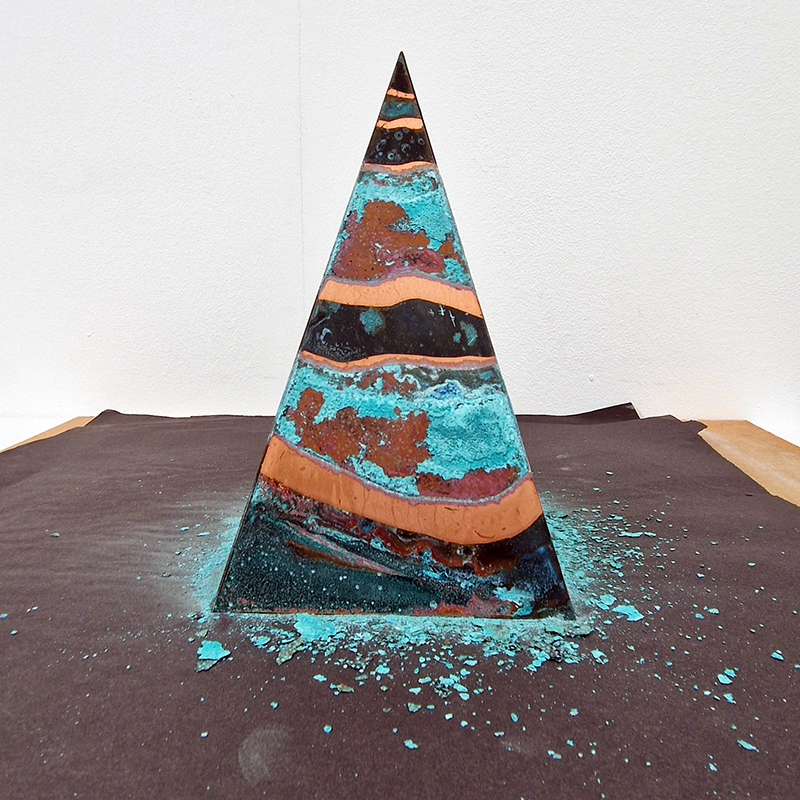
Sedimentary rock holds a geological history of the Earth’s magnetic field within its mineral components. The geomagnetic field, generated by the Earth’s molten core, varies through time; the magnetic poles migrate, go on excursions, or reverse polarity. During these periods of flux, the strength of the magnetic field changes, and this phenomenon is recorded in archaeological artefacts, volcanic rocks, and sediments. Limestone, a sedimentary rock, is often formed from crushed seashells, compressed over aeons. Crushed oyster shells were added to the obelisk base cast in Snowcrete.
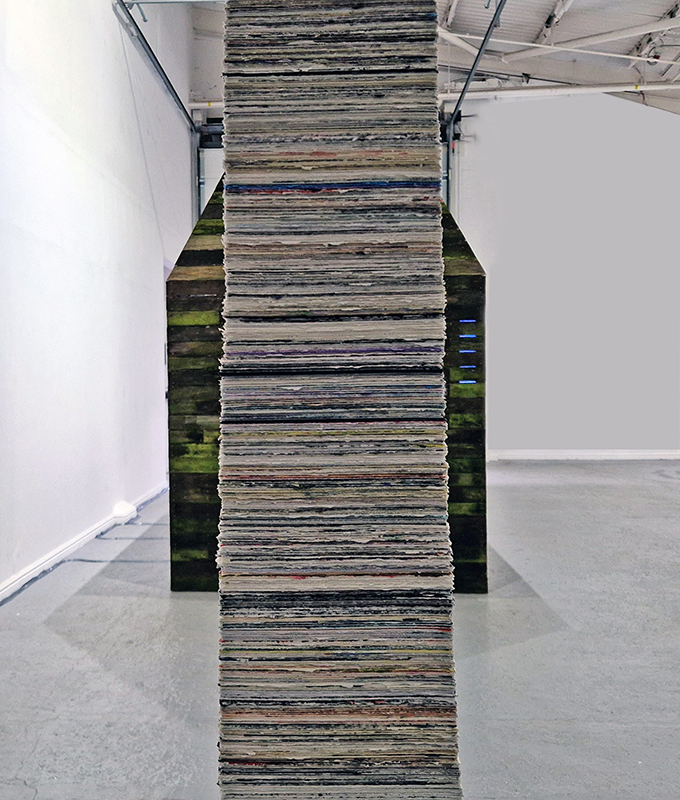
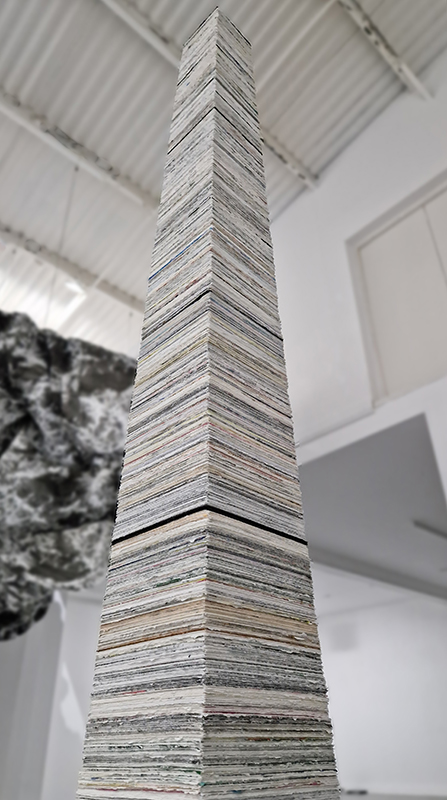
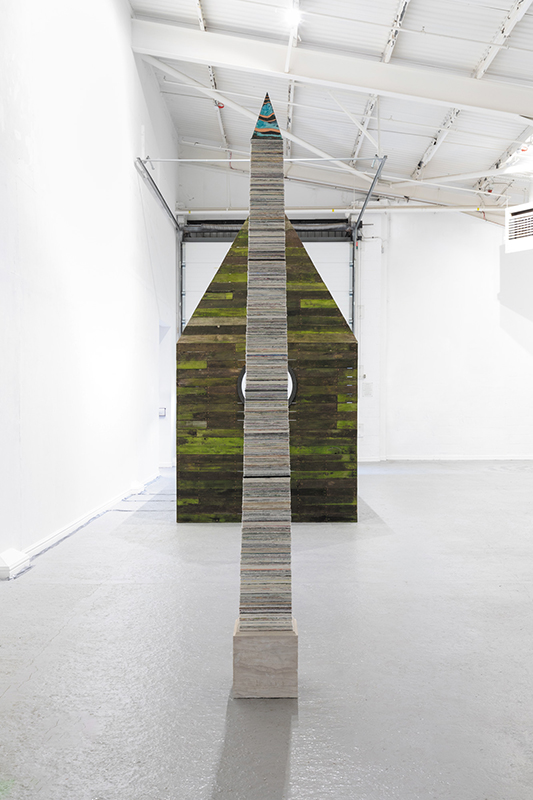
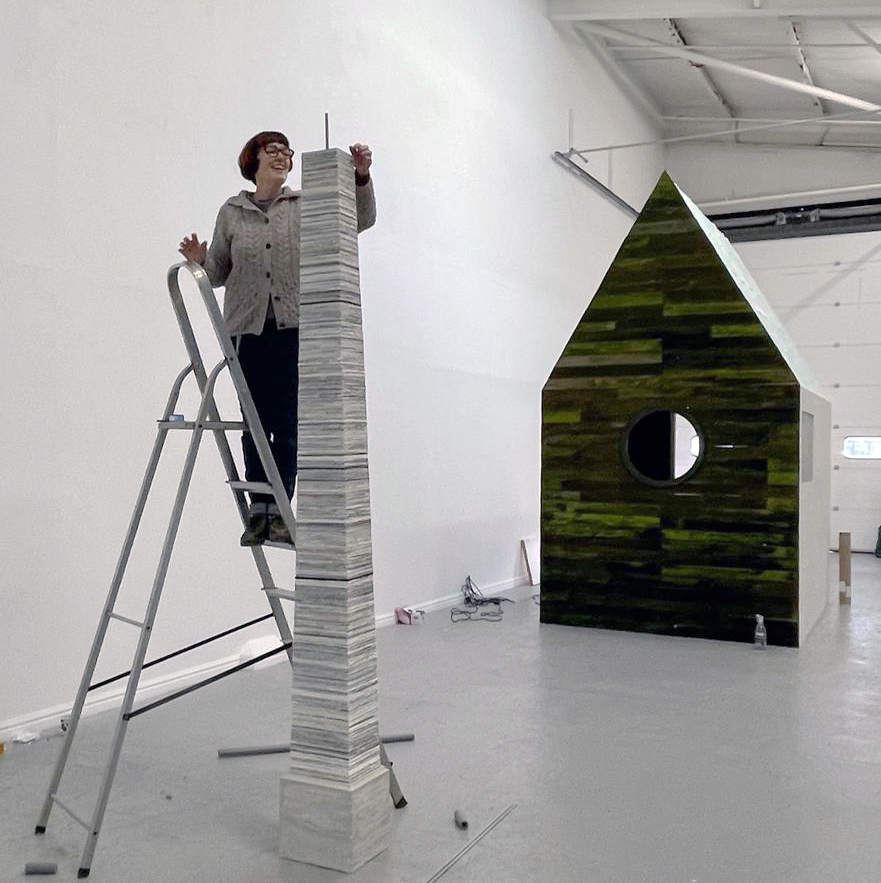
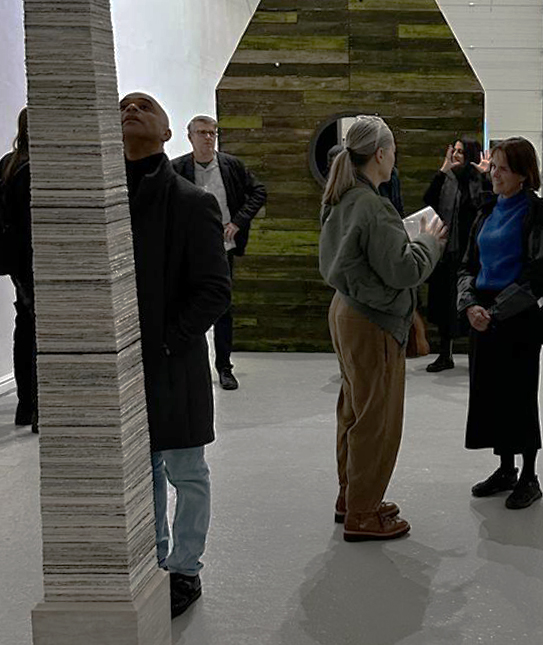
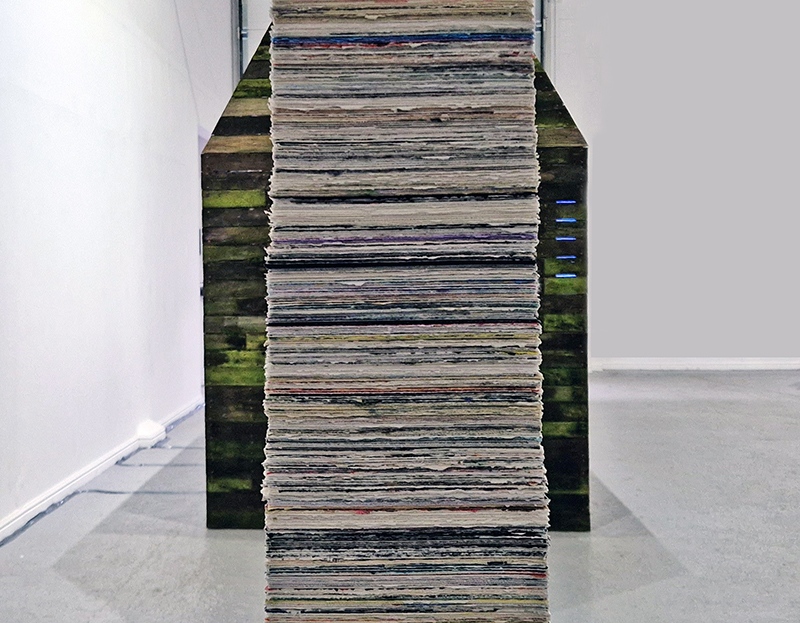
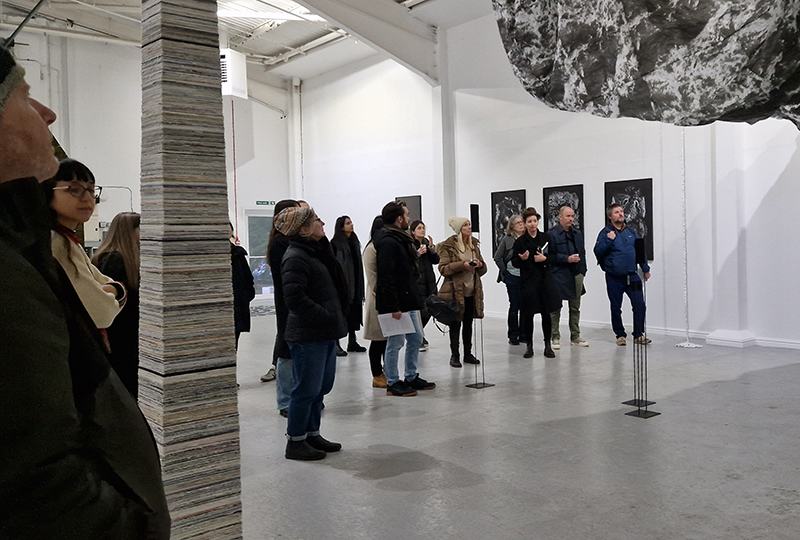
This sculpture also embodies the passage of time, and a layering of information, in the months of collecting paper donations or scavenging the recycling bins, weeks tearing down the hundreds of prints and drawings into squares decreasing by 1mm every 50 sheets, drilling holes through the centre and hours to build the almost 3m stack. I’m very grateful to everyone who donated some of their work archive. These images are now secreted within the layers of the sculpture, hinted at where edges are exposed, echoing the Earth’s sedimentary knowledge.

The Azimuth Obelisk (of sedimentary knowledge) Paper, steel, Snowcrete, oyster shells, patinated copper; 30 x 30 x 270 cm

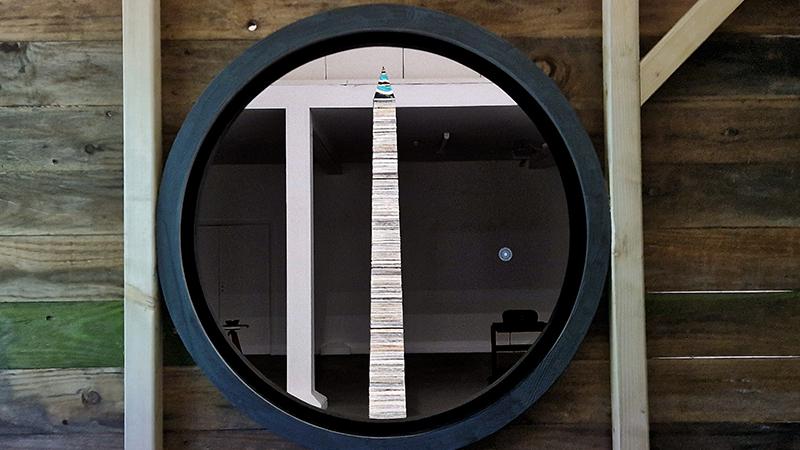
 This work is a reimagining of an ‘obelisk’ erected at Hartland Magnetic Observatory in the late 1950’s to be viewed through the north facing window of The Absolute Hut, it acts as a permanent azimuth mark from which the drift of the magnetic north pole is monitored. I am excited that this sculpture is being considered for exhibition in 2026 at the Royal West of England Academy in Cosmos: The Art of Observing Space curated by Ione Parkin with some amazing artists in the line up whose work I admire.

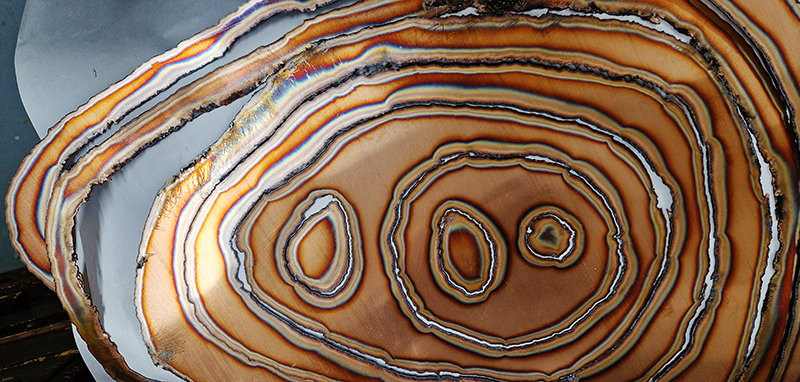
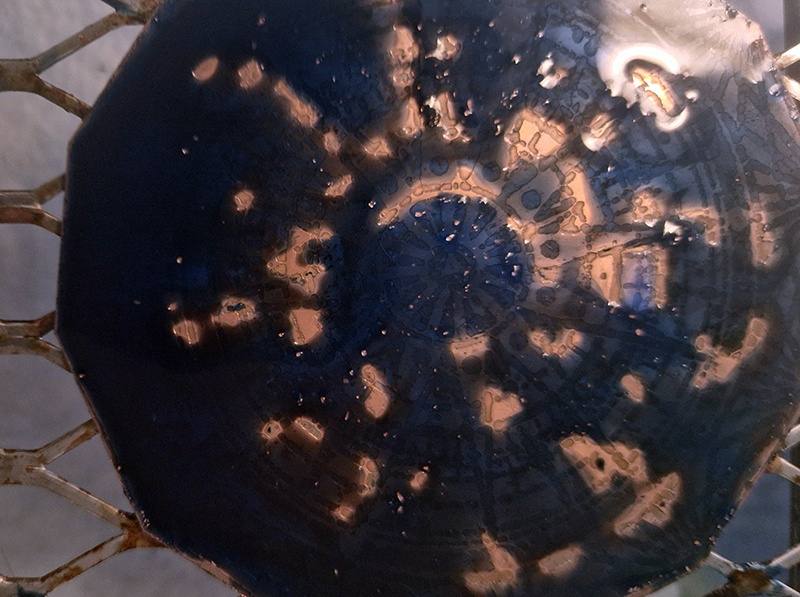
I first came across directional magnetic steel in the Electronic & Magnetic Materials Group open day at the National Physical Laboratory. Intrigued, I wanted to know if I could get hold of some to work with. I was put in touch with Union Steel Products who were very helpful in supplying a small amount (to them) of the material, but they import the product, and it arrives with an indeterminate protective matt grey coating. This was my challenge. It took many days of sanding and gently etching each sheet to reveal the pattern. It was a very temperamental material to work with, the pattern might appear but quickly tarnish and muddy over. So much of the work in the resulting sculpture was about the process of exposing an internal mechanism.
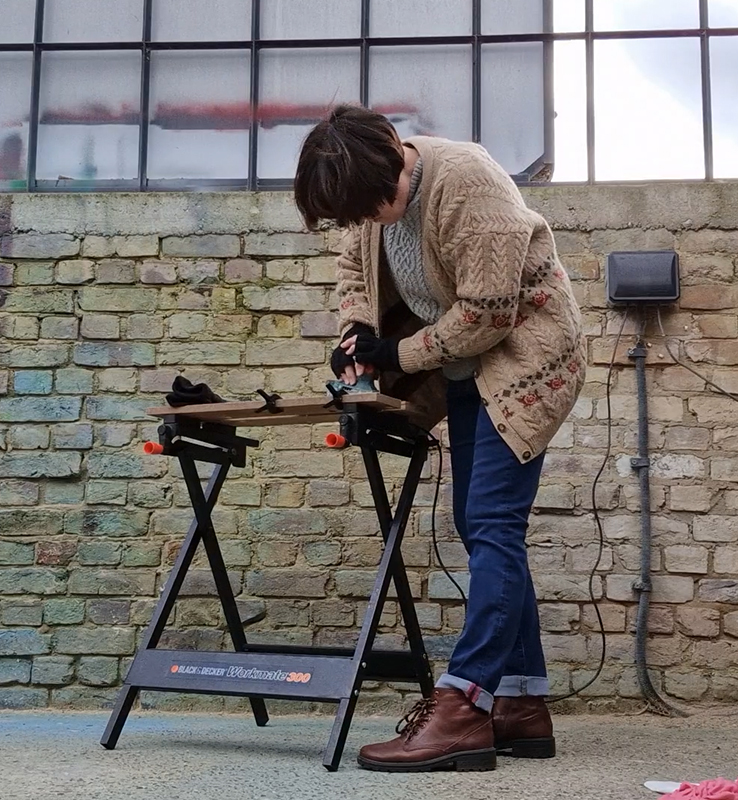
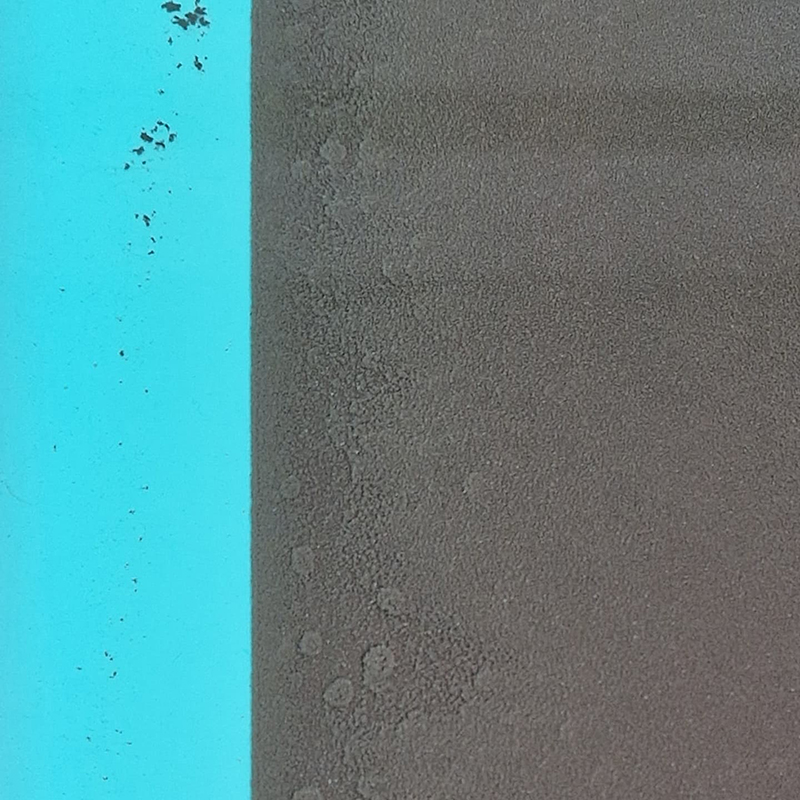
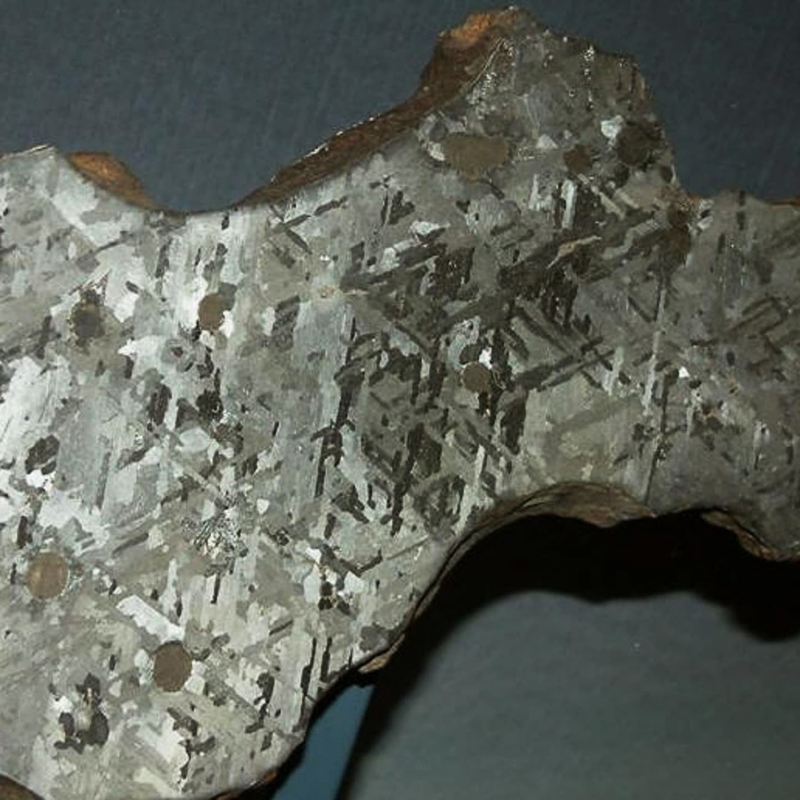
The dramatic Widmannstätten patterns found in meteorites due to their slow evolution through heat and pressure are also revealed through being cut, polished, and etched.

These secrets are not revealed lightly.
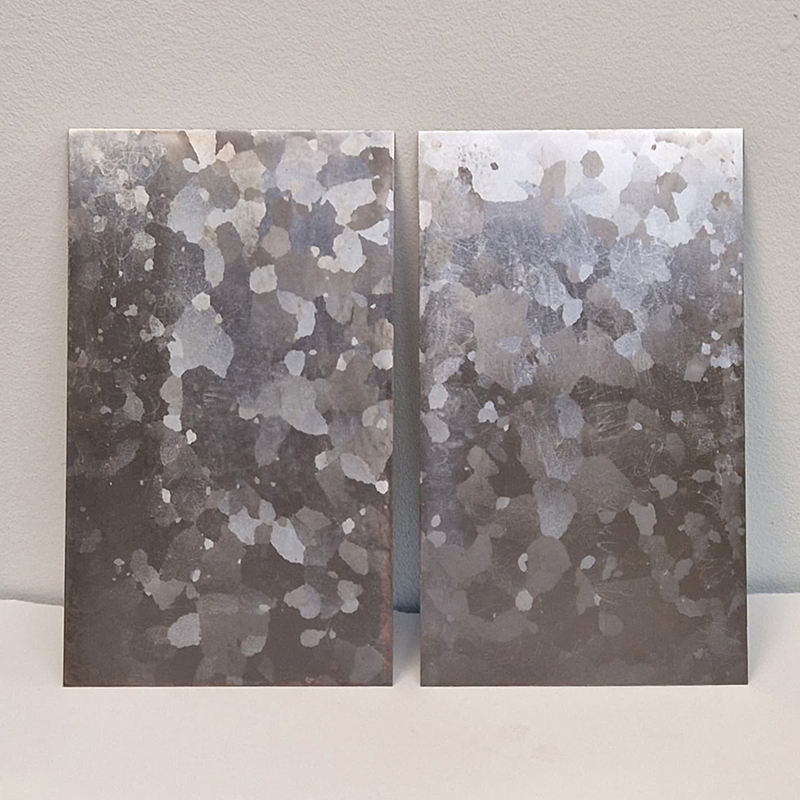
Domain of the Devil Valley Master

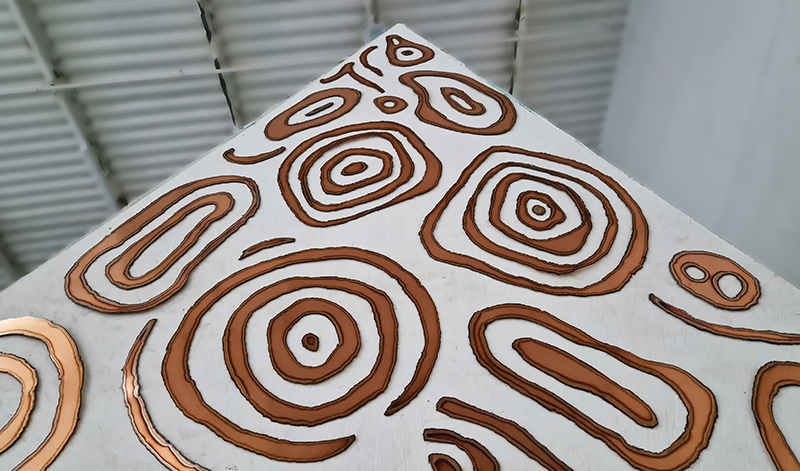
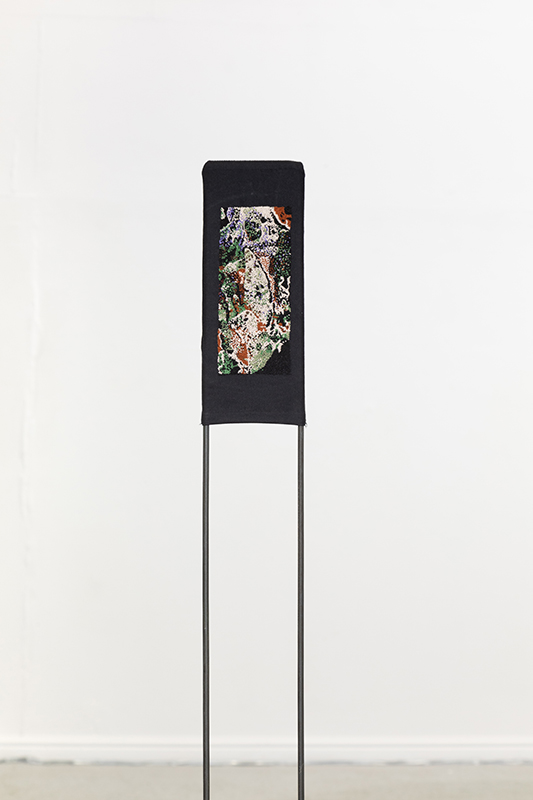
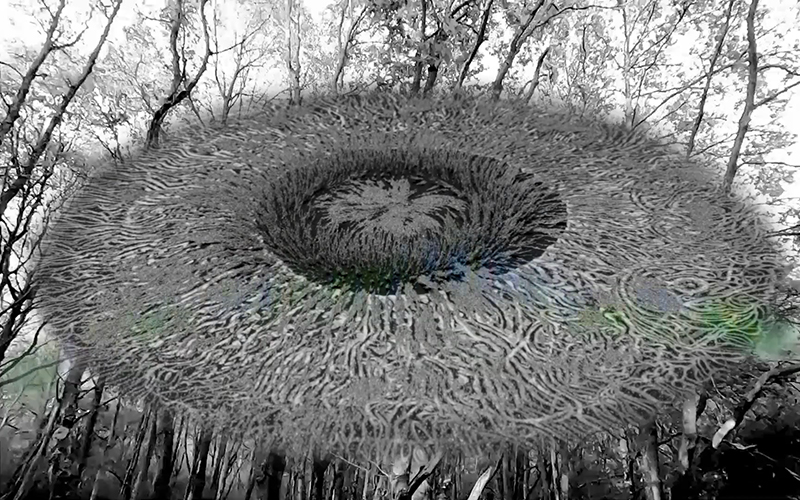
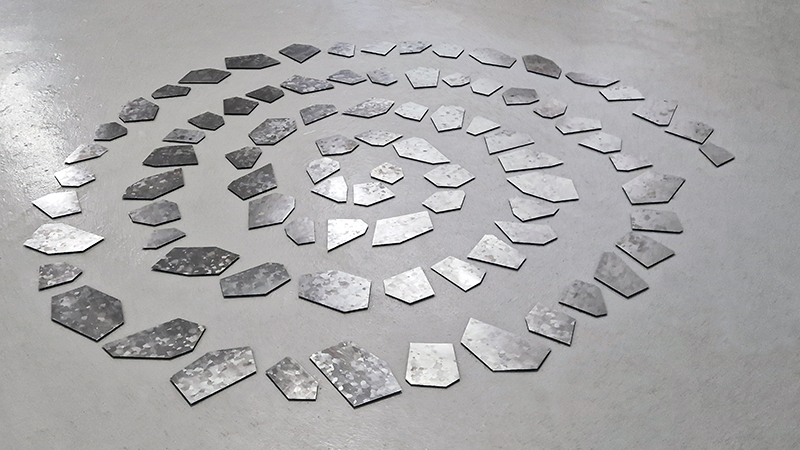
This work uses industrial directional magnetic steel, sanded and etched to reveal the Goss texture of rolled iron silicon alloy crystals. The jigsaw pattern of magnetic domains give this material exceptional magnetic properties. The simple evocation of a spiral described in geologically informed polygons draws upon many references, from the shape of our own Milky Way Galaxy sculpted by vast cosmological magnetic fields and the spiralling molten dynamo generating Earth’s magnetic field, to the inner pathway of spiritual growth and the route to the symbolic omphalos (navel) at the centre of the world where the sky entrance and the underworld meet. The title of this work originates from an ancient Chinese manual on the skills of persuasion, The Book of the Devil Valley Master, containing the first known mention of a compass, known at the time as a south-pointer. 

Work in progress. Mapping a response to the crystal structure of magnetite. Magnetite is the most magnetic of all the naturally occurring minerals on Earth found in igneous, metamorphic, and sedimentary rocks. Nano-particles are also found in the human brain, heart, liver, and spleen and the cells of many other organisms, with some creatures using this for navigation techniques.

Magnetite crystals from road traffic pollution caused predominantly by vehicle frictional braking systems can outnumber natural magnetite in the human brain by 100:1 – this is a worrying trend as these crystals could be involved in our perception, transduction, and long-term storage of information in the brain.

Returning to my conversation with Alan Watson on the history of Haverah Park Extensive Air Shower Array.

The motivation for the Haverah Park project getting off the ground came largely from the British physicist Patrick Blackett, who won the Nobel prize in 1948 for his discoveries in the field of cosmic rays. The director of The Rutherford Lab (where the British atomic bomb was being developed in the 50’s), John Cockcroft (known for splitting the atom), decided there should be fundamental science going on as well as bomb building, so outside the security wire they built an air shower array to monitor cosmic rays. When this experiment was shut down, Blackett was keen to see work with shower arrays continue, and to be within reach of a university so that scientists could combine research with teaching. Blackett was working at Cavendish Laboratory with Ernest Rutherford, but moved to Birkbeck which did all the teaching in the evening so he could do research work through the day and teach in the evening. Here he met J G Wilson, also with an interest in cosmic rays, so when J G Wilson later moved to Leeds, Blackett suggested he set up an air shower array there, which was how the Haverah Park Project came about. Land was rented from local sheep farmers to install the observation huts.

Alan Watson took a lectureship job at Leeds in 1964 and began working for J G Wilson, becoming a leading member of the UK Extensive Air Shower project until its closure in the early 1990s.

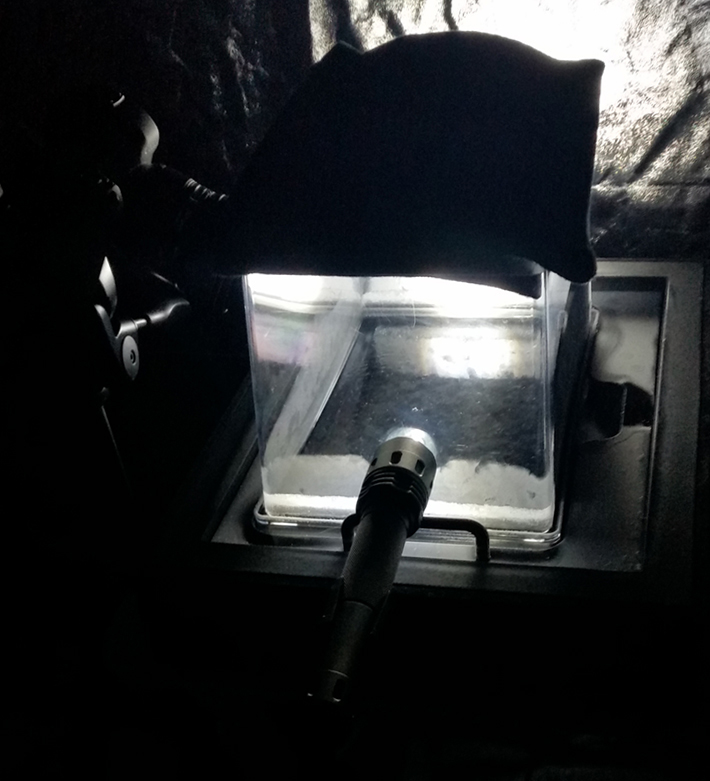
We also talked about the mesmerizing power of a cloud chamber. As well as it being considered one of the most important developments for progression in the understanding of particle physics it is also emotionally and aesthetically captivating. Alan reminisced about a time at the Royal Society Summer Exhibition when a large commercial diffusion cloud chamber drew so much attention they were asked to turn it off, as mesmerised visitors blocked the entrance to the exhibition. It’s been a few years since I visited the Institute of Physics to see the large cloud chamber in the foyer, I wonder if it’s still there. I love the fact that I can build my own cloud chamber to see these cosmic visitors.

J G Wilson writing on the study of cosmic rays from his book About Cosmic Rays published in 1948, of which I have a copy:

‘It has its spectacular side, for the only laboratory which has been found big enough for its investigations is the whole of the universe to which men can win access. Most refined measurements have been made under conditions of difficulty and hazard, deep in mines and on icebound mountains, in the watses of western Greenland and cramped in the tiny gondola of a stratosphere balloon. These exploits, which are outstanding even in one of the most brilliant phases of experimental physics, are an unambiguous indication of the importance which is attached to the problems which are being studied.’

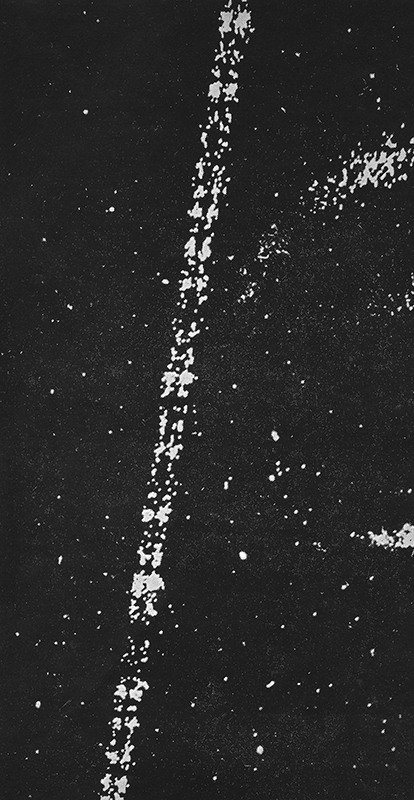
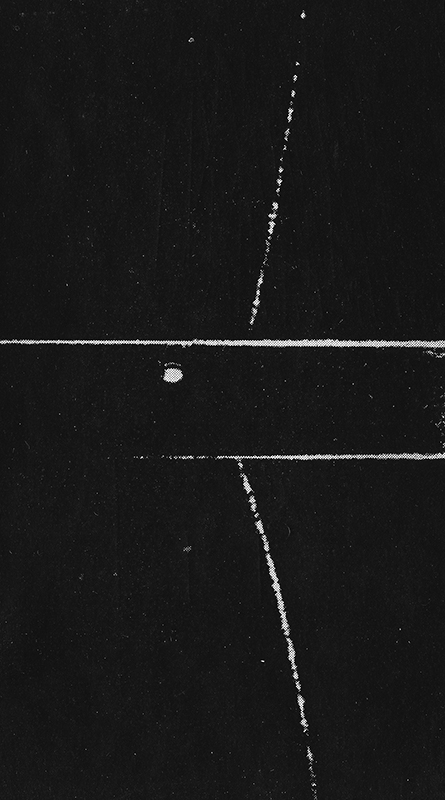
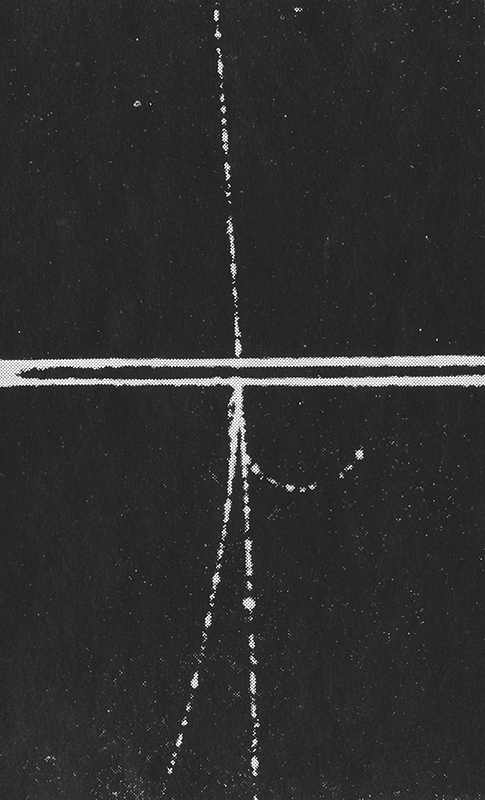
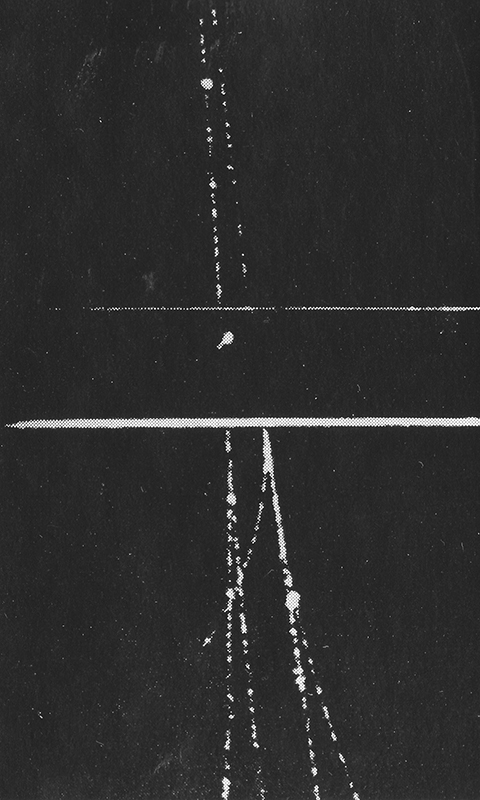
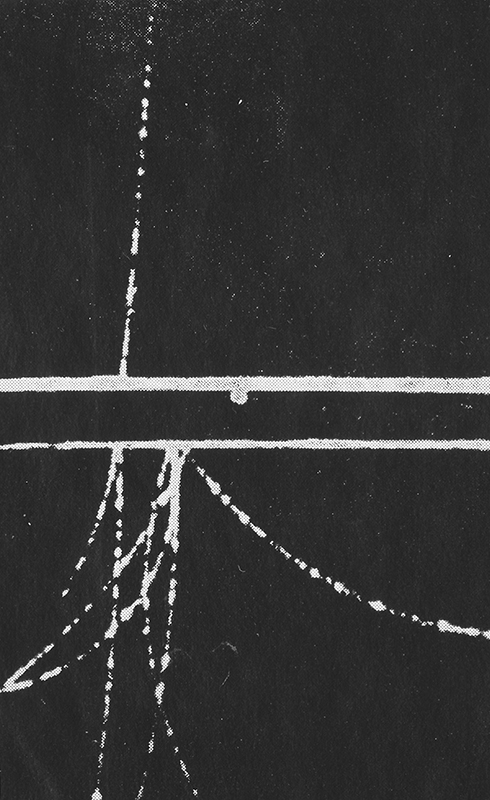
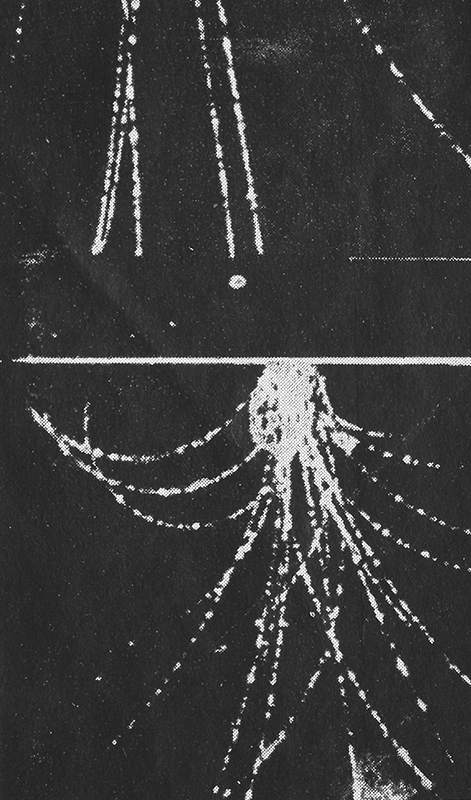
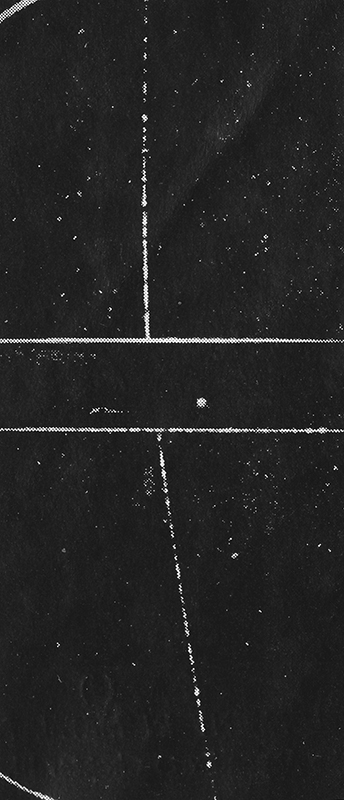
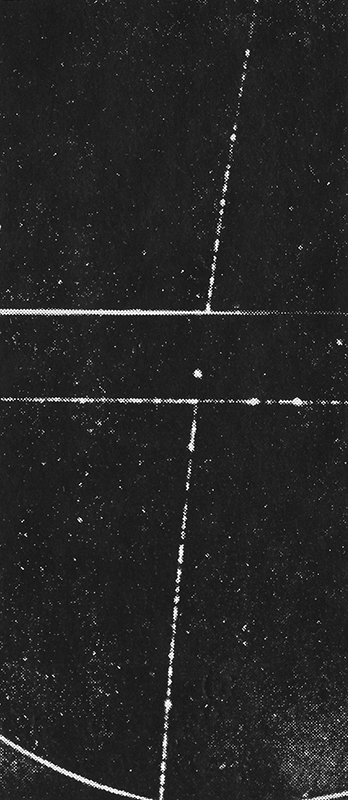
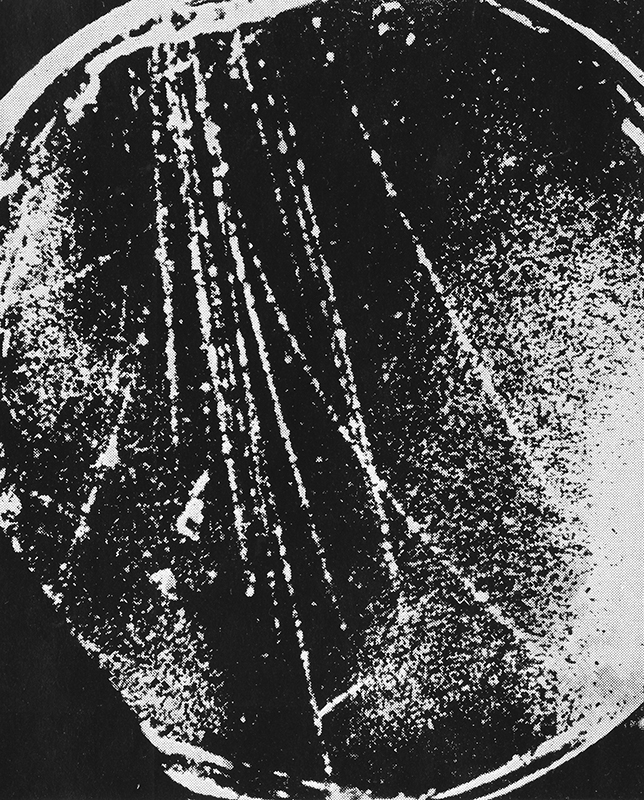
The following images from the same book show particle trails photographed in a cloud chamber -showing extensive showers and particles passing unhindered through metal plates.

J G Wilson writes about cosmic rays ‘…it is interesting to speculate on their previous history, for before it is overtaken by the catastrophe of hitting the earth, each particle is likely to have had a placid life for years, even millions of years, cruising through the wide open spaces of the universe’.

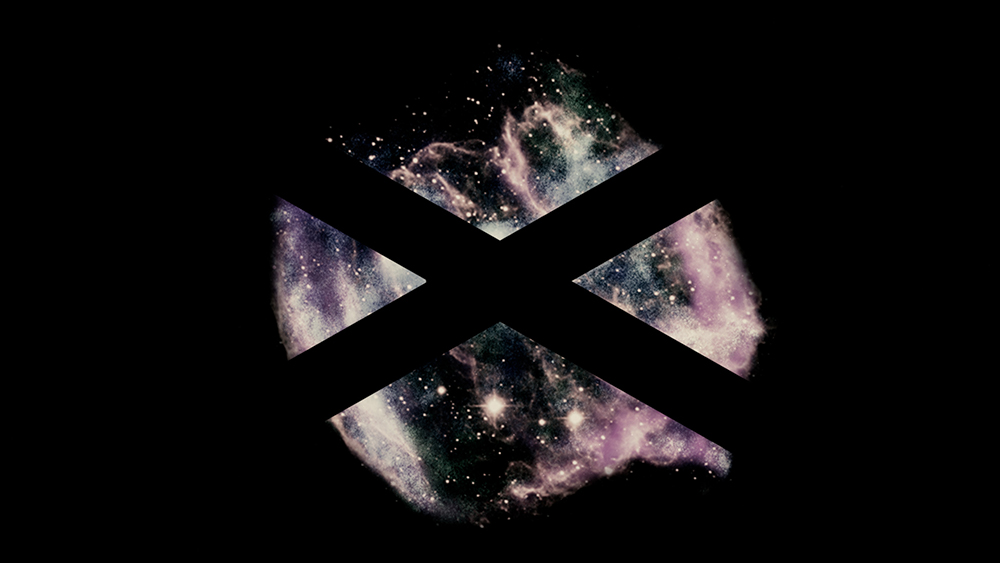
Cosmic Chiasmus: crossing the universe 2021 (video still)

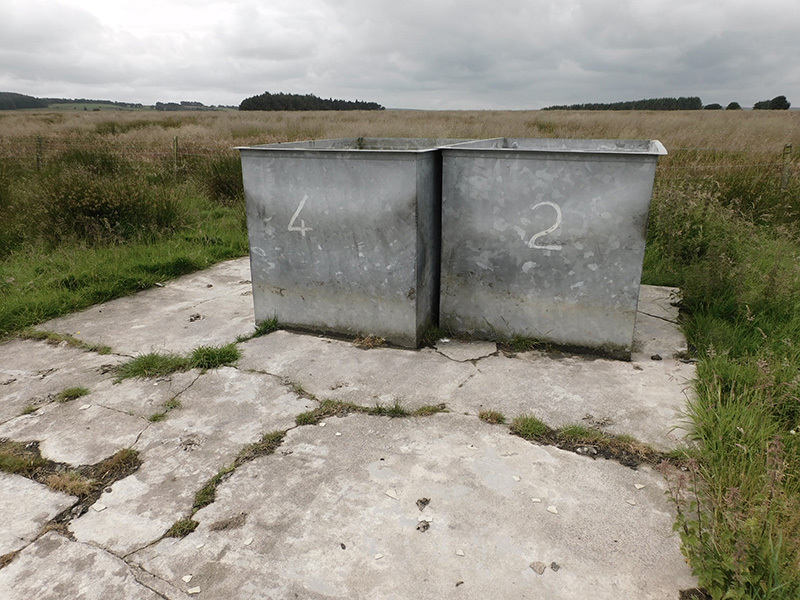
The primary detectors used at Haverah Park were water Cherenkov detectors. These are large water filled tanks filled with a photomultiplier suspended in the water to capture flashes of Cherenkov light emitted by high energy cosmic rays as they pass through. The light is emitted because the cosmic rays pass through water faster than photons of light are able to, and as they do so they lose electrons thereby emitting light. The speed of light is only a constant within a vacuum, when it passes through other materials it get slowed down.

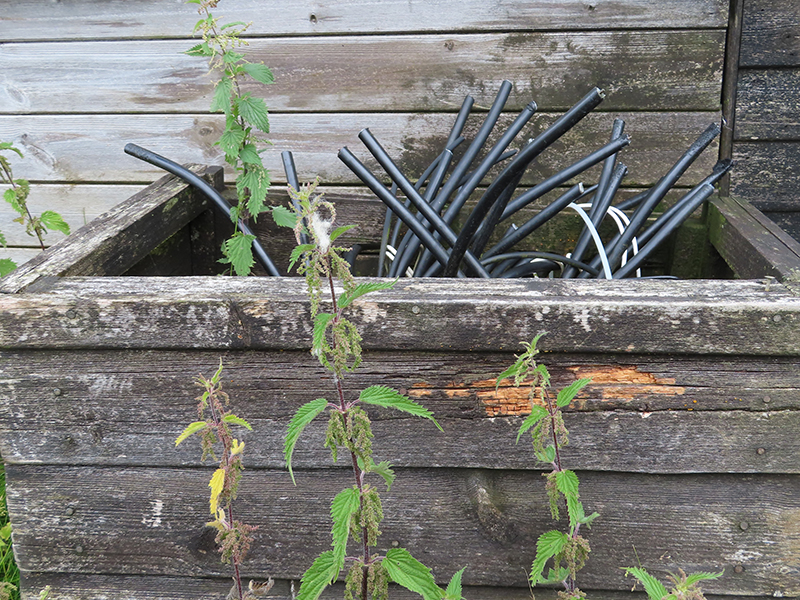
There were four 34 m2 detectors at the centre of the array in the main hut, with three detectors located 500m from the central detector. Signals from the three distant detectors were sent along buried cables to the central hut, with the signal from the central detector passing down 500 m of cable buried underground so that all signals arrived at about the same time.  When signals from the central one and two of the others arrived within ~2 x 10⁻⁶ s (called a coincidence), the signals from the photomultipliers in the 34 m2 detectors were displayed on four oscilloscope screens and photographed by one camera which had its shutter permanently open. About 20 feet of film could record around 150 events. Developed and manually scanned by Alan, or a senior colleague, the film was checked for quality and to look for any large events (ultra high energy particles arriving) which were always exciting to find. The developed film was then sent to Leeds University Physics dept for measurements.

When there was a coincidence event at the centre of the array, a signal was sent by microwave to the distant detectors set across the moorlands (on average about 2km from the central hut), the signals from these distant groups of 4 x 13.5 m2 were recorded digitally with the data going onto paper tape which was collected once each week. 

Along with the oscilloscope traces being photographed, the number on a counter was included which gave the time of each event to the nearest half minute.  In the 1960’s when this project began the time counter was advanced by a pendulum clock.  Counting time in half minutes the team found that there are roughly one million half-minutes in a year, which gave a good excuse for an annual party.

There were some brief periods in the early 1980s when a small number of scintillator detectors were also used to make cross-checks of the results from the water Cherenkov detectors against those from projects in the USA (Volcano Ranch) and Yakutsk (Siberia).  The scintillators retrieved from Imperial College’s Holborn project were brought to Haverah Park for an experiment to look at much lower energy showers.

Both types of detectors register flashes of light.  

Blackett was the first person to work out the details of Cherenkov light produced in the atmosphere. According to a memoir on Blackett, written by astronomer Bernard Lovell, who knew him very well, Blackett attempted to see Cherenkov light from cosmic ray showers with the naked eye but there is no mention of whether he succeeded. In 1962, physicist Neil Porter who built the first water Cherenkov tank in the UK at Harwell in the 50’s, did an experiment with some volunteers who were asked to recline on a coach in a dark room with a small Geiger telescope attached to a pair of darkened goggles and acknowledge if they saw a flash of light when a cosmic ray was known to pass through the googles. The observers did seem to experience a flash of light but results were ambiguous as to whether this was Cherenkov light being emitted as the particle passed though the crystalline lens or vitreous humour of the eye or a direct excitation of the retina. The experiment was a collaboration with the Psychology dept at the University of Dublin and published in Nature under the Psychology heading giving an impression that the lights were perhaps a figment of the imagination.

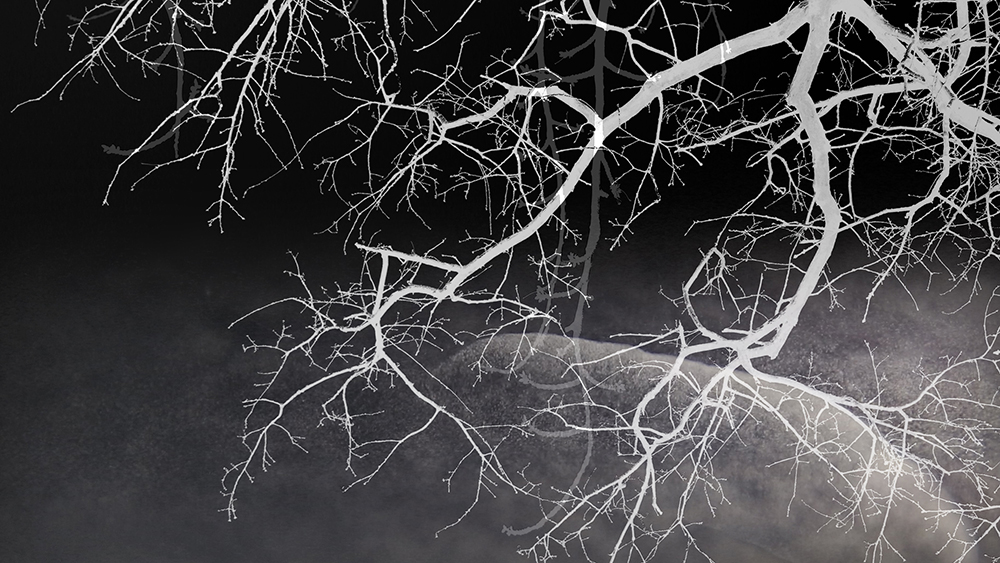
Aóratos 2019 video still

Astronauts are very aware of this phenomenon. During the 1970 Apollo 13 mission to the moon the power supply was damaged and the astronauts sat in the dark for several days waiting to return to Earth. They experienced flashes in their eyes and realized that some of this was Cherenkov light. Some flashes were caused by particles directly hitting the retina but Cherenkov light caused by high energy particles travelling through the matter of the eye faster than light, is much brighter. The energy is proportional to the square of the charge of the particle that comes through, so if you have an iron nucleus which has a charge 26 x the charge of a proton, you get 26 squared or 600 times as much light emitted. Out in space there are many more of these high energy particles and so the astronauts would become very familiar with these flashes, even using them to line up accelerator beams by putting their head in the particle beam to see the flashes.

An astronaut once told Alan that he was convinced that the very first people fired into space probably saw these flashes, but didn’t like to tell NASA in case it turned out to be a physiological defect of theirs and they would be taken off the space programme.

Recently, a professor friend of Alan’s who is aware of this phenomenon, has unfortunately had to begin radiation treatment for a brain tumour. He has found due to the position of the tumour and angle of treatment he can see Cherenkov light flashing in his eyes as the electrons bombard the tumour.

Aóratos 2019 cropped video still

When we met, Alan was just back from a conference in Italy discussing a paper titled ‘Ultra high energy cosmic rays: The Disappointing model’. They called it the disappointing model because they believed that the Auger results with particles at the highest energy were heavy not protons. I’m not sure I understood why it was disappointing although Alan did his best to explain: ‘It’s difficult to measure the mass of the particles of a certain energy. A deduction had been made that they have a mean mass, probably the same as nitrogen but mass changes in quite a complicated way as a function of energy. It’s to do with how deep the showers develop in the atmosphere.

Cosmic Chiasmus: crossing the universe 2021 video still

The techniques aren’t good enough to separate the particle’s mass on a one by one basis, we can only do averages. It looks like the average mass is much heavier than protons, which everybody had believed for a long, long time. Protons would be at a much lower energy. As the nucleus is travelling through space, it sees photons from the microwave background radiation and the photon will chip off a neutron or a proton, if it chips off a neutron, the neutron decays into a proton, so you can get protons this way, but they will be of lower energy. The energy reduces roughly by the mass of the particle, so an iron nucleus has a mass of 56, if you chip off a neutron or a proton that proton will have an energy, which a 56th of the energy that the nucleus has – so it goes down in energy.

Some particles could come from Centaurus A, which is a relatively close radio galaxy, it is thought that the jets from radio galaxies provide conditions to accelerate the particles, but the problem is, because the cosmic rays are charged, they get deflected in the magnetic field of the Galaxy so you can’t track them straight back to where they came from.  In terms of heavy particles that’s more of a problem because being charged means they bend even more. So one of the disappointing things is that cosmic ray astronomy is not going to be very easy. The Pierre Auger observatory has really been very successful in changing the picture quite a bit but because there are so few ultra high energy particles recorded it is slow progress. There are hopes to expand the observatory even more and also a plan to launch a satellite with detectors to pick up fluorescence light in the shower as it passes through the atmosphere, a similar phenomenon to aurora light.

Cosmic Chiasmus: crossing the universe 2021 video still

Exhibitions

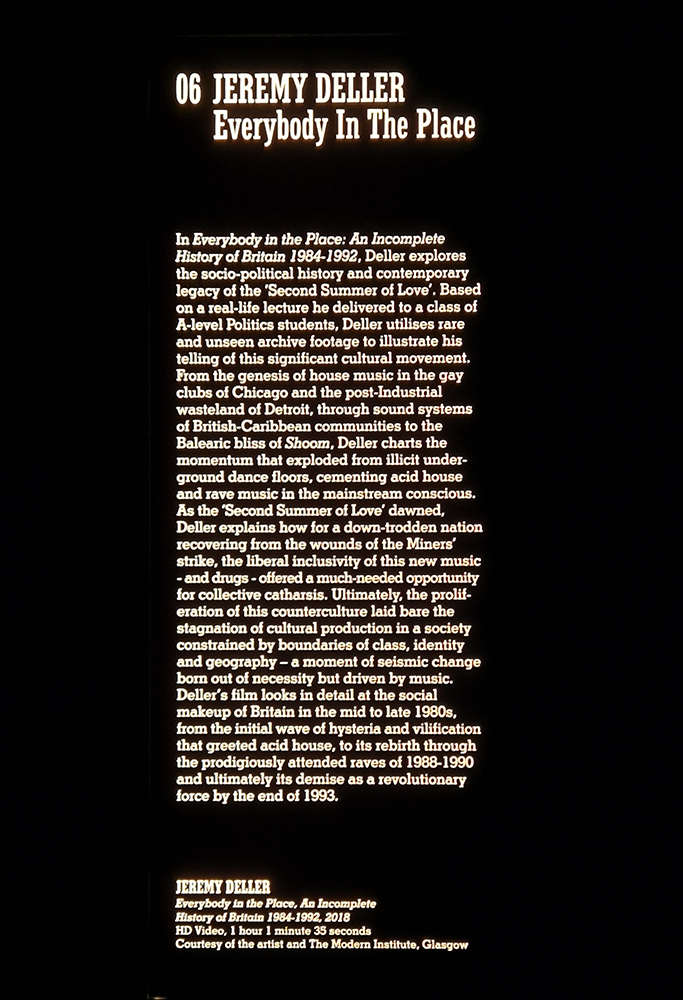
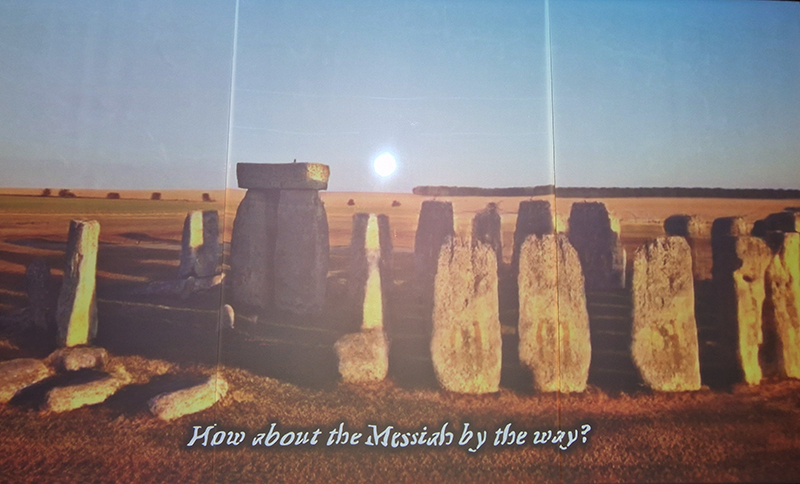
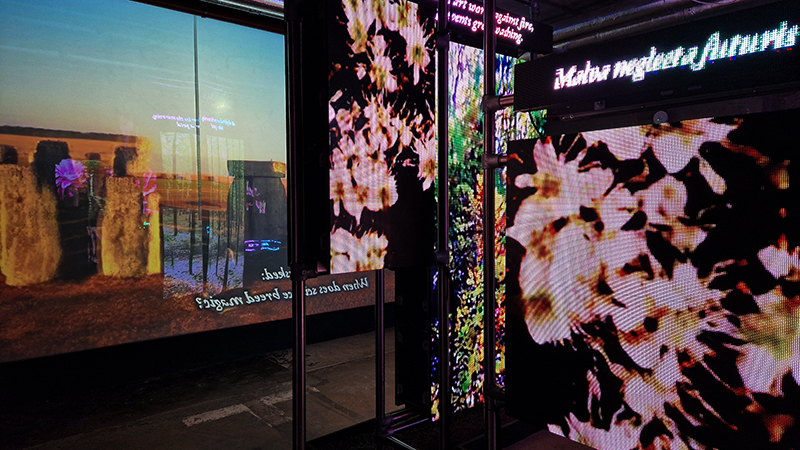
The Vinyl Factory: Reverb at 180 The Strand, a multimedia exhibition exploring the intersection of art and sound with artists including Theaster Gates, Es Devlin, Julianknxx, Kahlil Joseph, Caterina Barbieri, Stan Douglas, Virgil Abloh, Cecilia Bengolea, Jeremy Deller, William Kentridge, Jenn Nkiru, Hito Steyerl, Carsten Nicolai and Gabriel Moses. Fabulous show, shame I can’t share the sounds here. Loved Jeremy Deller’s takeover of a sixth form politics class. Some of the works I had seen before but that was fine as they are worth extra viewings.

Reading

I am beginning research reading for The Geological Unconscious exhibition Julie F Hill and I are co-curating at Hypha HQ Euston opening in May 2025.

Ursula Le Guin The Winds Twelve Quarters, a collection of profound short stories each introduced by the author reflecting on the intention within.

Long after I wrote the story (The Stars Below) I came on a passage in Jung’s On the Nature of the Psyche: ‘We would do well to think of ego-consciousness as being surrounded by a multitude of little luminosities…Introspective intuitions…capture the state of the unconscious: The star-strewn heavens, stars reflected in dark water, nuggets of gold or golden sand scattered in black earth.’ And he quotes from an alchemist, ‘Seminate aurum in terrain albam foliatam’ – the precious metal strewn in the layers of white clay. Perhaps the story is not about science, or about art, but about the mind, my mind, any mind, that turns inward to itself.

Roger Caillois The Writing of Stones 1970 is a tribute to the collection of extraordinary stones Caillois acquired and which now resides in The National Museum of Natural History Paris. In these poetic chapters he describes in detail each of the stones and his fascination with the images and associations they conjure in his imagination. Questioning and celebrating the allure of the mineral and the stories hidden and revealed over millennia.

I can scarcely refrain from suspecting some ancient, diffused magnetism; a call from the centre of things; a dim, almost lost memory. or perhaps a presentiment, pointless in so puny a being, of a universal syntax.

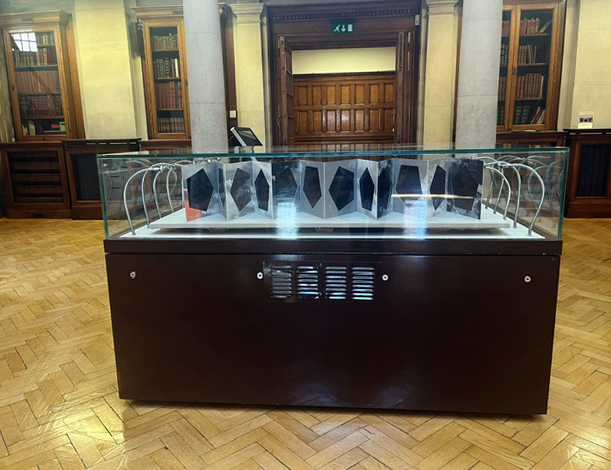
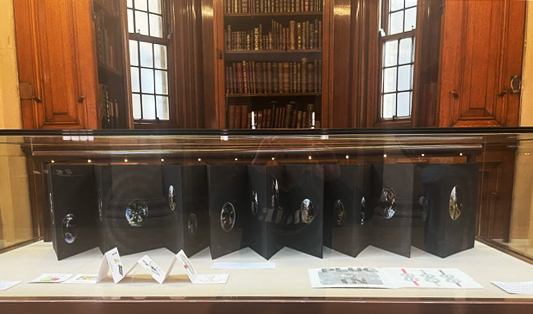
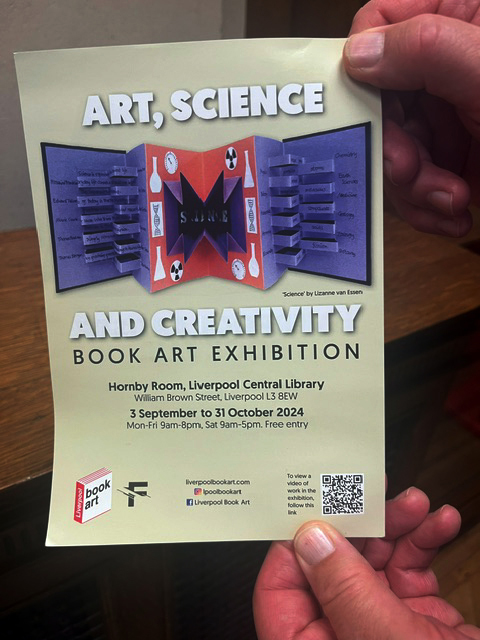
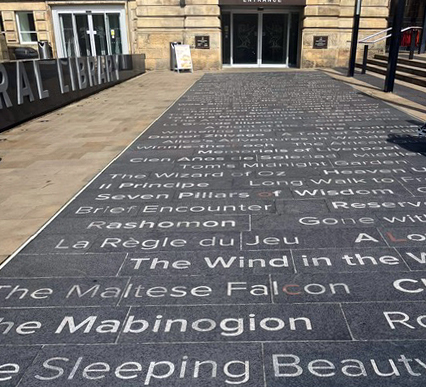
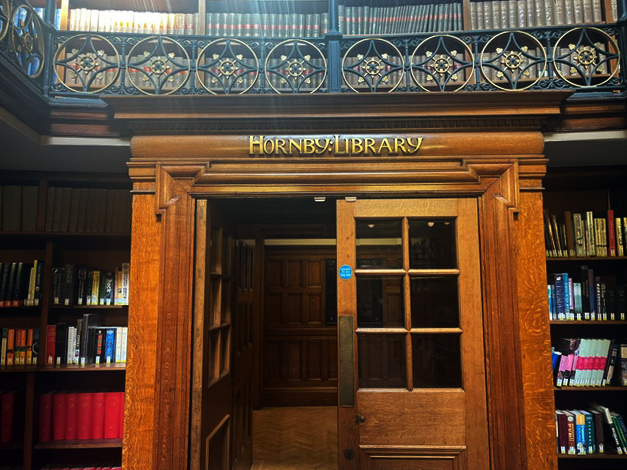
The ‘Art, Science and Creativity’ exhibition at Liverpool’s spectacular Central Library continues. The exhibition is inspired by statements from Albert Einstein, highlighting the fact that creativity is central to explorations in both art and science. As we wonder, and attempt to understand the universe and ourselves, categories can, and perhaps should, become blurred. Distinctions can be both valuable and problematic: ‘art’ versus ‘science’, ‘nature’ versus ‘human’, ‘natural’ versus ‘supernatural’, ‘material’ versus ‘spiritual’, ‘secular’ versus ‘religious’ and so on. And as the great science-fiction writer Arthur C Clarke said “Any sufficiently advanced technology is indistinguishable from magic”.

I am very happy to have two unique books included in the exhibition. In/Out and Unbound.

Liverpool Book Art and Fevered Imagination are collaborating to create a video loop of all the artworks, enabling audiences to get a fuller appreciation of the artists’ creativity than allowed by the use only of display cases. Fevered Imagination is a website dedicated to Artists Books, through which works from the exhibition can be bought.

I am delighted to be invited by Serendipity Arts Foundation to show Cosmic Chiasmus: crossing the universe at Serendipity Arts Festival in Goa later this year.

Serendipity Arts Foundation is an organisation that facilitates pluralistic cultural expressions, sparking conversations around the arts across the South Asian region. Committed to innovation and creativity, the aim of the Foundation is to support practice and research in the arts, as well as to promote sustainability and education in the field through a range of cultural and collaborative initiatives. The Foundation hosts projects throughout the year, which include institutional partnerships with artists and arts organisations, educational initiatives, grants, and outreach programs across India.

Serendipity Arts Festival is one of the largest multi-disciplinary arts initiatives in the South Asian region. It spans the visual, performing, and culinary arts, whilst exploring genres with film, live arts, and literature. Besides the core content, which is conceptualised by an eminent curatorial panel, the Festival has various layers of programming, in the form of educational initiatives, workshops, special projects, and institutional engagements. Through active conversations between the artistic community and the urban, social landscape, the Festival continues to evolve around the mandate of making the arts visible and accessible. The Festival is driven by a spirit of collaboration, hoping to inspire new perspectives and fresh aesthetic encounters. This labour of love is a cultural experiment that also addresses issues such as arts education, patronage culture, interdisciplinary discourse, inclusivity, and accessibility in the arts.

Other exciting news is that Julie F. Hill and myself are working together again on a new project. Following on from our ambitious duo show A Stone Sky at Thames-side Studios Gallery (Nov 23), we will be curating and participating in an exhibition next spring, exploring themes of stone consciousness and human-mineral encounters.

In the studio I have been working on a proposal for the Moon Gallery. Moon Gallery is an international collaborative artwork and a gallery of ideas which aims to set up the first permanent museum on the Moon. Moon Gallery will launch 100 artefacts to the Moon within the compact format of a 10 x 10 x 1cm plate on a lunar lander exterior panelling as early as 2025.

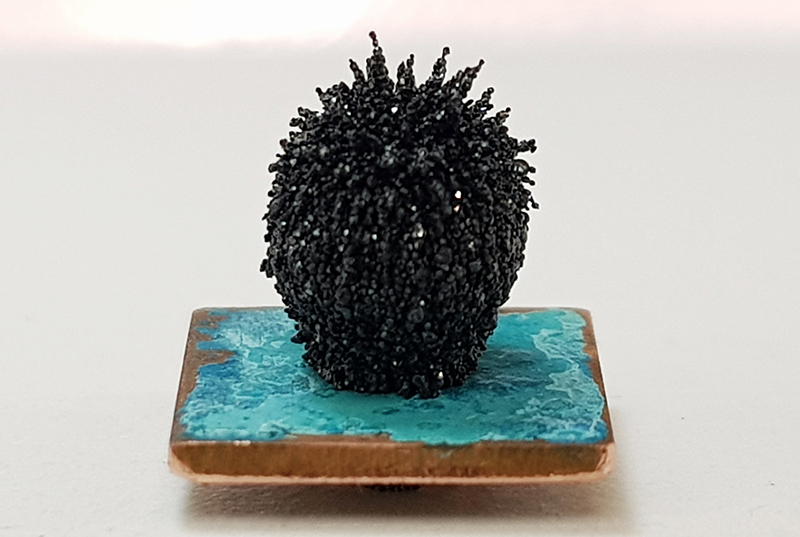
Each sculpture has to fit within a 1cm cube, which is quite challenging. My proposal is a 5mm spherical magnet sparkling with black volcanic sand on a 1cm square of patinated copper. Space exploration means leaving the protective shield of Earth’s magnetic field, placing astronauts and technology at risk from increased levels of harmful high energy particles. This artwork is a small realization of a magnetic field offered as a symbol of safe passage to those venturing beyond our home planet and protection of Earth’s magnetosphere. The black volcanic sand used in this work is naturally magnetic, making visible the force that emanates from the core of the magnet. The patination colour reflects on the astonishing view of our blue planet from the moon and the importance of water to sustain life. The title Core Values, makes reference to the molten core necessary for a planet to generate a magnetic field as well as the ethical principles and beliefs that guide humanity in a positive spirit of peaceful cooperation for the benefit of all. The work operates as a motif for what is in the heart of a body, rocky or otherwise. It also celebrates the beauty of the elements and natural forces that together inspire the human imagination and makes the cosmos so exciting to explore.

I have been sorting out the copper contours from The Absolute Hut (of action potential) as I couldn’t store this work, it had to be dismantled. The copper will be reused in future work.

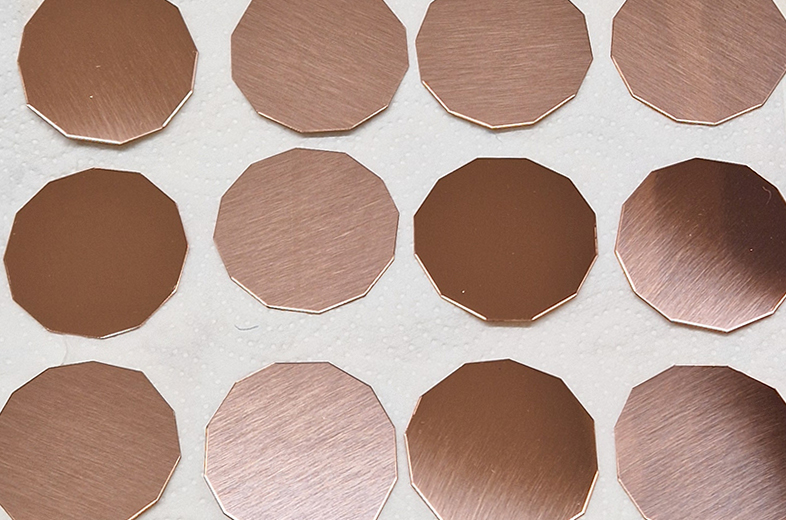
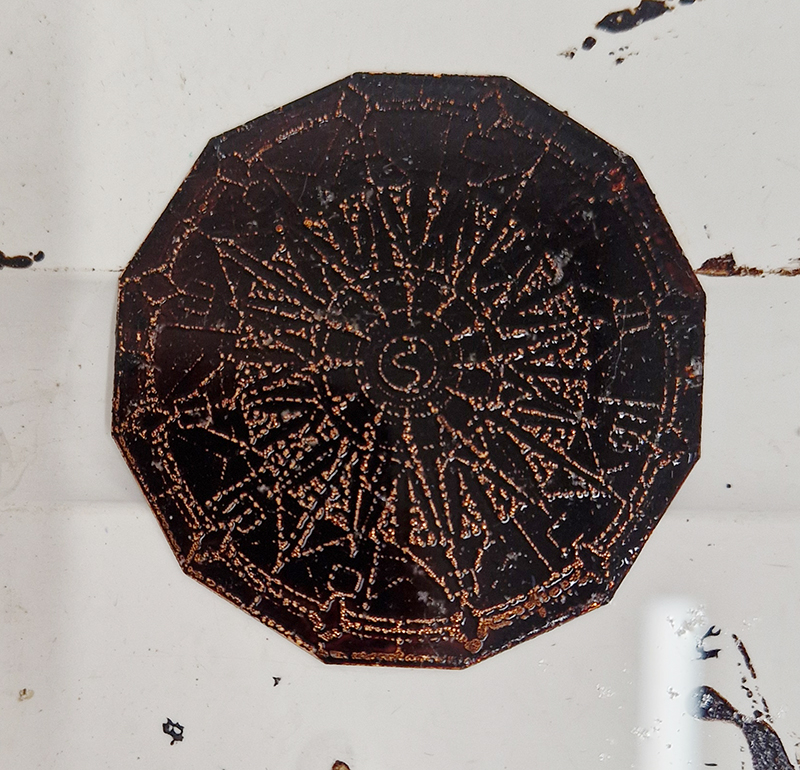
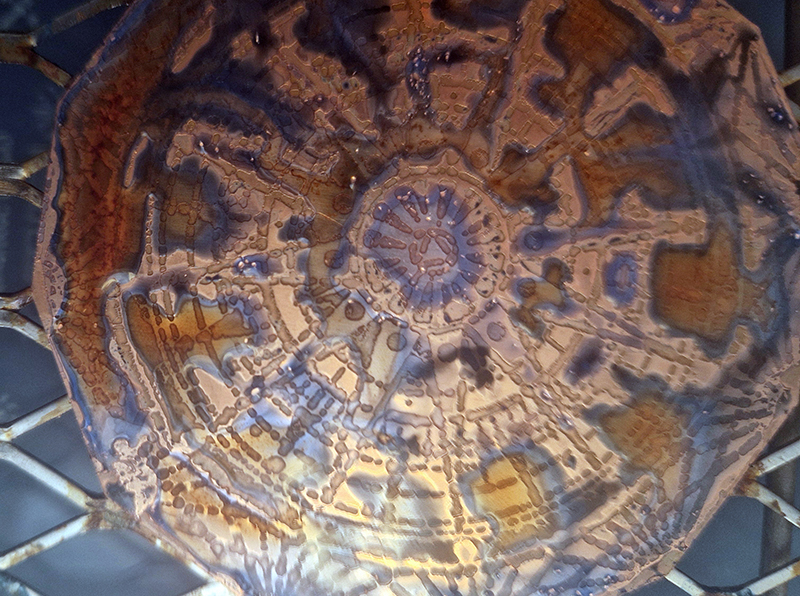
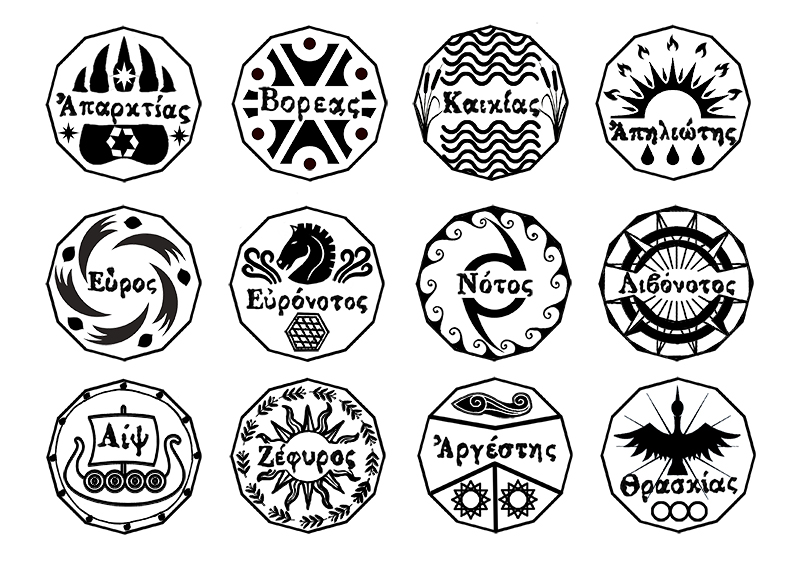
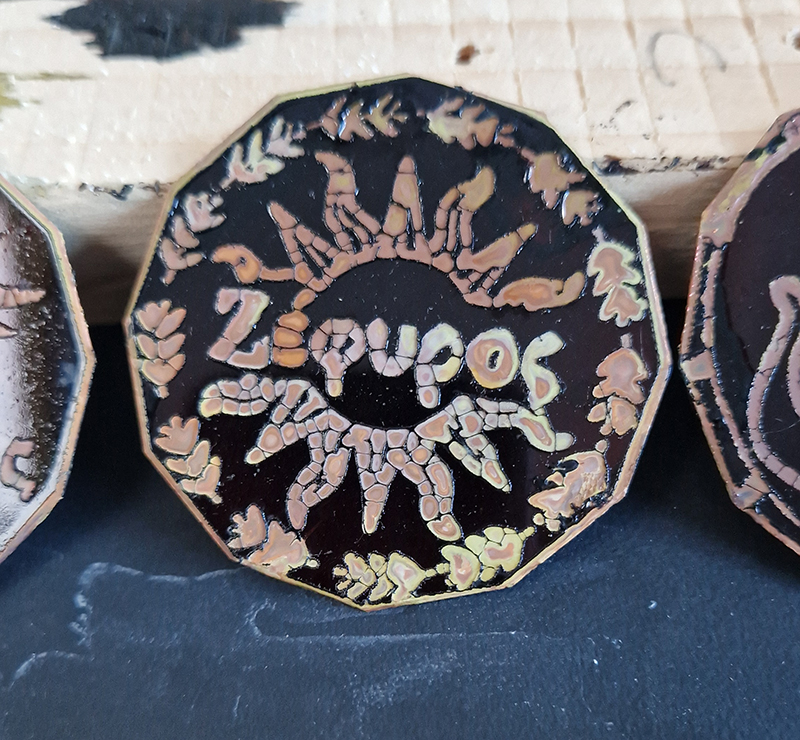
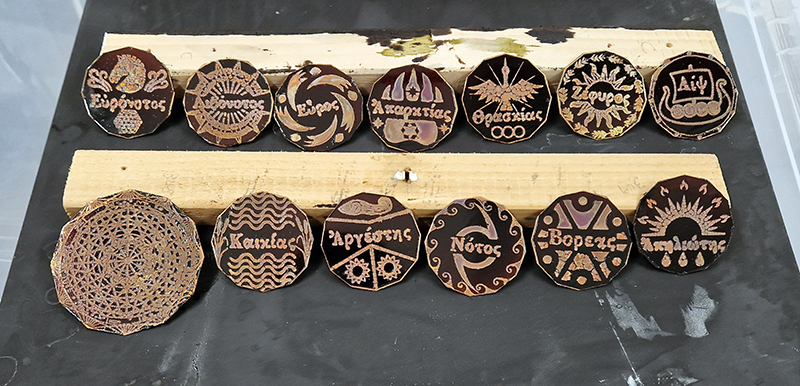
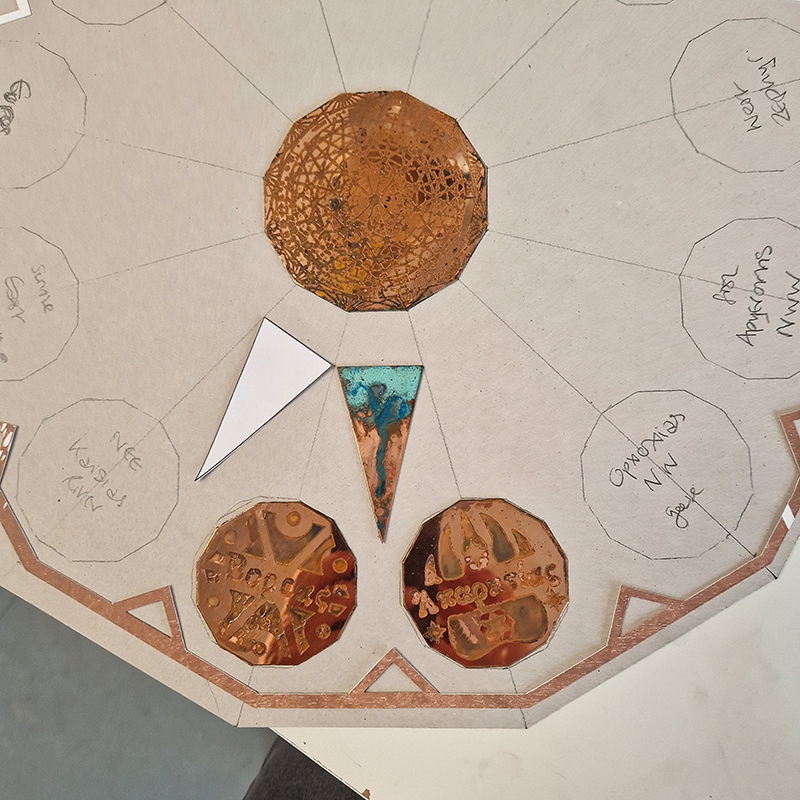
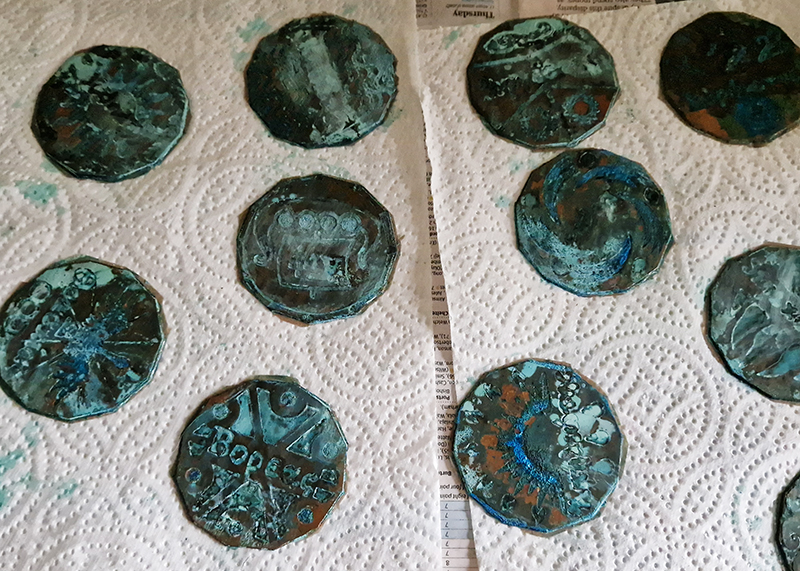
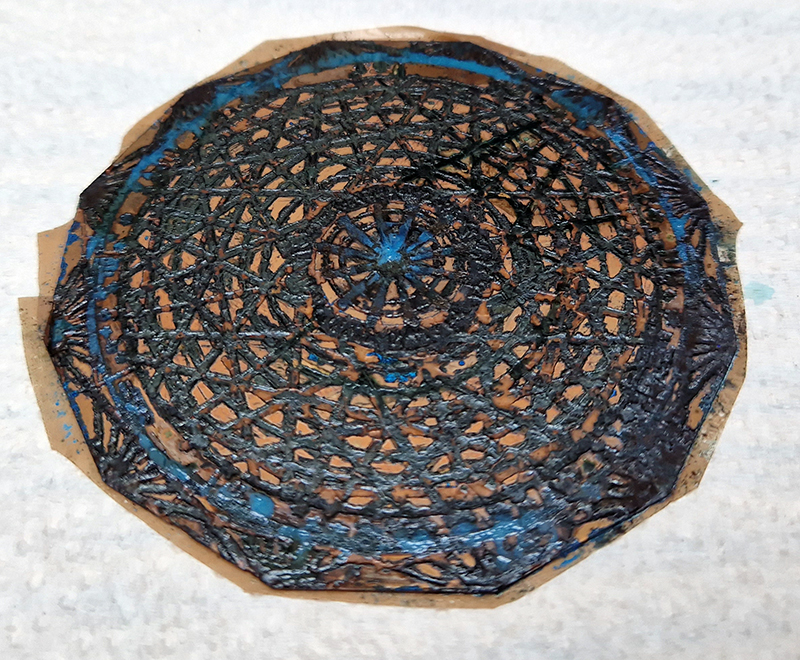
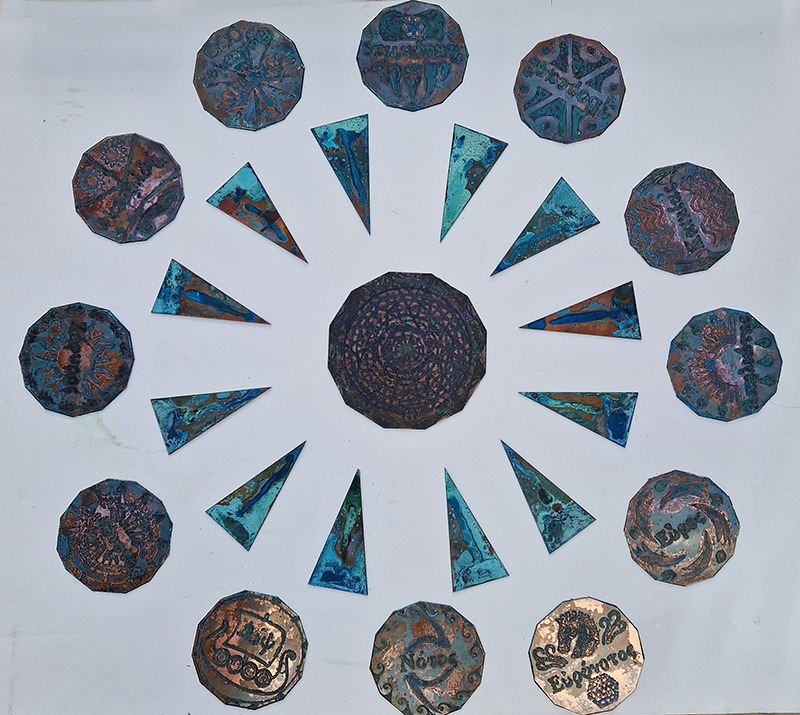
I am making a new concrete tablet for Instruments of the Anemoi series with more detailed compass rose inspired copper insets. The copper is guillotined to shape and screen printed with a sugarlift solution.

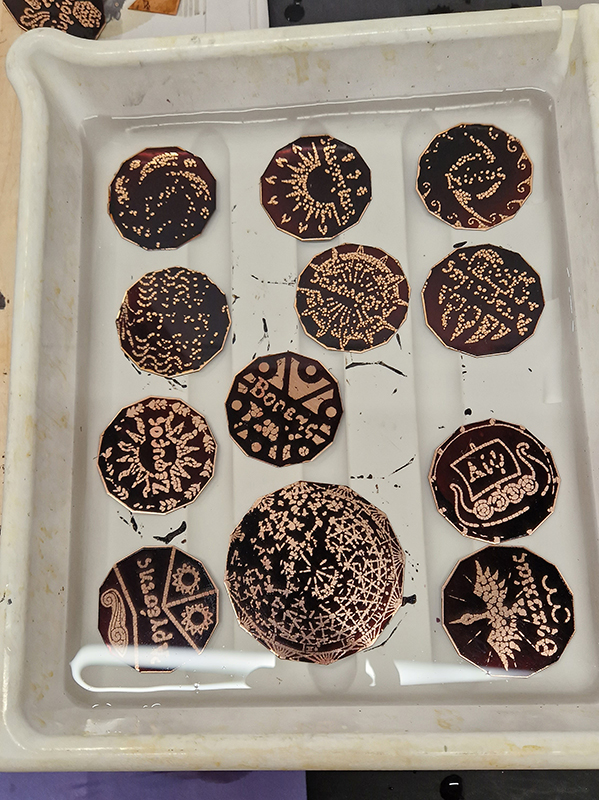
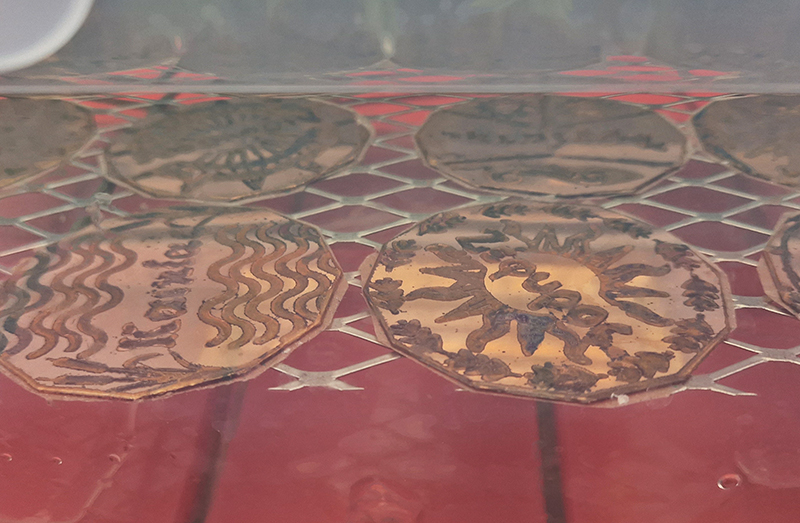
The pieces are then dipped in bitumen and left to dry before putting in a bath of warm water to dissolve the sugar solution, leaving the design ready to be etched.

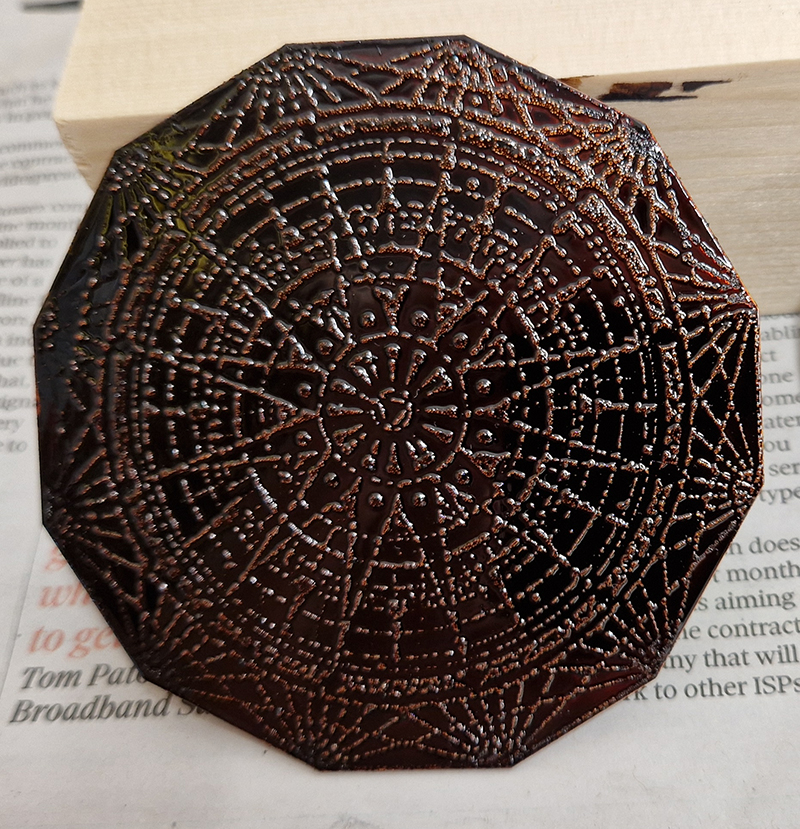
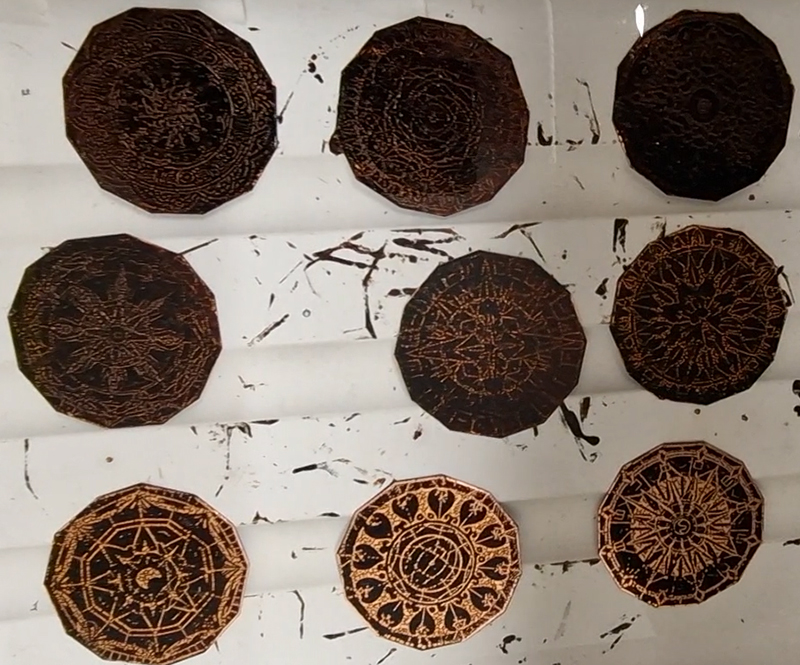
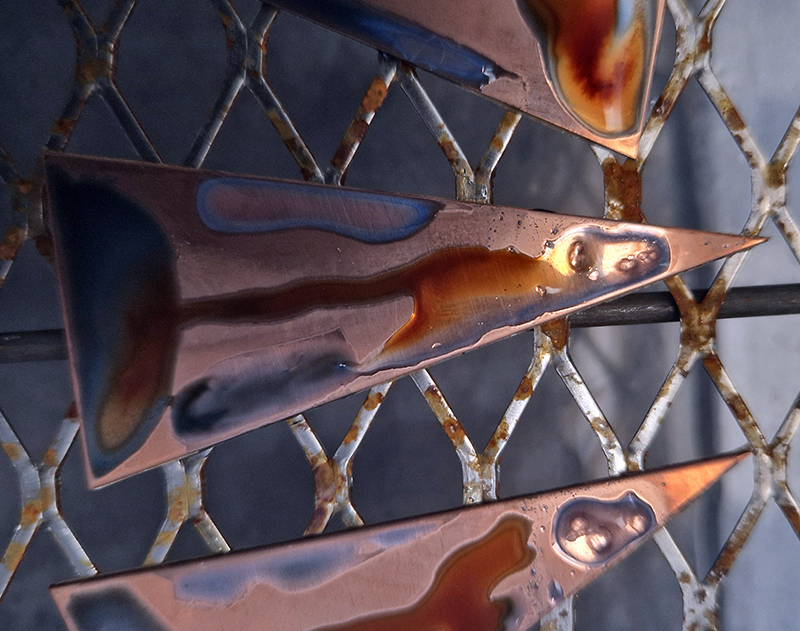
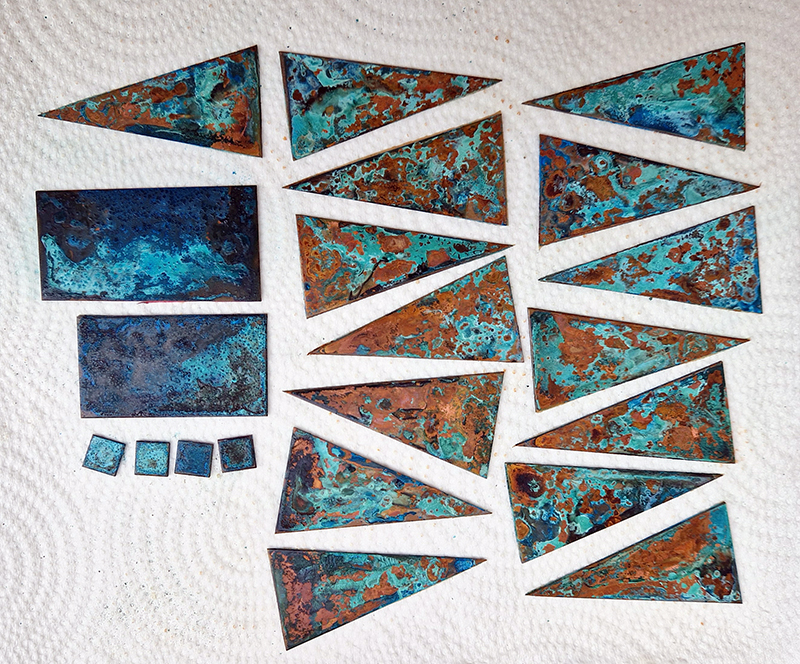
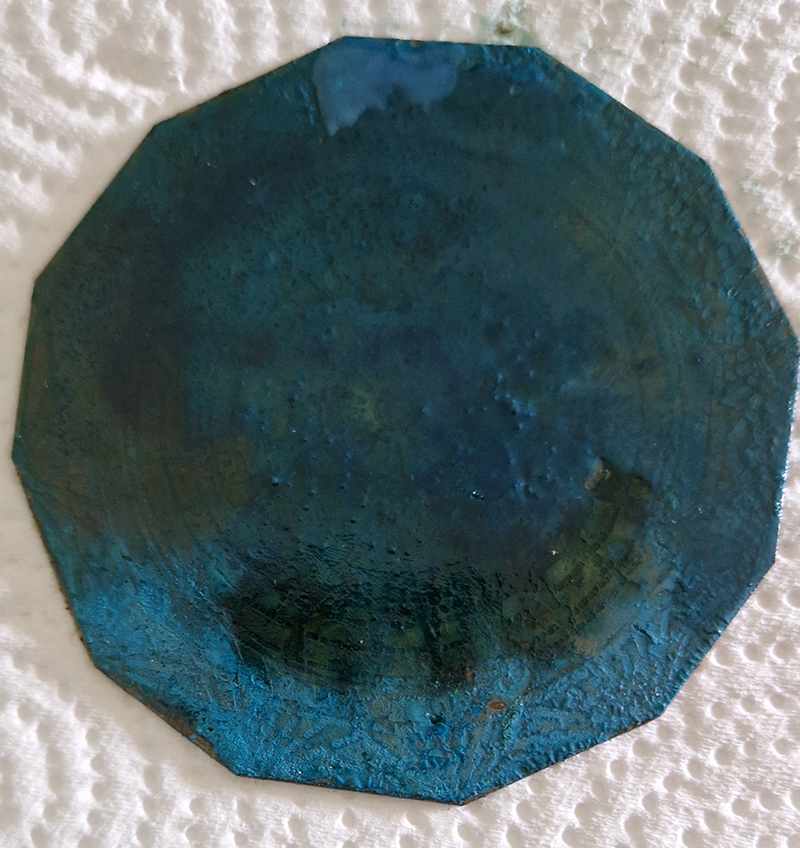
I also cut some copper shapes to patinate, painting the copper with salt and vinegar and soy sauce before fuming in an ammonia bath. I love how the colours change throughout the process.

I was going to patinate the dodecagon shapes as well but in the test I did, I lost a lot of detail, so these will just be inked and left.

Gallery Visits

Charmaine Watkiss showing her beautiful drawings full of symbolism in Hard Graft at Wellcome Collection. The exhibition explores the impact of work on health and her works celebrate the ancestral herbal knowledge of medicinal and edible plants and fruits that carry powerful healing properties.

These were used to secretly cure illnesses and prevent diseases as an act of survival and self-dependency, distinct from Western medicine. The connection between herbal healing and African spiritual practices is represented by cosmological symbols discreetly tattooed on the women’s bodies. Natural dyes – such as Jamaica’s Blue Mountain coffee and indigo – and materials such as brass and raffia palm embed historical knowledge in the fabric of the works. This knowledge is preserved, yet concealed, by the figures who avoid the viewer’s gaze.

The London Group Stillness in Movement at Bermondsey Project Space. Taking three evocative lines from Four Quartets by T S Eliot as a starting point for this group show. Images – Carol Wyss, Sandra Crisp, Genetic Moo and Beverley Duckworth.

‘Not known, because not looked for
But heard, half heard in the stillness
Between two waves of the sea’


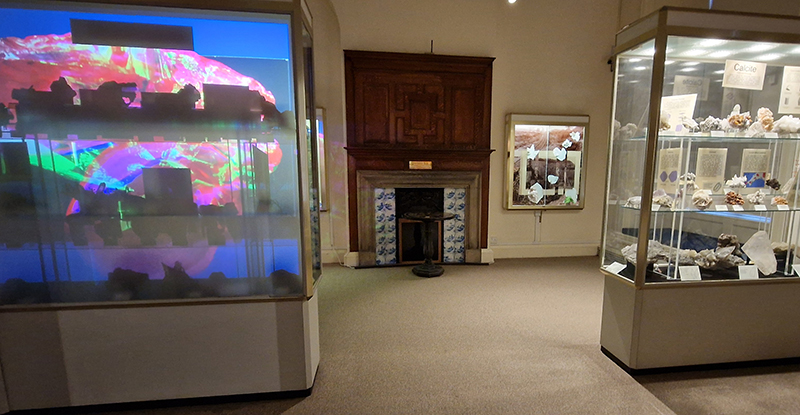
Rona Lee Lithic Entanglements at Sedgewick Museum of Earth Sciences. A considered intervention in the Whewell Mineral Gallery to ‘bring the dirt back in’, making evident the scarred landscapes, physical extraction processes as well as the social strata of those involved in procuring such a collection. There is no denying the allure of minerals and gemstones and the work here captures the beauty of the rocks while also reminding us of the ravaged Earth left scarred and depleted.

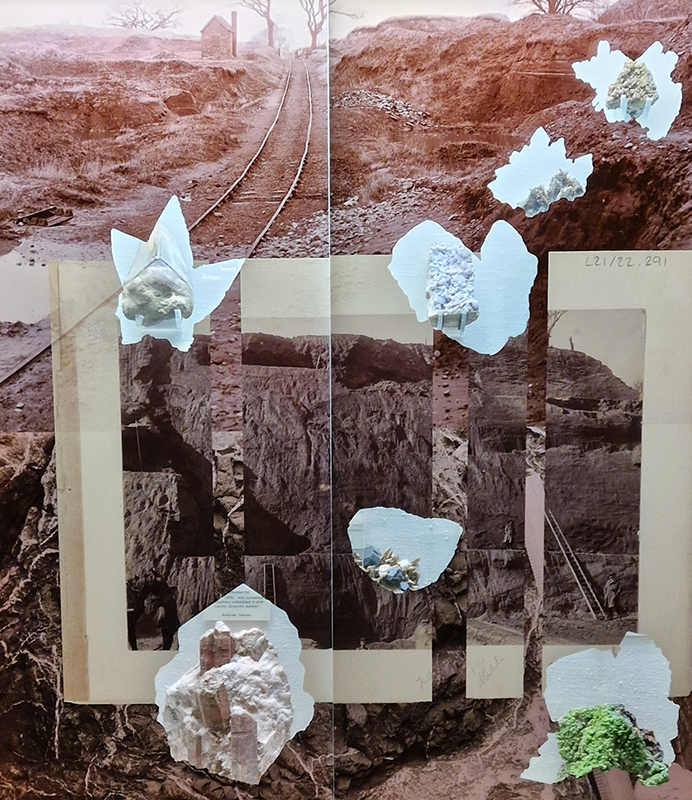
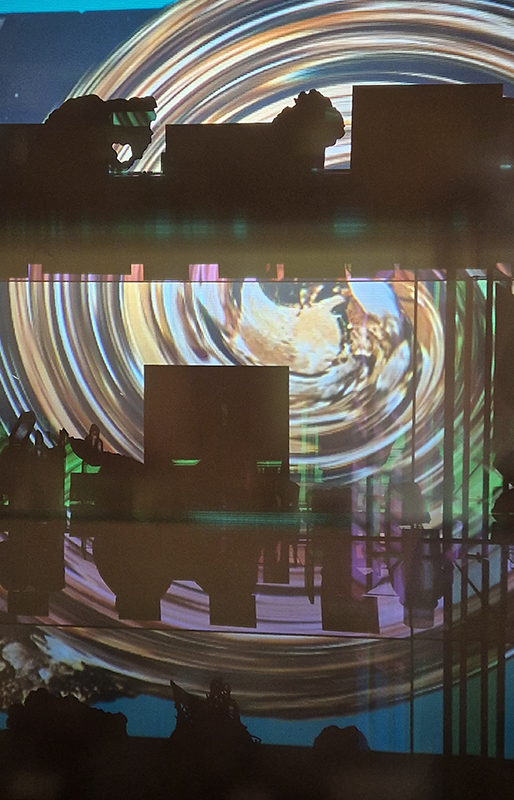
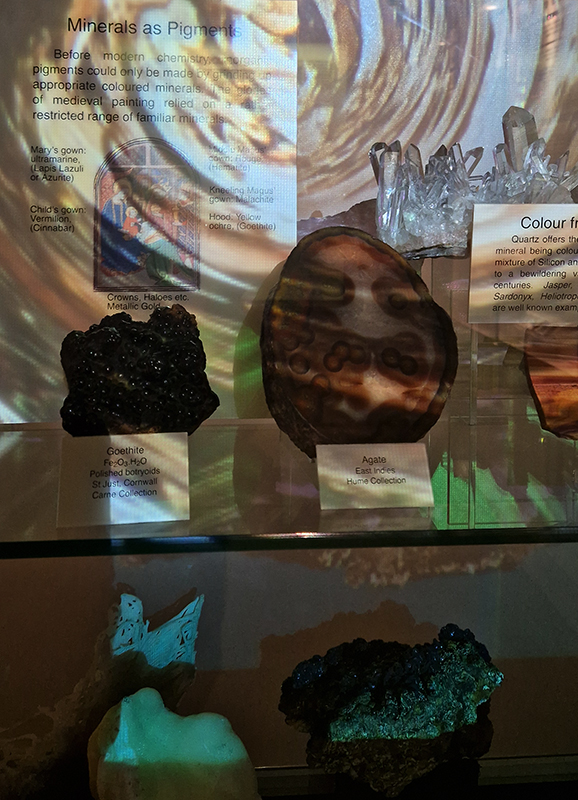
A Modern Lapidary a video work, back projected through one of the free-standing cases, animates mid-century scientific photographs of minerals, altering our perception of the samples within as ‘dead’ matter. Elsewhere, in An Extractive Index, digitally collaged photographs of geological field trips are laminated on to the glass, inviting reflection on the social and environmental relationships which these reveal.’ 

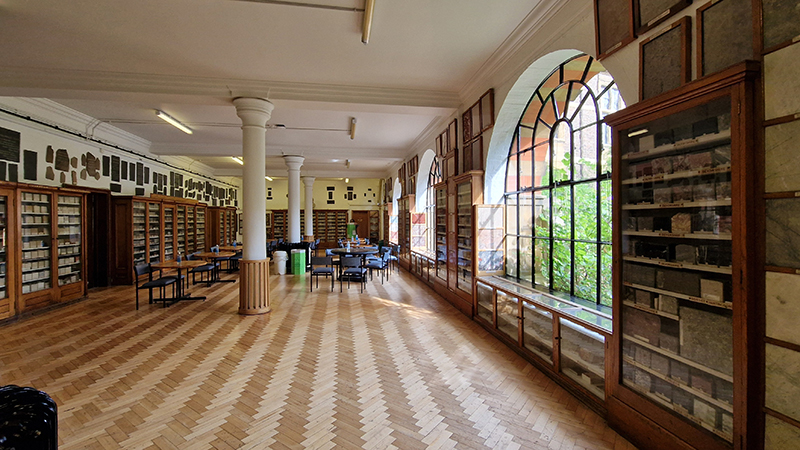
The Museum itself was also fascinating to look round and after Rona’s artist talk we were treated to tea in the The John Watson Building Stones Gallery which houses the most complete collection of stones used in construction.

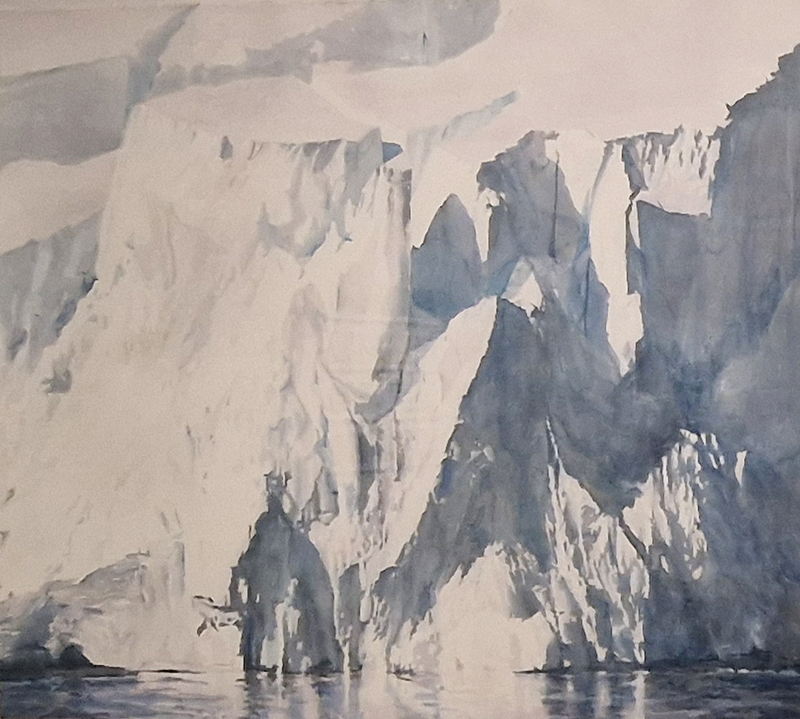
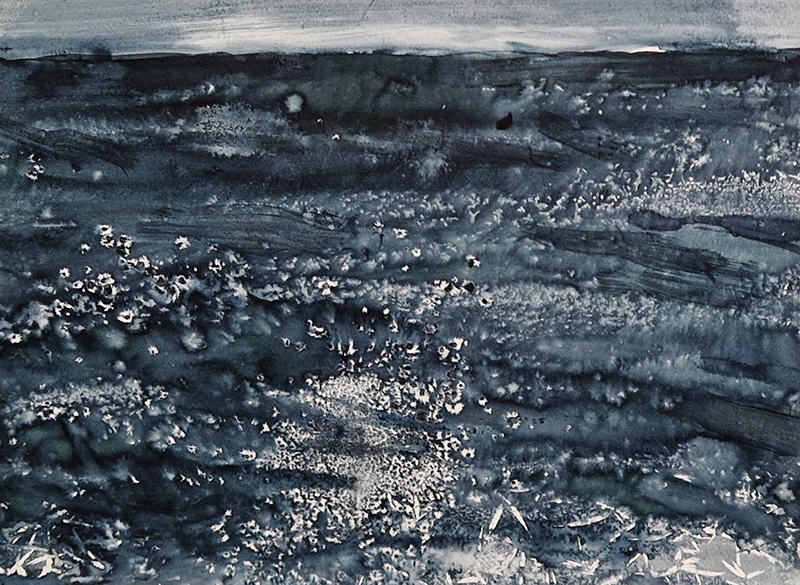
Emma Stibbon Melting Ice | Rising Tides at Towner Eastbourne. A day trip to the see this remarkable body of work so thoughtfully curated. The pale majesty of ice or chalk cliff faces, fragile against pounding seas that Emma witnesses in both the polar and local Sussex coastlines are captured so poignantly. These are portraits of great bodies under stress. Close up, edges and lines break down into fluid, watery strokes, a diaphanous translation of the fast painterly sketches made in often gruelling conditions. Wonderfully immersive, through scale and placement, and the understated palette of deep muted greens and blues, almost blacks and luminous whites which draw the viewer into the landscapes.

Listening

 Sideways – A New Frontier. A four-part podcast about the ethics of space exploration with former NASA astronaut Nicole Stott, new astronaut Ed Dwight, Space Philosopher and author Frank White, Anthropologist of Space and Religion, Deana Weibel, Professor of Religion at Knox College Robert Geraci and former ISRO scientist, Jijith Nadumari Ravi.

Astronauts and space tourists often cite the overview effect as a transformative experience offering the perspective to see a shared planet with no borders. Some however, experience the ‘ultraview’ effect which is the overwhelming and disorienting knowledge of the magnitude of the universe.

BBC Inside Science Podcast. How much of a risk is space junk? As we send more and more metal in the form of satellites up into space, scientists are warning it is becoming more of a risk both here – and up there.

Much space junk comes from defunct satellites. There are plans to launch 60,000 more satellites by 2030. It is estimated there is currently 12, 400 tons of space junk orbiting Earth – 2,500 discarded satellites and 130 million fragments that travel at 10 times the speed of a bullet. Because of the orbiting junk, Space X satellites must make around 275 collision avoidance manoeuvres every day. It is not only dangerous in space but large debris is falling to Earth and not burning up in the atmosphere. It is predicted life will be lost in the next decade as a result of falling space junk, there have already been some near misses. The satellites and launch debris that does burn up in the atmosphere releases large amounts of metal into the atmosphere with unknown consequences.

‘A stone sky rotated above our heads’ – Italo Calvino, Cosmicomics

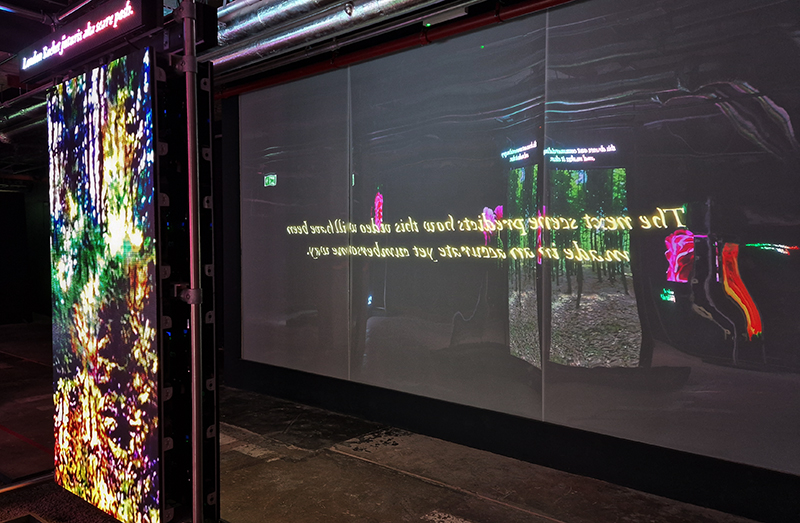
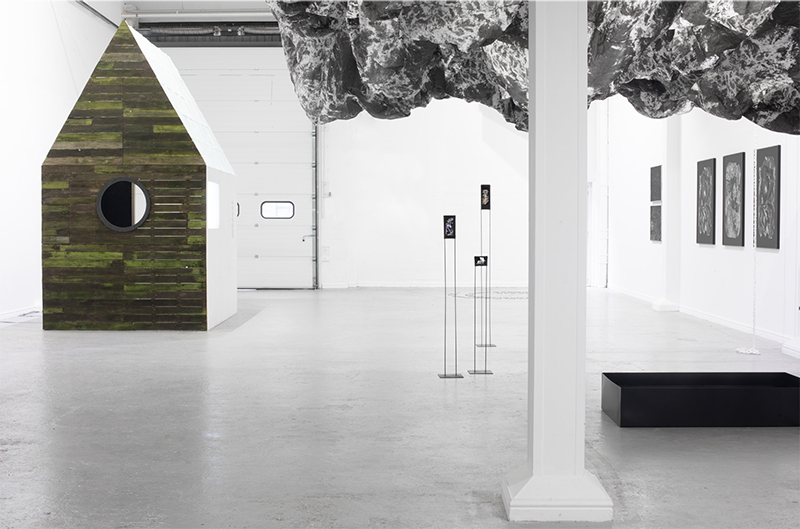
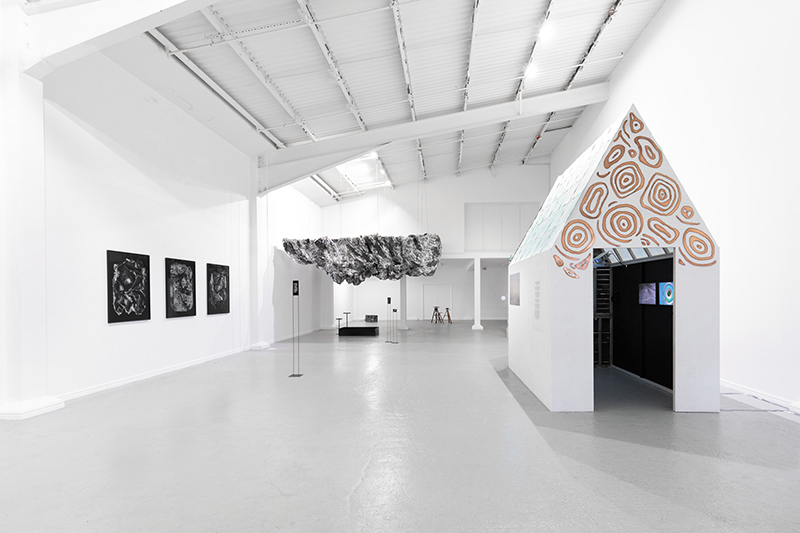
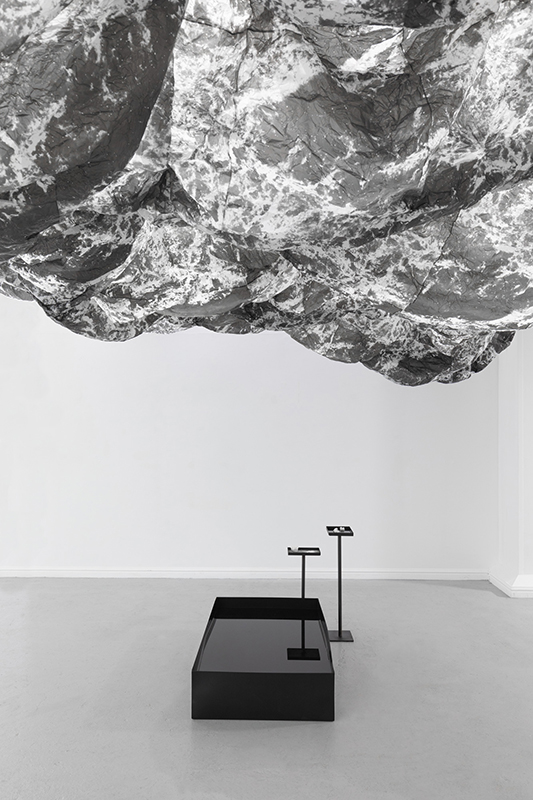
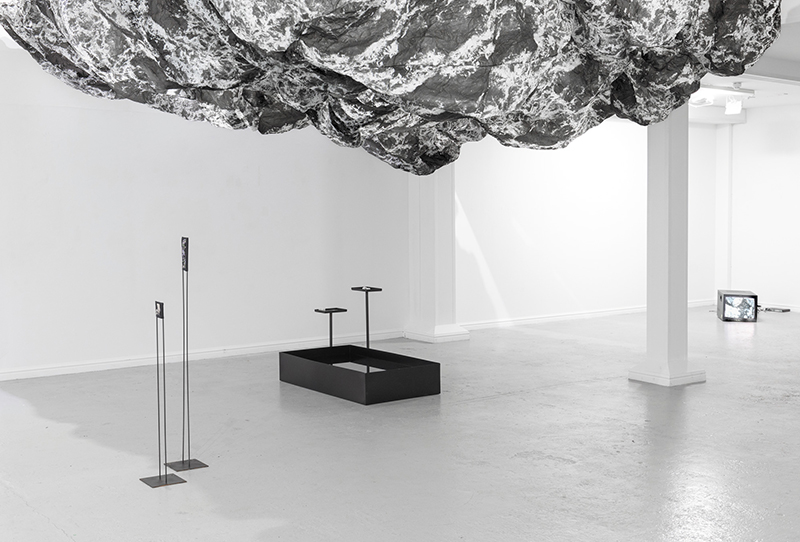
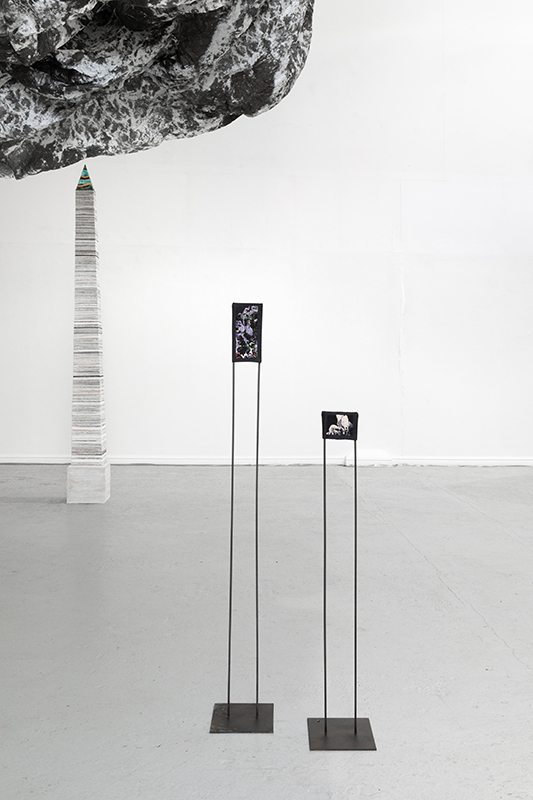
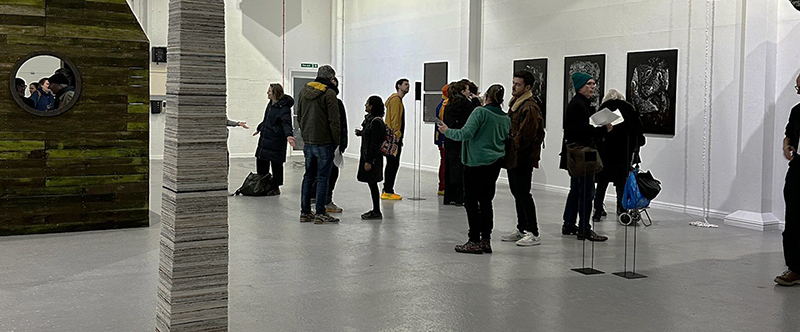
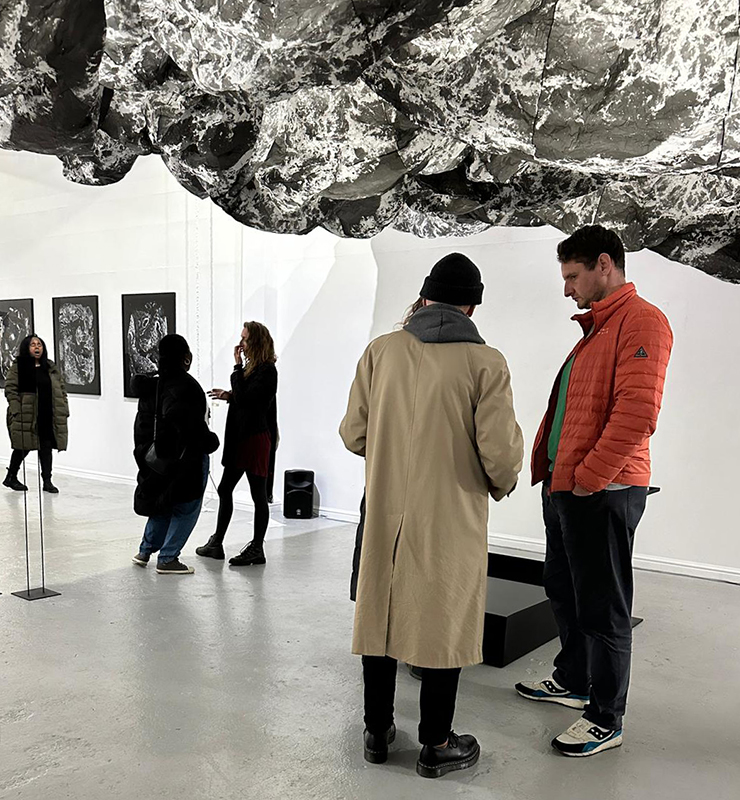
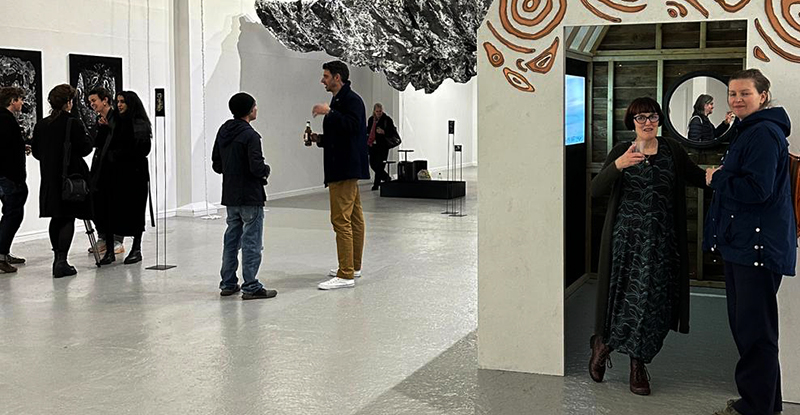
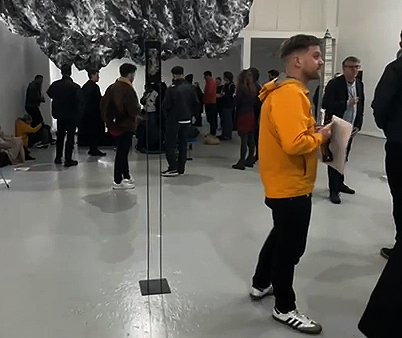
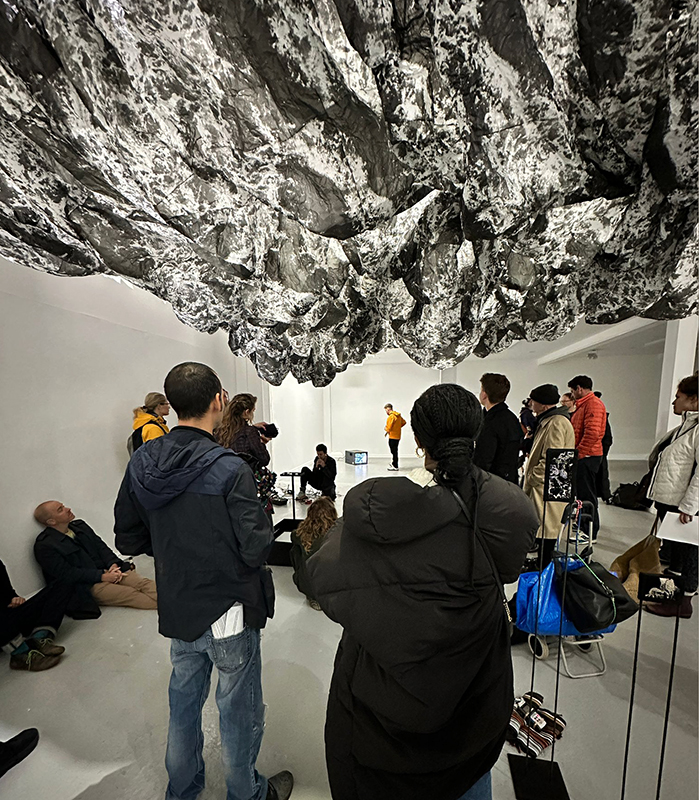
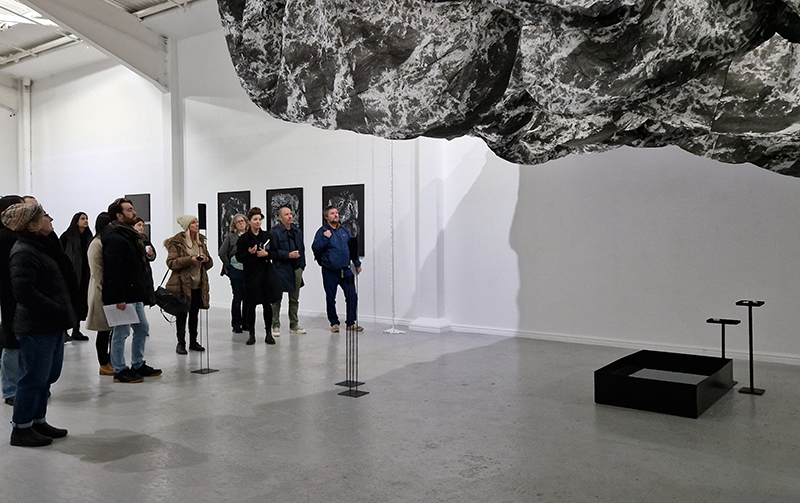
The culmination of two years work – A STONE SKY duo exhibition with Julie F Hill opened at Thames-side Studios GalleryReimagining the idea of an observatory – the exhibition proposes a cavernous realm of real and speculative possibilities that arise from beyond the limits of human perception. Engaging with the extended sensory range offered by technologies such as orbiting space telescopes through to the ability of birds to ‘see’ the Earth’s magnetic field, the artists’ reveal intimate connections between earth and space.

Installation shot by Ben Deakin Photography.

Susan Eyre seeks to navigate a path across time from the first human encounter with the magical qualities of the lodestone to current understanding of the interaction of the magnetic field with terrestrial life. Her works respond to the architecture, instruments and materials, found at a magnetic observatory while scientific objectives are expanded to include natural navigation techniques and extra-sensory methods used by the non-human realm, to form the basis of speculation as to the ability for humans to perceive the Earth’s magnetic field. Installation, sculpture and moving image works include a reimagined observation hut operating as a sensory hub with video screens suggesting portals into a web of neural pathways; an obelisk of layered recycled paper echoing Earth’s geological and magnetic history secreted in sedimentary strata of rock and a digital video work activated in real time by the passage of cosmic rays through a scintillator detector.

Images by Ben Deakin Photography

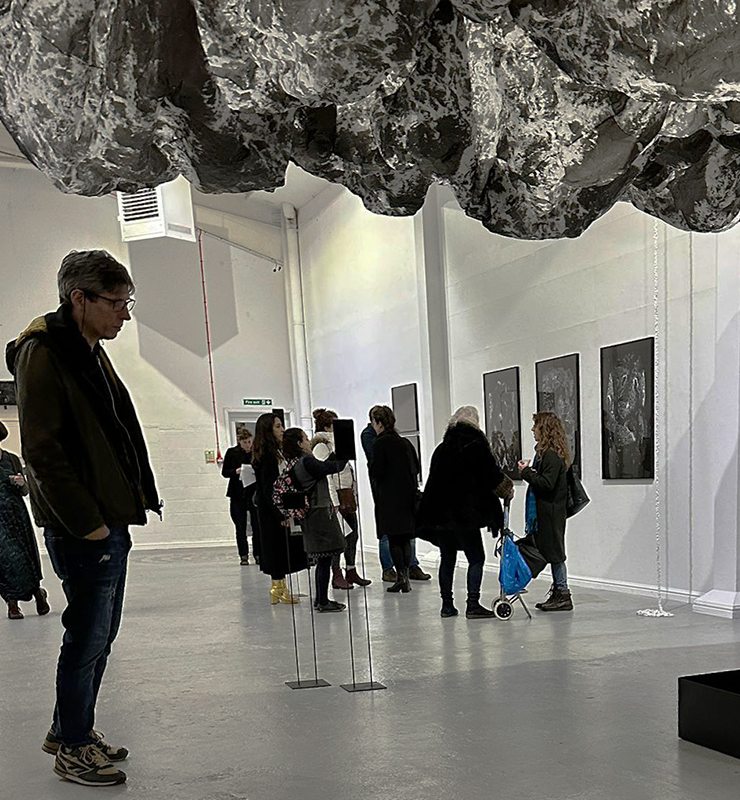
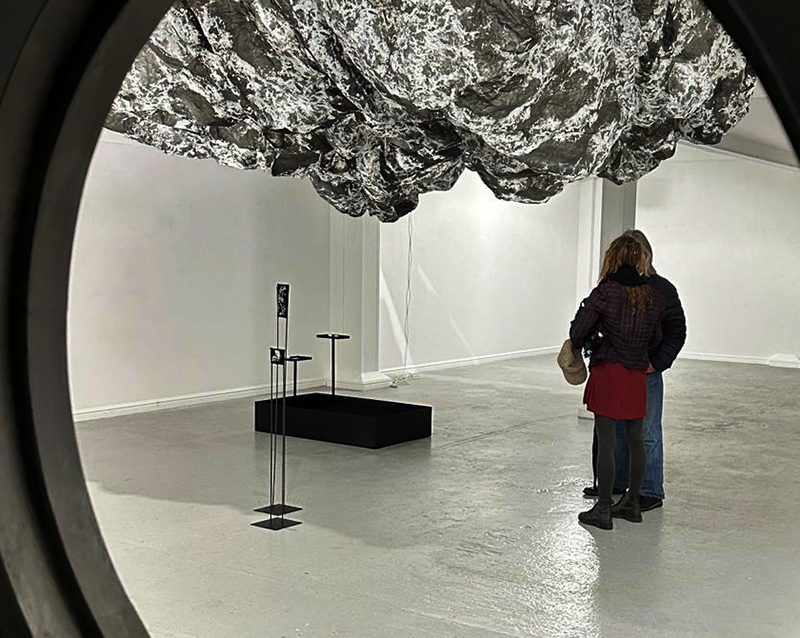
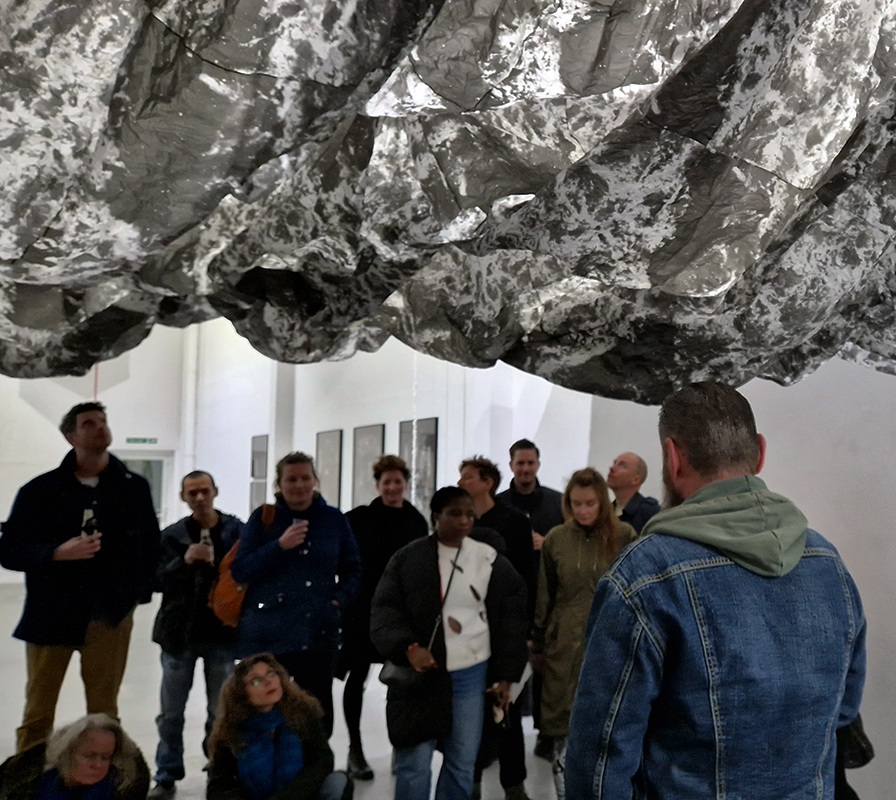
Julie F Hill explores the entwined darknesses of earth and cosmos. Crystalline and mineral substances from the deep earth fuse with astronomical data to suggest the deep-earth as an instrument for coming to know the cosmos. Crystalline and mineral substances formed in the continuum of deep earth and deep space allow us to peer back into cosmic time, both through the technologies created with them and the geological record they hold. Whilst darkness often indicates uncertainty and lack of knowledge, Hill asserts that it’s through darkness when we can be most perceptive to the interconnectedness between earth and cosmos. Through it we are able to extend our kinship with the inorganic and expand consciousness of what constitutes nature. Works include a large-scale sculptural print installation made from James Webb Space Telescope data that is reworked into a cavernous space, providing an experience of intimate immensity alongside more smaller sculptural and photographic works.

Images by Ben Deakin Photography

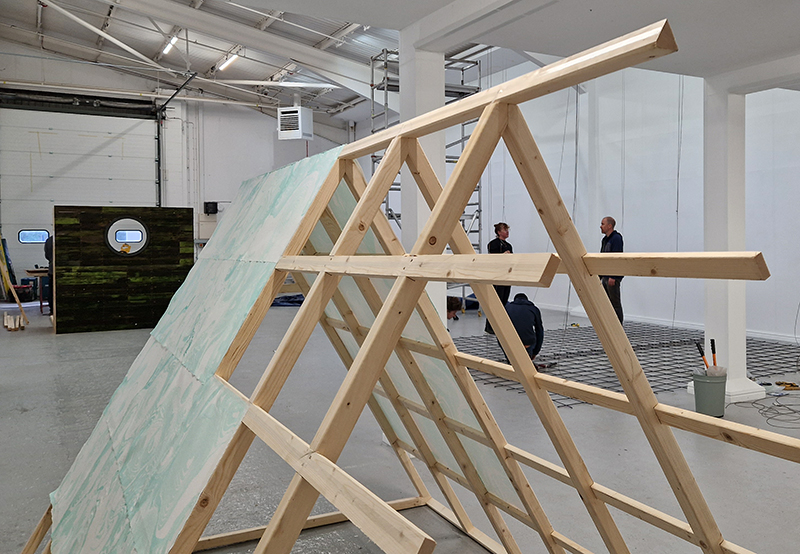
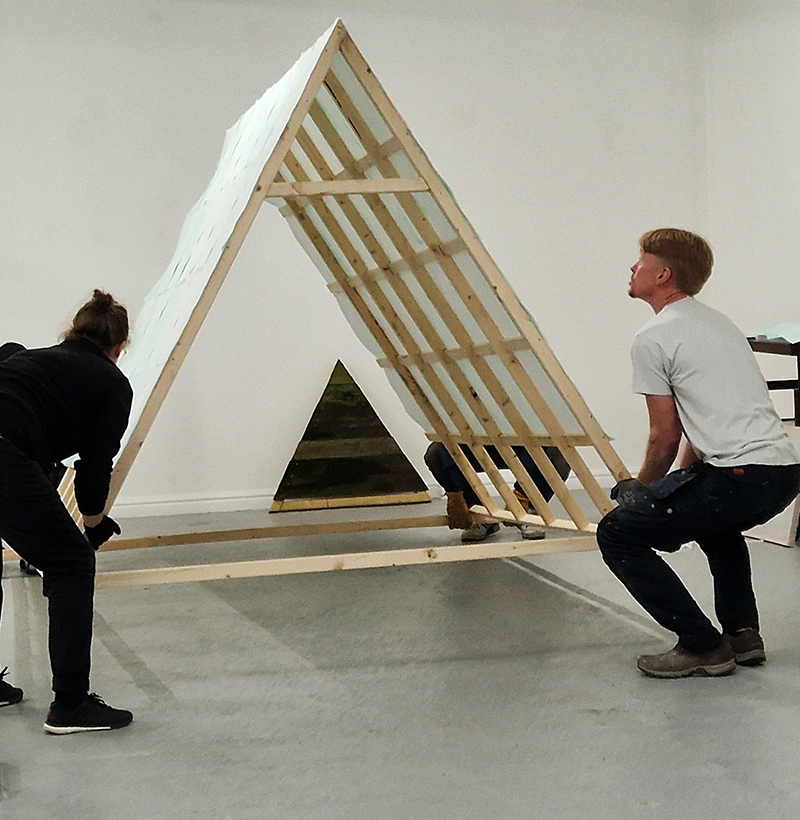
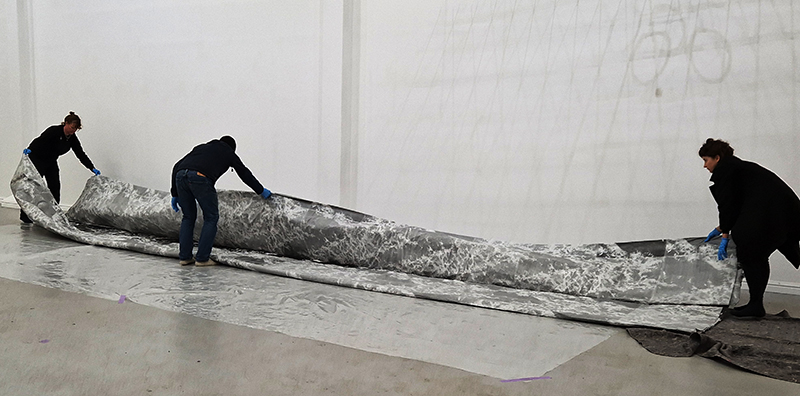
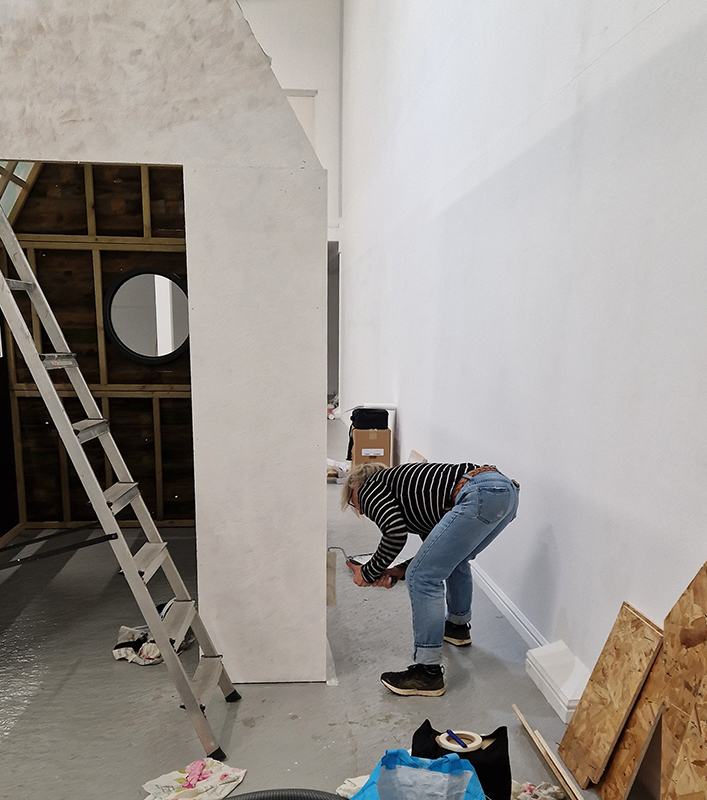
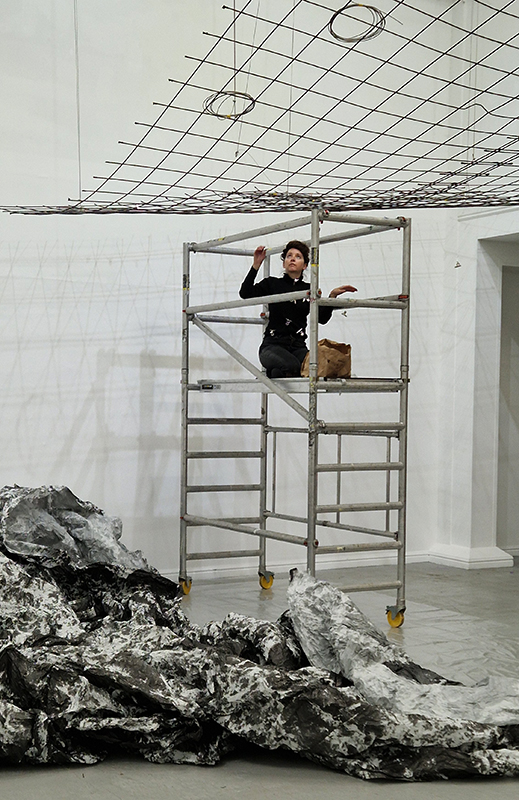
We both had ambitious large scale works to install and were grateful for the help we received from our partners (both Kevins), friends and technicians. Trevor Neale was magnificent in constructing The Absolute Hut. Anne Krinsky patiently helped apply double sided tape to the roof structure ready for the Suminagashi paper tiles and Caroline AreskogJones energetically painted the hut white and neatly edged the two way projection window. I was thrilled that, as a result of a wet few weeks, moss had started to grow on the wooden boards of the north facing wall in time for installation.

A big thank you to everyone that made it to the opening night, we were super chuffed with the positive responses.

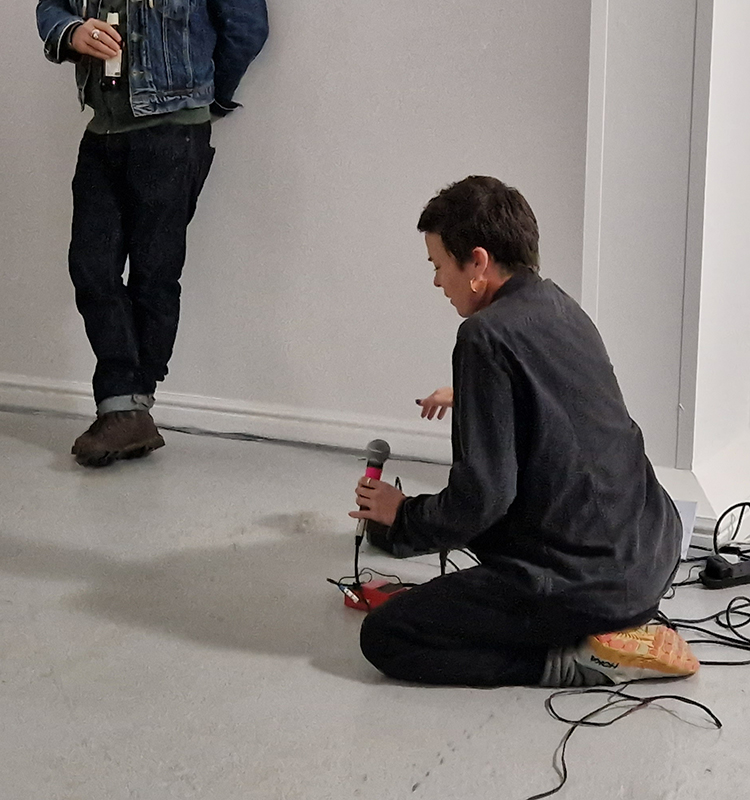
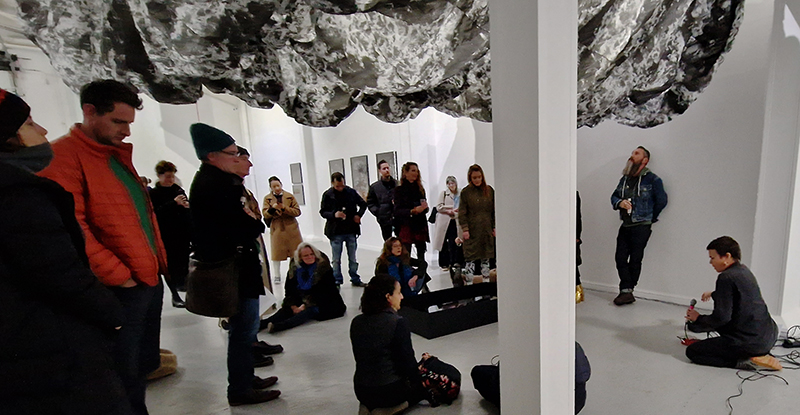
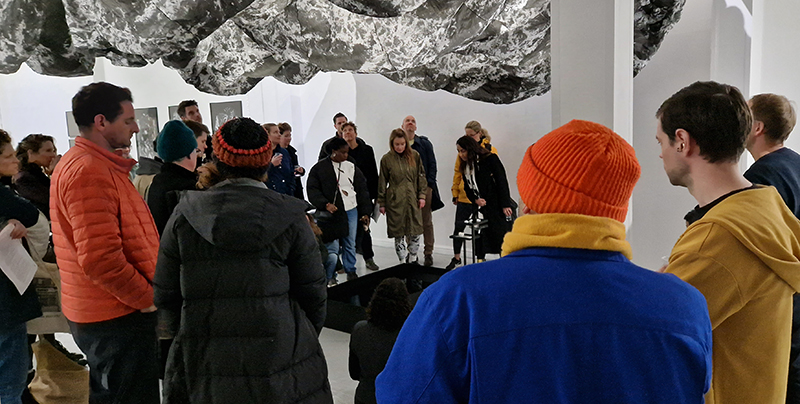
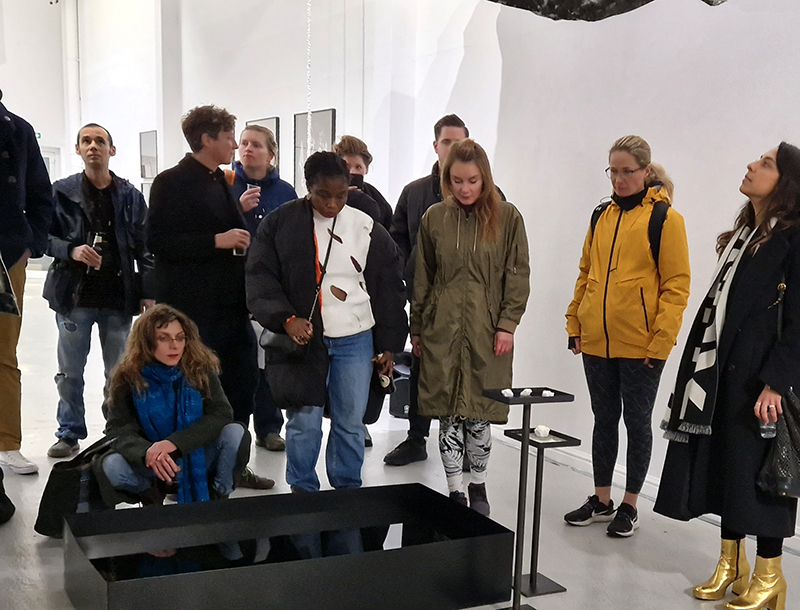
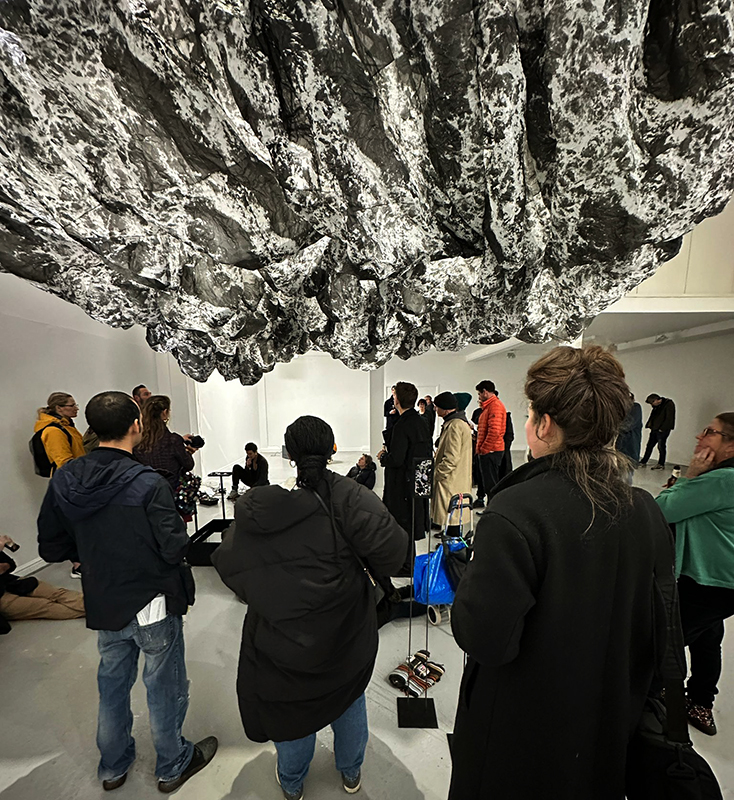
At the private view Julie’s large scale print installation was activated by a vocal performance conjuring abyssal voices of deep, cosmic time, performed and devised with Eleanor Westbrook whose voice produces incredible hauntingly beautiful sound.

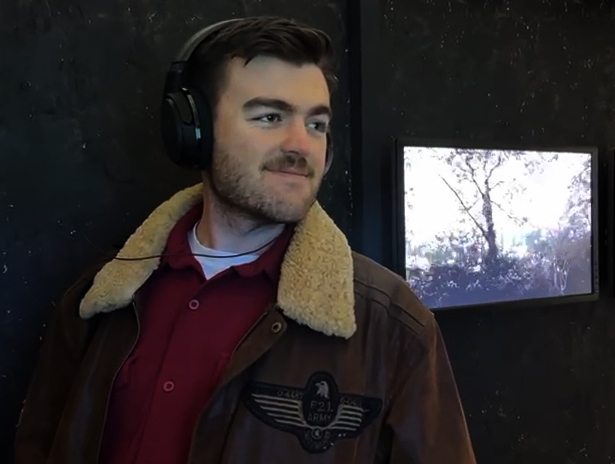
I was particularly excited to share The Breath of Stars, digital video work activated in real time by the passage of cosmic rays through a scintillator detector. After two years in development it was so exciting to watch the random starbursts appear in real time as witness to the unseen activity of cosmic rays passing through the gallery.

The kaleidoscopic video images that appear for every particle recorded by the detector, are created from footage of cosmic ray trails filmed in a cloud chamber.

The interaction of cosmic rays with atmospheric electrical fields influences the unpredictability of the magnetosphere and this random activity can be witnessed by the sudden flurries and silent gaps of the live video imagery.

These subatomic visitors from outer space power across the universe with unimaginable energy, coming from the heart of exploding stars or the depths of black holes; some may come from phenomena yet to be discovered or even from other dimensions. Travelling at close to the speed of light cosmic rays spiral along magnetic field lines, strike the edge of the Earth’s atmosphere, break apart and shower down upon us. Some particles collide and silently interact with atoms and technology on Earth. Most cosmic rays heading for Earth are deflected by the planet’s magnetic field and without this protection life on Earth could not survive this bombardment of radioactive matter. The interaction of cosmic rays and the solar wind with atmospheric electrical fields combines to influence the unpredictability of Earth’s magnetosphere, impacting the functioning of GPS satellite technology and computer processors on which humans have come to rely in daily life.

My research trip to Hartland Magnetic Observatory in North Devon was a catalyst for this body of work centring around a north facing observation hut aligned with an obelisk as a fixed azimuth mark. I am very grateful to The British Geological Survey for allowing me access to the site and particularly to Tom Martyn who shared his knowledge and gave a fascinating tour of the observatory.

The Azimuth Obelisk (of sedimentary knowledge) is a reimagining of an obelisk erected at Hartland Magnetic Observatory in the late 1950’s near the site’s northern boundary. Viewed through the window in the north wall of The Observing Building (also known as the Absolute Hut) it acts as a permanent azimuth mark from which the drift of the magnetic north pole is monitored. Currently almost hidden by undergrowth, the observatory’s concrete azimuth mark has been replaced by a digital GPS position. Much as the Earth’s geological and magnetic history is secreted into the strata of sedimentary rock, this sculpture also expresses the passage of time through the layering of recycled paper prints and drawings whose history becomes embedded within the stacked layers.

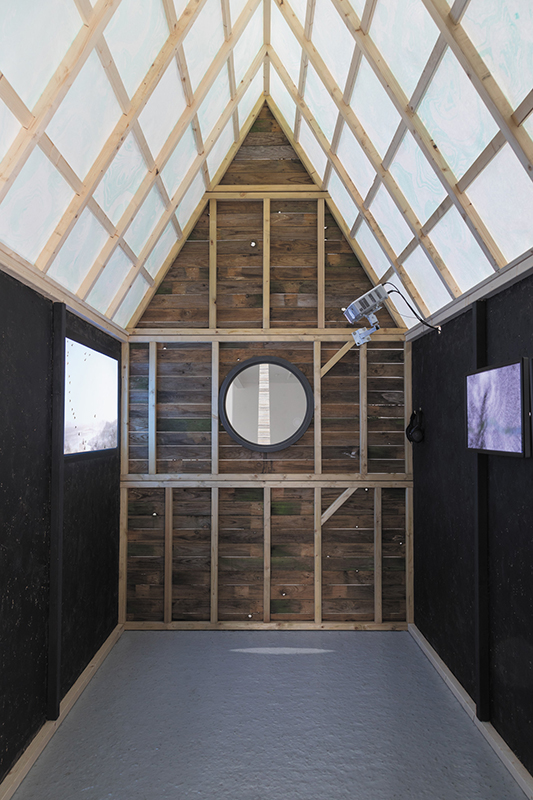
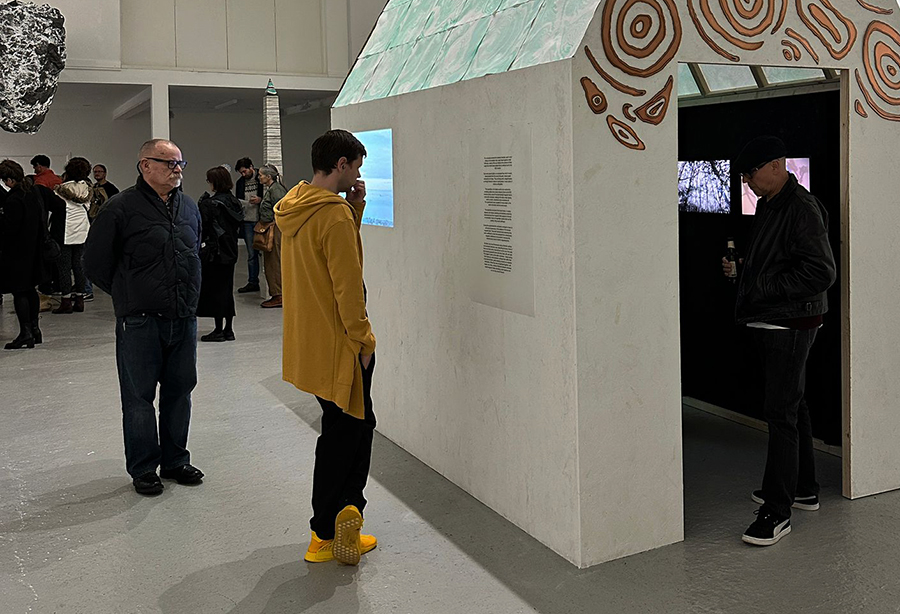
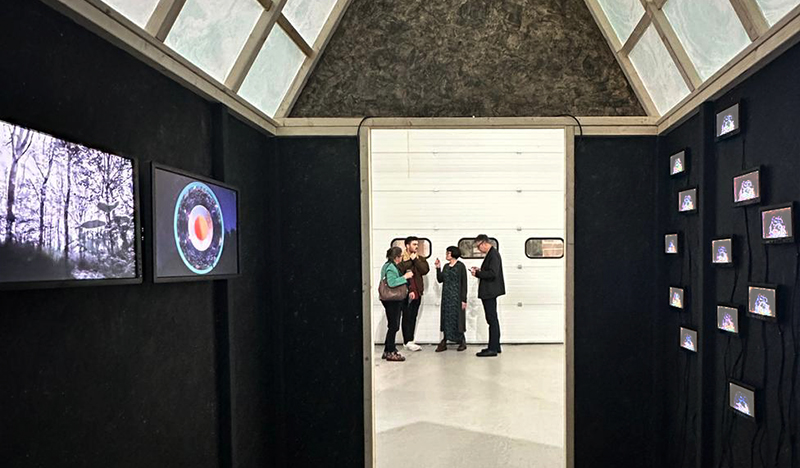
The Absolute Hut (of action potential) operates as a sensory hub with video screens suggesting portals into a web of neural pathways where a range of actions and processes are running concurrently reflecting on the dynamics between the Earth’s geologic structure and navigation using the magnetic field.

The title refers to the way neurons send information electrochemically around the body. The signals they send are called action potentials which is a temporary shift from negative to positive within the cell caused by certain ions entering the cell. Action potentials can be triggered by an interaction with the magnetic field causing a reaction in the body.

The installation is conceived from a combination of features, impressions and functions of the observing building and instruments at Hartland Magnetic Observatory in North Devon and the observation huts built in the 18th century at The Kings Observatory in Kew for meteorological and magnetic observations.

Topological contours of suminagashi marbling and plasma cut copper reflect the fluid motion of the Earth’s molten iron core and the pulsating alpha waves of the human brain when subjected to magnetic fields.

‘the internal skies have their own birds’ Italo Calvino Cosmicomics

The fascinating and perilous journeys made by migrating birds has been a natural wonder for centuries with the first records of this phenomena made more than 3,000 years ago. The innate knowledge of migratory birds is mentioned in Job and Jeremiah and the ancient Greek writers Homer, Hesiod and Aristotle noted their passage.

Job 39:26 Doth the hawk fly by thy wisdom and stretch her wings towards the south?

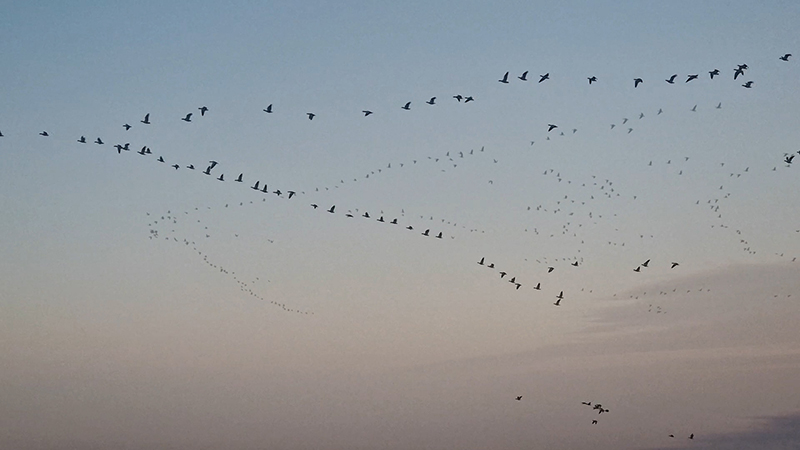
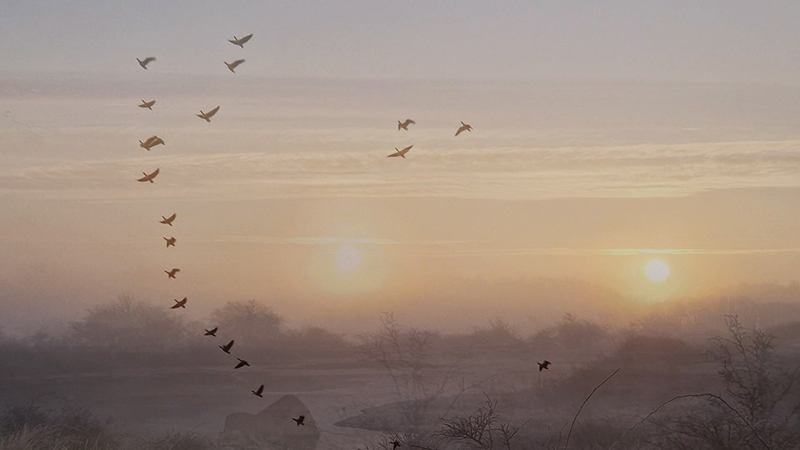
Wintering light two way video projection of migratory pink footed geese filmed at RSPB Snettisham on the North Norfolk coast.

Research has proven that birds and many other animals can use the earth’s magnetic field for navigation. There are two ways this happens. In birds there is a protein in the retina of the eye – (cryptochrome molecules) which trigger action potentials enabling them to visualise the magnetic field. In other animals and magnetotactic bacteria tiny crystals of magnetite respond to the field. This may also be true of humans as we do have these crystals in our brain cells.

Birds use three different compasses to navigate across the globe; the sun, the stars and the magnetic field.

Birds are also able to detect rapid movement such as individual flashes or flickering of a fluorescent light which humans see as a continuous light. Hawks which pursue other birds through dense forests at high speeds, follow the movement of their prey while avoiding branches and other obstacles. To humans travelling at this speed, the fleeing prey, branches and obstacles would just be a blur.

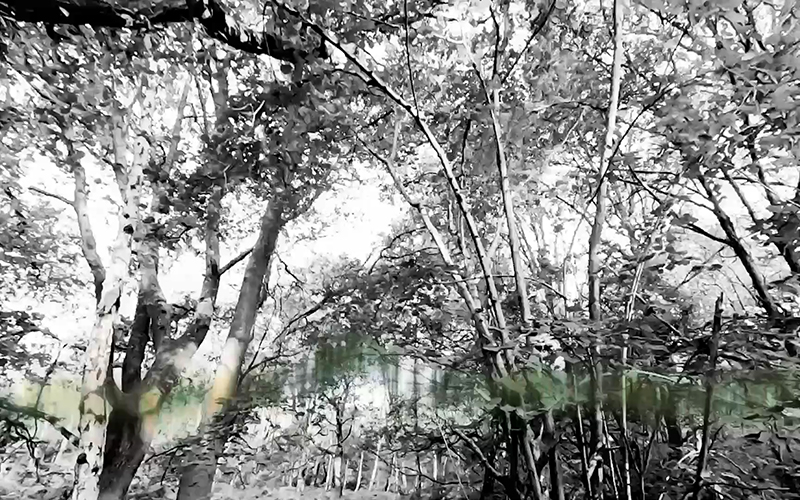
Degrees of Variation considers what it might be like to have the sensory powers of a bird where a protein in the eye is excited by polarised light making it possible to see the magnetic field and follow a visual navigatory cue in an accelerated world. The video imagines flight over water and through woods while being guided by the force of a magnetic field.

Calvino’s story The Stone Sky is wonderfully descriptive of the volatile geological structure of the Earth. This fluidity is what makes life on Earth possible. Only planets with fluid cores have magnetic fields. The geological interior generates a field that reaches into outer space offering a protective shield.

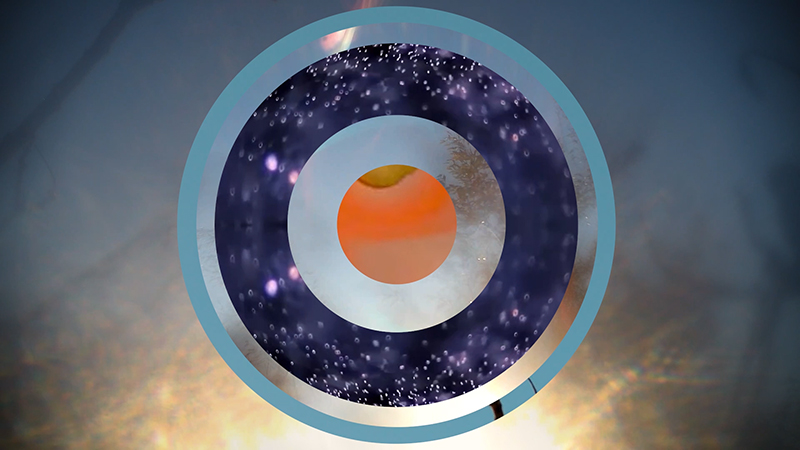
internal skies : external spheres video sequences within concentric circles mimic the geological structure of the Earth to explore the relationship between Earth’s magnetic field and various methods of navigation including via magnetoreception and celestial observation. Sequences include star trails around Polaris (the current north star), birds and bees that use the magnetic field for navigation, magnetotactic bacteria, magnetised iron filings, aerial views of the coastline around Hartland and early morning polarised light which excites the cryptochrome protein in a birds eye.

The Earth’s geomagnetic field is created by a combination of three separate fields and timescales. The main field is generated in the earth’s molten iron core.  Observing the field gives clues to the planet’s deep interior which is inaccessible to direct observations. Changes are measured in the annual drifting of magnetic poles. Secondly electrical currents caused by solar weather and cosmic rays bouncing off the Earth’s main  field charge the surrounding ionosphere causing fluctuations in the field. This field changes by the micro second as we orbit the sun. The Earth’s magnetic field also acts as a shield against most potentially harmful charged particles from outer space. Finally the residual magnetisation of the geology of the rocky mantle and crust, measured in deep geological time also offers clues to the geological history of Earth.

The understanding of the world surrounding us forms in the darkness of our skulls. 

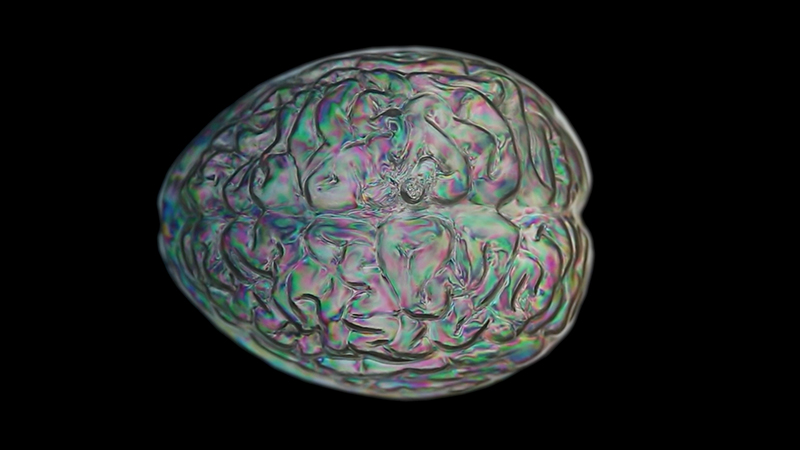
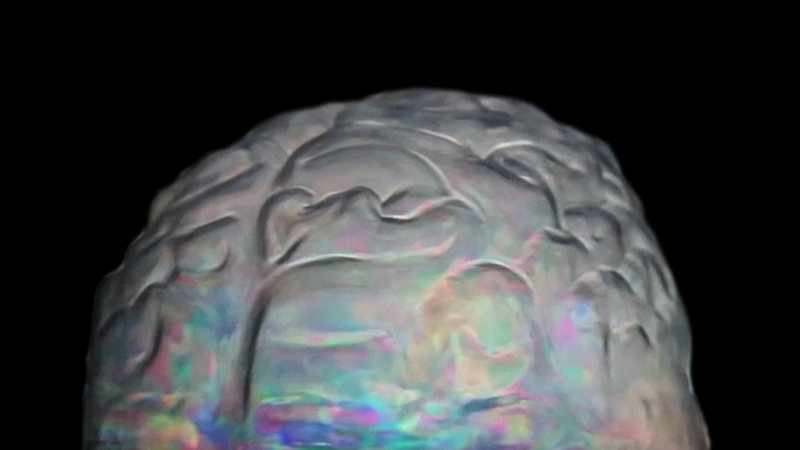
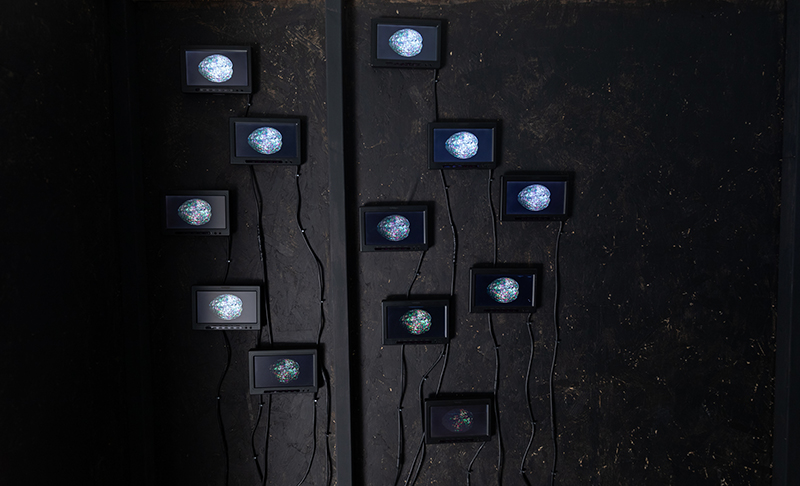
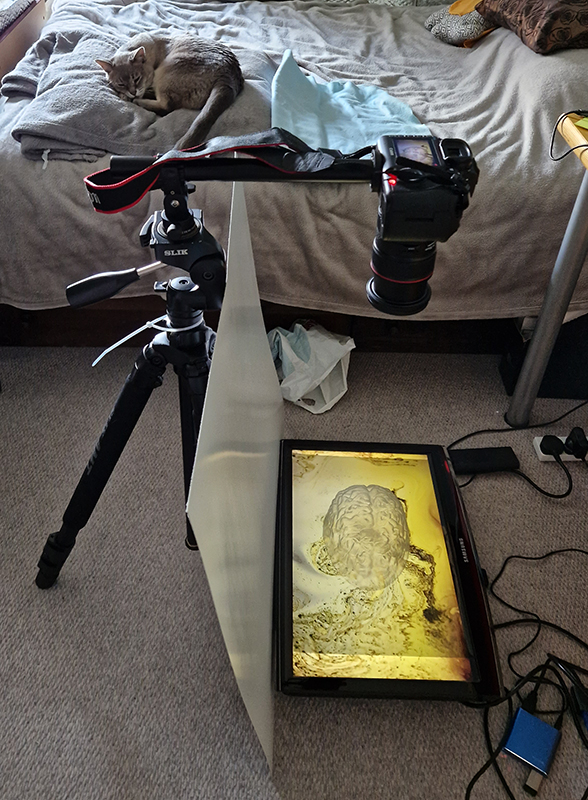
interference – a panel of 12 small video screens inside The Absolute Hut (of action potential), showing images of the human brain filmed by using polarizing filters to create pulsating birefringence colours, relate to the narrative pinned to the outside of the hut.

The narrative is a mix of fact and fiction based on a real experiment carried out at Caltech where scientists found Alpha waves in the human brain do respond to Earth’s magnetic field and other research suggesting that it could be possible for the magnetic field in one animal’s brain to transmit information to another animal’s brain by triggering action potentials creating the same thoughts and emotions.

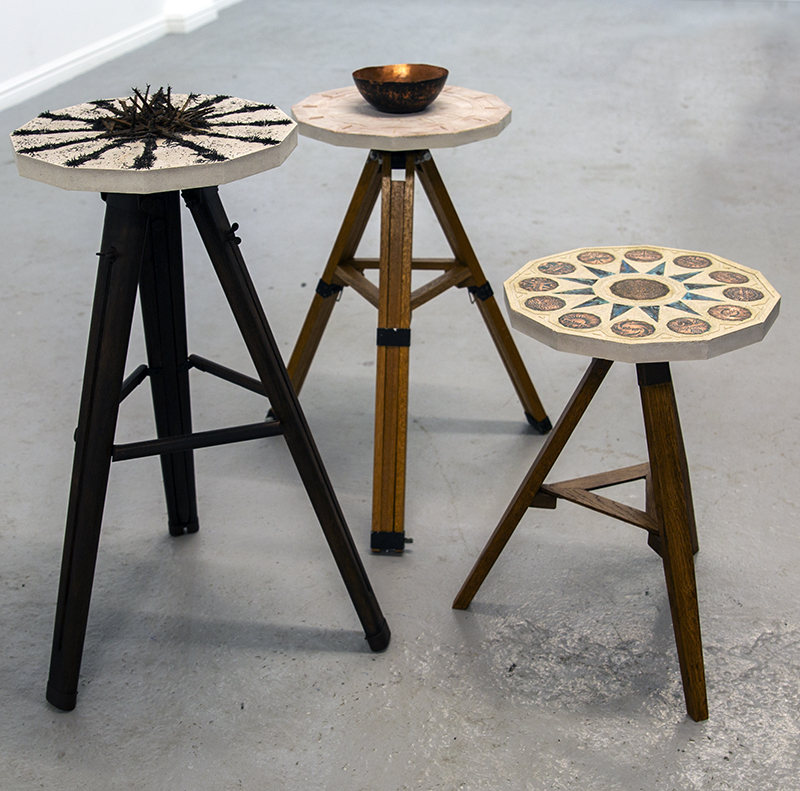
Instruments of the Anemoi are a set of dodecagon tablets cast in Snowcrete, a non-magnetic cement, as used in a magnetic observatory. Suggestive of the pedestals that support various instruments used in monitoring the Earths’ magnetic field they also respond to an ancient anemoscope “table of the winds” carved in marble around eighteen hundred years ago and inscribed with the Greek and Latin names of classical winds on each of its twelve sides. Envisaged here as speculative objects, instruments and schematics wrought by the wind gods, the first emissaries of navigation and orientation.

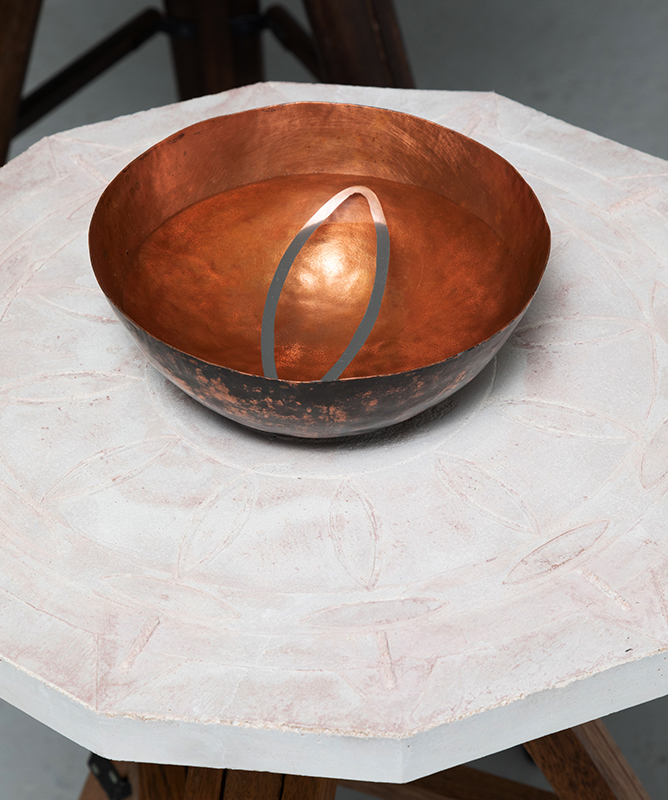
One tablet holds a copper bowl with a ‘silver fish’ floating in water. The shape of the ‘silver fish’ is based on the oval shaped compass needle (illustrated in Breve Compendio de la Sphera de la arte Navegar by Martin Cortes 1551)  and refers back to wafer thin fish shaped iron leaves used by 11th century Chinese geomancers.

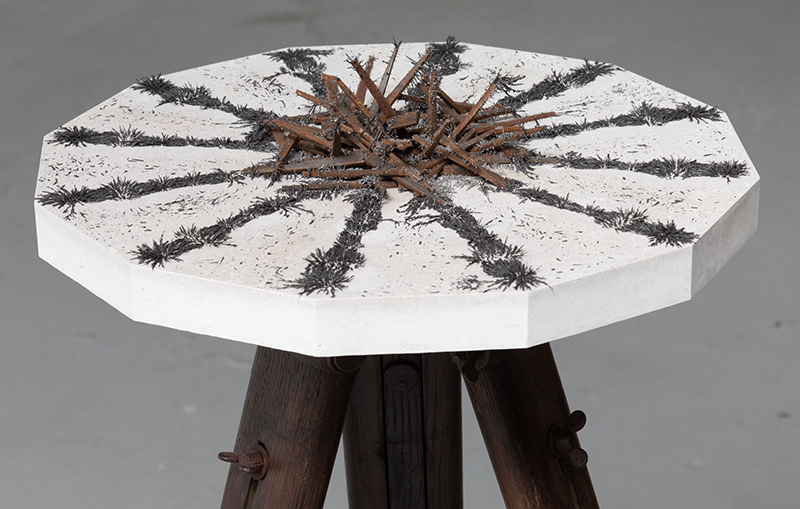
Nails and iron filings on the second tablet reveal an embedded magnetic field recalling a legend that the discovery of the lodestone was made by a Greek shepherd who noticed the nails in his boots were attracted to the rock (magnetite) beneath his feet.

The third tablet is embedded with copper etched with images and names based on associations and attributes of the twelve Greek wind gods set in a traditional compass rose.

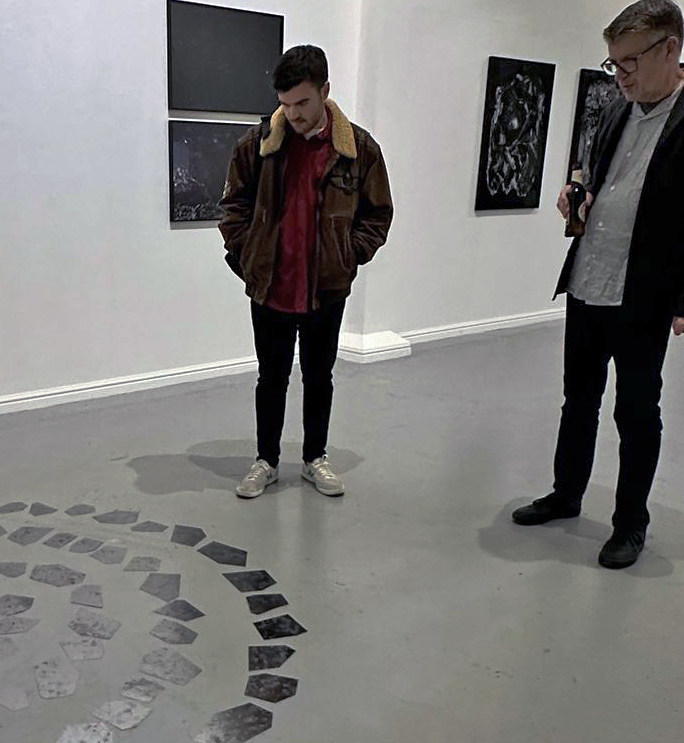
Domain of the Devil Valley Master uses industrial directional magnetic steel, sanded and etched to reveal the Goss texture of rolled iron silicon alloy crystals. The jigsaw pattern of magnetic domains give this material exceptional magnetic properties. The simple evocation of a spiral described in geologically informed polygons draws upon many references, from the shape of our own Milky Way Galaxy sculpted by vast cosmological magnetic fields and the spiralling molten dynamo generating Earth’s magnetic field, to the inner pathway of spiritual growth and the route to the symbolic omphalos (navel) at the centre of the world where the sky entrance and the underworld meet. The title of this work originates from an ancient Chinese manual on the skills of persuasion, The Book of the Devil Valley Master, containing the first known mention of a compass, known at the time as a south-pointer.
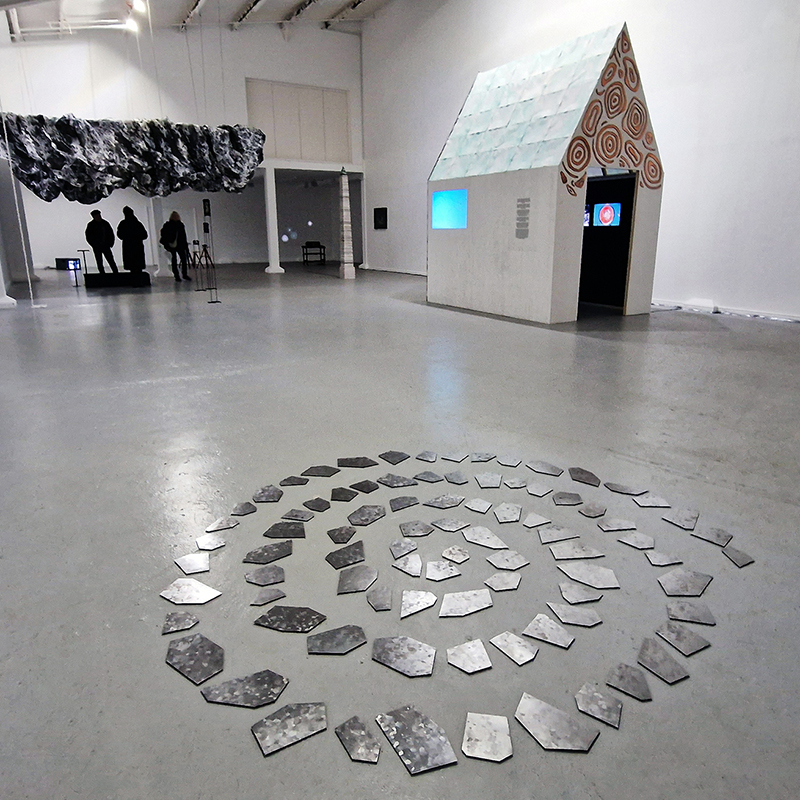
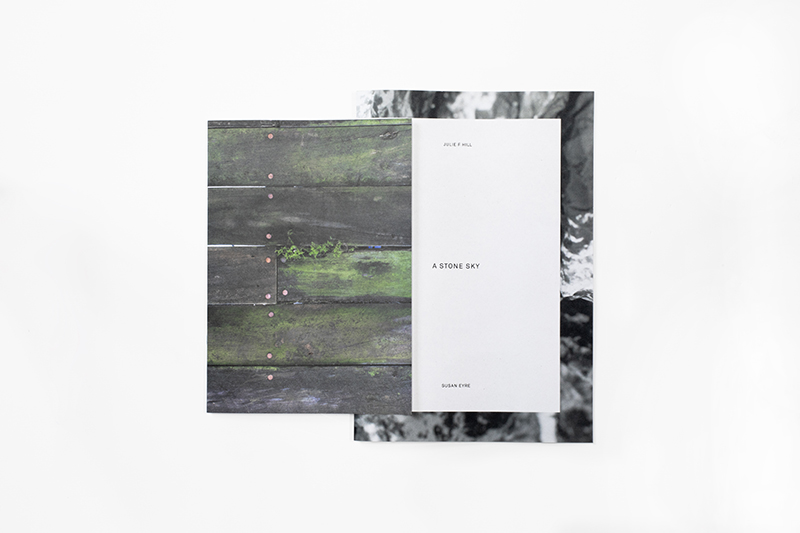
The exhibition closed with an afternoon event launching our publication which includes the essay Dark Nights and Signs of Unseen Things by Anjana Janardhan. There was also a live cloud chamber demonstration of mesmerising cosmic ray trails, artist tours and informal readings.
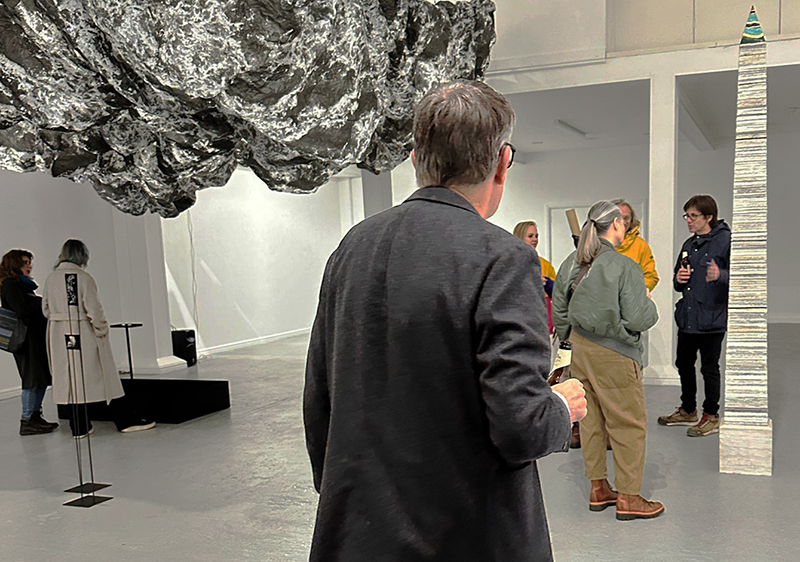
Publication available – DM via blog comments box for more details or visit Julie’s shop

Photoshoot with Warren King Photography resulted in some great images of my work ready for the press release and promotion of A STONE SKY – the upcoming joint exhibition, with Julie F Hill, that we have been working towards for many months. The exhibition will be at Thames-side Studios Gallery 11th – 26th November 2023 with a private view on 10th November 6-9pm.

Susan Eyre, Azimuth Obelisk (of sedimentary knowledge), paper, concrete, patinated copper, 2023 (detail) Photo Warren King Photography
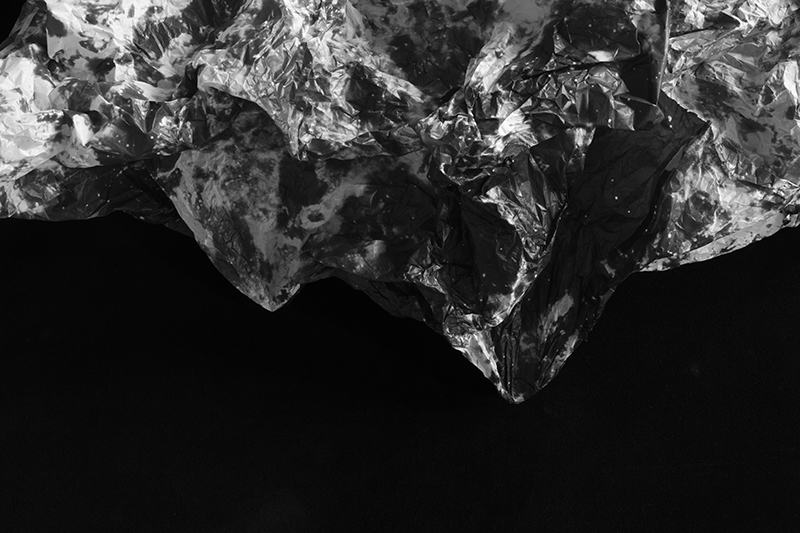
Julie F Hill, Cave, physically manipulated print of infrared James Webb data of barred, spiral galaxy NGC 5068, 2023 (detail).
Photo Julie F Hill

A Stone Sky brings together the works of multi-disciplinary artists Julie F Hill and Susan Eyre who traverse cosmic layers from the deep earth to deep space, exploring manifestations of darkness and its associations with the unknown and undiscovered. Reimagining the idea of an observatory, their sculptures and installations reach for scales and orders that surpass the human, revealing the cosmic at our feet. The exhibition proposes a cavernous realm of real and speculative possibilities that arise from beyond the limits of human perception. Engaging with the extended sensory range offered by technologies such as orbiting space telescopes through to the ability of birds to ‘see’ the Earth’s magnetic field, the artists’ reveal intimate connections between earth and space.

It was great to meet Anjana Janardhan who we have commissioned to write an essay for a publication which will be launched on the final weekend of the exhibition. We are also planning to give some informal readings, tours of the work and I will be running the cloud chamber so visitors can see the trails of cosmic rays – a way of visualising these unseen visitors from the stars.

The Azimuth Obelisk (of sedimentary knowledge) sculpture is an almost 3m tall reimagining of the obelisk erected at Hartland Magnetic Observatory in 1955 as an azimuth mark to be viewed from the Observing Room or Absolute Hut to monitor the drift of the magnetic north pole.

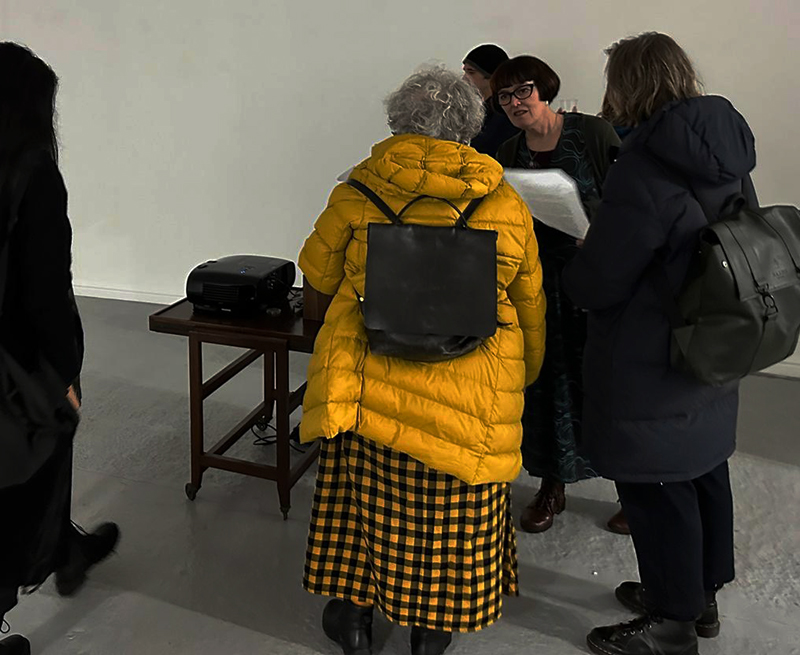
I have obtained an old wooden trolley to put the cosmic ray detectors and projector on for the digital video work The Breath of Stars. This feels in keeping with the original furniture used at Hartland Magnetic Observatory. The Breath of Stars directly interacts with cosmic rays – as each cosmic ray particle strikes a plastic scintillator its energy is recorded and a starburst image video is projected. The interaction of cosmic rays and the solar wind with atmospheric electrical fields combines to influence the unpredictability of the magnetosphere. Most radioactive particles heading for Earth are deflected by the magnetosphere. Without the Earth’s magnetic field deflecting the majority of cosmic rays, life on this planet could not survive.

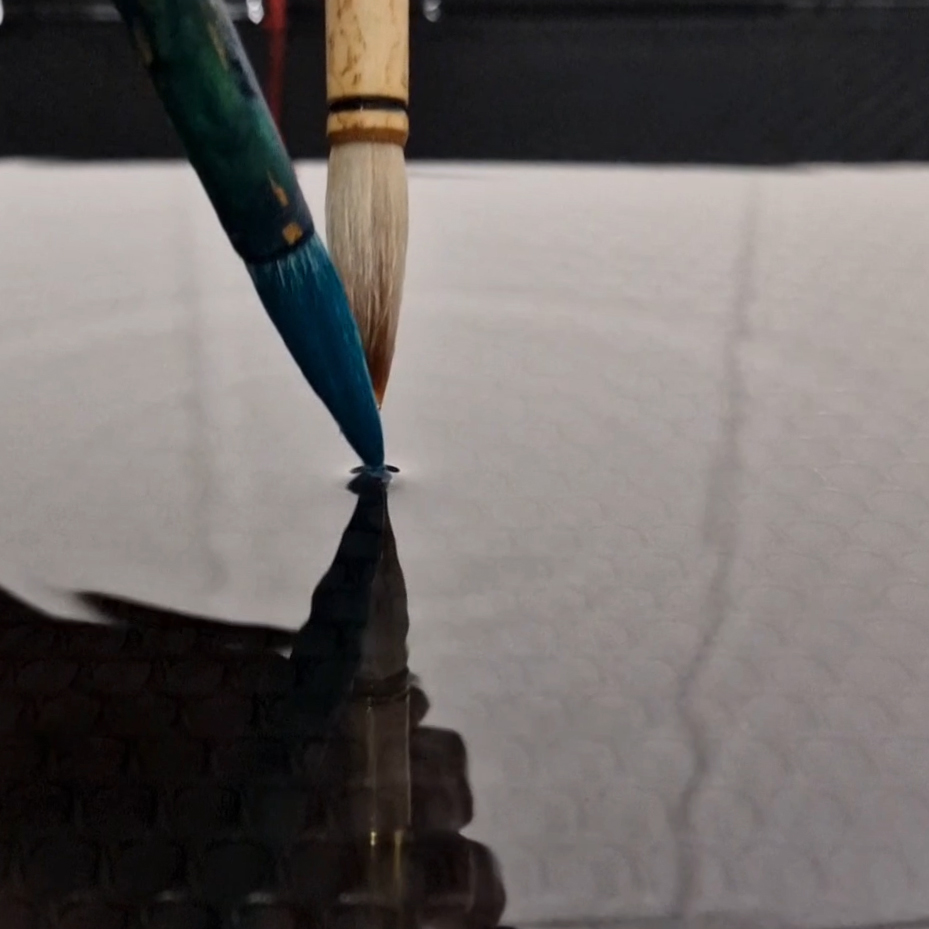
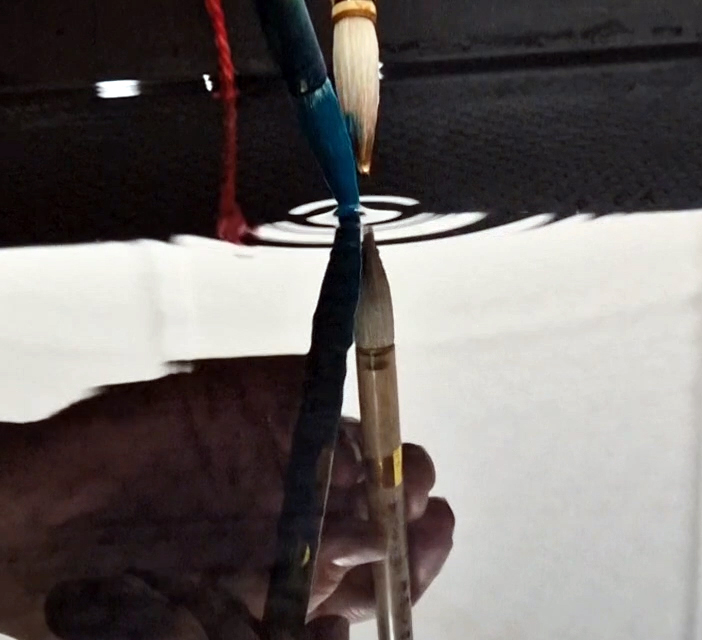
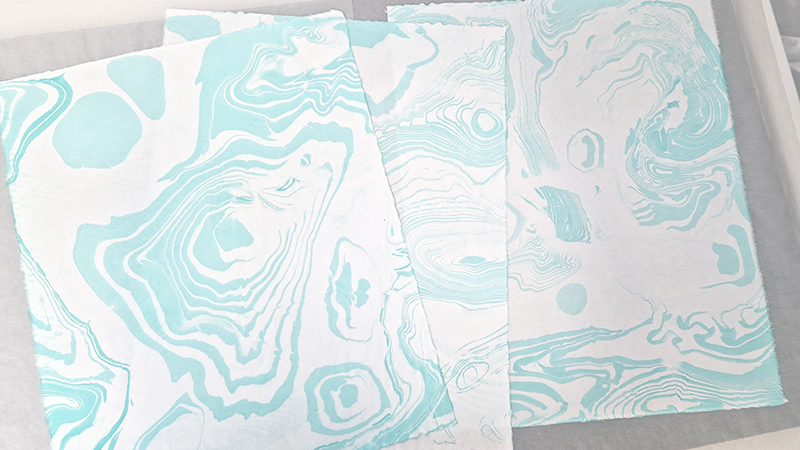
The 48 paper tiles for the roof of The Absolute Hut (of action potential) are made using the suminagashi technique of marbling with a colour to reflect both the sky and the patinated copper roof tiles of the Observation Hut at Hartland Magnetic Observatory. The paper is Japanese Osho Select and is very fragile when wet so has to be pulled from the water tray using a supporting mesh. Topological contours of suminagashi marbling reflect the fluid motion of the Earth’s magnetic dynamo and the pulsating alpha waves of the human brain when subjected to magnetic fields.

If you place a polarising filter over a screen that emits polarised light and use a polarising lens on the camera, then any plastic, photographed in this method, especially injection-moulded plastic, reveals stress points with a kaleidoscope of colours known as birefringence. Cryptochrome, the protein molecule found in a birds eye that enables birds to ‘see’ the magnetic field is excited by polarised light. Polarisation may also reveal the existence and properties of magnetic fields in the space medium light has travelled through. Research suggests that human alpha brainwaves react to a changing magnetic field. These ideas are brought together in a video work speculating on human magnetoreception via magnetite crystals in brain cells.

This video work will be shown on multiple small screens inside The Absolute Hut (of action potential) alongside two larger monitors showing companion video pieces exploring dynamics between the Earth’s geologic structure and navigation using the magnetic field.

I have replicated the experiment I saw at the National Physical Laboratory, dropping a magnet down a copper pipe to see how the magnetic field generated slows the magnet down considerably. I filmed this and added a tiny led light with the magnet.

Finally dark skies and fine weather coincided so I was able to go and make a time lapse of the stars rotating around Polaris.

Instruments of the Anemoi is a set of three dodecagon tablets cast in Snowcrete, a non-magnetic cement, as used in a magnetic observatory. Suggestive of the pedestals that support various instruments used in monitoring the Earths’ magnetic field they also respond to an ancient anemoscope “table of the winds” inscribed with the Greek and Latin names of classical winds on each of its twelve sides.

Hand cut copper pieces to be etched with images based on associations and attributes of the twelve Greek wind gods.

Sugar lift solution is screen printed onto the copper pieces.

These are then dipped in bitumen and immersed in hot water where the sugar slowly dissolves to reveal the image.

They are then left to dry before being etched.

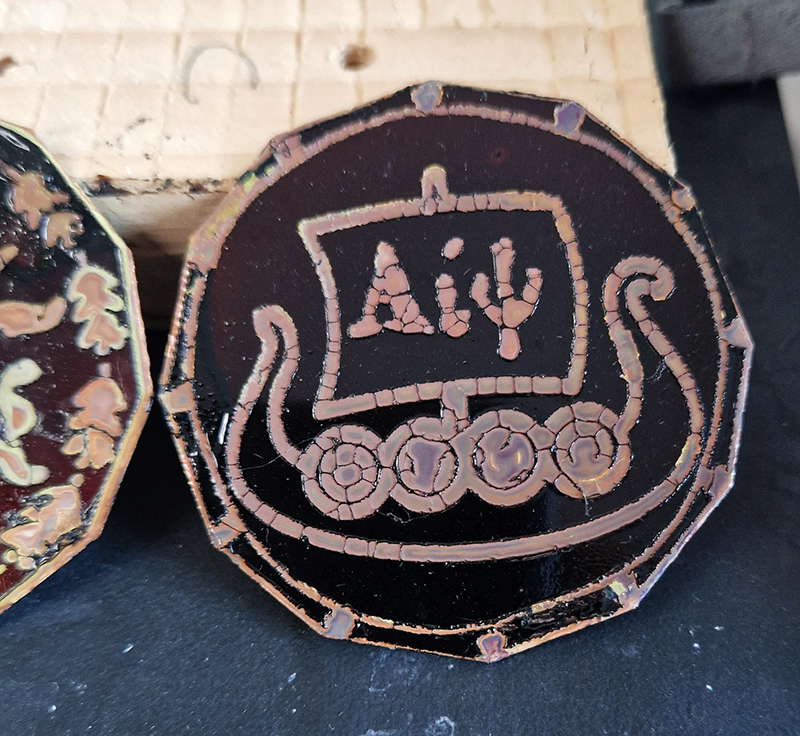
These were etched for 2 hours in an Edinburgh Etch solution, made with ferric chloride, citric acid and water to get a deep etch. The detail in the bitumen held very well. I constructed a collagraph from card to attach them to for casting in concrete. Once etched the detail areas were painted with a soy sauce solution before being placed in an ammonia vapour bath.

After a few hours patinating they are removed to dry before being cleaned up.

Positions are marked out on the collagraph and double sided tape is used to secure the pieces in place face down. The collagraph is then placed in the silicon mould ready for casting with Snowcrete – the same non-magnetic concrete used at a magnetic observatory.

This is the third of the tablets to be cast for the work Instruments of the Anemoi. The first holds a copper bowl with a ‘silver fish’ floating in water based on the oval shaped compass needle (illustrated in Breve Compendio de la Sphera de la arte Navegar by Martin Cortes 1551) as symbol of the silver fish – wafer thin fish shaped iron leaves used by 11th century Chinese geomancers.

Photo Warren King Photography

The second has embedded magnets in a pattern revealed by old nails and iron filings over the surface. One legend on the discovery of the lodestone recalls a Greek shepherd who noticed the nails in his boots were attracted to the lodestone (also known as magnetite a naturally occurring mineral).

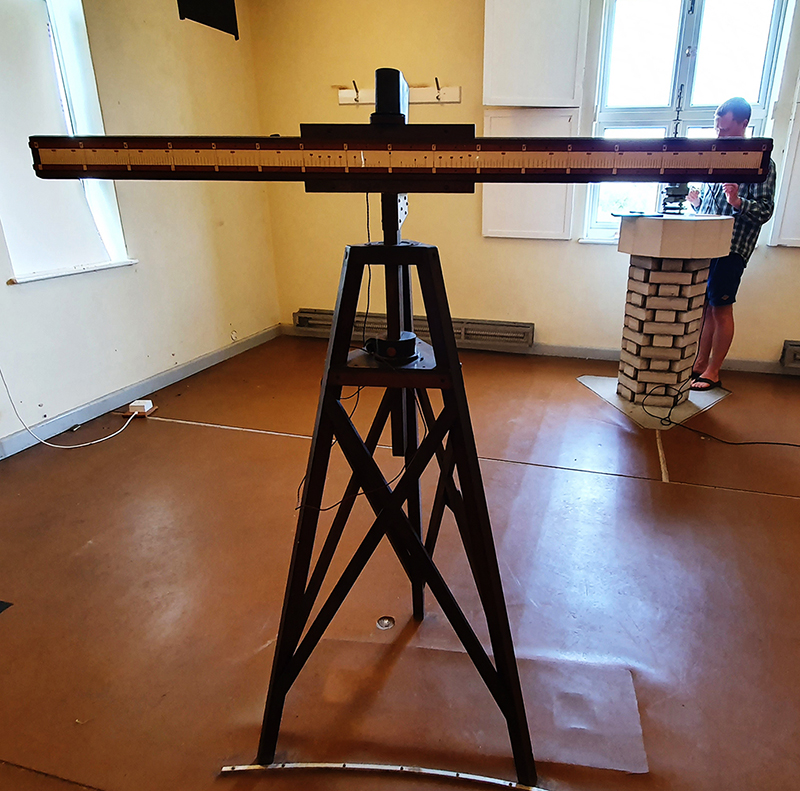
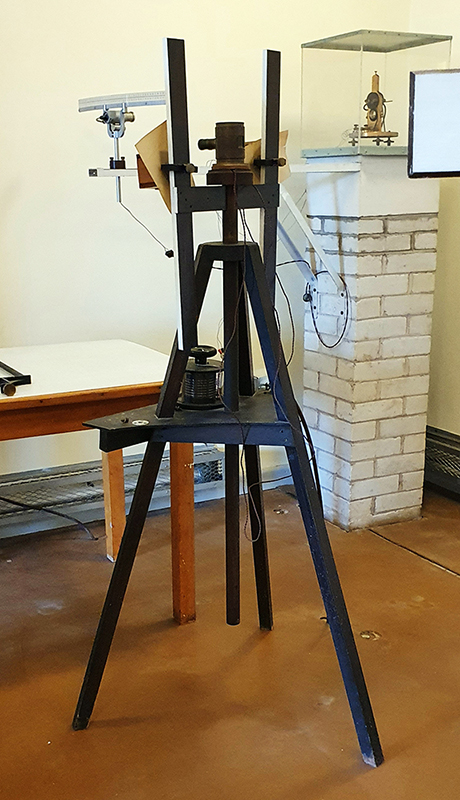
The tablets will be shown on adapted wooden theodolite or telescope tripods in the spirit of equipment seen below during my research trip to Hartland Magnetic Observatory.

Gallery Visits

Seismic Mother curated by Charly Blackburn and Holly Birtles at Hypha Space – an exhibition of 20 artists whose work attempts to communicate the seemingly incomprehensible nature of the earth’s magnitude and magnificence, temerity and resilience as it endures, regenerates and struggles to survive through the slow violence of ecological catastrophe. I visited for the book launch and performative reading from Stephen Cornford whose book, Petrified Matter, I bought. It’s an enlightening read on the links between photography and fossils through mineral, chemical and data recording processes, going on to speculate on future geology and the impossibility of reversing the extraction process by separating minerals used in mobile phones and other technology to return these back to the soil.