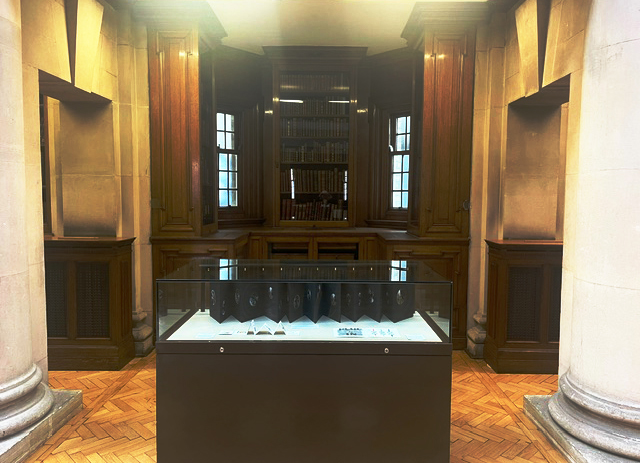
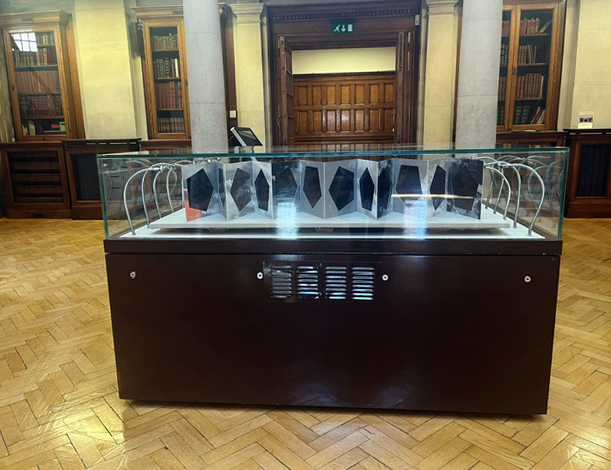
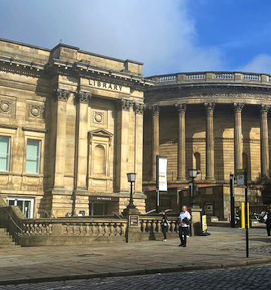
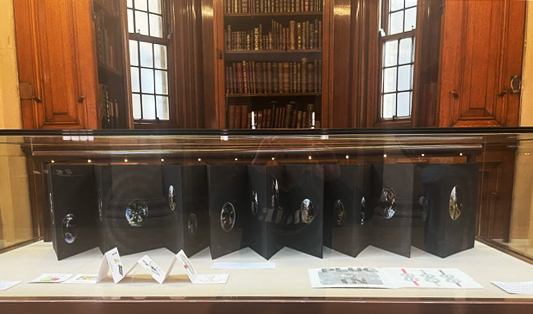
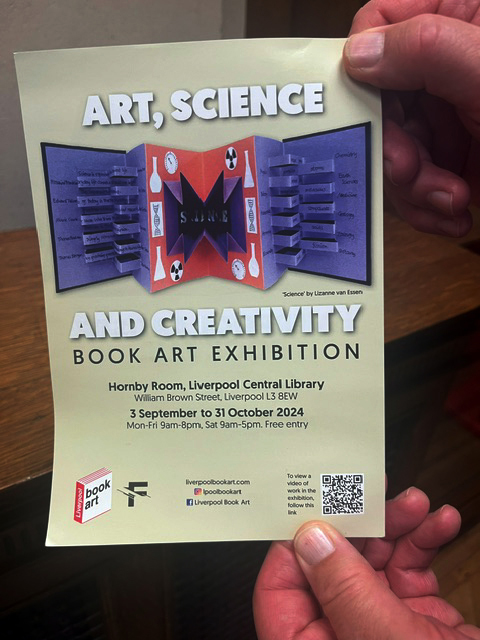
The ‘Art, Science and Creativity’ exhibition at Liverpool’s spectacular Central Library continues. The exhibition is inspired by statements from Albert Einstein, highlighting the fact that creativity is central to explorations in both art and science. As we wonder, and attempt to understand the universe and ourselves, categories can, and perhaps should, become blurred. Distinctions can be both valuable and problematic: ‘art’ versus ‘science’, ‘nature’ versus ‘human’, ‘natural’ versus ‘supernatural’, ‘material’ versus ‘spiritual’, ‘secular’ versus ‘religious’ and so on. And as the great science-fiction writer Arthur C Clarke said “Any sufficiently advanced technology is indistinguishable from magic”.
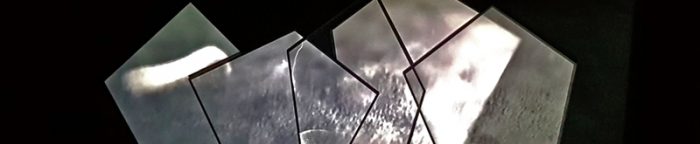
I am very happy to have two unique books included in the exhibition. In/Out and Unbound.
Liverpool Book Art and Fevered Imagination are collaborating to create a video loop of all the artworks, enabling audiences to get a fuller appreciation of the artists’ creativity than allowed by the use only of display cases. Fevered Imagination is a website dedicated to Artists Books, through which works from the exhibition can be bought.
I am delighted to be invited by Serendipity Arts Foundation to show Cosmic Chiasmus: crossing the universe at Serendipity Arts Festival in Goa later this year.
Serendipity Arts Foundation is an organisation that facilitates pluralistic cultural expressions, sparking conversations around the arts across the South Asian region. Committed to innovation and creativity, the aim of the Foundation is to support practice and research in the arts, as well as to promote sustainability and education in the field through a range of cultural and collaborative initiatives. The Foundation hosts projects throughout the year, which include institutional partnerships with artists and arts organisations, educational initiatives, grants, and outreach programs across India.
Serendipity Arts Festival is one of the largest multi-disciplinary arts initiatives in the South Asian region. It spans the visual, performing, and culinary arts, whilst exploring genres with film, live arts, and literature. Besides the core content, which is conceptualised by an eminent curatorial panel, the Festival has various layers of programming, in the form of educational initiatives, workshops, special projects, and institutional engagements. Through active conversations between the artistic community and the urban, social landscape, the Festival continues to evolve around the mandate of making the arts visible and accessible. The Festival is driven by a spirit of collaboration, hoping to inspire new perspectives and fresh aesthetic encounters. This labour of love is a cultural experiment that also addresses issues such as arts education, patronage culture, interdisciplinary discourse, inclusivity, and accessibility in the arts.
Other exciting news is that Julie F. Hill and myself are working together again on a new project. Following on from our ambitious duo show A Stone Sky at Thames-side Studios Gallery (Nov 23), we will be curating and participating in an exhibition next spring, exploring themes of stone consciousness and human-mineral encounters.
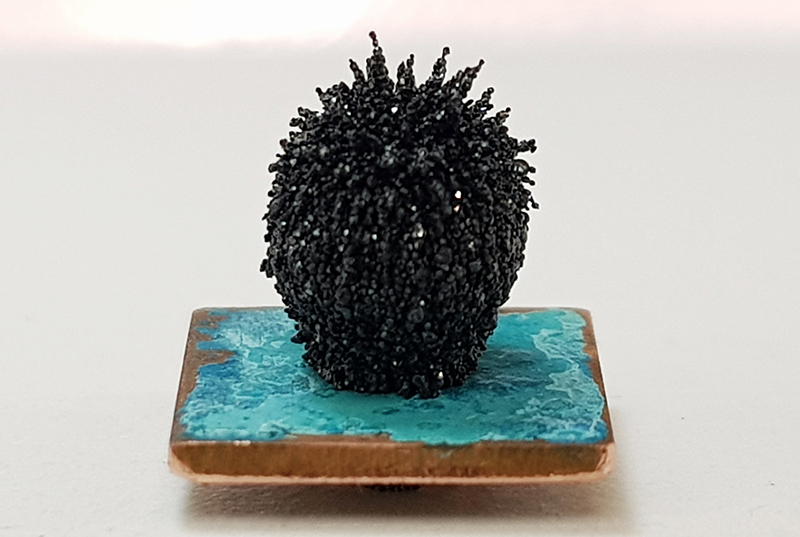
In the studio I have been working on a proposal for the Moon Gallery. Moon Gallery is an international collaborative artwork and a gallery of ideas which aims to set up the first permanent museum on the Moon. Moon Gallery will launch 100 artefacts to the Moon within the compact format of a 10 x 10 x 1cm plate on a lunar lander exterior panelling as early as 2025.
Each sculpture has to fit within a 1cm cube, which is quite challenging. My proposal is a 5mm spherical magnet sparkling with black volcanic sand on a 1cm square of patinated copper. Space exploration means leaving the protective shield of Earth’s magnetic field, placing astronauts and technology at risk from increased levels of harmful high energy particles. This artwork is a small realization of a magnetic field offered as a symbol of safe passage to those venturing beyond our home planet and protection of Earth’s magnetosphere. The black volcanic sand used in this work is naturally magnetic, making visible the force that emanates from the core of the magnet. The patination colour reflects on the astonishing view of our blue planet from the moon and the importance of water to sustain life. The title Core Values, makes reference to the molten core necessary for a planet to generate a magnetic field as well as the ethical principles and beliefs that guide humanity in a positive spirit of peaceful cooperation for the benefit of all. The work operates as a motif for what is in the heart of a body, rocky or otherwise. It also celebrates the beauty of the elements and natural forces that together inspire the human imagination and makes the cosmos so exciting to explore.
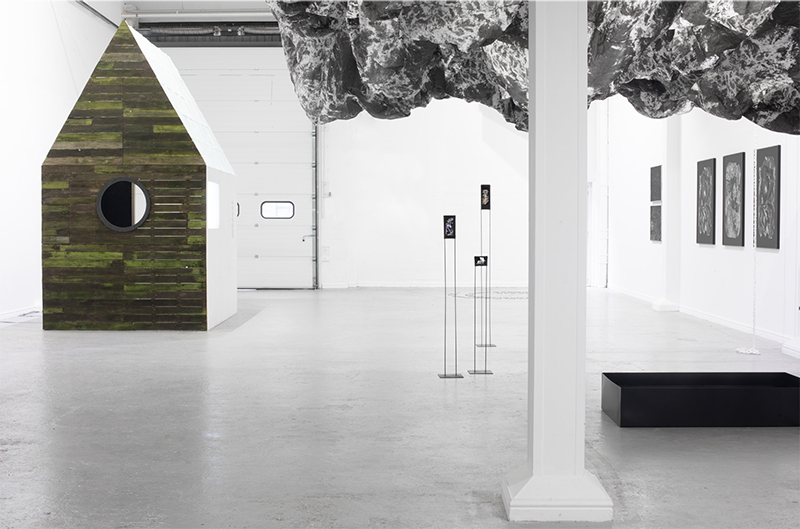
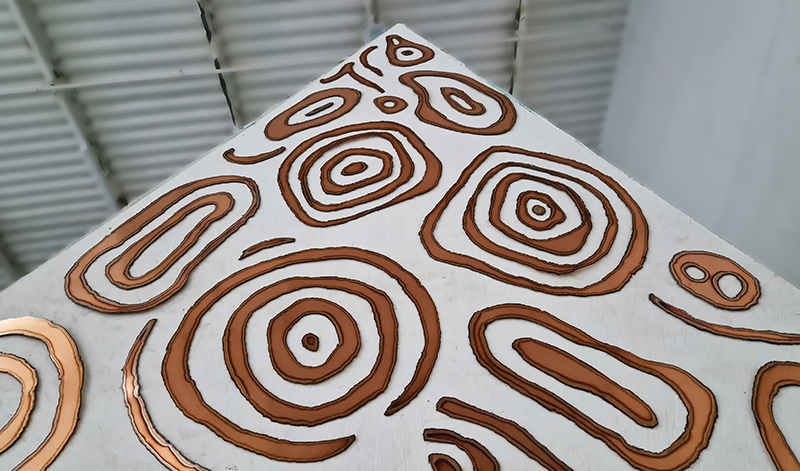
I have been sorting out the copper contours from The Absolute Hut (of action potential)as I couldn’t store this work, it had to be dismantled. The copper will be reused in future work.
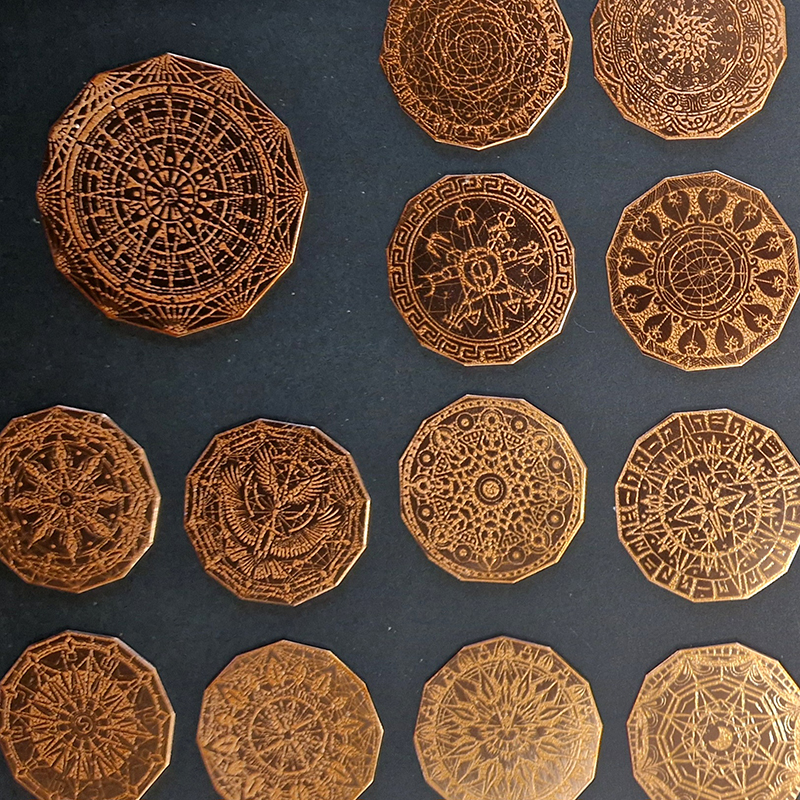
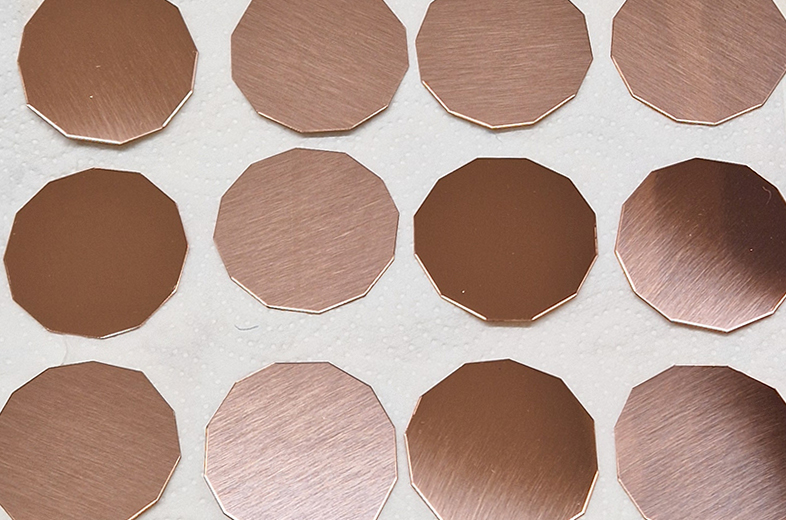
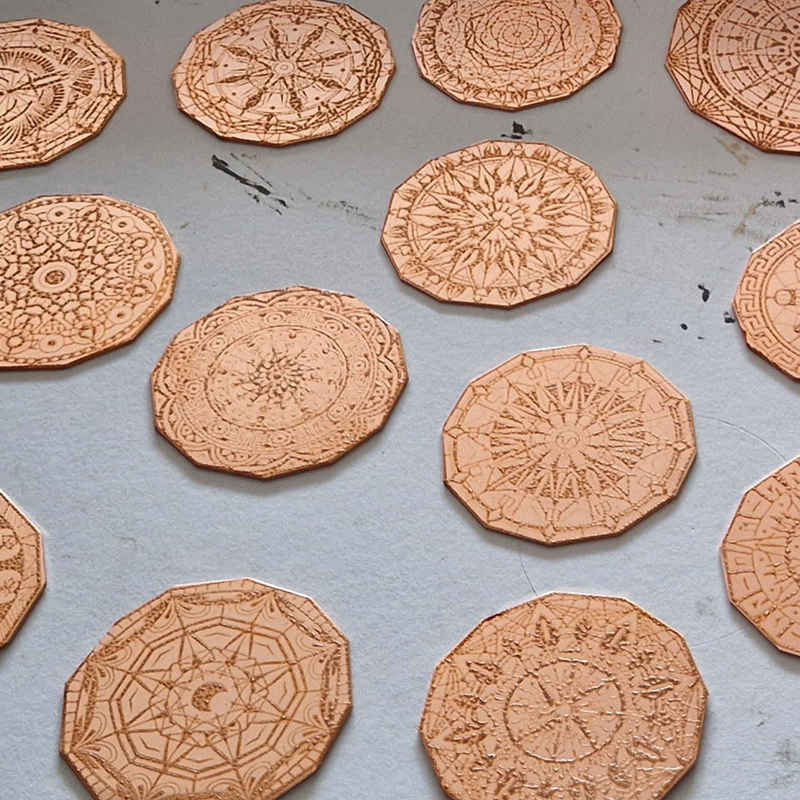
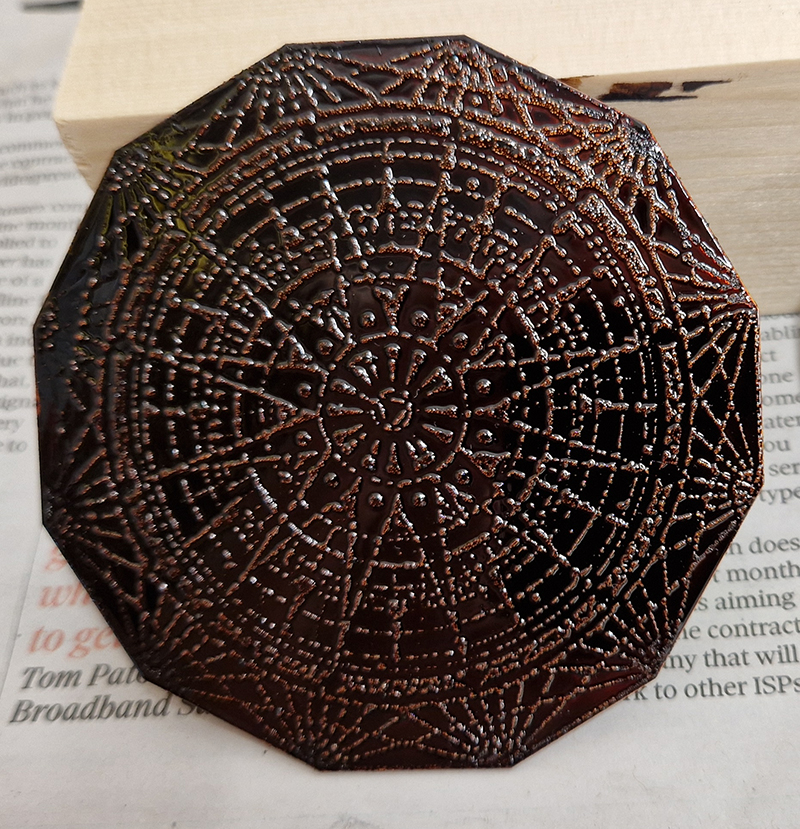
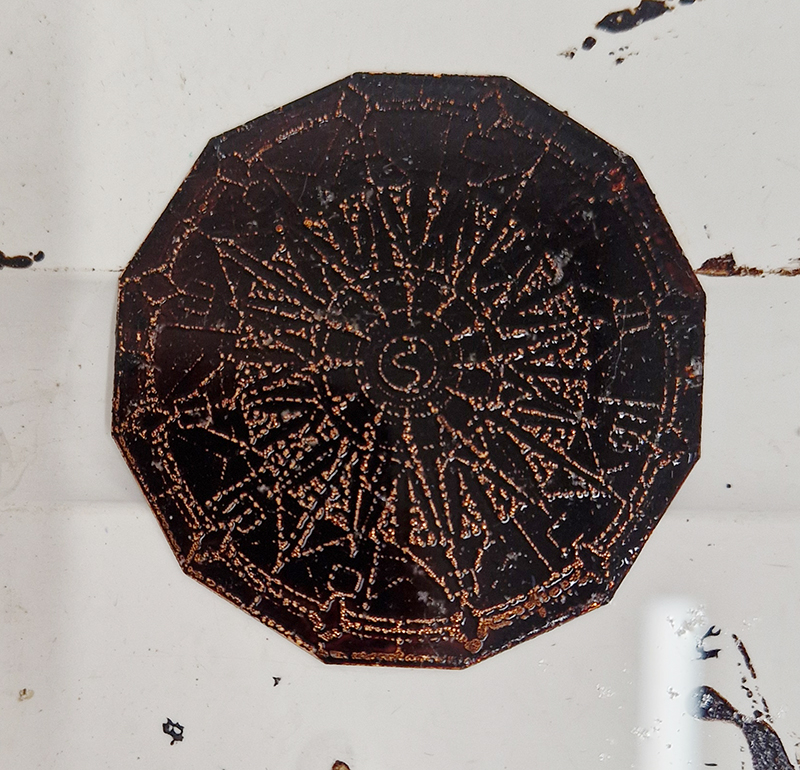
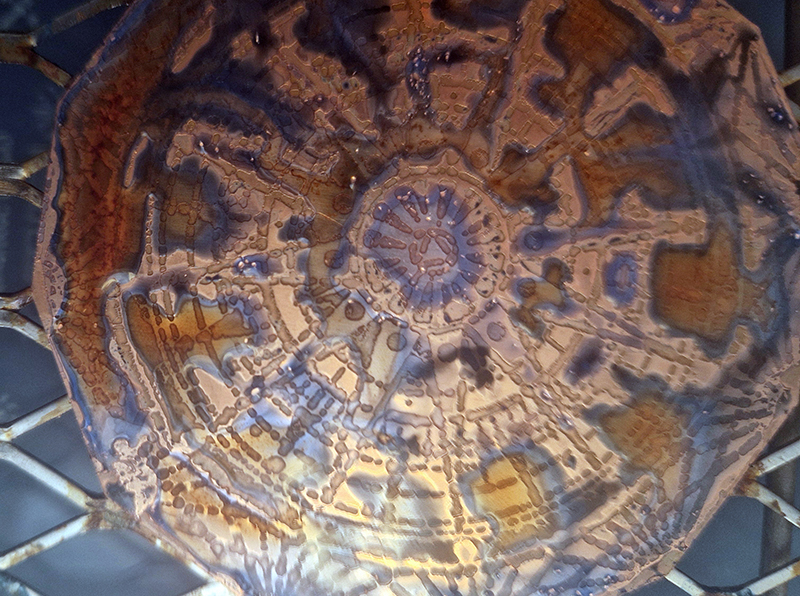
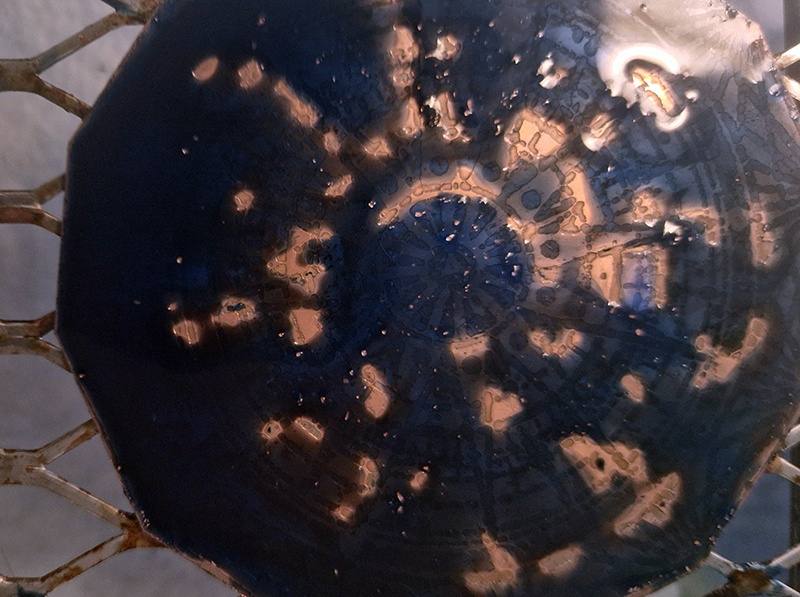
I am making a new concrete tablet for Instruments of the Anemoi series with more detailed compass rose inspired copper insets. The copper is guillotined to shape and screen printed with a sugarlift solution.
The pieces are then dipped in bitumen and left to dry before putting in a bath of warm water to dissolve the sugar solution, leaving the design ready to be etched.
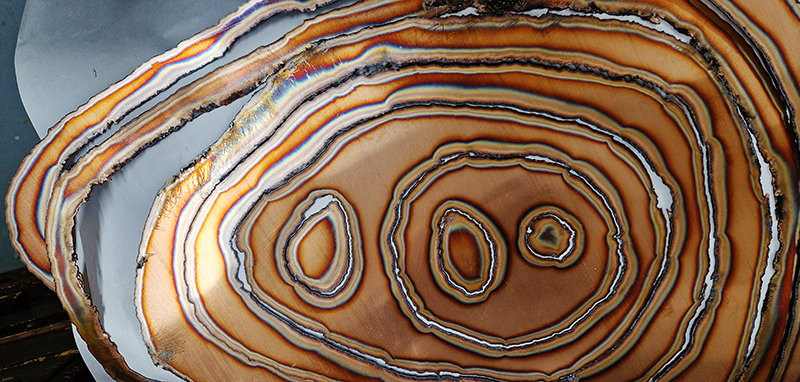
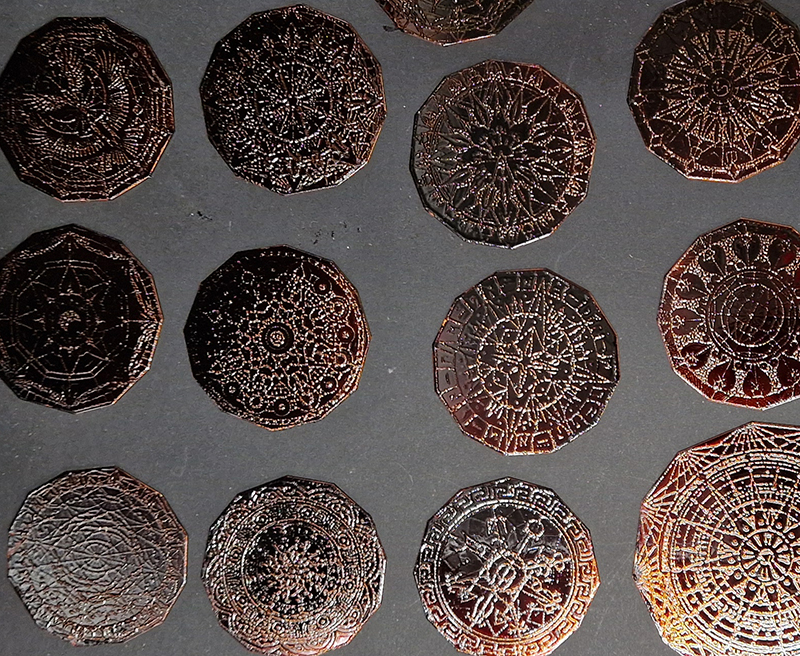
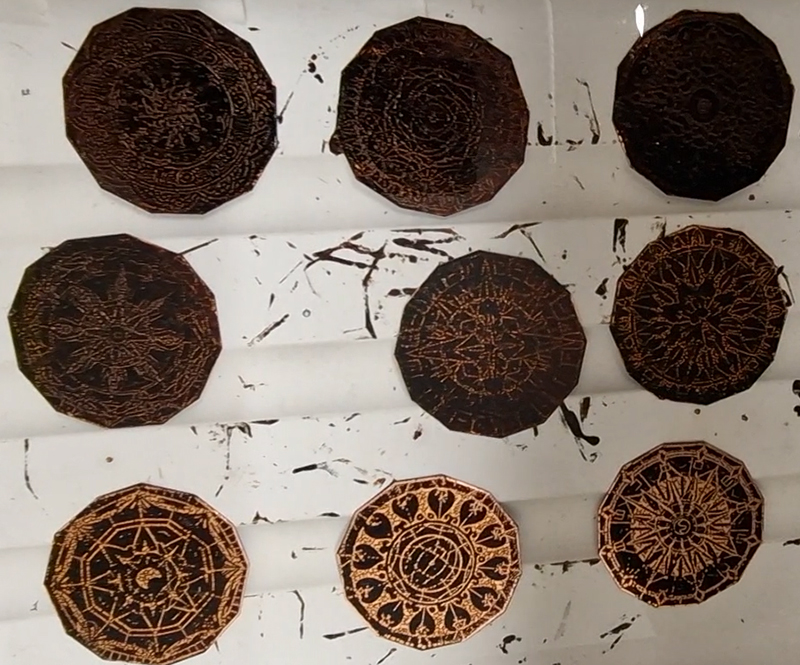
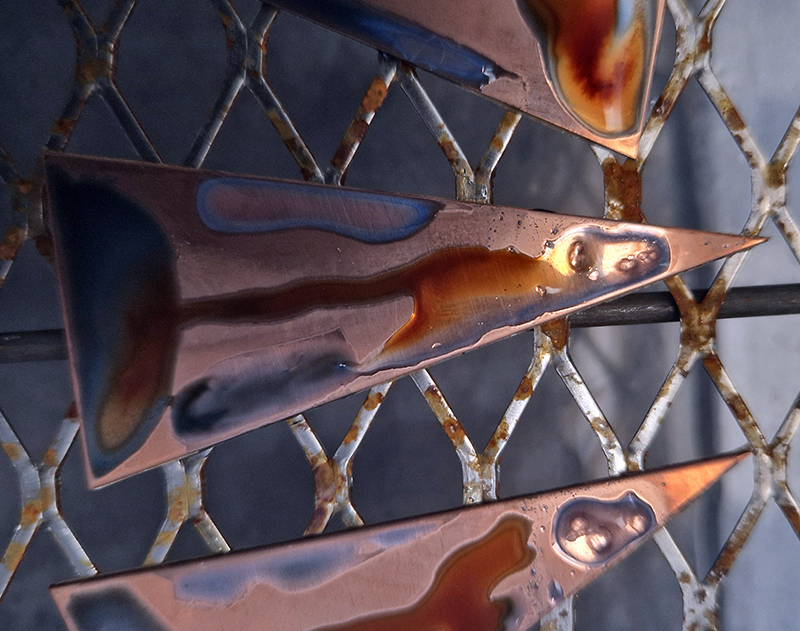
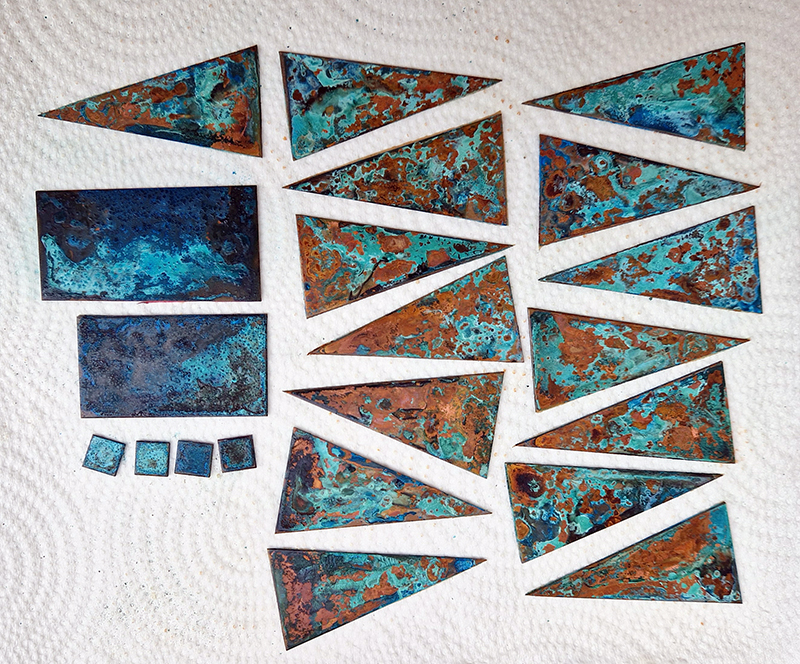
I also cut some copper shapes to patinate, painting the copper with salt and vinegar and soy sauce before fuming in an ammonia bath. I love how the colours change throughout the process.
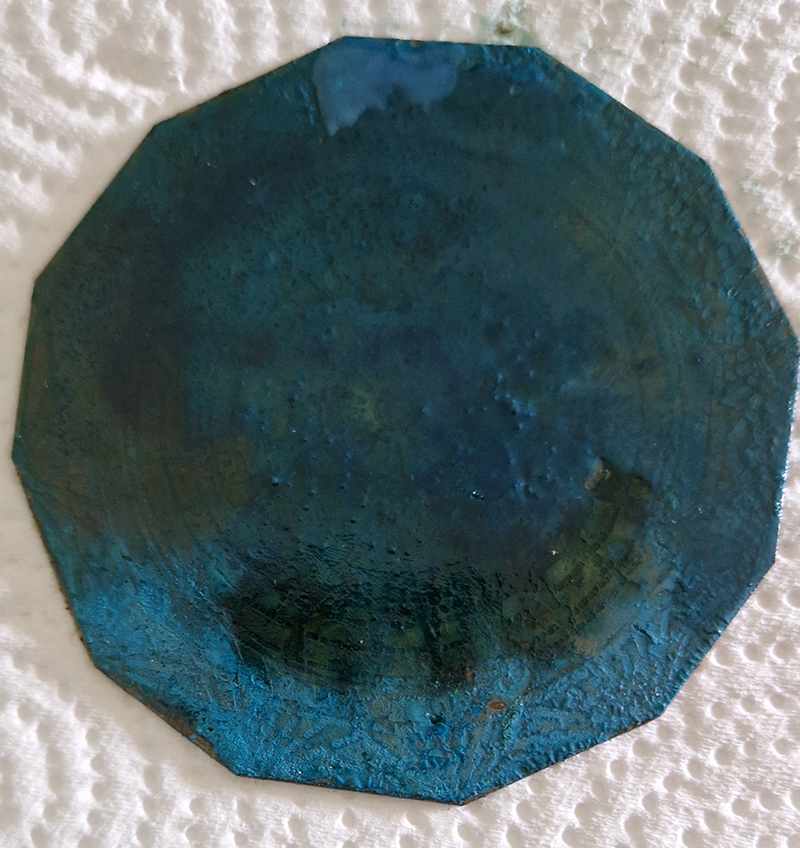
I was going to patinate the dodecagon shapes as well but in the test I did, I lost a lot of detail, so these will just be inked and left.
Gallery Visits
Charmaine Watkiss showing her beautiful drawings full of symbolism in Hard Graft at Wellcome Collection. The exhibition explores the impact of work on health and her works celebrate the ancestral herbal knowledge of medicinal and edible plants and fruits that carry powerful healing properties.
These were used to secretly cure illnesses and prevent diseases as an act of survival and self-dependency, distinct from Western medicine. The connection between herbal healing and African spiritual practices is represented by cosmological symbols discreetly tattooed on the women’s bodies. Natural dyes – such as Jamaica’s Blue Mountain coffee and indigo – and materials such as brass and raffia palm embed historical knowledge in the fabric of the works. This knowledge is preserved, yet concealed, by the figures who avoid the viewer’s gaze.
The London Group Stillness in Movement at Bermondsey Project Space. Taking three evocative lines from Four Quartets by T S Eliot as a starting point for this group show. Images – Carol Wyss, Sandra Crisp, Genetic Moo and Beverley Duckworth.
‘Not known, because not looked for But heard, half heard in the stillness Between two waves of the sea’
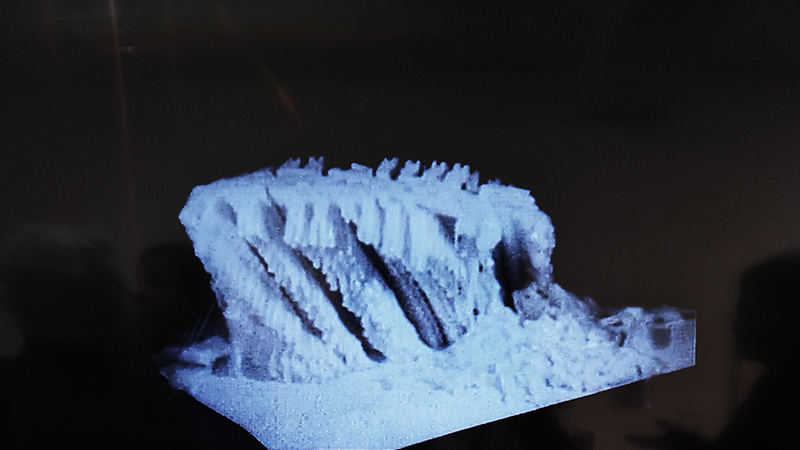
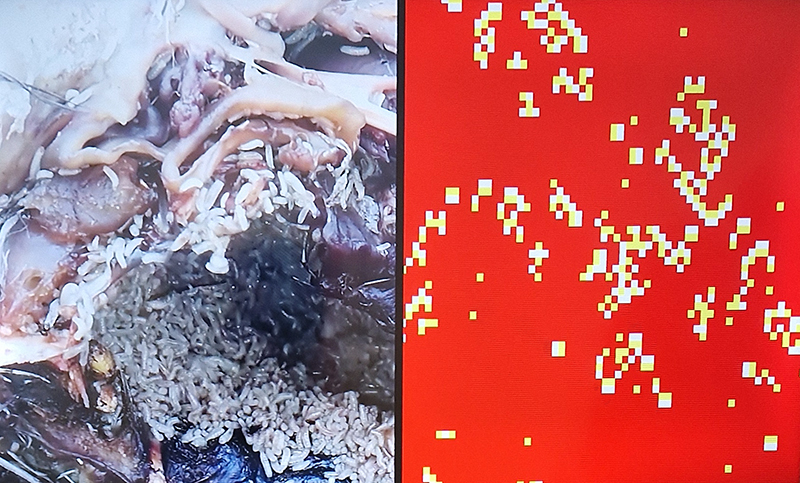
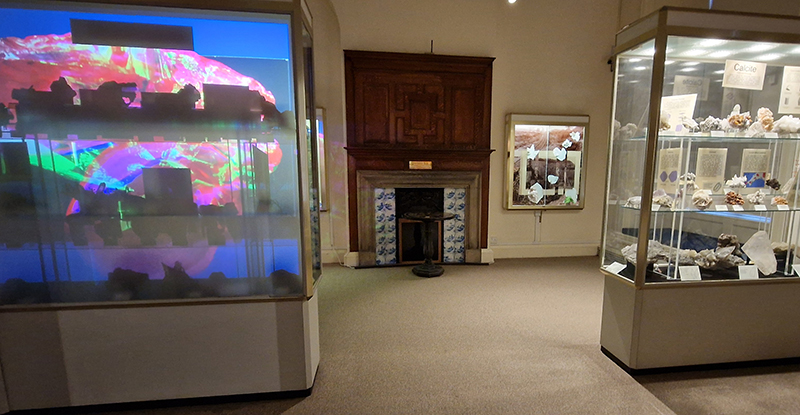
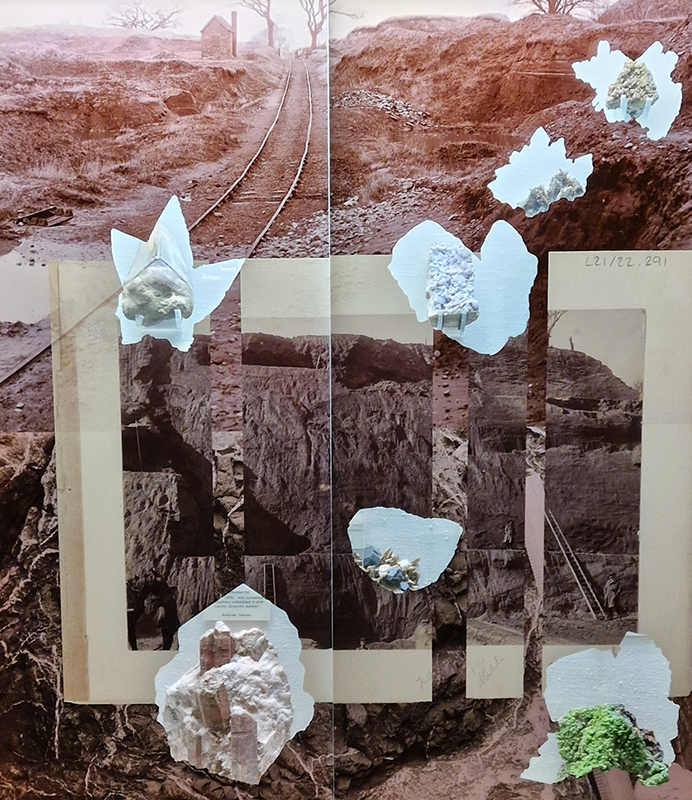
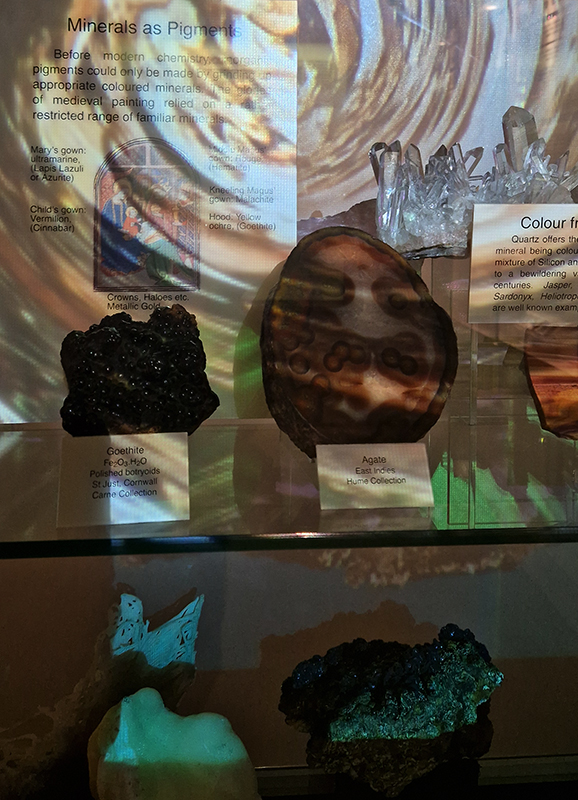
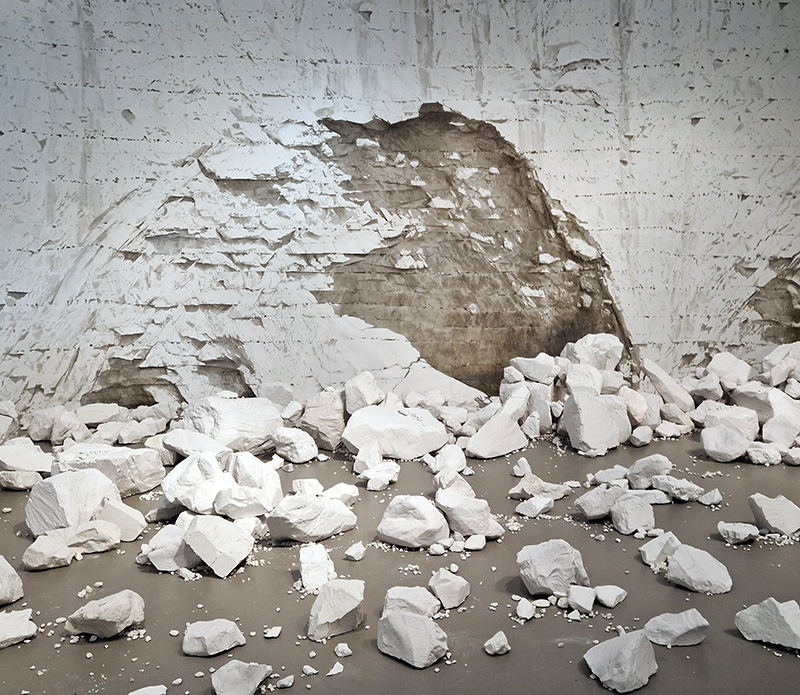
Rona Lee Lithic Entanglements at Sedgewick Museum of Earth Sciences. A considered intervention in the Whewell Mineral Gallery to ‘bring the dirt back in’, making evident the scarred landscapes, physical extraction processes as well as the social strata of those involved in procuring such a collection. There is no denying the allure of minerals and gemstones and the work here captures the beauty of the rocks while also reminding us of the ravaged Earth left scarred and depleted.
‘A Modern Lapidary a video work, back projected through one of the free-standing cases, animates mid-century scientific photographs of minerals, altering our perception of the samples within as ‘dead’ matter. Elsewhere, in An Extractive Index, digitally collaged photographs of geological field trips are laminated on to the glass, inviting reflection on the social and environmental relationships which these reveal.’
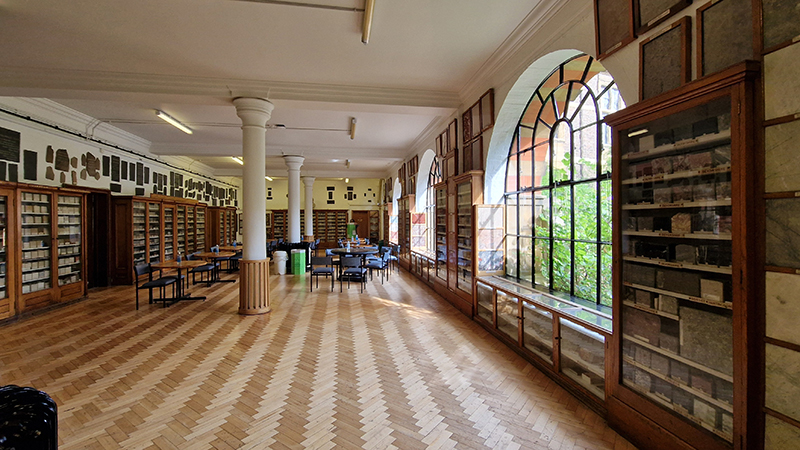
The Museum itself was also fascinating to look round and after Rona’s artist talk we were treated to tea in the The John Watson Building Stones Gallery which houses the most complete collection of stones used in construction.
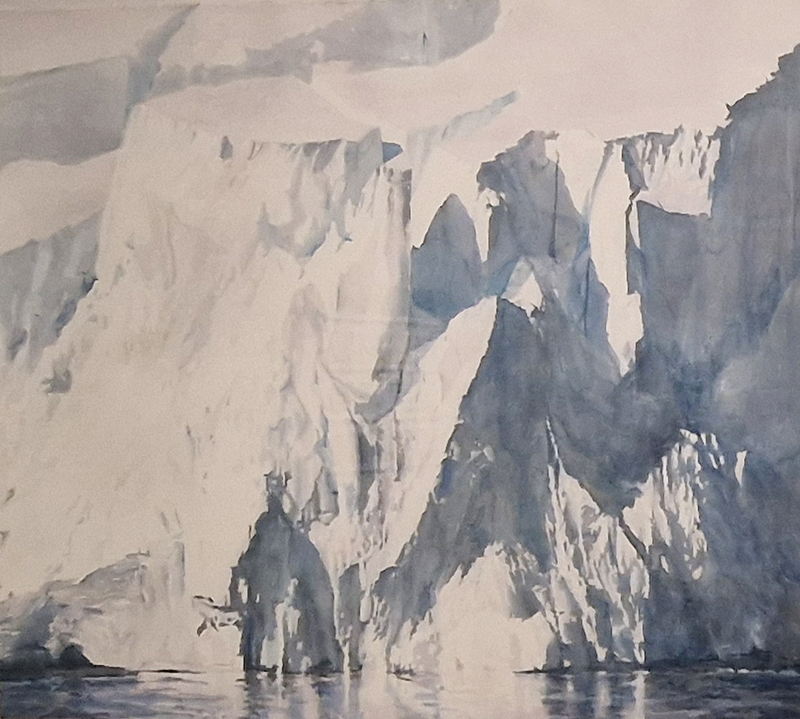
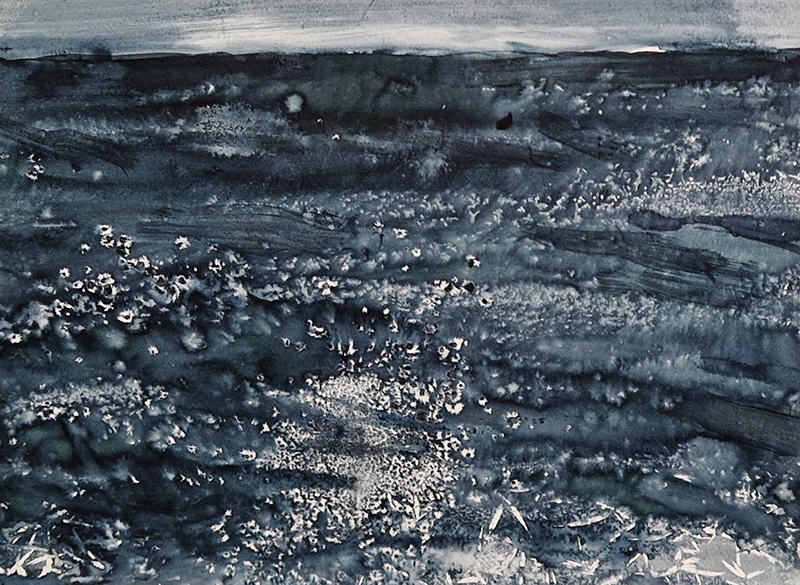
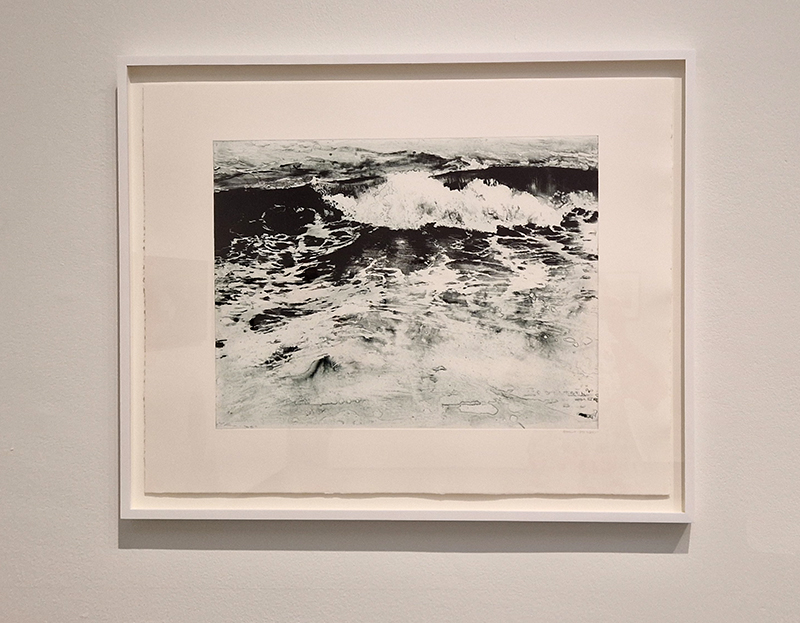
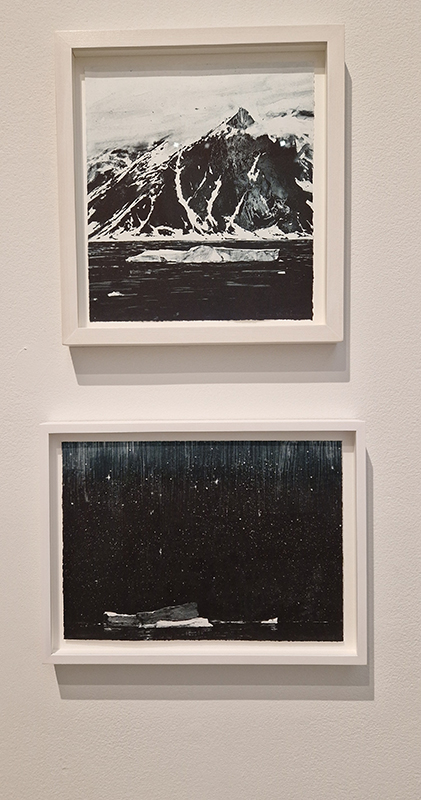
Emma Stibbon Melting Ice | Rising Tides at Towner Eastbourne. A day trip to the see this remarkable body of work so thoughtfully curated. The pale majesty of ice or chalk cliff faces, fragile against pounding seas that Emma witnesses in both the polar and local Sussex coastlines are captured so poignantly. These are portraits of great bodies under stress. Close up, edges and lines break down into fluid, watery strokes, a diaphanous translation of the fast painterly sketches made in often gruelling conditions. Wonderfully immersive, through scale and placement, and the understated palette of deep muted greens and blues, almost blacks and luminous whites which draw the viewer into the landscapes.
Listening
Sideways – A New Frontier. A four-part podcast about the ethics of space exploration with former NASA astronaut Nicole Stott, new astronaut Ed Dwight, Space Philosopher and author Frank White, Anthropologist of Space and Religion, Deana Weibel, Professor of Religion at Knox College Robert Geraci and former ISRO scientist, Jijith Nadumari Ravi.
Astronauts and space tourists often cite the overview effect as a transformative experience offering the perspective to see a shared planet with no borders. Some however, experience the ‘ultraview’ effect which is the overwhelming and disorienting knowledge of the magnitude of the universe.
BBC Inside Science Podcast. How much of a risk is space junk? As we send more and more metal in the form of satellites up into space, scientists are warning it is becoming more of a risk both here – and up there.
Much space junk comes from defunct satellites. There are plans to launch 60,000 more satellites by 2030. It is estimated there is currently 12, 400 tons of space junk orbiting Earth – 2,500 discarded satellites and 130 million fragments that travel at 10 times the speed of a bullet. Because of the orbiting junk, Space X satellites must make around 275 collision avoidance manoeuvres every day. It is not only dangerous in space but large debris is falling to Earth and not burning up in the atmosphere. It is predicted life will be lost in the next decade as a result of falling space junk, there have already been some near misses. The satellites and launch debris that does burn up in the atmosphere releases large amounts of metal into the atmosphere with unknown consequences.
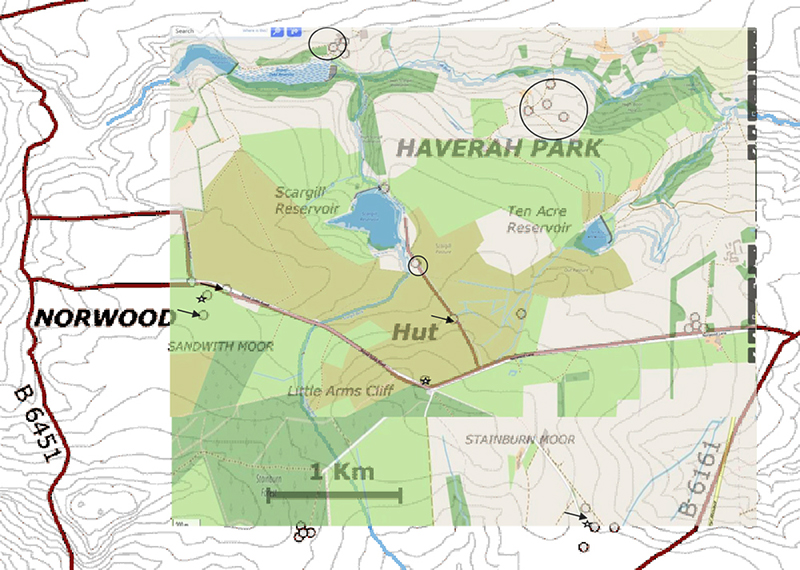
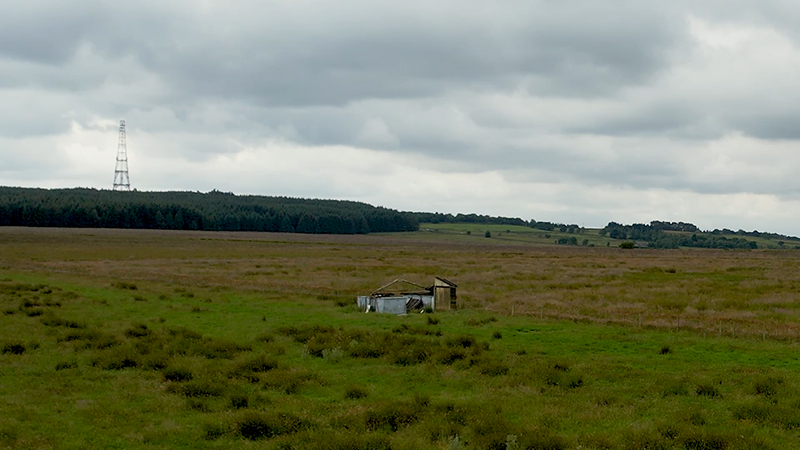
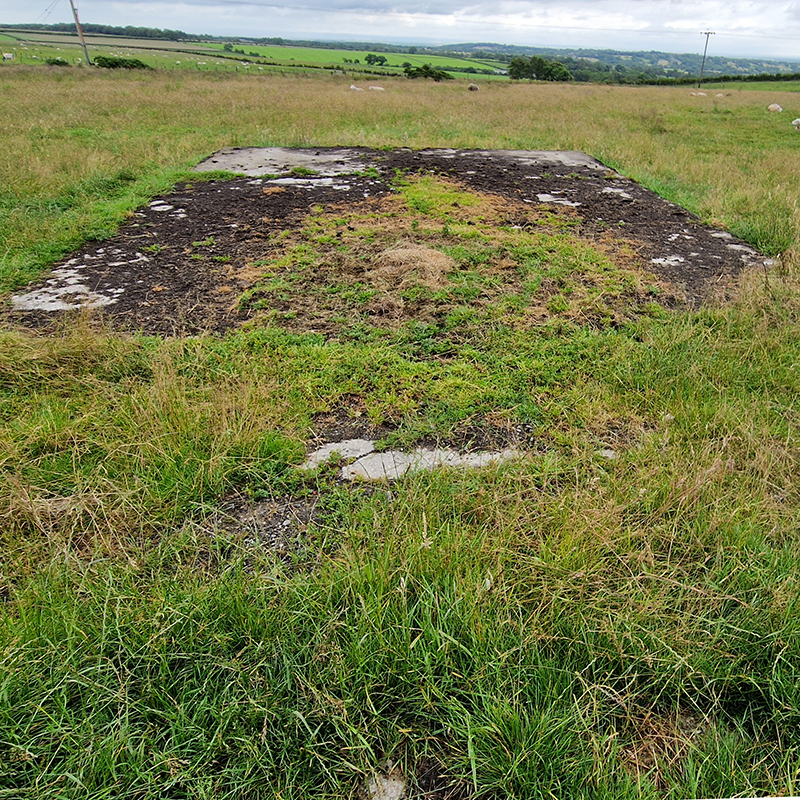
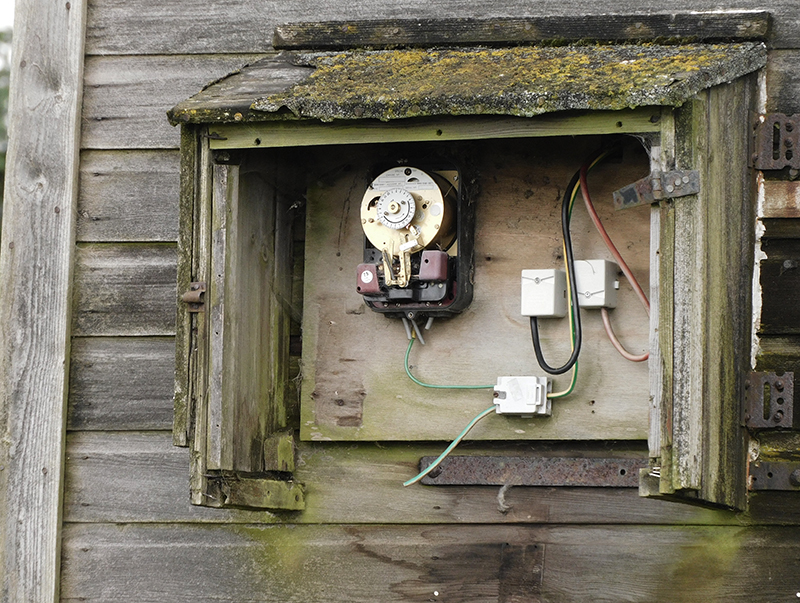
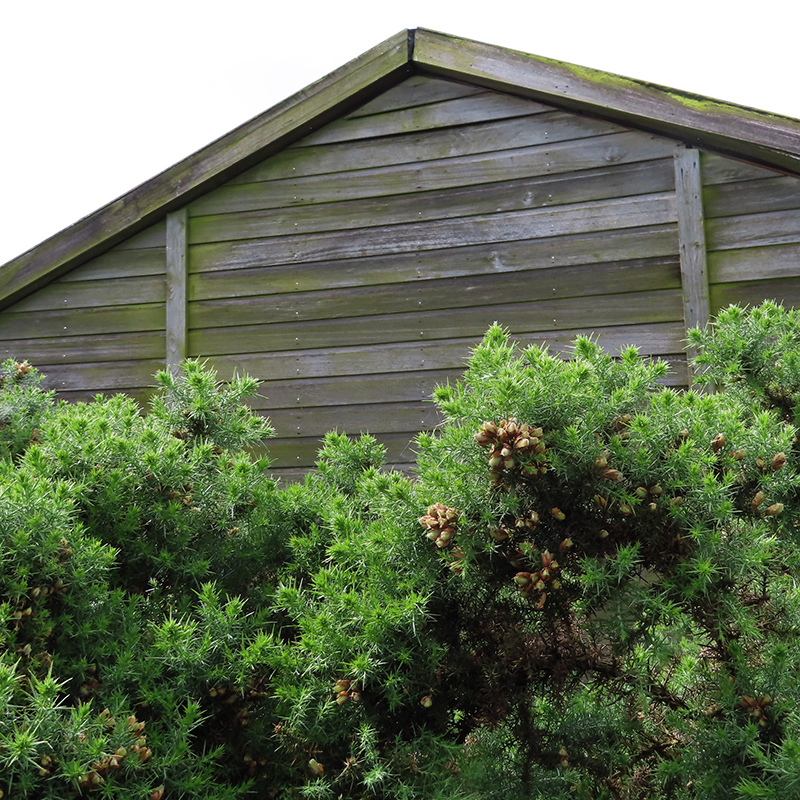
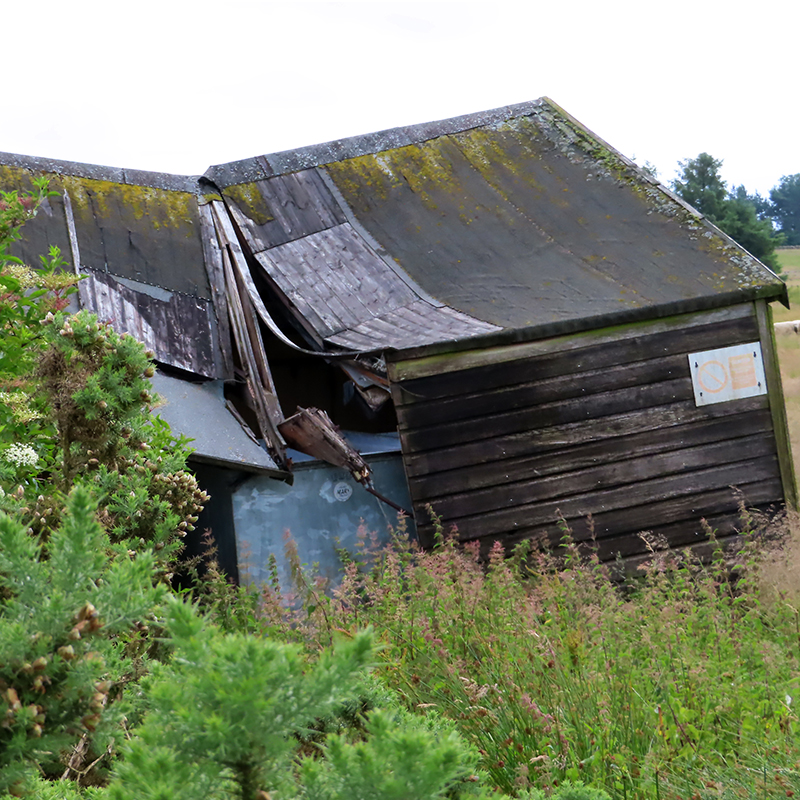
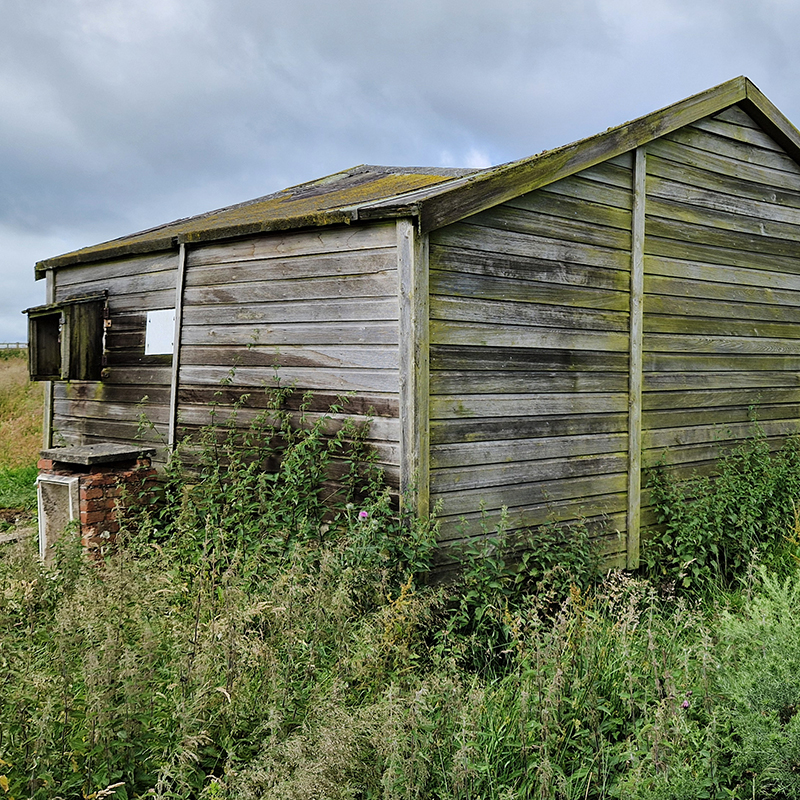
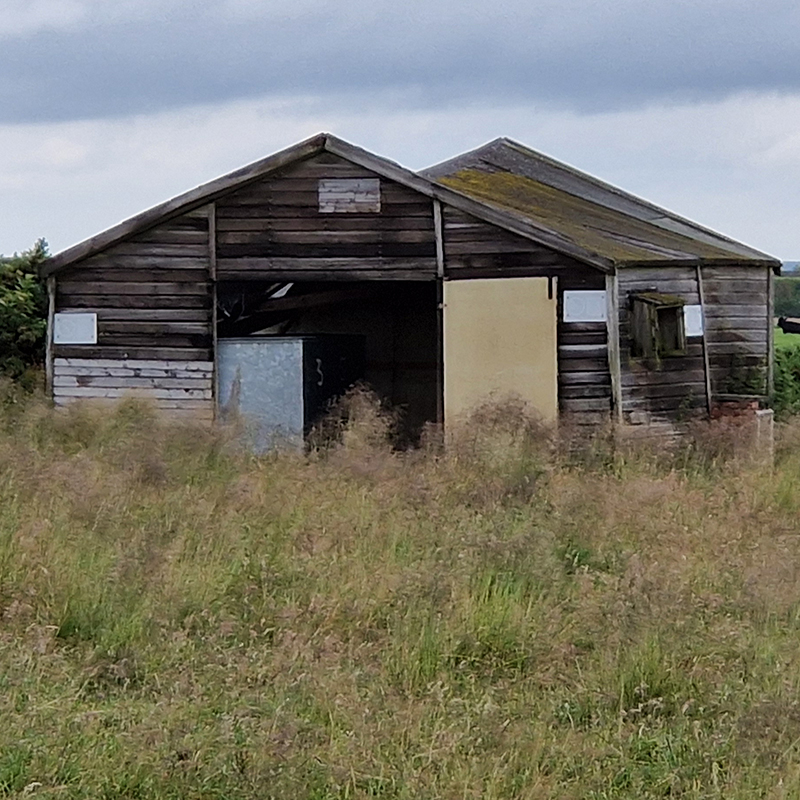
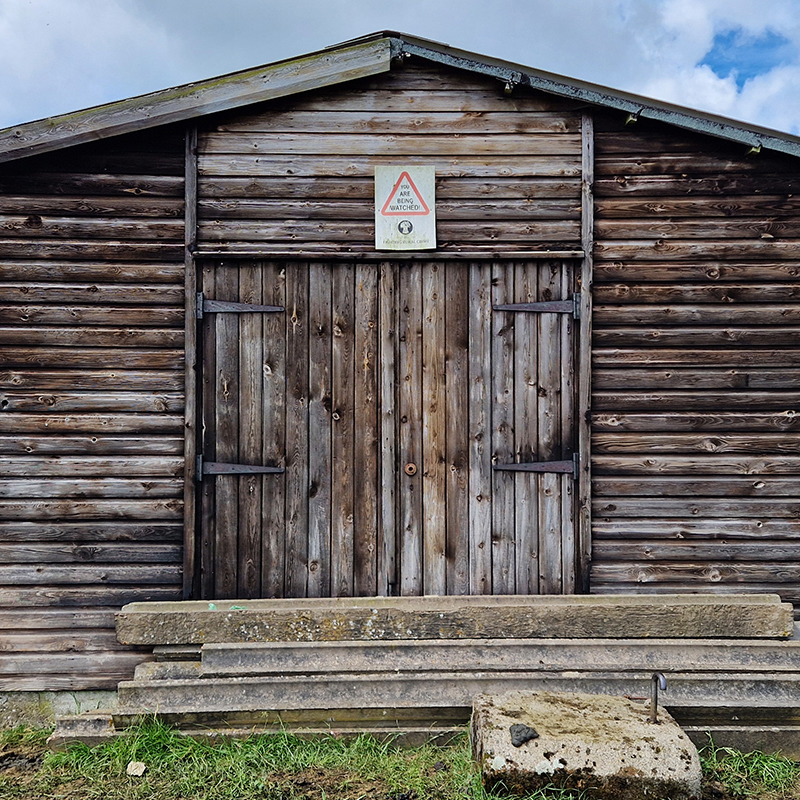
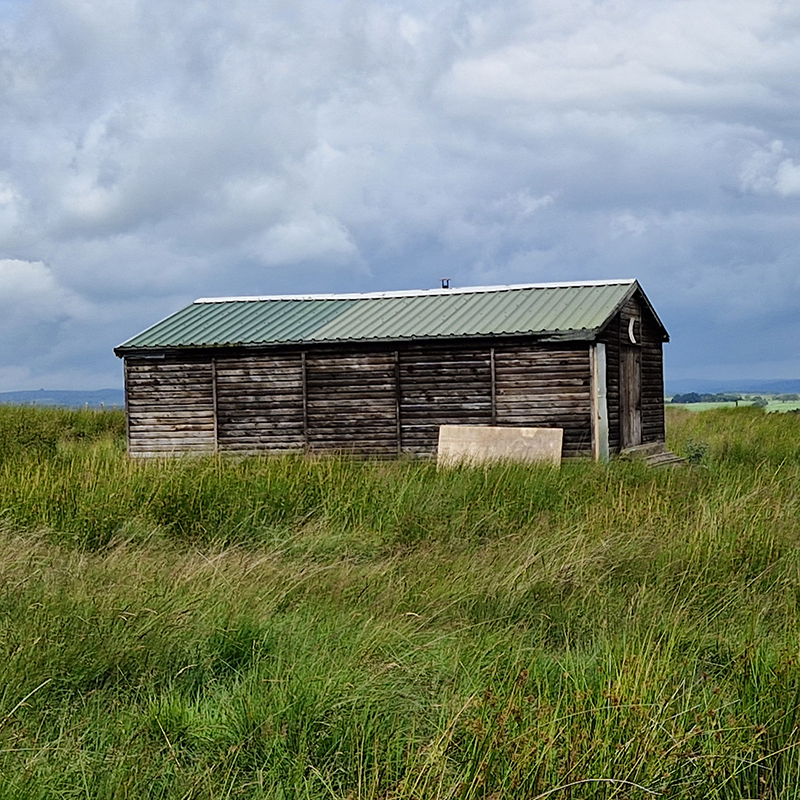
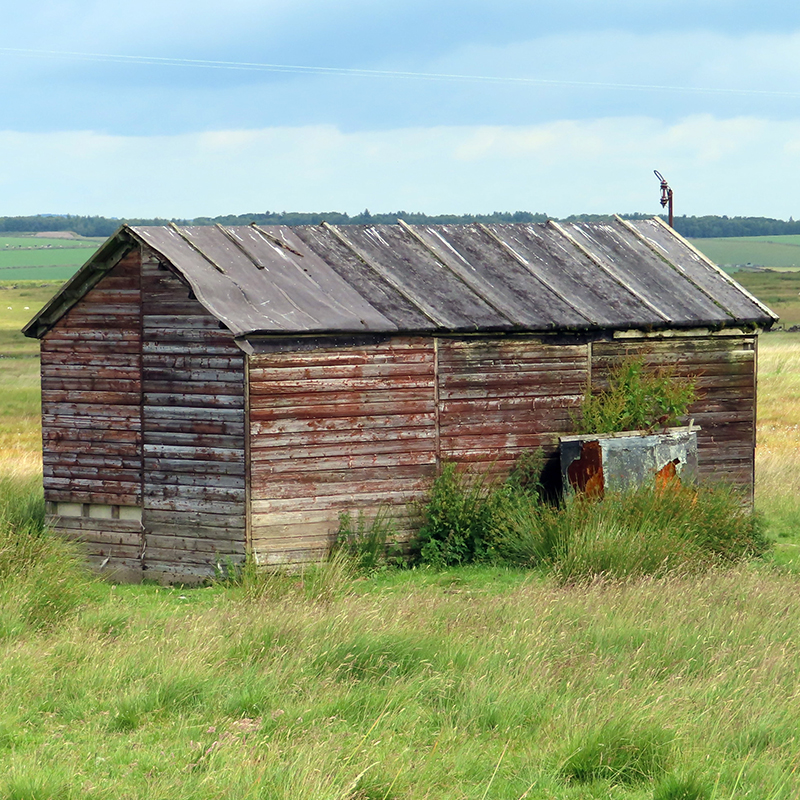
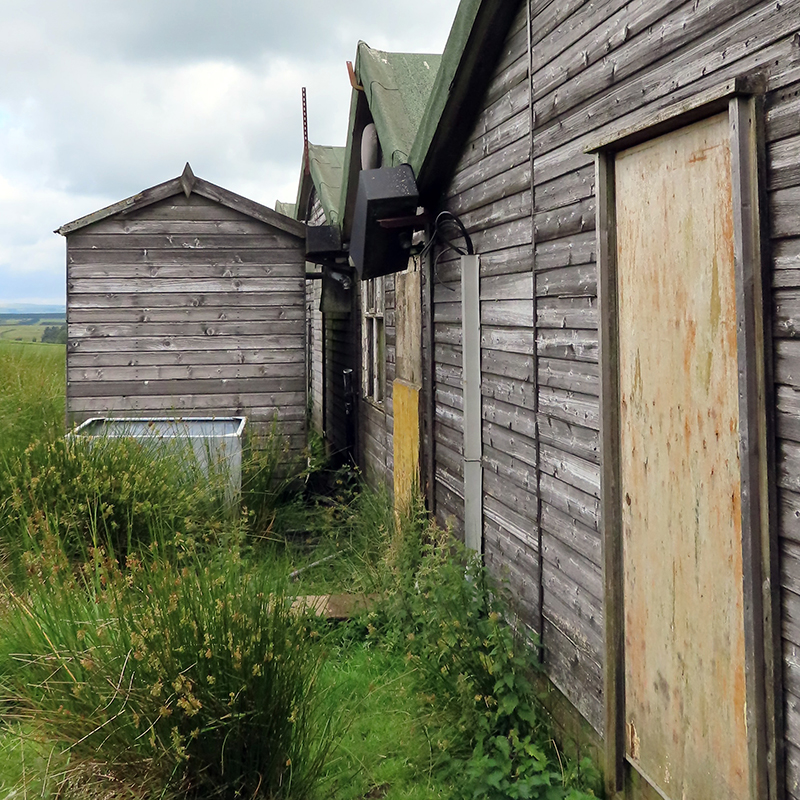
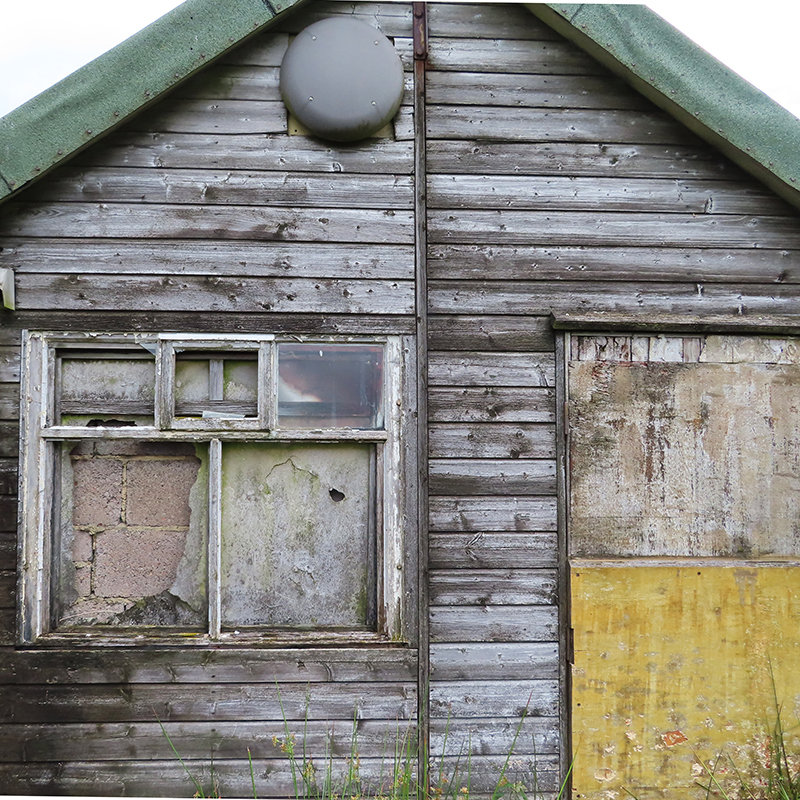
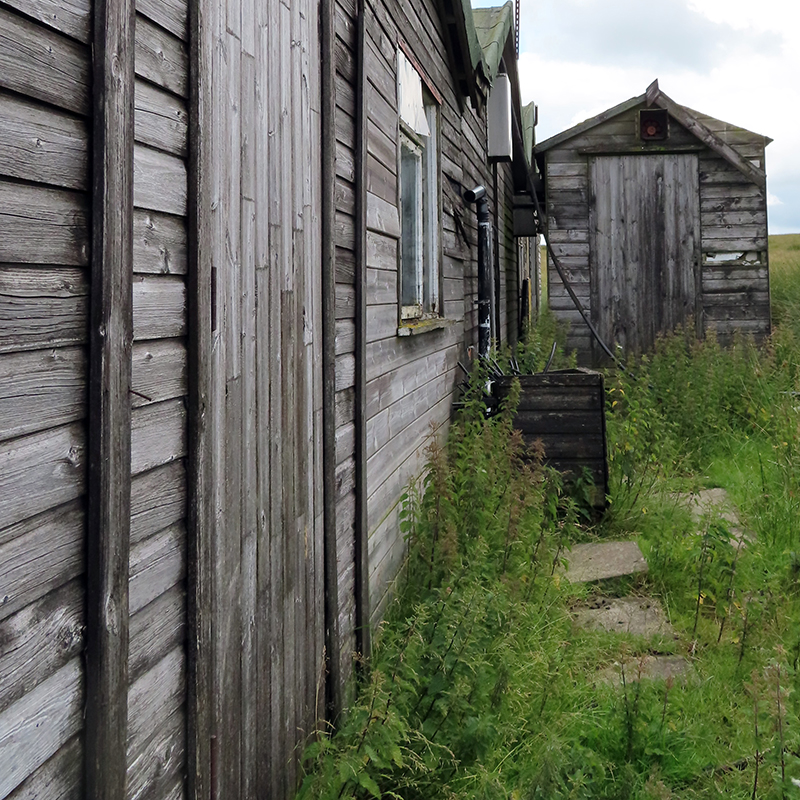
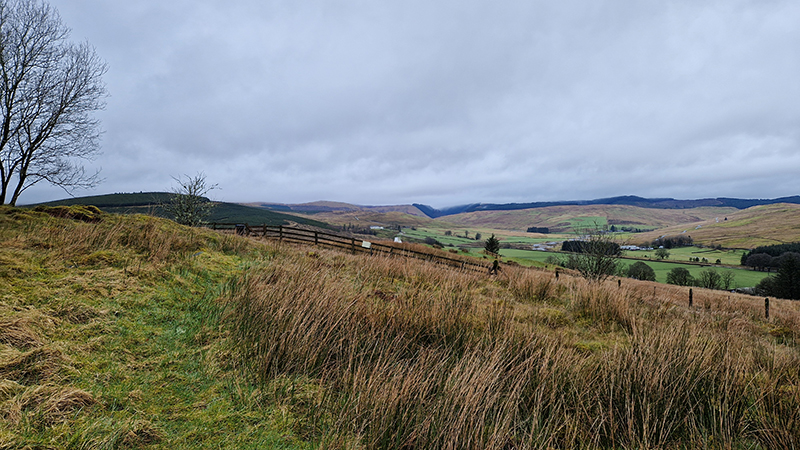
In search of huts. I have been on a mission to locate and document the remaining huts from a cosmic ray detection experiment at Haverah Park on the Pennine moorland in North Yorkshire.
When high-energy cosmic rays enter the atmosphere, they set off a chain-reaction particle cascade known as an extensive air shower. The Haverah Park experiment was home to one of the largest extensive cosmic ray air shower arrays in the world.
It was operated by the Physics Department of the University of Leeds for 20 years, closing in 1987. An array of over 200 water-Cherenkov detectors covering 12 km2 were active during its operation and many 1000’s of extensive air showers were recorded, including ones of such size that the cosmic rays that generated them had energies previously unthought of, adding to the mystery of where they come from.
The large energy density of cosmic rays is close to that of starlight, adding their own glow to the sky as they blast across the universe. Cosmic rays are the atomic nuclei of elements ranging from hydrogen to uranium accelerated to high energies, with half being protons and most positively charged.
Much of the technology used to observe cosmic rays has changed little over the decades since first inventions and still plays a role within newer technologies.
It appeals to me that the excitement of observing particles from other galaxies happened at these unassuming structures.
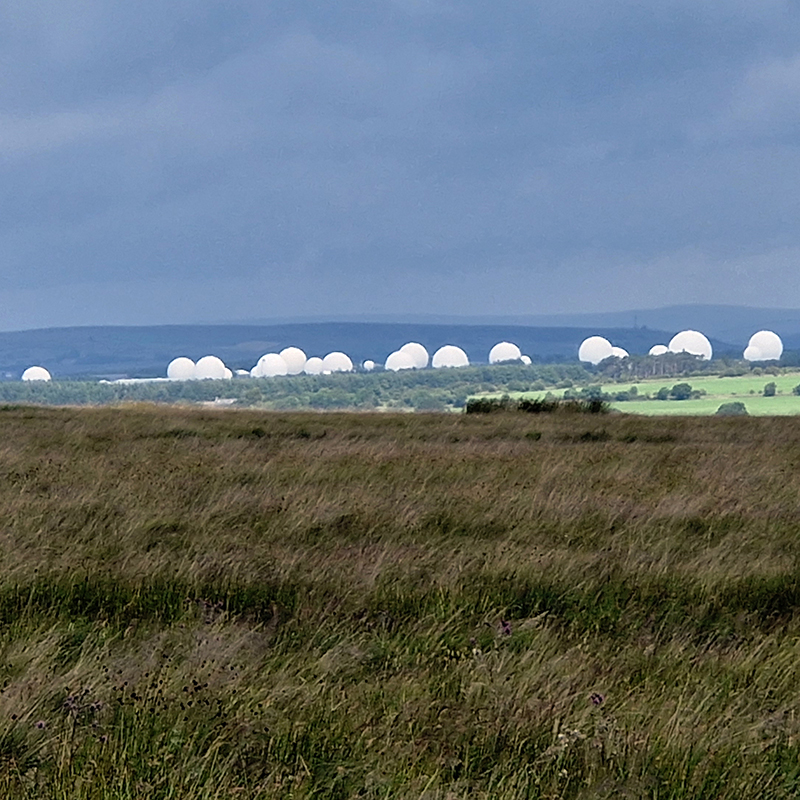
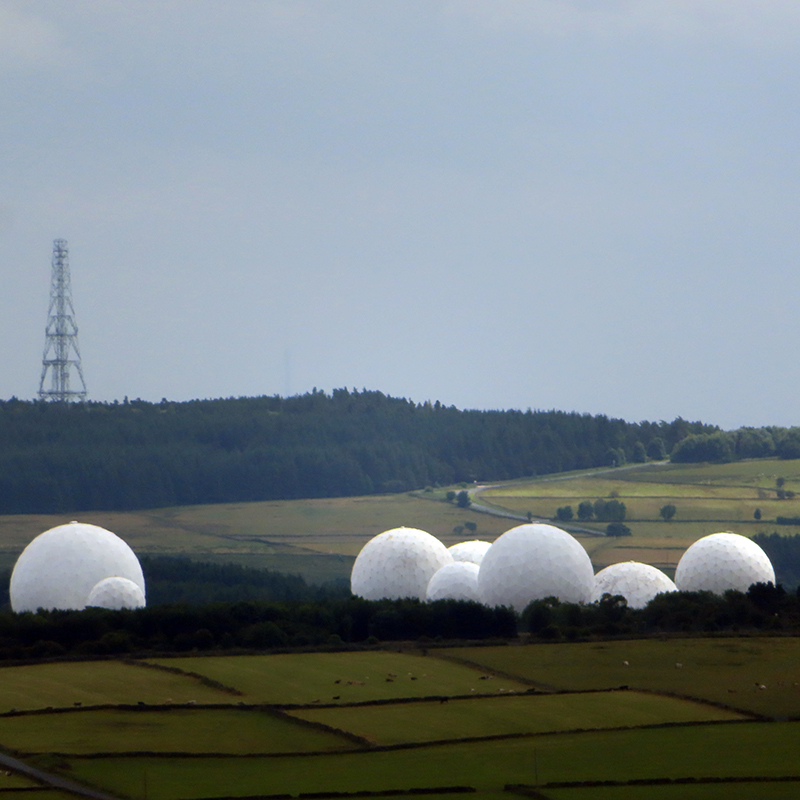
Sharing the landscape of Haverah Park cosmic ray air shower detector array huts are the striking white radomes that shield secret radar equipment at RAF Menwith Hill. The spy station has been there since the cold war space race began in the mid-fifties. Little is known about what goes on here but broadly it is said to gather electronic intelligence and is operated by US National Security Agency (NSA) and UK Government Communications Headquarters (GCHQ). As satellite technology has increased so has the number of radomes which now number 37 at the site. It is worth noting that satellites are vulnerable to unpredictable space weather and cosmic ray interference.
The total number of particles detected in a shower can be used to estimate the energy of the primary cosmic ray. Some particles contain the highest energy form of radiation known to exist anywhere in the universe and their origin is one of science’s greatest mysteries. Air showers of secondary particles generated from a primary cosmic ray hitting the Earth’s atmosphere are spread over many kilometres when they hit the ground so it is useful to have detectors spread over a large area. The difference in the time of arrival of recorded particles at multiple detectors can be used to estimate the arrival direction of the primary cosmic ray. However, this does not necessarily reveal the origin of the particle as magnetic fields within the galaxies bend their trajectories so that the memory of their original direction is obfuscated.
The cosmic ray detectors I made for the The Breath of Stars use a block of plastic scintillator which emits a short burst of UV light when a charged particle passes through it which is picked up by a single-photon-sensitive device. The detectors used at Haverah Park are water Cherenkov detectors. These are large steel tanks of purified water with photon sensitive detectors in the water.
While the speed of light in a vacuum is a universal constant its speed through a material may be significantly reduced as it is slowed by the medium. A particle passing through a material faster than that at which light can travel through the material loses electrons thereby emitting light. When cosmic rays pass through the water tanks, they emit Cherenkov radiation because they travel faster than the speed of light in water. Cherenkov light is similar to the production of a sonic boom when an airplane is traveling through the air faster than sound waves can move through the air. Pavel Cherenkov along with Ilya Frank and Igor Tamm discovered and demonstrated this phenomenon in 1934, astonishingly, it had been predicted in 1888 by Oliver Heaviside, and in 1910 Marie Curie had noticed a strange blue glow from her radium experiments.
There are so many high energy particles hurtling around the universe that they almost equal starlight in energy density. Cosmic rays travel at almost the speed of light and because they are charged particles most cosmic rays are confined, spiralling within our galaxy for a million years or more, by the magnetic fields which permeate it.
Five million cosmic rays pass through your body each day. Some will collide with atomic nuclei. A particle passing through a material at a velocity greater than that at which light can travel through the material emits light. Maybe we glow a little.
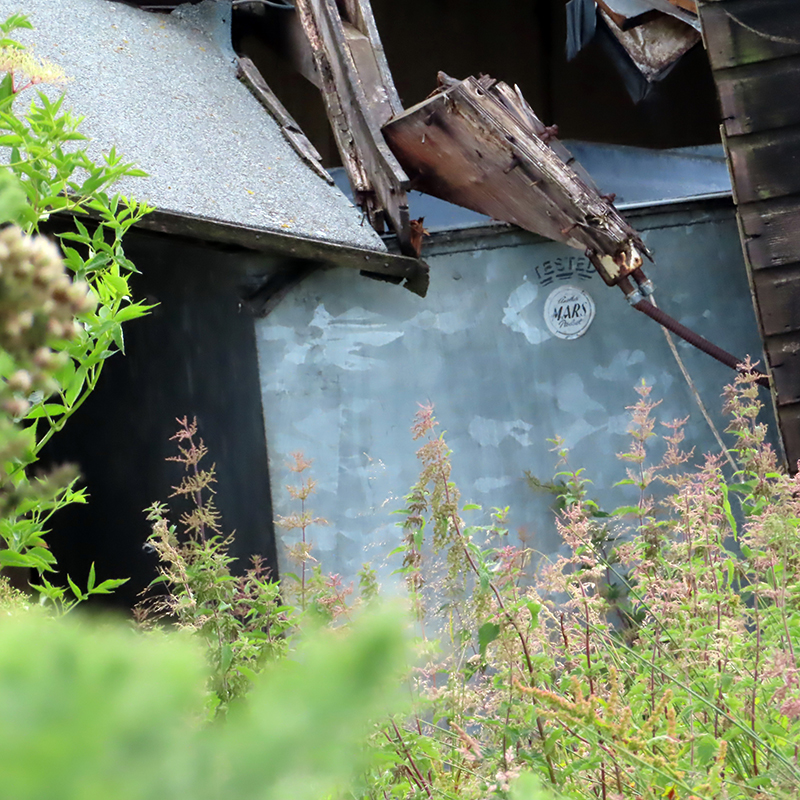
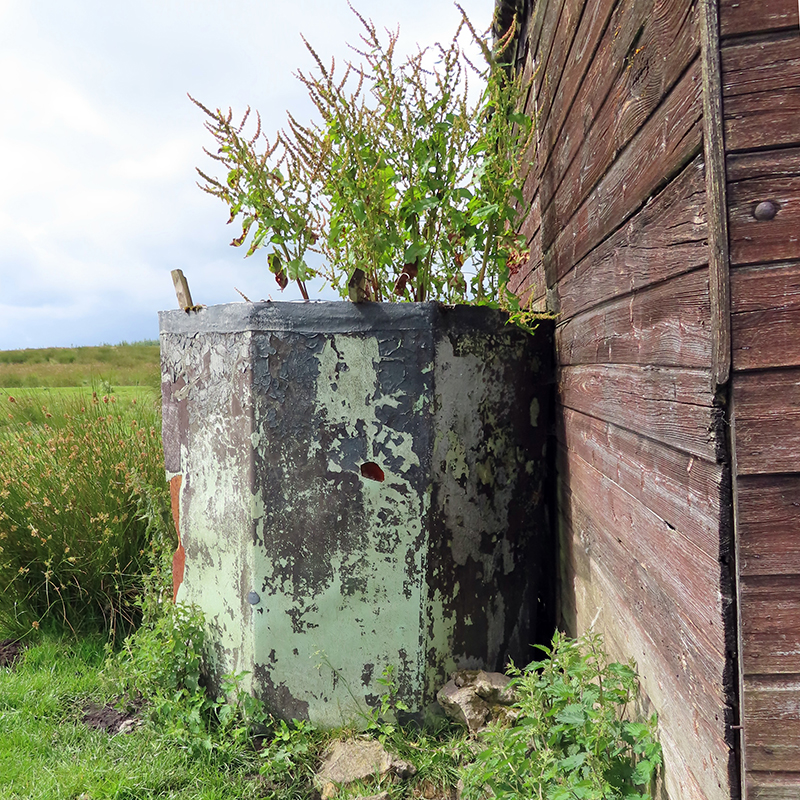
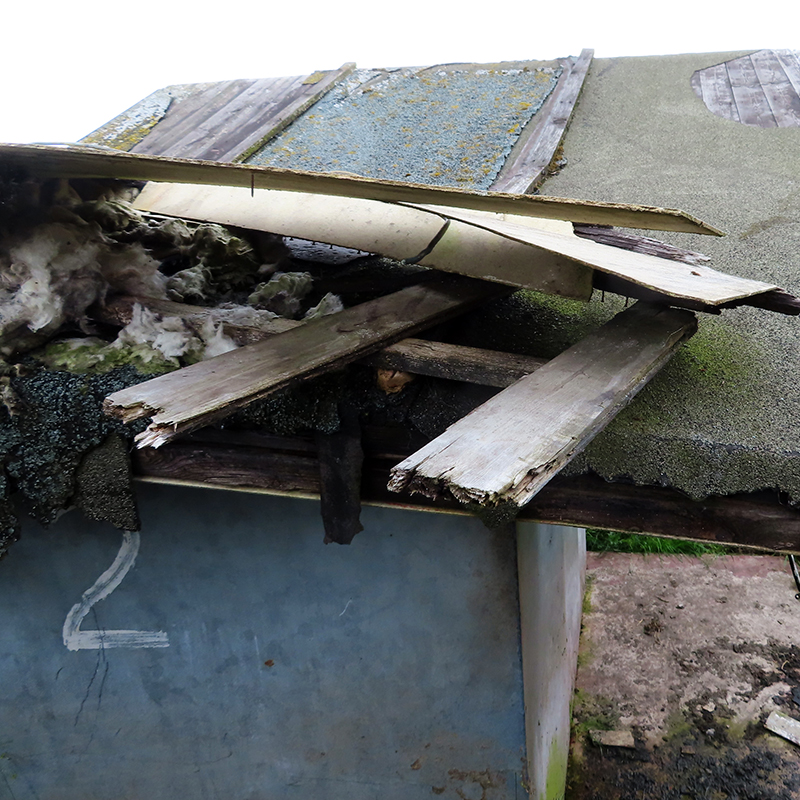
Following the disappearing trail. Haverah Park hut with an intriguing hexagon tank.
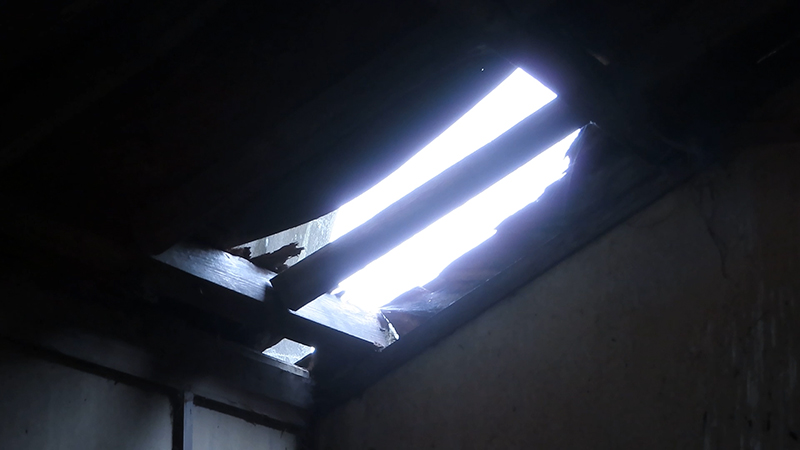
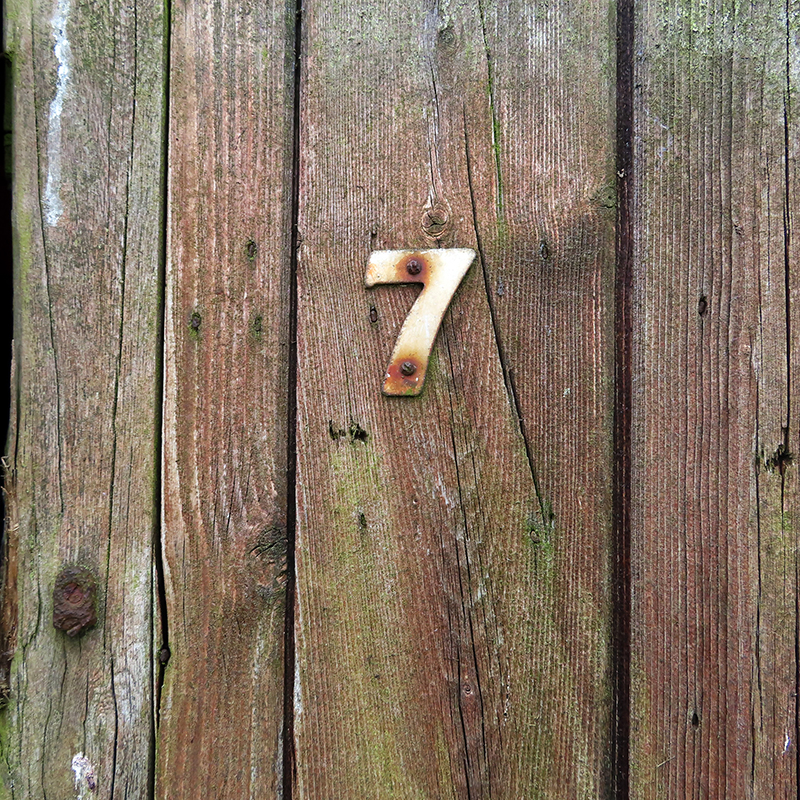
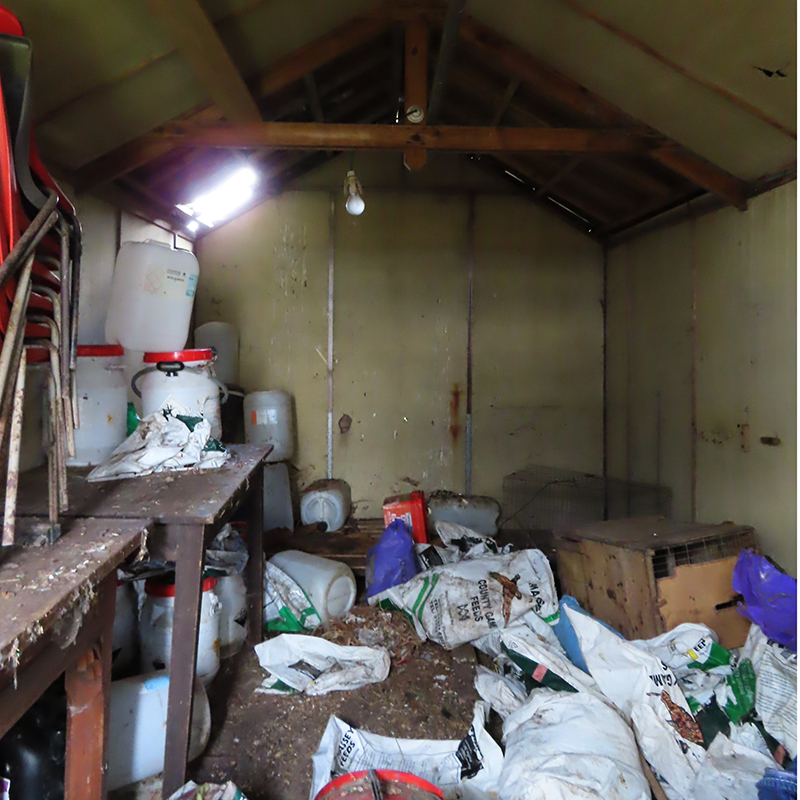
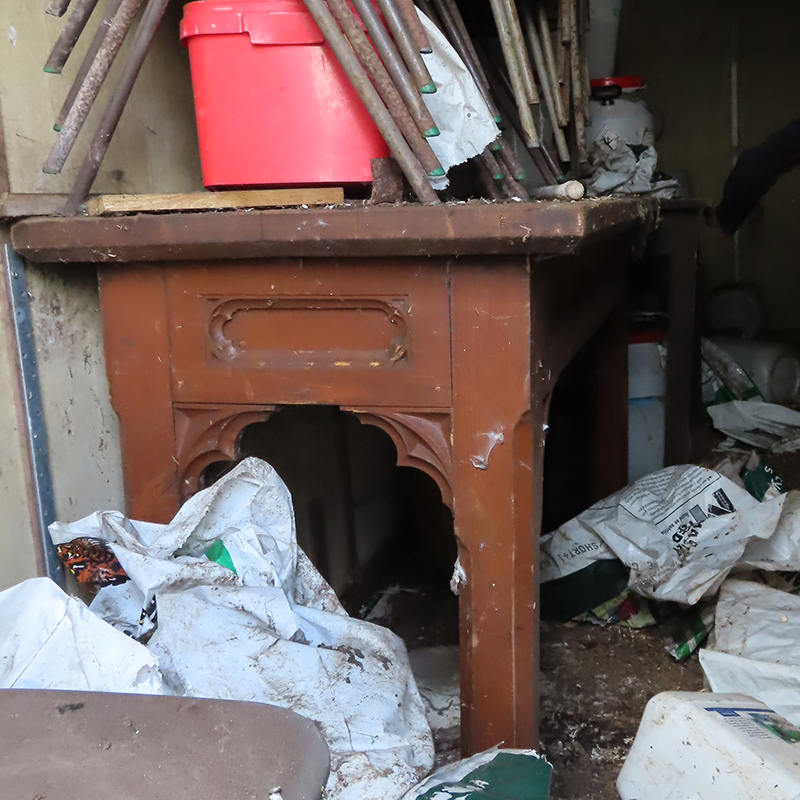
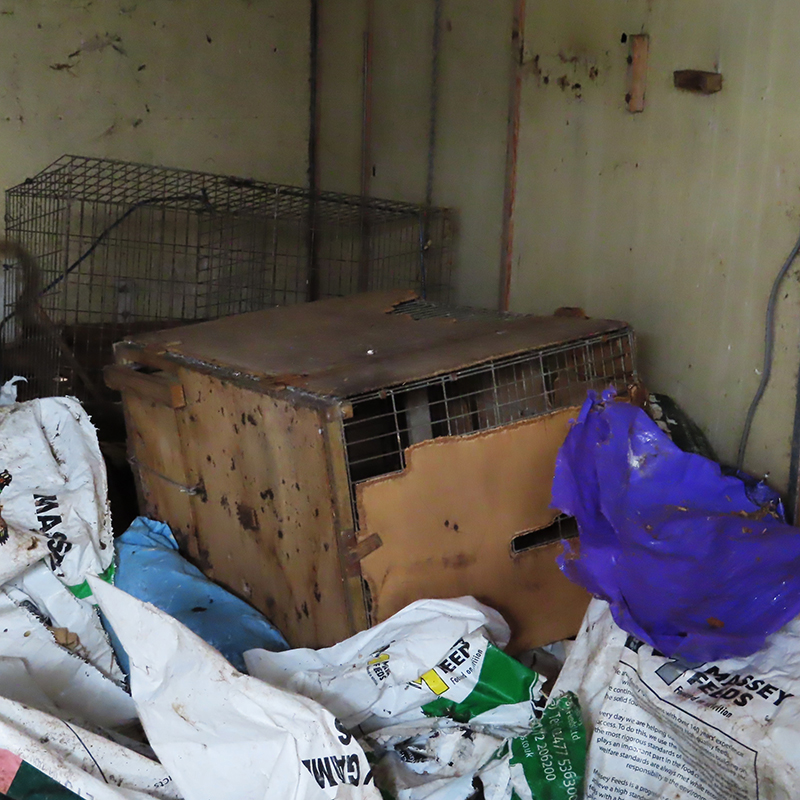
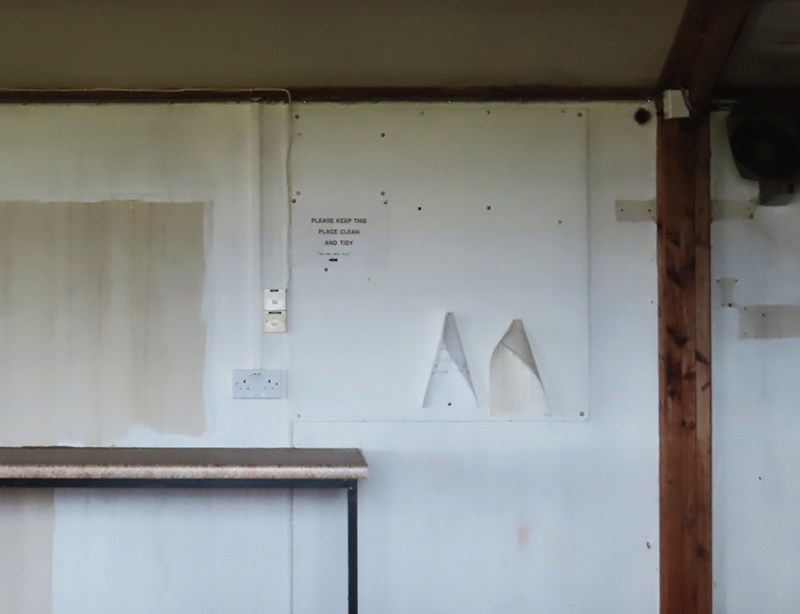
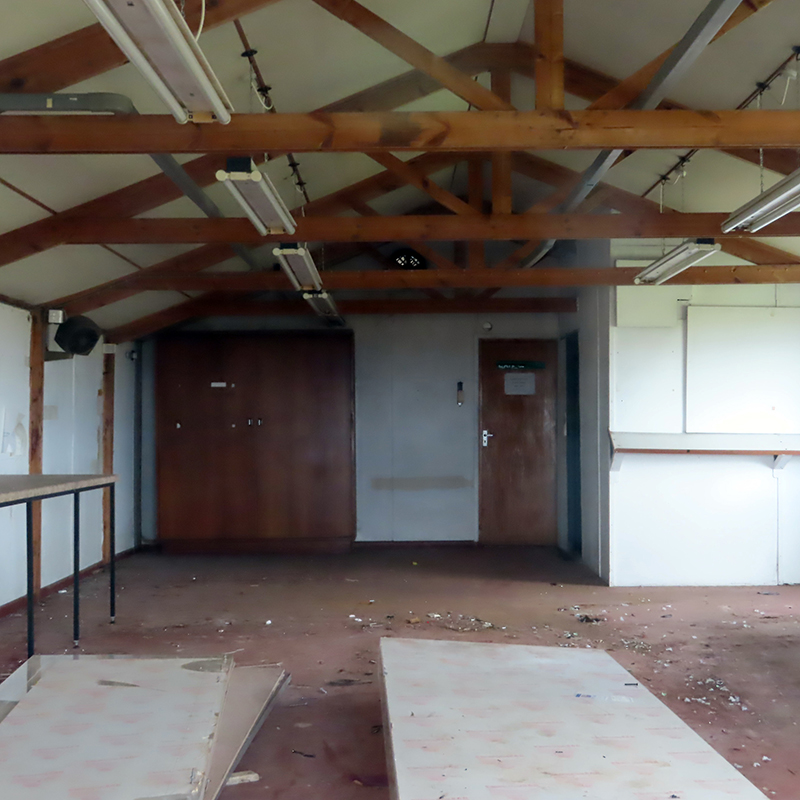
Inside Hut no. 7 is a dumping ground. Waste is a big problem in space as well as on Earth. The thickening shell of space junk in low Earth orbit, if left to accumulate, could cause a conductive shield to form, weakening the effectiveness of the magnetosphere, which protects life on earth from most cosmic radiation.
A decaying wall map of the entire Haverah Park experiment is just visible through a window of one of the huts in the central hub, but not much else remains inside.
It looks like these huts have been recently emptied into a skip which, by chance, was collected while I was there. Unfortunately, the driver had no enlightening information for me about the future of the huts.
Cherenkov radiation is a form of energy that gives off a blue glow when electrically charged particles are moving at speeds faster than light is able to travel through the same medium. The experimental physicist Blackett, who received the 1948 Nobel Prize in Physics for his investigations into cosmic rays, believed that extensive air showers should produce flashes of light that could be perceived by the human eye when lying down and looking upwards under dark skies. Whether he achieved seeing this phenomena himself is not known, but he inspired colleagues Galbraith and Jelley, in 1952, to devise an experiment to detect light from air showers using a rubbish bin painted black on the inside, a recycled searchlight mirror and a small phototube. With these simple items, they made the first observation of Cherenkov light produced by cosmic rays passing through the atmosphere. Not all the twinkling in the night sky is starlight.
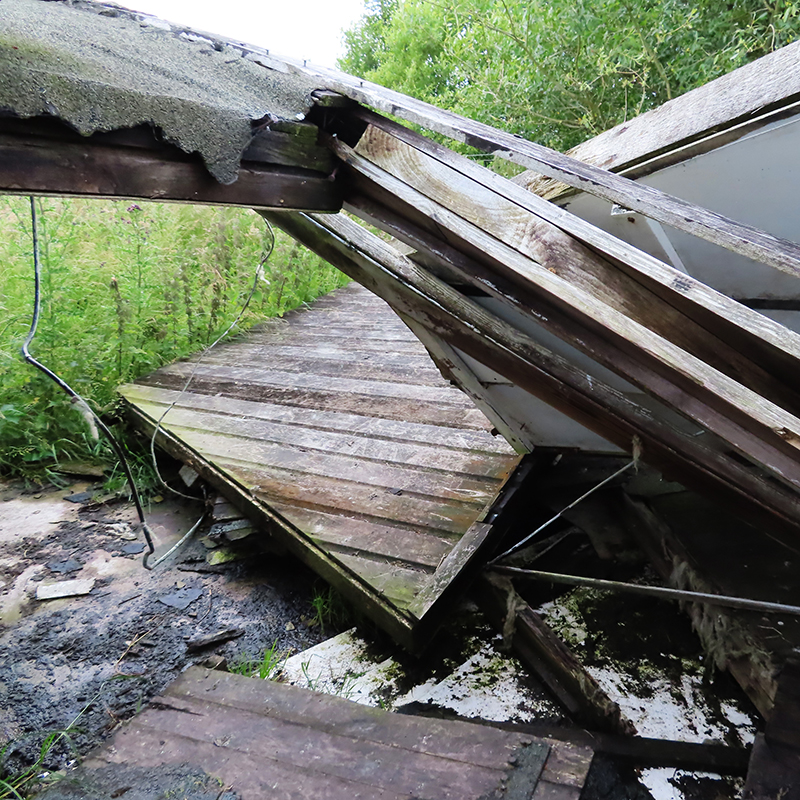
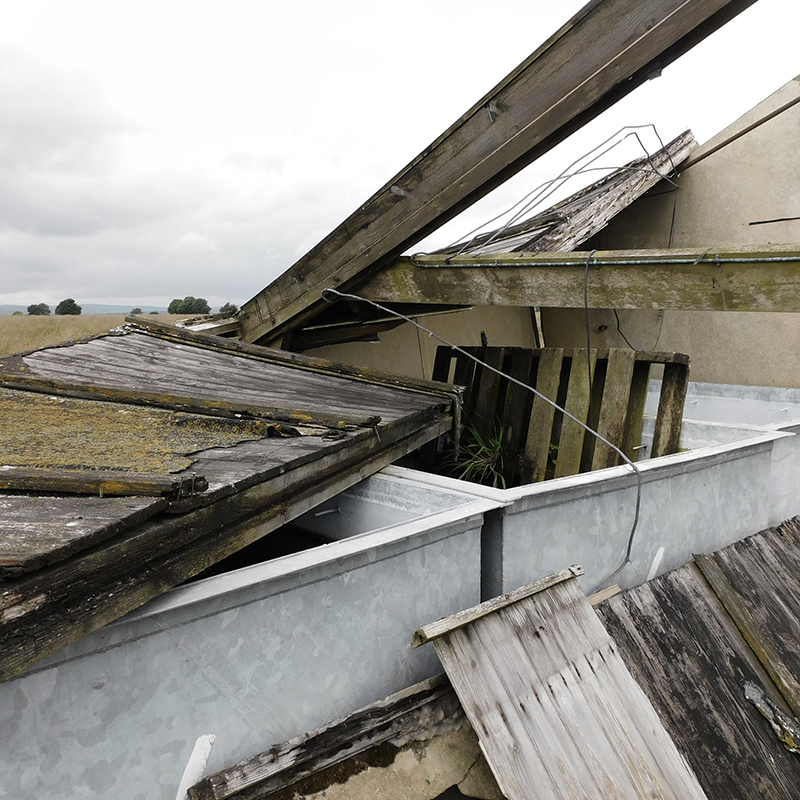
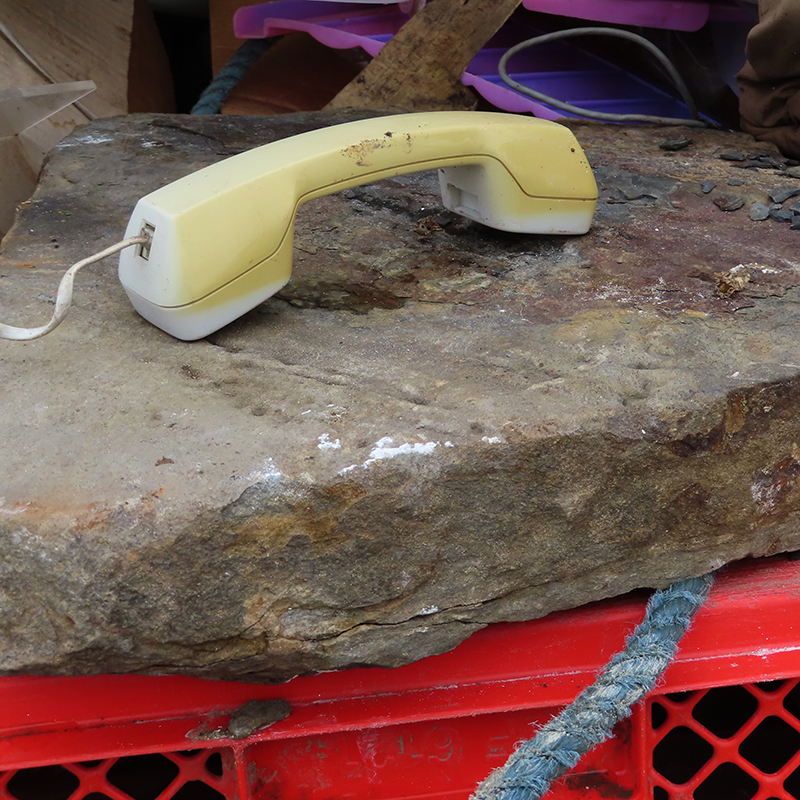
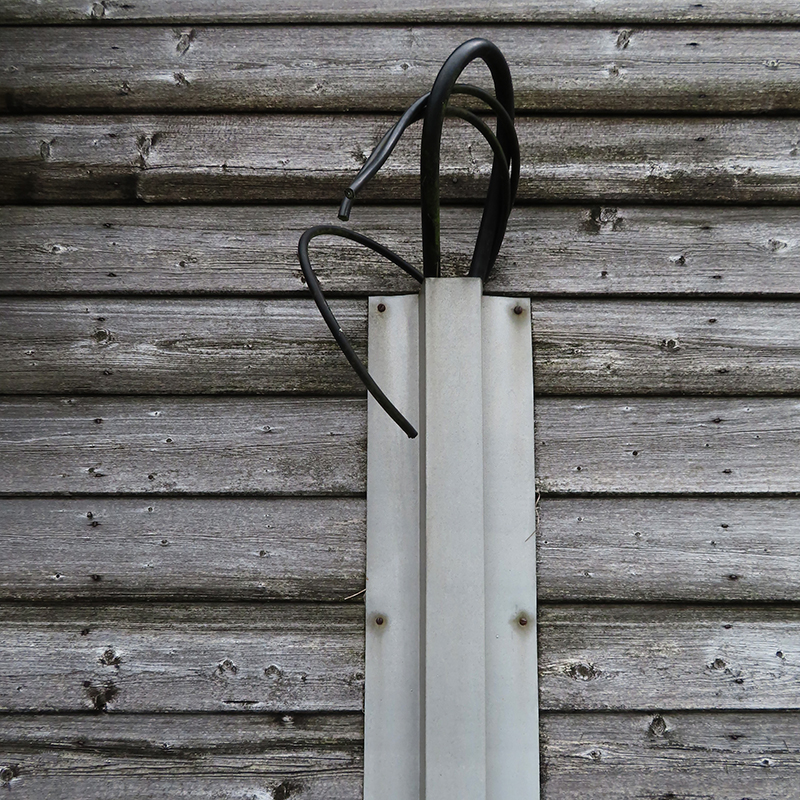
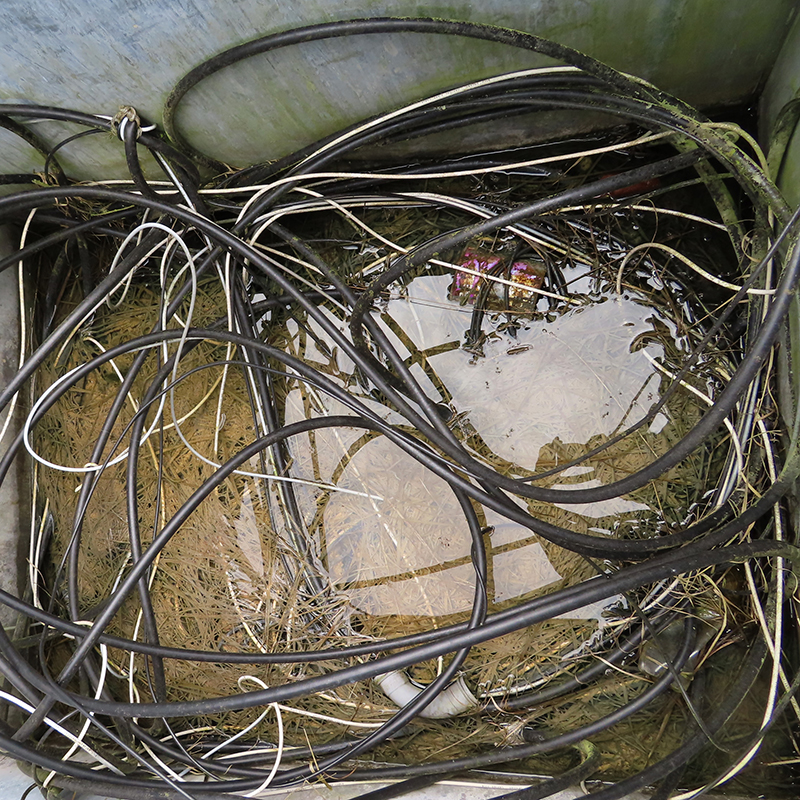
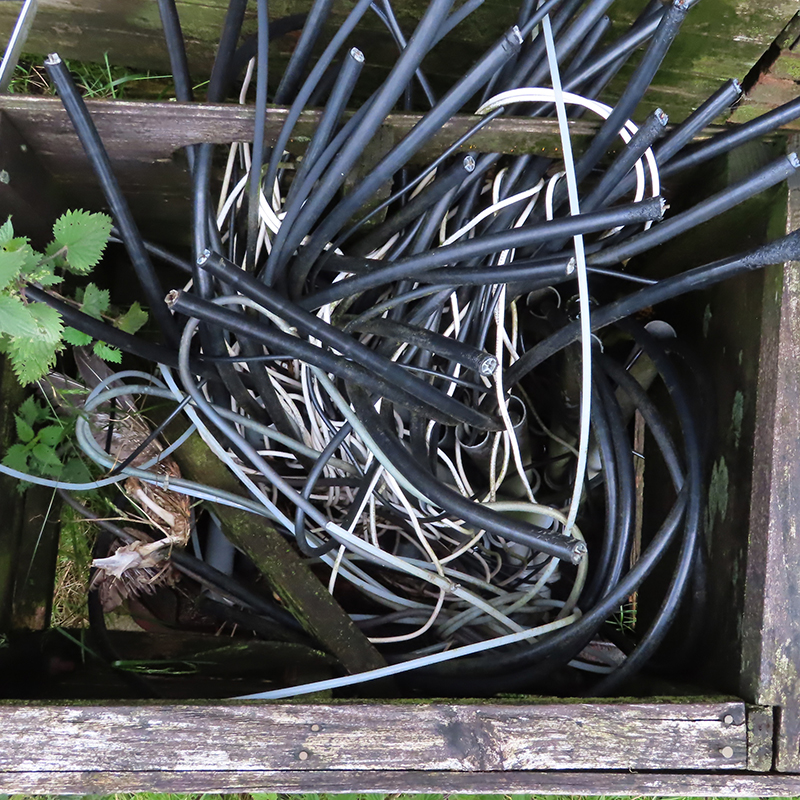
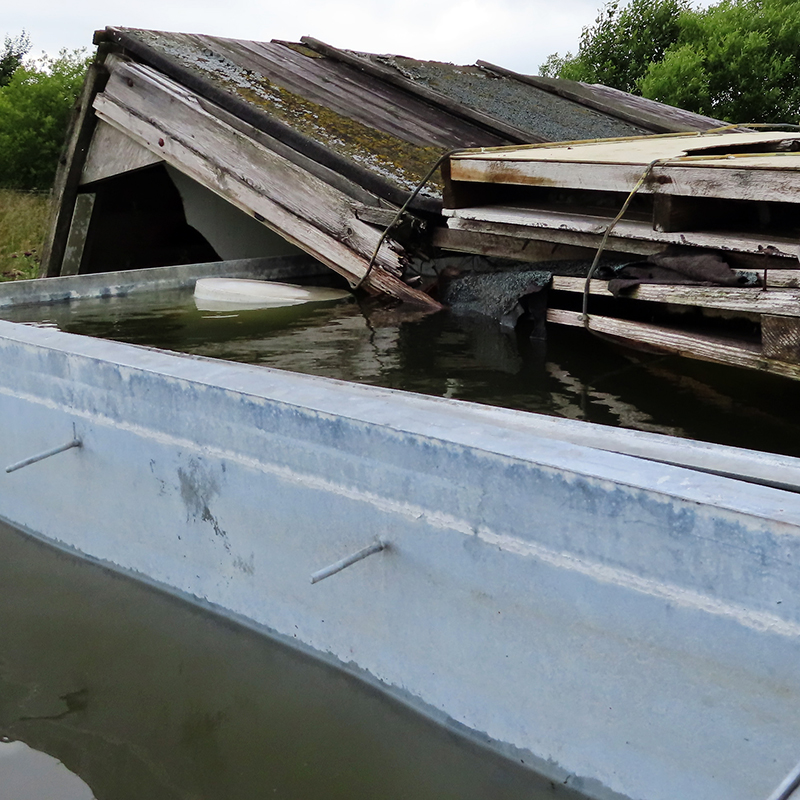
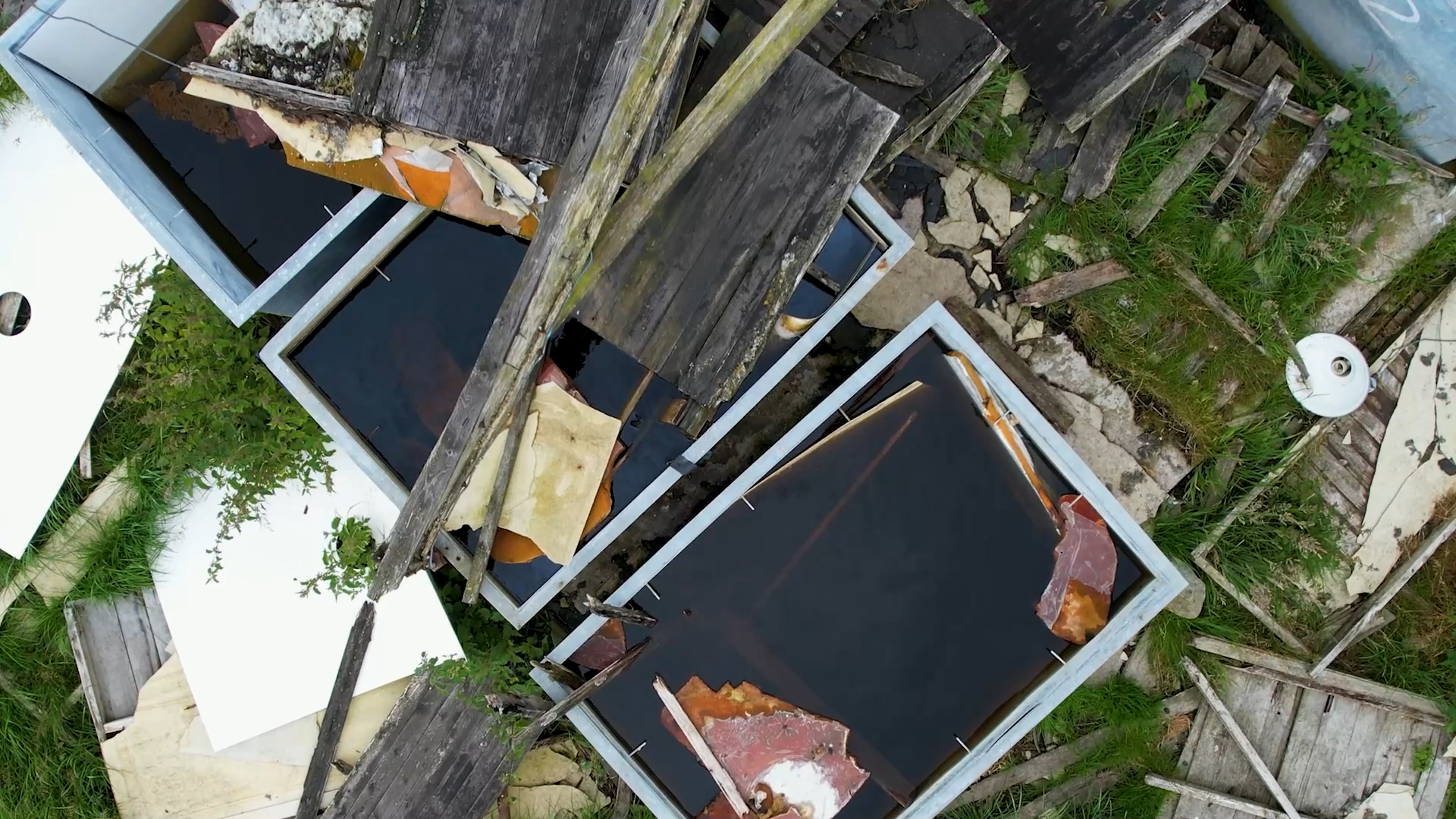
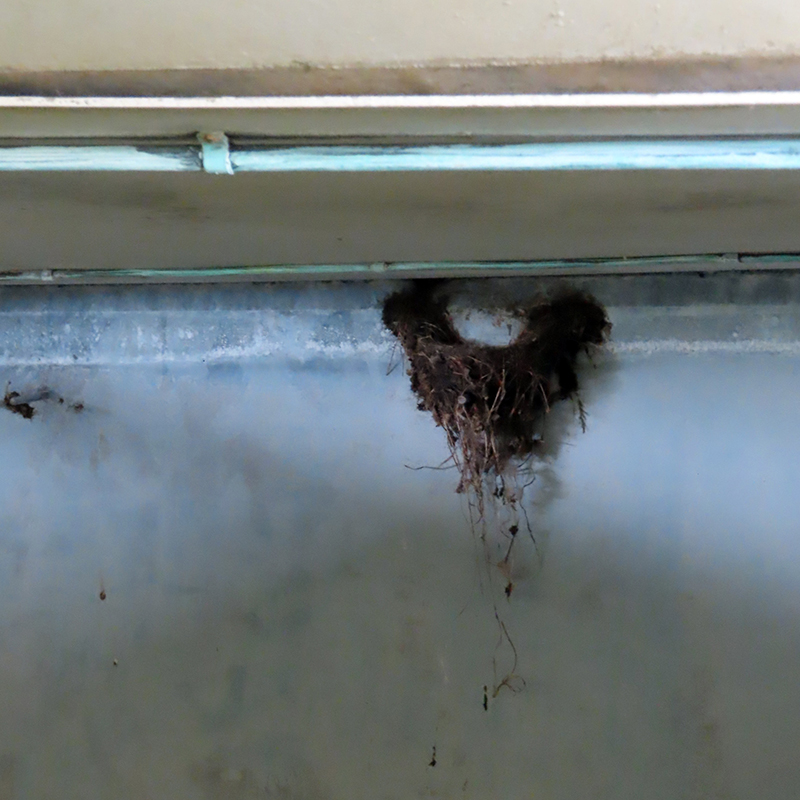
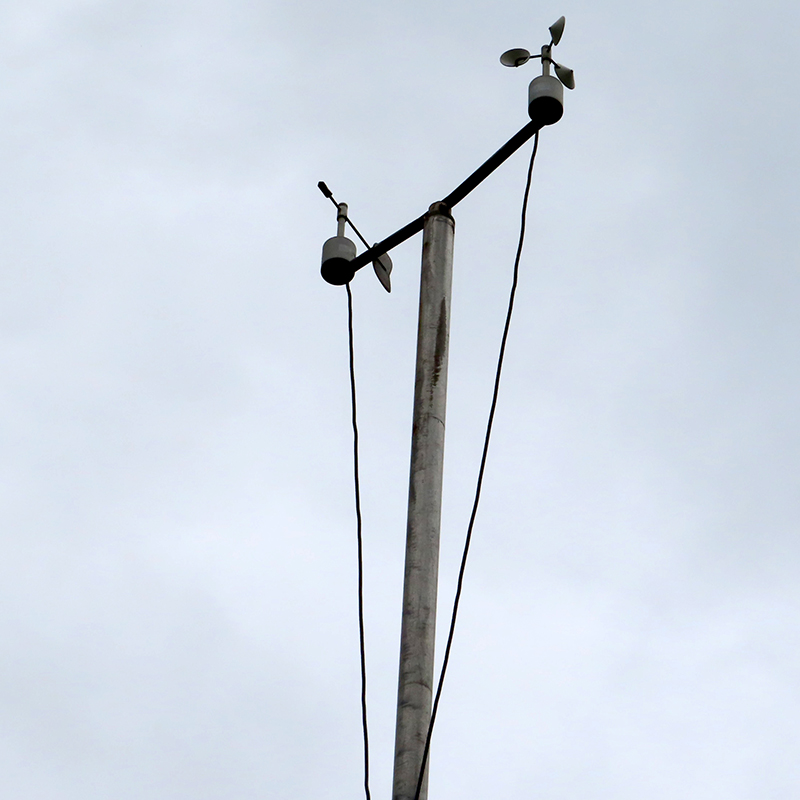
During the Haverah Park experiment, the water Cherenkov detectors deployed across the moors were connected by underground cables and transmitted information to the control huts via radio signals in the microwave frequency range. All communication is now severed. Cut cables coil in rain filled tanks. The cosmic rays are still pounding down upon these new unwatched ecosystems but the detectors have moved elsewhere.
I am looking forward to meeting Professor Alan Watson FRS here in the autumn. He is eminent in the field of cosmic rays and helped initiate the extensive air shower project, working at Haverah Park for 25 years. He has kindly agreed to meet and share his insider knowledge of the history and operations at the site.
The idea to build a truly giant shower array was launched by Alan Watson and Jim Cronin shortly after Haverah Park was decommissioned and thanks to the ground breaking work undertaken in these huts, it evolved to become the vast Pierre Auger Observatory in Argentina, named in honour of the man who first discovered extensive air showers.
Peering into the darkness, trying to fathom the structures of the universe or what’s inside the hut, and the nature of that relationship.
The ultra high energy particles detected at Havarah Park and new arrays across the globe are very rare, possibly less than one per square kilometre per century, so it is big news when one arrives. Because they have such high energy, it is thought they shouldn’t be affected by galactic magnetic fields, and therefore, the direction of the particle could be determined and the source located. The Amaterasu particle, named after the sun goddess in Japanese mythology, the second most powerful particle to be recorded, appears to have emerged from the Local Void, ana area with no astronomical objects that might produce such a particle. There is no explanation of where these particles come from, just hints of bigger mysteries to unfold.
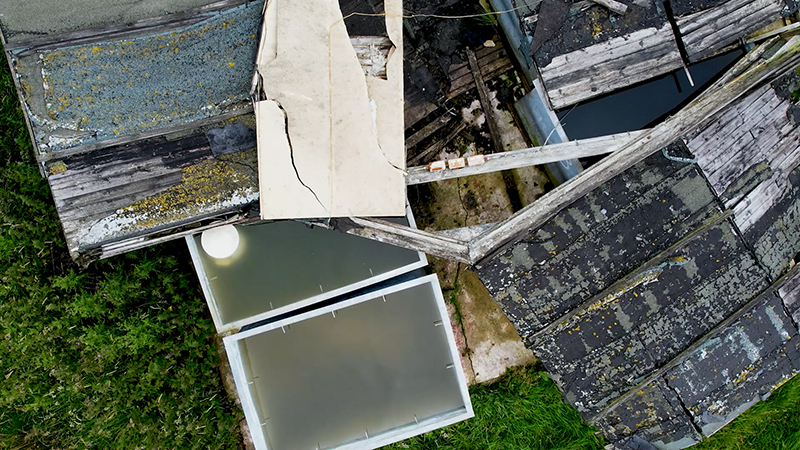
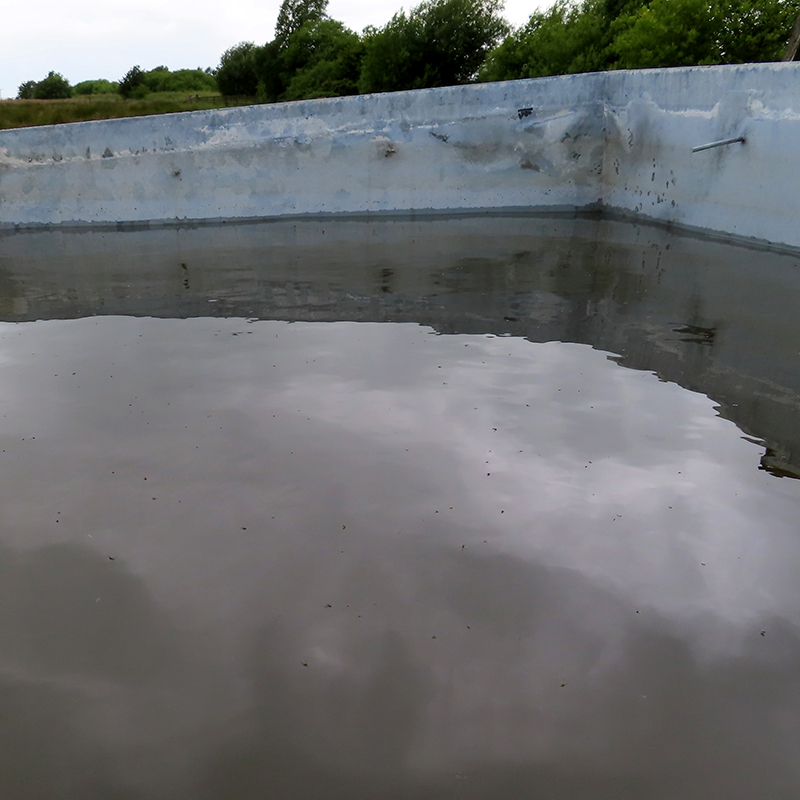
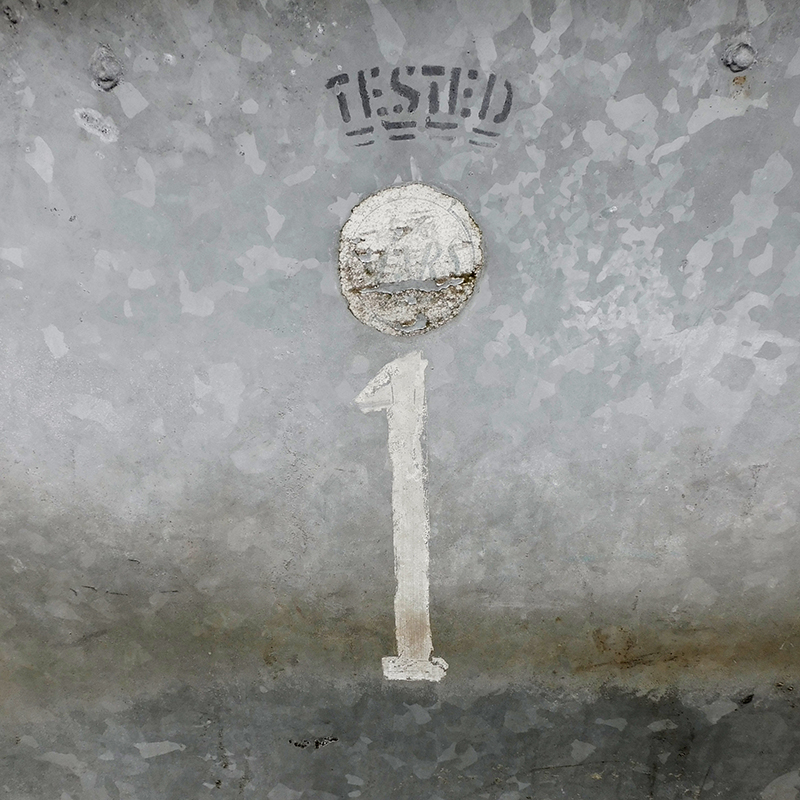
Many water tanks remain around Haverah Park, stripped of their purpose as water Cherenkov detectors they now reflect the sky in the rainfall they collect rather than record showers of particles from space.
During operation, huts were built in groups of three, each with six large galvanised steel tanks lined with white plastic to diffuse the light and filled with local purified water. Each tank was monitored by extremely sensitive photon detectors which recorded the Cherenkov light emitted as particles passed through the water. At the end of the large array experiment, one of the detectors was opened, and the water was found to be crystal clear and good enough to drink. The proof that water could be kept bacteria-free in a sealed container for over 25 years gave confidence in using the same technology for a future larger cosmic ray detector array to be developed.
Haverah Park was once one of the largest extensive air shower arrays in the world, with an area of 12 km2, but in the end, it just wasn’t big enough.
When Alan Watson and Jim Cronin proposed building a new 3000 km2 shower array, the question from funders was, ‘why do you want to make the array so large?’. The answer is, of course, to discover those known and unknown unknowns, but funders don’t usually like unpredictable outcomes. Luckily their plea was bolstered by the Fly’s Eye Cosmic Ray Detector Array out in the Utah Desert recording the Oh-My-God particle in 1991, it’s energy was 40 million times greater than that of any particles ever produced in any terrestrial particle accelerator. This and other evidence of extremely high energy particles sparked interest in the field of astrophysics and validated the discovery of similar particles at Haverah Park, which had not been taken seriously at the time. This ambitious proposal gained momentum during the 1990s to become the Pierre Auger Observatory in Argentina, with the detector design developed from the water Cherenkov tanks so successfully operated at Haverah Park. The huts here may be in ruins, but their legacy lives on at the world’s largest extensive air shower detector array, which is edging closer to answer the question ‘Where do ultra-high-energy cosmic rays come from?’
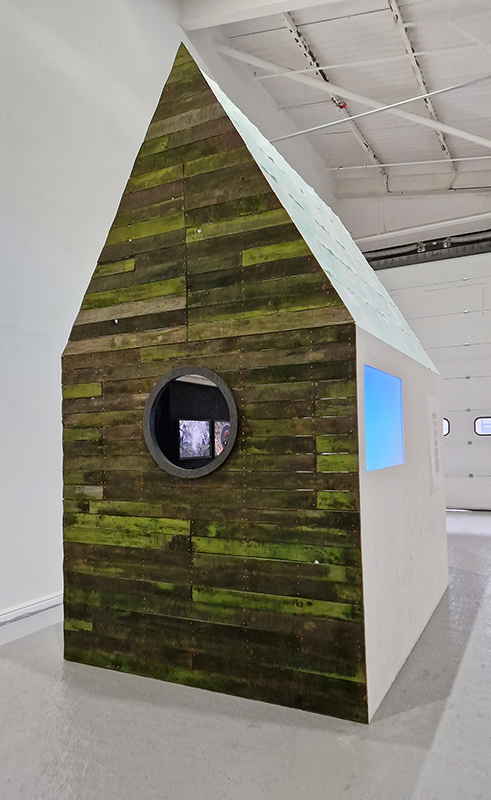
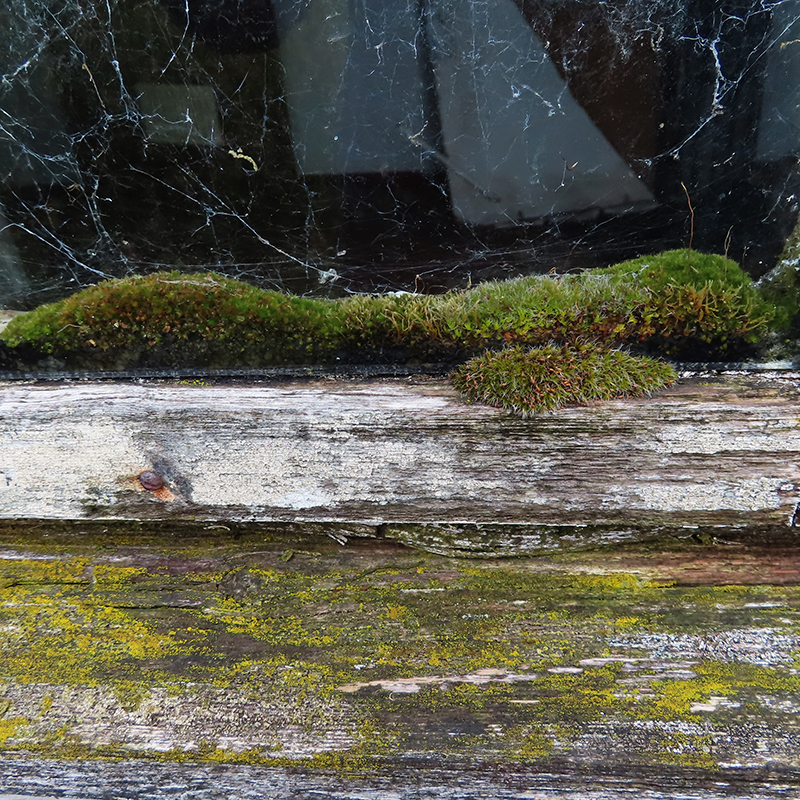
I am looking forward to developing work responding to the legacy of the Haverah Park experiment and building on my experience of creating The Absolute Hut (of absolute potential) New surfaces to explore, more moss, and also lichens here.
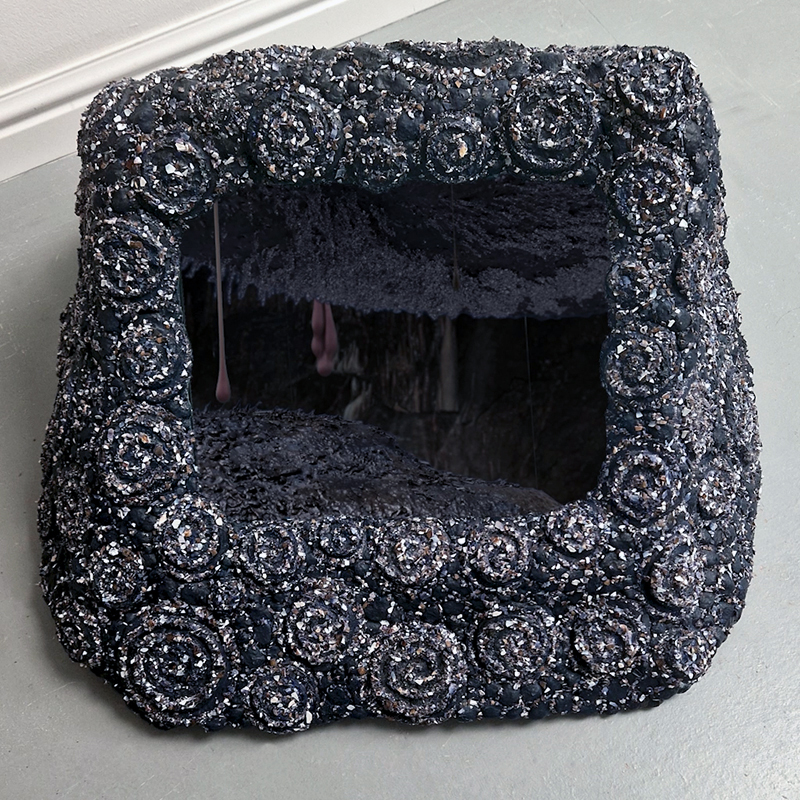
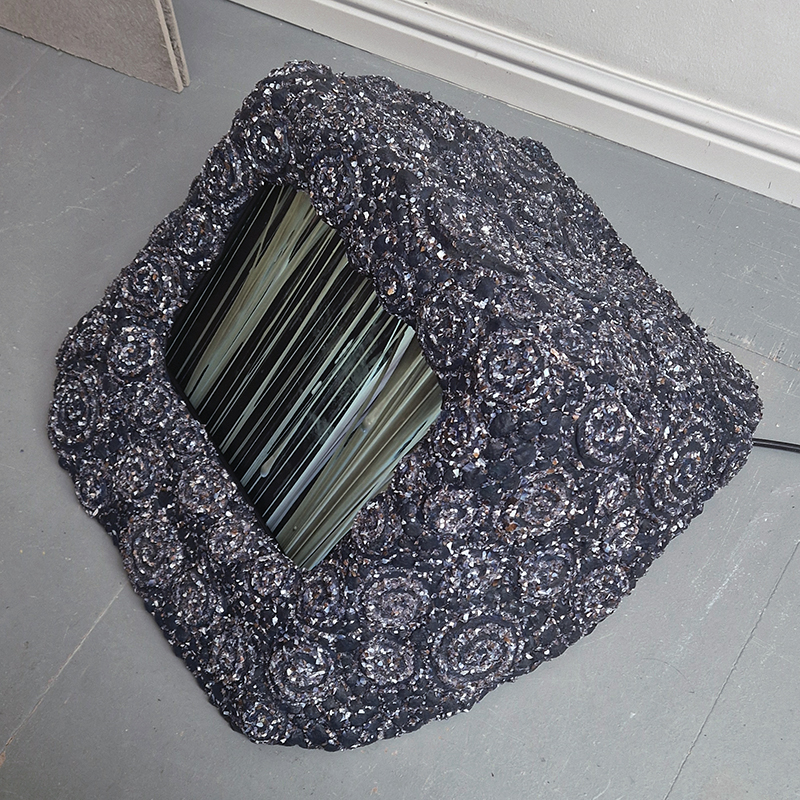
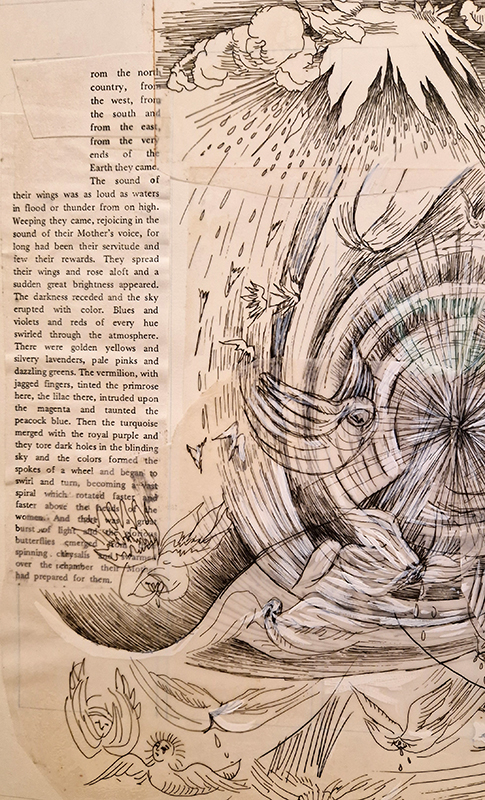
‘The Belly of a Rock’ video has waited a long time for its crusted shell. A hybrid between rock, mollusc, and technology inspired by the chemical conversations and urge to create described by Italo Calvino in his story ‘The Spiral’. We don’t always know what we are creating. Within ‘the belly’ surfaces slide and scrape along lines of fissure, distended innards ooze and rocks moan as they are distorted by untold pressure. The turbulent spiralling of the core births rock and lifeforms acted upon by the drag of the oscillating magnetic field.
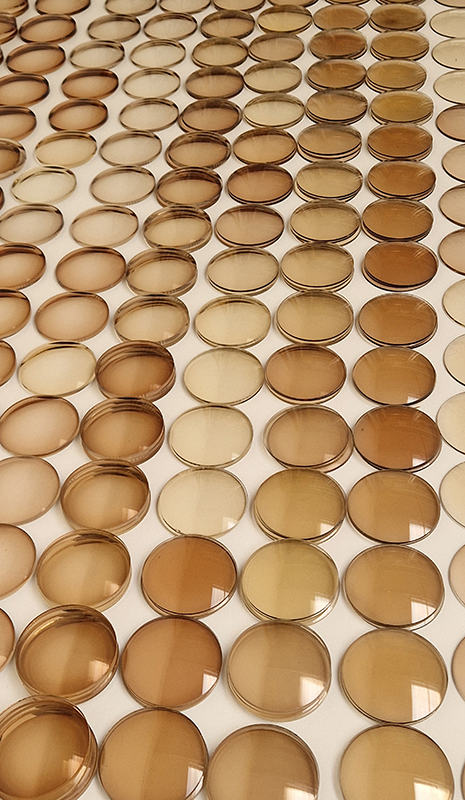
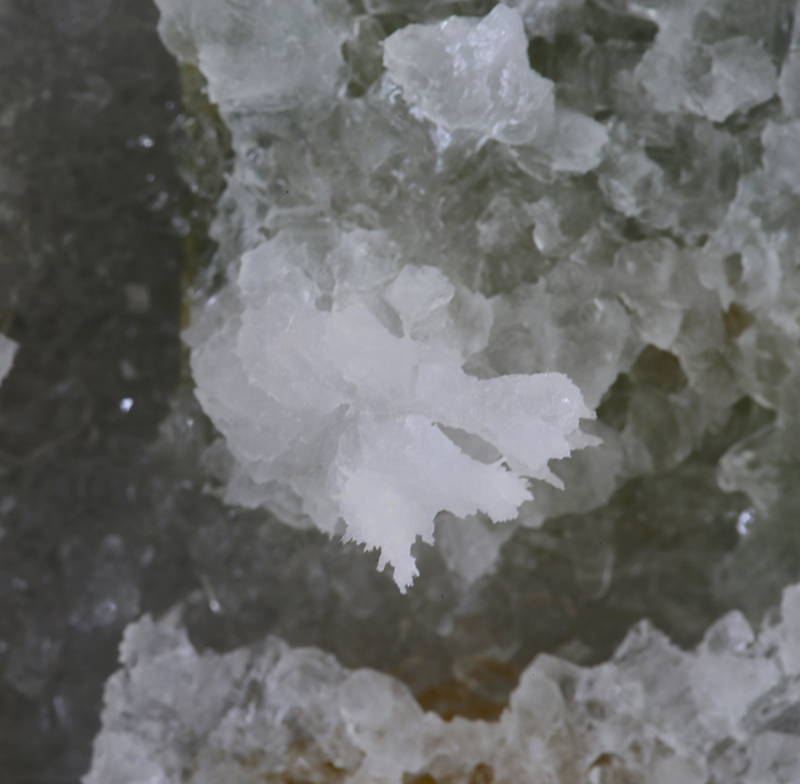
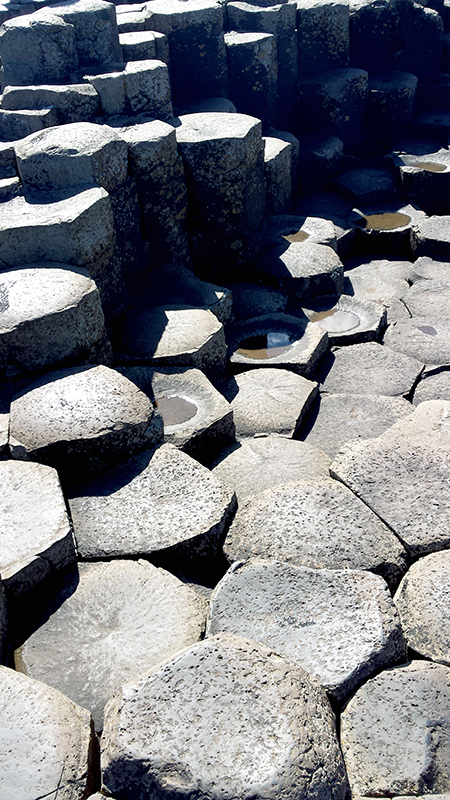
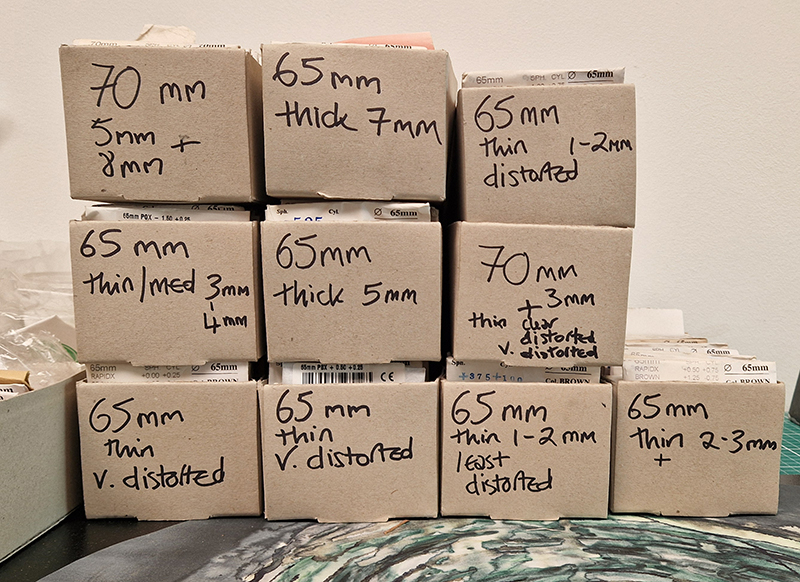
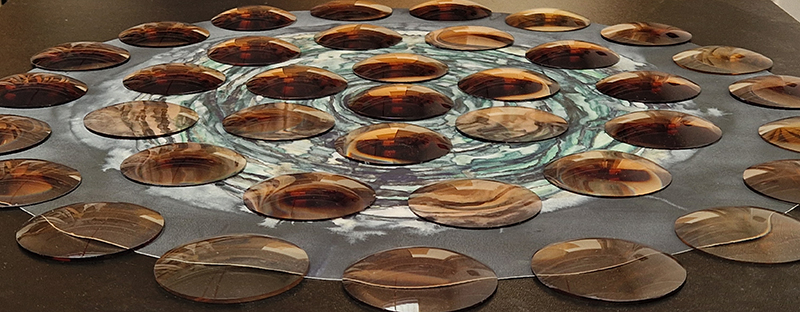
I have acquired a large number of photochromic optical lenses. These I have sorted by diameter, thickness and distortion. Initial thoughts about their use include using them as petri dishes to grow crystals which are embedded into small concrete hexagonal pillars of differing heights with reference to the geology of giants causeway. Using them to create composite windows into a new hut structure filled with video projections referencing the fly’s eye cosmic detector array.
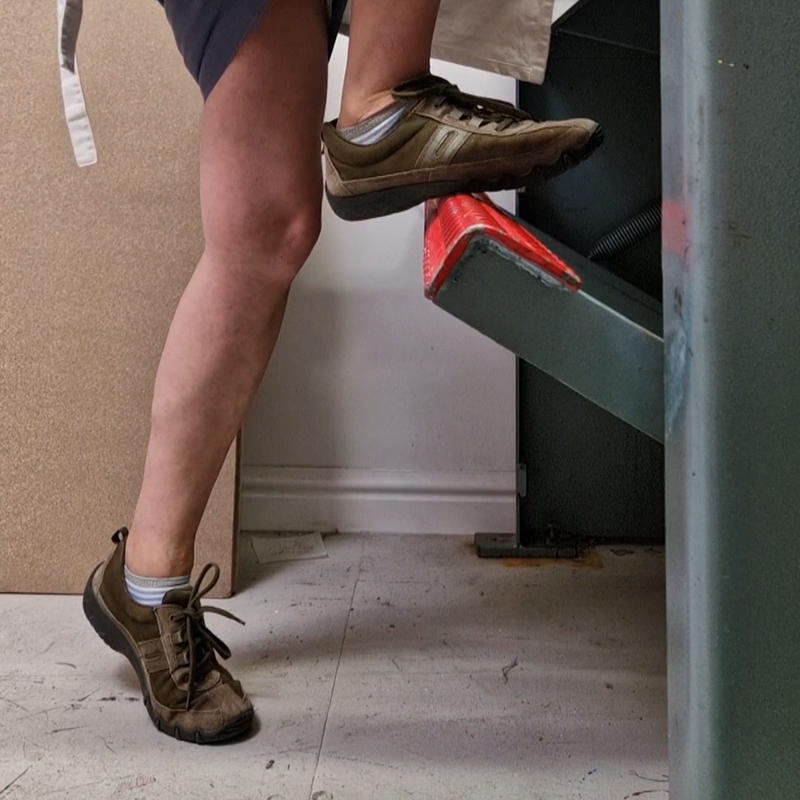
A good workout on the guillotine making 201 cuts in copper sheet in preparation for a new concrete tablet in the Instruments of the Anemoisculpture series.
Gallery and otheroutings:
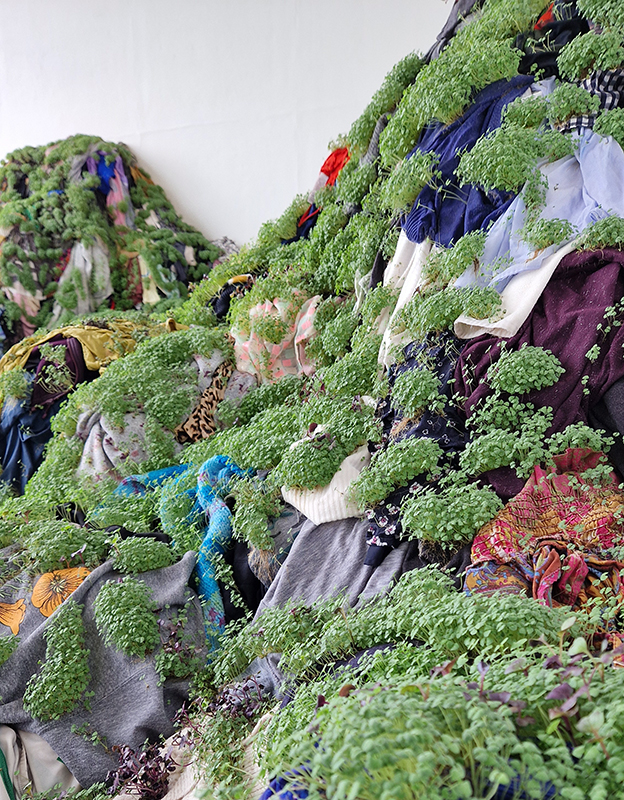
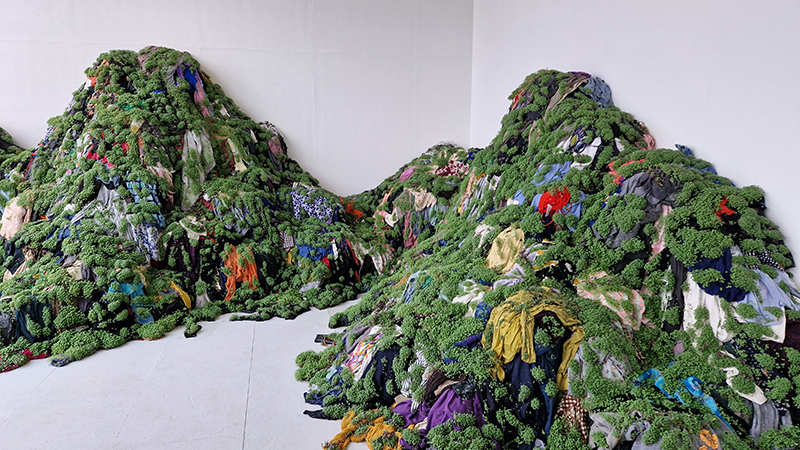
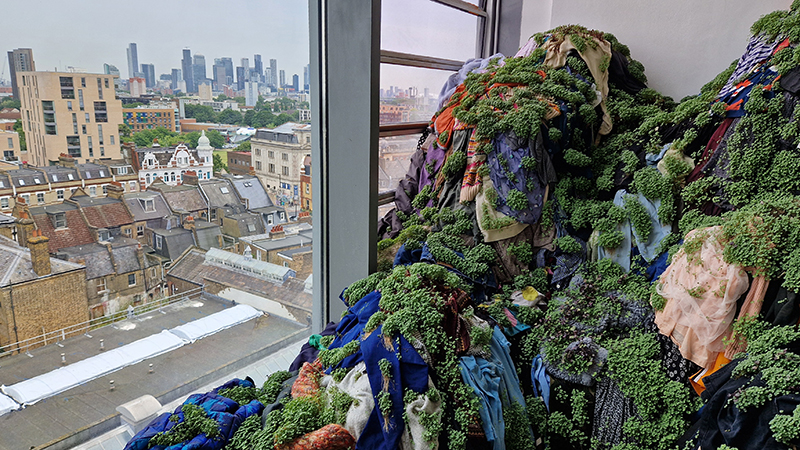
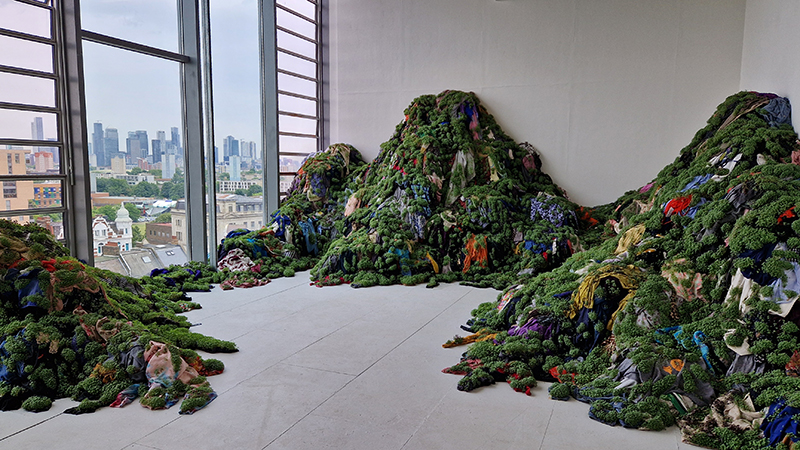
Beverley Duckworth’s installation Surplus at Goldsmiths MFA final show. Beverley’s work is grown through a diligent process of care. Found materials are literally given new life in the seeds which are embedded into them, which then transform and colour them. The installation includes an intermittent sound element of recordings of the melody played by waste trucks in Taiwan to call people to bring out their rubbish.
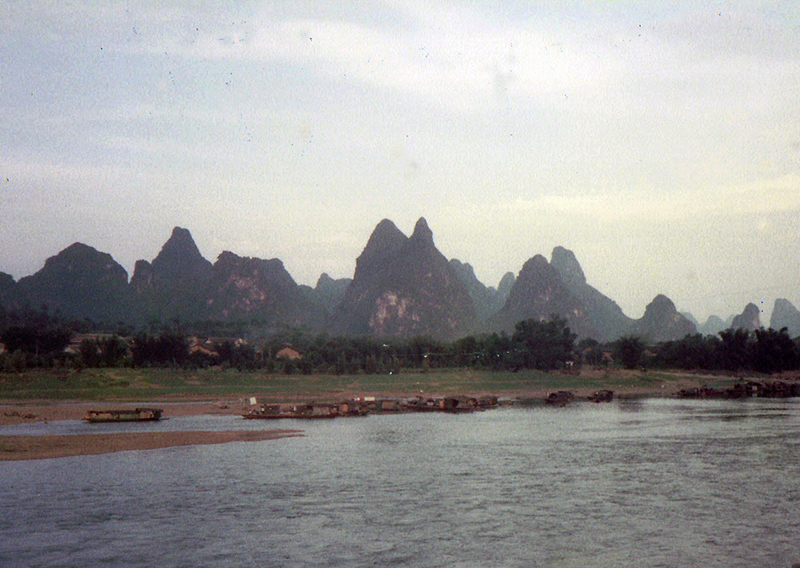
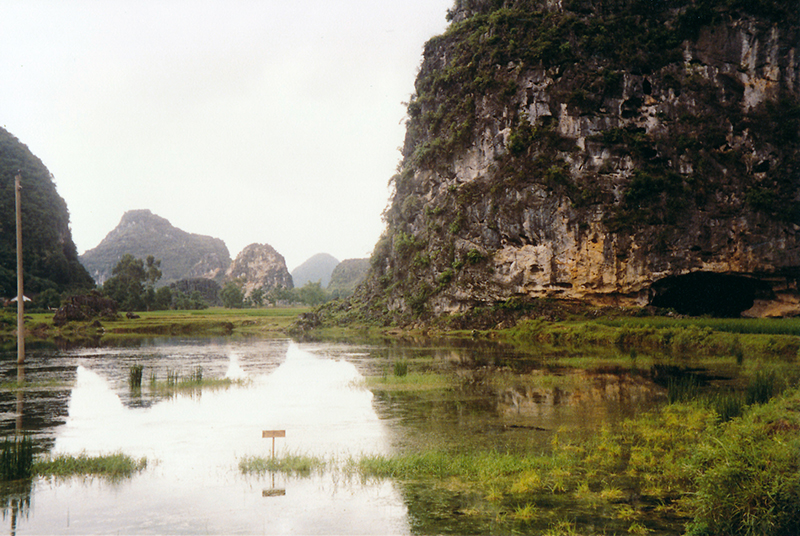
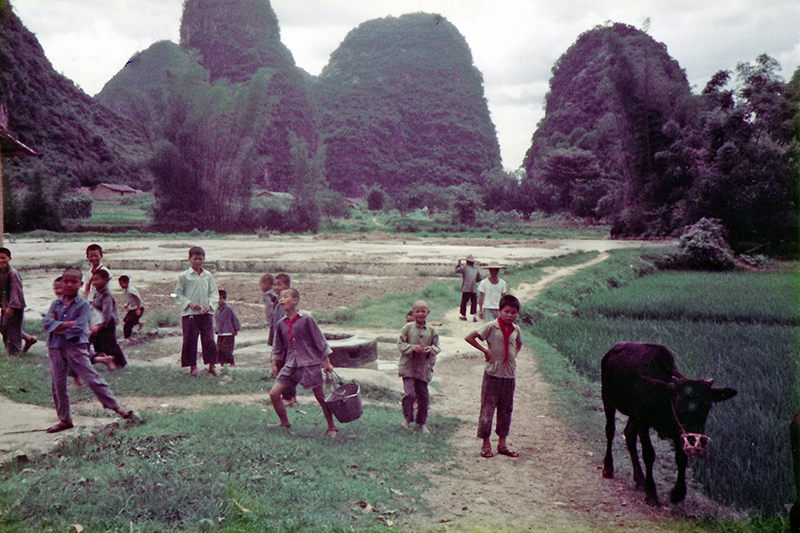
Apparently I wasn’t the first person to be struck by similarities to the landscape of Yangshuo near Guilin China. I visited in 1984 and think it is no longer a quiet little village.
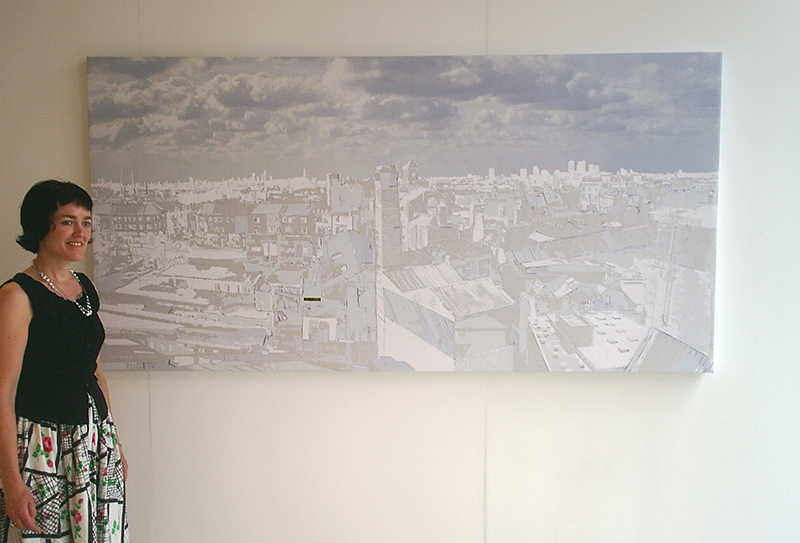
It was the first time I had been back inside the Ben Pimlott building at Goldsmiths since by own graduation, a scary twenty years ago. The building was brand new then and the views with little visible green fed into my installation Re:construction – a large screen print with tiny viewing hole to a tiny oasis amidst the grey, albeit a synthetic one.
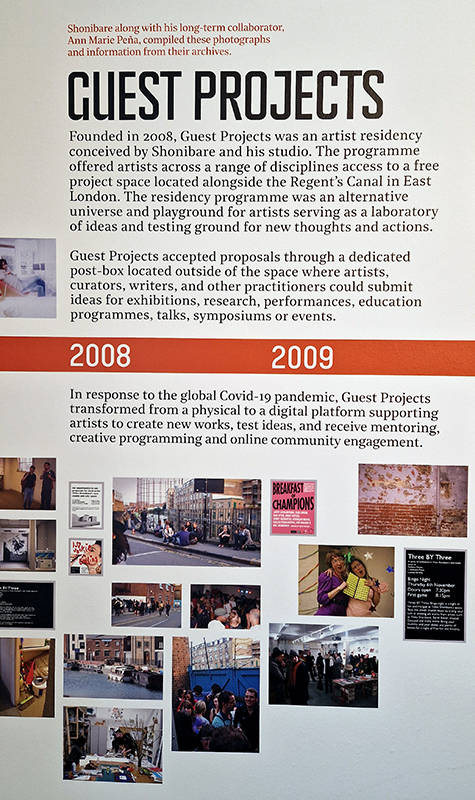
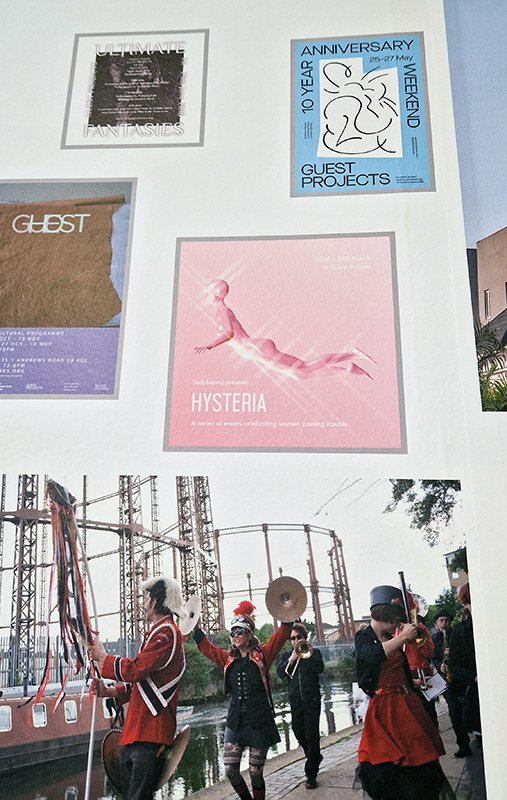
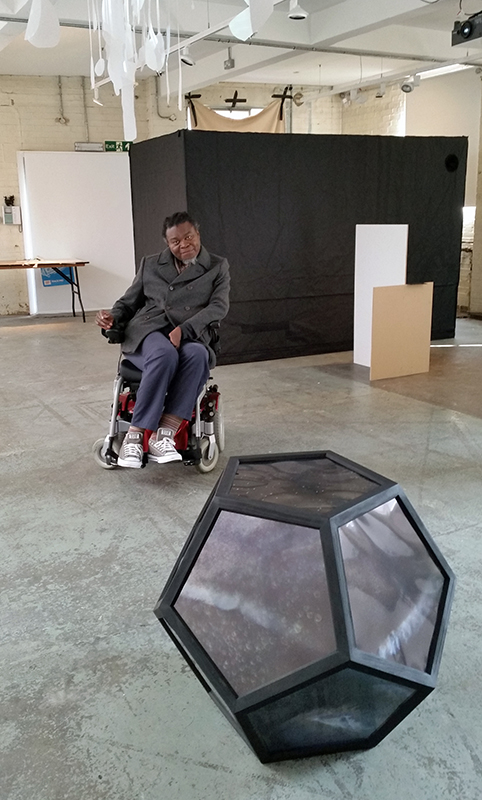
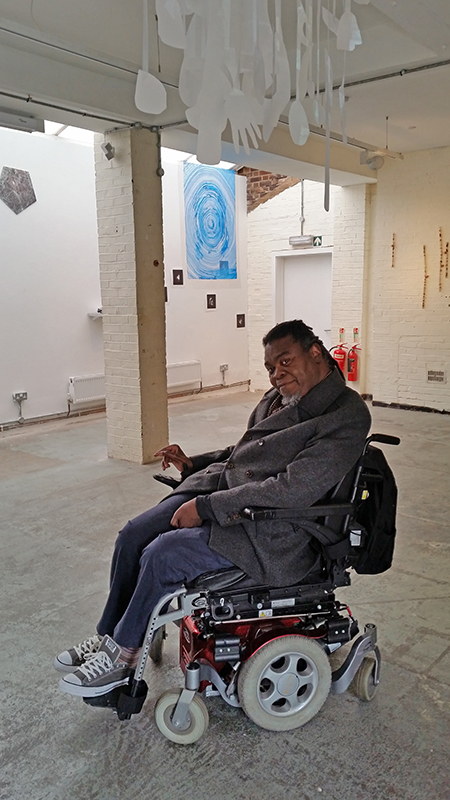
Yinka Shonibare Suspended States at Serpentine South. Horrors of war and colonialism are filed under dazzling colour, birds on the brink of extinction stare in plea or accusation, beacons of light in the darkness come from miniature replicas of sanctuaries.
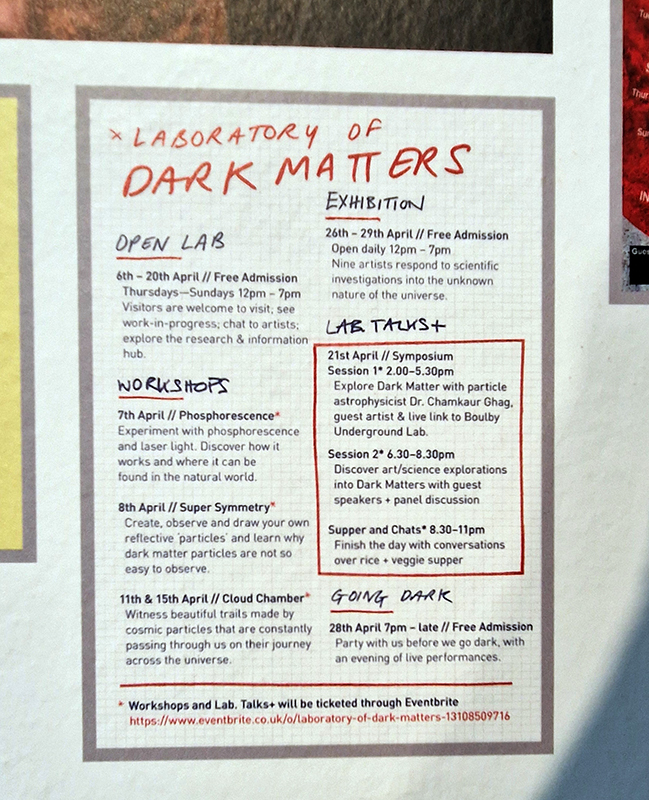
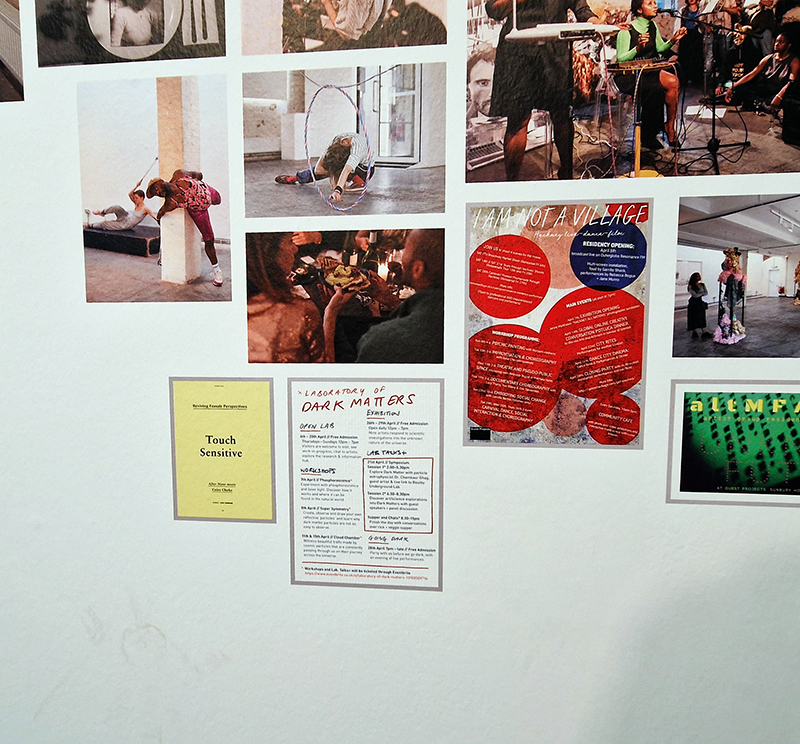
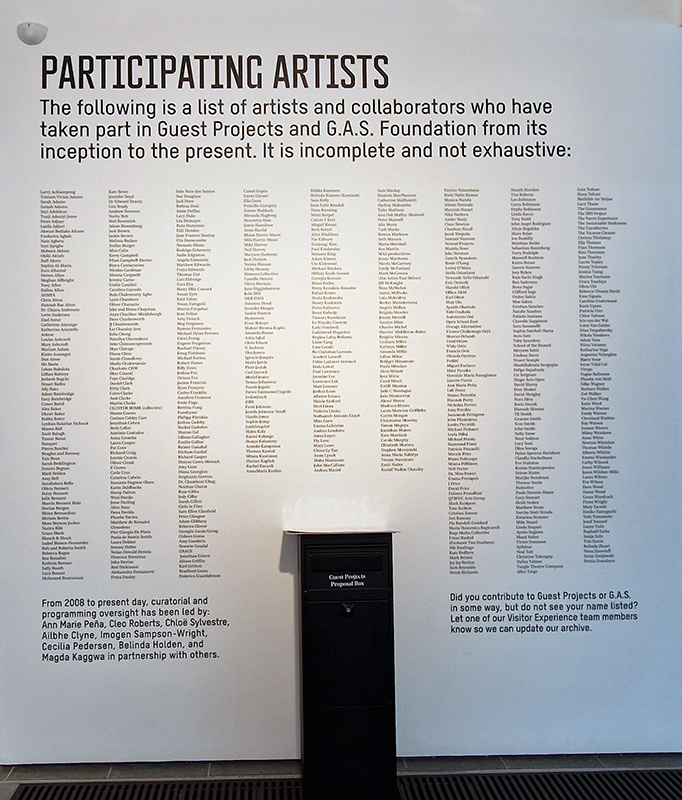
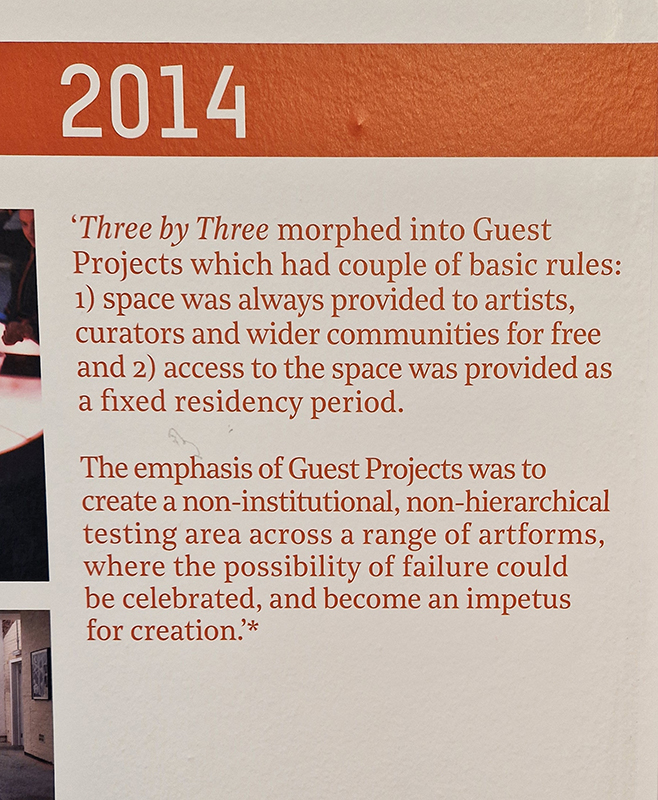
Yinka’s socially engaged inclusive practice spills over into real help for artists and communities. The exhibition celebrates Guest Projects and G.A.S. Foundation in Lagos. Guest Projects is such a generous idea and I have been so lucky to benefit from it with the project Laboratory of Dark Matters
Being awarded a month’s residency at Guest Projects was crucial to the success of Laboratory of Dark Matters as a site for developing ideas and subsequently touring the project. Wonderful to meet Yinka and also to be part of the selection committee for the next round of projects.
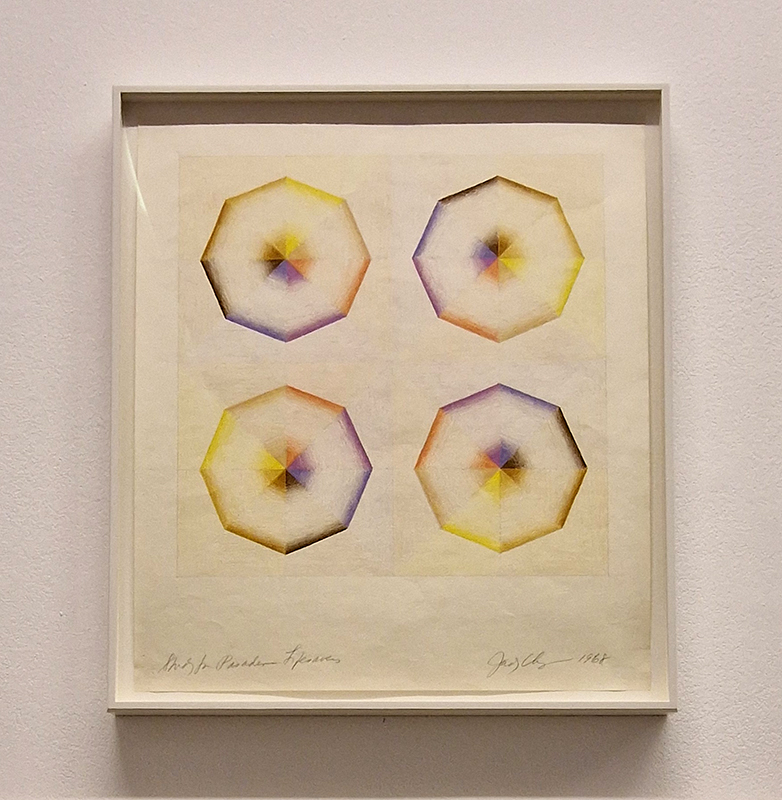
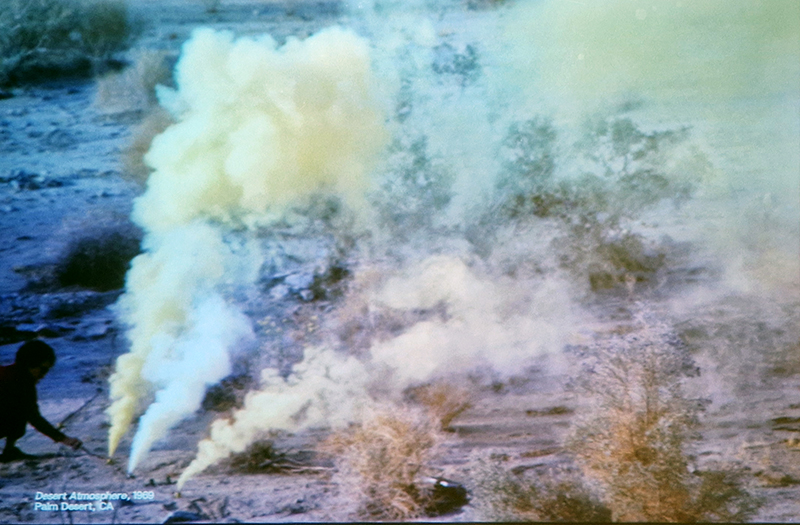
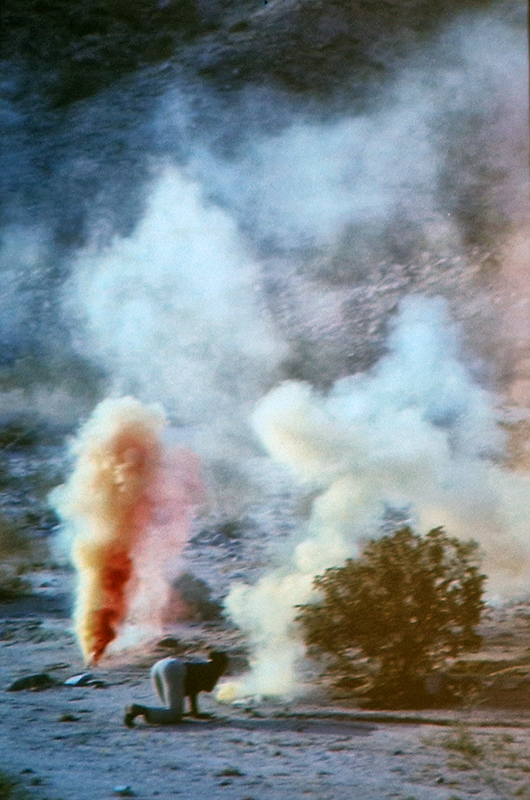
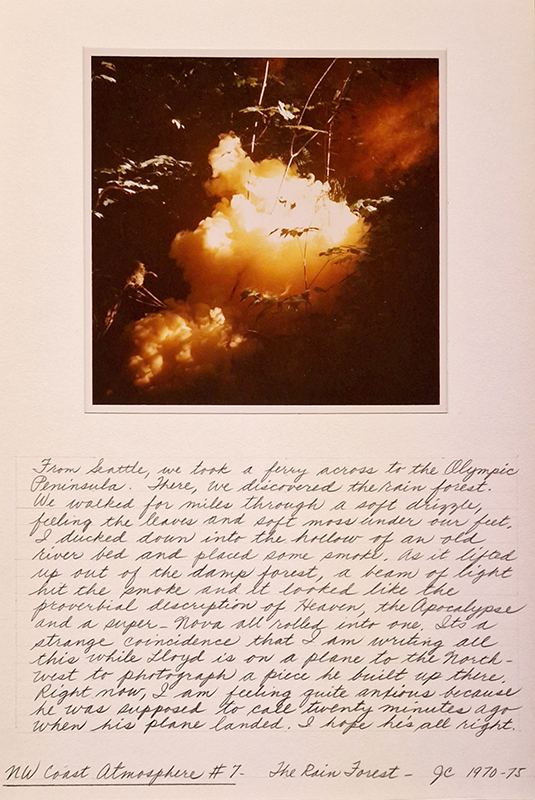
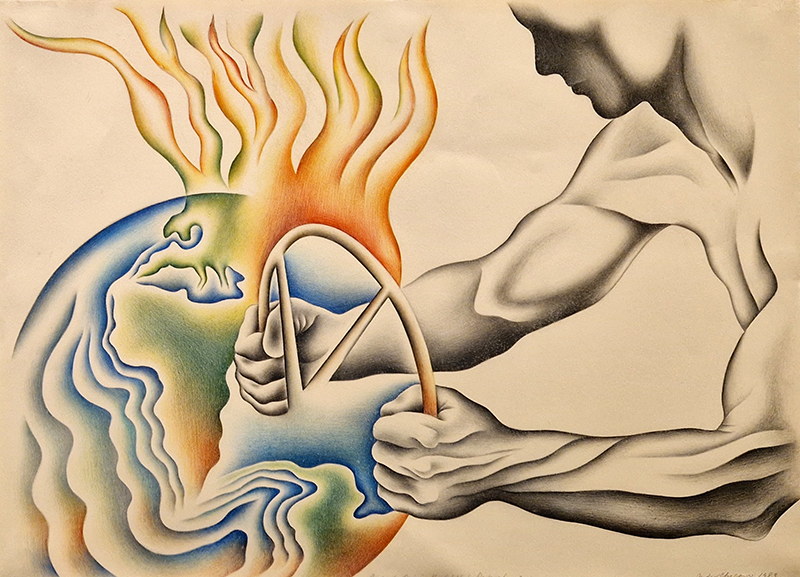
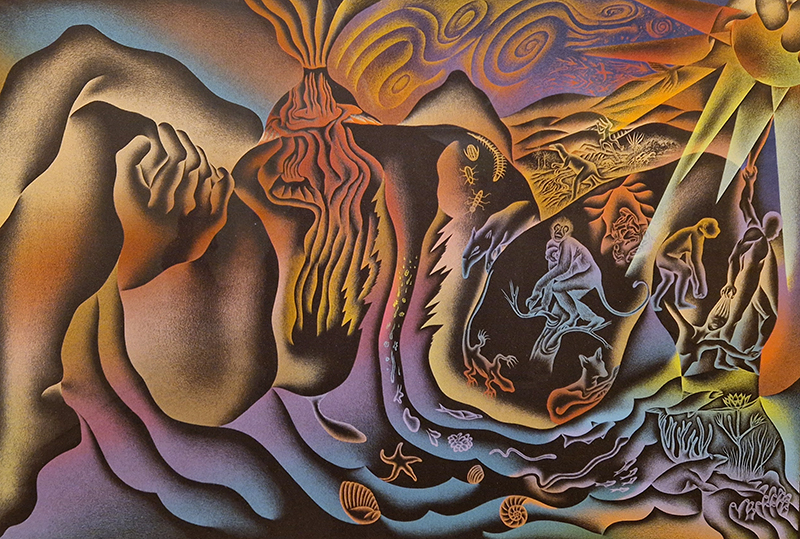
Judy Chicago Revelations at Serpentine North. The highlight of this show is the video documenting The Dinner Party (1974-79) installation and the preparatory drawings and sample plate. What a shame the actual installation wasn’t here, I will have to visit the Brooklyn Museum, New York sometime to see it. The research, collaborations, crafts and designs that went into creating it was phenomenal.
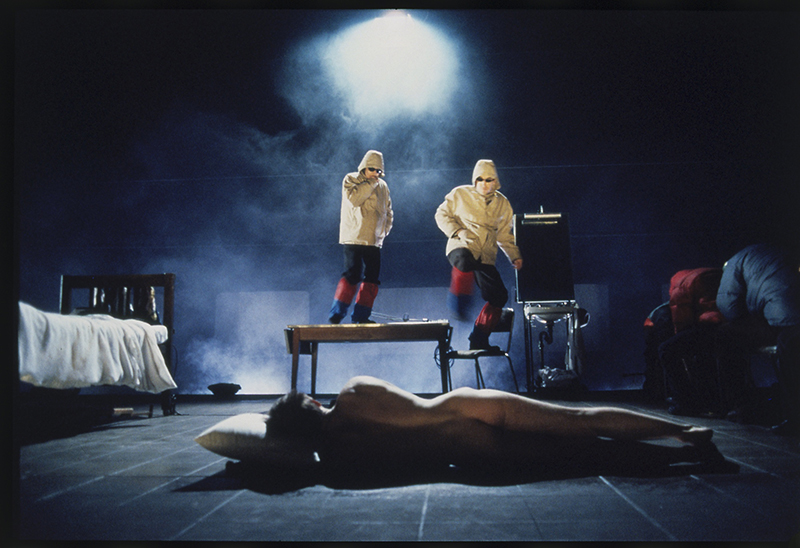
Saw Complicité’s excellent Mnemonicat The National Theatre, 25 years after first seeing it at Riverside Studios. ‘A body is found in the ice, and a woman is looking for her father while a man searches for his lost lover. Mnemonic is as much about origins as it is about memory, and remembering what is lost. Mnemonic asks us: what is our place in the natural world? How have human relationships with the environment shaped patterns of migration? Who are we, and where do we come from? ‘
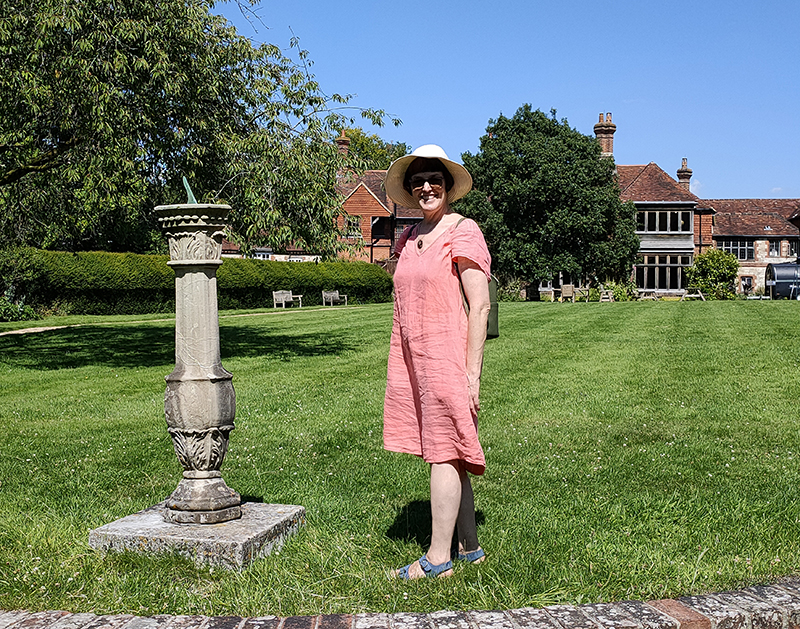
Visited the delightful mellow brick country home and extensive gardens of pioneering naturalist Gilbert White at Selborne. His book ‘The Natural History of Selborne’ (1789) has never been out of print since it was published more than 230 years ago. He was brought to many people’s attention, including mine, during the pandemic and lockdowns of 2020 when writer Melissa Harrison included his diary readings in her podcast The Stubborn Light of Things.
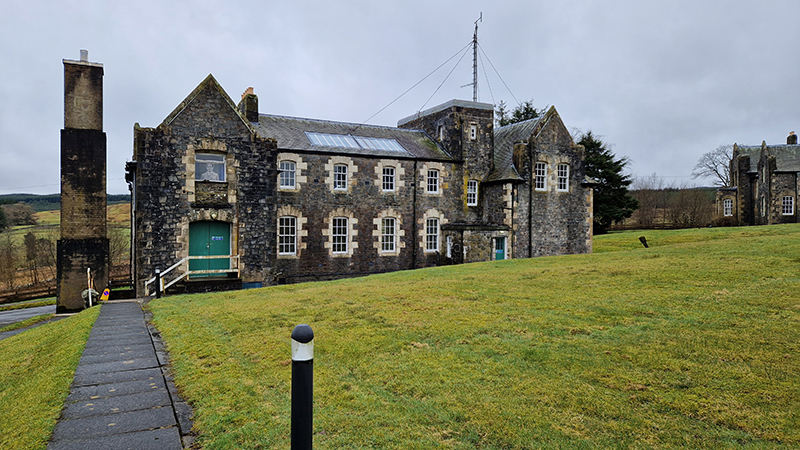
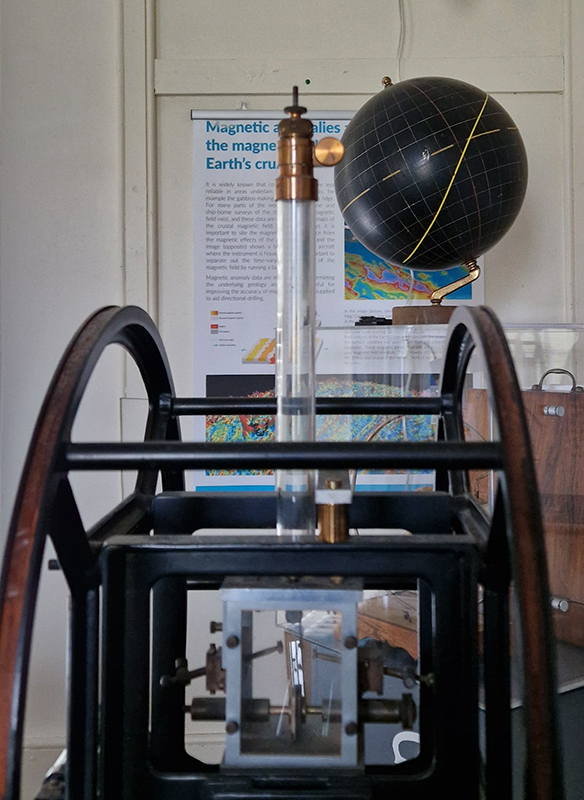
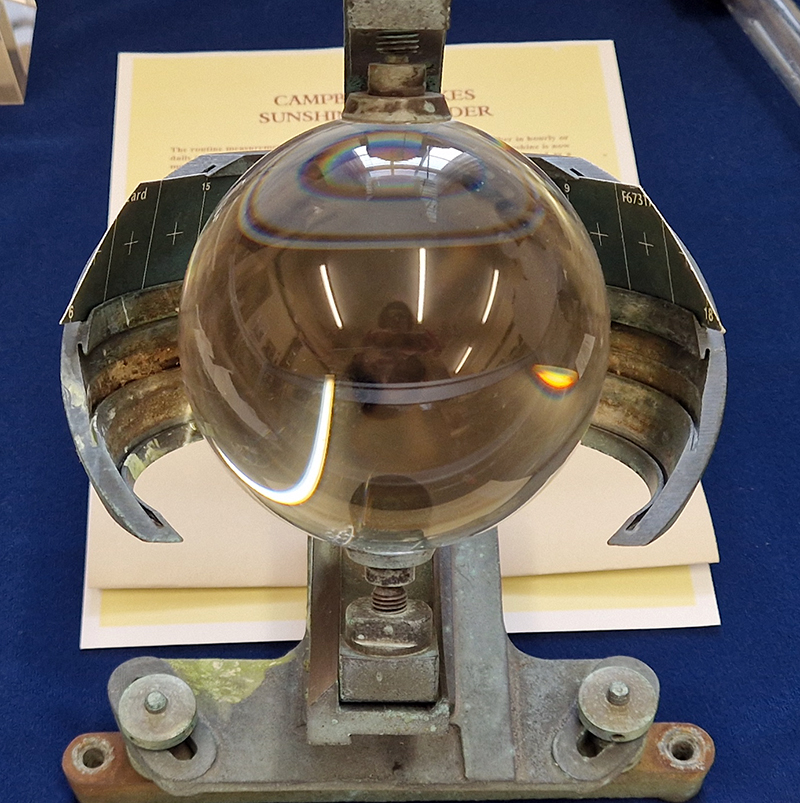
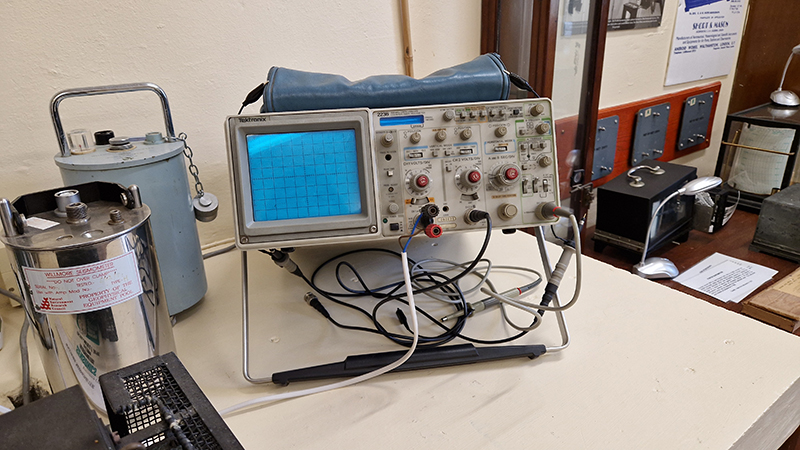
I am extremely grateful to a-n Artists Newsletter for the professional practice and creative development bursary that allowed me to visit Kielder Observatory in Northumberland and Eskdalemuir Observatory, Dumfriesshire to research how space weather impacts Earth’s magnetic field. I am also grateful to Claire Brown, site manager at Eskdalemuir Magnetic Observatory, for her time showing me around the site and explaining the many measurement processes that happen here. Despite the first survey of the site at Eskdalemuir, by the National Physical Laboratory in 1903, reporting back that “the weather was wet and stormy, and somewhat unfavourable to “field work” an observatory was established in this remote location, and recordings monitoring Earth’s magnetic field have been made from this site for 120 years.
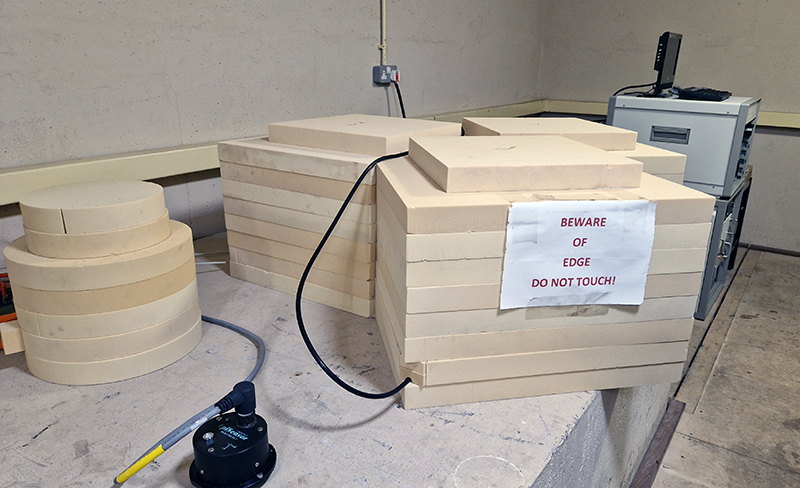
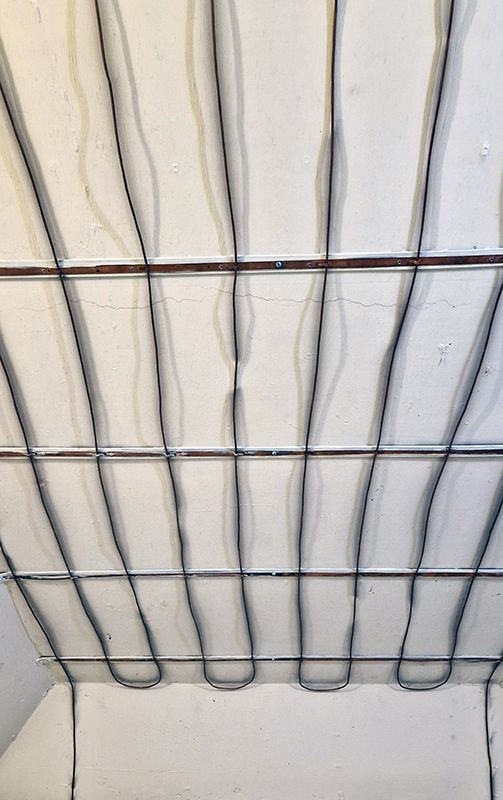
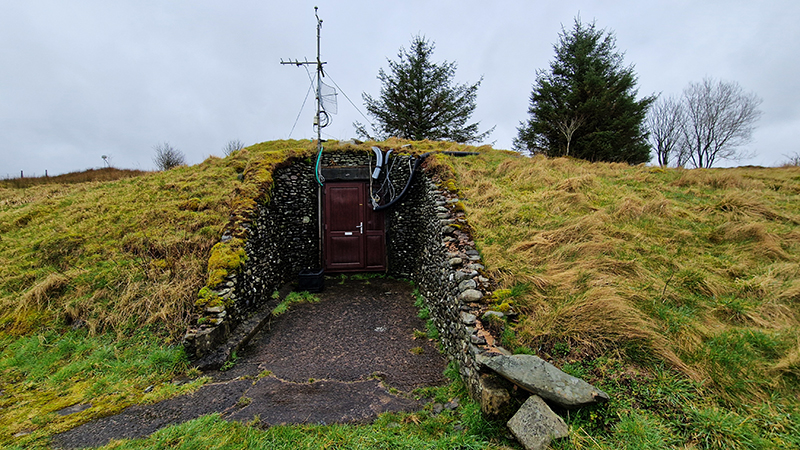
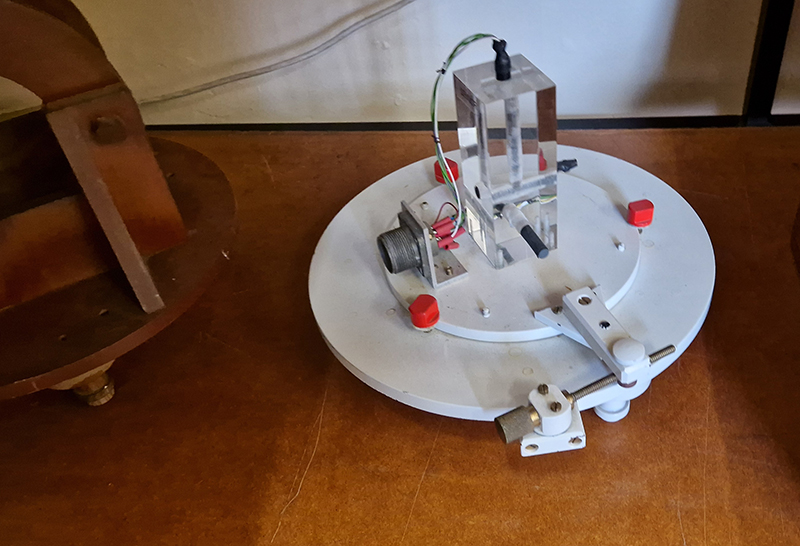
I was able to visit the East Absolute Hut, the Underground Chamber, and the Seismic Vault along with the main building and museum rooms. The interaction of space weather with magnetic currents in the surface of the Earth is monitored here, and there is a camera on the roof to record visual aurora on a loop which is then sent to the British Geological Survey research teams in Edinburgh for analysis. Meteorological observations are also made here, along with solar radiation, atmospheric pollution, and seismological activity. The monitoring of radiation pollution was inaugurated here after the Chernobyl incident in 1986 when explosions at the nuclear plant scattered radioactive elements over a wide area across Europe.
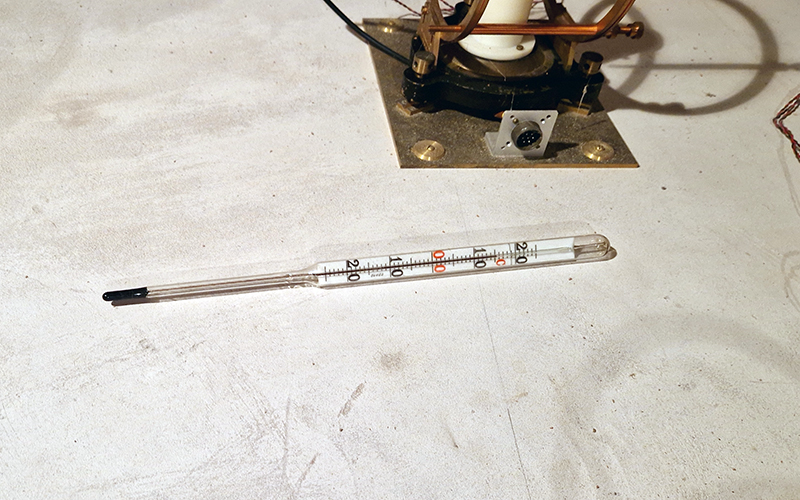
95% of Earth’s magnetic field comes from the swirling outer core of the Earth and changes are due to convection pattern turbulence. As compasses have been used for over 400 years, and records kept of magnetic declination, there is a long history of measurements to refer to. The magnetic north pole had been drifting westwards at about 55km a year up until 2020 but has recently slowed to 45km. Consistency of observations is very important for magnetic field modelling, which is why many of the instruments at Eskdalemuir are located underground to maintain an even temperature.
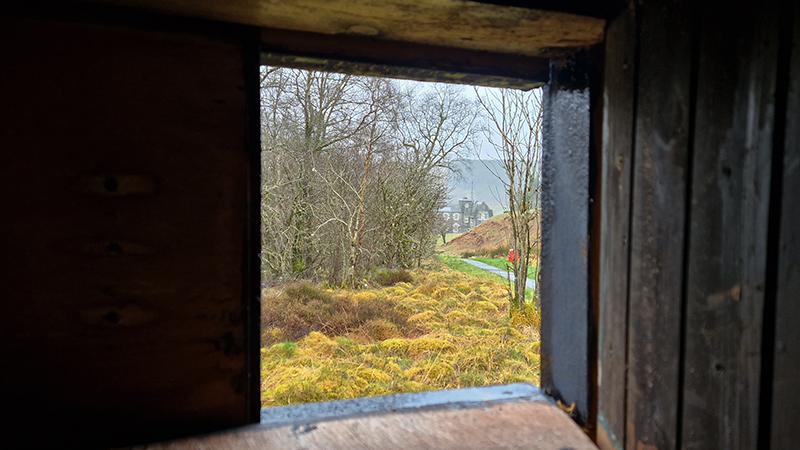
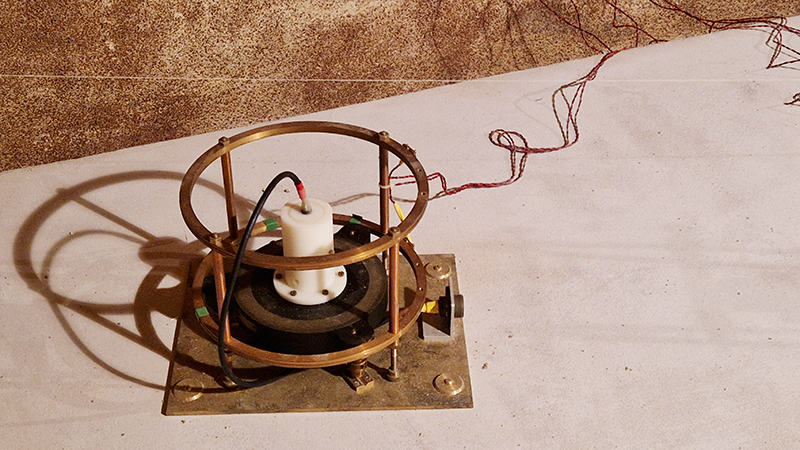
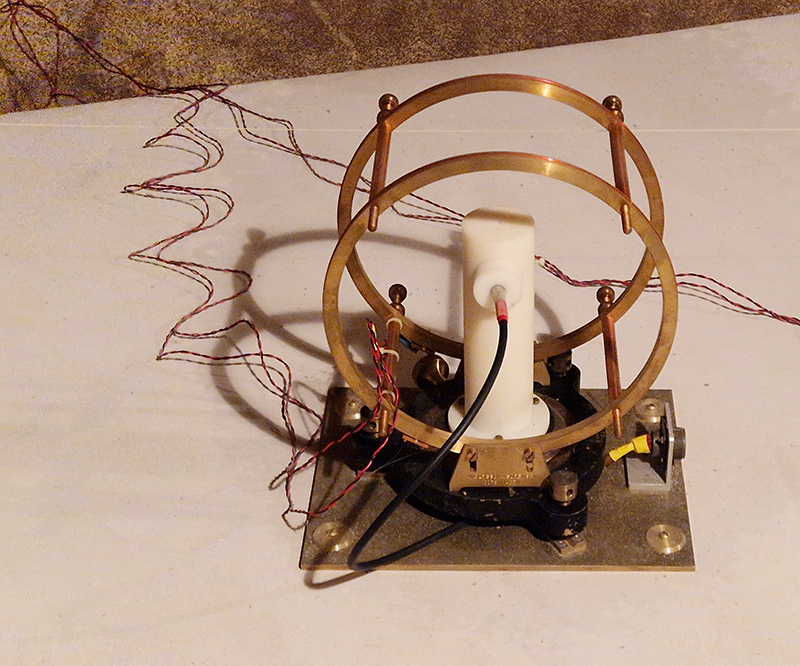
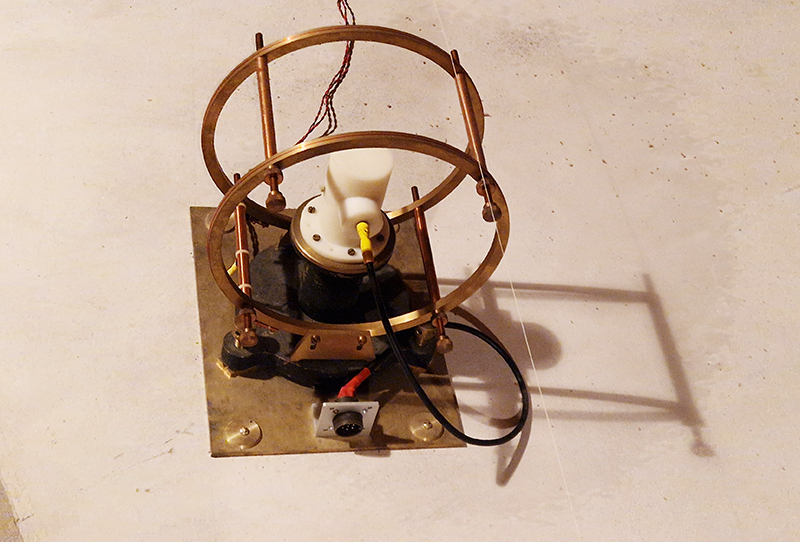
Manual observations of the direction of the magnetic field are taken once a week from the East Absolute Hut. A small sliding window in the wooden hut is pulled back to reveal a distant fixed azimuth mark, not always easily visible during inclement weather. The mark, viewed through the fluxgate theodolite, must be lined up with the north south meridian line until the reading on the digital recorder is at zero. At the same time the digital clock must read zero. These numbers fluctuate rapidly but once both machines read zero a measurement of the position of the magnetic north pole can be recorded. A separate recording is taken through a series of 12 angles on the theodolite to give an accurate position. The instrument is very sensitive and the operator wears the same clothes each time with no metal fixings etc to ensure consistency in the records. The measurements are then plotted on a graph which usually follows a smooth line describing the drift of the magnetic north pole. Sudden deviations alert the operator to errors in the recordings or dramatic movement in the field known as a geomagnetic jerk.
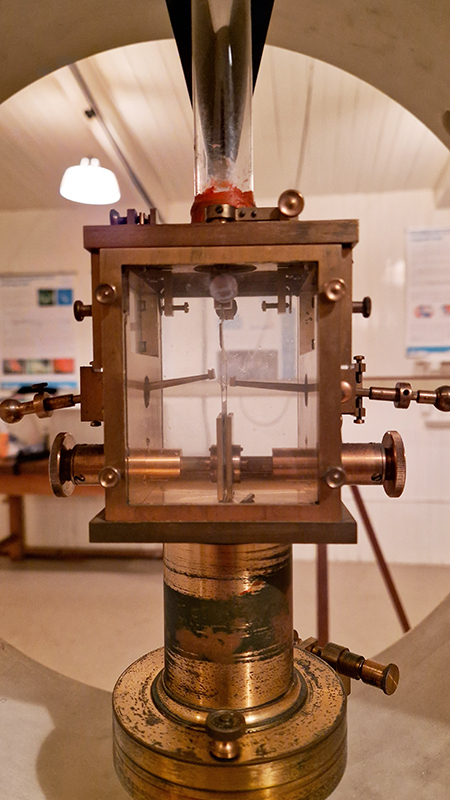
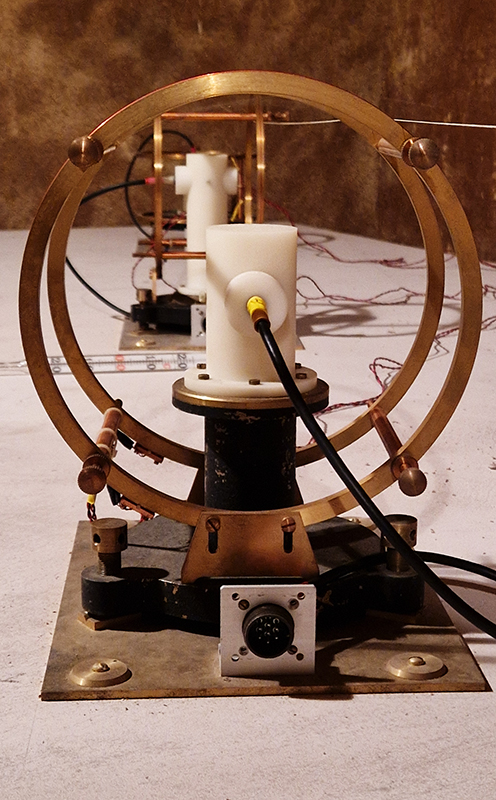
The instruments in the underground chamber measure the strength of the magnetic field in three directions.
Surface readings are also taken automatically from instruments in small enclosures in the back field. During my visit these instruments were used to record data rather than those I came in close contact with.
In the vault, seismograph readings are made of vibrations in the bedrock. Seismic activity around the UK is fairly low level but sensitive structures can still be effected. These instruments pinpointed the magnitude 4.7 Longtown earthquake on Boxing Day 1979, and a swarm of tremors in the Dumfries area in 2001. The network also detected the air crash at Lockerbie in 1988, accurately recording the time of impact for crash investigators.
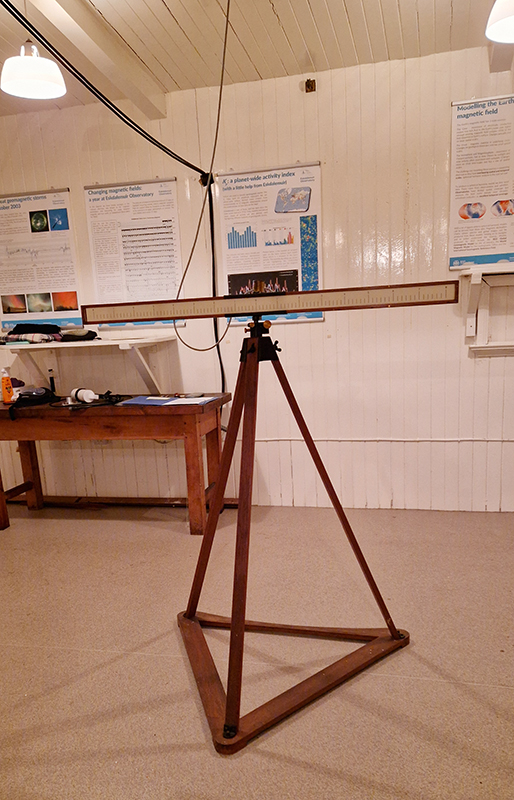
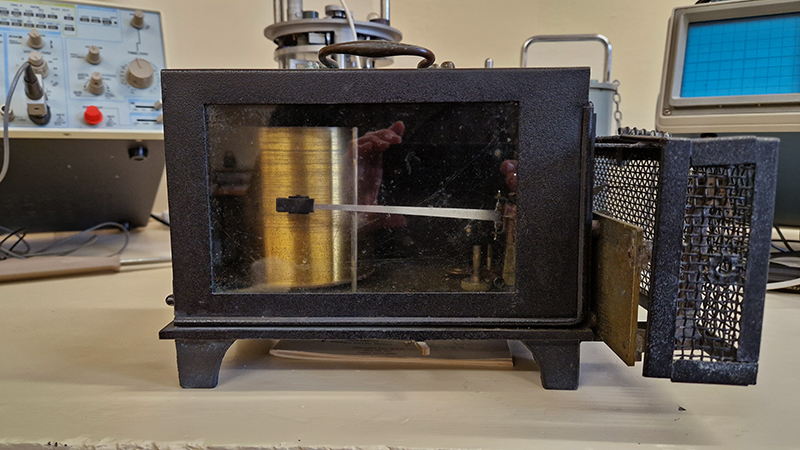
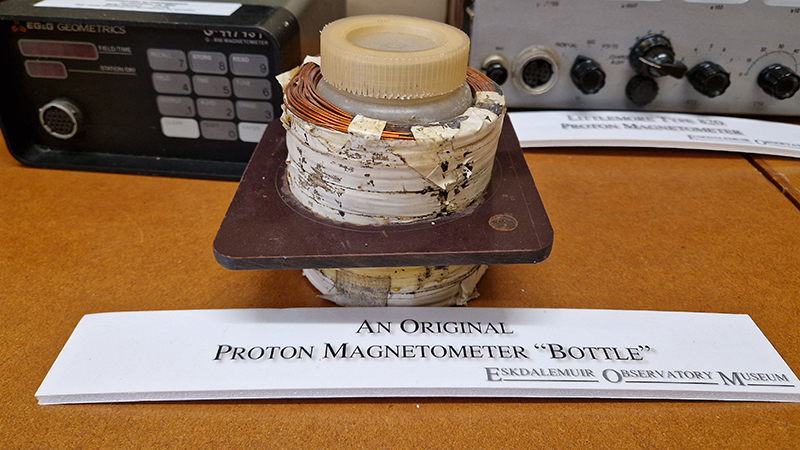
The museum holds a wonderful collection of mysterious instruments.
I attended Aurora Night at Kielder Observatory, established in 2008 under some of the darkest skies in Europe, to learn about how solar activity interacts with Earth’s atmosphere and creates the Aurora. The skies were very dark but also cloudy, and the sun was quiet, so no chance of seeing any aurora or even stargazing. However, we were given fascinating presentations on what causes the ethereal coloured lights seen at Earth’s poles and further towards the equator when solar activity is peaking.
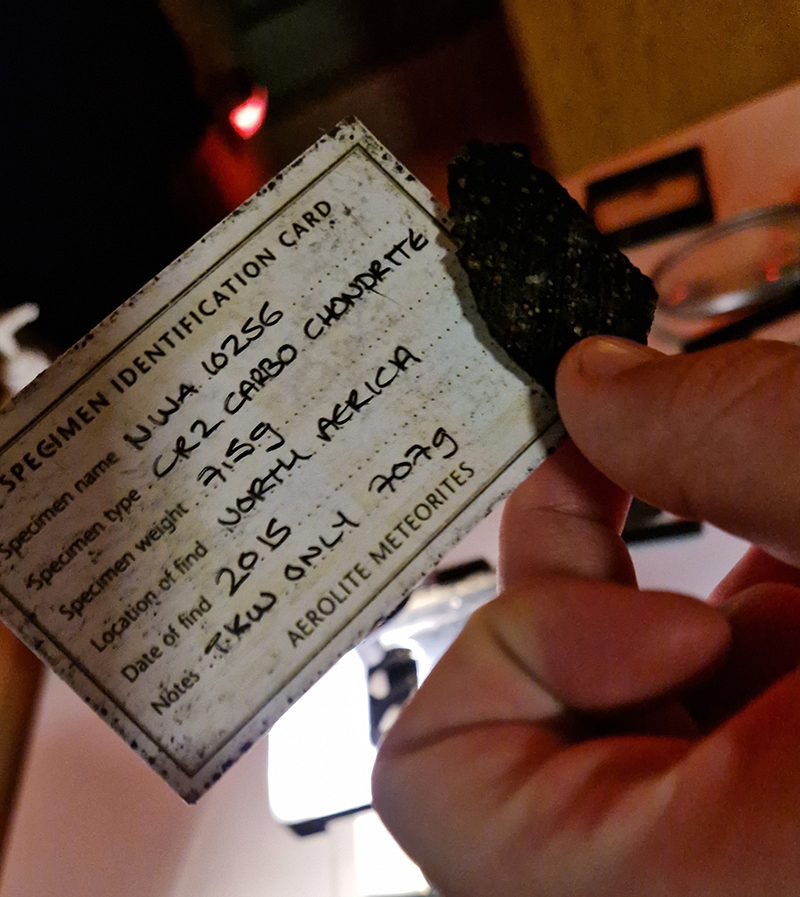
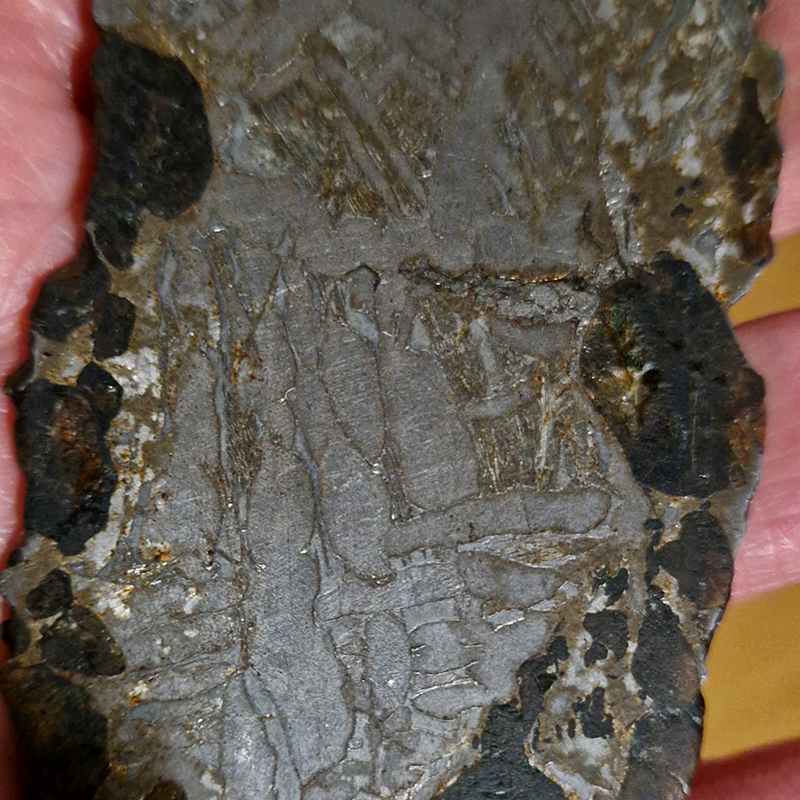
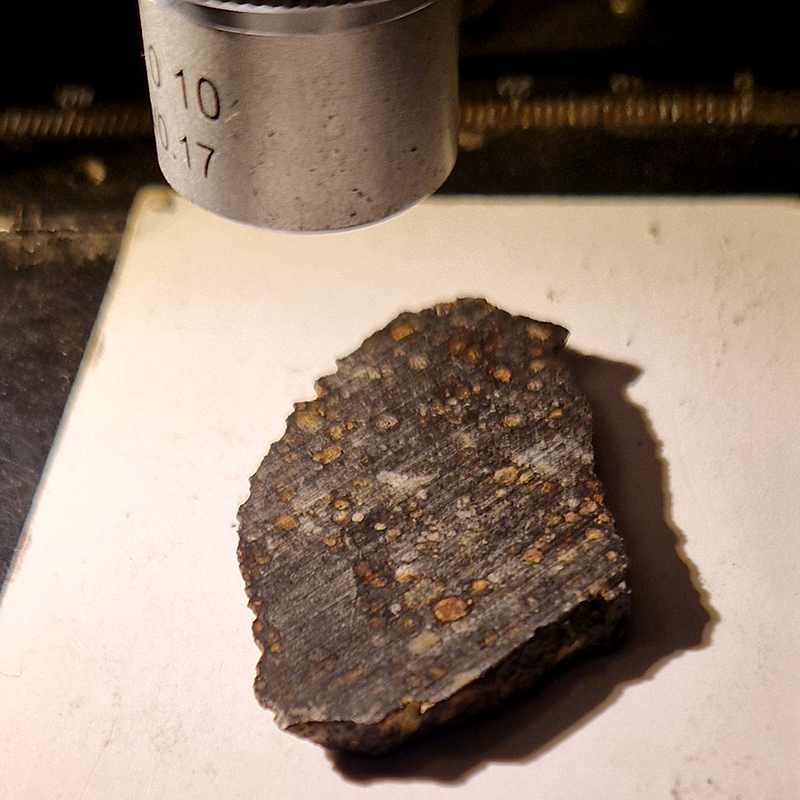
We were also given some cool meteorites to handle including a carbonaceous chondrite, one of the most primitive objects in our solar system.
The sun rotates faster at the equator than at the poles and this causes disruption in its magnetic field. The solar flares that we see loop out from the surface of the Sun are caused by localised incidents of polarity, where plasma and particles loop around what could be thought of as areas acting like independent bar magnets. Millions of tons of plasma and chunks of magnetic field can be ejected during one coronal mass ejection and this matter hurtles out into space, if we are in the line of fire we will be bombarded with energetic particles and Earth’s magnetic field will be disrupted. The solar wind brings the particles from the Sun that envelop Earth and are drawn to the polar regions by the geomagnetic field. The aurora is caused by the interaction of these high energy particles (usually electrons) with neutral atoms in the earth’s upper atmosphere. The particle collisions that occur in the upper atmosphere cause photons of light to be emitted. The Earth’s geomagnetic field is not symmetrical and changes as the Earth rotates, it responds to the disturbance of particles coming from the Sun and as the field adjusts to this disturbance, magnetic energy is released, thereby accelerating charged particles to high energies. These charged particles are forced to stream along the geomagnetic field lines which is why the aurora lights can appear in vertical columns or other dancing shapes depending on where in the magnetosphere they entered the atmosphere. The colours of the lights are dependent on which atmospheric gas is being excited by the solar particles, oxygen emits either a greenish or a red light and nitrogen gives off a blue light.
Solar activity is monitored and space weather forecasts are posted online. To be in with a chance of seeing the Aurora in the UK, the KP level should be 5 or above as this index increases as the aurora’s southern edge moves southward. It can take up to three days for the particles ejected from the Sun in a CME to reach the Earth. The lights are fainter than sunlight so a dark night sky is needed to see them. It is also often the case that the greater photo sensitivity of a camera can capture lights that are barely visible to the human eye. The aurora is more likely to be visible during the spring and autumn equinox because of the angle of the Earth’s magnetic field in relation to the Sun, not because storms are more frequent.
2024 is predicted to have a high number of solar storms so there may be opportunities to see the Aurora but it also comes with the risk of severe space weather that could cause havoc with our reliance on satellites and related technologies.
The connection between solar activity and the impact on technology was made during the 1859 Carrington Event, the most intense geomagnetic storm in recorded history. Strong auroral displays were reported globally and even seen in London, while sparking and fires occurred in multiple telegraph stations.
Satellites are vulnerable to space weather which can cause ongoing degradation or single event upsets where a charged particle can trigger a command in the satellite. During space weather events the ionosphere can become enhanced making it harder to communicate with satellites. Errors can occur in precision navigation and timing situations. Aviation crews are at risk to higher doses of radiation during solar activity and the HF radio communication system can have interference. Induced geoelectric fields in the ground can cause currents to flow in power grids and railway lines damaging transformers.
During the 2003 ‘Hallowe’en’ solar storms, when the largest single solar flare ever recorded was followed by severe storms, over half of all Earth-orbiting spacecrafts were impacted, disrupting satellite TV and radio services, GPS systems, damaging a Japanese scientific satellite beyond repair, sending several deep-space missions into safe mode or complete shutdown, and destroying the Martian Radiation Environment Experiment. The solar storms also led to communication problems for flights passing over the North Pole and Antarctic science groups had a full communications blackout for several days.
In acknowledging these risks we can gain an awareness of our vulnerability to the forces of nature and a respect for the power of the sun, the protection offered by our home planet and the interconnectedness of the universe.
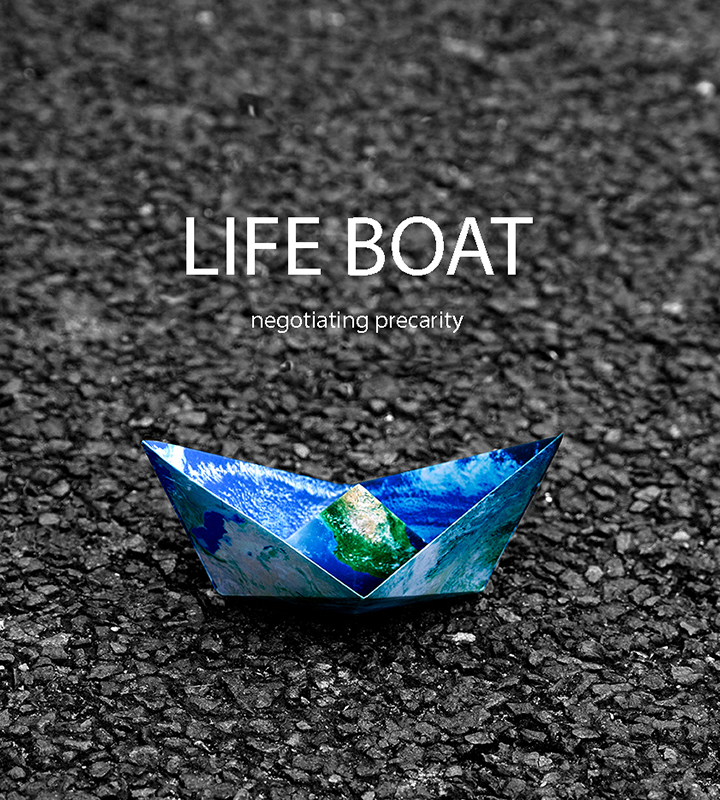
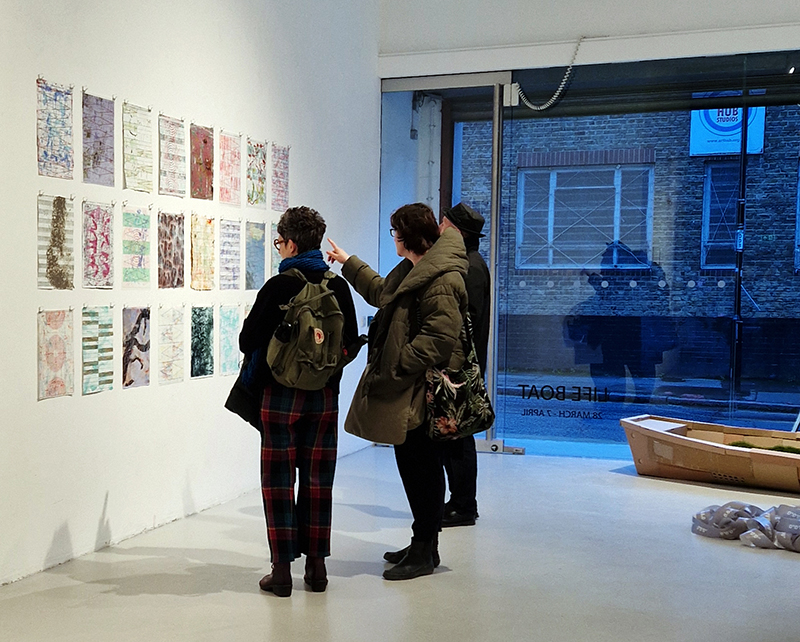
Life Boat at APT Gallery
Life Boat brings together artists with a shared interest in exploring precarity as a site of dynamic transition. Each takes an investigative approach to the environmental, social and historical themes evoked by the lifeboat, as a means of addressing ecological crisis, liminal landscapes, close and distant horizons, boundaries and displacement, lines of rescue, navigation and transformation.
Very happy to be exhibiting with Rachael Allain, Caroline AreskogJones, Beverley Duckworth, Liz Elton, Kathleen Herbert, Kaori Homma and Anne Krinsky.
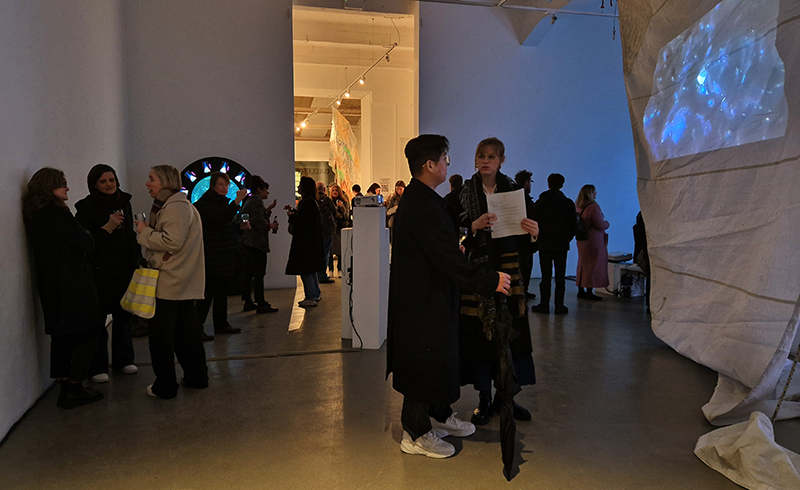
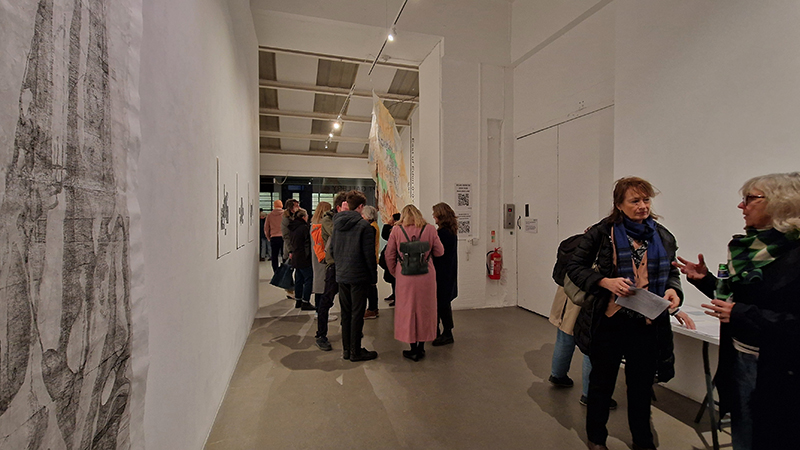
We had a fantastic opening night.
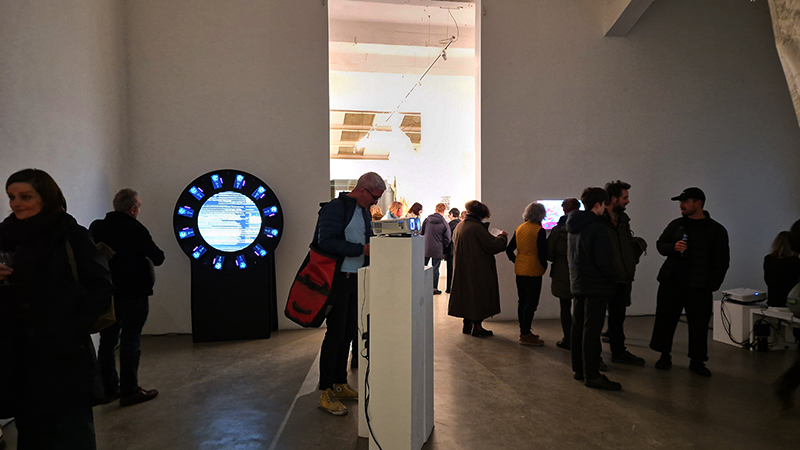
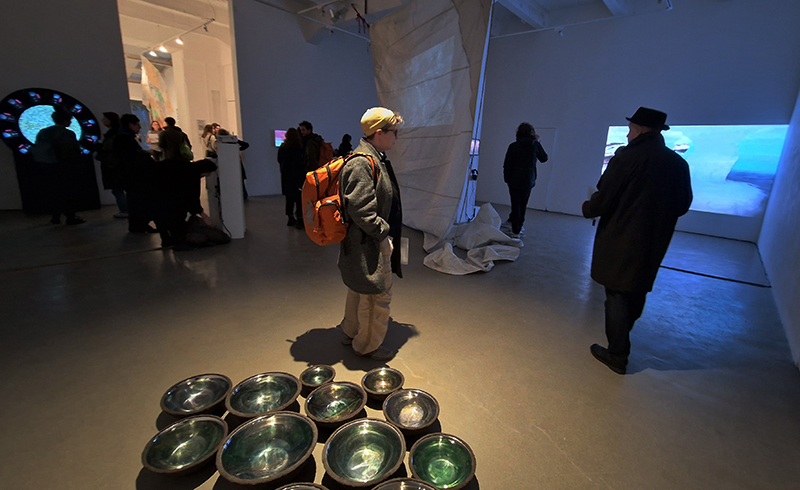
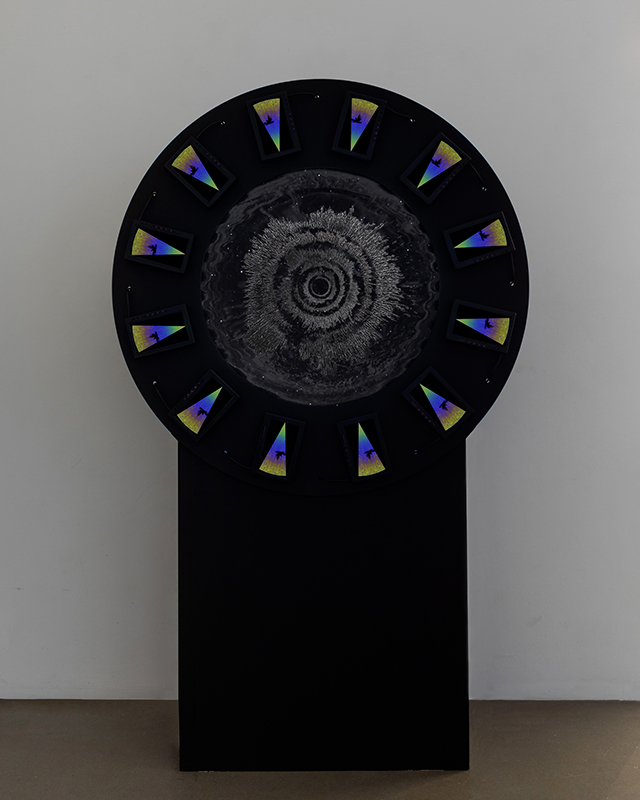
I was showing submīrārī (earthbound)and a new video installation Orbital – these works both consider transient landscapes, ecological landscapes on the cusp of disappearance and the digital landscape at risk from obliteration by an extreme solar storm.
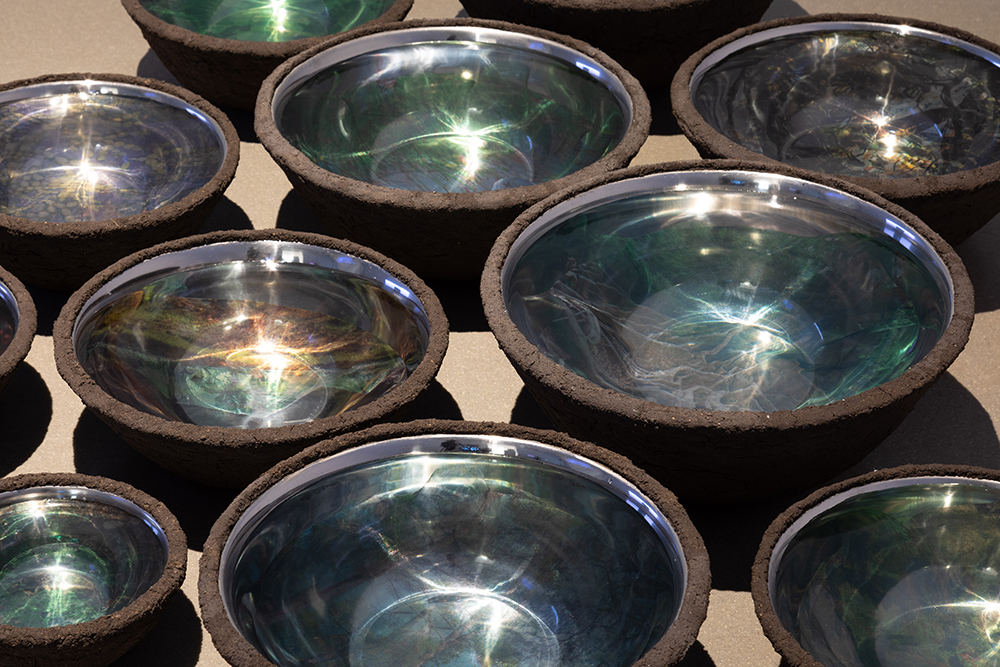
submīrārī (earthbound), 2018, steel, earth, water, sublimation printed textile, 12 pieces dimensions variable approx. 200 x 200 cm. Reflections of a no longer certain world hover in pools fluctuating on the cusp of disappearance. The ethereal images float or submerge revealing the hidden activity of water which also refracts light across the surface prompting the viewer to repeatedly shift perspective. Donna Haraway, drawing from Latour, proposes the ‘Earthbound’ as those humans who are ready to rethink and create new narratives with Gaia at the centre, who recognise the entanglement of society and nature and aim to pursue a ‘nonarrogant collaboration with all those in the muddle’. The shift in perspective embraced by the ‘Earthbound’ embodies a grief shared with other species at loss of habitat and disappearing landscapes. It is not a nostalgia for paradise lost but a reappraisal of what paradise could be.
Orbital, 2024,Back projection video, mini screen array, board, installation 122 x 200 x 50 cm, video 05:44 min. An exploration of the potential risks of space weather on human technology and infrastructure and non-human navigation.
The Sun is about 150 million kilometres (93 million miles) from Earth, but space weather can affect Earth and the rest of the solar system. It can cause damage to satellites and electrical blackouts on Earth. Small satellites have come to dominate low Earth orbit, and we have become reliant on this technology for communication, military strategy, and data gathering.
A blast of high energy particles hitting Earth during a solar storm can interfere with Earth’s magnetic field, confusing birds that use this for navigation. In America, pigeon racers postpone the big race if bad space weather is predicted. There is also new research that might suggest the number of satellites orbiting Earth and the growing satellite space junk graveyard could weaken Earth’s protective magnetic field, making us even more vulnerable to space weather and cosmic radiation.
The gallery location in Deptford, once a major departure point for maritime trade and scientific expeditions from Deptford Dockyard, resonates with the exhibition’s concept of being ‘at sea’, in the sense of negotiating the unknown. It was Deptford Dockyard that Edmund Halley set sail from to make the first circumnavigation of the Earth to map the declination of the magnetic field. The ship that he captained, the Paramour, was the first vessel built specifically as a research vessel and launched in April 1694.
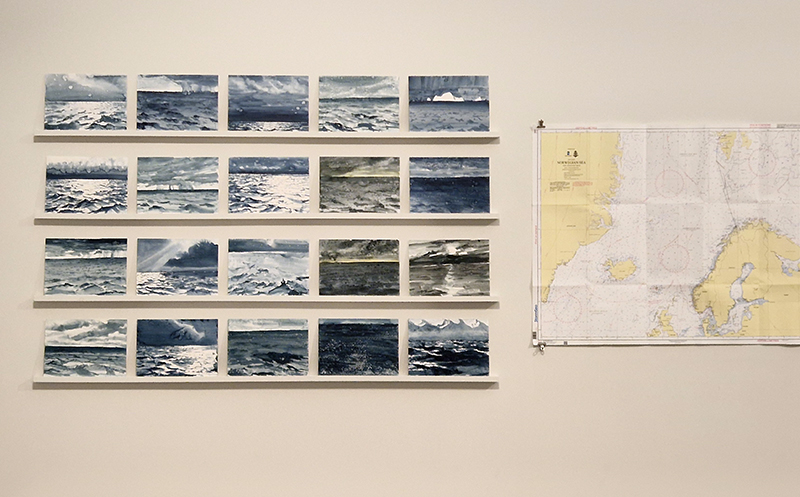
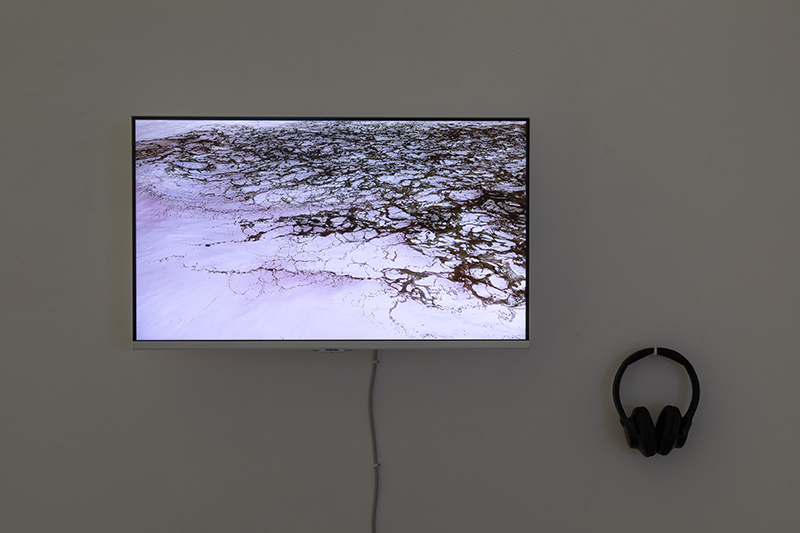
Rachael Allain’s current doctoral project ‘Above and Below the Horizon: A practice-led investigation into liminal thresholds of bodies of water’ has been undertaken in response to various aquatic locations. The work shown in this exhibition documents mapping aspects of an unexpected journey of discovery made in the upper reaches of the Arctic Ocean during an international art and science expeditionary residency in the Svalbard Archipelago during midsummer 2022. ‘Circumnavigation of a ‘Bergy Bit’’ is a film with sound of a close and intimate encounter with a section of an iceberg, calved from its mass and found beached and melting close to shore in Eolusneset, Sorgfjorden in the Bay of Grief.
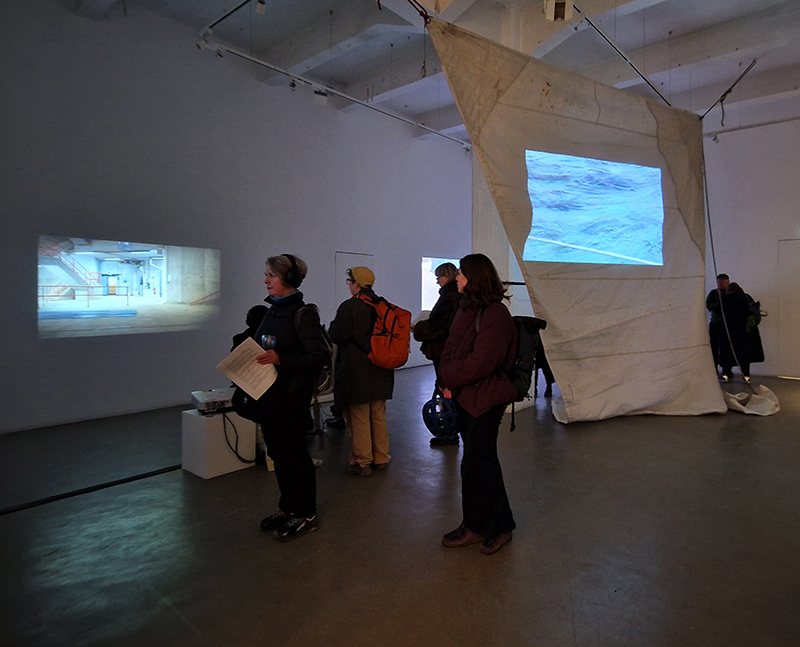
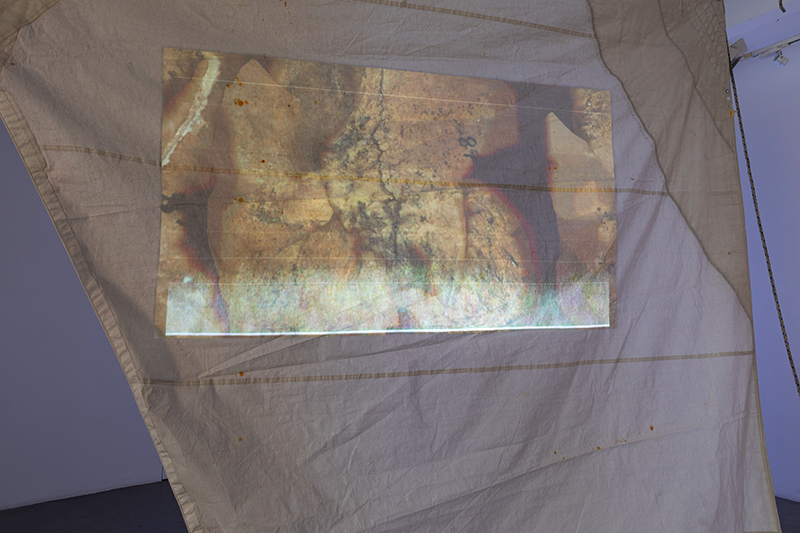
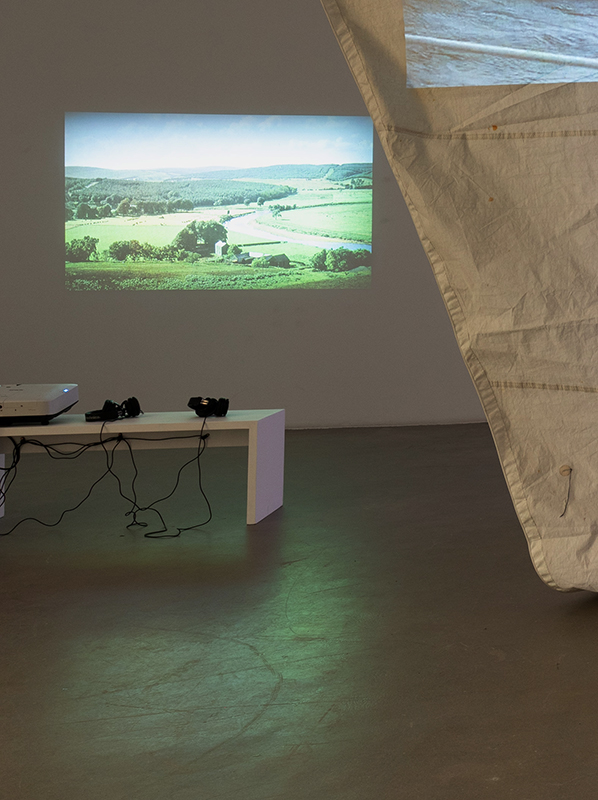
In 2019 Caroline AreskogJones spent time on the Sea of Hebrides making a series of responses whilst researching more viscerally the ocean as a site of ‘field research’ and gathering recordings. ‘Sounding Line’ (2024, sail, audio/video single channel as projection 07:32 min. Sail courtesy of Sail Britain) was created in deliberate wave format being inspired by Jean Painleve, whose hybrid films overlaid with jazz soundtracks occupy the uncertain space between art and science. Oskar Jones was invited to create the sonic composition in response – the saxophone being a wind instrument of extraordinary virtuosity. Since 2023 Caroline has been visiting the Natural History Museum Cetacean Archive – at the invitation of Principal Curator, Richard Sabin. Through conversations including those with environmental historian Sophia Nicolov, her research has broadened and this updated presentation includes recordings of the two remaining Orcas who inhabit the Sea of Hebrides courtesy of the Hebridean Whale and Dolphin Trust.
Anne Krinsky Boiling Seas Acid Seas (Work-in-progress), 2024, Video, 12:26 min, filmed on location at Long Beach Peninsula in the Pacific Northwest.
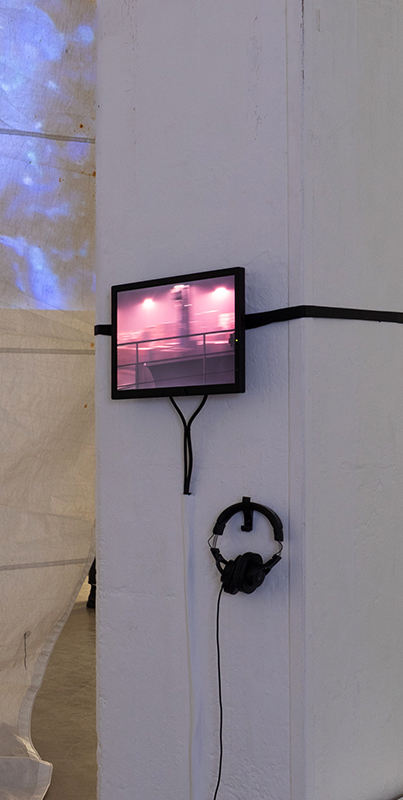
A History Of The Receding Horizon (2015, HD Video, 16:9, sound, projection, 28 min) is a digital film installation by Kathleen Herbert, exploring different concepts of time within the landscape. Based upon Kielder in Northumberland, the narrator whose script was developed from the artists research interviews with environmental historians, astronomers at Kielder Observatory and local people from the area, leads the viewer through the film weaving together past, present and future timelines. The Chaplin (2006, standard HD video, 4:3, sound, monitor, 07: 20 min) is a film installation recalling a conversation held between the artist, Kathleen Herbert, and the Port Chaplin based at the Mission to Seafarers centre in Avonmouth docks. The Port Chaplin boards every ship as it enters the docks, his role is to provide emotional and practical support to seafarers while they are in port. The piece was produced while Kathleen was based at the centre researching for a new commission by Picture This Moving Image and Situations Bristol. Her research at the centre culminated in a 3 day voyage aboard a cargo ship in which she took her camera and the extracts of film from this journey provide the visual background of the film.
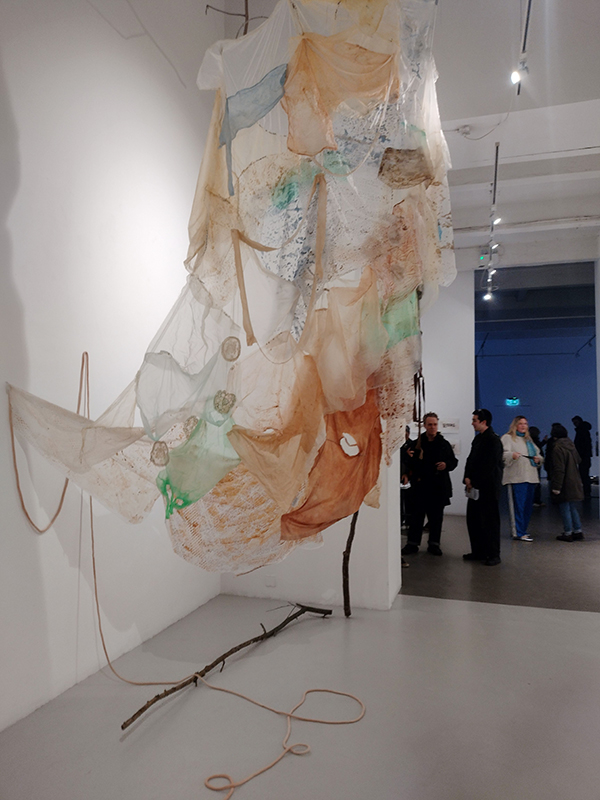
Fragility and vulnerability are embodied in layered works on paper, a large suspended sculpture made from delicate compostable material and living installations incorporating transient elements that transform over the exhibition period.
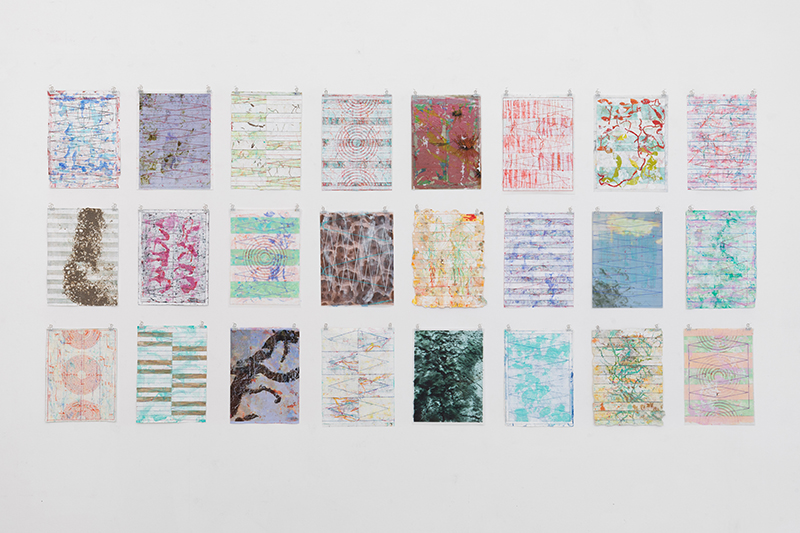
Anne Krinsky has been working on a research-based project about vulnerable wetlands and climate change since 2018. Coastal wetlands worldwide are at risk from rising sea levels caused by climate change, while inland watersheds are threatened by heat, drought and agricultural runoff. These ecosystems are critical to the plants and animals that inhabit them and to human survival. She is drawn to biodiverse habitat edges – where water meets land or where fresh water meets the sea and is interested in recording both the beauty of – and human impacts on – fragile habitats. She uses documentation as an archive of raw materials to generate work in other media, including site-responsive print and video installation and tactile work on paper. In responding creatively to wetlands and watersheds, she wants to raise public awareness of climate threats to these life-sustaining habitats. Before They Vanish, 2024, 24 small works: paper, mylar, acrylic, digital print, mixed media, 150 x 300 cm.
Caroline AreskogJones Float 2023, Paper lithography on shoji, 60 x 120 cm forms part of a series of works inspired by the Natural History Museum Cetacean Archive, rendered onto Shoji paper, used in museum conservation.
Liz Elton begins in landscape and still-life painting to explore the potential of waste and the recycling of matter. Her ephemeral work is often made on compostable ground, coloured with kitchen waste and embedded with seeds. Showing Habitat, 2024, Compostable cornstarch food waste recycling bags, household textiles from a house clearance, vegetable dyes from kitchen waste, water colour, silk, soil from various locations and gleaned from vegetables bought in the market, vegetable seeds saved from food preparation, seeds of varieties of self-seeding edible plants typically found on the wasteland around Deptford creek, found wood, Approx. 360 x 250 x 150 cm (variable).
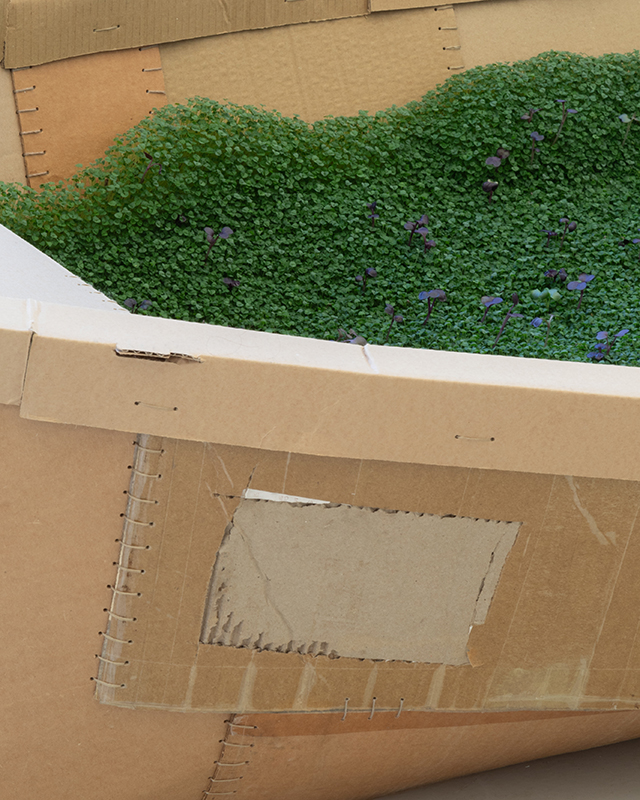
Working with living sculpture and installation, Beverley Duckworth creates spaces and moments which connect the smallest, poetic actions of plants with precarious issues facing humanity. Her practice centres on the afterlife of the discarded and is rooted in small acts of reparation – sewing scraps together, watering fragile seedlings and nurturing the regenerative power of composting from waste materials. Works include Husk, 2024, Discarded cardboard, thread, flax, seeds, water, 90 x 70 x 280 cm; Raze, 2023, Discarded clothes, binder, 48 x 51 x 10 cm.
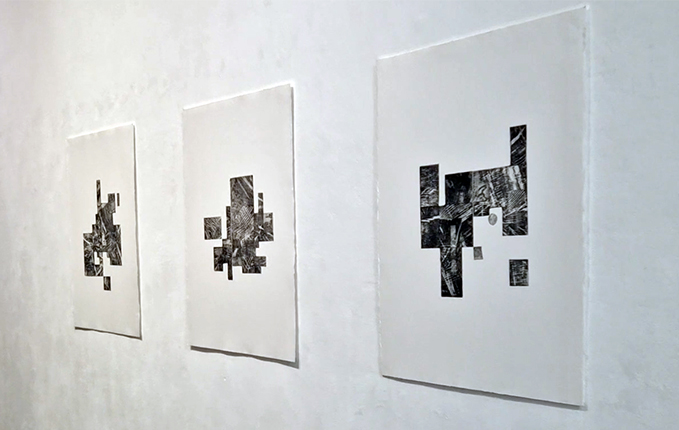
Etchings and spatial interventions explore the use of the natural world as human resource and land as a site of geopolitical conflict.
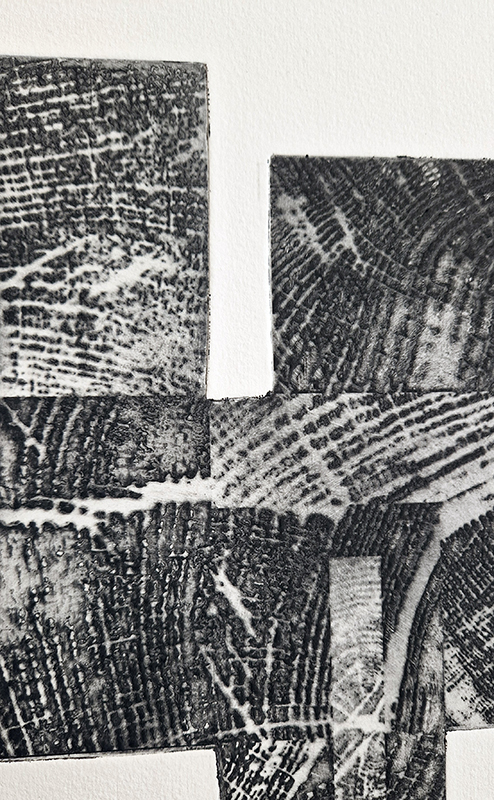
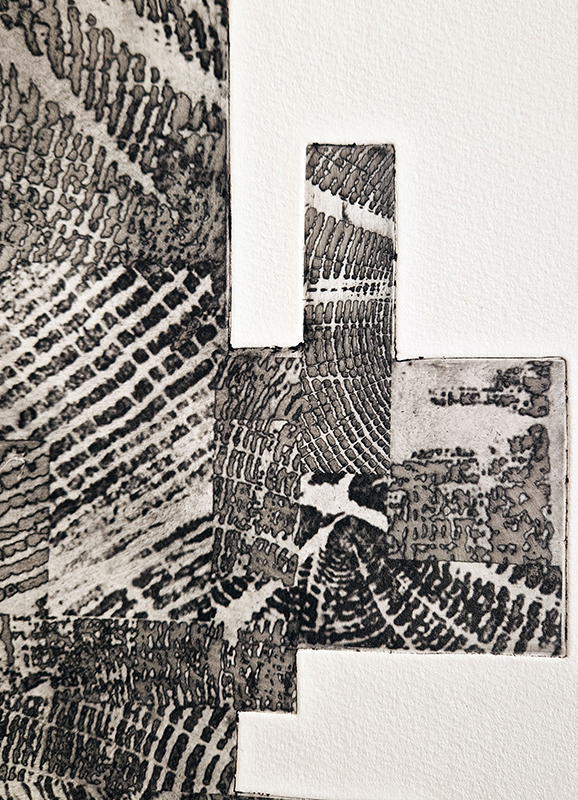
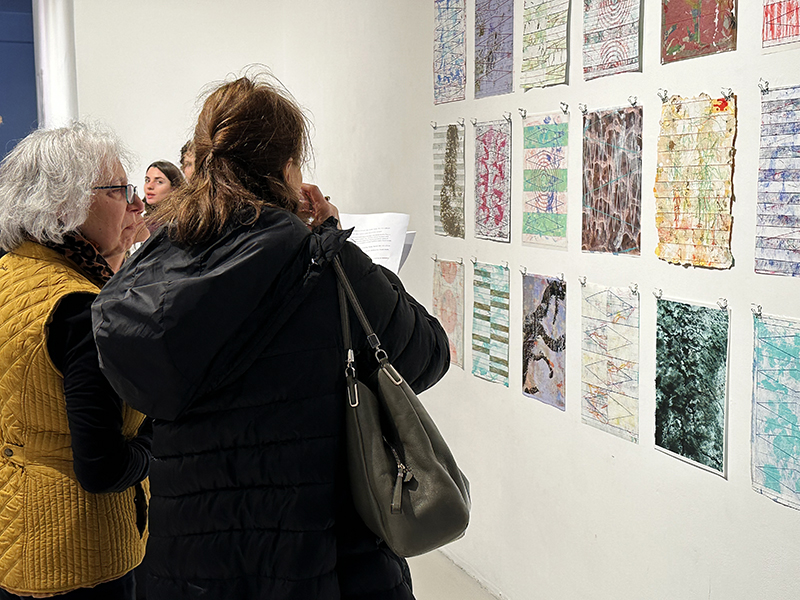
Kathleen Herbert Lost Dimensions I, II, III, 2022-23, Photopolymer Etching on Somerset Satin Paper, 75 x 57 cm.
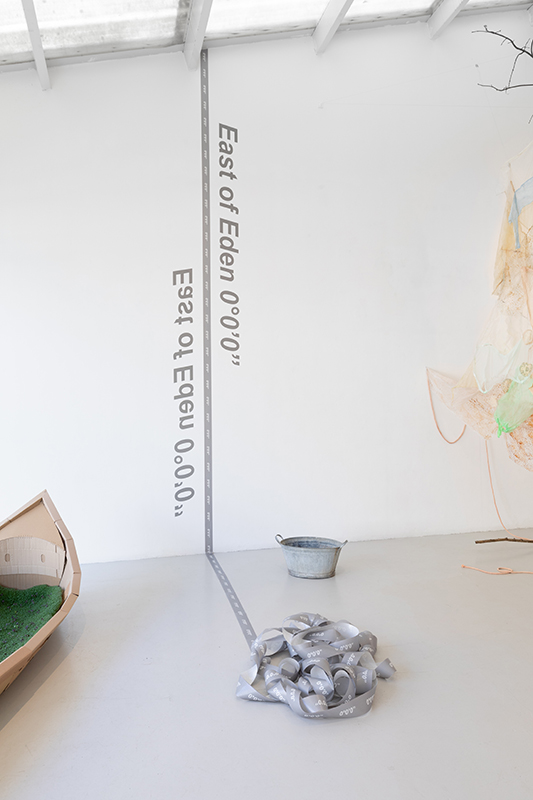
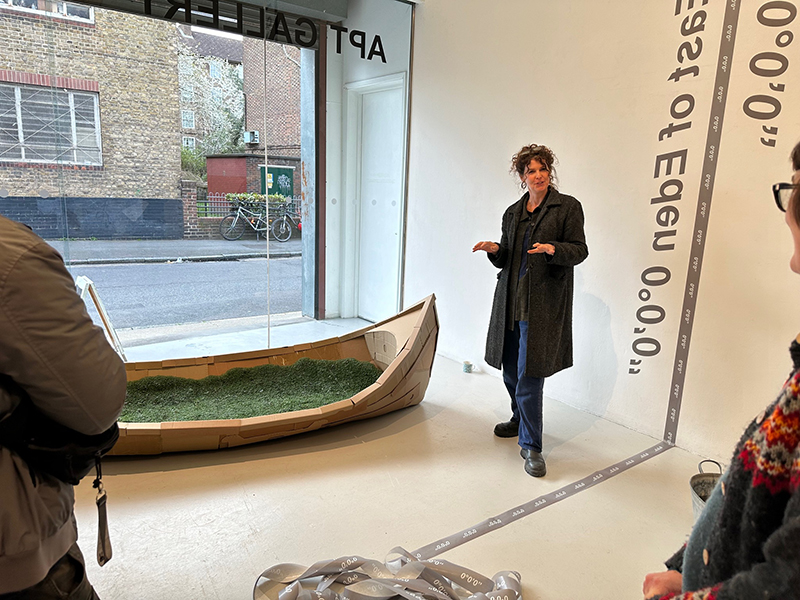
Kaori Homma’s multi-site Homma Meridian project asks us to reconsider and to challenge the cartographic demarcations that govern so much of our world and that we so frequently take for granted. With the deceptively simple move of ‘repositioning’ the Greenwich Prime Meridian, the artist radically shifts our perspective, as well as our sure footing, both figuratively and even literally. At each of its iterations (which have included Budapest, Margate, Wales, Paris, London and Pennsylvania) the artist and participating audiences draw an impermanent line running north-south, always using ephemeral materials, as a substitute for the ‘Prime’ meridian. The project’s act of displacement and its ephemerality work to highlight the imaginary nature of boundaries and to shake up our perception of our position on the earth as it spins on its titled axis. Works include Homma Meridian, Deptford, 2024, Vinyl Letters, tape, dimensions variable; Floating 0 degree Longitude, 2024, Abrudashi Fire Etching, Water, Bucket, 60 x 38 x 25 cm; Four corners of the earth, 2024, Aburidashi Fire Etching on Paper, 50 x 80 x 3 cm
Alongside the exhibition we held a series of events including a Low Tide Walk in Deptford Creek – led by Anne Krinsky in partnership with Creekside Discovery Centre followed by refreshments and a tour of the Life Boat exhibition at APT Gallery just two minutes from this amazing natural habitat in Deptford.
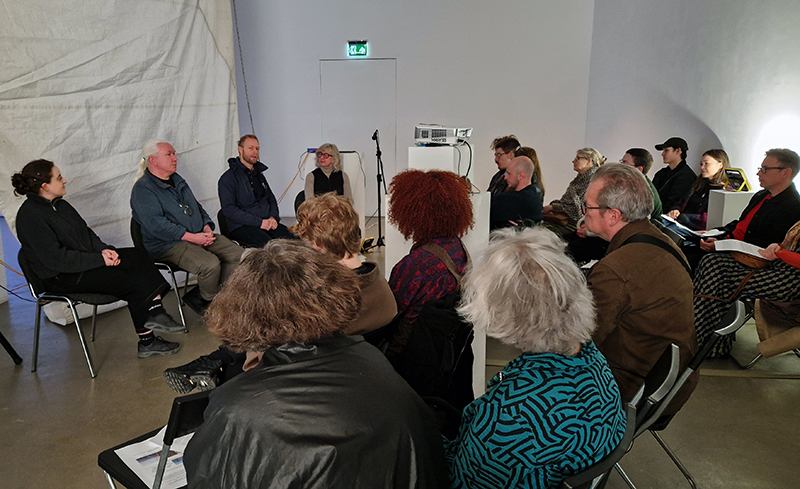
FIELDWORK AS PRACTICE – A live sonic performance by Oskar Jones and a conversation led by Caroline AreskogJones bringing together Oliver Beardon (Founder and Skipper of ‘Sail Britain’) Richard Sabin (Principal Curator of Mammals at the Natural History Museum, London) and Sophie Nicolov (AHRC Early Career Research Fellow, Natural History Museum, London) for a discussion around the potential overlaps between ‘field’ and research, artistic practice and ecological activism.
Homma Meridian and the Secret of Invisible Ink/Fire Etching Workshop where Kaori Homma shared her technique using Invisible Ink as part of the Aburidashi/Fire Etching process, historically used for espionage, she also gave a fascinating presentation on the history of this process and how it relates to her own art practice and her Homma Meridian Project.
In tackling concepts of the perilous, the vulnerable and the lost, Life Boat raises the alarm on the passive position of waiting for rescue and encourages urgent action in troubled waters.
Gallery Visits
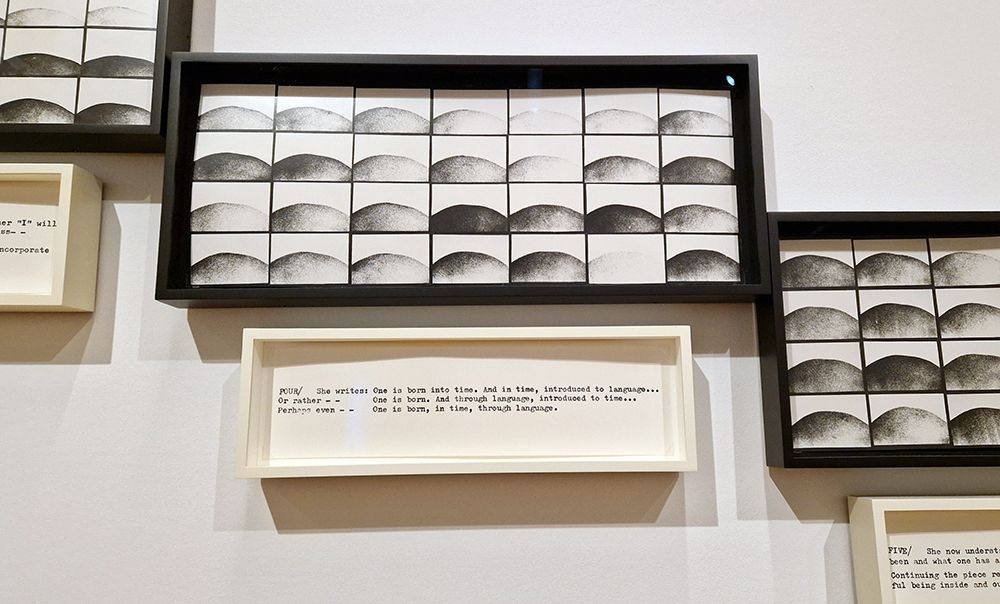
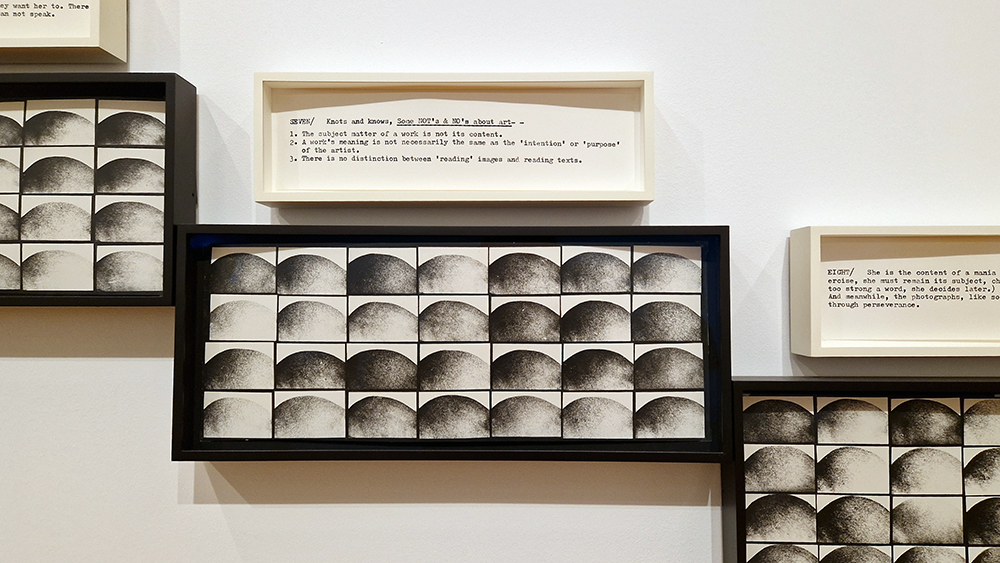
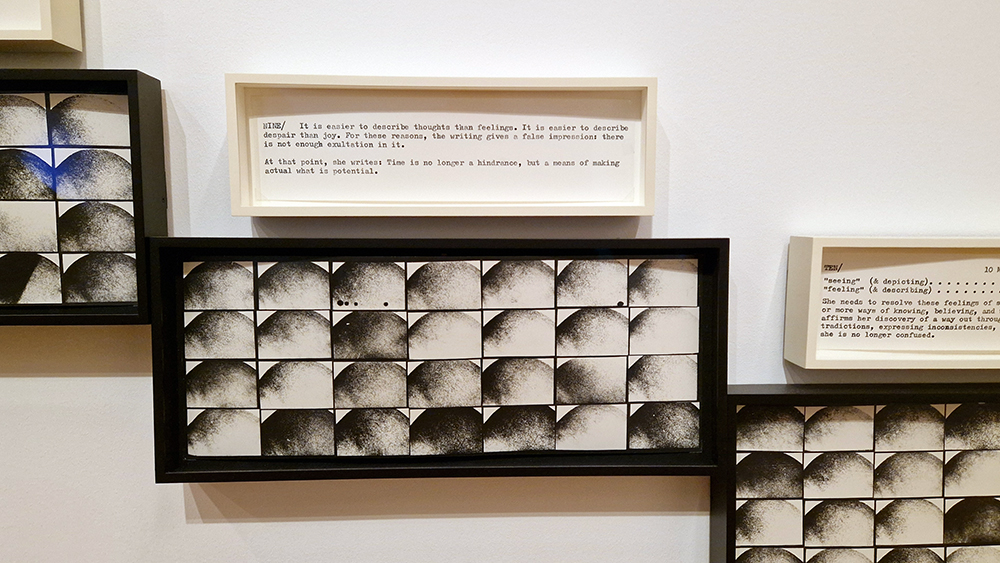
Women In Revolt at Tate Britain. A lot of documentation here of social history. Many texts, posters, zines, not so much art but a great piece from the inimitable Susan Hiller, with personal incites accompanying images of her ever increasing pregnant belly such as: – She writes, one is born into time. And in time introduced to language….Or rather — one is born. And through language, introduced to time…Perhaps even — one is born, in time, through language.
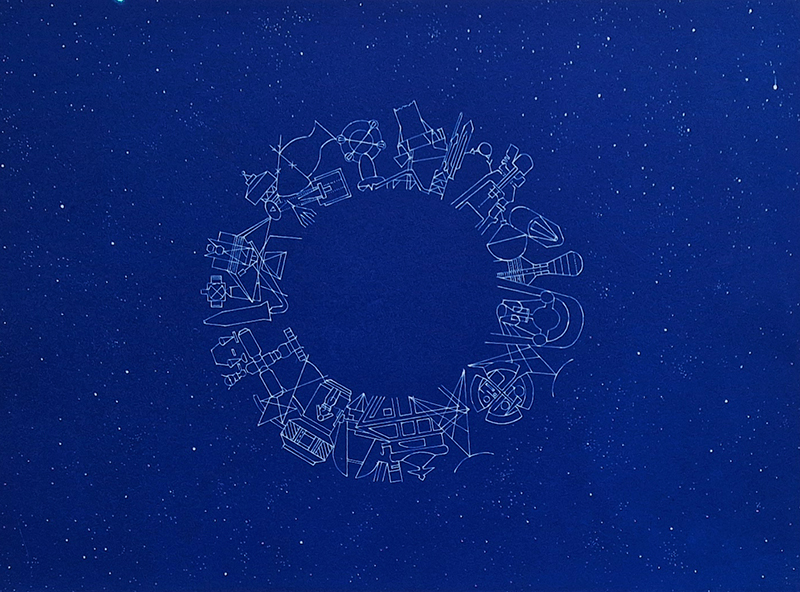
Mary Yacoob, captivates with astonishing precision of detail as always in Brutal Space at Bobinska Brownlee exploring the subject of future adaptations to life in space.




















































































 Susan Eyre