Archives for posts with tag: Collagraph

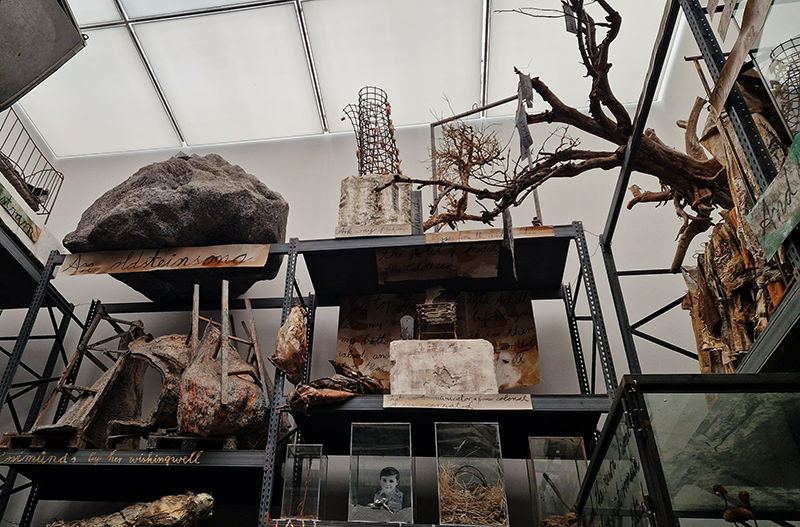
Photoshoot with Warren King Photography resulted in some great images of my work ready for the press release and promotion of A STONE SKY – the upcoming joint exhibition, with Julie F Hill, that we have been working towards for many months. The exhibition will be at Thames-side Studios Gallery 11th – 26th November 2023 with a private view on 10th November 6-9pm.
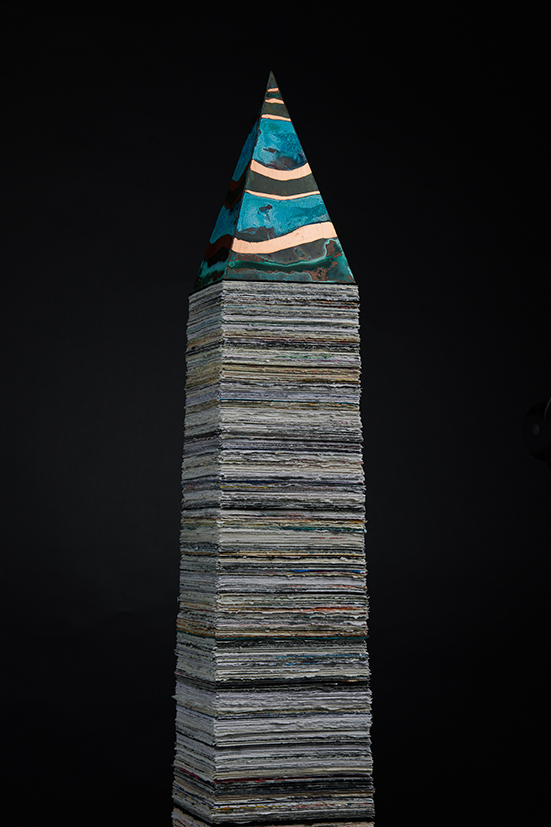
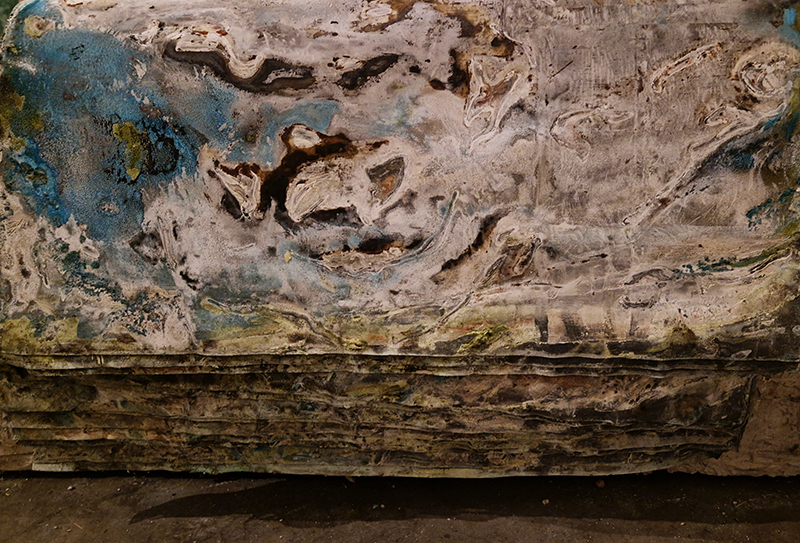
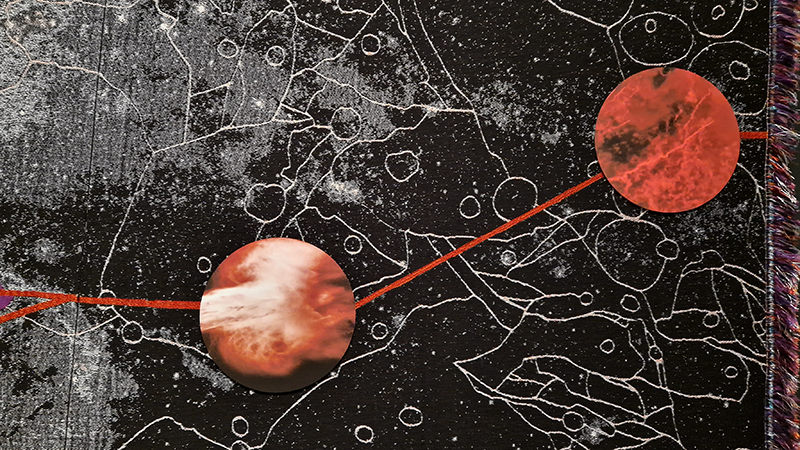
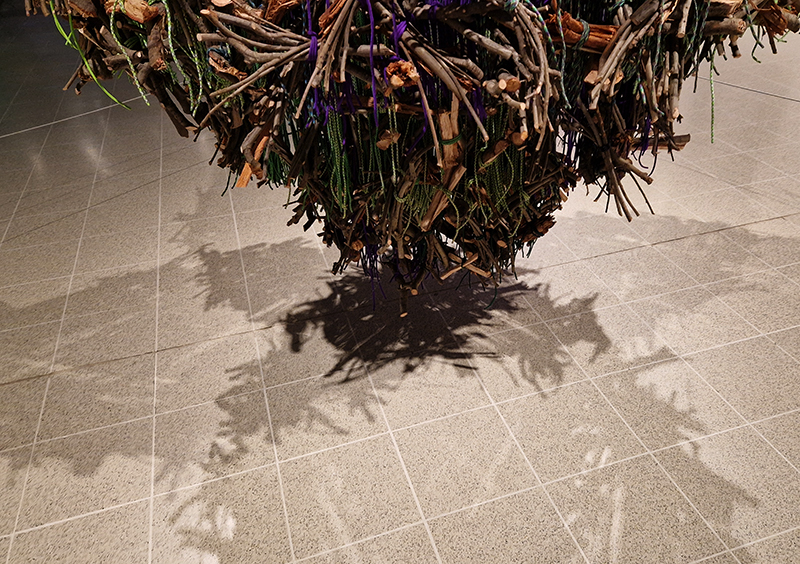
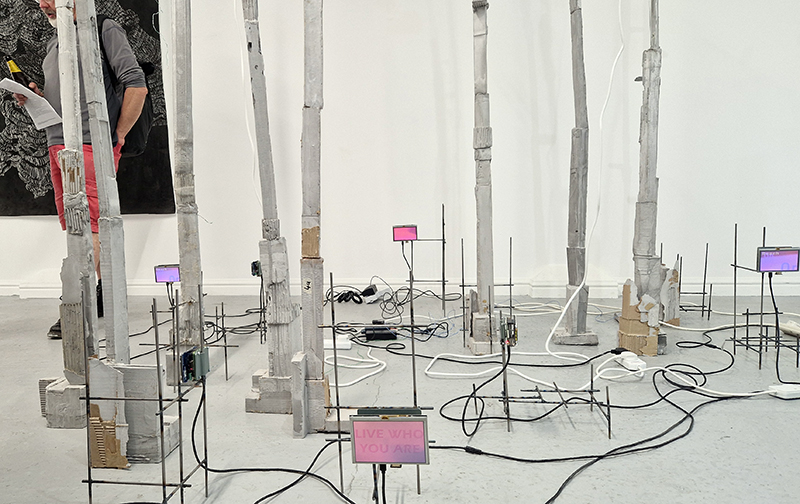
Susan Eyre, Azimuth Obelisk (of sedimentary knowledge), paper, concrete, patinated copper, 2023 (detail) Photo Warren King Photography
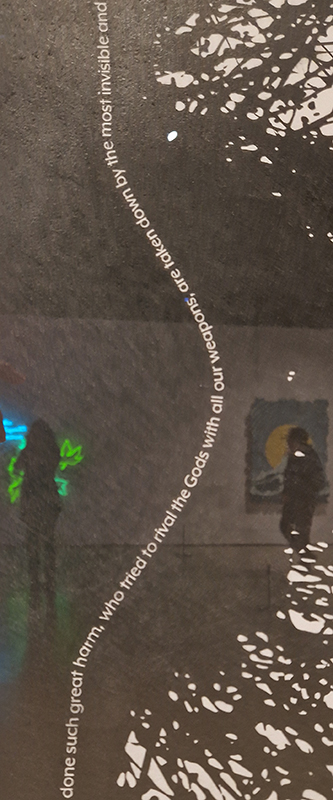
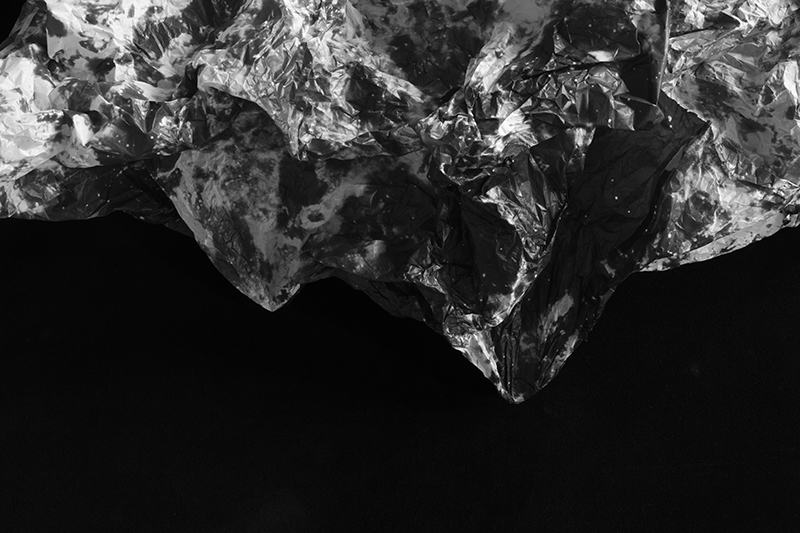
Julie F Hill, Cave, physically manipulated print of infrared James Webb data of barred, spiral galaxy NGC 5068, 2023 (detail).
Photo Julie F Hill

A Stone Sky brings together the works of multi-disciplinary artists Julie F Hill and Susan Eyre who traverse cosmic layers from the deep earth to deep space, exploring manifestations of darkness and its associations with the unknown and undiscovered. Reimagining the idea of an observatory, their sculptures and installations reach for scales and orders that surpass the human, revealing the cosmic at our feet. The exhibition proposes a cavernous realm of real and speculative possibilities that arise from beyond the limits of human perception. Engaging with the extended sensory range offered by technologies such as orbiting space telescopes through to the ability of birds to ‘see’ the Earth’s magnetic field, the artists’ reveal intimate connections between earth and space.

It was great to meet Anjana Janardhan who we have commissioned to write an essay for a publication which will be launched on the final weekend of the exhibition. We are also planning to give some informal readings, tours of the work and I will be running the cloud chamber so visitors can see the trails of cosmic rays – a way of visualising these unseen visitors from the stars.

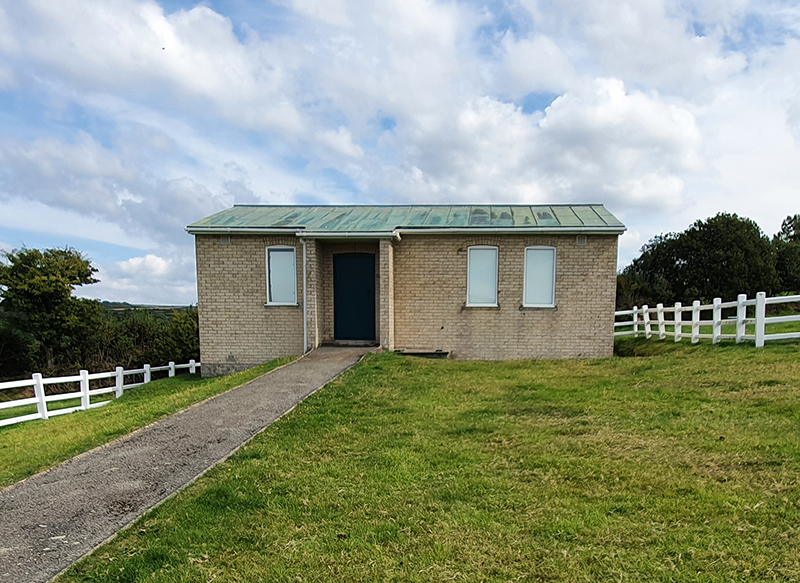
The Azimuth Obelisk (of sedimentary knowledge) sculpture is an almost 3m tall reimagining of the obelisk erected at Hartland Magnetic Observatory in 1955 as an azimuth mark to be viewed from the Observing Room or Absolute Hut to monitor the drift of the magnetic north pole.
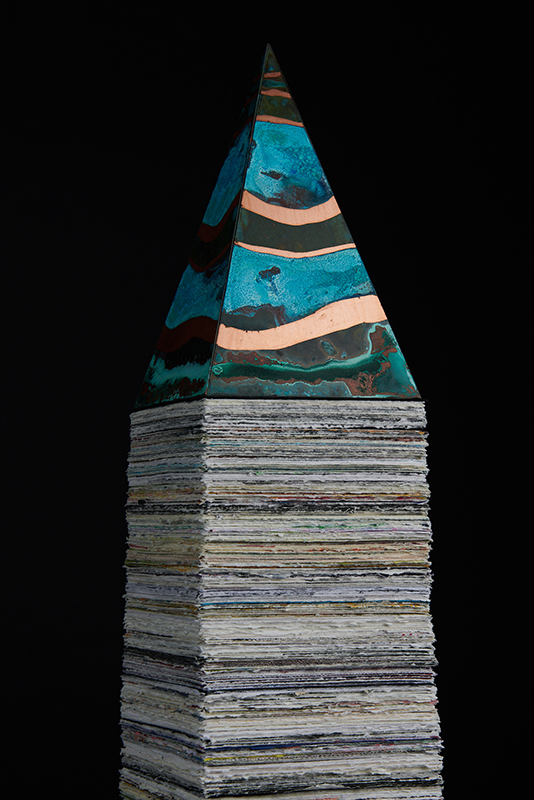
I have obtained an old wooden trolley to put the cosmic ray detectors and projector on for the digital video work The Breath of Stars. This feels in keeping with the original furniture used at Hartland Magnetic Observatory. The Breath of Stars directly interacts with cosmic rays – as each cosmic ray particle strikes a plastic scintillator its energy is recorded and a starburst image video is projected. The interaction of cosmic rays and the solar wind with atmospheric electrical fields combines to influence the unpredictability of the magnetosphere. Most radioactive particles heading for Earth are deflected by the magnetosphere. Without the Earth’s magnetic field deflecting the majority of cosmic rays, life on this planet could not survive.

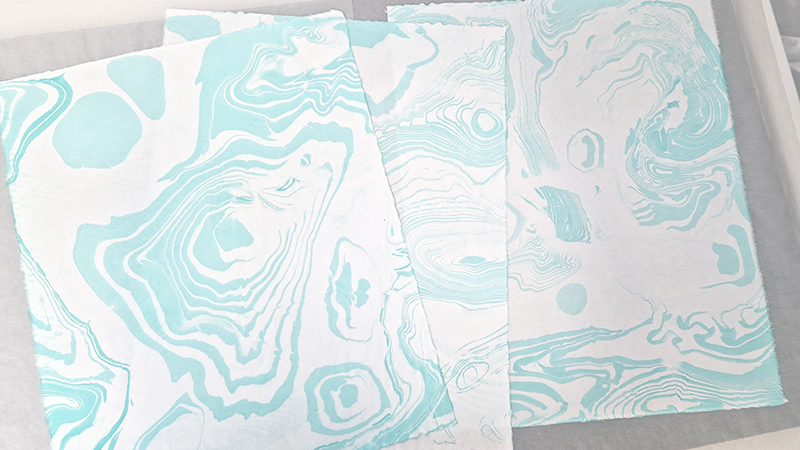
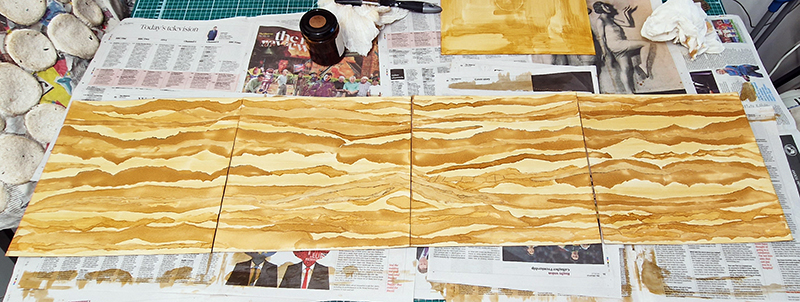
The 48 paper tiles for the roof of The Absolute Hut (of action potential) are made using the suminagashi technique of marbling with a colour to reflect both the sky and the patinated copper roof tiles of the Observation Hut at Hartland Magnetic Observatory. The paper is Japanese Osho Select and is very fragile when wet so has to be pulled from the water tray using a supporting mesh. Topological contours of suminagashi marbling reflect the fluid motion of the Earth’s magnetic dynamo and the pulsating alpha waves of the human brain when subjected to magnetic fields.
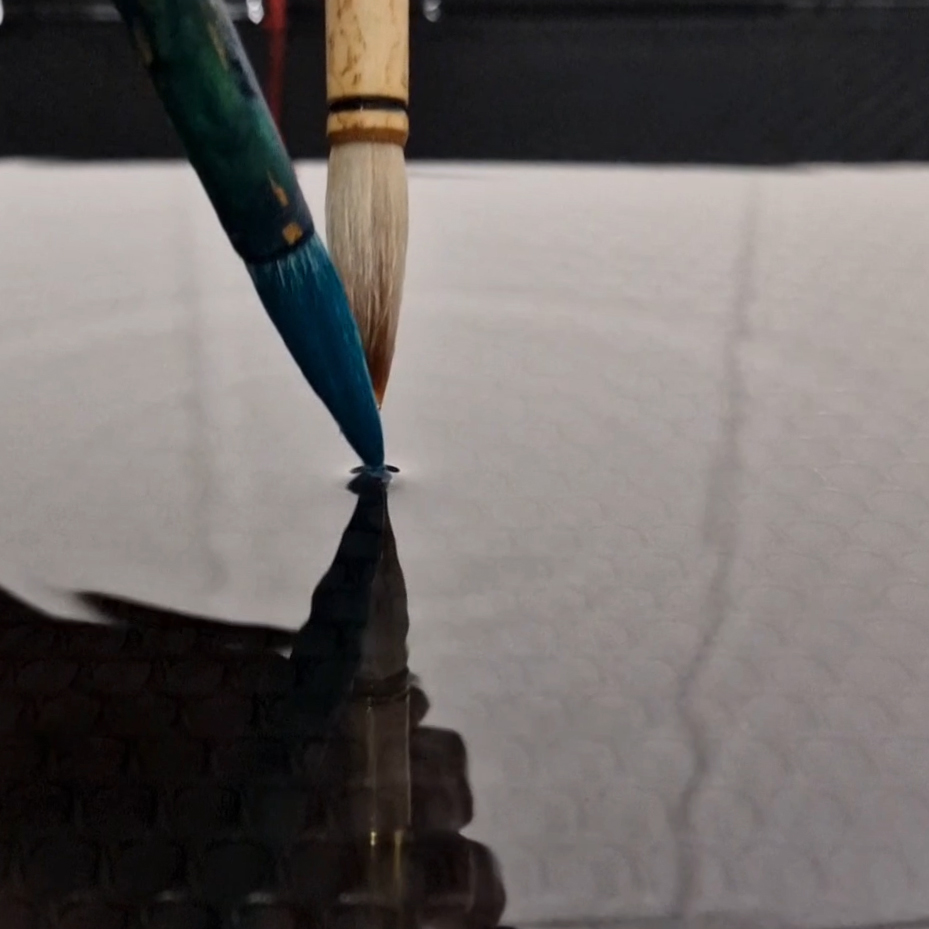
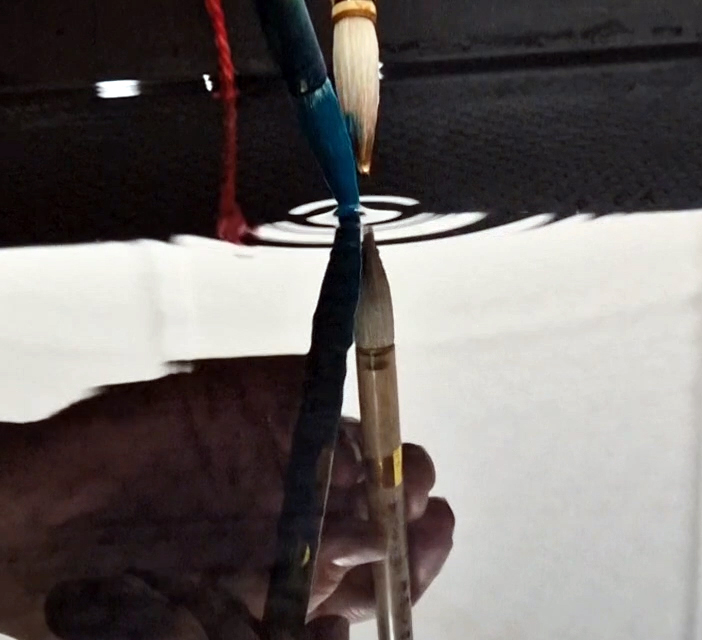
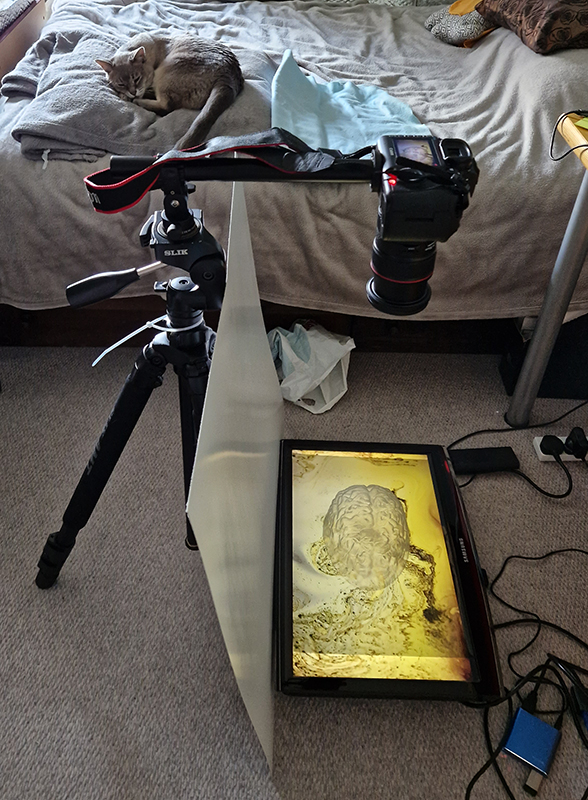
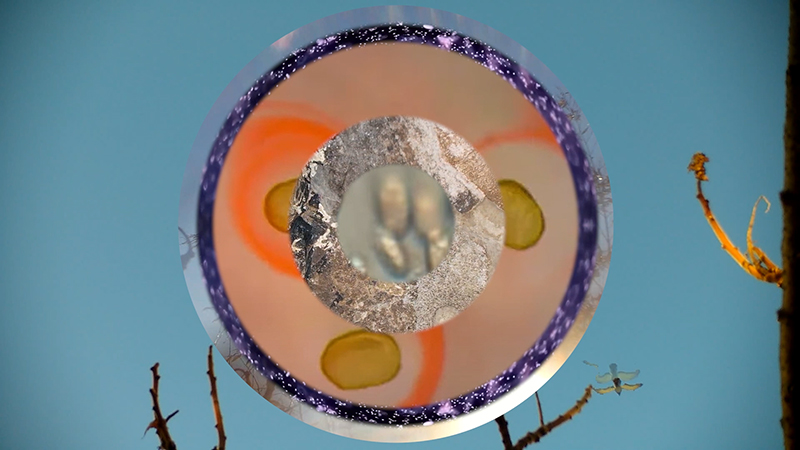
If you place a polarising filter over a screen that emits polarised light and use a polarising lens on the camera, then any plastic, photographed in this method, especially injection-moulded plastic, reveals stress points with a kaleidoscope of colours known as birefringence. Cryptochrome, the protein molecule found in a birds eye that enables birds to ‘see’ the magnetic field is excited by polarised light. Polarisation may also reveal the existence and properties of magnetic fields in the space medium light has travelled through. Research suggests that human alpha brainwaves react to a changing magnetic field. These ideas are brought together in a video work speculating on human magnetoreception via magnetite crystals in brain cells.

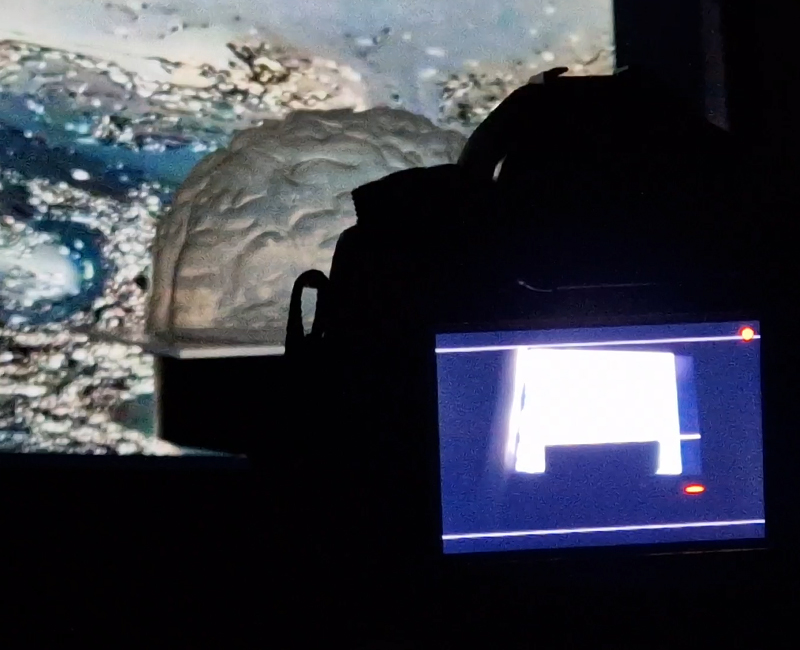
This video work will be shown on multiple small screens inside The Absolute Hut (of action potential) alongside two larger monitors showing companion video pieces exploring dynamics between the Earth’s geologic structure and navigation using the magnetic field.

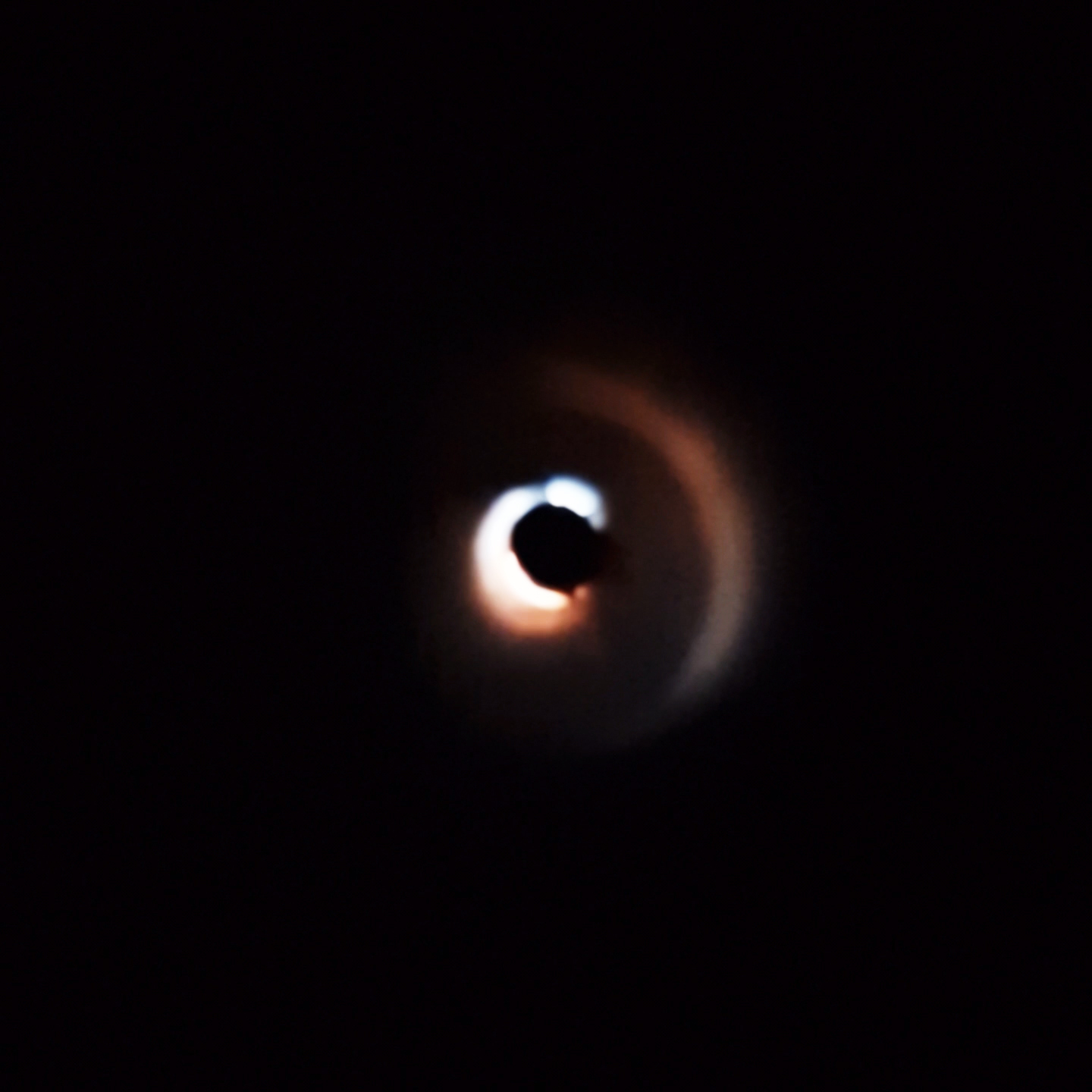
I have replicated the experiment I saw at the National Physical Laboratory, dropping a magnet down a copper pipe to see how the magnetic field generated slows the magnet down considerably. I filmed this and added a tiny led light with the magnet.
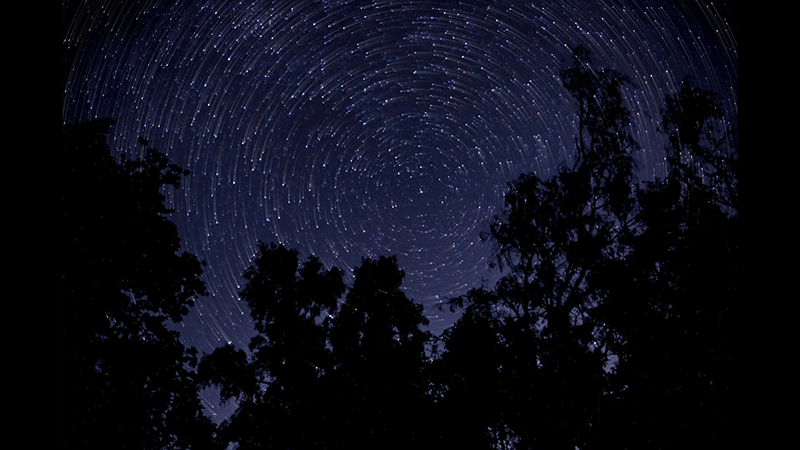
Finally dark skies and fine weather coincided so I was able to go and make a time lapse of the stars rotating around Polaris.
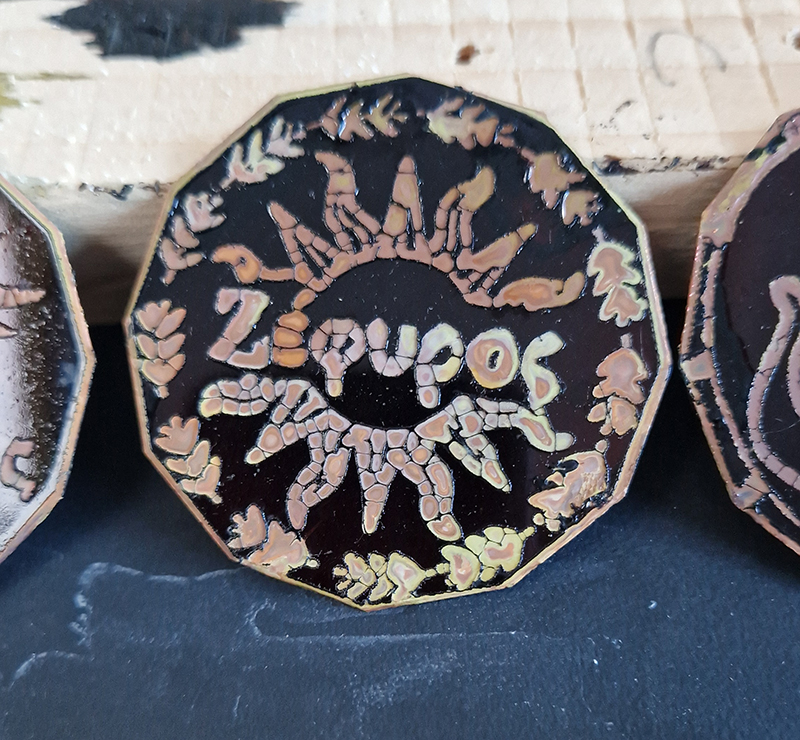
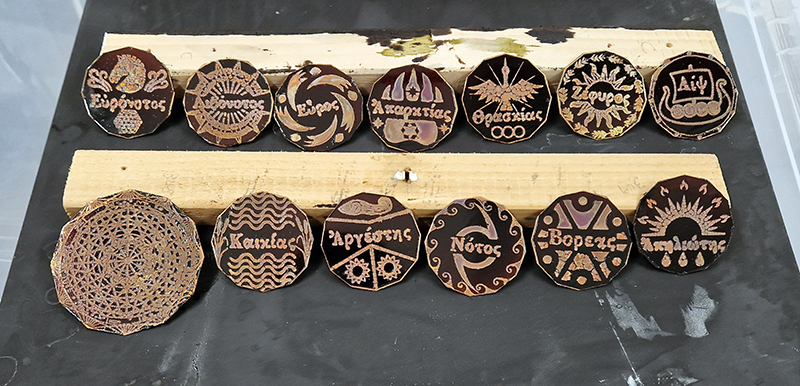
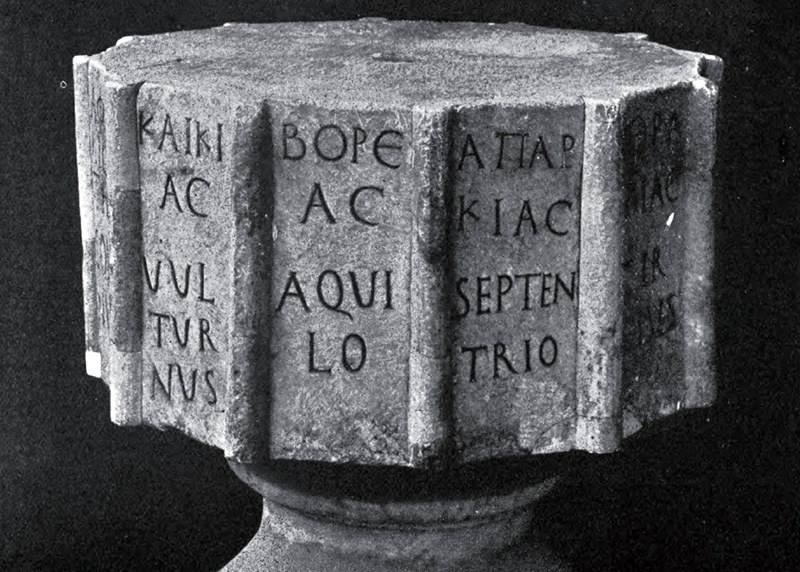
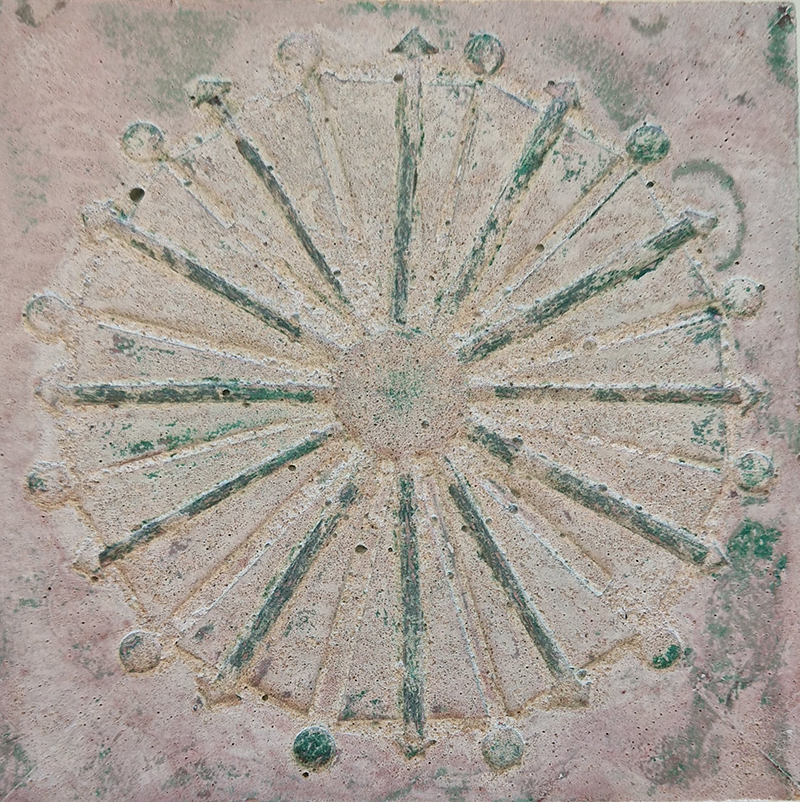
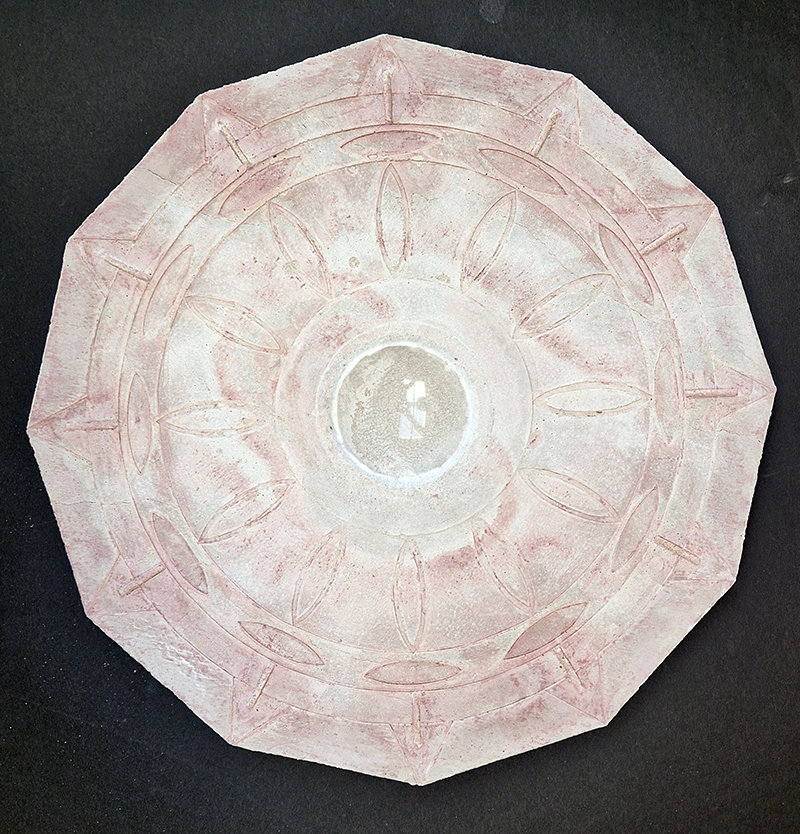
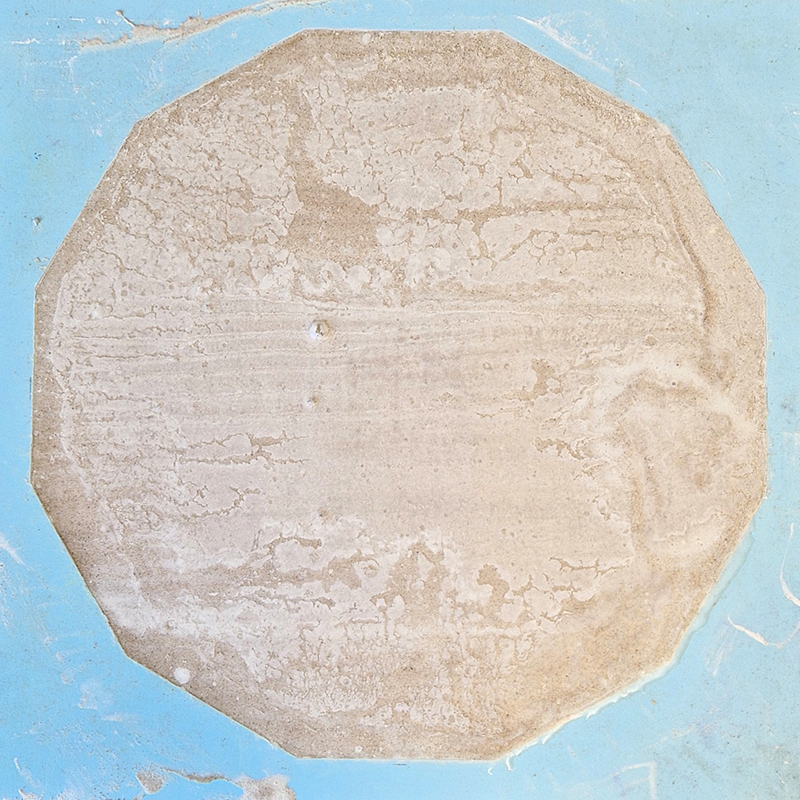
Instruments of the Anemoi is a set of three dodecagon tablets cast in Snowcrete, a non-magnetic cement, as used in a magnetic observatory. Suggestive of the pedestals that support various instruments used in monitoring the Earths’ magnetic field they also respond to an ancient anemoscope “table of the winds” inscribed with the Greek and Latin names of classical winds on each of its twelve sides.

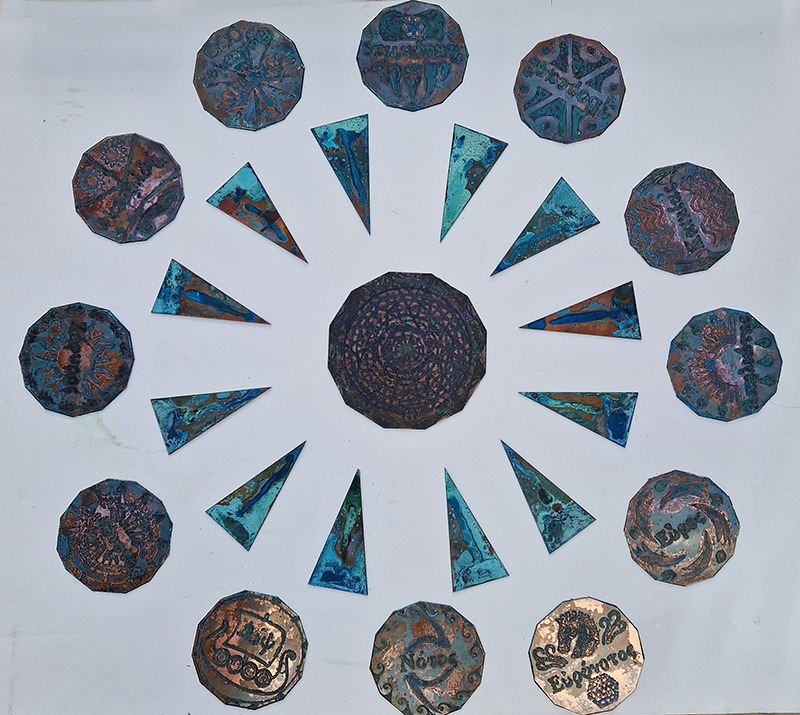
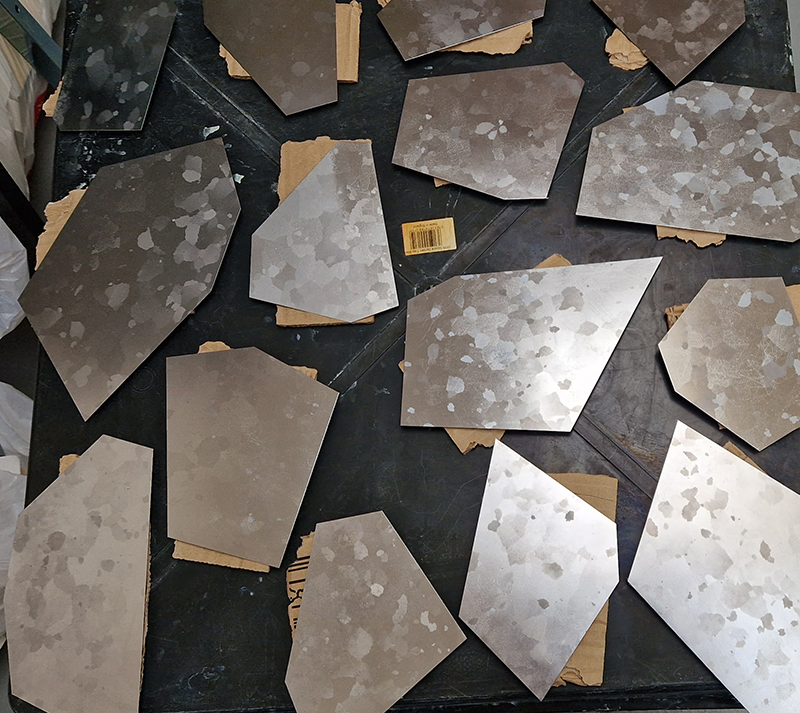
Hand cut copper pieces to be etched with images based on associations and attributes of the twelve Greek wind gods.

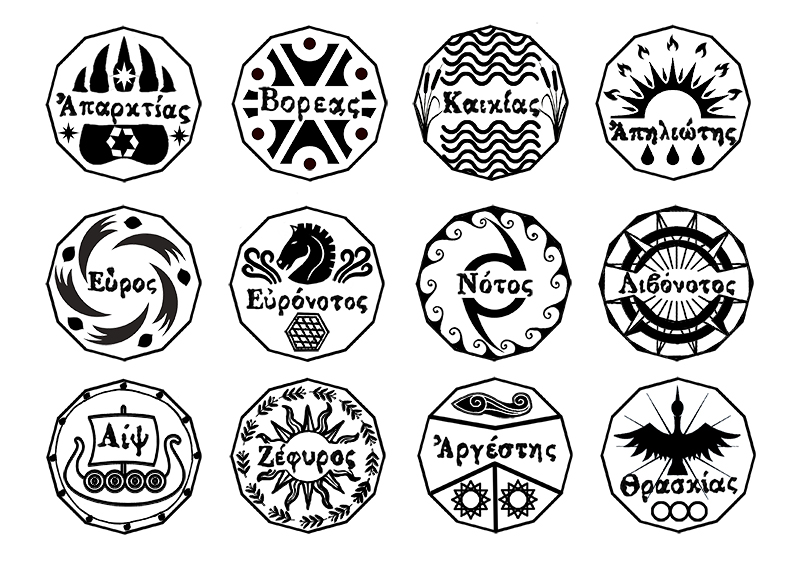
Sugar lift solution is screen printed onto the copper pieces.
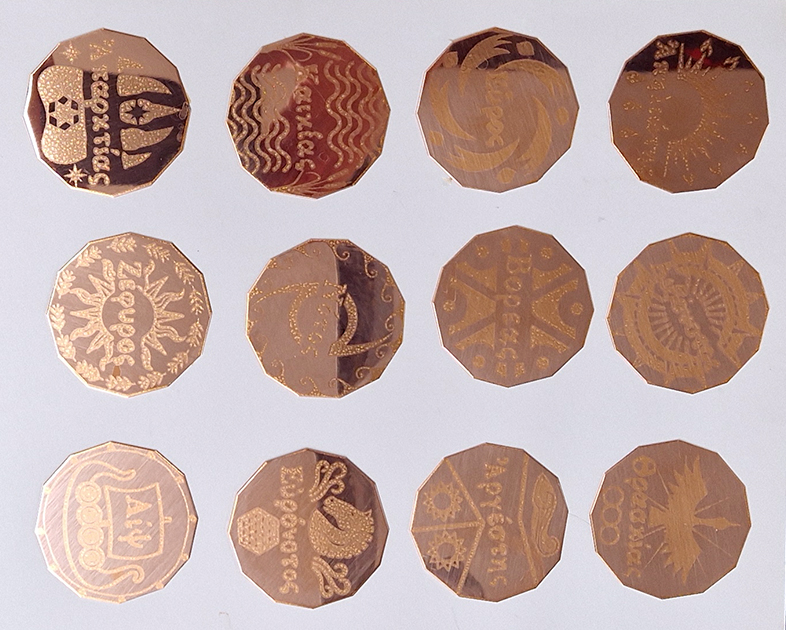
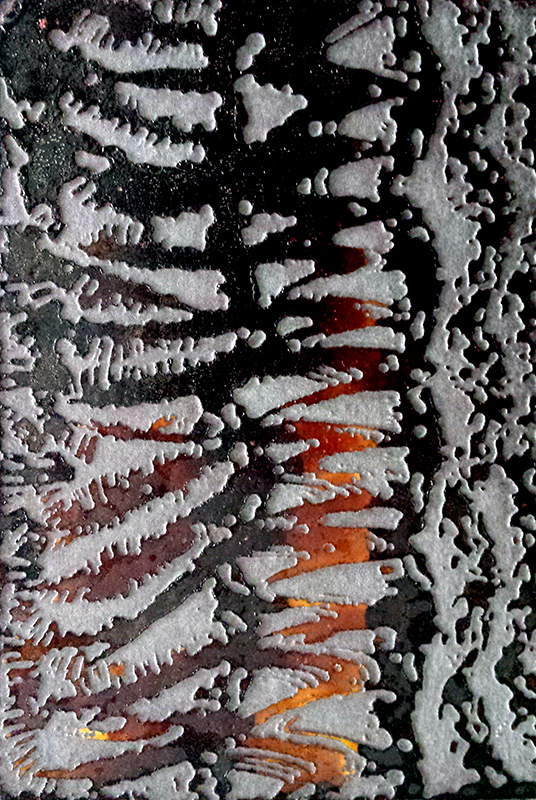
These are then dipped in bitumen and immersed in hot water where the sugar slowly dissolves to reveal the image.

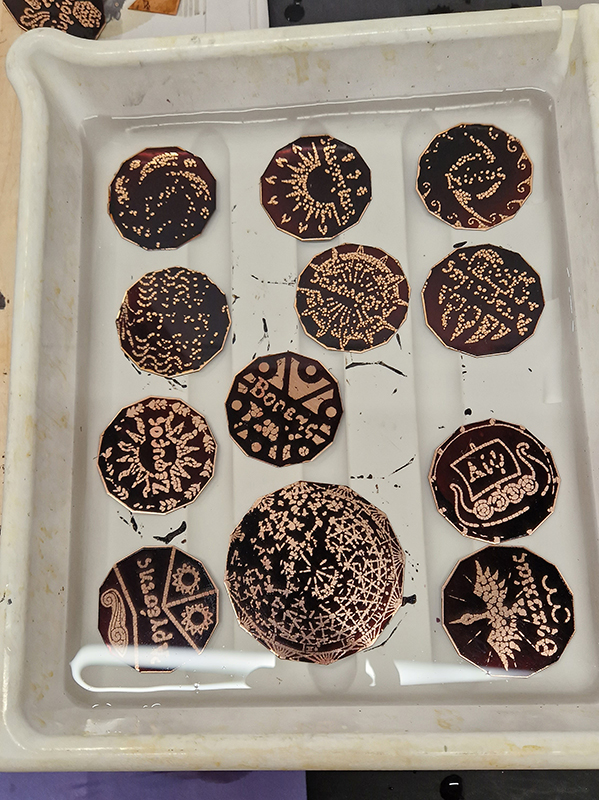
They are then left to dry before being etched.
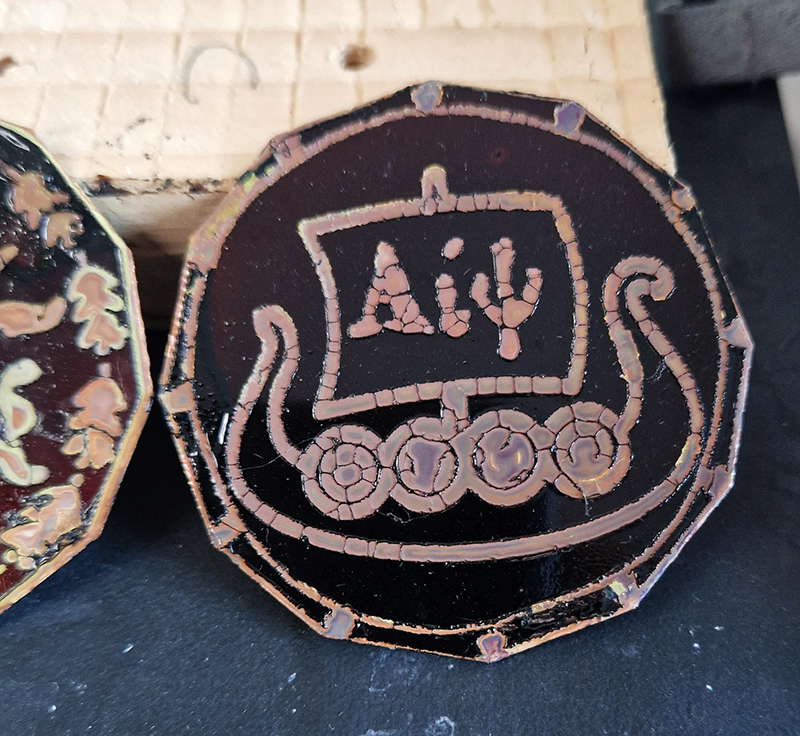
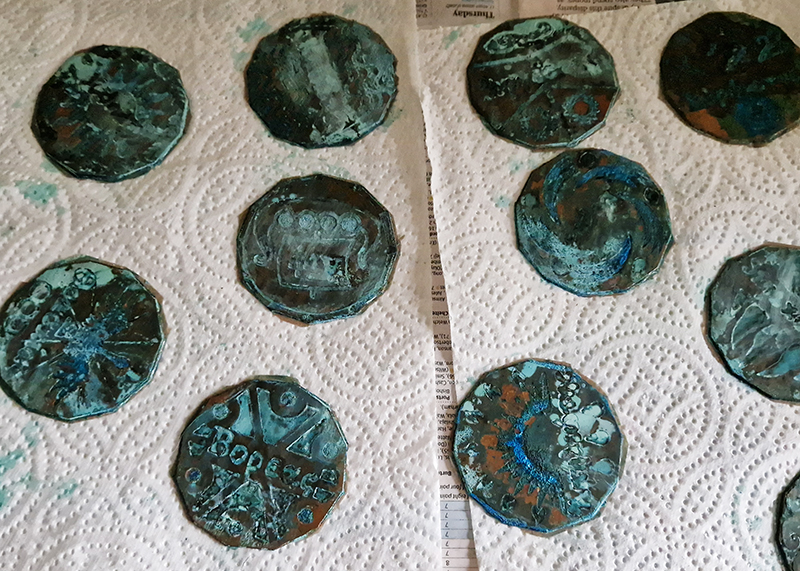
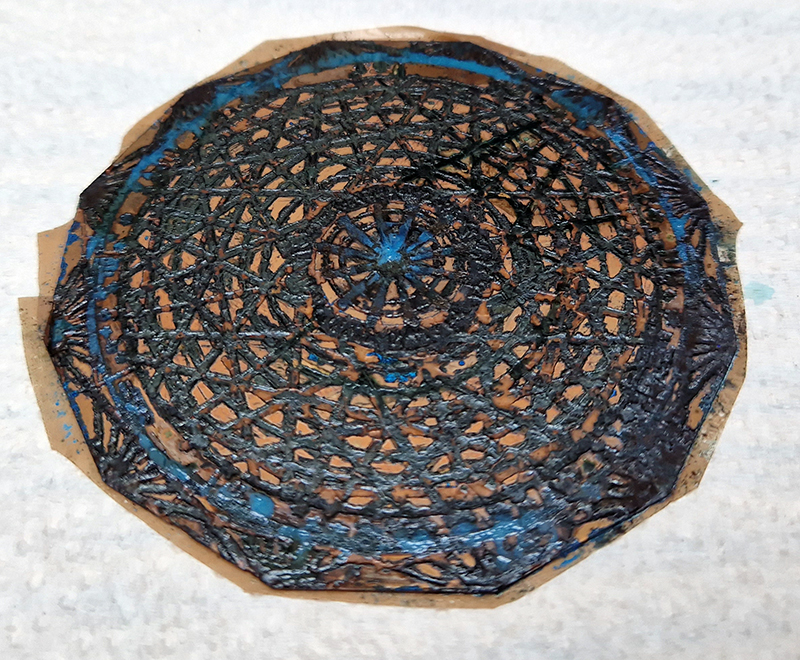
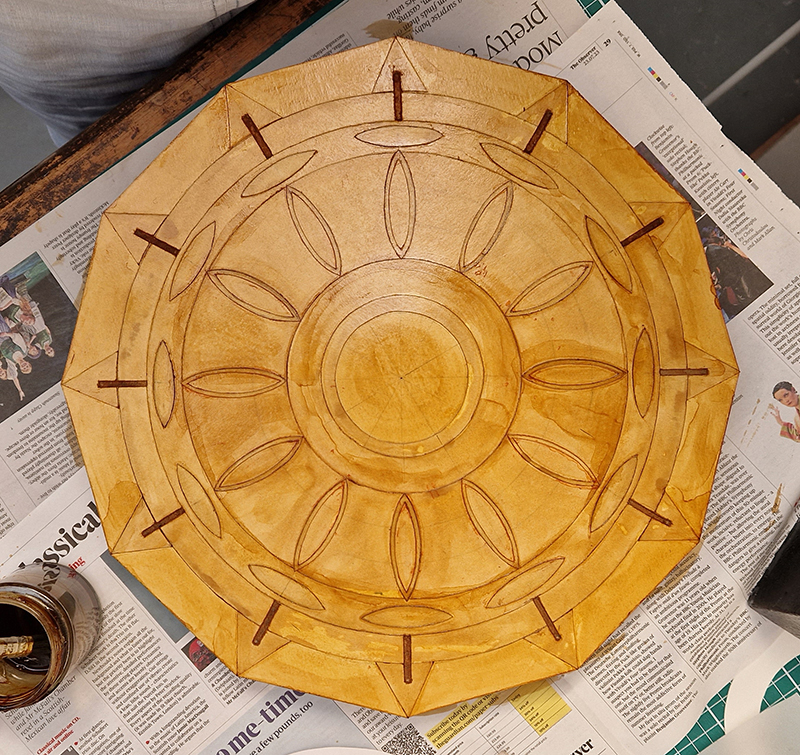
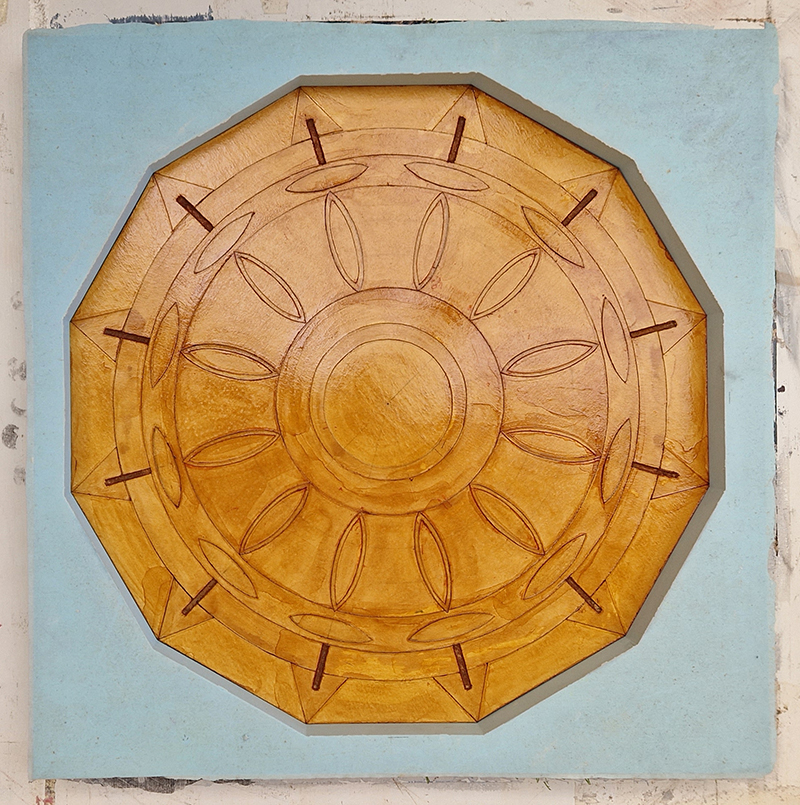
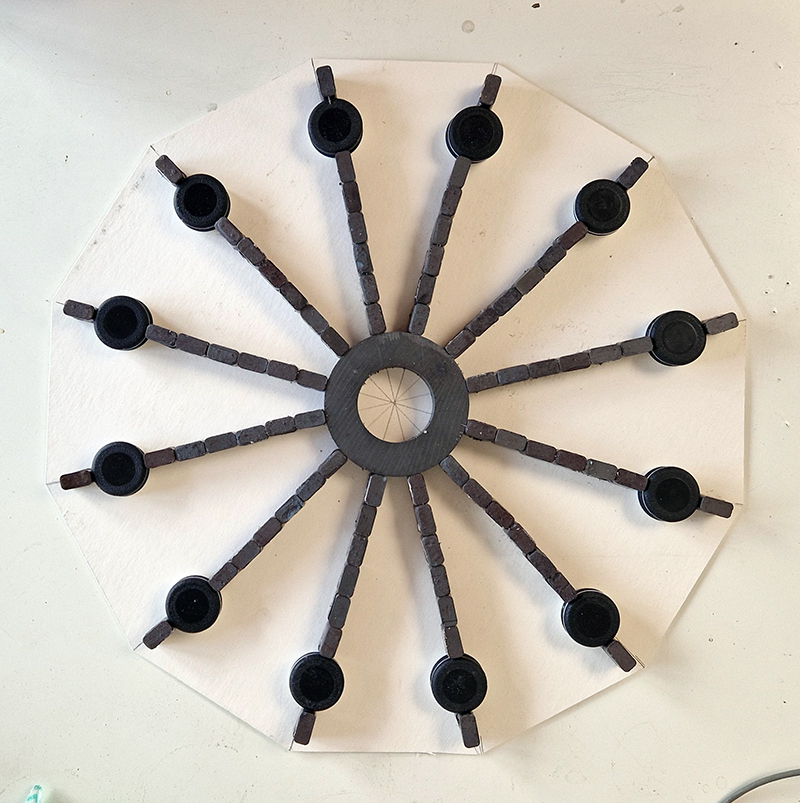
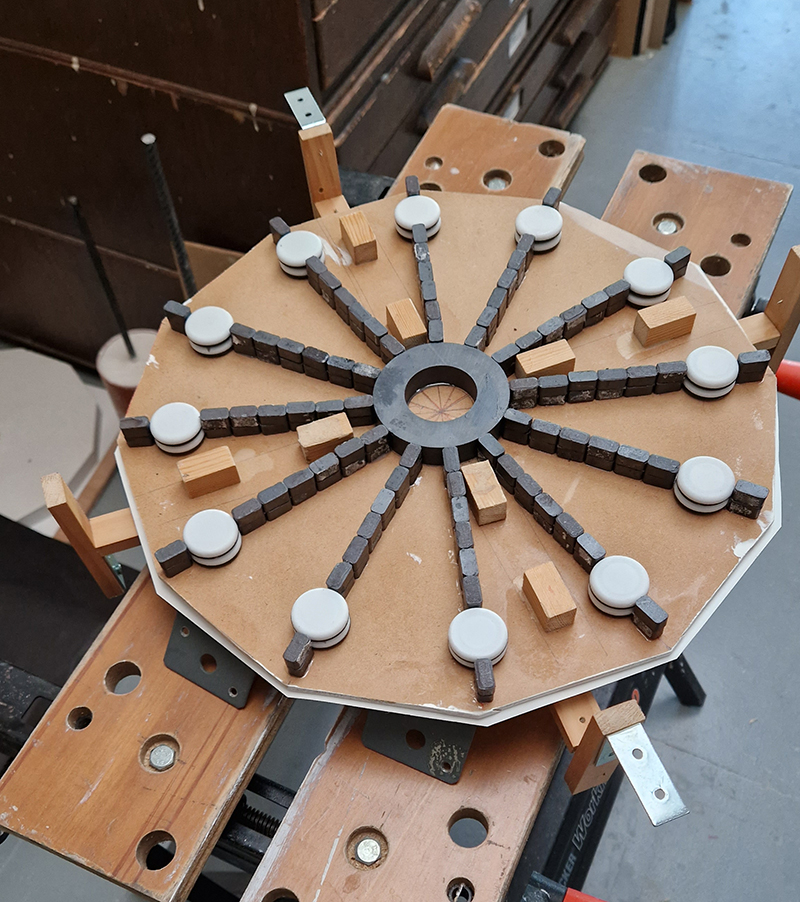
These were etched for 2 hours in an Edinburgh Etch solution, made with ferric chloride, citric acid and water to get a deep etch. The detail in the bitumen held very well. I constructed a collagraph from card to attach them to for casting in concrete. Once etched the detail areas were painted with a soy sauce solution before being placed in an ammonia vapour bath.
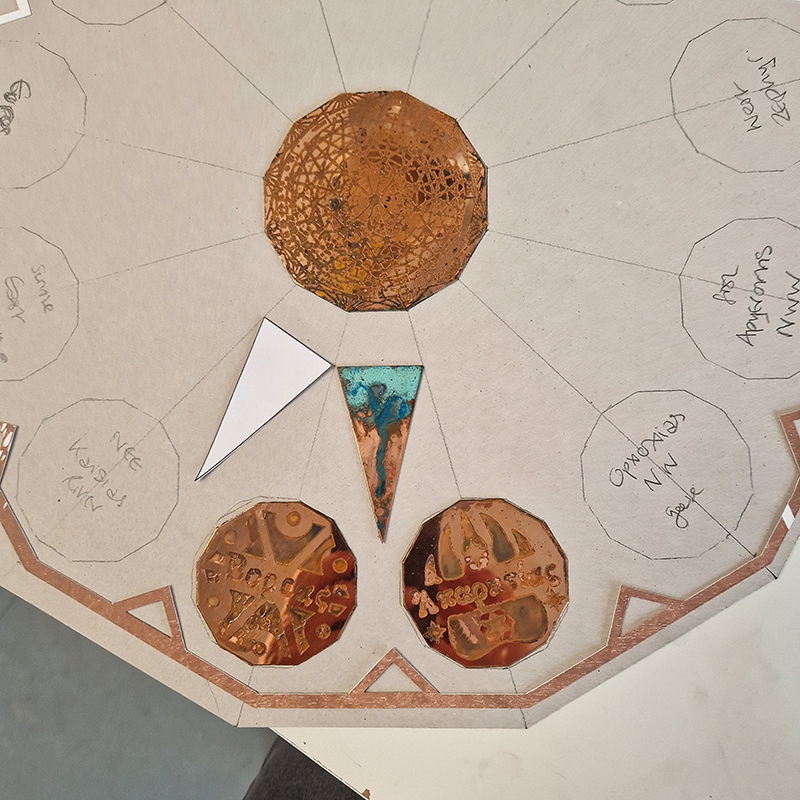
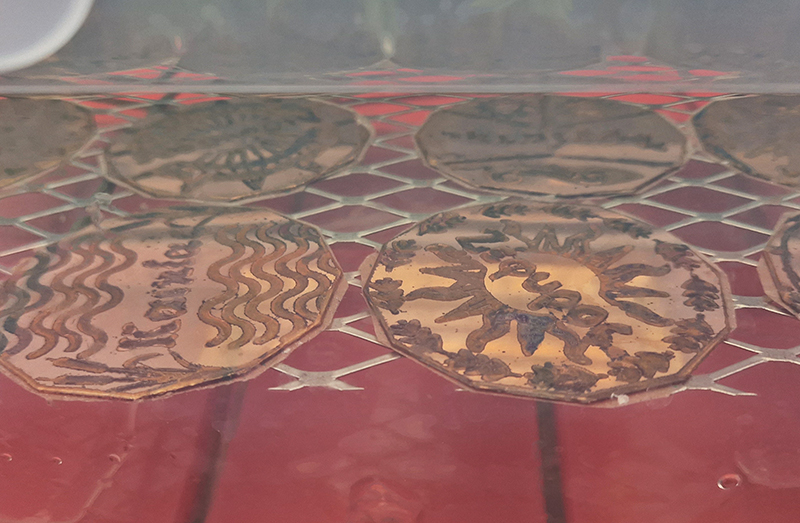
After a few hours patinating they are removed to dry before being cleaned up.

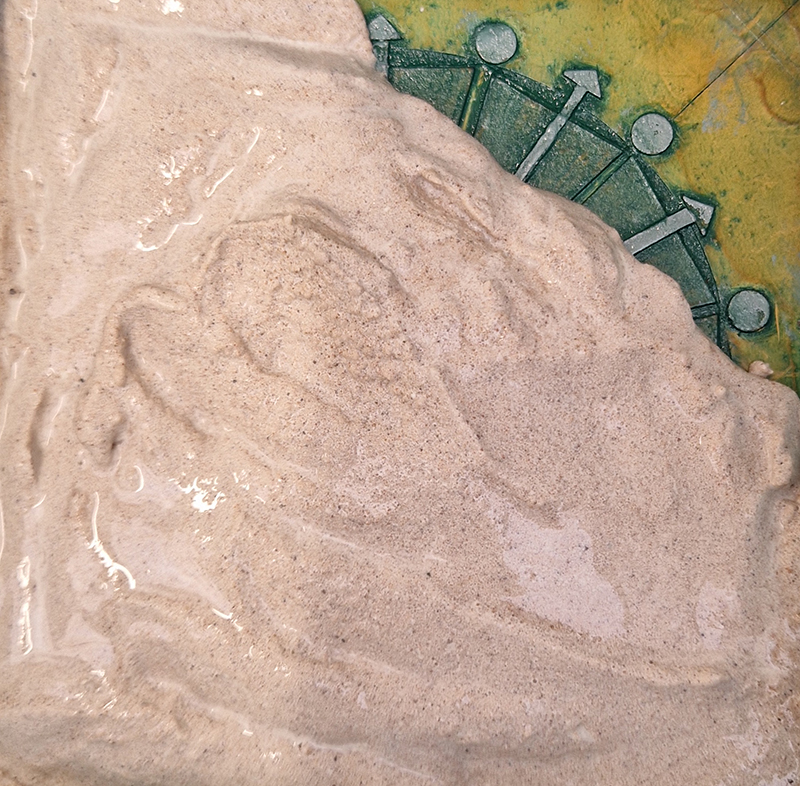
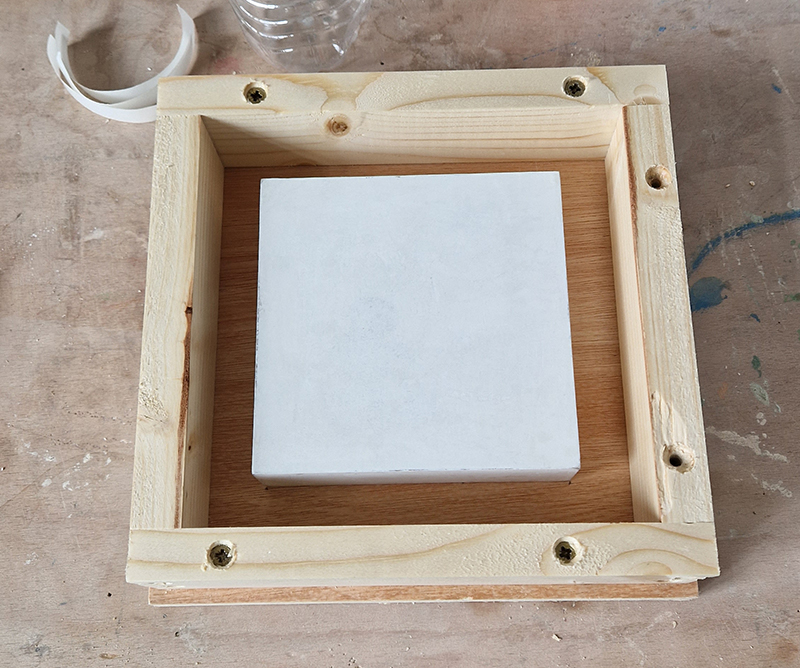
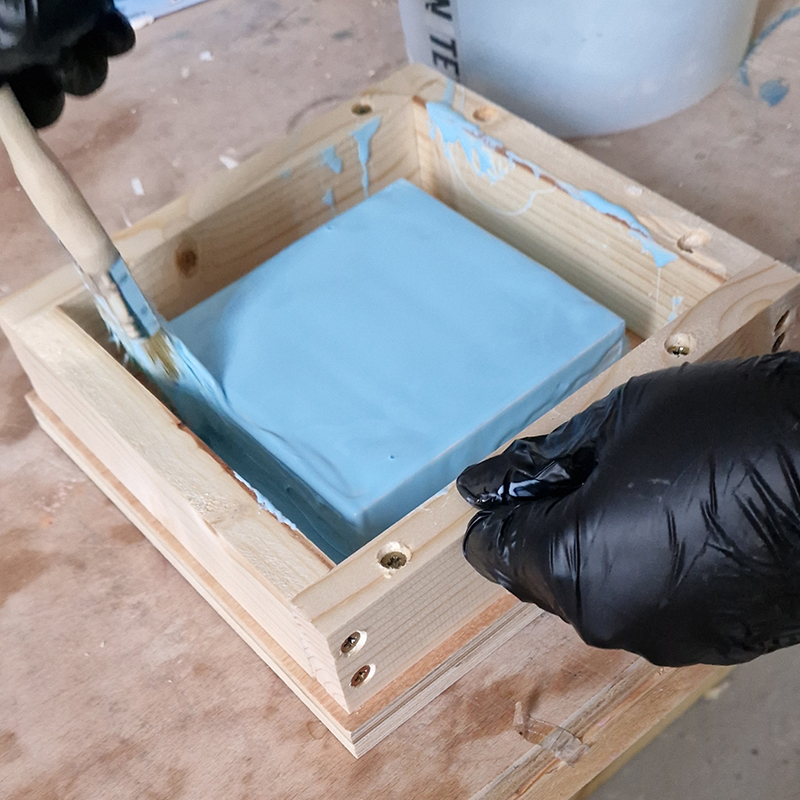
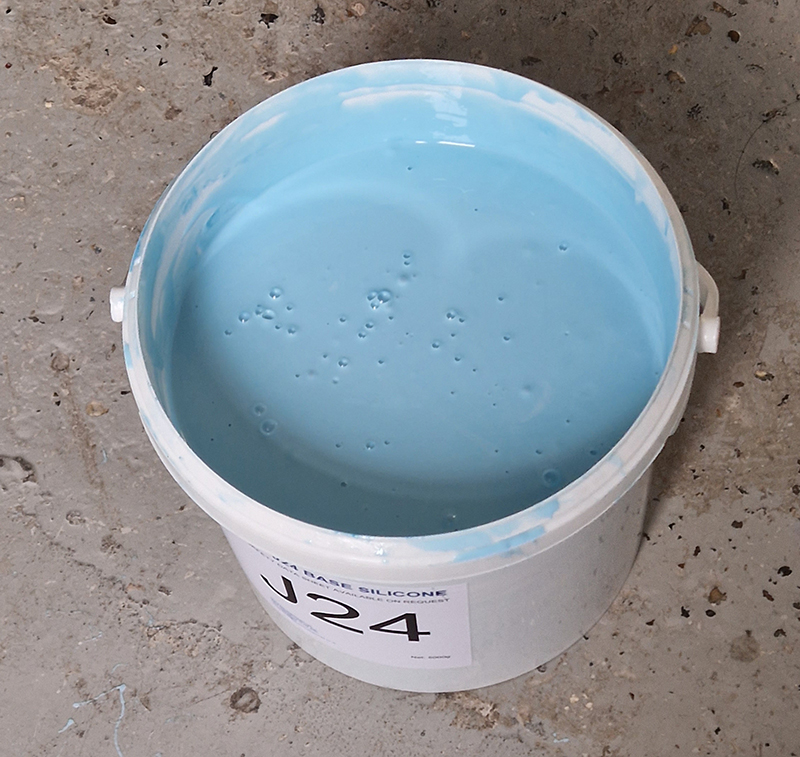
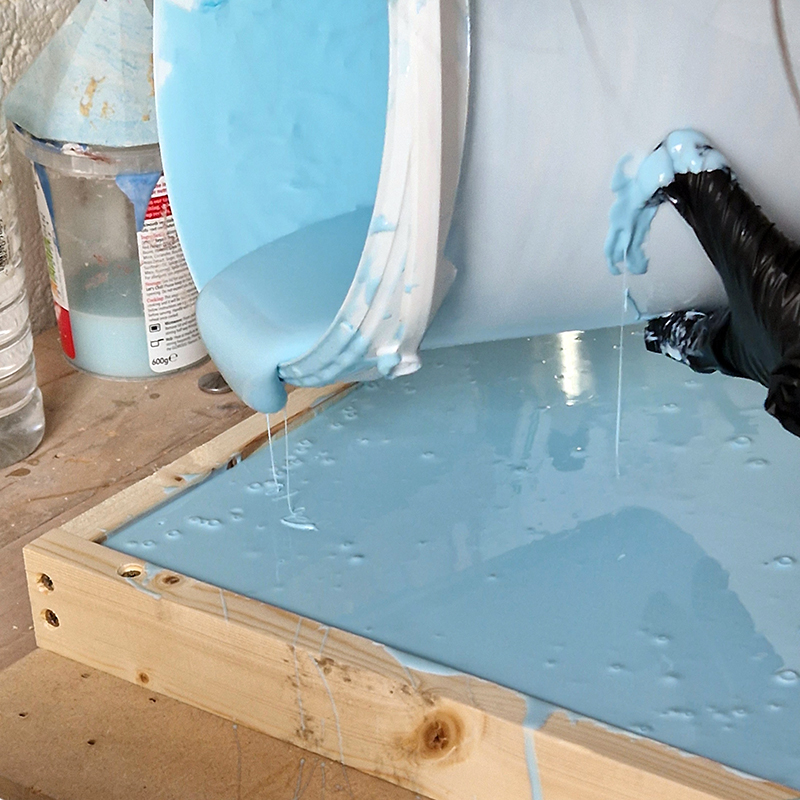
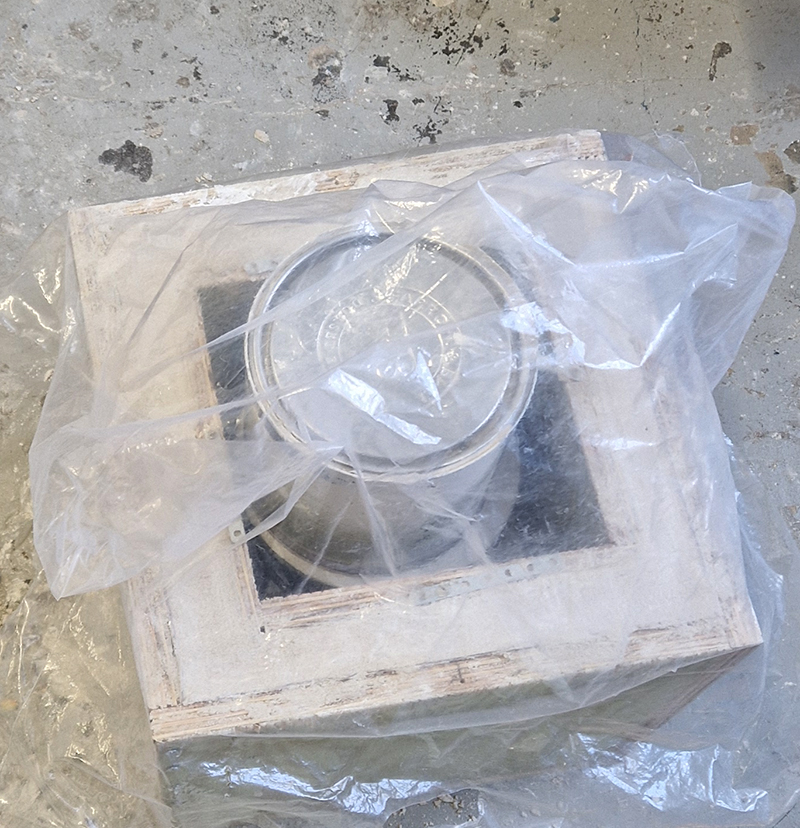
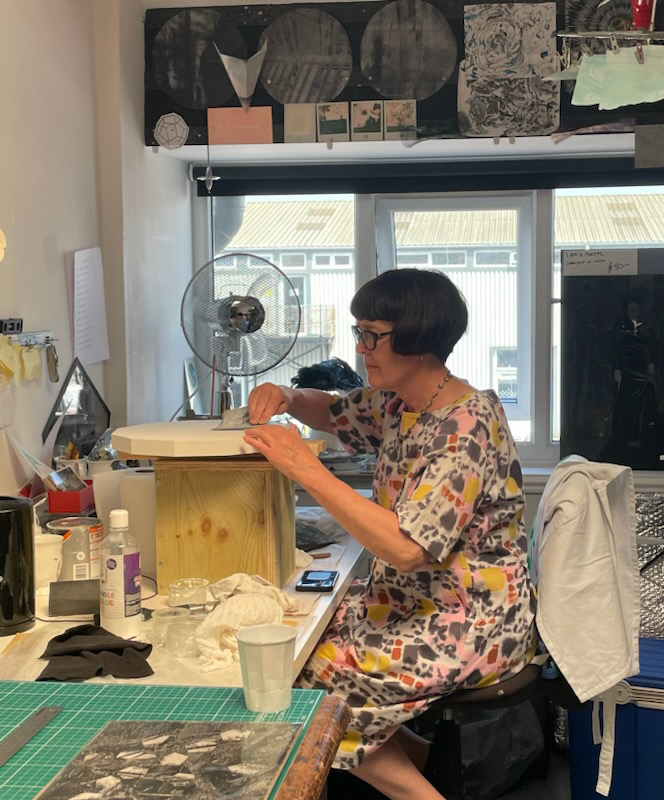
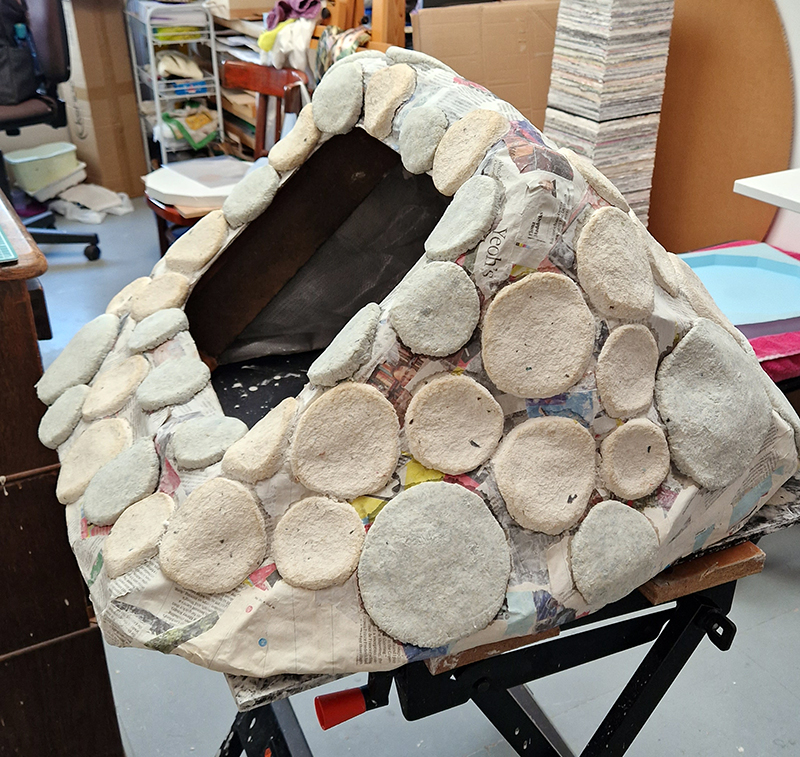
Positions are marked out on the collagraph and double sided tape is used to secure the pieces in place face down. The collagraph is then placed in the silicon mould ready for casting with Snowcrete – the same non-magnetic concrete used at a magnetic observatory.
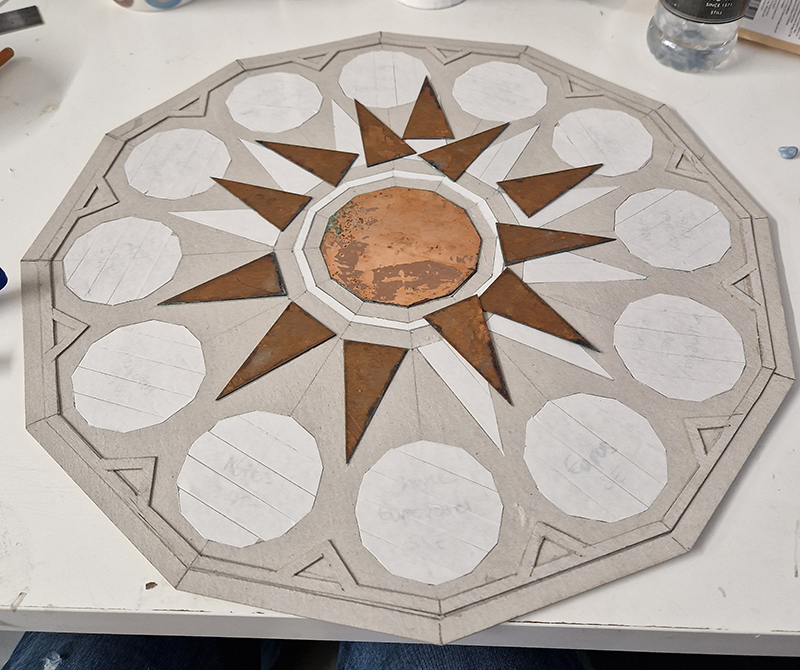
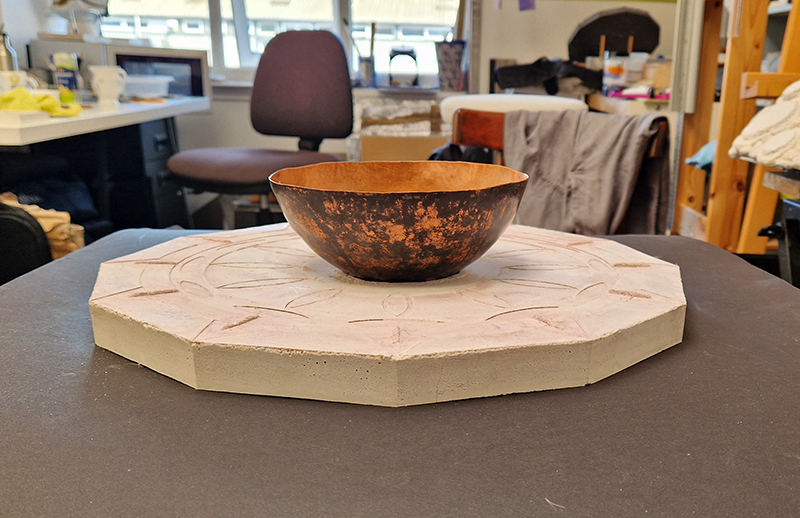
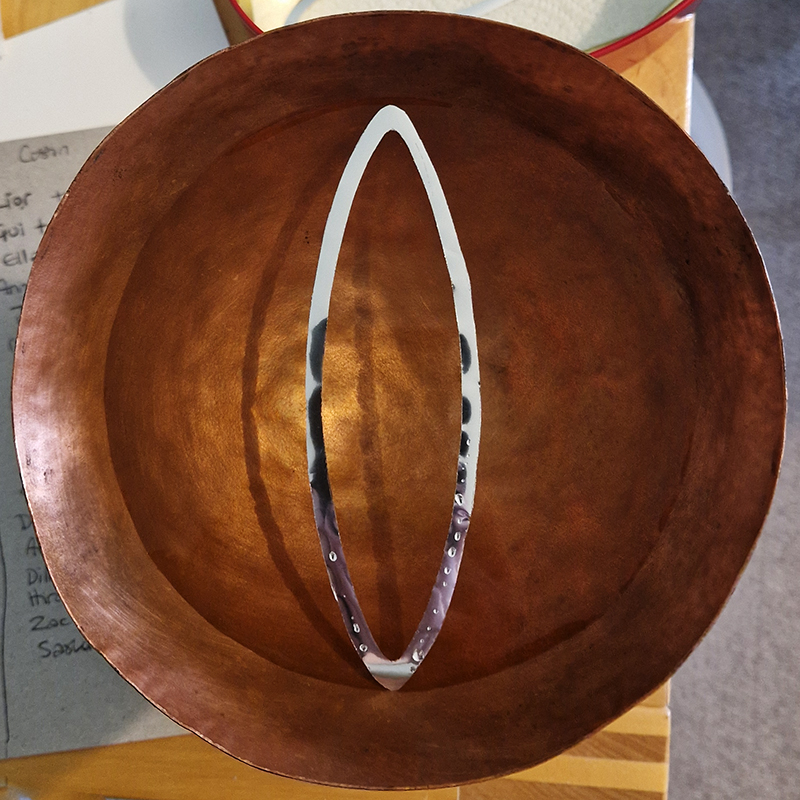
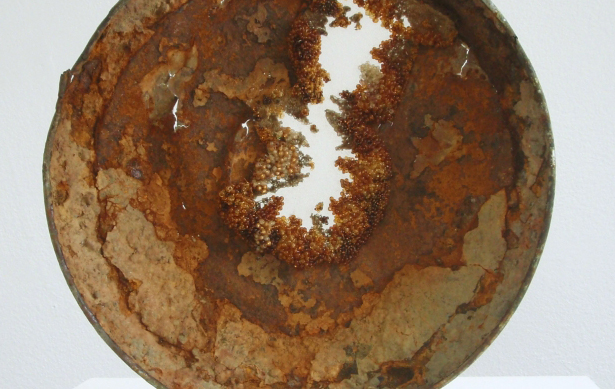
This is the third of the tablets to be cast for the work Instruments of the Anemoi. The first holds a copper bowl with a ‘silver fish’ floating in water based on the oval shaped compass needle (illustrated in Breve Compendio de la Sphera de la arte Navegar by Martin Cortes 1551) as symbol of the silver fish – wafer thin fish shaped iron leaves used by 11th century Chinese geomancers.
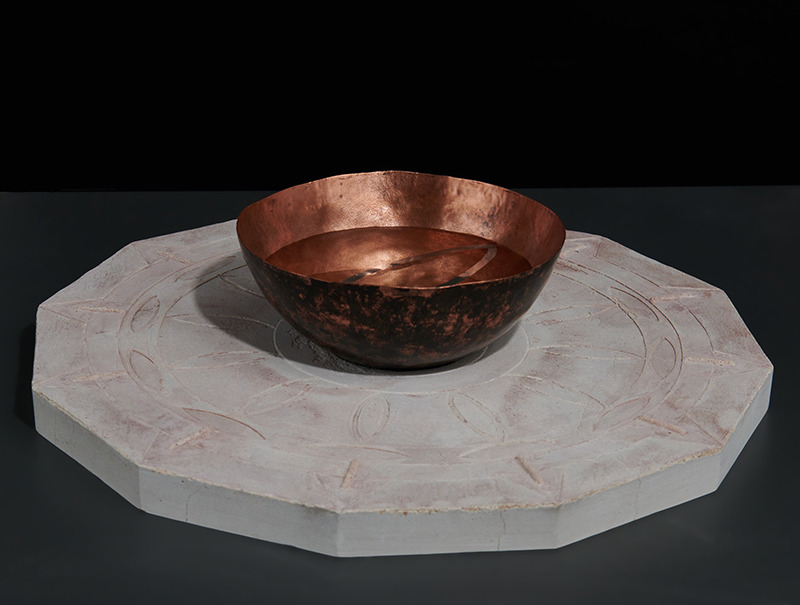
Photo Warren King Photography

The second has embedded magnets in a pattern revealed by old nails and iron filings over the surface. One legend on the discovery of the lodestone recalls a Greek shepherd who noticed the nails in his boots were attracted to the lodestone (also known as magnetite a naturally occurring mineral).
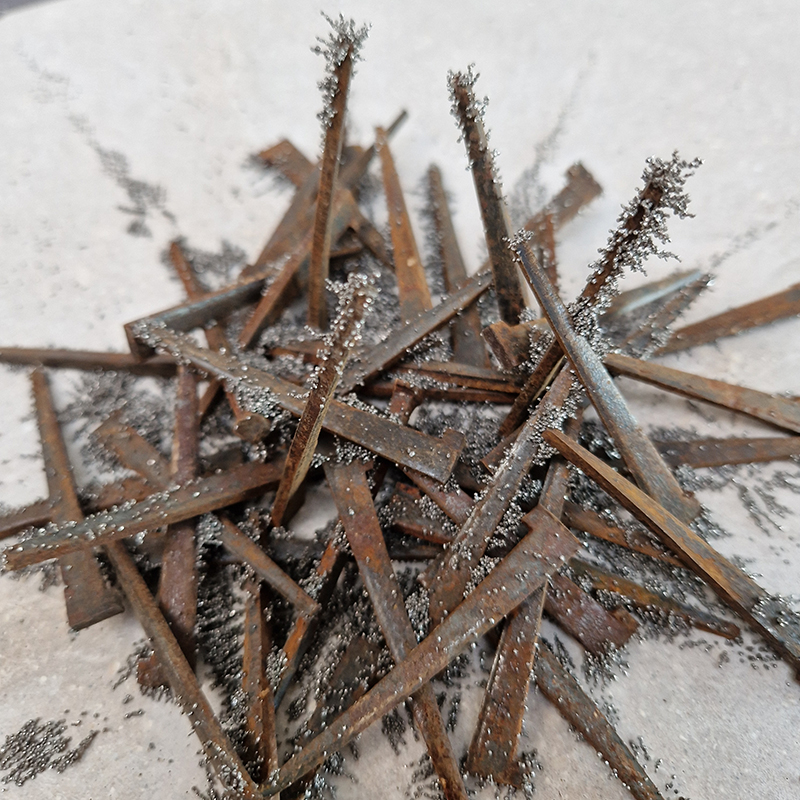
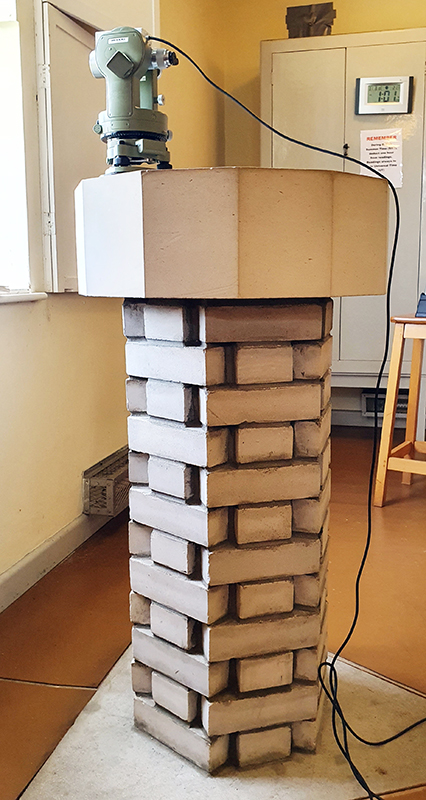
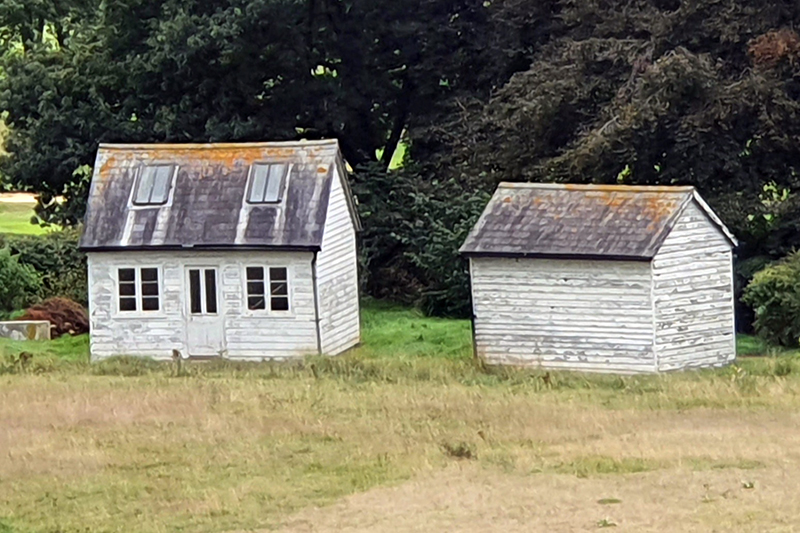
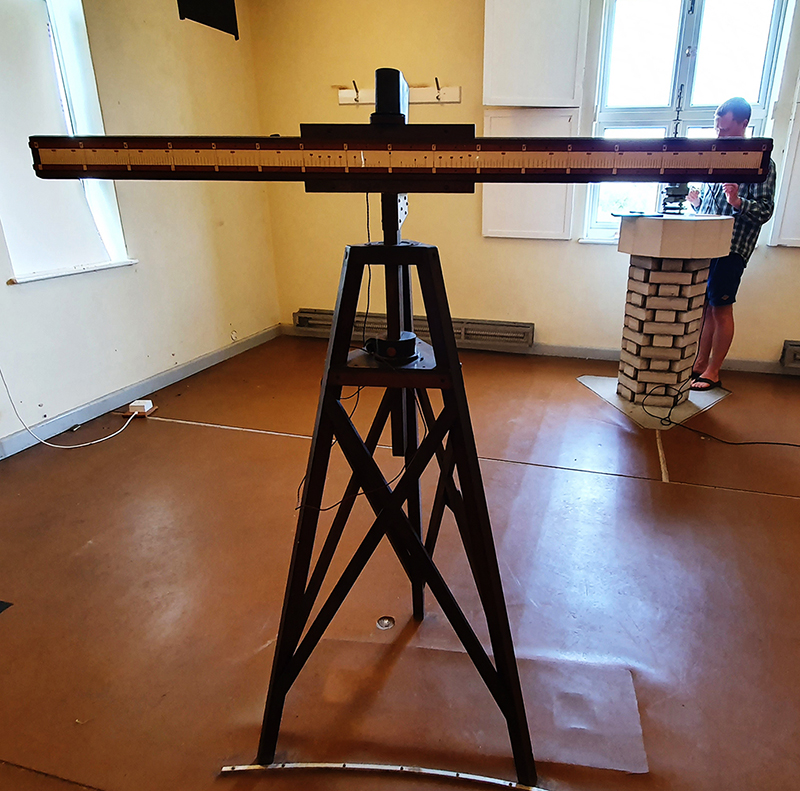
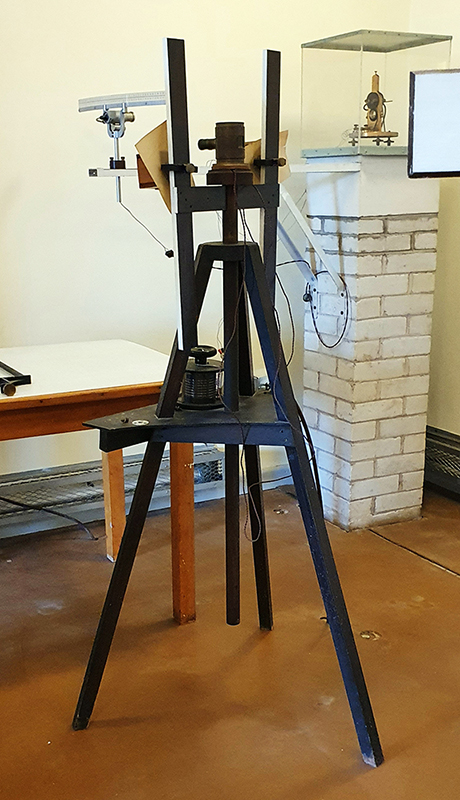
The tablets will be shown on adapted wooden theodolite or telescope tripods in the spirit of equipment seen below during my research trip to Hartland Magnetic Observatory.
Gallery Visits

Seismic Mother curated by Charly Blackburn and Holly Birtles at Hypha Space – an exhibition of 20 artists whose work attempts to communicate the seemingly incomprehensible nature of the earth’s magnitude and magnificence, temerity and resilience as it endures, regenerates and struggles to survive through the slow violence of ecological catastrophe. I visited for the book launch and performative reading from Stephen Cornford whose book, Petrified Matter, I bought. It’s an enlightening read on the links between photography and fossils through mineral, chemical and data recording processes, going on to speculate on future geology and the impossibility of reversing the extraction process by separating minerals used in mobile phones and other technology to return these back to the soil.
Over the centuries many wind roses have been designed with varying numbers of wind directions from four to thirty-two cardinal points. The contemporary compass rose has its roots in the ancient classification of the winds.

Working on the sculpture series of tablets titled Instruments of the Anemoi after the gods of the winds. Twelve sided non-magnetic concrete tablets suggestive of the plinths that support various instruments used in monitoring the Earths’ magnetic field and the ancient anemoscope “table of the winds” carved in marble around eighteen hundred years ago and inscribed with the Greek and Latin names of classical winds on each of its twelve sides.

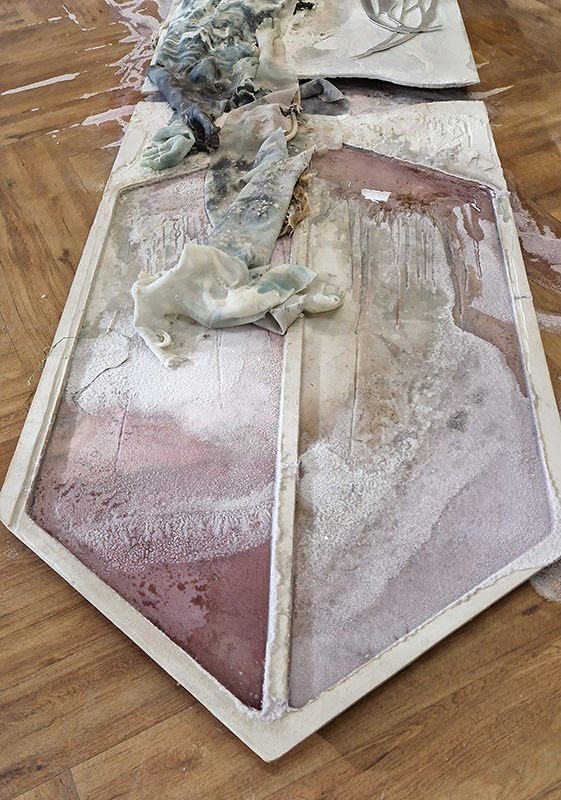
Testing an inked collagraph for concrete casting.

The first tablet in the series is cast with a collagraph which takes the commonly used oval shaped compass needle (illustrated in Breve Compendio de la Sphera de la arte Navegar by Martin Cortes 1551) as symbol of the silver fish – wafer thin fish shaped iron leaves used by 11th century Chinese geomancers.

The weather made the casting process a little precarious with the heat drying the concrete faster than ideal. The result has some fine cracks but overall I am pleased with the result. I used a convex glass lens to create a dip for a copper bowl to sit in. The glass had to be dremelled out after unmoulding. It left a very shiny surface. I made the copper bowl by hand at the London Sculpture Workshop. The ‘silver fish’ is cut from a silver gilding sheet.
The next tablet I am working on will contain embedded magnets. An elaborate frame is in construction to suspend the magnets in the concrete while it sets.

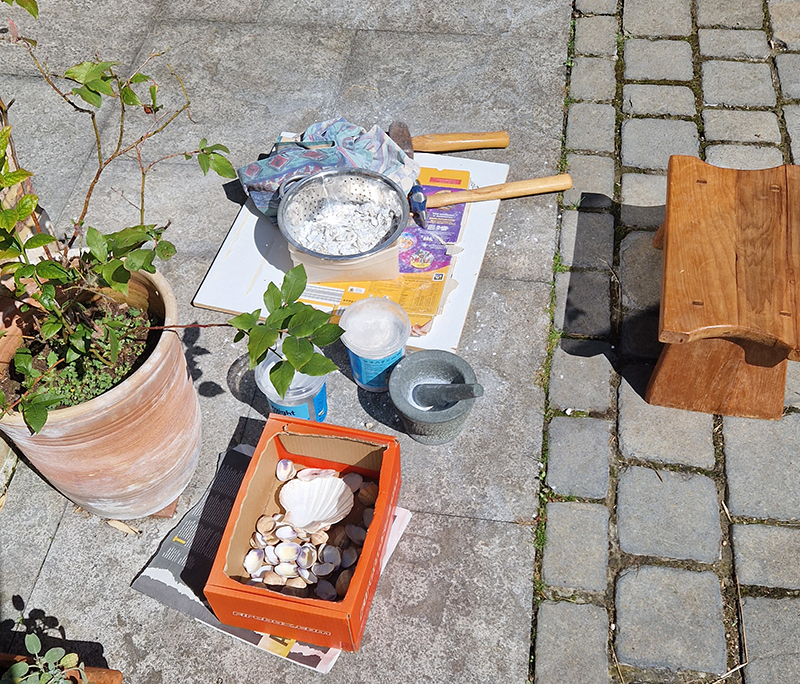
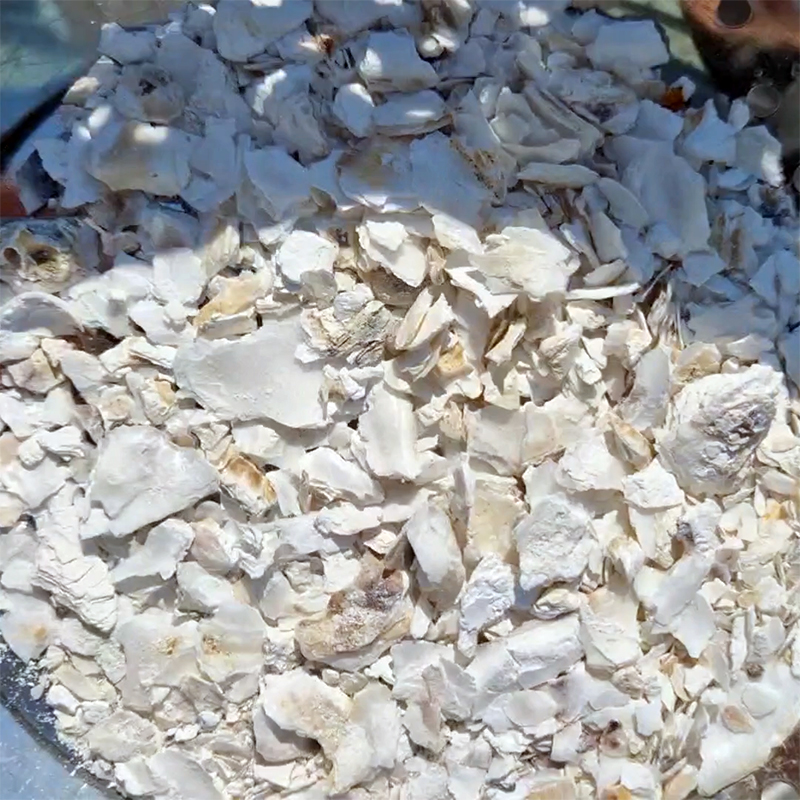
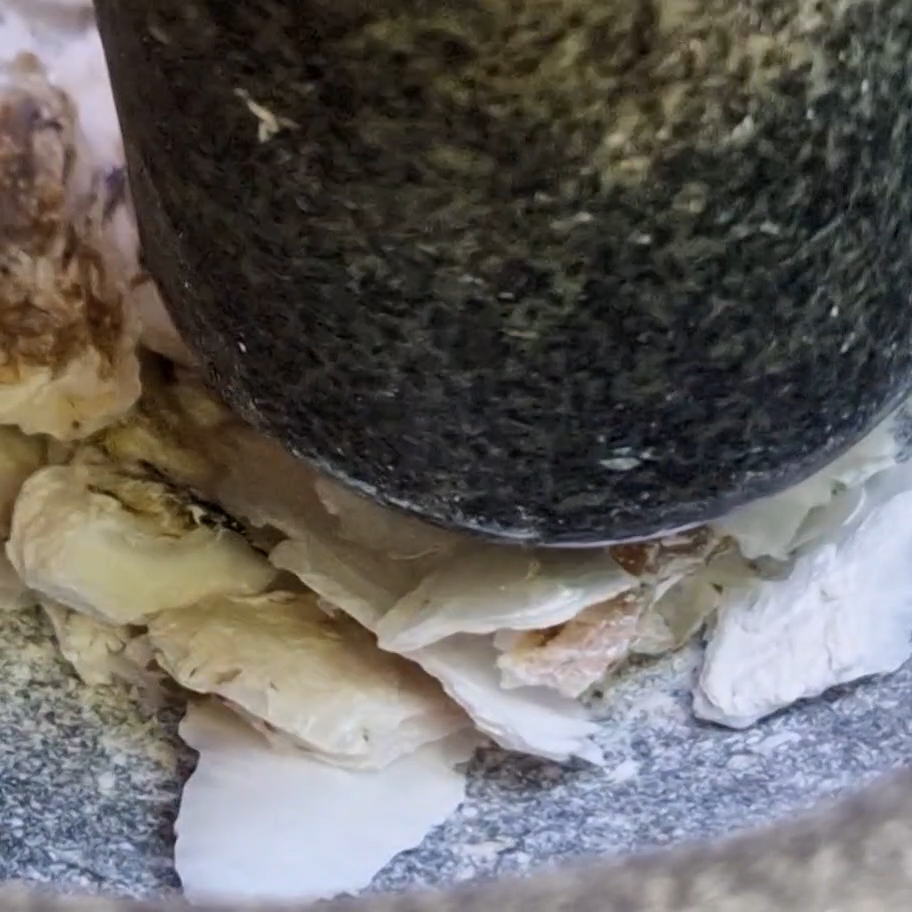
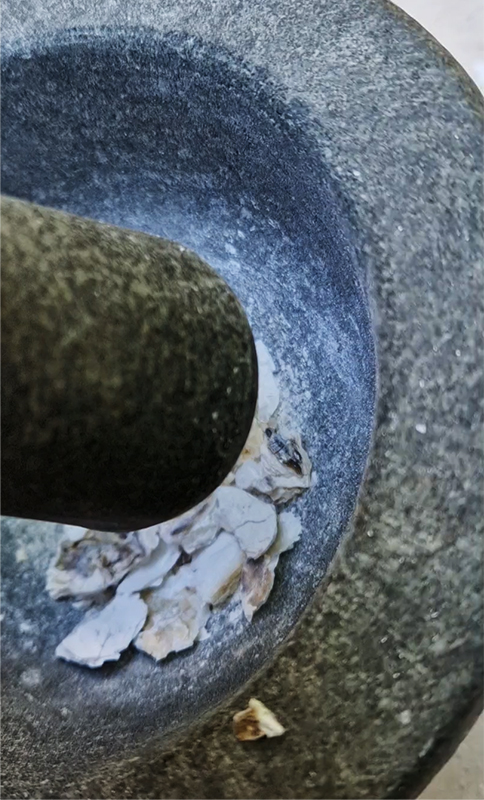
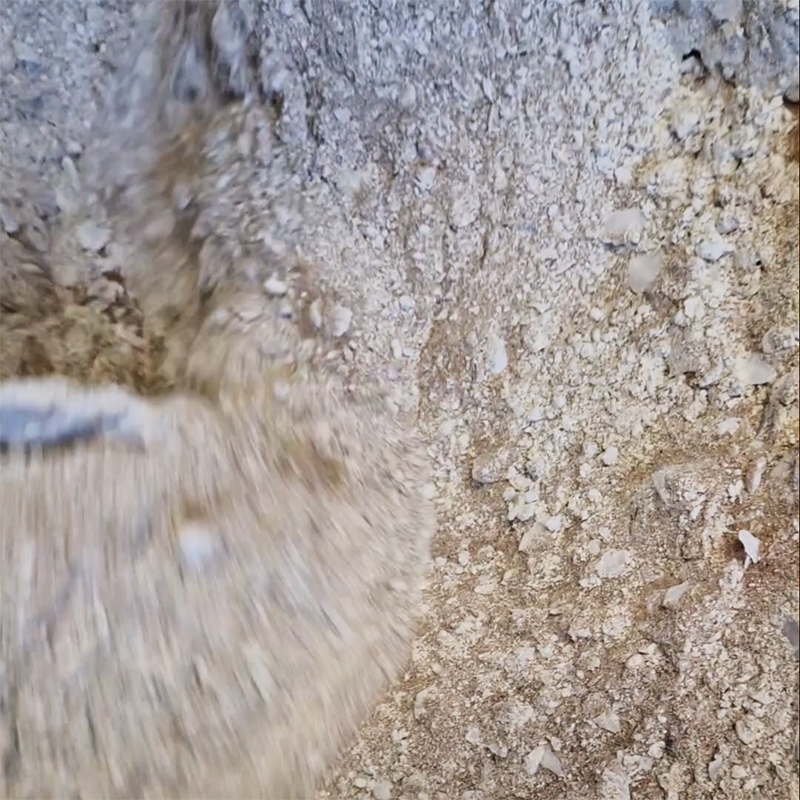
I will also add crushed shells as aggregate, so more pounding shells in the garden is necessary.

Continuing work on The Absolute Hut (of action potential). The Absolute Hut is structurally conceived from an amalgamation of features, impressions and functions of the Observing Building and instruments at Hartland Magnetic Observatory in North Devon and the observation huts built in the 18th century at The Kings Observatory in Kew for meteorological and magnetic observations.

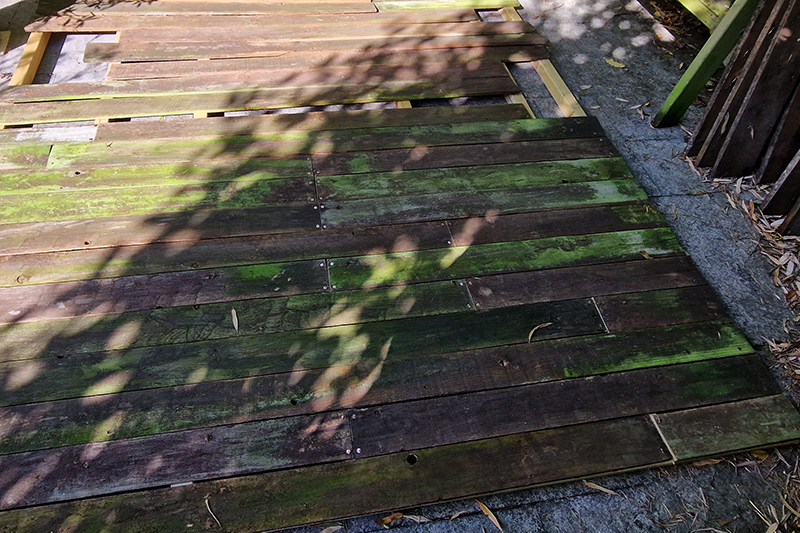
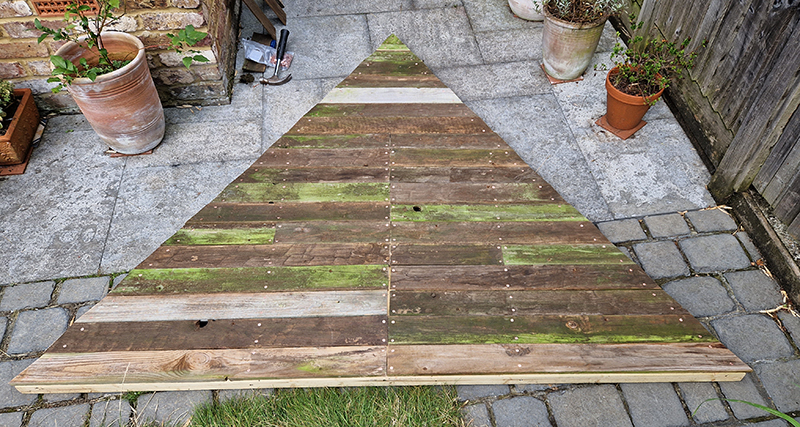
Cutting old featherboard planks to length and hammering them to the frame of the north facing wall with copper nails. These panel sections are now left facing north to gather some moss before the exhibition.

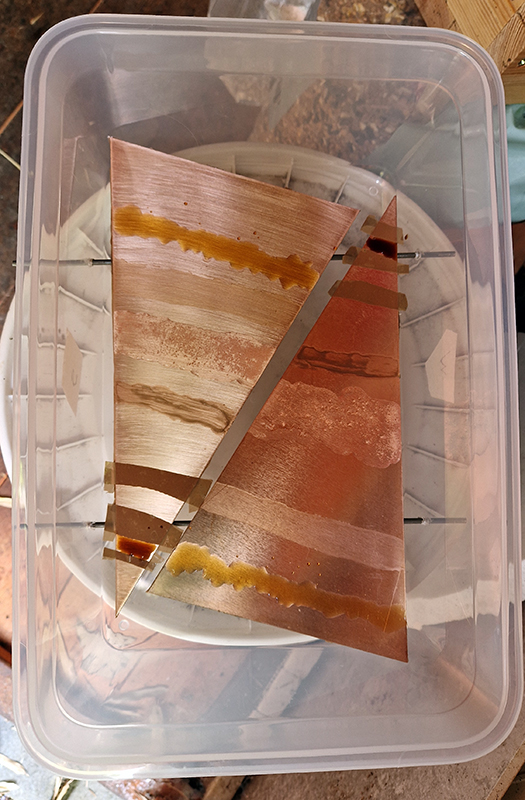
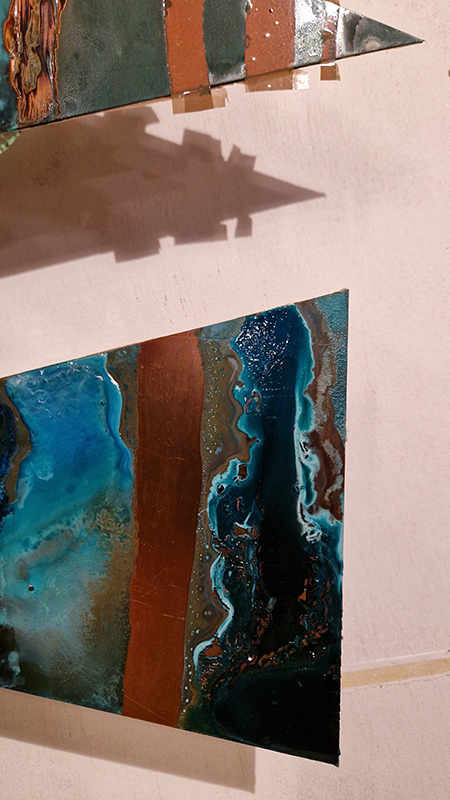
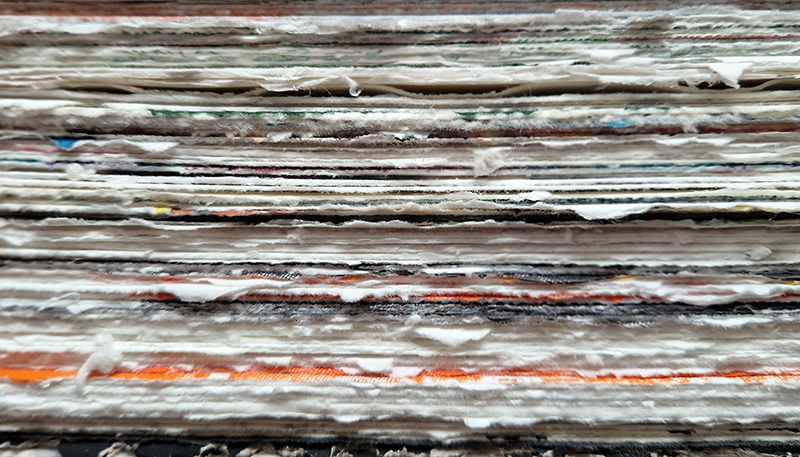
Exciting copper patination tests for the pyramidion to sit on top of The Azimuth Obelisk (of sedimentary knowledge) sculpture. The sculpture expresses the passage of time; made from recycled paper prints and drawings whose history is embedded in the stacked layers, much as the Earth’s geological and magnetic history is secreted into sedimentary strata of rock.

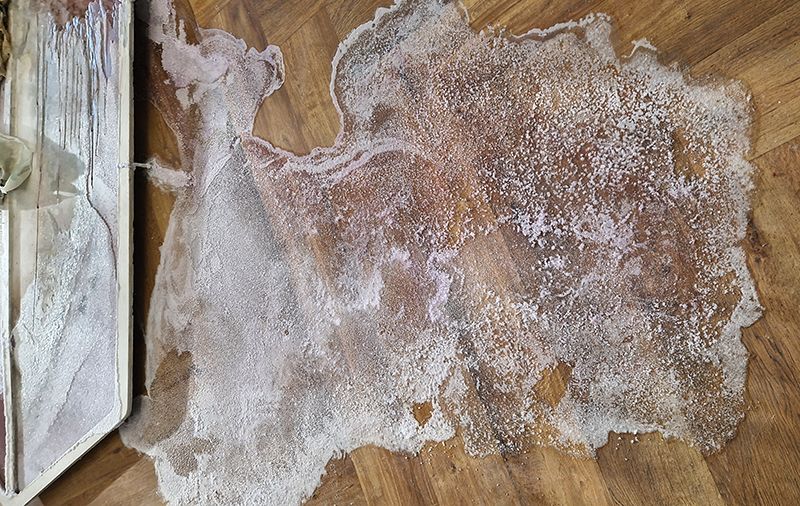
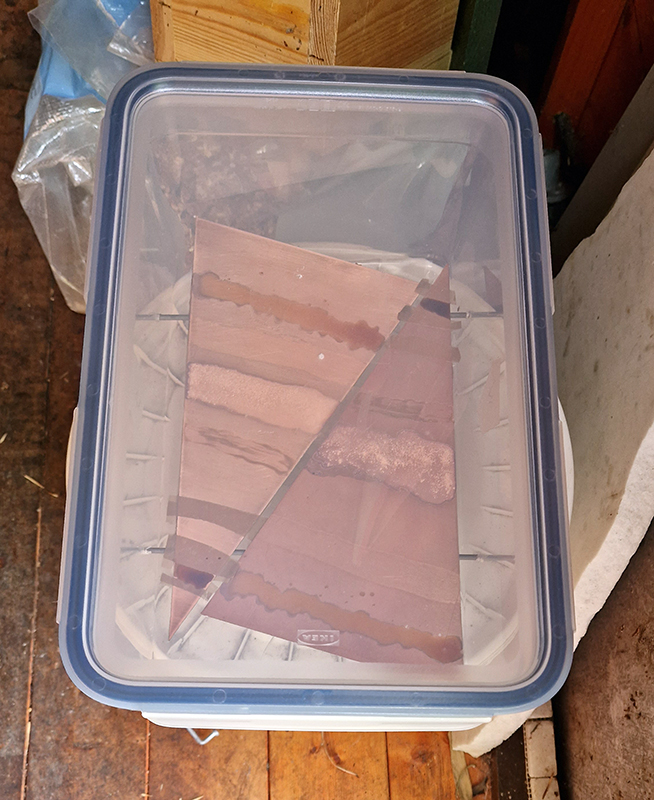
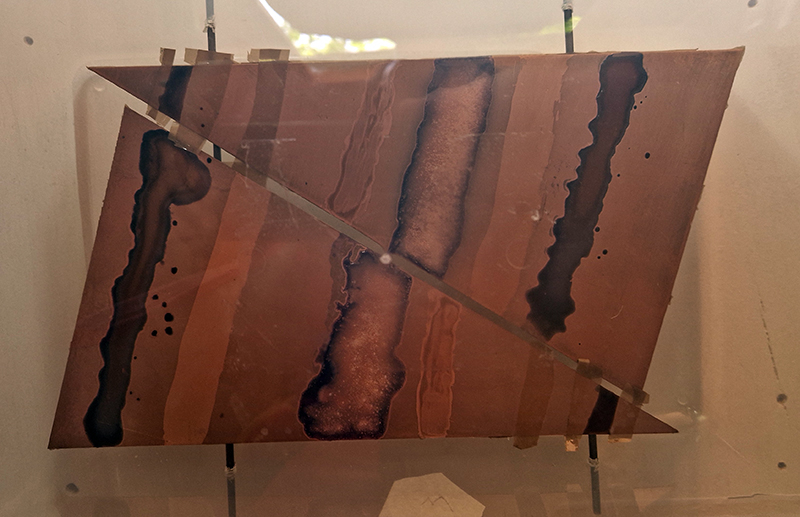
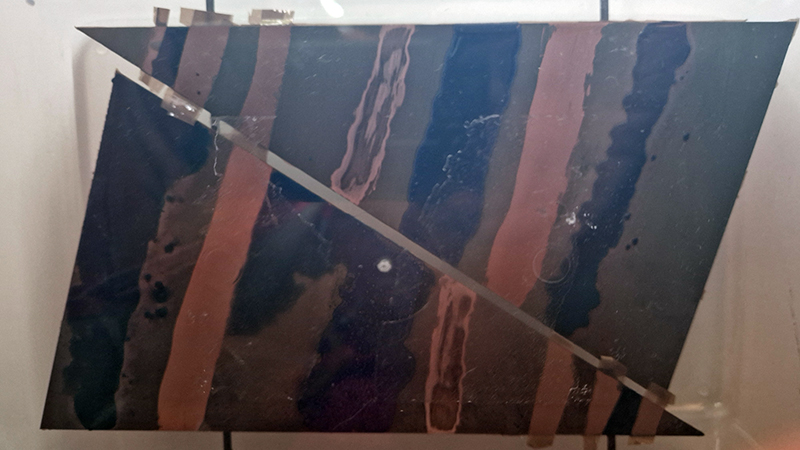
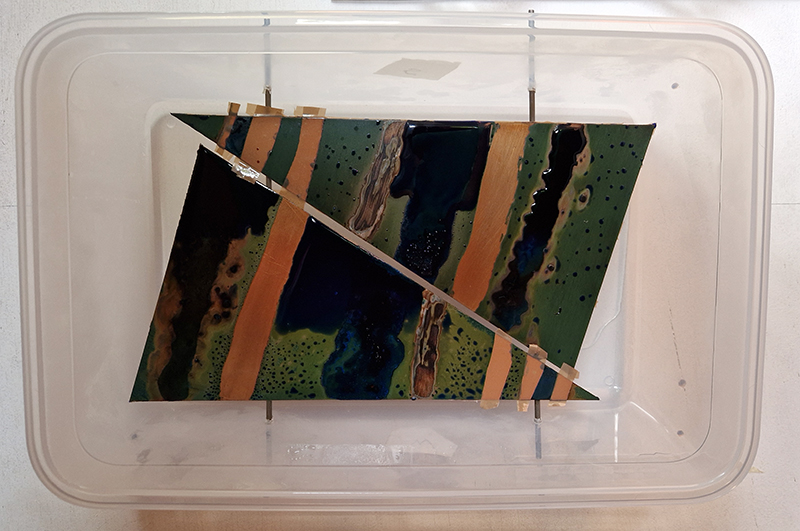
The copper is cleaned first with whiting and ammonia solution. For the test strips I used parcel tape, water based and spirit based varnish, salt and vinegar solution, soy sauce and seaweed plant food. These are applied to the copper which is then placed suspended in a sealed container with a little ammonia. Effects are immediate but I left this overnight.

The next day they are taken from the tank and left to dry.

Both types of varnish interacted with the ammonia fumes, either going dark or puckering and crazing. The parcel tape left a clear band of copper when removed. The salt and vinegar mix gave a light blue patination and the soy sauce and plant food varying greens as copper where it was left raw. The colours continue to develop.

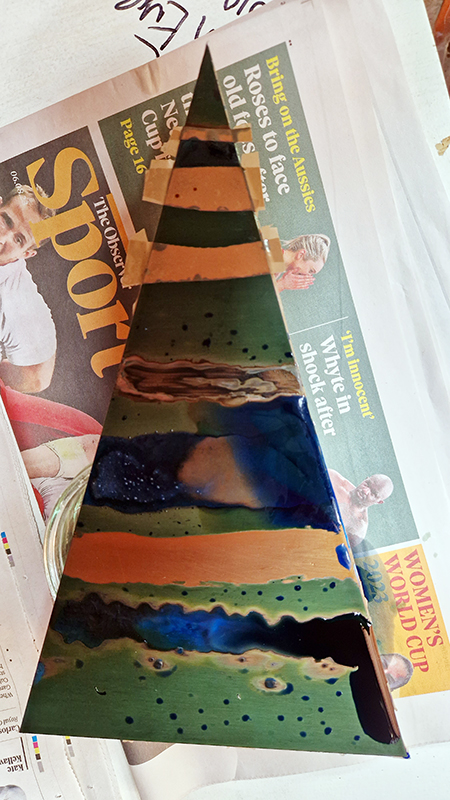
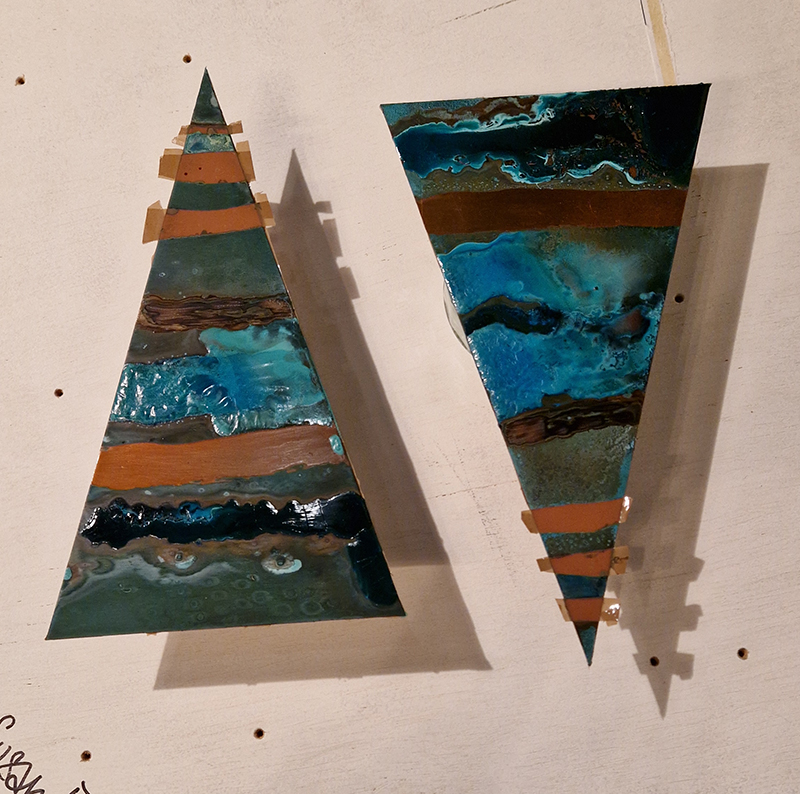
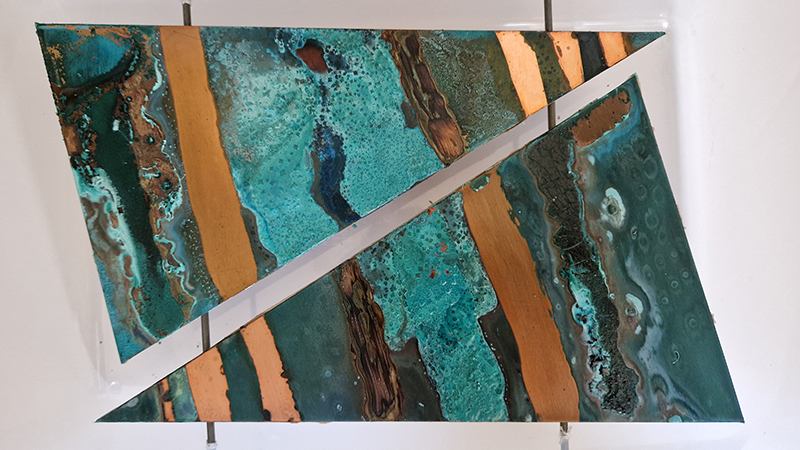
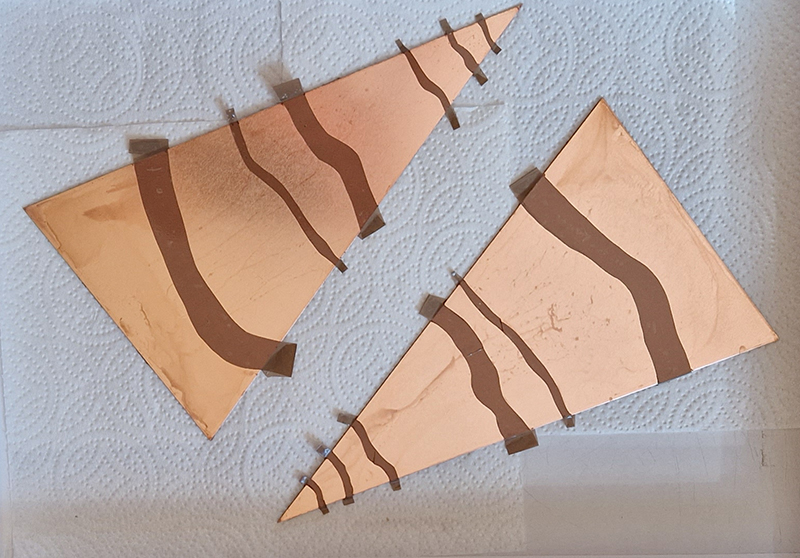
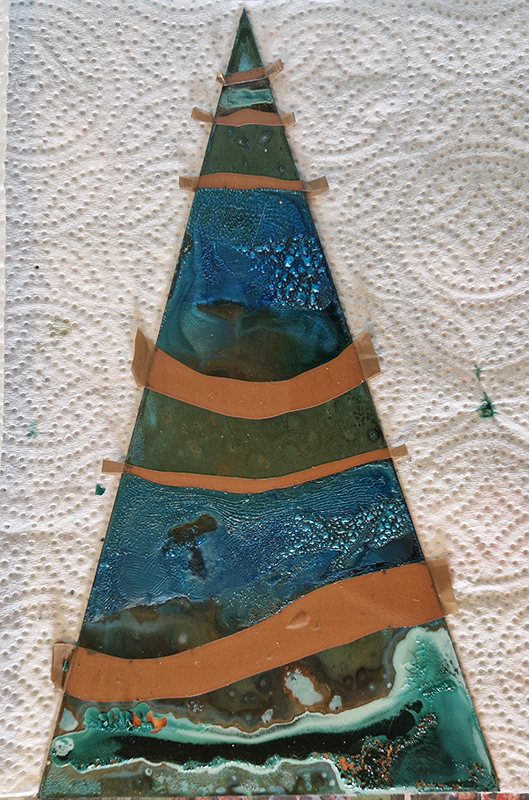
Preparing and patinating the copper triangles I had laser cut to size for the pyramidion. Applying strips of parcel tape to match up at the corners. Setting up a cat defence for drying the plates outside.

Once dry the colours continue to develop. I wanted to spray the surface with Golden archival acrylic spray but it was out of stock everywhere so I got Lascaux archival varnish with UV protection and gave it four light coats. It still continues to change though and flake off a bit adding to the effect of geological, topographical transformation.

I used Sugru, mouldable glue, building it up in stages to fix the sides while the pyramidion is supported in a frame.

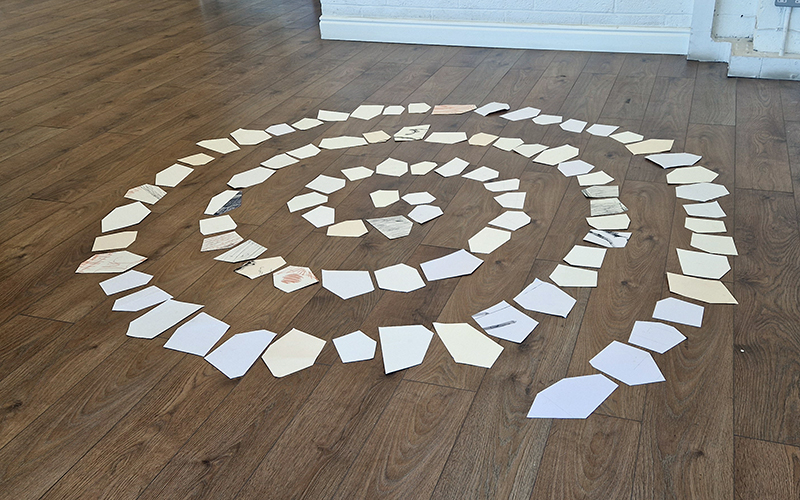
Making use of the communal lounge at Thames-side Studios to test some paper template layouts for Domain of the Devil Valley Master. A sculpture using directional magnetic steel laid in a simple spiral which draws upon many references, from the shape of our own Milky Way Galaxy sculpted by vast cosmological magnetic fields, the spiralling molten dynamo generating Earth’s magnetic field, to the inner pathway of spiritual growth and the route to the symbolic omphalos (navel) at the centre of the world where the sky entrance and the underworld meet.

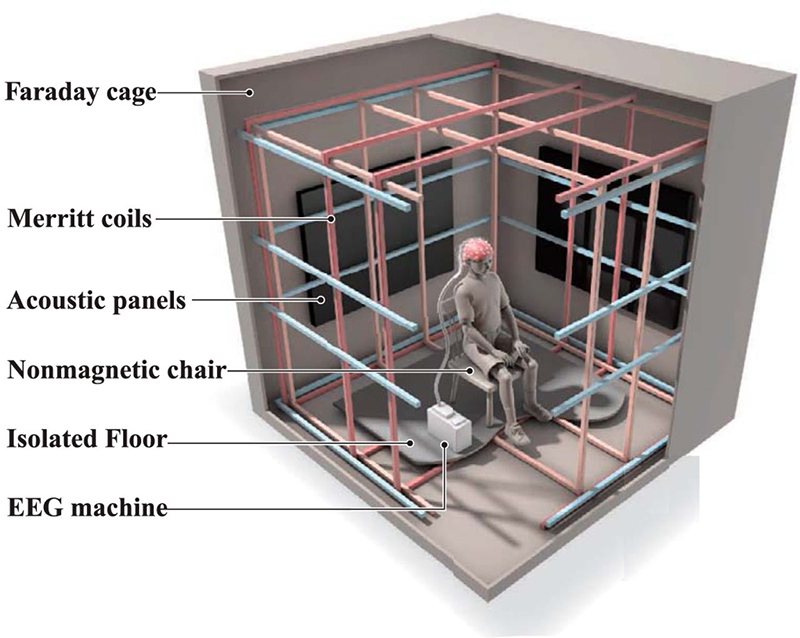
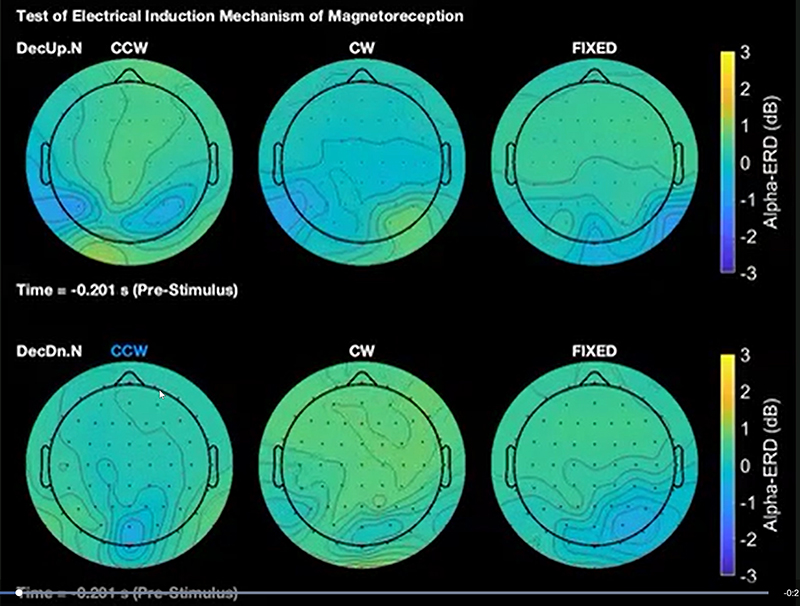
As research for new video work I am looking at experiments performed by Caltech geobiologist Joseph Kirschvink and colleagues investigating human magnetoreception. They found evidence that rotations of Earth-strength magnetic fields produce strong, specific and repeatable effects on human brainwave activity in the alpha-wave band. Alpha waves are always present, but are more prominent when at rest. The experiment, carried out at Caltech, mimicked how a person might experience the Earth’s magnetic field when turning their head. Although many migrating and homing animals are sensitive to Earth’s magnetic field, most humans are not consciously aware of the geomagnetic stimuli that we encounter in everyday life. Either we have lost a shared, ancestral magnetosensory system, or the system lacks a conscious component with detectable neural activity but no apparent perceptual awareness by us.

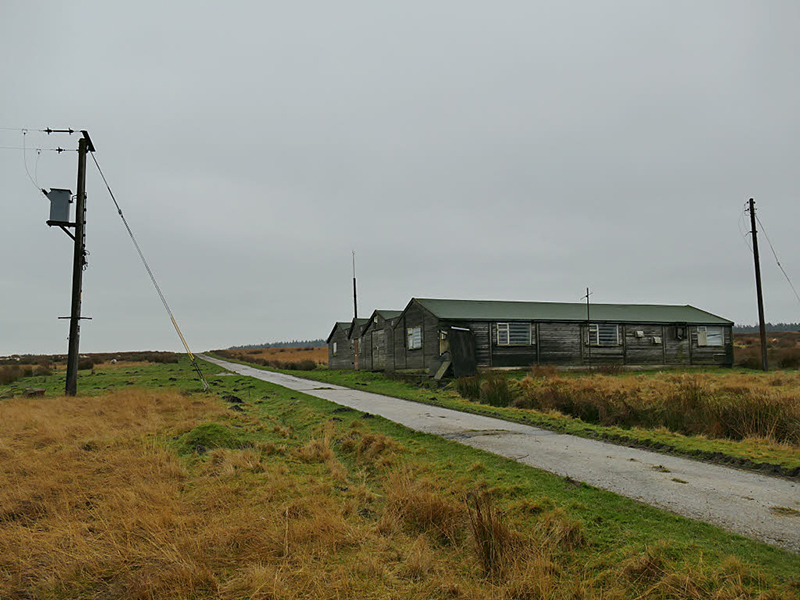
Friends from the north visiting London, told me about Haverah Park which is just up the road from where they live in North Yorkshire. The Haverah Park experiment was a cosmic ray air shower detection array consisting of water Cherenkov detectors distributed over an area of 12 km2 . The experiment began in 1967 and was operated by University of Leeds for 20 years before closing. During its operation, many thousands of cosmic ray events were recorded including four exceptional events with energies over 1020 eV. The abandoned huts remain and I am very excited about visiting the site to investigate further.

Gallery visits

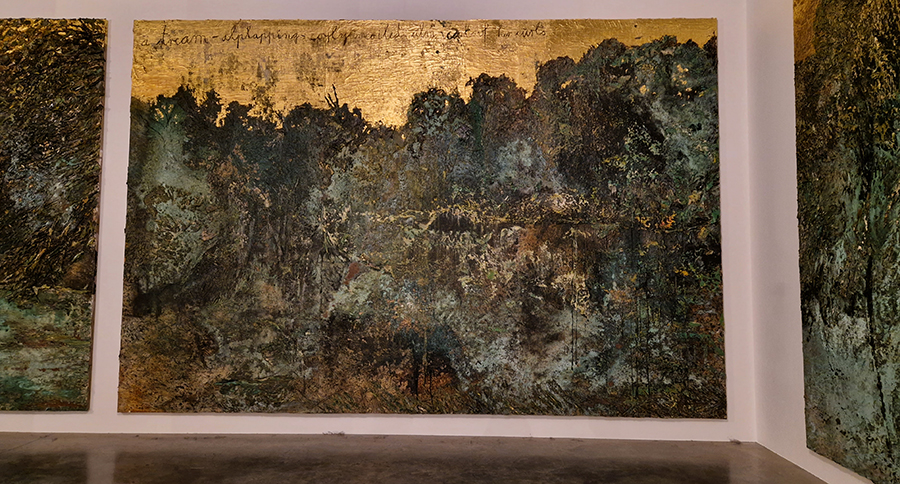
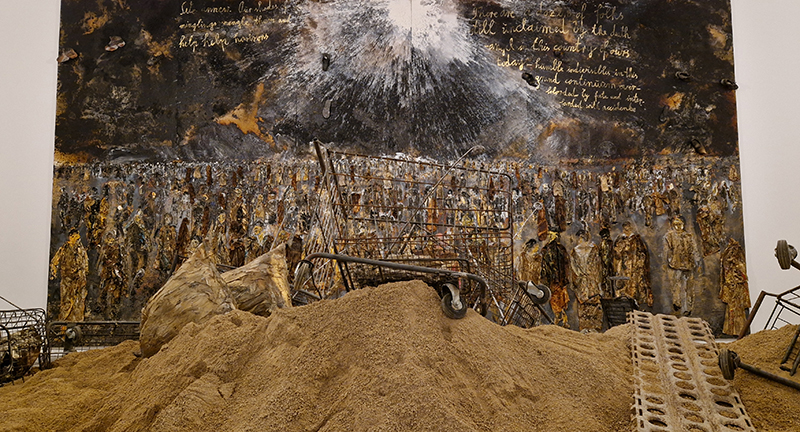
Anselm Kiefer Finnegans Wake at White Cube Bermondsey – “the artist’s new paintings, sculptures and installations respond to (that is, struggle with and transform) James Joyce’s novel of 1939. Kiefer first read the Irish writer as a young man, devouring Ulysses (1922) and embarking on a slow and spiralling relationship with the later, more exacting, Finnegans Wake. It is a book of circles and echoes, more or less overt or secret; its riverine movement begins in the midst of things, and turns back on itself on the final page.”

The weight and the scale of his work as always is overwhelming.

In my early research wondering what the building blocks of the universe looked like I found myself reading about Quarks and Leptons. I found the language of particle physics to be quite like that of mythology – inhabited with mysterious characters like the charm quark and strange quark, the muon and the tau governed by fundamental forces that cannot be seen or explained other than by their attributes – like the mythical gods. The name “quarks“ was chosen for the three fundamental particles of all matter from a nonsense word used by James Joyce in the novel Finnegan’s Wake:

“Three quarks for Muster Mark!“

Finnegans Wake seeks to inhabit a commonplace but elusive realm of human experience – the language is more like poetry than prose and should be read intuitively – the first sentence of Finnegans Wake completes the end of the last sentence – the book’s circular structure embodies the theories of the 18th Century philosopher Giambattista Vico, who viewed human history as cyclical along with the natural cycles of the earth such as night and day, life and death, rise and fall. Vico believed that there was a poetic wisdom in legends which gave an insight  into the relationship between the divine, the natural and the human worlds. He was interested in how myths began from common primordial experiences of the forces of nature.
A different kind of immersion – made from light rather than lead. Sarah Sze The Waiting Room at Peckham Rye Station, an Artangel project, is a captivating spectacle of colour and movement. It might be a lesson in attention spans and ubiquitous digital media but it still holds all the joy of being at the centre of a rotating fairground carousel.

“I’ve always been interested in certain times throughout history where our relationship to the way we experience time and space in the world speeds up radically. The invention of the aeroplane, the invention of the train, you see really interesting work coming out of that time, in film, visual arts and writing. We are in the middle of an extreme hurricane where we are learning to speak through images at an exponential pace.” Sarah Sze

Dear Earth at The Hayward Gallery is inspired by artist Otobong Nkanga’s suggestion that ‘caring is a form of resistance’. Bringing together 15 artists from around the world, the exhibition explores the interdependence of ecologies and ecosystems, as well as our emotional connection with nature.  

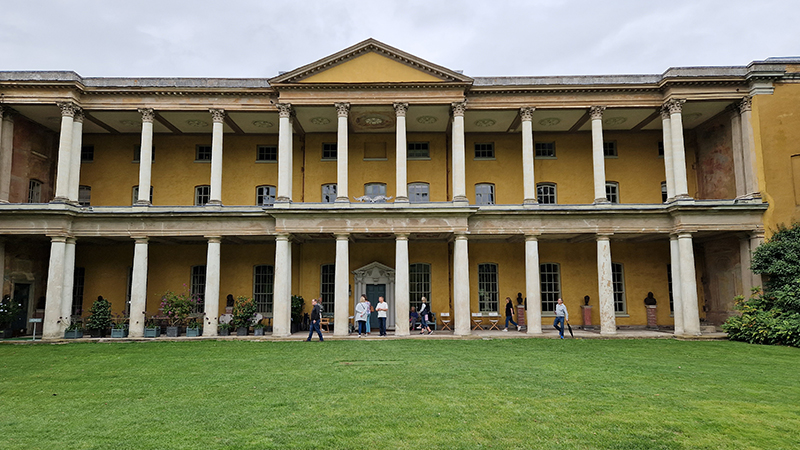
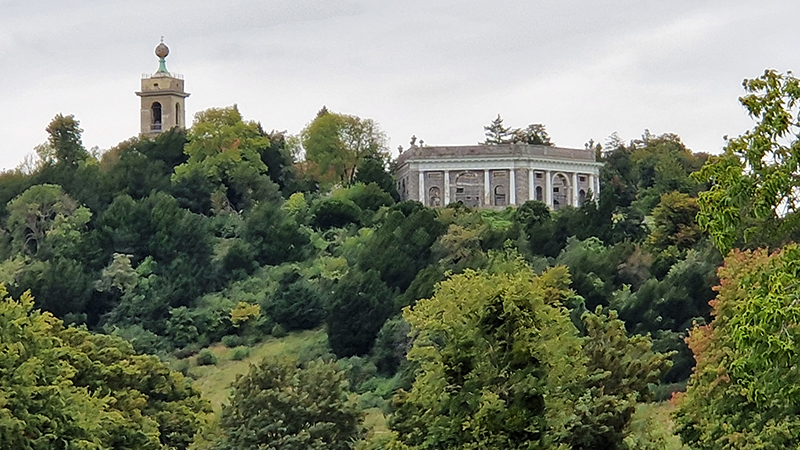
Day trip to West Wycombe Park; “one of the most theatrical and Italianate mid-18th century buildings in England” surrounded by “the most idiosyncratic 18th century gardens surviving in England”. Sir Francis Dashwood built West Wycombe to entertain, and there has been much speculation on the kind of entertainment he provided for his guests at the house and the nearby hellfire caves.

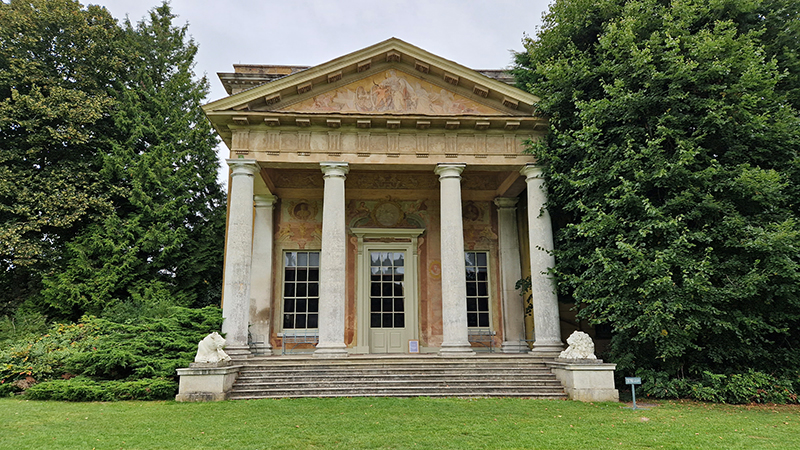
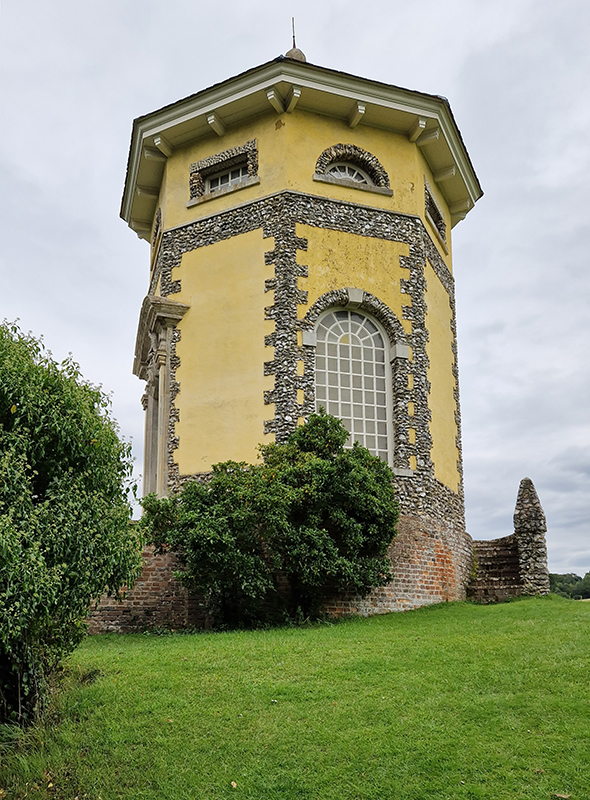
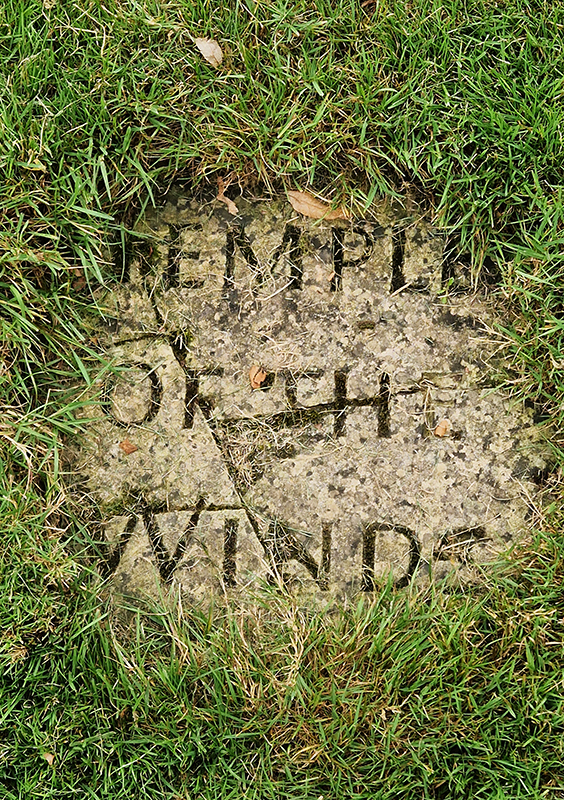
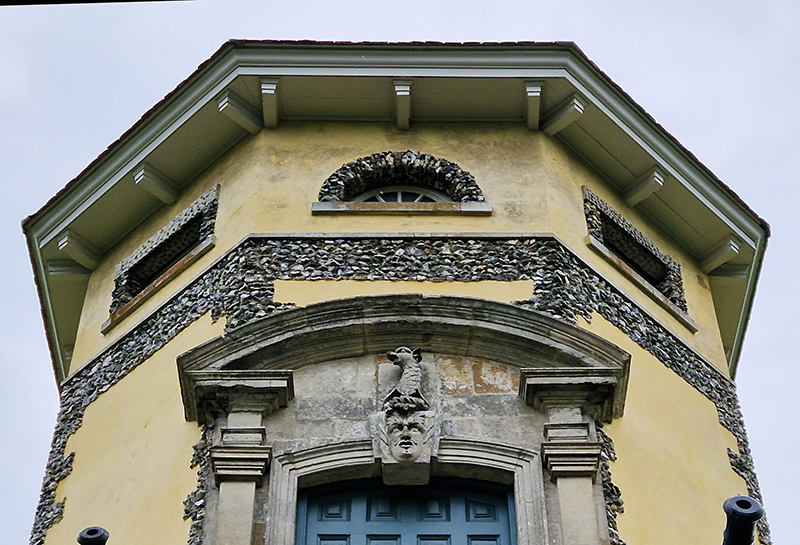
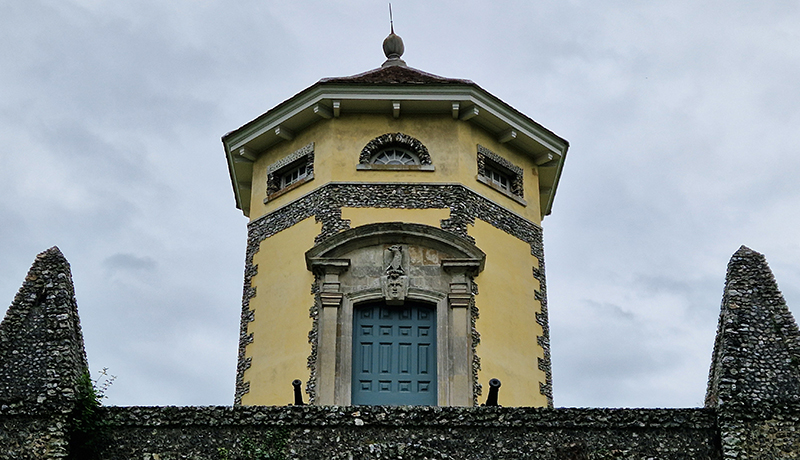
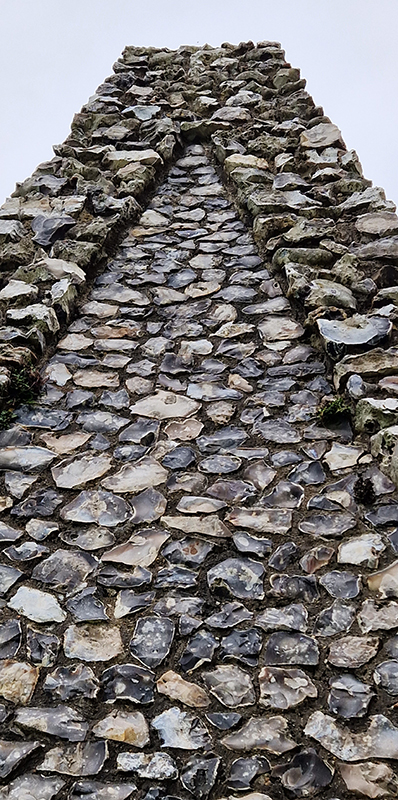
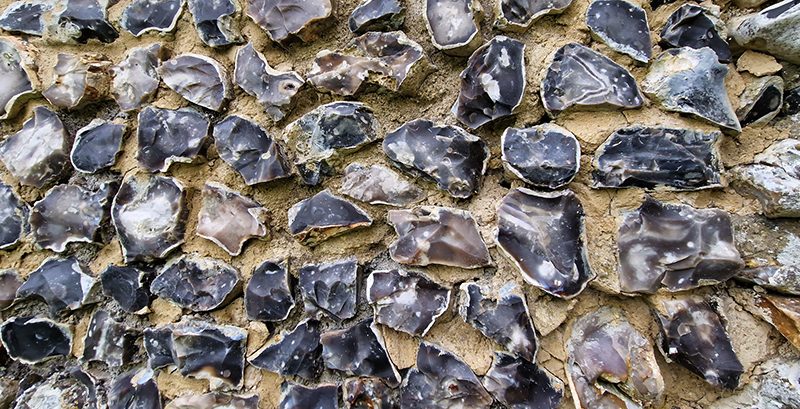
A surprise discovery in the gardens was The Temple of the Winds, a stucco and flint faced octagonal tower, aligned with its main walls facing north, south, east and west. Erected in 1759 and used as an ice house, its design was inspired by the ancient Tower of the Winds in the Roman Agora in Athens of which Vitruvius wrote

Some have chosen to reckon only four winds; the East, blowing from the equinoctial sunrise; the South, from the noon-day sun; the West; from the equinoctial sun-setting; and the North, from the Polar stars. But those who are more exact, have reckoned eight winds, particularly Andronicus Cyrrhestes, who on this system erected an octagon marble tower at Athens, and on every side of the octagon, he wrought a figure in relieve, representing the wind which blows against that side: the top of this tower he finished with a conical marble, on which he placed a brazen Triton, holding a wand in his right hand; this Triton is so contrived that he turns round with the wind and always stops when he directly faces it; pointing with his wand over the figure of the wind at that time blowing.

Reading

Ursula Le Guin The Winds Twelve Quarters (volume ii) – a collection of short stories, chosen for the title’s relevance to the sculpture series – Instruments of the Anemoi (wind gods).

The story The Stars Below is particularly interesting, written to interrogate the question – what happens to the creative mind when it is driven underground? Le Guin found that ‘you don’t go exploring the places underground all that easily’ as simple symbols took on unexpected divergent meanings and rather than the repression of science or art it was the abyss of the psyche she was fathoming. Le Guin later came across a passage in Jung likening the depths of ego-consciousness to ‘being surrounded by a multitude of little luminosities..[ ].. The star strewn heavens, stars reflected in dark water, nuggets of gold or golden sand scattered in black earth’

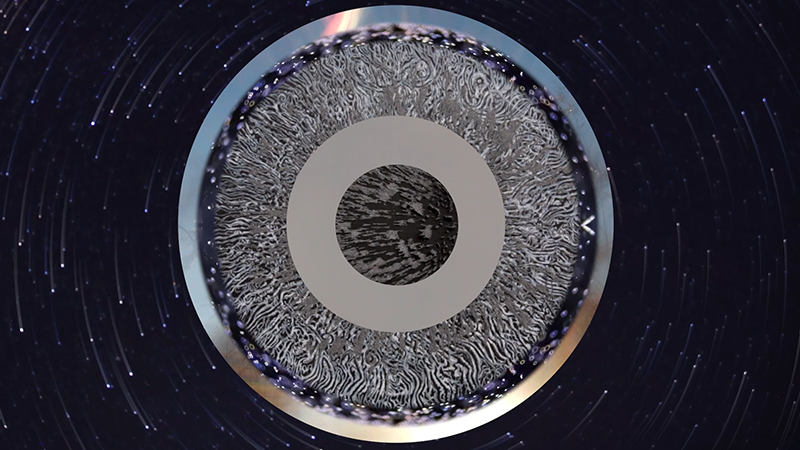
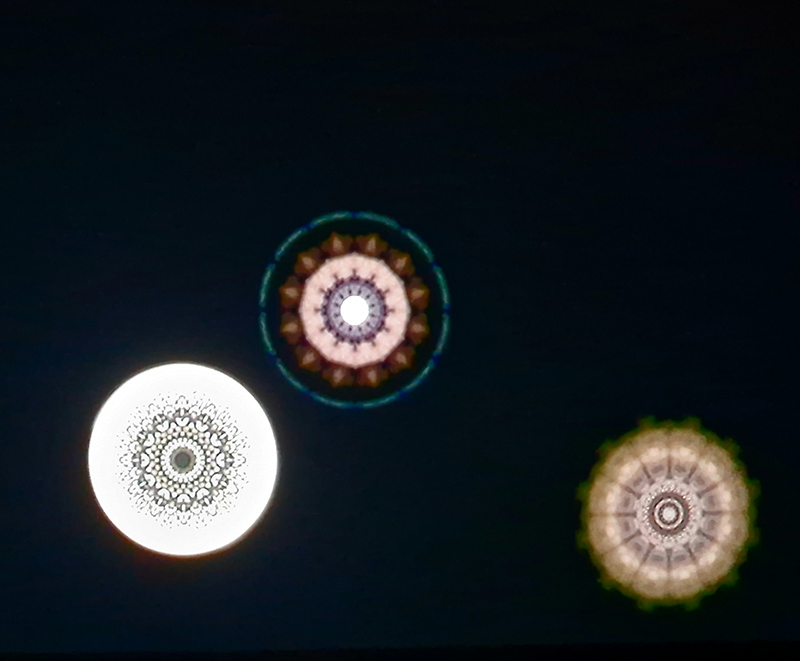
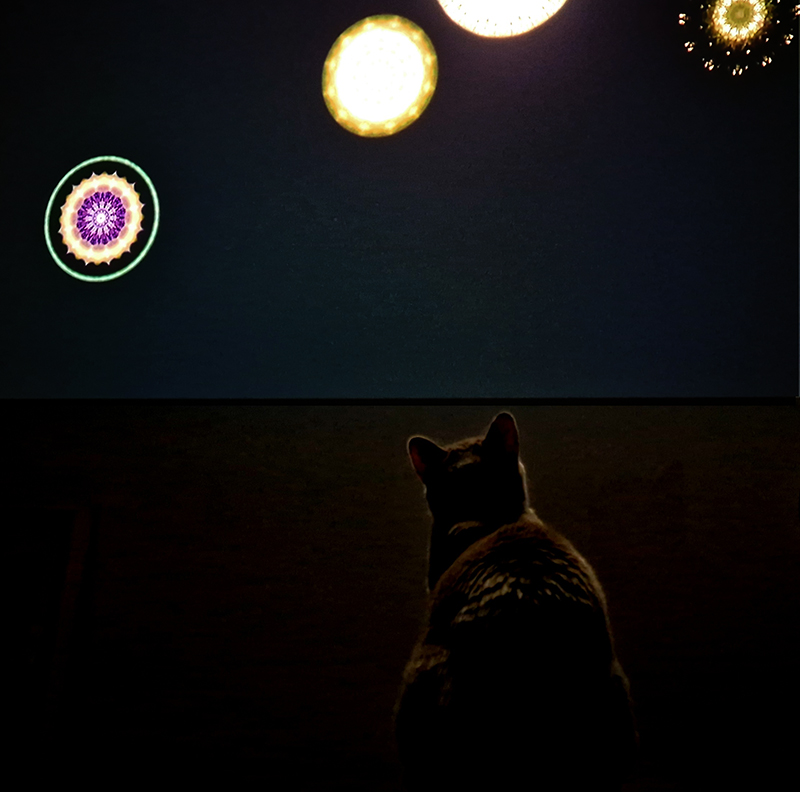
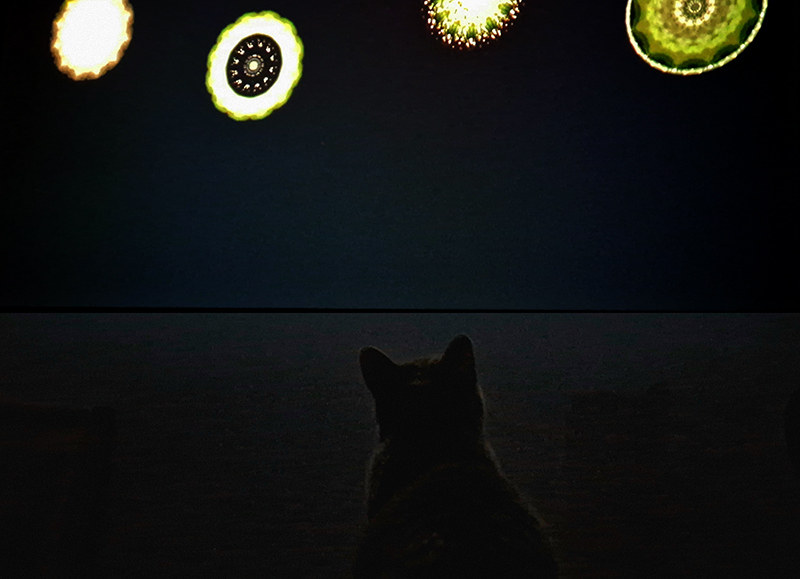
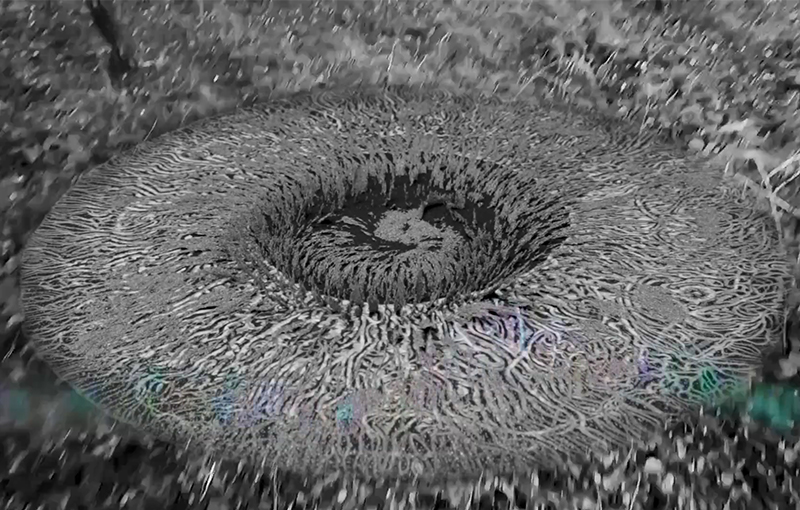
The Breath of Stars is a digital video work activated in real time by cosmic rays. These subatomic visitors from outer space are created during super nova explosions or by phenomena we are yet to discover. This work has been a long time coming and the fact that it is working in real time now is thanks to coding genius Jamie Howard who has managed to get a number video files to play simultaneously on one screen. We had to ditch the Raspberry Pi for a Panda Latte to cope with the processing needed. Cosmic particles strike the edge of the Earth’s atmosphere, break apart and shower down upon us. Some particles collide and silently interact with atoms and technology on Earth. In this work particle detectors and mini computers are connected to a projector. Every time a cosmic particle passes through the plastic scintillator block inside the detector its energy is recorded via a Silicon photomultiplier and a starburst video is displayed for twelve seconds. The kaleidoscopic video images generated are created from footage of cosmic particle trails filmed in a cloud chamber, split and mirrored twelve ways. The particles arrive randomly and this can be witnessed by the sudden flurries and silent gaps of the video imagery. First test run and the cat loved it.

The South Atlantic Anomaly is a region where the Earth’s magnetic field is at its weakest. The intensity of the field here is about one third of that near the magnetic poles. This affects how close to the Earth energetic charged particles (cosmic rays) can reach. This area, which spans the southern Atlantic and South America, is deepening and moving westwards. Could this be the beginning of the overdue magnetic field reversal?

The classical compass winds were named to reflect geographic direction as conceived of by the ancient Greeks and Romans. Ancient wind roses typically had twelve winds and thus twelve points of orientation. The Anemoi (from Greek “Winds”) were wind gods who were each ascribed a cardinal direction.

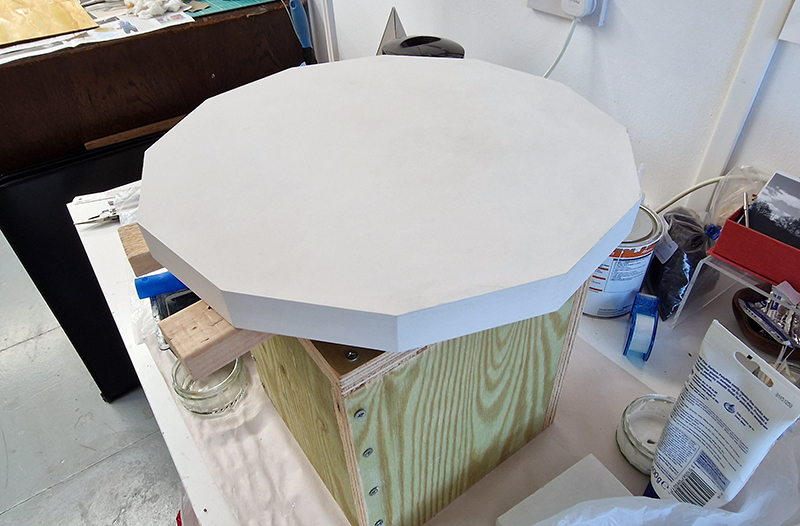
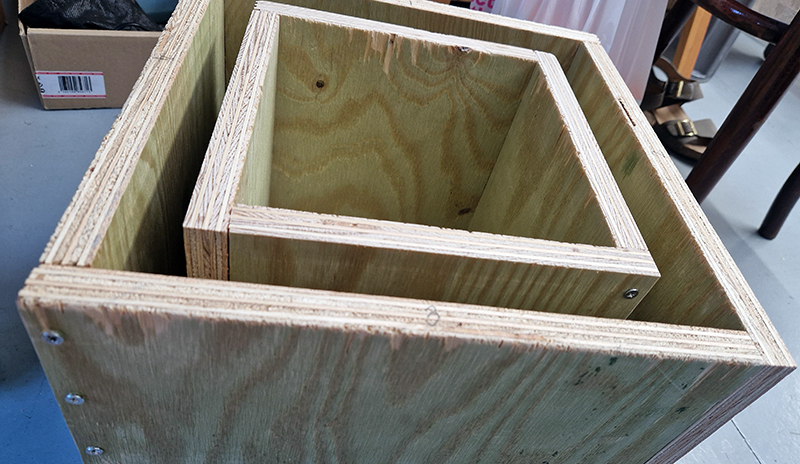
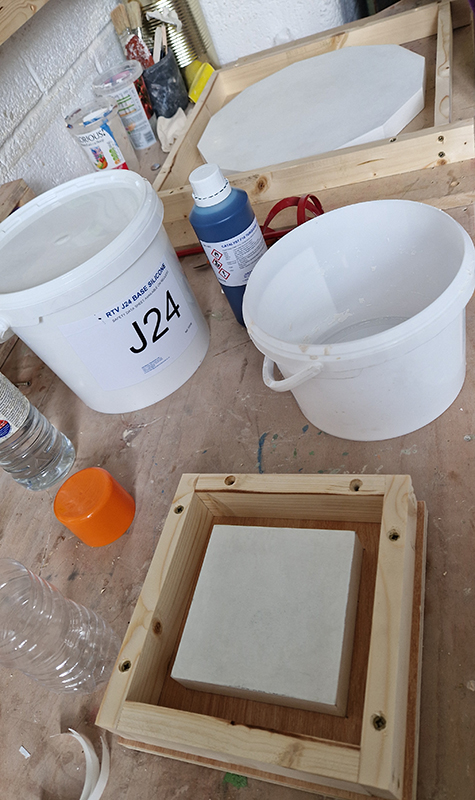
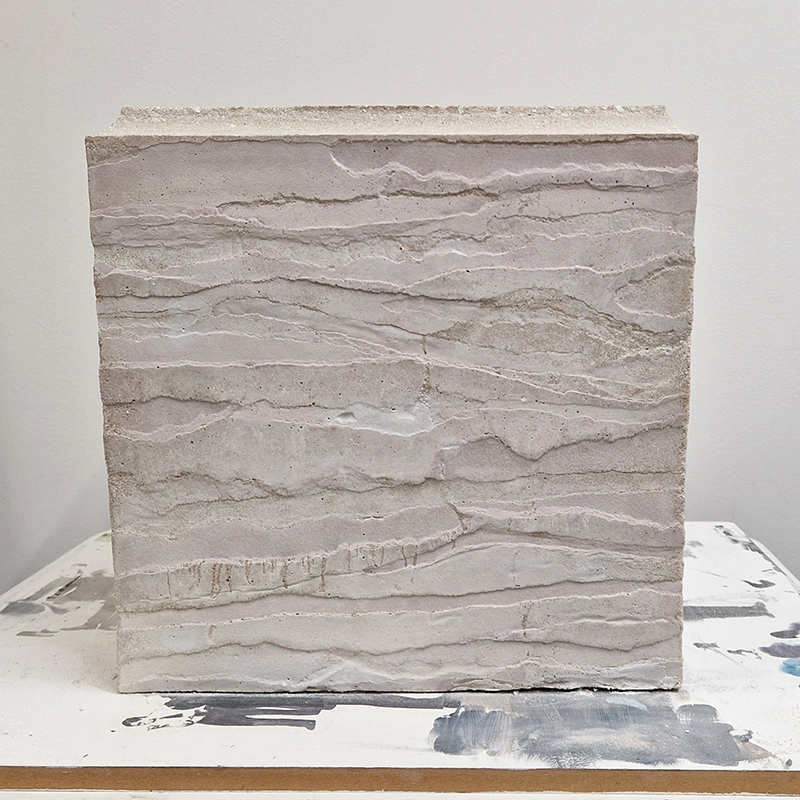
Supported by a professional practice and creative development bursary from a-n The Artists Information Company I have been privileged to have expert tuition in mould making and concrete casting from Anna Hughes based at Thames-side Studios. I have really enjoyed these sessions. Anna has given me the skills to go forward and experiment and I am excited by this new process. I prepared a dodecagon (twelve sided) shape cut in MDF to make a silicon mould and a double box mould for the base of my obelisk sculpture plus some small shapes for testing.

To continue the notion of sedimentary layers as signified by the layering of recycled paper in the body of the obelisk sculpture, I made collagraphs to line the box mould to give a texture of strata. Limestone, a sedimentary rock, is often formed from crushed seashells, compressed over eons. I used crushed oyster shells to use as aggregate for the base.

I am super pleased with how the base turned out.

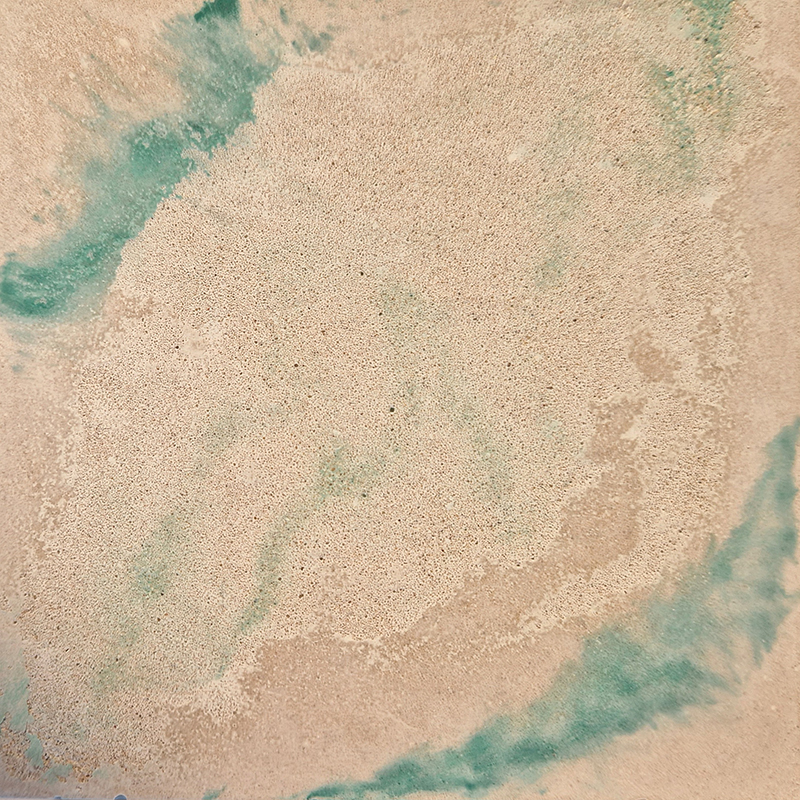
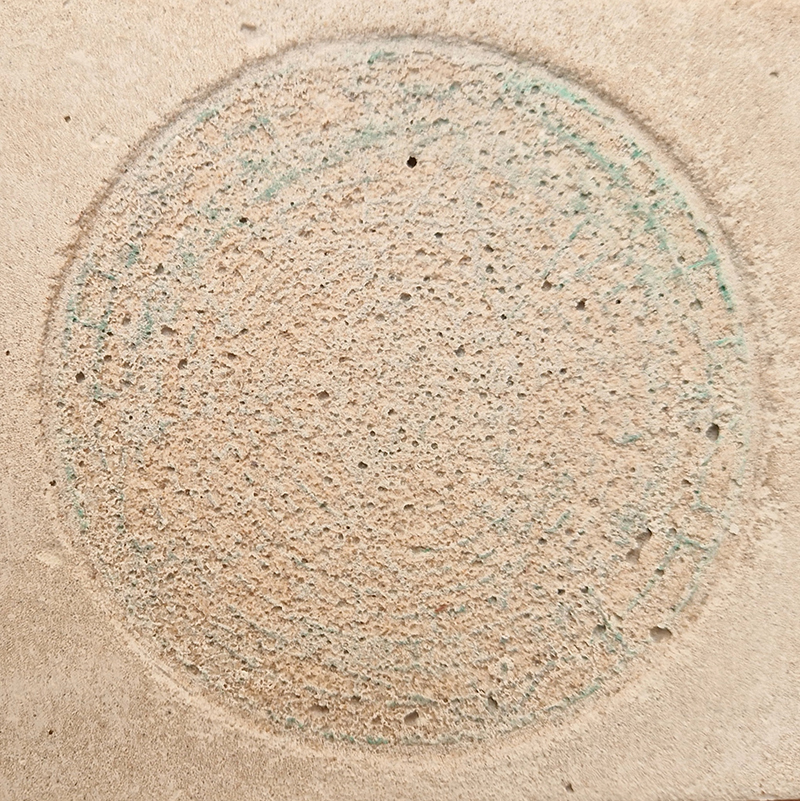
I also tested using verdigris pigment mixed into the concrete or in the grooves of etched aluminium to leave an imprint. The plate tests didn’t come out so clear so need more testing and I next plan to try embedding the etched plate face up in the concrete.

Open Studios at Thames-side Studios 2023.

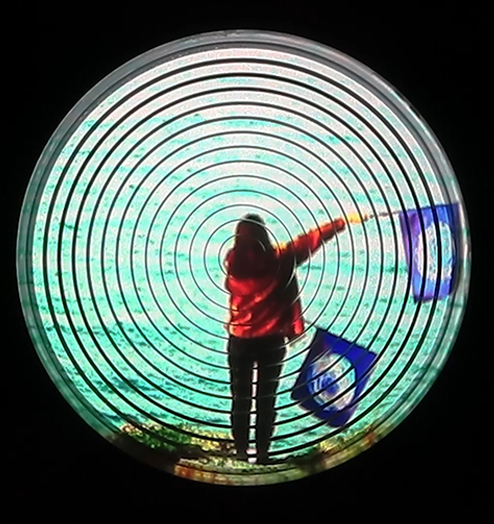
At a distance was installed in the main gallery group show. This work looks at remote methods of communication and relates this to the mysterious twinning of electrons in quantum entanglement where particles link in a way that they instantly affect each other, even over vast expanses. Einstein famously called this phenomenon ‘spooky action at a distance’. Filmed on 29th March 2019 (the first proposed Brexit date), in Cornwall as the iconic Lizard Lighthouse powers up its lamp, solitary figures using semaphore flags sign ‘We Are One’ out across the ocean in the hope the message will be echoed back. Drawing on the physical language of print that embodies touch, separation and mirroring the flags have been printed using hand painted dye sublimation inks applied via a heat press. This process transfers the ink from a paper matrix onto the substrate textile. The image passes momentarily across space in a dematerialized state as vapour before being reformed as its mirror opposite.

In my studio there was recent magnetic work Pole Receptor, along with work in progress Belly of a Rock hybrid sculpture plus some works from the archive such as screen prints from the StrataGem and everydaymatters series. I spent the weekend preparing for my concrete casting tuition in between chatting to visitors. Thanks to Caroline AreskogJones for the studio portrait.

The StrataGem series of screenprints on textiles imagines the possibility of the formation of geological strata created from the waste of plastic food packaging trays.

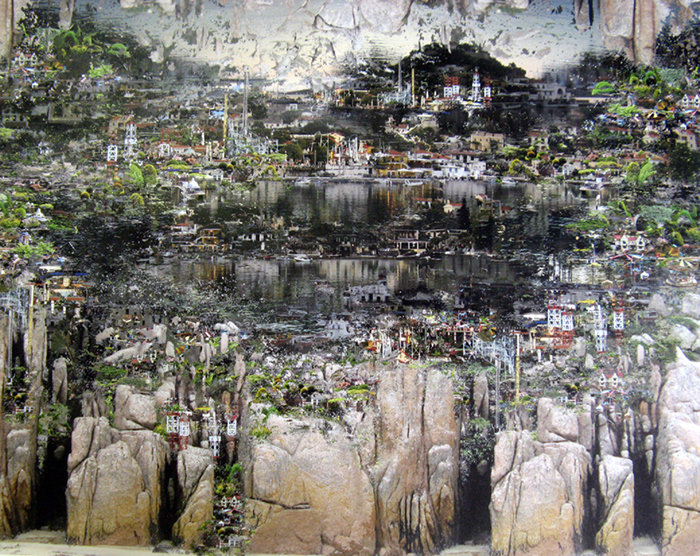
Informed by the discovery that the matter we know, that which is visible to us and includes all the stars and galaxies is less than 5% of the content of the universe, dark matter making up about 27% and the remaining percentage being dark energy, everydaymatters dissects landscapes to discover the hidden structures of the universe. Images taken from everyday prosaic paradises, such as Paradise Industrial Estate in Hemel Hempstead, are split into constituent parts of what is seen and unseen.

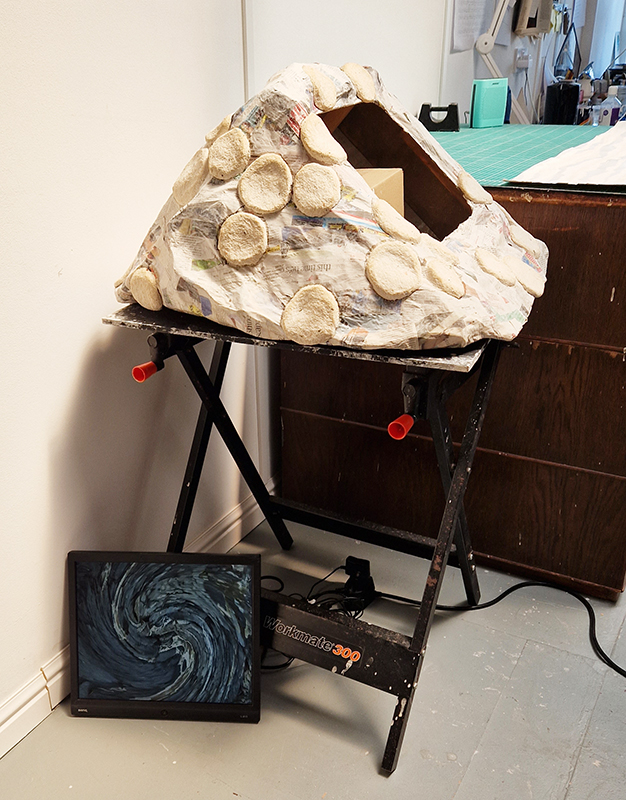
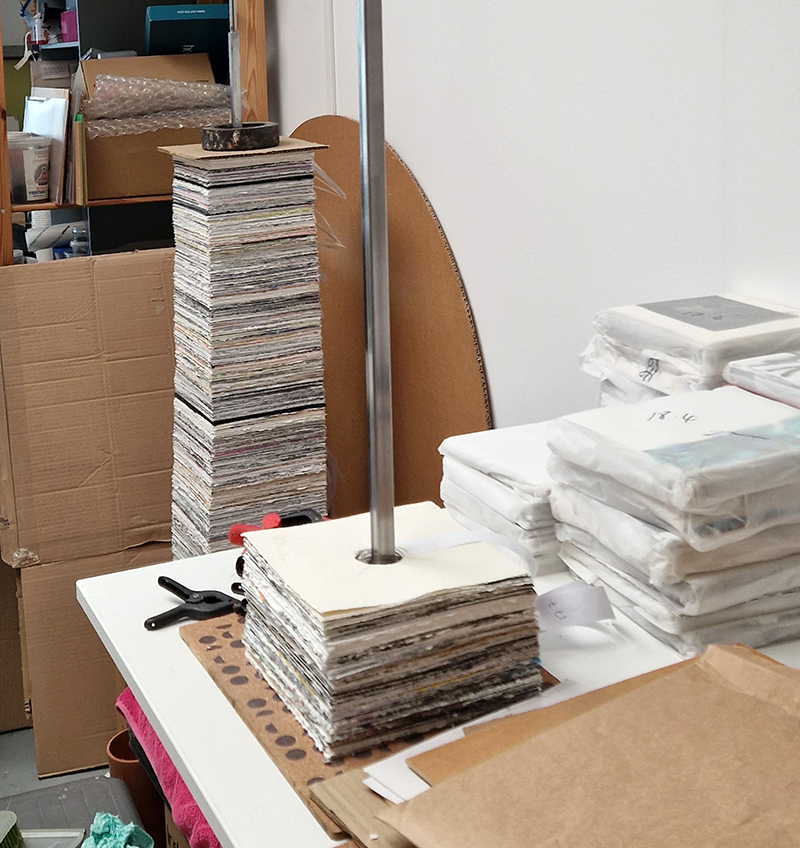
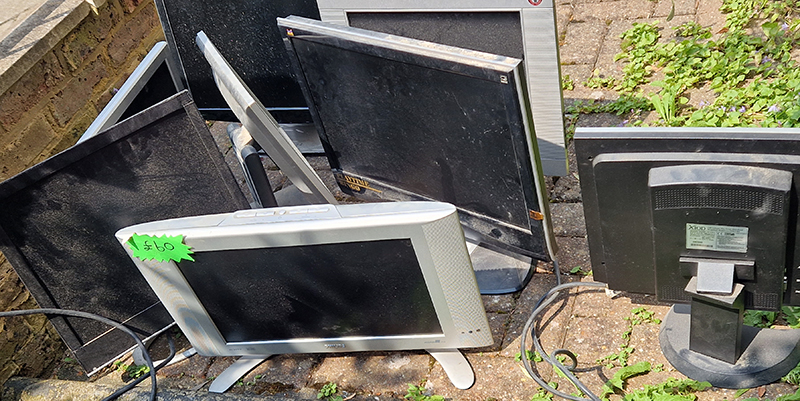
Studio progress on The Azimuth Obelisk of Sedimentary Knowledge – all the paper is now torn down but lots still needs to have a hole drilled through to feed onto the frame. This sculpture is a response to the obelisk erected in 1955 at Hartland Magnetic Observatory, near the site’s northern boundary as a permanent azimuth mark viewed from the north facing window of the observing hut (also known as the absolute hut). I have been sorting out if I have enough old boards for the north wall of The Absolute Hut and have been donated some old monitors and screens to see if I can get them working to use inside. I am thinking of having several screens playing video in the hut – as in the brain – a sensory hub there are different activities and processing going on in different locations. More paper clay forms have been added to The Belly of a Rock sculpture framework to house the video screen – this hybrid sculpture is a place of chemical conversations at the intersection of the animate and inanimate.

Gallery Visits

Fabulous tech and plaster sculptures from Tessa Garland in Postcards From the Volcano at Thames-side Gallery.

Light Being curated by Jonathan Miles of The Wild Parlour at Lychee One.

We were talking of such things: shadows, obscure illumination, folds within substance, but all without a schema that would serve to cohere. Then someone interjected about the rootmeaning of the word for being human as being an entanglement of light, thinking, and being. This would then generate a sense, like something in the air, but also a generation of a spacing for work. Rather than being an exhibition with a theme, instead a tonal poetics and with it a letting be or presentation of an accord would emerge. – Jonathan Miles

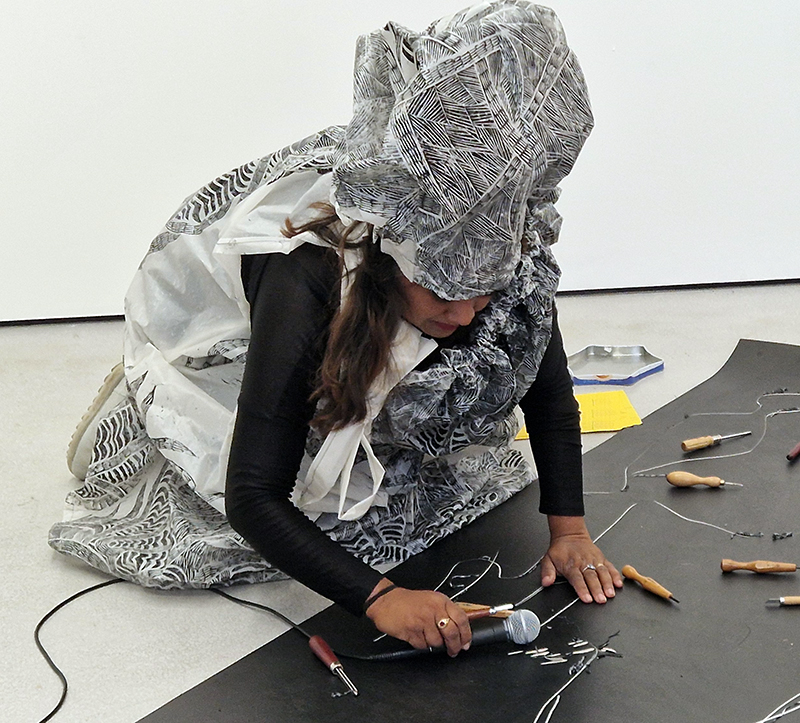
Mesmerizing performance from Chudamani Clowes – Choral Coral Cuts. Performance cutting linoleum to produce a song of coral for coral.

Transport delays meant I missed the first performance but did also catch Kate Howe read The Infinite Intimate which accompanies her sculptural Kraft paper installation and Jessica Mardon recite The Recovery of Meaning.

When numbers weren’t just a unit, a system of measurement, but were symbols that had meaning, it was their meaning that provided structure, not structure that provided their meaning. – Jessica Mardon

Amazing News Update – Laboratory of Dark Matters has been awarded a month long residency at Guest Projects for April 2017. Exciting times ahead.

Image - Laboratory of Dark Matters.jpg

Laboratory of Dark Matters is a response by artists to scientific investigations into the unknown nature of the Universe; opening a dialogue between scientists and artists who are each driven by curiosity and seek answers to fundamental questions about matter and consciousness.

“All visible matter in the entire Universe, including all the stars, cosmic objects, black holes and intergalactic gases, amounts to less than 5% of the mass we know to be present.”  

The search for dark matter is a scientific endeavour but also requires a large degree of faith in both the existence of these elusive particles and in the scientists’ ability to eventually detect and identify them. For artists, creating work is often about searching for some unknown and embracing an unexpected outcome.

The participating artists will be Amy Gear, Daniel Clark, Elizabeth Murton, Kate Fahey, Luci Eldridge, Melanie King, Peter Glasgow, Sarah Gillett, Susan Eyre.

Unexpectedly found myself trailing Game of Thrones fans location hunting.

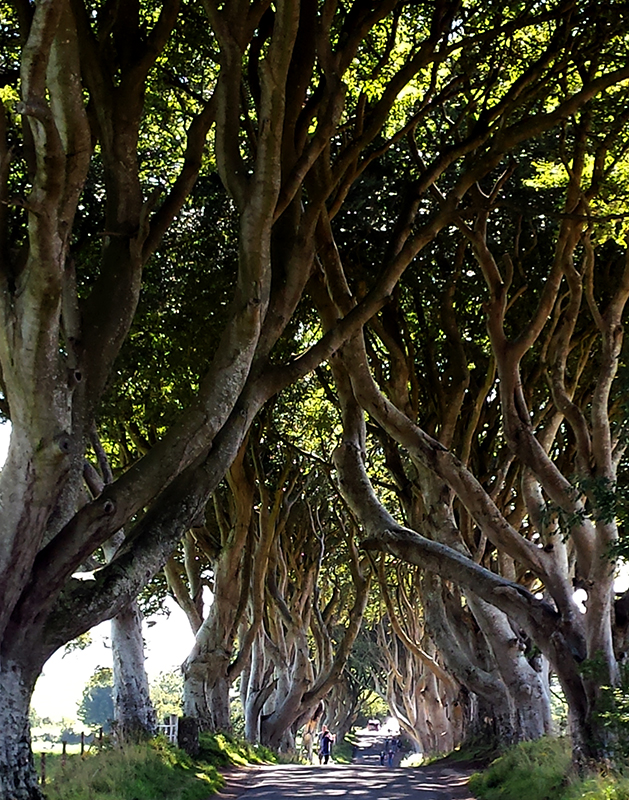
1609-dark-hedges

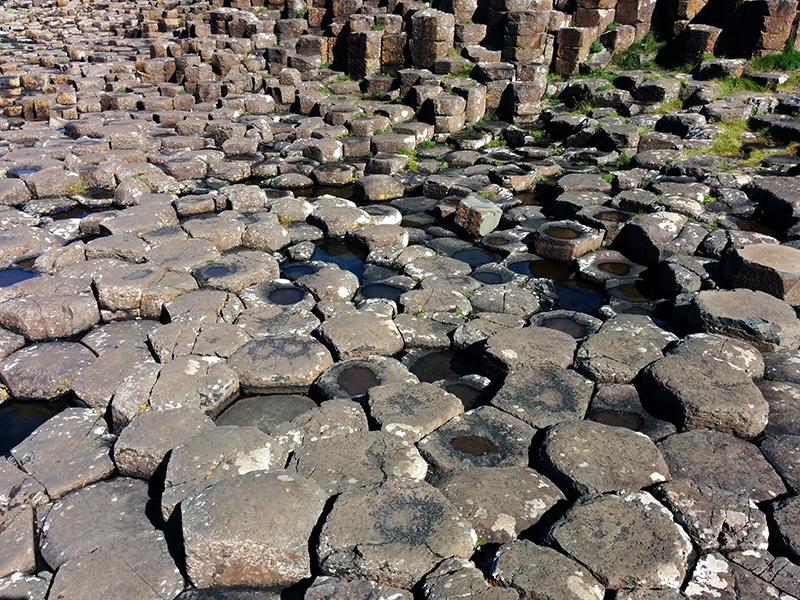
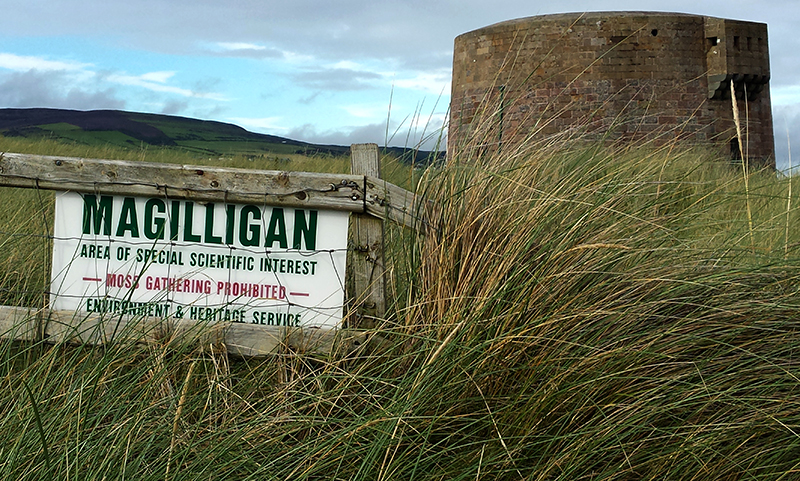
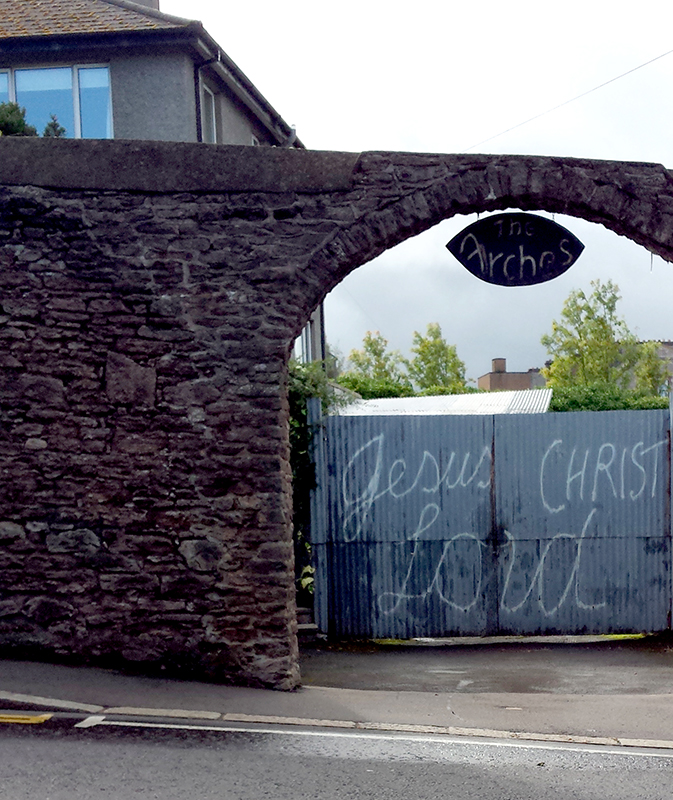
Visiting Northern Ireland’s dramatic coast and spiritual heartlands. Brooding ruins and primeval earthworks, geological anomalies and wide windswept bays. I was on the lookout for saints and sacred wells.

1609-magilligan-point

breathing it in

1609-magilligan-point-2

1609-giants-causeway

The walls of Dunluce Castle – struck through with the local geometric formations

1609-dunluce-castle

1609giants-causeway-2

1609-knockmany-forest

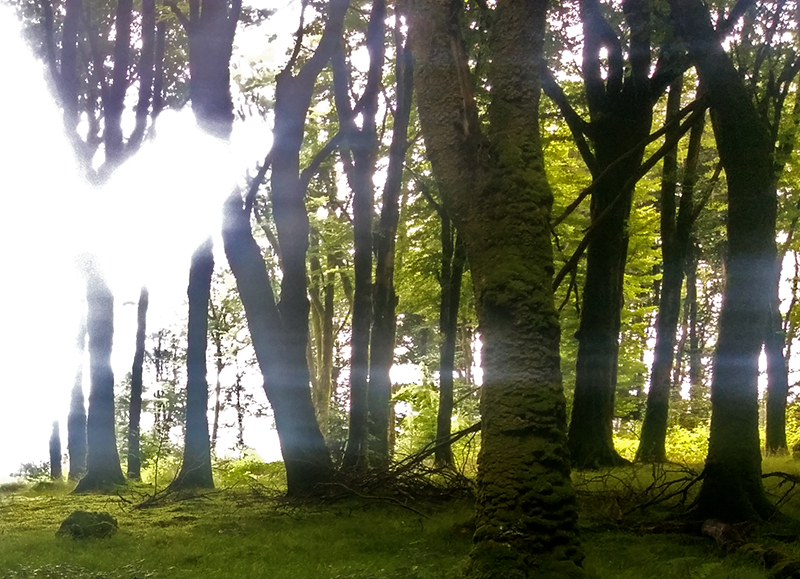
mossy glade – moss prohibition

1609-martello-tower

1609-churchtown-point

‘The Armagh Astropark – where Heaven comes down to Earth…’

1609-astro-park-armagh


1609-st-patricks-armagh-rc

faith and ritual

1609-cranfield-holy-well

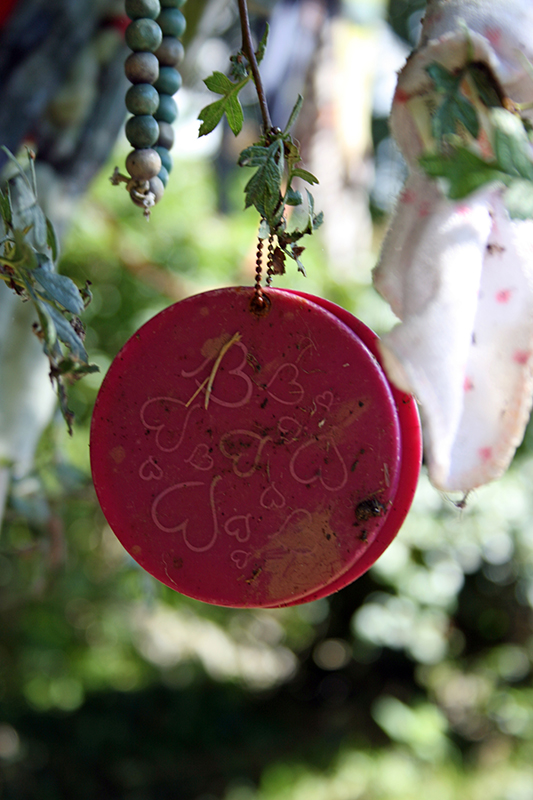
At Cranfield Holy Well there was no evidence of fine spring water and amber coloured crystals, it looked dank and more pestilent than healing. Still it is festooned with personal items tied to the overhanging branches, each one a little prayer. According to  custom, one must bathe the infected part of the body with a rag dipped in the well, pray and then tie the rag to a large overhanging tree, as the rag decays the affliction is supposed to disappear. Judging from the preservation of these items, for some, the cure is a long way off.

1609 Cranfield Holy Well 2.jpg

County Antrim wears its heart on its sleeve.

1609-armagh

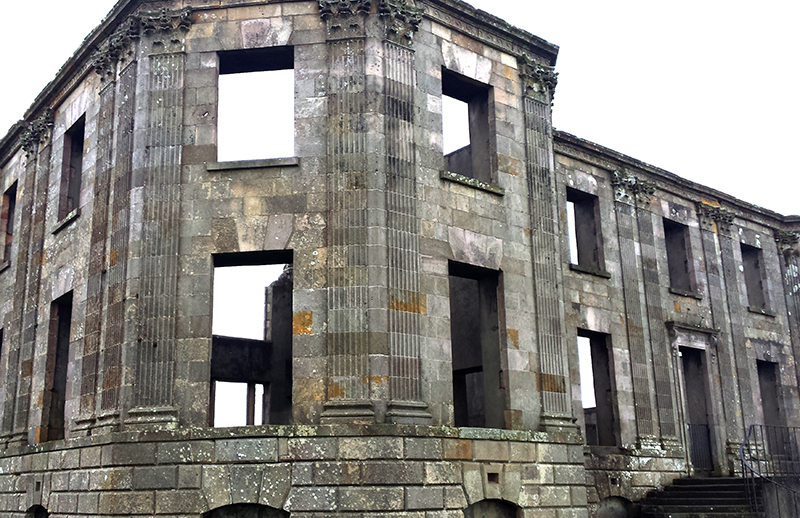
1609-downhill-house

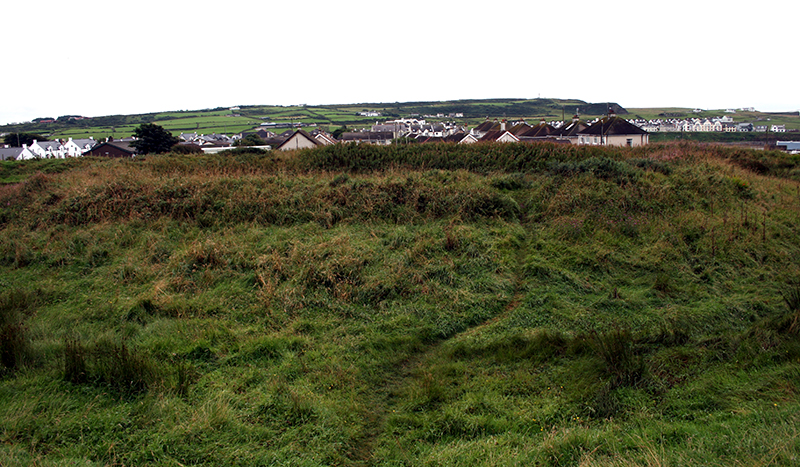
Settlements past and present – Downhill House a recent ruin and the grassy banks of Lissenden Earthworks

1609-lissanduff-earthworks

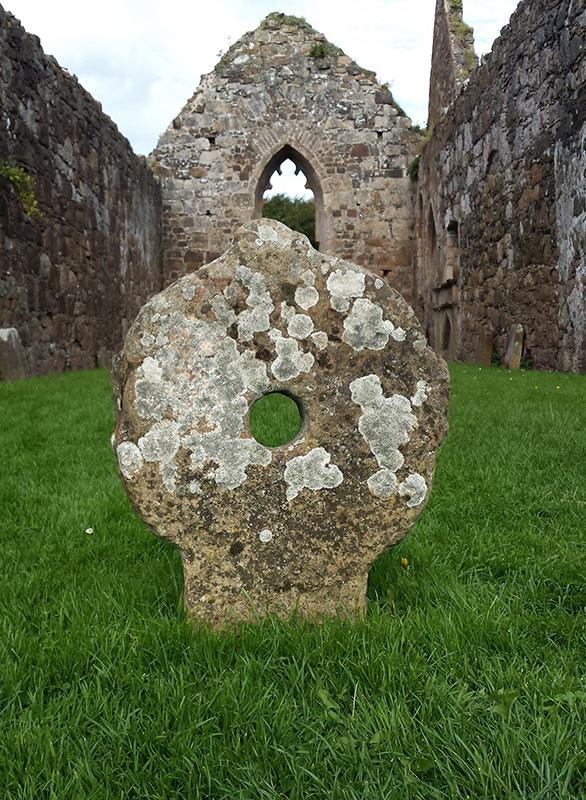
The enigmatic nun, dark Julia’s grave stone at the ancient Bonamargy Friary

1609-bonamargy-friary-dark-julia

The bronze age Tandragee Man brandishing  his legendary silver prosthetic limb

1609-tandragee-man

The even more ancient belly of the earth at Marble Arch caves

1609-marble-arch-caves

Containment slotted nicely into the Plastic Propaganda curated exhibition Sugar and Spice at St. Katherine’s Dock.

1609-containment-3

Made in response to the trade of exotic objects by merchants who journeyed across the globe five hundred years ago when navigation was reliant on the stars.

1609-containment-1

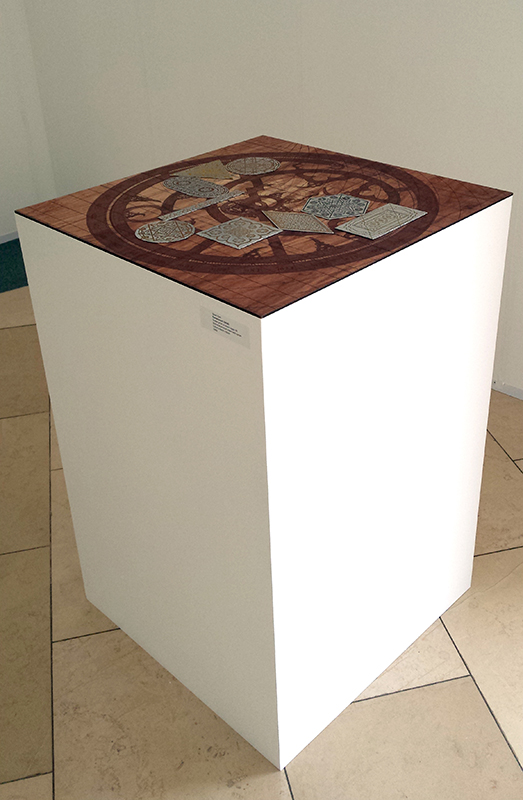
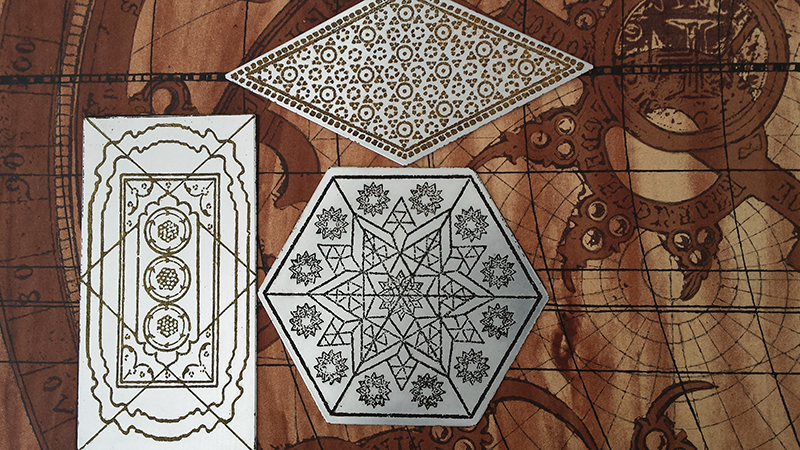
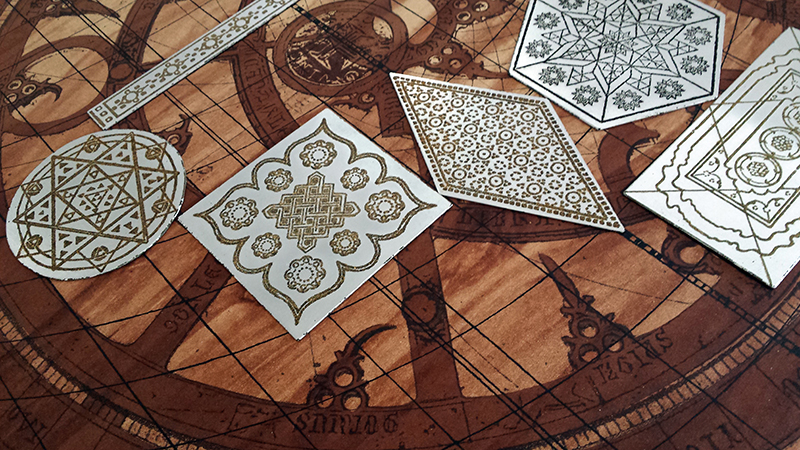
Shaped plates, etched using a sugar lift technique, are filled with inks made from ground spices and copperplate oils wafting traces of their origins in to the gallery space –  turmeric, coriander, cumin, paprika…

1609-containment-2

These operate as markers plotting the spice route from India around Africa to Europe according to the latitude and longitude lines taken from C16th maps of Mercator and Ortelius. The patterns combine ideologies of origins with destinations reflecting the breadth and mix of cultures that came together. I like how viewing becomes a ritual.

Sugar and Spice explored ideas of trade, hybridization and inter-cultural exchange and the legacy of the rich mercantile history of the docks. Looking back informs, educates and gives us the platform for continuous debate…

 …all more poignant post referendum.

Sarah Gillet’s magical show Quarry at Brocket Gallery was in itself a process of quarrying – exhuming material from a forensic analysis of Paolo Uccello’s painting   ‘The Hunt in the Forest (1470). The pursuit of quarry. This inversion of meanings repeats itself in the work as do the shapes and shadows of a forest that extends beyond the boundaries of any canvas into the dark depths of dream spaces where strange creatures abound.

1609-sarah-gillett

In such a space where would you turn to escape.

1609-sarah-gillett-2

It’s how I imagine the labyrinths of Venice should be during the carnival. Full of intriguing theatrical creatures appearing out of the void; playful menace.

I have long enjoyed the work of Raqib Shaw and the dazzling paintings he creates with intricate enamelled surfaces glistening with gemstones and gold; the chaos of  battle played out to the personal beat of shamanic drums; the quest for unattainable perfection.  His obsession with self, pitted against the world, seems to have reached a melancholic peak with Self-Portraits at White Cube. This reimagining of old masters heavily laden with references to his own worlds of Peckham and Kashmir appear as premature reliquaries to a life saturated in self immolation.

1609-raqib-shawHe looks weary.

Hidden undercurrents of surface beauty are exposed in Victoria Ahrens thoughtful presentation of her PhD research ABSORB. A meditation on the history of the Paranà River in Argentina. From a mystical place of leisure for her Grandfather to the brutal grave of those who ‘disappeared’ during the military junta, thrown to their deaths to be slowly and anonymously absorbed into the landscape.

160908-victoria-ahrens-2

By allowing the waters of the river to wash over the plates and images that she creates the alchemical processes continue and those lost into the waters imbue the work with a gentle pathos.

1609-victoria-ahrens-3

From shards of shattered time an image is built that hovers between past and present.

Alex Simpson’s exploration of material in Through Viscera at Barbican Arts Group Trust was fresh and almost vibrating with energy.

Like a virus spreading across all surfaces, into the core of matter that lay extruded across the floor, eaten into and vein like, globular and thick with fungal felt, drying and dropping, leaving prints as scars.


In Lichtlose Luft, at PARCspace the LCC’s photographic archive resource centre,  Johanna Love’s lithographic prints and drawings on digital prints of tiny specks of matter magnified to reveal the sublime contours reminiscent of a mountain landscape were a very successful exploration of finding the human relationship in a scientifically generated image.

1609-johanna-love-1

The technical image is a starting point for the work, either obtained through the electron microscope or the digital scanner. Through the process of drawing and digital manipulation, there is an attempt to bring the image back into the physical, material world of the living and imagination, for as Merleau Ponty (1964) states, ‘science manipulates things and gives up living in them.’

1609-johanna-love-2

Isolated like meteorites falling through a grey space that vibrates with the blurred colours we see on the back surface of the eyelid; these drawings capture the imagination.

Super/collider once again brought us a mind blowing yet entertaining talk at Second Home.  Dr. Andrew O’Bannon has been studying Holography for 15 years. He proposes a bold idea that all the information in our 3D universe may be contained in a mysterious 2D image, like a hologram. Promising not only to unite Einstein’s relativity with quantum physics, holography also has the potential to provide us with cleaner energy, faster computers, and novel electronics. Using ideas from string theory he studies holography and strongly interacting systems.

In everyday life, a hologram is a two-dimensional image containing enough information to reconstruct a three-dimensional object. In theoretical physics, holography proposes that some strongly-interacting systems are equivalent to Einstein’s theory of gravity in one higher dimension.

1609-dragonfly-hologram

“Many experiments to detect proposed dark matter particles through non-gravitational means are under way. On 25 August 2016, astronomers reported that Dragonfly 44, an ultra diffuse galaxy (UDG) with the mass of the Milky Way galaxy, but with nearly no discernible stars or galactic structure, may be made almost entirely of dark matter.” From BBC science

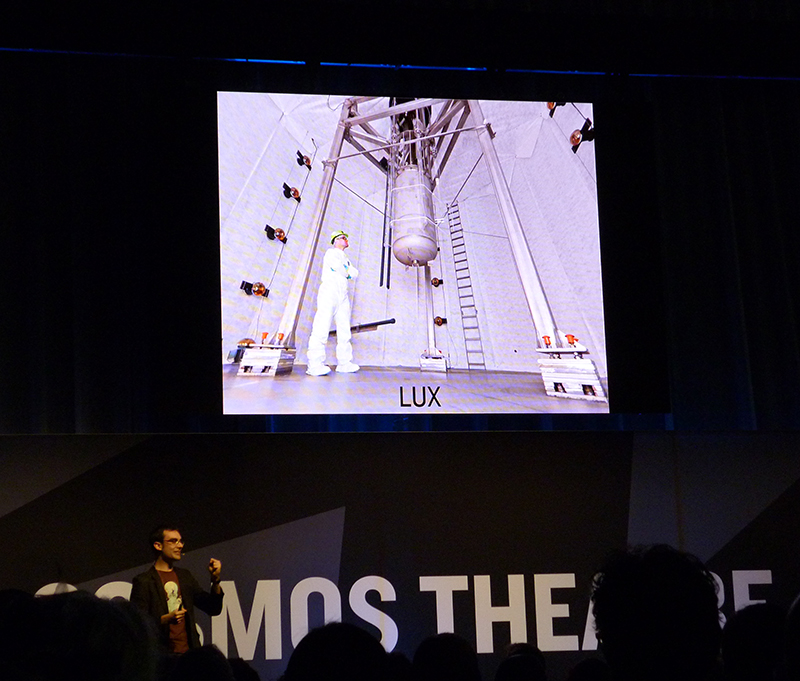
There were two talks at New Scientist Live that I found particularly interesting. The first was from Dr Andrew Pontzen a theoretical cosmologist explaining the evidence that dark matter exists and why it is proving so hard to detect. He spends his time working through theories that are then passed on to someone like Cham Ghag, an astrophysicist who will devise strategies to test theories in direct detection projects such as ZEPLIN and LUX.

1609-new-scientist-live-2

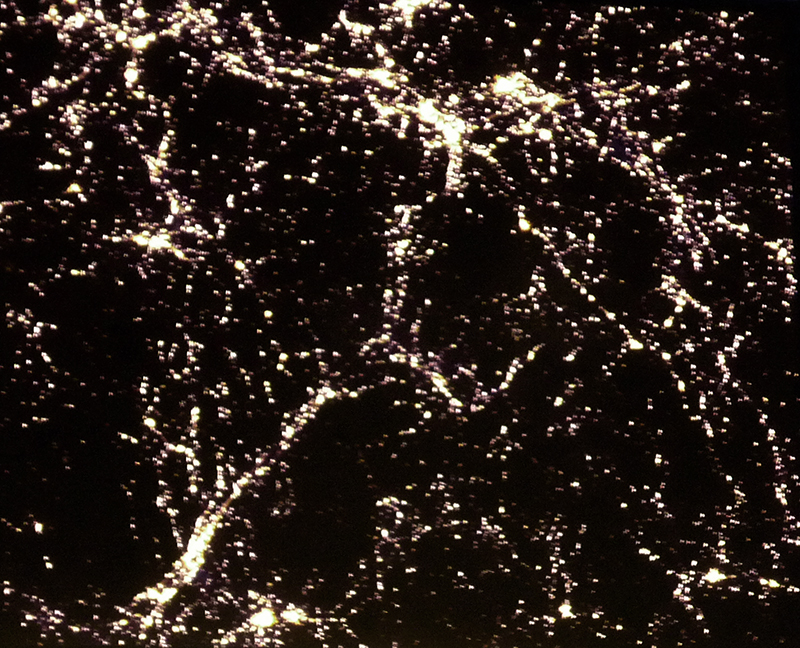
It’s not only the calculations from gravitational lensing that suggests way more mass is present than can be seen but also large computer modelling samples of how galaxies form and rotate. Removing a few stars from the model galaxy ends in a chaotic breakdown, but making a few stars ‘dark’ so that the mass remains but we cannot see them does not change the rotation of the remaining stars we can still see. The distribution of dark matter across the universe appears like a fibrous net, imaged from the cosmic microwave background, an echo still reverberating from the first few seconds at the birth of the universe. The second talk ‘Beyond the Higgs’ was from particle physicist Professor Tara Shears who inspects the data produced from the experiments colliding proton beams to create fundamental particles at CERN, for anomalies that might turn out to be evidence of an interaction with a new particle. The search goes on.

1609 New Scientist Live dark matter.jpg


Back to etching. Have completed an intro/induction at Thames Barrier Print Studio so am now good to go with new work. 1603 aluminium plateTried aluminium in saline sulphate which gives a really deep etch. Used stop out and painting into hot hard ground. Was good to play around with new materials and get some tips from resident expert etcher Nick Richards. 1603 stop out
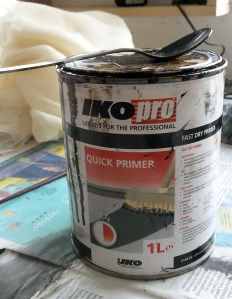
This primer from Wilkinsons is cheap and works well as a stop out solution. The etchings I had done before were all on steel with soft ground, I love the deep rich tones from steel but am trying a new piece of work on zinc with hard ground with should give me a more precise line.

1603 etching plate


This work is inspired by the idea of gravitational waves and grains of space which is one of the lessons in Carlo Rovelli’s book Seven Brief Lessons on Physics. It’s taking a while to cover the plate in the dots. I’m not sure when it’s all done if the wave pattern will disappear.


Michael Doser’s keynote paper Seeing Antimatter Disappear at the symposium Shadow Without Object  gave an insight into how the study of gravity acting on antimatter may help explain why it has disappeared. As a research physicist at CERN he is engaged is trying to discover why there is not the same amount of antimatter as matter in the universe and why what little there is remains clumped at the centre of our milky way galaxy. I asked him if antimatter was considered part of the 5% of the visible world of matter and I think he said that it was as it interacts with photons and fundamental forces.

1603 Michael Doser

Although gravity is the weakest of the fundamental forces its impact on the parabolic flight of anti-hydrogen atoms can be witnessed by using emulsion on a photographic plate which records the particle collision. Using photographic emulsion gives a far more accurate and sensitive result than any digital recording device could.

1603 anti proton imaging.jpg

He said some confounding things – that antimatter emits light exactly like normal matter so you can photograph it but you only see it when it annihilates. So we don’t actually see the antiprotons just the trace of the aftermath of their disappearance left in the photo emulsion on the plate. Working at quantum scales the collision of the proton into the emulsion is digitally scanned and a 3d image stacked up to reveal a starburst. The starburst is the locus of disappearance.

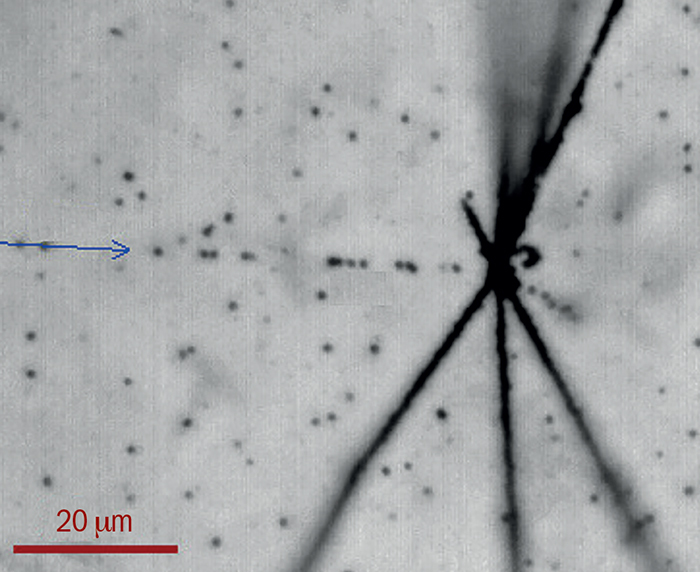
Cosmic rays coming from remote stars hit our atmosphere and produce showers of particles that plough through our bodies – these can be seen using cloud chambers which are detectors that track the particles. The unseen activity of the universe made visible. This is something I am hoping to see when we visit the underground laboratories at Boulby.

1603 cloud chamber particles.jpg

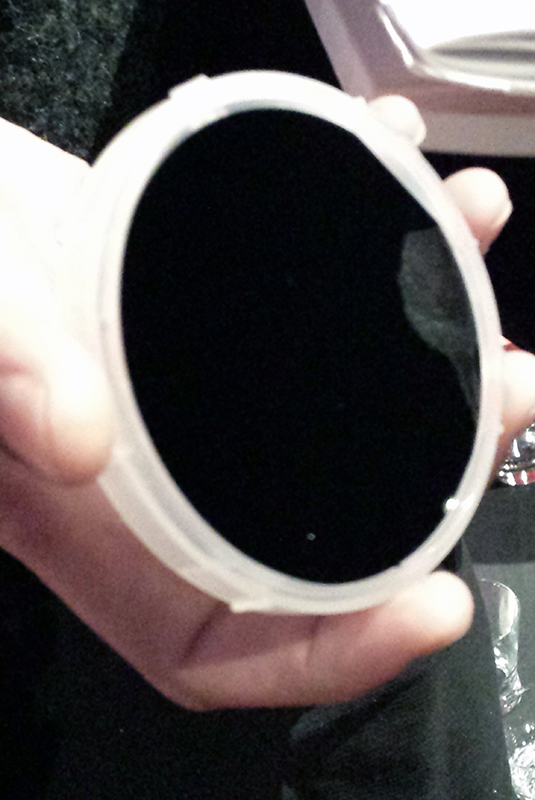
At the talk Are We Darkened by the Light? at Tate Modern architect Asif Khan had brought along a sample of the darkest material on earth – a Vertically Aligned Nano Tube Array. This material was made as a reference for noise images which aim to establish what black should be when looking at a camera chip to remove interference. This material is so black because it absorbs all the photons of light rather than bouncing some back to our eyes.

1512 darkest matter

I wonder if all the photons stay in this material when they are absorbed. Does it fill up with photons?  Does it get hot in there?  Planck’s constant states every hot object emits light, how does that fit in?

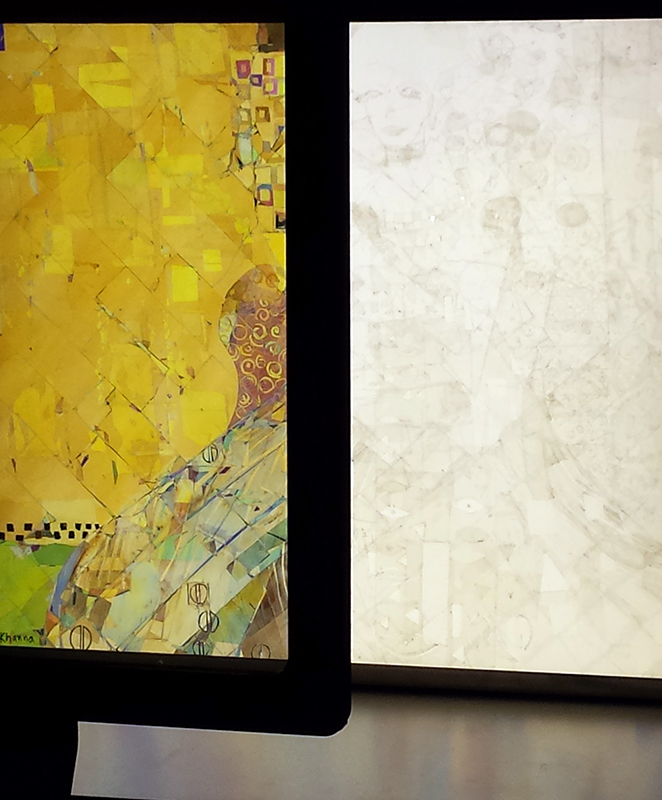
Also at Tate Modern was In/Visibility a work by Vinita Khanna that uses a polarising filter to conceal and reveal the colours in a copy of Gustav Klimt’s painting Portrait of Frau Adele Bloch Bauer.

1602  InVisibility

Vinita Khanna In/Visibility

Choosing an image that we are all familiar with, yet most of us have never seen the original, Vinita Khanna comments on the intangible nature of vision demonstrating the invisible made visible. Humans treat their vision as absolute, when in fact the bulk of our perceived reality is generated by our brains.

1603 Clare Muireann Murphy

Clare Muireann Murphy is a brilliant story teller. She was performing her new work Universe at The Crick Crack Club event upstairs at Soho Theatre. Colliding the science of the big bang (cracking of the cosmic egg) with mythical tales of a goddess tumbling from the skies into a watery world to be rescued by a fearless turtle who then gets turned into a magical lyre that plays the music of the cosmos passing from god to mortal. Clare creates a place of wonder and insight where time stretches and a fissure opens that builds a dream bridge between many worlds…

1601 Repetition Variation

Julian Page presented a group show at Clerkenwell Gallery with a strong sense of the material world. Layers, grids, clusters, networks and stacks – great pictures here:  Repetition Variation.  Having watched the steady growth of Stack while sharing a studio space with Amy Gear at the RCA I have a great affection for this piece.

Stack is an encounter with mass.

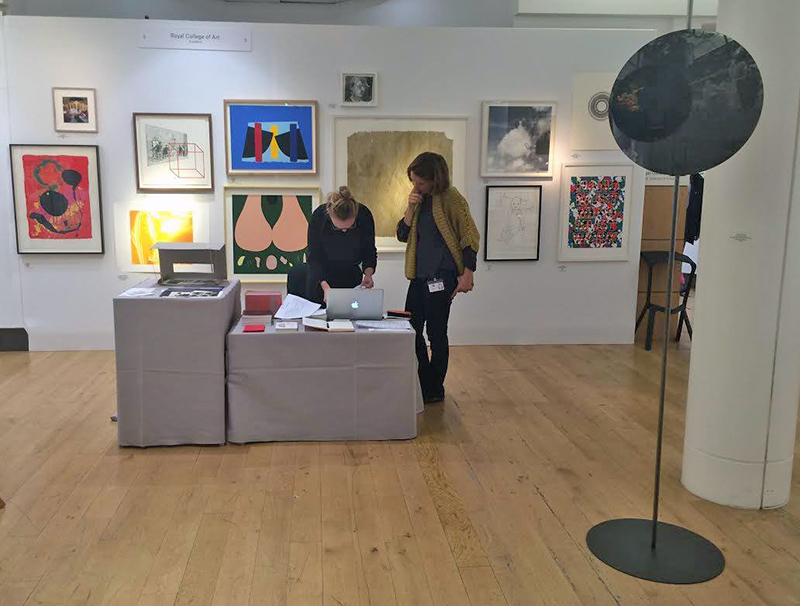
Repetition celebrates editions in the print fest Multiplied at Christies. A jostle of galleries showing their wares. The RCA gets a stand showcasing alumni with recent graduates. I had one sculpture from everydaymatters showing. It looks obvious in this picture but it was surprising how people just didn’t see it. It was about the only work not on the wall and when the room was packed it disappeared in the crowd. Invisible matter.1602 RCA  mulltipliedI was pleased to have two variable editions of Paradise Road sw4 shown by Dark Matter Studio in a grouping with work by Zoe Dorelli, Mary Yacoob, Marianne Walker and Patrick Jackson – The Inner City Pilgrims. A new collaborative project I am involved with whose aim is to re-mystify the city.
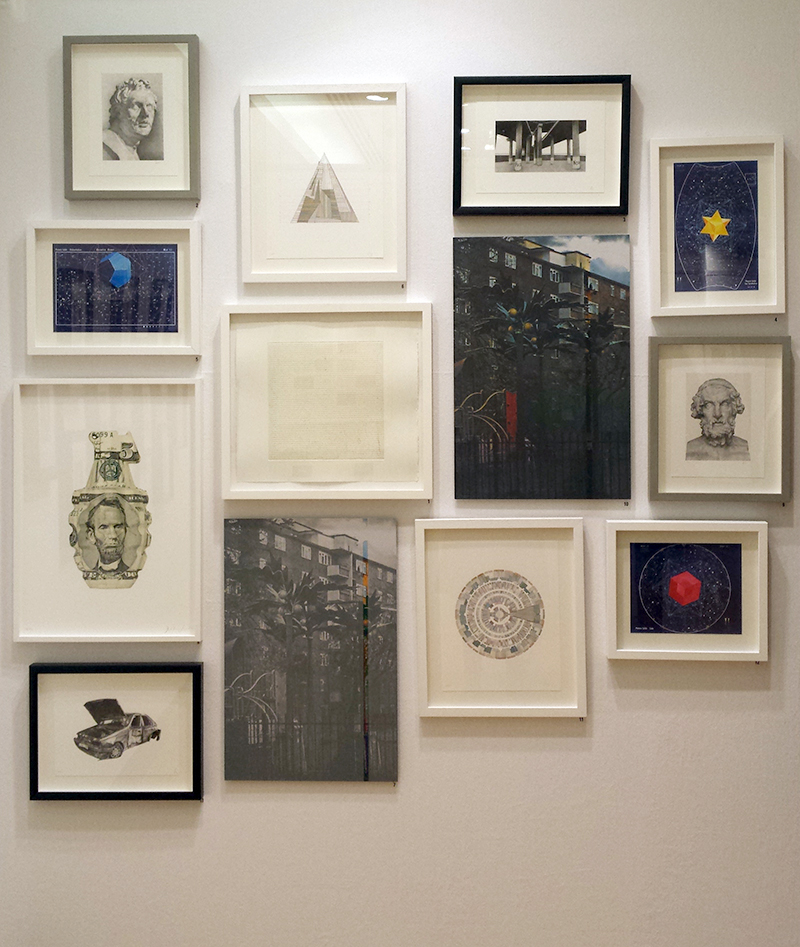
1602 Dark Matter at Multiplied

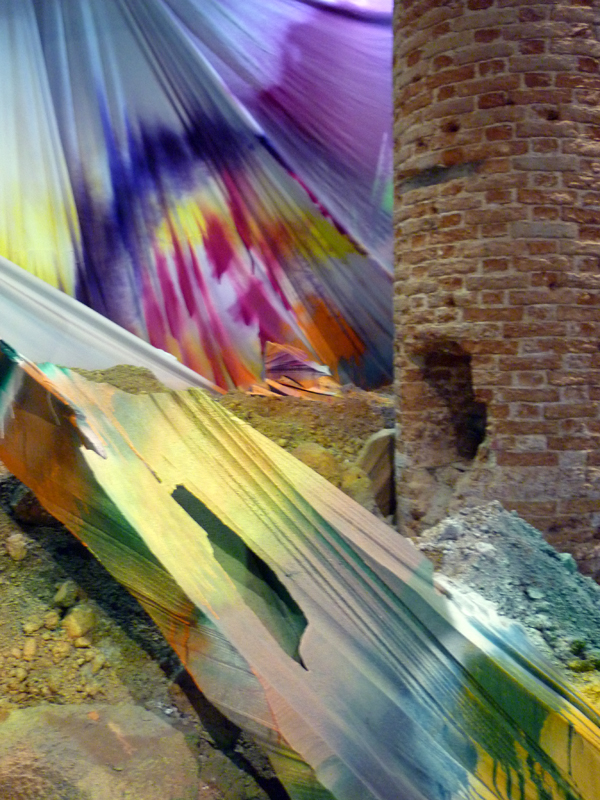
Katharina Grosse has been interrogating space in relation to her paintings such as  ‘Untitled Trumpet’ which have expanded to the point that you can walk through them.

1601 Venice Katherina Grosse  (2)

Katharina Grosse Untitled  (Trumpet)

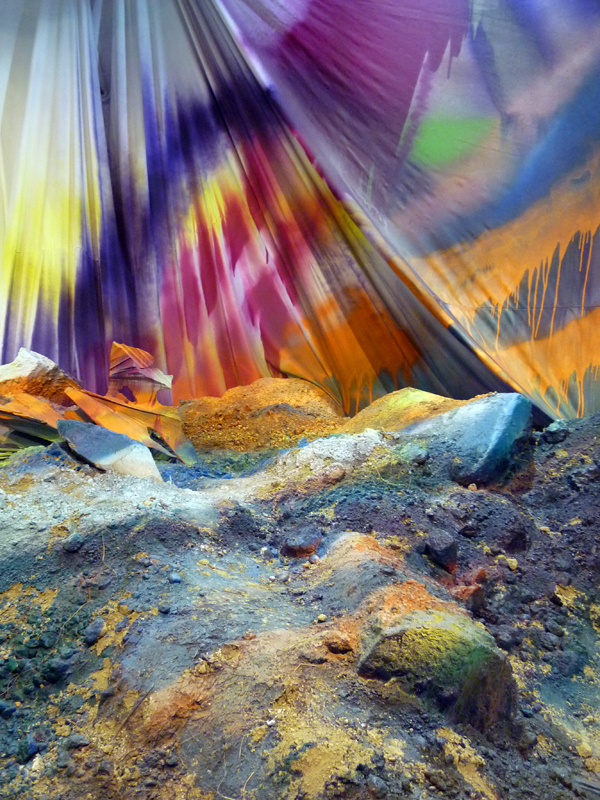
From the experience of having a painting transferred from canvas to silk she was inspired by the folds in the fabric. Folds in space.

1601 Venice Katherina Grosse  (1)

Katharina Grosse Untitled (Trumpet)

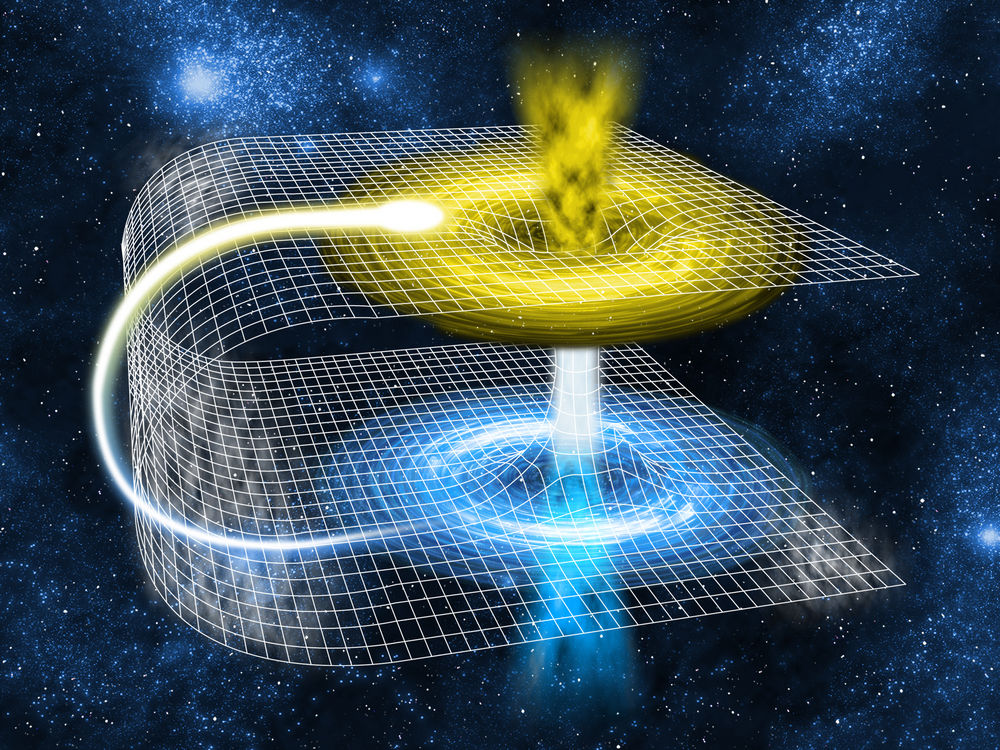
A fold in space could theoretically, allow a short cut from one place to another.

1601 wormholeA wormhole has two mouths and a throat. For travel to be possible, wormholes would need to be full of exotic matter, that is to say a non-baryonic matter like dark matter i.e. not made of the stuff we are made of. It is as yet another unknown.
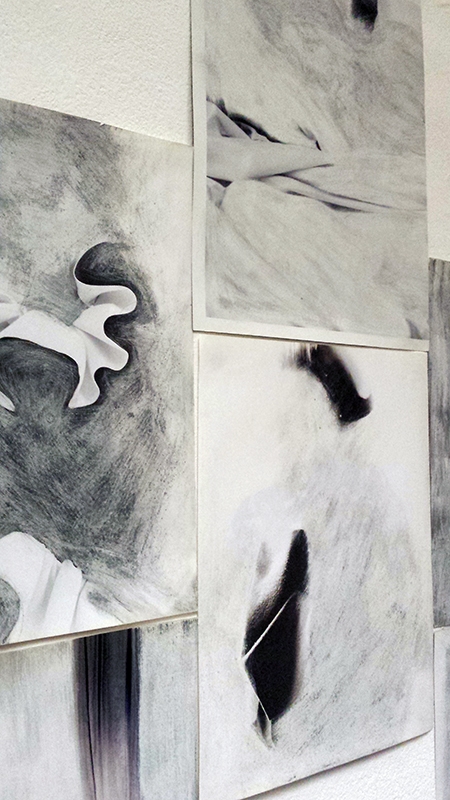
How we move through space and interact with the architecture that surrounds us was explored in Mimesis  at Westminster Reference Library.

“Mimesis produces mere ‘phantoms’, not real things. It is at once dependent and deluded, just as a mirror is empty and inessential without something to reflect.” – Matthew Potolsky

1602 Amelia Critchlow

Amelia Critchlow

Amelia Critchlow and Evy Jokhova have been considering how image and architectural form influence the way we read our world; how cognition can cloud and clarify and how association can attack an image or experience, or stand apart, apparently neutral and transparent.

1602 Evy Johkova 3

Evy Jokhova

Mimesis created an unstable environment of wobbly furniture, erased images and material associations where the chalky surface of architectural columns turn out to be constructed from Brie.

This is the playful mimic undermining the authority of grand architecture and opening a space to question our surroundings by subverting expectations of form.

I was introduced to the beautiful work of Ben Cove at Multiplied and then visited his exhibition Modern Language at Peter Von Kant Gallery.

Architectural devices are made symbols. Flat surfaces deceive the eye with shadow and form. Clean, sharp colours zing against black and white images drawing the eye backward and forward shifting us in space and in time. It’s a dynamic experience. Having read a lot lately about how there is no empty space, there is no void, I can feel here that all space is packed with information and all is connected through space time.

For her archaeological installation Wrong Way Time in the Australian Pavilion at the Venice Biennale Fiona Hall filled the room with an ecology of objects that tell the story of civilization from primal beliefs in magic and animism through capitalism, global economic collapse and climate change leaving us with the challenge of facing the end of anthropocentrism.

1601 Venice Australia Fiona Hall (2)

Fiona Hall

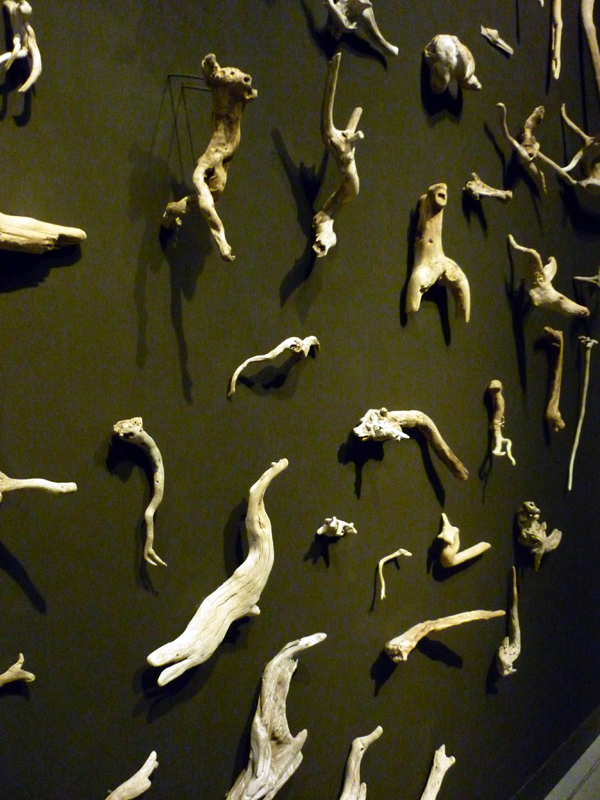
She trusts in our sense of wonder and imagination that can see life forms in sculpted drift wood to see a world not of exploitation but of symbiosis.

1601 Venice Australia Fiona Hall (3)

Fiona Hall

In the French Pavilion Celeste Boursier-Mougenot’s work also activated primal beliefs that animals, plants, and inanimate objects possess a spiritual essence. In transHUmUs an arboreal dance reintroduces us to a latent anthropomorphism. The trees glide around directed by their own metabolism with their truncated roots exposed on their islands of dirt, like isolated protesters quietly demonstrating.

1601 Venice France Celeste Boursier-Mougenot (2).jpg

Celeste Boursier-Mougenot transHUmUS

In the beginning…the word became flesh. The vertical-transcendent dimension of the Logos – the word of God from above and the horizontal-immanent dimension of the flesh below were the axes of research put forward by the Holy See as participant in the Venice Biennale 2105.  Elpida Hadzi-Vasileva created ‘Haruspex’ in this context.

1602 Venice Elpida Hadzi-Vasileva

Elpida Hadzi-Vasileva Haruspex

Using the raw flesh of pig’s caul, sheep’s intestine and cow’s stomach she weaves a canopy, an enclosure, a net, a trap, a sanctuary. It’s meaning oscillates as does the beauty and horror of its materiality. We must read the omens by inspecting the entrails of sacrificial animals.

Pamela Rosenkranz questions what it means to be human in a digital age. The anthropocentric bias of humanism is challenged when subject and object are impossible to separate. Our physical and psychic being is undergoing a transformation by the new materials that we wear, inject, subsume.

1601 Switzerland Pamela Rosenkranz (1)

Pamela Rosenkranz Simulation

The glowing wet body of synthetic liquid designed to replicate a particular skin colour floods the Swiss Pavilion with a sickly sweetness that has a back flavour of the murder victim’s chemical bath.


Surveillance, voyeurism, participation and looking within oneself. The need for private space.

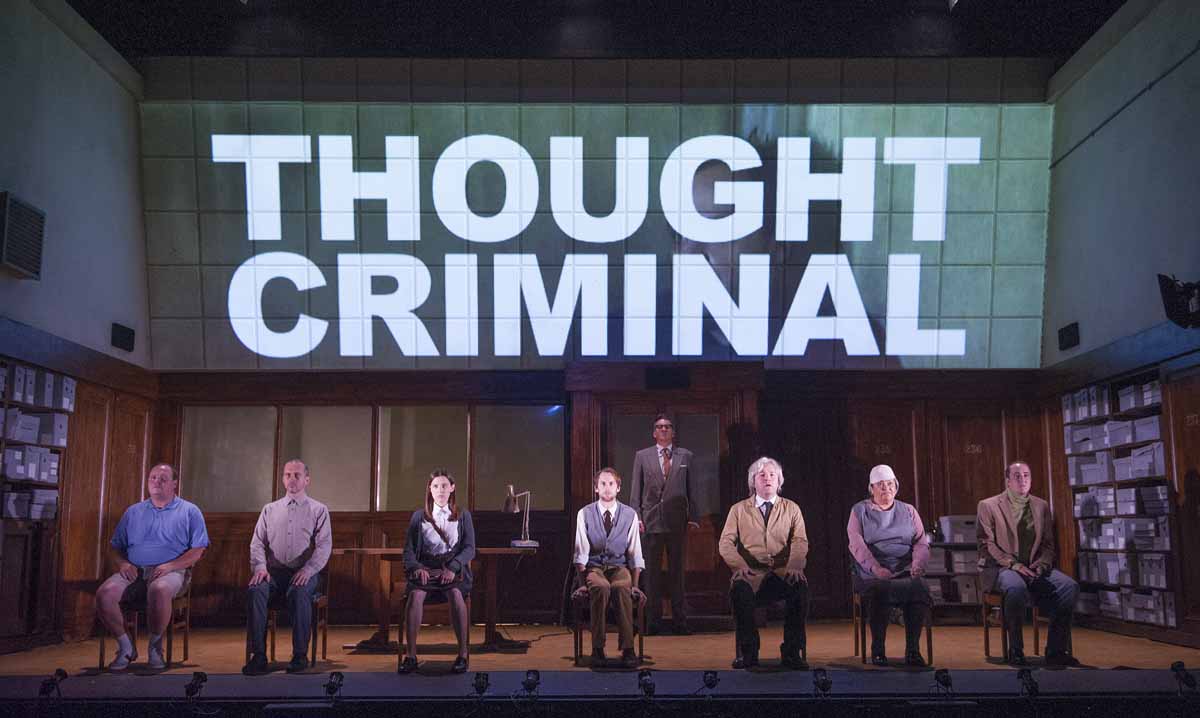
All of these ideas are encapsulated in George Orwell’s 1984 which I have recently seen interpreted by the brilliant and innovative Headlong Theatre Company.

Headlong Production of 1984

Headlong Production of 1984

This production explores the world inside Winston Smith’s head, as well as the world without, and catches the euphoria and bliss buried deep underneath the cold face of Big Brother. Headlong’s version explores why Orwell’s gaze is as relevant today as it ever was.

The series of short film screenings at Dilston Grove under the banner ‘Lawns and Hedges’ seemed very relevant to my interest in the manicured public space.

The programme was put together by Anna Gritz and Jennifer Teets as part of ‘Wendel! Open Your Door’ a Woodmill collaboration.

The films were chosen in relation to a text from the entry submitted by Lewis Masquerier in the 1858  competition to design Central Park.

‘To the Commissioners of Central Park:

I have planned purposely to effect a double object. Not only to give a pleasing landscape, but also an instructive one. For amusement and instruction combined, certainly intensify each other. I propose then to lay off the southern half of the park in a miniature representation of the continents of the earth.

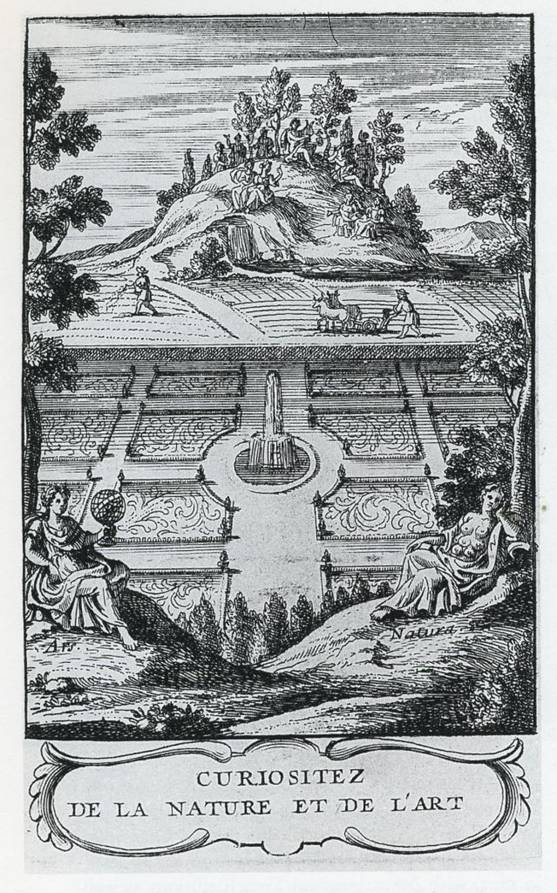
Unfortunately, no one would ever get the pleasure to stroll through Masquerier’s vision for Central Park, as Frederick Law Olmstead’s proposal would be the winning one. Yet nevertheless his vision for a landscape that would promise both pleasure and instruction is very much in line with the history of garden architecture.

Frontispiece to l'Abbé de Vallemont's Curiositez de la nature et de l'art (1705)

Frontispiece to l’Abbé de Vallemont’s Curiositez
de la nature et de l’art (1705)

From the gardens of the antiquity, to the French and English landscape gardens and the park designs of Frederick Law Olmsted and Walt Disney, nature has been used to choreograph our physical movements and emotional states.

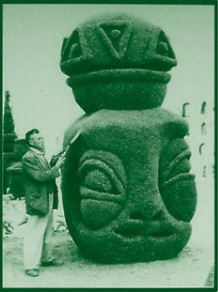
Azael José María Franco Guerrero and one of its 'living sculptures' in Tulcán Cemetery, Ecuador

Azael José María Franco Guerrero and one of its
‘living sculptures’ in Tulcán Cemetery, Ecuador

This screening looks at landscaping as a process of cultivation, one that creates sites suspended between exercised control and escapist diversion whilst offering the potential for political subversion.

Nature is featured here as a manicured stage set that guides and hosts the theatrics of the human condition. The environment is reconsidered not just as a dramatic backdrop that illustrates the psychological condition, but also as an active player in the sculpting of social unconscious. The individual films are entwined within a scroll of still vignettes, interlacing imagery and rhythm to mimic the peripatetic nature of human perception.

The screening opened with a rapid scroll through a selection of source material and images on the themes outlined in the programme.
I would have liked to have had longer to see each image and more information on the research undertaken as it looked extensive and fascinating.
The films shown were:
Julia Rometti and Victor Costales, Plantas Populares – Movimiento: Agitato, 2013, 14’56”
‘A film in black and white of tropical plants being agitated by the wind. These are ‘house plants’ seen in their natural habitat of the Amazon jungle.
Olga Chernysheva, Anonymous. Part 1 & 2, 2004, 19’
This is a film where a middle aged lady gradually plucks up the courage to change into her swimming costume in a public park.
It is sad in a way that she is obviously so self conscious yet ‘the public’ are oblivious to her trauma and exposure.
Deimantas Narkevicius, The Role of a Lifetime, 2003, 16′

Deimantas Narkevicius 'The Role of a Lifetime'

Deimantas Narkevicius ‘The Role of a Lifetime’

This film also on show at Tate Modern pans across a series of drawings from Gruto Park in Lithuania where a lot of old post war sculptures have been abandoned.

Should these murderers end their days in such arcadian settings. Filmmaker Peter Watkins adds a self reflective commentary on his personal creative journey.

Rosalind Nashashibi, Jack Straw’s Castle, 2009, 17’20”

Rosalind Nashashibi 'Jack Straw's Castle'

Rosalind Nashashibi ‘Jack Straw’s Castle’

Amy Granat, Landscape Film, 2009, 8’45”
TJ Wilcox, A Fair Tale (Extended Mix), 2006/2007 8’47”
Jessica Warboys, La Fôret de Fontainbleau, 2010, 4′
The exhibition ‘Surveillance’ at Gimpel Fils  had work by Seamus Harahan and Christopher Stewart who create work about watching and being watched.

Seamus Harahan Torch extended

Seamus Harahan Torch (extended) video still

Seamus Harahan films human behaviour from a distance, giving little away as to what activity we are witnessing but holding our attention as we become the detective searching for clues.

The long lens perspective gives us the sense that we are witnessing a private moment of an unguarded subject of our gaze.

Christopher Stewart

Christopher Stewart ‘Germany’

This series of photographs from Christopher Stewart are loaded with tension. This is not idle waiting and watching, these are covert operations.

Christopher Stewart Insecurity

Christopher Stewart ‘Insecurity’

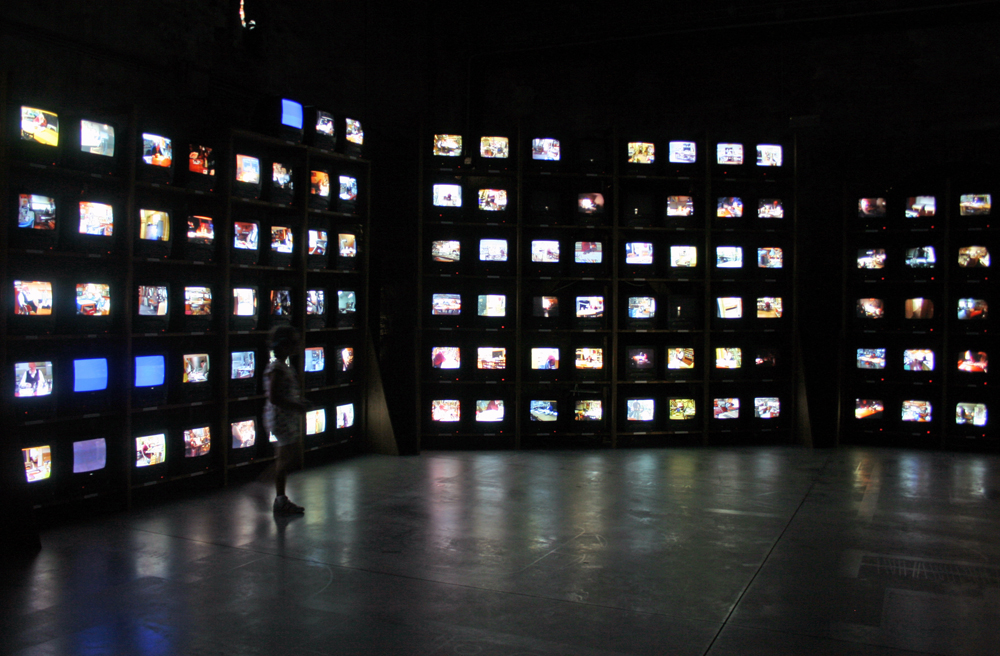
At the Venice Biennale Dieter Roth presented video surveillance as a sort of diary to record his everyday activities.

The minutiae of his life, eating, sleeping and working in his studio over a period of a few years are shown simultaneously on 131 monitors.

Dieter Roth

Dieter Roth ‘Solo Scenes’

The effect is to condense a series of events into one happening, it is impossible to witness everything on the monitors at once. Scattered like memories,  the linear narrative of life breaks down into fragments yet produces an overall  essence. A self portrait.

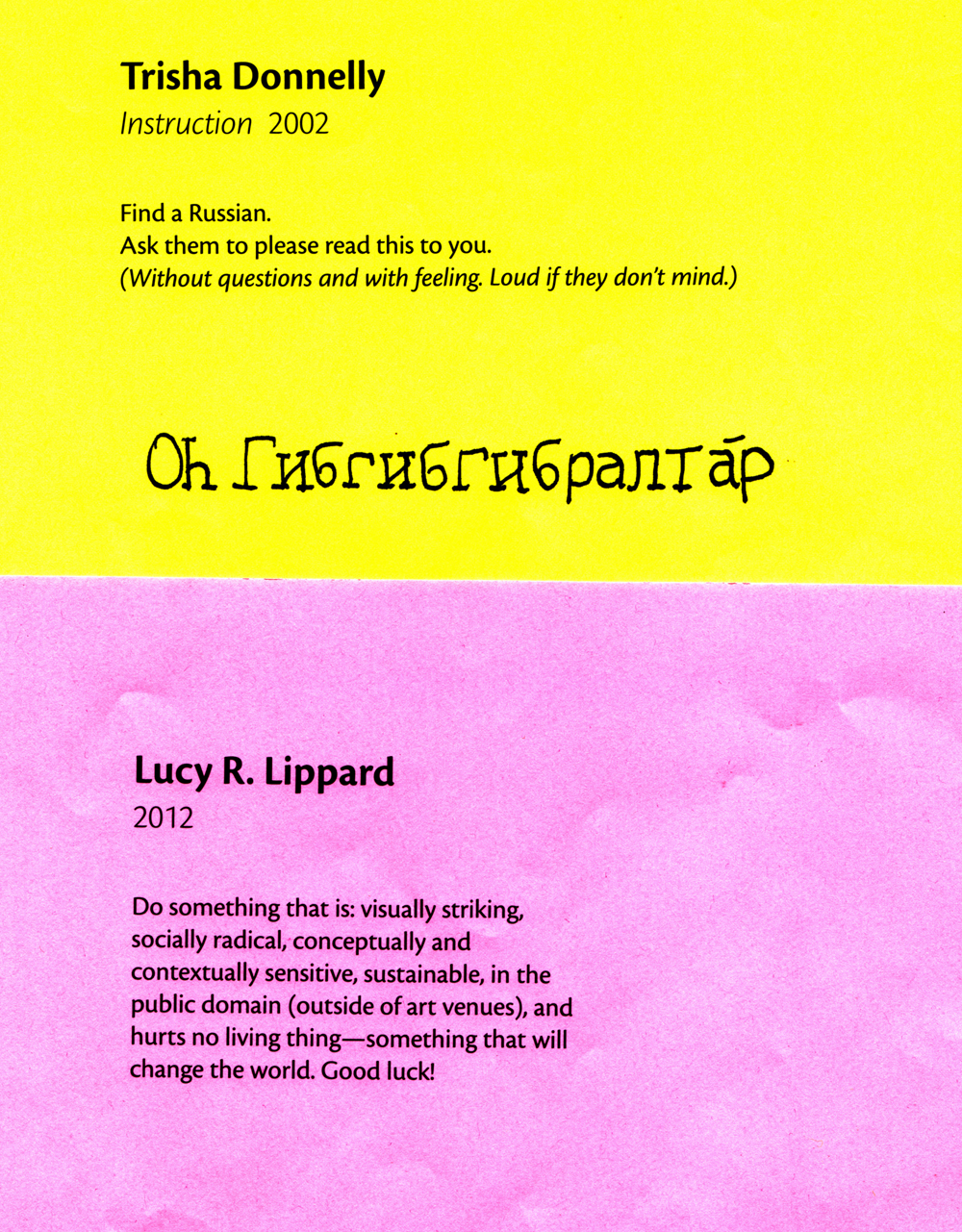
Do it 2013 a group art show at the Manchester International Festival was billed as turning the notion of viewing into an active and performative encounter between artist and visitor.
11 Rooms which was staged at the Manchester Gallery in 2011 felt more engaging than this years show for me. 11 Rooms was secretive and beguiling. You had to enter an unknown encounter through a closed door into an intimate space. This year the open plan space gave participation a self consciousness.

do it 2013 consists of a growing series of written artists instructions, each reinterpreted each time it is enacted.

Some of the instructions have been written specially for do it 2013 and some date back to 1993 when the project first began from a conversation between Christian Boltanski and Bertrand Lavier curated by Hans Ulrich Obrist.

Manchester Gallery Do It Yourself

Manchester Gallery Do It 2013

Some instructions were absurd, some fun and some impossible to carry out.

Manchester Gallery Do IT Yourself

Manchester Gallery Do IT 2013

The re-enacted instruction I enjoyed the most was the live performance with a vulture.

Maria José Arjona a Columbian performance artist paid homage to her mentor María Teresa Hincapié
who died a few years ago with the performance ‘Second Messenger: Performance with vulture and writings’.

Manchester International Festival

Manchester International Festival

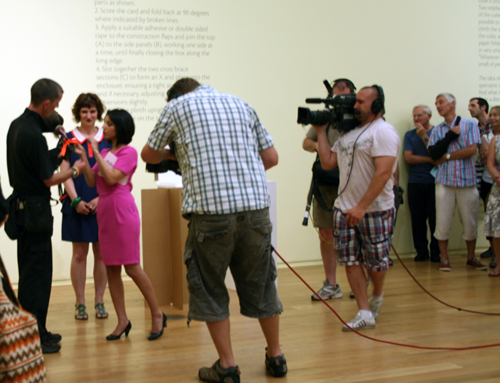
The film crew were on hand which heightened expectations of a performance but also killed any spirituality at the heart of the enactment.

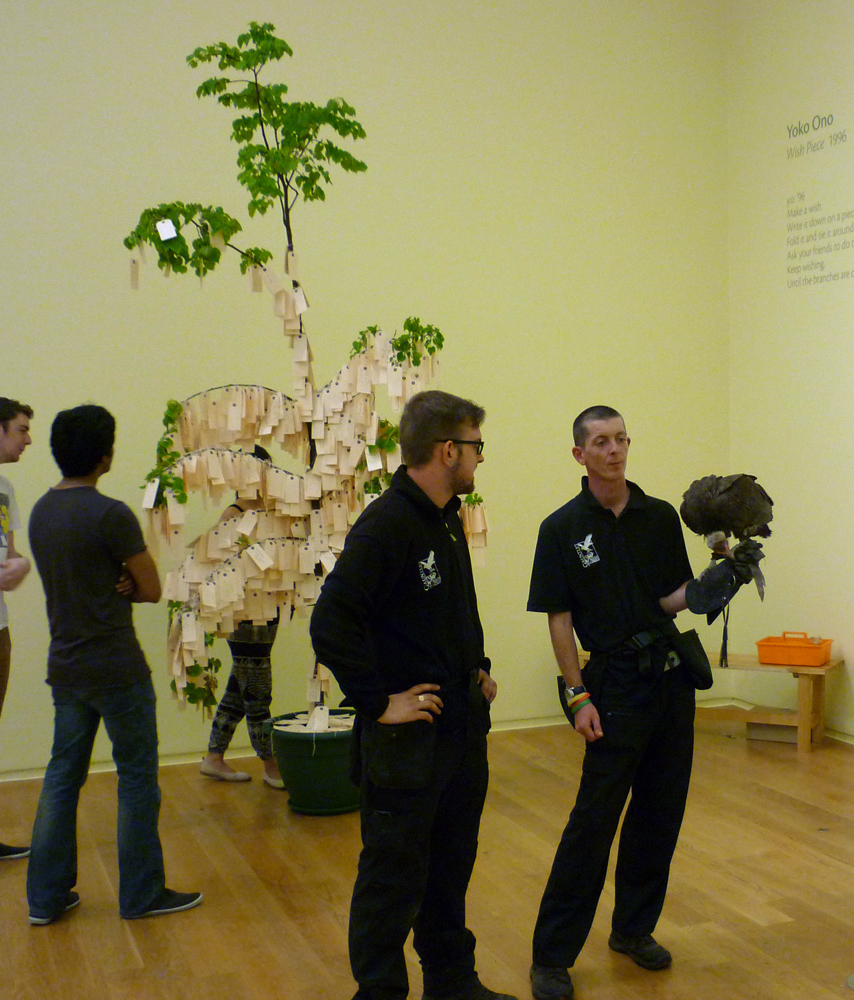
Shadow the Vulture

Shadow the Vulture

The Amazon rainforest felt very far away.

María Teresa Hincapié left instructions for her student to go into the Amazon rainforest, drink only water and eat only fruit and obtain a spiritual experience.
So Maria José Arjona went into the forest with a shaman who made a potion from plant bark for her to drink. This potion gave her an experience which she described as ‘seeing clearly’ and she spent 12 hours writing messages while under the influence of the potion. A message that she wrote while in her transcendent state is delivered to the Manchester Gallery by a vulture, a bird of sacred symbolism in Columbia.
The message reads
‘ The future is uncertain. Words are traps for innocent animals. You must know that knowing too many secrets delivers some sort of damages.’

The ancient forests of Europe used also to be a place to go to for adventure, to confront the power of nature and to face danger.

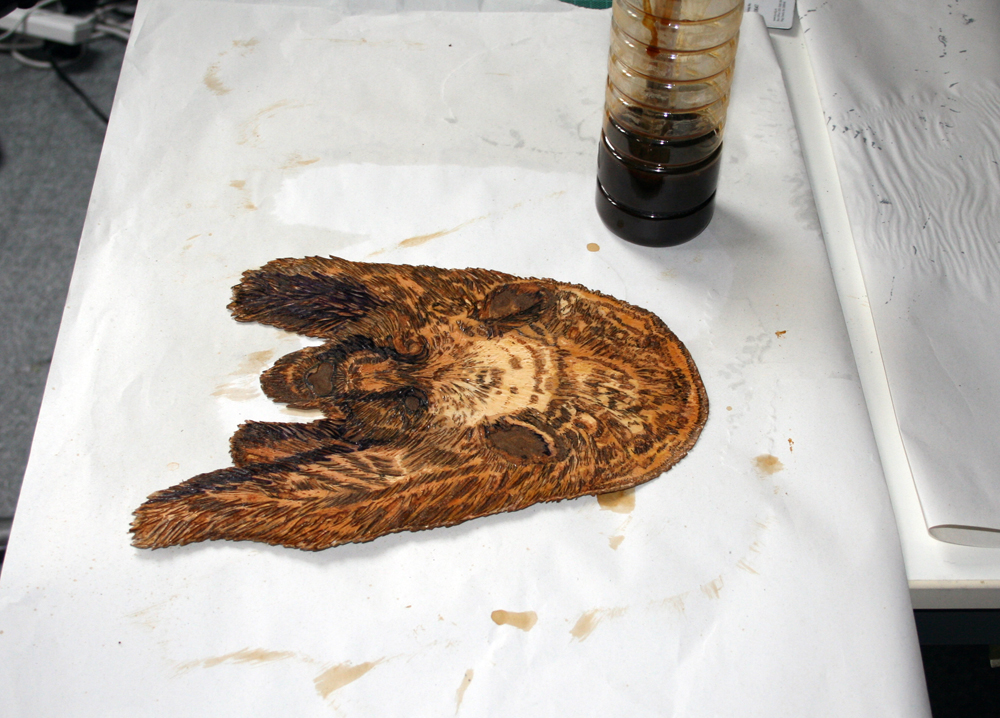
Bear Collagraph

Bear Collagraph

I made a collagraph of a bear. Partly to see how this would translate through the cardboard of the plate but also as I was thinking about the beasts of the ancient forest.

Bear test prints

Bear test prints

The reaction in the studio was that the bear was cute not fearsome.

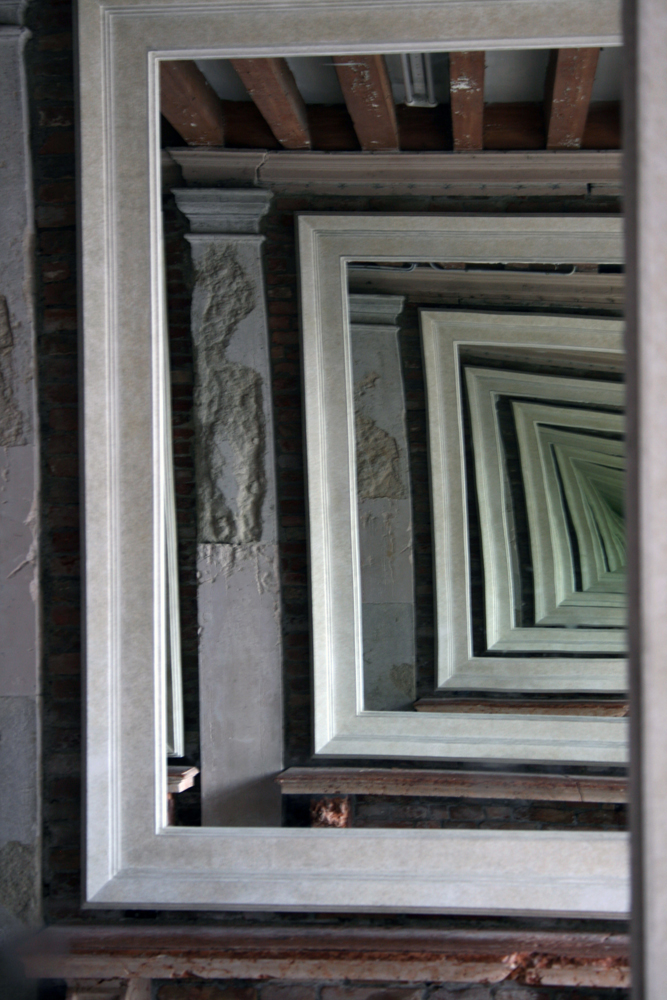
1309 Palazzo Zenobio

Space, a nebulous concept, we tend to like to measure and quantify it.

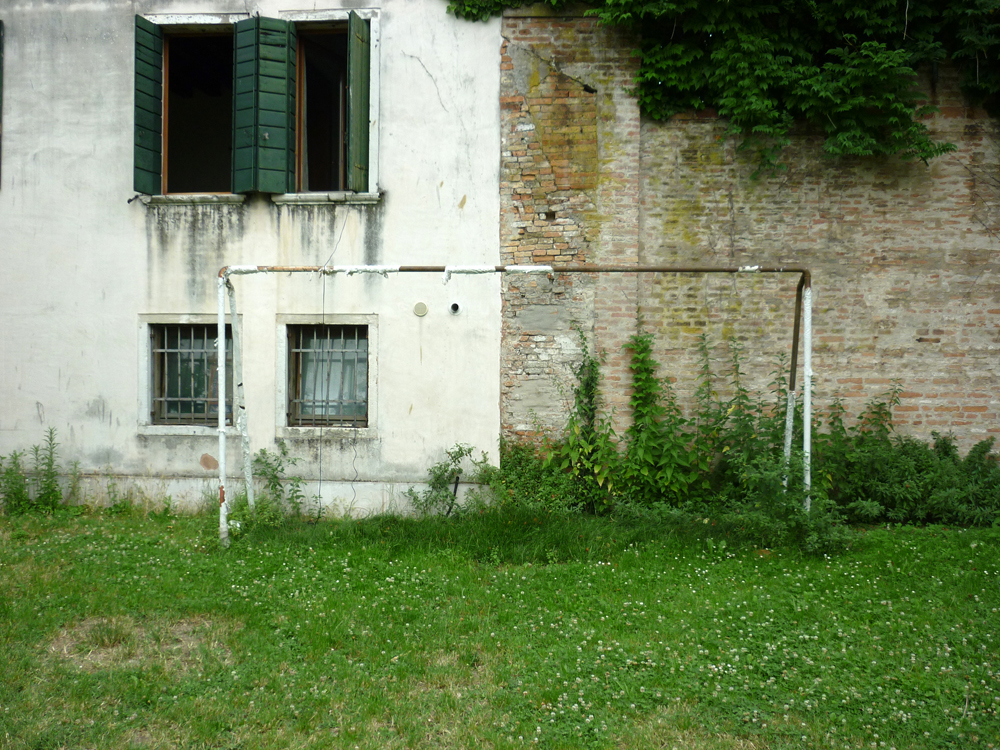
1309 goal

Marking out a space for a purpose.

The Icelandic Pavilion at the Venice Biennale investigated architectural drawings to contrast the function of a workplace  with the opulence of leisure pursuits.

One blueprint is placed over another.

Katrin Sigurdardottir 'Foundation'

Katrin Sigurdardottir ‘Foundation’

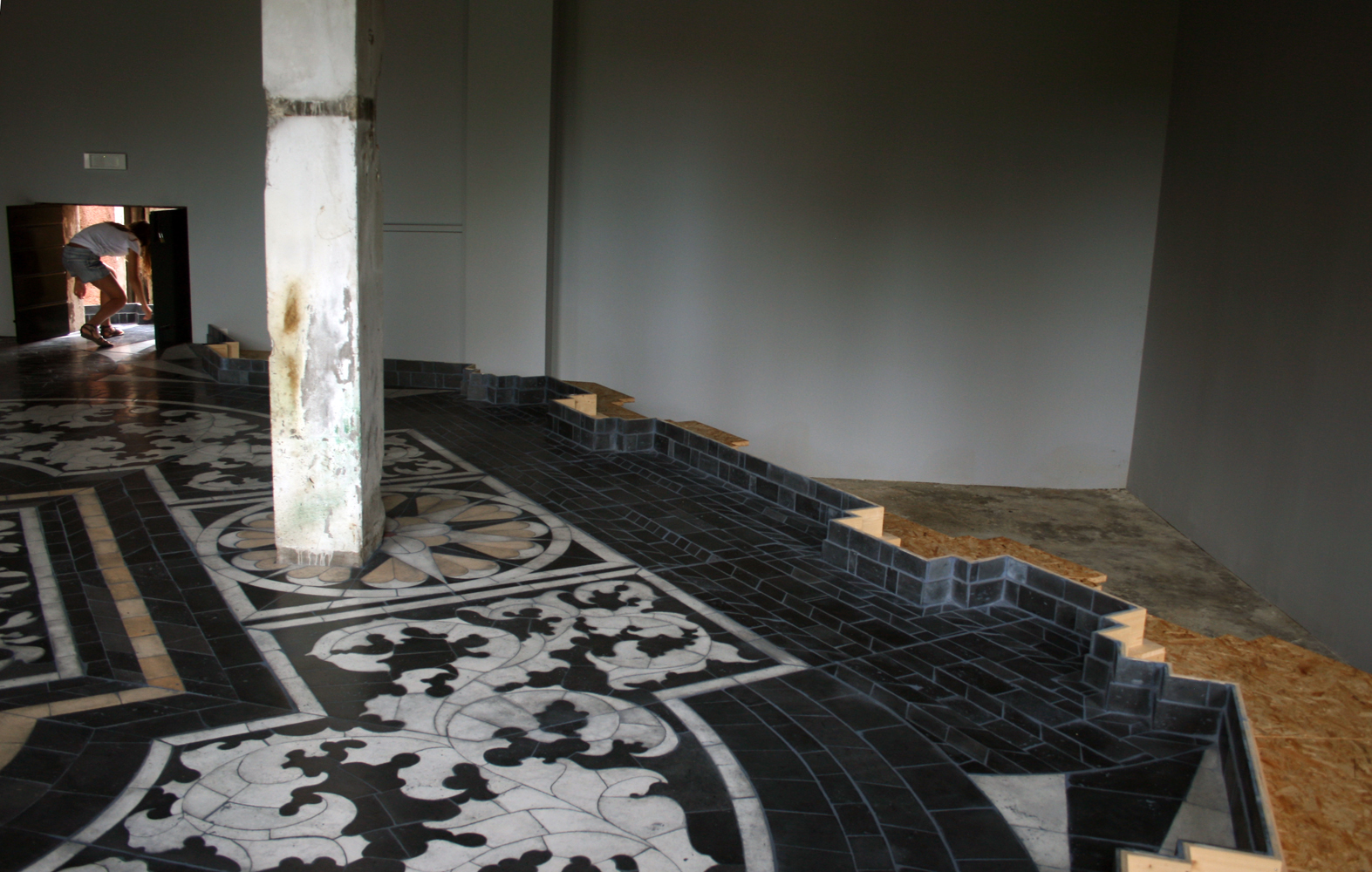
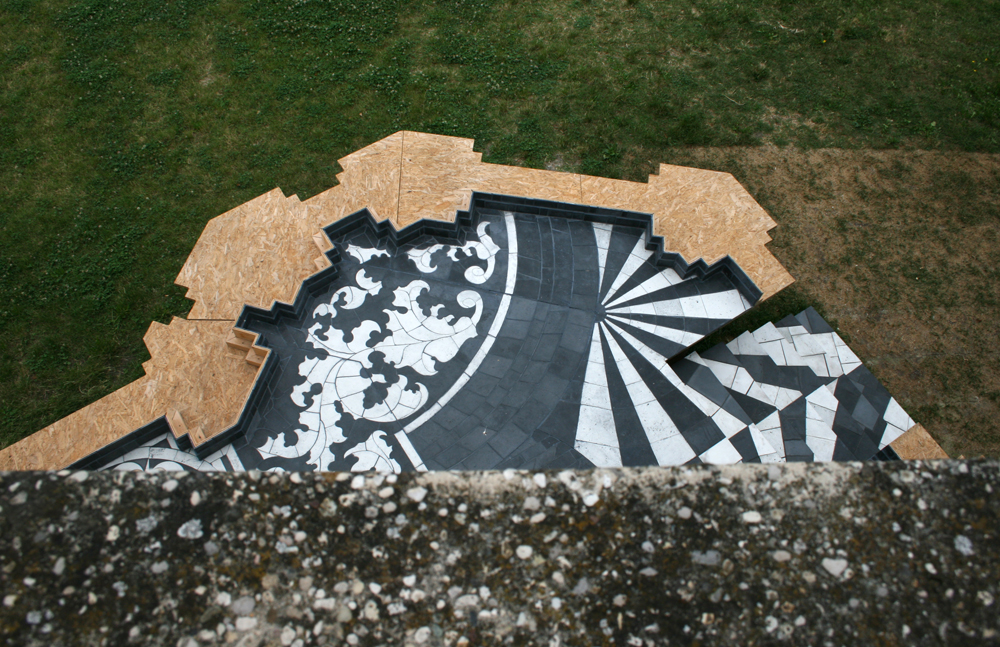
Using the site of an old laundry in the grounds of Palazzo Zenobia, Katrin Sigurdardottir imposes an ornate tiled floor with opposing dimensions into the structure of the former workplace.

Katrin Sigurdardottir 'Foundation'

Katrin Sigurdardottir ‘Foundation’

The swirling baroque inspired patterned floor spills out from the old foundations.

Katrin Sigurdardottir 'Foundation'

Katrin Sigurdardottir ‘Foundation’

The audience is directed through the space by the curiosity to explore the openings and exits that lead through the building and up onto the roof.

It is an Alice in Wonderland experience of displacement.

It also makes you think of the people that worked in the laundry and those that danced on such a floor, and how those disparate worlds may have intersected.

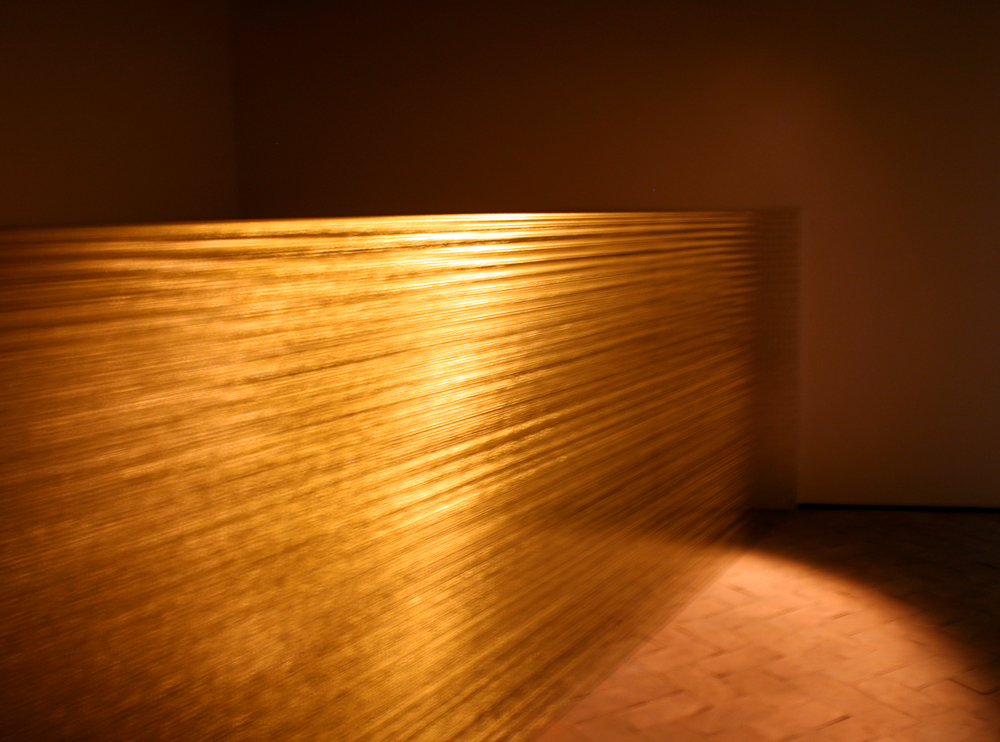
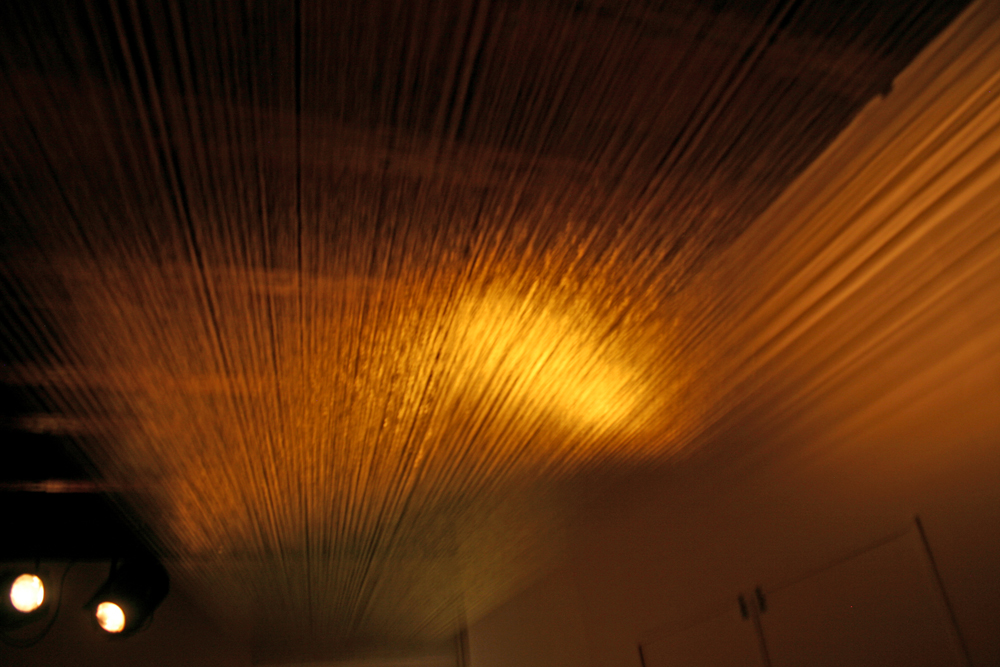
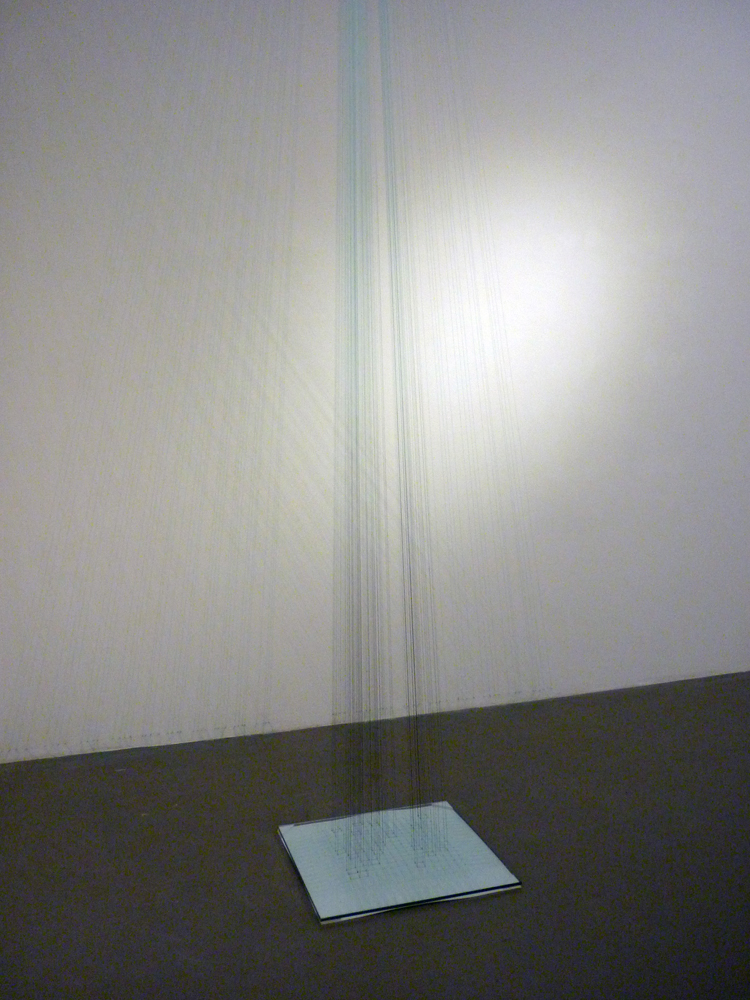
At the Montenegro Pavillion Irene Lagator Pejovic has not drawn a line around space but filled it up with the finest wires strung taught across the dark room and lit so as to appear ethereal.

Irena Lagator Pejovic

Irena Lagator Pejovic

It gives the impression of making light itself tangible.

Irena Lagator Pejovic

Irena Lagator Pejovic

She wants us to think about perceptual awareness, to be conscious of our body in space.

One of my favourite exhibitions which really defined space through line was ‘A remote whisper’ from Portuguese artist Pedro Cabrita Reis.

Pedro Cabrita Reis

Pedro Cabrita Reis

Drawings in space.

Pedro Cabrita Reis

Pedro Cabrita Reis

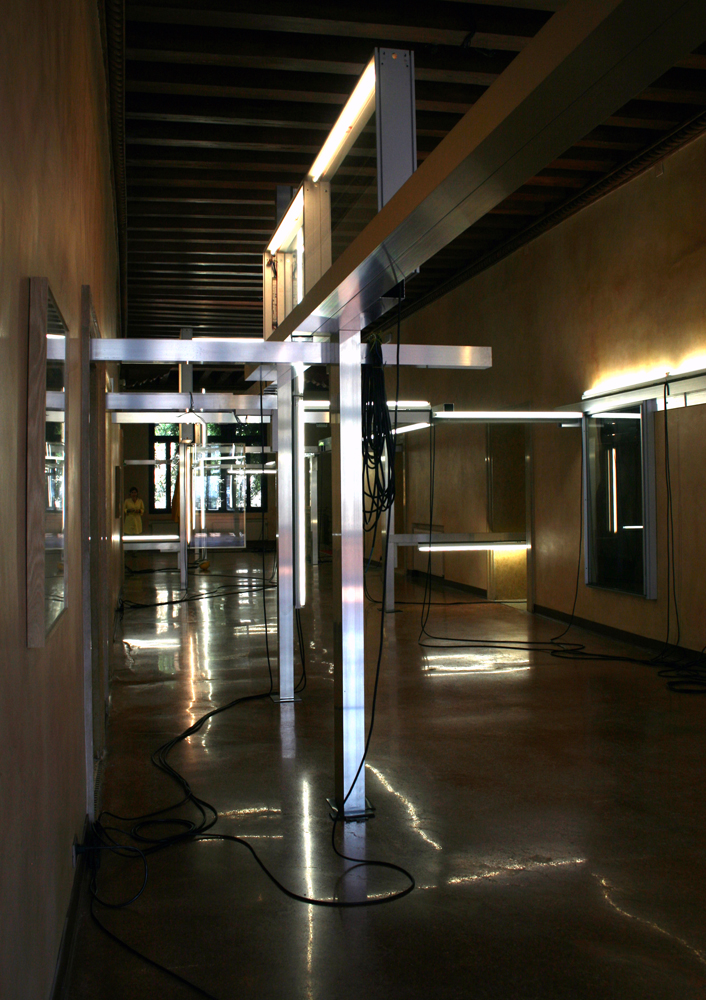
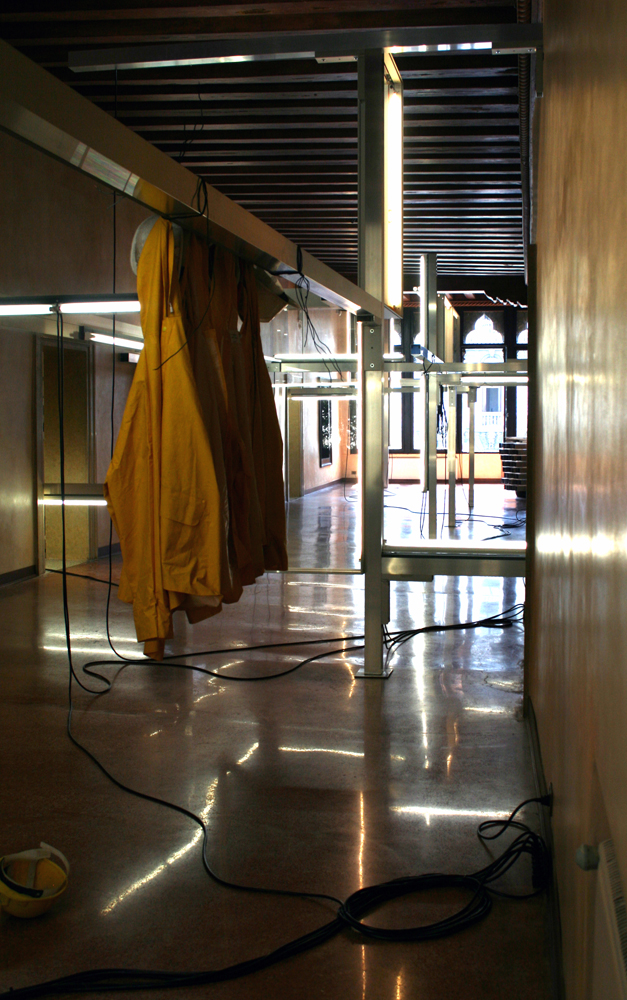
Aluminium tubes, fluorescent lights and cables flow through the corridors and rooms of Palazzo Falier adding a new vibrancy to the magnificent ancient building.

Another artist using the fluorescent tube as a drawn line is Bill Culbert for the New Zealand Pavilion.

A sculptural meditation on shelter, habitation and dwelling.

Bill Culbert

Bill Culbert

It was a building shot through with light, like a ricochetting laser beam had caused havoc, piercing and displacing objects in its path.

Bill Culbert

Bill Culbert

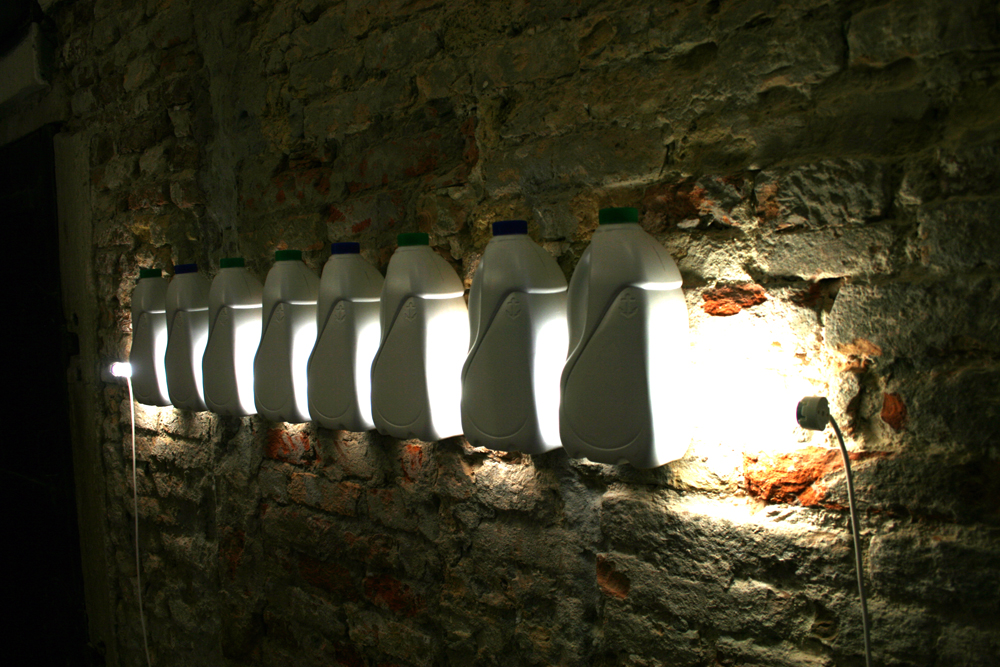
I was interested in his use of recycled plastics.

Bill Culbert

Bill Culbert

The catalogue accompanying this exhibition cites the historic image of Adam’s Hut in Paradise as a possible point of reference  for Bill Culbert’s Hut, made in Christchurch.

Bill Culbert Hut

Bill Culbert Hut, made in Christchurch

I had a quick look to see what references I could find about this mythic hut, there is a book called On Adam’s House in Paradise by Joseph Rykwert that looks like it could be interesting.

It has a look back through history to try and trace the first ideas about a place of dwelling.

Christchurch being the site where many buildings were recently destroyed by earthquakes for me it looks like a memorial to those buildings that fell.

The bare bones of a structure, no roof, no walls – the space that once held a dwelling marked out in light .

Susan Hiller was showing her series of photographs The Secrets of Sunset Beach at Timothy Taylor Gallery in an exhibition looking at interpretations of the American Landscape.

Susan Hiller Secrets of Sunset Beach

Susan Hiller Secrets of Sunset Beach

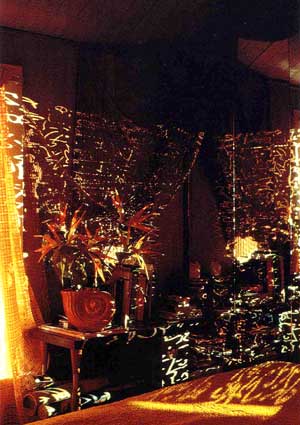
Through the use of projected light these spaces become magical, alive with weird hieroglyphs.

Susan Hiller

Susan Hiller

The inner space of the beach hut mirrors the dappling of sunlight outside.

Planes are distorted and the edges of space become blurred.

Had another chance to see the amazing work of Jane Ward.

These two images are a couple of favourites.

Jane Ward Inland

Jane Ward Inland

Space is not so much delineated as exploded.

Jane Ward In the Bay Shining

Jane Ward In the Bay Shining

What is wonderful about Jane’s work is that it works from a distance, a spectacle of dissolving worlds but it also works up close where the minute detail is crisp and intricate.

They look like landscapes from The Fifth Element where flying cars would come in handy.

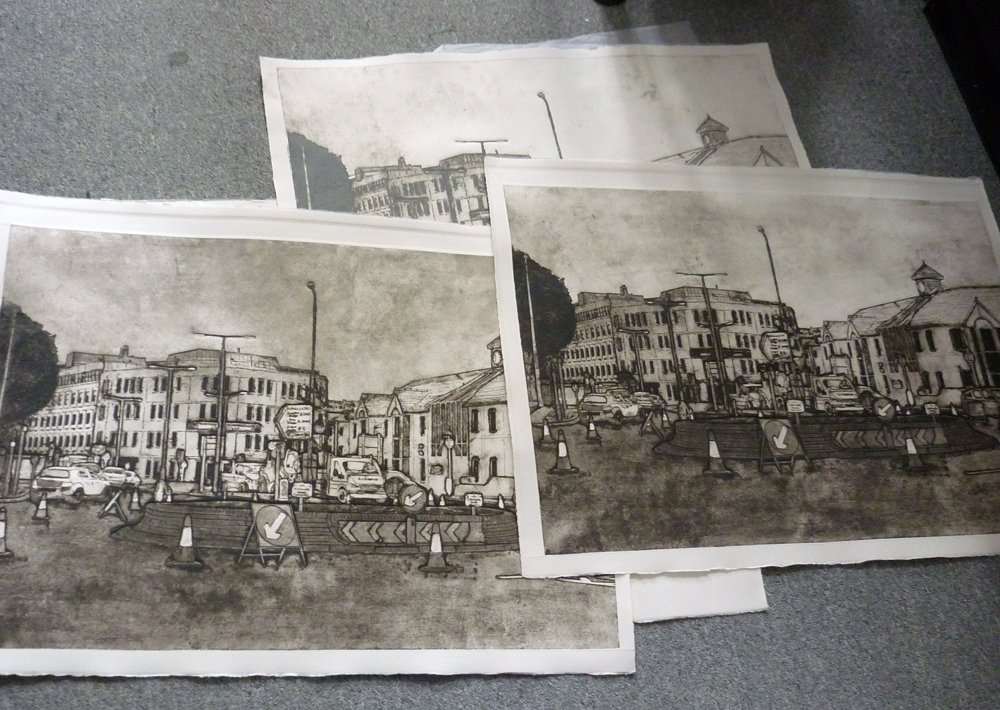
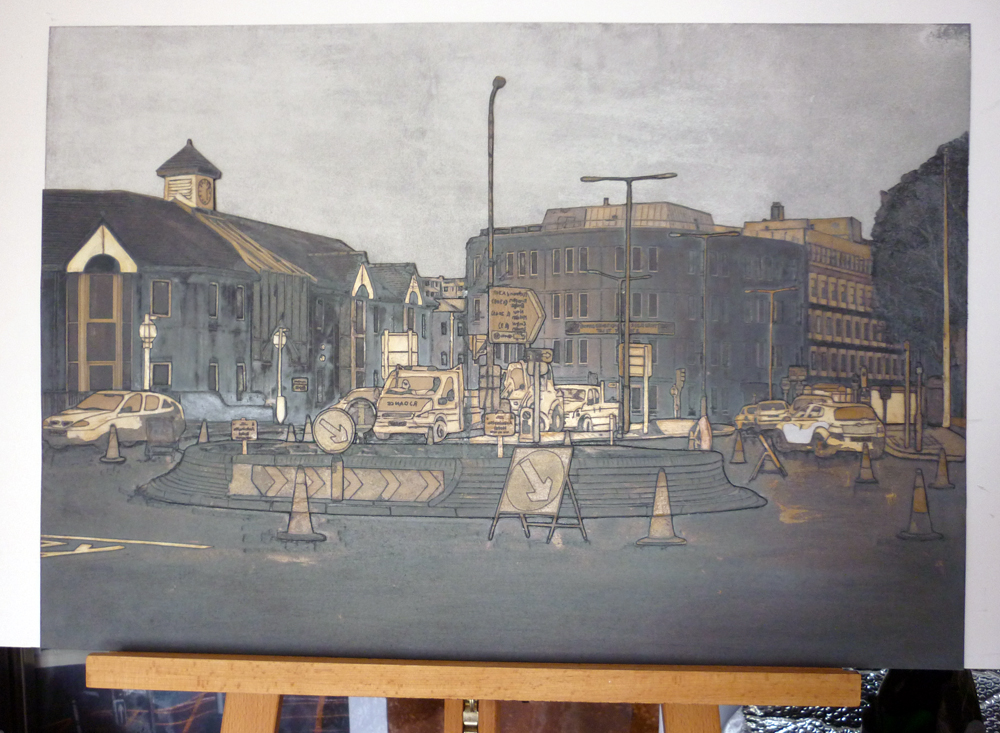
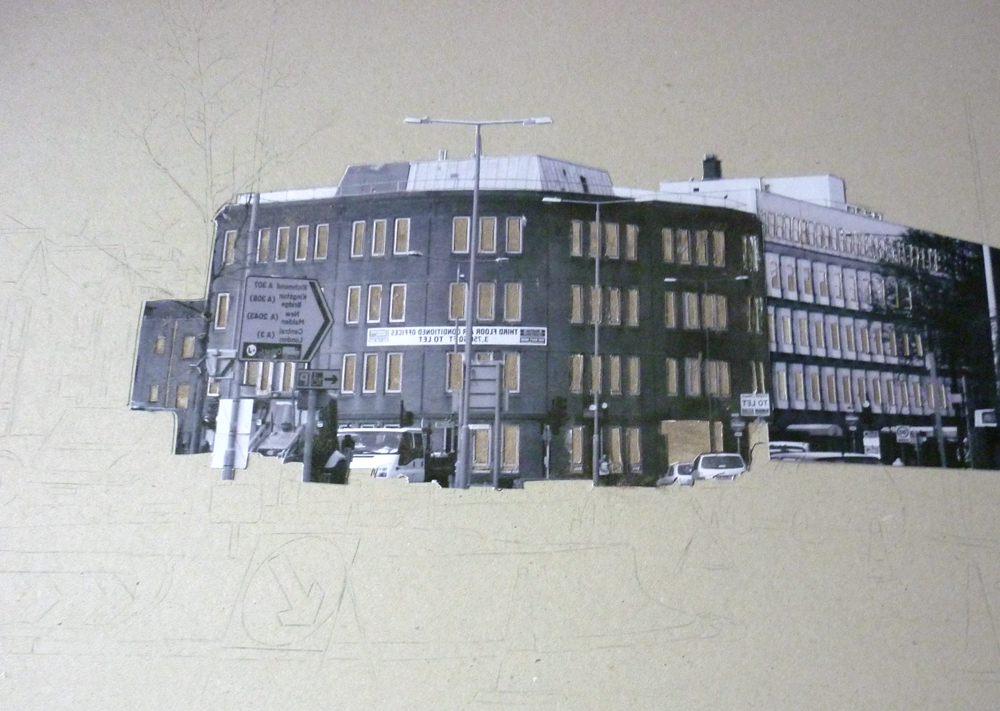
I have been working on the more local urban landscape of the roundabout.

Following directions, a flow.

Collagraph Prints

Collagraph Prints

These was a meagre tree on the roundabout – an attempt at a green oasis in the grey. I did have the tree in the first collagraph I made but have removed it. It needed to be intaglio not relief – something to bear in mind for next time I want clear dark lines with no ink pooling around the edges.

Collagraph plate

Collagraph plate

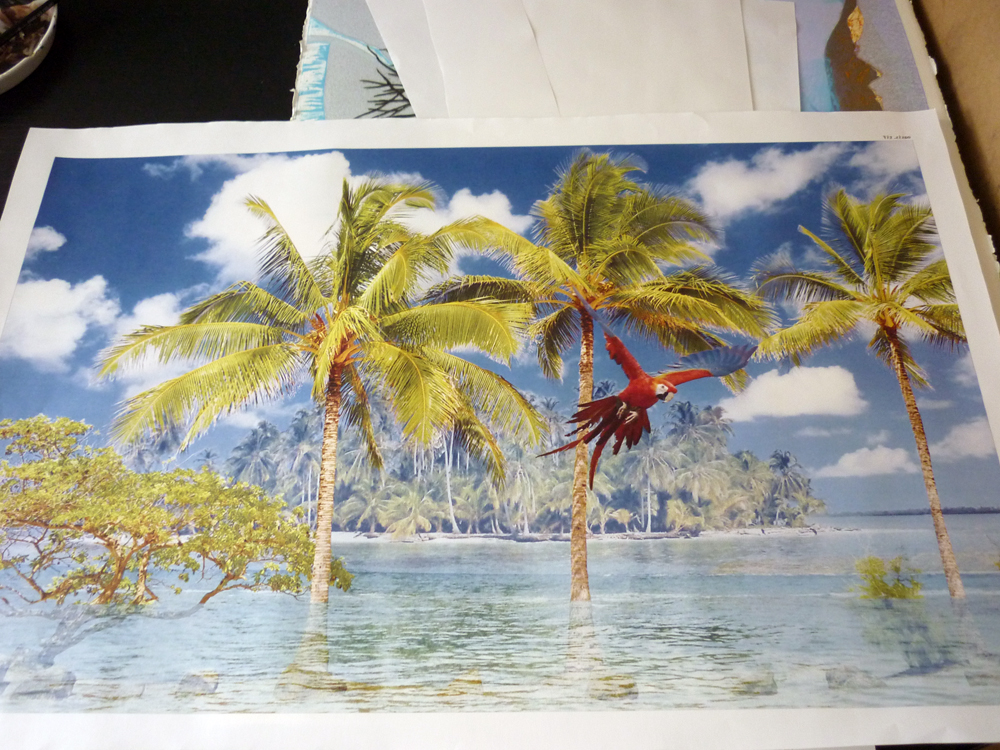
I also ended up cutting the collagraph so the sky was printed separately. I have to decide which print to use for the tear across the surface. Opening a space to fantasy. I have had the ‘paradise’ image printed which will go behind the collagraph print once it is transferred to polyester – only a small fragment will show but because the tear will be random I have had it printed full size. Even though most of the image won’t be shown I think it is important it is there.

1309 paradise

The pleasure of live performance.
It can have the feeling of a fiesta or a therapy group or a sinister encounter, there is so much to experience.

With Punchdrunk’s ‘The Drowned Man’ it was like being dropped into the middle of a David Lynch film.

Punchdrunk's The Drowned Man

Punchdrunk’s The Drowned Man

Bewildering yet sexy and beguiling.

Punchdrunk's The Drowned man

Punchdrunk’s The Drowned man

If there was a linear plot I didn’t follow it. Stories were told through dance and physical theatre with a little dialogue and a fair amount of miming to sultry soundtracks,

The dance was extraordinary, fast and furious as characters appeared, flung each other around and ran off before you could catch your breath.

I spent a lot of time wandering around deserted corridors, entering mysterious rooms labelled prosthetics or suchlike, seeing other masked figures slide into the gloom.

Suddenly a door would open onto a scene, sometimes disturbing, descending into violence as we stood anonymously and silently circling the victim.

Punchdrunk's The Drowned Man

Punchdrunk’s The Drowned Man

Through some subtle kettling the audience were amassed in one vast space for the final explosion of dance.

Separated at entry we were able to meet up in the bar with our friends to share impressions and find that we had all experienced something completely different.

I missed a whole floor of this vast space – maybe two even.

It’s running for a bit longer and I would love to go back.

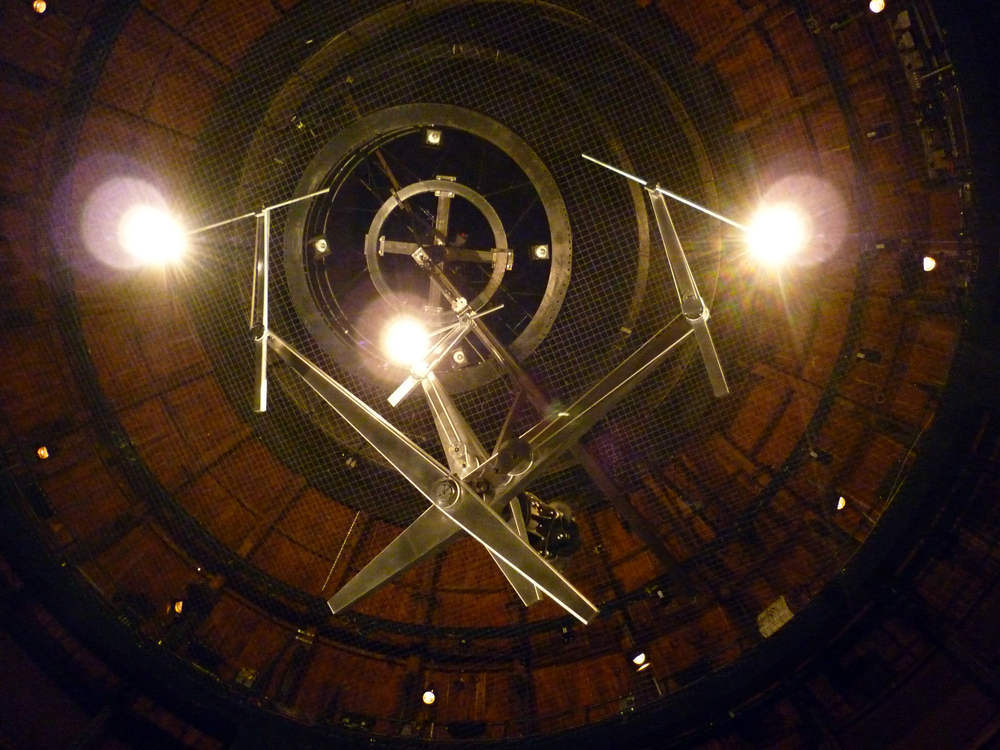
Timepiece from Conrad Shawcross at The Roundhouse was a more controlled affair.

Conrad Shawcross 'Timepiece'

Conrad Shawcross ‘Timepiece’

Seeking to reimagine our experience of time passing through the mechanical movements and shadows passing across the huge dome.

I wanted to try to make the familiar the peculiar again; to turn
time and the clock back into the celestial, primeval experience that it once was
for us all.

Conrad Shawcross

It was kind of meditative.

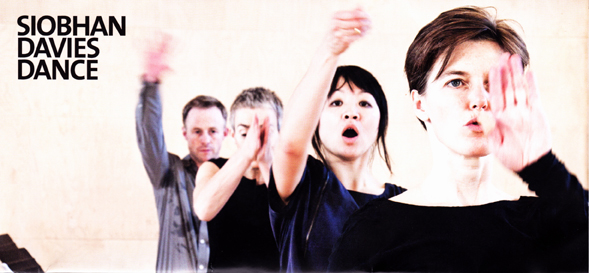
Siobhan Davies Dance Studio performers responded to the space with a reworking of Rotor.

While wheels and arms shifted above the four dancers mirrored the movements of a clock hand walking in concentric circles.

Siobhan Davies Dance ROTOR

Siobhan Davies Dance ROTOR

The concentration was intense.

There was a follow up wonderful idiosyncratic piece Songbook composed by Matteo Fargion. The performers stood in line making expressive sounds with accompanying physical expression.

1309 Siobhan Davies Dance
Like a human instrument. An investigation into how and why we make sound. It was fun and slightly ridiculous.

The complete giving over to the production of a sound, feeling its shape as it leaves the body.

Much like Bjork sings. Every nuance is felt.

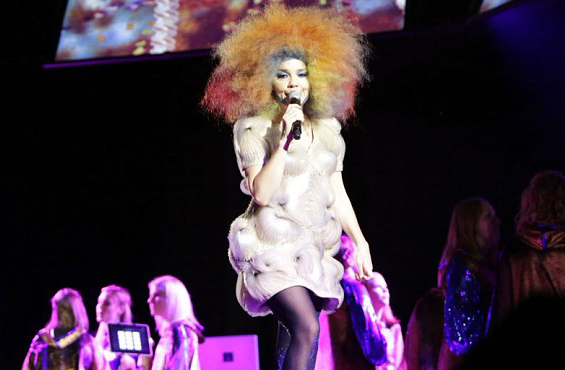
Amazing to see the very last performance of the touring show Biophilia at Alexandra Palace.

Bjork Biophilia

Bjork Biophilia

In a dress that looked like a multitude of breasts, Bjork charmed us with the intense beauty of a performance that makes you cry it’s so perfect.

‘This is kind of without humans and both zooming out like the planets but also zooming in into the atoms and in that way aesthetically sympathising with sound and how sound moves and physics of sound and how notes in a room behave, how they bounce off walls and between objects and its kind of more similar to how planets and microscopic things work.’ Bjork

Each section is introduced by the familiar tones of Sir David Attenborough giving insight into the infinite connections of the biosphere.

With bolts of electricity triggering sound and handcrafted instruments that ranged from a combination fusing the Celesta and the gamelan, a traditional Indonesian percussion ensemble to a giant pendulum contraption designed and programmed by musical robot maker from MIT, Andy Cavatorta, the ancient crafts collided with futuristic  technology.

The spectacle was completed by the soaring voices of her Icelandic choir drumming their bare feet like frenzied maenads.

Bjork Biophilia

Bjork Biophilia

Icelandic artist Ragnar Kjartansson stages large scale durational performances which can become feats of endurance for his performers and audience.

Ragnar Kjatansson

Ragnar Kjatansson

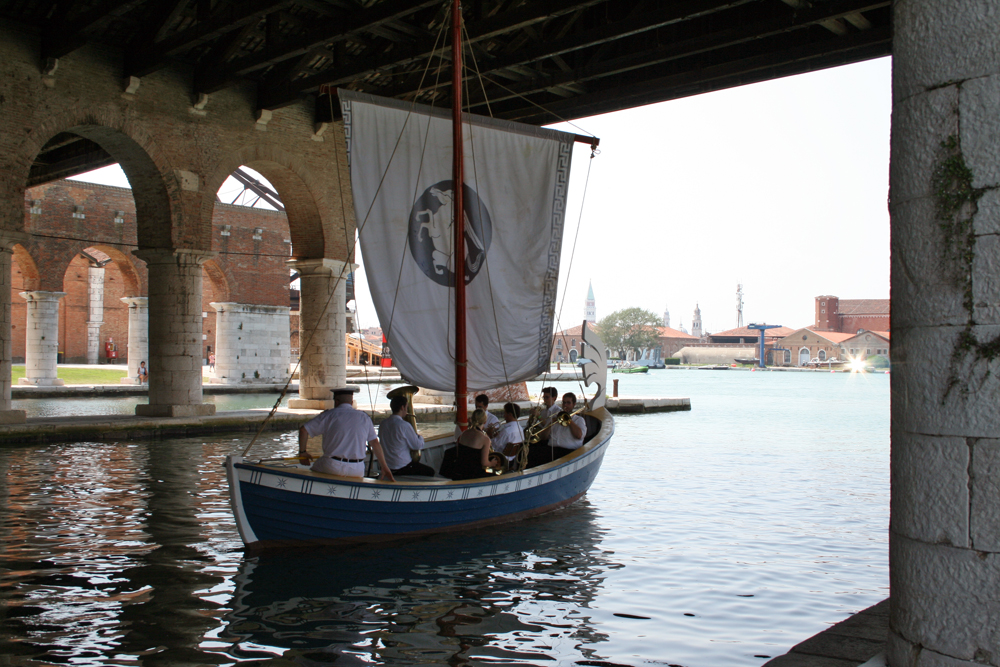
At the Venice Biennale he turns an old fishing boat into a floating stage carrying a troupe of musicians sending plaintive notes across the water. It has a rather comedic appearance as it traverses slowly back and forth across the docks at the Arsenale.  A deflated sort of pomp and circumstance.

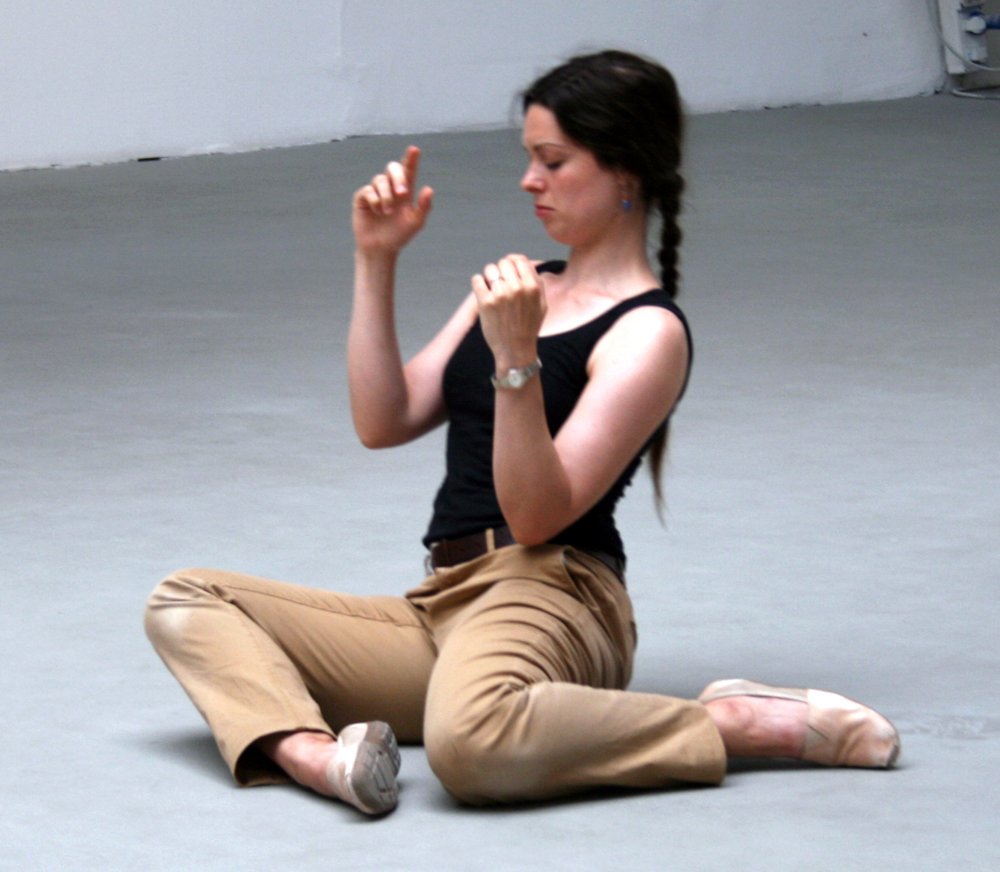
A more introspective performance is seen in Tino Sehgal’ s Golden Lion Award winning piece at The Venice Biennale.

Tino Sehgal

Tino Sehgal’s perfomance piece

We witness communication from a new perspective.

Animalistic, primeval it takes us away from our known language of words. The performers were immersed in the dialogue between themselves.

Using song, beatboxing, humming the piece develops freely between the participants like any conversation might.

Tino Sehgal

Lizzie Sells and Frank performing for Tino Sehgal in the Central Pavilion Venice

It was like watching someone being massaged by sound as one body responded in movement to the sounds from the other.

Tino Sehgal

Lizzie Sells performing in Tino Sehgal’s piece at the Venice Biennale

Speaking to Lizzie Sells afterwards she explained how she becomes so involved in her performance that she is unaware of the audience around her, even when they are being loud and intrusive.

An oasis of calm.

Illusion, as in the romantic notion, suggested in Ibsen’s play The Master Builder, of building ‘castles in the air’ as a refuge from reality is something I am trying to capture in new work.

I have not settled on a title yet but the work involves an urban roundabout scene and a tear through reality to a paradise behind.

The first few prints from a collagraph are not very successful as the plate must settle and mature so I have used one of the unsuccessful prints to test the tear.

1309 roundabout tear

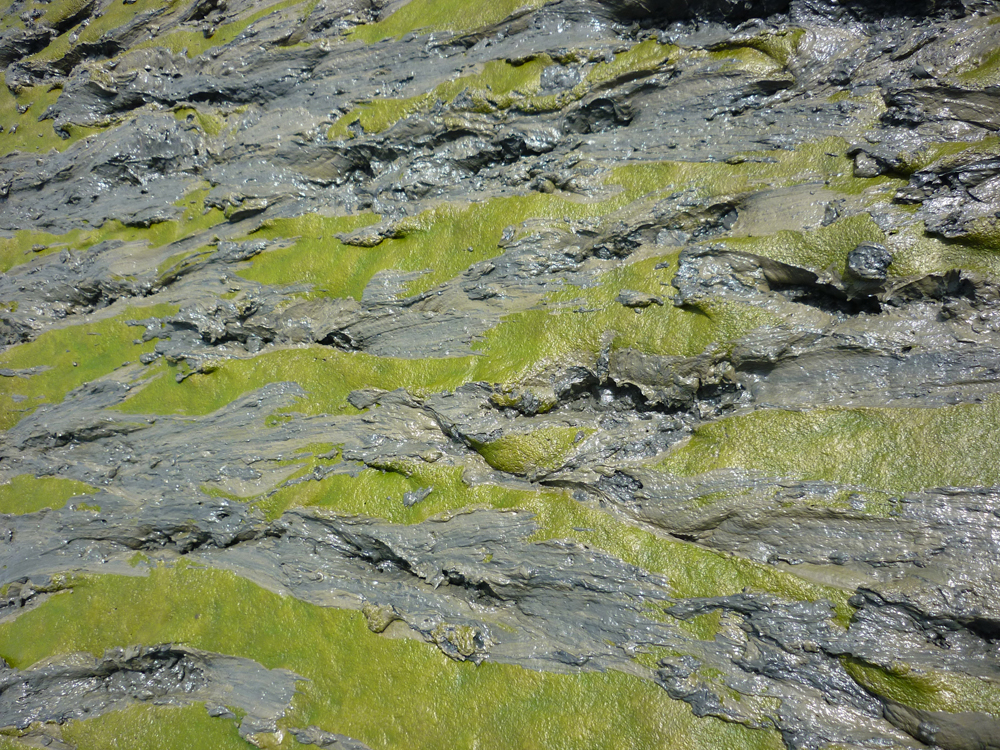
I have been getting up close to mud and matter and thinking about the makeup of the environment around us.

It’s hard to look at a cup say and imagine the structure of its atoms. To think about the solid and then the squishy and how it all works.

From thinking about the origins of things, like the first plants and forests. Evolution and yet how all matter existed from the beginning and it’s just a huge process of recycling.

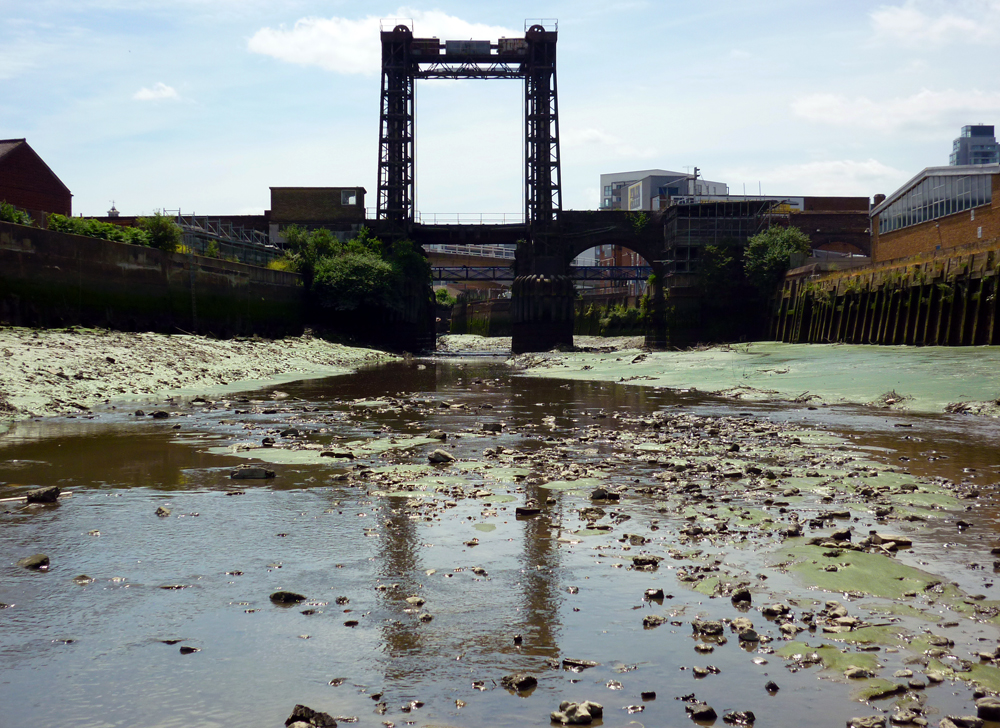
Deptford creek

Deptford creek

A great place for a new perspective on your surroundings is the Deptford Creekside Centre where you can join a low tide walk.

Low Tide Walk

Low Tide Walk

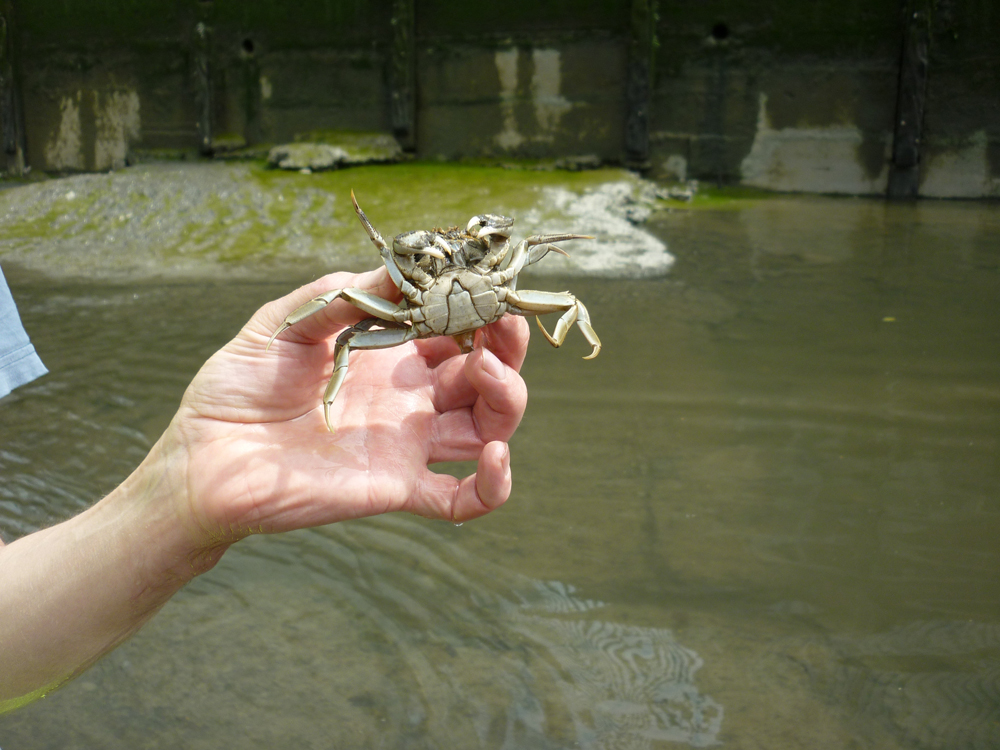
Equipped with thigh length waders and a long stick you are led down to the creek and given lots of insight into the history and wildlife of the creek.

Deptford Creek Crab

Deptford Creek Crab

It is stunningly beautiful and feels a real privilege to enter this world below the horizon.

Deptford Creek

Deptford Creek

The river has carved intricate sculptures into the wooden posts along the banks.

Deptford Creek

Deptford Creek

The look posts look totemic and hung with vibrant algae quite primordial.

Deptford Creek

Deptford Creek

The creek bed is thick with mud and slime creating wonderful patterns as the water recedes.

Deptford Creek

Deptford Creek

There is the possibility of finding treasure swept along and revealed after each tide but you must ask if you want to take anything away. They have quite a collection of finds they like to add to at the discovery centre.

Deptford Creek

Deptford Creek

On a previous trip artist Lizzie Cannon had been lucky to find a wonderful rusty object which she has since embroidered with threads and beads to continue the growth of the rust giving the object a new organic dimension

Lizzie Cannon - Corrosion

Lizzie Cannon – Corrosion

A Matter of Substance exhibition and salon curated by Caroline Lambard and Elizabeth Murton at APT Gallery encouraged their audience to look beyond the surface of the material to the very structure of the crystals, atoms and particles that form them.

1307 A Matter of Substance

Catherine Jacobs beautiful photographs show tensions of surface sometimes broken by an indeterminate object that works as a disruption to the surface and our perceptions of what we are looking at.

Catherine Jacobs Uncertainties

Catherine Jacobs Uncertainties

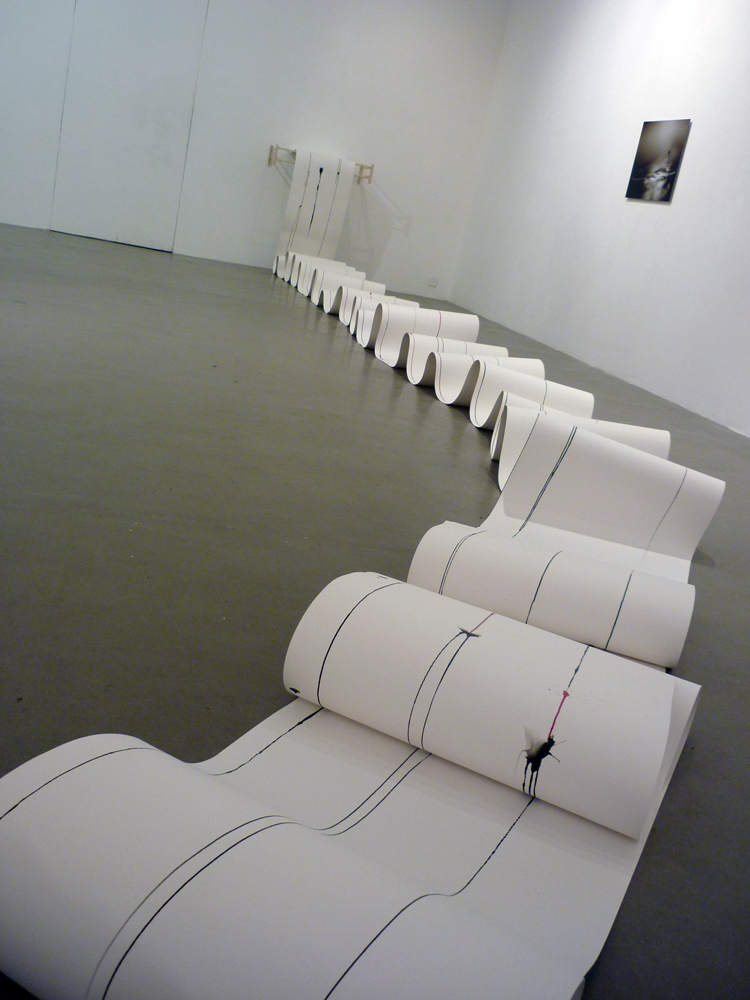
Elizabeth Murton’s scroll flows out across the floor in symbiosis with the marks upon it like a cascade of data presenting itself as a record of the inks journey.

Elizabeth Murton

Elizabeth Murton

Cool work for a hot day.

Phillip Hall-Patch

Phillip Hall-Patch / Caroline Lambard

There were salt crystals that sparkled like snow in magnified form like Icelandic landscapes and in salt block form eroded by a constant drip of water.

Phillip Hall-Patch Salt LIcks

Phillip Hall-Patch Salt LIcks

Caroline Lambard’s ethereal sculptures help to imagine 3D form from all perspectives through their delicate drawing in thread to delineate a space.

Caroline Lambard

Caroline Lambard

I have started on a new piece of work, the idea of an oasis, an escape, a view through to another place so it has been interesting to think about form and space.

A solid outer that hides a world inside.

1307 Oasis collagraph 1

It starts with the construction of a collagraph which I am slowly building up from cut card and carborundum.

1307 Oasis collagraph 2

Once made the idea will be to rip a section out to reveal an internal space.

Saw Chimerica, an amazing new play by Lucy Kirkwood. It is a powerful exploration of two cultures – China and America.
We are taken back to the student protests of 1989 in Tiananmen Square and follow the search of an American photographer, who took the iconic shot of the student standing with his shopping bags in front of the tank, as he tries to discover the identity of  ‘tank man’.

The fate still remains unknown of the unarmed man who blocked a column of tanks as they moved along Chang’an Avenue towards Tiananmen Square.

1306 Chimerica 3

The script is very tight, funny and moving, playing out  a touching relationship between the photographer and his Chinese contact as they question their roles in history.

There are questions about cultural identity and personal responsibility.

Chimerica by Lucy Kirkwood

Chimerica by Lucy Kirkwood

Who is a hero and how can one voice rage against the machine.  I found it a little scary to contemplate the future in this context as China is such a hard country to relate to and it’s influence is spreading quietly across the world.

In China there seems little compassion for the individual.

Yet obviously there are individuals who raise their voices, people we can relate to in their desire for justice, for free speech and for clean air.

Chimerica by Lucy Kirkwood

Chimerica by Lucy Kirkwood

Chimerica explores the courage required to step outside the control of the state and the security of a job.

It also makes us wonder about the dramatic changes to the landscape, the explosion of consumerism and urbanisation and the sources of energy to power this explosion in growth.

1306 China coal

The ideas behind Chimerica can be found at  http://headlong.co.uk/work/chimerica/explore/

1306 smog

I have always loved the work of Antii Laitinen since being introduced to his work by Nettie Horn Gallery.

I went to listen to him at the ICA in conversation with Elizabeth Neilson, Director of Zabludowicz Collection, and Harri Laakso, a co-curator of the Finnish Pavilion at this year’s Venice Biennale.

He undertakes extraordinary feats of endurance to make his art such as building his own island from bags of sand, only to have it swept away by a storm and then starting again.

Antii Laitinen 'It's my Island'

Antii Laitinen
‘It’s my Island’

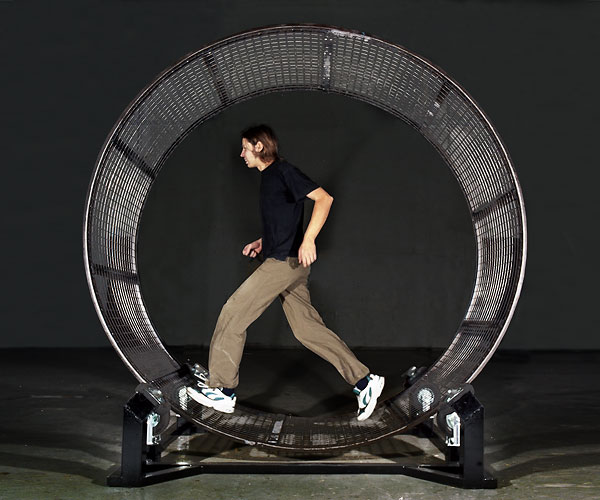
In his talk  he stressed that he uses nature as his material and his studio space and what he is exploring is the nature of human existence. He questions the value of effort which stems from his native Finnish culture and its Lutheran attitude to the benefits of hard labour. In ‘Sweat work’ he constructed a human sized hamster wheel and ran until he was dripping in sweat, he then removed his clothes and laid down onto photographic paper.

Antii Laitinen 'Sweat Work'

Antii Laitinen
‘Sweat Work’

The photographs were then hung on the wall where the image of his body slowly faded and disappeared.

Antii Laitinen 'Sweat work'

Antii Laitinen ‘Sweat work’

Each of his pieces has required physical exertion in often futile exercises. Originally training as a photographer he moved into performative work which he then documents himself through photography.

He likes to be in control. He prefers if possible to perform all the hard labour himself.

There was an interesting discussion on the reaction of different cultures to his sawing up of a tree into many pieces and then trying to fix it back together again like a puzzle. In Finland where there are vast forests and there is a pragmatic relationship to a tree and he had no problem getting any number of trees to chop down. In Vienna he caused an outcry at the stupidity of his endeavour. In Bristol he had real trouble getting a tree at all, and the tree he was finally given was a very small tree, barely a tree at all, weak and diseased. What is it that makes it hard for us to chop down a tree. The shortage of trees or the love of the old, a national instinct to preserve maybe.
What was it that mobilised the nation into protest recently – the threat to the forests. We might never visit them – but it’s good to know they are there. Our cultural history is tied up in the forests not as a source of fuel and income but as a refuge, as a source of myths and legends.

Antii Laitinen

Antii Laitinen

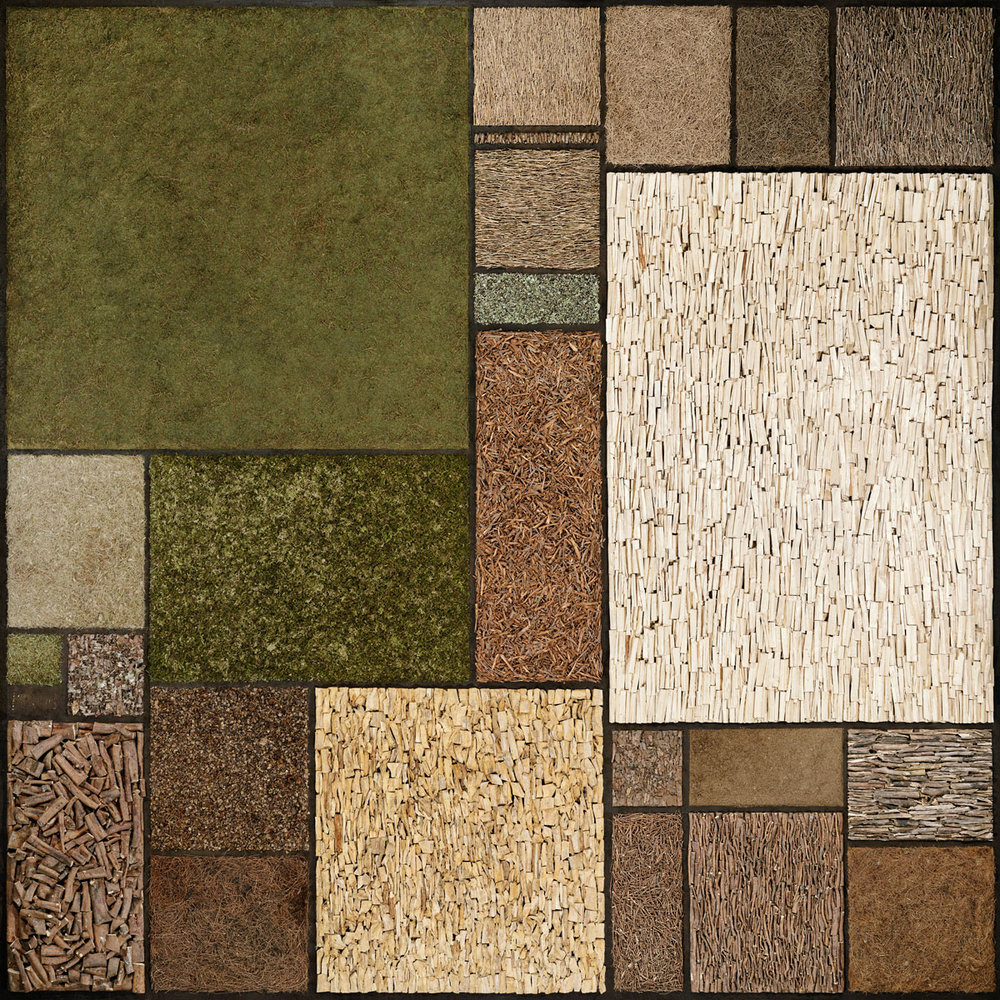
For the project “FOREST SQUARE”, new work made for the Venice Biennale 2013, Laitinen chopped down a ten meters square section of forest and sorted the entire found material such as the soil, moss, wood, pines, etc into various categories. He then reorganized the forest according to different colours – the composition referring to the pure abstraction and utopian ideal of spiritual harmony and order from the De Stijl movement.

Antii Laitinen 'Forest Square'

Antii Laitinen ‘Forest Square’

I am still working on the collagraphs  ‘return of the forest’ and still not entirely happy with the way it is going.

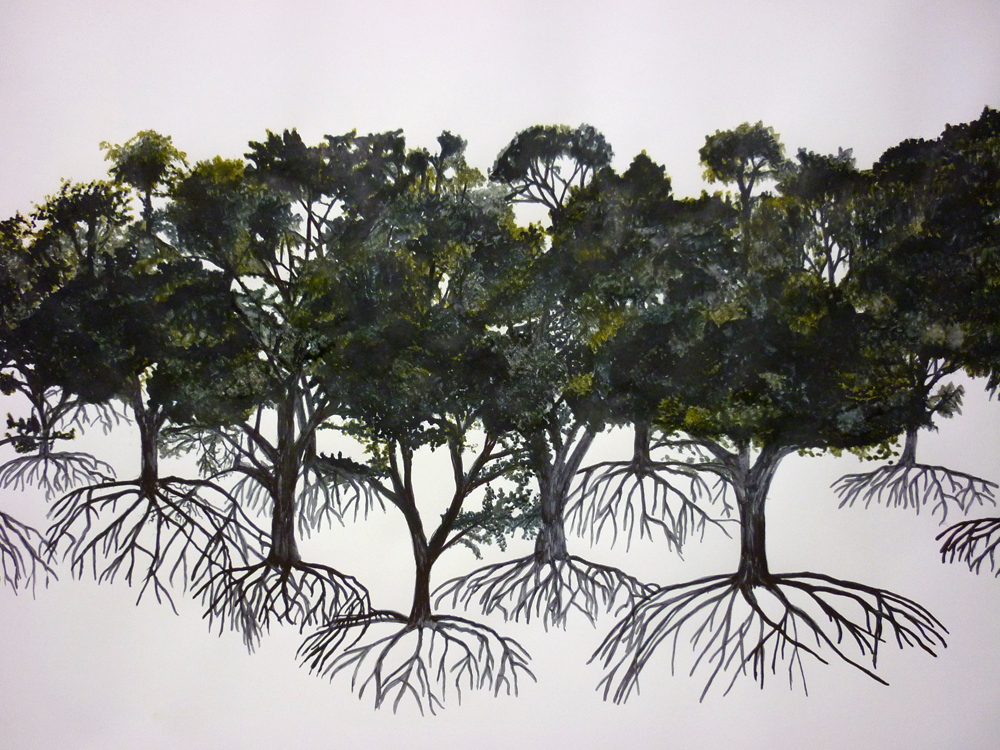
I have been painting trees with sublimation inks to print onto organza which I will then cut onto the iceberg collagraphs I have made.

The thing about sublimation inks is you can’t quite tell what colour they will print until you put them in the heat press.

130701 (2)

I was upset to find out that London Printworks Trust had closed in February.

It is so sad that such a great resource is lost. I did think it bad though that as a paying member I hadn’t been told it was closing, I guess as they were in financial difficulties they weren’t going to refund memberships.

Now I have to find another large heat press to use.

The Ochre Print Studio Summer Exhibition had lots of good feedback. Shame I had to miss the Private View this year.

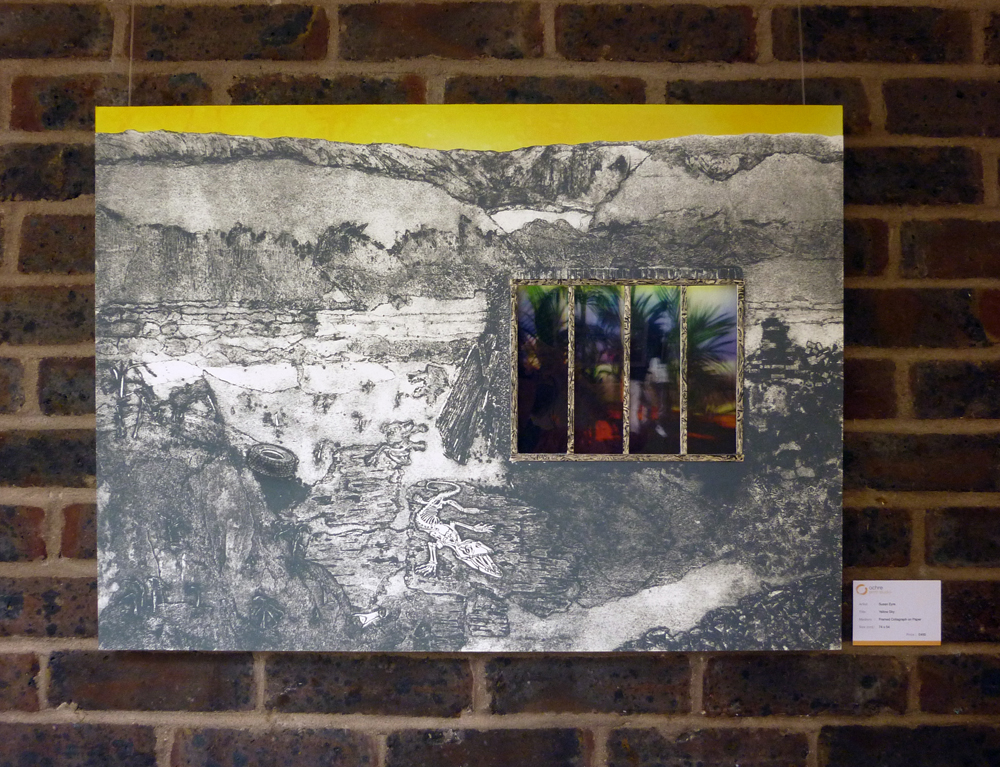
Susan Eyre 'Yellow Sky'

Susan Eyre ‘Yellow Sky’

‘Yellow Sky’ is about looking for refuge and reliance on a controlled environment to survive

Susan Eyre 'Graft i'

Susan Eyre ‘Graft i’

‘Graft I’ explores ideas about the changing landscape, the urban and the cultivated space, the hybrid landscapes and the empty inbetween spaces where imagination can flourish if nothing else.

Lots to see from other members and guest artists. It’s a good opportunity to bring the community at Ochre together.

Tom Hammick

Guest artists -Tom Hammick – woodcuts

Richenda Court's lino cut

Richenda Court’s lino cuts

Julie Hoyle

Julie Hoyle screen prints on wood

Lockwood Group

Lockwood Group artists with learning disabilities

Anna Hennings - artist in residence

Anna Hennings – artist in residence

Guest Artist - David Dragon - monoprints

Guest Artist – David Dragon – monoprints


Susan Eyre 'Subluna'

Susan Eyre ‘Subluna’


Sold ‘Subluna’ at Ochre and also some of my ‘Collected Thoughts’ sold at the Surrey Contemporary.
Always a strange mixed feeling of loss and pleasure.