Archives for posts with tag: crystals

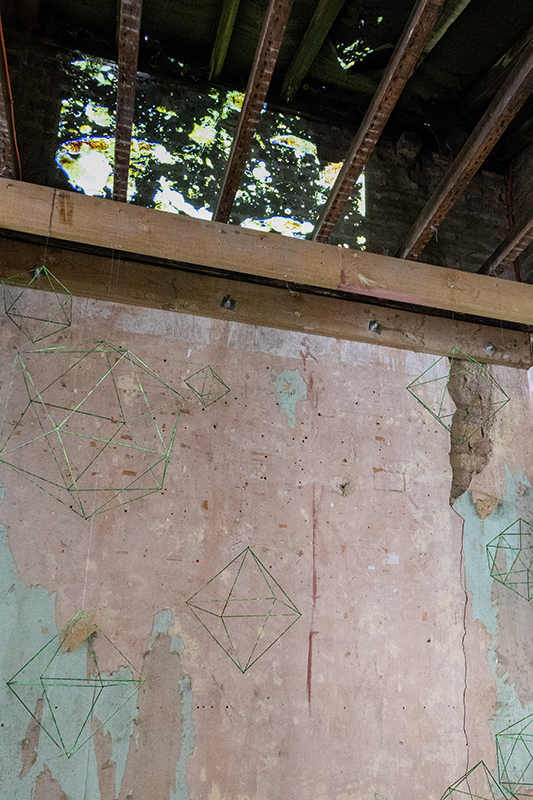
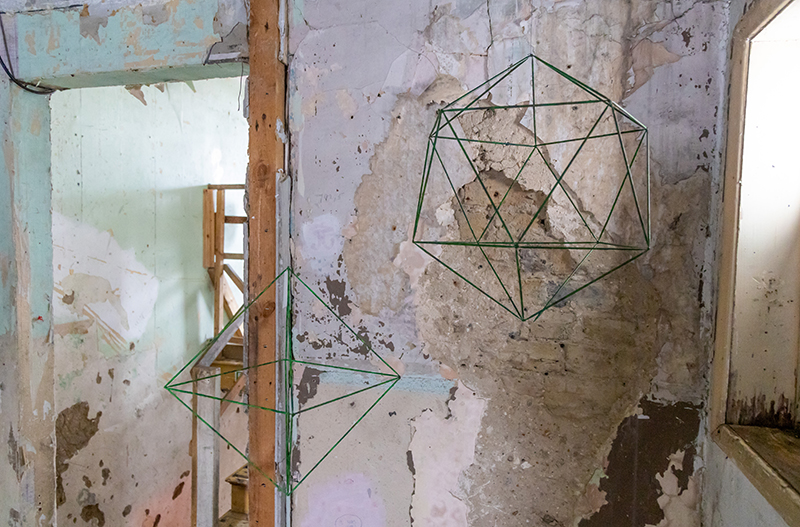
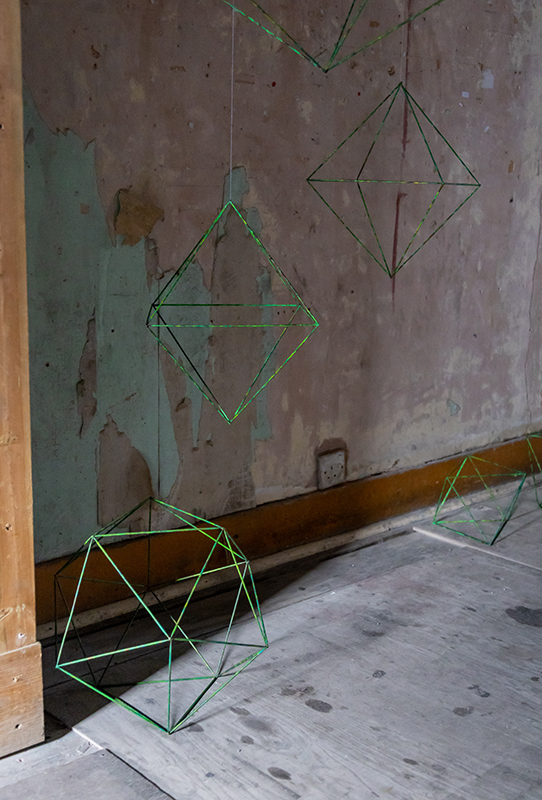
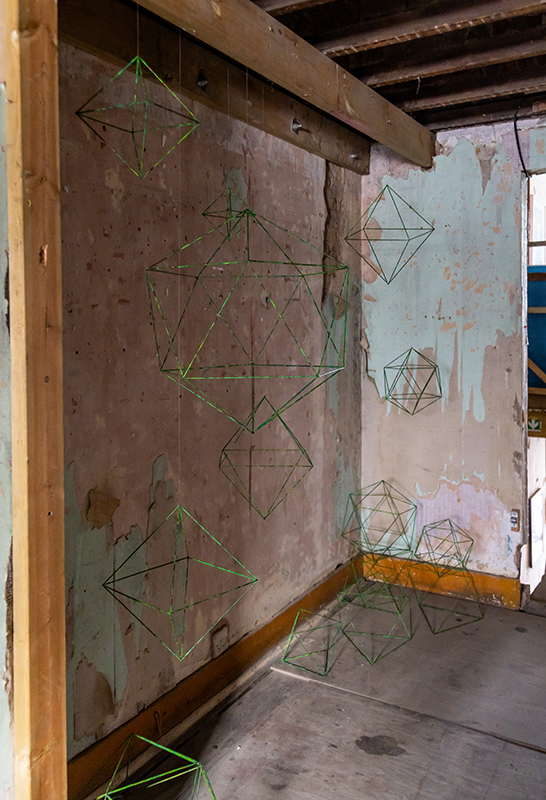
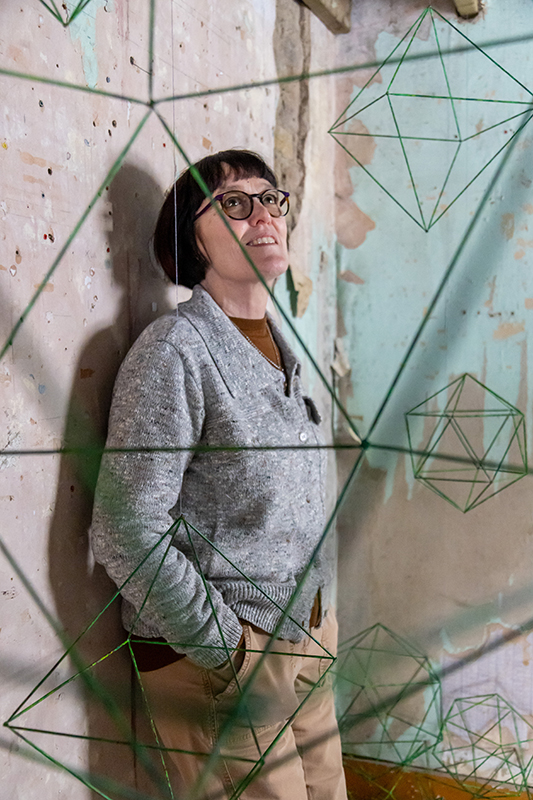
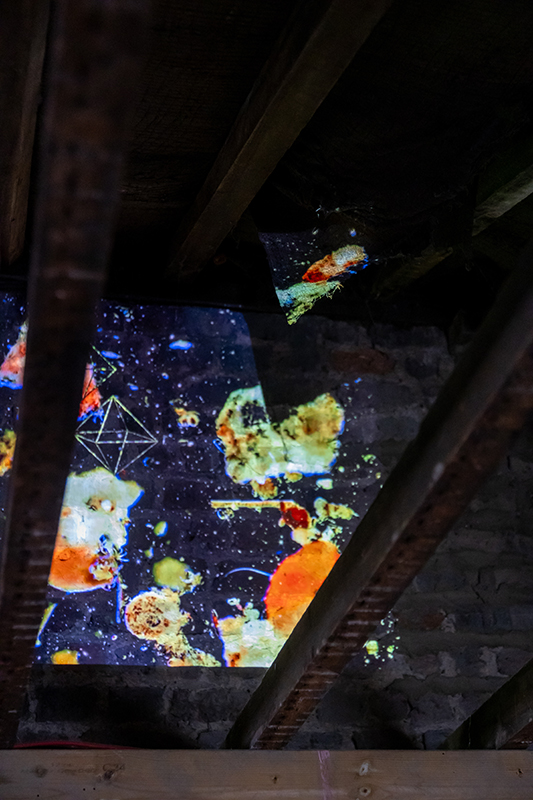
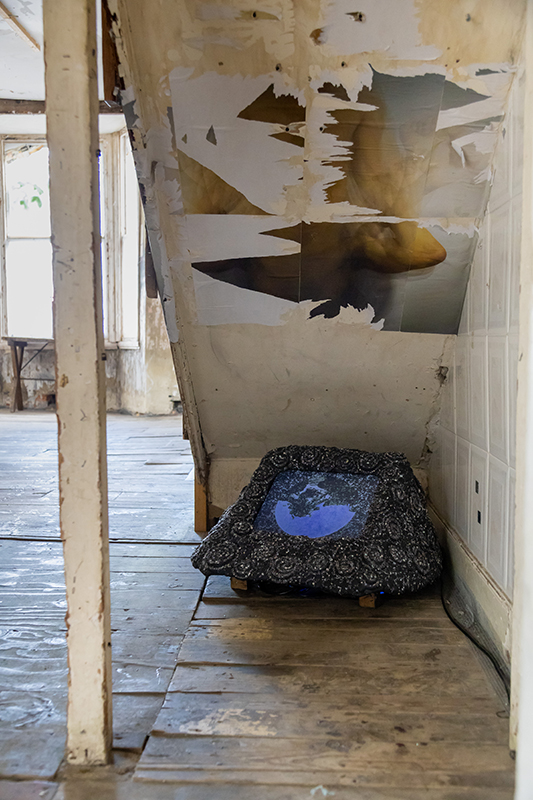
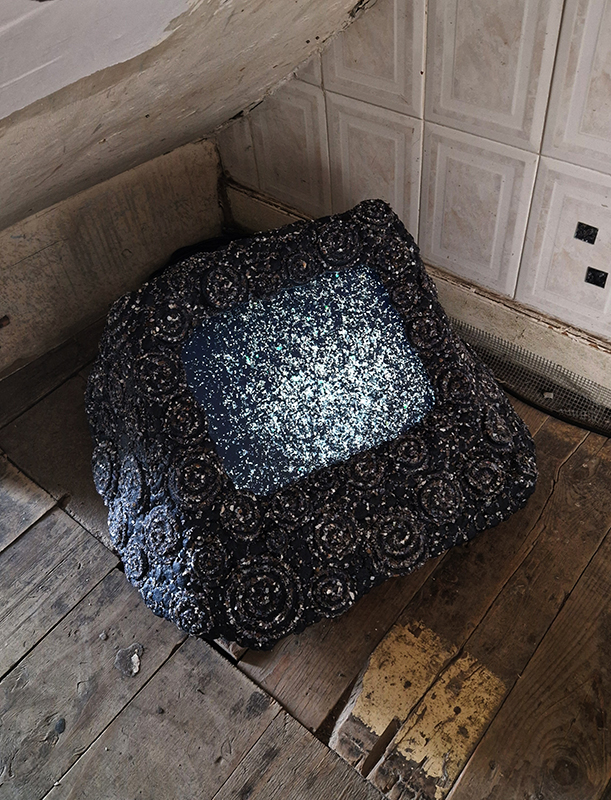
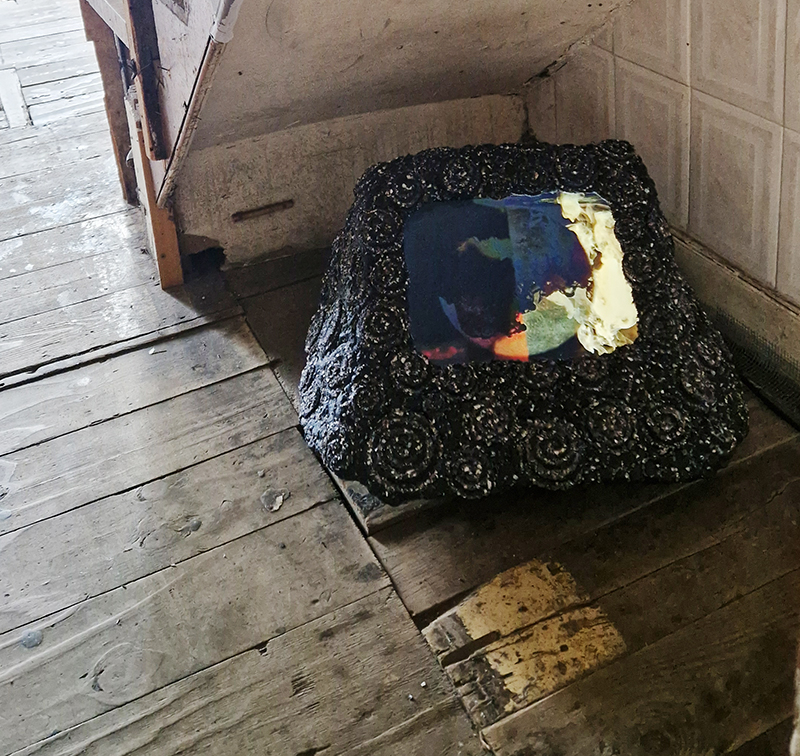
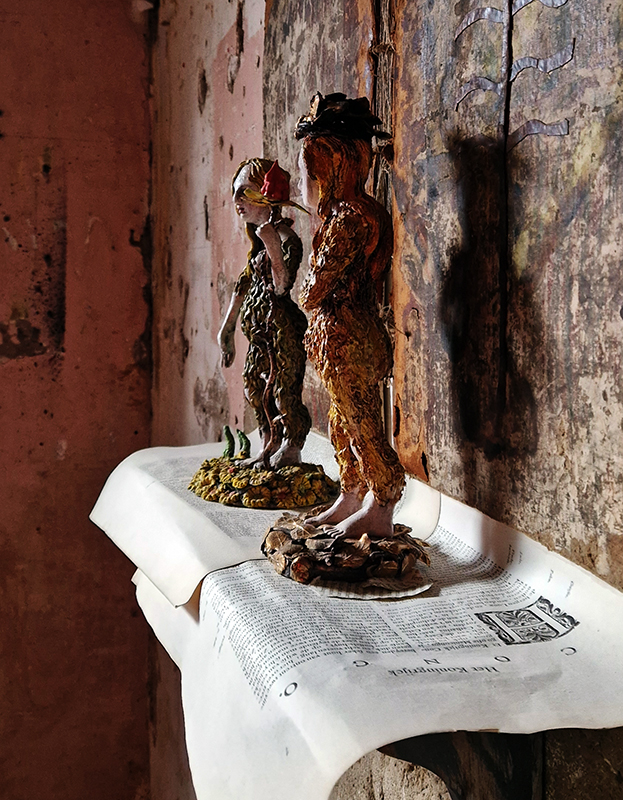
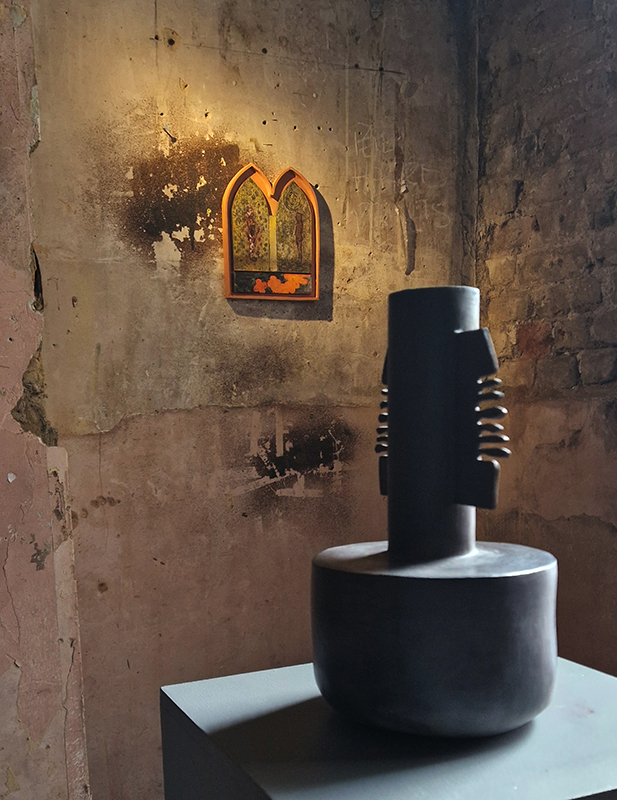
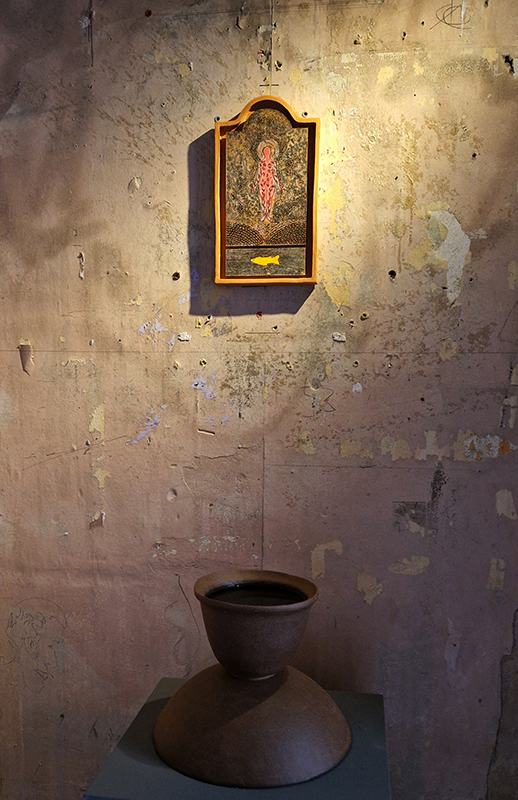
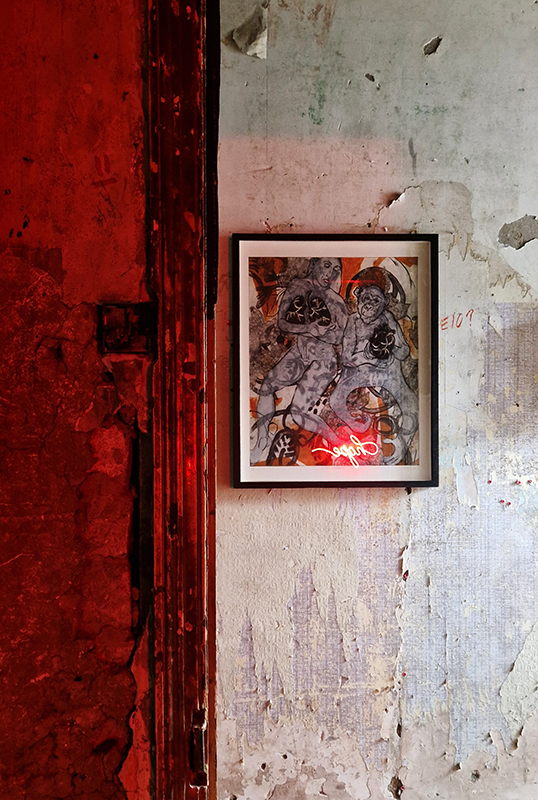
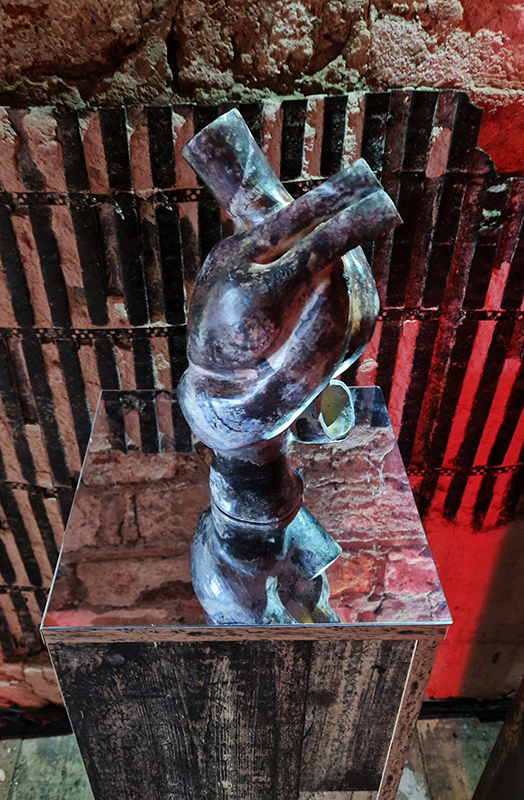
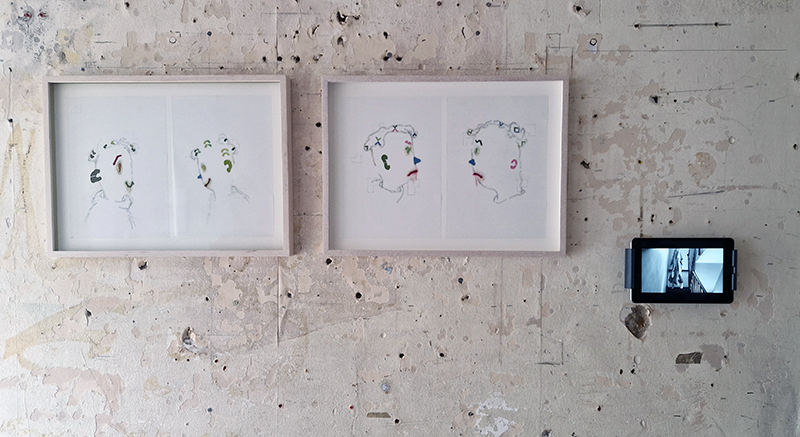
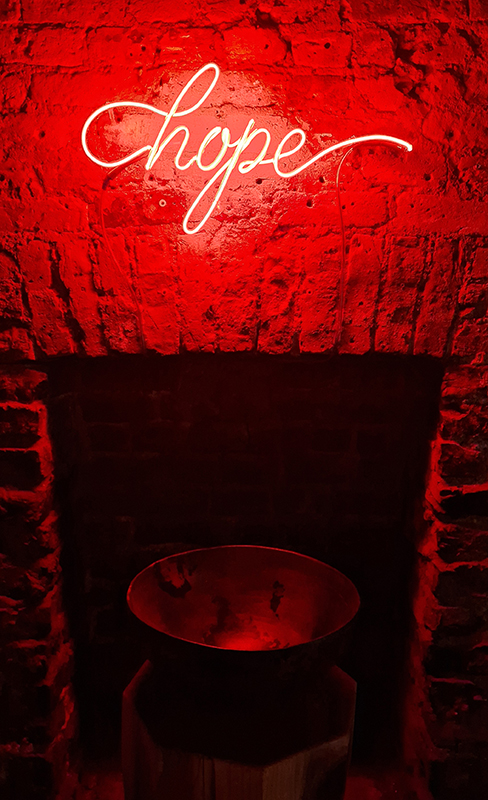
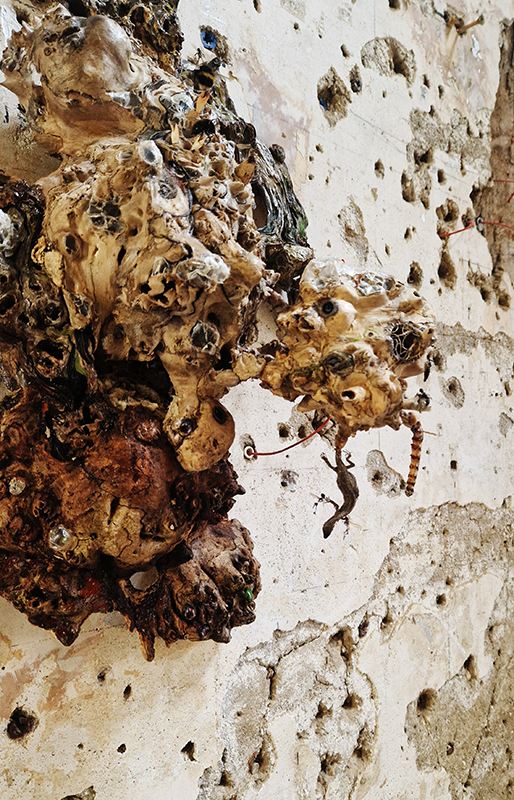
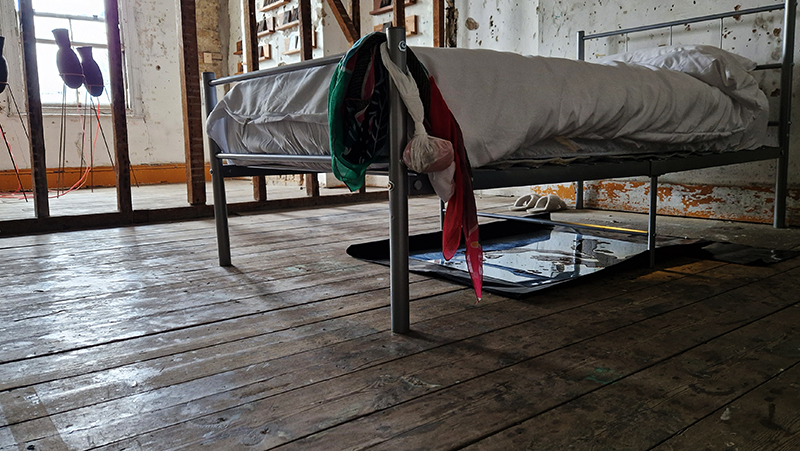
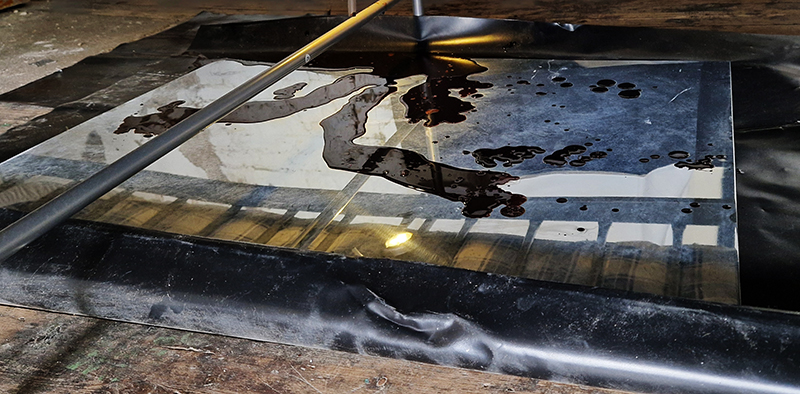
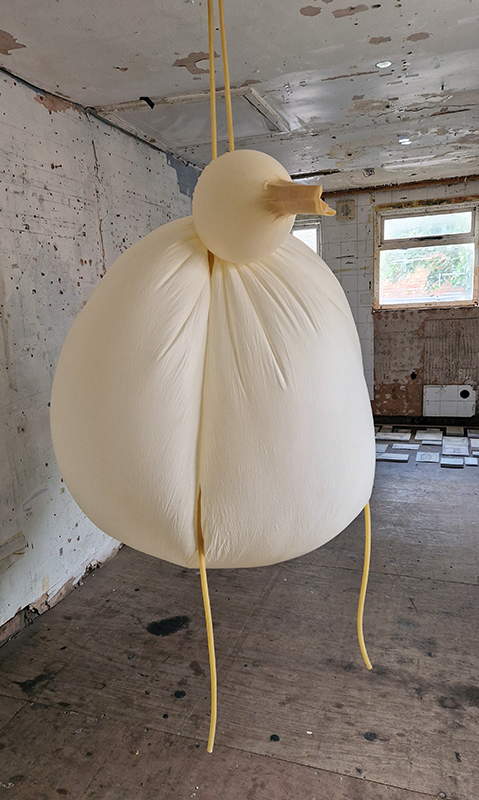
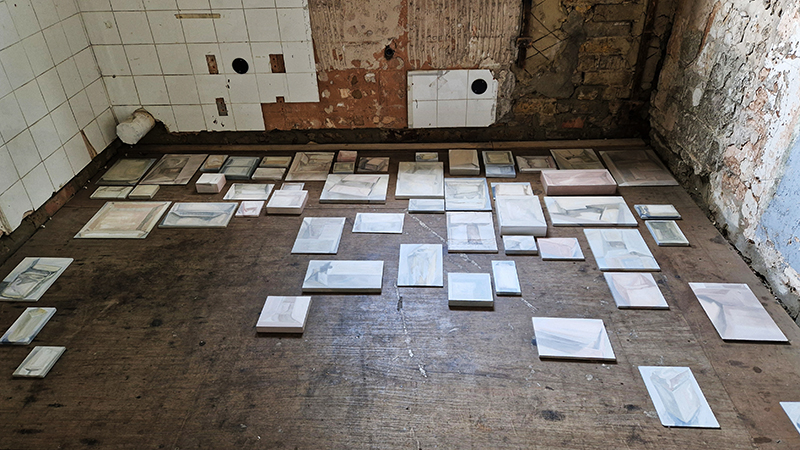
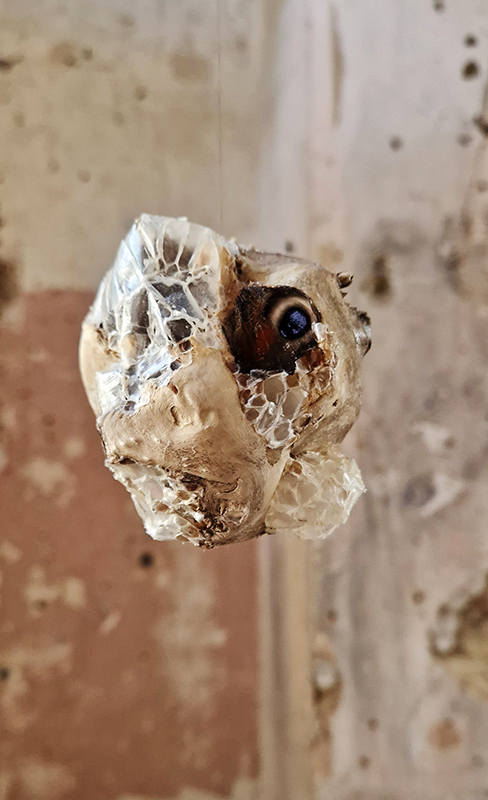
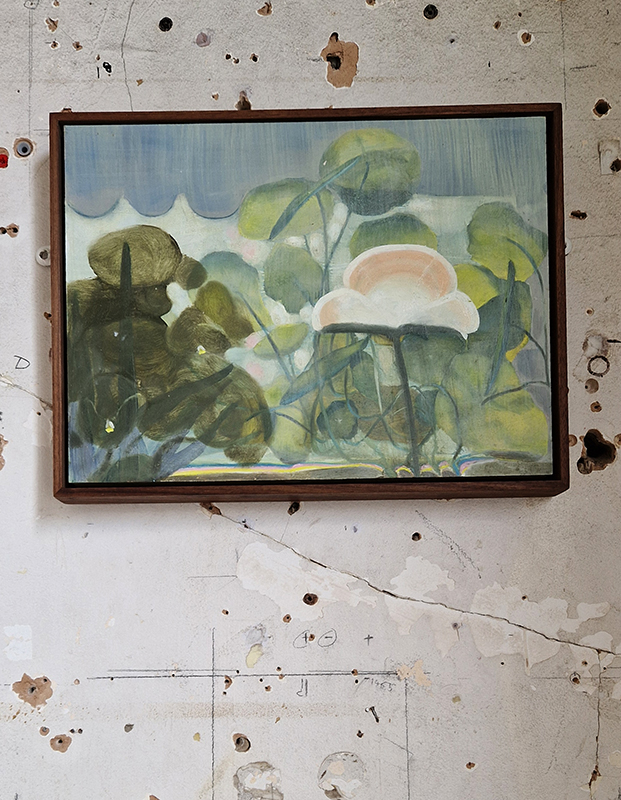
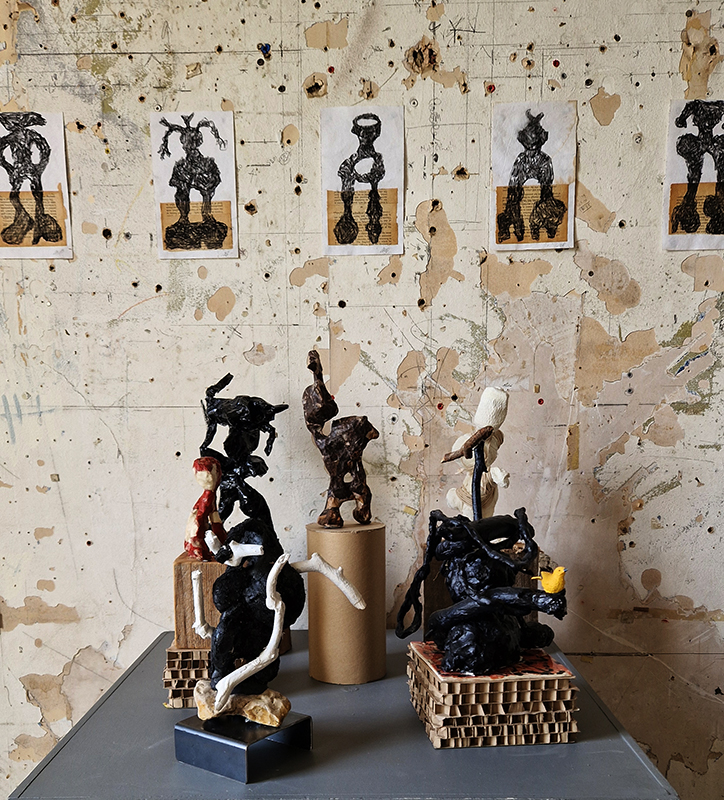
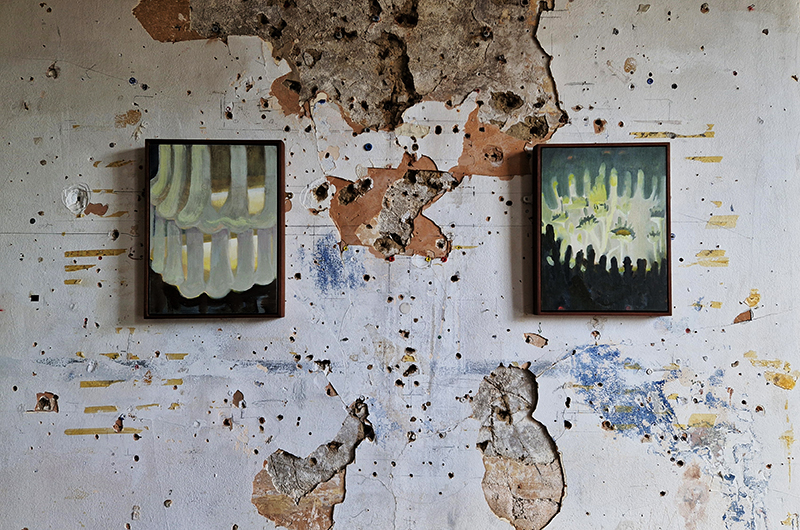
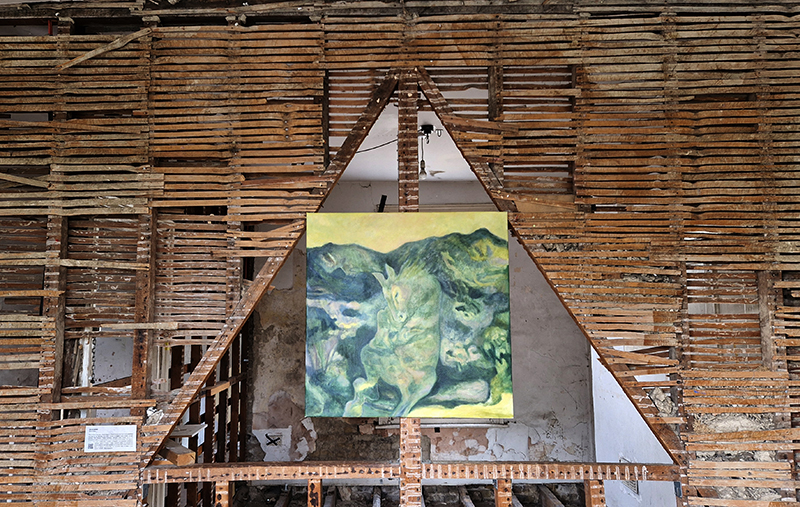
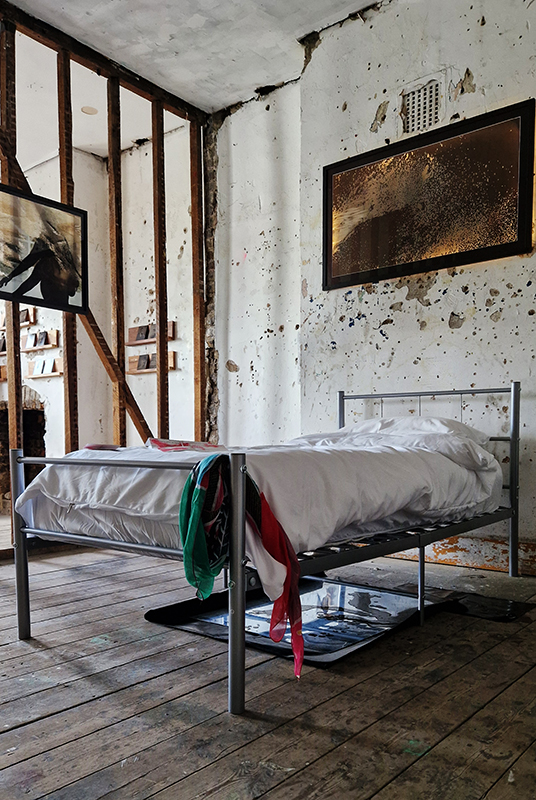
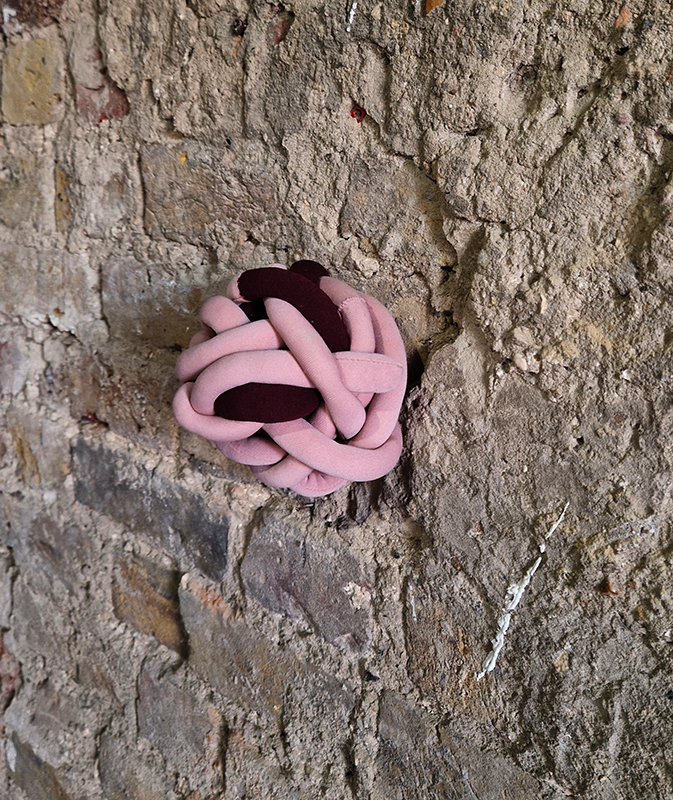
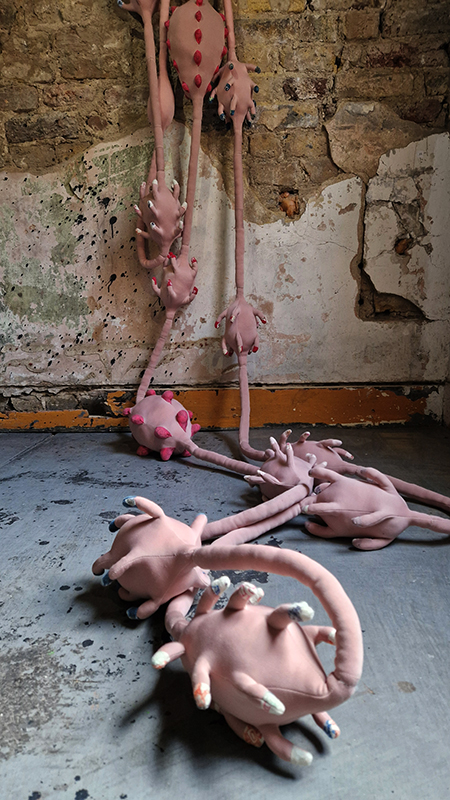
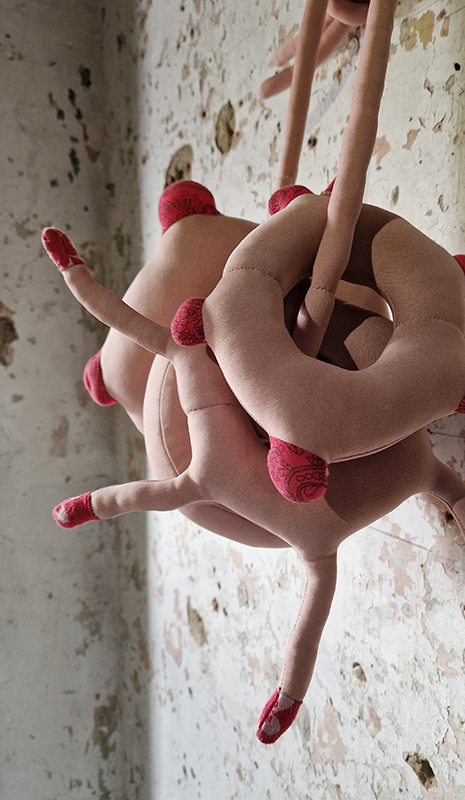
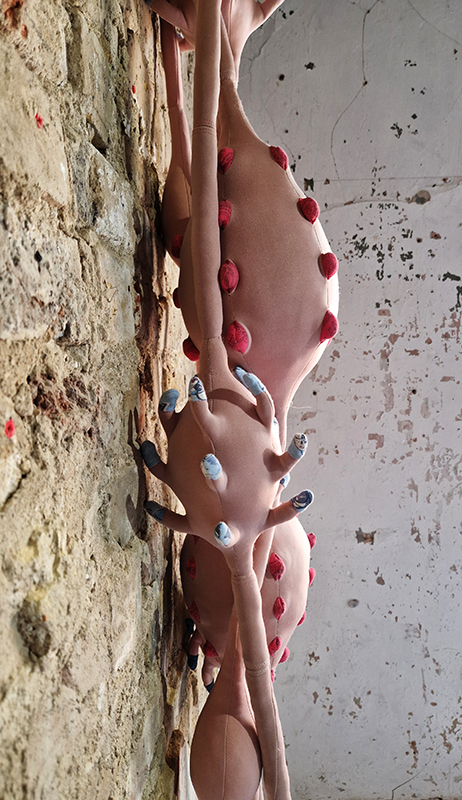
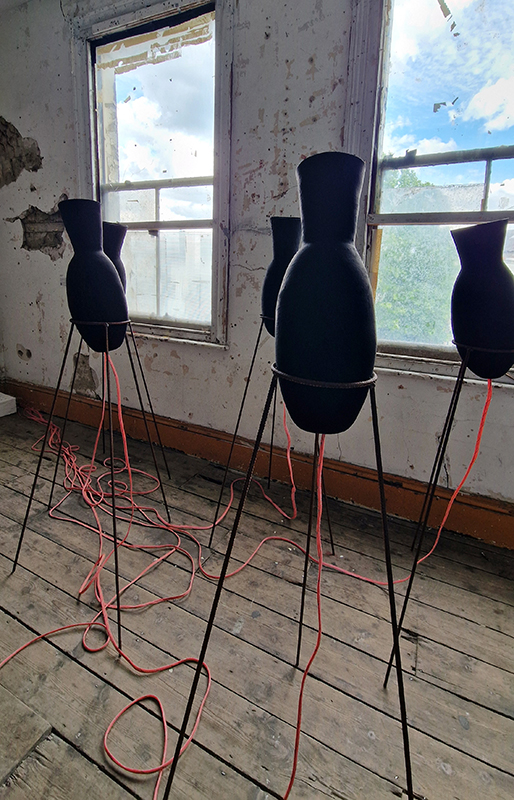
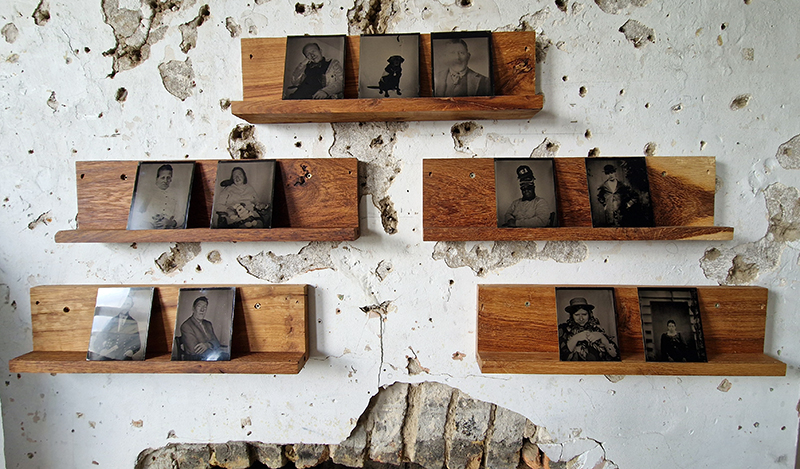
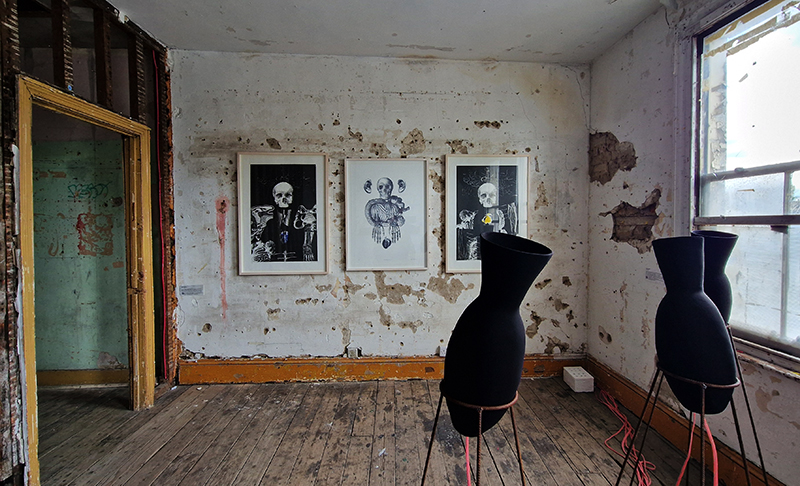
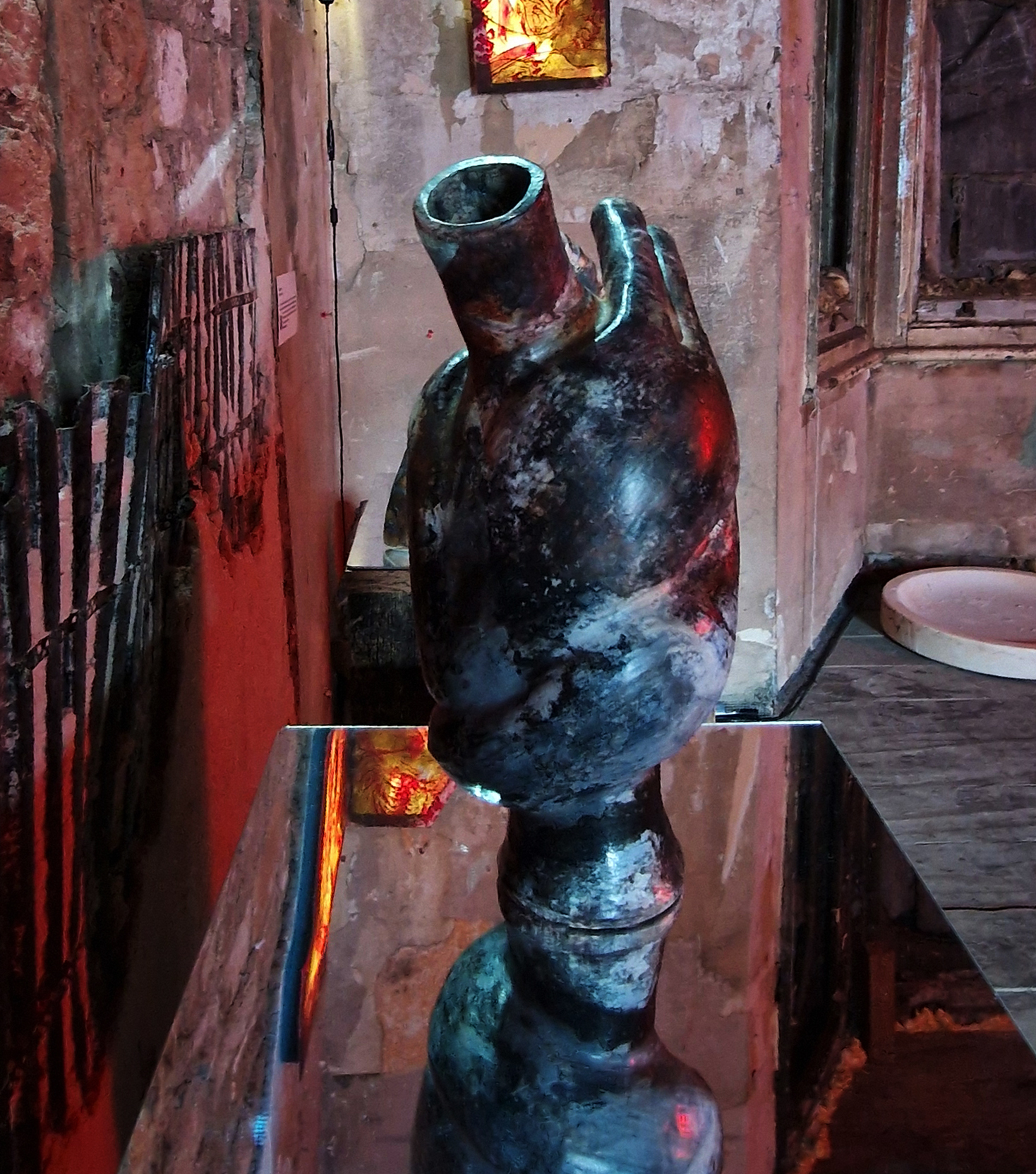
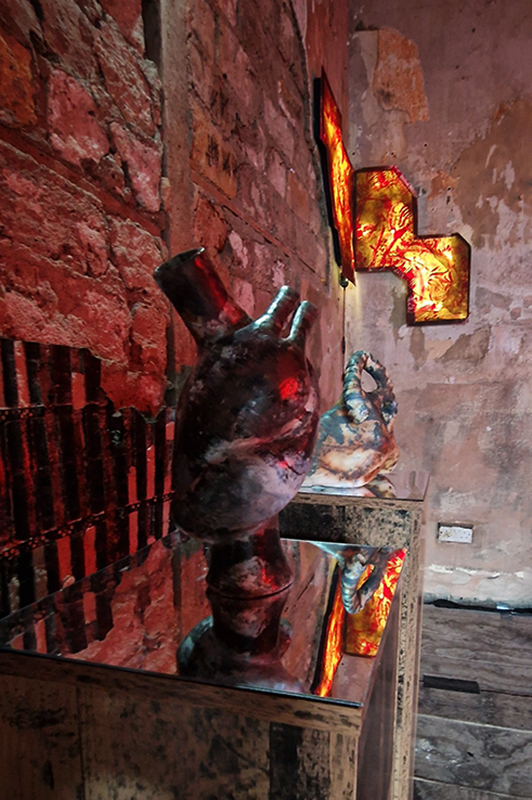
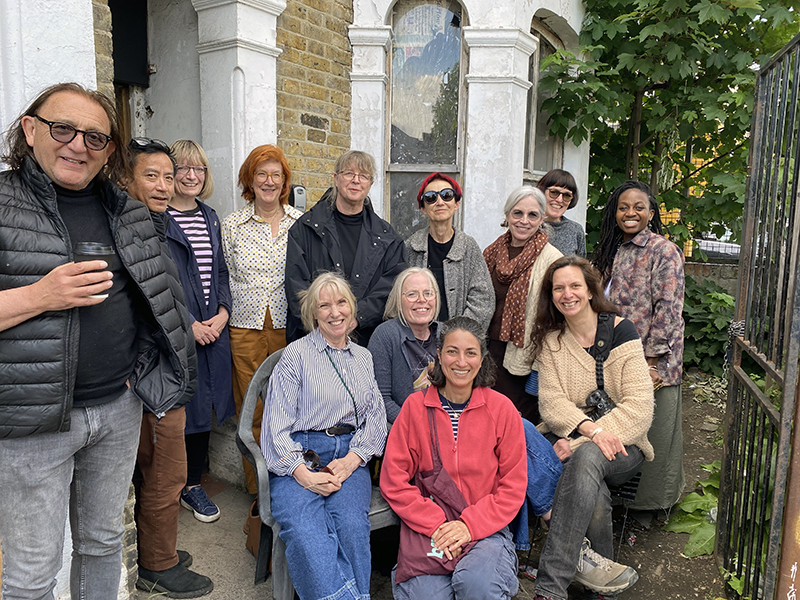
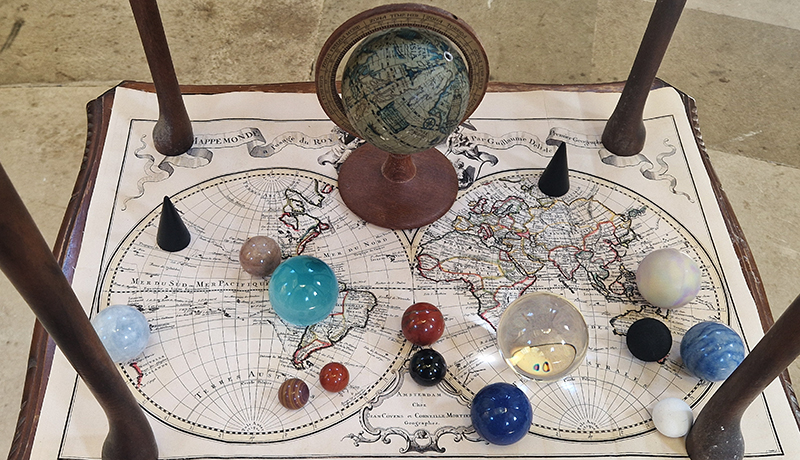
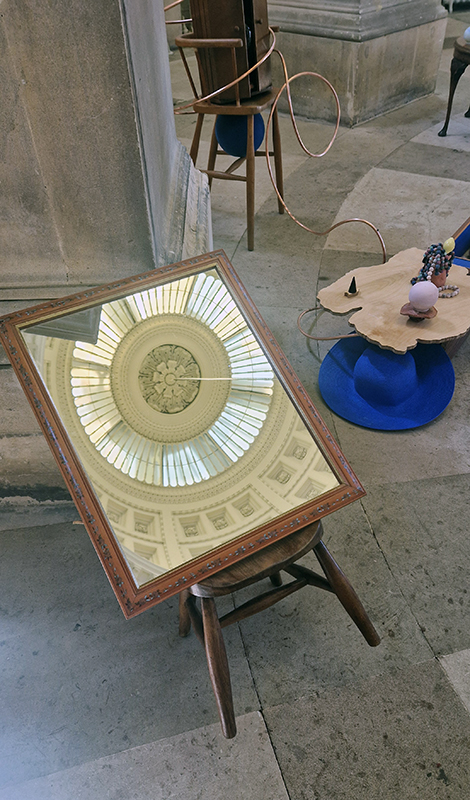
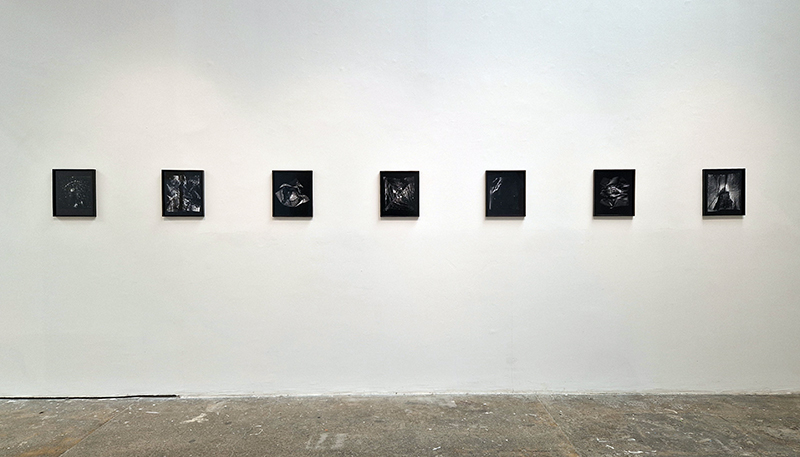
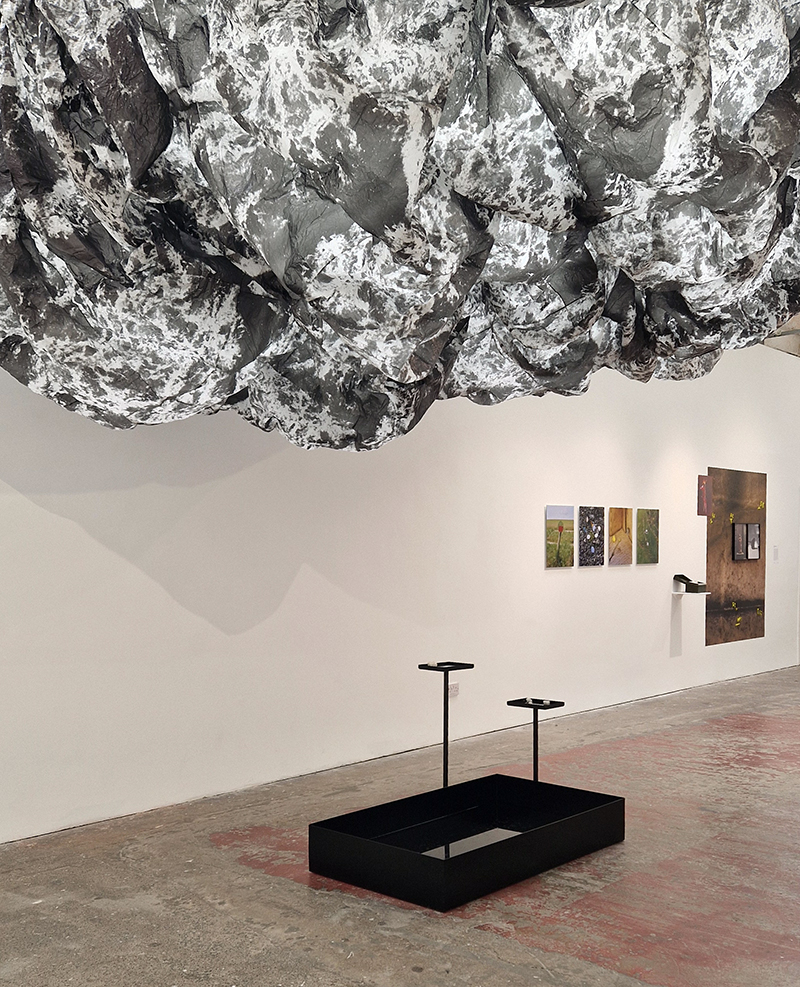
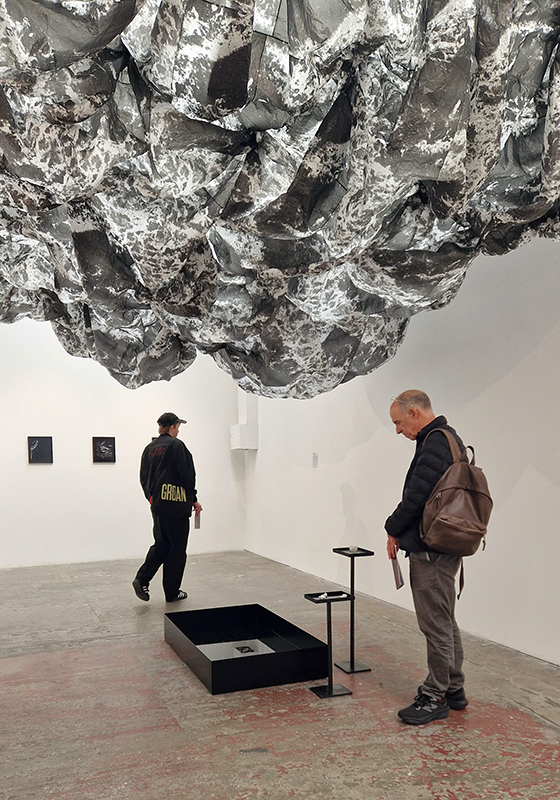
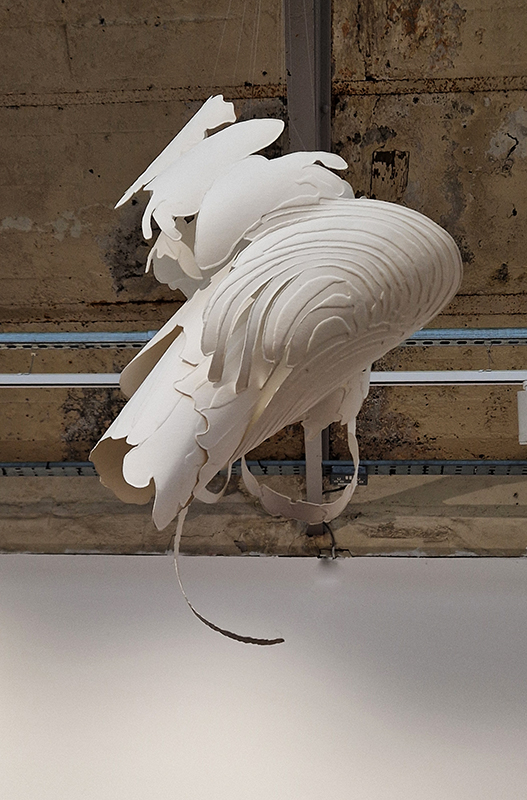
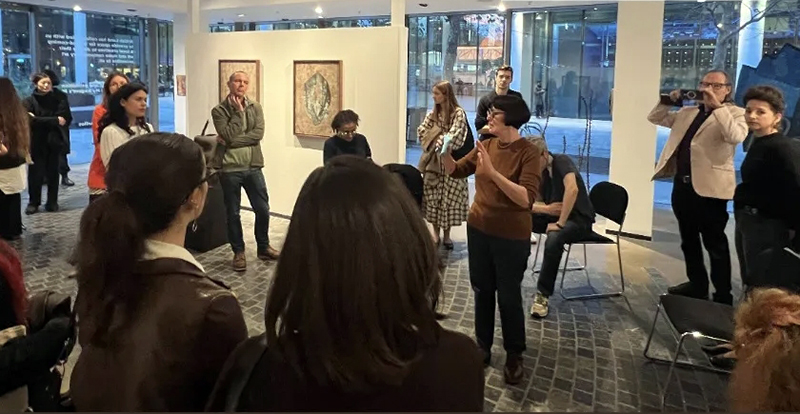
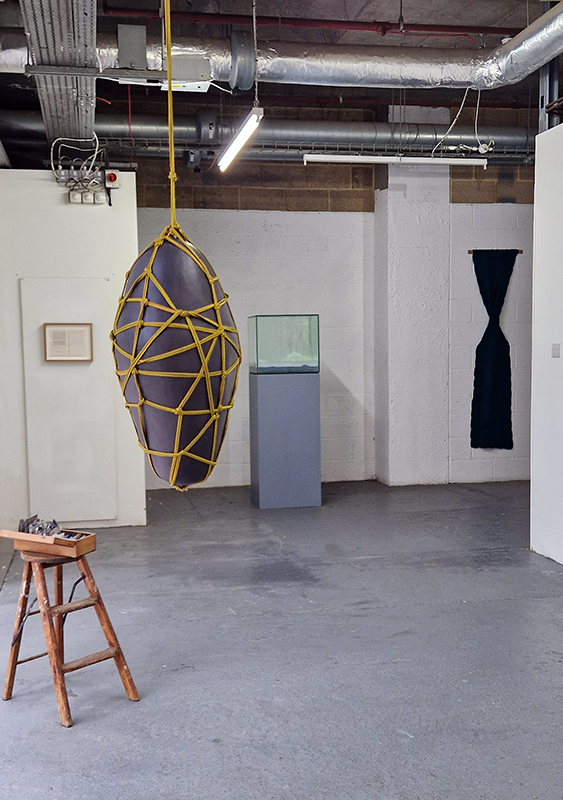
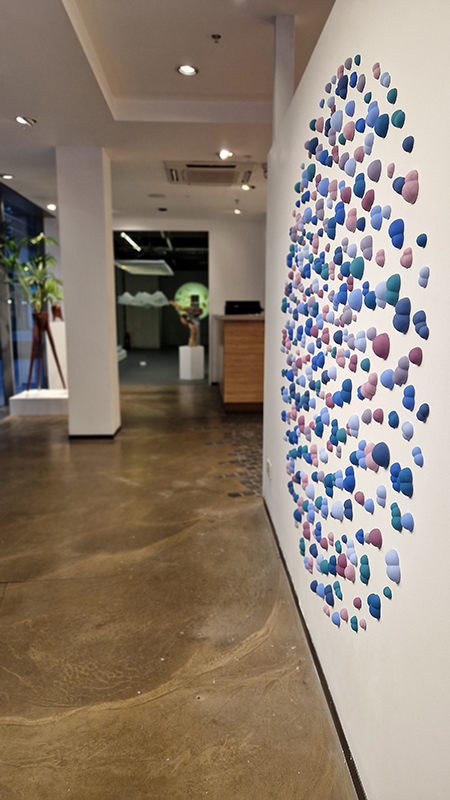
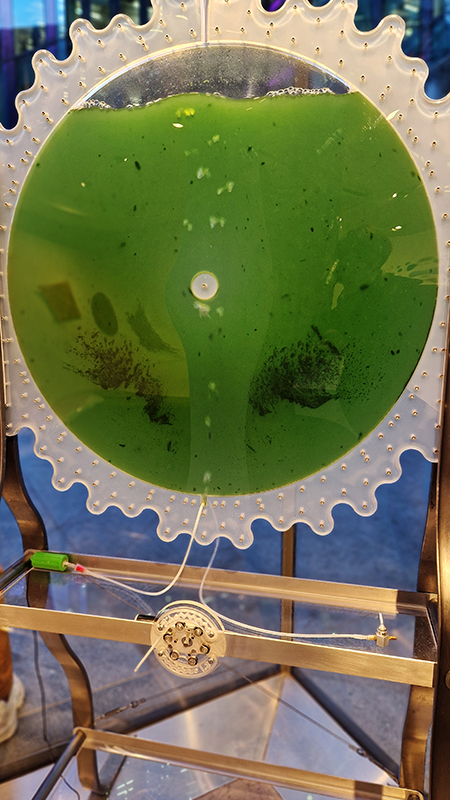
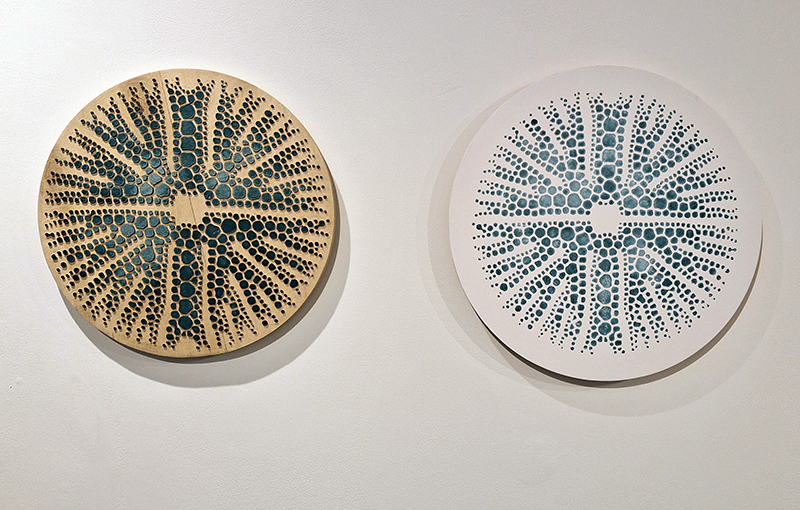
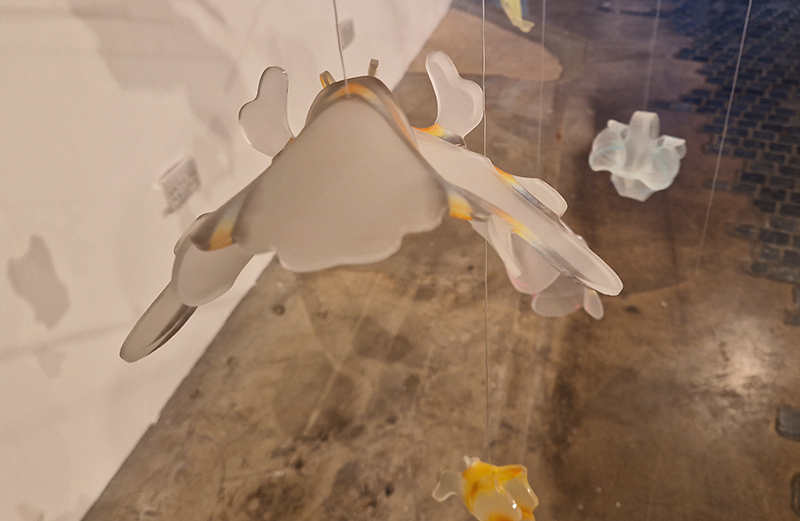
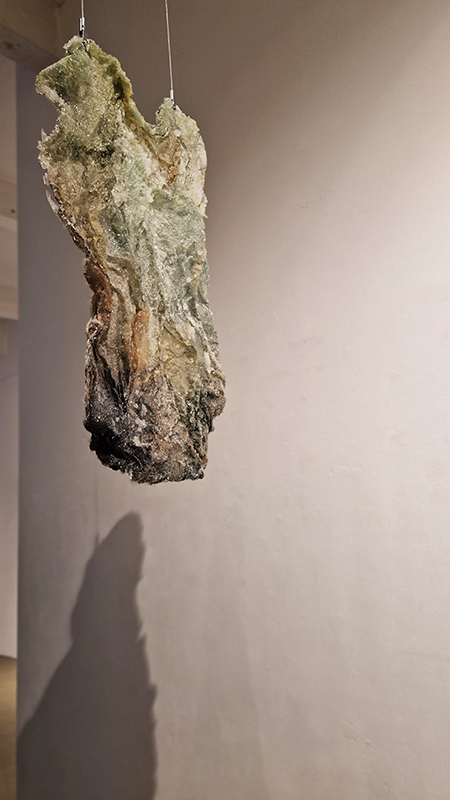
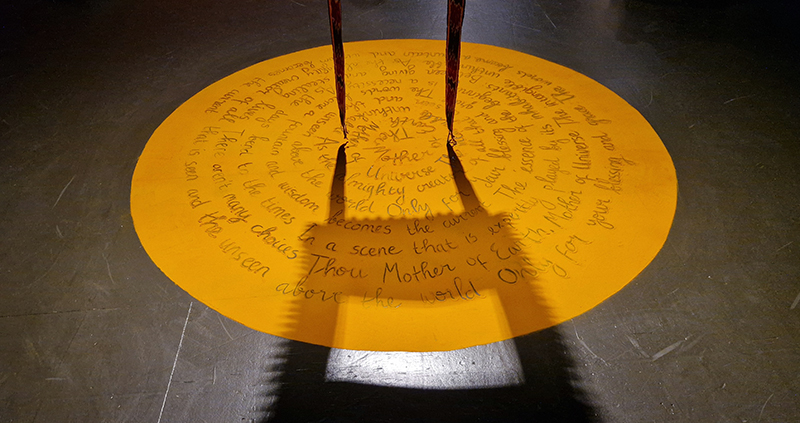
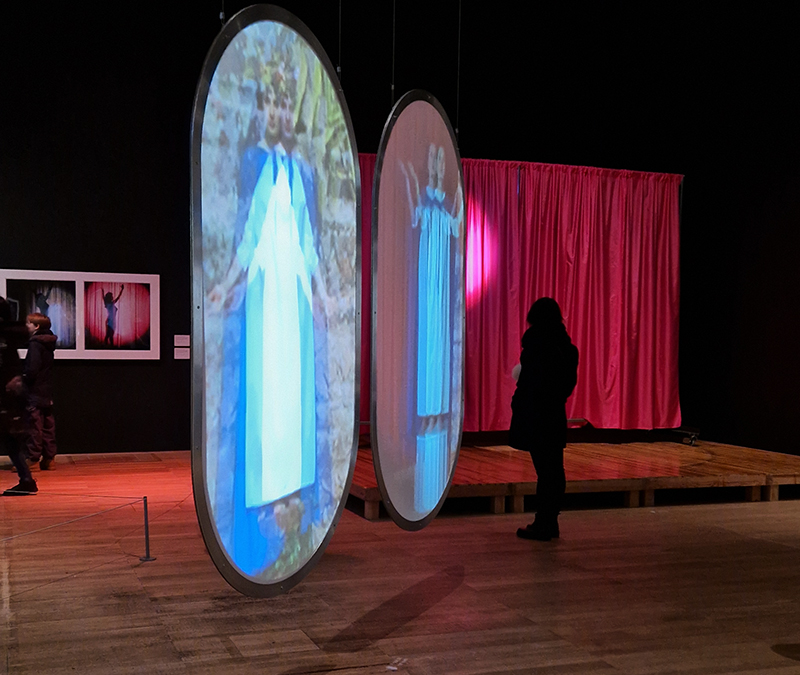
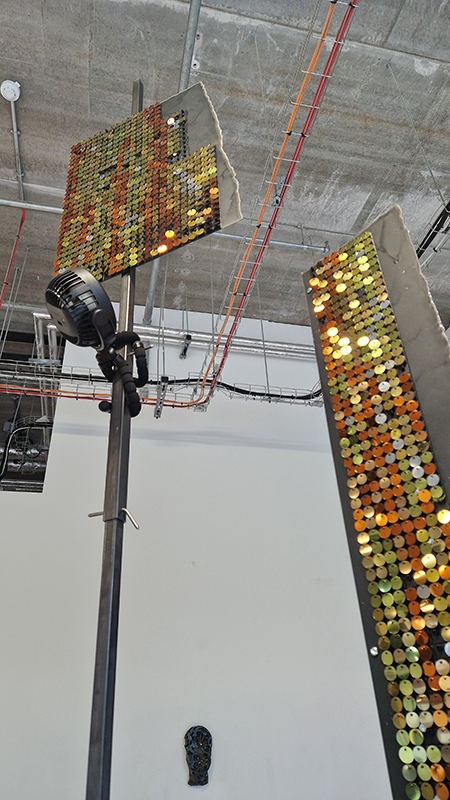
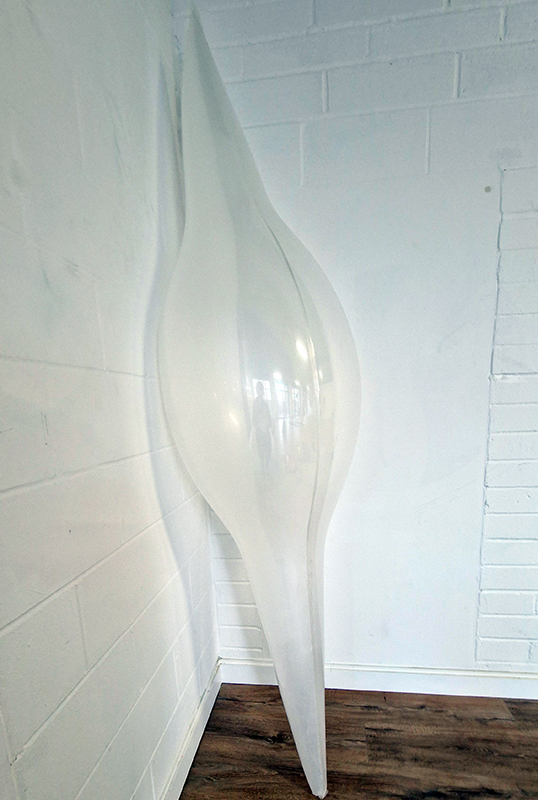
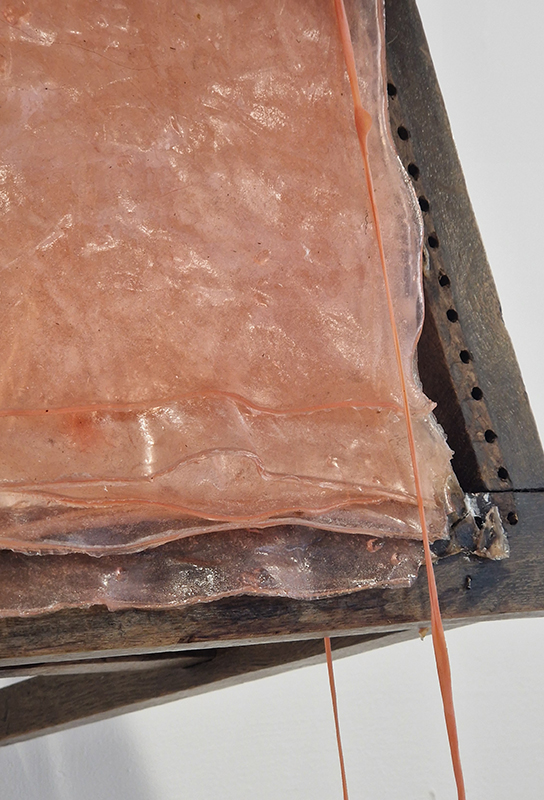
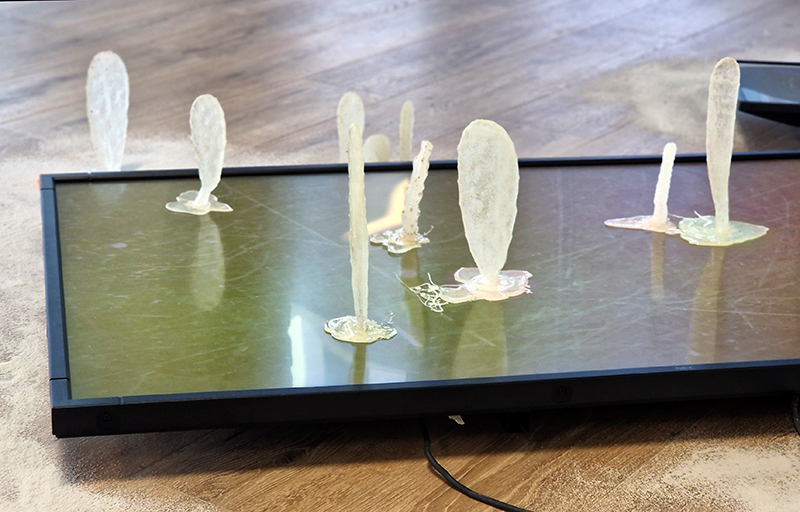
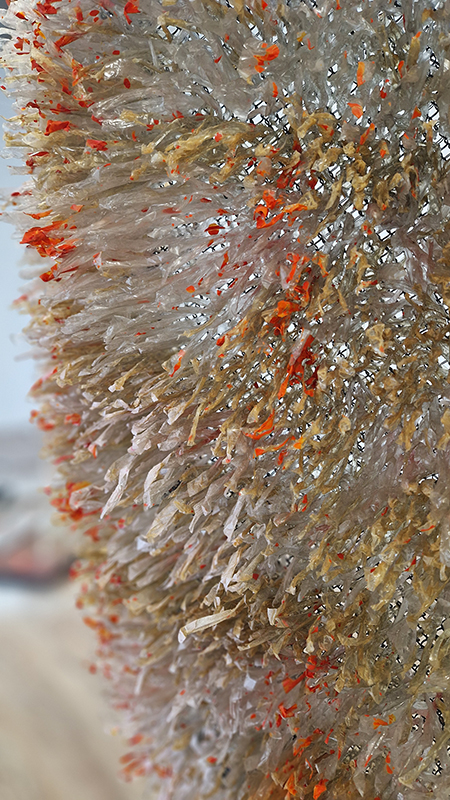
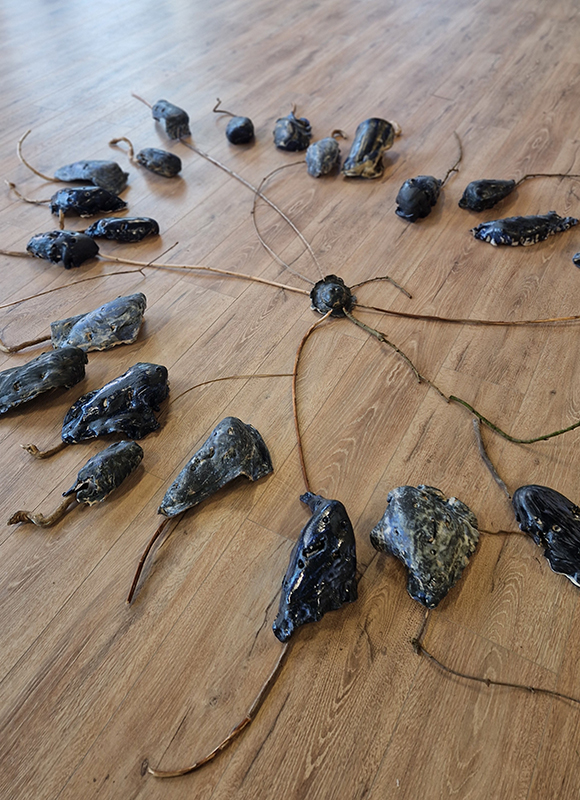
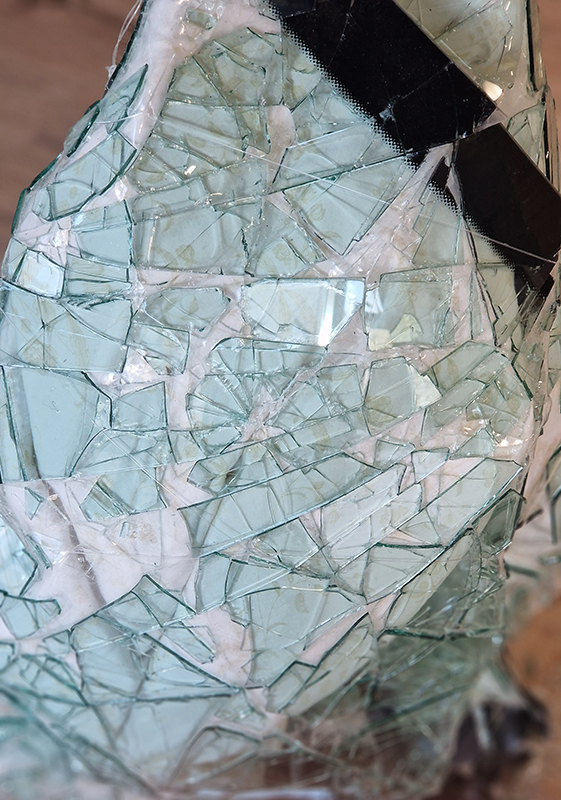
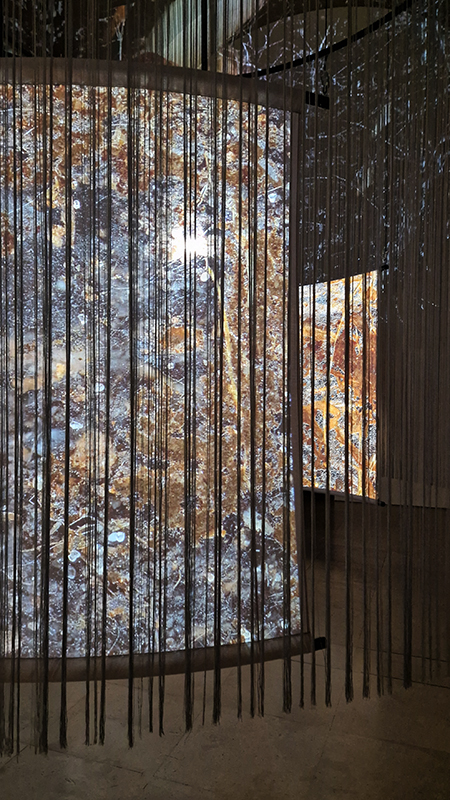
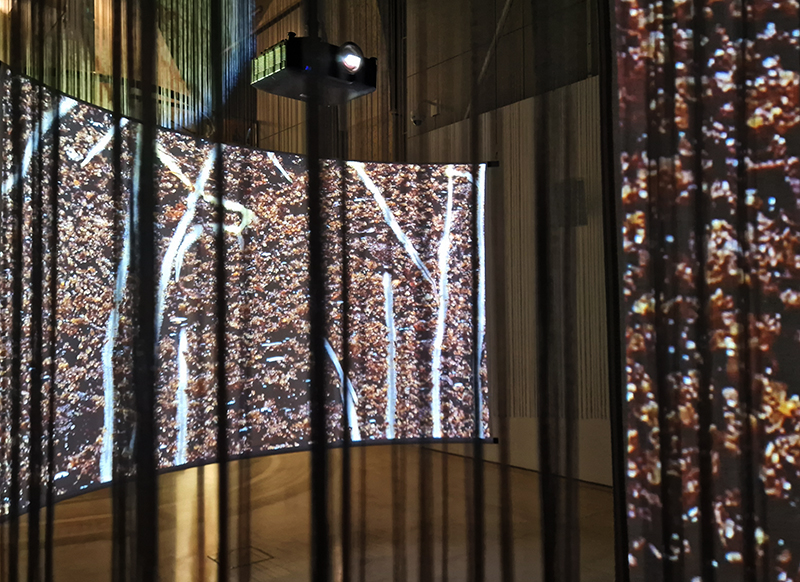
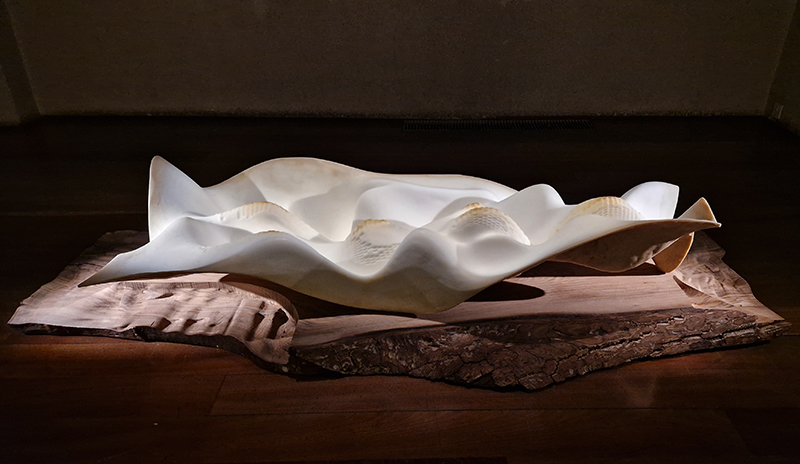
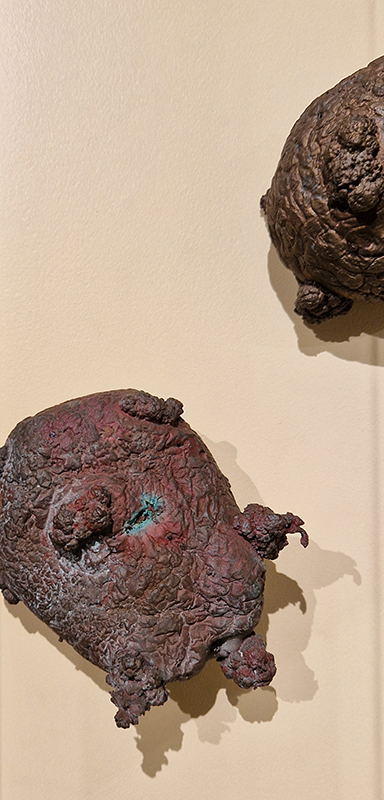
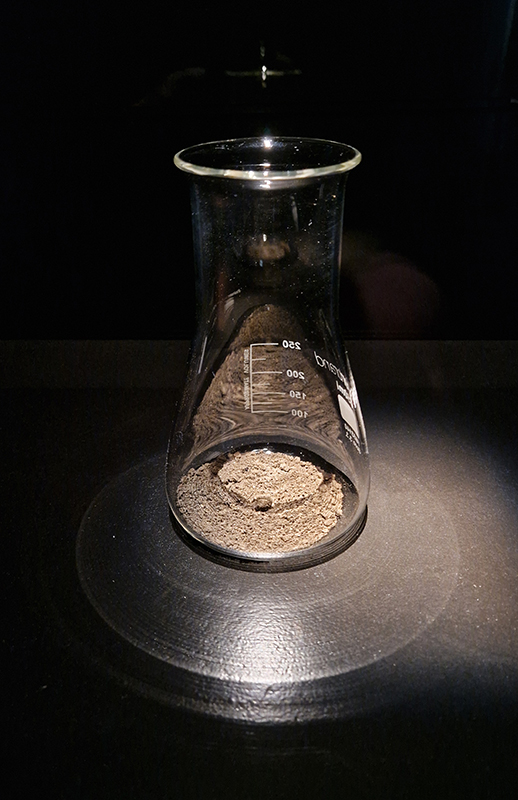
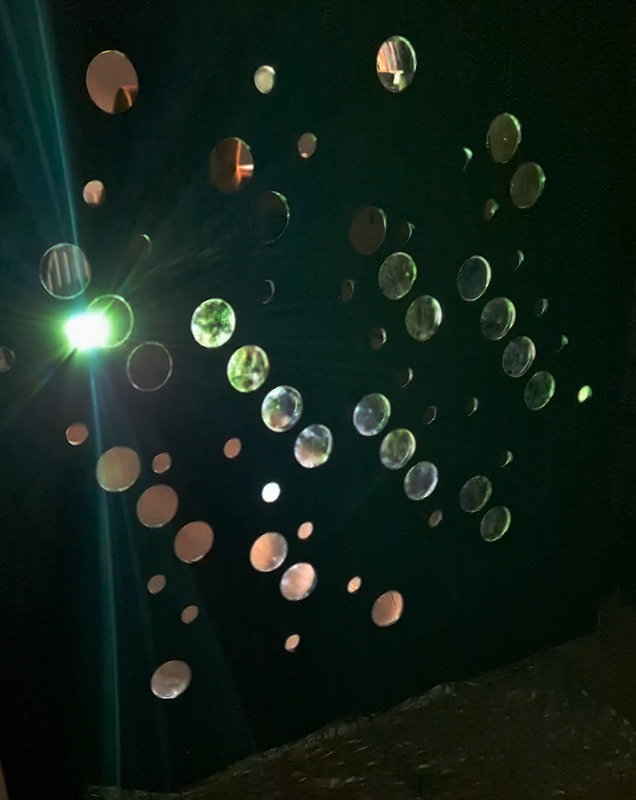
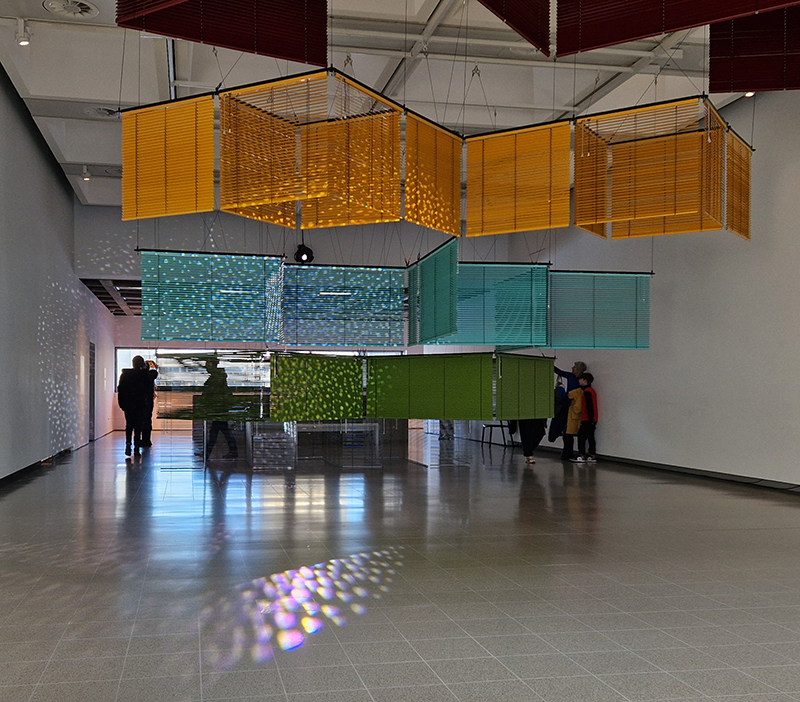
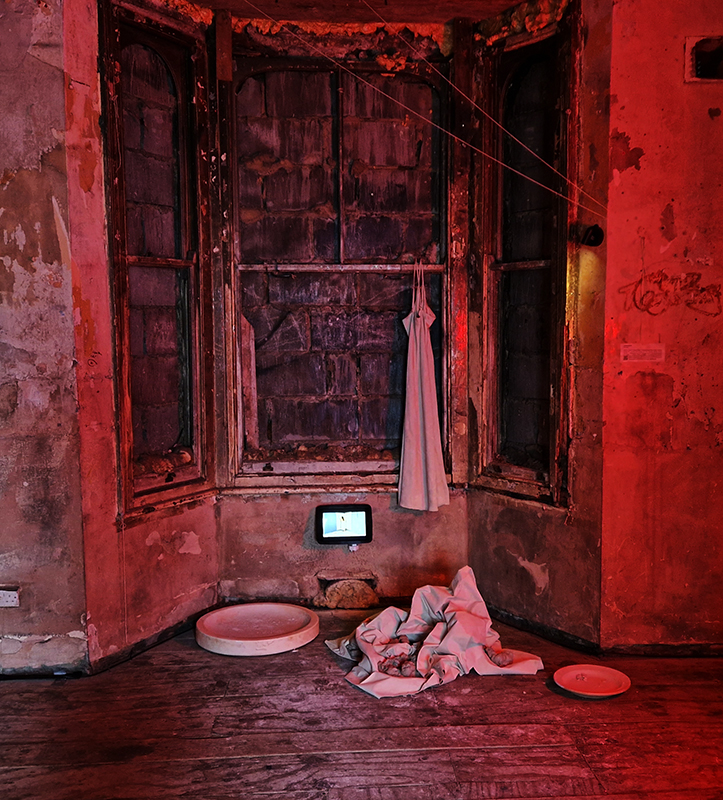
It was a brilliant busy weekend at the Safehouses Peckham for Occupied: Strange Company. So many visitors commented on the excellent curation of the works by Julie Hoyle. Each room had its own unique atmosphere yet all blended so seamlessly across the two houses. I was very happy with the placing of my two installations, one in the rafters the other in a dark recess under the stairs. Both works look to other life forms that we coexist with and often overlook – the mollusc and the creatures of the gutters.

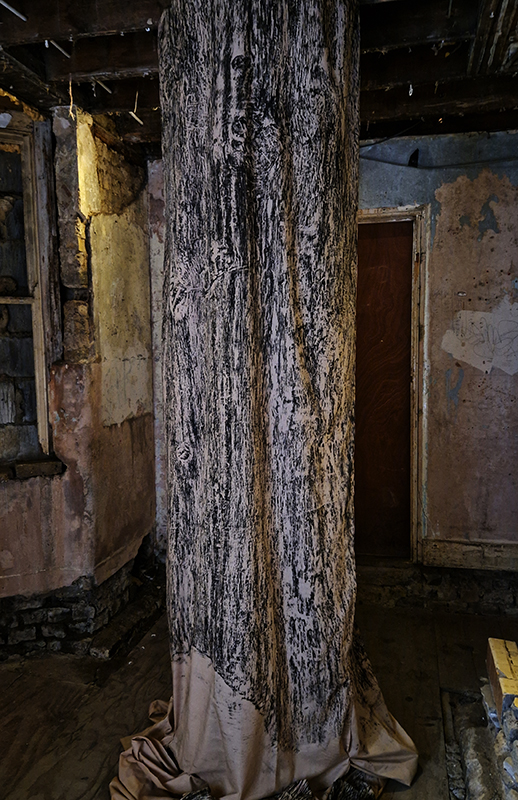
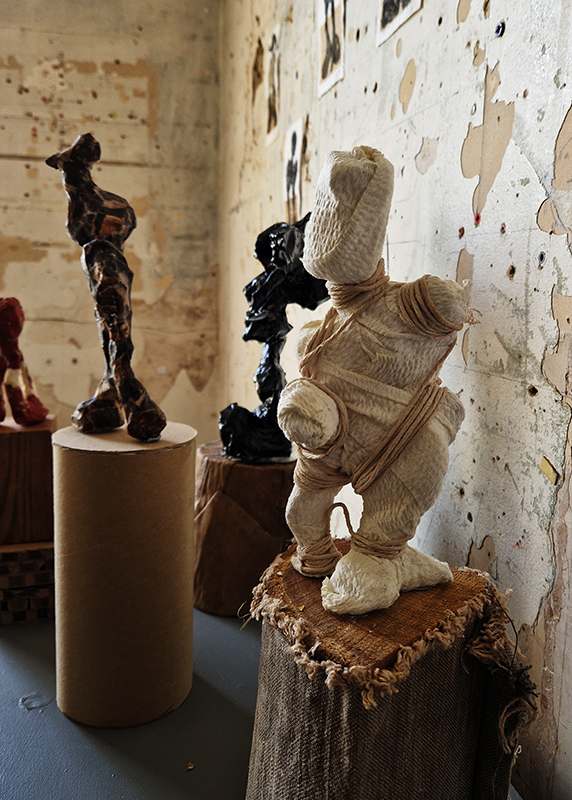
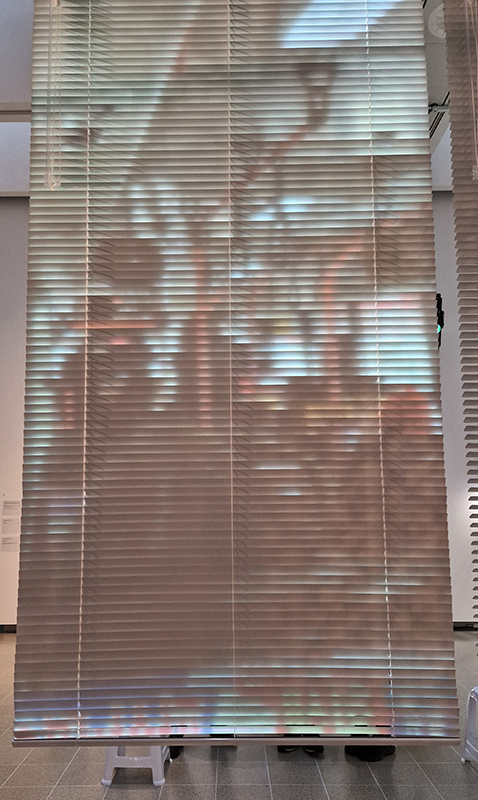
Installation images of my work by Emma Brown Photography
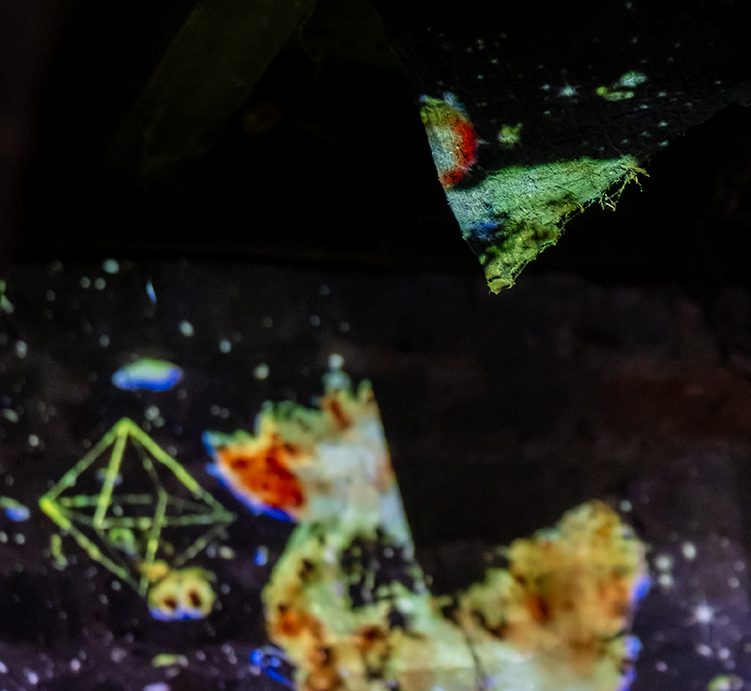
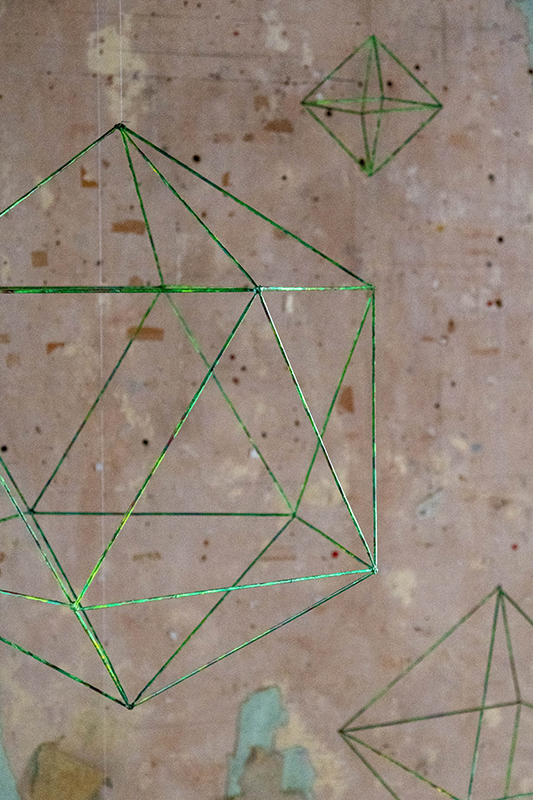
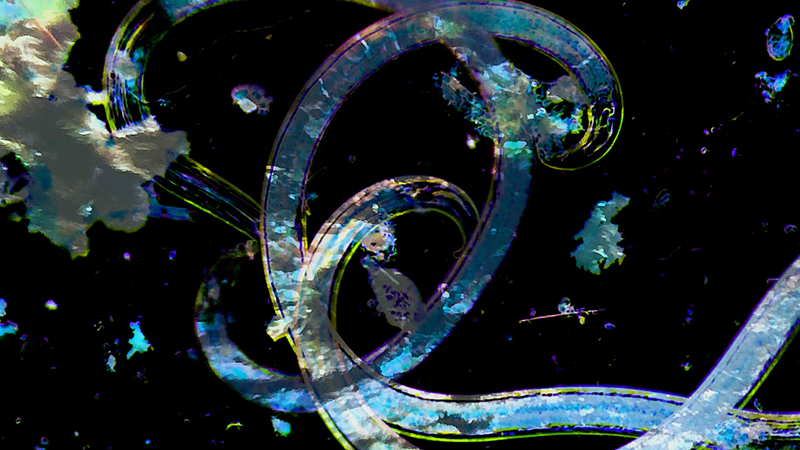
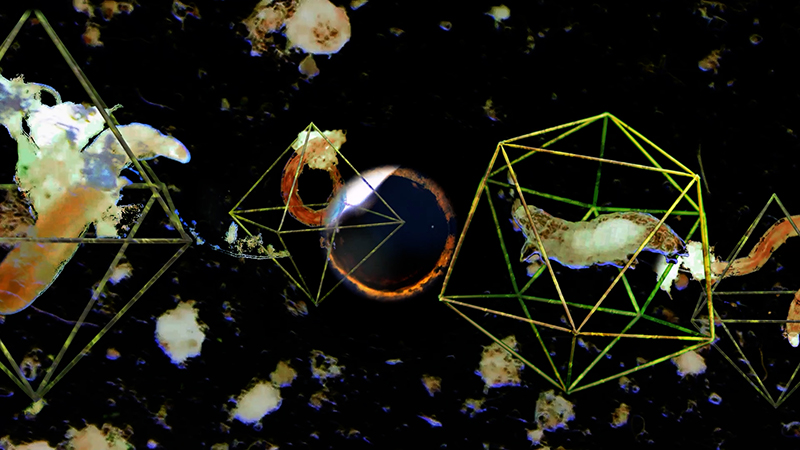
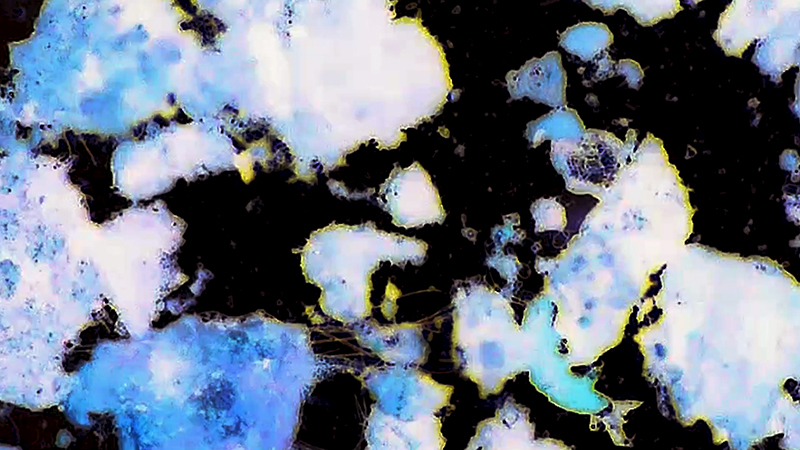
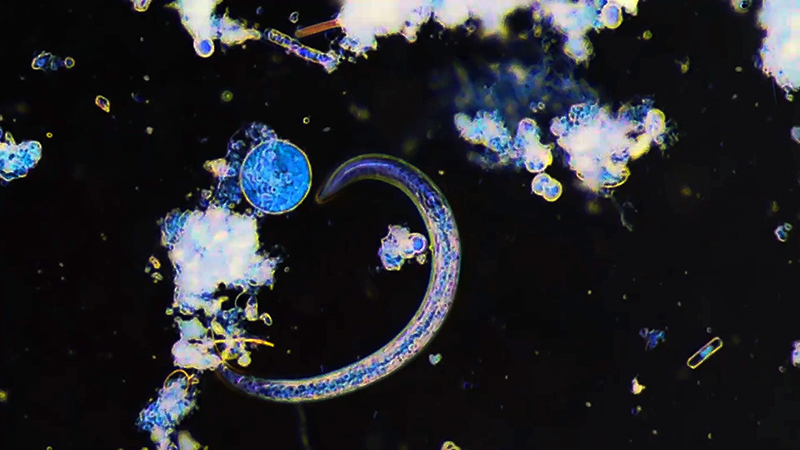
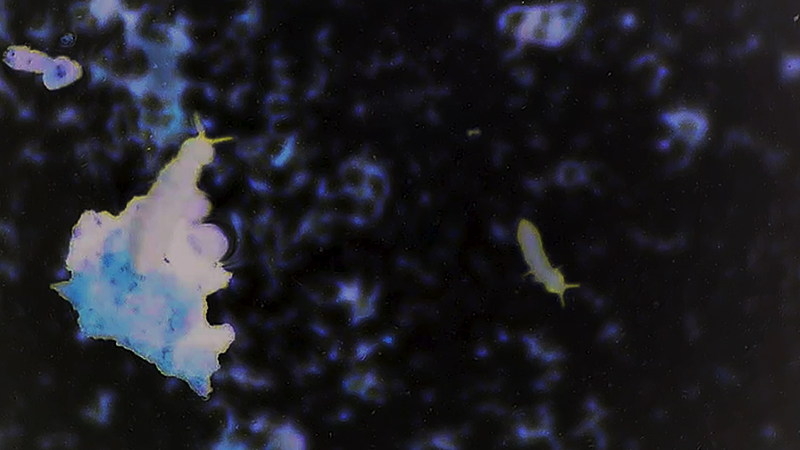
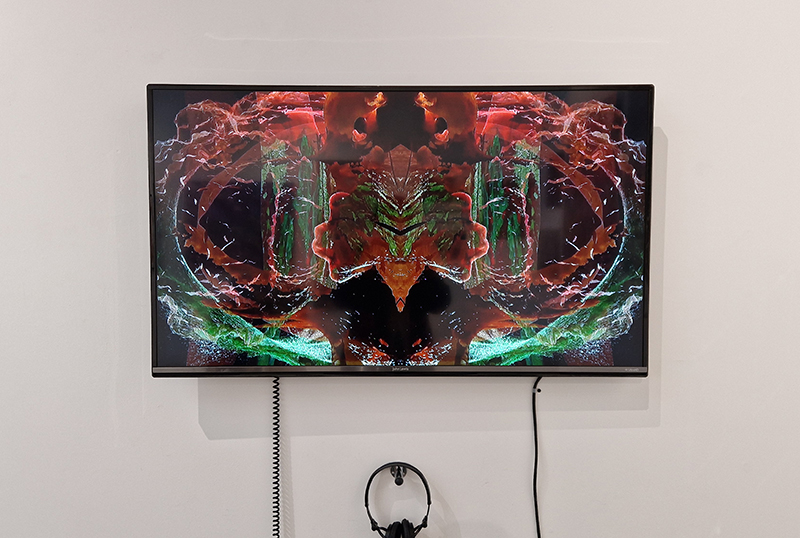
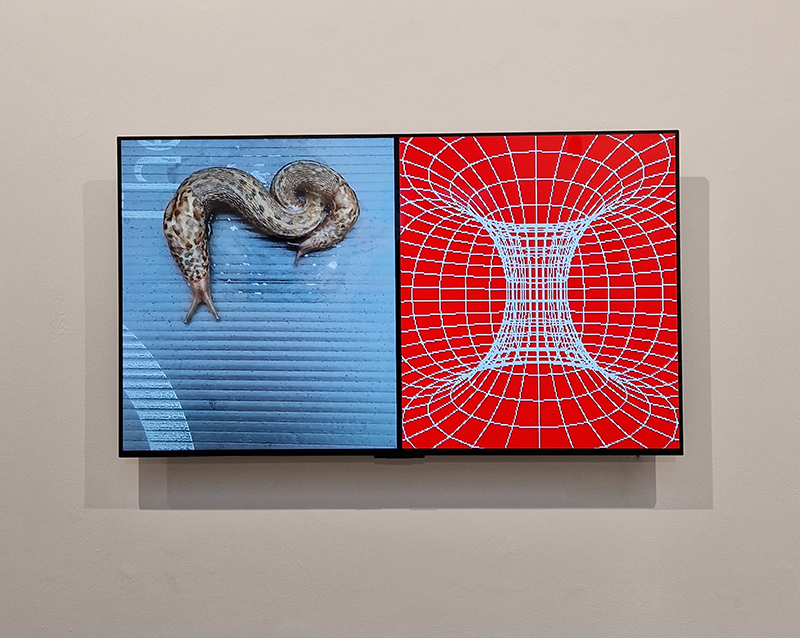
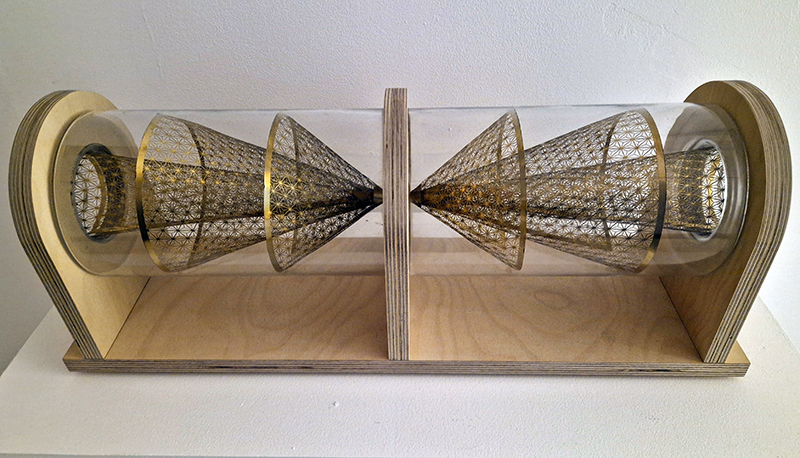
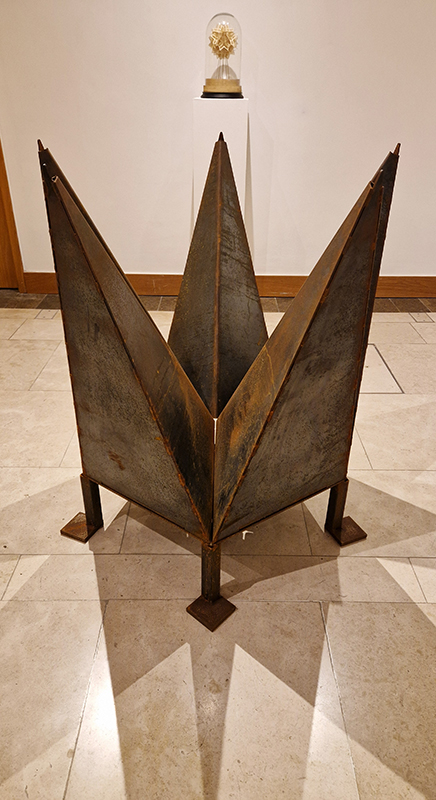
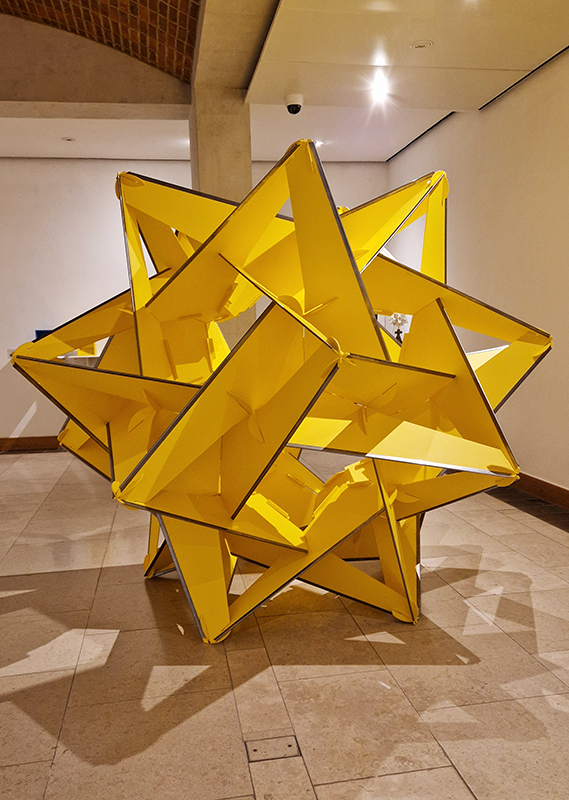
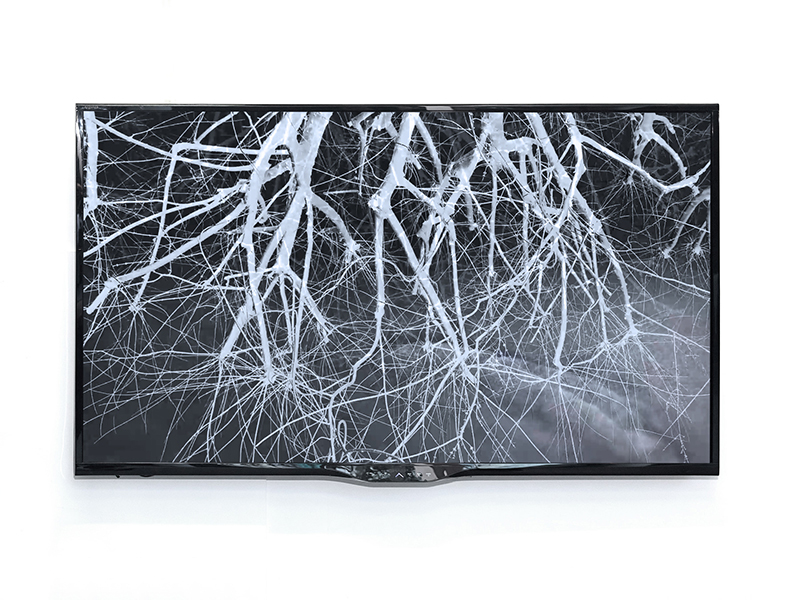
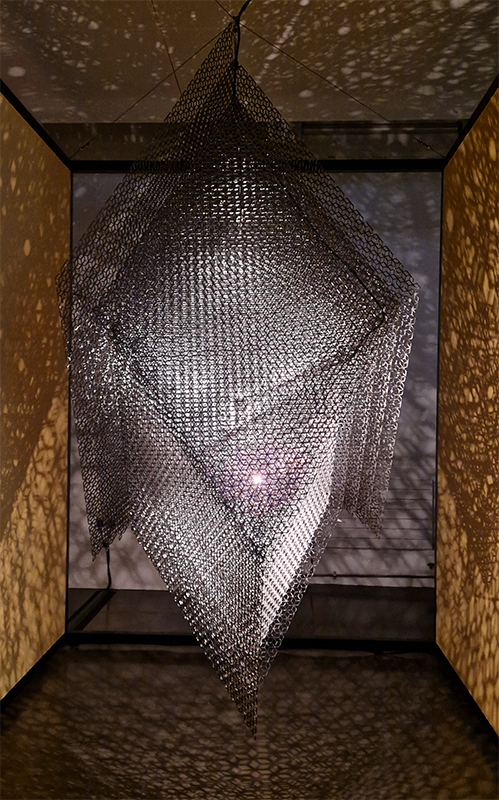
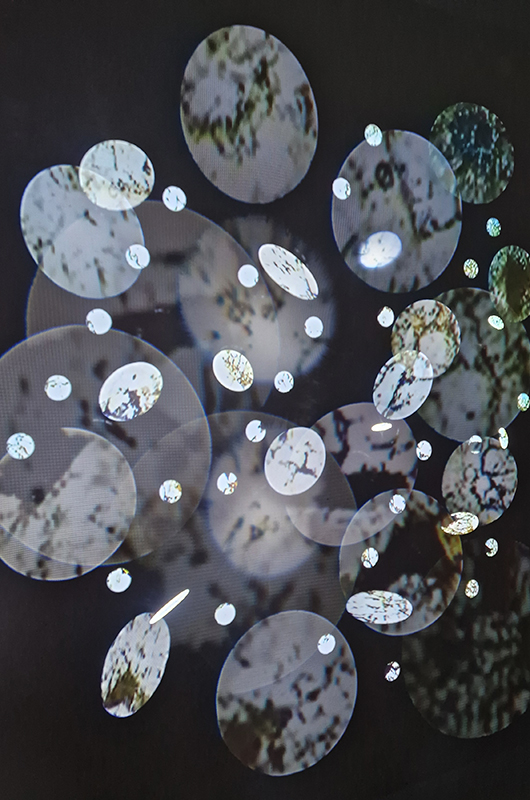
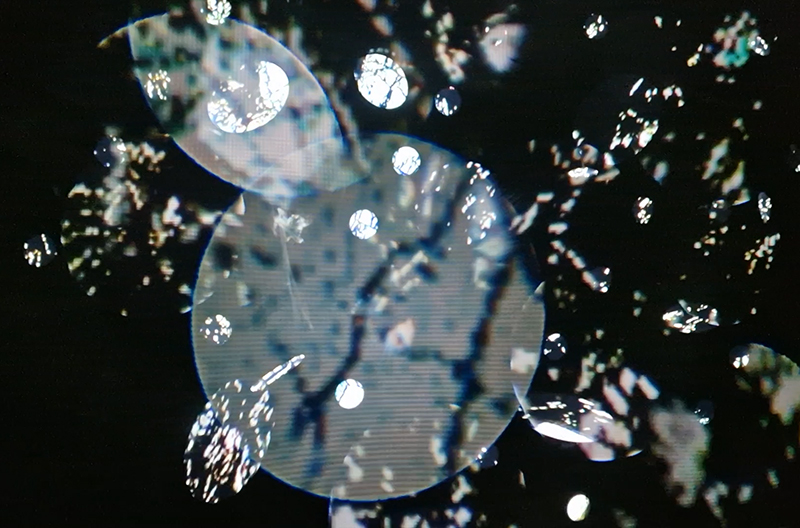
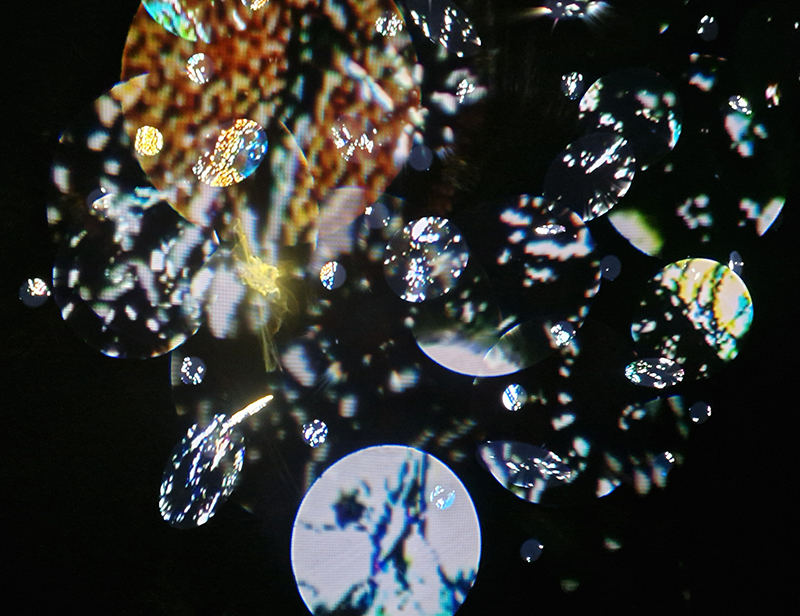
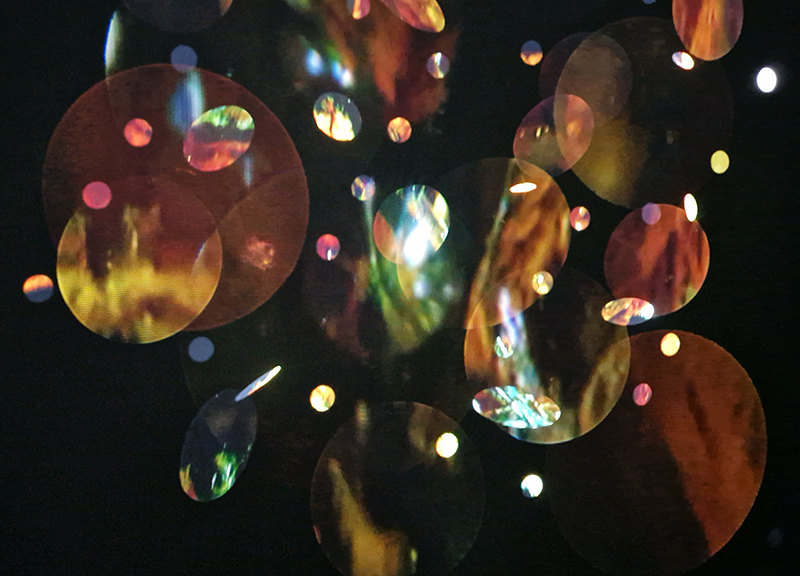
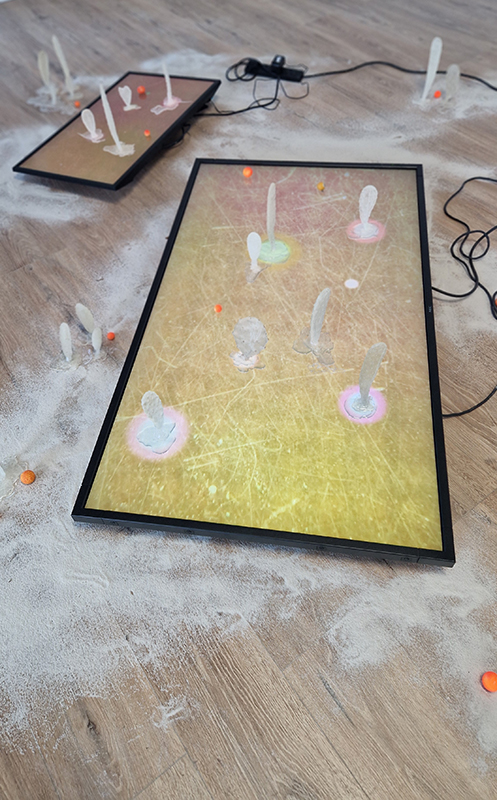
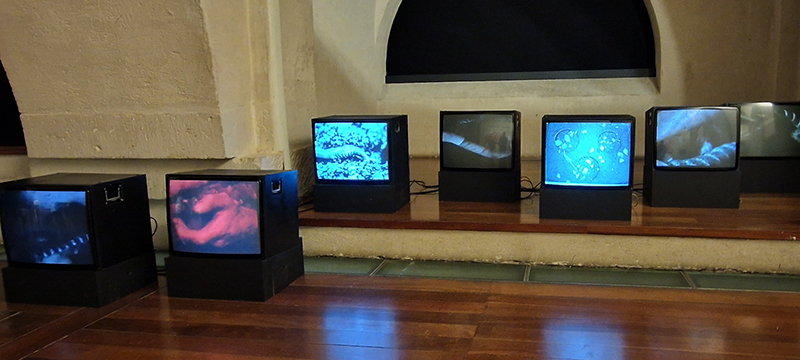
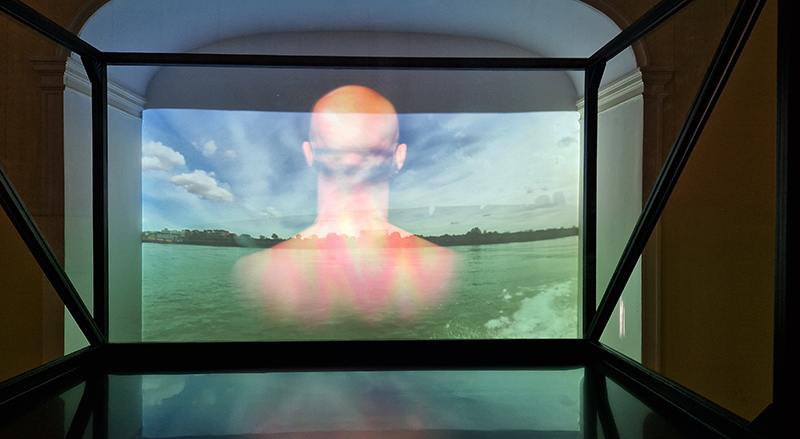
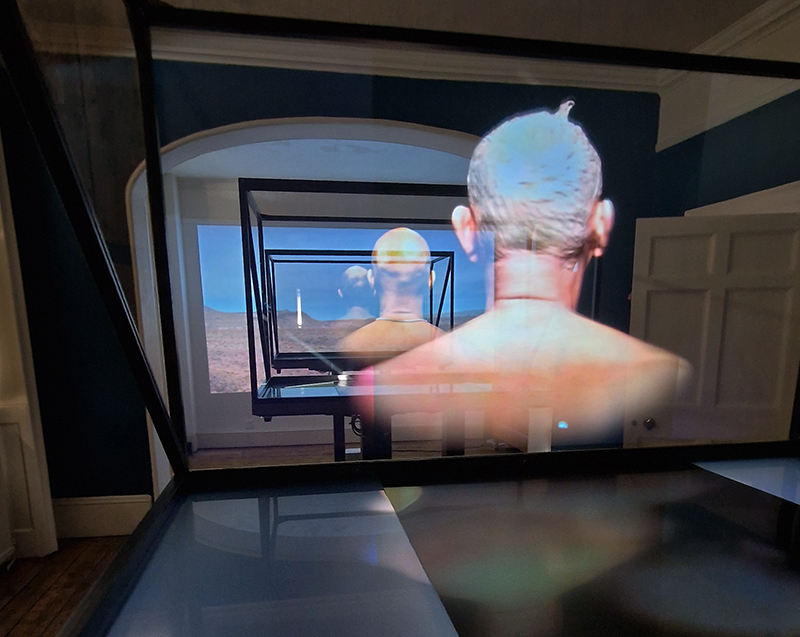
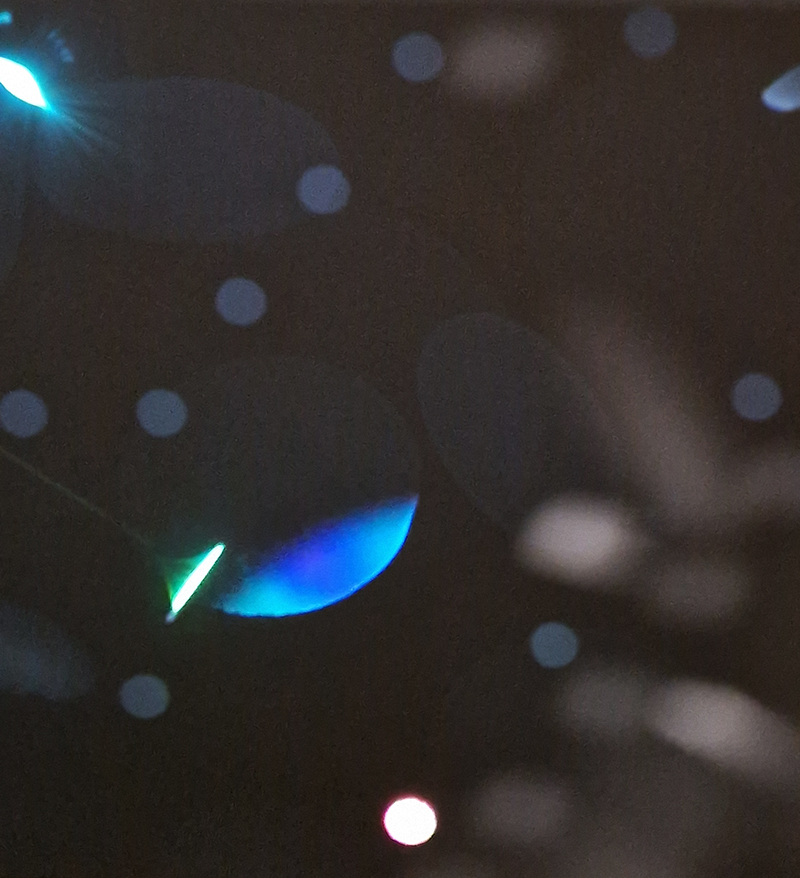
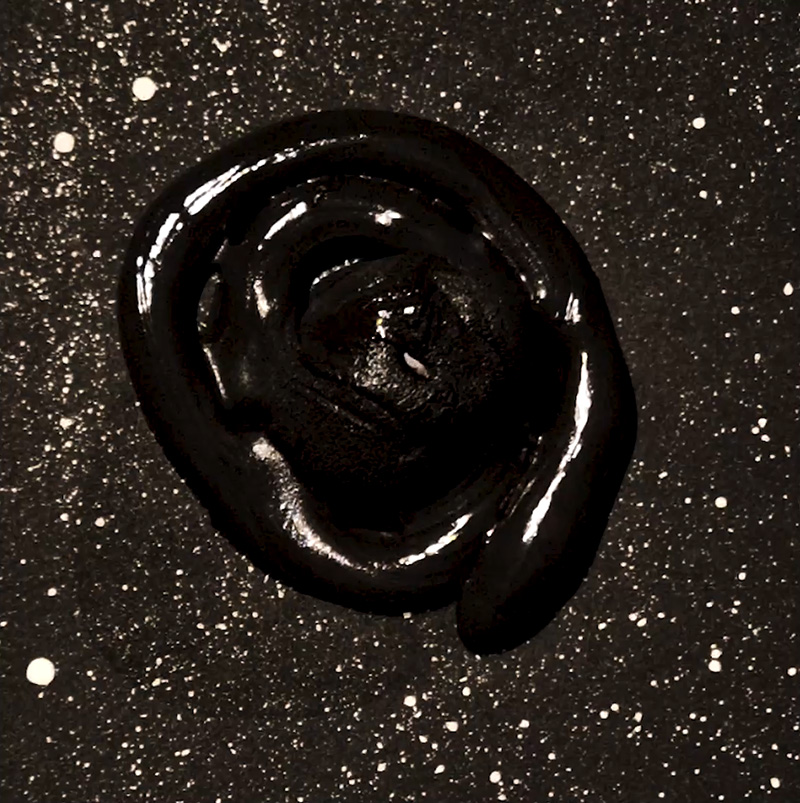
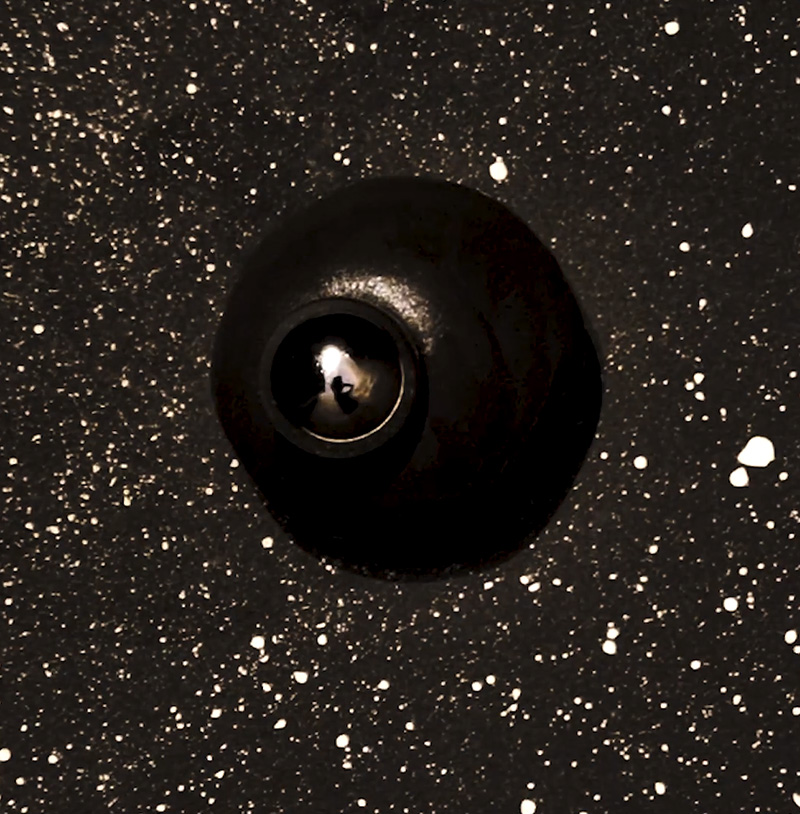
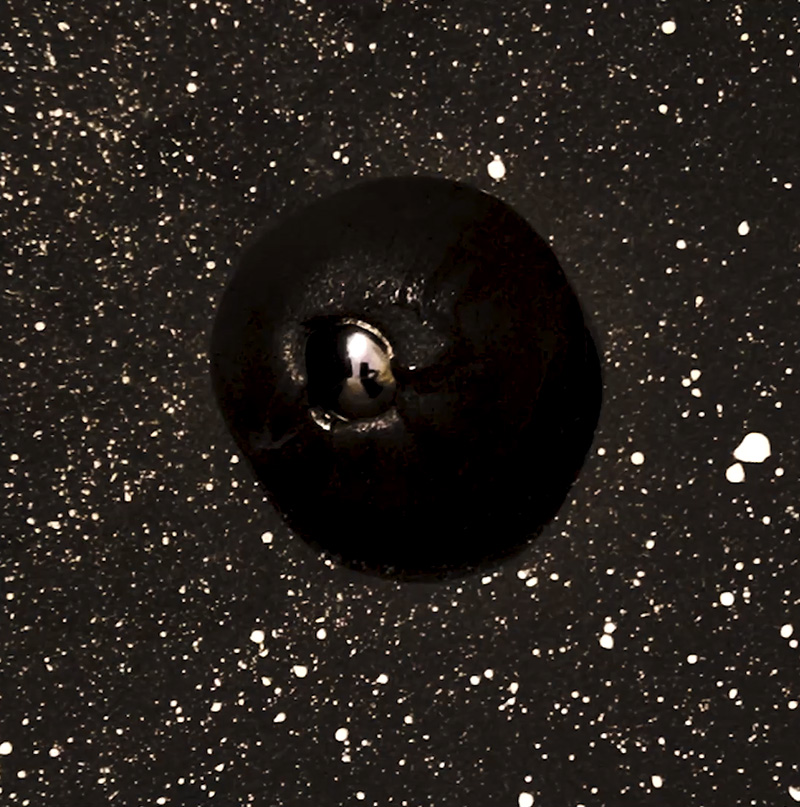
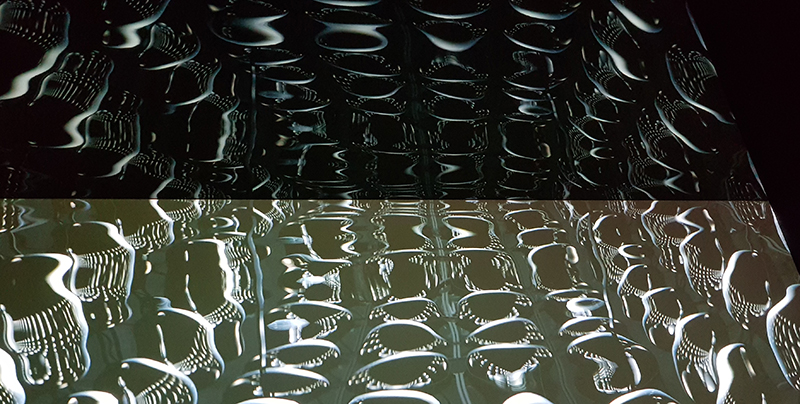
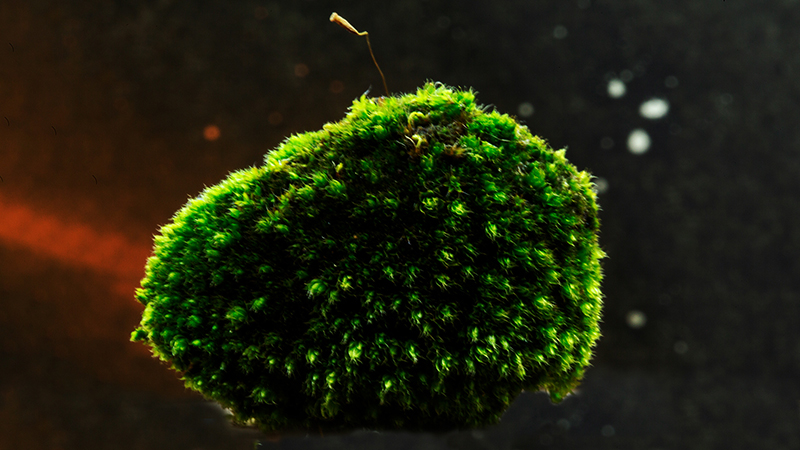
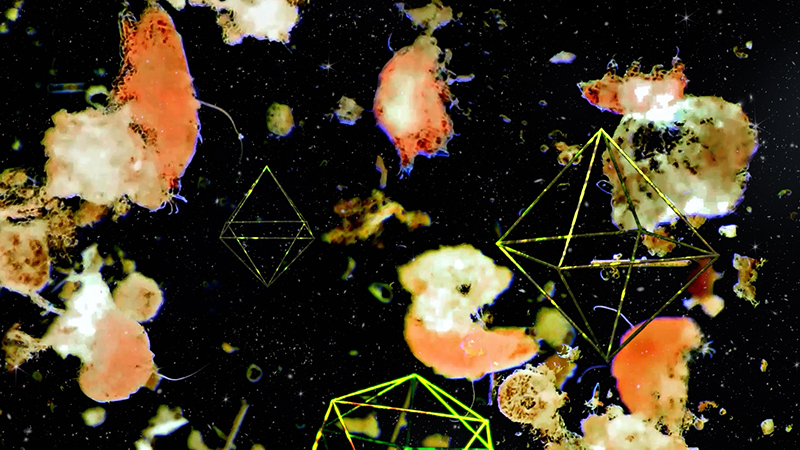
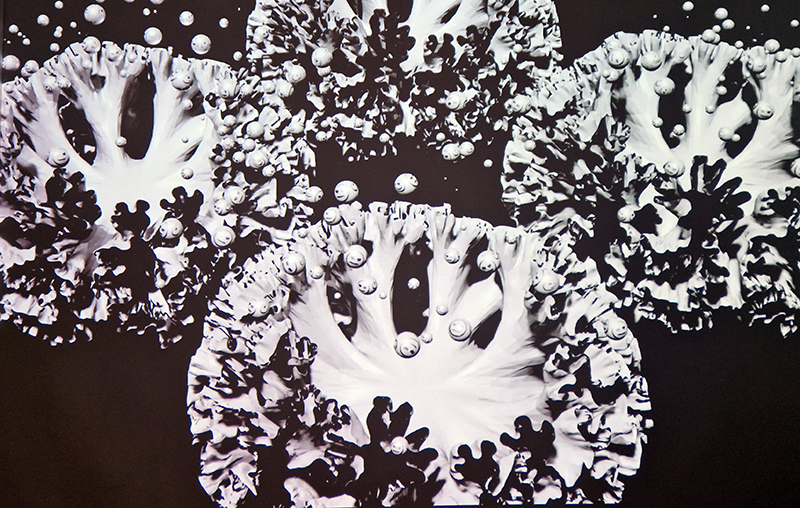
Guttanaut alludes to Oscar Wilde’s familiar quote ‘We are all in the gutter but some of us are looking at the stars’. This video installation transports the viewer to exotic otherworlds inhabited by microscopic creatures found in a drop of water or tuft of moss in the dank environs of house gutters. Icosahedron and octahedron shapes representing the elemental qualities of water and air appear as constructs for satellites or modes of exploration across this alternative cosmos.
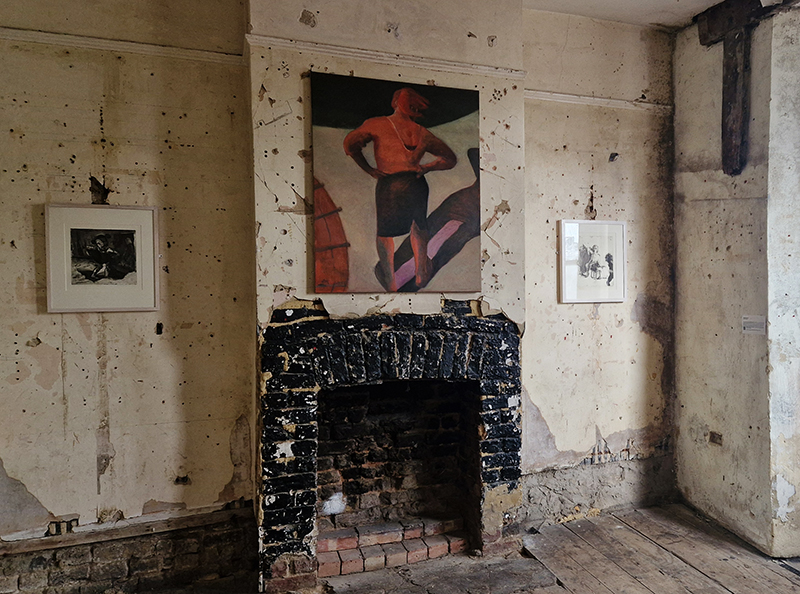
Julie Hoyle brought together a cross-section of artists from Royal Academicians to emerging practitioners, alongside artists working within disability and community contexts reflecting her interest in community and unexpected connections.

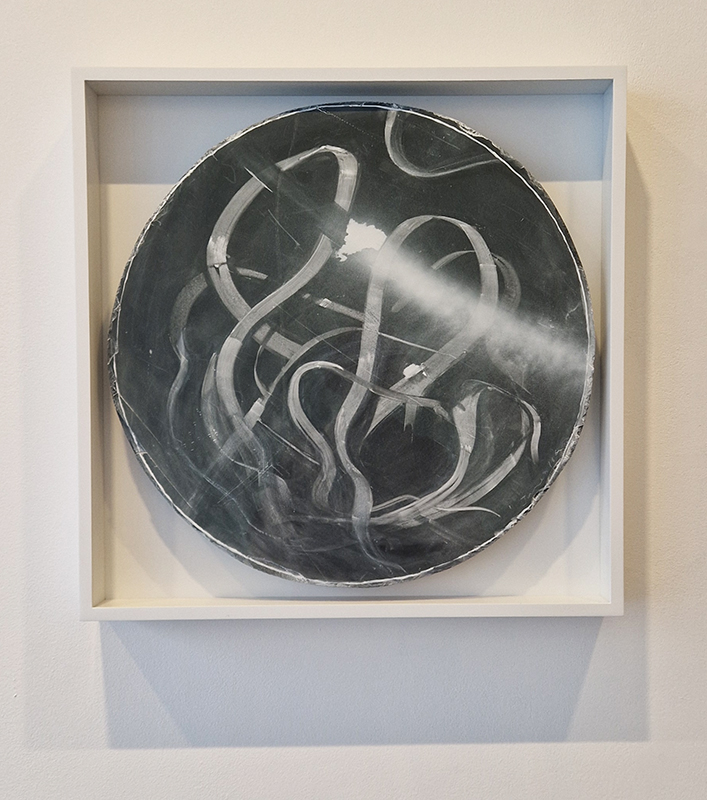
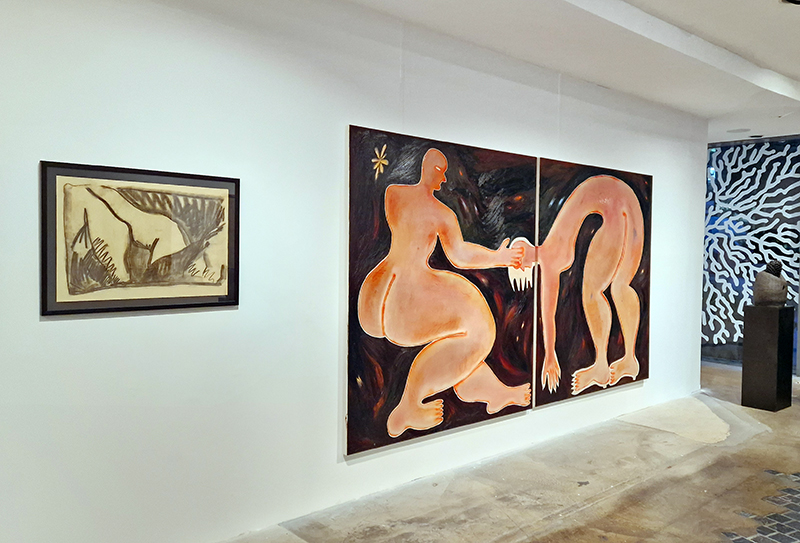
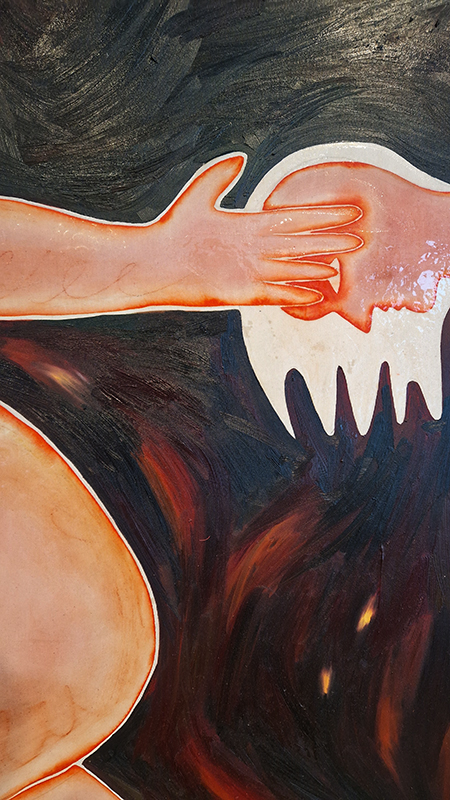
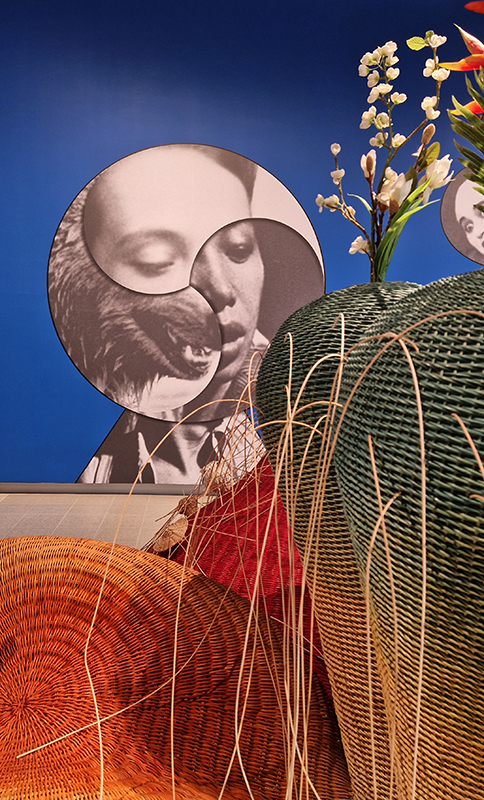
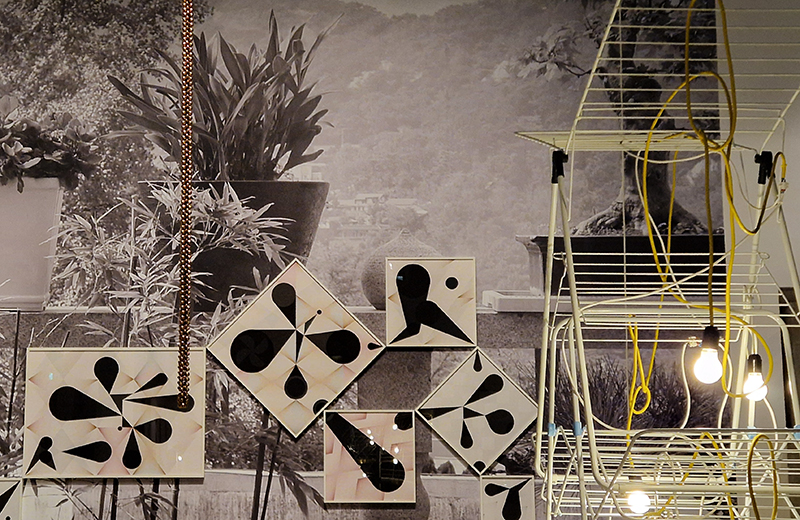
Works across the exhibition move between the intimate and the otherworldly, often unsettling the boundaries between body, space and perception. Included within a range of strange bodily presences are Susan Aldworth’s work Reassembling the Self. Internal, fragmented and reconfigured lithographs exploring how identity may be disrupted through trauma, illness, or simply the experience of being alive. As does Fungai Marima’s practice, using her own body as both subject and archive in performance. Repeated gestures of exposure and persistence draw attention to the private realities of anxiety and endurance. Charlie Betts’s practice is also rooted in movement and performance. Through drawing and action, she captures fleeting physical states that hold presence, absence and memory in tension. Mary Branson’s installation explores the fragile boundary between rest and exposure through vessel forms and the sound of breathing, evoking a vulnerable presence within places we assume are safe. This focus on vulnerability and embodiment resonates with Us and Them, a series of wet plate collodion portraits by Emma Brown in collaboration with Freewheelers Theatre & Media Company, a creative company of disabled artists and performers, reflecting on representation, visibility and shared humanity. In a shift of atmosphere, Marcelle Hanselaar transforms familiar interiors into psychologically charged scenes where bedrooms and domestic spaces become sites of unease, desire and dreamlike threat. Her figures appear exposed, restless and vulnerable, inhabiting worlds where intimacy and danger uneasily coexist. Beyond the body, the exhibition extends into the domestic, material and more-than-human worlds we inhabit. Janet Currier’s work turns to the objects and organisms we live alongside, where repetition, attachment and care become central. Rooted in the domestic and often autobiographical, her sculptural arrangements suggest that the things we tend to – fabrics, forms, fragments – hold memory and presence, quietly accumulating meaning over time. A similar sensitivity to material and instability is present in the work of Mandeep Dillon and Marielle Schram. Dillon’s ephemeral sculptures explore pressure, balance and the temporary nature of form, their fragile, inflatable structures responding to subtle environmental shifts and hovering between buoyancy and collapse. Schram’s small-scale sculptures and drawings translate emotional experience into tactile form, where diverse materials are handled with sensitivity and control, balancing strength and vulnerability. In both practices, making becomes a visible negotiation between material, form and feeling. Sue Baker Kenton and Ann Norfield consider how things are kept, categorised and carried through time. Baker Kenton’s installation of painted, box-like structures reflects on containment and hidden histories, while Norfield’s use of collected bones and print processes brings a quieter, more direct engagement with chance, hope and the precariousness of life. Together, they reflect on accumulation, fragility and the tenuous nature of what we hold on to. A more overtly uncanny register emerges in works that draw on folklore, memory and psychological space. Oona Grimes’s film and drawings draw on historical and cinematic references to create fragmented, misremembered scenes in which figures appear both comic and spectral. This sense of dislocation and re-framing is echoed in the work of Tom Sliwinski, whose drawings present a personal and immediate view of the world, where historic interiors and figures take on a ghostly presence. A different sense of time emerges in the work of Penny Green and Roya Pourzadi, whose figures and forms draw on myth, symbolism and cultural memory. Their works carry a feeling of something ancient yet still in motion, not fixed in the past, but moving through it. Pourzadi’s imagery draws on Persian histories and elemental forces, where water, vessels and symbolic figures suggest cycles of renewal, fragility and transformation. In contrast, Green constructs a world of masquerade, blending emblems and archetypes across time. Her Wild Women and reworked objects draw on mythological forest figures and medieval imagery, creating presences that feel both rooted in history and strangely alive within the present. Throughout the exhibition artists construct distinct visual worlds that shift between observation and imagination. Katherine Jones transforms familiar imagery through intense light and distortion, pushing it towards something simultaneously seductive and unsettling, beauty and unease seem to exist in tension. Helen Baines painting ‘Show Horse’ similarly draws on lived experience and symbolic imagery and questions the uncomfortable truth of how we bend animals to our will in the name of discipline, love or tradition. A suspended bird moves through a constructed interior that feels both familiar and uncertain in Karl Newman’s Melancholy Study holding a moment of stillness charged with anticipation. Rooted in a deep connection to the natural world, Temsuyanger Longkumer’s installation centres on the reconstruction of a tree, drawn from his printmaking practice. Re-situated within the interior of the house, the work introduces a presence that feels both elemental and enchanting. Oak, wormshells, shed snake skin, hedgehog spines, mouse bones are just a few of the organic and unsettling materials used in Tessa Farmer’s sculptural interventions. Her work introduces meticulously constructed miniature worlds, bringing a darkly intricate presence into the house. Imagined or parallel worlds shaped through narrative and invention is prevalent in Adam Green’s work. His painting shown here presents a system-like visual language of pattern, geometry and reptition, suggesting constructed environments that are at once playful but possibly unstable. Elsewhere, David Ferry’s photomontages reimagine landscape through layered and unexpected combinations, where deserts, oases and shifting terrains disrupt familiar visual language, creating a sense of both recognition and disorientation. Finally and beyond the interior, several works extend into speculative and cosmological realms. Susan Eyre’s video-sculptural installations imagine hybrid lifeforms at the intersection of the organic and inorganic, expanding the exhibition beyond the domestic into a wider consideration of time, scale and the unknown.

Together, the exhibition forms a temporary community of presences, installed in close proximity, the works begin to speak to one another in unexpected ways, forming subtle and unexpected relationships that create a charged and shifting environment in which the familiar is rendered persistently strange.
I am excited to be selected for the HIRESidency at Equivalentbehaviour founded by Katrina Stamatopoulos and Wojciech Kawczyk, who specialise in photographic scanning and digitising photographic film, prints and 3 dimensional mixed-media artwork.

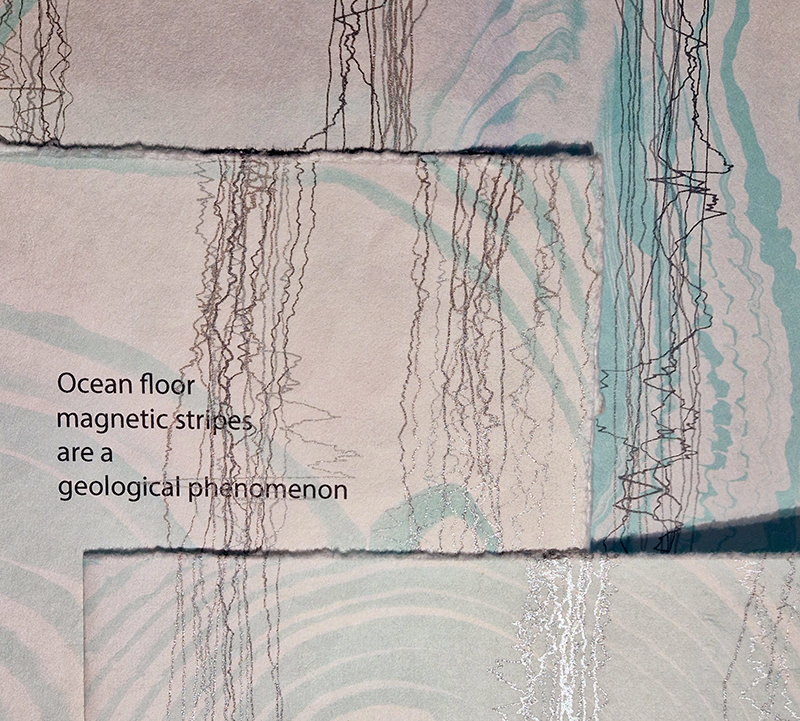
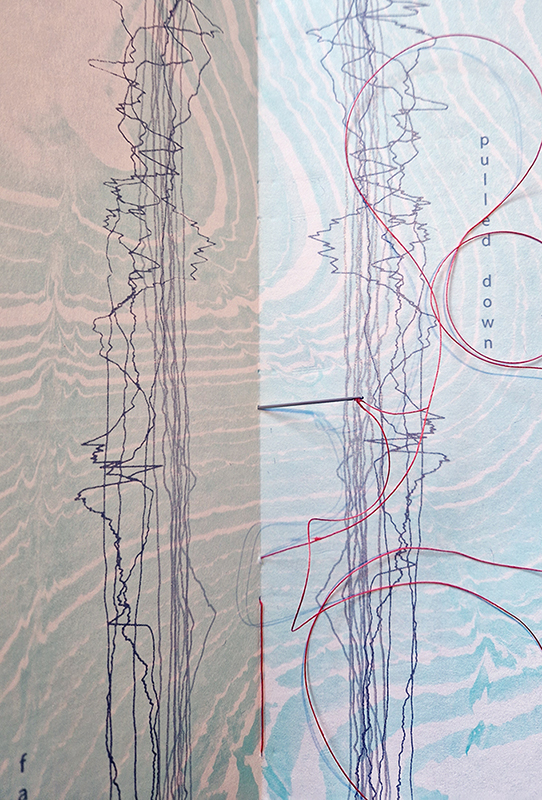
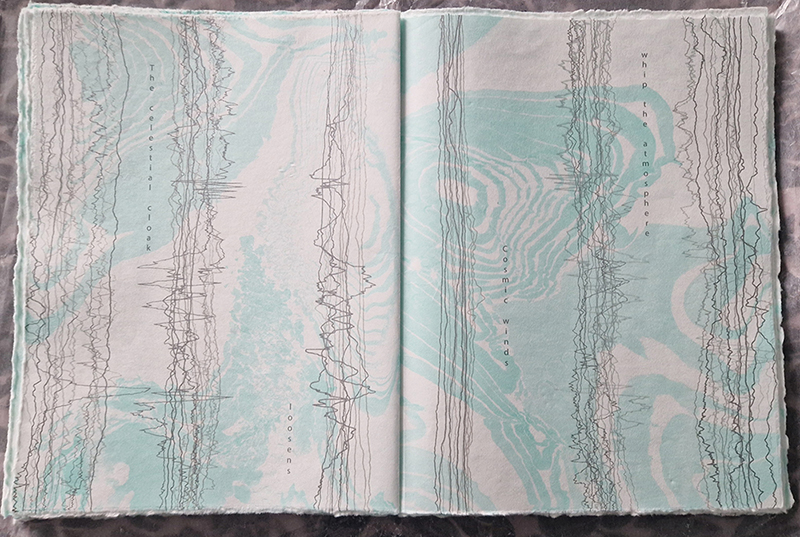
My proposal is to scan the Book of Reversals to make a digital work with narration. The physical work will be exhibited at Brompton Cemetery Chapel in the upcoming Appearances are a Glimpse of the Unseen. This book is a poetic interpretation of the formation of planet Earth and its turbulent internal fluid core that generates an unpredictable but protective magnetic field prone to sudden changes in polarity. Ocean floor magnetic stripes are a geological phenomenon consisting of alternating bands of differing magnetic polarity. Our planet is a complex and dynamic body where interactions occur ceaselessly between the inner core the outer core the mantle and the crust.
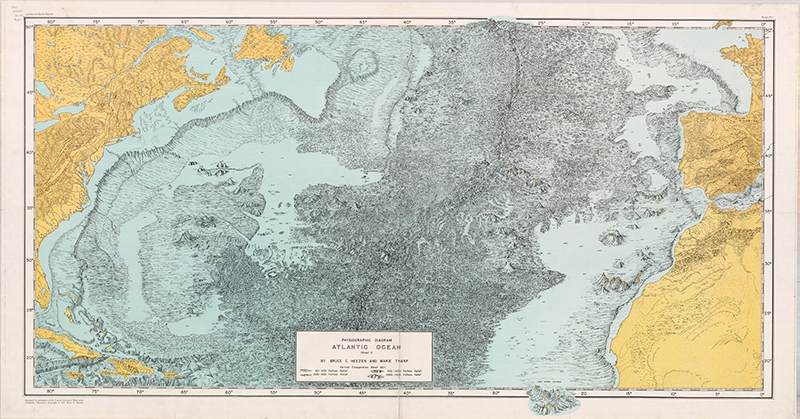
Marie Tharp was an American geologist and oceanographic cartographer. In the 1950s, she was instrumental in producing the first scientific map of the Atlantic Ocean floor revealing a detailed topography and multi-dimensional geographical landscape of the ocean bottom. She translated thousands of sonar readings from ships she was barred from boarding as a woman scientist. Mapping the Atlantic, she identified a continuous rift valley along the Mid-Atlantic Ridge: the first visual evidence of seafloor spreading, the mechanism behind plate tectonics and continental drift. When she showed the map to her colleague Bruce Heezen, he dismissed it as “girl talk.” The idea was still considered too radical, especially from a woman excluded from research vessels. But the evidence kept proving her right. As more surveys arrived and earthquake patterns matched her work, the scientific world accepted by the early 1960s, the planet is not fixed, but alive and in motion. In 1977 she co-published the first complete map of the world’s ocean floor, transforming geology, navigation, and our understanding of natural disasters. In 1997 the Library of Congress named her one of the 20th century’s greatest cartographers, and in 2023 National Geographic awarded her the Hubbard Medal. Thanks to Herstory_feminism for highlighting these amazing usually overlooked women who contributed so much.
It was great to meet the team at ArtEO in an online group meet and introduction to the collective initiative that aims to make satellite imagery and data sets available to artists.

I am excited to have access to imagery that I would never be able to create for myself to feed into my work. I am interested to explore aspects of Earth’s magnetic field in relation to how it might be monitored using satellites, how it impacts the functionality of satellites and how satellites might themselves impact the magnetic field. While bringing so much data and valuable information for us to monitor the Earth and run its infrastructures and provide global communication the increasing number of satellites may put us at risk from over reliance on this technology in the face of an unpredictable force of nature. I hope to learn more about how satellites might help in predicting solar storms and what data sets are produced to model the interaction between high energy particles and the magnetosphere. I would also like to explore the relationship between satellite technology and natural phenomena and the balance between observing and disrupting. These images show an active volcano and a site of mineral extraction.
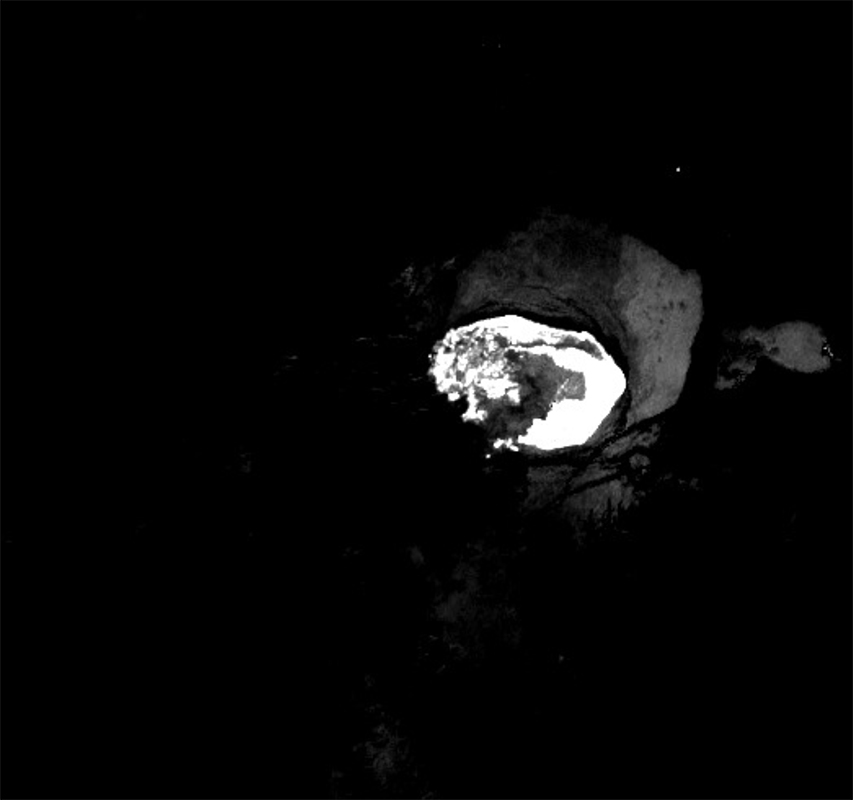
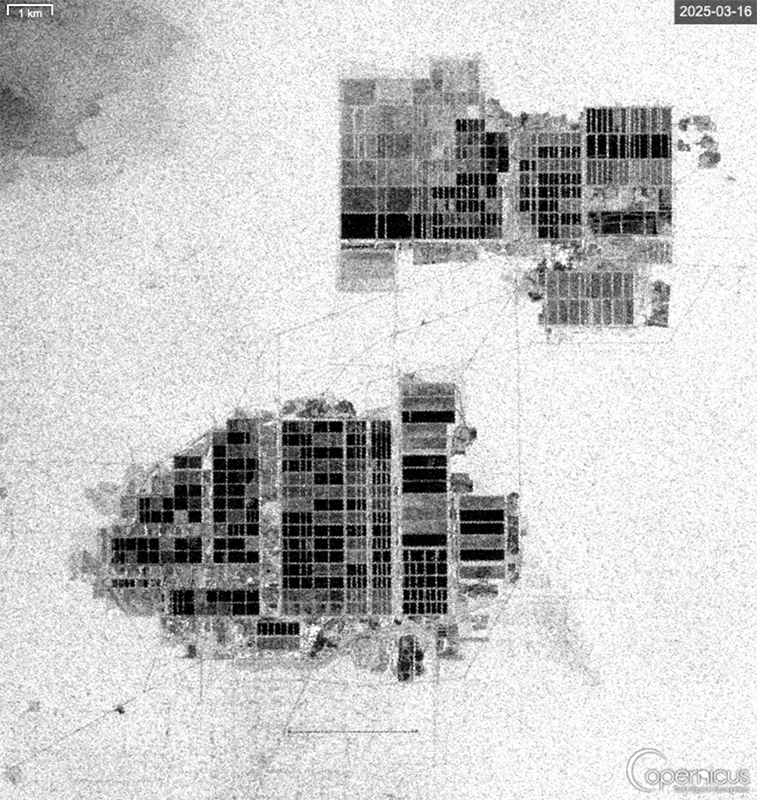
I have been busy with preparations for the upcoming Appearances are a Glimpse of the Unseen which will be in The Chapel at Brompton Cemetery curated by Catherine Li with the support of The Friends of Brompton Cemetery.

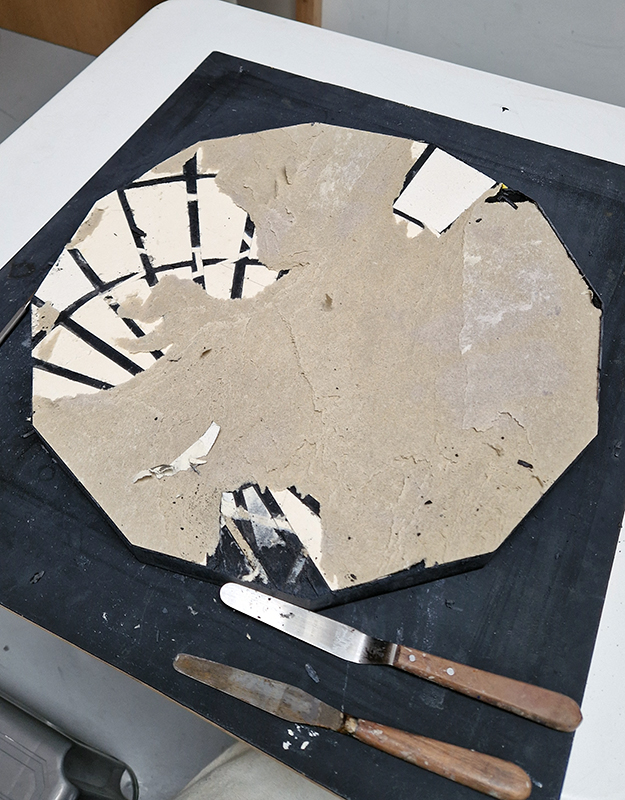
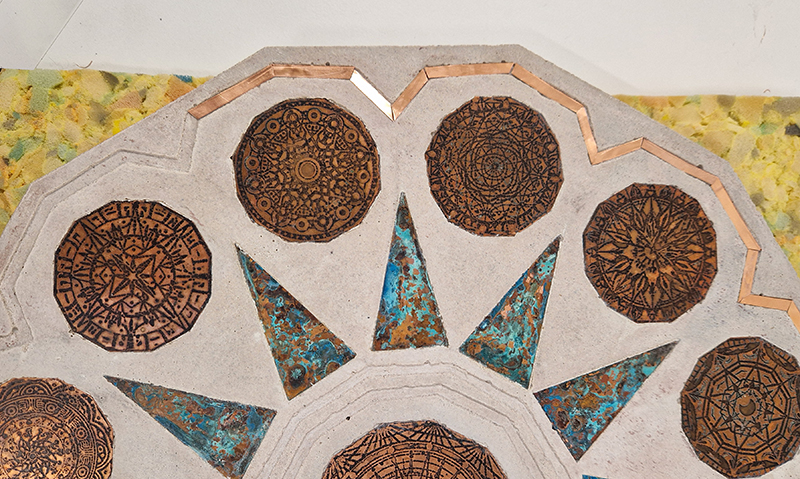
I am making a new sculpture in the series Instruments of the Anemoi set of dodecagon tablets cast in Snowcrete, a non-magnetic cement, as used in buildings at a magnetic observatory. Suggestive of the pedestals that support various instruments used in monitoring the Earths’ magnetic field they also respond to an ancient anemoscope “table of the winds” carved in marble around eighteen hundred years ago with the names of the classical winds, both in Greek and in Latin inscribed on each of its twelve sides.

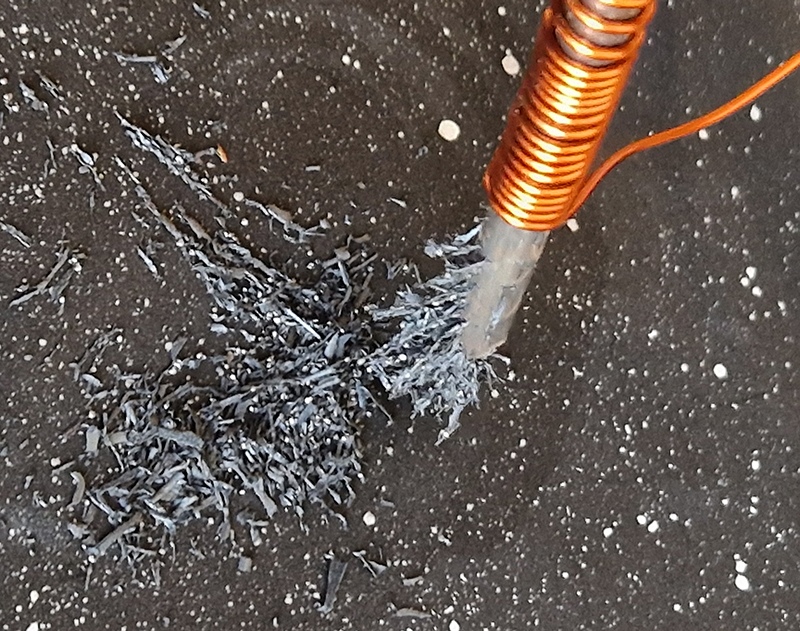
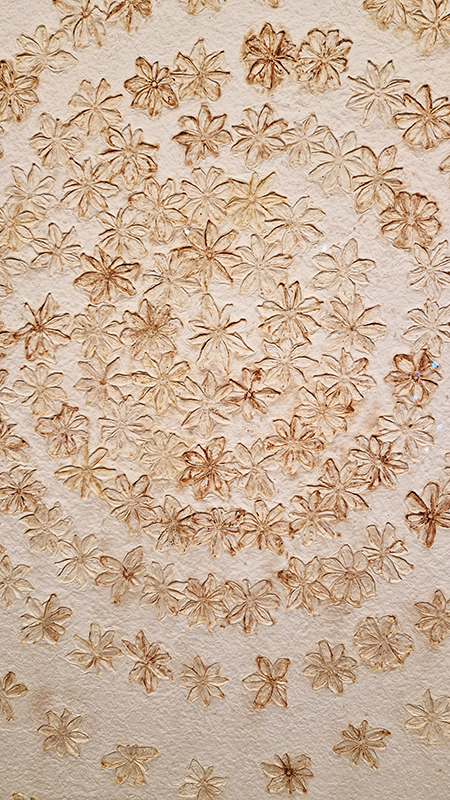
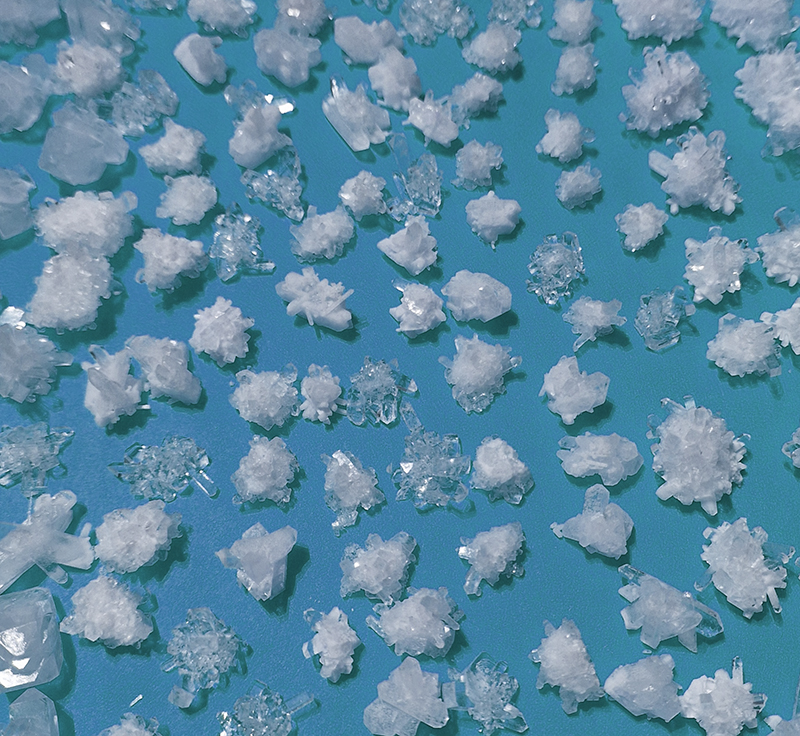
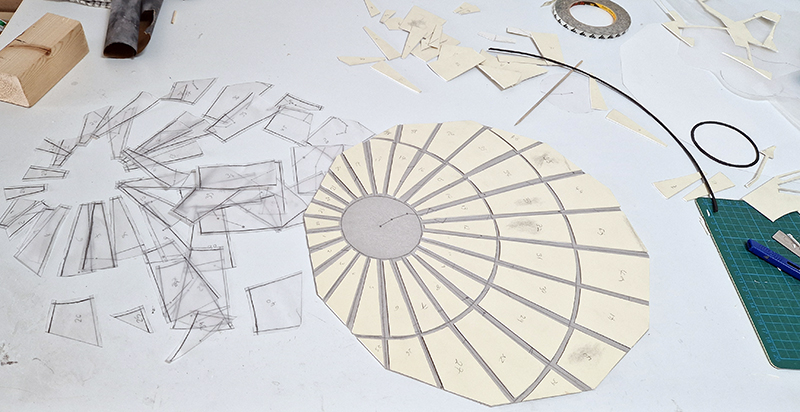
These sculptures are envisaged as speculative objects from past times, shown on repurposed theodolite or telescope tripods, reflecting on methods and tools of natural navigation such as magnetism, wind and stars. The new tablet will reference celestial navigation. Polaris has not always been the Pole Star as Earth’s axis of rotation wobbles over the course of about 26,000 years and many other stars take their turn at pointing to geographic North. I am centring Thuban in the constellation of Draco who took the position between two and four thousand years ago. I have been growing mono-ammonium phosphate crystals to use to outline the constellations whose lines are mapped by casting the concrete onto a collagraph set in a silicon mould. Once the concrete has set, it must be excavated from the cardboard collagraph by careful scraping and peeling away.
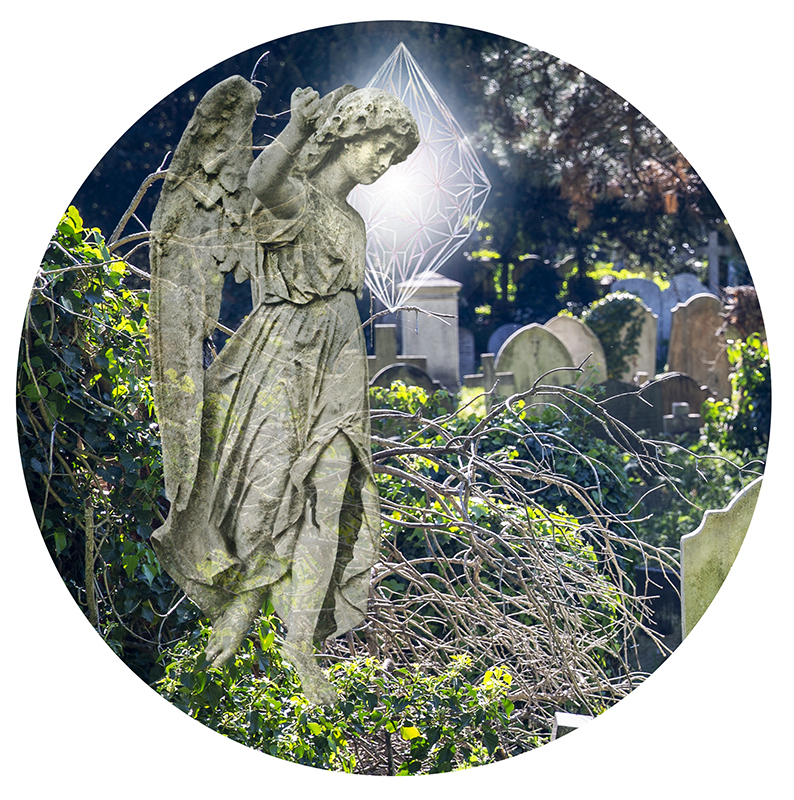
I have also been working on new images for submīrārī (earthbound), which feature the unique convergence of nature, history and serenity at Brompton Cemetery along with a myriad of angels that inhabit it. In looking for cultural and scientific explanations of angels I came across a book The Physics of Angels: Exploring the Realm Where Science and Spirit Meet, in which co-authors Rupert Sheldrake and Matthew Fox discuss parallels between quantum mechanics and early theories of angels, particularly Thomas Aquinas’ teaching that angels are immaterial bodies and creatures of light. The language used to describe the esoteric and the spirit world can often be substituted with the language of physics used to explain energy in its various manifestations.

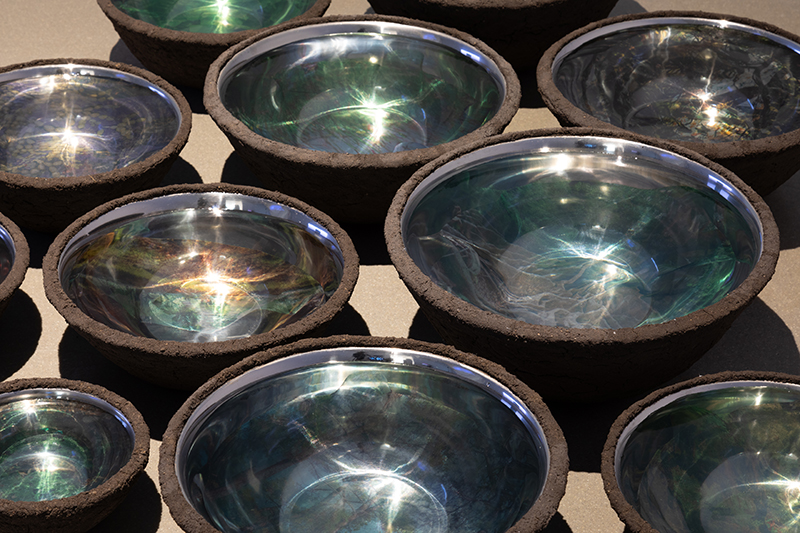
The images I have been working on are to be printed with sublimation dyes onto organza. I was sad to discover that Promptside printers, who have been so generous to me in the past, in providing paper prints for me to heat press, are no longer operating. I am trying a new company Contrado.
Out of studio activities

Just squeaked in to see The London Group exhibition This That and The Other at The Handbag Factory on its final day.
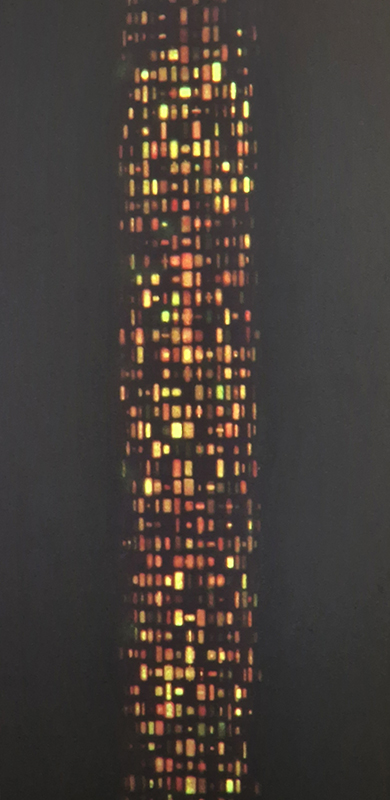
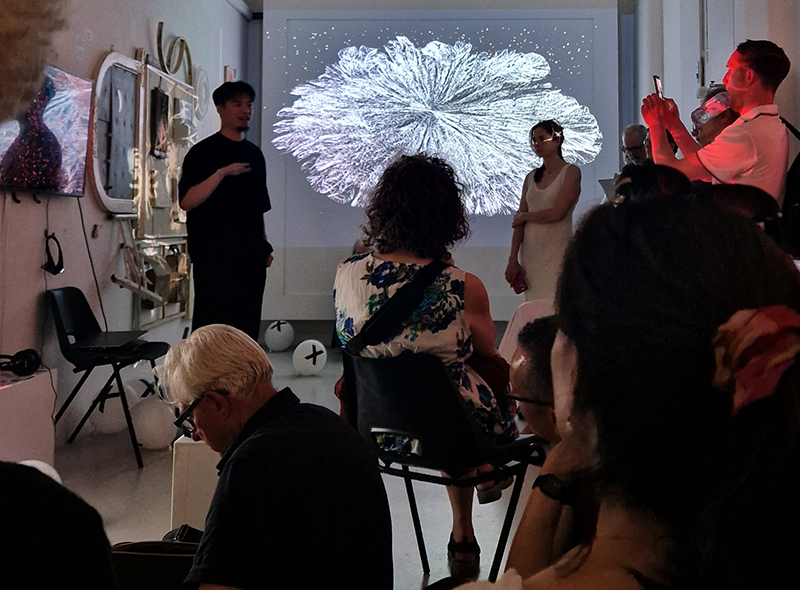
I managed to catch a couple of the talks ‘In the dark’ room and was intrigued by the work of Ash Xu which responded to the brainwaves of visitors wearing a headpiece attached to a screen monitor. The ‘Cosmic in the Brain’ series is an experimental artistic practice that merges neuroscience technologies with generative art, aiming to translate the abstract processes of human thought into the creation, evolution, and integration of stars within a virtual cosmos via Brain-Computer Interface (BCI) technology. The work is a collaboration between the artist and the audience. Through intuitive interaction, individual ideas are translated into a shared digital cosmos, allowing each participant’s inner world to contribute to the collective constellation. This process turns private thought into a visible, living landscape, one that unfolds in real time and belongs equally to everyone present.
I also was drawn to the video work by Eric Fong – A haunting journey through Horton Cemetery in Epsom, where thousands of pauper patients, mostly women, from five nearby mental asylums were buried. It is now an abandoned, derelict and overgrown site, where all grave markers have been removed, except one. The footage is overlaid with words drawn from the medical case notes of those buried there.
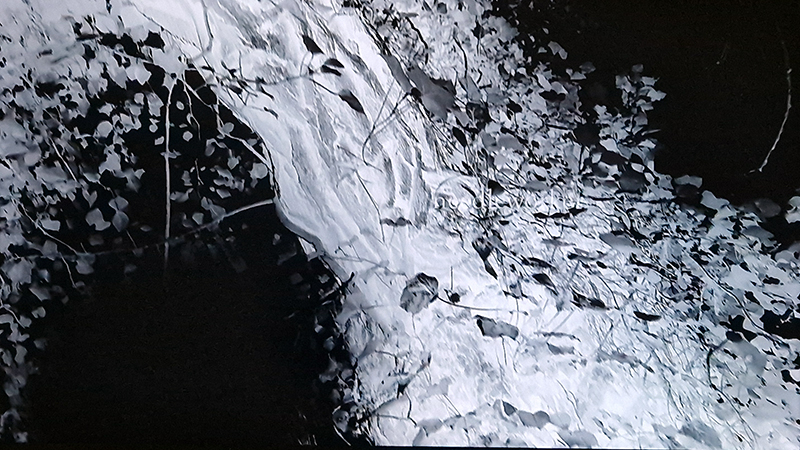
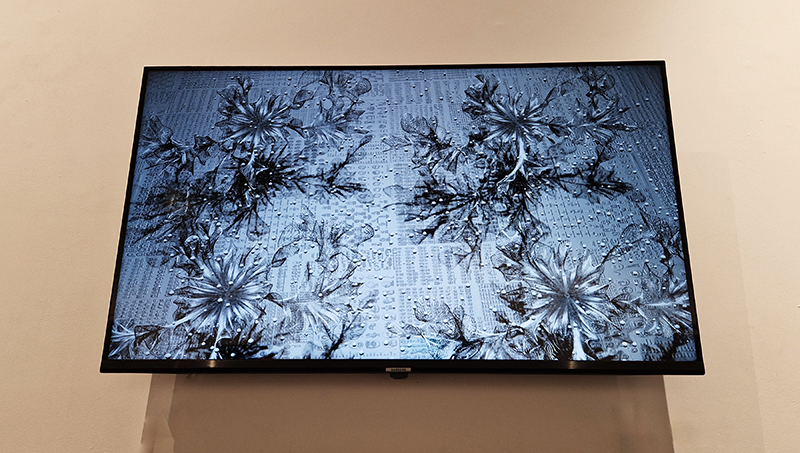
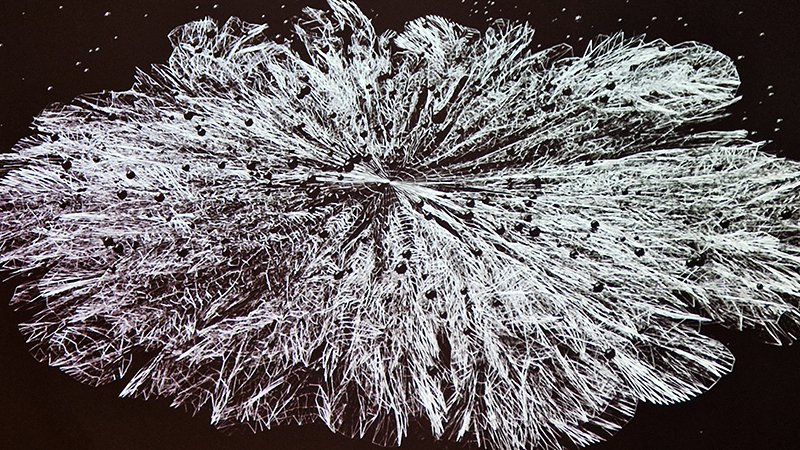
Mesmerising work by Sandra Crisp – ‘Dark Particles [slow_data]’ explores hybrid forms emerging where biological process and computational culture collide. Particle systems and differential growth generate organic structures whose surfaces are mapped with emoji and climate infographics — the residue of our information-saturated present absorbed into coral-like, cellular forms. Particles fall, accumulate, stick and die. Forms grow, darken and sediment. Rendered in monochrome on everyday hardware, the work embraces slowness. Like fossils, these forms carry traces of their moment — compressed into something unreadable, elusive and dark.
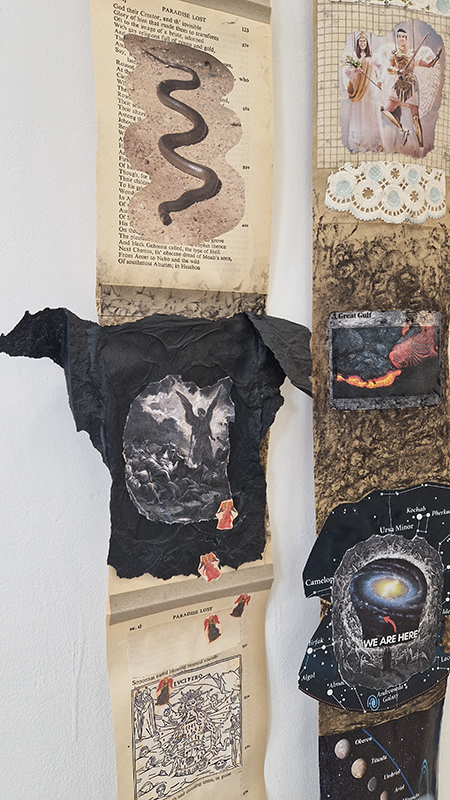
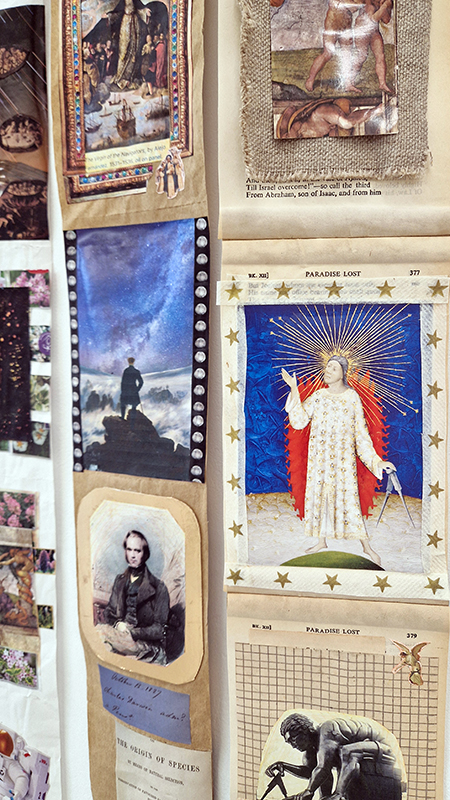
David Redfern On the 12th September 1768 Captain James Cook put in to the island of Madeira to resupply his ship ‘Endeavour’ at the beginning of his epic voyage around the world. Also on board ‘Endeavour’ was a private party of scientists, artists and the amateur botanist Joseph Banks. Banks discovered 25 new plant species on Madeira and needed to preserve the specimens he gathered. He pressed them in a book, a copy of a criticism of Milton’s ‘Paradise Lost’, written by Joseph Addison. The mythical Garden of Eden pressed up against scientific specimens contributing to the burgeoning science of botany. Paradise Lost Book leaves, gathered images 200 x 180cm. This work captured my attention as I am interested in ‘paradise’ and have been looking at angels in Brompton Cemetery at the moment and recently listened to two podcasts where angels feature – Cautionary Tales Podcast on John Dee and the Bureau of Lost Culture Podcast EVP – voices from the other side
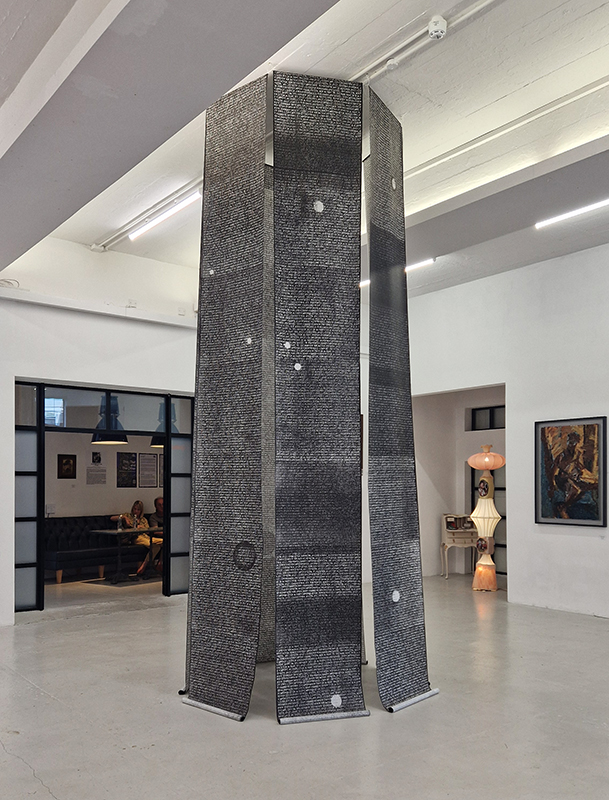
Imposing installation with amazing attention to detail from Carol Wyss 7 PILLARS OF WISDOM deconstructs the very concrete order of bones into lines of information — a basis of a new writing to chronicle human interaction. The title of the installation refers to a biblical proverb which outlines a range of moral duties. T. E. Lawrence wrote an autobiography of that same title, likely inspired by Ruskin’s 7 Lamps of Architecture book which Lawrence had previously read. The installation consists of seven large unframed scrolls. Each scroll combines intaglio and relief printmaking techniques on thin Japanese paper.
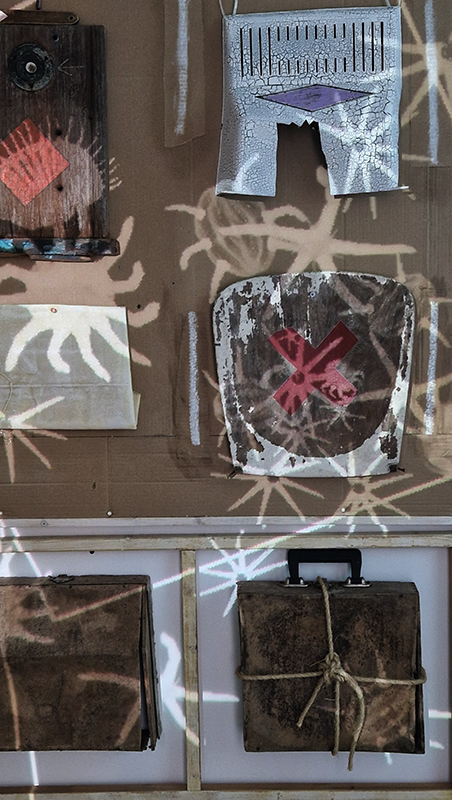
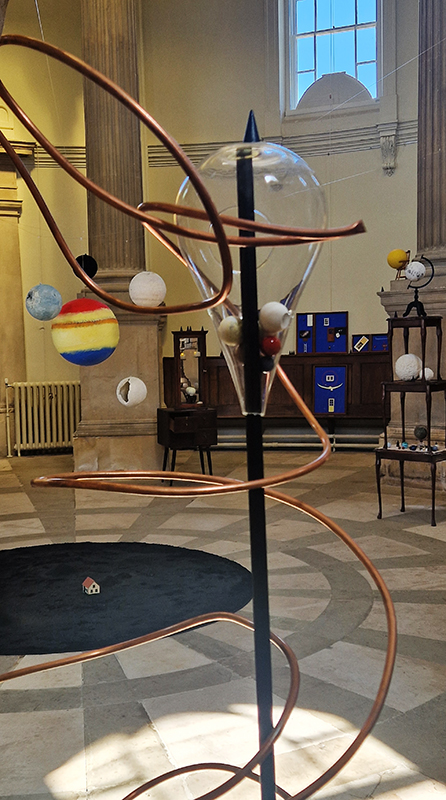
Qi Baiting House of Day, House of Night at The Chapel, Brompton Cemetery curated by Catherine Li brings together a ‘constellation’ of sculptures inspired by the circulation of objects via numerous flea markets. Drawing from Olga Tokarczuk’s image of living in two homes at once, one fixed in time and space and one infinite, these objects appear on interstellar journeys in which they hold together the material and the immeasurable: the located and the unplaced, the lived and the imagined. The objects remain tied to their historical time, imbued with traces lived experience, while their decontextualization allows other meanings to surface, as though they too were inhabiting more than one home at once. She also alludes to Ursula K. Le Guin’s The Carrier Bag Theory of Fiction: Sometimes the world is nothing more than things placed quietly together.
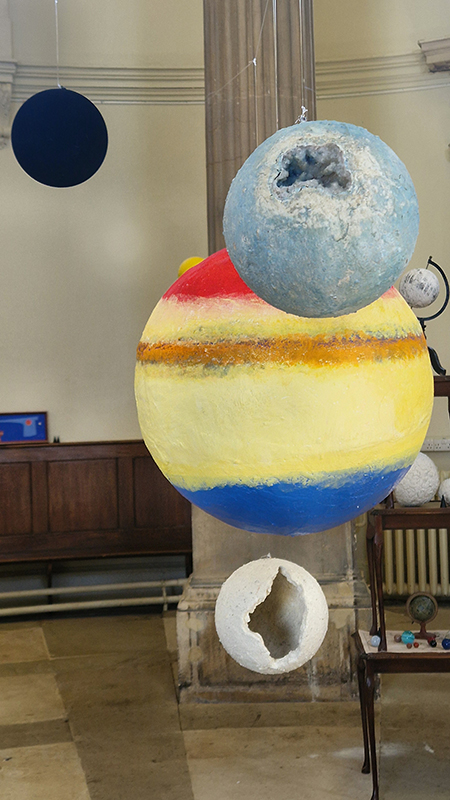
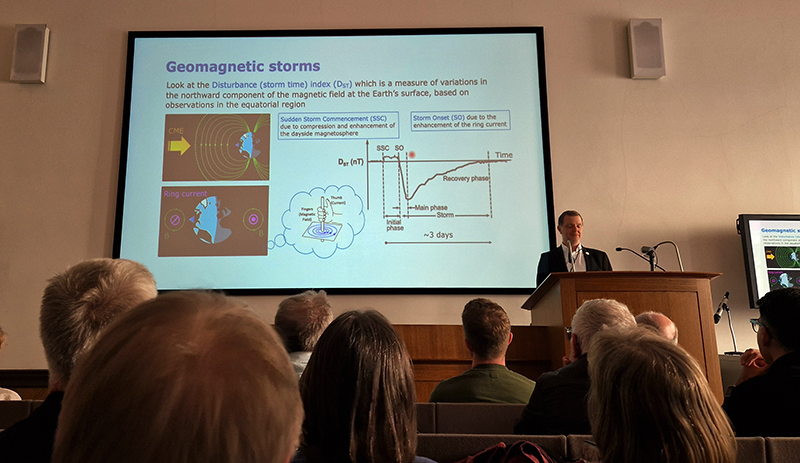
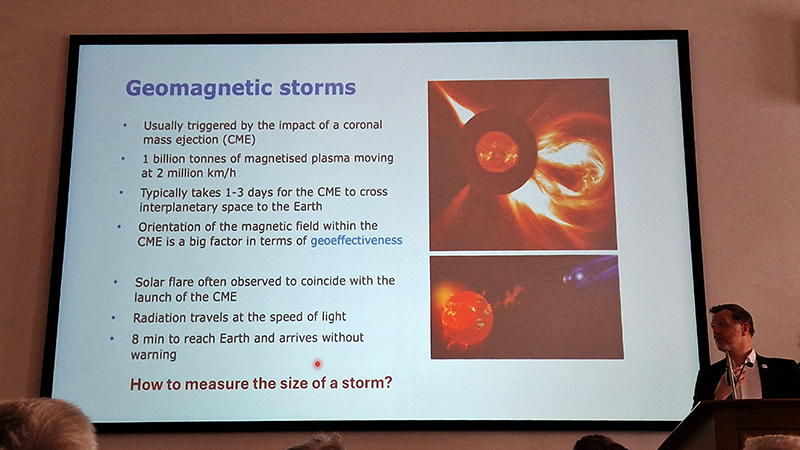
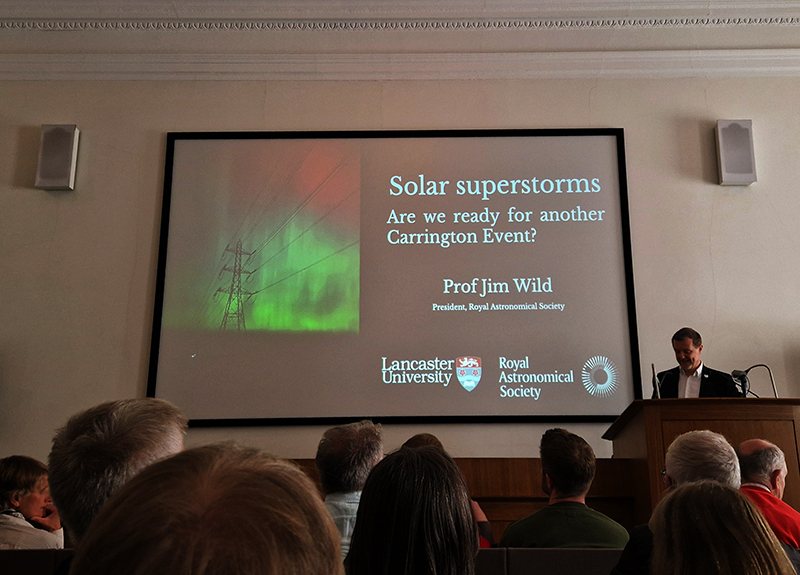
Royal Astronomical Society talk Solar superstorms: Are we ready for another Carrington Event? by Jim Wild, Professor of Space Physics within the Physics Department at Lancaster University and President-Elect of the Royal Astronomical Society.

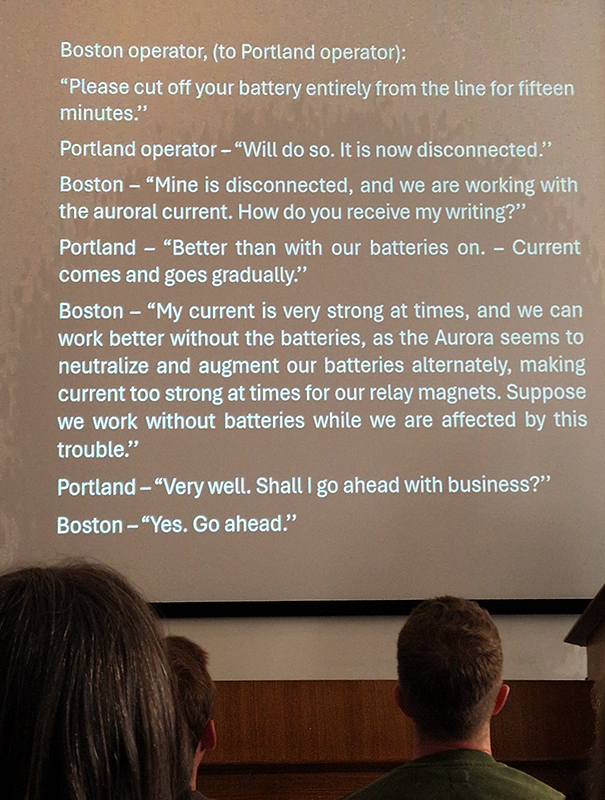
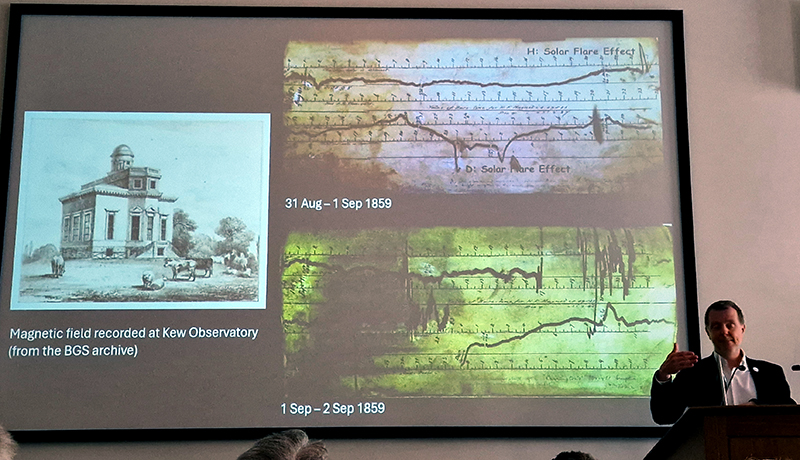
In September 1859, the English astronomer Richard Carrington made the first recorded observations of a solar flare. Unknown to Carrington, the flare coincided with a fast-moving coronal mass ejection that struck the Earth’s less than twenty four hours later, triggering the most powerful geomagnetic storm of the modern age. The storm, now known as “the Carrington event”, sparked auroral displays visible as far south as the Caribbean and disrupted operations of the global telegraph network. But this powerful space weather event pre-dated most of the technologies that we depend upon today, such as power grids, satellites, and wireless communications. How vulnerable are we? Are we prepared for the next Carrington event? In this talk, Prof Jim Wild considers the resilience of the modern world to extreme space weather.

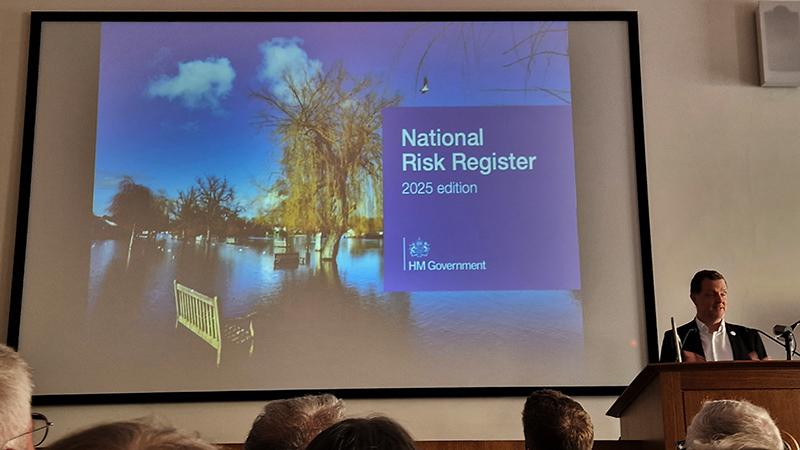
The UK National Risk Register sees space weather as significant risk. The term ‘space weather’ describes a series of phenomena originating from the sun, which include solar flares, solar energetic particles and coronal mass ejections. Day-to-day space weather causes little more than the Aurora Borealis in polar regions, but strong space weather events can bring disruption to many vital technologies. Orbiting satellites are particularly vulnerable to space weather effects, and can be damaged or temporarily disabled. Impacts may include regional power disruptions, loss or disruption of Global Navigation Satellite Systems (for example Global Positioning System (GPS)) and some telecommunications (for example satellite communications and high frequency radio), disruption to aviation, an increase in background radiation doses at high altitudes and in space, and possible disruption to ground-based digital components. The catalogue of tracked objects in orbit would be significantly impacted, raising the risk of on-orbit collisions. There may also be second order impacts such as fatalities and casualties (for example, in the event of power disruptions).
Peckham 24 The Eras Edition at Copeland Gallery exploring photography through the lens of time. ‘Time is a paradox; it is intangible, but its traces are omnipresent; it is an illusion, yet it’s governing our lives; it facilitates growth, while inducing decay. The projects exhibited at this year’s Peckham 24 explore these multifaceted aspects of time; they address the issues of our time, interrogate ecological transformation and its long-term implications, capture varying life stages and nostalgic formations, and explore the lingering of the past in the present.’

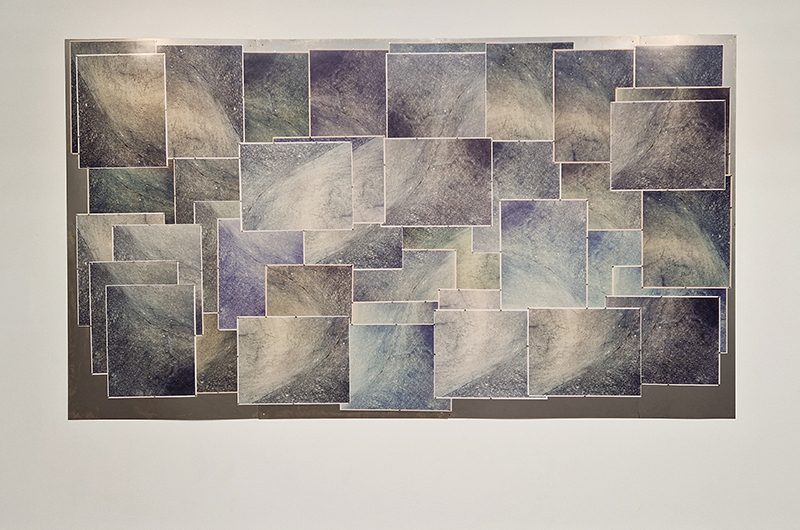
ROM a large-scale multi-image work by Eugenie Shinkle at first glance looks galactic but is in fact a series of photographs of the material surface of a decaying skatepark. The work reconstructs an experience of space, disorienting, immersive, and at times euphoric. Time is encountered here not as sequence or narrative, but as something embedded in matter and enacted through movement. Built in 1978, the Rom skatepark in Hornchurch, Essex was the first of its kind in the UK. No longer in regular use, the concrete structure is slowly decaying – cracking and delaminating, a consequence of decades of weathering, and of the wear and tear inflicted by the passage of thousands of wheels. Though they’re only a few decades old, the forms have a strangely primordial quality, the concrete stained and colonized by lichen, as if the recent past were already slipping into something more geological.
A Parliament of Empty Gestures by Mark Duffy is made from appropriated photographs produced and distributed by the House of Commons over the past two years. It is a comment on the performative and confrontational nature of political debate, the repetition of prescribed political gestures, and the constantly shifting blame game that is modern politics.
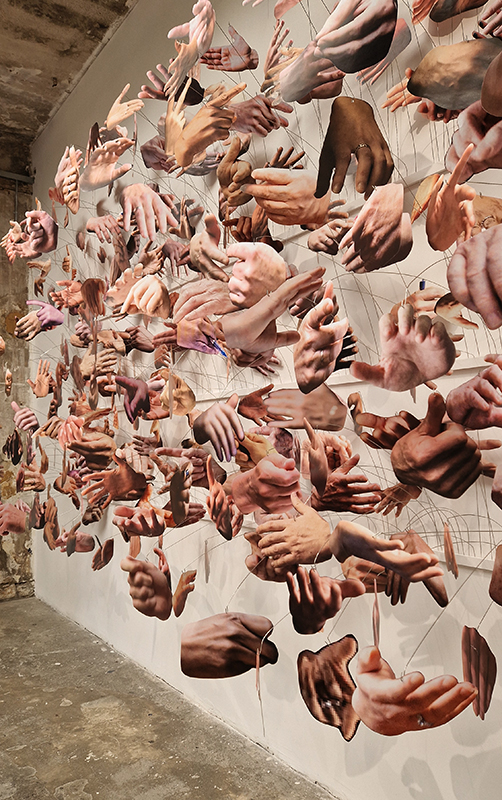
A fabulous iteration of Julie F Hill’s installation Cave and Chasms series where RAW data from space telescopes, such as Hubble and the James Webb is processed, sculpted, crystallized and mineralised drawing on the cosmic and terrestrial to offer an experience of intimate immensity.
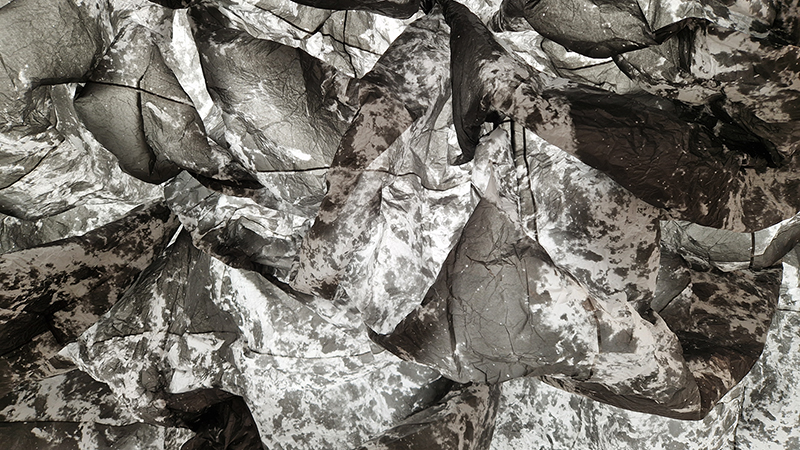
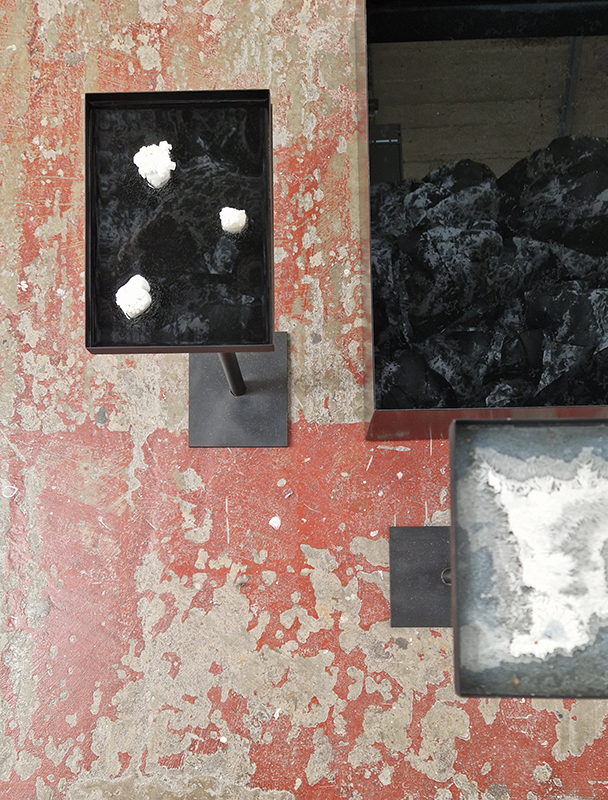
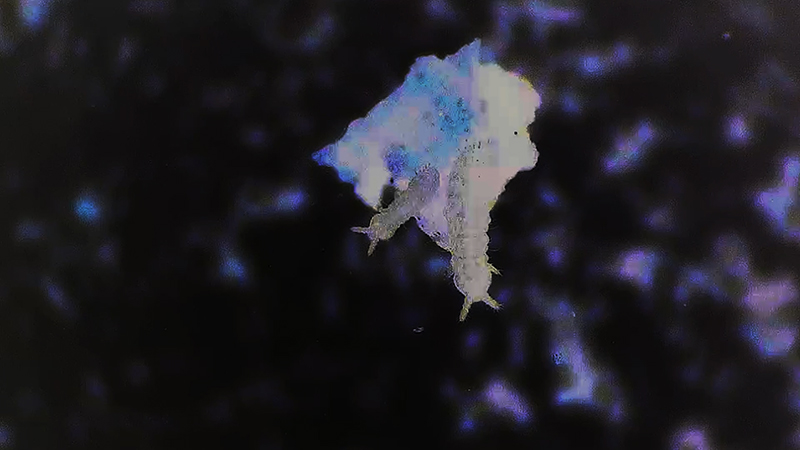
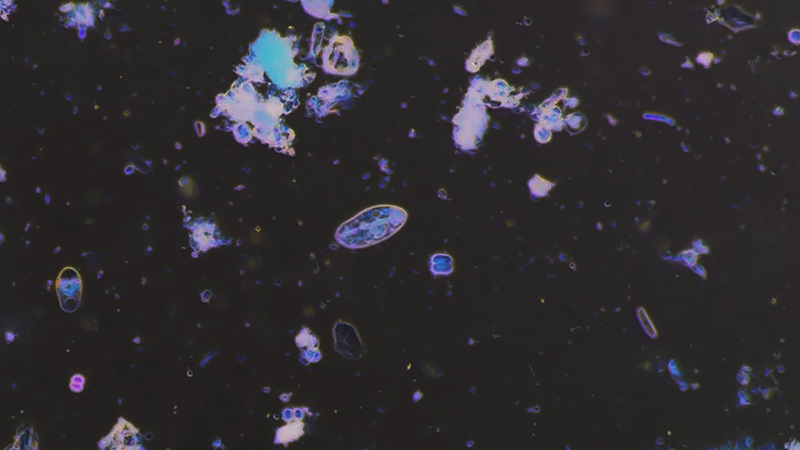
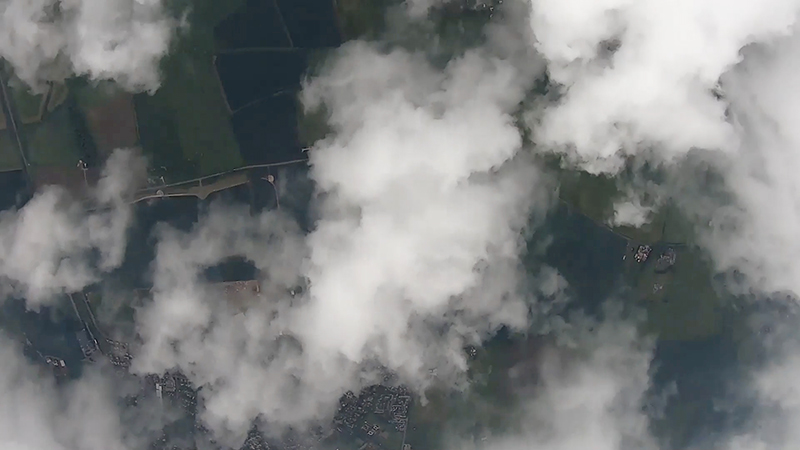
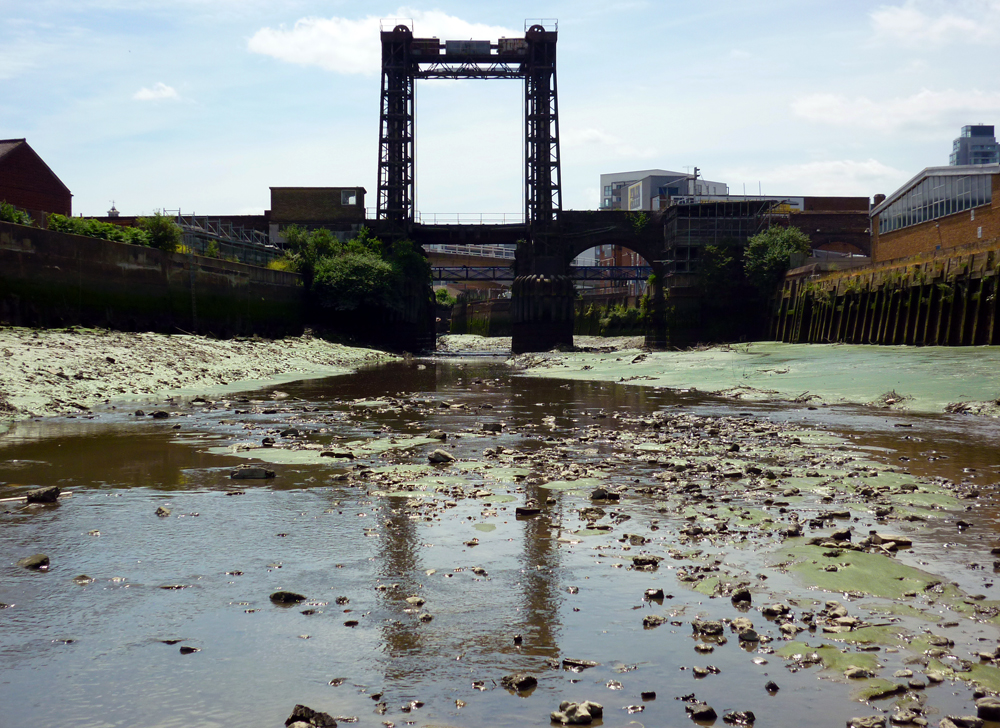
I am enjoying discovering the gutter creatures who share my home. Gathering video footage of an alternative cosmos to go towards making work which will be shown in Occupied: Strange Company at the Safehouse next year, a group exhibition curated by Julie Hoyle.

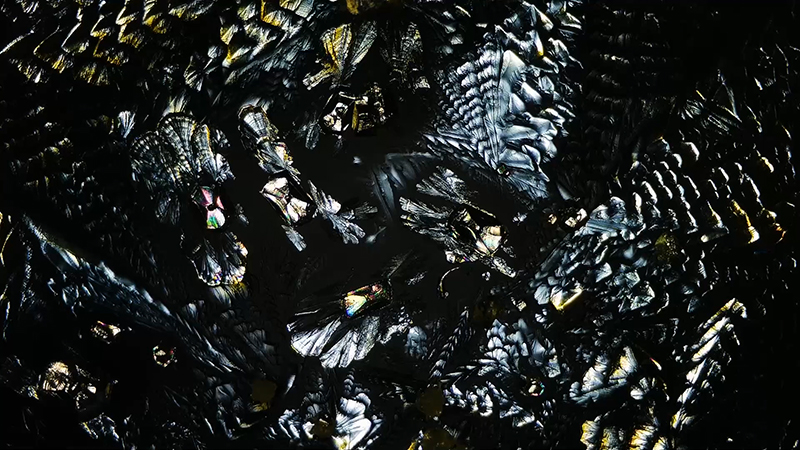
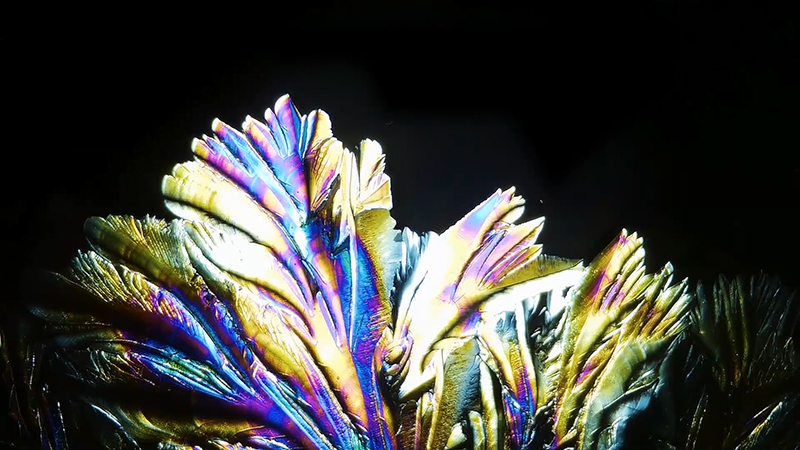
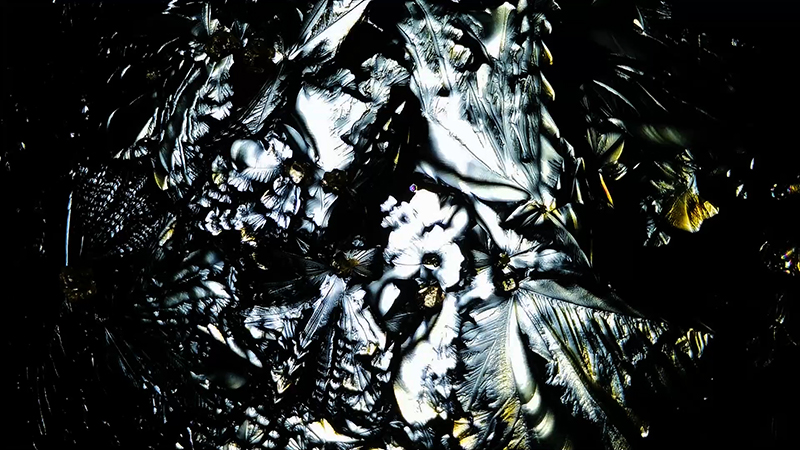
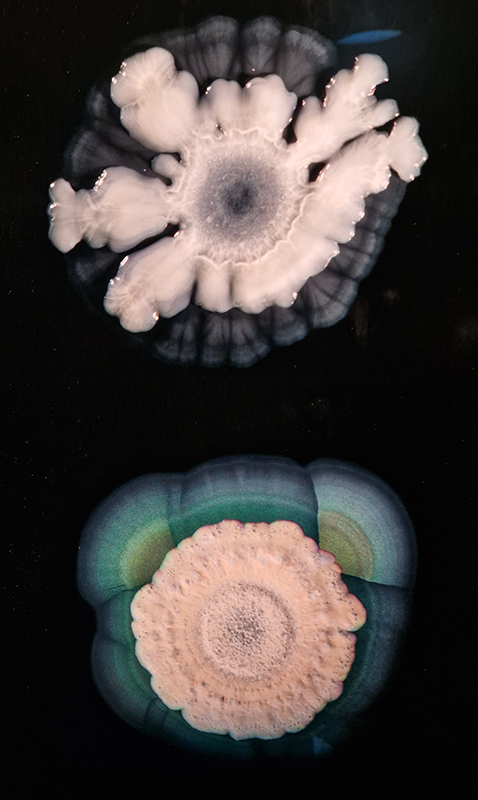
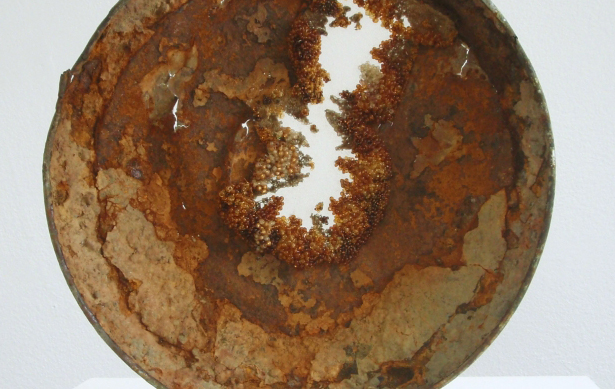
My experiments growing citric acid crystals have been going well. I am filming these transformations under polarised light which reveals the many vibrant colours but I also like the images without the filter. The structures remind me of feathers so I am thinking about creatures that flutter as well as those that swim.

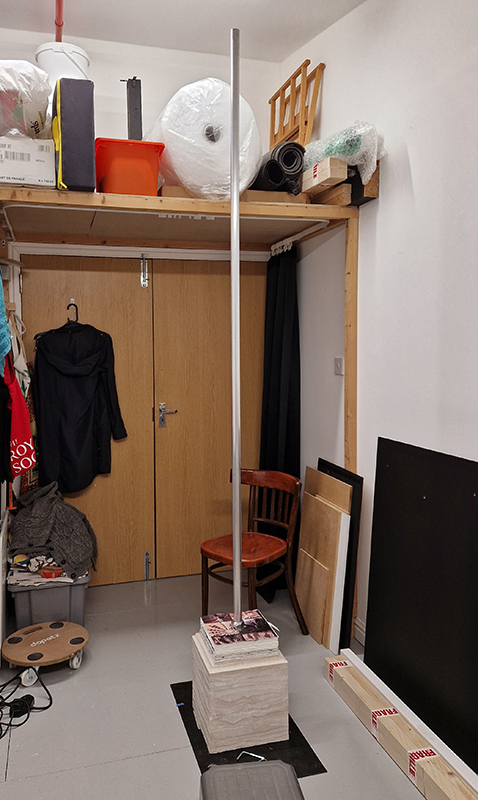
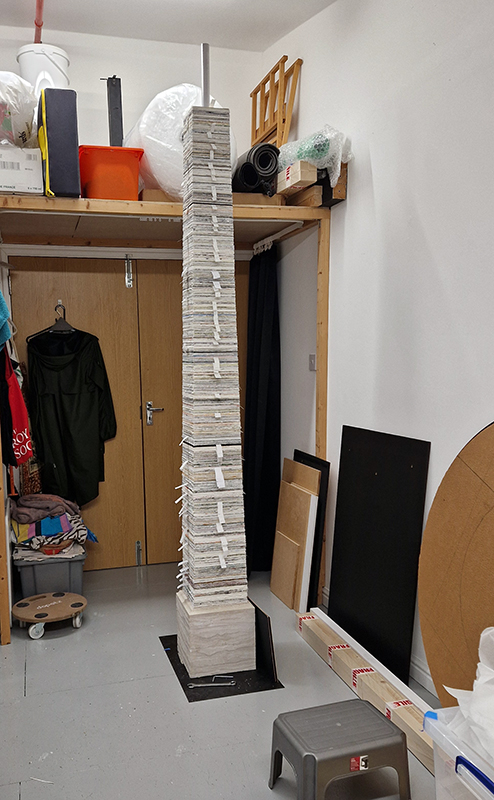
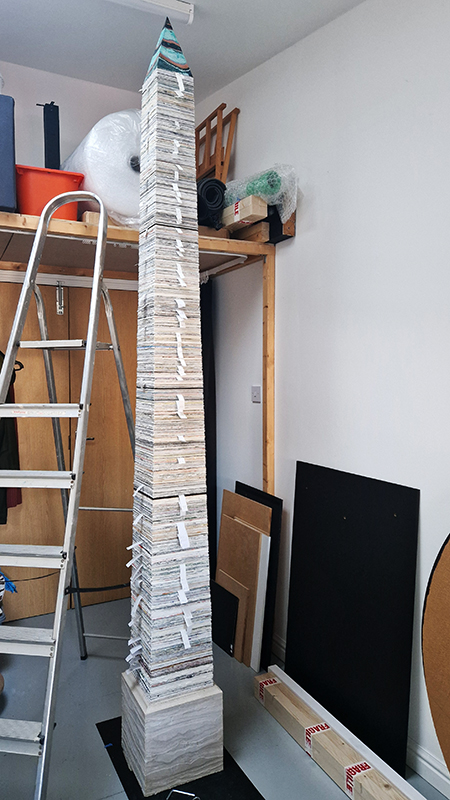
Time in the studio has been spent checking over and preparing works that will be showing in Cosmos: The Art of Observing Space curated by Ione Parkin which opens in the new year. I am thrilled to be part of this exhibition bringing together contemporary and historic artists and featuring an extraordinary range of work inspired by the cosmos. I have completed a test build of The Azimuth Obelisk (of sedimentary knowledge) using a new internal structure for before packing it all away again ready for transport to The Royal West of England Academy in Bristol. This work is a reimagining of an permanent azimuth mark erected at Hartland Magnetic Observatory in North Devon from which the drift of the magnetic north pole is monitored. Made of many layers hand torn from recycled works on paper it echoes the geological and magnetic history of the Earth which is secreted in the strata of sedimentary rock. The protruding tabs of paper seen in these studio images are markers for each section of paper squares of a tapering size and will get tucked away at installation in the gallery. With the added thickness of my new studio roof insulation the obelisk only just fits in now.

I have started work on inserting copper segments into the new sculpture for the Instruments of the Anemoi series. The other larger pieces of etched and patinated copper were added at the time of casting, held in place with tape and hope when the concrete was poured into the mould. This series of sculptures are suggestive of the pedestals that support various instruments used in monitoring the Earths’ magnetic field but are envisaged here as speculative objects used by the wind gods as the first emissaries of navigation.

I am still battling with writing text for The Book of Reversals, an artist book that responds to the record of Earth’s magnetic field reversals being written in bands of minerals on the ocean floor.

The crisp crust fractures / Fragments slide across a viscous veneer

Submarine mountains tower / Ocean trenches gape

Tectonic plates subduct / melting into the mantle 

Deep time traces are consumed / surfaces ceaselessly reformed

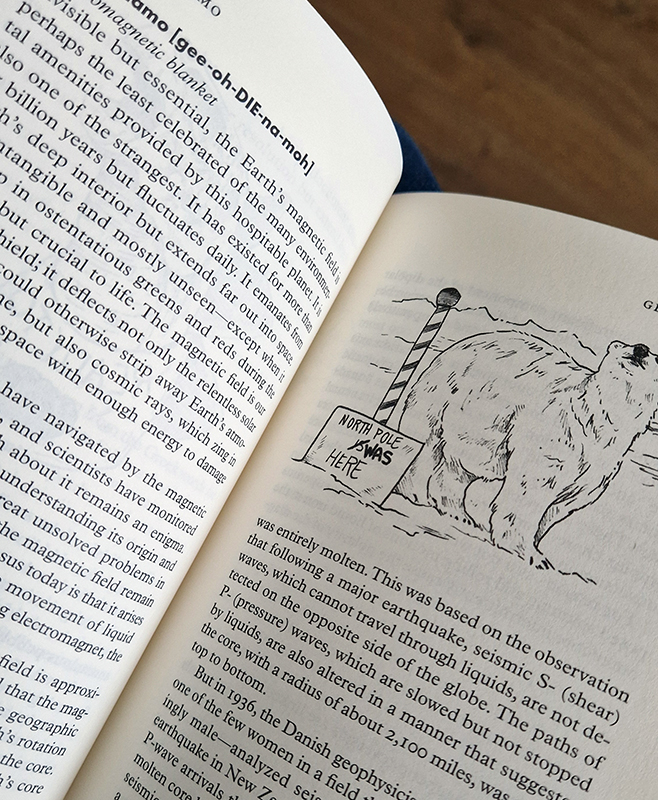
The Earth’s magnetic field has been a fascinating mystery for many hundreds of years and Gillian Turner’s book North Pole, South Pole recounts the stories of those who sought to solve its origin and mechanism. Something I hope to look at in more depth is how pottery and bricks preserve the direction of the magnetic field in their minerals during the process of firing which heats and then cools the clay – the same process that occurs in a lava flow. Iron-bearing minerals (like magnetite) in clay become “magnetic” when heated in a kiln. As the pottery cools, these minerals lock into the Earth’s magnetic field direction and strength at that time. The study of the magnetic properties of ancient pottery, known as archaeomagnetism, has been used to make records of the inclination of the magnetic field from past millennia. Inspired by these studies of manmade artefacts to determine the historical position of the north magnetic pole, physicists Bernard Brunhes and Pierre David took samples from exposed lava flows and their underlying clay in central France. In 1906 they came to the astonishing conclusion that about six million years ago the magnetic field seemed to point in the opposite direction, the first indication of magnetic field reversals.

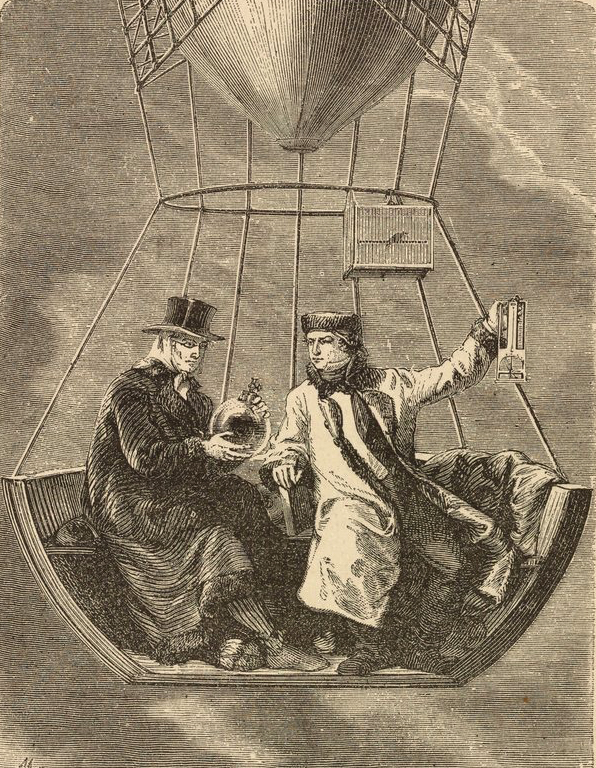
Also with thanks to Gillian Turner’s book North Pole, South Pole I have learnt that there were early hydrogen balloon ascents to determine if the Earth’s magnetic field intensity varied with altitude, helping to decide if the magnetic field came from within the Earth or was extra terrestrial. In 1804 Jean-Baptiste Biot and Joseph Louis Gay-Lussac made a pioneering ascent to 4,000 feet (1.2km). In Turner’s book she writes that the dip needle necessary to take the measurements iced up and so the results were unreliable. I feel for them, but it seems they conducted many other experiments on temperature and gases in the atmosphere while aloft and in any case we now know they would have needed to ascend many kilometres higher than they achieved to notice any weakening in the magnetic field.

This plate is from John Howard Appleton’s (1844-1930) Chemistry, Developed by Facts and Principles Drawn Chiefly from the Non-Metals, published in 1884.

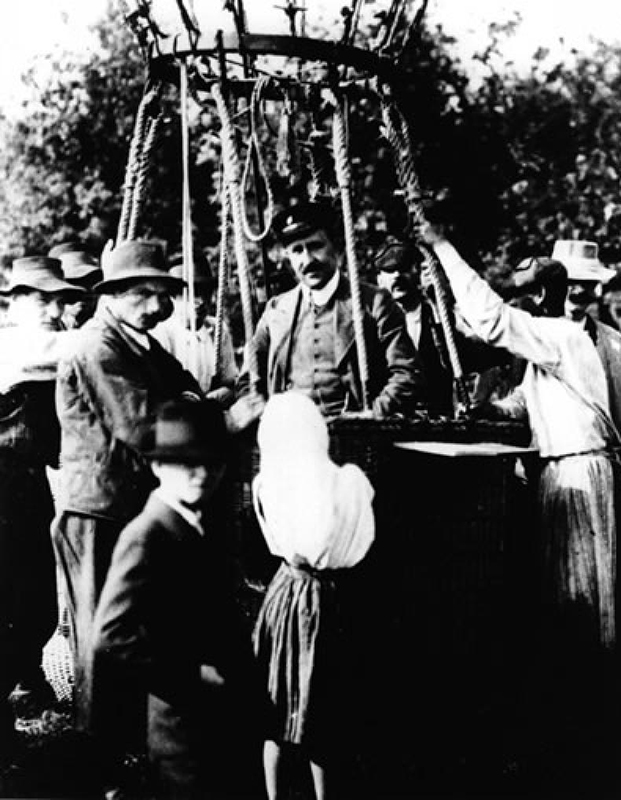
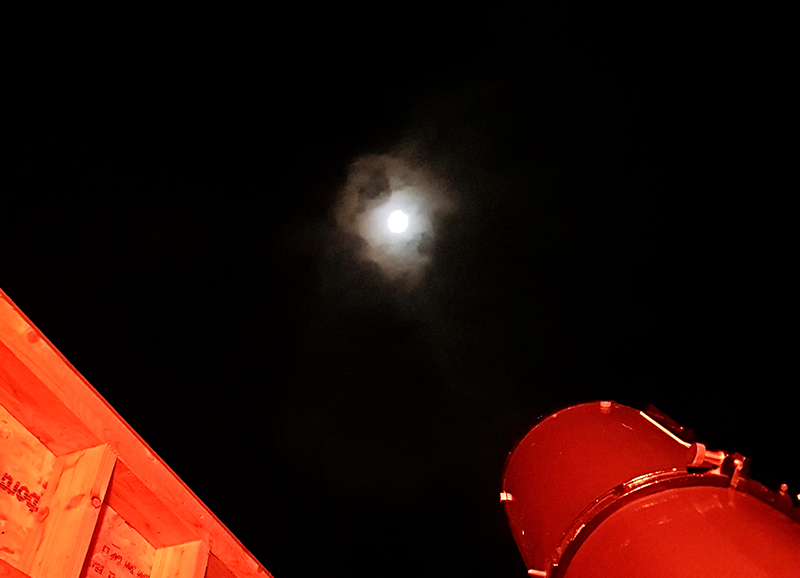
I am trying to remember when I first had the idea to launch a cloud chamber in the payload of a high altitude balloon. I knew about the hot-air balloon experiments carried by Victor Hess to determine the origin of cosmic radiation, and his discovery in 1912, when he made an ascent to over 5km during a near-total eclipse of the Sun, that radiation had to be coming from further out in space.

Hess on his return from the 1912 balloon ascent – Alan Watson pointed out that this was obviously staged at another time as he would not have been standing looking so well after his ordeal.

I remember looking into the dark skies during a residency at Allenheads Contemporary Arts and wondering about all the activity that I couldn’t see. I decided then I would like to film at 15km where most subatomic cosmic ray activity takes place, even if nothing would show on the film.

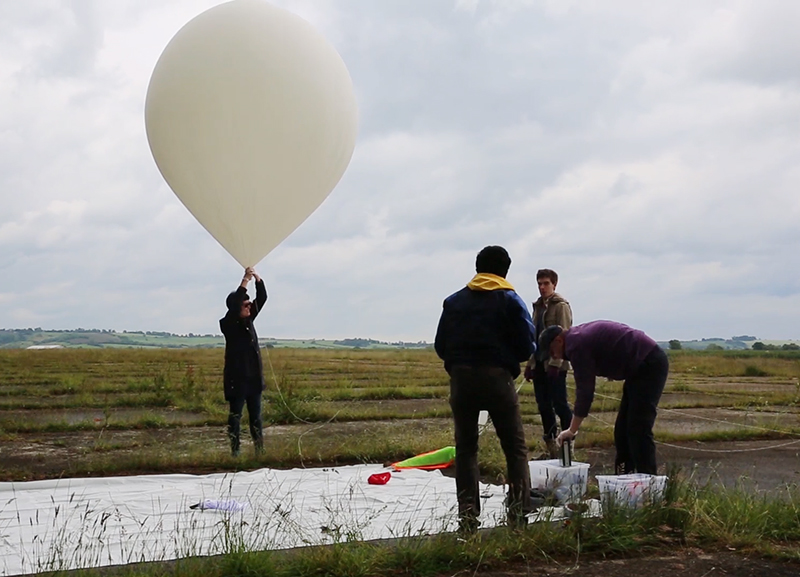
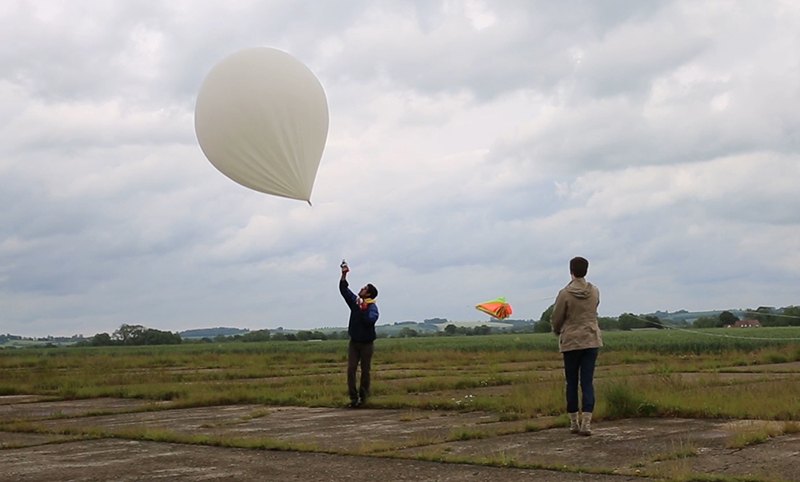
A high altitude balloon flight seemed the perfect solution and I was very grateful for the help I subsequently received from Imperial College Space Society and The UK High Altitude Society. The decision to include a cloud chamber in the payload was always a risk and as it turned out nothing of the cosmic ray activity was captured on film. However, the balloon did reach an altitude of over 37km and the payload was successfully recovered with some amazing video footage of its journey.

The record height for a hot air balloon ascent is 21km so in theory it could be possible to send a cloud chamber up in a hot-air balloon and film at altitude with potential for more success if some brave person were on board to operate the camera. Unlikely to be me.

Some intriguing news of ORC’s on the RAS websiteThe most distant and most powerful ‘odd radio circle’ (ORC) known so far has been discovered by astronomers. These curious rings are a relatively new astronomical phenomenon, having been detected for the first time just six years ago. Only a handful of confirmed examples are known – most of which are 10-20 times the size of our Milky Way galaxy. ORCs are enormous, faint, ring-shaped structures of radio emission surrounding galaxies which are visible only in the radio band of the electromagnetic spectrum and consist of relativistic, magnetised plasma. the three new cosmic rings – discovered not by automated software but by sharp-eyed citizen scientists – represent an important step toward unlocking the secrets of these vast, puzzling structures.

Out and About

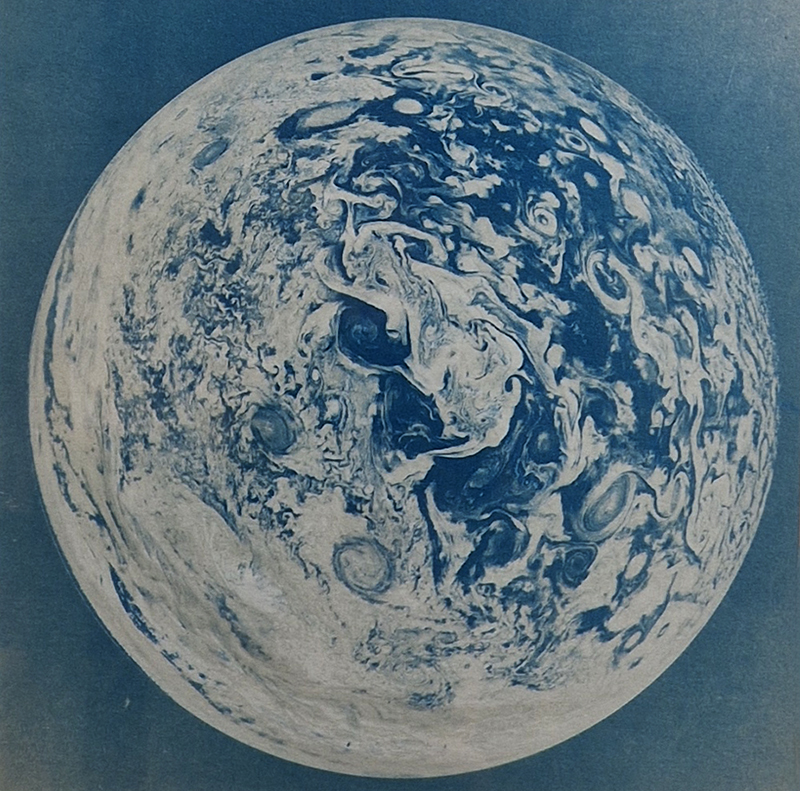
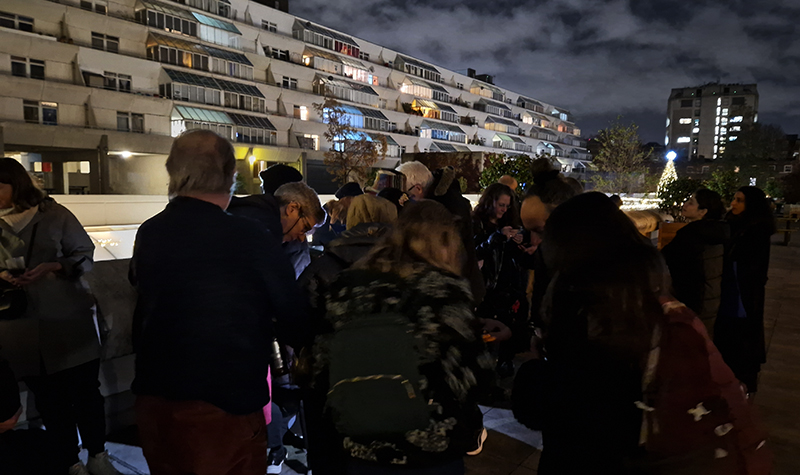
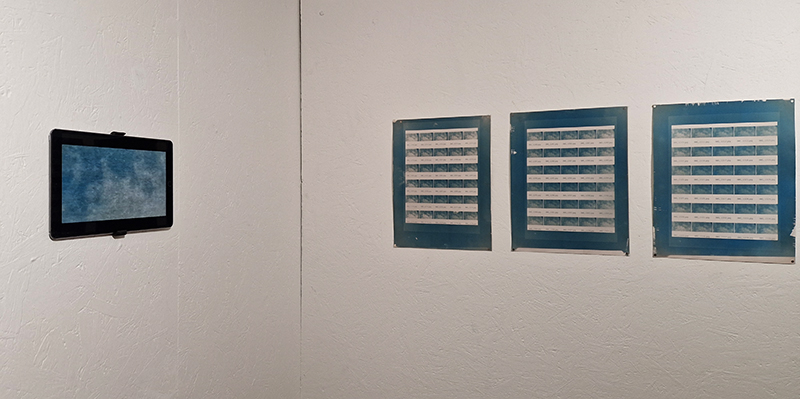
A wonderful evening with artist in residence Melanie King at Passengers connecting the celestial with the architecture of the grade II listed Brunswick Centre in Bloomsbury, London. Melanie used the residency opportunity to explore the duotone cyanotype process using multiple layers of cyanotype to mimic astronomical imaging construction and even used cyanotypes to create an of the Moon. The beautiful results were presented at an evening event with the additional treat of live telescope viewing of the Moon and Saturn from the second floor terrace of the Brunswick centre under the engaging guidance of astronomer and science communicator Paul Hill.

Liz Elton’s sensitive work Black and Blue (compostable bio materials, cabbage and fruit dye saddened with iron, silk, poppy and sage seeds) showing in A Changed Environment at Messums London. This group show examines changing ideas of beauty, ecology, and sustainability, as well as themes of place, memory, and identity, revealing how connections to the natural world can inspire both understanding and hope. I love the delicacy of this new work and the term ‘saddened by iron’ which is used in the dying process to dull a colour, and which, as Liz says, also emotes the hardships of industrial life.

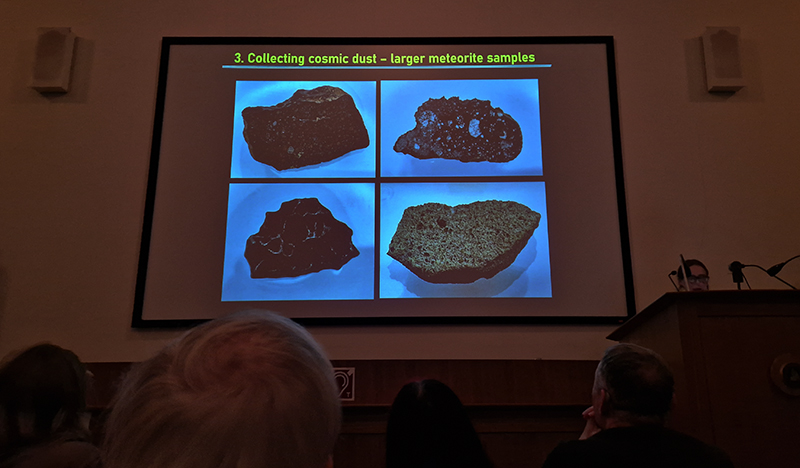
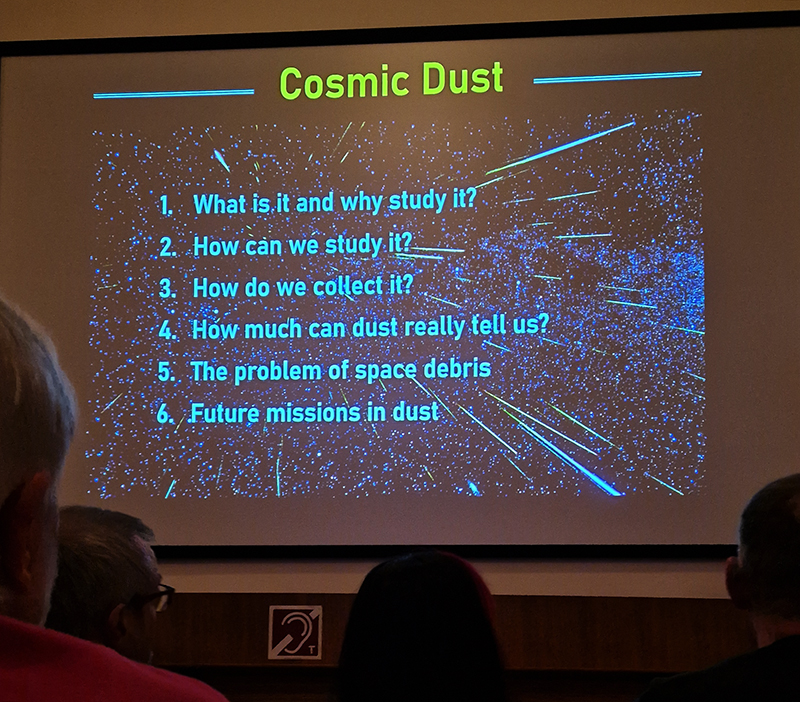
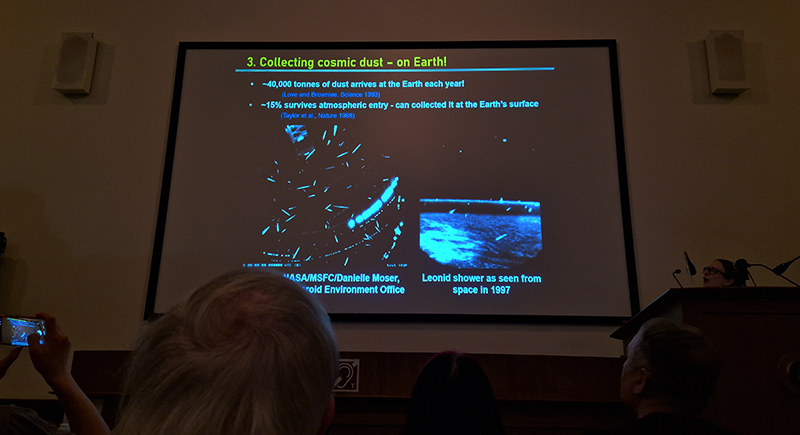
Cosmic Dust talk by expert on extraterrestrial space dust, and how it can impact astronomy and wider human endeavours in space, Penny Wozniakiewicz at The Royal Astronomical Society. ‘Natural’ cosmic dust is being polluted by man made dust from space debris. This is a real problem created by dead satellites, old upper stages of rockets, fragments form exploded rocket or stages, flecks of paint, aluminium oxide spheres from solid rocket burns, dropped space equipment. When any of this debris collides a cloud of smaller debris is ejected, this process is self propagating and even the tiniest piece of debris can cause serious damage to spacecraft and satellites. This is called the Kessler syndrome, a cascading effect that could render orbital space unusable for generations, threatening satellites, the International Space Station, and future space travel.

Good to visit the The London Group show 2025 at Copeland Gallery where lots of friends are showing excellent work and also to discover new work and artists.

I found Majid Majid’s video Faith Amongst The Ruins a difficult but compelling work. So scary and horrific because we know this is real footage, some of which I had seen before at the time of the attacks on hotels housing asylum seekers and refugees, but it is still so disturbing to watch these people, with so many children present, cheer on the violence. They have no empathy with the terrified people trapped inside the hotel or for the person in the car who is ambushed and stabbed. The glee of those filming the assault is chilling.

He writes: “As a refugee, I know places shaped by fear and rejection. This work revisits UK sites of last summer’s Islamophobic and racist violence, a mosque, a street, and a hotel housing asylum seekers transforming them through prayer. Placing a mat where hostility flared, I reclaim space as sacred ground. Video and traces of violence form a counter-narrative of dignity, belonging, and resilience.”

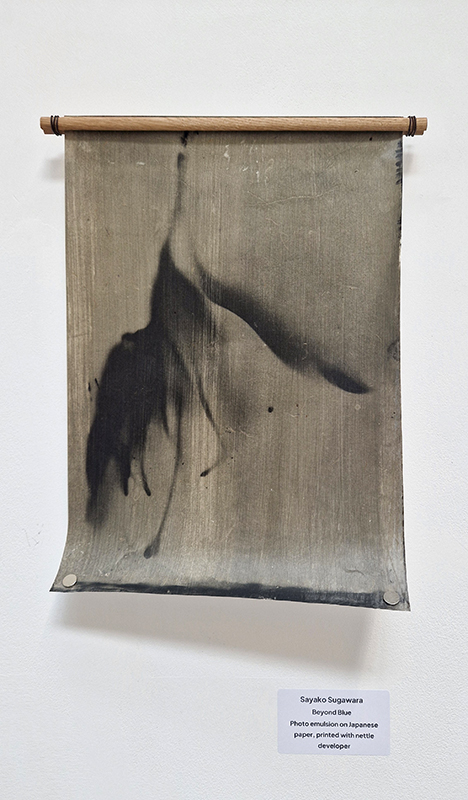
Images: Majid Majid, Sayako Sugawara, R James Healy, Victoria Rance, Jonathan Armour, Sandra Crisp, Jenny Wiggins, Victoria Arney, Carol Wyss, Sandra Crisp, Genetic Moo, Jacqueline Yuen-Ling Chiu.

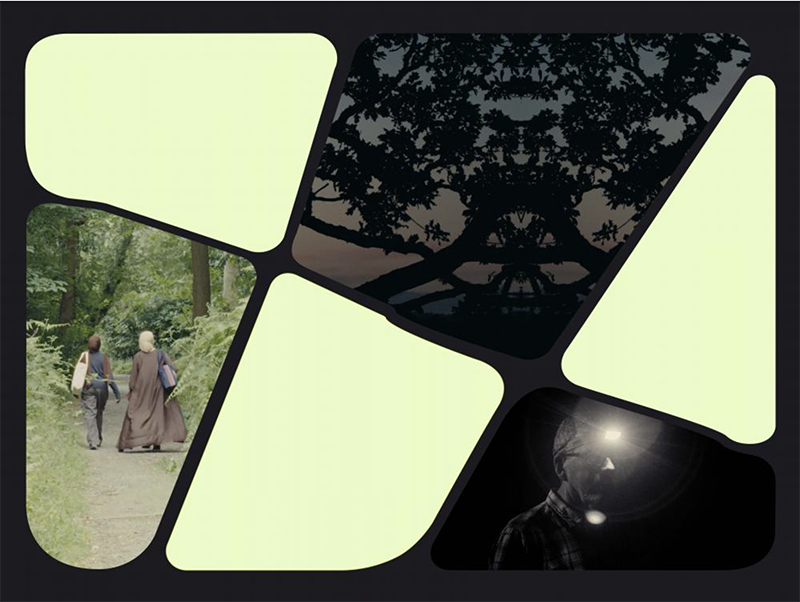
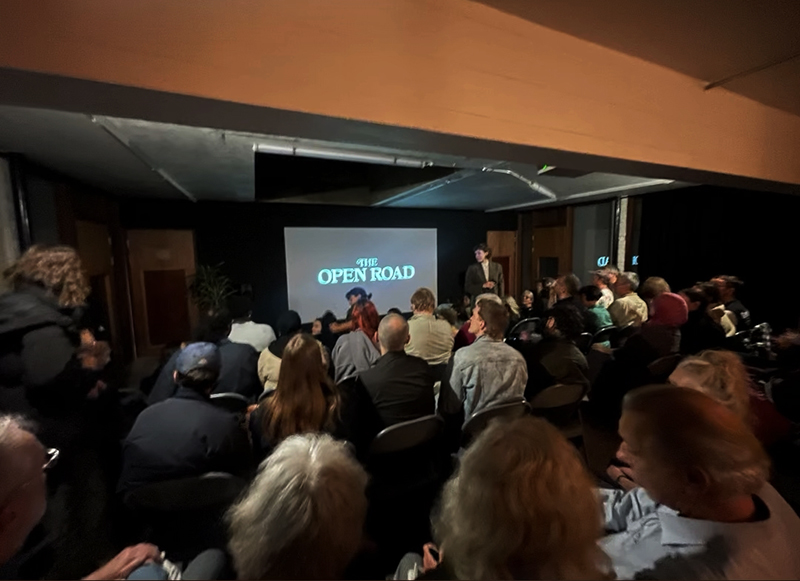
Three beautifully directed films screened at FormaHQ as part of The Open Road series of artists moving image works, co-commissioned by a partnership of visual arts organisations. The works are loosely inspired by The Canterbury Tales, drawing from a disparate cast of characters to recount competing stories in a patchwork of styles. David Blandy (Commons), Amaal Said (Open Country) and Sam Williams (The Eel’s Tale) each draw on storytelling traditions to give fresh perspectives on their journeys, on foot, by sea and through time. Heartbreaking to hear how terrified Amaal Said was to leave London for the open country of the south coast, especially with the current rise in overt racism, when out looking for locations and that they did suffer racist abuse while filming. Hers is a gentle and warm study of a mother and daughter and an absent grandmother, a longing for home and to feel ‘at home’. Sam William’s film sets the plight of the highly endangered glass eels who journey 4,000 miles from the Sargasso Sea to the Medway wetlands in Kent, swept along by currents, undergoing bodily transformation, following an instinctive desire on this epic migration alongside two other watery tales of transformative journeys across boundaries of identity and freedom. Coincidently, a recent episode of the Infinite Monkey Cage is all about these mysterious eels. David Blandy turned his attention to the vast and disparate collection of artefacts held in the Tunbridge Wells museum and gave some of these specimens a voice to tell of how they had lived before they became a part of this collective of human taxonomy.

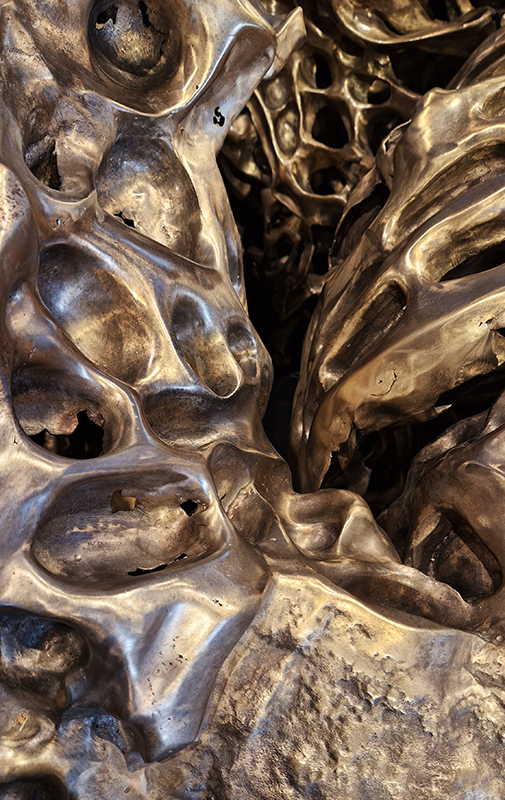
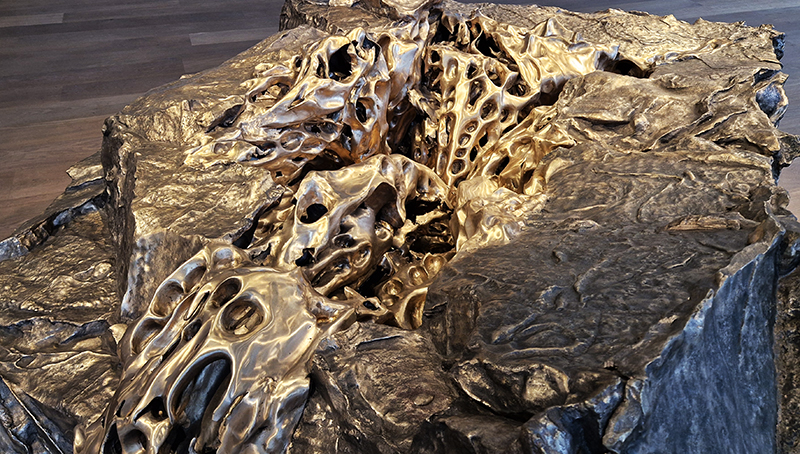
Cristina Iglesias The Shore at Hauser & Wirth features large-scale bronze works from the artist’s Littoral (Lunar Meteorite) series, part of her ongoing exploration of geological themes. The word ‘littoral’ refers to something relating to or situated along a coast or shore, or the region where the land meets the water. The weightiness of the objects is impressive ( I can’t imagine how they were brought into the gallery even with the technology available today – after coming here from the talk on stone henge and the incredible feat of bringing the standing stones across rough terrain for many kilometres and up a slope 5000 years ago seems even more impossible – yet there they are). The sound of water bubbling within each piece draws you to peer within and stay with the piece perhaps longer. The audience is invited to touch the sculptures. The bronze is polished and does need to be used and worn away in a more effective organic and dirty process. They are very clean.

The Royal Astronomical Society lecture Sighting the Sun and Moon? at Stonehenge – by Archaeoastronomist Prof. Clive Ruggles. Debunking many myths and overspeculation, concerning the use of the monument for observations of the sky the professor was clear about what can sensibly be said about the relationship of Stonehenge to the Sun, considering the conventional archaeological evidence that has been uncovered in recent years. He also recommended visiting the day before or after the actual solstice if possible for an experience without the many crowds as the alignment is almost identical. Also visiting at sunset can be just as magical and quieter. He turned his attention to the Moon, questioning if our prehistoric forebears also celebrated the occurrence of a major lunar standstill, an event occurring every 18.6 years around which time the Moon can be seen at fortnightly intervals exceptionally far to the north and south.

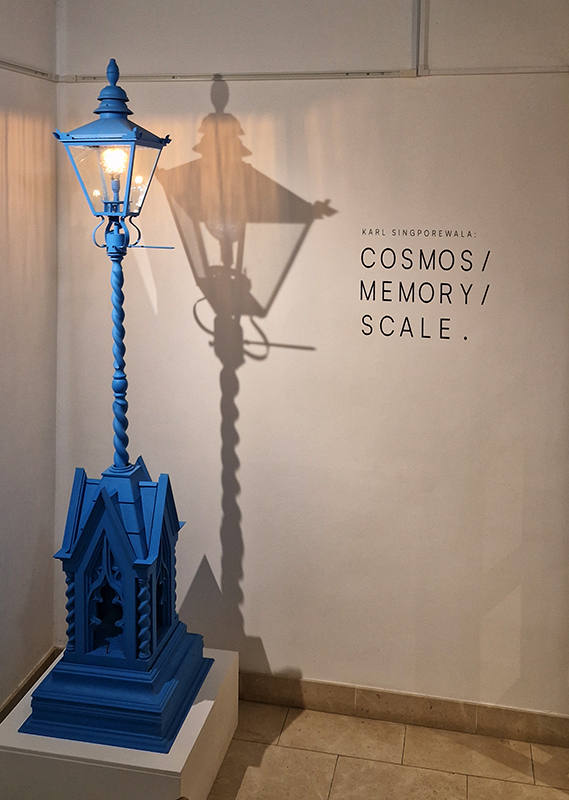
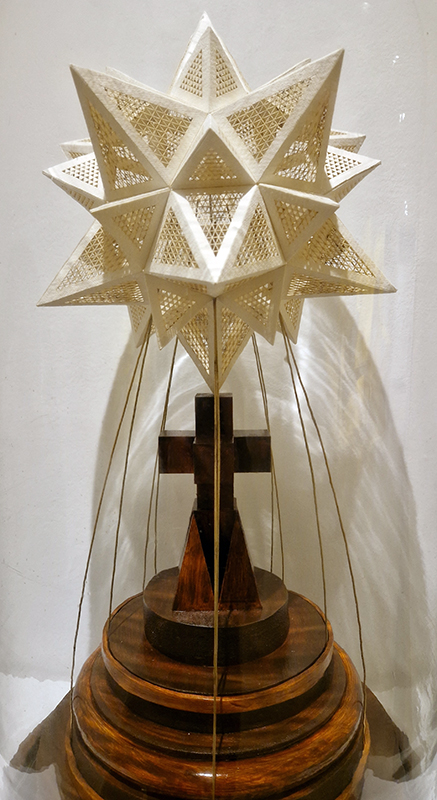
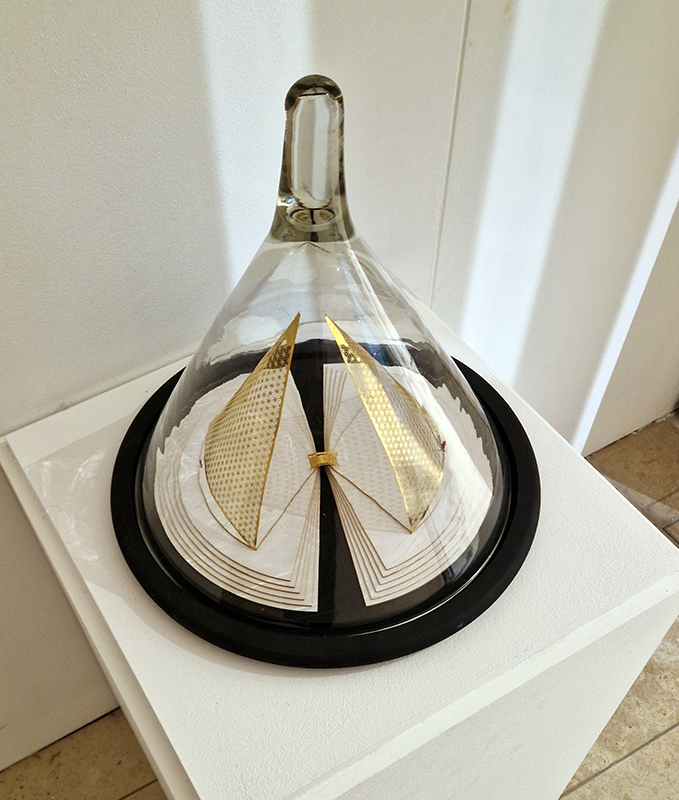
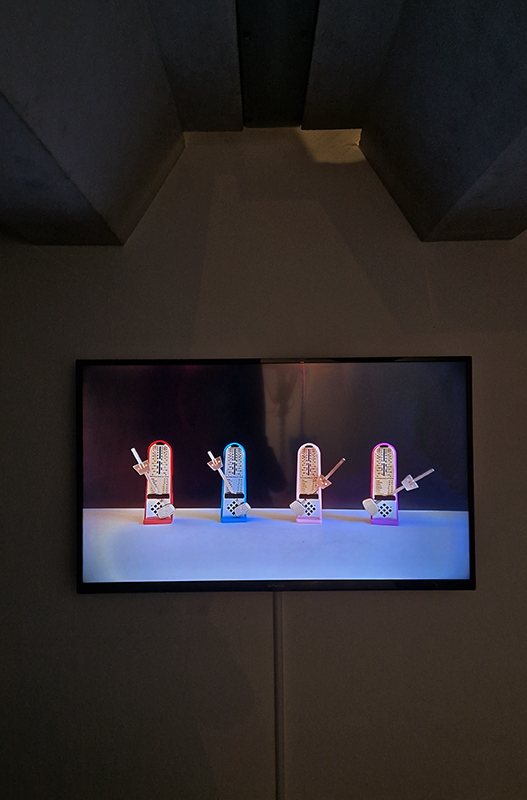
Karl Singporewala’s sculptural interpretations of Zoroastrian symbolism in Cosmos, Memory, Scale at SOAS Gallery convey a meditation on how material and memory intersect to shape the human experience. Cosmos speaks to both his fascination with astrophysics together with a metaphysical belief in the alignments of life. Stars and geometric forms recur as motifs, refracting both spiritual navigation and mathematical structure. Memory is treated as a living, shifting phenomenon. Inspired by oral tradition, family stories and inherited rituals. Scale, is used both literally and metaphorically in shifting perspectives and unexpected relationships. Good Thoughts, Good Words, Good Deeds.

Dusty, chalky mythical drawings and solar eclipse traces from Tacita Dean in Black, Grey, Green and White at Frith Street Gallery Golden Square.

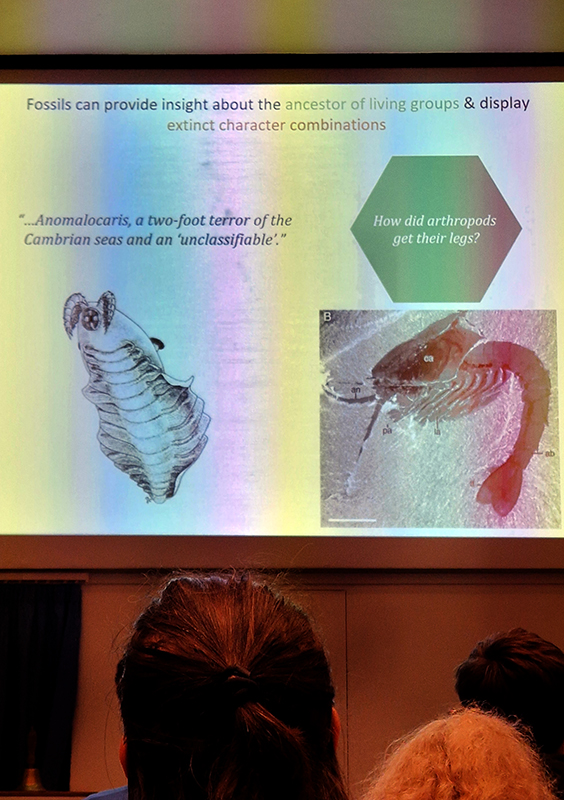
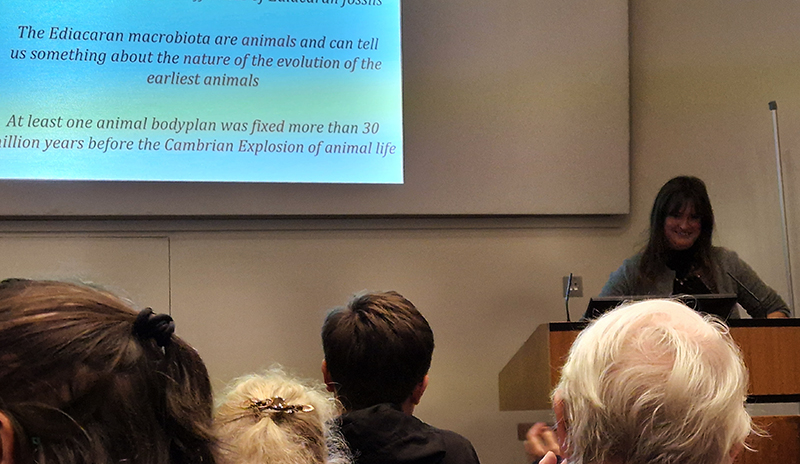
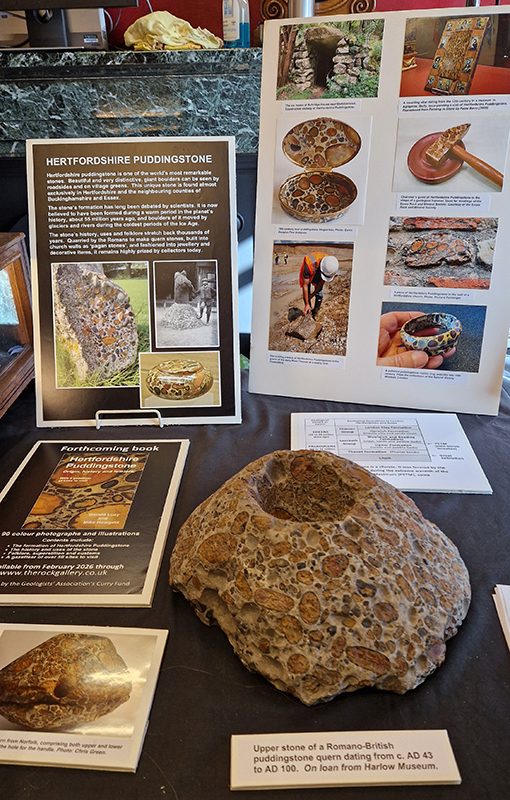
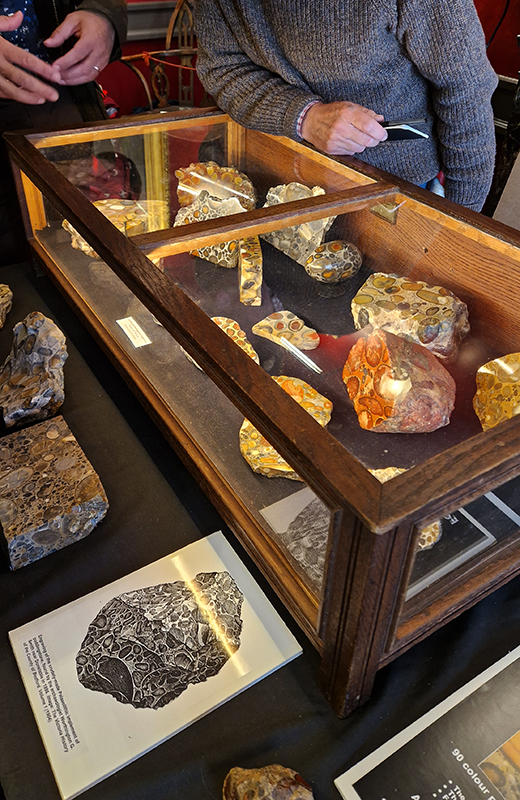
I spent a happy morning at the Geologists Association Festival of Geology 2025. This included a fascinating lecture The Early Evolution of Animal Life by palaeobiologist Frankie Dunn focused on the origin and early evolution of animals and particularly on the fossil record of the late Ediacaran Period (approximately 570 – 540 million years ago) – just before the Cambrian explosion of life. The aim of her research is to understand how animal body plans evolved in deep time. There also was some amazing and unique pudding stone on display.

I also picked up a great little book full of wonderful geologically enriching words by Marcia Bjornerud.

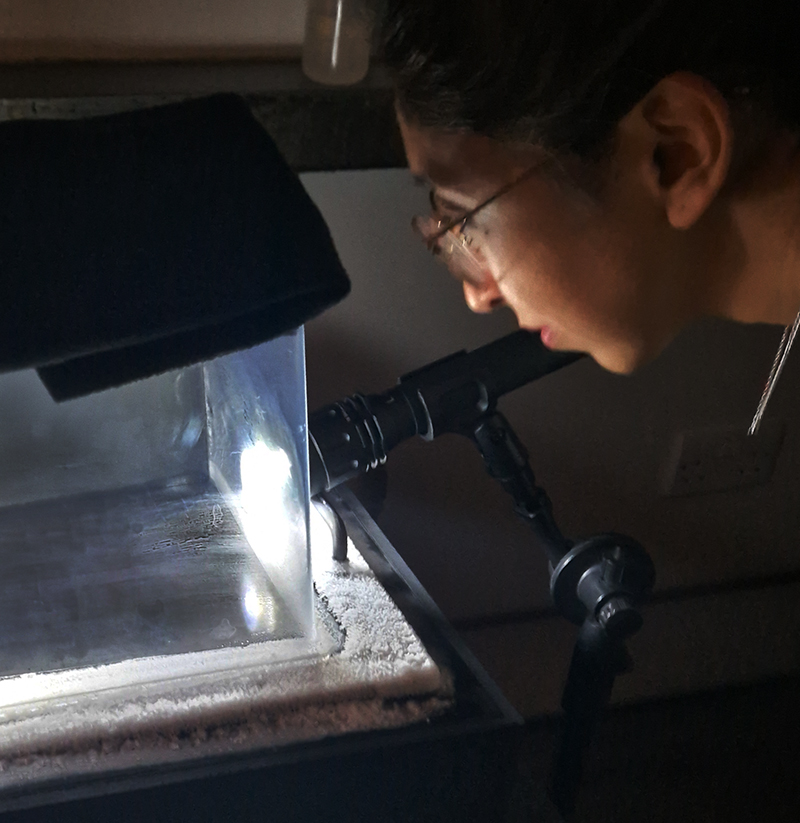
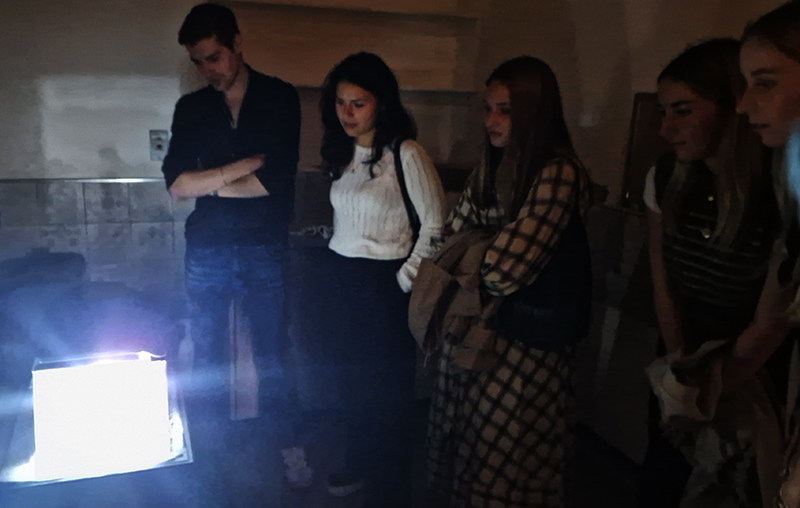
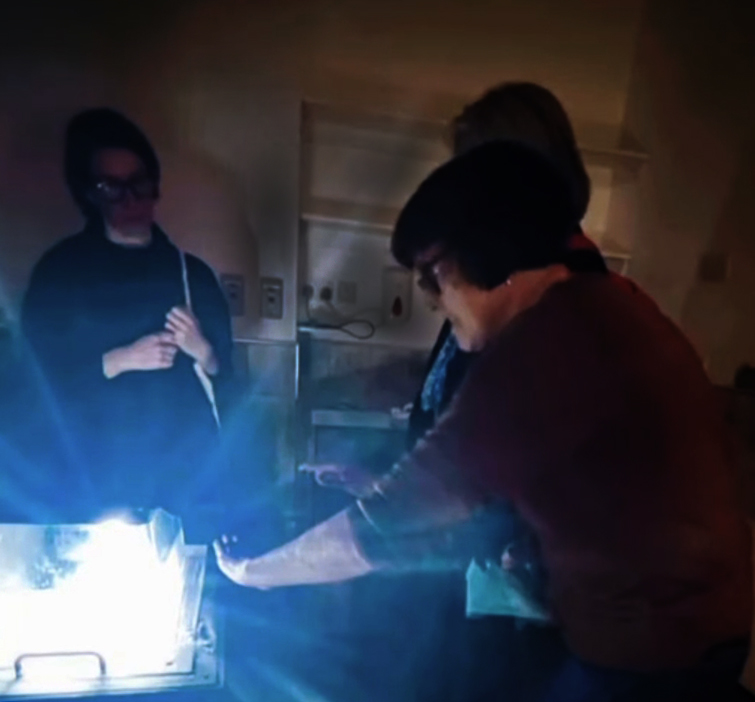
The finale of the exhibition programme of Carbon, Carbon Everywhere co-curated by Indira Dyussebayeva-Ziyabek and Maria Hinel at Hypha HQ included an exhibition tour, a BREAT(HOLD) workshop led by Ania Mokrzycka and an invitation to view cosmic particle trails passing through a cloud chamber.

This simple equipment of a plastic tank saturated with isopropyl alcohol vapour over a metal tray sitting on dry ice was used to capture footage for the video Cosmic Chiasmus: crossing the universe showing in the exhibition. Cosmic rays are fast-moving particles, blasted across space, spiralling along magnetic field lines to end up entangled with carbon in our bodies.

Installation image of Cosmic Chiasmus: crossing the universe

Not only is all life physically permeated by cosmic rays with the potential for nuclei collisions but some cascading particles smash into atoms of nitrogen to create carbon-14 which combines with oxygen in the atmosphere to create radioactive carbon-dioxide which enters the food cycle via photosynthesis.  Cosmic ray activity creating Carbon-14 allows us to perform carbon dating techniques offering insights into Earth’s past climate, magnetic field, solar activity, and changes in the carbon cycle, helping to understand historical patterns and establish timelines for ancient human history.

The title of the exhibition, Carbon, Carbon Everywhere, is a quote from the landmark essay Carbon by the writer and chemist Primo Levi. In the essay, Levi traces a journey of a single atom of carbon across distinct states and beings, from the monotony of being embedded in limestone for hundreds of millions of years, to entering the world of ‘things that change’ – swiftly shifting from the atmosphere to the lungs of a falcon, to the sea, to the trunk of a cedar, and eventually entering the writer’s own body from a glass of milk on his desk, crossing into the brain cell that controls the hand writing its own story. Resolutely specific yet universal, Levi’s story highlights the singularity of carbon as an element that inherently connects all things through its relentless transformation. It fossilises, mutates, preserves, pollutes and nourishes. From its ancient geological formations to its current atmospheric volatility, carbon is never still, shifting between forms and contexts in an ongoing process of exchange.

‘It is possible to demonstrate that this completely arbitrary story is true. I could tell innumerable other stories, and they would all be true: literally true, in the nature of the transitions, in their order and data. The number of atoms is so great that one could always be found whose story coincides with any capriciously invented story’ Primo Levi

This was a beautiful show and I was thrilled to be invited to exhibit alongside such amazing artists including Emii Alrai, Anousha Payne, Kate Daudy, Konstantin Novoselov, Ania Mokrzycka, Nissa Nishikawa, Mariele Neudecker, Simon Faithfull, Aimee Parrott, Lucia Pizzani, Lizi Sanchez and Meng Zhou.

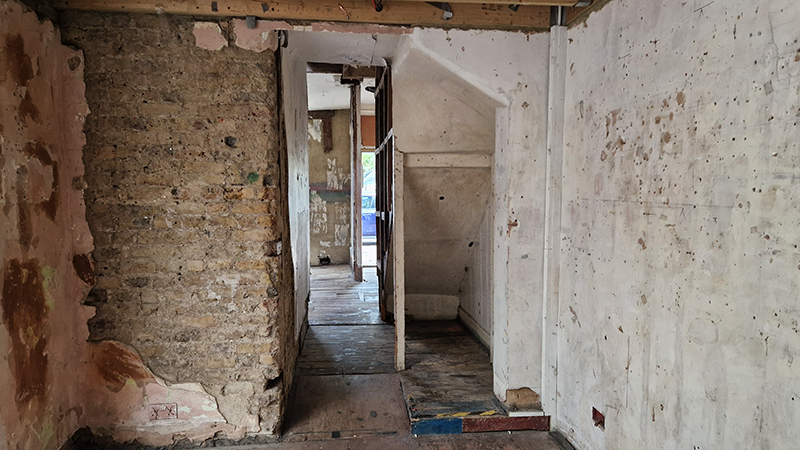
I am very excited to have an invitation to exhibit at the Safehouses in Peckham next year with a group of wonderful artists and friends. Curated by Julie Hoyle, the artists have been selected for the way their work resonates with the atmosphere of the Safehouses — places where traces of the past meet the imagined and the unseen. Together, the works will form a dialogue between beauty and unease, the real and the imagined, reanimating the stripped-bare rooms with strange company. We had a productive site visit and I have two spaces in mind to work with – one above and one below.

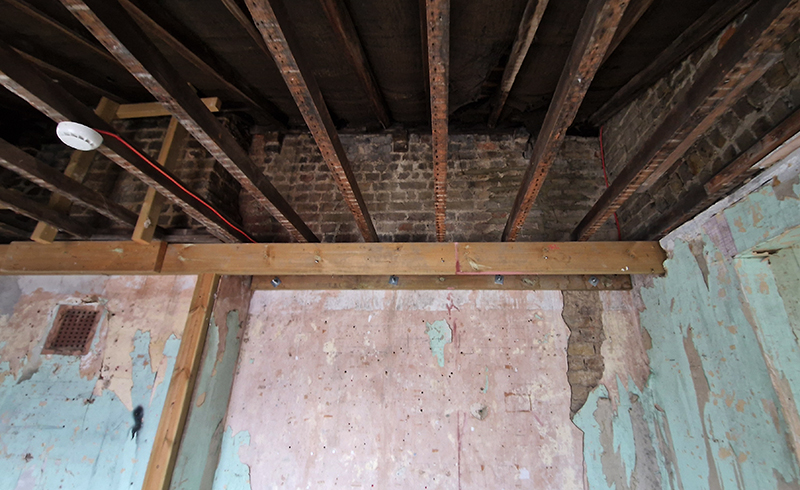
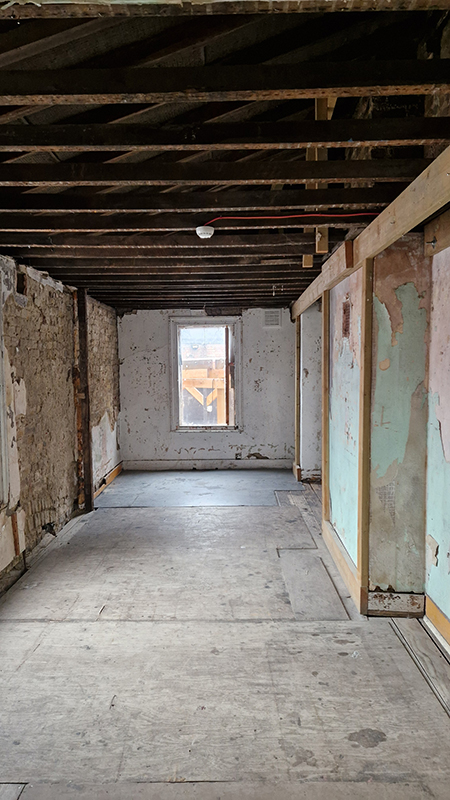
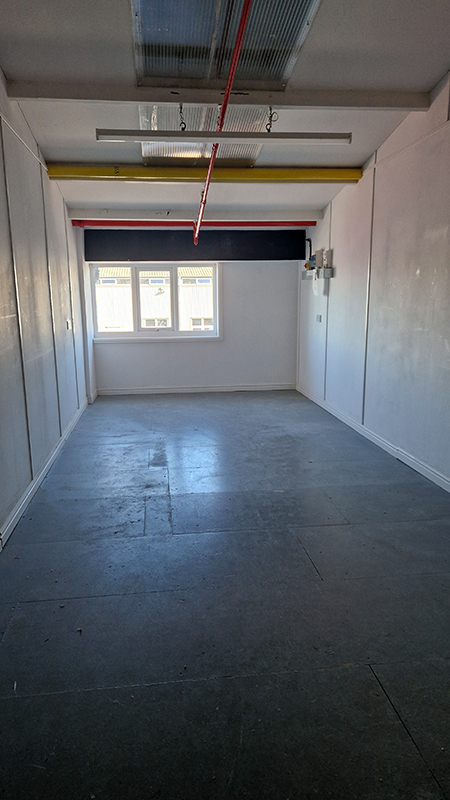
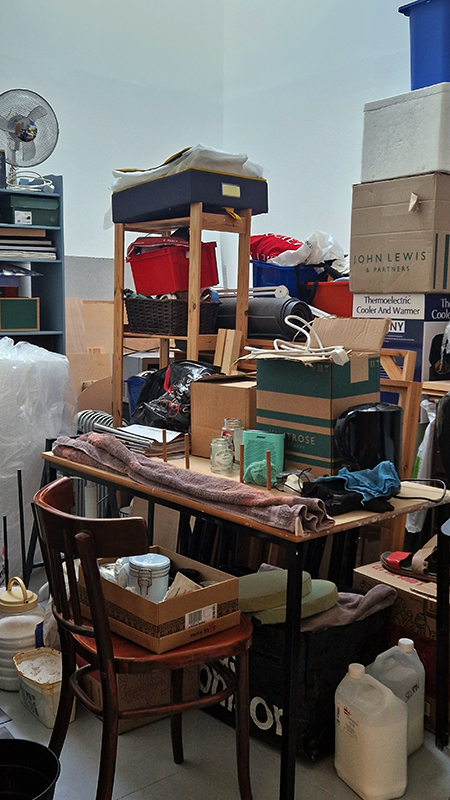
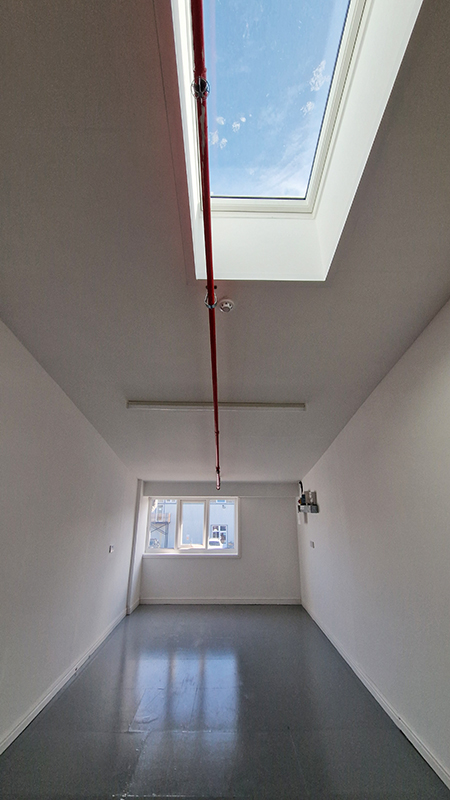
There is an ongoing refurbishment project at my studio complex which although welcome improvements has caused a little disruption to my ability to work there recently. My unit has had a new roof installed and each studio is being insulated with a new ceiling and opening Velux window. When the new roof went on we lost our ceiling windows so it is wonderful to have natural light from above again. Having to move everything out of my studio for a couple of weeks has been a good exercise in discovering long hidden materials and putting it all back has forced my hand to have a bit of a clear out of items I am unlikely to use and pass these on to other studio holders. Images show before, during and after.

I managed to get everything back into my studio just in time for a studio visit from curator Catherine Li to discuss the possibility of exhibiting at Brompton Cemetery Chapel next year. It is a stunning building so I am very excited about this upcoming project.

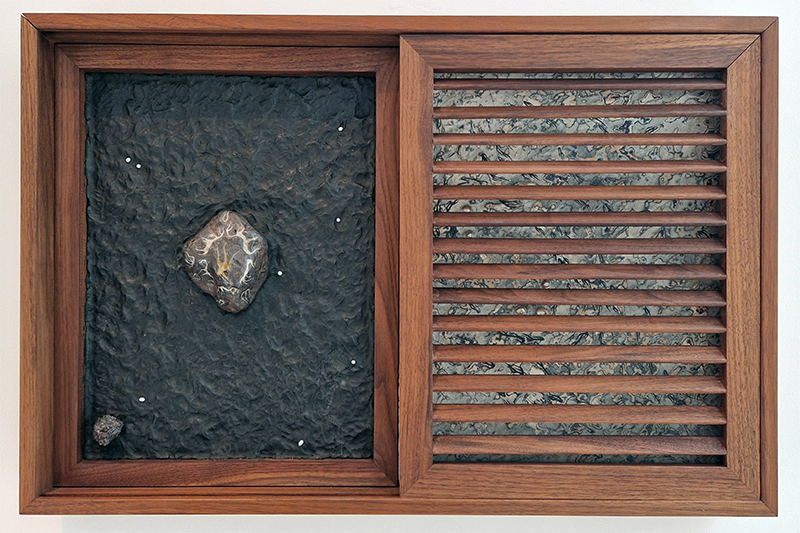
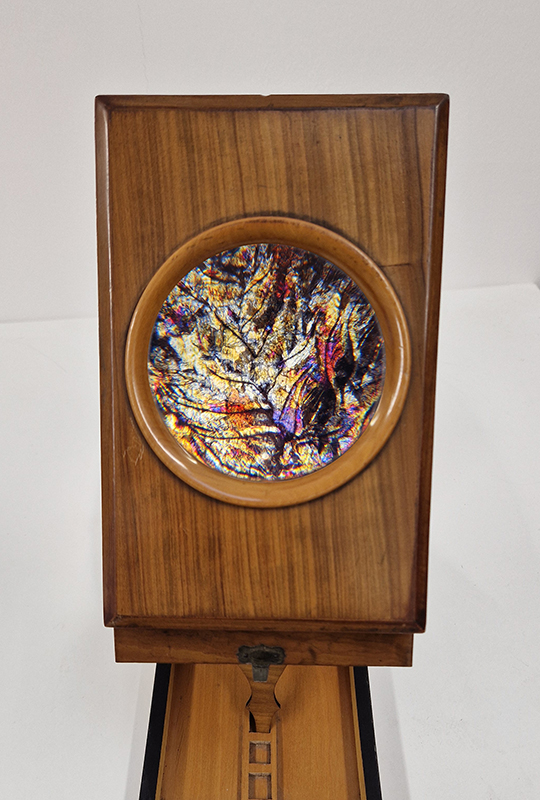
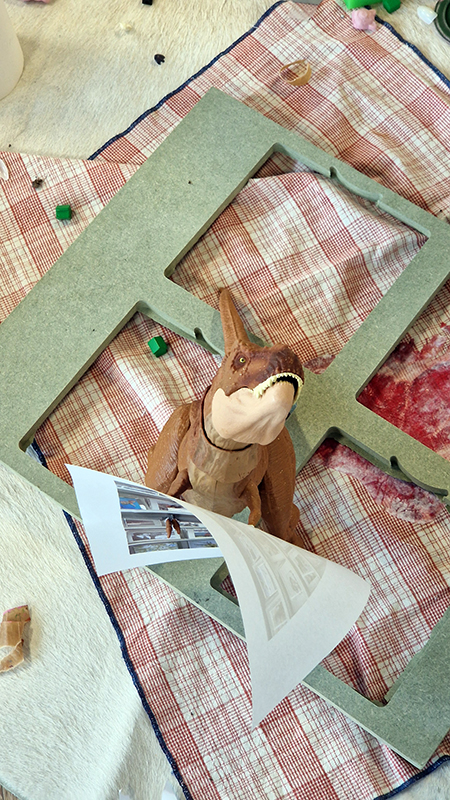
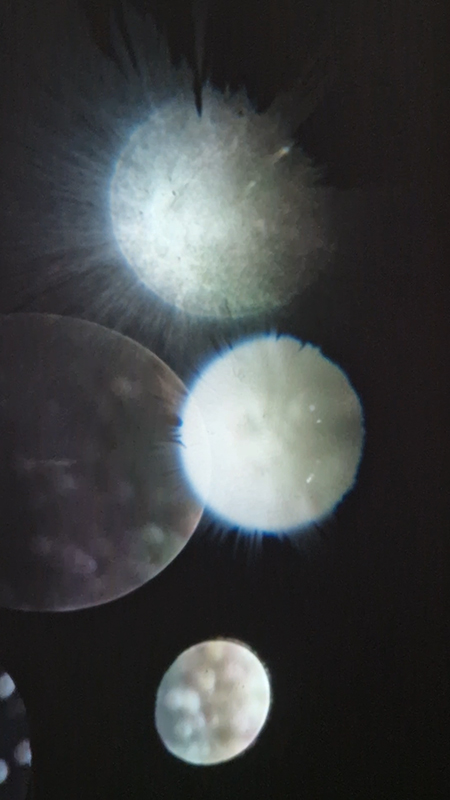
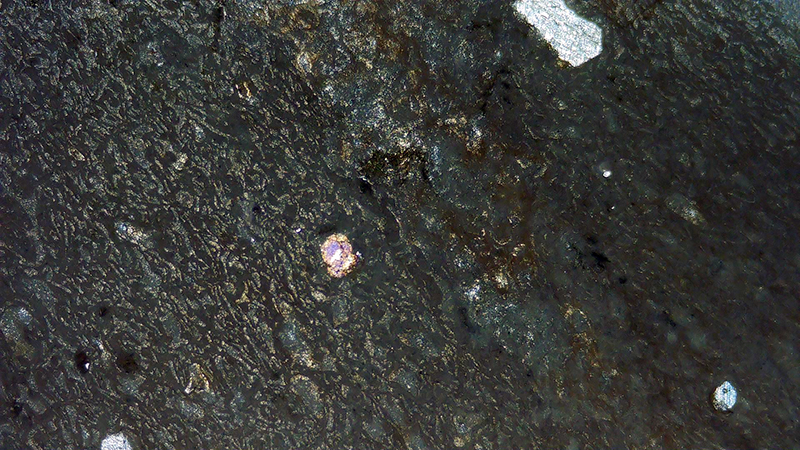
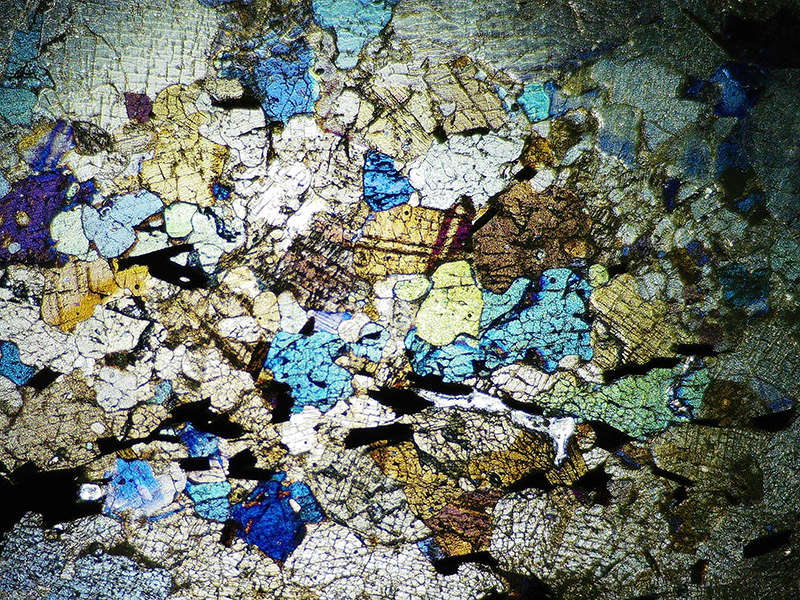
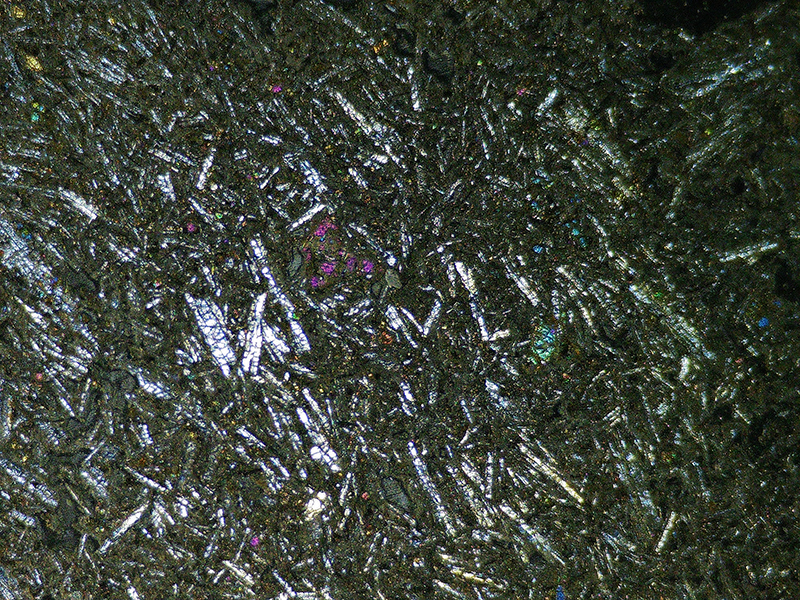
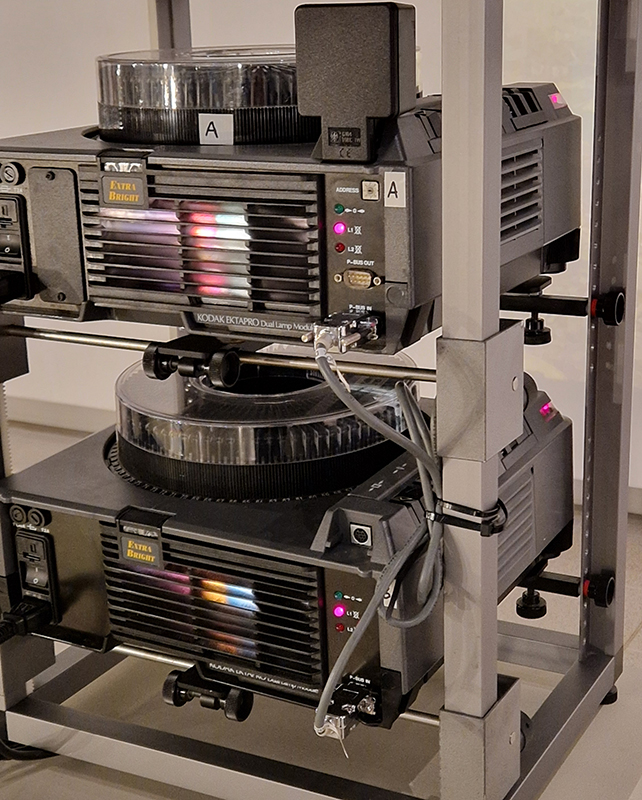
I have been experimenting with an old wooden slide viewer, printing images onto acetate from my microscope camera of polarised crystal and rock structures.

Work in progress on The Book of Reversals, writing text to print over the screen-printed magnetic graph lines. Ocean floor magnetic stripes are formed as magma cools at mid-ocean ridges. These alternating bands show Earth’s magnetic field reversals, with minerals in the crust aligning to current polarity and recording each change in pattern.

Colossal forces spinning dust

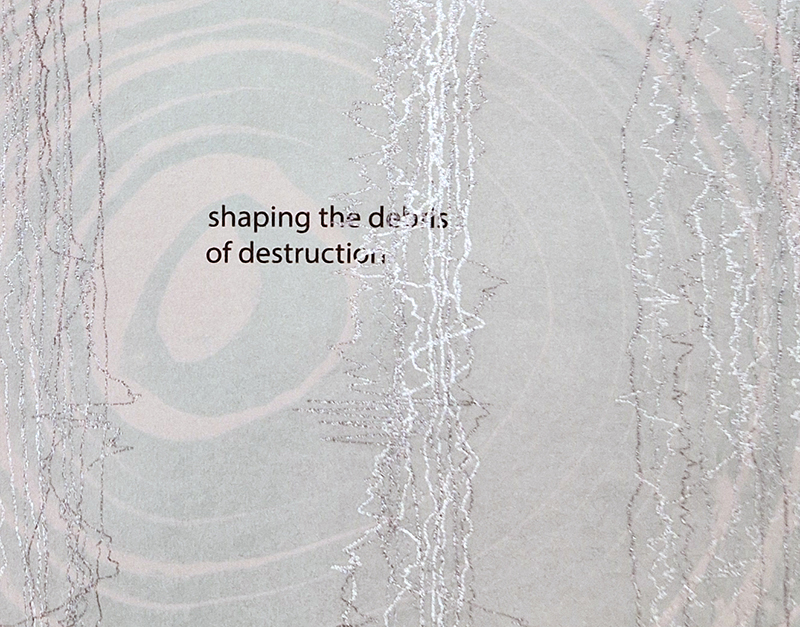
Aeons of accretion and gravity / shaping the debris of destruction

Searing elements separate /  amidst violence and decay

The weighty fall, pulled down, digested / feeling pressure only diamonds can survive

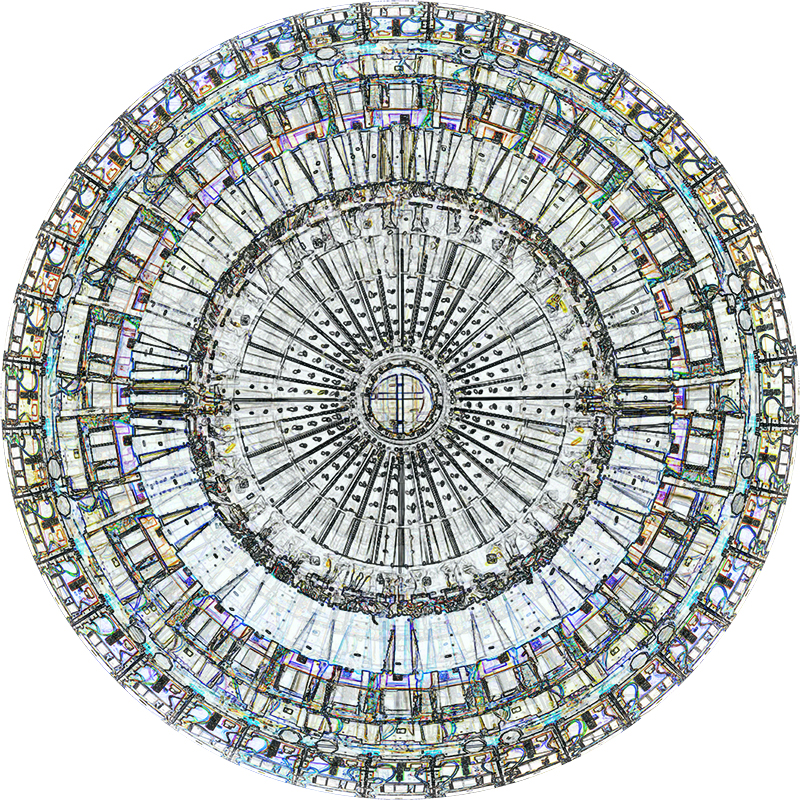
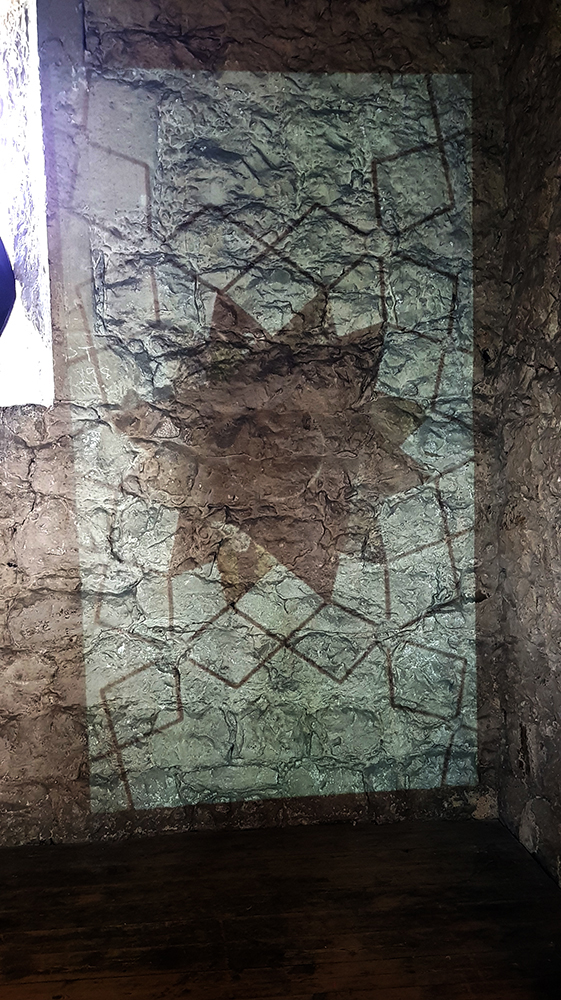
Work in progress looking at the sacred geometry of the Westminster Abbey Cosmati Pavement and relating medieval symbolism with contemporary iconography to think about changing relationships to fire, water, earth, air and the cosmos. Reimagining imagery from the Cosmati Pavement and particle accelerator at CERN.

Out and About

Noémie Goudal And yet it still moves at Edel Assanti. Mesmerizing work. I especially found the work Rocks very effective, an inkjet print on photographic paper with a video projection that moves across the image highlighting certain parts as though a torch is traversing a dark landscape. I always enjoy the theatricality of her large scale video installations even if they do purport a world collapsing around us.

Gorgeous paintings by Helen Baines in Striding Edge at The Department Store, Brixton. Photos don’t capture the ethereal luminosity.
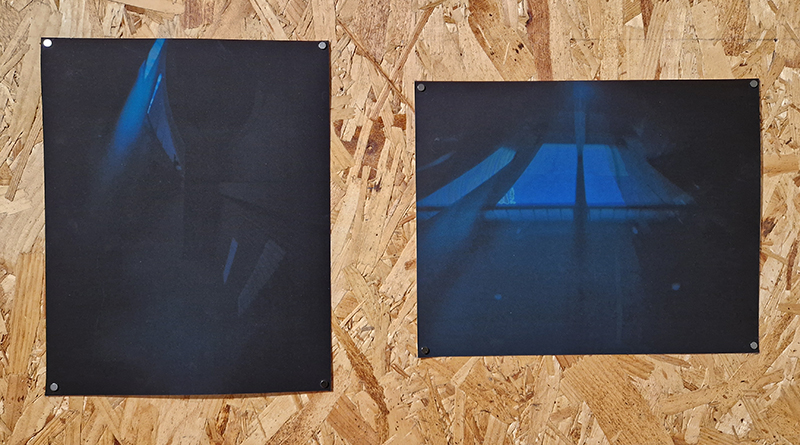
The hypnotic monument of modified LED laptop screens Wiped (Free Palastine) by Katrin Hanusch in Return of the Repressed curated by Toby Ziegler at an empty office block 10 Heddon Street. A show examining alienation and abstraction of the human experience in a climate of digital technology and AI.

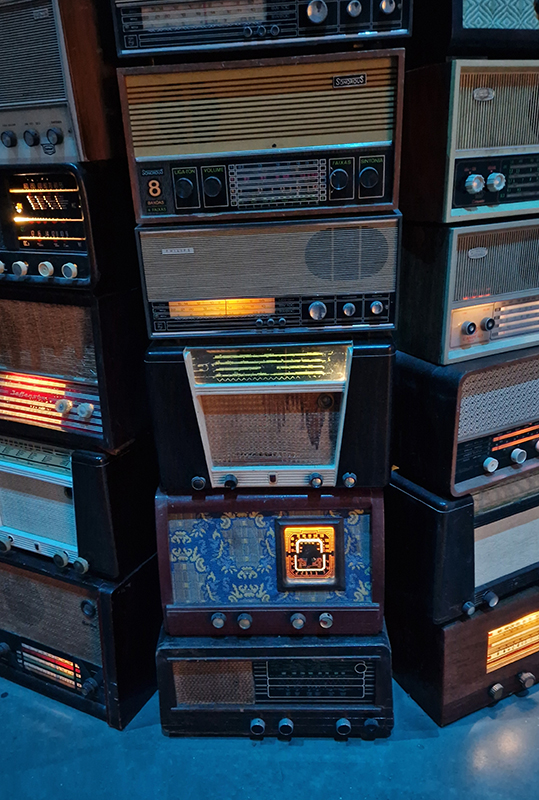
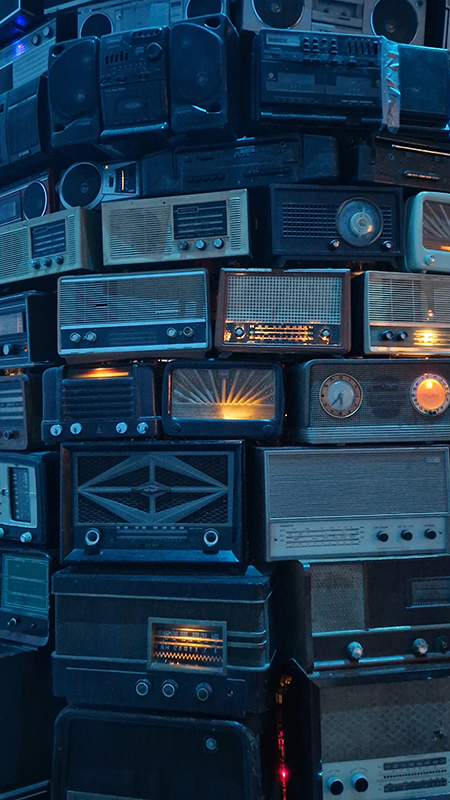
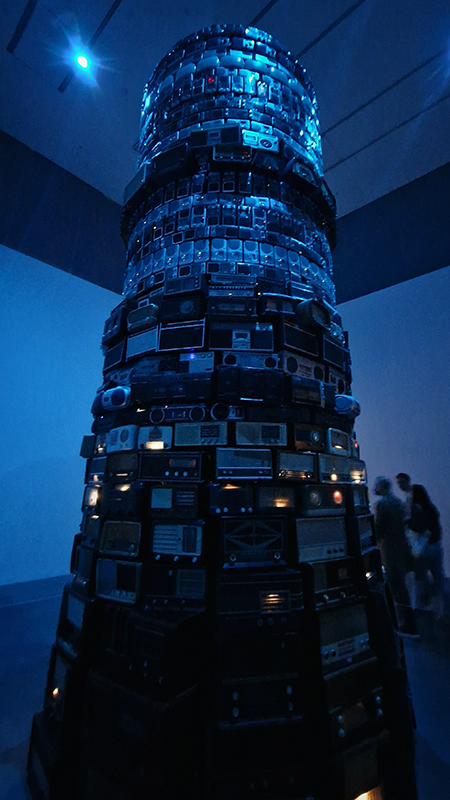
The magnificent Babel by Cildo Meireles at Tate Modern. With slightly dalek vibes, this thrumming ‘tower of incomprehension’ relates to the biblical story of the Tower of Babel, a tower tall enough to reach the heavens. God was offended by this structure, and caused the builders to speak in different languages. No longer able to understand one another, they became divided and scattered across the earth, and so began all mankind’s conflicts. Here we are, punished for our curiosity, again. This work though is a joy.

Material Actors curated by binder of women at Hypha Gallery 3 / No. 1 Poultry, London explores the tipping point of formal representation into the theatrical and cinematic world of mimicry and artifice. The artists include Alice Browne, Charlie Franklin, Lauren Godfrey, Oona Grimes, Pia Pack, Milly Peck, Michelle Williams Gamaker and Laura White. Material process and the façade are key in many of the works that surprise and confound definition.

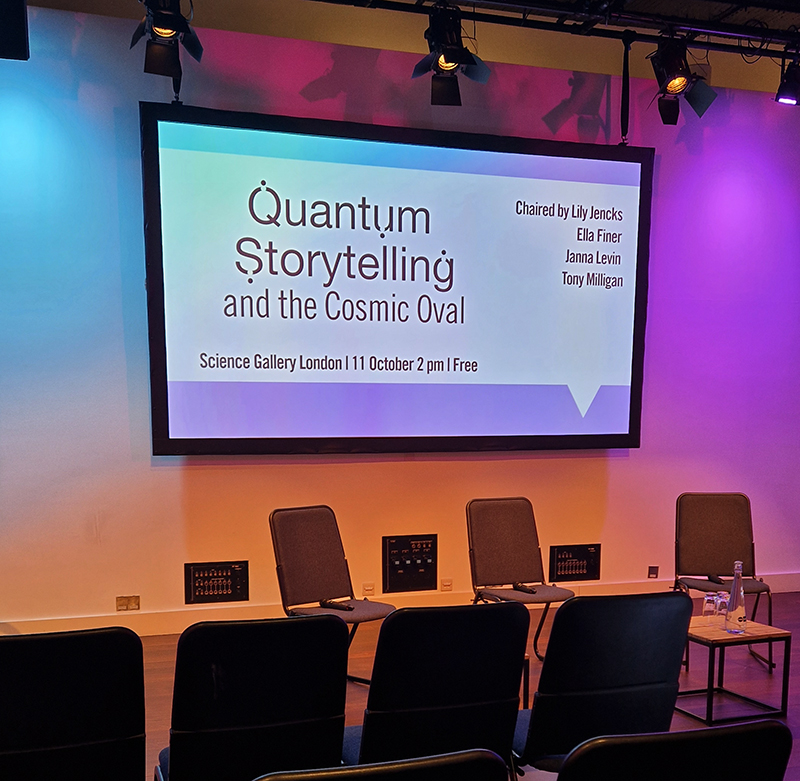
Quantum Storytelling and the Cosmic Oval – a fascinating discussion exploring how cosmic discoveries influence cultural narratives and the composing of histories. Physicist and author Janna Levin in conversation with writer Ella Finer to celebrate the launch of a new book commission The Cosmic Oval. Chaired by Lily Jencks, Keeper of Vision at The Cosmic House, with further insight from Tony Milligan, Research Fellow in the Philosophy of Ethics, Department of Theology and Religious Studies at King’s College London.

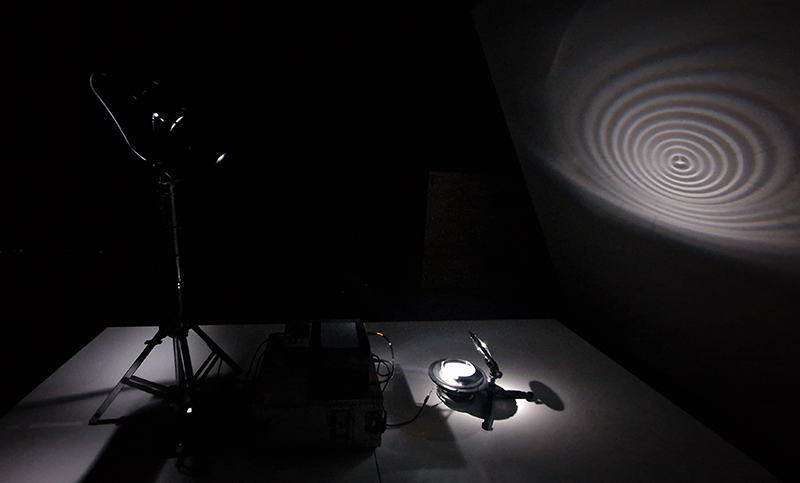
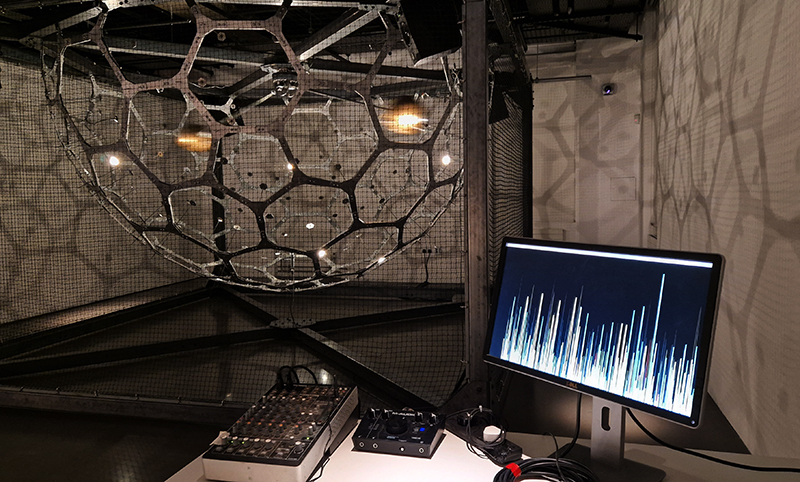
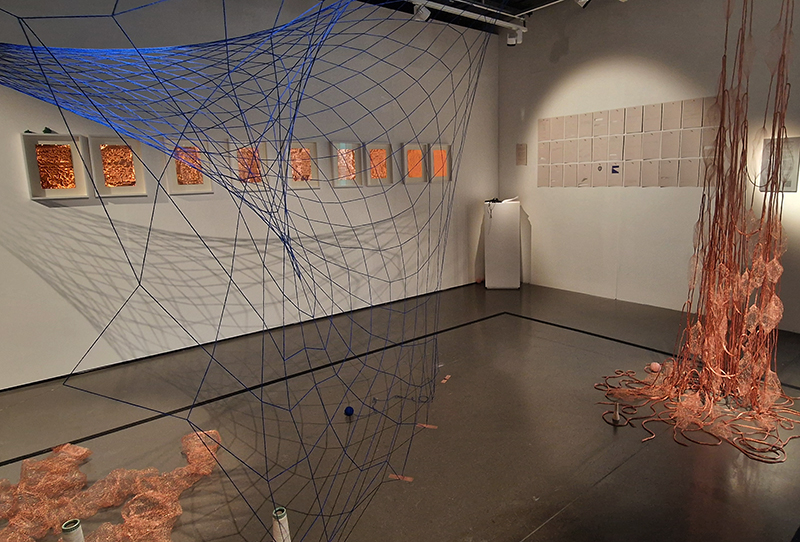
Quantum Untangled at The Science Gallery, London. I liked the simplicity of Alistair McClymont’s An Early Universe where wave patterns caused in water by low frequency sound vibrations are projected via a lens to reference quantum oscillations created when the universe was rapidly expanding after the big bang. Two large installations from Conrad Shawcross use the play of shadows to signify intangible forces of the universe. In Ringdown two caged spherical pendulums oscillate in violent motion to evoke the spiralling motion of gravitational waves in the moments after two black holes merge, a phase known as ‘ringdown.’ The artwork is probed with sensors to trace the magnetic field generated, which is displayed on a monitor. The Blind Proliferation explores the idea that our Universe is one of many co-existing ‘bubble universes’ formed in the period of rapid expansion at the beginning of time. Two ‘scientist’s offices sit either side of a structure casting complex shadows. In a nod to Plato, the scientists can only see the shadows from which they must determine their origin. There are slight differences between the two offices to suggest the idea of the multiverse where many worlds may exist with only slight variations. Daniela Brill Estrada & Monica C. LoCascio, Begriff des Körpers reflect on the nature of perception and shared understanding through their use of copper, a key material in quantum technologies, to create sculptures that describe the diagrammatic language of scientists when explaining spacetime and quantum phenomena.

It is always exciting to enter a truly dark space – NOWISWHENWEARE (The Stars) at the Rambert Dance Studios as part of the LFF Expanded program promised a breath-taking journey through light and sound when you would enter a meditative state and come face to face with your inner self. With nearly 4,000 reactive LED lights and a 496-channel soundscape it was an enjoyable experience but perhaps not quite as awe inspiring as hoped.

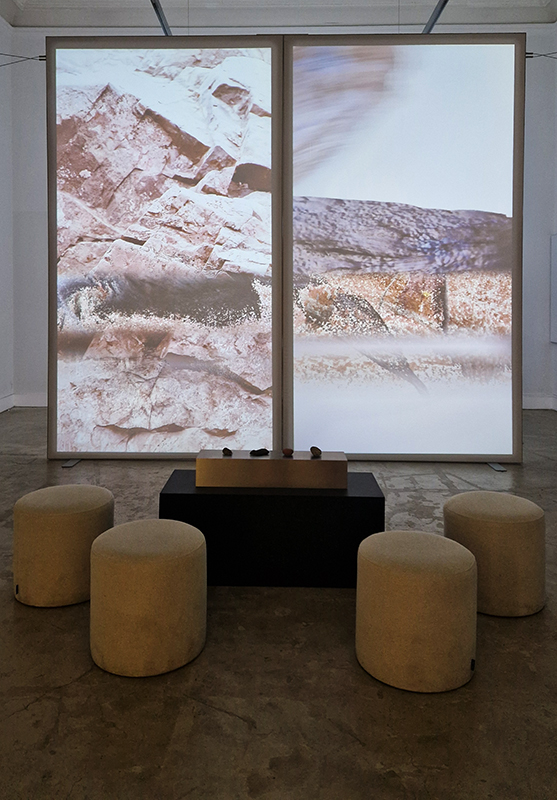
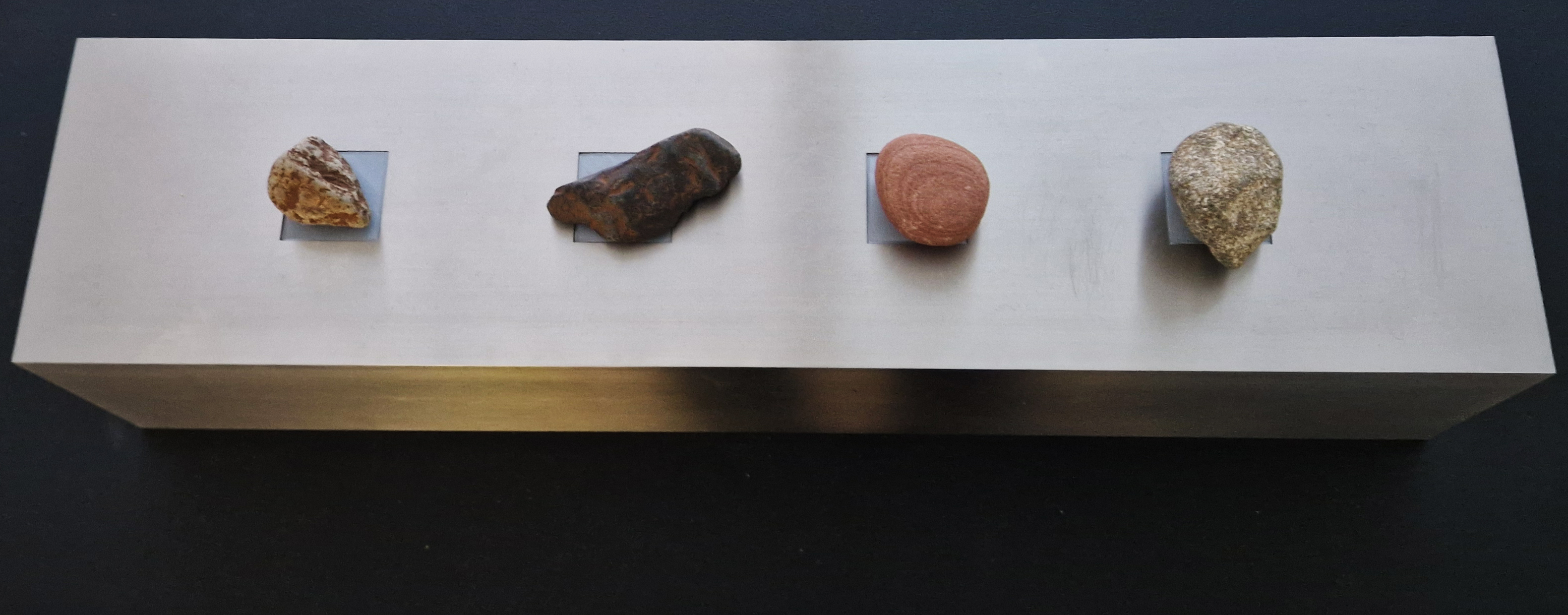
(S)low Tech AI by Studio Above & Below (Daria Jelonek and Perry-James Sugden) at Victoria and Albert Museum. ‘This installation examines artificial intelligence through the lens of geology. A sculptural interface of four rocks activates a slow, responsive AI system that reacts to touch with evolving sound and image. Each new rock arrangement adds a line to a growing digital landscape, echoing sedimentary layers shaped by collective interaction. The imagery is drawn from four geologically significant sites in Scotland, where ancient stone carvings show early examples of symbolic data recording. Using simple algorithms, the work invites reflection on AI as a slow, ethical, and materially-aware process.’ I couldn’t determine what changes were set in motion when the stones were moved, it does say it is a slow process so perhaps I shouldn’t have expected to notice the impact of my moving the stones and it is something that builds into the algorithm later. It was still quite mesmerising to watch.

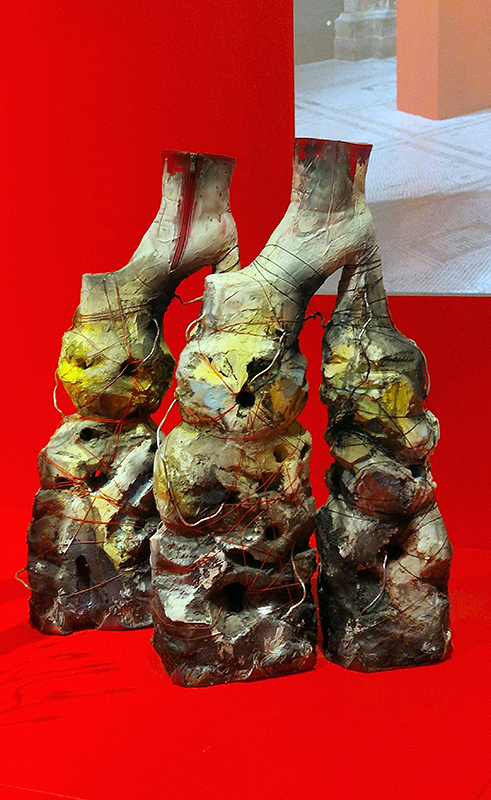
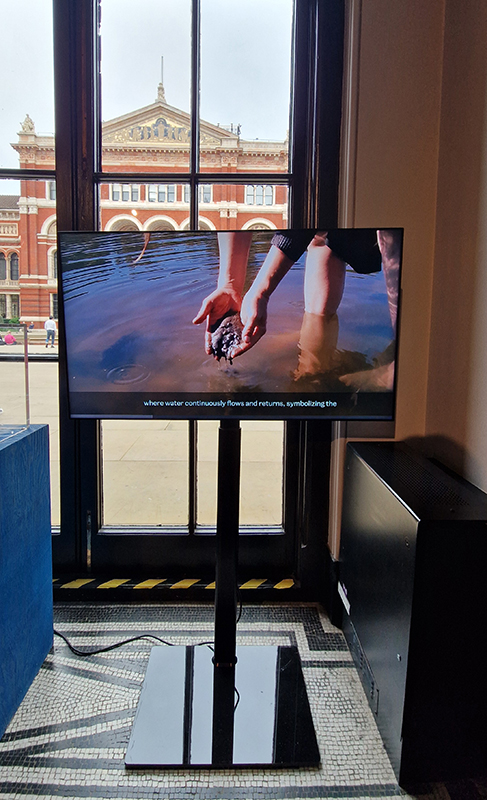
Luca Bosani Unidentified Performing Objects at Victoria and Albert Museum

Loved these boots that look like they have been torn from the rock. Magnes might have felt a slight tug as the nails in his boots clung to the magnetite beneath his feet but imagine the weight, the feeling of increased gravity walking in boots of rock.

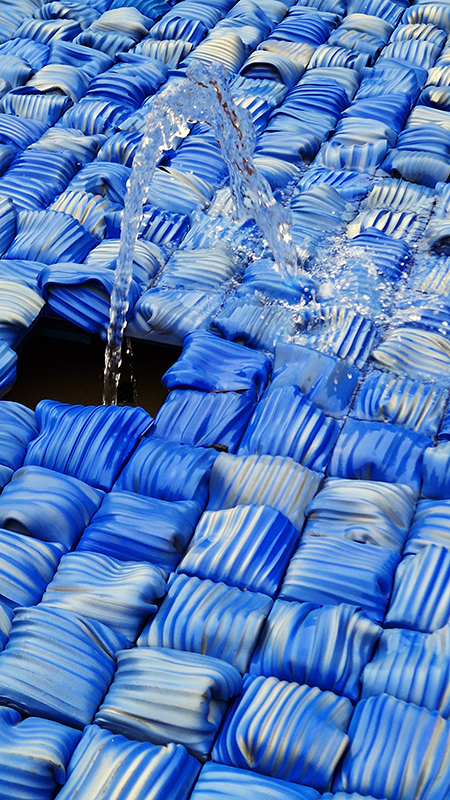
The Ripple Effect by Alicja Patanowski blending materials from one of the largest mining waste reservoirs in Europe with clay to create a tiled seating installation in the John Madejski Garden.

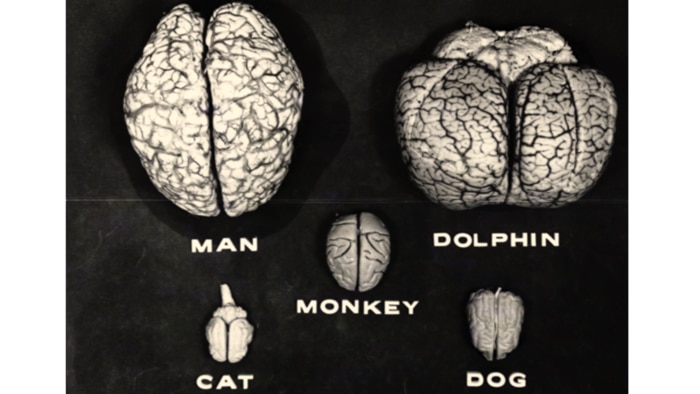
Screening as part of the London Film Festival, John Lilly and The Earth Coincidence Control Office directed by Michael Almereyda and Courtney Stephens, explores Lilly’s radical experiments with isolation tanks and LSD to study consciousness, as well as his theory that a hidden entity called the Earth Coincidence Control Office (E.C.C.O.) secretly influences human events. Despite his desire to communicate with cetaceans believing them to be intelligent conscious beings he exhibits a cold disconnect to their physical and emotional welfare. A lot of the footage is shocking to a contemporary audience in its cruelty but his research into human consciousness was trailblazing at the time and his conclusion that humans were at risk from an outside technology based intelligence does have some prescience considering current concerns over AI.

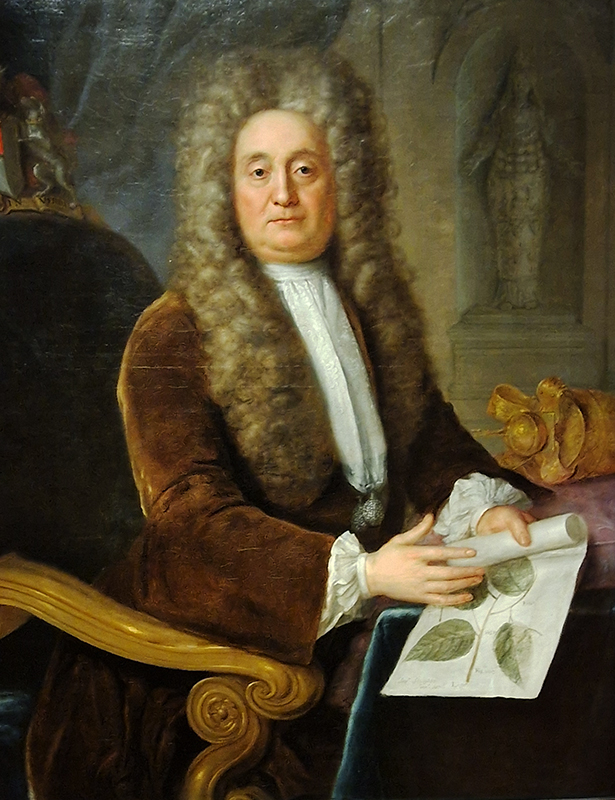
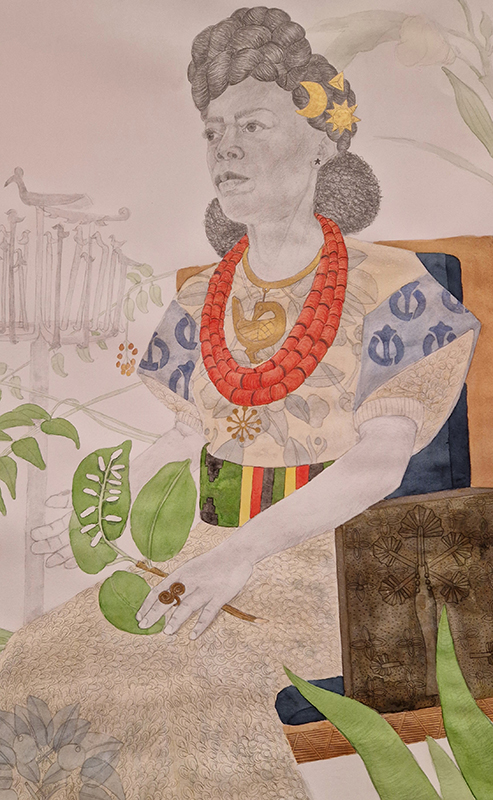
Artists First: Contemporary perspectives on portraiture at The National Portrait Gallery commissioned several artists to respond to an artwork of their choice. Charmaine Watkiss chose the portrait of Sir Hans Sloane, a botanist and collector who travelled to Jamaica in 1687 taking advantage of enslaved people’s indigenous knowledge of the location, properties and medicinal uses of local plants to boost his collection and furnish his publication. Charmaine’s beautifully crafted response To reimagine an African Queen shifts the dynamic to reflect the dissonance between these two human’s relationship to nature, one built on wisdom and respect and one which based on extraction and mastery.

Reading

The Stone Woman by A.S. Byatt. An evocative journey into becoming other.

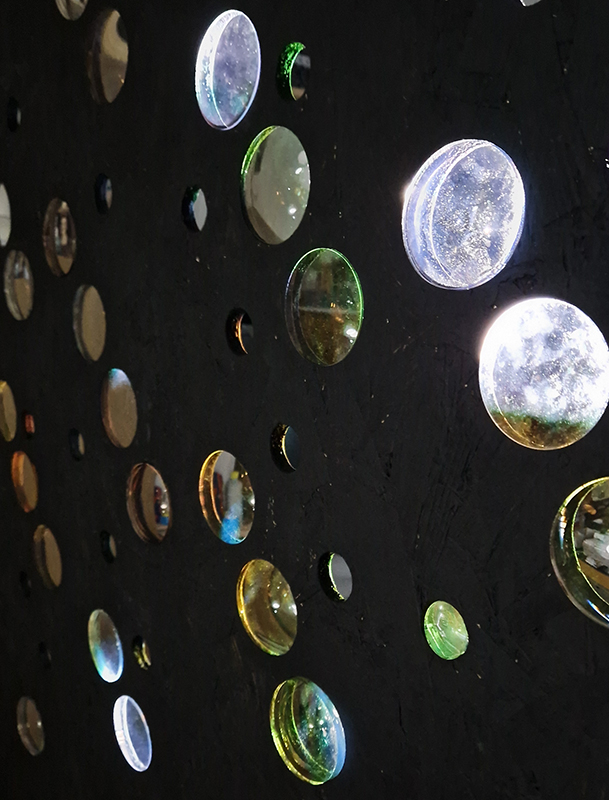
Work continues on ‘mineral visions’ testing projecting through a variety of optical lenses set in a pattern reflecting the crystal structure of magnetite. Magnetite is a mineral we are very intimate with. It is in our cells, in our brain but this delicate balance is being disrupted as magnetite crystals from air pollution now outnumber natural magnetite in the brain by 100:1. The full consequences of this imbalance are not known yet but it could be implicated in neurodegenerative disease like Alzheimer’s.

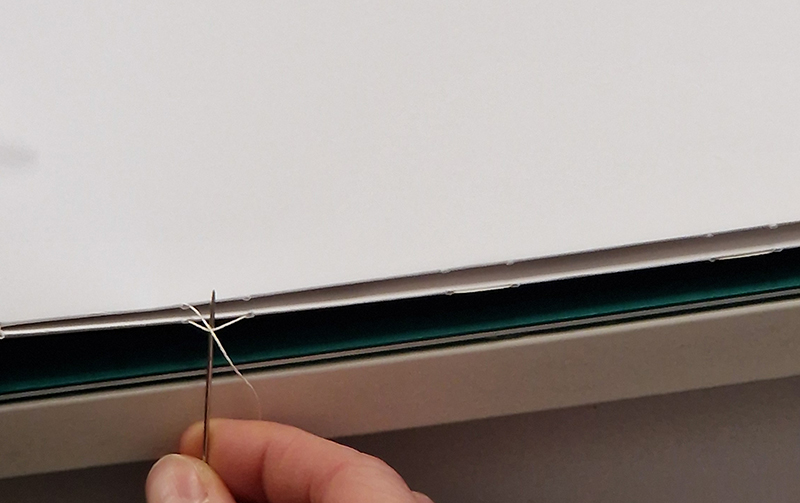
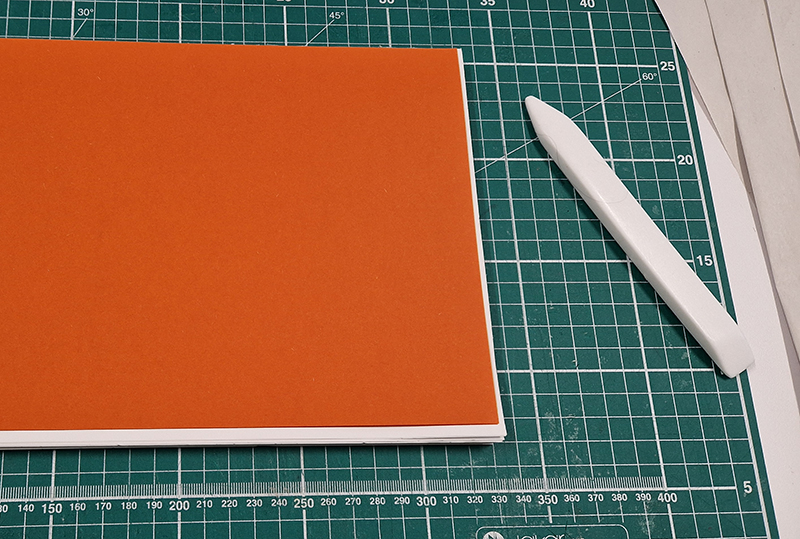
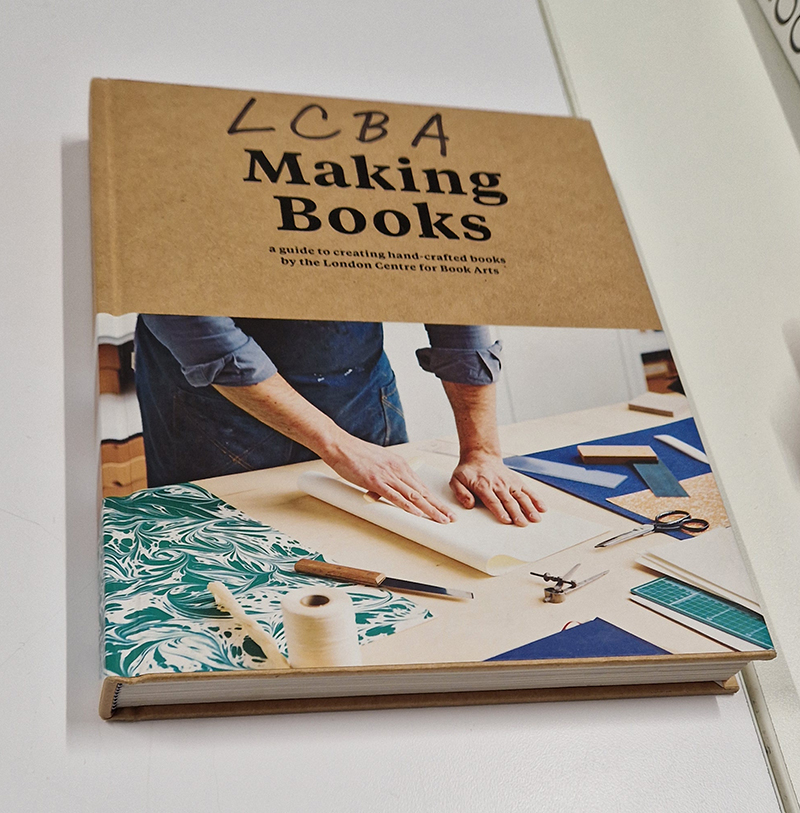
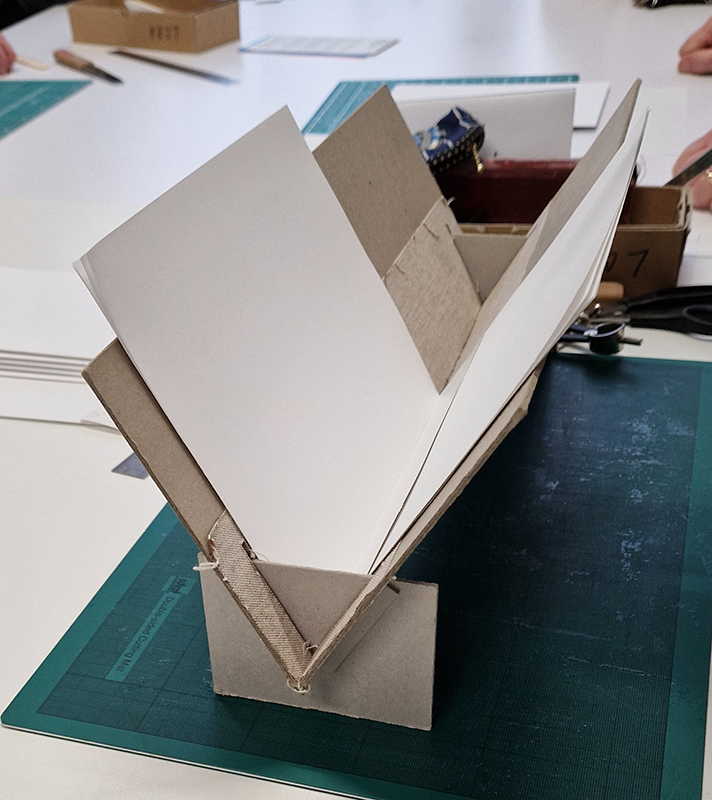
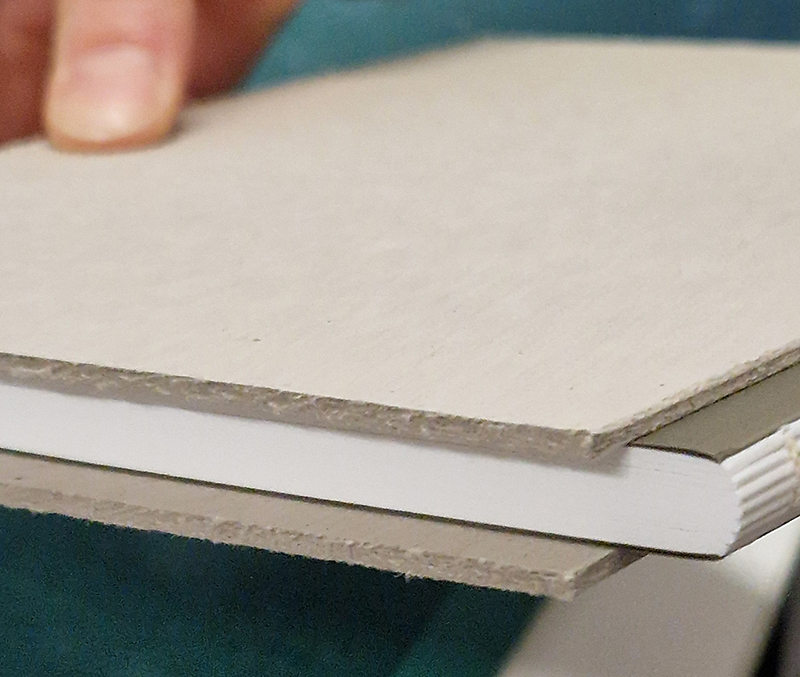
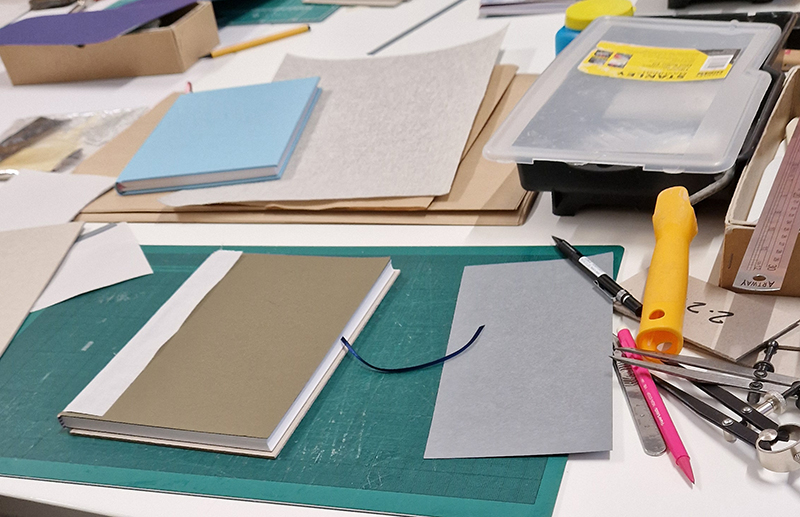
I spent an enjoyable day at London Centre for Book Arts learning how to create a classic full cloth-covered case bound book with a rounded spine. I hope to have picked up some skills here which I will use to make a sculptural book embodying the history of magnetic field reversals stored in the minerals of lava beds on the ocean floor.

Studio visits

Julie F Hill and I had been in contact with writer/producer/curator Ariane Koek since our duo exhibition The Stone Sky at Thames-side Studios Gallery which she had been unable to attend, but with her interest in physics, geology and cosmology had suggested we keep in touch. We finally had the pleasure of meeting Ariane at Julie’s Bomb Factory Studio and were able to share some of our plans for our upcoming show The Geological Unconscious which we are co-curating at Hypha HQ this spring.

It was so good to meet curators Maria Hinel and Indira Dyussebayeva-Ziyabek at my studio to discuss their upcoming project inspired by the essay on carbon in Primo Levi’s The Periodic Table. Levi weaves a story following a single atom of carbon as it is transformed through the many relationships and bonds made with other atoms, moving from rock to atmosphere to living organism and back to mineral.

Gallery visits

Exhibition research trip to Exeter with Julie to see Dartmoor: A Radical Landscape at the Royal Albert Memorial Museum & Art Gallery. Artists include: Fern Leigh Albert, Jo Bradford, Chris Chapman, John Curno, Robert Darch, Siân Davey, Susan Derges, Robin Friend, Ashish Ghadiali, Alex Hartley, Nancy Holt, Laura Hopes and Katharine Earnshaw, Richard Long, Garry Fabian Miller, James Ravilious, Tanoa Sasraku, David Spero, Nicholas J R White, Marie Yates.

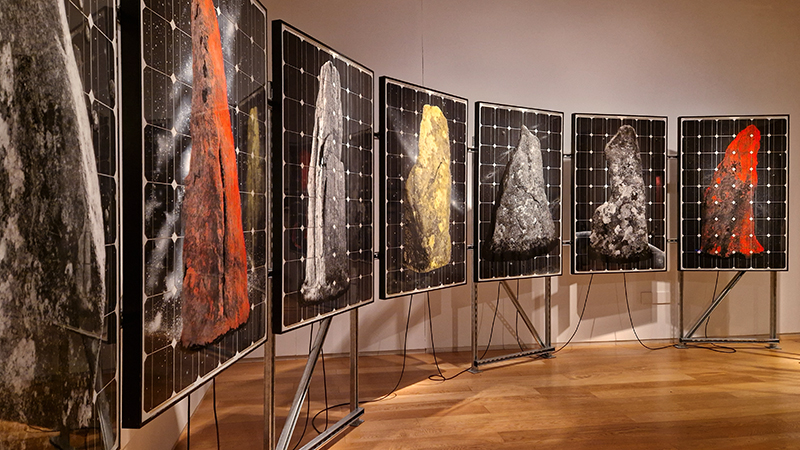
I was particularly interested in seeing Alex Hartley’s, The Summoning Stones, which is a series of hand coloured prints of standing stones embedded into recycled solar panels. Aiming to bring together ancient and contemporary ways of engaging with the sun they are positioned to put the viewer in the centre of a magical arc of energy; the contemporary may have the bias here and the ancient magic dispersed in the gallery setting but I still enjoyed the aesthetic. The works felt rather cramped in the space. There was a lot of photographic work documenting artist’s interest in the moor from the 60’s/70’s onwards and several prints using the process of dye destruction (luminograms) which I was unfamiliar with, such as those by Gary Fabian Miller – this is a photographic printing process in which colour dyes embedded in the paper are selectively bleached away (destroyed) to form a full-colour image. The papers used in this process are no longer manufactured and Miller spent a year creating one direct long exposure to paper luminogram every day as a reflection on time passing. Extraordinary fluid images from Susan Derges were a highlight.

A luminous intervention of glass Specimens from an Imaginary Voyage by Steffen Dam in the main collection at RAMM.

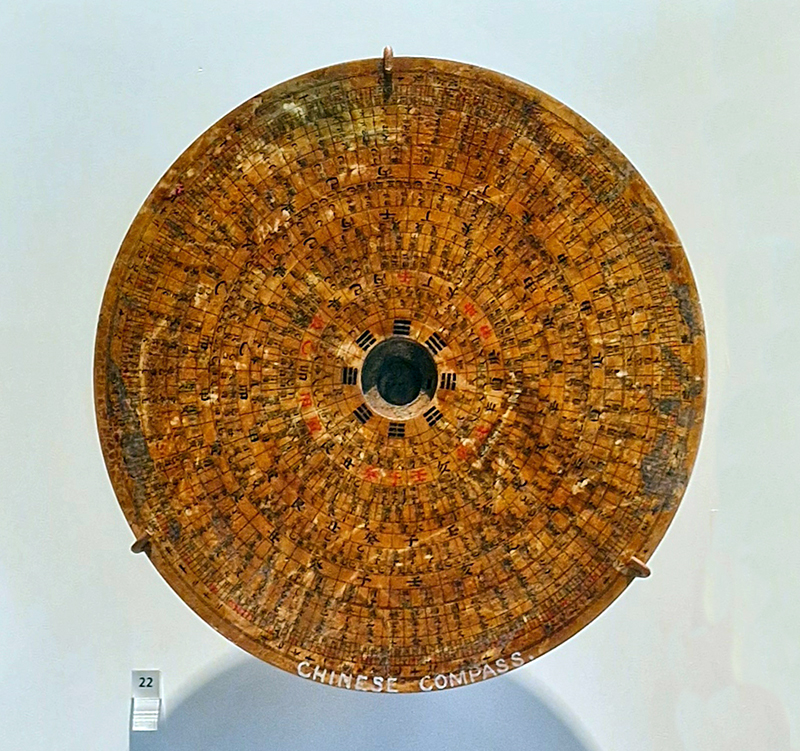
This splendid Chinese Compass, Lo P’an, also spotted at Royal Albert Memorial Museum, Exeter – used more for alignment of positive energy than navigation.

In Scope at Hypha HQ, Euston curated by James Grossman. An exhibition examining nested systems in nature, there were some fascinating symbioses of technology and natural materials such as live algae prints and sculpture capturing the tidal forces of the Thames estuary. Images 1-3 Alexander Clarke, 4 Will Laslett, 5-7 Kerrie O’Leary, 8 Star Holden, 9-10 James Grossman, 11 Peter James Nasielski, 12-13 James Grossman + Peter James Nasielski, 14 Hanne Peeraer

Great to see Sophie Mei Birkin’s Vestige in Joining Doggerland at APT Gallery. A semi-translucent, glittering, crystal encrusted form suspended like messenger from both the past and the future – a reminder of what once was and what might be.

Citra Sasmita Into Eternal Land at Barbican The Curve. Having turned my hands and kitchen yellow recently grating fresh turmeric I understand why this circle of turmeric powder in the meditation zone was so closely invigilated. A calm scented area after walking the curve of colonial atrocities.

Mike Kelley Ghost and Spirit at Tate Modern. Sublevel (1998) is a model of the basement of CalArts, where he had studied in the 1970s. The spaces that Kelley couldn’t recall from memory are lined with pink crystal resin. The work stages a site of hidden memories and repressed desires, underscored by the symbolism of the pink coloured crystals, as Kelley explained: Because, as everyone knows, regardless of meaningless, exterior coloration, it’s all pink inside. Janelle Monae would agree and regardless of honourable/ironic sentiments employed the aesthetics left me feeling a bit like I’d time travelled to a seedy fairground scenario.

Glad I made it to see UBIK Hypha Studios at Sugar House Island from the Changeable Beast sculpture group. Inspired by the eponymous Philp K Dick novel, the artists invite viewers into speculative narratives of alternative futures. Images left to right: Weeping Willow Ellie Reid, Untitled (from the series ‘You Follow Me Around’) Ellie Reid, Things Said Susan Young, Return of the Dinosaurs Ornela Novello, Sunspots Tessa Garland, Timebeing Diana Wolzak, Inertials Clare Jarrett, Broken Nights Kay Senior

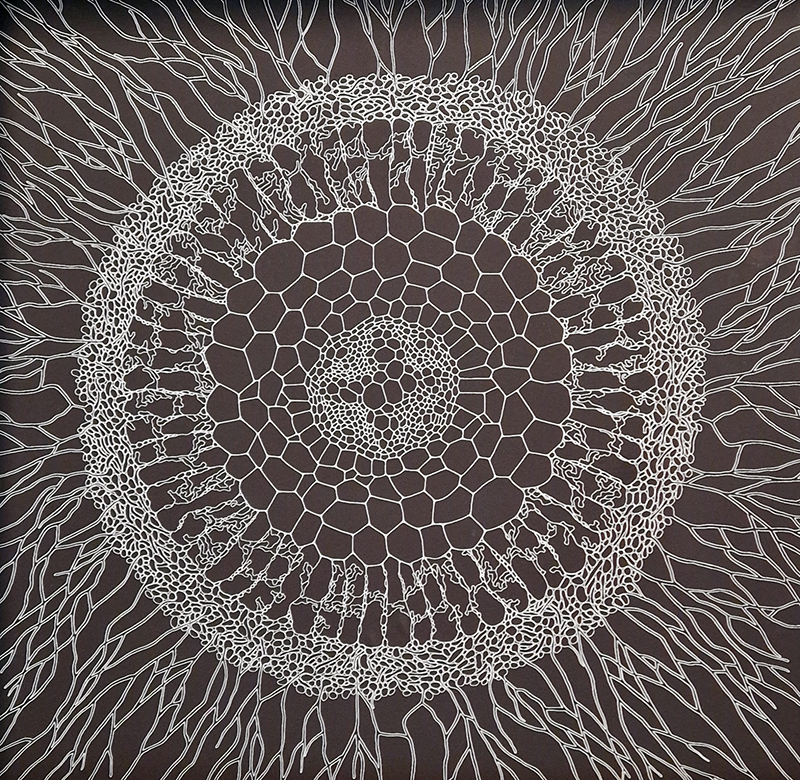
Soil: The World at Our Feet at Somerset House. As it says on the tin – the exhibition sets out to inspire and educate visitors about the power and the fragility of soil, its fundamental role in human civilisation and its remarkable potential to heal our planet. There is so much educational text that the bias of the experience veers towards the didactic. A lot of worms and impressive time lapse video – both of which I like very much and there are some interesting works here but after been slammed with so much ‘fact’ and repetitive tropes it becomes a bit wearying, which is a shame. Sam Williams Wormshine seven channel video collage had a fitting sensitivity to worms as unsung heroes of soft power. Maeve Brennan roman soil with microplastic contamination gave stark evidence of a toxic legacy leaching through the water table to infect roman artefacts. Diana Scherer has woven an intriguing substrate using natural growth processes to generate structures from root tissues. I was interested to see how microscopic soil bacteria can have the appearance of agate and a cross section drawing of a root reminded me of my Mum’s crocheted doilies.

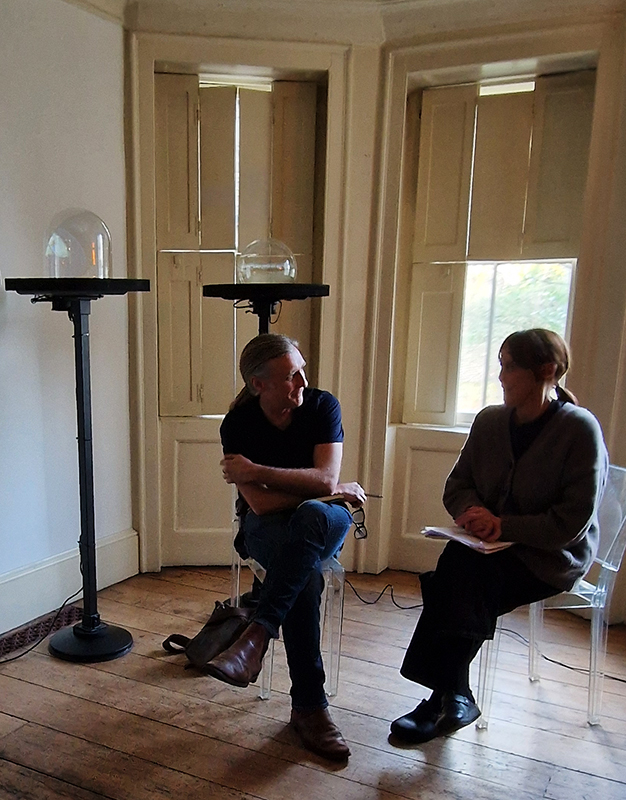
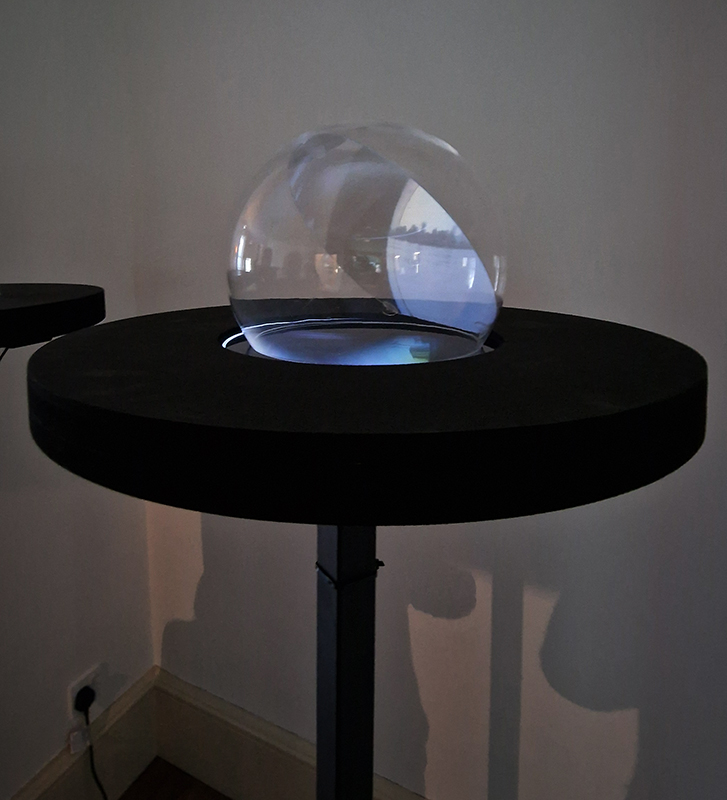
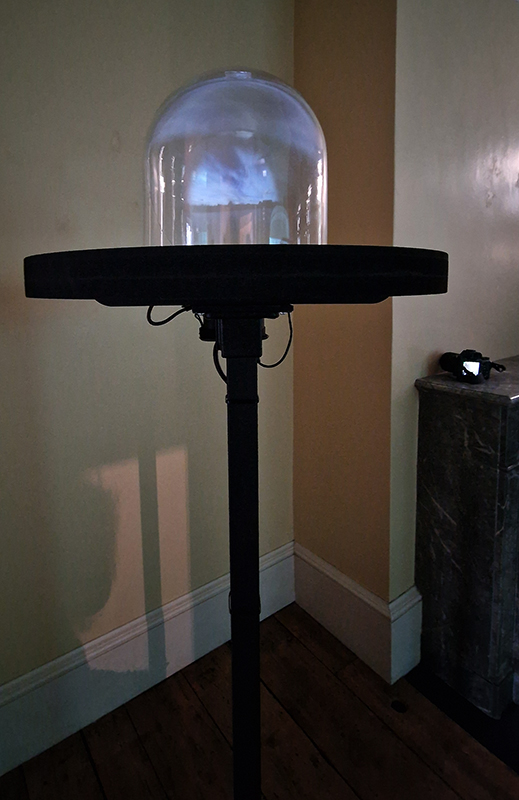
David Cotterell in conversation with Amanda Crawley Jackson, (LCC Professor of Place and Culture / Dean of Research and Knowledge Exchange), at Danielle Arnaud discussing the exhibition and underlying themes of the sublime, suburbia, estuaries, deserts, and human inconsequentiality. Albert Camus’ absurdism philosophy was referenced in respect of the inability to know the world and the world’s indifference to human attempts to even try. David has visited and documented some amazing wide open landscapes of Afghanistan and Mexico where the sublime is inherent in the experience of isolation, vulnerability and awe. We see these in the projected works here. The choppy expanse of the Thames estuary is encapsulated into spherical and domed microcosms, like seeing visions in a series of crystal balls set at eye/brain level – so also a bit like peering directly into the mind’s eye. He expressed the desire to share the experience of being in these landscapes – I think he did share the wonder. He also talked about his visit to Donald Judd’s sculptures in Marfa, Texas where even megalithic sculptures are overwhelmed by the scale of the environment and the milky way is not beyond, but within touching distance.

Events

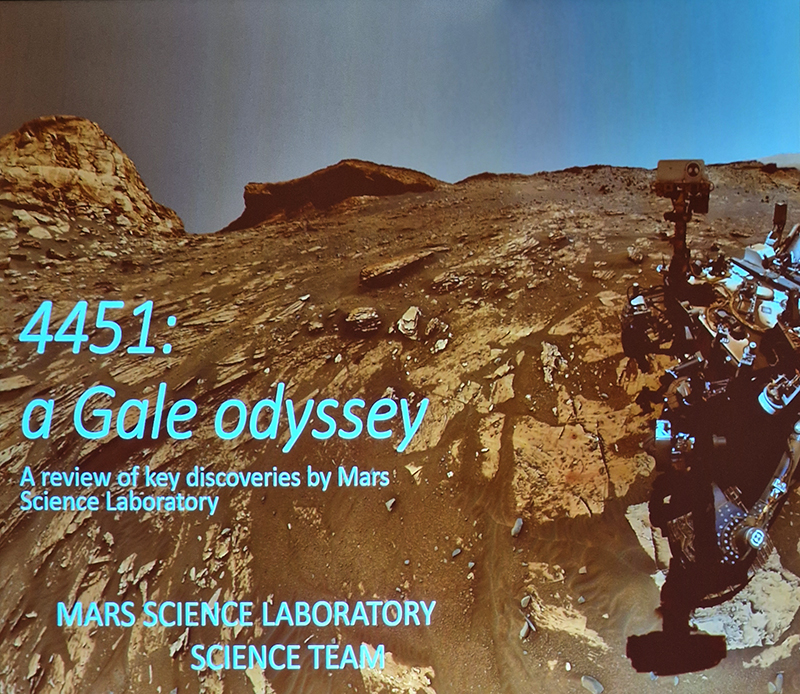
Royal Astronomical Society Friends Lecture from Dr Steven Banham, Imperial College London. This was an in depth reveal on the geology of Mars. The Mars Science Laboratory mission’s Curiosity rover landed in Mars’ Gale Crater in August 2012. About the size of a MINI Cooper, Curiosity is equipped with 17 cameras and a robotic arm containing specialized instruments. It has explored the northern margin of Mount Sharp for 4451 Martian sols providing compelling evidence that shortly after crater formation, a habitable environment existed here. The rocks that form lower Mount Sharp preserve a record of persistent lakes fed by fluvial systems originating from the crater rim. As the rivers entered the lake, they released plumes of sediment and assorted nutrients into the water column to be distributed across the lakebed — recorded as the Murray formation. Geochemical and mineralogical assessments indicate that environmental conditions preserved in these layered rocks would have sustained life, if it were present. On Sol 3047, Curiosity made a sharp right turn after crossing the phyllosilicate unit, to drive up into the orbitally-defined sulphate-bearing unit. From this point, Curiosity witnessed distinct changes in the stratigraphy, recording a progressive drying of the ancient environment. The rover identified a gradual change from humid conditions containing a record of perennial lakes, to isolated ephemeral lakes, and onto desolate deserts. During this ascent, interstratification of aeolian strata became increasingly common, including sand sheets, dune strata and deflation scours. However, despite this general aridification, the succession was occasionally punctuated by episodes of abundant water: the Amapari ripple bed for example, records a brief shallow lake: a veritable oasis, free of ice.

I travelled to Manchester to see Figures in Extinction, a dance trilogy exploring the age of disconnection. A beautiful, haunting and sobering collaboration between choreographer Crystal Pite, NDT 1 dancers and Complicité director Simon McBurney. The first section confronts the extinction crisis and climate change deniers, listing the last of each species vanishing from our world; the second section addresses human isolation in a world dominated by technology and data, the divided brain where the intuitive side of our brain has not been nurtured leaving the rational unempathetic side to be dominant, and the final section draws our focus to death, physical decay of the body and grief, urging an honouring of our ancestors – the dead, having lived are not inert. The lighting throughout was amazing but particularly extraordinary in the closing scenes as ethereal spectres swarm the stage. The dancers, so precise in their movements delivered a hugely emotional homage to life on Earth.

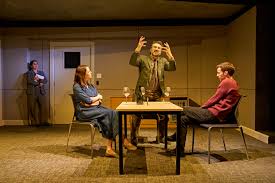
East is South by Beau Willimon at Hampstead Theatre. There was a lengthy monologue on equivalence in this fast paced play projecting a future where AI or AGI (Artificial General Intelligence) learns to take on the experience of faith over logic. Two coders stand accused of releasing a dangerous AI to infect processors globally. Their motivation interrogated as potential spy or subject to religious cult beliefs. “God didn’t create the universe,” it may be “the universe’s project to create God.” After all, if Agi escapes to colonise the internet, knowing everything about everything, and having power over everything, wouldn’t “she” become our “God?” With personal memories questioned as truth as much as being duped by others for their own ends, there is no clear path in a complete breakdown of trust and authority. I see this play has had a lot of bad reviews – it is dense with ideas and maybe the interrogation format is not new but it has a lot to say that is relevant.
Speculating on a view of the world projected from the perspective of the rock. In the studio drilling more holes for optical lenses set out in a pattern based on the crystal structure of the naturally magnetic mineral magnetite which was determined in 1915 as one of the first crystal structures to be obtained using X-ray diffraction. Found in igneous rocks, sedimentary deposits and sand across the globe in many locations, magnetite is also found in the cells of organisms from bacteria to humans. Magnetite contains both ferrous (divalent) and ferric (trivalent) iron along with oxygen.

Testing projecting through the optical lenses I’m excited to see how the different lenses cause images to overlap and distort.

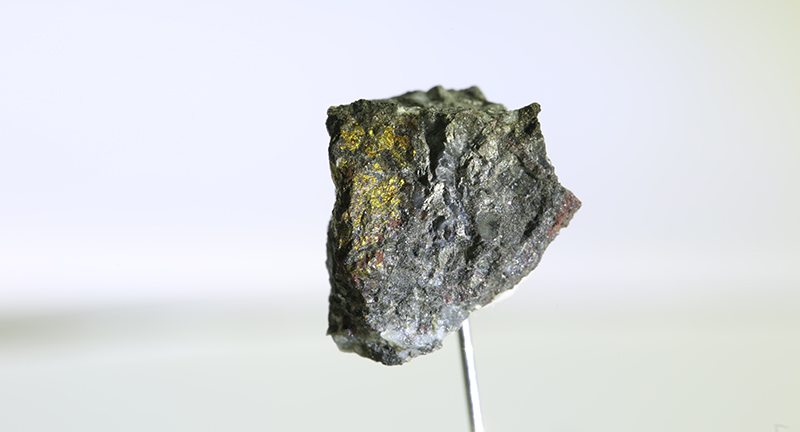
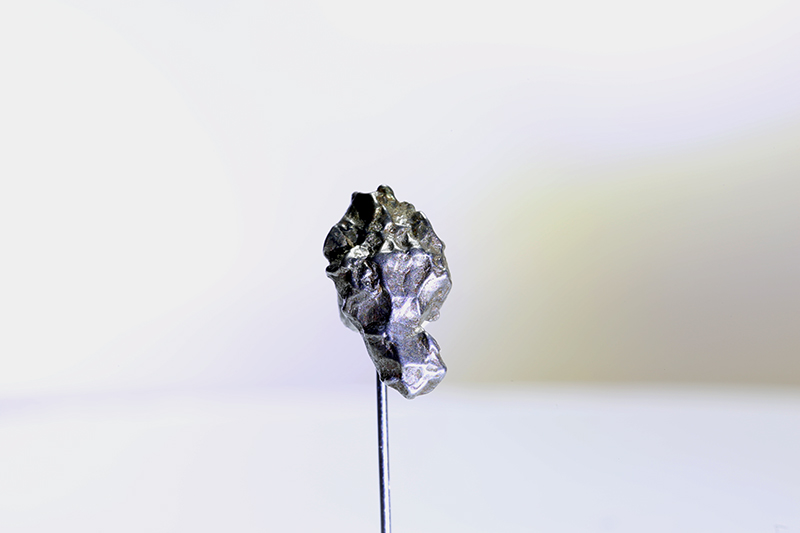
I received a Digital Microscope for my birthday and a selection of rocks and meteorites to look at. So far I have only used the lens with the least magnification capabilities yet this is revealing wonderful detail in the rocks which are further enhanced by using a polarising filter. I have chosen to look at rocks which originate near areas of tectonic activity or that may have magnetite in them.

Images on left have no filter, those on the right have a polarising filter.

This thin slice of Deep Ocean Pebble was collected in 1979 three miles deep in the Pacific Ocean Clarion Clipperton Fracture Zone. This zone is regularly considered for deep-sea mining due to the abundant presence of manganese nodules. In 2016, investigation of the seafloor in the zone was found to contain an abundance and diversity of life – more than half of the species collected were new to science.

This slice of Lewisian Gneiss is 3 billion years old. These ancient rocks from the Isle of Lewis were caught up in a mountain building cycle roughly 490–390 million years ago and were pushed above younger rocks formed during the late stages of this tectonic event.

This slice of Olivine Basalt comes from Þingvallavatn, a rift valley lake in southwestern Iceland. The area is covered by lava. The cracks and faults around the lake is where the Eurasian and North American tectonic plates meet. This may be the only place where one can stand with two feet on two different tectonic plates. The sample is a mid oceanic ridge basalt (MORB) fine grained but consisting of small olivine, clinopyroxene fragments in ground mass dominated by plagioclase laths, an opaque magnetite.

This slice of Vesicular Basalt Lava – a type of lava that solidifies into a rock with trapped gas bubbles leaving small holes as the lava cools, comes from the Mid Atlantic Ridge near the Azores Islands.

I also have a piece of Jepara taken from a pallasite, a class of stony–iron meteorite, discovered in Indonesia in 2008 during building excavations. The outside is heavily weathered but when cut and polished the inside reveals a translucent structure of densely packed olivine and magnetite. The sample has been coated with acrylic which has surface scratches so I think some of the detail has been compromised but it is still beautiful. No filters used here.

I am making use of public access to historical magnetograms recording of Earth’s magnetic declination to feed into new work inspired by palaeomagnetism. Magnetic studies of the ocean in the 1950’s had determined that the ocean floor was covered by bands of magnetic stripes that varied between normal polarity and reversed polarity. The Earth’s magnetic field has reversed polarity many times over the past hundreds of millions of years. These magnetic stripes were found to be symmetrical on the ocean floor about the mid-oceanic ridge. In 1963 British scientists, Fred Vine and D. H. Matthews proposed that the magnetic striping was caused by paleomagnetism, the storing of Earth’s ancient magnetic field in the sedimentary rocks that were forming as lava spewed up and spread across the ocean floor setting the history of pole reversals in stone.
I have embarked on some crystal growing experiments using a seed crystal in a saturated solution of mono-ammonium phosphate and aluminium potassium sulphate. I am hoping these might become objects to view through a lovely old wooden magnifying box I have. The last time I experimented with crystals was when I was amazed by the speed and glut of salt crystals overwhelming the test area. Before that made a time lapse video over 5 days of crystal growth for the installation Time Crystals in Reading Stones at St. Augustine’s Tower 2019. I will be learning more about this as workshops are developed for The Geological Unconscious public engagement programme which will run alongside the exhibition at Hypha HQ Euston this coming spring. Both Julie F Hill and Sophie Mei Birkin work with crystal structures and growth in their own practices and will be leading on the workshops we will run in partnership with a local primary school.

A crystal is like a class of children arranged for drill, but standing at ease, so that while the class as a whole has regularity both in time and space, each individual child is a little fidgety. Dame Kathleen Lonsdale, 1948

Had some studio fun testing the possibilities of magnetic putty for future video ideas. Mesmerising the way it very slowly swallows the magnet.

I began the magical process of making copper ink. Soaking pieces of copper in vinegar and salt, stirring daily and watching the liquid turn a milky turquoise blue. Looking forward to using this to patinate copper but also to paint with on paper.

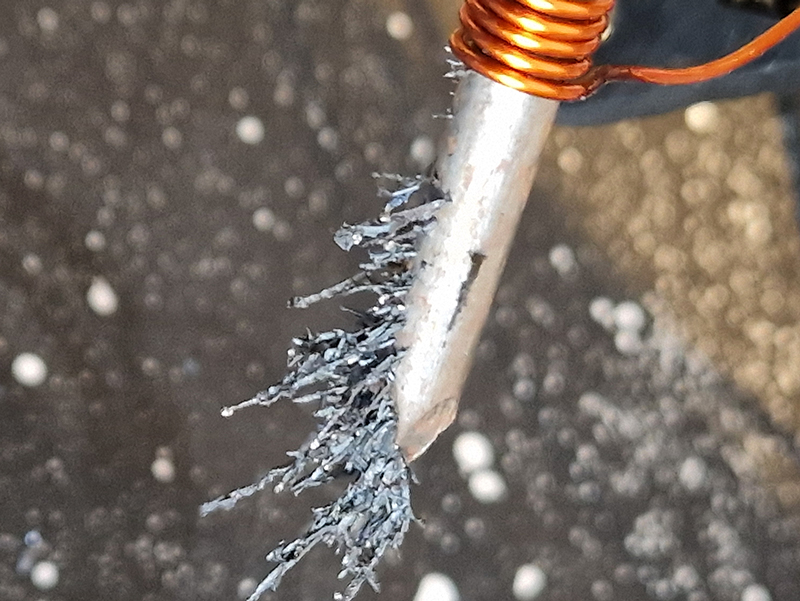
Experimenting winding a copper wire around an iron nail and connecting the wire to a battery cell. A magnetic field is generated around the nail which stays for a little while after the nail is removed from the coil. I used a 9v battery and large nail– it wasn’t a very strong magnet – a welding stick was better and seemed to retain the magnetic field for longer but in both cases the battery got very hot. I had hoped to maybe develop this idea to magnetise a sculpture threaded with iron. Needs more investigation.

I have been exploring the updated Digital Materials Library at the Institute of Making which led me to the Mindsets website which has some cool magnetic materials for sale. Future experiments upcoming.

Exploring paper weaving patterns with a view to reinventing past works while thinking about ideas of cosmic planes in The Rosicrucian Cosmo-Conception, a 1909 text by Max Heindel. This text, setting out a theory of seven Worlds and seven Cosmic Planes, supposes an intermingling of spirit with matter where the intersection of the material and metaphysical world are not one above another in space, but inter-penetrate each with the other.

Astonishing that the preserved remains of the ancient kauri trees of New Zealand, alive over 42,000 years ago, can reveal the time of the last significant magnetic pole excursion within their rings. During what is known as ‘The Laschamps Excursion’, the north and south magnetic poles swapped places for about 500-800 years before swapping back again. During a magnetic pole reversal the magnetic field weakens so many more cosmic particles reach the surface of Earth. This means much more Carbon-14 is produced in the atmosphere and absorbed by plants.

Changes in radiocarbon levels were recorded from four ancient kauri logs found buried in peat swamps which seals them in a chemically balanced environment. Through high precision carbon dating processes at the University of Waikato in New Zealand the scientists discovered the most dramatic time was the lead-up to the reversal, when the poles were migrating across the Earth and our magnetic field practically disappeared, leaving life here very vulnerable to cosmic radiation. It appears, this weakening 42,000 years ago, in combination with a period of low solar magnetic activity – captured in evidence from ice cores, caused damage to the ozone layer and disrupted atmospheric conditions impacting the global climate so that devastating environmental changes took place. The research team links this climate change to extinction events which occurred at the same time, Neanderthals vanishing from Europe, and a proliferation of cave paintings appearing in Europe and Asia as humans find shelter from the turbulent weather and increased electrical storms. They have dubbed this period of excursion ‘The Adams Event’ in honour of Douglas Adams who wrote in The Hitchhikers Guide to the Galaxy that ‘42’ was the answer to life, the universe, and everything

Studio Visits

Julie F Hill and I have been visiting the other artists participating in the upcoming exhibition The Geological Unconscious at Hypha HQ Euston. We are so happy to be working with Charlie Franklin who considers control, physical experience and memory within the natural landscape, Deborah Tchoudjinoff who considers what the form is through the process of material and visual experimentations, Rona Lee who centres on the politics and aesthetics of Geo-materiality along with the human /more than-human entanglements of contemporary life and Sophie Mei Birkin who investigates the generative potential in the transformation of matter through a variety of material processes such as growing salt crystals and exploring amorphous and decomposing substances.

I have also been lucky to have Charly Blackburn and Victoria Rance visit my studio to chat about our respective work and shared interests. Charly is beginning a period of research into rare earth materials and extractive processes and we share a fascination with things magnetic. Victoria came to chat about our shared interest in the sun but is also interested in magnetic fields and the potential they offer for brain to brain communication.

Gallery Visits

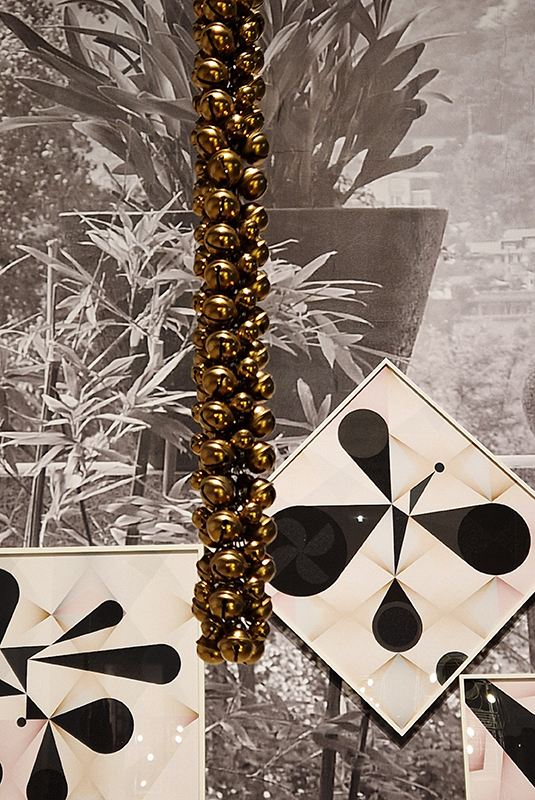
Haegue Yang Leap Year at Hayward Gallery. With colourful works festooned by garlands of bells and strewn with fairy lights this was a perfect show for the festive period. Folklore, surrealism and ritual, collage and costumes combine with the modern domestic/utilitarian in hybrid works that have a playful carnival air.

Thoughtful works beautifully presented Each Place Its Own Mind at Edel Assanti with Mirtha Dermisache | Noémie Goudal | Sky Hopinka | Anna Hulačová | Marguerite Humeau | Bronwyn Katz | Kat Lyons | Yukultji Napangati | Emmanuel Van der Auwera. An ongoing collective reimagining of our relationship with the living world, rooted in revelations from indigenous knowledge, ecological research, literature, science, and artistic experimentation. Each Place Its Own Mind  borrows its title from ecologist David Abram’s 1996 book The Spell of the Sensuous, which traces the ways the human mind came to renounce its “sensory bearings” in the natural world, visualising a myriad of “lost” faculties that link the “inner, psychological world and the perceptual terrain that surrounds us.”

Damian Taylor Things Past at Thames-side Studios Gallery. These paintings hover on the edge of discovery where content and surface are ambiguous but reward study with tantalizing recognizable glimpses.

Events

A little out of my depth at the A&G Highlights Meeting at The Geological Society where some talks were quite specialised, involving graphs and terminology beyond my understanding. I do enjoy hearing clever people talk though, even if I can’t grasp exactly what they are explaining. A fascinating presentation by writer Nilanjan Choudhury on ‘The Square Root of a Sonnet’, his play which explores the fraught personal relationship between the brilliant Indian-American astrophysicist Subrahmanyan Chandrasekhar and his mentor, Sir Arthur Eddington of Cambridge University who publicly humiliated him at a Royal Astronomical Society meeting 90 years ago to the day. Guardian Article here

Dr Jessica Irving (Bristol University) gave The Harold Jeffreys Lecture on ‘Hearing planetary hearts: seismology of the cores of Earth and Mars’. An engaging speaker, she led us through the milestones of the last 130 years of theories on what is at the centre of the Earth and the discoveries made using seismology.

Dr Chris Lovell (University of Portsmouth) spoke on his research into ‘Accelerated modelling of the entire observable Universe’. I recognised the dark matter simulations and was fascinated by the different views of a galaxy depending on the band of the light spectrum used to observe it.

I joined a sobering Royal Astronomical Society webinar We Need to Talk About Space Junk presented by Professor Mike Lockwood. Our use of space is increasingly limited and threatened by space junk. The concern is that we are heading towards a runaway effect called the Kessler syndrome, in which the debris from one collision causes many others, to the point where space becomes unusable.

I went to see the fast paced RSC production of Kyoto at Soho Place. Welcome to the Kyoto Conference Centre, 11 December 1997. The nations of the world are in deadlock and 11 hours have passed since the UN’s landmark climate conference should have ended. Time is running out and agreement feels a world away. The greatest obstacle: American oil lobbyist and master strategist, Don Pearlman… Set nearly 20 years ago its depressing how little progress was made and we are currently sliding backwards. Would never have guessed it at the time but now am nostalgic for the politics and positivity of the 90’s.

Time to email your MP to join The All-Party Parliamentary Group for Dark Skies. The group’s primary focus is to preserve the night sky within the UK and promote the adoption of dark sky friendly lighting and planning policies. Surprisingly the committee is made up mostly of tories – come on the rest of you!

Go to this link where it is quick and easy to message your MP to act on this important issue.

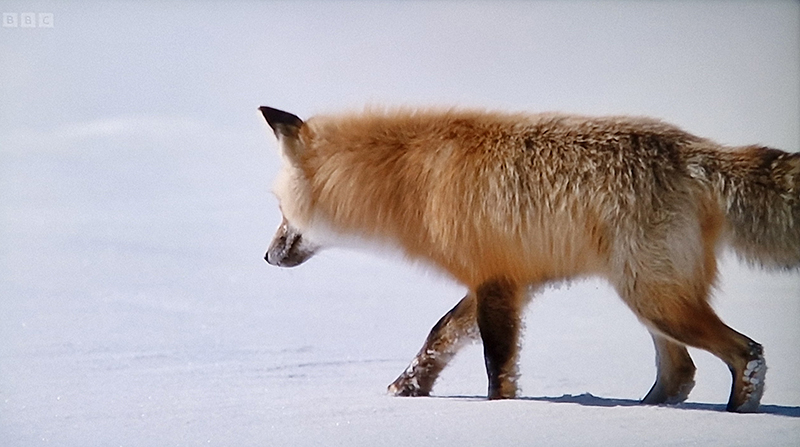
Watching Chris Packham’s The Wonder of Animals – Foxes A red fox catches its prey using more than pinpoint hearing and an accurate pounce: it also involves alignment to the slope of Earth’s magnetic fields. I contacted Peter Hore FRS, Professor of Chemistry and Magnetoreception expert at Oxford University who was so helpful to me before in explaining how birds ‘see’ the magnetic field to see if he had come across any new research on this. He has pointed me in the direction of other research conducted by the group looking at fox behaviour so this is something I will pursue further.

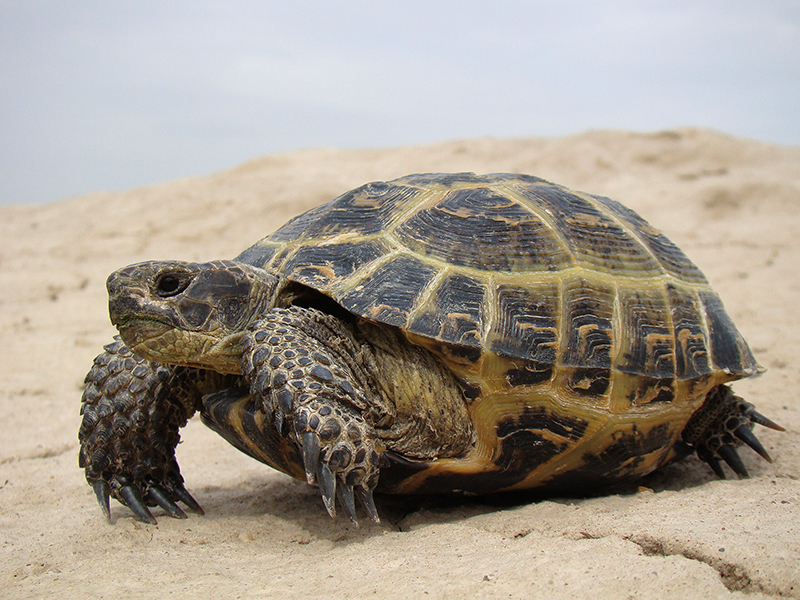
Listening to What? Seriously?? with special guest Helen Sharman, the first British astronaut, about how humans learned to survive in space. Quite a few animals were sent to space before humans including two Russian Steppe tortoises (Testudo horsfieldi), who did a circuit of he moon and returned to Earth – alive but starved. The tortoises were chosen as they have a unique ability in the animal world to resist radiation and their blood may be useful in the treatment of radiation sickness. In recent research a string of amino acids have been extracted from the blood of these tortoises and if you inject those amino acids into other animals they become radiation resistant too.

Listening to The Year in Science 2024 podcast – One of the UK’s first military communication satellites’ Skynet 1a launched in 1969 was abandoned a few years later above Africa. Orbital dynamics should have dragged it out somewhere above India but it has been found wandering above the Americas in a busy area of live satellites and no-one knows why. Space consultants think it must have been commanded to move in the 1970’s but can find no record of this and although research has been undertaken it is still a mystery how this satellite moved. BBC article

There is no mention of a cosmic ray interaction forcing the command, but that would be my theory!

Work underway for the upcoming Reading Stones exhibition with artists Anne Krinsky and Carol Wyss. We will be installing site-specific works in response to the history and architecture of the ancient stone Tower of Saint Augustine, Hackney’s oldest building. Built in the 13th century, the tower houses a magnificent 16th century clock whose mechanisms still strike the hours, occupying three floors connected by steep spiral stone stairs.

1908 clock.jpg

The nature of time itself was a concept that St Augustine of Hippo grappled with in his philosophical texts sixteen centuries ago and is still perplexing us today; namely, how to equate the subjective experience of time with an objective understanding.

I am working on a video which makes reference to the scientific theory of time crystals; a model which proposes a structure that repeats in time, as well as in space.

1908 Time Crystal 2 wip

Patterns used in the film aim to mirror the crystal structure of the mineral beryl, commonly used to fashion the original reading stones which were used to magnify texts before the invention of optical glass. Reading Stones could be considered the first instruments used to create an enhanced sensory experience.

1907 reading stones WIP 1

I am playing with speeding up, slowing down and overlapping events to deconstruct a linear flow of time and interrogate the methods used to measure and experience time. I  spent a couple of nights in remote car parks setting up a time lapse sequence under darkish skies in anticipation of  the Perseids Meteor Shower and was rewarded with my first experience of live meteor action.

1908 perseids

I also think there was a faint glimmer of the Milky Way. These weren’t true dark sky areas but not bad for an hour to two hour drive from London.

1908 milky way

Also set up a time lapse station overnight on the Suffolk coast with the two wind turbine’s in view that dominate the Kessingland village skyline. I was surprised to see how much aerial activity goes on usually unnoticed.

1908 wind turbines

Another times lapse experiment focused on crystal growing over a week period.

1908 crystal growing
Filming slowing down time with a Go Pro set at 240 frames per second to record smashing rocks.

1908 stone smash

I made some earth meteorites to collide with the ground but the results not so great.

1908 earth meteorites

1908 earth collision.JPG

Beautiful light in Richmond Park when photographing the tree clock’s I plan to make into spinning time portals

1908 tree rings

Hot Sunday morning traipsing around a car boot sale for ceramic atrocities to line up for an energy exchange experience.

1908 time is up


A site visit to St. Augustine’s Tower gave me pause for thought over the hanging sculpture I had planned which would possibly be dangerous to attempt. So looking at projecting directly onto the brickwork in that corner instead. This is giving me all sorts of issues over projecting in portrait mode and whether the projector will cope being on its side.

1908 projection test

Testing ideas for a viewing circle on the tower roof.

1908 viewing circle test

Inside the circle will be the image of a rock or meteorite.

I have been auditioning candidates.

1908 rock candidate

1908 meteorite

On the final day of the exhibition we will have extra activities which will include a lithomancy board and the chance to have your fortune told by the fall of the stones.

The act of “reading stones” can refer to both the scientific practice of geological investigation and the ritual of lithomancy which seeks to interpret the patterns of stones cast by those wishing to divine the future.

1908 laboradite

Made a trip to Box Hill Fort for a photo shoot of the artists books I had made for the Insatiable Mind Exhibition. The Fort is one of a line of 13 mobilisation centres built in the 1890’s to protect London from the threat of invasion from continental Europe. Never used for its intended purpose, it is now part of the National Trust Box Hill property and home to three species of bats that have taken up residence in the tunnels originally built for ammunition storage.

1908 old fort box hill

1908 unbound detail

‘Unbound’ depicts images taken from my cloud chamber. A cloud chamber is a supersaturated sealed environment that enables us to see the trails of cosmic rays. These high energy particles know no boundaries, travel at high speed across the universe and continuously pass unseen through us and our world. The twelve pentagons form a dodecahedron, the solid described by Plato as ‘the fifth construction, which the god used for embroidering the constellations on the whole heaven.’

1908 unbound

1908 InOUT detail

‘In/Out’ expresses the energy and randomness of quantum fluctuation as particles pop in-and-out of existence in empty space. At this tiny scale the universe is mysterious and unpredictable. Originating from a large crystal ball which reflects and absorbs its surrounding landscape, the bright spheres act as a series of portals to alternative perspectives.

1908 InOUT

Chilled evening at the Science Gallery for Zen-On a collaborative presentation from artist Ansuman Biswas and astroparticle physicist Chamkaur Ghag.

‘We have many tools at our disposal to gather information about the world. Physicists are tuning their instruments to an unprecedented level of sensitivity. Even burying super-cooled xenon under a mountain in the hope of detecting the faintest, most elusive particles of matter.
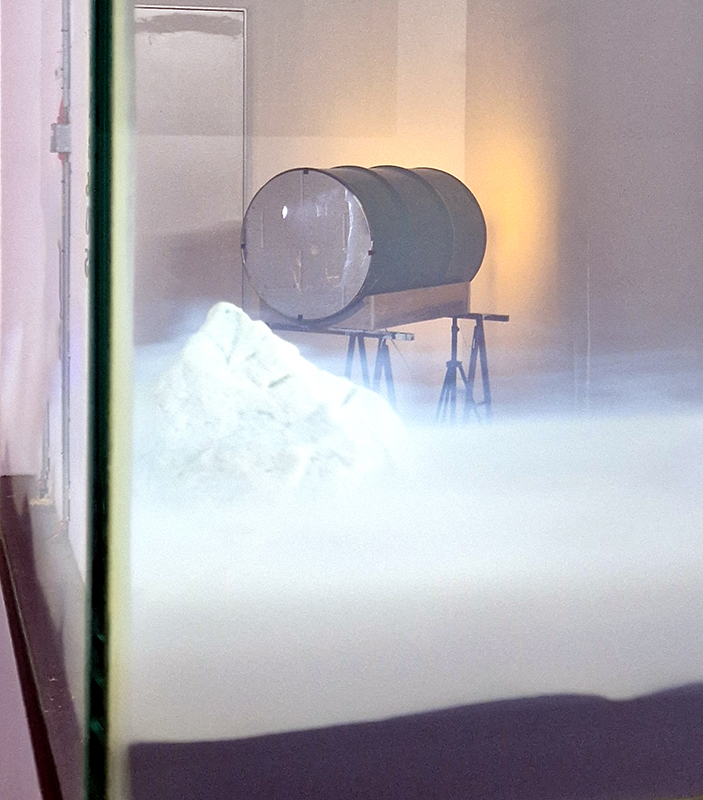
Ultimately, however, whatever external instruments we use, all data is experienced by our bodily senses. These senses turn out to be more finely tuned and calibrated than anything we have yet invented. And they are available to all of us, for free.

In this interactive performance we will draw parallels between the physical world around us and the physical experience of the body. We will explore the instrumentation we have available to us and discover its limits and possibilities in search of the subtlest and most elusive elements of reality.’

1908 zen-on polaroid

I enjoyed the parallels drawn between the search for dark matter and the search for inner peace, both of which require PURITY, QUIET and SENSITIVITY in processing data, looking for patterns and understanding knowledge.
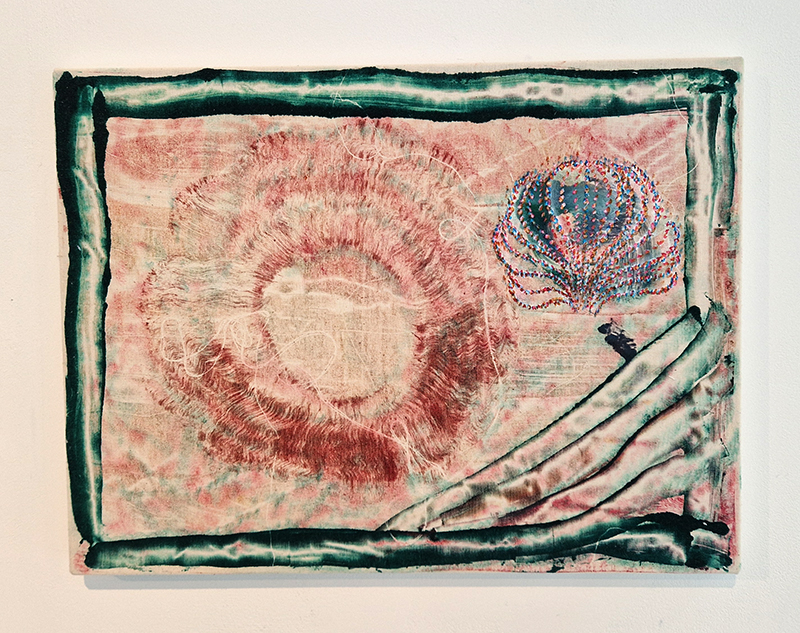
The Dark Matter exhibition at Science Gallery was not so inspiring in its curation but there were a few nuggets to be gleaned.

Through the AEgIS from Semiconductor

1908 Science gallery semiconductor

Images gathered from data captured from the AEGIS experiment based at CERN of violent collisions between matter and antimatter, along with tracks of newly created particles, all of which are too small to see with the human eye reveal the chaos of the unseen.  The artists call it a “space time-lapse” work, showing an animation created from around 100,000 still images.

Mirror Matter by Emilija Škarnulytė

1908 Science gallery Emilija Škarnulytė
In thousands of years, how will the gigantic structures dedicated to the pursuit of science be viewed? Will their remains be viewed the same way we think of Stonehenge or the pyramids – relics of a previous civilisation? Mirror Matter is set 10,000 years from now, with an all-seeing alien eye surveying the ruins of scientific machines that once probed and measured the Universe.

The public engrossed in building Utopia at Tate Modern Turbine Hall

1908 Tate Turbine Hall lego

Olafur Eliasson In Real LIfe at Tate Modern works well for social media posts but on the day I felt mostly disappointed with one or three exceptions, this may be because it was like an unruly crèche or being swamped with spectacle.

  1. Waterfall 2019 against a grey London sky

1908 Olafur Eliasson Waterfall 2019

2. Model Room 2003

1908 Olafur Eliason model room

3. Glacial Currents 2018


and A description of a reflection 1995

1908 Olafur Eliason description reflection

Loved this idea

1908 Olafur Eliason magnetic field

Went on to see Takis Sculptor of Magnetism, Light and Sound which was great (also no babies)

1908 Takis magnetism

‘Plato speaks of an artist turning the invisible world into the visible. I hope that someone seeing my sculpture is lifted out of his ordinary state’

1908 Takis Telelumiere No 4

‘I cannot think of my work as entirely my work, I’m only a transmitter, I simply bathe in energy’

1908 Takis sound and silence

‘We have chased the sacred symbols into the desert and replaced them with electronic eyes’

1908 Takis Music of the Spheres

Reading Timothy Morton ‘Being Ecological’ I started off thinking I am going to love this book but after a chapter of multiple examples of how to look at ‘being ecological’ this way or that way I was a bit frustrated. I missed the reading group to see how everyone else got on.

I did find it interesting to discover that the Anthropocene has a proposed official start date and it’s very recent – 1945 – the time when the first atomic bomb was detonated.

1908 nuclear explosion 1945.jpg

In January 2015, 26 of the 38 members of the International Anthropocene Working Group published a paper suggesting the Trinity test on 16 July 1945 as the starting point of the proposed new epoch.

I have been getting up close to mud and matter and thinking about the makeup of the environment around us.

It’s hard to look at a cup say and imagine the structure of its atoms. To think about the solid and then the squishy and how it all works.

From thinking about the origins of things, like the first plants and forests. Evolution and yet how all matter existed from the beginning and it’s just a huge process of recycling.

Deptford creek

Deptford creek

A great place for a new perspective on your surroundings is the Deptford Creekside Centre where you can join a low tide walk.

Low Tide Walk

Low Tide Walk

Equipped with thigh length waders and a long stick you are led down to the creek and given lots of insight into the history and wildlife of the creek.

Deptford Creek Crab

Deptford Creek Crab

It is stunningly beautiful and feels a real privilege to enter this world below the horizon.

Deptford Creek

Deptford Creek

The river has carved intricate sculptures into the wooden posts along the banks.

Deptford Creek

Deptford Creek

The look posts look totemic and hung with vibrant algae quite primordial.

Deptford Creek

Deptford Creek

The creek bed is thick with mud and slime creating wonderful patterns as the water recedes.

Deptford Creek

Deptford Creek

There is the possibility of finding treasure swept along and revealed after each tide but you must ask if you want to take anything away. They have quite a collection of finds they like to add to at the discovery centre.

Deptford Creek

Deptford Creek

On a previous trip artist Lizzie Cannon had been lucky to find a wonderful rusty object which she has since embroidered with threads and beads to continue the growth of the rust giving the object a new organic dimension

Lizzie Cannon - Corrosion

Lizzie Cannon – Corrosion

A Matter of Substance exhibition and salon curated by Caroline Lambard and Elizabeth Murton at APT Gallery encouraged their audience to look beyond the surface of the material to the very structure of the crystals, atoms and particles that form them.

1307 A Matter of Substance

Catherine Jacobs beautiful photographs show tensions of surface sometimes broken by an indeterminate object that works as a disruption to the surface and our perceptions of what we are looking at.

Catherine Jacobs Uncertainties

Catherine Jacobs Uncertainties

Elizabeth Murton’s scroll flows out across the floor in symbiosis with the marks upon it like a cascade of data presenting itself as a record of the inks journey.

Elizabeth Murton

Elizabeth Murton

Cool work for a hot day.

Phillip Hall-Patch

Phillip Hall-Patch / Caroline Lambard

There were salt crystals that sparkled like snow in magnified form like Icelandic landscapes and in salt block form eroded by a constant drip of water.

Phillip Hall-Patch Salt LIcks

Phillip Hall-Patch Salt LIcks

Caroline Lambard’s ethereal sculptures help to imagine 3D form from all perspectives through their delicate drawing in thread to delineate a space.

Caroline Lambard

Caroline Lambard

I have started on a new piece of work, the idea of an oasis, an escape, a view through to another place so it has been interesting to think about form and space.

A solid outer that hides a world inside.

1307 Oasis collagraph 1

It starts with the construction of a collagraph which I am slowly building up from cut card and carborundum.

1307 Oasis collagraph 2

Once made the idea will be to rip a section out to reveal an internal space.