Archives for posts with tag: magnetic field reversal

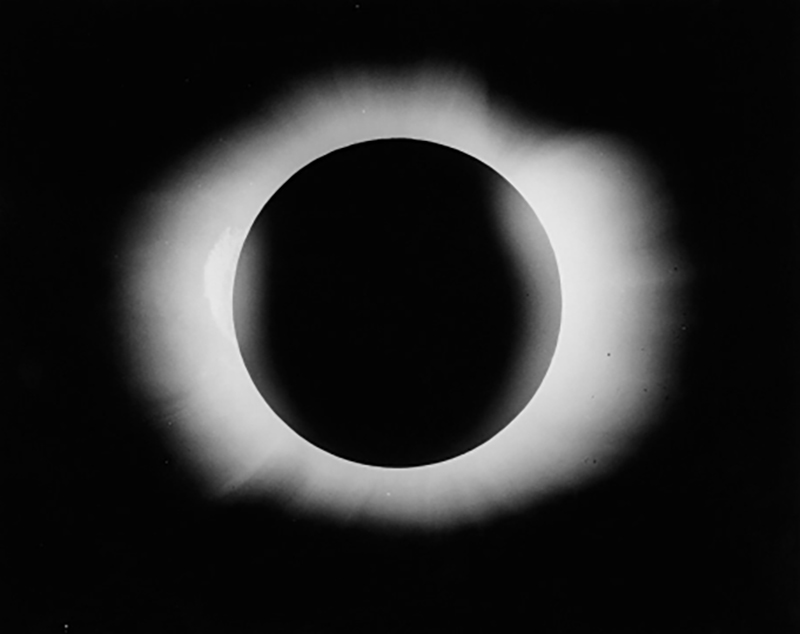
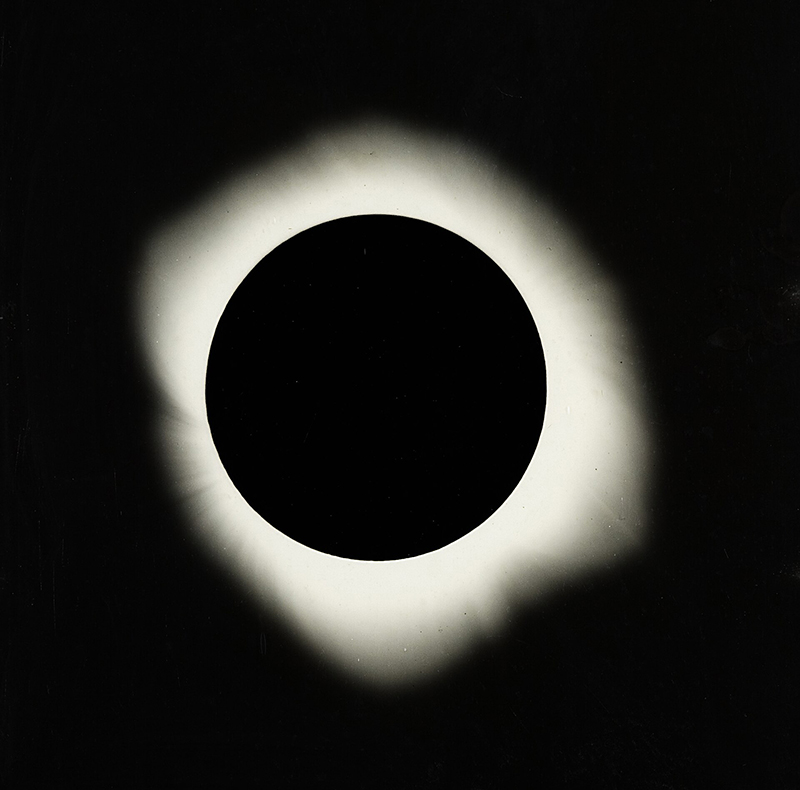
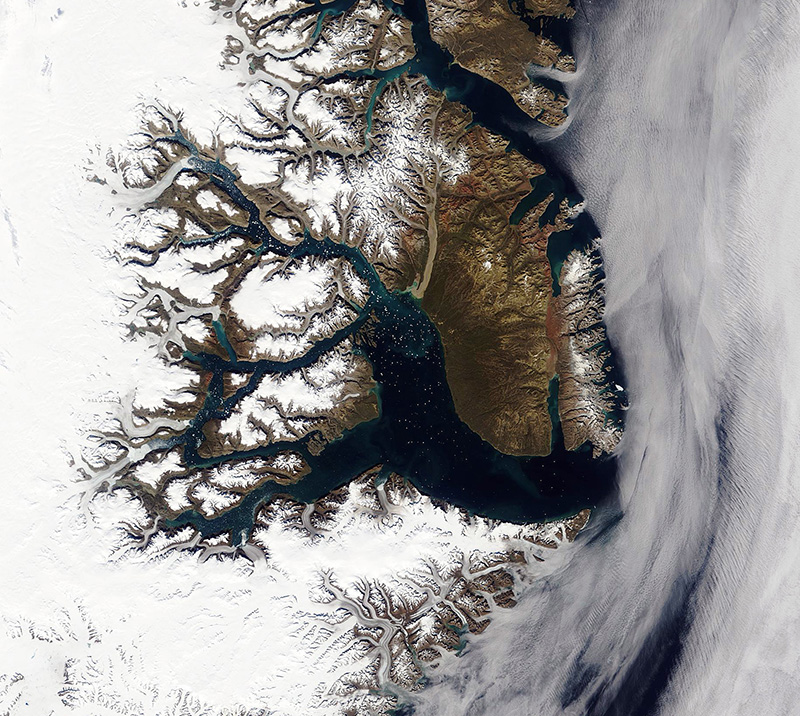
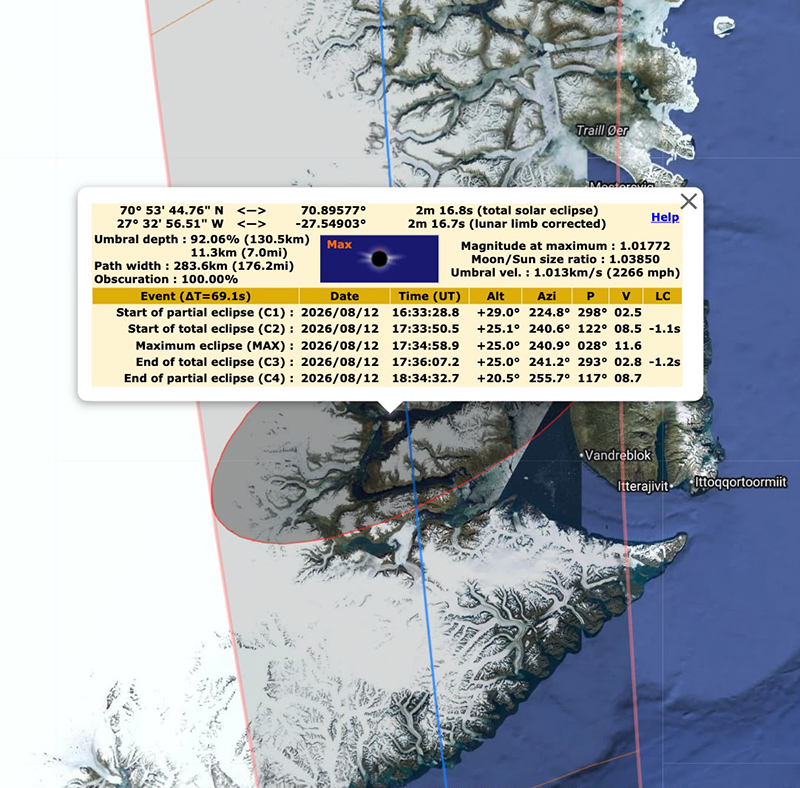
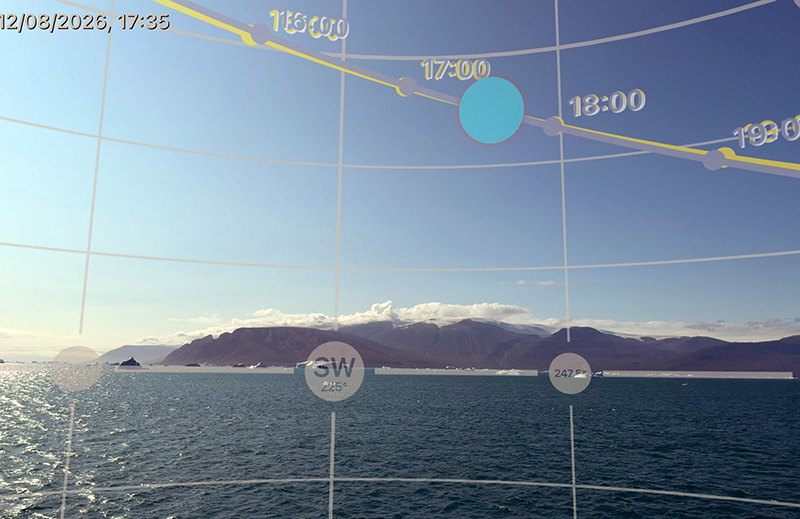
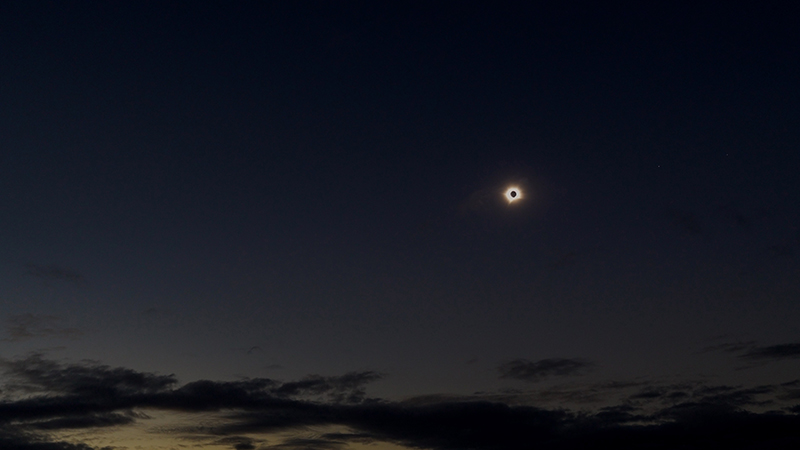
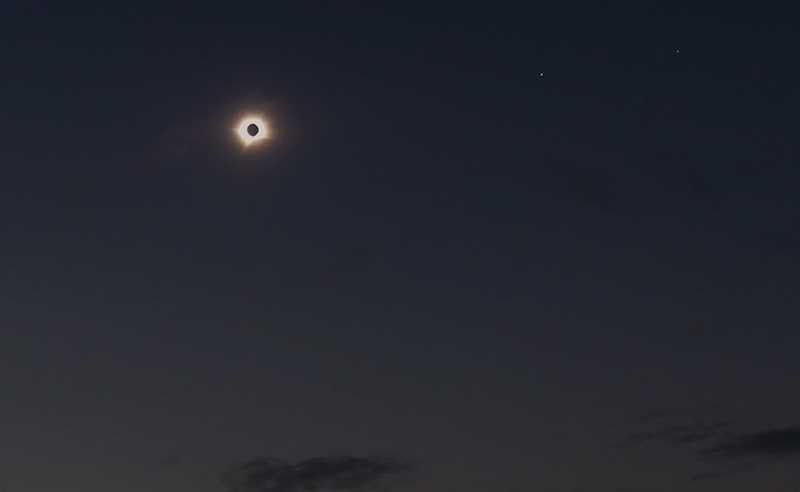
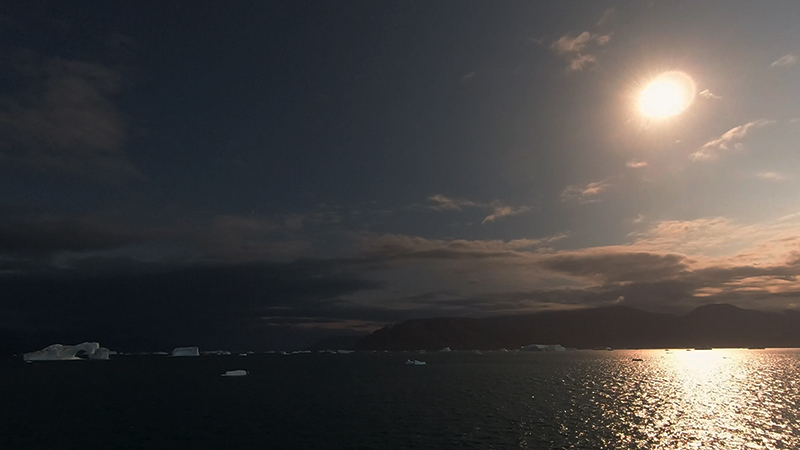
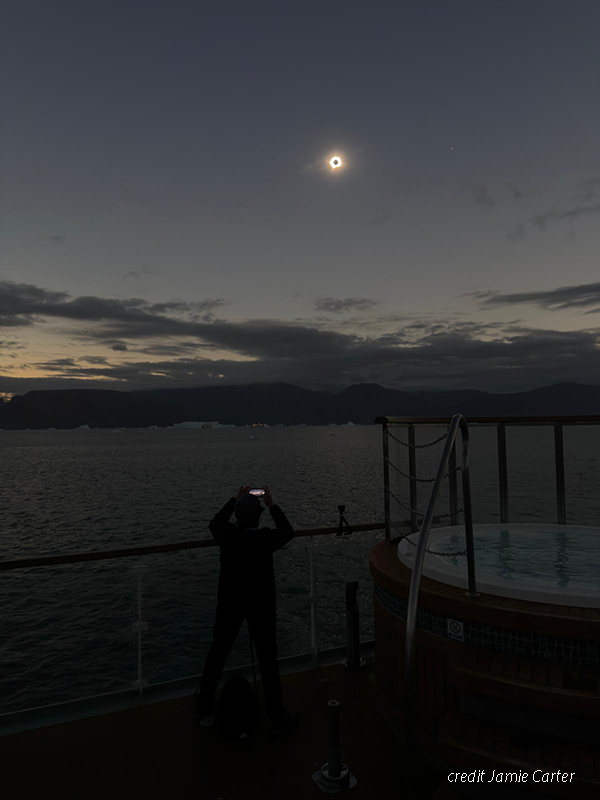
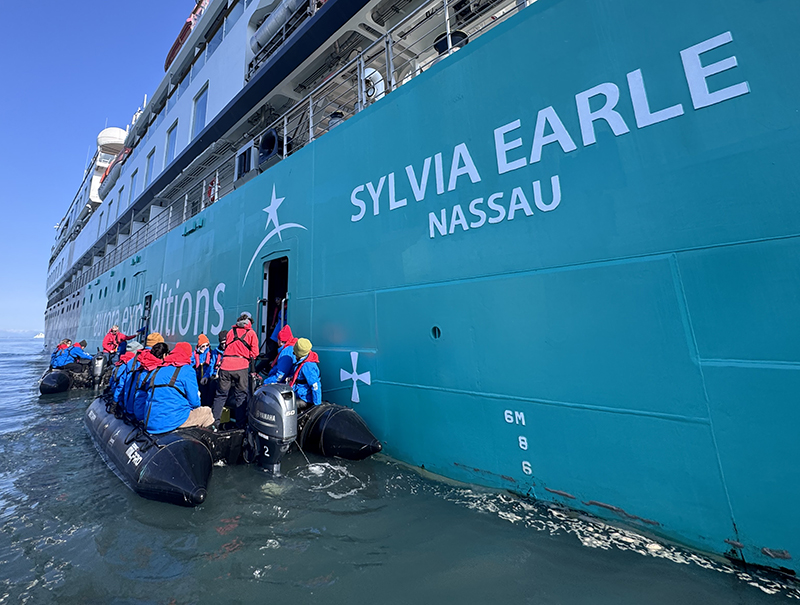
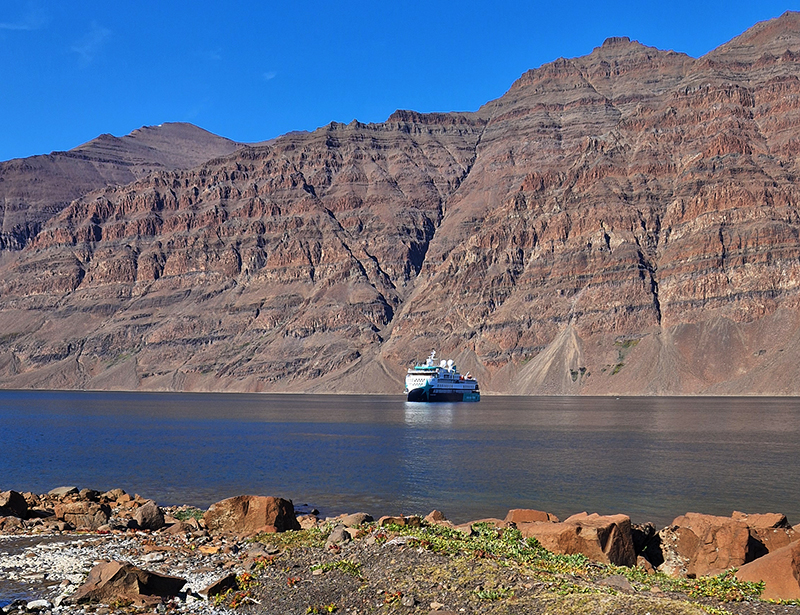
August 12th 2026 16:33 GMT first contact, 17:33 totality, lasting 2 minutes 17 seconds spent aboard the Sylvia Earle expedition ship led by the remarkable Greg Mortimer and perfectly positioned in Ofjord, part of Scoresby Sund, the largest and deepest fjord system in the world.

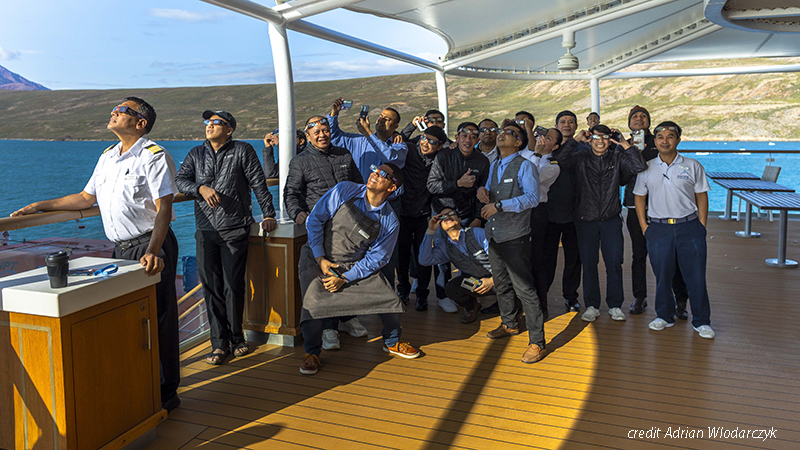
This fjord was so deep the ship could not drop anchor but had to use its virtual anchoring system to hold a steady orientation while every person on board including all crew members from every quarter gathered to experience one of nature’s exquisite astronomical events.

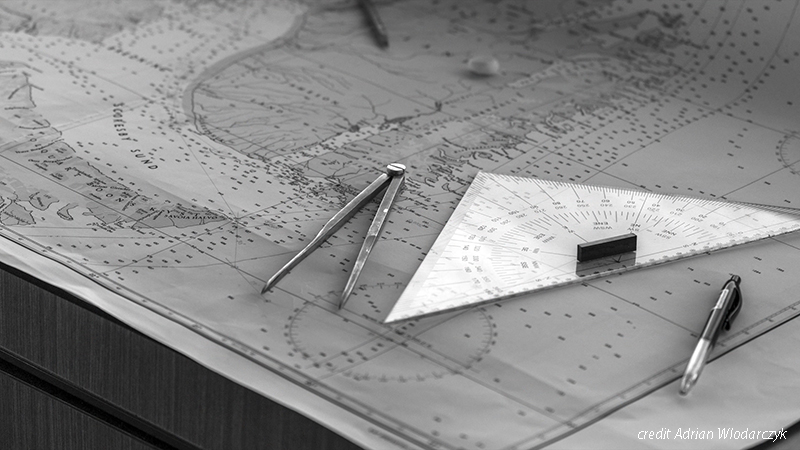
It will/is/has taken time to process the incredible experience of sailing from Iceland to east Greenland to witness totality in such a stunning location. We had booked the trip two years ago knowing there may only be a 40% chance of clear skies, but felt it was worth the risk as being in Greenland would be amazing anyway. As the day neared, the ship’s captain, expedition leader and astronomer held our fate in their hands as they poured over their charts and weather predictions, having to commit to a target destination several hours ahead of the event.

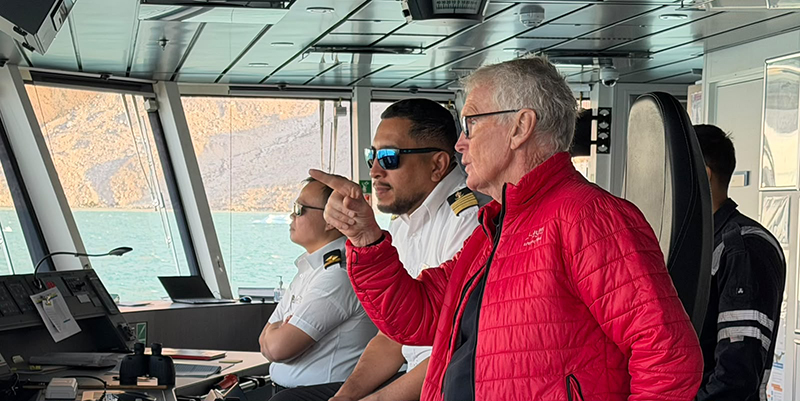
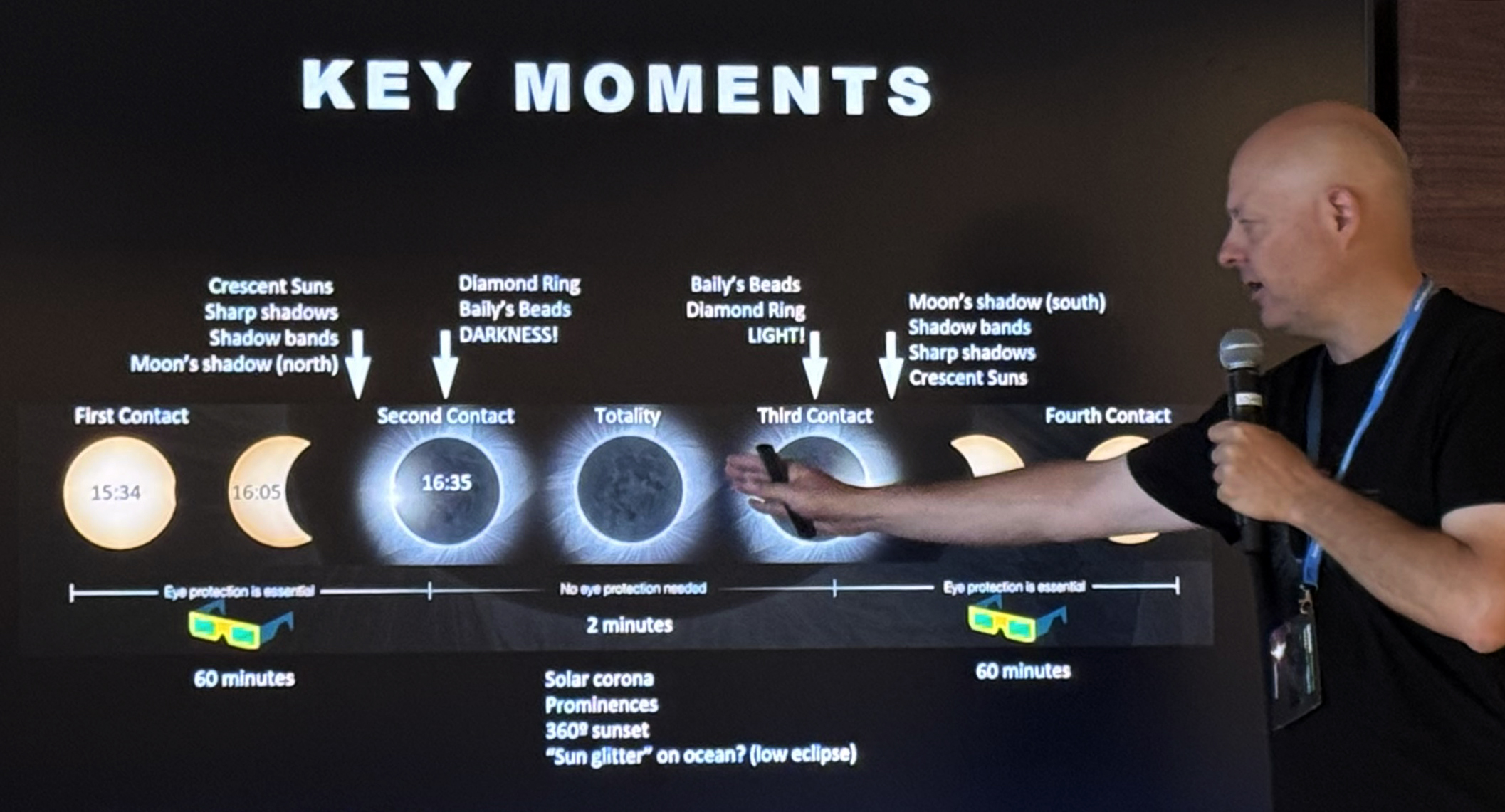
The brilliant team made a perfect choice, deciding to head for a conjunction of fjords yet keeping the ship back from the cliffs so that we looked up at clear skies with just the odd wisp of cloud. As excitement built around the ship there was some concern that we might not know when totality had started so that we could remove our solar glasses and filters and enjoy unfettered viewing. Jamie Carter our onboard eclipse expert was right – we knew instantly.

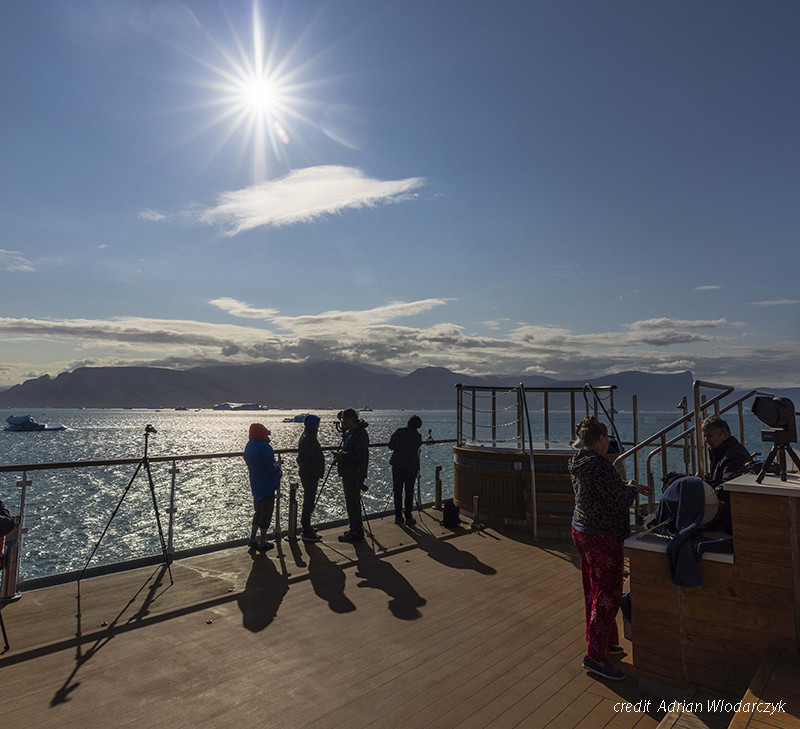
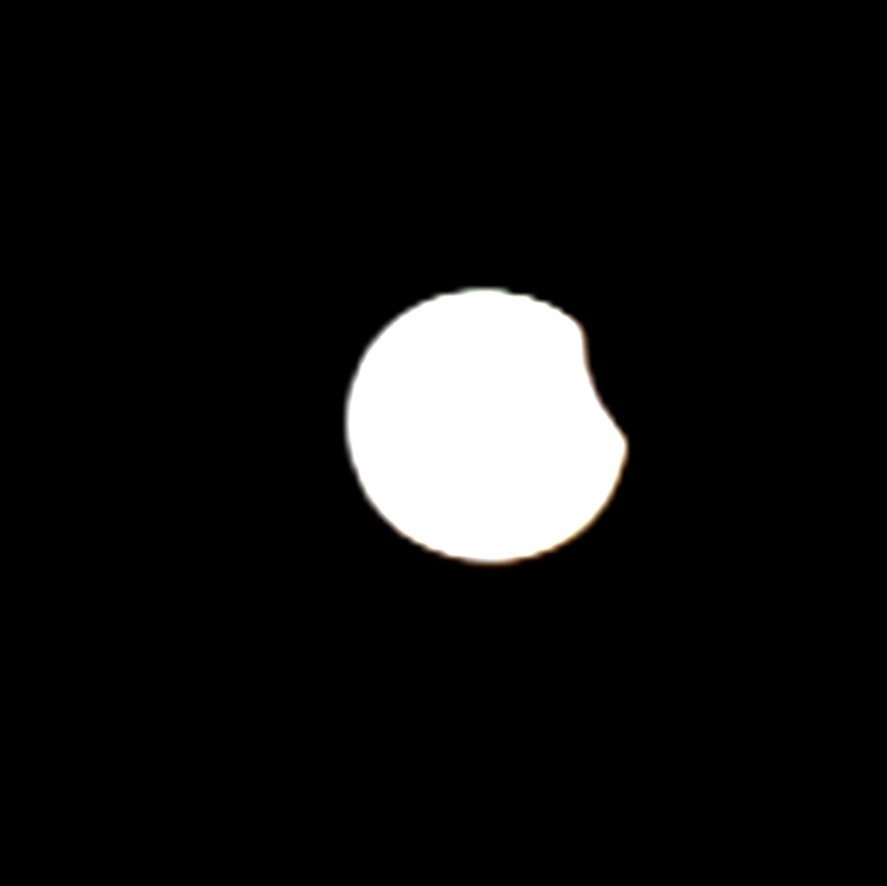
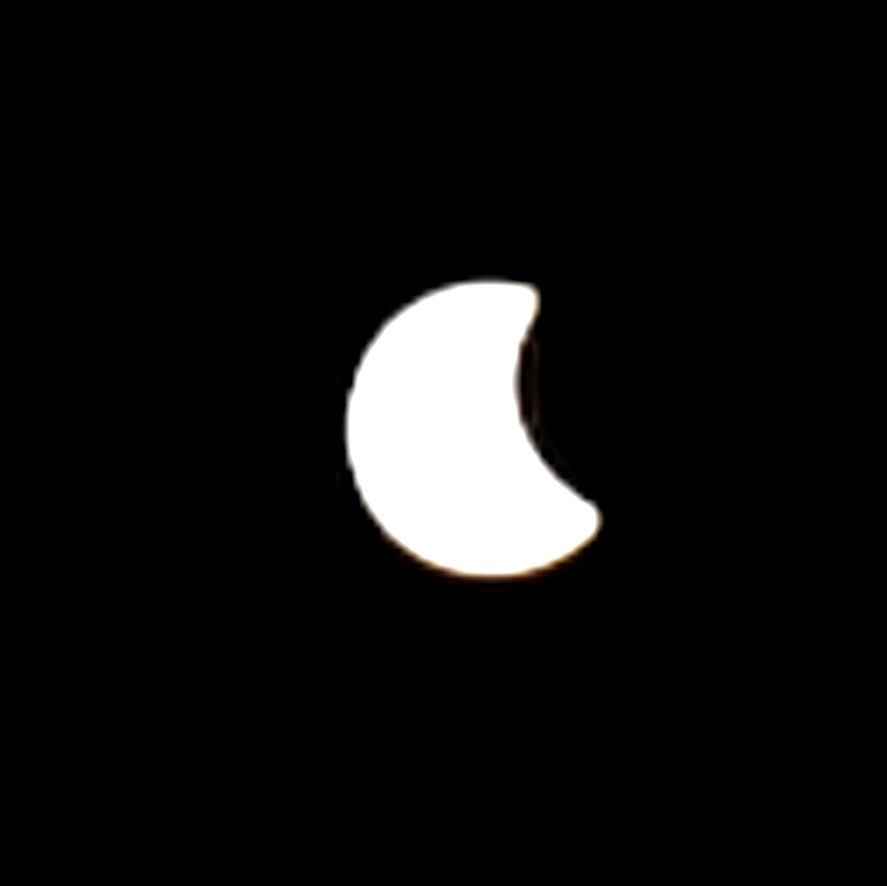
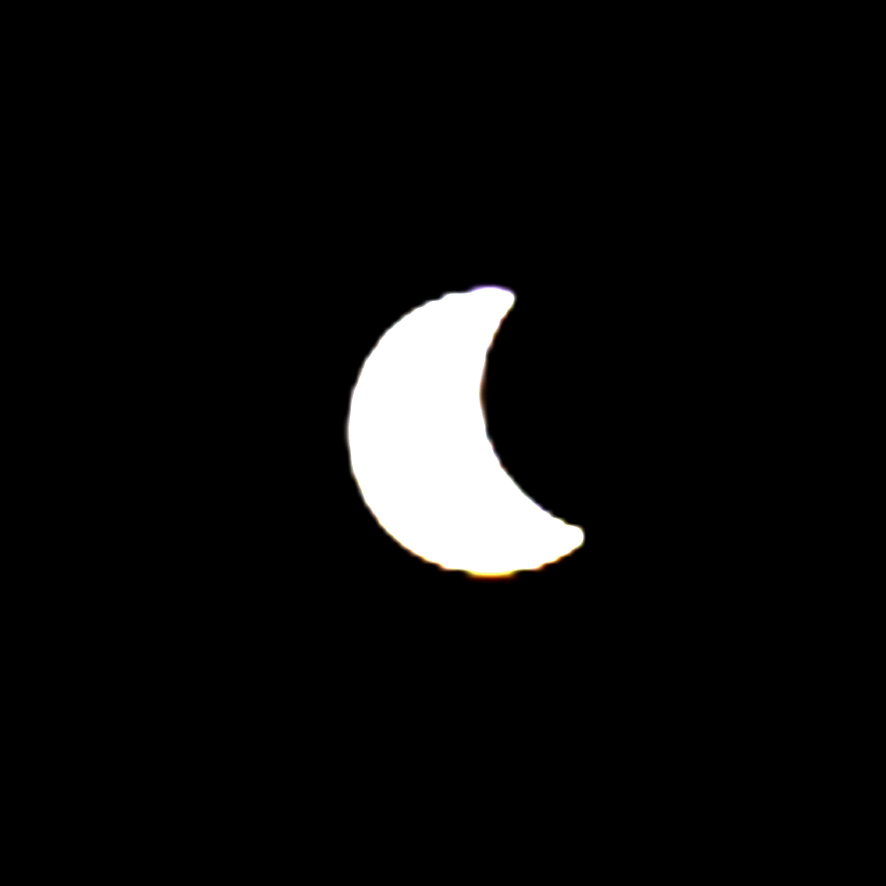
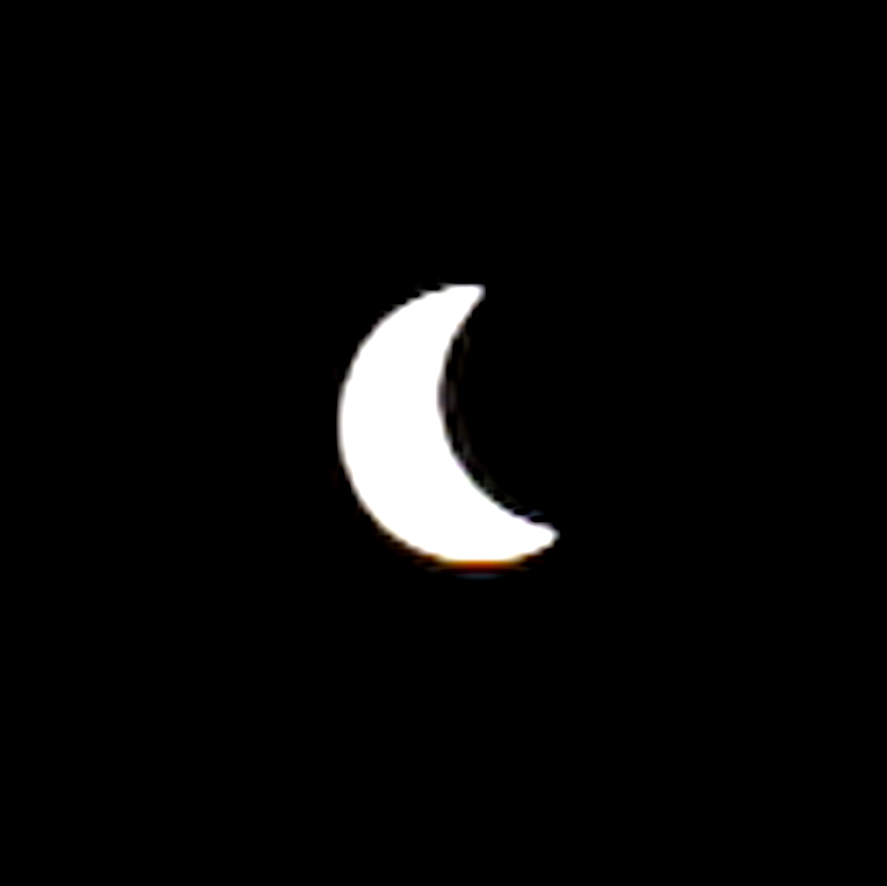
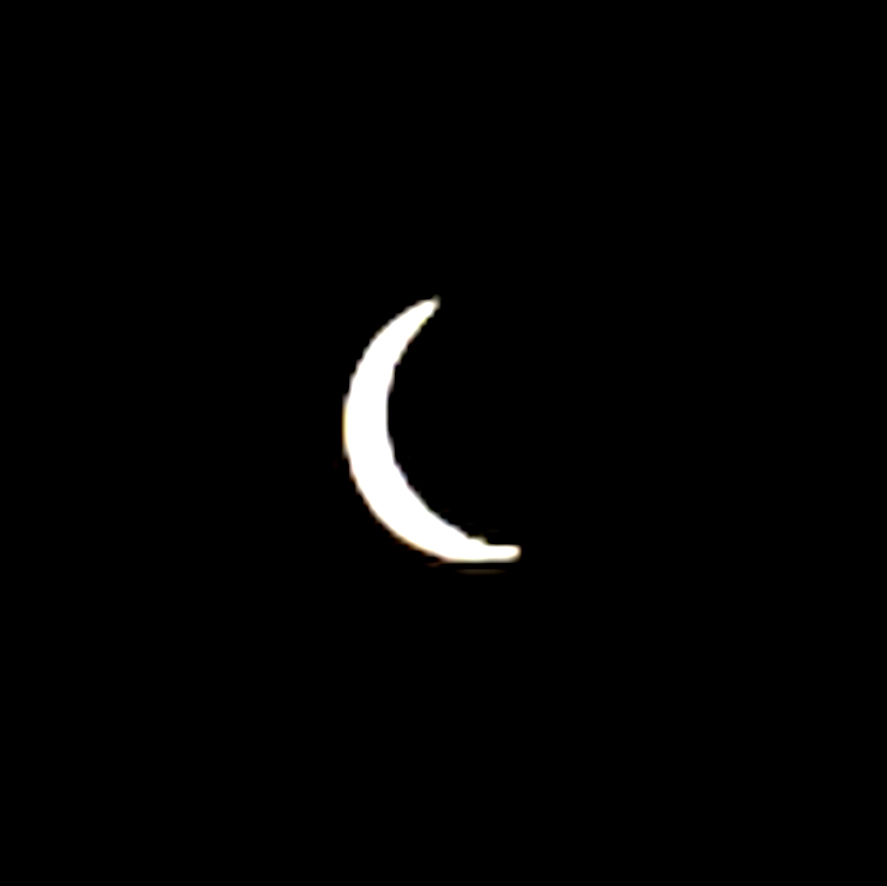
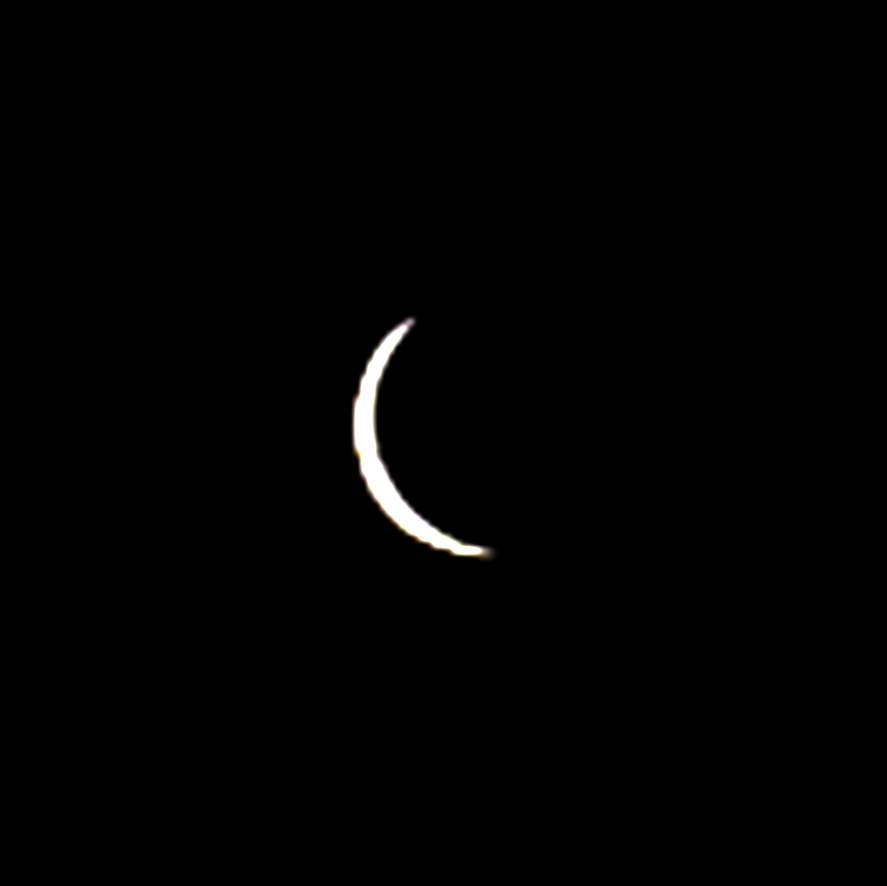
It was spine tingling to witness that moment, so accurately predicted, when the first sliver of the moon’s shadow inched into the circumference of the sun. It then took a leisurely hour to bite an increasingly larger chunk from its sphere as we gazed out from behind solar filters.

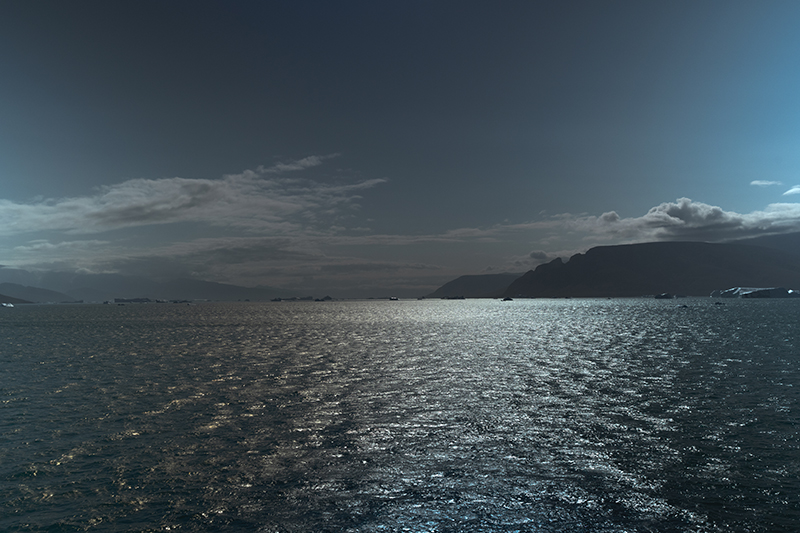
Even at almost complete totality the light escaping from the shrinking crescent was surprisingly illuminating over the fjord, dancing across the rippling water.

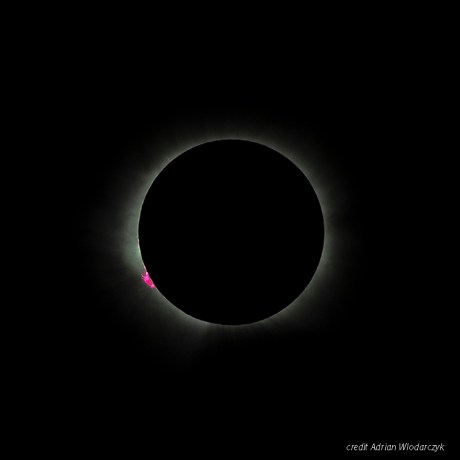
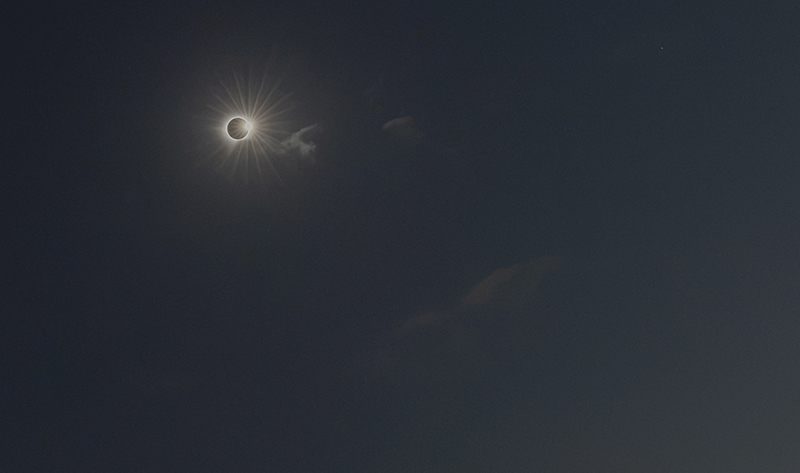
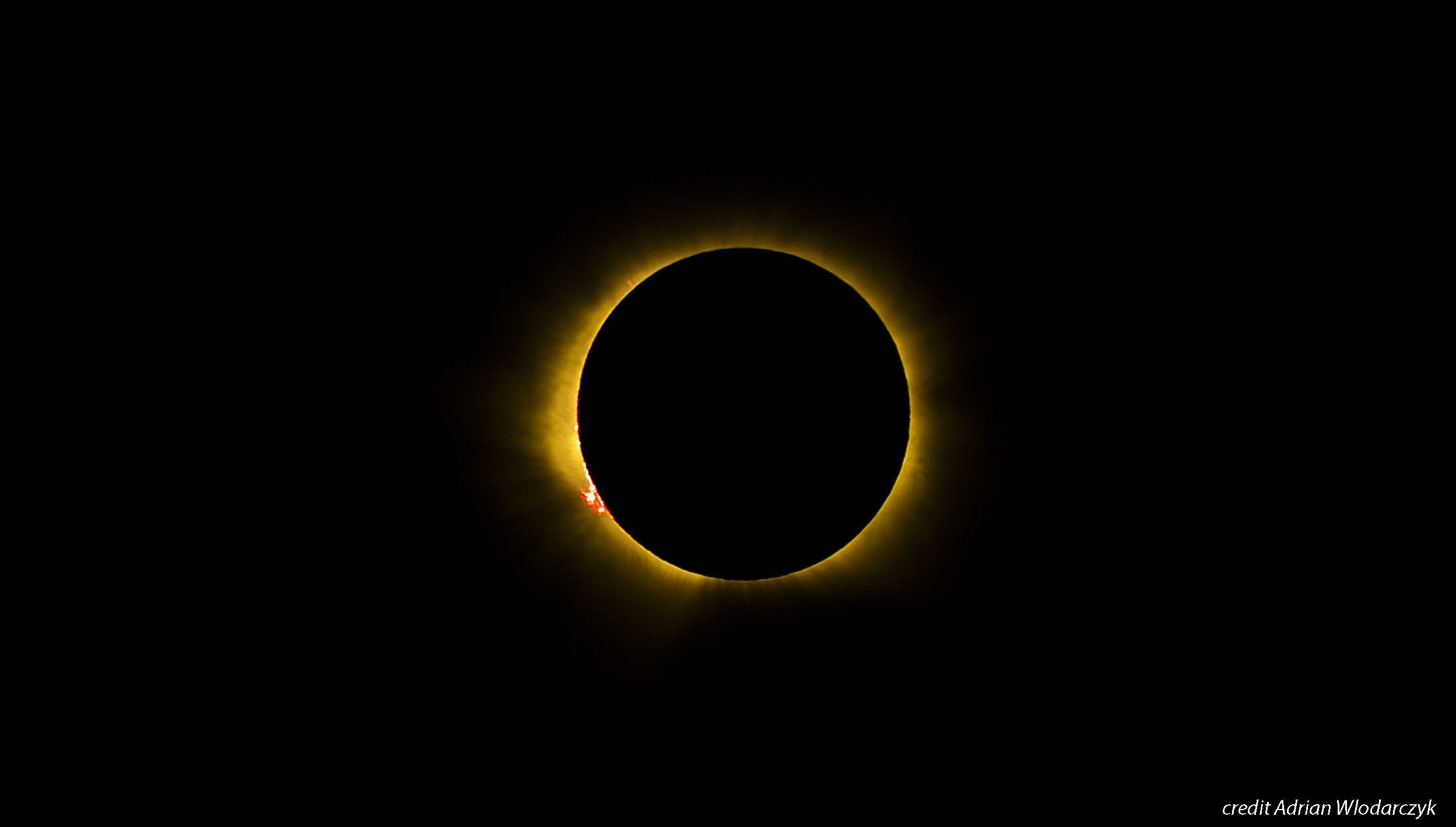
As the two celestial bodies slotted into perfect alignment, the light dimmed dramatically, bright pink solar prominences of glowing hydrogen became visible and flashes of light known as ‘baileys beads’, revealed the rough topography of the moon’s surface craters and valleys.

During the eclipse we noticed the bottom area of the sun’s corona was less defined. Gaps in the corona are due to dynamic changes in the Sun’s magnetic field causing regions in the outer atmosphere where the gas is much cooler and less dense so it does not scatter the same amount of light. This eclipse in 2026 is roughly two years after the peak of Solar Cycle 25 and while the Sun is still relatively active, it lacks the perfectly symmetrical corona seen during maximum activity.

Planets including Mercury made a brief astonishing appearance.

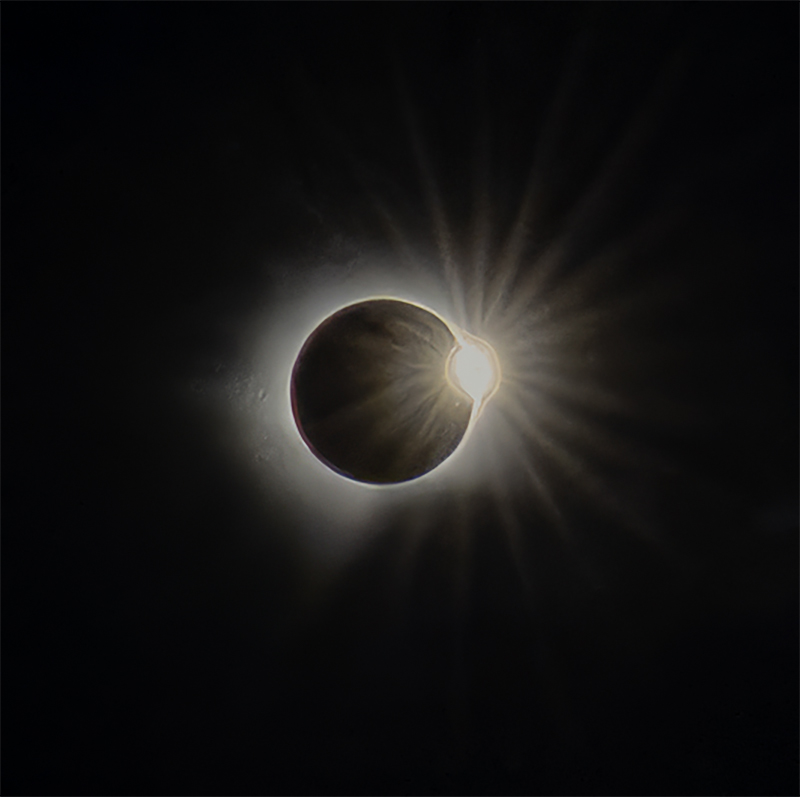
The precious minutes and seconds soon vanished in a dazzling blaze as the ‘diamond ring’ effect shattered the mysterious twilight with piercing rainbows of light. Glasses and filters were quickly replaced to watch the slow retreat of the moon’s shadow slipping off into the unseen.

In his eclipse lectures, Jamie Carter had stressed that we should not stress about getting photos but enjoy being present.

I did try to absorb the moment but also quickly snap some shots with my new Sony A7C II and a couple on my phone.

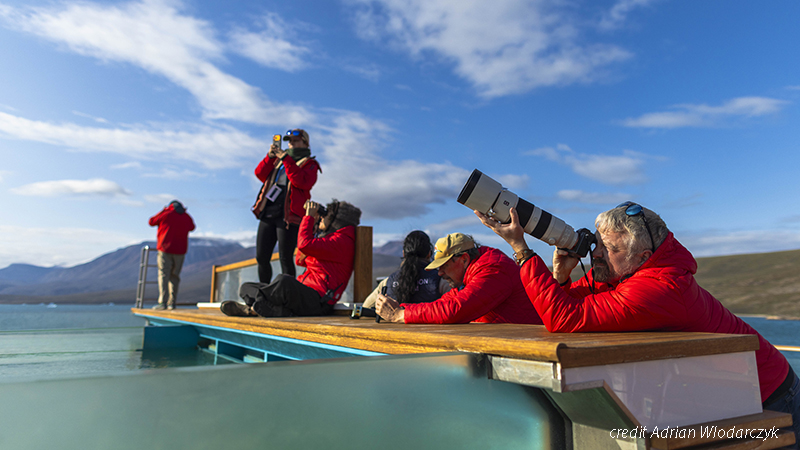
I also had a GoPro running on the side to capture the changing light across the landscape. I had chosen a wide angle rather than a zoom lens for the Sony camera so sacrificed detail for ambience. There is something rewarding about taking your own photos even if they are not perfect and I knew we would have professional images shared with us from the on board photographer Adrian Wlodarczyk. Adrian captured terrific zoom shots of the eclipse and all aspects of the cruise which are shared with everyone so we all have access to fantastic reminders of our arctic adventure.

The total eclipse was obviously the highlight of the trip but there were so many other extraordinary encounters along the way.

Before sailing for Greenland, I had a rewarding time exploring Iceland in the company of local guide Kristjan Einvarður and volcanologist Dave McGarvie. Both were passionate and knowledgeable as well as being great fun. Blessed with clear skies and alarmingly warm temperatures we were repeatedly told that this weather was very unusual. (It did rain one day)

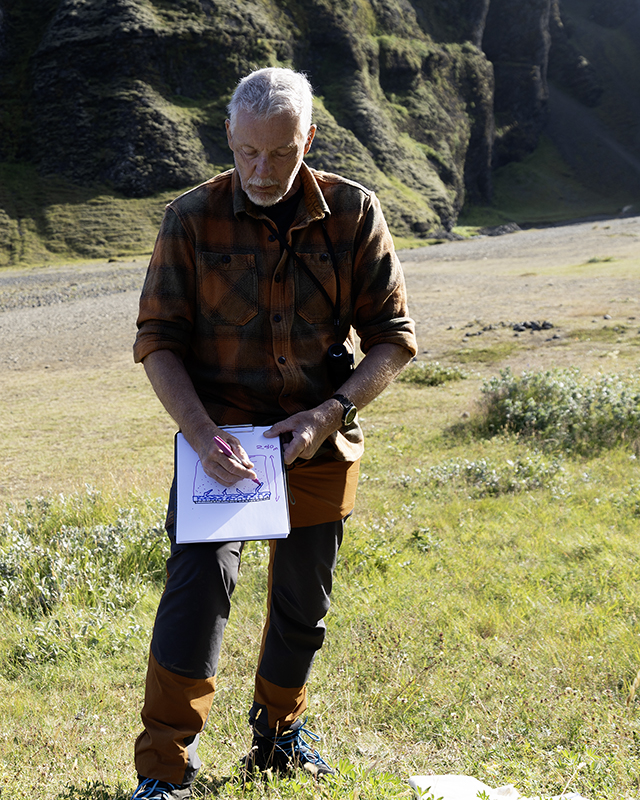
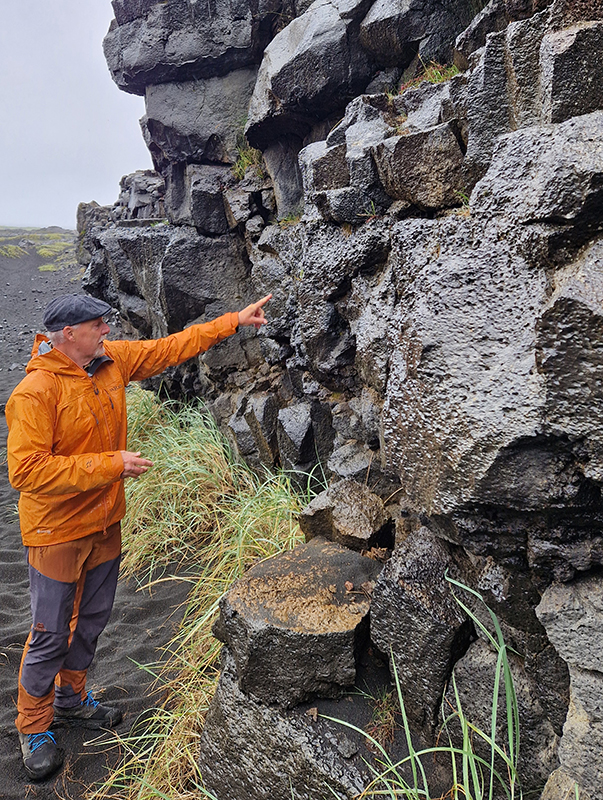
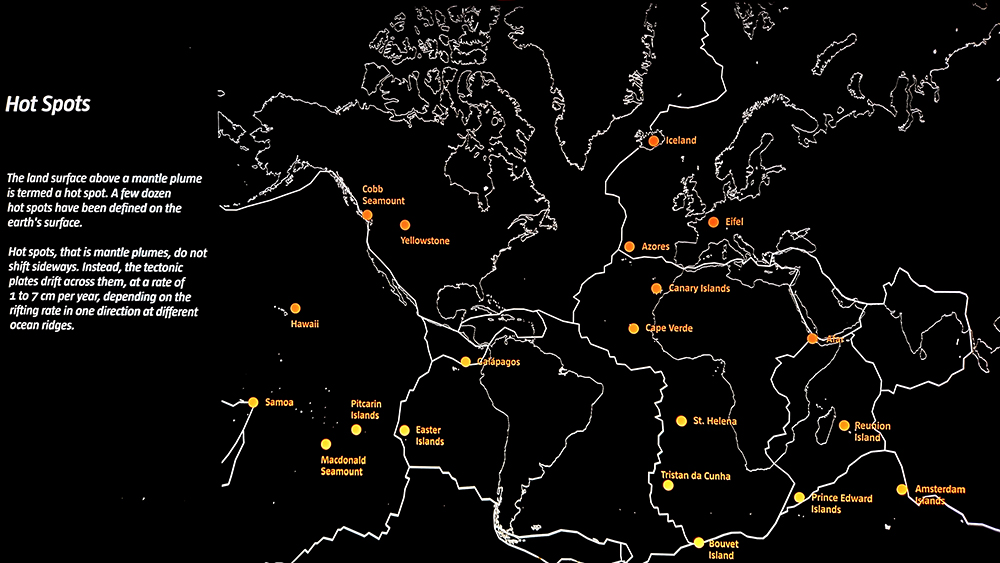
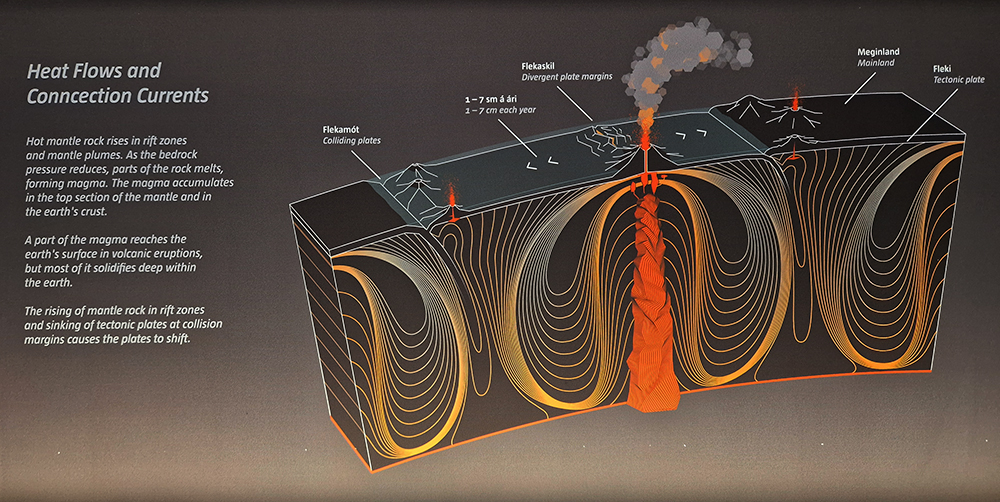
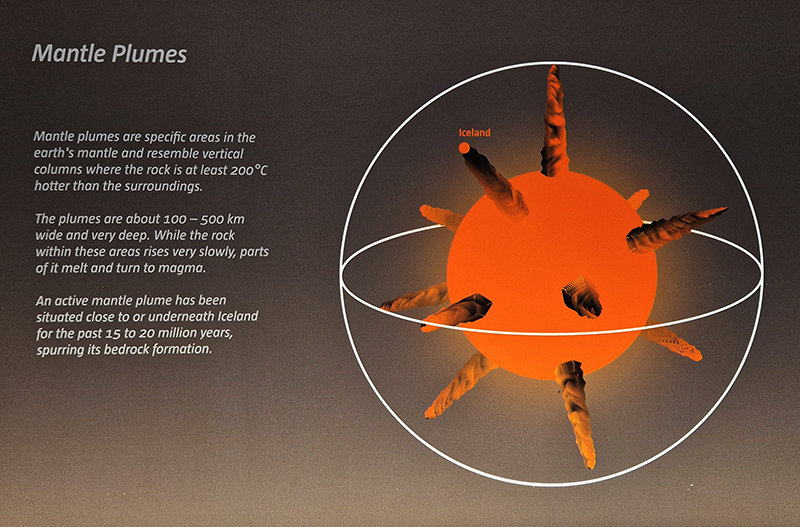
Volcanologist Dave McGarvie explained to us the unique nature of Iceland geology. All along the mid-ocean ridges, basalt magma erupts and builds new oceanic crust as it spreads across the sea floor. What is different about Iceland is the presence of a mantle plume where magma erupts from great depth, enough to build ocean islands. The island of Iceland is the only part of the worldwide mid-ocean ridge system that lies above the sea surface.

Because Iceland has such a thick crust created by sitting over a mantle plume, its central volcanoes produce rhyolite lavas flows which are much thicker than basalt lava flows and produce much more explosive eruptions. Magma that erupts under ice or water can’t spread far and so it builds upwards. Eruptions that occurred under ice can be identified by a table top or ridge appearance.


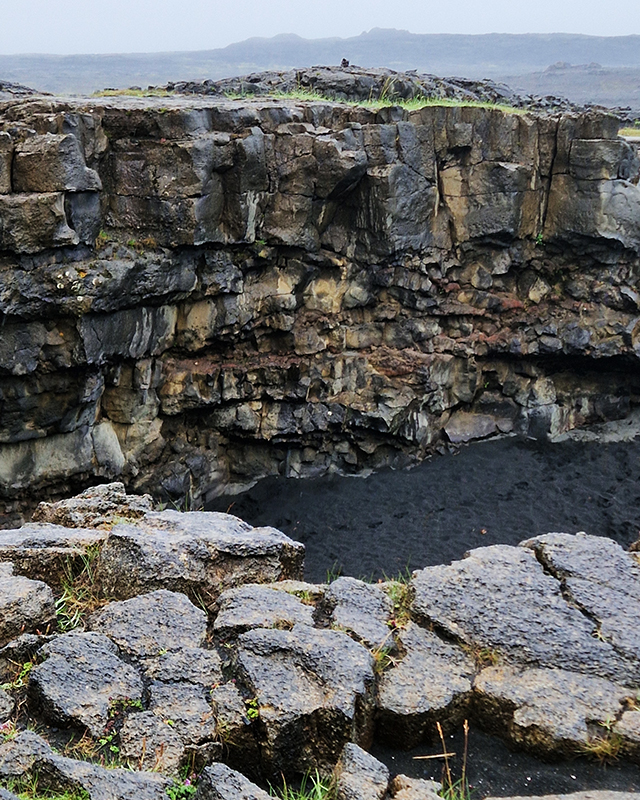
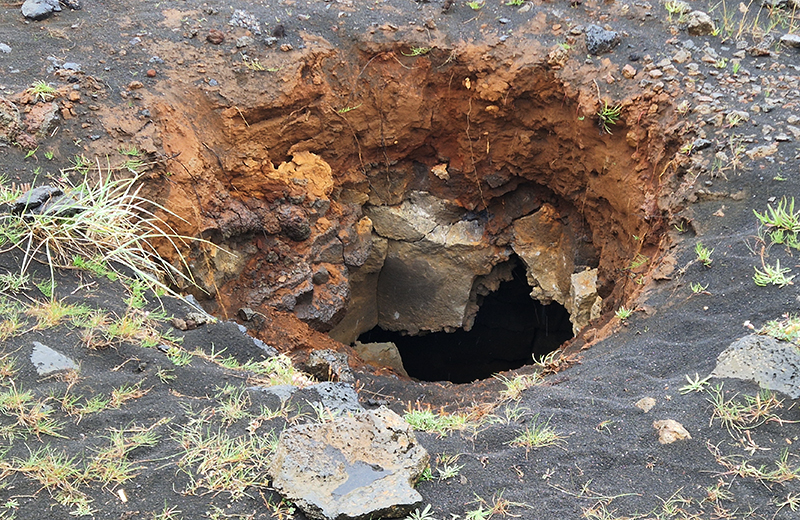
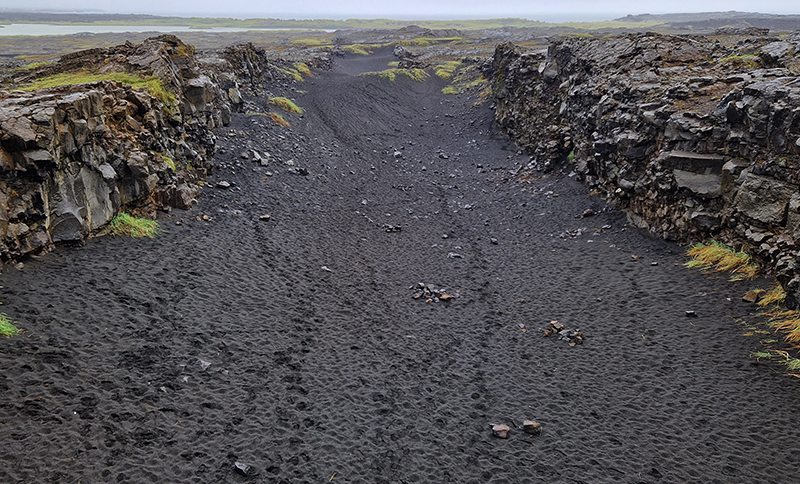
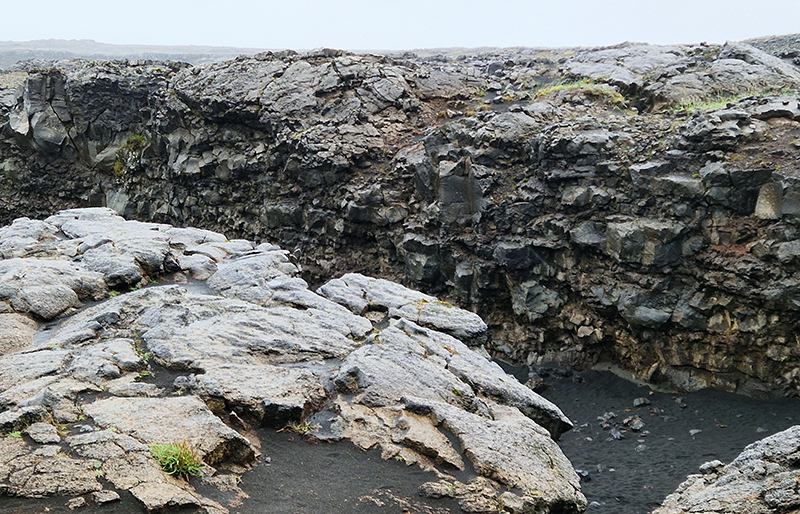
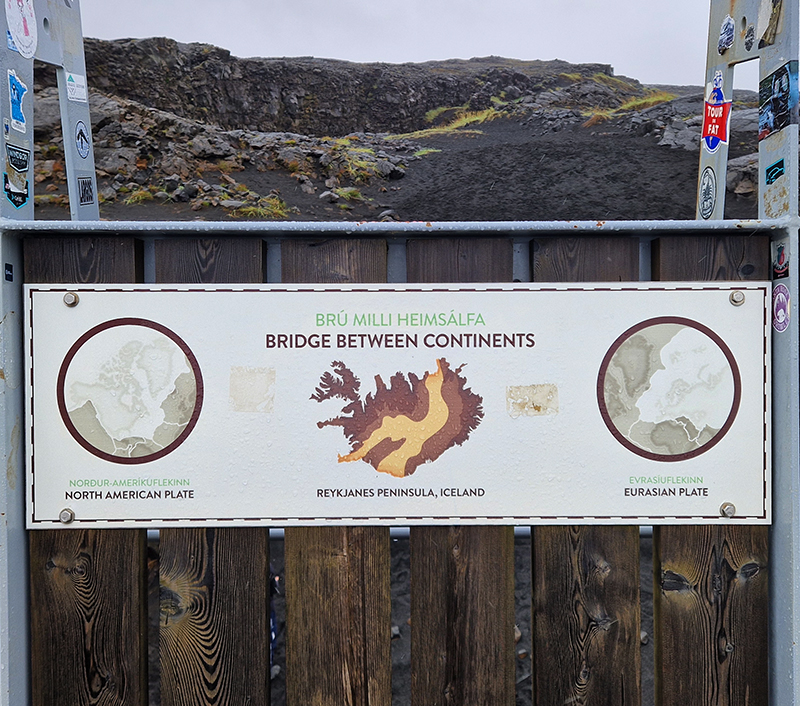
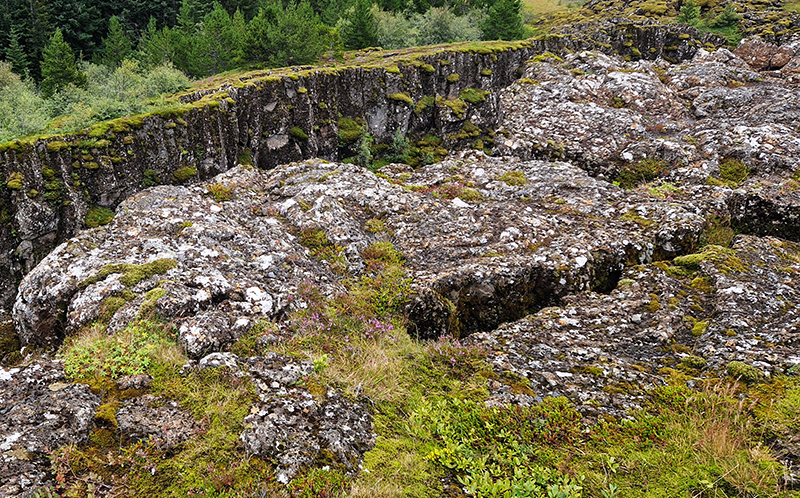
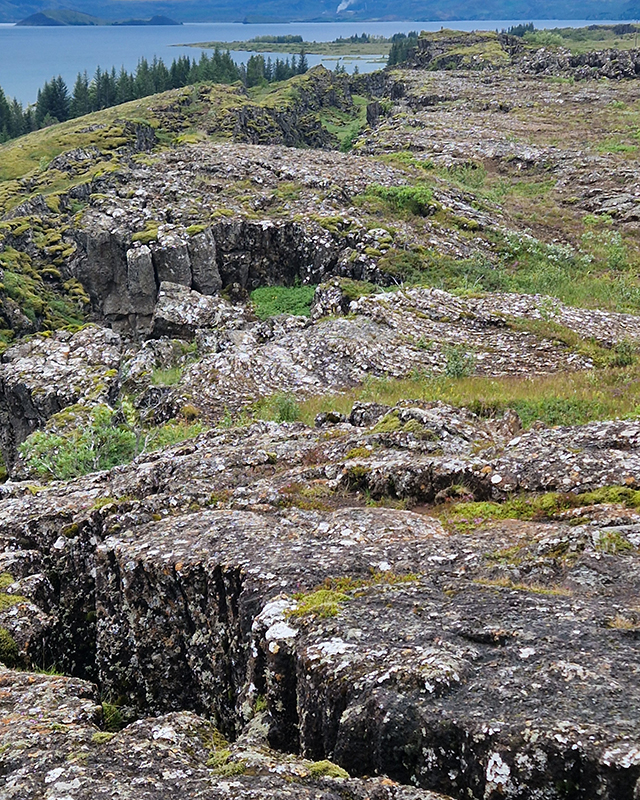
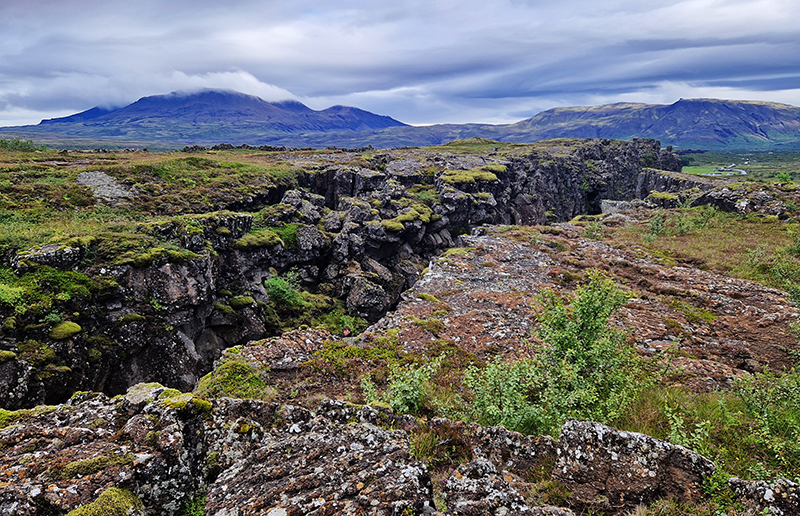
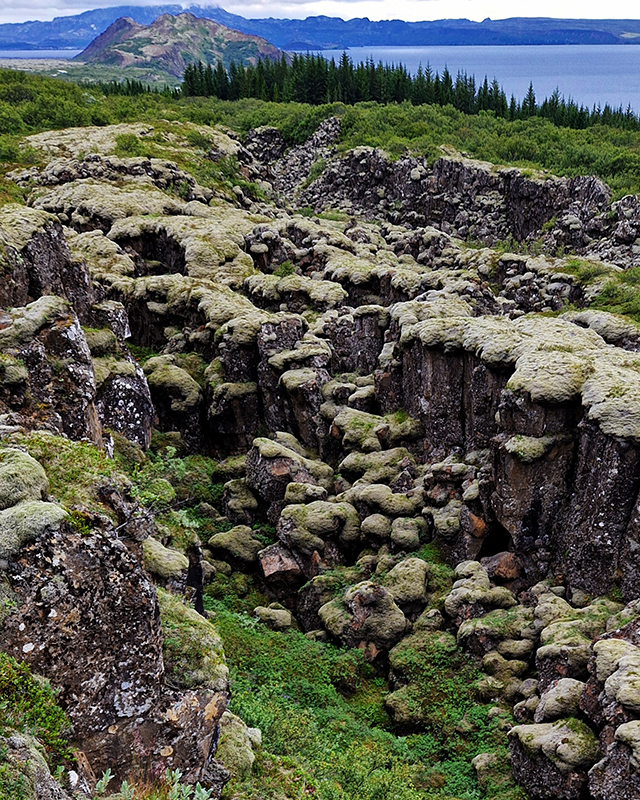
This is land where the North American and Eurasian plates are slowly drifting apart at about 2cm a year. As the plates diverge, cracks and fractures appear in the lava rock forming steep trenches. There is a small footbridge here where you can supposedly walk across from one continent to the other but in reality the division isn’t a single narrow trench but a complex, active rift zone that spans several kilometres.

It was the discovery of magnetic stripes, created by sea-floor spreading of lava erupting from mid-ocean ridges during different eras of magnetic polarity, which led to the understanding of plate tectonics. This phenomenon inspired my Book of Reversals so I was thrilled to visit the Mid-Atlantic Ridge at Sandvik Bridge and also at Thingvellir National Park to see land shaped by these forces that I find fascinating. I am planning to use sound recordings from this trip to create an ambient background for the digital form of Book of Reversals which uses the scanned images from my HiResidency at equivalentbehaviour .


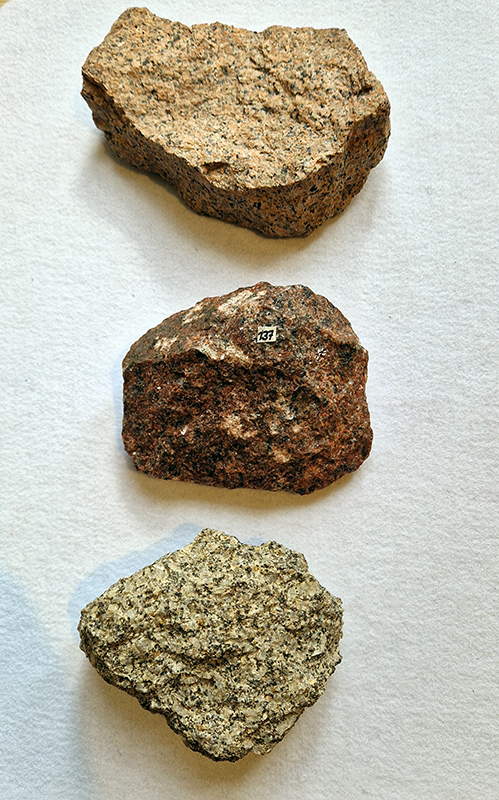
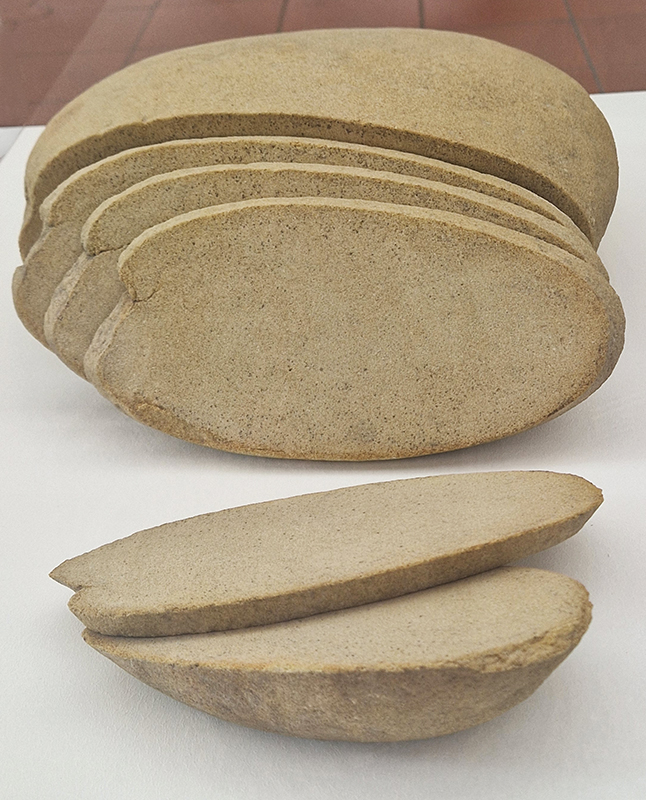
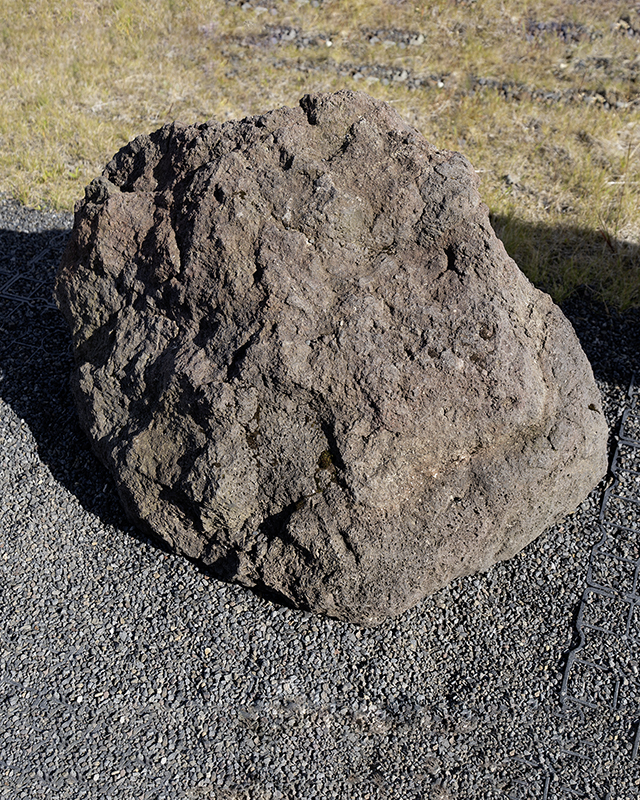
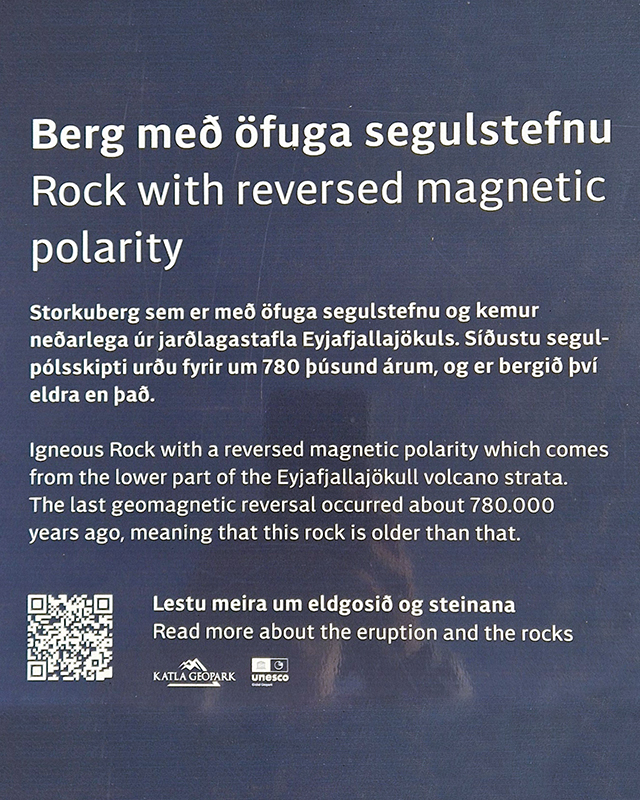
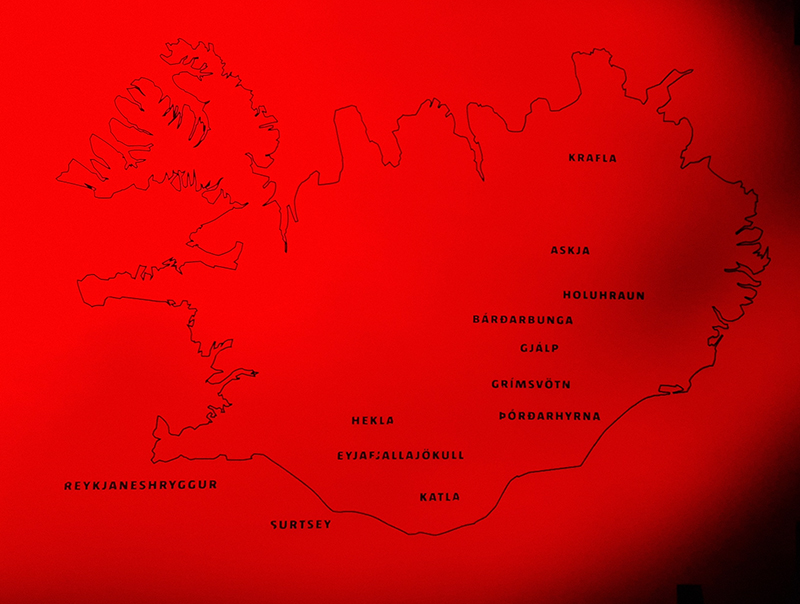
I was also delighted to see a ‘rock with reversed magnetic polarity’ displayed at the Katla Geopark. This rock was born when the north and south poles had flipped to the opposite ends of the Earth.

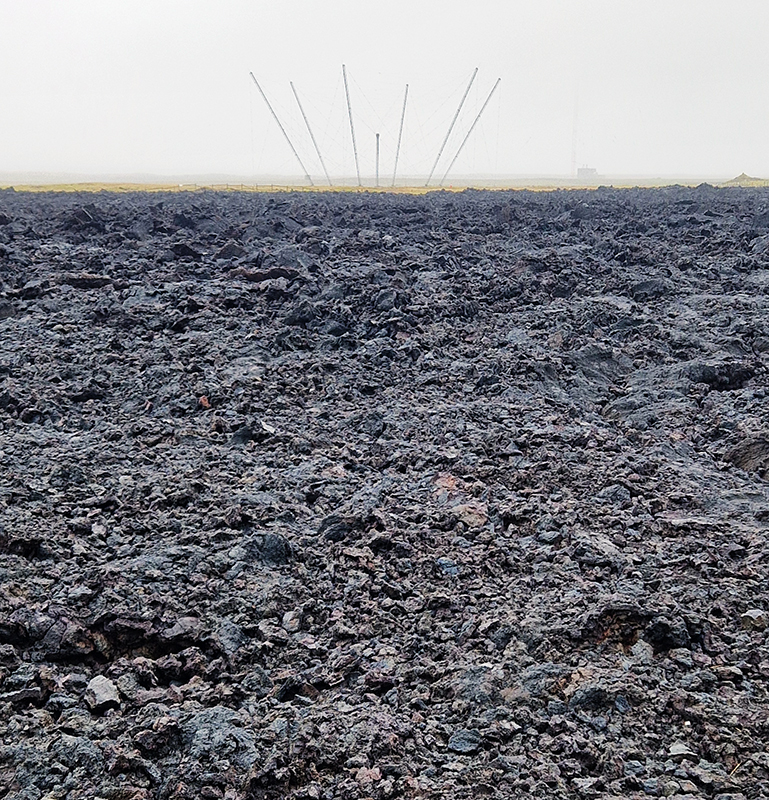
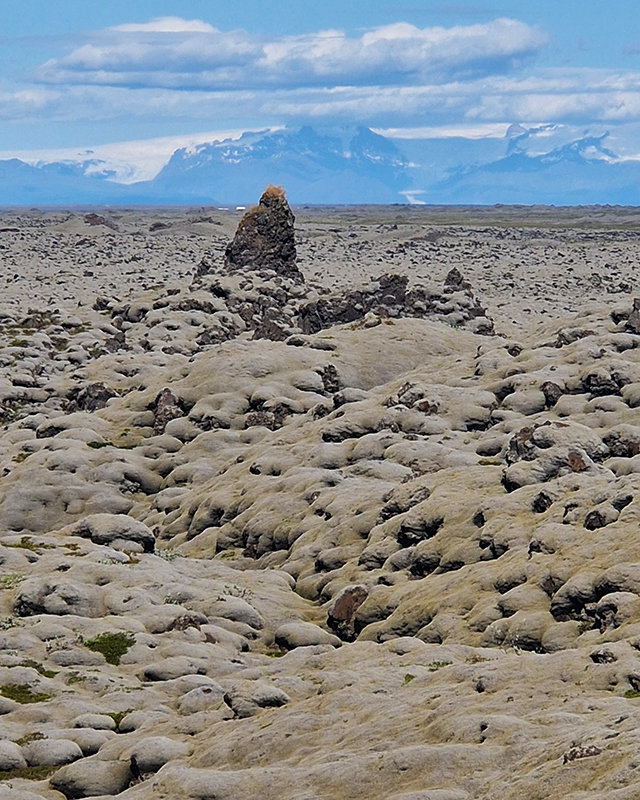
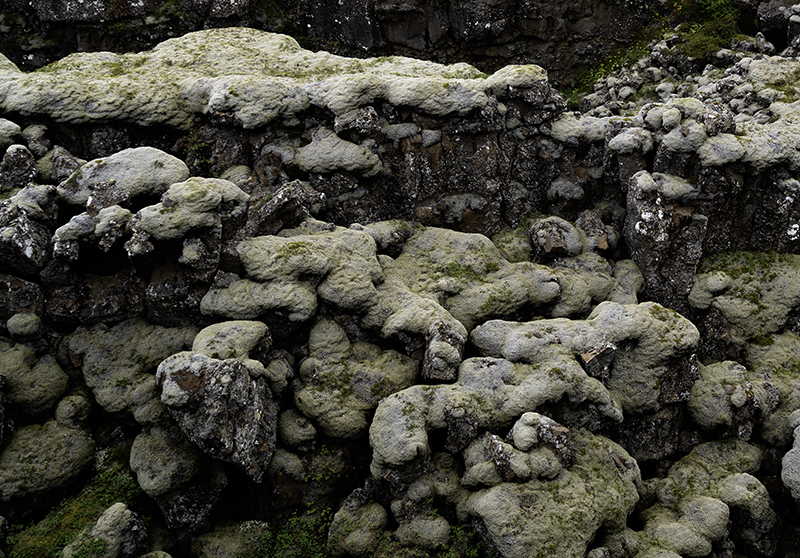
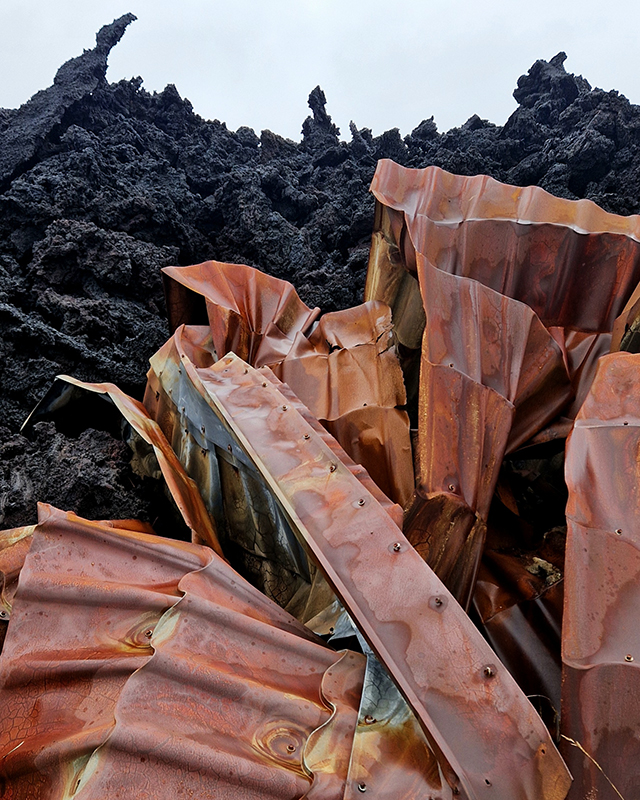
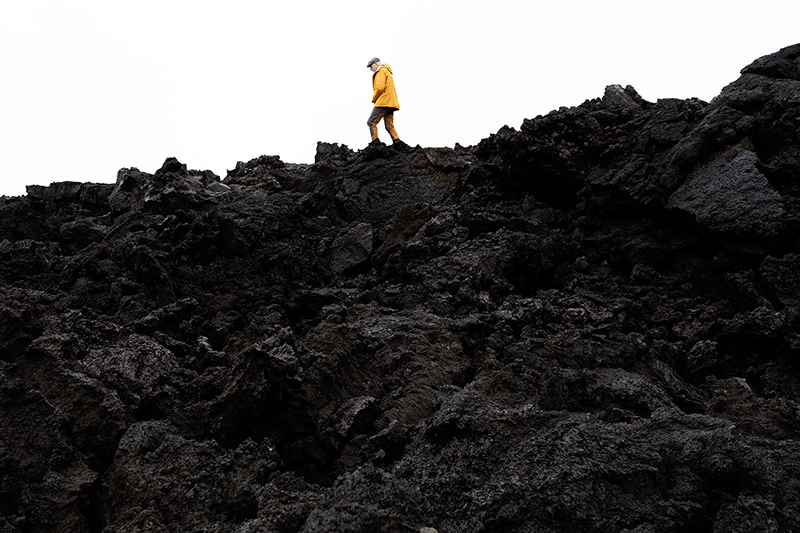
New raw lava fields are hostile jagged and bare terrains stretching vast distances. Over time the lava gains a cushioning of moss, lichens appear and these pioneer lifeforms pave the way for soil and tender flowering plants to take hold.

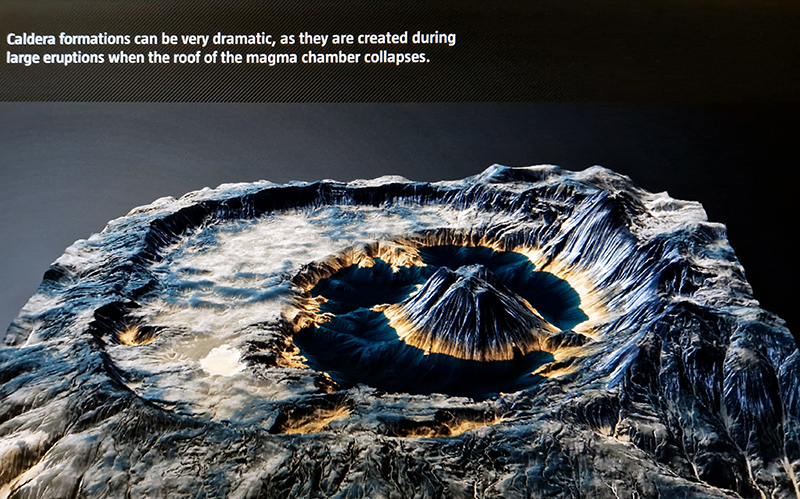
Iceland has many central volcanoes which are surrounded by chains of smaller cones and craters where lava erupts during fissure eruptions from faults where the land subsided during rifting. After almost 800 years of stability on the Reykjanes Peninsula a new cycle of fissure eruptions have occurred since 2021 and are continuing regularly. The most destructive happened in January 2024 when lava reached the town of Grindavík. It was poignant visiting this town where people had to suddenly flee with what they could carry, leaving their homes at the mercy of the lava.

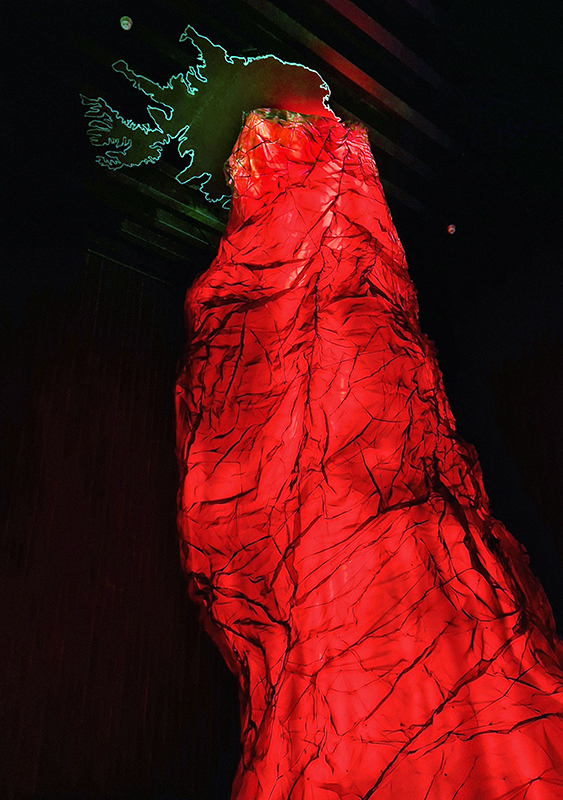
We made a visit to the Lava Centre at Hvolsvöllur to learn more about volcanology and mantle plumes.

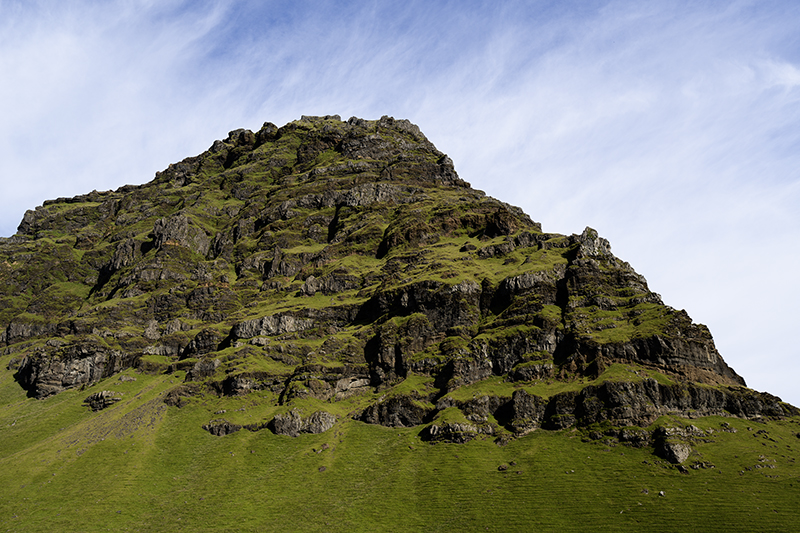
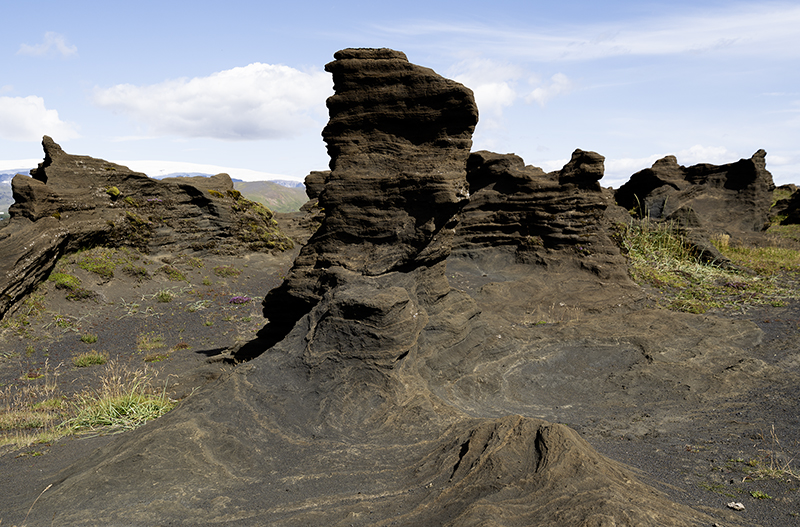
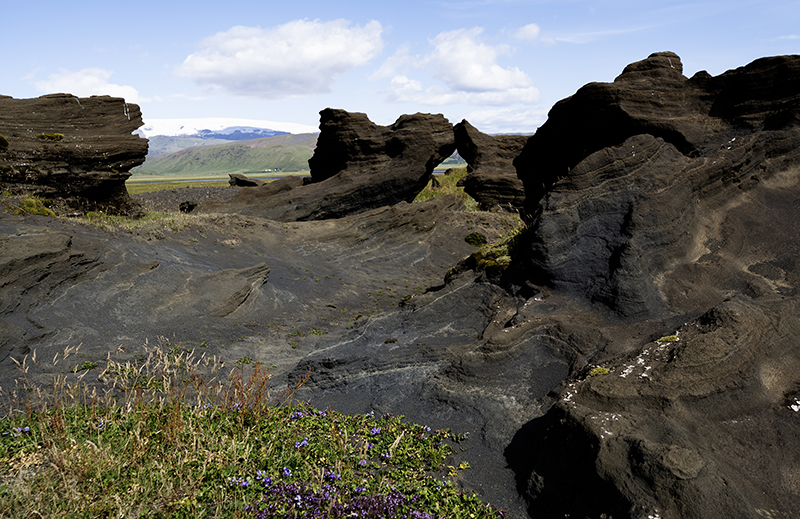
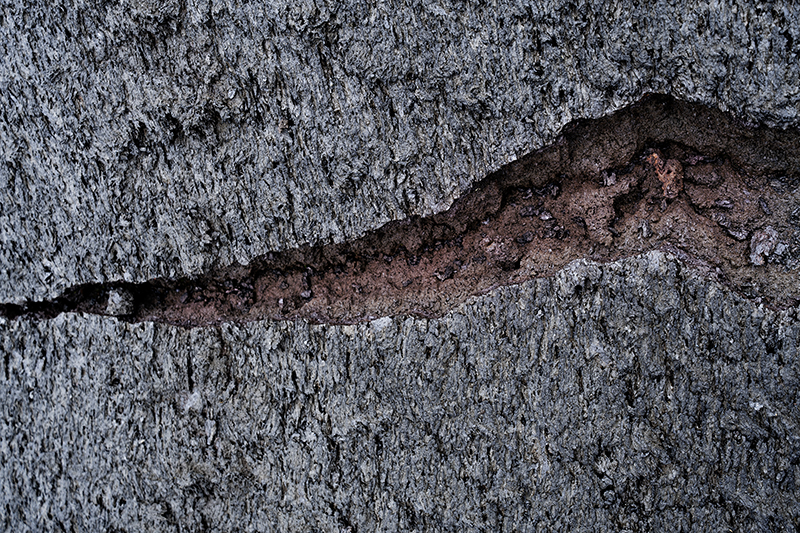
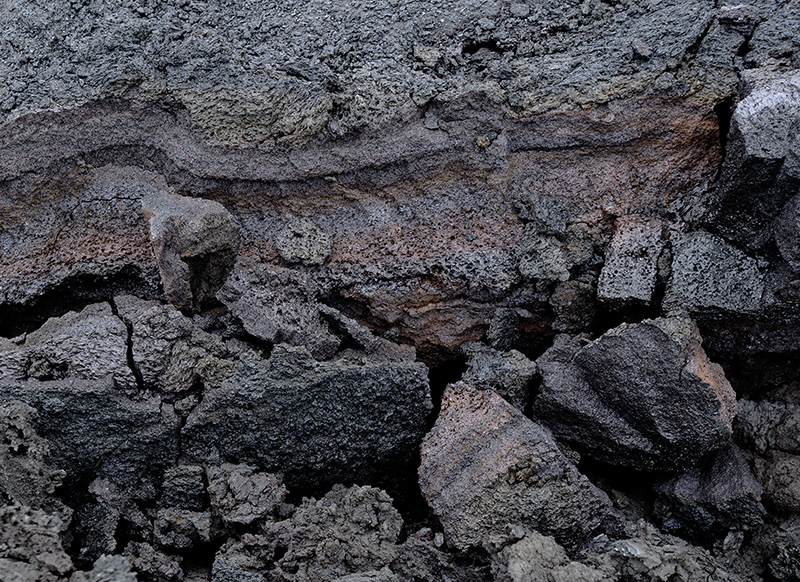
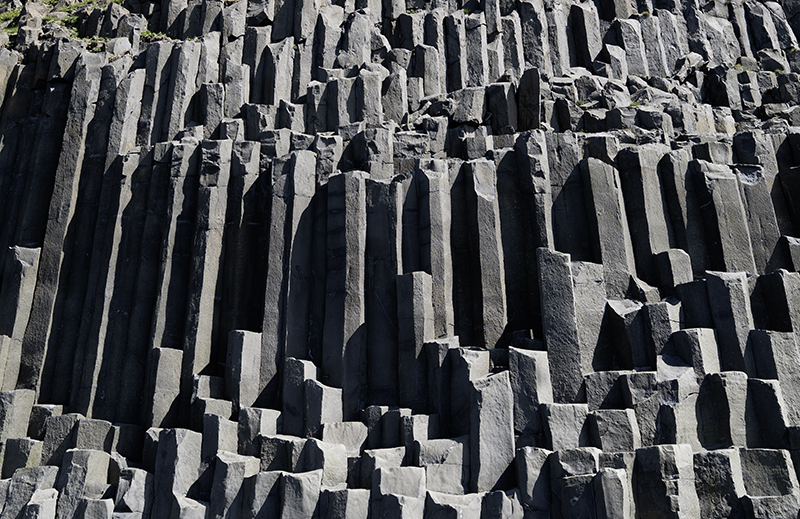
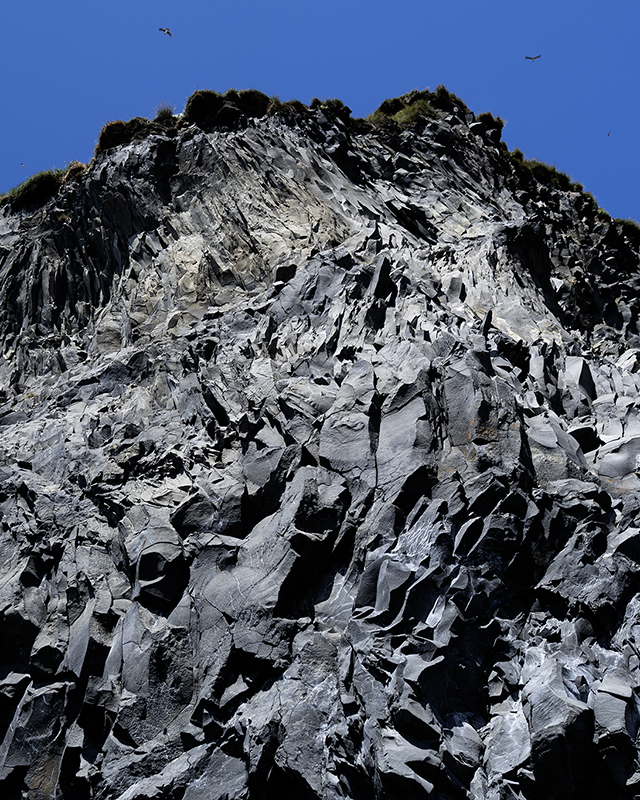
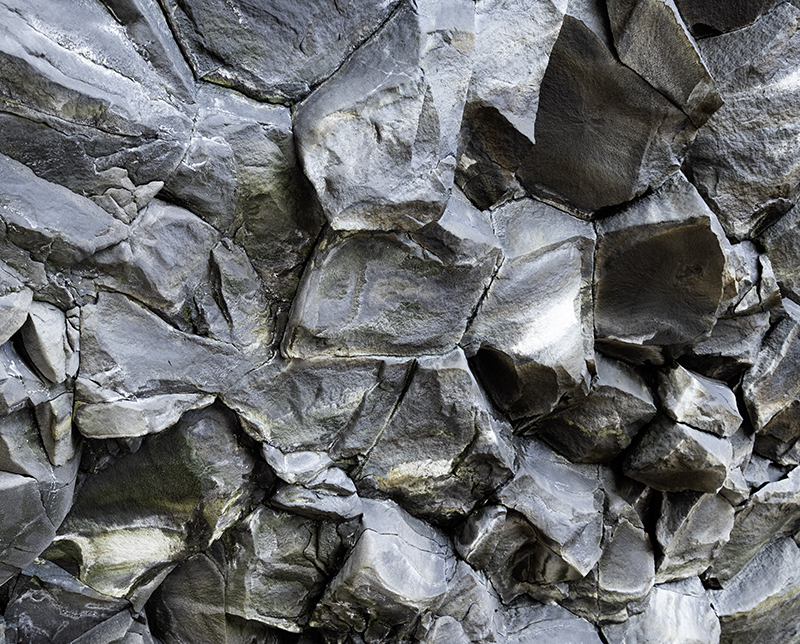
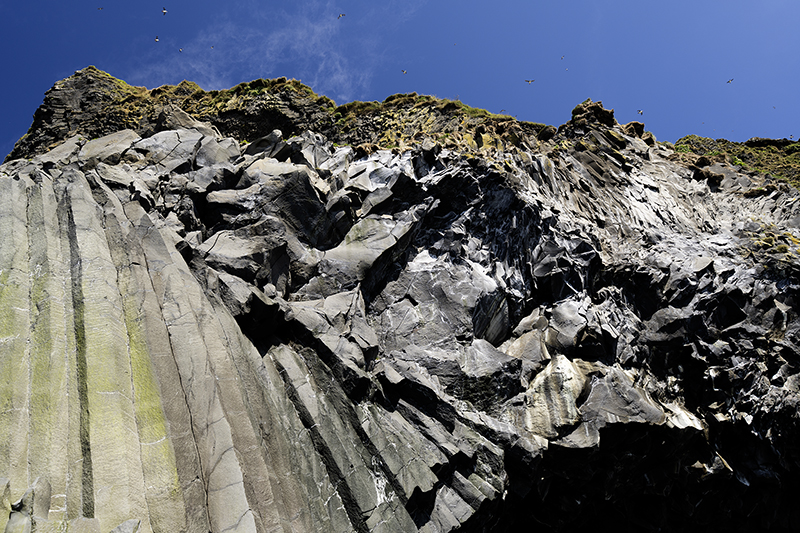
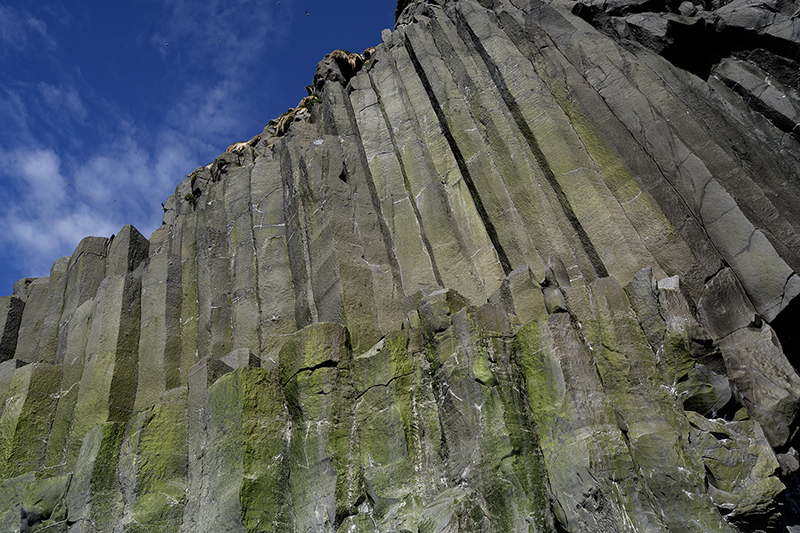
Under expert guidance we made many stops on our travels to look at rock formations, the layering of lava flows, pillars, columns and mosaics formed as lava cooled at varying speeds, cracking, filling with water, freezing and splitting further. We examined the aerated texture of lava, evidence of gas trapped in the magma, and the burnished iridescent surfaces found amongst the blackest basalt laced with minerals like olivine, laboradite and magnetite.

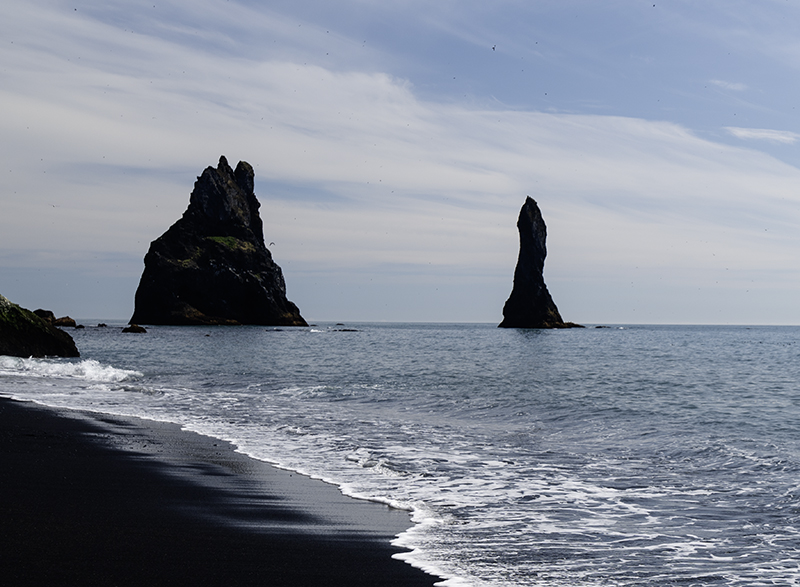
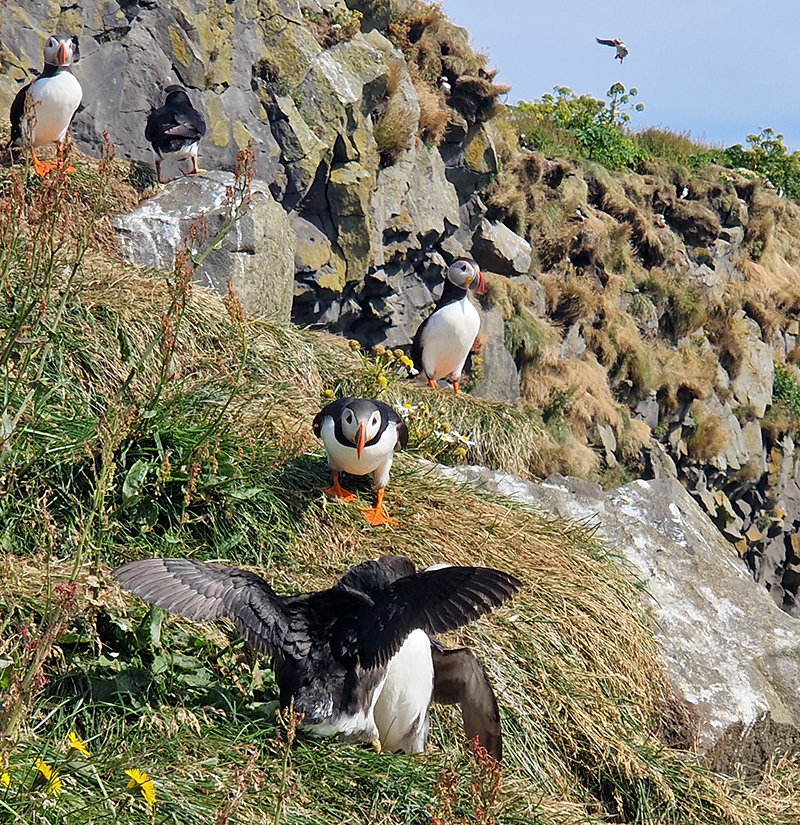
A very special treat was seeing puffins on the Dyrhólaey peninsula. Their stature does not look capable of flight, yet off they swoop from great  heights, out to sea, diving for fish.

Iceland is home to about half the global population. They spend most of their life out on the open sea without their colourful attire which will reappear as breeding season brings them back to their burrows high on the cliffs.

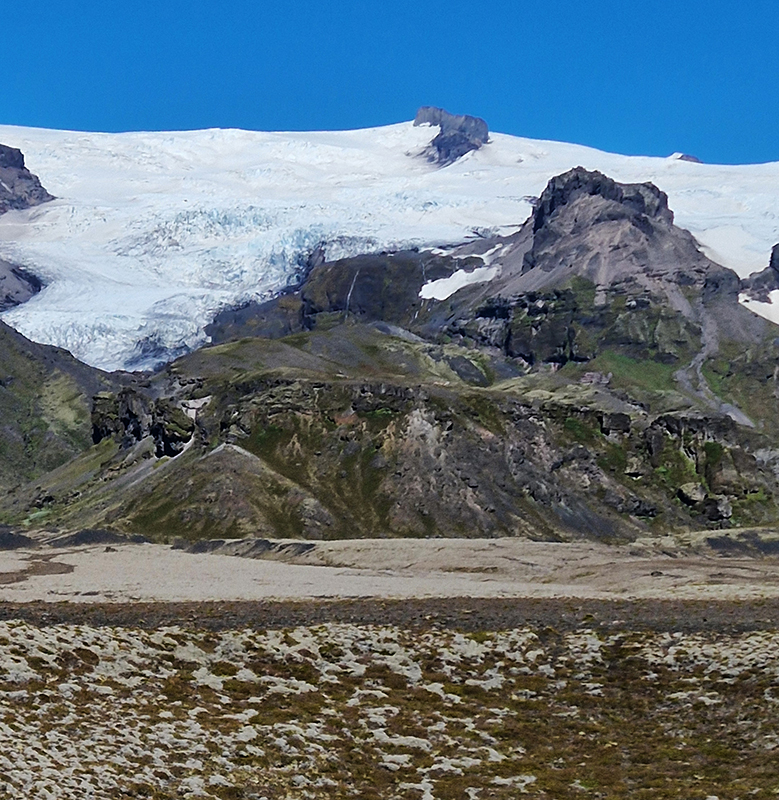
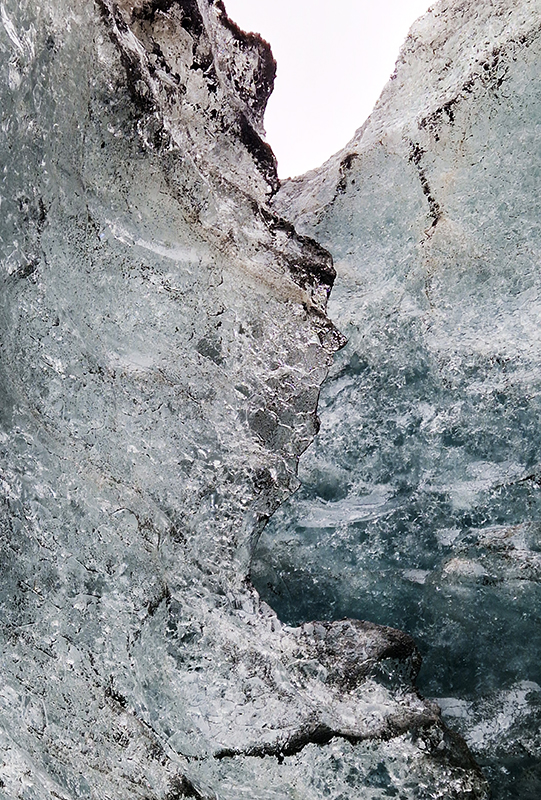
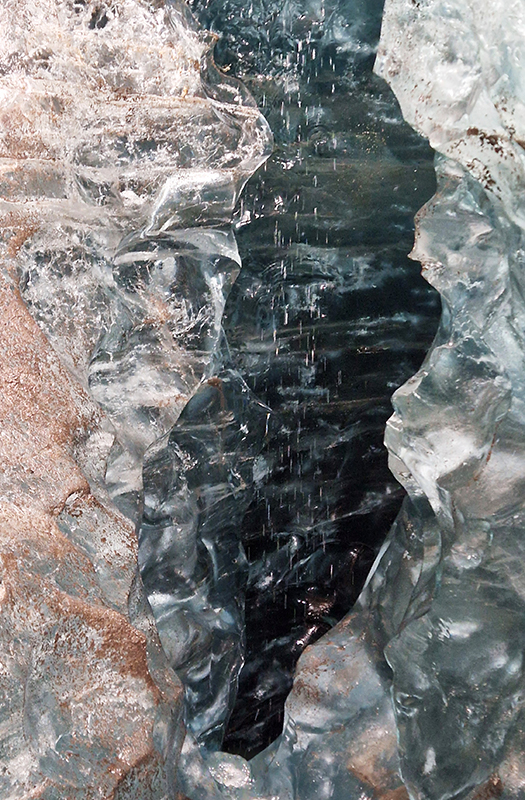
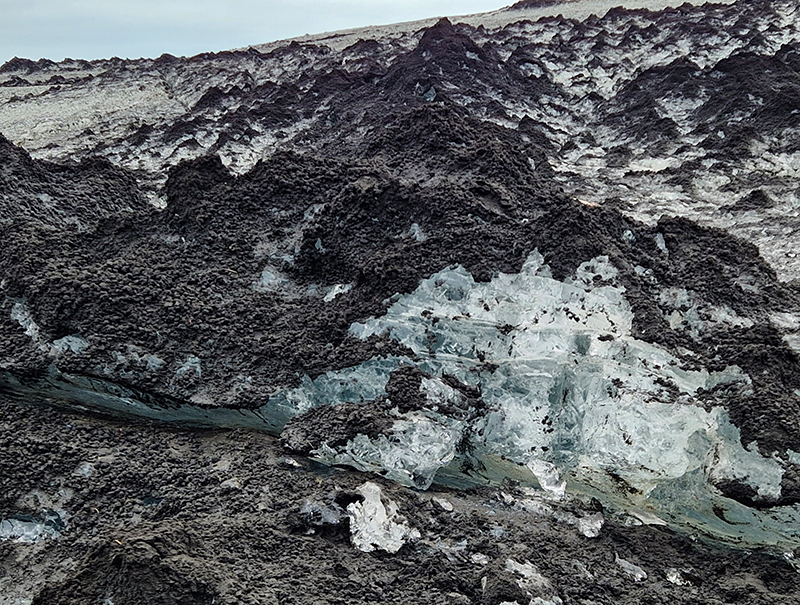
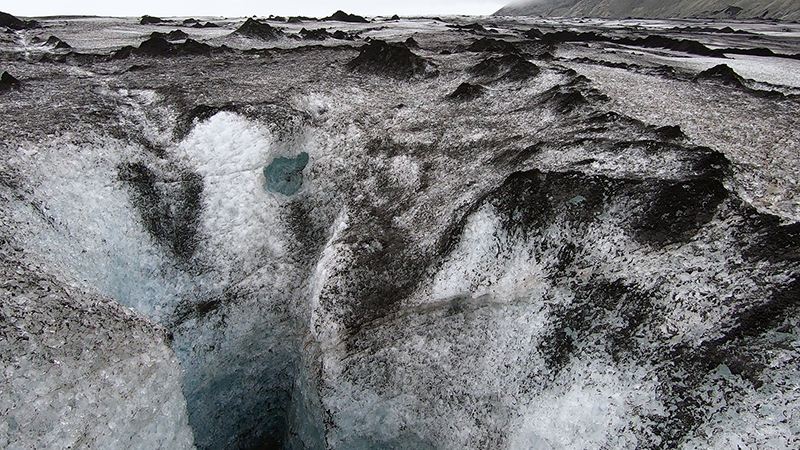
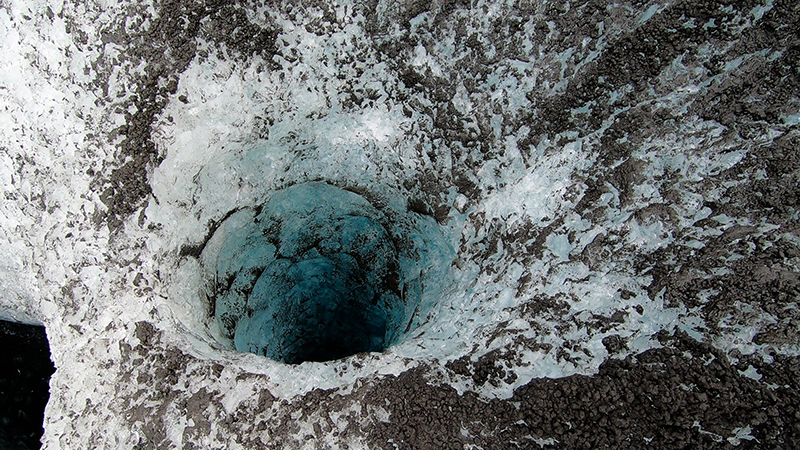
Getting up close to the ice in Iceland was incredible. The depth of the ice caps and glaciers is mind blowing but these giants are losing mass rapidly. We hiked on the Vatnajökull ice cap where it was about 150m deep but at the centre of this vast frozen landscape ice can be1000m deep. Walking in line and wary of crumbling ice holes we were led to view some deep crevasses sculpted by the constant flow of glacier melt. Iceland is one of the fastest warming areas on Earth and our guide helped us understand the impact of glacier retreat on ocean currents and global weather systems. Also, as glaciers melt, their diminishing weight causes the Earth’s crust to rebound, altering the melting point of magma in the upper mantle and leading to further seismic volatility.

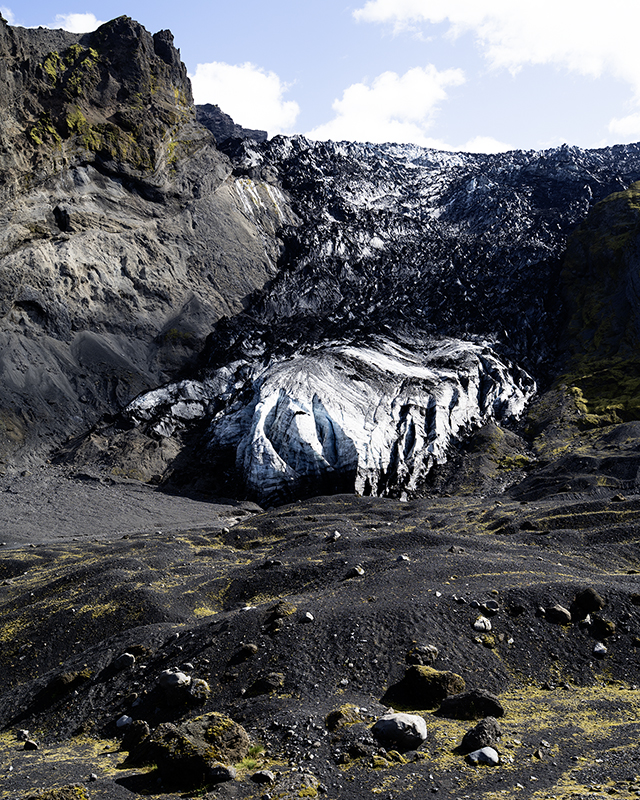
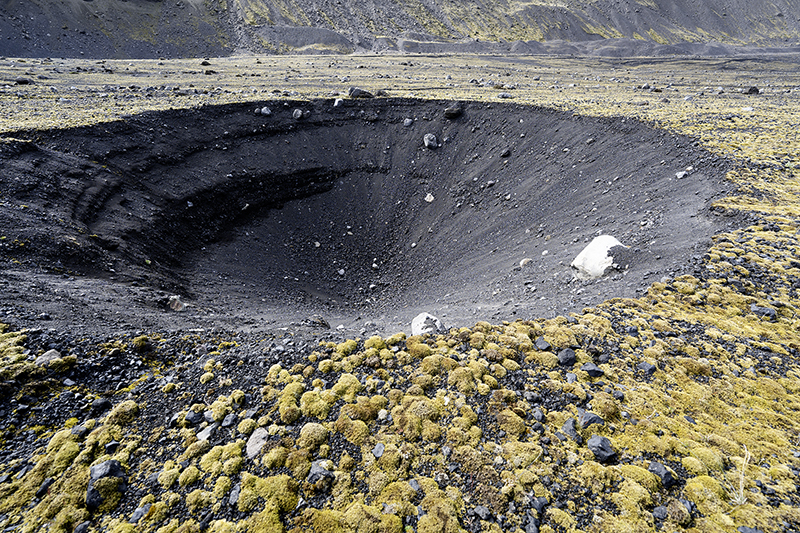
Our visit to the magnificent Gigjokull Glacier, the largest glacier of the Eyjafjallajökull volcano, famed for its internationally disruptive 2010 eruption, involved a jarring 4×4 ride over rock strewn terrain and through several fast flowing rivers of the Thórsmörk Valley. Volcanologist Dave McGarvie pointed out a large cone shaped hole to us that is believed to be where a huge chunk of ice was covered in deep ash and then slowly melted away leaving no evidence.

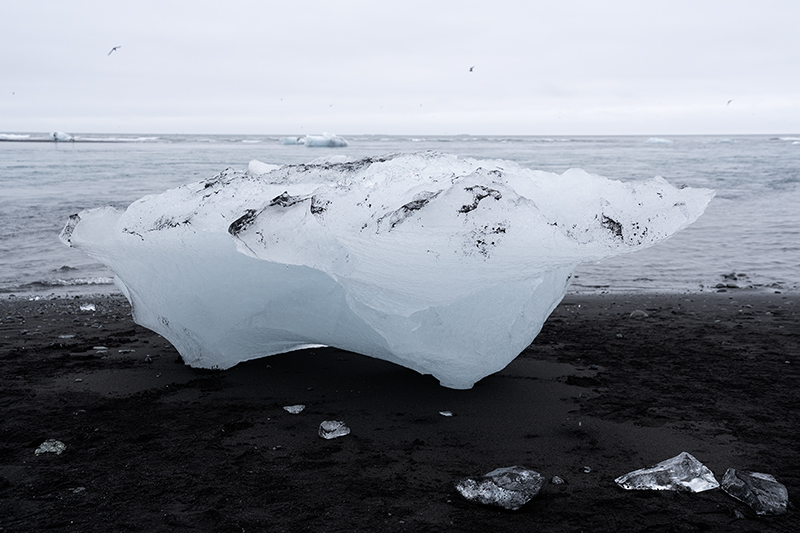
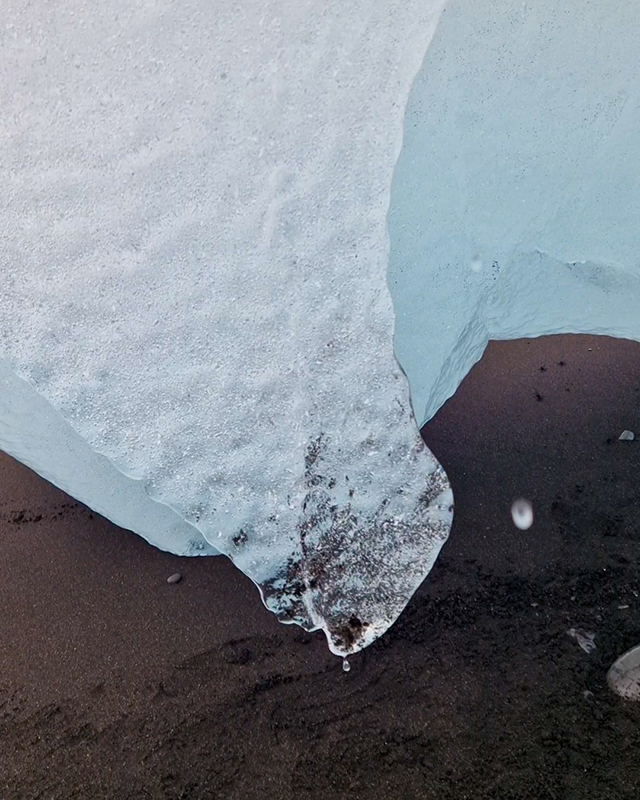
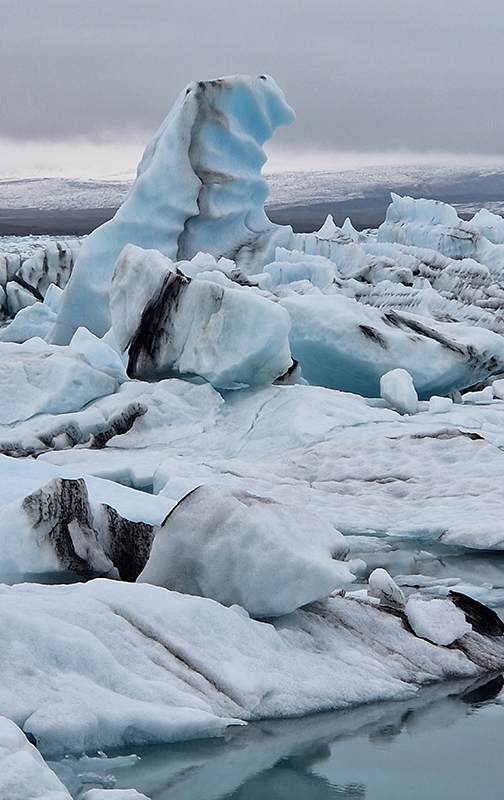
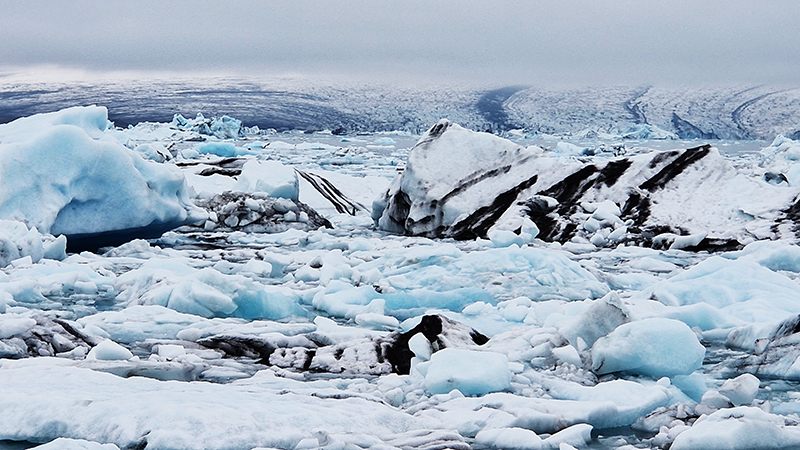
From the dark volcanic rocks come the famous black sand beaches, particularly set off by stranded sparkling ice, washed onto its shores at Diamond Beach. The adjacent Jökulsárlón Glacier Lagoon is an example of a landscape shaped by glacier change, as ice from one of the glaciers of the Vatnajökull ice cap calves into this lagoon, creating icebergs that jostle through the water towards the sea.

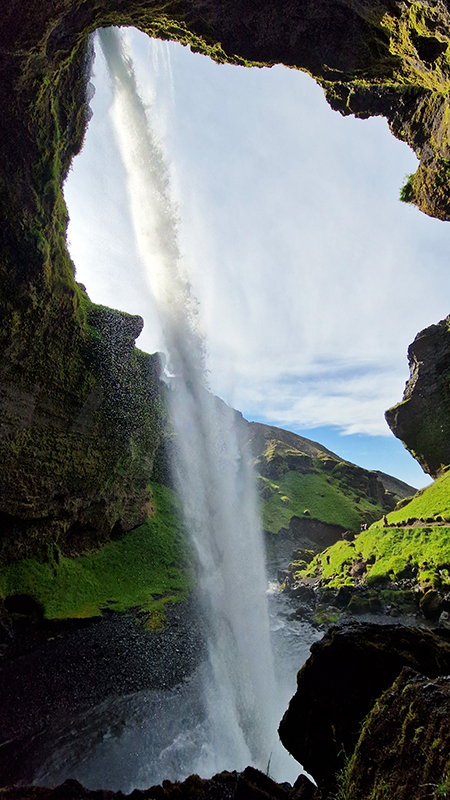
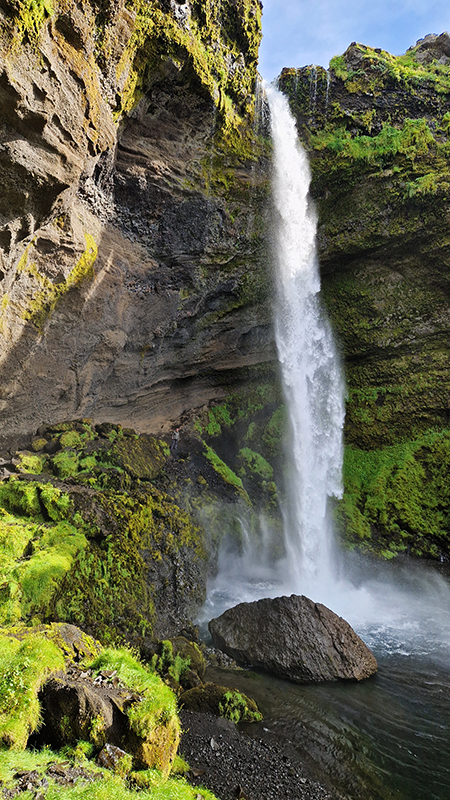
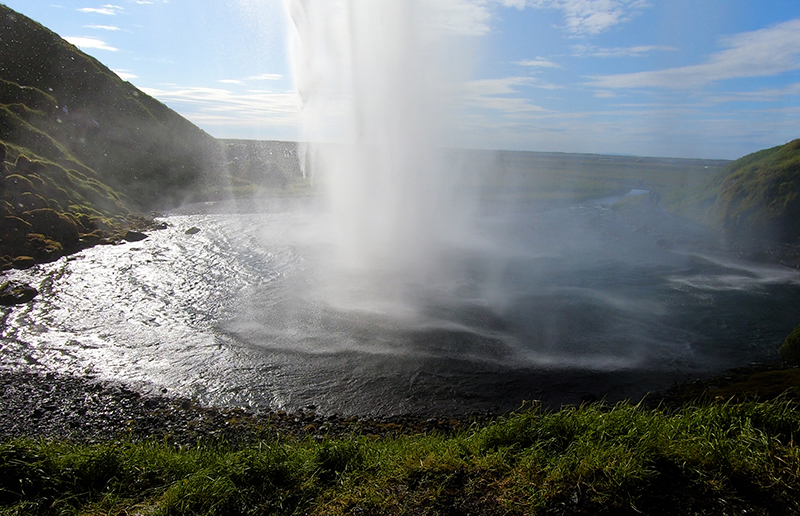
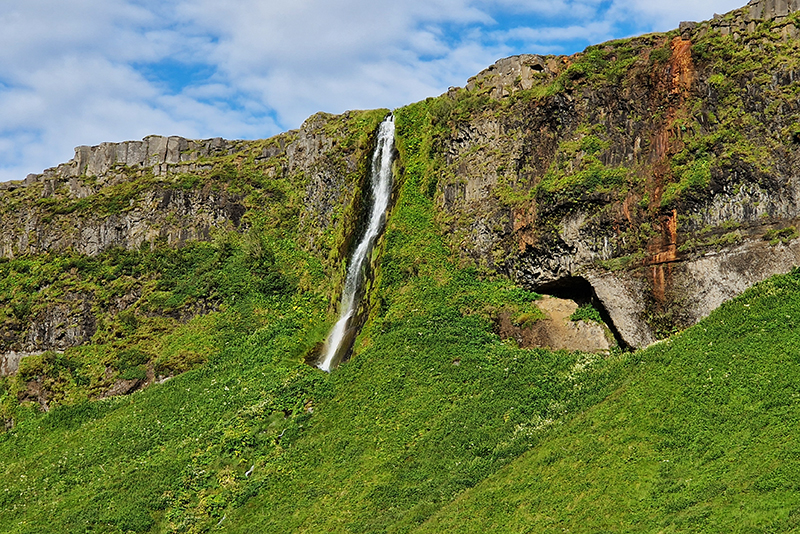
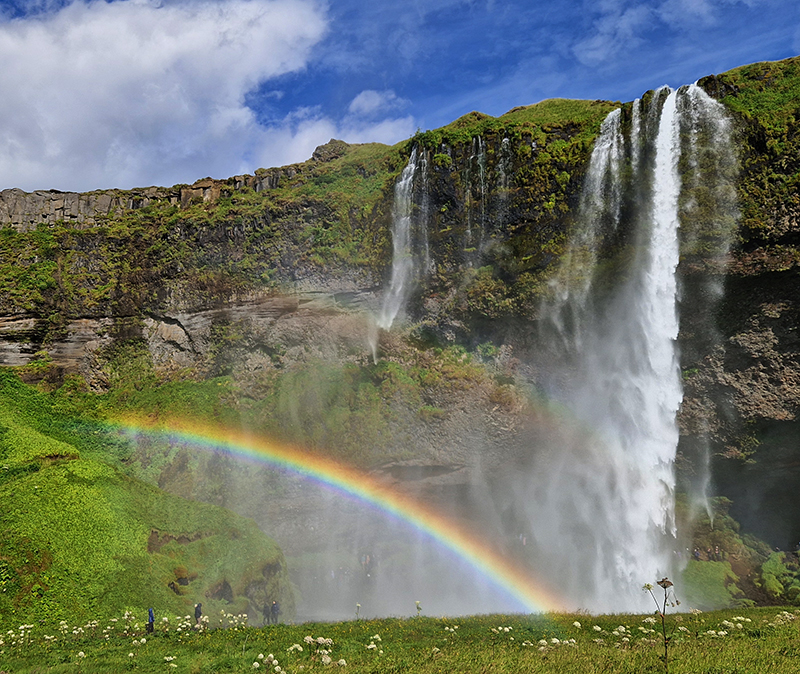
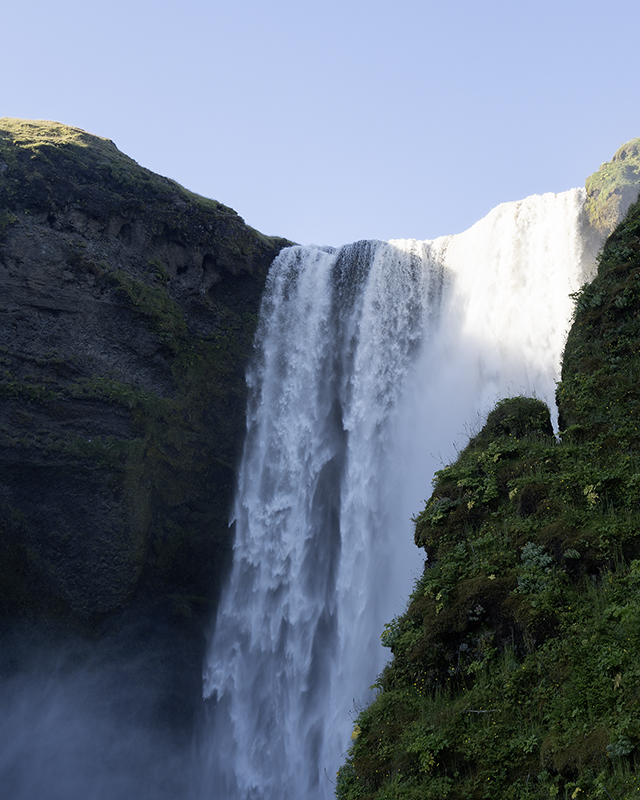
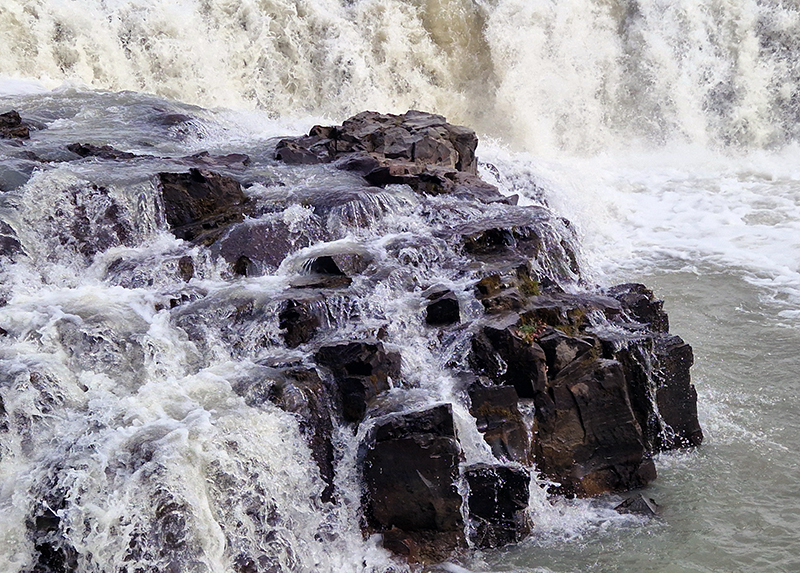
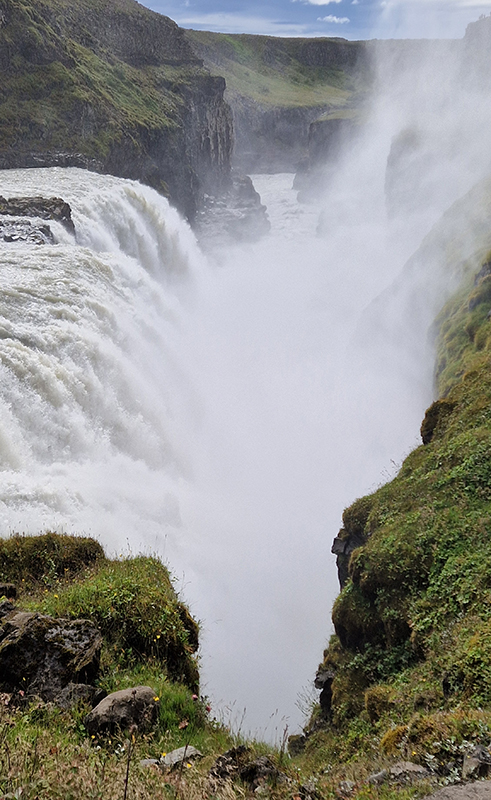
A wet climate, melting glaciers and steep volcanic cliffs create thousands of waterfalls across Iceland, roaring and tumbling from colossal heights into deep pools and ravines feeding a lattice of streams and rivers. Always magical to experience and such a contrast to the vast flatlands of lava fields.

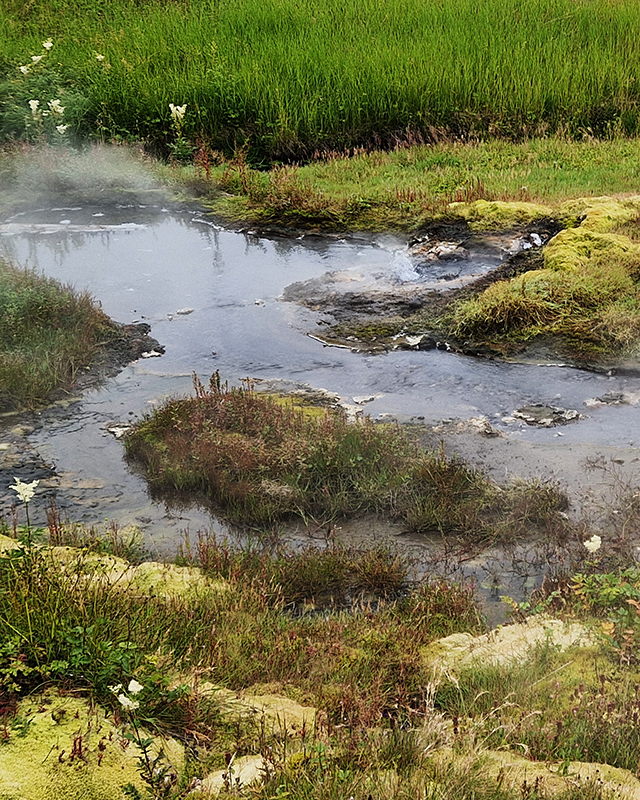
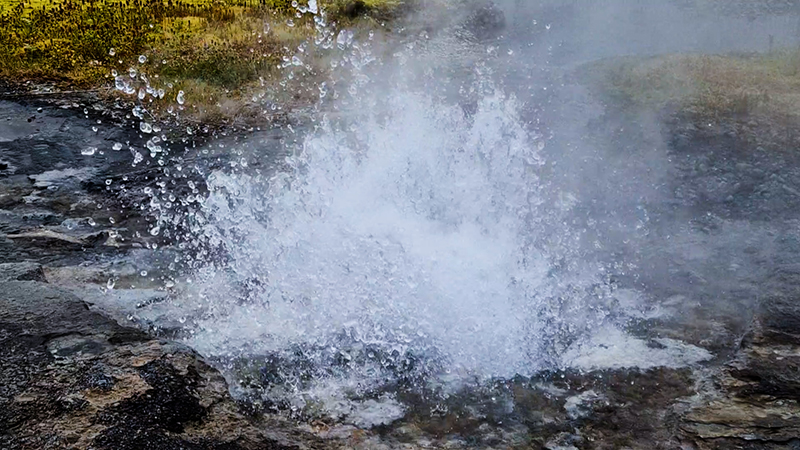
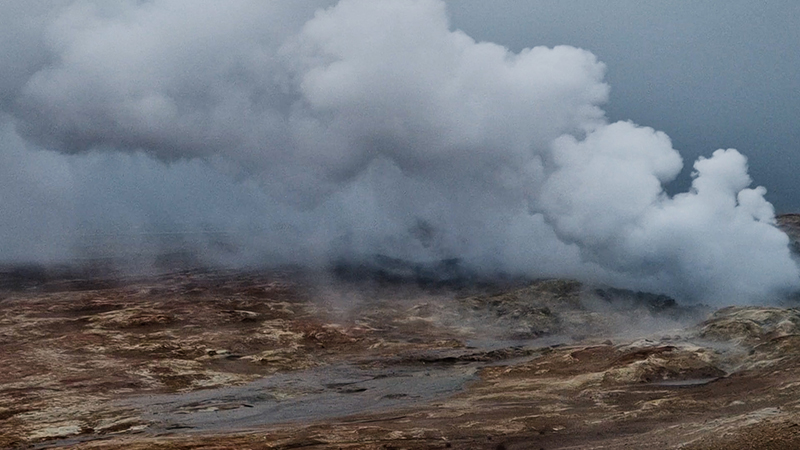
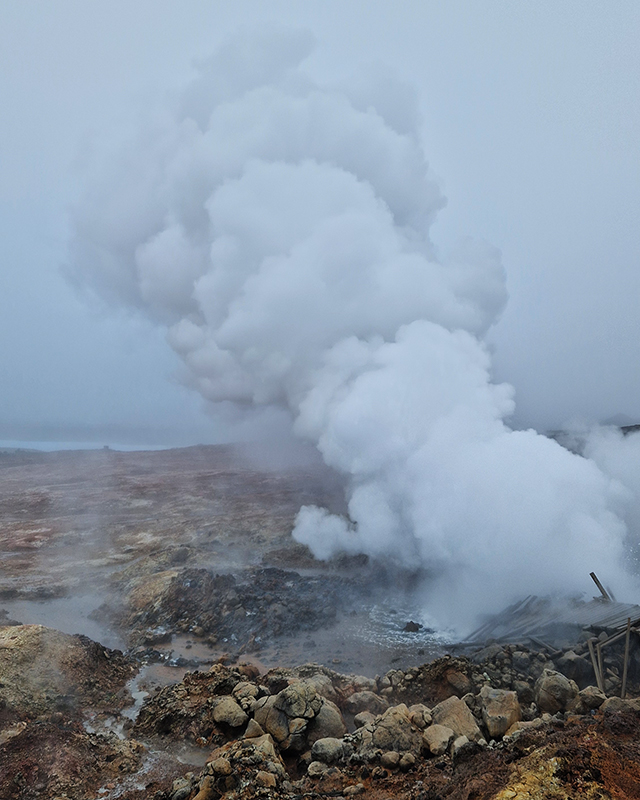
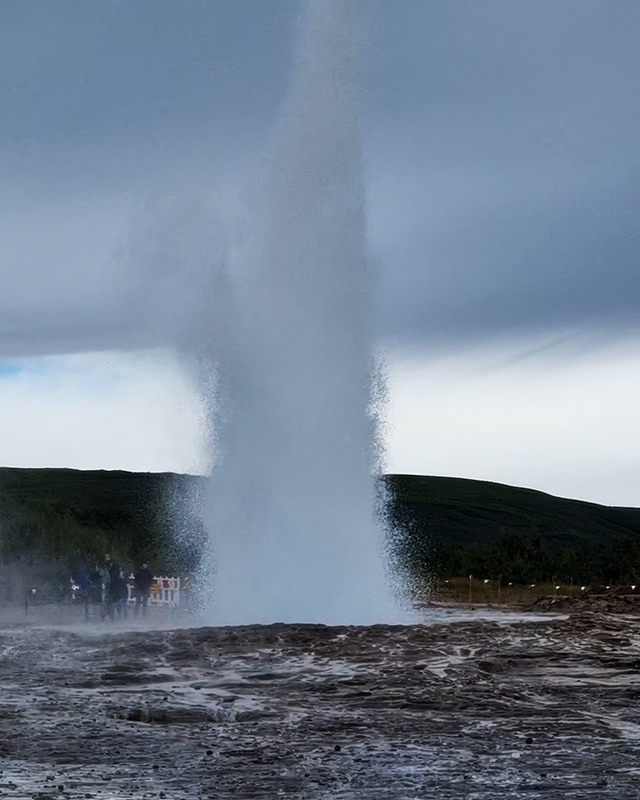
Water also soaks deep down through the porous volcanic rocks into the earth’s crust, where hot magma and bedrock heat the water to very high temperatures. As the water warms, it rises back up through cracks, faults, and fissures in the earth to emerge as a natural hot spring. Some springs are gently bubbling with escaping gases but at places like Gunnuhver, intense geothermal activity causes boiling mud pools and powerful steam vents. Sometimes water fills deep underground chambers, getting super hot until steam bubbles rise and push a small amount of water out of at the top, releasing pressure and causing the superheated water below to instantly turn into expanding steam, blasting boiling water and steam upwards in an exhilarating geyser. The chamber then refills and repeats.

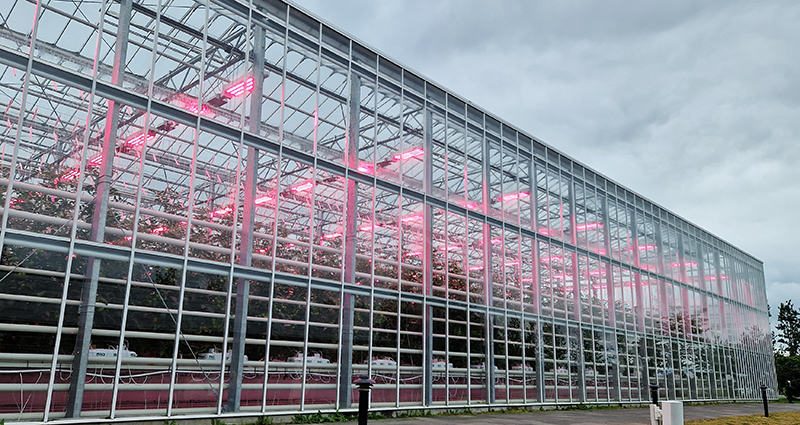
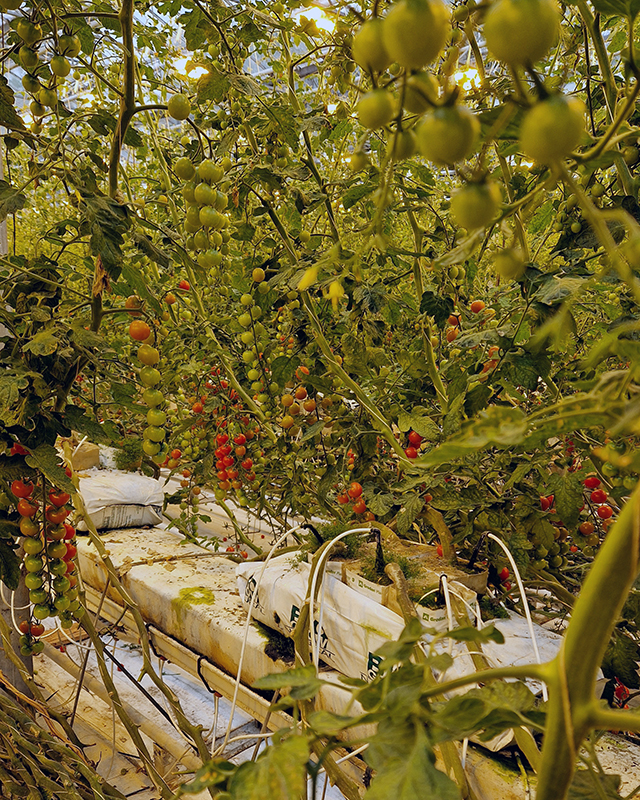
Iceland’s unique active geology and location over a mantle plume means that it can harness geothermal energy which provides around 30% of the island’s electricity with the rest generated by hydropower. Hot water is fed directly into heating systems and the run off from power plants is used to fill swimming pools, hot tubs and keep city pavements ice free. Crops that would not normally thrive in the Iceland climate are grown in huge commercial greenhouses using geothermal water to regulate temperatures – we had delicious fresh tomato soup here.

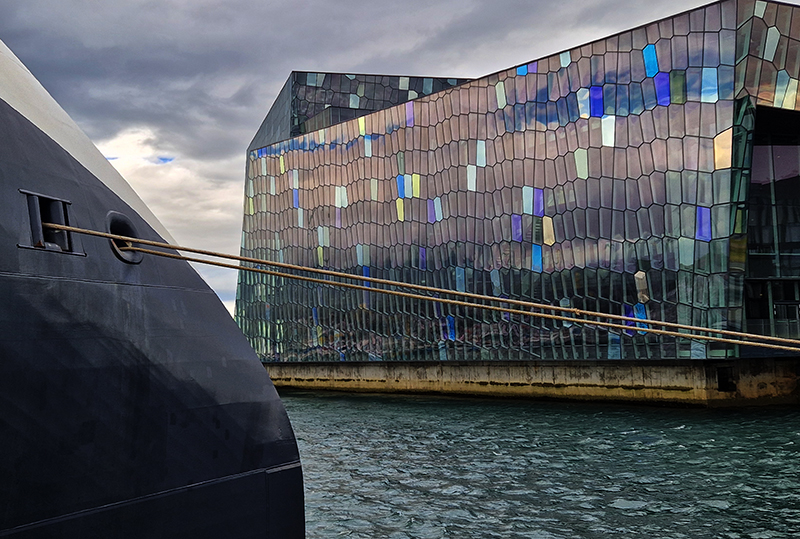
We sailed from Reykjavik to Kalaallit Nunaat (Greenland) aboard the Sylvia Earle ship, leaving as the evening lights played over the iridescent geometric glass façade of Harpa, architecturally designed in collaboration with artist Olafur Eliasson to reflect the basalt landscape of Iceland.

The ship is named after the amazing marine biologist, conservationist, oceanographer and explorer Dr Sylvia Earle who holds the record for deepest walk on the sea floor. Richard Powers loosely based his glass ceiling breaking, female character, Evelyne Beaulieu, in his excellent  novel Playground on the extraordinary real life of Dr. Sylvia Earle. A recommended read.

Settling onto the ship we were issued with life vests, taken through a practice lifeboat drill and given a bio-check, hoovering all our kit that we might take off the ship with us when landing in Greenland. Mud boots were issued which would be scrubbed and disinfected after every landing.

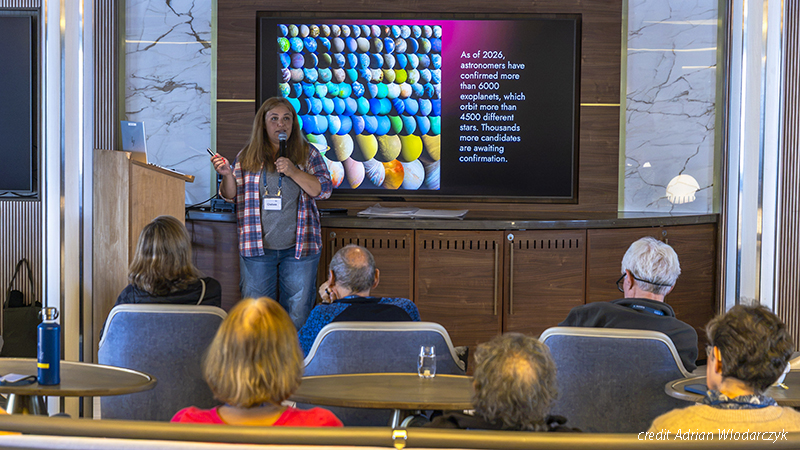
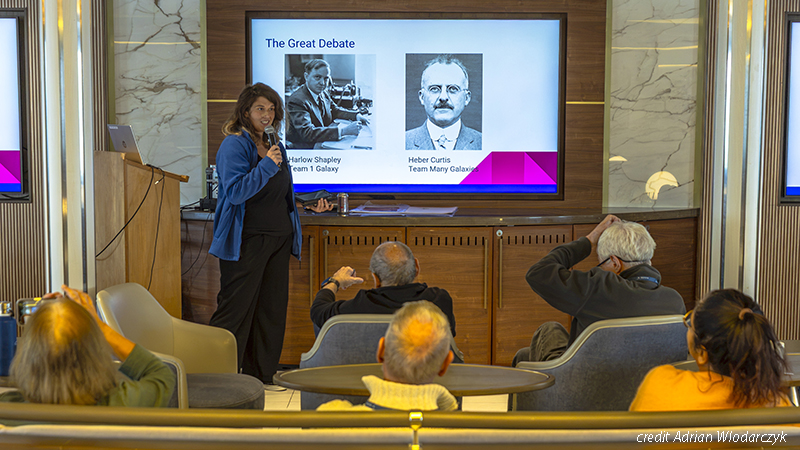
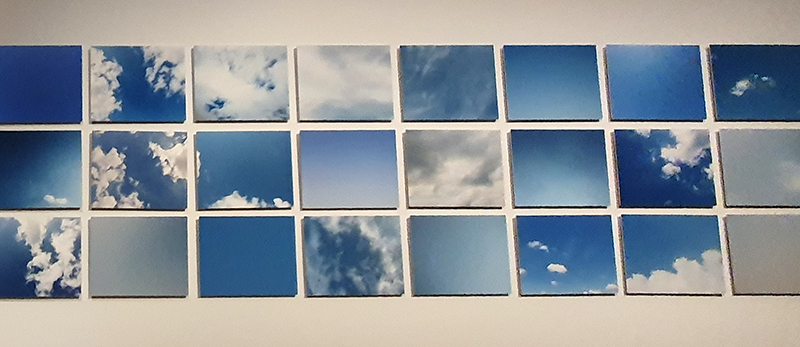
The first day was spent crossing the Denmark Strait. On board we had briefings on Zodiac cruising, polar bear safety and lectures introducing Greenland and the Arctic skies. There were citizen science cloud surveys that feed into NASA satellite data to help monitor clouds in remote regions and give a perspective looking up rather than down. We were given charts to identify clouds at different heights and estimated coverage percentages to feed into a central database.

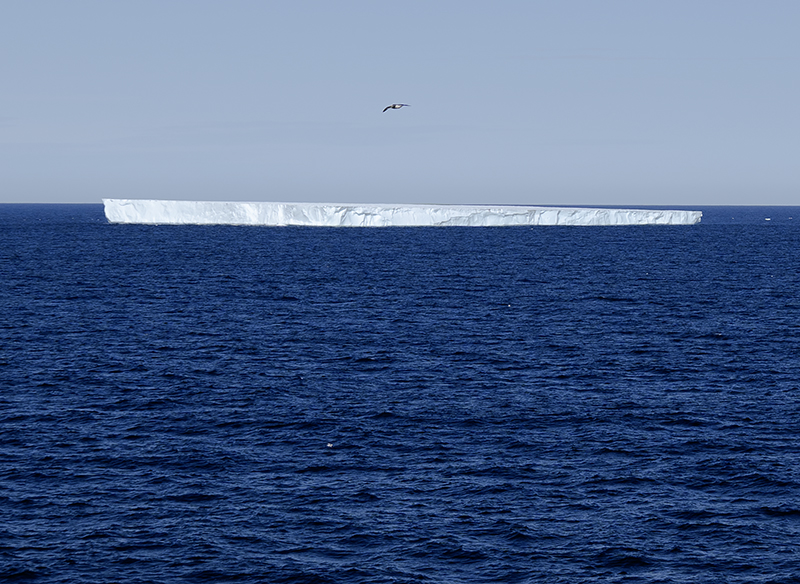
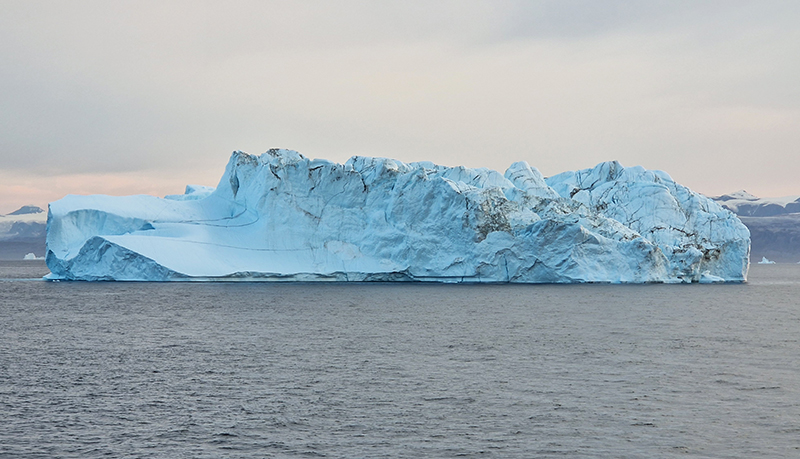
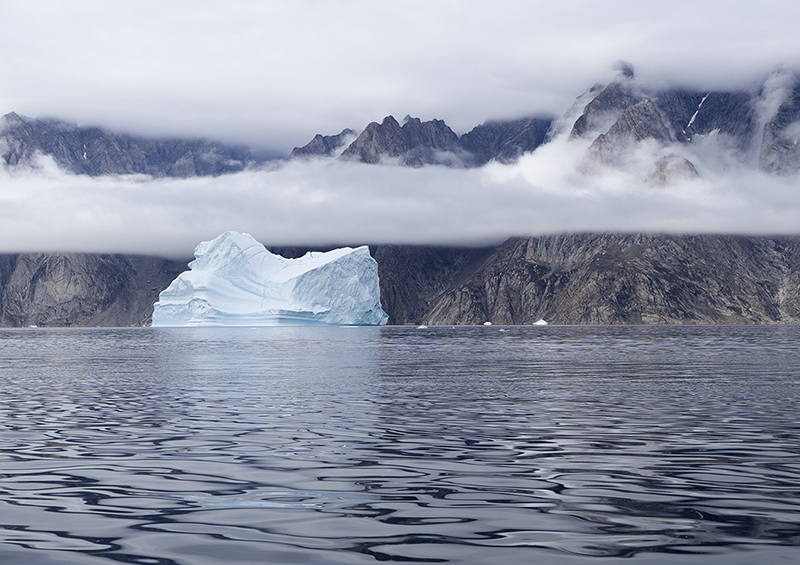
A solitary massive iceberg, met us just as we crossed into the arctic circle.

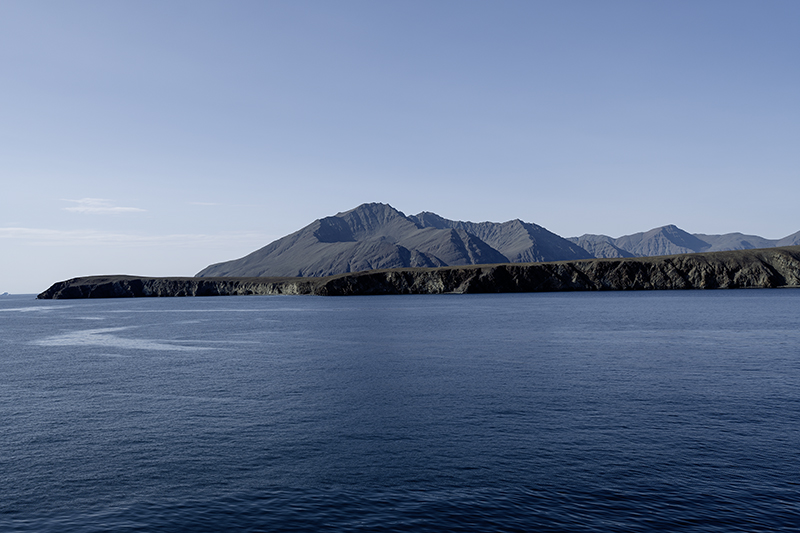
Fist sight of Greenland land.

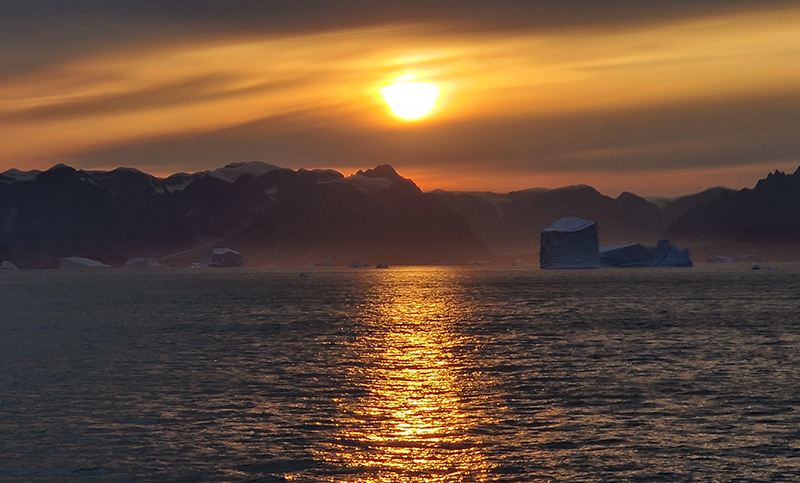
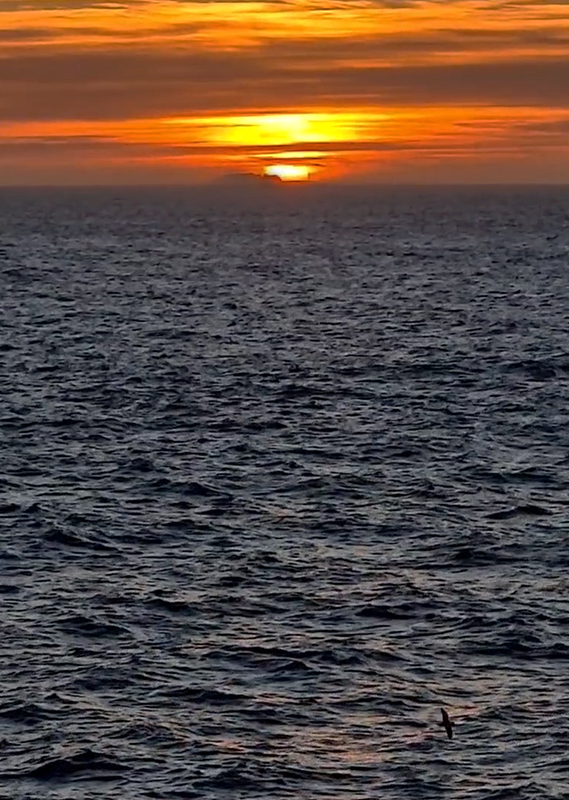
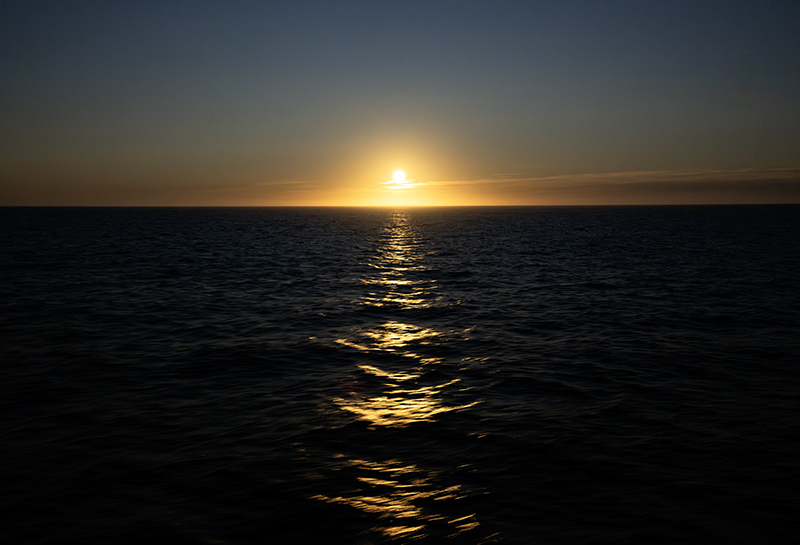
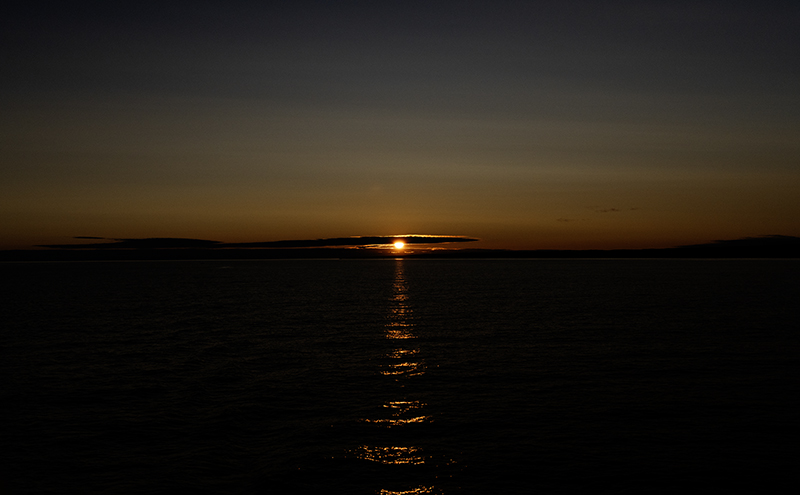
At this time of year lingering arctic sunsets hover above the horizon, the sky never fully dark before the sun rises again.

It wasn’t dark enough for us to see any aurora that might be occurring but New Scientist reporter Chelsea Whyte gave a fascinating presentation on the quest to create artificial auroras by Finnish physicist Karl Lemström and other 19thC science pioneers when the cause of auroras was still unknown.

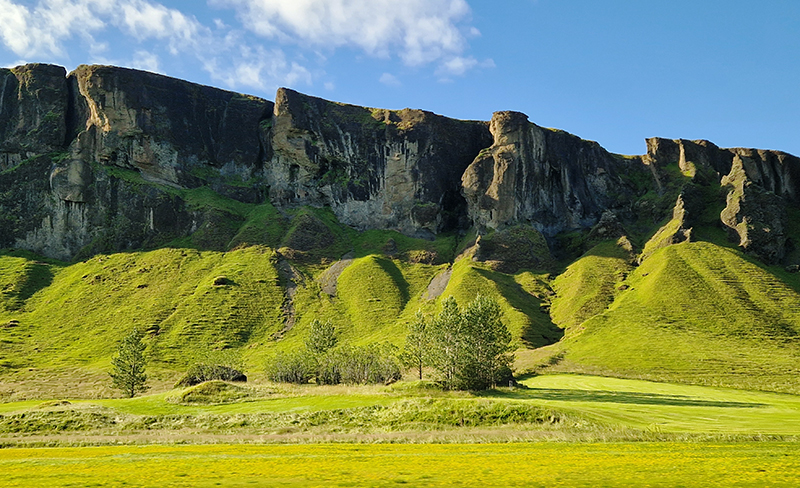
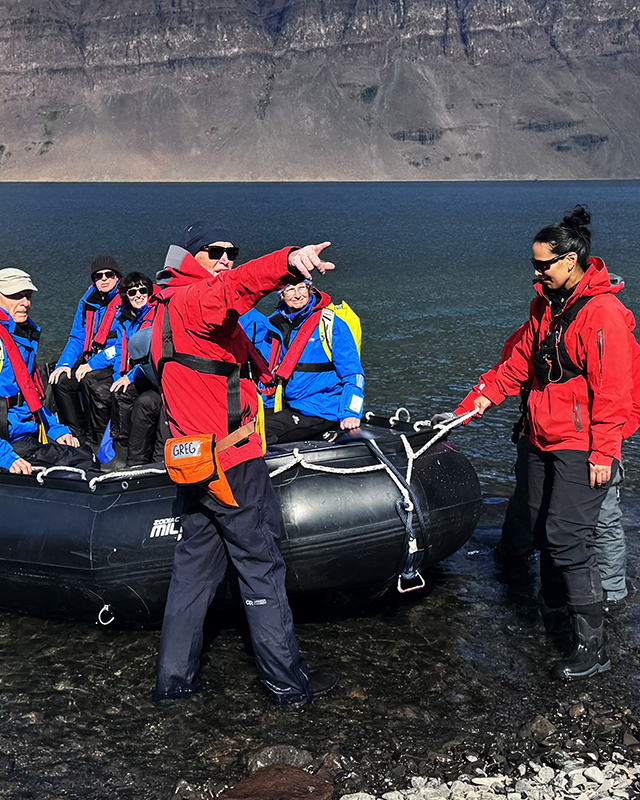
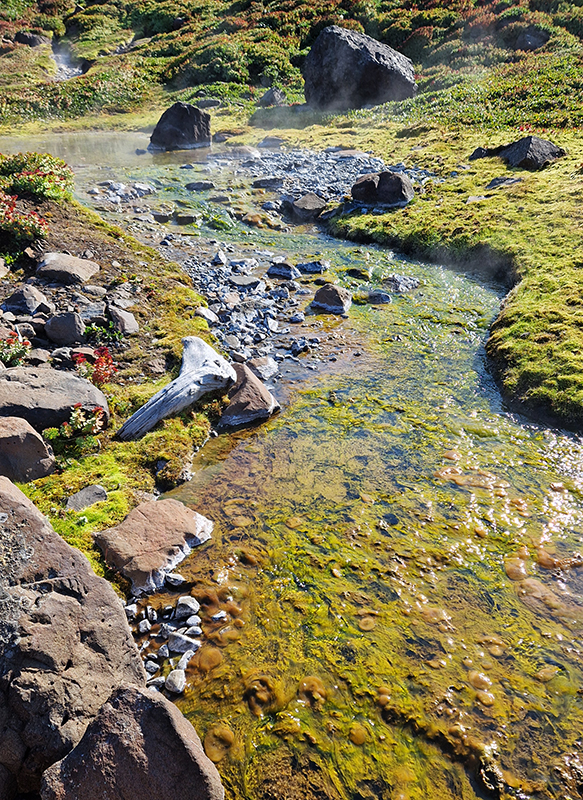
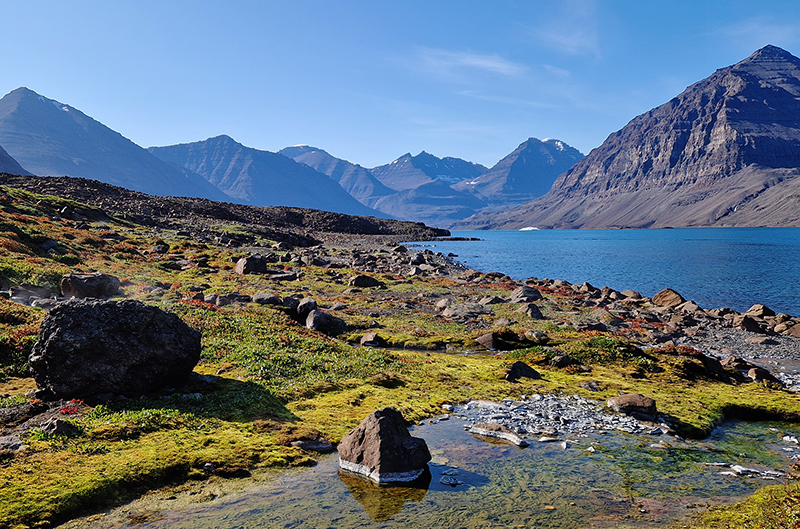
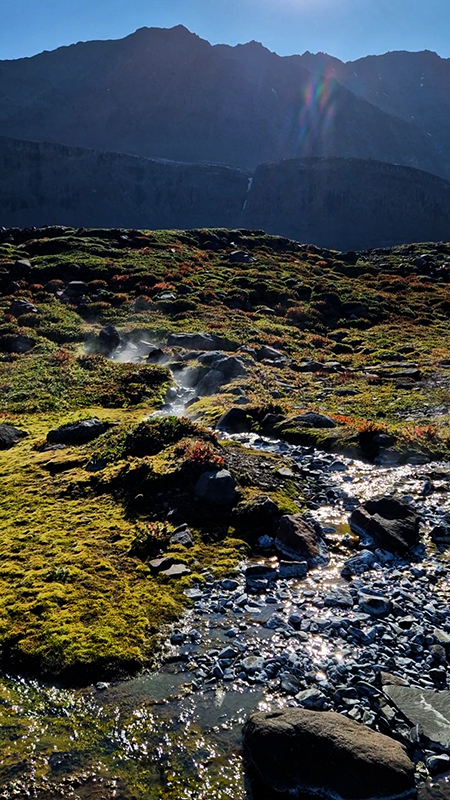
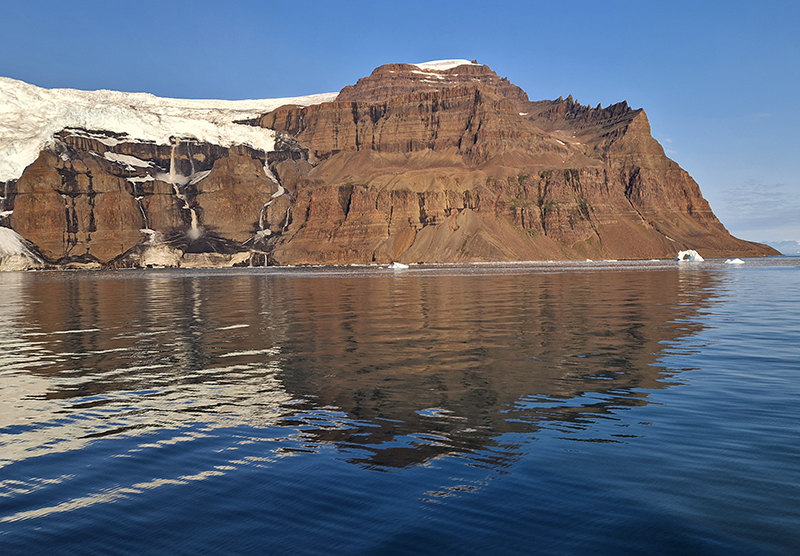
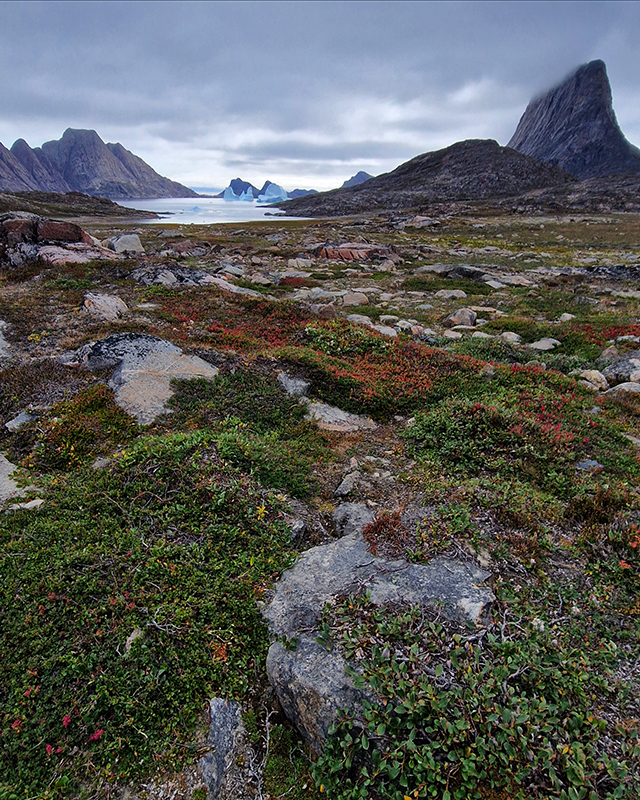
Our first landing via Zodiac boat was in Rømer Fjord. Surrounded by 55 million year old red basalt cliffs we explored bubbling hot springs and magical green oases, kept safe by a perimeter of expedition team leaders equipped with flares and rifles who constantly scan the horizon and shore line for approaching polar bears.

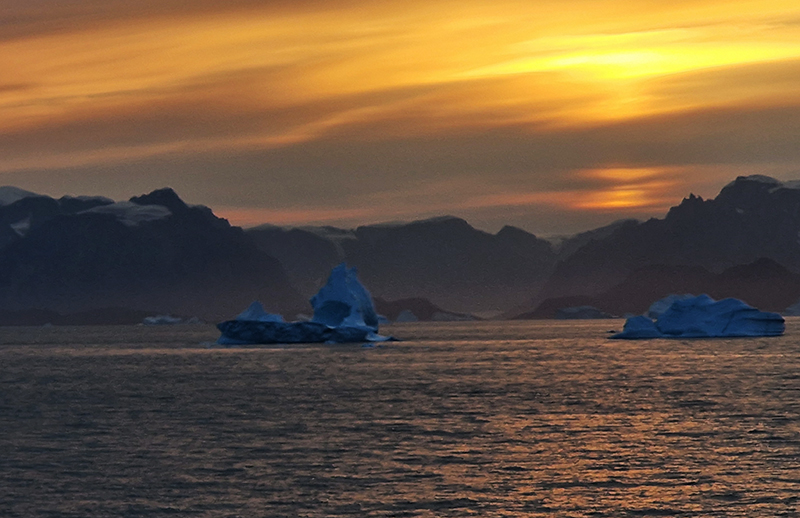
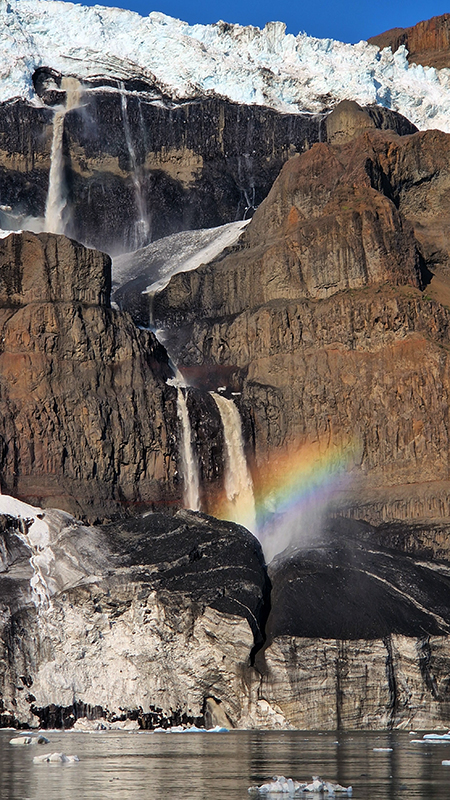
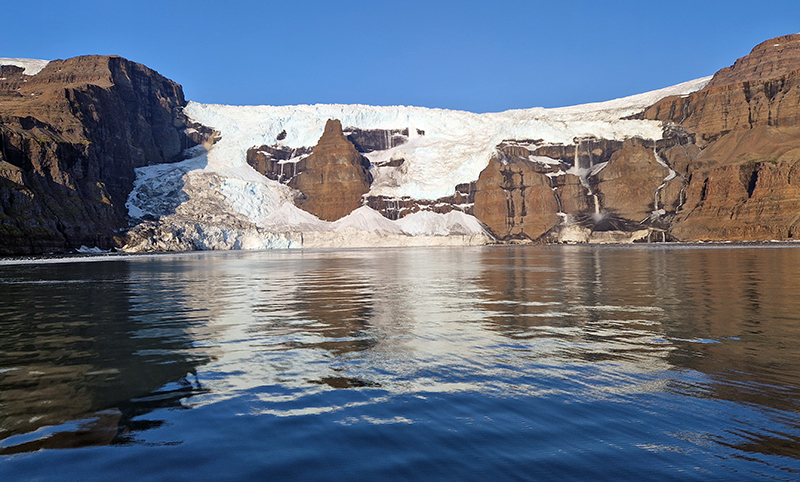
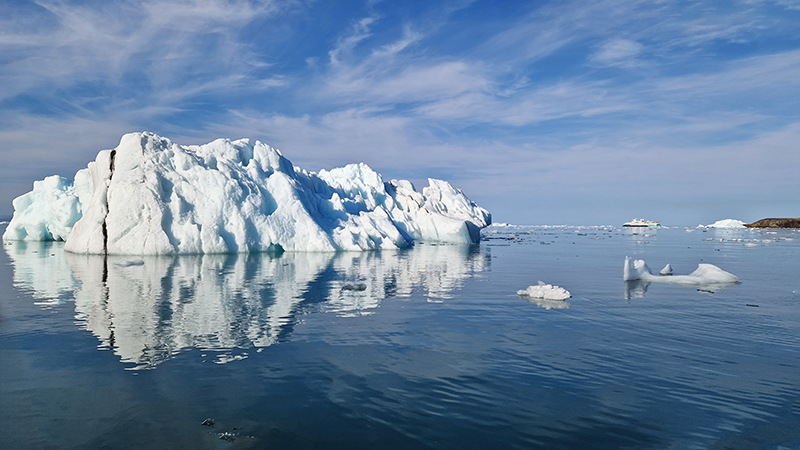
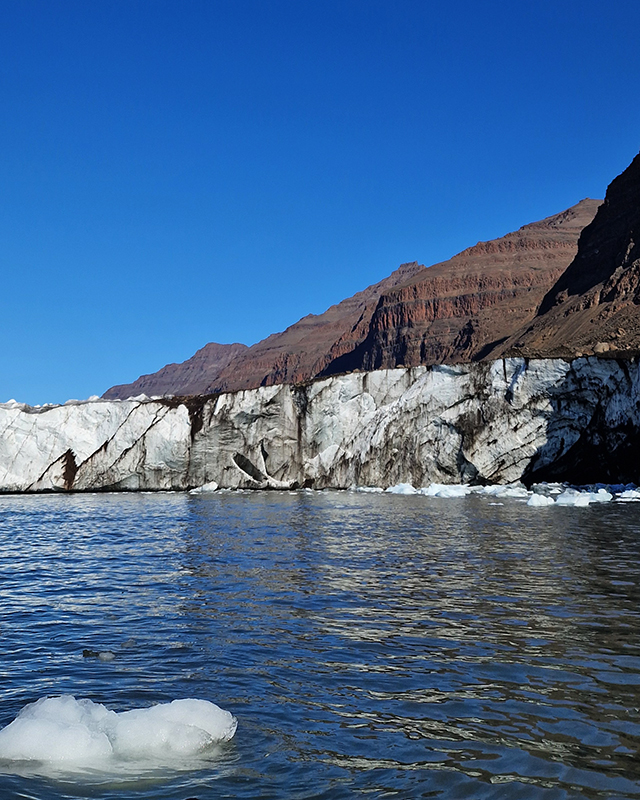
We saw Greenland under a dazzling sun that intensified the vibrant blues and startling whites of majestic icebergs and imposing walls of glaciers, throwing up rainbows over waterfalls and tinting the ice pink and gold, morning and evening. Even under cloud cover the ice has a radiant glow, as any light here bounces around the many reflective surfaces.

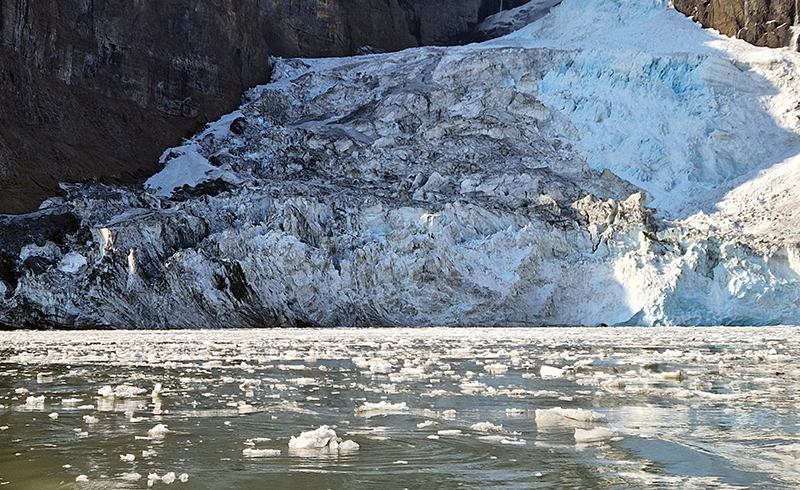
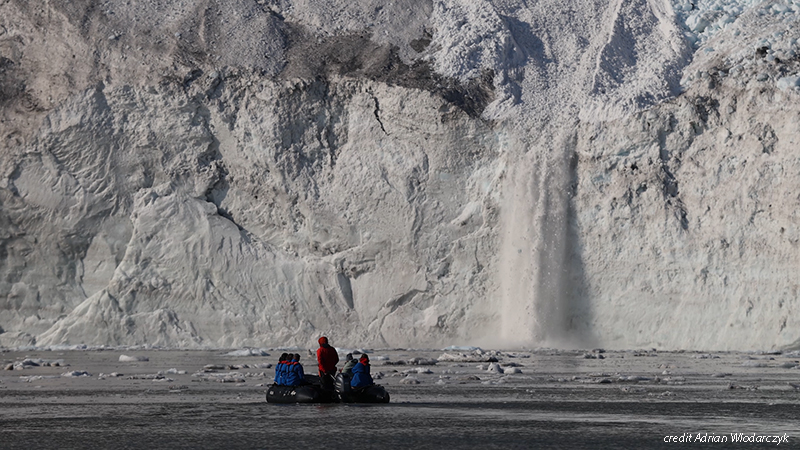
The silence of the fjords is broken dramatically by thunder claps of collapsing glaciers, near and far, as they shift, crack and calve.

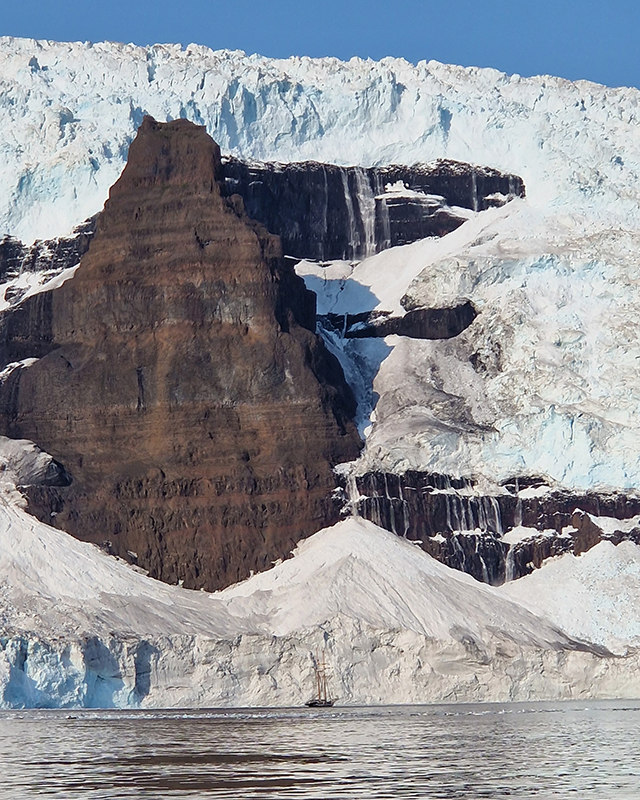
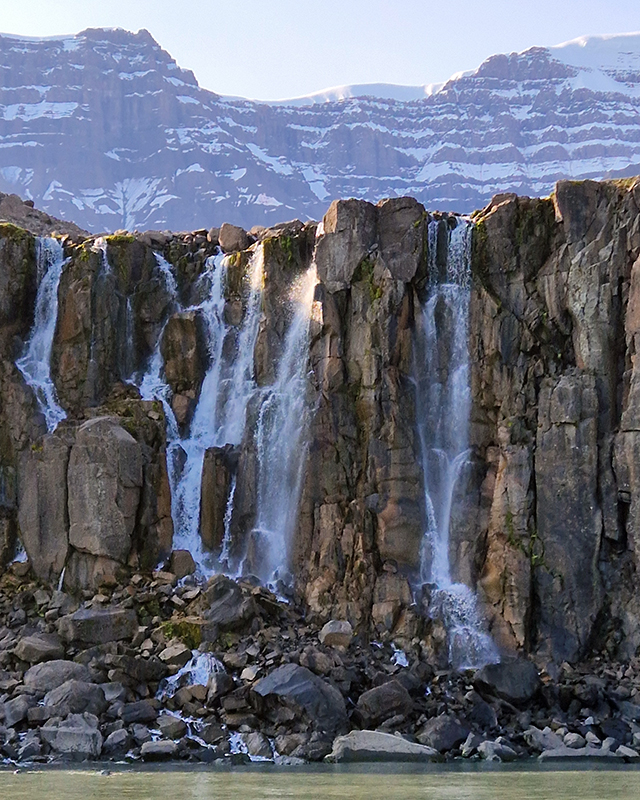
Riding on the zodiac boats was great fun and our expert drivers took us around icebergs and to glacier walls and sheer cliffs threaded with waterfalls allowing us to really get a sense of the size of these edifices. We saw great ice falls from the cliffs and even an iceberg roll at one point, sending out concentric waves across the fjord, a warning not to get too close.

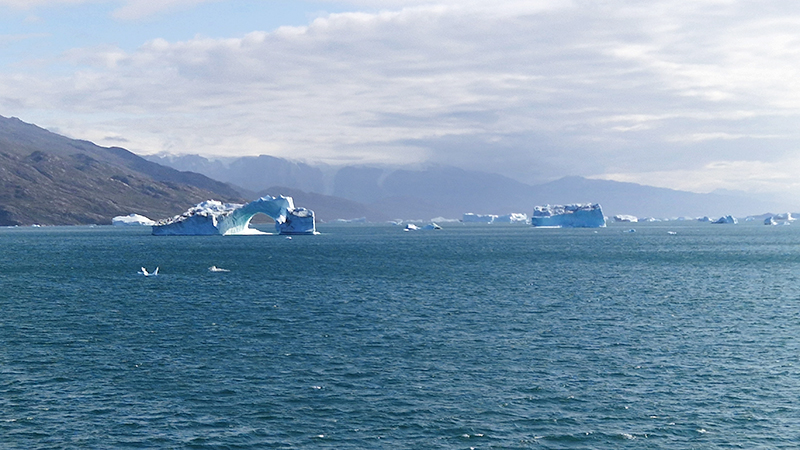
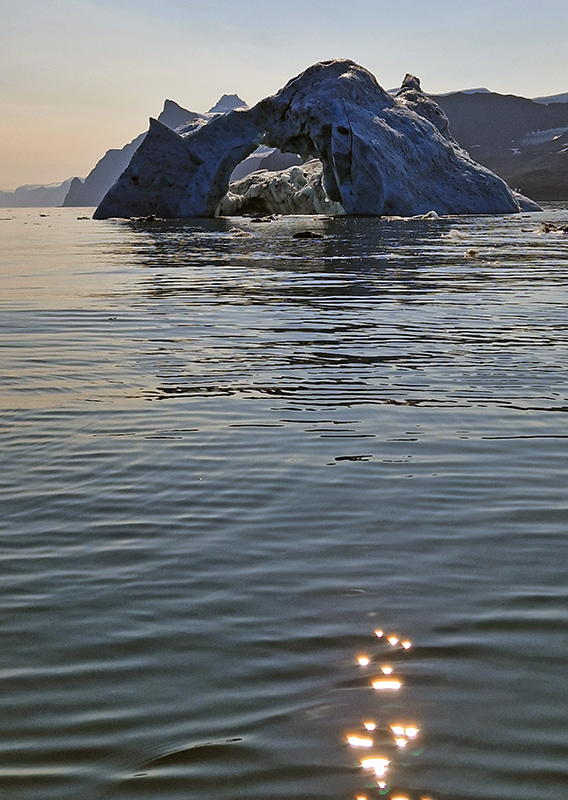
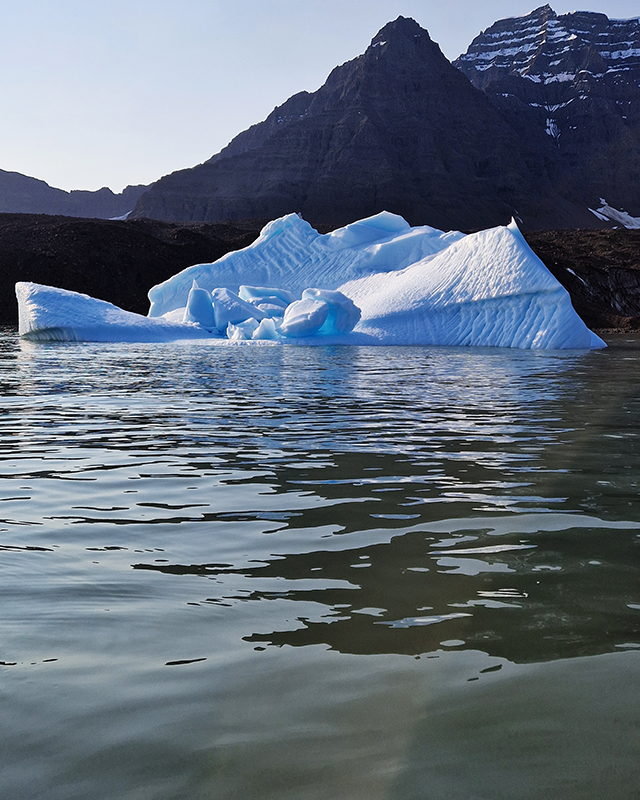
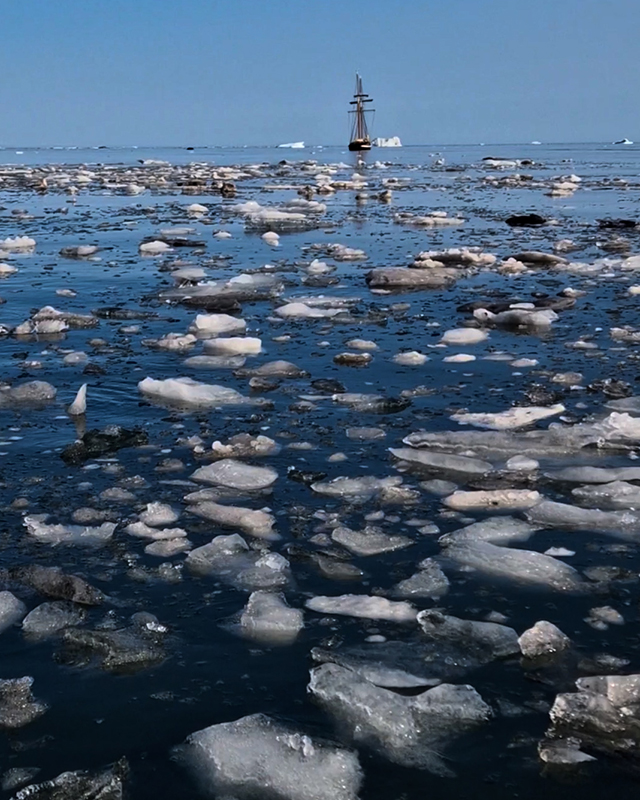
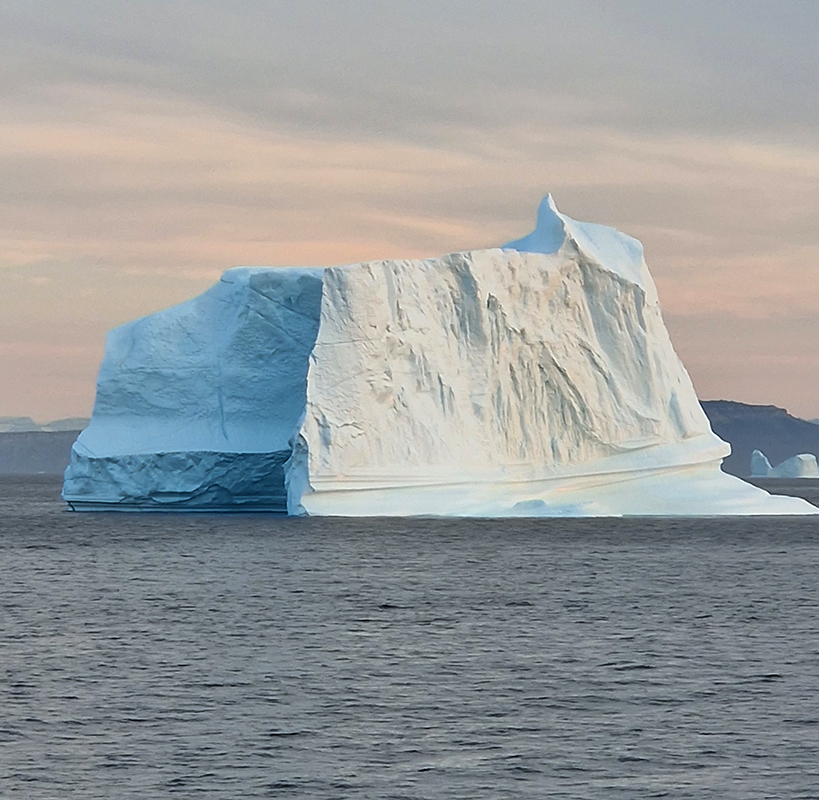
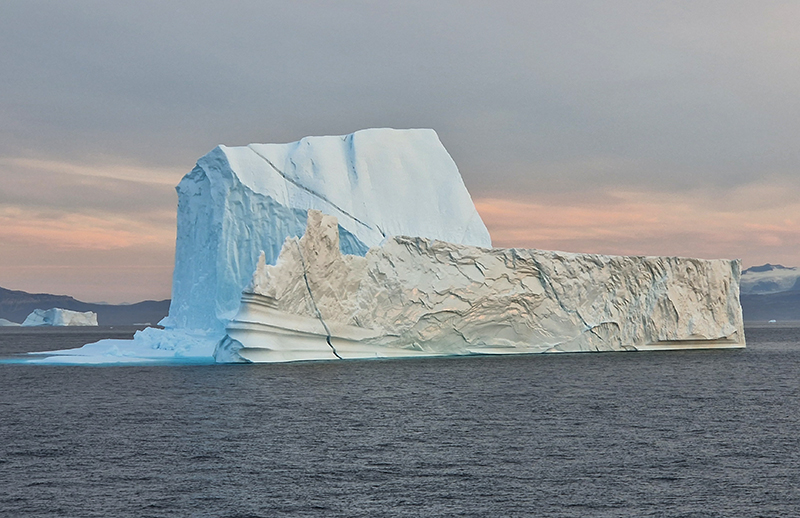
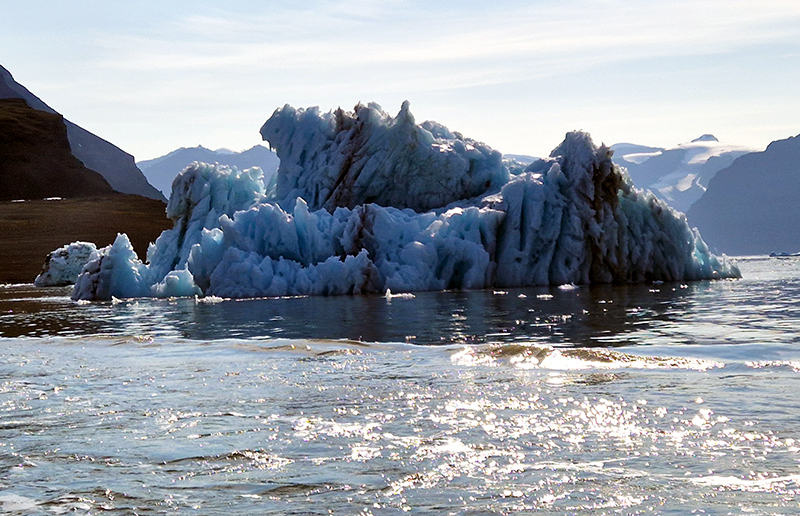
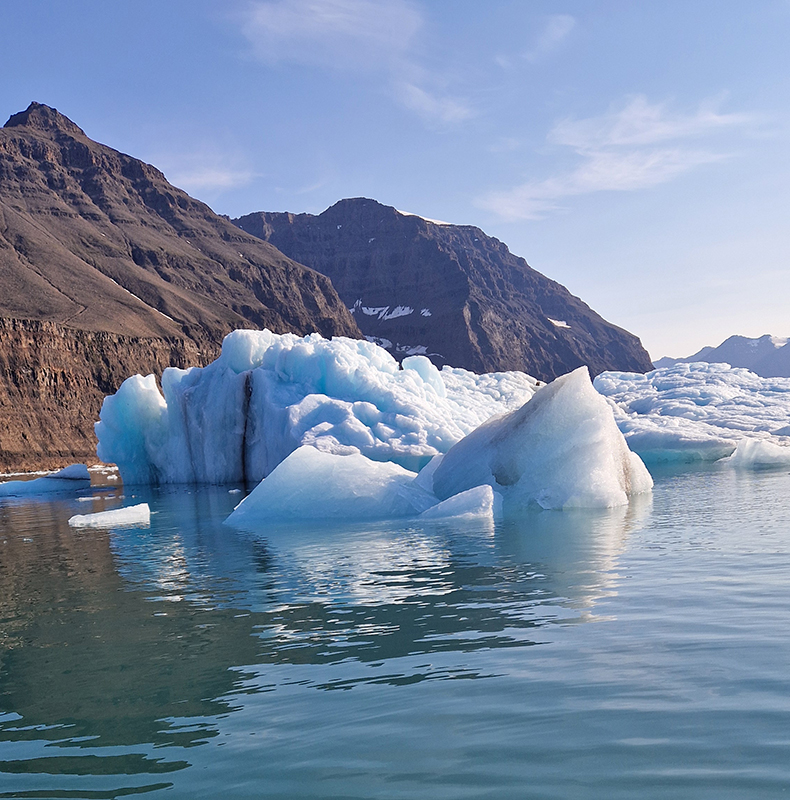
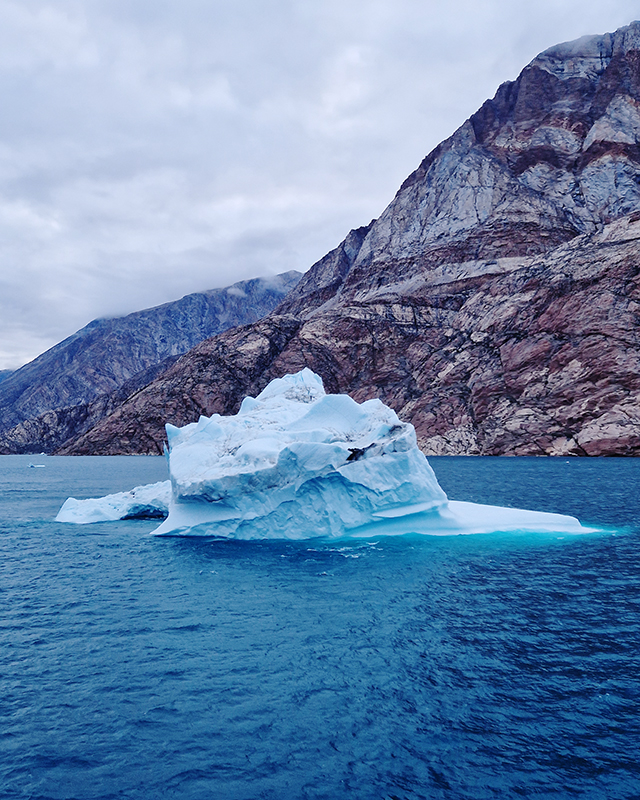
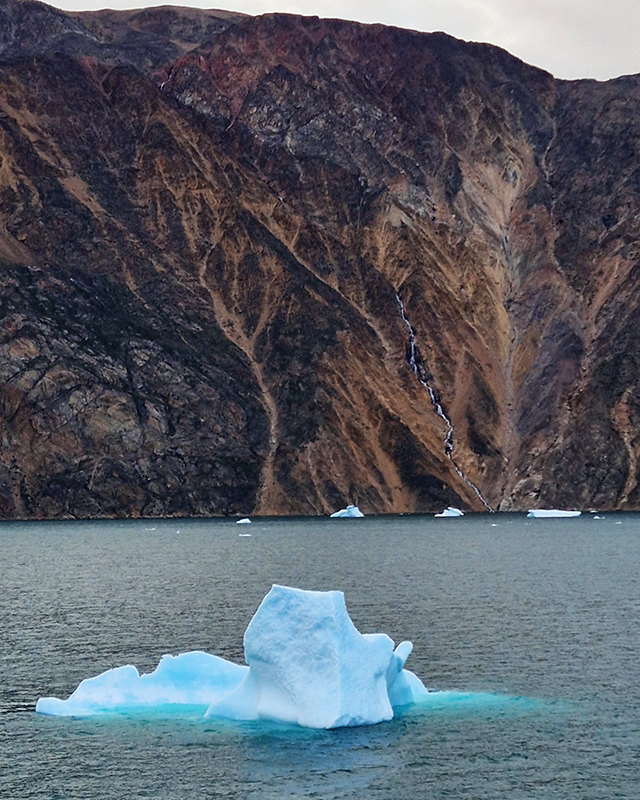
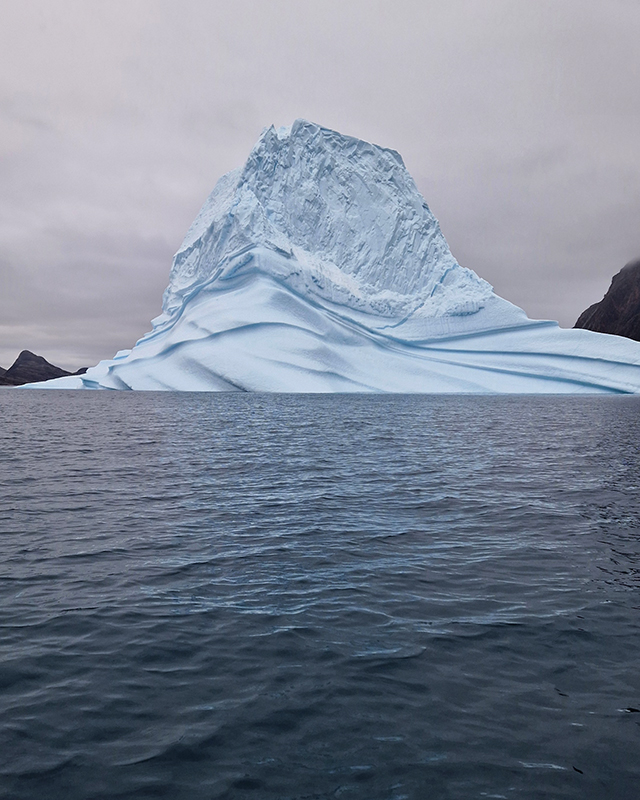
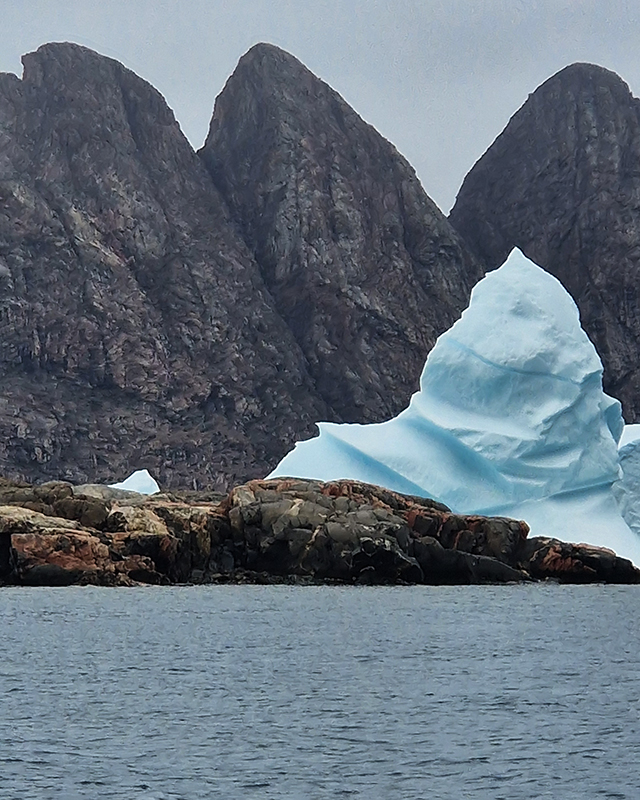
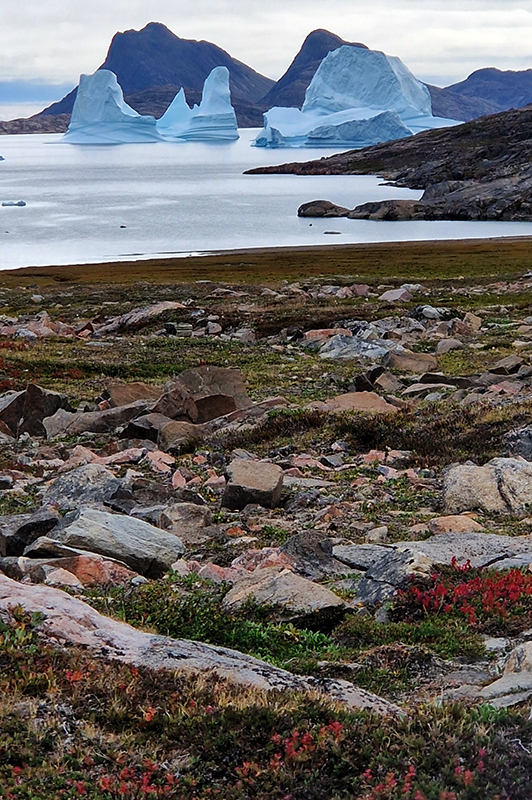
Our journey through the fjords was met by a long procession of floating ice palaces, giant ice sculptures in sublime shapes, striped in turquoise and teal glittering as the ship negotiated a seemingly impossible route through this otherworldy carnival.

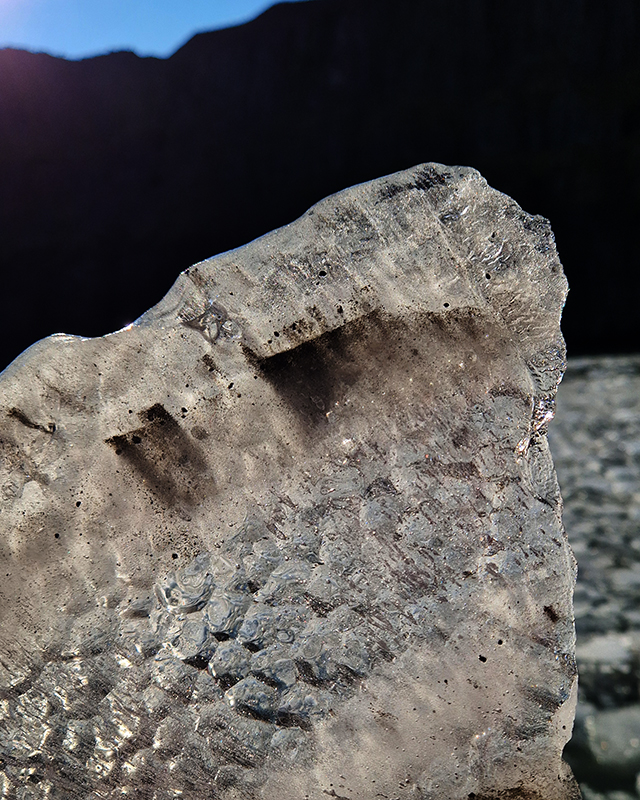
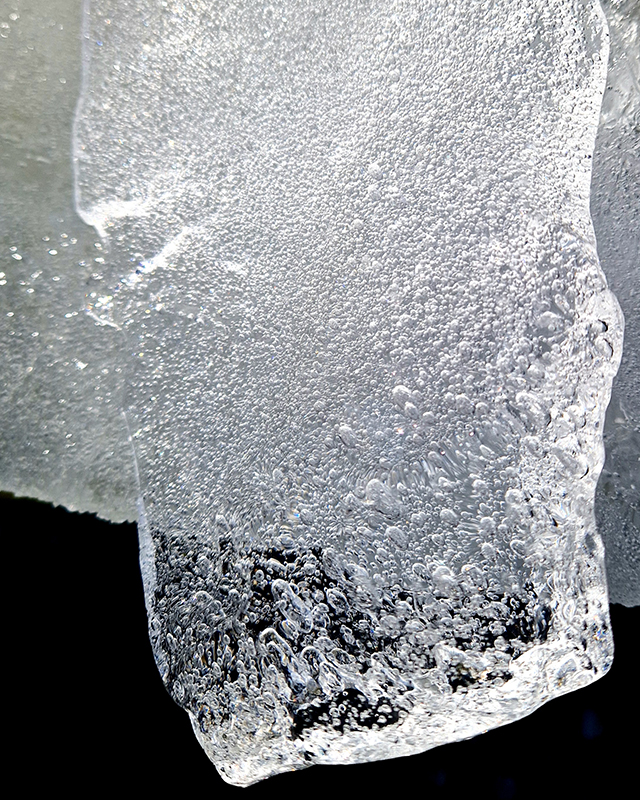
The luminous blue icebergs are from very old glacial ice. As more layers of snow are deposited onto a glacier, the snow beneath gradually transforms into ice. The sheer weight of the upper part of the glacier slowly squeezes air bubbles from its lower levels of ice to form clear ice. Light penetrates deeper into clear ice and all but blue wavelengths of light are absorbed. Deep blue streaks and lines within icebergs are formed when crevices in the ice fill with melt water and then refreeze.

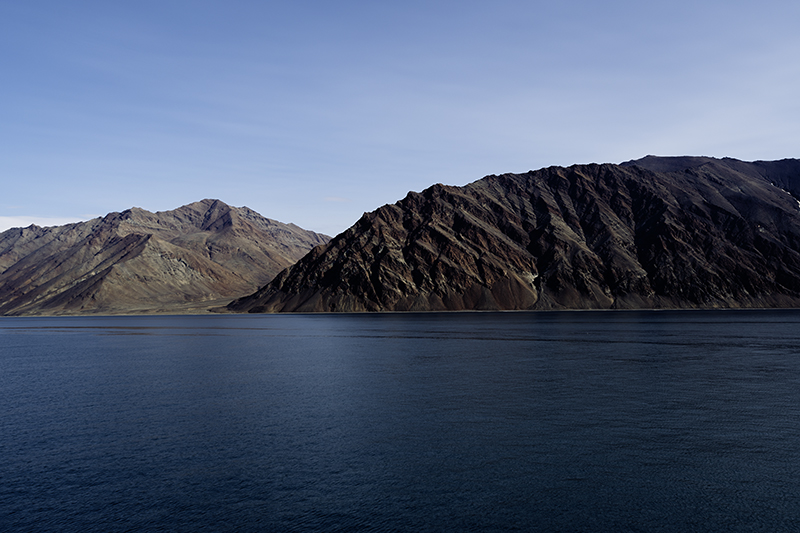
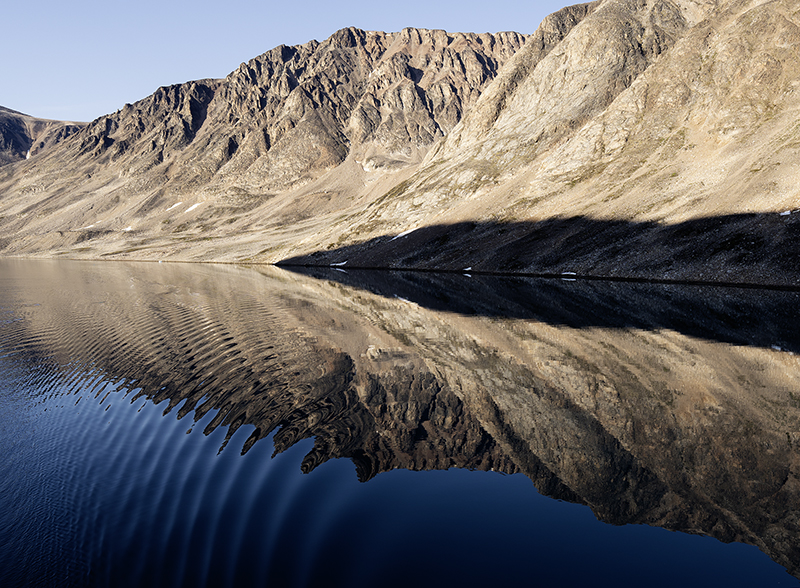
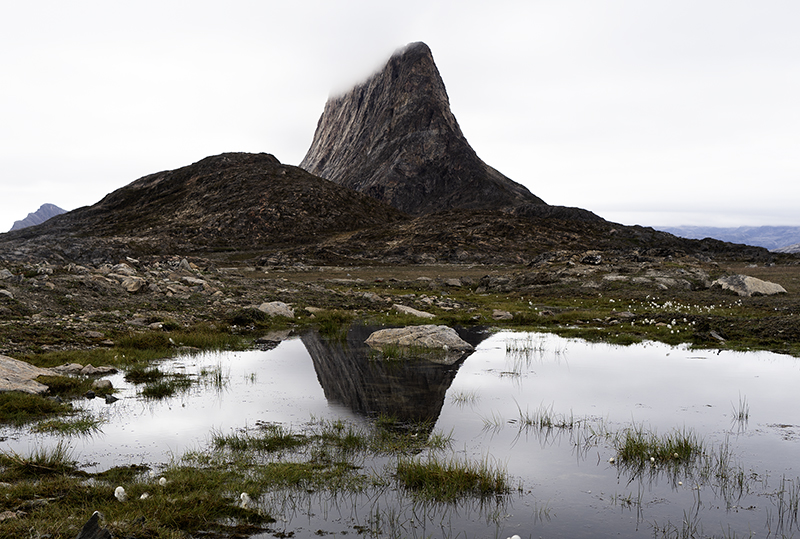
The majority of Greenland is covered in ice but we entered its grand fjord system in summer and so much of our experience of the country is dominated by the warm earth colours and magnitude of its cliffs and mountain ranges mirrored in the glassy surfaces of deep glacial lakes which overwhelm all sense of scale.

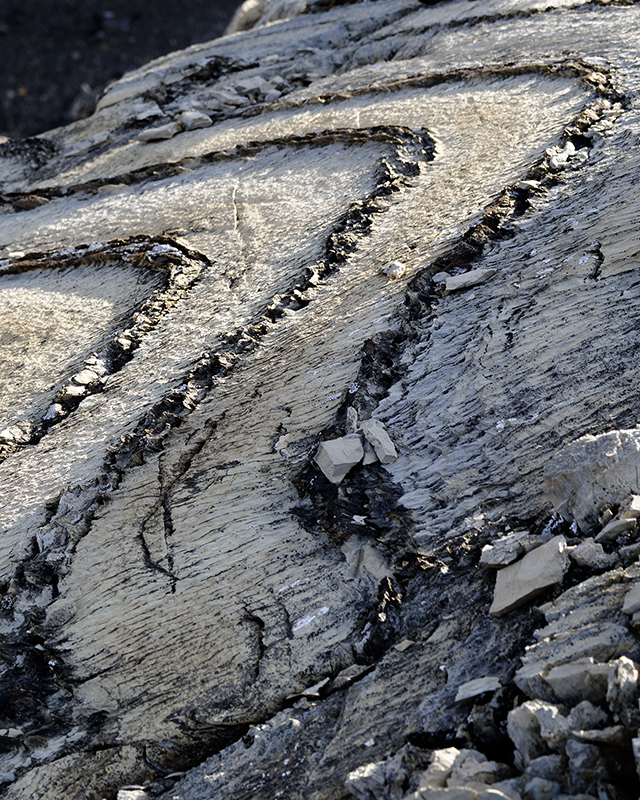
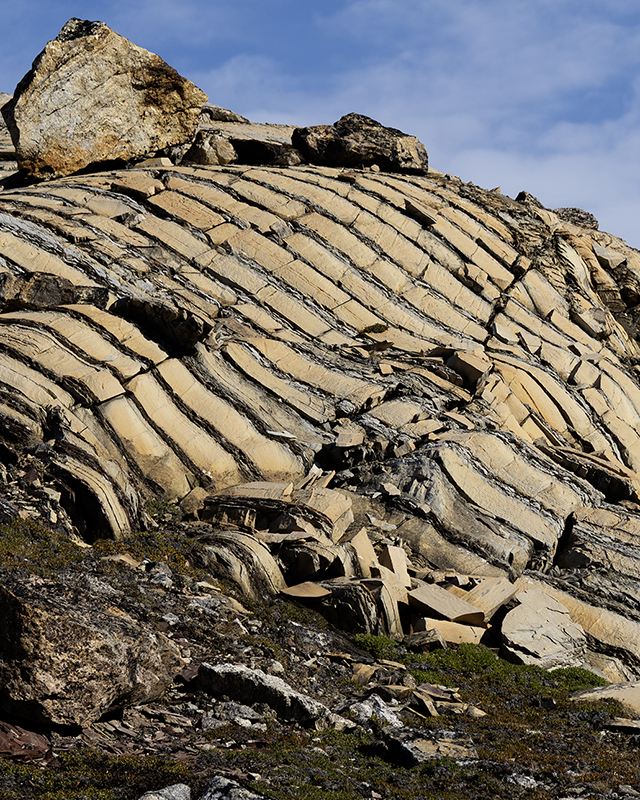
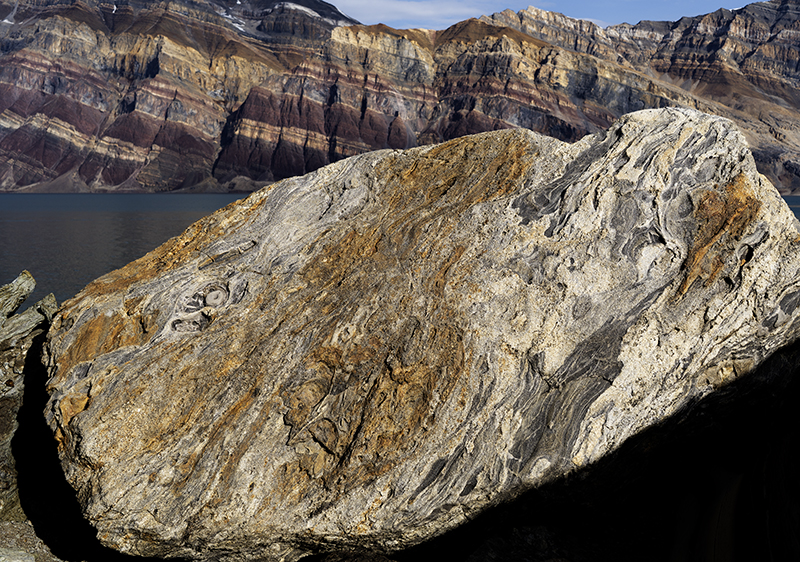
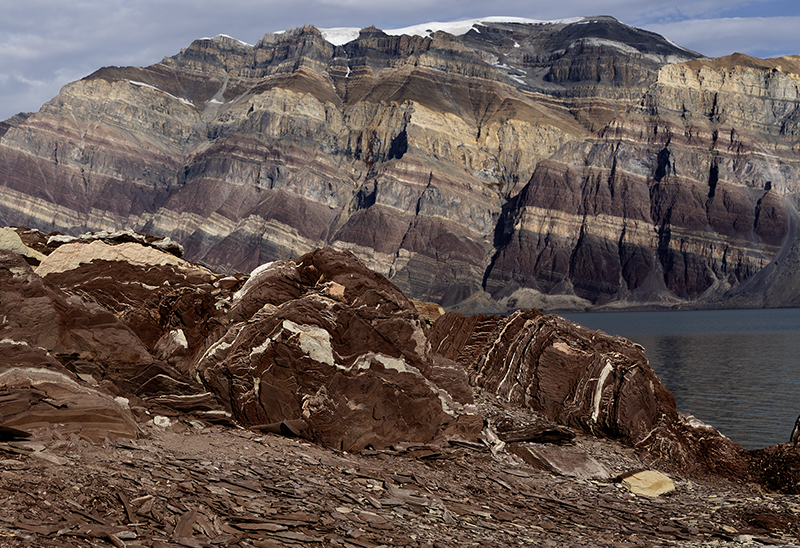
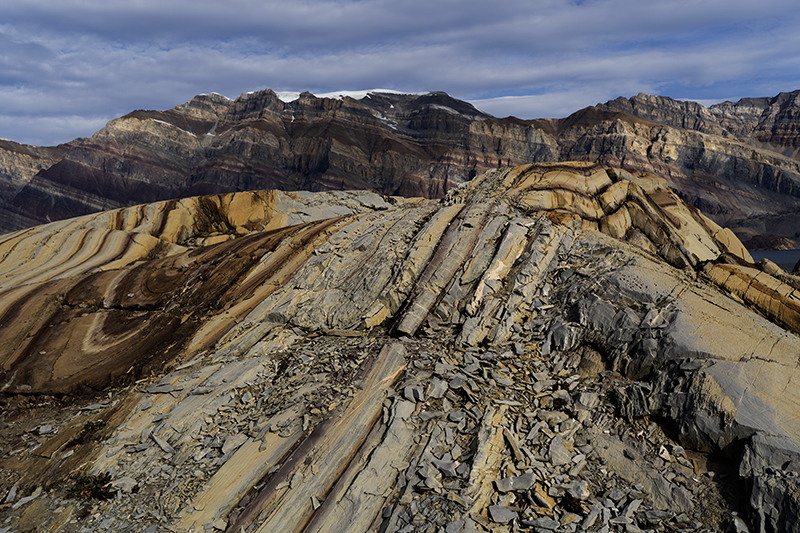
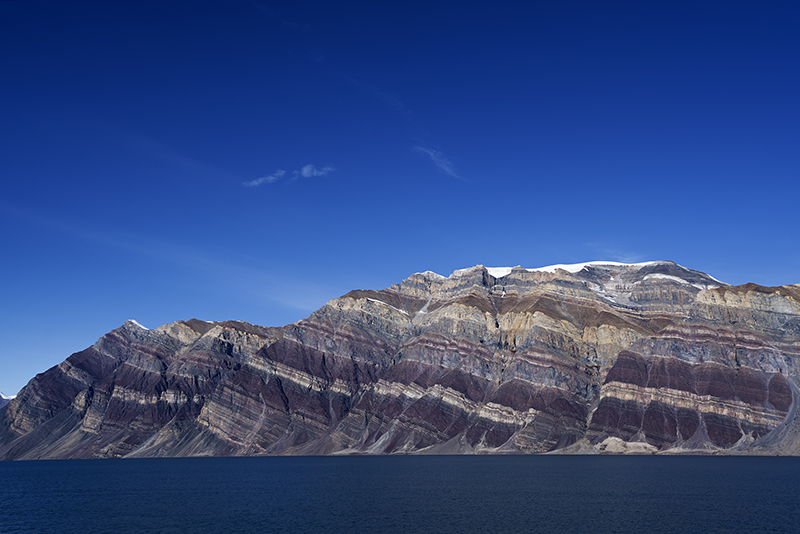
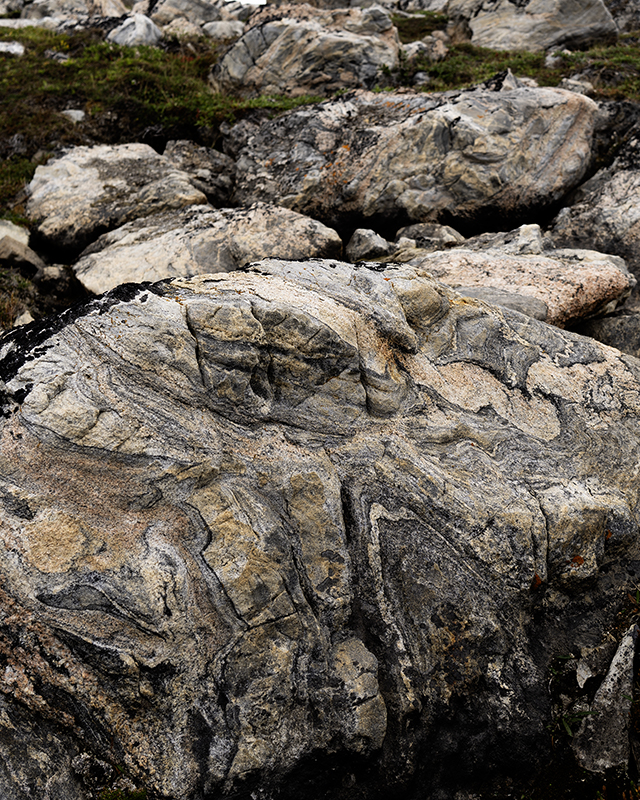
Greenland geology differs from Iceland in that it doesn’t have active volcanoes, mountains are made from sedimentary rocks and ancient tectonic movement. Greenland has some of the oldest rocks on Earth, dating back billions of years whereas Iceland is one of the youngest landmasses, still actively changing with surface rocks no older than 16 to 18 million years.

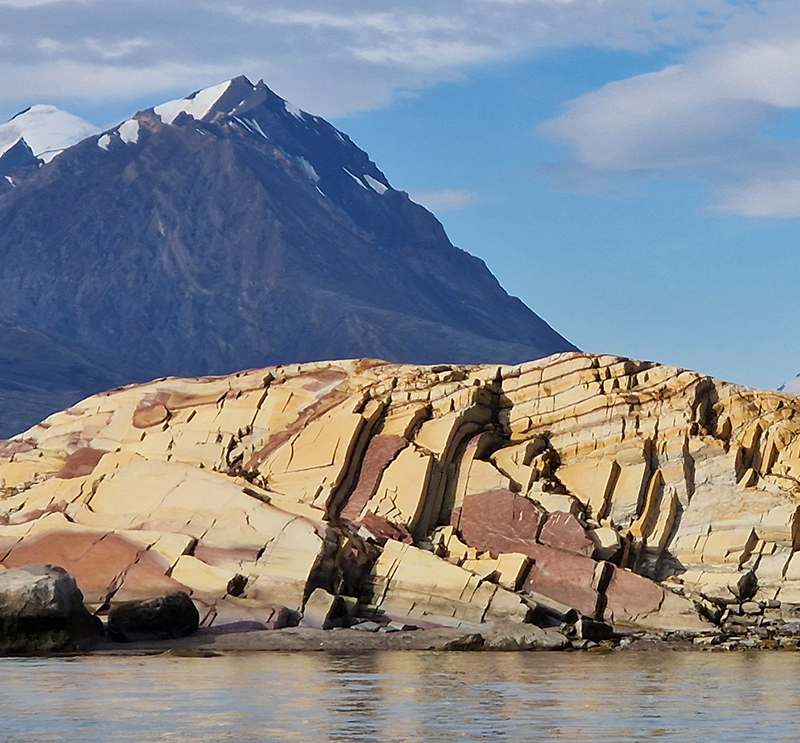
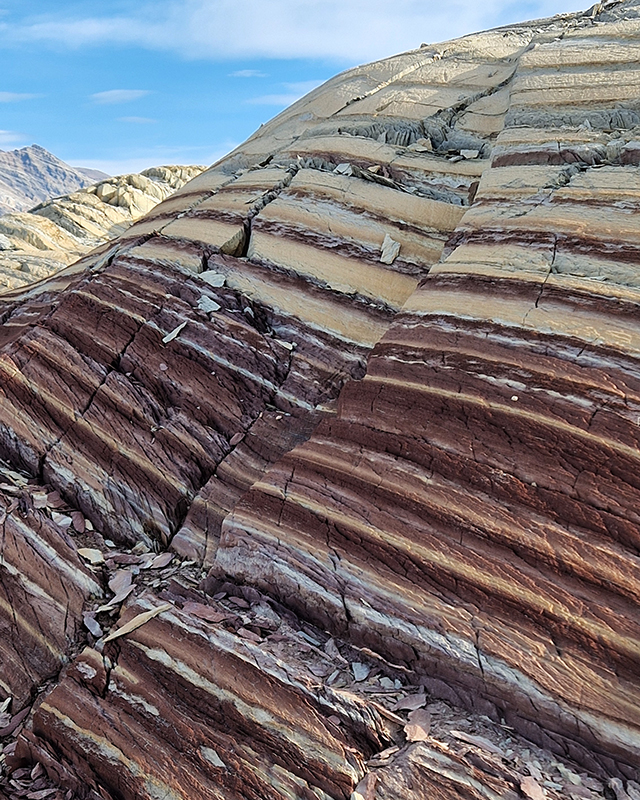
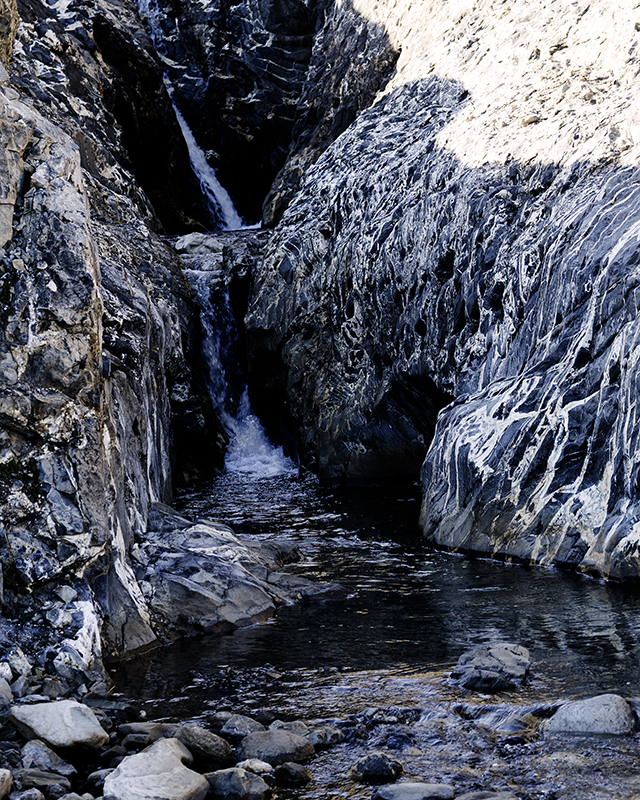
The distinct layering of rock, most obvious at Gateaux Point, are from ancient marine sediments deposited in a shallow calm seas roughly 900 to 600 million years ago. These alternating bands of limestone, mudstone and quartzite were later uplifted and twisted during a major mountain-building era around 490 to 390 million years ago, and further sculpted by glacial erosion leaving this extraordinarily beautiful landscape.

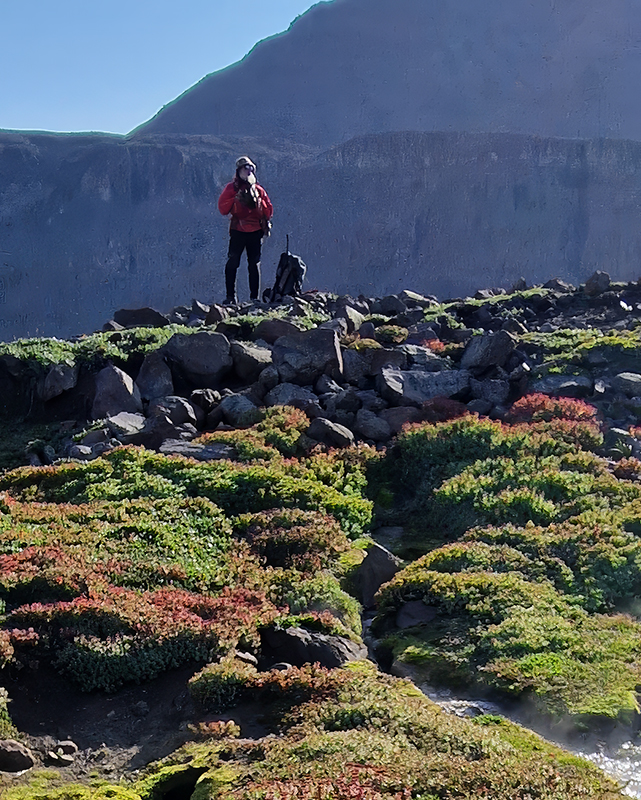
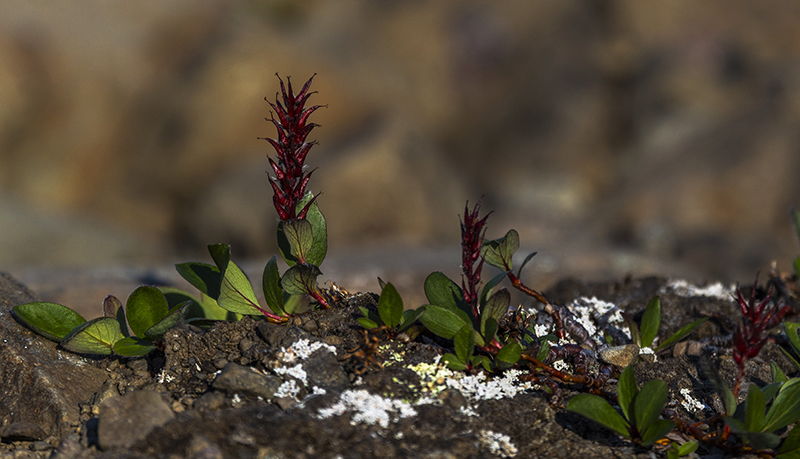
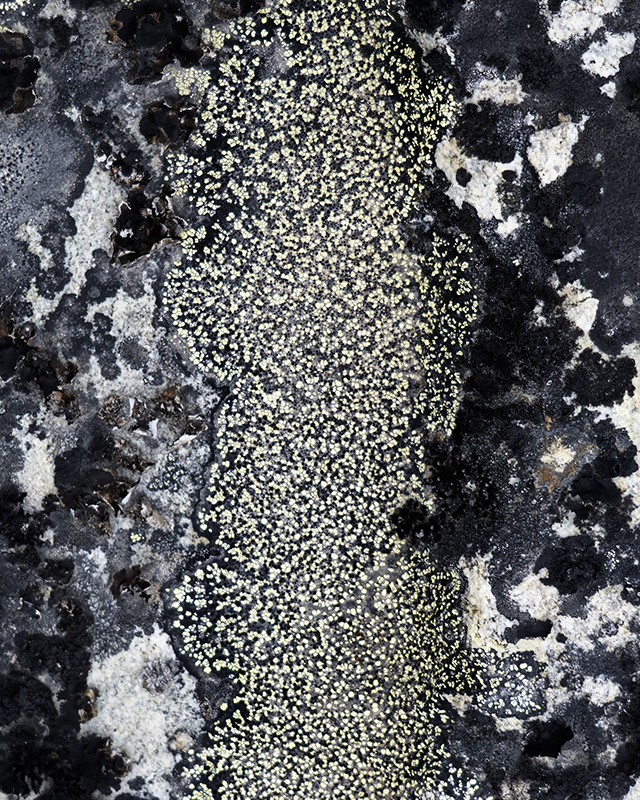
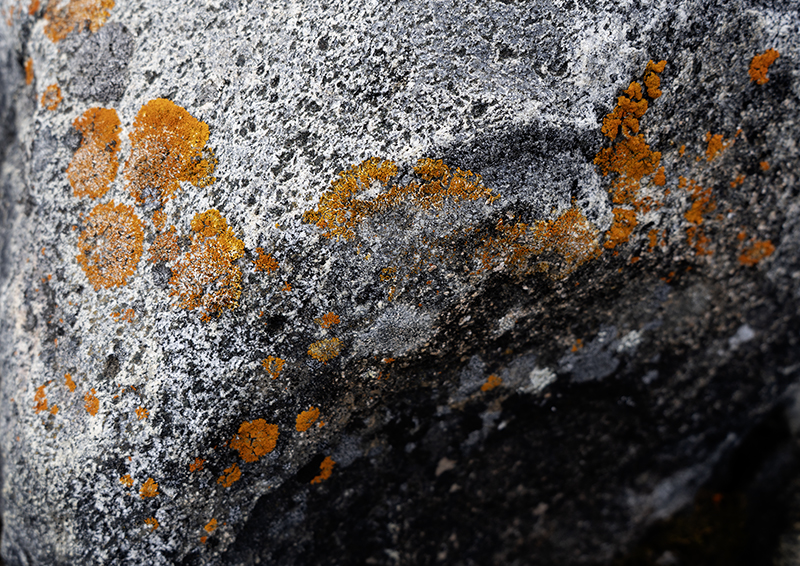
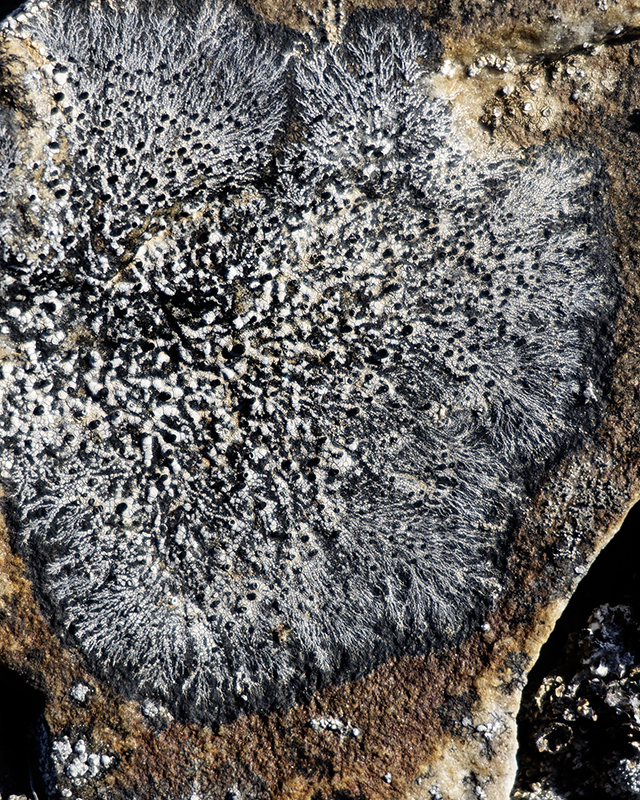
We walked on Arctic tundra. From a distance the land looks barren but up close we found micro forests, springy moss and delicate plant life. Black and vibrant lichens speckle the rocks. Freshwater shrimp can be seen darting in the streams.

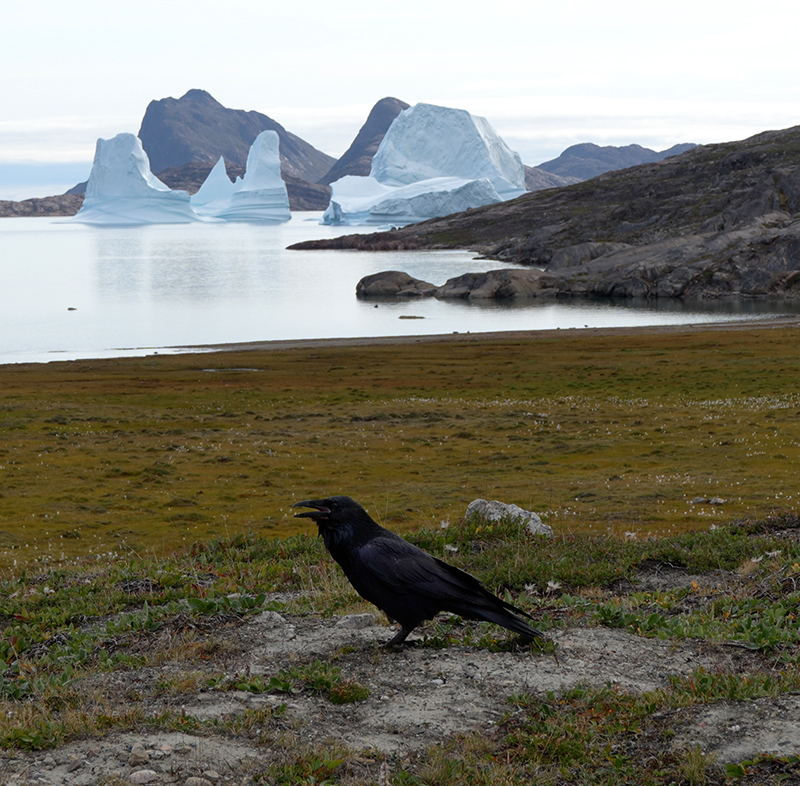
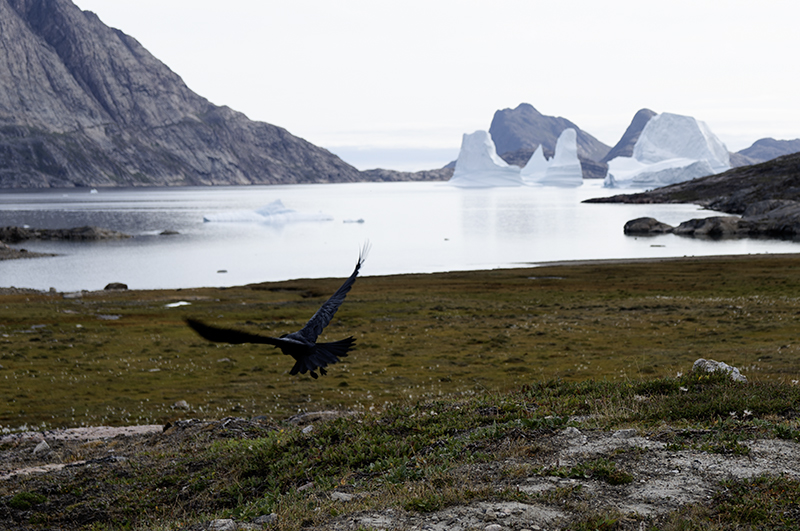
While out on the tundra, a raven circled us and landed very close by, all the while loudly cawing. It felt very much like a message was being delivered. The raven (tulugaq) is a powerful symbol in Greenlandic Inuit culture which credits the raven with helping to bring light and order to the world out of primordial darkness.

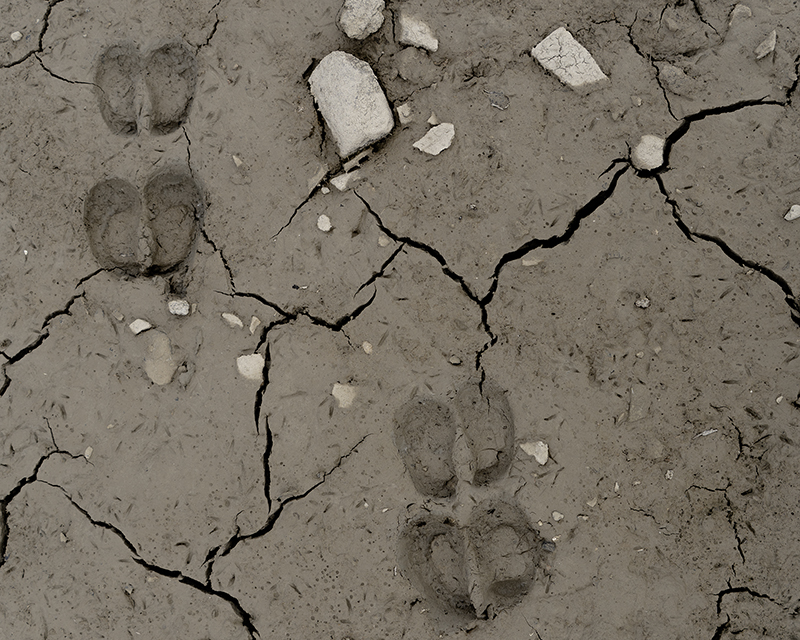
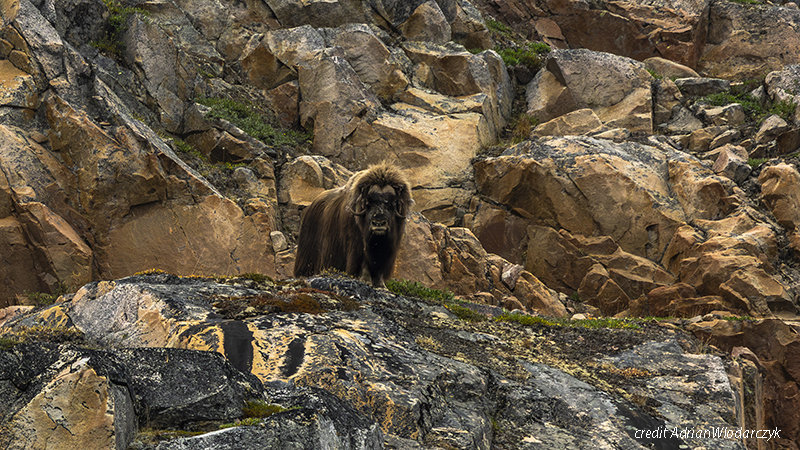
We saw muskox footprints in hardened mud and entangled silky soft muskox hair caught on the rough boulders they rub against and at last caught distant sight of one solitary beast surveying the fjord from on high. They stand still and slow their breathing to conserve energy to survive the extreme temperatures of the exposed arctic tundra. Muskox image credit to Adrian Wlodarczyk with the mega zoom.

There were also lots of seabirds skimming the water around the ship and diving into the water. Expedition team member JB gave a presentation on the ability of seabirds to see underwater due to the flat shape of their cornea which focuses the light more directly onto the retina – a bit like when peering through a tiny hole without your glasses.

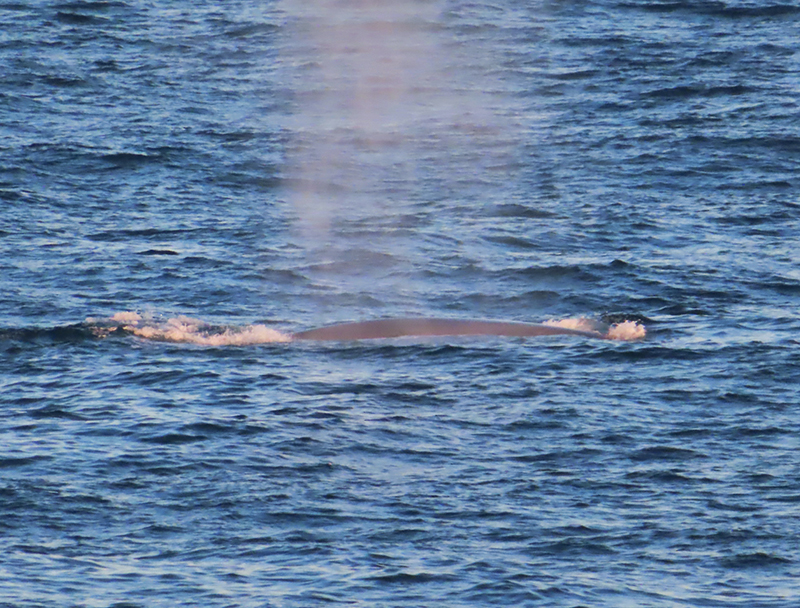
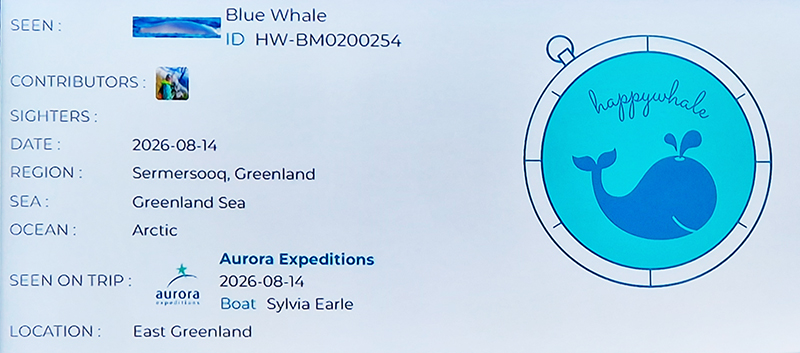
Other wildlife encounters included a blue whale, later identified by Happy Whale, as one not seen before.

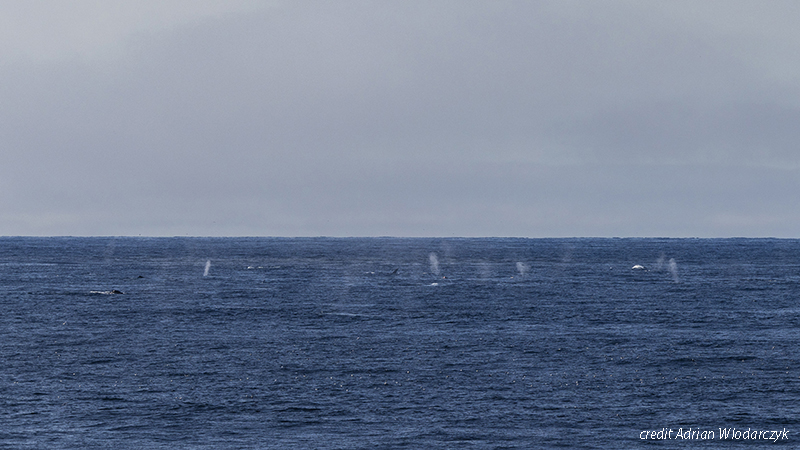
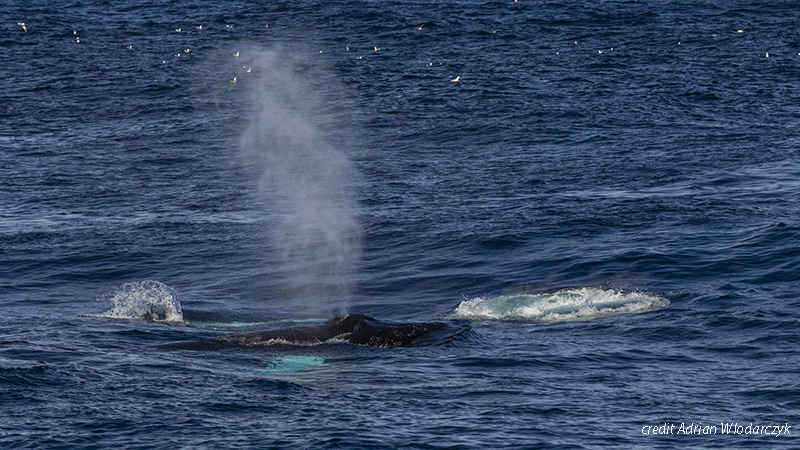
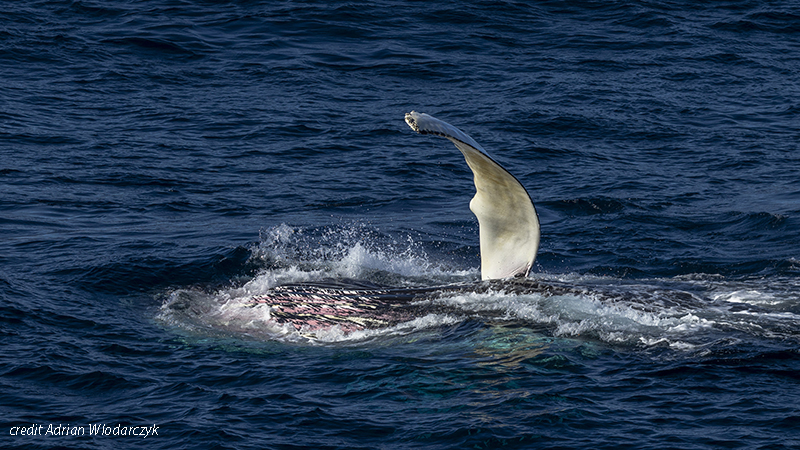
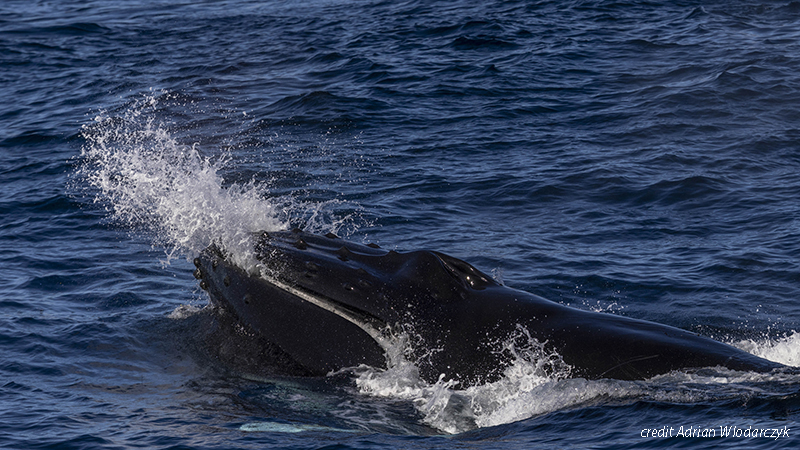
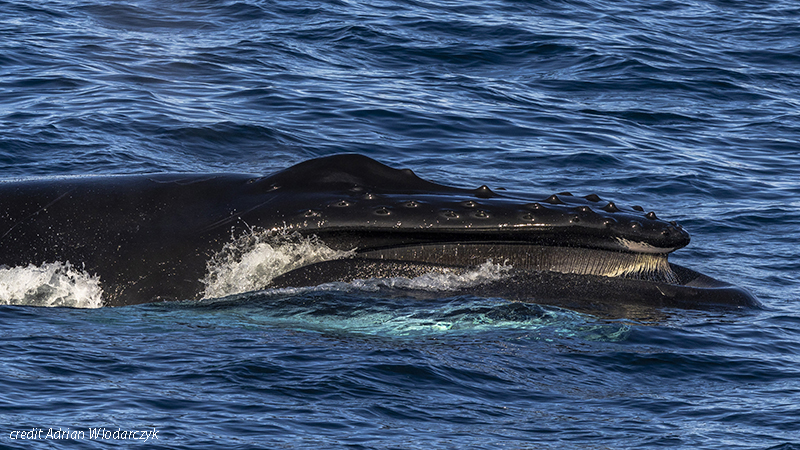
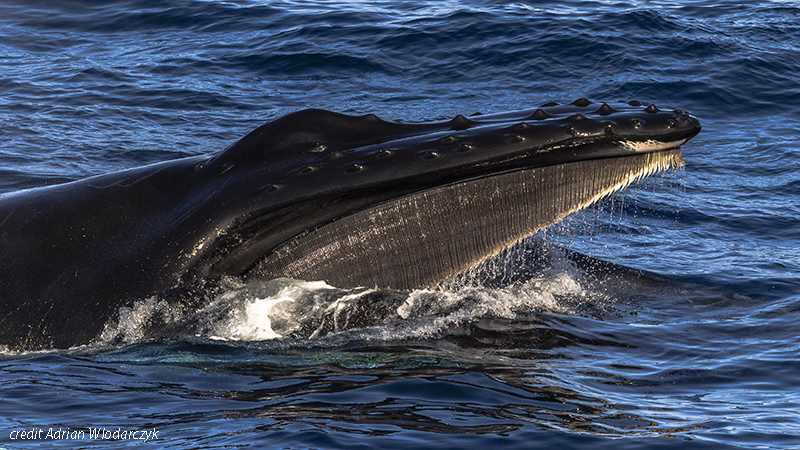
The most remarkable encounter was a gathering of hundreds and hundreds of humpback and fin whales engaged in a feeding frenzy. We were back out at sea and could see many plumes pfiffing up across the horizon. As the ship approached and slowed, the whales not only seemed unconcerned by our presence but appeared to actively use the ship to corral the krill into their gaping baleens. They were so close and so many and so energetic, it was very special. Those on board who had spent a lifetime at sea said they had neve seen anything like it. It even made the BBC news. . I messed up trying to film this experience so I have to credit Adrian Wlodarczyk again for saving the day.

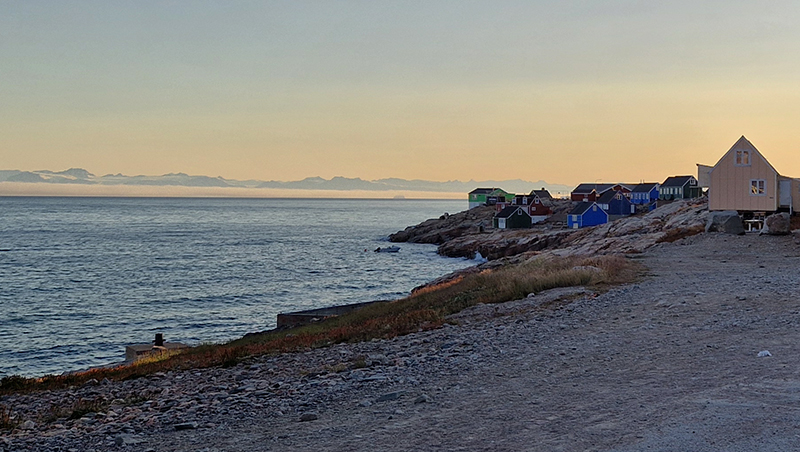
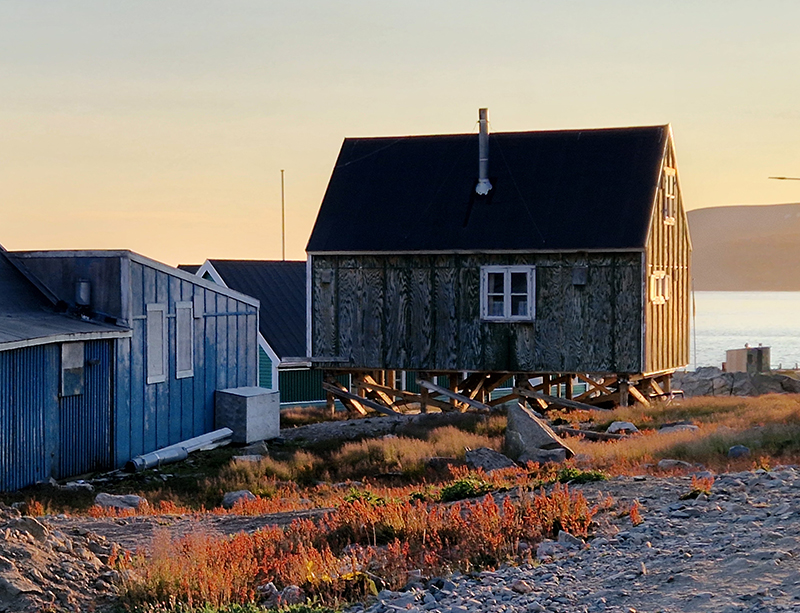
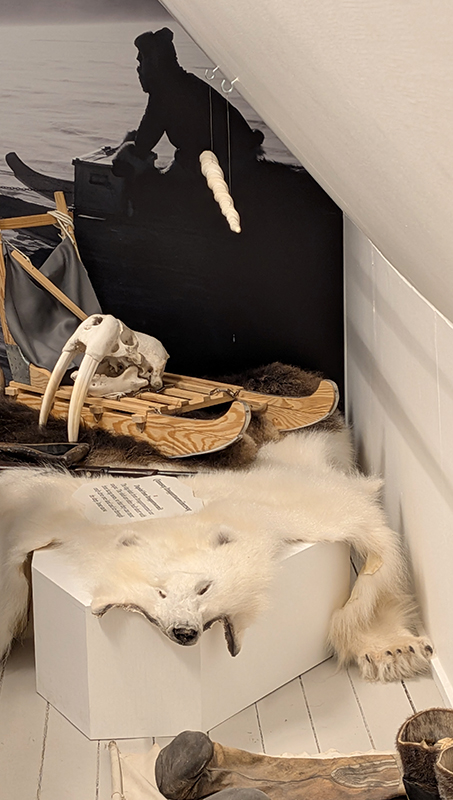
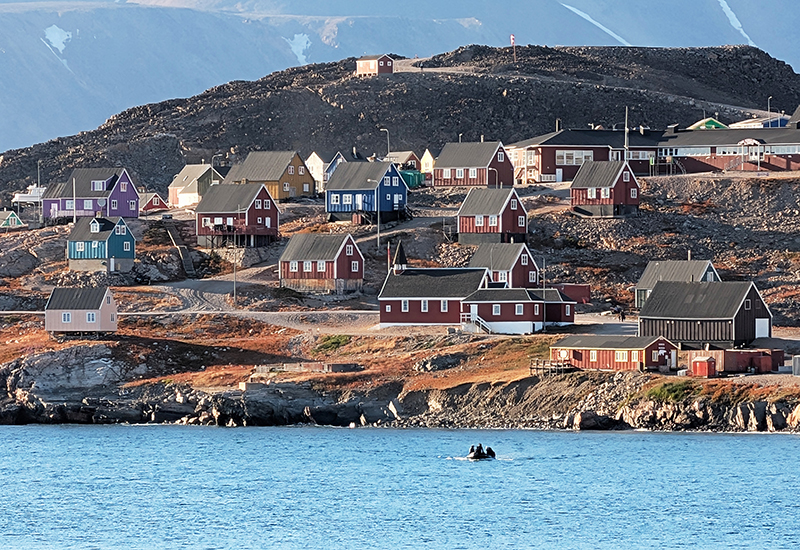
Our only contact with the people of Greenland was a visit to Ittoqqortoormiit, one of the most remote settlements anywhere, 500 miles form the nearest town it has a population of about 330 people. The people here are hunters and when we arrived a whale had been killed and brought ashore to stock the larders of the villagers, so most local people were down at the harbour on the other side to the quay where we came ashore via the Zodiac boats. We were advised to keep away from the harbour where this was happening and spent our time visiting the museum and enjoying the evening light on the colourful houses. This small settlement is at the forefront of climate change as they lose surrounding sea ice which is vital for travelling over to hunt seals, a problem shared by polar bears and so it also brings hungry bears to the village looking for an easier source of food.

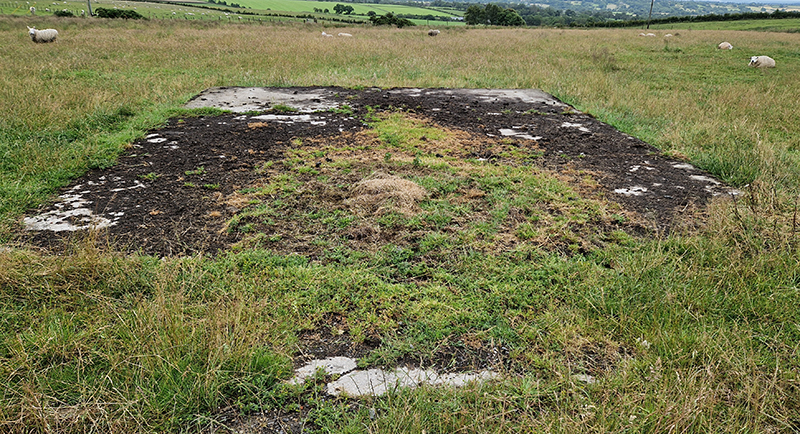
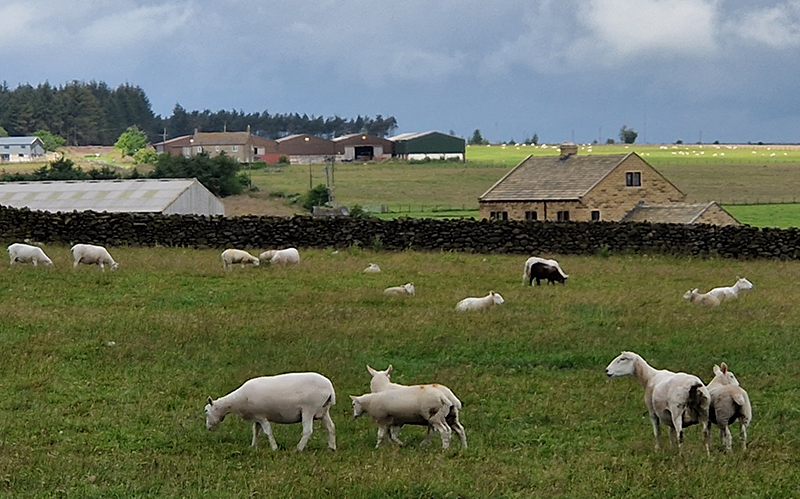
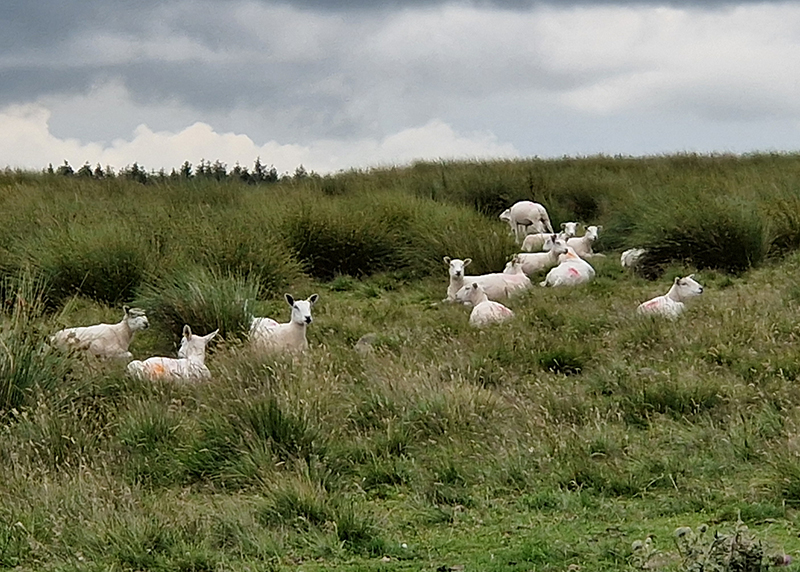
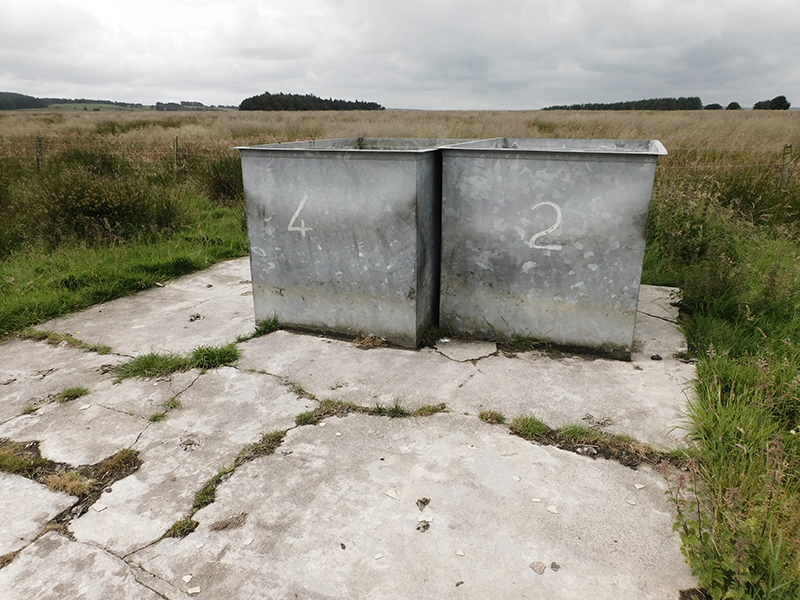
New Scientist reporter Chelsea Whyte gave a lecture on Animal Astronomy which I found fascinating. She talked about the many animals that use celestial navigation and the research has been done in this field. Thinking of my longlisted Artangel proposal involving creating a star gazing platform for sheep on the North Yorkshire moors as part of a sculptural intervention to commemorate the Haverah Park cosmic ray detector huts that have been abandoned here, it made me wonder if anyone has looked at how sheep experience the night sky. This is something I am excited to look into further.

Greg Mortimer was happy to say that all his crew were all trained in the use of a sexton which is used to measure the angle between the horizon and an object in the sky, such as the sun, moon, or stars, to help determine a ship’s position at sea. I spoke with a young officer who said that a lot of the new recruits from India took their exams in the UK now because they didn’t insist on training using a sexton but India did, so the qualification was much harder to attain. I wonder if that will change after the Royal Institute of Navigation recommends teaching sailors to navigate by the stars again as a top priority. I heard about this on the Inside Science podcast Should we rethink navigating by GPS?

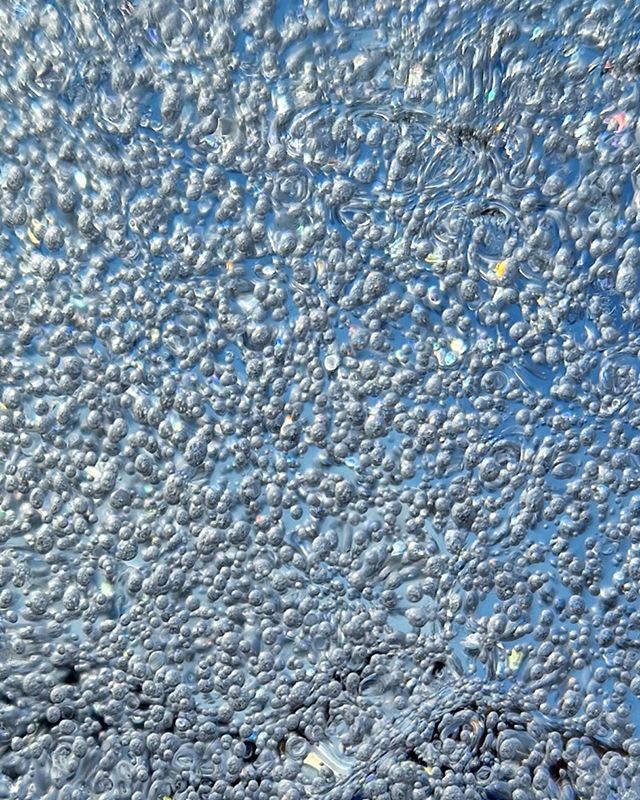
The final Zodiac cruise was to Bartholin Glacier. Out on ice strewn water the fizz and crackle of ancient air escaping its frozen enclosures can be heard as bubbles are released from the melting ice.

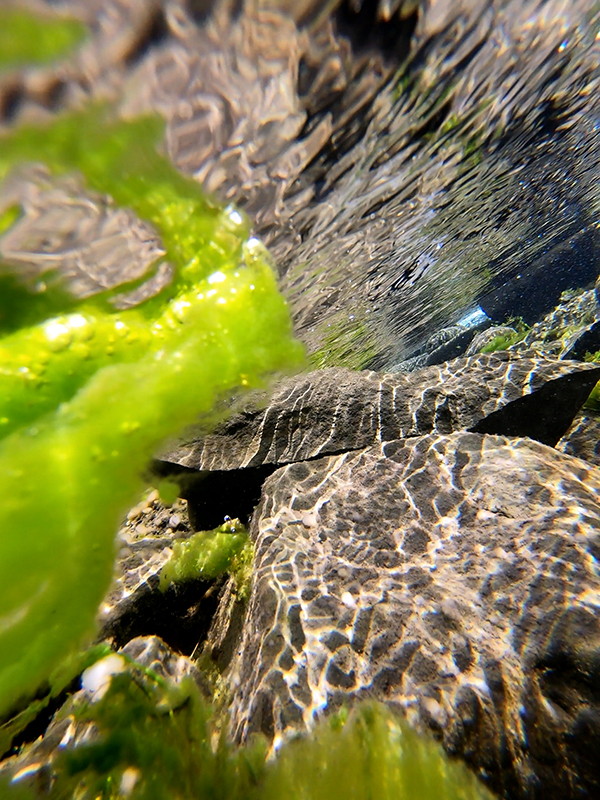
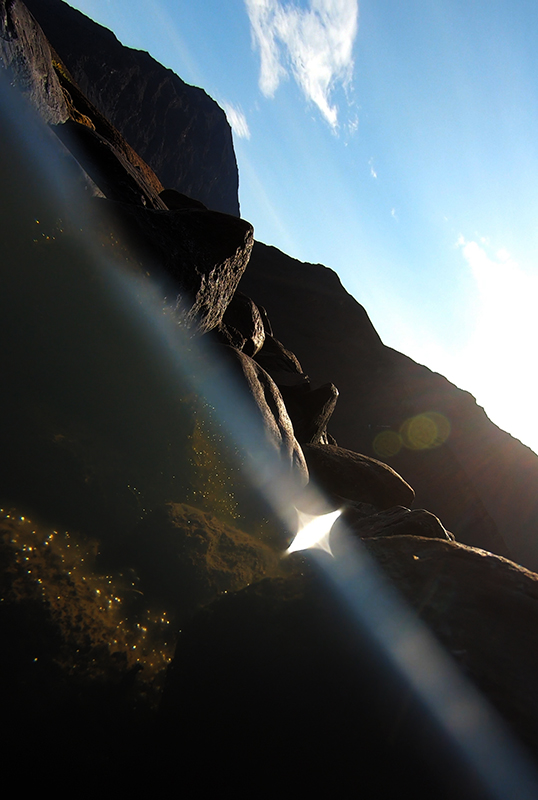
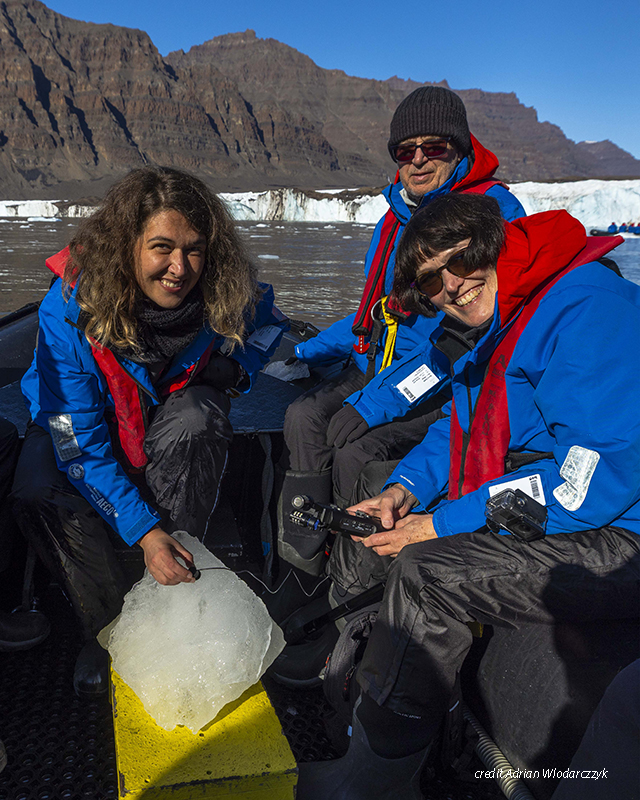
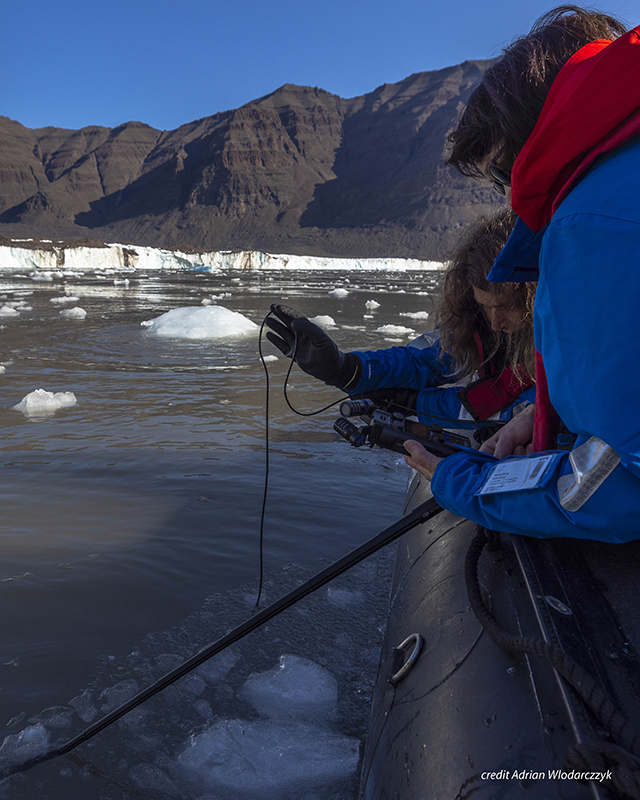
I attempted to record the sounds of the glacial ice and film underwater with the help of New Scientist reporter Leah Crane.

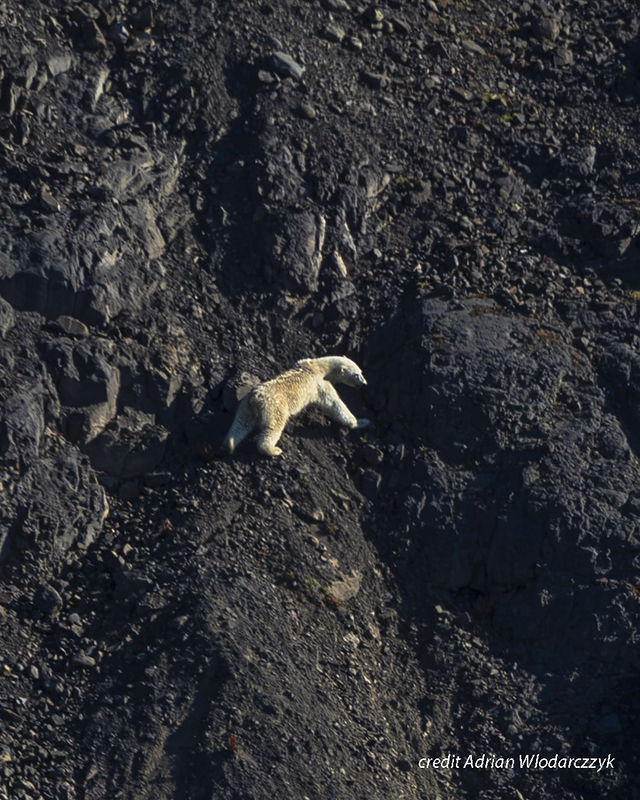
We had become used to the protective measures of polar bear scouts whenever we landed but it was when we were out in the Zodiac recording ice that a message over the walkie talkie alerted us to a polar bear in the water 200m from the ship. We held back and waited for news from the bridge. Eventually the bear swam over to the shore and we could quickly return to the ship for a distant view of its lone form traversing the steep banks of the cliff. Thanks to Aurora expeditions photographer Adrian Wlodarczyk for the images with Leah and of the polar bear.

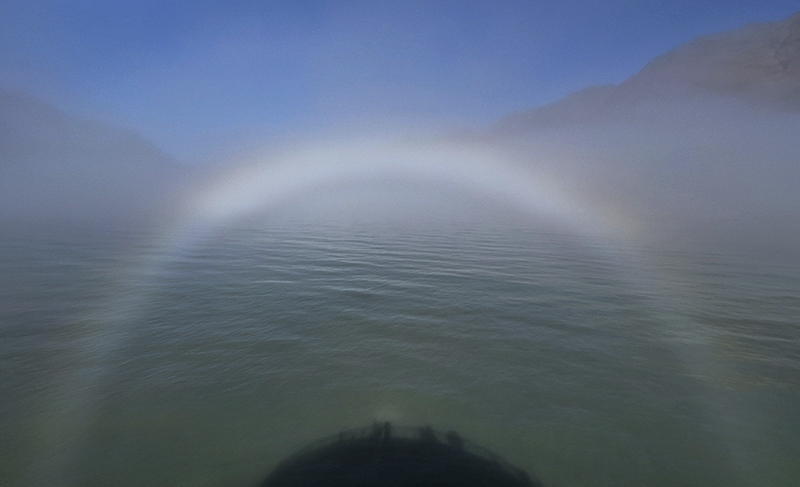
As the polar bear wandered off, fog descended over the glacier and a magical fog bow appeared. Fog droplets are much smaller than raindrops so they scatter light through diffraction rather than refraction blending the spectrum of colours to produce white light unlike a rainbow which splits the colours.

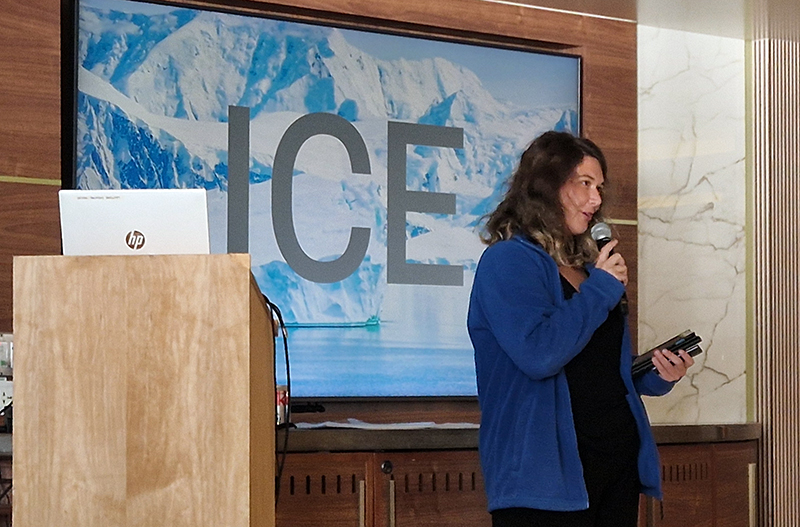
During the cruise there were many other talks, discussions and citizen science activities which covered Eclipses and Astronomy, the past and future of Greenland’s Glaciers, Wildlife and the Arctic environment, The Science of Awe, Whales as Ecosystem Engineers, Geology, Ice on Other Planets and Moons and what Ice Cores on Earth can tell us. I have so much information and overwhelming sensory experiences to process from this expedition. I am sure all that I have absorbed will surface in my work over time.

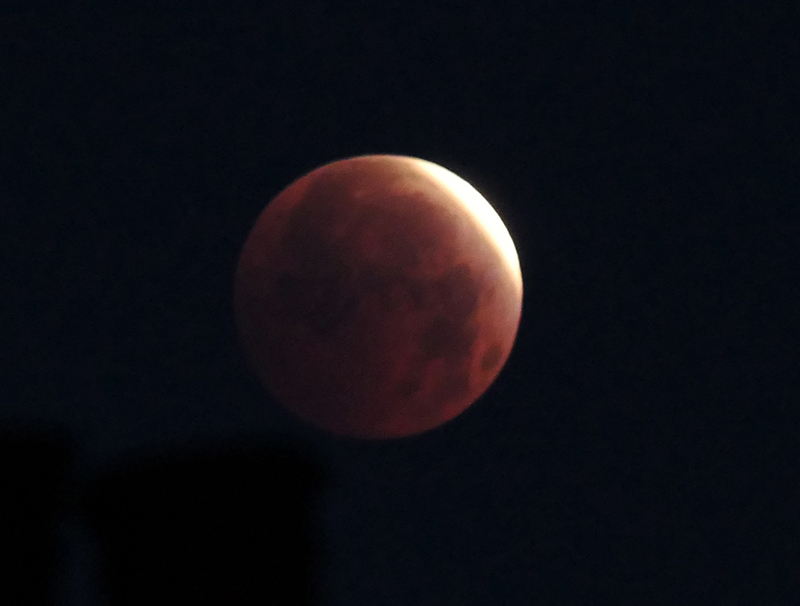
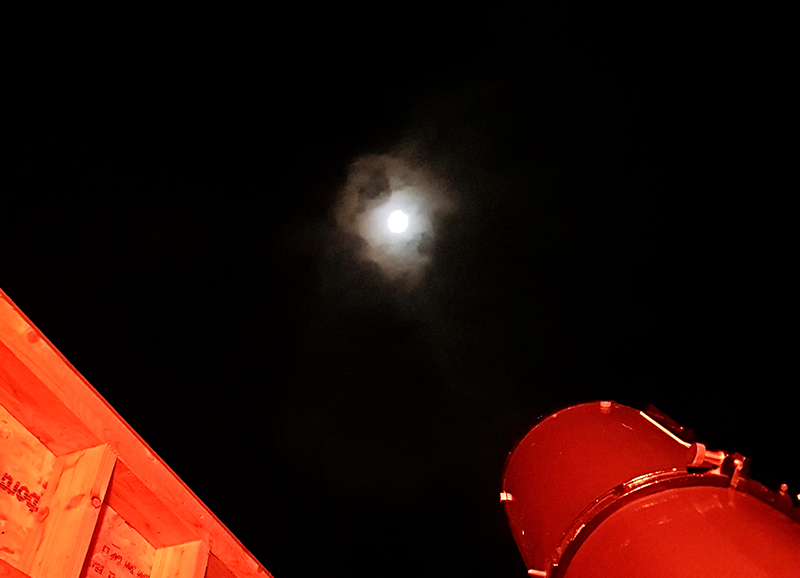
Back in London, I woke early to see the partial lunar eclipse which was rather lovely.

Gallery Visits

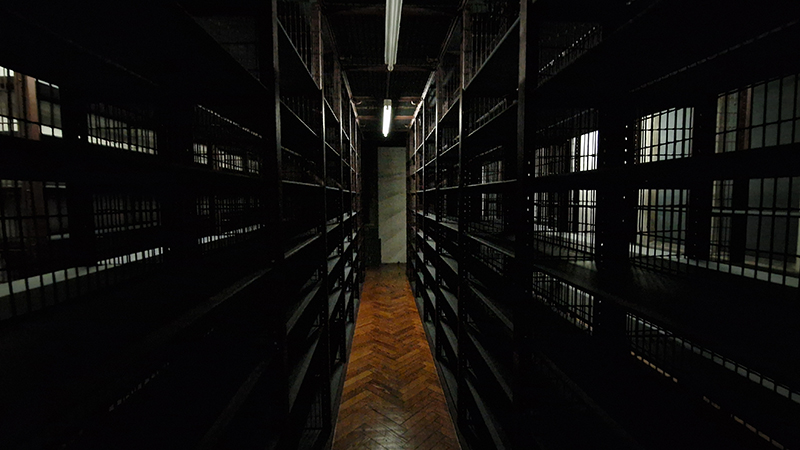
Group show, The Dead Cat and Everything Else at APT curated by Cecilia Sjoholm and Iain Hales, had a tantalizing title for me and I really liked the concept of showing works that could be seen to exist in multiple states at once, to oscillate between reality and thought experiment and consider if the act of viewing the work brings about a definitive perspective. It was asking a lot.

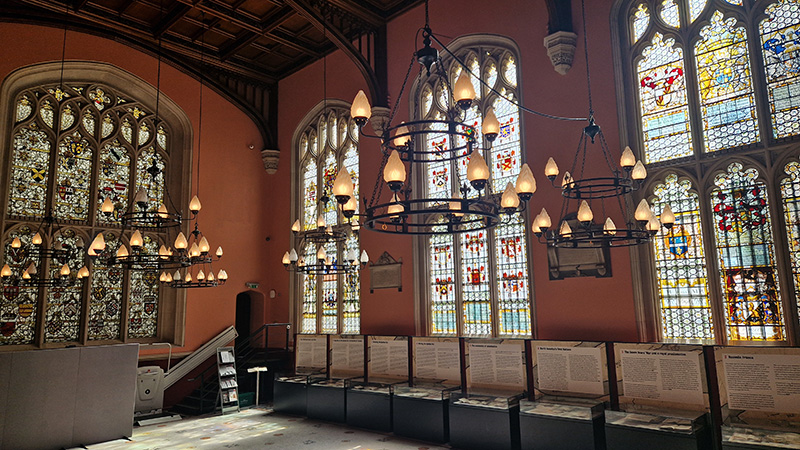
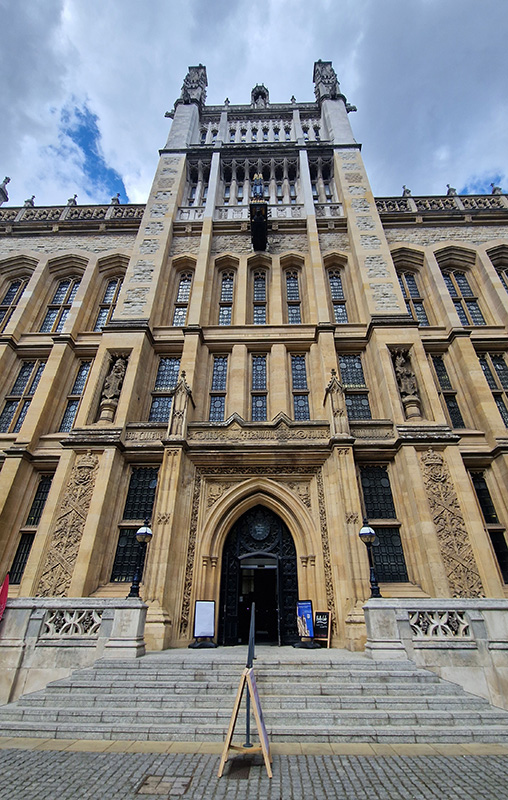
Terrence Gower Enemies and Rascals supported by Artangel and installed in the Original Cell in the Maughan Library, Kings College London, the first purpose built fire-proof building for housing public records and where the records were held for the tale that Gower unfolds within this cloistered space. The narration using transcripts from historical records tells the story of the newly formed America’s failed attempt to seize Canada from the British. Notable is the indigenous perspective who watch with horror as what they deem to be brothers ferociously fight each other for territory which had always been theirs and their plea for peace.

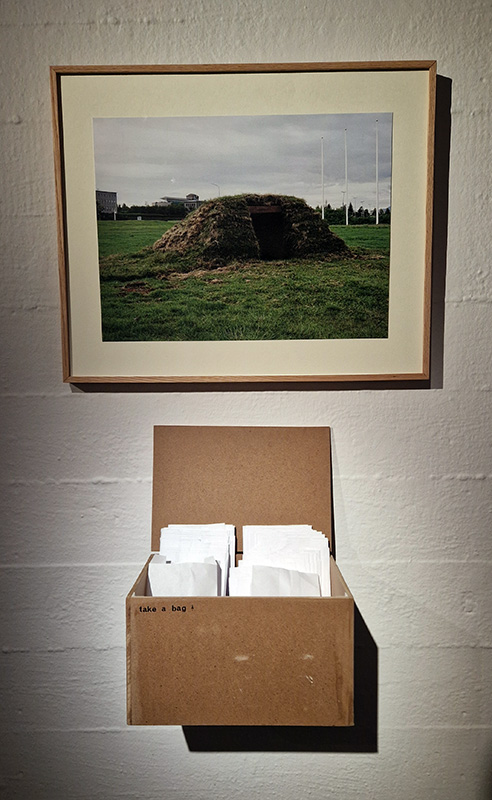
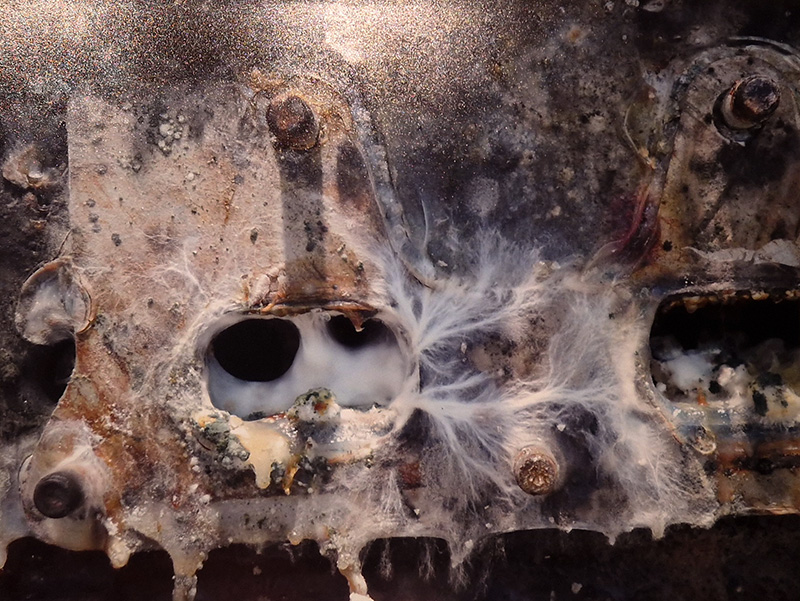
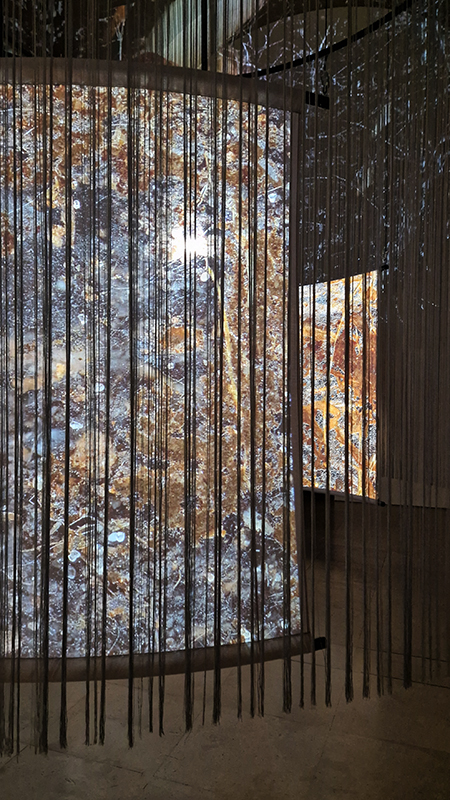
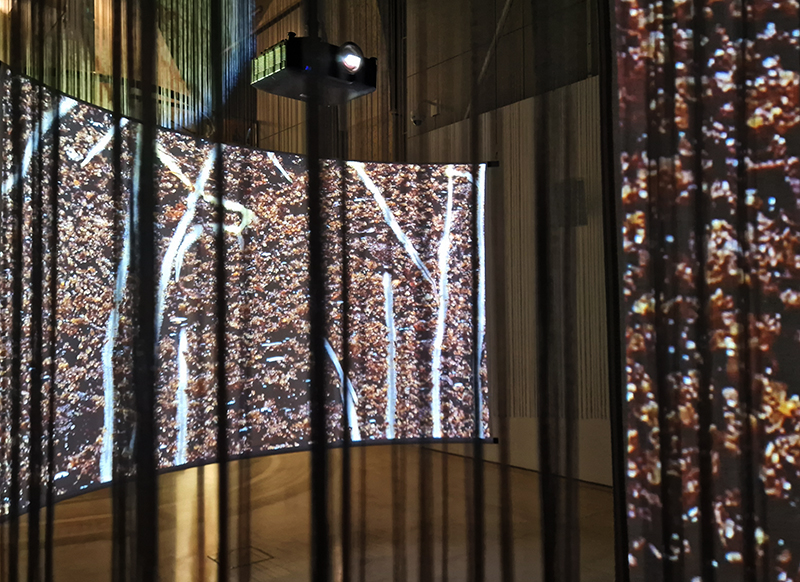
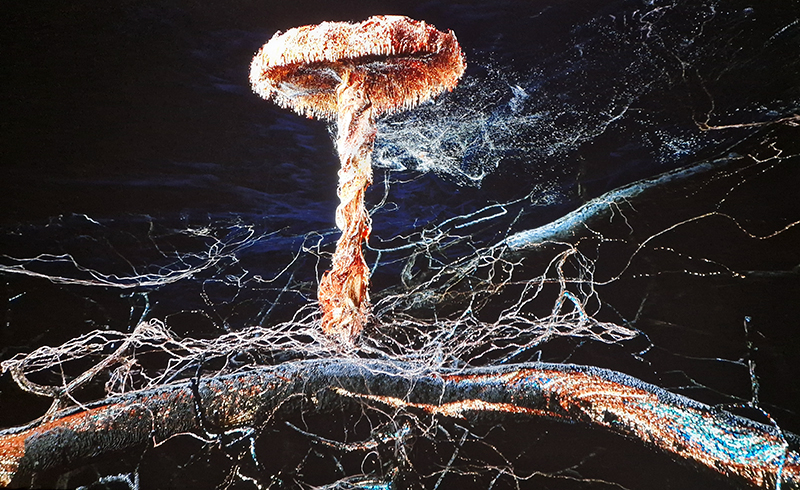
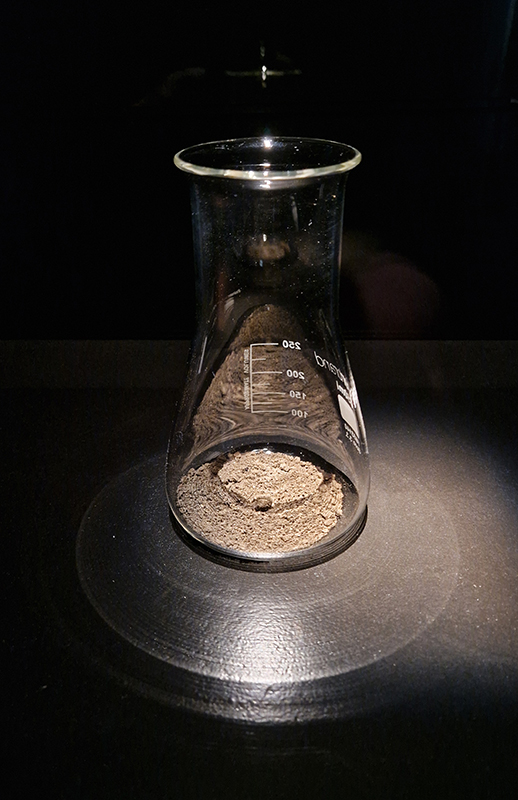
Membrane / Himna at The Nordic House, Reykjavik beautifully curated by Thomas Pausz presents seven artists whose works expand on ecological awareness of soil-making processes.

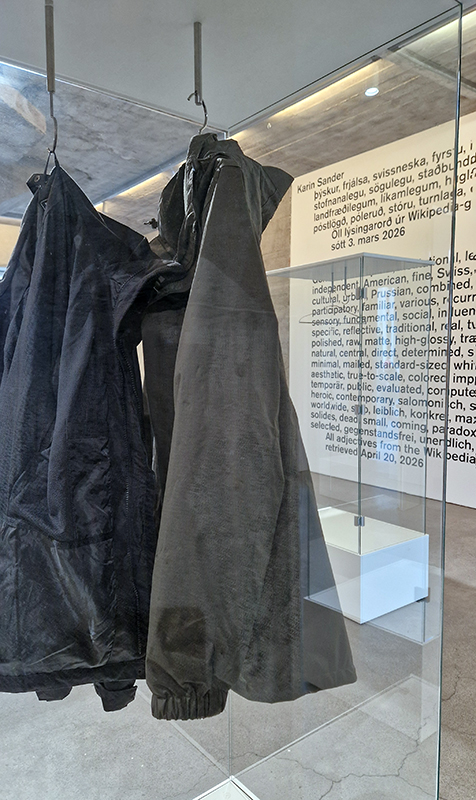
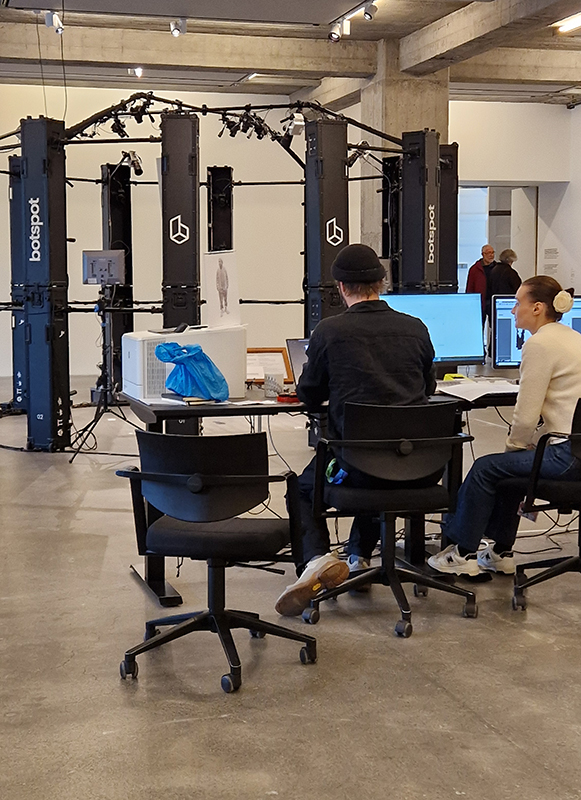
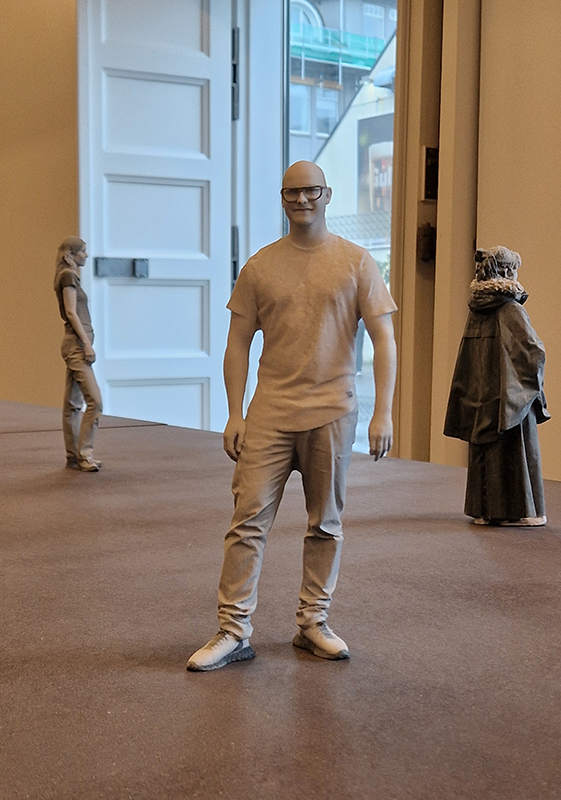
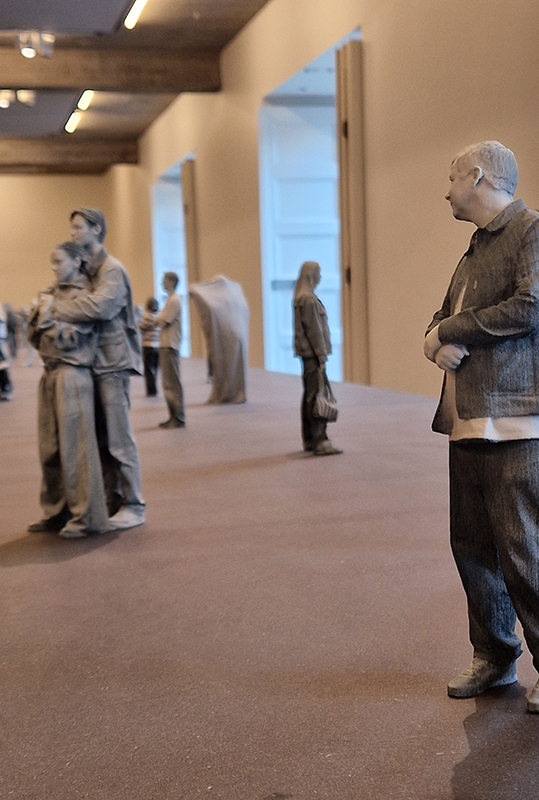
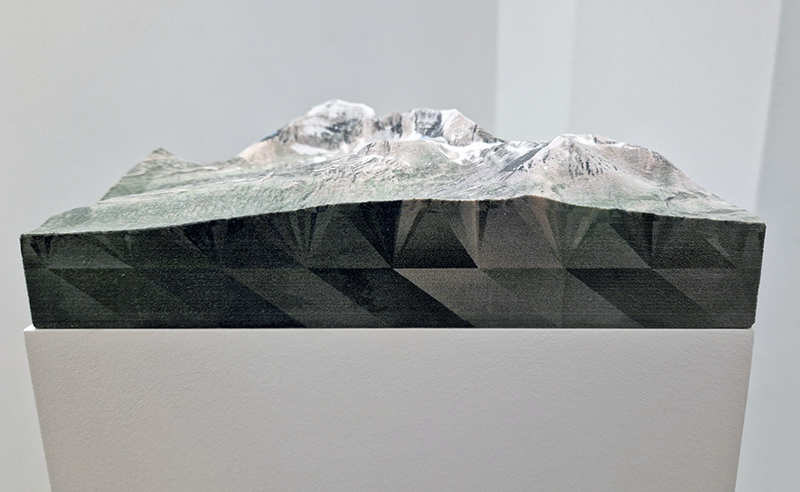
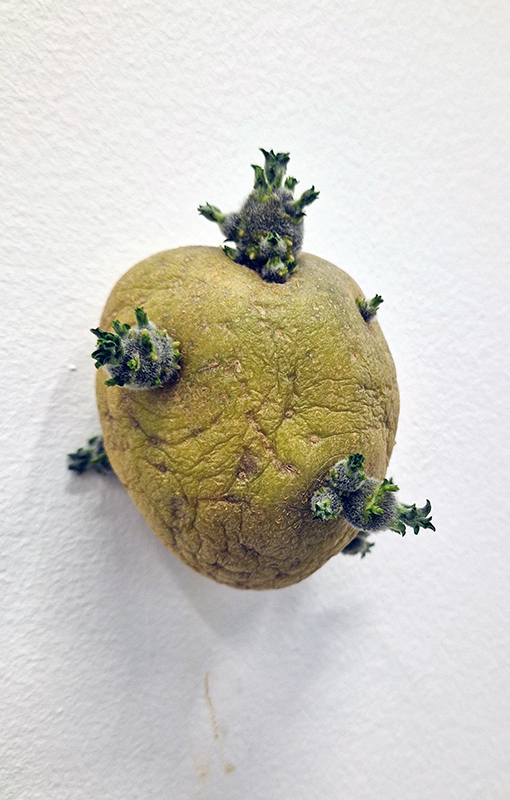
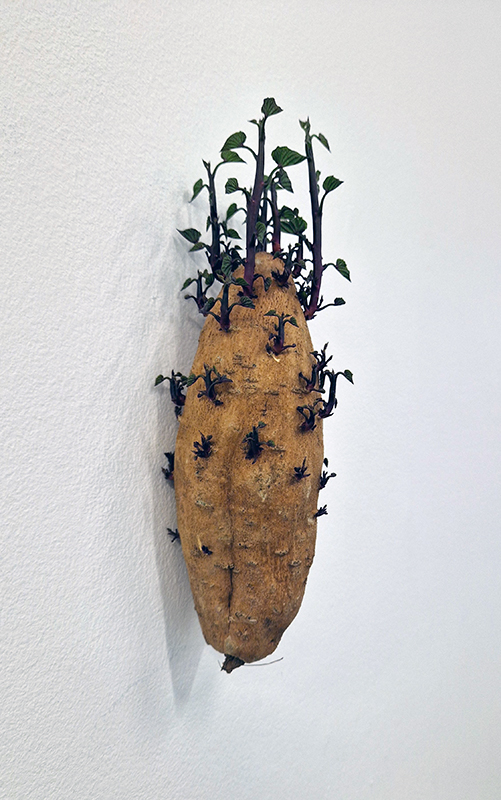
Karin Sander 1957 – 2057 at Reykjavik Art Museum. Many of her works rely on the participation of exhibition visitors or the influence of the surrounding environment, and her subtle interventions into the museum space invite reflection on the purpose and nature of the place itself. We hung our coats in a glass vitrine and became living sculptures balanced on plinths in a dangerously slippy courtyard. The exhibition explores notions of site-specificity in geographical, physical, and conceptual terms. Visitors are invited to have themselves scanned and 3D printed as freakily realistic small figurines. I liked the potatoes.

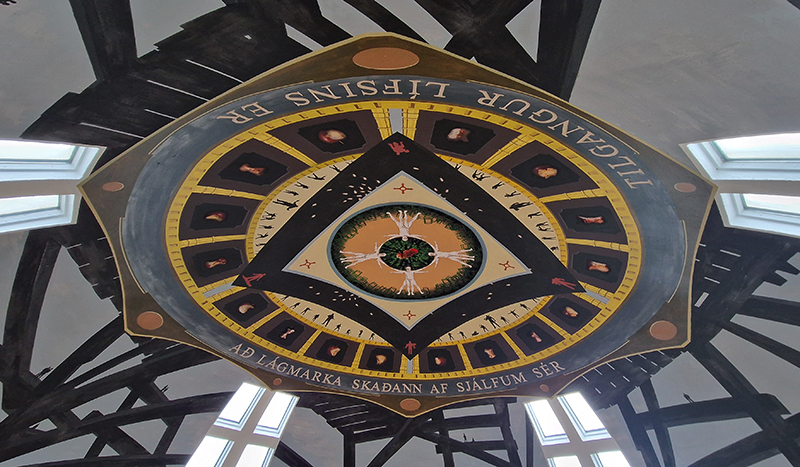
Wonderland, an exhibition series at Ásmundarsafn (Reykjavík Art Museum) where artists are invited to temporarily relocate their studios into the museum, offering the public an insight into their work and creative process. For his residency, Finnur Arnar Arnarsson moved both his studio and personal belongings into the museum, staying and working there continuously for nine weeks. The imagery he painted onto the building dome draws on notions of masculinity as shaped by societal concepts, prompting reflections on creation and destruction, the digital and ever-connected world, power, responsibility, and influence. The text translates as – The purpose of life is to minimise the harm you make.

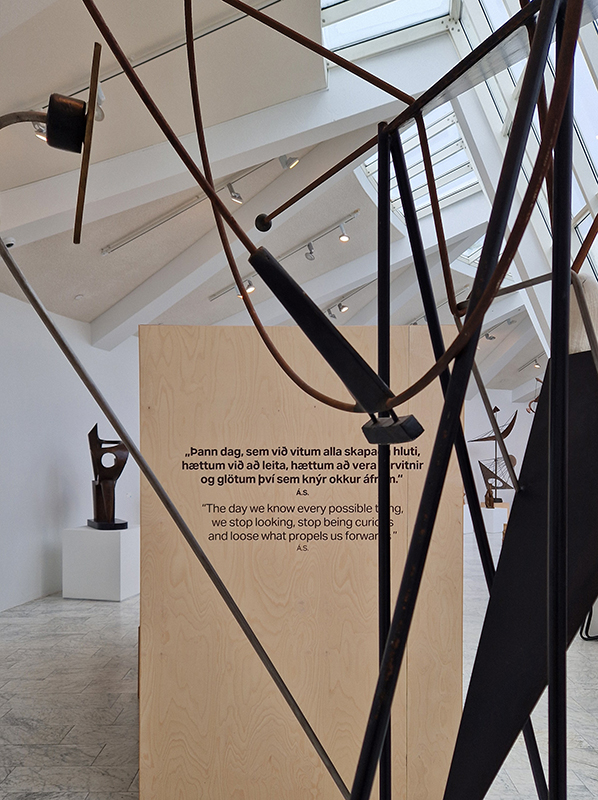
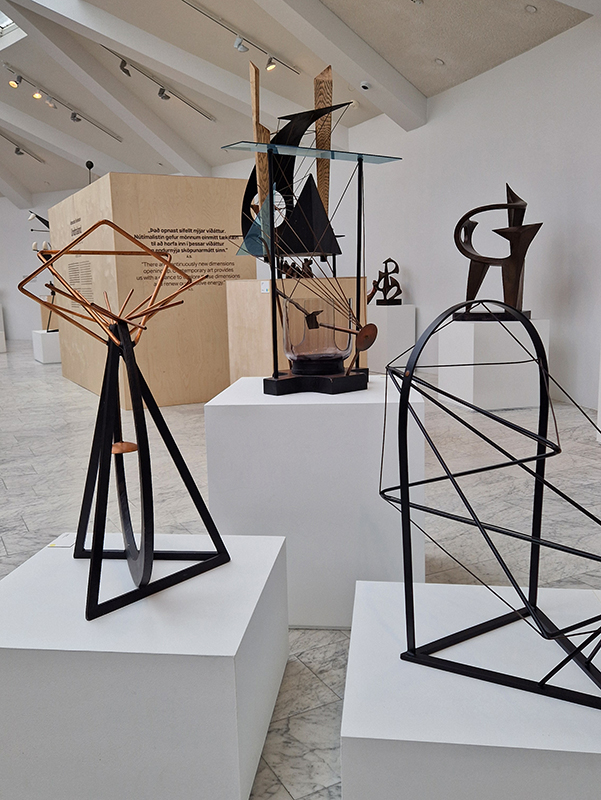
Sculpture Museum Ásmundursafn is dedicated to the works of the sculptor Ásmundur Sveinsson (1893-1982). The striking modernist building he designed was once his home and studio.

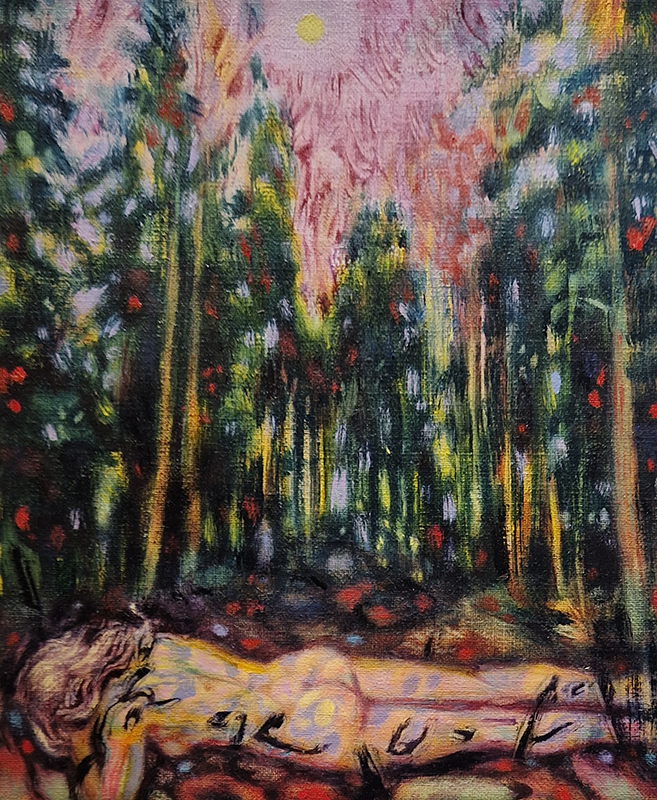
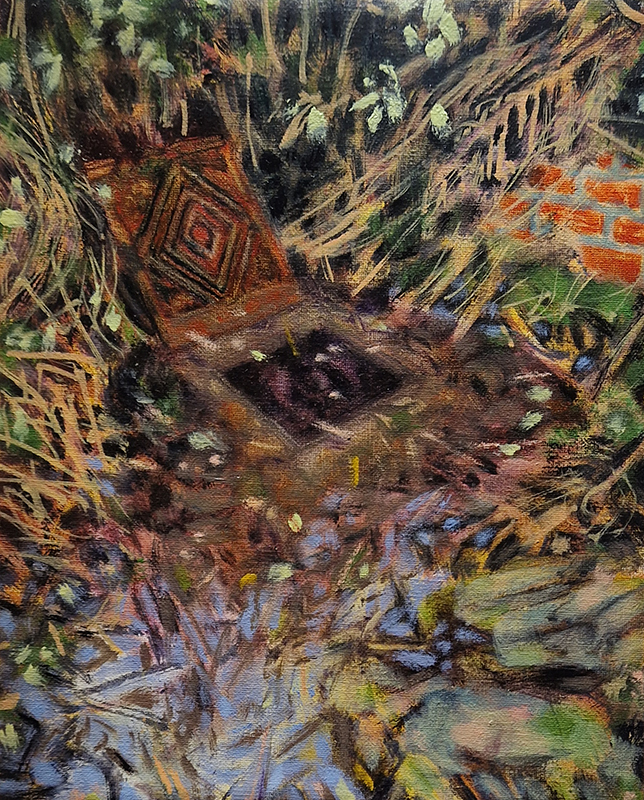
Dominic Shepherd The Hollow Hill, curated by Charlie Smith Gallery in appropriately subterranean and labyrinthine office basement.

Shepherd and his wife now live on The Hollow Hill, a place with its own histories, myths, and hidden currents. Their home sits at the original entrance to an Iron Age hill fort, built directly into the ancient ramparts high above the Dorset vales. The hill is a place shaped by time and disappearance. Beneath its surface lies a network of hidden waters, where springs emerge around and above the summit. Once the site of a holy well, reputed to contain a golden tablet with healing powers, the hill was also home to an anchorite’s chapel. Following the Reformation, these disappeared, though pilgrimage continued with the great agricultural fair held each Autumn equinox. The site later entered literary history through Thomas Hardy’s Far from the Madding Crowd. Where a hamlet once stood on the hill, before gradually vanishing in the late twentieth century, only the house where the Shepherds now live and a derelict farm building remain.

I wanted to see these new works as I had quoted Shepherd in my dissertation Finding Paradise (ROYAL COLLEGE OF ART
Printmaking 2014 words10,440).

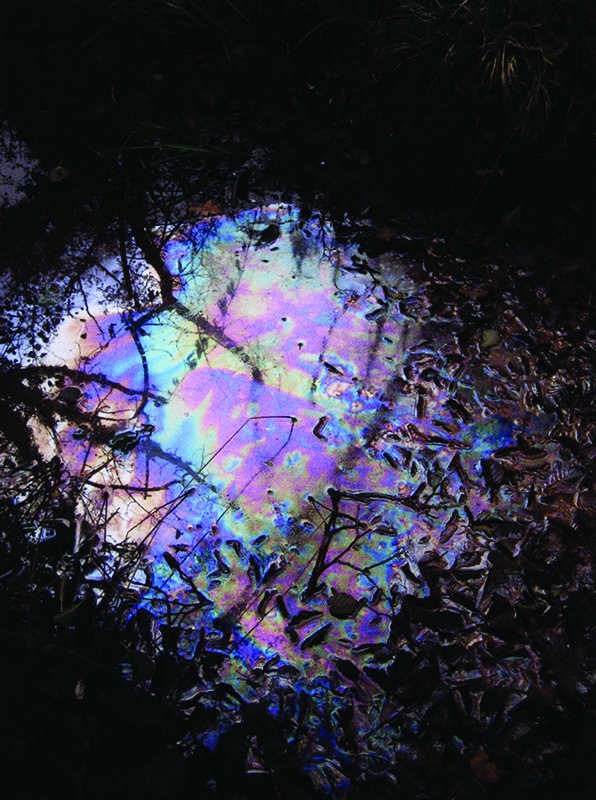
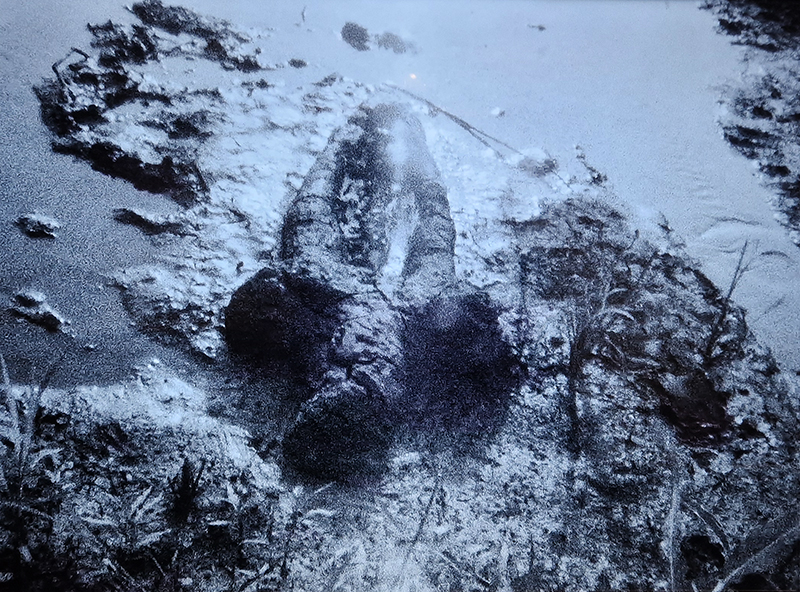
By following the path of the poet “finding resonances and poetic contemplation in the forgotten zones”[1] we leave the confines of the everyday. As an example of the sacred emerging from the profane, Dominic Shepherd offers us a black mirror for our time in his digital photograph ‘The Puddle’. He doesn’t present the 21st century dark screen of a smart phone or tablet to scry the future but suggests we gaze into the murky depths of water slicked with oil on waste land. He points us in the direction of “the edgelands” to locate our dreams.

“It is within our imagination that one sees the invisible, the unformed, the possible. It is here, in the garden of the mind, that one can mentally contrast and bring to bud the ‘pastoral’ for our present and future age.”[2]


[1] Dominic Shepherd refers to poets Paul Farley and Michael Symmons Roberts, ’Edgelands: Journeys into England’s True Wilderness (London: Jonathan Cape, 2011). “The Golden Age, Between Wilderness and Utopia” in The New Pastoralism: landscape into architecture. Architectural Design May/ June 2013. (Chichester: Wiley, 2013) p.30. [2] Dominic Shepherd. “The Golden Age, Between Wilderness and Utopia” in The New Pastoralism: landscape into architecture. Architectural Design May/ June 2013. (Chichester: Wiley, 2013) p.31.

I enjoyed the opening of Elisa Giardini Papa video installation She Flickered  In and Out of History at the ICA. A great precursor to my trip to Iceland to experience the volcanic landscape there. It’s a beautifully put together film drawing from an underwater volcanic eruption in 1831 that gave rise to a new landform between Tunisia and Sicily, sparking a violent sovereignty dispute among European powers. Six months later, the island vanished beneath the surface. Historical observations of the altered colour of the sun, caused by the release of volcanic particles and sulphur aerosols into the atmosphere, are also referenced where observers from the Mediterranean to the Middle East and the Caribbean reported seeing blue, green, and purple suns. The exhibition also featured shattered pieces of obsidian which is created when rhyolite lava is cooled quickly.

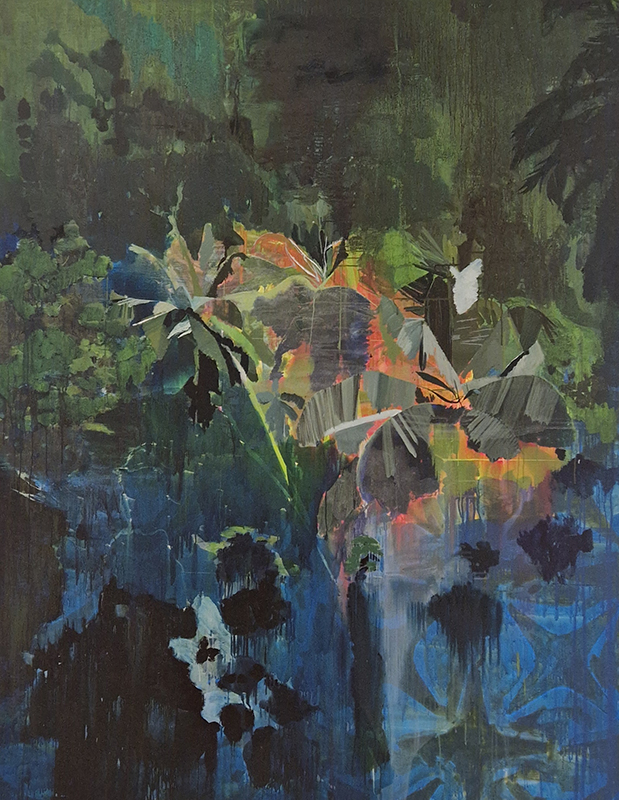
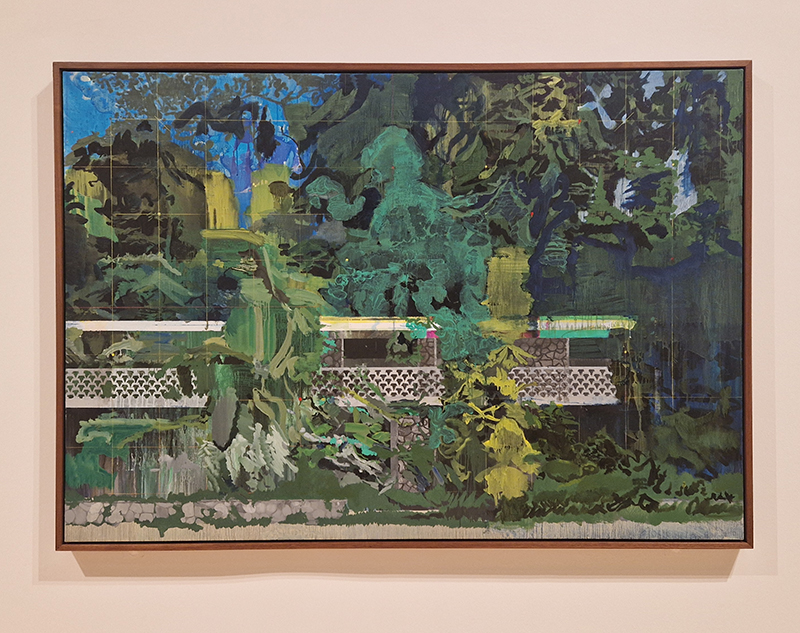
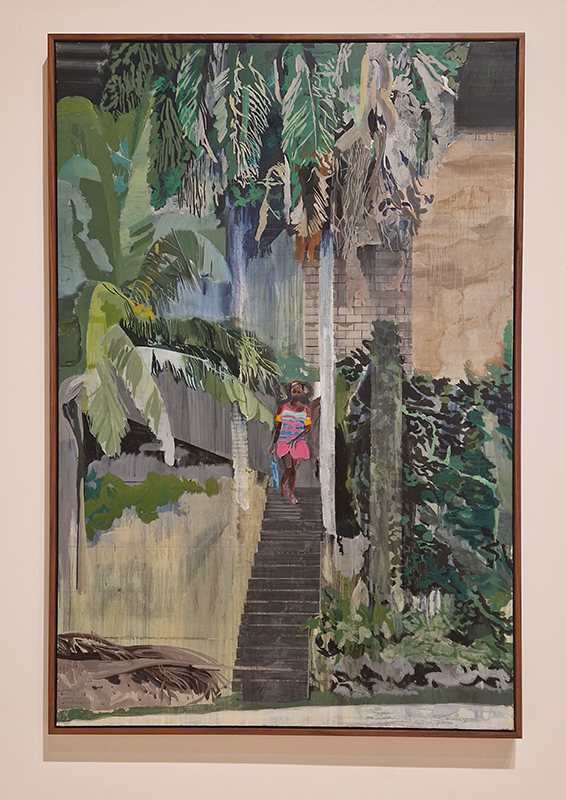
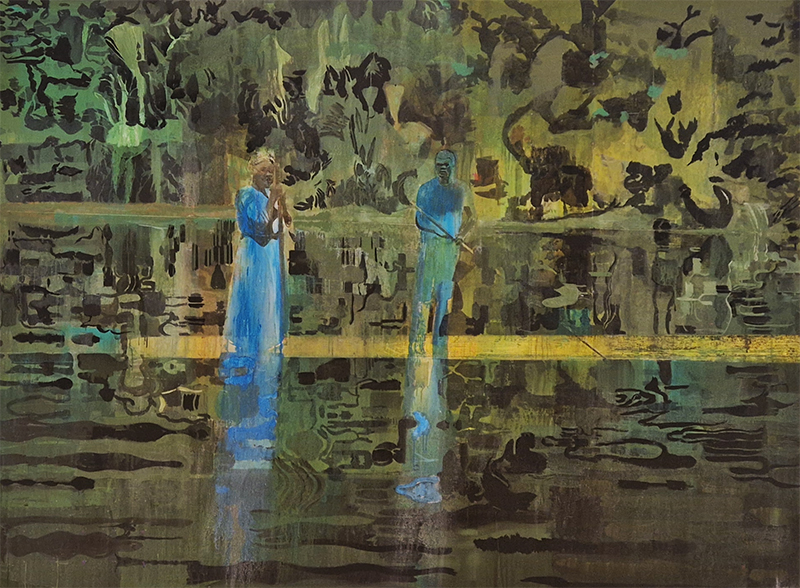
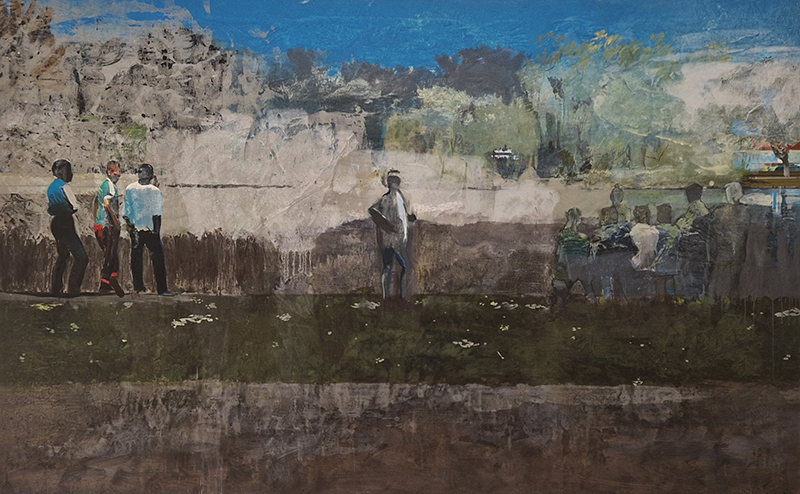
Hurvin Anderson at Tate Britain. I know these paintings originated from trauma and dislocation and feeling an outsider but they are so seductive. Sensory overload.

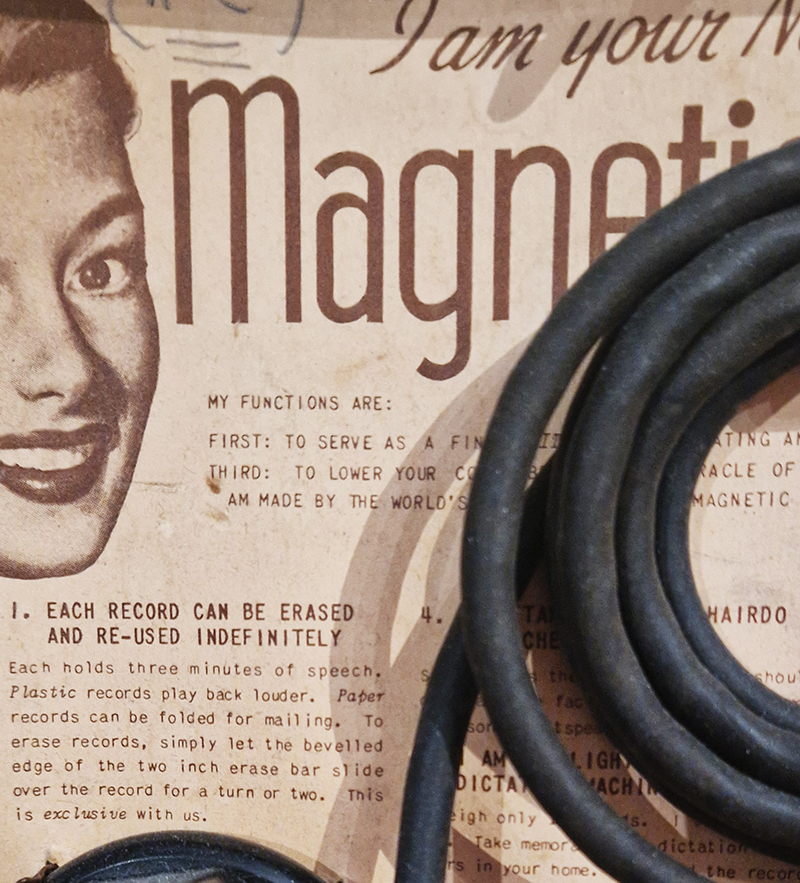
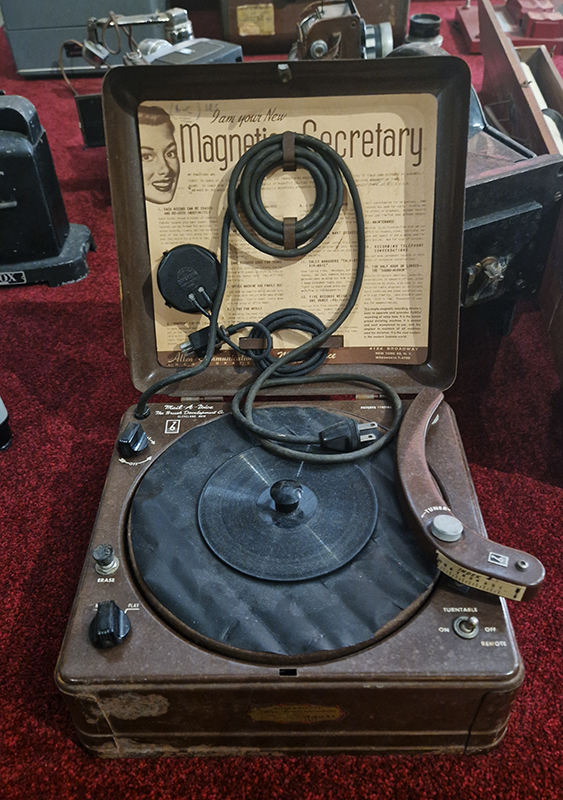
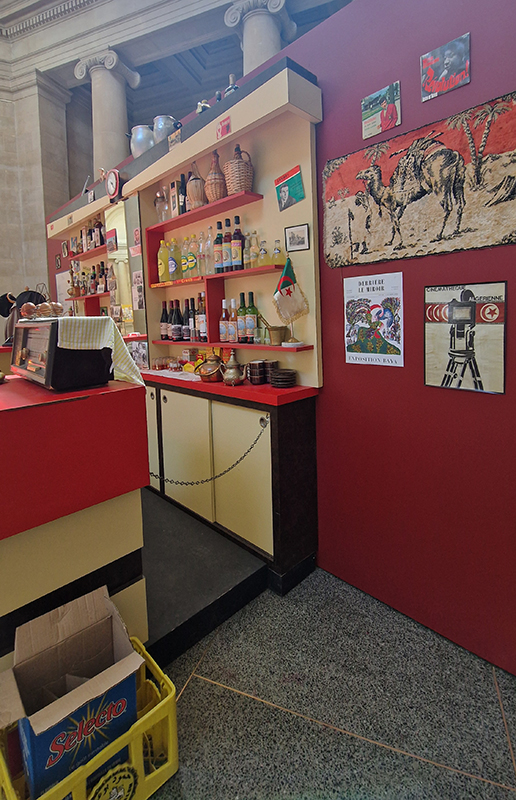
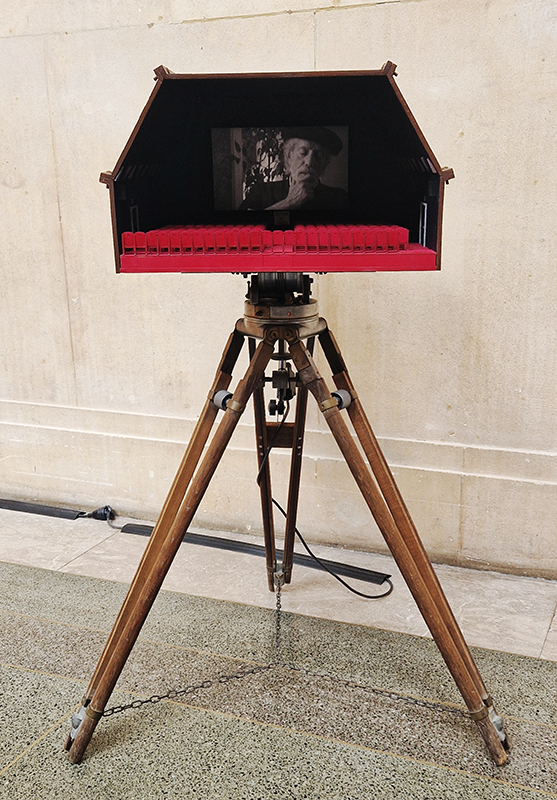
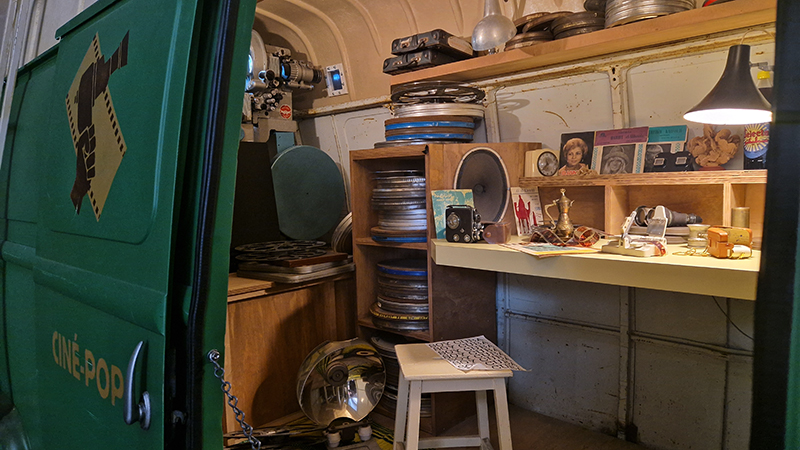
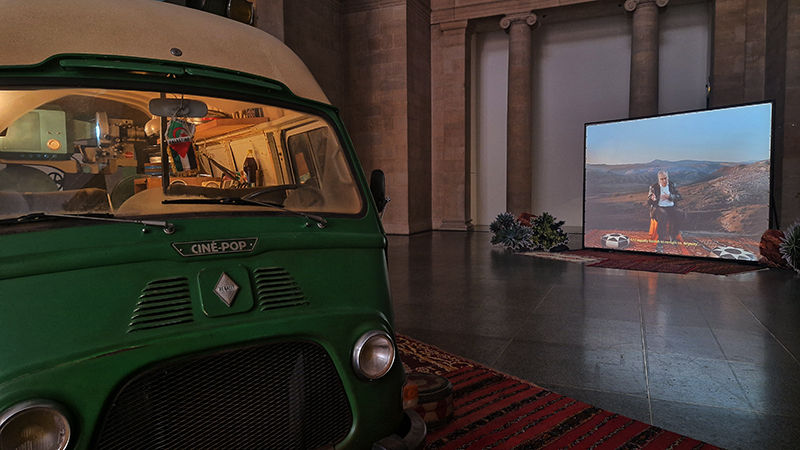
Zineb Sedira, When Words Fall Silent, Cinema Speaks at Tate Britain. Sedira’s work draws on personal encounters within the Algerian diaspora of Africa. Taking inspiration from family archives and the history of cinema. I loved the mini cinema on a tripod and was fascinated by the ‘Magnetic Secretary’.

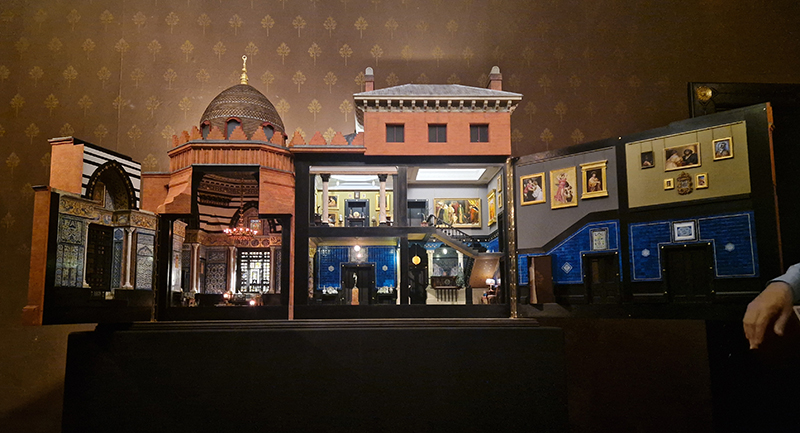
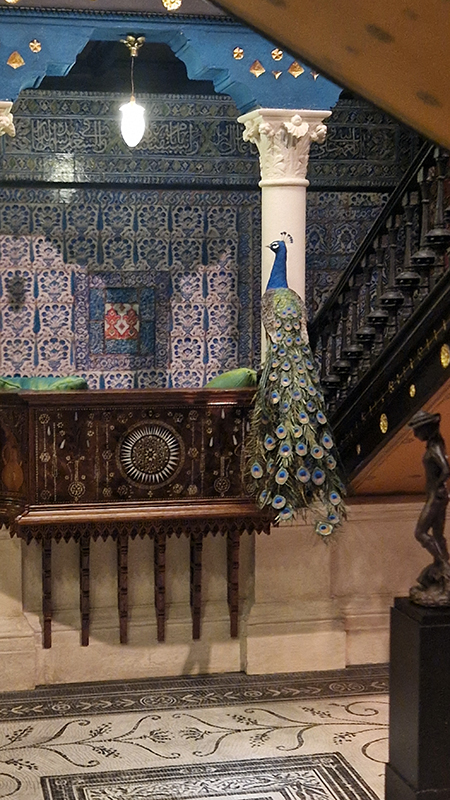
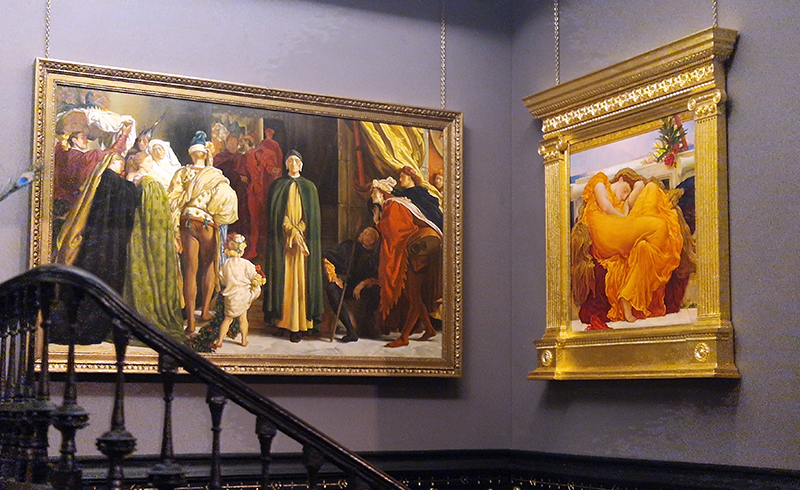
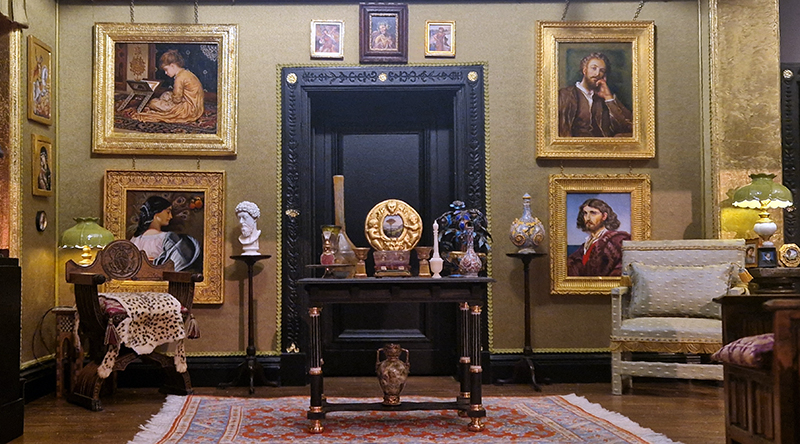
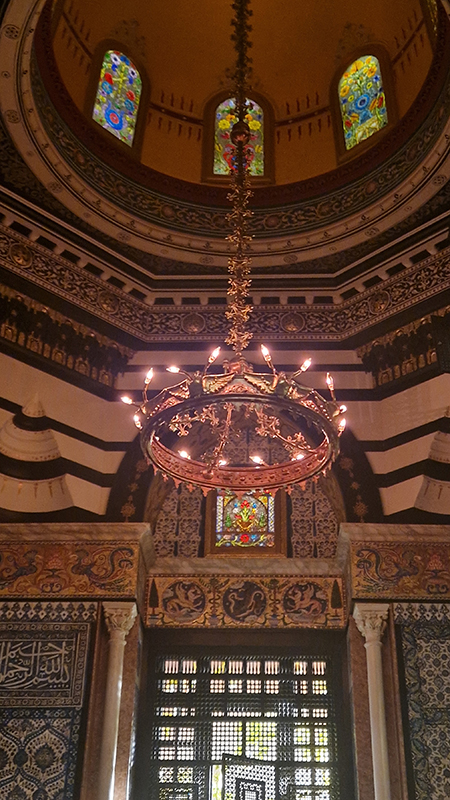
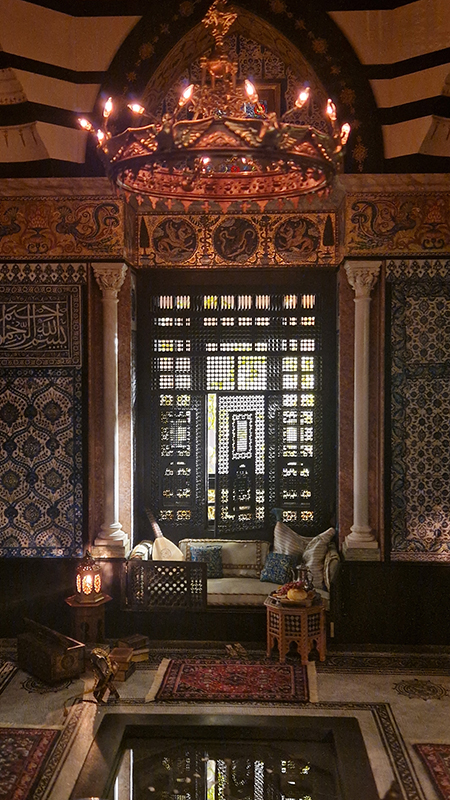
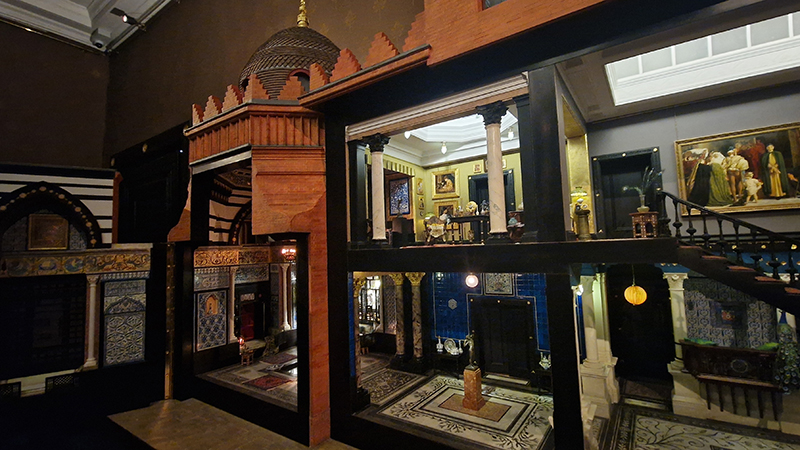
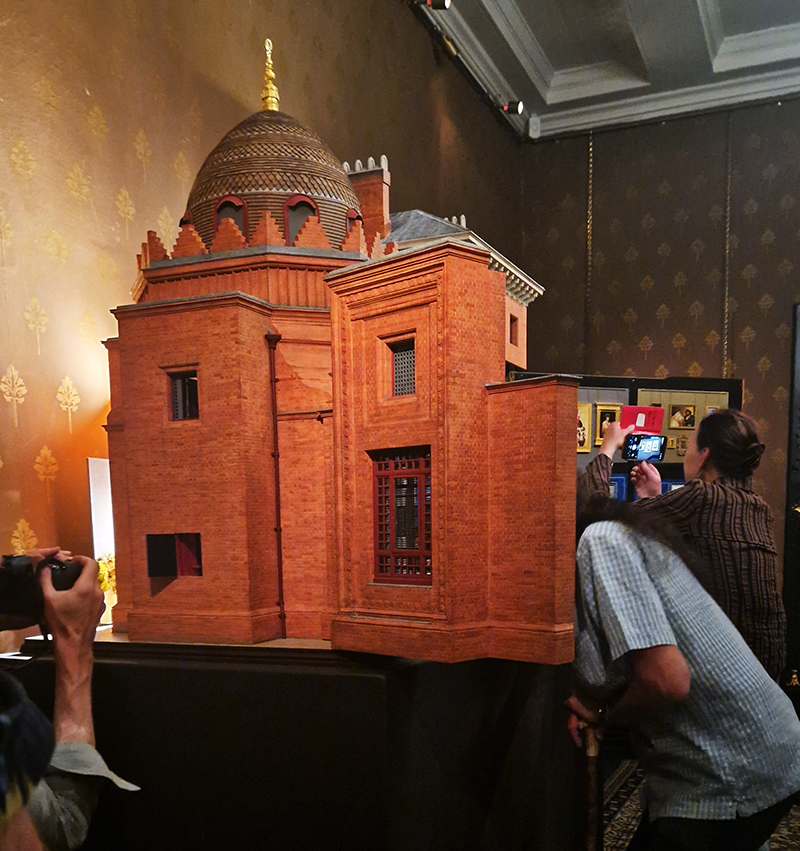
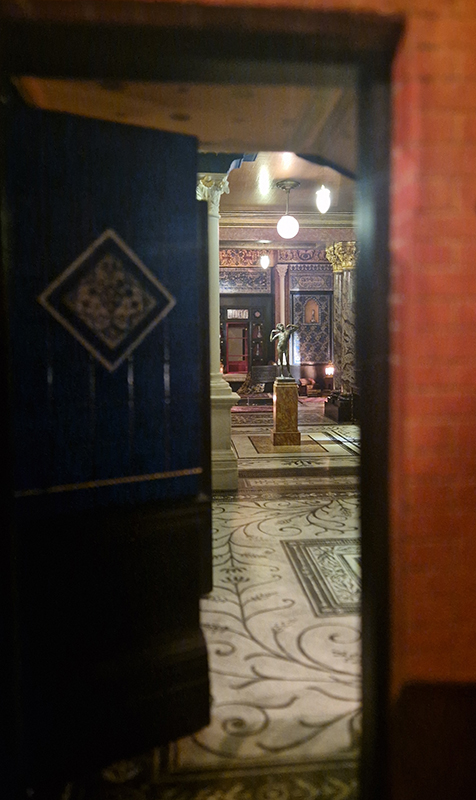
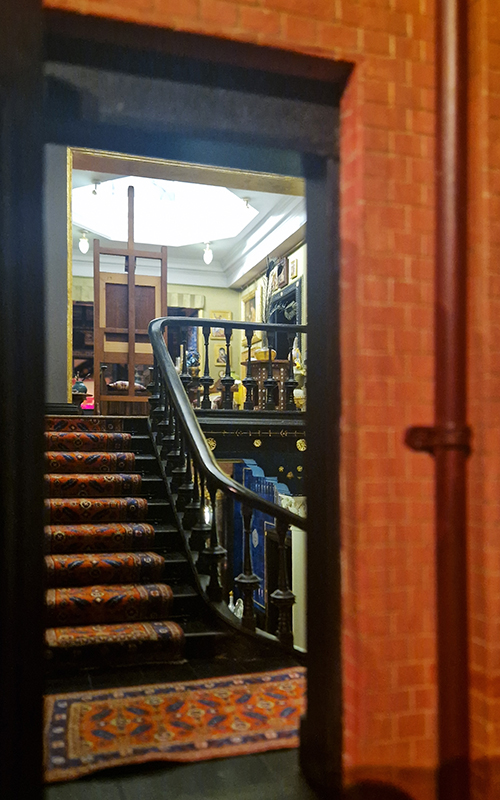
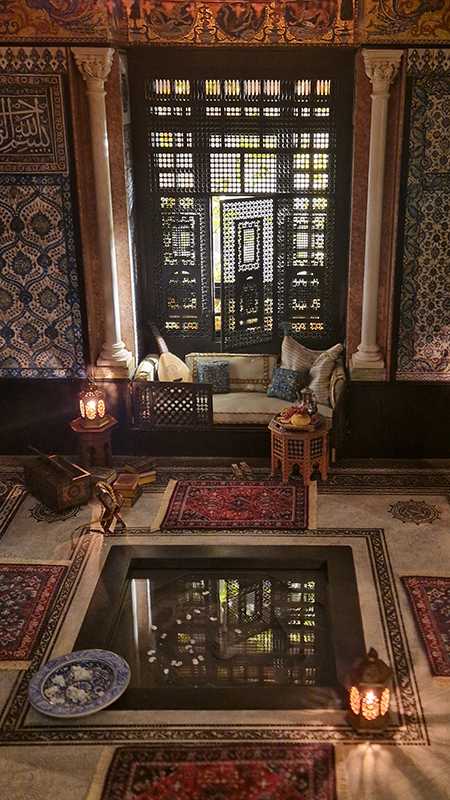
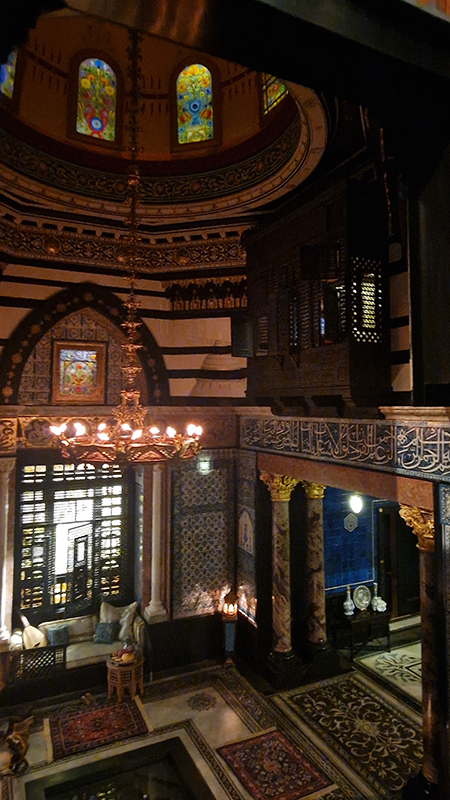
In sorting out my photos from the visit to Leighton House to see the 1/12th scale model by Susie Mulvany and Kevin Rogers I had trouble deciding which were of the full size house and which were of the model. Their excellence in creating miniatures is astounding. Leighton House is the former studio-home of Victorian artist and President of the Royal Academy, Frederic, Lord Leighton (1830 – 1896). He is most famous for painting Flaming June, which doesn’t hang here but is included in the model which aims to capture the essence of the house, rather an exact replica. Every painting is an oil painting, every carpet is woven, the dome is lined with real miniature gold leaf sheets, the windows are Victorian glass, the cabinet is inlaid….and so it goes on, every piece is meticulously made to match the original, just in miniature.

Reading

The Age of Miracles was the choice for the Greenland expedition book club aboard the Sylvia Earle. I can see why it was chosen for its speculation on what would happen if the Earth’s spinning slowed and days became longer and longer, but as the novel is aimed at a teen market with a coming of age saga dominating the storyline, there was a general consensus of disappointment that the science didn’t feature strongly enough and this catastrophic cosmic event wasn’t followed through convincingly. It begins with quite a gripping plot and I found some parallels that chimed with the covid pandemic interesting as it was written in 2012 but was not good for an audience looking for a more science based debate about the sun and circadian cycles.

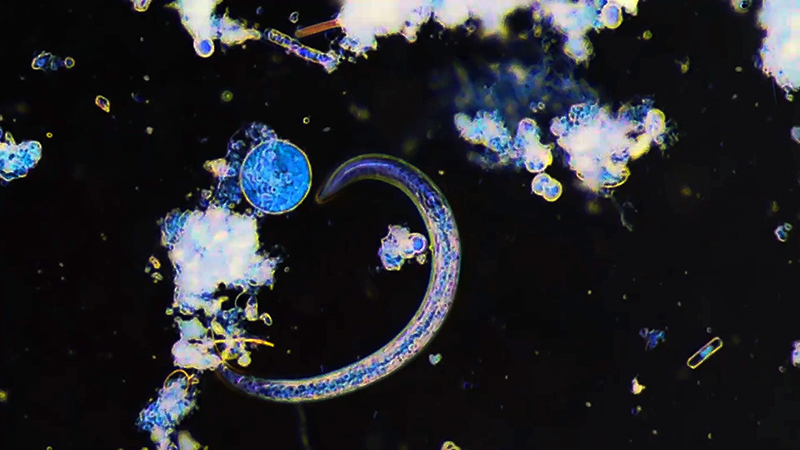
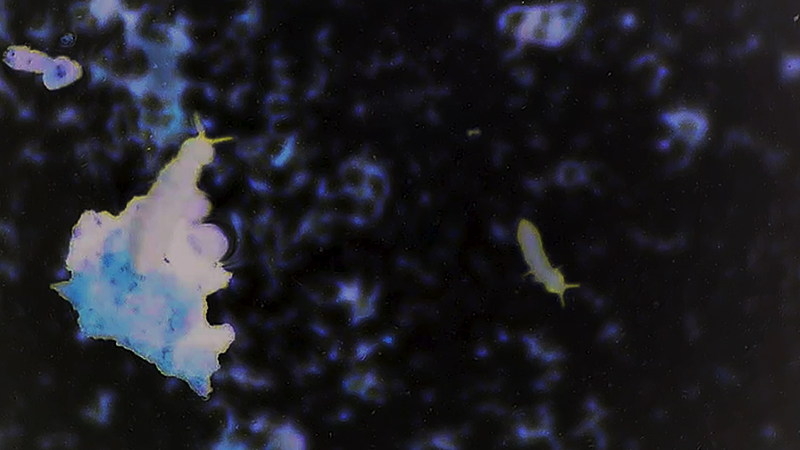
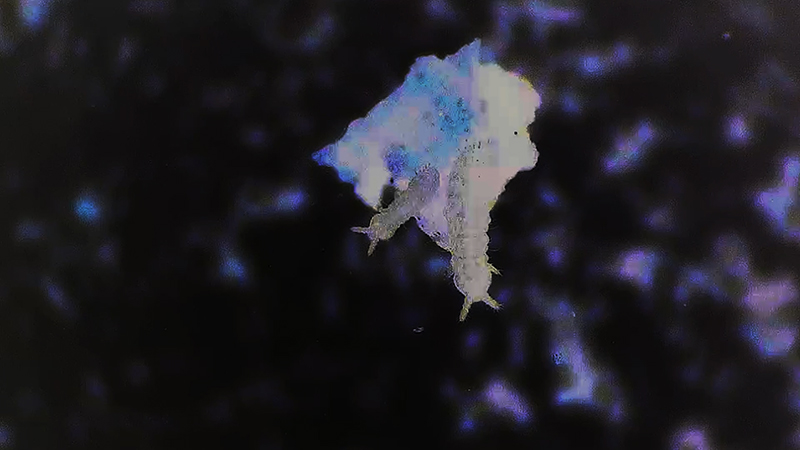
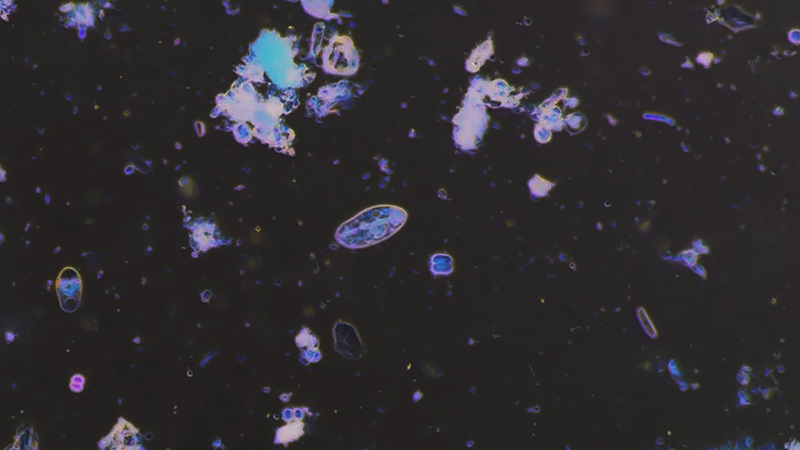
I am enjoying discovering the gutter creatures who share my home. Gathering video footage of an alternative cosmos to go towards making work which will be shown in Occupied: Strange Company at the Safehouse next year, a group exhibition curated by Julie Hoyle.

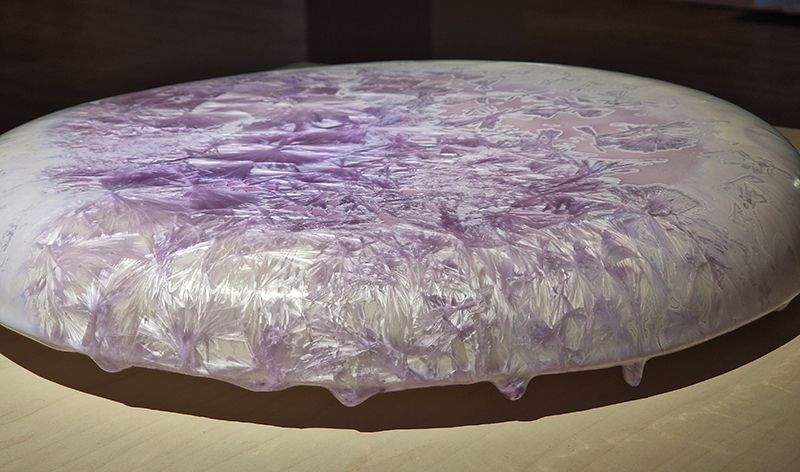
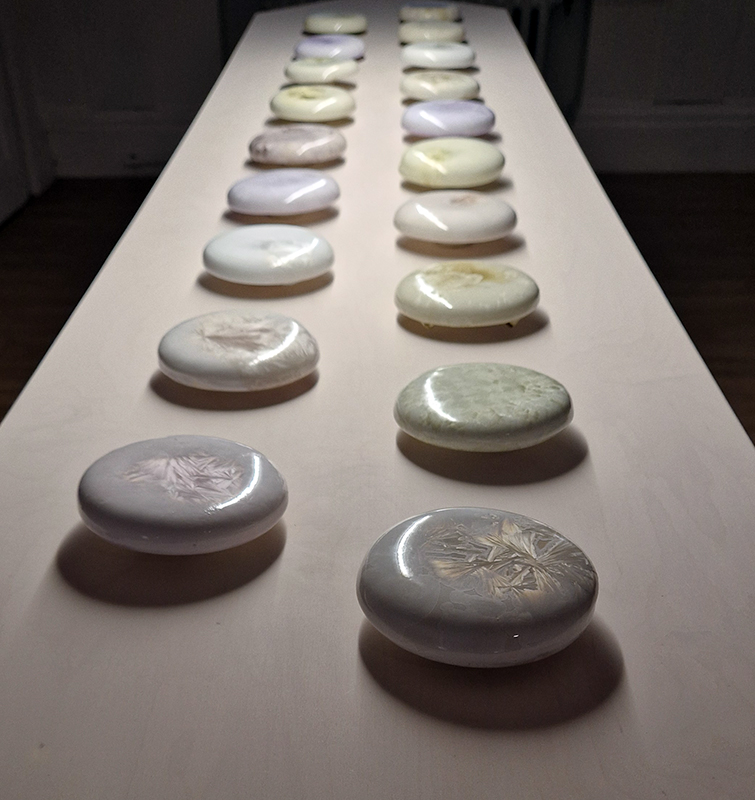
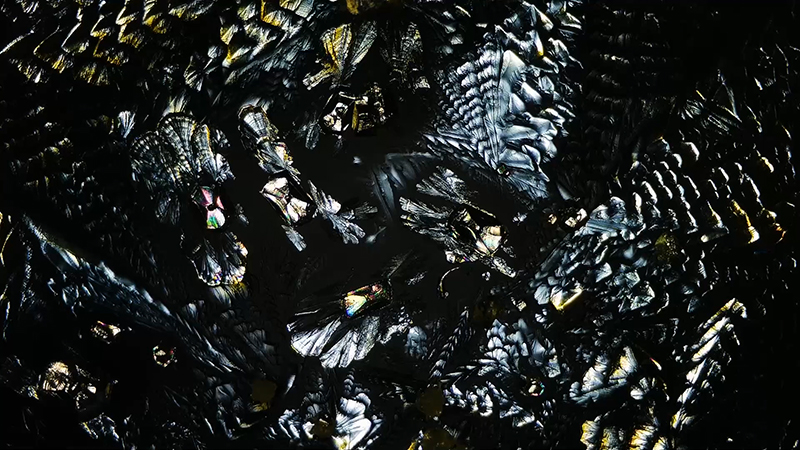
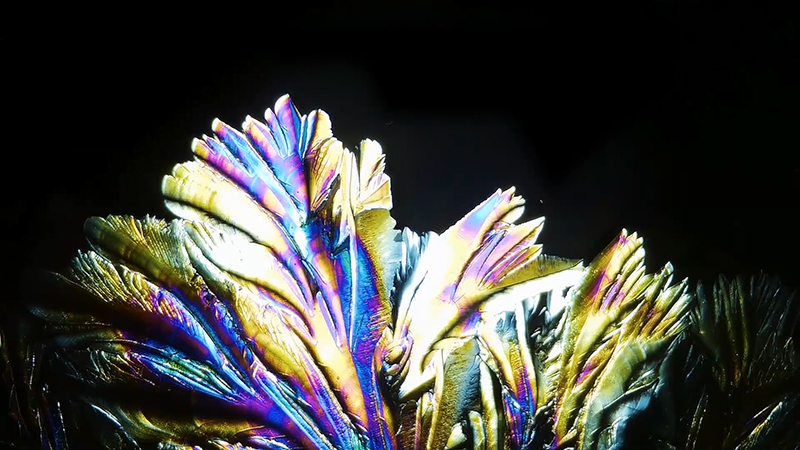
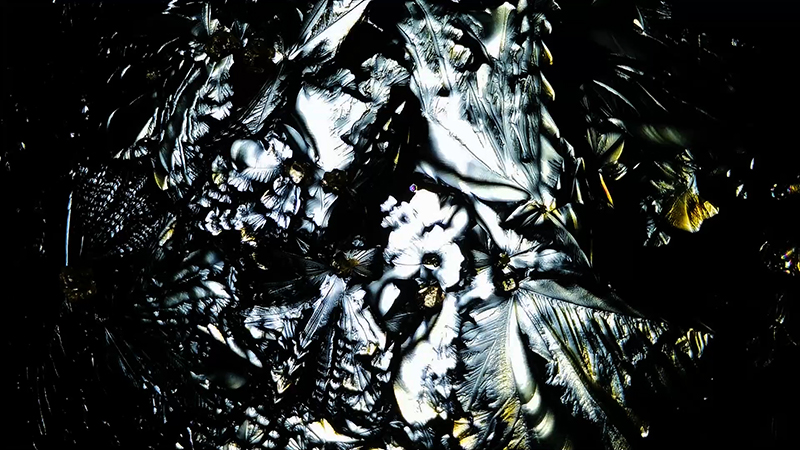
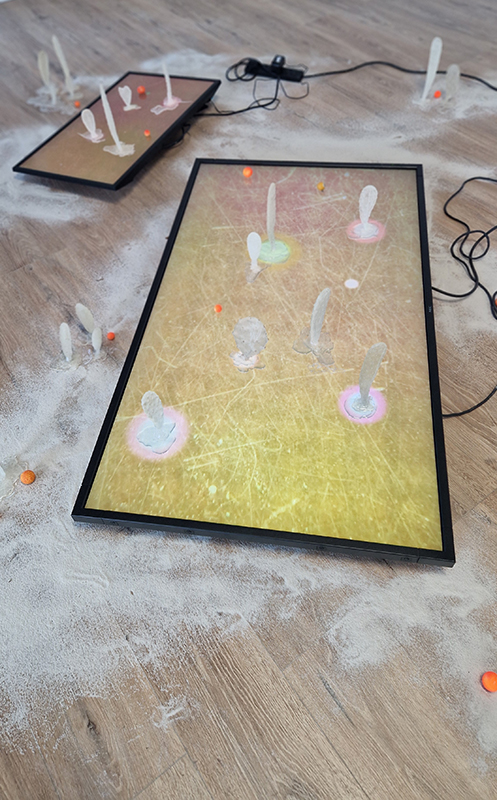
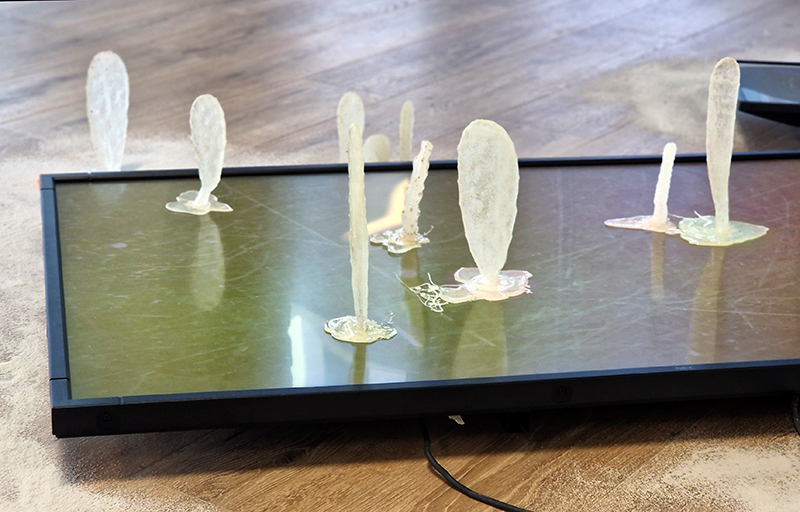
My experiments growing citric acid crystals have been going well. I am filming these transformations under polarised light which reveals the many vibrant colours but I also like the images without the filter. The structures remind me of feathers so I am thinking about creatures that flutter as well as those that swim.

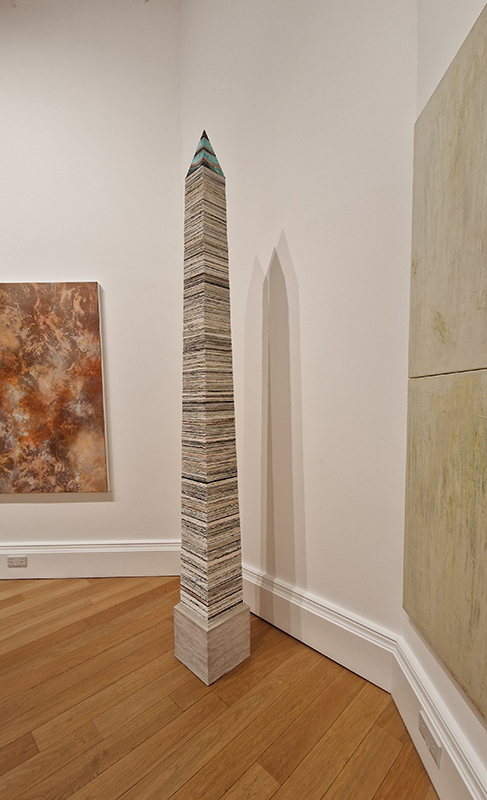
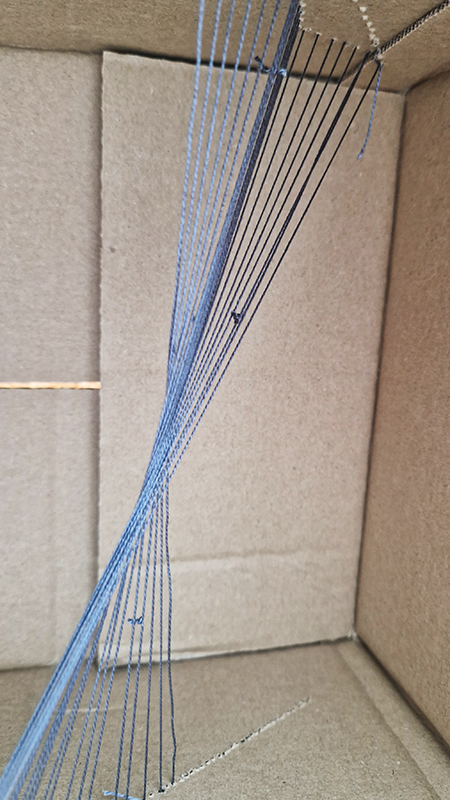
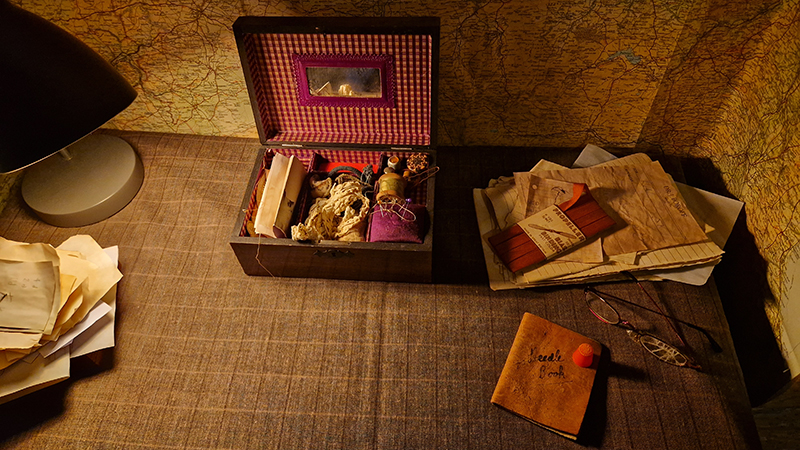
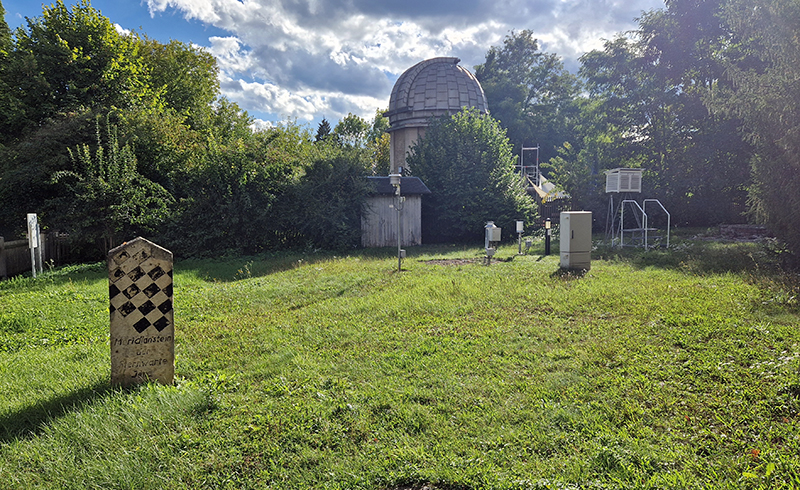
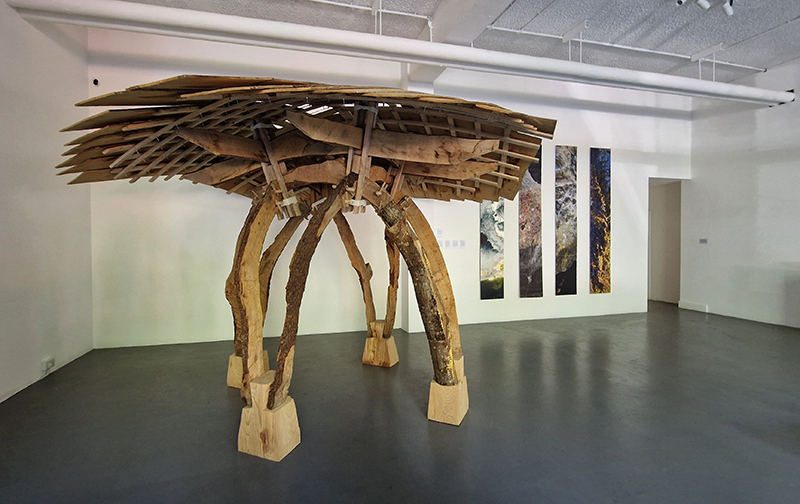
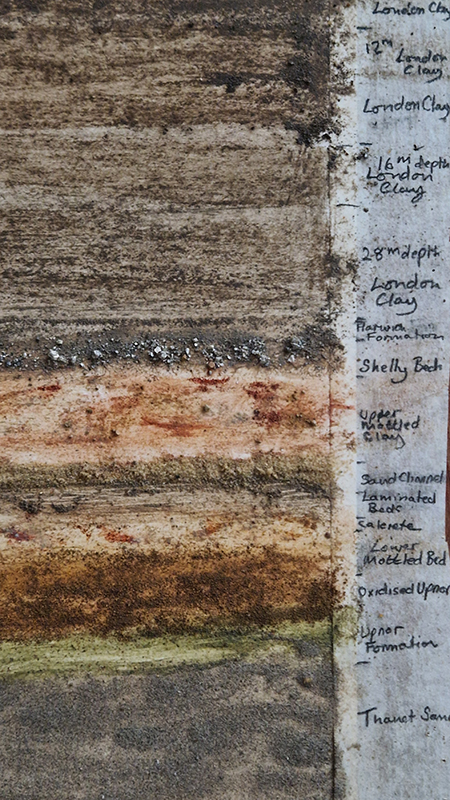
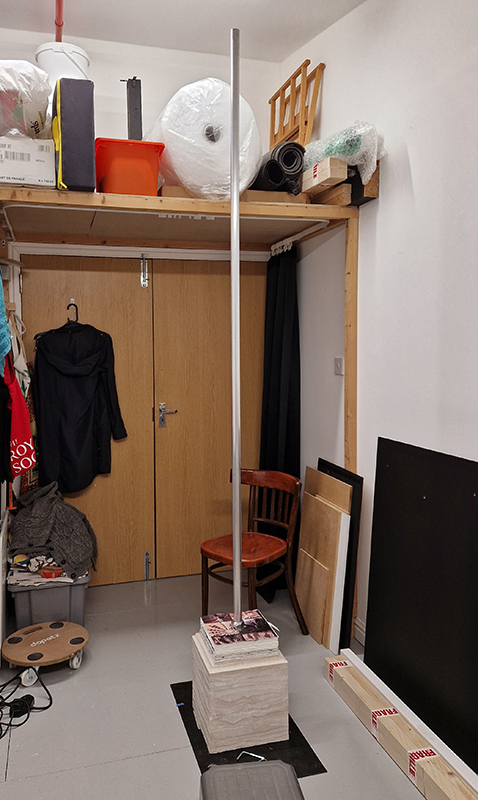
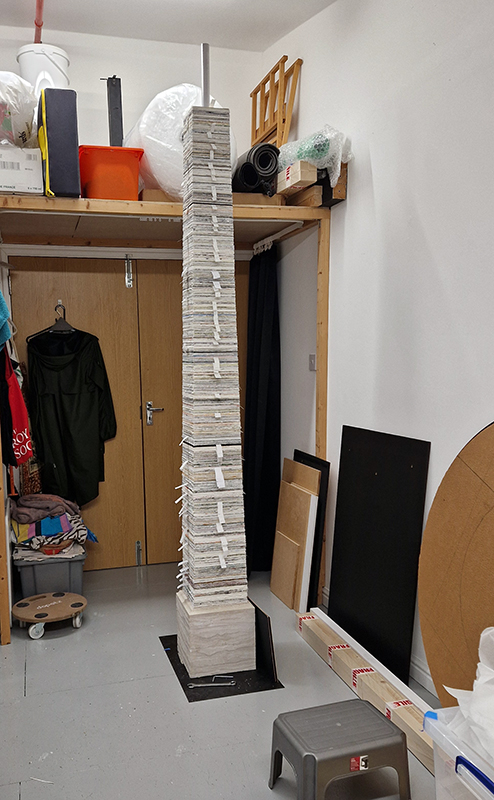
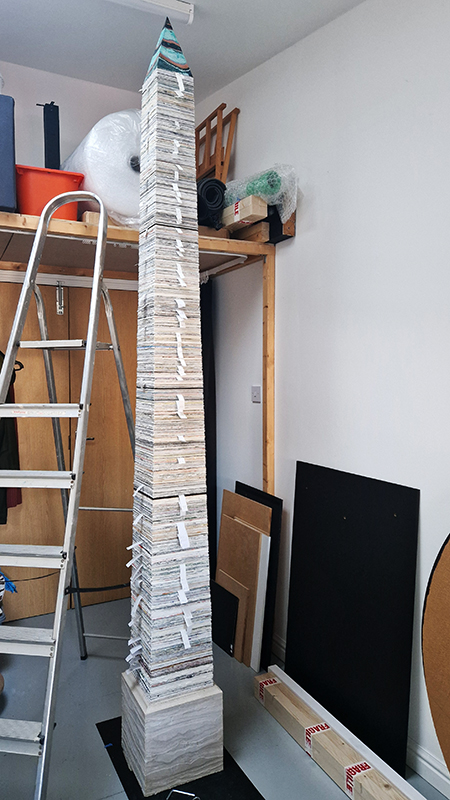
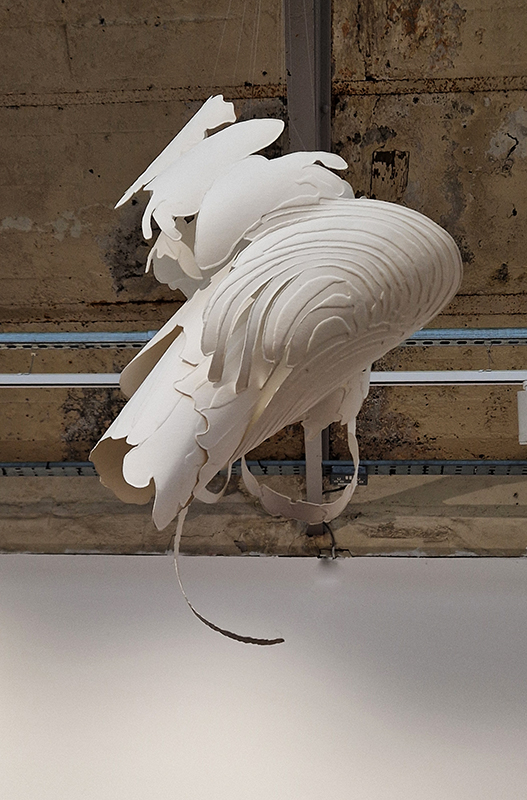
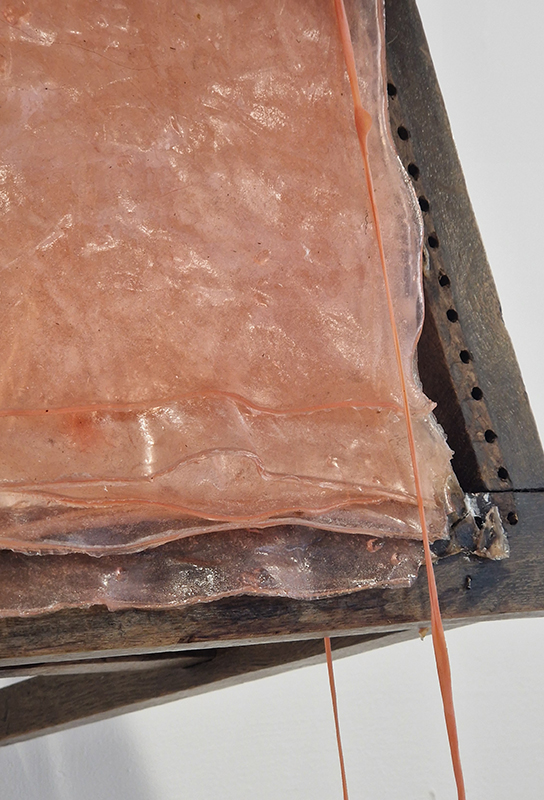
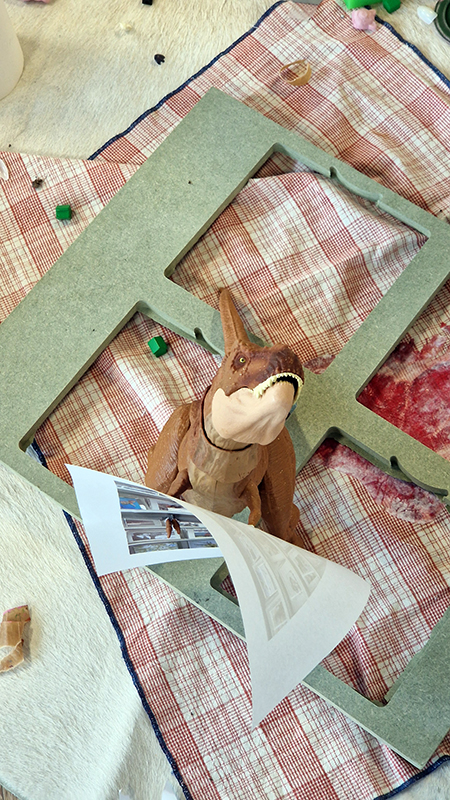
Time in the studio has been spent checking over and preparing works that will be showing in Cosmos: The Art of Observing Space curated by Ione Parkin which opens in the new year. I am thrilled to be part of this exhibition bringing together contemporary and historic artists and featuring an extraordinary range of work inspired by the cosmos. I have completed a test build of The Azimuth Obelisk (of sedimentary knowledge) using a new internal structure for before packing it all away again ready for transport to The Royal West of England Academy in Bristol. This work is a reimagining of an permanent azimuth mark erected at Hartland Magnetic Observatory in North Devon from which the drift of the magnetic north pole is monitored. Made of many layers hand torn from recycled works on paper it echoes the geological and magnetic history of the Earth which is secreted in the strata of sedimentary rock. The protruding tabs of paper seen in these studio images are markers for each section of paper squares of a tapering size and will get tucked away at installation in the gallery. With the added thickness of my new studio roof insulation the obelisk only just fits in now.

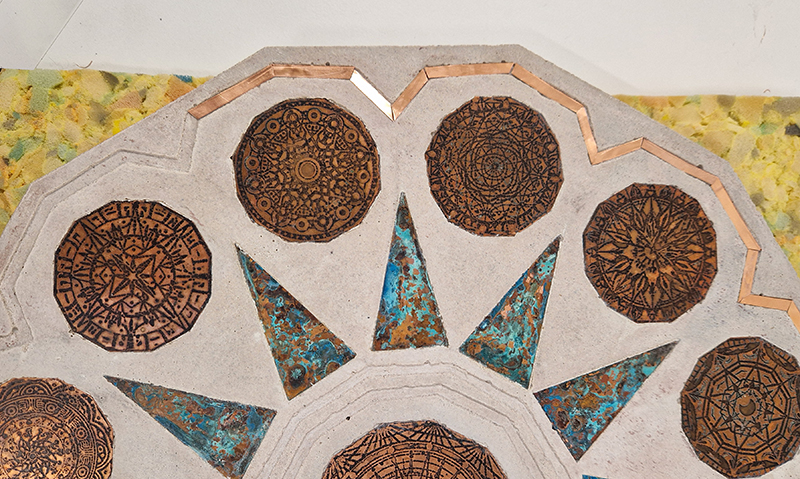
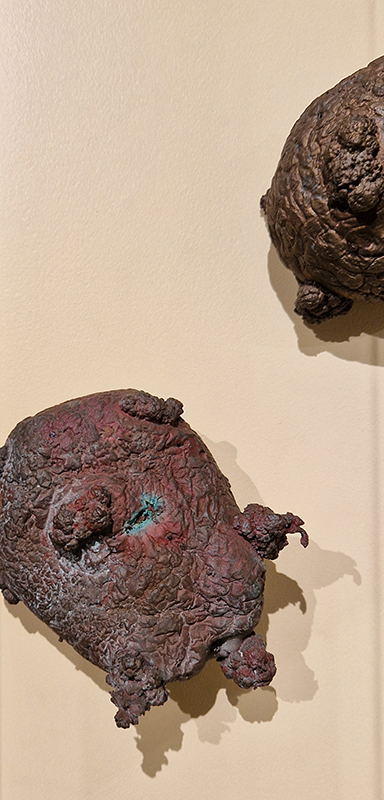
I have started work on inserting copper segments into the new sculpture for the Instruments of the Anemoi series. The other larger pieces of etched and patinated copper were added at the time of casting, held in place with tape and hope when the concrete was poured into the mould. This series of sculptures are suggestive of the pedestals that support various instruments used in monitoring the Earths’ magnetic field but are envisaged here as speculative objects used by the wind gods as the first emissaries of navigation.

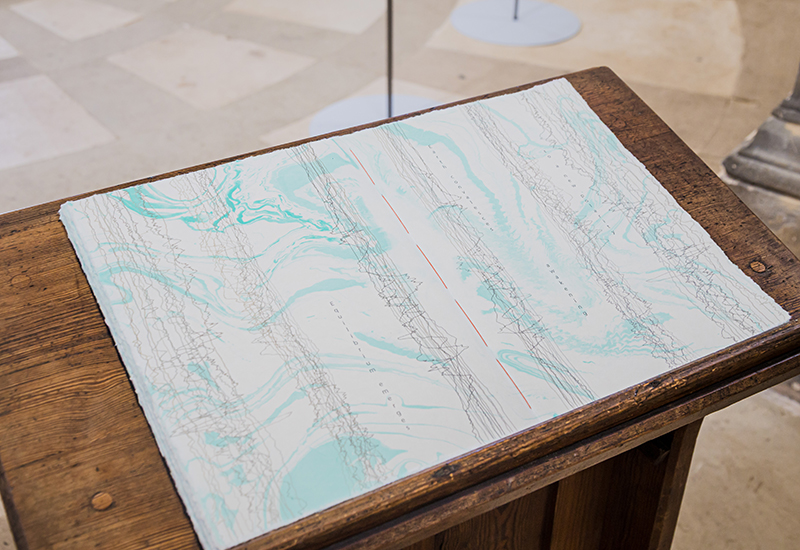
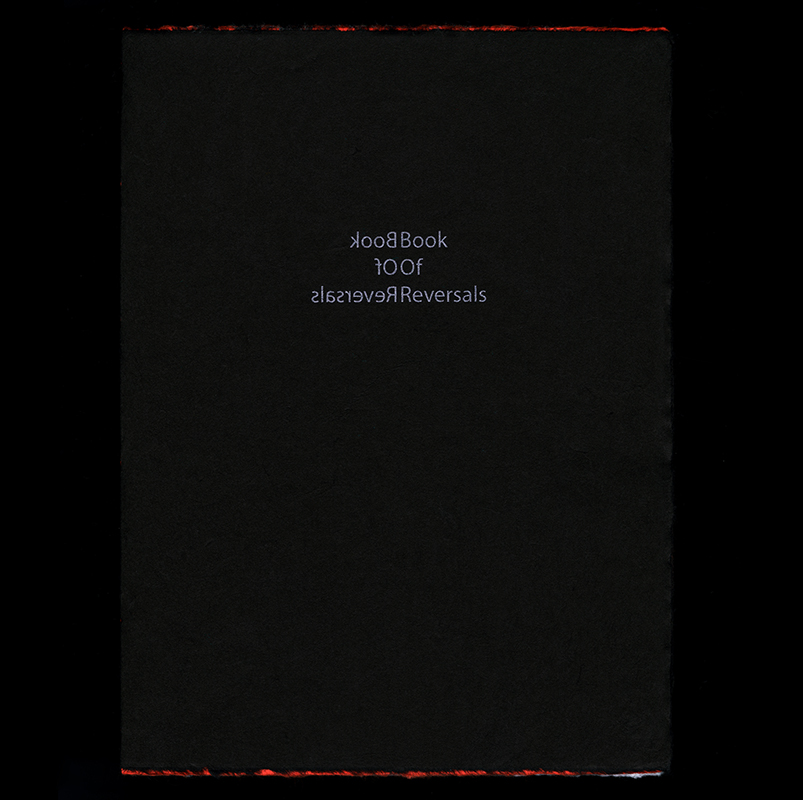
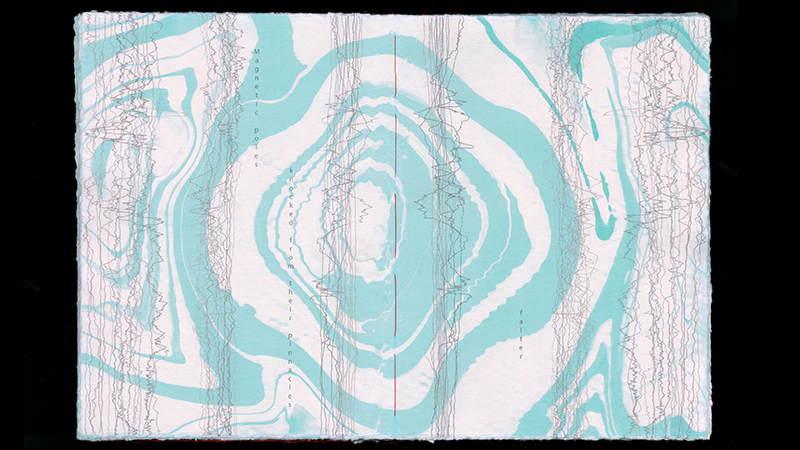
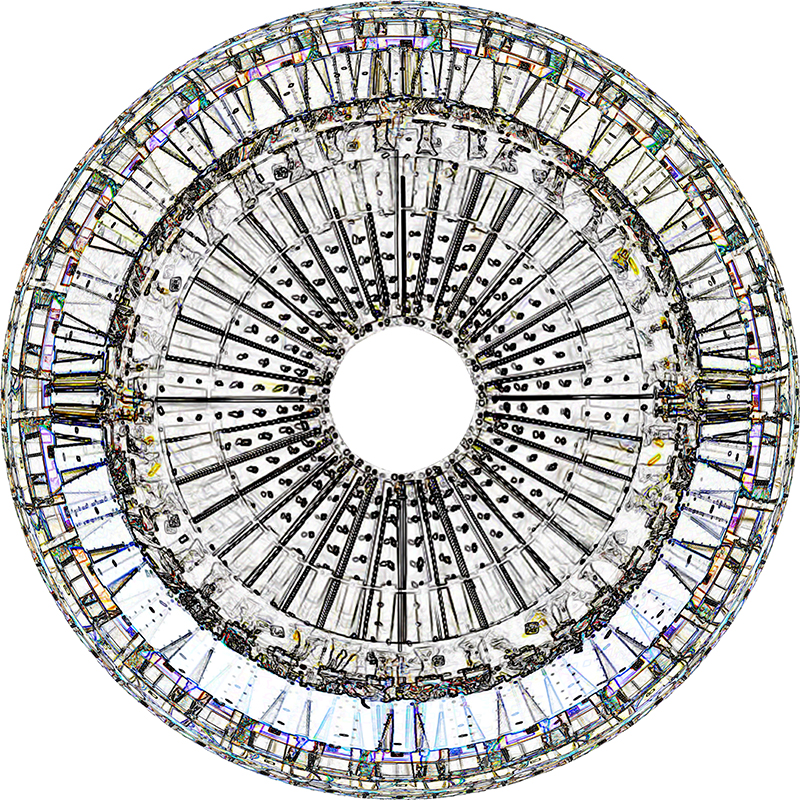
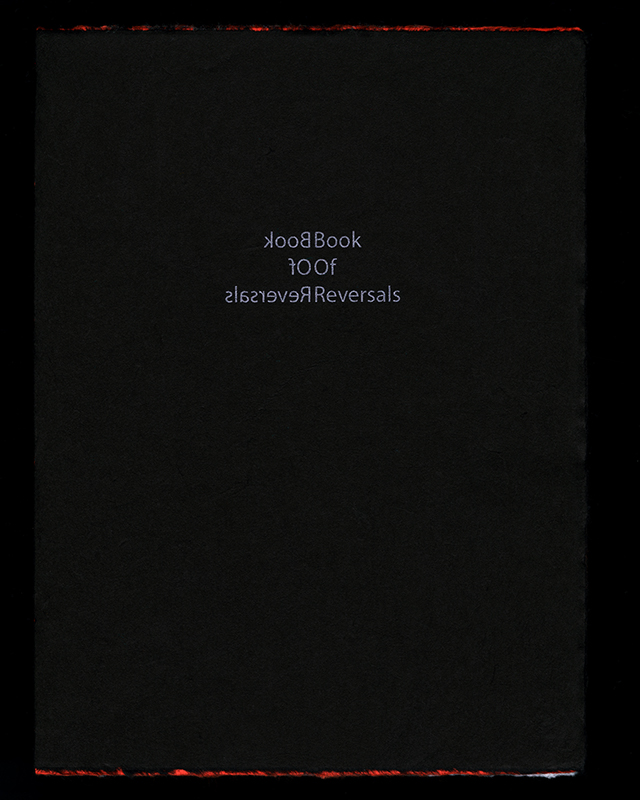
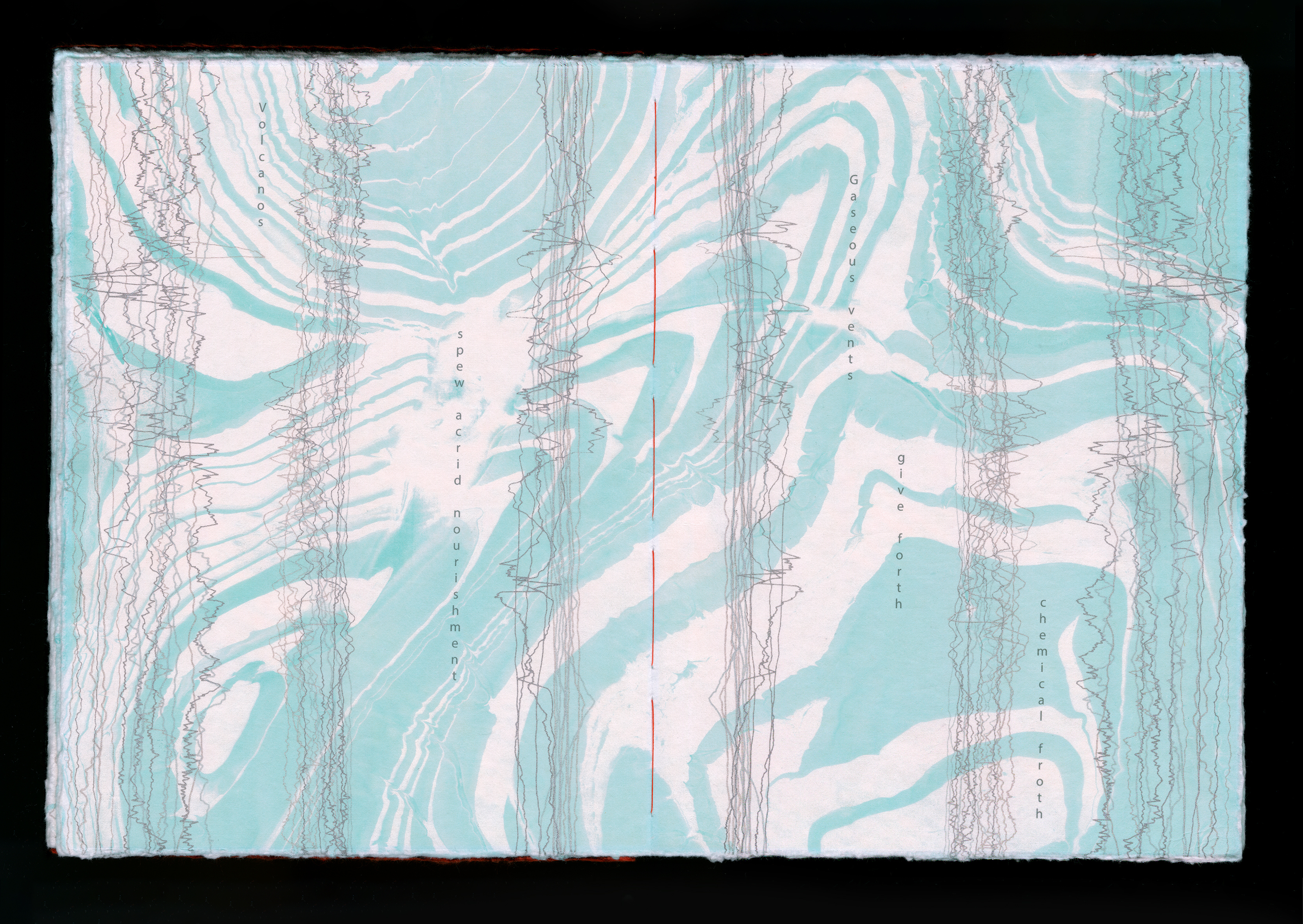
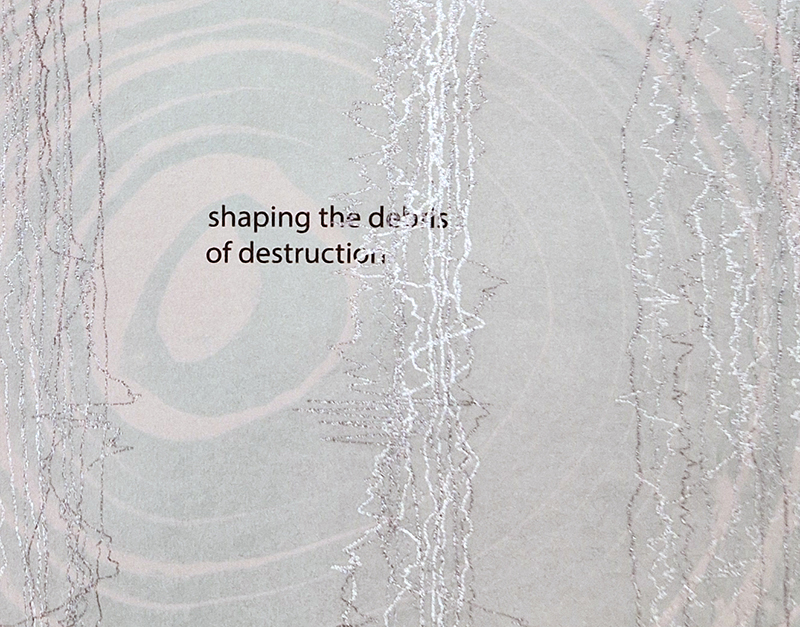
I am still battling with writing text for The Book of Reversals, an artist book that responds to the record of Earth’s magnetic field reversals being written in bands of minerals on the ocean floor.

The crisp crust fractures / Fragments slide across a viscous veneer

Submarine mountains tower / Ocean trenches gape

Tectonic plates subduct / melting into the mantle 

Deep time traces are consumed / surfaces ceaselessly reformed

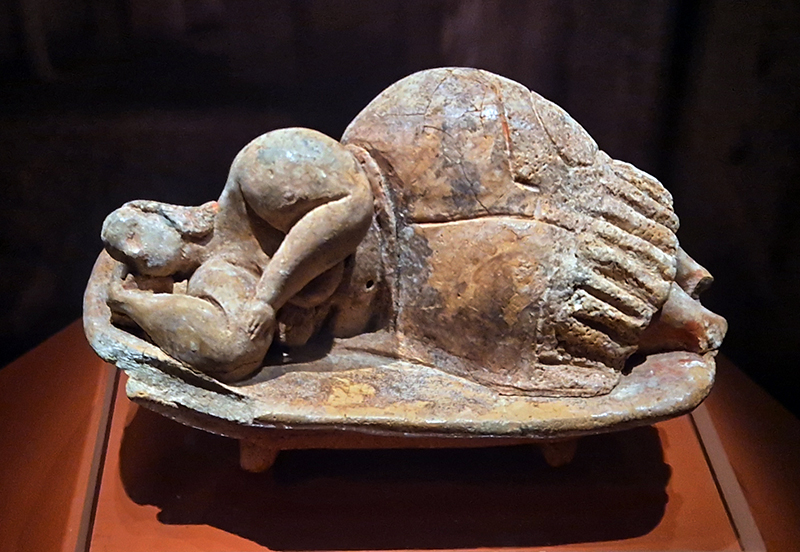
The Earth’s magnetic field has been a fascinating mystery for many hundreds of years and Gillian Turner’s book North Pole, South Pole recounts the stories of those who sought to solve its origin and mechanism. Something I hope to look at in more depth is how pottery and bricks preserve the direction of the magnetic field in their minerals during the process of firing which heats and then cools the clay – the same process that occurs in a lava flow. Iron-bearing minerals (like magnetite) in clay become “magnetic” when heated in a kiln. As the pottery cools, these minerals lock into the Earth’s magnetic field direction and strength at that time. The study of the magnetic properties of ancient pottery, known as archaeomagnetism, has been used to make records of the inclination of the magnetic field from past millennia. Inspired by these studies of manmade artefacts to determine the historical position of the north magnetic pole, physicists Bernard Brunhes and Pierre David took samples from exposed lava flows and their underlying clay in central France. In 1906 they came to the astonishing conclusion that about six million years ago the magnetic field seemed to point in the opposite direction, the first indication of magnetic field reversals.

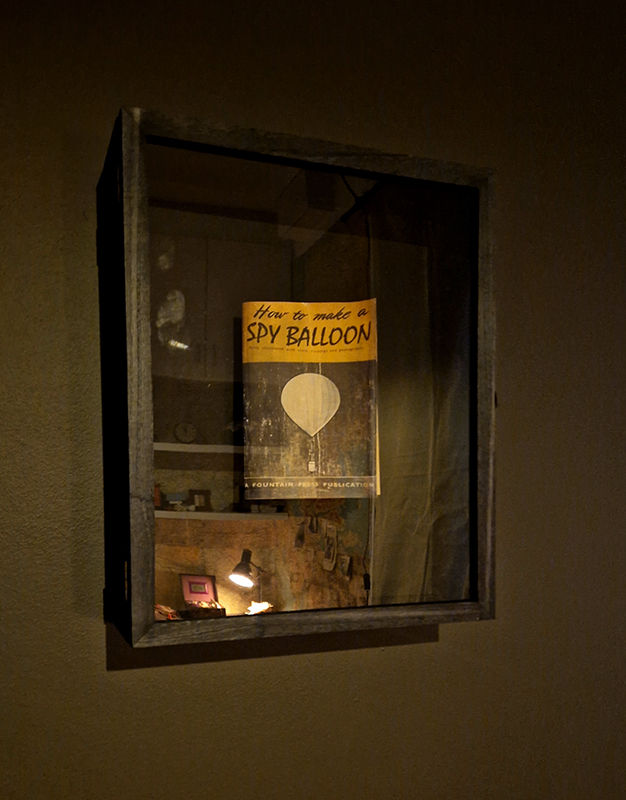
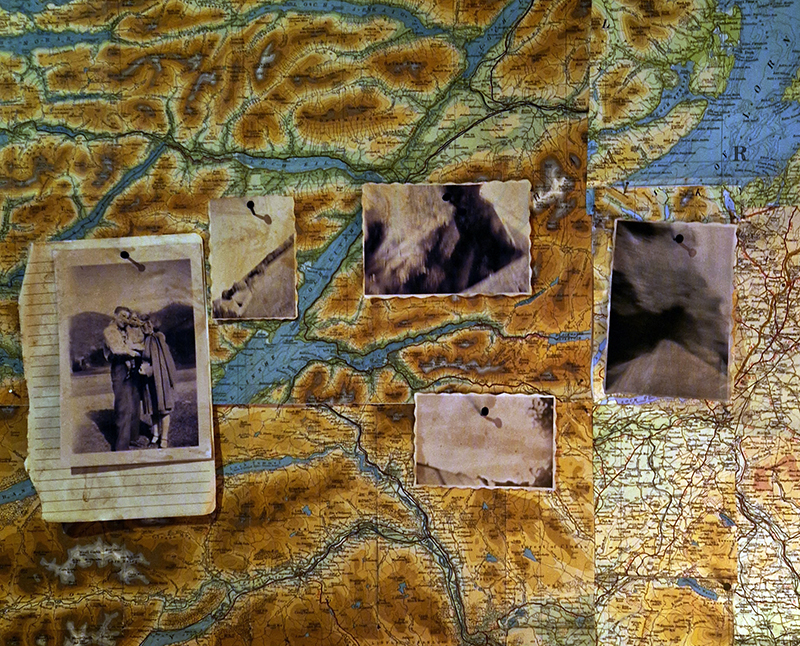
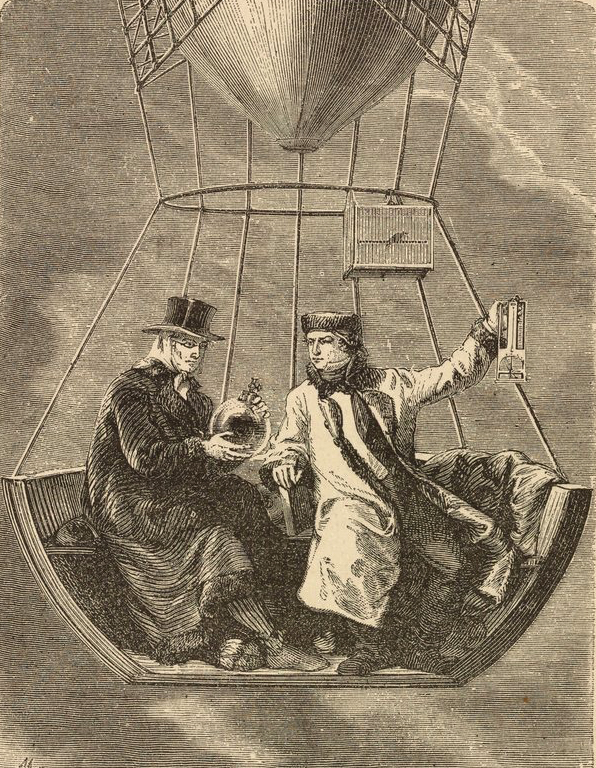
Also with thanks to Gillian Turner’s book North Pole, South Pole I have learnt that there were early hydrogen balloon ascents to determine if the Earth’s magnetic field intensity varied with altitude, helping to decide if the magnetic field came from within the Earth or was extra terrestrial. In 1804 Jean-Baptiste Biot and Joseph Louis Gay-Lussac made a pioneering ascent to 4,000 feet (1.2km). In Turner’s book she writes that the dip needle necessary to take the measurements iced up and so the results were unreliable. I feel for them, but it seems they conducted many other experiments on temperature and gases in the atmosphere while aloft and in any case we now know they would have needed to ascend many kilometres higher than they achieved to notice any weakening in the magnetic field.

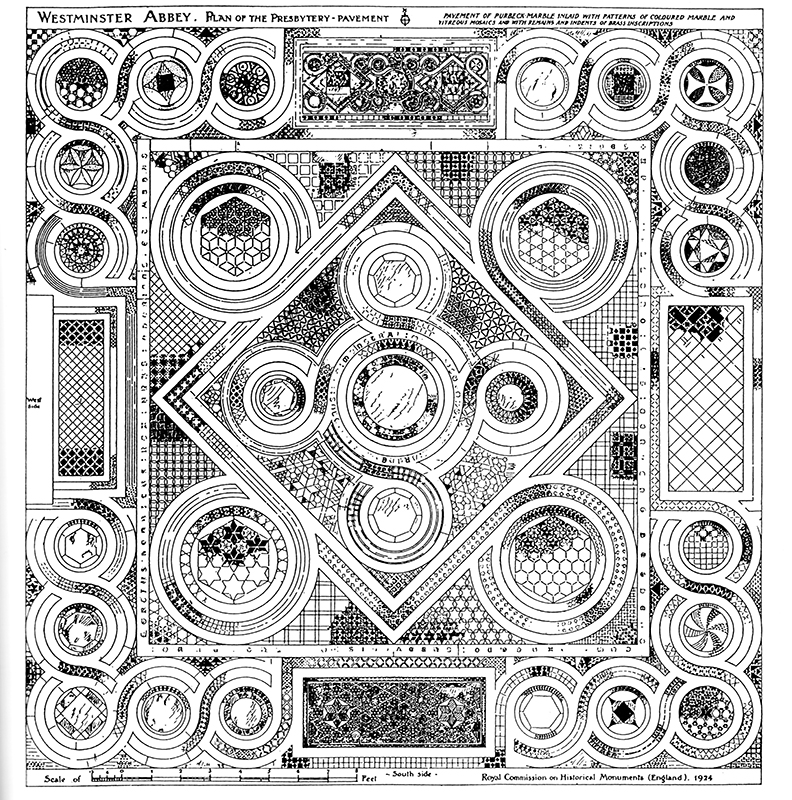
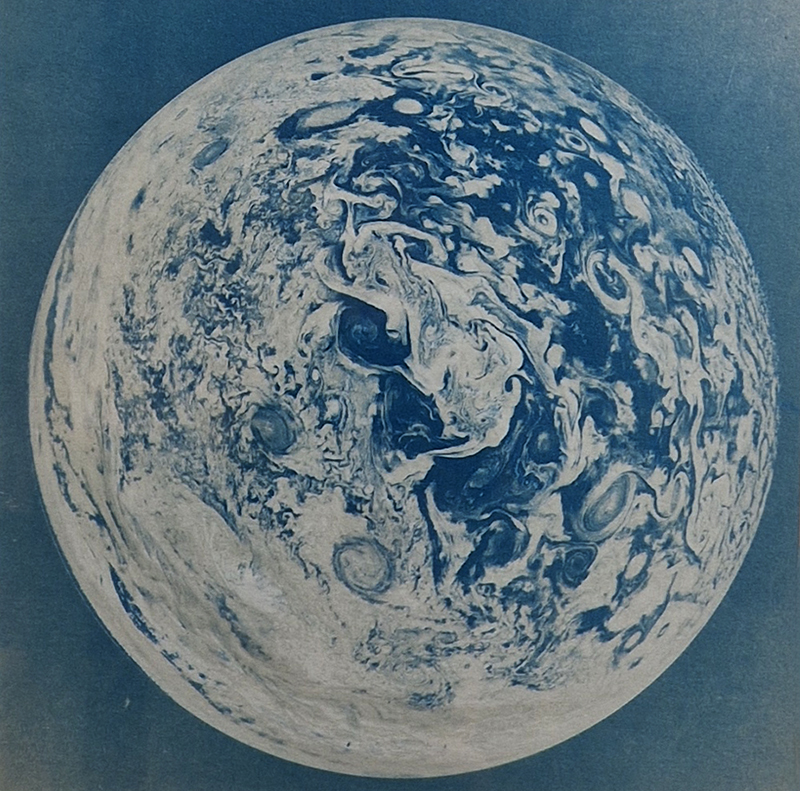
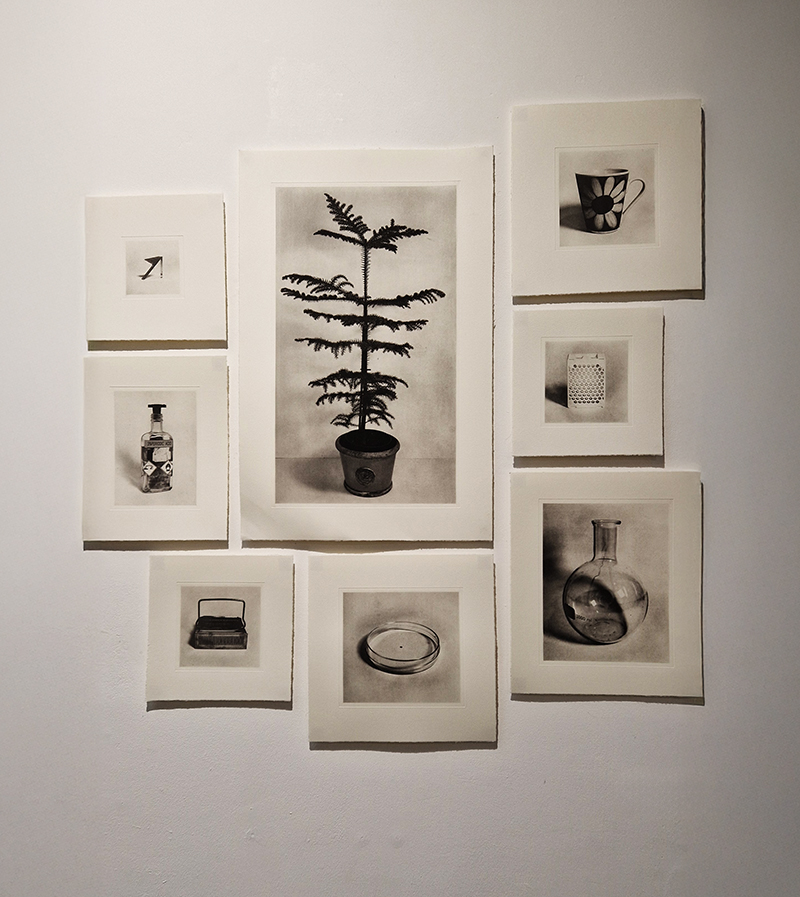
This plate is from John Howard Appleton’s (1844-1930) Chemistry, Developed by Facts and Principles Drawn Chiefly from the Non-Metals, published in 1884.

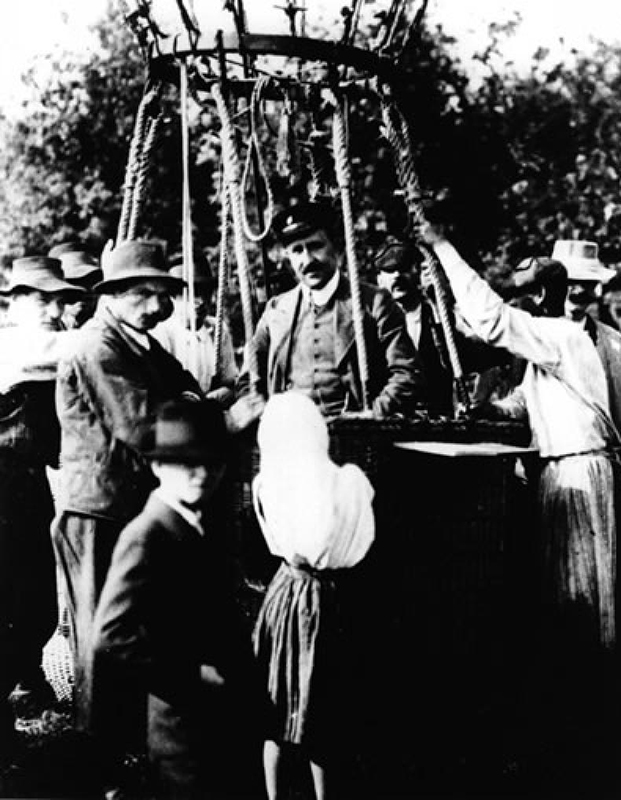
I am trying to remember when I first had the idea to launch a cloud chamber in the payload of a high altitude balloon. I knew about the hot-air balloon experiments carried by Victor Hess to determine the origin of cosmic radiation, and his discovery in 1912, when he made an ascent to over 5km during a near-total eclipse of the Sun, that radiation had to be coming from further out in space.

Hess on his return from the 1912 balloon ascent – Alan Watson pointed out that this was obviously staged at another time as he would not have been standing looking so well after his ordeal.

I remember looking into the dark skies during a residency at Allenheads Contemporary Arts and wondering about all the activity that I couldn’t see. I decided then I would like to film at 15km where most subatomic cosmic ray activity takes place, even if nothing would show on the film.

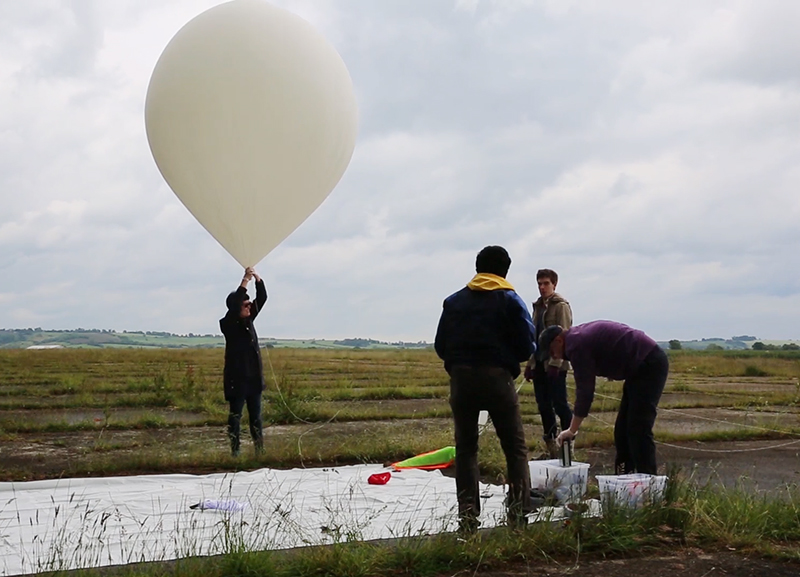
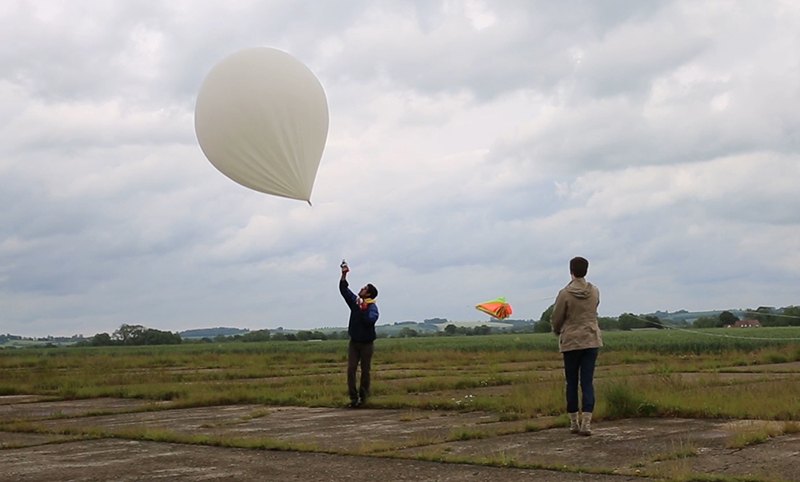
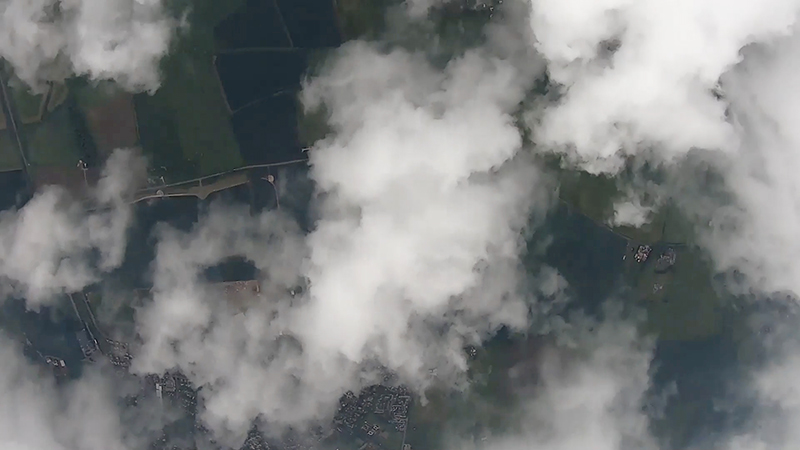
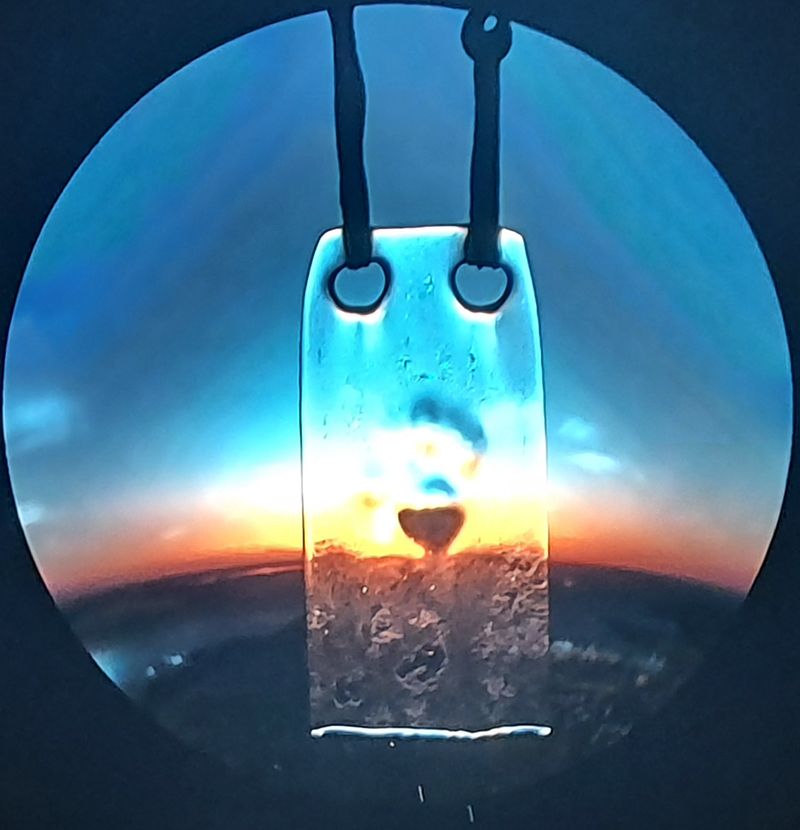
A high altitude balloon flight seemed the perfect solution and I was very grateful for the help I subsequently received from Imperial College Space Society and The UK High Altitude Society. The decision to include a cloud chamber in the payload was always a risk and as it turned out nothing of the cosmic ray activity was captured on film. However, the balloon did reach an altitude of over 37km and the payload was successfully recovered with some amazing video footage of its journey.

The record height for a hot air balloon ascent is 21km so in theory it could be possible to send a cloud chamber up in a hot-air balloon and film at altitude with potential for more success if some brave person were on board to operate the camera. Unlikely to be me.

Some intriguing news of ORC’s on the RAS websiteThe most distant and most powerful ‘odd radio circle’ (ORC) known so far has been discovered by astronomers. These curious rings are a relatively new astronomical phenomenon, having been detected for the first time just six years ago. Only a handful of confirmed examples are known – most of which are 10-20 times the size of our Milky Way galaxy. ORCs are enormous, faint, ring-shaped structures of radio emission surrounding galaxies which are visible only in the radio band of the electromagnetic spectrum and consist of relativistic, magnetised plasma. the three new cosmic rings – discovered not by automated software but by sharp-eyed citizen scientists – represent an important step toward unlocking the secrets of these vast, puzzling structures.

Out and About

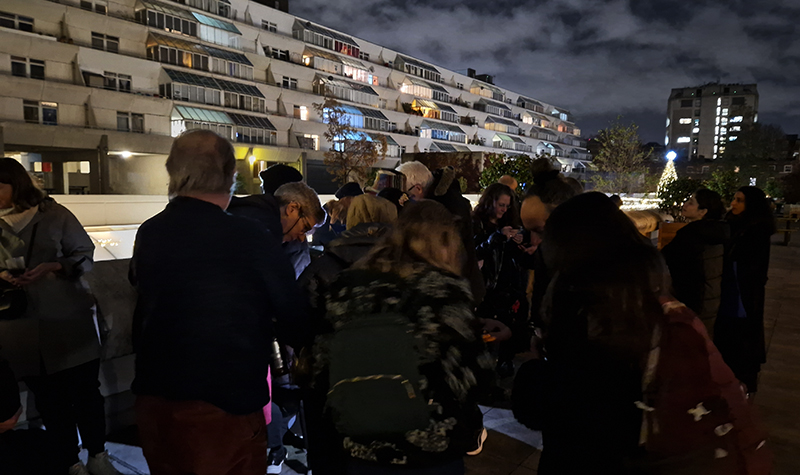
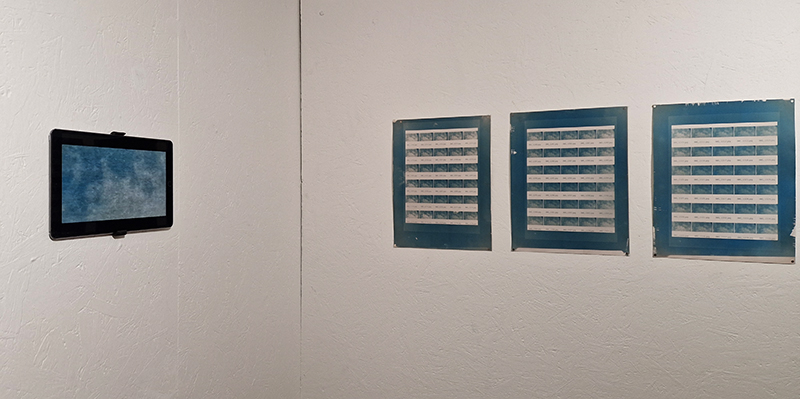
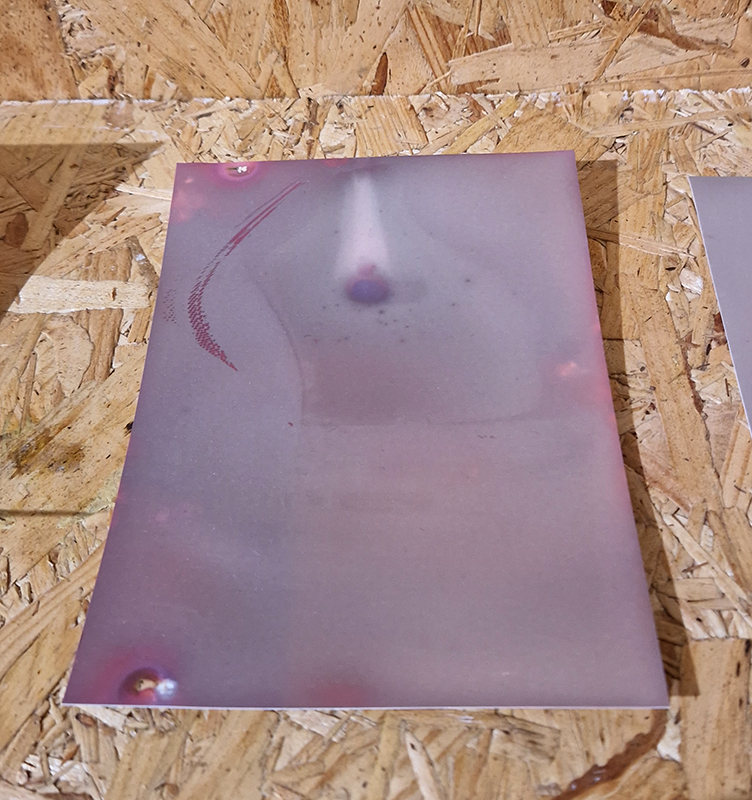
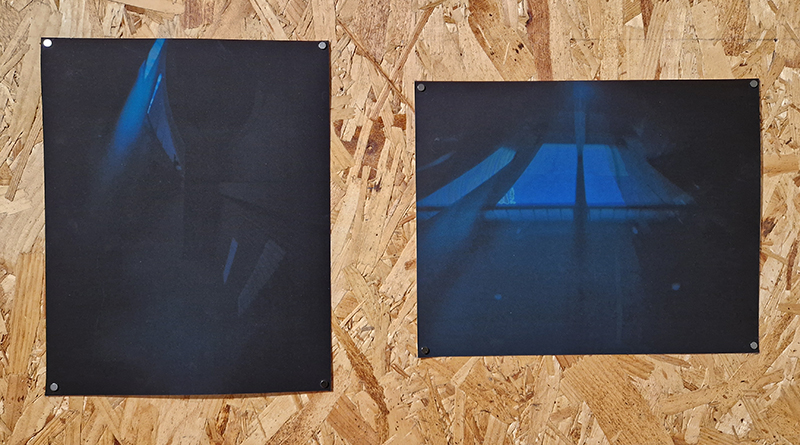
A wonderful evening with artist in residence Melanie King at Passengers connecting the celestial with the architecture of the grade II listed Brunswick Centre in Bloomsbury, London. Melanie used the residency opportunity to explore the duotone cyanotype process using multiple layers of cyanotype to mimic astronomical imaging construction and even used cyanotypes to create an of the Moon. The beautiful results were presented at an evening event with the additional treat of live telescope viewing of the Moon and Saturn from the second floor terrace of the Brunswick centre under the engaging guidance of astronomer and science communicator Paul Hill.

Liz Elton’s sensitive work Black and Blue (compostable bio materials, cabbage and fruit dye saddened with iron, silk, poppy and sage seeds) showing in A Changed Environment at Messums London. This group show examines changing ideas of beauty, ecology, and sustainability, as well as themes of place, memory, and identity, revealing how connections to the natural world can inspire both understanding and hope. I love the delicacy of this new work and the term ‘saddened by iron’ which is used in the dying process to dull a colour, and which, as Liz says, also emotes the hardships of industrial life.

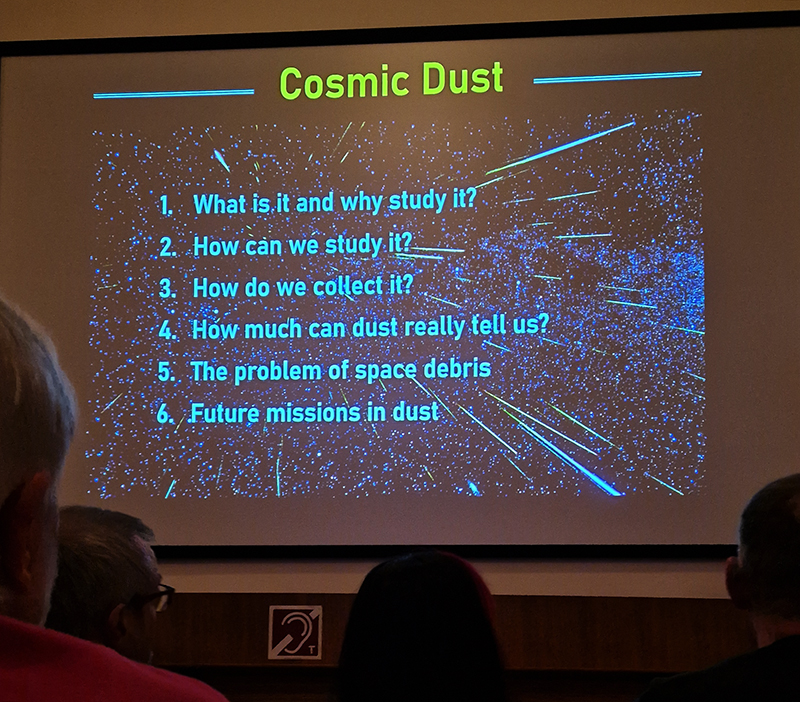
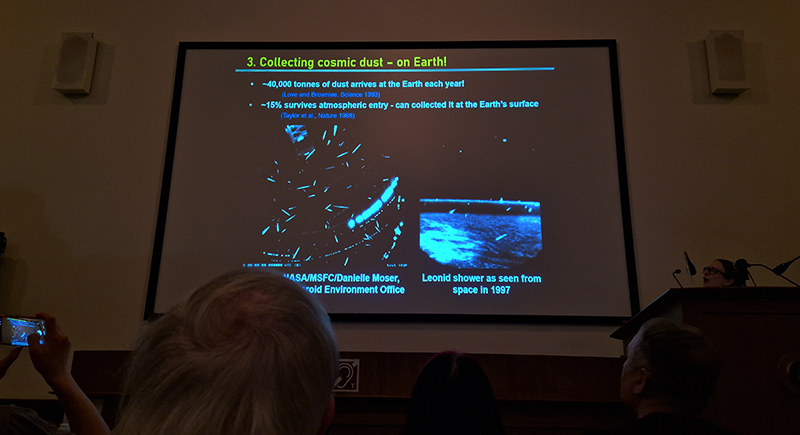
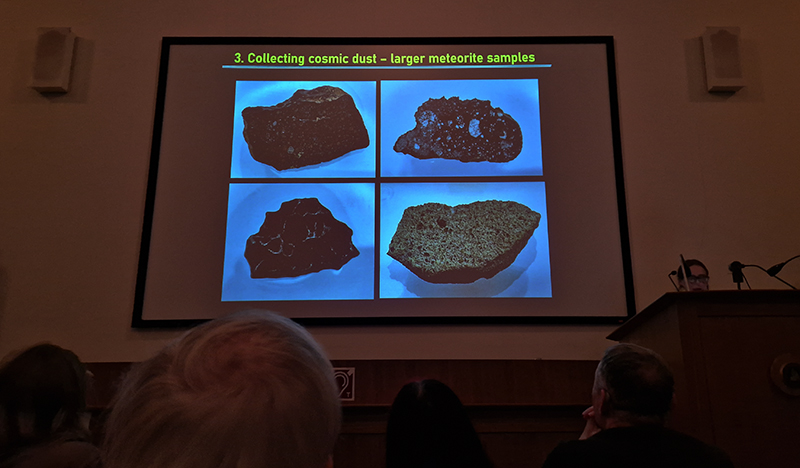
Cosmic Dust talk by expert on extraterrestrial space dust, and how it can impact astronomy and wider human endeavours in space, Penny Wozniakiewicz at The Royal Astronomical Society. ‘Natural’ cosmic dust is being polluted by man made dust from space debris. This is a real problem created by dead satellites, old upper stages of rockets, fragments form exploded rocket or stages, flecks of paint, aluminium oxide spheres from solid rocket burns, dropped space equipment. When any of this debris collides a cloud of smaller debris is ejected, this process is self propagating and even the tiniest piece of debris can cause serious damage to spacecraft and satellites. This is called the Kessler syndrome, a cascading effect that could render orbital space unusable for generations, threatening satellites, the International Space Station, and future space travel.

Good to visit the The London Group show 2025 at Copeland Gallery where lots of friends are showing excellent work and also to discover new work and artists.

I found Majid Majid’s video Faith Amongst The Ruins a difficult but compelling work. So scary and horrific because we know this is real footage, some of which I had seen before at the time of the attacks on hotels housing asylum seekers and refugees, but it is still so disturbing to watch these people, with so many children present, cheer on the violence. They have no empathy with the terrified people trapped inside the hotel or for the person in the car who is ambushed and stabbed. The glee of those filming the assault is chilling.

He writes: “As a refugee, I know places shaped by fear and rejection. This work revisits UK sites of last summer’s Islamophobic and racist violence, a mosque, a street, and a hotel housing asylum seekers transforming them through prayer. Placing a mat where hostility flared, I reclaim space as sacred ground. Video and traces of violence form a counter-narrative of dignity, belonging, and resilience.”

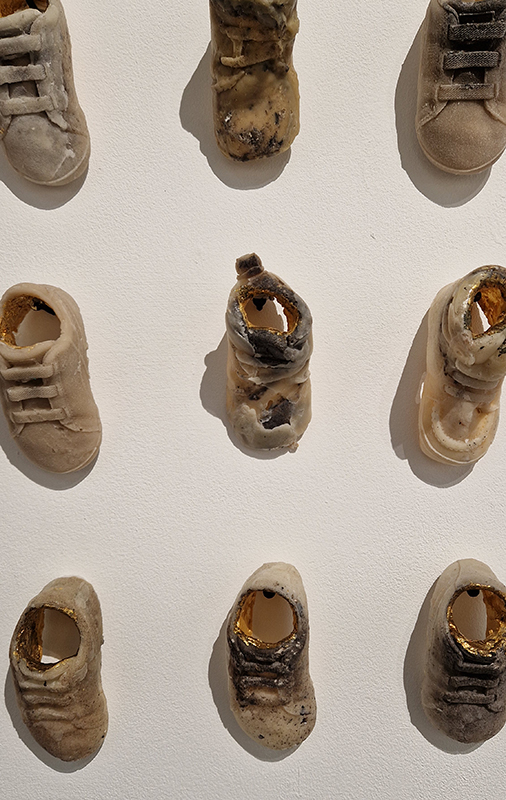
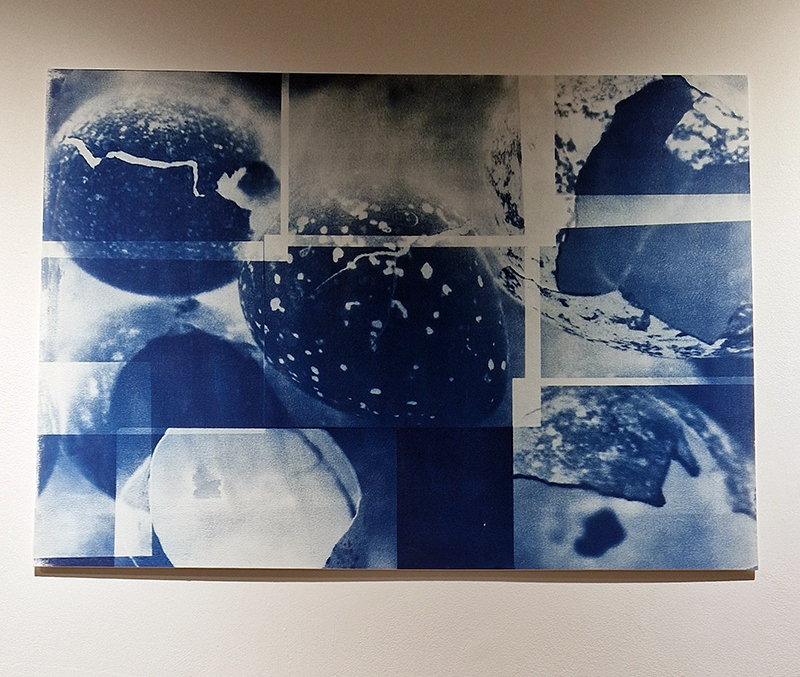
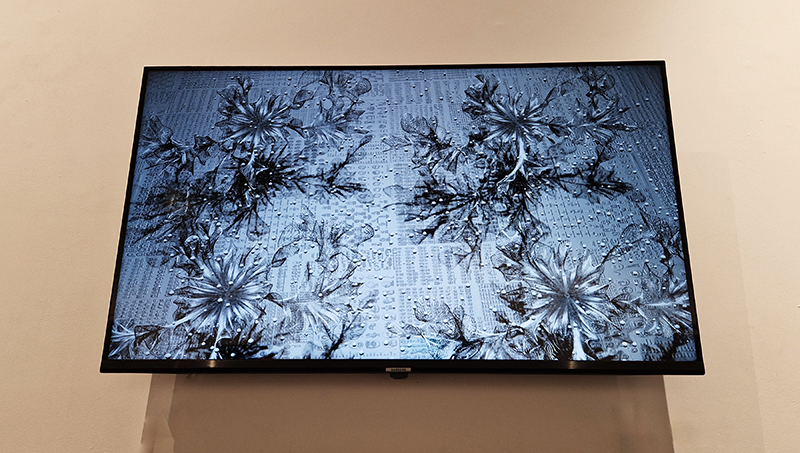
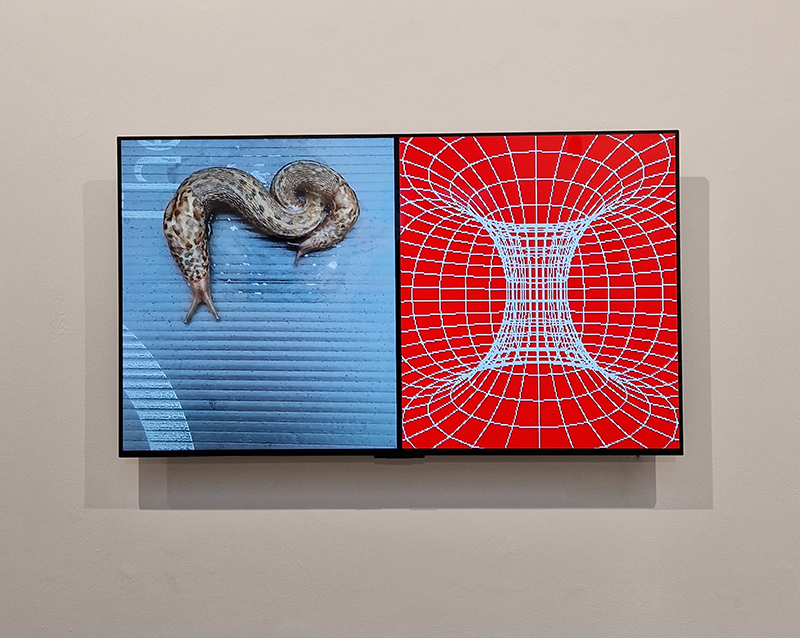
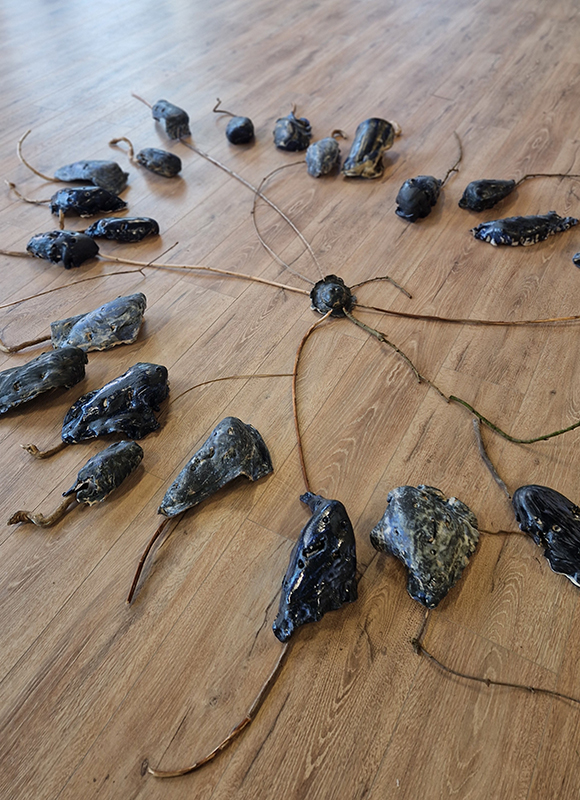
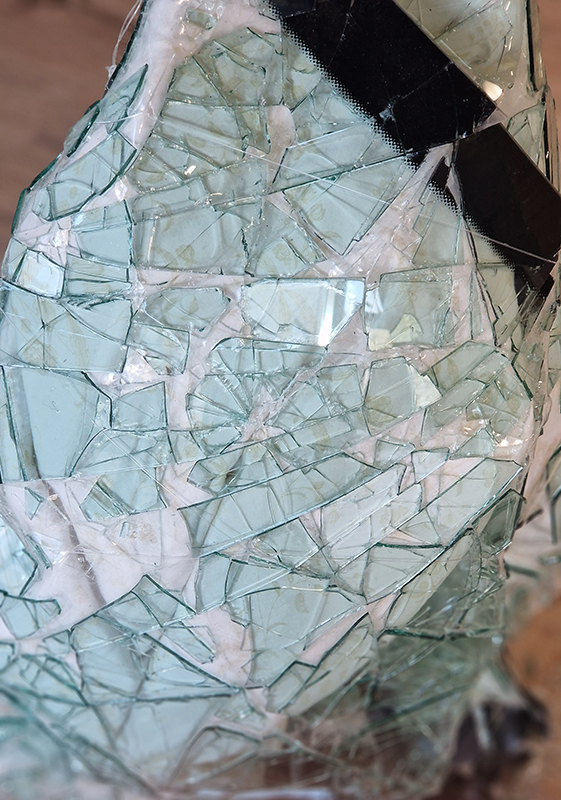
Images: Majid Majid, Sayako Sugawara, R James Healy, Victoria Rance, Jonathan Armour, Sandra Crisp, Jenny Wiggins, Victoria Arney, Carol Wyss, Sandra Crisp, Genetic Moo, Jacqueline Yuen-Ling Chiu.

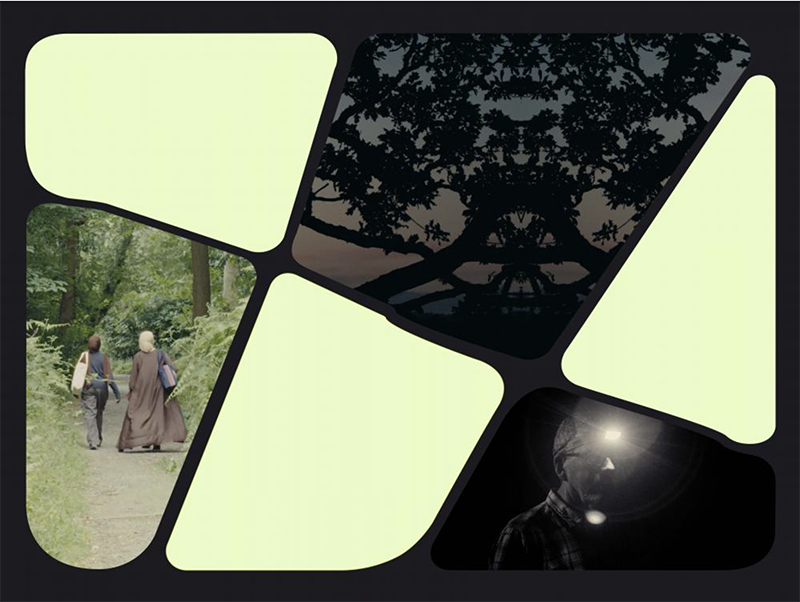
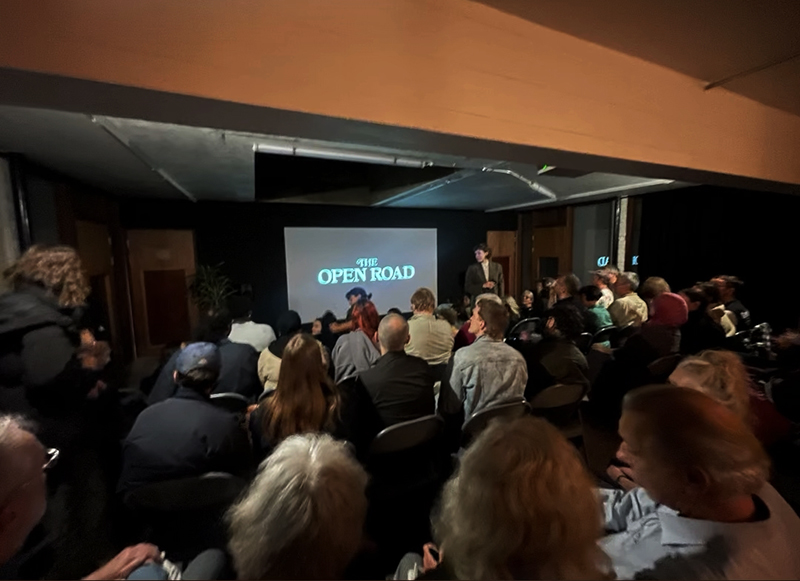
Three beautifully directed films screened at FormaHQ as part of The Open Road series of artists moving image works, co-commissioned by a partnership of visual arts organisations. The works are loosely inspired by The Canterbury Tales, drawing from a disparate cast of characters to recount competing stories in a patchwork of styles. David Blandy (Commons), Amaal Said (Open Country) and Sam Williams (The Eel’s Tale) each draw on storytelling traditions to give fresh perspectives on their journeys, on foot, by sea and through time. Heartbreaking to hear how terrified Amaal Said was to leave London for the open country of the south coast, especially with the current rise in overt racism, when out looking for locations and that they did suffer racist abuse while filming. Hers is a gentle and warm study of a mother and daughter and an absent grandmother, a longing for home and to feel ‘at home’. Sam William’s film sets the plight of the highly endangered glass eels who journey 4,000 miles from the Sargasso Sea to the Medway wetlands in Kent, swept along by currents, undergoing bodily transformation, following an instinctive desire on this epic migration alongside two other watery tales of transformative journeys across boundaries of identity and freedom. Coincidently, a recent episode of the Infinite Monkey Cage is all about these mysterious eels. David Blandy turned his attention to the vast and disparate collection of artefacts held in the Tunbridge Wells museum and gave some of these specimens a voice to tell of how they had lived before they became a part of this collective of human taxonomy.

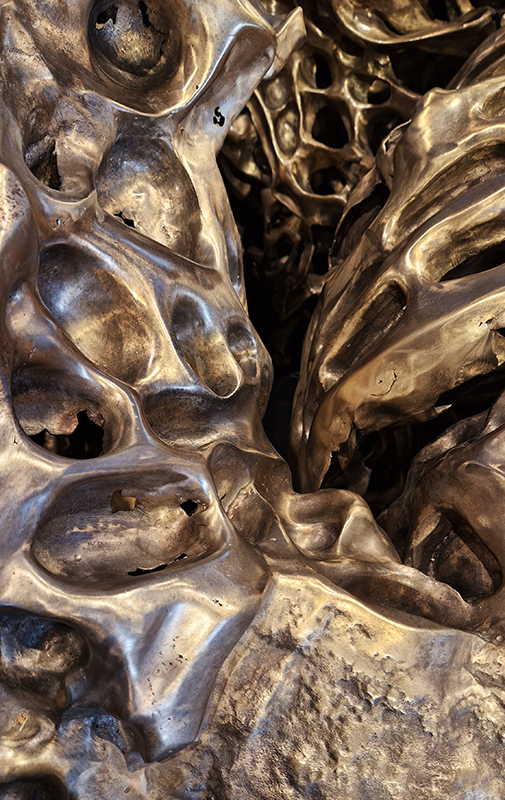
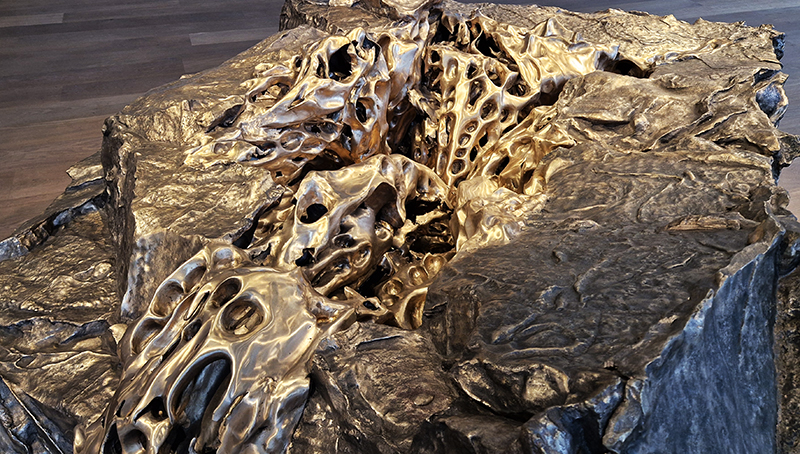
Cristina Iglesias The Shore at Hauser & Wirth features large-scale bronze works from the artist’s Littoral (Lunar Meteorite) series, part of her ongoing exploration of geological themes. The word ‘littoral’ refers to something relating to or situated along a coast or shore, or the region where the land meets the water. The weightiness of the objects is impressive ( I can’t imagine how they were brought into the gallery even with the technology available today – after coming here from the talk on stone henge and the incredible feat of bringing the standing stones across rough terrain for many kilometres and up a slope 5000 years ago seems even more impossible – yet there they are). The sound of water bubbling within each piece draws you to peer within and stay with the piece perhaps longer. The audience is invited to touch the sculptures. The bronze is polished and does need to be used and worn away in a more effective organic and dirty process. They are very clean.

The Royal Astronomical Society lecture Sighting the Sun and Moon? at Stonehenge – by Archaeoastronomist Prof. Clive Ruggles. Debunking many myths and overspeculation, concerning the use of the monument for observations of the sky the professor was clear about what can sensibly be said about the relationship of Stonehenge to the Sun, considering the conventional archaeological evidence that has been uncovered in recent years. He also recommended visiting the day before or after the actual solstice if possible for an experience without the many crowds as the alignment is almost identical. Also visiting at sunset can be just as magical and quieter. He turned his attention to the Moon, questioning if our prehistoric forebears also celebrated the occurrence of a major lunar standstill, an event occurring every 18.6 years around which time the Moon can be seen at fortnightly intervals exceptionally far to the north and south.

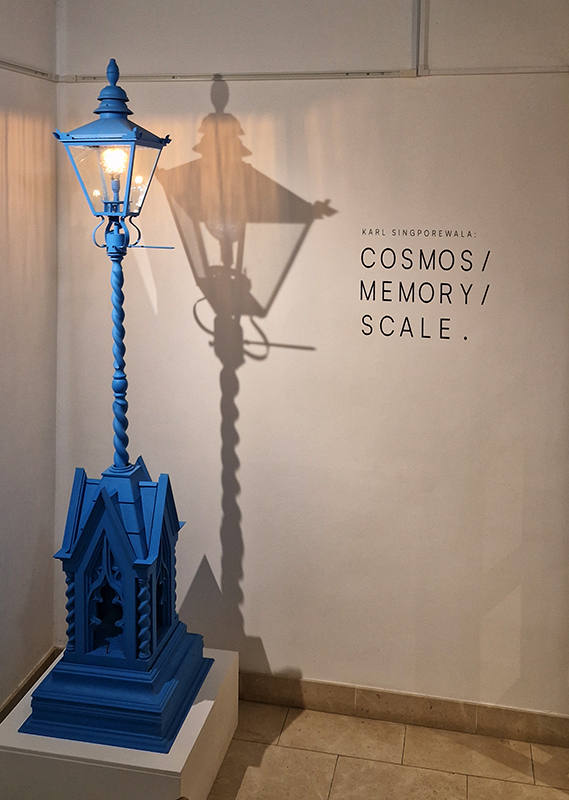
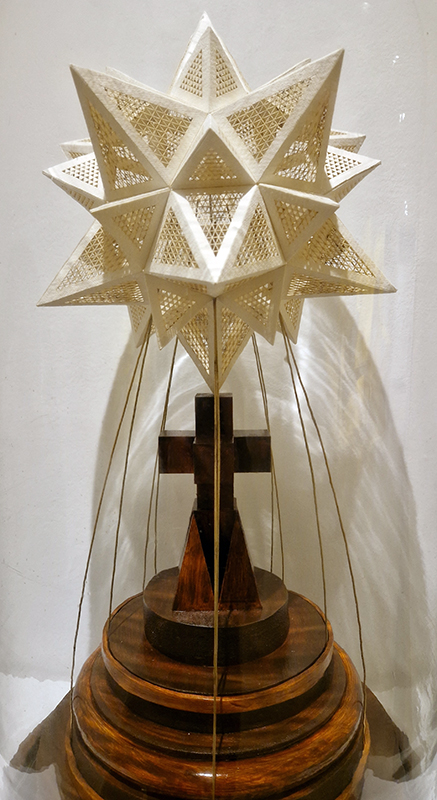
Karl Singporewala’s sculptural interpretations of Zoroastrian symbolism in Cosmos, Memory, Scale at SOAS Gallery convey a meditation on how material and memory intersect to shape the human experience. Cosmos speaks to both his fascination with astrophysics together with a metaphysical belief in the alignments of life. Stars and geometric forms recur as motifs, refracting both spiritual navigation and mathematical structure. Memory is treated as a living, shifting phenomenon. Inspired by oral tradition, family stories and inherited rituals. Scale, is used both literally and metaphorically in shifting perspectives and unexpected relationships. Good Thoughts, Good Words, Good Deeds.

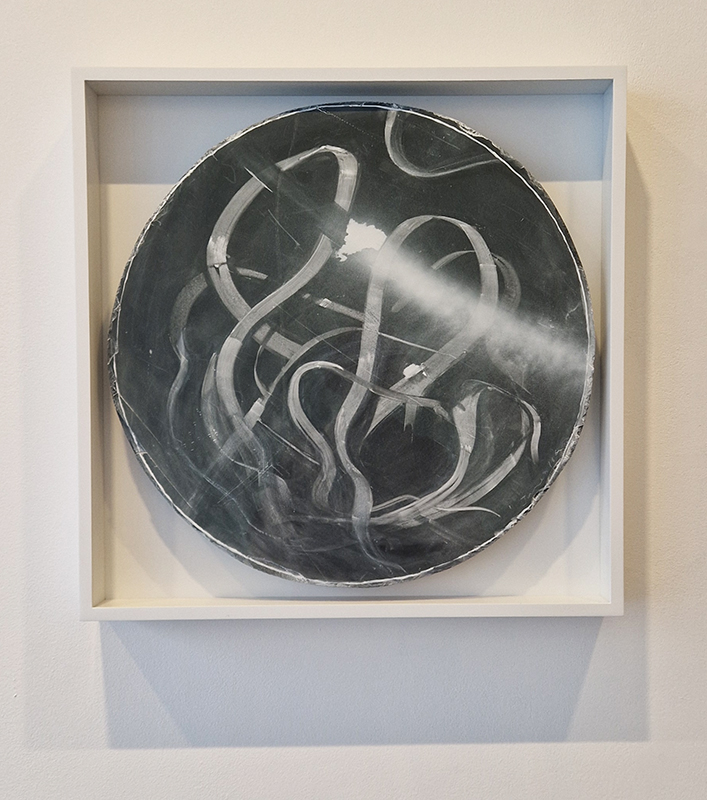
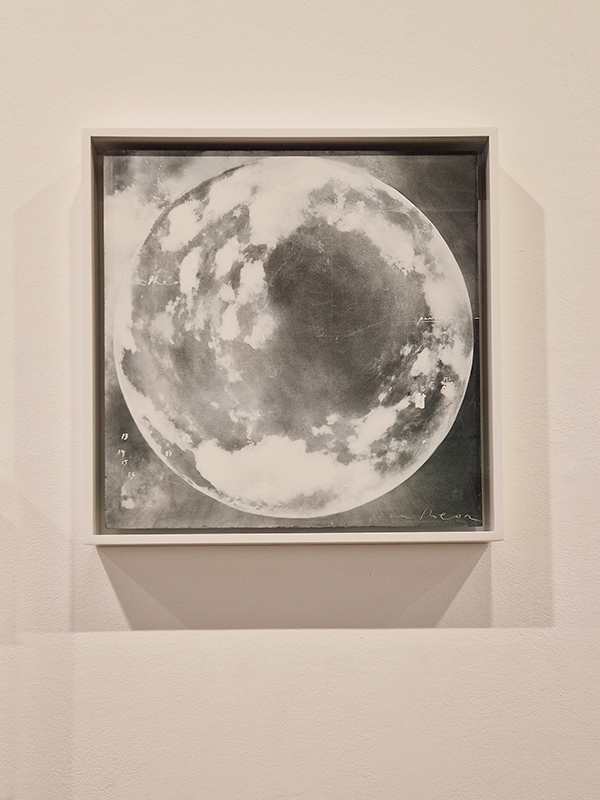
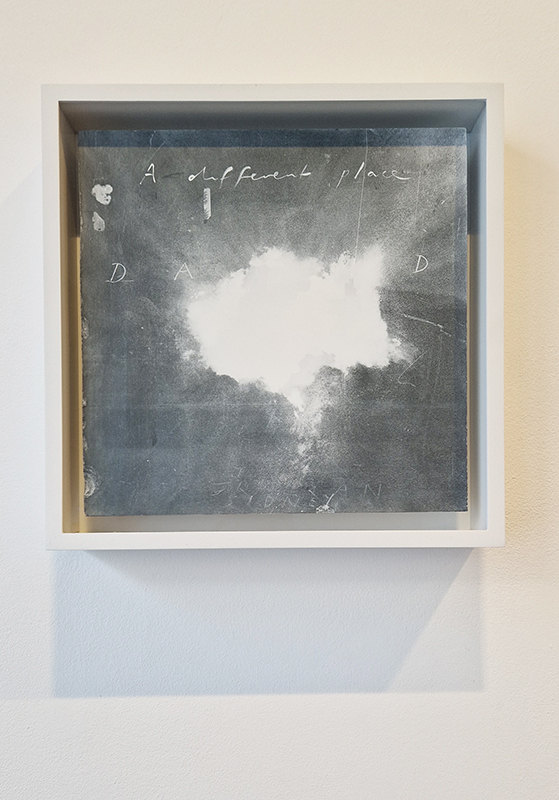
Dusty, chalky mythical drawings and solar eclipse traces from Tacita Dean in Black, Grey, Green and White at Frith Street Gallery Golden Square.

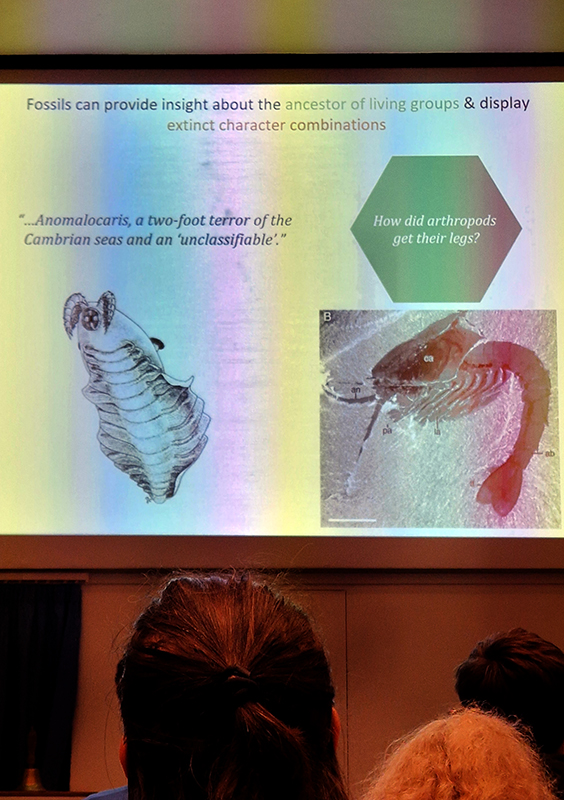
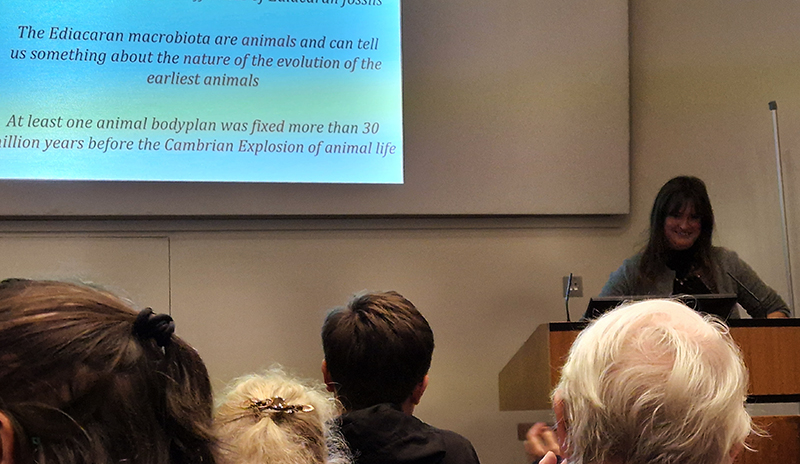
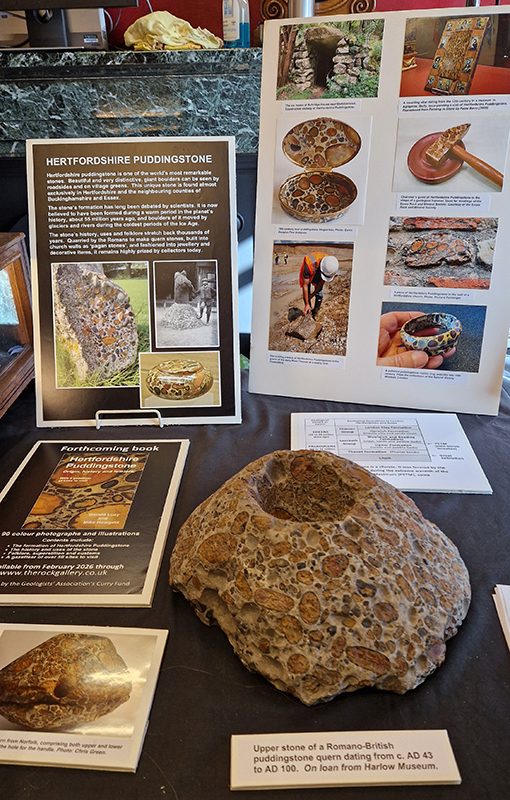
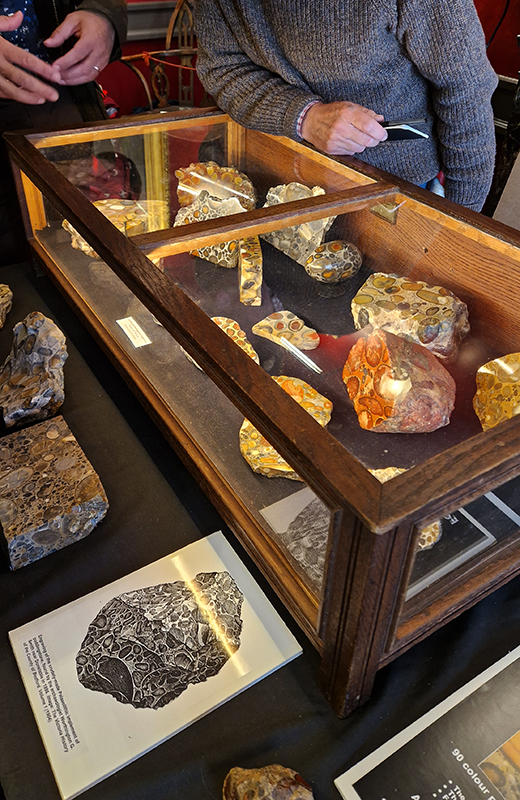
I spent a happy morning at the Geologists Association Festival of Geology 2025. This included a fascinating lecture The Early Evolution of Animal Life by palaeobiologist Frankie Dunn focused on the origin and early evolution of animals and particularly on the fossil record of the late Ediacaran Period (approximately 570 – 540 million years ago) – just before the Cambrian explosion of life. The aim of her research is to understand how animal body plans evolved in deep time. There also was some amazing and unique pudding stone on display.

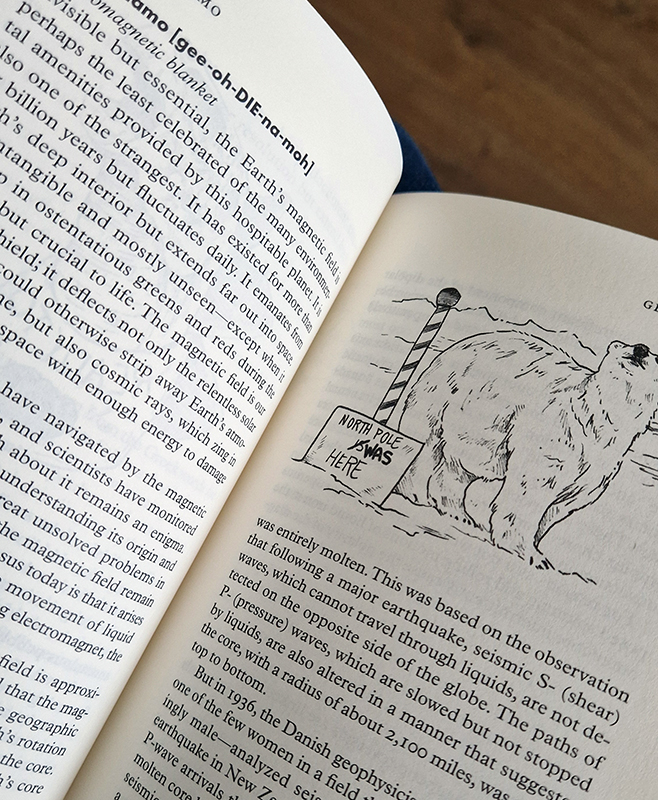
I also picked up a great little book full of wonderful geologically enriching words by Marcia Bjornerud.

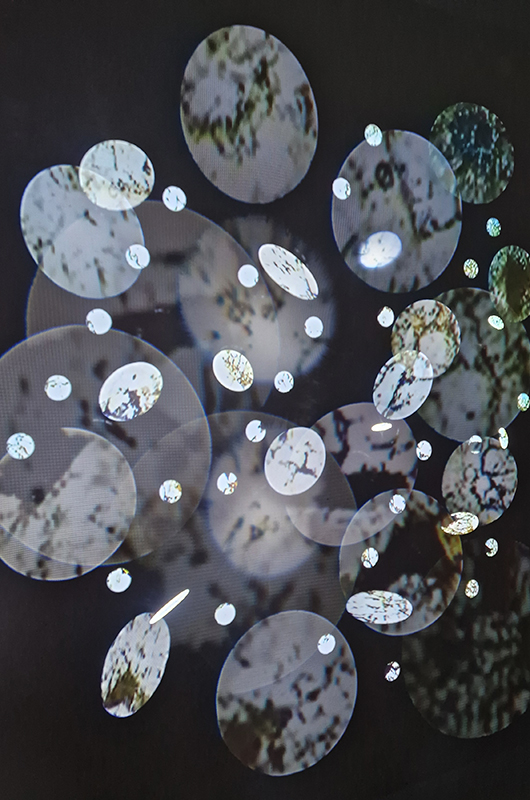
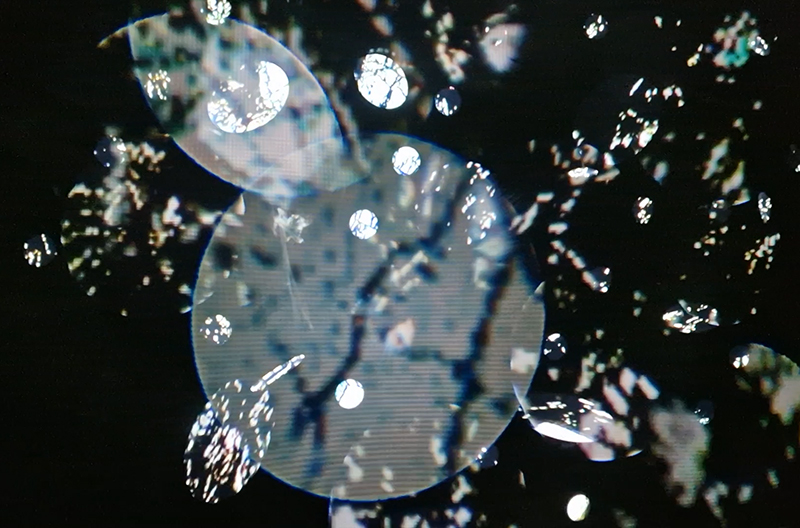
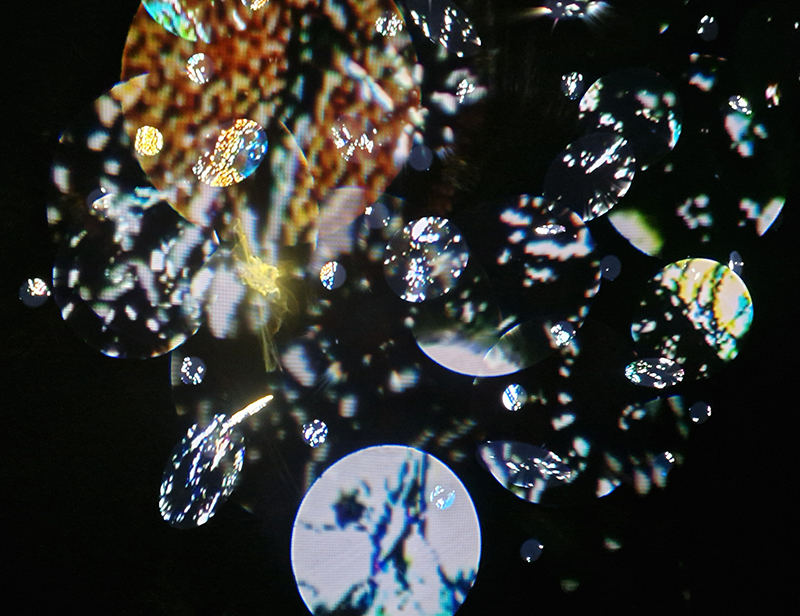
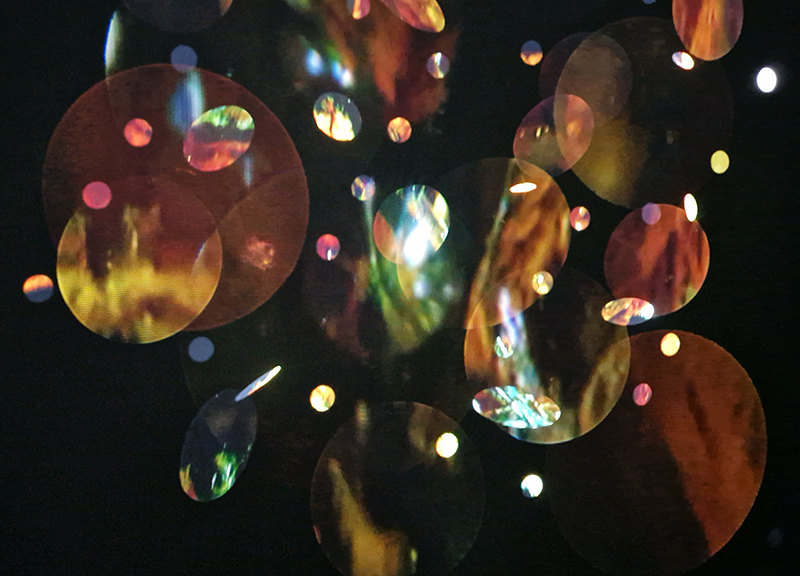
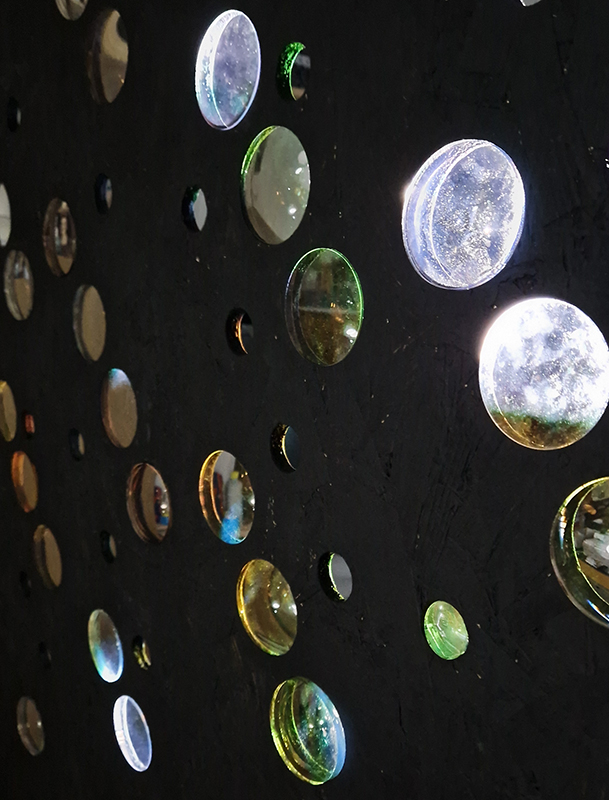
Work continues on ‘mineral visions’ testing projecting through a variety of optical lenses set in a pattern reflecting the crystal structure of magnetite. Magnetite is a mineral we are very intimate with. It is in our cells, in our brain but this delicate balance is being disrupted as magnetite crystals from air pollution now outnumber natural magnetite in the brain by 100:1. The full consequences of this imbalance are not known yet but it could be implicated in neurodegenerative disease like Alzheimer’s.

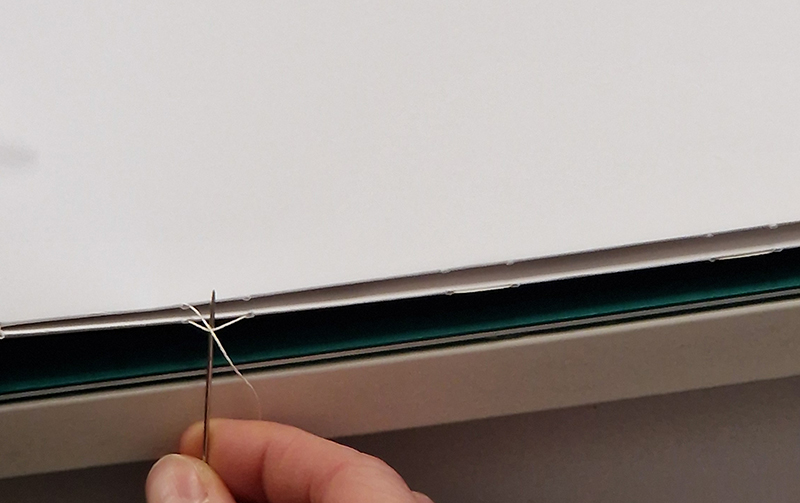
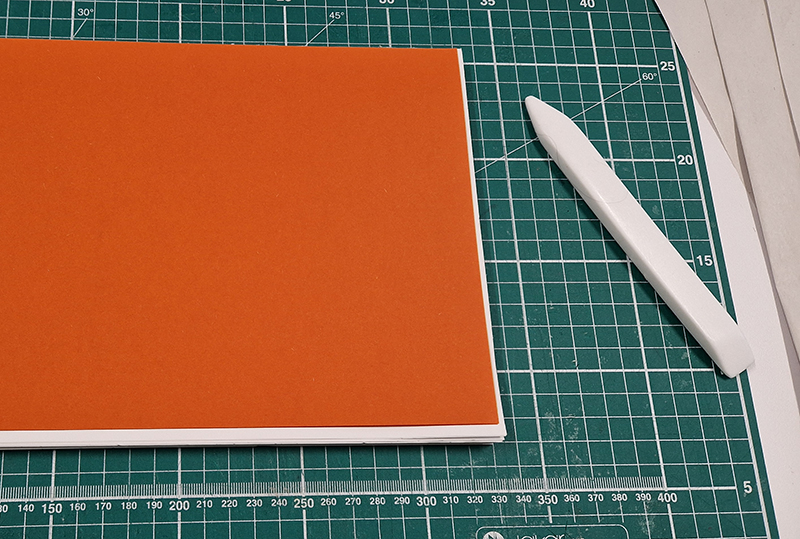
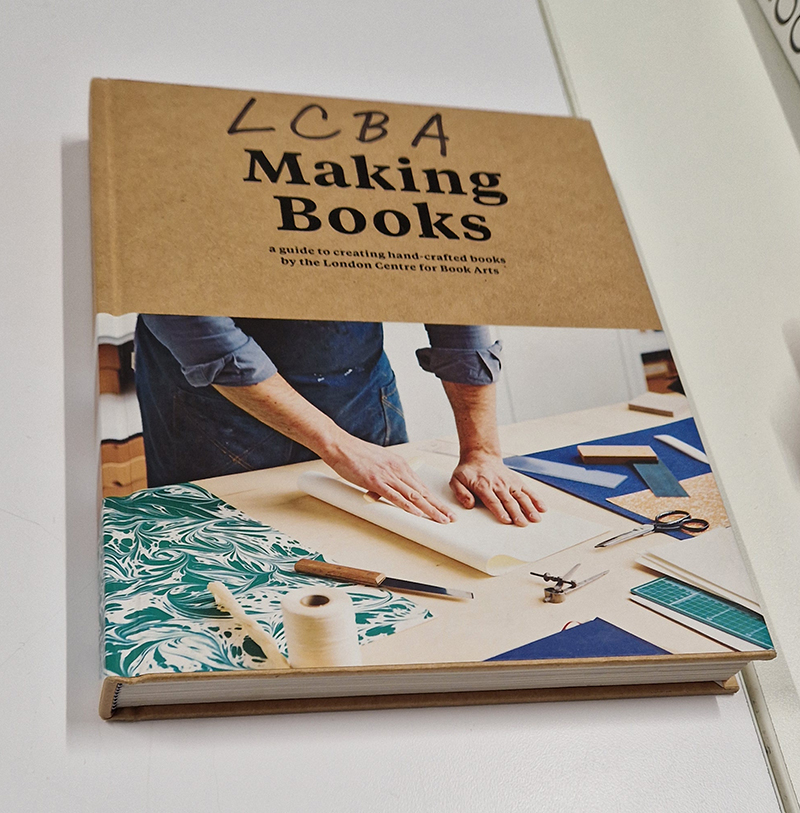
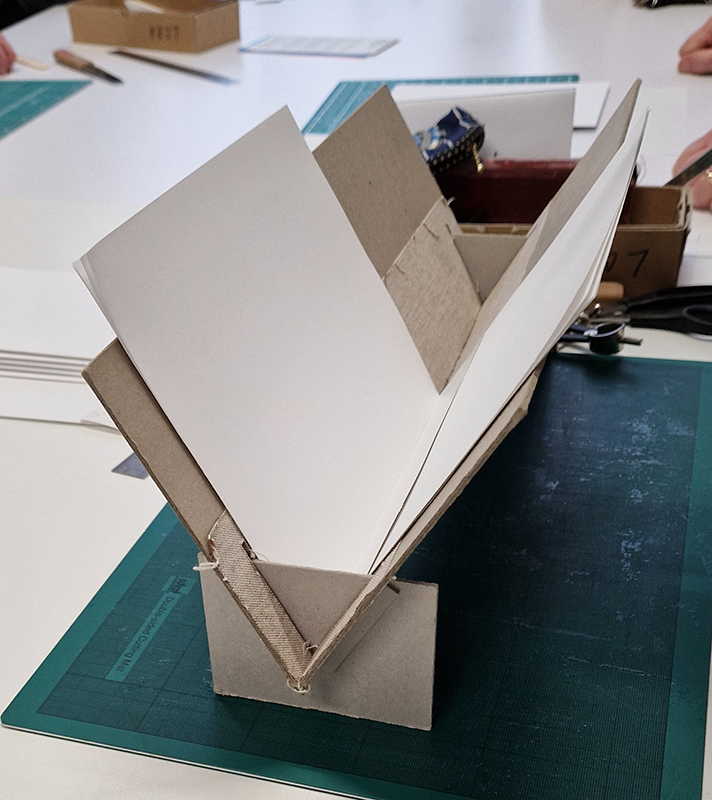
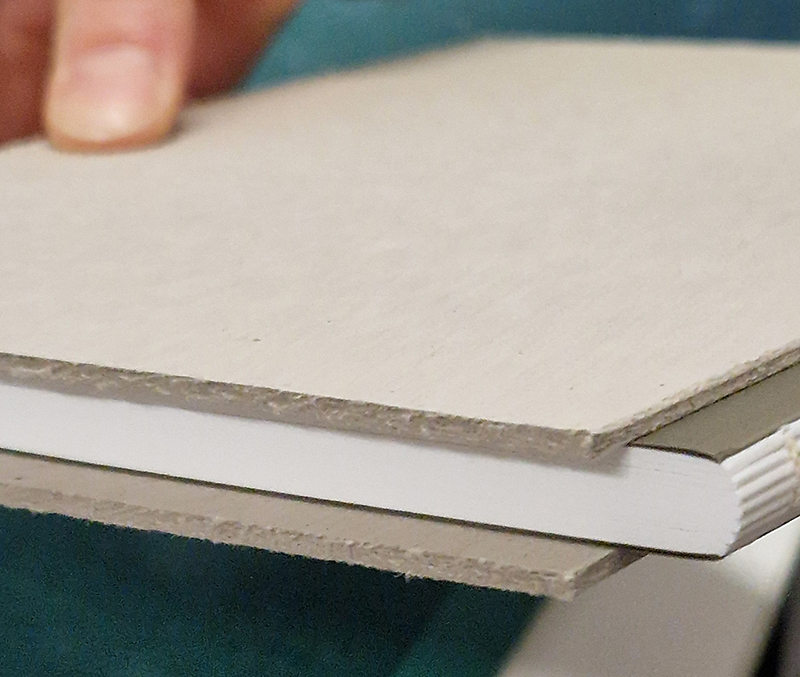
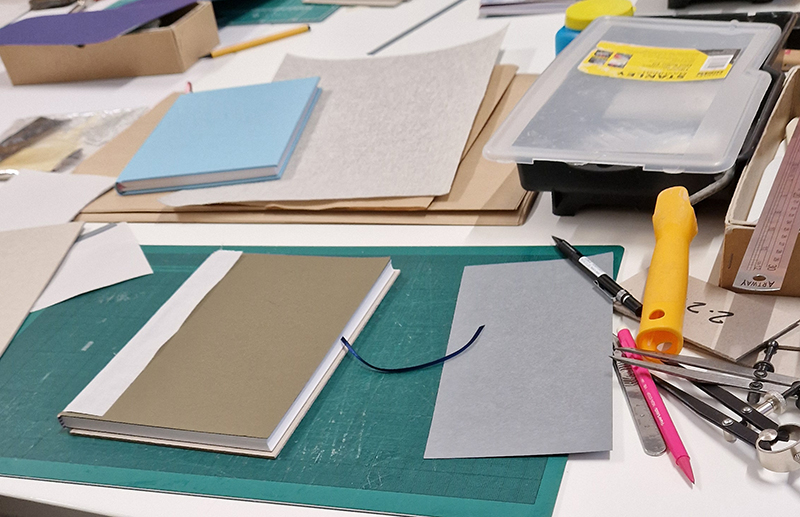
I spent an enjoyable day at London Centre for Book Arts learning how to create a classic full cloth-covered case bound book with a rounded spine. I hope to have picked up some skills here which I will use to make a sculptural book embodying the history of magnetic field reversals stored in the minerals of lava beds on the ocean floor.

Studio visits

Julie F Hill and I had been in contact with writer/producer/curator Ariane Koek since our duo exhibition The Stone Sky at Thames-side Studios Gallery which she had been unable to attend, but with her interest in physics, geology and cosmology had suggested we keep in touch. We finally had the pleasure of meeting Ariane at Julie’s Bomb Factory Studio and were able to share some of our plans for our upcoming show The Geological Unconscious which we are co-curating at Hypha HQ this spring.

It was so good to meet curators Maria Hinel and Indira Dyussebayeva-Ziyabek at my studio to discuss their upcoming project inspired by the essay on carbon in Primo Levi’s The Periodic Table. Levi weaves a story following a single atom of carbon as it is transformed through the many relationships and bonds made with other atoms, moving from rock to atmosphere to living organism and back to mineral.

Gallery visits

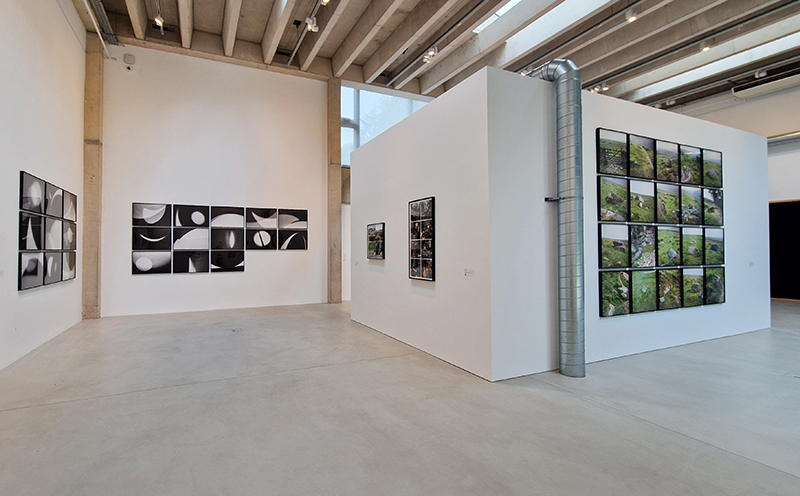
Exhibition research trip to Exeter with Julie to see Dartmoor: A Radical Landscape at the Royal Albert Memorial Museum & Art Gallery. Artists include: Fern Leigh Albert, Jo Bradford, Chris Chapman, John Curno, Robert Darch, Siân Davey, Susan Derges, Robin Friend, Ashish Ghadiali, Alex Hartley, Nancy Holt, Laura Hopes and Katharine Earnshaw, Richard Long, Garry Fabian Miller, James Ravilious, Tanoa Sasraku, David Spero, Nicholas J R White, Marie Yates.

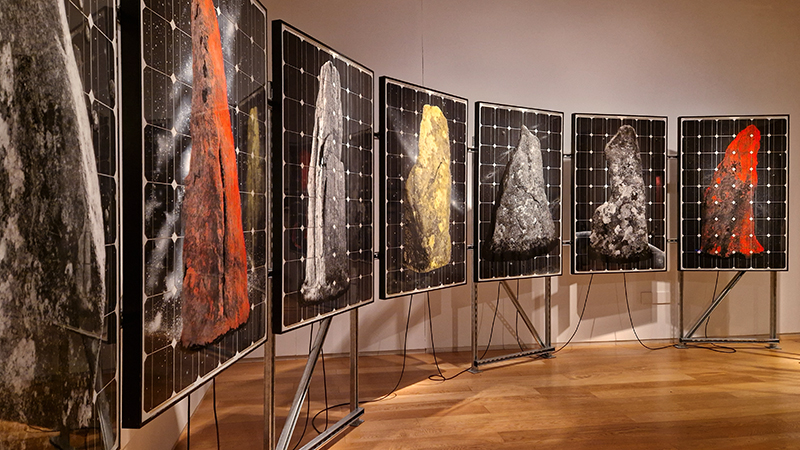
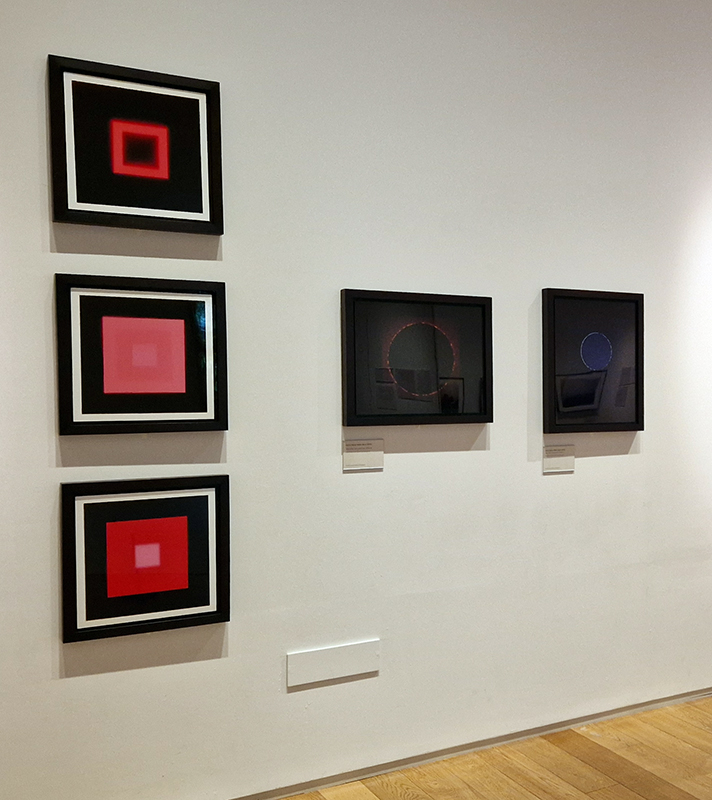
I was particularly interested in seeing Alex Hartley’s, The Summoning Stones, which is a series of hand coloured prints of standing stones embedded into recycled solar panels. Aiming to bring together ancient and contemporary ways of engaging with the sun they are positioned to put the viewer in the centre of a magical arc of energy; the contemporary may have the bias here and the ancient magic dispersed in the gallery setting but I still enjoyed the aesthetic. The works felt rather cramped in the space. There was a lot of photographic work documenting artist’s interest in the moor from the 60’s/70’s onwards and several prints using the process of dye destruction (luminograms) which I was unfamiliar with, such as those by Gary Fabian Miller – this is a photographic printing process in which colour dyes embedded in the paper are selectively bleached away (destroyed) to form a full-colour image. The papers used in this process are no longer manufactured and Miller spent a year creating one direct long exposure to paper luminogram every day as a reflection on time passing. Extraordinary fluid images from Susan Derges were a highlight.

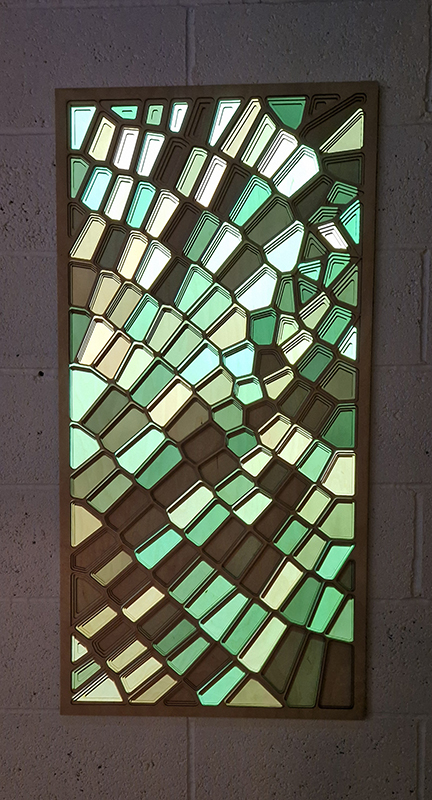
A luminous intervention of glass Specimens from an Imaginary Voyage by Steffen Dam in the main collection at RAMM.

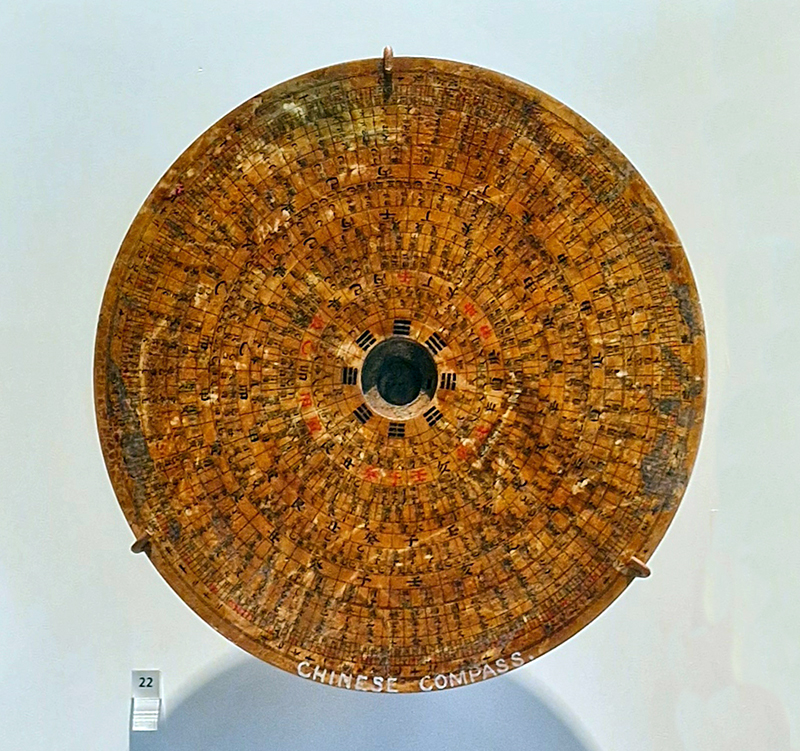
This splendid Chinese Compass, Lo P’an, also spotted at Royal Albert Memorial Museum, Exeter – used more for alignment of positive energy than navigation.

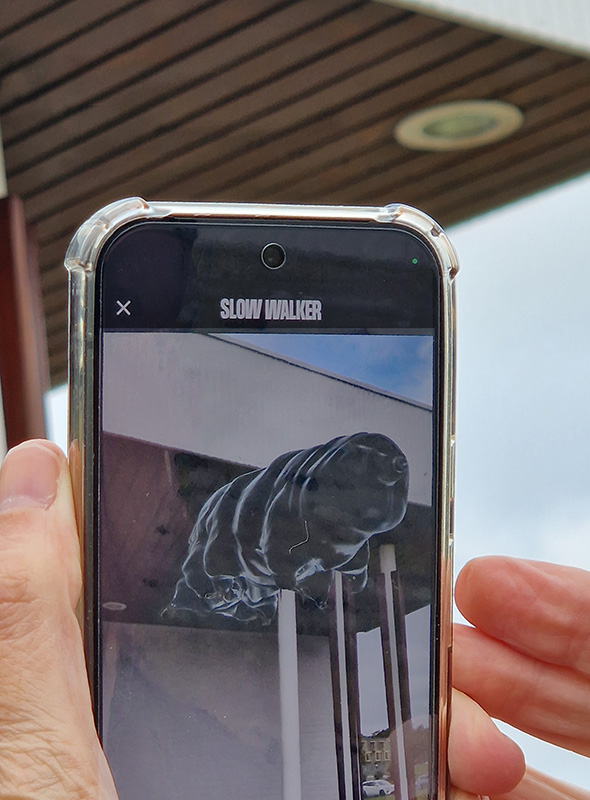
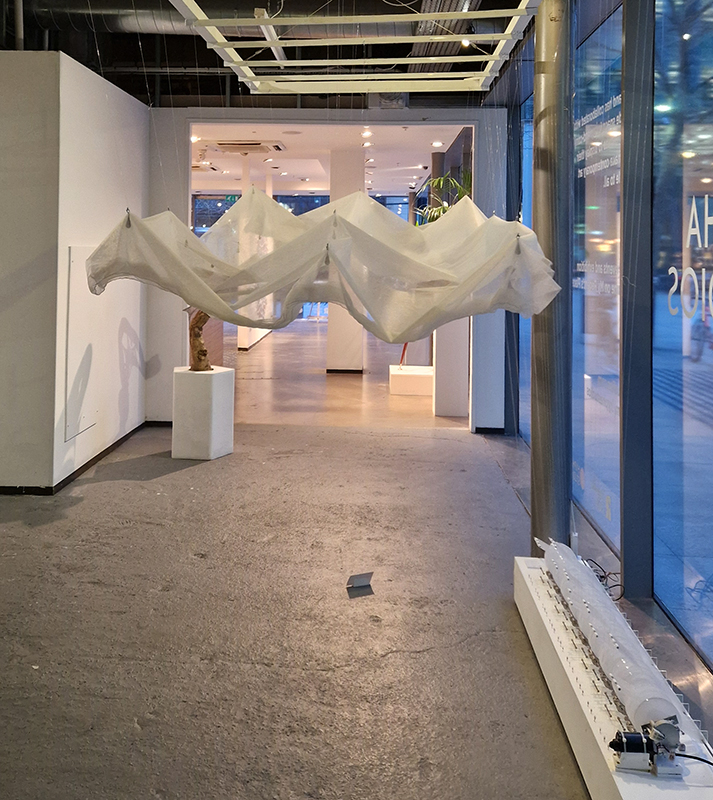
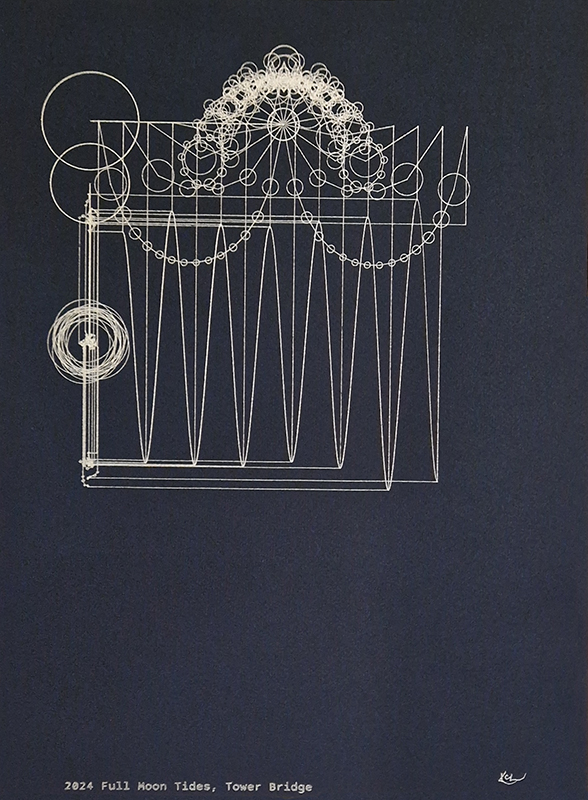
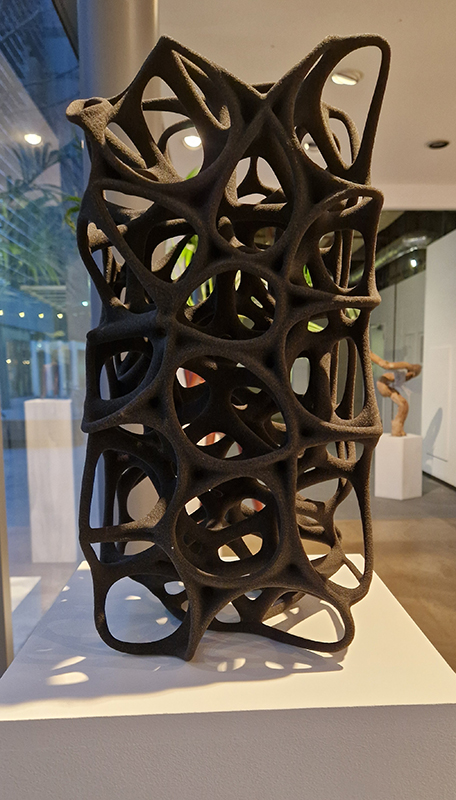
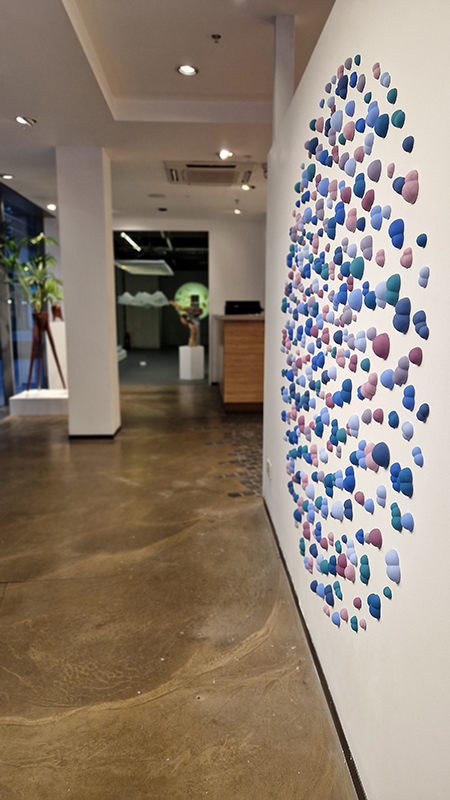
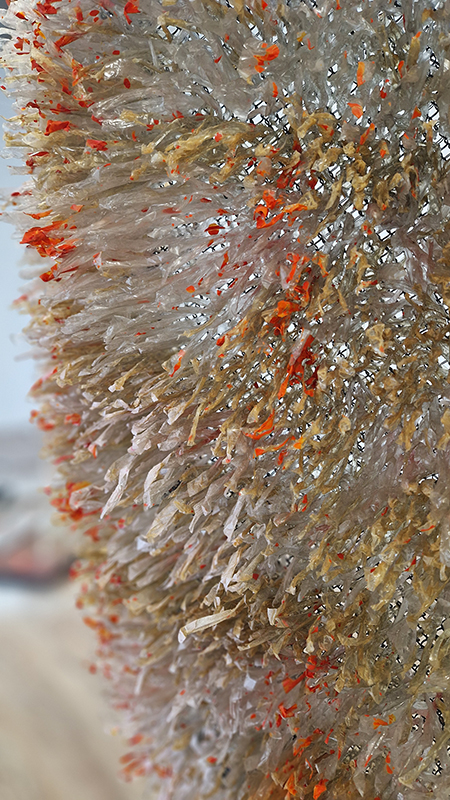
In Scope at Hypha HQ, Euston curated by James Grossman. An exhibition examining nested systems in nature, there were some fascinating symbioses of technology and natural materials such as live algae prints and sculpture capturing the tidal forces of the Thames estuary. Images 1-3 Alexander Clarke, 4 Will Laslett, 5-7 Kerrie O’Leary, 8 Star Holden, 9-10 James Grossman, 11 Peter James Nasielski, 12-13 James Grossman + Peter James Nasielski, 14 Hanne Peeraer

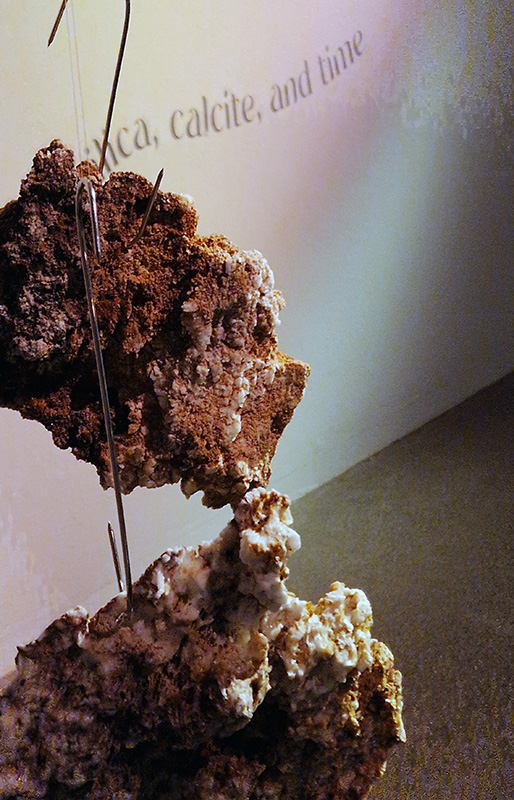
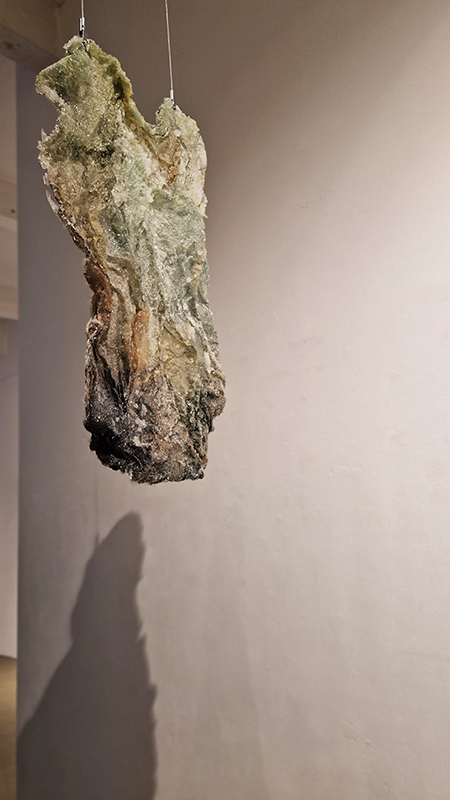
Great to see Sophie Mei Birkin’s Vestige in Joining Doggerland at APT Gallery. A semi-translucent, glittering, crystal encrusted form suspended like messenger from both the past and the future – a reminder of what once was and what might be.

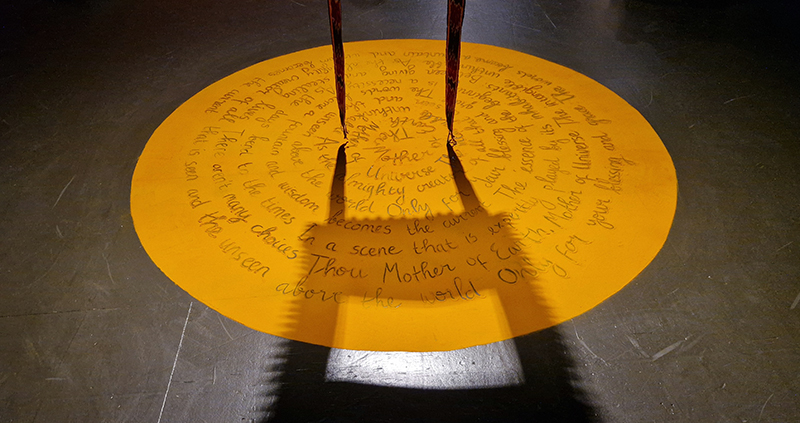
Citra Sasmita Into Eternal Land at Barbican The Curve. Having turned my hands and kitchen yellow recently grating fresh turmeric I understand why this circle of turmeric powder in the meditation zone was so closely invigilated. A calm scented area after walking the curve of colonial atrocities.

Mike Kelley Ghost and Spirit at Tate Modern. Sublevel (1998) is a model of the basement of CalArts, where he had studied in the 1970s. The spaces that Kelley couldn’t recall from memory are lined with pink crystal resin. The work stages a site of hidden memories and repressed desires, underscored by the symbolism of the pink coloured crystals, as Kelley explained: Because, as everyone knows, regardless of meaningless, exterior coloration, it’s all pink inside. Janelle Monae would agree and regardless of honourable/ironic sentiments employed the aesthetics left me feeling a bit like I’d time travelled to a seedy fairground scenario.

Glad I made it to see UBIK Hypha Studios at Sugar House Island from the Changeable Beast sculpture group. Inspired by the eponymous Philp K Dick novel, the artists invite viewers into speculative narratives of alternative futures. Images left to right: Weeping Willow Ellie Reid, Untitled (from the series ‘You Follow Me Around’) Ellie Reid, Things Said Susan Young, Return of the Dinosaurs Ornela Novello, Sunspots Tessa Garland, Timebeing Diana Wolzak, Inertials Clare Jarrett, Broken Nights Kay Senior

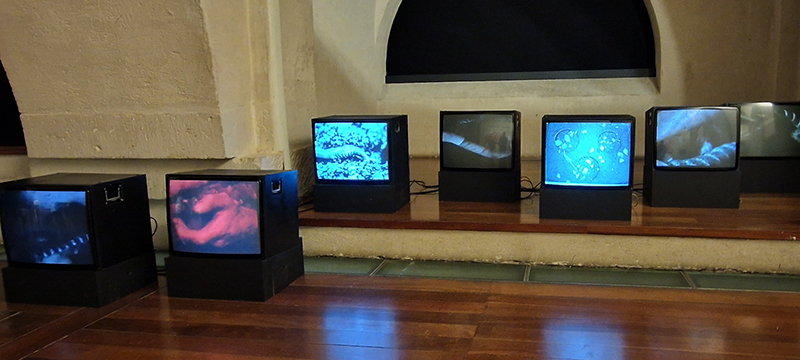
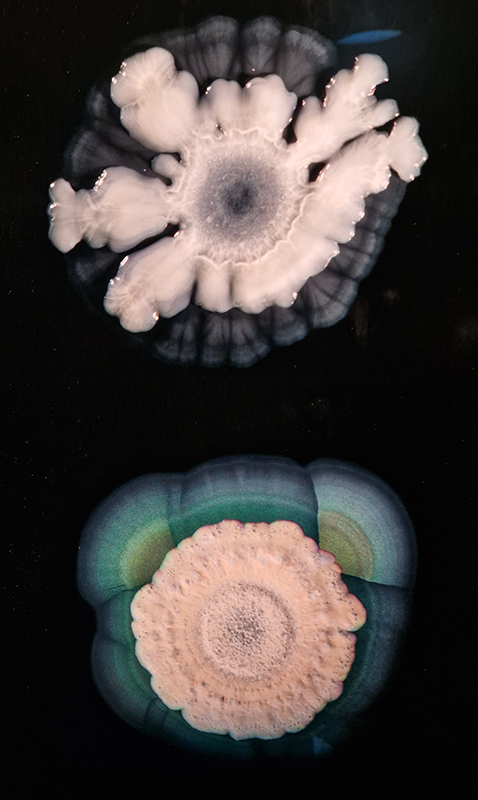
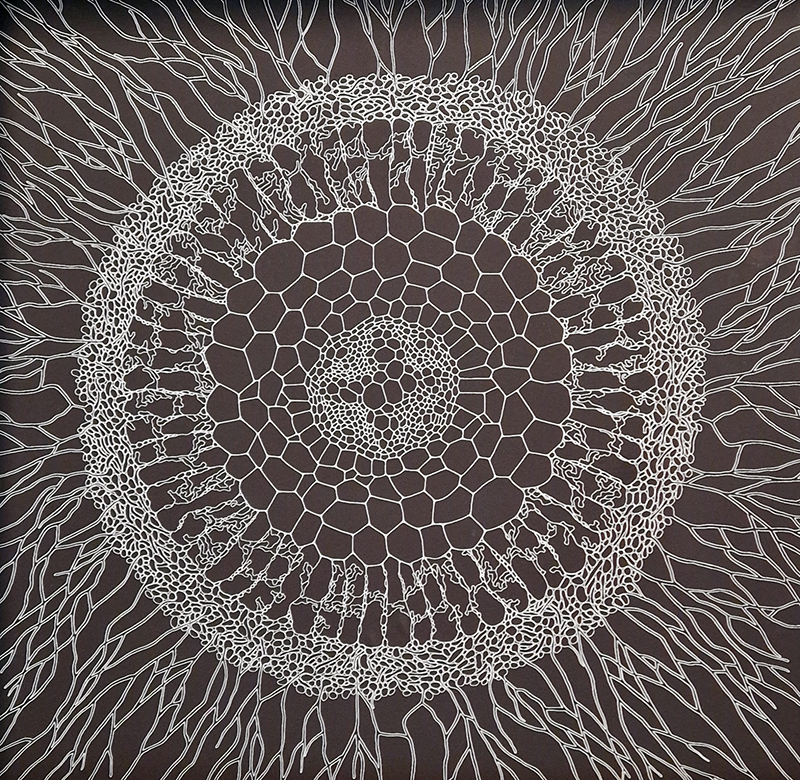
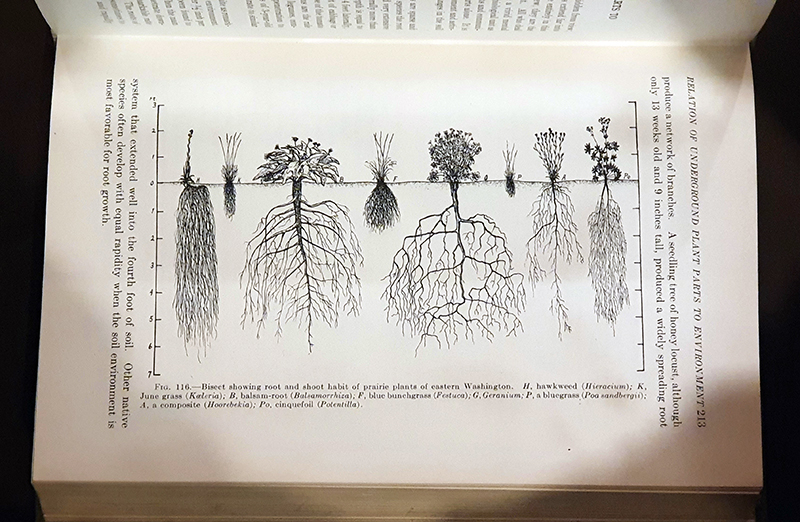
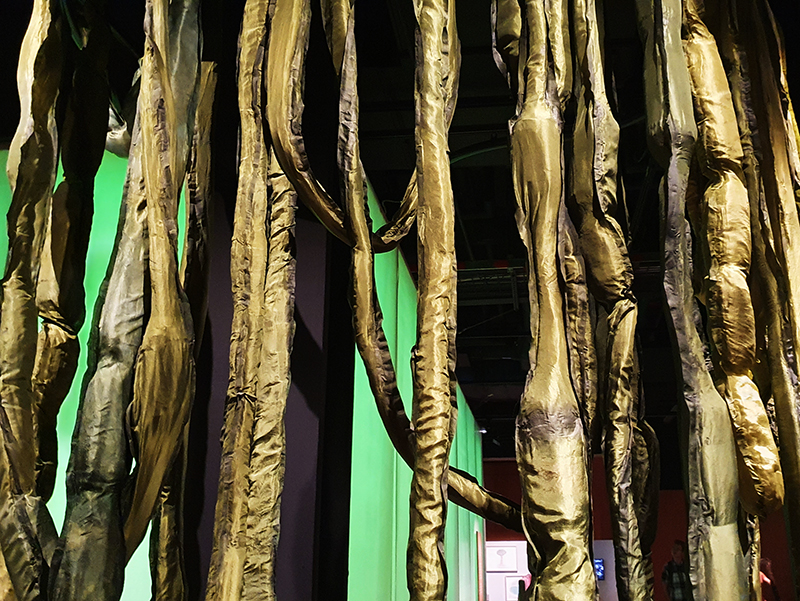
Soil: The World at Our Feet at Somerset House. As it says on the tin – the exhibition sets out to inspire and educate visitors about the power and the fragility of soil, its fundamental role in human civilisation and its remarkable potential to heal our planet. There is so much educational text that the bias of the experience veers towards the didactic. A lot of worms and impressive time lapse video – both of which I like very much and there are some interesting works here but after been slammed with so much ‘fact’ and repetitive tropes it becomes a bit wearying, which is a shame. Sam Williams Wormshine seven channel video collage had a fitting sensitivity to worms as unsung heroes of soft power. Maeve Brennan roman soil with microplastic contamination gave stark evidence of a toxic legacy leaching through the water table to infect roman artefacts. Diana Scherer has woven an intriguing substrate using natural growth processes to generate structures from root tissues. I was interested to see how microscopic soil bacteria can have the appearance of agate and a cross section drawing of a root reminded me of my Mum’s crocheted doilies.

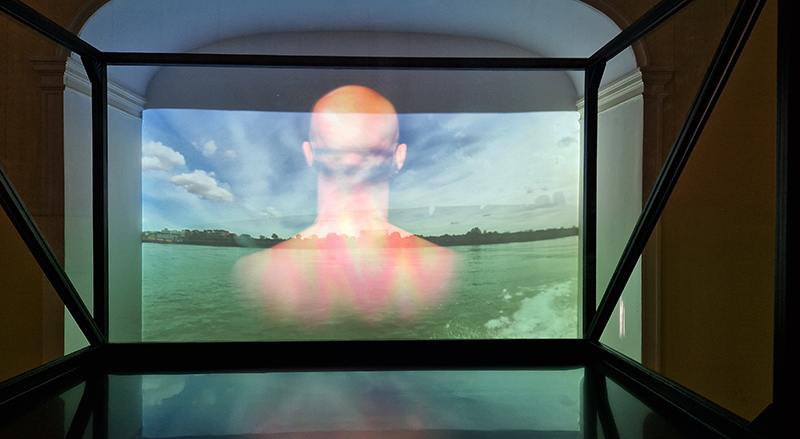
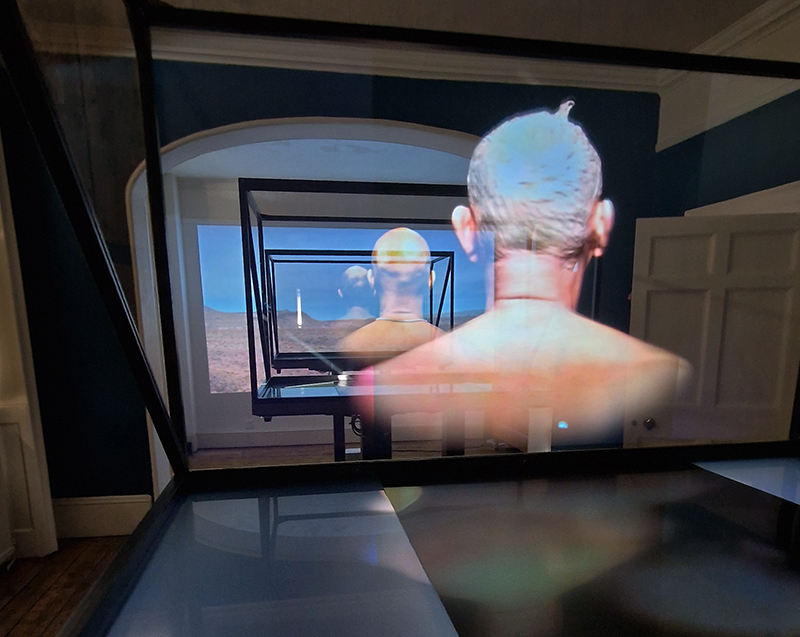
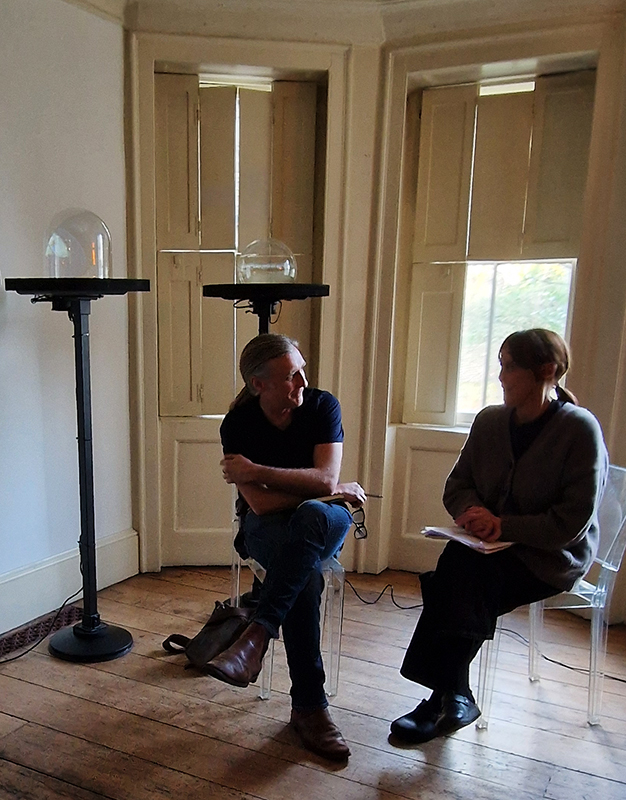
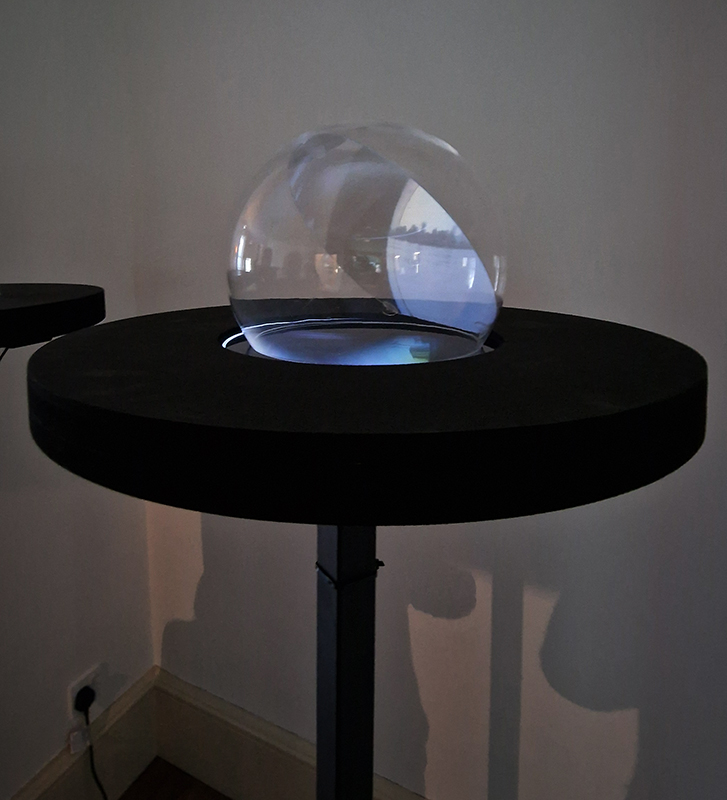
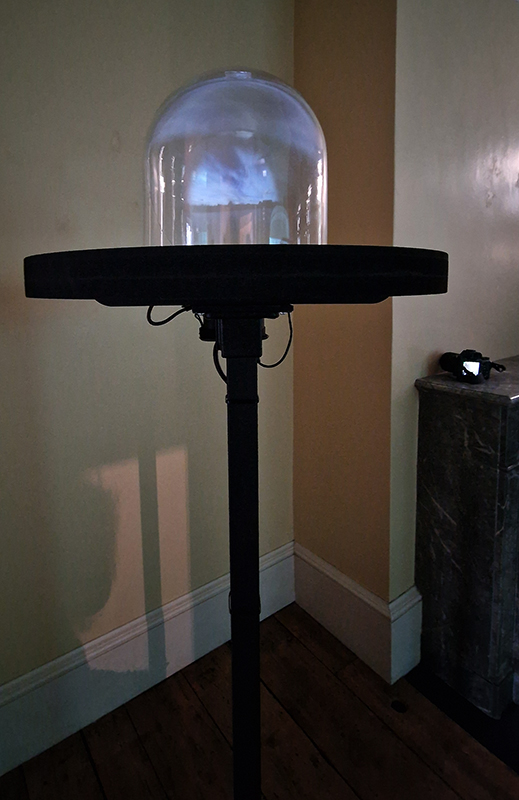
David Cotterell in conversation with Amanda Crawley Jackson, (LCC Professor of Place and Culture / Dean of Research and Knowledge Exchange), at Danielle Arnaud discussing the exhibition and underlying themes of the sublime, suburbia, estuaries, deserts, and human inconsequentiality. Albert Camus’ absurdism philosophy was referenced in respect of the inability to know the world and the world’s indifference to human attempts to even try. David has visited and documented some amazing wide open landscapes of Afghanistan and Mexico where the sublime is inherent in the experience of isolation, vulnerability and awe. We see these in the projected works here. The choppy expanse of the Thames estuary is encapsulated into spherical and domed microcosms, like seeing visions in a series of crystal balls set at eye/brain level – so also a bit like peering directly into the mind’s eye. He expressed the desire to share the experience of being in these landscapes – I think he did share the wonder. He also talked about his visit to Donald Judd’s sculptures in Marfa, Texas where even megalithic sculptures are overwhelmed by the scale of the environment and the milky way is not beyond, but within touching distance.

Events

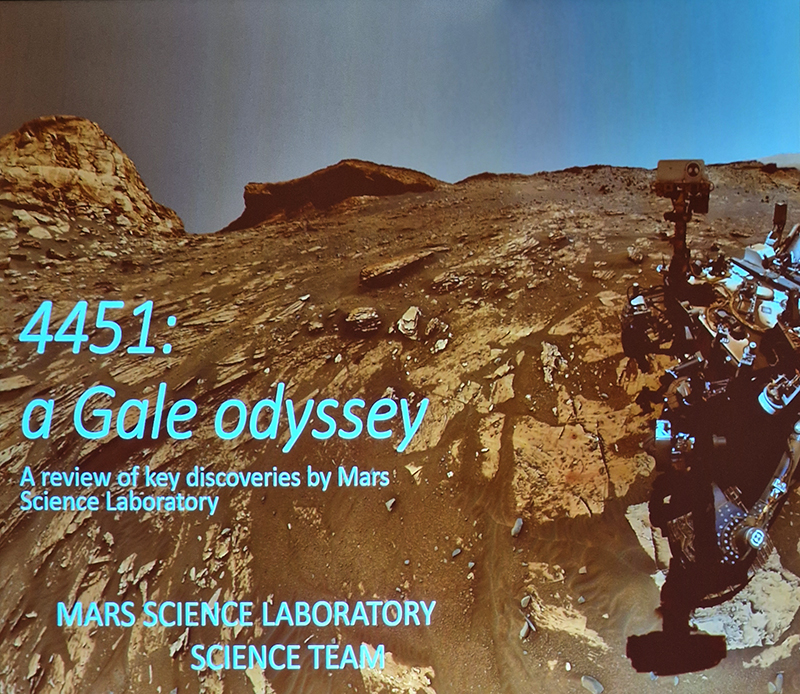
Royal Astronomical Society Friends Lecture from Dr Steven Banham, Imperial College London. This was an in depth reveal on the geology of Mars. The Mars Science Laboratory mission’s Curiosity rover landed in Mars’ Gale Crater in August 2012. About the size of a MINI Cooper, Curiosity is equipped with 17 cameras and a robotic arm containing specialized instruments. It has explored the northern margin of Mount Sharp for 4451 Martian sols providing compelling evidence that shortly after crater formation, a habitable environment existed here. The rocks that form lower Mount Sharp preserve a record of persistent lakes fed by fluvial systems originating from the crater rim. As the rivers entered the lake, they released plumes of sediment and assorted nutrients into the water column to be distributed across the lakebed — recorded as the Murray formation. Geochemical and mineralogical assessments indicate that environmental conditions preserved in these layered rocks would have sustained life, if it were present. On Sol 3047, Curiosity made a sharp right turn after crossing the phyllosilicate unit, to drive up into the orbitally-defined sulphate-bearing unit. From this point, Curiosity witnessed distinct changes in the stratigraphy, recording a progressive drying of the ancient environment. The rover identified a gradual change from humid conditions containing a record of perennial lakes, to isolated ephemeral lakes, and onto desolate deserts. During this ascent, interstratification of aeolian strata became increasingly common, including sand sheets, dune strata and deflation scours. However, despite this general aridification, the succession was occasionally punctuated by episodes of abundant water: the Amapari ripple bed for example, records a brief shallow lake: a veritable oasis, free of ice.

I travelled to Manchester to see Figures in Extinction, a dance trilogy exploring the age of disconnection. A beautiful, haunting and sobering collaboration between choreographer Crystal Pite, NDT 1 dancers and Complicité director Simon McBurney. The first section confronts the extinction crisis and climate change deniers, listing the last of each species vanishing from our world; the second section addresses human isolation in a world dominated by technology and data, the divided brain where the intuitive side of our brain has not been nurtured leaving the rational unempathetic side to be dominant, and the final section draws our focus to death, physical decay of the body and grief, urging an honouring of our ancestors – the dead, having lived are not inert. The lighting throughout was amazing but particularly extraordinary in the closing scenes as ethereal spectres swarm the stage. The dancers, so precise in their movements delivered a hugely emotional homage to life on Earth.

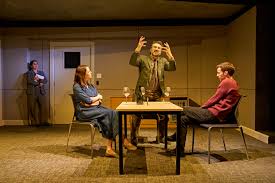
East is South by Beau Willimon at Hampstead Theatre. There was a lengthy monologue on equivalence in this fast paced play projecting a future where AI or AGI (Artificial General Intelligence) learns to take on the experience of faith over logic. Two coders stand accused of releasing a dangerous AI to infect processors globally. Their motivation interrogated as potential spy or subject to religious cult beliefs. “God didn’t create the universe,” it may be “the universe’s project to create God.” After all, if Agi escapes to colonise the internet, knowing everything about everything, and having power over everything, wouldn’t “she” become our “God?” With personal memories questioned as truth as much as being duped by others for their own ends, there is no clear path in a complete breakdown of trust and authority. I see this play has had a lot of bad reviews – it is dense with ideas and maybe the interrogation format is not new but it has a lot to say that is relevant.

Delighted to announce At a Distance has been selected for The Anxiety of Interdisciplinarity exhibition at the Island Venue, Bridewell St, Bristol.

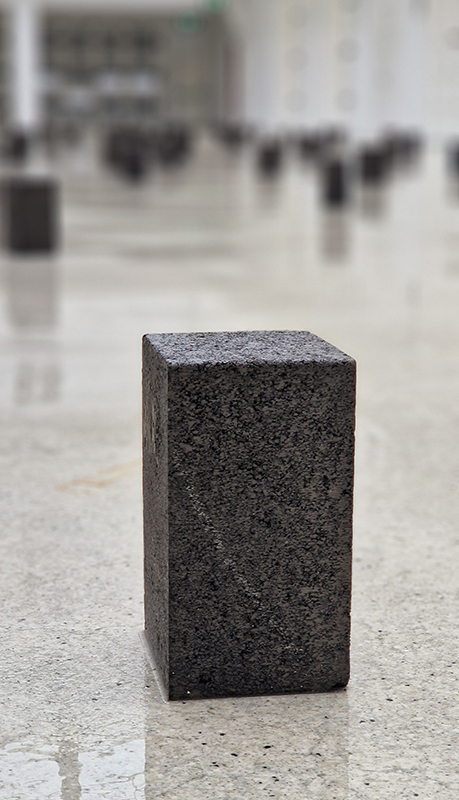
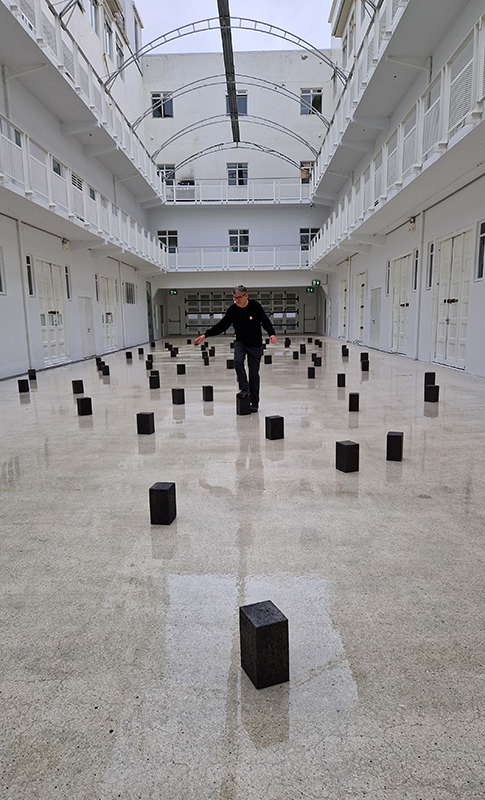
The Anxiety of Interdisciplinarity is an exhibition which seeks to reframe printmaking as a site of interdisciplinarity – a testing ground for ‘The important work…done at the surfaces between adjacent disciplines’ (Carter, 1998). Motivated by the International Multidisciplinary Printmaking Conference IMPACT 12’s theme ‘Merging and Metamorphosis’, the exhibition aims to trace the metamorphosis of conversations between disciplines. Installed at a former police station in Bristol, the Island Venue hosts art works in an outdoor courtyard, police cells and subterranean motor vehicle storage area.  The hybrid exhibition includes works of differing materials, scale and dimensions across installation, sculpture, sound, moving image, digital and post-digital media.  Curated by Sarah Strachan and Ayeshah Zolghadr.

At a Distance looks at remote methods of communication and relates this to the mysterious twinning of electrons in quantum entanglement where particles link in a way that they instantly affect each other, even over vast expanses. Einstein famously called this phenomenon ‘spooky action at a distance’. Filmed in Cornwall on 29th March 2019 (the first date when Brexit was supposed to happen) as the iconic Lizard Lighthouse powers up its lamp, solitary figures using semaphore flags sign ‘We Are One’ out across the ocean in the hope the message will be echoed back. Drawing on the physical language of print that embodies touch, separation and mirroring the flags have been printed using hand painted dye sublimation inks applied via a heat press. This process transfers the ink from a paper matrix onto the substrate textile. The image passes momentarily across space in a dematerialized state as vapour before being reformed as its mirror opposite.

In the studio I have been performing some more test etchings of the directional magnetic steel samples. Copper sulphate seems to give a better result than Nitric Acid. I have managed to gently polish the surface with Brasso without losing the crystal pattern and I gave it a coat of clear lacquer as it seems to rust easily. I am enjoying the excavation process.

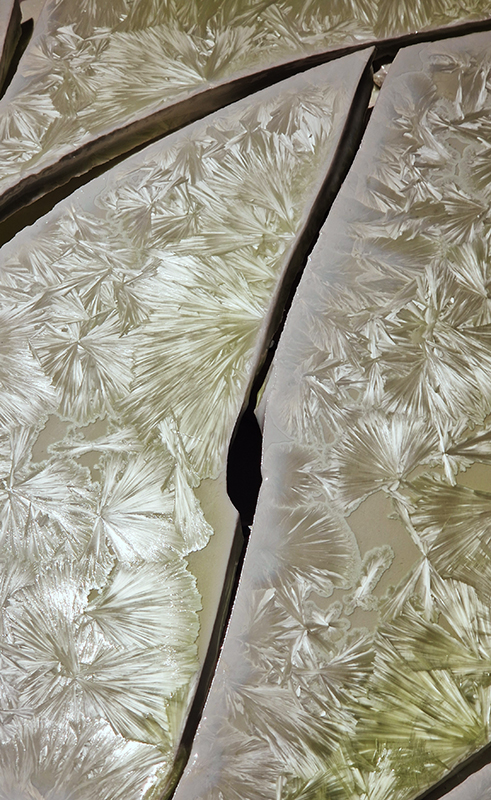
The pattern comes from rolling single crystals of an iron silicon alloy into thin sheets to minimise magnetic losses for use in transformers.

There is a link here to quite a cool video showing magnetic wall domain movement with a magneto-optical sensor.

Back in the belly of a rock video editing the footage of iron filings movement over rock like surfaces.

Magnetic field reversals are stored in ancient volcanic and sedimentary rocks. The North and South Pole flip at irregular intervals but average about every 300,000 years. The last one was around 780,000 years ago. During a magnetic field reversal, which can take thousands of years, the magnetic field becomes twisted and tangled, and magnetic poles may appear in unexpected places.

Today the Earth is divided into the super hot inner core, the molten outer core, the mantle, and the thin crust.

When the Earth formed about 4.5 billion years ago from the collision, accretion and compression of matter it was rock all the way through. Heat from the massive violence of formation and radioactive decay caused the planet to get hotter and hotter. After about 500 million years of heating up it finally reached the melting point of iron. Known as the iron catastrophe this liquifying caused planetary differentiation to occur as lighter material rose to the surface becoming the mantle and crust whereas the heavy metals like iron and nickel fell towards the centre becoming the core. This molten mass also contains elements that dissolve in iron such as gold, platinum, and cobalt along with around 90% of the Earth’s sulphur.

Earth’s main geomagnetic field is constantly changing due to convection flows and waves in the Earth’s core. As this change cannot entirely be predicted, uncertainty slowly increases over time. This fluctuation is monitored using The World Magnetic Model jointly developed by the National Centres for Environmental Information and the British Geological Survey. This is the standard model used by the U.S. and U.K. governments and international organizations for navigation, attitude and heading referencing systems using the geomagnetic field.

Took an early morning drive out to Wilder’s Folly. Built in 1769 by Reverend Henry Wilder as a love token for his fiancée Joan Thoyts – it could be seen from both their residencies. First drone flight over a building and over trees. White doves are now resident and thankfully didn’t seem bothered by the drone.

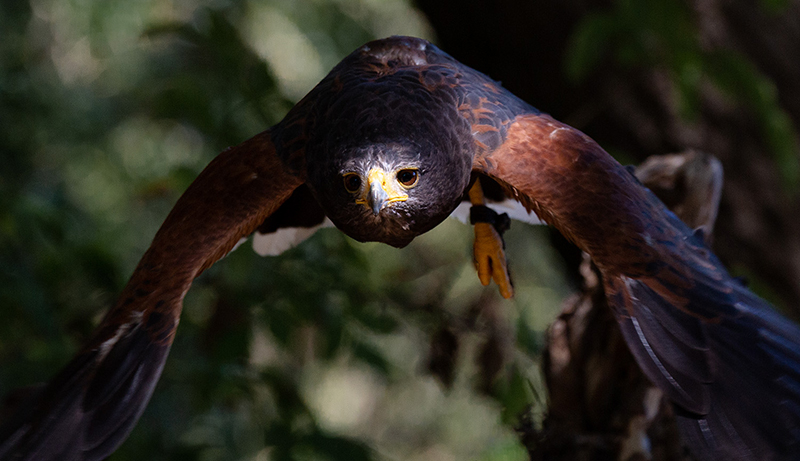
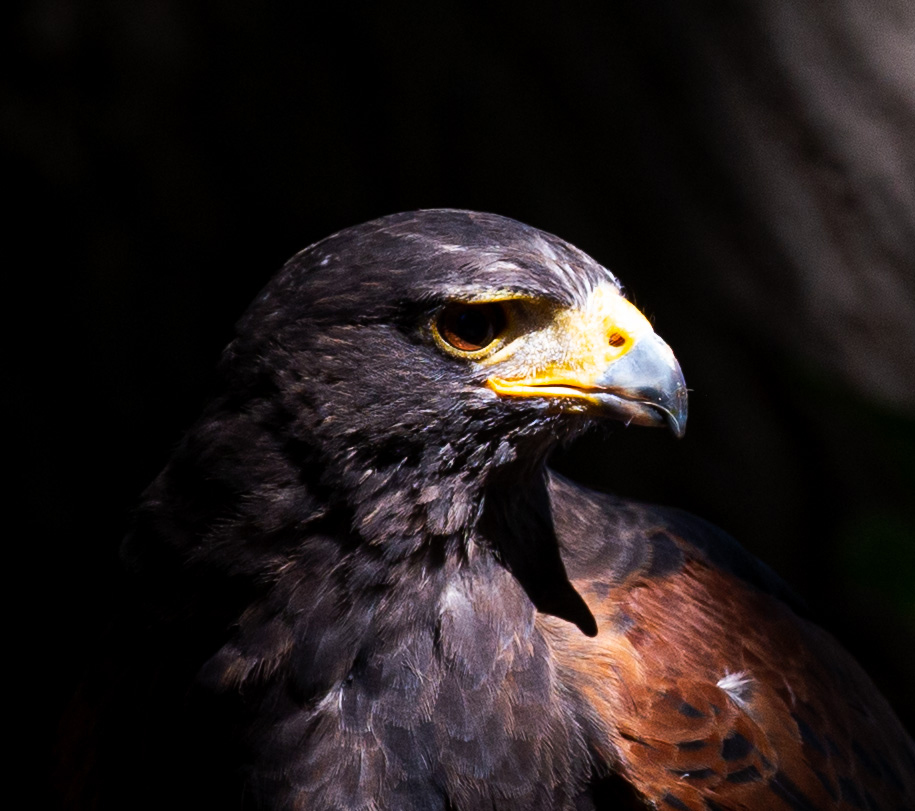
Such a brilliant day meeting and trying to photograph the beautiful birds of prey at Coda Falconry under the expert guidance of Elliot. Lots of advice on hand just need faster reflexes and possibly a mirrorless camera.

Birds appear to be able to “see” Earth’s magnetic field lines and use that information for navigation. Their compass ability comes from a quantum effect in radical pairs, formed photochemically in the eyes.

Gallery Visits

The extraordinary Joe Banks Disinformation The Rapture Live optokinetic video and sound installation at Cable Depot. A special experience to witness this work which has a heady mix of spirituality and mortality. The human voice stretched to primordial sounds as the flesh transcends its halo of fire.

Wellcome Collection Rooted Beings

A look at the symbiotic relationship between plants, fungi and humans. The exhibition takes on the entanglement of colonial violence, indigenous knowledge and wildness. How different the world would be if we were also autotrophic. Patricia Domínguez holographic sculptures were fascinating – these are four blades of programmable LED lights spinning at speed to create an image. It was very effective. I was also intrigued by the material construction of the Vegetal Matrix exhibition stands which did look a bit like volcanic stone in the low light though they were listed as MDF with acrylic, so a sort of textured paint.

Wellcome Collection Being Human

Yinka Shonibare’s Refugee Astronaut“The refugee astronaut is the reverse of the colonial instinct of the astronaut – someone who is going out to conquer the world. What you have here is a nomadic astronaut just trying to find somewhere that’s still habitable.” 

Wellcome Collection In the Air

The exhibition explores the relationship between the air and earth, from 3.5-billion-year-old fossilised bacteria that first introduced oxygen into the atmosphere to delicate porcelain sculptures of the glaciers that provide a record of the air and our impact on it. 

Stromatolites 350m years old – these are fossilised microbial reefs formed in shallow waters from blue-green algae. These cyanobacteria were some of the earliest life forms and their photosynthesis helped produce the oxygen to support the development of other life forms.

International Airspace David Rickard 2019

This work marks the 100 year anniversary of the signing of the Paris Convention which extended land rights upwards to create international airspaces. The vessel contains air collected from the 27 participating countries alongside photographs of where the air was captured.

Panoramic film installation Air Morphologies investigates the materiality and composition of air pollution particles, their causes, effects and morphological agency. The project addresses how art and aesthetics interact with toxic materials; what kind of stories might be deployed through digital technologies; and how geopolitics are located in atmospheric thinking and being. Air Morphologies was initiated during Matterlurgy’s residency on the Science Technology Society program at Delfina Foundation, London funded by Gaia Art Foundation.

Rachael Allain introduced me to the work of Perla Krauze at Cadogan Contemporary. Earthy work presented simply allowing the natural materials to resonate with their own history and materiality. Real volcanic rock rather than a simulation.

“Using graphite frottages from stones and pavements and engraved volcanic rocks from El Pedregal, her paintings are abstract topographies and mappings. Stone is a fundamental material in her practice; linked to memory and durability, it can also be transformed and eroded. The crosshatch patterns in her paintings derive from the lines made in stone cutting, emphasising the transformation of stone from raw material to art object. Described as ‘grayscale tone poems’, Krauze alters and arranges stones to make miniature landscapes, complete in themselves but still referencing their origins.”

Future shock reimagining our near future at 180 The Strand. An immersive dive into a fairground world of light and motion, entertaining with one or two that stood out beyond technical prowess.

My favourite has its roots in the fashion world. Ib Kamara’s stylish film The Queen is Coming, a collaboration with Abdel El Tayeb grabs attention with its sense of transfixing unease created by the film’s characters via their direct expressions and heightened breathing. Anxiety levels are high. Fantastic.

In Neo Surf a collaborative project between filmmaker Romain Gavras and music producer Surkin the sheer scale of the marble quarry landscape emphasised by lanky teens dancing on the cut blocks is extraordinary and brings home a kind of wild abandonment.

Vigil is an installation collaboration between Ruben Spini and musician Caterina Barbieri. A sunset projected onto suspended melting ice creates a fragmented mirror image across the floor while videos with slow-motion footage of levitating bodies, transcendent synths and haunting vocals add to the sense of a slow death drugged on beauty.

Vortex puffs out a smoke ring every so often which is quite fun. Created by Pablo Barquin and Anna Diaz.

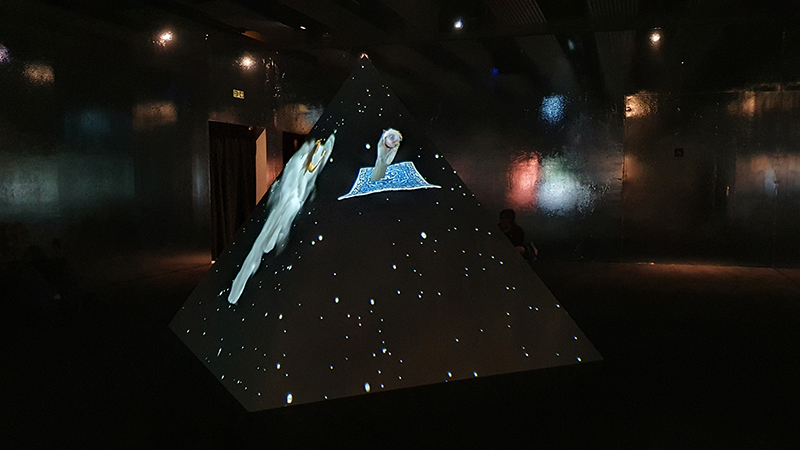
Row by Tundra uses the same holographic projectors as I recently saw used by Patricia Domínguez in Rooted Beings. Here they are interpreting generative data from the 12 notes of the chromatic scale.

Other work at Future Shock includes Weirdcore’s lucid dreaming colourscape Subconscious, Lawrence Lek’s self-driving car animation Theta, Actual Objects mildly interactive installation Vicky, NonoTak’s Daydream V6, Ibby Njoya’s colour box experience named after his influential father Mustafa, Vanishing Point from UVA, Object Blue and Natalia Podgorska’s installation of a future where astrologically predicted personality traits are true in What Melissa Said, Ryoichi Kurokawa and the shifting planes of light Topologies by UVA,

In The Black Fantastic at the Hayward Gallery. New narratives of Black possibility embracing the fantastical not as escapism but as bursting from the constraints of a restrictive society.

The Soundsuits of Nick Cave made as a response to racist violence confer anonymity along with a shamanic power. What a great use of the lace doily. Inspiration for the many doilies I have inherited from my Mum.

Wangechi Mutu collages, Sentinel sculptures and film The End of Eating Everything (featuring Santigold) are drawn from folklore steeped in the grotesque and spectacular. Time to turn from gluttony to restoration.

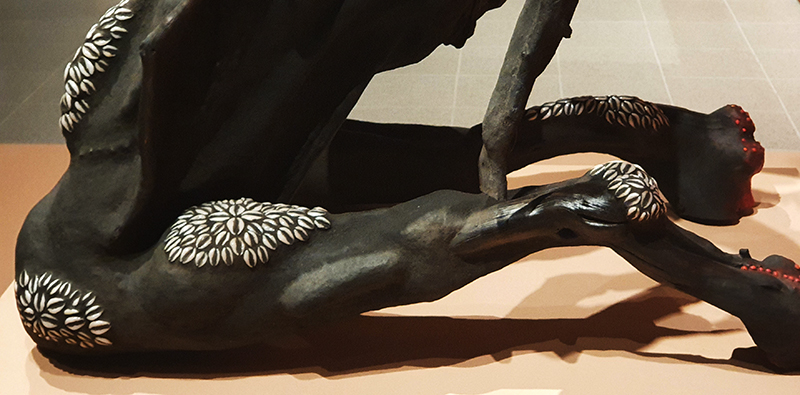
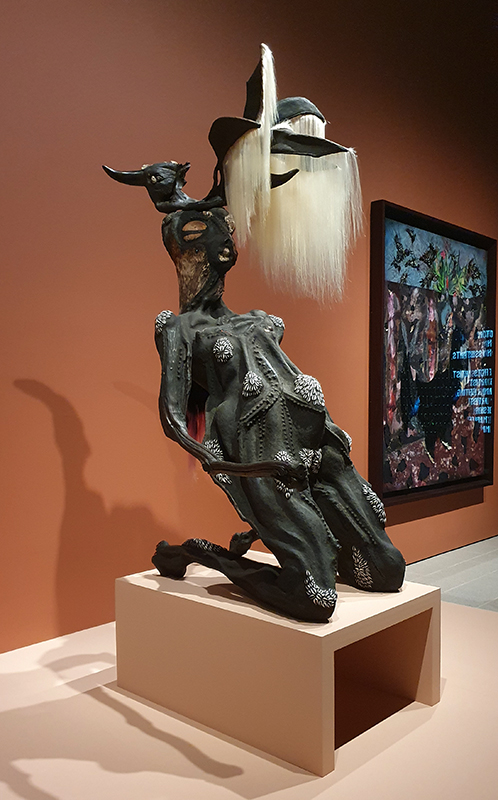
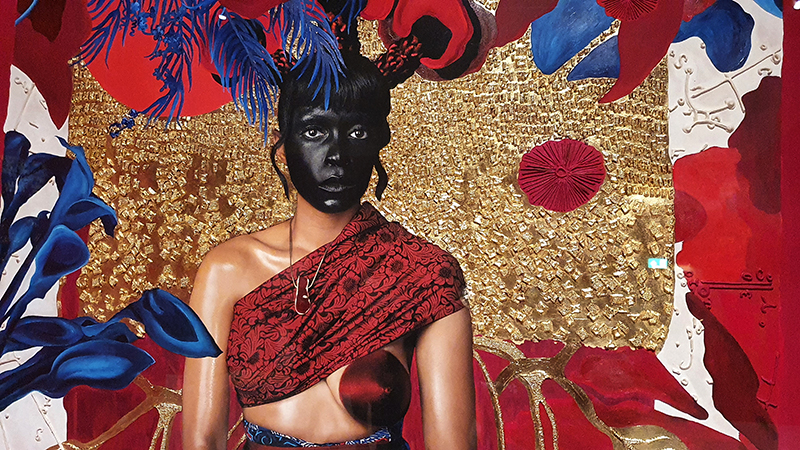
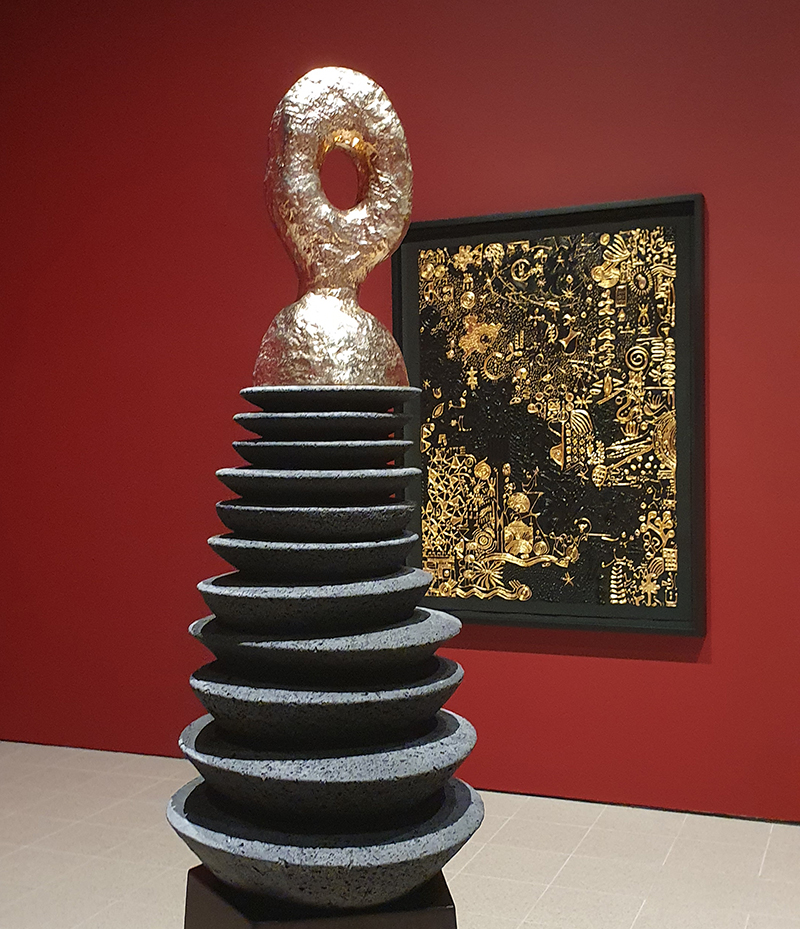
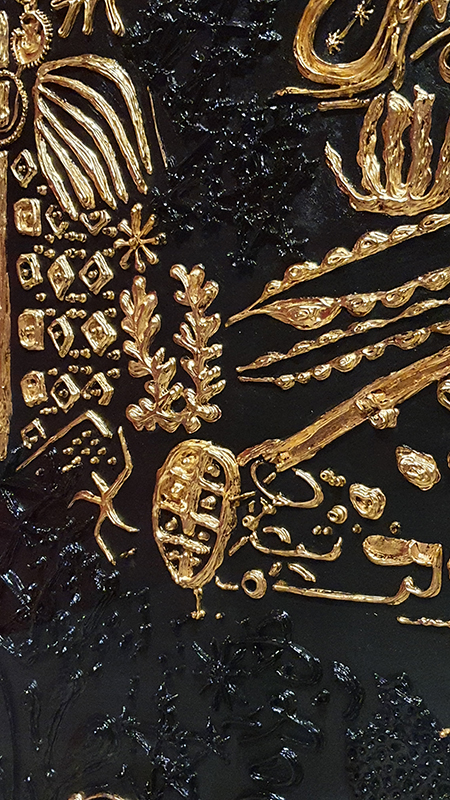
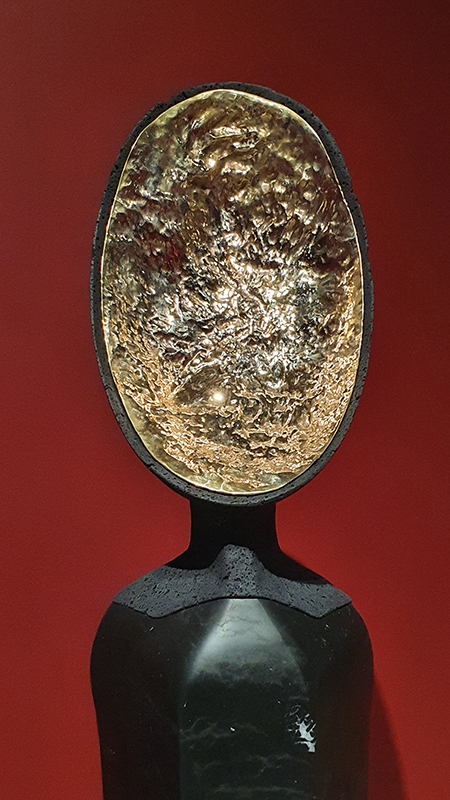
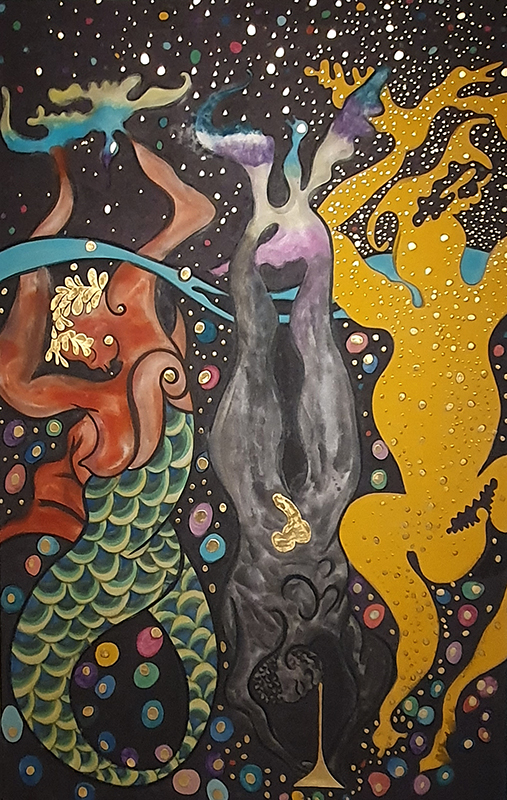
Lina Iris Viktor sumptuous paintings and Diviner sculptures heavy with gold acting as a conduit between heaven and earth inspired by ancient Egyptian funerary traditions. Her dramatic use of rich glossy black signifies the ‘materia prima’ – from which all creation was formed. Fabulous to see The Watcher, The Listener, The Orator sculptures are hewn from volcanic rock. Black gold of the sun.

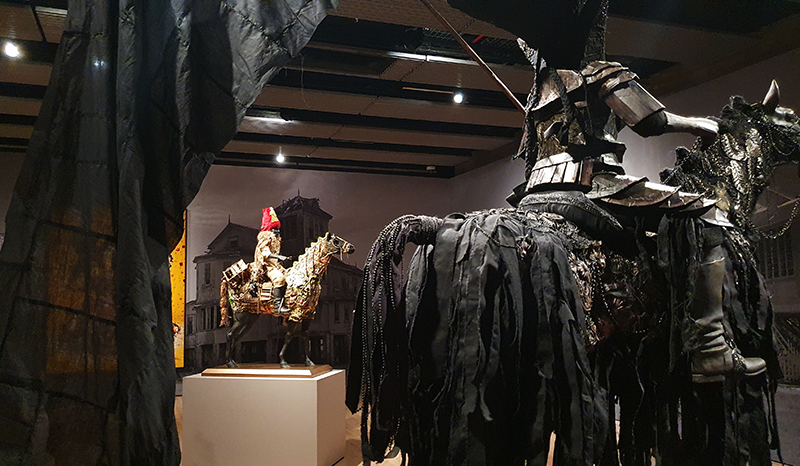
Hew Locke’s The Ambassadors, a procession in search of future lands carrying their precious history with them echoing down the ages to Hans Holbein the Younger’s painting of the same name made in times when colonial foundations were being laid.

Cauleen Smith created an intriguing installation Epistrophy which refers to a phrase in literature or music repeated for emphasis. Her archive of associations are elevated into cinematic stardom by a series of live feed CCTV cameras which relay the objects onto the big screens becoming larger than life.

Other vibrant works include those of Rashaad Newsome, Tabita Rezaire and Chris Offili.

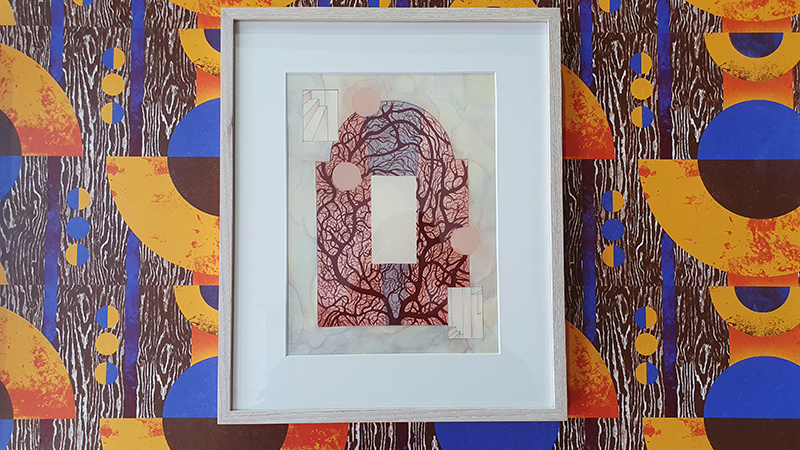
Directed to The Swimmers Limb by an attendant who said rather harshly ‘there’s not much to see’ I visited Gallery 31 dedicated to the Somerset House Studio artists where Mani Kambo has designed a ‘psychedelic’ wallpaper on which hang prints by Tai Shani from her feminist mythology series. Pattern, symbols and ritual. Plenty to see.

Carol Wyss The Mind Has Mountains at The Swiss Church. Having seen this powerful work at Ruskin’s House on Coniston Water last year in a very different space – very like the inside of a skull, it was rewarding to be able to see it in a larger space with a little distance which brought alive the mountainscapes within us. A film of the very physical etching, printing and installation process made by Peter Bromley entitled  Carol Wyss – In Situ was screened to an amazed captivated audience.