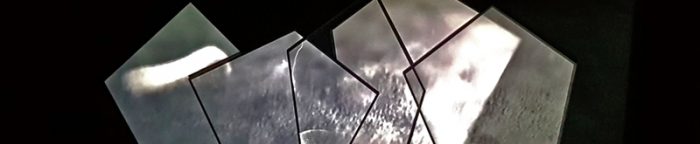
To welcome back the light of longer days I collected one of my solargraph cans from The Hogsmill Nature Reserve where it had been fixed to a hide for 6 months, since the summer solstice, looking out across the water where the birds gather. Really pleased with the image and that it captured the reflection too.

So delighted that Cosmic Chiasmus: crossing the universe was included in the amazing Serendipity Arts Festival, an annual interdisciplinary festival held across multiple venues in Panjim, Goa, India. I just wish I could have visited 💎🌌✨️☀️
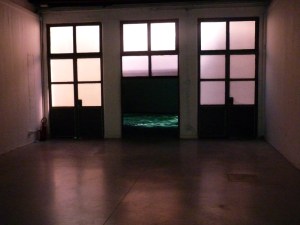
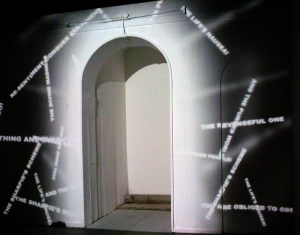
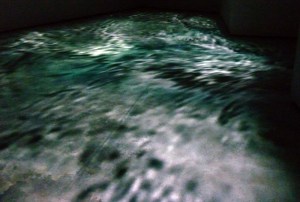
My video was shown as part of the selected module exhibition CARBON, curated by the Science Gallery Bengaluru team in collaboration with artist and curator Ravi Agarwal.

Artists: Annelie Berner; Susan Eyre; Marina Zurkow; David Hochagatterer; Dhiraj Kumar Nite; Jan Sweirowski; Jane Tingley; Maria Joseph and Nuvedo; Shanthamani Muddaiah
Curated walkthrough with Jahnavi Phalkey
The video (05:29 min) offers a glimpse into a subatomic world where cosmic rays travel from distant galaxies to collide and silently interact with atoms and technology on Earth. Above our heads where cosmic rays interact with the Earth’s atmosphere radioactive carbon-14 is formed. This is then absorbed by plants that are eaten by animals and humans. When an organism dies, no more carbon-14 will be absorbed and the current amount in the organism will start to decay. By measuring the remaining carbon-14 in organic matter, the time of death can be established. Cosmic ray activity gives us carbon dating techniques.


I attended The John Brown Memorial Lecture: Exploring Cosmological Phenomena: An Artist’s Perspective, talk by Ione Parkin RWA at The Royal Astronomical Society. Ione is the Co-Founder/Lead Artist of the Creativity and Curiosity Art-Astronomy Project (C&C). She is an Honorary Visiting Fellow of the School of Physics and Astronomy at the University of Leicester and a member of the British Association of Planetaria. Through her many cosmological paintings the ephemeral, gaseous, nebulous phenomena of space are given an earthly materiality that still retains the sense of the intangible. Ione has created an impressive body of work. I especially liked the cloud chamber mixed media pieces and photopolymer etchings created through the fluorescence microscopy process of firing laser beams of light of one wavelength at the surface of the painting then capturing the light emitted from a longer wavelength. Look forward to seeing these works irl rather than digital images.
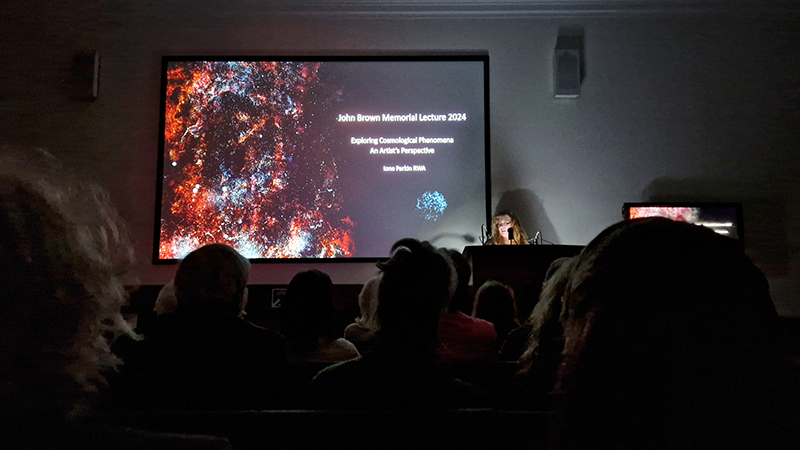


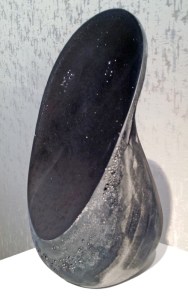
I am over the moon that Ione has selected my sculpture The Azimuth Obelisk (of sedimentary knowledge) to be included in Cosmos: The Art of Observing Space, a major exhibition she is curating at the Royal West of England Academy in 2026. Cosmos will bring together a body of artwork inspired by themes of astronomy, cosmology, astrophysics, planetary atmospherics, space-exploration, solar dynamics and celestial mechanics. There will be a catalogue published to accompany the exhibition with a Foreword by Professor Chris Lintott (Professor of Astrophysics, University of Oxford).


In the studio I have been conducting some more tests towards a video installation which will respond to the crystal structure of magnetite and a quote from Jason Groves book The Geological Unconscious – ‘What truth could be more unexpected ….than the one in which the mineral envisions while also being envisioned.’
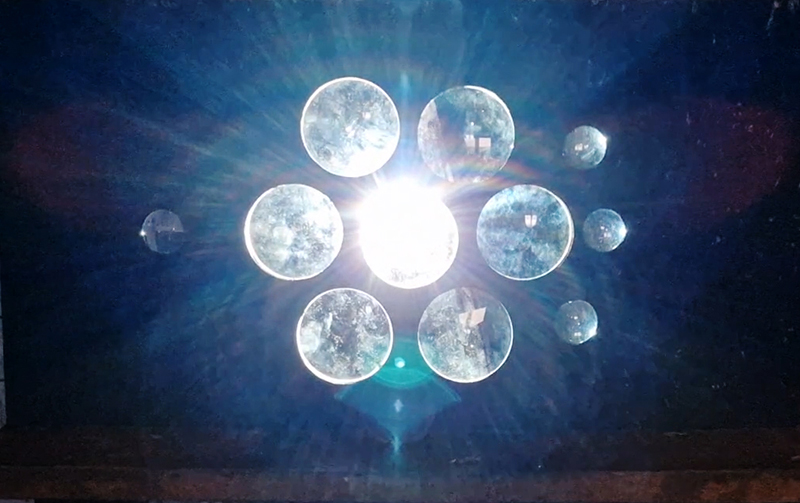
Magnetite is attracted to a magnet and can be magnetized to become a permanent magnet itself. It’s crystal structure was determined in 1915 as one of the first crystal structures to be obtained using X-ray diffraction. Magnetite contains both ferrous (divalent) and ferric (trivalent) iron. At present I am just testing the concept and technical issues using a small board with some lenses inserted in a circle pattern. The large lenses used to distort the projection represent the oxygen present in the crystal structure, I have drilled some smaller holes to test lenses to represent the iron component. In my tests I was surprised to find that when the small lenses were inserted in the holes the projection image was no longer visible on the wall. The small lenses I have are quite thick, but still it was unexpected. I am sourcing some thin lenses to test.

Projection with no lenses in board – no distortion of image

With all lenses inserted – large lens distortion occurs but small lens images not visible


Tests with only large lenses inserted for distortion
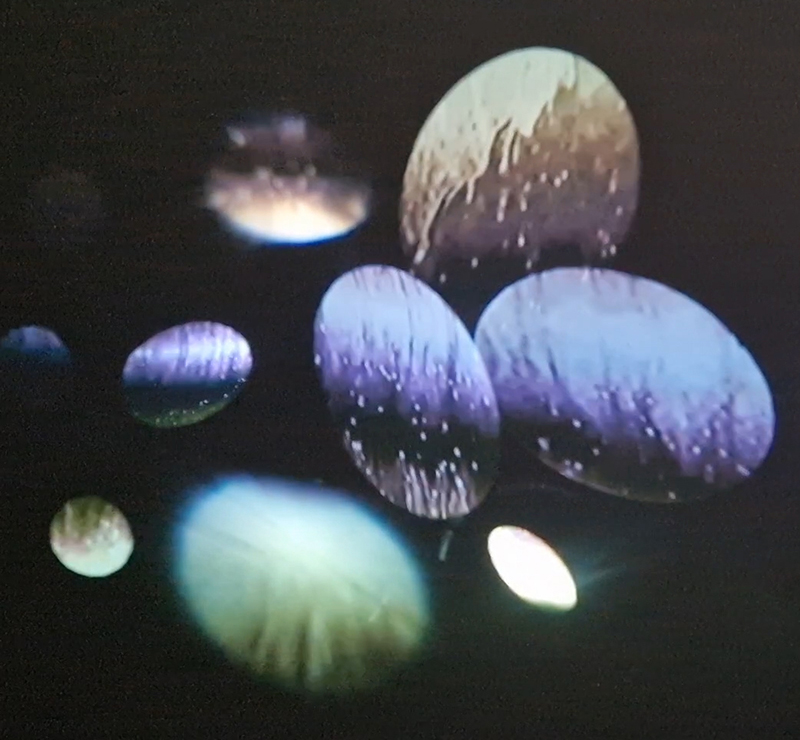


Tests using back projection screen and looking directly at the lenses


Exhibitions visited
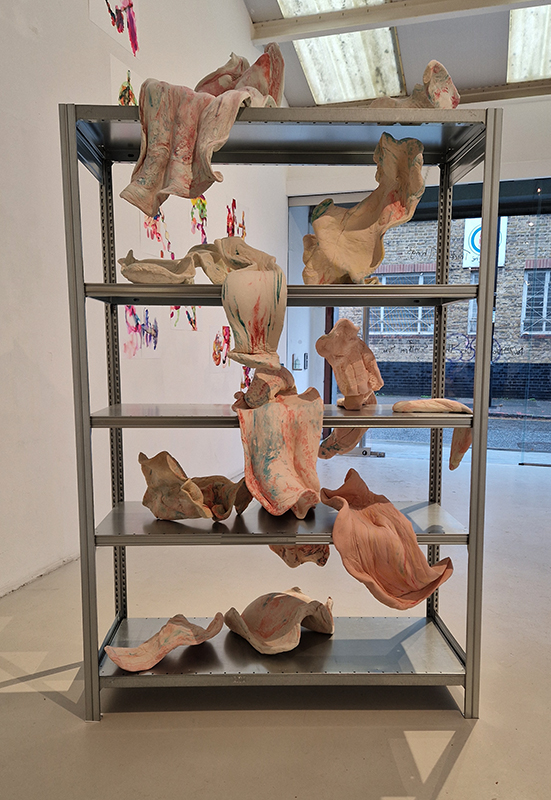
In the Thick of Things at APT curated by Chris Marshall and Cash Aspeek including works by Laura White, Asaki Kan, Leila Galloway and Deborah Gardner. Big messy works, tumbling, sliding and colliding following the vein of arte povera letting the materials speak. Had a touching conversation about the last days of our respective parents with Cash who had made a very personal series of work using her parents marital bed of 60 years as both subject and material.


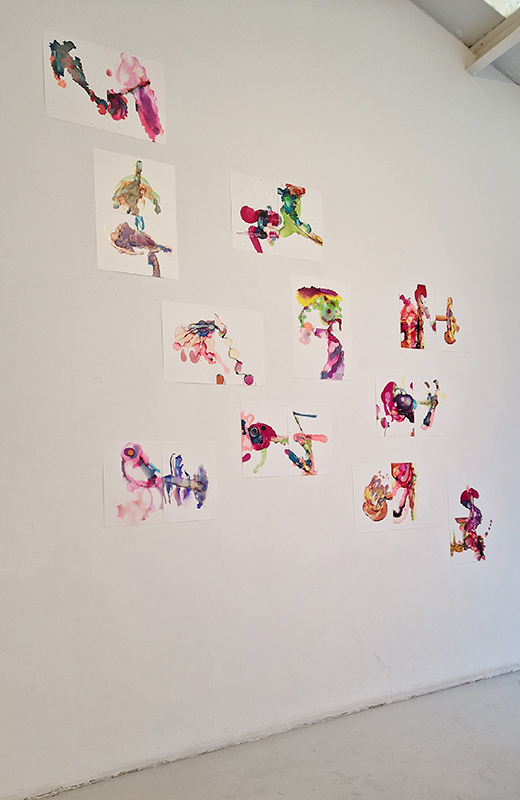
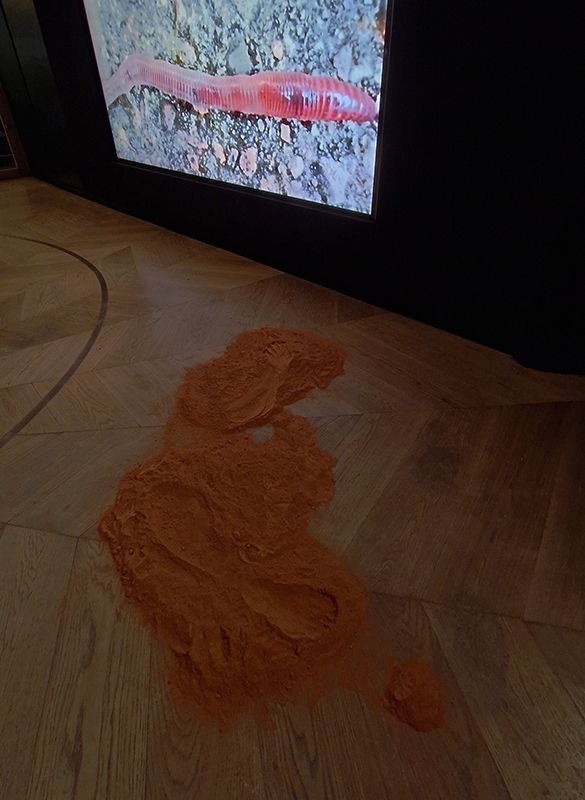
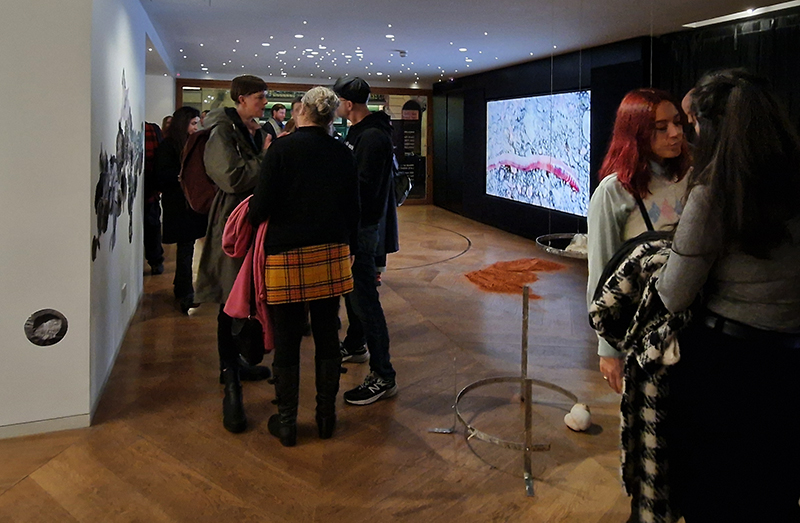
Conglomerates at Hypha Gallery Mayfair, a group show featuring work by Paola Bascon, Rhiannon Hunter, Rona Lee, Hannah Morgan, Davinia-Ann Robinson and Sam Williams. A warm and earthy show exploring care formed through relations with self and other beings to create substrates for resistance, deep-knowing, storying and kinning as processes of paying attention to that which is unheard.


Reading
While reading Margaret Atwood’s disturbing novel Oryx and Crake (to gain insight after seeing the stunning collaboration between Wayne McGregor and Max Richter in Maddaddam at ROH recently) I came across a reference to Mesembryanthemaceae – a plant which disguises itself as small pebbles by taking on patterns and colouring of the ground it grows on. I had forgotten about these strange plants commonly called stone lithops or living stones. The thick leaves can store enough water for the plants to survive for months without rain and during dry periods they shrivel into the ground. With no stem they are partially subterranean, sending light down to the buried leaf cells via ingenious reflecting ‘window cells’ on the two wide leaf tips.

In The Human Soul: Its Movements, Its Lights, and the Iconography of the Fluidic Invisible, originally published in French in 1896, Dr. Hippolyte Baraduc (1850–1909) postulates the existence of “the fluidic invisible” — a “vital cosmic force”, which he calls Odic liquid, that extends across the universe and “saturates the organism of living beings and constitutes our fluidic body”. Instead of all things being composed of one elementary substance, as in philosophical accounts of the monad, in this cosmic vision, we all live in a sea that we cannot see, which Baraduc names Somod.
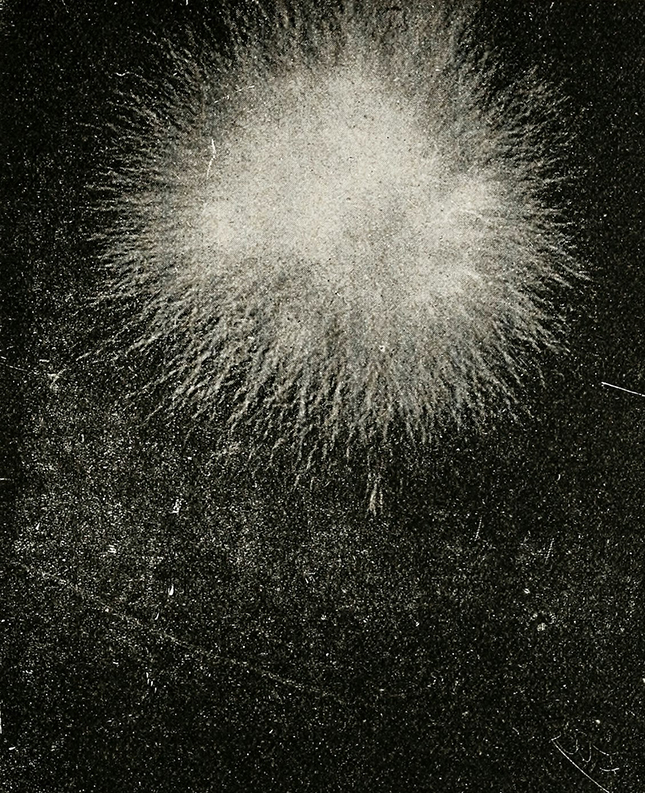
This remarkable image posted by Public Domain Review is one of the many attempts to capture the “vital cosmic force” made by Dr. Hippolyte Baraduc a French physician and parapsychologist who believed he could photograph thoughts and emotions.

“Pure electography of the hand by Iodko’s method. The hand of an over-electrified person, placed on a plate gives a very remarkable impression of the electrified cutaneous surface.”
I am intrigued as to what might ‘over-electrified person’ mean? I was also fascinated by this image – “Luminous spectre of the north pole magnet, obtained by the red electric photographic lamp, surrounded by fine pearls of psychecstasis.”
 I was taking part in a tour of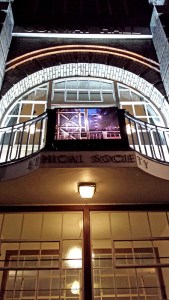
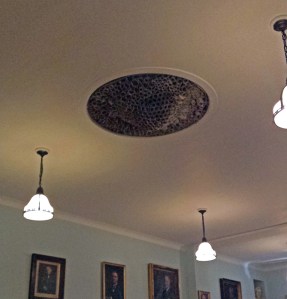



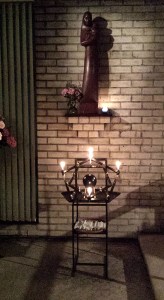
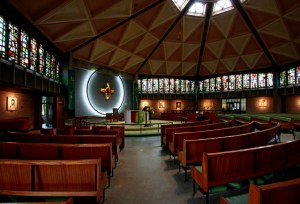 I entered late in the day, there had been a schedule of performances but I had missed most of these. Coming in from torrential rain outside, the place was immediately a sanctuary. People milled quietly and took their seats along the pews. I sat waiting but not sure what for and in the hushed gloom had the uncanny feeling I had inadvertently joined a cult. After a while, strange resonating sounds from Michael Speers performance of distorted feedback filled the space. We sat in quasi religious contemplation.
 A leap of faith considers the universe, civilisation and the individual; questioning our existence in rel
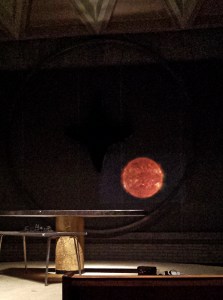 Among the artists in this show were Mark Ariel Waller projecting SO-LA, video footage from NASA’s Solar Dynamics Observatory above a bronze cast replicating ‘Sit Shamshi’ a 12thC relic of Iran which depicts two figures in a temple setting performing a ritual to the rising sun.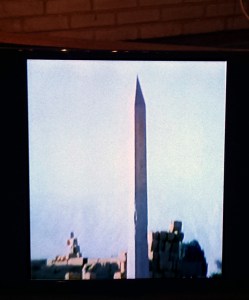

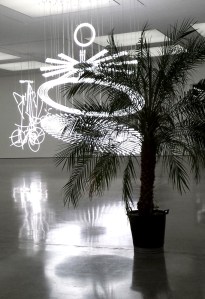

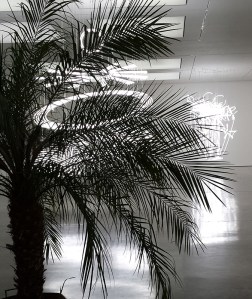
 Susan Eyre