Archives for posts with tag: platonic solids

In Pliny’s Natural History (published after his death in the AD 79 eruption of Vesuvius, when, ever curious, he had gone to investigate the strange cloud rising), he marvels at the powers of the magnet ‘For what, in fact, is there endowed with more marvellous properties than this?’; ‘What is there in existence more inert than a piece of rigid stone? And yet, behold! Nature has endowed stone with both sense and hands! He goes on to assert that ‘it received its name “magnes”, Nicander informs us, by the person who was the first to discover it, upon Ida’. ‘Magnes, it is said, made this discovery, when, upon taking his herds to pasture, he found that the nails of his shoes and the iron ferrel of his staff adhered to the ground.’
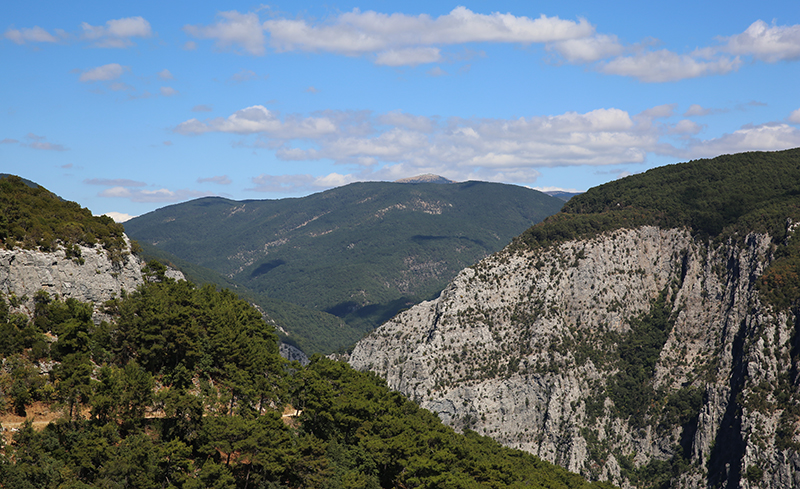
Nicander was a 2nd century BC Greek poet, physician, and grammarian and there is no surviving record of his claim. Gillian Turner, in her book North Pole, South Pole, admits that this story will have been embellished over time but acknowledges that if an electrical storm took place on Mount Ida and the naturally magnetic magnetite was struck by lightning, it would be permanently magnetised into lodestone and would therefore attract the nails of Magnes’s shoes.

The legend is not impossible but it is also possible the stone is named after the region where it was first found. In ancient Greek, magnetite was known as magnes lithos. There were two ancient regions called Magnesia and so the true provenance of the first discovery of the lodestone is hard to determine. In Greece, ancient Magnesia was a long and narrow slip of country in Thessaly between Mounts Ossa and Pelion. Around the 4th Century BC, the people known as Magnetes, migrated and settled in Ionian cities which were named after them as Magnesia on the Maeander and the neighbouring Magnesia ad Sipylum, currently in Aydın Province near Ephesus, Turkey.

I decided to follow the footsteps of Magnes.

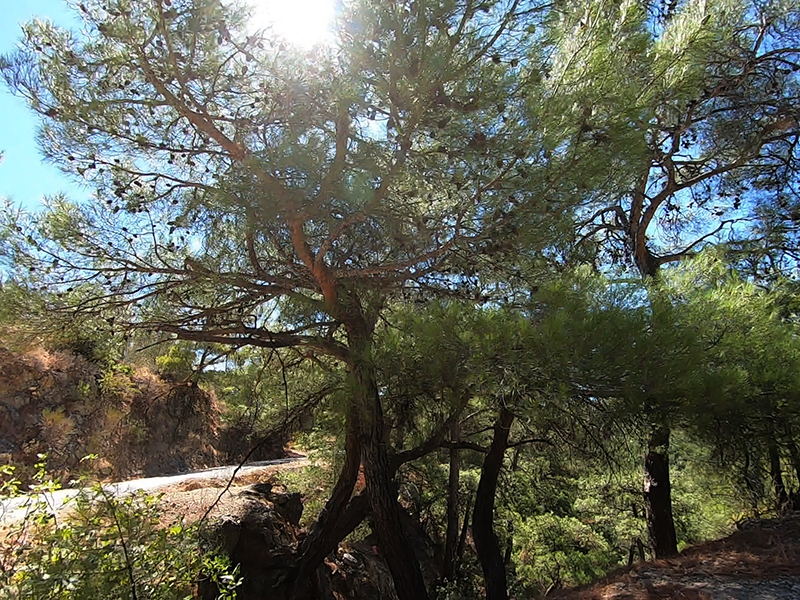
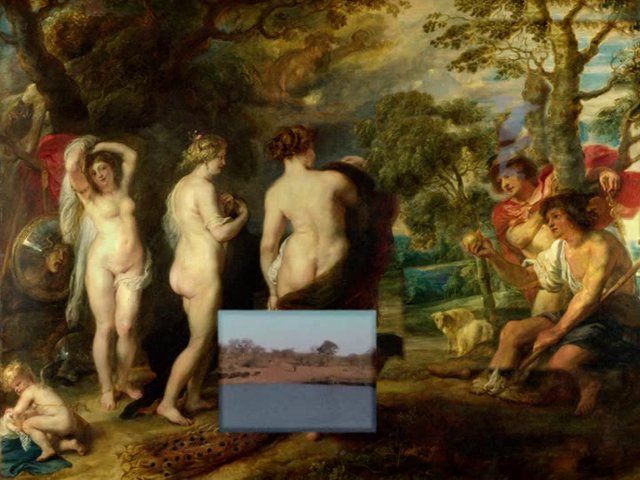
Mount Ida is famous in Greek Mythology as the location for the Judgement of Paris, where he fatefully chose Aphrodite as the most beautiful goddess, setting in motion the events of the Trojan War which the gods watched from its summit while its fir trees were felled to build the Trojan Horse. It was also an ancient sacred site for worship of the mother goddess Cybele, an embodiment of a universal Mother Earth. Its name was changed to Kazdağı (Goose Mountain) as the goose holds sacred significance in Turkish mythology. The landscape is literally breath-taking with very high oxygen levels due to the extensive pine forests and unique geographic features that funnel ionised air up from the sea to mix with the clear mountain air.

Setting out on the first evening the walk to view the mountain brought home the vastness of the landscape to negotiate.
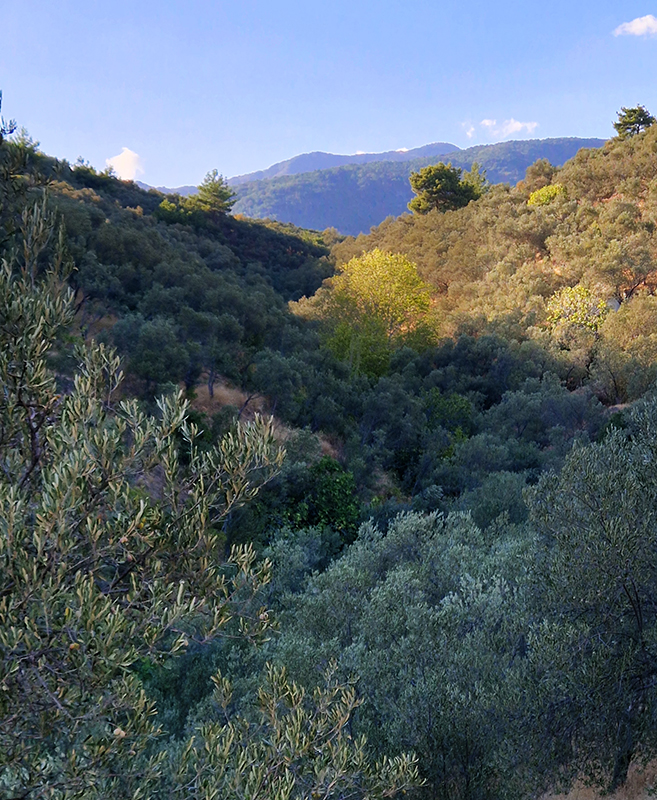
After dinner, the owner of our hotel in Zeytinli said he would find a guide to the area if we gave him 5 minutes. Thinking he would come back with a book of hiking trails, I was surprised when he returned with a Kazdağı National Park Ranger. We arranged to meet the next day when he led us up the dusty mountain tracks with his old school friend as driver.
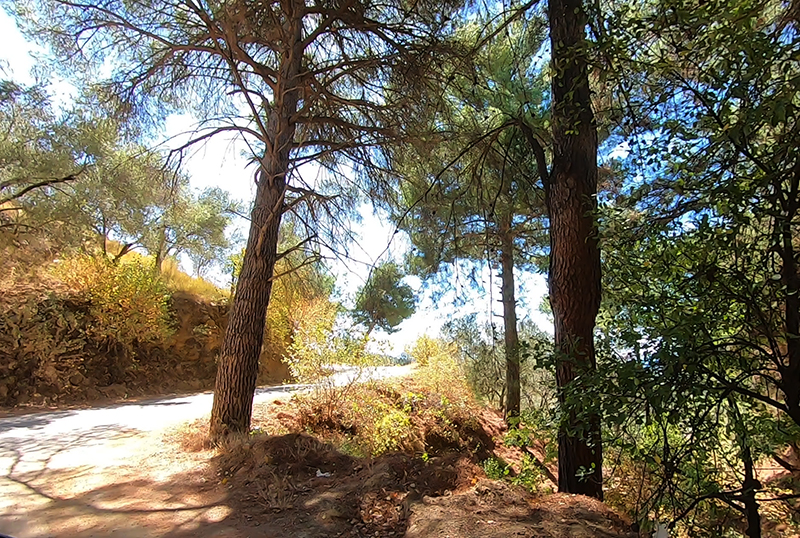
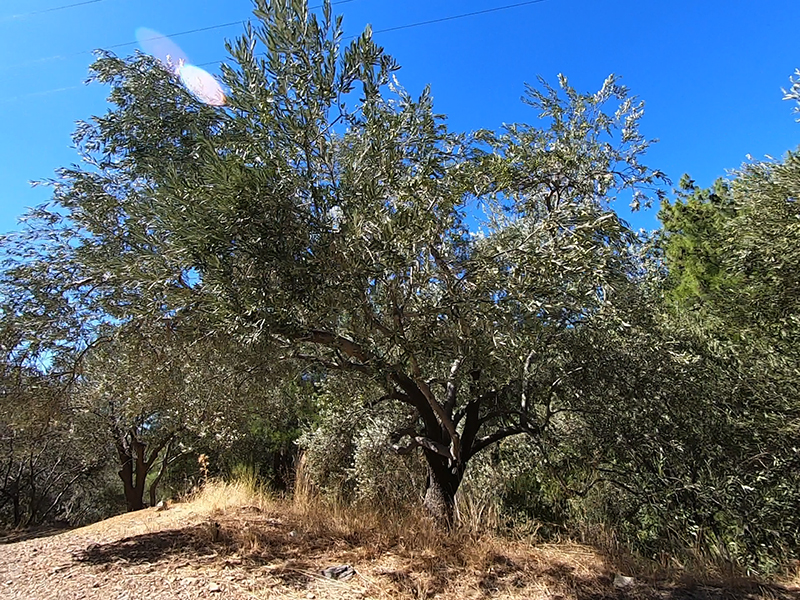
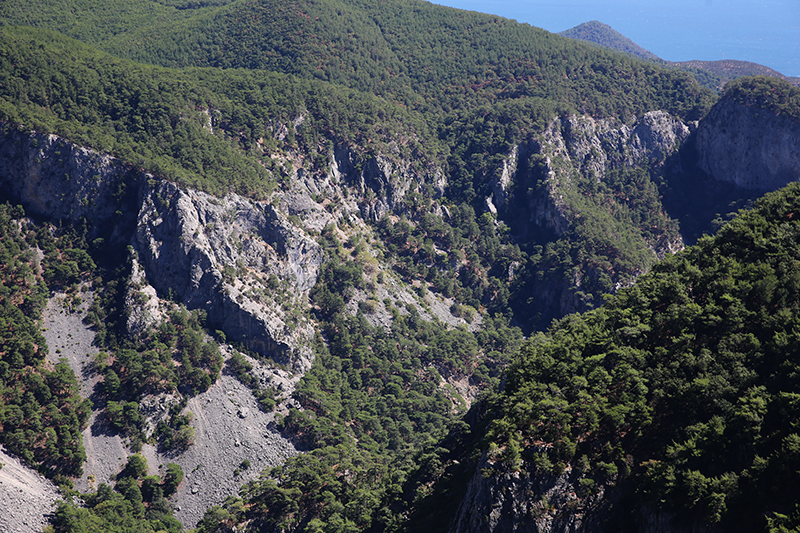
The summit of Mount Ida was always in the distance and it is not possible to walk unaccompanied in the National Park during the summer season. We drove up to a height of 800m to view the spectacular Sahinderesi Canyon.
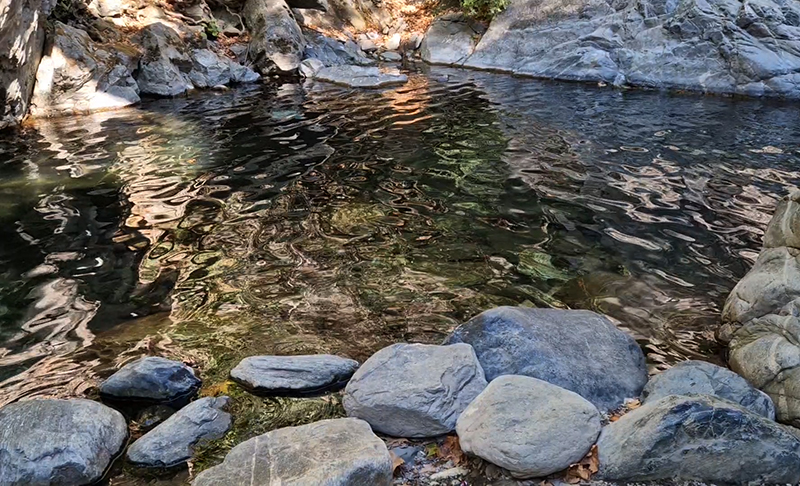
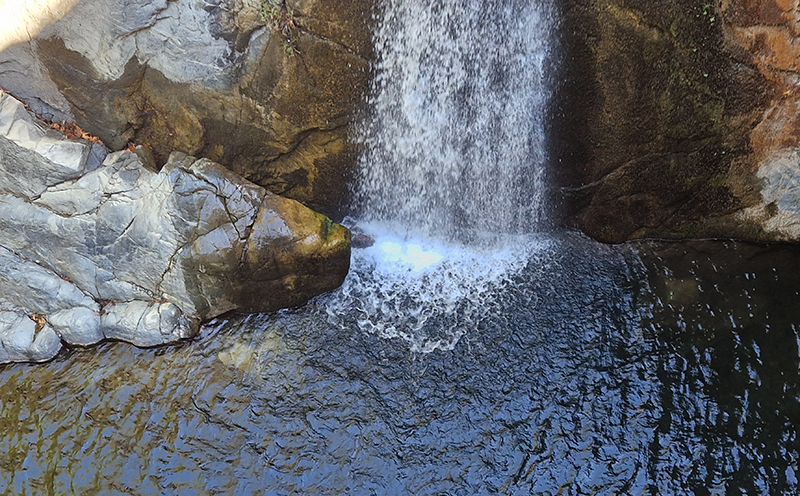
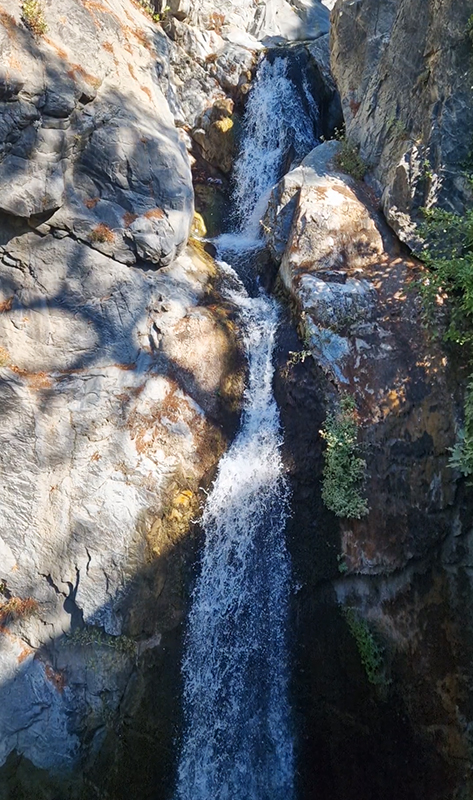
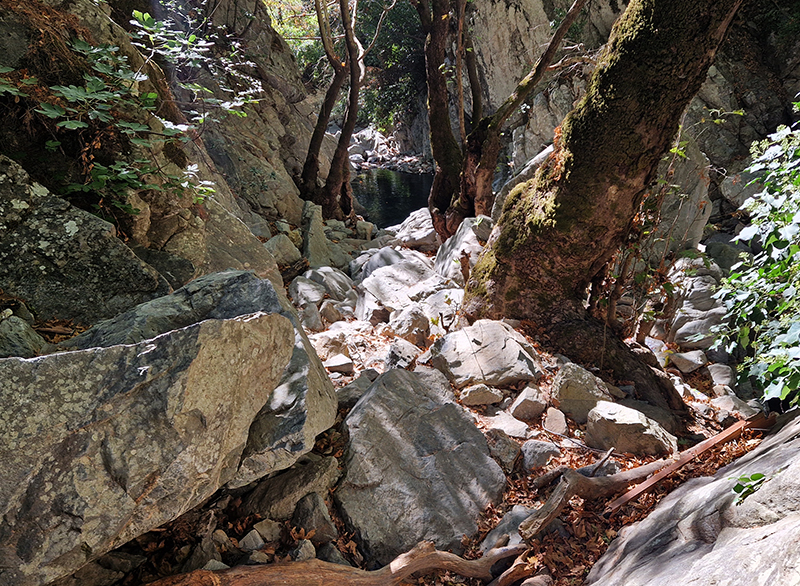
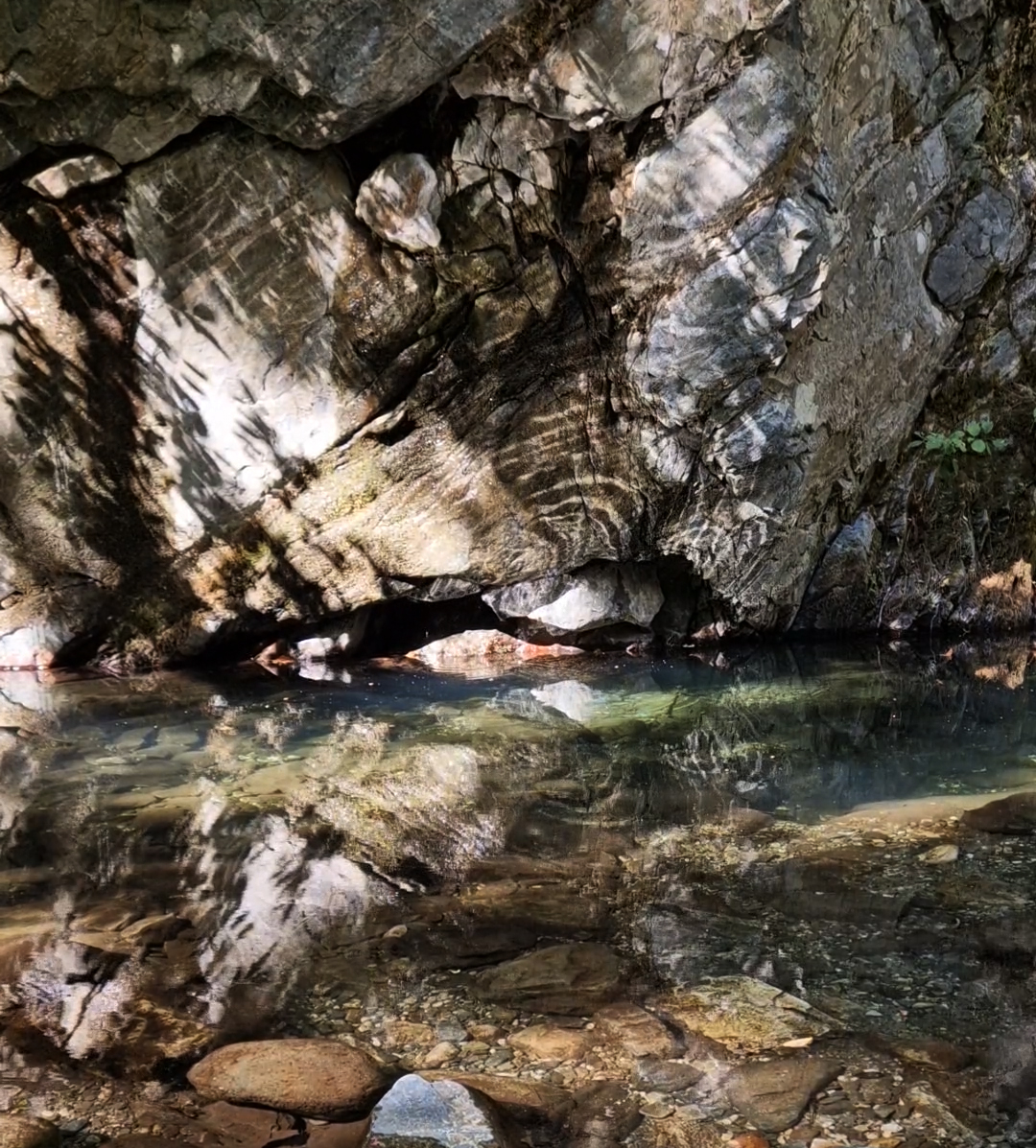
Mount Ida abounds with fresh water springs, rivers, ponds and waterfalls including the Sütüven Waterfall which we visited.
We visited the Ida Madra Geopark Museum which displayed tantalising exhibits of magnetite crystal and volcanic rock but there was only a security guard on duty who could offer no information about the collection or the local geology. The magnetite crystal does look like a broken magnet rather than raw crystal.
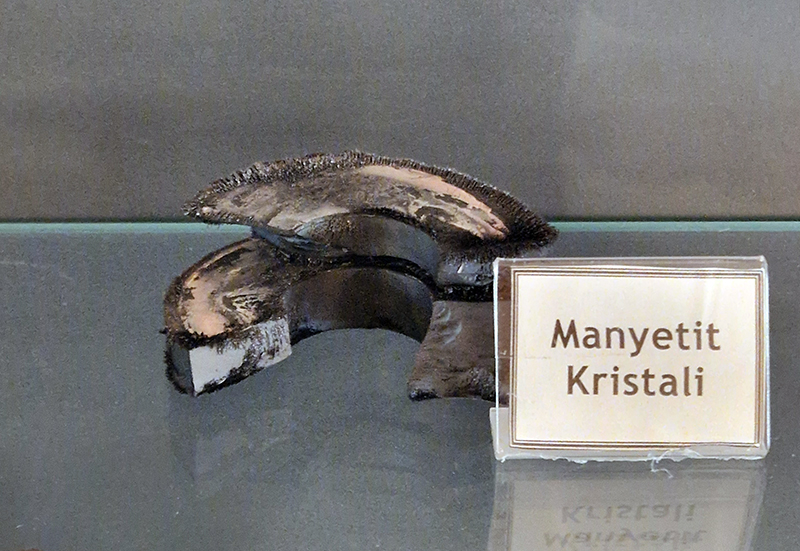
Fascinating choice of sentence to describe magnetite in the Turkish-English online dictionary – ‘Category, Turkish, English. Technical. 1, Technical, manyetit · magnetite n. The enzyme dissolved the brain tissue and left the magnetite particles intact.

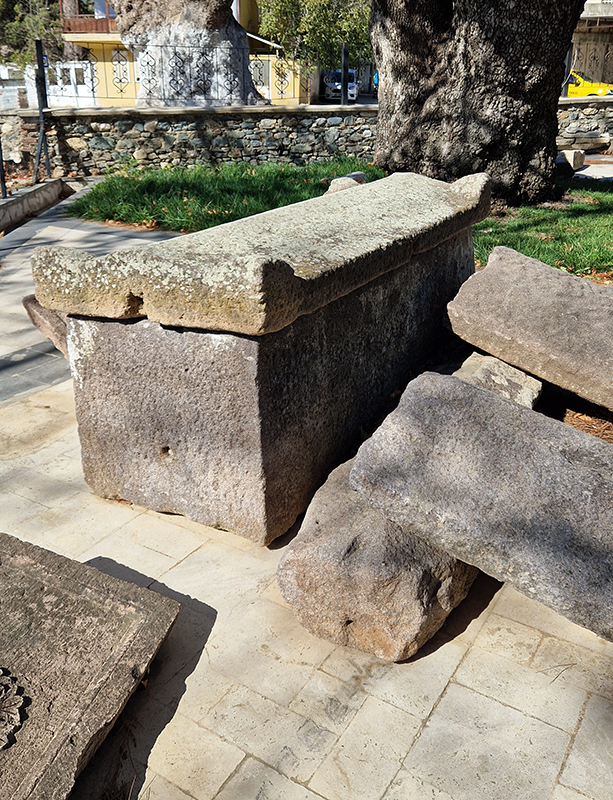
Outside the museum was a tomb that our guide told us is called ‘the man eating stone’. Pliny also talks about a stone called sarcophagus (stone of Assos) of which he says ‘It is a well-known fact, that dead bodies, when buried in this stone, are consumed in the course of forty days, which the sole exception of the teeth.’ There was also a magnificent Oriental Plane Tree, over 570 years old.
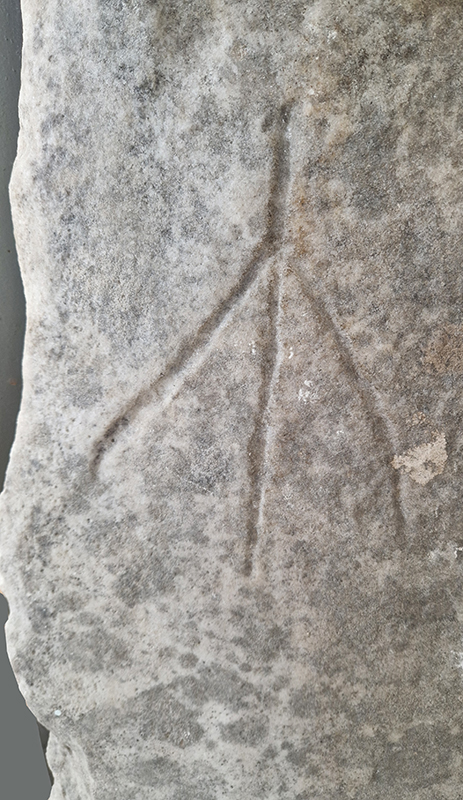
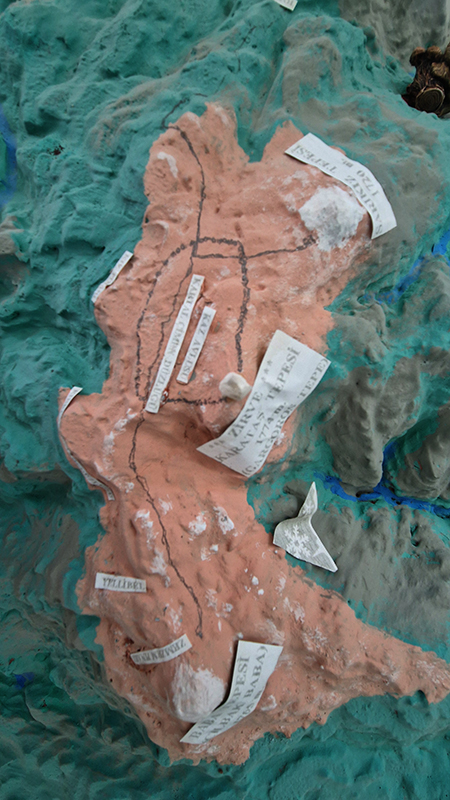
We visited the wonderfully eccentric Tahtakuşlar Ethnographic Museum which celebrates the cultural heritage of nomadic Turkish tribes and displays a stone tablet inscribed with the symbol of a goose foot reflecting the veneration of the goose by the Turkmen people. There is a rather faded model of Mount Ida which apparently shows the line of a mysterious ancient structure that circles the summit.
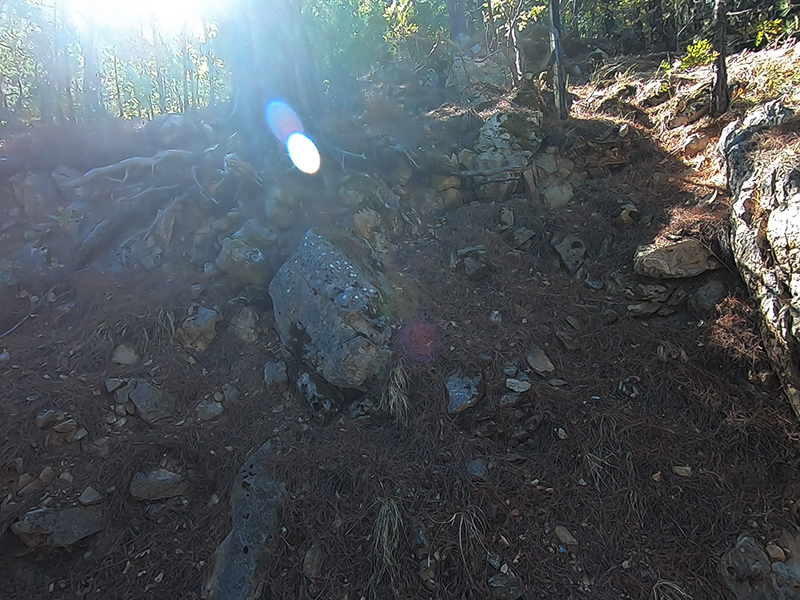
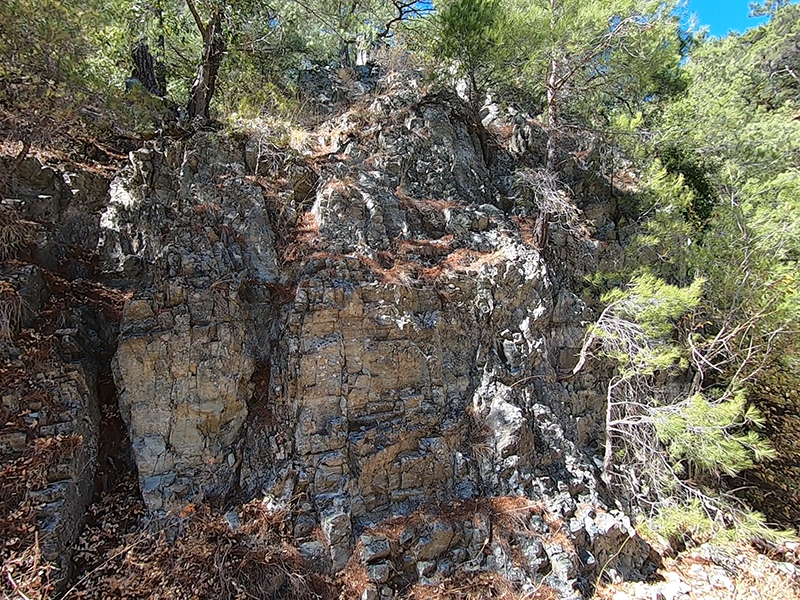
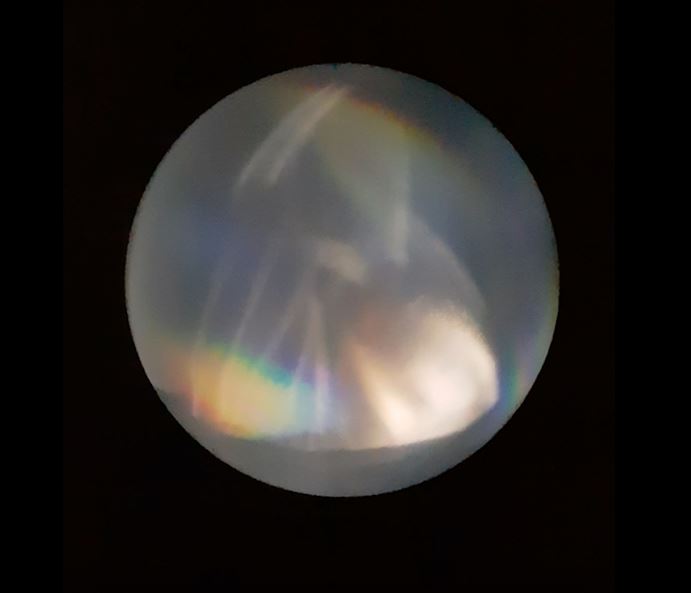
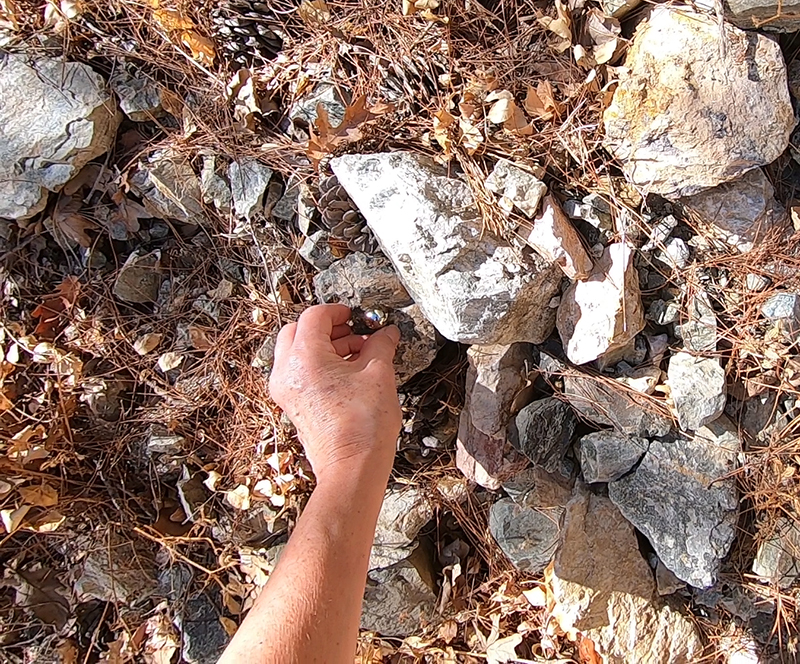
The next day we made another winding ascent. Equipped with my own magnet sphere (terrella) I went in search of magnetite on the foothills of Mount Ida. I was thrilled to discover some rocks that were magnetic.
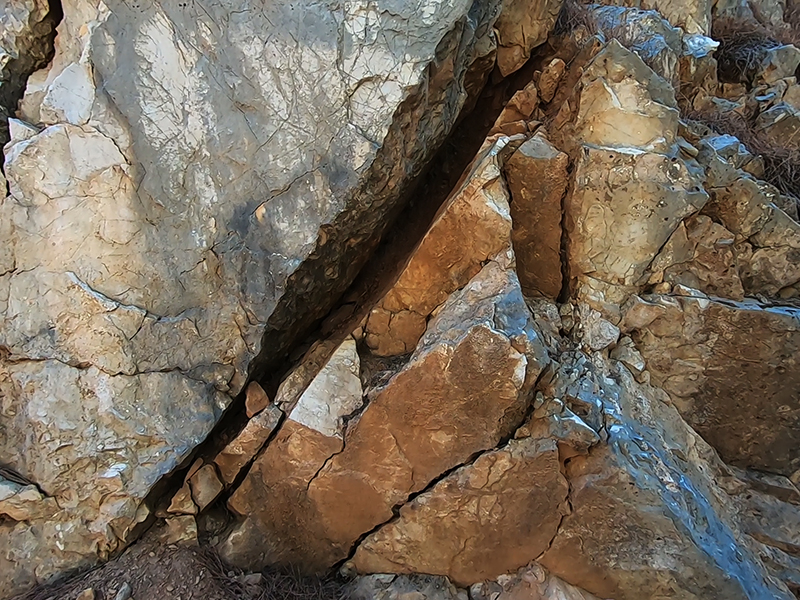
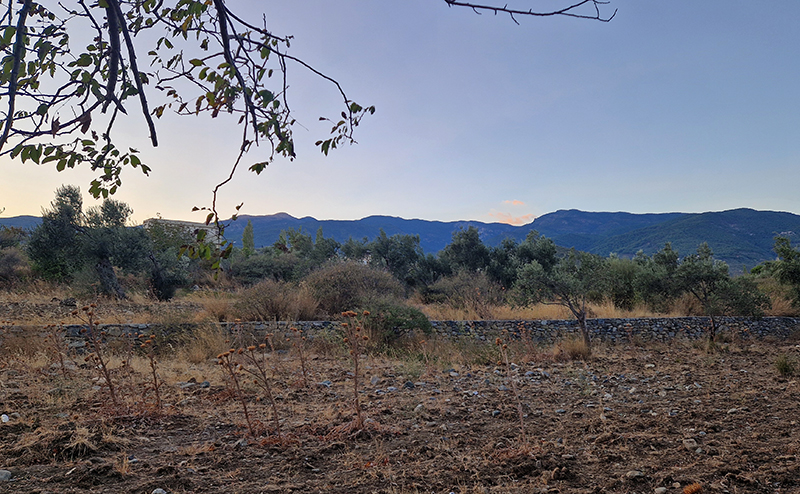
The final evening in northwest Turkey was spent watching the light fade over Mount Ida as bats and hedgehogs made an appearance along with quite a lot of street dogs that were thankfully more interested in barking at each other.
On to the urban geology of Istanbul and a number of monolithic erections. In the Hippodrome, once a vast public arena for chariot races, imperial ceremonies, and public events, there are several examples of phallic architecture.
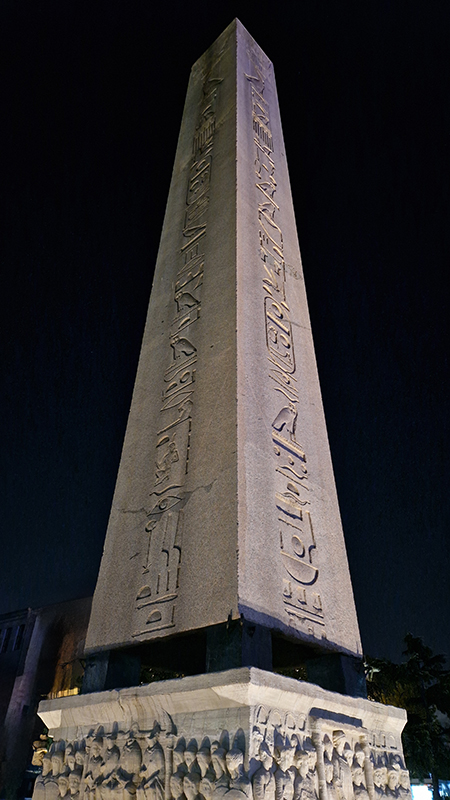
The towering red granite Obelisk of Theodosius, originally 30m tall, is an ancient Egyptian obelisk of Pharaoh Thutmose III (1479–1425 BC), first erected at Karnak to celebrate victory in battle. It was removed from Karnak and transported along the river Nile to Alexandria by the Roman emperor Constantias II in 357 and just 33 years later Theodosius I had it transported to Constantinople and erected on the spina of the Hippodrome, the relocation upheavals having reduced its height by a number of metres.

It is not known exactly when The Walled Obelisk was constructed but was probably built to mirror the Obelisk of Theodosius in the Hippodrome. Obelisks were often erected in symmetrical pairs. It was originally decorated with gilded bronze plaques (maybe to hide the fact that it wasn’t a true obelisk which should be hewn from a single piece of rock) but these were removed and melted down by Christian crusaders in 1204.

The Serpent Column is the remains of an ancient bronze column that was part of a Greek sacrificial tripod originally built in Delphi 478 BC as an offering to Apollo but relocated to Constantinople in 324.
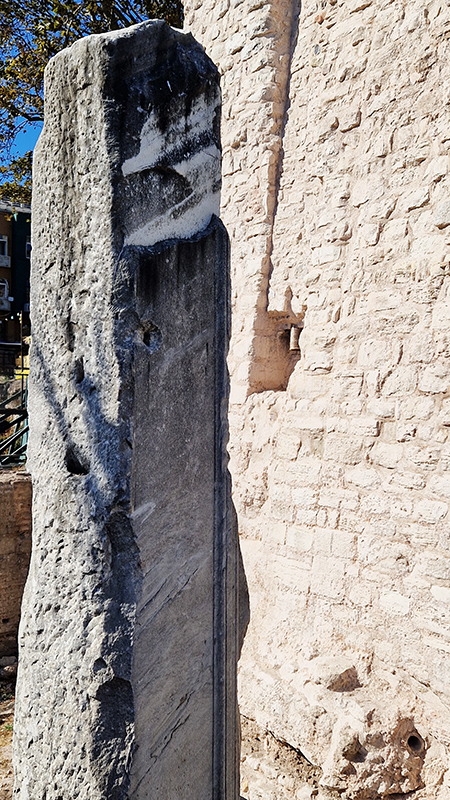
The stone Milion was a marker from which all distances across the Roman Empire were measured. Erected by Septimius Severus upon the re-founding of Byzantium as Constantinople in 330 AD it became the starting-place for the measurement of distances for all roads leading to the cities of the Eastern Roman Empire.
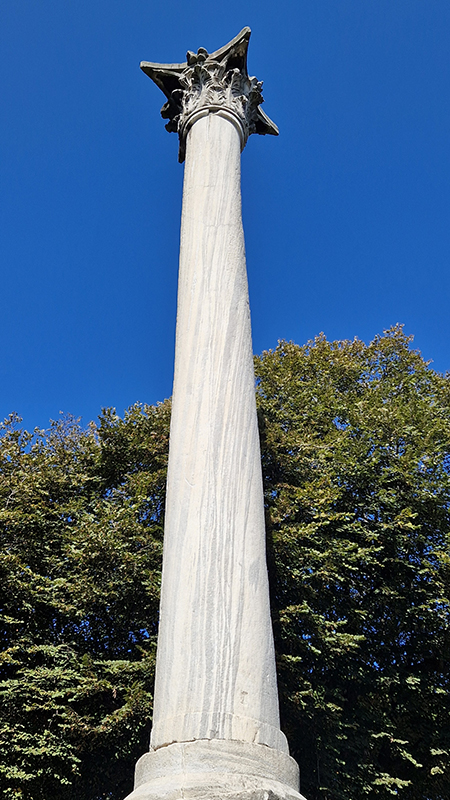
The Column of the Goths, a single block of marble 18.5 metres high, erected in Gulhane Park, is the oldest monument still standing from Roman times.
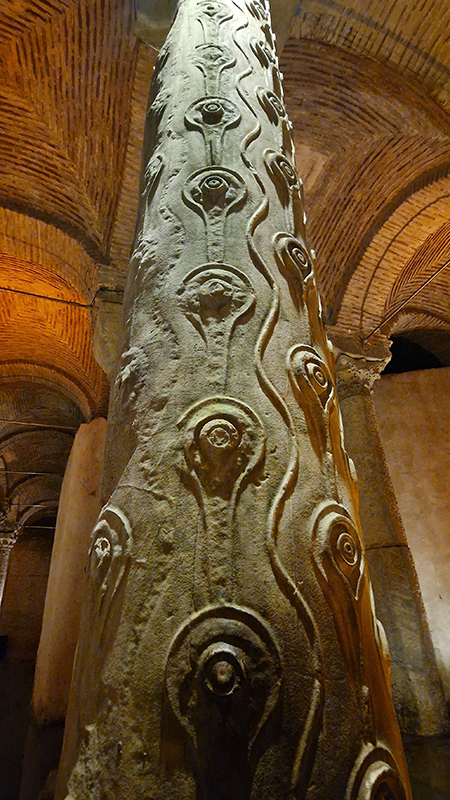
The Basilica Cistern is a vast subterranean forest of columns with the 4th Century ‘Tear Column’ standing out for its unique patterns which are often thought of as tears but may actually be a stylised representation of a tree.

The Basilica Cistern is the largest of several hundred ancient cisterns that lie beneath Istanbul, built in the 6th century during the reign of Byzantine emperor Justinian I to supply the city with drinking water. The ceiling is supported by a 336 marble columns, each 9 metres high which appear to have been recycled from the ruins of older buildings and are carved out of different types of marble and granite.

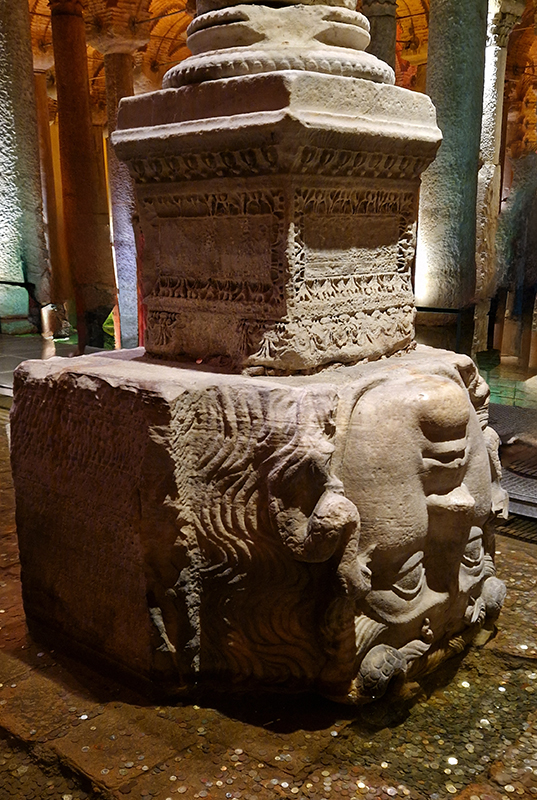
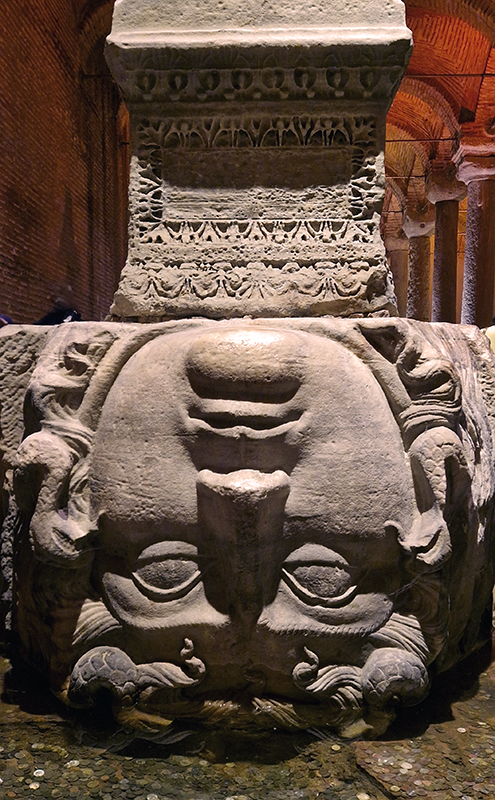
Two columns reuse blocks carved with the face of Medusa. Tradition has it that the blocks are oriented sideways and inverted in order to negate the power of the Gorgon which held that anyone who looked upon her was turned to stone.

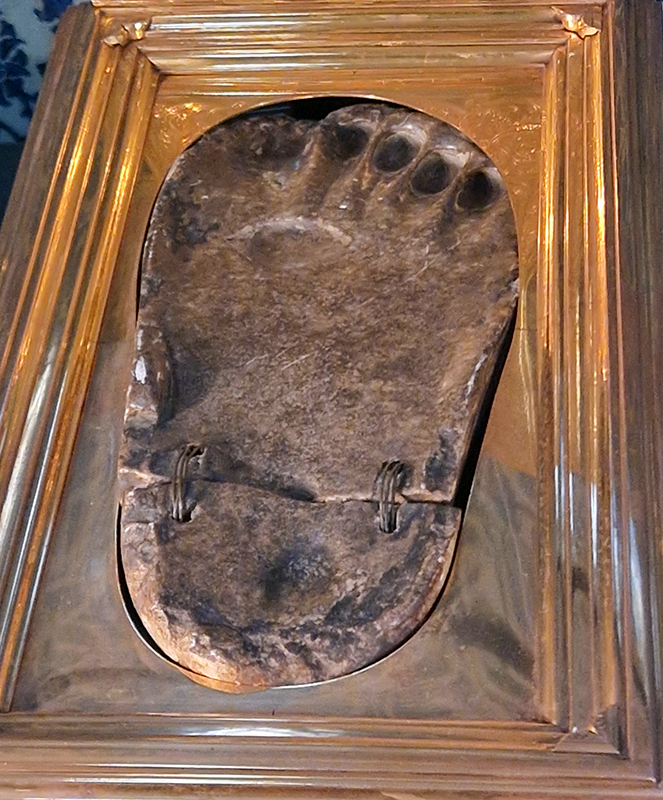
The Sacred Trust, of Islamic religious relics kept at the Topkapi Palace includes the Casing for the Black Stone, a rock set into the eastern corner of the Kaaba, in Mecca, Saudi Arabia. Revered by Muslims as an relic which, according to tradition, was set intact into the Kaaba’s wall by Muhammad before he became a prophet. It has had a turbulent history, being stolen, taken hostage and smashed. Today its fragments can be seen set in cement, encased in a silver frame on the side of the Kaaba, polished smooth by the hands and kisses of pilgrims. Although idolatry is forbidden in the Hebrew Bible and the Quran the use of aniconic stones, or baetyls, which are sacred stones stones venerated for their connection to the divine, without needing human-crafted images, were permitted. There has been speculation The Black Stone is a meteorite, but it has never been scientifically analysed to ascertain its physical origin. Also on display are footprints in stone (Kadem-i Şerif) attributed to the prophet Muhammad. An Ottoman scholar, Mehmed Münib Ayıntâbî (d. 1823) wrote a treatise to explain that this footprint was one of the miracles of the Prophet for otherwise how could it be possible to leave the impression of a foot on hard ground like stones. This was reiterated by a guide at the palace. There are six Kadem-i Şerif of the Prophet four of which are on stone and two of which are on brick, the most significant is the one in a gold frame believed to be left on his ascension to heaven from the Dome of the Rock.
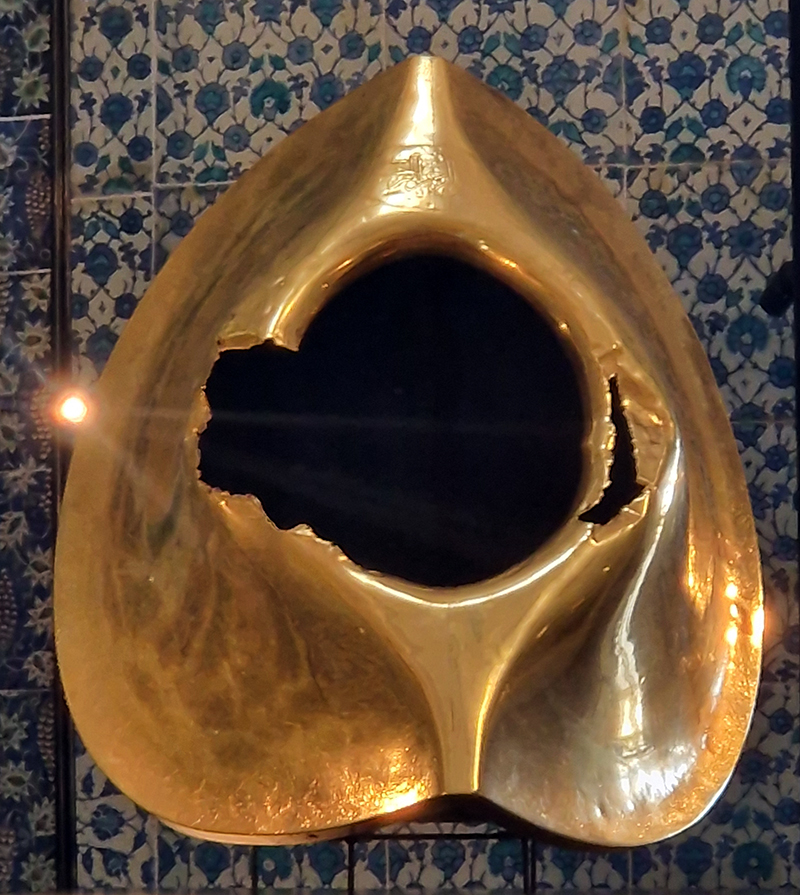
Mechanical clocks didn’t arrive in Ottoman lands until the 15th Century, 200 years after their initial invention. Chief astronomer to Sultan Selim II, Taqi al-Din, bemoaned the new instruments as ‘the most burdensome to construct, which demanded modest workers’. The qibla compass was used to determine the direction for prayer. This Ottoman marble sundial is from 1526.
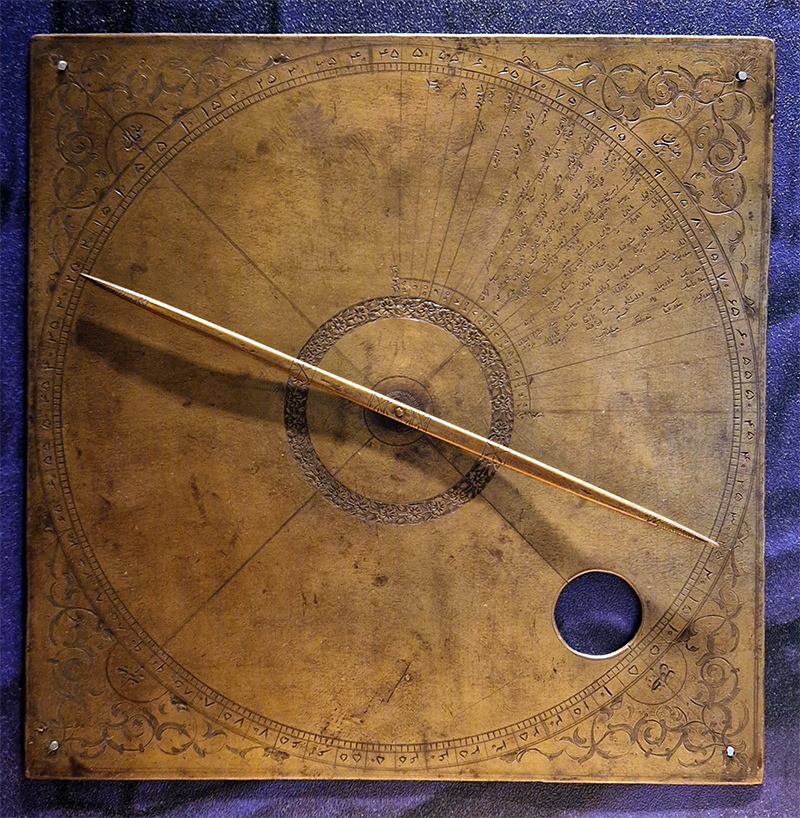
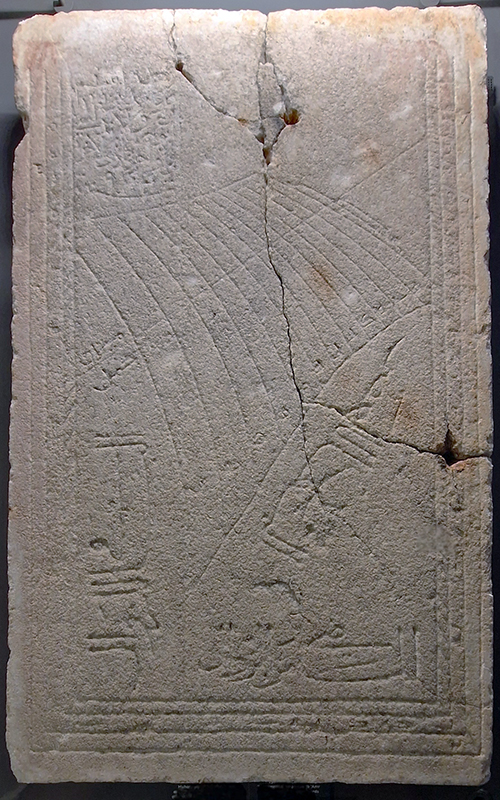
‘Were man to look up from the ground, he’d see a starry sky, were he to look down from the heavens – a wavy sea’ Tursun Beg. (15th century Ottoman historian who wrote a detailed account of Mehmed the Conqueror’s reign.)

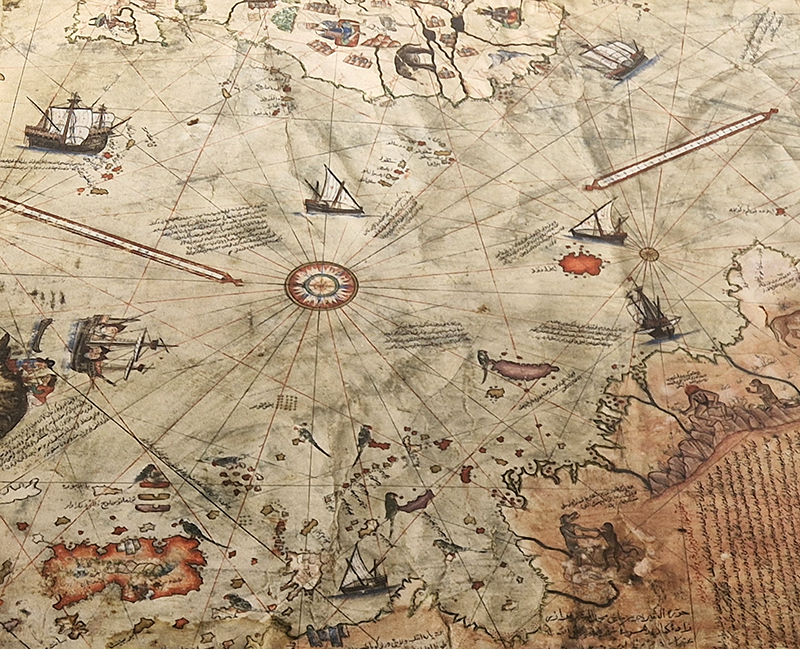
The 1513 world map made by Turkish cartographer Pîrî Reis was discovered in the Topkapı Palace Library in 1929. Pîrî Reis created an impressively accurate depiction of the newly discovered regions of the world using a circular design based on a hypothetical centre. This map is the earliest cartographic record of Columbus’s oceanic voyages and the first to show the unique fauna of Terra Australis.
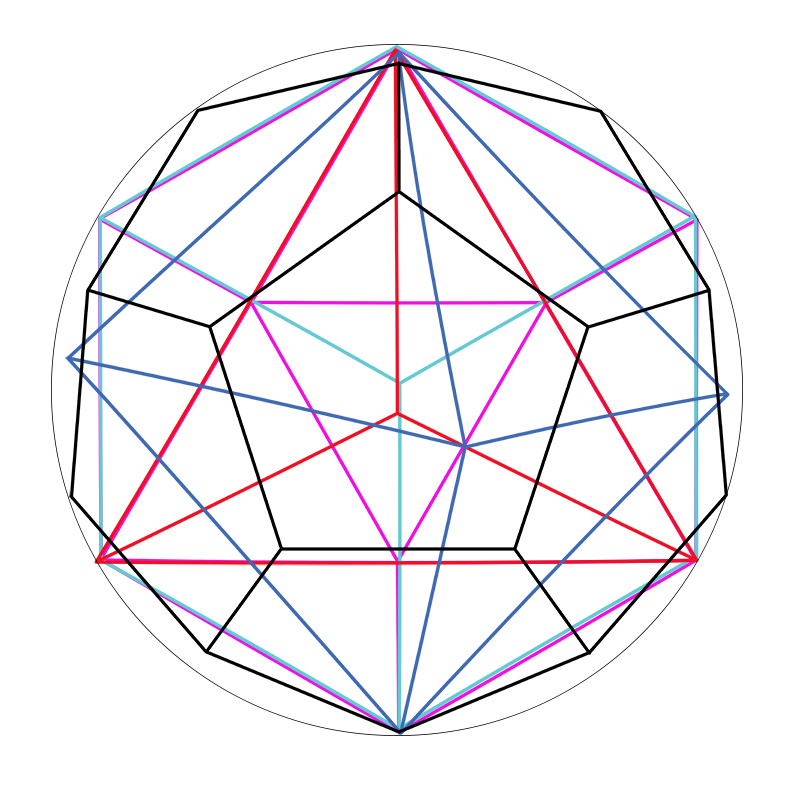
Beginning new work. Learning about the symbolism of sacred geometry in the Westminster Abbey Cosmati Pavement has inspired me to think about how I could relate ancient symbolism and contemporary iconography to think about changing relationships to fire, water, earth, air and the cosmos. Plato imagined the universe was created as a living creature in the shape of a sphere, perfect and complete in itself. Patterns of Thought author Richard Foster suggests that ‘as our minds become progressively tuned to ecological and global concerns, so the Platonic image of the world as a living creature is re-awakened from its sleep.’
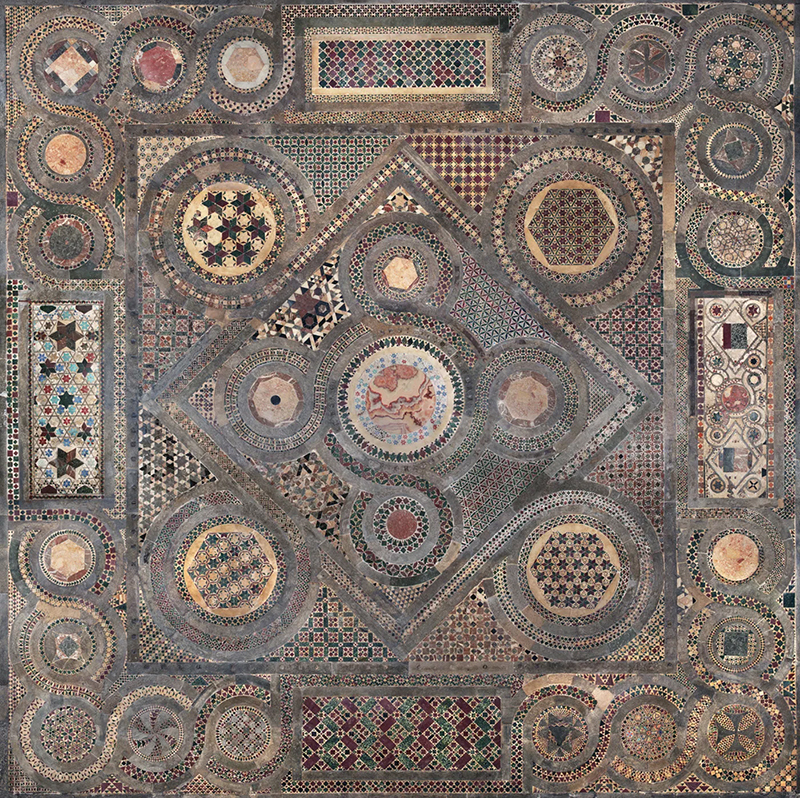
In the symbolism of the Cosmati Pavement, the journey from earthly materialism to spirituality is seen as a progression from multiplicity and diversity towards unity and uniformity. The tiles show a transition from a variety of patterns through to simplified regular polygons, the archetypes of form representing a perfection that we only experience as a shadow on Earth. Random patterns at the centre of the design describe the elements in an undifferentiated state of matter, the primal chaos before the division of spirit and matter when the breath of the creator swept over the ‘turbulent waters’ or ‘silva’ bringing forth the differentiation of matter into the forms of the four elements. The medieval mind never took the world at face value and always sought to see the coexistent and equally valid layers of meaning in everything.

In medieval cosmology the separation of the elements happened before the advent of time which began with the creation of the sun, the moon and the planets as astronomical time, the timelessness of eternity is alluded to by the number 60 + 1. The end of the world was imagined as a reversal of creation. All will return into the four elements which return to the primal chaos and are reabsorbed into the divine mind and eternity.

The four elements are linked by pairs of opposing qualities: Fire is dry and hot; Air is hot and moist; Water is moist and cold; Earth is cold and dry. Each element shares a quality with two others and elements with a shared quality combine more easily. Fire is sharp, tenuous and mobile, reflected in a quick tempered choleric human temperament, it gives vision and belongs to the heavenly race of gods. Earth is blunt, weighty and immobile reflected in a heavy melancholic human temperament. Earth resides with the sense of touch and those that walk on the ground. It has stability facing to the north, south, east, west, zenith and nadir. Air is sharp, mobile and weighty reflected in a breezy optimistic human temperament. Air amplifies hearing and smell, it supports the flying creatures and is synonymous with breath and spirit. Water is mobile, blunt and weighty reflected in a dissolute easy-going human temperament. Water amplifies taste and supports the creatures that swim.
I was interested to read that in the kitchens of the Topkapi Palace (1459) in Istanbul, the four humours (blood, phlegm, black bile and yellow bile) were taken into account when designing the menus. Different foods were recommended depending on their qualities to restore good health for those suffering sickness which was attributed to an imbalance of the humours. The seasons were also taken into account in relation to the humours when deciding which foods to cook.
Gallery Visits

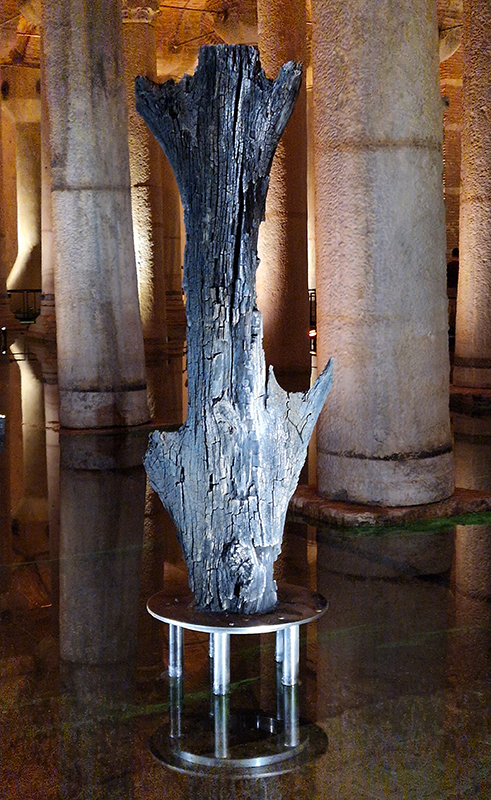
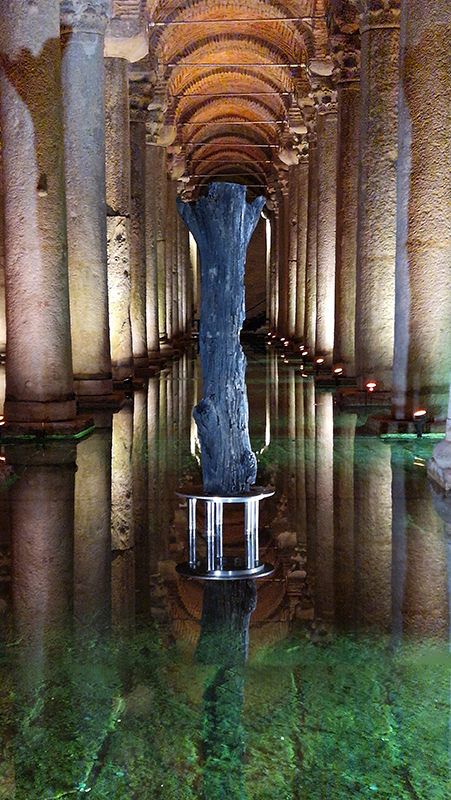
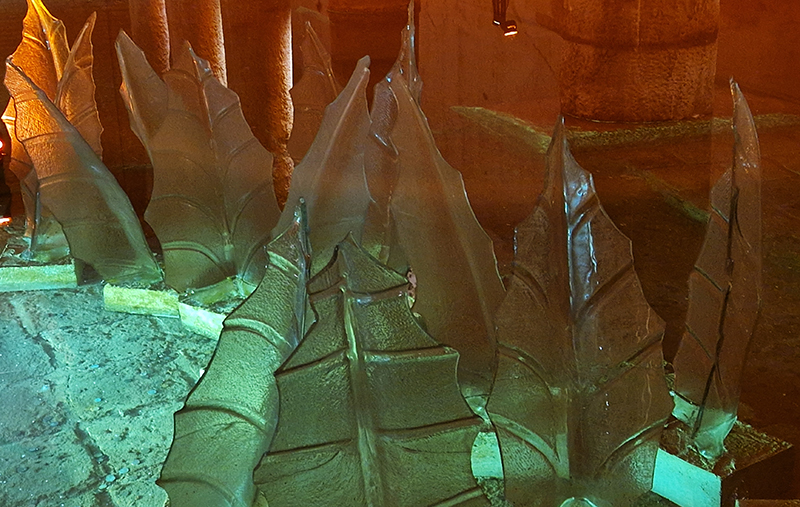
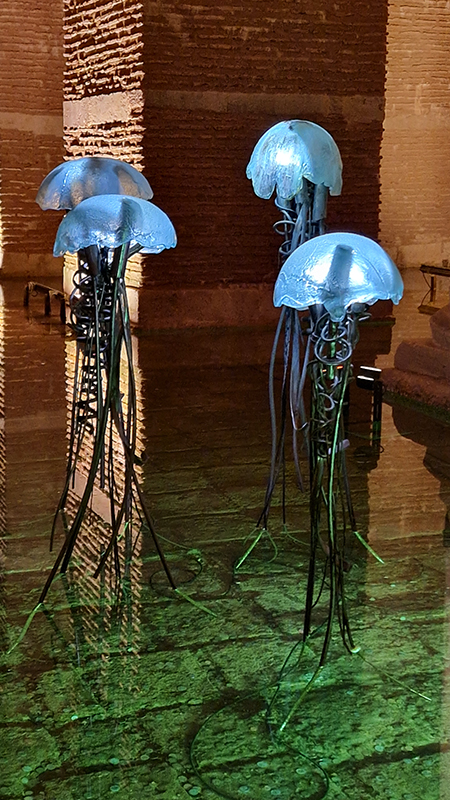
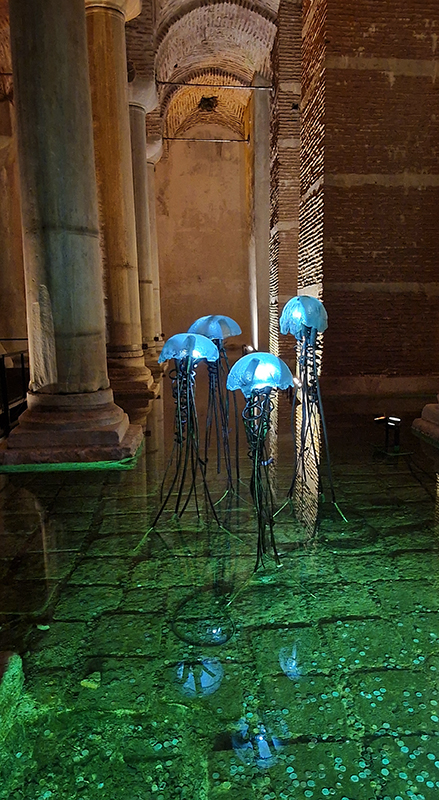
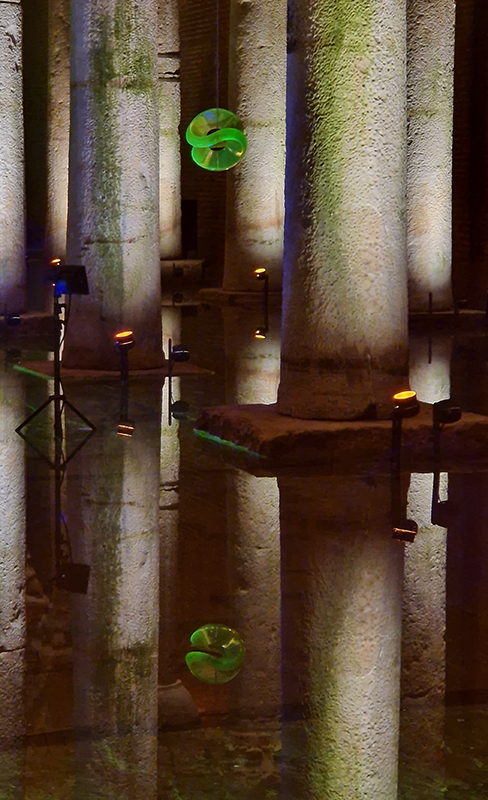
Deeper Beneath at the stunning 1500 year old Basilica Cistern Museum includes work by Vlastimil Beranek (Aqua One- Yellow – made from Bohemian Crystal), Jaroslav Prosek ( 6500 year old subfossil oak), Ali Abayoğlu (Glass Leaves and Jellyfish) and Muzaffer Tuncer (Seclusion)
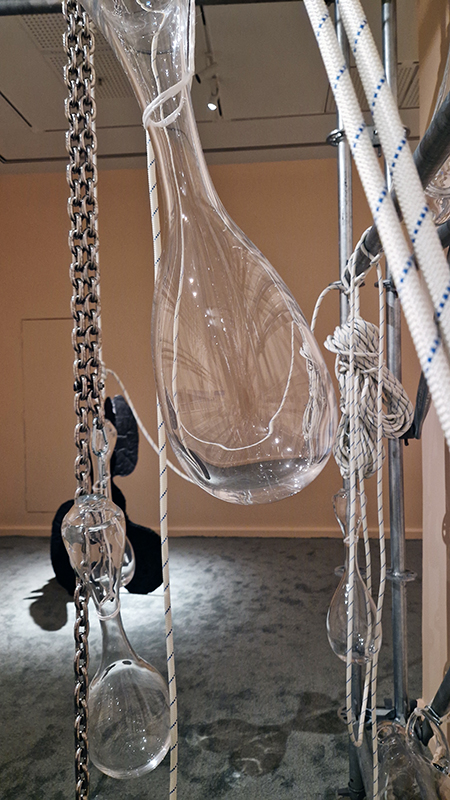
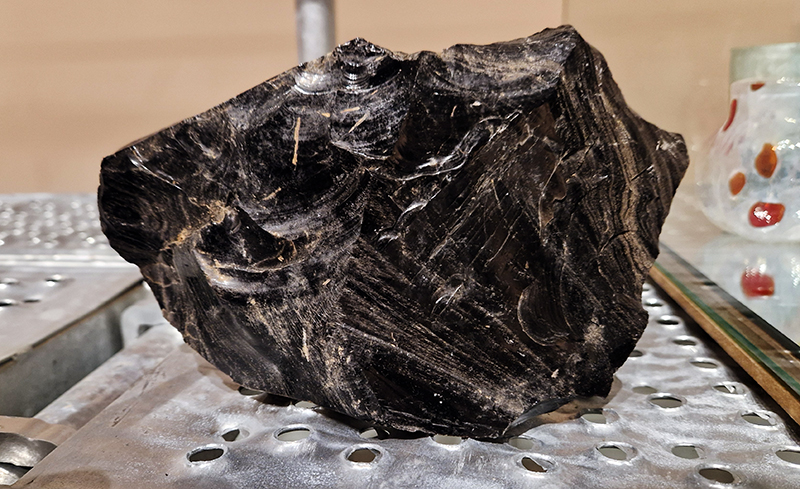
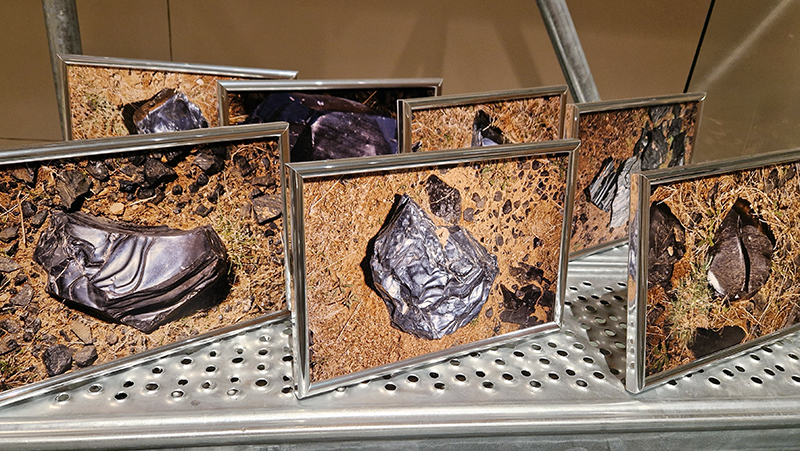
Åsa Jungnelius A Verse, Written with Earth, Fire, Water and Air at Pera Museum, Istanbul. The exhibition brings together the results of time spent in the obsidian fields of Eastern Anatolia collecting natural glass formed by the rapid cooling of volcanic lava and working in the glass furnaces of Denizli along with reflections on marble steeped in Byzantine history. Archaeological finds, glass objects, materials, and handwoven cords rooted in nomadic traditions are displayed alongside photographs by Swedish photographer Peo Olsson documenting the artist’s research. There is a strange juxtaposition of the installation scaffolding set against thick carpet in the gallery.

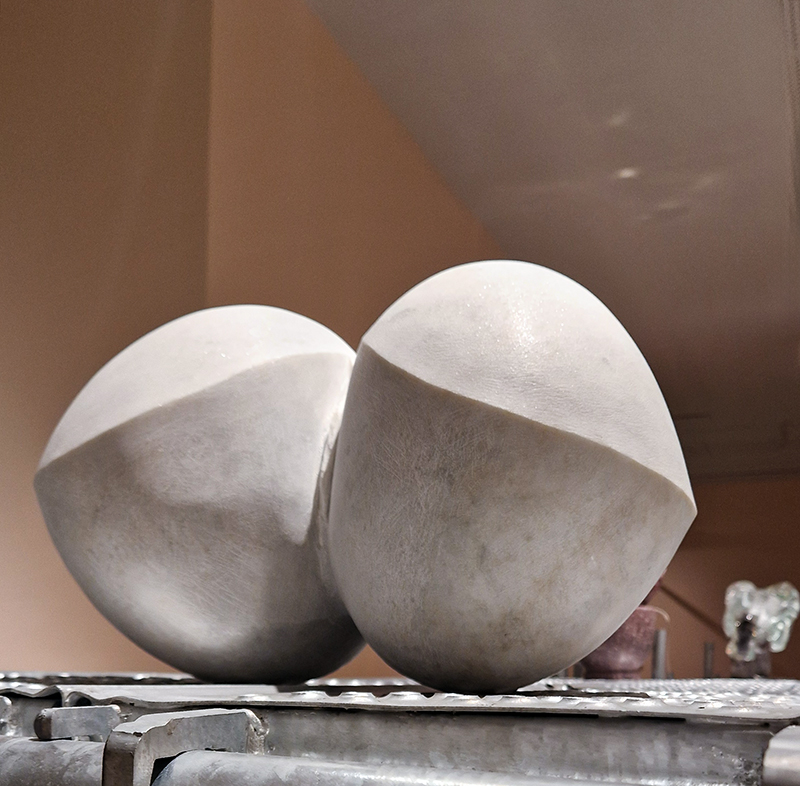
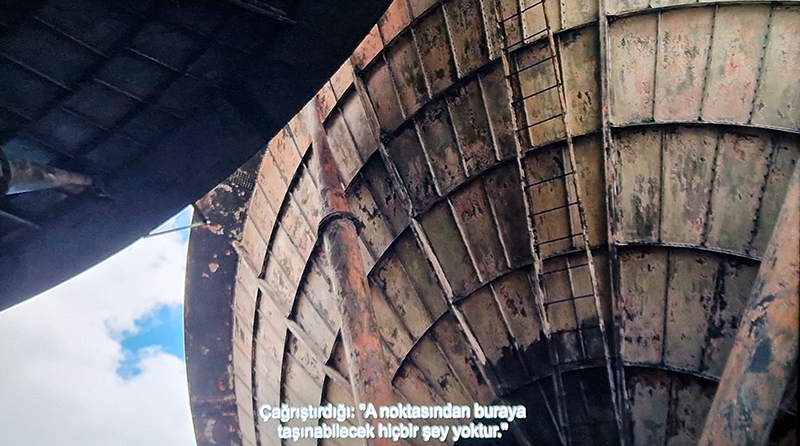
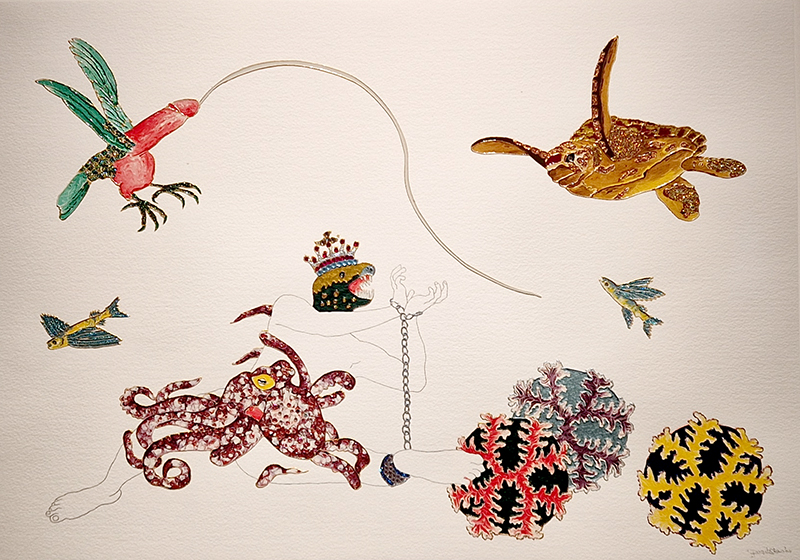
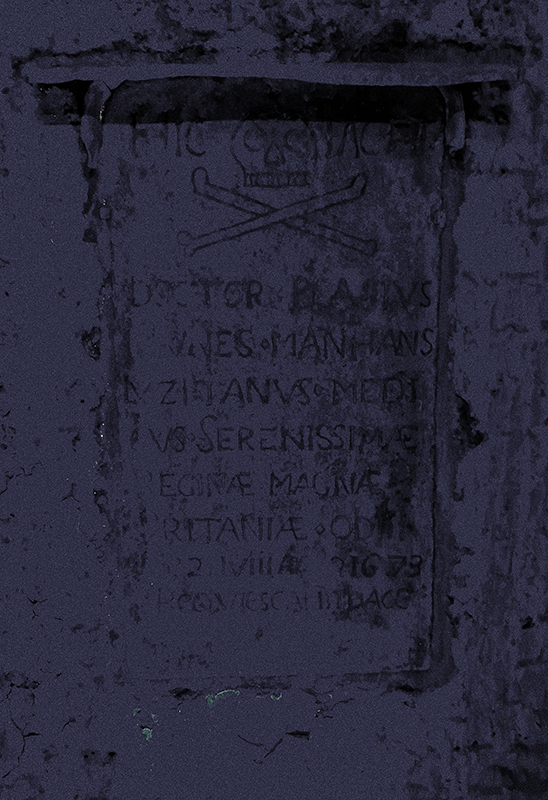
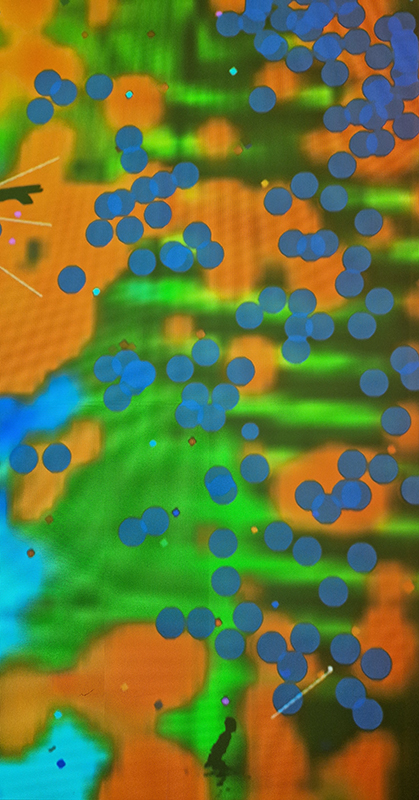
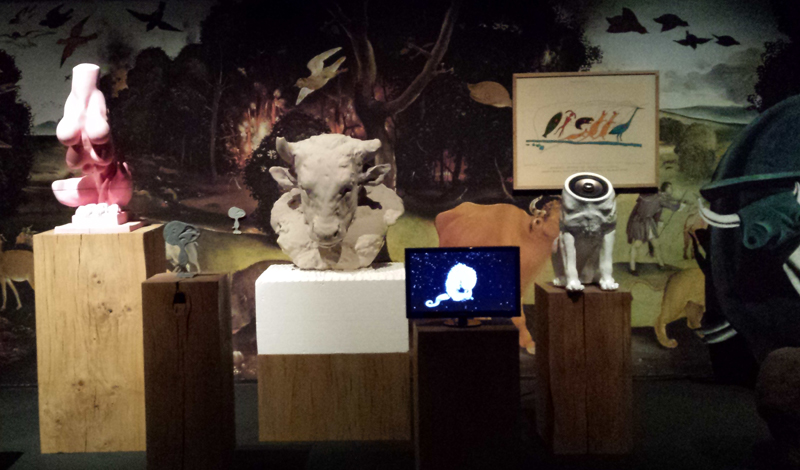
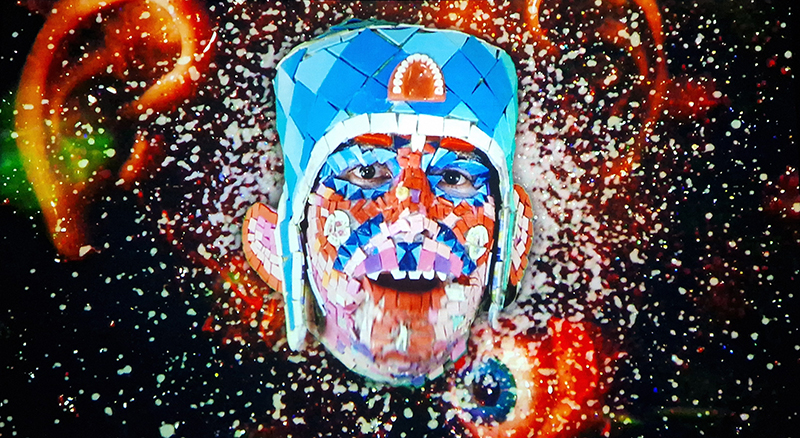
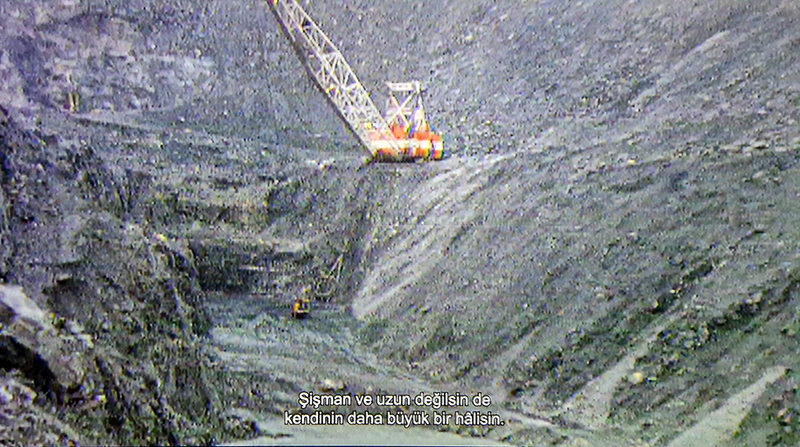
Also at the Pera Museum was Feelings in Common: Works from the British Council Collection. The exhibition is striving to form a zone where feelings in common are shared amidst uncertainties and transformations regarding the future. Happy to see Bedwyr Williams The Starry Messenger again (image 1 + 2 – the poignant geological story of a mosaic dentist which alludes to the micro macro scales of the universe ) and Larry Achiampong’s Relic 2 (an Afrofuturist exploration of postcolonial identities, imagined futures, and ancestral memory) along with a small work from Raqib Shaw from his Garden of Earthly Delights series amongst other works.
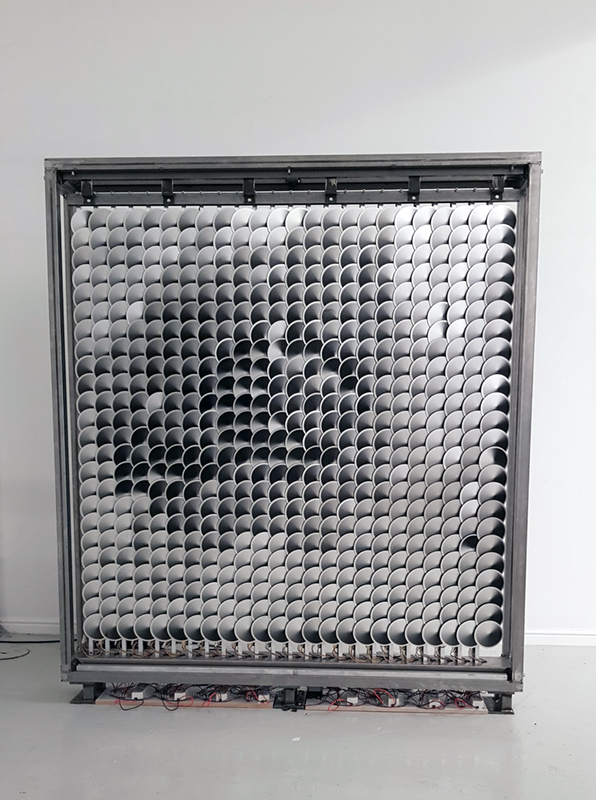
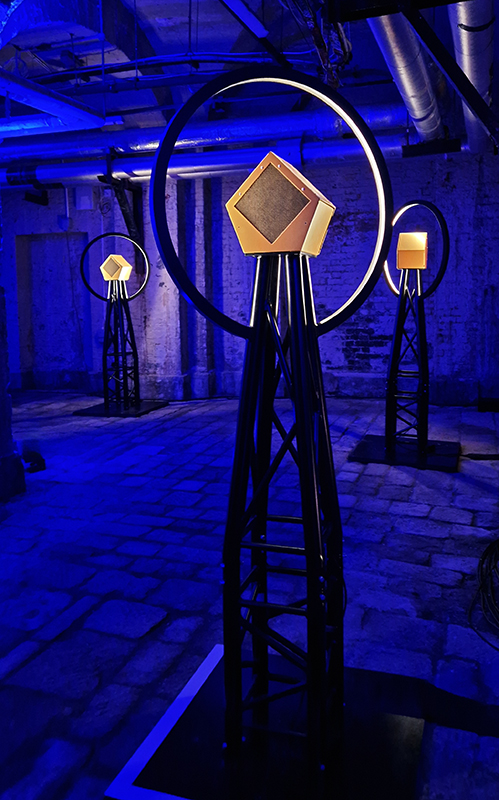
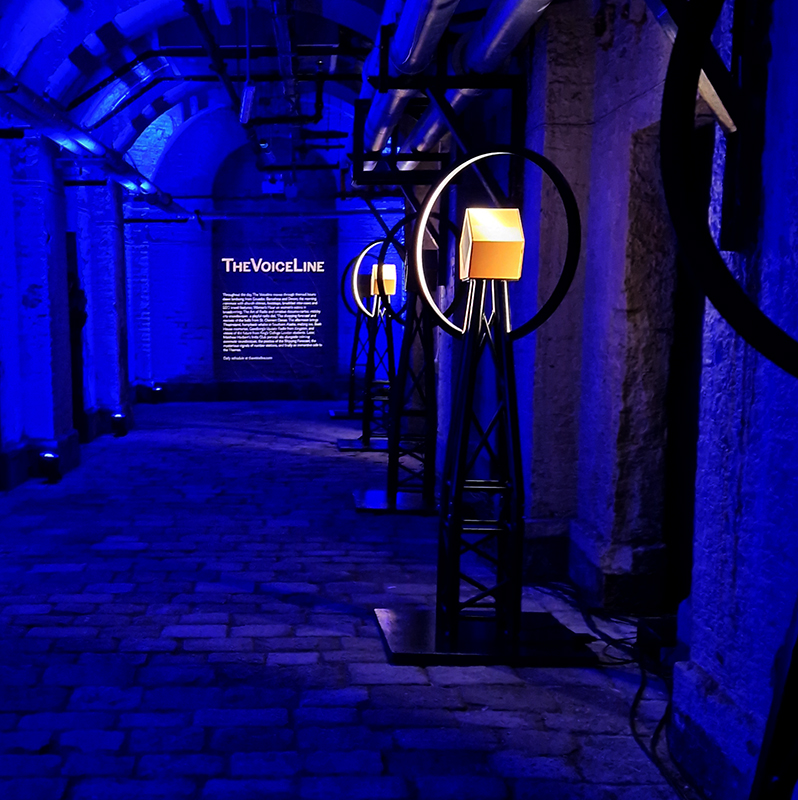
The VoiceLine by composer and sound artist Nick Ryan installed in the atmospheric Deadhouse, Somerset House. 39 precisely aligned speakers, creating an evolving pathway of sound reflecting the histories of radio and listening that began on the Strand more than a century ago.
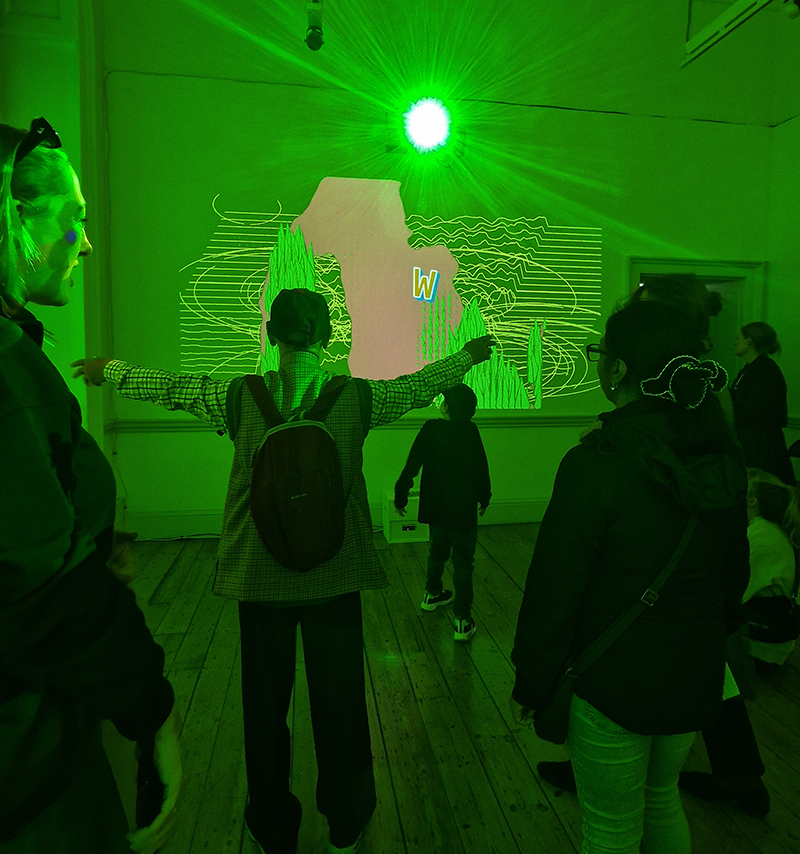
An exhibition by KitMapper, an artist led production company, Along More Latent Lines at Somerset House to showcase new and recent works of the team and creatives based here including the interactive and immersive Genetic Moo: Magic by Genetic Moo.
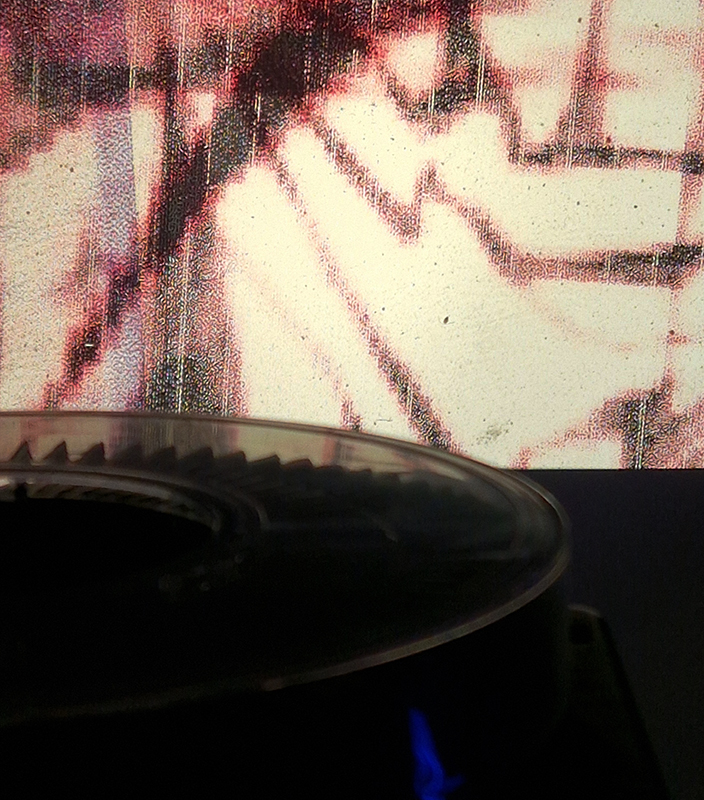
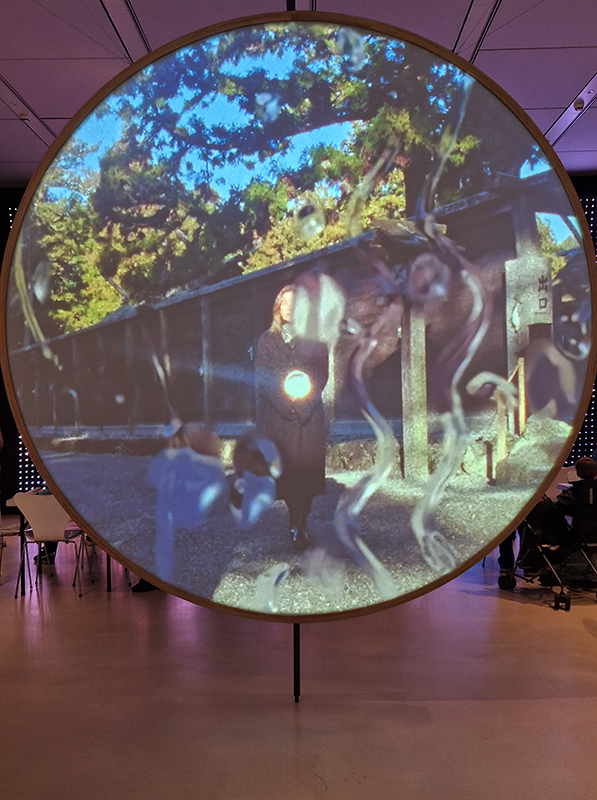
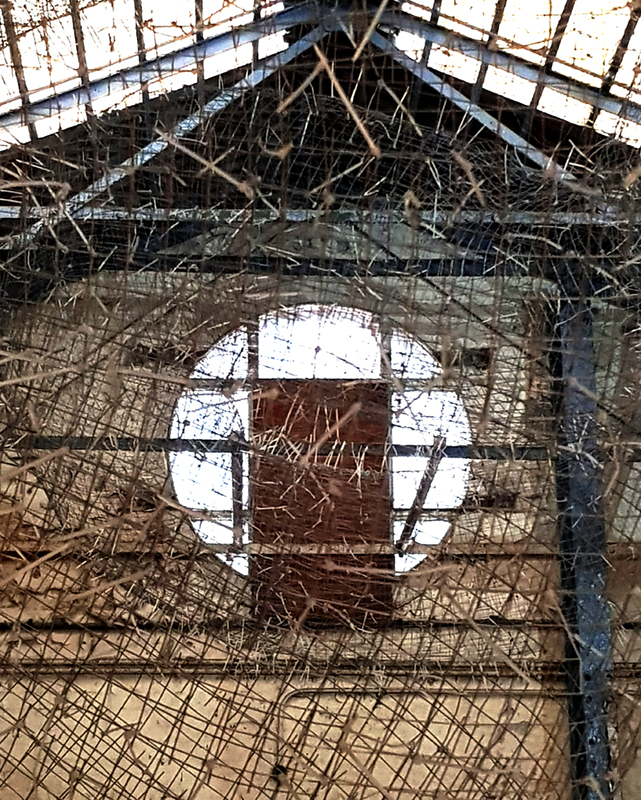
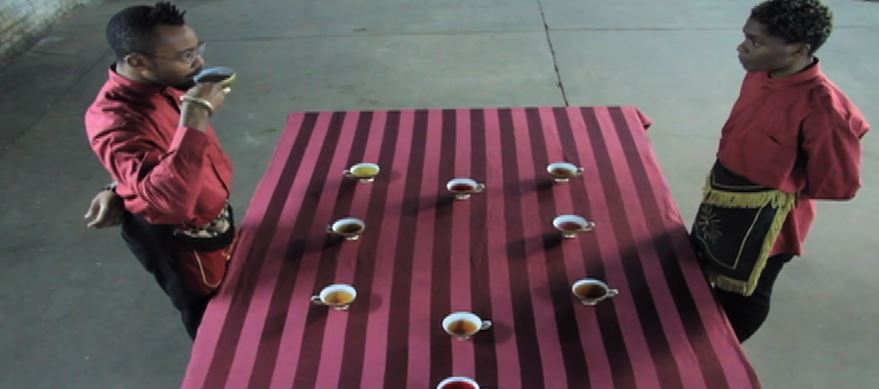
Jane and Louise Wilson Performance of Entrapment at The London Mithraeum Bloomberg Space featuring 2,000 year old oak stakes that inspired imagery looking at structure and ritual. The works investigates parallels between the sacred sites of Mithras and Japan’s Ise Jingu Shrine.
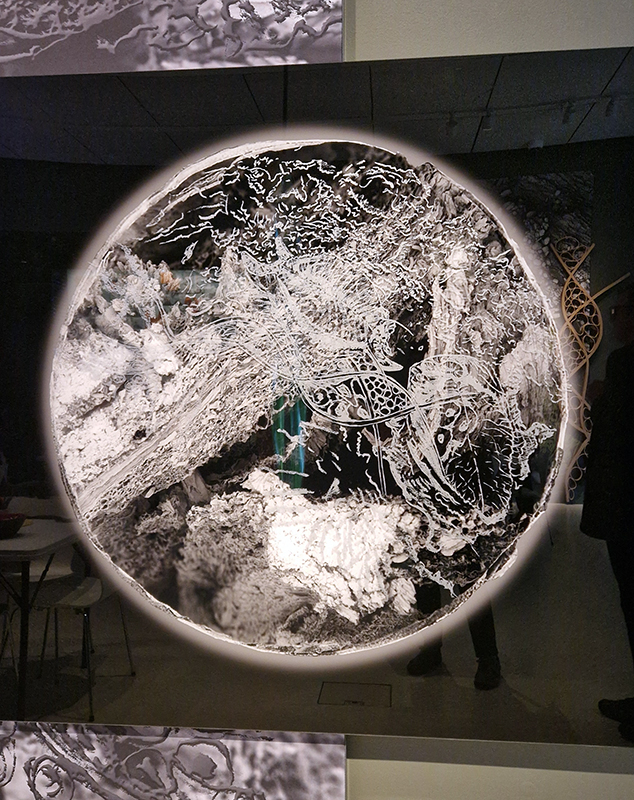
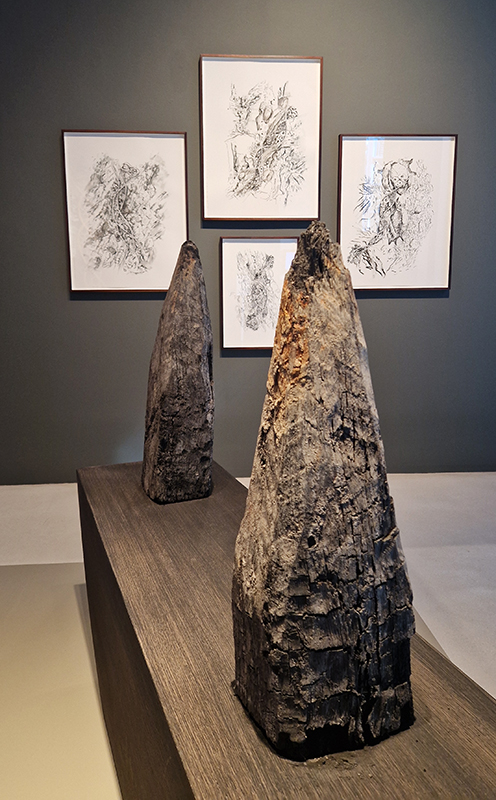
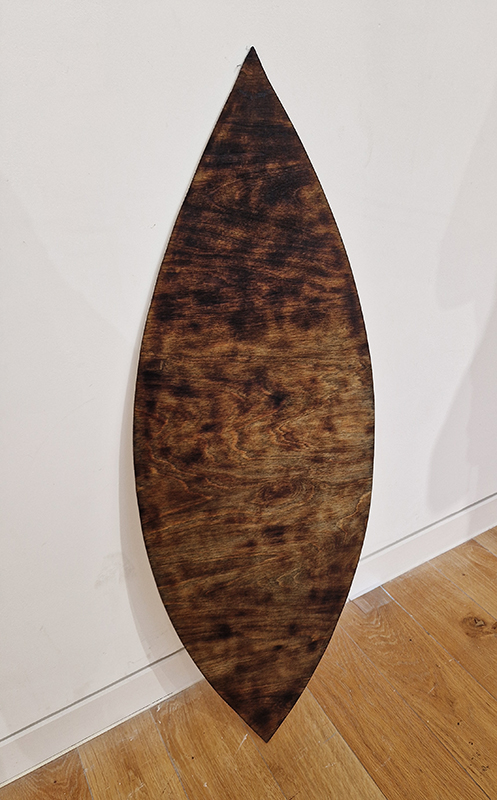
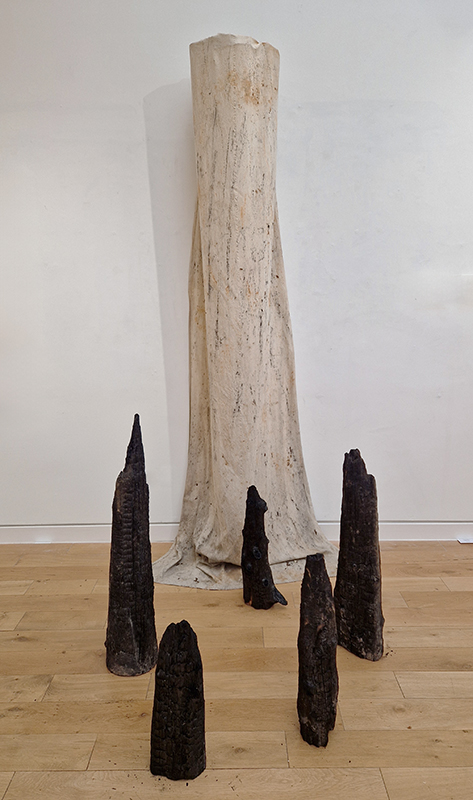
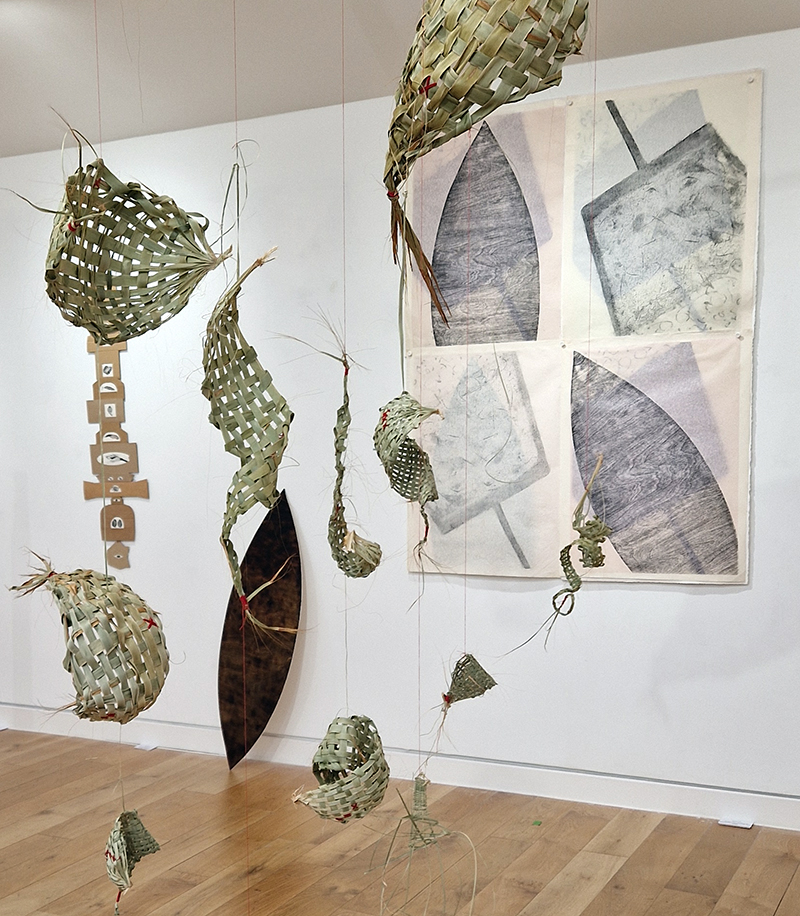
Treen (of a tree) was a collaborative event between Liz Botterill, Sevenoaks museum curator and the Kaleidoscope Gallery co-curators Rosalind Barker and Sue Evans, with the artists of Sevenoaks Visual Arts Forum. The artists were invited to respond to items in Sevenoaks Museum that are made of wood. Participating artists: Colin Anderson, Carole Aston, Jocelyn Bailey, Rosalind Barker, Susanne Beard, Sarah Cliff, Christina Crews, Louisa Crispin, Margaret Devitt, Louisa Donovan, Duncan Dwinell, Sally Eldars, Sue Evans, Deborah Farquarson, Victoria Granville, Kate Grimes, Amanda Hopkins, Marilyn Kyle, Keith Lovegrove, Venetia Nevill, Clare Revolta, Franny Swann and Irene Vaughan. Venetia Nevill worked outside the remit to create ‘Memories of a tree’ to honour a plantation of spruce trees that have been felled, because they were infected by the spruce beetle. Her process of wrapping a cloth around a tree, and rubbing the burnt soil, ash and charcoal into it, memorialises and commemorates the trees. Over a few months the cloth absorbed the sunlight, birdsong and passing of time, allowing the elements to leave their mark, and create a cloak of protection. The cloth is exhibited along with burnt remains of trees.
Reading

North Pole, South Pole: The Epic Quest to Solve the Great Mystery of Earth’s Magnetism by Gillian Turner. A very readable account of all the philosophers, explorers and scientists fascinated by the origin of Earth’s magnetism, from the earliest speculations of lodestone mountains, magnetic polar stars to seismology and deep ocean core sampling revealing the inner working of the planet.

Turning to Stone by Marcia Bjornerud. This book is the antithesis of the idiom ‘as cold as a stone’. It is a passionate and candid account of relationships between humans and rocks. Human to human, human to rock, rock to human and rock to rock. Along the way we learn a lot about geology and the human condition.
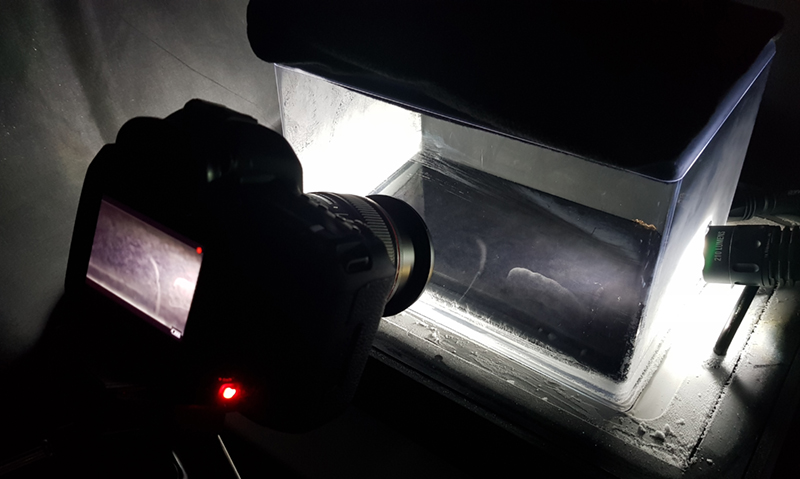
I had a very productive time during my Studio4 residency at Chisenhale Art Place. It was great to have so much space. I got started by putting up the hydroponic tent to run the cloud chamber to get some more film footage.

1803 filming cloud chamber (1)

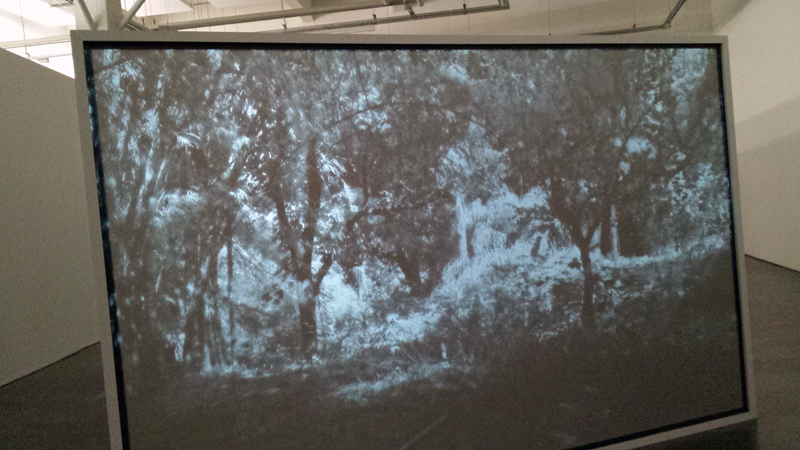
I also ran a Cloud Chamber Workshop where lots of particle trails were spotted. The cloud chamber gives us a glimpse into the invisible world of particles produced in the radioactive decay of naturally occurring elements and those generated when cosmic rays strike the top of the Earth’s atmosphere.
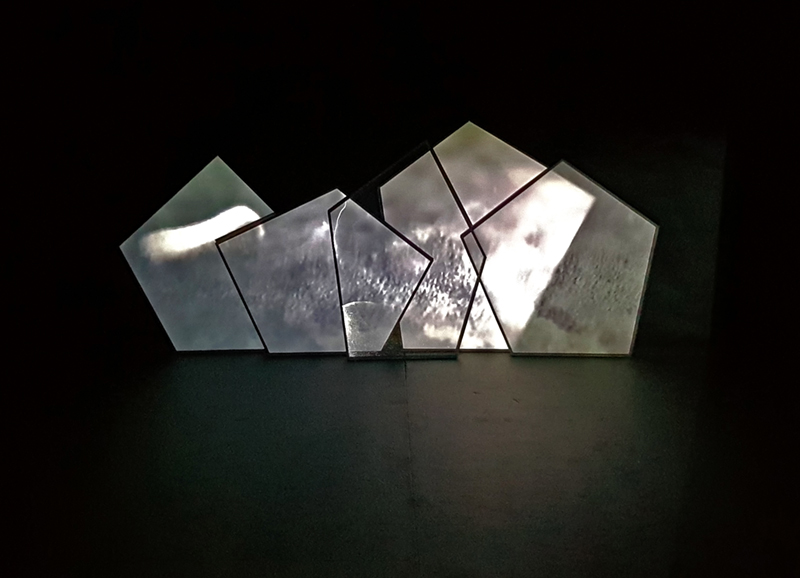
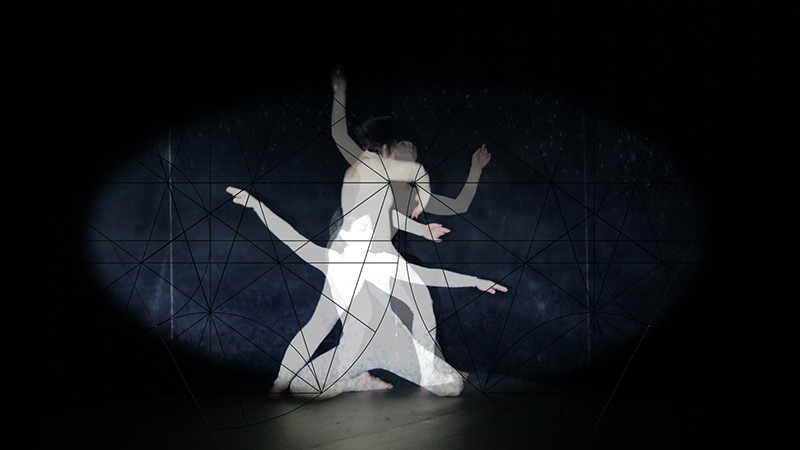
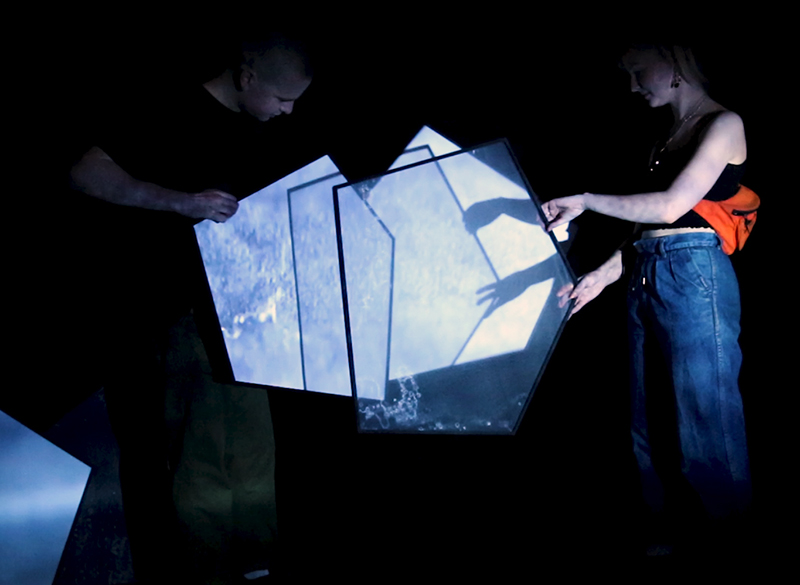
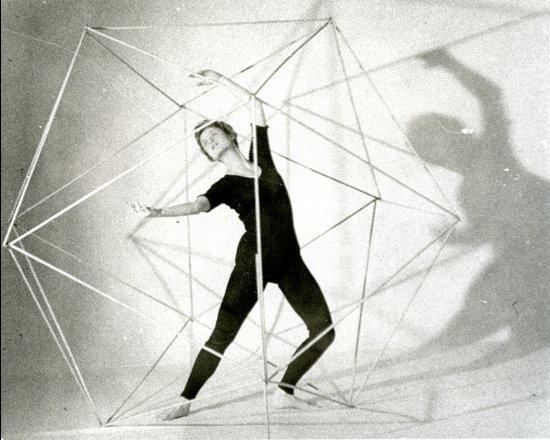
My call out through Chisenhale Dance Place for a dance collaborator was successful and I met up with dance artist Paola Napolitano She has brought lots of brilliant ideas to the project with her knowledge of Rudolf Laban’s choreutics theory and her own interpretation of the dodecahedron as a Kinesphere, ascribing sequences of movement to the peripheral lines and planes within the shape. She shared some of Laban’s wonderful drawings with me

and pointed out his quote; ‘Space is a hidden feature of movement and movement is a visible aspect of space’ 

I then began building the velvet chamber.

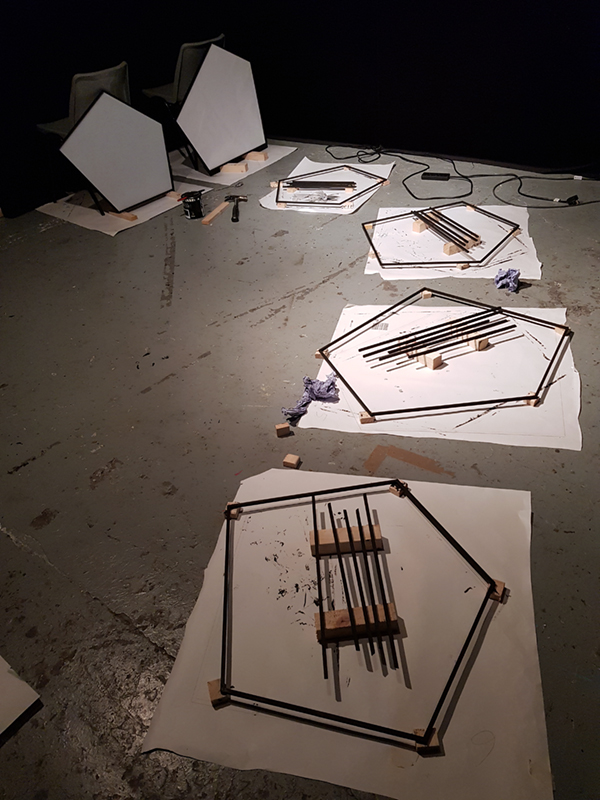
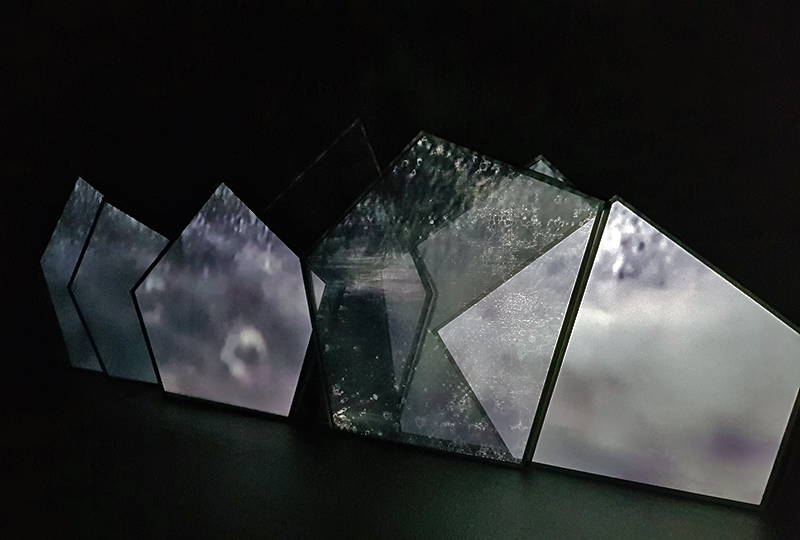
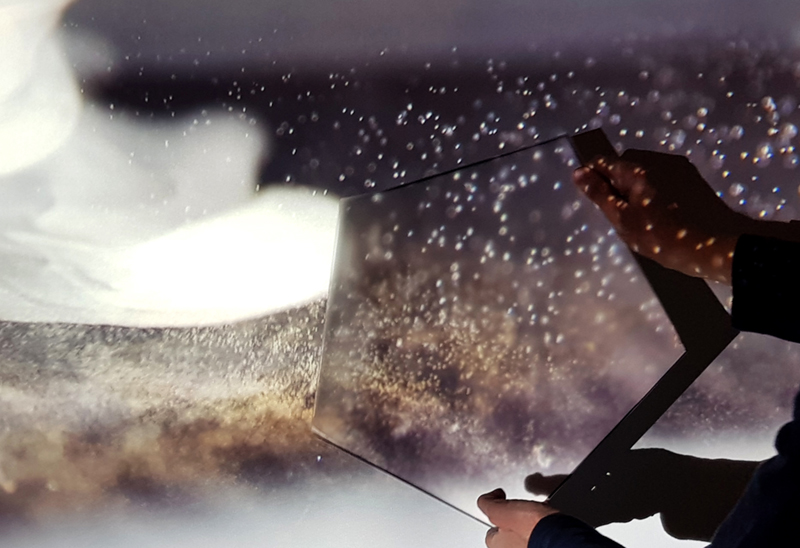
Next I needed to make the small screens that the audience would use to ‘capture’ the filmed particle trails which would be projected in the chamber lined with thick black velvet.

1803 making screens 1

This took some working out to fix the joints but in the end a combination of glue, V nails, double sided tape and veneer pins seemed to be strong enough. I used tracing paper, projector screen fabric, white cotton, polyester, organza, styrene, acrylic and wood as different substrates to give different effects and emphasize the porous/solid nature of matter.

1803 velvet chamber projections 3

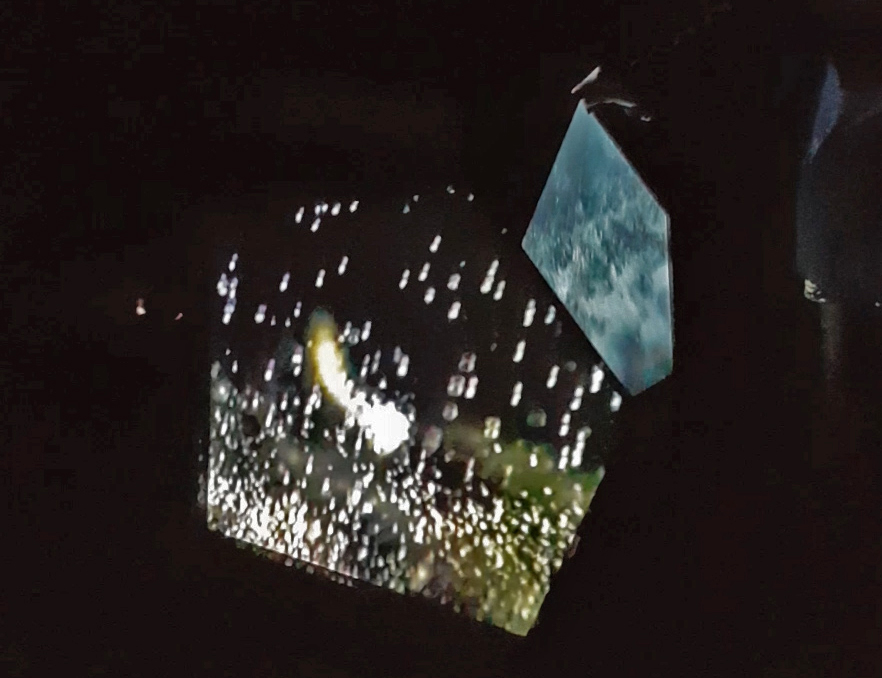
The particle trail footage was edited together and the projections in the chamber tested.
1803 velvet chamber projections 2Some unexpected effects appeared.1803 velvet chamber projections 1


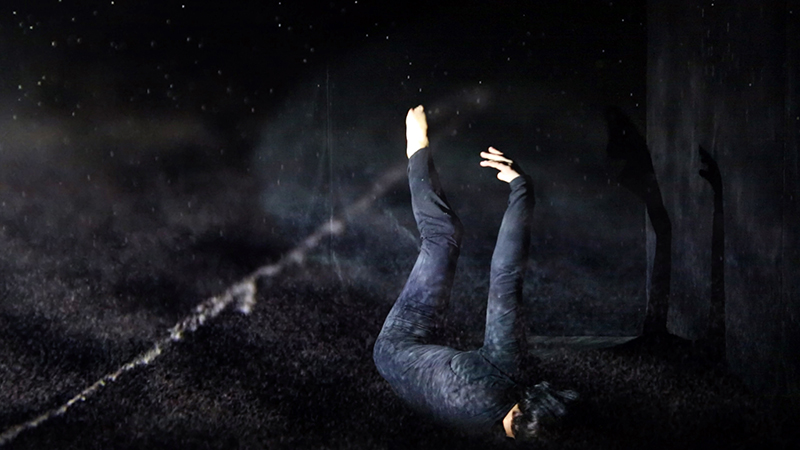
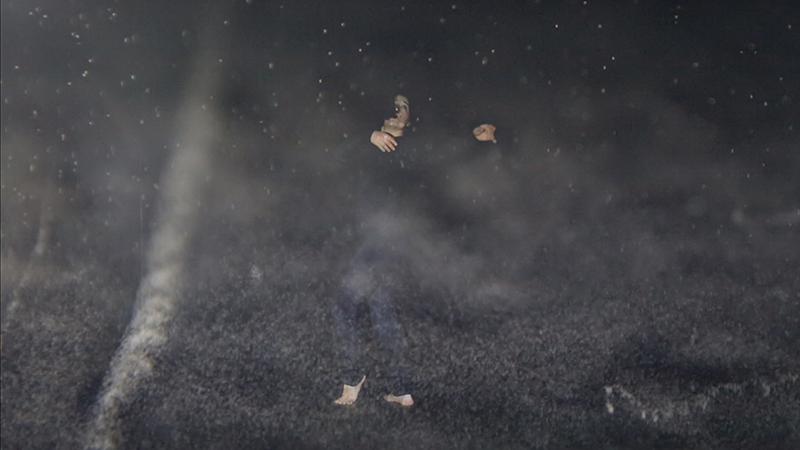
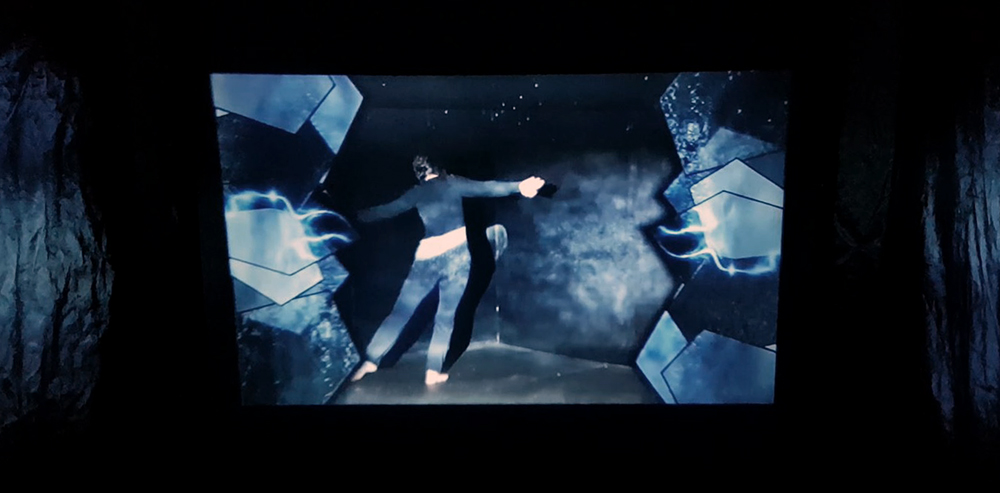
I spent quite a while looking at different projector options. When it was time to film Paola I used a pico DLP for darker shots where just her body was visible and a more powerful HD projector for other shots.
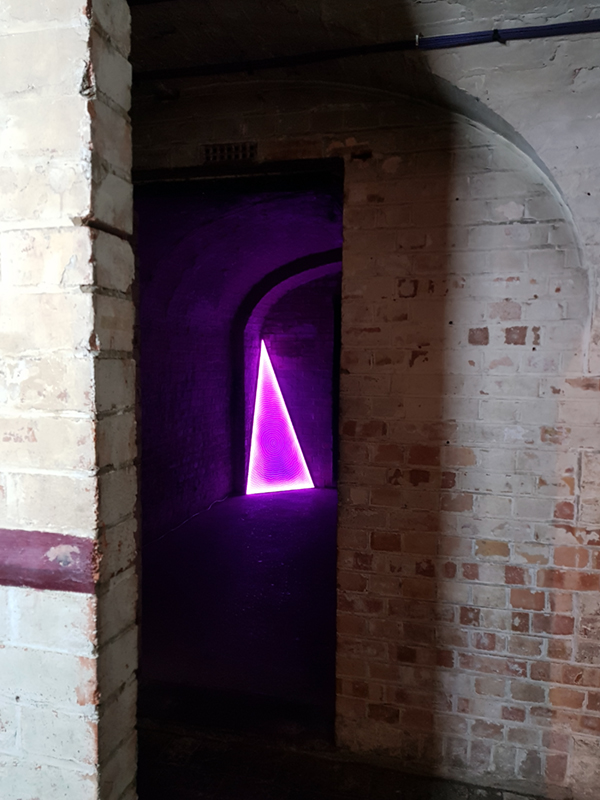
1803 video still 5

There was a lot of footage to go through and only a week to the opening event. This was my first video work and I was learning Premiere Pro on the hoof.

1803 video still 8

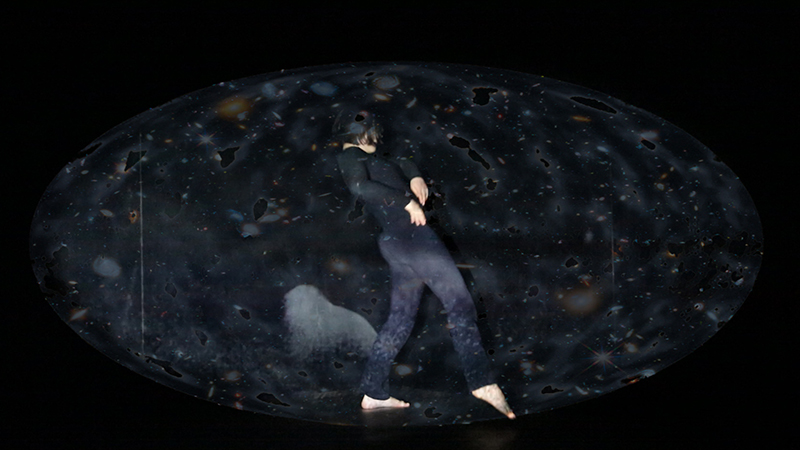
Movement choreographed and performed by Paola Napolitano was filmed in the velvet chamber.

1803 video still 3

This work builds on recent research that began with wondering what fundamental elements make up the landscapes around us leading to the discovery that less than 5% of the universe is visible.

1803 video still 2

Within the unimaginable vastness of the universe we trace our paths continuously permeated at a quantum scale by cosmic rays fired into our world by high energy collisions in space.

1803 video still 1

Plato described the dodecahedron as the fifth construction that ‘the god used for embroidering the constellations on the whole heavens’.

There is also a contemporary theory that the universe may be the shape of a dodecahedron, not infinite but with no boundaries this is known as the 3-sphere universe theory. If you left the dodecahedron at one point you would immediately re-enter at another point

1803 video still 7

Rudolf Laban was influenced by Plato and the geometries of the platonic solids. His choreutics theories open up new languages to describe interactions between matter and space.

1803 video still 4

‘What we cannot perceive with our senses, especially our fundamental sense of touch, remains unreal and its very existence is denied, until intuition or research discovers the unique and universal role of movement as a visible aspect of space’ Laban


1803 Laban open dodecahedron

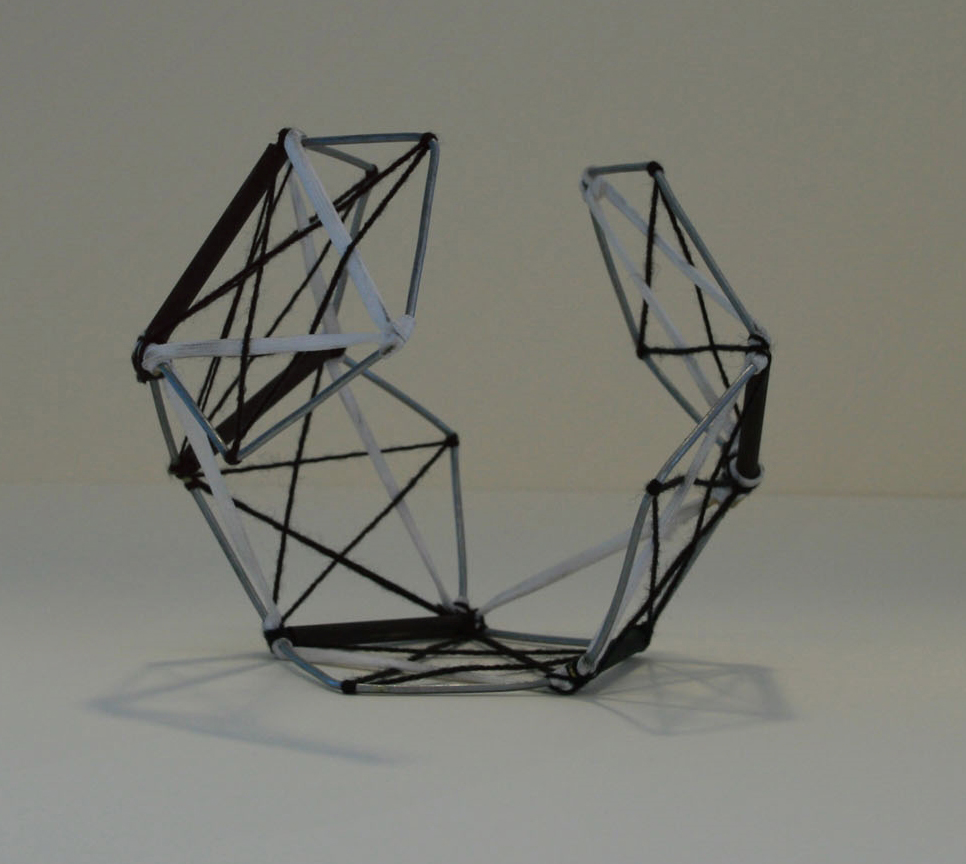
Laban Archive – Dodecahedron without six of its pentagonal sides, demonstrating a diagonal orientational axis with a circular void around it representing a circular movement. Model made with metal, painted wood, wool and shoelace.


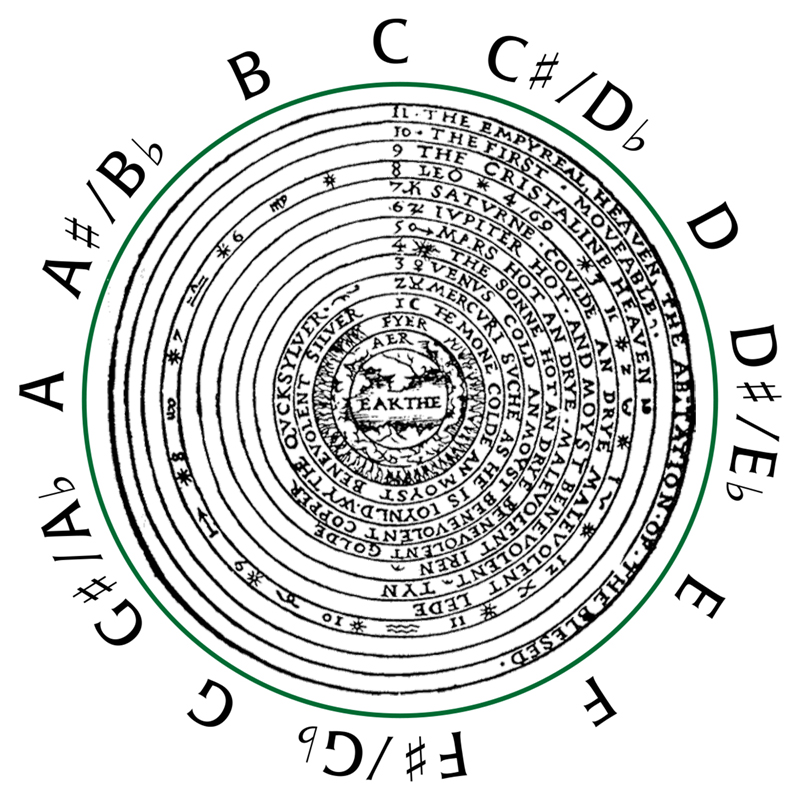
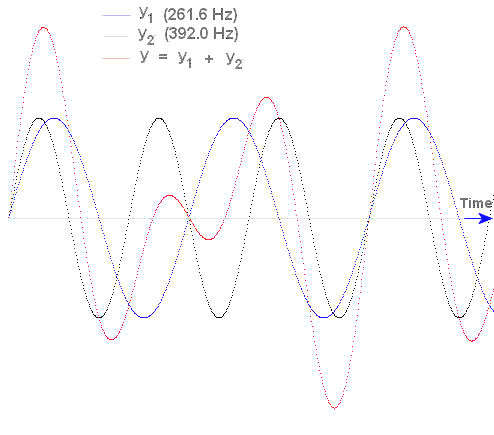
The simple sound edit was a slow transition through the chromatic scale which is a scale with twelve pitches to echo the 12 sided dodecahedron and some added Geiger counter signals converted to an original chromatic scale composition. The video was screened at the open event Scales of Intangibility and it was a relief that Paola was pleased.
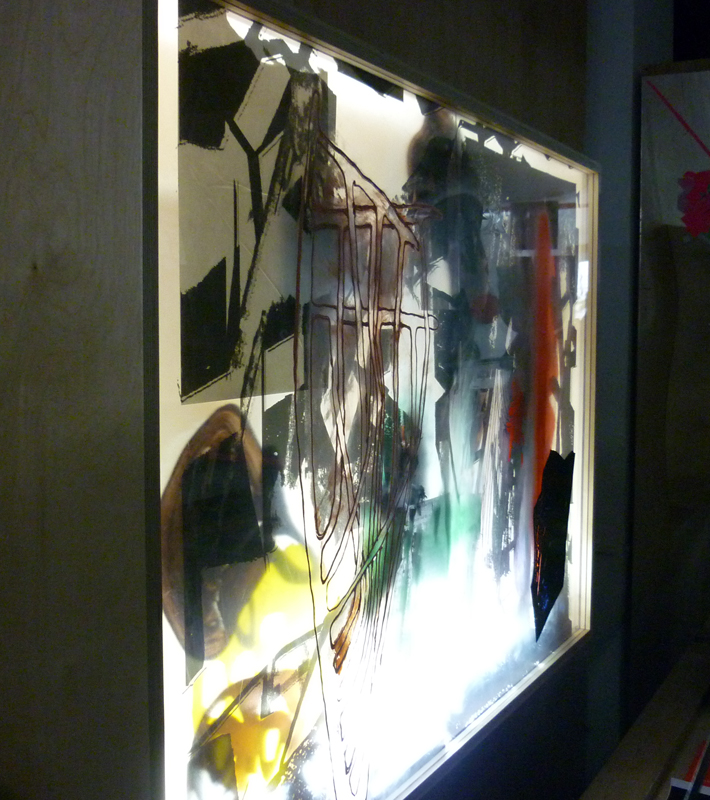
1803 screening 2.jpg

Interesting  interactions happened in the velvet chamber.

1803 Open Event

1803 Open Event 1

The polyhedral screens worked well to view the projections and ‘capture’ trails, ( a white shirt worked well too ) and I really appreciated all the good feedback from visitors.

1803 Open Event (5)

Now the concept has been tested I am keen to take the idea to new places. Hopefully it can be developed into work for my open door residency Beyond at Allenheads Contemporary Arts.

1803 tear in the fabric of space

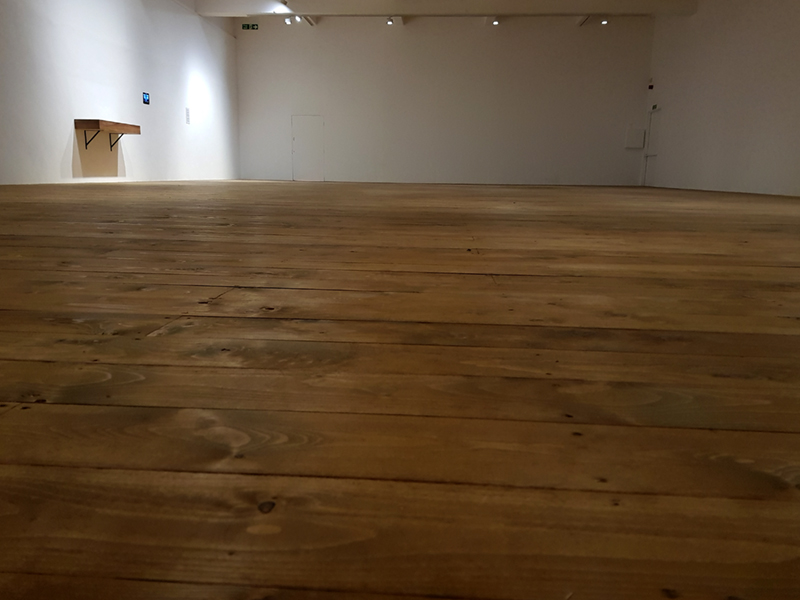
While at Chisenhale I had the privilege of experiencing Lydia Ouramane’s The You In Us exhibition at Chisenhale Gallery alone on the floor, letting the reverberations from the underfloor transducer speakers course through my body while reading about the extraordinary tale of her grandfather pulling out all his teeth to escape military service and the night her dogs were kidnapped from her roof terrace. The sound piece is called Paradis it is about waiting for something better to come.

1803 Lydia Ourahmane 1

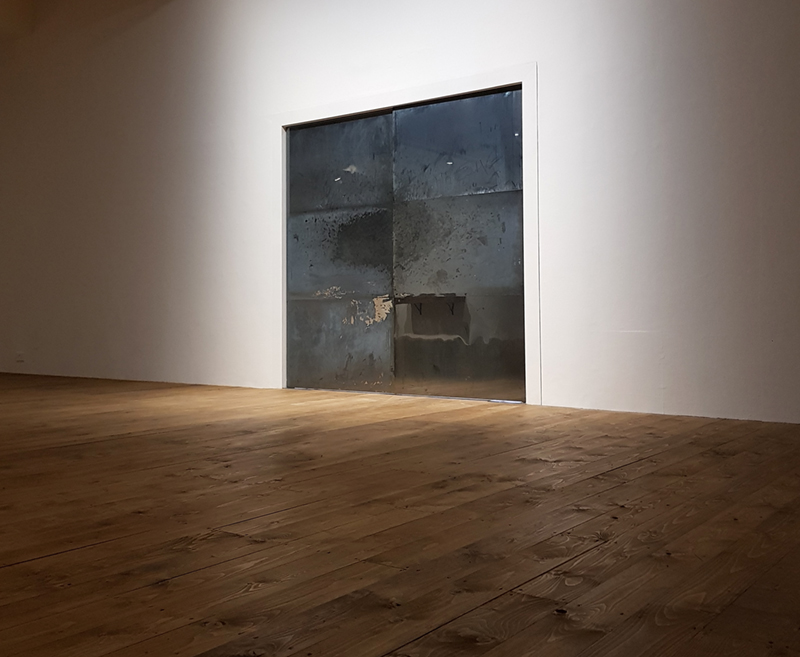
It is a subtle interaction that makes the seemingly empty space personal. My body is here, I can feel the effects and I will leave traces of my visit as I enter and leave pushing against the heavy silver oxidised doors, as with every visitor’s touch, slowly revealing the silver beneath.

1803 Lydia Ourahmane 2

Enjoyed an afternoon screening at LUX with Catalyst Arts presenting Looking Aside. Laura McMorrow’s The Lost Acre had a fragile materiality, creating unstable ground of the sort that might give way and open passages to other realms.

1803 Laura McMorrow

I knew we were in for a treat as Peter Glasgow was involved in the selection of films to compliment Seamus Harahan’s BL CK B X exhibition: shiny wet stones.

Fred Butler Harmonics in Space was not quite the zen experience I had been expecting. There was certainly a lot of energy going on at the private view.


And as Laban states ‘Matter itself is a compound of vibrations’ 

1803 video still 6


It has been an RCA MA printmaking department tradition for each graduating year to produce a box set. In our year we questioned the purpose of a set which was inevitably split. The cost of the whole set being prohibitive to most people. We wondered how we could reinvent this idea to make it exciting and relevant. It was an exercise sometimes lacking in diplomacy but eventually it was decided that collaboration and a theme would help to create a more cohesive edition.

The result was Lean to, an interpretation of the traditional printmaking box set, it acts as a site of investigation that questions what a box set can be.

RCA Printmaking MA 2015 collaboration Lean To

RCA Printmaking MA 2015 collaboration Lean to

We chose to respond to a ‘house’ of print matter. Interested in the house as a fluid concept, we expanded it to mean anything alluding to a habitat: a home, shelter, bunker, shed, commune, boundary…

This structure allowed us to make collaboration a defining feature – people worked together on areas or ‘rooms’, responding thematically, materially and conceptually. One group worked with text to create a written 3D structure, another explored the construction of space through sound. The defining of outside space was considered through a collaboration that explored the garden, and another investigated the overlooked details via the life of dust. There were also individual responses: a digital scanning room where walls threaten to melt into the night sky, contorted vessels that appear at once frozen and shifting, a sweeping gesture of an arch promising (or threatening) an arrival.
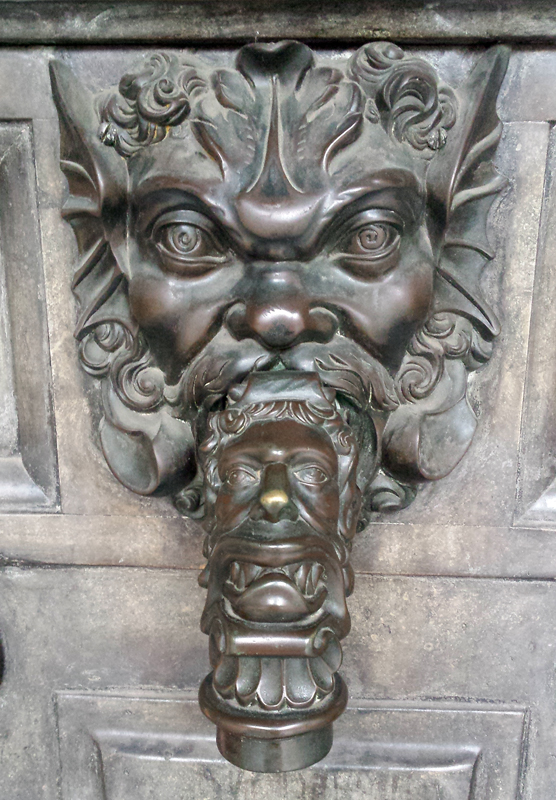
I worked with Amanda Wieczorek, Jilly Roberts and Gloria Ceballos.

1508 Battersea Park 3

We looked at structures found on the allotment or in a garden.

1508 Battersea Park 2

We went to Battersea Park for inspiration.

1508 Battersea Park

The symbiosis of the synthetic and the organic became key to our thinking and resulted in transfer printed handmade paper embedded with seeds contained in a protective screenprinted plastic sleeve.

1508 shed

For a box set that responds to the notion of being housed, it is necessary that the skin, the home stake its place.

design by Meg Ferguson

design by Meg Ferguson


It does this by being both a folder of precious deeds, and a site of shelter and display.

RCA Printmaking MA 2015 collaboration Lean To

RCA Printmaking 2015 collaboration lean-to

The cover, complete with guy ropes and support poles, unfurls into a simple structure that acts as both site to view and shelter for its contents.

RCA Printmaking MA 2015 collaboration Lean To

RCA Printmaking 2015 collaboration lean- to

The team that installed the work for the launch night did an excellent job and we all ended up very proud.

lean to 11

The volume was launched at Tenderbooks with an evening of performance and readings.

Launch of Lean-To at Tender Books

Launch of lean-to at Tender Books

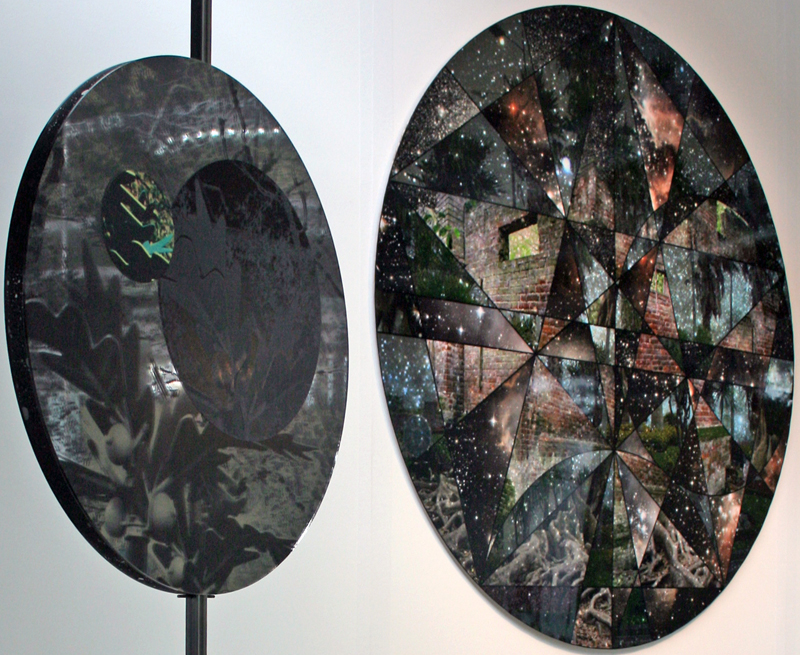
While learning about geometry and the platonic solids at The Princes School of Traditional Arts I was intrigued by Plato’s description of the fifth platonic solid – the dodecahedron – as ‘a fifth construction which God used for embroidering the constellations on the whole heaven’.

Susan Eyre Pairi Daêza

Susan Eyre Pairi Daêza

In this work I have taken the net which is used as the pattern to make a 3D dodecahedron when cut and folded into shape and used this as a structure meshing together images of constellations, an abandoned walled garden and a roundabout. I wanted to make connections between origins, structure, and belief systems. My original plan for this idea was to screenprint the images on individual segments of laser cut mdf – each piece would then be pulled slightly apart – the expanding universe. In the end it was a combination of time and feasibility that meant this idea was realised as a c-type print on metallic paper mounted on aluminium.

Susan Eyre everydaymatters

Susan Eyre everydaymatters

It became an integral part and focal point of my MA degree show installation.

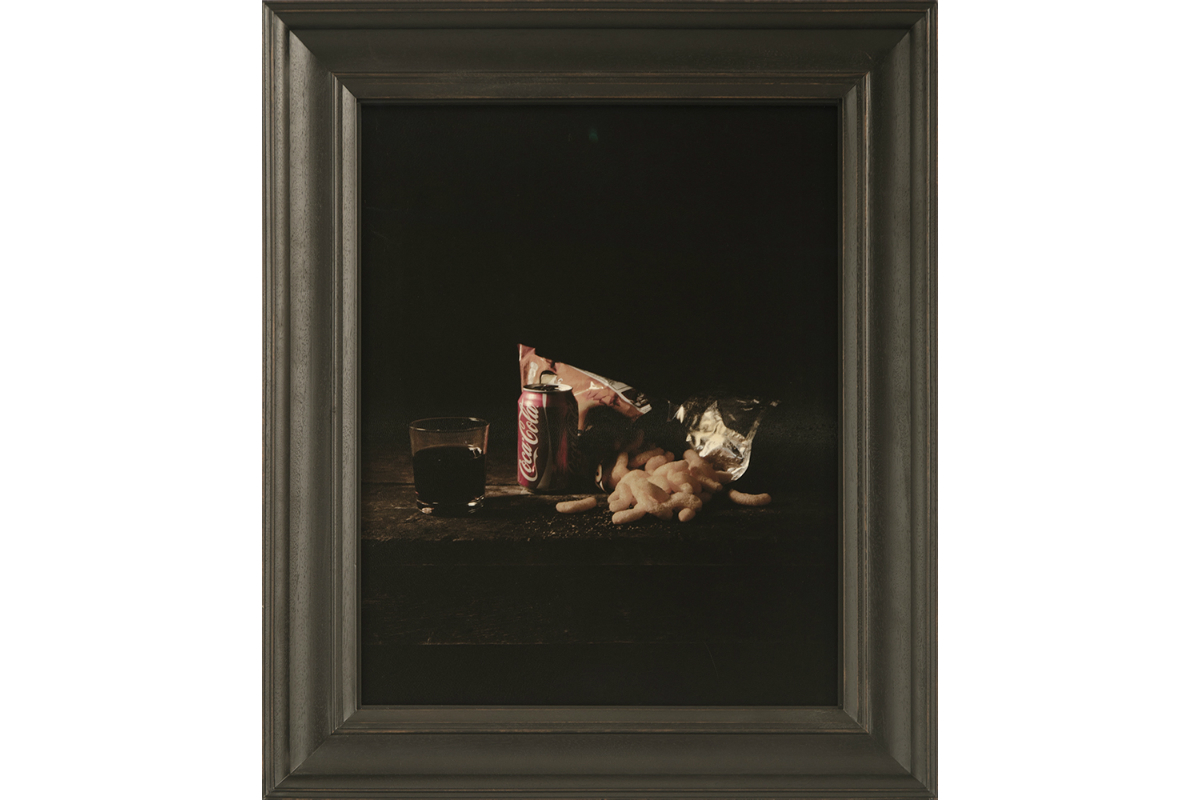
I was invited to The Collective at The House of St. Barnabas in Soho. Dark Matter Studio were hosting Matt Collishaw’s Last Supper prints in the Bazalgette Room. These images transferred onto goatskin parchment recreate the final meals requested by men condemned on death row in the style of 17th century vanitas paintings.

Matt Collishaw Last Meal on Death Row, Velma Barfield, 2012

Matt Collishaw Last Meal on Death Row, Velma Barfield, 2012


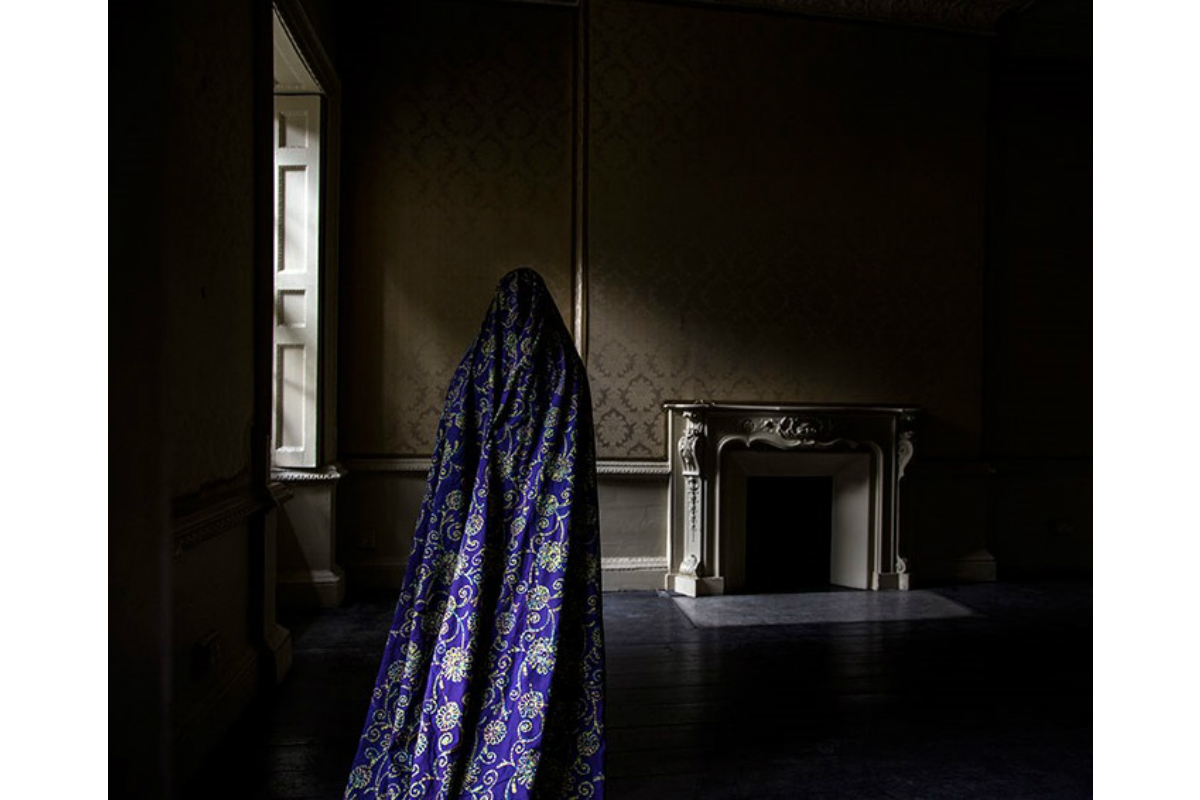
Güler Ates had work appropriately showing in the Silk Room. Taken just before the club at  opened in 2013, her photographs confront the intense dialogue between the past and present that is unescapable in such a space. Güler comments on the presence of the past; ‘They were absent; however, through the objects in the rooms, the interiors and the exterior of the building, I wanted to trace the “present” of some of the previous occupiers.’

Guler Ates Departure into darkness

Guler Ates Departure into darkness

I had a tutorial with her while at the RCA  when she had suggested I should scale up my fabric pieces and take then to the sea – I think this is something I could try  when I visit a clear  sea but also I would like to try under a waterfall or in a brook.  She also talked about the importance of the structure for the display of the circles which I was still struggling with.

The House of St Barnabas is an impressive building it even has its own chapel where ARTinTRA  presented PARAMENTRONOMICON  a site-specific, computer animated video and sound installation by the Finnish duo Pink Twins (Juha and Vesa Vehvilainen) , curated by Vassiliki Tzanakou.

1508 Pink Twins

Pink Twins PARAMENTRONOMICON

Within the dark space of the chapel lit by a faint glow from narrow stained glass windows a large screen takes the place of the altar. The sci-fi imagery in high saturation colour is dazzling in a perpetual cycle of abstracted motion, forming and reforming. There is a nice play between the deconstructed images of the stained glass – once this technology was awe inspiring in itself – and the similar breakdown of form in the swirling images on the screen. We are similarly held enthralled by this mesmerizing experience as were the first visitors to encounter the delights of light through coloured glass.

In retrospect I can see that Pairi Daêza has a structure similar to that of a stained glass window.

Susan Eyre Pairi Daêza

Susan Eyre everydaymatters / Pairi Daêza

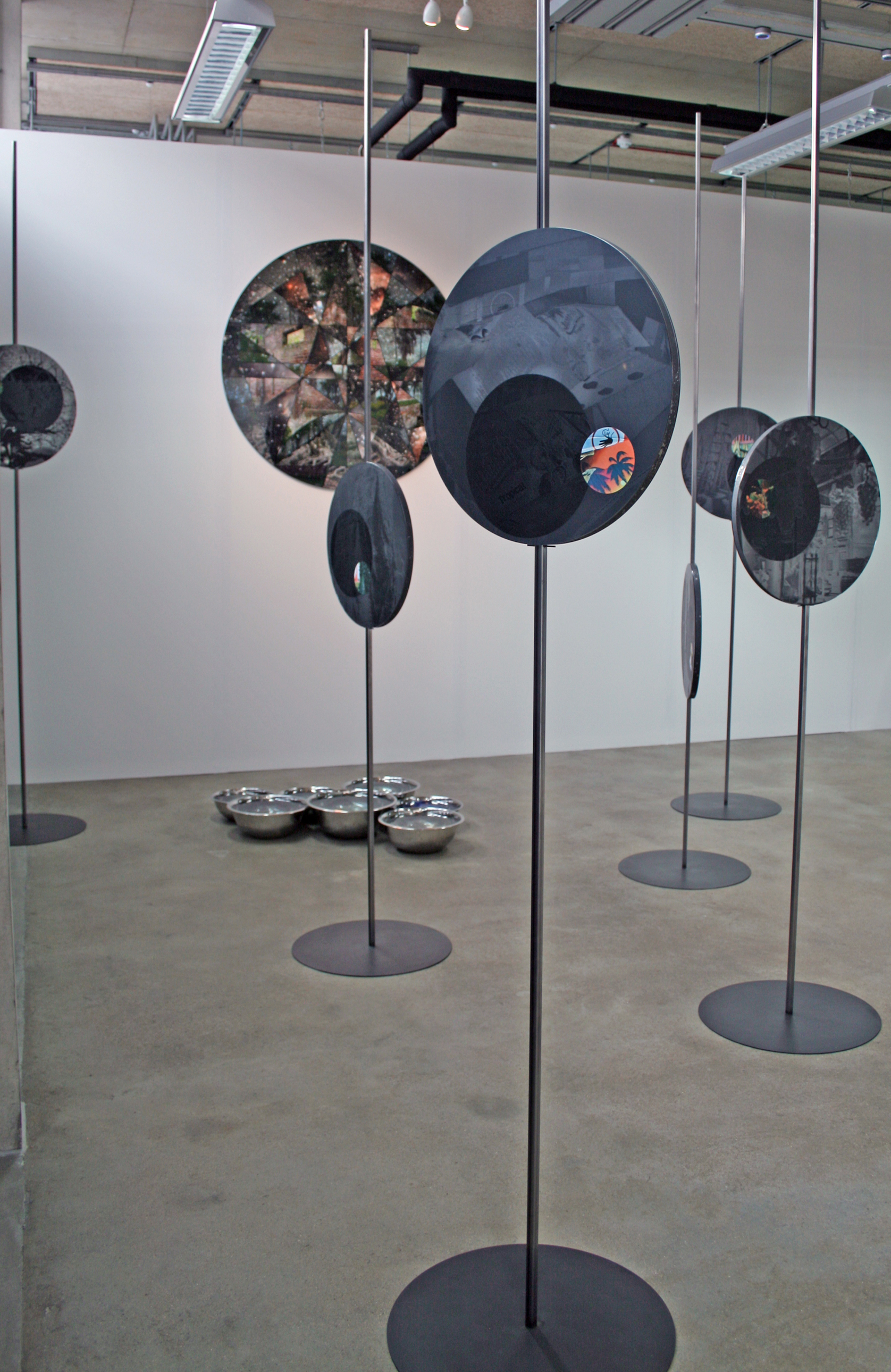
Looking for structures and patterns in the matter of landscape and breaking those down is something I am interested in. When installing the circle sculptures I learnt how hard it is to be consciously random. I wanted to place the pieces randomly with the idea that these were slices of space that could appear anywhere but my instincts kept drawing me to balance and pattern.

Susan Eyre everydaymatters

Susan Eyre everydaymatters

After the show when trying to clear space in my studio at home I came across some very old samples I had forgotten about. It’s fascinating the way ideas form over time with threads emerging and submerging.  When I made these I was thinking about geology  and the human effect on the formation of rock strata, how all our rubbish in landfill would create the gemstones of the future.

1508 earth crystal

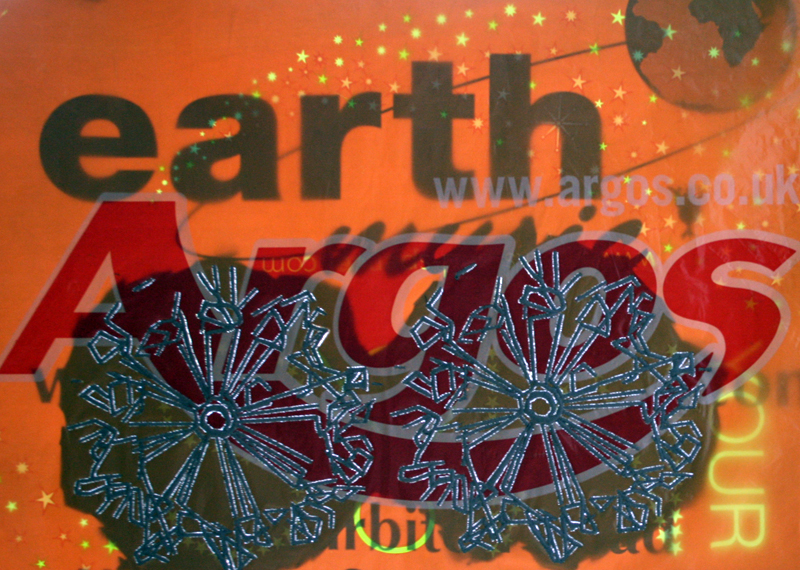
Here on these layered plastic carrier bags was the universe with digitally embroidered geometrical patterns of crystal structures.

1508 earth structure

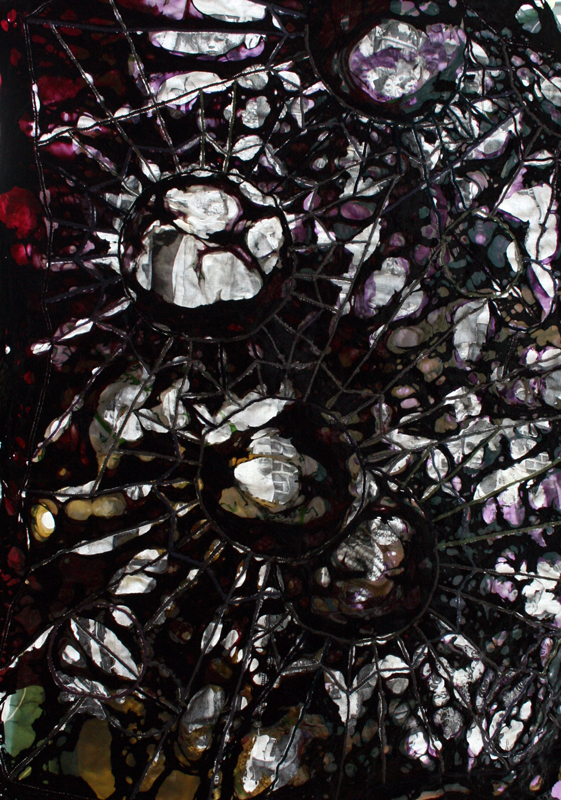
Another sample of layered plastic with machine free stitched geometrical patterns, melted to reveal images of human life. These pieces were a bit clunky but it feels there is a connection in my thinking here that has carried through. I have been thinking about black holes and disruptions in space and this old work has given me some new ideas to carry forward.

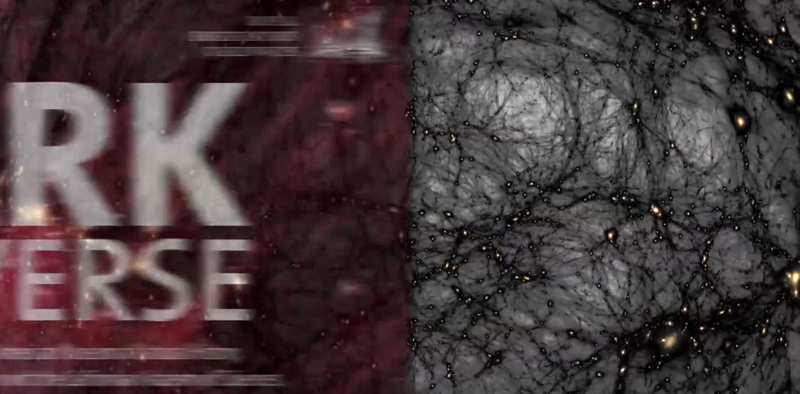
I went to see Dark Universe at Greenwich Planetarium. As I had previously learnt on the CERN website the planets, stars and everything you can see make up less than 5% of the Universe. Dark Universe is a new planetarium show exploring what we know – and what we don’t know – about the structure and history of the Universe.

1508 dark universe

I don’t think I learnt anything new from this show but the visual experience of being blasted through space was worth the trip.

The space theme continued with a trip to Breese Little Gallery  to see the exhibition dark frame / deep field  and a collection of Vintage NASA Photographs.

The most arresting piece was Dan Holdworth’s giant c-type of a mountain range inverted into an ethereal alien scape.

Dan Holdsworth, Blackout 13

Dan Holdsworth, Blackout 13

The NASA photos were also fascinating. The strange light, the staged self-consciousness.  These images share the style of the cinema flyer from the same era and so the amazing achievement and experience of these men standing on alien soil seems to get diluted by the association with fantasy making it even harder to comprehend what we are looking at.

Alan Shepard and the U.S. flag, Apollo 14, February 1971

Alan Shepard and the U.S. flag,  Apollo 14                February 1971


I enjoy visiting artists studios, seeing the debris from the workings of the mind. I am envious of these spaces. I went to see what Elizabeth Murton and Lizzie Cannon have been working on at Bow Arts Open Studios Event. Elizabeth is also interested in structures and was showing her experiments with nets and the malleable nature of space.

Elizabeth Murton worked net

Elizabeth Murton worked net

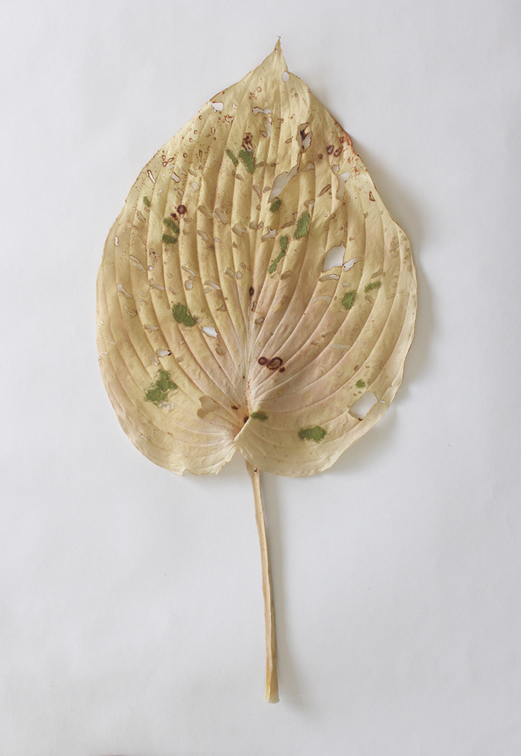
Lizzie has hauled a giant portion of rusting pipe from a Suffolk beach into her studio. She had already started to discreetly embellish the rust encrusted surface with tiny stitches and glass beads. She is interested in accretion of matter and repair. Repair can also contribute to the deterioration as the tiny perforations from the stitching break down the surface. In the case of her mended leaves the repairs appear as scars.  Both artists had work in the Structure, Texture, Future exhibition, an investigation into ruin and repair the substance of matter and our relationship to it,  curated by Shahida Bari and Rosamond Murdoch.

Lizzie Cannon Mended Leaf (Hosta)

Lizzie Cannon Mended Leaf (Hosta)


Thinking in shapes.

Across RCA is a great scheme where students get to do something completely different for a week.

I went to the Princes School of Traditional Arts and joined the current talented MA students for lessons in geometry and biomorphic patterns.

1411 geometry class 2

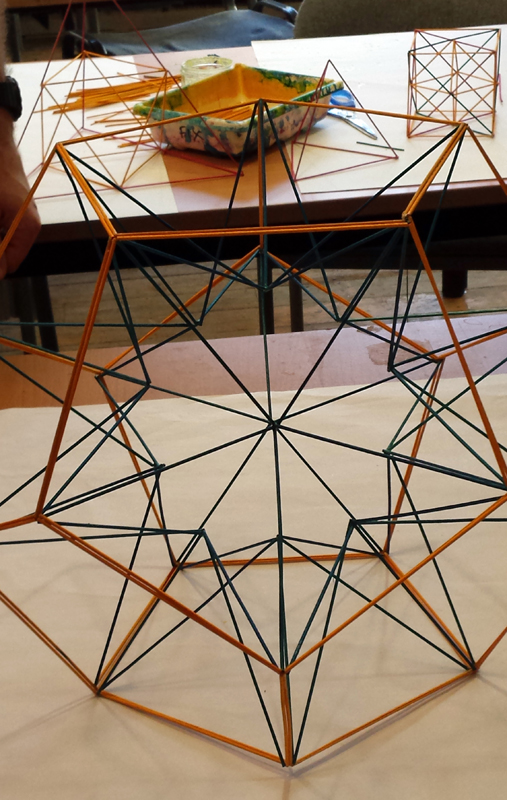
We made platonic solids from sticks and thin card.

1411 Geometry class

Geo = earth, metry = measure.

Having recently read Raymond Williams ‘People of the Black Mountains’ which tells stories of a burgeoning civilization spanning thousands of years it was interesting to connect the theories of the early measurers in his book with what I was learning, to think about this knowledge in terms of history.

The teaching was very much from a spiritual perspective, highlighting the balance and harmony in the universe present in mathematical relationships.

I found these ideas quite relevant to the ways I have been thinking about my work. I am thinking of introducing pattern into my work and I want the shapes to have meaning, to be from the very structures that the world is built from. If I am searching for paradise in the everyday then looking at the construction of the universe seems a good place to start.

Heaven and earth linked by consciousness.

1411 gallerie Nadine Feront (1)

This painting, done using a brush with just a single hair, makes me think of stone circles.

Writing this blog helps me pin my thoughts down. To pause and consider what I have recently seen or read or discovered feeds my practice.

Coming back to think about the history of clearing our space in the forest.

Building – burial – marriage – ancestors – (wild men)

The forest as dark, dangerous and profane as opposed to enchanted, sacred, shelter.

I haven’t made this work yet.

This year the RCA Printmaking study trip was to Belgium.

We visited Anne-Mie Van Kerckhoven at her studio in Antwerp.

Anne-Mie Van Kerckhoven

Anne-Mie Van Kerckhoven

Her interests are in the intertwining of the female body, mysticism and technology.

Anne-Mie Van Kerckhoven

Anne-Mie Van Kerckhoven

She believes she could almost be a reincarnation of the mystic Marguerite Porete in that she shares so many mutual concerns.

Porete was executed for heresy as a result of her poetic mysticism in  Le Miroir des âmes simples anéanties (The Mirror of the Simple Souls Who Are Annihilated and Remain Only in Will and Desire of Love) which lists seven stages of annihilation of the soul necessary to become one with God which fell foul of current Christian thinking.

Again the mirror.

We visited Museum Plantin Moretus home of the oldest printing presses in the world.

1411 Museum Plantin Moretus (1)

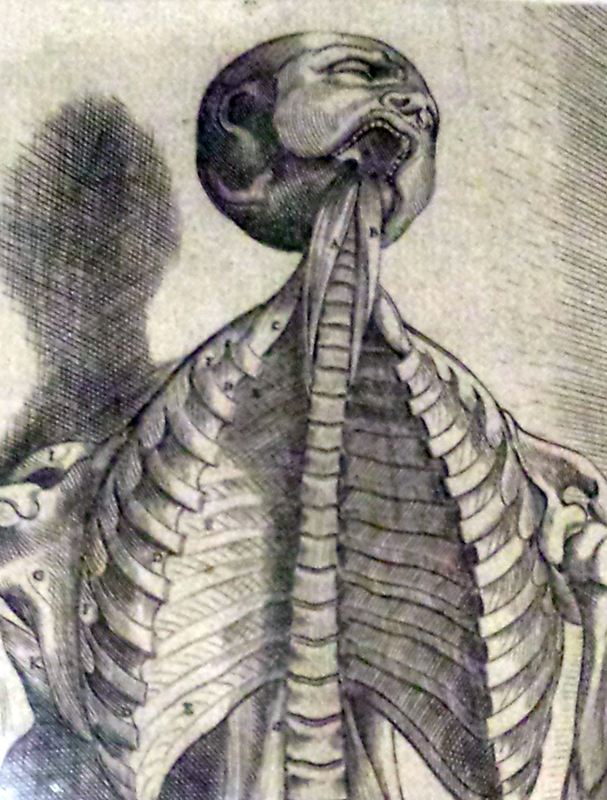
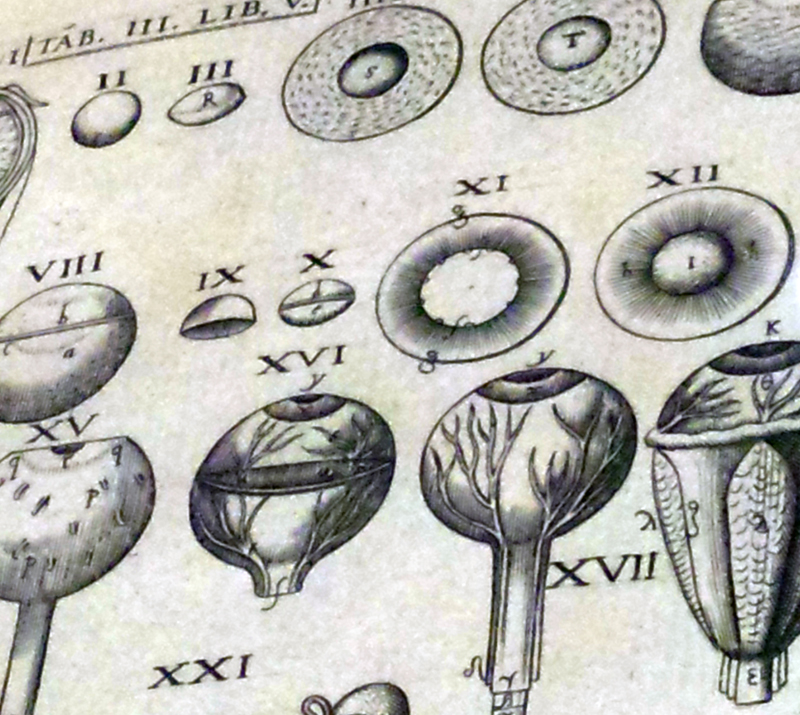
The current exhibition was Dissected Anatomy

1411 Museum Plantin Moretus 3

The sphere is a symbol of unity and completeness

1411 Museum Plantin Moretus 2

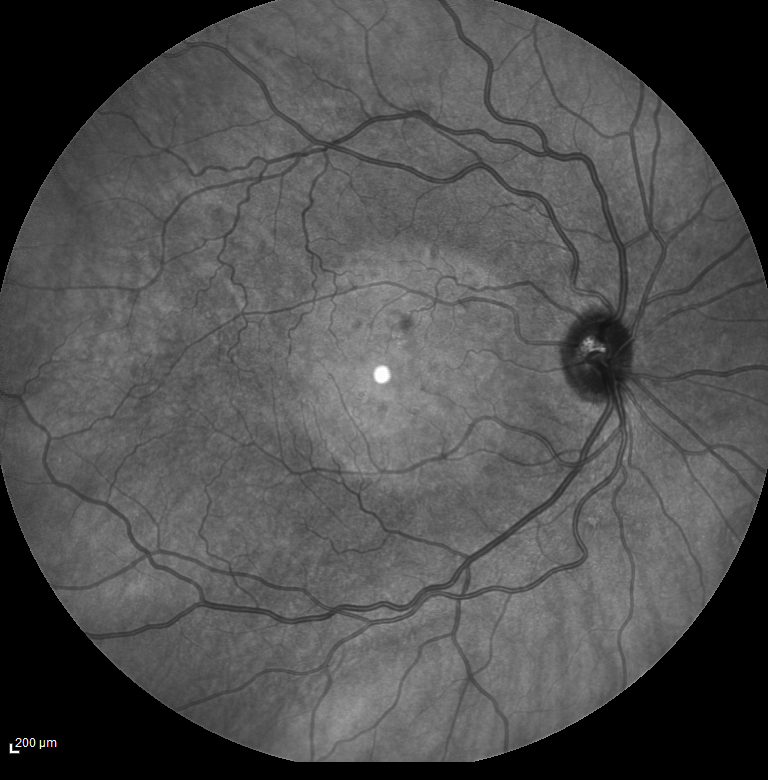
I have asked my optician for the scan images of my eye to use in my work

1411 eye

Always searching.

We visited M HKA Museum of Modern Art Antwerp

There were beautiful evocative photographs taken in Moscow’s Museum of Natural History by Russian artist Olga Chernysheva. The illumination of the light boxes emphasized the illumination of the museum display cases within, making the images ethereal and other worldly.

Olga Chernysheva Cactus Seller 2009

Olga Chernysheva Cactus Seller 2009

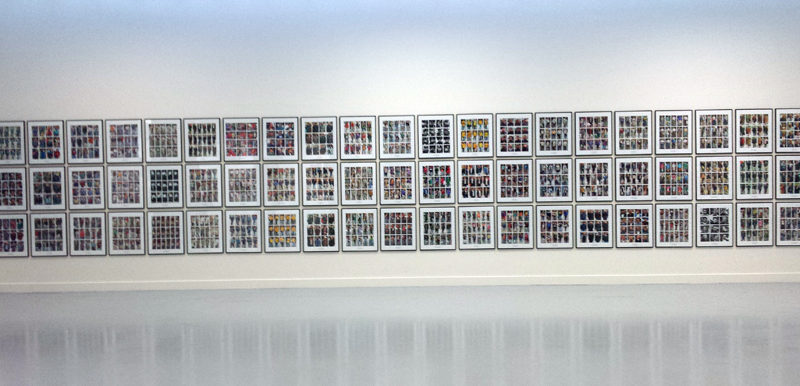
Social realism. Hans Eijkelboom set himself very clear rules about what he would photograph each day.

Hans Eijkelboom Fotonotities  (1992 - 2007)

Hans Eijkelboom Fotonotities (1992 – 2007)

From the swarming figures on the streets he picks out the individual and then places them back in the group setting up taxonomies and cultural relationships

Hans Eijkelboom Fotonotities

Hans Eijkelboom Fotonotities

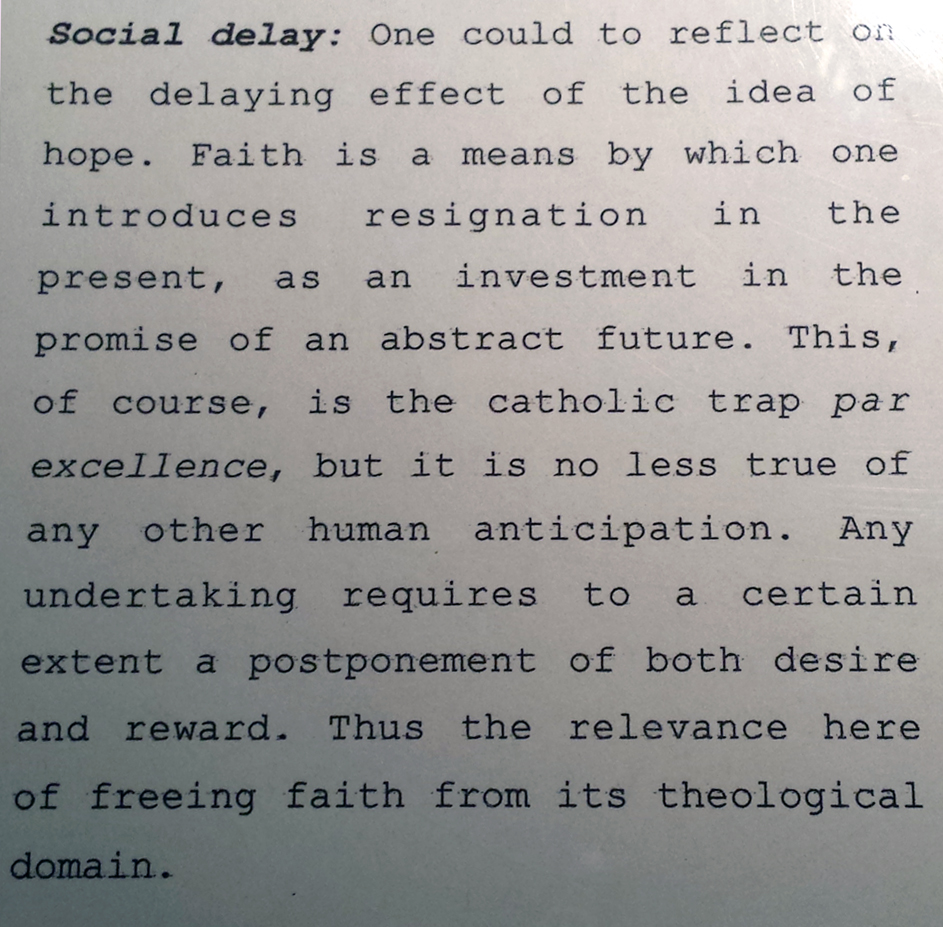
Faith and hope – the fulfilment of desire must never happen – it must always be in the future

Francis Alys When Faith Moves Mountains: Lima, Peru

Francis Alys When Faith Moves Mountains: Lima, Peru

We had a trip to La Centre de la Gravure et de l’Image Imprimee in Louviere. A soulless print archive in a soulless place.

Like a crematorium built for function on the outskirts of town, it seemed displaced from locality and devoid of the spirituality of the temple or shrine. An archive seems a sad place somehow.

The theory is, it’s only a resting place.

1411 first proof chapel

First proof of soft ground etching – Chapel of Rest

Wiels Contemporary Art Centre had a big retrospective of Mark Leckey with the wonderful title –  Lending Enchantment to Vulgar Materials

There was a new interpretation of the Universal Addressability of Dumb Things. This time the material icons had been 3D printed. The status of the object has been questioned throughout the various incarnations of this exhibition. Where does the aura lie?

Mark Leckey Lending Enchantment to Vulgar Materials

Mark Leckey

Ana Torfs ‘Echolalia’ exhibition also at Wiels Contemporary Art Centre was tantalising for me. It contained research and imagery that I am drawn to yet the presentation of so much factual text alongside turned it into something a bit dry.

Ana Torfs

Ana Torfs

The installation piece ‘The Parrot and the Nightingale, a Phantasmagoria’ worked well

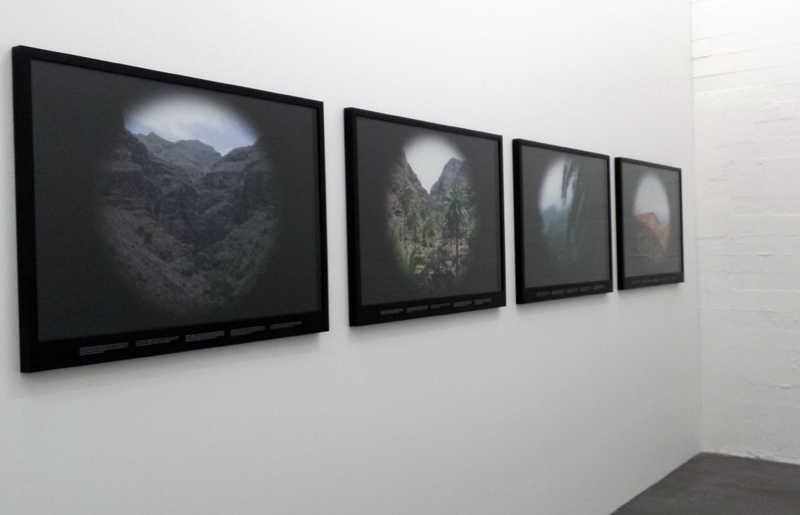
and I liked the vignette images of islands like the view through a telescope but the text was intrusive

Ana Torfs

Ana Torfs

I can understand why you might want to include all your research, she talks about an archaeology of knowledge

Ana Torfs

Ana Torfs

I have a similar problem, I am grappling with how to make known my research and narrative in my own work

It’s hard to make it evident in the image but I don’t think it matters that everything should be disclosed, ideas should be sparked and then threads can be followed that may lead elsewhere even.

French artist Emmanuelle Laine at c-o-m-p-o-s-i-t-e gallery in Brussels had made a colourful intervention creating a sculpture on site that she then photographed and repeated around the gallery walls. She has found a way to include her research and incidental thoughts in her work, her tools both for process and inspiration are left scattered around the space in evidence

Emmanuelle Laine

Emmanuelle Laine

The traces of construction and thought processes are not discarded or hidden – the sculpture becomes an exploded view of the artists brain during the creative process

Emmanuelle Laine

Emmanuelle Laine

Great to see some more video work of Philippa Kuligowski at New Sensations.

She has a wonderful way of collaging imagery and media in original ways to create engaging magical narratives.

Philippa Kuligowski The Plover and the Crocodile

Philippa Kuligowski The Plover and the Crocodile

The Plover and the Crocodile link to film

Other work I liked also at New Sensations –

Vivien Zhang Porcupine Hair

Vivien Zhang Porcupine Hair

Nicholas Johnson Mildew Swoosh

Nicholas Johnson Mildew Swoosh

Felicity Hammond Restore to Factory Settings

Felicity Hammond Restore to Factory Settings


Ben Woodeson  That Bit From the Omen, Yes That Bit

Ben Woodeson That Bit From The Omen, Yes That Bit

I haven’t seen The Omen so I don’t know that bit.

I am looking at invisible planes made visible, the threat of collapse and the possibility of violence.

The new media animation by Charles Richardson was intriguing. It was not a hologram. The figure turned and writhed out of the screen in 3D but no glasses were  involved –  it was like a ghost had entered the room  – it was uncanny

Charles Richardson Rehearsal

Charles Richardson Rehearsal

In an inspiring lecture Esther Teichmann made suggestions of work to check out including Marie Darrieussecq ‘My Phantom Husband’, Claire Denis ‘Beau Travail’ and Janet Cardiff and George Bures Millar ‘Blue Hawaii Bar’ link here – Searching for the light in an evocative installation in a Victorian water reservoir.

All the time I thought I was looking at landscape but maybe I was looking for what was held within the landscape. The nooks and crannies where the myths hide.