Archives for posts with tag: spiral

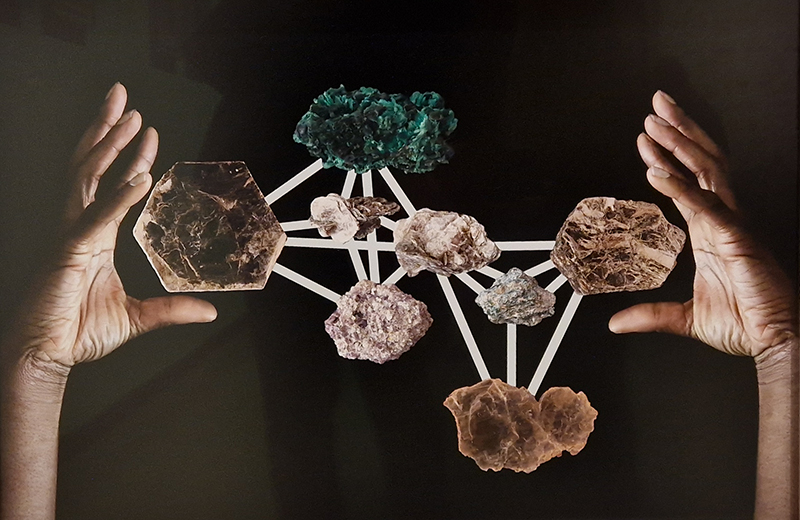
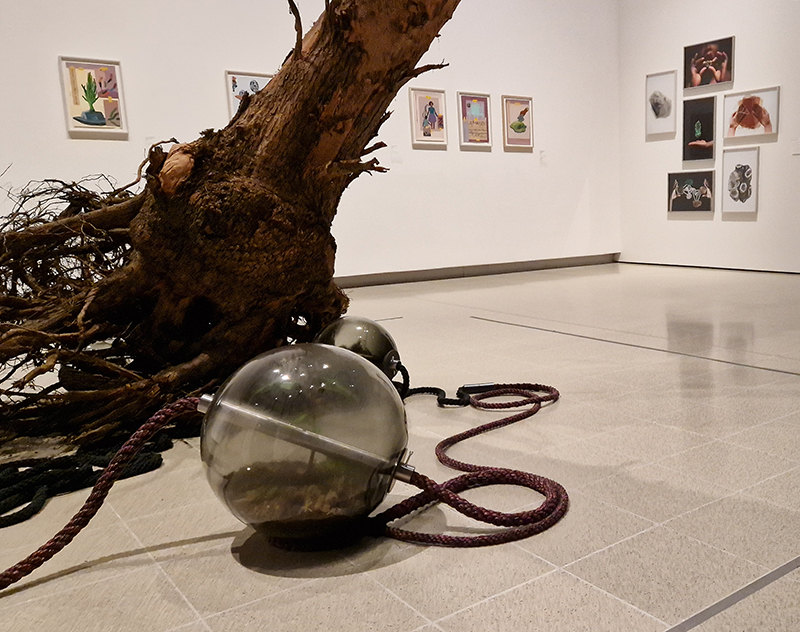
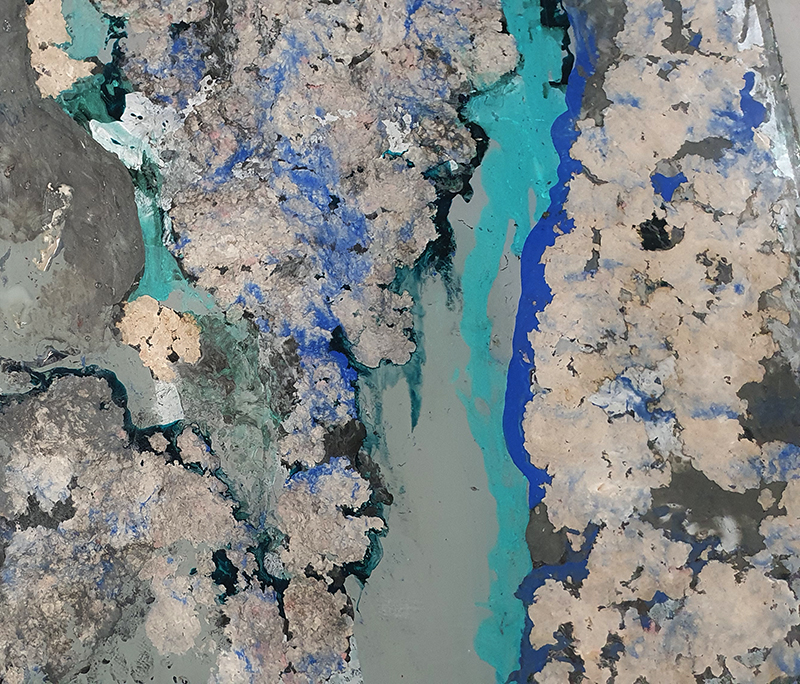
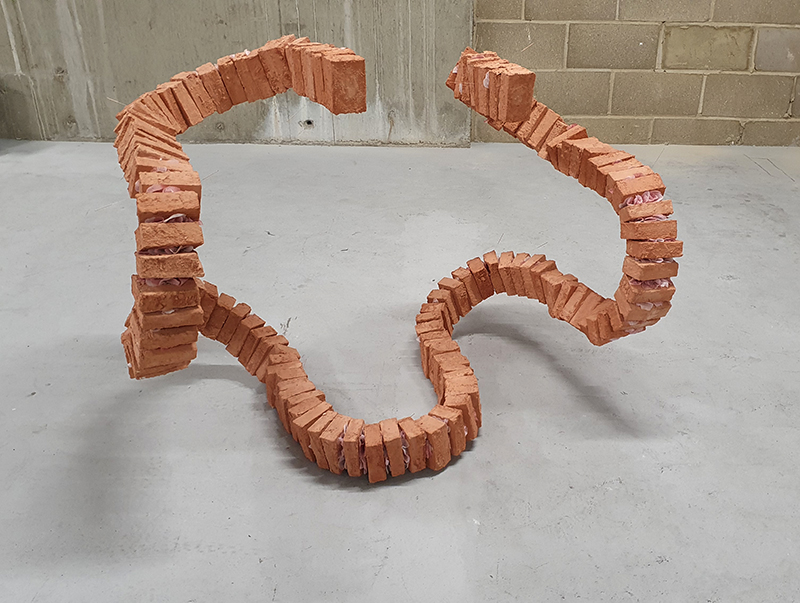
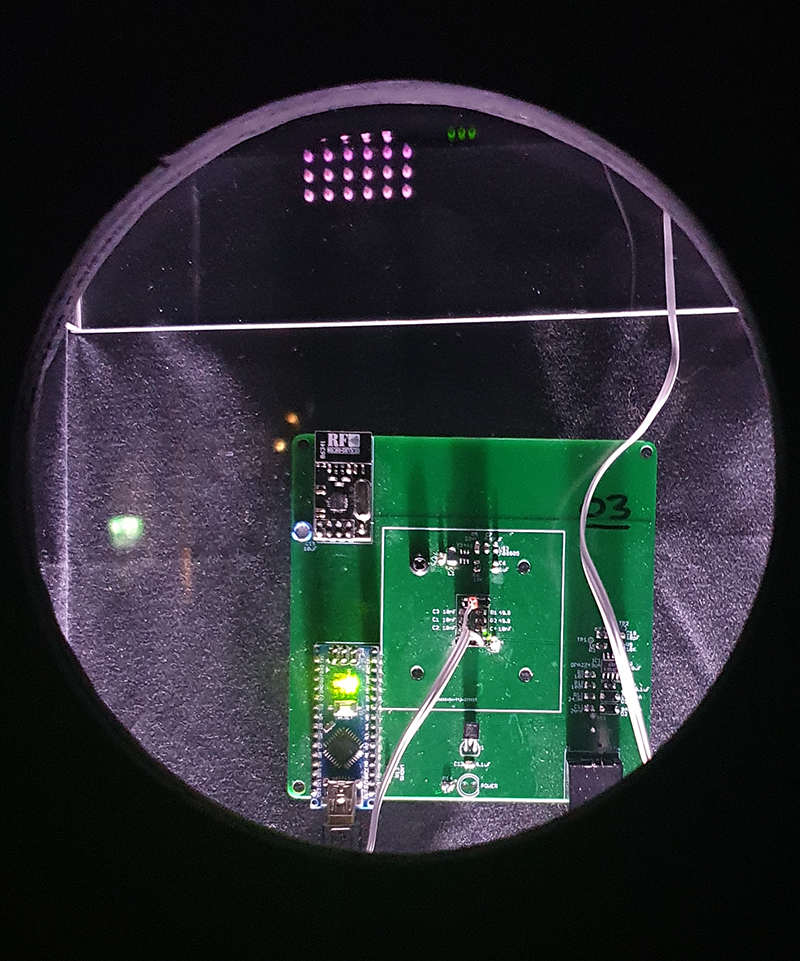
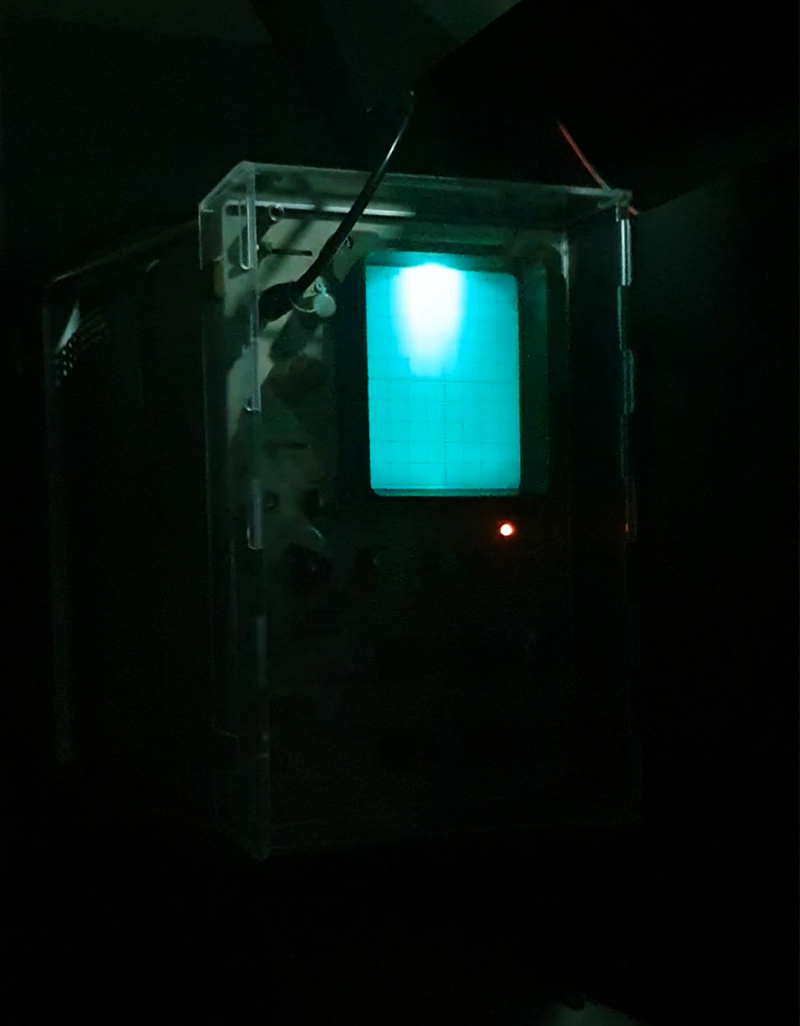
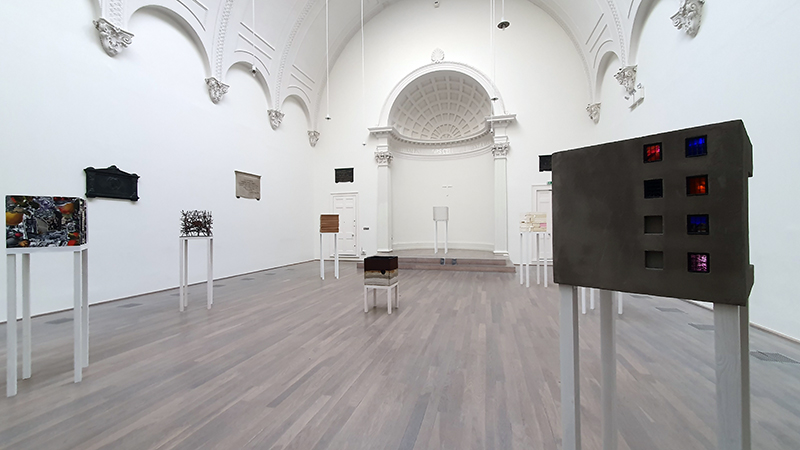
The Geological Unconscious had a wonderful six week run at Hypha HQ, Euston. Responding to Jason Groves’ inquiry into the mineral imaginary in his eponymous book, as well as the ‘Writing of Stones’ as proposed by writer and mineral collector Roger Caillois, the exhibition exposes the complex entanglements between the organic and the inorganic; the human and the lithic. 

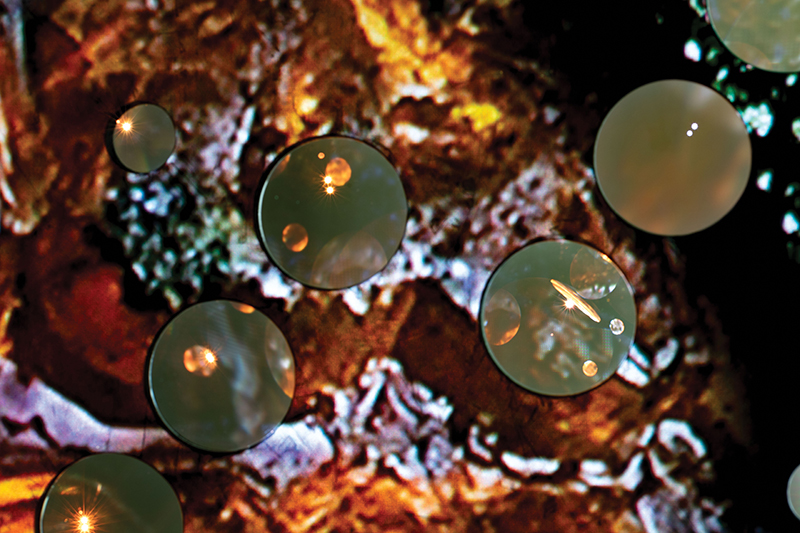
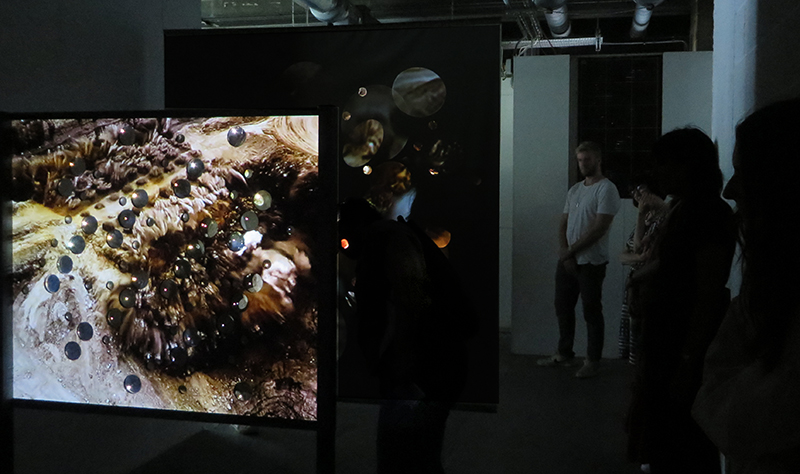
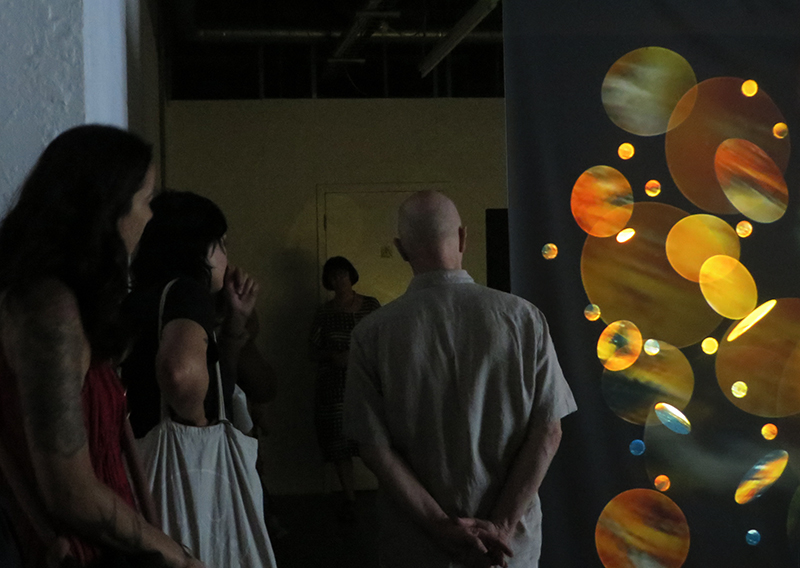
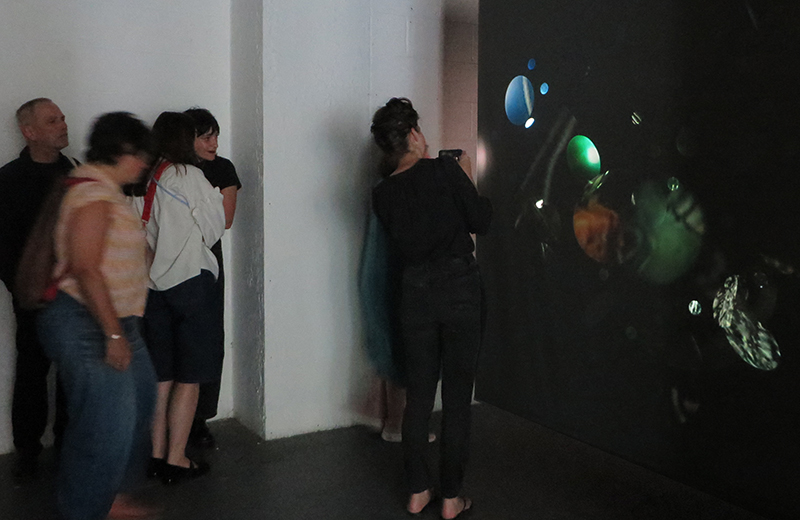
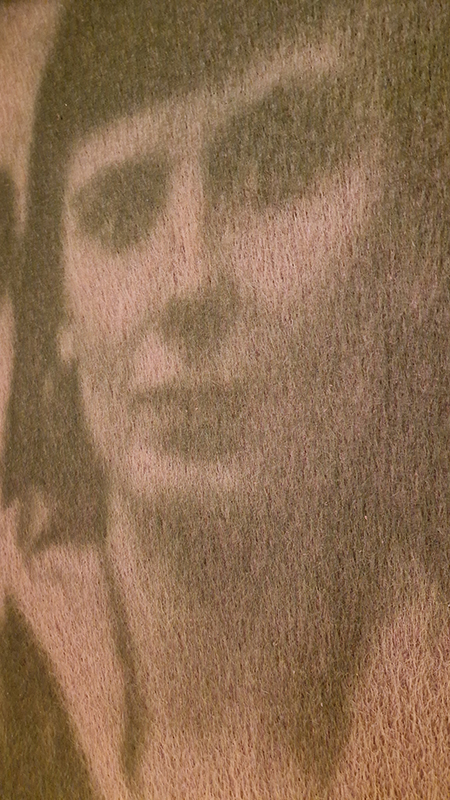
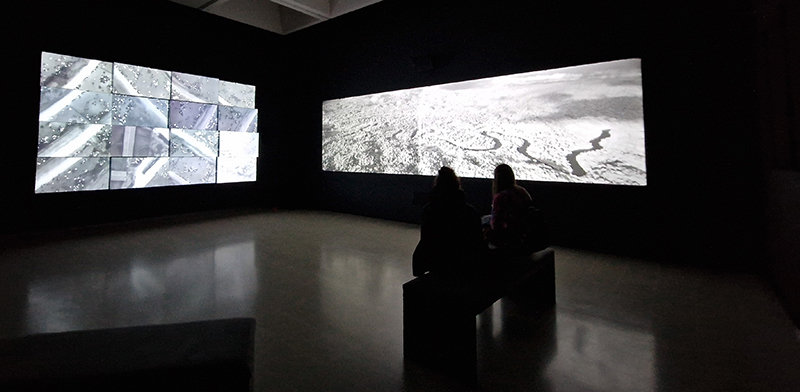
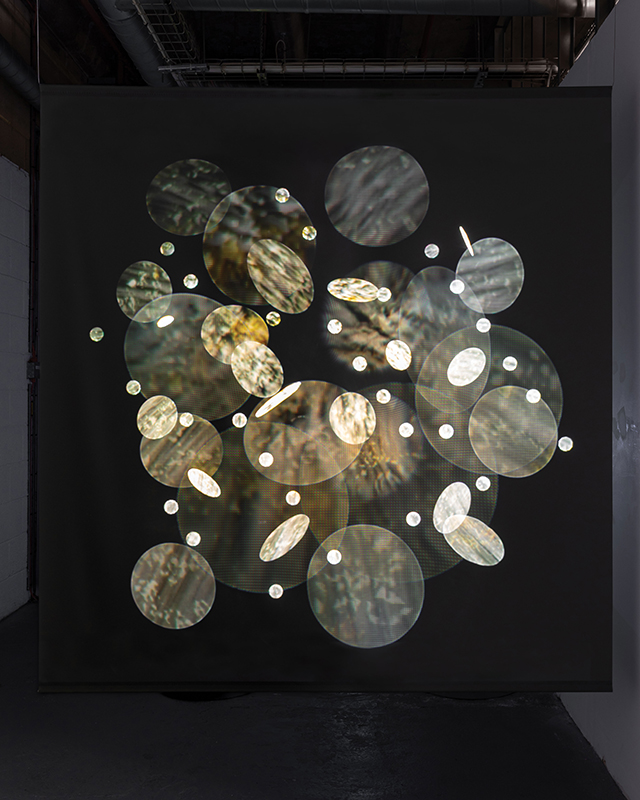
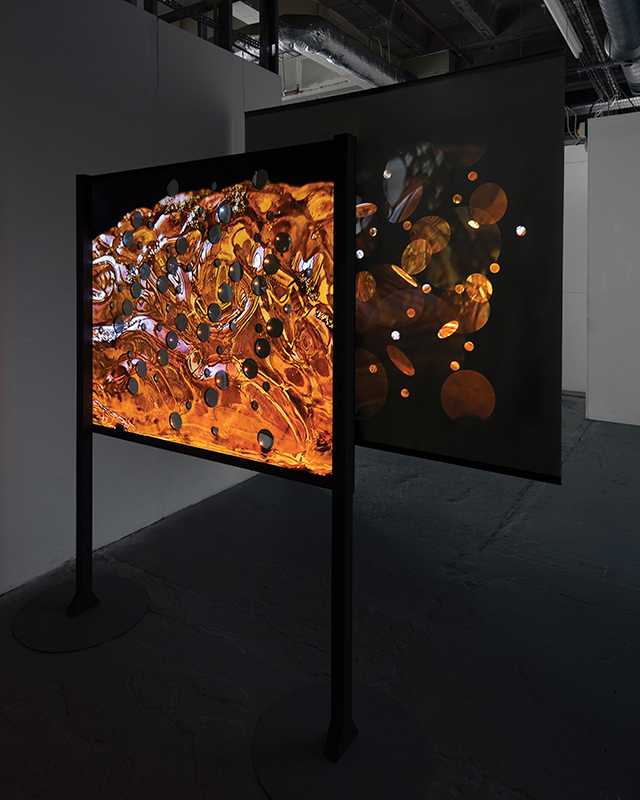
Very happy to receive lots of positive feedback for my video installation Lithos Panoptes. People were very engaged with how the work reveals itself in stages, from the kaleidoscopic imagery displaying on the two way suspended screen to discovering the board of distorting lenses behind the screen and finally stepping back to see the original film from the human perspective before it is transformed by the lenses.

Referencing a many-eyed giant of Greek mythology, Argos Panoptes (always eyes still awake), the work considers the perpetual vigilance of rock as record keeper and witness. Video of human activity projected through distorting optical lenses transforms the anthropocentric position to imagine the perspective of the rock.

The pattern of lenses is informed by the molecular structure of magnetite, a mineral found in magma and metamorphic rock in Earth’s crust as well as in meteorites and the cells of organisms.
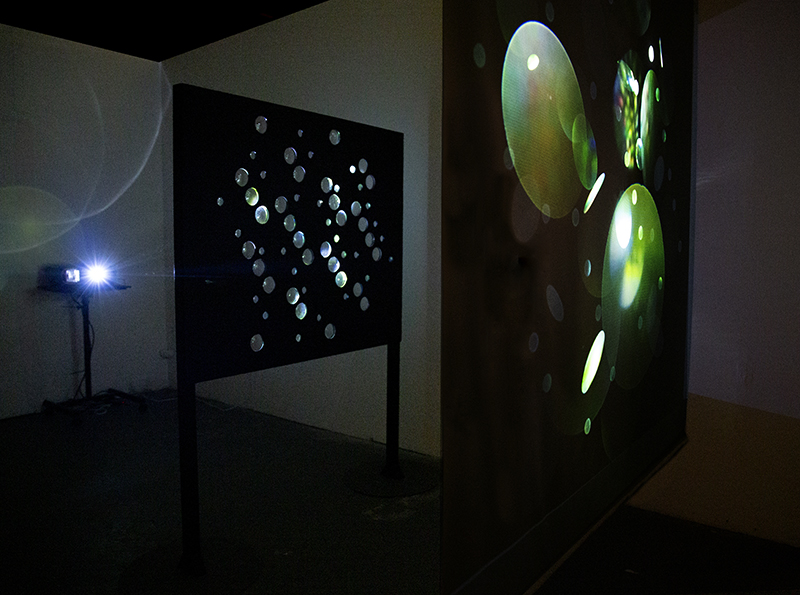
Through actual and metaphoric lenses, the relationship between the organic and non-organic is explored.

Lithos Panoptes 2025, Optical lenses, wood, steel, projector. Video 09:27 min Sculpture: H172 × W170 × D50 cm, Rear projection screen: H180 × W180 cm.
Photography by Benjamin Deakin

Mined magnetite is used in industrial and mechanical processes and its use in combustion engines and vehicle braking systems is releasing nanoscale pollutant particles into the air which are finding their way into human brain cells, vastly overwhelming the innate magnetite present, causing concerns linked to the development of degenerative brain diseases.
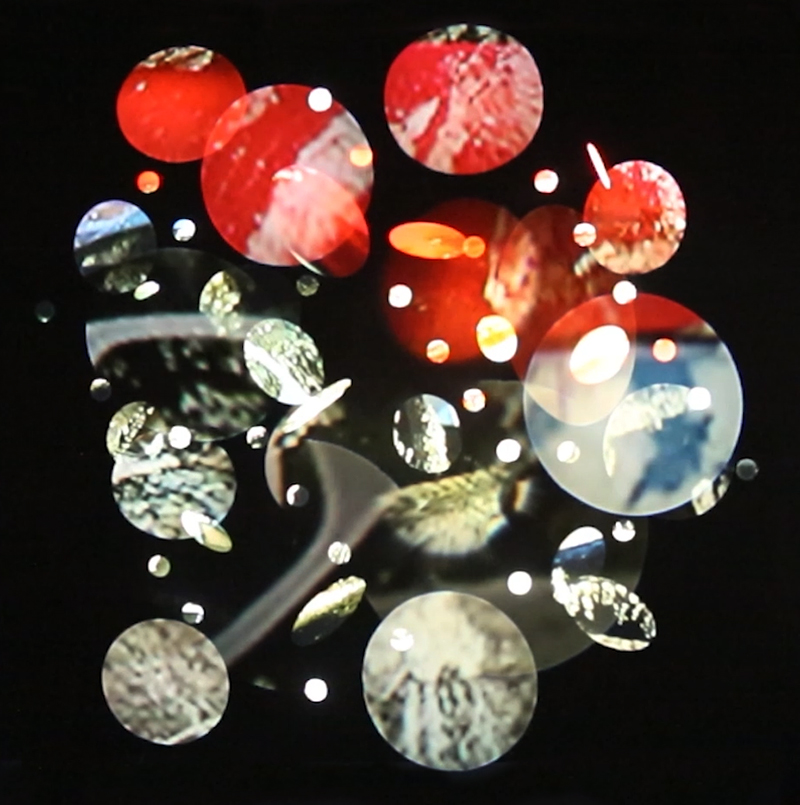
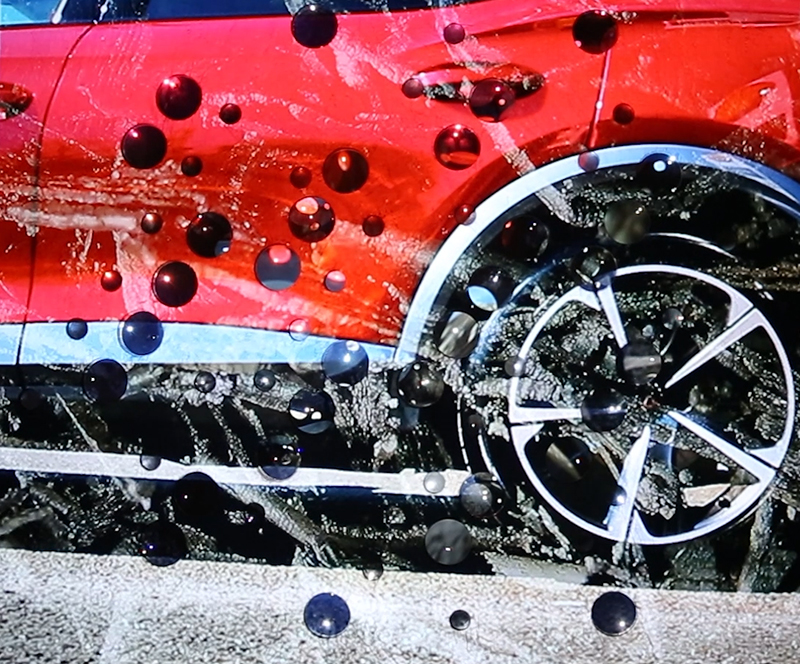
As well as referencing an ever watchful, many-eyed giant of Greek mythology, Lithos Panoptes also considers the numerous eyes (ocelli) of the chiton (a species of mollusc) whose rock crystal lenses have evolved over many millions of years to keep watch along rocky coastlines across the globe.

The only creature with eye lenses made of mineral and not protein, the chiton is also unique in having rows of teeth primed with magnetite which allow chomping on the hard rock surfaces it clings to. Some chiton’s teeth also contain the recently discovered mineral santabarbaraite, named after the mining district Santa Barbara in Italy where it was found – it is one of the few minerals named after a woman.
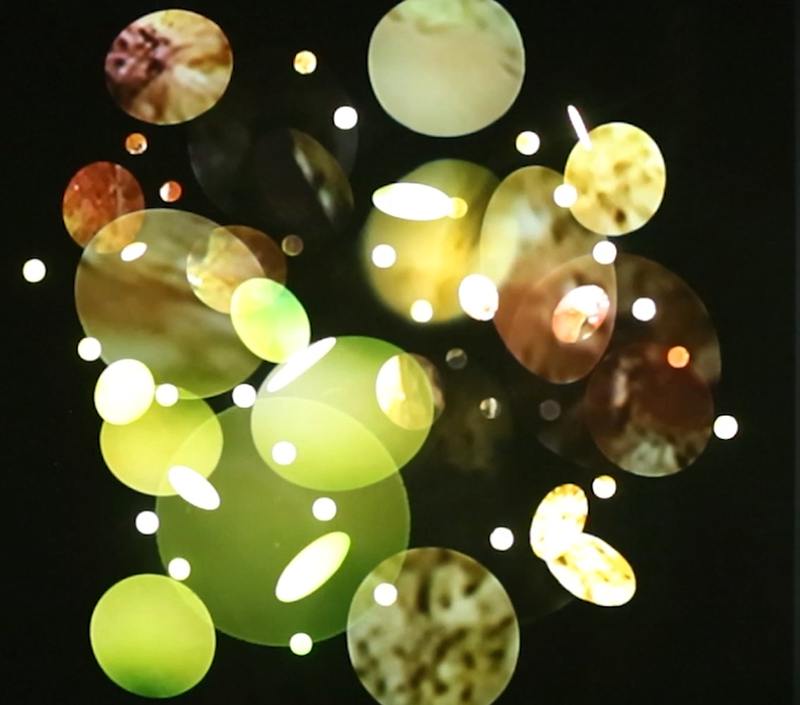
I was surprised to discover that the benedictions of Saint Barbara are still sought today, with shrines installed at tunnel entrances at Crossrail and even at CERN, the epicentre of scientific rigour. Before the boring machines were set in motion, services seeking her blessings were performed by local priests, with some even being winched down excavation shafts to carry out their duties.

Saint Barbara, who is associated with sudden death from fire, lightning and explosions, including military armaments, was adopted as patron saint of miners and tunnellers when the use of explosives in mining escalated during the 1600’s.

As the statues of Saint Barbara installed at these tunnel entrances are now buried, I have substituted images of my mother Barbara, coincidently born within hours of this Saint’s Day, in my video installation Lithos Panoptes.

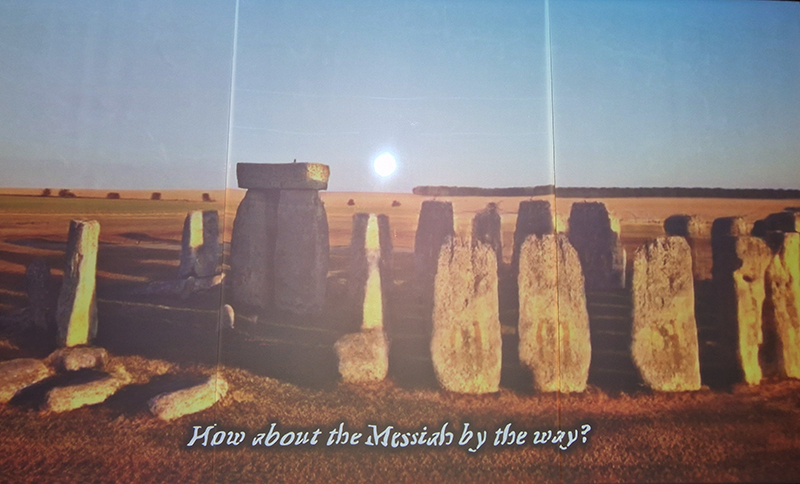
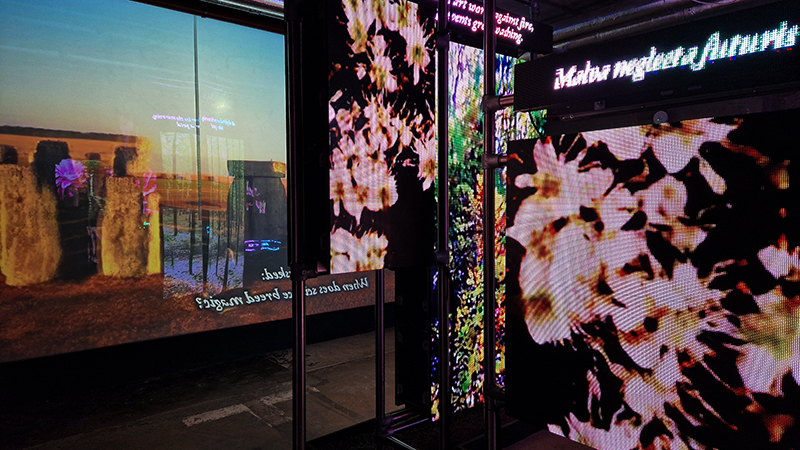
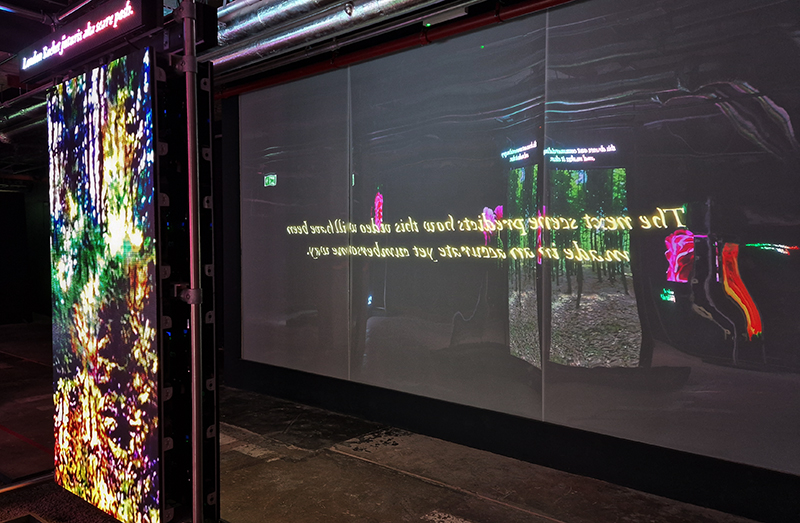
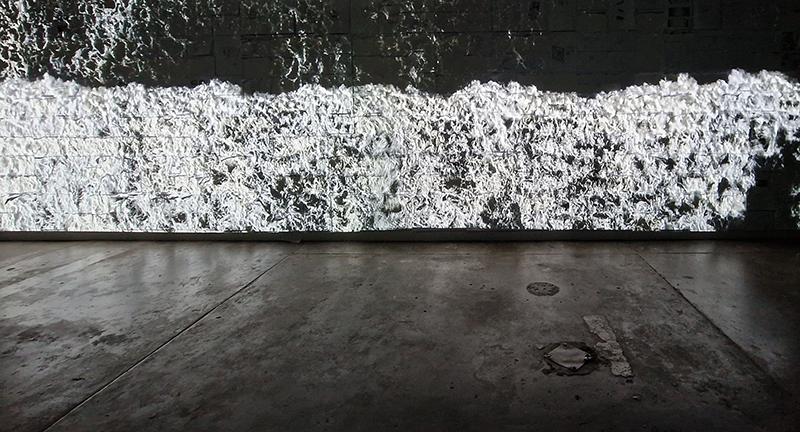
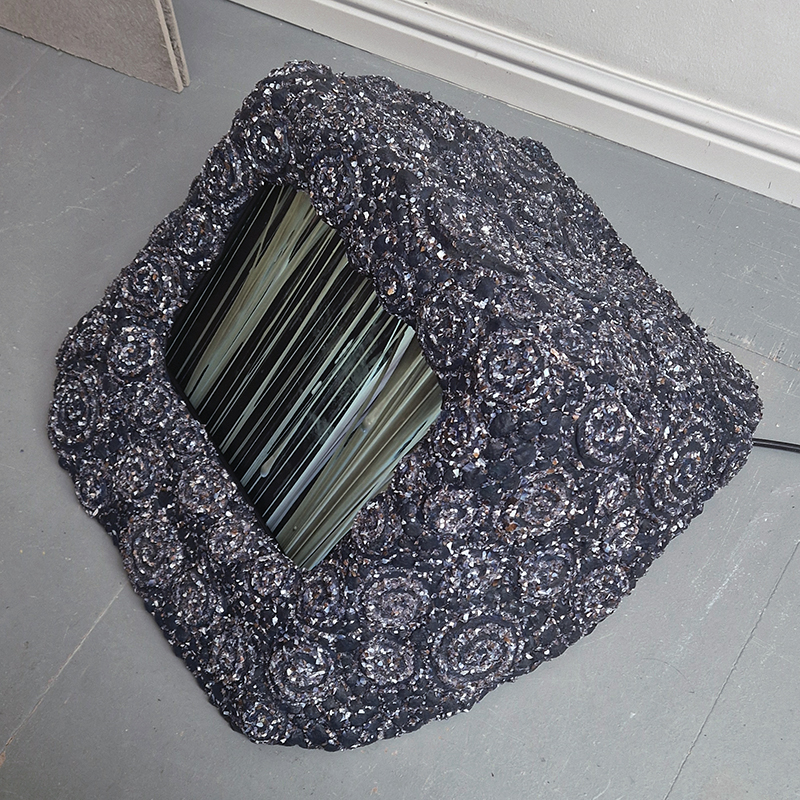
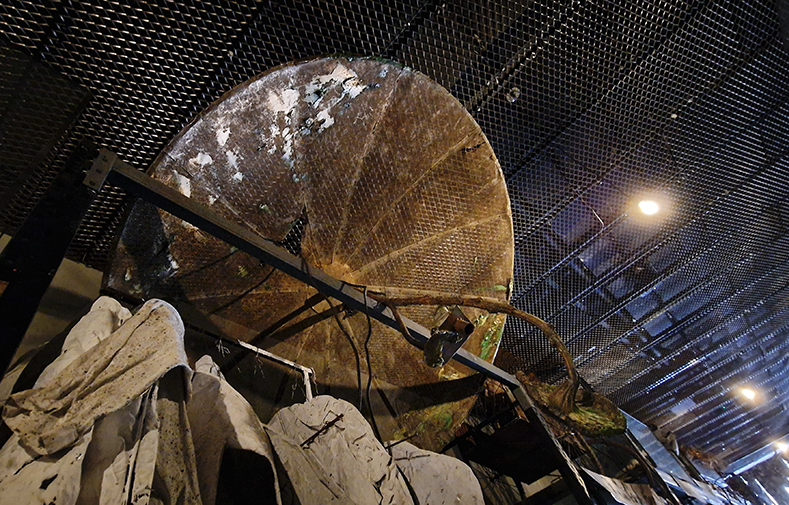
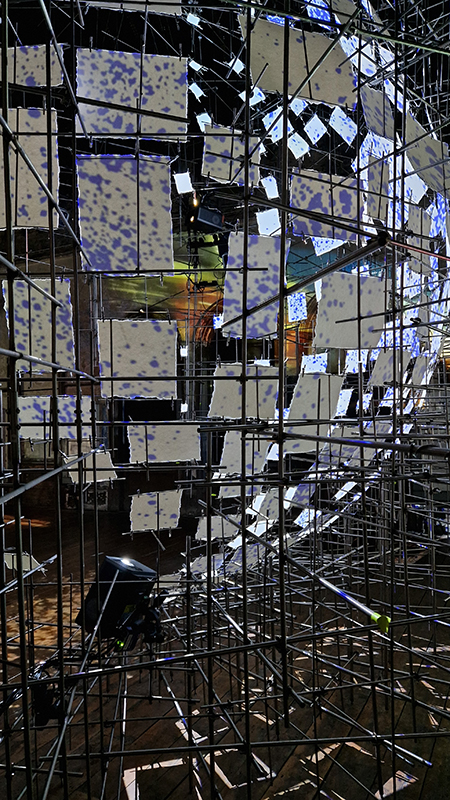
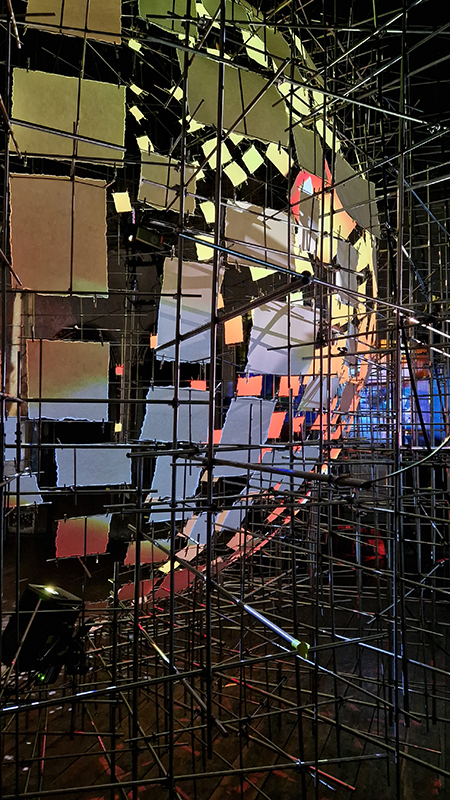
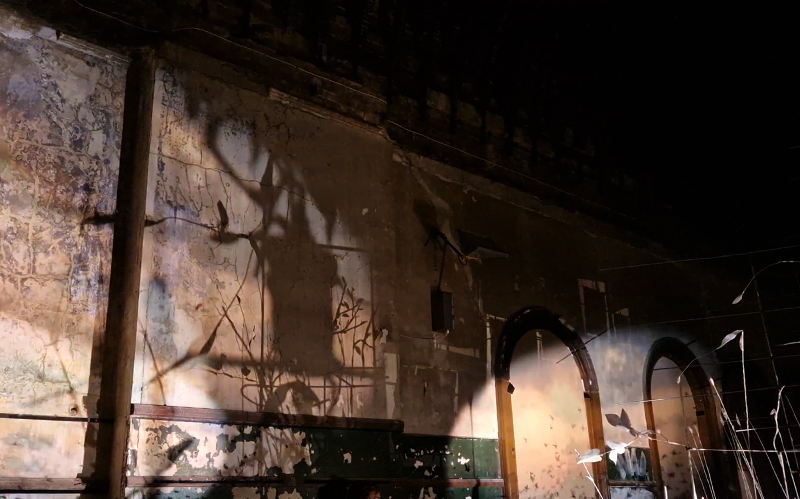
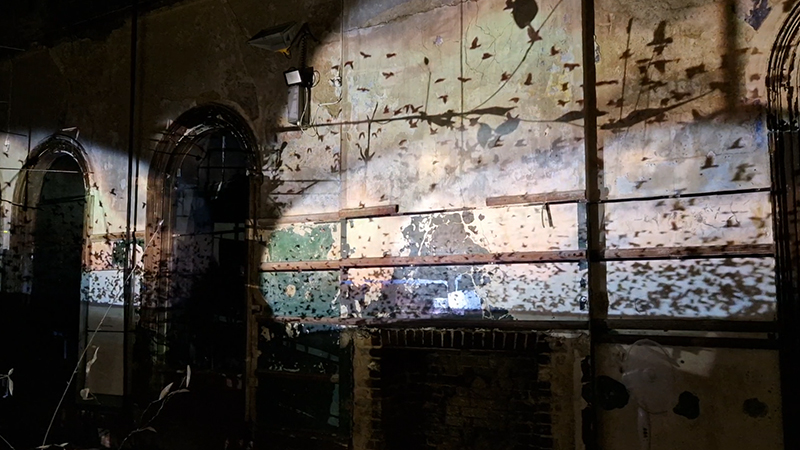
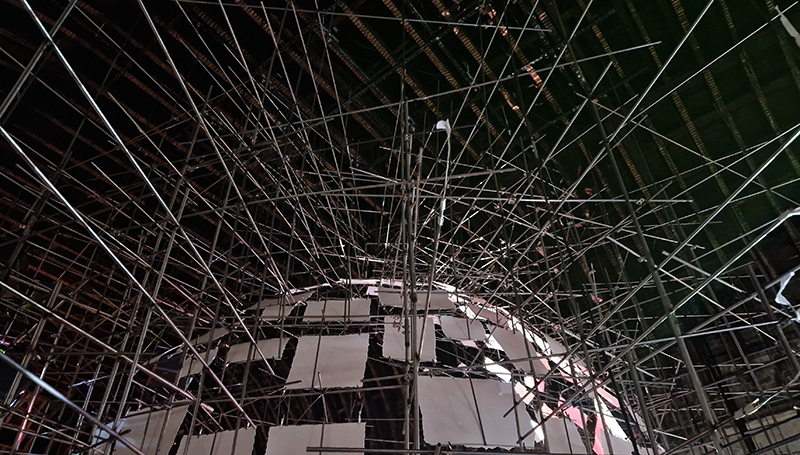
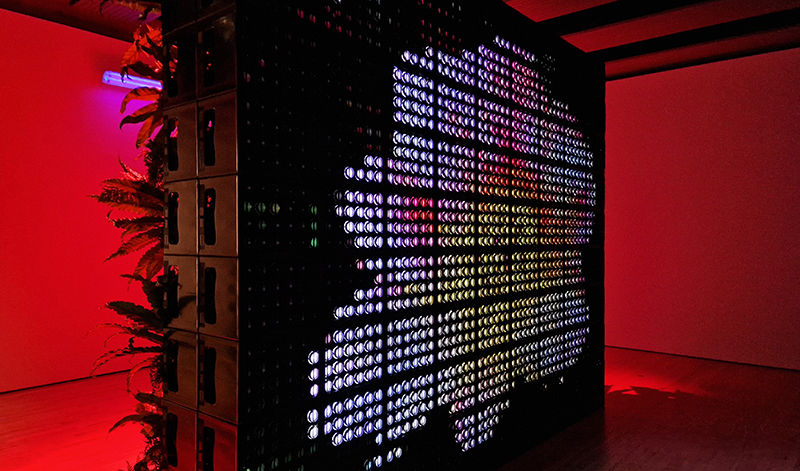
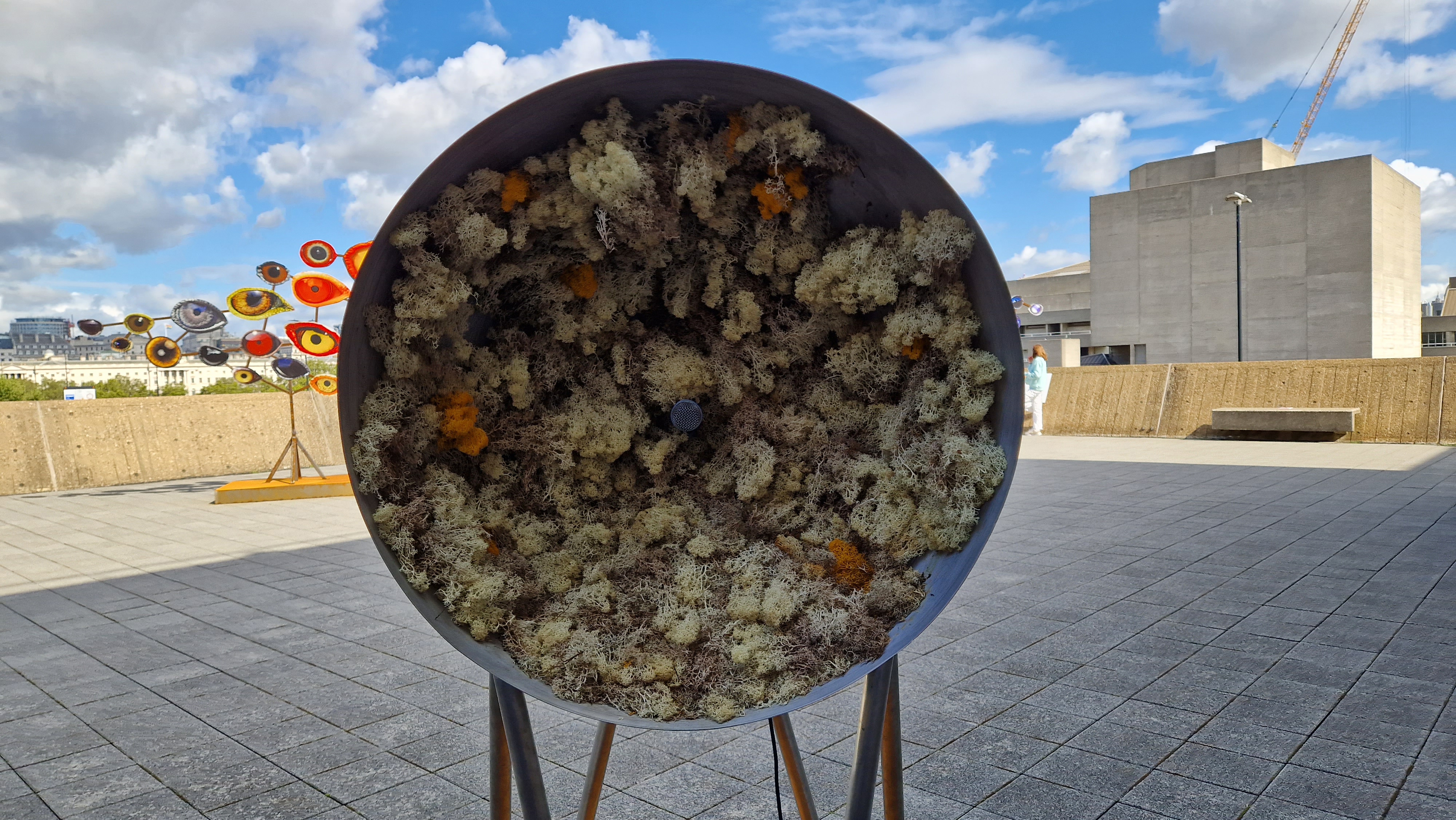
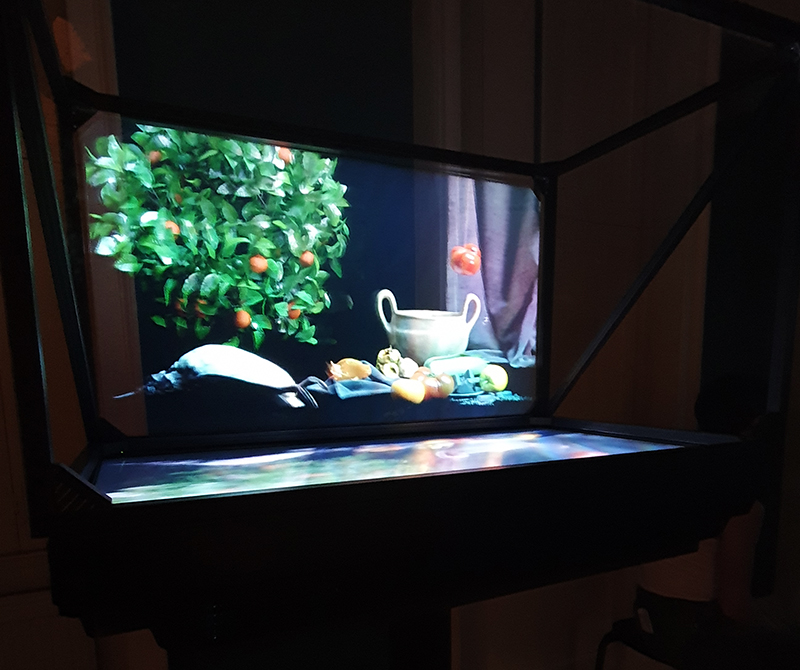
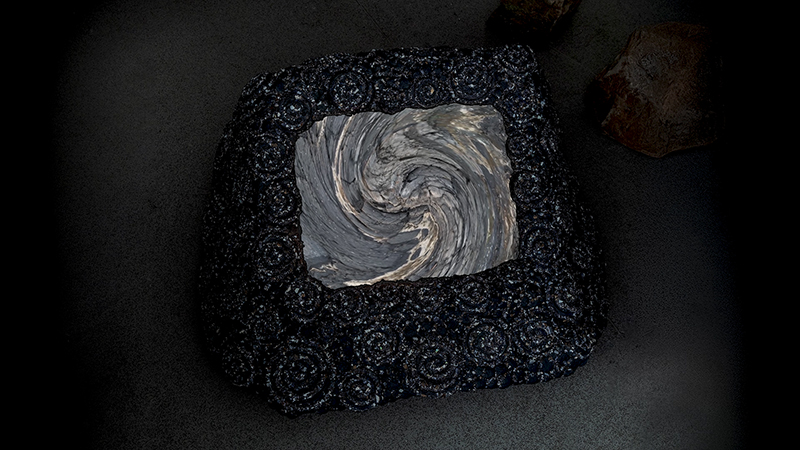
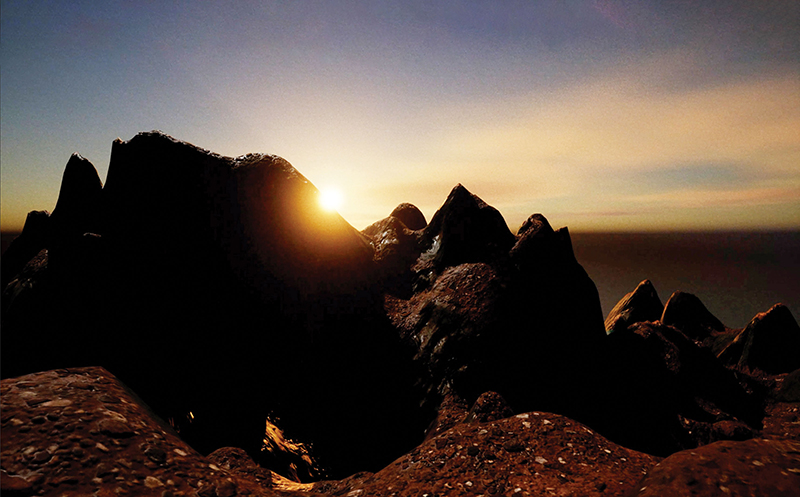
Tucked into a dark recess of the gallery, Belly of a Rock suggests an imagined place of chemical conversations at the intersection of the organic and inorganic. A hybrid between rock, mollusc and technology this video sculpture responds to an early lifeform’s emerging self-awareness, desire to communicate and urge to create as described by Italo Calvino in his story ‘The Spiral’. We don’t always know what we are creating.
Thrilled to show these works alongside Julie F Hill @juliefhill, Rona Lee @ronaleeartist, Charlie Franklin @charlie__franklin and Deborah Tchoudjinoff @deboraht_ff

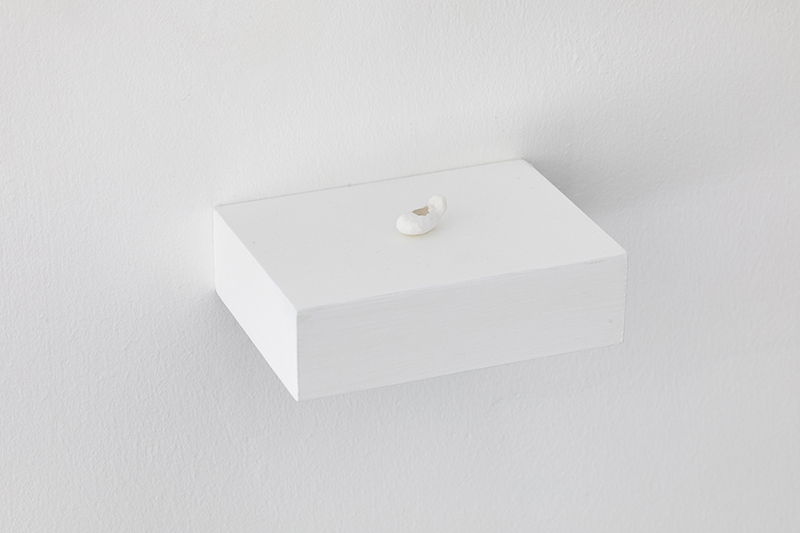
Julie F Hill’s sculptural print installation Parent Body uses scanning electron microscope imagery of samples recently returned from asteroid Bennu. The cave-like entrance, provides an embodied experience of the data and invites intimate contemplation of expanded scales. The ambiguous rock-like yet flowing forms echo the words of Jeffrey Jerome Cohen ‘stone is fluid when viewed within its proper duration’. Hill’s miniature work Return, considers the chemical and molecular cross exchanges between earth and space and in a gesture of reverse sample return (scientific missions and human extractive processes both take), a bead of Iridium is returned to the belly of asteroid Itokawa. Her small-scale embroidery work Water and Night, is based on observational studies of moonlight on water, continuing her explorations of water as the eye of landscape as proposed by Gaston Bachelard.

Julie F Hill, Parent Body, physically manipulated soy-ink print on tissue, chalk and clay pigments, chrome metal, water, clamp, funnel. c. W3 × H2.2 × D2.5m. 2025. Return, 3d print of asteroid Itokawa cast in plaster-of-paris, Iridium, 20 ×11× 8mm. 2024. Water and Night, silver metalized embroidery thread, 5.3 ×11 cm. 2025

 Photography Julie F Hill (1+3) Benjamin Deakin (2)

Deborah Tchoudjinoff’s moving image installation work The City of Gold (with sound in collaboration with Joe Farley) considers vast, beyond human, geological timescales when continents have once again become as one. Starting as a short fiction text, Deborah began to form an imagined world of cities in a future Amasia. The fictional cities are named after minerals that are heavily sought – rare earths, copper, uranium, gold, and coal – hinting at a narrative of an Earth depleted of the resources we rely on. The City of Gold is one of the five imagined cities. In a world where these natural resources are no longer, she questions what it would look like and who would be the inhabitants.

Deborah Tchoudjinoff, The City of Gold, video with sound, sculptural installation, 2m × 4m × 2m. 2025.

Photography B J Deakin (1) Julie F Hill (3)

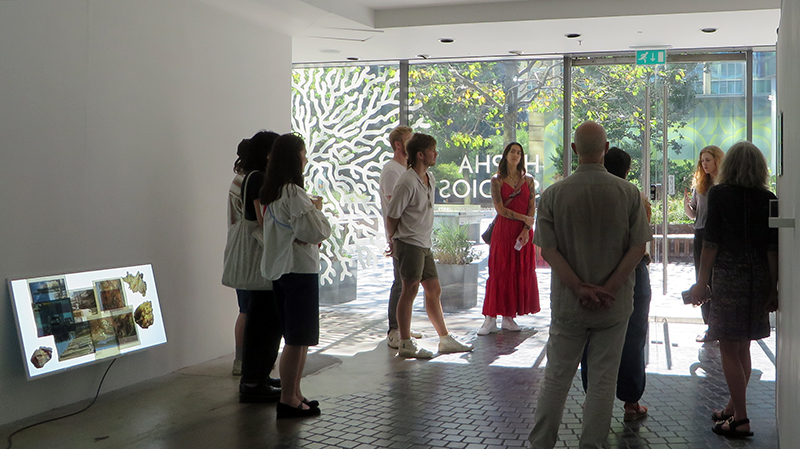
For Litho/Domous Rona Lee has chosen to work with book plates originating in the post-war period of the ‘great acceleration’ – a time in which population numbers, use of natural resources, popular consumerism, technological dependency and environmental degeneration burgeoned. Unified in their varying representations of the geologic but broking no contradiction between their celebration of extractive processes such as tourism and industrialisation and idealisation of the ‘wild’, the images selected by Lee conjure a pre-fall world in which imaginaries of lithic instability are firmly suppressed.

Two handfuls of silt (the residue of scientific samples collected at a depth of 4,000 meters), squeezed into the artist’s hands, fired and then gilded, form Rona Lee’s I want, I want, I want (2012), the title of which references William Blake’s engraving of the same name, wryly conjures the possibility of reaching down into the ocean’s depth, as though into a rock pool, while simultaneously cautioning against the folly and voracity of such ambitions.

Rona Lee, Litho/Domous, light panels, bookplates. 2025. I want, I want, I want, fired and chromed handfuls of sediment, 2012.

Photography B J Deakin

The sculptures presented by Charlie Franklin, Landform and FRAGS, are lumpy, solid looking forms that speak of geological debris or ruins. All three pieces were soaked in the waters of the North Sea, on the easterly edge of the UK. This process allowed the natural elements to determine their individual patination or colouring, along with indentations and scuffs, where materials have been worn away by salt and stone. Cave Drawings (Aladdin’s Cave, Series of Grottos, Marble Curtain, Fairy Grotto, and Solomon’s Temple) are a series of five found postcards depicting the caves at Cheddar Gorge in Somerset, UK which have been hand coloured by the artist. Franklin is interested in how the addition of colour can provoke a personality or aura within each cave interior, allowing for grand experiments to be realised on an intimate scale.

Charlie Franklin, Landform, Cardboard, found fabric, gaffer tape, gouache, scrim, plaster, adhesive, acrylic paint, copper leaf, sea water residue, 87 × 26 × 30cm. 2025. Cave Drawings, felt tip on found postcards, 14 × 9cm. 2025. FRAGS, cardboard, rope, gaffer tape, scrim, oil paint, aluminium leaf, plaster, adhesive, acrylic paint, copper leaf, seawater residue, work in two parts, 29 × 22 × 28cm / 12 × 29 × 23cm. 2025.

Photography B J Deakin, Julie F Hill

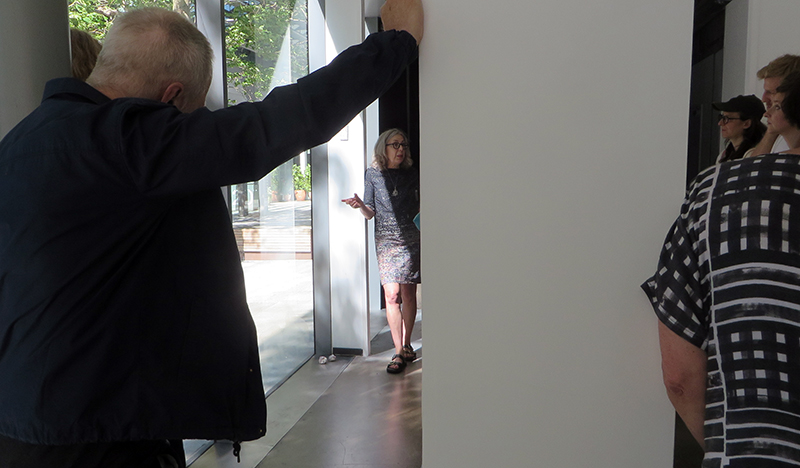
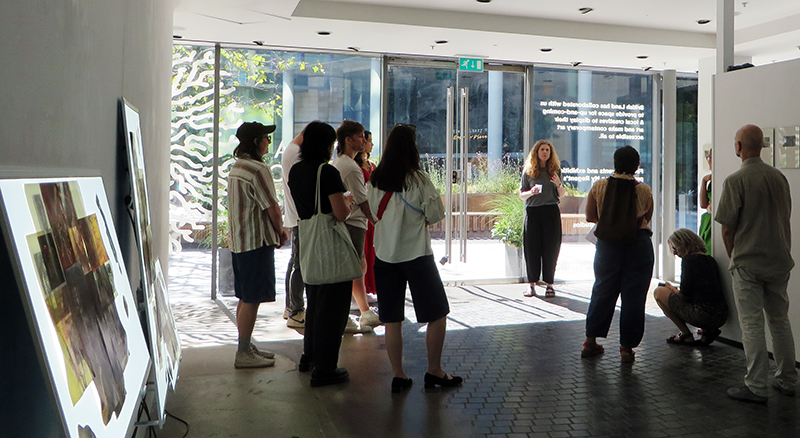
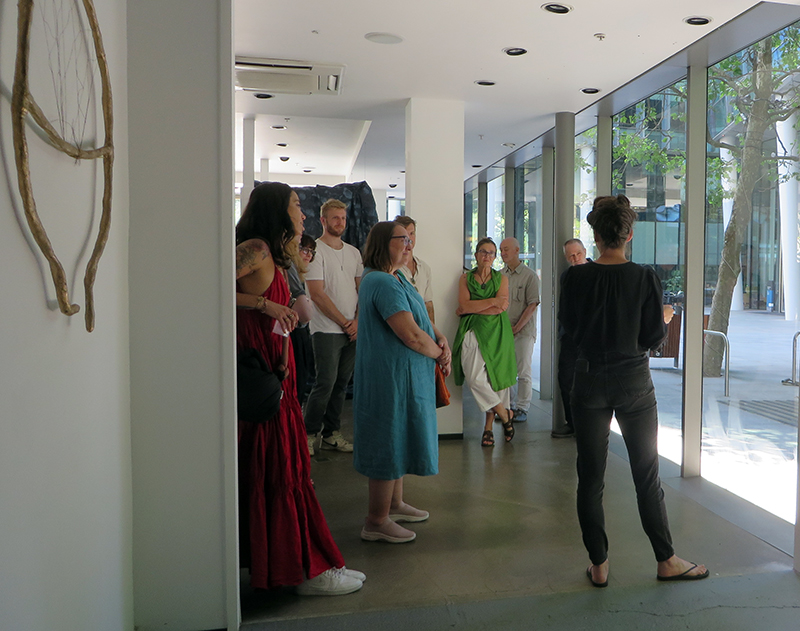
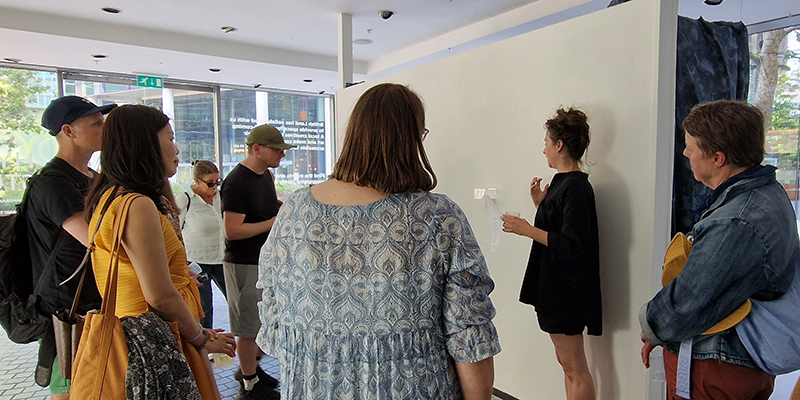
A highlight of our events was an Urban Geology Walk led by geologist Ruth Siddall.

“The gravel pit, like other mining holes, is the reverse image of the cityscape it creates — extraction in the aid of erection.” Lucy Lippard

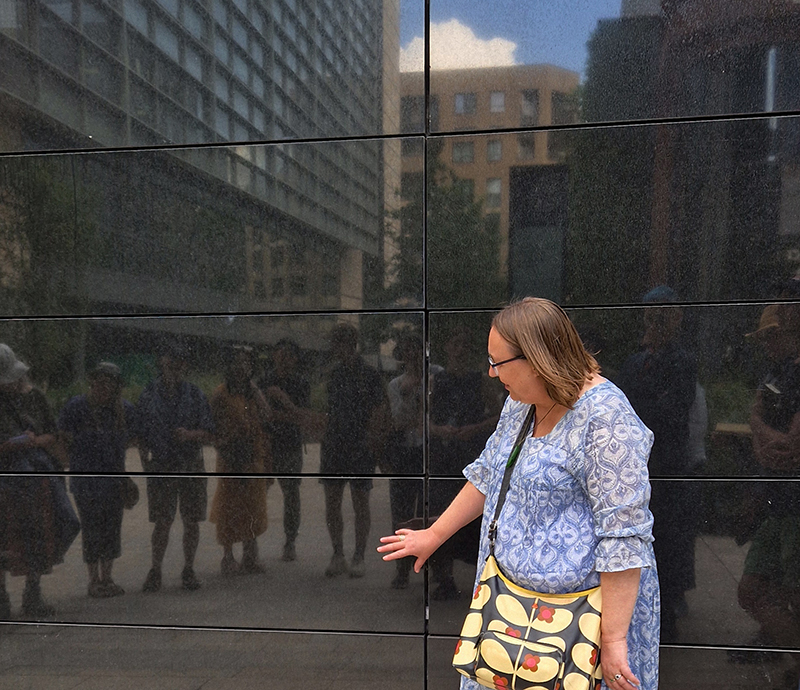
Ruth lead a group walk to explore the geology of the local built environment around Regent’s Place and Fitzrovia. Her knowledge of geology is astounding and her passion for stone infectious. Everyone came away incredulous, having their eyes opened to the deep time history of the rocks that build our city. The deep, black, Archaean dolerite from Mashonaland in Zimbabwe that Ruth points to is 2.2 billion years old. The large block of polished stone shaped like a giant pebble, itself crammed with pebbles of other rocks, is a sculpture by John Aiken, Monolith & Shadow. A patchwork of Jurassic limestone from southern Spain is crowded with the spire-shaped fossil shells of the gastropod Nerinea, stained red and yellow with ochres.

After the walk Ruth joined us for a tour of the gallery – it was fantastic to hear her insight and corroboration on some of the research that fed into the artworks.
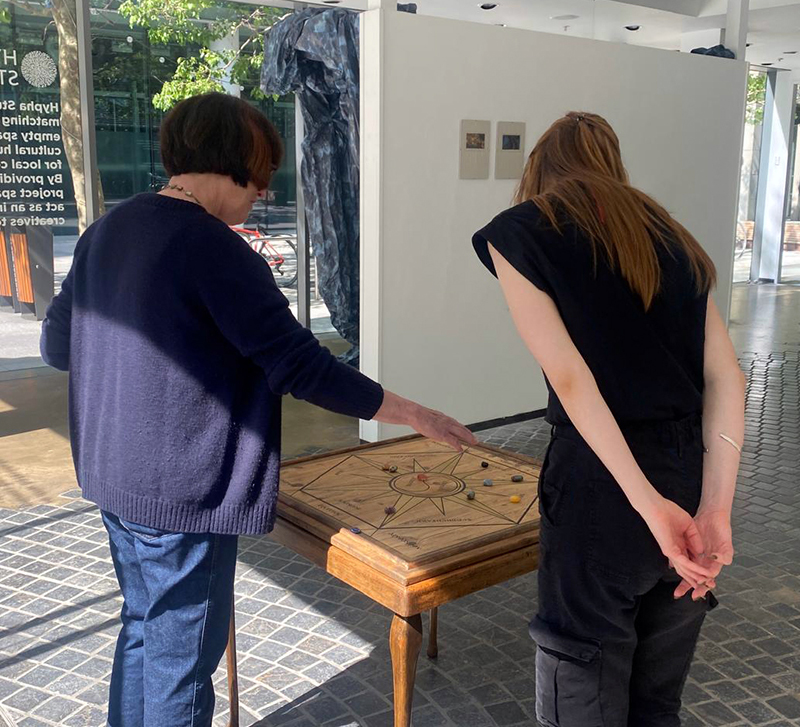
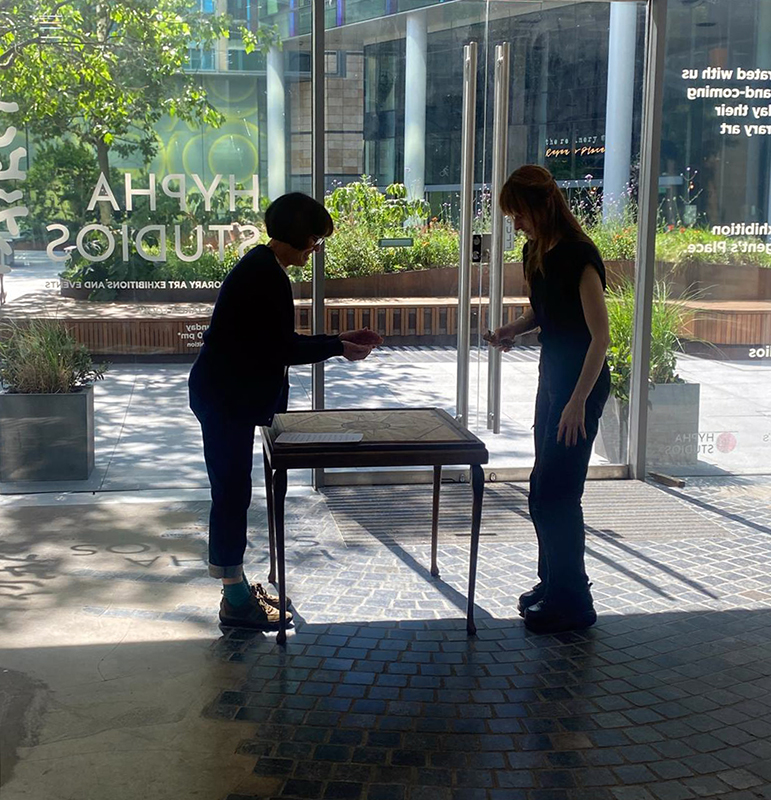
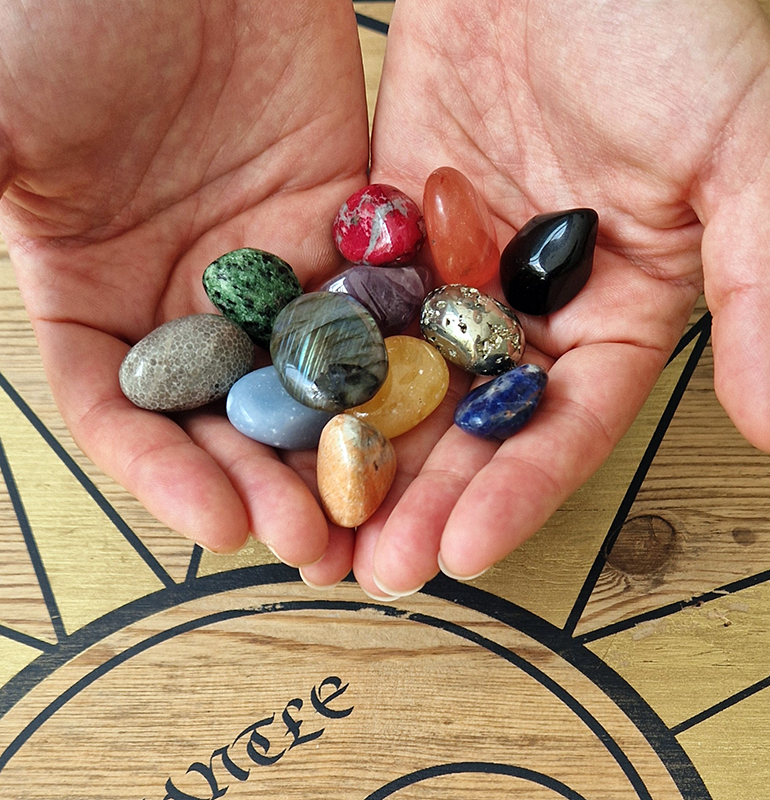
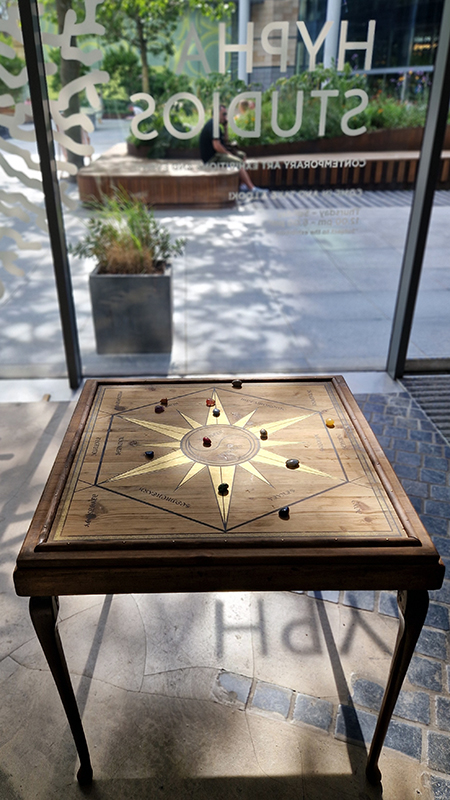
I offered Lithomancy drop-in sessions on Friday afternoons as part of a programme of events for The Geological Unconscious. Visitors were invited to throw gemstones with specially assigned characteristics onto a wooden board divided into geologically themed sections. They are then given personal interpretations based on the position of the cast stones by drawing from the esoteric ritual of lithomancy which seeks to divine the future from the reading of stones.

This performative experience proposes insights into the power and allure of stones emanating from the symbolic meanings attributed to them and exposes the entangled relations between the human and the geologic found in our language and desire to align the human condition with the lithic.

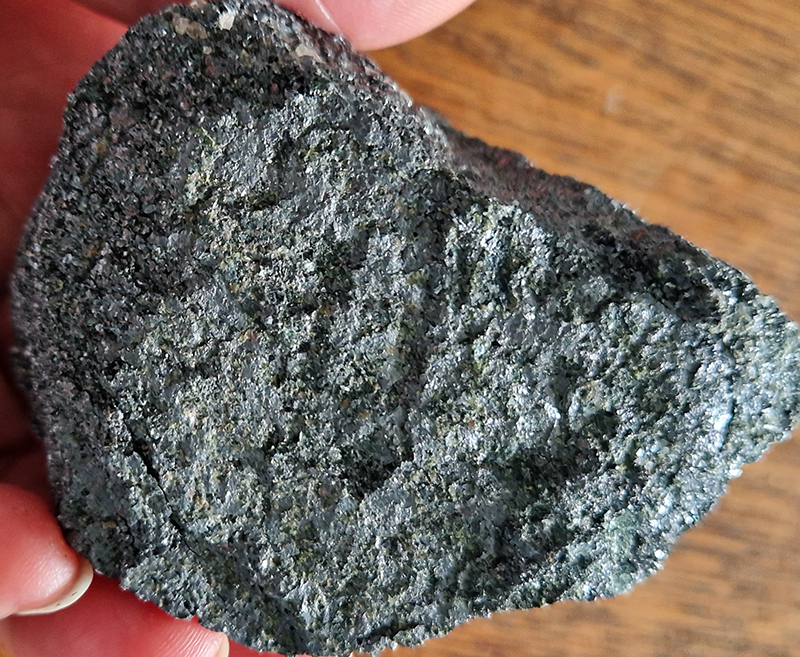
We had many interesting visitors to The Geological Unconscious and have made some wonderful new contacts. Not least among these was meeting Melanie Wheeler who has recently completed a residency in the UCL Geology Department where she worked with the technician to re-curate the rock room. Julie and I were lucky to be taken on a tour of the newly curated collection and receive gifts. So excited to have a beautiful sample of magnetite.

In ancient Greek, magnetite was known as “magnes lithos,” meaning “stone from Magnesia” – the region in Thessaly, Greece, where magnetite was first discovered, supposedly by a shepherd who noticed the nails in his boots were sticking to the rock under his feet.
As an additional daily drop in activity during The Geological Unconscious we offered cheong tasting. Chef Moonhyung Lee explored human-mineral entanglements through digestion using stones to create cheong (Korean fermented syrup). The use of weighing stones helps create the environment for preservation, a process which amplifies the bioavailability of minerals in food. Moonhyung Lee is a food designer with a background in graphics. She is currently based in London and works at zero waste restaurant Silo.

It was great to have so many people join us for our Closing Event artist talks and the launch of the exhibition publication with preface by Jason Groves and short essay by Ruth Siddall.
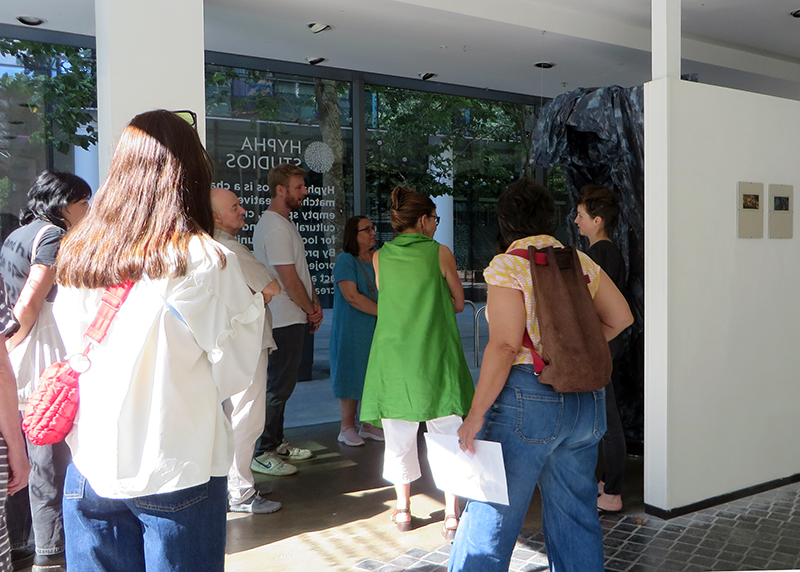
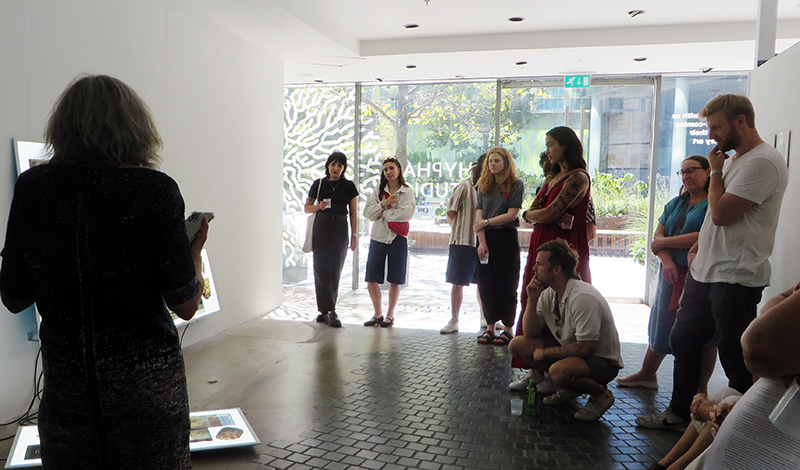
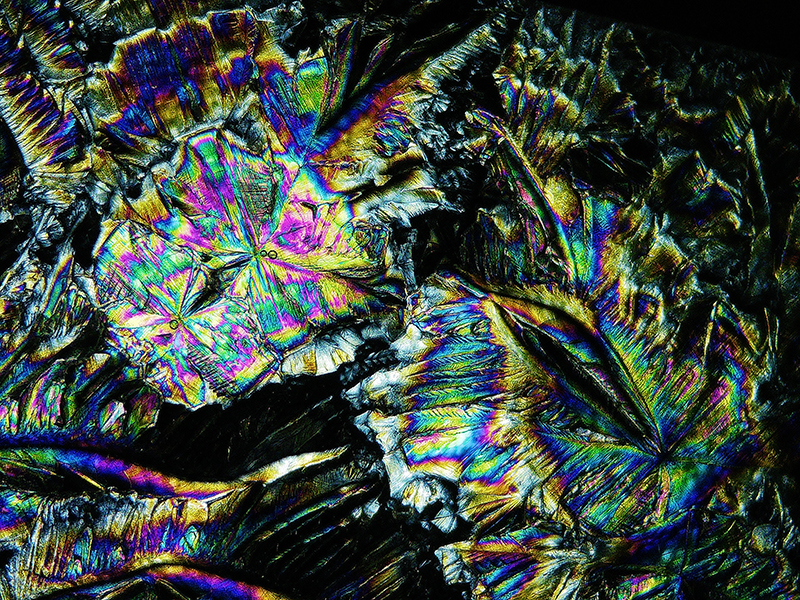
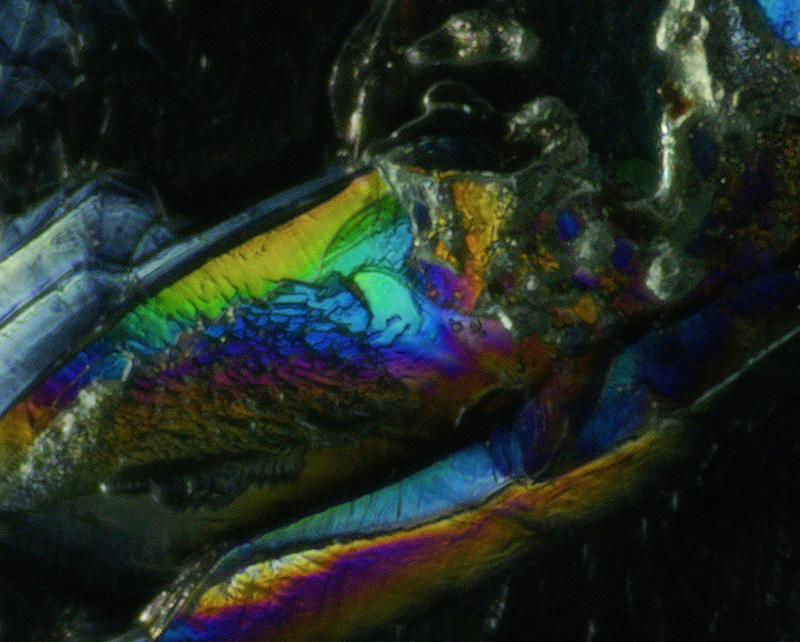
We also had the microscope set up at the closing event to look at some crystal growth in solutions prepared by Julie who works extensively with crystals.

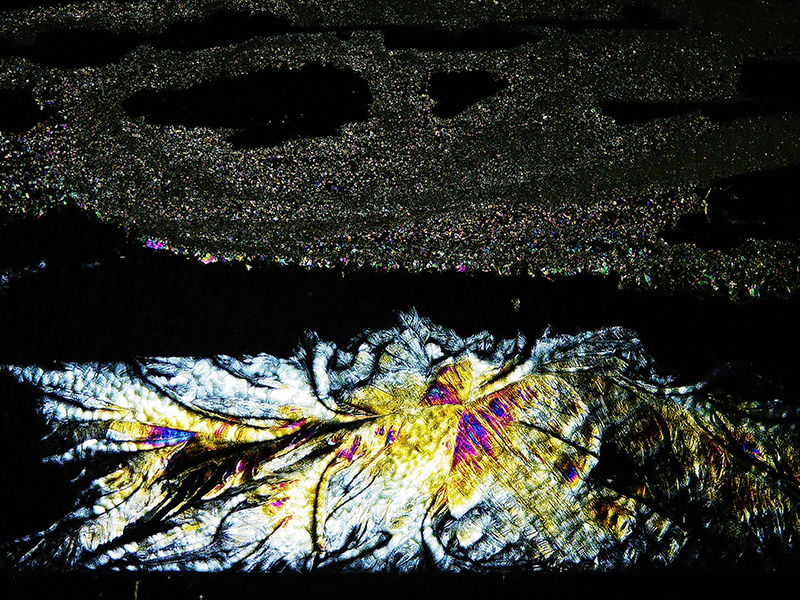
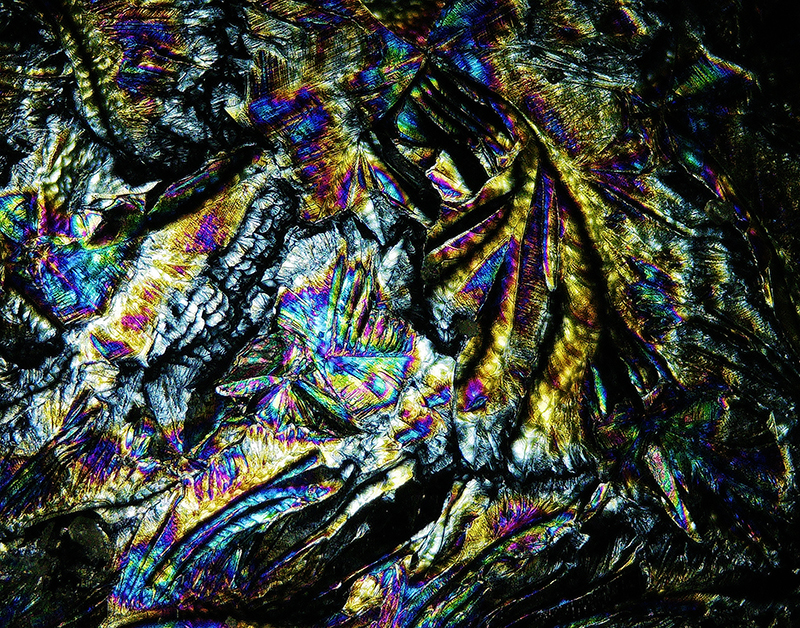
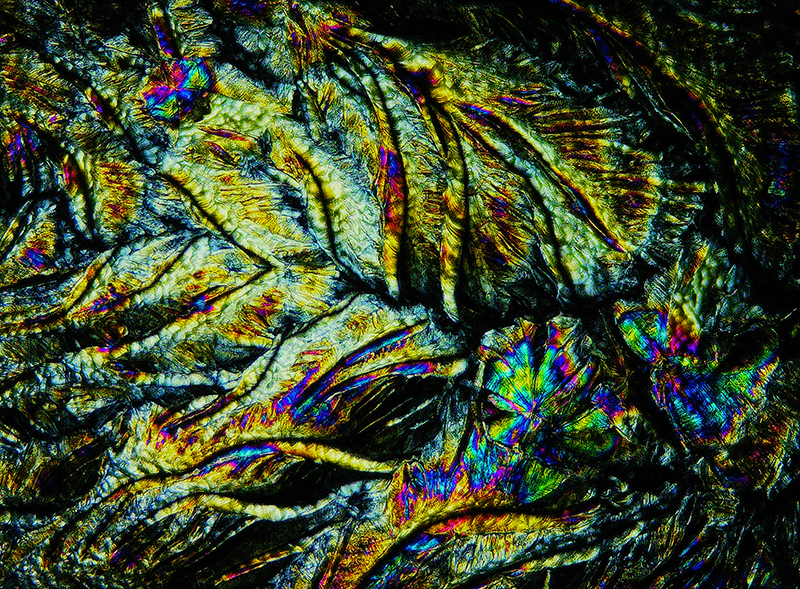
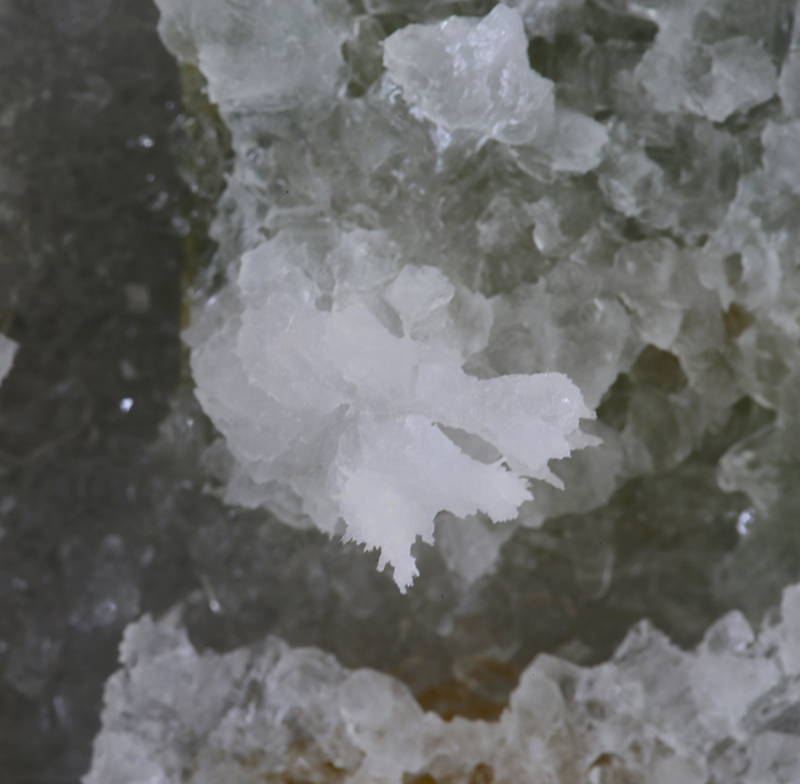
I had tried some ‘Vitamin C’ crystal growing microscopy experiments at home. These images use a polarising filter under the microscope to reveal the vibrant colours. Next step will be to set up a timelapse of the crystals growing.
Summer Solstice 2025. The shortest night of the longest day brought an awful darkness. Collected the last two solargraphs I had installed at the Hogsmill Nature Reserve. These have been collecting light from the sun for a whole year, recording every sunrise and sunset. May the light shine through.

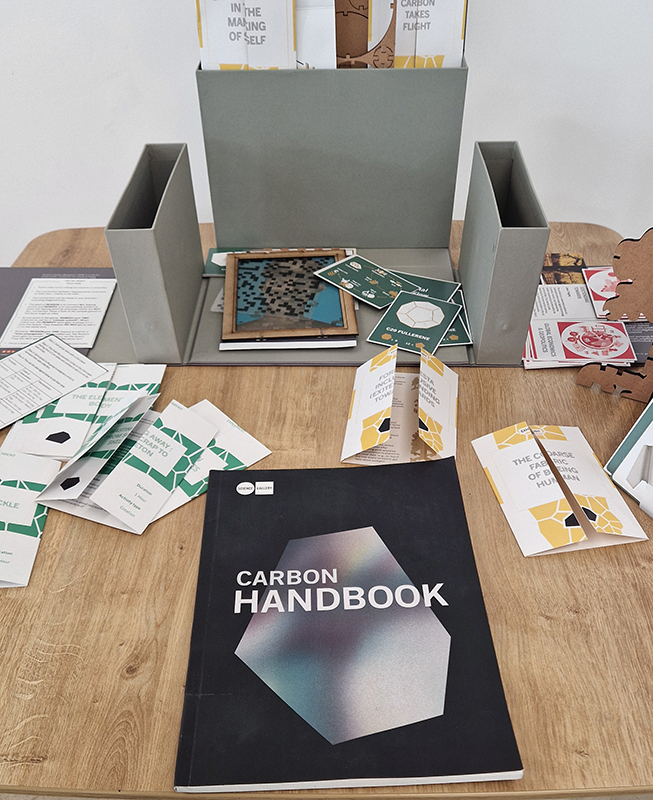
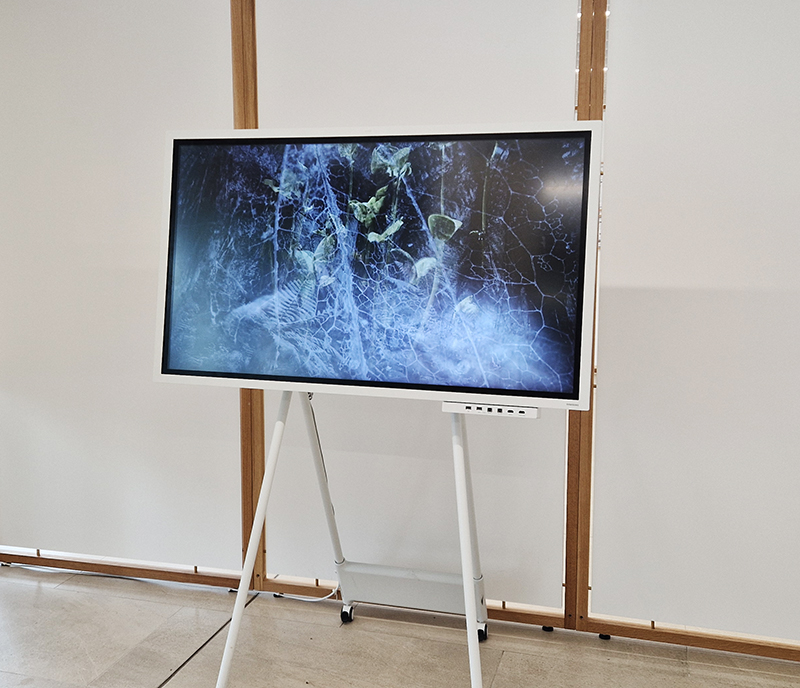
I was delighted that my video Cosmic Chiasmus: crossing the universe was included in CARBON: Under Pressure, at the Mazumdar-Shaw Advanced Research Centre as part of Glasgow Science Festival 2025, in a special exhibition partnership with Science Gallery Bengaluru.

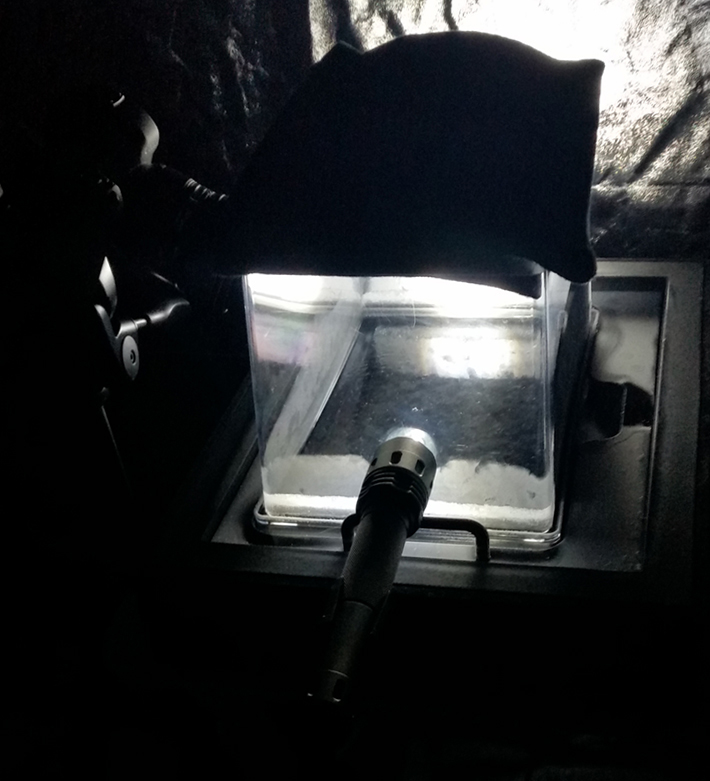
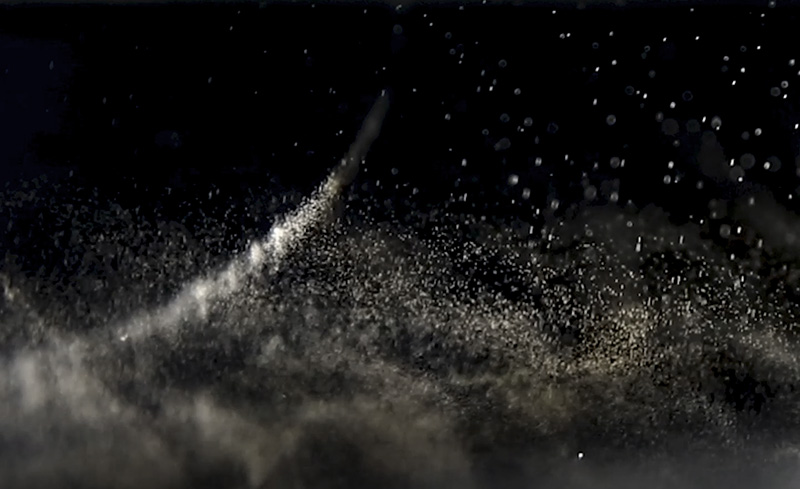
The video offers a glimpse into a subatomic world where cosmic rays travel from distant galaxies to collide and silently interact with atoms and technology on Earth. Alongside the screening of the video I was also invited to give an artist talk and cloud chamber demonstration. It was great to share the wonders of the cloud chamber with visitors who were able to see cosmic ray trails for themselves.

It is an incredible journey that cosmic rays make, blasted across space, spiralling along magnetic field lines to end up entangled with carbon in our bodies.

Not only is all life physically permeated by cosmic rays with the potential for nuclei collisions, but some cascading particles smash into atoms of nitrogen and combine with oxygen to create radioactive carbon-14 which enters our atmosphere. Plants absorb it during photosynthesis, and it is incorporated into their carbon skeleton, which we then eat. While plants and animals are alive, carbon-14 is continually replenished as the organism takes in air or food. But when an organism dies no more carbon-14 is absorbed and that which is present starts to decay at a constant rate. By measuring the radioactivity of dead organic matter, the current carbon-14 content can be determined and the time of death established. Cosmic ray activity gives us carbon dating techniques.

Reading

The Geological Unconscious – Jason Groves. Returning to this book that sparked the ideas we explored in our exhibition. A redirection of geology to consider a type of connection between things that are not in themselves geologic. Stones that stare, stones that speak. An image of the human could develop through geologic processes, becoming part of the mineral consciousness. Quoting Heather Sullivan ‘There is a difficulty for biology and philosophy to maintain a reliable distinction between life and non-life.’

The Writing of Stones – Roger Caillois. A paean to the capacity of minerals to form images within the imagination, which in turn is considered to be nothing more than an extension of matter.

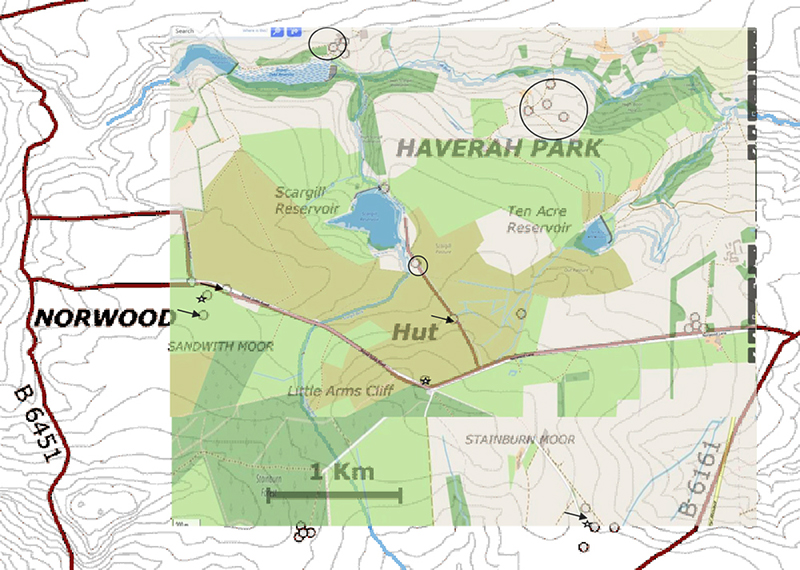
The Performances of Sacred Places: crossing, breathing, resisting – edited by Silvia Battista. I read this for some background research while thinking about how I might make work responding to the abandoned sites of the cosmic ray detector huts at Haverah Park on the North Yorkshire Moors.

‘An horizon stands, in modern hermeneutics, for what is possible to see from the position of a specific observer. That is, not only a location in space but also a position in the cultural and historical apprehension of the world.’ Silvia Battista

The book opens by questioning relationships between the site and its ascribed attributes, which may be mercurial qualities not easy to define or quantify. It reflects on the performativity theories of Karen Barad which argue that matter, in its complexity, is an active participant in our relationship to the world and Jane Bennet’s call to recognise the ‘vitality of matter’ that crosses the human non human divide. In the section on ‘crossing’ the sensitive work of Louise Ann Wilson explores ritual around death, grief and loss through walking in rural locations echoing walking an interior landscape of memory. Walking the labyrinth and the pilgrimage are also considered as journeys that take place in physical and metaphysical space.
In classical antiquity, a time stretching from Homer to the early middle ages, geographic orientation usually referred to landmarks or astral phenomena to determine direction. Eos, meaning dawn, and Hesperus, meaning evening, were named for sunrise and sunset with north (arctos) being marked by the constellation Ursa Major and later the Pole Star. The winds also became associated with direction and named in accordance with their qualities such as hot and humid or cold and dry.

The number of points on a wind rose began with the four cardinal points that were added to and refined over time. Aristotle designed an asymmetrical 10 point wind rose for “the study of things high in the air” (meteorology) which was later refigured by Timosthenes, a 3rd century BCE Admiral and geographer, naming a system of twelve winds and using this as a tool for navigation. The contemporary compass has its roots in the ancient classification of winds.

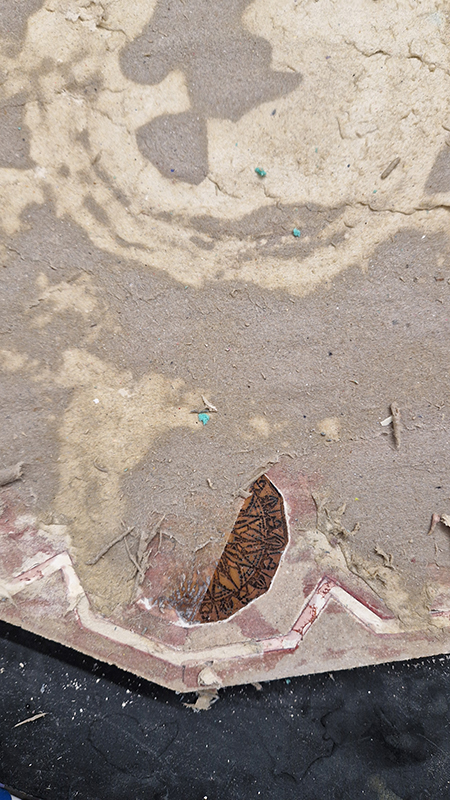
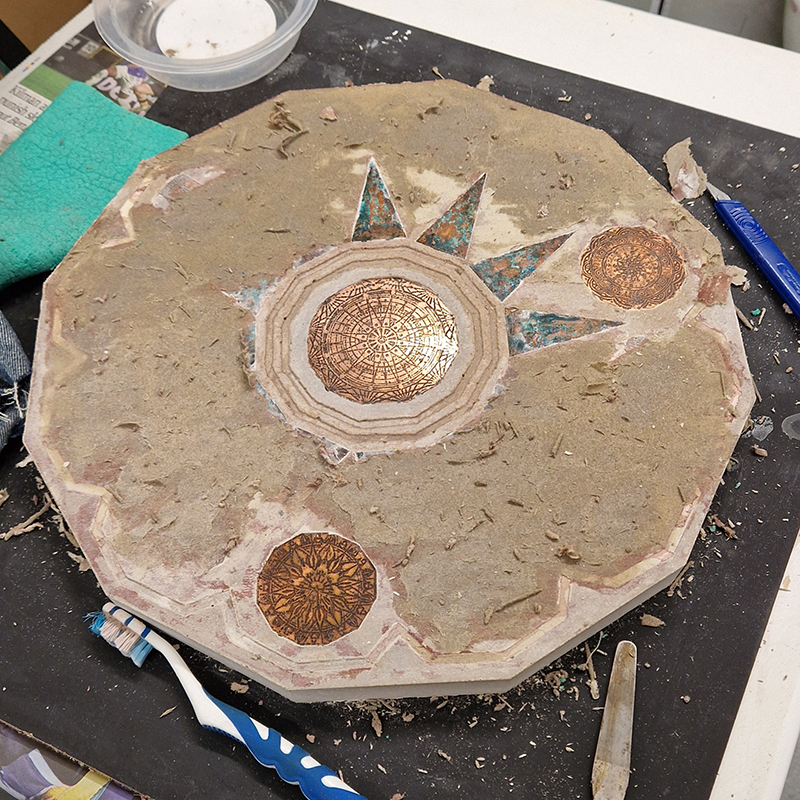
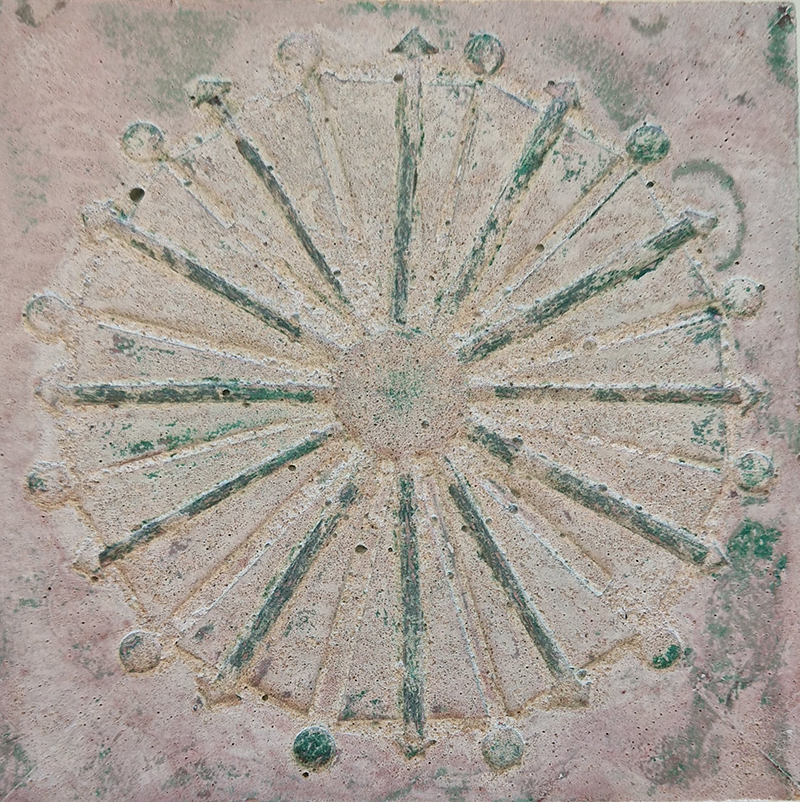
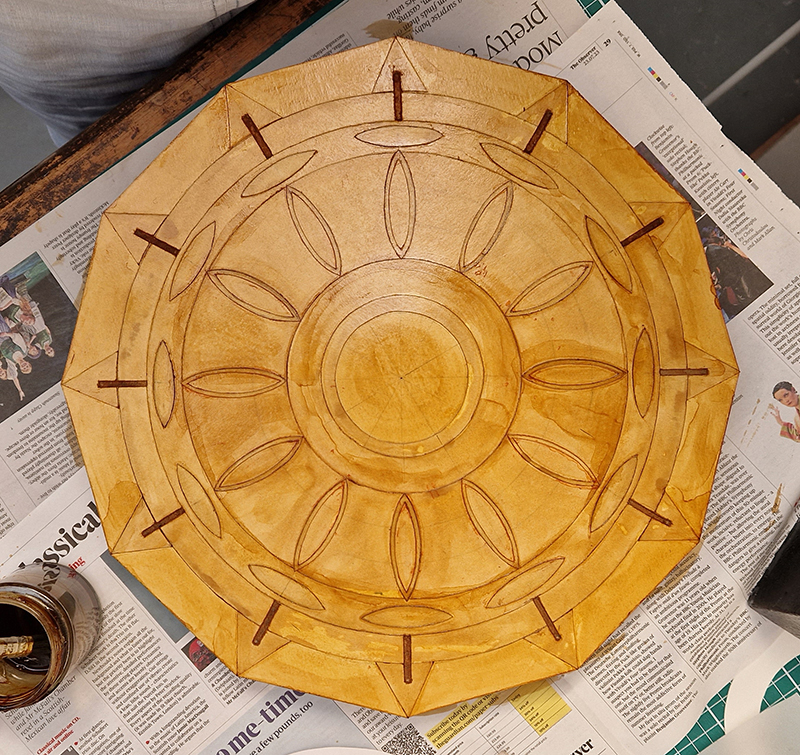
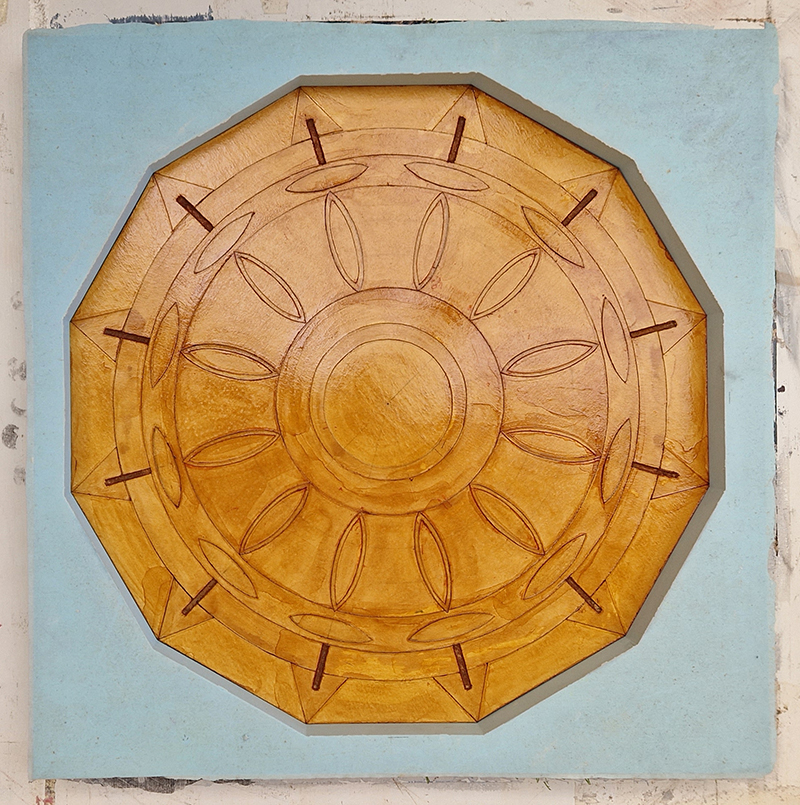
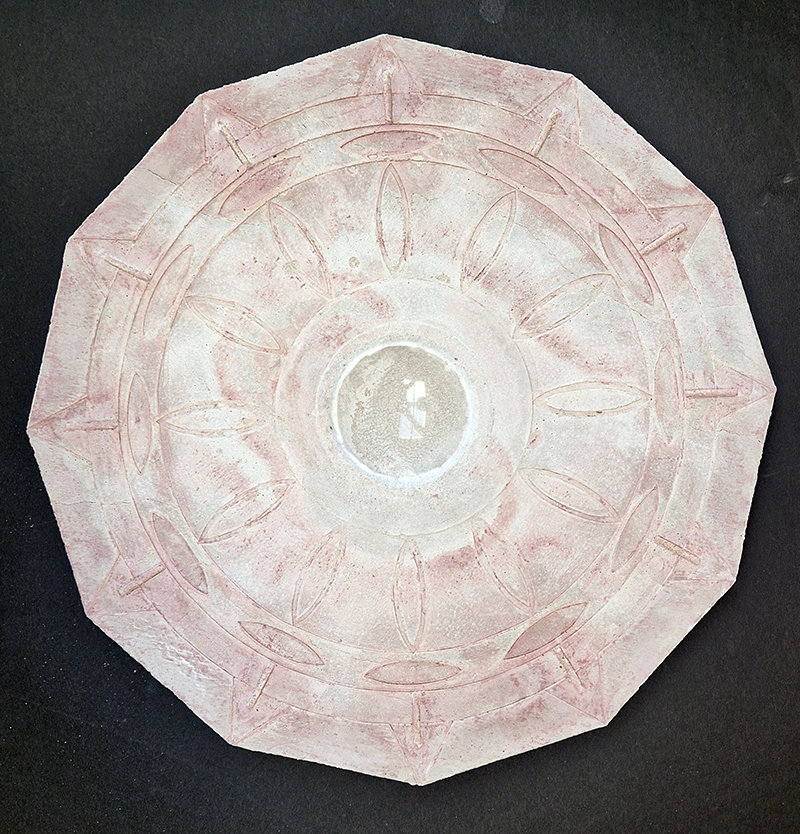
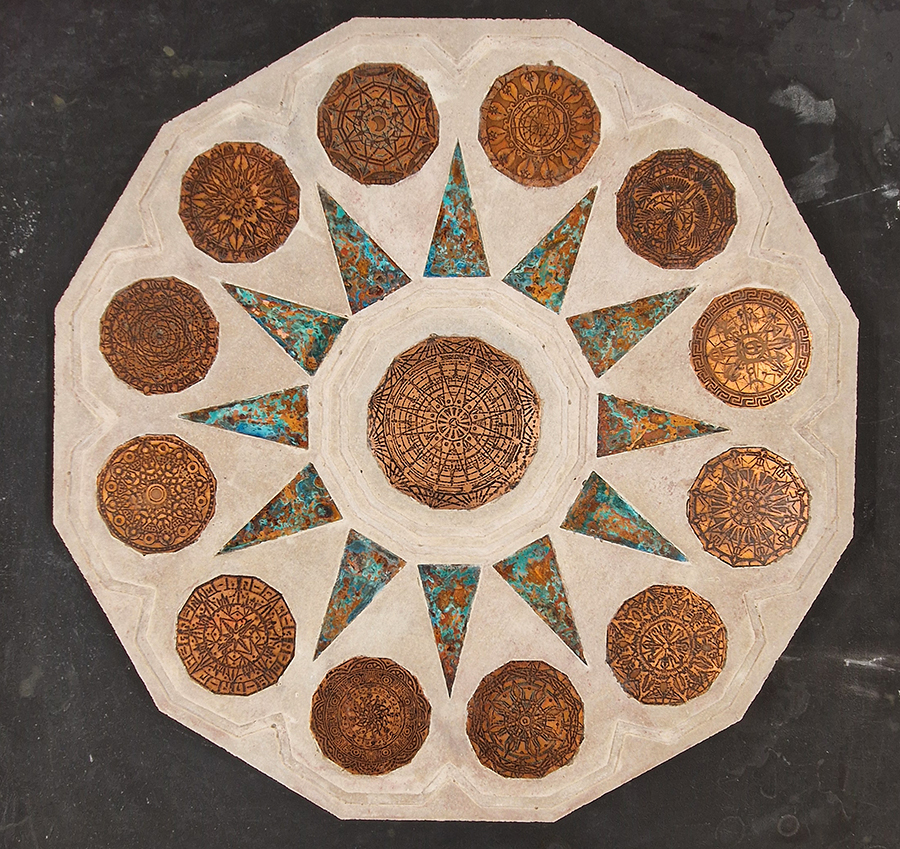
Freshly excavated. A new tablet for the series Instruments of the Anemoi, replacing a previous one based on the idea of a wind rose and set with etched copper markers, the designs of which are influenced by characteristics of the gods (anemoi) represented by each of the twelve winds.

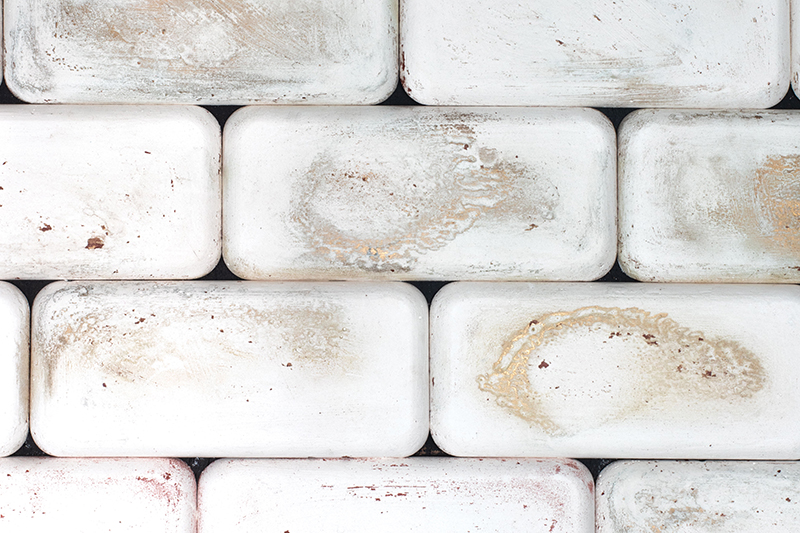
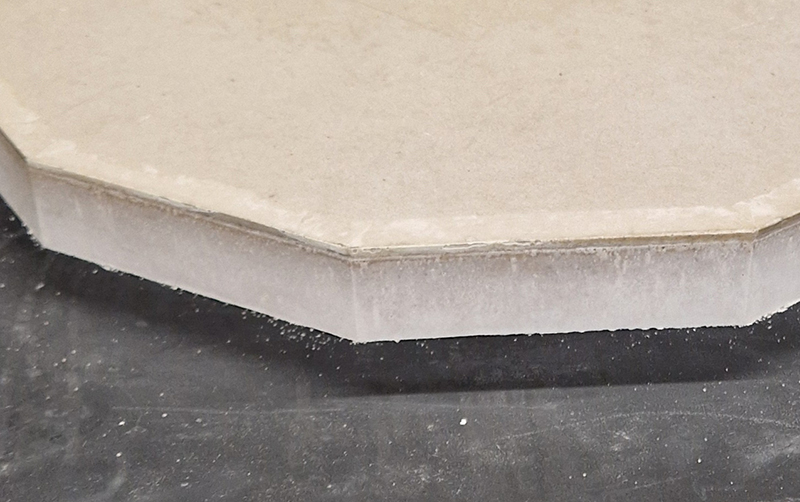
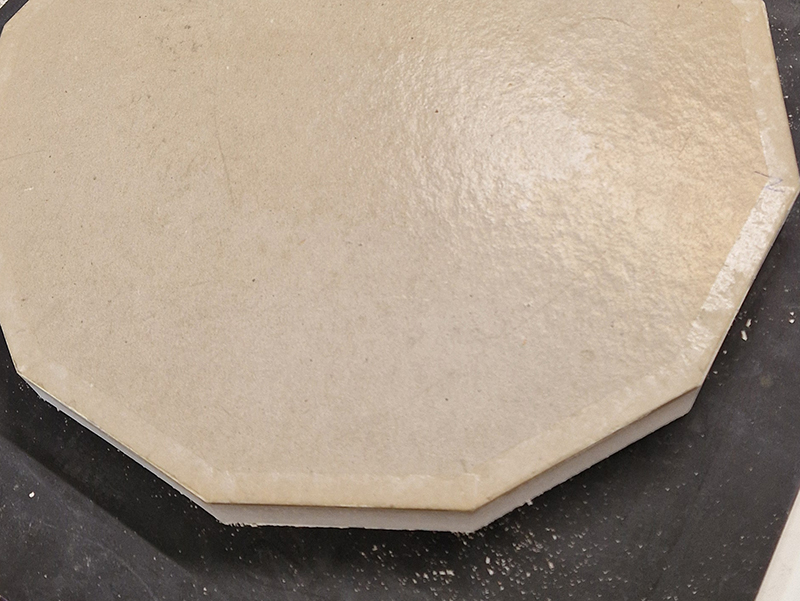
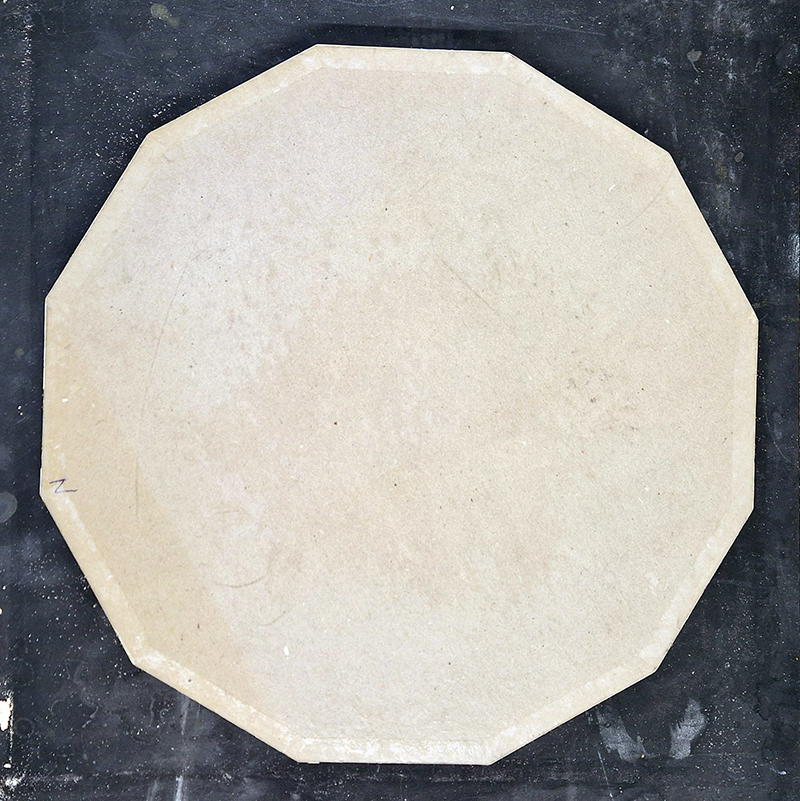
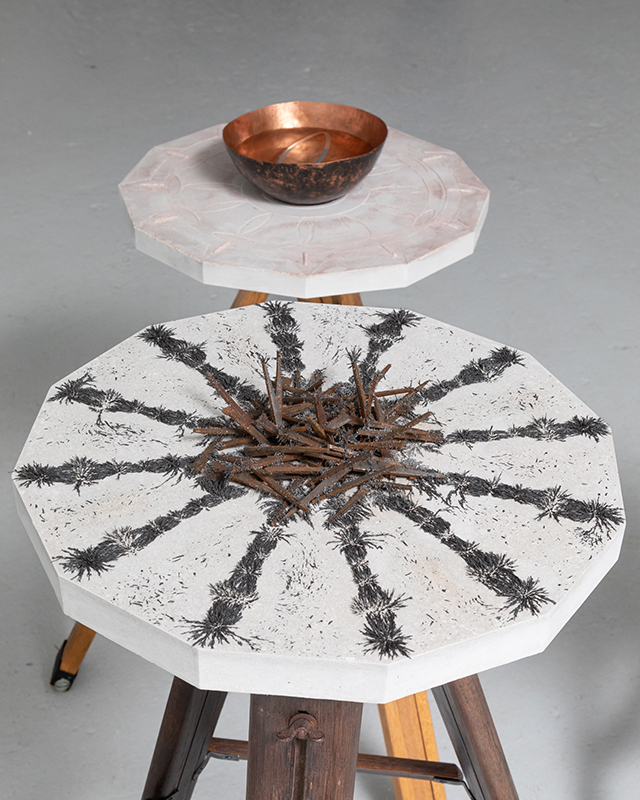
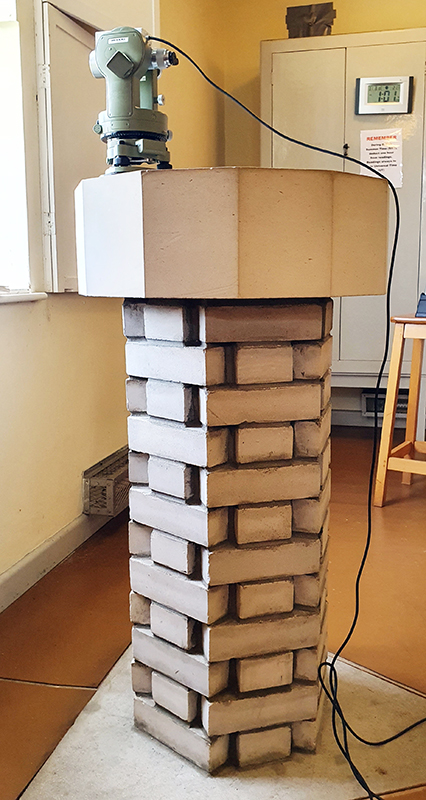
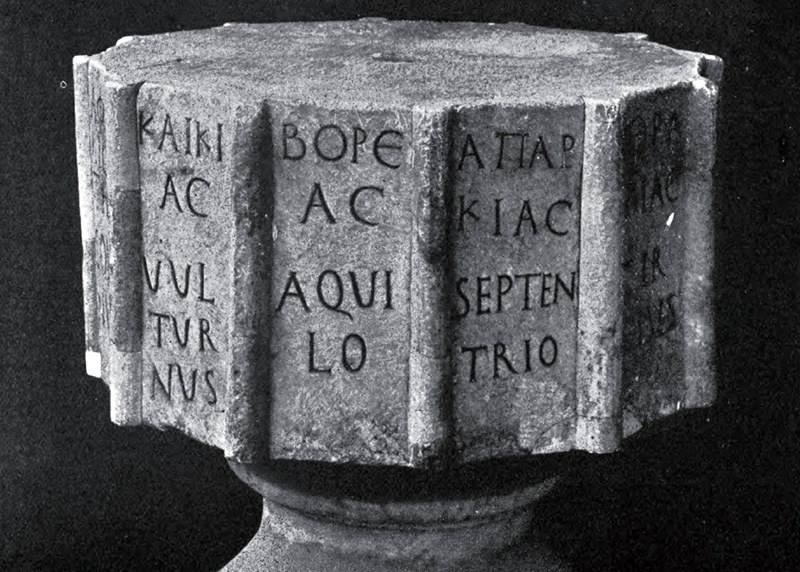
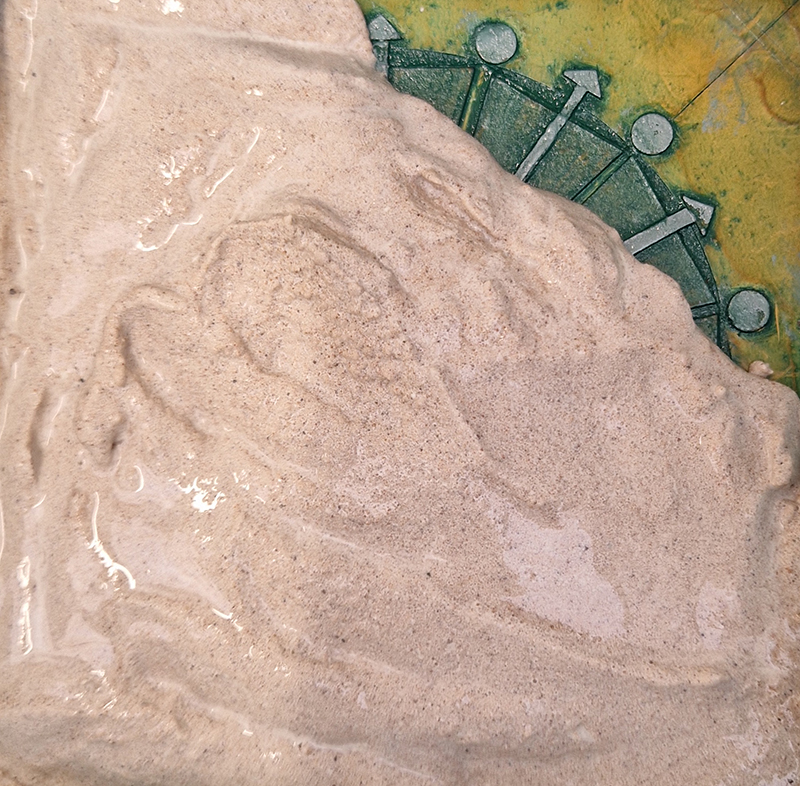
Instruments of the Anemoi are a set of dodecagon tablets cast in Snowcrete, a cement with no magnetic minerals, as is used for instrument pedestals at a magnetic observatory. They also respond to a twelve sided anemoscope “table of the winds” carved in marble around eighteen hundred years ago and held at the Vatican Museums. Releasing the cast from the mould and collagraph is a rewarding process – if all the pieces have held their position during the concrete pour and vibrating to release trapped air bubbles. Luckily this time was a success.

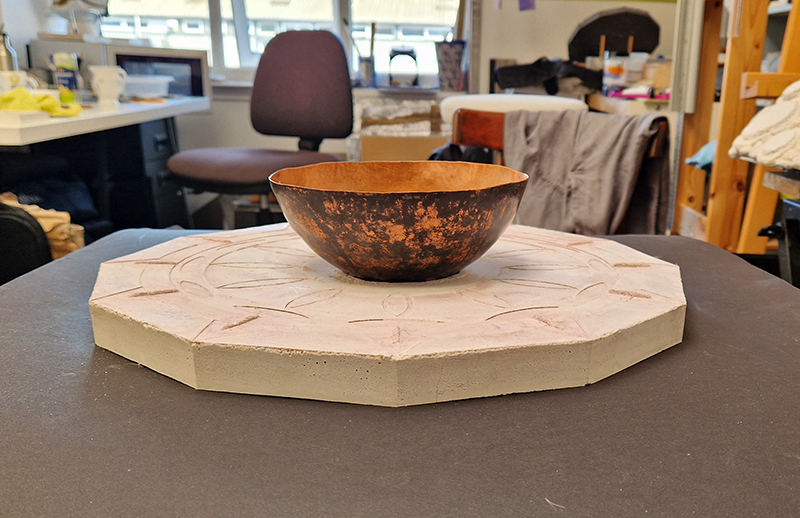
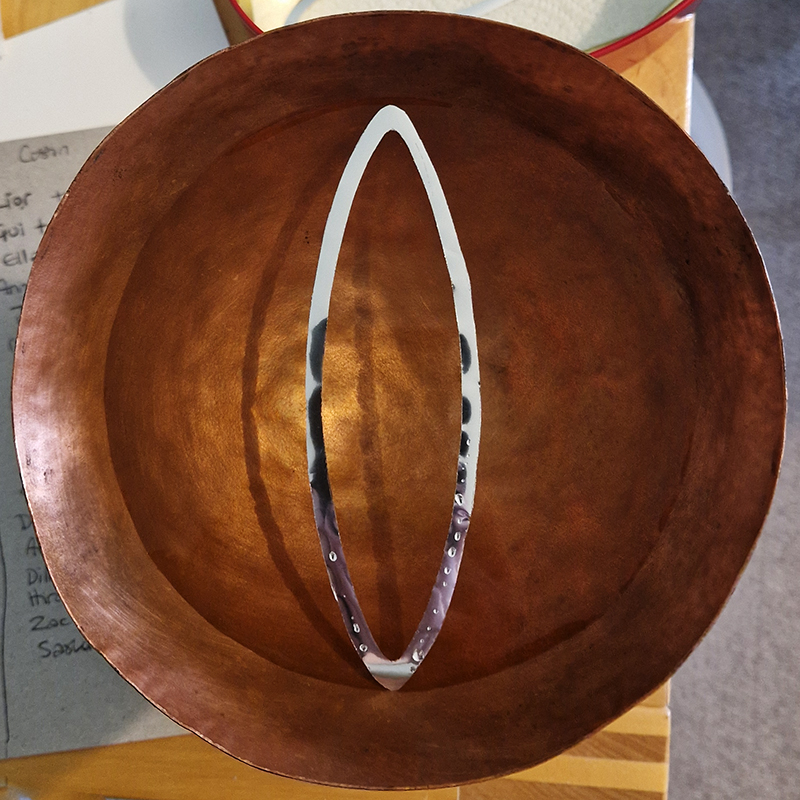
The other two sculptures in the series. A hand beaten copper bowl with a ‘silver fish’ floating in water based on the oval shaped compass needle illustrated in Breve Compendio de la Sphera de la arte Navegar by Martin Cortes 155. Wafer thin fish shaped iron leaves were also used by 11th century Chinese geomancers. Nails and iron filings reveal an embedded magnetic field and hark back to a legend on the discovery of the lodestone, a naturally magnetic mineral, which recalls a Greek shepherd who noticed the nails in his boots were attracted to the rock beneath his feet.

Unsettling to find it is already one year on since A Stone Sky duo exhibition with Julie F Hill opened at Thames-side Studios Gallery and this work was first shown.

Around 95% of the universe is ‘dark’ to us, formed of unknown and possibly unknowable matter which may be inaccessible to us, but cosmic rays offer a tangible contact with outer space.   

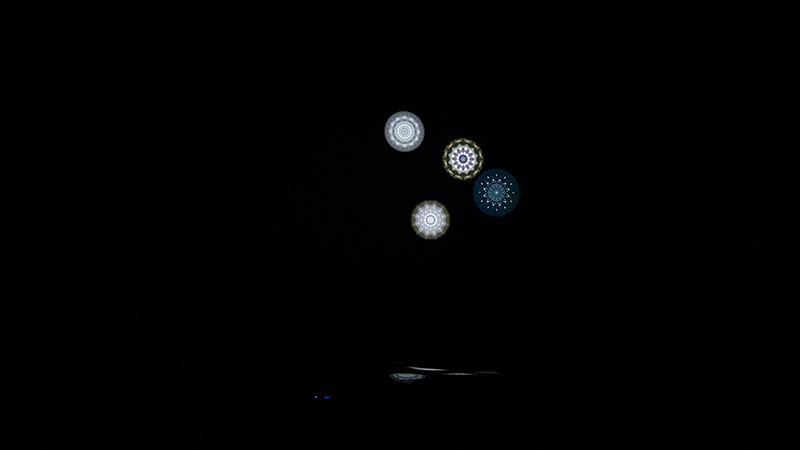
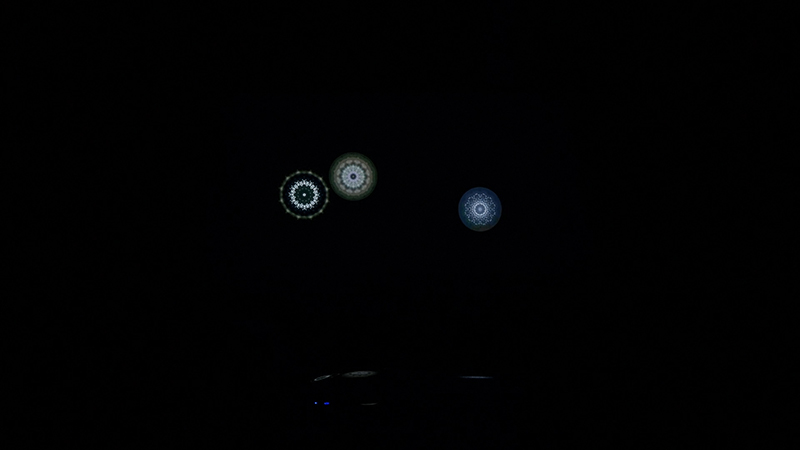
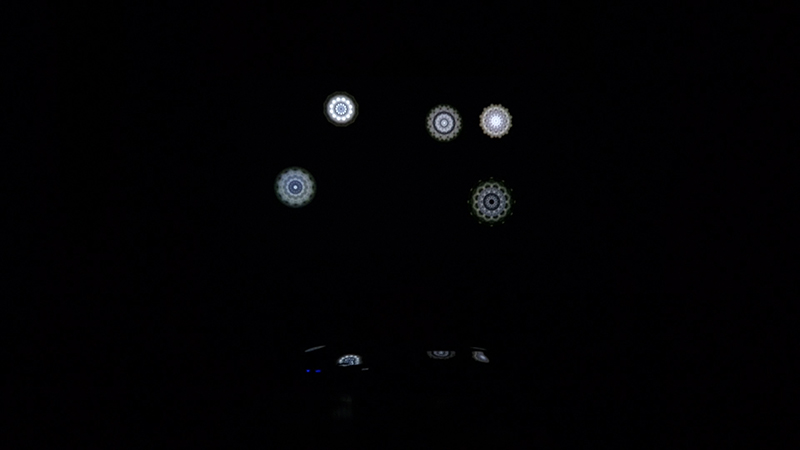
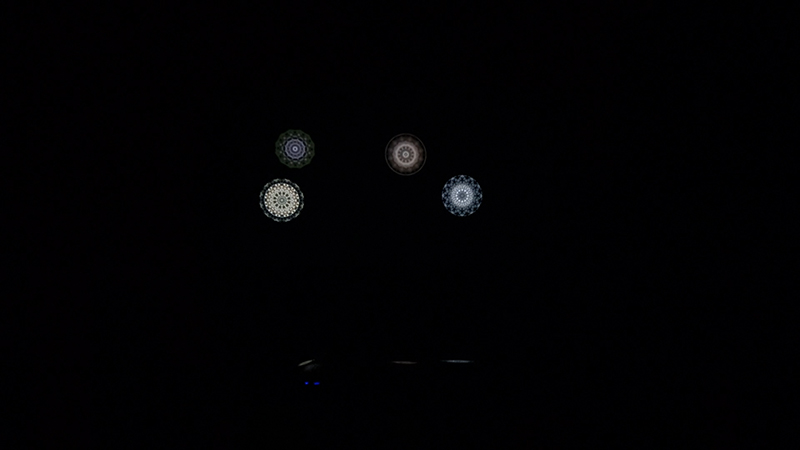
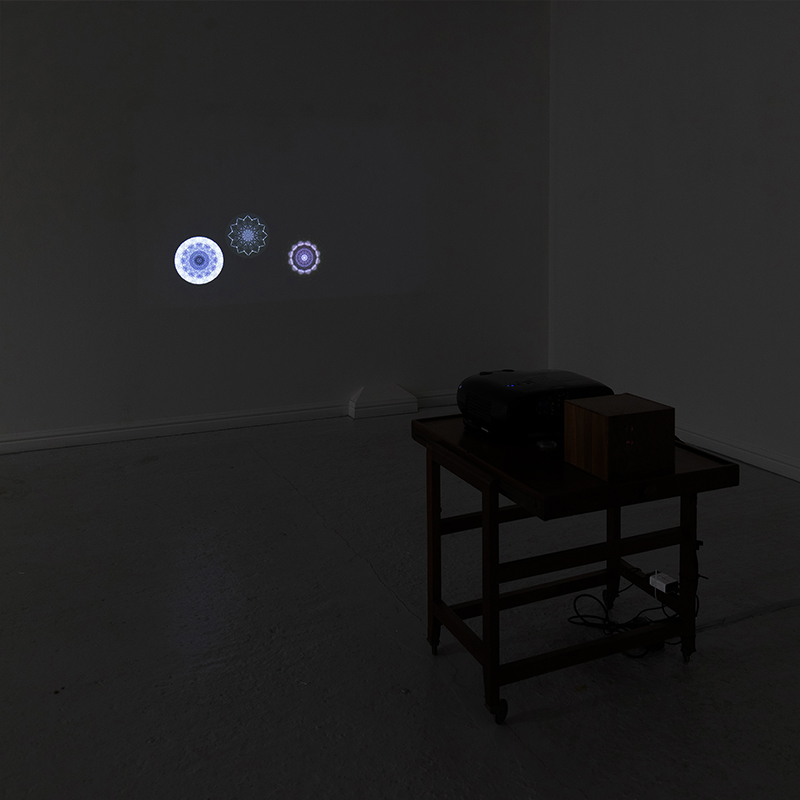
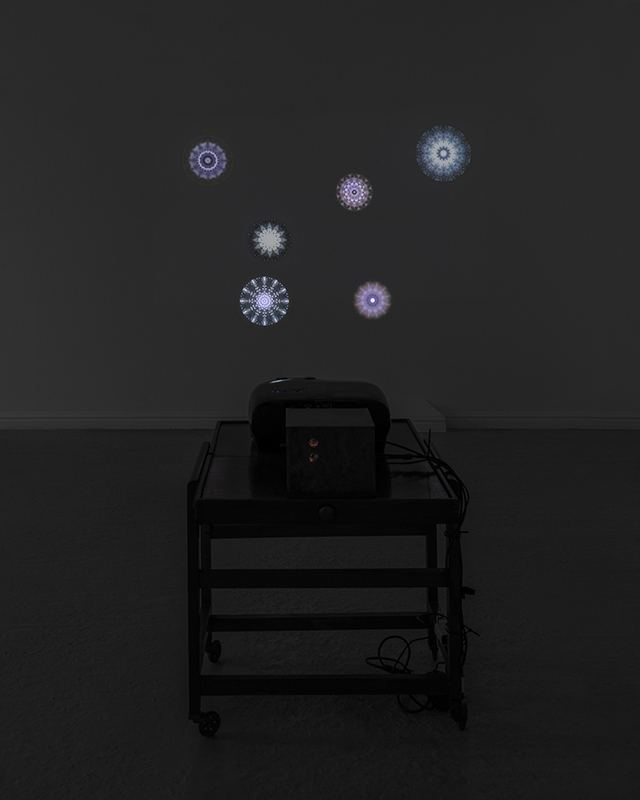
Giving The Breath of Stars a run to see if the cosmic rays are still there 😉 These images are stills of live action.
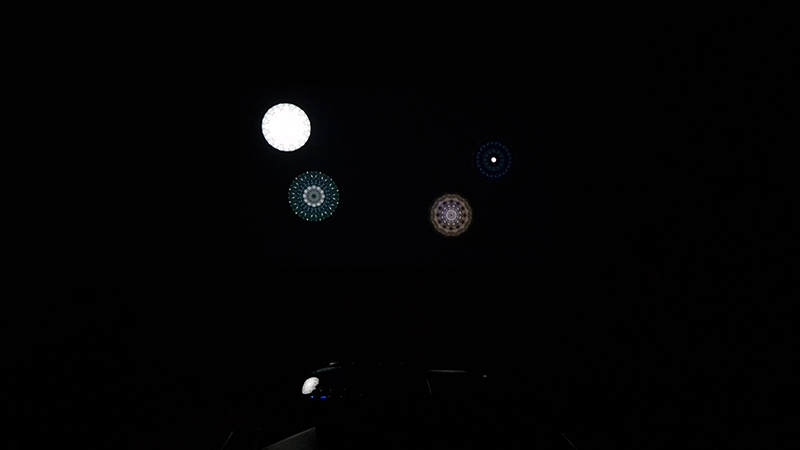
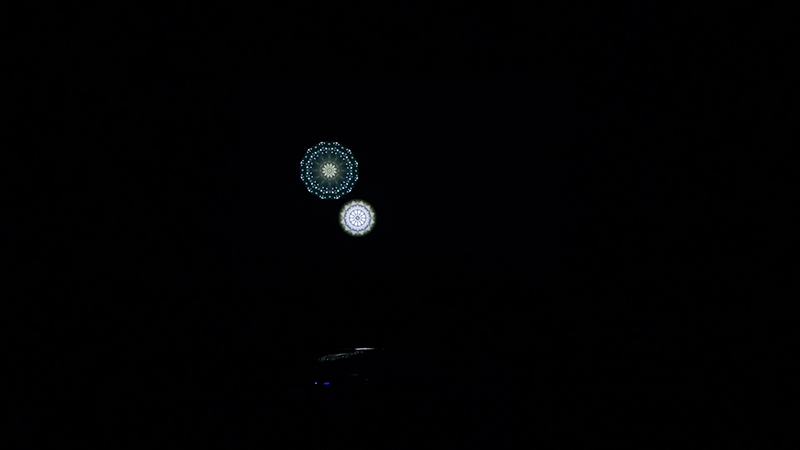
Cosmic ray detectors, mini computers, wooden box (20 x20 cm), video projection; live duration.

The Breath of Stars is a digital video work activated in real time by cosmic rays. These high energy particles arrive from outer space, interacting with life and technology on Earth. Coming from the heart of exploding stars or the depths of black holes, cosmic rays power across the universe with unimaginable energy. Some may come from phenomena yet to be discovered or even from other dimensions. A kaleidoscopic animation is projected every time a cosmic ray is recorded passing through the detectors. The animations are created from footage of cosmic ray trails filmed in my cloud chamber.

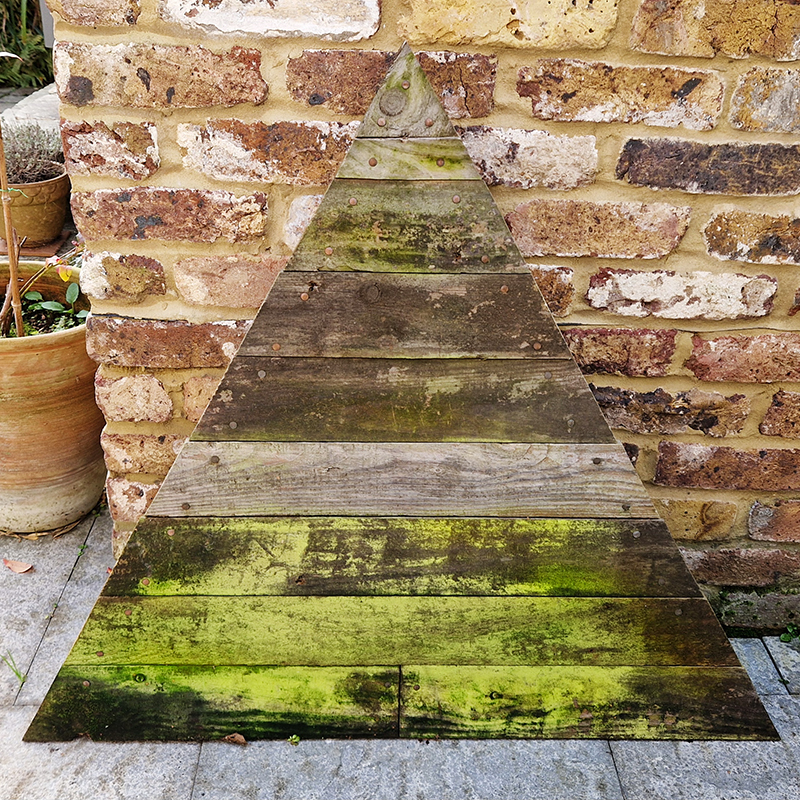
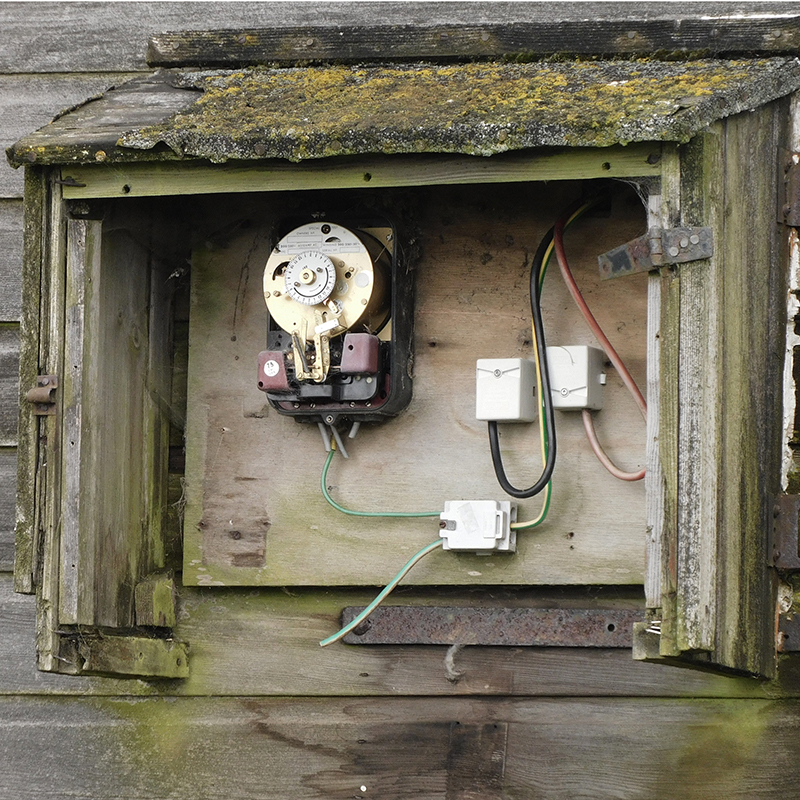
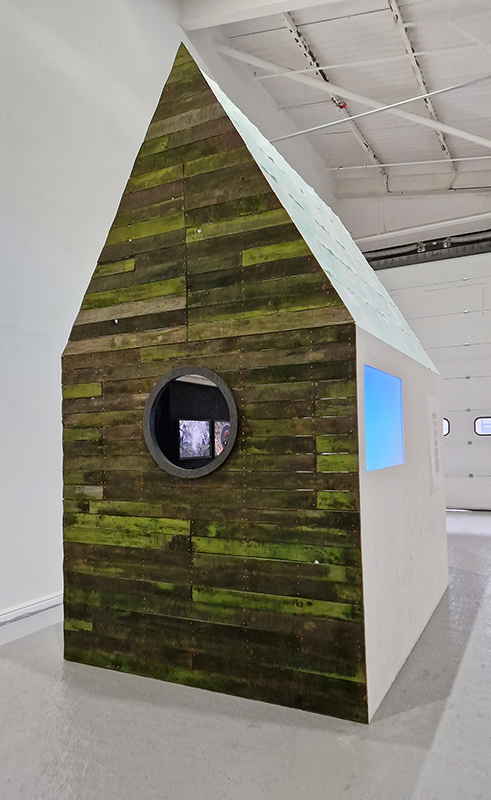
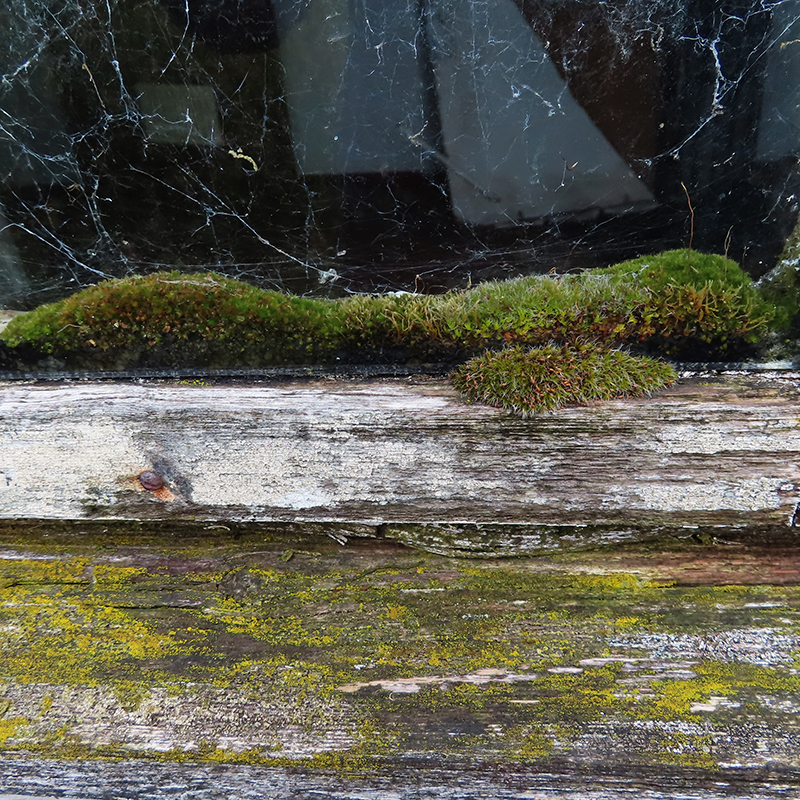
This cold damp weather is stimulating the moss regrowth on the apex pinnacle of The Absolute Hut (of action potential) that found a space in my garden after The Stone Sky exhibition this time last year. I had spent weeks preparing the recycled fence boards to make the North facing wall of the hut, painting them with various mixtures of buttermilk and yogurt blended with moss and was so excited when it began to grow. During the exhibition I would mist it every day. The beginning of my fascination with huts!

The Absolute Hut (of action potential) Wood, moss, paper, copper, video projection, video monitors ; 200 x 300 x 375 cm

Operating as a sensory hub where a range of actions and processes are running concurrently reflecting on the dynamics between the Earth’s geologic structure and navigation using the magnetic field. Neurons in the brain and nervous system send information electrochemically around the body. The signals they send are called action potentials, which is a temporary shift from negative to positive within the cell caused by certain ions entering the cell. Action potentials can be triggered by an interaction with the magnetic field, causing a reaction in the body.

Interference 2023 (video still)

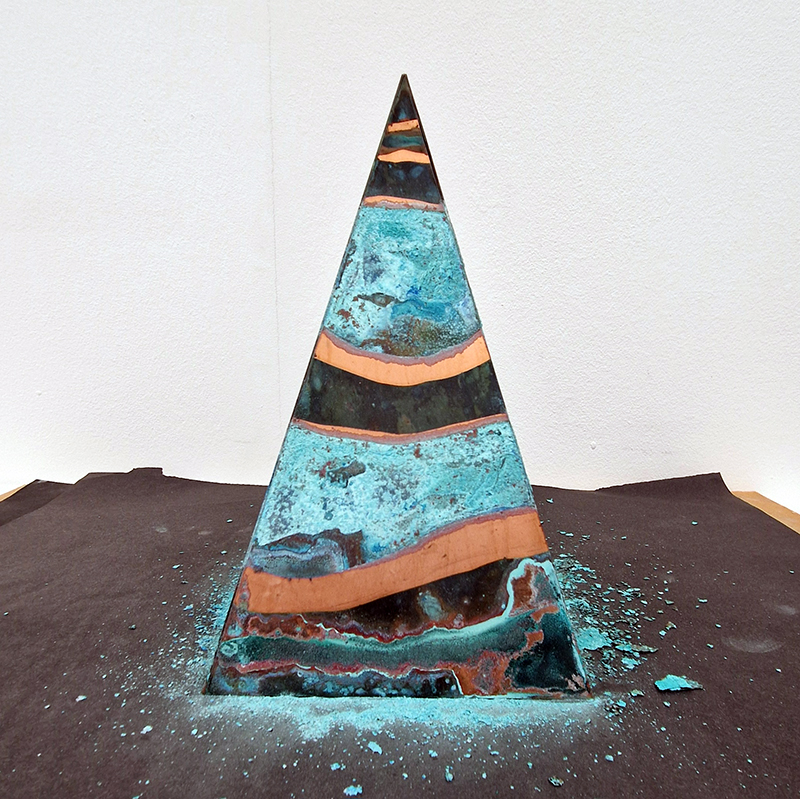
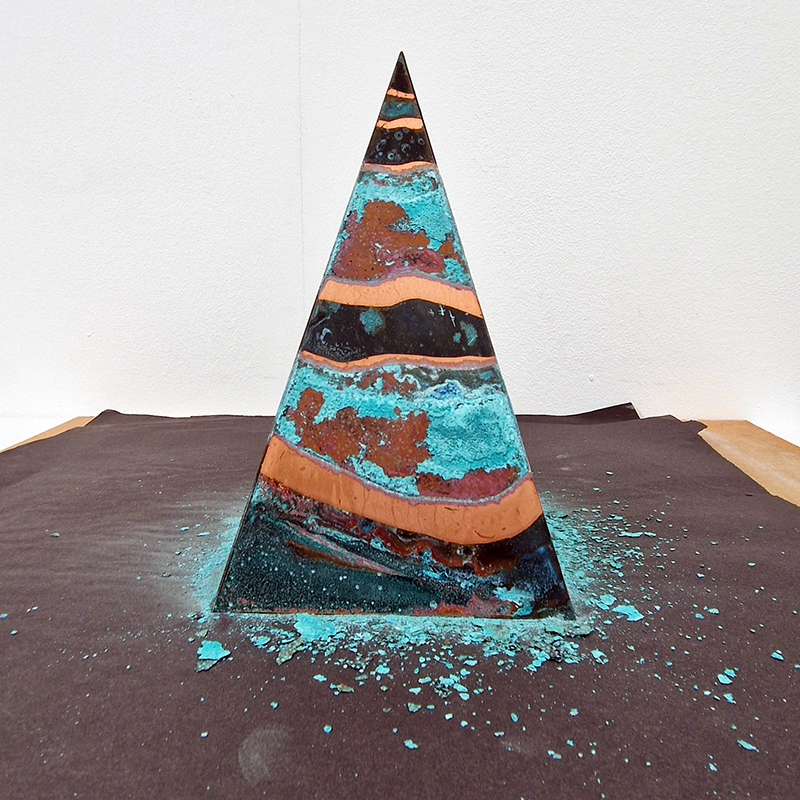
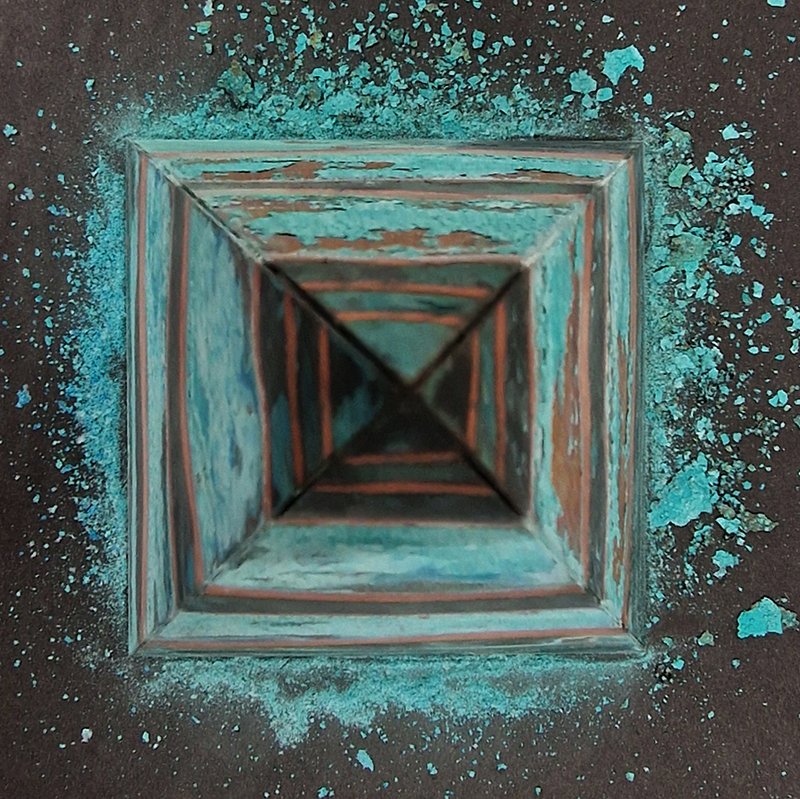
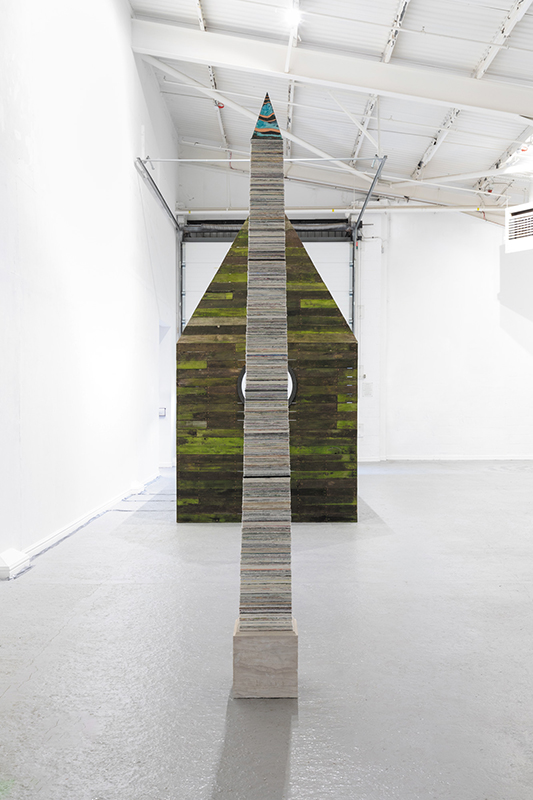
A year on and the pyramidion that sits on top of The Azimuth Obelisk (of sedimentary knowledge) is evolving. The patination, which involved a variety of chemicals being applied to the copper in layers, is an ongoing process.

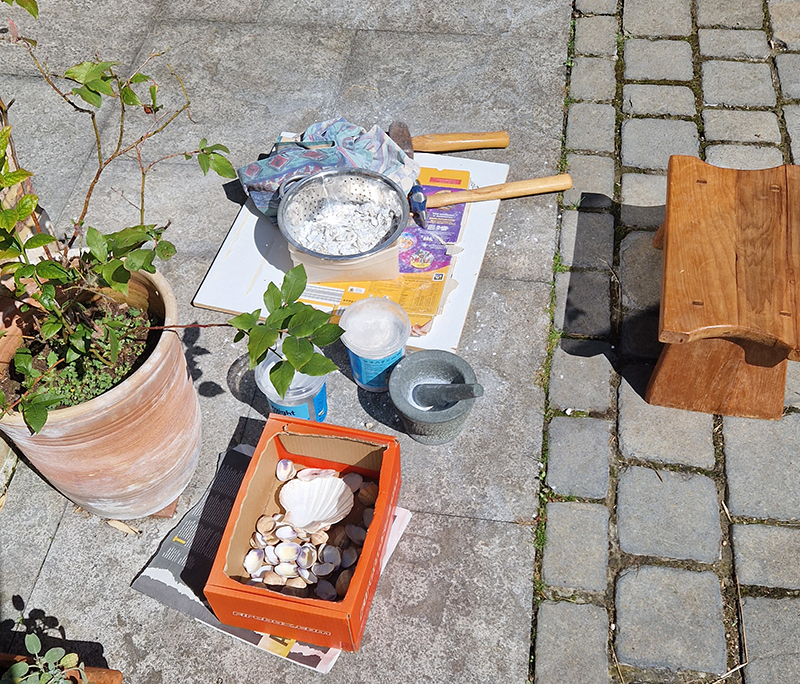
Sedimentary rock holds a geological history of the Earth’s magnetic field within its mineral components. The geomagnetic field, generated by the Earth’s molten core, varies through time; the magnetic poles migrate, go on excursions, or reverse polarity. During these periods of flux, the strength of the magnetic field changes, and this phenomenon is recorded in archaeological artefacts, volcanic rocks, and sediments. Limestone, a sedimentary rock, is often formed from crushed seashells, compressed over aeons. Crushed oyster shells were added to the obelisk base cast in Snowcrete.

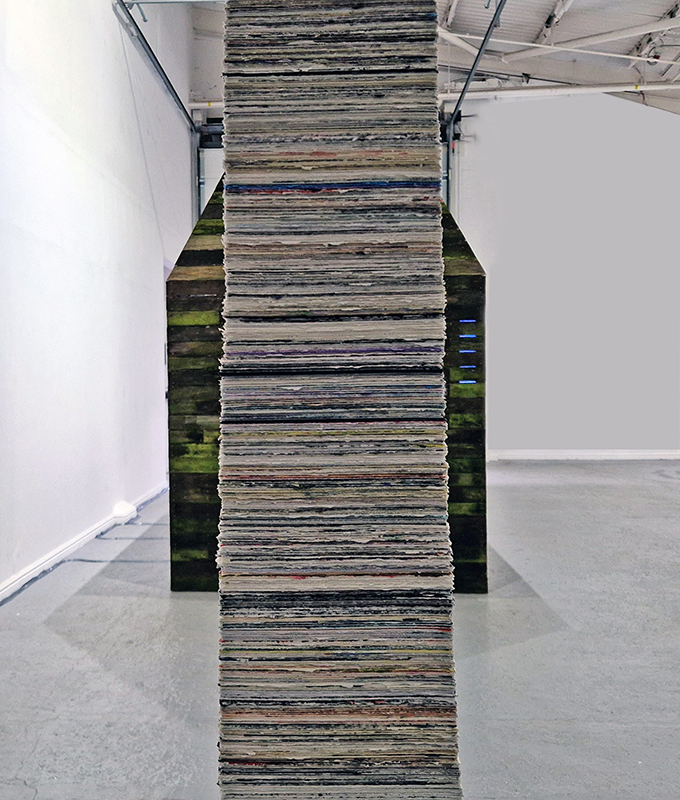
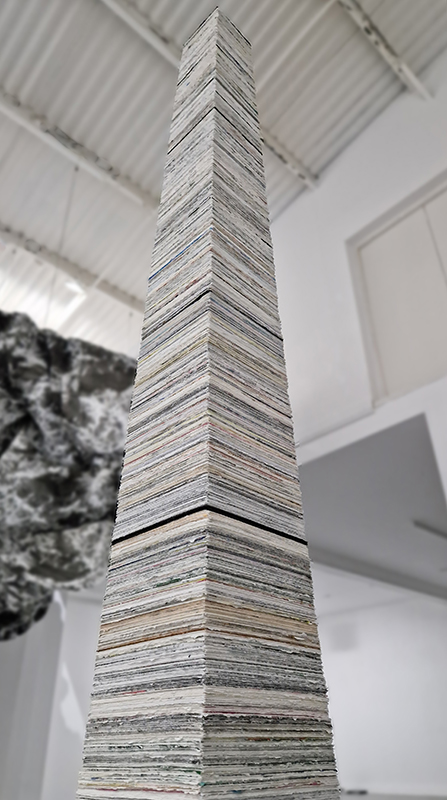
This sculpture also embodies the passage of time, and a layering of information, in the months of collecting paper donations or scavenging the recycling bins, weeks tearing down the hundreds of prints and drawings into squares decreasing by 1mm every 50 sheets, drilling holes through the centre and hours to build the almost 3m stack. I’m very grateful to everyone who donated some of their work archive. These images are now secreted within the layers of the sculpture, hinted at where edges are exposed, echoing the Earth’s sedimentary knowledge.

The Azimuth Obelisk (of sedimentary knowledge) Paper, steel, Snowcrete, oyster shells, patinated copper; 30 x 30 x 270 cm

 This work is a reimagining of an ‘obelisk’ erected at Hartland Magnetic Observatory in the late 1950’s to be viewed through the north facing window of The Absolute Hut, it acts as a permanent azimuth mark from which the drift of the magnetic north pole is monitored. I am excited that this sculpture is being considered for exhibition in 2026 at the Royal West of England Academy in Cosmos: The Art of Observing Space curated by Ione Parkin with some amazing artists in the line up whose work I admire.

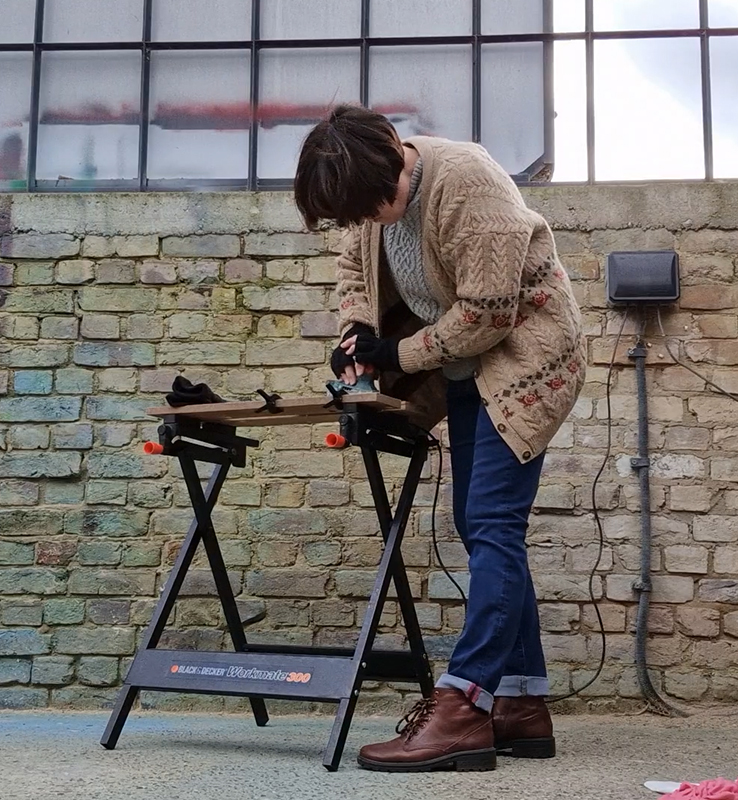
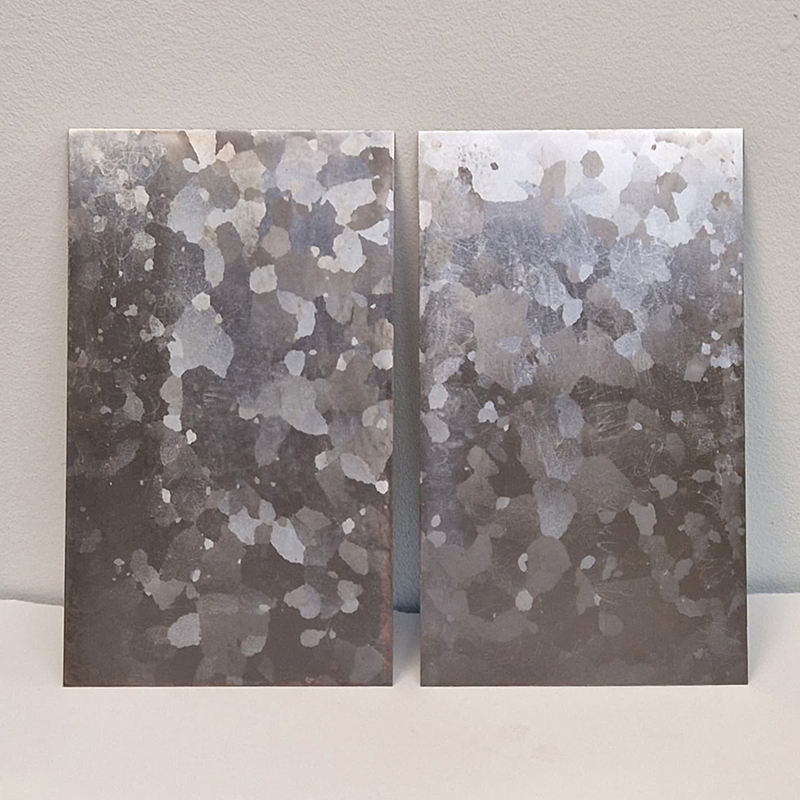
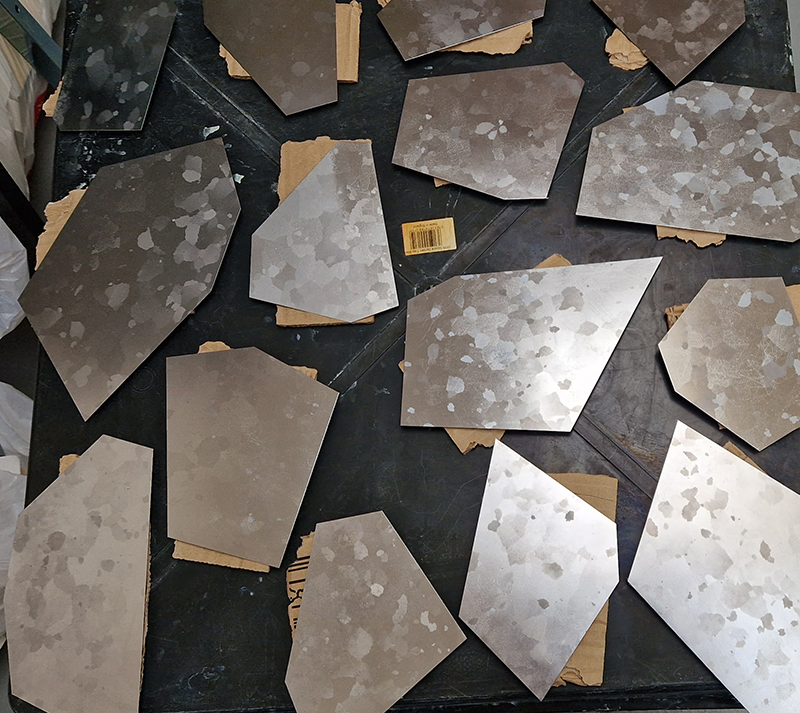
I first came across directional magnetic steel in the Electronic & Magnetic Materials Group open day at the National Physical Laboratory. Intrigued, I wanted to know if I could get hold of some to work with. I was put in touch with Union Steel Products who were very helpful in supplying a small amount (to them) of the material, but they import the product, and it arrives with an indeterminate protective matt grey coating. This was my challenge. It took many days of sanding and gently etching each sheet to reveal the pattern. It was a very temperamental material to work with, the pattern might appear but quickly tarnish and muddy over. So much of the work in the resulting sculpture was about the process of exposing an internal mechanism.

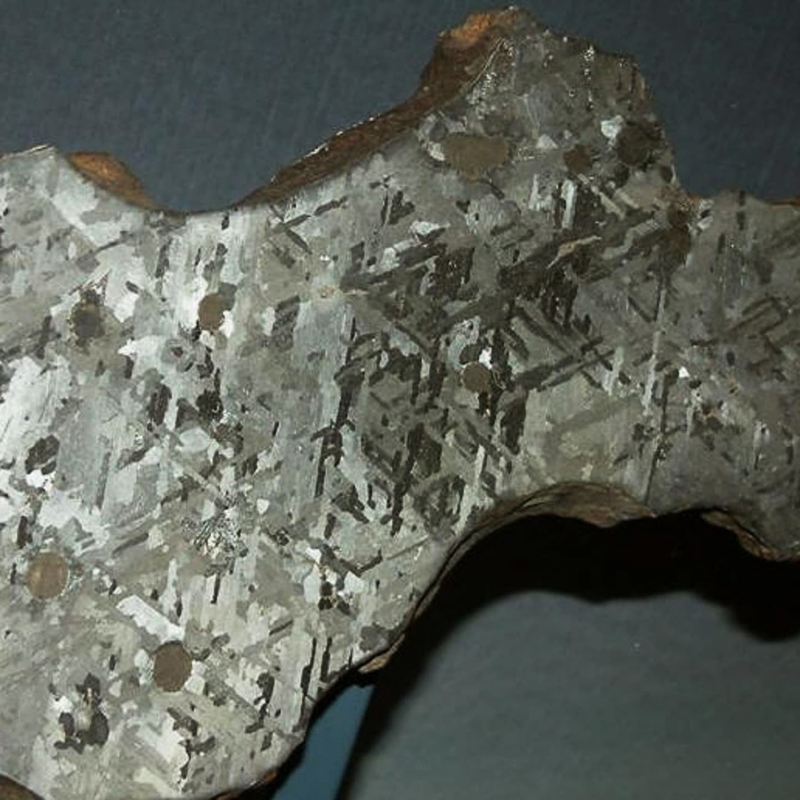
The dramatic Widmannstätten patterns found in meteorites due to their slow evolution through heat and pressure are also revealed through being cut, polished, and etched.

These secrets are not revealed lightly.

Domain of the Devil Valley Master

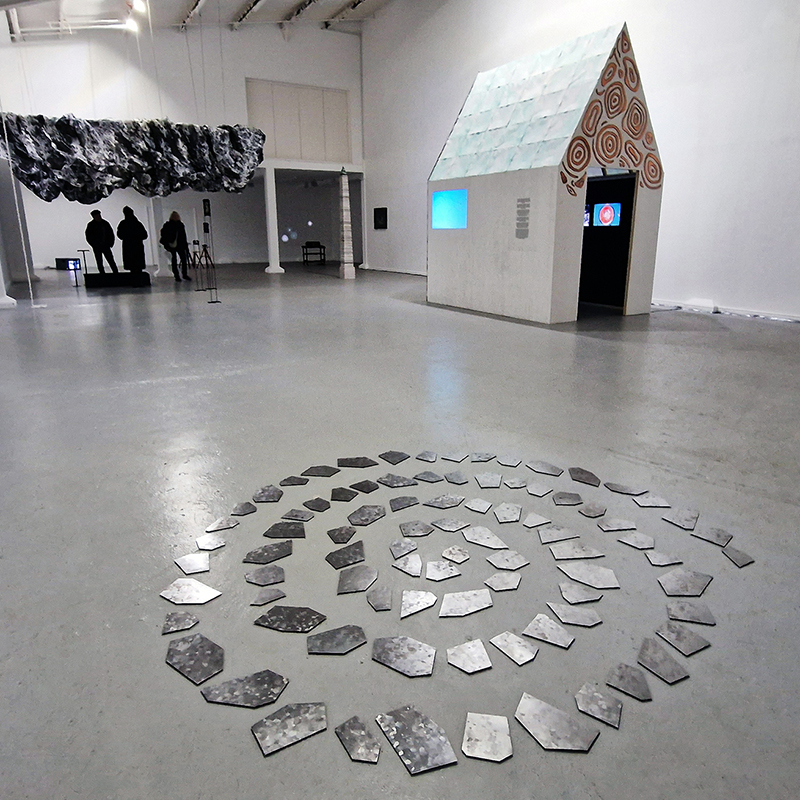
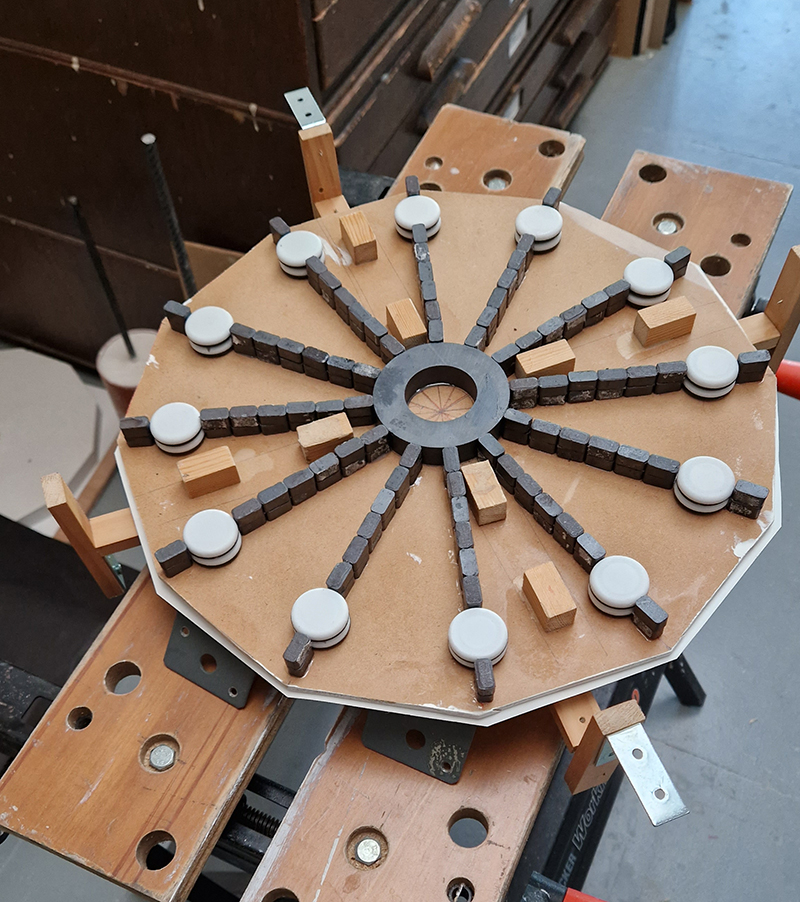
This work uses industrial directional magnetic steel, sanded and etched to reveal the Goss texture of rolled iron silicon alloy crystals. The jigsaw pattern of magnetic domains give this material exceptional magnetic properties. The simple evocation of a spiral described in geologically informed polygons draws upon many references, from the shape of our own Milky Way Galaxy sculpted by vast cosmological magnetic fields and the spiralling molten dynamo generating Earth’s magnetic field, to the inner pathway of spiritual growth and the route to the symbolic omphalos (navel) at the centre of the world where the sky entrance and the underworld meet. The title of this work originates from an ancient Chinese manual on the skills of persuasion, The Book of the Devil Valley Master, containing the first known mention of a compass, known at the time as a south-pointer. 

Work in progress. Mapping a response to the crystal structure of magnetite. Magnetite is the most magnetic of all the naturally occurring minerals on Earth found in igneous, metamorphic, and sedimentary rocks. Nano-particles are also found in the human brain, heart, liver, and spleen and the cells of many other organisms, with some creatures using this for navigation techniques.

Magnetite crystals from road traffic pollution caused predominantly by vehicle frictional braking systems can outnumber natural magnetite in the human brain by 100:1 – this is a worrying trend as these crystals could be involved in our perception, transduction, and long-term storage of information in the brain.

Returning to my conversation with Alan Watson on the history of Haverah Park Extensive Air Shower Array.

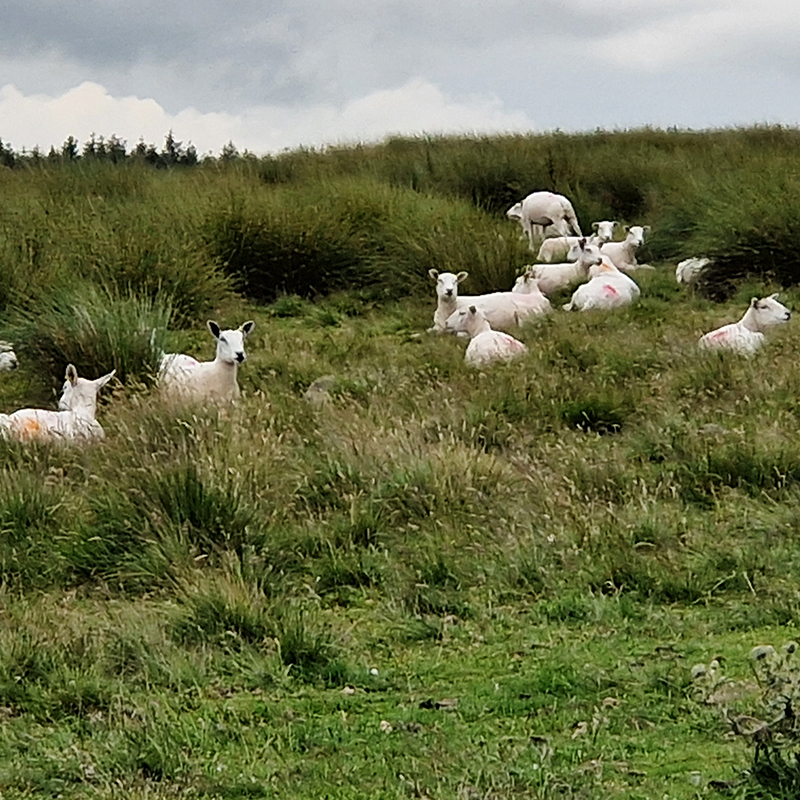
The motivation for the Haverah Park project getting off the ground came largely from the British physicist Patrick Blackett, who won the Nobel prize in 1948 for his discoveries in the field of cosmic rays. The director of The Rutherford Lab (where the British atomic bomb was being developed in the 50’s), John Cockcroft (known for splitting the atom), decided there should be fundamental science going on as well as bomb building, so outside the security wire they built an air shower array to monitor cosmic rays. When this experiment was shut down, Blackett was keen to see work with shower arrays continue, and to be within reach of a university so that scientists could combine research with teaching. Blackett was working at Cavendish Laboratory with Ernest Rutherford, but moved to Birkbeck which did all the teaching in the evening so he could do research work through the day and teach in the evening. Here he met J G Wilson, also with an interest in cosmic rays, so when J G Wilson later moved to Leeds, Blackett suggested he set up an air shower array there, which was how the Haverah Park Project came about. Land was rented from local sheep farmers to install the observation huts.

Alan Watson took a lectureship job at Leeds in 1964 and began working for J G Wilson, becoming a leading member of the UK Extensive Air Shower project until its closure in the early 1990s.

We also talked about the mesmerizing power of a cloud chamber. As well as it being considered one of the most important developments for progression in the understanding of particle physics it is also emotionally and aesthetically captivating. Alan reminisced about a time at the Royal Society Summer Exhibition when a large commercial diffusion cloud chamber drew so much attention they were asked to turn it off, as mesmerised visitors blocked the entrance to the exhibition. It’s been a few years since I visited the Institute of Physics to see the large cloud chamber in the foyer, I wonder if it’s still there. I love the fact that I can build my own cloud chamber to see these cosmic visitors.

J G Wilson writing on the study of cosmic rays from his book About Cosmic Rays published in 1948, of which I have a copy:

‘It has its spectacular side, for the only laboratory which has been found big enough for its investigations is the whole of the universe to which men can win access. Most refined measurements have been made under conditions of difficulty and hazard, deep in mines and on icebound mountains, in the watses of western Greenland and cramped in the tiny gondola of a stratosphere balloon. These exploits, which are outstanding even in one of the most brilliant phases of experimental physics, are an unambiguous indication of the importance which is attached to the problems which are being studied.’

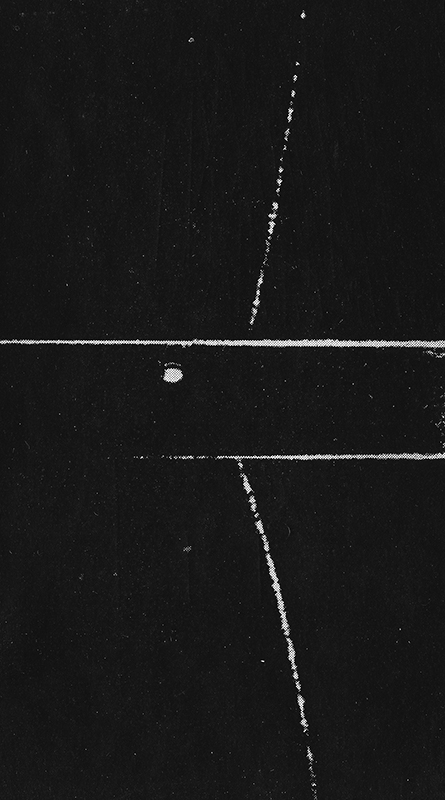
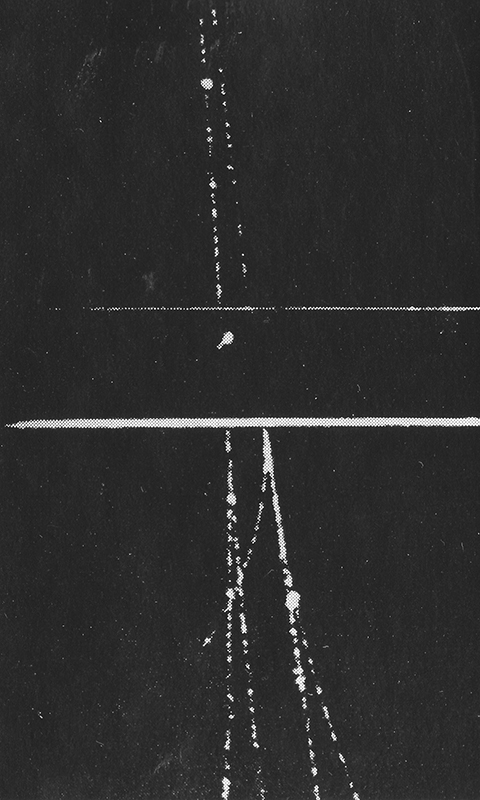
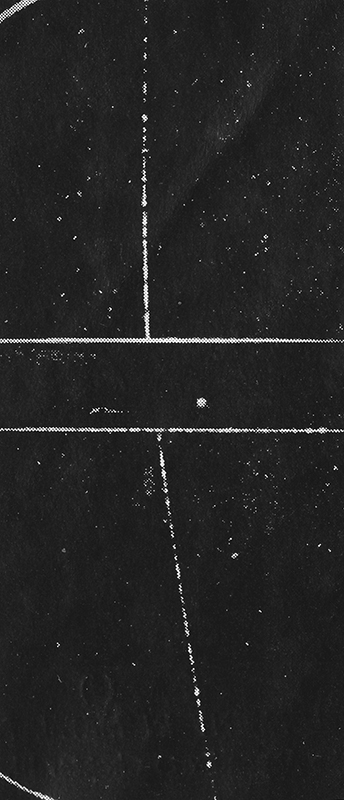
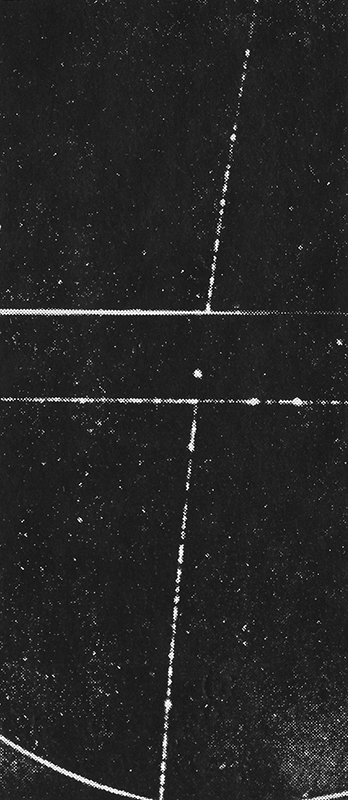
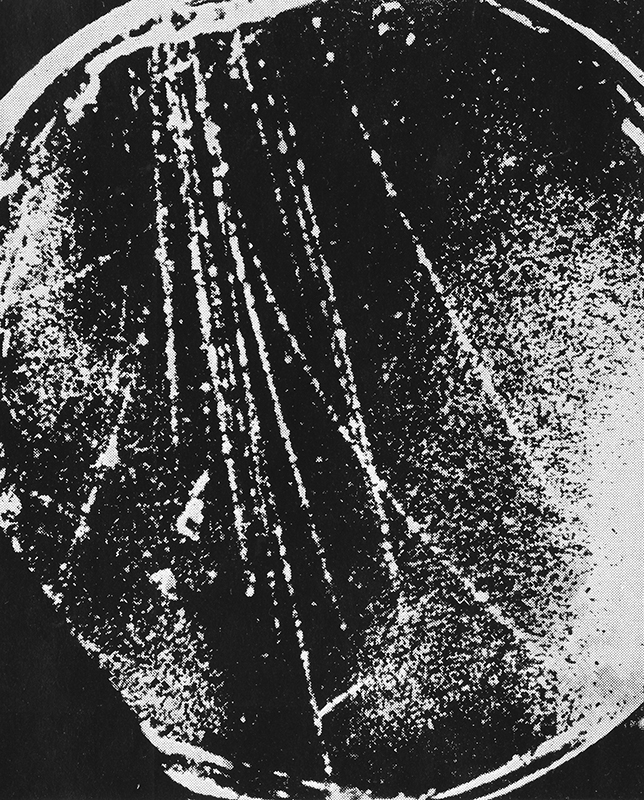
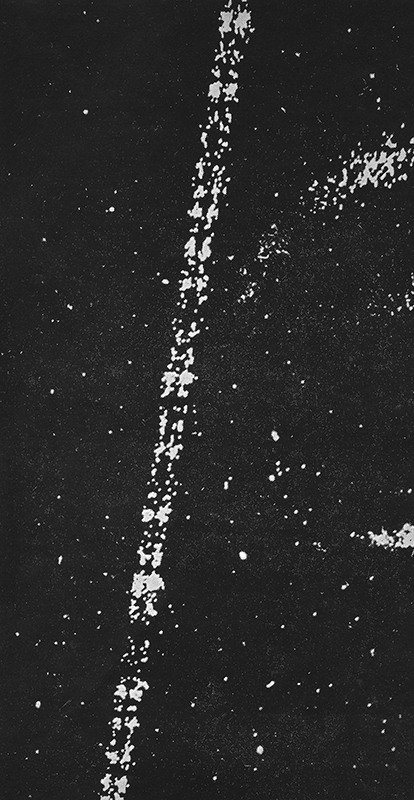
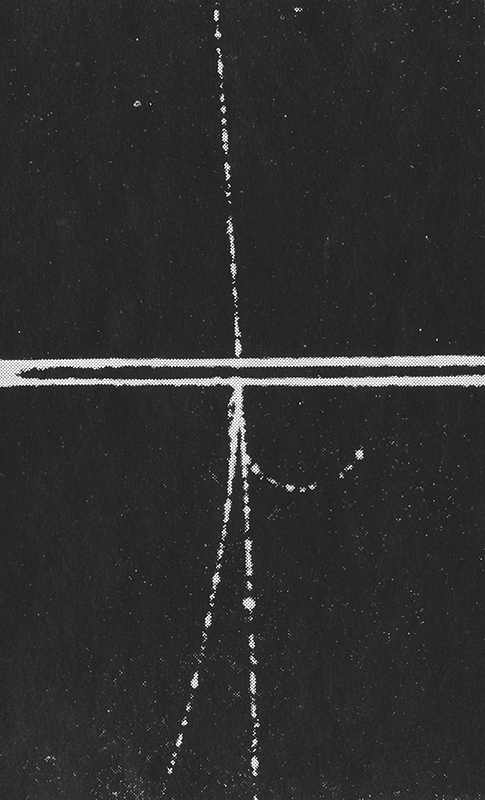
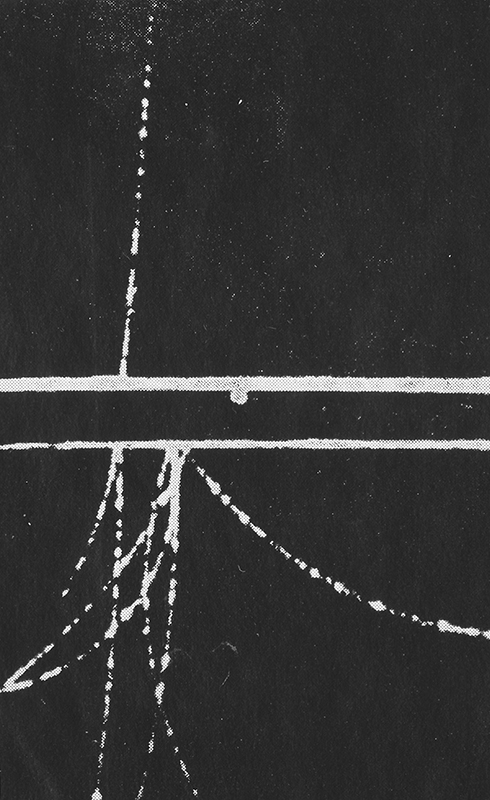
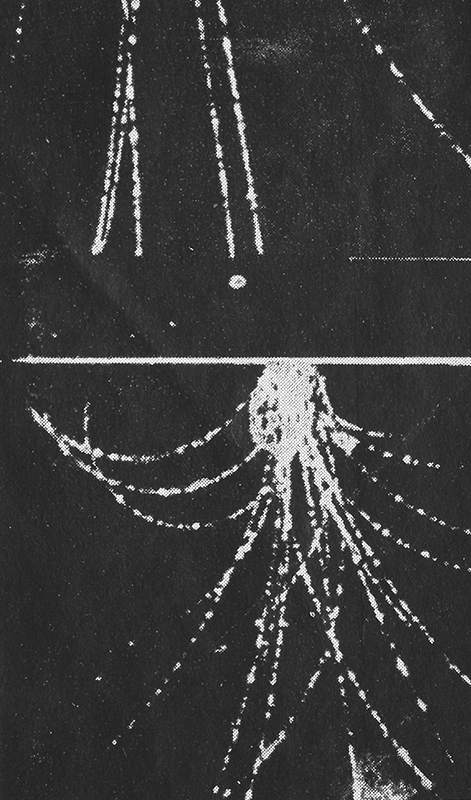
The following images from the same book show particle trails photographed in a cloud chamber -showing extensive showers and particles passing unhindered through metal plates.

J G Wilson writes about cosmic rays ‘…it is interesting to speculate on their previous history, for before it is overtaken by the catastrophe of hitting the earth, each particle is likely to have had a placid life for years, even millions of years, cruising through the wide open spaces of the universe’.

Cosmic Chiasmus: crossing the universe 2021 (video still)

The primary detectors used at Haverah Park were water Cherenkov detectors. These are large water filled tanks filled with a photomultiplier suspended in the water to capture flashes of Cherenkov light emitted by high energy cosmic rays as they pass through. The light is emitted because the cosmic rays pass through water faster than photons of light are able to, and as they do so they lose electrons thereby emitting light. The speed of light is only a constant within a vacuum, when it passes through other materials it get slowed down.

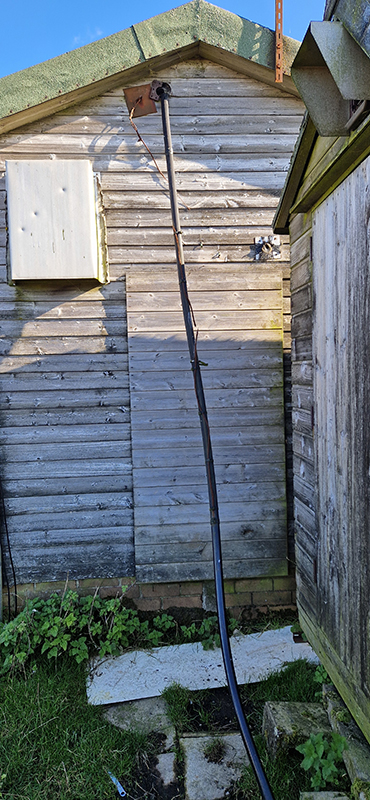
There were four 34 m2 detectors at the centre of the array in the main hut, with three detectors located 500m from the central detector. Signals from the three distant detectors were sent along buried cables to the central hut, with the signal from the central detector passing down 500 m of cable buried underground so that all signals arrived at about the same time.  When signals from the central one and two of the others arrived within ~2 x 10⁻⁶ s (called a coincidence), the signals from the photomultipliers in the 34 m2 detectors were displayed on four oscilloscope screens and photographed by one camera which had its shutter permanently open. About 20 feet of film could record around 150 events. Developed and manually scanned by Alan, or a senior colleague, the film was checked for quality and to look for any large events (ultra high energy particles arriving) which were always exciting to find. The developed film was then sent to Leeds University Physics dept for measurements.

When there was a coincidence event at the centre of the array, a signal was sent by microwave to the distant detectors set across the moorlands (on average about 2km from the central hut), the signals from these distant groups of 4 x 13.5 m2 were recorded digitally with the data going onto paper tape which was collected once each week. 

Along with the oscilloscope traces being photographed, the number on a counter was included which gave the time of each event to the nearest half minute.  In the 1960’s when this project began the time counter was advanced by a pendulum clock.  Counting time in half minutes the team found that there are roughly one million half-minutes in a year, which gave a good excuse for an annual party.

There were some brief periods in the early 1980s when a small number of scintillator detectors were also used to make cross-checks of the results from the water Cherenkov detectors against those from projects in the USA (Volcano Ranch) and Yakutsk (Siberia).  The scintillators retrieved from Imperial College’s Holborn project were brought to Haverah Park for an experiment to look at much lower energy showers.

Both types of detectors register flashes of light.  

Blackett was the first person to work out the details of Cherenkov light produced in the atmosphere. According to a memoir on Blackett, written by astronomer Bernard Lovell, who knew him very well, Blackett attempted to see Cherenkov light from cosmic ray showers with the naked eye but there is no mention of whether he succeeded. In 1962, physicist Neil Porter who built the first water Cherenkov tank in the UK at Harwell in the 50’s, did an experiment with some volunteers who were asked to recline on a coach in a dark room with a small Geiger telescope attached to a pair of darkened goggles and acknowledge if they saw a flash of light when a cosmic ray was known to pass through the googles. The observers did seem to experience a flash of light but results were ambiguous as to whether this was Cherenkov light being emitted as the particle passed though the crystalline lens or vitreous humour of the eye or a direct excitation of the retina. The experiment was a collaboration with the Psychology dept at the University of Dublin and published in Nature under the Psychology heading giving an impression that the lights were perhaps a figment of the imagination.

Aóratos 2019 video still

Astronauts are very aware of this phenomenon. During the 1970 Apollo 13 mission to the moon the power supply was damaged and the astronauts sat in the dark for several days waiting to return to Earth. They experienced flashes in their eyes and realized that some of this was Cherenkov light. Some flashes were caused by particles directly hitting the retina but Cherenkov light caused by high energy particles travelling through the matter of the eye faster than light, is much brighter. The energy is proportional to the square of the charge of the particle that comes through, so if you have an iron nucleus which has a charge 26 x the charge of a proton, you get 26 squared or 600 times as much light emitted. Out in space there are many more of these high energy particles and so the astronauts would become very familiar with these flashes, even using them to line up accelerator beams by putting their head in the particle beam to see the flashes.

An astronaut once told Alan that he was convinced that the very first people fired into space probably saw these flashes, but didn’t like to tell NASA in case it turned out to be a physiological defect of theirs and they would be taken off the space programme.

Recently, a professor friend of Alan’s who is aware of this phenomenon, has unfortunately had to begin radiation treatment for a brain tumour. He has found due to the position of the tumour and angle of treatment he can see Cherenkov light flashing in his eyes as the electrons bombard the tumour.

Aóratos 2019 cropped video still

When we met, Alan was just back from a conference in Italy discussing a paper titled ‘Ultra high energy cosmic rays: The Disappointing model’. They called it the disappointing model because they believed that the Auger results with particles at the highest energy were heavy not protons. I’m not sure I understood why it was disappointing although Alan did his best to explain: ‘It’s difficult to measure the mass of the particles of a certain energy. A deduction had been made that they have a mean mass, probably the same as nitrogen but mass changes in quite a complicated way as a function of energy. It’s to do with how deep the showers develop in the atmosphere.

Cosmic Chiasmus: crossing the universe 2021 video still

The techniques aren’t good enough to separate the particle’s mass on a one by one basis, we can only do averages. It looks like the average mass is much heavier than protons, which everybody had believed for a long, long time. Protons would be at a much lower energy. As the nucleus is travelling through space, it sees photons from the microwave background radiation and the photon will chip off a neutron or a proton, if it chips off a neutron, the neutron decays into a proton, so you can get protons this way, but they will be of lower energy. The energy reduces roughly by the mass of the particle, so an iron nucleus has a mass of 56, if you chip off a neutron or a proton that proton will have an energy, which a 56th of the energy that the nucleus has – so it goes down in energy.

Some particles could come from Centaurus A, which is a relatively close radio galaxy, it is thought that the jets from radio galaxies provide conditions to accelerate the particles, but the problem is, because the cosmic rays are charged, they get deflected in the magnetic field of the Galaxy so you can’t track them straight back to where they came from.  In terms of heavy particles that’s more of a problem because being charged means they bend even more. So one of the disappointing things is that cosmic ray astronomy is not going to be very easy. The Pierre Auger observatory has really been very successful in changing the picture quite a bit but because there are so few ultra high energy particles recorded it is slow progress. There are hopes to expand the observatory even more and also a plan to launch a satellite with detectors to pick up fluorescence light in the shower as it passes through the atmosphere, a similar phenomenon to aurora light.

Cosmic Chiasmus: crossing the universe 2021 video still

Exhibitions

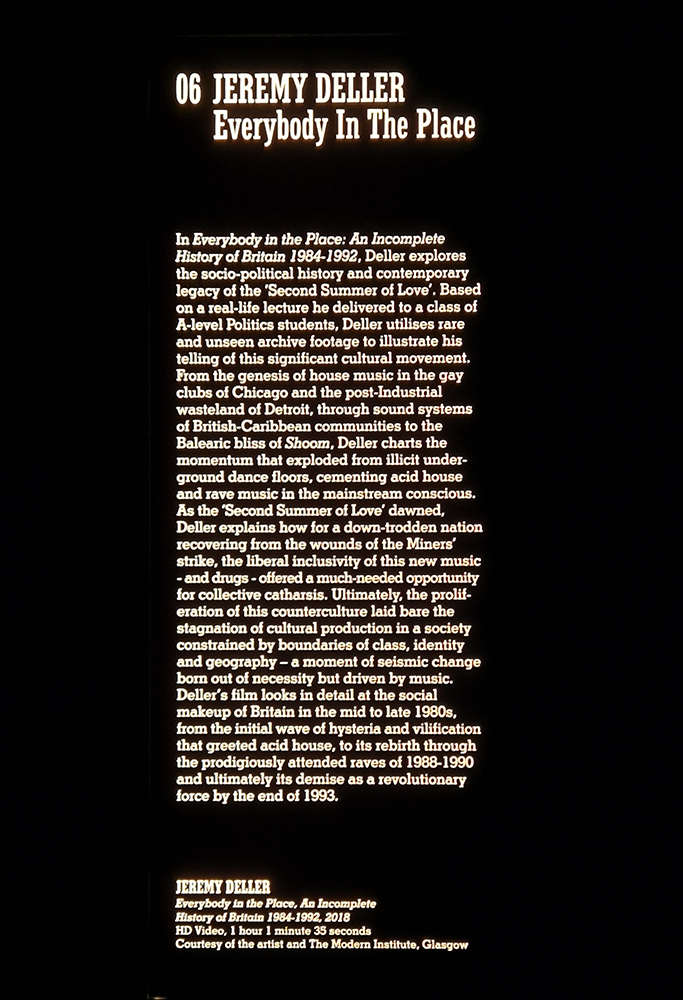
The Vinyl Factory: Reverb at 180 The Strand, a multimedia exhibition exploring the intersection of art and sound with artists including Theaster Gates, Es Devlin, Julianknxx, Kahlil Joseph, Caterina Barbieri, Stan Douglas, Virgil Abloh, Cecilia Bengolea, Jeremy Deller, William Kentridge, Jenn Nkiru, Hito Steyerl, Carsten Nicolai and Gabriel Moses. Fabulous show, shame I can’t share the sounds here. Loved Jeremy Deller’s takeover of a sixth form politics class. Some of the works I had seen before but that was fine as they are worth extra viewings.

Reading

I am beginning research reading for The Geological Unconscious exhibition Julie F Hill and I are co-curating at Hypha HQ Euston opening in May 2025.

Ursula Le Guin The Winds Twelve Quarters, a collection of profound short stories each introduced by the author reflecting on the intention within.

Long after I wrote the story (The Stars Below) I came on a passage in Jung’s On the Nature of the Psyche: ‘We would do well to think of ego-consciousness as being surrounded by a multitude of little luminosities…Introspective intuitions…capture the state of the unconscious: The star-strewn heavens, stars reflected in dark water, nuggets of gold or golden sand scattered in black earth.’ And he quotes from an alchemist, ‘Seminate aurum in terrain albam foliatam’ – the precious metal strewn in the layers of white clay. Perhaps the story is not about science, or about art, but about the mind, my mind, any mind, that turns inward to itself.

Roger Caillois The Writing of Stones 1970 is a tribute to the collection of extraordinary stones Caillois acquired and which now resides in The National Museum of Natural History Paris. In these poetic chapters he describes in detail each of the stones and his fascination with the images and associations they conjure in his imagination. Questioning and celebrating the allure of the mineral and the stories hidden and revealed over millennia.

I can scarcely refrain from suspecting some ancient, diffused magnetism; a call from the centre of things; a dim, almost lost memory. or perhaps a presentiment, pointless in so puny a being, of a universal syntax.

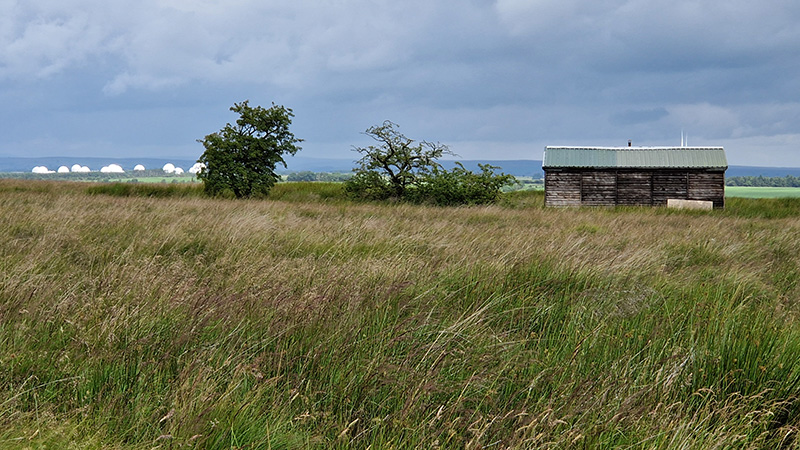
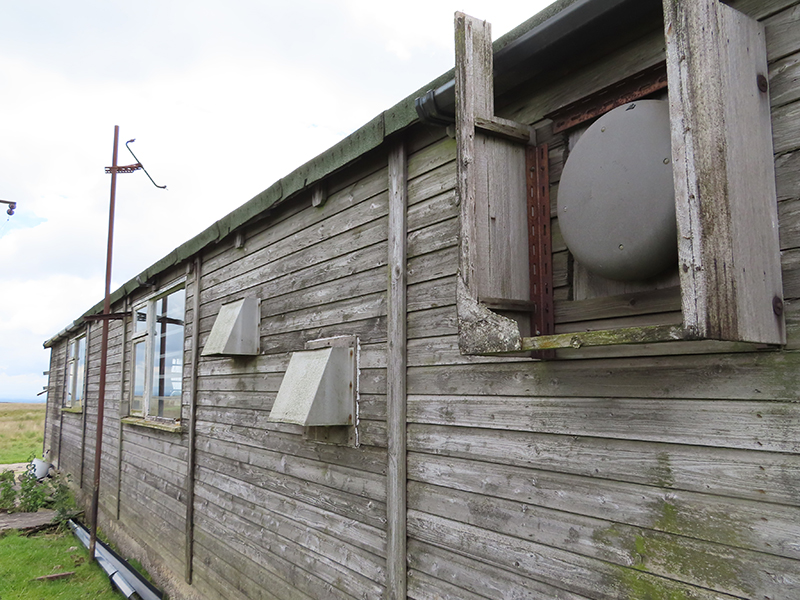
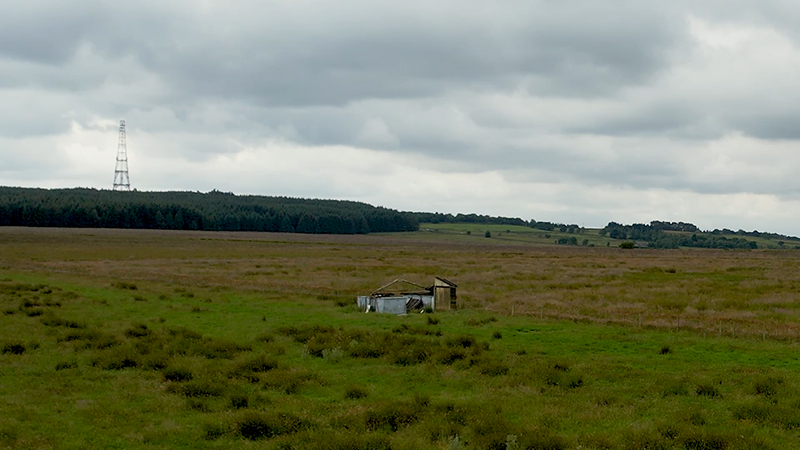
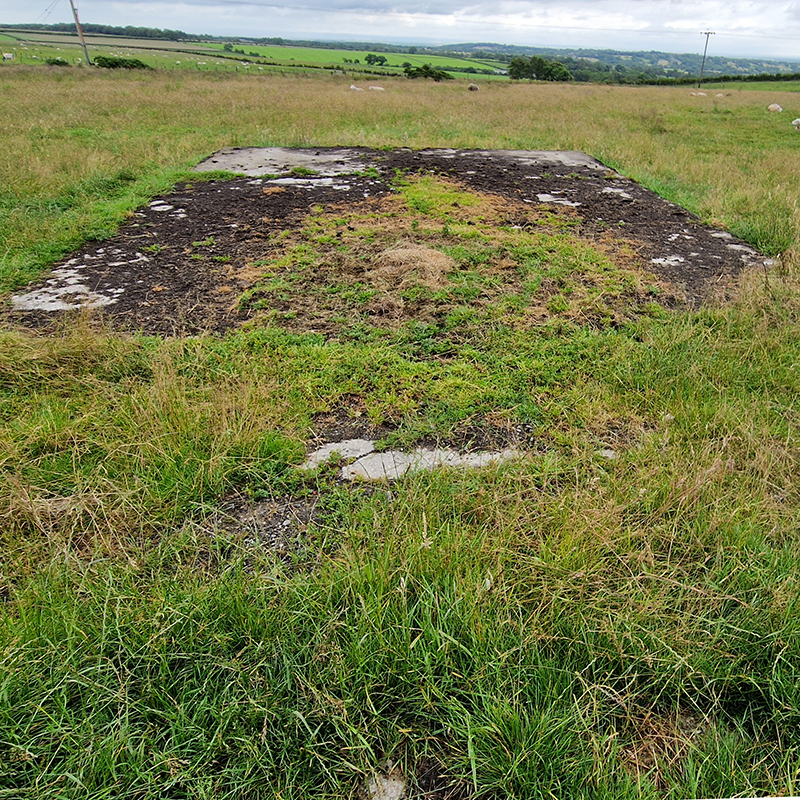
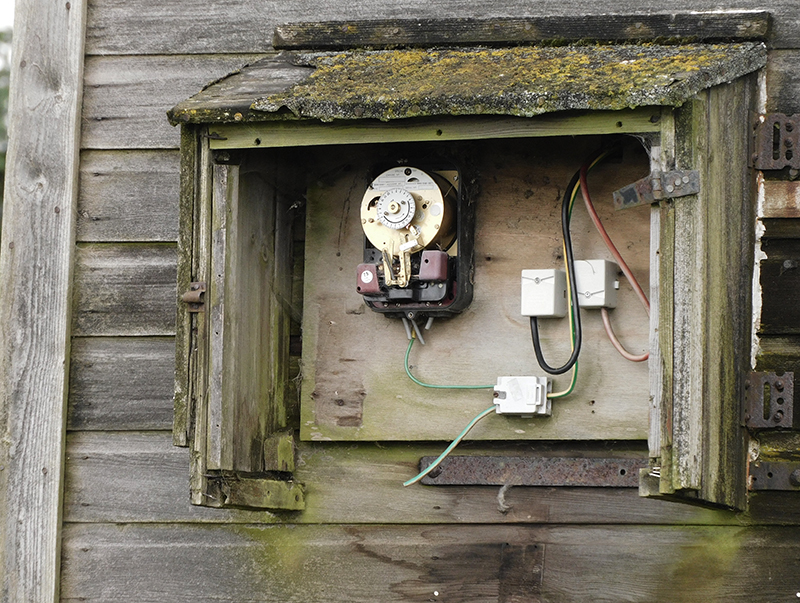
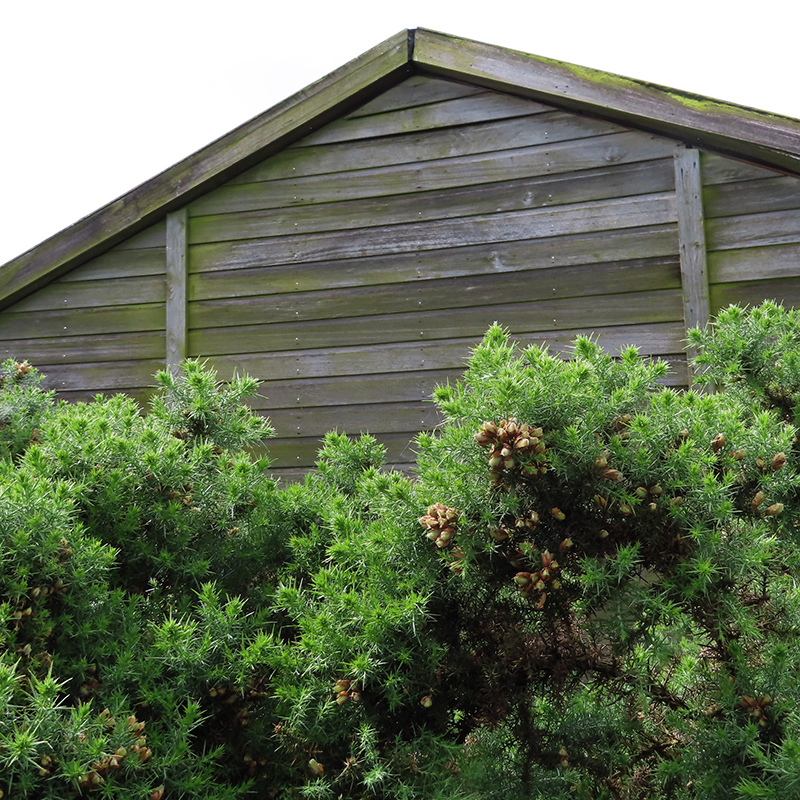
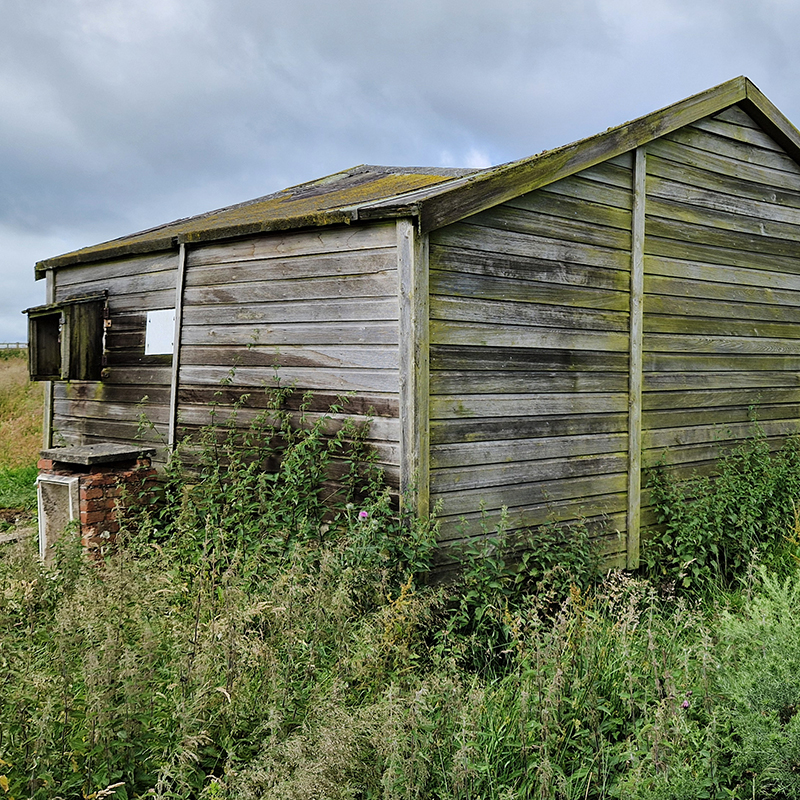
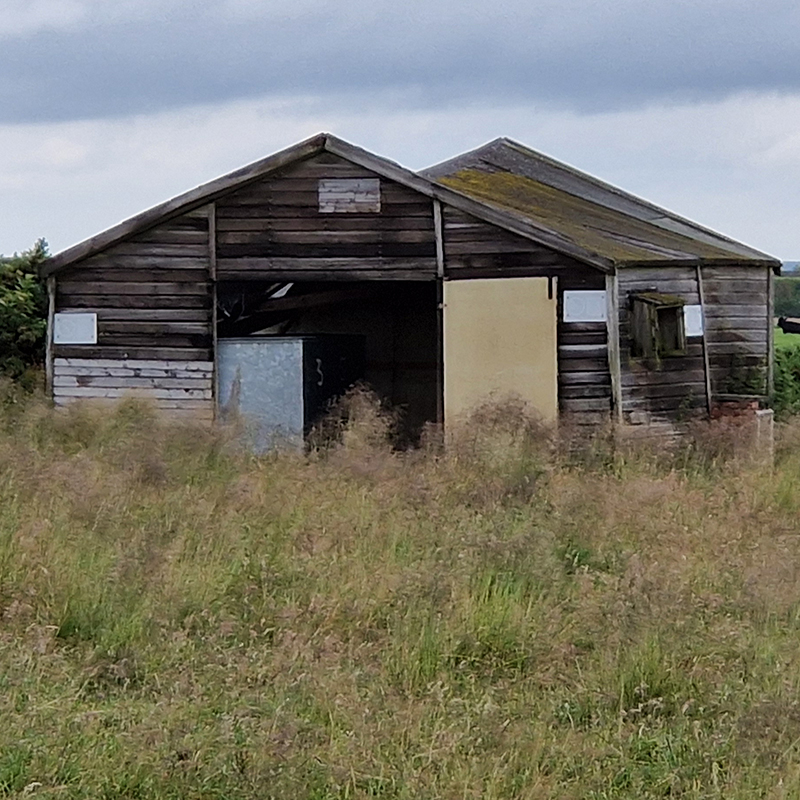
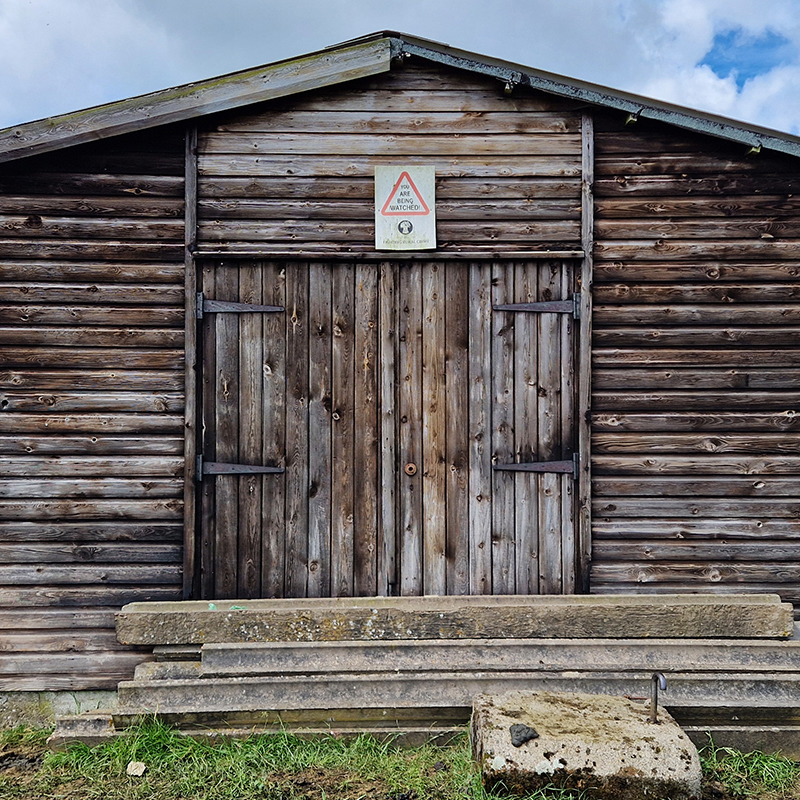
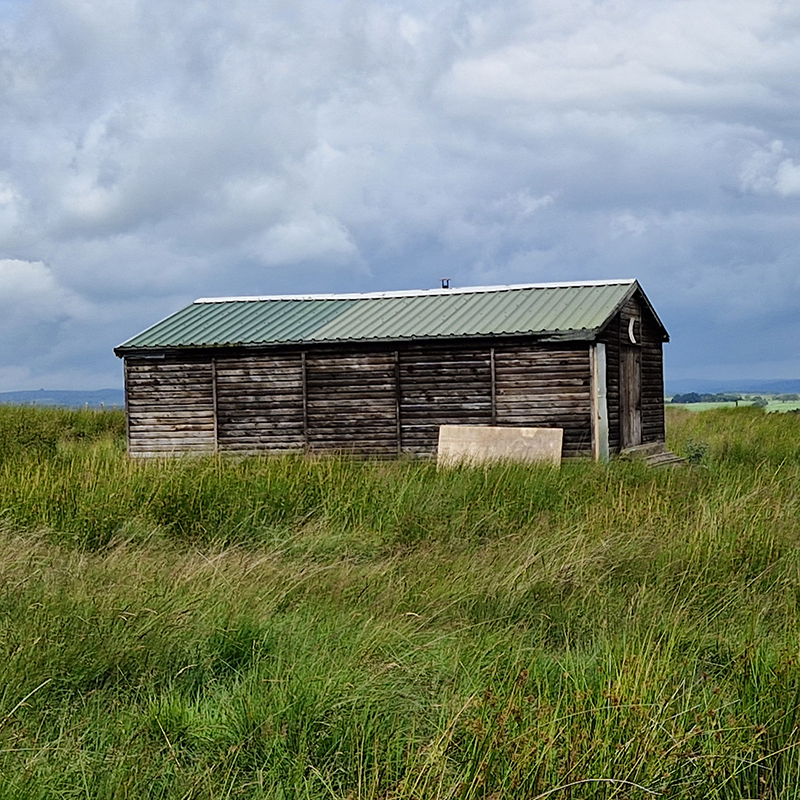
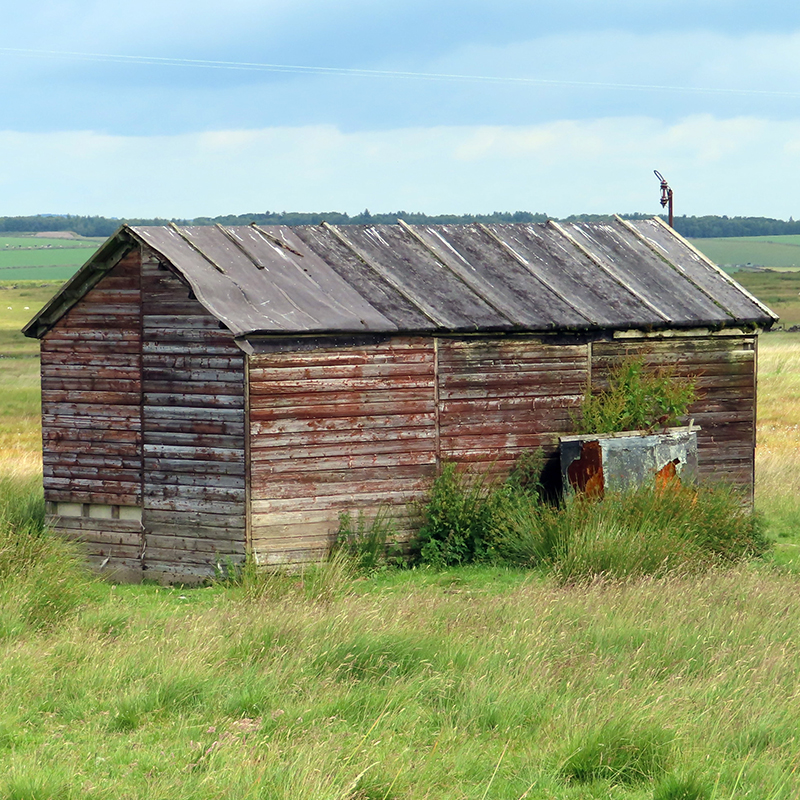
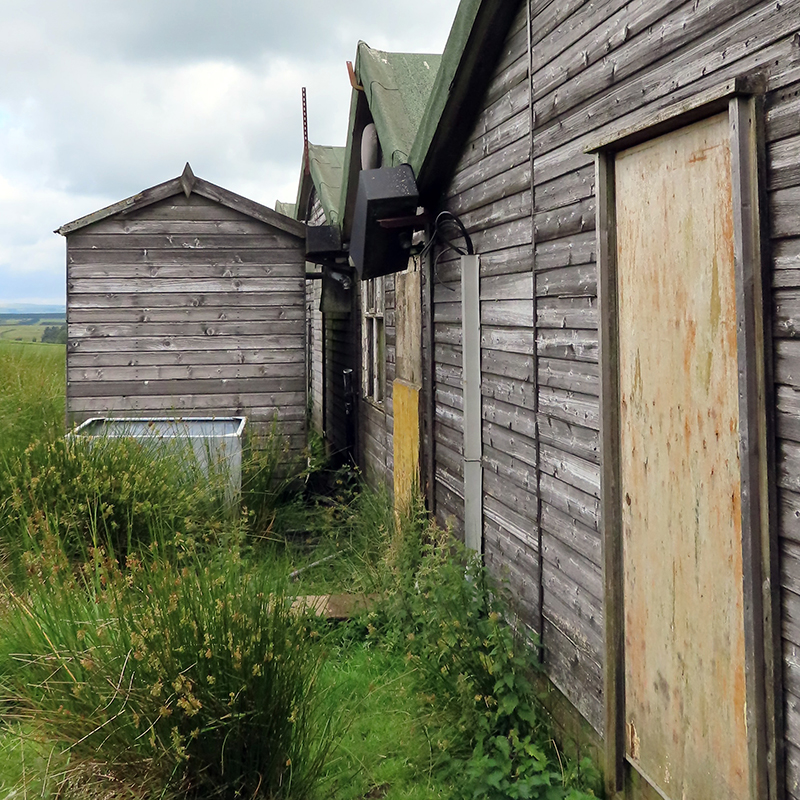
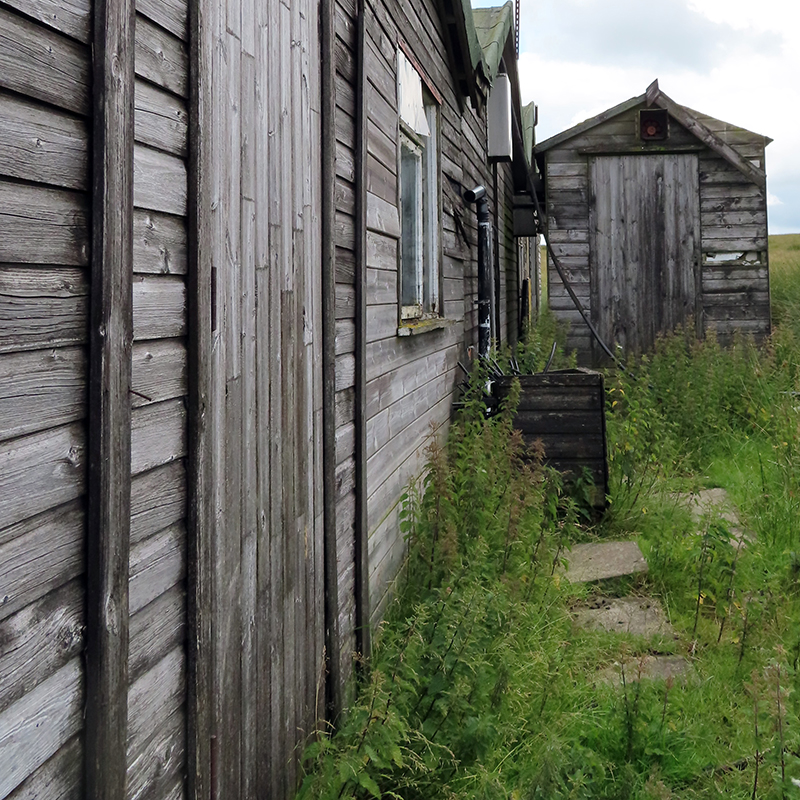
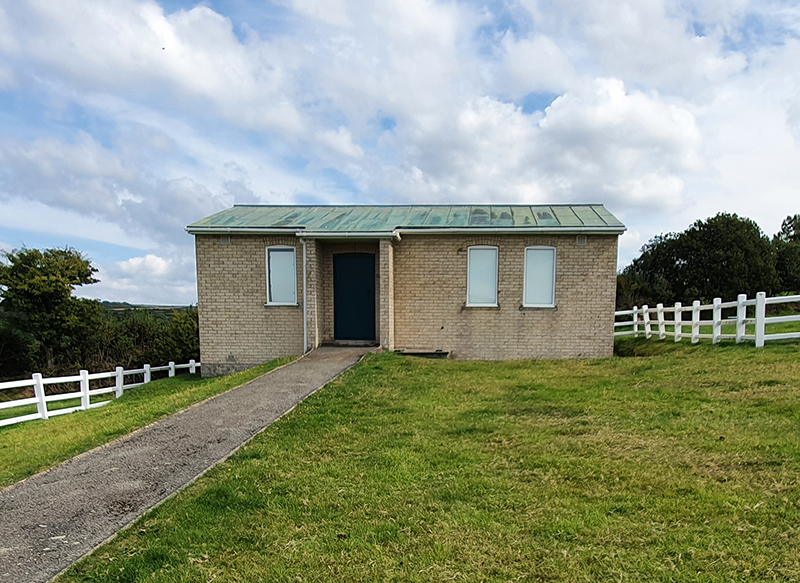
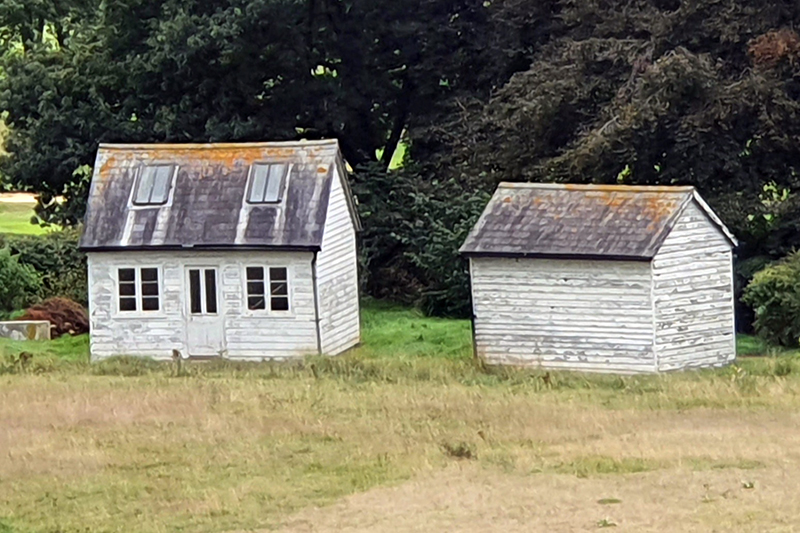
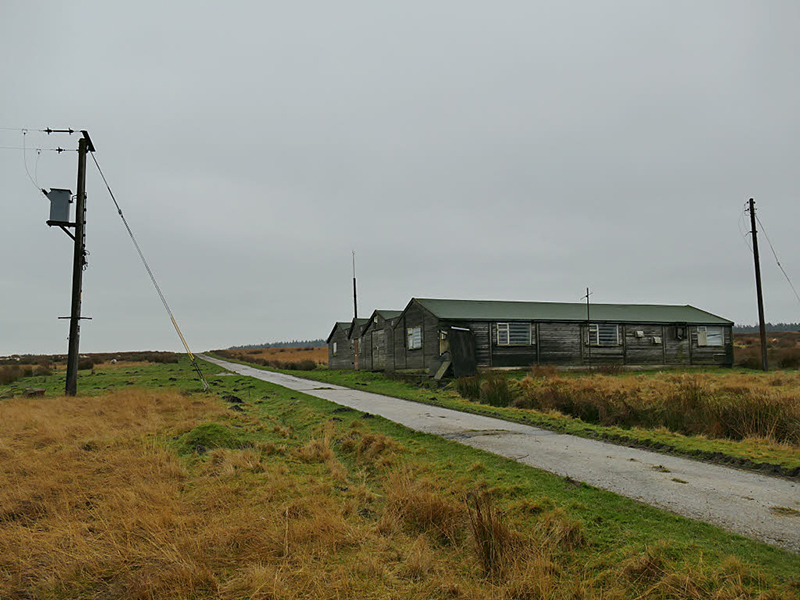
In search of huts. I have been on a mission to locate and document the remaining huts from a cosmic ray detection experiment at Haverah Park on the Pennine moorland in North Yorkshire.

When high-energy cosmic rays enter the atmosphere, they set off a chain-reaction particle cascade known as an extensive air shower. The Haverah Park experiment was home to one of the largest extensive cosmic ray air shower arrays in the world.

It was operated by the Physics Department of the University of Leeds for 20 years, closing in 1987. An array of over 200 water-Cherenkov detectors covering 12 km2 were active during its operation and many 1000’s of extensive air showers were recorded, including ones of such size that the cosmic rays that generated them had energies previously unthought of, adding to the mystery of where they come from.

The large energy density of cosmic rays is close to that of starlight, adding their own glow to the sky as they blast across the universe. Cosmic rays are the atomic nuclei of elements ranging from hydrogen to uranium accelerated to high energies, with half being protons and most positively charged.

Much of the technology used to observe cosmic rays has changed little over the decades since first inventions and still plays a role within newer technologies.

It appeals to me that the excitement of observing particles from other galaxies happened at these unassuming structures.

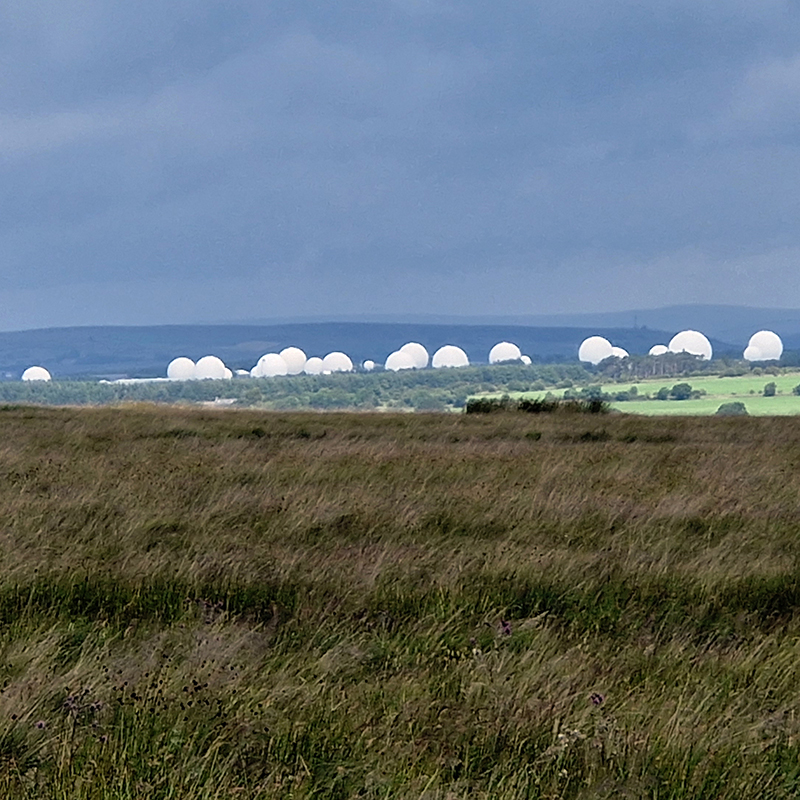
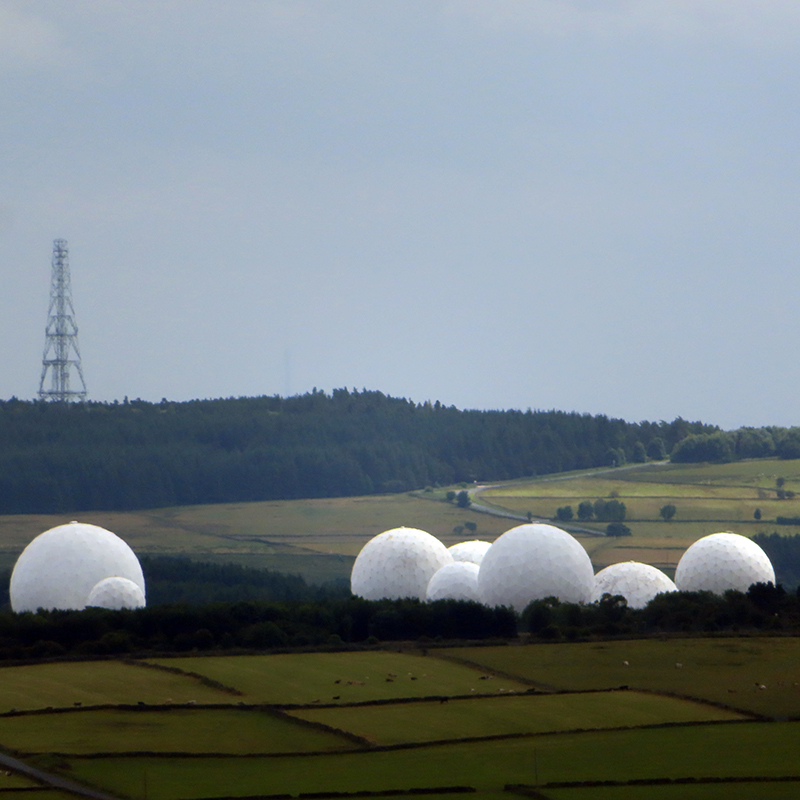
Sharing the landscape of Haverah Park cosmic ray air shower detector array huts are the striking white radomes that shield secret radar equipment at RAF Menwith Hill. The spy station has been there since the cold war space race began in the mid-fifties. Little is known about what goes on here but broadly it is said to gather electronic intelligence and is operated by US National Security Agency (NSA) and UK Government Communications Headquarters (GCHQ). As satellite technology has increased so has the number of radomes which now number 37 at the site. It is worth noting that satellites are vulnerable to unpredictable space weather and cosmic ray interference.

The total number of particles detected in a shower can be used to estimate the energy of the primary cosmic ray. Some particles contain the highest energy form of radiation known to exist anywhere in the universe and their origin is one of science’s greatest mysteries. Air showers of secondary particles generated from a primary cosmic ray hitting the Earth’s atmosphere are spread over many kilometres when they hit the ground so it is useful to have detectors spread over a large area. The difference in the time of arrival of recorded particles at multiple detectors can be used to estimate the arrival direction of the primary cosmic ray. However, this does not necessarily reveal the origin of the particle as magnetic fields within the galaxies bend their trajectories so that the memory of their original direction is obfuscated.

The cosmic ray detectors I made for the The Breath of Stars use a block of plastic scintillator which emits a short burst of UV light when a charged particle passes through it which is picked up by a single-photon-sensitive device. The detectors used at Haverah Park are water Cherenkov detectors. These are large steel tanks of purified water with photon sensitive detectors in the water.

While the speed of light in a vacuum is a universal constant its speed through a material may be significantly reduced as it is slowed by the medium. A particle passing through a material faster than that at which light can travel through the material loses electrons thereby emitting light. When cosmic rays pass through the water tanks, they emit Cherenkov radiation because they travel faster than the speed of light in water. Cherenkov light is similar to the production of a sonic boom when an airplane is traveling through the air faster than sound waves can move through the air. Pavel Cherenkov along with Ilya Frank and Igor Tamm discovered and demonstrated this phenomenon in 1934, astonishingly, it had been predicted in 1888 by Oliver Heaviside, and in 1910 Marie Curie had noticed a strange blue glow from her radium experiments.

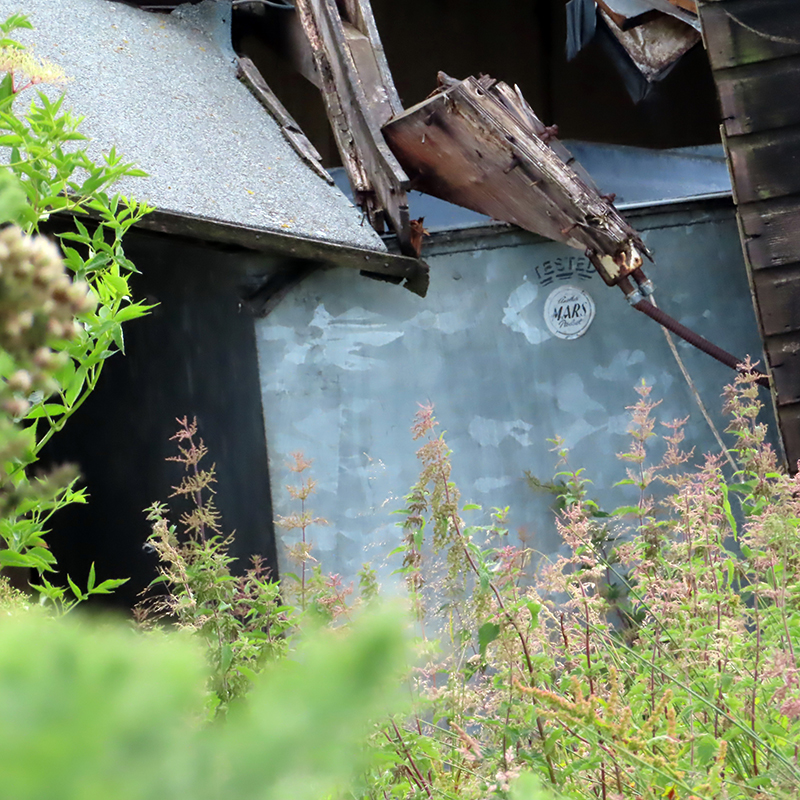
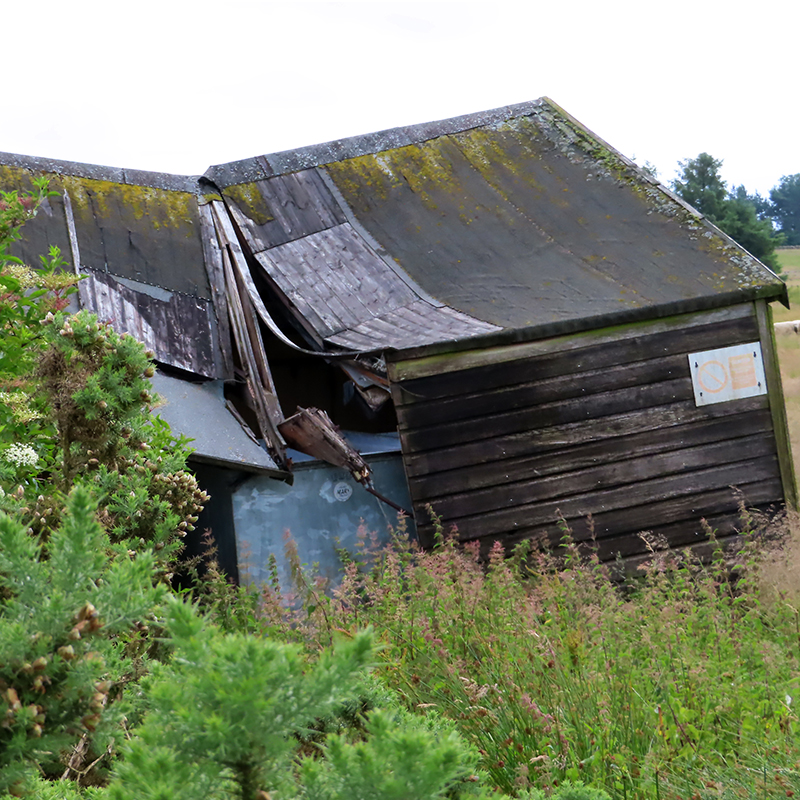
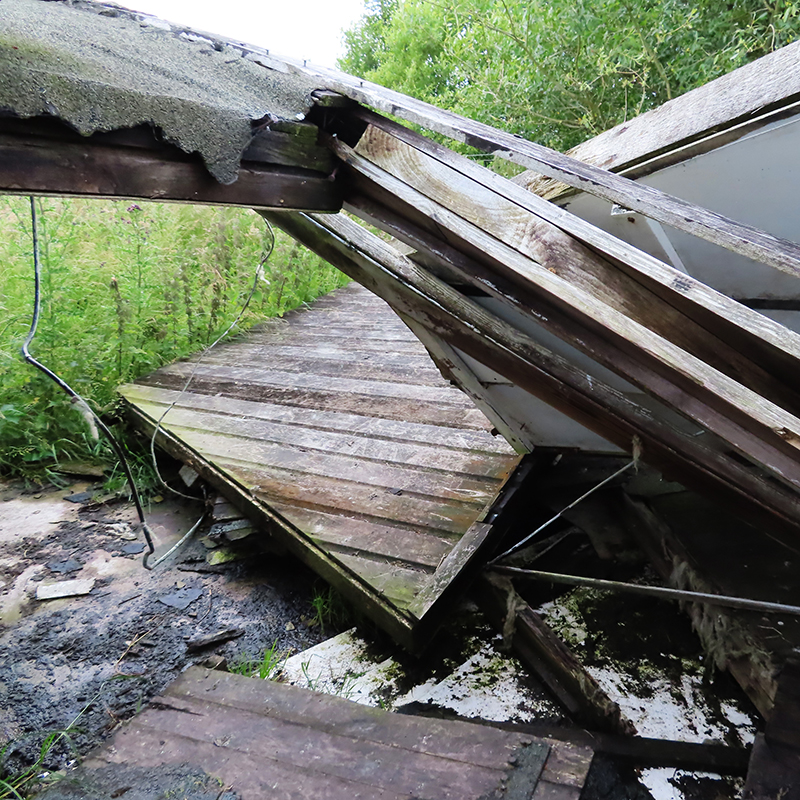
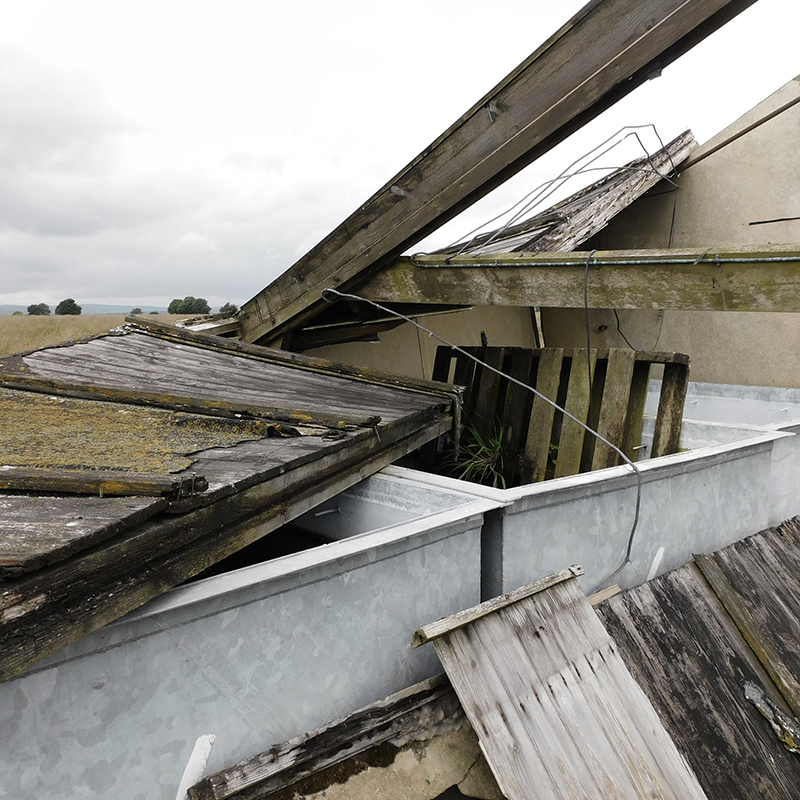
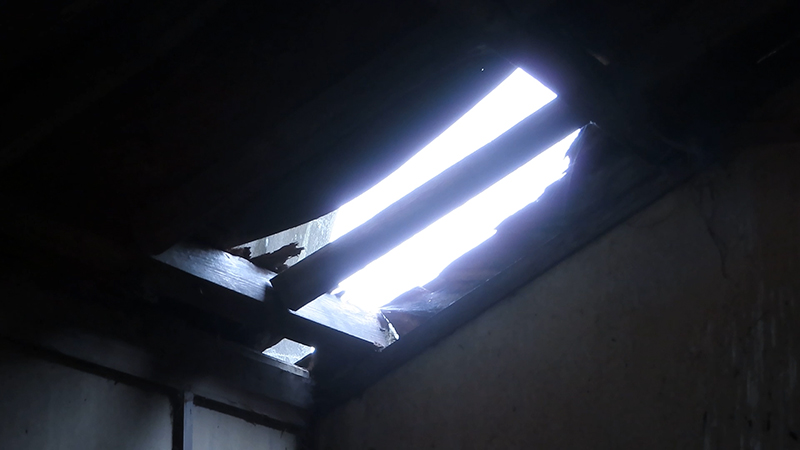
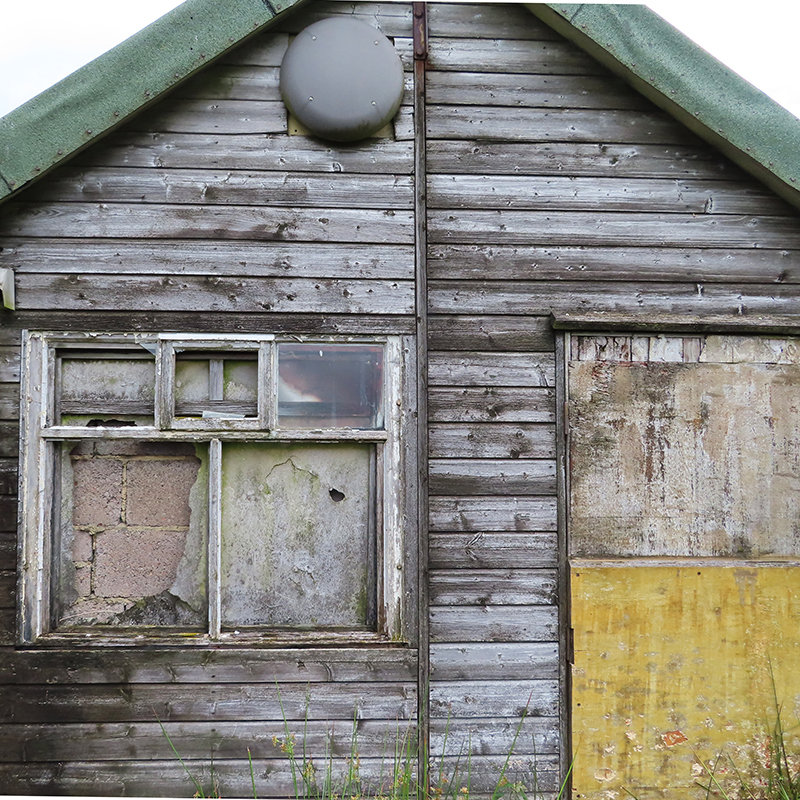
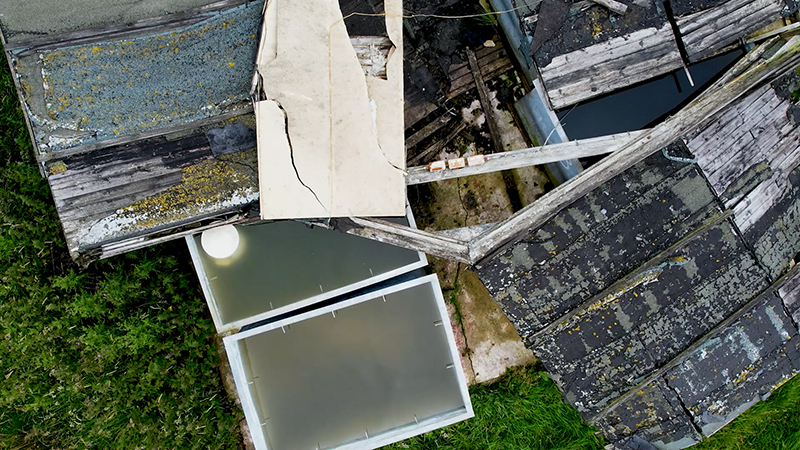
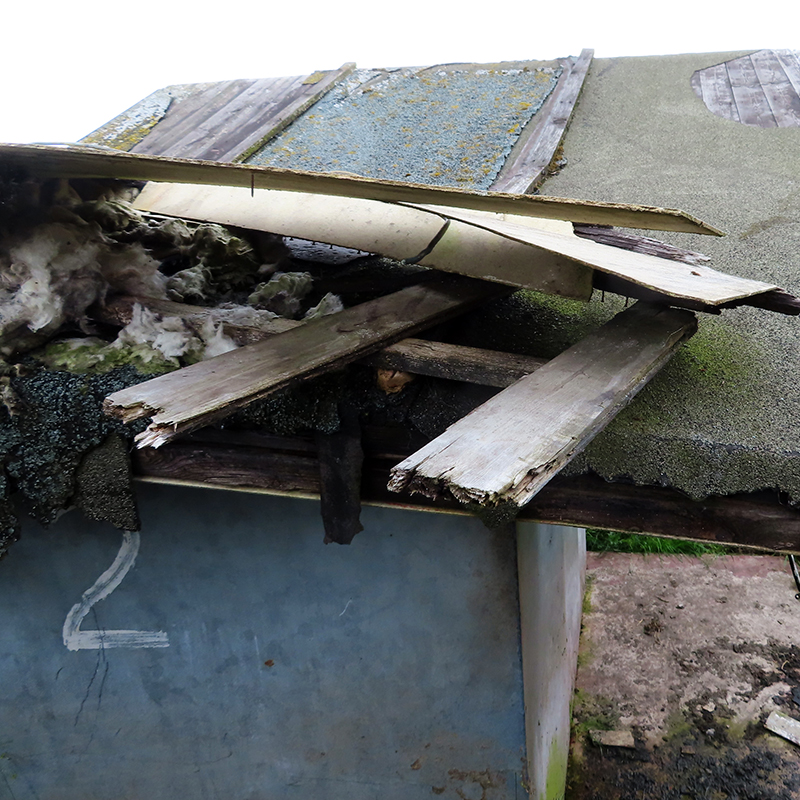
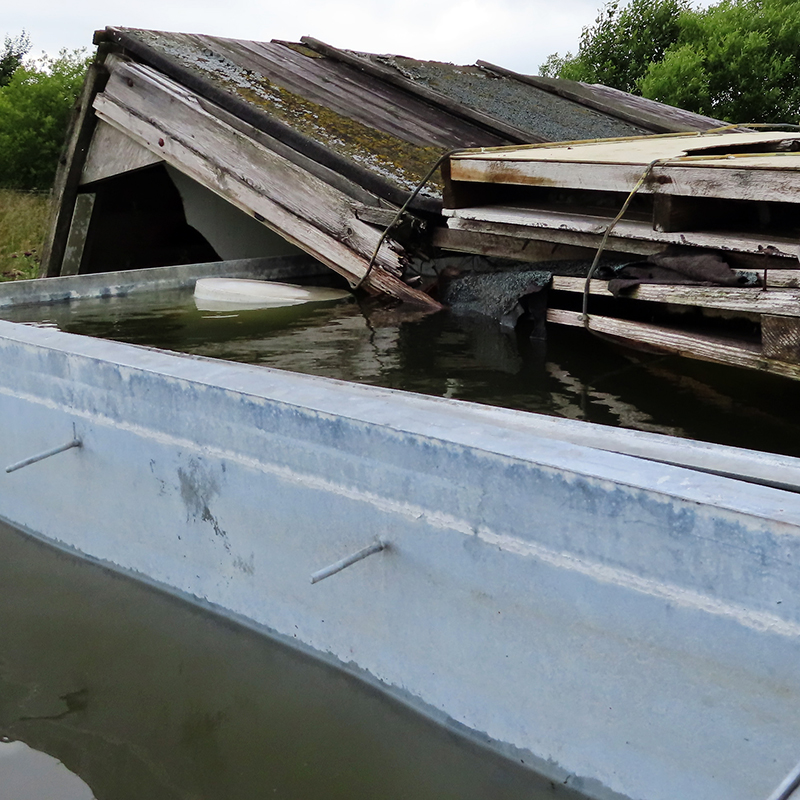
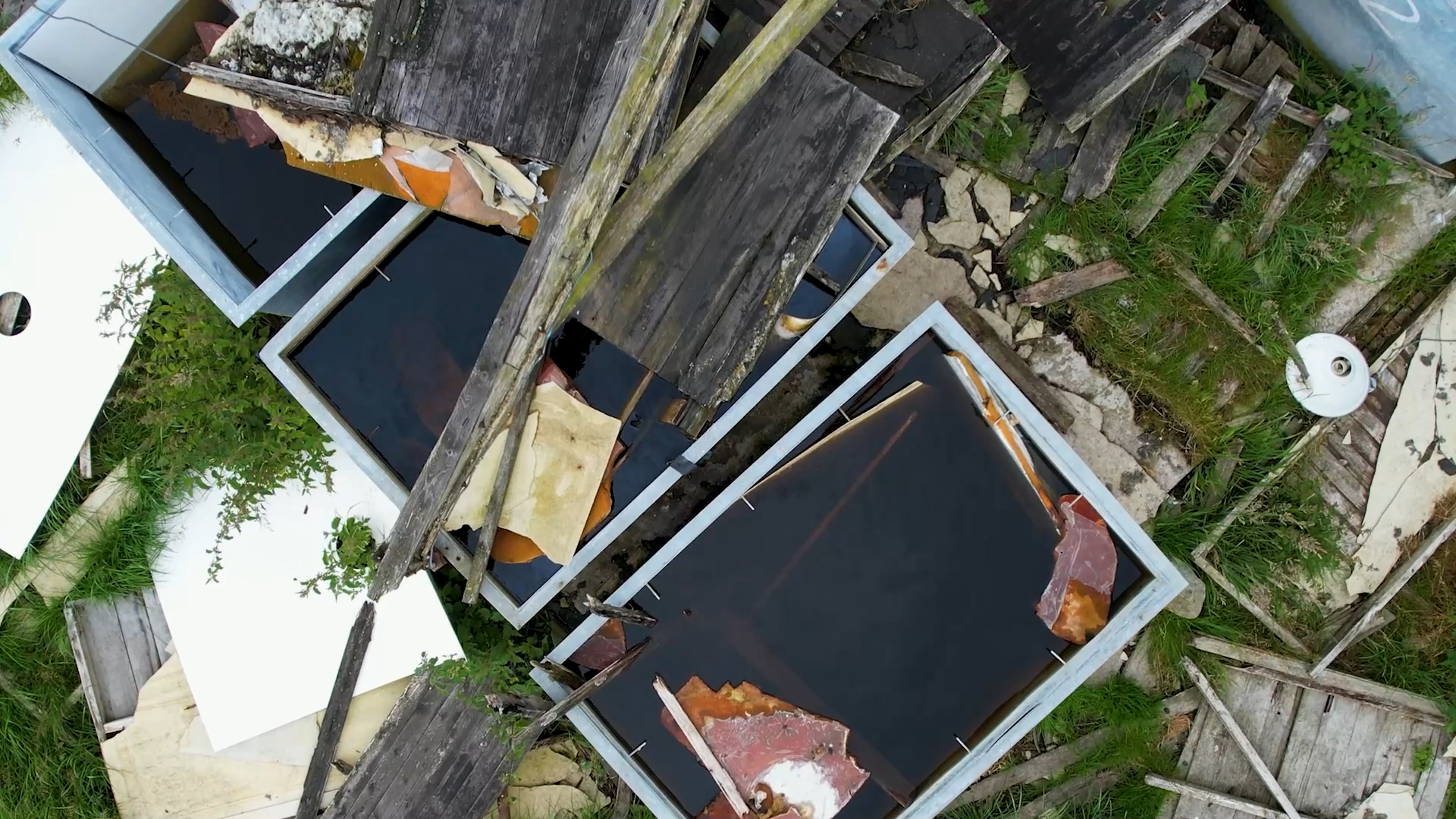
Other huts from the Haverah Park experiment are in a state of collapse.

There are so many high energy particles hurtling around the universe that they almost equal starlight in energy density. Cosmic rays travel at almost the speed of light and because they are charged particles most cosmic rays are confined, spiralling within our galaxy for a million years or more, by the magnetic fields which permeate it.

Five million cosmic rays pass through your body each day. Some will collide with atomic nuclei. A particle passing through a material at a velocity greater than that at which light can travel through the material emits light. Maybe we glow a little.

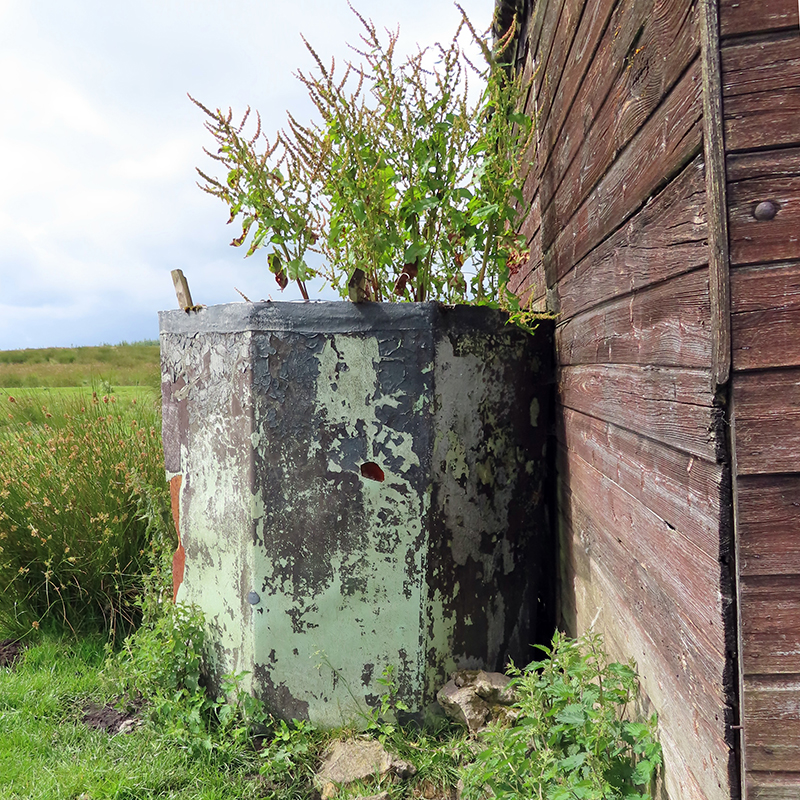
Following the disappearing trail. Haverah Park hut with an intriguing hexagon tank.

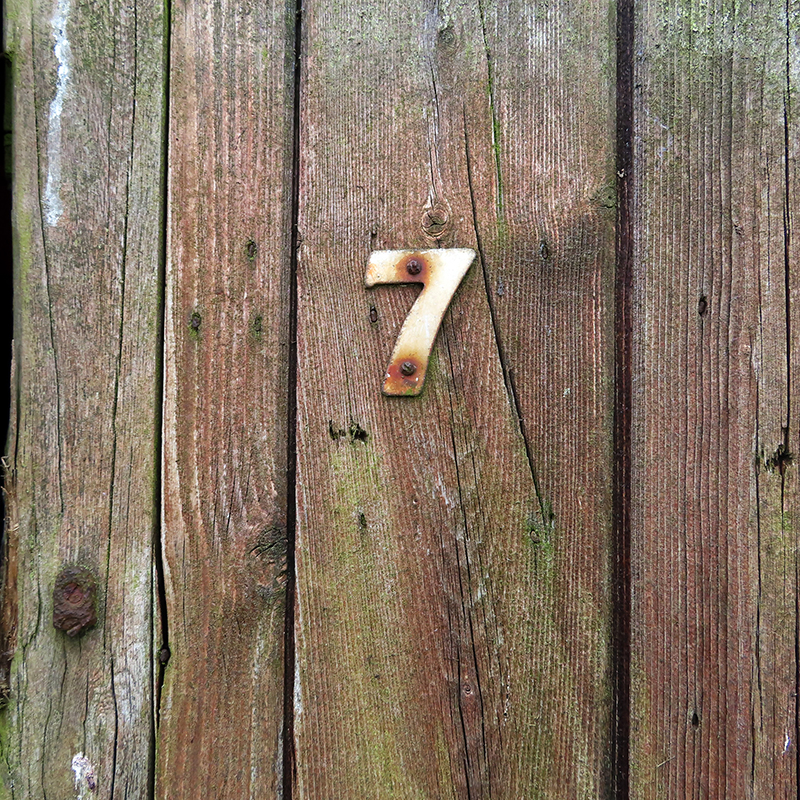
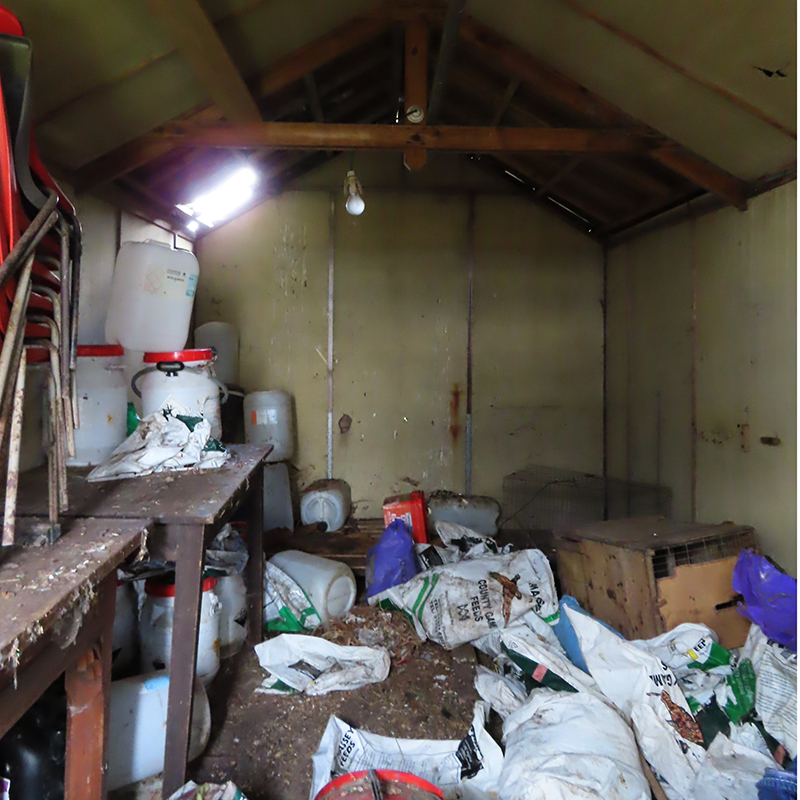
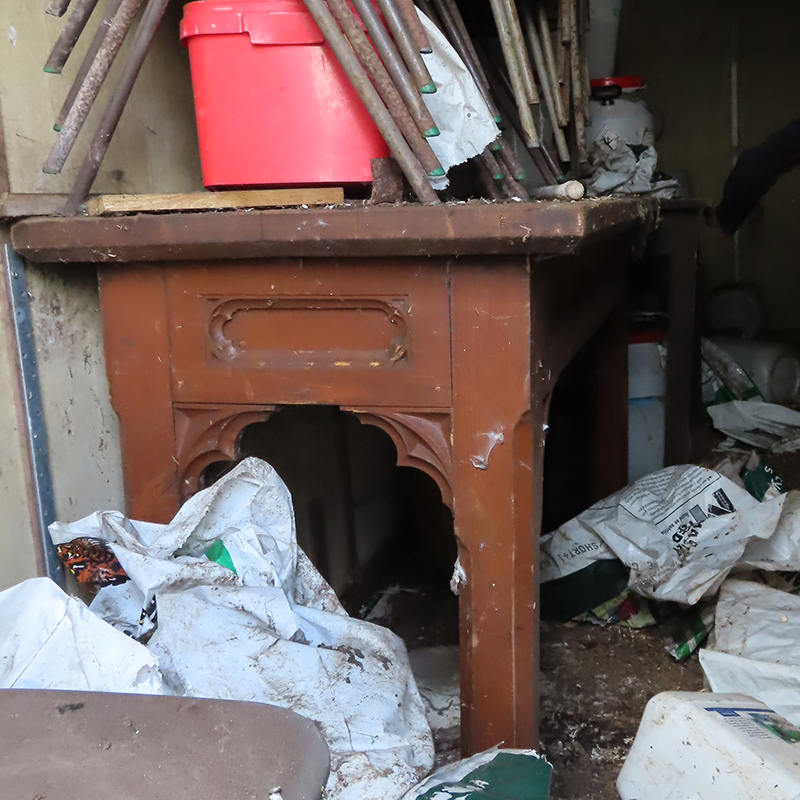
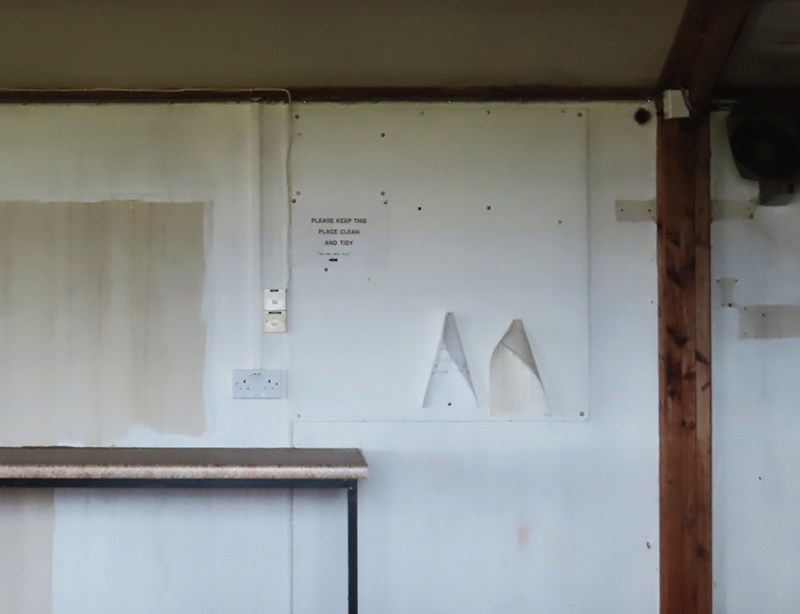
Inside Hut no. 7 is a dumping ground. Waste is a big problem in space as well as on Earth. The thickening shell of space junk in low Earth orbit, if left to accumulate, could cause a conductive shield to form, weakening the effectiveness of the magnetosphere, which protects life on earth from most cosmic radiation.

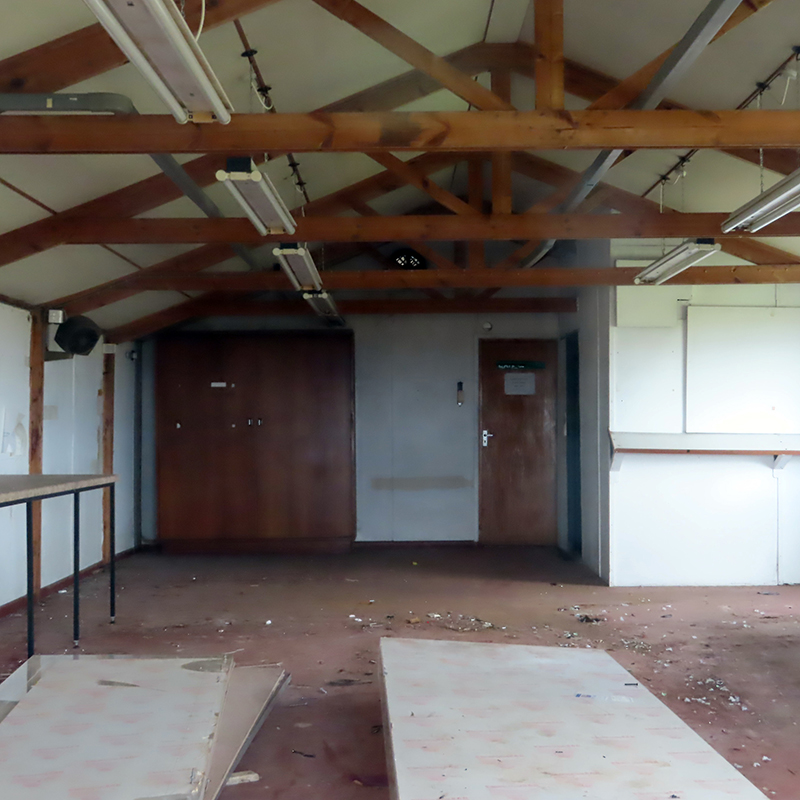
A decaying wall map of the entire Haverah Park experiment is just visible through a window of one of the huts in the central hub, but not much else remains inside.

It looks like these huts have been recently emptied into a skip which, by chance, was collected while I was there. Unfortunately, the driver had no enlightening information for me about the future of the huts.

Cherenkov radiation is a form of energy that gives off a blue glow when electrically charged particles are moving at speeds faster than light is able to travel through the same medium. The experimental physicist Blackett, who received the 1948 Nobel Prize in Physics for his investigations into cosmic rays, believed that extensive air showers should produce flashes of light that could be perceived by the human eye when lying down and looking upwards under dark skies. Whether he achieved seeing this phenomena himself is not known, but he inspired colleagues Galbraith and Jelley, in 1952, to devise an experiment to detect light from air showers using a rubbish bin painted black on the inside, a recycled searchlight mirror and a small phototube. With these simple items, they made the first observation of Cherenkov light produced by cosmic rays passing through the atmosphere. Not all the twinkling in the night sky is starlight.

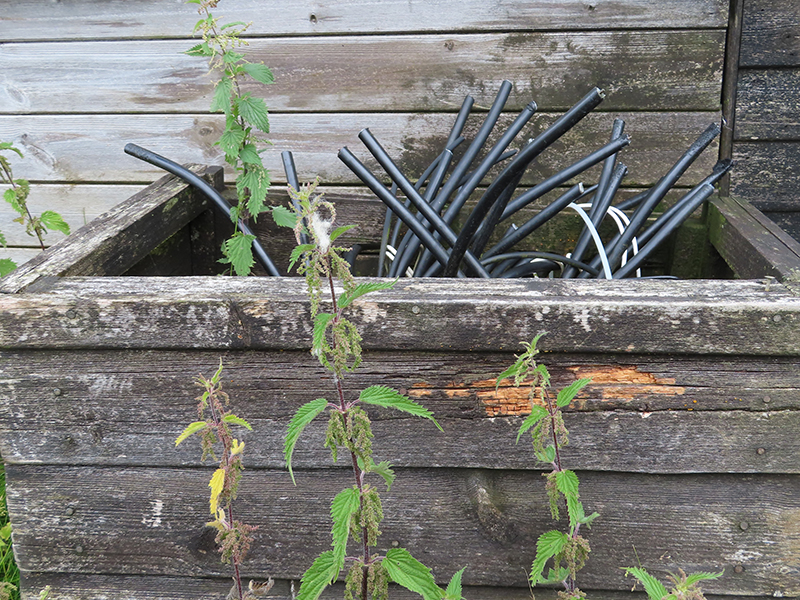
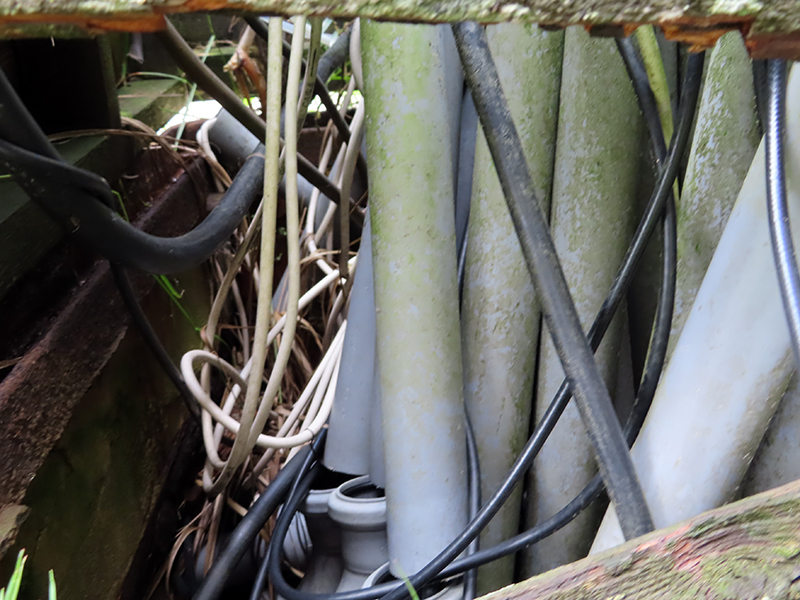
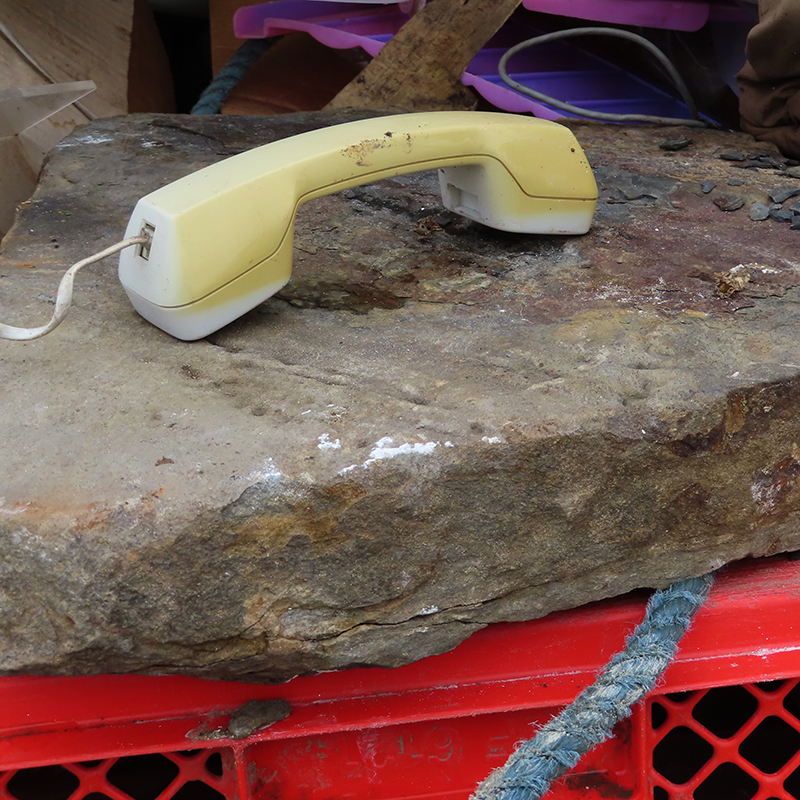
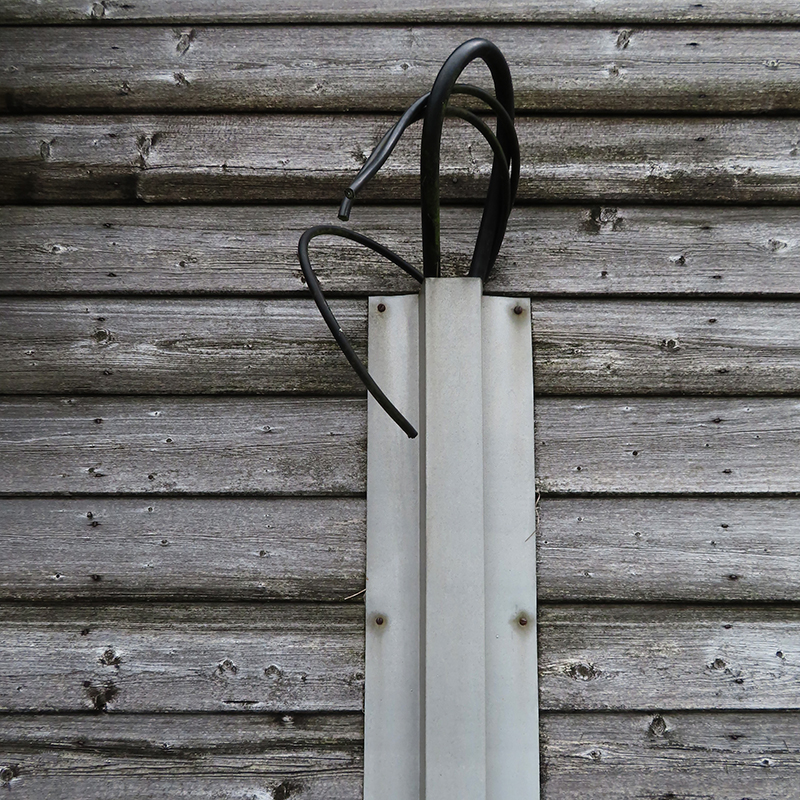
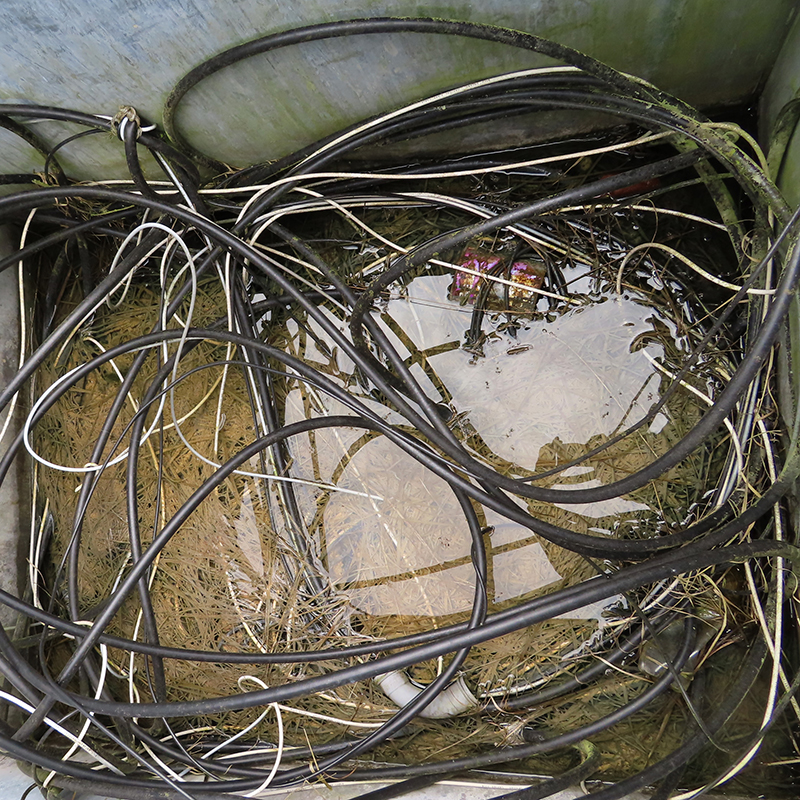
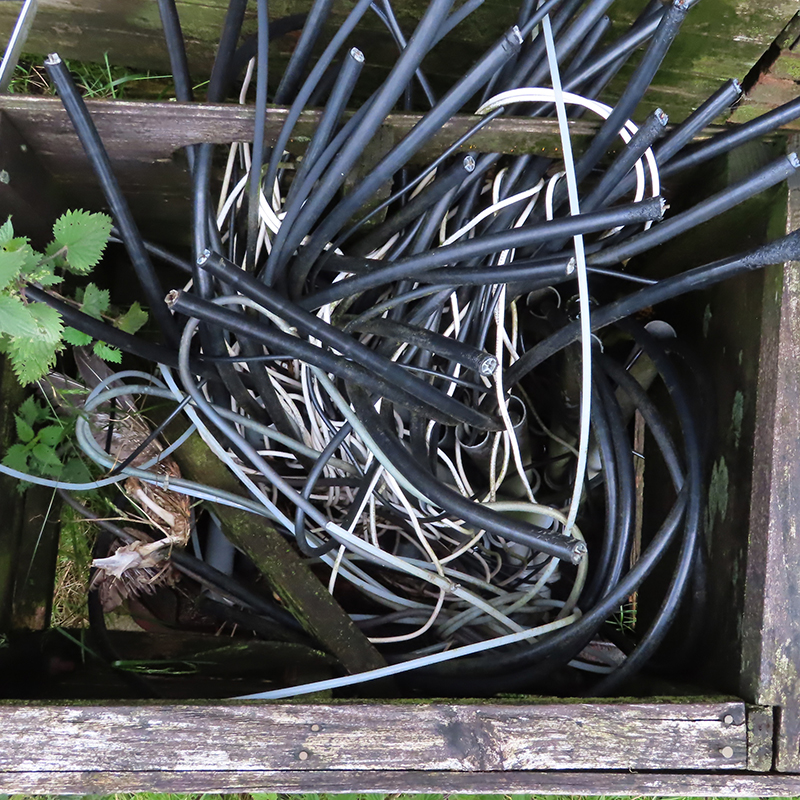
During the Haverah Park experiment, the water Cherenkov detectors deployed across the moors were connected by underground cables and transmitted information to the control huts via radio signals in the microwave frequency range. All communication is now severed. Cut cables coil in rain filled tanks. The cosmic rays are still pounding down upon these new unwatched ecosystems but the detectors have moved elsewhere.

I am looking forward to meeting Professor Alan Watson FRS here in the autumn. He is eminent in the field of cosmic rays and helped initiate the extensive air shower project, working at Haverah Park for 25 years. He has kindly agreed to meet and share his insider knowledge of the history and operations at the site.

The idea to build a truly giant shower array was launched by Alan Watson and Jim Cronin shortly after Haverah Park was decommissioned and thanks to the ground breaking work undertaken in these huts, it evolved to become the vast Pierre Auger Observatory in Argentina, named in honour of the man who first discovered extensive air showers.

Peering into the darkness, trying to fathom the structures of the universe or what’s inside the hut, and the nature of that relationship.

The ultra high energy particles detected at Havarah Park and new arrays across the globe are very rare, possibly less than one per square kilometre per century, so it is big news when one arrives. Because they have such high energy, it is thought they shouldn’t be affected by galactic magnetic fields, and therefore, the direction of the particle could be determined and the source located. The Amaterasu particle, named after the sun goddess in Japanese mythology, the second most powerful particle to be recorded, appears to have emerged from the Local Void, ana area with no astronomical objects that might produce such a particle. There is no explanation of where these particles come from, just hints of bigger mysteries to unfold.

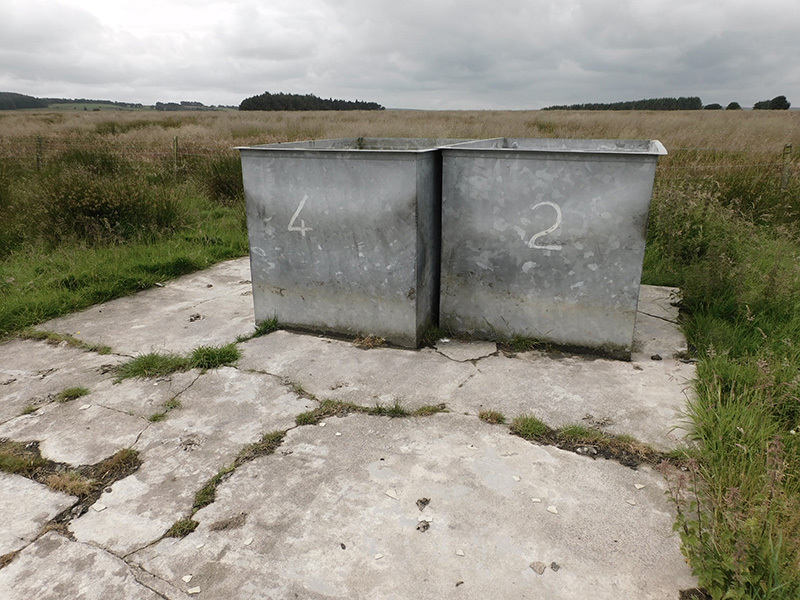
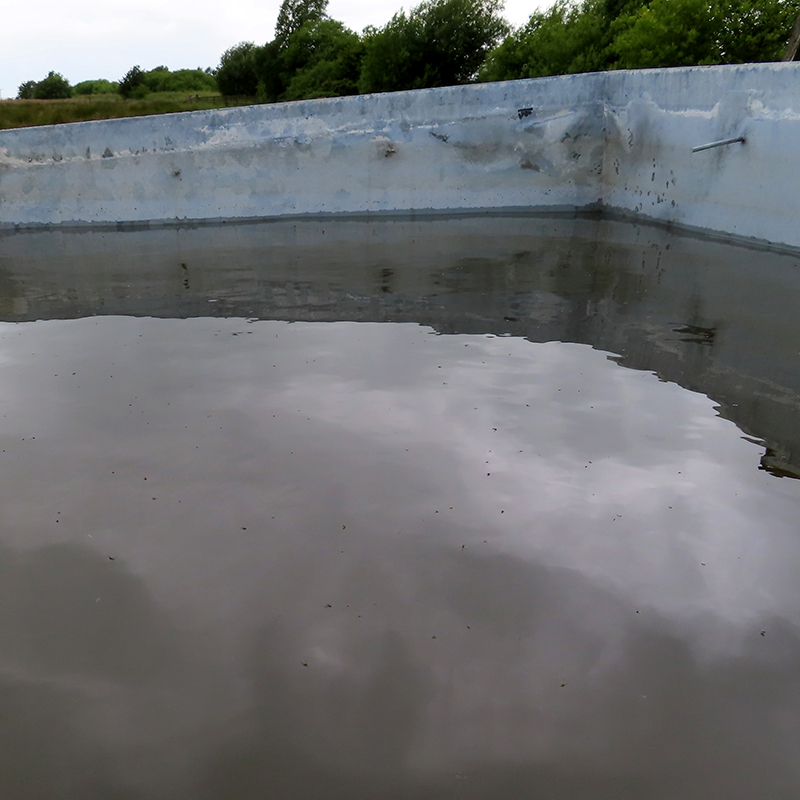
Many water tanks remain around Haverah Park, stripped of their purpose as water Cherenkov detectors they now reflect the sky in the rainfall they collect rather than record showers of particles from space.

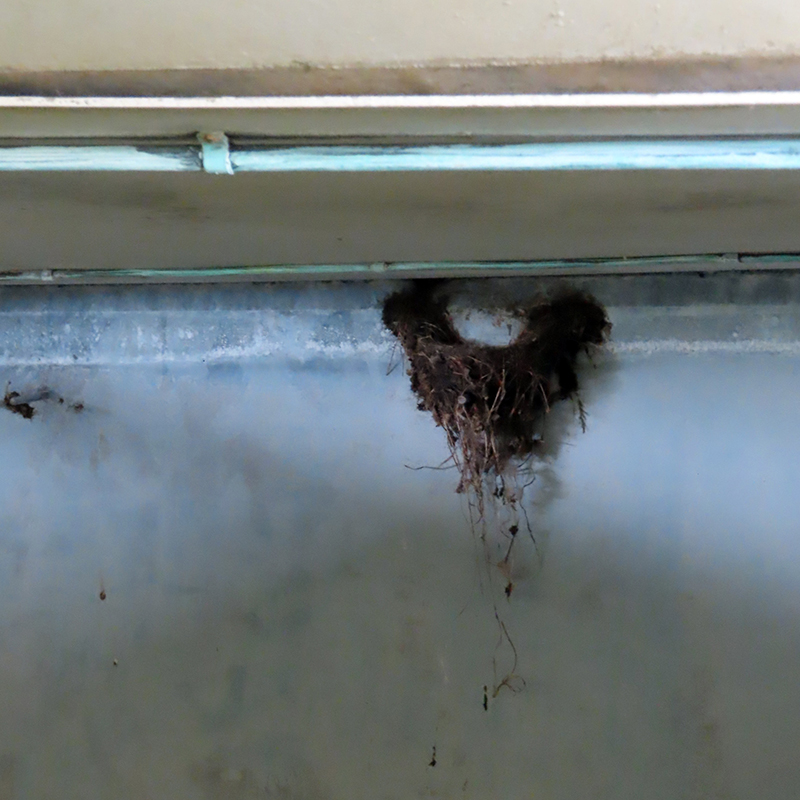
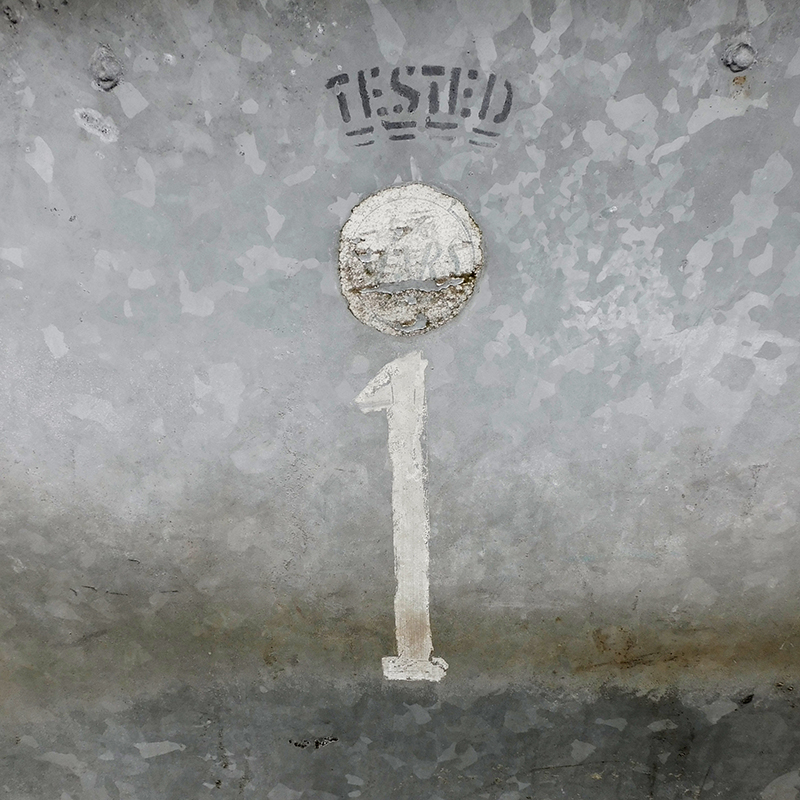
During operation, huts were built in groups of three, each with six large galvanised steel tanks lined with white plastic to diffuse the light and filled with local purified water. Each tank was monitored by extremely sensitive photon detectors which recorded the Cherenkov light emitted as particles passed through the water. At the end of the large array experiment, one of the detectors was opened, and the water was found to be crystal clear and good enough to drink. The proof that water could be kept bacteria-free in a sealed container for over 25 years gave confidence in using the same technology for a future larger cosmic ray detector array to be developed.

Haverah Park was once one of the largest extensive air shower arrays in the world, with an area of 12 km2, but in the end, it just wasn’t big enough.

When Alan Watson and Jim Cronin proposed building a new 3000 km2 shower array, the question from funders was, ‘why do you want to make the array so large?’. The answer is, of course, to discover those known and unknown unknowns, but funders don’t usually like unpredictable outcomes. Luckily their plea was bolstered by the Fly’s Eye Cosmic Ray Detector Array out in the Utah Desert recording the Oh-My-God particle in 1991, it’s energy was 40 million times greater than that of any particles ever produced in any terrestrial particle accelerator. This and other evidence of extremely high energy particles sparked interest in the field of astrophysics and validated the discovery of similar particles at Haverah Park, which had not been taken seriously at the time. This ambitious proposal gained momentum during the 1990s to become the Pierre Auger Observatory in Argentina, with the detector design developed from the water Cherenkov tanks so successfully operated at Haverah Park. The huts here may be in ruins, but their legacy lives on at the world’s largest extensive air shower detector array, which is edging closer to answer the question ‘Where do ultra-high-energy cosmic rays come from?’

I am looking forward to developing work responding to the legacy of the Haverah Park experiment and building on my experience of creating The Absolute Hut (of absolute potential) New surfaces to explore, more moss, and also lichens here.

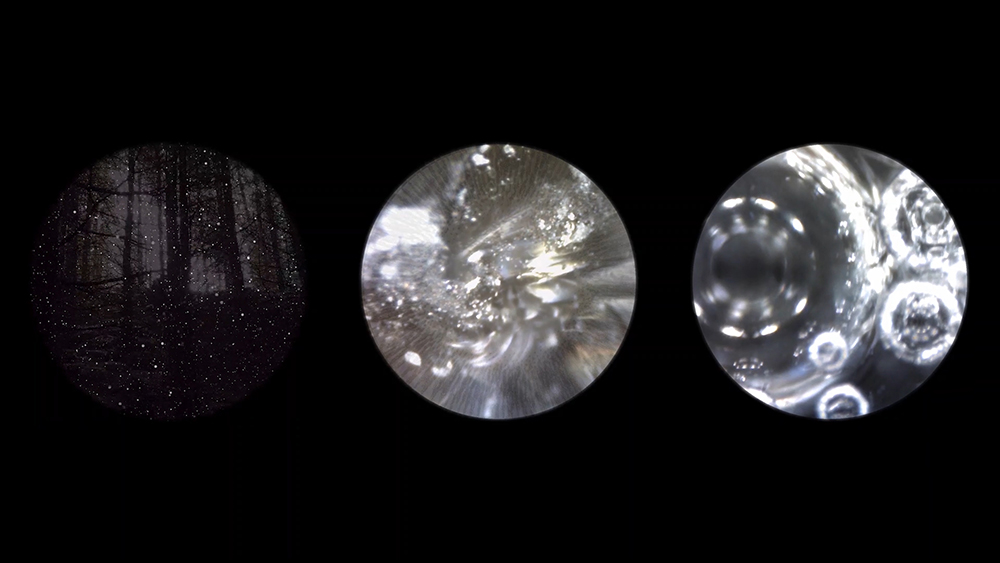
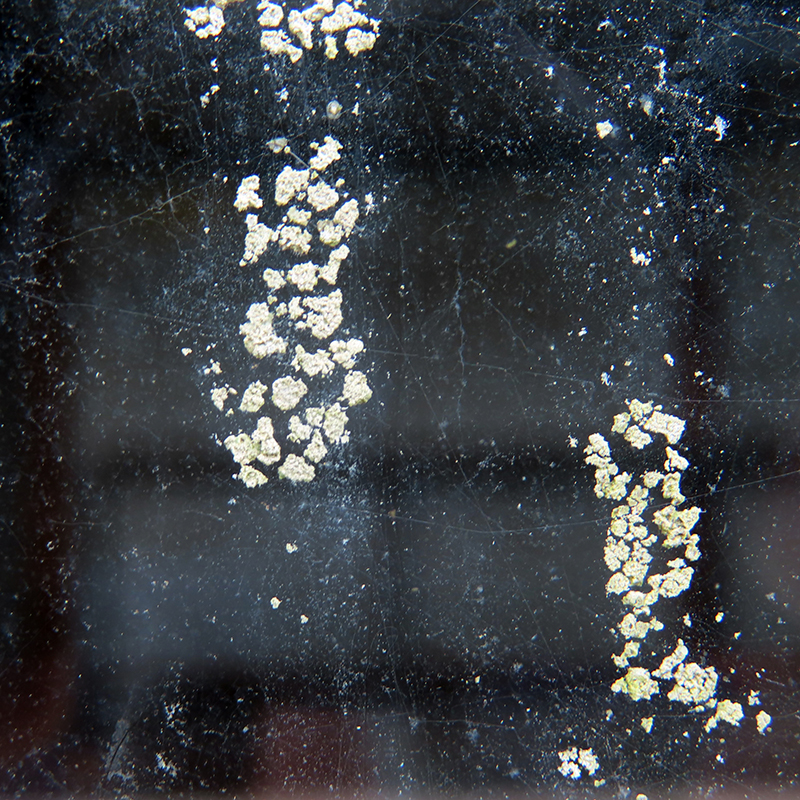
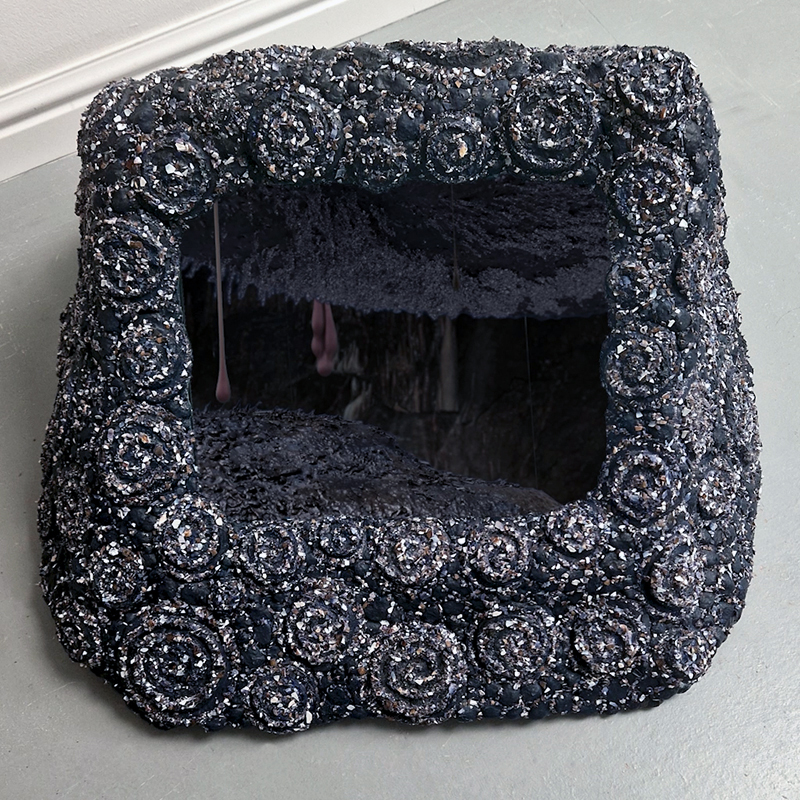
‘The Belly of a Rock’ video has waited a long time for its crusted shell. A hybrid between rock, mollusc, and technology inspired by the chemical conversations and urge to create described by Italo Calvino in his story ‘The Spiral’. We don’t always know what we are creating. Within ‘the belly’ surfaces slide and scrape along lines of fissure, distended innards ooze and rocks moan as they are distorted by untold pressure. The turbulent spiralling of the core births rock and lifeforms acted upon by the drag of the oscillating magnetic field.  

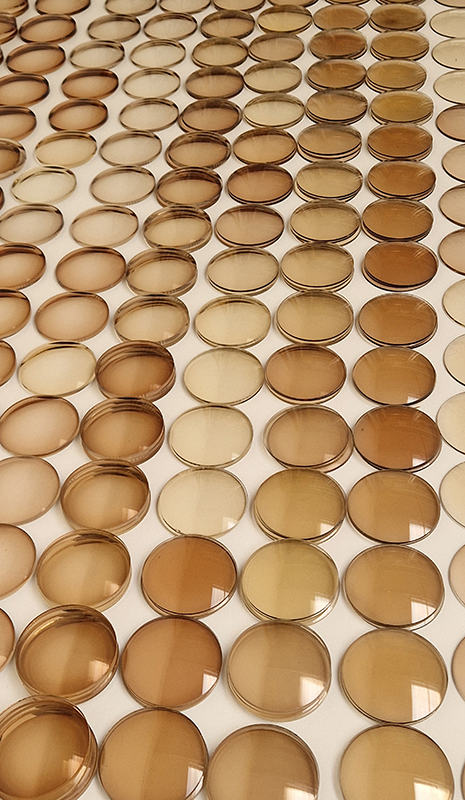
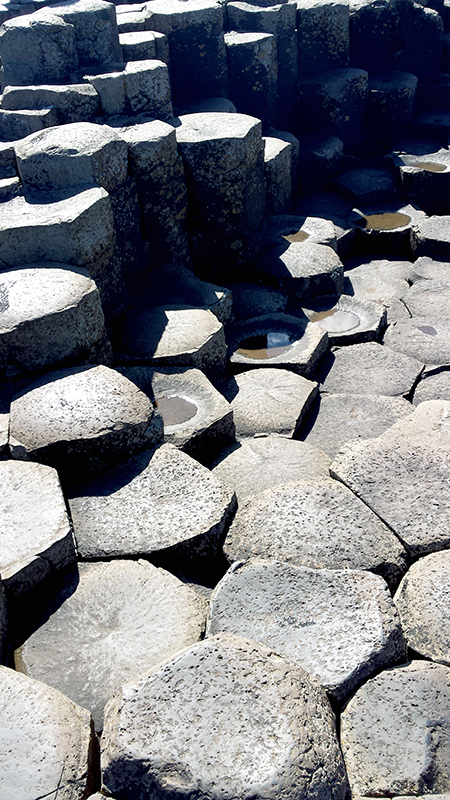
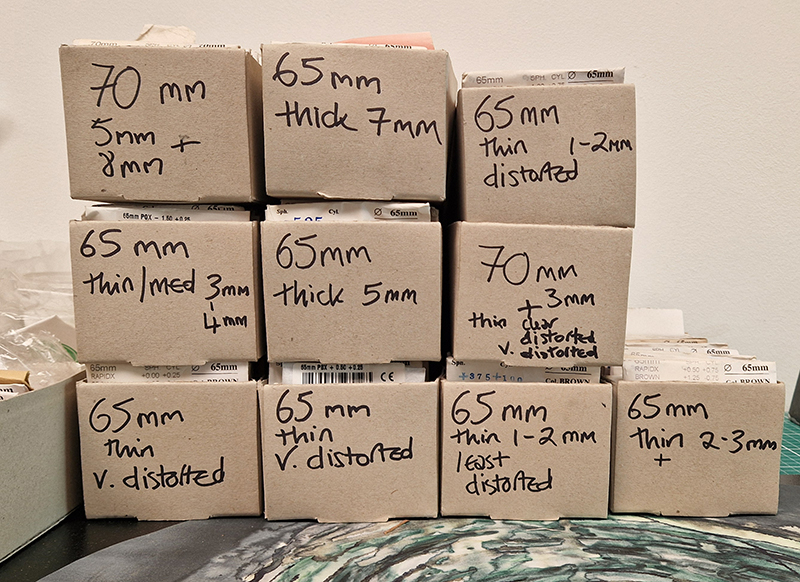
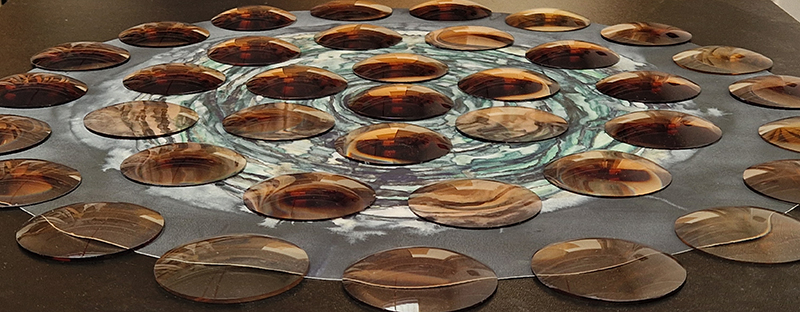
I have acquired a large number of photochromic optical lenses. These I have sorted by diameter, thickness and distortion. Initial thoughts about their use include using them as petri dishes to grow crystals which are embedded into small concrete hexagonal pillars of differing heights with reference to the geology of giants causeway. Using them to create composite windows into a new hut structure filled with video projections referencing the fly’s eye cosmic detector array.

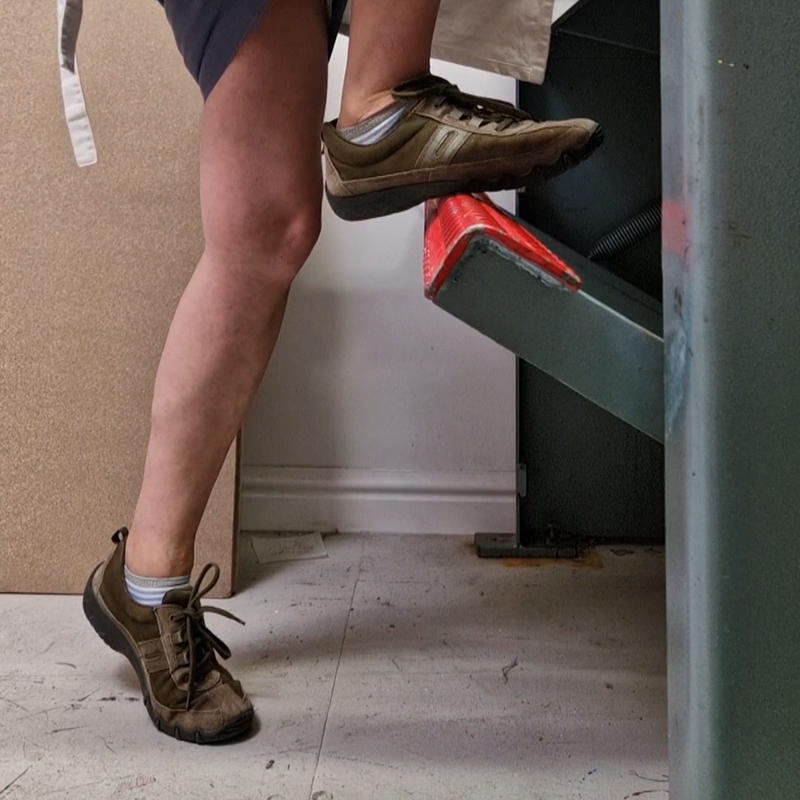
A good workout on the guillotine making 201 cuts in copper sheet in preparation for a new concrete tablet in the Instruments of the Anemoi sculpture series.

Gallery and other outings:

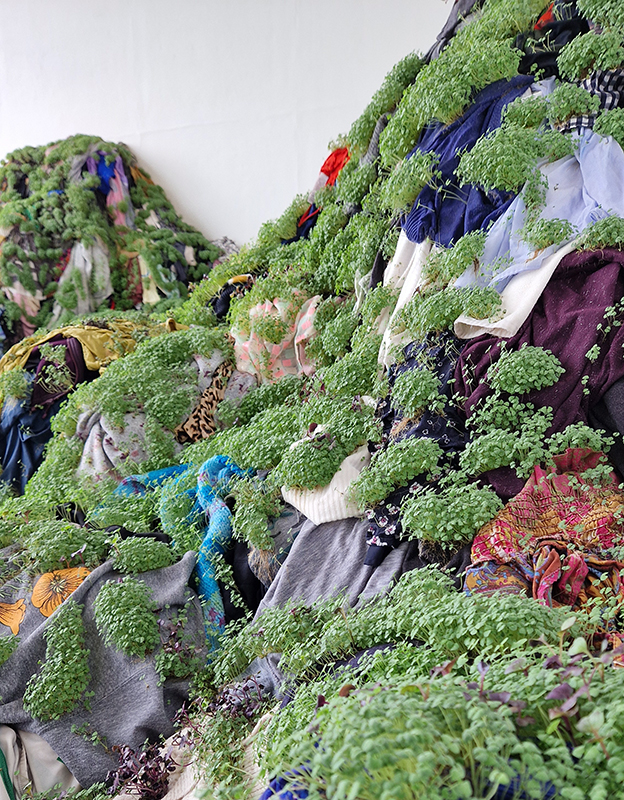
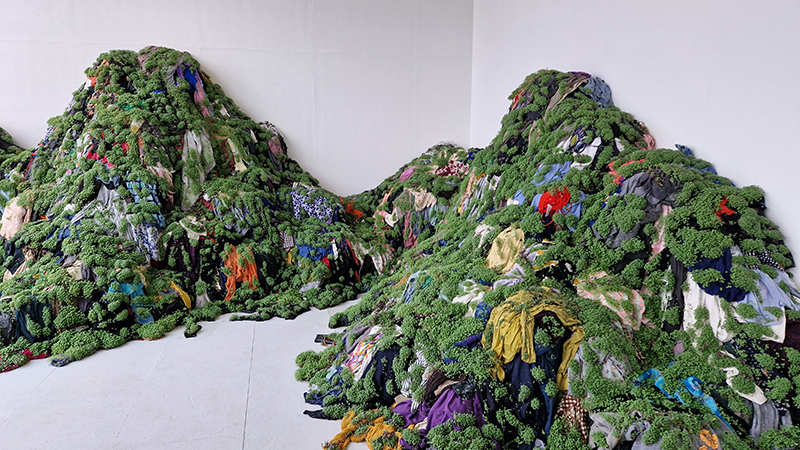
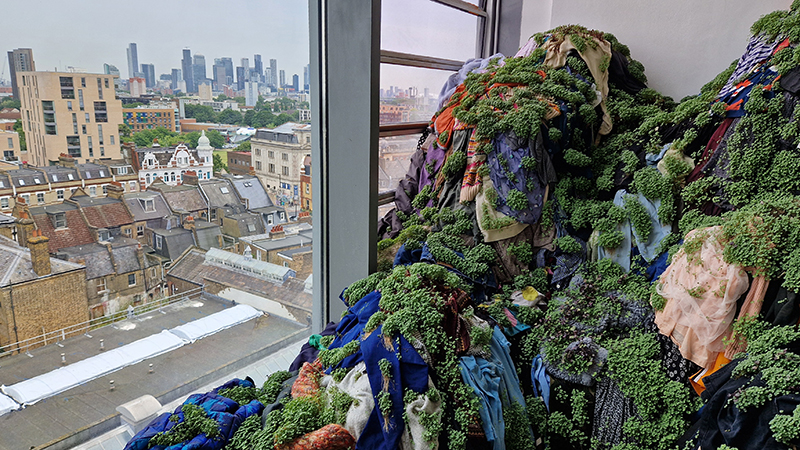
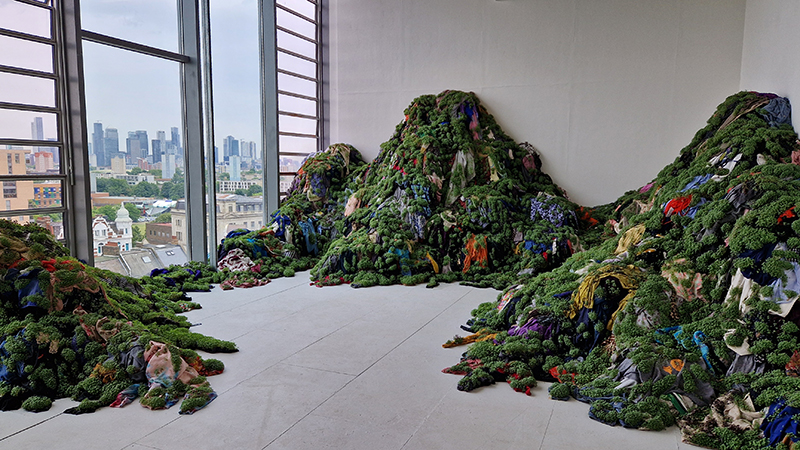
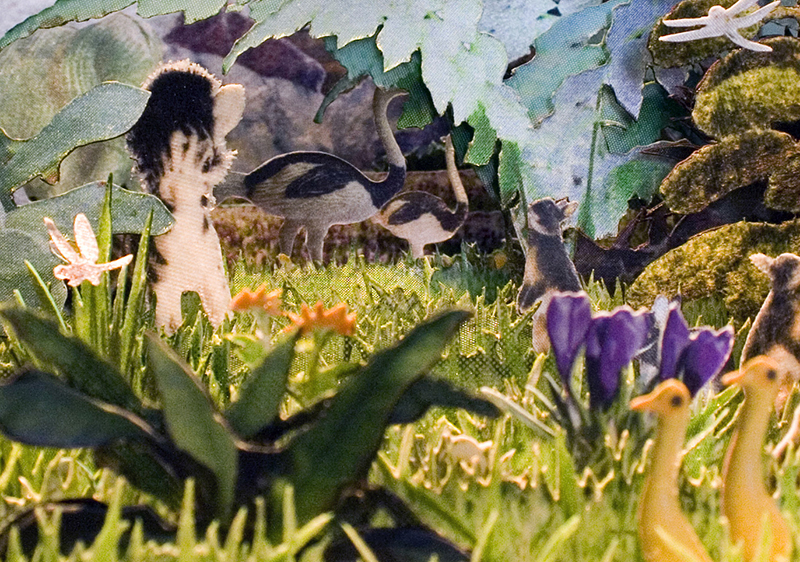
Beverley Duckworth’s installation Surplus at Goldsmiths MFA final show. Beverley’s work is grown through a diligent process of care. Found materials are literally given new life in the seeds which are embedded into them, which then transform and colour them. The installation includes an intermittent sound element of recordings of the melody played by waste trucks in Taiwan to call people to bring out their rubbish.

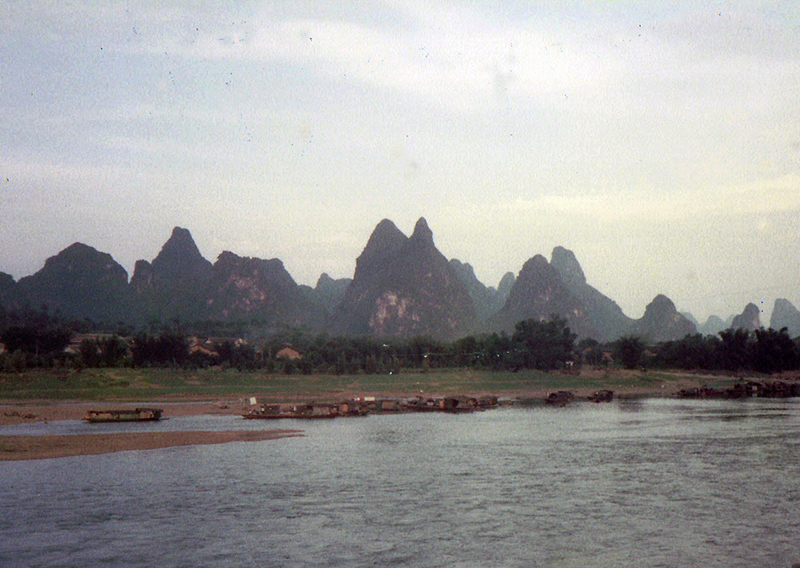
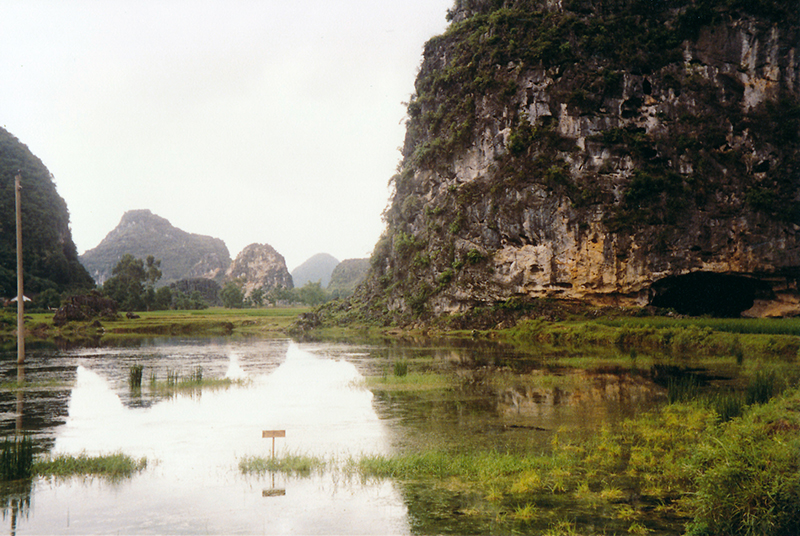
Apparently I wasn’t the first person to be struck by similarities to the landscape of Yangshuo near Guilin China. I visited in 1984 and think it is no longer a quiet little village.

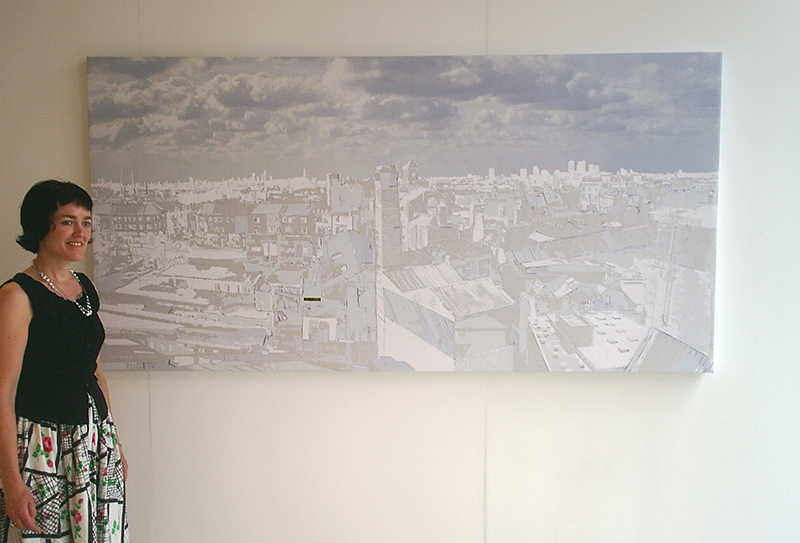
It was the first time I had been back inside the Ben Pimlott building at Goldsmiths since by own graduation, a scary twenty years ago. The building was brand new then and the views with little visible green fed into my installation Re:construction – a large screen print with tiny viewing hole to a tiny oasis amidst the grey, albeit a synthetic one.

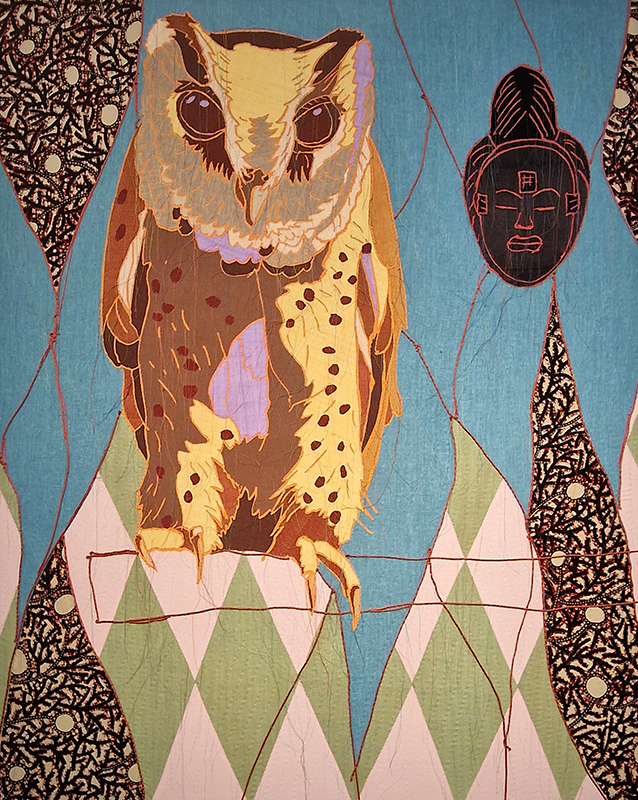
Yinka Shonibare Suspended States at Serpentine South. Horrors of war and colonialism are filed under dazzling colour, birds on the brink of extinction stare in plea or accusation, beacons of light in the darkness come from miniature replicas of sanctuaries.

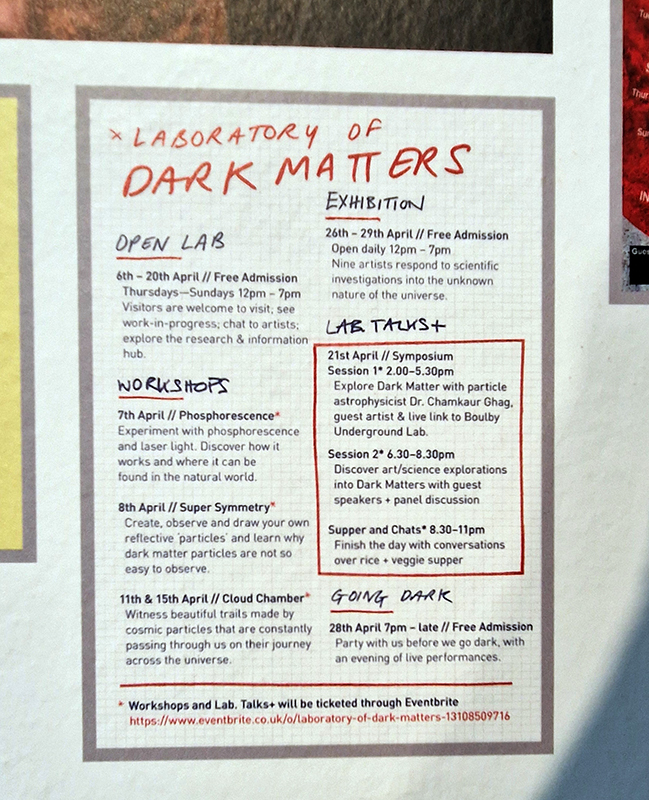
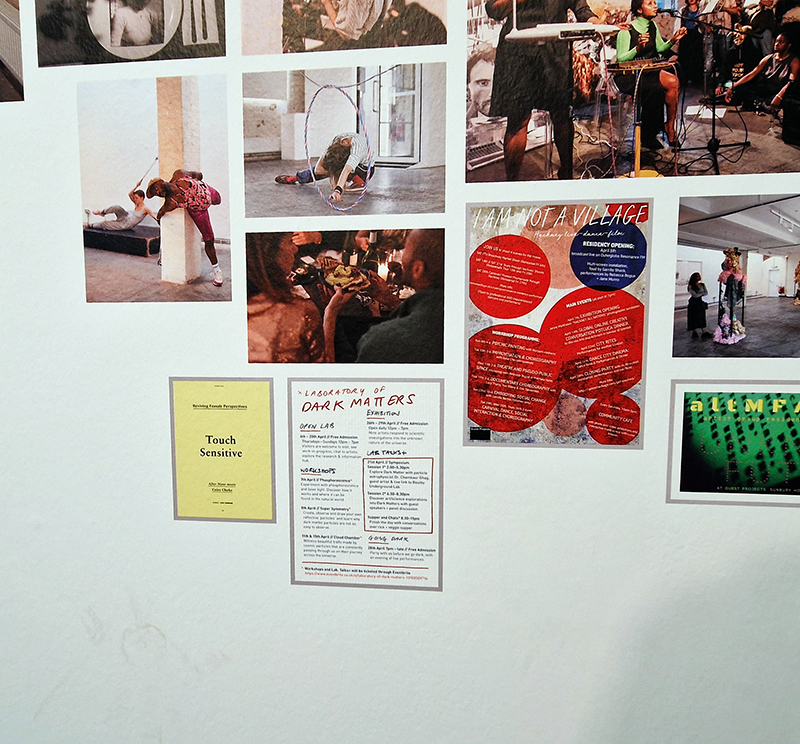
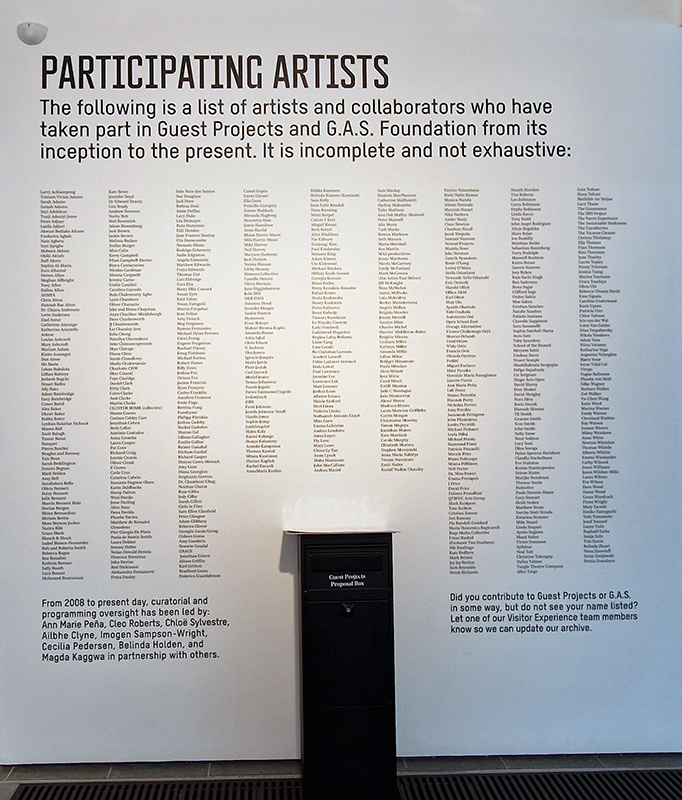
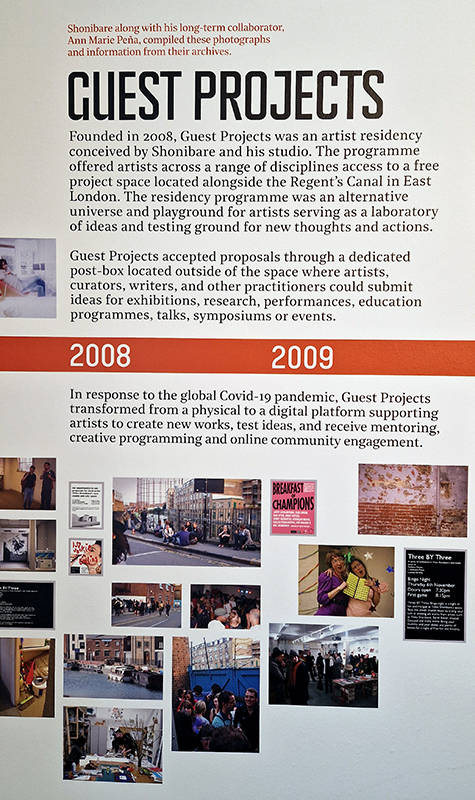
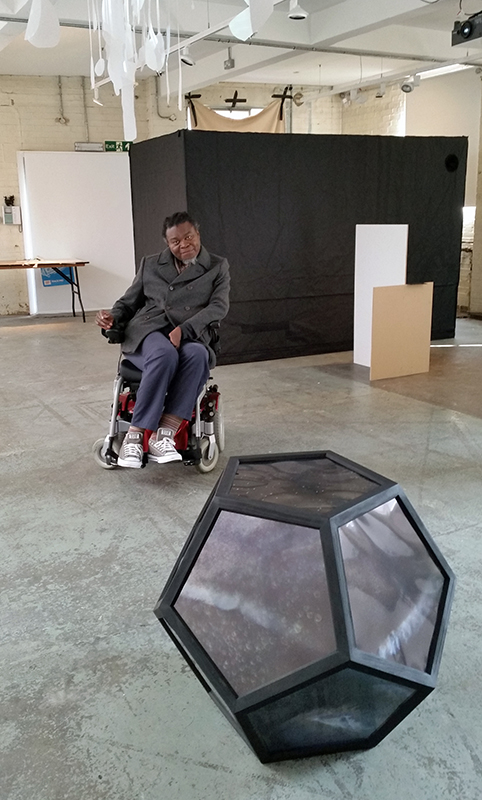
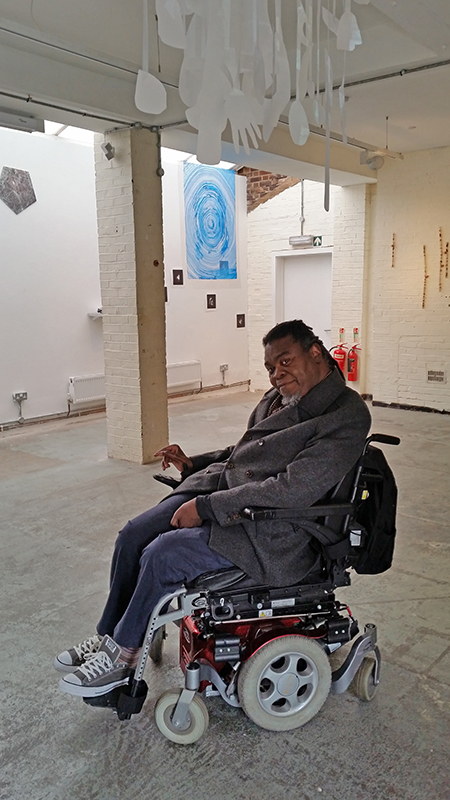
Yinka’s socially engaged inclusive practice spills over into real help for artists and communities. The exhibition celebrates Guest Projects and G.A.S. Foundation in Lagos. Guest Projects is such a generous idea and I have been so lucky to benefit from it with the project Laboratory of Dark Matters

Being awarded a month’s residency at Guest Projects was crucial to the success of Laboratory of Dark Matters as a site for developing ideas and subsequently touring the project. Wonderful to meet Yinka and also to be part of the selection committee for the next round of projects.

Judy Chicago Revelations at Serpentine North. The highlight of this show is the video documenting The Dinner Party (1974-79) installation and the preparatory drawings and sample plate. What a shame the actual installation wasn’t here, I will have to visit the Brooklyn Museum, New York sometime to see it. The research, collaborations, crafts and designs that went into creating it was phenomenal.

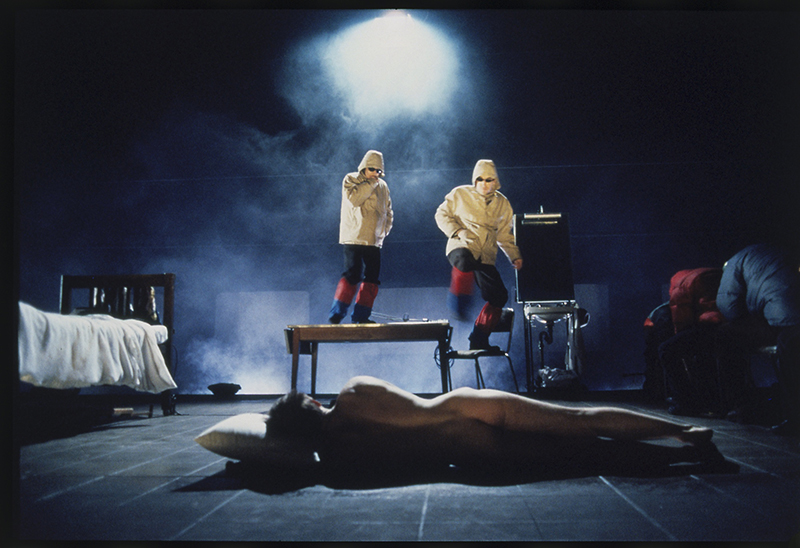
Saw Complicité’s excellent Mnemonic at The National Theatre, 25 years after first seeing it at Riverside Studios. ‘A body is found in the ice, and a woman is looking for her father while a man searches for his lost lover. Mnemonic is as much about origins as it is about memory, and remembering what is lost. Mnemonic asks us: what is our place in the natural world? How have human relationships with the environment shaped patterns of migration? Who are we, and where do we come from? ‘

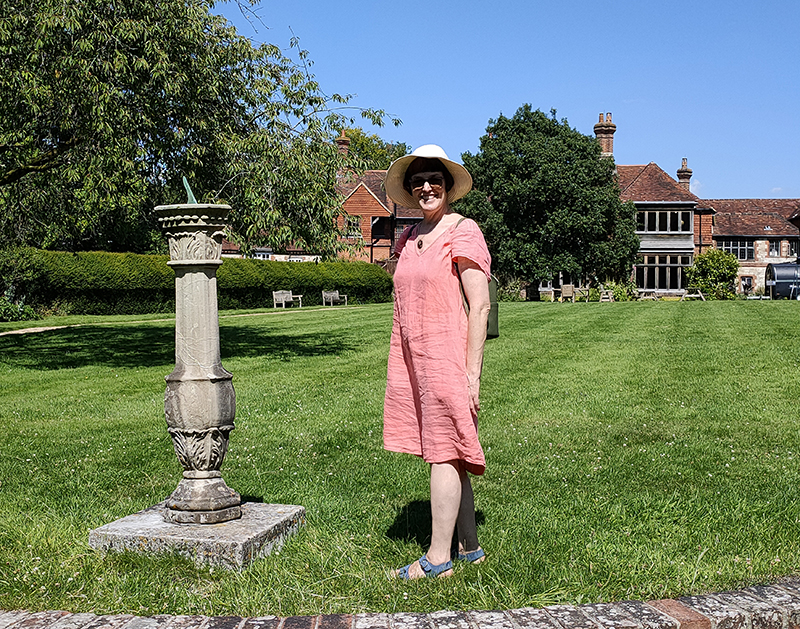
Visited the delightful mellow brick country home and extensive gardens of pioneering naturalist Gilbert White at Selborne. His book ‘The Natural History of Selborne’ (1789) has never been out of print since it was published more than 230 years ago. He was brought to many people’s attention, including mine, during the pandemic and lockdowns of 2020 when writer Melissa Harrison included his diary readings in her podcast The Stubborn Light of Things.

Over the centuries many wind roses have been designed with varying numbers of wind directions from four to thirty-two cardinal points. The contemporary compass rose has its roots in the ancient classification of the winds.

Working on the sculpture series of tablets titled Instruments of the Anemoi after the gods of the winds. Twelve sided non-magnetic concrete tablets suggestive of the plinths that support various instruments used in monitoring the Earths’ magnetic field and the ancient anemoscope “table of the winds” carved in marble around eighteen hundred years ago and inscribed with the Greek and Latin names of classical winds on each of its twelve sides.

Testing an inked collagraph for concrete casting.

The first tablet in the series is cast with a collagraph which takes the commonly used oval shaped compass needle (illustrated in Breve Compendio de la Sphera de la arte Navegar by Martin Cortes 1551) as symbol of the silver fish – wafer thin fish shaped iron leaves used by 11th century Chinese geomancers.

The weather made the casting process a little precarious with the heat drying the concrete faster than ideal. The result has some fine cracks but overall I am pleased with the result. I used a convex glass lens to create a dip for a copper bowl to sit in. The glass had to be dremelled out after unmoulding. It left a very shiny surface. I made the copper bowl by hand at the London Sculpture Workshop. The ‘silver fish’ is cut from a silver gilding sheet.

The next tablet I am working on will contain embedded magnets. An elaborate frame is in construction to suspend the magnets in the concrete while it sets.

I will also add crushed shells as aggregate, so more pounding shells in the garden is necessary.

Continuing work on The Absolute Hut (of action potential). The Absolute Hut is structurally conceived from an amalgamation of features, impressions and functions of the Observing Building and instruments at Hartland Magnetic Observatory in North Devon and the observation huts built in the 18th century at The Kings Observatory in Kew for meteorological and magnetic observations.

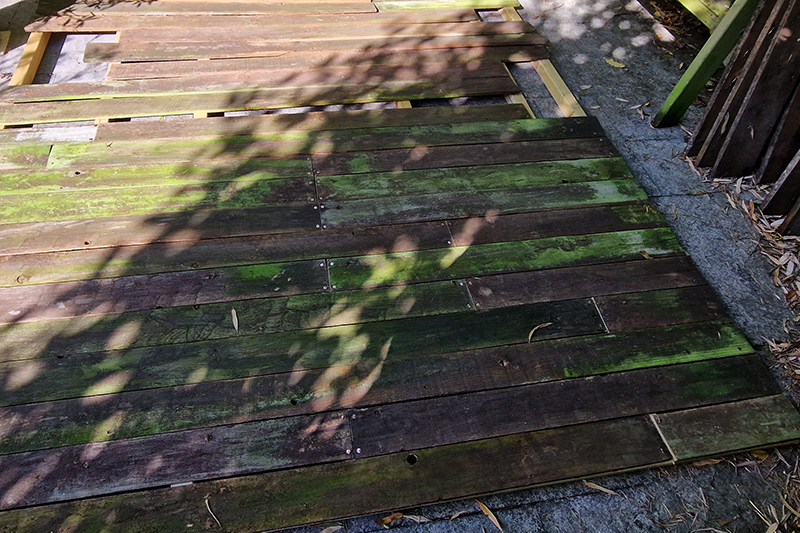
Cutting old featherboard planks to length and hammering them to the frame of the north facing wall with copper nails. These panel sections are now left facing north to gather some moss before the exhibition.

Exciting copper patination tests for the pyramidion to sit on top of The Azimuth Obelisk (of sedimentary knowledge) sculpture. The sculpture expresses the passage of time; made from recycled paper prints and drawings whose history is embedded in the stacked layers, much as the Earth’s geological and magnetic history is secreted into sedimentary strata of rock.

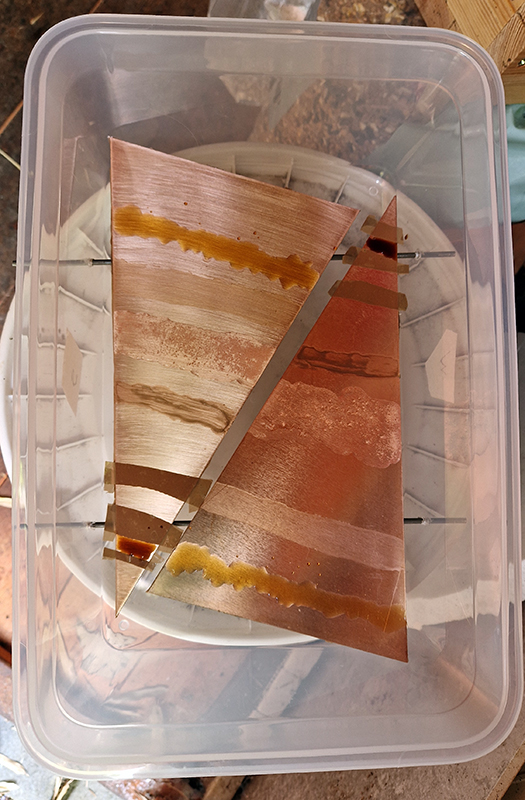
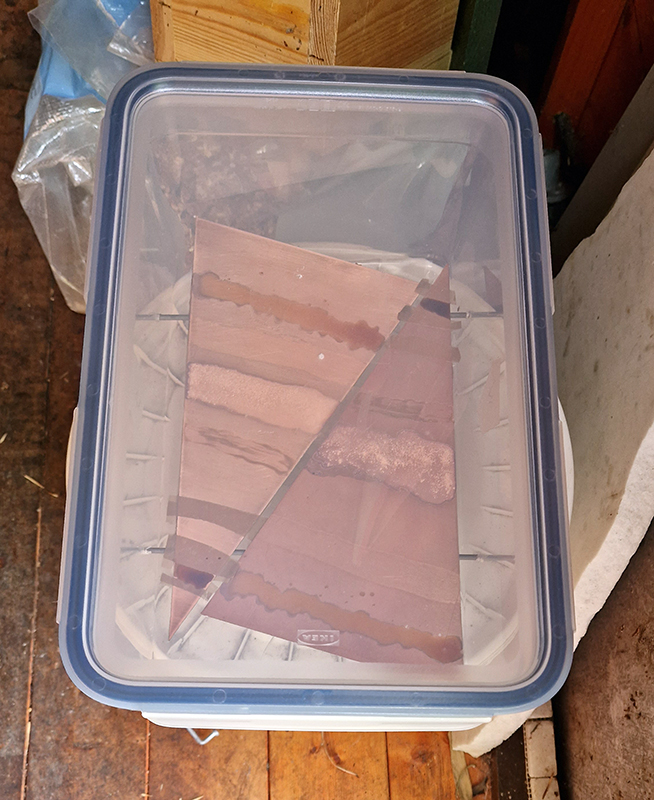
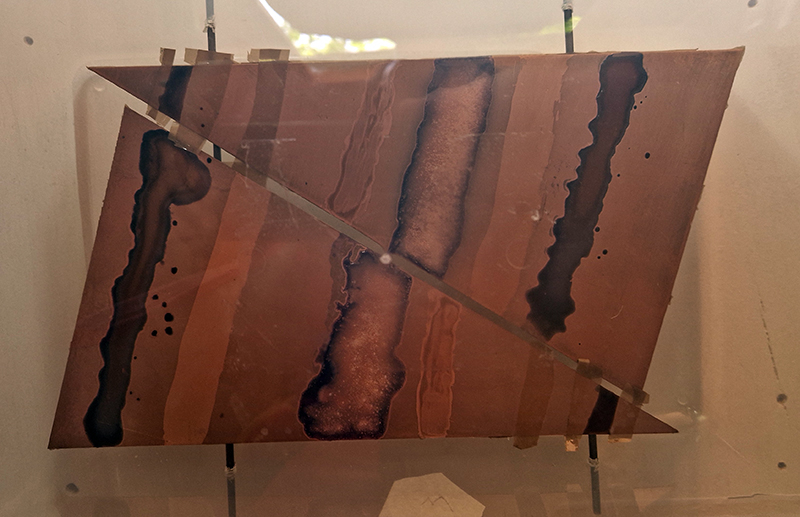
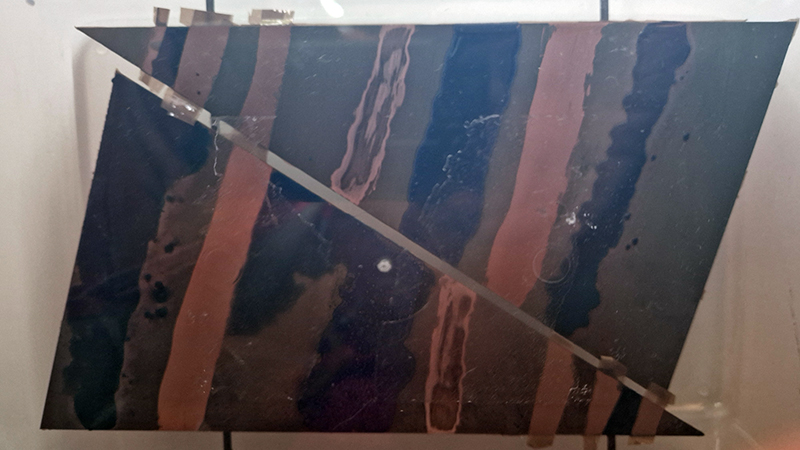
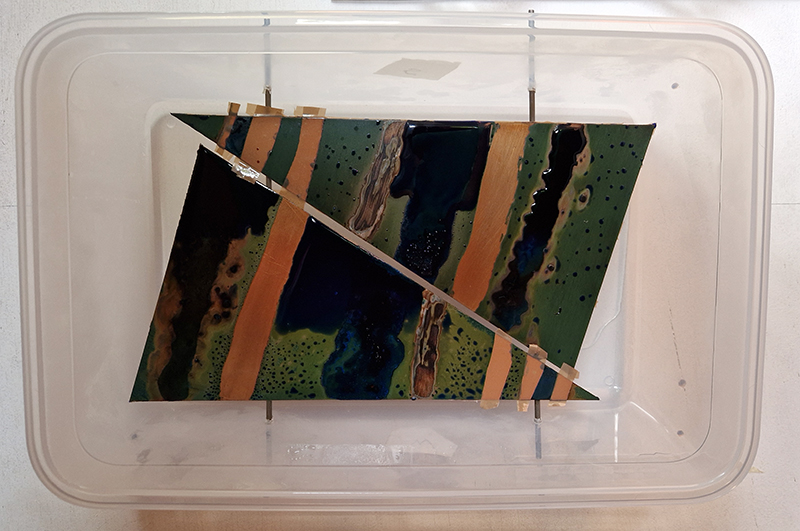
The copper is cleaned first with whiting and ammonia solution. For the test strips I used parcel tape, water based and spirit based varnish, salt and vinegar solution, soy sauce and seaweed plant food. These are applied to the copper which is then placed suspended in a sealed container with a little ammonia. Effects are immediate but I left this overnight.

The next day they are taken from the tank and left to dry.

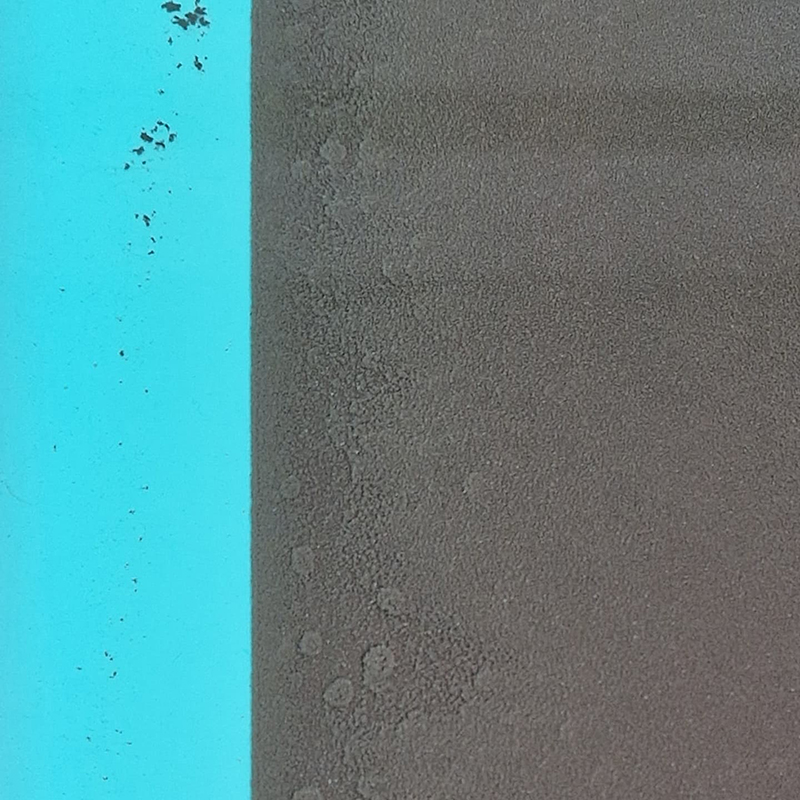
Both types of varnish interacted with the ammonia fumes, either going dark or puckering and crazing. The parcel tape left a clear band of copper when removed. The salt and vinegar mix gave a light blue patination and the soy sauce and plant food varying greens as copper where it was left raw. The colours continue to develop.

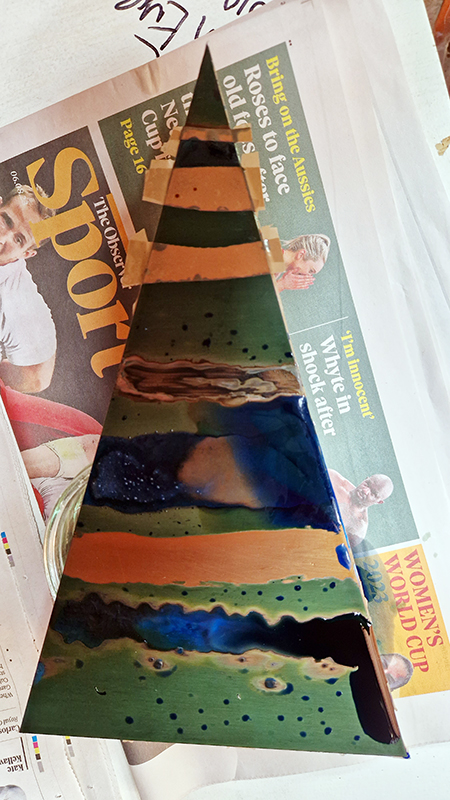
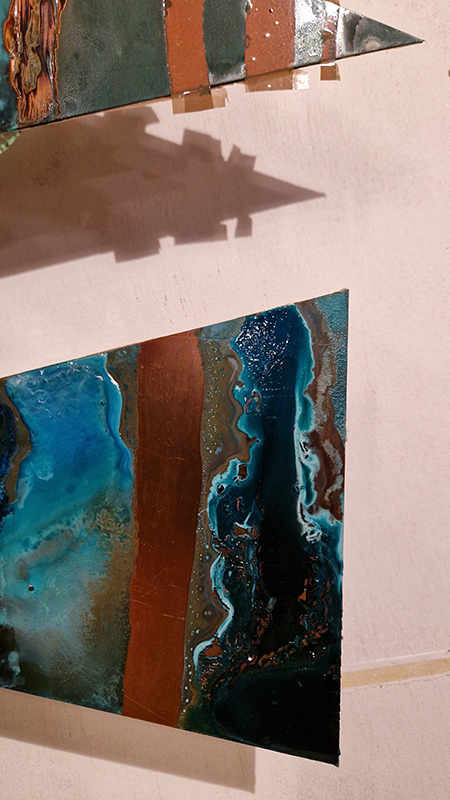
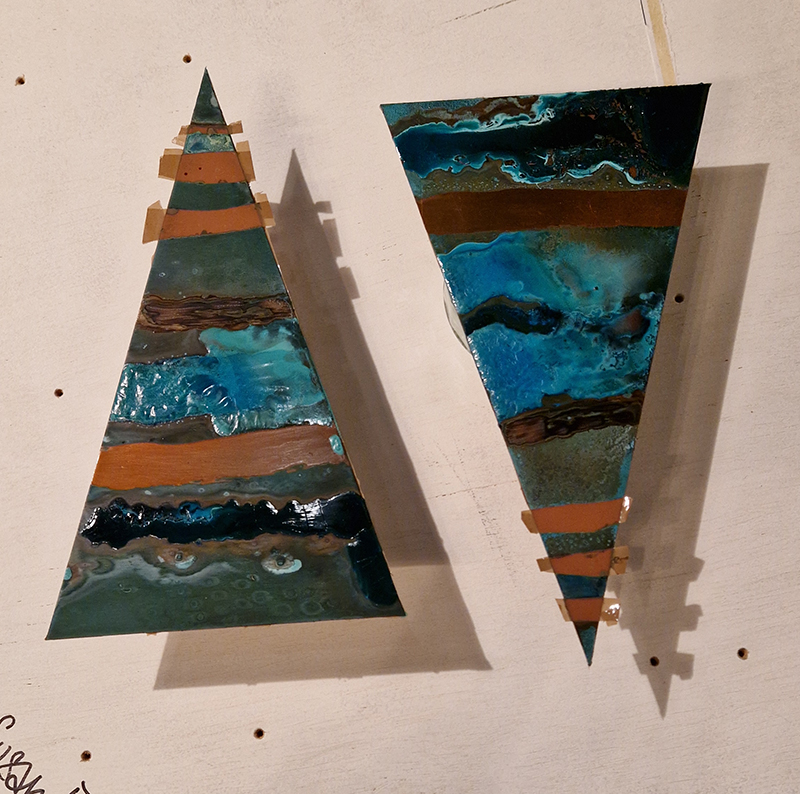
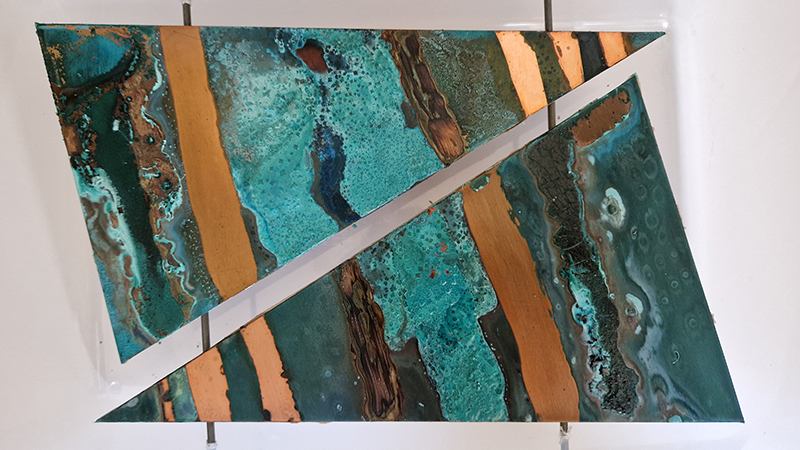
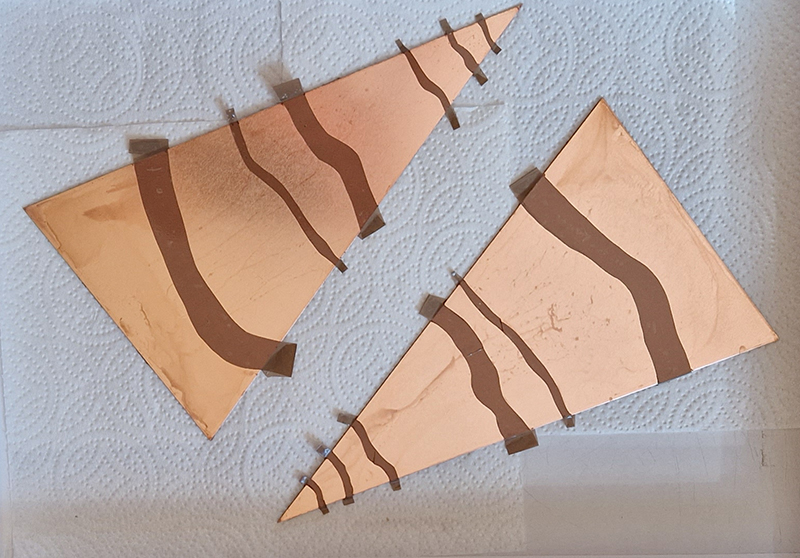
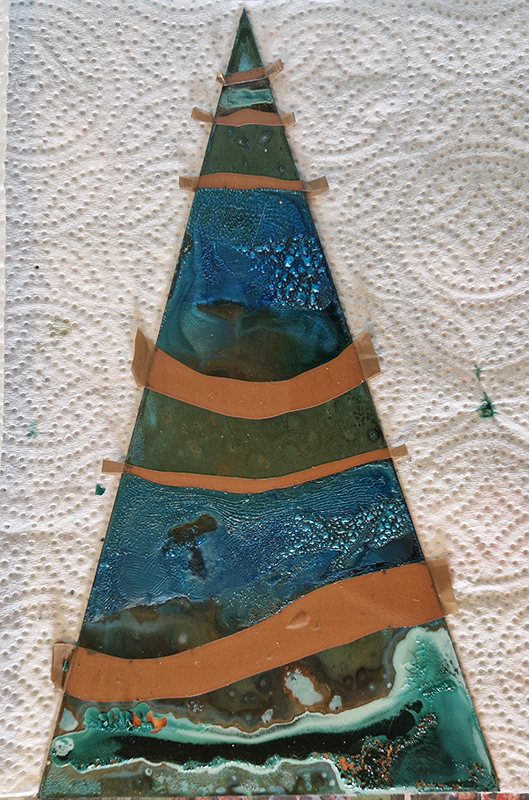
Preparing and patinating the copper triangles I had laser cut to size for the pyramidion. Applying strips of parcel tape to match up at the corners. Setting up a cat defence for drying the plates outside.

Once dry the colours continue to develop. I wanted to spray the surface with Golden archival acrylic spray but it was out of stock everywhere so I got Lascaux archival varnish with UV protection and gave it four light coats. It still continues to change though and flake off a bit adding to the effect of geological, topographical transformation.

I used Sugru, mouldable glue, building it up in stages to fix the sides while the pyramidion is supported in a frame.

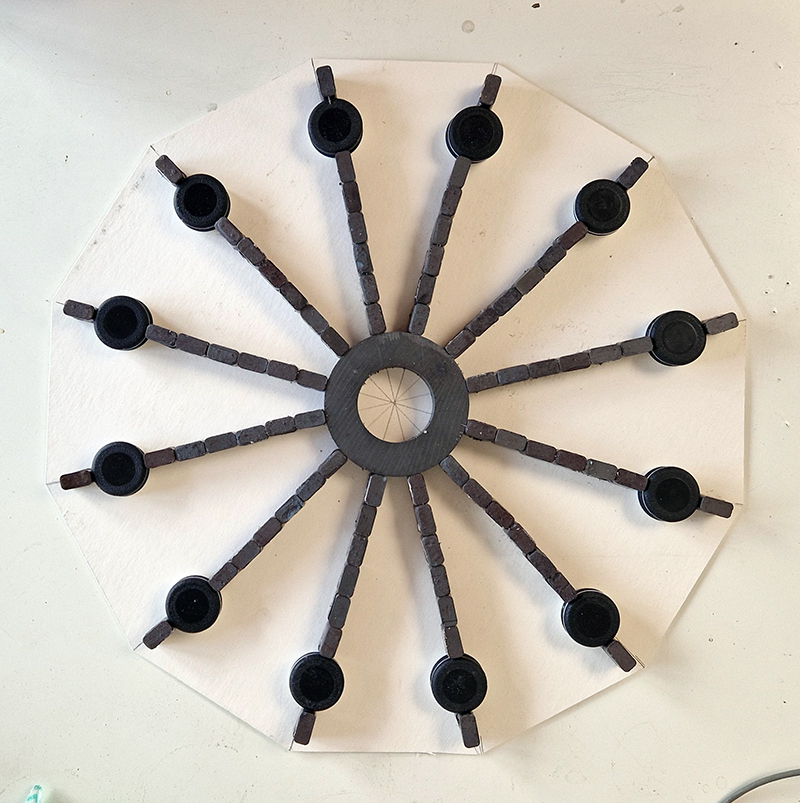
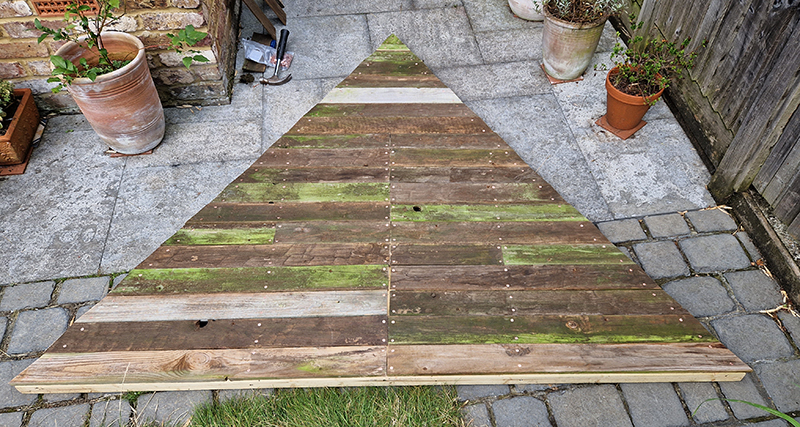
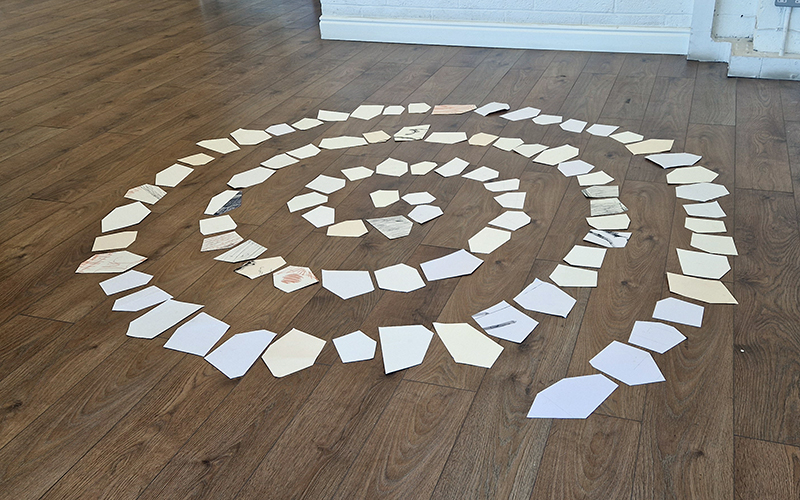
Making use of the communal lounge at Thames-side Studios to test some paper template layouts for Domain of the Devil Valley Master. A sculpture using directional magnetic steel laid in a simple spiral which draws upon many references, from the shape of our own Milky Way Galaxy sculpted by vast cosmological magnetic fields, the spiralling molten dynamo generating Earth’s magnetic field, to the inner pathway of spiritual growth and the route to the symbolic omphalos (navel) at the centre of the world where the sky entrance and the underworld meet.

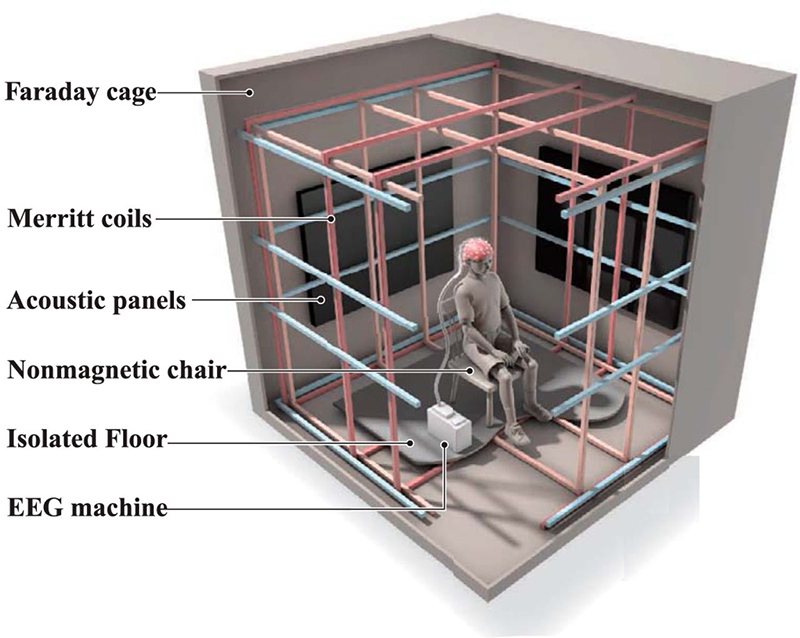
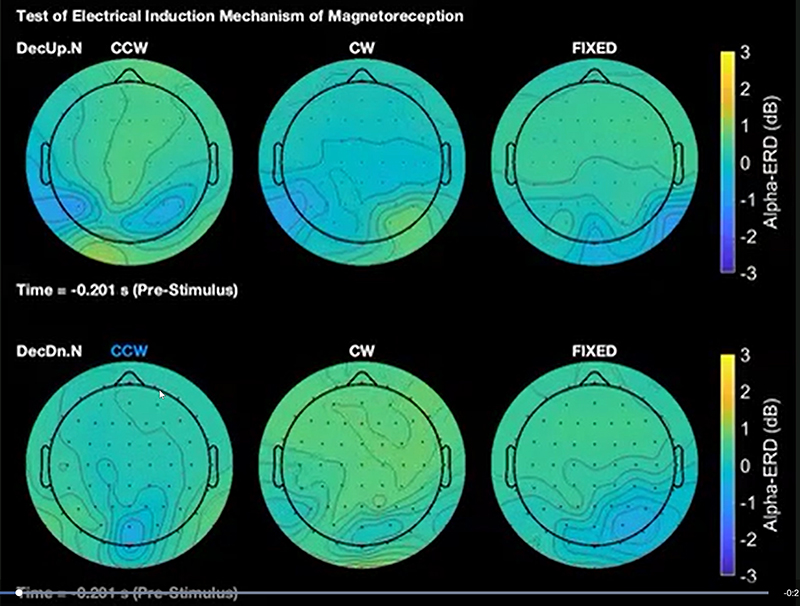
As research for new video work I am looking at experiments performed by Caltech geobiologist Joseph Kirschvink and colleagues investigating human magnetoreception. They found evidence that rotations of Earth-strength magnetic fields produce strong, specific and repeatable effects on human brainwave activity in the alpha-wave band. Alpha waves are always present, but are more prominent when at rest. The experiment, carried out at Caltech, mimicked how a person might experience the Earth’s magnetic field when turning their head. Although many migrating and homing animals are sensitive to Earth’s magnetic field, most humans are not consciously aware of the geomagnetic stimuli that we encounter in everyday life. Either we have lost a shared, ancestral magnetosensory system, or the system lacks a conscious component with detectable neural activity but no apparent perceptual awareness by us.

Friends from the north visiting London, told me about Haverah Park which is just up the road from where they live in North Yorkshire. The Haverah Park experiment was a cosmic ray air shower detection array consisting of water Cherenkov detectors distributed over an area of 12 km2 . The experiment began in 1967 and was operated by University of Leeds for 20 years before closing. During its operation, many thousands of cosmic ray events were recorded including four exceptional events with energies over 1020 eV. The abandoned huts remain and I am very excited about visiting the site to investigate further.

Gallery visits

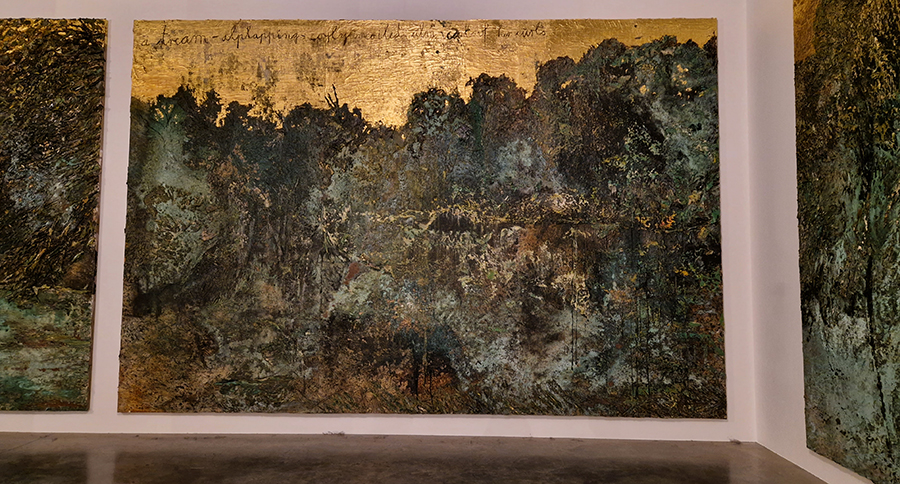
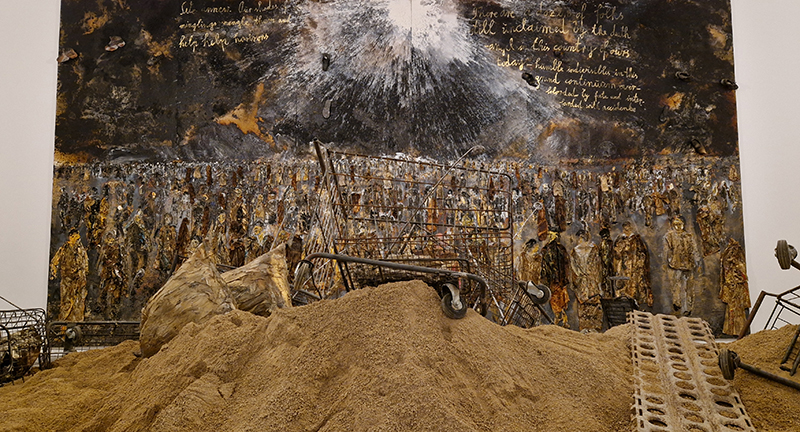
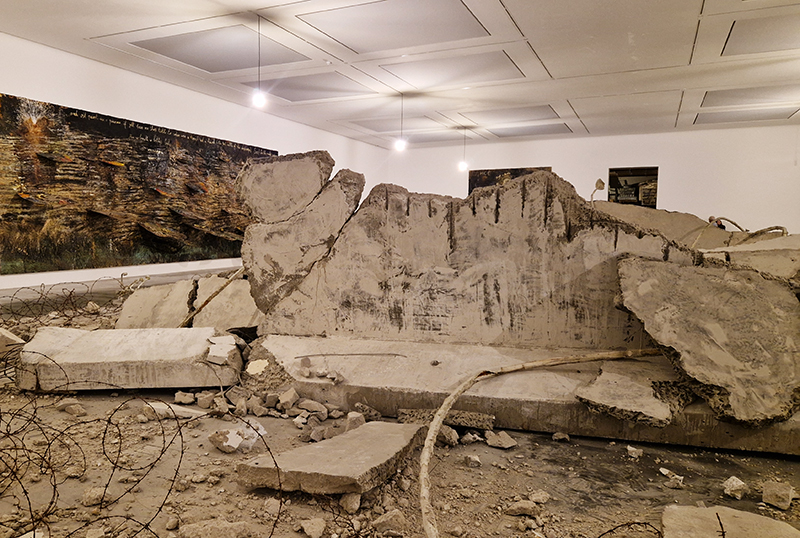
Anselm Kiefer Finnegans Wake at White Cube Bermondsey – “the artist’s new paintings, sculptures and installations respond to (that is, struggle with and transform) James Joyce’s novel of 1939. Kiefer first read the Irish writer as a young man, devouring Ulysses (1922) and embarking on a slow and spiralling relationship with the later, more exacting, Finnegans Wake. It is a book of circles and echoes, more or less overt or secret; its riverine movement begins in the midst of things, and turns back on itself on the final page.”

The weight and the scale of his work as always is overwhelming.

In my early research wondering what the building blocks of the universe looked like I found myself reading about Quarks and Leptons. I found the language of particle physics to be quite like that of mythology – inhabited with mysterious characters like the charm quark and strange quark, the muon and the tau governed by fundamental forces that cannot be seen or explained other than by their attributes – like the mythical gods. The name “quarks“ was chosen for the three fundamental particles of all matter from a nonsense word used by James Joyce in the novel Finnegan’s Wake:

“Three quarks for Muster Mark!“

Finnegans Wake seeks to inhabit a commonplace but elusive realm of human experience – the language is more like poetry than prose and should be read intuitively – the first sentence of Finnegans Wake completes the end of the last sentence – the book’s circular structure embodies the theories of the 18th Century philosopher Giambattista Vico, who viewed human history as cyclical along with the natural cycles of the earth such as night and day, life and death, rise and fall. Vico believed that there was a poetic wisdom in legends which gave an insight  into the relationship between the divine, the natural and the human worlds. He was interested in how myths began from common primordial experiences of the forces of nature.

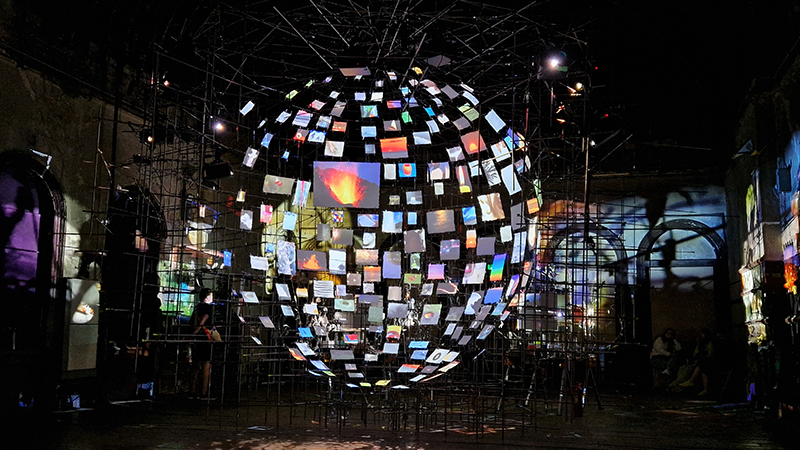
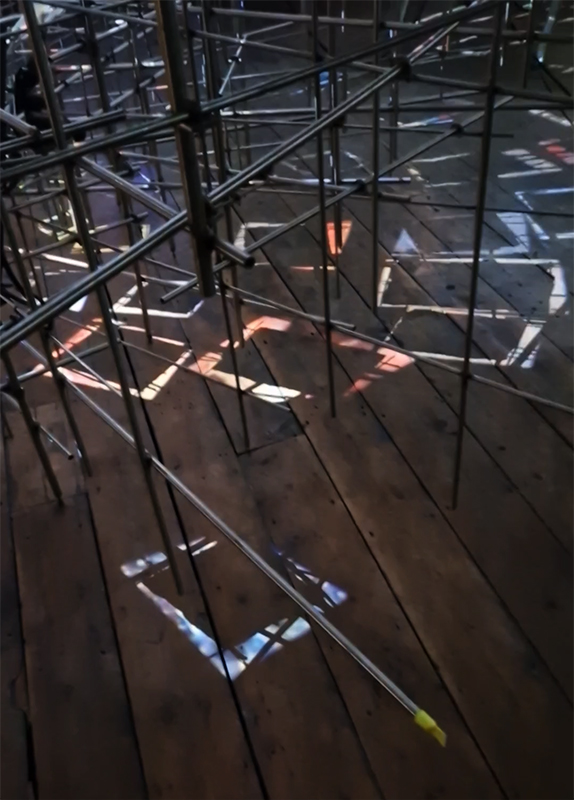
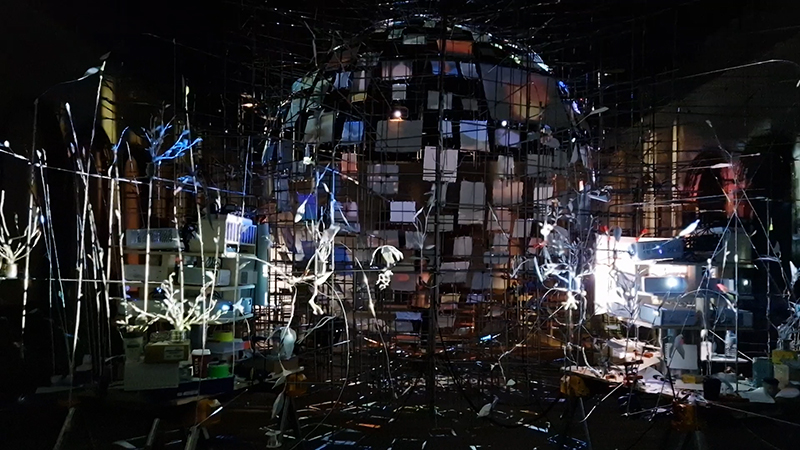
A different kind of immersion – made from light rather than lead. Sarah Sze The Waiting Room at Peckham Rye Station, an Artangel project, is a captivating spectacle of colour and movement. It might be a lesson in attention spans and ubiquitous digital media but it still holds all the joy of being at the centre of a rotating fairground carousel.

“I’ve always been interested in certain times throughout history where our relationship to the way we experience time and space in the world speeds up radically. The invention of the aeroplane, the invention of the train, you see really interesting work coming out of that time, in film, visual arts and writing. We are in the middle of an extreme hurricane where we are learning to speak through images at an exponential pace.” Sarah Sze

Dear Earth at The Hayward Gallery is inspired by artist Otobong Nkanga’s suggestion that ‘caring is a form of resistance’. Bringing together 15 artists from around the world, the exhibition explores the interdependence of ecologies and ecosystems, as well as our emotional connection with nature.  

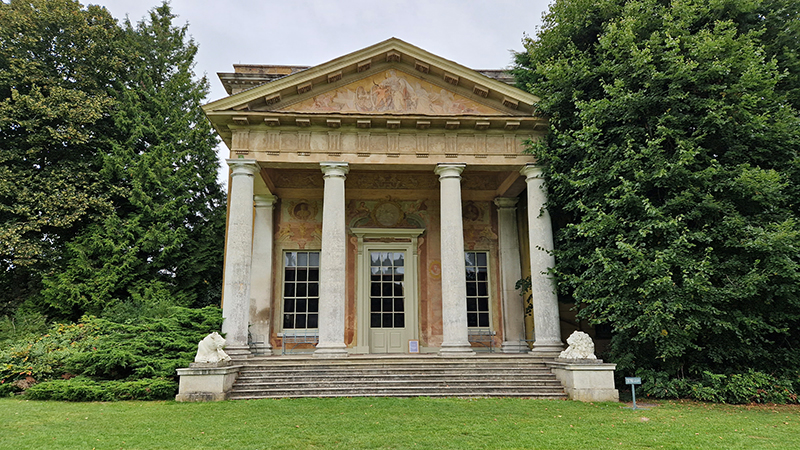
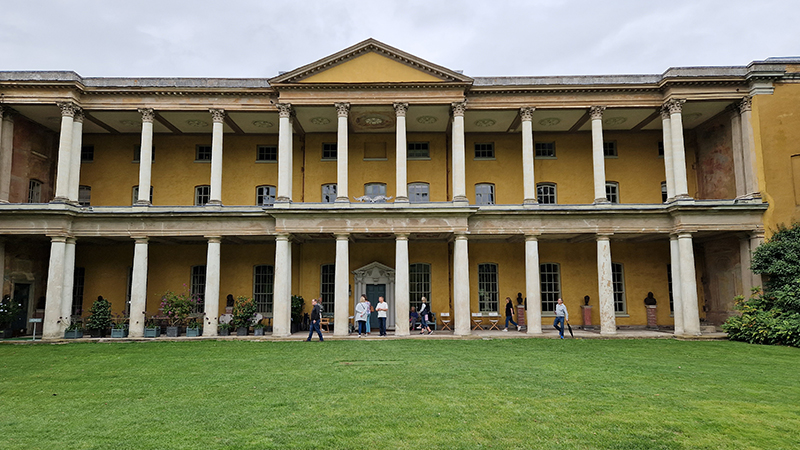
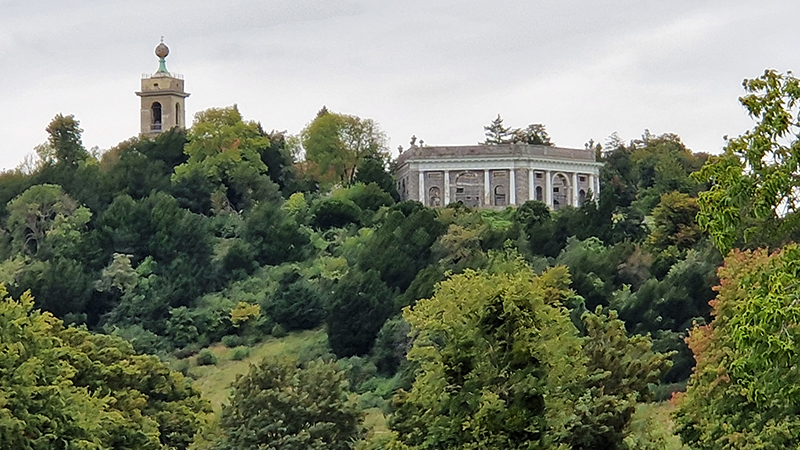
Day trip to West Wycombe Park; “one of the most theatrical and Italianate mid-18th century buildings in England” surrounded by “the most idiosyncratic 18th century gardens surviving in England”. Sir Francis Dashwood built West Wycombe to entertain, and there has been much speculation on the kind of entertainment he provided for his guests at the house and the nearby hellfire caves.

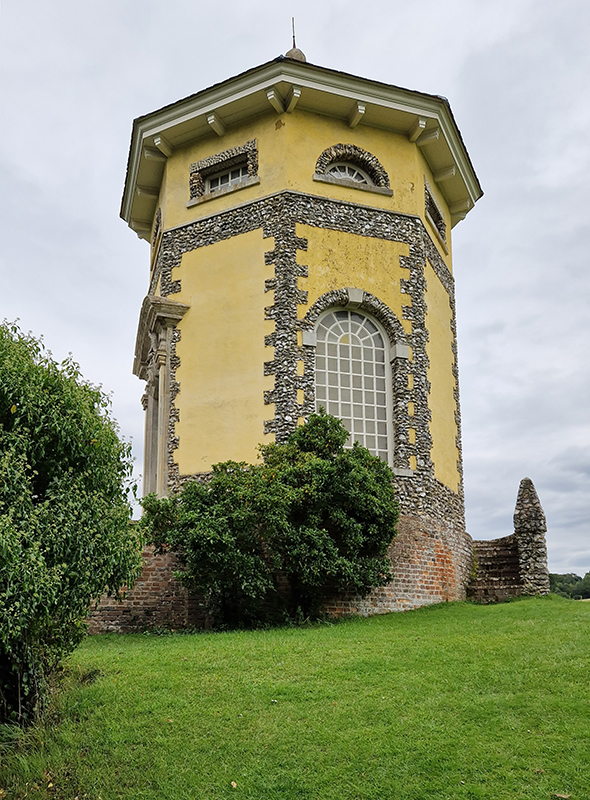
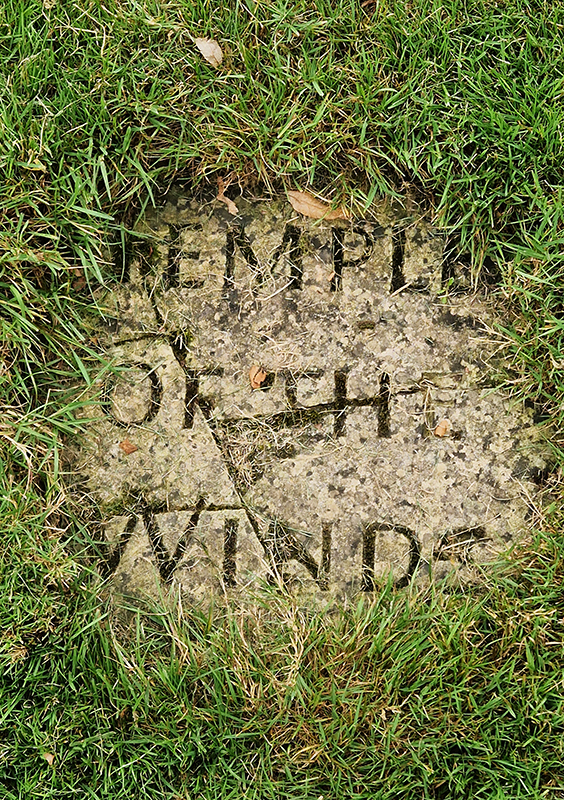
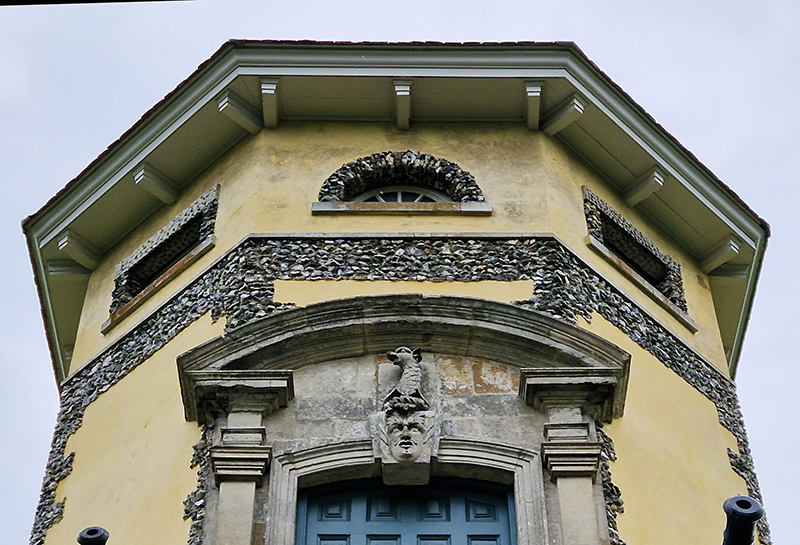
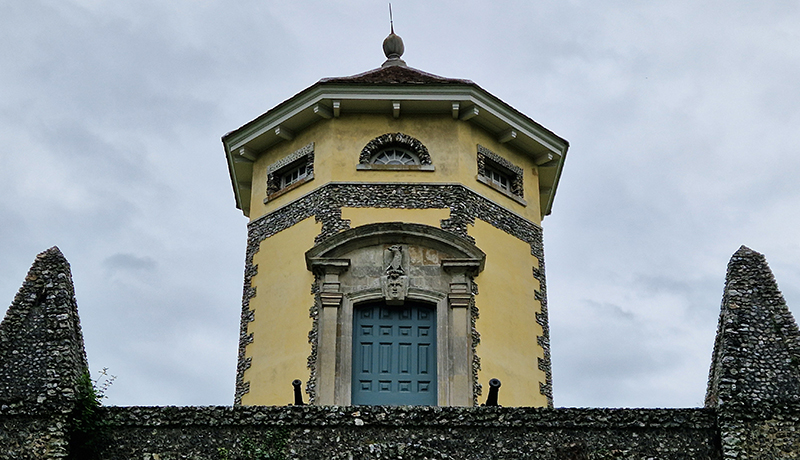
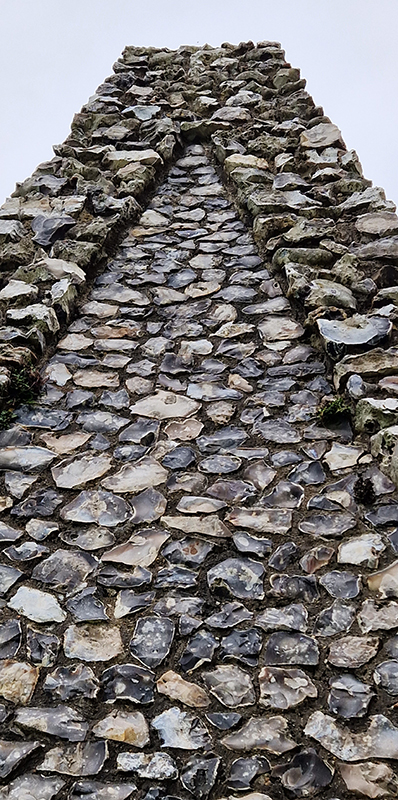
A surprise discovery in the gardens was The Temple of the Winds, a stucco and flint faced octagonal tower, aligned with its main walls facing north, south, east and west. Erected in 1759 and used as an ice house, its design was inspired by the ancient Tower of the Winds in the Roman Agora in Athens of which Vitruvius wrote

Some have chosen to reckon only four winds; the East, blowing from the equinoctial sunrise; the South, from the noon-day sun; the West; from the equinoctial sun-setting; and the North, from the Polar stars. But those who are more exact, have reckoned eight winds, particularly Andronicus Cyrrhestes, who on this system erected an octagon marble tower at Athens, and on every side of the octagon, he wrought a figure in relieve, representing the wind which blows against that side: the top of this tower he finished with a conical marble, on which he placed a brazen Triton, holding a wand in his right hand; this Triton is so contrived that he turns round with the wind and always stops when he directly faces it; pointing with his wand over the figure of the wind at that time blowing.

Reading

Ursula Le Guin The Winds Twelve Quarters (volume ii) – a collection of short stories, chosen for the title’s relevance to the sculpture series – Instruments of the Anemoi (wind gods).

The story The Stars Below is particularly interesting, written to interrogate the question – what happens to the creative mind when it is driven underground? Le Guin found that ‘you don’t go exploring the places underground all that easily’ as simple symbols took on unexpected divergent meanings and rather than the repression of science or art it was the abyss of the psyche she was fathoming. Le Guin later came across a passage in Jung likening the depths of ego-consciousness to ‘being surrounded by a multitude of little luminosities..[ ].. The star strewn heavens, stars reflected in dark water, nuggets of gold or golden sand scattered in black earth’

Work in progress on the Azimuth Obelisk sculpture has taken a new direction and I have abandoned the idea of casting the obelisk in aerated concrete. I also have new dimensions to work with having found an interesting article on the historic dimensions of obelisks with the advice that ‘designs that have too large a gap in scaling between elements will lack hierarchical cooperation and lead to a sense of emotional unrest‘.

Looking at layering of sedimentary rock holding memory of magnetic field information I am aiming to make the sculpture from layered paper to echo the effect of strata, using unwanted old work on paper as well as other paper that would otherwise be discarded. It has been satisfying tearing down old prints that were languishing in plan chests and old work from foundation courses and art classes. It even has an obelisk within the obelisk. I am collecting donations from everyone I know who works with paper as I have estimated I need about 8,000 sheets to reach a height of over 2m.

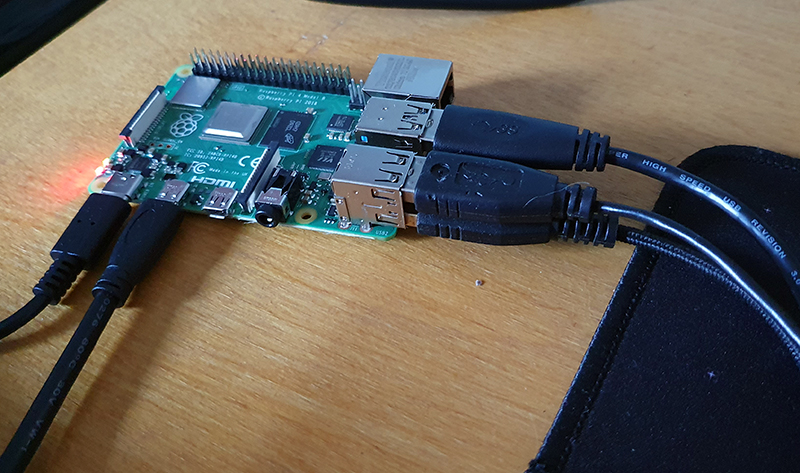
Work in progress on The Breath of Stars cosmic ray interactive work is still pending. After spending hours formatting and loading the raspberry pi with the video files of cosmic trail starbursts I heard from Jamie the programmer that .avi files are not going to work and these might need converting to WebM files which might not be easy. Hoping to find a solution to this soon.

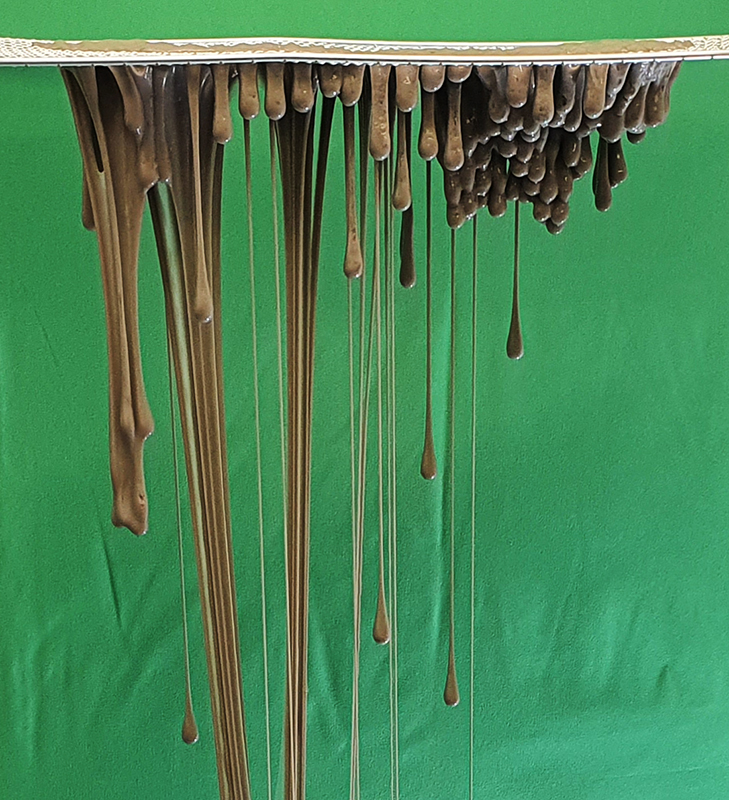
Great fun greenscreen filming slime for Belly of a Rock – a video sculpture partly inspired by the Cosmicomics story The Spiral and partly inspired by paleomagnetism where magnetic minerals in rocks can archive a record of the direction and intensity of the magnetic field when they form.

“I began to give off excretions which took on a curving shape all around” The Spiral, Italo Calvino

“..I accompanied the effort of making the shell with the effort of thinking I was making something, that is anything: that is, I thought of all the things it would be possible to make. So it wasn’t even a monotonous task, because the effort of thinking which accompanied it spread towards countless types of thoughts which spread, each one, towards countless types of actions that might each serve to make countless things, and making each of these things was implicit in making the shell grow, turn after turn…” Italo Calvino The Spiral

Fabulous shells lent to me by my neighbour for spiralling inspiration. The size of them not easily appreciated in these images. They are huge. I have no idea how old the molluscs that made these could be.

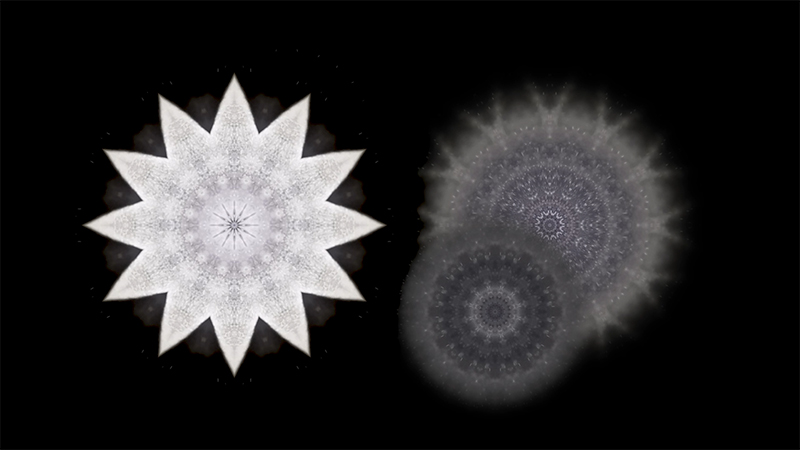
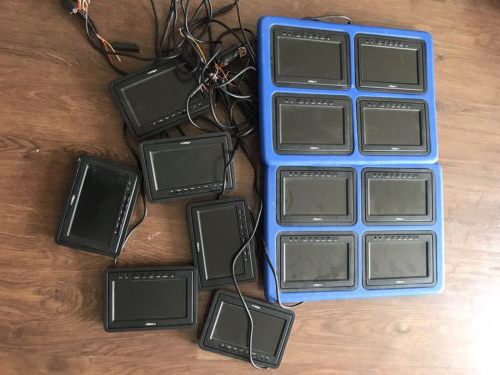
Other work in progress is towards using the small monitors bought as a good deal on eBay set in a circle displaying video dissected into twelfths. Testing ideas with kaleidoscopic images from soap bubble videos and relying on technical help from next door getting the monitors to work

Delighted to be invited to join Sandra Crisp and Jockel Liess for an exciting moving image event. Each artist has a unique approach to film incorporating the study of form, surface and location. DM for an invitation.

Sandra Crisp: E_Life uses 3D generated animation to present a digital environment populated with intensely textured and dynamic geometry.

Jockel Liess: Variations on a theme is a generative audiovisual system which starts from a point of fascination with the aesthetics of irregular organic patterns.

My work Aóratos (new edit for this event) transports the viewer between everyday locations and terrains visually transformed via the use of an endoscope, a microscope, and cameras launched in a high-altitude balloon.

Paused to see the wonderful World Time Linear Clock at Piccadilly Circus Underground Station built in the early1920s and recently refurbished.

The band of roman numerals scrolls West at the same relative speed as the earth rotates, completing a circuit in 24 hours.

“The clock by which we measure time on our watches and digital devices is very misleading; it is determined by the daily rotation of the Earth around its axis and its annual rotation around the sun. This astronomical time is linear and regular. But the actual clock by which we live our socioeconomic lives is an emergent phenomenon determined by the collective forces of social interaction: it is continually and systematically speeding up relative to objective astronomical time.”    Geoffrey West

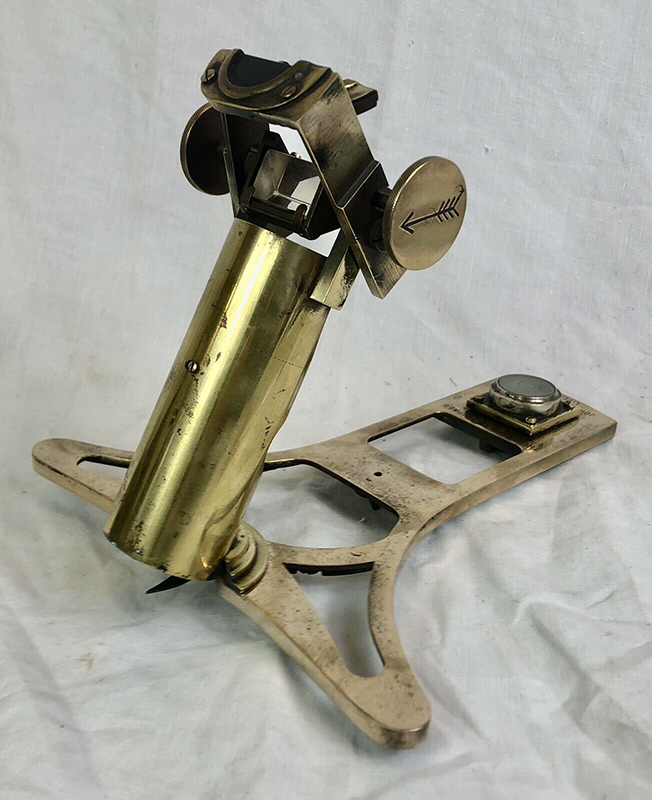
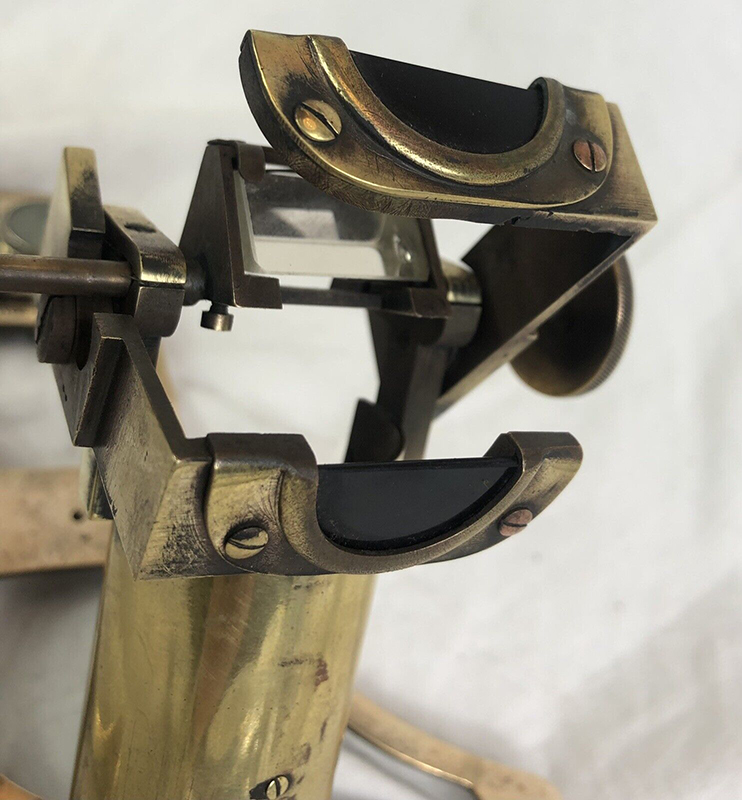
I also did a little research to find out more about the Azimuth Mirror I was given as a present. An azimuth mirror is used for taking the bearings of terrestrial and celestial objects. An azimuth is defined, from any given observation point, as the angle between an object or point and a reference line, usually to true North, moving away from that reference line in a clockwise direction on a horizontal plane. Through the use of mirrors, lenses and prisms, the instrument allows both, the readings of the compass card, and the object to be seen at the same time and in the same direction. It is portable equipment which is placed over a magnetic or gyro compass to aid navigation using either a landmark, when the arrows would be pointed down, or from a celestial object when the arrow would be pointed up. The little glass circle was once a spirit level but that has dried up. The word azimuth is used in all European languages today, it originates from medieval Arabic meaning “the directions”.
Finally made it to meet the Go Stargazing Walton Astronomy Group at their monthly session. We found them on the green at Esher which has been recently over illuminated with bright LED streetlights by a thoughtless council ruining the skies for astronomical observation and disorientating local wildlife and plant life. The local MP Dominic Raab IS NOT A MEMBER of the All Party Parliamentary Group for Dark Skies. Click on the link and ask your MP to join in protecting our dark skies.
When we look up to the heavens, we largely see the same view that captivated and inspired our ancestors. The constellations, the Milky Way, shooting stars, and the night sky are woven into the fabric of our society, cultures and religions. The night sky is one of the most inspirational views that our planet offers.

We are on the precipice of losing the night sky. Right now, SpaceX and other companies are planning to launch tens of thousands of bright satellites in orbit around the Earth.

There is an Avaaz petition at this link urging protection of the night skies.

Bringing back memories of the 2015 Nelly Ben Hayoun film Disaster Playground

….NASA celebrates a Smashing Success – A team of researchers confirmed that the DART spacecraft’s impact with Dimorphos successfully altered the moonlet’s orbit around its parent asteroid by 32 minutes – marking the first time humans have changed the trajectory of a celestial object in space.

To me this feels like a major historical event. What has this little nudge set in motion?

Exhibition visits

Expanded film at the BFI London Film festival.

Framerate: Pulse of the Earth by ScanLAB Projects presents Destruction, extraction, habitation, construction, harvests, growth and erosion are presented as a shared immersive experience. The 3D time-lapse scans of British landscapes observe change on a scale impossible to see with traditional filmmaking techniques.

One of my favourites was Monoliths by Lucy Hammond, Hannah Davies, Asma Elbadawi and Carmen Marcus – we are shaped by the spaces that made us. Through footage shot in the north of England and personal narrative the women embody three monoliths – standing stones, whose symbolic power becomes increasingly important as the women talk.

Elizabeth Murton and Jane Glynn, explore the dynamics of time and movement in Fluid Time at The WaterMill, Mill Green Museum, Hatfield with live dance performance of Elizabeth Murton’s The Giant Weave from BEEE Creative full of joy and energy.

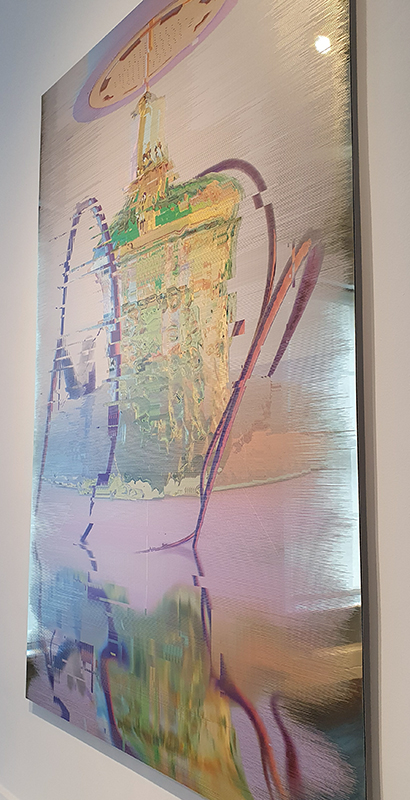
Libby Heaney in remiQXing still at Fiumano Clase. A solo presentation of video and physical works exploring the emerging field of quantum computing as both a subject and medium, turning the gallery space into the showroom of her fictional quantum computing company QX (Quantum eXperience). Some fabulous super shiny prints on mirrored dibond and ethereal prints direct to media on clear acrylic.

Transports of Delight at Danielle Arnaud curated by Edward Chell. In the 1830s, East London doctor and amateur naturalist Dr Nathaniel Bagshaw Ward invented a sealed glass case, an ecosphere in which plants could survive heavily polluted air. Named after its inventor the Wardian case enabled the transport of plants by sea around the world and transformed global economies and environments, shaping the world we live in. Exhibition includes works by
Anna Barriball | Daphne Wright | David Cotterrell | Edward Chell | Gerard Ortín Castellví | Günther Herbst | Harun Morrison | Helen Maurer | Joseph Banks | Joy Gregory | Laure Prouvost | Lee Maelzer | Leelou Gordon-Fox | Maria Thereza Alves | Mariele Neudecker | Nick Laessing | Nils Norman | Owen Griffiths | Peter Hofer | Pia Östlund | Rosa Nguyen | Stephen Lee | Uriel Orlow |

ABSURD at OHSH Projects exploring the absurdity and strange rituals of our daily lives, the bizarreness of
which are brought to light when taken out of context. The institutions, structures and traditions we have built around ourselves and imbued with power and importance can highlight this most starkly; through religion, schooling, government, work and even our own homes. Curated by Henry Hussey and Sophia Olver. Exhibition includes works by Gillies Adamson Semple, Samuel Bassett, Jonny Briggs, Tom Bull, Ladina Clement, Janina Frye, Johnny Hogland, Mark Jackson, Lea Rose Kara, James Lomax, Hynek Martinec, Rasmus Nosstring and Lottie Stoddart.
Hypha Studios presents a showcase of some previously selected artists at the project space on Conduit Street. Hypha Studios matches artists with empty spaces across the UK. Artworks include those by Beverley Duckworth, Foka Wolf, Dion Kitson, Futures After and Josh Wright’s “Lost in a Just In time Supply Chain”, Anna Fearon, Tom Skipp, Molly Stredwick, Gabriela Pelczarska, Salvatore Pione.

Subatomic at The Science Gallery is a project by composer Christo Squier and experimental particle physicist Dr. Teppei Katori that looks at ways of interacting with cosmic rays, something I have been working on myself in the work The Breath of Stars for the last year or so. I was equally excited and anxious to see what they were presenting. They have created a particle shrine which takes data from the Super-Kamiokande observatory in Japan as well as live data from cosmic ray detectors to create a light and sound experience with vibrating mirrors. Rather jealous of the technical resources this project had access to.

There was also a performance of live music by a small orchestra responding in real time to data from the Super-Kamiokande observatory and compositions inspired by cosmic ray observation data.

A lot of the data used in the music responses and the particle shrine is publicly available data from the Super-Kamiokande observatory in Japan. I did notice that the cosmic watch detectors hooked up to the particle shrine are not set in coincidence mode to be sure it is cosmic particles that are being recorded. A lot of what Christo said during his presentation echoed how I feel about cosmic rays, the fact that they come from other galaxies and pass through us making that physical connection with outer space.
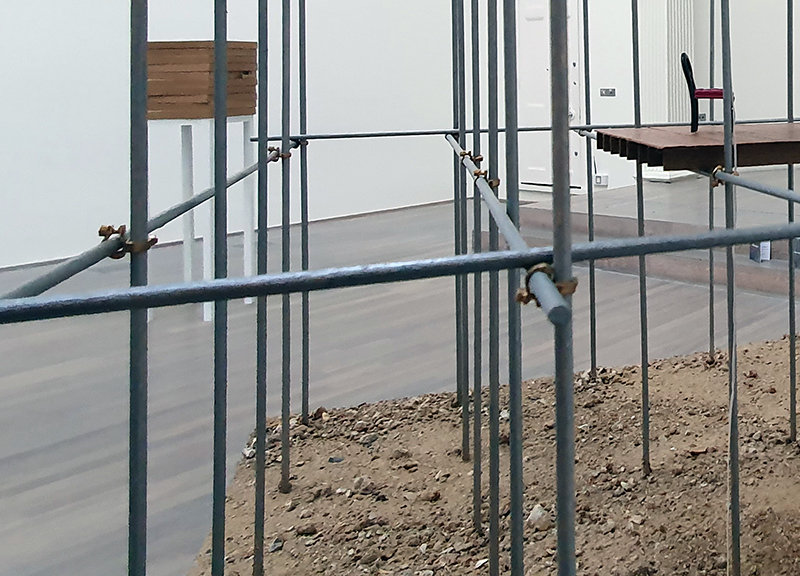
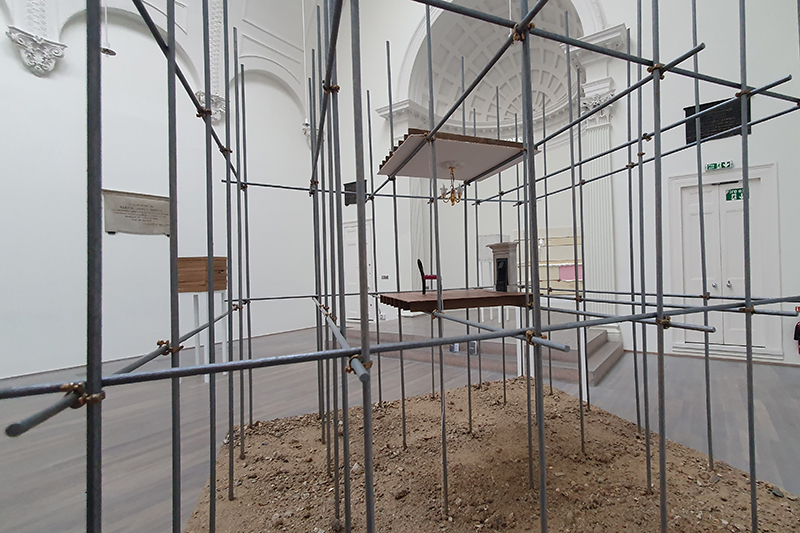
Sanctuary at The Swiss Church takes inspiration from the disparate and striking surrounding architecture, and the stories of people within the Covent Garden community, artists Ali Clarke and Gary Scholes have created a series of structures that symbolise individual sanctuaries. Amazing detail in some of the constructions, especially impressed with the scaffolding bolts.

Reading

Came across some great finds at the local Oxfam bookshop on mapping and magnetism and time, all interconnected.

I read Conquest of the Useless as I thought it might be relevant to research on exploration of the unknown. It was definitely a worthwhile read portraying the total dedication to following through a dream, the power of the creative urge. Watched the film Fitzcarraldo afterwards which although extraordinary doesn’t convey the true life drama and hardship recorded in the book experienced by the actors and film crew in telling the story.

Listening

BBC Radio 4 In our Time – The Earth’s Core. Melvyn Bragg and guests discuss the Earth’s solid inner core and liquid outer core, their structures and their impact on life on Earth.