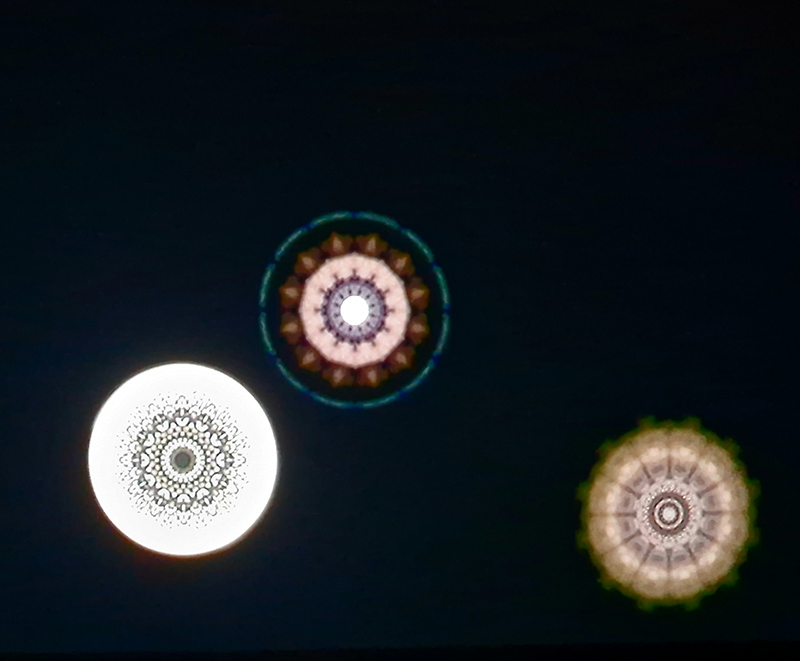
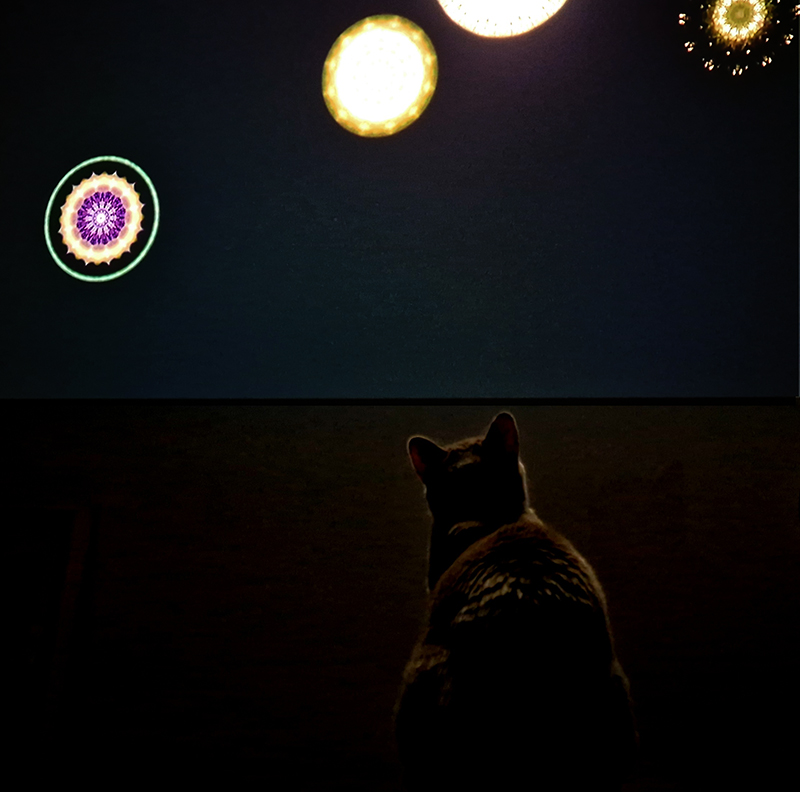
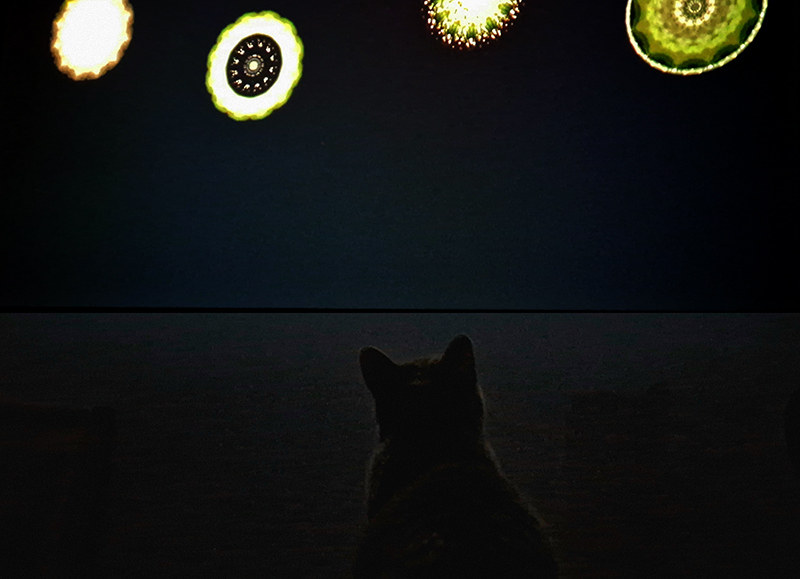
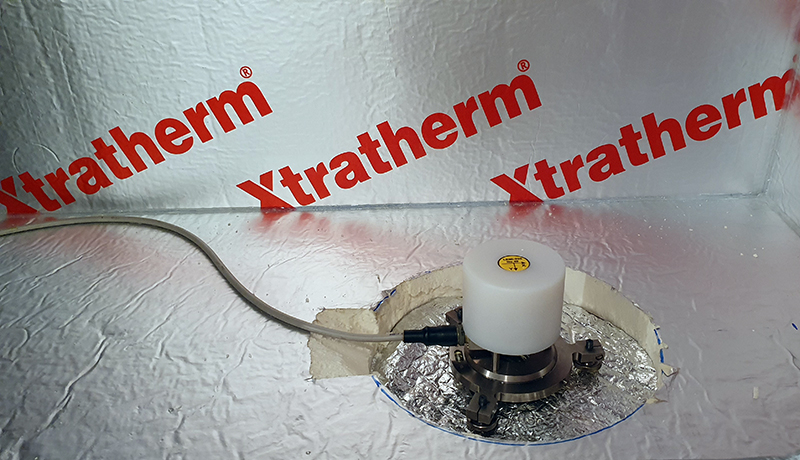
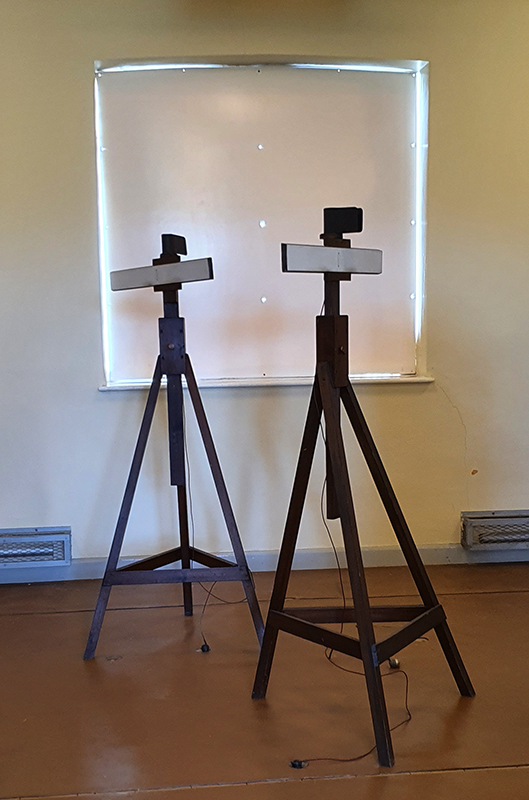
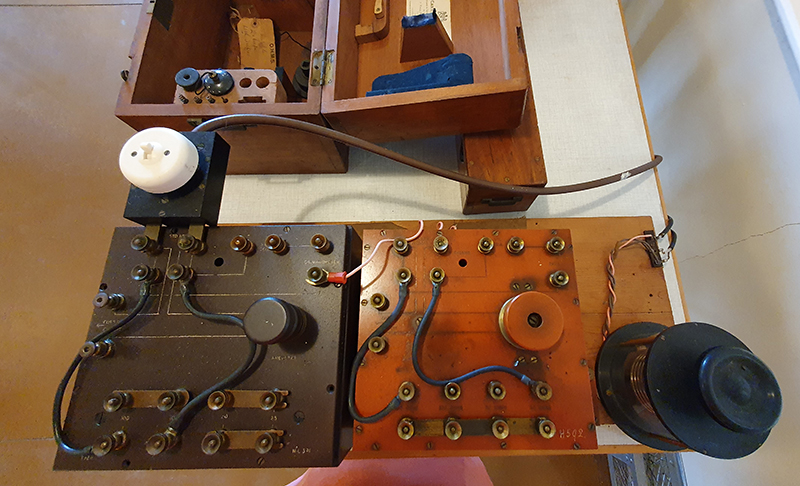
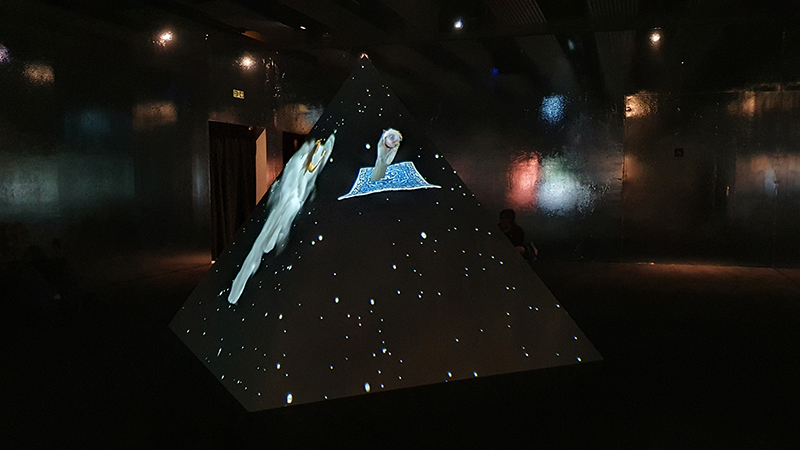
The Breath of Stars is a digital video work activated in real time by cosmic rays. These subatomic visitors from outer space are created during super nova explosions or by phenomena we are yet to discover. This work has been a long time coming and the fact that it is working in real time now is thanks to coding genius Jamie Howard who has managed to get a number video files to play simultaneously on one screen. We had to ditch the Raspberry Pi for a Panda Latte to cope with the processing needed. Cosmic particles strike the edge of the Earth’s atmosphere, break apart and shower down upon us. Some particles collide and silently interact with atoms and technology on Earth. In this work particle detectors and mini computers are connected to a projector. Every time a cosmic particle passes through the plastic scintillator block inside the detector its energy is recorded via a Silicon photomultiplier and a starburst video is displayed for twelve seconds. The kaleidoscopic video images generated are created from footage of cosmic particle trails filmed in a cloud chamber, split and mirrored twelve ways. The particles arrive randomly and this can be witnessed by the sudden flurries and silent gaps of the video imagery. First test run and the cat loved it.
The South Atlantic Anomaly is a region where the Earth’s magnetic field is at its weakest. The intensity of the field here is about one third of that near the magnetic poles. This affects how close to the Earth energetic charged particles (cosmic rays) can reach. This area, which spans the southern Atlantic and South America, is deepening and moving westwards. Could this be the beginning of the overdue magnetic field reversal?
The classical compass winds were named to reflect geographic direction as conceived of by the ancient Greeks and Romans. Ancient wind roses typically had twelve winds and thus twelve points of orientation. The Anemoi (from Greek “Winds”) were wind gods who were each ascribed a cardinal direction.
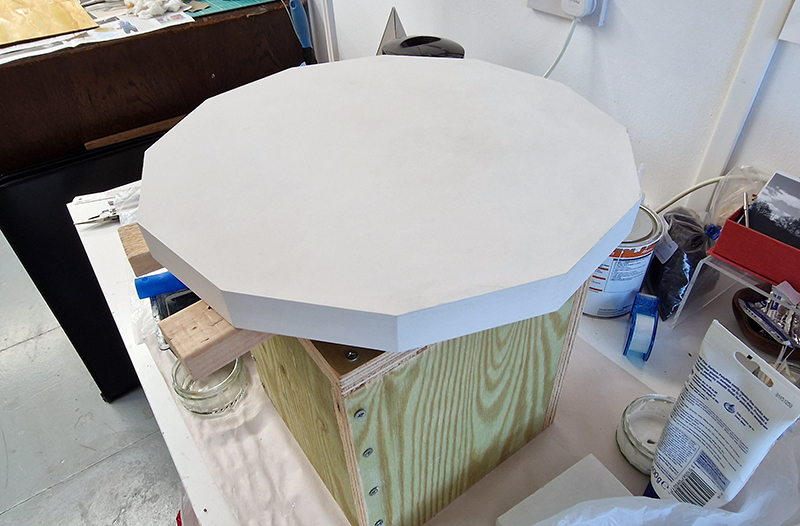
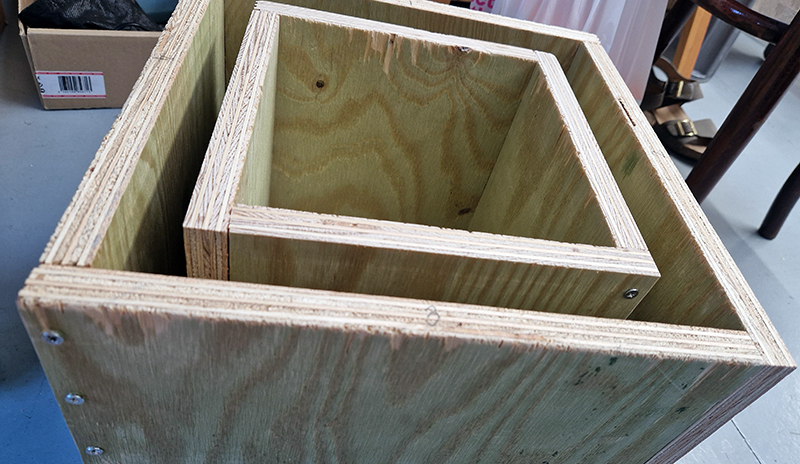
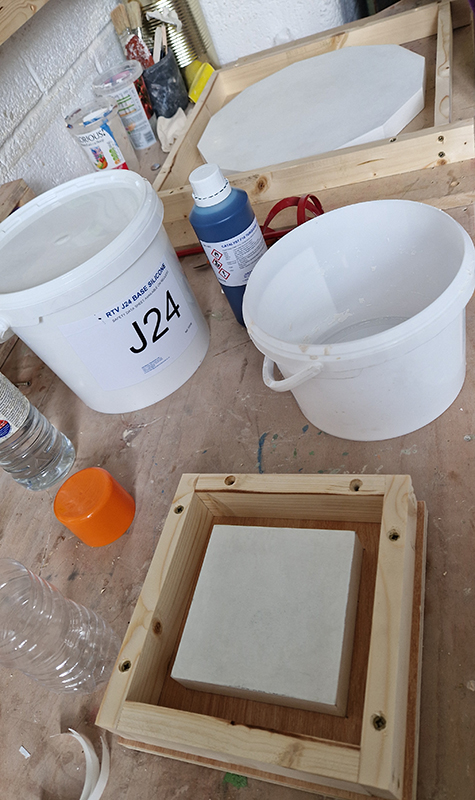
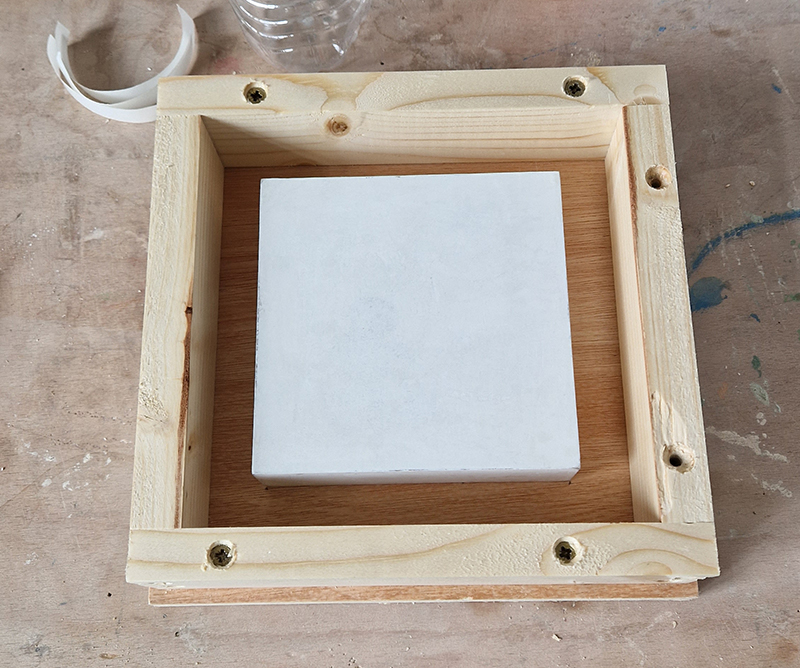
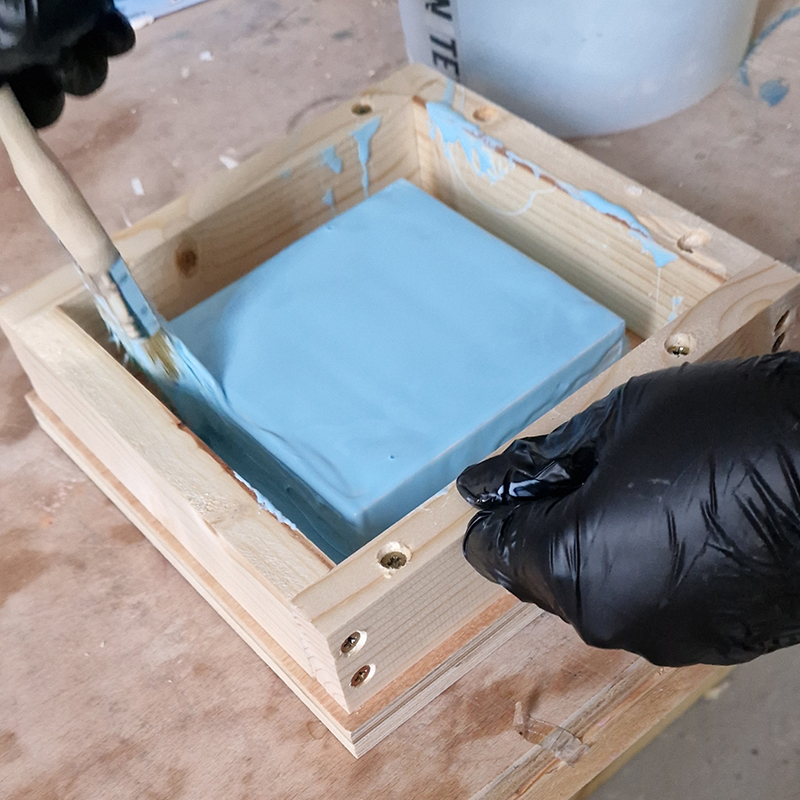
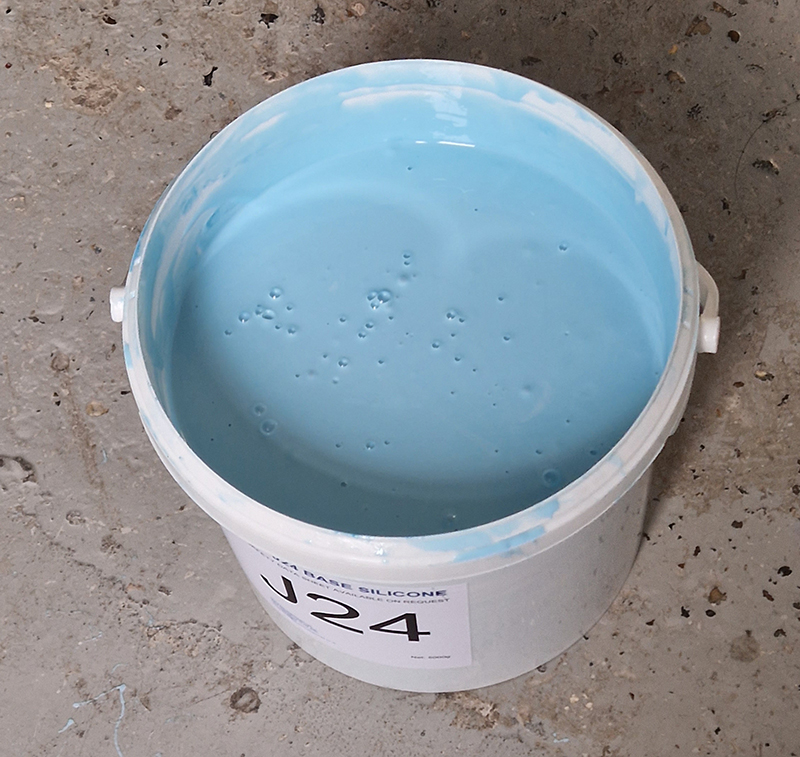
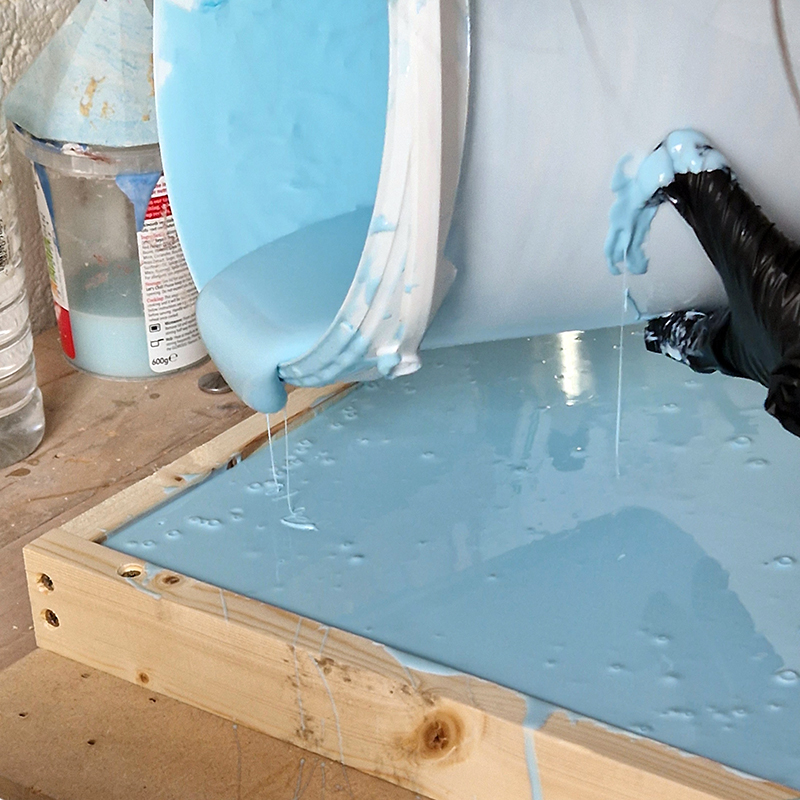
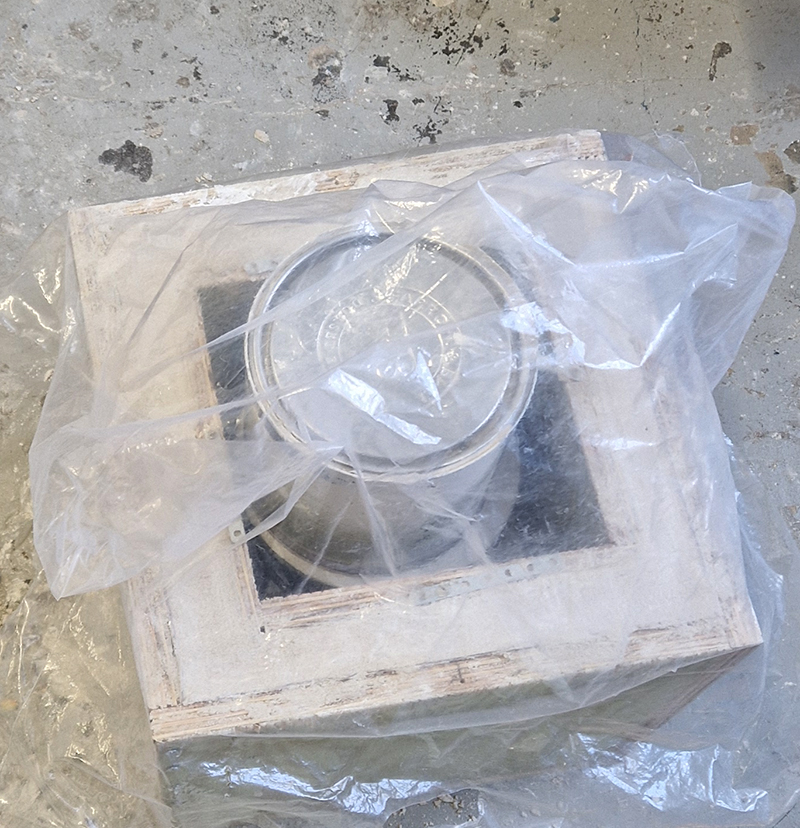
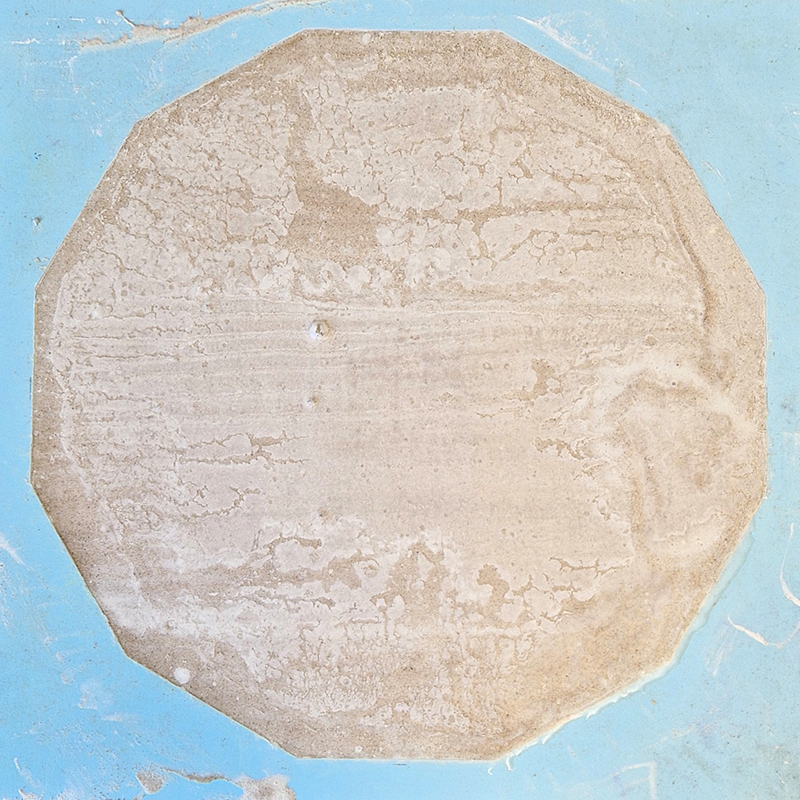
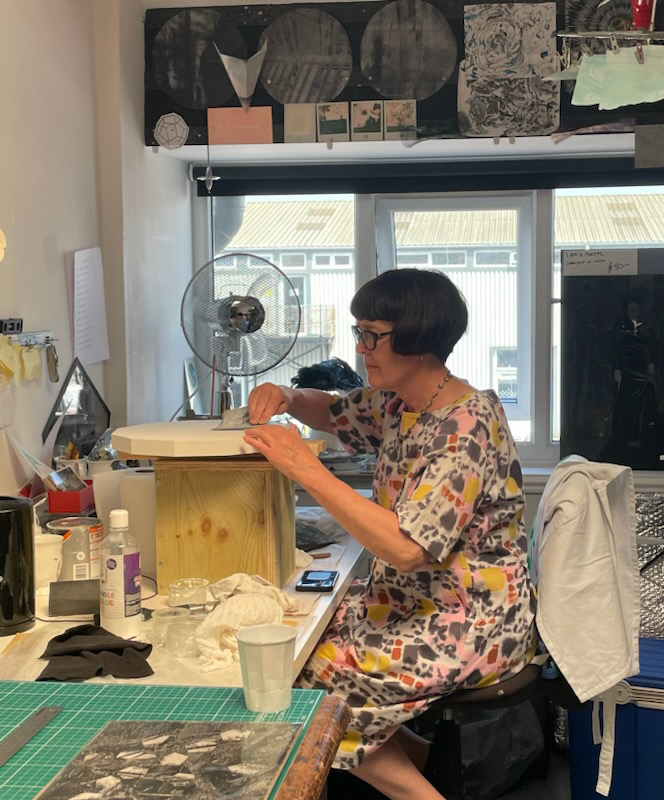
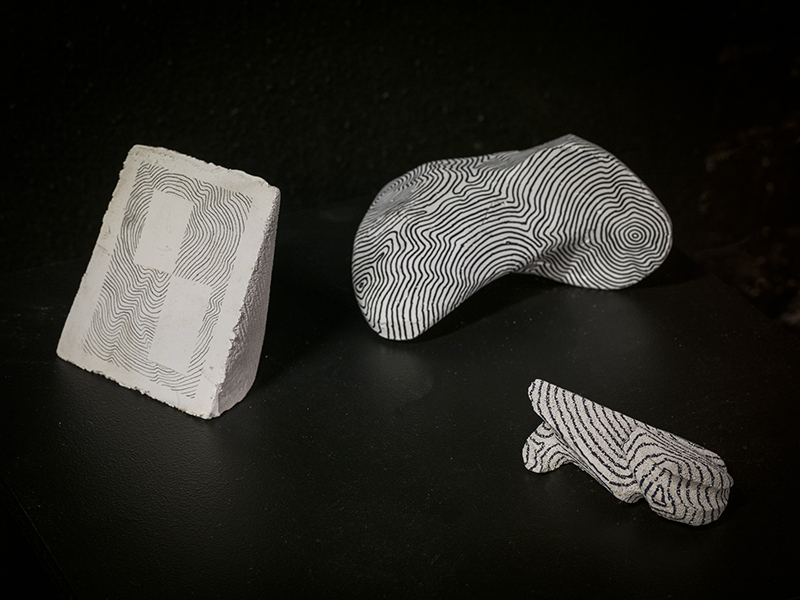
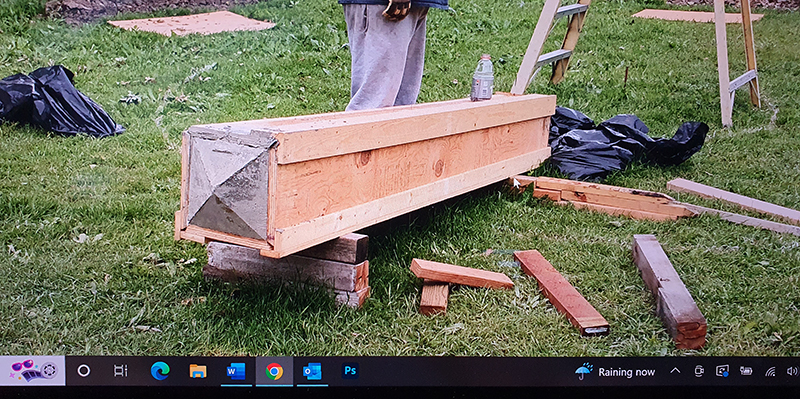
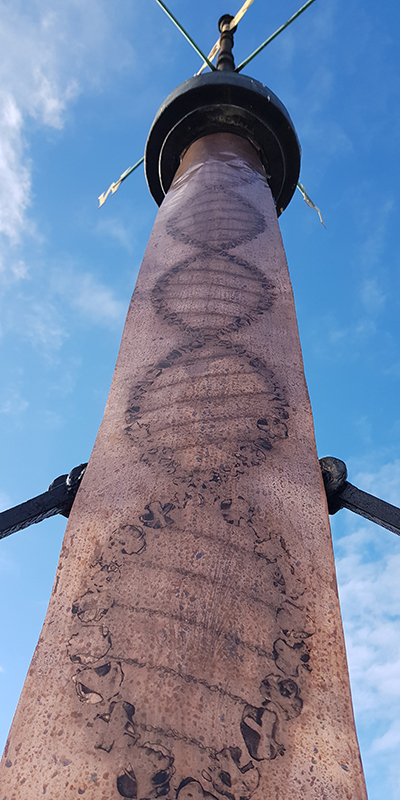
Supported by a professional practice and creative development bursary from a-n The Artists Information Company I have been privileged to have expert tuition in mould making and concrete casting from Anna Hughes based at Thames-side Studios. I have really enjoyed these sessions. Anna has given me the skills to go forward and experiment and I am excited by this new process. I prepared a dodecagon (twelve sided) shape cut in MDF to make a silicon mould and a double box mould for the base of my obelisk sculpture plus some small shapes for testing.
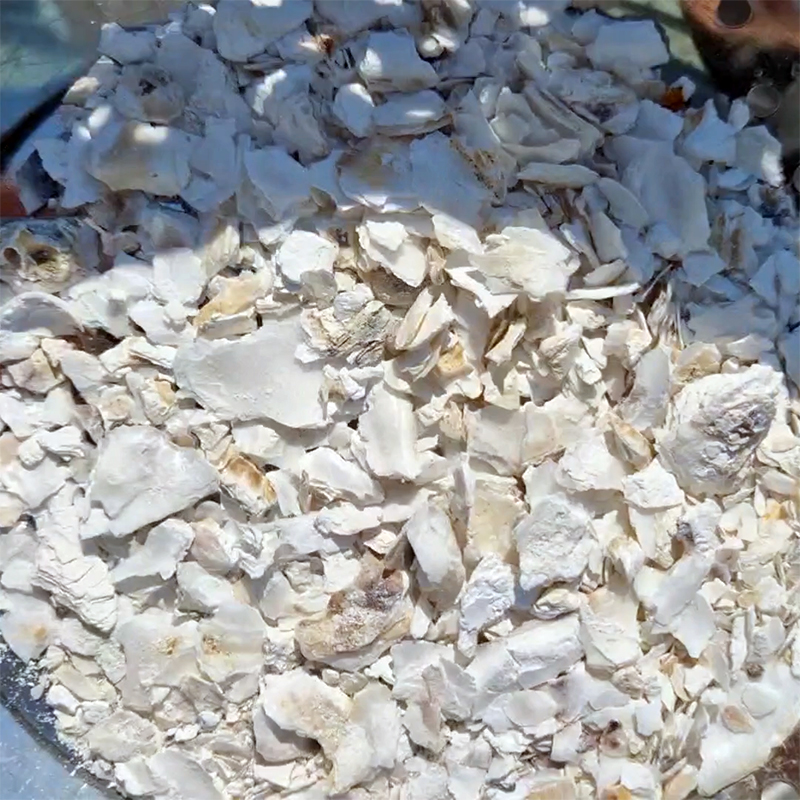
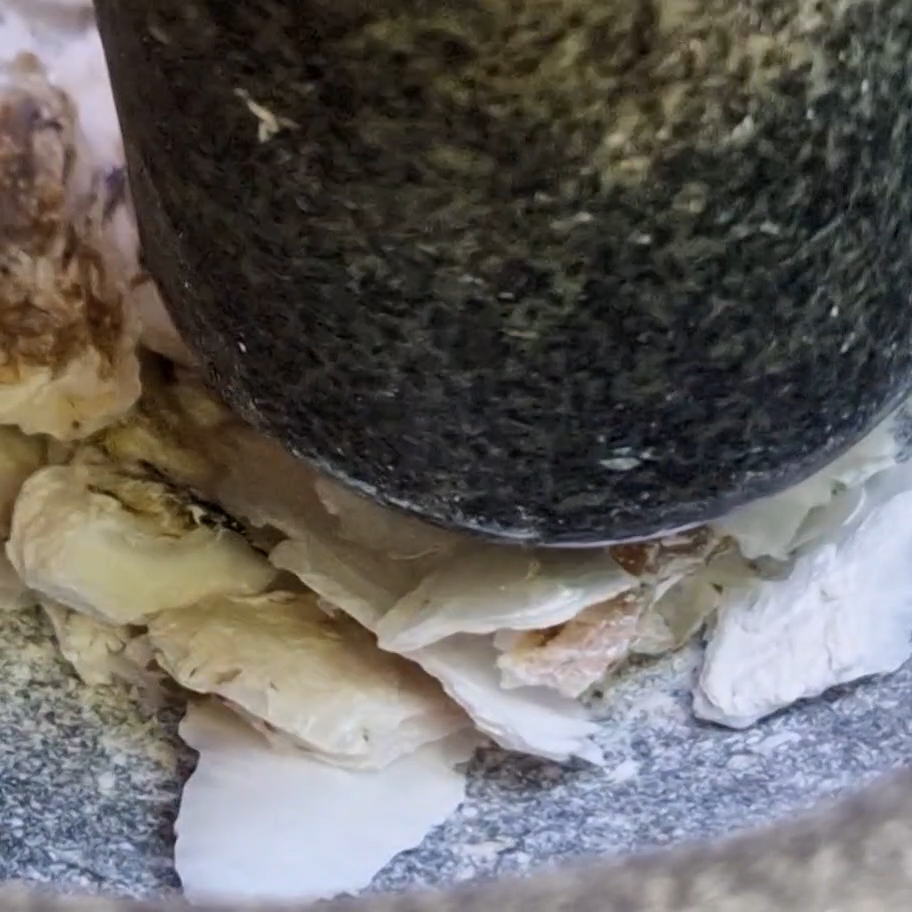
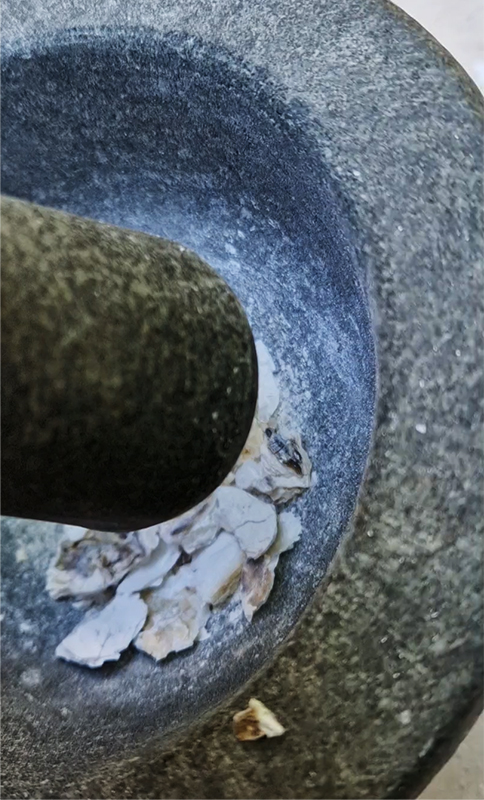
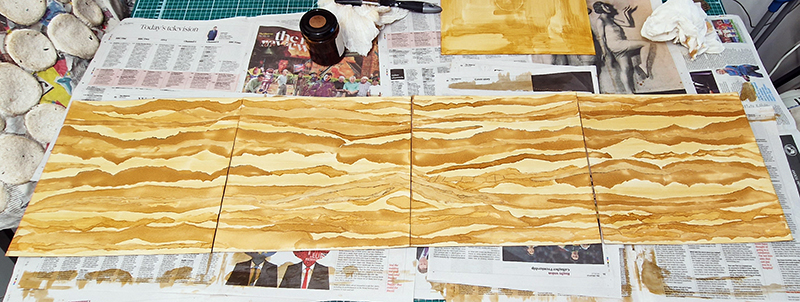
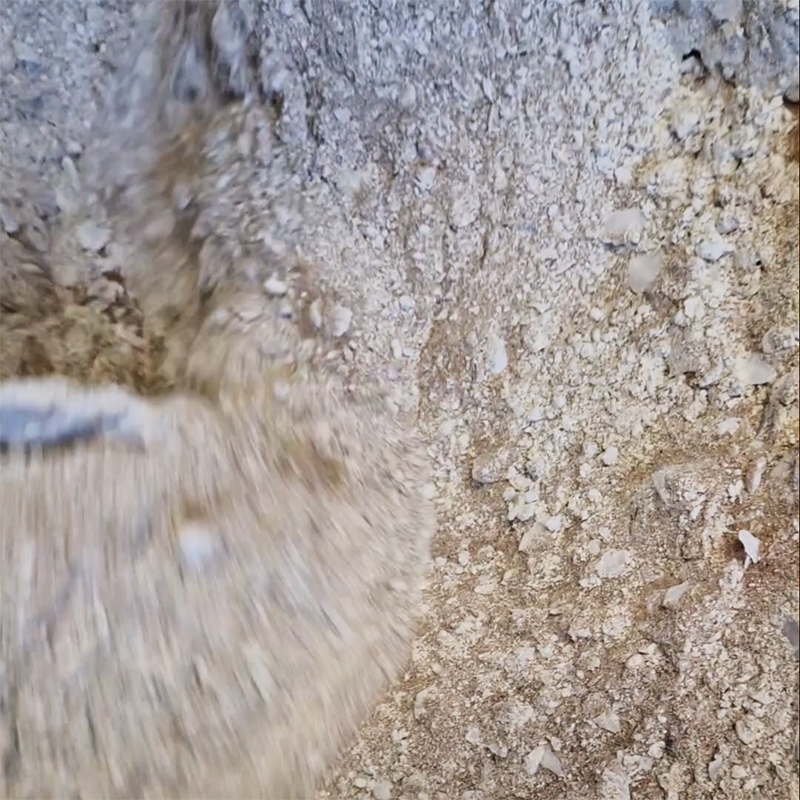
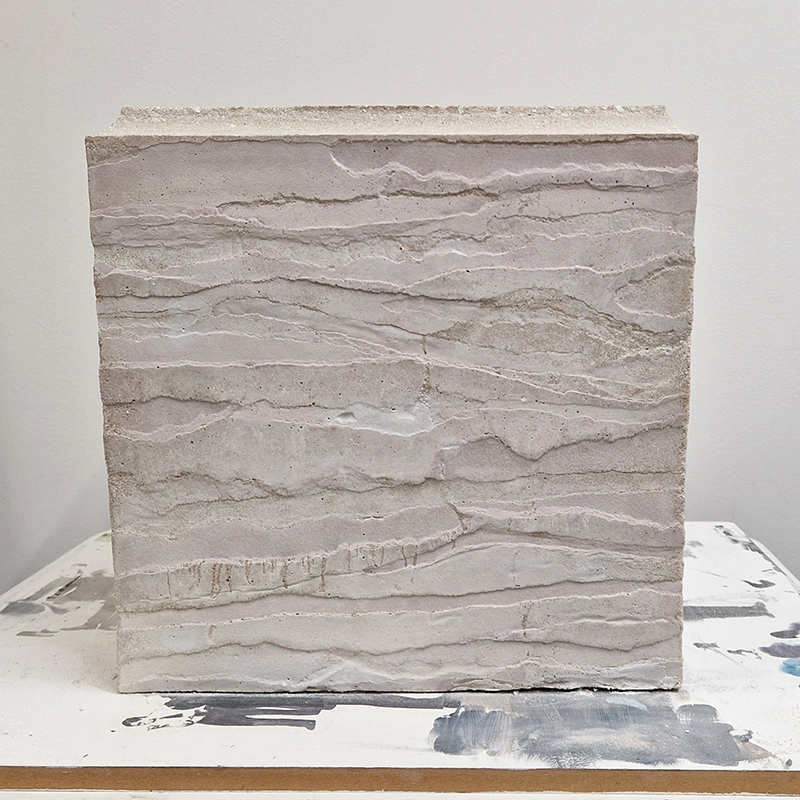
To continue the notion of sedimentary layers as signified by the layering of recycled paper in the body of the obelisk sculpture, I made collagraphs to line the box mould to give a texture of strata. Limestone, a sedimentary rock, is often formed from crushed seashells, compressed over eons. I used crushed oyster shells to use as aggregate for the base.
I am super pleased with how the base turned out.
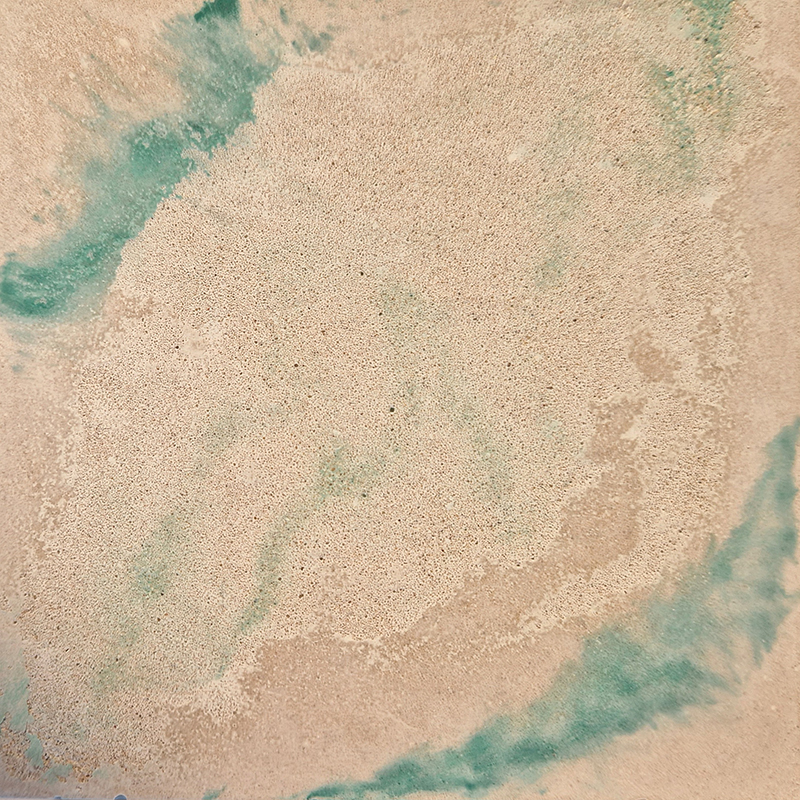
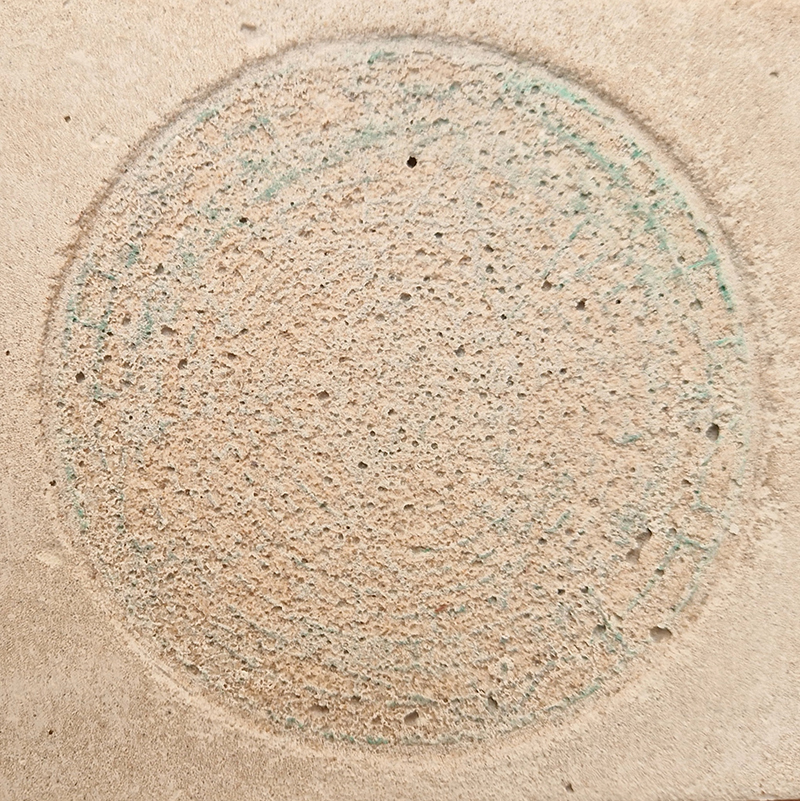
I also tested using verdigris pigment mixed into the concrete or in the grooves of etched aluminium to leave an imprint. The plate tests didn’t come out so clear so need more testing and I next plan to try embedding the etched plate face up in the concrete.
Open Studios at Thames-side Studios 2023.
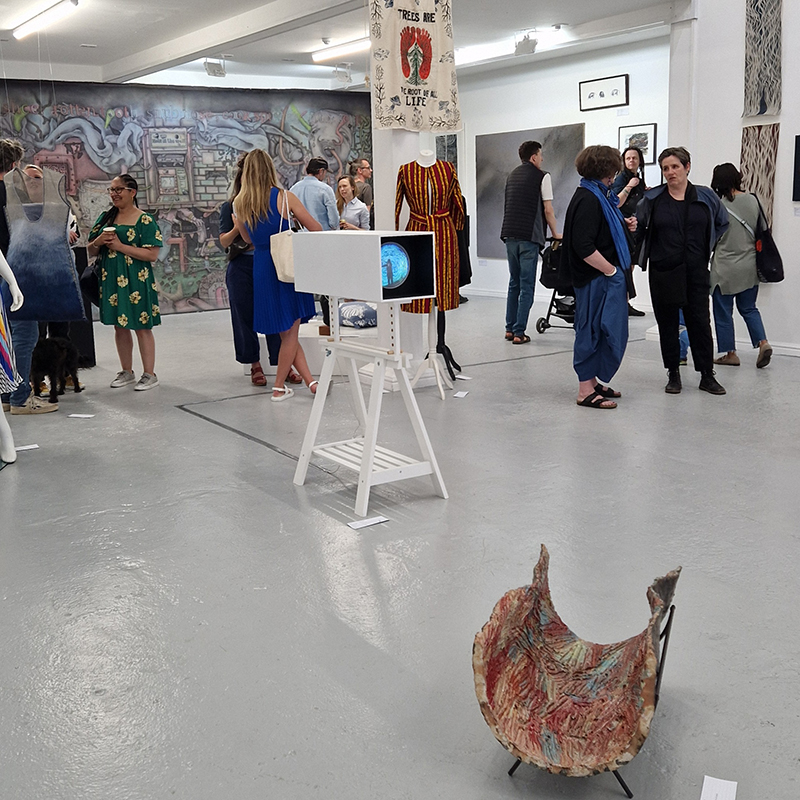
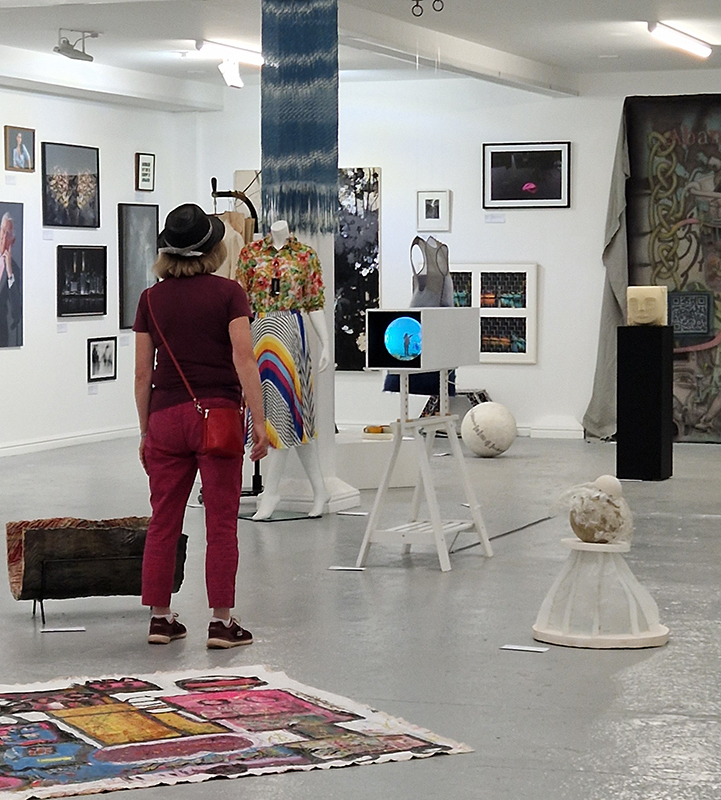
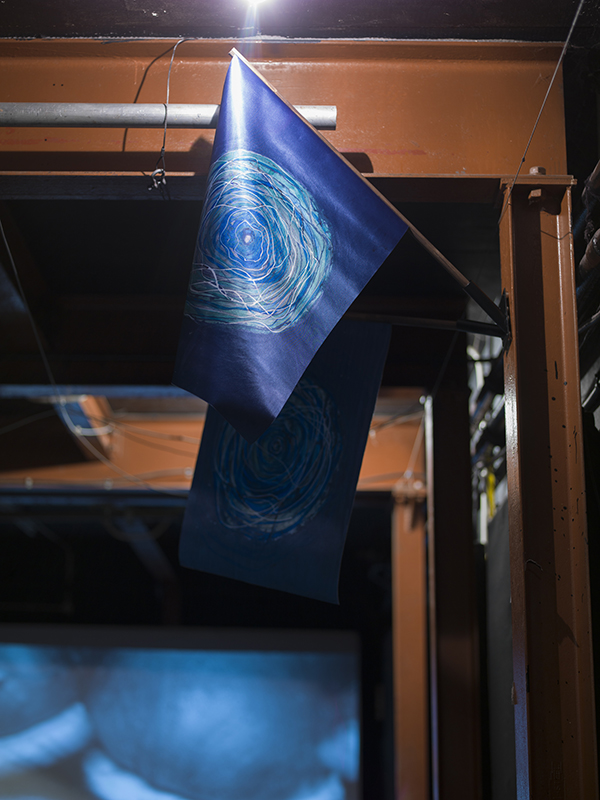
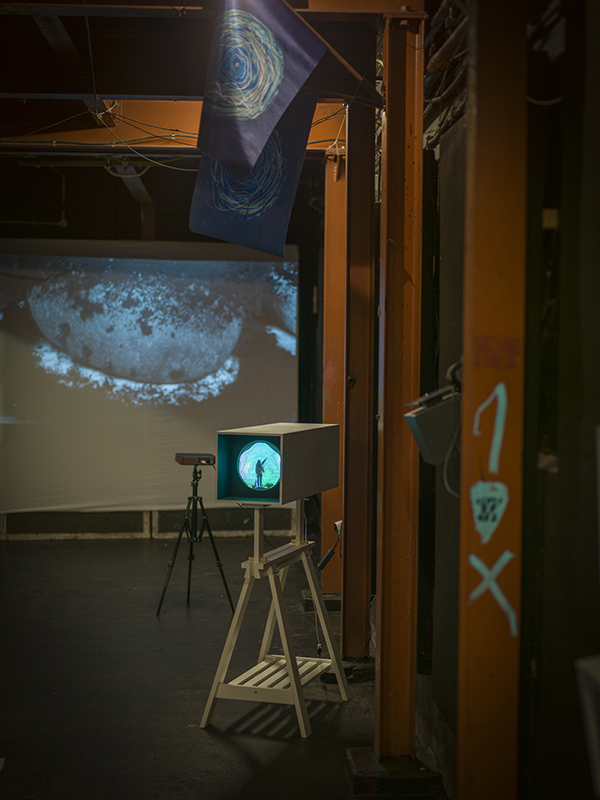
At a distance was installed in the main gallery group show. This work looks at remote methods of communication and relates this to the mysterious twinning of electrons in quantum entanglement where particles link in a way that they instantly affect each other, even over vast expanses. Einstein famously called this phenomenon ‘spooky action at a distance’. Filmed on 29th March 2019 (the first proposed Brexit date), in Cornwall as the iconic Lizard Lighthouse powers up its lamp, solitary figures using semaphore flags sign ‘We Are One’ out across the ocean in the hope the message will be echoed back. Drawing on the physical language of print that embodies touch, separation and mirroring the flags have been printed using hand painted dye sublimation inks applied via a heat press. This process transfers the ink from a paper matrix onto the substrate textile. The image passes momentarily across space in a dematerialized state as vapour before being reformed as its mirror opposite.
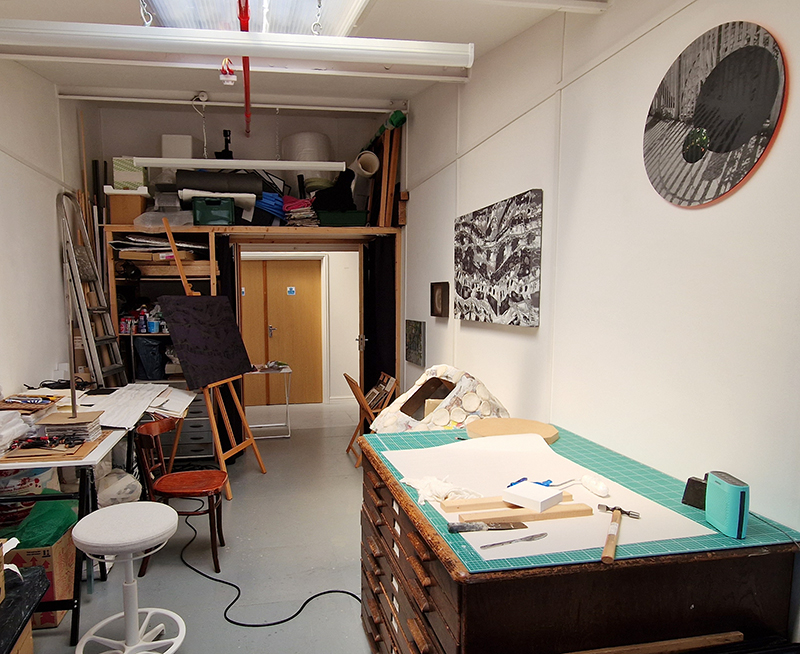
In my studio there was recent magnetic work Pole Receptor, along with work in progress Belly of a Rock hybrid sculpture plus some works from the archive such as screen prints from the StrataGem and everydaymatters series. I spent the weekend preparing for my concrete casting tuition in between chatting to visitors. Thanks to Caroline AreskogJones for the studio portrait.
The StrataGem series of screenprints on textiles imagines the possibility of the formation of geological strata created from the waste of plastic food packaging trays.
Informed by the discovery that the matter we know, that which is visible to us and includes all the stars and galaxies is less than 5% of the content of the universe, dark matter making up about 27% and the remaining percentage being dark energy, everydaymatters dissects landscapes to discover the hidden structures of the universe. Images taken from everyday prosaic paradises, such as Paradise Industrial Estate in Hemel Hempstead, are split into constituent parts of what is seen and unseen.
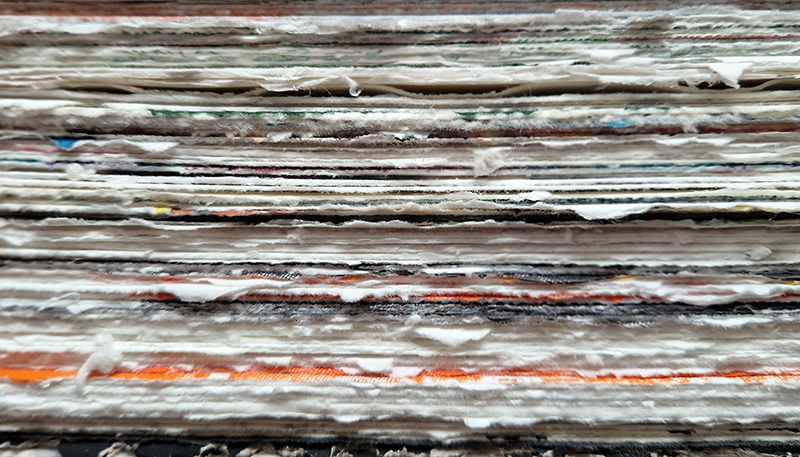
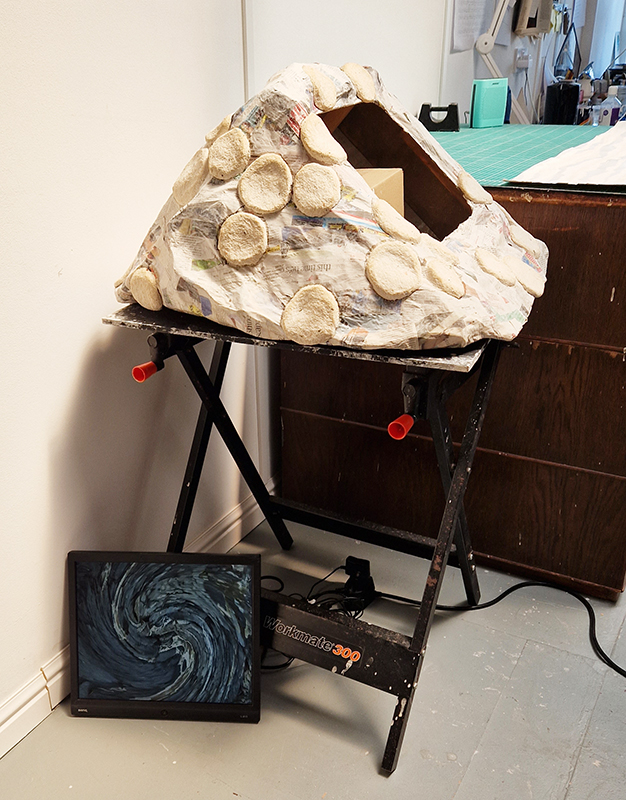
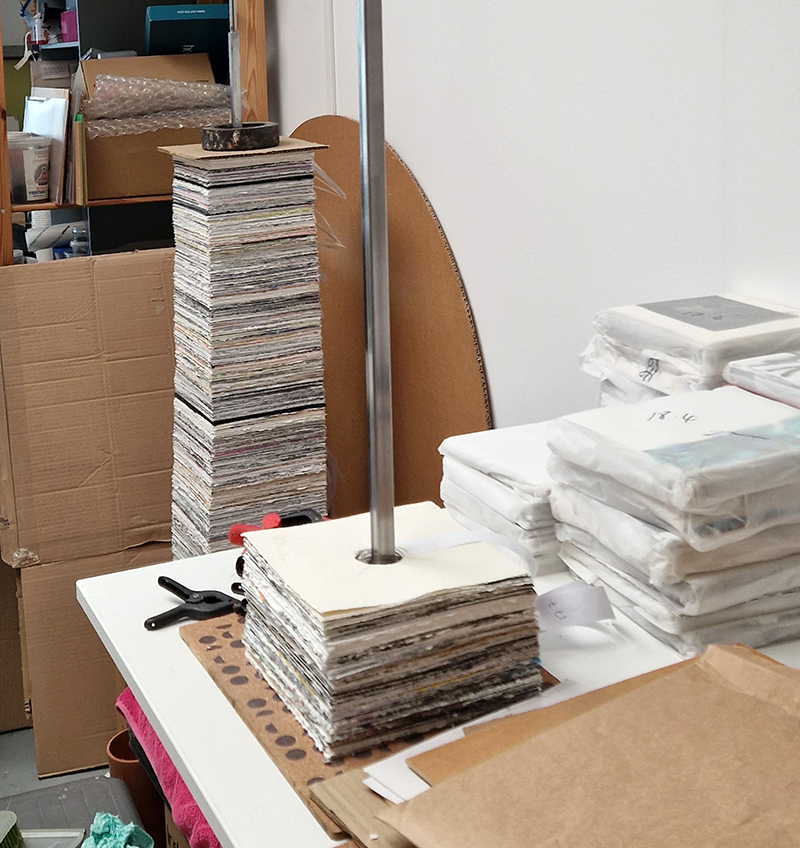
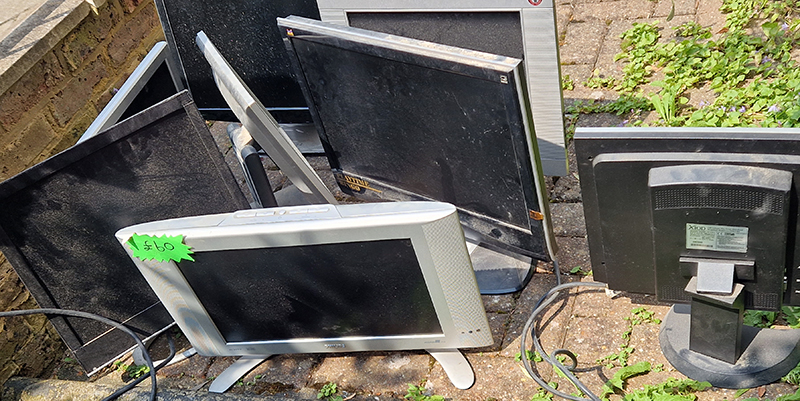
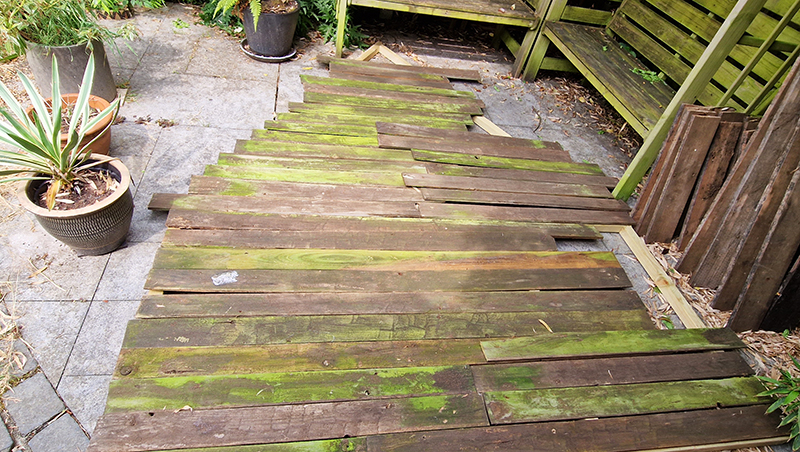
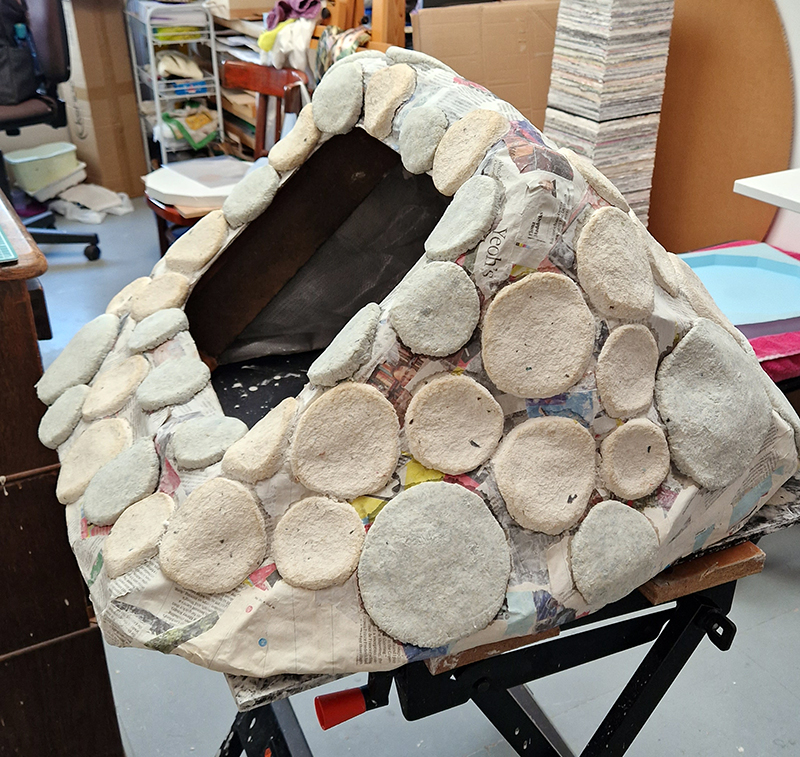
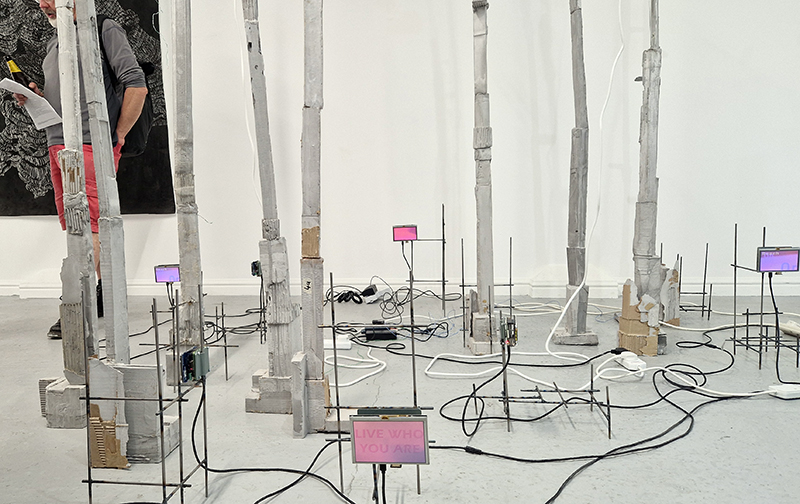
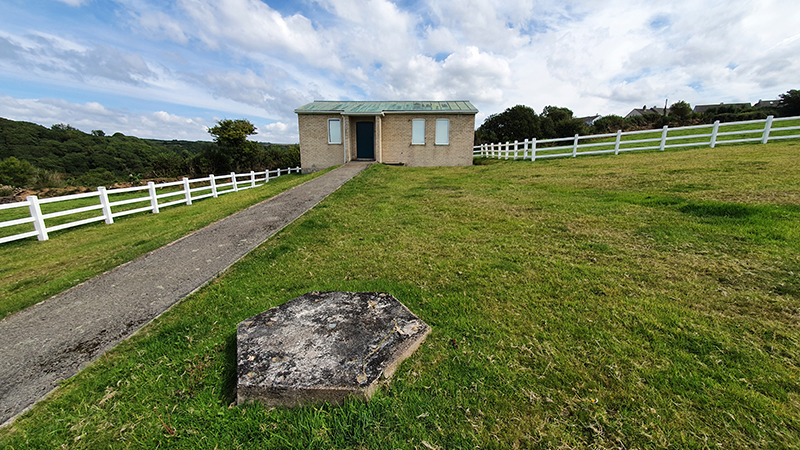
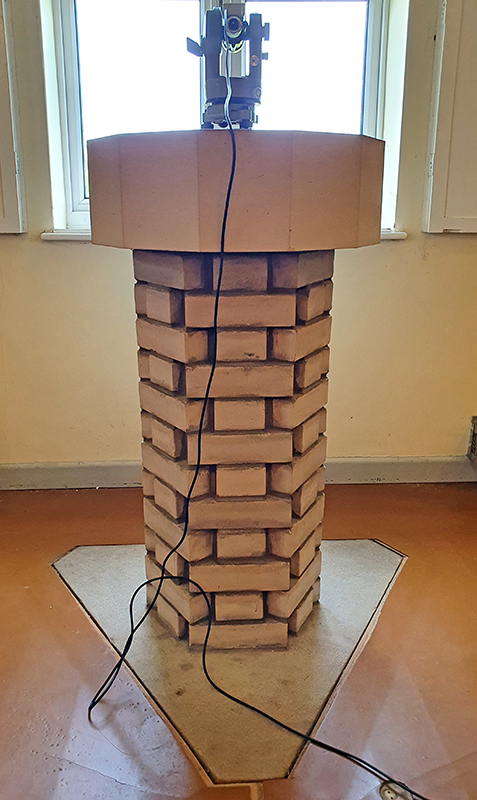
Studio progress on The Azimuth Obelisk of Sedimentary Knowledge – all the paper is now torn down but lots still needs to have a hole drilled through to feed onto the frame. This sculpture is a response to the obelisk erected in 1955 at Hartland Magnetic Observatory, near the site’s northern boundary as a permanent azimuth mark viewed from the north facing window of the observing hut (also known as the absolute hut). I have been sorting out if I have enough old boards for the north wall of The Absolute Hut and have been donated some old monitors and screens to see if I can get them working to use inside. I am thinking of having several screens playing video in the hut – as in the brain – a sensory hub there are different activities and processing going on in different locations. More paper clay forms have been added to The Belly of a Rock sculpture framework to house the video screen – this hybrid sculpture is a place of chemical conversations at the intersection of the animate and inanimate.
Gallery Visits
Fabulous tech and plaster sculptures from Tessa Garland in Postcards From the Volcano at Thames-side Gallery.
Light Being curated by Jonathan Miles of The Wild Parlour at Lychee One.
We were talking of such things: shadows, obscure illumination, folds within substance, but all without a schema that would serve to cohere. Then someone interjected about the rootmeaning of the word for being human as being an entanglement of light, thinking, and being. This would then generate a sense, like something in the air, but also a generation of a spacing for work. Rather than being an exhibition with a theme, instead a tonal poetics and with it a letting be or presentation of an accord would emerge. – Jonathan Miles
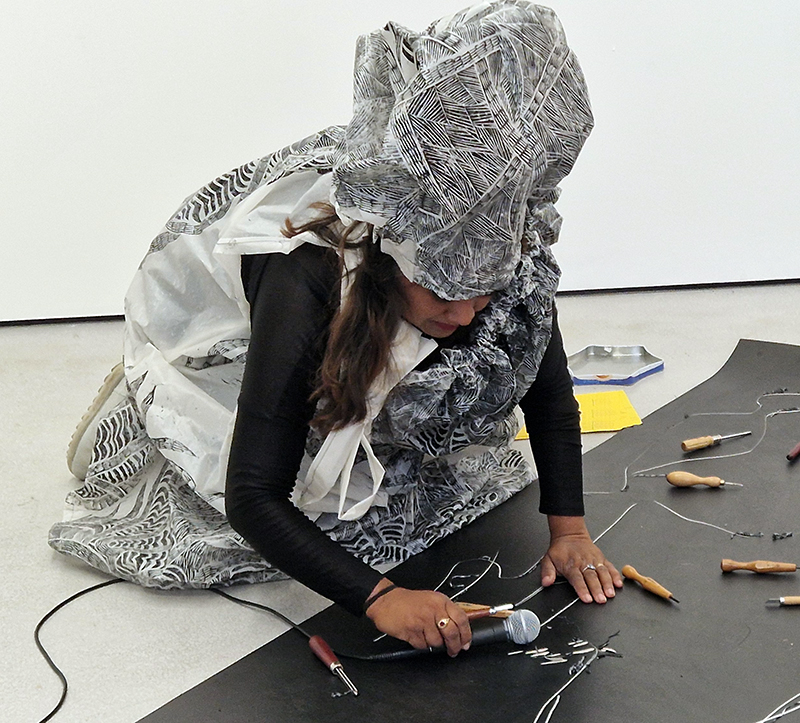
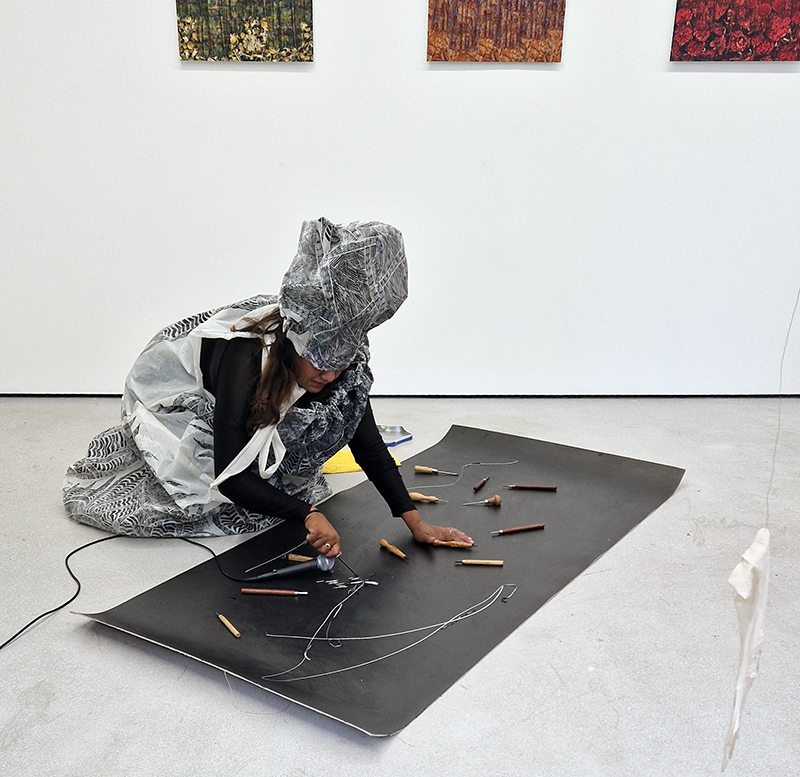
Mesmerizing performance from Chudamani Clowes – Choral Coral Cuts. Performance cutting linoleum to produce a song of coral for coral.
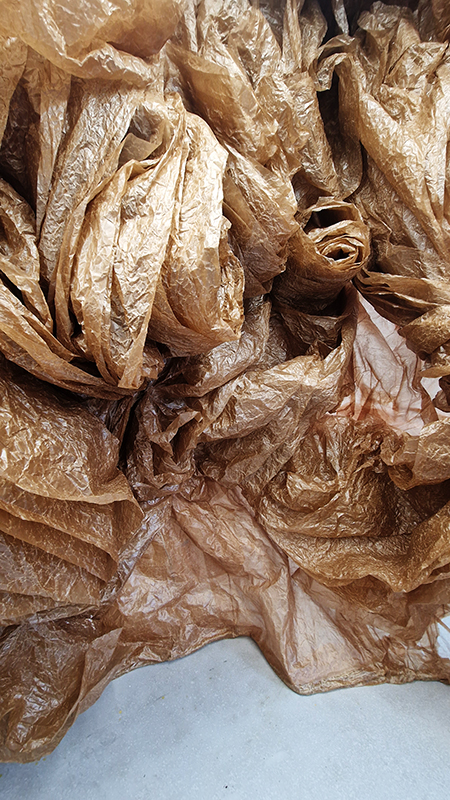
Transport delays meant I missed the first performance but did also catch Kate Howe read The Infinite Intimate which accompanies her sculptural Kraft paper installation and Jessica Mardon recite The Recovery of Meaning.
When numbers weren’t just a unit, a system of measurement, but were symbols that had meaning, it was their meaning that provided structure, not structure that provided their meaning. – Jessica Mardon
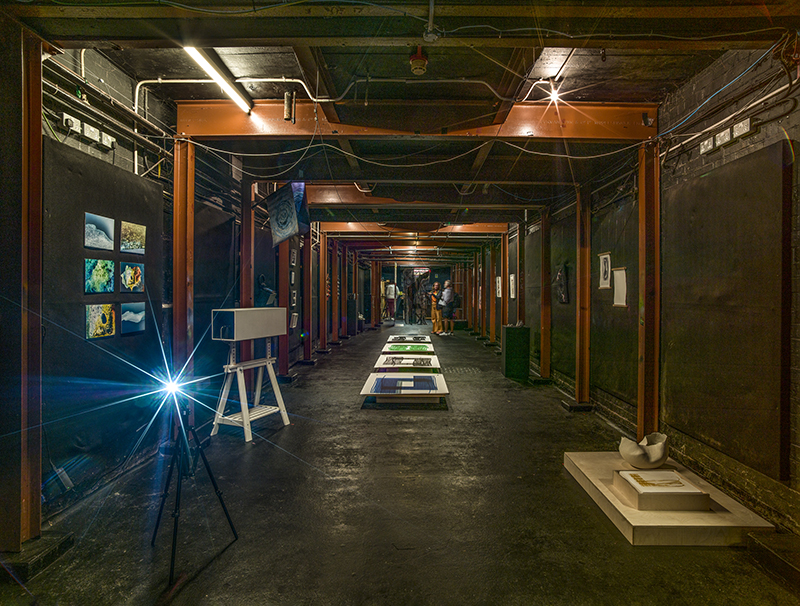
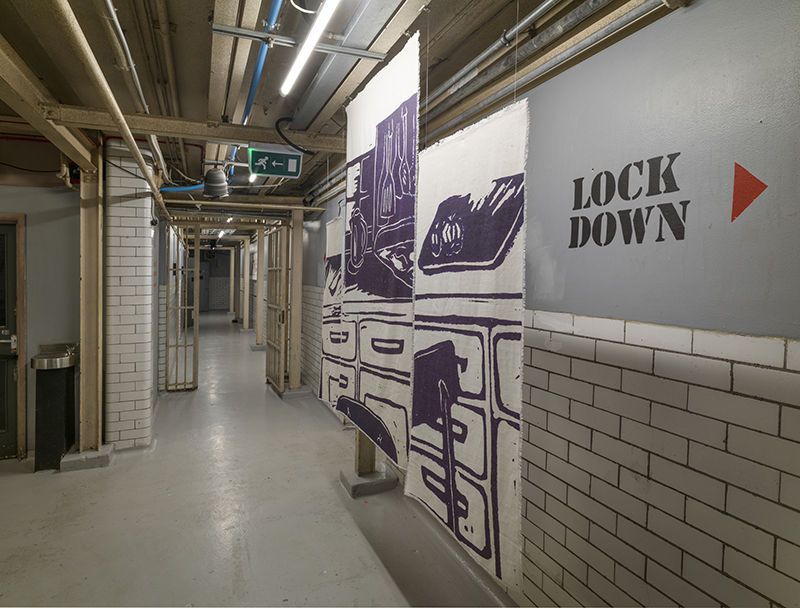
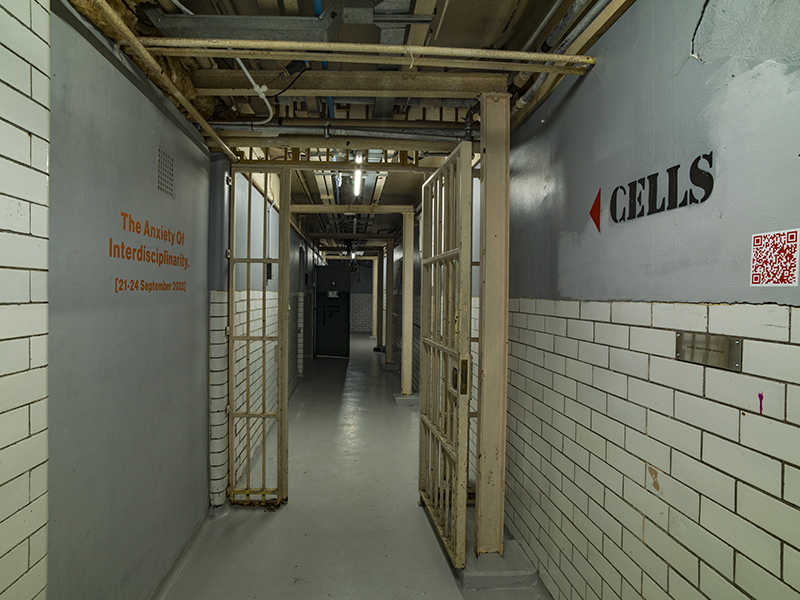
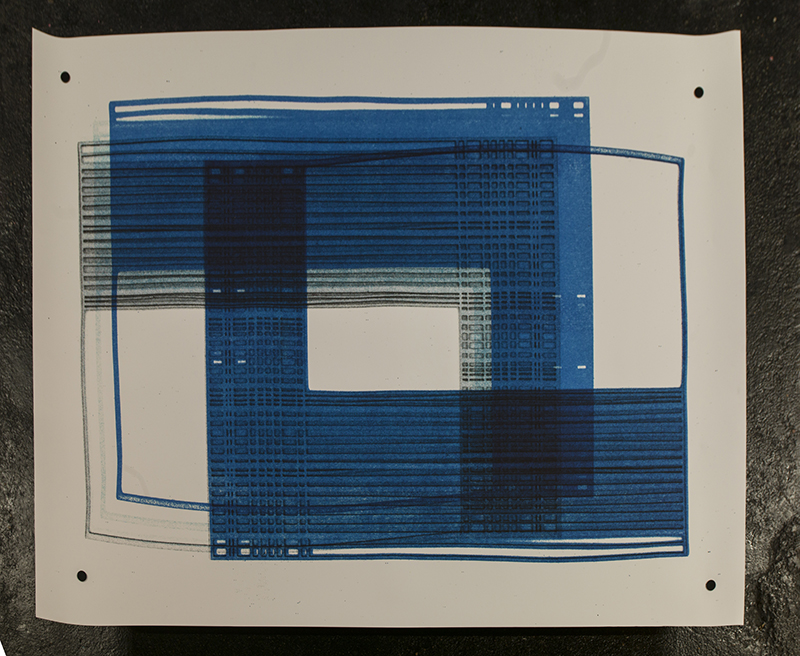
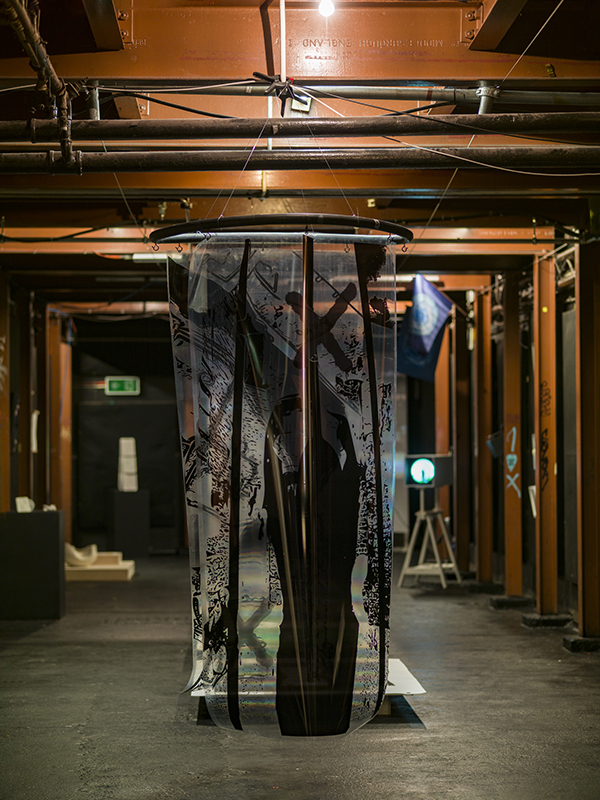
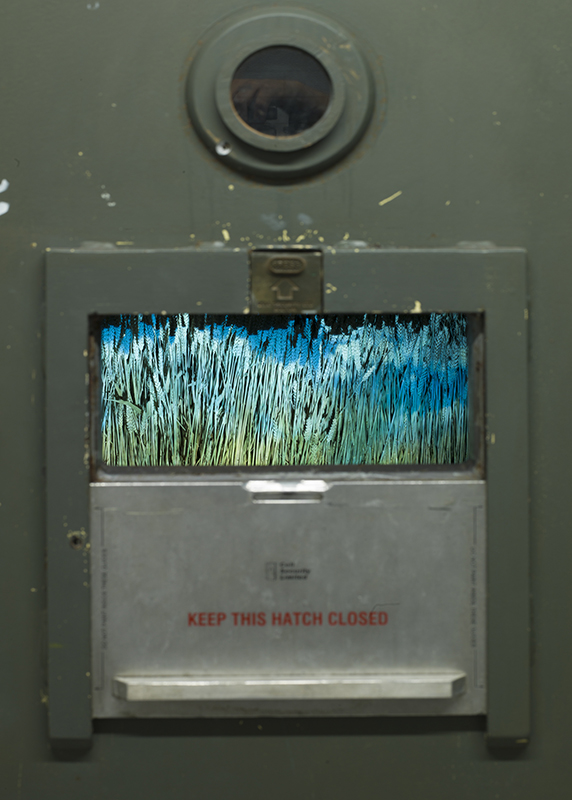
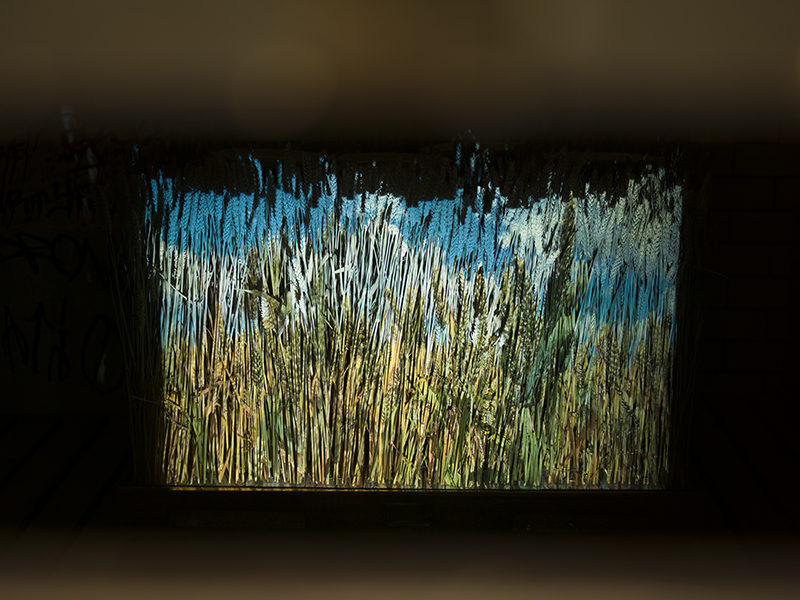
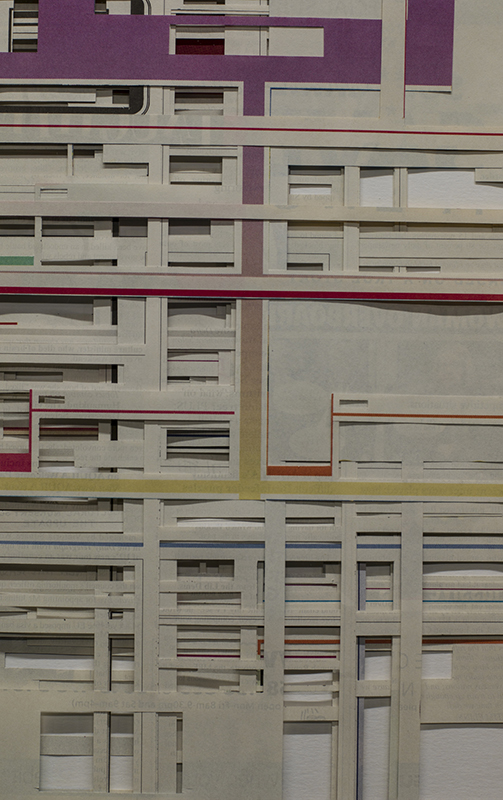
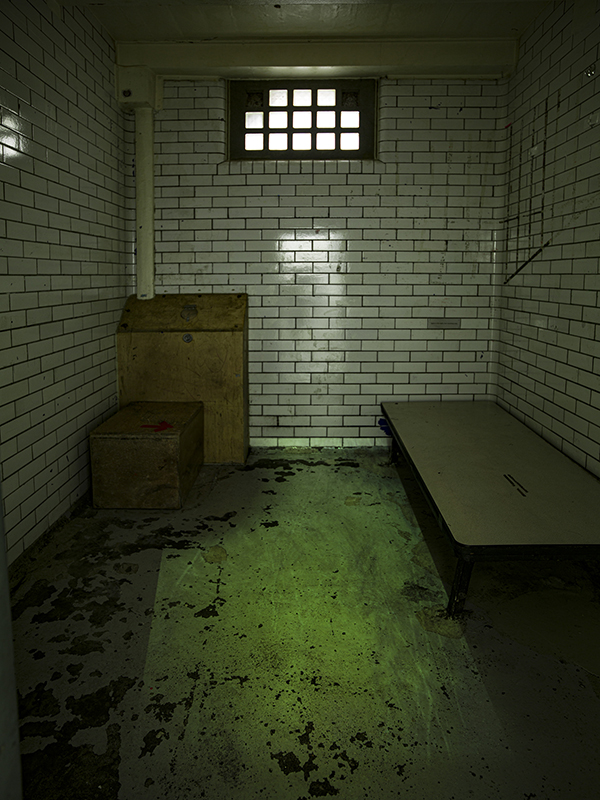
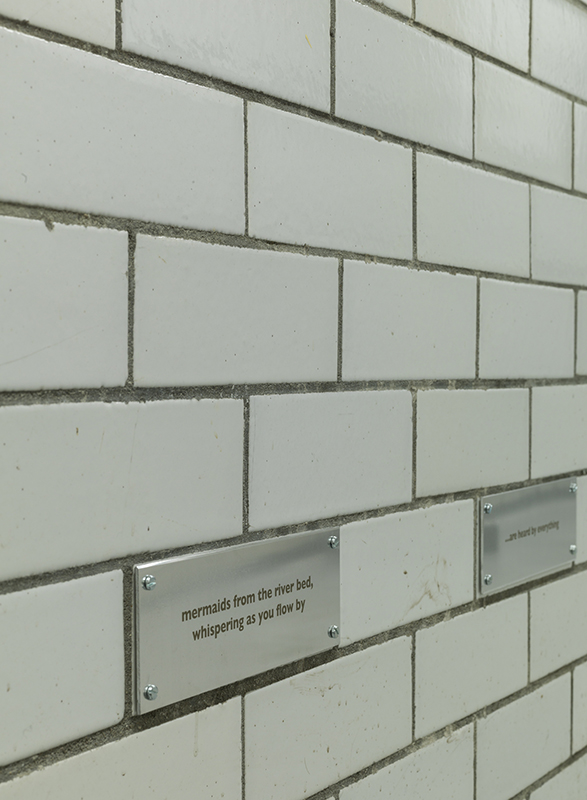
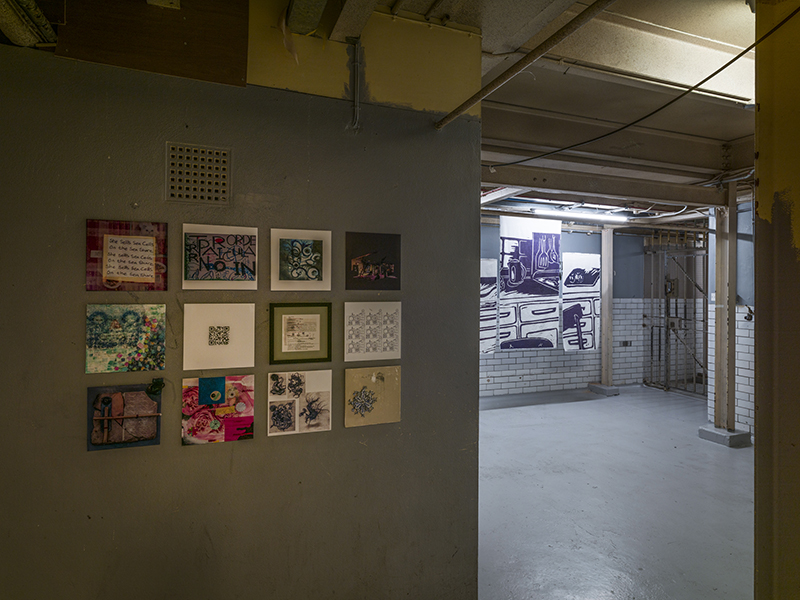
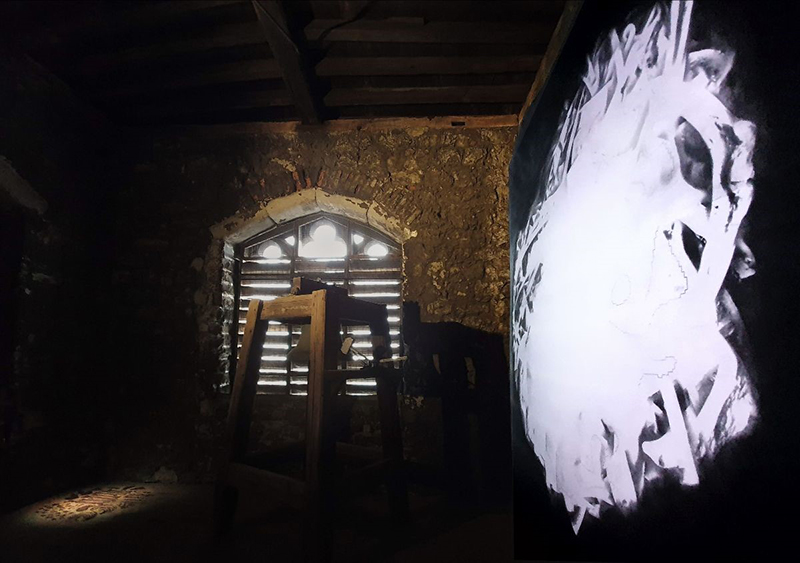
Delighted to have my video installation At a Distance included in The Anxiety of Interdisciplinarity exhibition in the subterranean labyrinth of former police cells that is The Island Venue in Bristol. Curated by Sarah Strachan and Ayeshah Zolghadr. Exhibition Images by Steve Russell Studios.
This is a satellite exhibition of the International Printmaking Conference taking place at The Centre for Print Research, University of the West of England, Bristol. Motivated by the International Multidisciplinary Printmaking Conference IMPACT 12’s theme ‘Merging and Metamorphosis’, the exhibition aims to trace the metamorphosis of conversations between disciplines, seeking to reframe printmaking practice as a ‘site of interdisciplinarity’ and consider contemporary approaches to print as ‘a site of ambivalence, tension or a fertile ground for exploration and experimentation.’
Works include:
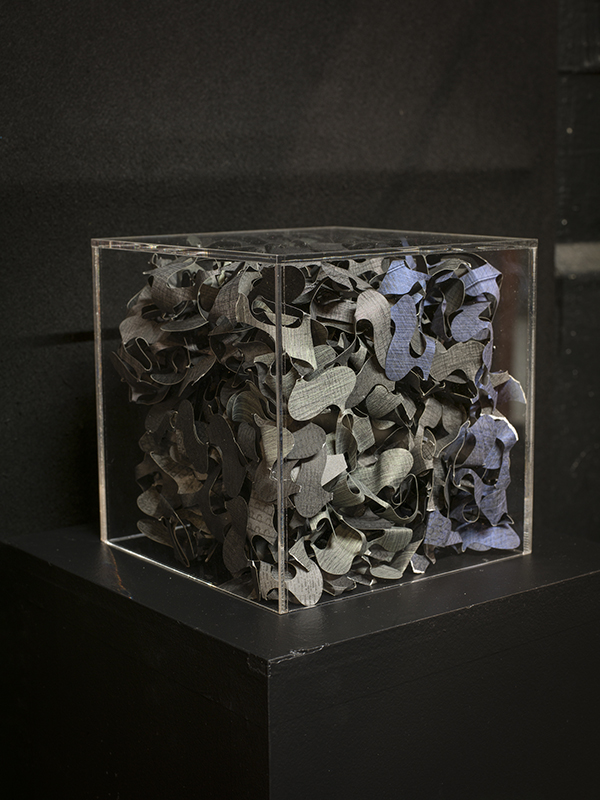
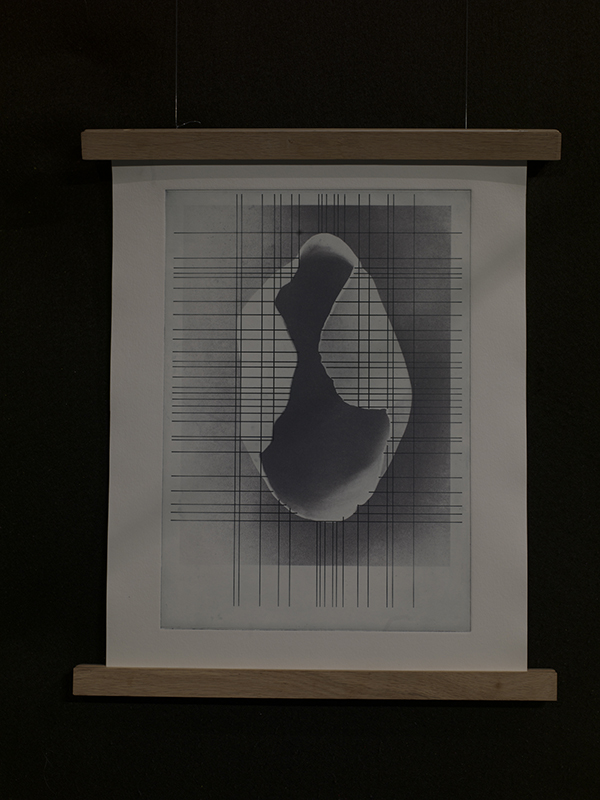
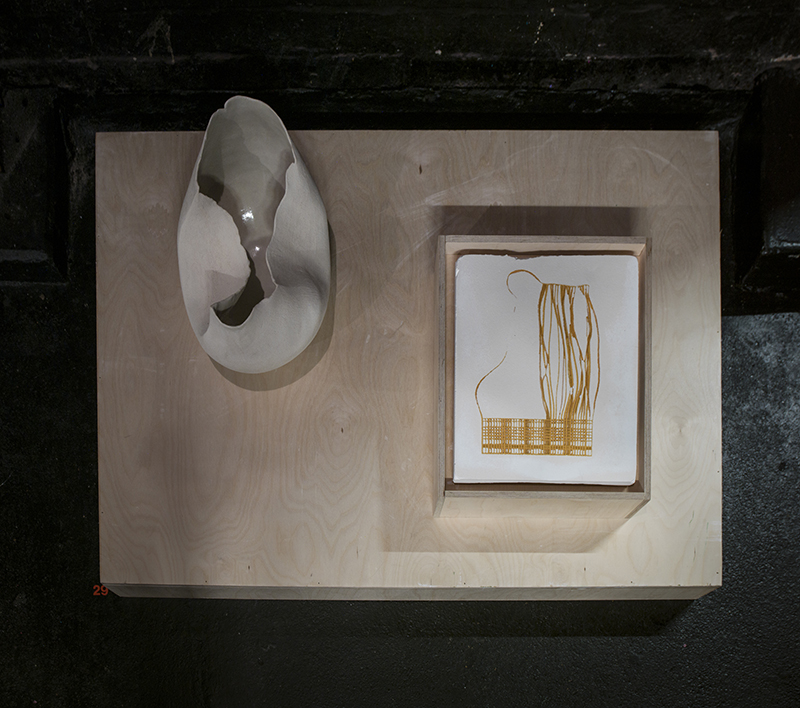
Valerie O’Regan, Vertical Landscape Nicky Harwood Parachute Åse Vikse The Sixteen Hannah Robin Baker “In Conversation With…” Heather Burwell Nostalgia Erika Cann Feldspar Score Katy Drake Expose Pauline Scott-Garrett An Almost Invisible Wound Debby Lauder Fair, Fine, Brisk Sarah Strachan The Security Dilemma Lon Kirkop Ċella ta’ Wieħed Rana Al Ogayyel Visual Sound and Hear the Print Judy Dibiase Trace Laura Greenway Never Enough Mick Paulusma Being There A. Rosemary Watson line_space_form III.VII.I Katherine Van Uytrecht Cellular Sound Ayeshah Zolghadr Individuated Copy Series Nicole Pietrantoni Still Life: Darwin’s Barberry Simon Leahy-Clark Untitled Cameron Lings Drawing: The Expanded Field Mary Rouncefield Escape To Infinity Jon Michaelides 16 x 64 Susan Eyre At a Distance Corinna Reynolds Traces of Pathways Strachan + Zolghadr Boundary Objects Heather Burwell Playing Games Alexandra Sivov “Listen To Me!” Joe Dean Southern Trains Loop Corinna Reynolds Traces of Pathways Daniel Bell Growing Blackness
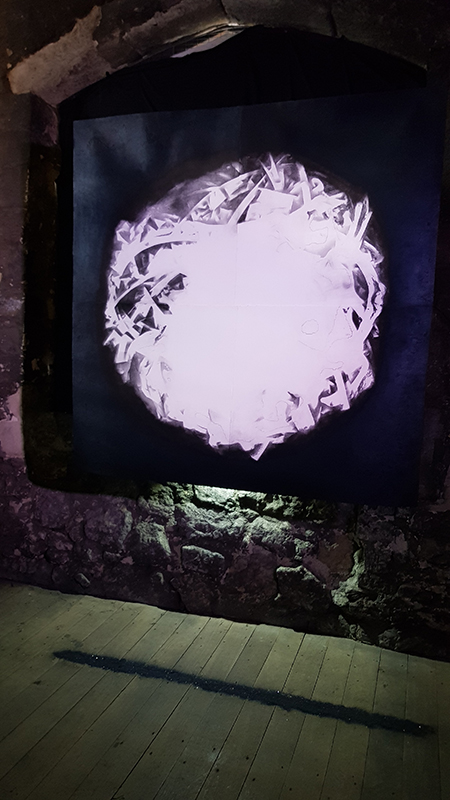
At a Distance looks at remote methods of communication and relates this to the mysterious twinning of electrons in quantum entanglement where particles link in a way that they instantly affect each other, even over vast expanses. Einstein famously called this phenomenon ‘spooky action at a distance’. Filmed on 29th March 2019 in Cornwall as the iconic Lizard Lighthouse powers up its lamp, solitary figures using semaphore flags sign ‘We Are One’ out across the ocean in the hope the message will be echoed back. Drawing on the physical language of print that embodies touch, separation and mirroring the flags have been printed using hand painted dye sublimation inks applied via a heat press. This process transfers the ink from a paper matrix onto the substrate textile. The image passes momentarily across space in a dematerialized state as vapour before being reformed as its mirror opposite.
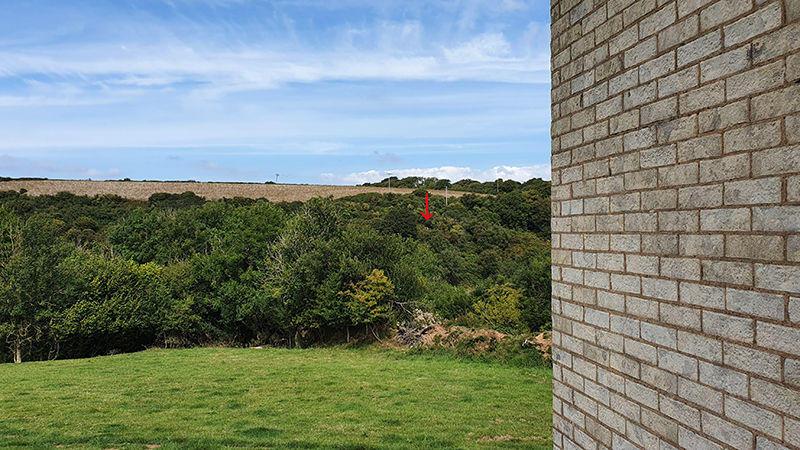
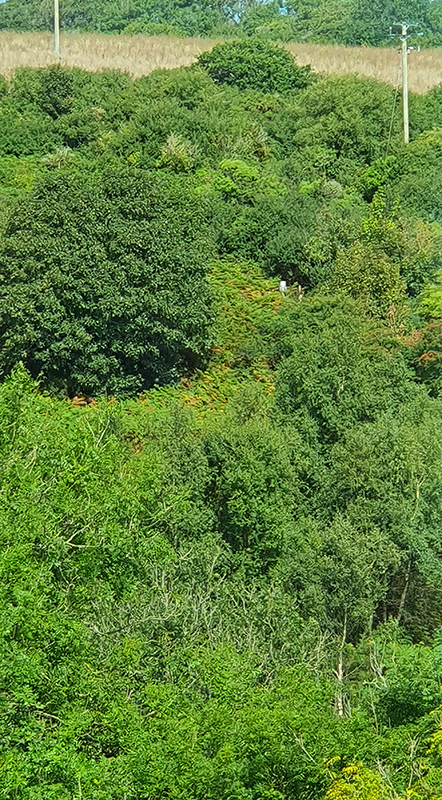
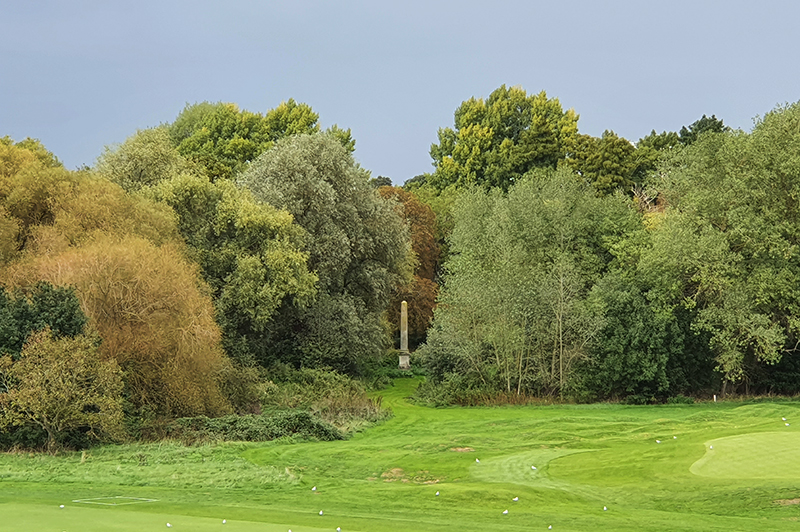
Research visit to Hartland Magnetic Observatory. I am very grateful to The British Geological Survey for allowing me access to the site and particularly to Tom who shared his knowledge and gave a fascinating tour of the observatory. He was a little perplexed by my request to see the obelisk with the azimuth mark determined by observations of Polaris as he thought this description was a slight exaggeration of what was actually present. The ‘obelisk’ is almost hidden in thick undergrowth and impenetrable woodland so this object, just glimpsed amongst the trees remains an enigma.
Hartland was established in 1955 and is part of a network of international observatories sharing information with governments and industry, the charts of the shifting magnetic field are also publicly available. The buildings are made of lime bricks and timber, with concrete flooring and roofing of copper.
The Earth’s magnetic field acts as a shield against potentially harmful charged particles from outer space. It is also holds clues to the planet’s deep interior and geological history which are inaccessible to direct observations.
Magnetic declination is the angular difference between magnetic north and geographical or true north for any point on the earth’s surface. The British astronomer Sir Edmund Halley was interested in the magnetic field and knew about declination based on the observations of sea captains and explorers in various parts of the world. He made two scientific voyages in the Atlantic Ocean as captain of the HMS Paramore between 1698 and 1700 when he charted declination in the Atlantic and from his observations published the first geomagnetic field map in 1701. His observations involved recording the position of celestial objects and the angular distance of the sun on the horizon.
I am intrigued to know what the middle species he encountered between a bird and a fish might be. Penguins with long swan necks?
Alexander von Humboldt determined that the magnetic field increased in intensity with distance from the equator based on magnetic field observations during his scientific journeys 250 years ago. He initiated coordinated observations across the globe and thus laid the foundation for international data exchange and collaboration.
Observation is essential to gain insight into the complexities of the geomagnetic field which is created by a combination of three separate fields. The main field is generated in the earth’s core, the second from electrical currents caused by solar weather as cosmic particles bounce off the Earth’s main field charging the surrounding ionosphere and thirdly from the magnetisation of the surrounding geology of the rocky mantle and crust.
The purpose of a magnetic observatory is to measure the size, direction and changes to the natural magnetic field at the surface of the earth. There is no clear separation between north and south currents at the equator as many diagrams suggest, everything just gets a bit muddled with tangled currents.
The fluctuations in the geomagnetic component fields occur over hugely different timescales, changing by the second as we orbit the sun, to the yearly drifting of magnetic poles and the millennia of deep geological time. To study these changes an observatory must make measurements at exactly the same point over a long period of time.
Activity in the ionosphere causes a compass needle to shift slightly throughout the day but these changes, although rapid, are very small, so the instruments measuring these fluctuations must be very sensitive and operate in an environment free from man made magnetic contamination which is why I was advised to park some way from the observatory.
Rapid changes in the geomagnetic field due to magnetic storms can impact navigation data which is particularly important for the oil industry that uses this data for accurate drilling references. Data monitoring solar variability can also help studies into the mechanisms of climate change. It has been noticed that the Sun’s coronal magnetic field has doubled over the last century and this may have an effect on cloud formation which has an impact on warming the planet.
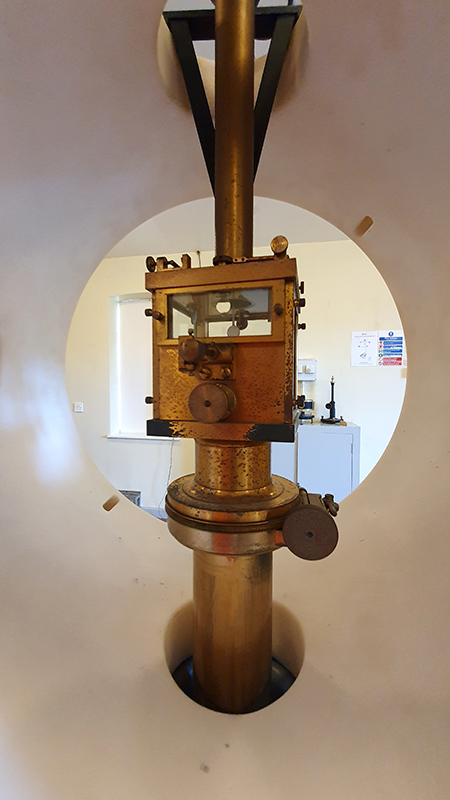
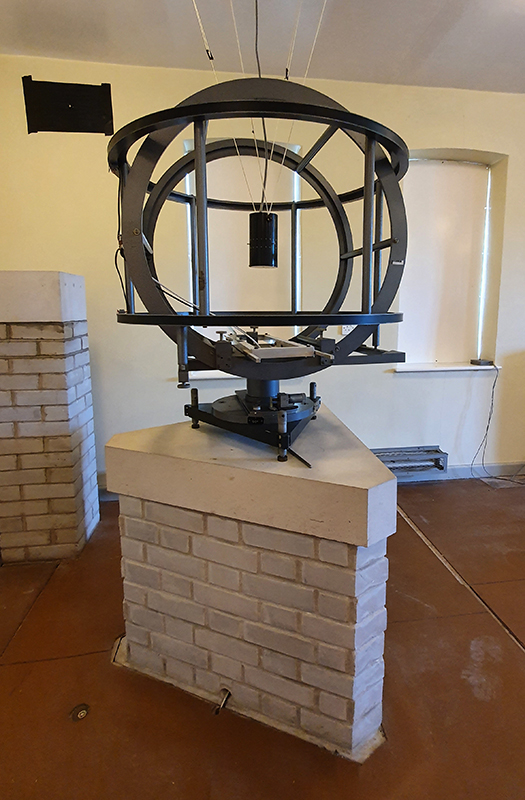
Today at Hartland, the intensity and direction of the magnetic field is sampled using one manual and two automated instruments. A fluxgate magnetometer (variometer) is used to measure variations in the direction of the field every second. It has copper coils and three orthogonal sensors (measuring north, east and vertical). This instrument is extremely sensitive, mounted on a marble block on a pillar set into the bedrock to avoid tilting, it must be kept at a constant 23C temperature. It is housed in a special building with thermally insulated inner chambers within inner chambers, isolated in the dark, it is only visited once a year. We didn’t even walk too close to the building which appeared to have no door.
The second automated instrument is a proton precession magnetometer to measure the strength of the field. This also has its own building and new equipment is being tested here. As new instruments are introduced previously unseen minute fluctuations are revealed.
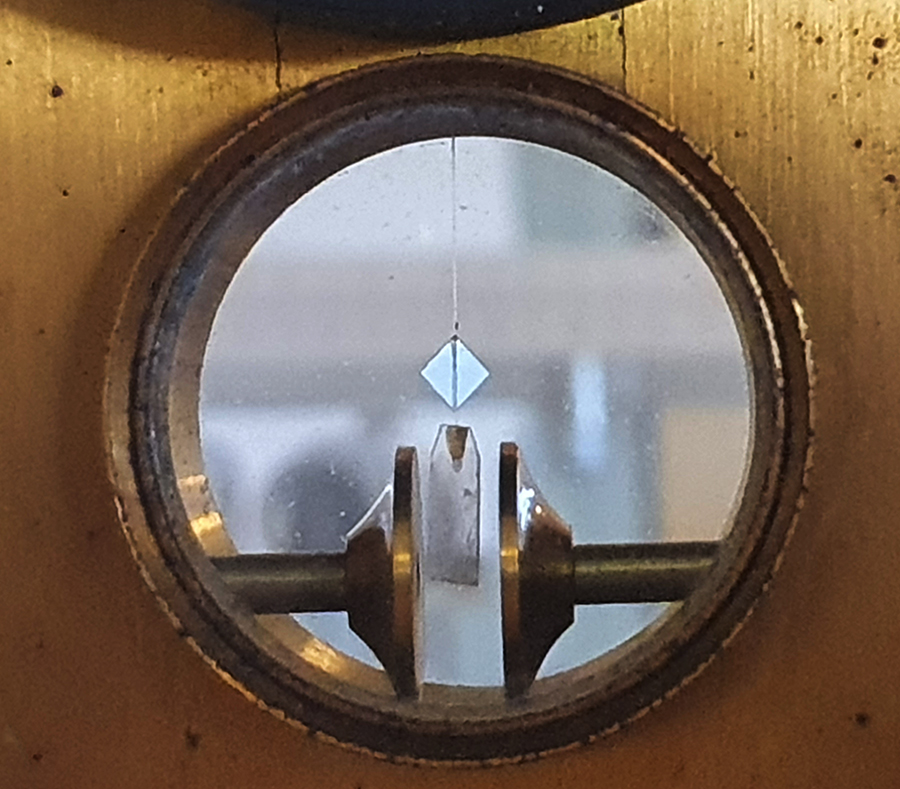
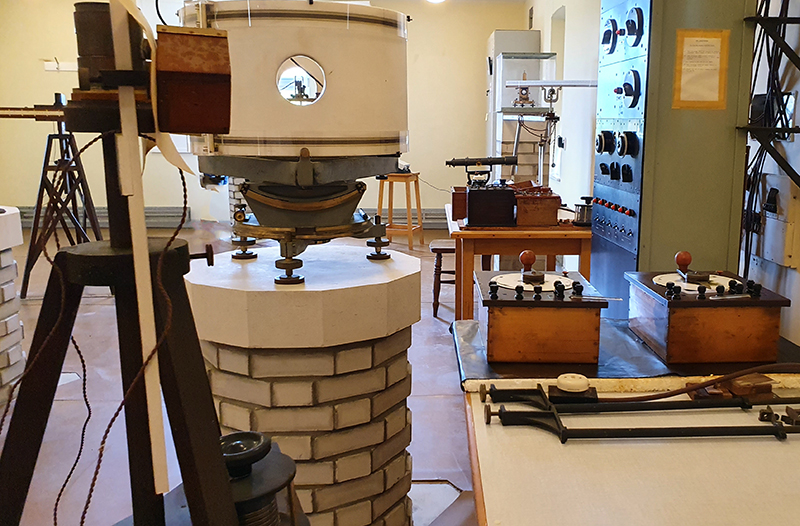
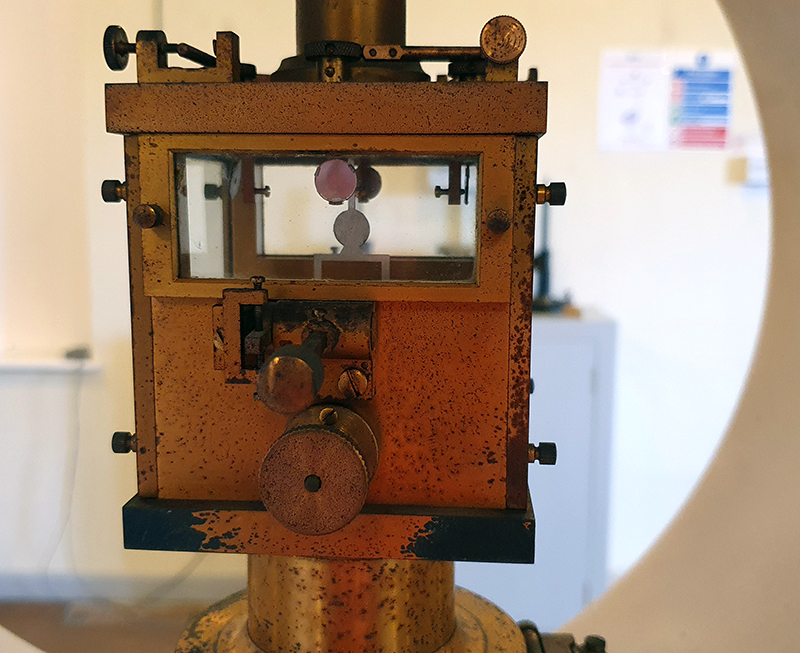
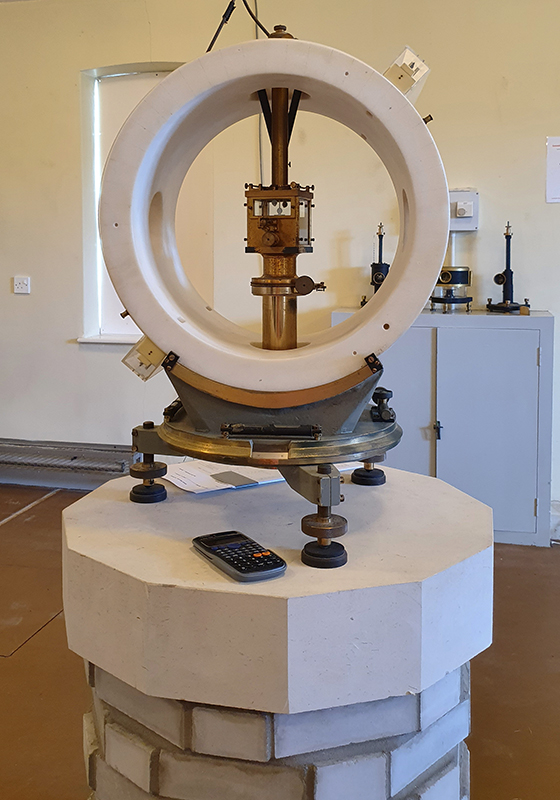
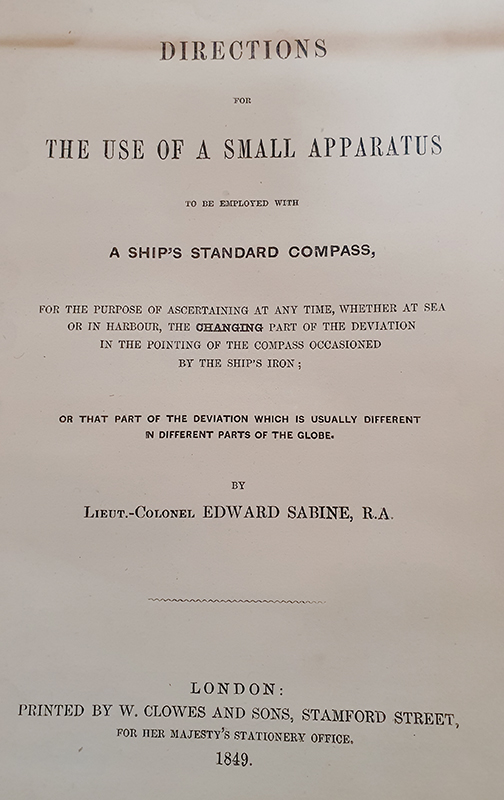
The manual instrument is a fluxgate theodolite housed in the Absolute Hut looking out of the North facing window. It sits on a lime brick and concrete pillar. This instrument has a magnetic sensor mounted on the non-magnetic telescope of the theodolite to detect when it is perpendicular to the magnetic field vector. True north is determined by reference to a fixed mark of known azimuth. This was the obelisk though today it is determined by GPS.
Absolute and variable measurements are combined to give a full record of the field.
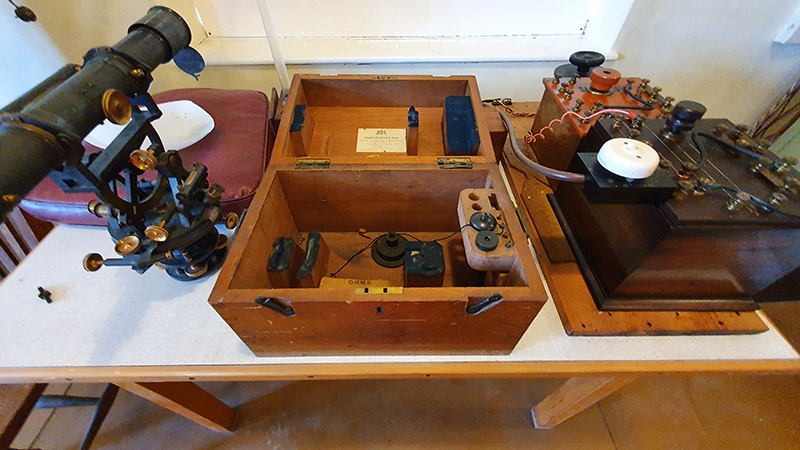
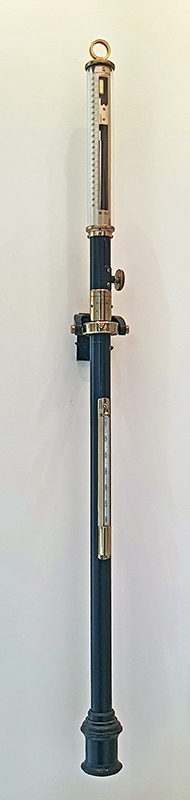
It used to be that all the measurements were made by hand and this took time and skill to produce accurate results. The beautiful old instruments used still sit in the buildings at Hartland.
The Dye Coil measured the strength of the field in the vertical direction, using a coil that vibrates in the presence of a magnetic field as the sensing element. The Schuster-Smith magnetometer measured the strength of the field in the horizontal direction, using a magnet, a mirror and a light source to make a sensitive detector. The decinometer measured the angle between true and magnetic north using a freely suspended magnet and a theodolite to measure the angles. Three Danish LaCour variometers were kept in the recording house, each measuring the strength of the field, one for the north-south component, another for east-west and one for the vertical component of the field. All three used magnets attached to mirrors, which were free to rotate in the Earth’s magnetic field. A thin beam of light shone onto each mirror was reflected back onto a rotating drum covered in photographic paper. The drum driven by clockwork rotated once a day.
There are also three satellites which monitor the magnetic field from space (though these may only have about three more years of useful life). ESA’s ‘Swarm’ mission is dedicated to the study of the mysteries of the magnetic field which although invisible, together with electric currents in and around Earth, generates complex forces that have immeasurable impact on everyday life.
Using measurements from ESA’s Earth Explorer Swarm mission, scientists have developed a new tool that links the strength and direction of the magnetic field to the flight paths of migrating birds. This new research means that the study of animal movement can now combine tracking data with geophysical information and lead to new insights on migration behaviour.
Hartland Observatory is situated on the dramatic North Devon Coast with stunning local geology. When the Earth formed about 4.5 billion years ago from the collision, accretion and compression of matter it was rock all the way through. Heat from the massive violence of formation along with radioactive decay caused Earth to get hotter and hotter. After about 500 million years as a rocky lump it reached the melting point of iron. Known as the iron catastrophe this liquifying caused planetary differentiation to occur as lighter material rose to the surface becoming the mantle and crust while heavy metals sank to the core becoming the churning dynamo powering the magnetic field.
During my visit the weather was kind and so I was able to fly my drone around the cliffs and rocky bays. I am still terrified of disaster every time I take it out, compounded by almost getting caught out by the incoming tide but I did get some useful footage for my ‘Belly of a Rock’ video sculpture I am working on.
When night falls after a warm day at certain times of year bioluminescence can be experienced at high tide in Hartland Quay. A young woman, and her mother (who swims across the bay at night here regularly) invited us into the pitch darkness to see the green sparks fly as we splashed in the rising water. It was incredible to witness. Swimming in the water limbs are coated in a luminescent glow. I tried to film the flashes on my phone and thought I had been unsuccessful as what I captured appeared totally dark. However, back at home I tried pulling out what information there was on each frame and managed to get a film sequence that might not show exactly what I saw but has an essence of the experience.
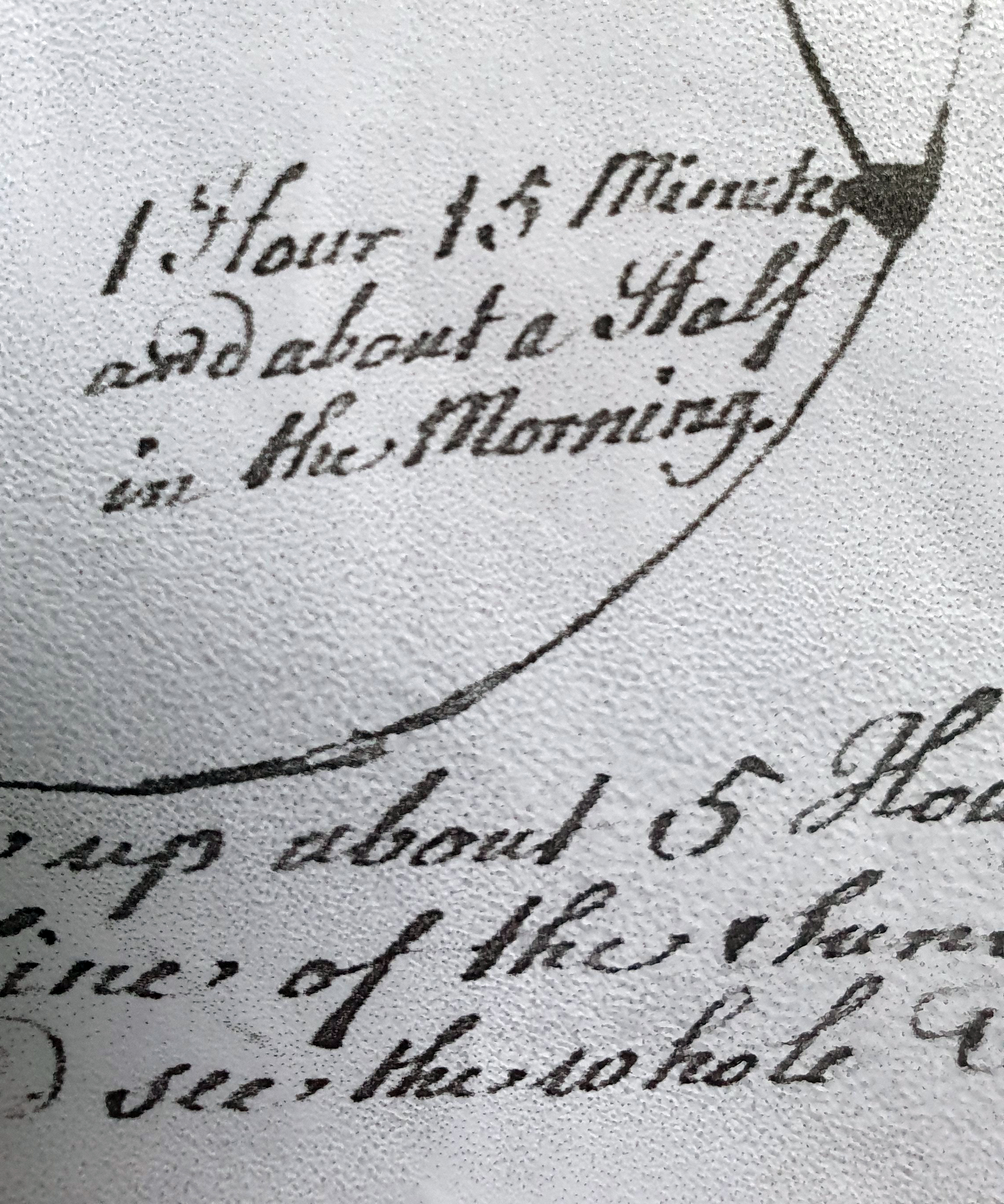
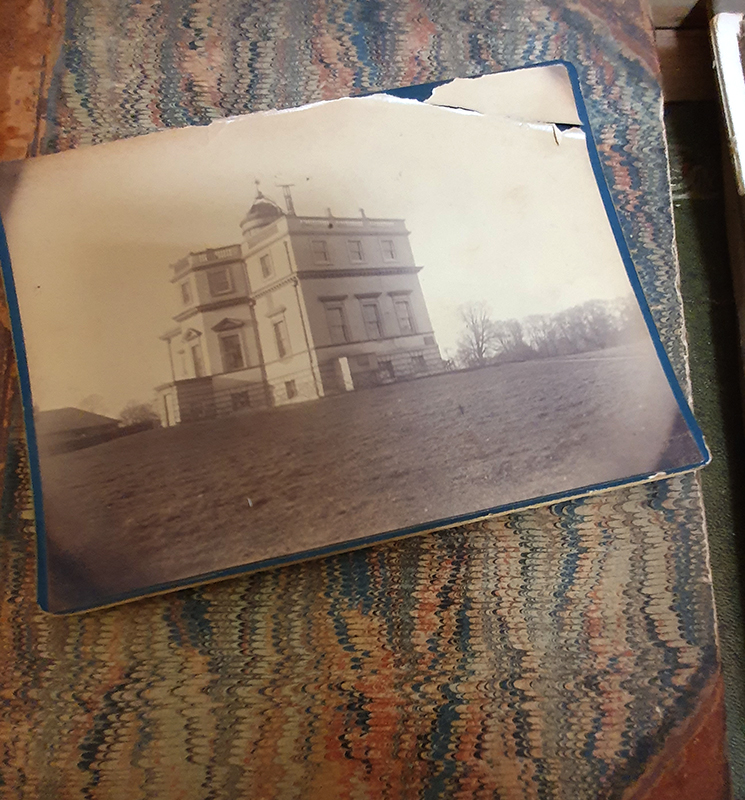
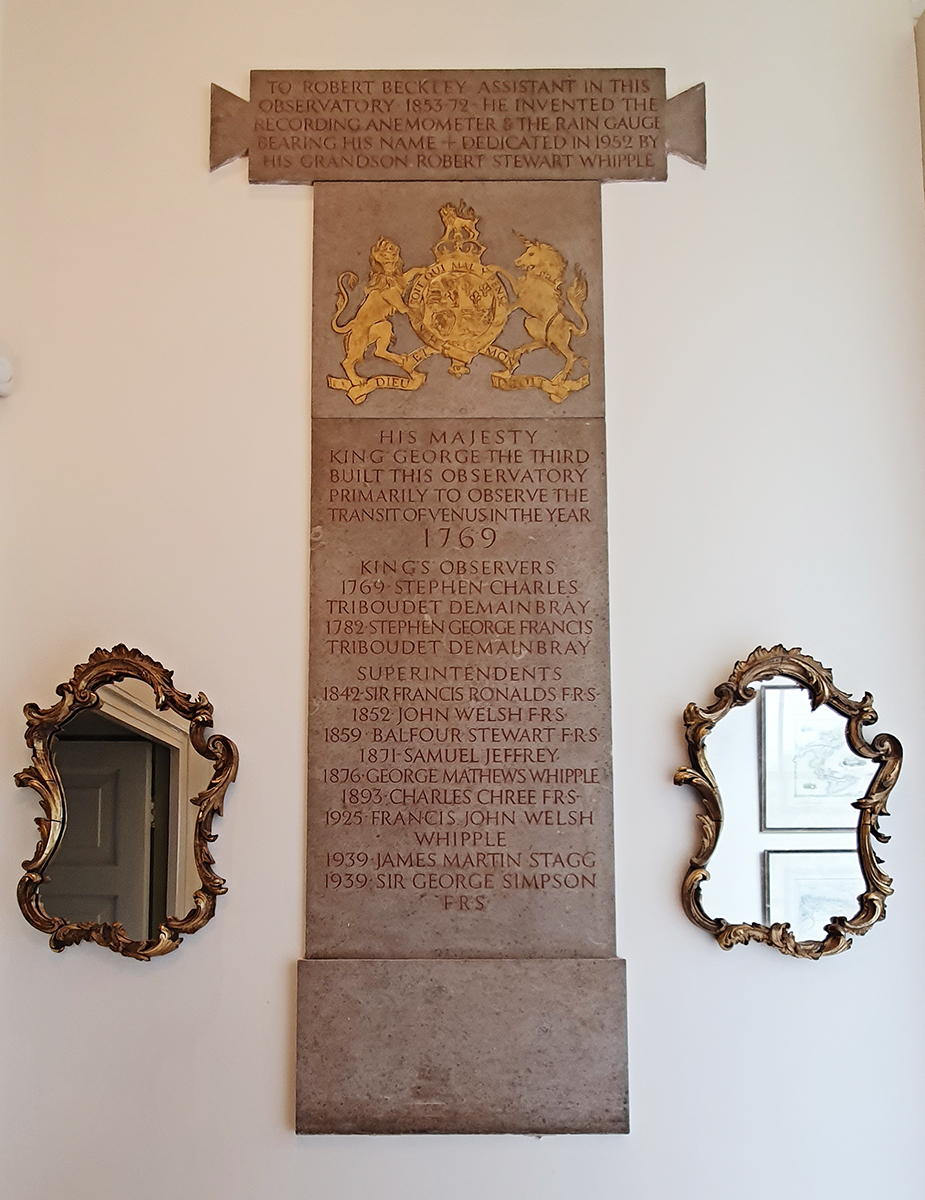
Visit to The King’s Observatory built by George III for the purpose of observing the transit of Venus across the sun in 1769. This observation allowed measurement of the distance from Earth to the sun, later named as the astronomical unit at around 150 million kilometres (8.3 light minutes).
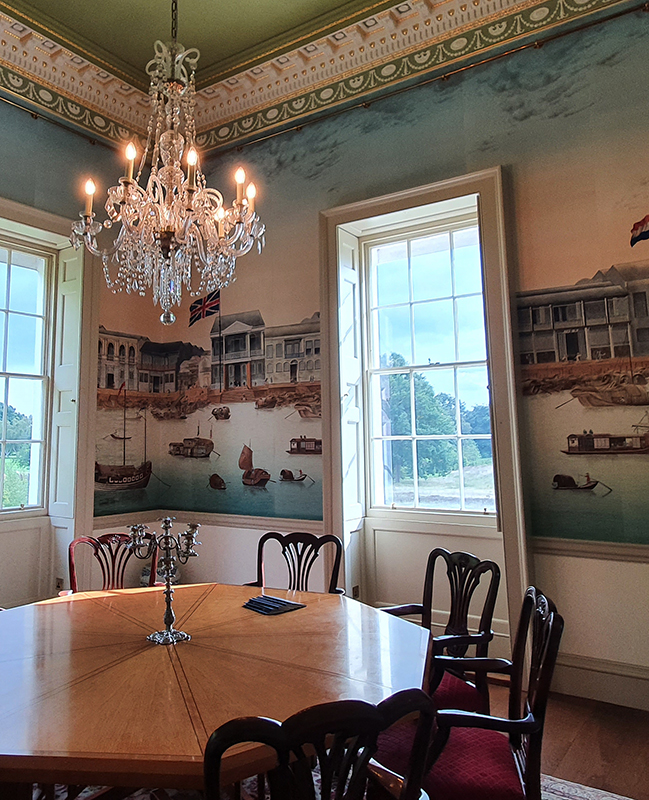
It is now a family home and so the decor although representative of Georgian taste does not reflect the working laboratory that it once was.
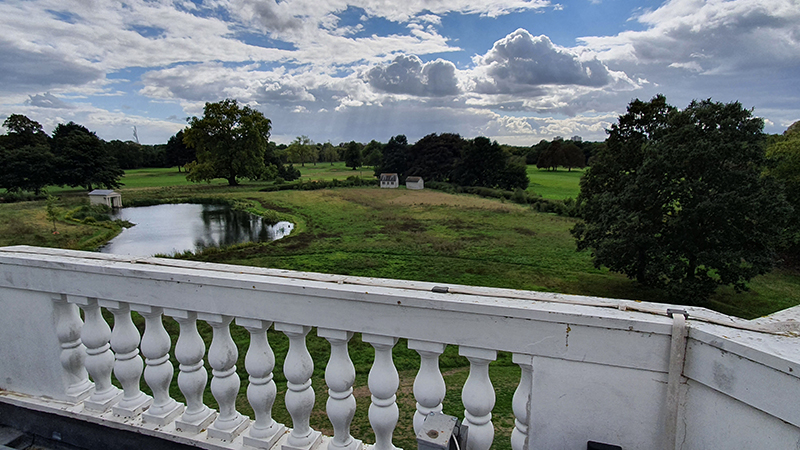
Fascinating to discover it was also the site of the meridian line marked true north-south by two obelisks either side of the west room which housed a tracking telescope. There is a third obelisk due south from the east room which housed a mural quadrant used to measure angles. It wasn’t possible to walk over to the obelisks as the Observatory is in the middle of a golf course now, but there is a path to them via the Old Deer Park which I will walk another day. An accurate clock here provided standard time to the government before the task was transferred to Greenwich Observatory.
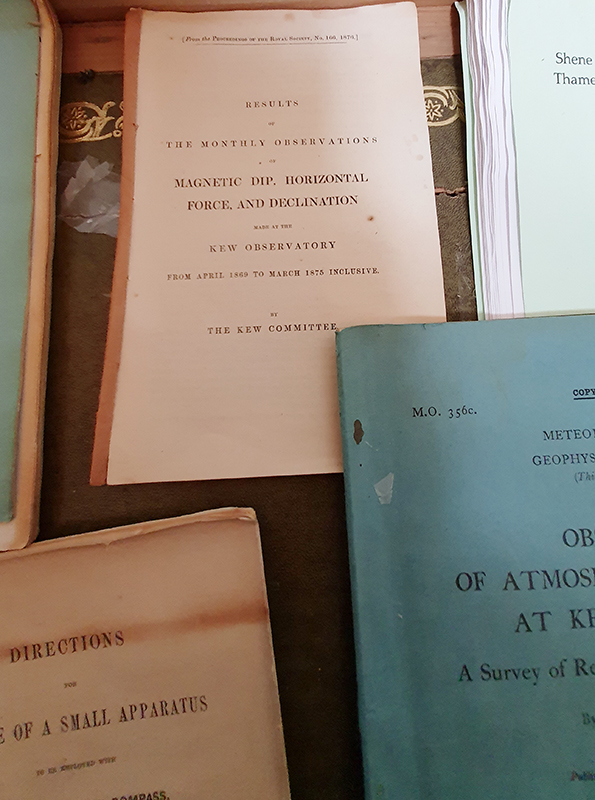
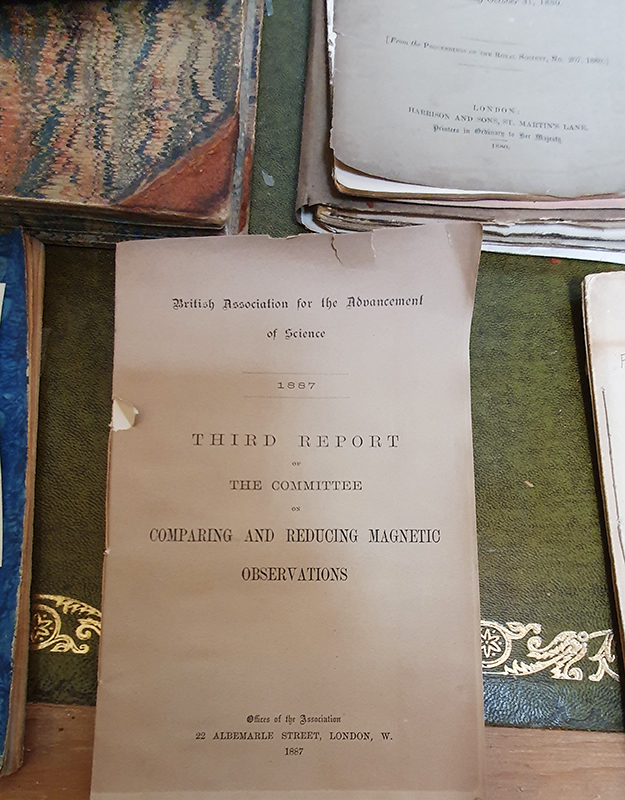
In 1842 it was renamed Kew Observatory and taken over by The British Association for the Advancement of Science. The Meteorological Office was based here, making regular records of the weather from 1773 until 1980. It was also home to the National Physical Laboratory between 1900 and 1914 when scientific instruments were checked for accuracy and stamped with KO, a hallmark of excellence if they passed.
The two huts remaining in the grounds were used for meteorological and magnetic observations and are built with no nails which might interfere with the instruments used within.
Francis Ronalds, director at Kew Observatory from 1842, invented several camera designs subsequently used in both weather forecasting and in understanding the perennial perturbations in terrestrial magnetism. Photography was used early on in its development for use in scientific investigations. Ronalds’ first instrument captured observations from his atmospheric electricity apparatus. He went on to record atmospheric pressure and temperature using the same method and had soon extended his approach to geomagnetism. His magnetographs “established the standard technique employed for magnetic observatory recording worldwide for more than a century” – Encyclopedia of Geomagnetism and Paleomagnetism.
In 1908 the geomagnetic instruments were relocated to the magnetic observatory established at Eskdalemuir in Scotland to undertake magnetic work for which Kew was no longer suitable after the advent of electrification in London led to interference with their operations.
Ronalds had also established an atmospheric electricity observing system at Kew with a long copper rod protruding through the cupola dome of the observatory connected to electrometers and electrographs to manually record the data.
Lord Kelvin later installed an updated electrical observation system and CTR Wilson (the inventor of the cloud chamber) set up a secondary system using different principles which has been useful in historical air pollution research.
I am extremely grateful to Professor of Chemistry at the University of Oxford Peter Hore for spending time chatting on zoom with me about his fascinating research into the ability of birds to navigate using the Earth’s magnetic field. There is a link to a YouTube lecture by Peter on Radical pair mechanism of magnetoreception here.
Research confirms there is a chemical reaction in the bird’s eye sensitive to magnetic fields as weak as that of the Earth. This happens in an array of reactant molecules which can be changed into extremely short lived radical pairs which are magnetically sensitive. The reaction in the molecules to produce radical pairs is triggered by light from the sun or stars. It is thought that this chemical compass is sensitive to direction not intensity of the field and may use the energy from blue/green photons to power this reaction. During this reaction, as the bird changes direction, some radical pairs perform one way and others another creating difference across the array of molecules which is detected by the bird.
My question to Peter was to ask for his thoughts on whether a bird’s ability to ‘see’ the magnetic field manifests itself visually and if he has any understanding of what the bird experiences. He had to confess that how this sense is experienced by birds is not known but he had done some speculative modelling with a PhD student representing the field as fluctuating visual contour lines mapped over the landscape.
The birds eye is very complex and so there is still a lot to be learned about how this ability functions. Bird’s retinas have rods that are sensitive to light intensity and cones sensitive to red, blue and green wavelengths of light like us but they are also sensitive to ultra violet light. There are also double cones in the bird’s eye and their function is not clear, it could be that these are seconded for magnetic reception at night when they are not active.
Often birds fly high above the clouds when migrating and starlight appears to be enough to trigger the reaction in the molecules. In normal sight chemical messages are sent from the retina to visual processing centres within the central nervous system via ganglion cells. There are many of these ganglion cells in the birds eye and it may be they send the information bypassing any rods or cones. Studies on the retina show a reaction to the magnetic field when blue light is present but the activity has not been traced from the retina to a specific part of the brain yet which might determine if this sensitivity does manifest itself visually.
It is very difficult to imagine a sense we do not have.
Learning the migratory route and destination is vital to birds survival in many cases. Often the young bird will have to undertake the first migratory journey on its own, its parents having left earlier. These instinctive instructions for the journey are passed on from one generation to the next. The genetic instructions are quite broad, leading to a large designated destination zone which could be within a 200 mile radius. However, when returning, along with the hereditary instinct using the stars and sun to navigate the birds also have learnt the magnetic map and can return to the exact spot they left as a fledgling. Young birds in a planetarium will follow the stars if they are rotating correctly.
Peter is a chemist so his interest is in the chemical reactions of the radical pairs but he is part of a wider research group that also looks at this behaviour in bats and fish.
I also asked his thoughts on the human capacity to sense the magnetic field. Unfortunately, although we have cryptochromes in many of our cells we do not have the particular molecule Riboflavin which is the one activated by blue light to become magnetically sensitive. Whether we once had this molecule and lost it or birds evolved this molecule separate to our evolution is not understood but he did believe current research on human brain alpha wave activity in response to the magnetic field might throw up some interesting ideas to look at. A speculative approach to gaining sensitivity to the magnetic field may be by transplanting a tiny compass as used in a mobile phone onto the body, setting it to vibrate when pointing north. The body may ‘learn’ to recognise north in this way.
Listening to The Life Scientific with guest David Eagleman has shed further light on what might be possible as his research shows the human brain can be trained to receive input from alternative sources, for example learning to hear through the skin. He believes it will be perfectly possible for us to experience new senses in the future, including magnetoreception.
Work in Progress
I have been scouring the internet for tips on casting a concrete obelisk and getting an idea of the dimensions. I am thinking about using aerated concrete, for lightness but also to give an appearance of the texture of volcanic rock.
Chemical conversation tests for the video sculpture Belly of a Rock inspired by Italo Calvino The Spiral in The Complete Cosmicomics. “The water was a source of information, reliable and precise [ ] full of substances and sensations and stimuli”
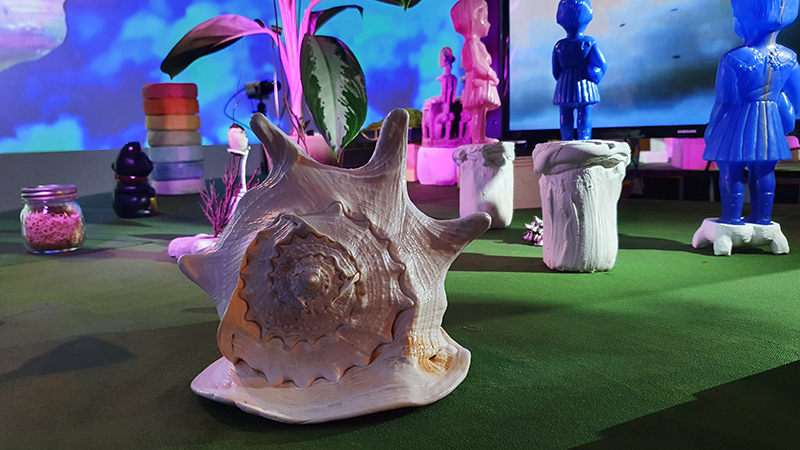
I have been testing paper clay recipes and shapes for the video sculpture Belly of a Rock which will be somewhere between a rock and a mollusc.
Out of Studio
Visit to Richard Saltoun Gallery to see Haptic Vision a retrospective of artists Jo Bruton and Rosa Lee working in the 1980’s and 90’s creating paintings that encourage the eye to wander across a richly textured surface of optical illusions. “The necessity of ‘making’, of being within that space as a primary concern, where the Subject is nearby and woven into the repetitions and patterns of everyday life.” – Jo Bruton, 2022
Eternally Yours at Somerset House reflects upon the hope and healing which can be found in the memories and stories that everyday objects hold in our lives. The repair becomes a shared experience expanding the idea of bonding to include the emotional connection.
I really liked the DIY sensors and data gathering device created by Superflux. Re-imagining technology as a useful tool for communities to gather and share information on the environment, monitor local air pollution and be active in creating a just and equitable society.
New River Folk is the outcome of an Engine House Residency by Laura Copsey and Philip Crewe at the new Quentin Blake Centre for Illustration about to be developed at New River Head, Clerkenwell. This site was part of an artificial watercourse opened in 1613 to supply water to London at first through overground wooden pipes. When more pressure was needed a six-sail windmill pumped water from the site. After storm damage to the windmill in 1720 horses were harnessed to turn the wheel and power the pump. The round base of the windmill remains, and is the oldest construction of its kind in central London. The artists drew on local history around the site, creating an archeology expanding on the lives of Mole Catcher William ‘Mollitrappe’ Smythe, Well-Keeper Black Mary Woolaston and Tankard-Bearer Joan Starkey. They also collaborated with the river itself to create 16mm film imagery and recordings.
I was fascinated by the crystals that had formed on the bricks in the old windmill. The salt crystal growing experiment I set up while planning an exhibition proposal is still sitting in my studio – if it is still growing it is doing so very slowly, the initial growth was surprisingly fast.
Reimagining Joya is an exhibition at Thames-side Gallery inspired by the experiences and artistic responses of a group of artists who have all participated in Joya: Art + Ecology / AiR residency. The curators, Olga Suchanova, Tere Chad and Barbara Slavikova, have selected a body of works which explore the way we inhabit, survey, feel, and relate to the natural landscape and its living creatures.
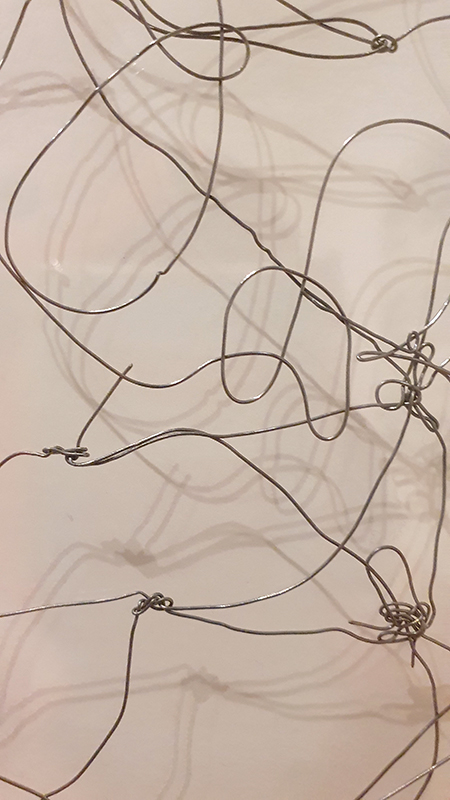
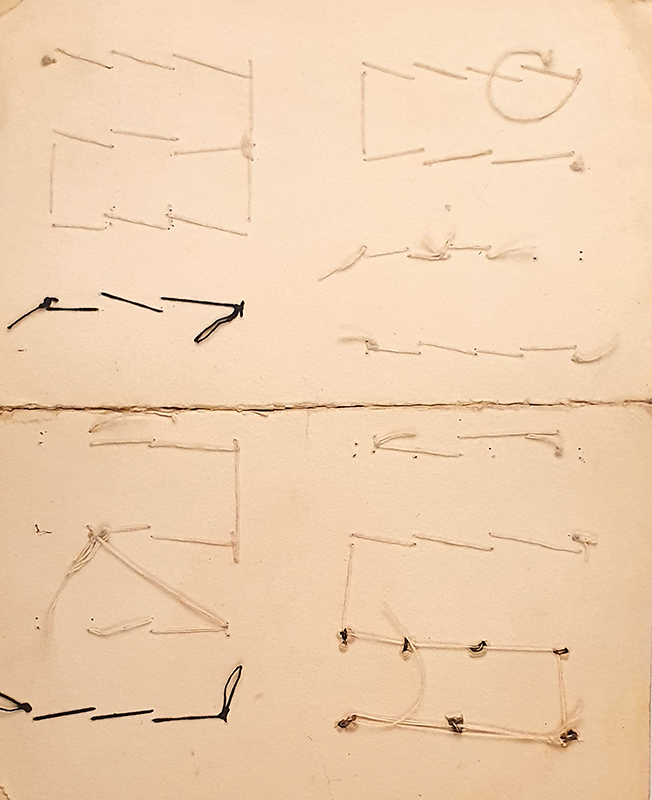
Cornelia Parker at Tate Britain. Simple materials, deconstructed and presented immaculately. I was in awe of the invisible framing of her linen squares and wire grids where the objects appear held against the glass as if by magic. Many works are born in violence, condense violence into form or render it impotent. These include Bullet Drawings using lead from bullets melted down and drawn into wire; shotgun sawn off by criminals sawn up by police; handgun used by criminals precipitated to rust by science engineers. Gentler work included the back of button cards appearing as coded messages or star charts – something I was very familiar with as a child growing up in a village drapers shop.
Forest: Wake this Ground at The Arnolfini, Bristol showing works by Rodrigo Arteaga, Mark Garry, Alma Heikkilä, Eva Jospin, Jumana Manna, Zakiya Mckenzie, David Nash, Maria Nepomuceno, John Newling, Rose Nguyen, Ben Rivers, Ai Weiwei, and Hildegard Westerkamp.
Rodrigo Arteaga burned drawing series Monocultures and Fallen Tree documenting the radical change in the forest floor and threatened indigenous species.
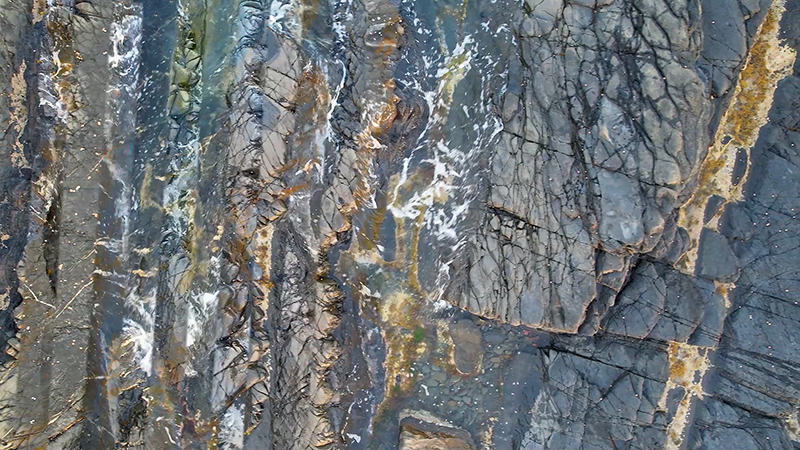
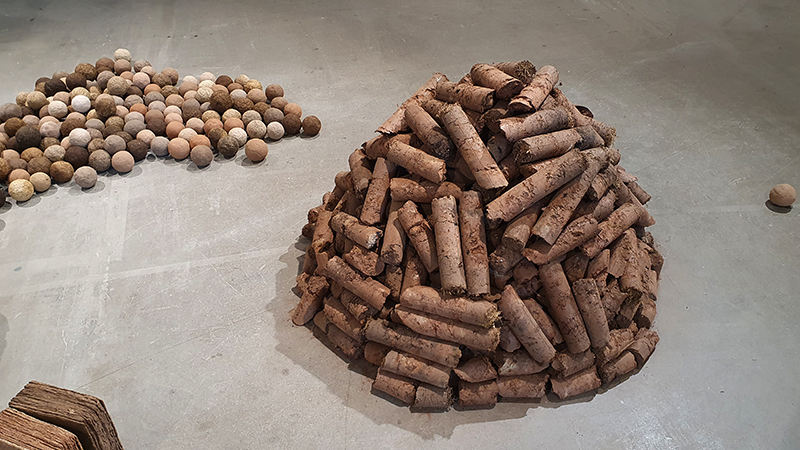
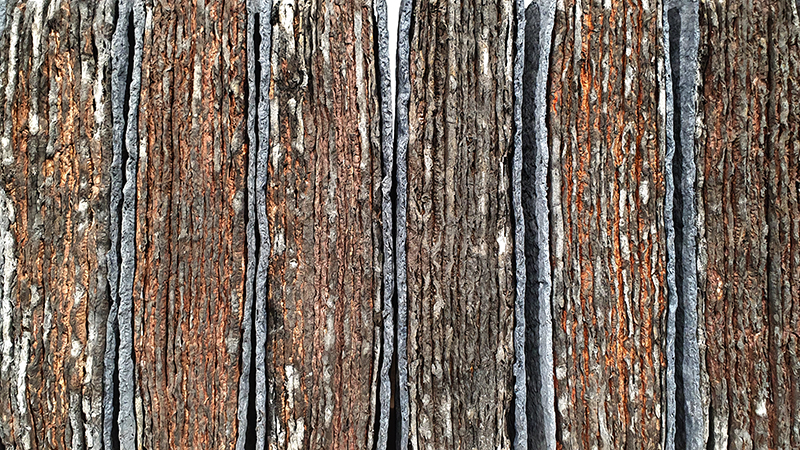
John Newling extracts of soil form his own garden reveals a surprising diversity of minerals in the many colours of the balls and cores. The Night Books burning forests, made from pulped texts, coal dust and crushed charcoal worryingly notes that the work physically released carbon through the process of making. The vertical strata reminds me of the cliffs at Hartland Bay.
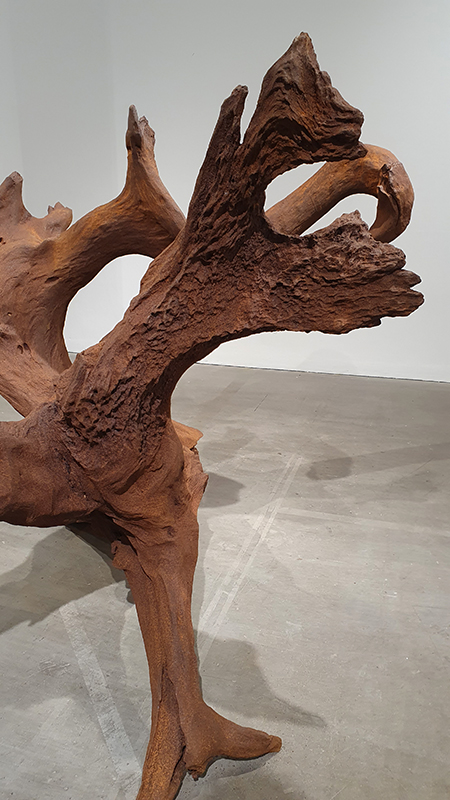
Ai Weiwei cast from the ancient and endangered Pequi Vinagreiro tree (found in the Bahian rainforest), reflect both the uprootedness of arboreal species and the displacement of people.
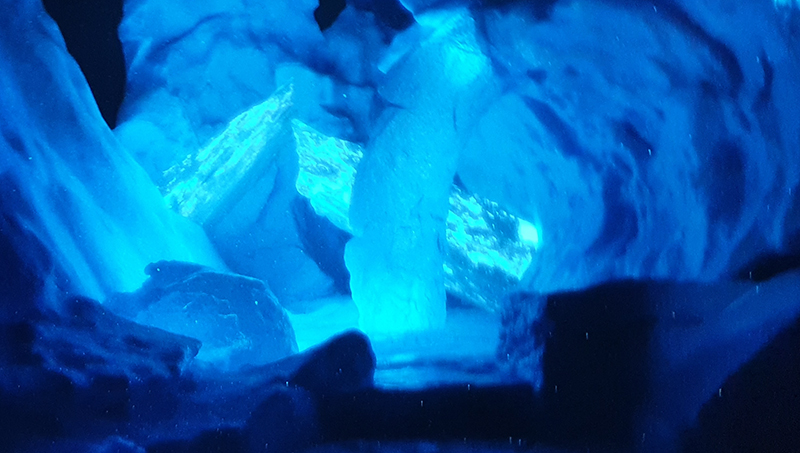
Ben Rivers film Look Then Below shot beneath the Mendip hills and ancient woodland in Somerset, imagines a dystopian but seductive future.
Eva Jospin Forêt Palatine, made from recycled cardboard, at once evokes folklore and decay. I liked the surface texture which in parts almost looked volcanic.
Paths of Resistance by Tracy Hill is a site-specific fabric installation in response to magnetic fields measured in the space at Arnolfini as part of the IMPACT 12 programme of events. The work explores the hidden energies that shape our experience of the world.
Delighted to announce At a Distance has been selected for The Anxiety of Interdisciplinarity exhibition at the Island Venue, Bridewell St, Bristol.
The Anxiety of Interdisciplinarity is an exhibition which seeks to reframe printmaking as a site of interdisciplinarity – a testing ground for ‘The important work…done at the surfaces between adjacent disciplines’ (Carter, 1998). Motivated by the International Multidisciplinary Printmaking Conference IMPACT 12’s theme ‘Merging and Metamorphosis’, the exhibition aims to trace the metamorphosis of conversations between disciplines. Installed at a former police station in Bristol, the Island Venue hosts art works in an outdoor courtyard, police cells and subterranean motor vehicle storage area. The hybrid exhibition includes works of differing materials, scale and dimensions across installation, sculpture, sound, moving image, digital and post-digital media. Curated by Sarah Strachan and Ayeshah Zolghadr.
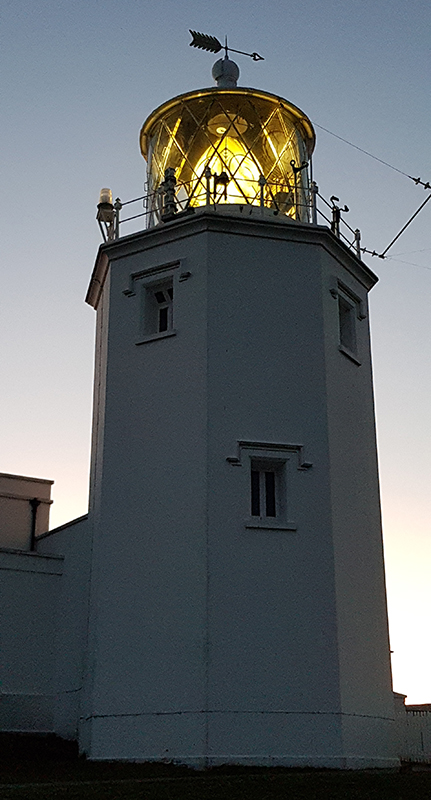
At a Distance looks at remote methods of communication and relates this to the mysterious twinning of electrons in quantum entanglement where particles link in a way that they instantly affect each other, even over vast expanses. Einstein famously called this phenomenon ‘spooky action at a distance’. Filmed in Cornwall on 29th March 2019 (the first date when Brexit was supposed to happen) as the iconic Lizard Lighthouse powers up its lamp, solitary figures using semaphore flags sign ‘We Are One’ out across the ocean in the hope the message will be echoed back. Drawing on the physical language of print that embodies touch, separation and mirroring the flags have been printed using hand painted dye sublimation inks applied via a heat press. This process transfers the ink from a paper matrix onto the substrate textile. The image passes momentarily across space in a dematerialized state as vapour before being reformed as its mirror opposite.
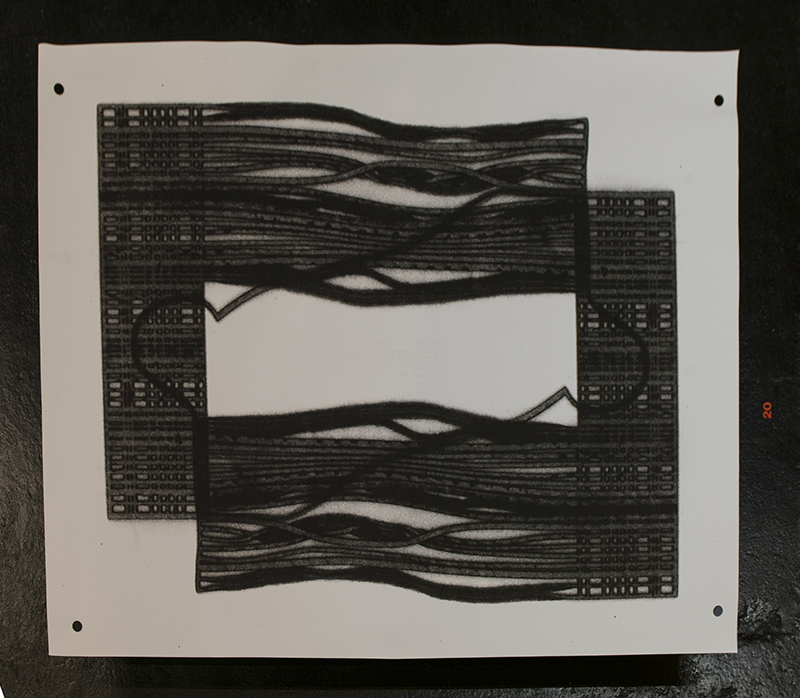
In the studio I have been performing some more test etchings of the directional magnetic steel samples. Copper sulphate seems to give a better result than Nitric Acid. I have managed to gently polish the surface with Brasso without losing the crystal pattern and I gave it a coat of clear lacquer as it seems to rust easily. I am enjoying the excavation process.
The pattern comes from rolling single crystals of an iron silicon alloy into thin sheets to minimise magnetic losses for use in transformers.
There is a link here to quite a cool video showing magnetic wall domain movement with a magneto-optical sensor.
Back in the belly of a rock video editing the footage of iron filings movement over rock like surfaces.
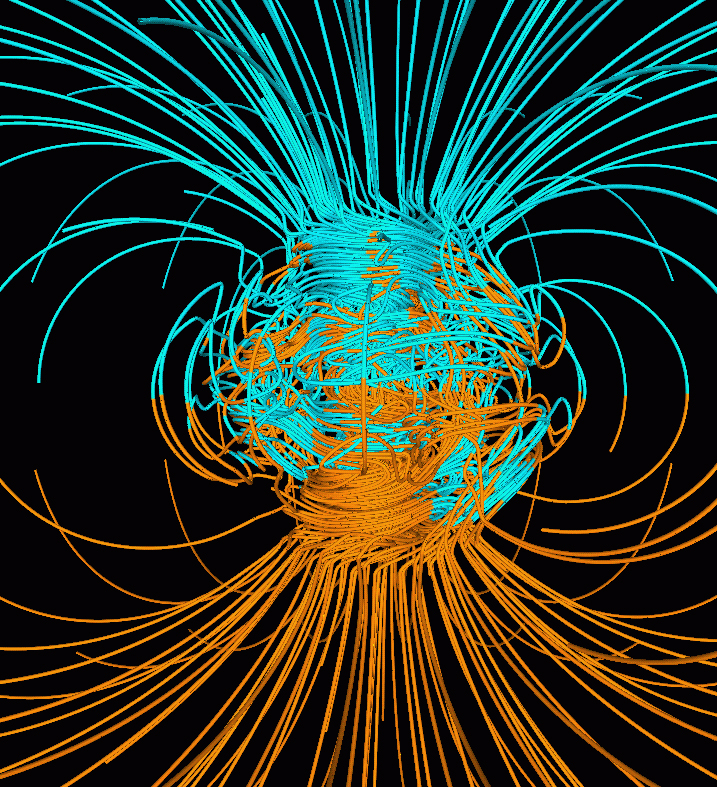
Magnetic field reversals are stored in ancient volcanic and sedimentary rocks. The North and South Pole flip at irregular intervals but average about every 300,000 years. The last one was around 780,000 years ago. During a magnetic field reversal, which can take thousands of years, the magnetic field becomes twisted and tangled, and magnetic poles may appear in unexpected places.
Today the Earth is divided into the super hot inner core, the molten outer core, the mantle, and the thin crust.
When the Earth formed about 4.5 billion years ago from the collision, accretion and compression of matter it was rock all the way through. Heat from the massive violence of formation and radioactive decay caused the planet to get hotter and hotter. After about 500 million years of heating up it finally reached the melting point of iron. Known as the iron catastrophe this liquifying caused planetary differentiation to occur as lighter material rose to the surface becoming the mantle and crust whereas the heavy metals like iron and nickel fell towards the centre becoming the core. This molten mass also contains elements that dissolve in iron such as gold, platinum, and cobalt along with around 90% of the Earth’s sulphur.
Earth’s main geomagnetic field is constantly changing due to convection flows and waves in the Earth’s core. As this change cannot entirely be predicted, uncertainty slowly increases over time. This fluctuation is monitored using The World Magnetic Model jointly developed by the National Centres for Environmental Information and the British Geological Survey. This is the standard model used by the U.S. and U.K. governments and international organizations for navigation, attitude and heading referencing systems using the geomagnetic field.
Took an early morning drive out to Wilder’s Folly. Built in 1769 by Reverend Henry Wilder as a love token for his fiancée Joan Thoyts – it could be seen from both their residencies. First drone flight over a building and over trees. White doves are now resident and thankfully didn’t seem bothered by the drone.
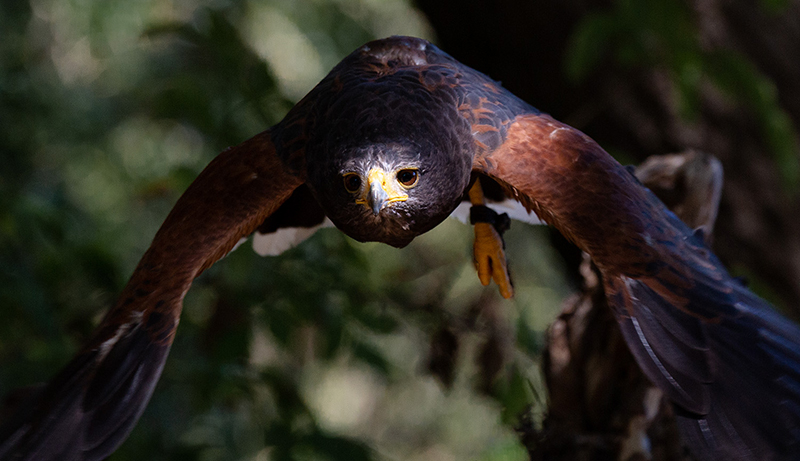
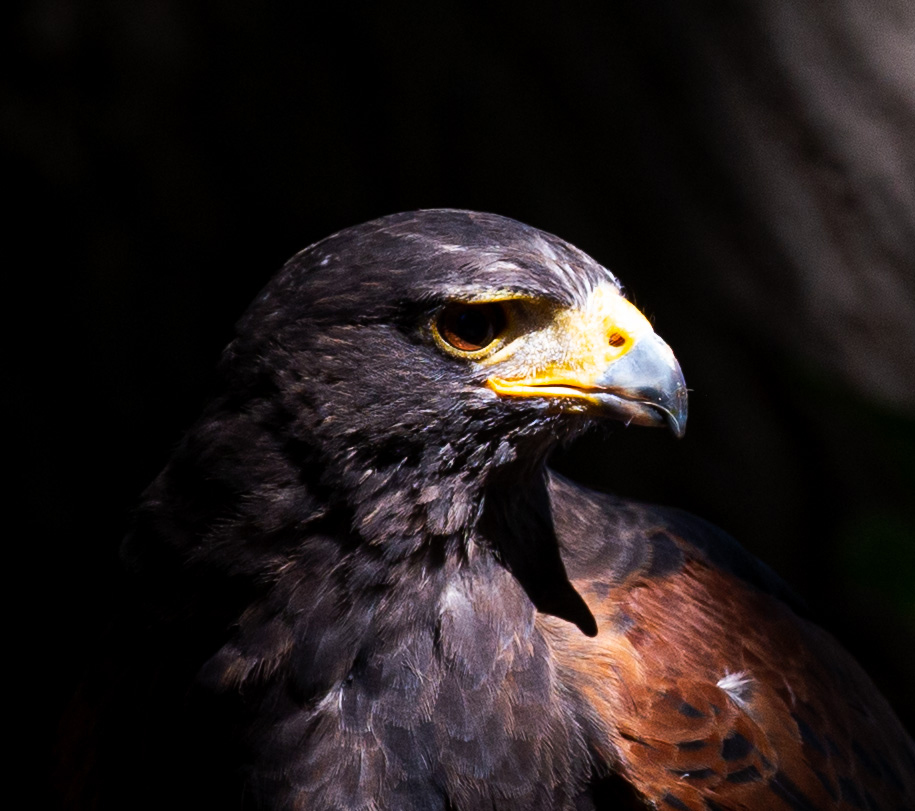
Such a brilliant day meeting and trying to photograph the beautiful birds of prey at Coda Falconry under the expert guidance of Elliot. Lots of advice on hand just need faster reflexes and possibly a mirrorless camera.
Birds appear to be able to “see” Earth’s magnetic field lines and use that information for navigation. Their compass ability comes from a quantum effect in radical pairs, formed photochemically in the eyes.
Gallery Visits
The extraordinary Joe Banks Disinformation The Rapture Live optokinetic video and sound installation at Cable Depot. A special experience to witness this work which has a heady mix of spirituality and mortality. The human voice stretched to primordial sounds as the flesh transcends its halo of fire.
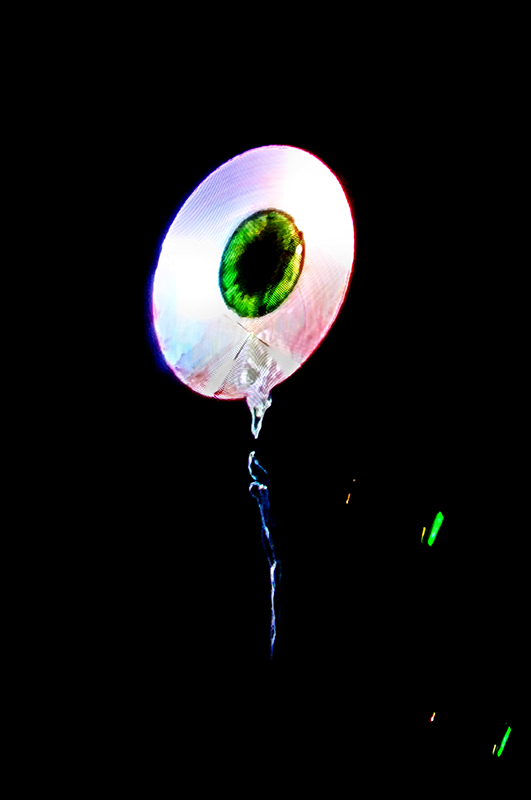
A look at the symbiotic relationship between plants, fungi and humans. The exhibition takes on the entanglement of colonial violence, indigenous knowledge and wildness. How different the world would be if we were also autotrophic. Patricia Domínguez holographic sculptures were fascinating – these are four blades of programmable LED lights spinning at speed to create an image. It was very effective. I was also intrigued by the material construction of the Vegetal Matrix exhibition stands which did look a bit like volcanic stone in the low light though they were listed as MDF with acrylic, so a sort of textured paint.
Wellcome Collection Being Human
Yinka Shonibare’s Refugee Astronaut – “The refugee astronaut is the reverse of the colonial instinct of the astronaut – someone who is going out to conquer the world. What you have here is a nomadic astronaut just trying to find somewhere that’s still habitable.”
Wellcome Collection In the Air
The exhibition explores the relationship between the air and earth, from 3.5-billion-year-old fossilised bacteria that first introduced oxygen into the atmosphere to delicate porcelain sculptures of the glaciers that provide a record of the air and our impact on it.
Stromatolites 350m years old – these are fossilised microbial reefs formed in shallow waters from blue-green algae. These cyanobacteria were some of the earliest life forms and their photosynthesis helped produce the oxygen to support the development of other life forms.
International Airspace David Rickard 2019
This work marks the 100 year anniversary of the signing of the Paris Convention which extended land rights upwards to create international airspaces. The vessel contains air collected from the 27 participating countries alongside photographs of where the air was captured.
Panoramic film installation Air Morphologies investigates the materiality and composition of air pollution particles, their causes, effects and morphological agency. The project addresses how art and aesthetics interact with toxic materials; what kind of stories might be deployed through digital technologies; and how geopolitics are located in atmospheric thinking and being. Air Morphologies was initiated during Matterlurgy’s residency on the Science Technology Society program at Delfina Foundation, London funded by Gaia Art Foundation.
Rachael Allain introduced me to the work of Perla Krauze at Cadogan Contemporary. Earthy work presented simply allowing the natural materials to resonate with their own history and materiality. Real volcanic rock rather than a simulation.
“Using graphite frottages from stones and pavements and engraved volcanic rocks from El Pedregal, her paintings are abstract topographies and mappings. Stone is a fundamental material in her practice; linked to memory and durability, it can also be transformed and eroded. The crosshatch patterns in her paintings derive from the lines made in stone cutting, emphasising the transformation of stone from raw material to art object. Described as ‘grayscale tone poems’, Krauze alters and arranges stones to make miniature landscapes, complete in themselves but still referencing their origins.”
Future shock reimagining our near future at 180 The Strand. An immersive dive into a fairground world of light and motion, entertaining with one or two that stood out beyond technical prowess.
My favourite has its roots in the fashion world. Ib Kamara’s stylish film The Queen is Coming, a collaboration with Abdel El Tayeb grabs attention with its sense of transfixing unease created by the film’s characters via their direct expressions and heightened breathing. Anxiety levels are high. Fantastic.
In Neo Surf a collaborative project between filmmaker Romain Gavras and music producer Surkin the sheer scale of the marble quarry landscape emphasised by lanky teens dancing on the cut blocks is extraordinary and brings home a kind of wild abandonment.
Vigil is an installation collaboration between Ruben Spini and musician Caterina Barbieri. A sunset projected onto suspended melting ice creates a fragmented mirror image across the floor while videos with slow-motion footage of levitating bodies, transcendent synths and haunting vocals add to the sense of a slow death drugged on beauty.
Vortex puffs out a smoke ring every so often which is quite fun. Created by Pablo Barquin and Anna Diaz.
Row by Tundra uses the same holographic projectors as I recently saw used by Patricia Domínguez in Rooted Beings. Here they are interpreting generative data from the 12 notes of the chromatic scale.
Other work at Future Shock includes Weirdcore’s lucid dreaming colourscape Subconscious, Lawrence Lek’s self-driving car animation Theta, Actual Objects mildly interactive installation Vicky, NonoTak’s Daydream V6, Ibby Njoya’s colour box experience named after his influential father Mustafa,Vanishing Point from UVA, Object Blue and Natalia Podgorska’s installation of a future where astrologically predicted personality traits are true in What Melissa Said, Ryoichi Kurokawa and the shifting planes of light Topologies by UVA,
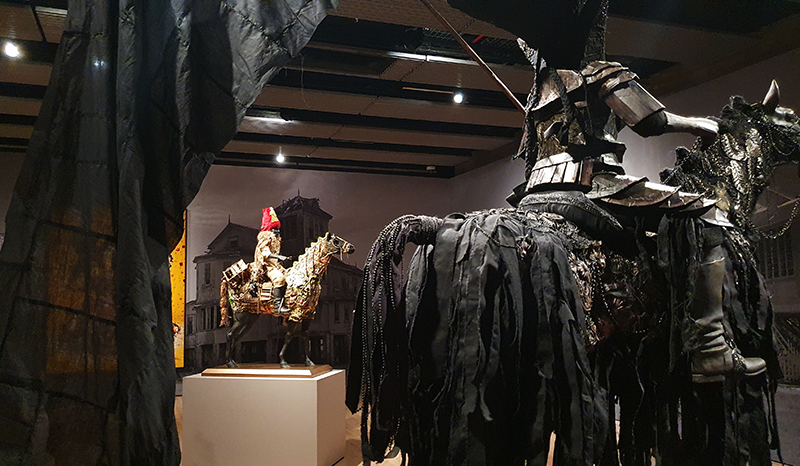
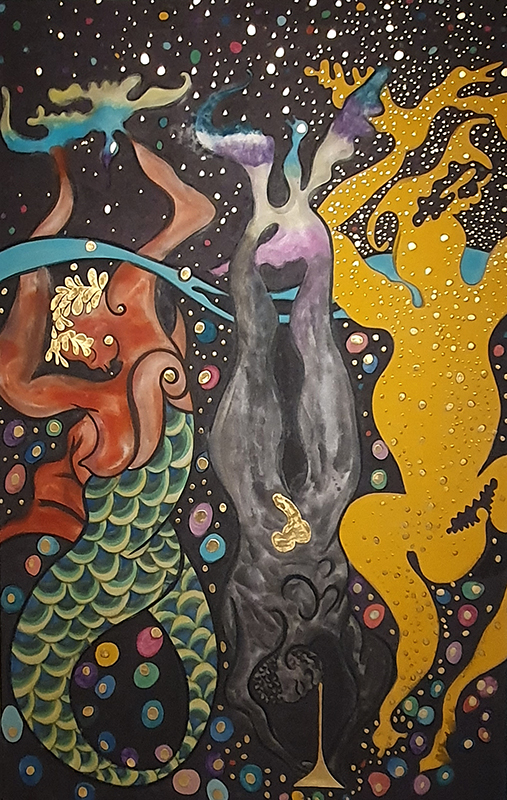
In The Black Fantastic at the Hayward Gallery. New narratives of Black possibility embracing the fantastical not as escapism but as bursting from the constraints of a restrictive society.
The Soundsuits of Nick Cave made as a response to racist violence confer anonymity along with a shamanic power. What a great use of the lace doily. Inspiration for the many doilies I have inherited from my Mum.
Wangechi Mutu collages, Sentinel sculptures and film The End of Eating Everything (featuring Santigold) are drawn from folklore steeped in the grotesque and spectacular. Time to turn from gluttony to restoration.
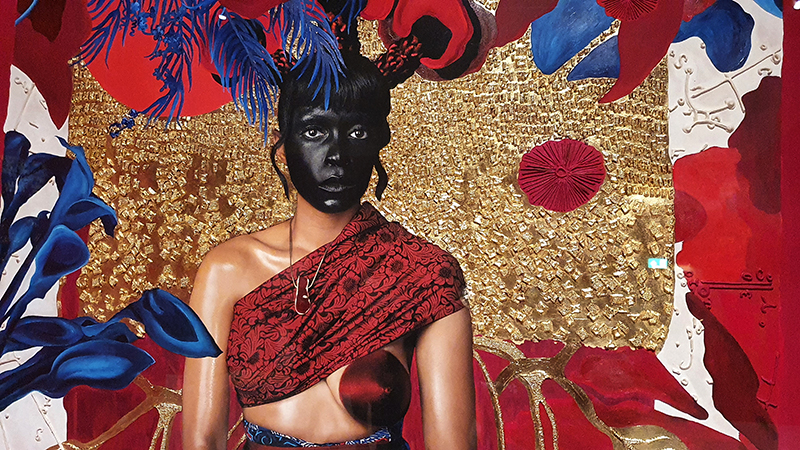
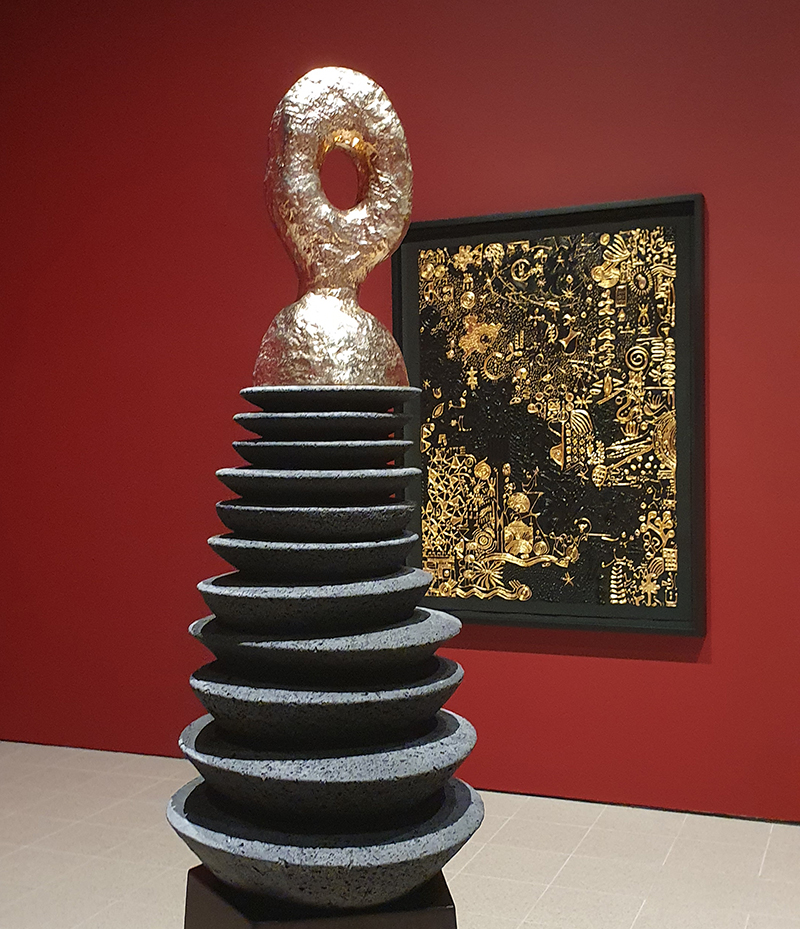
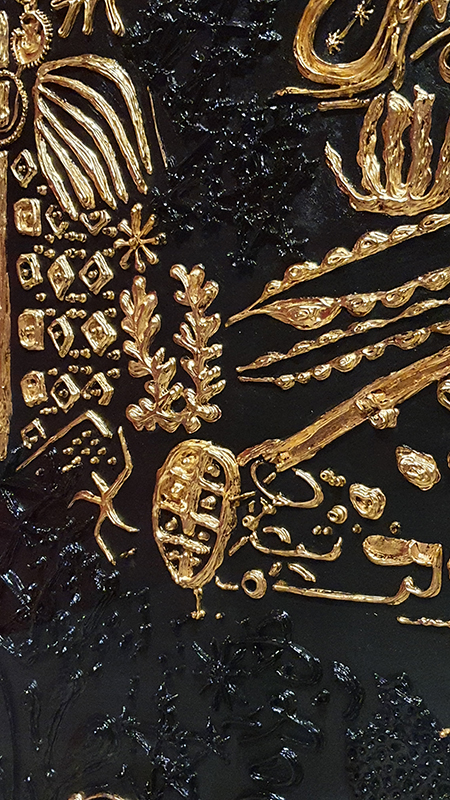
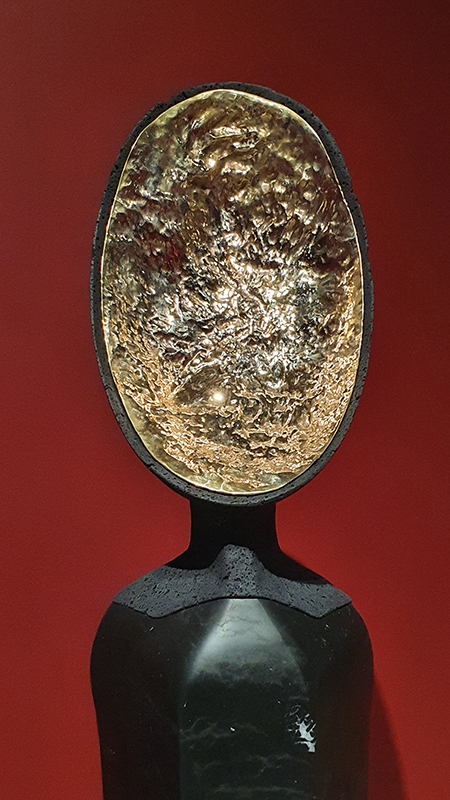
Lina Iris Viktor sumptuous paintings and Diviner sculptures heavy with gold acting as a conduit between heaven and earth inspired by ancient Egyptian funerary traditions. Her dramatic use of rich glossy black signifies the ‘materia prima’ – from which all creation was formed. Fabulous to see The Watcher, The Listener, The Orator sculptures are hewn from volcanic rock. Black gold of the sun.
Hew Locke’s The Ambassadors, a procession in search of future lands carrying their precious history with them echoing down the ages to Hans Holbein the Younger’s painting of the same name made in times when colonial foundations were being laid.
Cauleen Smith created an intriguing installation Epistrophy which refers to a phrase in literature or music repeated for emphasis. Her archive of associations are elevated into cinematic stardom by a series of live feed CCTV cameras which relay the objects onto the big screens becoming larger than life.
Other vibrant works include those of Rashaad Newsome, Tabita Rezaire and Chris Offili.
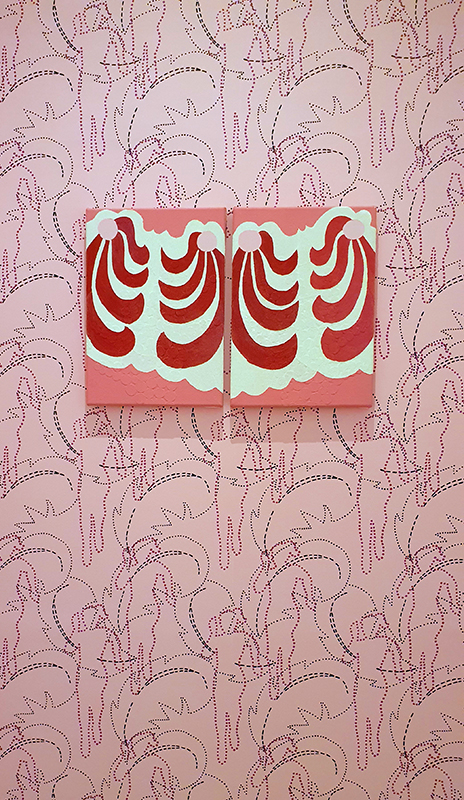
Directed to The Swimmers Limb by an attendant who said rather harshly ‘there’s not much to see’ I visited Gallery 31 dedicated to the Somerset House Studio artists where Mani Kambo has designed a ‘psychedelic’ wallpaper on which hang prints by Tai Shani from her feminist mythology series. Pattern, symbols and ritual. Plenty to see.
Carol Wyss The Mind Has Mountains at The Swiss Church. Having seen this powerful work at Ruskin’s House on Coniston Water last year in a very different space – very like the inside of a skull, it was rewarding to be able to see it in a larger space with a little distance which brought alive the mountainscapes within us. A film of the very physical etching, printing and installation process made by Peter Bromley entitled Carol Wyss – In Situ was screened to an amazed captivated audience.
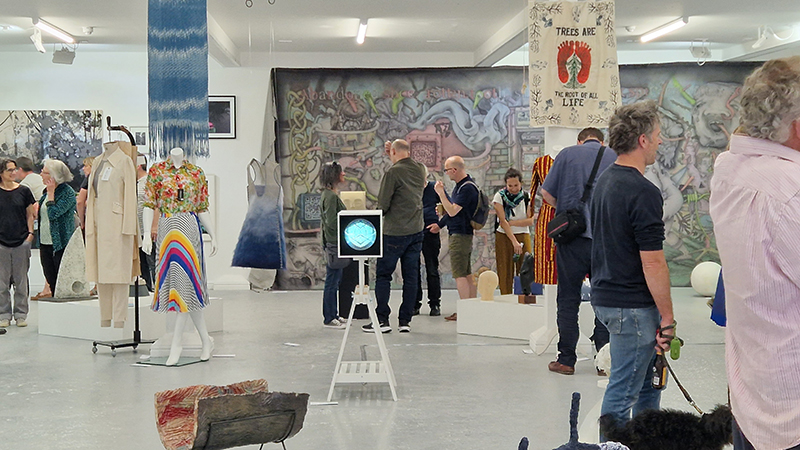
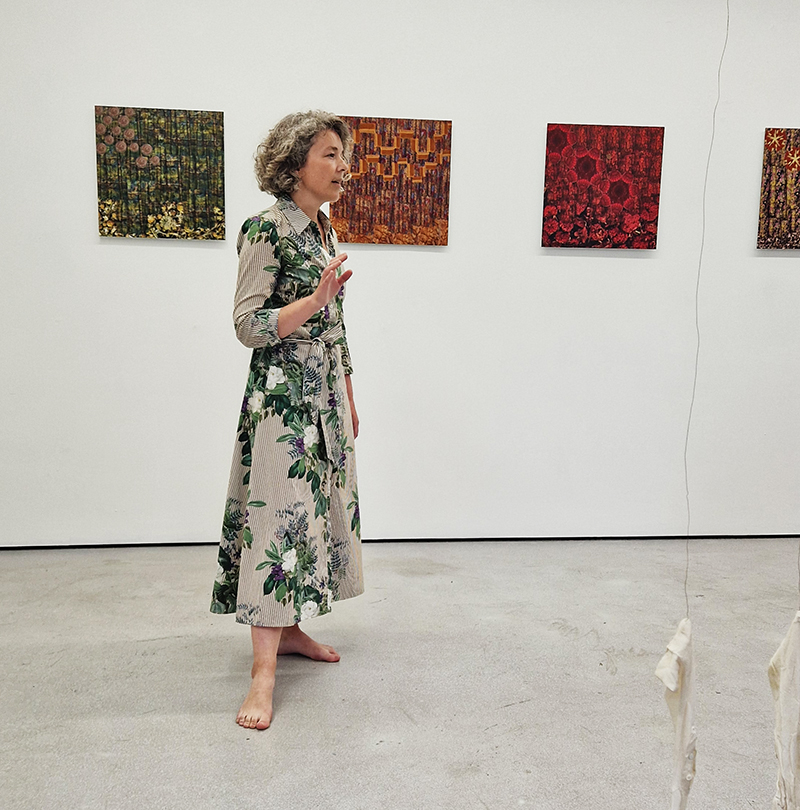
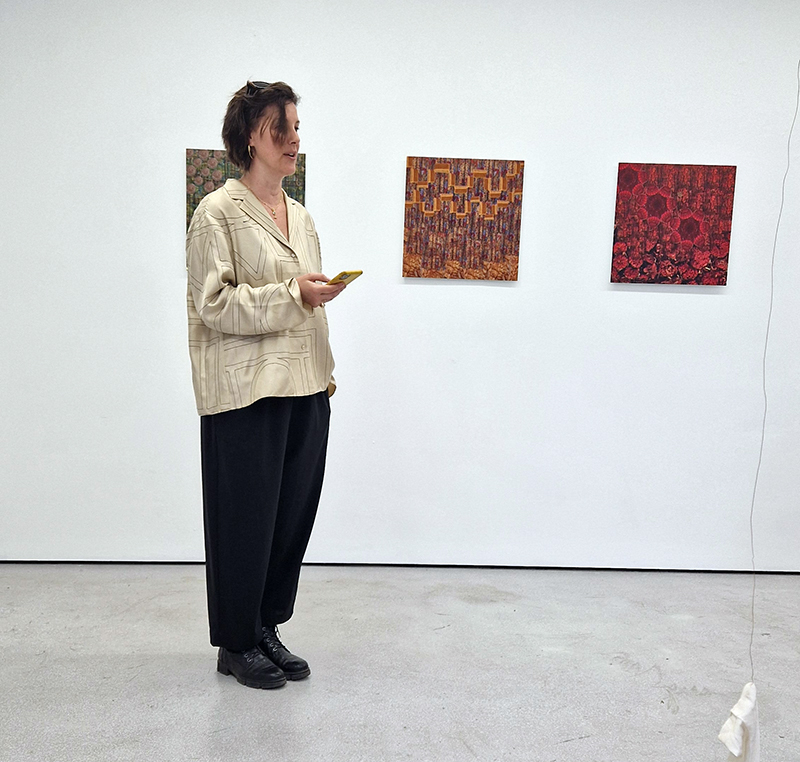
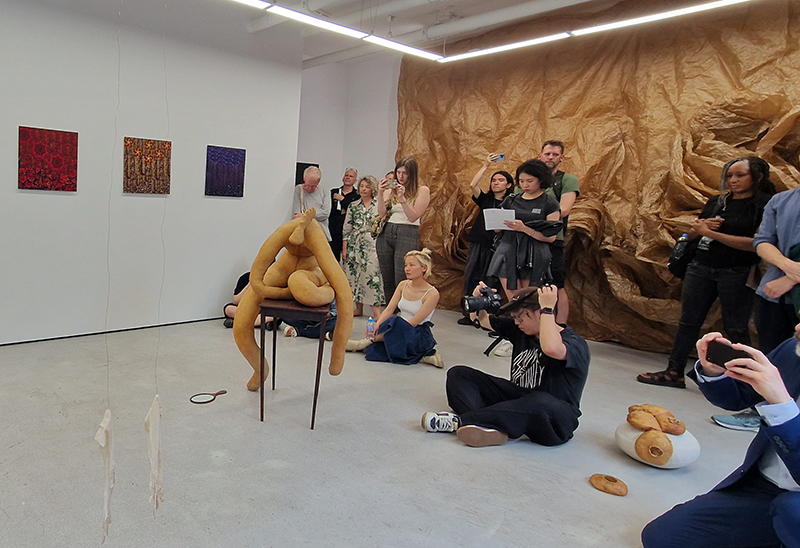
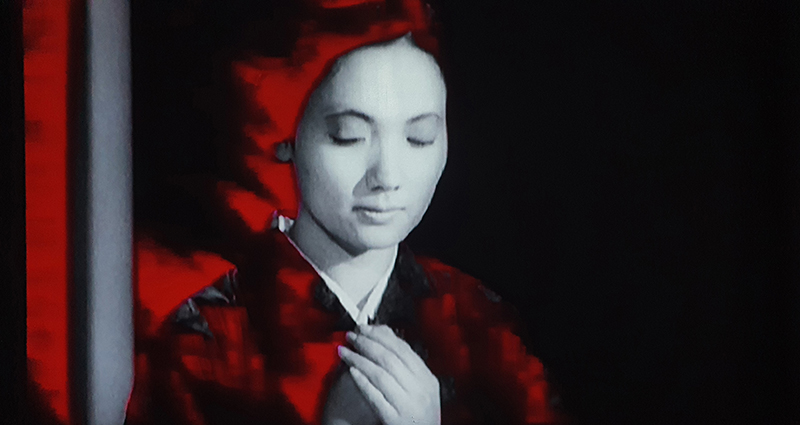
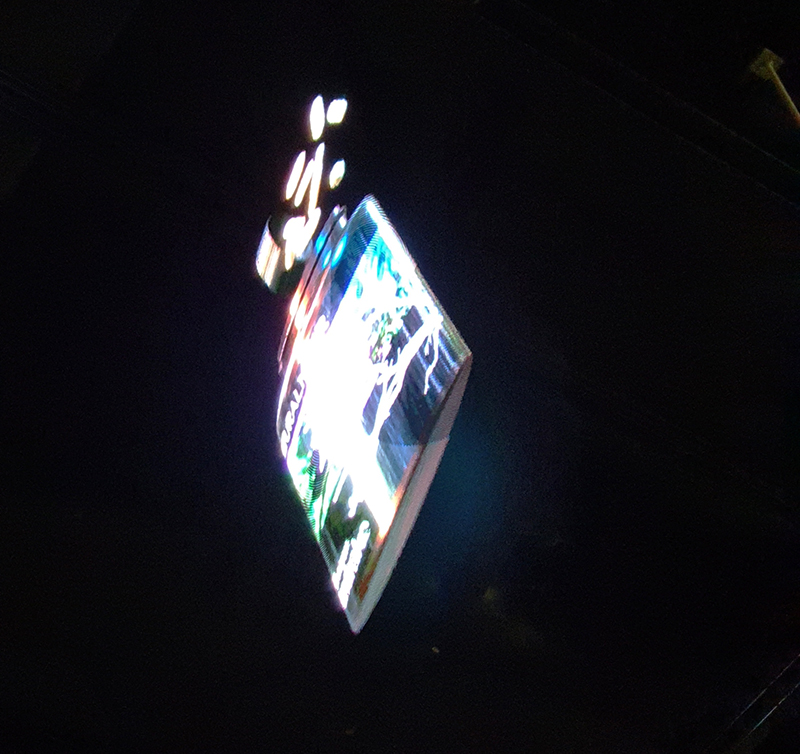
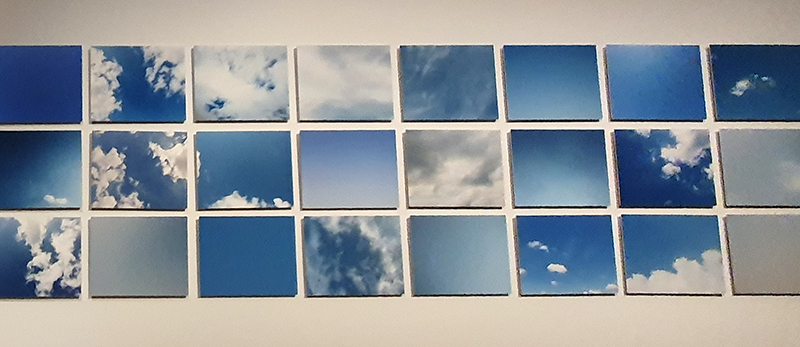
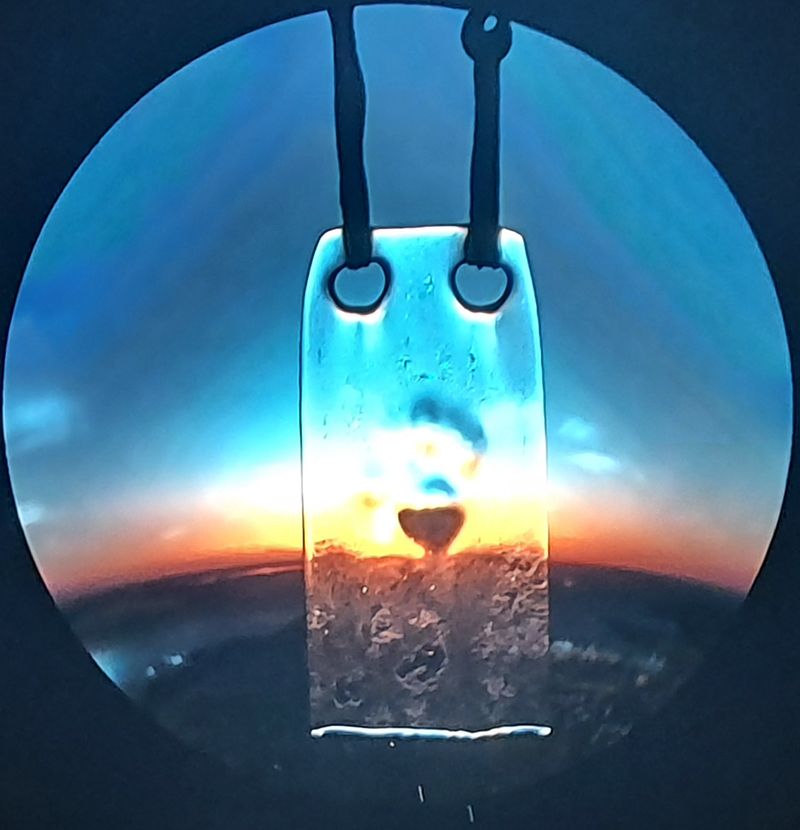
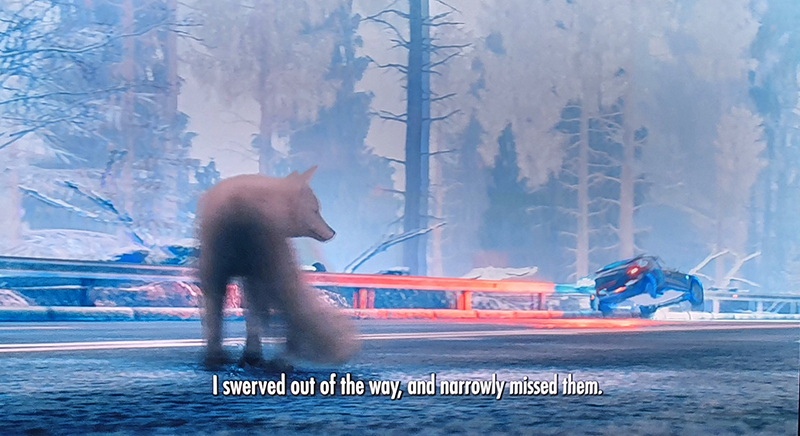
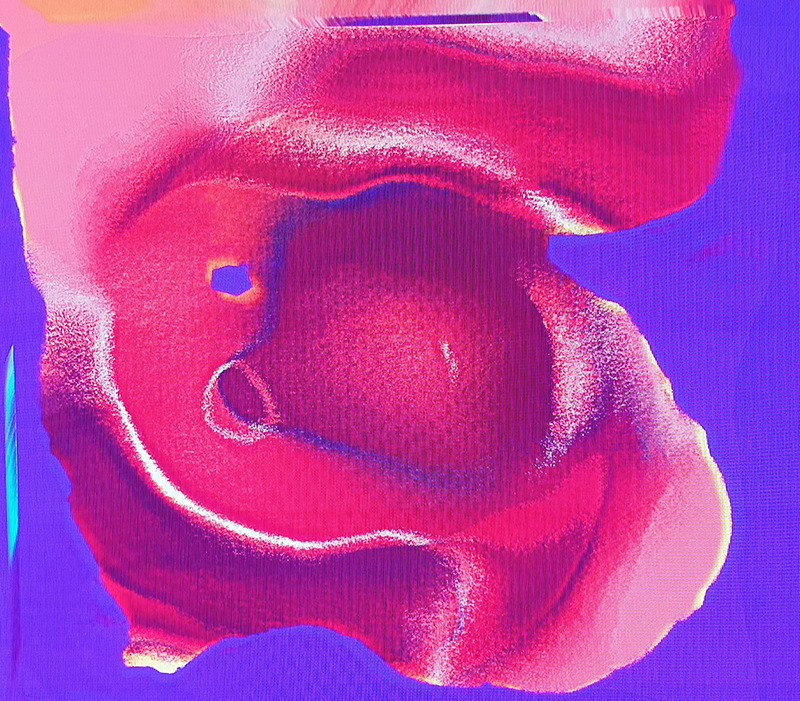
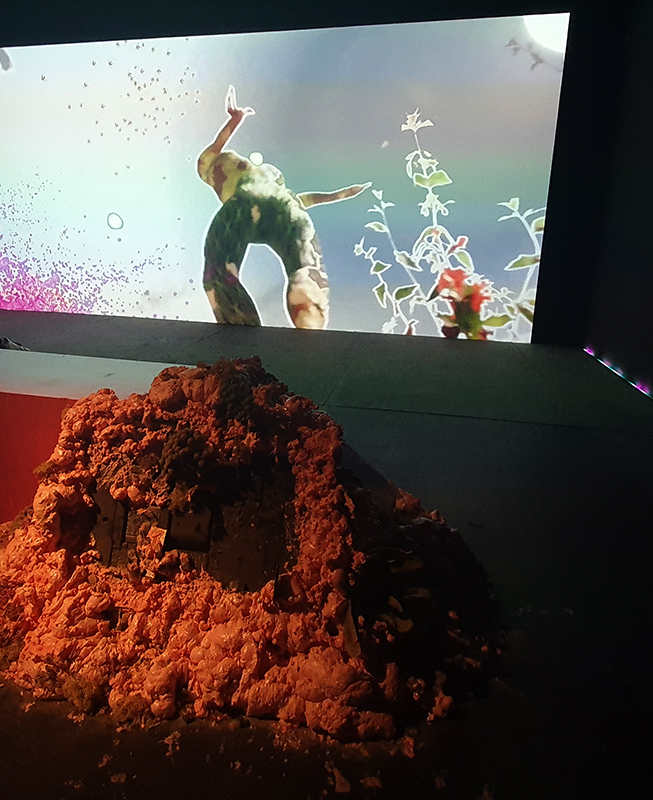
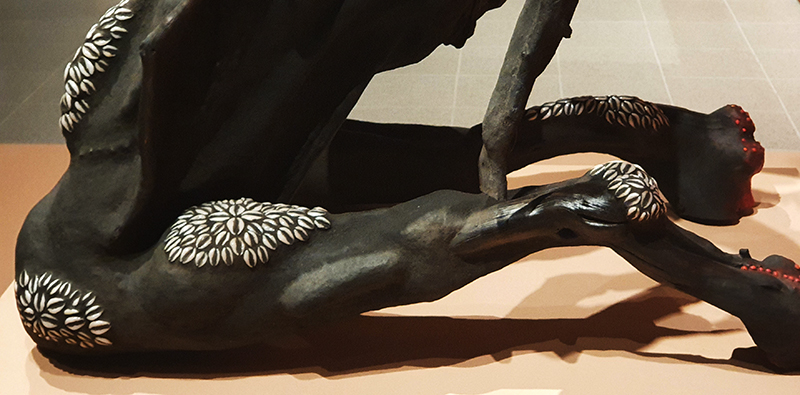
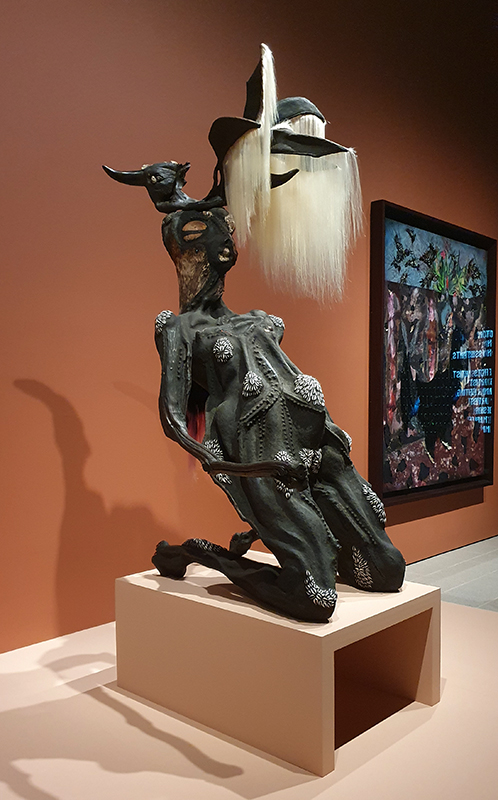
Delighted to be included in Visions In The Nunnery at Bow Arts and so good to be at the opening with live performances. Robert Luzar with Timo Kube Tracing Someone Else’s Skin and Libby Heaney presenting Top of the Bots karaoke where audience members embody pop idols via AI technology. Bodies touching and people singing seemed illicit and extra joyful. Visions in the Nunnery is Bow Arts’ biennial showcase of international moving image and performance art.
Lead artist for Programme 2 is Nye Thompson. Creating new data-generating artist software systems she explores the hidden impact of new technologies. For Visions she premieres /artefact, an immersive work building a colossal border wall on Mars through satellite and google earth imagery accompanied by a throaty space-filled soundtrack.
For the first time, all Visions 2020 works will also be available online for international audiences and those shielding. The themes of programme 2 include digital mediation, digital infrastructure, the remote gaze, CCTV, borders and separation, other worlds and alternate geographies.
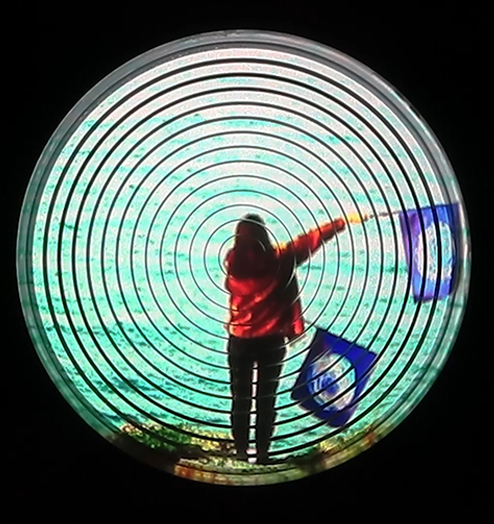
In At a Distance solitary figures using semaphore flags sign ‘We Are One’ out across the ocean. Filmed on 29th March 2019, the first date the UK was supposed to leave the EU.
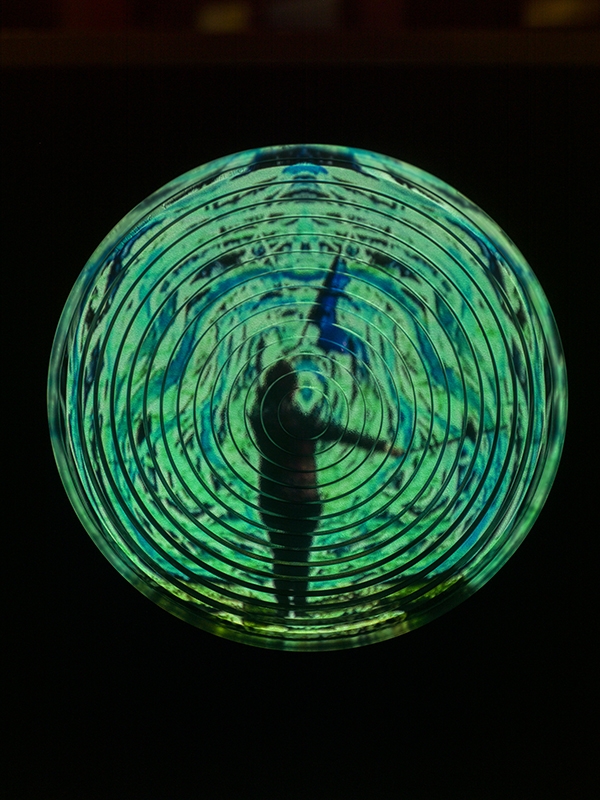
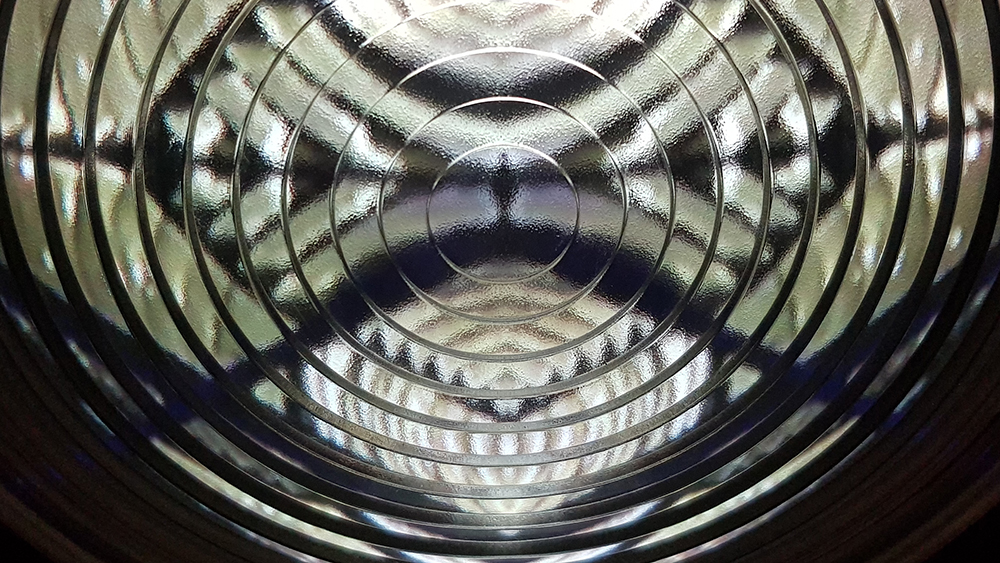
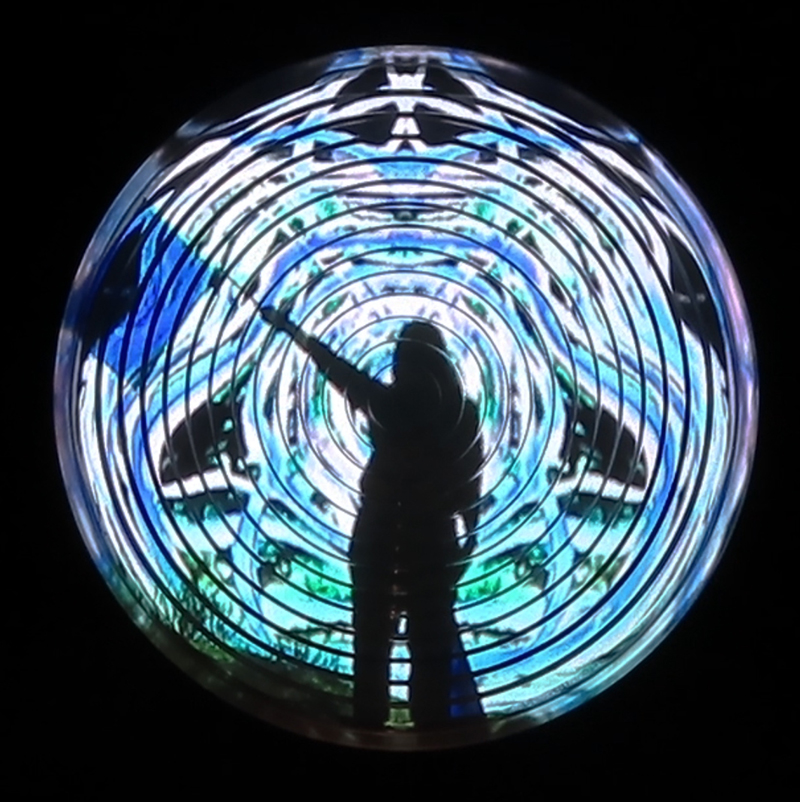
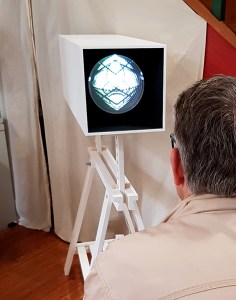
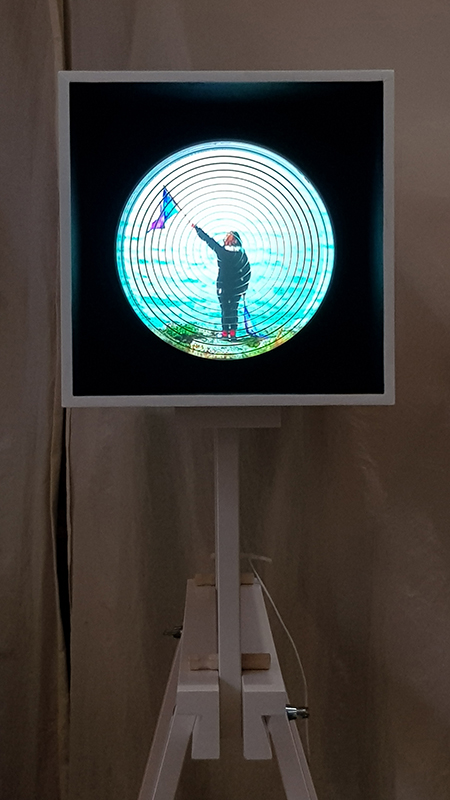
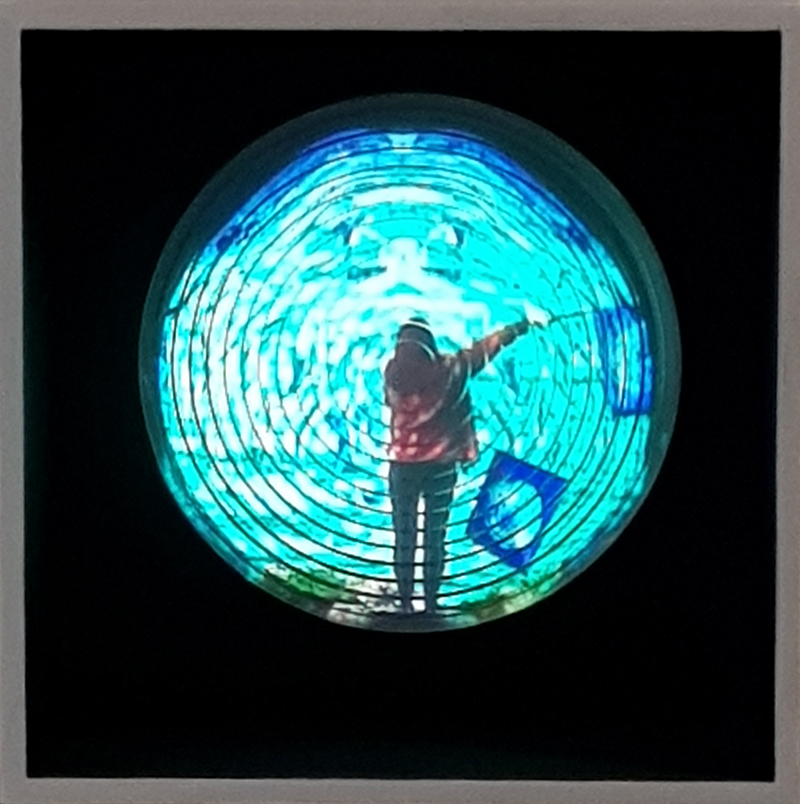
As in quantum entanglement theory where two paired electrons mirror each other at a distance it is hoped the message will be echoed back. This mysterious twinning of electrons where particles link in a way that they instantly affect each other, even over vast distances is what Einstein famously called ‘spooky action at a distance’. The 4m video includes mirrored footage of the iconic Lizard Point Lighthouse and covers the time it takes for the lamp to power up. The video is back projected onto a Fresnel lens, similar to that found in lighthouses to increase luminosity of the lamps beam.
Exhibition and launch images below by Rob Harris courtesy of The Nunnery Gallery.
Updated my website Finding Paradise project pages with Paradise(suspended).
Making (slow) progress on new moving image work Seeker, Seer, Scientist.
We each have a personal distance to the horizon based on our specific height of eye from the ground and the local elevation from sea level at which we stand. It is a place we can never reach as it always recedes as we approach.
Walking East at dawn.
In my enthusiasm I may’ve set off a little too early and some footage has turned out to be rather dark, though passing the Sewage Treatment Works at this hour was an uncanny futuristic experience. It was the hummmm.
Grappling with abstract space as I research for the audio track. Revisiting a lecture I attended at UCL on the 7th dimension by Jason D. Lotay
As you go up in dimensions there are more symmetries that you cannot see. There are special symmetries that only happen in the 7th dimension, this holonomy set of transformations is called G2.
There are 7 new numbers known as Octonians. The symmetry of the Octonians is precisely G2.
M theory unites the various different string theories into one master theory but in order to do this there must be 11 dimensions. These 11 dimensions are the 4 we know (3 dimensions + time) + 7 new dimensions (related to G2) (which I think allows for the multiverse to exist)
The 7th dimension is closely related to soap films and soap bubbles in that these try to minimise their surface area. Seventh dimensional things with holonomy G2 also try to minimise a kind of energy or area.
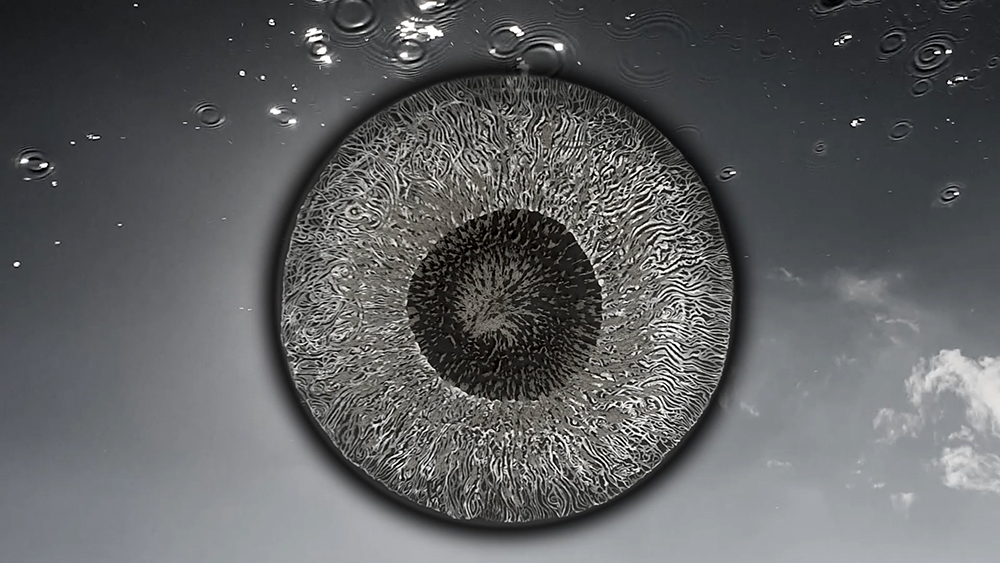
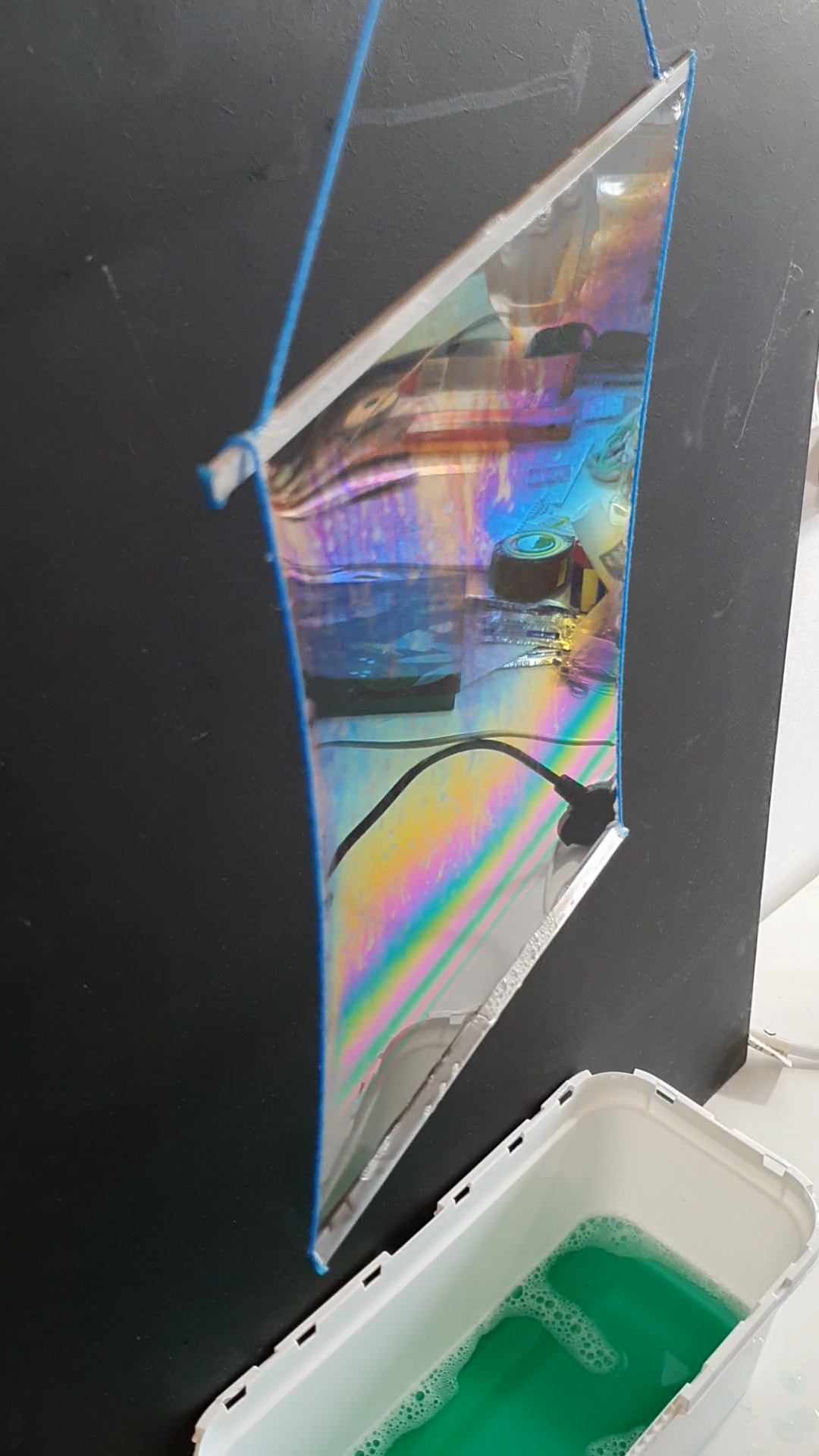
I am continuing to film soap film as light is spectacularly reflected from the surface. The colours depend on the thickness of the water sandwiched between the soap and as the membrane becomes so thin just before breaking the colours fade away.
Trying a new soap bubble recipe with lots more glycerin and a different brand of washing-up liquid. I also have a larger frame for the soap film so I don’t know which factor has effected the results most but I’m getting falling rainbow stripes morphing to grey and black swirls.
Finally ventured back into the Print Studio to clean my screens ready for potential new work. It’s the first time I had been back for months. I’m working on images of glacial water which has been trapped for 80,000 years.
Everything we can see, everything we know exists, makes up just five percent of the matter and energy in the universe.
I watched the live stream Dark Matter Day event live from Sanford Underground Research Facility and Boulby Underground Laboratory and was struck by the use of the word shielding, it’s all about shielding which of course is something we hear a lot about now amid the pandemic. In the case of dark matter detection experiments it is about shielding from cosmic rays. On the surface of the earth 2/3 Muons pass through your hand every second, in the underground labs this is reduced by a factor of 10,000,000 to about once a month.
I also learnt that gravity travels at the speed of light.
Some wonderful online discussions are being had by The Diagram Research Group (DRG), a collaboration between artists David Burrows, John Cussans, Dean Kenning and Mary Yacoob. Each collaborator conducts an illustrated discussion that explores their interest in diagrams in relation to Flat Time and Latham’s ideas concerning the unification of scientific and artistic bodies of knowledge and the primacy of time and event (rather than space and matter).
As part of the National Parks Virtual Dark Skies Week 2020 there were a series of online events available such as a talk on The Search For Dark Energy from Dr Luke Tyas. The Dark Energy Spectroscopic Instrument (DESI) will measure the effect of dark energy on the expansion of the universe. It will obtain optical spectra for tens of millions of galaxies and quasars, constructing a 3D map spanning the nearby universe to 11 billion light years.
Looking at new ways to experience dimensions, Laure Provoust explores her approach to installations as living works, with sculptural elements and films that function in 3-D, invoking the viewer’s senses of taste and touch. In an online talk hosted by Yorkshire Sculpture Park she introduces us to her installation at Lisson Gallery where we are invited to learn a new language, new ways of connecting and associating.
It reminds me of the Carsten Höller perception-altering device I experienced back in 2015 that fed each eye with a different woodland perspective. I found it very unsettling. Like my brain was splitting.
This year I had to experience the London Film Festival at home with streamed content but was able to visit the BFI Blue room for the Expanded programme The Expanse, a gallery of immersive 360 videos and interactive virtual reality experiences. This was all free with lots of Covid safe help on hand to enjoy the VR.
Icarus – ‘don’t think of my fall, think of me soaring to the sun.’
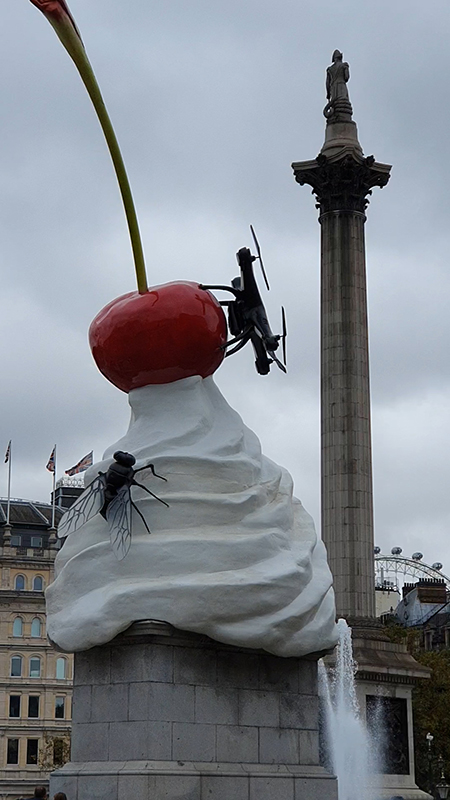
THE END Heather Phillipson’s sculpture of excess on the Fourth Plinth transmits a live feed of Trafalgar Square picked up by the drone’s camera and visible on a dedicated website www.theend.today giving a sculpture’s eye perspective.
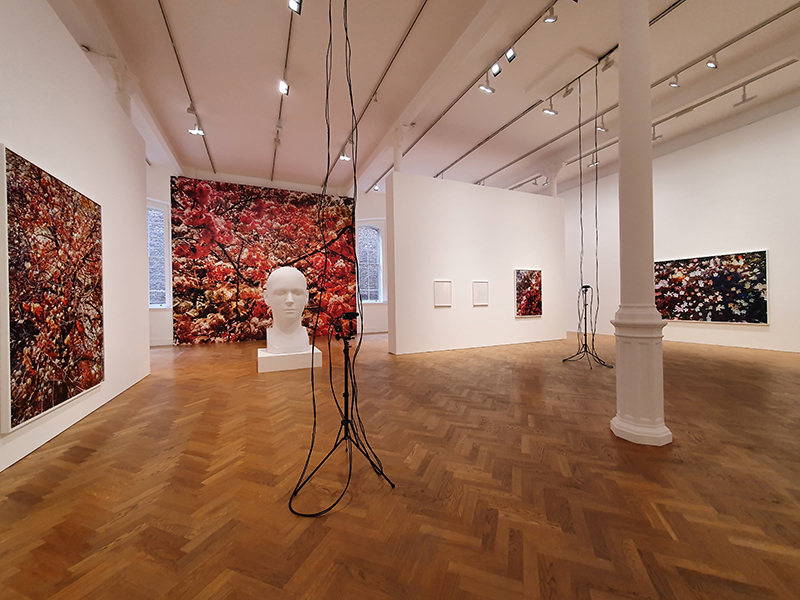
Fascinating work by Trevor Paglen at Pace Gallery uncovers the hidden agendas and bias present in systems which now govern many aspects of our lives.
The works in this exhibition seek to provide a small glimpse into the workings of platforms that track faces, nature and human behaviour, and into the underlying data that structures how machines ‘perceive’ humans and landscapes.
You can visit virtually through a live web portal connected to cameras placed in the gallery, observe gallery visitors experiencing the work in real time and can even be “present” in the space by streaming your own webcam onto monitors displayed within the exhibition. Or you can visit in person as I did where I was assessed and evaluated by ‘ImageNet Roulette’ an interactive artwork that classifies people’s digitally-captured portraits according to one of the most widely-used datasets used for training and evaluating computer vision systems.
My classification oscillated between ‘dosser’ and ‘char’.
‘Bloom’, a series of large-scale photographs that depict flower formations conceptualized by various computer vision algorithms created to analyse the constituent parts of real-life photographs. The colours and shapes in the images represent similar areas that the AI has detected in learning from other images of flowers. They do not represent real-to-life colours so much as what the AI thinks the different parts of the images are.
‘The Standard Head’ is a large-scale reconstruction of the 1960’s mathematical model of a “standard head” by the pioneering researcher funded by the CIA, Woody Bledsoe. Conceived from the average measurements of the faces Bledsoe experimented with, Paglen reconstructed the “standard head” from rare information left behind in Bledsoe’s archives at the University of Texas. Artificial intelligence algorithms are designed and trained to look for faces, unique key points, lines, circles, and areas of interest as they attempt to deconstruct the underlying reality into a more simplified series of sections or shapes.
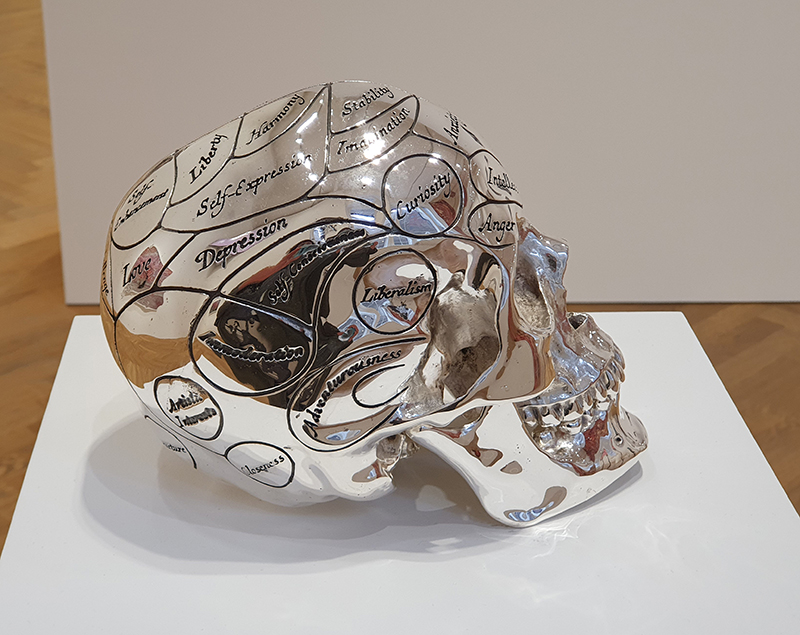
‘The Model (Personality)’, a plated bronze phrenology skull derived from the current categories that are used in predictive policing and sentencing algorithms that intend to gauge someone’s level of criminality by measuring their psychological attributes and behaviours.
‘Distracted Drivers’ and ‘Classifications of Gait’ showcase grids composed of thousands of smaller images used to evaluate people’s behaviours for commercial purposes.
The dataset for ‘Distracted Drivers’, for example, is a collection of images used to recognise if someone is distracted while driving by an AI system. This dataset was created by State Farm insurance to adjust their insurance premiums in real-time, based on that information.
The group exhibition Washing Line curated by Neil Zakiewicz and Patrick Morrissey at Thames-side Gallery took work away from the gallery walls and strung it across space. This made for a dynamic viewing experience negotiating a route to new perspectives. Two dimensional work hanging out in the world of three dimensions.
Robert Good’s stream(ers) of questions from Google News Feed rams home not only the overwhelming assault of media but the constant interrogation we are subject to. Another form of surveillance.
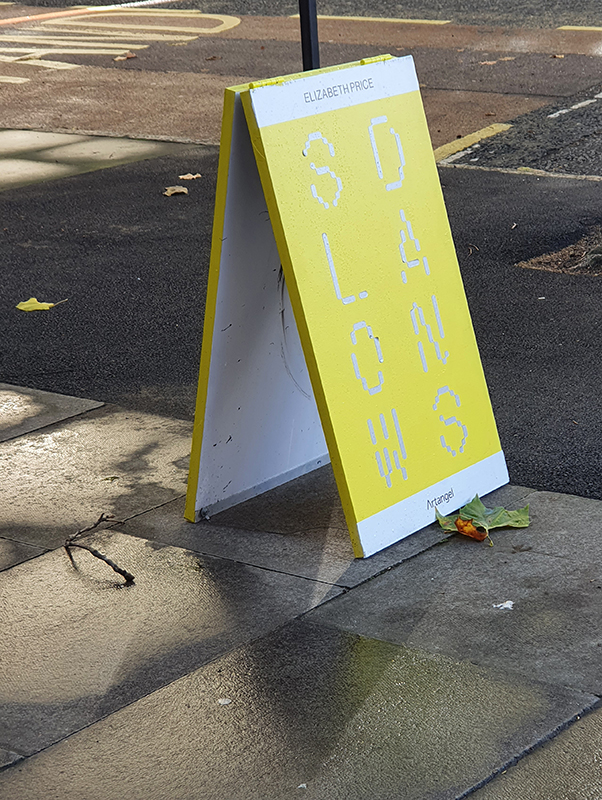
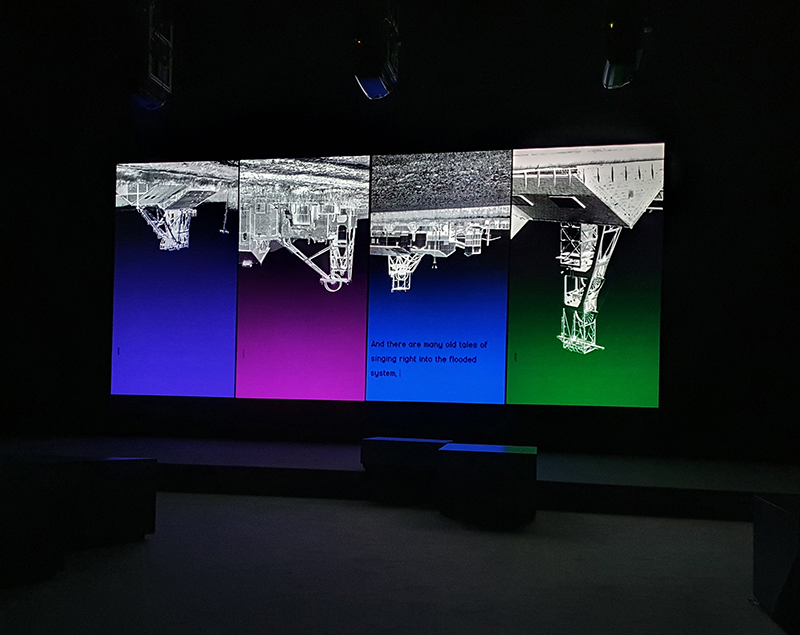
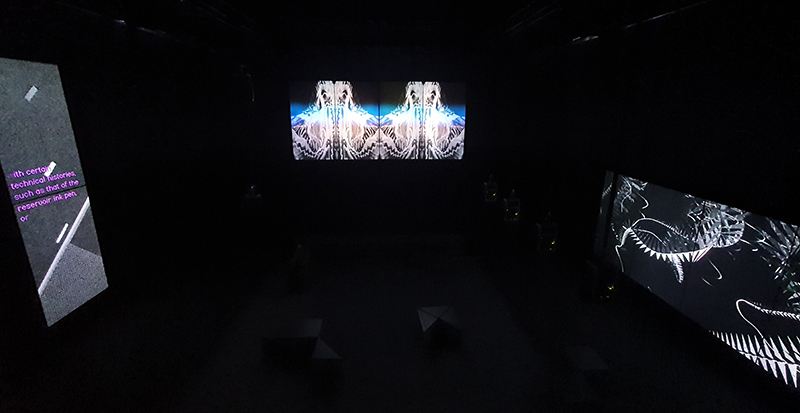
Elizabeth Price raising the ghosts of a lost era in Slow Dans an Artangel presentation at The Assembly Rooms on Borough Road. This was a haunting and fascinating evocation of lost landscapes and what is quite recent but rapidly disappearing social history. Mineshafts, ink-wells, the human throat connect a geological past with a technological present.
Latin suspendere, from sub- ‘from below’ + pendere ‘hang’ –
the prefix, sub- is often simplified to su- before sp; as seen in suspect, suspend, suspicion, suspension –
attachment from above/ imposed but not enforced/ dispersed through the bulk
A meshing of images and geometries which serve as a motif for the universe, fragmented and suspended echoing a time when dreams have been put on hold and the routines of daily life broken and held in limbo.
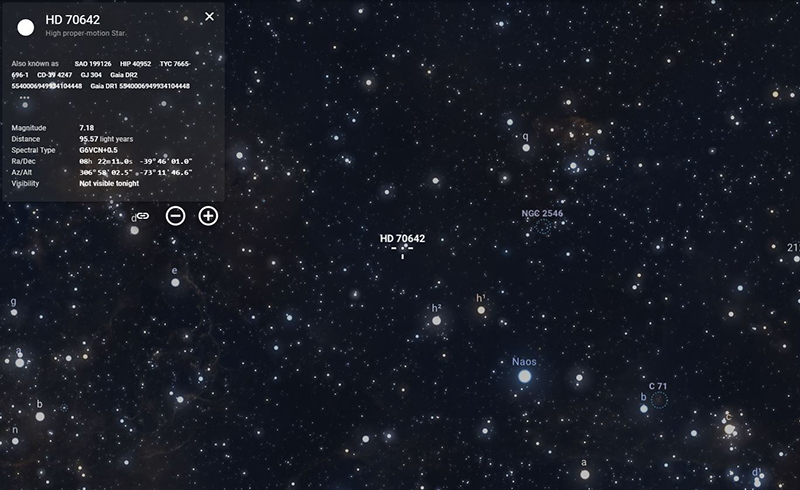
Work in progress looking at the possibility of a home from home orbiting the star HD70642 in the constellation of Puppis located about 92 light years away. Link here to see HD70642 using the online planetarium Stellarium.
This star has a long period planet companion making a circular orbit which means it is one of the most similar currently known planetary systems to our Solar System. There could be an Earth like planet orbiting this star. It would have taken my Mother’s whole life to reach here and the very first radio signals are only just arriving.
Puppis is one of the three constellations that once formed the huge constellation Argo Navis. In Greek mythology, the Argo carried Jason and his 50 Argonauts to Colchis at the eastern end of the Black Sea, to recover the Golden Fleece helped by Athena and Orpheus.
Imagine a world 92 light years away looking back at us. What patterns do the stars make? What stories are told here? Could those radio signals reaching them now be picked out from the noise of the universe?
I have made some progress with Seeker, Seer, Scientist an investigation at the boundary of my horizon. What lies beyond.
Marking out a 3 mile radius on my customized ordnance survey map to determine each destination at the four points of my compass. I embarked upon my first journey at dawn.
My GoPro headstrap had not arrived and so I had to improvise.
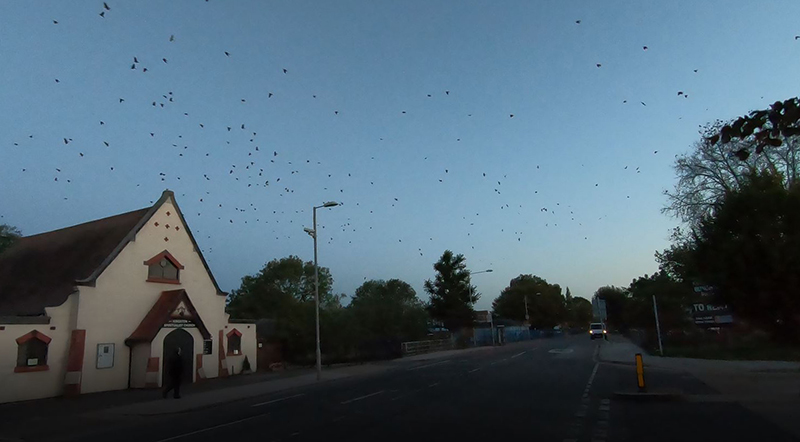
I was surprised by huge flocks of raucous parakeets rising from their overnight roost.
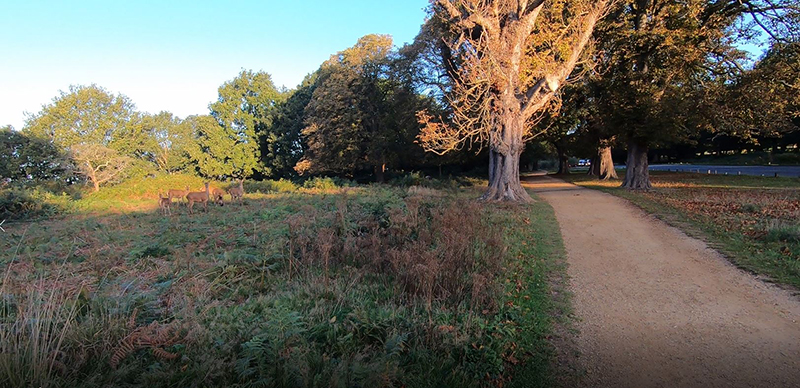
Destination North took me to Richmond Park. Wild deer and the terrifying roar of the nearby stag made a magical encounter.
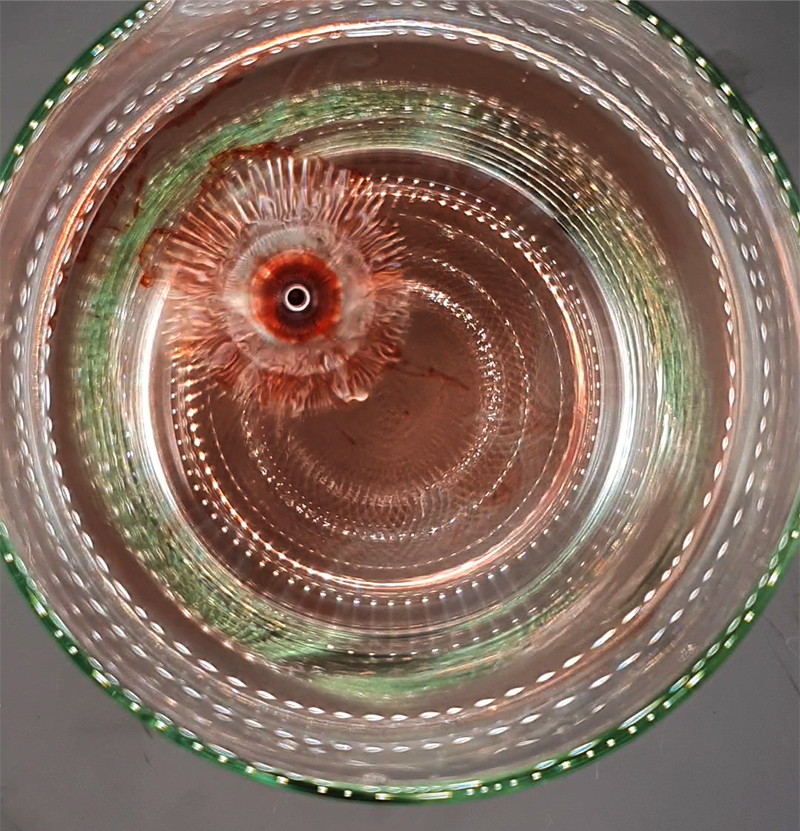
Some test filming of soap membranes for use in the film as a crossover point between the visual and the imagined reality.
Nye Thompson’s Programme 2 explores our world through the many new digital systems that have fundamentally changed how we see and exist. Data is harvested, other worlds are imagined and the cataclysmic effect of technology is explored. I’m very excited to see her new work which virtually builds a colossal dividing wall on the un-walked territories of Mars.
In At a distance solitary figures using semaphore flags sign ‘We are one’ out across the ocean. Filmed at Lizard Point Cornwall on 29th March 2019 (the first date the UK was supposed to leave the EU). As in entanglement theory where two paired electrons mirror each other at a distance it is hoped the message will be echoed back.
Every outing is precious now. Visited Unit 1 Gallery/workshop Radical Residency V exhibition particularly to see the enigmatic sculpted forms of Marianne Walker’s 3D drawings connecting conversations across the ages echoing object and mark making. Impressive collection of works including Emily Woolley’s alchemical sculpture articulating swirling ocean currents through the use of mica.
First post lock-down gallery visit was to see Among The Trees at the Hayward Gallery.
‘In meditative works across different media, 37 artists explore how trees challenge how we think about time, and consider how intimately entangled they are with human affairs. They invite us to appreciate their soaring scale, in art works such as a monumental sculpture cast from a 2,000-year-old olive tree by Ugo Rondinone, a cinematic portrait of a 30-metre-high spruce tree by Eija-Liisa Ahtila, and a vast forest of trees constructed entirely from cardboard by Eva Jospin. Among the Trees transports us around the world – from Colombian rainforests and remote Japanese islands to olive orchards in Israel and a 9,550-year-old spruce in Sweden.
There was lots to feel in awe of as trees are such magnificent beings. During lockdown trees became a vital presence for everyone confined to their immediate neighbourhood. The daily walk gave us time to notice spring unfurl and appreciate local nature.
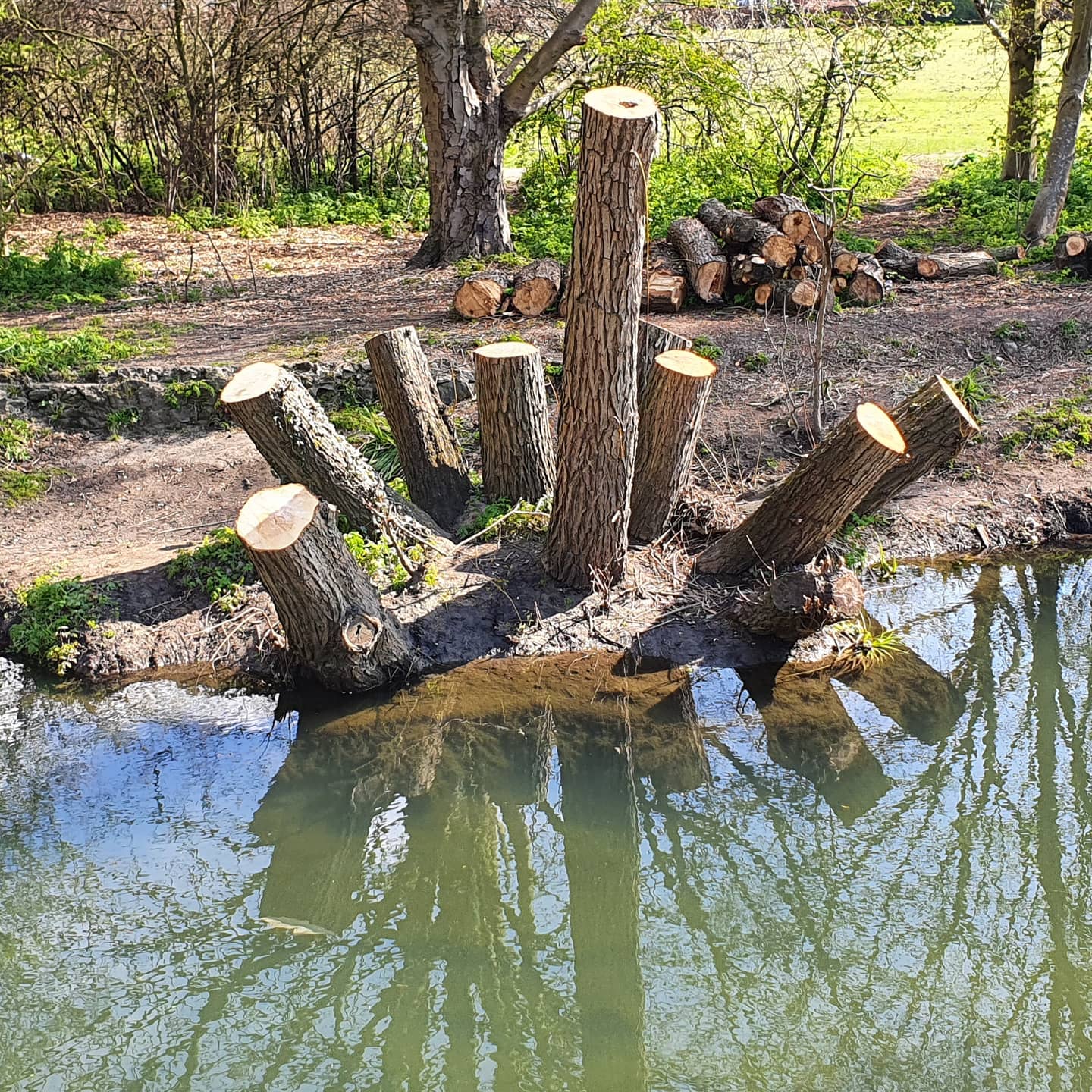
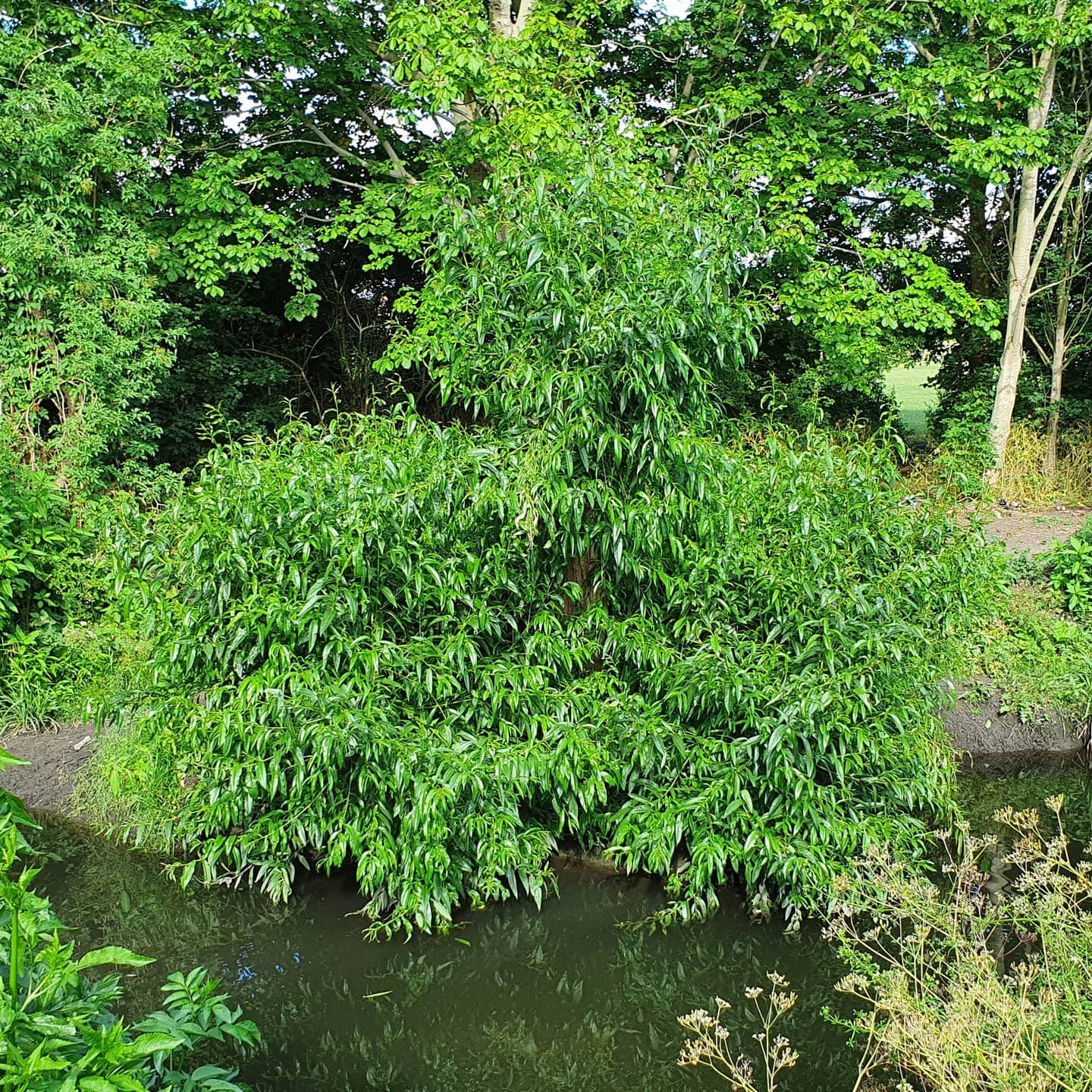
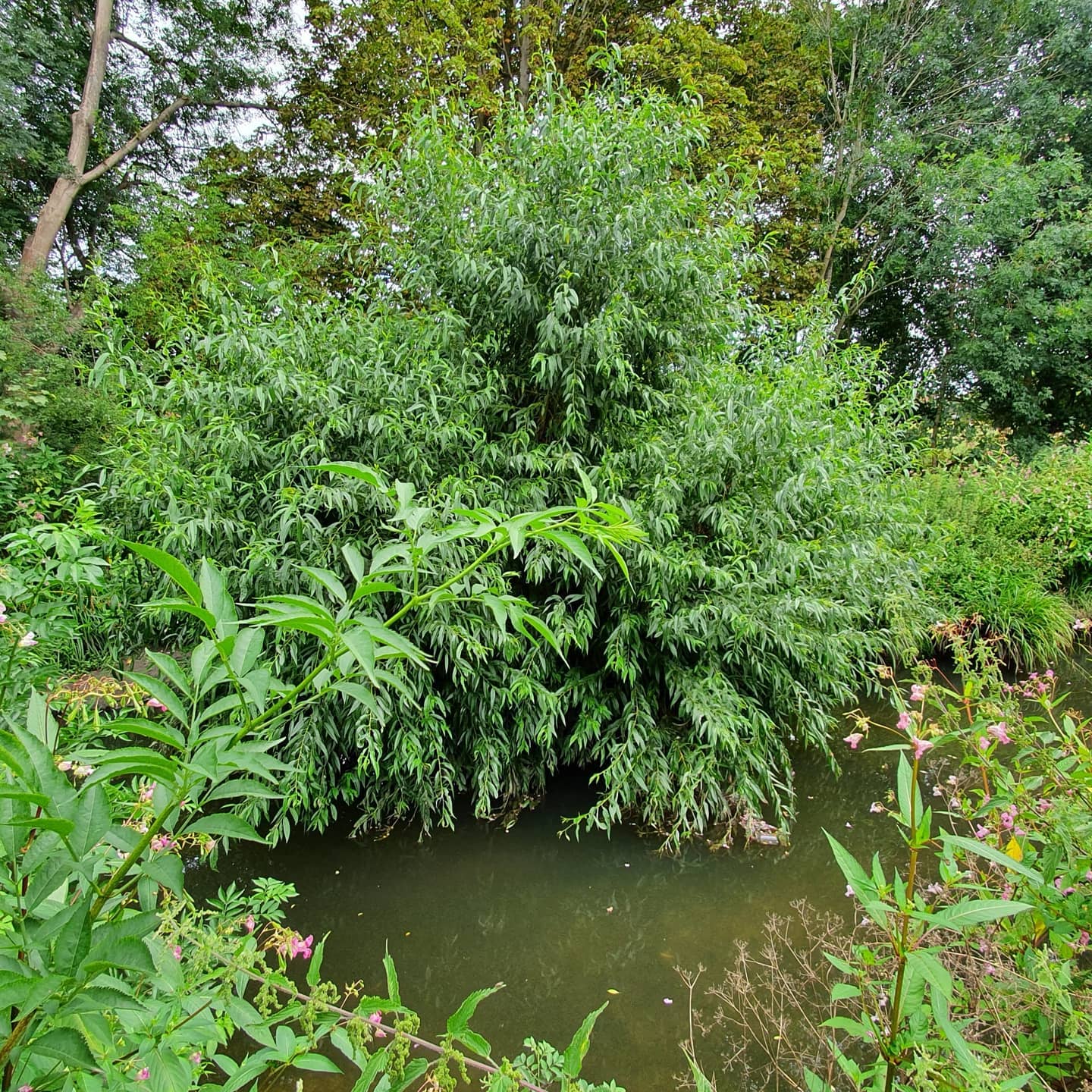
I followed the fortunes of stumpy from a brutal curtailment of growth happened upon during my first covid walk, to the fight back to regain some of what was before. Just as we are bristling and sending out tentative new growth as we emerge from lockdown.
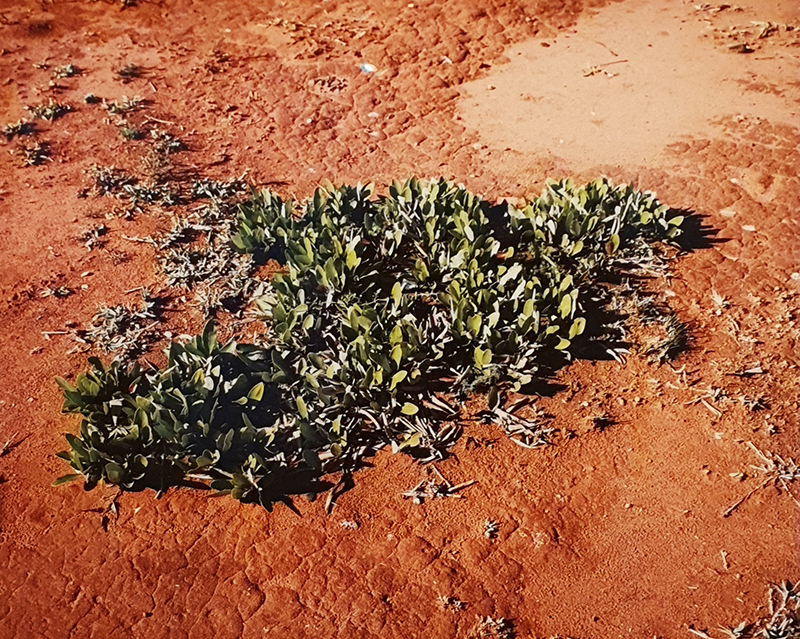
Rachel Sussman’s photograph Underground Forest #0707-1333 (13,000 years old; Pretoria, South Africa) Deceased 2007 was particularly intriguing.
This is the crown of a tree that has migrated underground possibly to survive the areas regular wildfires. These underground trees are found in the savannahs of southern Africa and South America and are different to the root systems of other trees. The shoots on the surface could be part of a network with large woody structures as much as one metre wide with stems measuring up to 10 metres across. If there is a fire the shoots above ground can quickly regrow. These underground forests are extensive and diverse and seem to be linked with the spread of the savannah around 8 million years ago that led to an increase in wildfires.
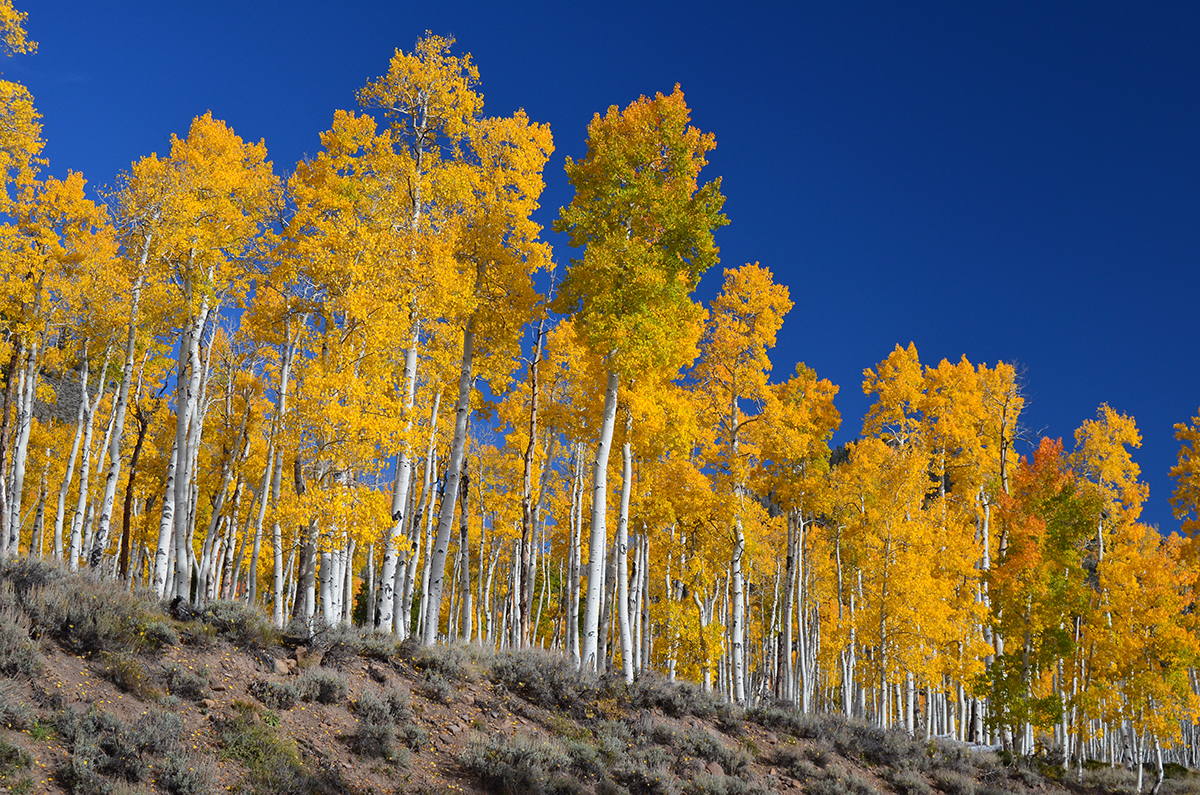
It is also what is known as a clonal tree which reproduces vegetatively underground. There are also clonal colonies where a forest of trees are all genetically identical linked by one network of roots that send up suckers. The world’s largest living organism (and maybe the oldest) is a clonal forest known as Pando or the Trembling Giant. This striking colony of quaking aspen covers 106 acres of Fishlake National Forest in Utah.
The other thing everyone mentioned during lockdown was how birdsong was louder and more pervasive to our days as traffic and flights ceased to muddy our soundscape.
The lockdown zoom Ways of Listening from Complicité was a joy to listen to. I didn’t realise how starved I felt of these sort of conversations. Hopefully the link below will remain active for the future. Unlike our eyes, our ears are never closed.
Bohm was interested in consciousness because of its implications with regard to quantum theory. He looks at the interconnectedness of all matter. How we interact with the earth, how we interact with each other. If we want to go beyond our current state of consciousness and experience wholeness we must look beyond the manifest veil of form to a realisation of oneness.
Reading stones could be considered the first instruments used to create an enhanced sensory experience. Originally made from ground and polished rock crystal or beryl, they were placed over texts to magnify them.
This early optical technology paved the way toward observation of the furthest reaches of the universe and its minutest components.
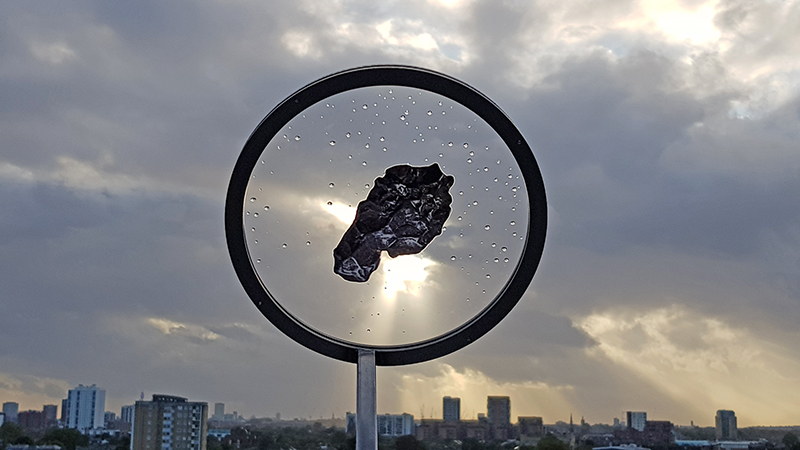
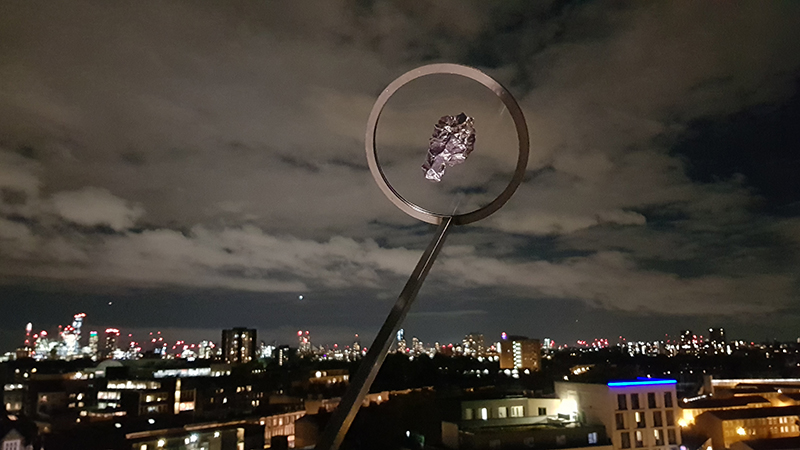
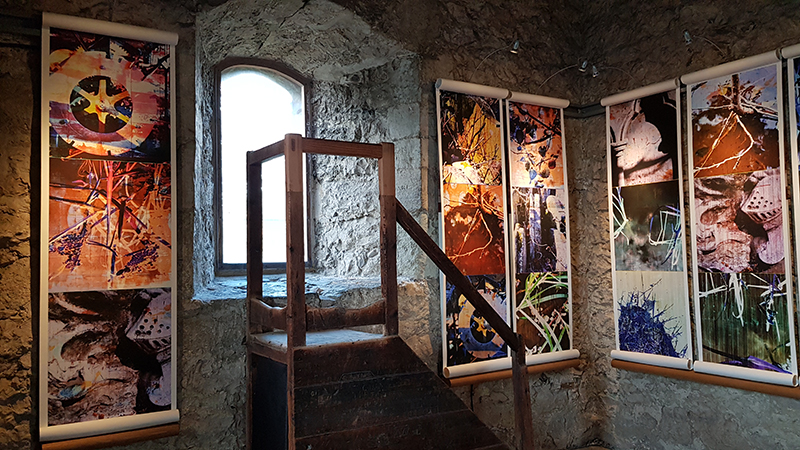
Both the telescope and microscope are referenced by the sculpture Baetylus installed on St. Augustine’s Tower roof for the exhibition Reading Stones.
Baetylus (meaning from the house of god), are sacred stones/meteorites of divine origin.
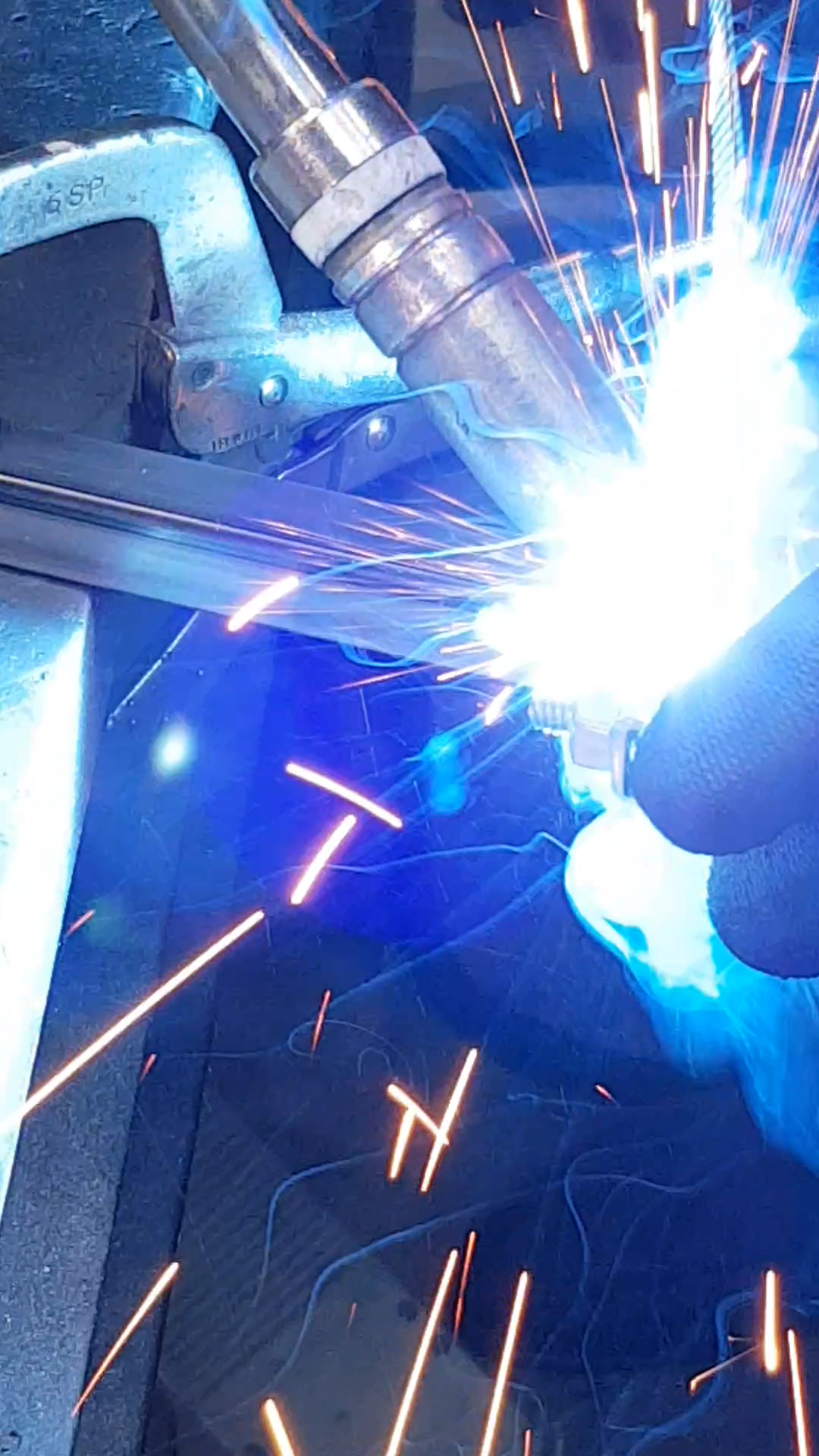
In this case sold to me for £6, a 15mm Nickel Iron Meteorite from Campo Del Cielo Argentina, falling 5000-6000 years ago. Photographed with a macro lens and direct to media printed onto acrylic by Genesis printing. The steel frame expertly welded by Nick Amott of J.& R. Precision Engineers.
The wind and rain on the roof soon added to the piece.
rain + meteor = meteor shower
An object falling through space distorts not only the space it travels through but also time as space and time are inexorably linked.
Each visit to the roof gave a different experience of the work.
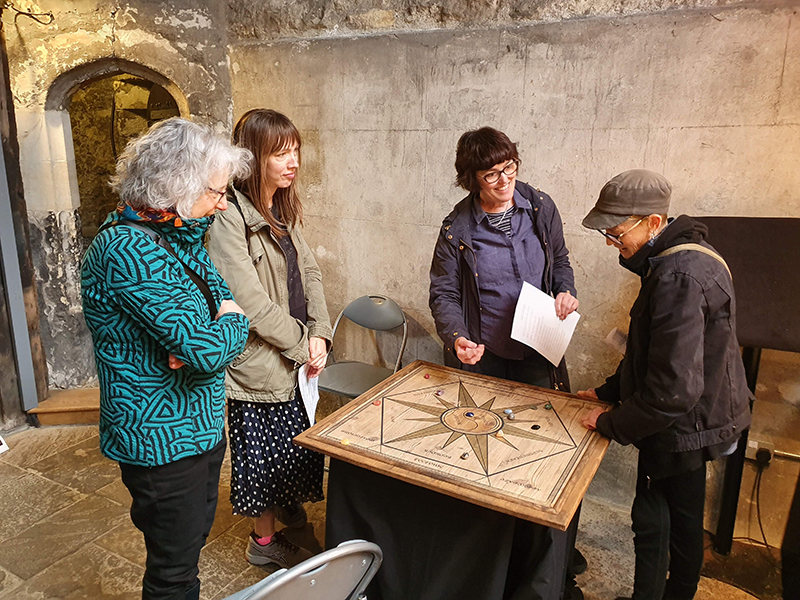
The act of “reading stones” can refer to both the scientific practice of geological investigation and the ritual of lithomancy which seeks to interpret the patterns of stones cast by those wishing to divine the future.
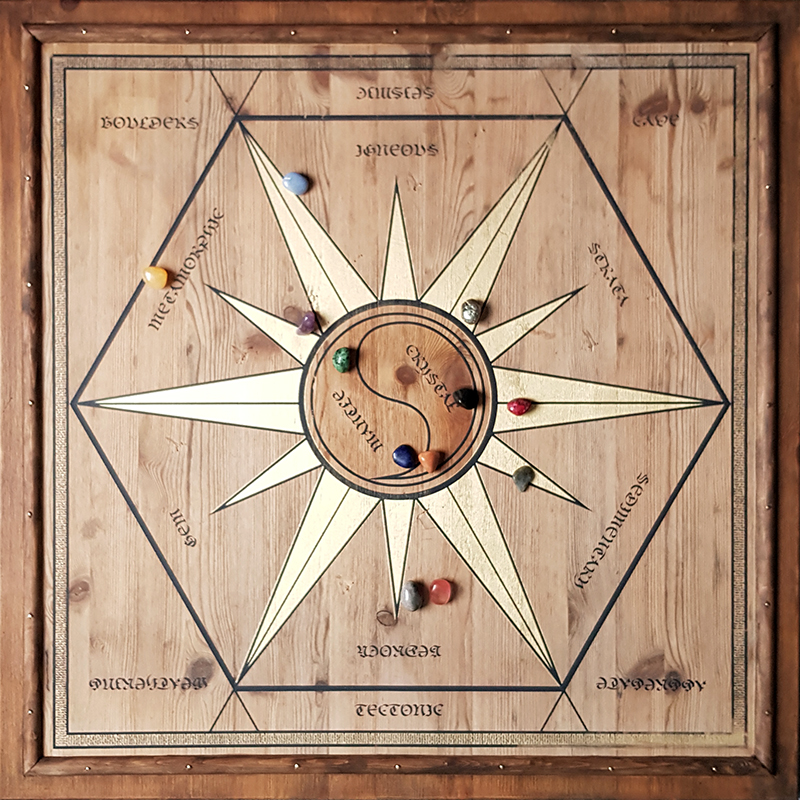
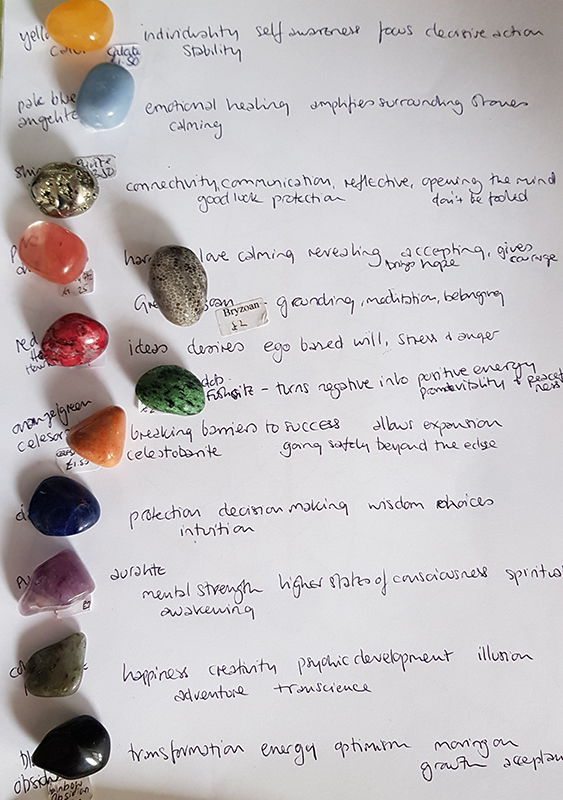
Offering ‘readings’ gave visitors a personal perspective to consider when thinking about how we experience time and negotiate the future. The board, a salvaged old table top was screen printed with a design created after researching the ancient art of lithomancy and prevalent variations. I gave the board a geological emphasis and aligned the areas of activity with traditional associations such as sedimentary = home, boulders = obstacles and challenges, strata = knowledge and experience.
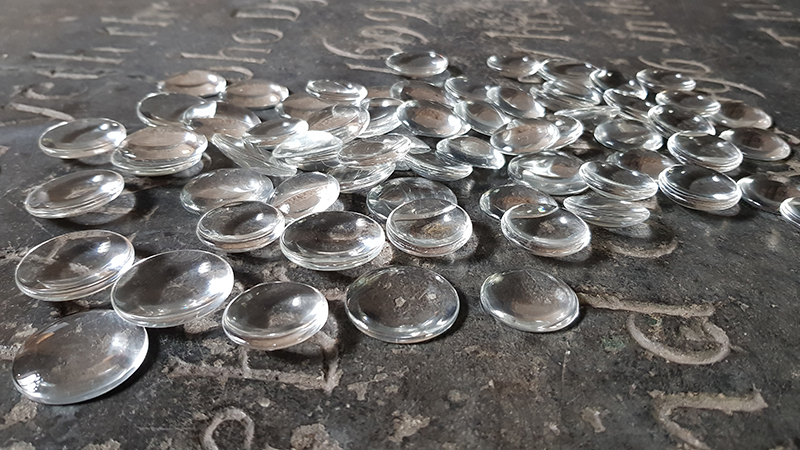
The gemstones were assigned properties according to traditional meanings.
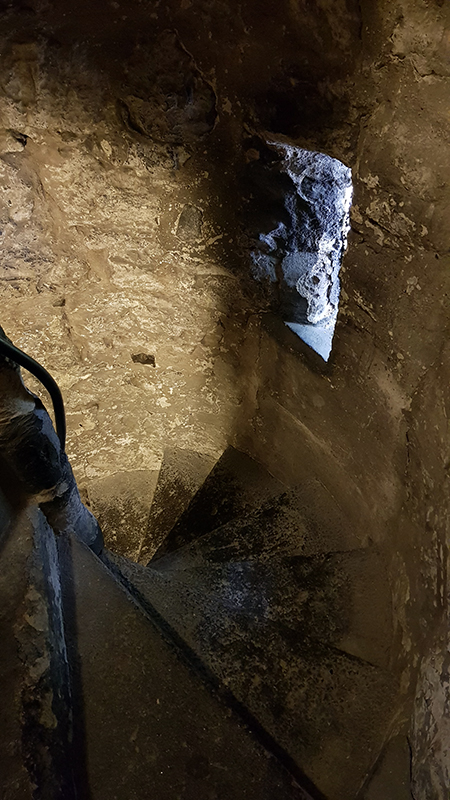
It was magical to spend so much time within the thick stone walls of St. Augustine’s Tower, ascending and descending the steep narrow spiral stairs adding yet another infinitesimal trace to the worn history of the steps.
Working with Carol Wyss and Anne Krinsky on this project was a pleasure and we were delighted with the public response to the exhibition.
Carol Wyss All That Remains
“My aim is to re-create the original ‘UR’ bone which has neither gender nor race, the first ever bone which existed, the one which fell from heaven or space. It is an attempt at merging all the bones of the human skeleton into one entity, which then becomes the common denominator, the starting point from which all bones and consequently all humans came. I am referring to the bible story of Eve’s creation from Adam’s rib, the Greek myth of Pyrrha with the creation of humans from the stones / bones of the earth and Da Vinci’s perfectly proportional Vitruvian man, as well as to science’s search for the ultimate building blocks of our universe.” Carol Wyss
Carol Wyss Os
Deucalion and his wife Pyrrha were the only survivors of the great deluge and landed on Mount Parnassus, the only place spared by the flood.
Deucalion consulted an oracle of Themis about how to repopulate the earth. He was told to throw the bones of his mother behind his shoulder.
Deucalion and Pyrrha understood the “mother” to be Gaia, the mother of all living things, and the “bones” to be rocks.
They threw the rocks behind their shoulders, which soon began to lose their hardness and change form.
Their mass grew greater, and the beginnings of human form emerged.
The parts that were soft and moist became skin, the veins of the rock became people’s veins, and the hardest parts of the rocks became bones.
The stones thrown by Pyrrha became women; those thrown by Deucalion became men.
Carol Wyss Osmosis
All the sons of Adam are part of One single body, They are of the same essence. When time afflicts us with pain In one part of that body All the other parts feel it too. If you fail to feel the pain of others You do not deserve the name of man.
― Saadi Shirazi 1258
Anne Krinsky Ephemera Scrolls
“I am interested in the ephemeral nature of the physical world – in the transformation of terrains and in the erosion of stone, wood and metal over time. In developing imagery for the Ephemera scrolls, I wanted to create visual relationships across time and space. I photographed the Tower’s clock mechanism and gravestones from the surrounding garden and other London churchyards. During a recent residency at Oberpfalzer Kunstlerhaus in Schwandorf, Germany, I photographed the River Naab, as its water levels dropped during the hottest June on record. I feel impelled to document changes to wetlands and waterways in this time of accelerating climate change.” Anne Krinsky
Anne Krinsky Ephemera Scrolls
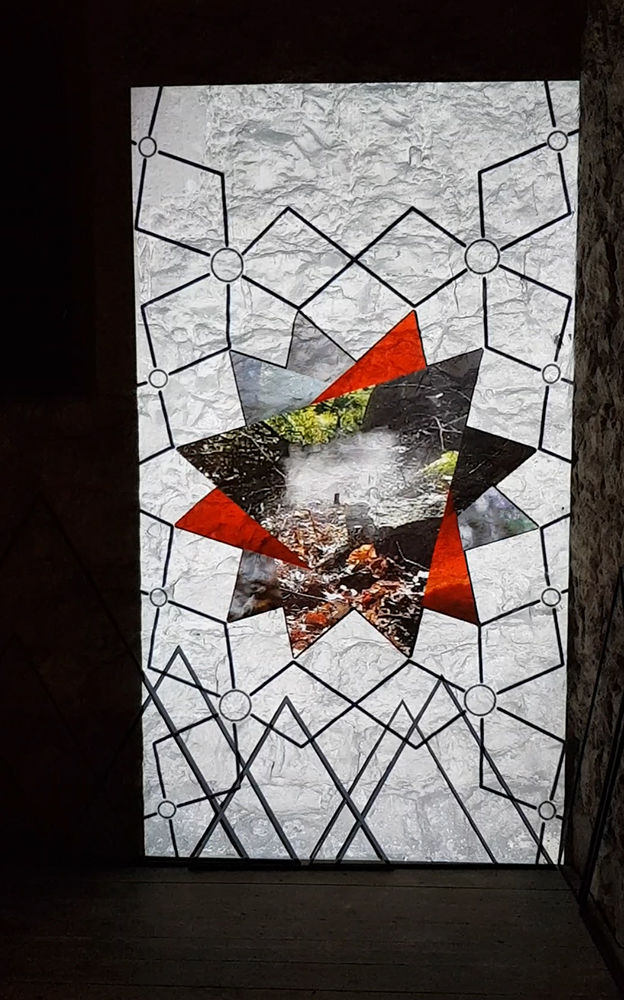
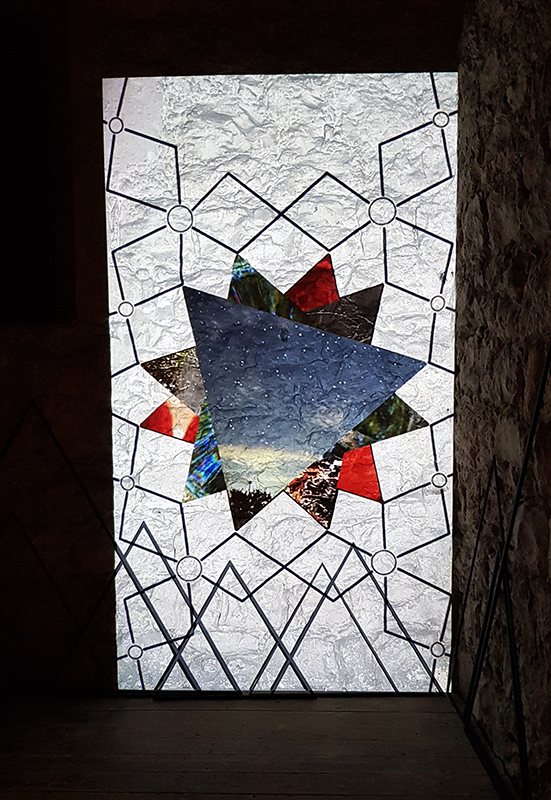
Time Crystals video work installed alongside the tower’s ancient clock builds on an interest in the mystery of time viewed across human, cosmological and quantum scales.
The clock by which we measure time on our watches and digital devices is very misleading; it is determined by the daily rotation of the Earth around its axis and its annual rotation around the sun. This astronomical time is linear and regular. But the actual clock by which we live our socioeconomic lives is an emergent phenomenon determined by the collective forces of social interaction: it is continually and systematically speeding up relative to objective astronomical time.
– Geoffrey West, 2017
The patterns employed within the film and spilling out from the projection as 3D triangles mirror the crystal structure of the mineral beryl, commonly used to fashion the original reading stones.
The work also makes reference to the scientific theory of time crystals; a model which proposes a structure that repeats in time, as well as in space. Variations in perspective are manipulated through the speeding up, slowing down and overlapping of events to deconstruct a linear flow of time and interrogate the methods by which humans measure and experience this phenomenon.
It is within my mind then, that I measure time. I must not allow my mind to insist that time is something objective. When I measure time, I am measuring something in the present of my mind. Either this is time, or I have no idea what time is.
― St. Augustine of Hippo, 397
How can the past and future be, when the past no longer is, and the future is not yet? As for the present, if it were always present and never moved on to become the past, it would not be time, but eternity.
― St. Augustine of Hippo, 397
Using Carlo Rovelli’s book The Order Of Time as a reference guide and the quotes of St. Augustine as points of enquiry the repeating layered films were made using time lapse and slow motion; recording the exchange of energy as objects collide, heat up, cool down, travel at speed, transform, reflect and absorb, display traces of past events and embark on supposedly predictable trajectories. How we experience time is relative to where we are in the universe, our proximity to a larger mass and how fast we are moving.
A crystal is like a class of children arranged for drill, but standing at ease, so that while the class as a whole has regularity both in time and space, each individual child is a little fidgety.
– Dame Kathleen Lonsdale, 1948
The fabric of the ancient building also helped determine the work installed. The 3D element of my video installation needed to be built in situ. One challenge was projecting in portrait mode to neatly fit the wall space between window and clock mechanism. Projectors are not supposed to be set on their side but with an adapted ceiling mount allowing clear air vents for the fan it all worked out fine.
Clamps, weights, stitching, balancing and non invasive means of installing had to be employed not to harm the Grade I listed heritage site.
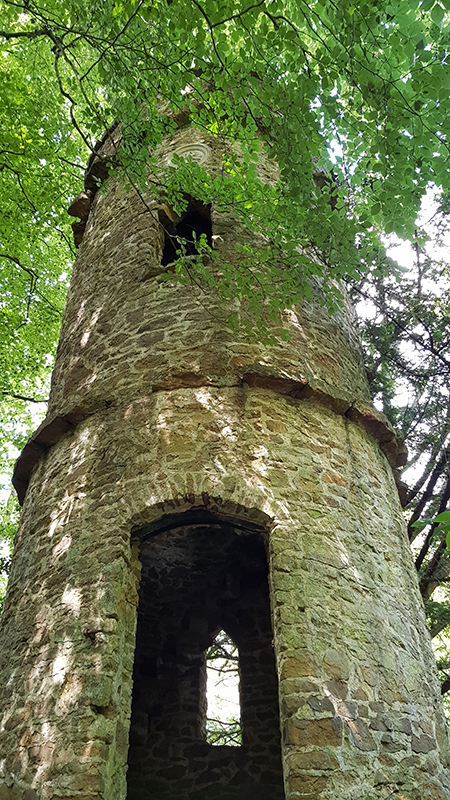
On location. After much searching a secret tower in the woods was found, knotted within dense undergrowth. Hidden in time and space.
A pleasure to be asked back to Guest Projects for a filmed interview about my experience during the residency Laboratory of Dark Matters for a promotional video to launch Yinka Shonibare’s new residency programme opening in Lagos.
I attended the UK High Altitude Society Conference 2019 to give an update on the project aiming to launch a cloud chamber in a high altitude balloon.
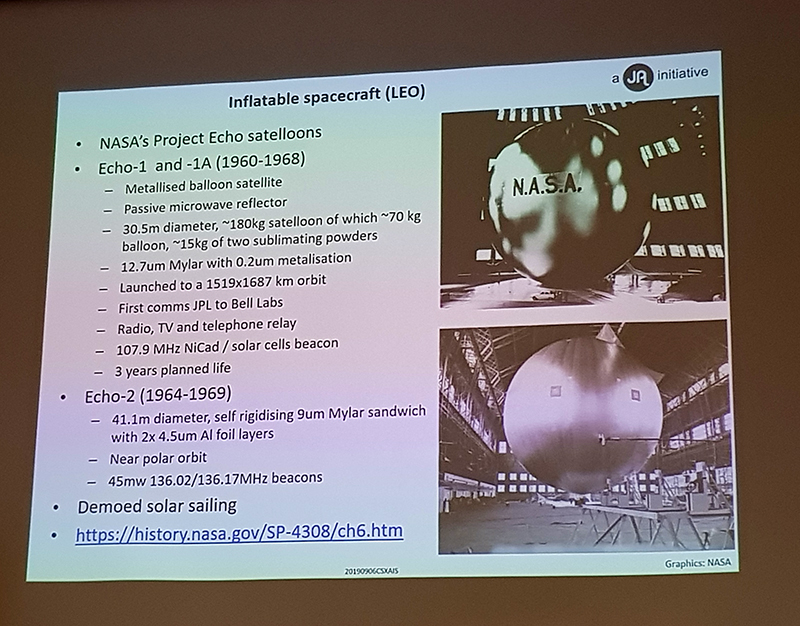
Very interesting talk from Michael Johnson on citizen space exploration & inflatable spacecraft, building on past developments of inflatable spacecraft from NASA new technology could see thousands of tiny spacecraft launched within days as opposed to decades.
He also allowed us to hold the tiny spacecraft.
Finished working on video sculpture At a distance which has been installed at The Museum of Cornish Life, Helston for the Lizard Point Residency Touring Exhibition.
This residency was inspired by an incredible communications double anniversary in 2019, for Lizard Lighthouse (400 years) and Goonhilly Earth Station (50 years: transmission of the first lunar landings), considering the importance of life-saving lighthouse beacons and internationally important transmissions across the sea and sky.
Lizard Point, overlooking the Atlantic, benefits from natural darkness, natural beauty and is a great spot for viewing the Moon, stars and meteor showers.
Staying on site, next door to the famous Lizard Lighthouse, artists had the opportunity to create works responding to the variety of astronomical sights found there, as well as be inspired by the rich communications heritage along this very special part of the SW coastal path.
Solitary figures using semaphore flags sign ‘We Are One’ out across the ocean; filmed on 29th March 2019 (the first date the UK was supposed to leave the EU).
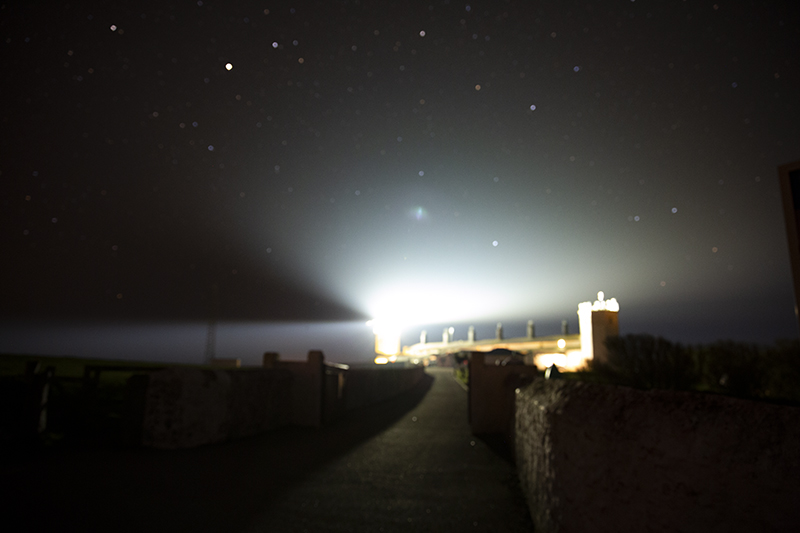
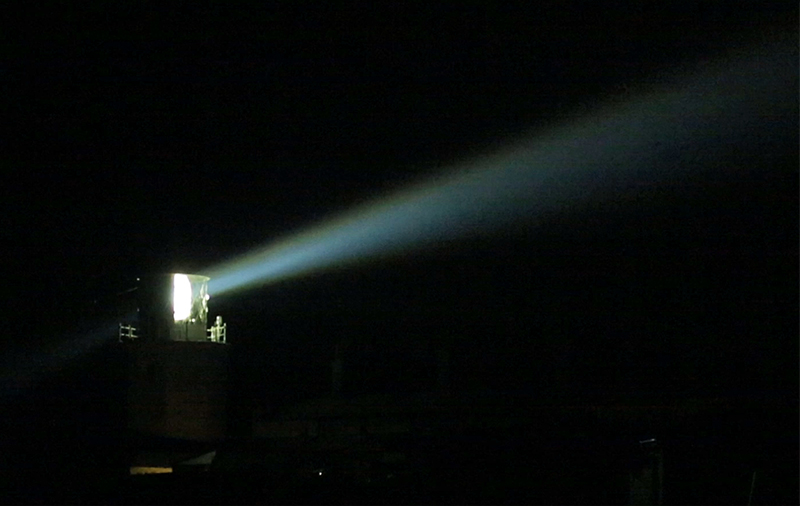
As in entanglement theory where two paired electrons mirror each other at a distance it is hoped the message will be echoed back. The work looks at methods of communication over distance. It relates this to the mysterious twinning of electrons in quantum entanglement where particles link in a way that they instantly affect each other, even over vast distances, and which Einstein famously called ‘spooky action at a distance’. The video is back projected onto a Fresnel lens, the type found in lighthouses to increase luminosity of the lamps beam, another form of messaging over distance.
The video sequences through five sets of semaphore messages. Each message is echoed back within a swirling force field emanating from across the ocean repeating the pattern of the flag representing entanglement. This is interspersed with imagery from video captured of the Lizard Point Lighthouse Lamp slowly waking and powering up from dim to dazzling light, split and mirrored in a circle of sending and receiving messages.
The Museum of Cornish Life is surprisingly vast and crowded with innumerable artefacts at every scale. A fearsome cider press the size of a lorry included. The long passage through the museum to the exhibition rooms encounters an overwhelming volume of items jostling for attention.
Here are the records of events from which we infer the past.
While in Cornwall there was time for a quick visit to Tate St. Ives. An unexpected treat to find Otobong Nkanga’s excellent exhibition From Where I Stand looking at the glittery desirability of minerals and the scars left on the landscape and people by it’s extraction.
What could a monument be? Is it the thing we build or the thing we have taken away from? A place of emptiness is the monument to remind us there is no possibility of getting back to what has been – Otobong Nkanga

































































































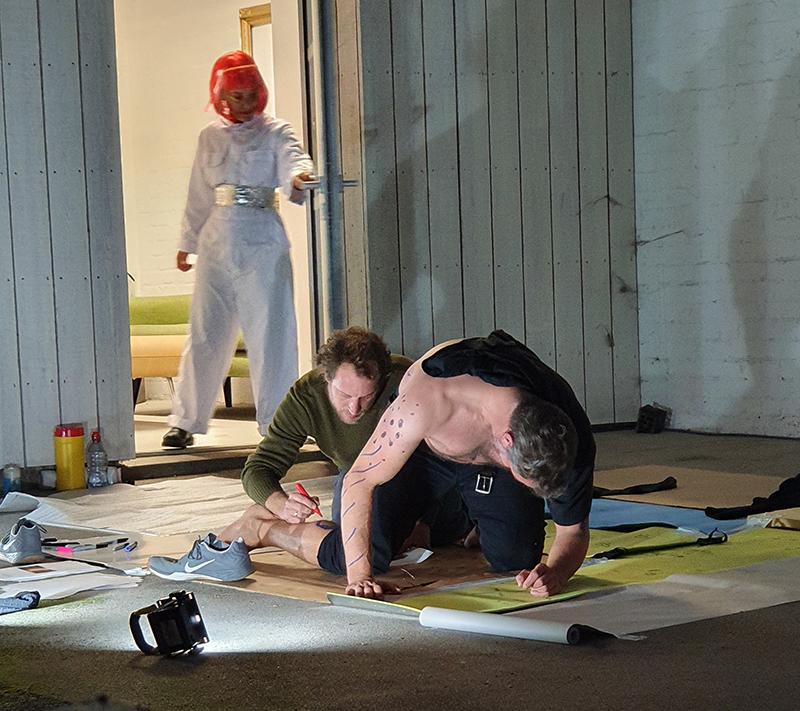 Bodies touching and people singing seemed illicit and extra joyful.
 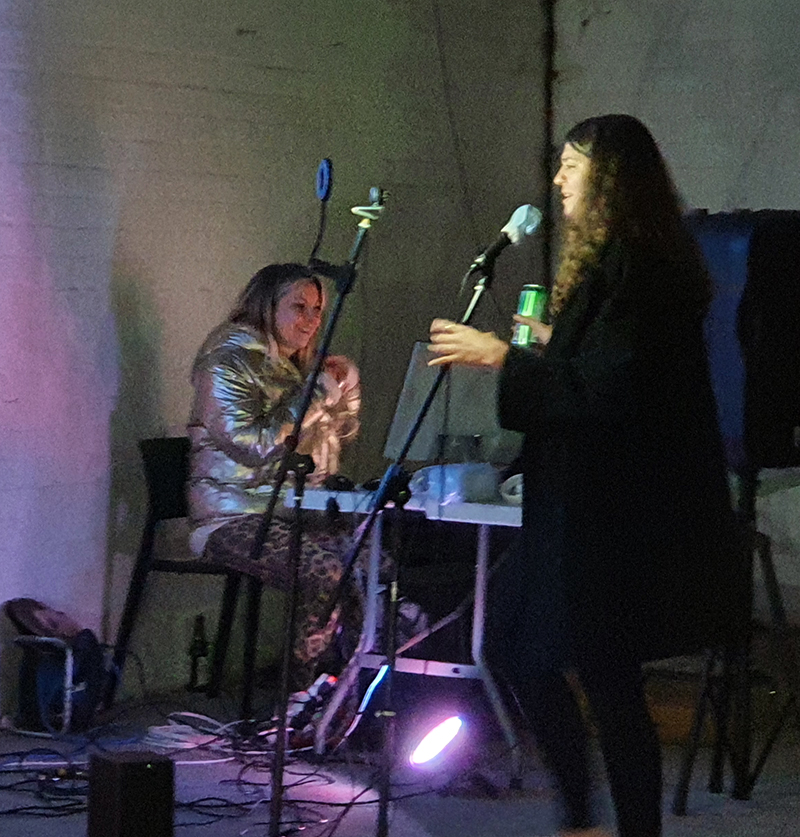 Visions in the Nunnery is Bow Arts’ biennial showcase of international moving image and performance art.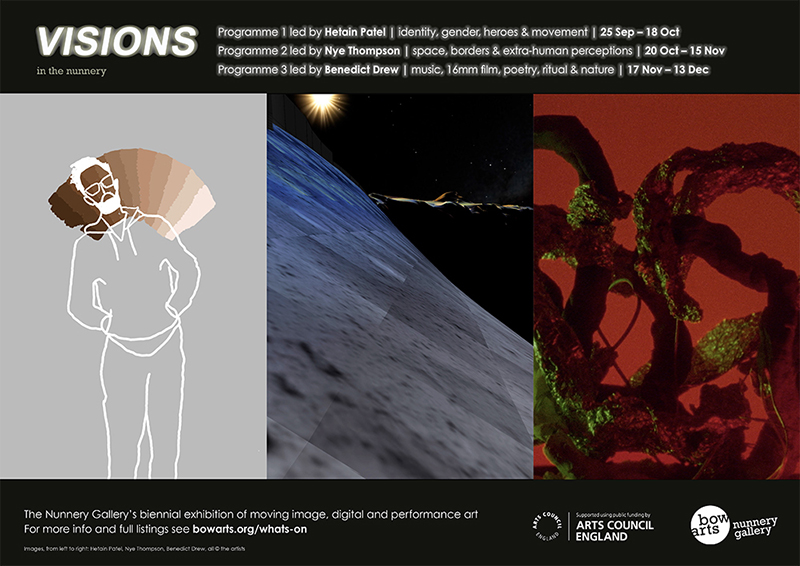


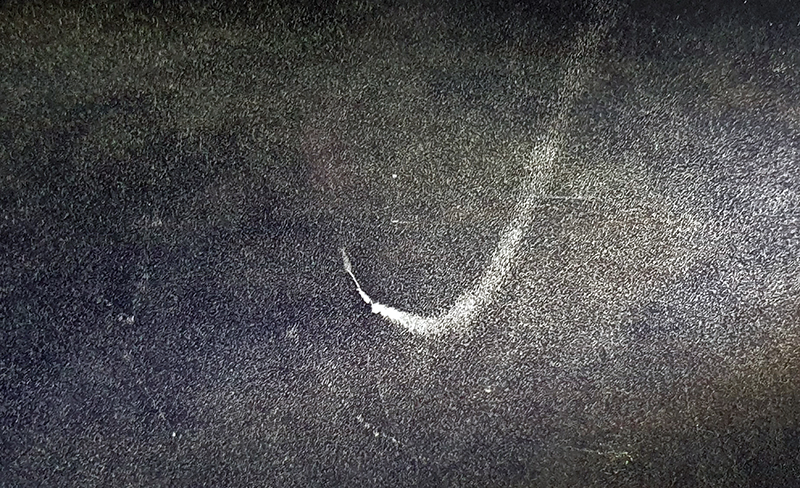







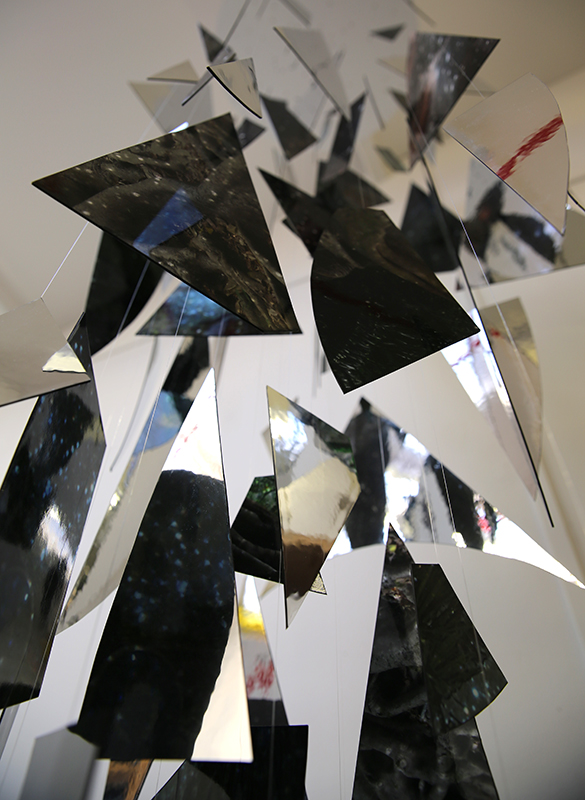


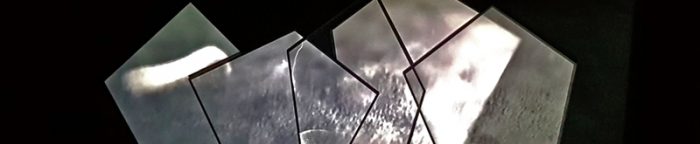
 Some test filming of soap membranes for use in the film as a crossover point between the visual and the imagined reality.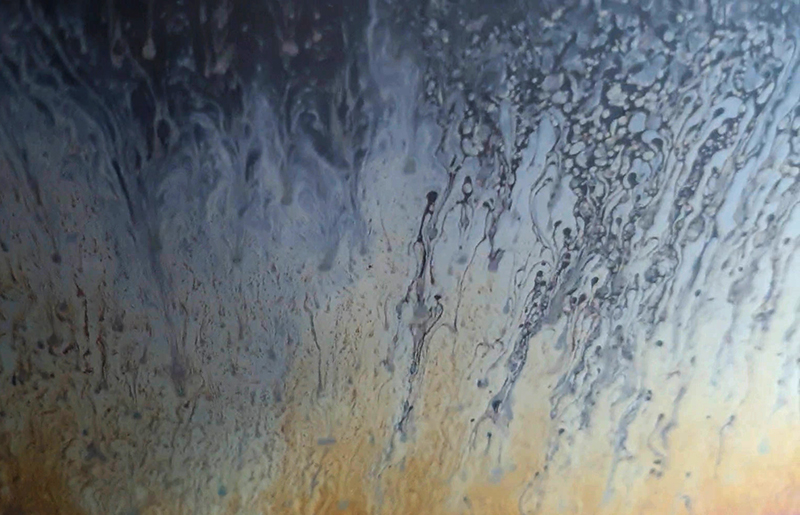




















 Susan Eyre