Archives for posts with tag: cosmic ray detector

In classical antiquity, a time stretching from Homer to the early middle ages, geographic orientation usually referred to landmarks or astral phenomena to determine direction. Eos, meaning dawn, and Hesperus, meaning evening, were named for sunrise and sunset with north (arctos) being marked by the constellation Ursa Major and later the Pole Star. The winds also became associated with direction and named in accordance with their qualities such as hot and humid or cold and dry.

The number of points on a wind rose began with the four cardinal points that were added to and refined over time. Aristotle designed an asymmetrical 10 point wind rose for “the study of things high in the air” (meteorology) which was later refigured by Timosthenes, a 3rd century BCE Admiral and geographer, naming a system of twelve winds and using this as a tool for navigation. The contemporary compass has its roots in the ancient classification of winds.

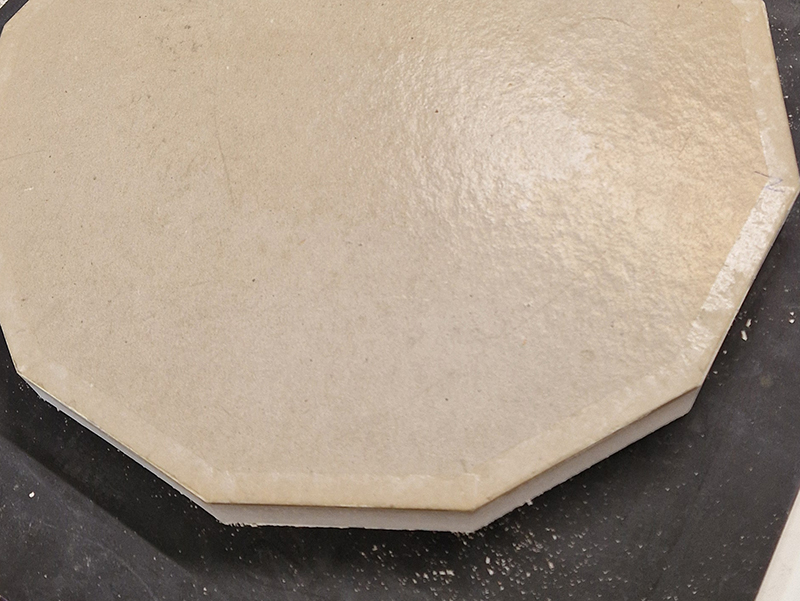
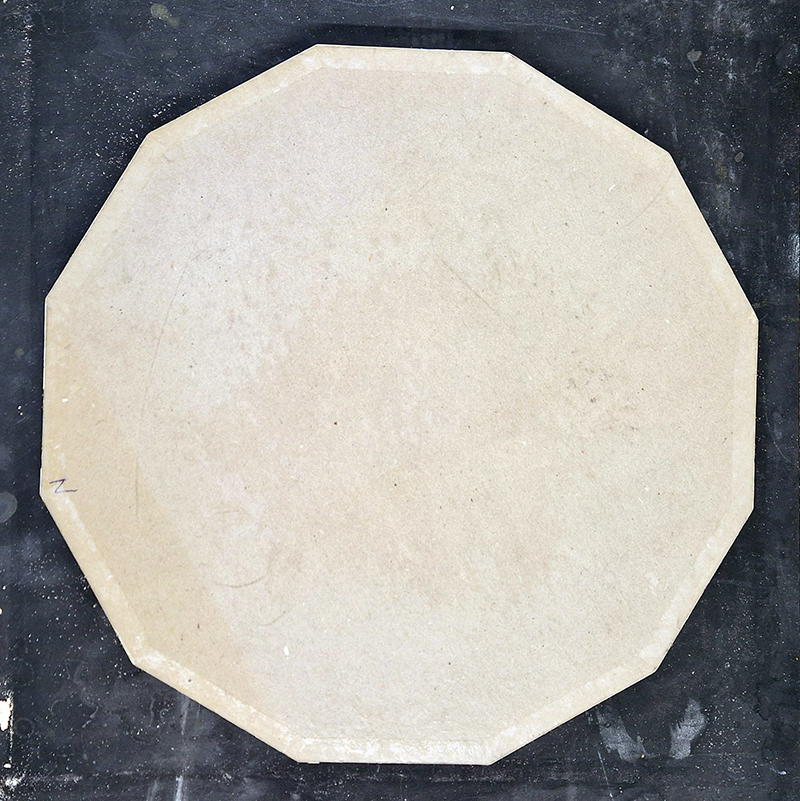
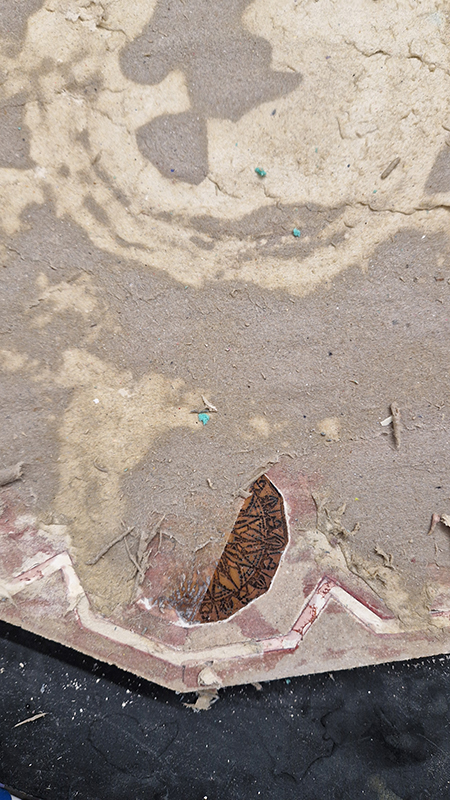
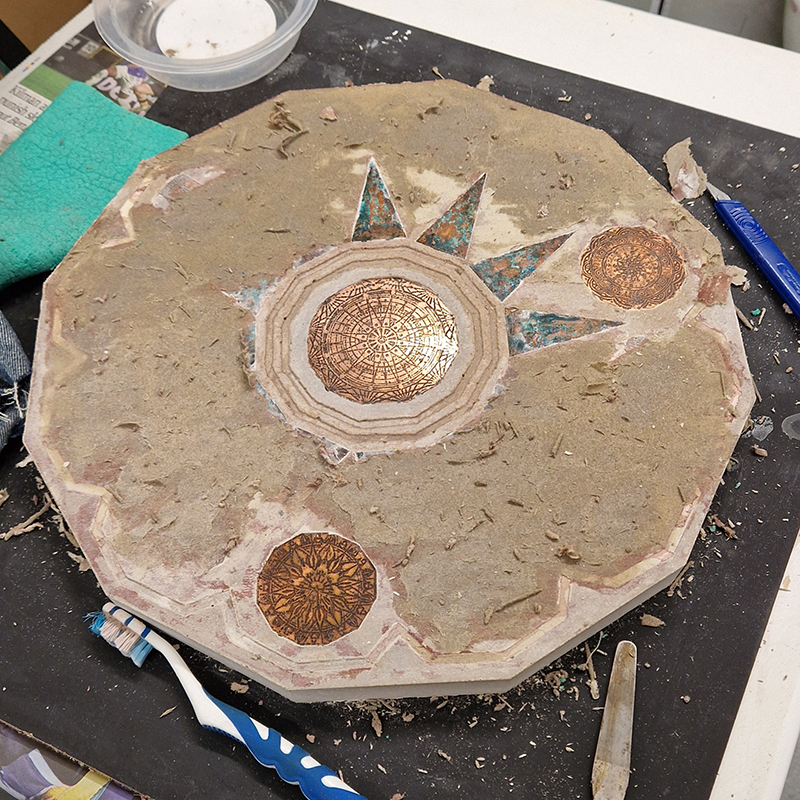
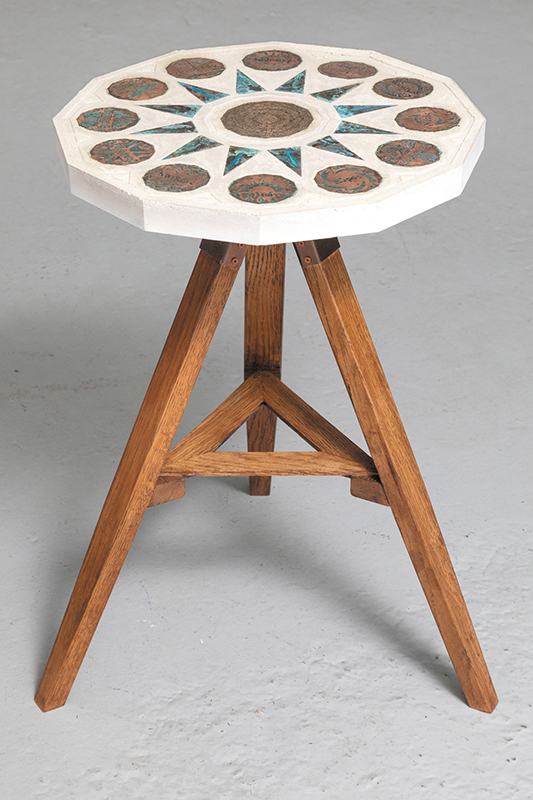
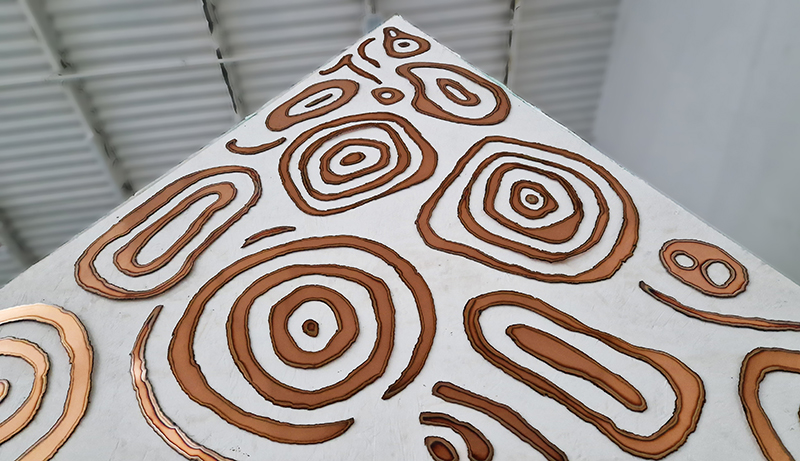
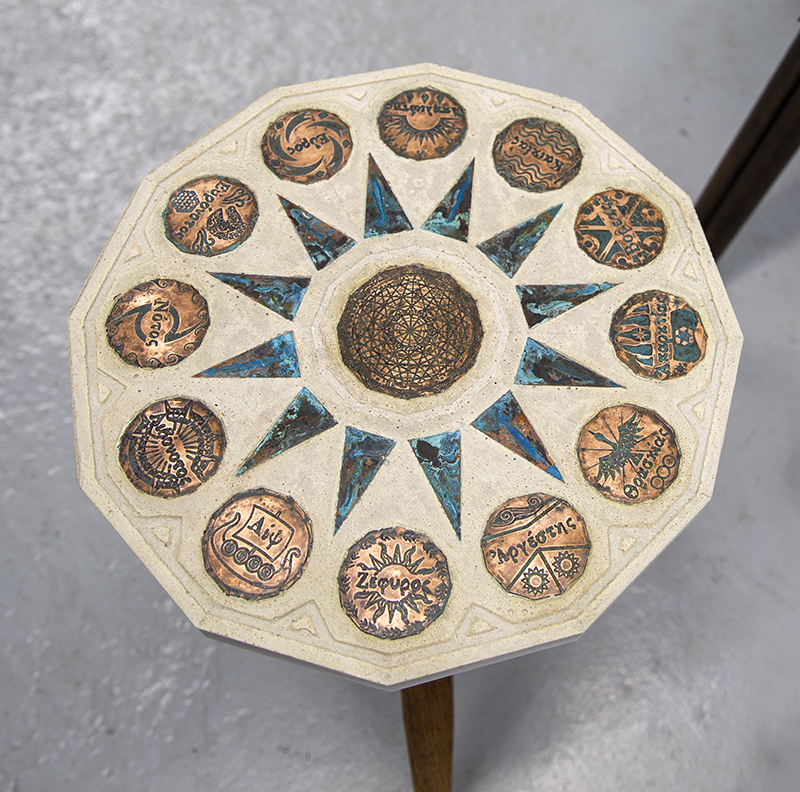
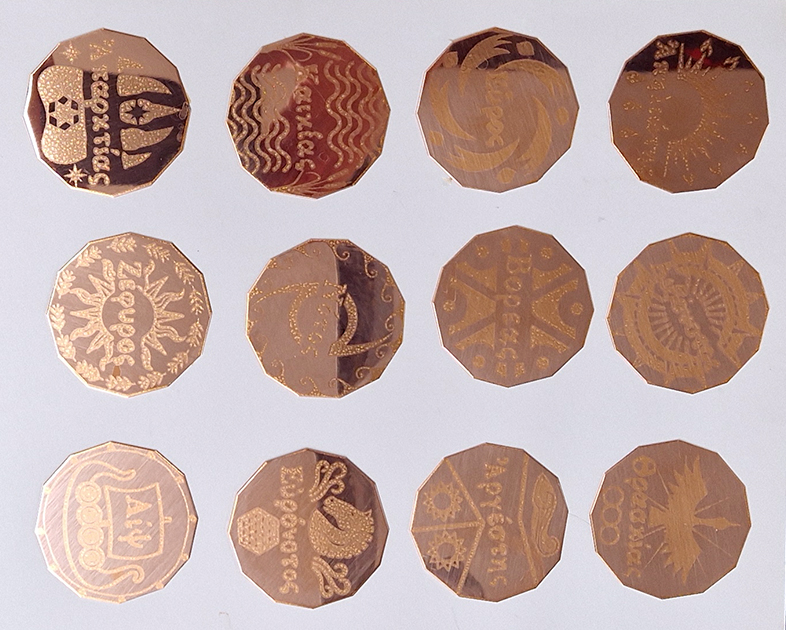
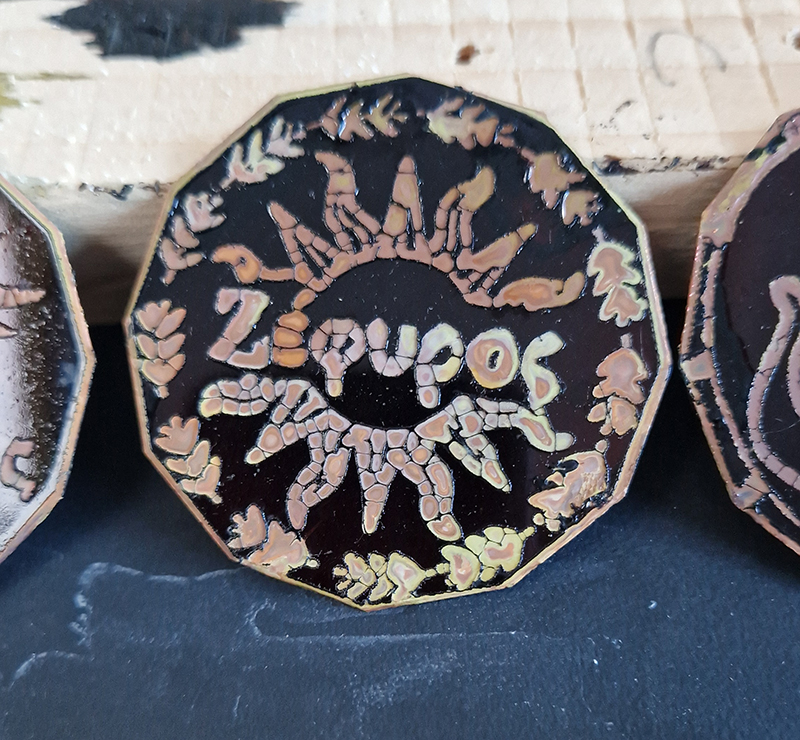
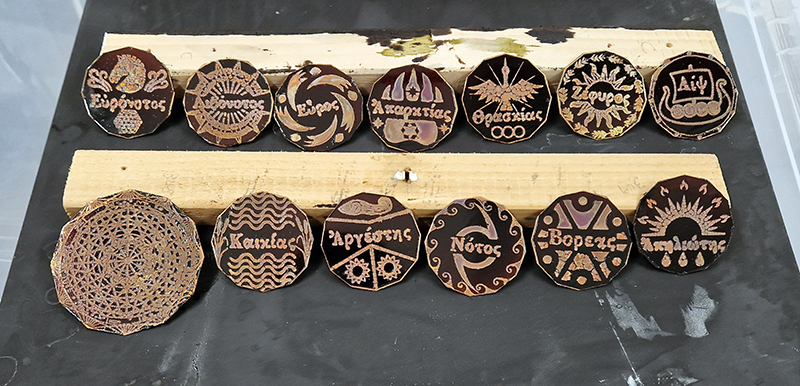
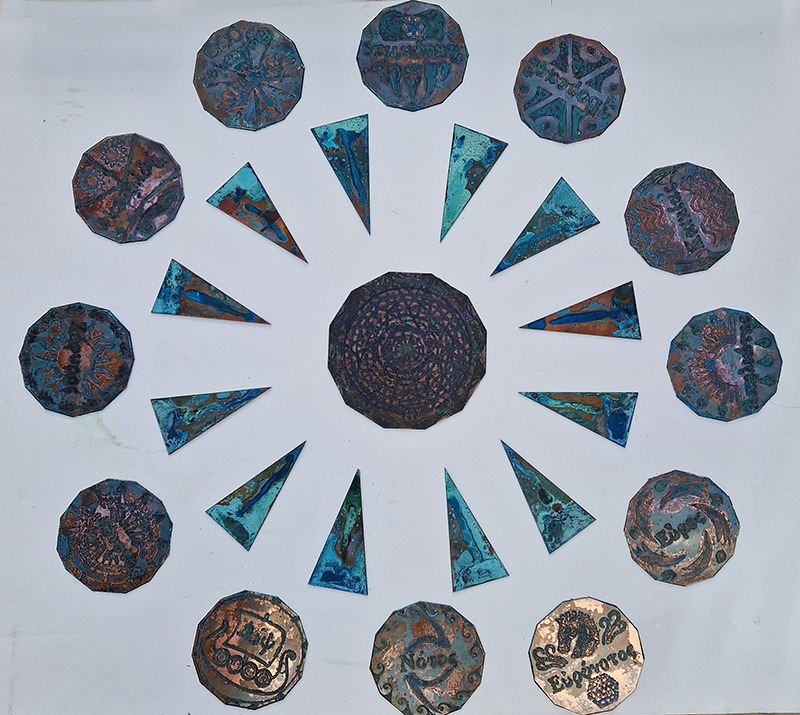
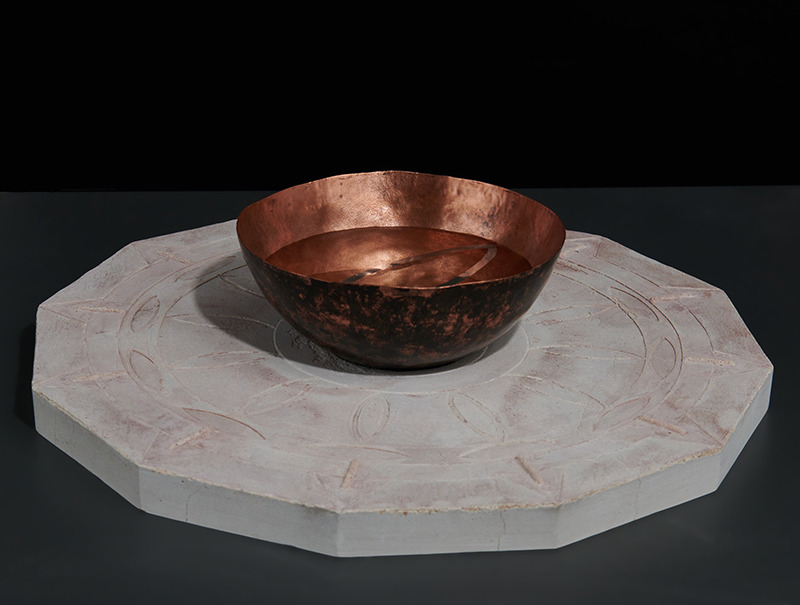
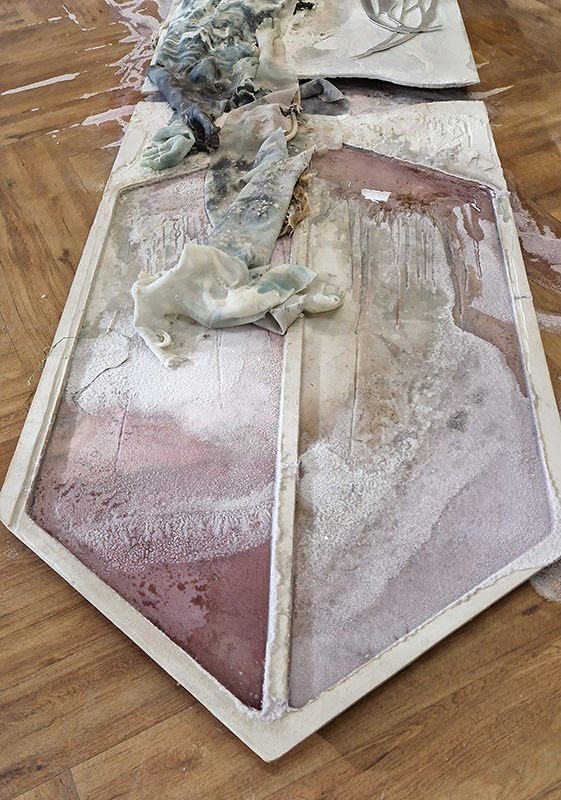
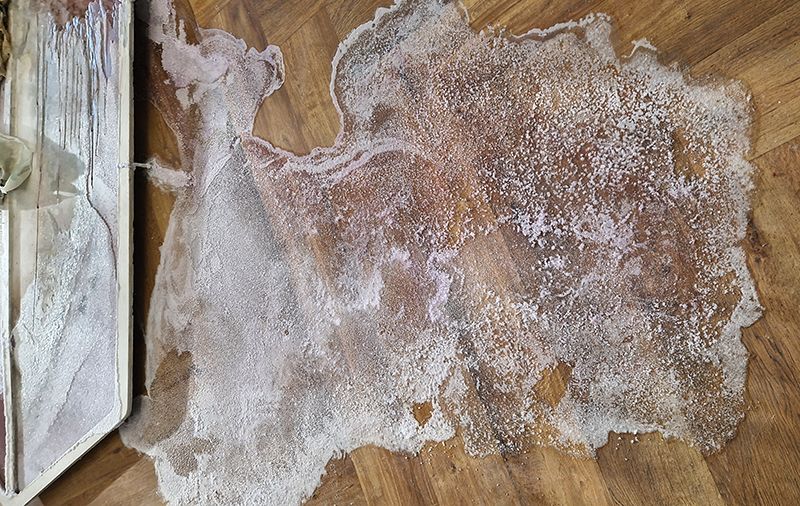
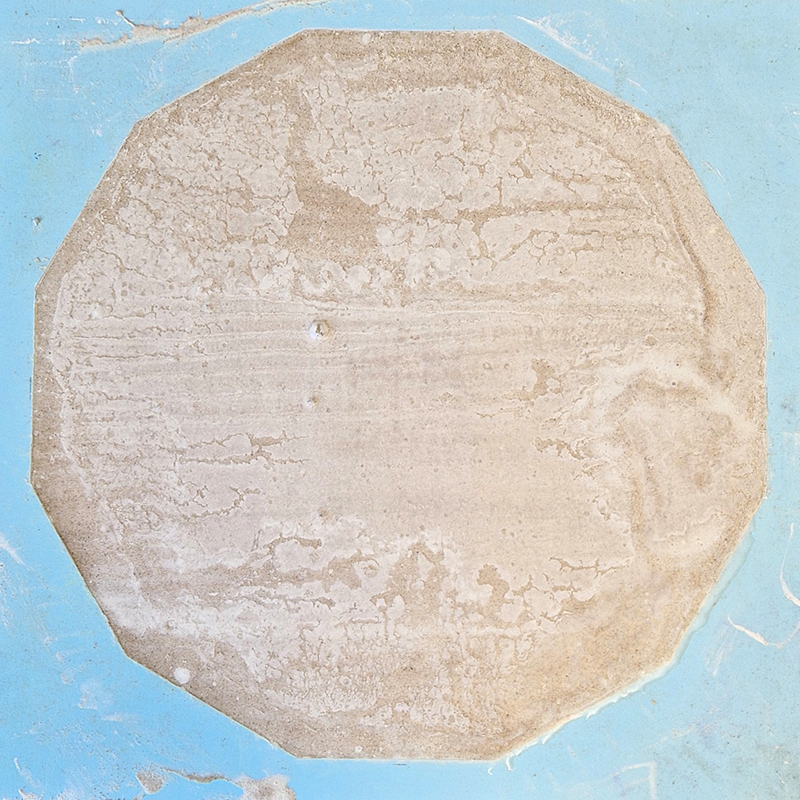
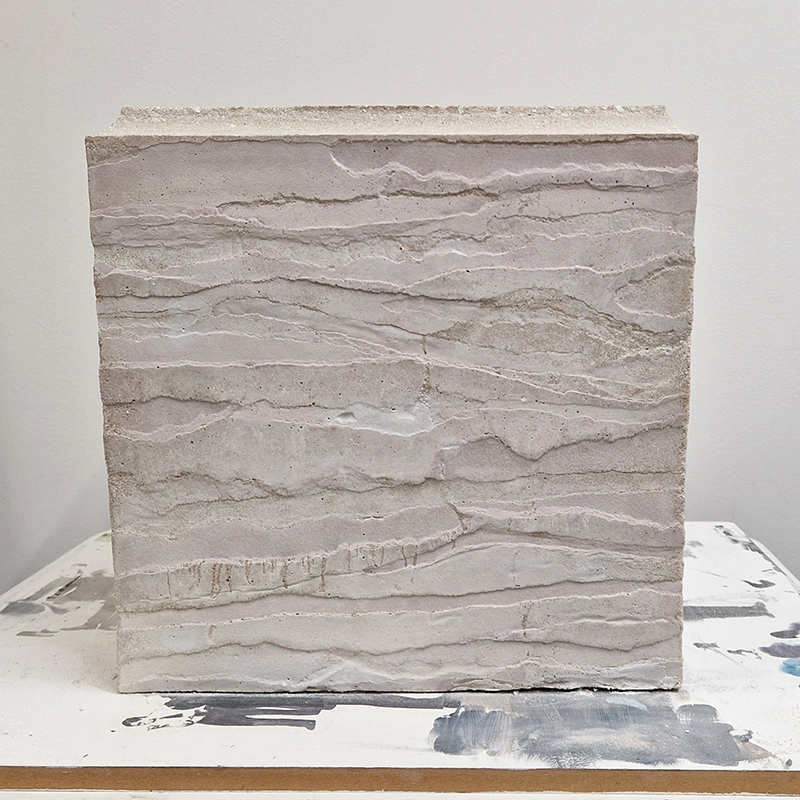
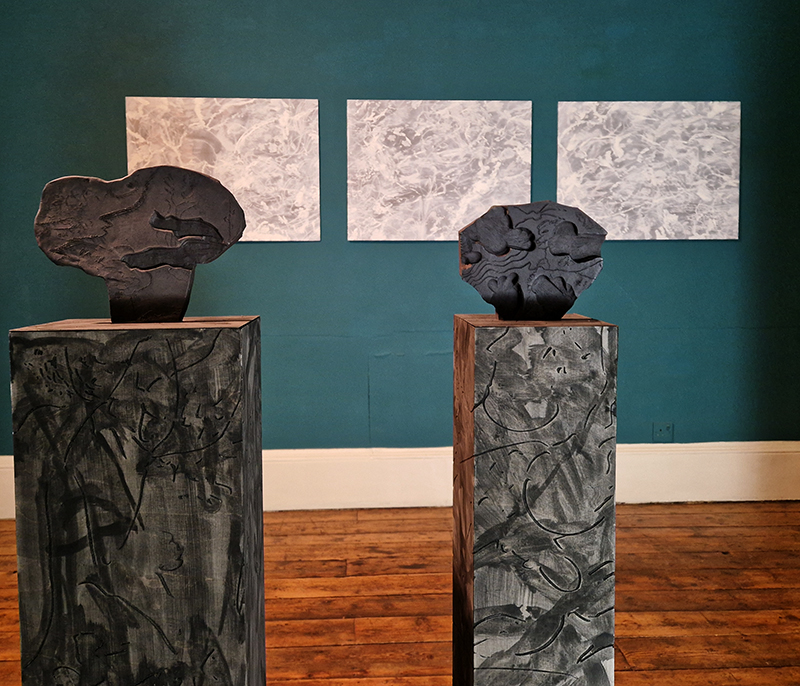
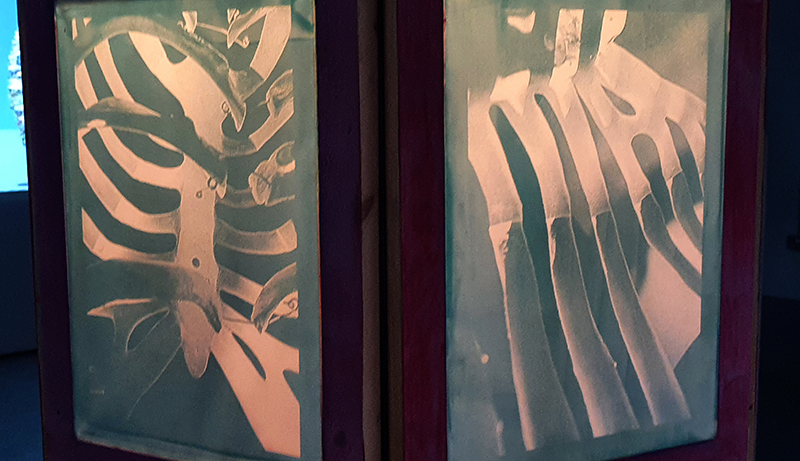
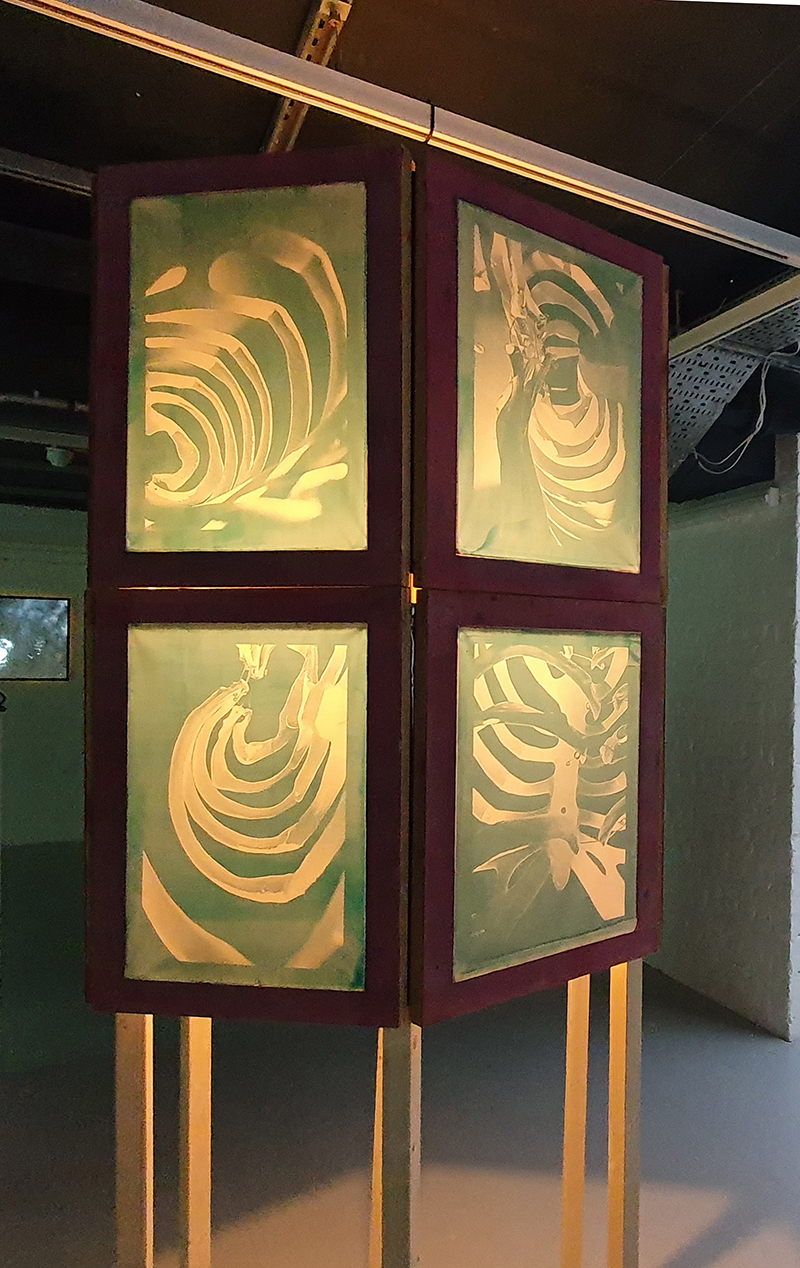
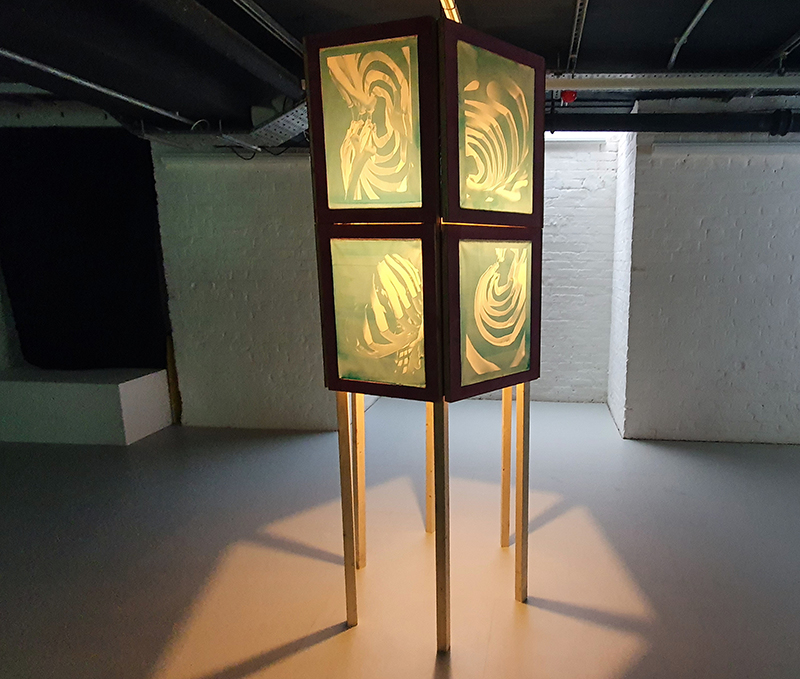
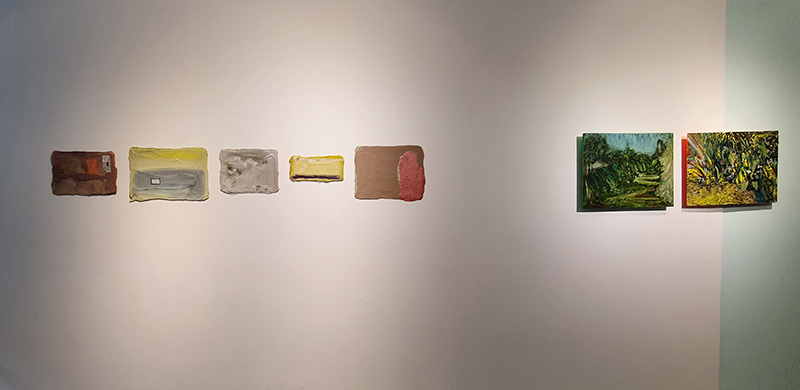
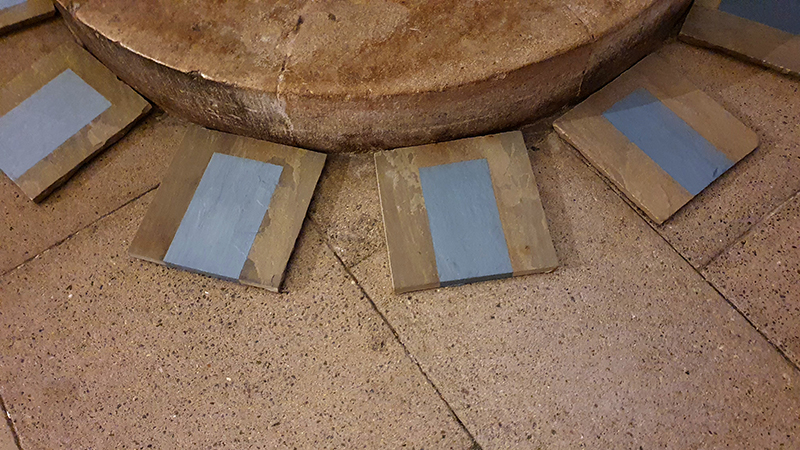
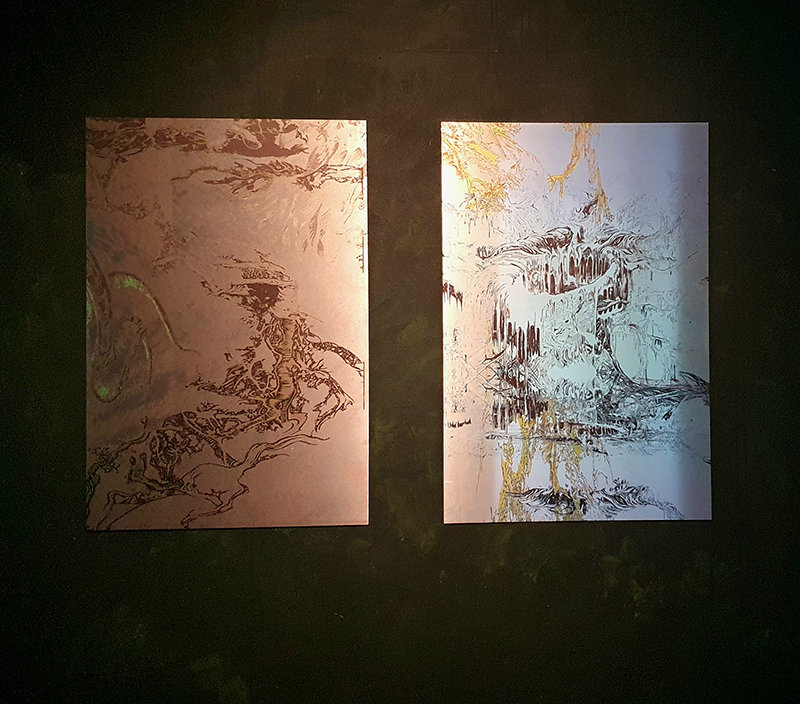
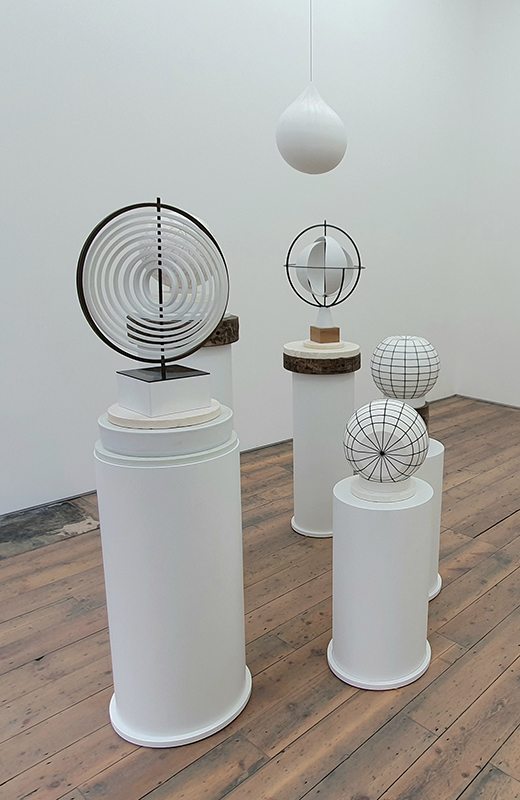
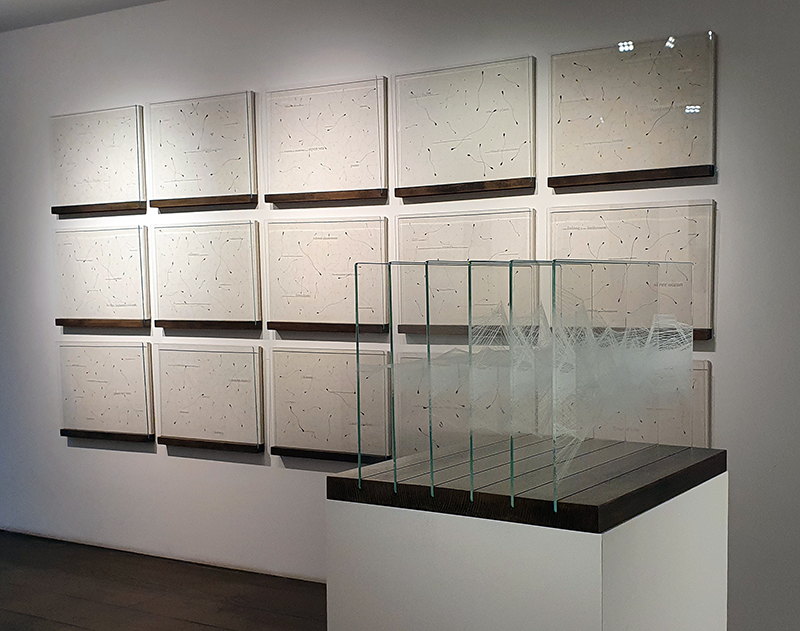
Freshly excavated. A new tablet for the series Instruments of the Anemoi, replacing a previous one based on the idea of a wind rose and set with etched copper markers, the designs of which are influenced by characteristics of the gods (anemoi) represented by each of the twelve winds.
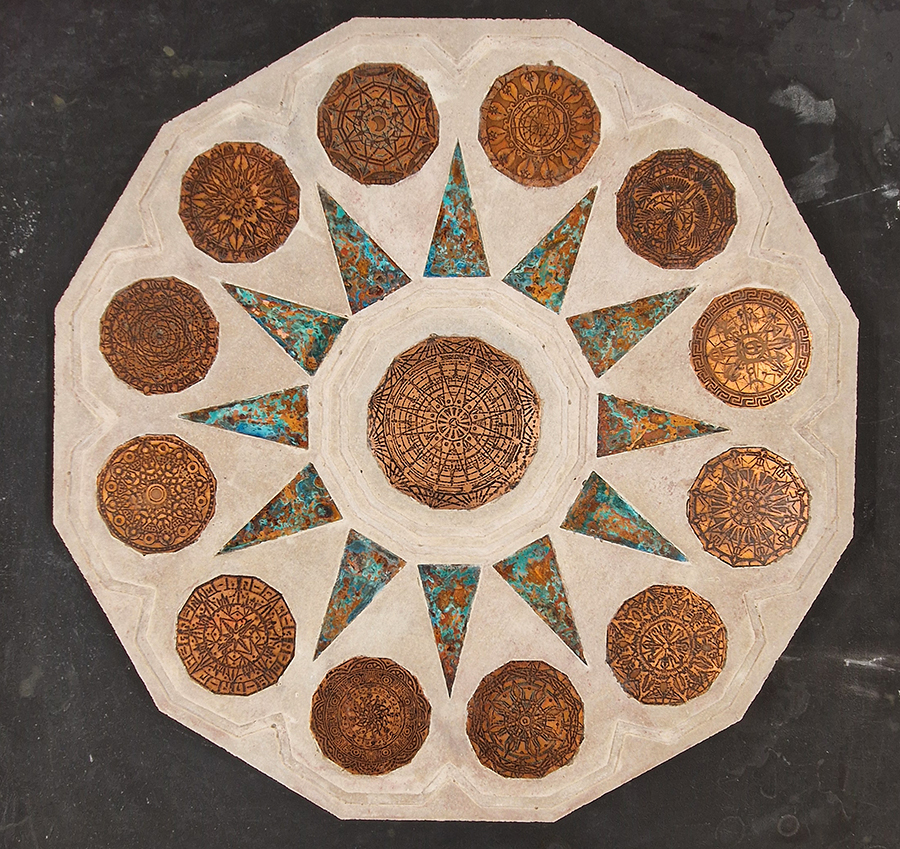
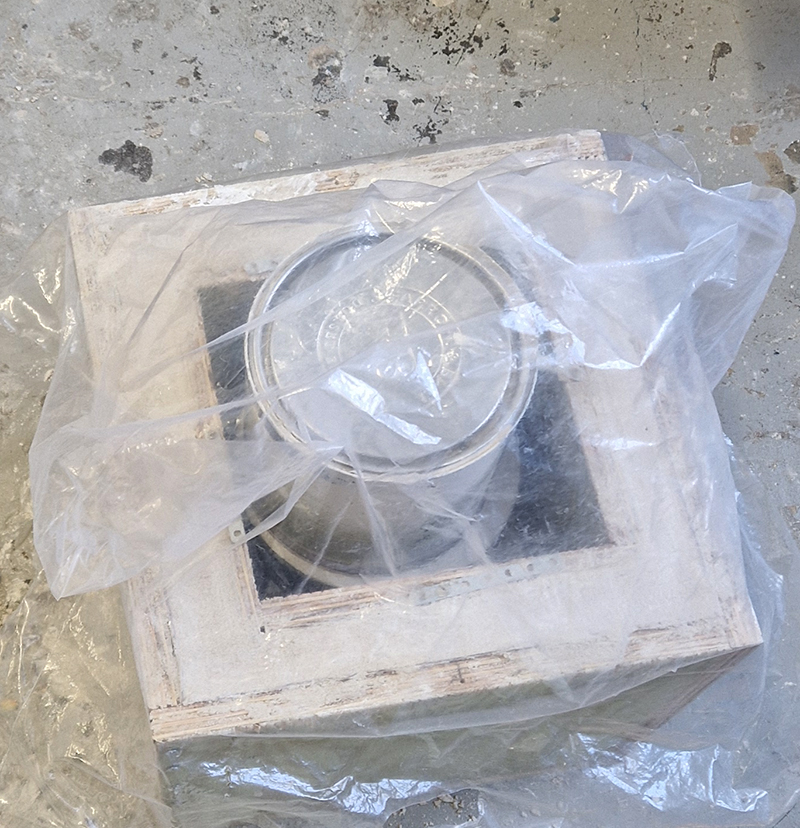
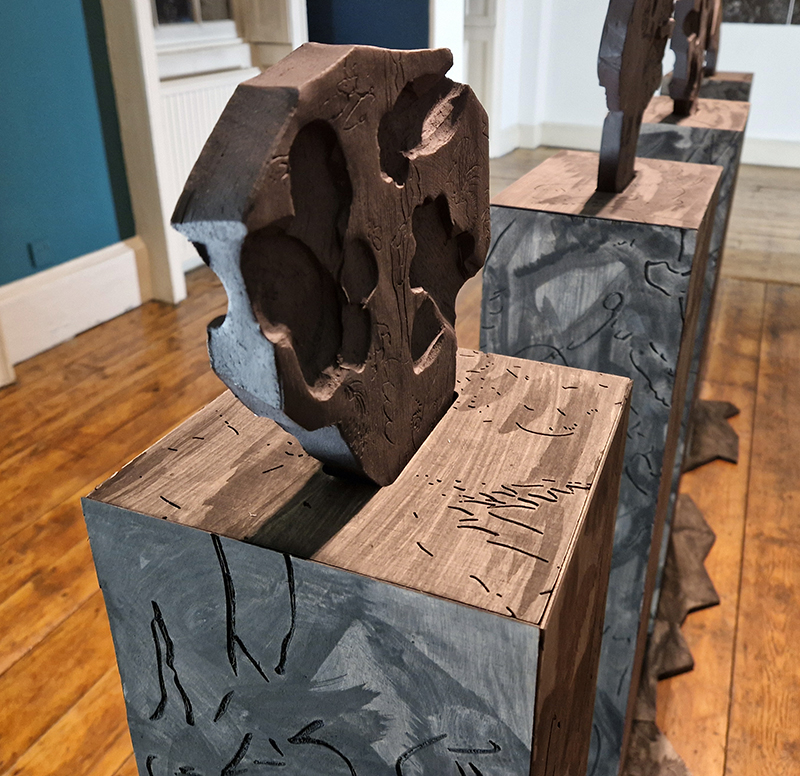
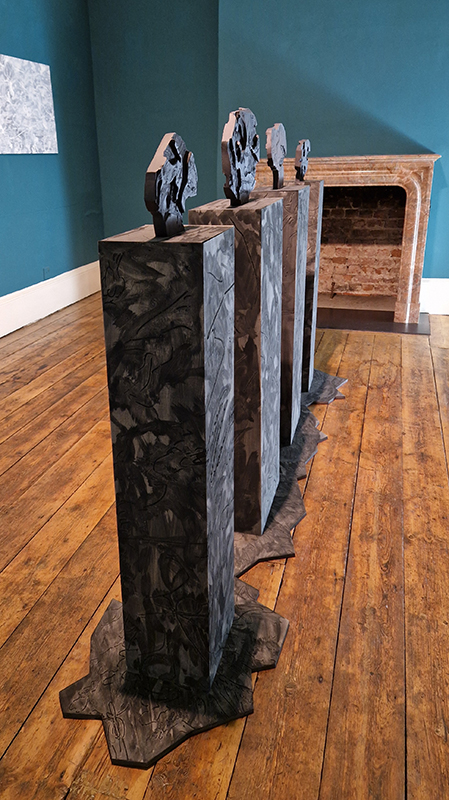
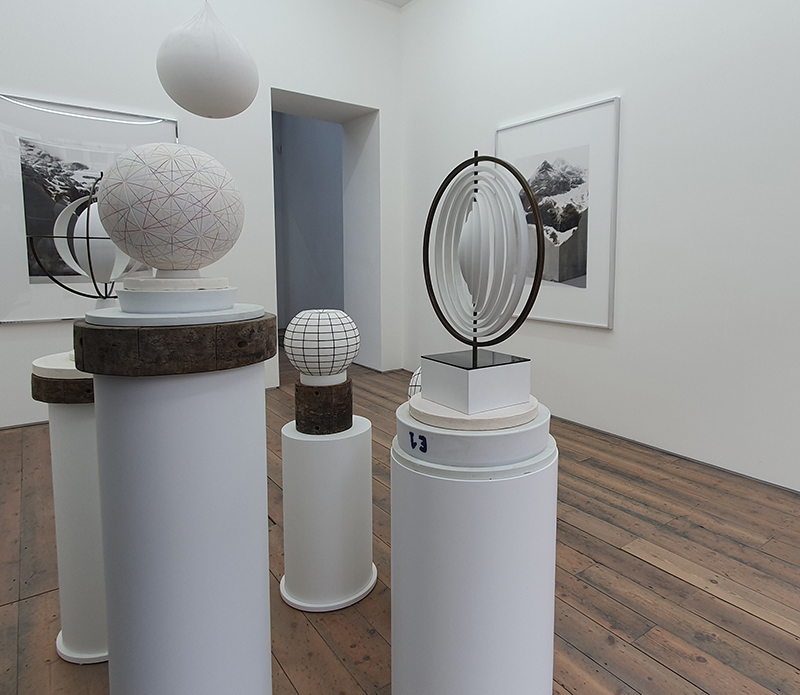
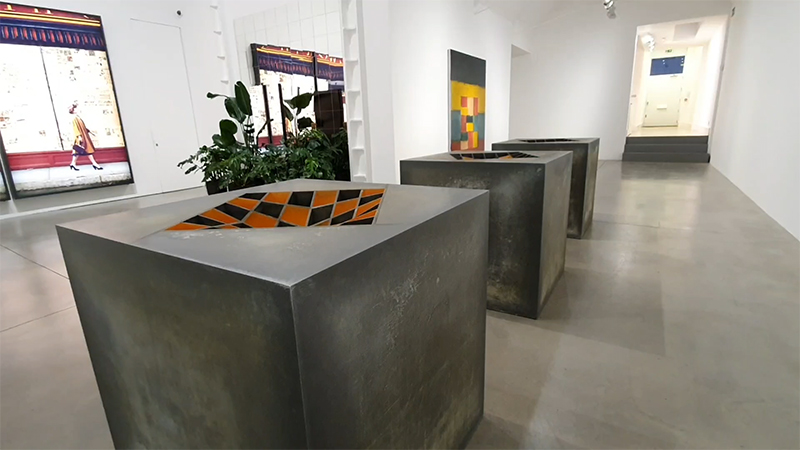
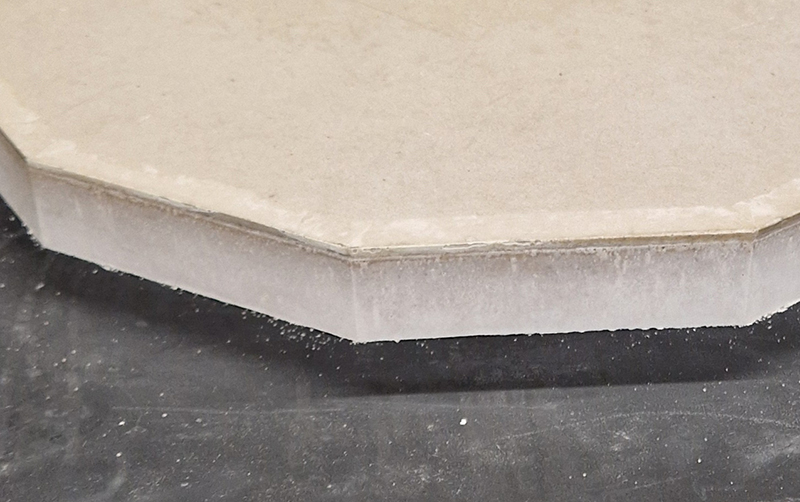
Instruments of the Anemoi are a set of dodecagon tablets cast in Snowcrete, a cement with no magnetic minerals, as is used for instrument pedestals at a magnetic observatory. They also respond to a twelve sided anemoscope “table of the winds” carved in marble around eighteen hundred years ago and held at the Vatican Museums. Releasing the cast from the mould and collagraph is a rewarding process – if all the pieces have held their position during the concrete pour and vibrating to release trapped air bubbles. Luckily this time was a success.

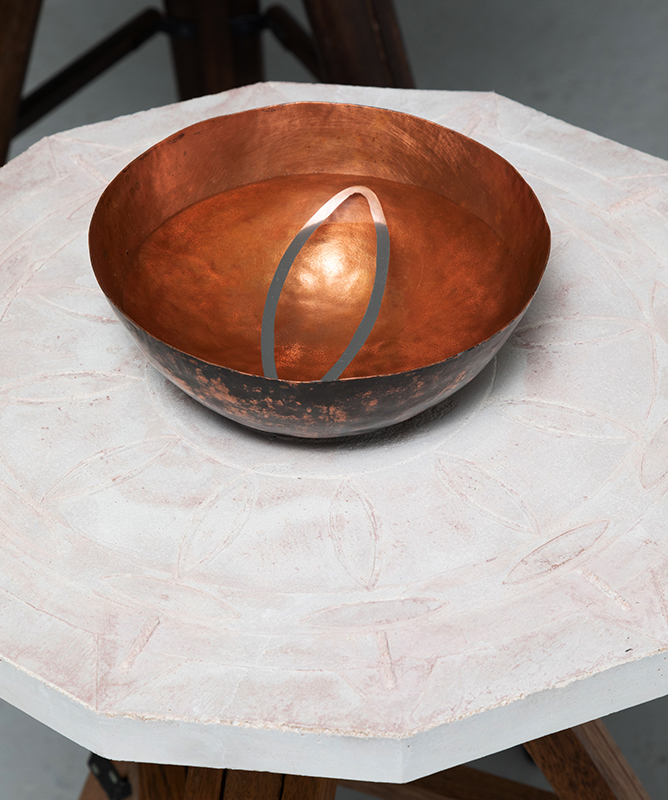
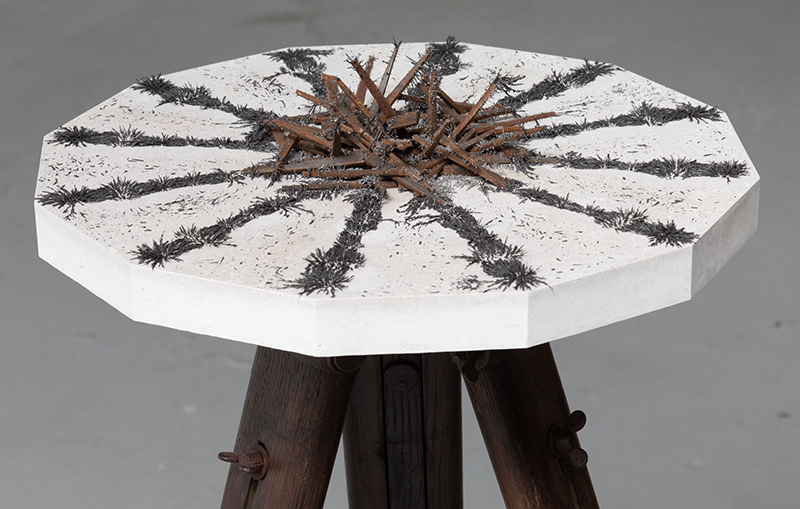
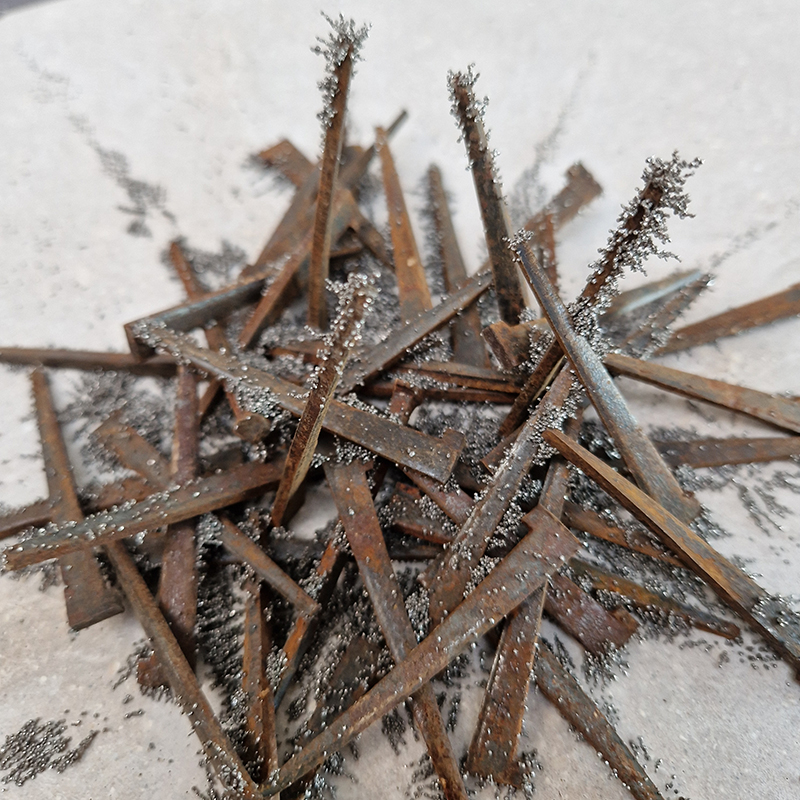
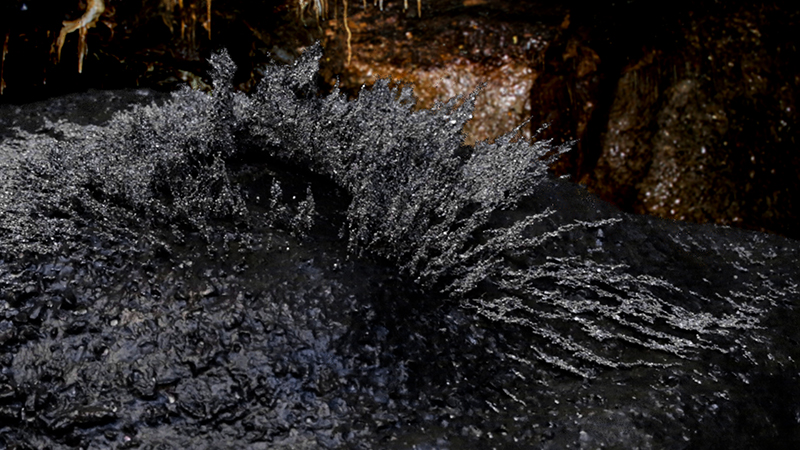
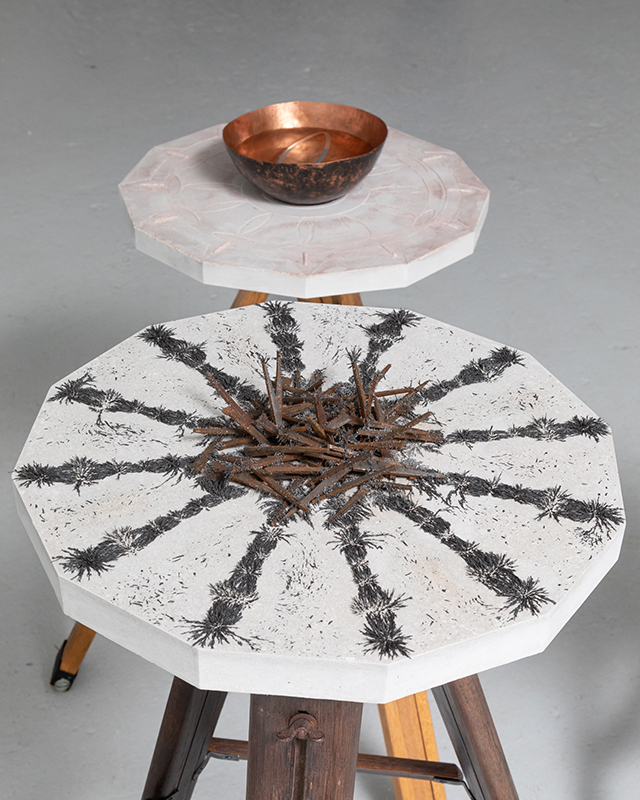
The other two sculptures in the series. A hand beaten copper bowl with a ‘silver fish’ floating in water based on the oval shaped compass needle illustrated in Breve Compendio de la Sphera de la arte Navegar by Martin Cortes 155. Wafer thin fish shaped iron leaves were also used by 11th century Chinese geomancers. Nails and iron filings reveal an embedded magnetic field and hark back to a legend on the discovery of the lodestone, a naturally magnetic mineral, which recalls a Greek shepherd who noticed the nails in his boots were attracted to the rock beneath his feet.
Unsettling to find it is already one year on since A Stone Sky duo exhibition with Julie F Hill opened at Thames-side Studios Gallery and this work was first shown.

Around 95% of the universe is ‘dark’ to us, formed of unknown and possibly unknowable matter which may be inaccessible to us, but cosmic rays offer a tangible contact with outer space.   

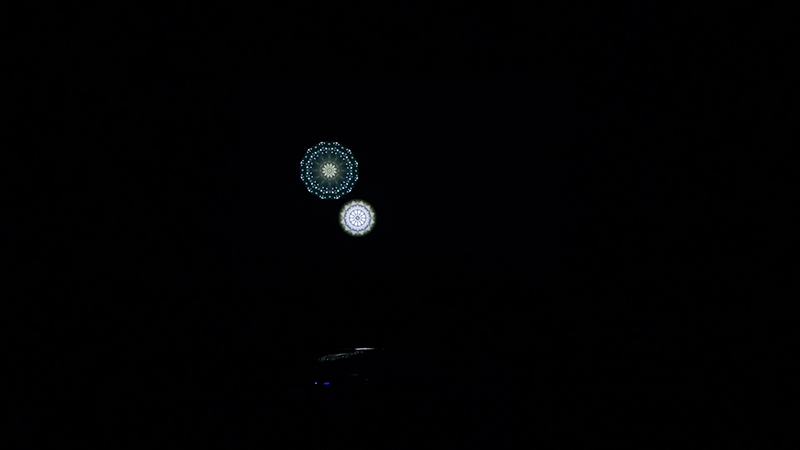
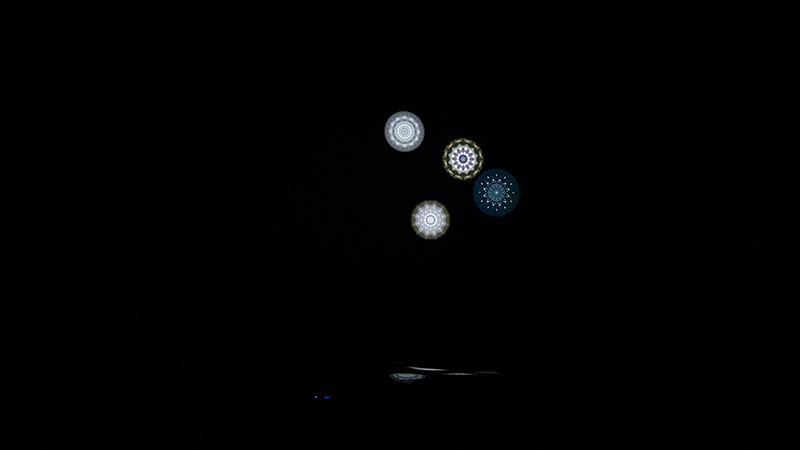
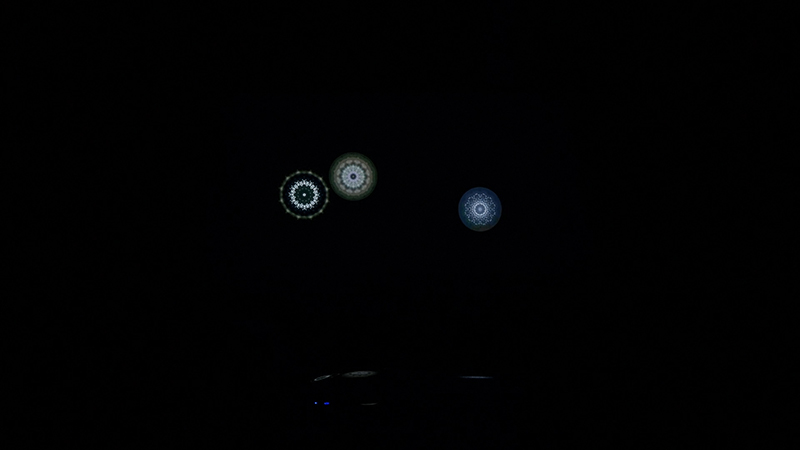
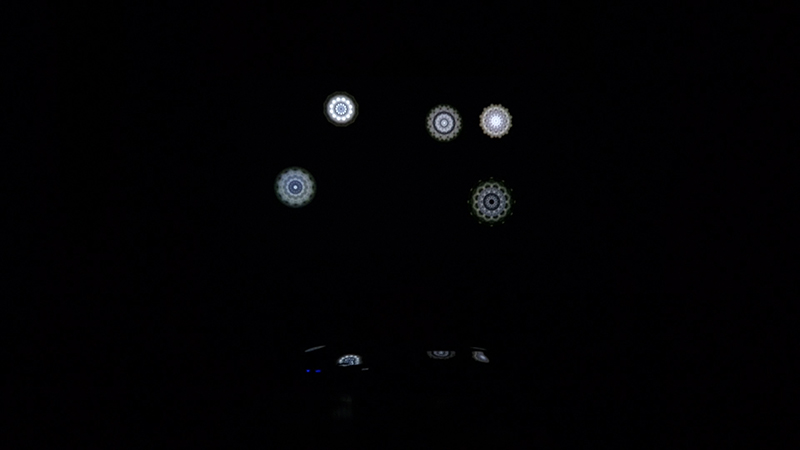
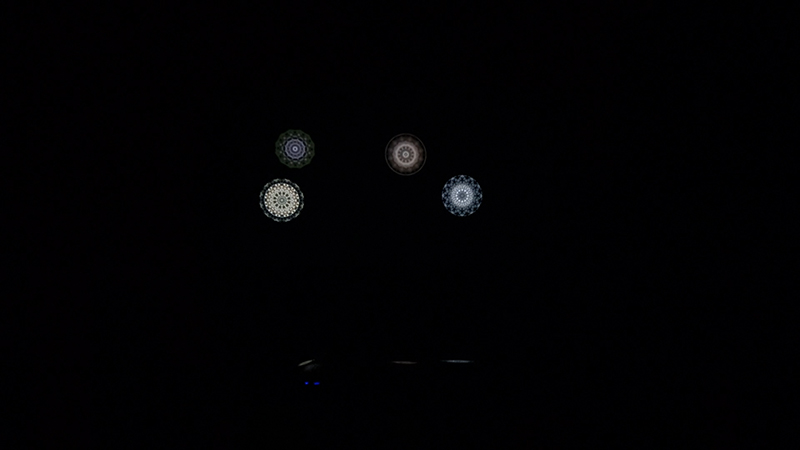
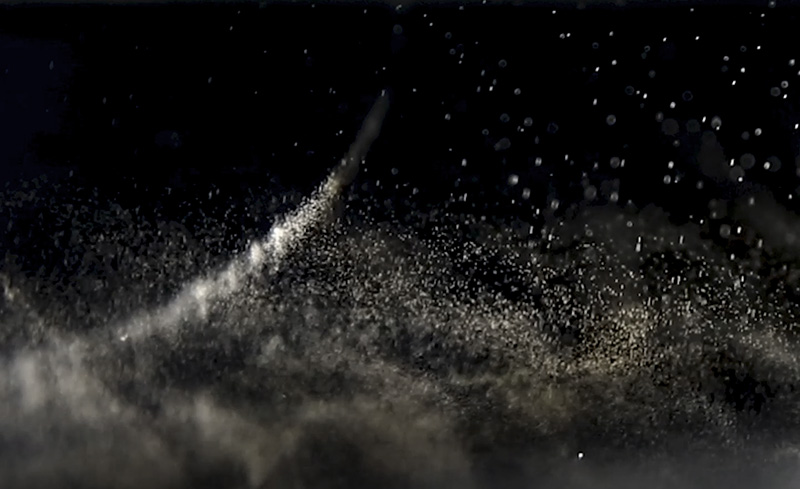
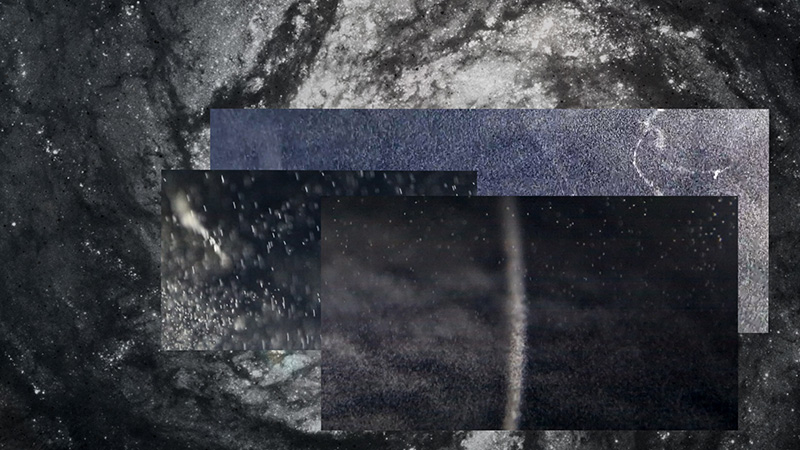
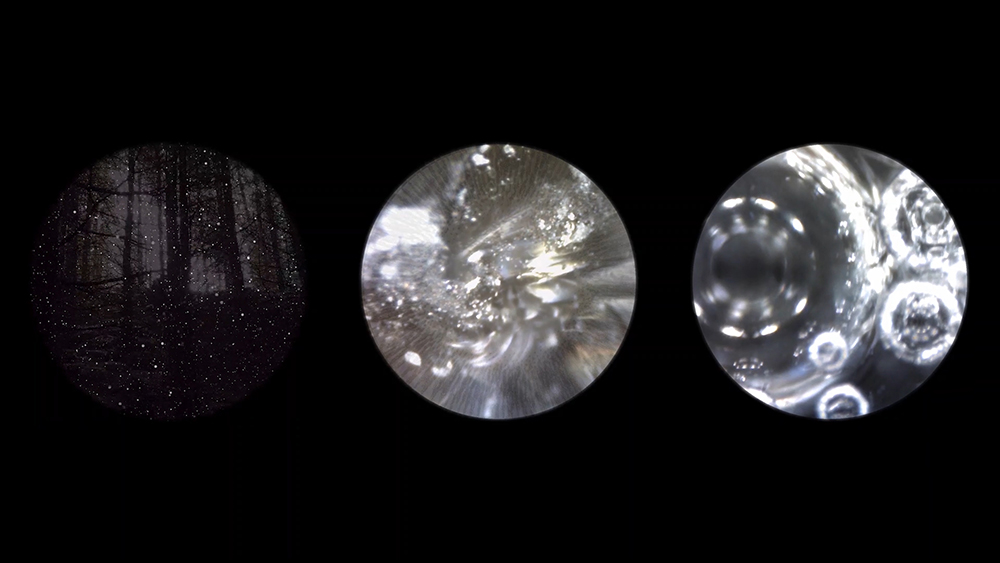
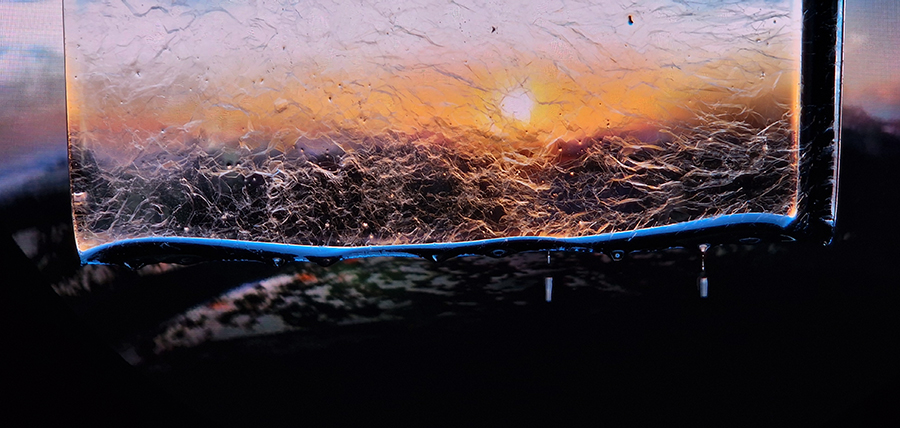
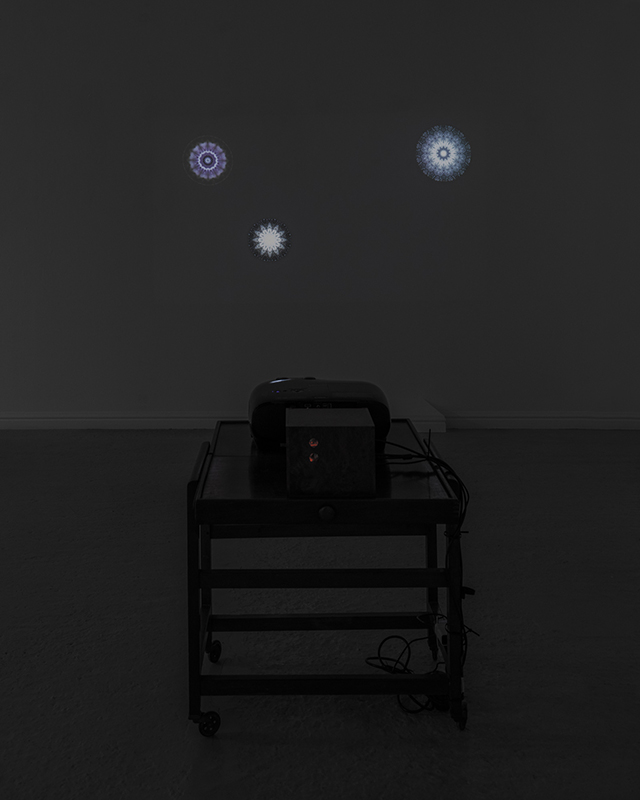
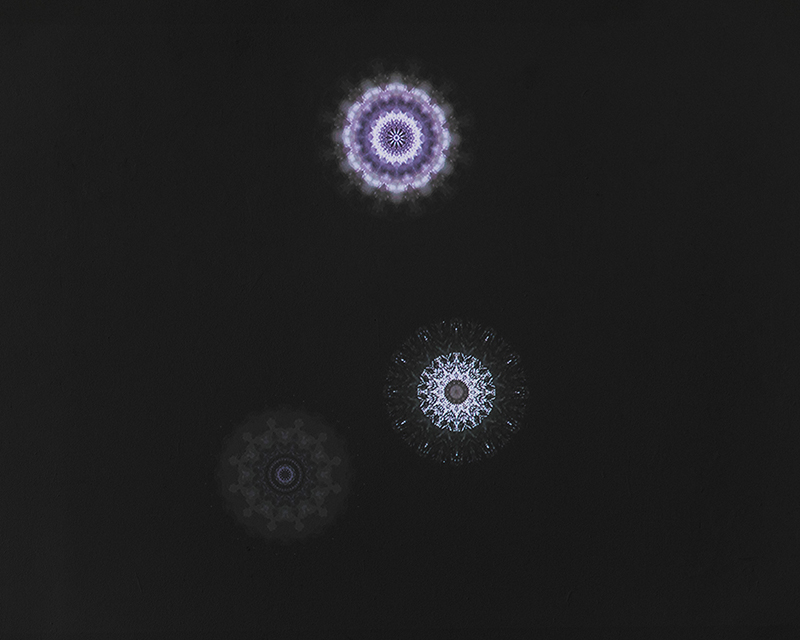
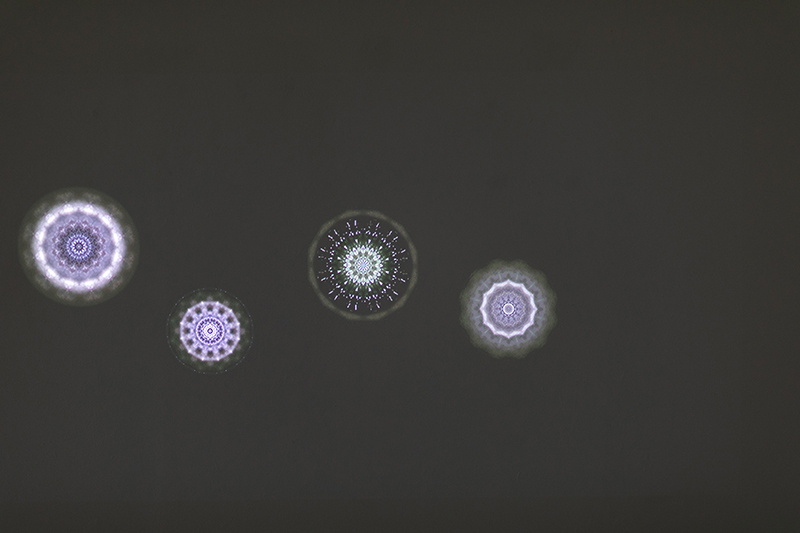
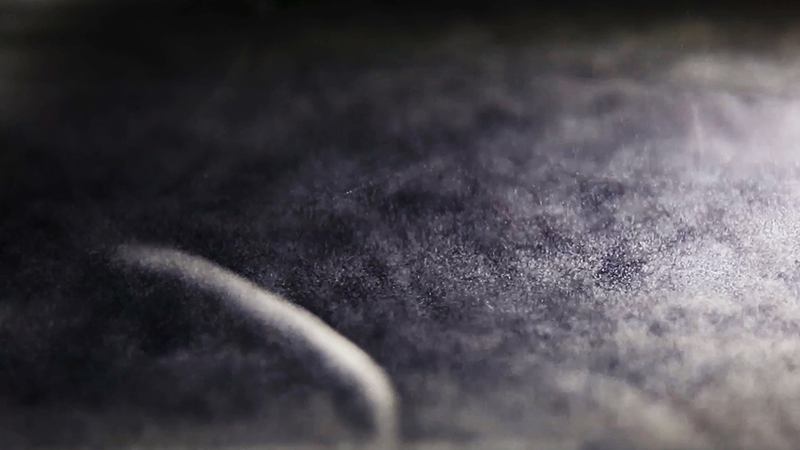
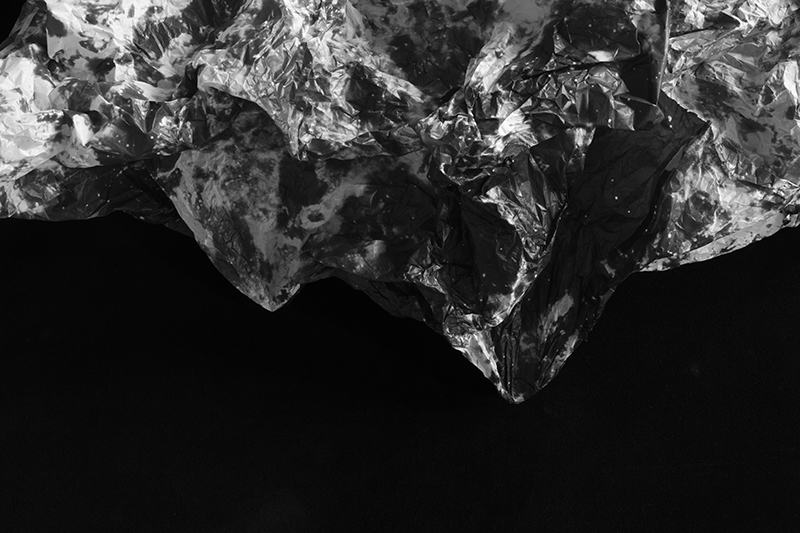
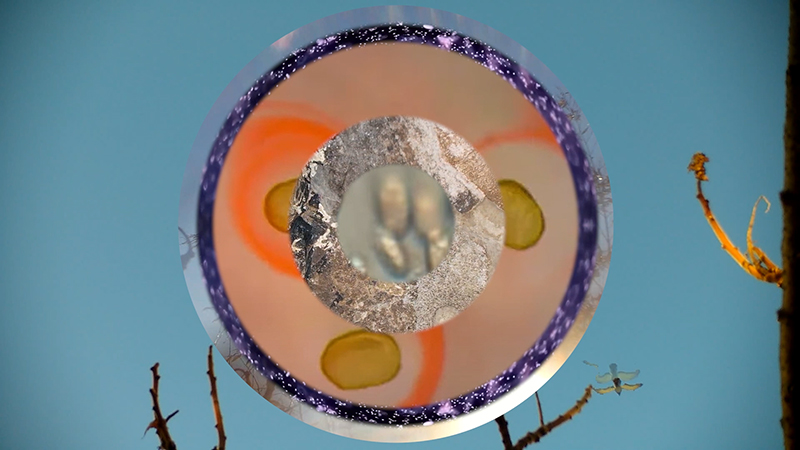
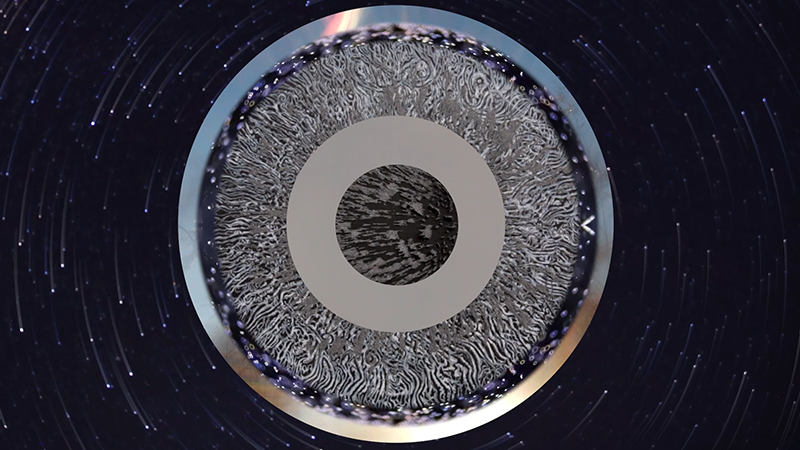
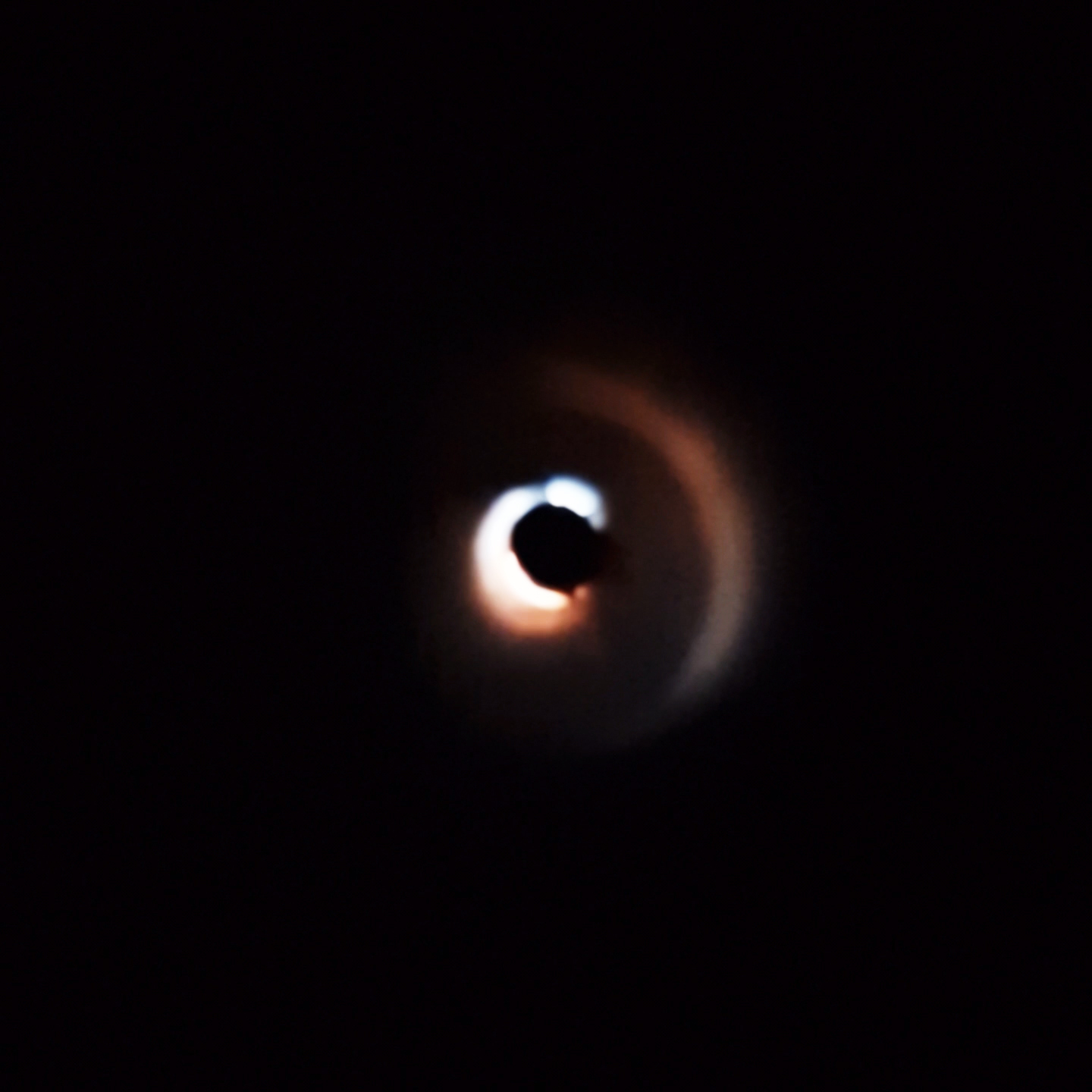
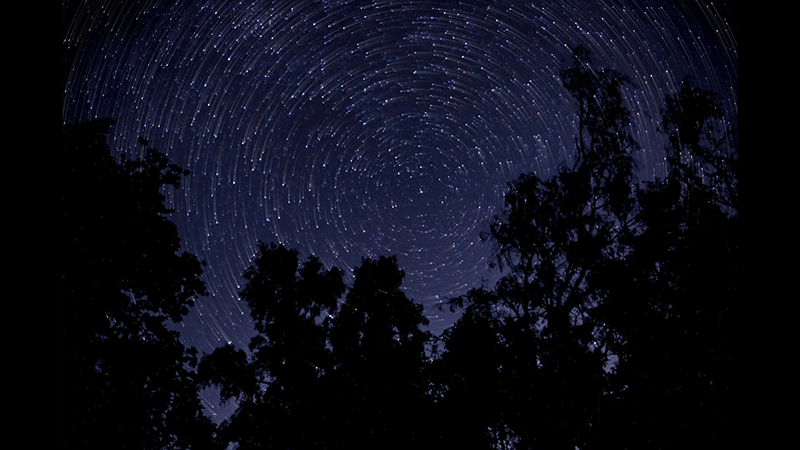
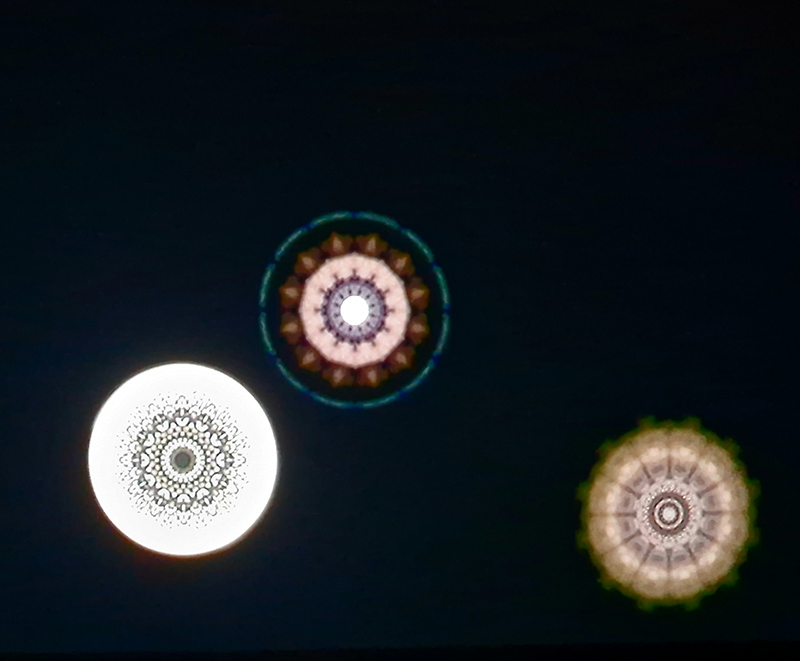
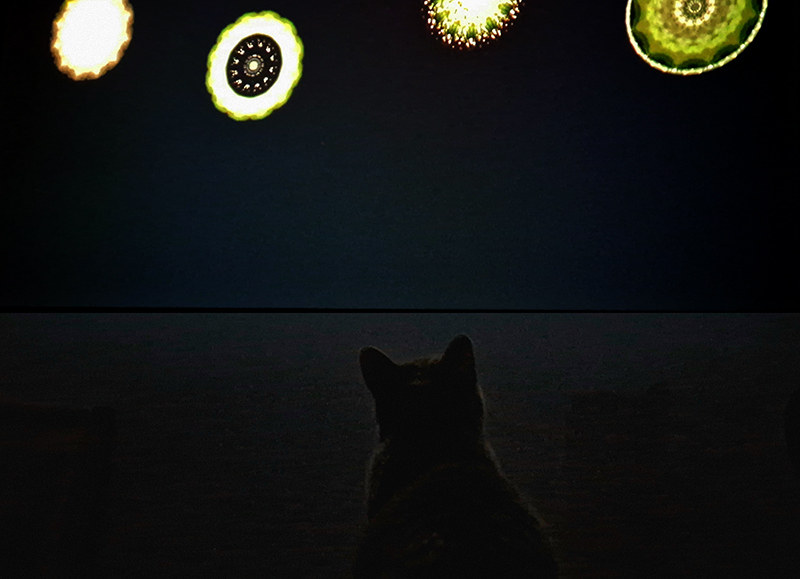
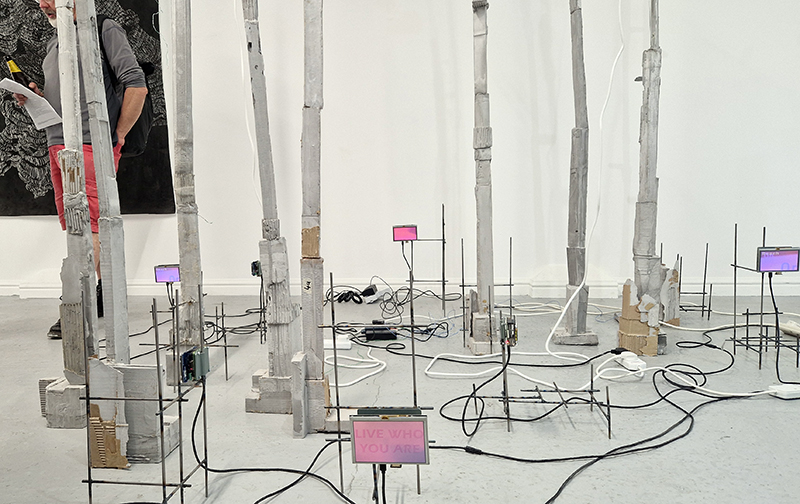
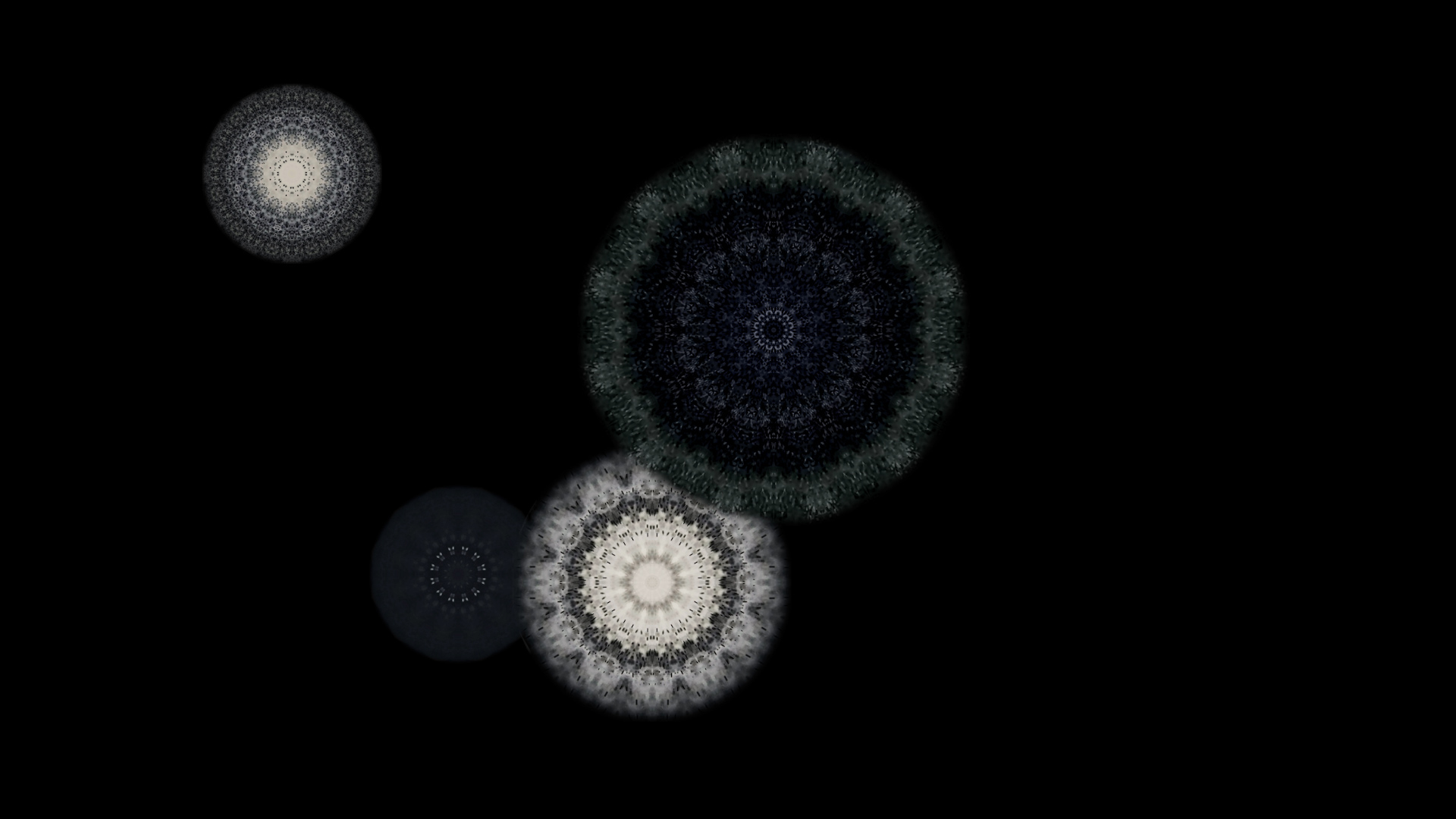
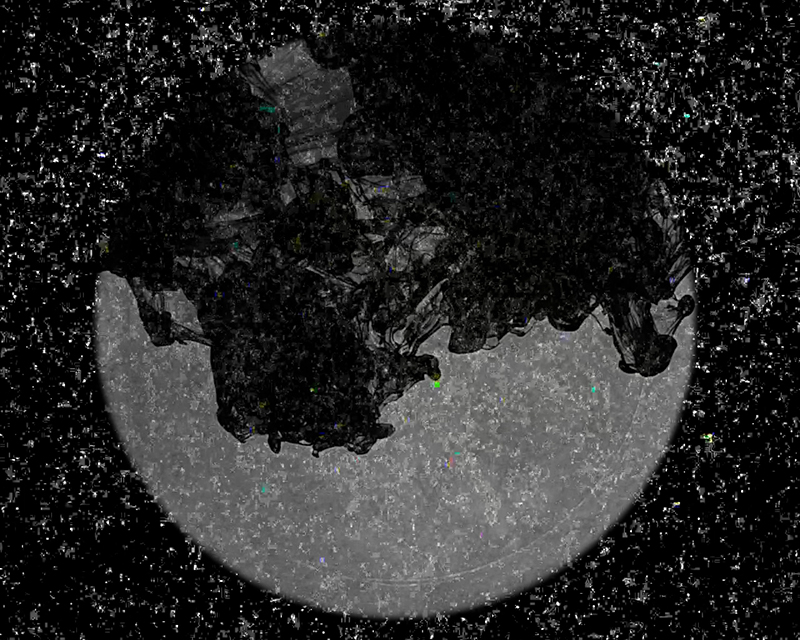
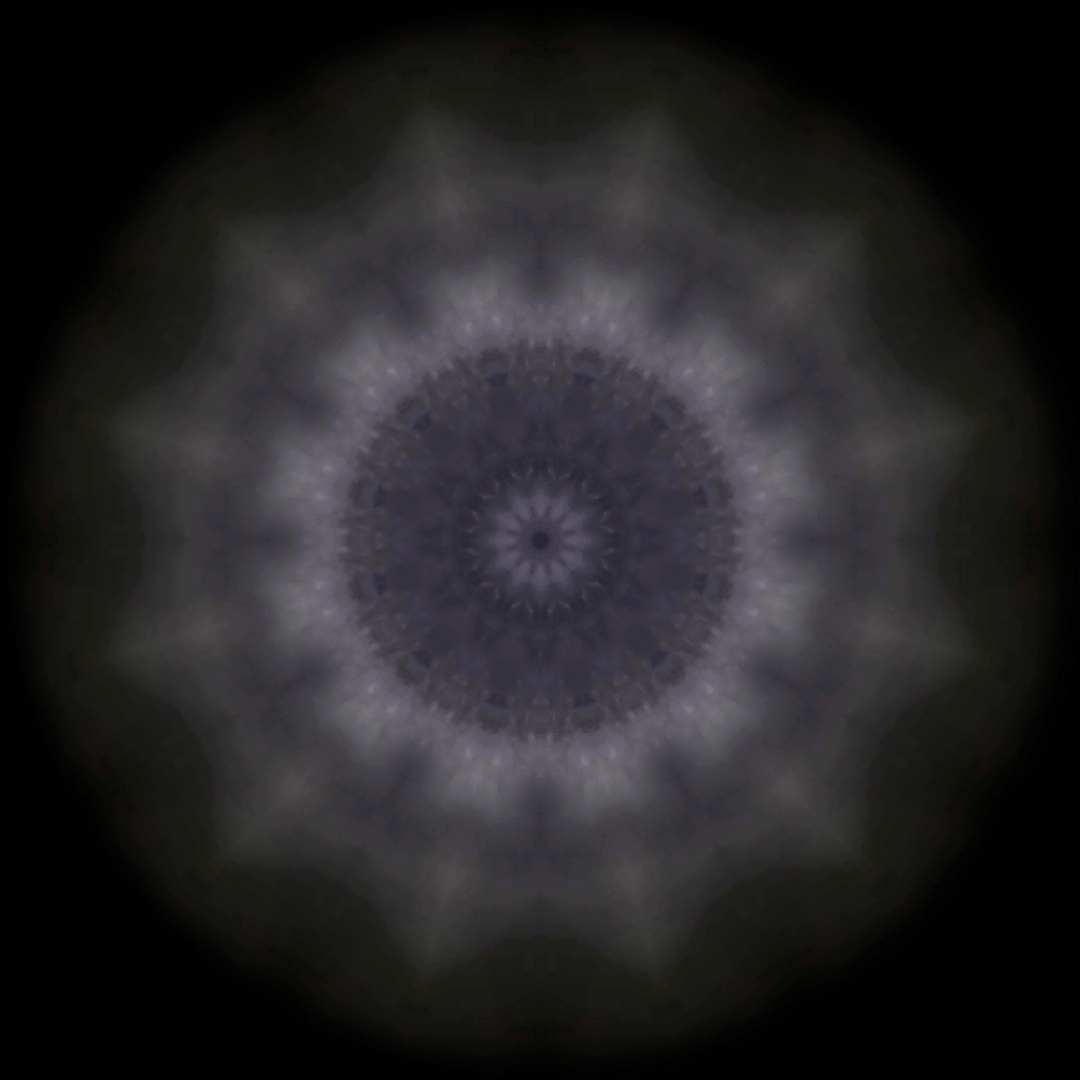
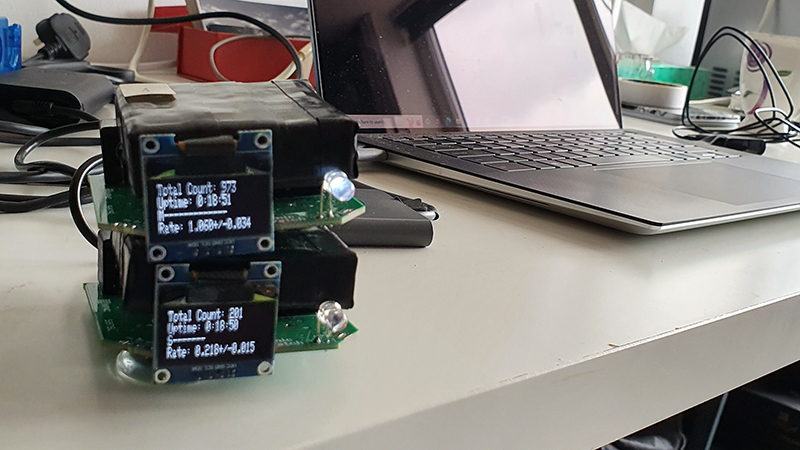
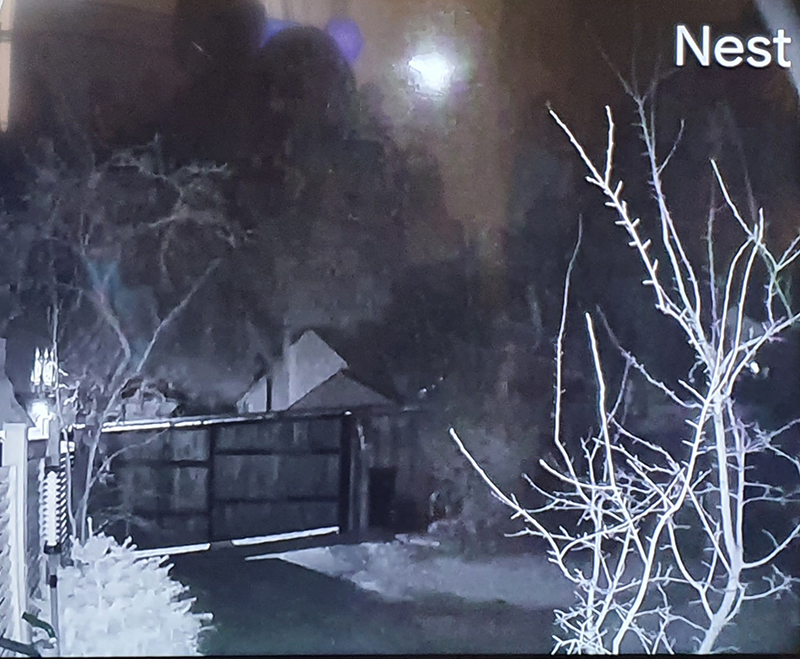
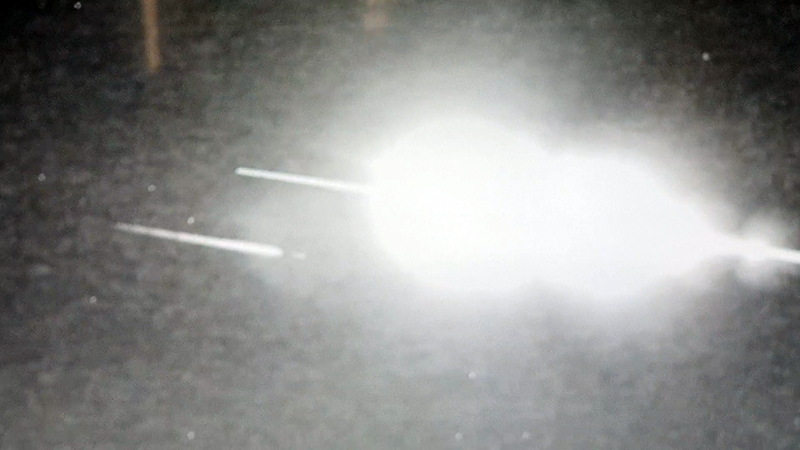
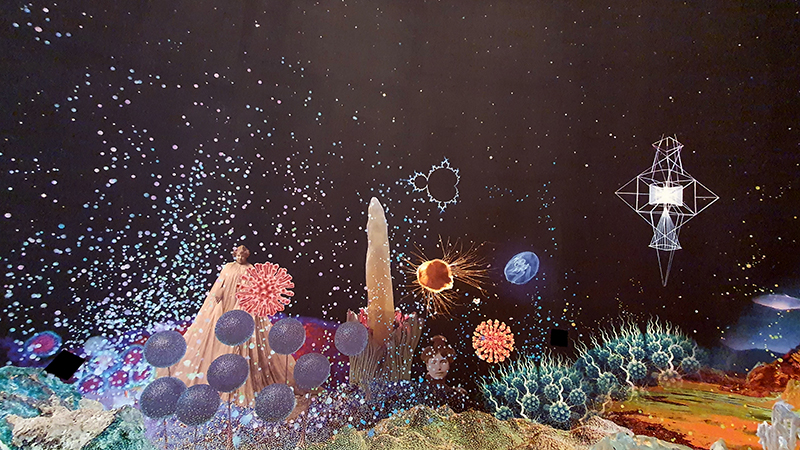
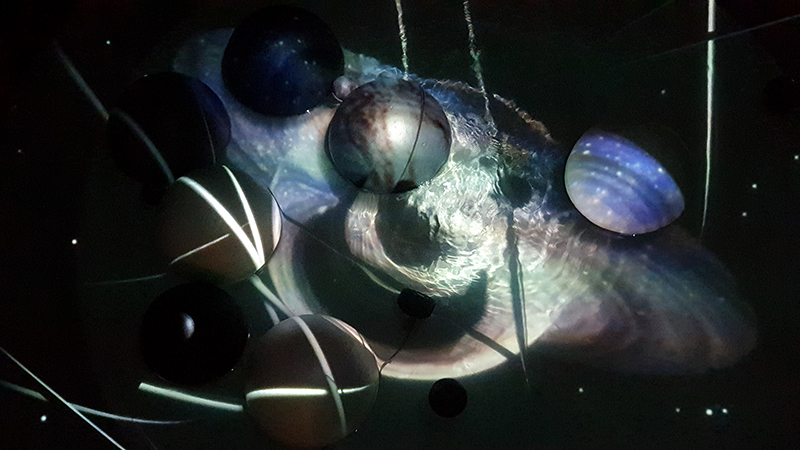
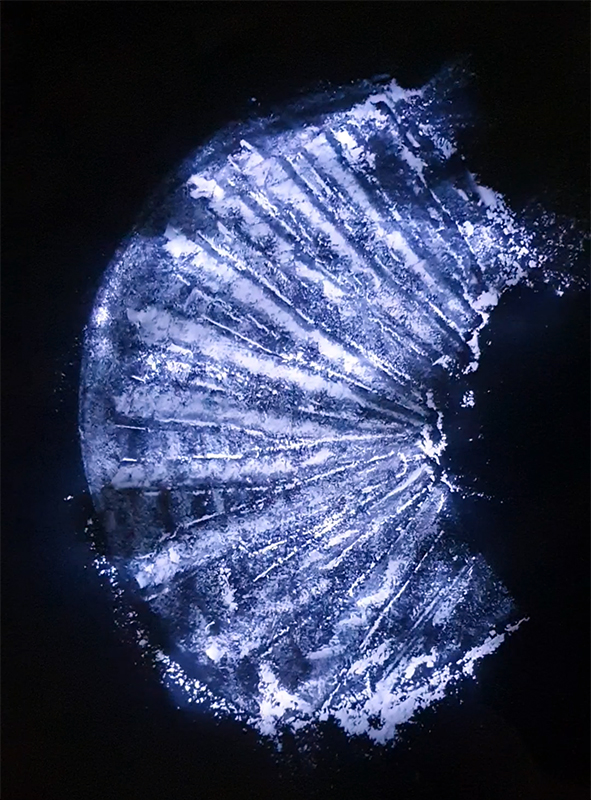
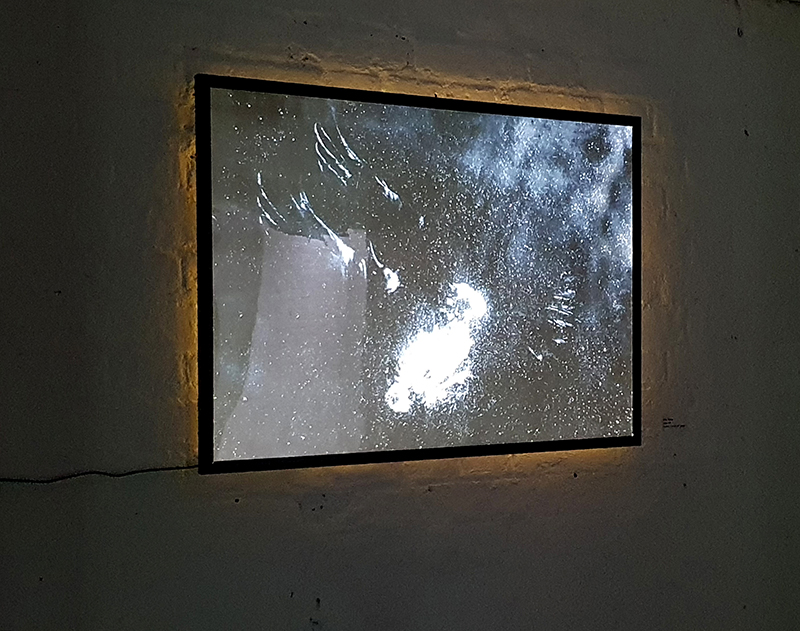
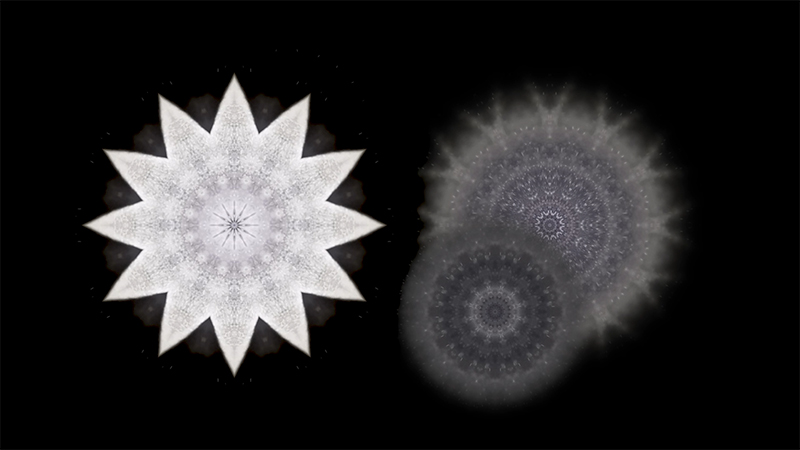
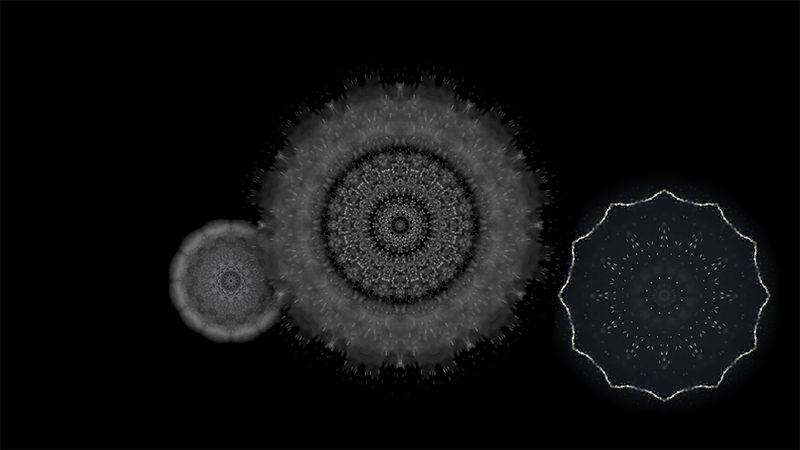
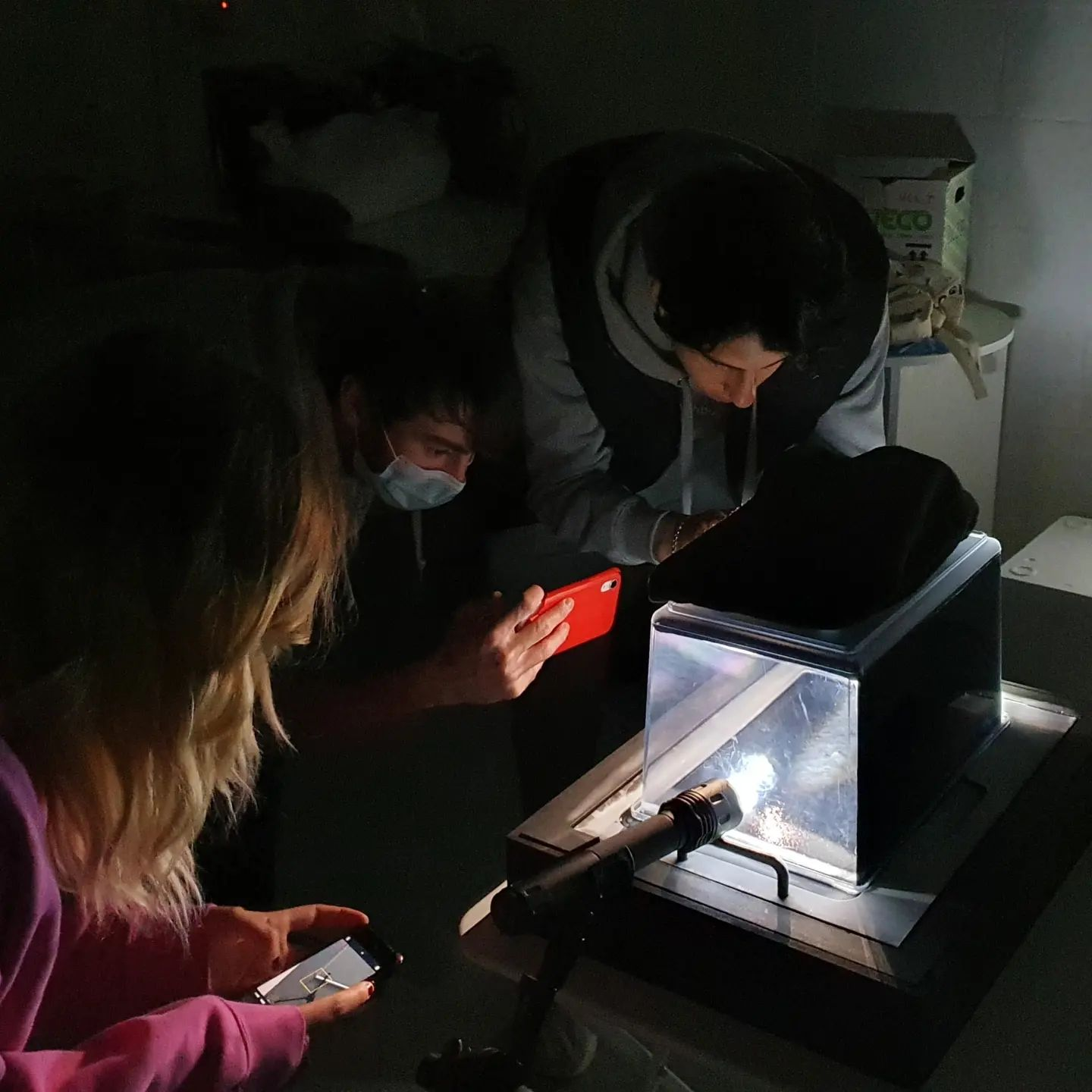
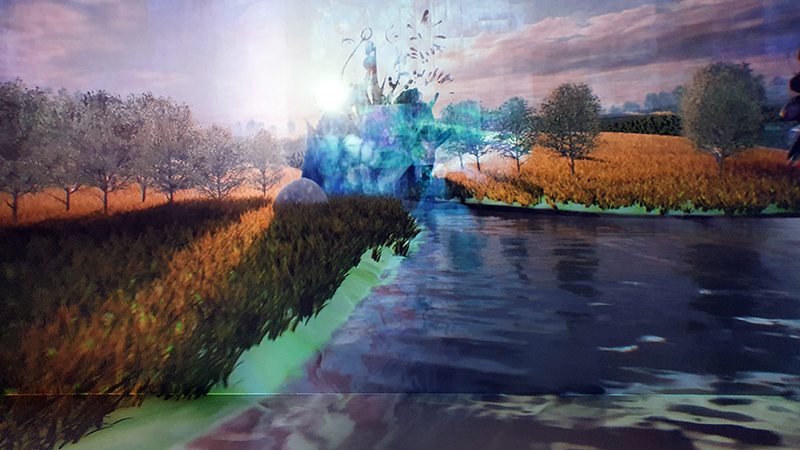
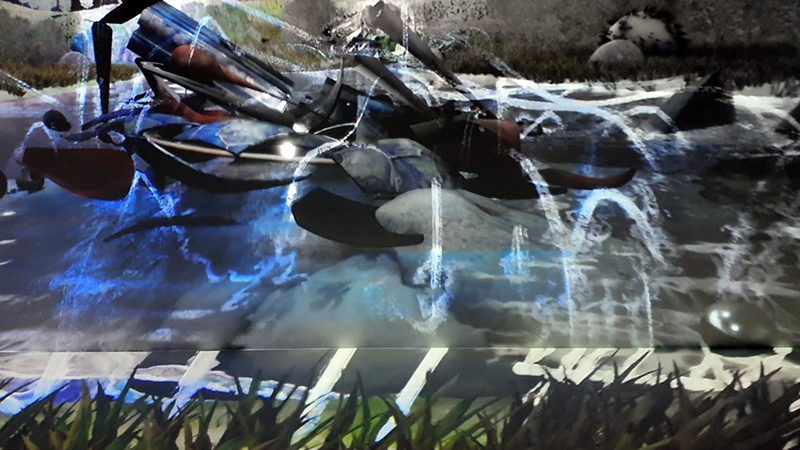
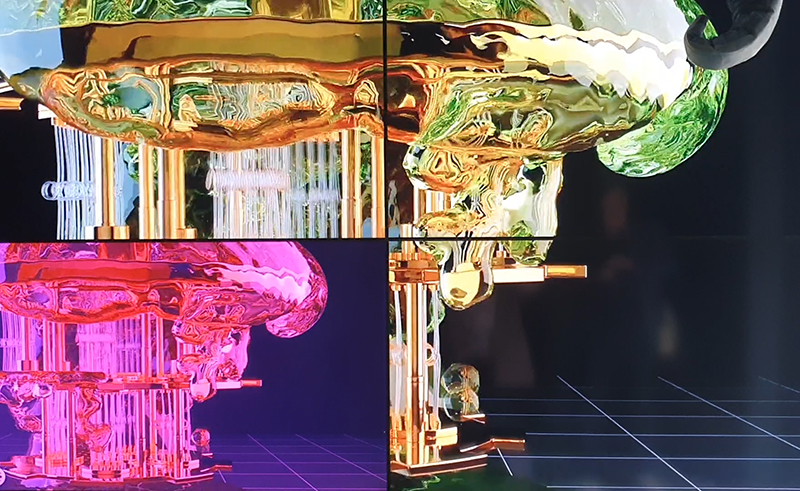
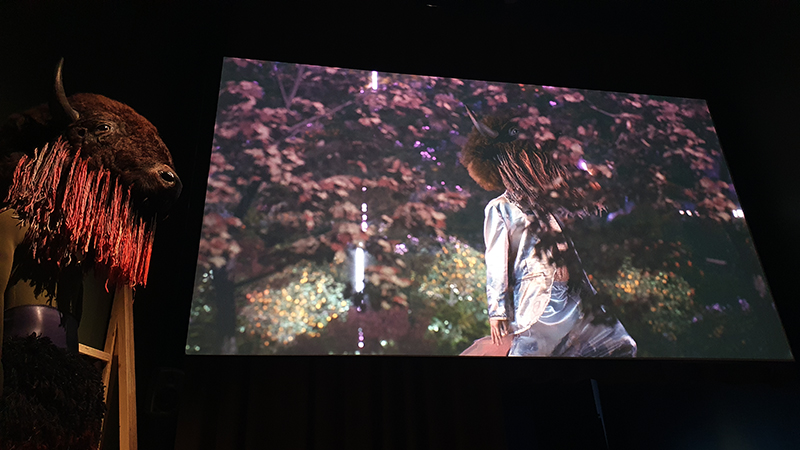
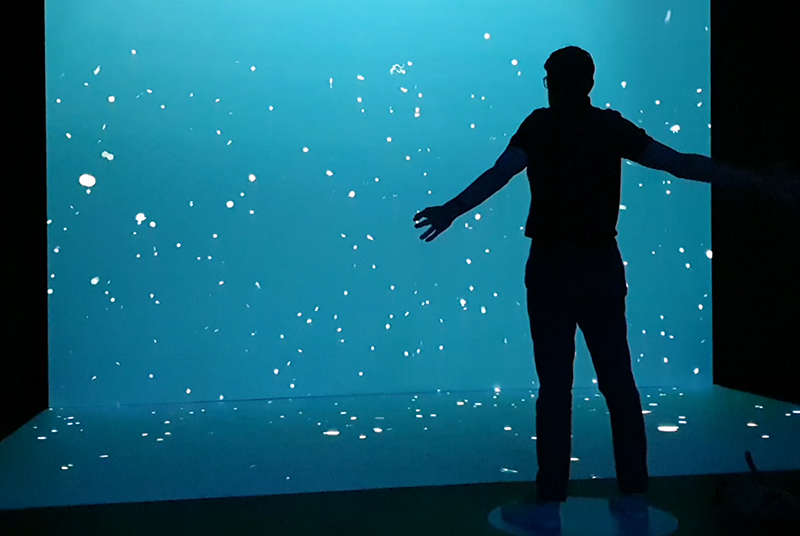
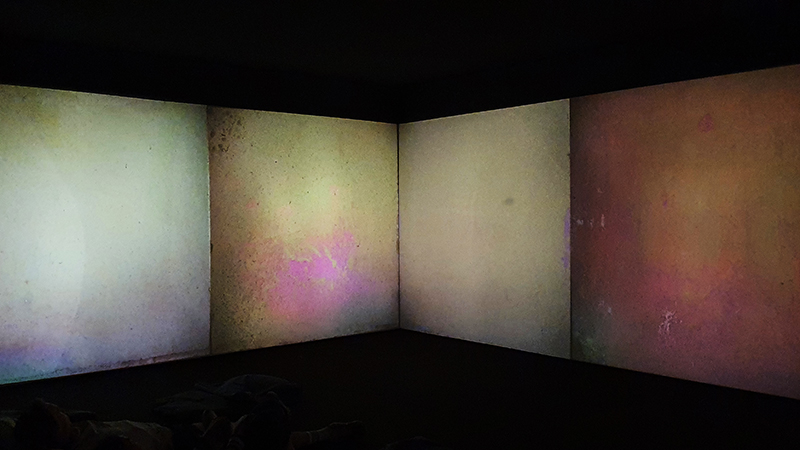
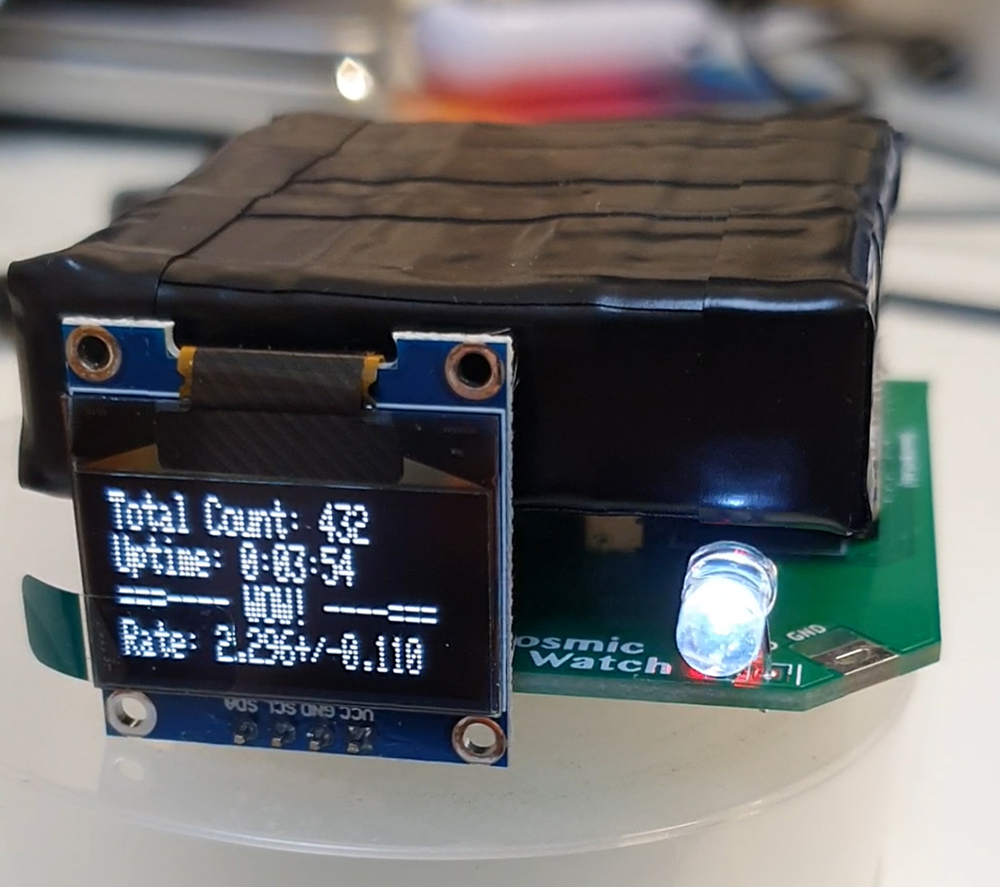
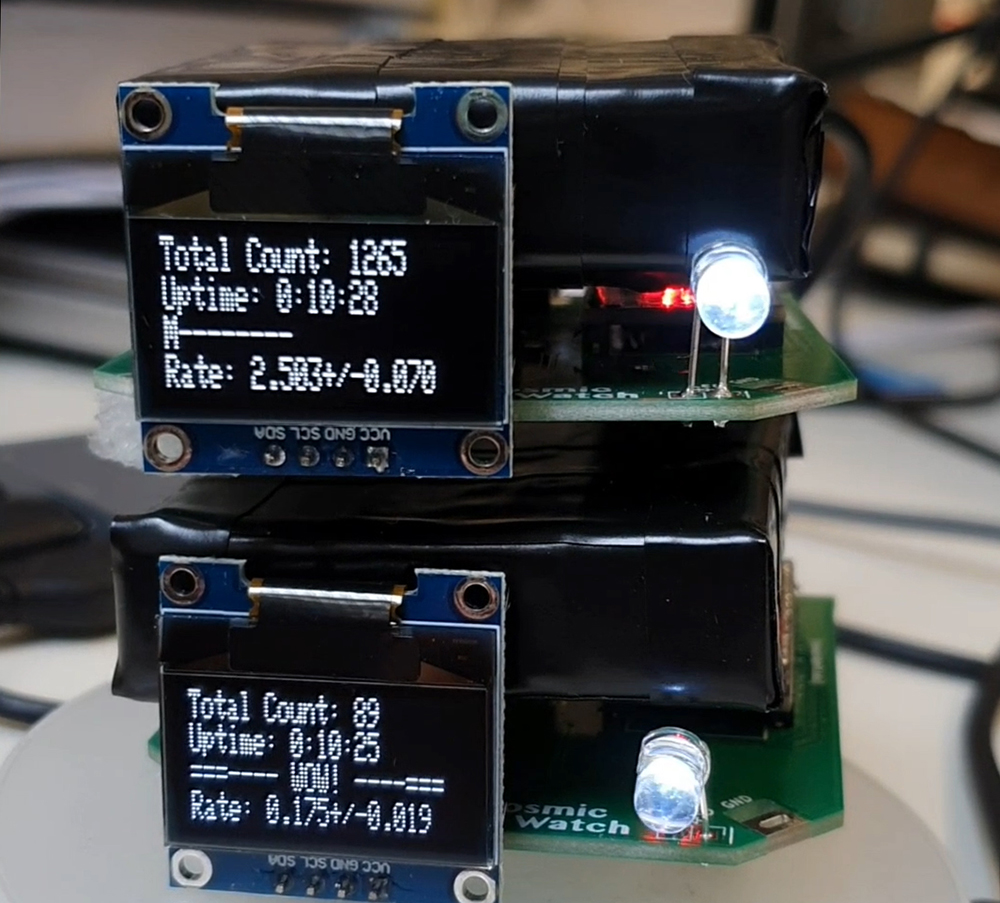
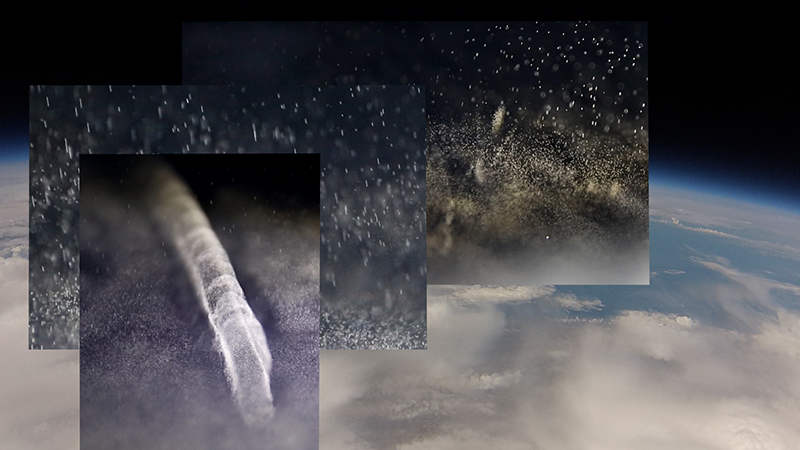
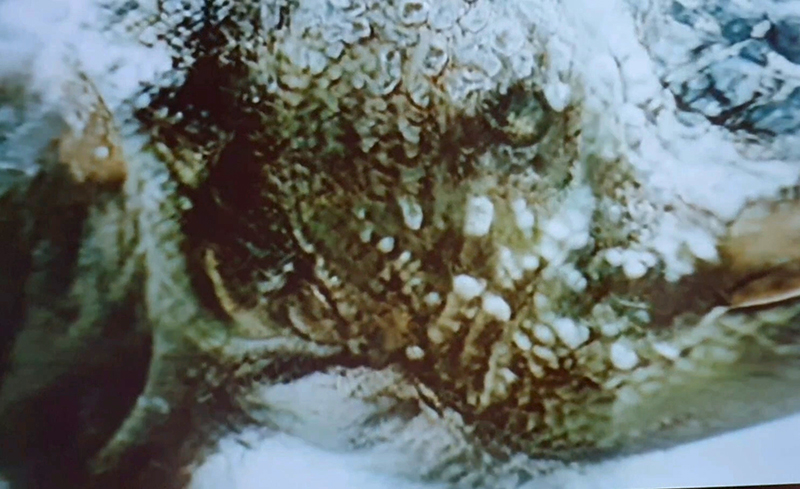
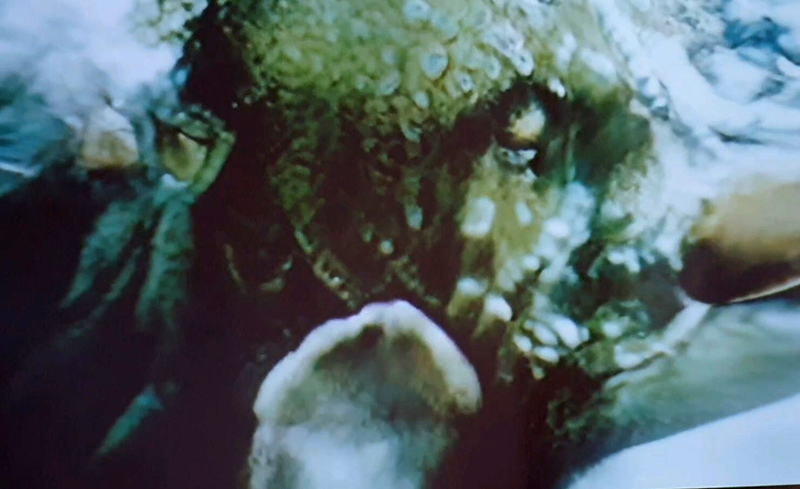
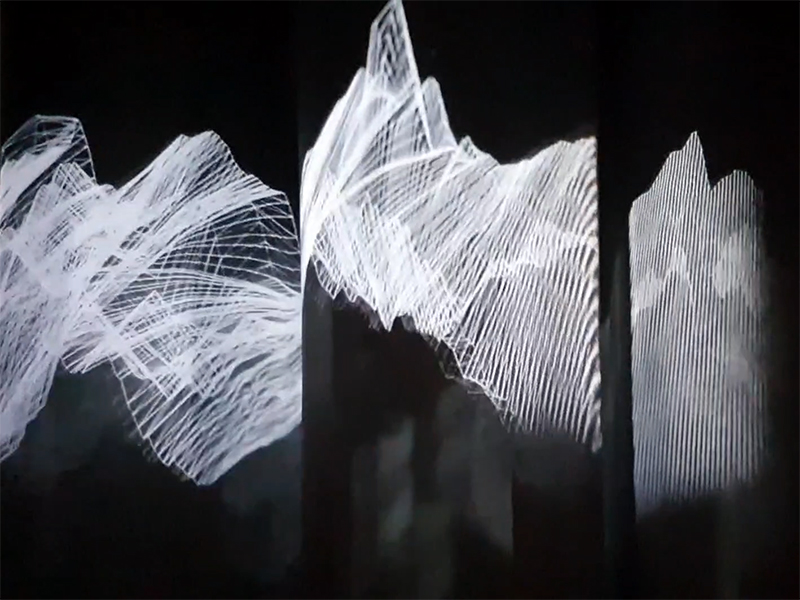
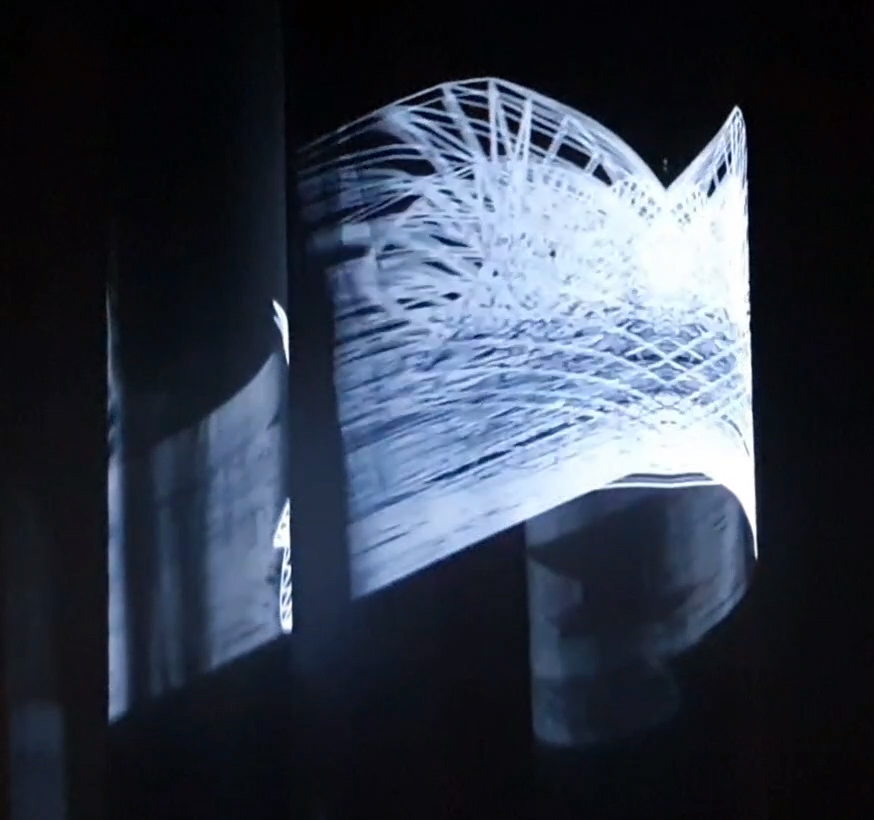
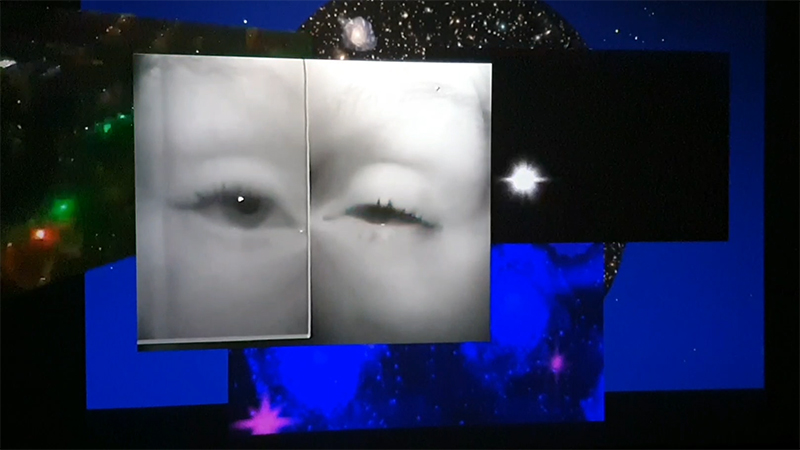
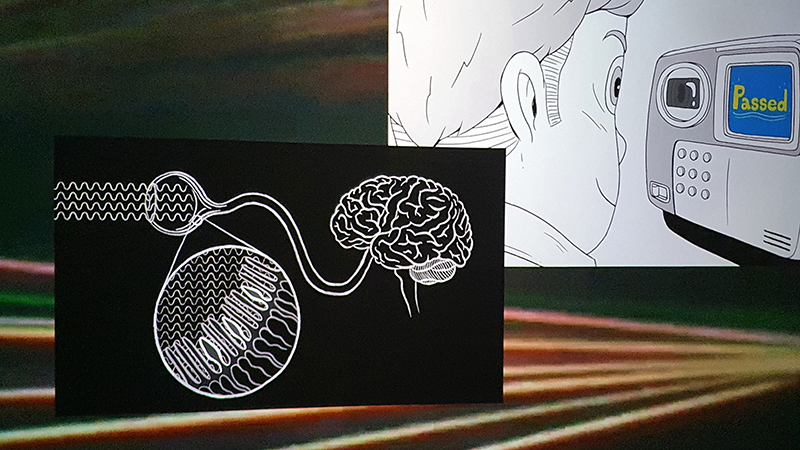
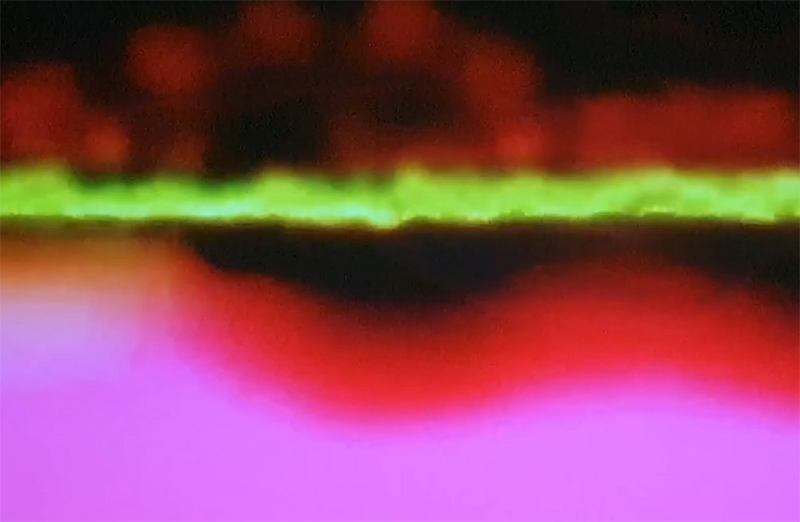
Giving The Breath of Stars a run to see if the cosmic rays are still there 😉 These images are stills of live action.
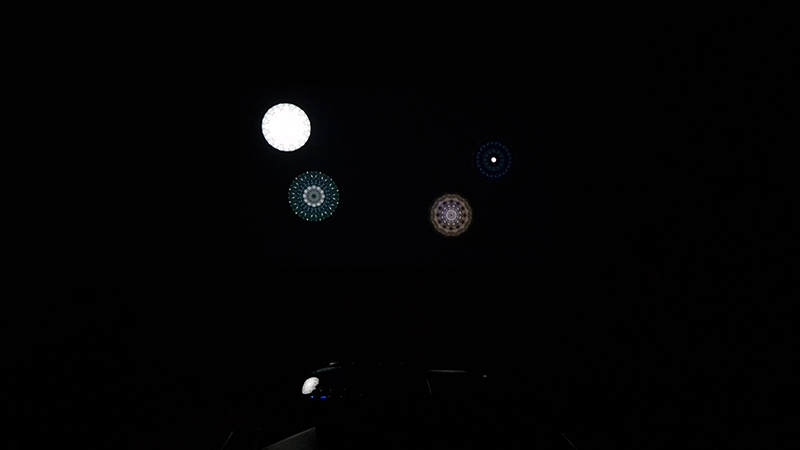
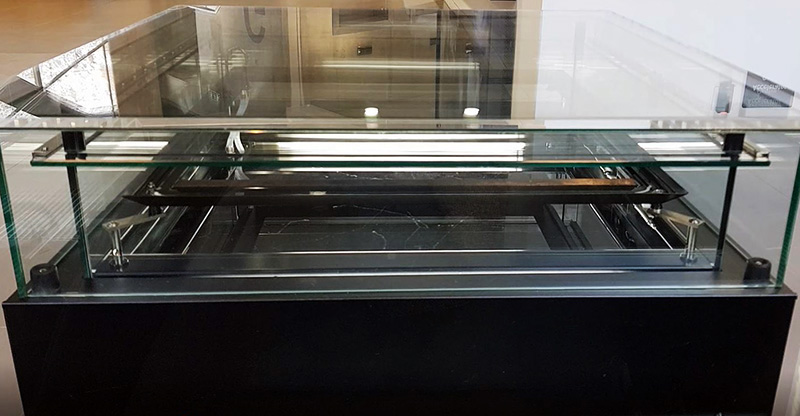
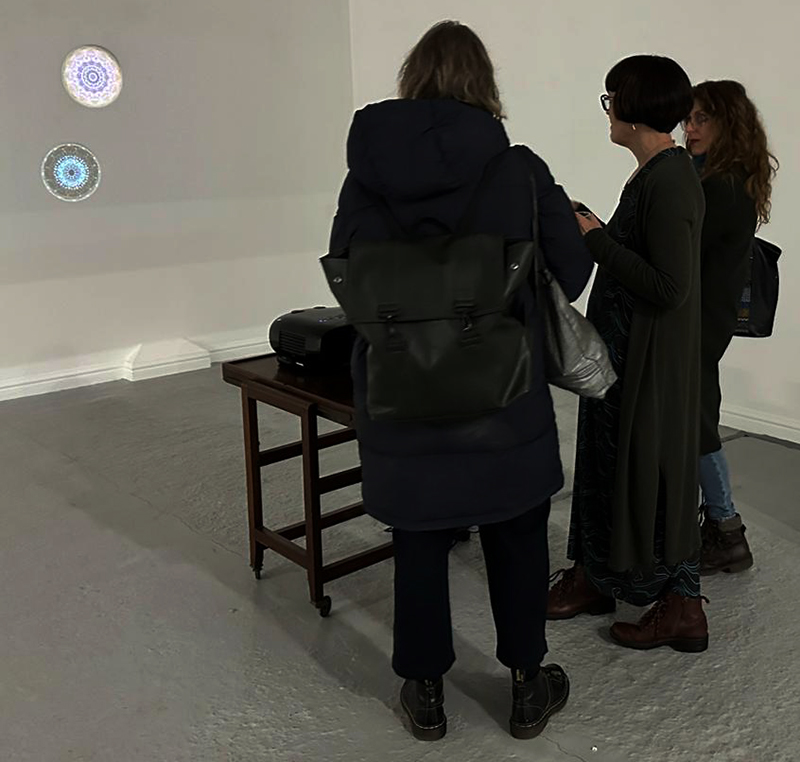
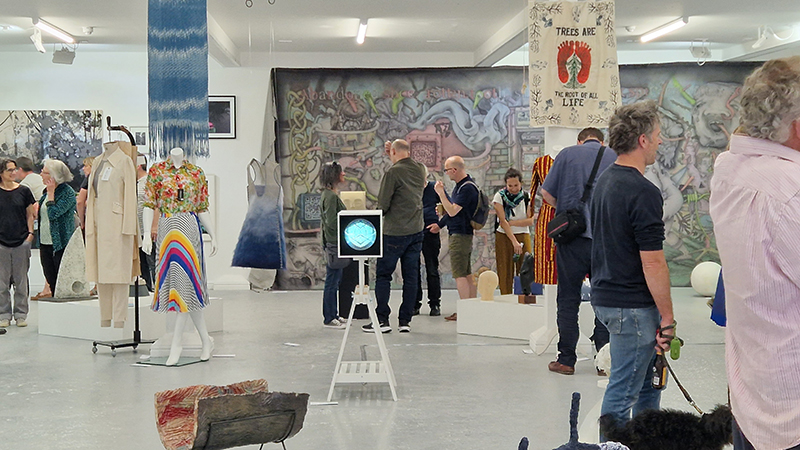
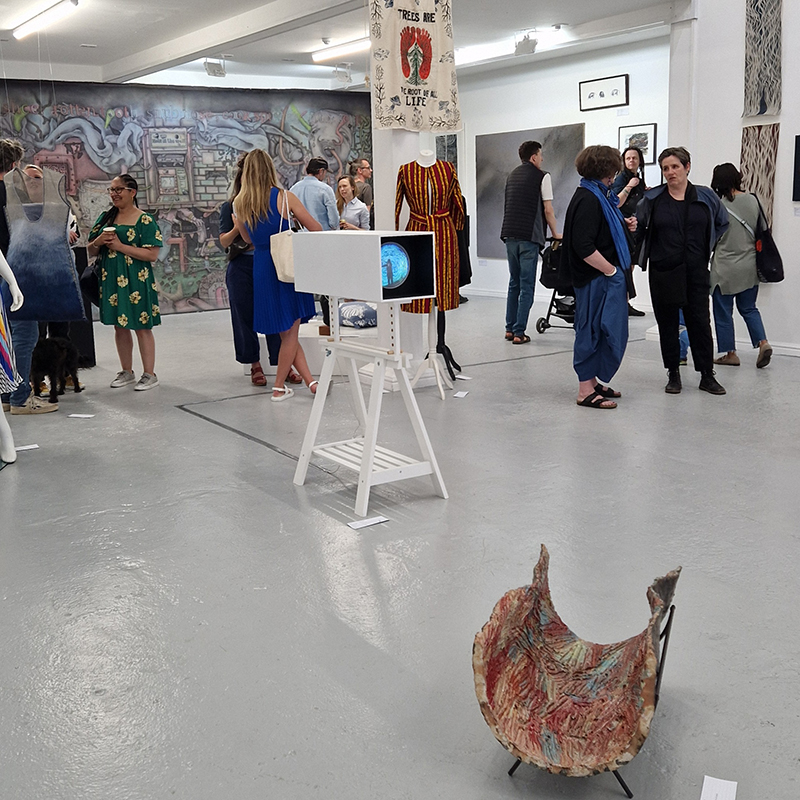
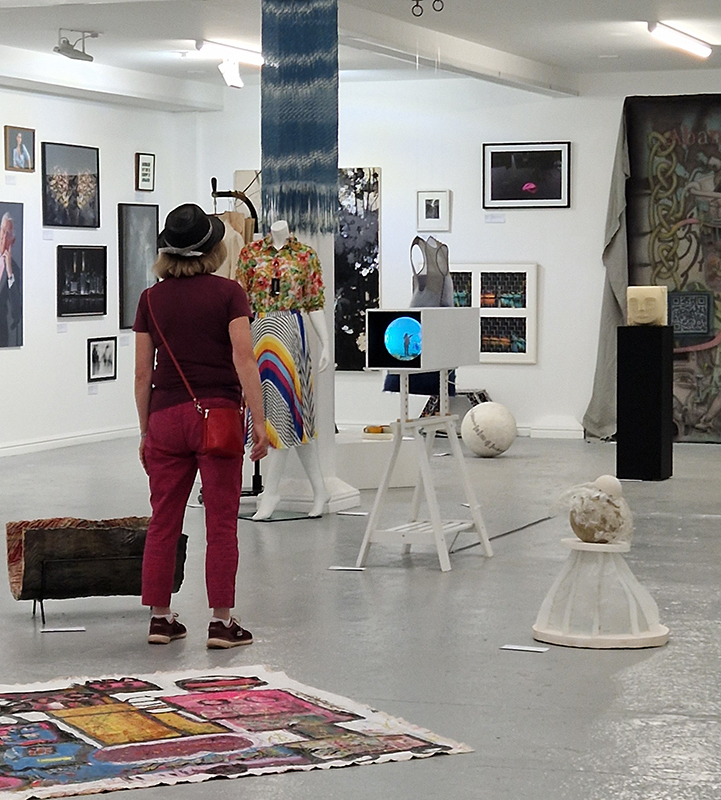
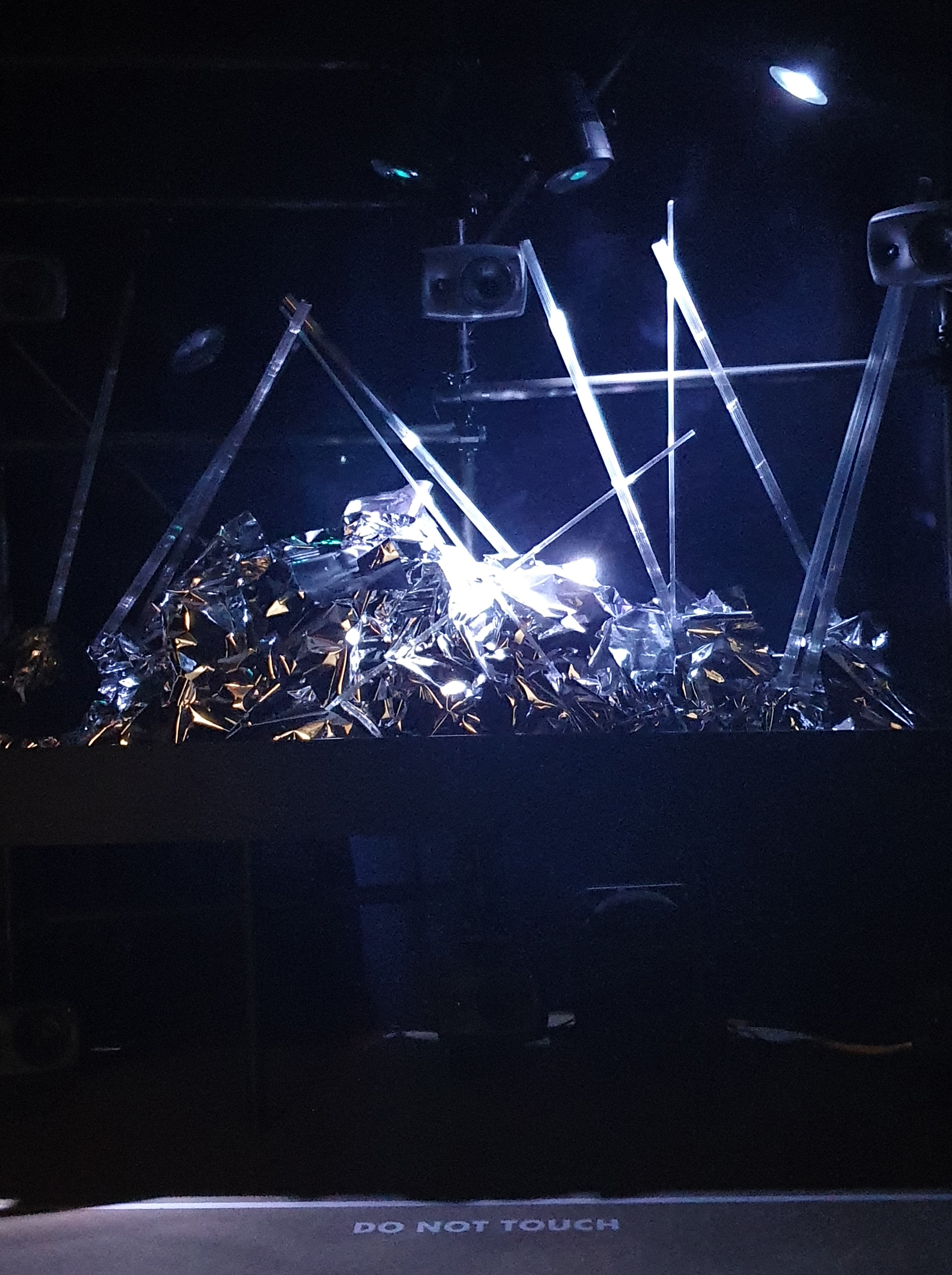
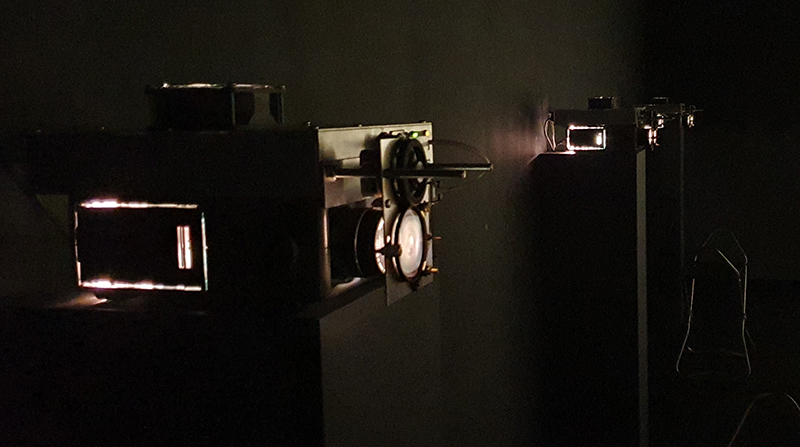
Cosmic ray detectors, mini computers, wooden box (20 x20 cm), video projection; live duration.

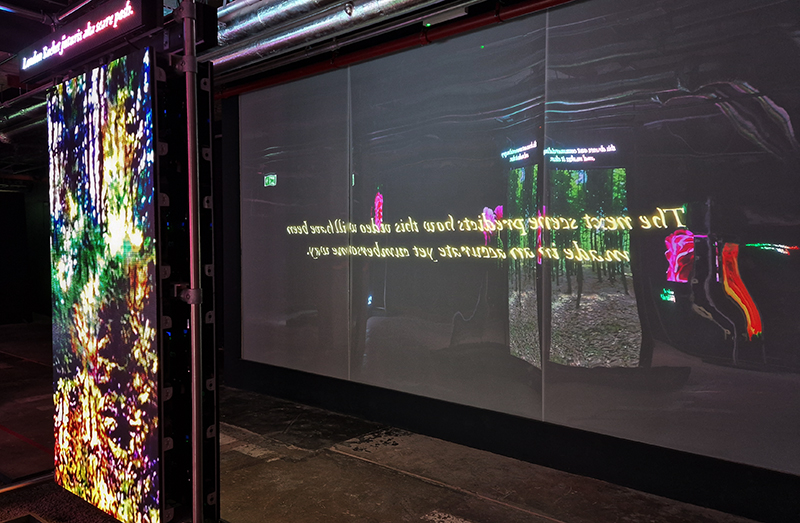
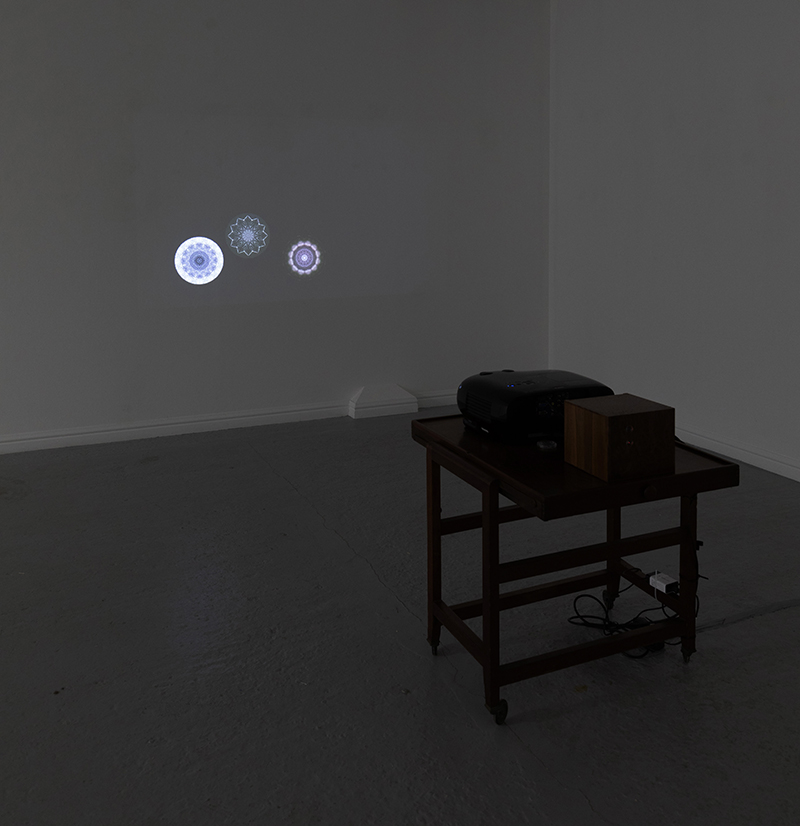
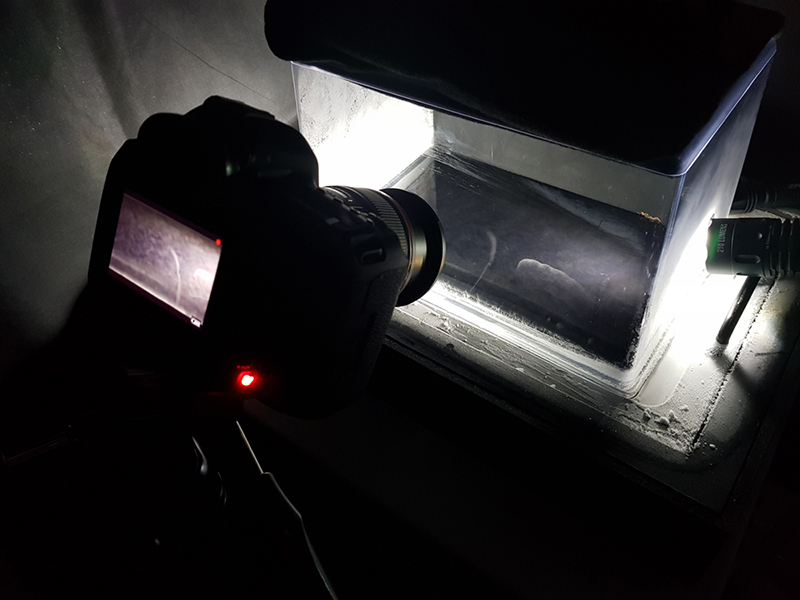
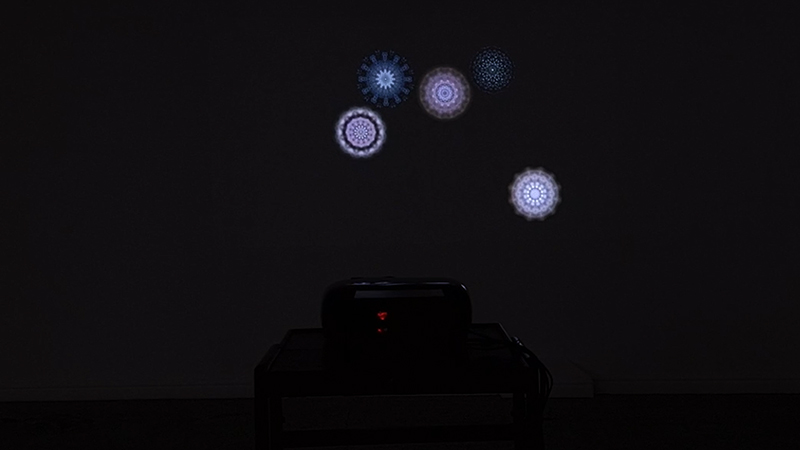
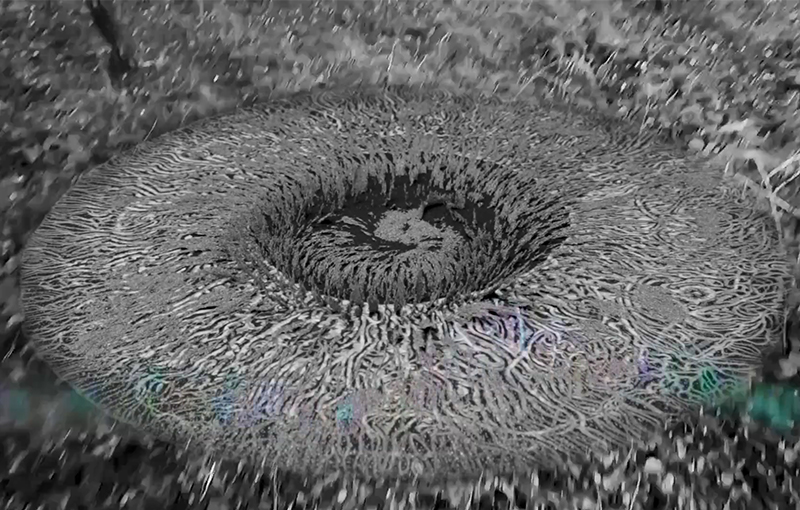
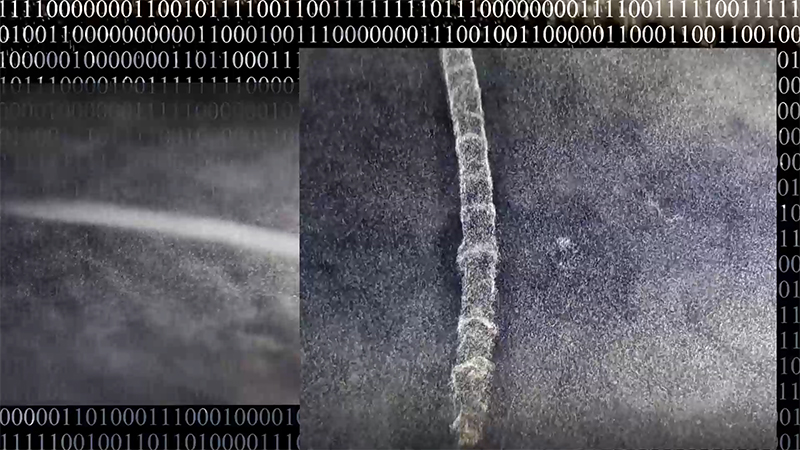
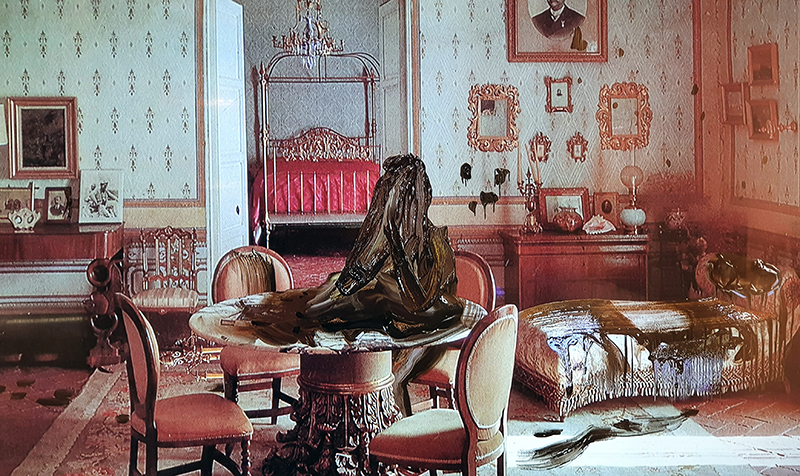
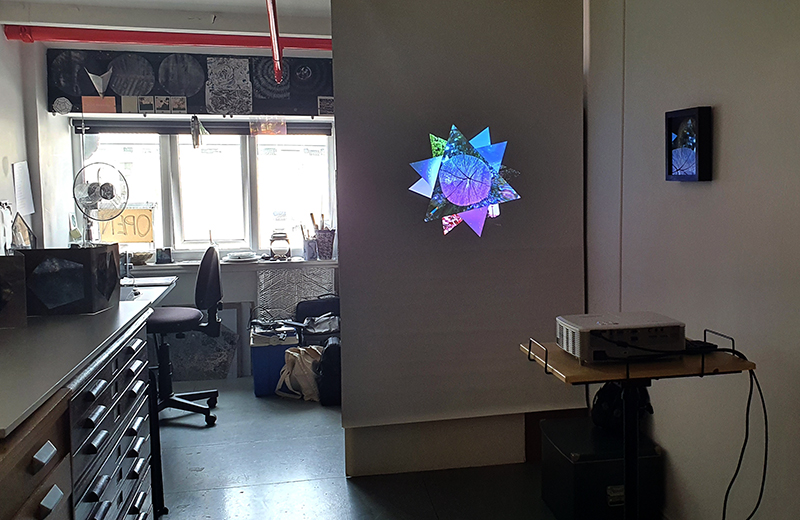
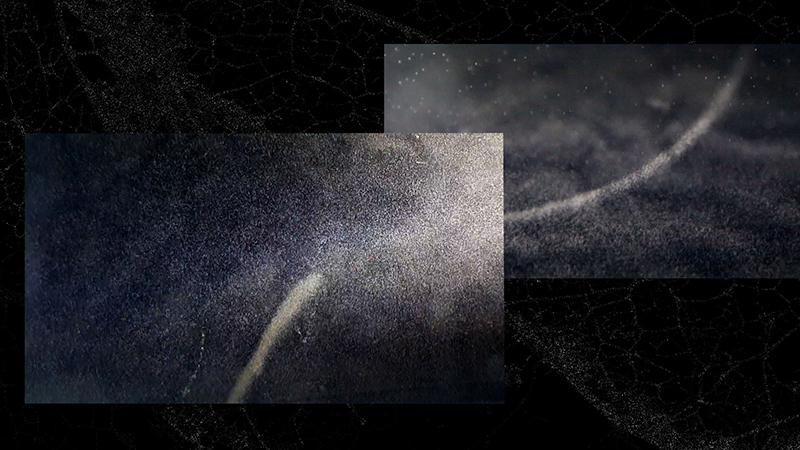
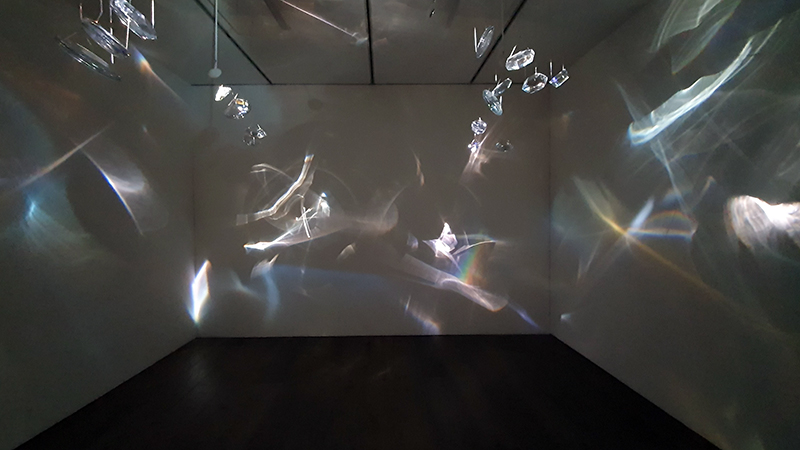
The Breath of Stars is a digital video work activated in real time by cosmic rays. These high energy particles arrive from outer space, interacting with life and technology on Earth. Coming from the heart of exploding stars or the depths of black holes, cosmic rays power across the universe with unimaginable energy. Some may come from phenomena yet to be discovered or even from other dimensions. A kaleidoscopic animation is projected every time a cosmic ray is recorded passing through the detectors. The animations are created from footage of cosmic ray trails filmed in my cloud chamber.
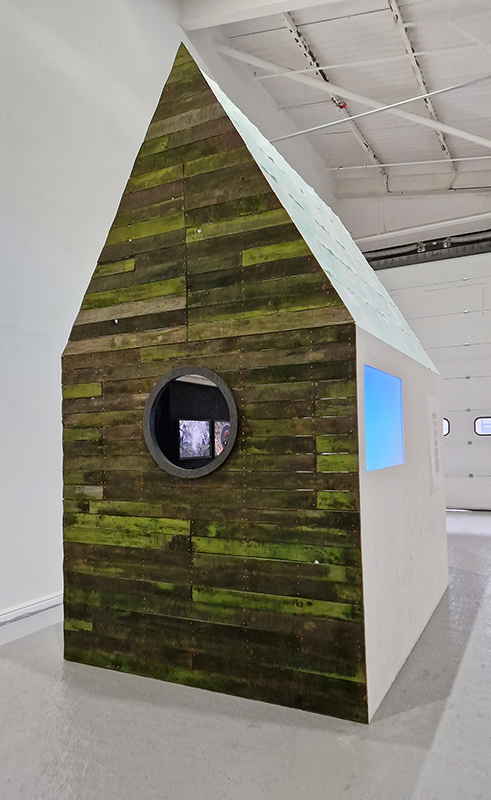
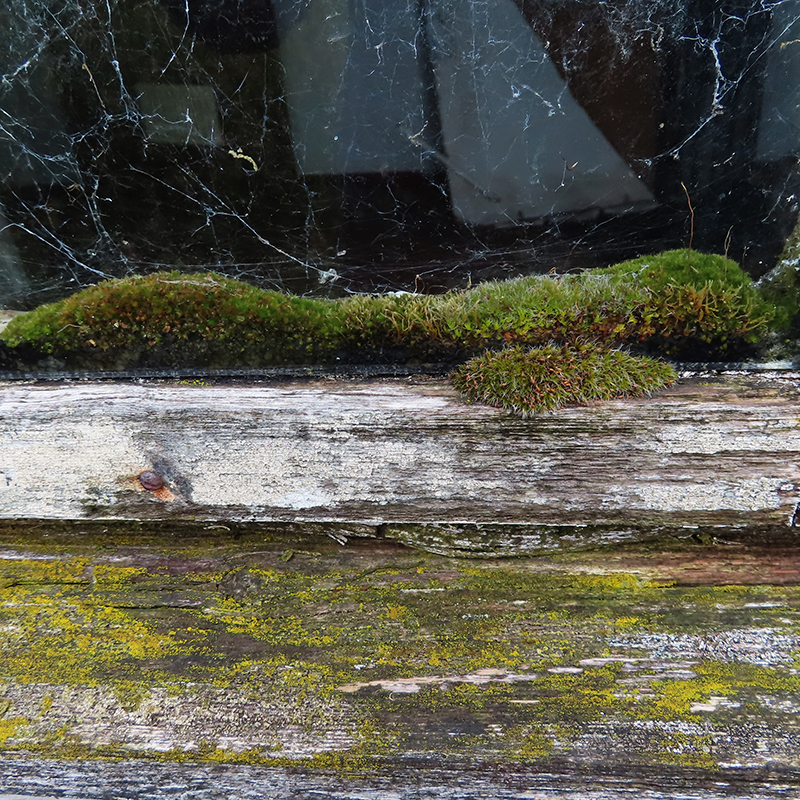
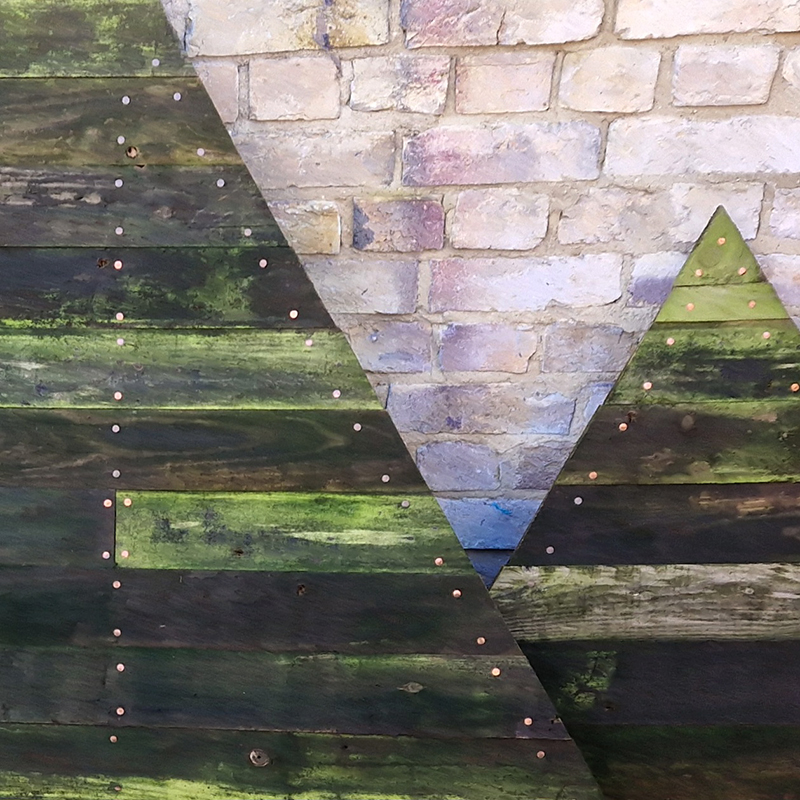
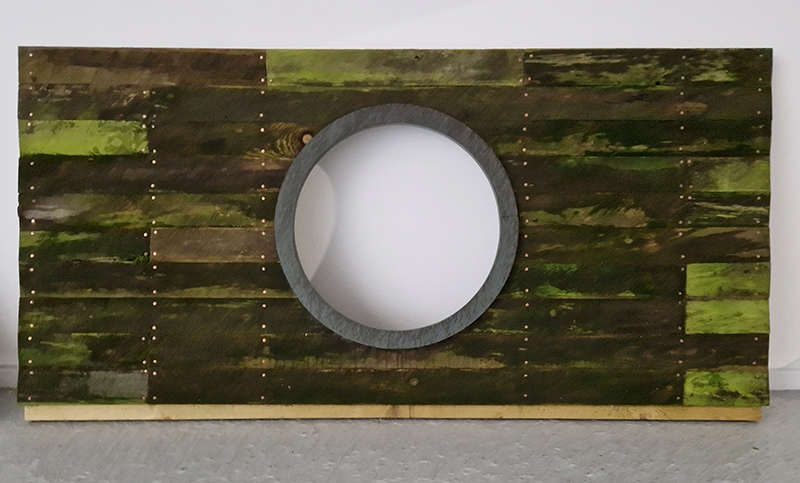
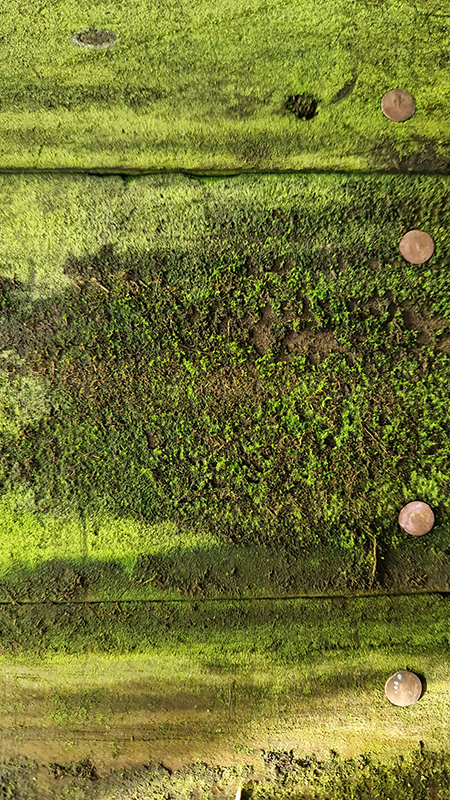
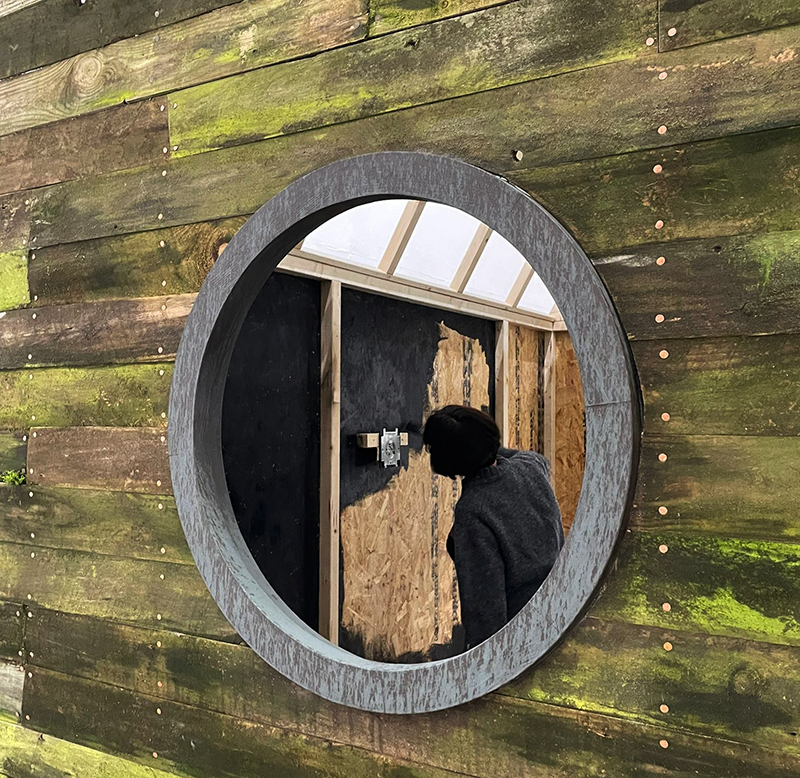
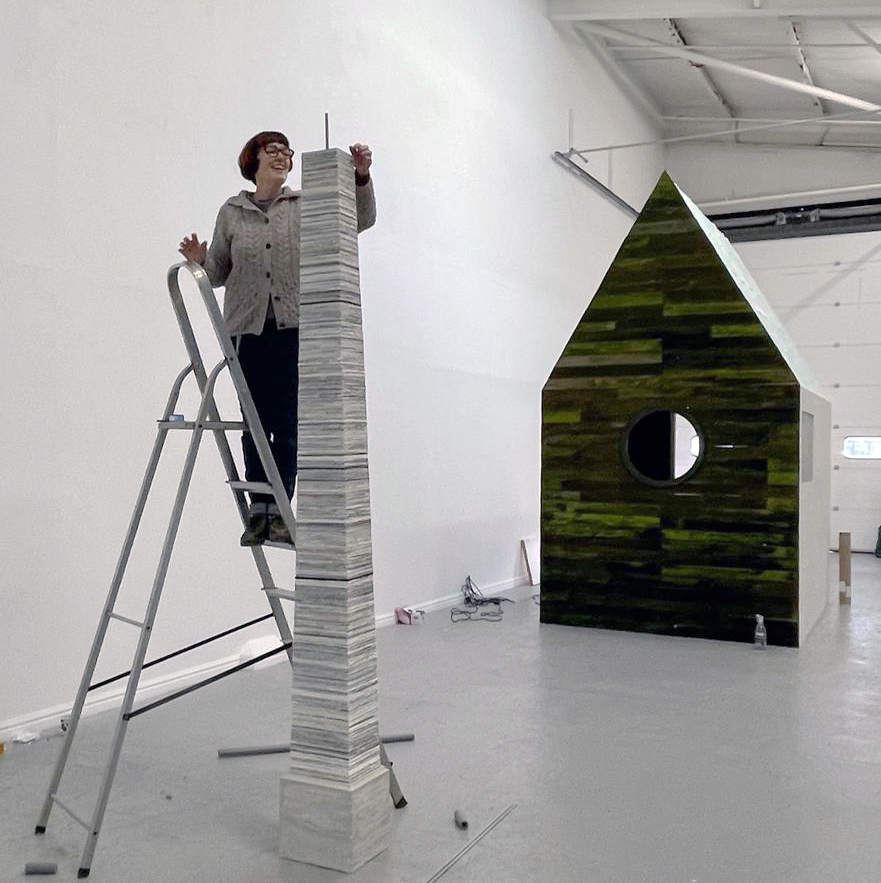
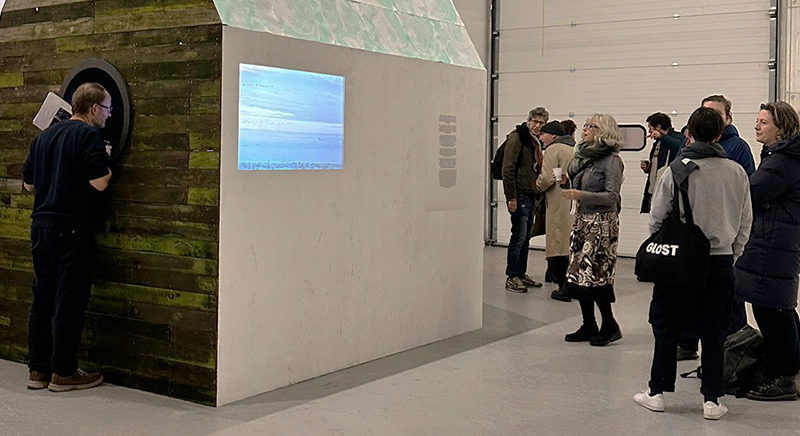
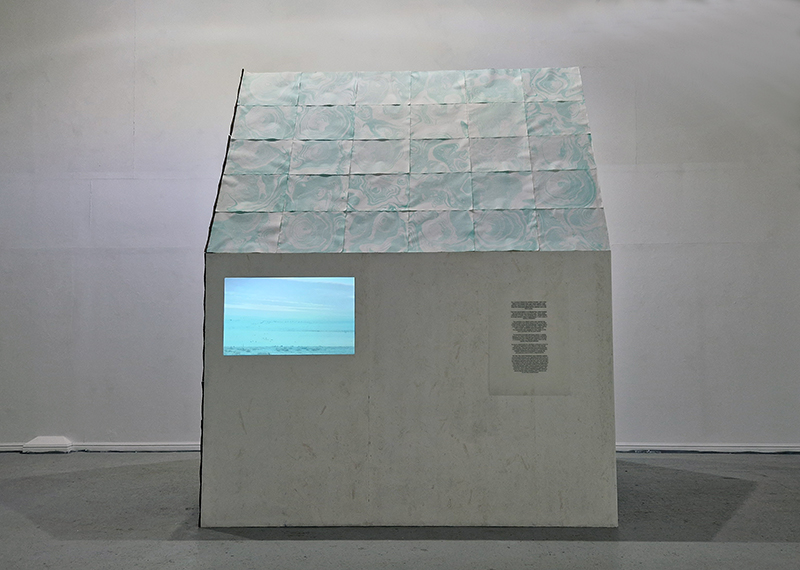
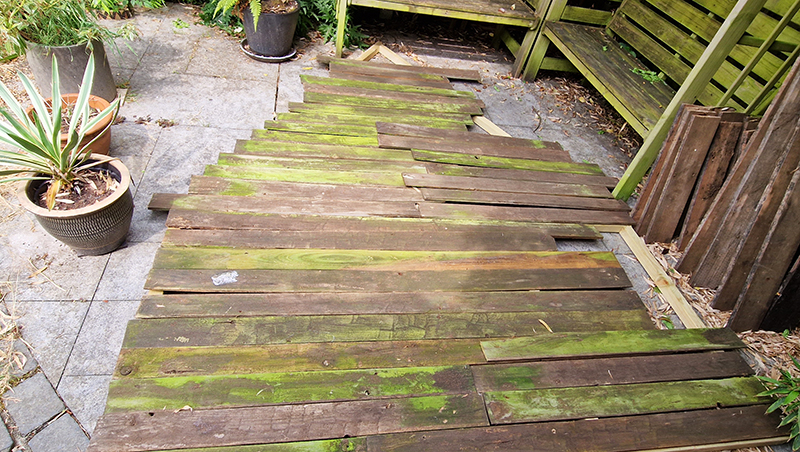
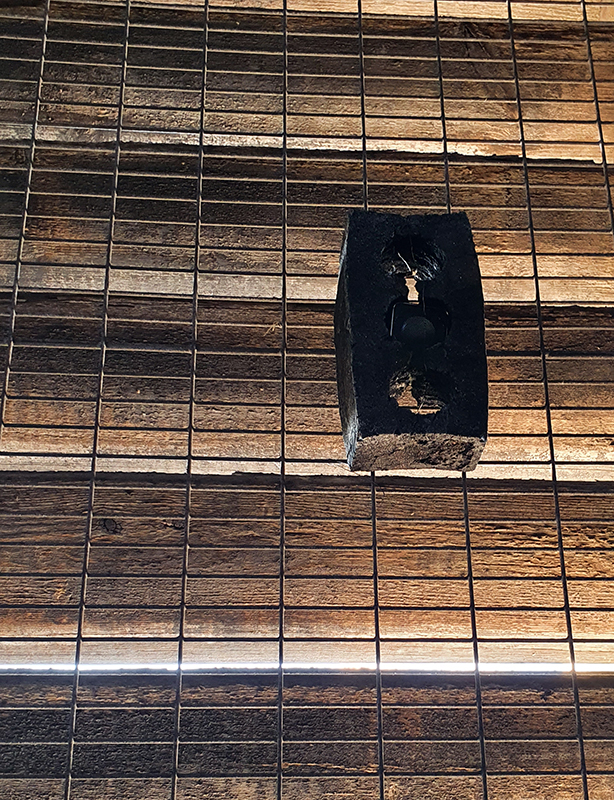
This cold damp weather is stimulating the moss regrowth on the apex pinnacle of The Absolute Hut (of action potential) that found a space in my garden after The Stone Sky exhibition this time last year. I had spent weeks preparing the recycled fence boards to make the North facing wall of the hut, painting them with various mixtures of buttermilk and yogurt blended with moss and was so excited when it began to grow. During the exhibition I would mist it every day. The beginning of my fascination with huts!
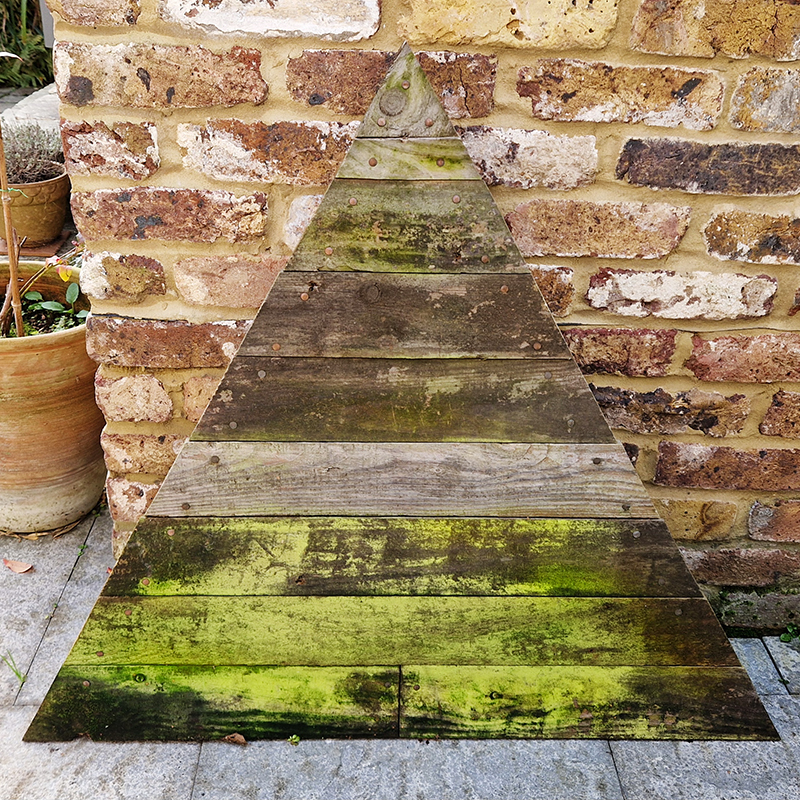
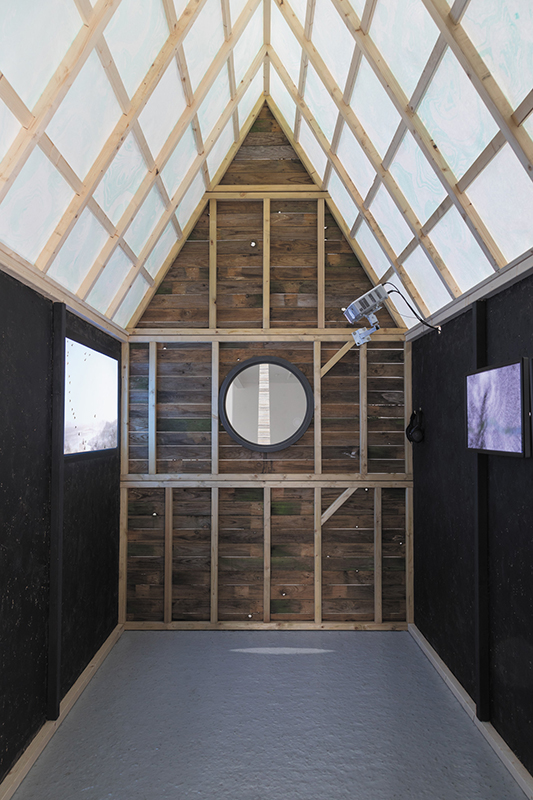
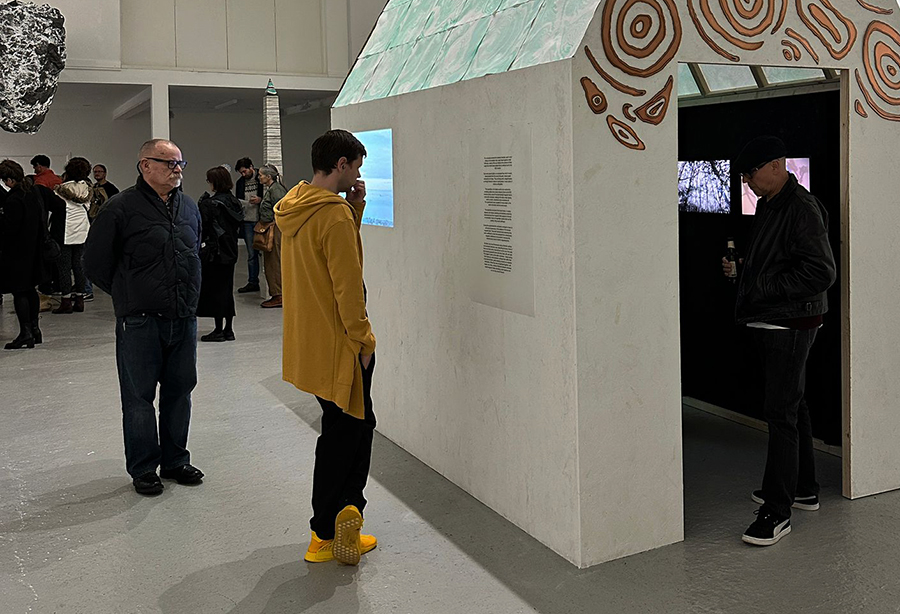
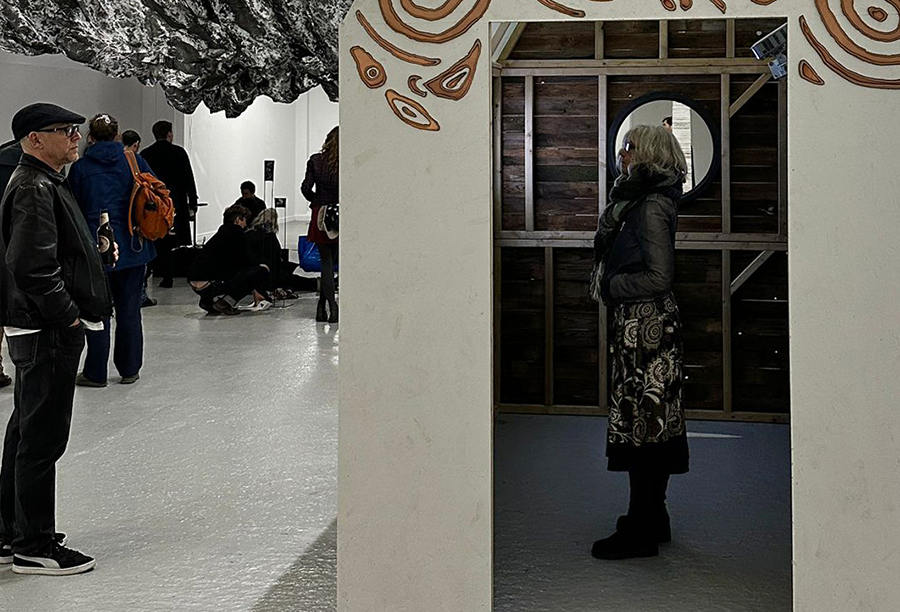
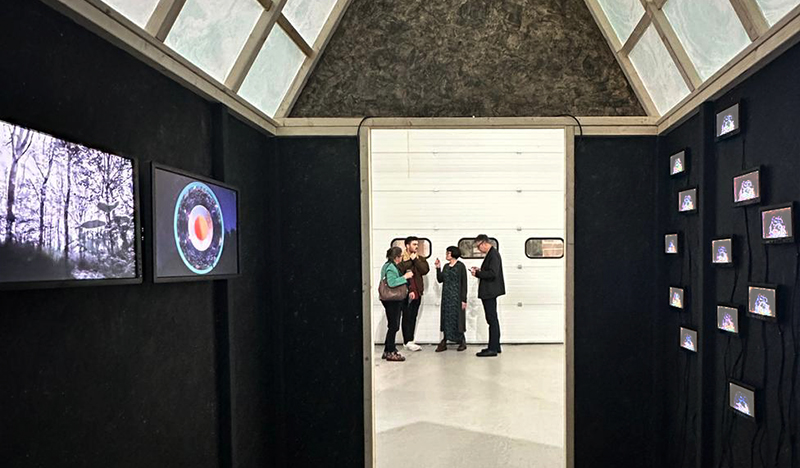
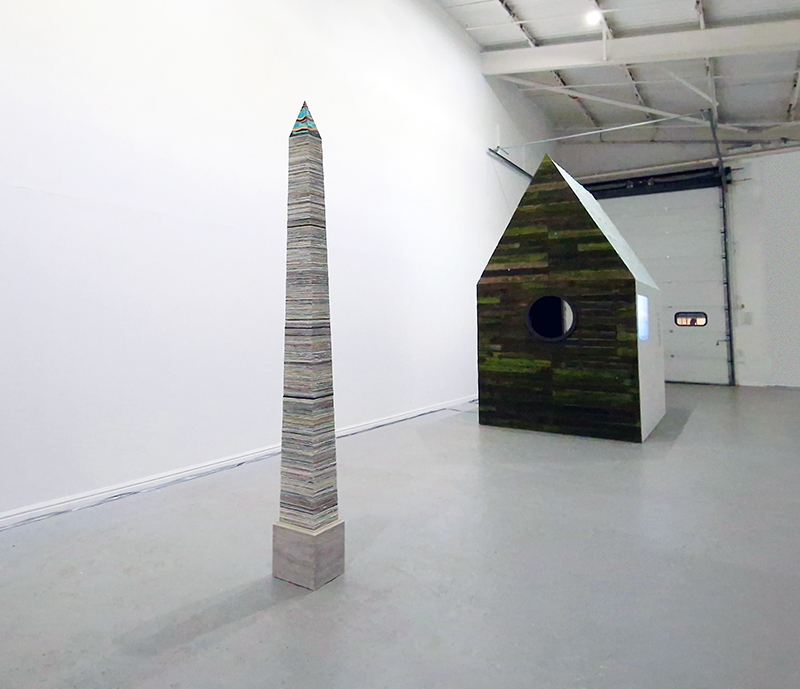
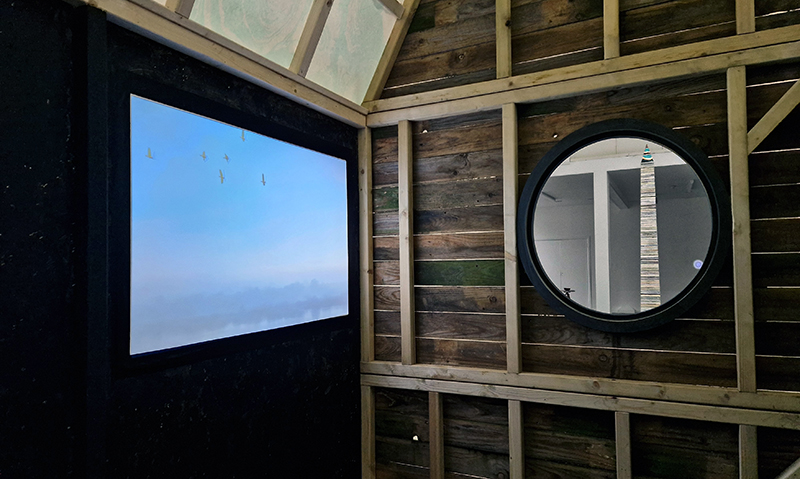
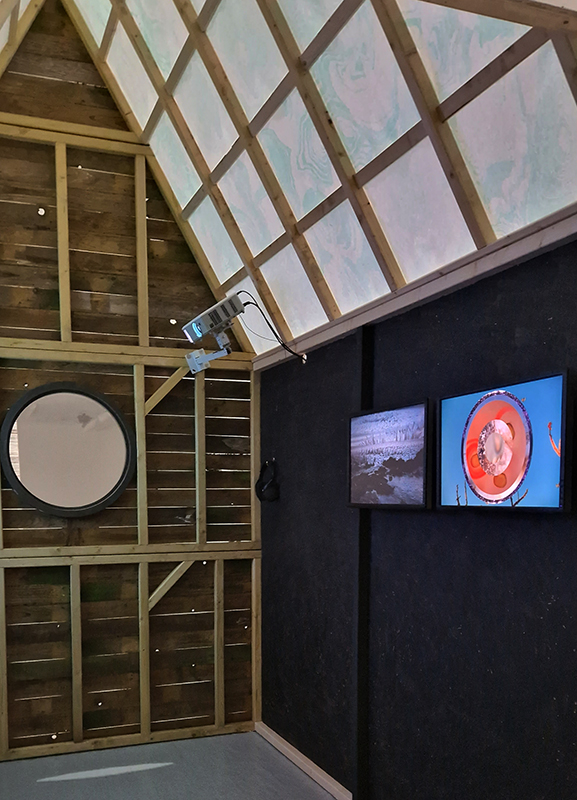
The Absolute Hut (of action potential) Wood, moss, paper, copper, video projection, video monitors ; 200 x 300 x 375 cm

Operating as a sensory hub where a range of actions and processes are running concurrently reflecting on the dynamics between the Earth’s geologic structure and navigation using the magnetic field. Neurons in the brain and nervous system send information electrochemically around the body. The signals they send are called action potentials, which is a temporary shift from negative to positive within the cell caused by certain ions entering the cell. Action potentials can be triggered by an interaction with the magnetic field, causing a reaction in the body.

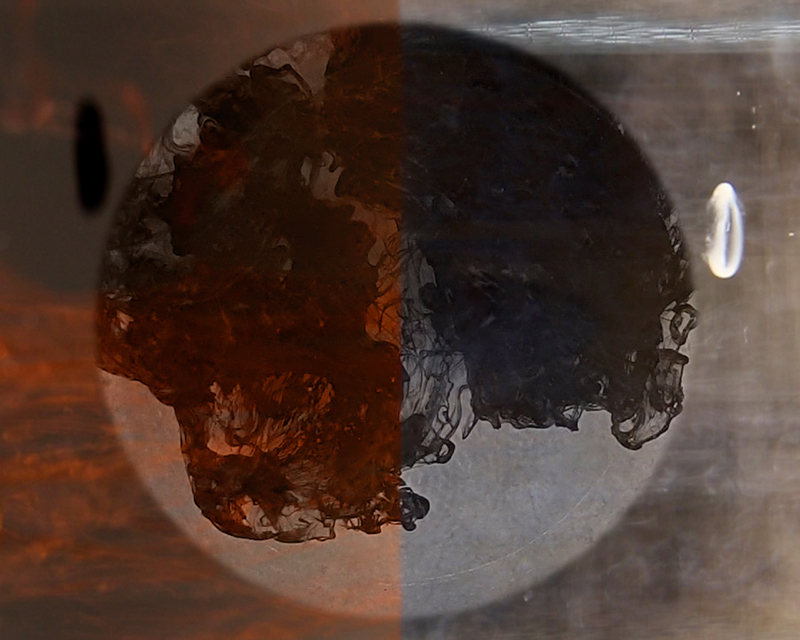
Interference 2023 (video still)

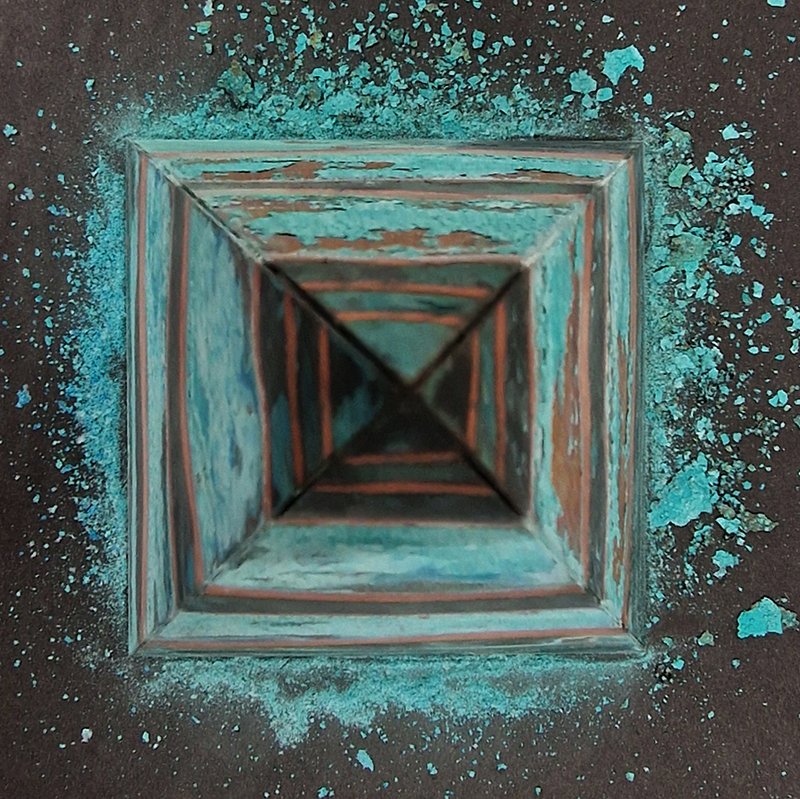
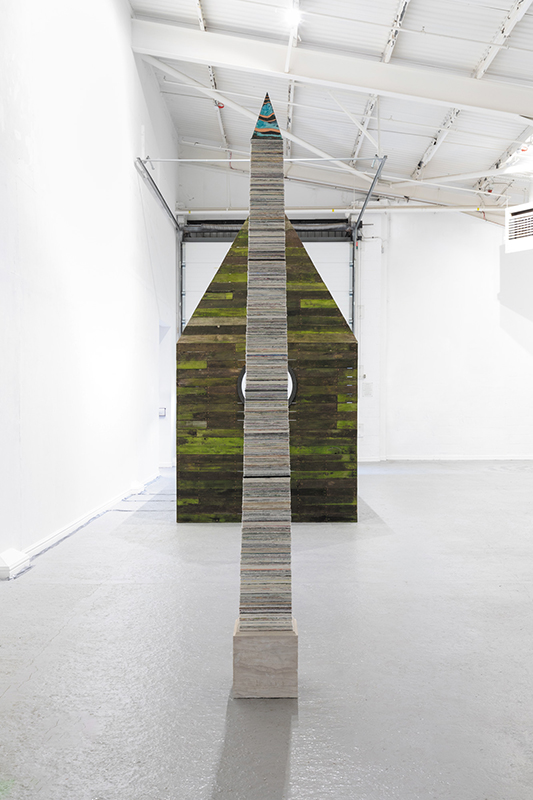
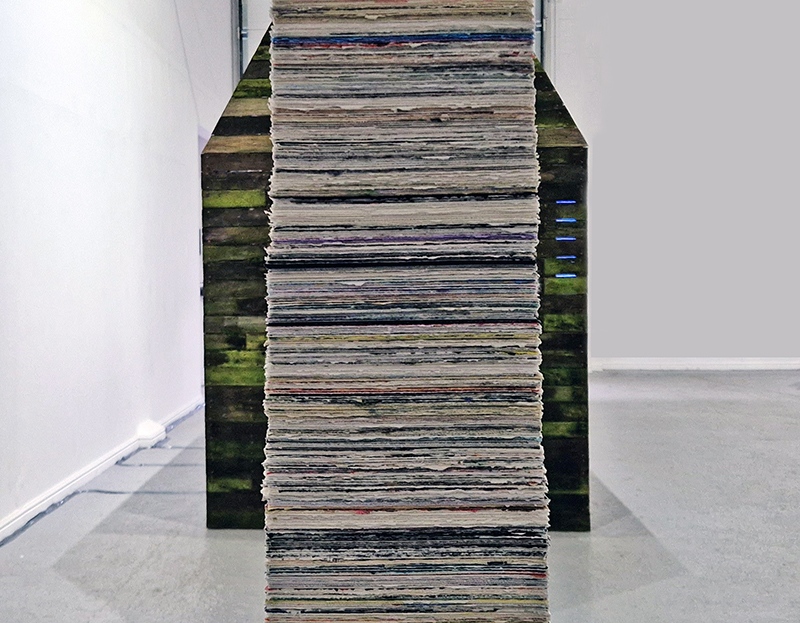
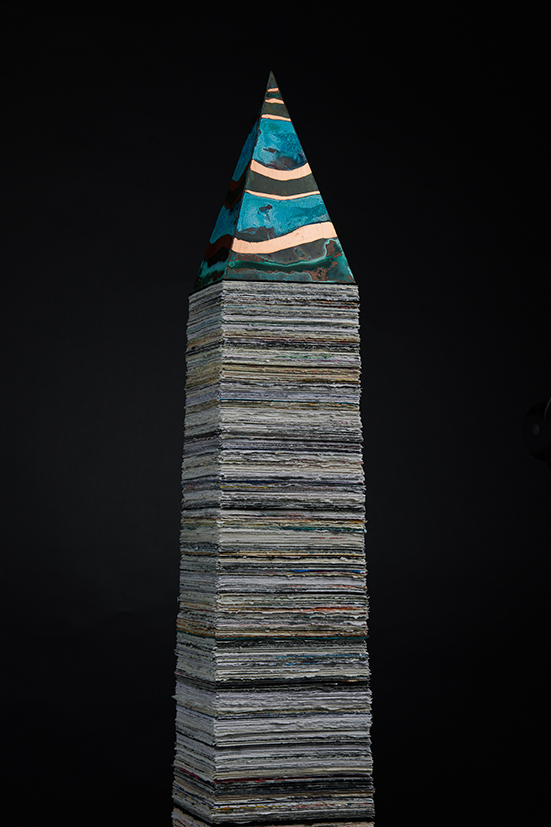
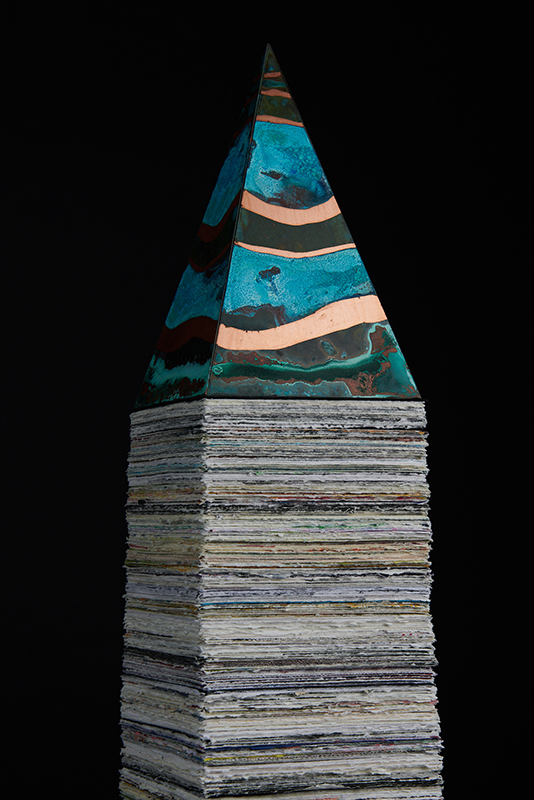
A year on and the pyramidion that sits on top of The Azimuth Obelisk (of sedimentary knowledge) is evolving. The patination, which involved a variety of chemicals being applied to the copper in layers, is an ongoing process.
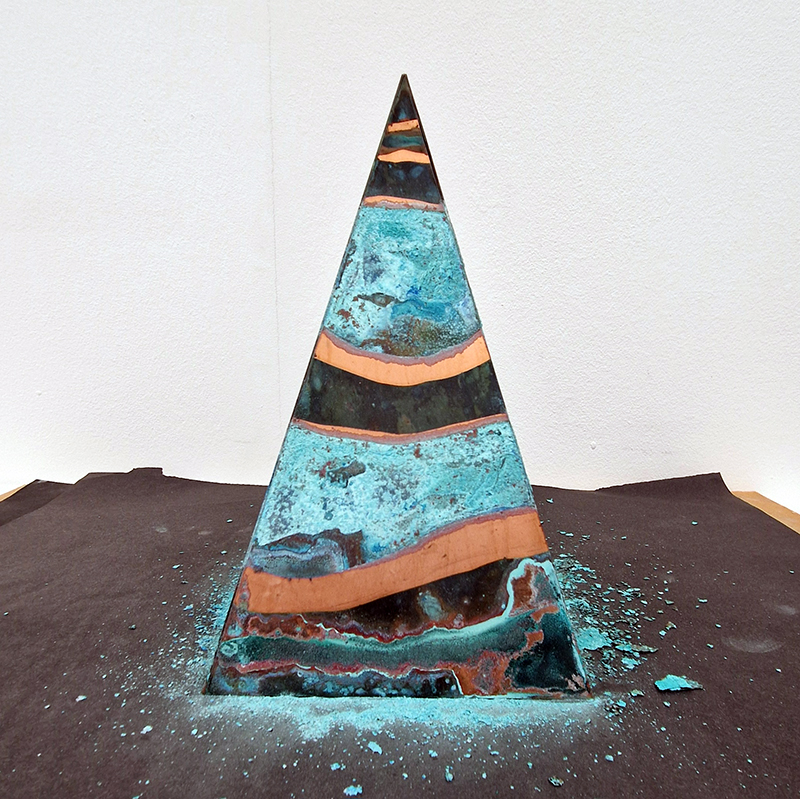
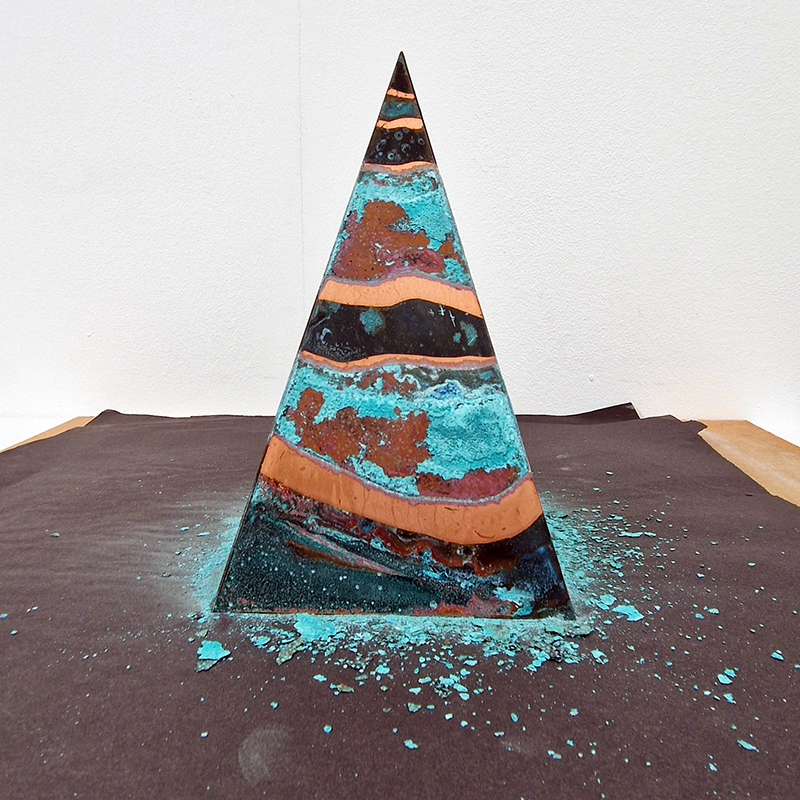
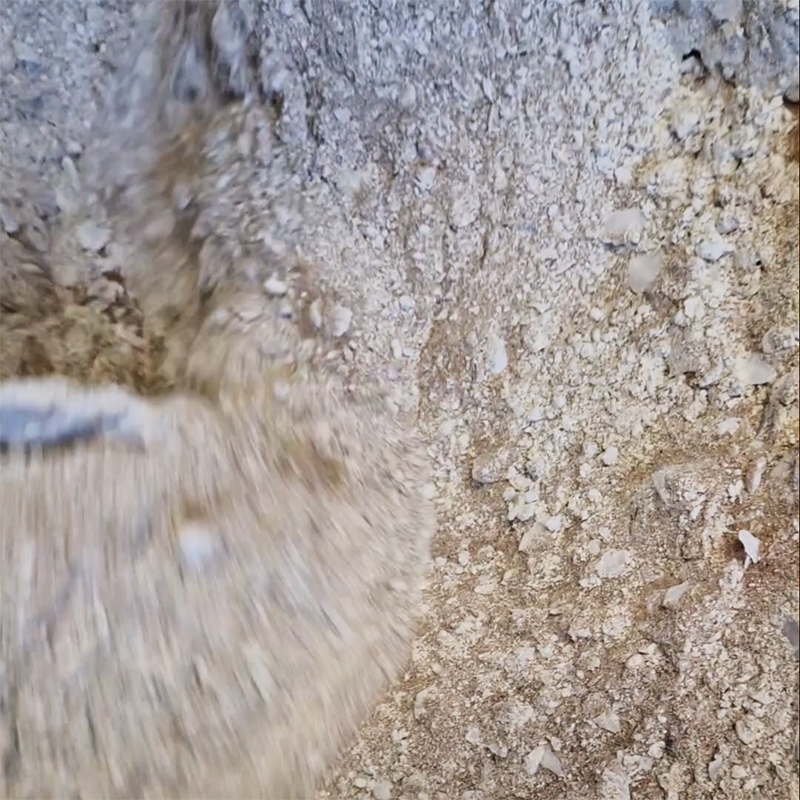
Sedimentary rock holds a geological history of the Earth’s magnetic field within its mineral components. The geomagnetic field, generated by the Earth’s molten core, varies through time; the magnetic poles migrate, go on excursions, or reverse polarity. During these periods of flux, the strength of the magnetic field changes, and this phenomenon is recorded in archaeological artefacts, volcanic rocks, and sediments. Limestone, a sedimentary rock, is often formed from crushed seashells, compressed over aeons. Crushed oyster shells were added to the obelisk base cast in Snowcrete.
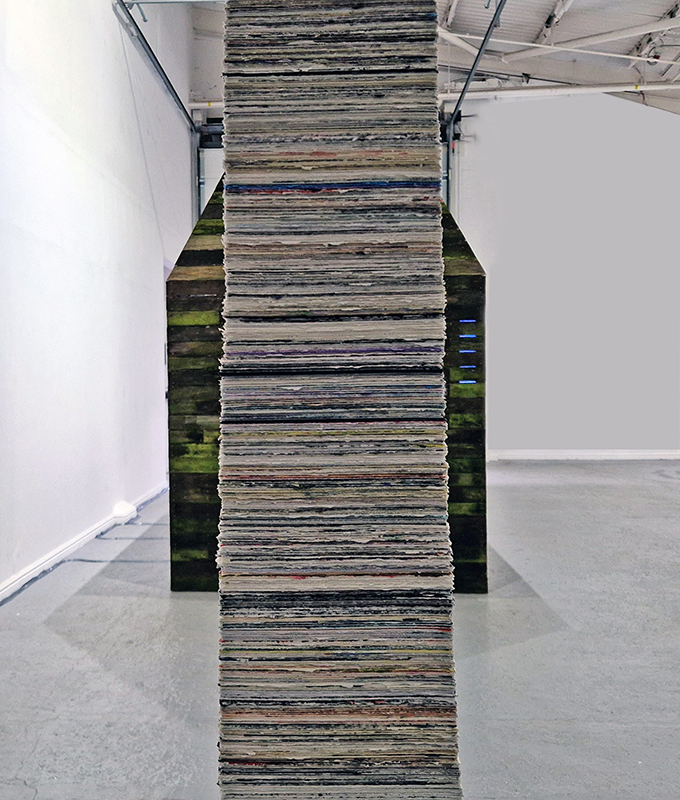
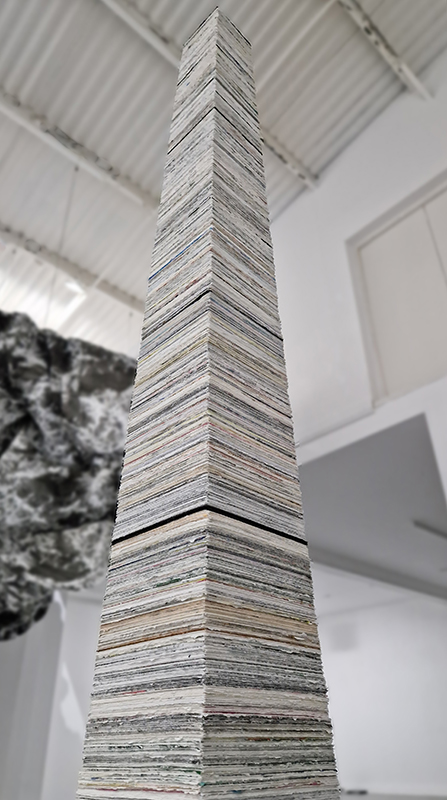
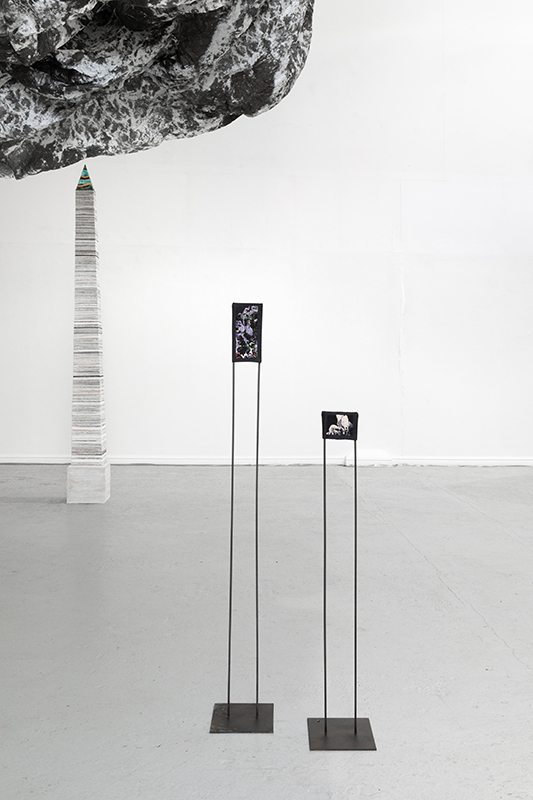
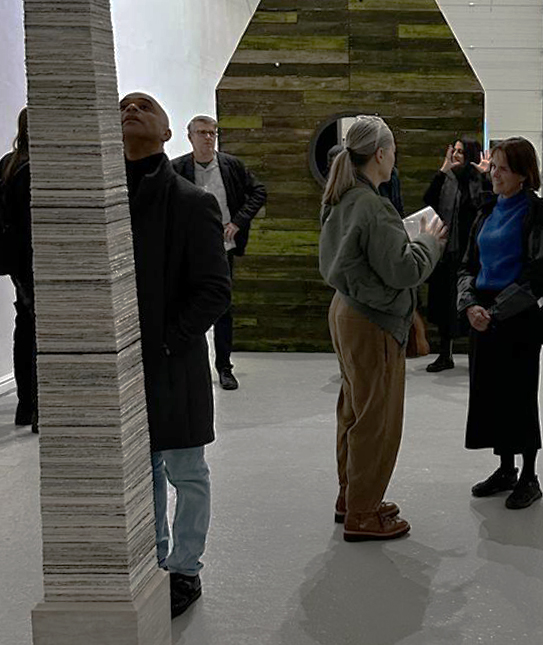
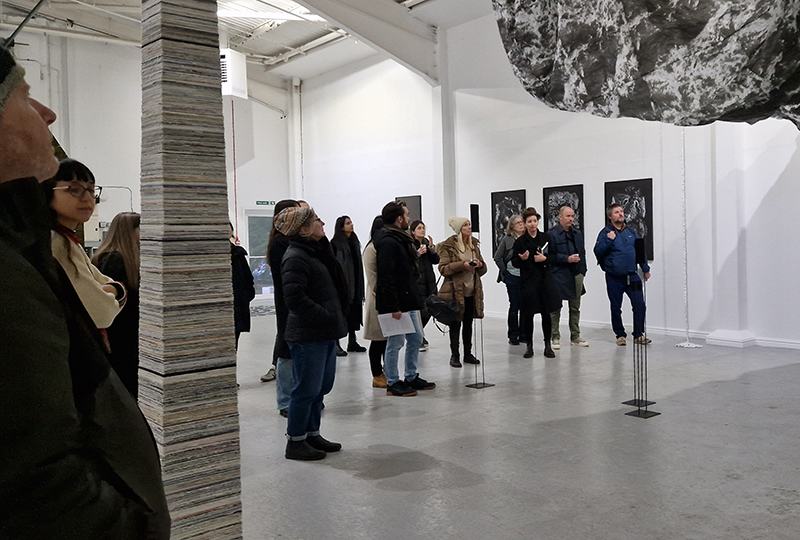
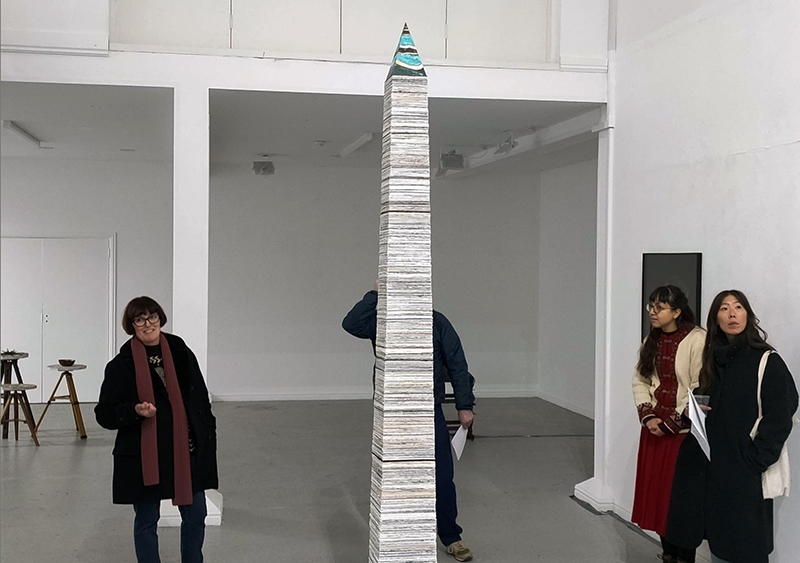
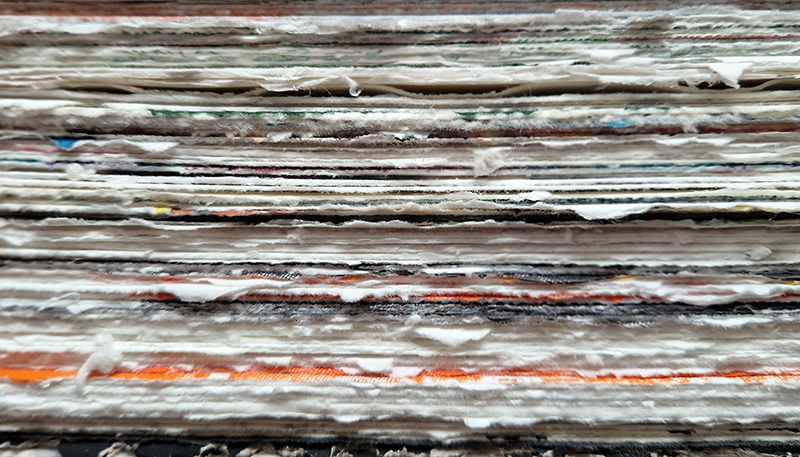
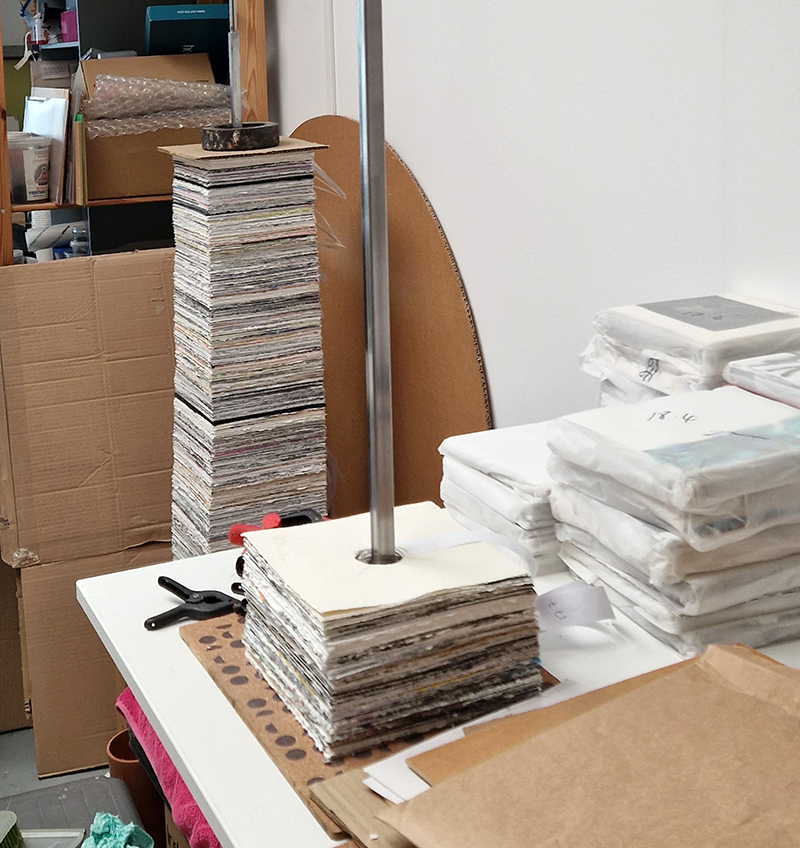
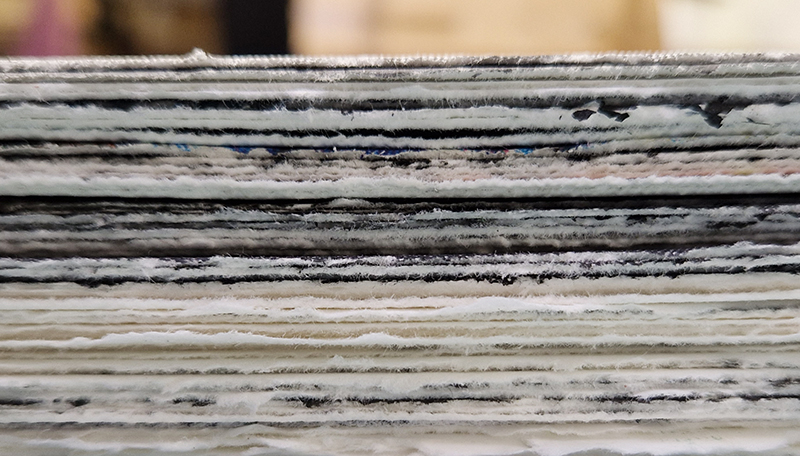
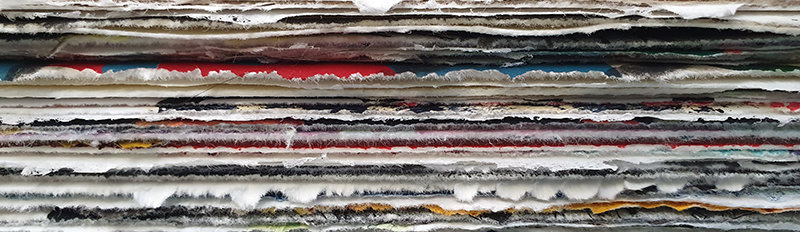
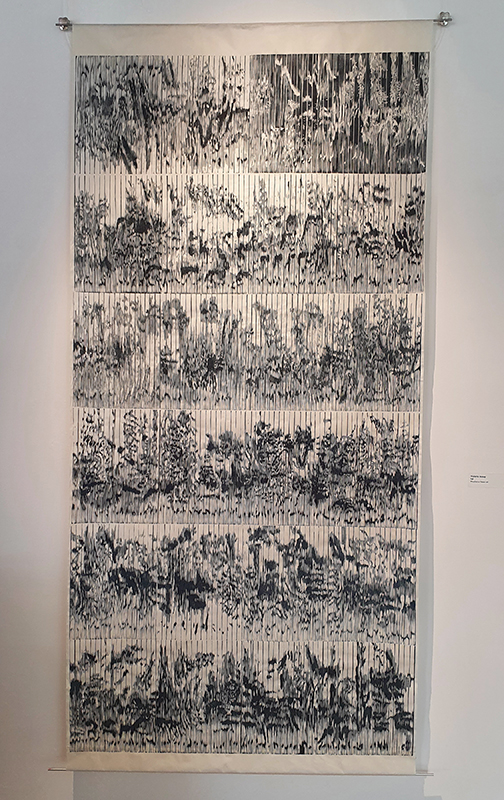
This sculpture also embodies the passage of time, and a layering of information, in the months of collecting paper donations or scavenging the recycling bins, weeks tearing down the hundreds of prints and drawings into squares decreasing by 1mm every 50 sheets, drilling holes through the centre and hours to build the almost 3m stack. I’m very grateful to everyone who donated some of their work archive. These images are now secreted within the layers of the sculpture, hinted at where edges are exposed, echoing the Earth’s sedimentary knowledge.

The Azimuth Obelisk (of sedimentary knowledge) Paper, steel, Snowcrete, oyster shells, patinated copper; 30 x 30 x 270 cm

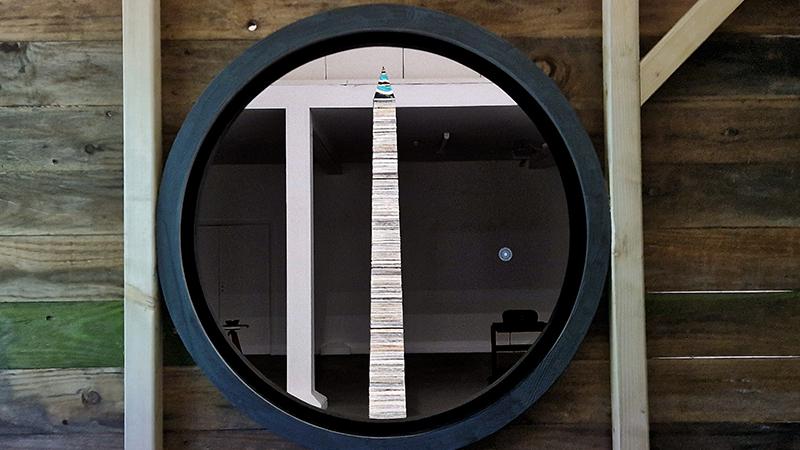
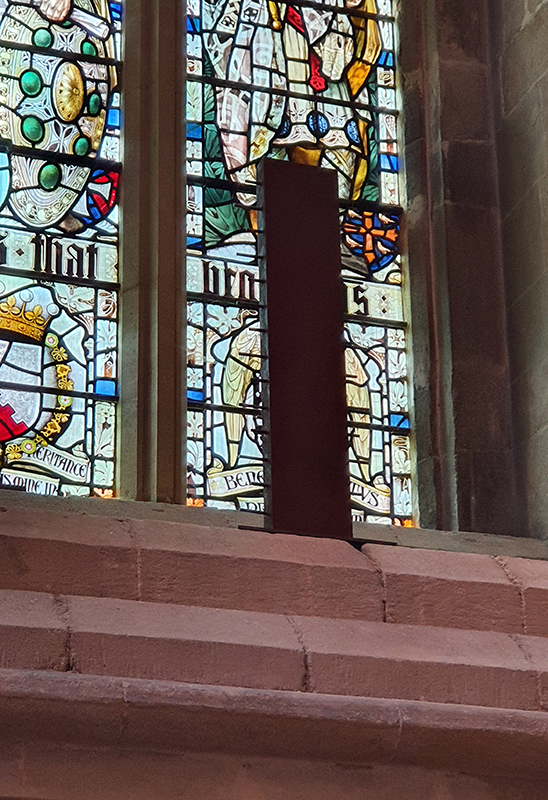
 This work is a reimagining of an ‘obelisk’ erected at Hartland Magnetic Observatory in the late 1950’s to be viewed through the north facing window of The Absolute Hut, it acts as a permanent azimuth mark from which the drift of the magnetic north pole is monitored. I am excited that this sculpture is being considered for exhibition in 2026 at the Royal West of England Academy in Cosmos: The Art of Observing Space curated by Ione Parkin with some amazing artists in the line up whose work I admire.

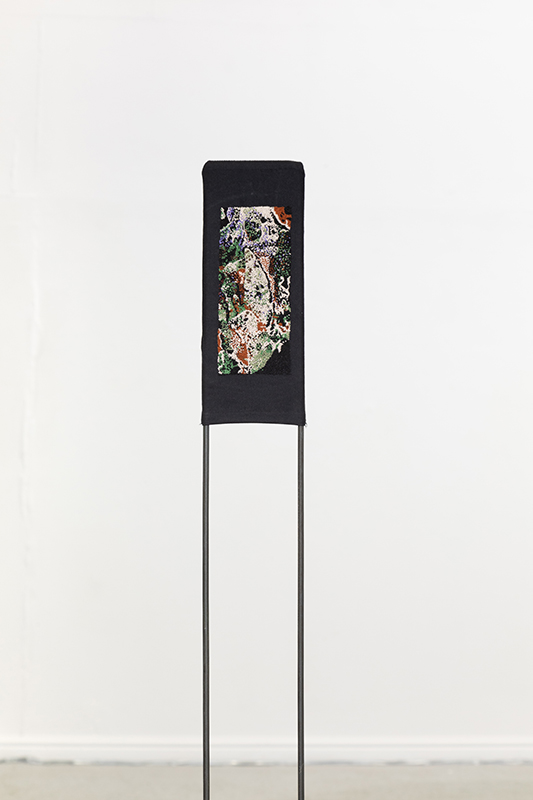
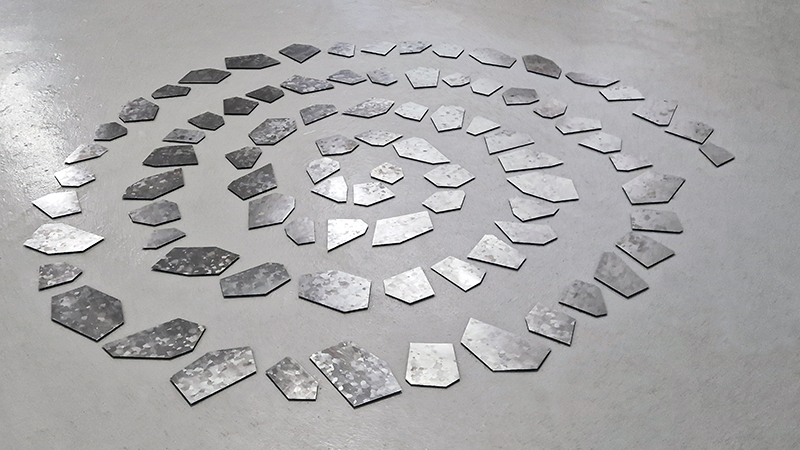
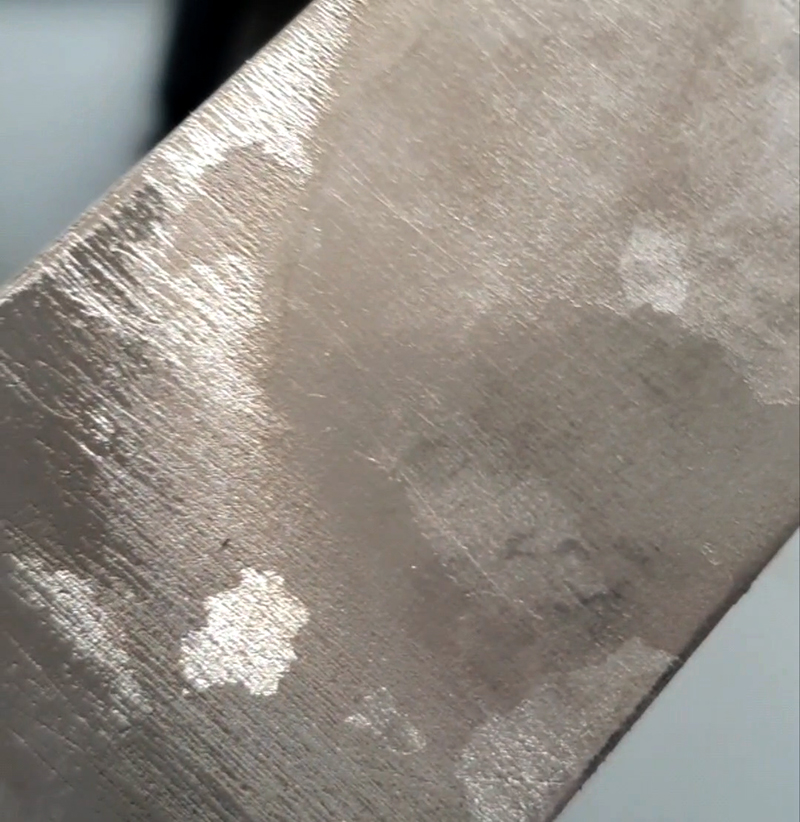
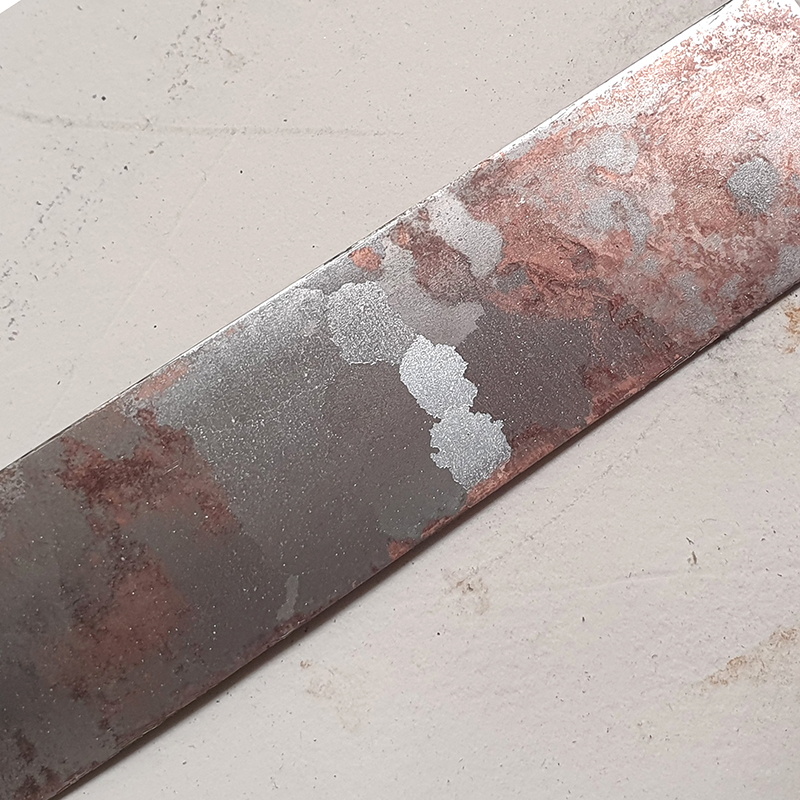
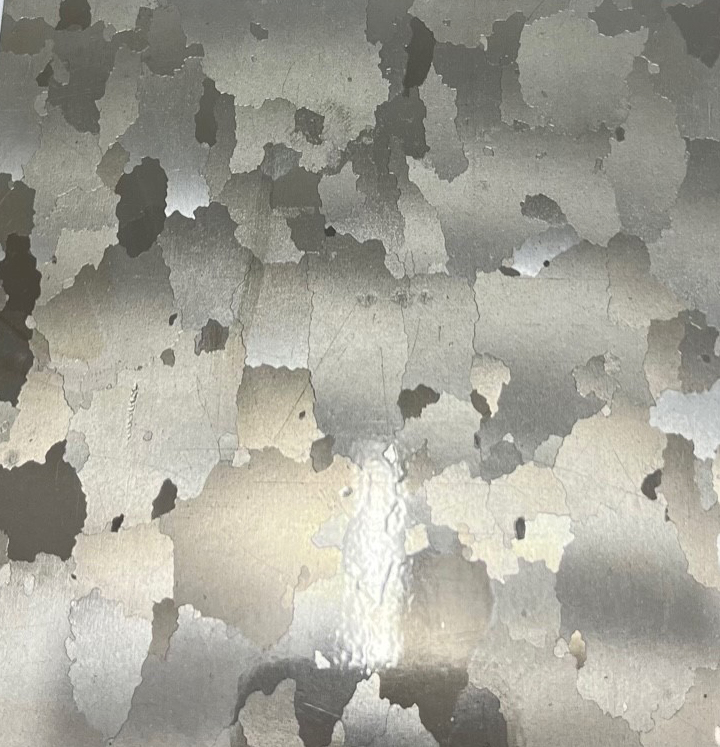
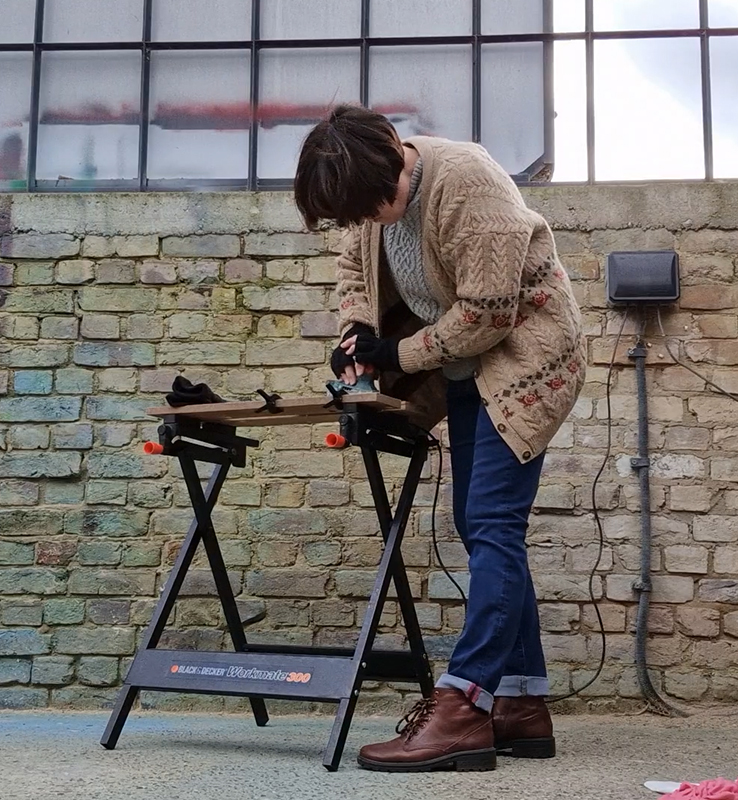
I first came across directional magnetic steel in the Electronic & Magnetic Materials Group open day at the National Physical Laboratory. Intrigued, I wanted to know if I could get hold of some to work with. I was put in touch with Union Steel Products who were very helpful in supplying a small amount (to them) of the material, but they import the product, and it arrives with an indeterminate protective matt grey coating. This was my challenge. It took many days of sanding and gently etching each sheet to reveal the pattern. It was a very temperamental material to work with, the pattern might appear but quickly tarnish and muddy over. So much of the work in the resulting sculpture was about the process of exposing an internal mechanism.
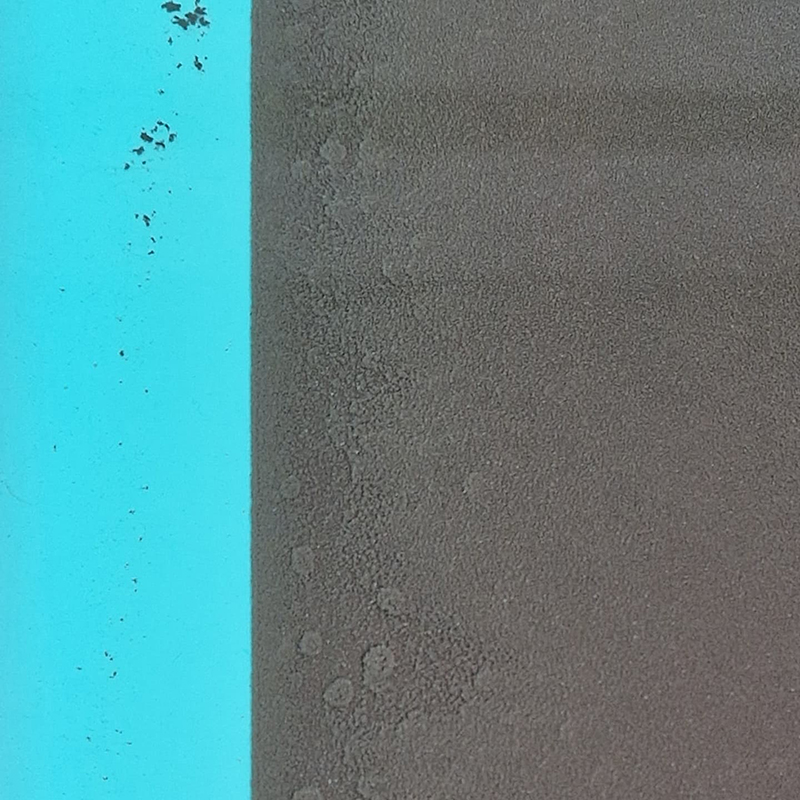
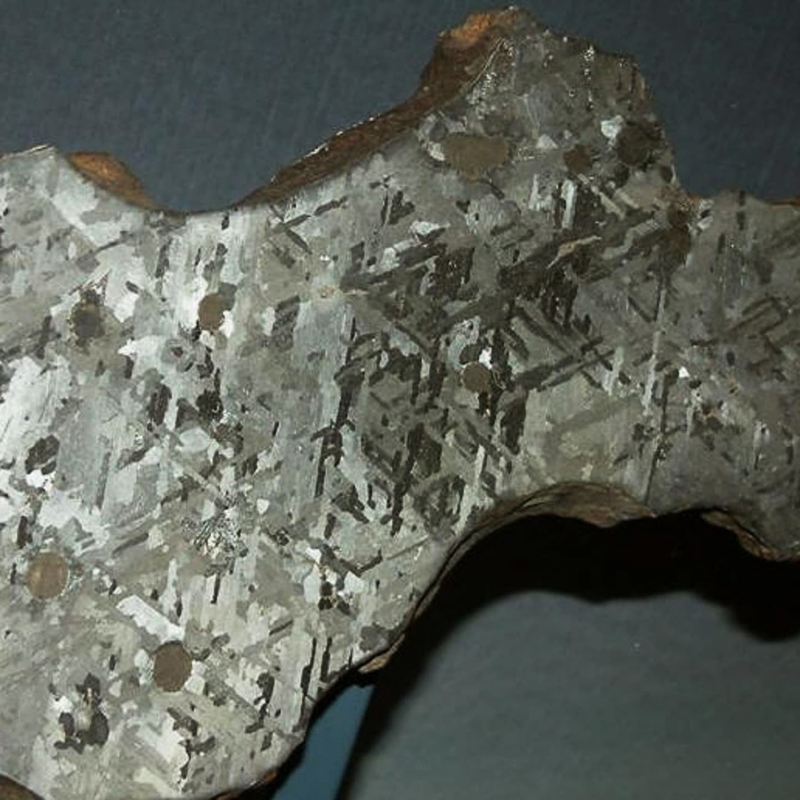
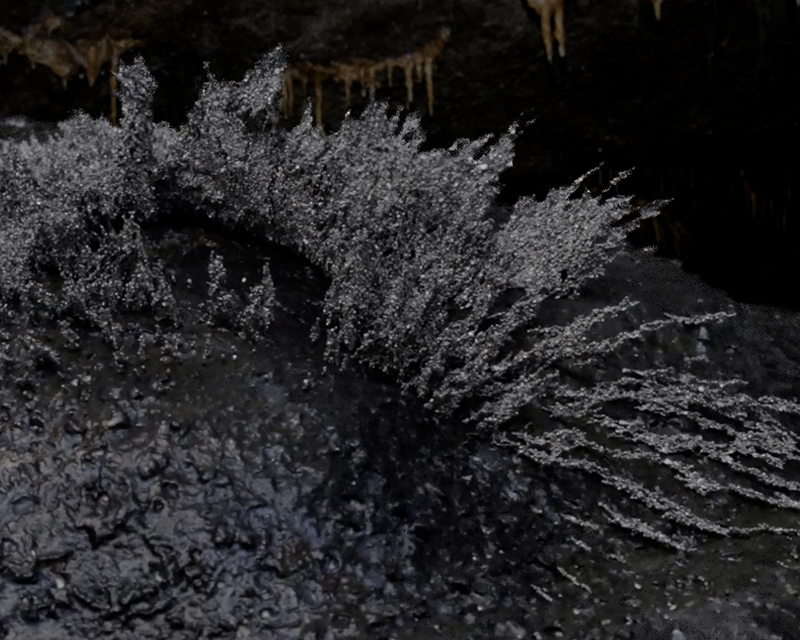
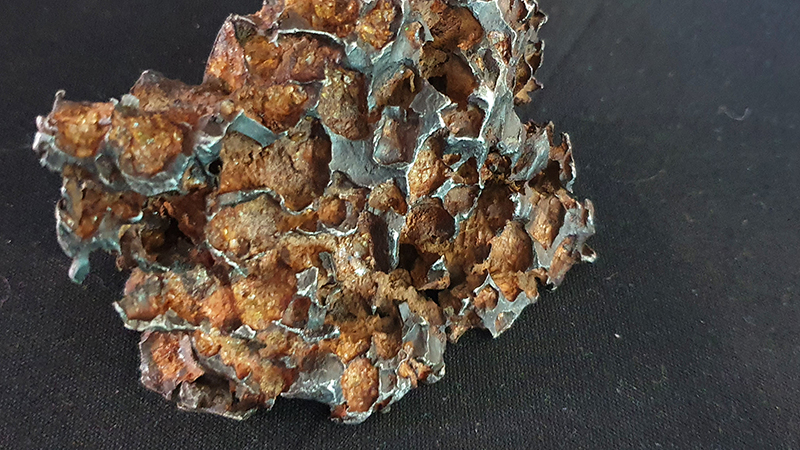
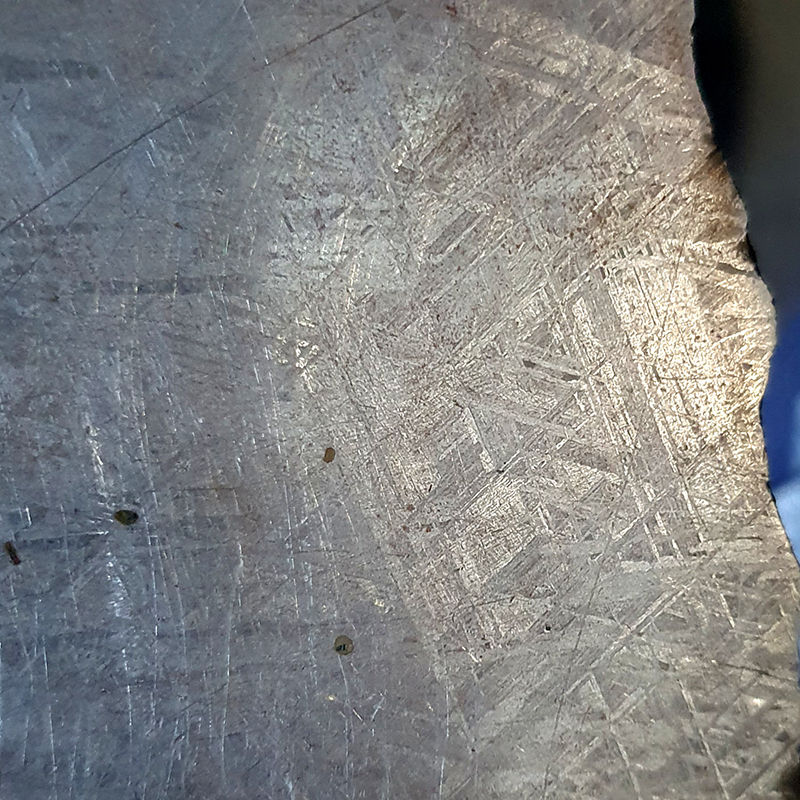
The dramatic Widmannstätten patterns found in meteorites due to their slow evolution through heat and pressure are also revealed through being cut, polished, and etched.

These secrets are not revealed lightly.
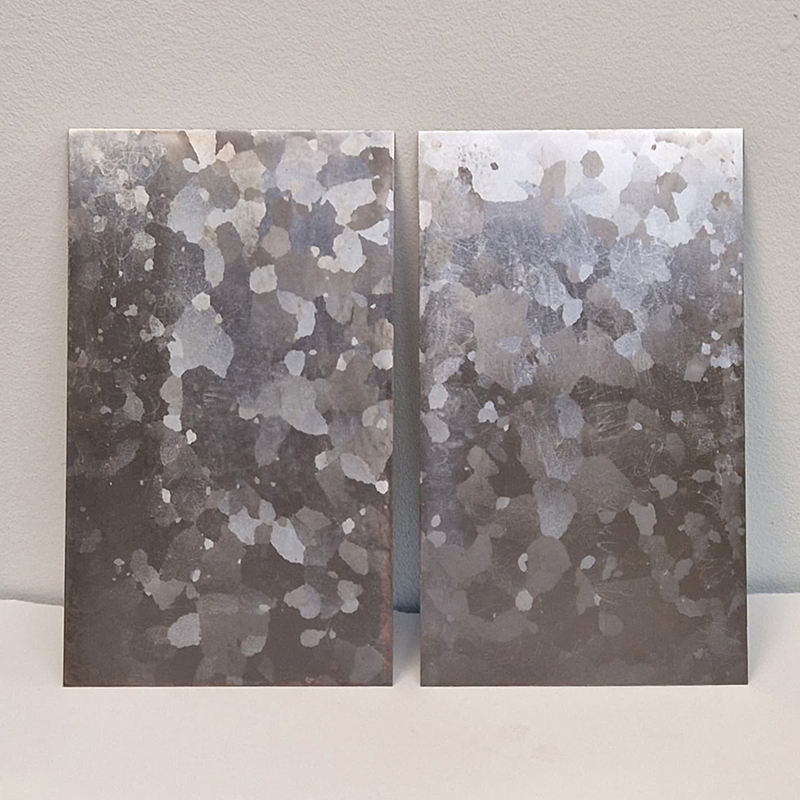
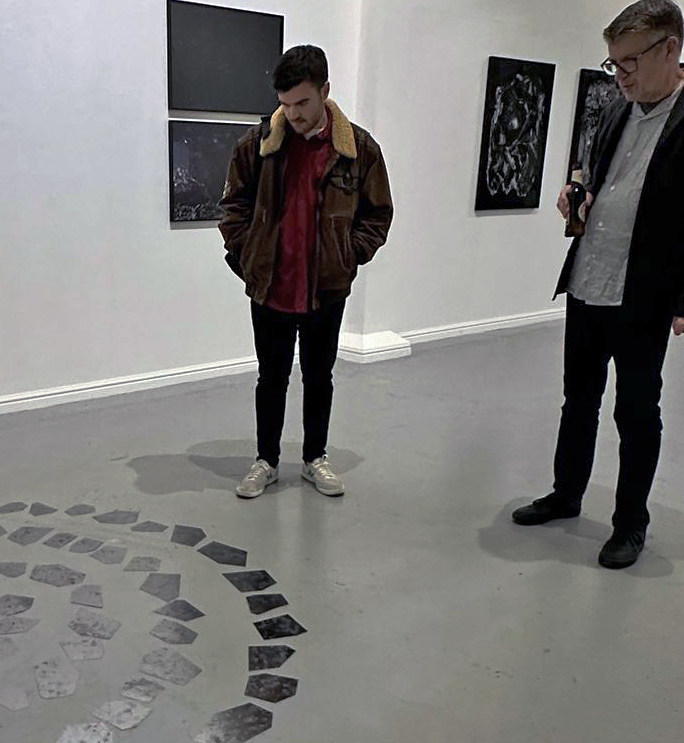
Domain of the Devil Valley Master

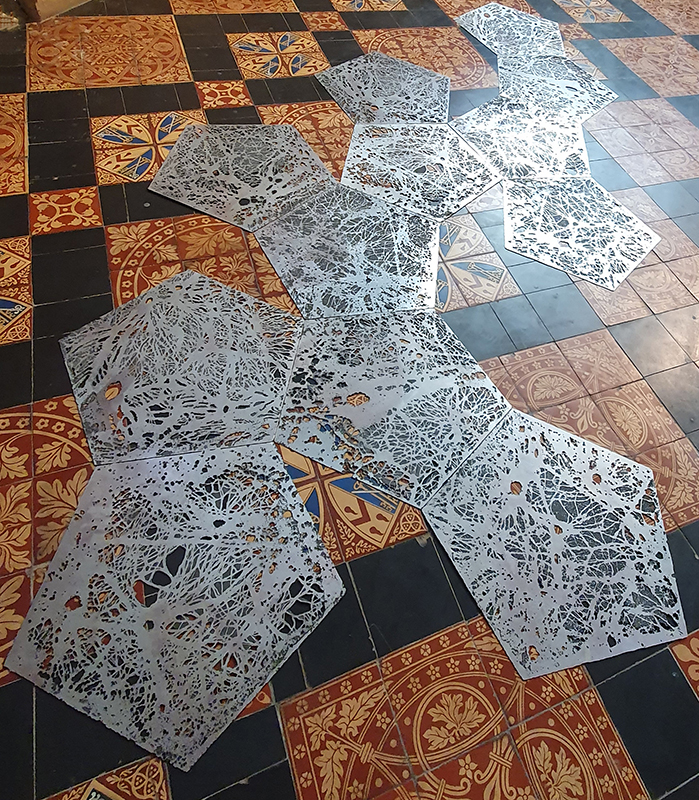
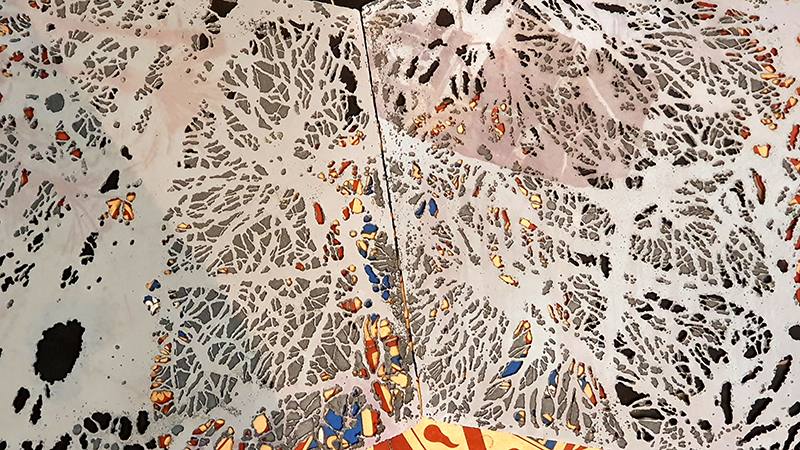
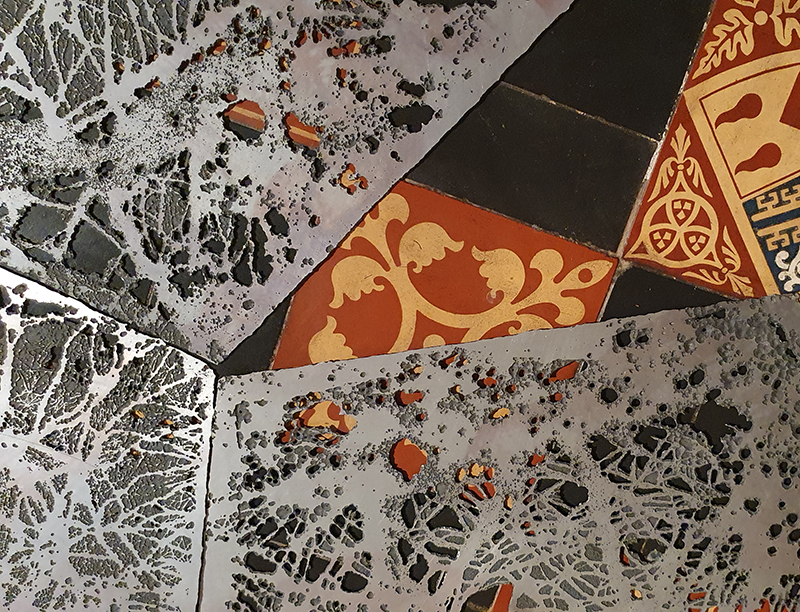
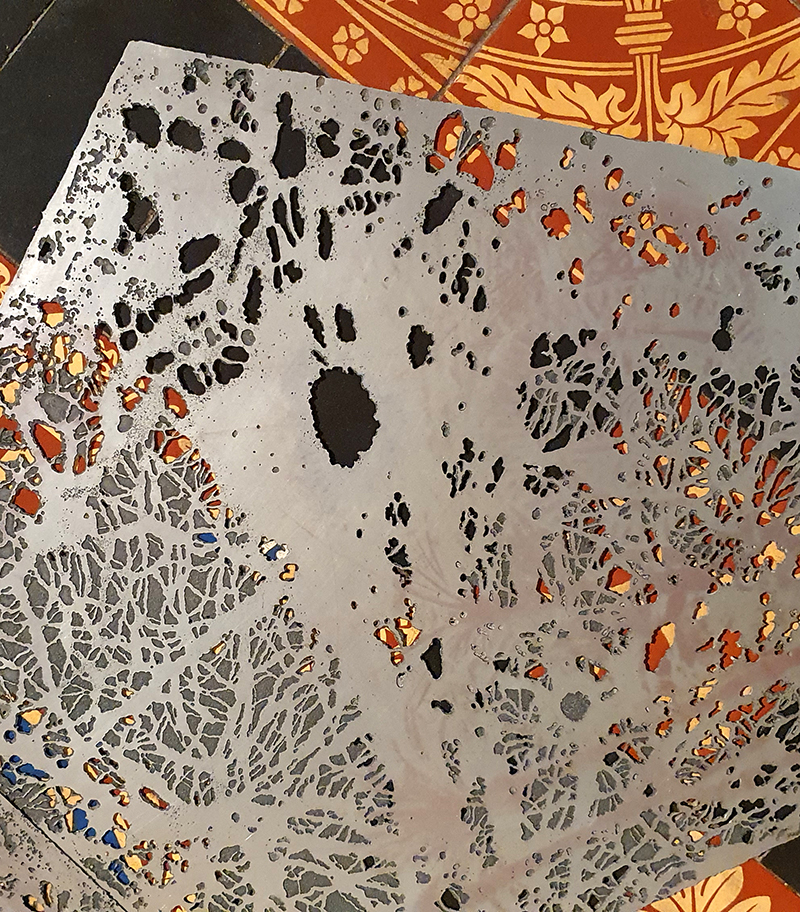
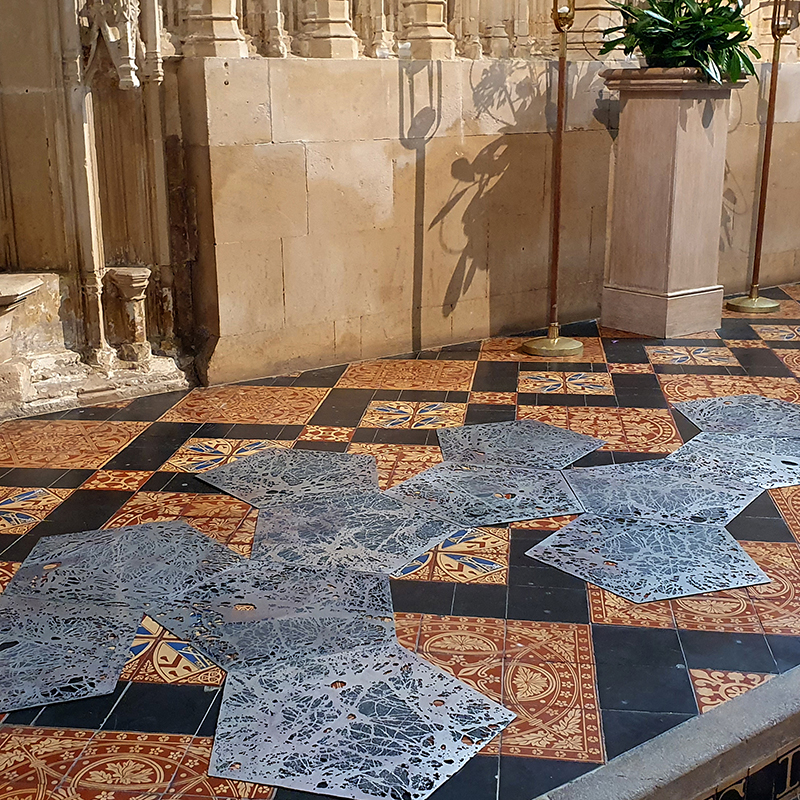
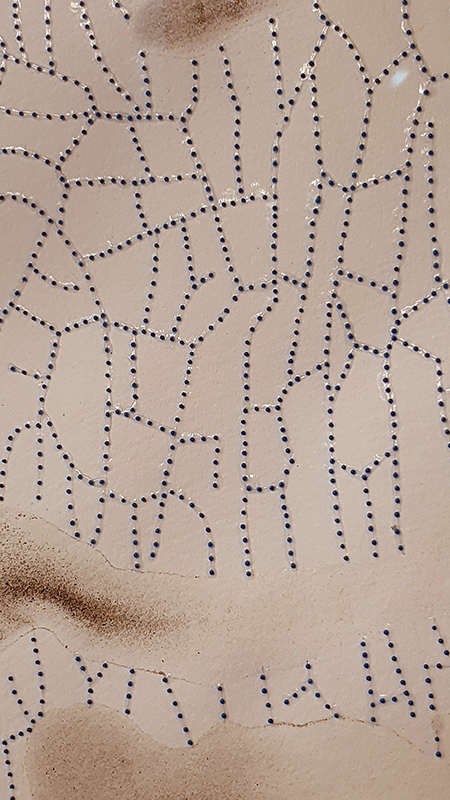
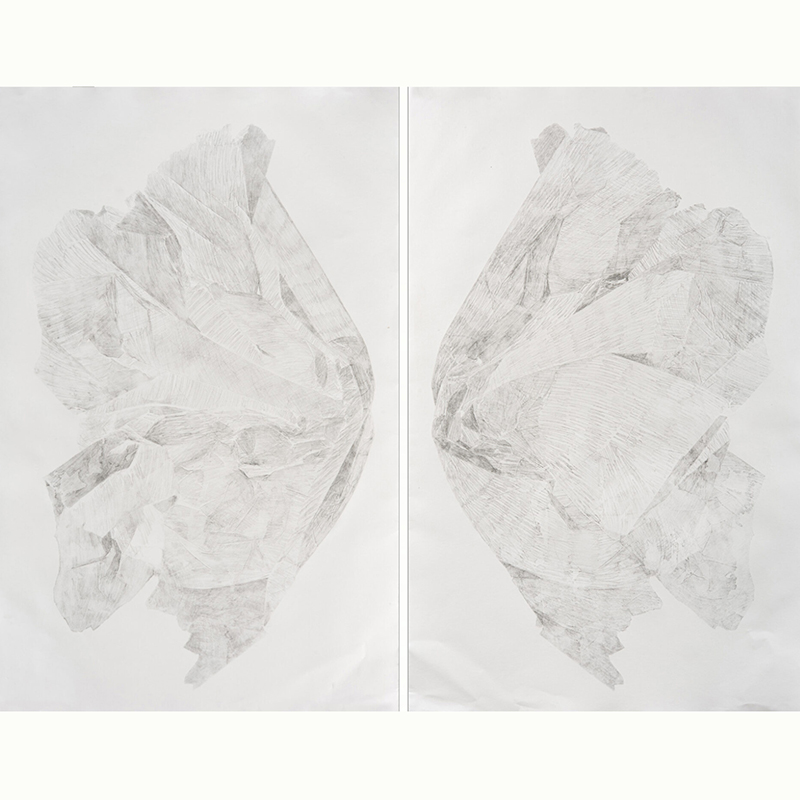
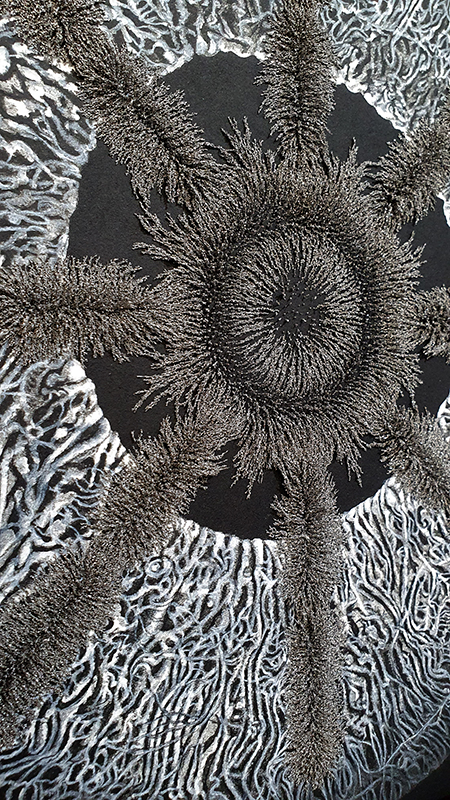
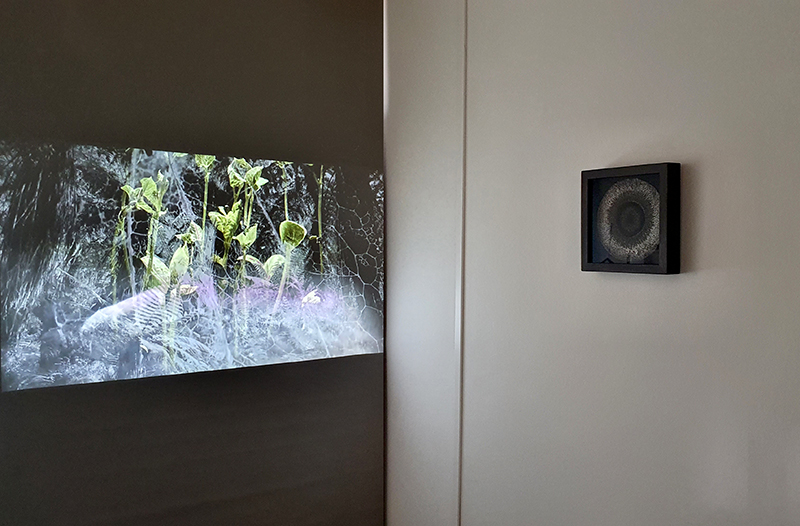
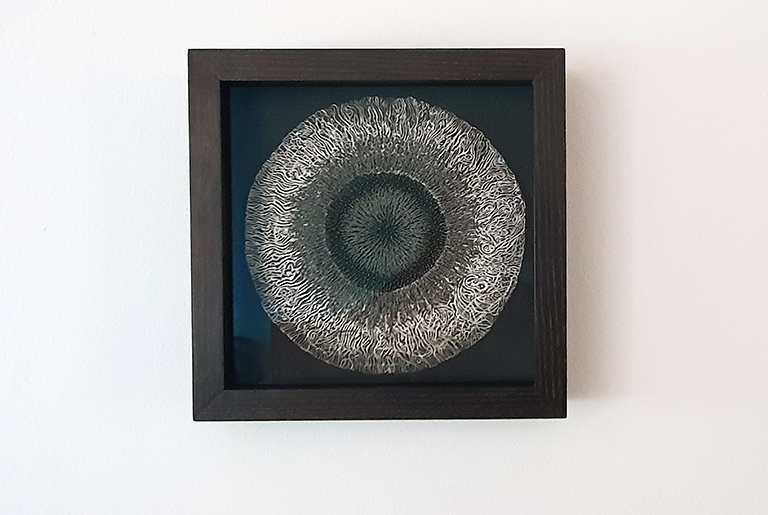
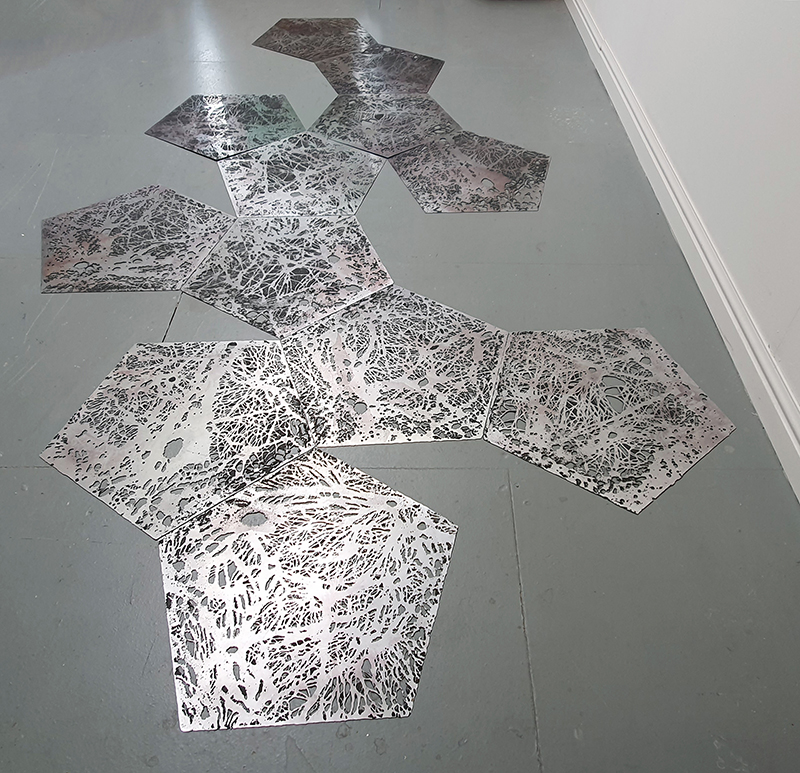
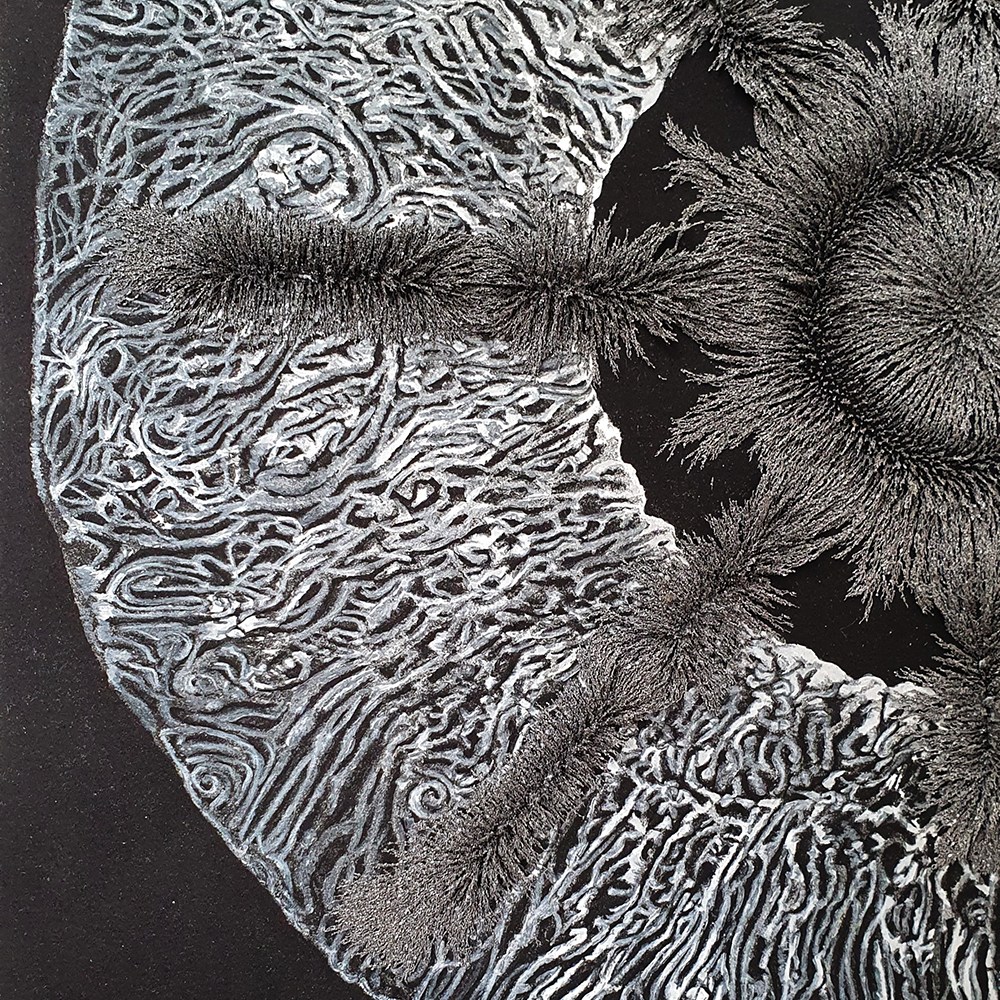
This work uses industrial directional magnetic steel, sanded and etched to reveal the Goss texture of rolled iron silicon alloy crystals. The jigsaw pattern of magnetic domains give this material exceptional magnetic properties. The simple evocation of a spiral described in geologically informed polygons draws upon many references, from the shape of our own Milky Way Galaxy sculpted by vast cosmological magnetic fields and the spiralling molten dynamo generating Earth’s magnetic field, to the inner pathway of spiritual growth and the route to the symbolic omphalos (navel) at the centre of the world where the sky entrance and the underworld meet. The title of this work originates from an ancient Chinese manual on the skills of persuasion, The Book of the Devil Valley Master, containing the first known mention of a compass, known at the time as a south-pointer. 

Work in progress. Mapping a response to the crystal structure of magnetite. Magnetite is the most magnetic of all the naturally occurring minerals on Earth found in igneous, metamorphic, and sedimentary rocks. Nano-particles are also found in the human brain, heart, liver, and spleen and the cells of many other organisms, with some creatures using this for navigation techniques.

Magnetite crystals from road traffic pollution caused predominantly by vehicle frictional braking systems can outnumber natural magnetite in the human brain by 100:1 – this is a worrying trend as these crystals could be involved in our perception, transduction, and long-term storage of information in the brain.

Returning to my conversation with Alan Watson on the history of Haverah Park Extensive Air Shower Array.

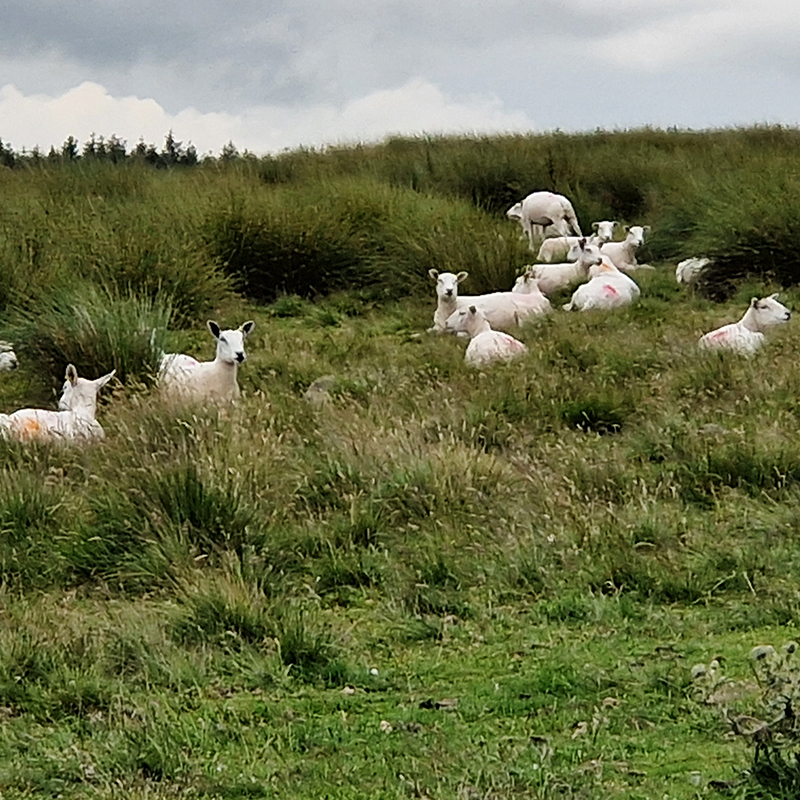
The motivation for the Haverah Park project getting off the ground came largely from the British physicist Patrick Blackett, who won the Nobel prize in 1948 for his discoveries in the field of cosmic rays. The director of The Rutherford Lab (where the British atomic bomb was being developed in the 50’s), John Cockcroft (known for splitting the atom), decided there should be fundamental science going on as well as bomb building, so outside the security wire they built an air shower array to monitor cosmic rays. When this experiment was shut down, Blackett was keen to see work with shower arrays continue, and to be within reach of a university so that scientists could combine research with teaching. Blackett was working at Cavendish Laboratory with Ernest Rutherford, but moved to Birkbeck which did all the teaching in the evening so he could do research work through the day and teach in the evening. Here he met J G Wilson, also with an interest in cosmic rays, so when J G Wilson later moved to Leeds, Blackett suggested he set up an air shower array there, which was how the Haverah Park Project came about. Land was rented from local sheep farmers to install the observation huts.

Alan Watson took a lectureship job at Leeds in 1964 and began working for J G Wilson, becoming a leading member of the UK Extensive Air Shower project until its closure in the early 1990s.

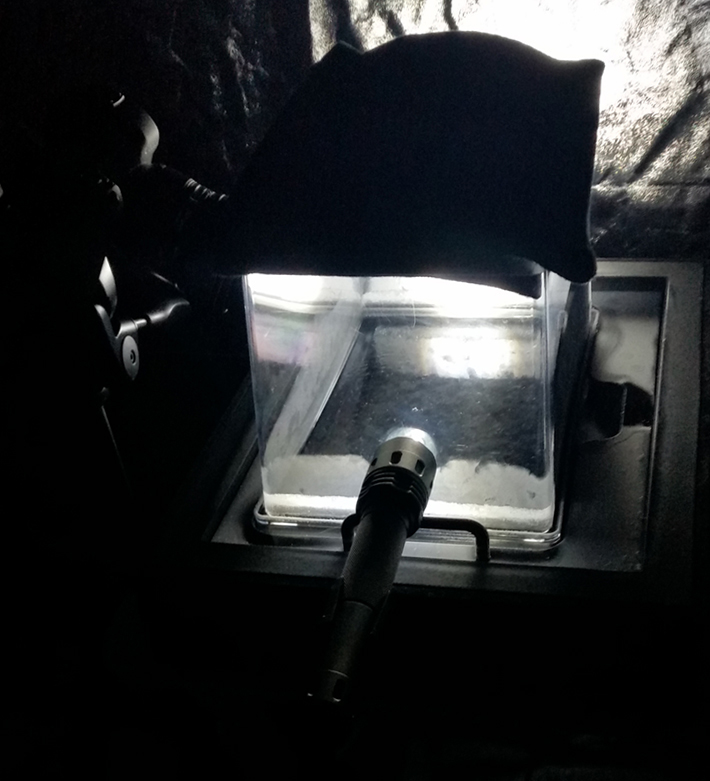
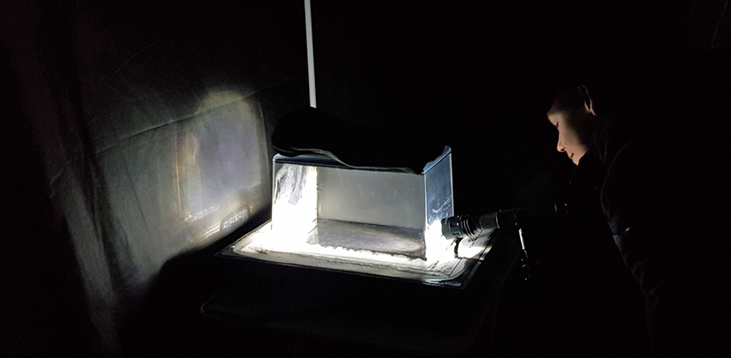
We also talked about the mesmerizing power of a cloud chamber. As well as it being considered one of the most important developments for progression in the understanding of particle physics it is also emotionally and aesthetically captivating. Alan reminisced about a time at the Royal Society Summer Exhibition when a large commercial diffusion cloud chamber drew so much attention they were asked to turn it off, as mesmerised visitors blocked the entrance to the exhibition. It’s been a few years since I visited the Institute of Physics to see the large cloud chamber in the foyer, I wonder if it’s still there. I love the fact that I can build my own cloud chamber to see these cosmic visitors.

J G Wilson writing on the study of cosmic rays from his book About Cosmic Rays published in 1948, of which I have a copy:

‘It has its spectacular side, for the only laboratory which has been found big enough for its investigations is the whole of the universe to which men can win access. Most refined measurements have been made under conditions of difficulty and hazard, deep in mines and on icebound mountains, in the watses of western Greenland and cramped in the tiny gondola of a stratosphere balloon. These exploits, which are outstanding even in one of the most brilliant phases of experimental physics, are an unambiguous indication of the importance which is attached to the problems which are being studied.’

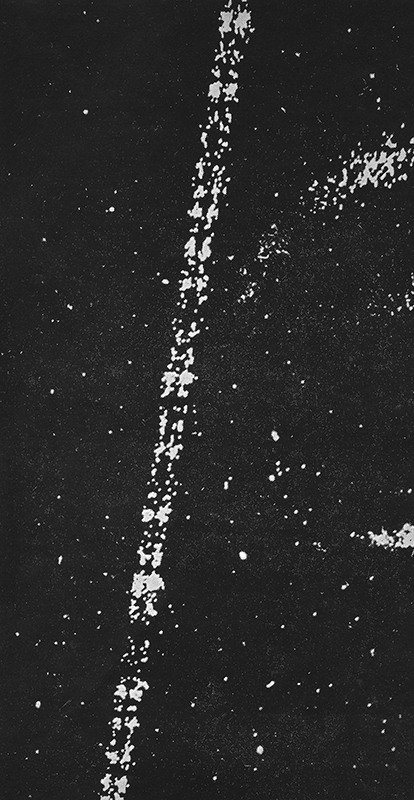
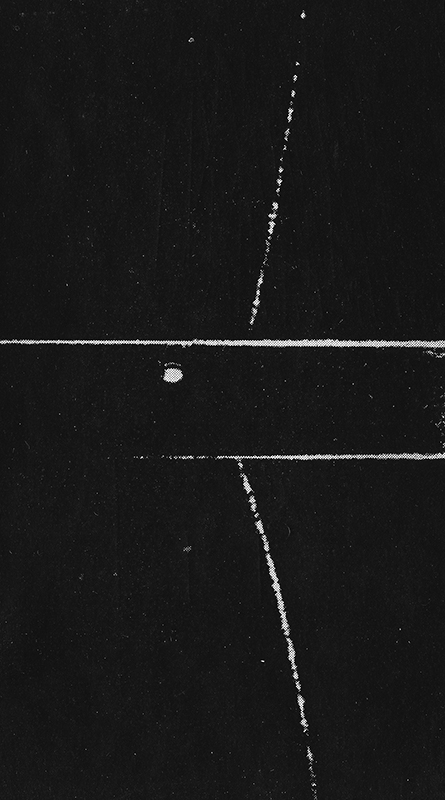
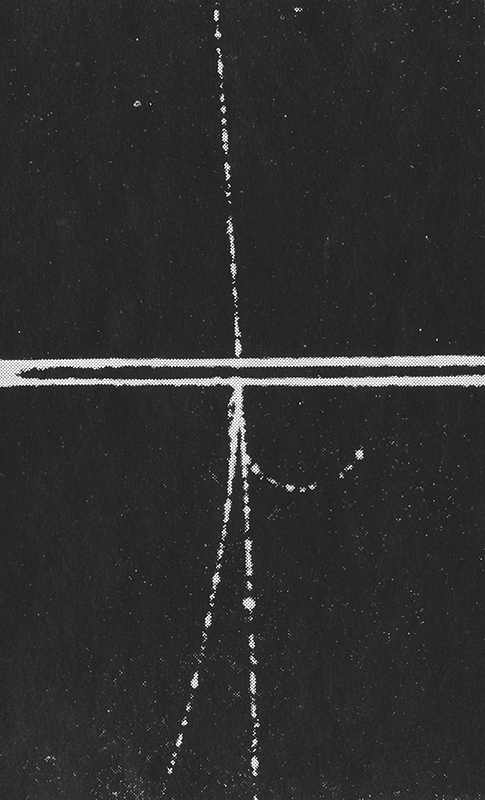
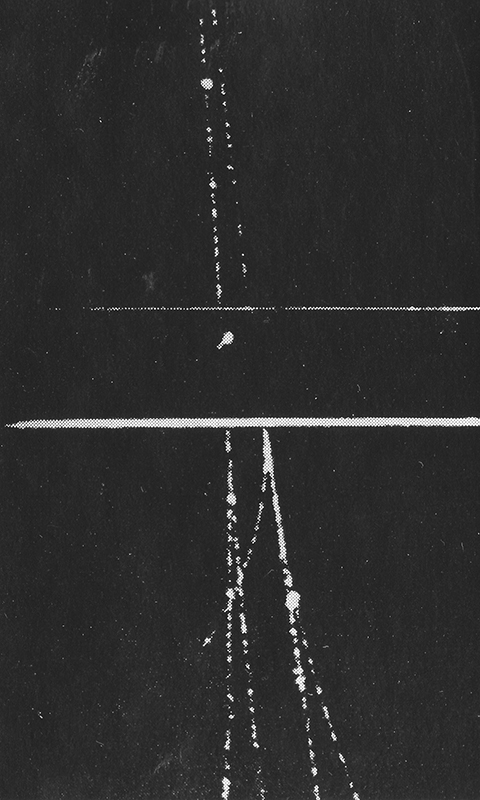
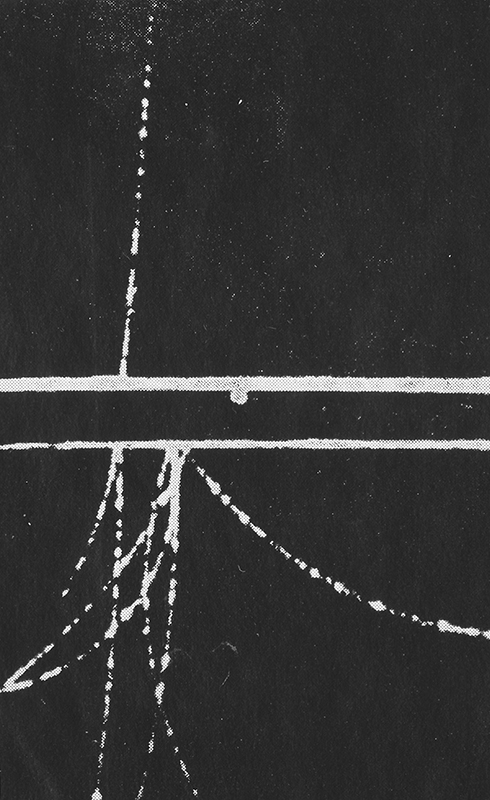
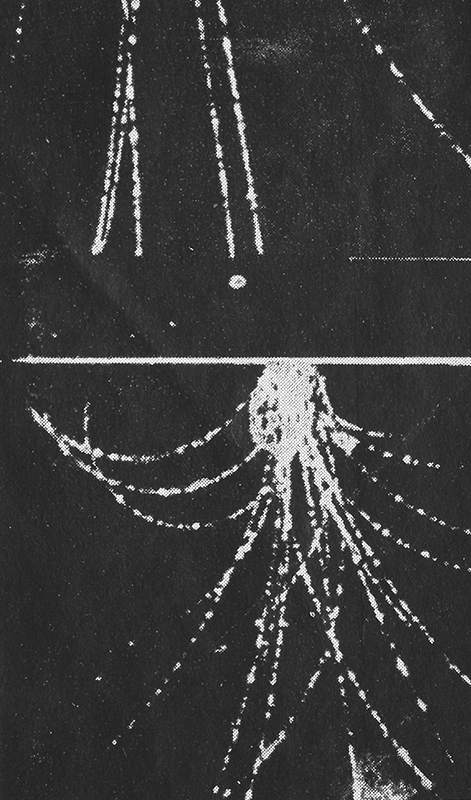
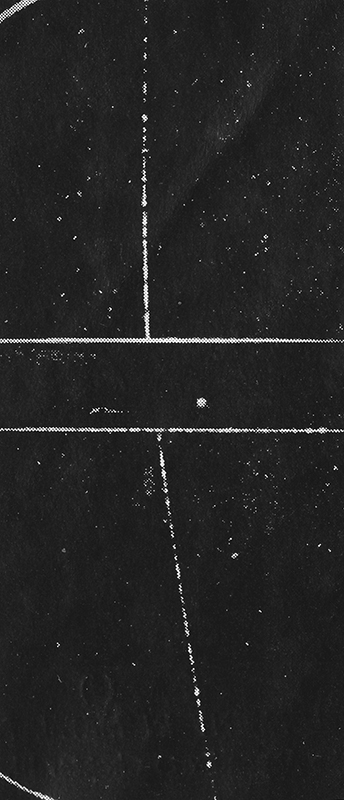
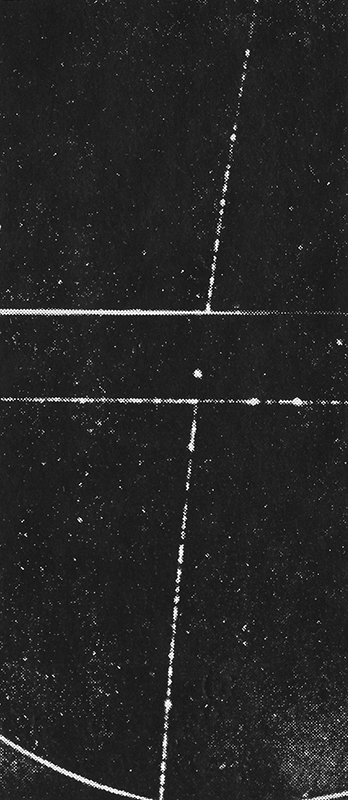
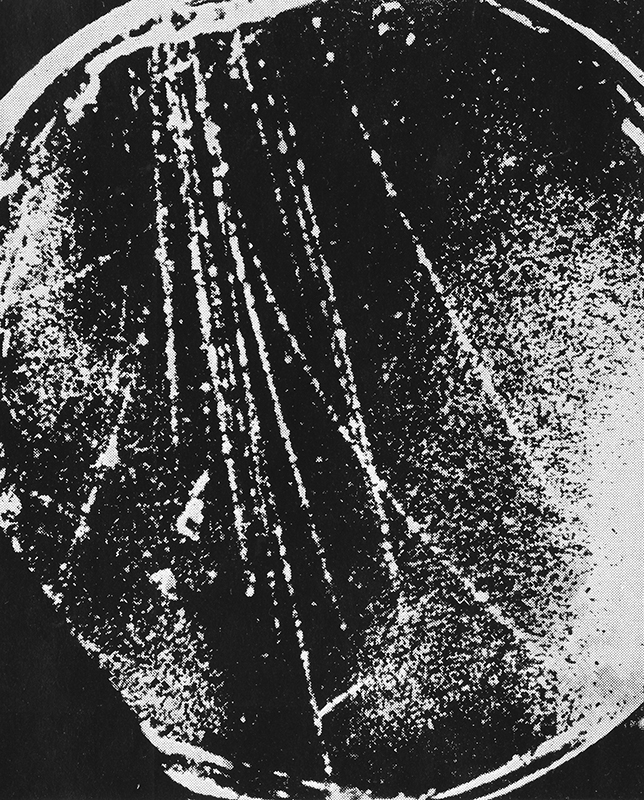
The following images from the same book show particle trails photographed in a cloud chamber -showing extensive showers and particles passing unhindered through metal plates.

J G Wilson writes about cosmic rays ‘…it is interesting to speculate on their previous history, for before it is overtaken by the catastrophe of hitting the earth, each particle is likely to have had a placid life for years, even millions of years, cruising through the wide open spaces of the universe’.

Cosmic Chiasmus: crossing the universe 2021 (video still)

The primary detectors used at Haverah Park were water Cherenkov detectors. These are large water filled tanks filled with a photomultiplier suspended in the water to capture flashes of Cherenkov light emitted by high energy cosmic rays as they pass through. The light is emitted because the cosmic rays pass through water faster than photons of light are able to, and as they do so they lose electrons thereby emitting light. The speed of light is only a constant within a vacuum, when it passes through other materials it get slowed down.

There were four 34 m2 detectors at the centre of the array in the main hut, with three detectors located 500m from the central detector. Signals from the three distant detectors were sent along buried cables to the central hut, with the signal from the central detector passing down 500 m of cable buried underground so that all signals arrived at about the same time.  When signals from the central one and two of the others arrived within ~2 x 10⁻⁶ s (called a coincidence), the signals from the photomultipliers in the 34 m2 detectors were displayed on four oscilloscope screens and photographed by one camera which had its shutter permanently open. About 20 feet of film could record around 150 events. Developed and manually scanned by Alan, or a senior colleague, the film was checked for quality and to look for any large events (ultra high energy particles arriving) which were always exciting to find. The developed film was then sent to Leeds University Physics dept for measurements.

When there was a coincidence event at the centre of the array, a signal was sent by microwave to the distant detectors set across the moorlands (on average about 2km from the central hut), the signals from these distant groups of 4 x 13.5 m2 were recorded digitally with the data going onto paper tape which was collected once each week. 

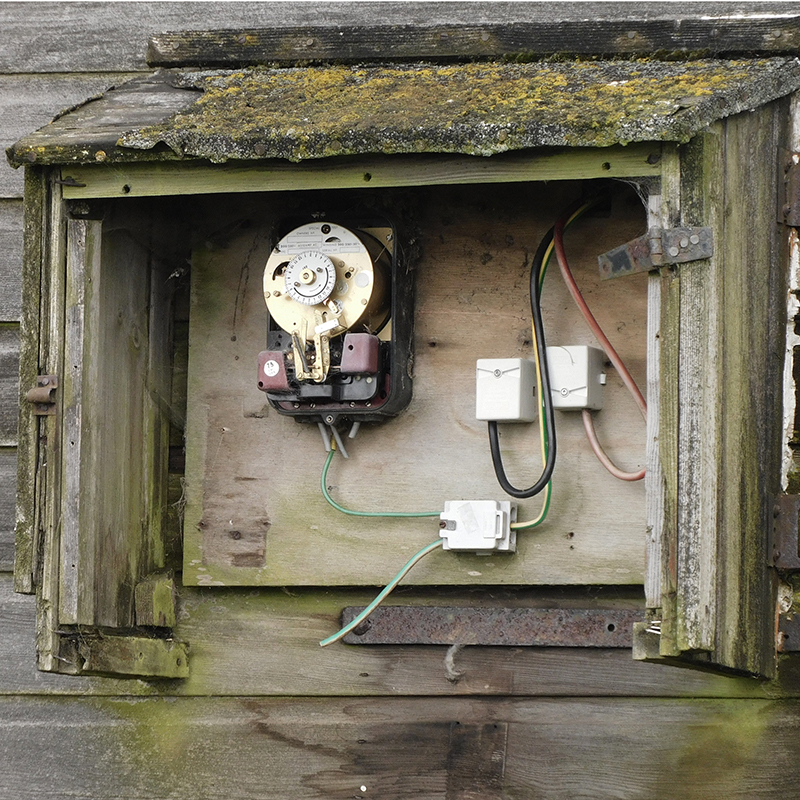
Along with the oscilloscope traces being photographed, the number on a counter was included which gave the time of each event to the nearest half minute.  In the 1960’s when this project began the time counter was advanced by a pendulum clock.  Counting time in half minutes the team found that there are roughly one million half-minutes in a year, which gave a good excuse for an annual party.

There were some brief periods in the early 1980s when a small number of scintillator detectors were also used to make cross-checks of the results from the water Cherenkov detectors against those from projects in the USA (Volcano Ranch) and Yakutsk (Siberia).  The scintillators retrieved from Imperial College’s Holborn project were brought to Haverah Park for an experiment to look at much lower energy showers.

Both types of detectors register flashes of light.  

Blackett was the first person to work out the details of Cherenkov light produced in the atmosphere. According to a memoir on Blackett, written by astronomer Bernard Lovell, who knew him very well, Blackett attempted to see Cherenkov light from cosmic ray showers with the naked eye but there is no mention of whether he succeeded. In 1962, physicist Neil Porter who built the first water Cherenkov tank in the UK at Harwell in the 50’s, did an experiment with some volunteers who were asked to recline on a coach in a dark room with a small Geiger telescope attached to a pair of darkened goggles and acknowledge if they saw a flash of light when a cosmic ray was known to pass through the googles. The observers did seem to experience a flash of light but results were ambiguous as to whether this was Cherenkov light being emitted as the particle passed though the crystalline lens or vitreous humour of the eye or a direct excitation of the retina. The experiment was a collaboration with the Psychology dept at the University of Dublin and published in Nature under the Psychology heading giving an impression that the lights were perhaps a figment of the imagination.

Aóratos 2019 video still

Astronauts are very aware of this phenomenon. During the 1970 Apollo 13 mission to the moon the power supply was damaged and the astronauts sat in the dark for several days waiting to return to Earth. They experienced flashes in their eyes and realized that some of this was Cherenkov light. Some flashes were caused by particles directly hitting the retina but Cherenkov light caused by high energy particles travelling through the matter of the eye faster than light, is much brighter. The energy is proportional to the square of the charge of the particle that comes through, so if you have an iron nucleus which has a charge 26 x the charge of a proton, you get 26 squared or 600 times as much light emitted. Out in space there are many more of these high energy particles and so the astronauts would become very familiar with these flashes, even using them to line up accelerator beams by putting their head in the particle beam to see the flashes.

An astronaut once told Alan that he was convinced that the very first people fired into space probably saw these flashes, but didn’t like to tell NASA in case it turned out to be a physiological defect of theirs and they would be taken off the space programme.

Recently, a professor friend of Alan’s who is aware of this phenomenon, has unfortunately had to begin radiation treatment for a brain tumour. He has found due to the position of the tumour and angle of treatment he can see Cherenkov light flashing in his eyes as the electrons bombard the tumour.

Aóratos 2019 cropped video still

When we met, Alan was just back from a conference in Italy discussing a paper titled ‘Ultra high energy cosmic rays: The Disappointing model’. They called it the disappointing model because they believed that the Auger results with particles at the highest energy were heavy not protons. I’m not sure I understood why it was disappointing although Alan did his best to explain: ‘It’s difficult to measure the mass of the particles of a certain energy. A deduction had been made that they have a mean mass, probably the same as nitrogen but mass changes in quite a complicated way as a function of energy. It’s to do with how deep the showers develop in the atmosphere.

Cosmic Chiasmus: crossing the universe 2021 video still

The techniques aren’t good enough to separate the particle’s mass on a one by one basis, we can only do averages. It looks like the average mass is much heavier than protons, which everybody had believed for a long, long time. Protons would be at a much lower energy. As the nucleus is travelling through space, it sees photons from the microwave background radiation and the photon will chip off a neutron or a proton, if it chips off a neutron, the neutron decays into a proton, so you can get protons this way, but they will be of lower energy. The energy reduces roughly by the mass of the particle, so an iron nucleus has a mass of 56, if you chip off a neutron or a proton that proton will have an energy, which a 56th of the energy that the nucleus has – so it goes down in energy.

Some particles could come from Centaurus A, which is a relatively close radio galaxy, it is thought that the jets from radio galaxies provide conditions to accelerate the particles, but the problem is, because the cosmic rays are charged, they get deflected in the magnetic field of the Galaxy so you can’t track them straight back to where they came from.  In terms of heavy particles that’s more of a problem because being charged means they bend even more. So one of the disappointing things is that cosmic ray astronomy is not going to be very easy. The Pierre Auger observatory has really been very successful in changing the picture quite a bit but because there are so few ultra high energy particles recorded it is slow progress. There are hopes to expand the observatory even more and also a plan to launch a satellite with detectors to pick up fluorescence light in the shower as it passes through the atmosphere, a similar phenomenon to aurora light.

Cosmic Chiasmus: crossing the universe 2021 video still

Exhibitions

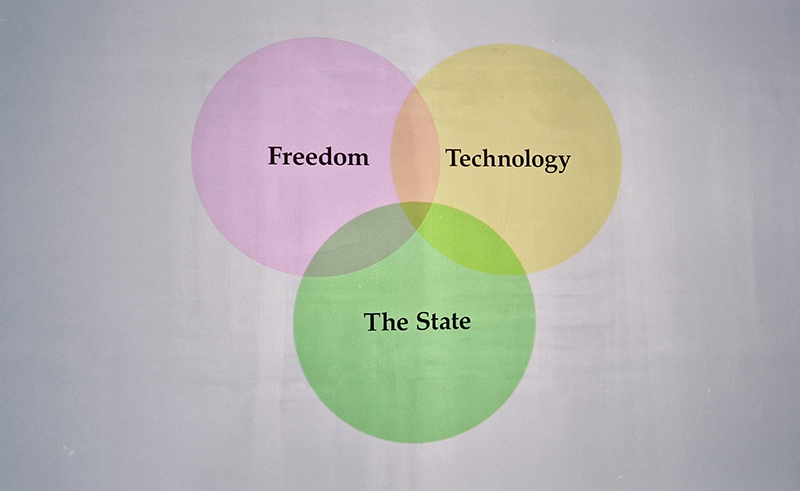
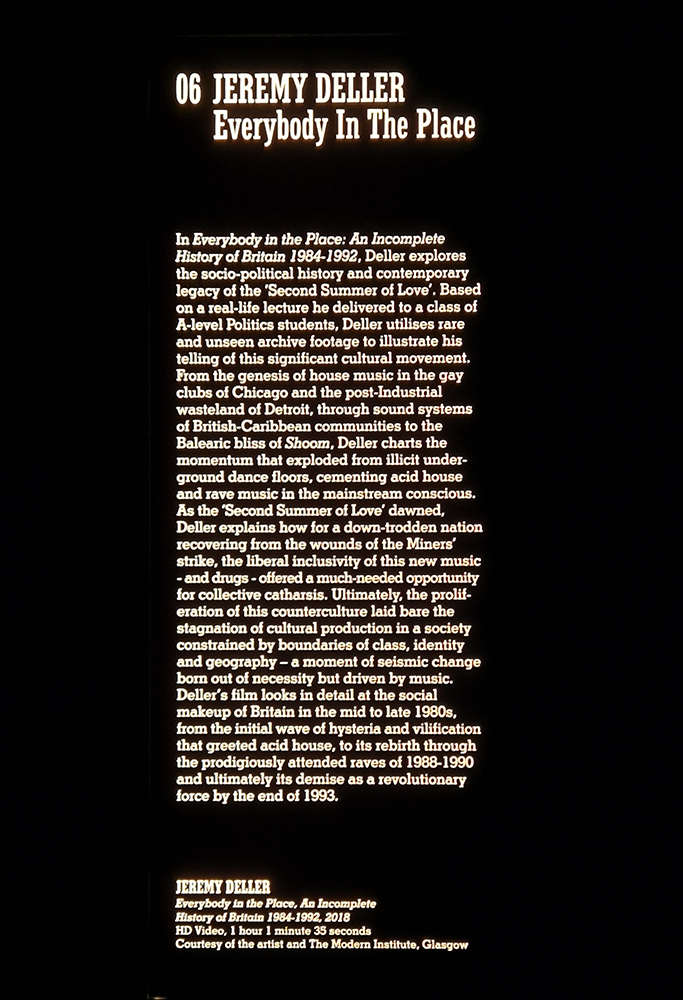
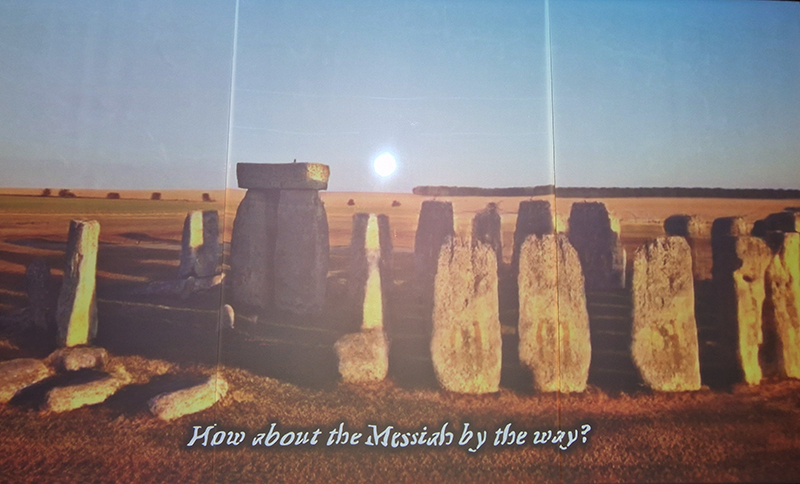
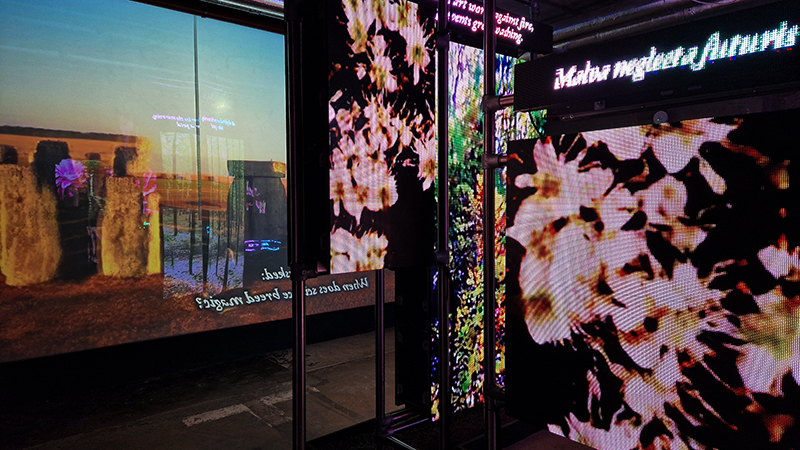
The Vinyl Factory: Reverb at 180 The Strand, a multimedia exhibition exploring the intersection of art and sound with artists including Theaster Gates, Es Devlin, Julianknxx, Kahlil Joseph, Caterina Barbieri, Stan Douglas, Virgil Abloh, Cecilia Bengolea, Jeremy Deller, William Kentridge, Jenn Nkiru, Hito Steyerl, Carsten Nicolai and Gabriel Moses. Fabulous show, shame I can’t share the sounds here. Loved Jeremy Deller’s takeover of a sixth form politics class. Some of the works I had seen before but that was fine as they are worth extra viewings.

Reading

I am beginning research reading for The Geological Unconscious exhibition Julie F Hill and I are co-curating at Hypha HQ Euston opening in May 2025.

Ursula Le Guin The Winds Twelve Quarters, a collection of profound short stories each introduced by the author reflecting on the intention within.

Long after I wrote the story (The Stars Below) I came on a passage in Jung’s On the Nature of the Psyche: ‘We would do well to think of ego-consciousness as being surrounded by a multitude of little luminosities…Introspective intuitions…capture the state of the unconscious: The star-strewn heavens, stars reflected in dark water, nuggets of gold or golden sand scattered in black earth.’ And he quotes from an alchemist, ‘Seminate aurum in terrain albam foliatam’ – the precious metal strewn in the layers of white clay. Perhaps the story is not about science, or about art, but about the mind, my mind, any mind, that turns inward to itself.

Roger Caillois The Writing of Stones 1970 is a tribute to the collection of extraordinary stones Caillois acquired and which now resides in The National Museum of Natural History Paris. In these poetic chapters he describes in detail each of the stones and his fascination with the images and associations they conjure in his imagination. Questioning and celebrating the allure of the mineral and the stories hidden and revealed over millennia.

I can scarcely refrain from suspecting some ancient, diffused magnetism; a call from the centre of things; a dim, almost lost memory. or perhaps a presentiment, pointless in so puny a being, of a universal syntax.

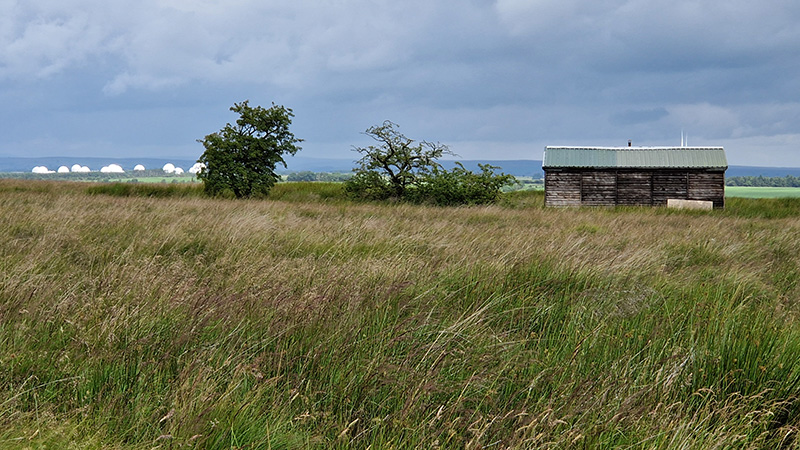
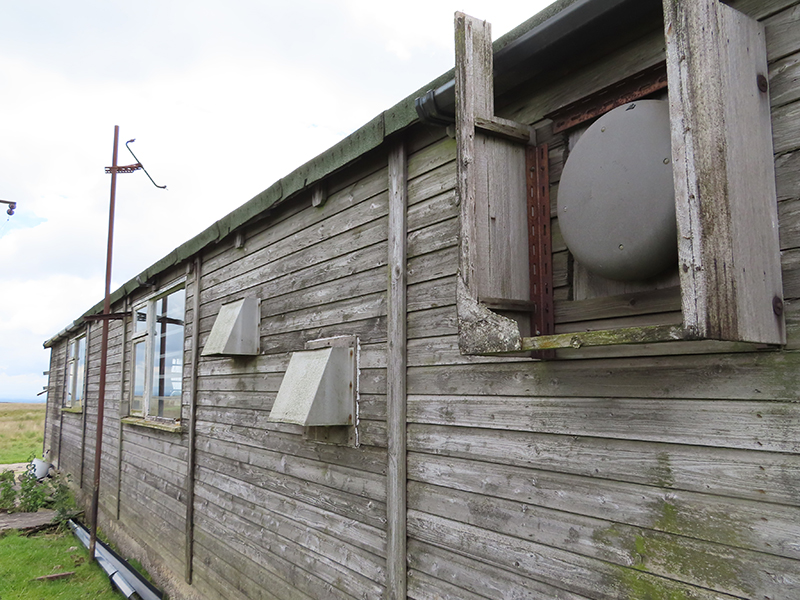
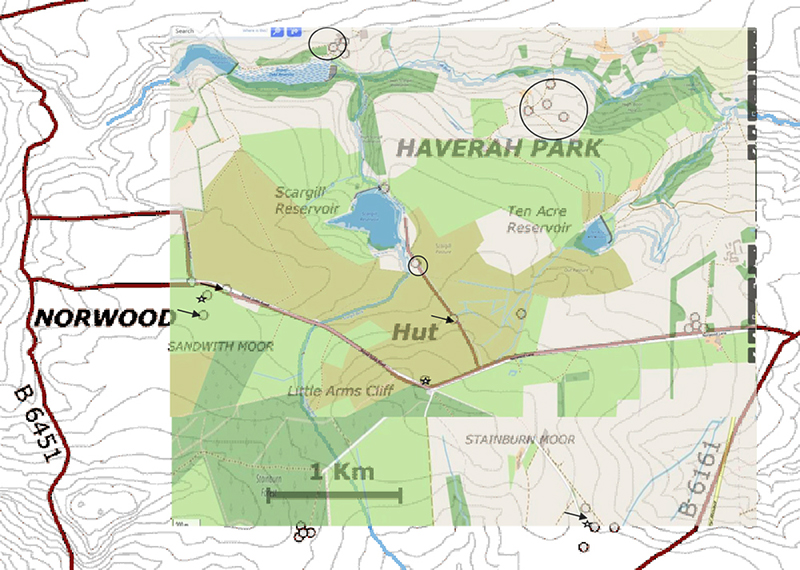
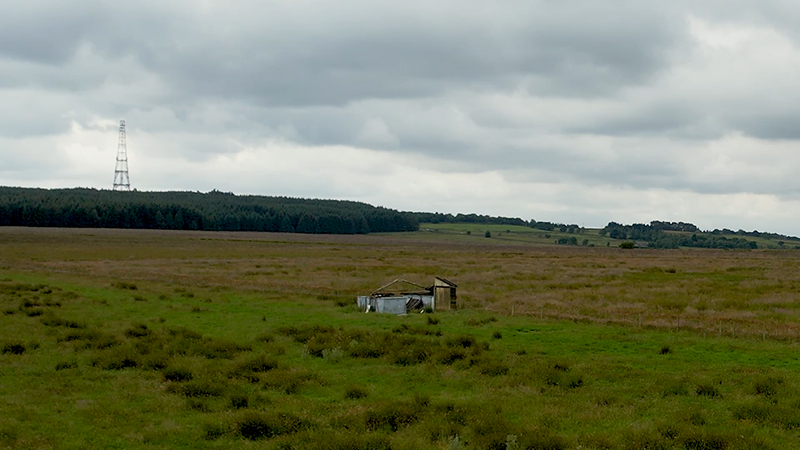
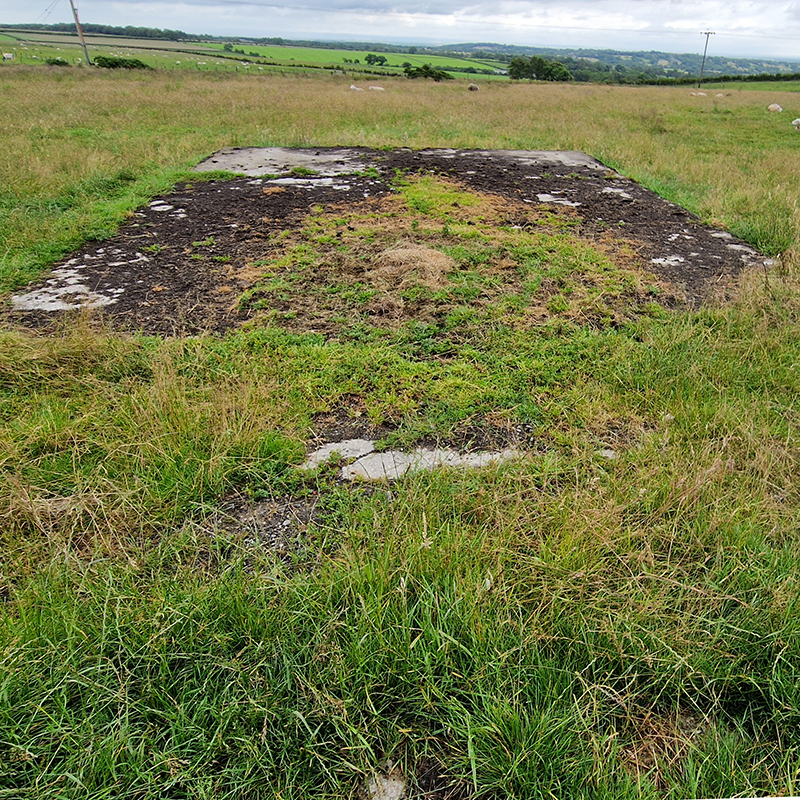
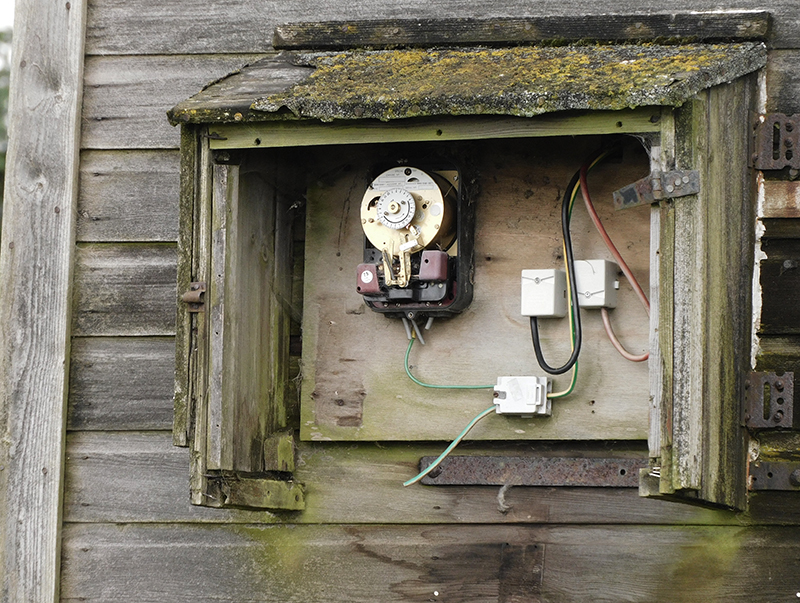
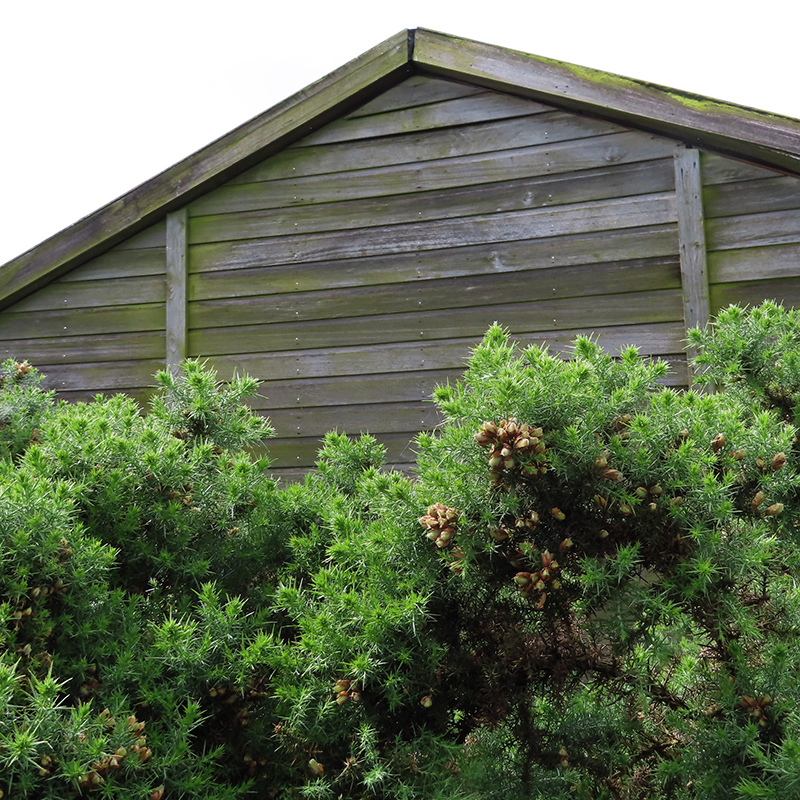
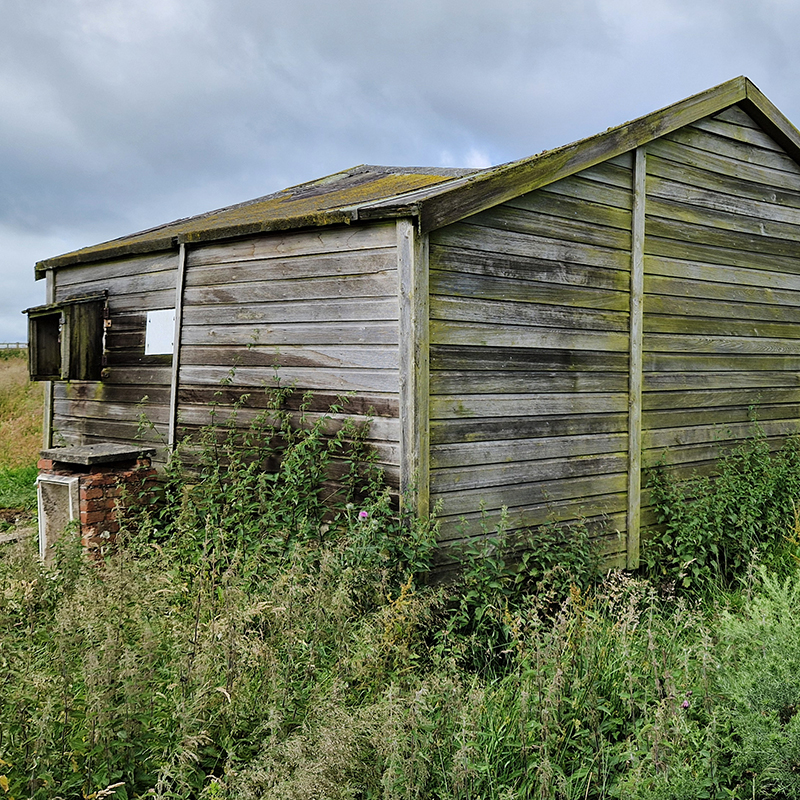
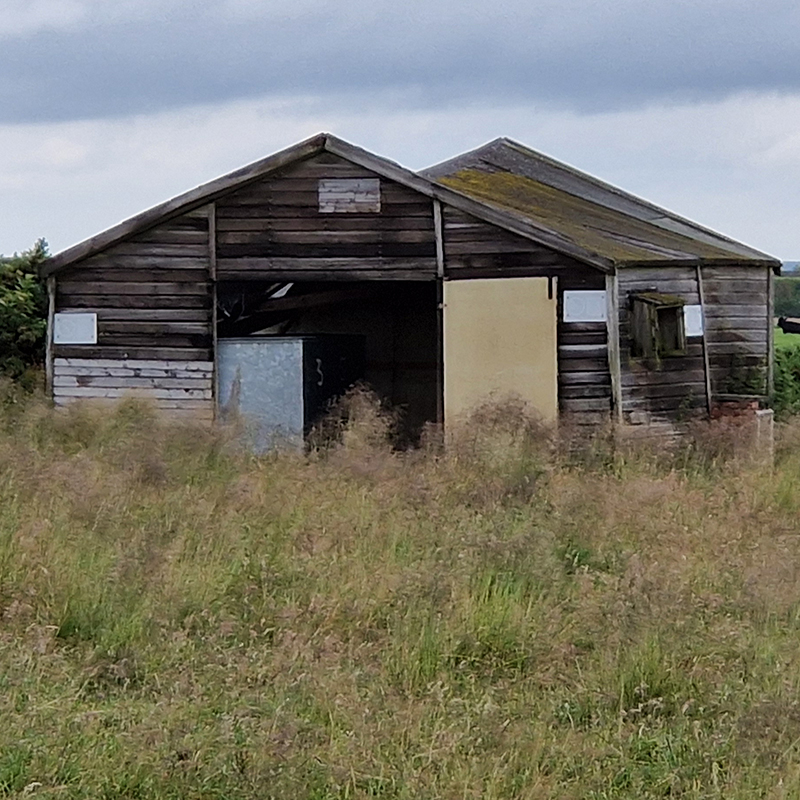
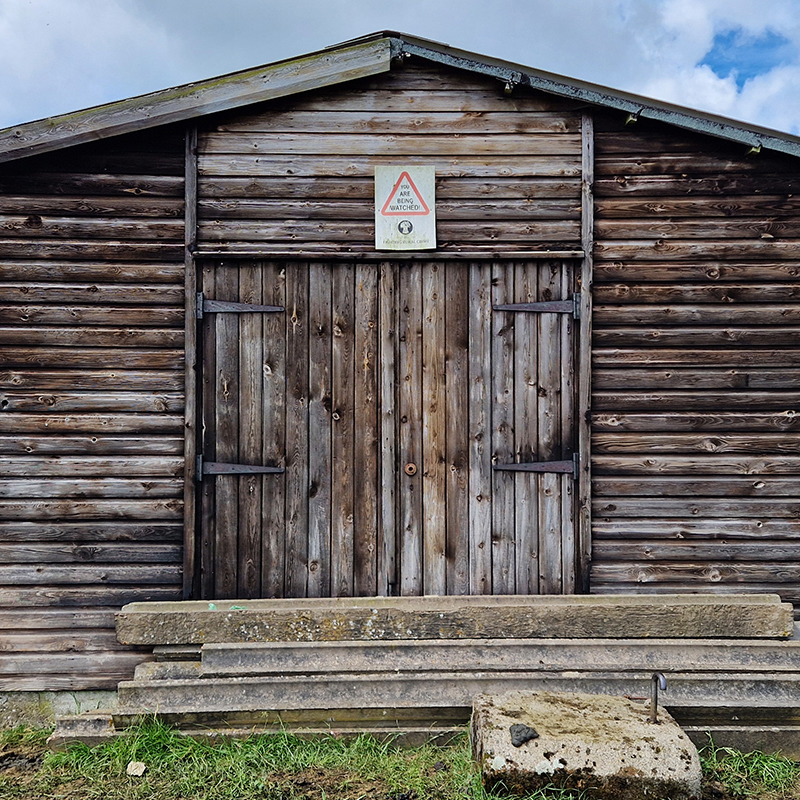
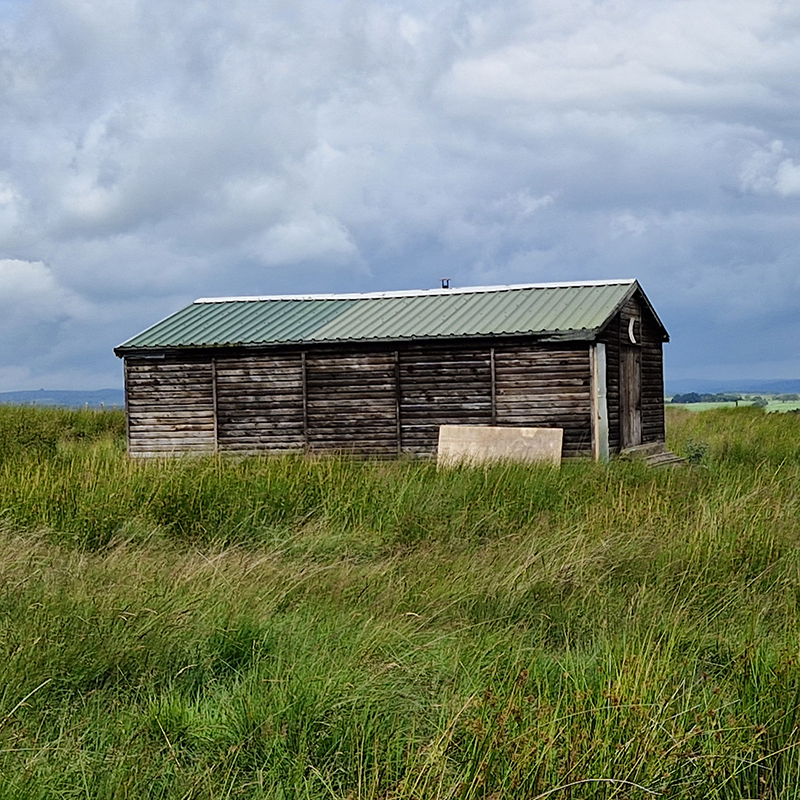
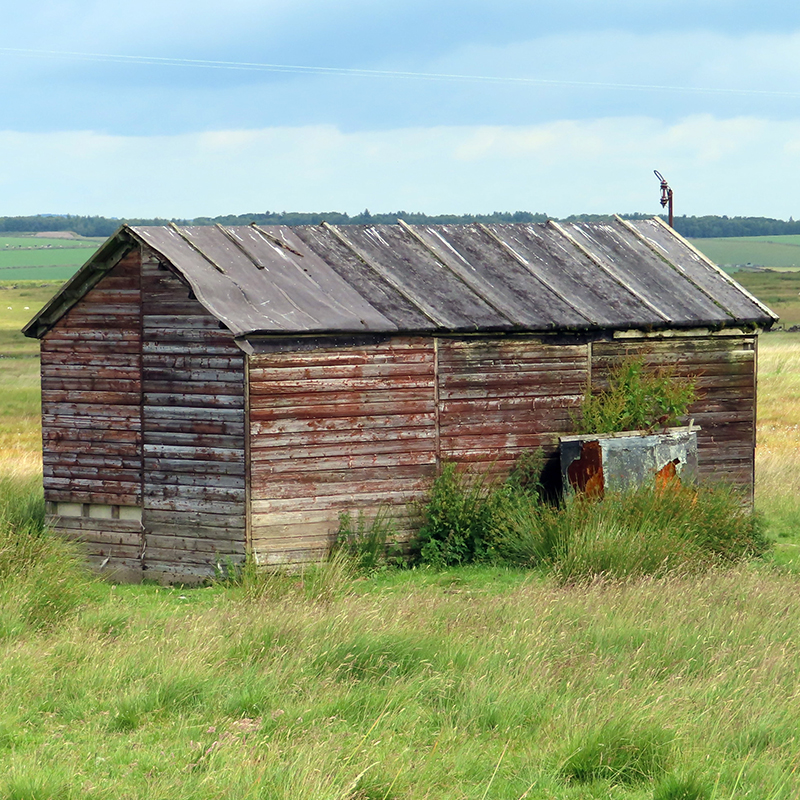
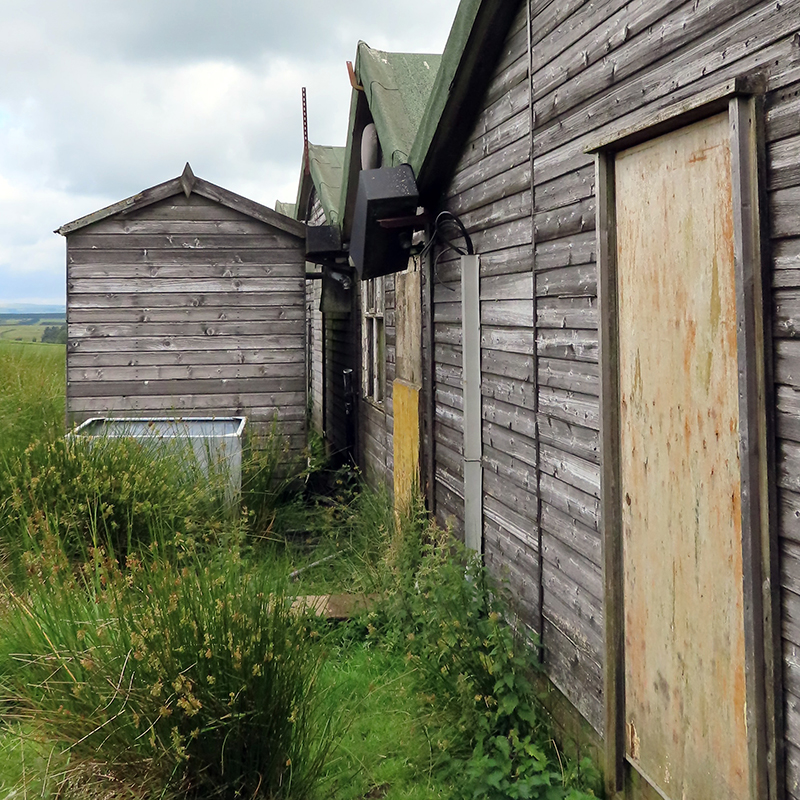
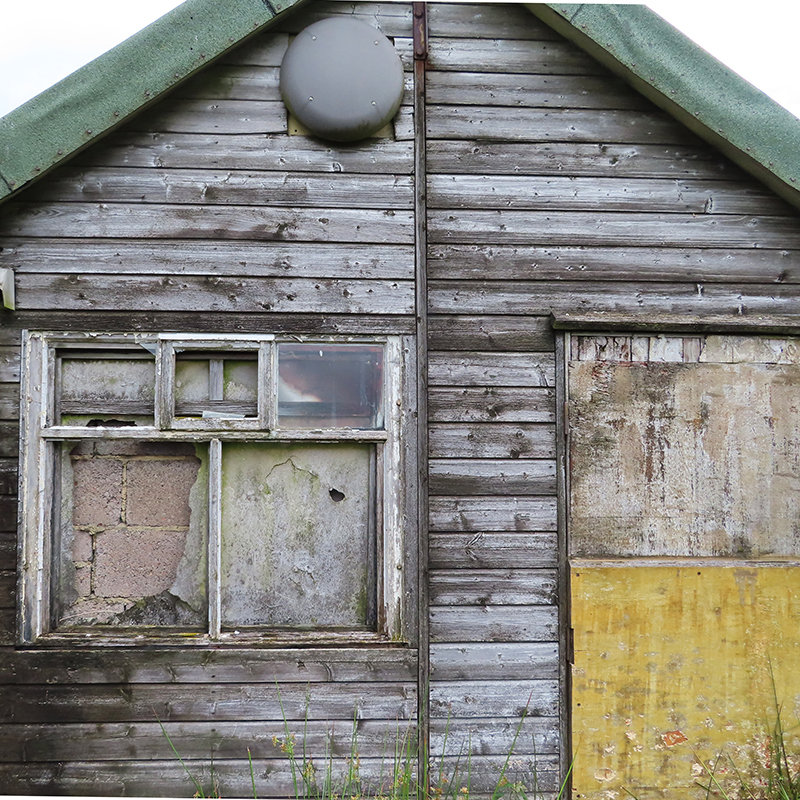
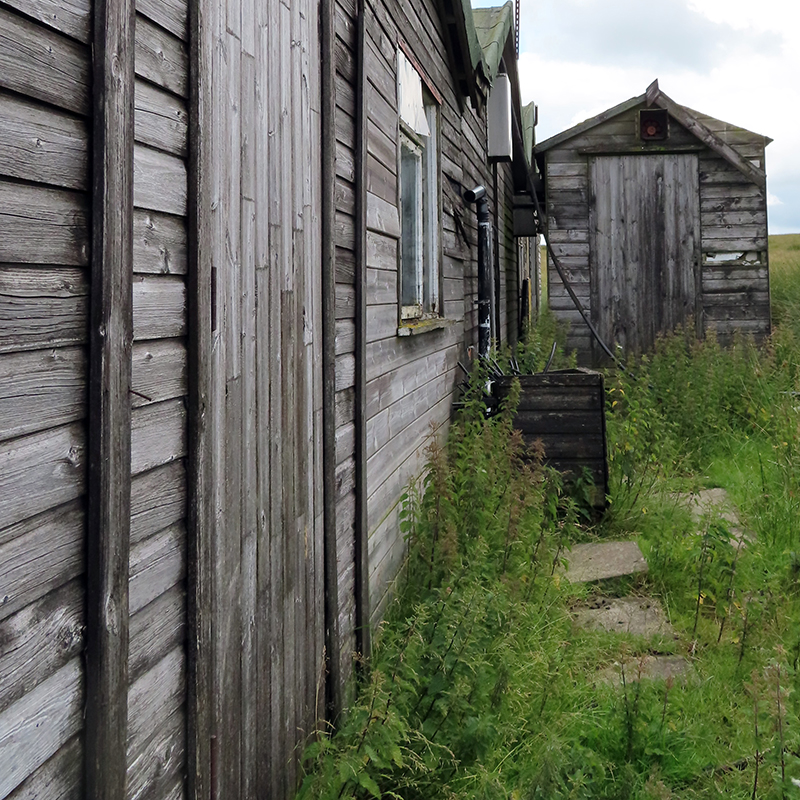
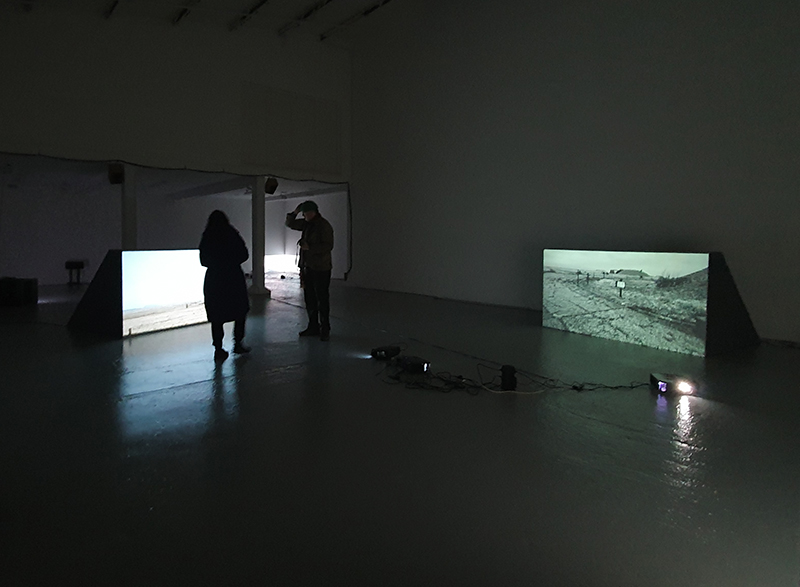
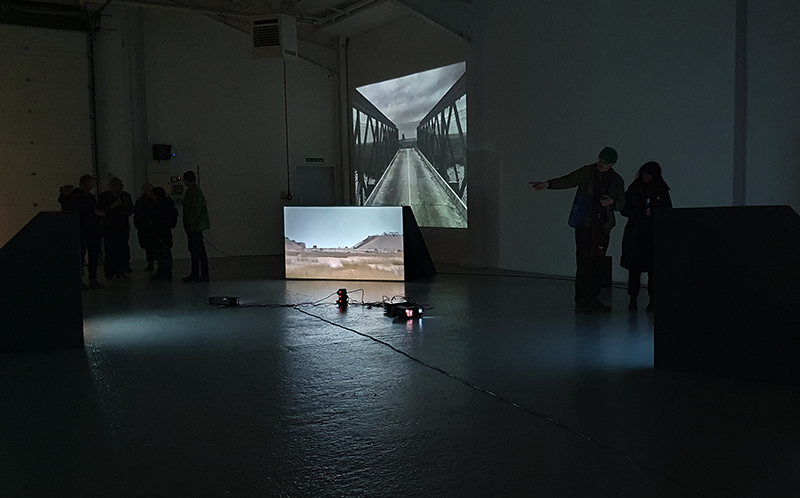
In search of huts. I have been on a mission to locate and document the remaining huts from a cosmic ray detection experiment at Haverah Park on the Pennine moorland in North Yorkshire.

When high-energy cosmic rays enter the atmosphere, they set off a chain-reaction particle cascade known as an extensive air shower. The Haverah Park experiment was home to one of the largest extensive cosmic ray air shower arrays in the world.

It was operated by the Physics Department of the University of Leeds for 20 years, closing in 1987. An array of over 200 water-Cherenkov detectors covering 12 km2 were active during its operation and many 1000’s of extensive air showers were recorded, including ones of such size that the cosmic rays that generated them had energies previously unthought of, adding to the mystery of where they come from.

The large energy density of cosmic rays is close to that of starlight, adding their own glow to the sky as they blast across the universe. Cosmic rays are the atomic nuclei of elements ranging from hydrogen to uranium accelerated to high energies, with half being protons and most positively charged.

Much of the technology used to observe cosmic rays has changed little over the decades since first inventions and still plays a role within newer technologies.

It appeals to me that the excitement of observing particles from other galaxies happened at these unassuming structures.

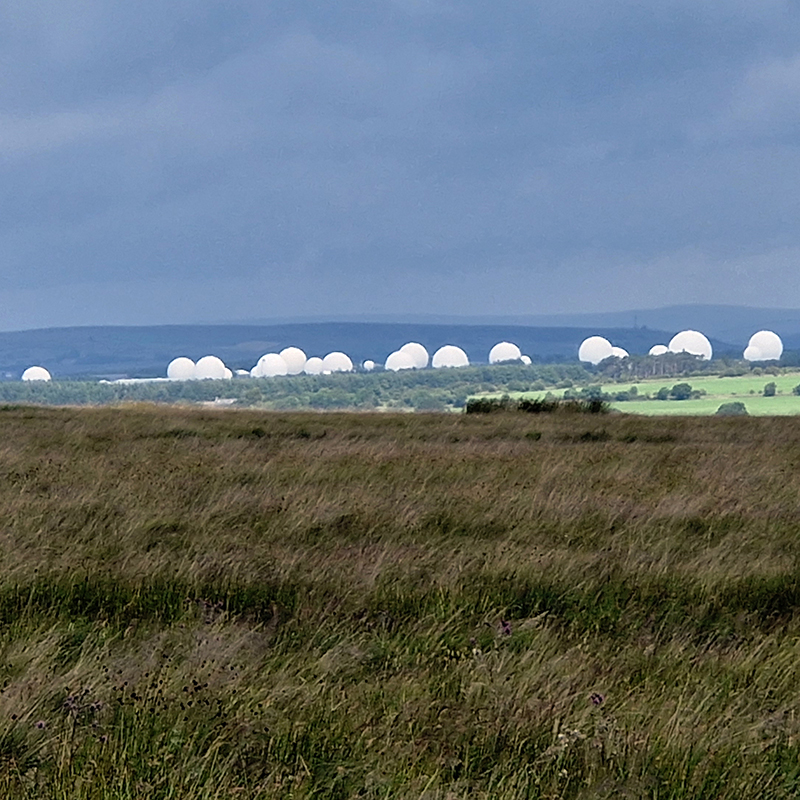
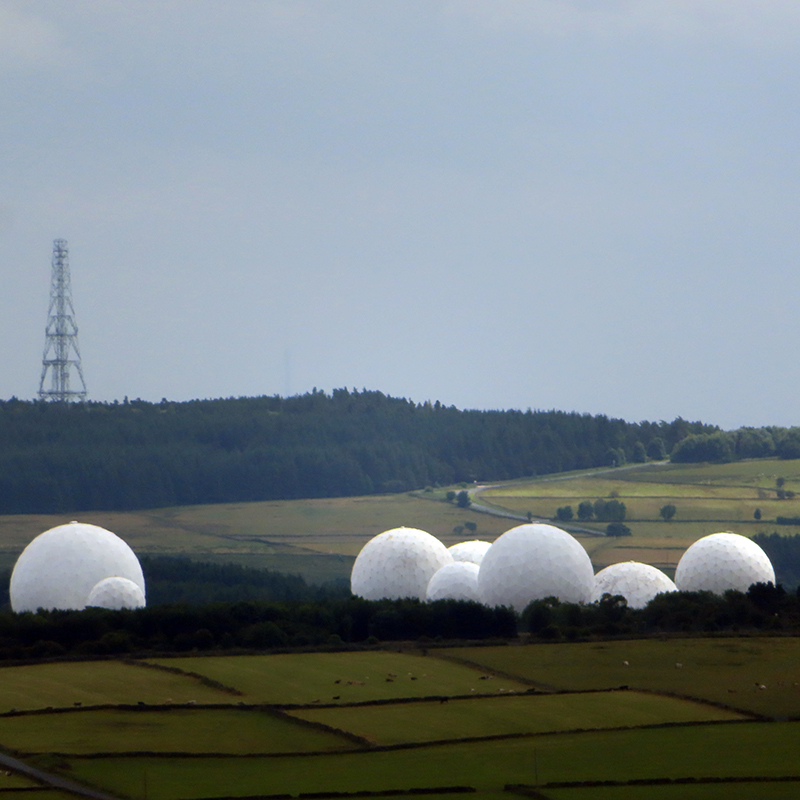
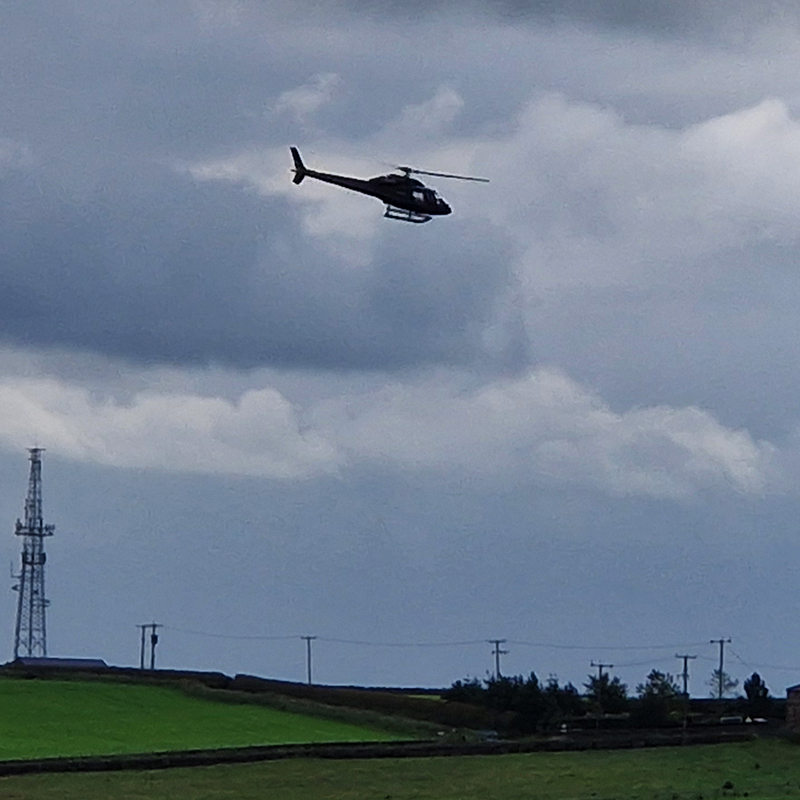
Sharing the landscape of Haverah Park cosmic ray air shower detector array huts are the striking white radomes that shield secret radar equipment at RAF Menwith Hill. The spy station has been there since the cold war space race began in the mid-fifties. Little is known about what goes on here but broadly it is said to gather electronic intelligence and is operated by US National Security Agency (NSA) and UK Government Communications Headquarters (GCHQ). As satellite technology has increased so has the number of radomes which now number 37 at the site. It is worth noting that satellites are vulnerable to unpredictable space weather and cosmic ray interference.

The total number of particles detected in a shower can be used to estimate the energy of the primary cosmic ray. Some particles contain the highest energy form of radiation known to exist anywhere in the universe and their origin is one of science’s greatest mysteries. Air showers of secondary particles generated from a primary cosmic ray hitting the Earth’s atmosphere are spread over many kilometres when they hit the ground so it is useful to have detectors spread over a large area. The difference in the time of arrival of recorded particles at multiple detectors can be used to estimate the arrival direction of the primary cosmic ray. However, this does not necessarily reveal the origin of the particle as magnetic fields within the galaxies bend their trajectories so that the memory of their original direction is obfuscated.

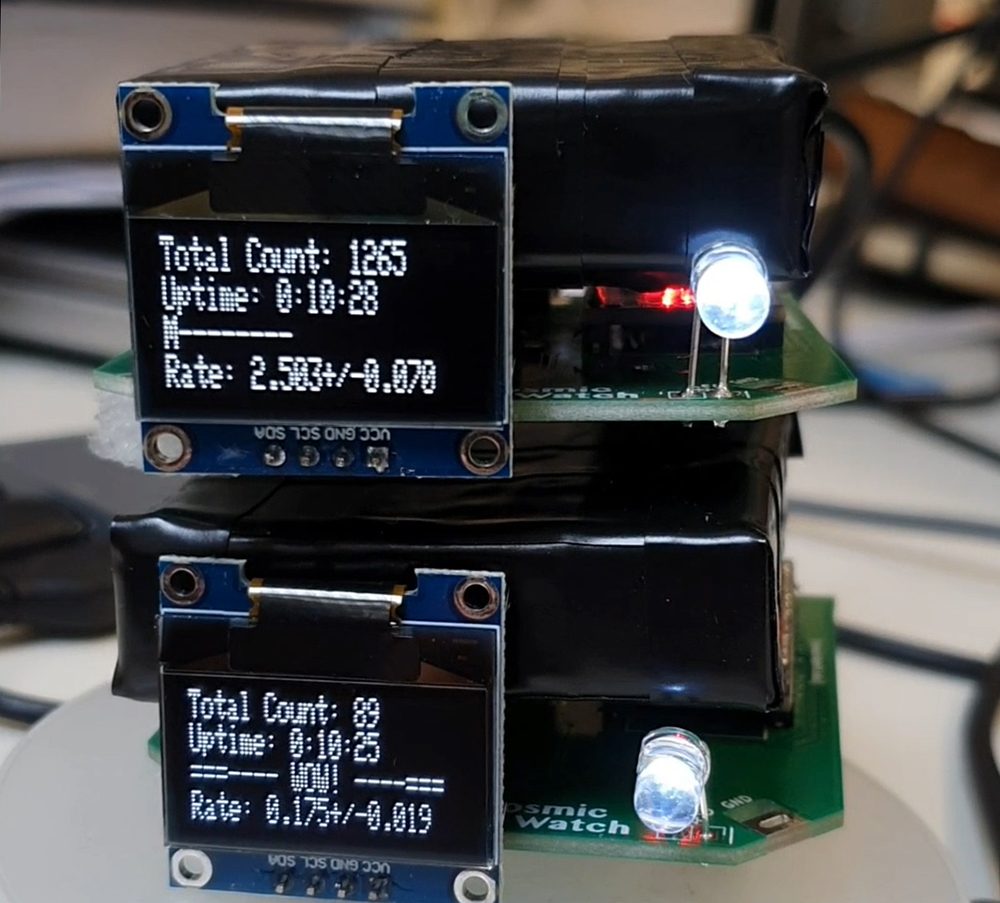
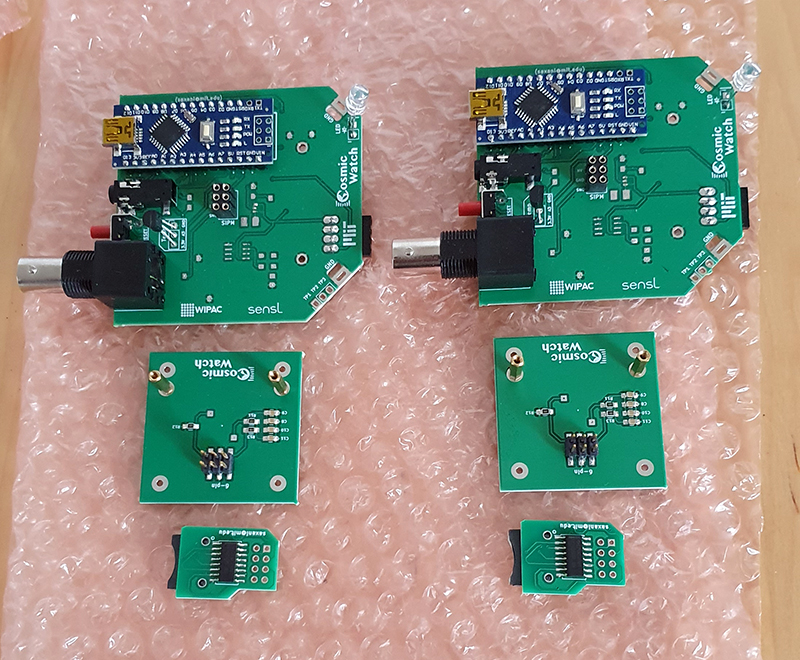
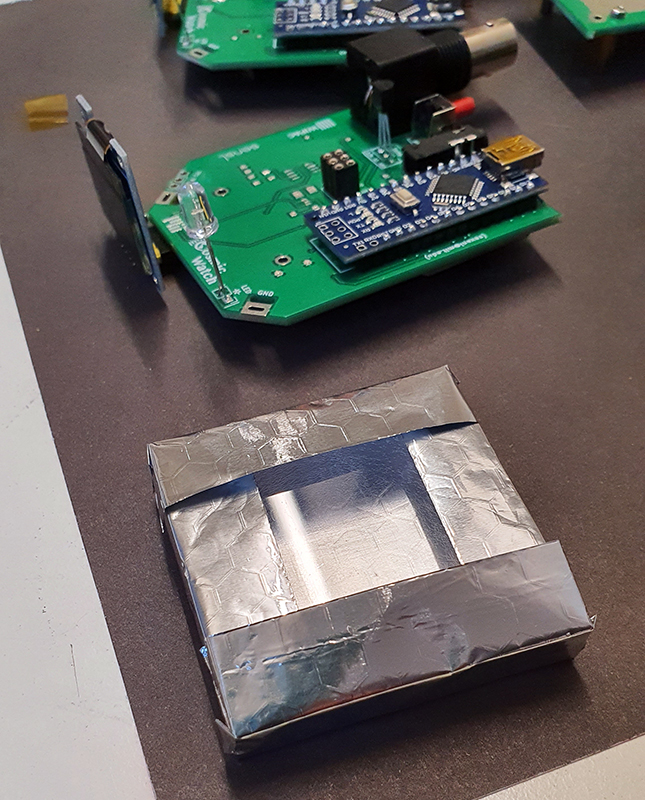
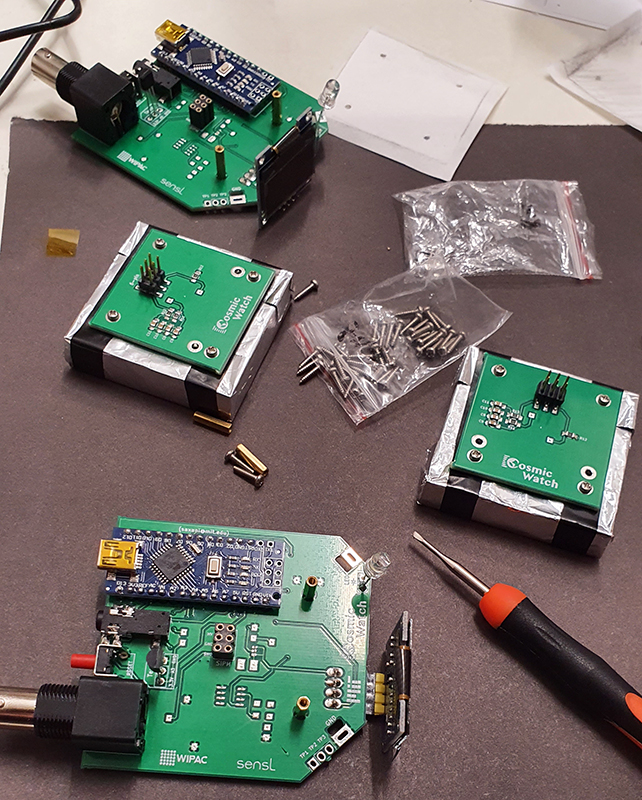
The cosmic ray detectors I made for the The Breath of Stars use a block of plastic scintillator which emits a short burst of UV light when a charged particle passes through it which is picked up by a single-photon-sensitive device. The detectors used at Haverah Park are water Cherenkov detectors. These are large steel tanks of purified water with photon sensitive detectors in the water.

While the speed of light in a vacuum is a universal constant its speed through a material may be significantly reduced as it is slowed by the medium. A particle passing through a material faster than that at which light can travel through the material loses electrons thereby emitting light. When cosmic rays pass through the water tanks, they emit Cherenkov radiation because they travel faster than the speed of light in water. Cherenkov light is similar to the production of a sonic boom when an airplane is traveling through the air faster than sound waves can move through the air. Pavel Cherenkov along with Ilya Frank and Igor Tamm discovered and demonstrated this phenomenon in 1934, astonishingly, it had been predicted in 1888 by Oliver Heaviside, and in 1910 Marie Curie had noticed a strange blue glow from her radium experiments.

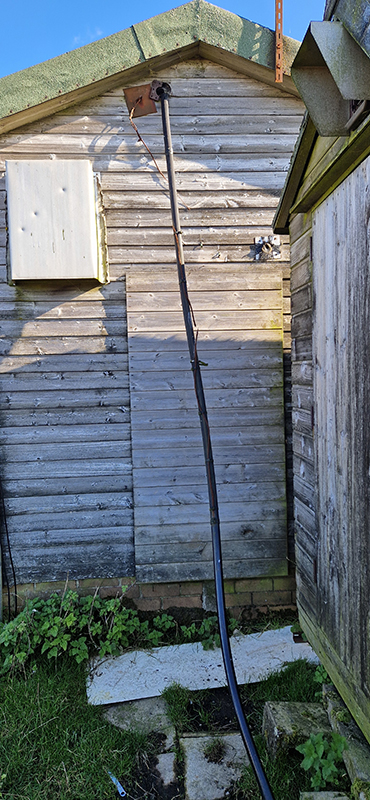
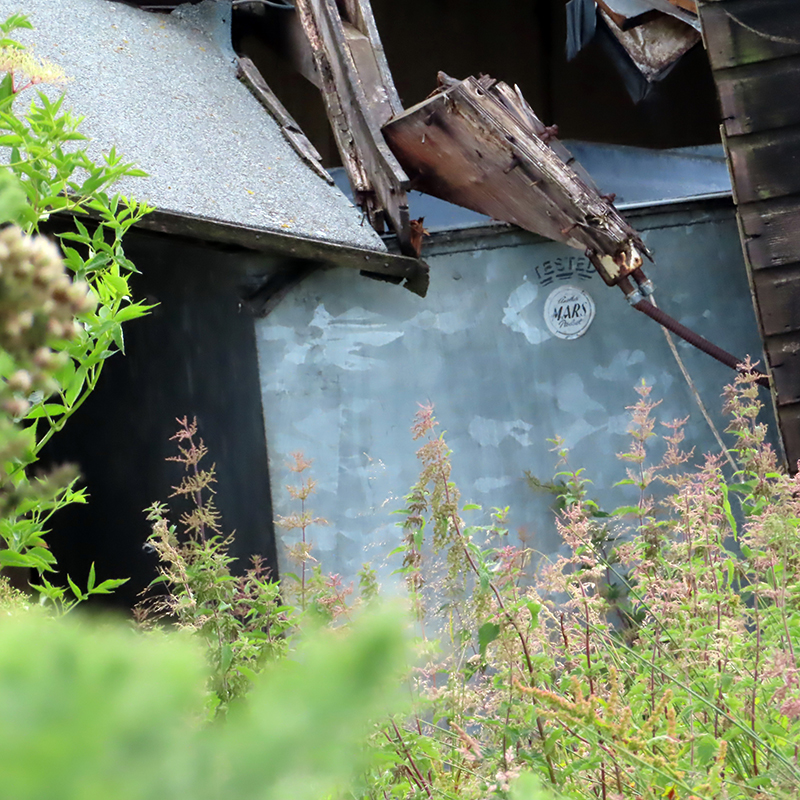
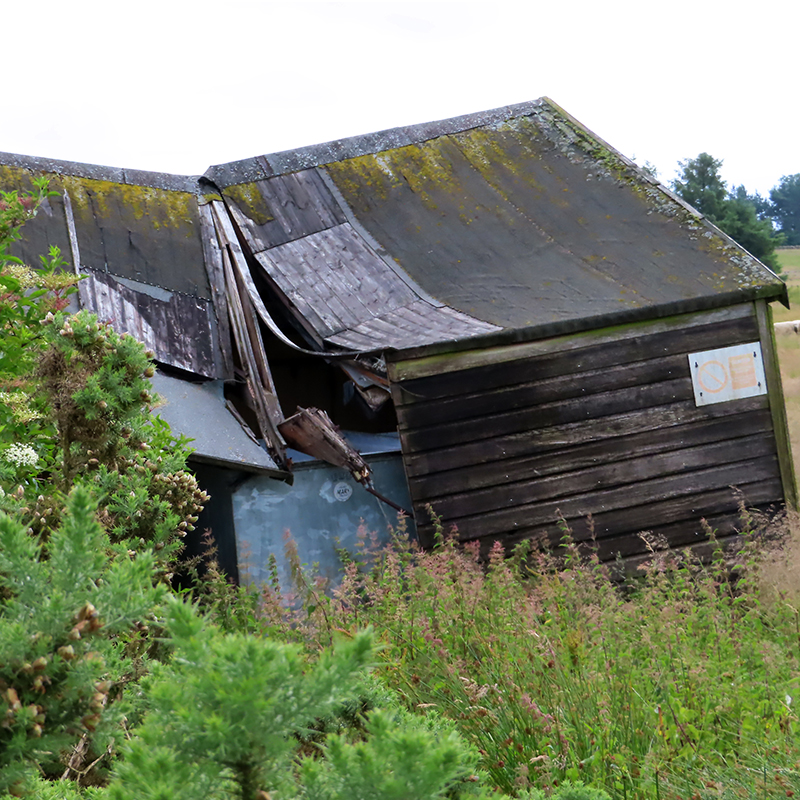
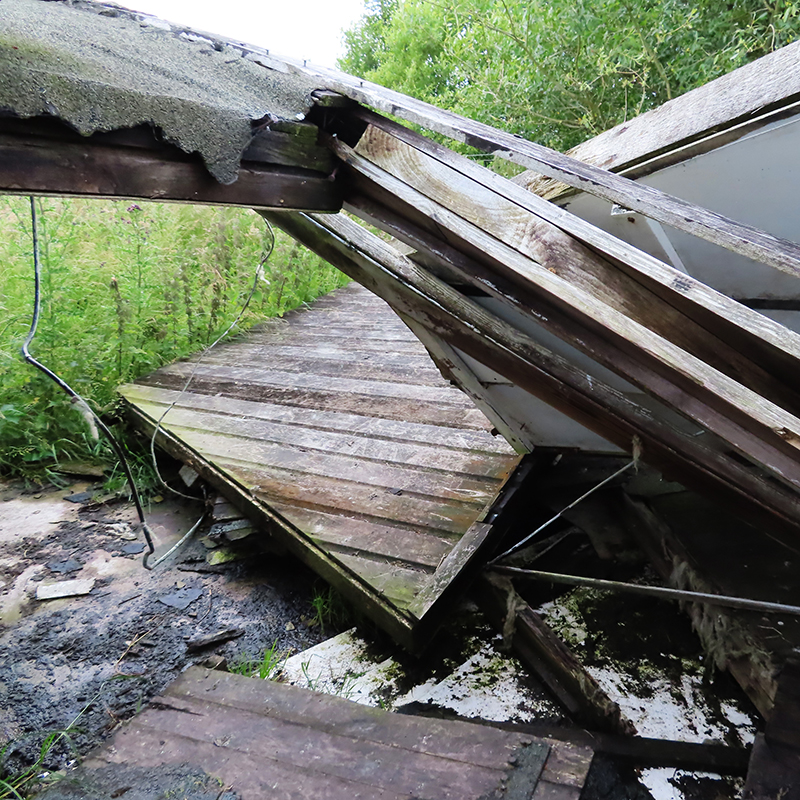
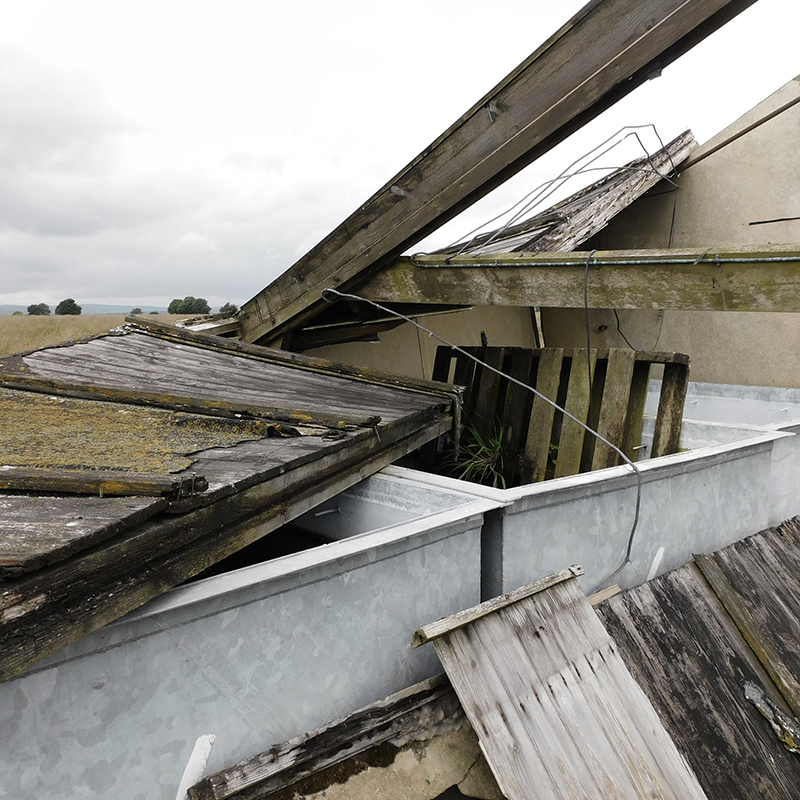
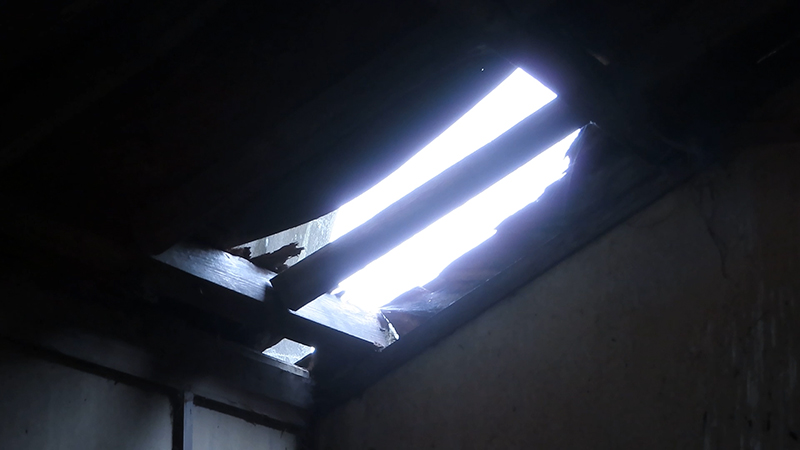
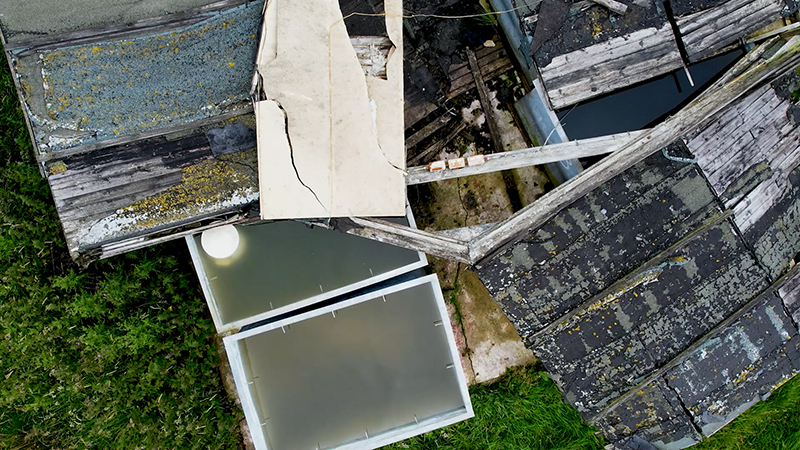
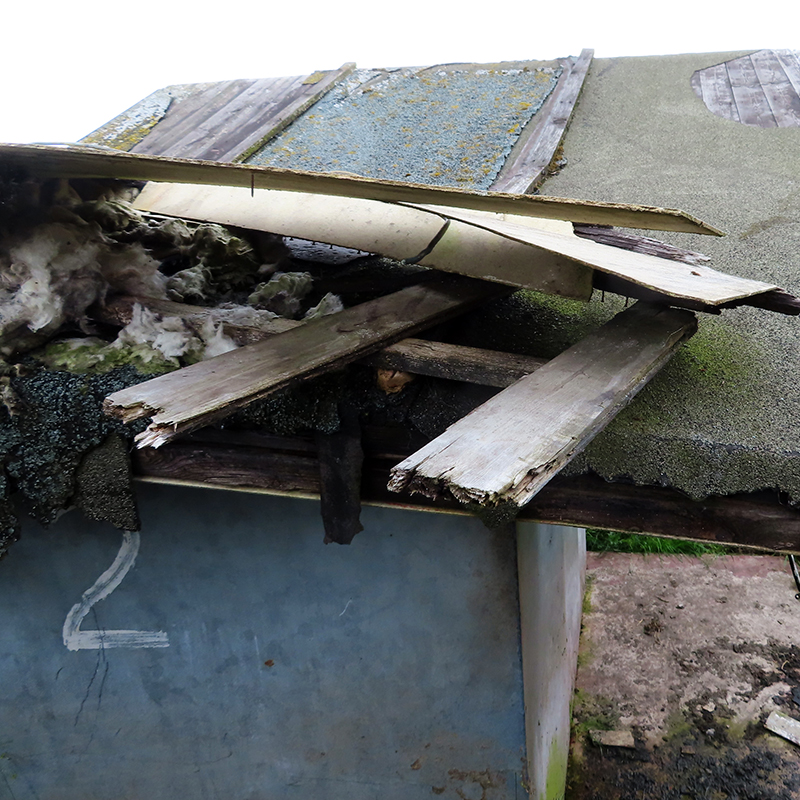
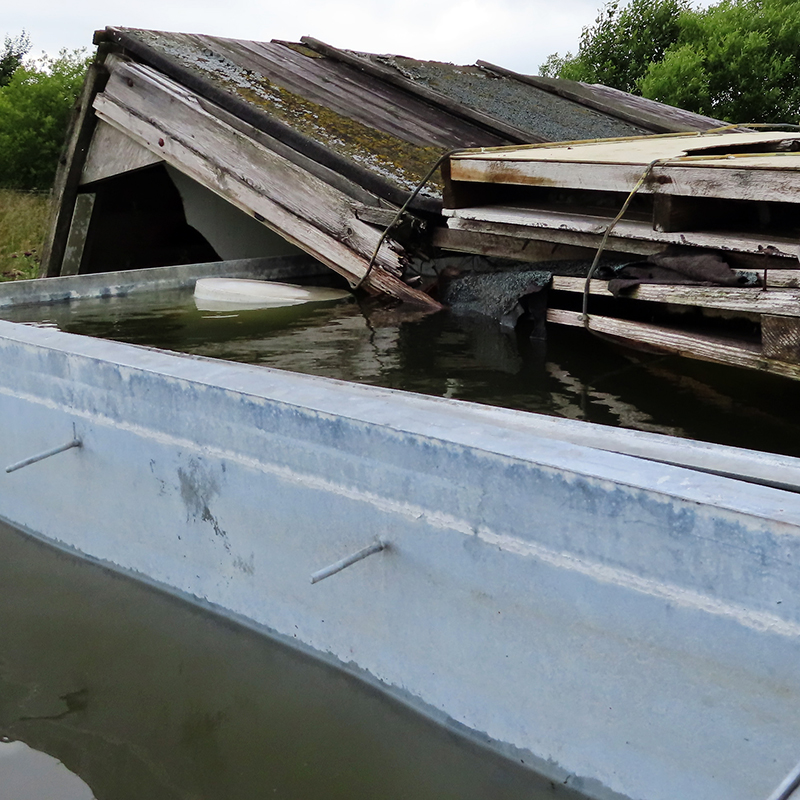
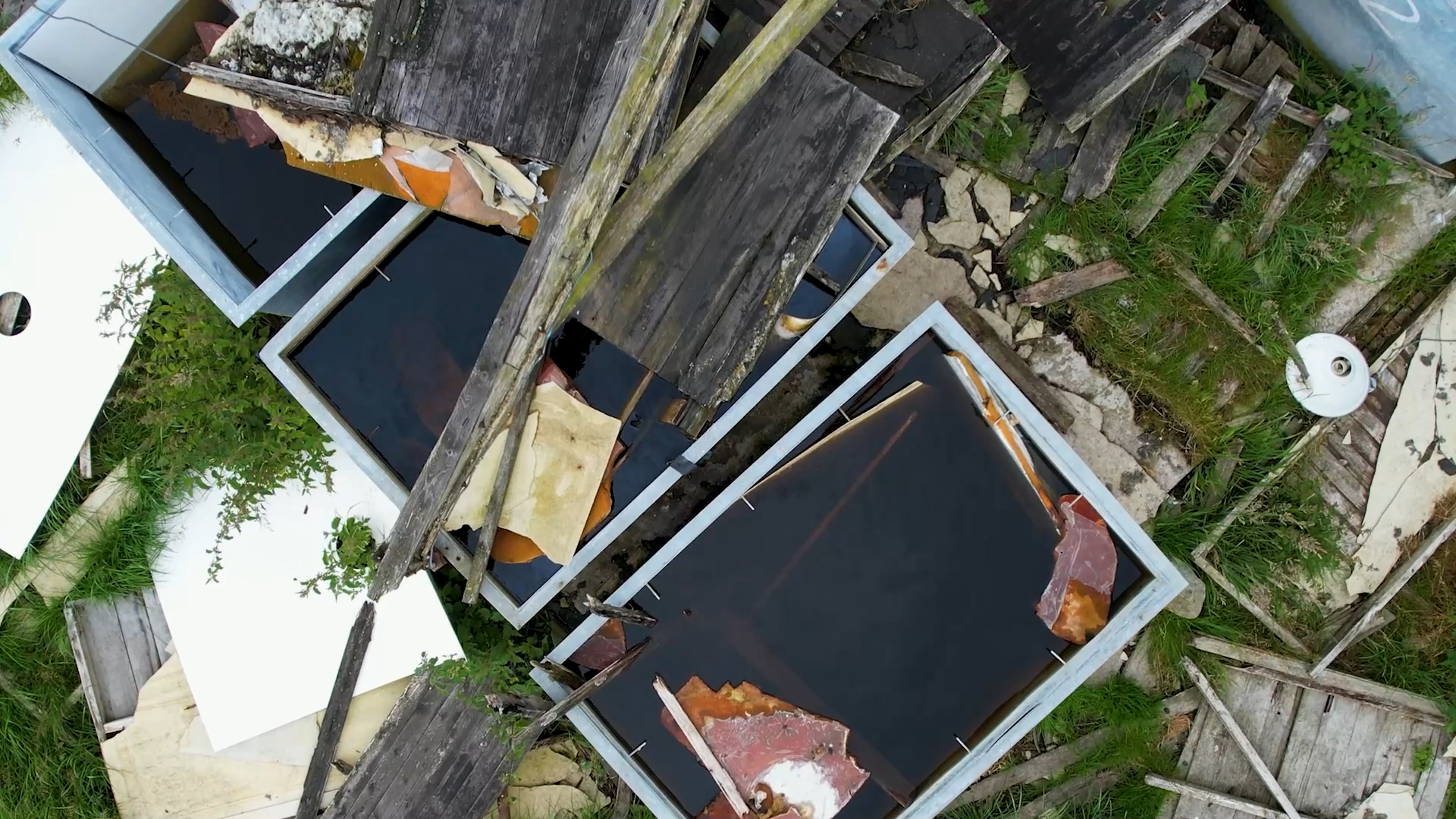
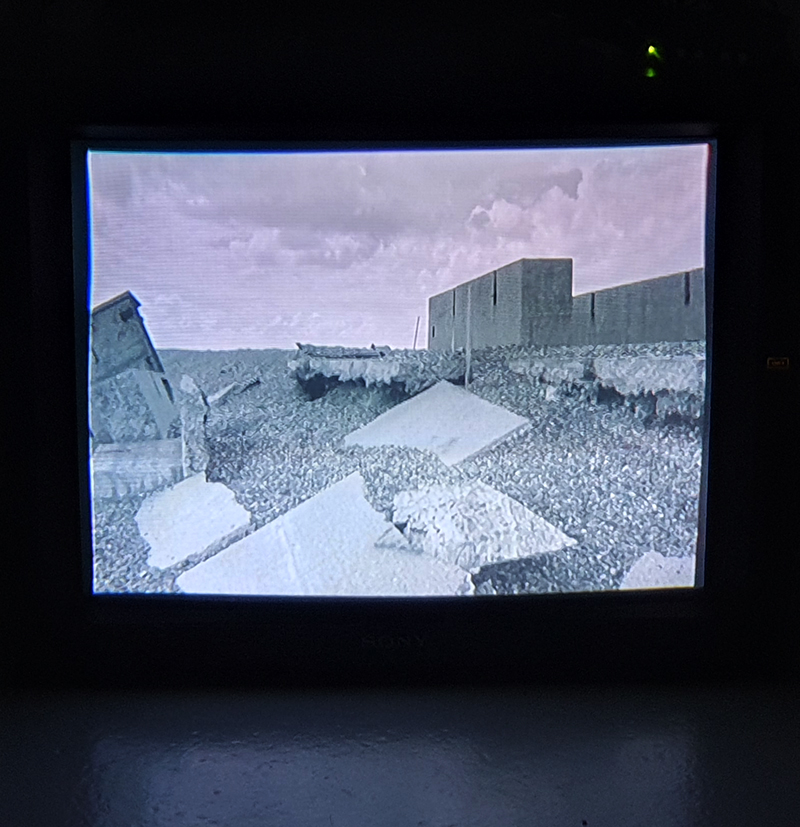
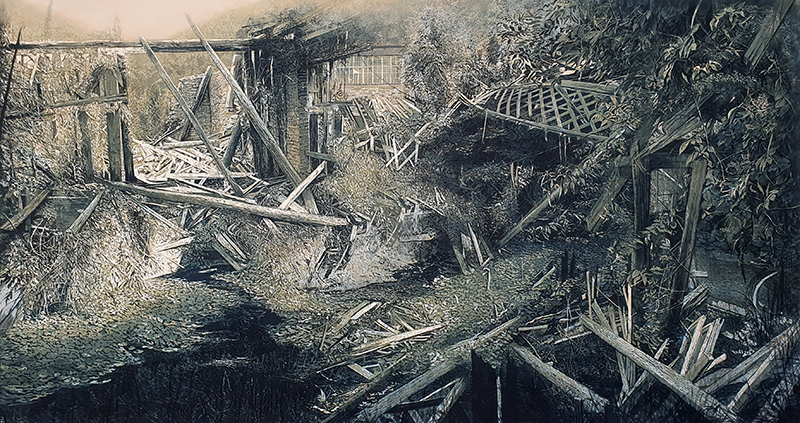
Other huts from the Haverah Park experiment are in a state of collapse.

There are so many high energy particles hurtling around the universe that they almost equal starlight in energy density. Cosmic rays travel at almost the speed of light and because they are charged particles most cosmic rays are confined, spiralling within our galaxy for a million years or more, by the magnetic fields which permeate it.

Five million cosmic rays pass through your body each day. Some will collide with atomic nuclei. A particle passing through a material at a velocity greater than that at which light can travel through the material emits light. Maybe we glow a little.

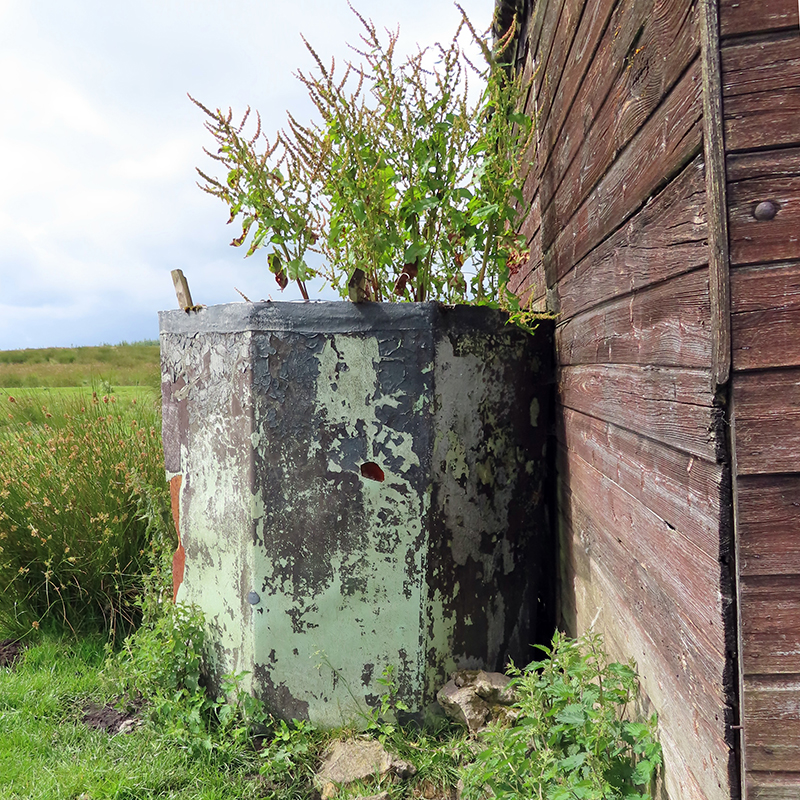
Following the disappearing trail. Haverah Park hut with an intriguing hexagon tank.

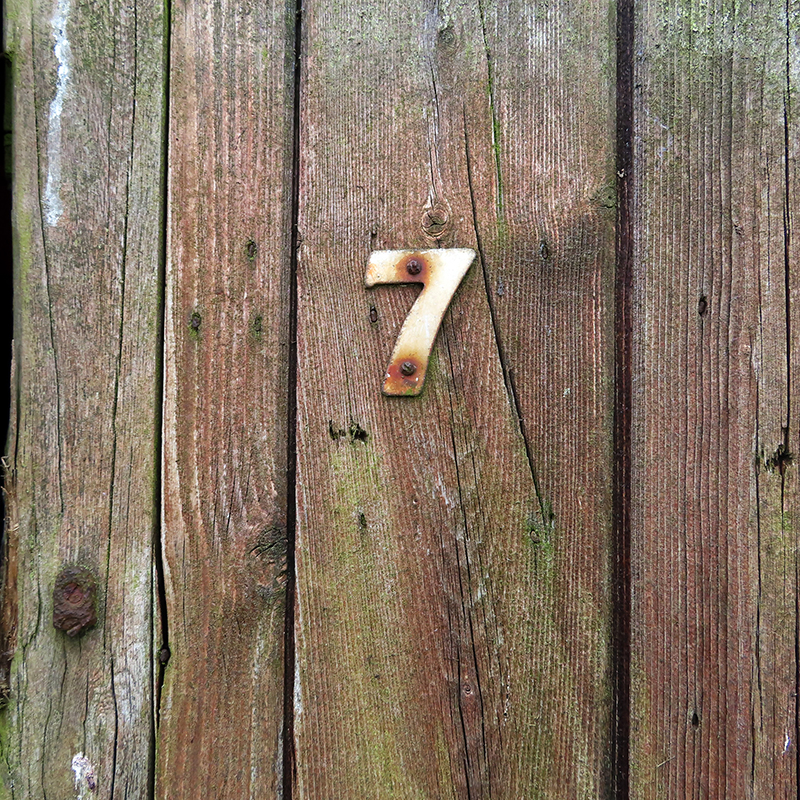
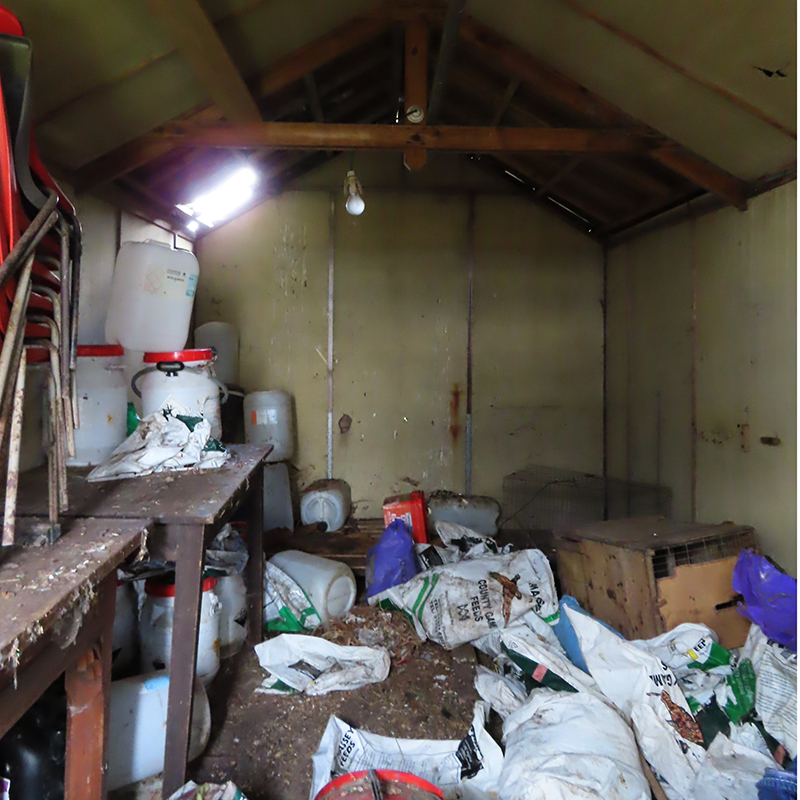
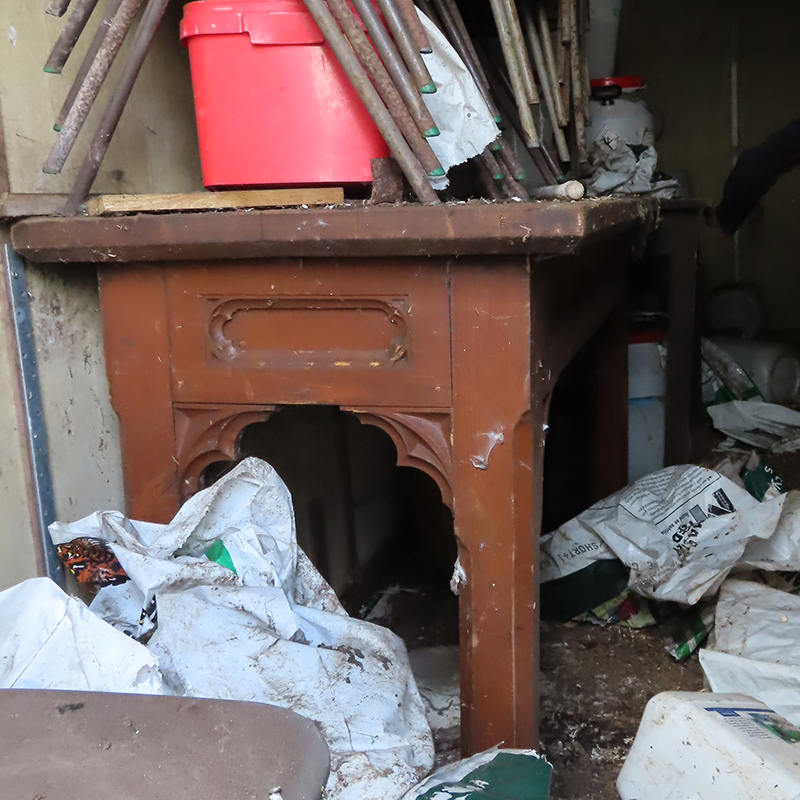
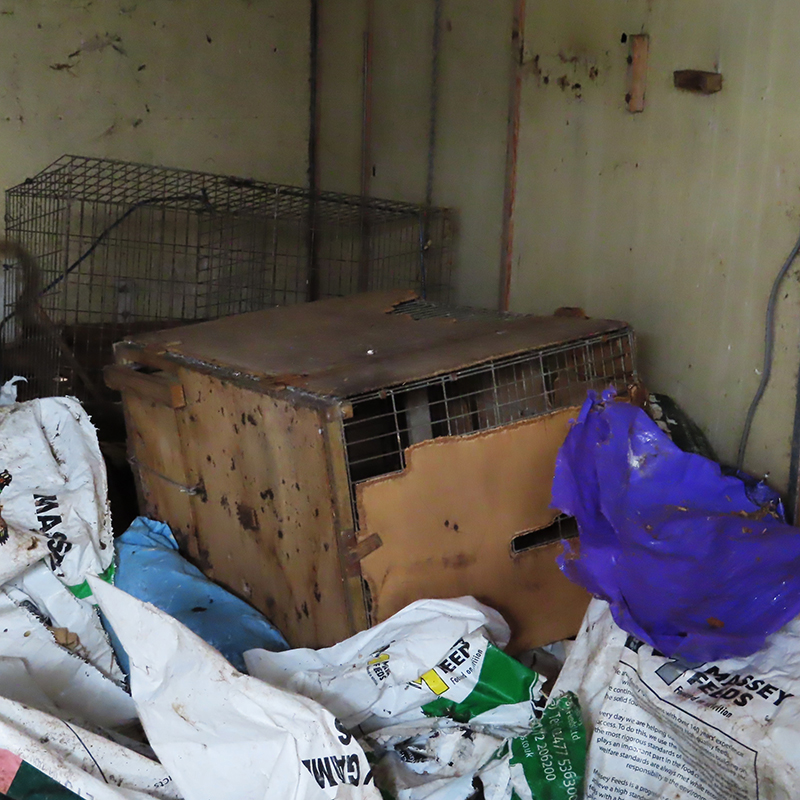
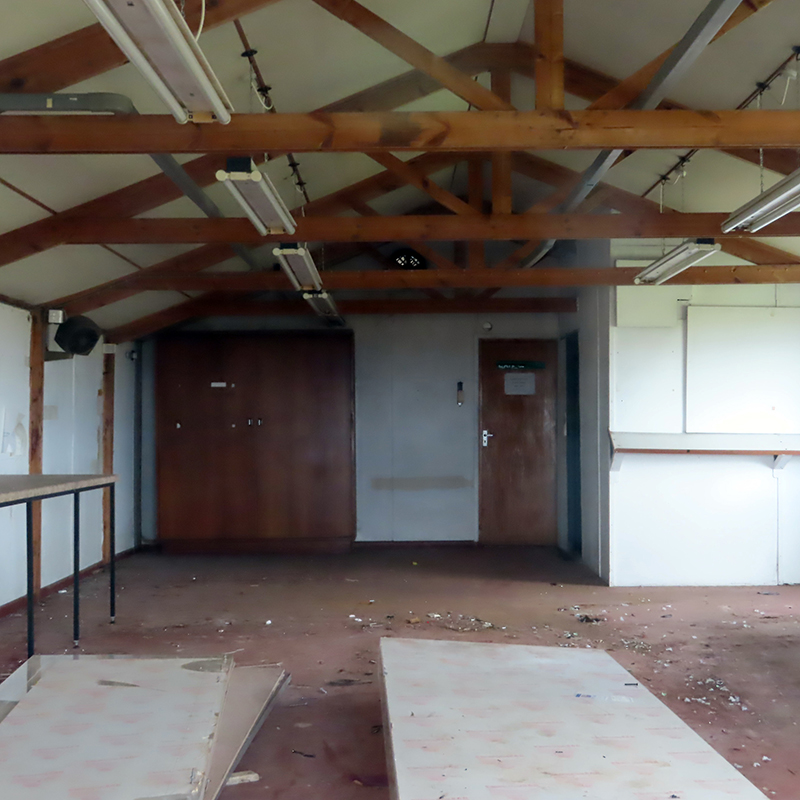
Inside Hut no. 7 is a dumping ground. Waste is a big problem in space as well as on Earth. The thickening shell of space junk in low Earth orbit, if left to accumulate, could cause a conductive shield to form, weakening the effectiveness of the magnetosphere, which protects life on earth from most cosmic radiation.

A decaying wall map of the entire Haverah Park experiment is just visible through a window of one of the huts in the central hub, but not much else remains inside.

It looks like these huts have been recently emptied into a skip which, by chance, was collected while I was there. Unfortunately, the driver had no enlightening information for me about the future of the huts.

Cherenkov radiation is a form of energy that gives off a blue glow when electrically charged particles are moving at speeds faster than light is able to travel through the same medium. The experimental physicist Blackett, who received the 1948 Nobel Prize in Physics for his investigations into cosmic rays, believed that extensive air showers should produce flashes of light that could be perceived by the human eye when lying down and looking upwards under dark skies. Whether he achieved seeing this phenomena himself is not known, but he inspired colleagues Galbraith and Jelley, in 1952, to devise an experiment to detect light from air showers using a rubbish bin painted black on the inside, a recycled searchlight mirror and a small phototube. With these simple items, they made the first observation of Cherenkov light produced by cosmic rays passing through the atmosphere. Not all the twinkling in the night sky is starlight.

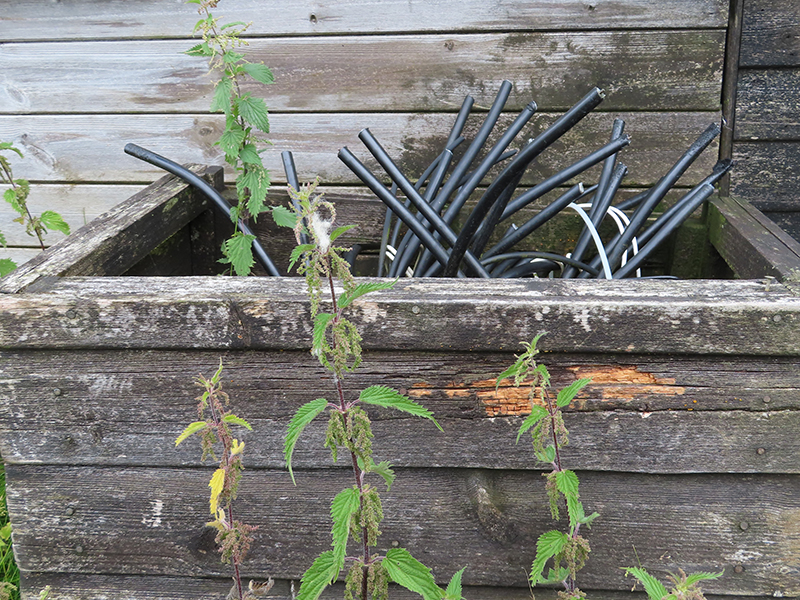
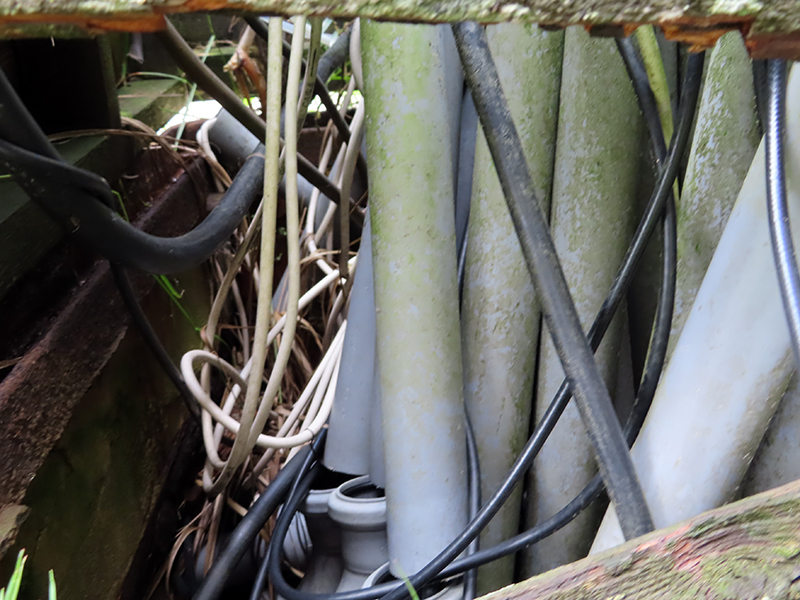
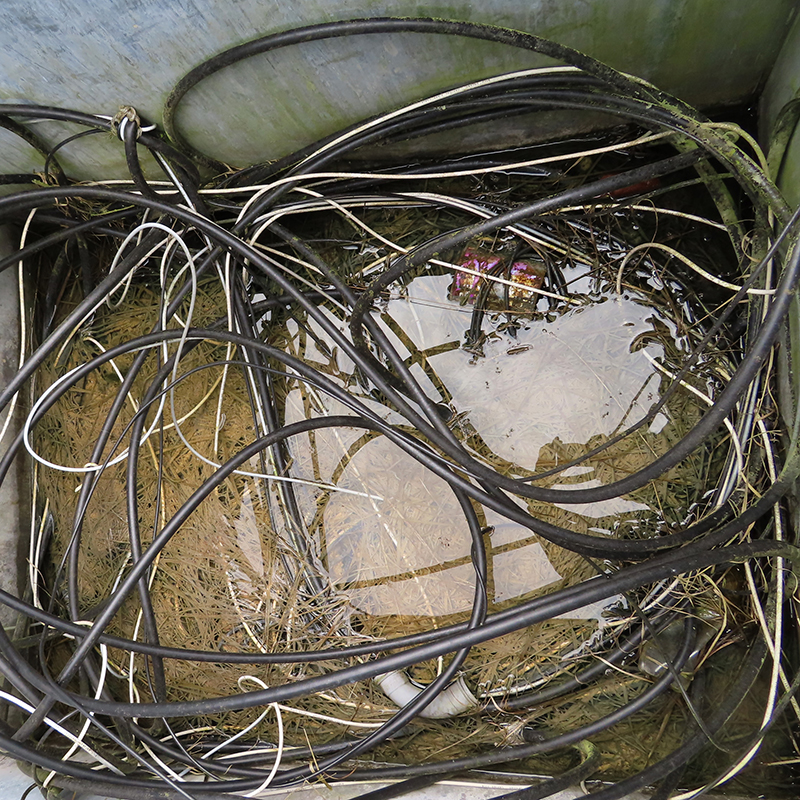
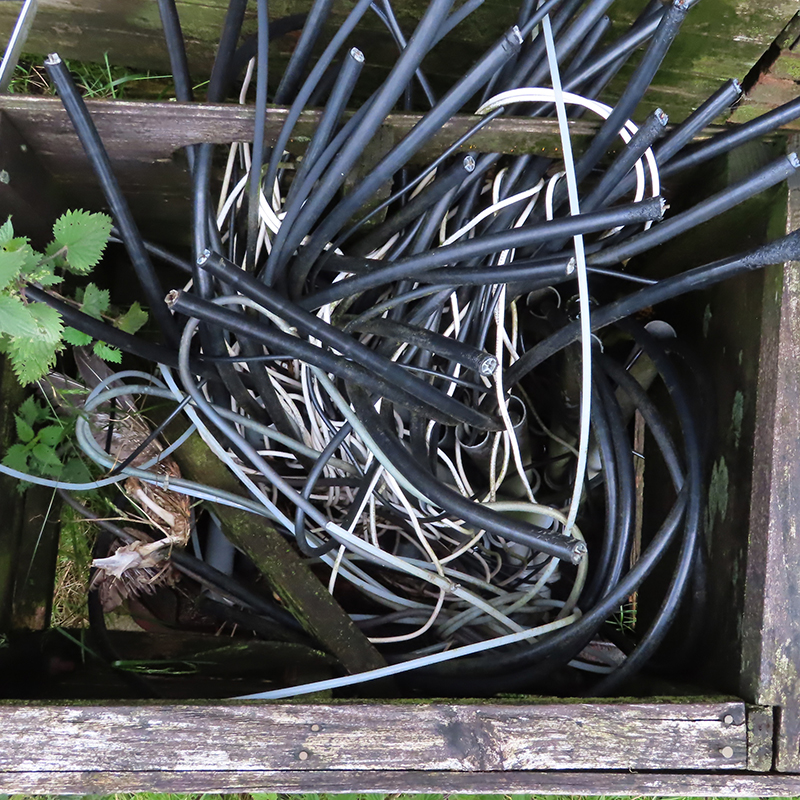
During the Haverah Park experiment, the water Cherenkov detectors deployed across the moors were connected by underground cables and transmitted information to the control huts via radio signals in the microwave frequency range. All communication is now severed. Cut cables coil in rain filled tanks. The cosmic rays are still pounding down upon these new unwatched ecosystems but the detectors have moved elsewhere.

I am looking forward to meeting Professor Alan Watson FRS here in the autumn. He is eminent in the field of cosmic rays and helped initiate the extensive air shower project, working at Haverah Park for 25 years. He has kindly agreed to meet and share his insider knowledge of the history and operations at the site.

The idea to build a truly giant shower array was launched by Alan Watson and Jim Cronin shortly after Haverah Park was decommissioned and thanks to the ground breaking work undertaken in these huts, it evolved to become the vast Pierre Auger Observatory in Argentina, named in honour of the man who first discovered extensive air showers.

Peering into the darkness, trying to fathom the structures of the universe or what’s inside the hut, and the nature of that relationship.

The ultra high energy particles detected at Havarah Park and new arrays across the globe are very rare, possibly less than one per square kilometre per century, so it is big news when one arrives. Because they have such high energy, it is thought they shouldn’t be affected by galactic magnetic fields, and therefore, the direction of the particle could be determined and the source located. The Amaterasu particle, named after the sun goddess in Japanese mythology, the second most powerful particle to be recorded, appears to have emerged from the Local Void, ana area with no astronomical objects that might produce such a particle. There is no explanation of where these particles come from, just hints of bigger mysteries to unfold.

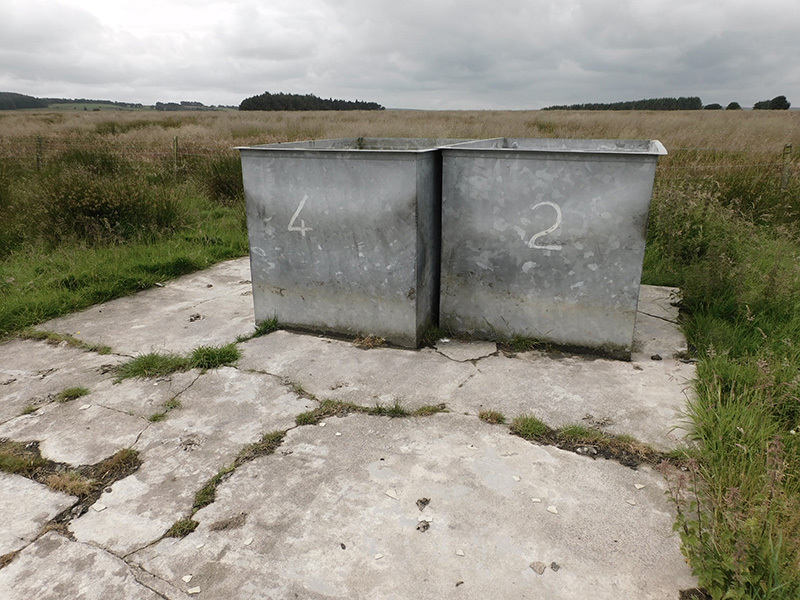
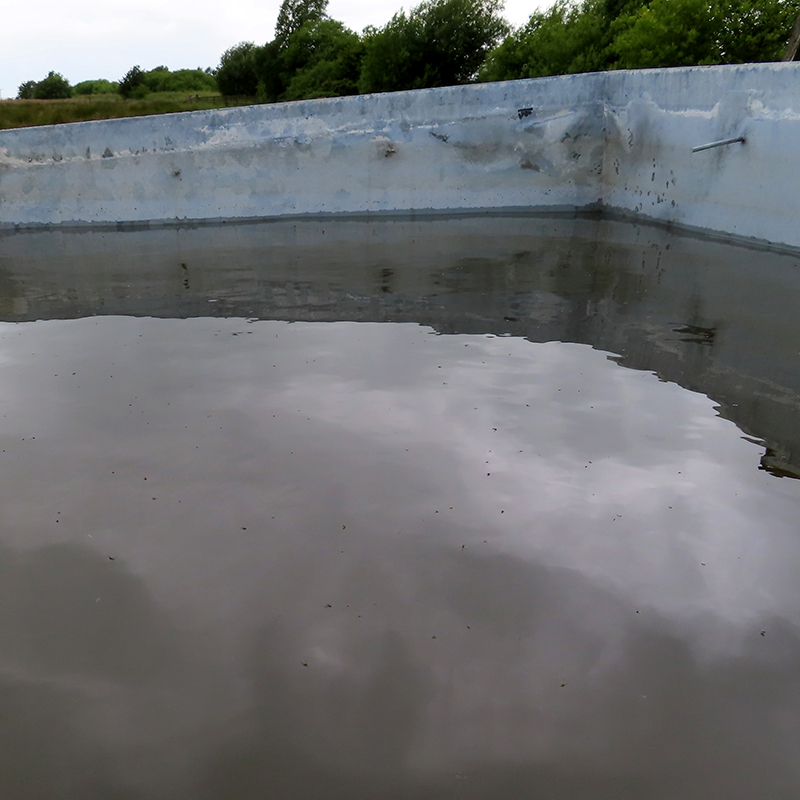
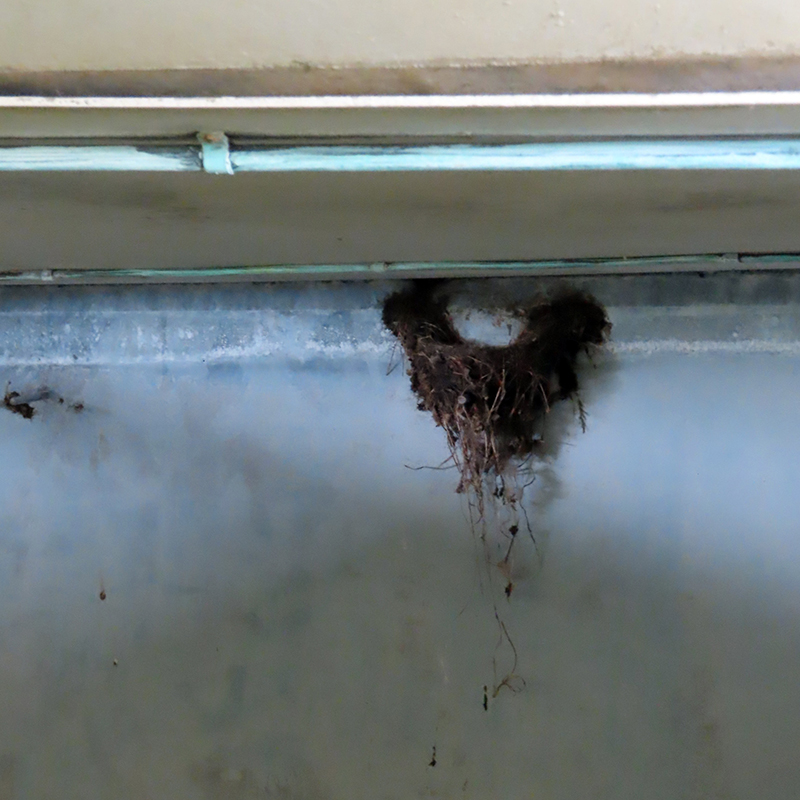
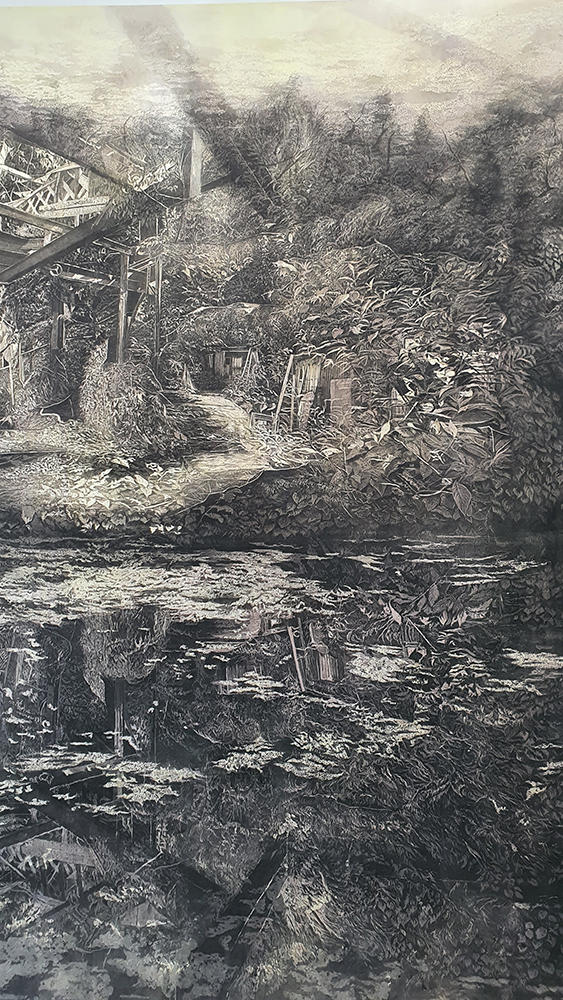
Many water tanks remain around Haverah Park, stripped of their purpose as water Cherenkov detectors they now reflect the sky in the rainfall they collect rather than record showers of particles from space.

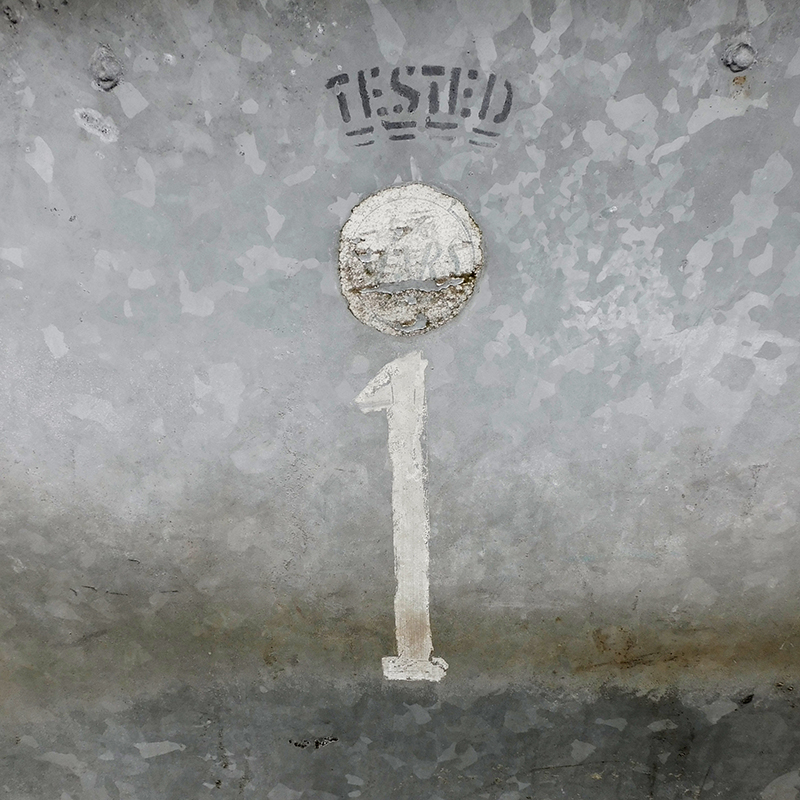
During operation, huts were built in groups of three, each with six large galvanised steel tanks lined with white plastic to diffuse the light and filled with local purified water. Each tank was monitored by extremely sensitive photon detectors which recorded the Cherenkov light emitted as particles passed through the water. At the end of the large array experiment, one of the detectors was opened, and the water was found to be crystal clear and good enough to drink. The proof that water could be kept bacteria-free in a sealed container for over 25 years gave confidence in using the same technology for a future larger cosmic ray detector array to be developed.

Haverah Park was once one of the largest extensive air shower arrays in the world, with an area of 12 km2, but in the end, it just wasn’t big enough.

When Alan Watson and Jim Cronin proposed building a new 3000 km2 shower array, the question from funders was, ‘why do you want to make the array so large?’. The answer is, of course, to discover those known and unknown unknowns, but funders don’t usually like unpredictable outcomes. Luckily their plea was bolstered by the Fly’s Eye Cosmic Ray Detector Array out in the Utah Desert recording the Oh-My-God particle in 1991, it’s energy was 40 million times greater than that of any particles ever produced in any terrestrial particle accelerator. This and other evidence of extremely high energy particles sparked interest in the field of astrophysics and validated the discovery of similar particles at Haverah Park, which had not been taken seriously at the time. This ambitious proposal gained momentum during the 1990s to become the Pierre Auger Observatory in Argentina, with the detector design developed from the water Cherenkov tanks so successfully operated at Haverah Park. The huts here may be in ruins, but their legacy lives on at the world’s largest extensive air shower detector array, which is edging closer to answer the question ‘Where do ultra-high-energy cosmic rays come from?’

I am looking forward to developing work responding to the legacy of the Haverah Park experiment and building on my experience of creating The Absolute Hut (of absolute potential) New surfaces to explore, more moss, and also lichens here.

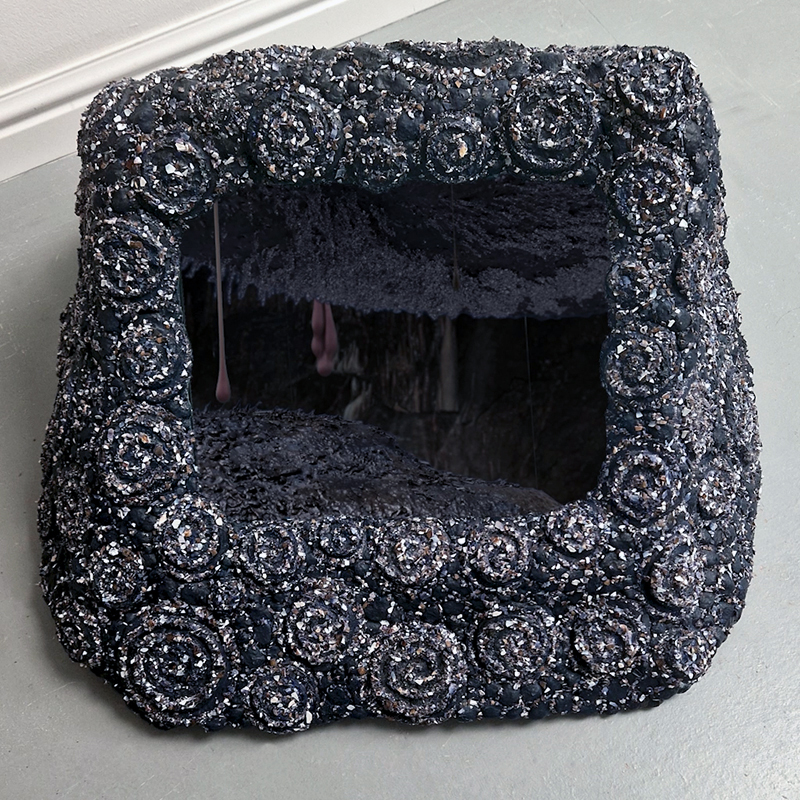
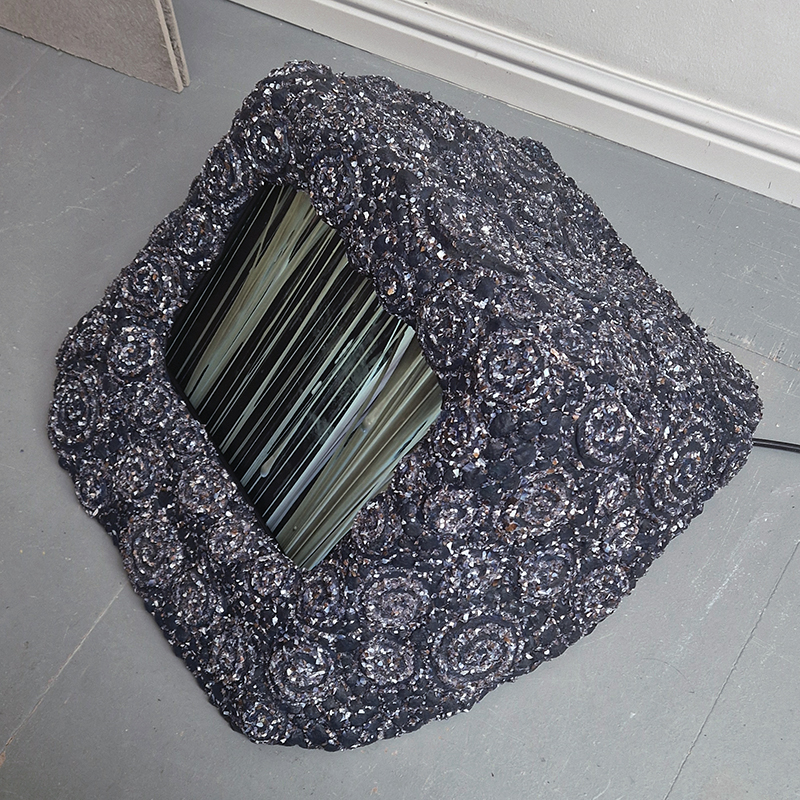
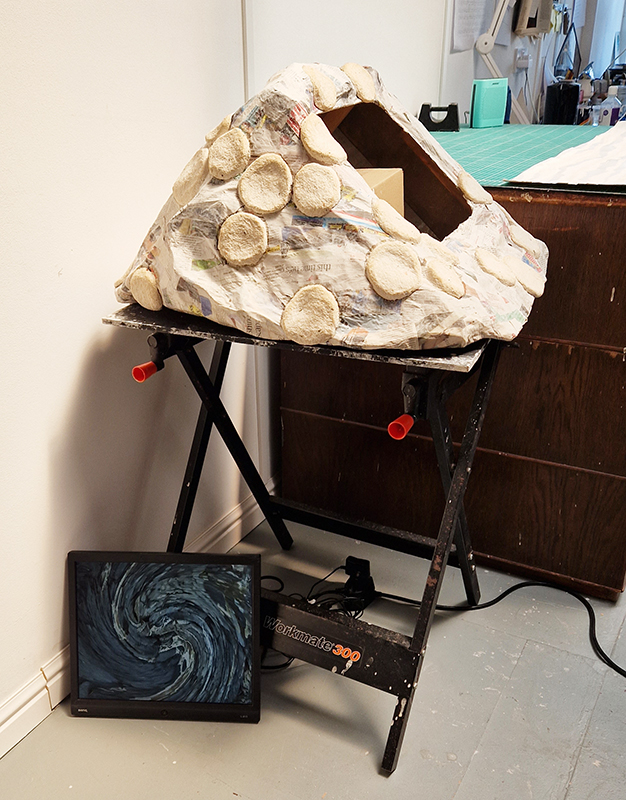
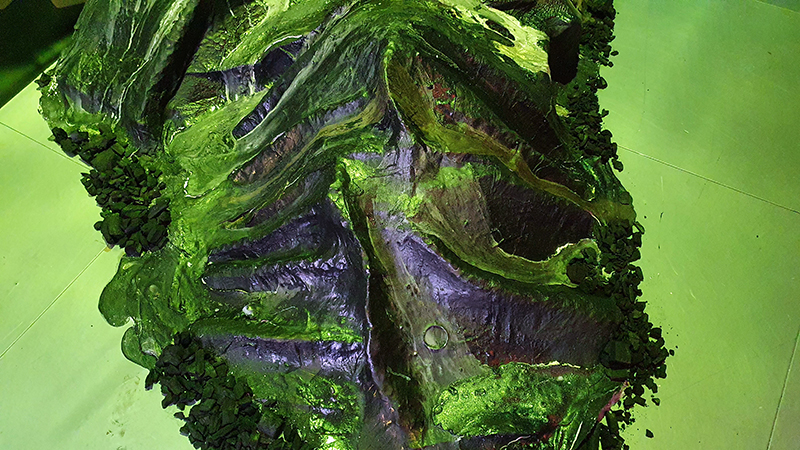
‘The Belly of a Rock’ video has waited a long time for its crusted shell. A hybrid between rock, mollusc, and technology inspired by the chemical conversations and urge to create described by Italo Calvino in his story ‘The Spiral’. We don’t always know what we are creating. Within ‘the belly’ surfaces slide and scrape along lines of fissure, distended innards ooze and rocks moan as they are distorted by untold pressure. The turbulent spiralling of the core births rock and lifeforms acted upon by the drag of the oscillating magnetic field.  

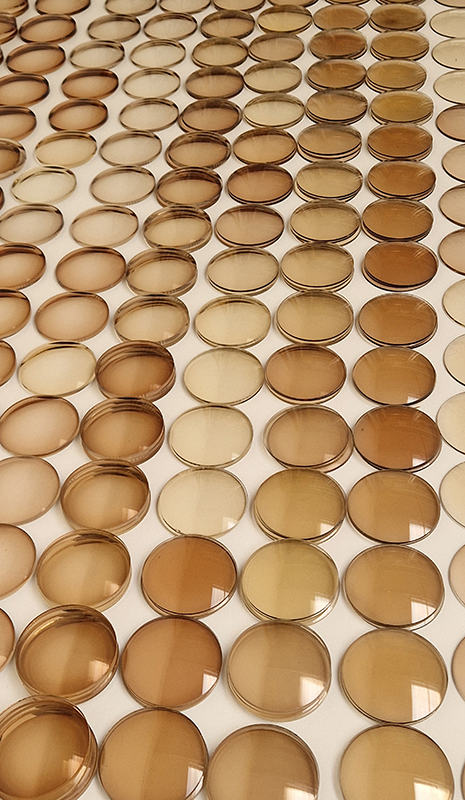
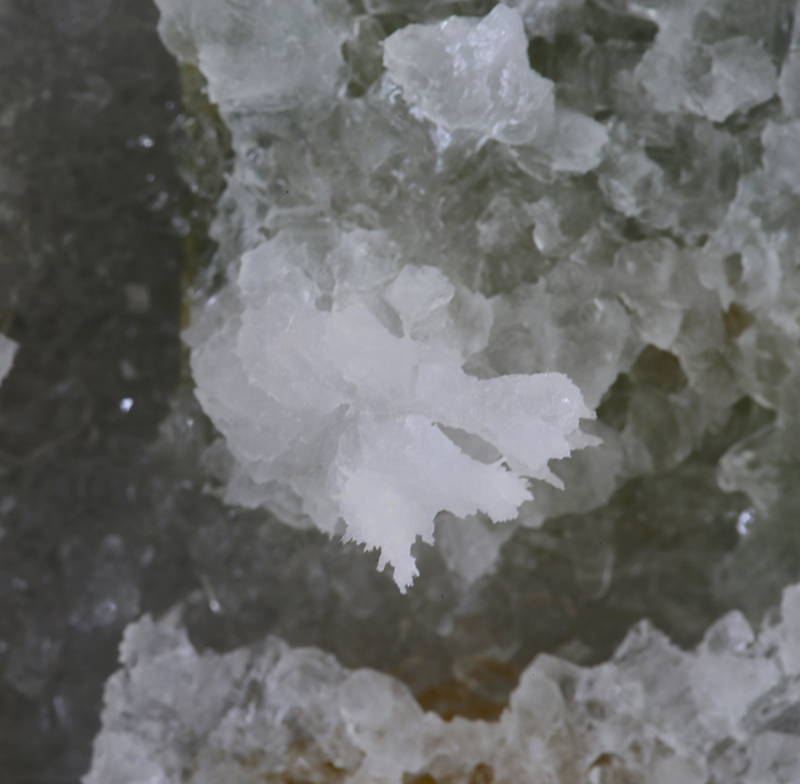
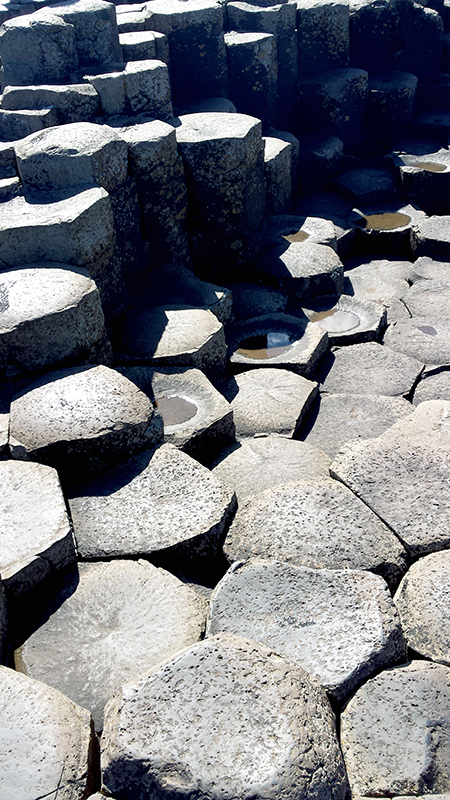
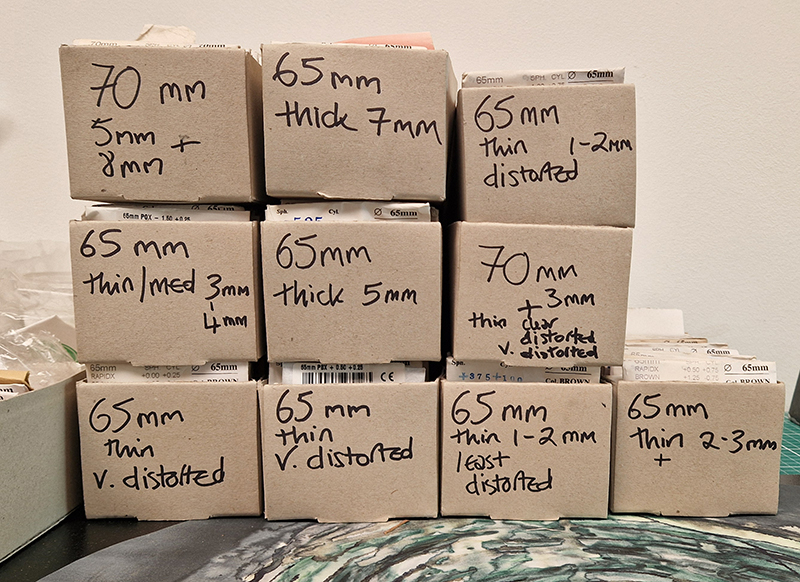
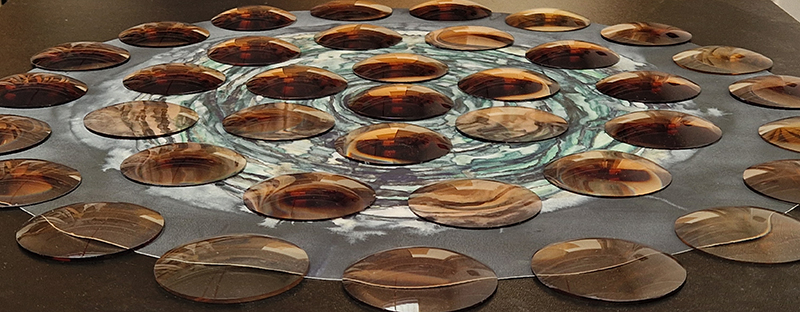
I have acquired a large number of photochromic optical lenses. These I have sorted by diameter, thickness and distortion. Initial thoughts about their use include using them as petri dishes to grow crystals which are embedded into small concrete hexagonal pillars of differing heights with reference to the geology of giants causeway. Using them to create composite windows into a new hut structure filled with video projections referencing the fly’s eye cosmic detector array.

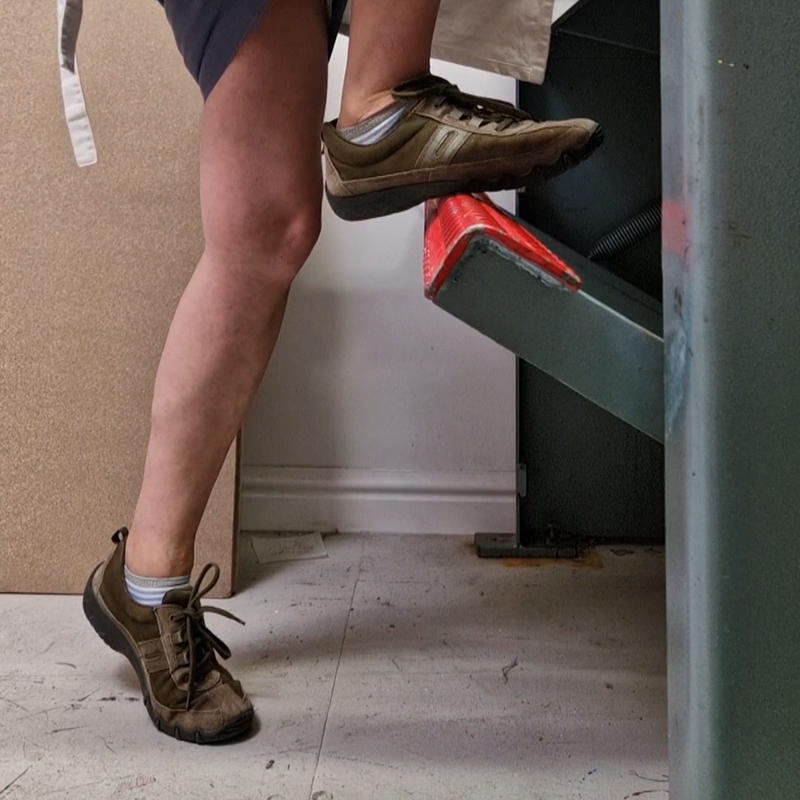
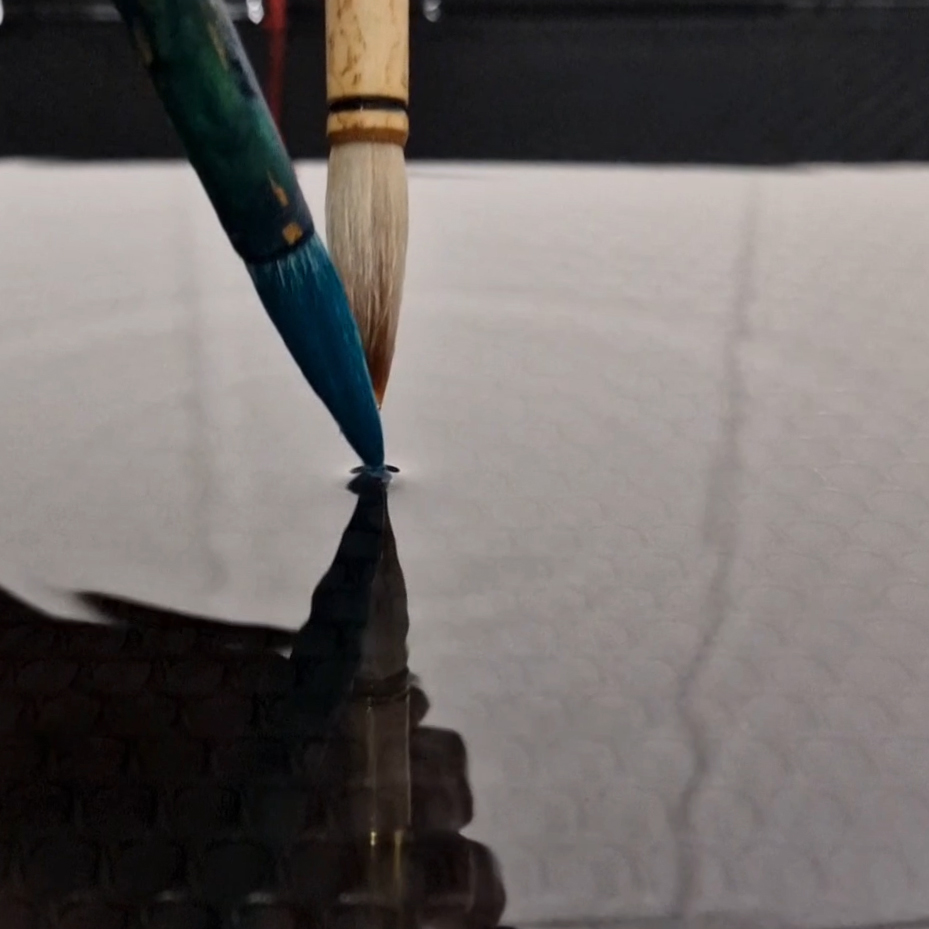
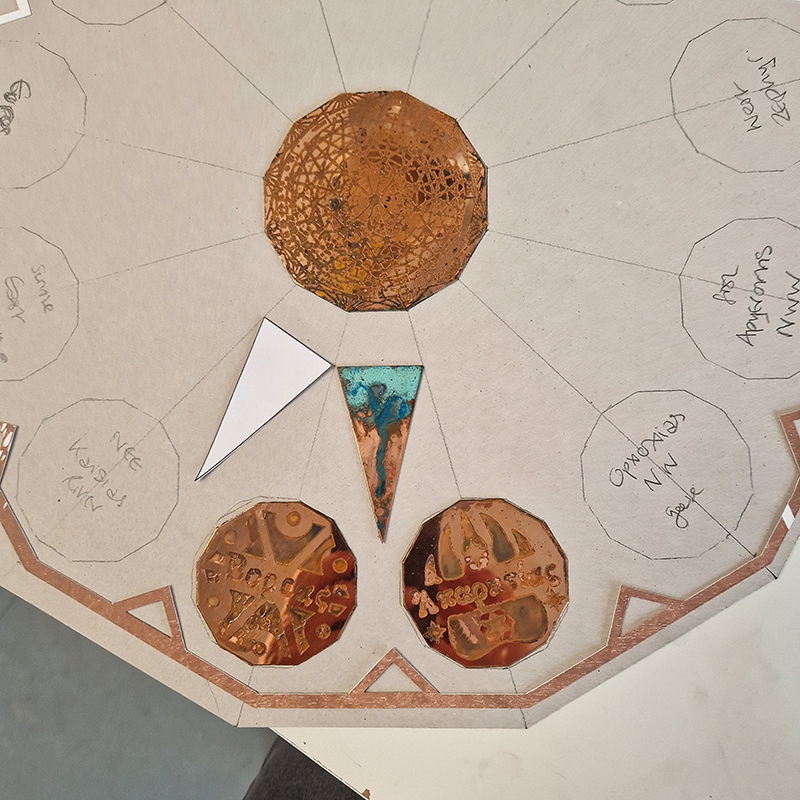
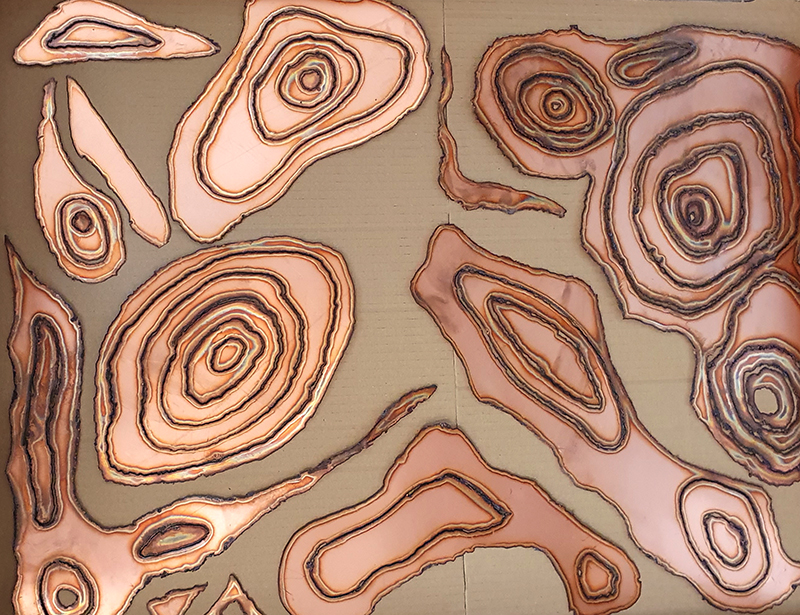
A good workout on the guillotine making 201 cuts in copper sheet in preparation for a new concrete tablet in the Instruments of the Anemoi sculpture series.

Gallery and other outings:

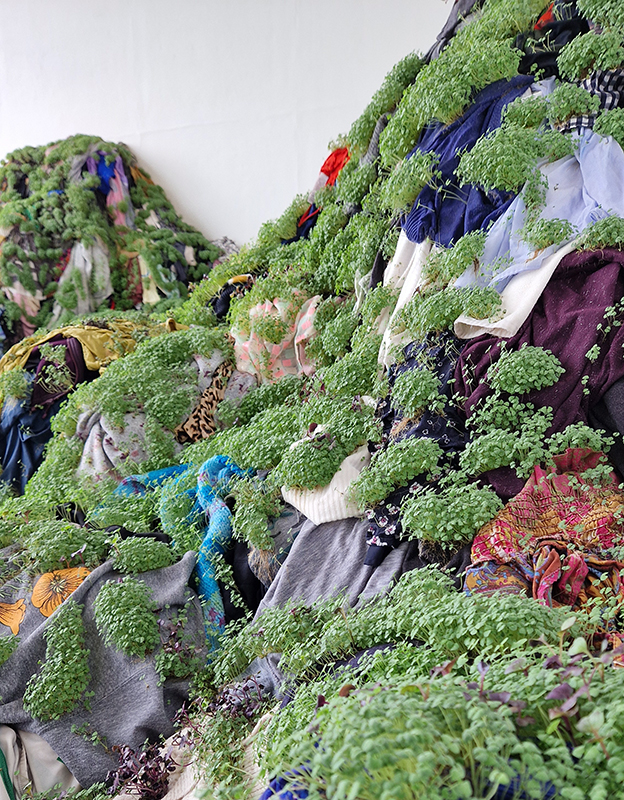
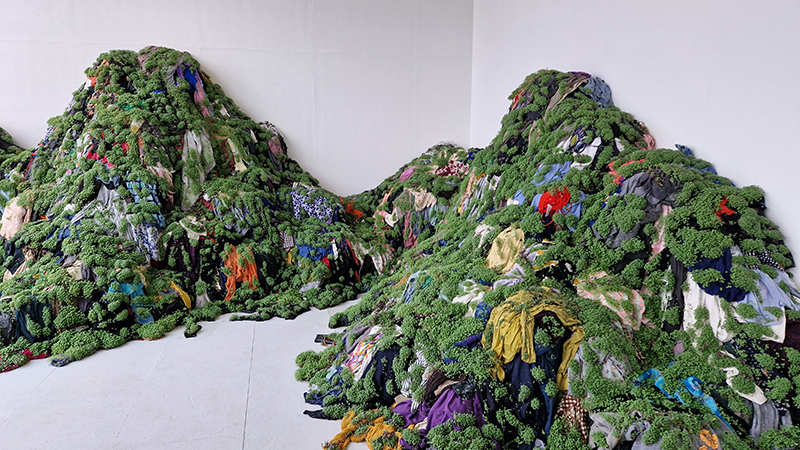
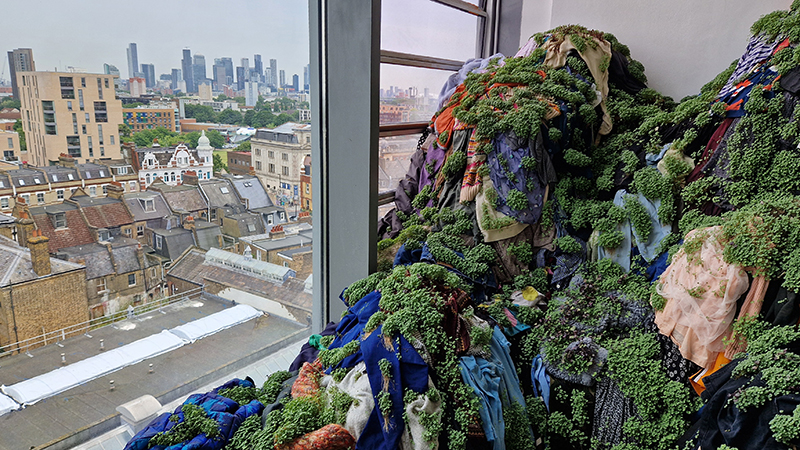
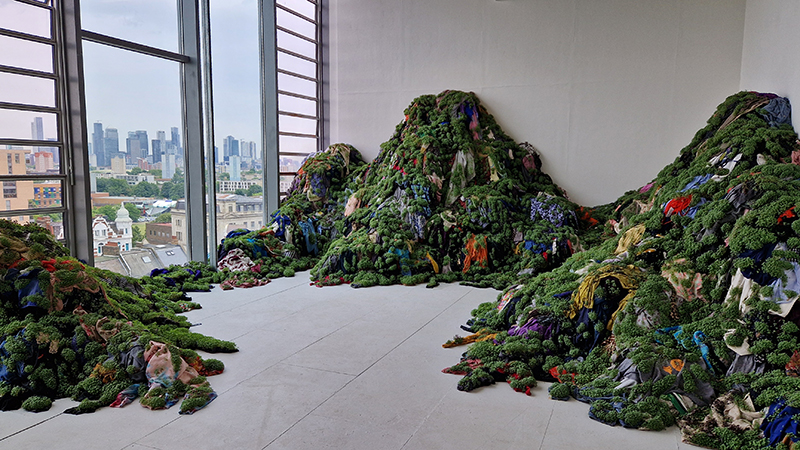
Beverley Duckworth’s installation Surplus at Goldsmiths MFA final show. Beverley’s work is grown through a diligent process of care. Found materials are literally given new life in the seeds which are embedded into them, which then transform and colour them. The installation includes an intermittent sound element of recordings of the melody played by waste trucks in Taiwan to call people to bring out their rubbish.

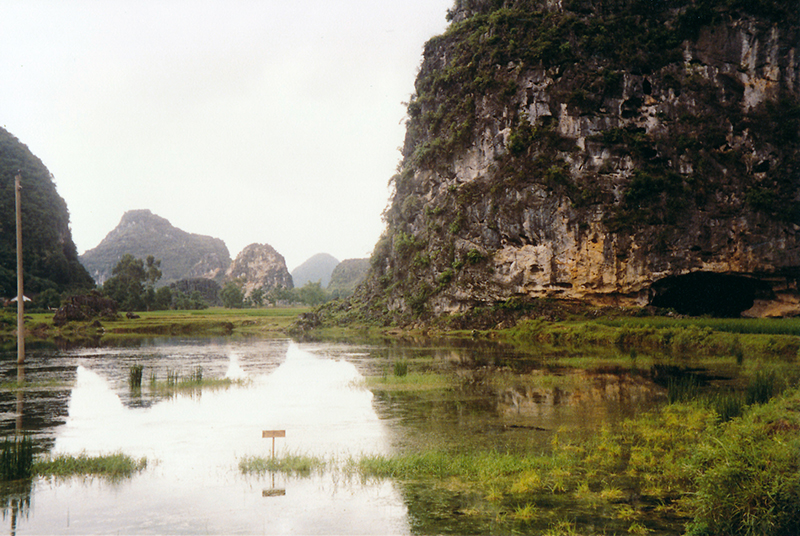
Apparently I wasn’t the first person to be struck by similarities to the landscape of Yangshuo near Guilin China. I visited in 1984 and think it is no longer a quiet little village.

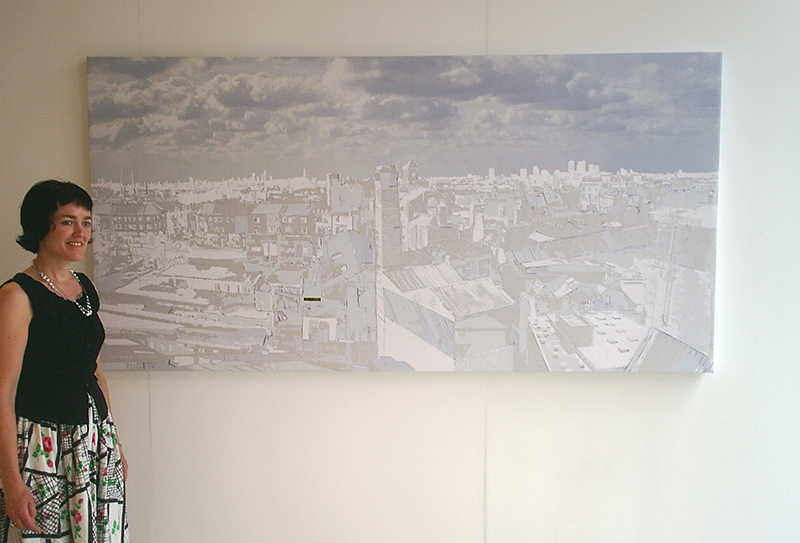
It was the first time I had been back inside the Ben Pimlott building at Goldsmiths since by own graduation, a scary twenty years ago. The building was brand new then and the views with little visible green fed into my installation Re:construction – a large screen print with tiny viewing hole to a tiny oasis amidst the grey, albeit a synthetic one.

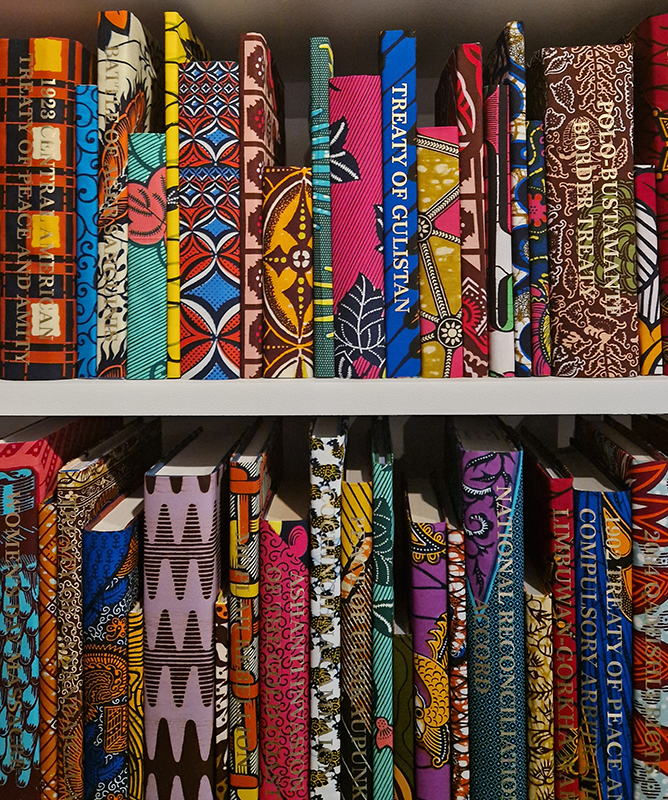
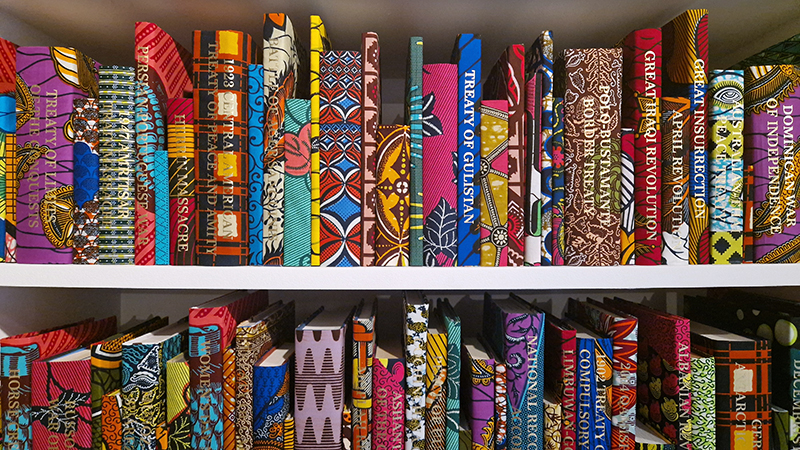
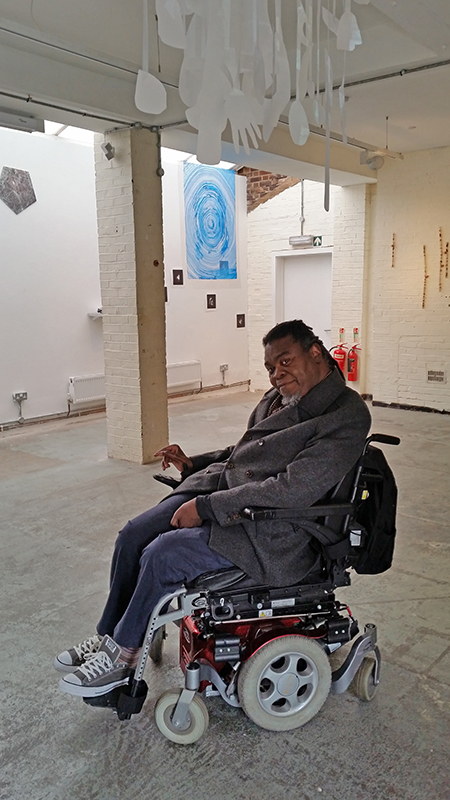
Yinka Shonibare Suspended States at Serpentine South. Horrors of war and colonialism are filed under dazzling colour, birds on the brink of extinction stare in plea or accusation, beacons of light in the darkness come from miniature replicas of sanctuaries.

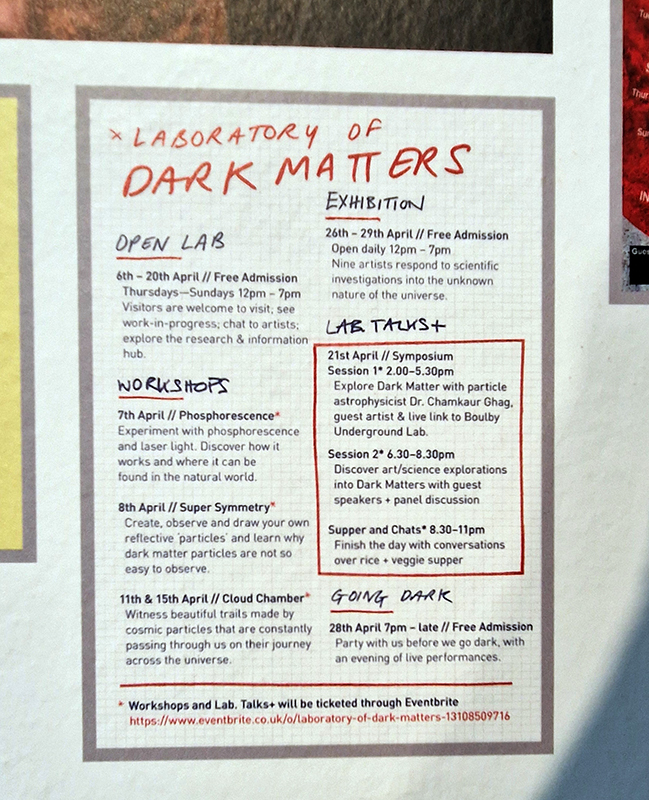
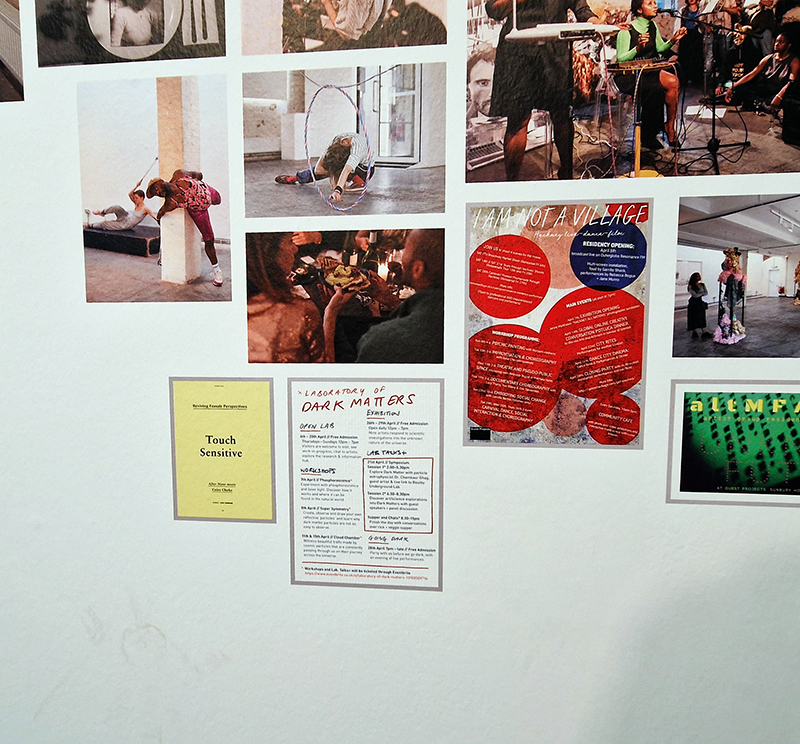
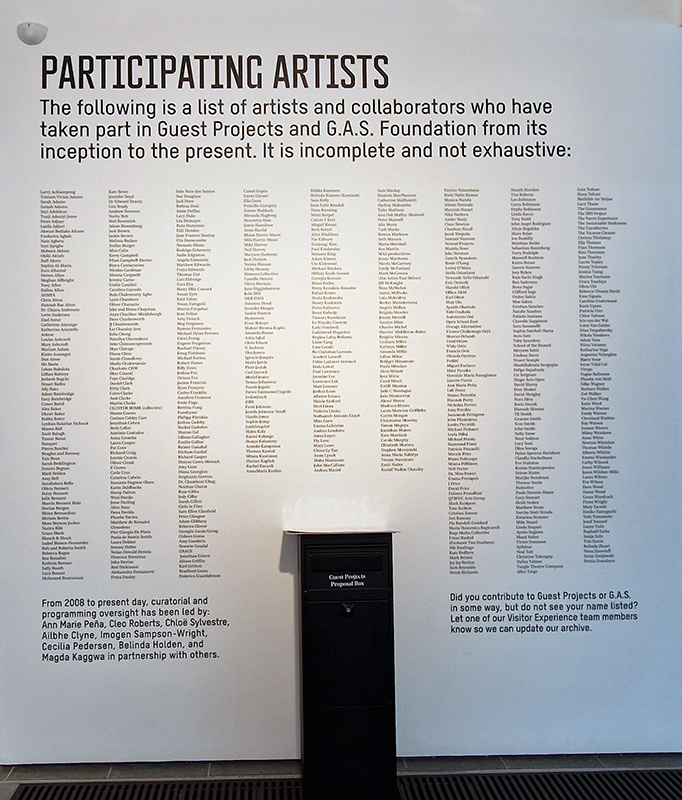
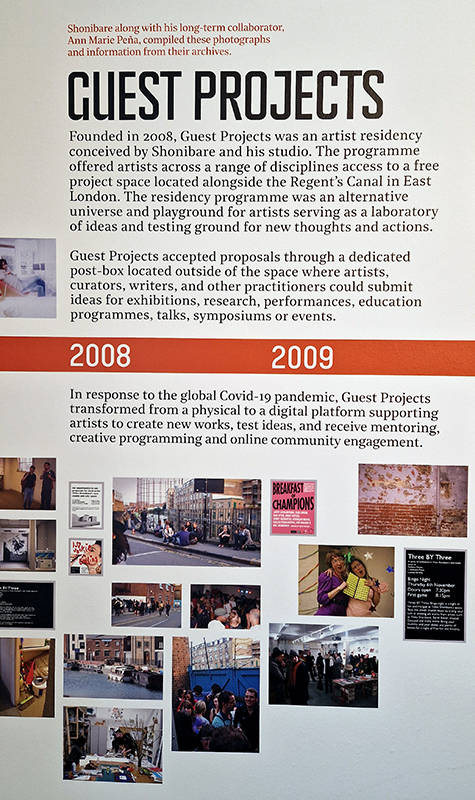
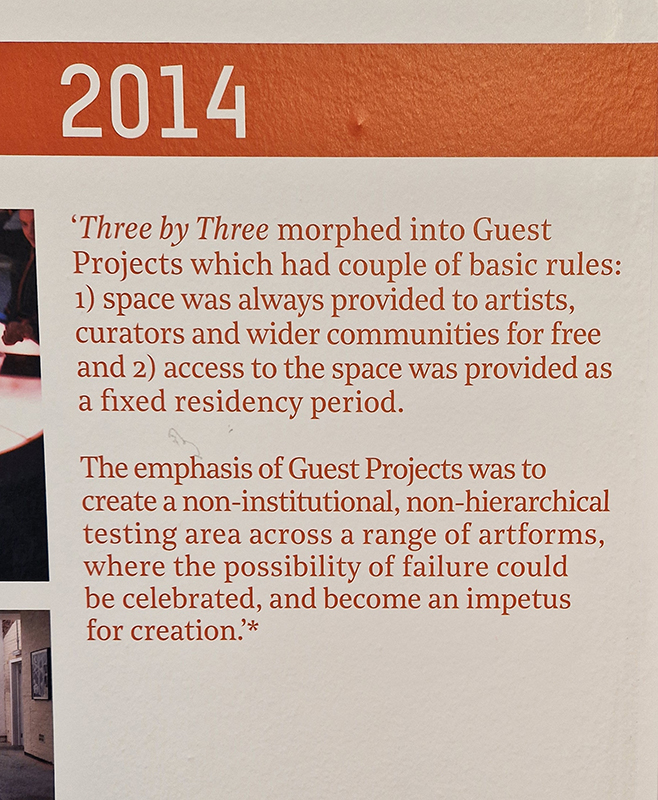
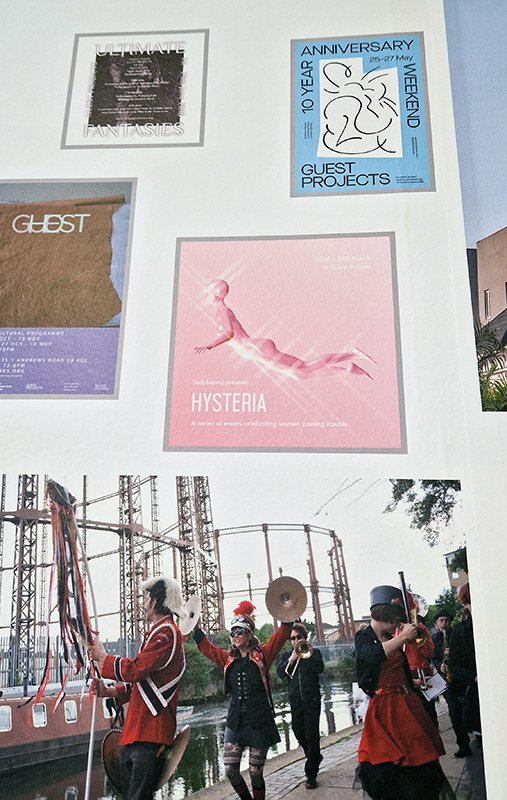
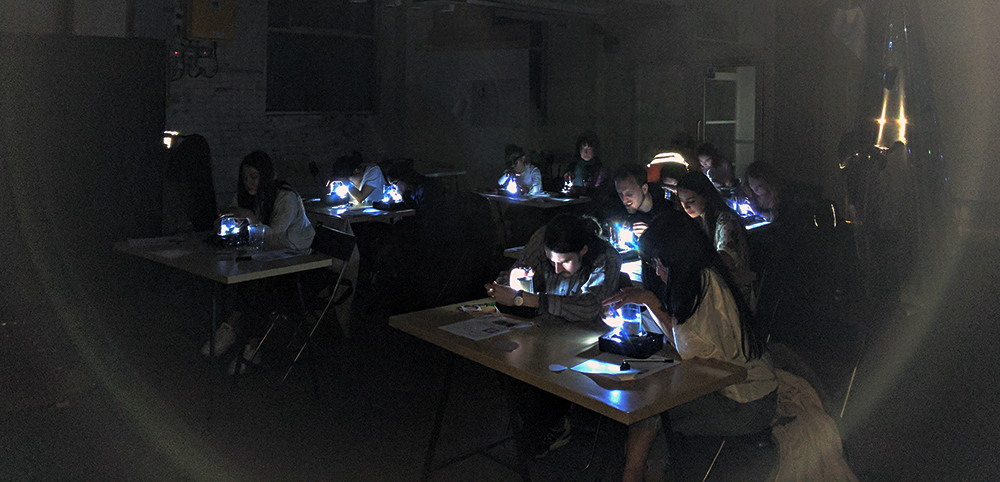
Yinka’s socially engaged inclusive practice spills over into real help for artists and communities. The exhibition celebrates Guest Projects and G.A.S. Foundation in Lagos. Guest Projects is such a generous idea and I have been so lucky to benefit from it with the project Laboratory of Dark Matters

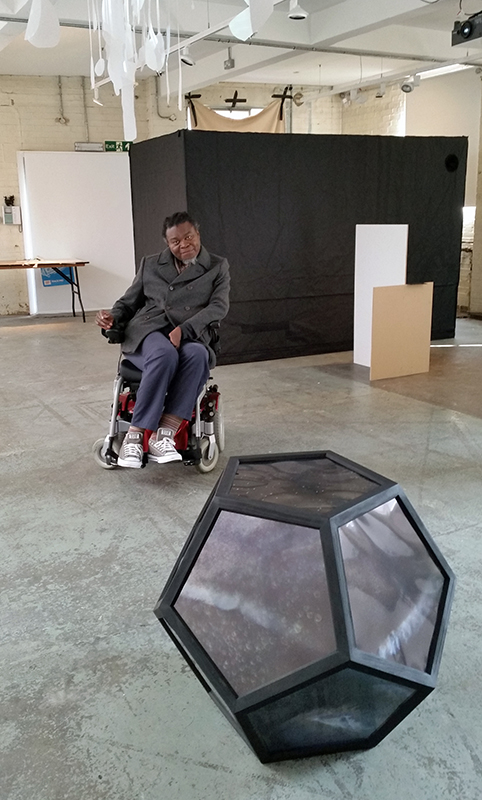
Being awarded a month’s residency at Guest Projects was crucial to the success of Laboratory of Dark Matters as a site for developing ideas and subsequently touring the project. Wonderful to meet Yinka and also to be part of the selection committee for the next round of projects.

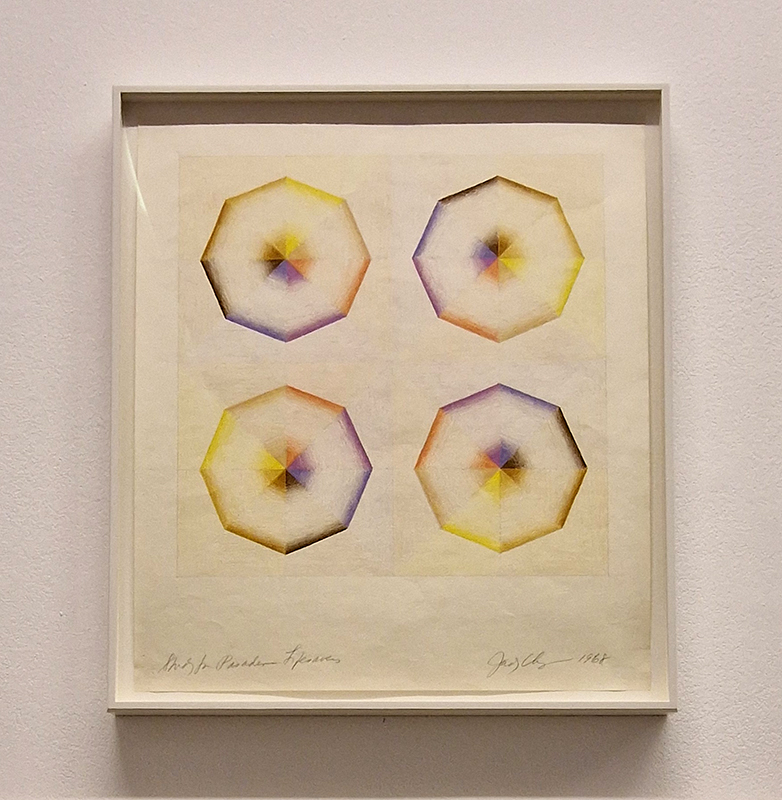
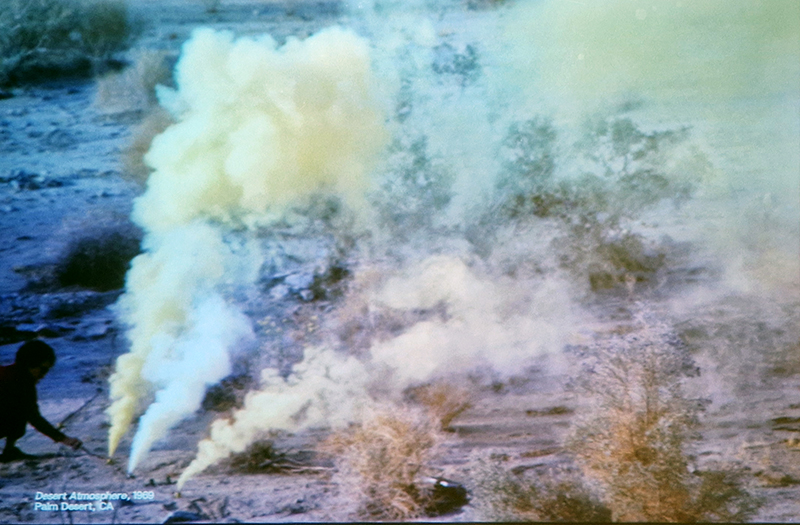
Judy Chicago Revelations at Serpentine North. The highlight of this show is the video documenting The Dinner Party (1974-79) installation and the preparatory drawings and sample plate. What a shame the actual installation wasn’t here, I will have to visit the Brooklyn Museum, New York sometime to see it. The research, collaborations, crafts and designs that went into creating it was phenomenal.

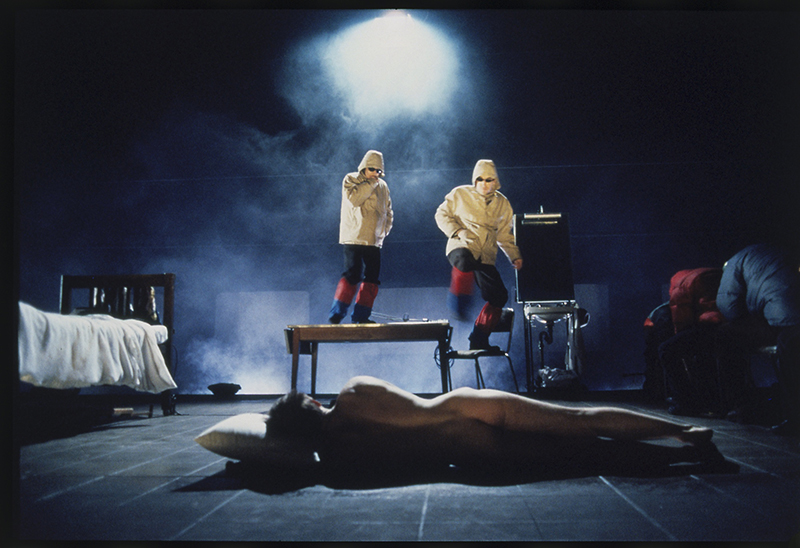
Saw Complicité’s excellent Mnemonic at The National Theatre, 25 years after first seeing it at Riverside Studios. ‘A body is found in the ice, and a woman is looking for her father while a man searches for his lost lover. Mnemonic is as much about origins as it is about memory, and remembering what is lost. Mnemonic asks us: what is our place in the natural world? How have human relationships with the environment shaped patterns of migration? Who are we, and where do we come from? ‘

Visited the delightful mellow brick country home and extensive gardens of pioneering naturalist Gilbert White at Selborne. His book ‘The Natural History of Selborne’ (1789) has never been out of print since it was published more than 230 years ago. He was brought to many people’s attention, including mine, during the pandemic and lockdowns of 2020 when writer Melissa Harrison included his diary readings in her podcast The Stubborn Light of Things.

‘A stone sky rotated above our heads’ – Italo Calvino, Cosmicomics

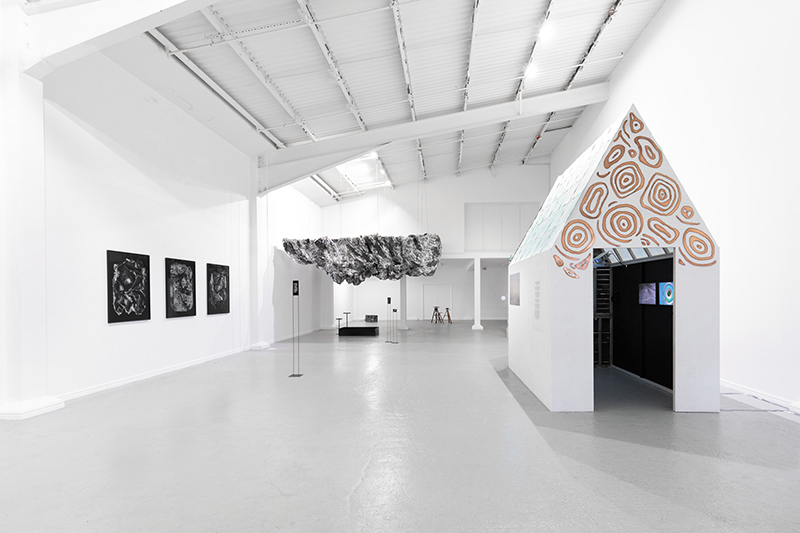
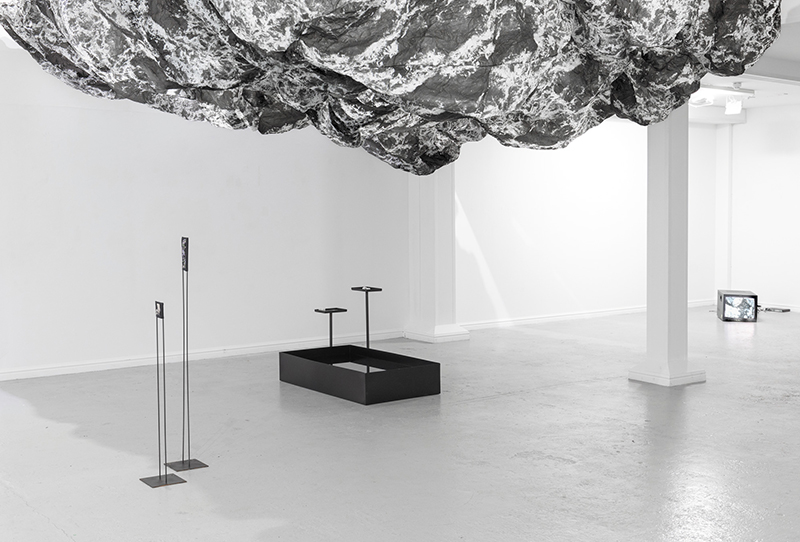
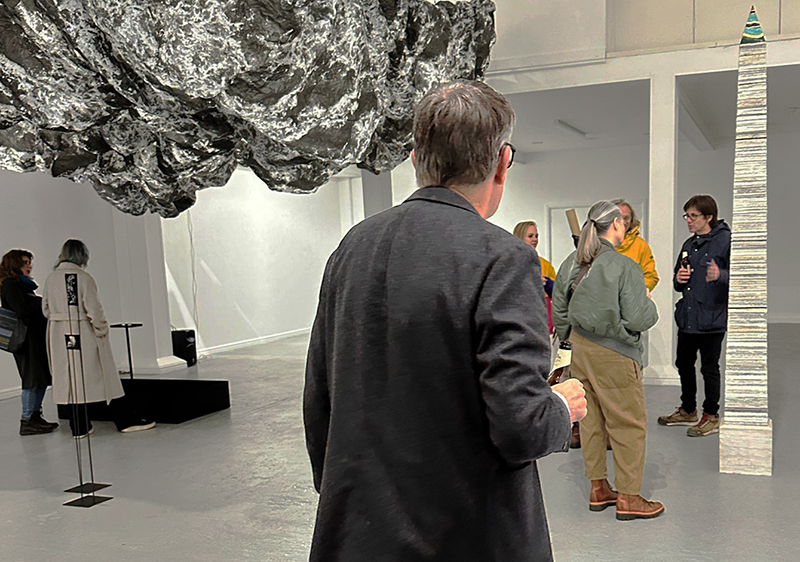
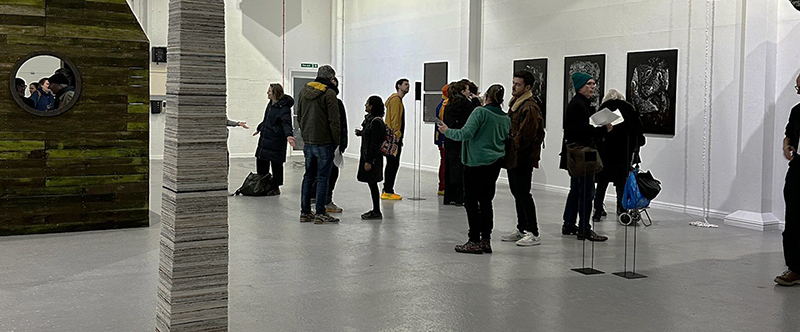
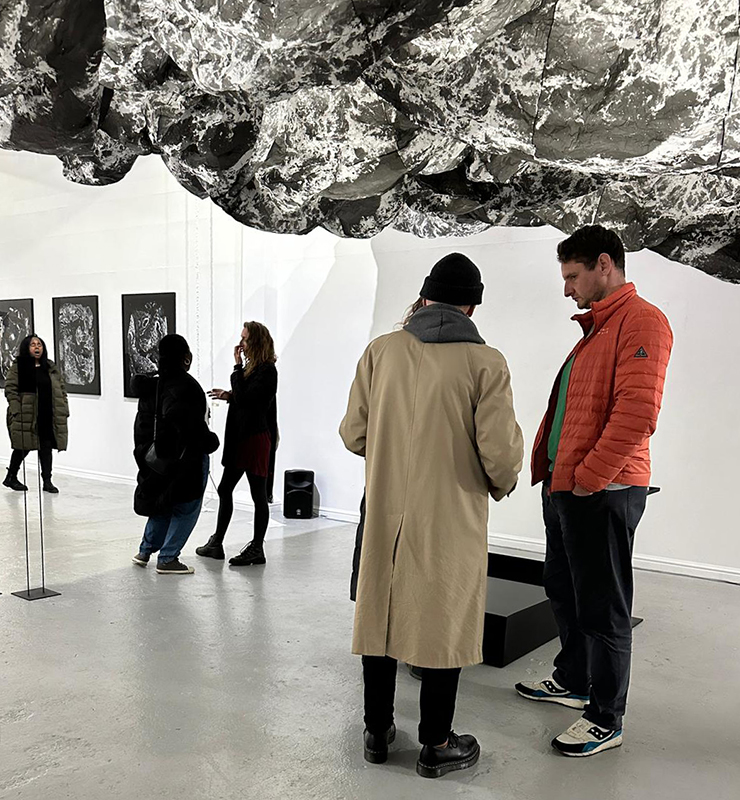
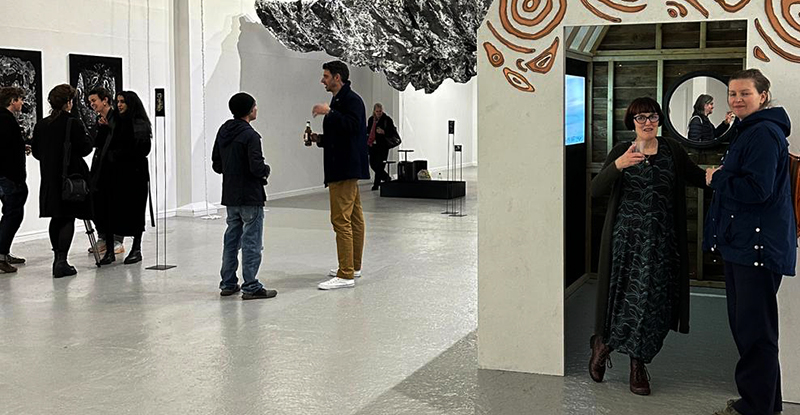
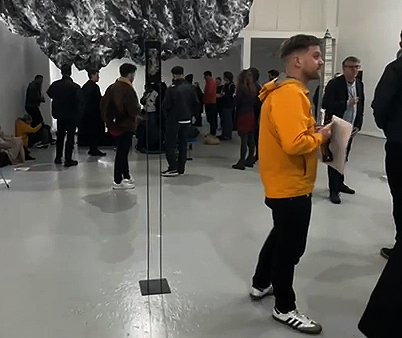
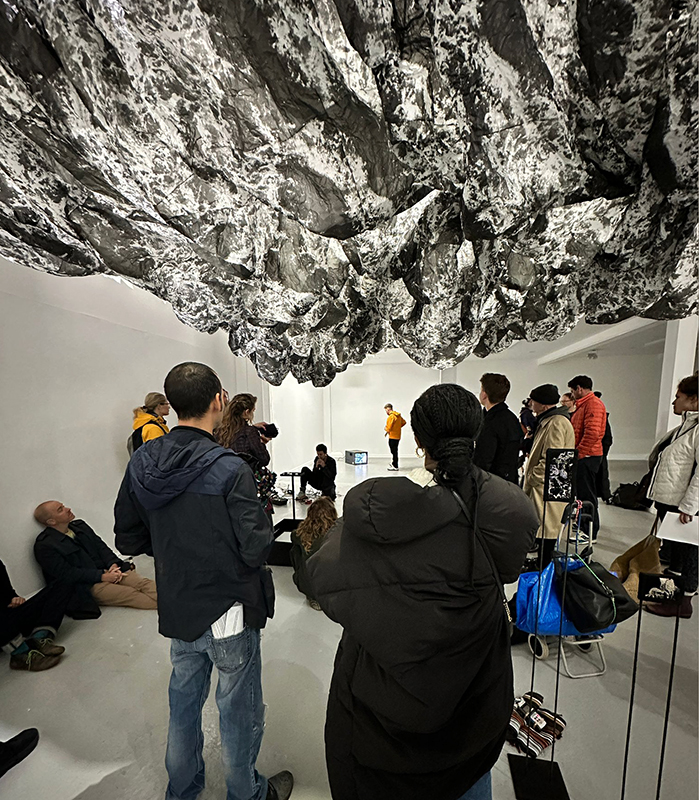
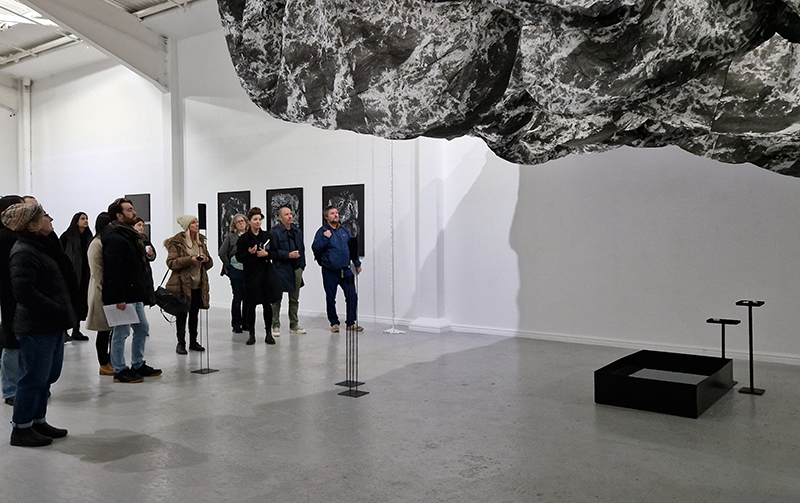
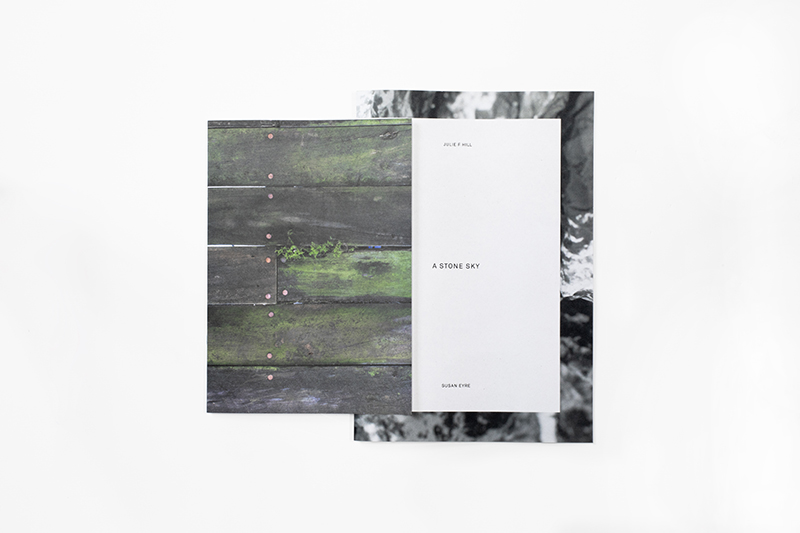
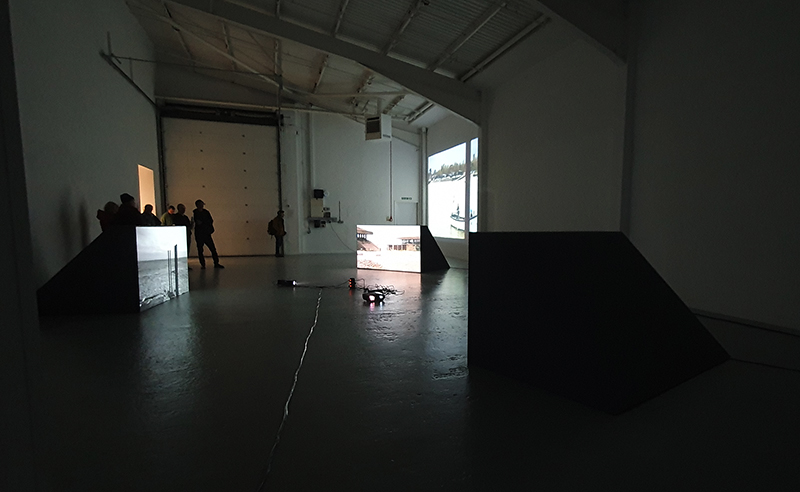
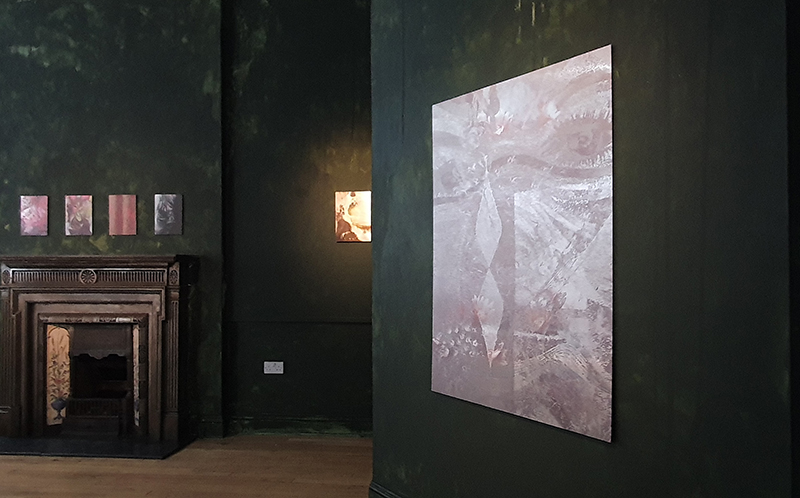
The culmination of two years work – A STONE SKY duo exhibition with Julie F Hill opened at Thames-side Studios GalleryReimagining the idea of an observatory – the exhibition proposes a cavernous realm of real and speculative possibilities that arise from beyond the limits of human perception. Engaging with the extended sensory range offered by technologies such as orbiting space telescopes through to the ability of birds to ‘see’ the Earth’s magnetic field, the artists’ reveal intimate connections between earth and space.

Installation shot by Ben Deakin Photography.

Susan Eyre seeks to navigate a path across time from the first human encounter with the magical qualities of the lodestone to current understanding of the interaction of the magnetic field with terrestrial life. Her works respond to the architecture, instruments and materials, found at a magnetic observatory while scientific objectives are expanded to include natural navigation techniques and extra-sensory methods used by the non-human realm, to form the basis of speculation as to the ability for humans to perceive the Earth’s magnetic field. Installation, sculpture and moving image works include a reimagined observation hut operating as a sensory hub with video screens suggesting portals into a web of neural pathways; an obelisk of layered recycled paper echoing Earth’s geological and magnetic history secreted in sedimentary strata of rock and a digital video work activated in real time by the passage of cosmic rays through a scintillator detector.

Images by Ben Deakin Photography

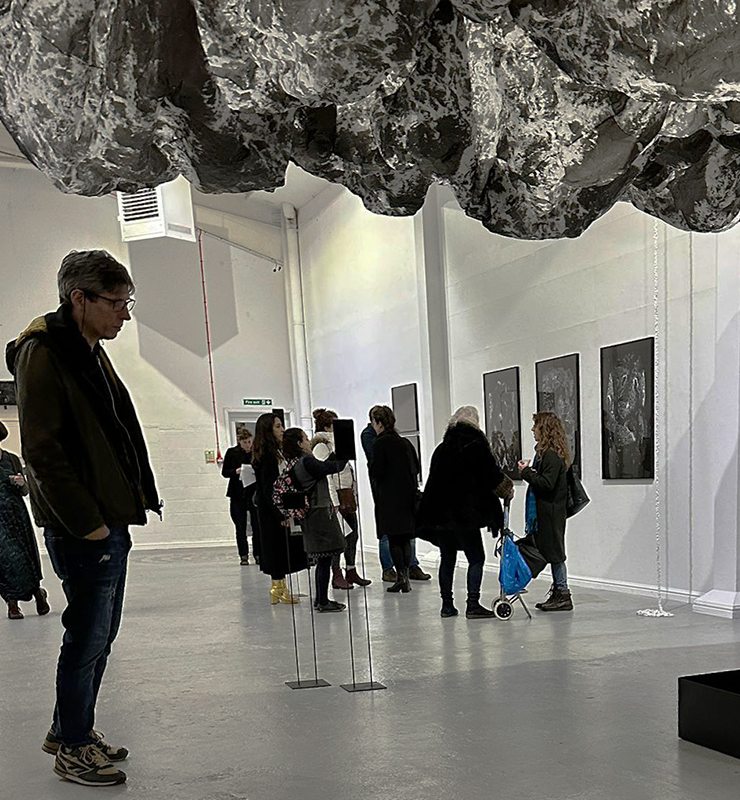
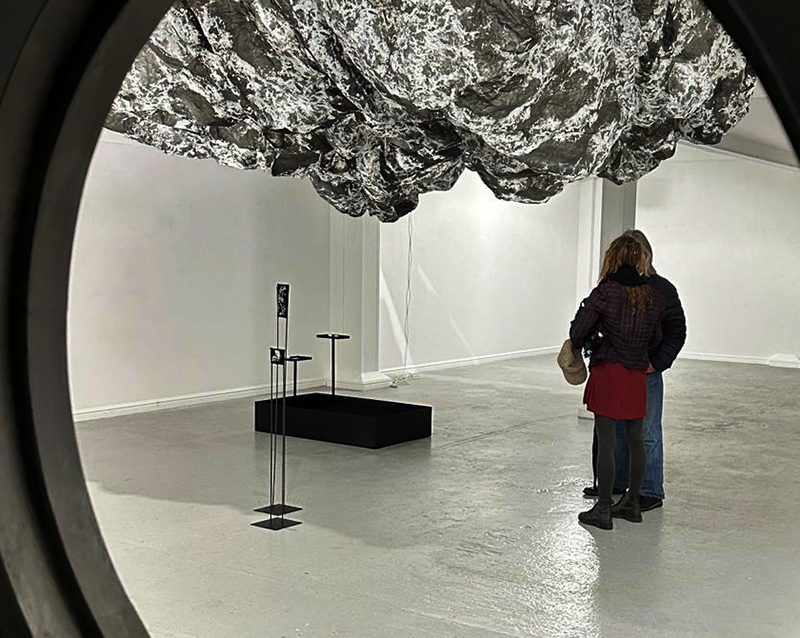
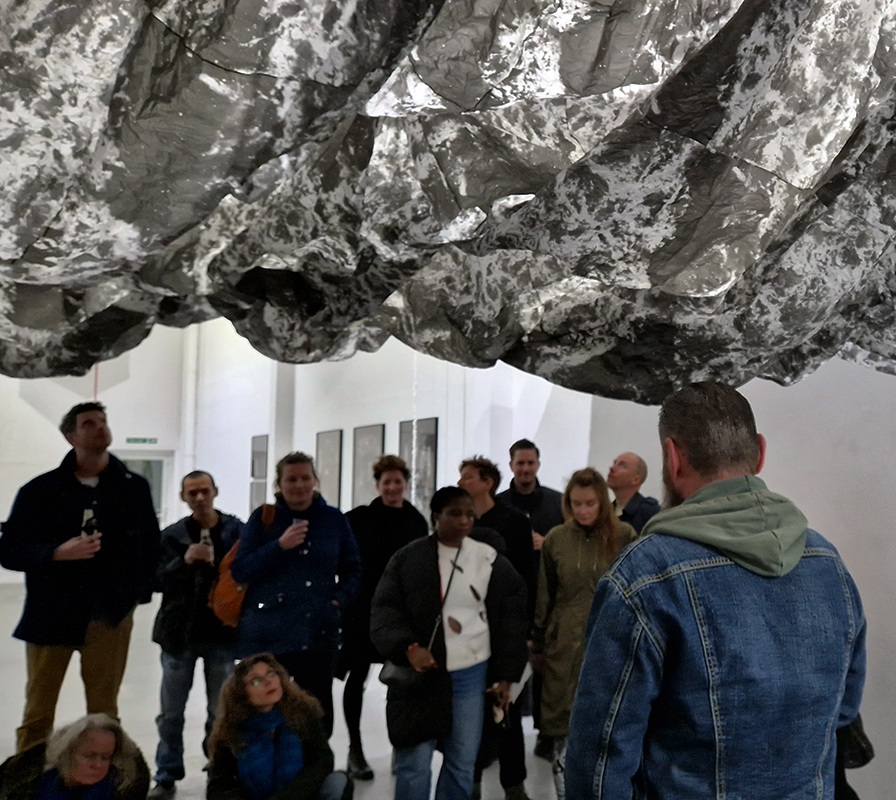
Julie F Hill explores the entwined darknesses of earth and cosmos. Crystalline and mineral substances from the deep earth fuse with astronomical data to suggest the deep-earth as an instrument for coming to know the cosmos. Crystalline and mineral substances formed in the continuum of deep earth and deep space allow us to peer back into cosmic time, both through the technologies created with them and the geological record they hold. Whilst darkness often indicates uncertainty and lack of knowledge, Hill asserts that it’s through darkness when we can be most perceptive to the interconnectedness between earth and cosmos. Through it we are able to extend our kinship with the inorganic and expand consciousness of what constitutes nature. Works include a large-scale sculptural print installation made from James Webb Space Telescope data that is reworked into a cavernous space, providing an experience of intimate immensity alongside more smaller sculptural and photographic works.

Images by Ben Deakin Photography

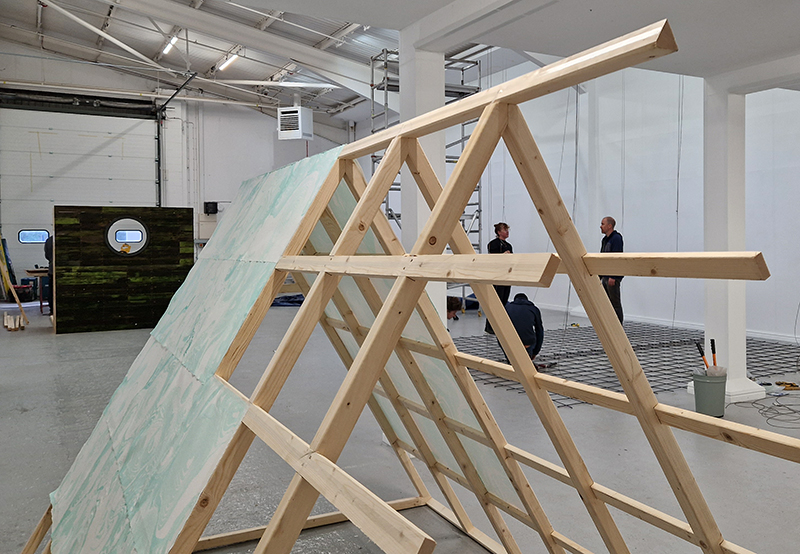
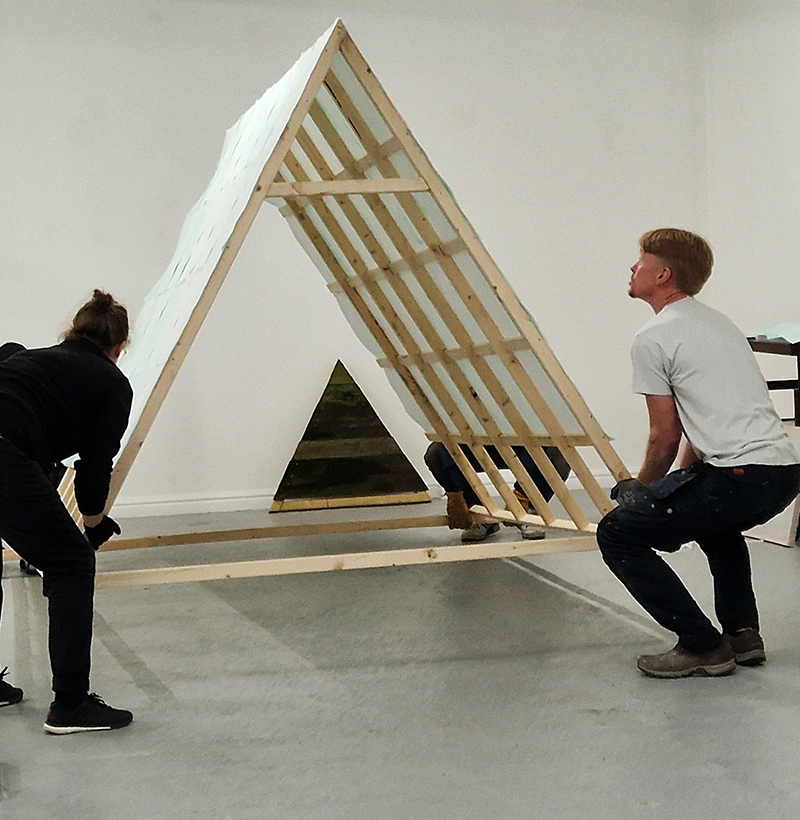
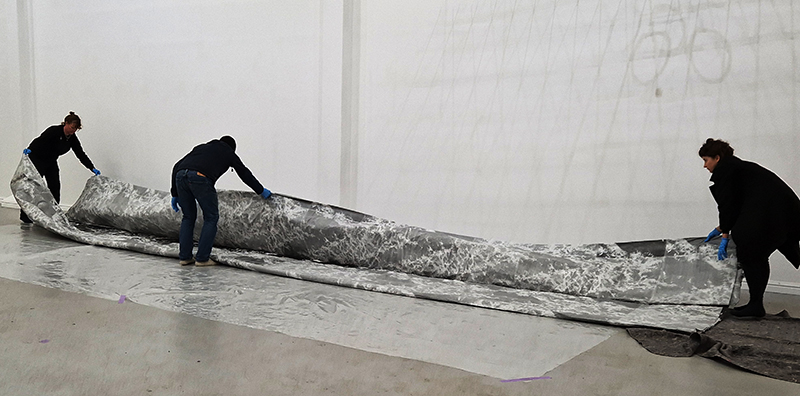
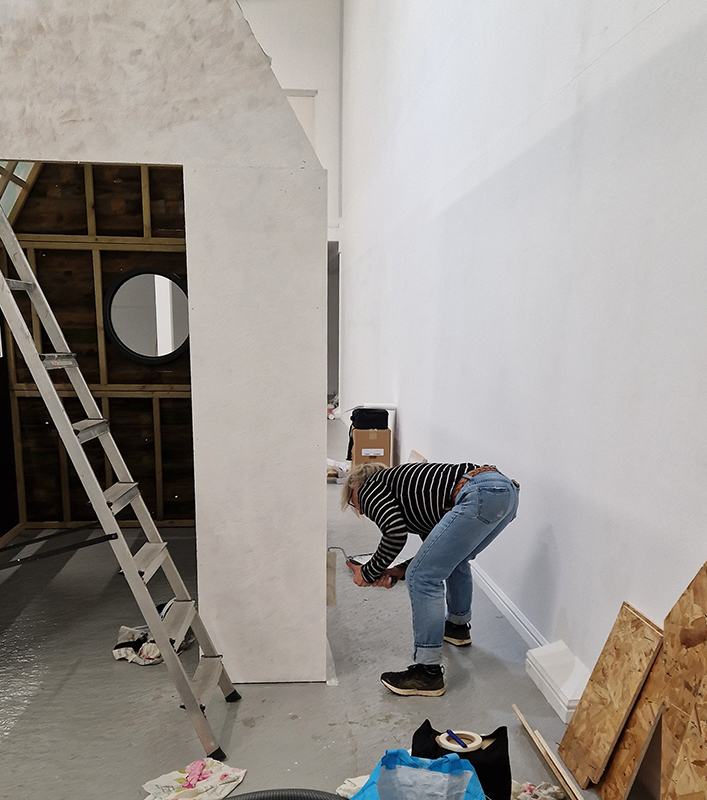
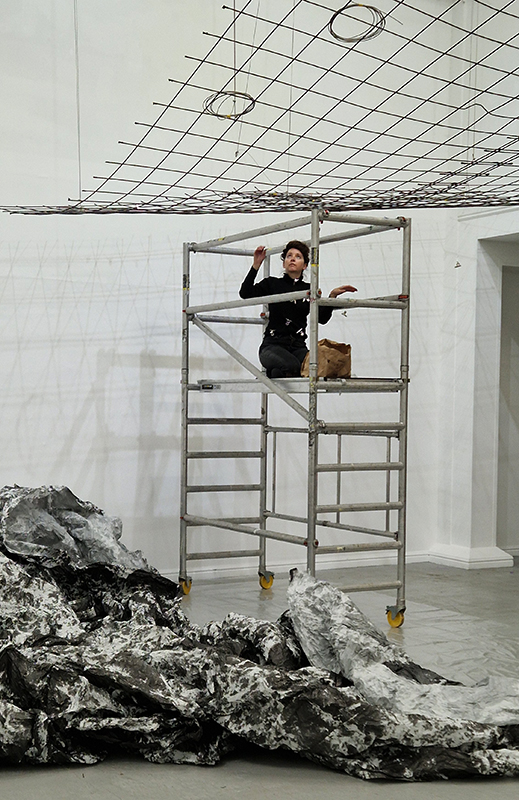
We both had ambitious large scale works to install and were grateful for the help we received from our partners (both Kevins), friends and technicians. Trevor Neale was magnificent in constructing The Absolute Hut. Anne Krinsky patiently helped apply double sided tape to the roof structure ready for the Suminagashi paper tiles and Caroline AreskogJones energetically painted the hut white and neatly edged the two way projection window. I was thrilled that, as a result of a wet few weeks, moss had started to grow on the wooden boards of the north facing wall in time for installation.

A big thank you to everyone that made it to the opening night, we were super chuffed with the positive responses.

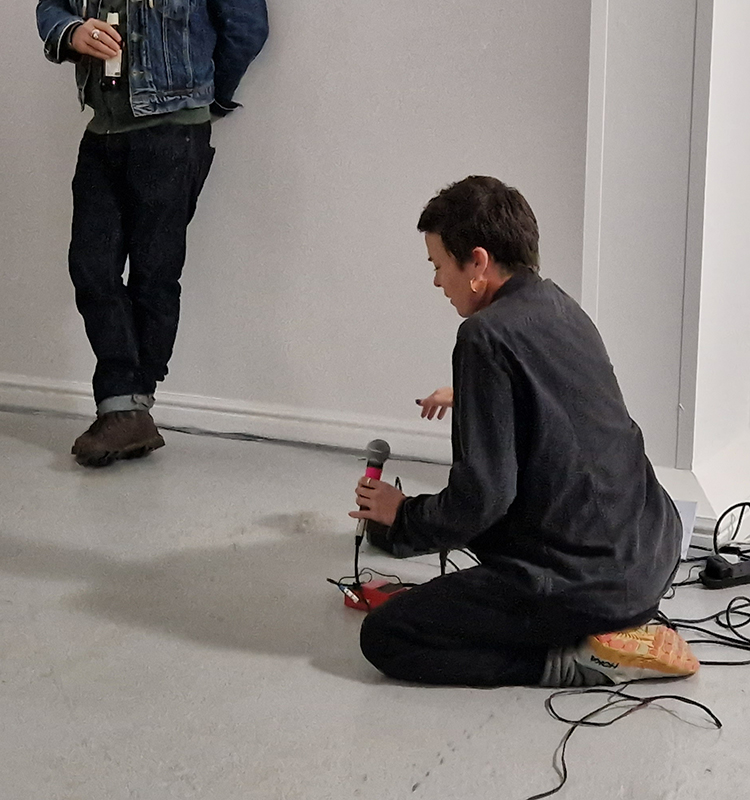
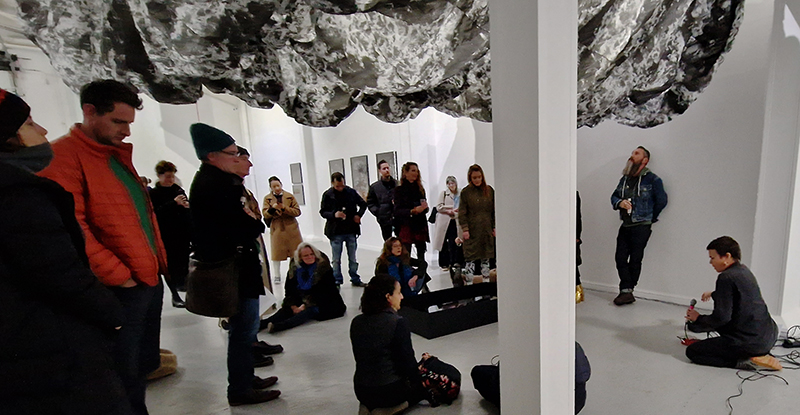
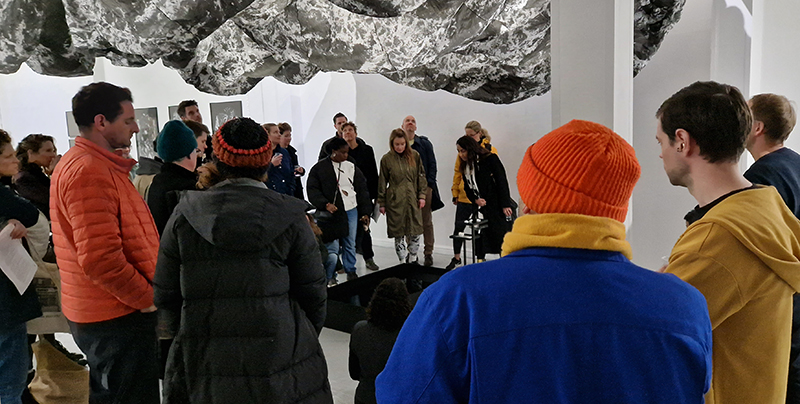
At the private view Julie’s large scale print installation was activated by a vocal performance conjuring abyssal voices of deep, cosmic time, performed and devised with Eleanor Westbrook whose voice produces incredible hauntingly beautiful sound.

I was particularly excited to share The Breath of Stars, digital video work activated in real time by the passage of cosmic rays through a scintillator detector. After two years in development it was so exciting to watch the random starbursts appear in real time as witness to the unseen activity of cosmic rays passing through the gallery.

The kaleidoscopic video images that appear for every particle recorded by the detector, are created from footage of cosmic ray trails filmed in a cloud chamber.

The interaction of cosmic rays with atmospheric electrical fields influences the unpredictability of the magnetosphere and this random activity can be witnessed by the sudden flurries and silent gaps of the live video imagery.

These subatomic visitors from outer space power across the universe with unimaginable energy, coming from the heart of exploding stars or the depths of black holes; some may come from phenomena yet to be discovered or even from other dimensions. Travelling at close to the speed of light cosmic rays spiral along magnetic field lines, strike the edge of the Earth’s atmosphere, break apart and shower down upon us. Some particles collide and silently interact with atoms and technology on Earth. Most cosmic rays heading for Earth are deflected by the planet’s magnetic field and without this protection life on Earth could not survive this bombardment of radioactive matter. The interaction of cosmic rays and the solar wind with atmospheric electrical fields combines to influence the unpredictability of Earth’s magnetosphere, impacting the functioning of GPS satellite technology and computer processors on which humans have come to rely in daily life.

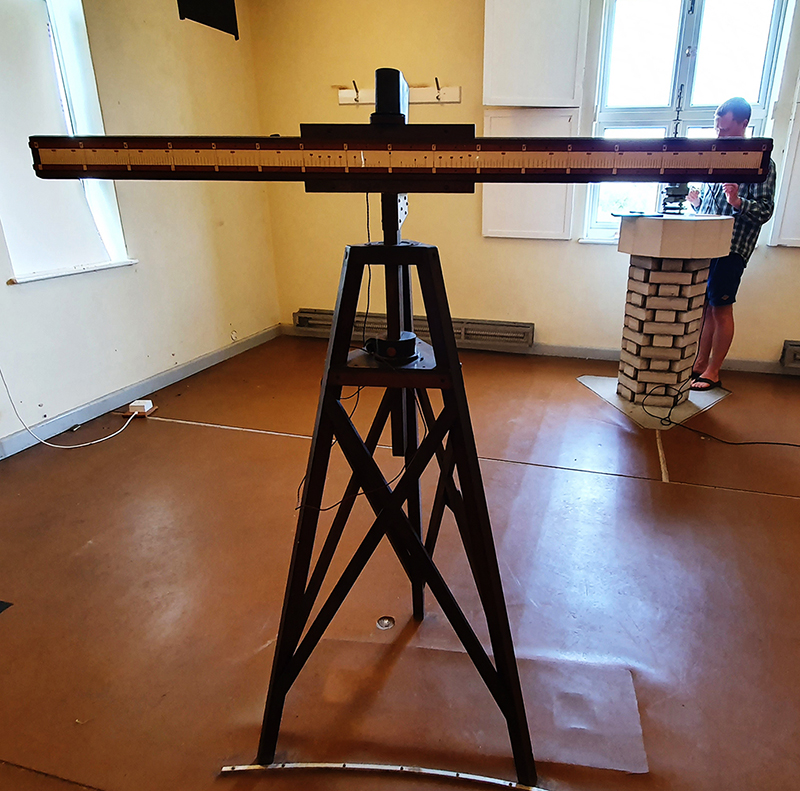
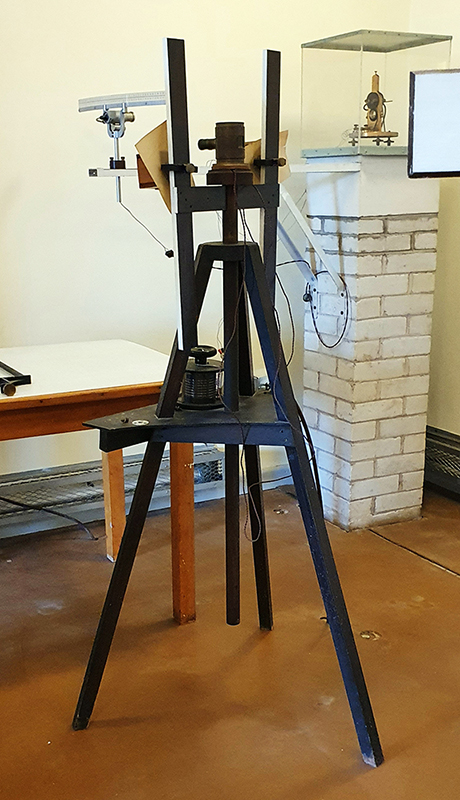
My research trip to Hartland Magnetic Observatory in North Devon was a catalyst for this body of work centring around a north facing observation hut aligned with an obelisk as a fixed azimuth mark. I am very grateful to The British Geological Survey for allowing me access to the site and particularly to Tom Martyn who shared his knowledge and gave a fascinating tour of the observatory.

The Azimuth Obelisk (of sedimentary knowledge) is a reimagining of an obelisk erected at Hartland Magnetic Observatory in the late 1950’s near the site’s northern boundary. Viewed through the window in the north wall of The Observing Building (also known as the Absolute Hut) it acts as a permanent azimuth mark from which the drift of the magnetic north pole is monitored. Currently almost hidden by undergrowth, the observatory’s concrete azimuth mark has been replaced by a digital GPS position. Much as the Earth’s geological and magnetic history is secreted into the strata of sedimentary rock, this sculpture also expresses the passage of time through the layering of recycled paper prints and drawings whose history becomes embedded within the stacked layers.

The Absolute Hut (of action potential) operates as a sensory hub with video screens suggesting portals into a web of neural pathways where a range of actions and processes are running concurrently reflecting on the dynamics between the Earth’s geologic structure and navigation using the magnetic field.

The title refers to the way neurons send information electrochemically around the body. The signals they send are called action potentials which is a temporary shift from negative to positive within the cell caused by certain ions entering the cell. Action potentials can be triggered by an interaction with the magnetic field causing a reaction in the body.

The installation is conceived from a combination of features, impressions and functions of the observing building and instruments at Hartland Magnetic Observatory in North Devon and the observation huts built in the 18th century at The Kings Observatory in Kew for meteorological and magnetic observations.

Topological contours of suminagashi marbling and plasma cut copper reflect the fluid motion of the Earth’s molten iron core and the pulsating alpha waves of the human brain when subjected to magnetic fields.

‘the internal skies have their own birds’ Italo Calvino Cosmicomics

The fascinating and perilous journeys made by migrating birds has been a natural wonder for centuries with the first records of this phenomena made more than 3,000 years ago. The innate knowledge of migratory birds is mentioned in Job and Jeremiah and the ancient Greek writers Homer, Hesiod and Aristotle noted their passage.

Job 39:26 Doth the hawk fly by thy wisdom and stretch her wings towards the south?

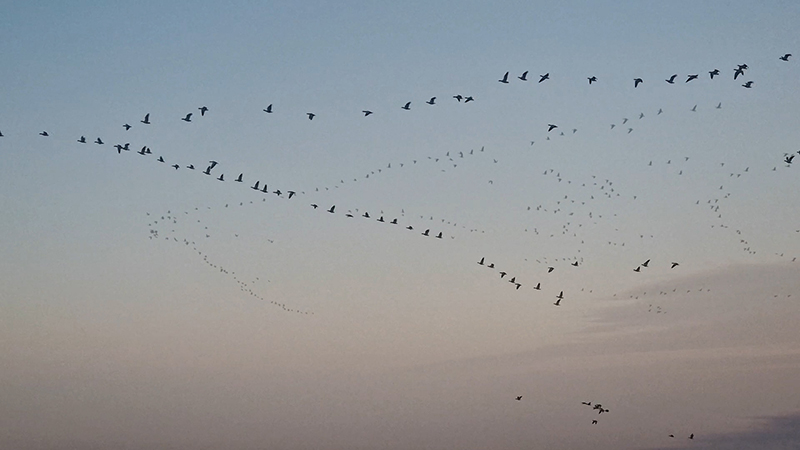
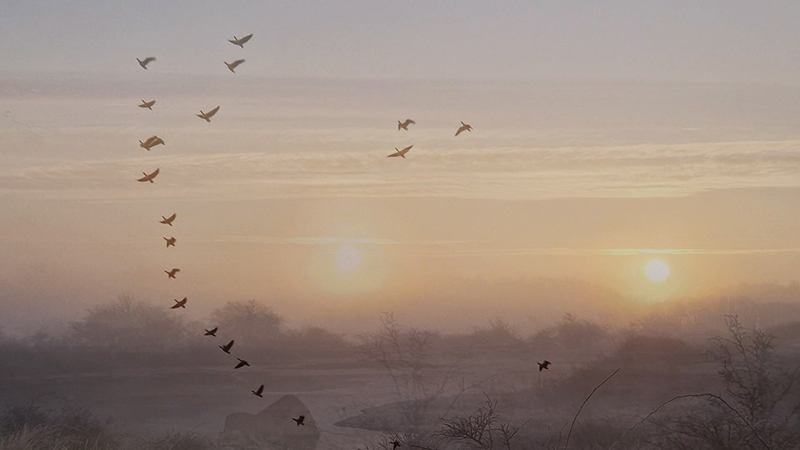
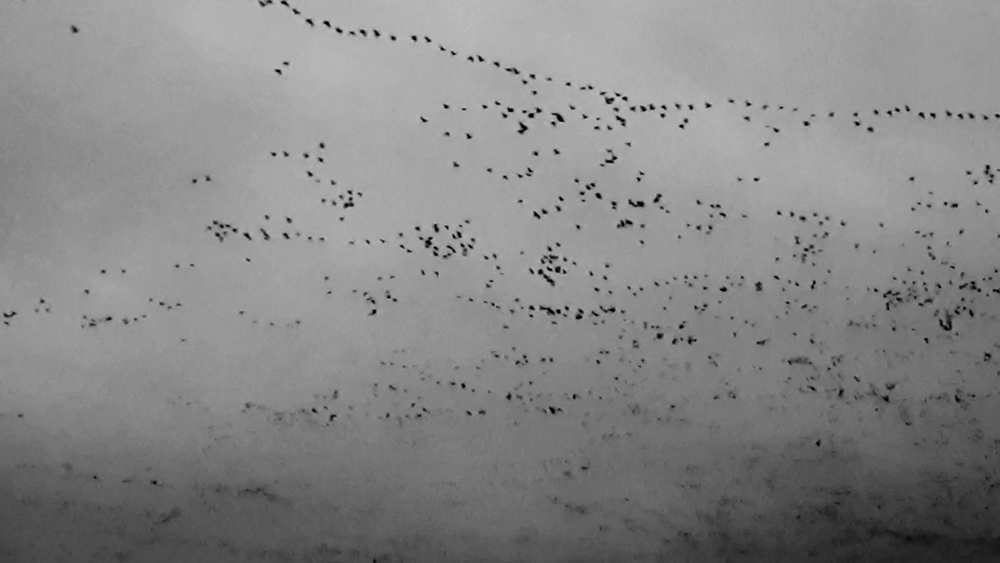
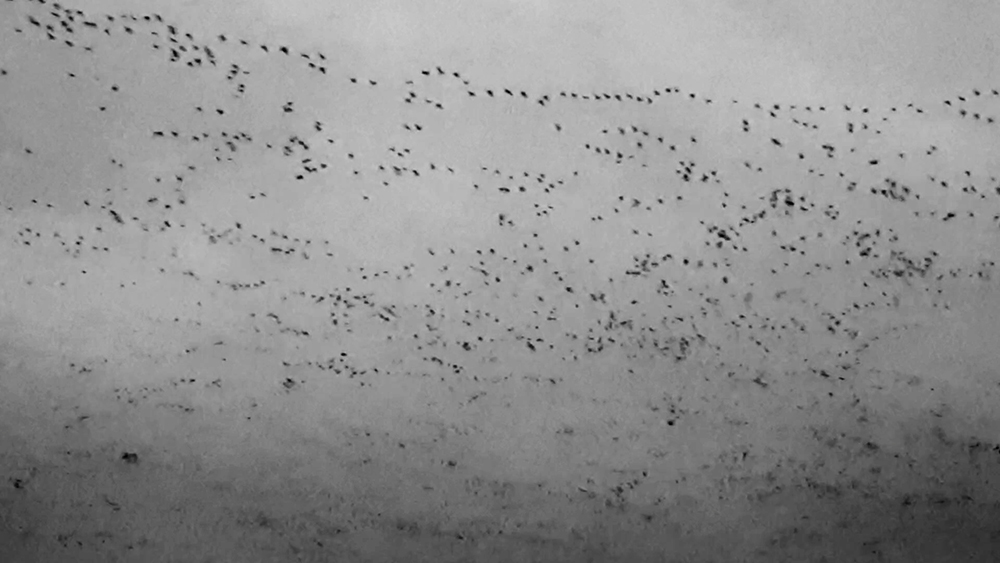
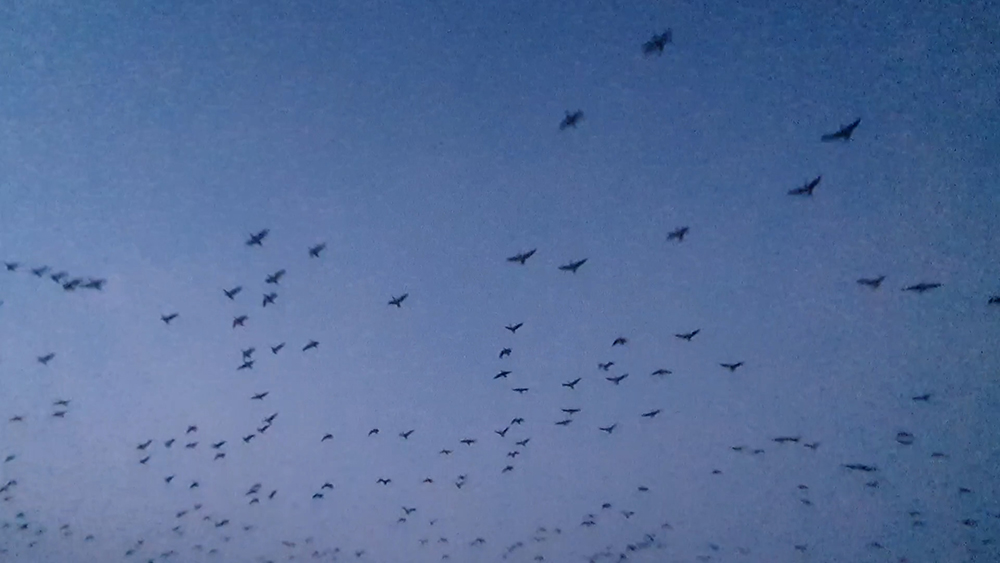
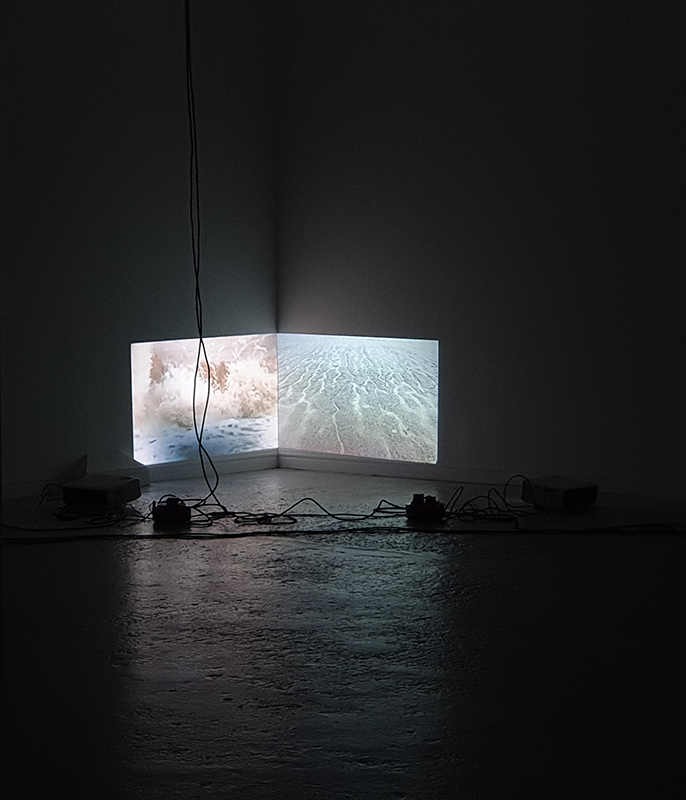
Wintering light two way video projection of migratory pink footed geese filmed at RSPB Snettisham on the North Norfolk coast.

Research has proven that birds and many other animals can use the earth’s magnetic field for navigation. There are two ways this happens. In birds there is a protein in the retina of the eye – (cryptochrome molecules) which trigger action potentials enabling them to visualise the magnetic field. In other animals and magnetotactic bacteria tiny crystals of magnetite respond to the field. This may also be true of humans as we do have these crystals in our brain cells.

Birds use three different compasses to navigate across the globe; the sun, the stars and the magnetic field.

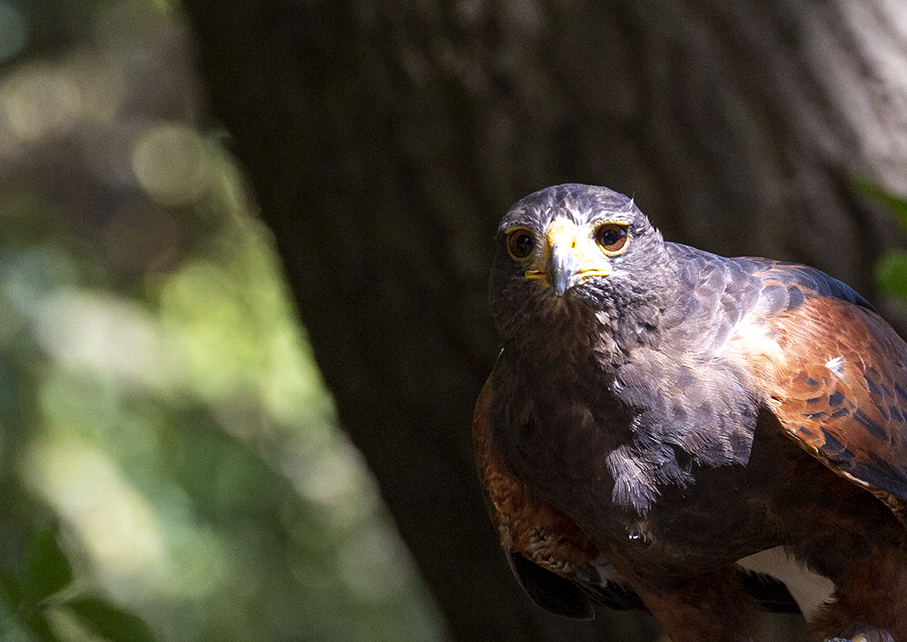
Birds are also able to detect rapid movement such as individual flashes or flickering of a fluorescent light which humans see as a continuous light. Hawks which pursue other birds through dense forests at high speeds, follow the movement of their prey while avoiding branches and other obstacles. To humans travelling at this speed, the fleeing prey, branches and obstacles would just be a blur.

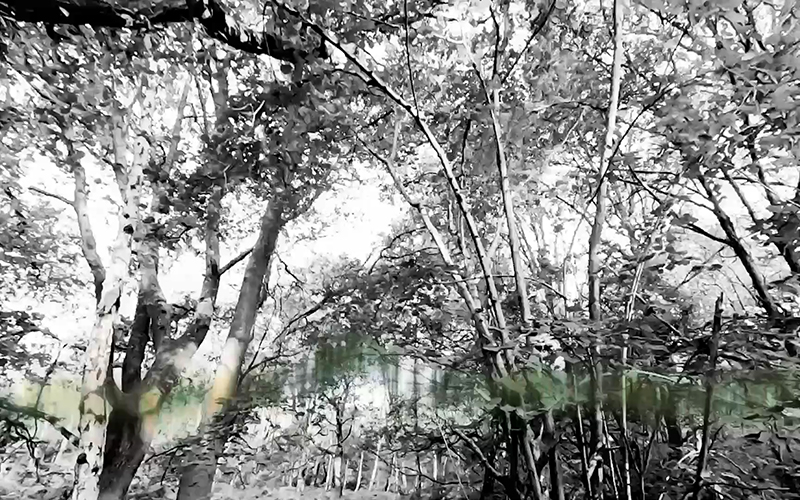
Degrees of Variation considers what it might be like to have the sensory powers of a bird where a protein in the eye is excited by polarised light making it possible to see the magnetic field and follow a visual navigatory cue in an accelerated world. The video imagines flight over water and through woods while being guided by the force of a magnetic field.

Calvino’s story The Stone Sky is wonderfully descriptive of the volatile geological structure of the Earth. This fluidity is what makes life on Earth possible. Only planets with fluid cores have magnetic fields. The geological interior generates a field that reaches into outer space offering a protective shield.

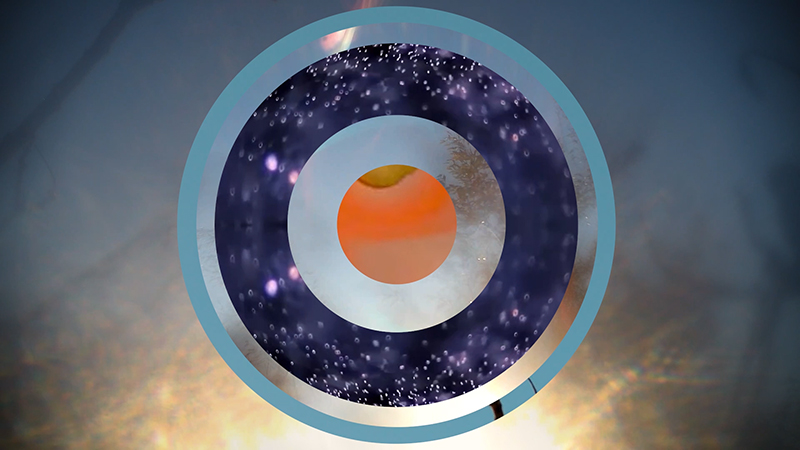
internal skies : external spheres video sequences within concentric circles mimic the geological structure of the Earth to explore the relationship between Earth’s magnetic field and various methods of navigation including via magnetoreception and celestial observation. Sequences include star trails around Polaris (the current north star), birds and bees that use the magnetic field for navigation, magnetotactic bacteria, magnetised iron filings, aerial views of the coastline around Hartland and early morning polarised light which excites the cryptochrome protein in a birds eye.

The Earth’s geomagnetic field is created by a combination of three separate fields and timescales. The main field is generated in the earth’s molten iron core.  Observing the field gives clues to the planet’s deep interior which is inaccessible to direct observations. Changes are measured in the annual drifting of magnetic poles. Secondly electrical currents caused by solar weather and cosmic rays bouncing off the Earth’s main  field charge the surrounding ionosphere causing fluctuations in the field. This field changes by the micro second as we orbit the sun. The Earth’s magnetic field also acts as a shield against most potentially harmful charged particles from outer space. Finally the residual magnetisation of the geology of the rocky mantle and crust, measured in deep geological time also offers clues to the geological history of Earth.

The understanding of the world surrounding us forms in the darkness of our skulls. 

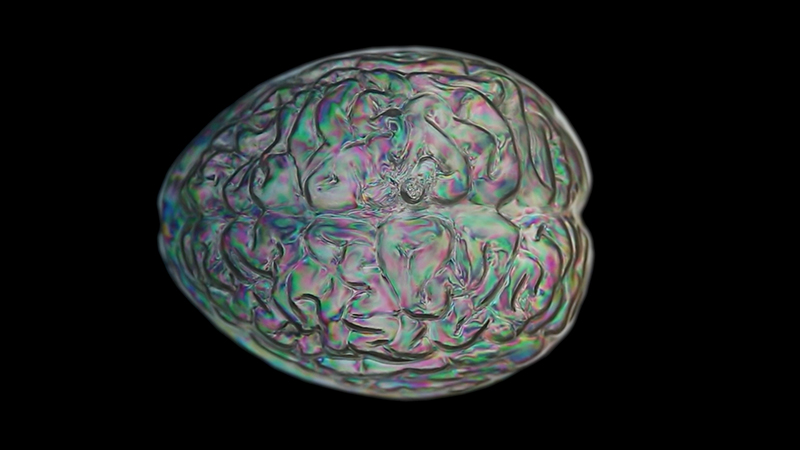
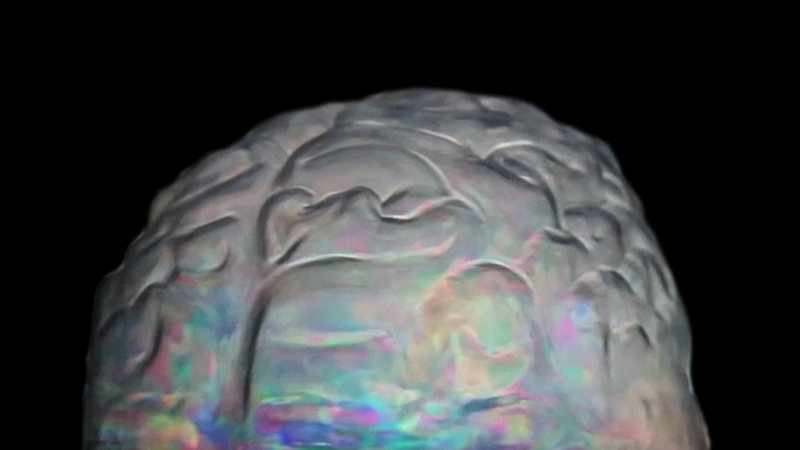
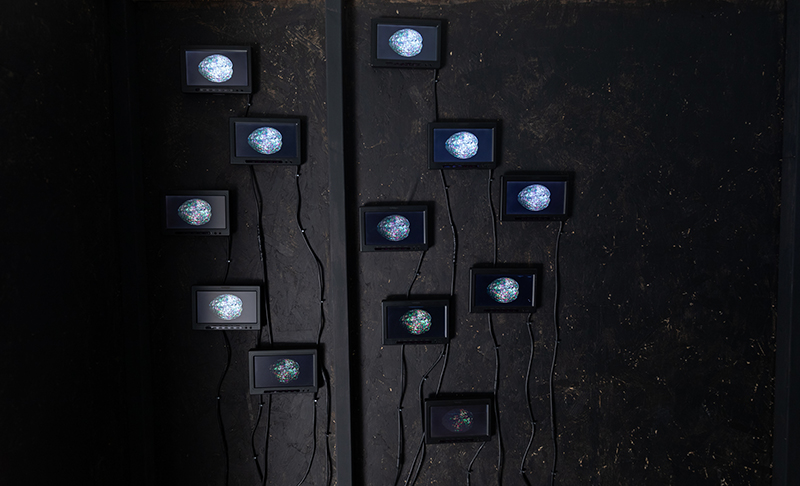
interference – a panel of 12 small video screens inside The Absolute Hut (of action potential), showing images of the human brain filmed by using polarizing filters to create pulsating birefringence colours, relate to the narrative pinned to the outside of the hut.

The narrative is a mix of fact and fiction based on a real experiment carried out at Caltech where scientists found Alpha waves in the human brain do respond to Earth’s magnetic field and other research suggesting that it could be possible for the magnetic field in one animal’s brain to transmit information to another animal’s brain by triggering action potentials creating the same thoughts and emotions.

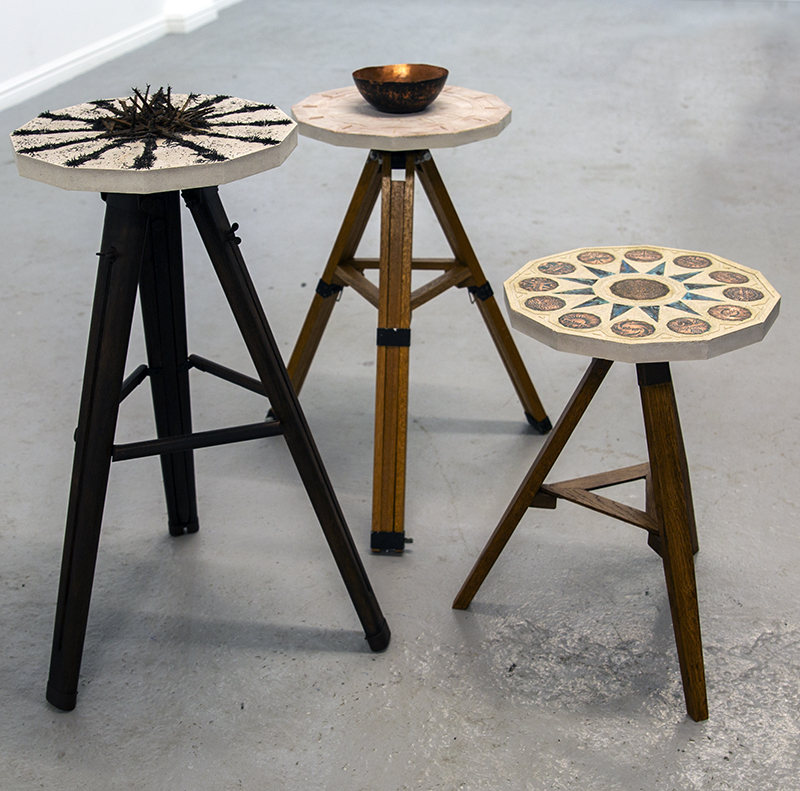
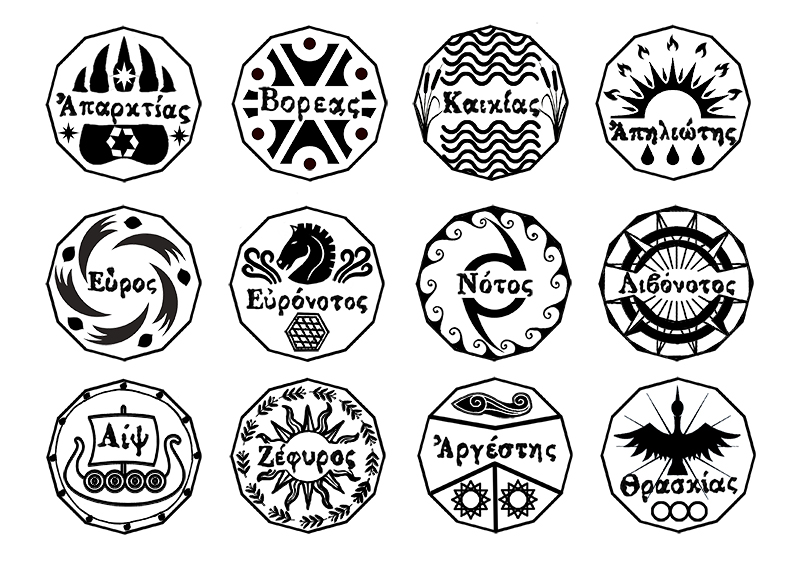
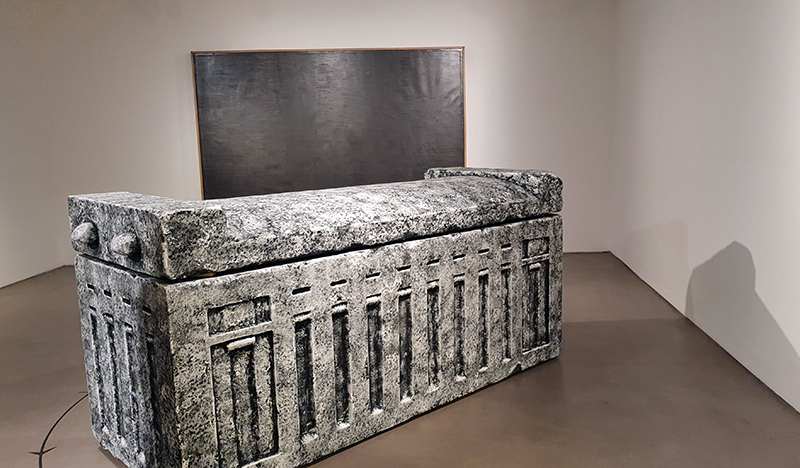
Instruments of the Anemoi are a set of dodecagon tablets cast in Snowcrete, a non-magnetic cement, as used in a magnetic observatory. Suggestive of the pedestals that support various instruments used in monitoring the Earths’ magnetic field they also respond to an ancient anemoscope “table of the winds” carved in marble around eighteen hundred years ago and inscribed with the Greek and Latin names of classical winds on each of its twelve sides. Envisaged here as speculative objects, instruments and schematics wrought by the wind gods, the first emissaries of navigation and orientation.

One tablet holds a copper bowl with a ‘silver fish’ floating in water. The shape of the ‘silver fish’ is based on the oval shaped compass needle (illustrated in Breve Compendio de la Sphera de la arte Navegar by Martin Cortes 1551)  and refers back to wafer thin fish shaped iron leaves used by 11th century Chinese geomancers.

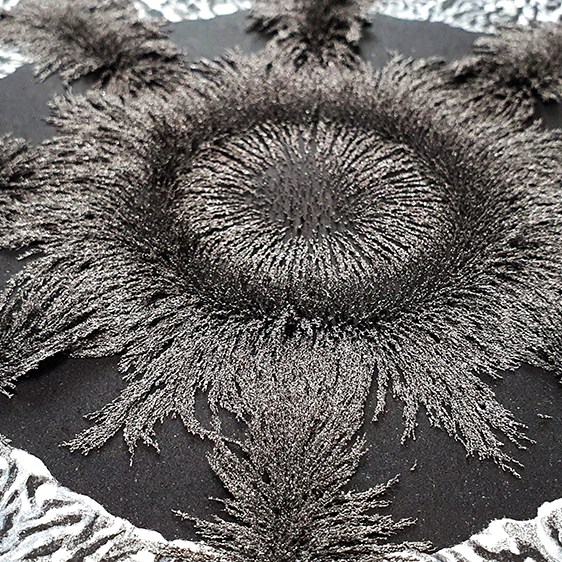
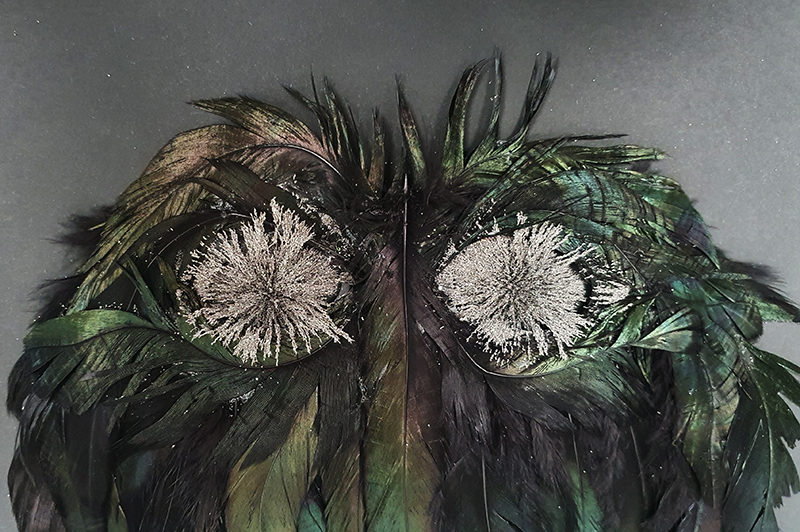
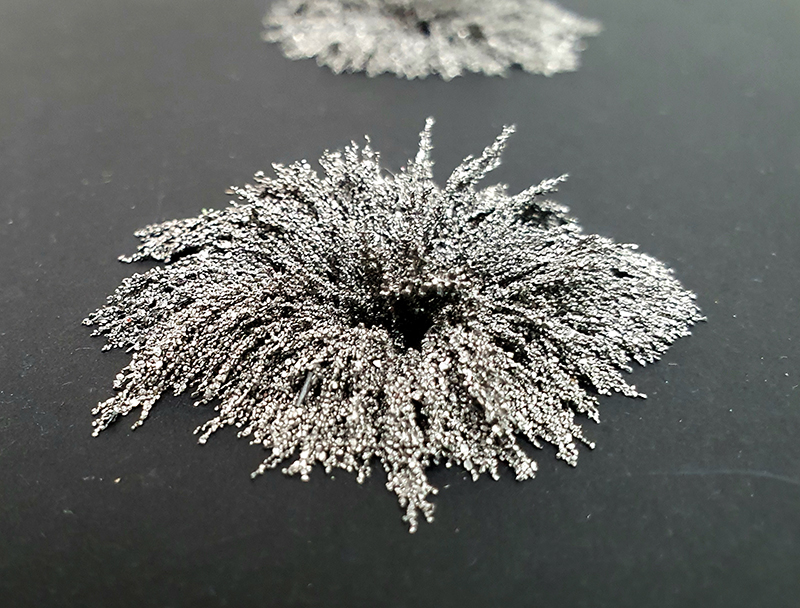
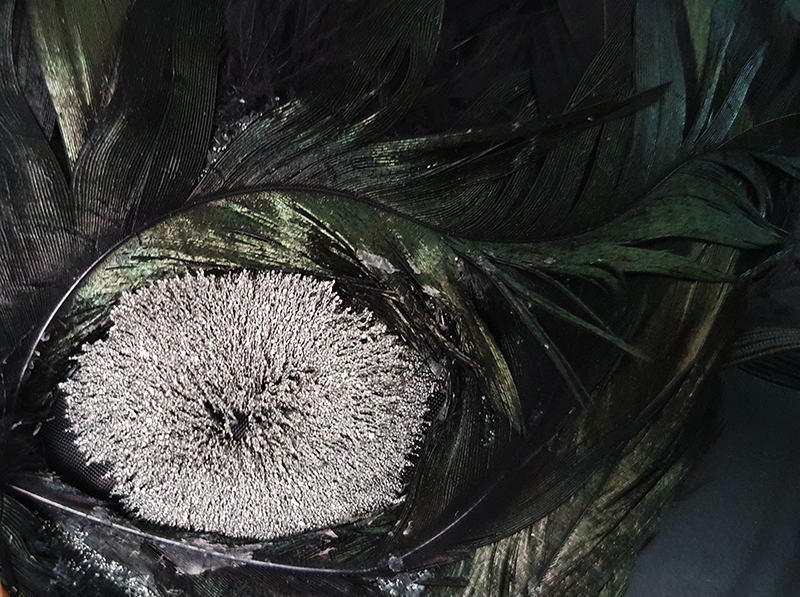
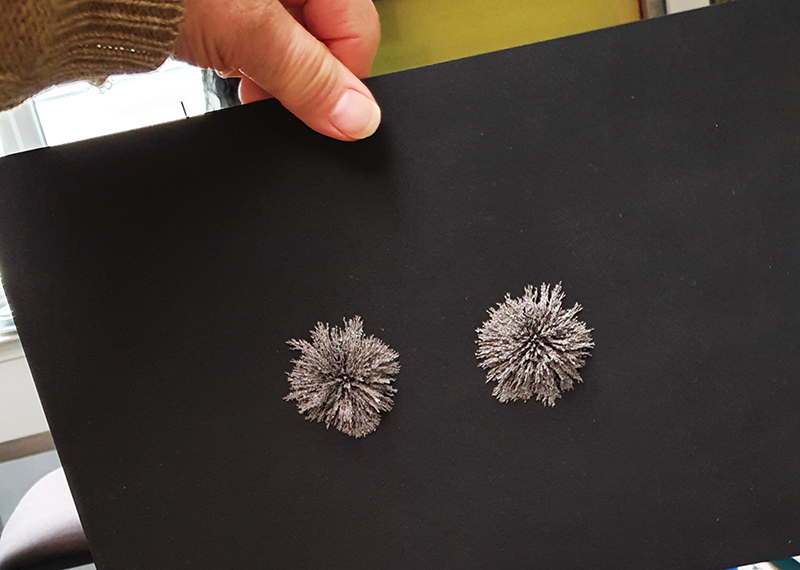
Nails and iron filings on the second tablet reveal an embedded magnetic field recalling a legend that the discovery of the lodestone was made by a Greek shepherd who noticed the nails in his boots were attracted to the rock (magnetite) beneath his feet.

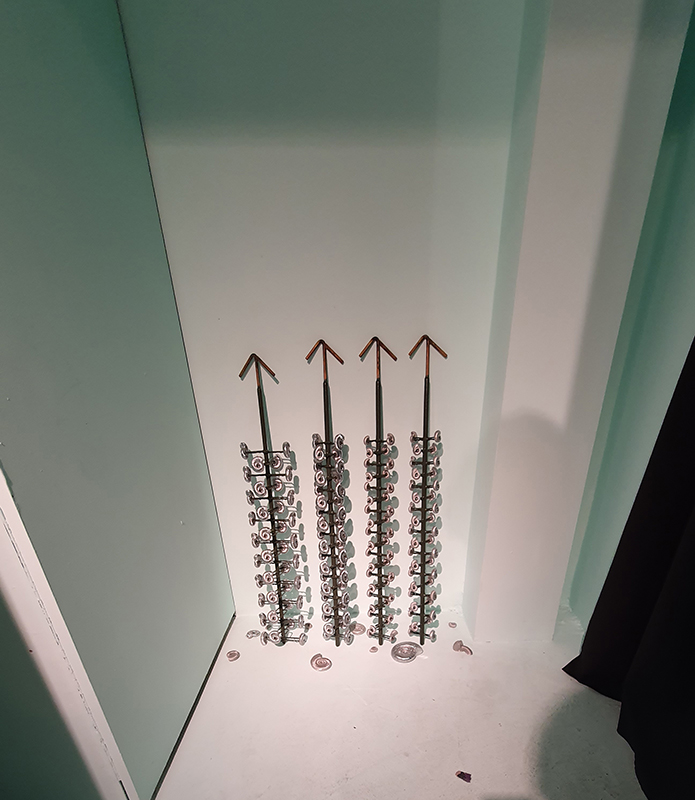
The third tablet is embedded with copper etched with images and names based on associations and attributes of the twelve Greek wind gods set in a traditional compass rose.

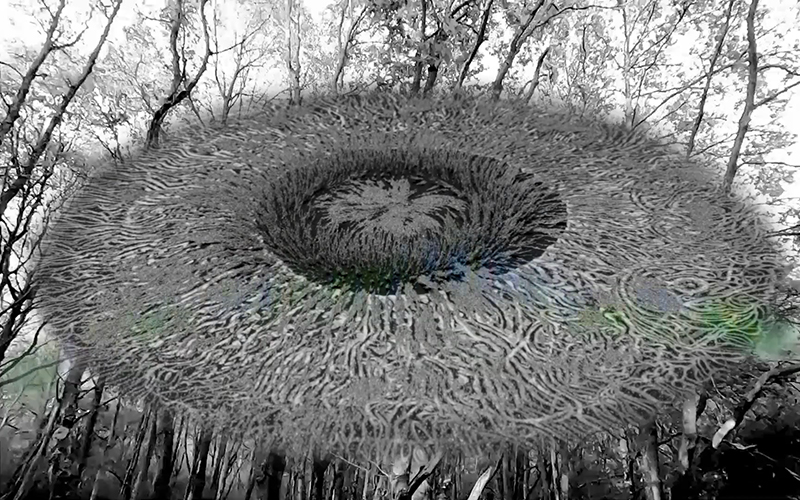
Domain of the Devil Valley Master uses industrial directional magnetic steel, sanded and etched to reveal the Goss texture of rolled iron silicon alloy crystals. The jigsaw pattern of magnetic domains give this material exceptional magnetic properties. The simple evocation of a spiral described in geologically informed polygons draws upon many references, from the shape of our own Milky Way Galaxy sculpted by vast cosmological magnetic fields and the spiralling molten dynamo generating Earth’s magnetic field, to the inner pathway of spiritual growth and the route to the symbolic omphalos (navel) at the centre of the world where the sky entrance and the underworld meet. The title of this work originates from an ancient Chinese manual on the skills of persuasion, The Book of the Devil Valley Master, containing the first known mention of a compass, known at the time as a south-pointer.
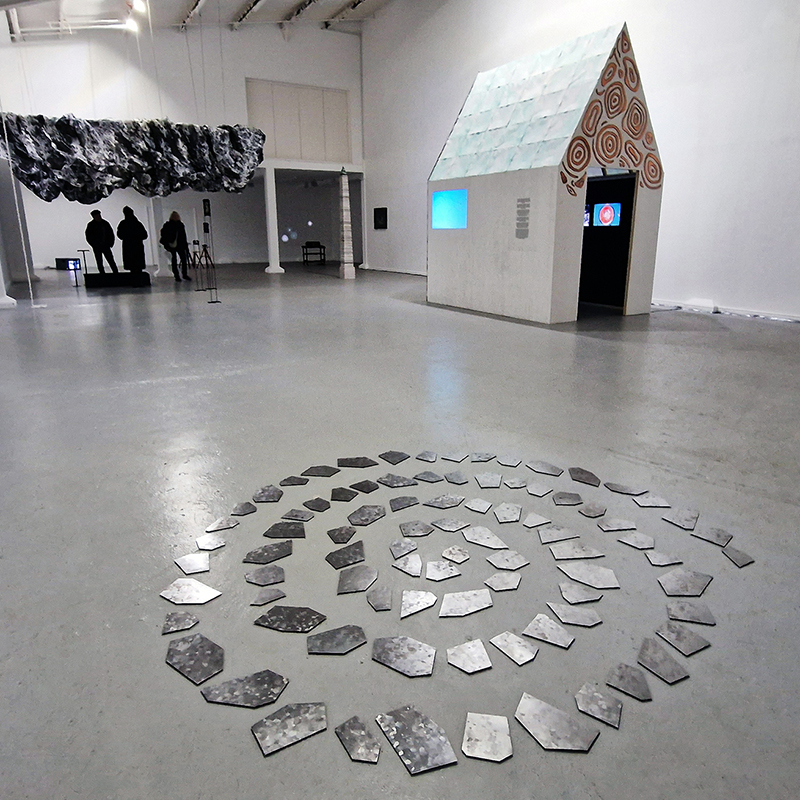
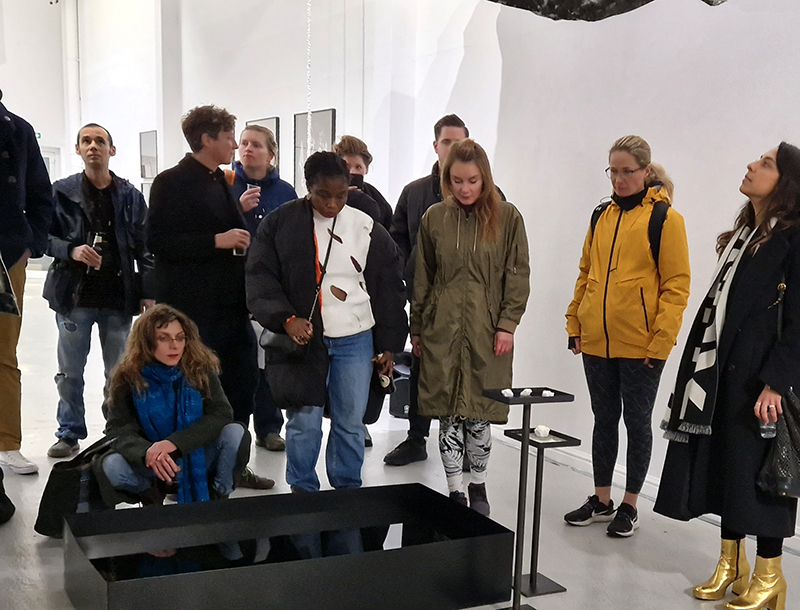
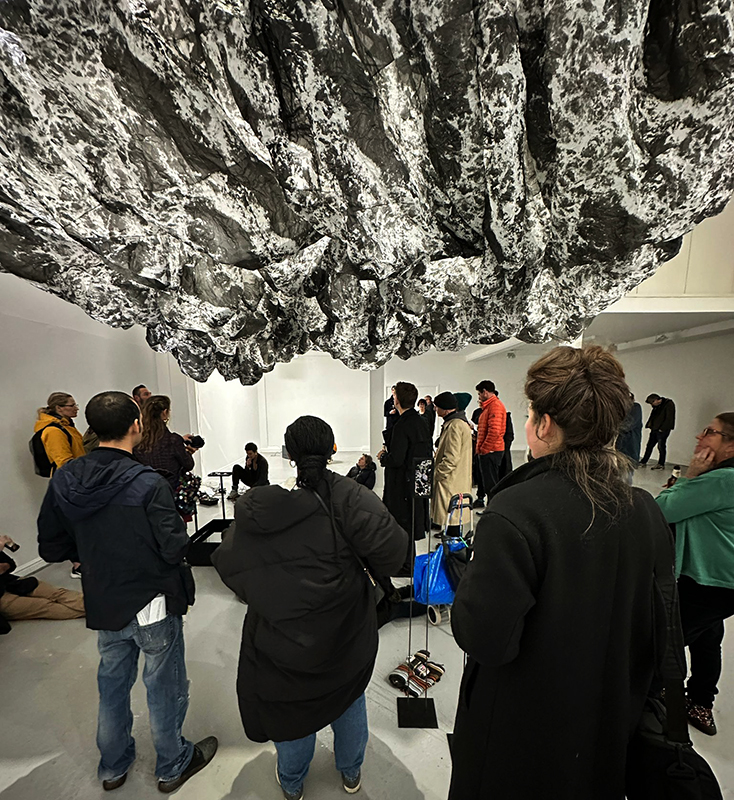
The exhibition closed with an afternoon event launching our publication which includes the essay Dark Nights and Signs of Unseen Things by Anjana Janardhan. There was also a live cloud chamber demonstration of mesmerising cosmic ray trails, artist tours and informal readings.

Publication available – DM via blog comments box for more details or visit Julie’s shop

Photoshoot with Warren King Photography resulted in some great images of my work ready for the press release and promotion of A STONE SKY – the upcoming joint exhibition, with Julie F Hill, that we have been working towards for many months. The exhibition will be at Thames-side Studios Gallery 11th – 26th November 2023 with a private view on 10th November 6-9pm.

Susan Eyre, Azimuth Obelisk (of sedimentary knowledge), paper, concrete, patinated copper, 2023 (detail) Photo Warren King Photography
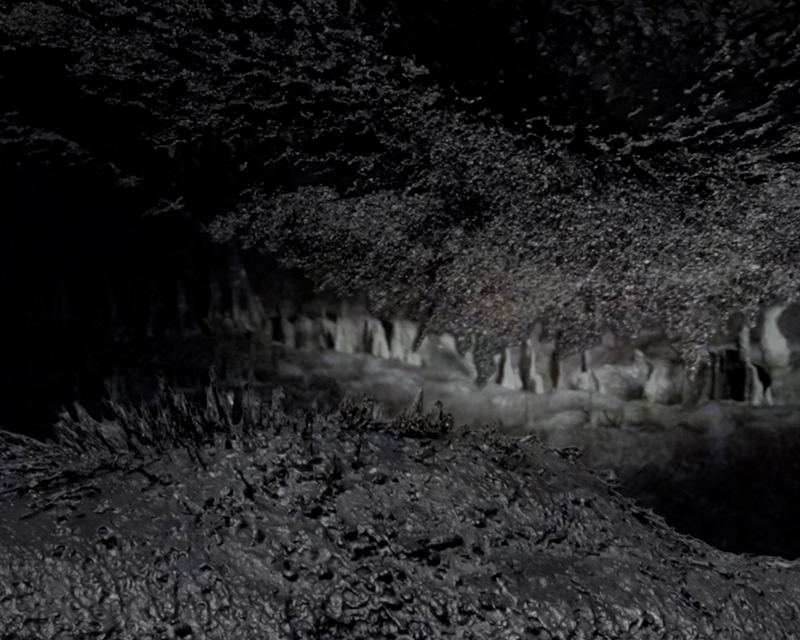
Julie F Hill, Cave, physically manipulated print of infrared James Webb data of barred, spiral galaxy NGC 5068, 2023 (detail).
Photo Julie F Hill

A Stone Sky brings together the works of multi-disciplinary artists Julie F Hill and Susan Eyre who traverse cosmic layers from the deep earth to deep space, exploring manifestations of darkness and its associations with the unknown and undiscovered. Reimagining the idea of an observatory, their sculptures and installations reach for scales and orders that surpass the human, revealing the cosmic at our feet. The exhibition proposes a cavernous realm of real and speculative possibilities that arise from beyond the limits of human perception. Engaging with the extended sensory range offered by technologies such as orbiting space telescopes through to the ability of birds to ‘see’ the Earth’s magnetic field, the artists’ reveal intimate connections between earth and space.

It was great to meet Anjana Janardhan who we have commissioned to write an essay for a publication which will be launched on the final weekend of the exhibition. We are also planning to give some informal readings, tours of the work and I will be running the cloud chamber so visitors can see the trails of cosmic rays – a way of visualising these unseen visitors from the stars.

The Azimuth Obelisk (of sedimentary knowledge) sculpture is an almost 3m tall reimagining of the obelisk erected at Hartland Magnetic Observatory in 1955 as an azimuth mark to be viewed from the Observing Room or Absolute Hut to monitor the drift of the magnetic north pole.

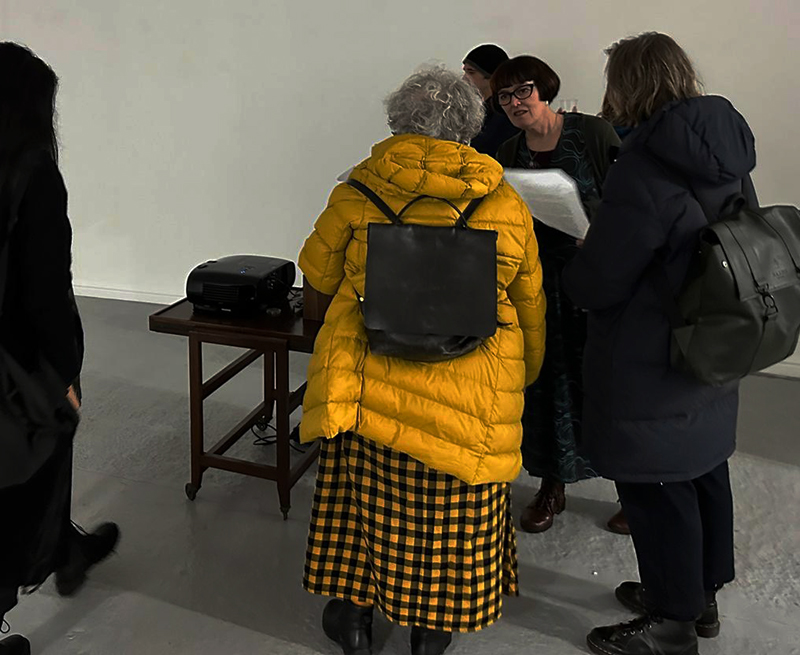
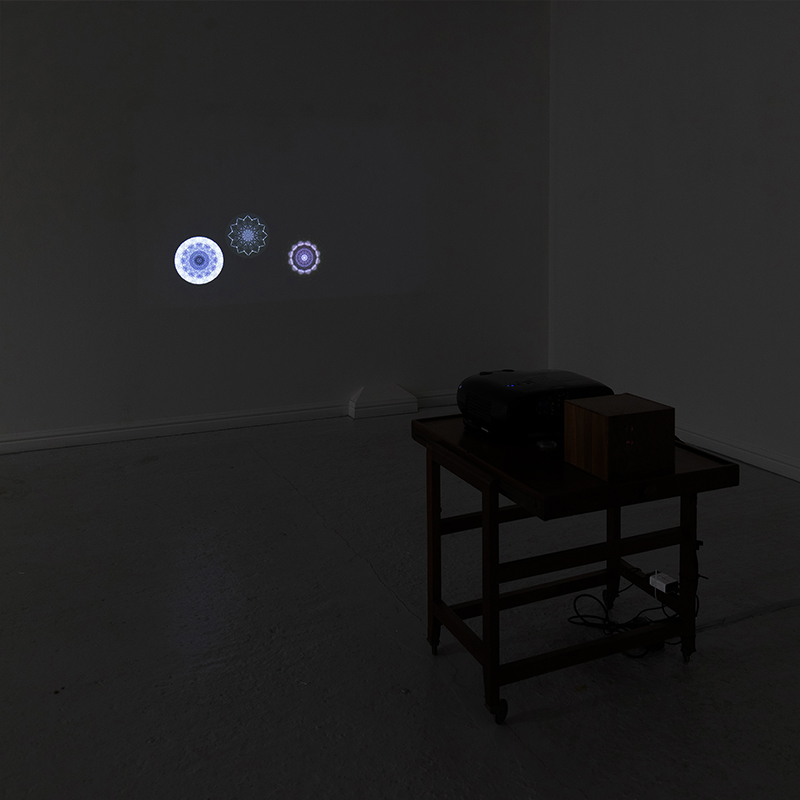
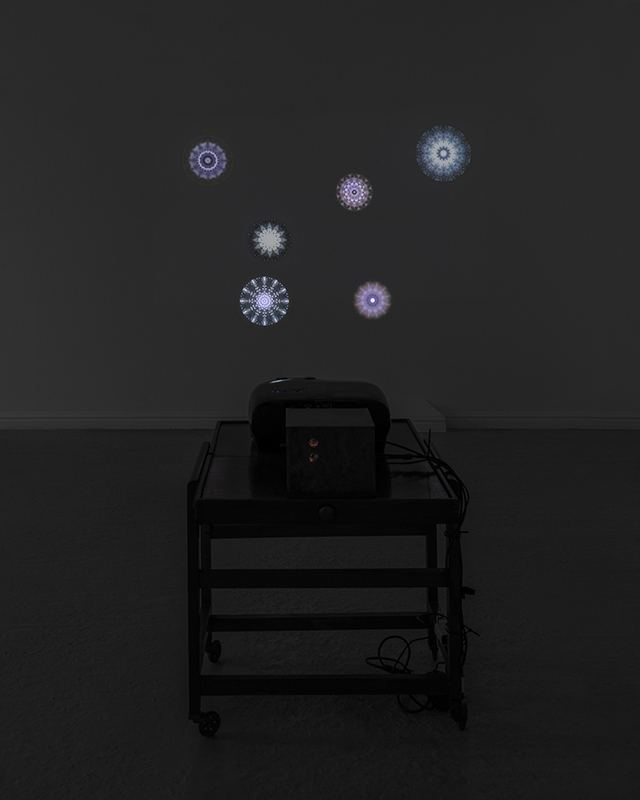
I have obtained an old wooden trolley to put the cosmic ray detectors and projector on for the digital video work The Breath of Stars. This feels in keeping with the original furniture used at Hartland Magnetic Observatory. The Breath of Stars directly interacts with cosmic rays – as each cosmic ray particle strikes a plastic scintillator its energy is recorded and a starburst image video is projected. The interaction of cosmic rays and the solar wind with atmospheric electrical fields combines to influence the unpredictability of the magnetosphere. Most radioactive particles heading for Earth are deflected by the magnetosphere. Without the Earth’s magnetic field deflecting the majority of cosmic rays, life on this planet could not survive.

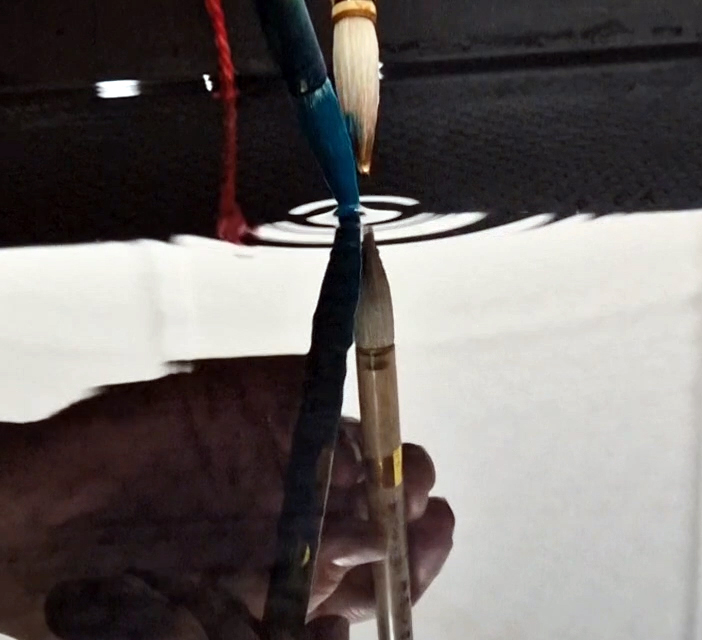
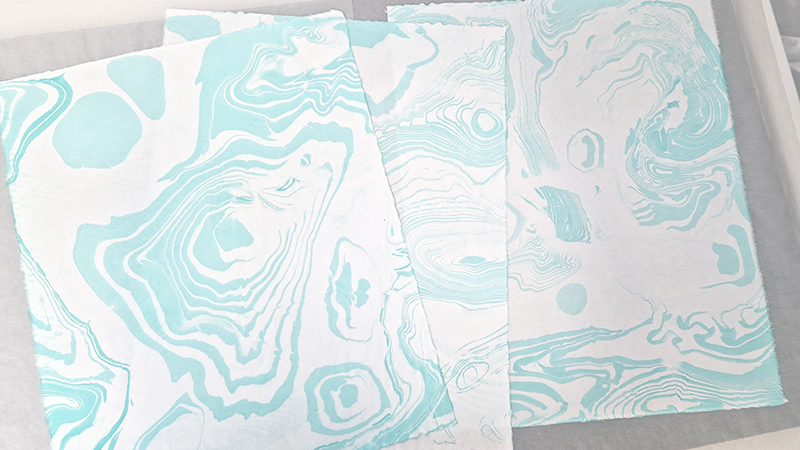
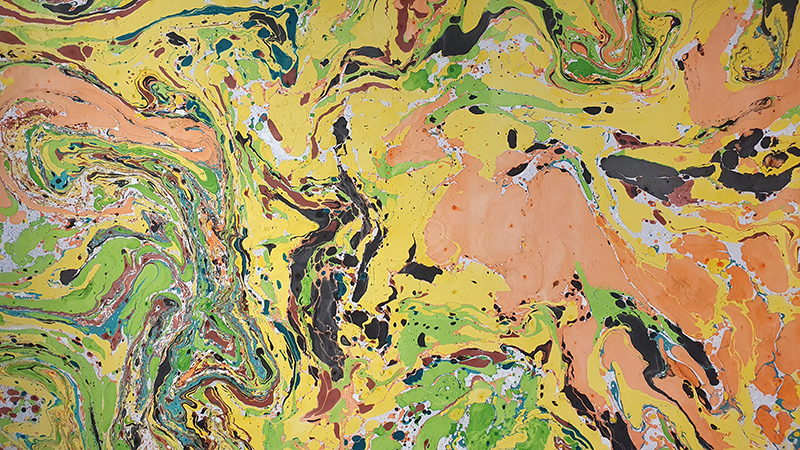
The 48 paper tiles for the roof of The Absolute Hut (of action potential) are made using the suminagashi technique of marbling with a colour to reflect both the sky and the patinated copper roof tiles of the Observation Hut at Hartland Magnetic Observatory. The paper is Japanese Osho Select and is very fragile when wet so has to be pulled from the water tray using a supporting mesh. Topological contours of suminagashi marbling reflect the fluid motion of the Earth’s magnetic dynamo and the pulsating alpha waves of the human brain when subjected to magnetic fields.

If you place a polarising filter over a screen that emits polarised light and use a polarising lens on the camera, then any plastic, photographed in this method, especially injection-moulded plastic, reveals stress points with a kaleidoscope of colours known as birefringence. Cryptochrome, the protein molecule found in a birds eye that enables birds to ‘see’ the magnetic field is excited by polarised light. Polarisation may also reveal the existence and properties of magnetic fields in the space medium light has travelled through. Research suggests that human alpha brainwaves react to a changing magnetic field. These ideas are brought together in a video work speculating on human magnetoreception via magnetite crystals in brain cells.

This video work will be shown on multiple small screens inside The Absolute Hut (of action potential) alongside two larger monitors showing companion video pieces exploring dynamics between the Earth’s geologic structure and navigation using the magnetic field.

I have replicated the experiment I saw at the National Physical Laboratory, dropping a magnet down a copper pipe to see how the magnetic field generated slows the magnet down considerably. I filmed this and added a tiny led light with the magnet.

Finally dark skies and fine weather coincided so I was able to go and make a time lapse of the stars rotating around Polaris.

Instruments of the Anemoi is a set of three dodecagon tablets cast in Snowcrete, a non-magnetic cement, as used in a magnetic observatory. Suggestive of the pedestals that support various instruments used in monitoring the Earths’ magnetic field they also respond to an ancient anemoscope “table of the winds” inscribed with the Greek and Latin names of classical winds on each of its twelve sides.

Hand cut copper pieces to be etched with images based on associations and attributes of the twelve Greek wind gods.

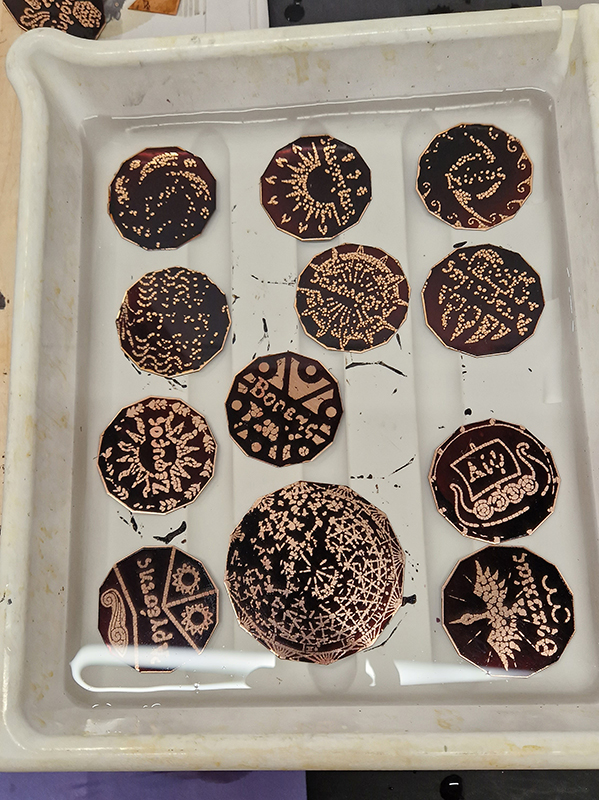
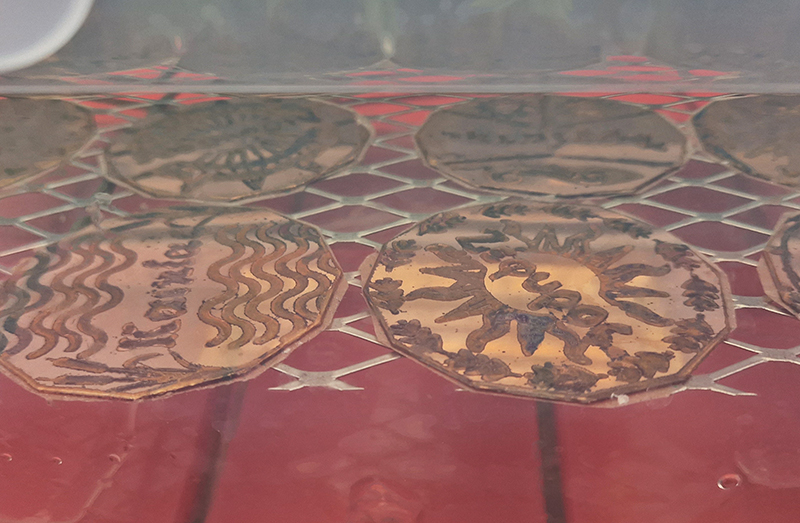
Sugar lift solution is screen printed onto the copper pieces.

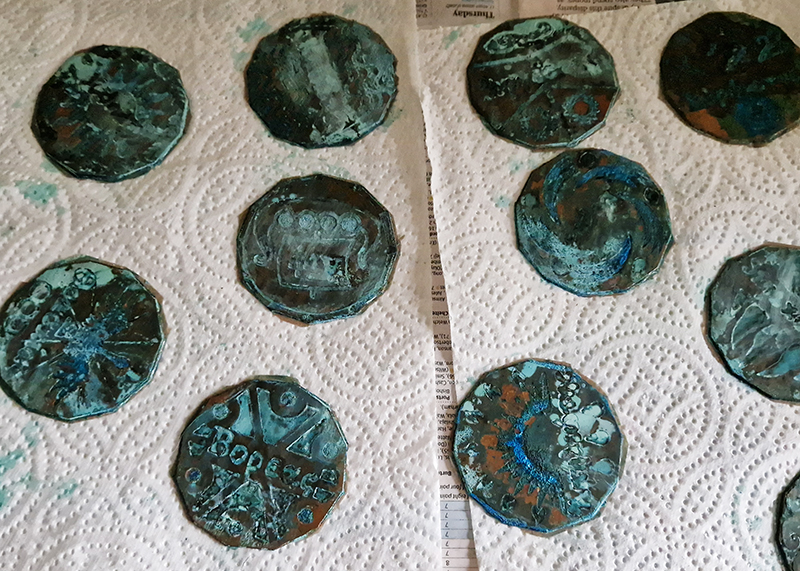
These are then dipped in bitumen and immersed in hot water where the sugar slowly dissolves to reveal the image.

They are then left to dry before being etched.

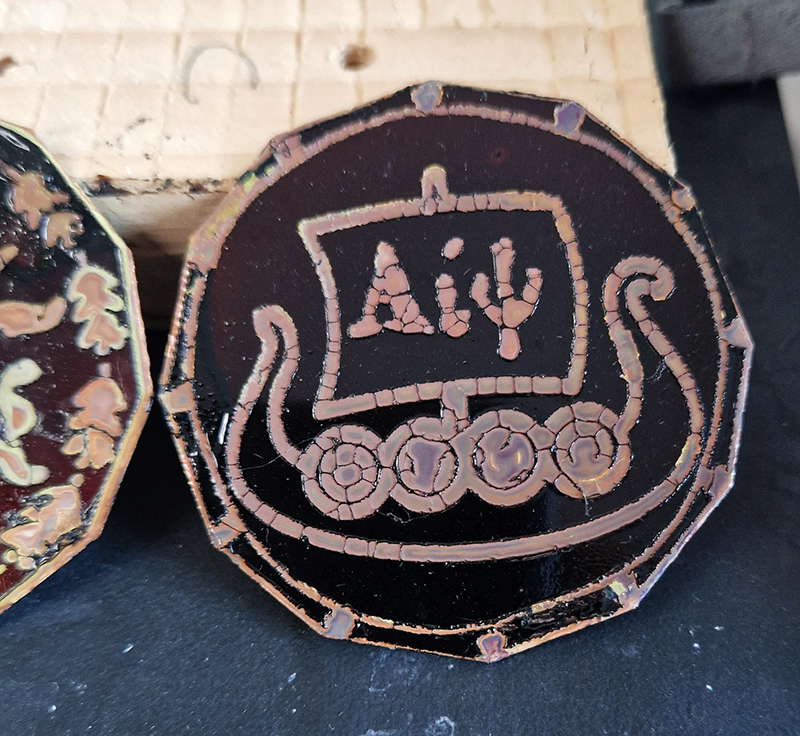
These were etched for 2 hours in an Edinburgh Etch solution, made with ferric chloride, citric acid and water to get a deep etch. The detail in the bitumen held very well. I constructed a collagraph from card to attach them to for casting in concrete. Once etched the detail areas were painted with a soy sauce solution before being placed in an ammonia vapour bath.

After a few hours patinating they are removed to dry before being cleaned up.

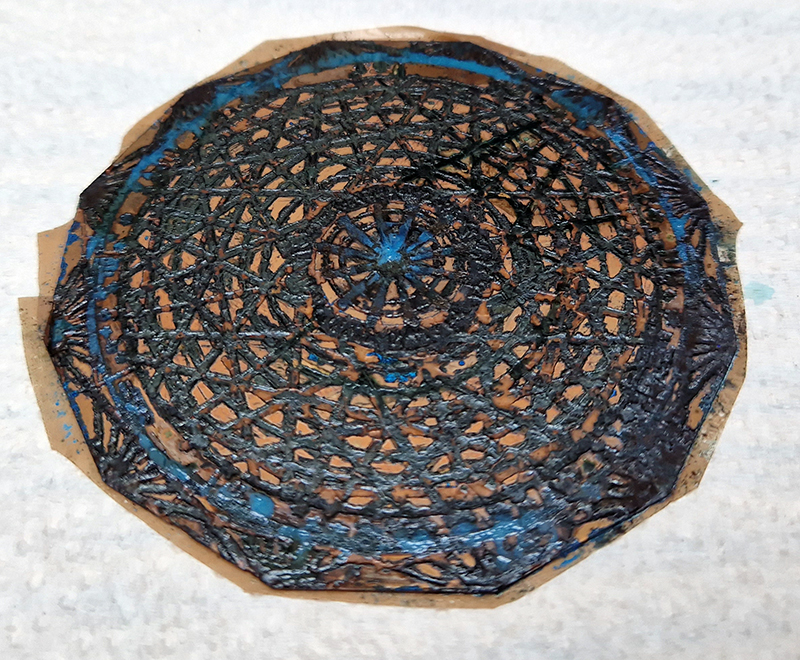
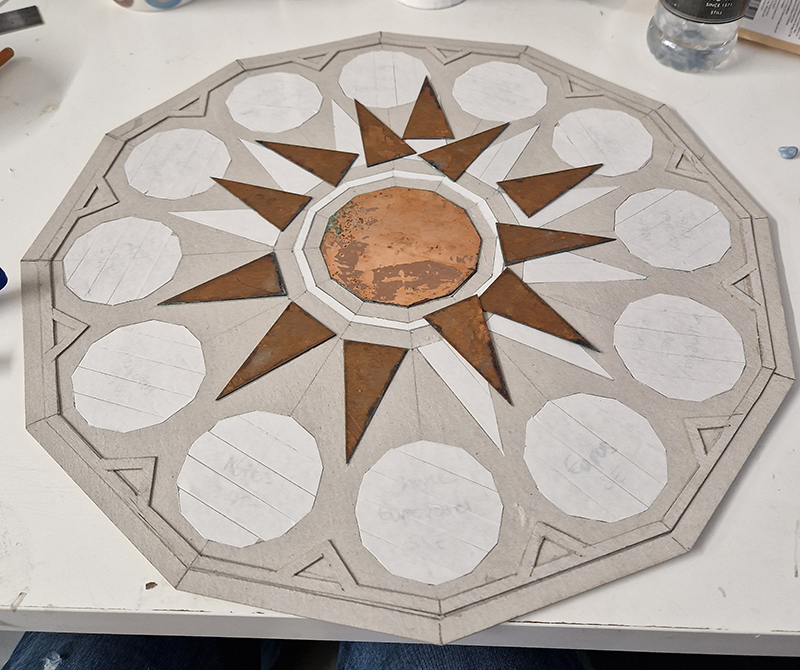
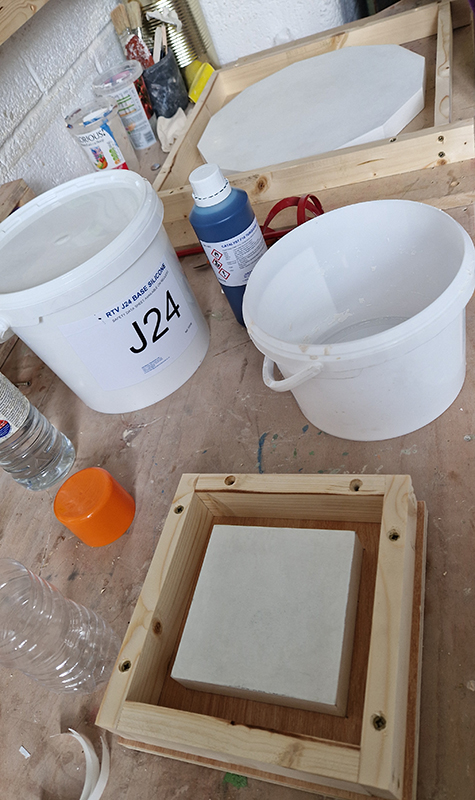
Positions are marked out on the collagraph and double sided tape is used to secure the pieces in place face down. The collagraph is then placed in the silicon mould ready for casting with Snowcrete – the same non-magnetic concrete used at a magnetic observatory.

This is the third of the tablets to be cast for the work Instruments of the Anemoi. The first holds a copper bowl with a ‘silver fish’ floating in water based on the oval shaped compass needle (illustrated in Breve Compendio de la Sphera de la arte Navegar by Martin Cortes 1551) as symbol of the silver fish – wafer thin fish shaped iron leaves used by 11th century Chinese geomancers.

Photo Warren King Photography

The second has embedded magnets in a pattern revealed by old nails and iron filings over the surface. One legend on the discovery of the lodestone recalls a Greek shepherd who noticed the nails in his boots were attracted to the lodestone (also known as magnetite a naturally occurring mineral).

The tablets will be shown on adapted wooden theodolite or telescope tripods in the spirit of equipment seen below during my research trip to Hartland Magnetic Observatory.

Gallery Visits

Seismic Mother curated by Charly Blackburn and Holly Birtles at Hypha Space – an exhibition of 20 artists whose work attempts to communicate the seemingly incomprehensible nature of the earth’s magnitude and magnificence, temerity and resilience as it endures, regenerates and struggles to survive through the slow violence of ecological catastrophe. I visited for the book launch and performative reading from Stephen Cornford whose book, Petrified Matter, I bought. It’s an enlightening read on the links between photography and fossils through mineral, chemical and data recording processes, going on to speculate on future geology and the impossibility of reversing the extraction process by separating minerals used in mobile phones and other technology to return these back to the soil.

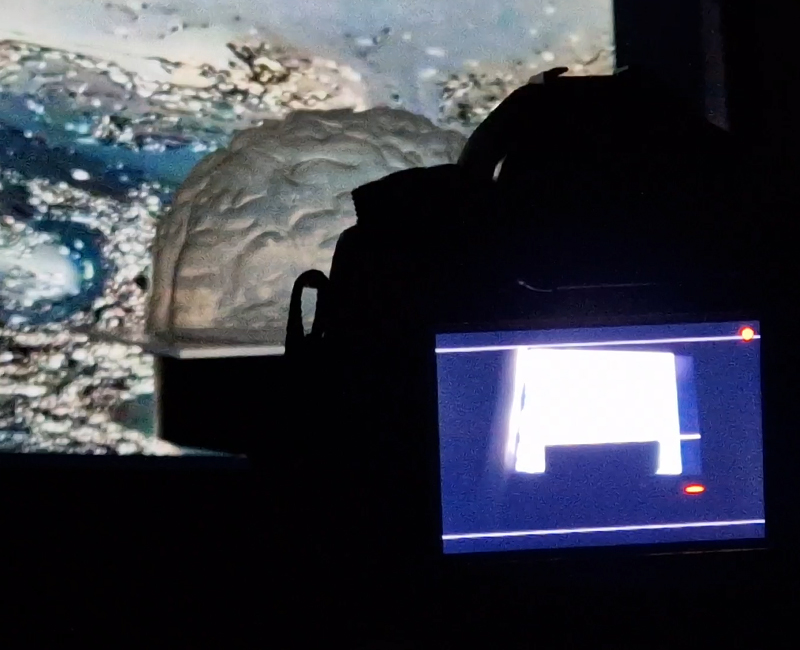
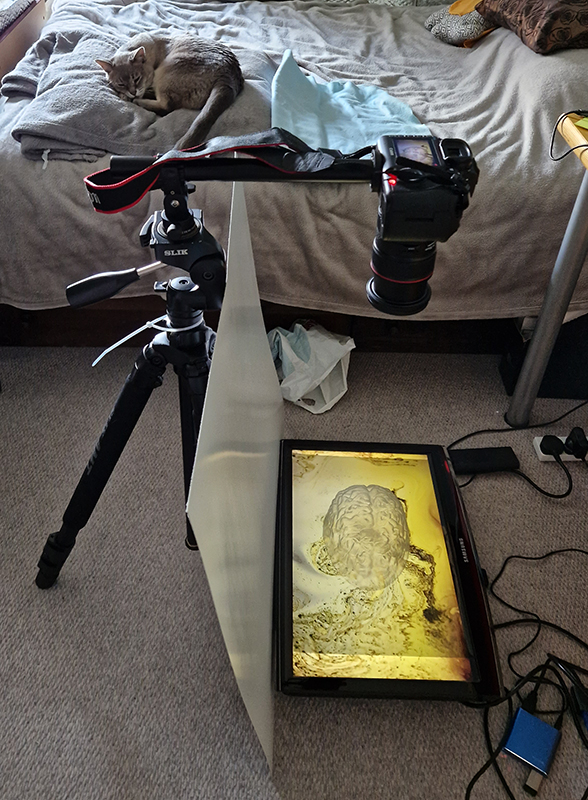
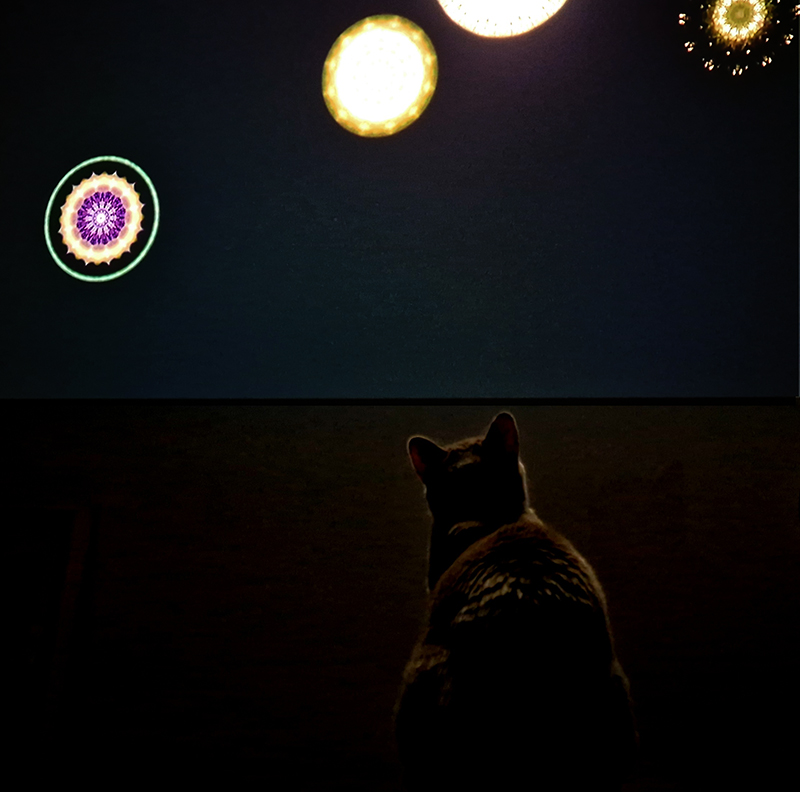
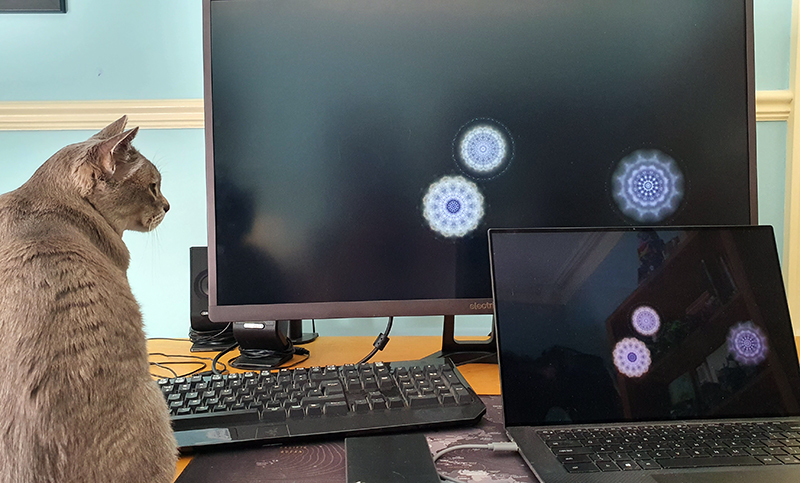
The Breath of Stars is a digital video work activated in real time by cosmic rays. These subatomic visitors from outer space are created during super nova explosions or by phenomena we are yet to discover. This work has been a long time coming and the fact that it is working in real time now is thanks to coding genius Jamie Howard who has managed to get a number video files to play simultaneously on one screen. We had to ditch the Raspberry Pi for a Panda Latte to cope with the processing needed. Cosmic particles strike the edge of the Earth’s atmosphere, break apart and shower down upon us. Some particles collide and silently interact with atoms and technology on Earth. In this work particle detectors and mini computers are connected to a projector. Every time a cosmic particle passes through the plastic scintillator block inside the detector its energy is recorded via a Silicon photomultiplier and a starburst video is displayed for twelve seconds. The kaleidoscopic video images generated are created from footage of cosmic particle trails filmed in a cloud chamber, split and mirrored twelve ways. The particles arrive randomly and this can be witnessed by the sudden flurries and silent gaps of the video imagery. First test run and the cat loved it.

The South Atlantic Anomaly is a region where the Earth’s magnetic field is at its weakest. The intensity of the field here is about one third of that near the magnetic poles. This affects how close to the Earth energetic charged particles (cosmic rays) can reach. This area, which spans the southern Atlantic and South America, is deepening and moving westwards. Could this be the beginning of the overdue magnetic field reversal?

The classical compass winds were named to reflect geographic direction as conceived of by the ancient Greeks and Romans. Ancient wind roses typically had twelve winds and thus twelve points of orientation. The Anemoi (from Greek “Winds”) were wind gods who were each ascribed a cardinal direction.

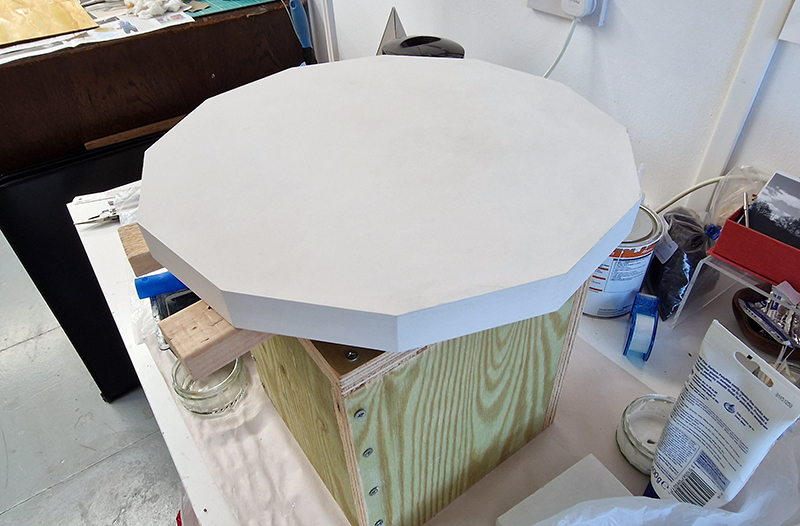
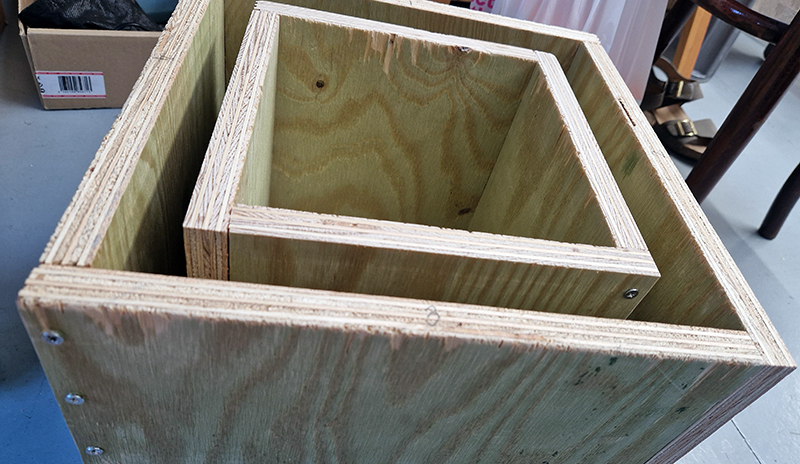
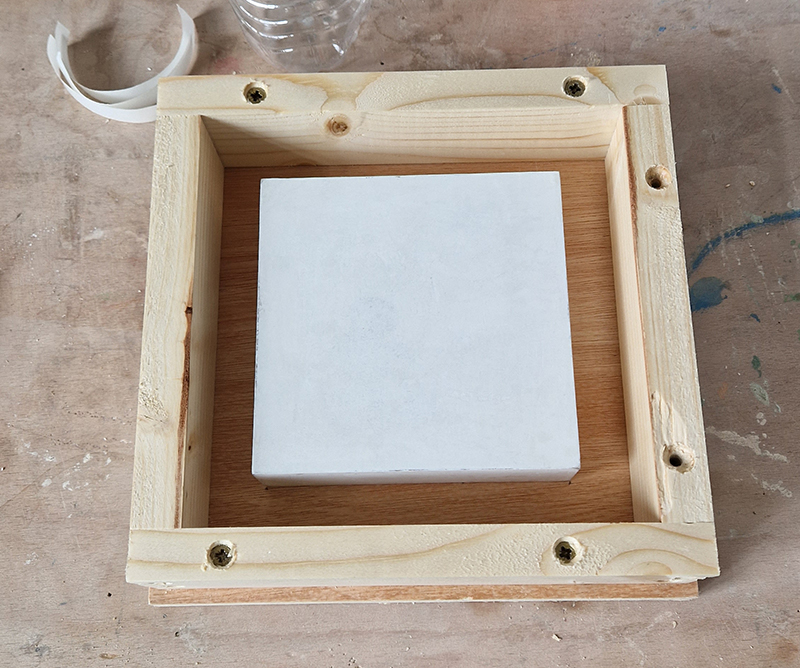
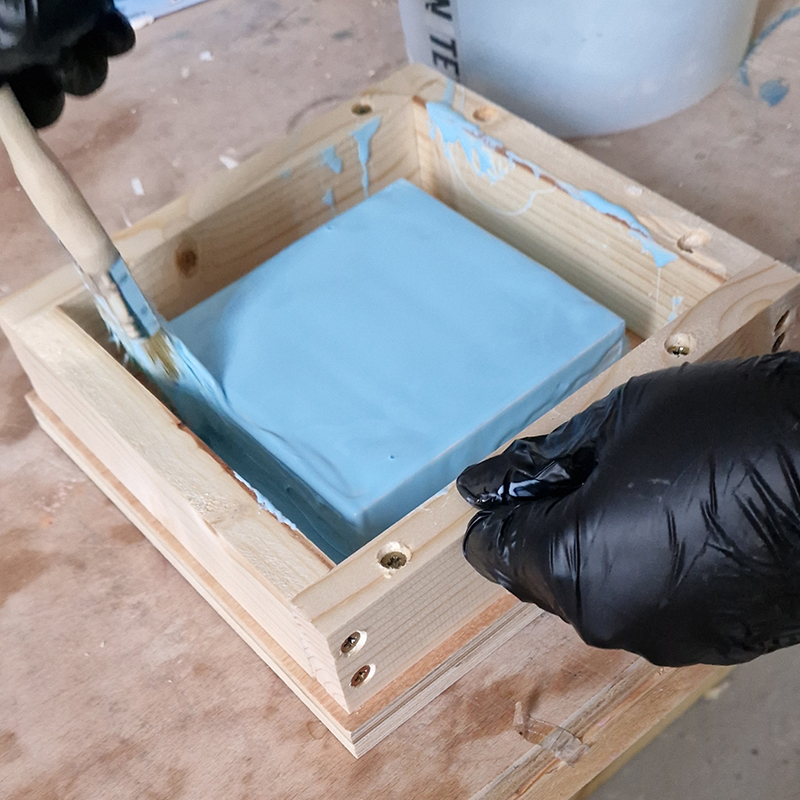
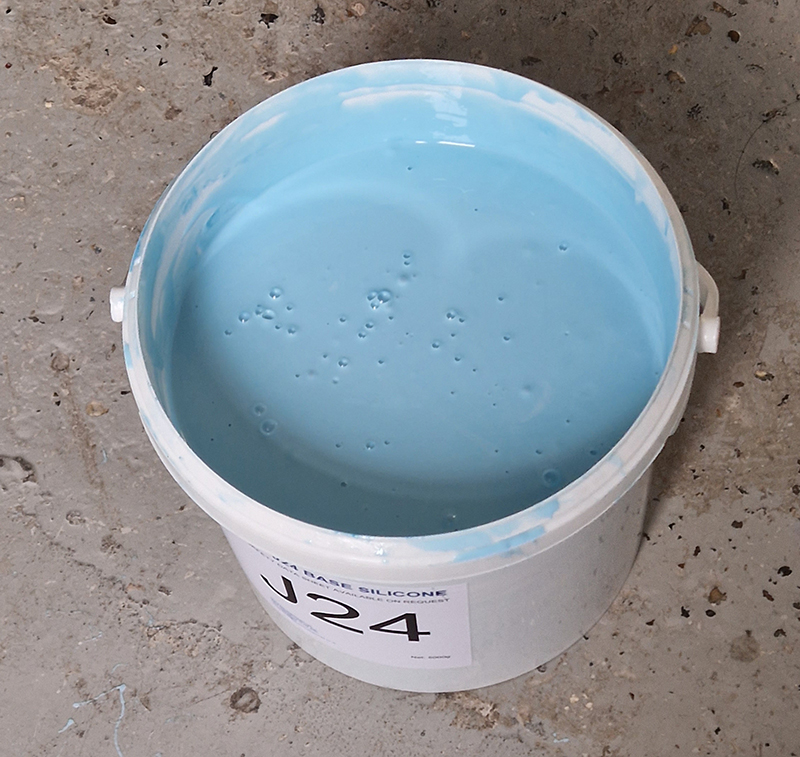
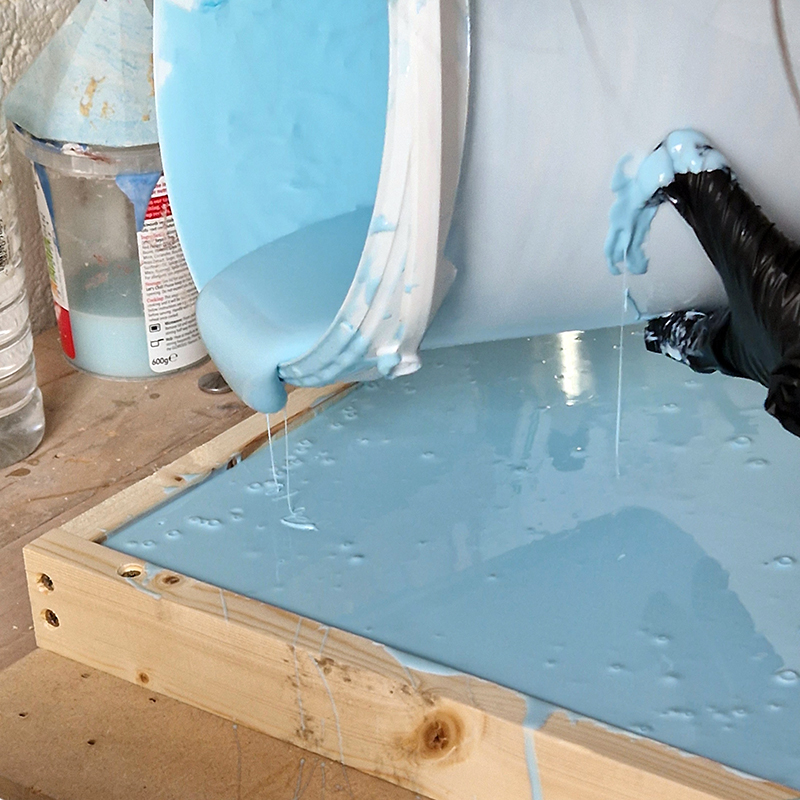
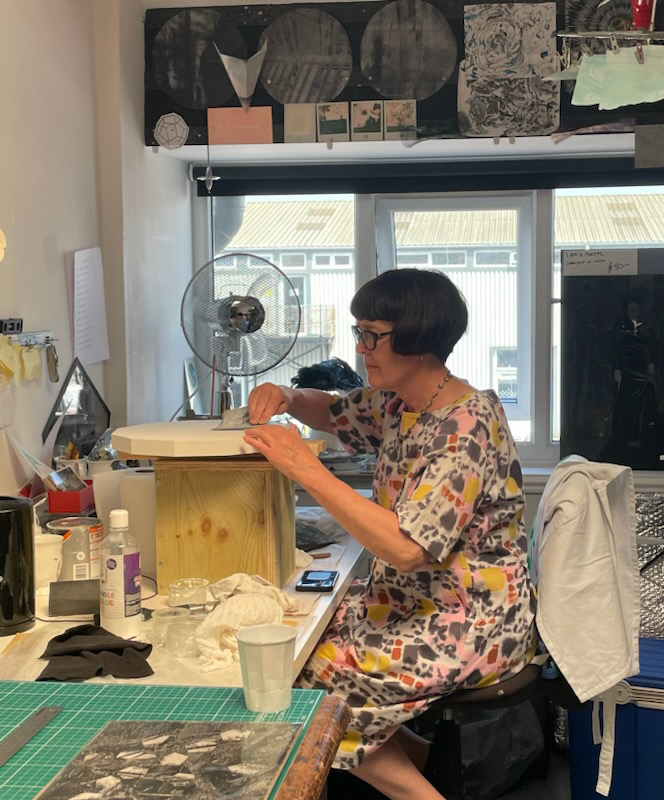
Supported by a professional practice and creative development bursary from a-n The Artists Information Company I have been privileged to have expert tuition in mould making and concrete casting from Anna Hughes based at Thames-side Studios. I have really enjoyed these sessions. Anna has given me the skills to go forward and experiment and I am excited by this new process. I prepared a dodecagon (twelve sided) shape cut in MDF to make a silicon mould and a double box mould for the base of my obelisk sculpture plus some small shapes for testing.

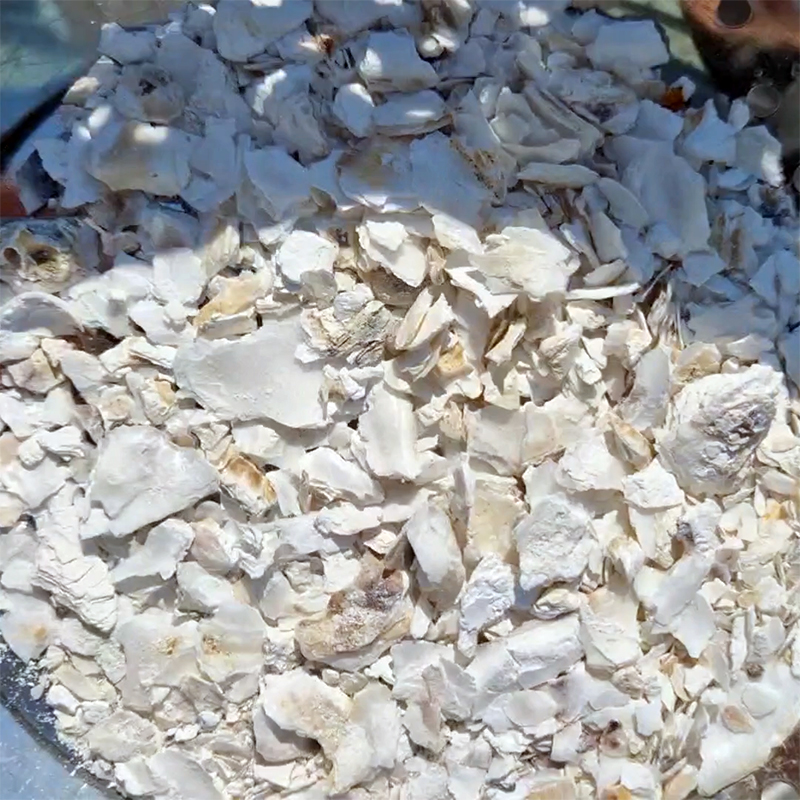
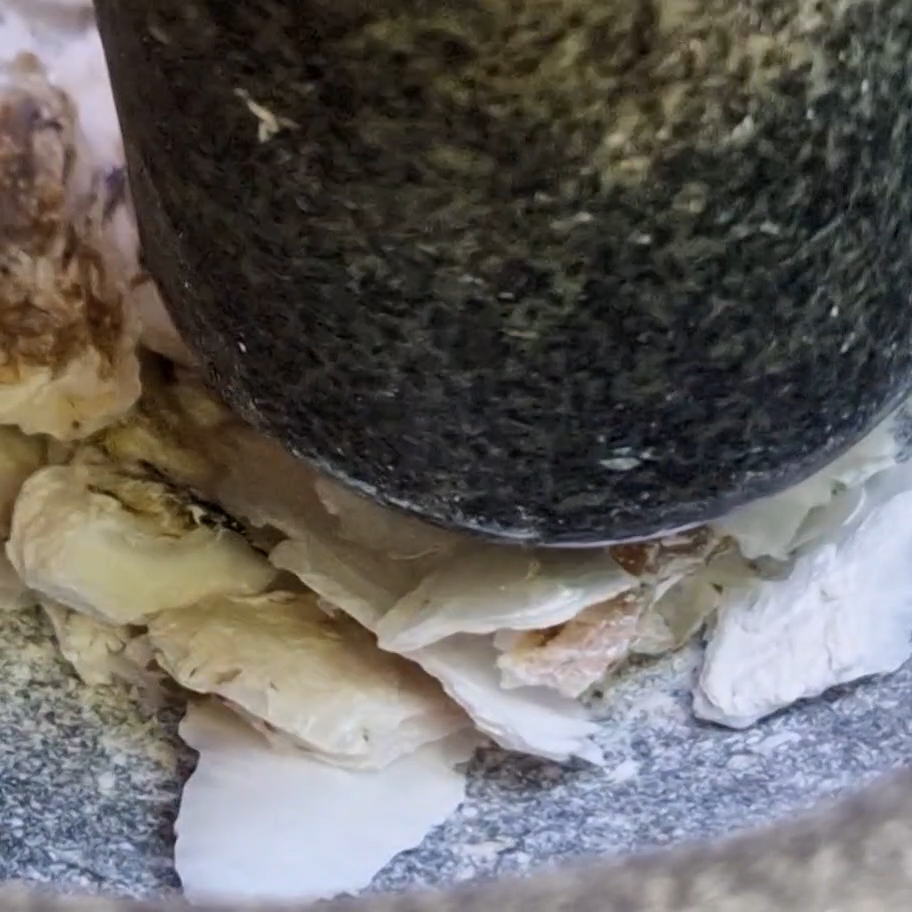
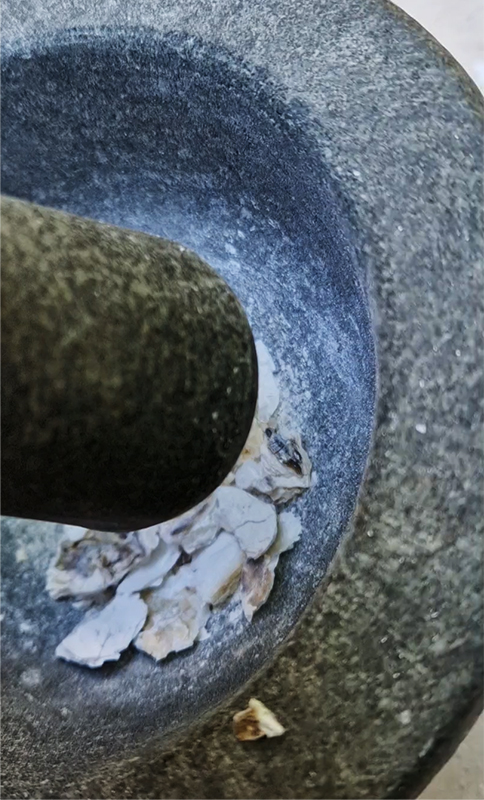
To continue the notion of sedimentary layers as signified by the layering of recycled paper in the body of the obelisk sculpture, I made collagraphs to line the box mould to give a texture of strata. Limestone, a sedimentary rock, is often formed from crushed seashells, compressed over eons. I used crushed oyster shells to use as aggregate for the base.

I am super pleased with how the base turned out.

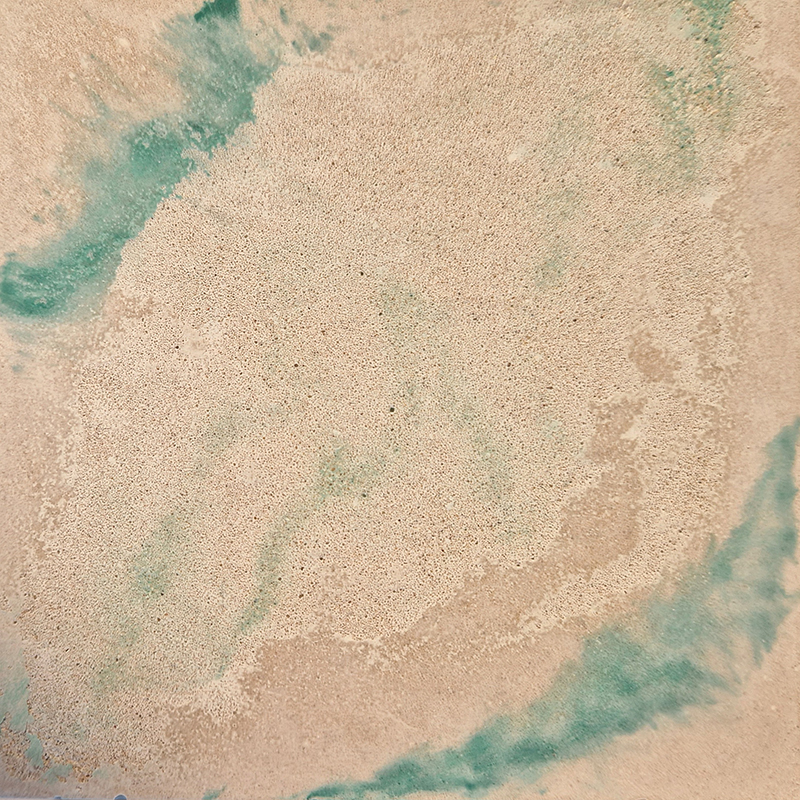
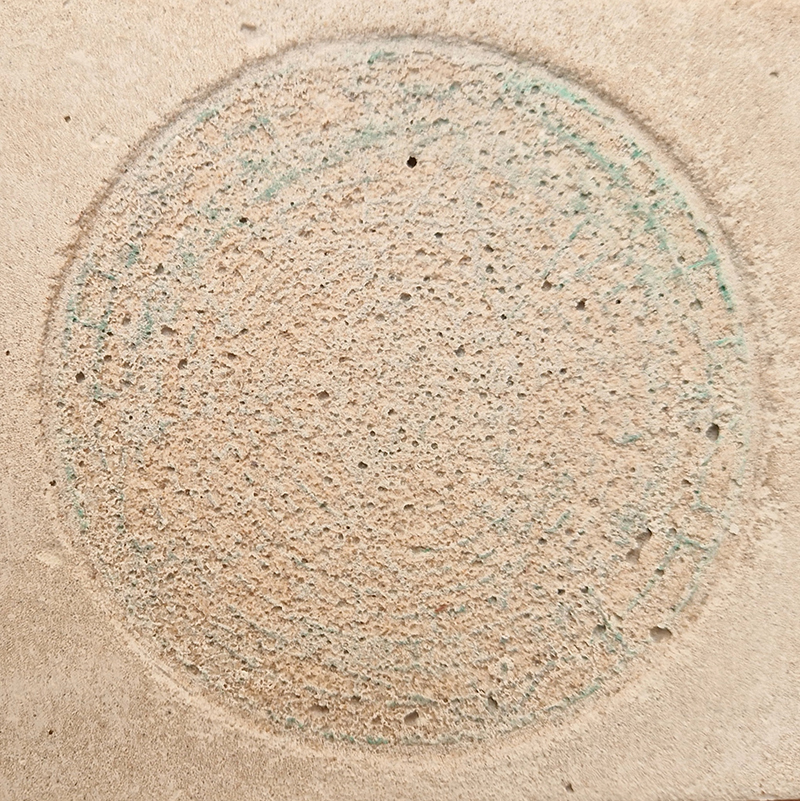
I also tested using verdigris pigment mixed into the concrete or in the grooves of etched aluminium to leave an imprint. The plate tests didn’t come out so clear so need more testing and I next plan to try embedding the etched plate face up in the concrete.

Open Studios at Thames-side Studios 2023.

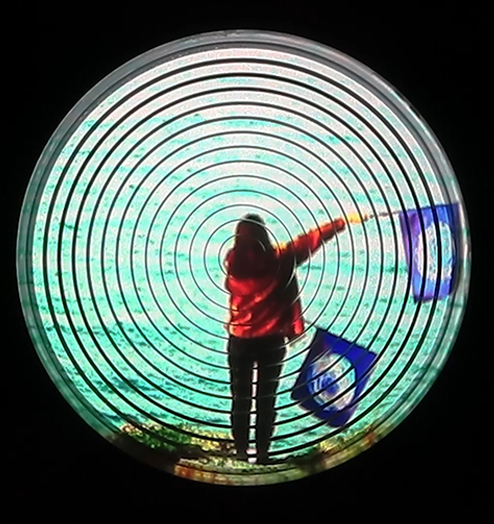
At a distance was installed in the main gallery group show. This work looks at remote methods of communication and relates this to the mysterious twinning of electrons in quantum entanglement where particles link in a way that they instantly affect each other, even over vast expanses. Einstein famously called this phenomenon ‘spooky action at a distance’. Filmed on 29th March 2019 (the first proposed Brexit date), in Cornwall as the iconic Lizard Lighthouse powers up its lamp, solitary figures using semaphore flags sign ‘We Are One’ out across the ocean in the hope the message will be echoed back. Drawing on the physical language of print that embodies touch, separation and mirroring the flags have been printed using hand painted dye sublimation inks applied via a heat press. This process transfers the ink from a paper matrix onto the substrate textile. The image passes momentarily across space in a dematerialized state as vapour before being reformed as its mirror opposite.

In my studio there was recent magnetic work Pole Receptor, along with work in progress Belly of a Rock hybrid sculpture plus some works from the archive such as screen prints from the StrataGem and everydaymatters series. I spent the weekend preparing for my concrete casting tuition in between chatting to visitors. Thanks to Caroline AreskogJones for the studio portrait.

The StrataGem series of screenprints on textiles imagines the possibility of the formation of geological strata created from the waste of plastic food packaging trays.

Informed by the discovery that the matter we know, that which is visible to us and includes all the stars and galaxies is less than 5% of the content of the universe, dark matter making up about 27% and the remaining percentage being dark energy, everydaymatters dissects landscapes to discover the hidden structures of the universe. Images taken from everyday prosaic paradises, such as Paradise Industrial Estate in Hemel Hempstead, are split into constituent parts of what is seen and unseen.

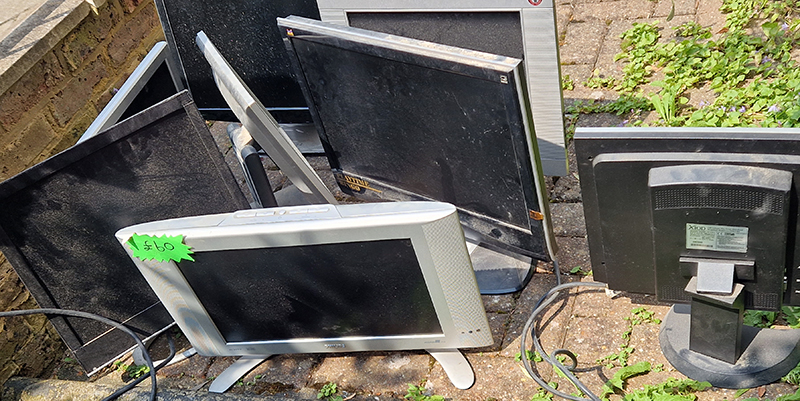
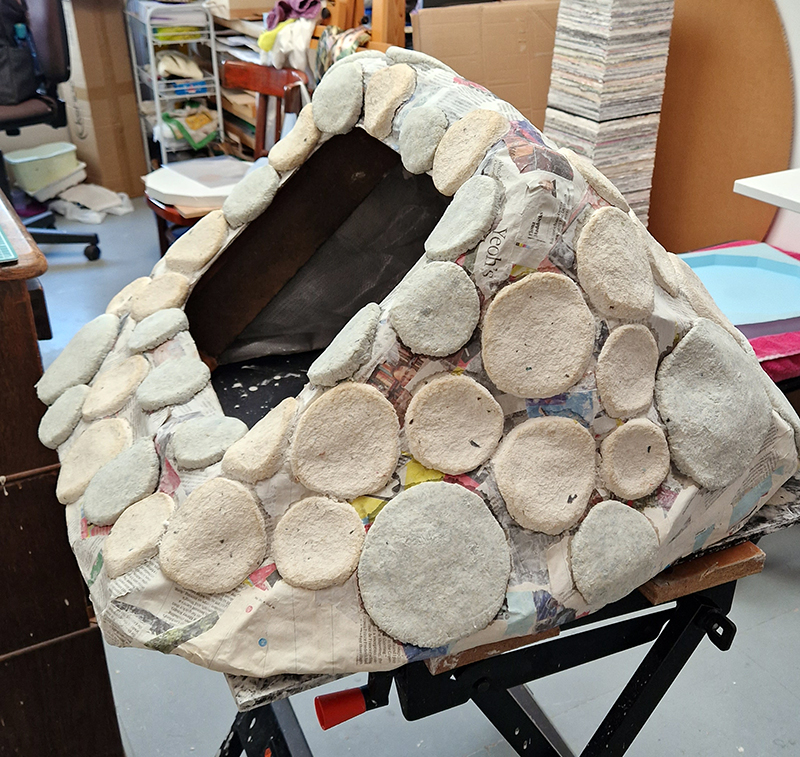
Studio progress on The Azimuth Obelisk of Sedimentary Knowledge – all the paper is now torn down but lots still needs to have a hole drilled through to feed onto the frame. This sculpture is a response to the obelisk erected in 1955 at Hartland Magnetic Observatory, near the site’s northern boundary as a permanent azimuth mark viewed from the north facing window of the observing hut (also known as the absolute hut). I have been sorting out if I have enough old boards for the north wall of The Absolute Hut and have been donated some old monitors and screens to see if I can get them working to use inside. I am thinking of having several screens playing video in the hut – as in the brain – a sensory hub there are different activities and processing going on in different locations. More paper clay forms have been added to The Belly of a Rock sculpture framework to house the video screen – this hybrid sculpture is a place of chemical conversations at the intersection of the animate and inanimate.

Gallery Visits

Fabulous tech and plaster sculptures from Tessa Garland in Postcards From the Volcano at Thames-side Gallery.

Light Being curated by Jonathan Miles of The Wild Parlour at Lychee One.

We were talking of such things: shadows, obscure illumination, folds within substance, but all without a schema that would serve to cohere. Then someone interjected about the rootmeaning of the word for being human as being an entanglement of light, thinking, and being. This would then generate a sense, like something in the air, but also a generation of a spacing for work. Rather than being an exhibition with a theme, instead a tonal poetics and with it a letting be or presentation of an accord would emerge. – Jonathan Miles

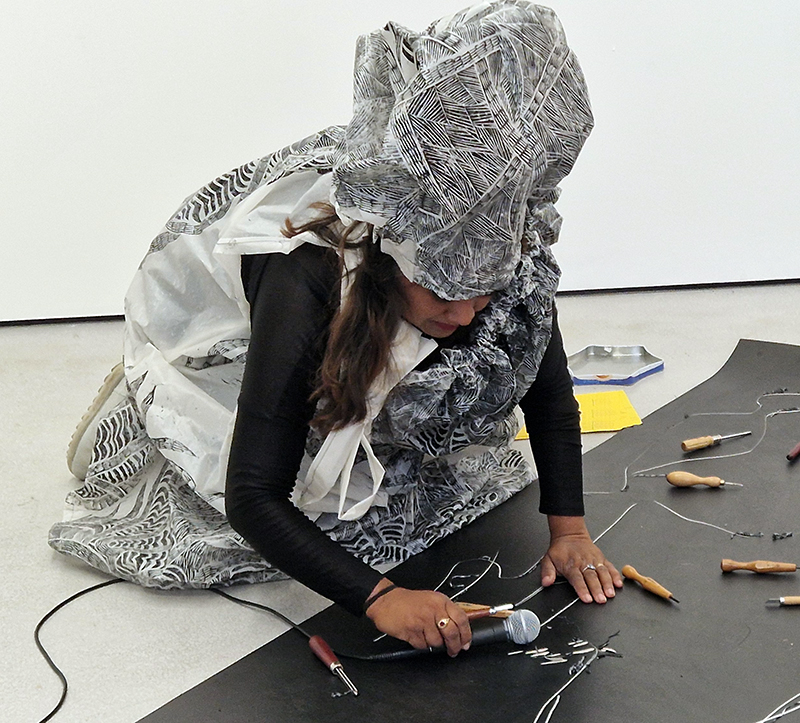
Mesmerizing performance from Chudamani Clowes – Choral Coral Cuts. Performance cutting linoleum to produce a song of coral for coral.

Transport delays meant I missed the first performance but did also catch Kate Howe read The Infinite Intimate which accompanies her sculptural Kraft paper installation and Jessica Mardon recite The Recovery of Meaning.

When numbers weren’t just a unit, a system of measurement, but were symbols that had meaning, it was their meaning that provided structure, not structure that provided their meaning. – Jessica Mardon

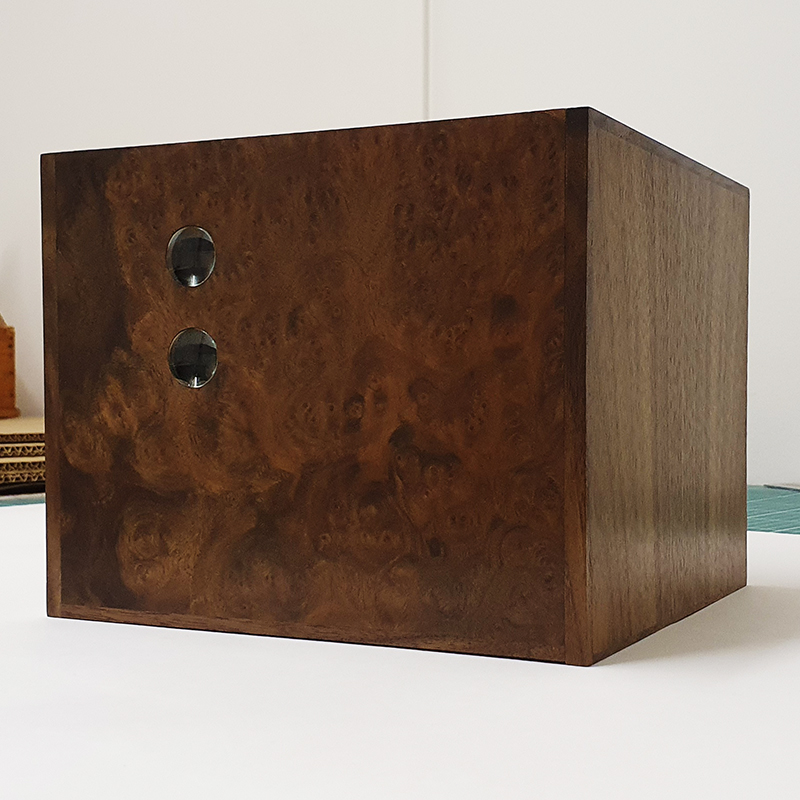
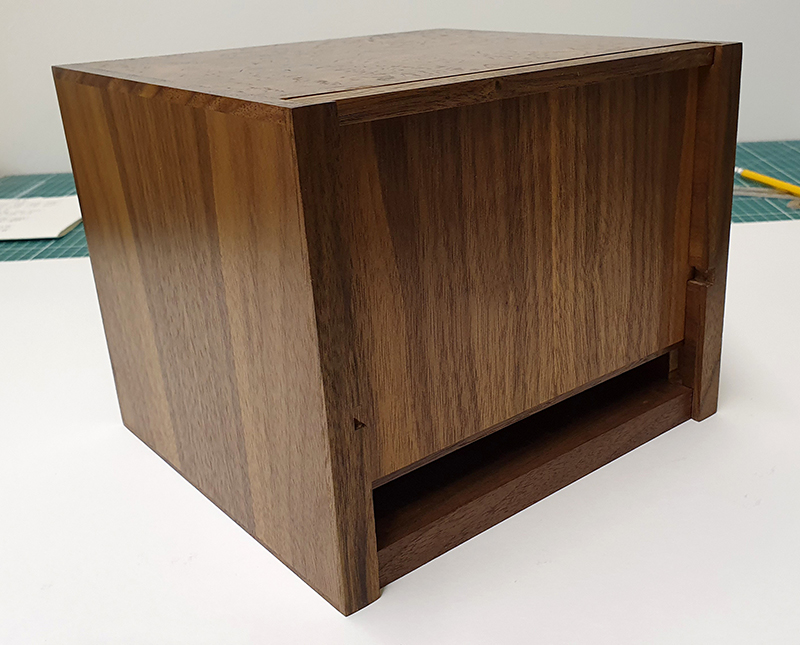
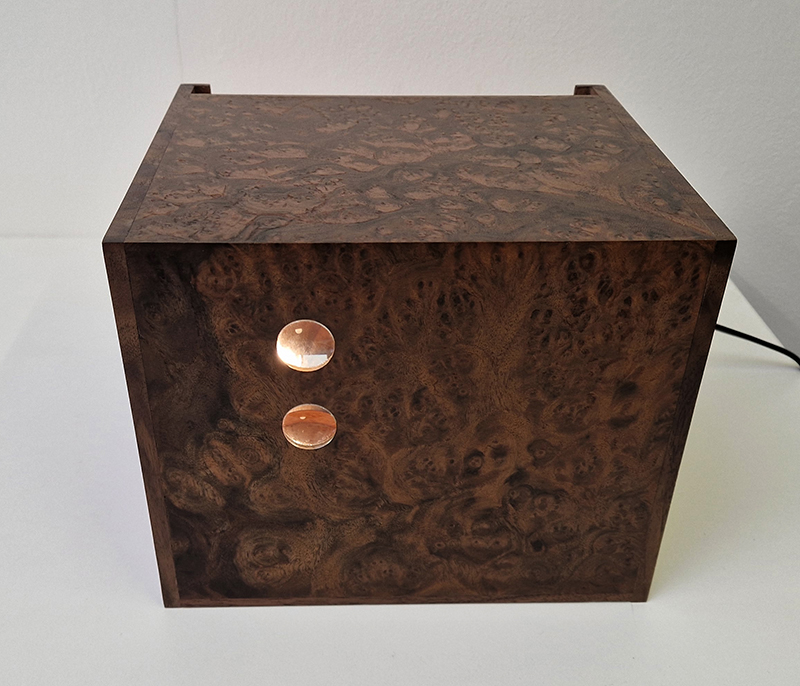
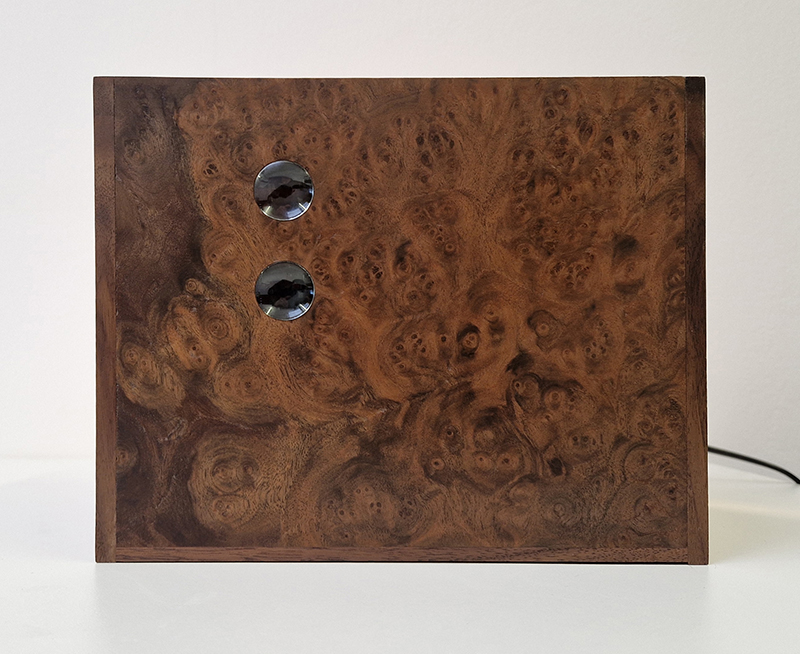
Super happy with the beautiful box, with walnut burr veneer, made by the skilled hands of Bruce Watson to house my cosmic ray detectors for cosmically interactive work The Breath of Stars. Bruce has a workshop opposite my studio at Thames-side Studios. The attention to detail is immaculate.

The Breath of Stars is a digital video work activated in real time by the passage of cosmic particles travelling from distant galaxies. These subatomic visitors from outer space are created during super nova explosions or by phenomena we are yet to discover.

Work in progress continues with tearing down paper squares for the Azimuth Obelisk.

Single vertical forms embody a primitive power. Etymologically, an obelisk should be made from a single quarried stone. To quarry one enormous piece of rock without it fracturing required power and money. To erect it required complex engineering skills. Since the first obelisks were raised in Egypt, often in gateway pairs with gilded tips for the sun god Re to anoint, they have escaped the confines of their original meaning. Originally a motif of immortality and communion between heaven and earth, its phallic symbolism has been co-opted by many nations, institutions and companies for its crude assertion of male power. Mystics shape crystals into obelisks as symbols of pent up negative energy in need of release. Perhaps the many memorials to the dead, marked by an obelisk usually cast in concrete, attempt to embrace the notion of immortality through remembrance in those carved names.

I don’t know why an obelisk was chosen as the azimuth marker at Hartland Magnetic Observatory. It’s hard to establish its actual shape as it can barely be seen now through the woods. Perhaps one day I will go back with binoculars.

I have imagined my obelisk sculpture as sedimentary rock with the layers holding clues to the fluctuations of the Earth’s magnetic field it stands as constant sentinel to. Made from recycled prints it is also a memorial to all the images buried in its form.

Looking North.

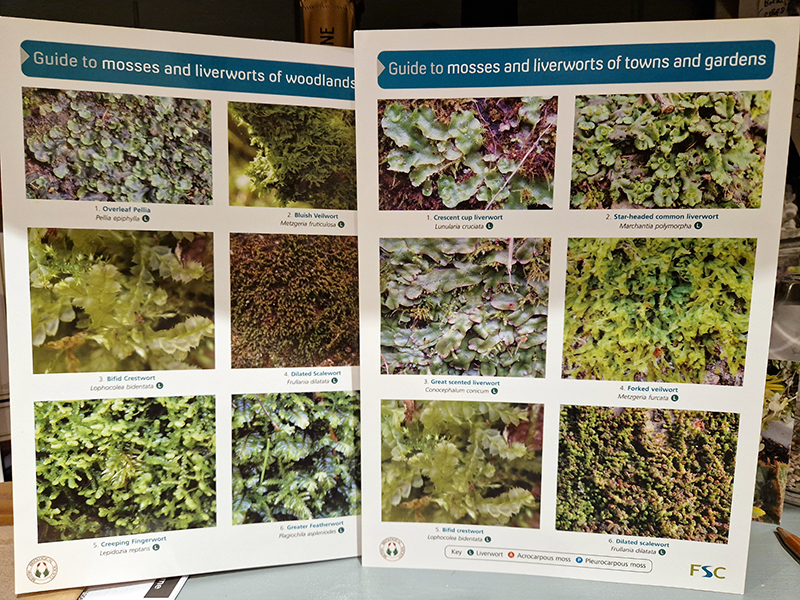
After unsuccessfully trying RHS Wisley for a book or advice on growing moss I have got some guides from the Field Studies Council. Hopefully these will help me choose the sort of moss that will be appropriate to use for the north wall of the Absolute Hut Installation. I am also beginning to collect wood to grow the moss on. The exhibition is several months away but I think it can take a while for moss to get established. The advice seems to be to liquidise some moss with yoghurt and spread it on the surface you want it to grow on.

The geographic north pole lies in the middle of the Arctic Ocean covered in shifting sea ice where the sun rises and sets only once per year. All lines of longitude converge here and hence all time zones. It is known as true north to distinguish it from the magnetic north pole.

However, as the Earth’s axis of rotation wobbles slightly in an irregular circle called the Chandler wobble this pole is not fixed. Where Earth’s rotational axis meets its surface is known as the instantaneous north pole and the north pole of balance, lies at the centre of this circle. The celestial north pole is where the axis line of the Earth extends into the night sky.

The magnetic north pole is where the planet’s magnetic field is vertical and a compass needle here would dip and try to point straight down – hence its other name: the magnetic dip pole.

The north geomagnetic pole is the northern dipole of the planet. When looked at from space the Earth may look like a bar magnet with two dipoles, but the geomagnetic poles are an approximation arrived at by reducing Earth’s complex and varied magnetic field to that of a simple bar magnet. The north dip pole lies in Northern Canada, the northern dipole is roughly off the northwest coast of Greenland.

The magnetic field lines of the Earth flow from south to north magnetic pole which is the opposite of a bar magnet where the lines flow north to south.  The north magnetic dip pole is where the earth’s magnetic field lines pull toward the planet, acting like the south pole of a bar magnet. The north pole of a bar magnet is attracted to the magnetic north pole of the Earth, not resisted as two north poles on magnets repel one another.

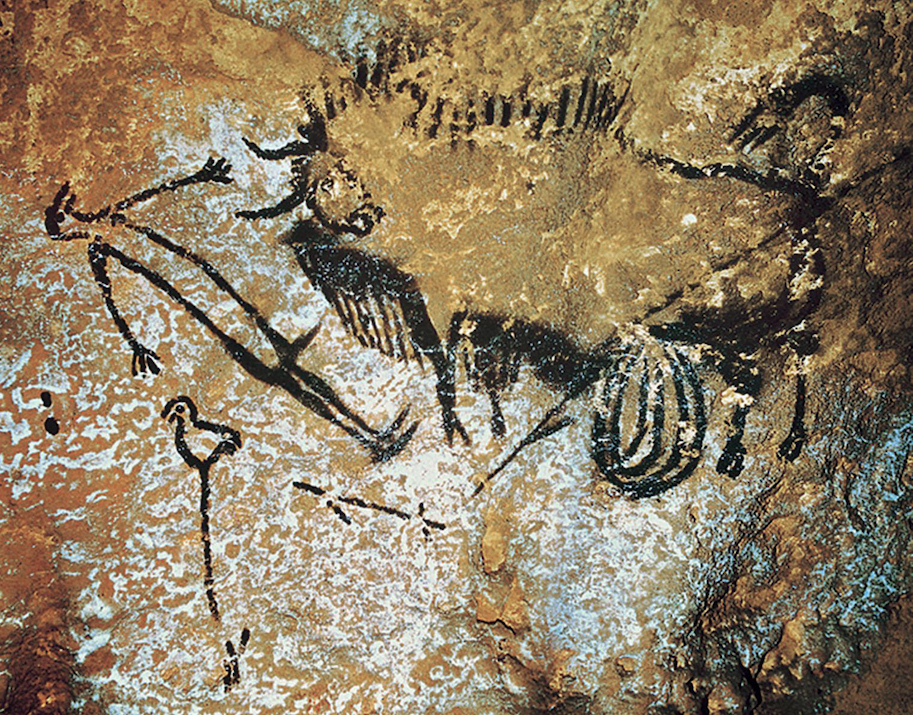
The extraordinary paintings in the Lascaux Caves of southwestern France may include representations of constellations and therefore be the earliest star maps dating back to nearly twenty thousand years ago. The dots set around an Aurochs eye in the Hall of Bulls may be the Hyades star cluster around the star Aldebaran as the eye of Taurus. Other dots are similar in configuration to the Pleiades. Now sealed off from the contamination of human breath the public can visit a replica site to gain a sensory experience of the scale and artistry. Painted on to the wall of the shaft is a bull, a strange bird-man and a mysterious bird on a stick. which according to Dr Rappenglueck, form a map of the sky with the eyes of the bull, birdman and bird representing the three prominent stars Vega, Deneb and Altair. Around 17,000 years ago, this region of sky would never have set below the horizon and would have been especially prominent at the start of spring.

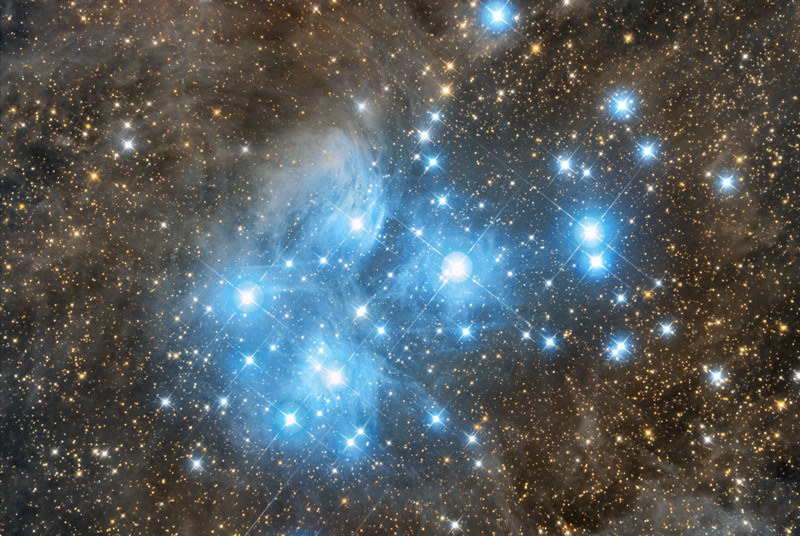
The Pleiades visible to the naked eye from almost anywhere on Earth appear as a small asterism of six or seven stars. At a distance of about 444 light years, it is among the nearest star clusters to Earth. Chased by Orion the seven sisters were transformed by Zeus and flung into the sky to escape the hunter. Through a lens, we can now see there are a lot more sisters drifting through a cloud of interstellar dust which scatters the light into a misty blue cloak. Image by Emil Ivanov.

A third research trip to Snettisham.

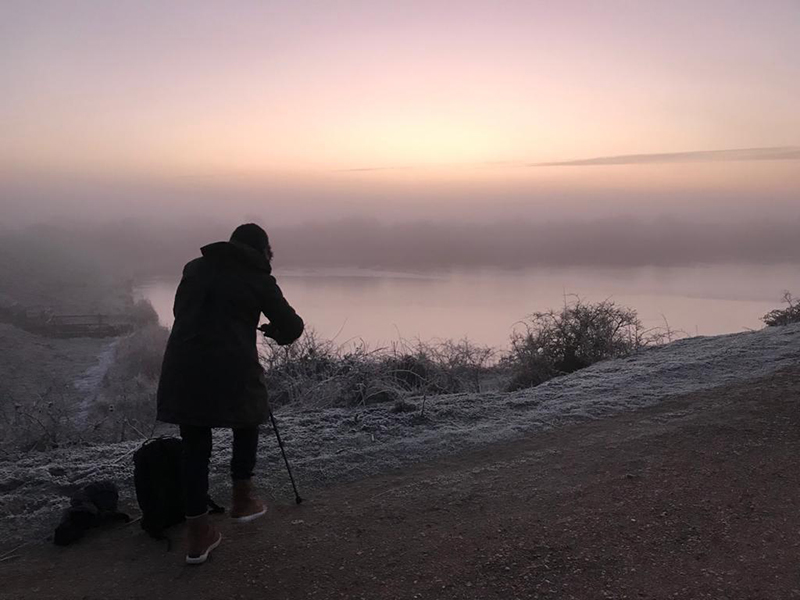
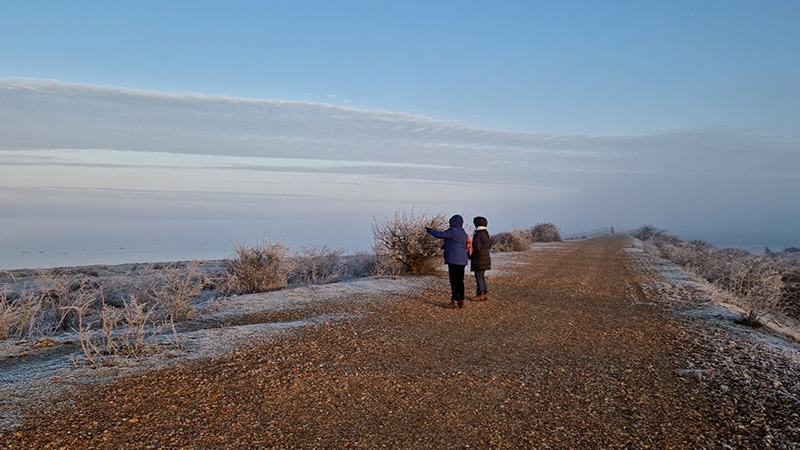
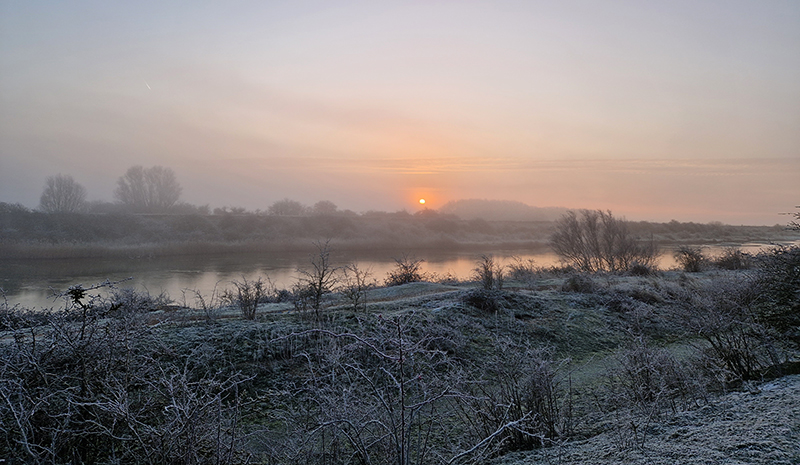
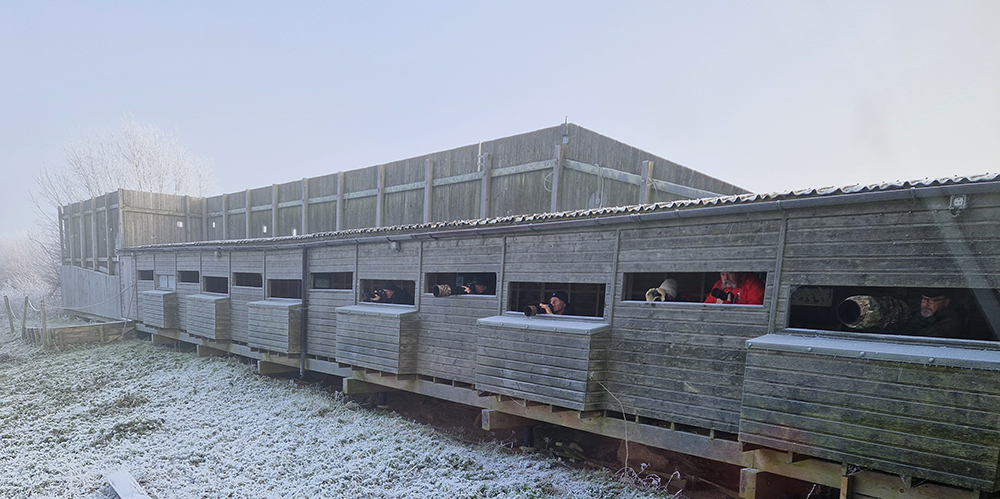
This time I shared the experience with good friends Ruth and Odile and we joined an RSPB group visit which allowed parking nearer the viewing site avoiding the usual long walk in the dark. The drive along the narrow potholed track, with no headlights which would alarm the birds, is a challenge and I was grateful for another car who had visited before leading the way. It was a chilling -7 at 7am making it difficult to use the camera with frozen fingers.

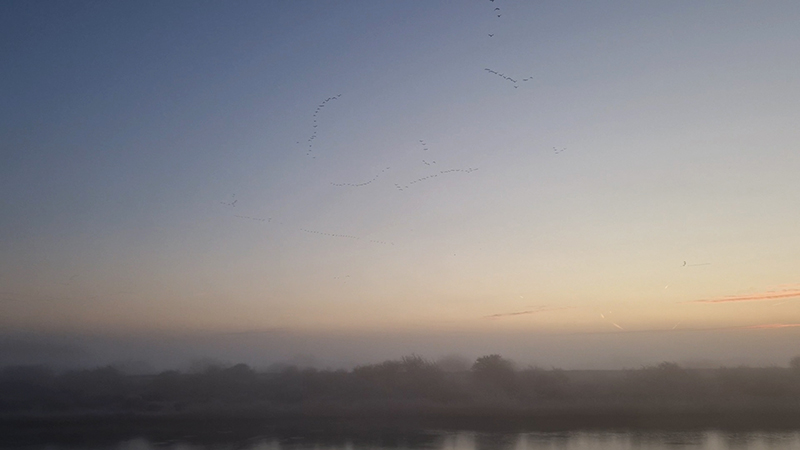
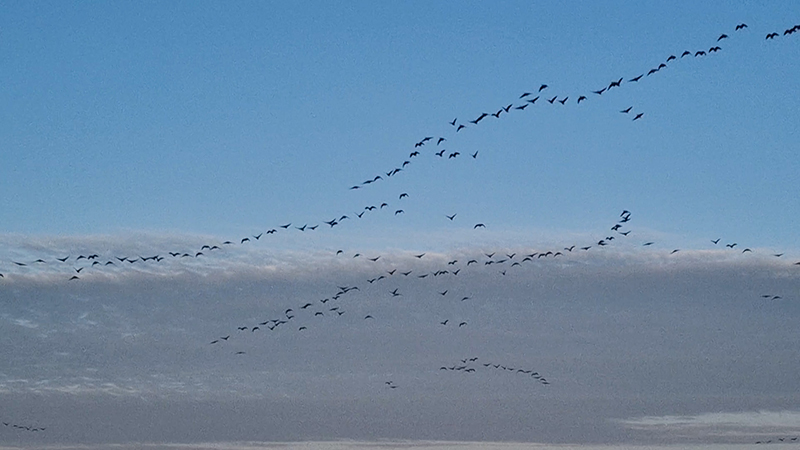
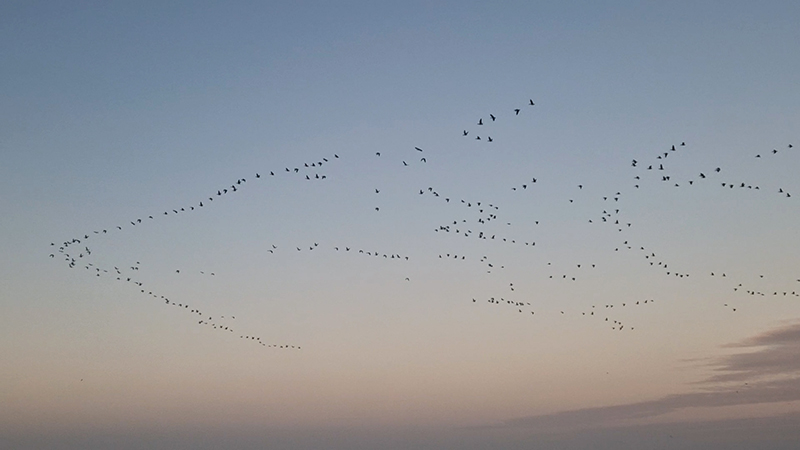
Eventually the sun cut through the low mist giving us stunningly beautiful skies to watch the skeins of pink footed geese leave their roost to go in search of sugar beet fields.

Having spent the night on the mudflats to avoid predators they leave at dawn in family groups. If there is a bright moon shining, they might not return from the feeding grounds at night as they can see if there is any danger approaching.

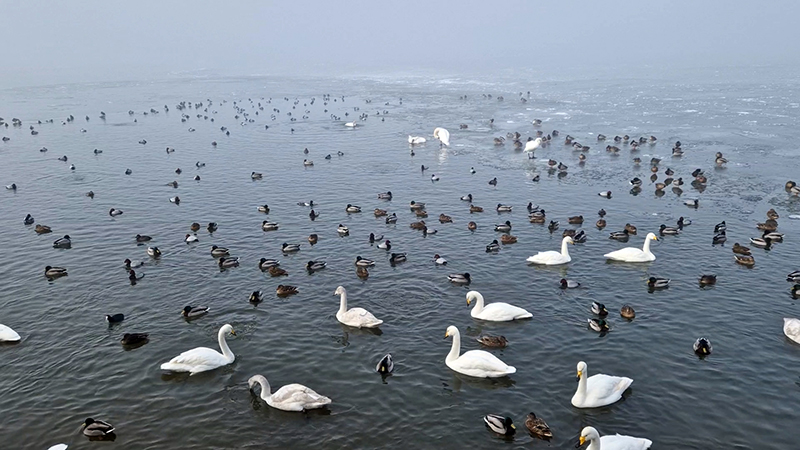
Before leaving Norfolk we visited Welney Wetland Centre, Britain’s largest area of seasonally-flooded land and the setting for mass winter gatherings of many thousands of wild ducks, geese and swans. Each winter thousands of Bewick’s and whooper swans make their winter migration to the UK, to escape colder countries.

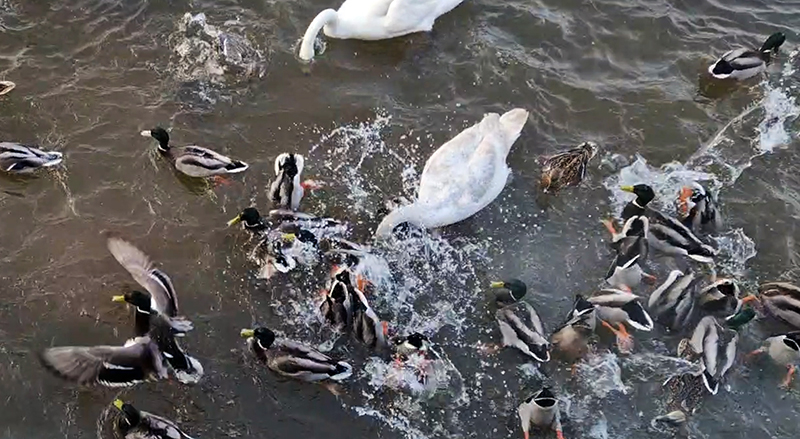
They have popular swan feeding sessions and talks about the site and the work they do to protect the wildlife here such as liaising with the electric companies to hang reflectors on the overhead cables to make them more visible to flying birds.

Walking around the frozen fens reminded me of the James Turrell installations of diffuse light that makes it hard for the eye to focus.

The light-sensitive molecules that allow perception of the Earth’s magnetic field, could also influence other responses such as control of circadian rhythms and tracking the difference between night and day. In birds, Cryptochrome molecules are located in photoreceptors in the eye and react to the Earth’s magnetic field when excited by blue light enabling orientation and navigation. Light sensitive molecules can also be found in cell nuclei and may influence physiological processes, such as fattening and migratory motivation, working as a trigger for changes in behaviour.

Light vibrates up and down as it travels in waves and these vibrations can be vertical, horizontal, or at any angle in between. The waves that make up sunlight are evenly distributed across all angles but polarised light is made up of waves with the vibrations at only one angle. Polarising lenses absorb horizontal light while letting through the vertical waves reducing the overall intensity of the light that passes through. Light also becomes partially polarized when it reflects at an angle from a surface such as when the sun is low in the sky. Research led by Rachel Muheim has shown that birds are better able to use their magnetic compass when the direction of polarised light exciting the cryptochrome molecules is parallel to the magnetic field. She suggests that it is more useful for birds to sense the magnetic field during sunrise and sunset for orientation to determine their direction before migrating or leaving the roost. In the middle of the day, when the polarised light is approximately perpendicular to the magnetic field, it can be an advantage that the magnetic field is less visible, so that it does not interfere at a time when visibility is important to locate food and to detect predators.

Gallery Visits

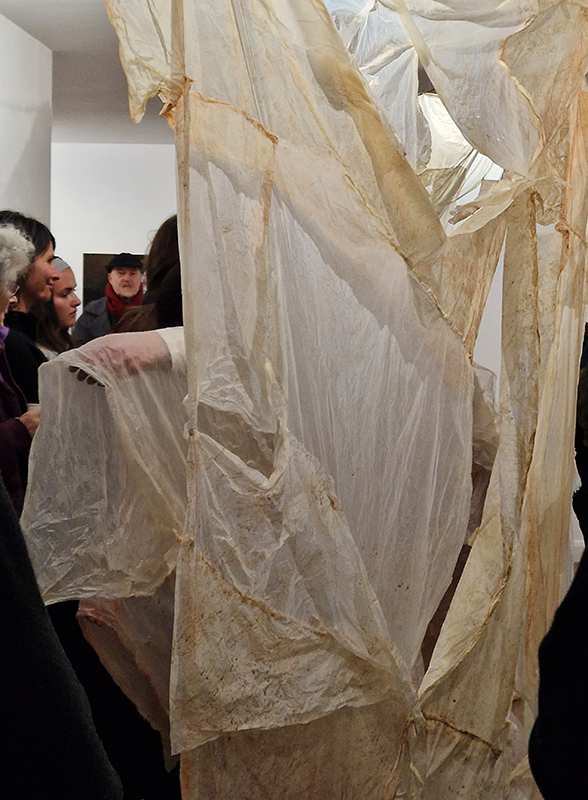
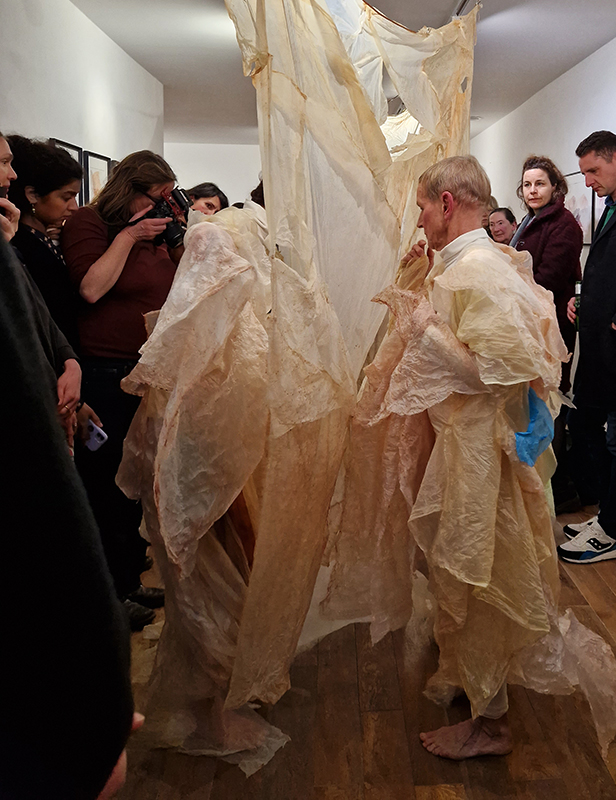
Sarah Kent and Claire Loussouam performance interacting with iterations of the work Graft at the finissage of Liz Elton’s Work in Progress residency at Fitzrovia Gallery. Great to see the gallery filled with these delicate wafting landscapes made from biodegradable materials and natural dyes.

Strange Clay at Hayward Gallery explores the possibilities of thinking through making.

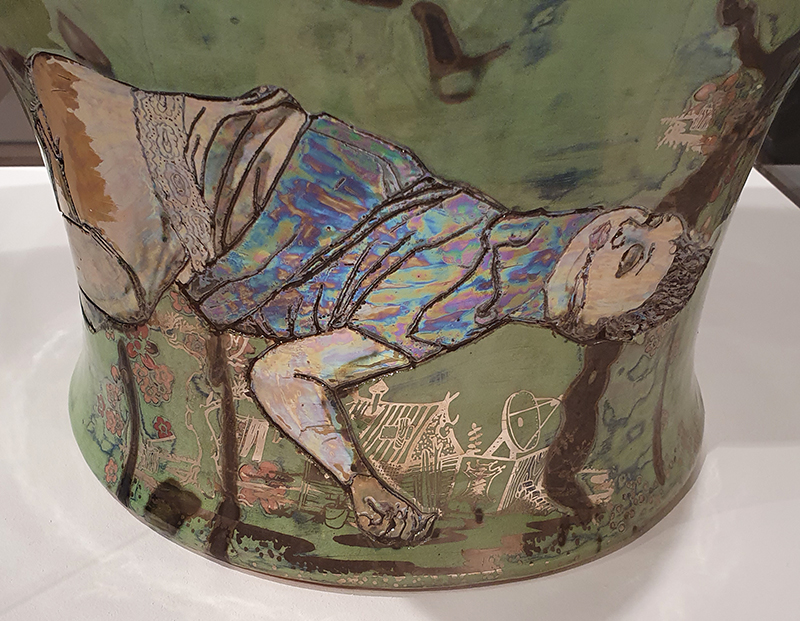
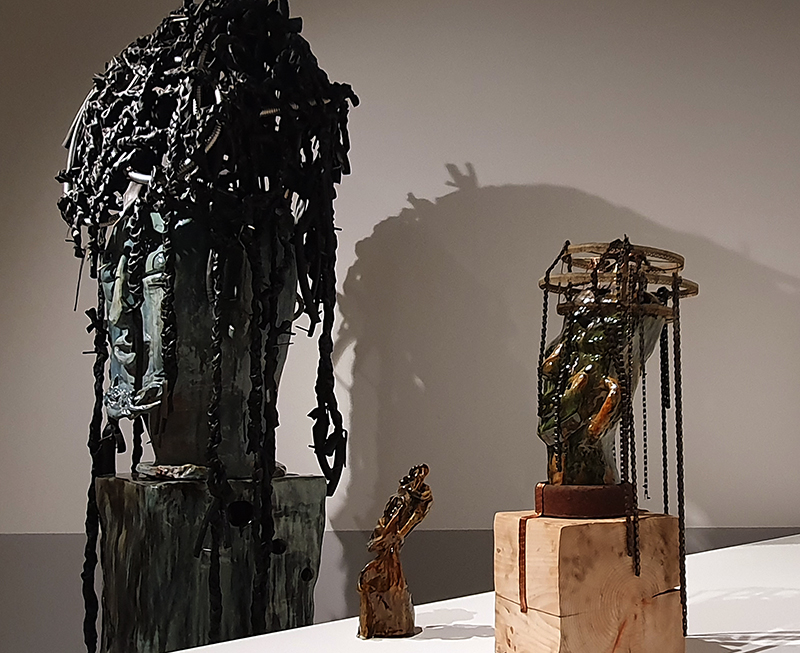
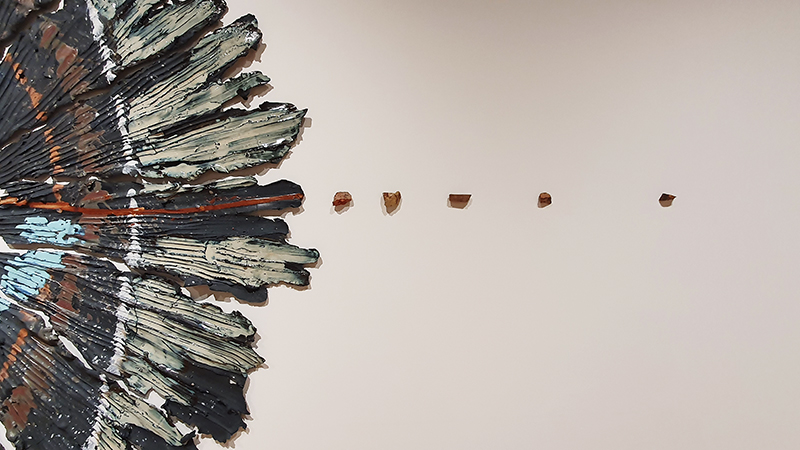
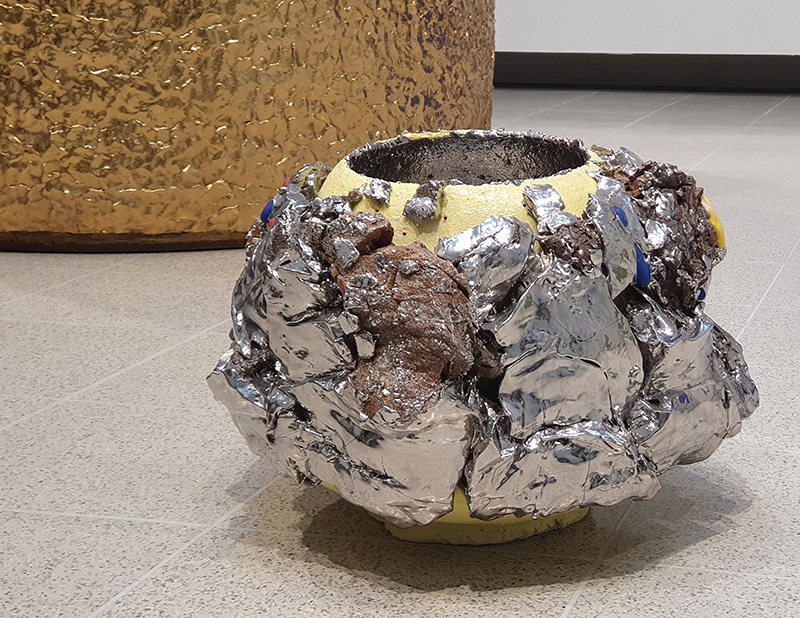
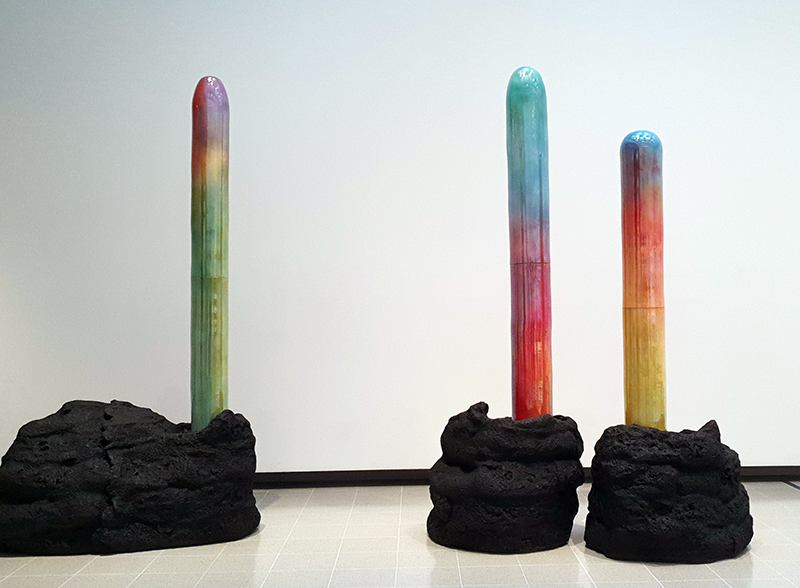
The exhibition features works by Aaron Angell, Salvatore Arancio, Leilah Babirye, Jonathan Baldock, Lubna Chowdhary, Edmund de Waal, Emma Hart, Liu Jianhua, Rachel Kneebone, Serena Korda, Klara Kristalova, Beate Kuhn, Takuro Kuwata, Lindsey Mendick, Ron Nagle, Magdalene Odundo, Woody De Othello, Grayson Perry, Shahpour Pouyan, Ken Price, Brie Ruais, Betty Woodman and David Zink Yi.

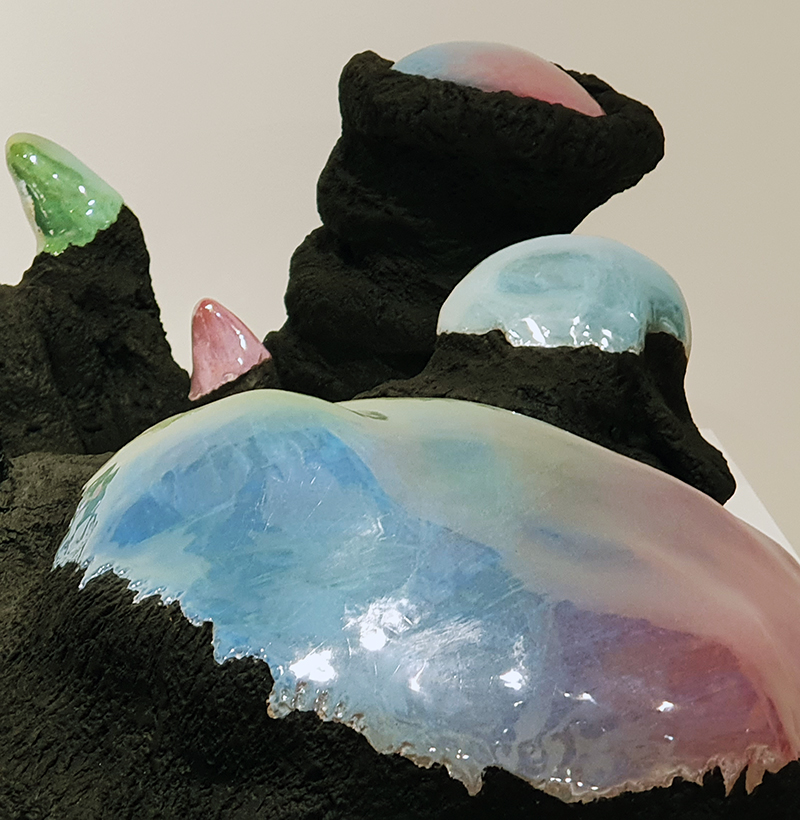
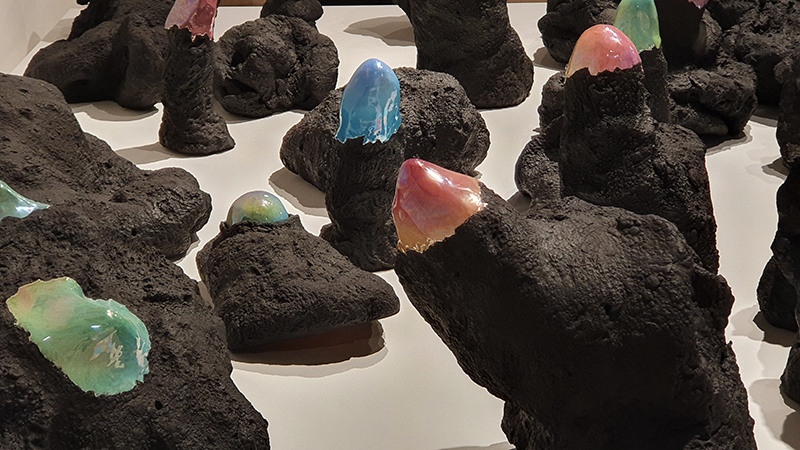
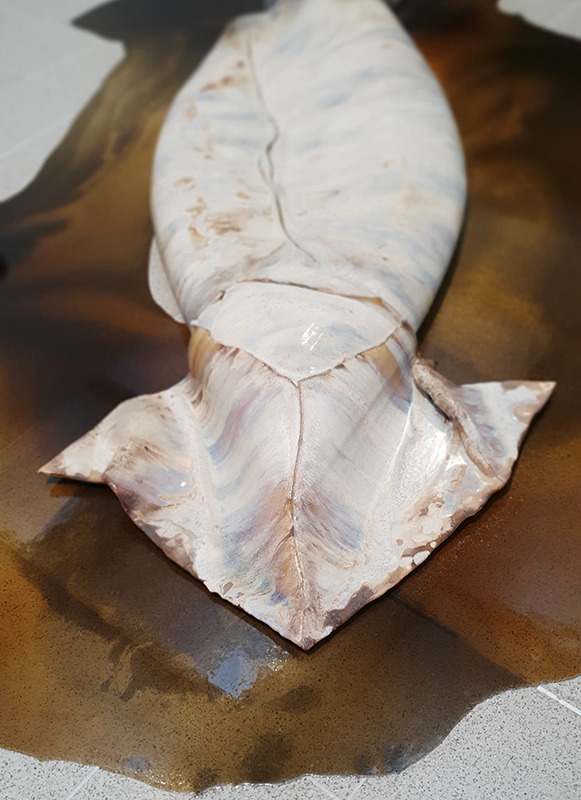
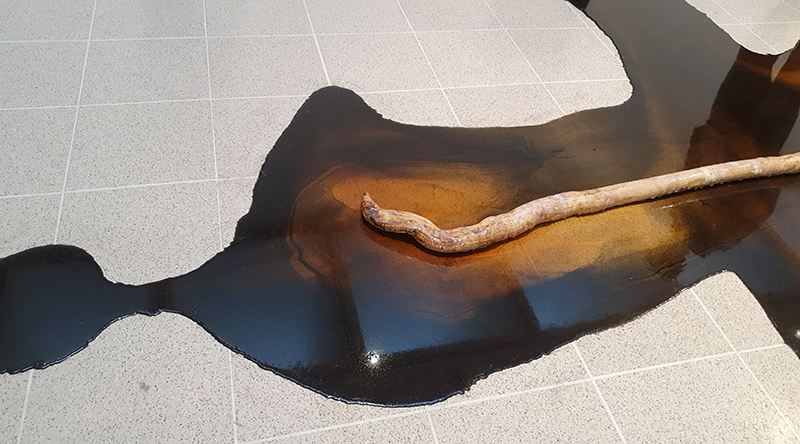
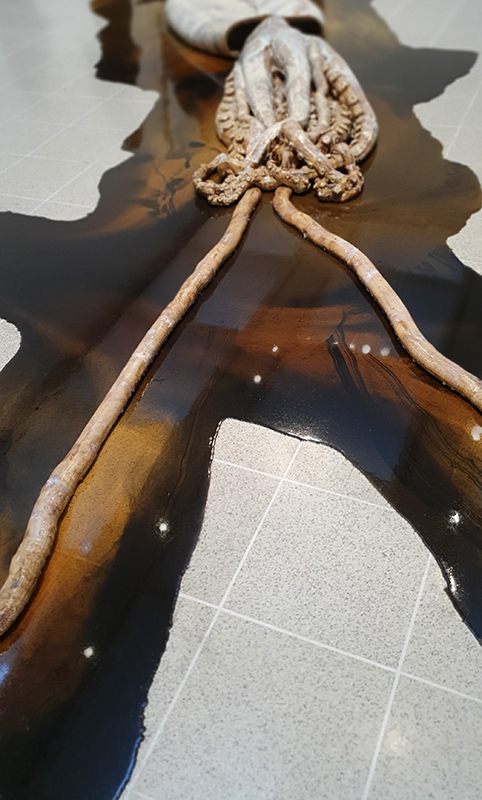
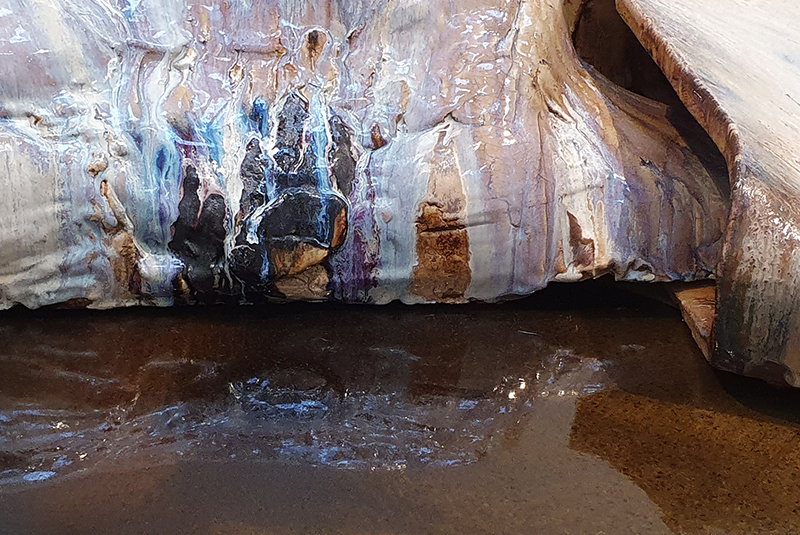
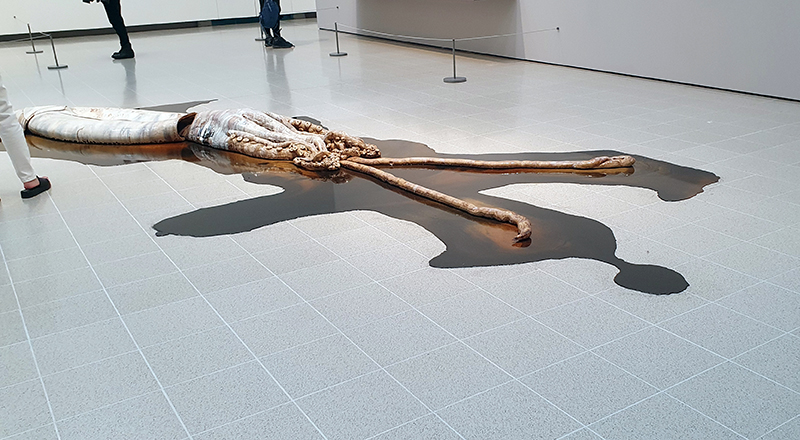
Stand out favourites were the dark volcanic and glistening contrasting surfaces of Salvatore Arancio’s work and the extraordinary and impressive scale of the squid in a pool of corn syrup and Japanese ink by David Zink Yi

Abraham Kritzman A Hand Beneath The Hills at Danielle Arnaud. I was intrigued to visit to see the small pillar structures and the interesting use of ceramics. Kritzman doesn’t like to give a lot away about his work so impressions are not pre-directed. The camouflage paintwork on the sculptures, crenellations and frenetic lines in the prints had a war like ambience. The influences however appear to come from the insect world of metamorphism, burrowing and speed.

Reading

Being a Human by Charles Foster. I got this book as I thought it might offer some points for discussion at the upcoming debate Being Human in relation to the night sky to be held at Allenheads Contemporary Arts. Unfortunately it didn’t have any useful insights and was rather judgemental and smug despite some clever and comic attempts at self effacement. The sort of smugness that emanates from those of devout faith where the judgement is on those unfortunate enough not to share or even aspire to the same definitive experience as that of the author. It also has some of the smugness of the parent loudly interacting with their offspring in public to show off their parenting skills/precocious/cute child. I did appreciate it was well written and researched. Acres of endnotes and a huge reading list which could turn out to be useful. Some points were well made about the edge as the site of all change and the idea that what is imagined is no less real but the packaging just wasn’t for me.

Listening

The Magnetic Mystery – investigate the mysterious power of magnets, with the help of wizard-physicist Dr Felix Flicker and materials scientist Dr Anna Ploszajski.

https://www.bbc.co.uk/programmes/m001h49f

Editing footage for the video Belly of a Rock which will be shown on an old monitor encased in a sculptural hybrid form relating to both mollusc and rock. The giant sea slug of the mollusc family, can derive directional cues from the magnetic field of the earth which is then modified in response to the lunar cycle. It orients its body between north and east prior to a full moon. In the slug’s nervous system, four particular neurons are stimulated by changes in the applied magnetic field, and two are inhibited by such changes suggesting that the animal uses its magnetic sense continuously to help it travel in a straight line.

The Earth can be divided into the inner core, the outer core, the mantle, and the thin crust. The outer core is about 1,367 miles thick and mostly composed of liquid iron and nickel. It is very malleable and in a state of violent convection. The churning liquid metal of the outer core creates and sustains Earth’s magnetic field. At the boundary between the inner and outer core temperatures can reach 6,000° C which is as hot as the surface of the sun. The inner core is a dense ball of mostly iron, but with a temperature above the melting point of iron, it is not liquid or even molten. Intense pressure from the rest of the planet and its atmosphere prevents the iron inner core from melting as the iron atoms are unable to move into a liquid state. It could be described as a plasma behaving as a solid. The inner core rotates eastward, like the surface of the planet, but it’s a little faster, making an extra rotation about every 1,000 years.  Geoscientists think that the iron crystals in the inner core align north-south, along with Earth’s axis of rotation and magnetic field and are arranged in a hexagonal close-packed pattern. The orientation of the crystal structure means that seismic waves travel faster when going north-south than when going east-west. Seismic waves travel four seconds faster pole-to-pole than through the Equator. 

The Earth is still cooling and as it does so, bits of the liquid outer core solidify or crystallize causing the solid inner core to grow by about a millimetre every year. The growth is not uniform, it is influenced by activity in the mantle and is more concentrated around regions where tectonic plates are slipping from the lithosphere into the mantle, drawing heat from the core and cooling the surrounding area. The crystallization process is very slow, and further slowed by the constant radioactive decay of Earth’s interior. Scientists estimate it would take about 91 billion years for the core to completely solidify but the sun will burn out in just 5 billion years. 

I have nervously passed the cosmic ray detectors over to programmer Jamie. It was hard to let them out of my sight after so much work to get them built but he can’t test the code he has written without them. The Breath of Stars directly interacts with cosmic rays in real time to trigger a digital reaction via a mini computer attached to a block of plastic scintillator and a sensitive photomultiplier. As each particle strikes the plastic scintillator its energy is recorded and a starburst image video relative to the energy released is projected, with the largest images representing the particles with the highest energy.

I am constructing an Obelisk sculpture in response to the concrete obelisk erected in 1955 at Hartland Magnetic Observatory, near the site’s northern boundary as a permanent azimuth mark. It is viewed via a theodolite through a window in the north wall of the Absolute Hut, its azimuth being 11º27’54” E of N and marks the point from which the magnetic north pole is tracked as it drifts westwards. Layers of torn recycled paper are stacked like sedimentary rock that holds clues to the Earth’s magnetic field reversals in its strata.

Copper contours of magnetic field lines have been lacquered to preserve the heat patina from plasma gun cutting. These shapes will be pinned to the north facing mossy wall of the Absolute Hut installation, a reimagining of the Absolute Hut at Hartland Magnetic Observatory. I will also employ a north facing window from which to observe the azimuth mark of the Obelisk sculpture.

A second research visit to RSPB Snettisham, this time to see the pink footed geese (which over winter on the mudflats here) leave their roost at dawn to fly to the fields to feed.

The walk from the car park to the viewing area is over 2km and takes about half an hour to walk. Setting out before first light the weather felt promising but just as I erected the camera tripod the rain came down hard and didn’t stop for the rest of the morning.

Made a second attempt the next morning leaving a little earlier and although it remained dry there was heavy fog over the sea. Not great for filming with my very basic kit but very atmospheric to experience as the geese emerged from the sea mists.

The noise they make is incredible, a constant chattering building to a crescendo of honking calls as they rise from the water and swarm across the sky in their hundreds. They come in waves but look like particles. At one point what sounded like a few gunshots fired out across the bay in the distant darkness. This sudden disturbance set off a slow deep rumble which drew closer accompanied by a low dark cloud growing heavily stronger building and rising as a huge tidal wave of geese rose simultaneously into the sky in panicked disarray. Extraordinary to witness.

Birds are able to “see” Earth’s magnetic field lines and use that information for navigation. Their compass ability comes from a quantum effect in radical pairs, formed photochemically in the eyes. This light sensitive magnetic compass used by birds is affected by the polarisation direction of light. Exposure to blue light excites an electron, which causes the formation of a radical-pair whose electrons are quantum entangled, enabling the precision needed for magnetoreception.

In chemistry a radical is an unpaired electron which is can be highly chemically reactive. In the radical pair mechanism a pair of electrons with opposite spins have a chemical bond. Light can cause the electrons to change spin direction which can break the bond giving the electron a chance to react with other molecules. In magnetoreception two cryptochrome molecules, found in the rod cells in the eyes of birds, each with unpaired electrons, exist in states either with their spin axes in the same direction, or in opposite directions, oscillating rapidly between the two states. That oscillation is extremely sensitive and can detect the weak magnetic field of the Earth. Birds then move their heads to read the spin of the molecules and therefore detect the orientation of the magnetic field.

While in North Norfolk staying in a beach chalet away from light pollution I was able to make a couple of short time lapse videos centering on Polaris.

Birds can detect the slow arc of the sun and the rotation of the constellations across the sky which is imperceptible to humans and allows migrating birds to orient themselves using celestial navigation as well as magnetoreception.

Birds are also able to detect rapid movement such as individual flashes or flickering of a fluorescent light which humans see as a continuous light. Hawks which pursue other birds through dense forests at high speeds, follow the movement of their prey while avoiding branches and other obstacles. To humans travelling at this speed, the fleeing prey, branches and obstacles would just be a blur.

Gallery Visit

Thames-side Gallery ‘The Accurate Perception Available When Our Eye Becomes Single’ is an immersive multi-screen installation evoking the emotional specifics of place (Orford Ness on the Suffolk coast) while exploring the elasticity of time and history. It is an audio-visual collaboration between Richard Ducker (video) and Ian Thompson (sound) with no linear narrative; sound and image are not synchronised, so each viewing is a unique experience. Sarah Sparkes also makes an enigmatic performative appearance both in the video and live in the gallery.

The crashing sea on shingle, open spaces and brutalist bunker architecture of Orford Ness are echoed in the gallery with audio pitched to envelop and resonate but not overwhelm. Nicely done.

Listening

I really enjoy the Inside Science podcasts with Gaia Vince and this one interviewing cosmologist and theoretical physicist Laura Mersini-Houghton about finding evidence that supports her multiverse theory was particularly fascinating.

Multiverses, melting glaciers and what you can tell from the noise of someone peeing

According to Laura the single universe theory is mathematically impossible.

Reading

Merlin Sheldrake’s Entangled Life. A remarkable reveal of an other world, so different yet so entwined with our own. Beautifully clear analogies help to bridge an understanding between human and fungi.

The ability to detect and respond to chemicals is a primordial sensory ability.

In humans when a molecule lands on our olfactory epithelium and binds to a receptor it causes nerves to fire triggering thoughts and emotional responses.

A mycelial network is one large chemically sensitive membrane: a molecule can bind to a receptor anywhere on its surface and trigger a signalling cascade that alters fungal behaviour.

Fungal lives are lived in a flood of sensory information.

They have light receptors, are sensitive to touch and it also looks like fungi may form fantastically complex networks of electrically excitable cells – a potential ‘fungal computer’ using electrical signalling as a basis for rapid communication and decision making which could learn and remember.

Honoured to have The Forms installed in the magnificent Wells Cathedral as part of Wells Art Contemporary

The immutable truths Plato discovered in geometry belong to the realm of abstract thought and ideals he called The Forms. Twelve pentagons form a dodecahedron which Plato defined as ‘a fifth construction, which the god used for embroidering the constellations on the whole heaven.’

Today it is dark matter that science believes holds the stars in the heavens. In visualisations of dark matter created from cosmological data provided to me by KIPAC Stanford University, we see familiar organic patterns emerge; the fronds of dark matter spanning between galaxies could be the spreading branches of trees or the veins under our skin.

In Plato’s the allegory of the cave, those in the cave mistake shadows thrown by the fire onto the cave wall as reality; in a similar way we are guessing what dark matter is from the shadows we see, such as gravitational lensing and galaxy rotation curves.

Thrilled with the location of my work in the Lady Chapel, interacting with the patterns and geometry of the Minton tiled floor.

Working on Breath of Stars – making a data base of video clips which will be accessed and play for 12 seconds every time a cosmic ray event is recorded by the detectors. The star bursts are made from cloud chamber footage. The size of the star burst will relate to the amplitude of the cosmic ray that hits the scintillator plastic. More energy = bigger starburst.

Testing testing. Running the cosmic ray detectors at my studio to see if I get similar results to at home and yes, seems fairly consistent. Maybe slightly more hits. Thinner roof!

Exciting developments in the acid room etching the directional magnetic steel sample I have been given. Trying to uncover the grain structure like a jigsaw pattern of this magical matter hidden under a grey coating. I had no luck trying to reveal the pattern just by sanding. I then tried sanding the coating away quite aggressively and etching in 1:4 nitric acid for 10 minutes. This did reveal the hidden structure but not very cleanly and weirdly sanding or polishing after etching made the pattern disappear again.

Then I tried finer sanding plus 10 minutes in a copper sulphate solution with just a careful wipe with a sponge to clean the plate and was quite happy how things were progressing. I quite like the coppery tinge.

I discovered the pattern comes from rolling single crystals of an iron silicon alloy into thin sheets to minimise magnetic losses for use in transformers. I decided to have another try with nitric acid on a larger piece just to compare but had very poor results.

An attempt with copper sulphate again on a larger piece this time wasn’t quite so clean as before although the structure is visible. I am wondering if there is a better side to etch – both sides look the same but maybe there is a difference in how deep the structure is hidden.

Working through some ideas for a proposal has helped with focus for video work using iron filings over a boulder (made from paper clay) set in a cave. Working title Belly of a Rock which will be a video sculpture.

The same with some experiments with vessels and salt crystals. Exploring possibilites.

Out of Studio

The Royal Society Summer Science Exhibition

Favourite stands were obviously those with a connection to magnets or cosmic rays.

Exciting research from a collaboration between the University of Birmingham, Keele University and
MICA Biosystems on remote controlled healing to treat spinal injuries and tissue regeneration using ground-breaking advances in nanotechnology and magnetics.

Magnetic nanoparticles exhibit superparamagnetism, meaning that these tiny magnetic particles flip magnetic orientation between north and south rapidly at random appearing to be non-magnetic unless subjected to a magnetic field. When a magnetic field is applied, the particles’ ‘north’ and ‘south’ align with the field direction, turning the nanoparticles’ magnetic properties ‘on’. By binding these nanoparticles to stem cells and injecting them into the body they can be directed to the target injury site using a controlled magnetic field outside the body. Once at the injury site the magnetic force can be turned on and off to stimulate the cells controlling cell behaviour and biological pathways speeding up the healing process.

When a meteoroid survives a trip through the atmosphere and hits the ground, it’s called a meteorite.

The Natural History Museum were displaying meteorite samples including a large fragment of the Winchcombe meteorite, an extremely rare carbonaceous chondrite observed entering the Earth’s atmosphere as a fireball over Gloucestershire at 21:54 hours on 28 February 2021 and landing in a family home driveway. It was the first time in 30 years, a meteorite has been recovered in the UK. It’s unexpected arrival from the asteroid belt near Jupiter was captured on a system of UK Fireball Alliance cameras as well as local CCTV and doorbell cameras.

Most iron meteorites are thought to be the cores of asteroids that melted early in their history. The crystal structure (image left) known as Widmanstätten patterns in iron meteors forms from criss-cross plates of an iron-nickel alloy. Slicing the meteor at various angles reveals different patterns.

I was informed that this texture was made visible by etching the meteorite in hydrofluoric acid though it may also need polishing. This made me hopeful to reveal the hidden structure of the directional magnetic steel sample (image right) provided to me by Union Steel Products which is currently hidden by an opaque grey coating over a thin layer of smooth steel. I first saw this type of extra magnetic steel at the National Physical Laboratory open day. It is no longer manufactured in the UK and so am grateful for the sample.

Very excited to talk to Lancaster University about their new Extreme Space Weather Monitoring research. The first international network of ground-level neutron detectors to measure the number of high-energy charged particles striking the Earth’s atmosphere from outer space was established in 1957 but these used toxic materials and are costly to run so many were decommissioned. There are only 50 left worldwide and none in the UK. Lancaster are developing a new-generation radiation detector intended to help protect safety-critical systems and national infrastructure against the effects of severe space weather. Space radiation can affect aircraft systems, communications, and cause current surges in power grids and other ground-level systems. There are significant risks to the infrastructures we rely on in daily life so predicting solar storms could provide a warning to shut down or move vulnerable systems before they get hit.

I asked Professor of Space Physics Jim Wild and his colleague Andrew Parker from the school of engineering radiation protection dept. about the event count for my own cosmic ray detector and they thought it sounded about right. As I cannot be sure of the quality of my plastic scintillator the count may not be scientifically accurate in measuring all events but I can feel confident that events I do record and will use to trigger code to display video starbursts are from direct contact with a particle that has travelled from outer space.

Alienarium 5 Dominique Gonzalez-Foerster at Serpentine Gallery. Managed to miss the seductive glimpse of The Closed Planet and any holograms but did experience the VR though connections promised with other alien beings failed to materialize – there were other forms floating in the distance but no way to communicate. I suppose this reinforced the difficulty of cross being communication. The reading list turned to cushions had become a toddler soft play area and while the 360 panorama was impressive in scale and content included it felt ‘educational’ as opposed to enlightening.

Theaster Gates, the Serpentine Pavilion 2022 Black Chapel draws inspiration from many of the architectural typologies that ground the artist’s practice. It is impressive in scale and simplicity.

I am a big fan of Lindsay Seers work and loved the Artangel commission Nowhere Less Now at The Tin Tabernacle, Kilburn in 2012.

This was my post at the time;

Lindsay Seers work is narrative but is not a linear story. The past present and future entwine with the thoughts of multiple characters. Everything is connected but like in a dream those connections are just beyond grasp as they shift and change and merge. I wasn’t sure if I fell asleep or not, my eyes seemed to be open but I had those moments of falling from consciousness being tucked up in a warm blanket can induce. The haunting sea shanty played in the headphones ‘ the sea will take her slender body..’ over and over, a narrative from one side in Seers soft tone then someone speaks abruptly from behind, another voice is heard at a a distance, some music starts up and all the while the dual projections onto giant convex and concave spheres in the disorienting location of an upside down ships hull sweeps through history into a CGI future and back to the present. We were given a free book on exit, it is another layer to the whole experience and I have no idea what is true and what is fiction, this means the fantastical can appear to be reality and I like that. There are many things to wonder about in Lindsay Seers work. In Seers work the explanation about the work is part of the work and so may be just a fiction as much as the work itself.

Jump ten years to Cold Light a collaboration with Keith Sargent at Matt’s Gallery in their new swanky location at Nine Elms. Subtle intervention has been sacrificed for the installation which is engaging on a different more immediate sensory level of flashing lights on shiny objects. The work is inspired by the futurist Nikola Tesla and his experiments with electricity in the early part of the 20th century. Cold light refers to light produced electrically rather than by fire. The use of low-fi silver foil and extractor vent tubing, along with scaffolding and clunky robotics give an impression of the home inventor. This would have looked futuristic in Tesla’s lifetime. I experienced the VR CGI environment, it was cold place emotionally despite the pigeons which were apparently Tesla’s true love. Is this the CGI future alluded to in past work?

Fabulous work from Grace Ndiritu An Absolute River at Lux. An Absolute River’s title derives from Borges’ theories on the fluidity of time. Borges features as a fictional protagonist in Ndiritu’s Black Beauty, and his notion of “An Absolute River” was inspired by Heraclitus’ “No Man ever Steps in the Same River Twice”. Her films blur the lines between different time frames and explore themes of media, authorship and historical narratives, whilst expanding on notions of temporality. Her work is so good.
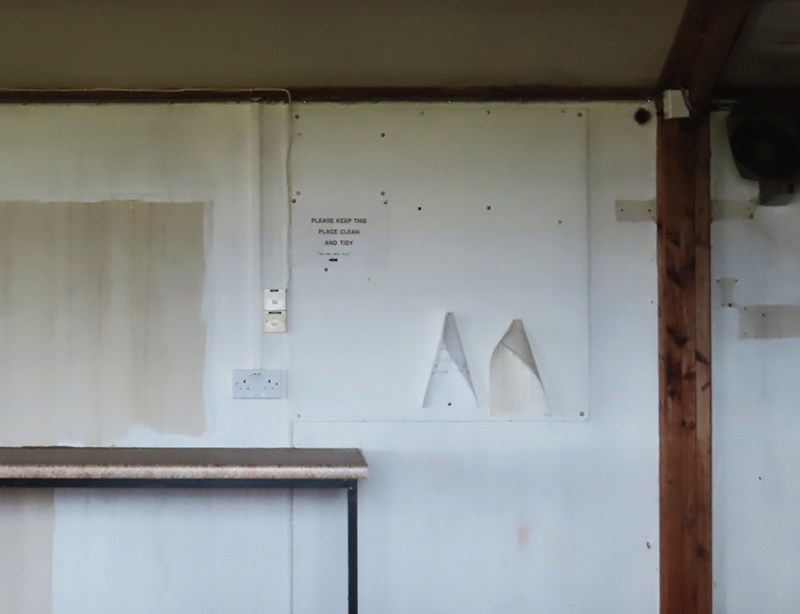
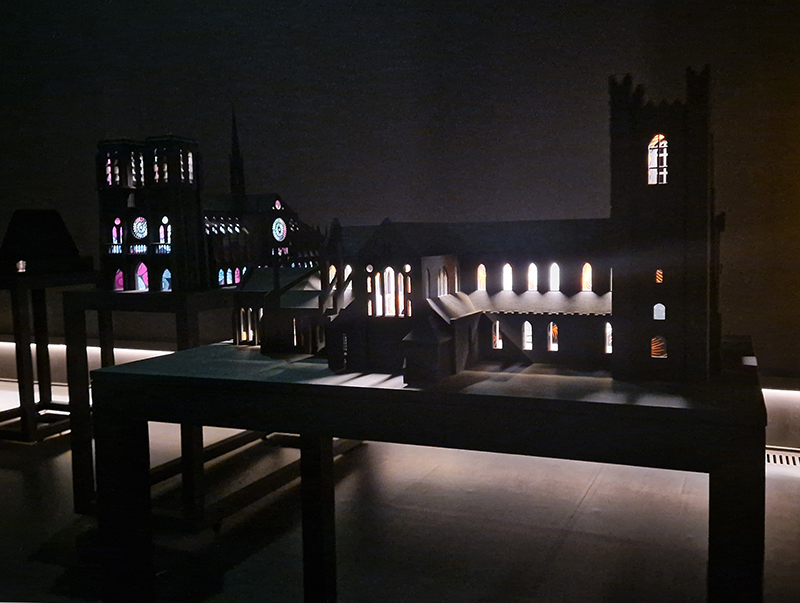
SPACE IS THE PLACE

What a joy to experience The Sun Ra Arkestra

In some far off place
Many light years in space
I’ll wait for you
Where human feet have never trod
Where human eyes have never seen
I’ll build a world of abstract dreams
And wait for you

The Ruins of Time at St. Augustine’s Tower, Hackney. “Tower” is part four of the “Ruins of Time” project, organized by LME (London – Munich Exchange) exploring the passage of time and its specific expression in the place, space and architecture of the site. Curated by Eleonora Bourmistrov and Milena Michalski who are exhibiting alongside Myra Brooklyn, Risha Gorig, Angelika Hofmann, Monika Kita, Brigitte C. Reichl, and Marcia Teusink. Many thoughtful works and a marvellous installation from Eleonora Bourmistrov.

The London Group exhibition including work from Victoria Arney (birdsong translated into woodcuts), Carol Wyss (examining the ribcage as protective enfolding), Sandra Crisp (blender generated molecules with embedded culture – a culture with culture) and Beverley Duckworth (Dust from the Sahara) in Catch Your Breath at Morley Gallery.

‘Catching one’s breath can happen if surprised, impressed or even shocked by something, such as an extraordinary object or image stumbled upon that instantaneously changes a familiar viewpoint. It can also be a time to pause or reflect and take stock.’

Working on The Breath of Stars I have been thinking about the breath and its active nature and inter-actions so it was interesting to see the many interpretations here.

Cloud Point at Paradise Row curated by Nicolas Bourriaud in collaboration with Radicants.

Text from the Gallery:

The artists (Nicolas Aguirre, Hicham Berrada, Marieke Bernard Berkel, Alice Channer, Pakui Hardware, My-Lan Hoang-Thuy, Zarah Landes, Estrid Lutz, Tala Madani, Pamela Rosenkranz) in this exhibition belong to a generation for whom no material is natural anymore. Matter, in its totality, is both form and content, subject and object, nature and culture. In other words, there is no neutral background in today’s images, but streams and active forces.

Cloud Point gathers artists who don’t consider objects, products or masses in their work, but rather the atomic structure of our surroundings, and theirs. They are particularly interested in the in-betweens — processes of liquefaction, moments of coagulation, condensation points… The emergence of this molecular gaze in contemporary art also reflects in theory and politics.

Politics goes molecular as Felix Guattari had already stated, in the 1970’s, talking about a necessary ‘molecular revolution’. We see how gas, oil, bacterias, viruses or chemicals become the new agents of History. Zygmunt Bauman analysed postmodern capitalism as a process of liquefaction of our institutions. Today Karen Barad describes matter, at its molecular stage, as pure ‘queerness’. And according to Rosa Braidotti, ‘Capital seeks and reduces body fluids to merchandise: the sweat and cheap blood of the labor force available throughout the Third World; but also the fluids of the desire of First World consumers who reduce their existence to a commodity by transforming it into a hyper-saturated state of confusion.’

I have returned to my BA dissertation from 2007 The Communication of Ecological Concerns Through Contemporary Artistic Practice to look at excerpts where I discussed the theories of Nicolas Bourriaud.

‘The intertwining of ecological and political processes with artistic practises is explored in conjunction with the particular theories of Bruno Latour, Nicolas Bourriaud and Zygmunt Bauman. These writers all speak of a need to establish new ways of communicating about the complexities of our relationships to our environments as we move through different spaces to those of the past. In light of this necessity, the precarious balance an artist must achieve to engage a contemporary urban audience with an environmental message, without losing sight of their aesthetic, or becoming embroiled in the nullifying production of commodity, is debated.’

‘Bourriaud documents the shift in focus from the visual to the relational during the 1990’s when new forms of communication  available through modern technologies coincided with an economic depression. For the artist there was a lack of funding for the spectacular but also the opportunity to experiment with spaces previously given over to exchange and barter. The artists took as their medium something they found lacking in  other areas of daily life; social relations which did not involve supplier-customer exchanges. The loss of personal interactions from daily life as more and more functions were performed by or through machines and computers were reborn in the processes of participatory practises where the audience was invited to experience rather than behold.’

‘An artwork’s short life span is not necessarily a reflection of the insatiable appetite of the gallery going public to consume and discard art as any other commodity. In using relational aesthetics the artist deliberately steps outside of this cycle. Artists who base their practises on exchanges of experience and communication through tangible means which have no value as art outside a temporal set of circumstances give the public a chance to experience a different type of social bond. From the ethos of relational aesthetics is born the possibility of art infecting the collective subjectivity. Artists whose work sidesteps the rules of the market place create a ‘social interstice,’ a small space in which to explore relations with the world. An interstice does not operate in the same way as a message, which is akin to advertising and belongs in the world of marketing. The space created must be inviting or intriguing to draw the audience into a realm of possibility, to start a conversation not give a lecture.’


I selected seven works alongside my own for an informal tour at Wells Art Contemporary to promote conversations inspired by the works. Shield – Peter Newell-Price, Chronologer (chalk and bone) – Paul Tuppeny, Screw Up Repeat – Kate McDonnell, Beneath the Heavens III – Kaori Homma, Route 339 – John Ball, Everyone was a bird – Caro Williams, Two-Sided I & II – Aliceson Carter.

Out of thousands of submissions, this year’s judging panel, Matthew Burrows MBE, Dale Lewis and Nana Shiomi, selected a shortlist of 120 artworks by 111 artists for the 2022 exhibition.

29 site-specific installations have also been selected by Clare Burnett and Jacquiline Creswell to stand as interventional responses to the architectural, spatial and spiritual aspects of Wells Cathedral.

New work has been framed – these pieces consider the potential for the human eye to perceive the Earth’s magnetic field. Research shows birds have this capability activated by molecules in the retina of the eye when excited by blue light. The molecules produce radical pair electrons sensitive to the magnetic field and as these molecules are found within the photoreceptor cells it is possible birds may visualise the magnetic field lines to aid navigation. A similar molecule is also found in the human eye and I am speculating that this is a sense we may once have experienced and could tap into again. It is of course the brain that must receive a signal from the eye by which we see. Independently of the cryptochrome molecule, research monitoring alpha wave activity shows the human brain does appear to be sensitive to a magnetic field albeit unconsciously.

The Compass Eye Etching with chinagraph pencil, magnets, iron filings

Pole Receptor 2022 27 x 27 x 3 cm Etching, magnet and iron filings

Framework made a neat job of the frames enabling the magnets to be released to reset the iron filings if necessary. The Compass Eye doesn’t have glass and maybe that was a mistake but I prefer the thin frame.

Progress is being made on new work Breath of Stars. This will be a screen based work triggered by cosmic ray activity. Every time an event is registered by a photomultiplier attached to a 5cm square piece of plastic scintillator, a star burst video image will flash up on the screen. The size of the starburst will correspond to the energy of the particle that has just arrived from space. The starburst videos are made in Adobe After Effects using footage from my cloud chamber experiments.

I have got some help with coding from gaming programmer Jamie Howard so am not feeling so out of my depth in the python maze. One problem we may have though is the shortage of Raspberry Pi processors. It could be months before we are able to get one with a high enough spec to process the video layering. In the meantime I am testing ideas and creating video clips.

It was wonderful to see so many people visiting the first Open Studios at Thames-side since 2019 despite the rail strike difficulties that weekend. The Compass Eye was hanging in the Thames-side Gallery Studio Holders Showcase exhibition. Thank you to everyone who came to visit and found their way to my studio, it was great to discuss everything from Plato to Planck.

Super happy to have my video Cosmic Chiasmus: crossing the universe included in the May Fair Showreel screening at the very smart May Fair Theatre as part of Mayfair Art Weekend. The departure point for the curated selection was the word ‘PROCESS’, which was inspired by the video work by Wolf Vostell, Auto-Faber (1973). It was a great experience to see all the amazing nominated films and meet the selectors -Elisa Tosoni, Angel Leung and Eugene Macki and art weekend project manager Cheri Silver.

What a lovely write up in the Winchester School of Art Yearbook 2022 from one of the Fine Art students on the Images In The Making sessions that I ran.

I am delighted that my installation The Forms has been selected for exhibition in the splendid Wells Cathedral as part of Wells Art Contemporary 2022.

Twelve aluminium plates in the shape of pentagons that together make up the net of a dodecahedron have been deep etched with imagery taken from data visualisation of dark matter provided to me by KIPAC, Stanford University. The etching process used a screen printed sugar lift technique where the bite was allowed to penetrate completely through the plate leaving holes in some areas.

Excited to be selected for a satellite exhibition at the international print conference IMPACT12 to be installed at a former police station in Bristol. At a distance will be shown in The Anxiety of Interdisciplinarity, an exhibition which seeks to reframe printmaking as a site of interdisciplinarity – a testing ground for ‘The important work…done at the surfaces between adjacent disciplines’ (Carter, 1998).

Drawing on the physical language of print that embodies touch, separation and mirroring the semaphore flags in this work have been printed using hand painted dye sublimation inks applied via a heat press. This process transfers the ink from a paper matrix onto the substrate textile. The image passes momentarily across space in a dematerialized state as vapour before being reformed as its mirror opposite.

Out of Studio

Billed as an immersive experience like no other Dreamachine offers a unique journey into the potential of your mind. Stimulated by strobe lighting playing rhythms on your eyelids and spatial sound fed directly into your ears, your mind creates its own images behind closed eyes. Inspired by a 1959 invention from artist–inventor Brion Gysin it has been reimagined by Collective Act, in collaboration with Turner Prize-winning artists Assemble, Grammy and Mercury nominated composer Jon Hopkins, and a team of leading technologists, scientists and philosophers.

It was pretty amazing. From a deep orange glow of swirling matter kaleidoscopic shapes emerge with geometric patterns that form and explode into vibrant pulsating honeycomb structures. Felt sure I was seeing some of my recent work in there. Swept away on a tide of colour with a big smile it was like a roller coaster ride through the forming of a technicolour universe. Wonderful.

Interesting to read that the frequency range of light emitted by Brion Gysin’s Dream Machine corresponds to alpha waves, electrical oscillations normally present in the human brain while relaxing. The pulsating light stimulates the optical nerve and alters the brain’s electrical oscillations. I have been looking at scientific research that explores a connection between the Earth’s magnetic field and human vision when stimulated by blue or polarised light depending on the orientation of the viewer. The human brain’s alpha waves can be seen to react to the local geomagnetic field. Some research correlates the nature of our dreams to magnetic field activity with calmer dreams resulting from high activity and more bizarre dreams when activity is low.

Going from Dreamachine to Libby Heaney’s quantum world of morphing fluid shapeshifting worlds The Evolution of Ent @Arebyte was a nice continuation of mind bending immersion.

Ent-er. Ent-anglements. Ent-ropy. Ent-wining. Ent- hralling. Ent-icing.

Looking at the potential futures created by quantum computing where the digital mode of binary gives way to superposition and quantum entanglement. Daniel Cavalcanti has provided a useful quantum glossary in the exhibition catalogue. Explaining superposition as like looking through a window and seeing outside and yourself reflected simultaneously, two configurations happening at the same time.

I was very excited to visit The World of Stonehenge at The British Museum to see the Nebra Sky Disc, having been introduced to the existence of this amazing object by archaeoastronomer Carolyn Kennett while on the Lizard Point Residency in 2019. Found by metal detectorists in Germany the gold used in this ancient map of the cosmos can be traced to Cornwall.

Carolyn explaining the history of this most ancient of cosmological objects.

The actual disc was much larger than I expected and almost translucently thin.

Six thousand years ago in the final 1,500 years of the stone age was the British Neolithic period. A time of stone axes for chopping. Woodlands cleared for farming. Stone held meaning. Offerings were made to spirits. Hundreds of stone and wooden circles were raised across the land. A cosmic inversion, connecting earth to sky. The first stones were brought to Stonehenge about 5000 years ago to create a burial ground which was transformed 500 years later into the symbolic site where the large sarsen stones were placed in alignment with the sun as it rises at midsummer solstice and sets in midwinter. Some astonishing objects in the exhibition, the power of the sun celebrated and reflected in gold.

I had high hopes for Our Time on Earth exhibition in the Barbican Curve – the aim was for technology to bring us closer to nature and highlight our place as one species among millions of others, striving to live together in a delicate balance. There was some enticing imagery and interesting ideas but as an experience it was tech overload, information overload all crammed into quite a tight space. Too much to take in and too removed from a lived time on Earth for me to engage and absorb anything meaningful.

Postwar Modern at the Barbican Gallery explores the art produced in Britain between 1945 and 1965 in the wake of a cataclysmic war. Including; Denis Williams Painting in Six Related Rhythms 1954; Eduardo Paolozzi Will Man Outgrow The Earth? collage form the series Bunk 1952/1971; the lovely Aphra Shemza’s grandfather Anwar Jalal Shemza painting fusing Western ideas of abstraction with Eastern influence and Gustav Metzger Liquid Crystal Environment  made using heat-sensitive liquid crystals that are placed between glass slides and inserted into projectors where they are are rotated to create movement within the liquid causing the crystals to change colour as they are heated and cooled.

I was fascinated to learn about the numbering system used by Cistercian Monks while visiting the impressive ruins of 12th century Cleeve Abbey in Somerset. A single cypher can represent numbers up to 9999.

The abbey church was destroyed by Henry VIII during the dissolution in 1536 but the cloister buildings, gatehouse, 15th century refectory and 13th century heraldic tiles survived destruction as they were being used as farm buildings at the time and it’s ancient tiled floor was protected from the elements by a cabbage field.

The big excitement this month was to get the cosmic ray detector assembled and working. It may not look very exciting to see an LED flash but knowing it was caused by a tiny traveller from outer space I do find quite something to acknowledge.

The detector uses a small slab of plastic scintillator as a detection medium and a silicon photomultiplier (SiPM) for light collection from charged particles as they pass through the scintillator. Flashing the plastic block with light from a UV torch causes a big scintillation burst.

The signal from the photomultiplier is sent to an Arduino microprocessor which measures the amplitude of the signal. The small OLED screen updates every second and an LED flashes every time an event is registered.

I have the skills and patience of ABL Circuits to thank for soldering the tiny SMT components to the PCB boards and then working out which part had the fault and replacing it so that the correct voltage was supplied to the SiPM PCB. It needed to read approximately +29.5 V as anything over 30 might damage the SiPM so it was a big relief when this was achieved.

Once I had the printed circuit boards assembled I could wrap the scintillator plastic in foil, apply optical gel and attach it to the SiPM and then wrap this in electrical tape to make it light tight. I had a little bit of soldering left to do myself and then it could be slotted together.

When I had both detectors working independently I could set them up in coincidence mode to differentiate cosmic rays from background radiation particles.

The top detector is reading all local background radiation and the bottom one is just recording cosmic rays. The lights flash in unison when a particle travels through the top and bottom detector at the same time. The top detector labelled ‘M’ I will call mother and the bottom ‘S’ I will call son, (not the historical terminology suggested).

The horizontal lines record the energy of that particle – look out for the WOW particles!

So happy to have got this far with the project, now for the difficult bit translating that signal into an action triggering an interactive artwork.

Not only can cosmic rays be observed using a cloud chamber but they also trigger the formation of everyday clouds.

The Solar Wind is made up mainly of hydrogen and helium ions (ions are the nucleus of atoms separated from their accompanying electrons) known as solar protons. Travelling at up to 5 million miles per hour, the solar wind carries a million tons of matter from the sun into space every second. When massive amounts of energy stored in the magnetic fields of the sun are suddenly released in a solar flare explosion the particles are accelerated to even greater speeds.

Coronal mass ejections fire off great clouds of hot gas and the explosions are so powerful that they also rip away knots of magnetism from the surface of the sun which are sent sweeping past Earth deflecting the path of cosmic rays that would otherwise strike our planet. This effect is called the Forbush Decrease where increased solar activity results in a reduction of cosmic rays coming from outside our solar system.

Cosmic rays are super-charged subatomic particles produced by exploding stars, black holes and other phenomena many times more violent than any solar flare explosion but one coronal mass ejection can reduce cosmic rays for a few weeks and continued solar activity can keep cosmic ray counts low for sustained periods of time.

The Sun’s magnetic field goes through a cycle where north and south poles switch places about every 11 years. It then takes another 11 years for the poles to flip back again. Sunspot activity caused by the magnetic field are affected by the solar cycle but it is hard to predict how active a cycle might be. Usually at the beginning of the cycle there are fewer sunspots causing eruptions which then increase over time reaching solar maximum in the middle of the solar cycle before gradually retuning to solar minimum before the cycle begins again. The first solar cycle to be recorded was in 1751 and we are currently in cycle 25 with peak activity expected in 2025.

Research at the Technical University of Denmark has shown that the number of comic rays reaching the Earth has a significant impact on the warming of the oceans. When solar explosions deflect the number of cosmic rays hitting our planet there is a shortage of small aerosols – the chemical specks in the air that grow until water vapour can condense on them to become the water droplets of low-level clouds. The aerosol robotic network AERONETT also noticed a slight change in the colour of sunlight during times of low cosmic ray activity and found that violet light from the Sun looked brighter than usual. They put this down to the shortage of small aerosols usually provided by the cosmic rays which scatter violet light as it passes through the air. Without the growing aerosols, low-altitude clouds begin disappearing about a week after a Forbush Decrease minimum of cosmic rays. The water remains in the atmosphere in vapour form, but unlike cloud droplets it does not get in the way of sunlight warming the ocean. During solar maximum events the decline in cosmic radiation and the loss of low cloud cover persists for long enough to warm the planet.

“The effect of the solar explosions on the Earth’s cloudiness is huge. A loss of clouds of 4 or 5 per cent may not sound very much, but it briefly increases the sunlight reaching the oceans by about 2 watt per square metre, and that’s equivalent to all the global warming during the 20th Century.” Henrik Svensmark DTU

I have been testing new configurations of magnets for a large etching/drawing work looking at magnetoreception.

Also testing ideas for a magnetoreception performance mask. It became clear I will have to be careful with the iron filings around the eyes.

I was excited by the results of testing chine collé under black etching ink. It’s very subtle but I didn’t think it would show at all so was surprised and plan to try this with other ideas.

Great to see the launch of Yinka Shonibare’s new project Guest Artist Space in Lagos – this will be an international space for knowledge exchange between established and emerging artists, it will have urban and rural elements and involve local people as well as visiting artists for a true cultural exchange.

A video which I was invited to contribute to along with many artists Guest Projects has supported in the past is currently being shown as part of The Whitechapel Gallery exhibition programme A Century of the Artist’s Studio – Link to video here.

I am so grateful to Yinka Shonibare for his generosity and genuine interest in emerging and early career artists and awarding Laboratory of Dark Matters a month long residency that enabled us to achieve so much in 2017 including developing and running my first Cloud Chamber Workshops.

Exhibition Visits –

Gala Porras-Kim at Gasworks Out of an instance of expiration comes a perennial showing.

This wonderful exhibition is playful yet thoughtful, giving voice to the spirits of displaced, forgotten or overlooked fragments of history that have been institutionalised. The artworks suggest ways improve the material and spiritual conditions of artefacts stored in archaeological collections around the world such as re-aligning the sarcophagus or offering an awakening deity a more familiar prospect than the modern museum room in which it finds itself. Porras-Kim gives equal value to the dust gathering from artefacts stored in the back rooms of institutions and invites the spirits to communicate in the swirling patterns of marbling inks.

San Mei Gallery showing Laila Majid and Louis Blue Newby – not yet

Walls smeared with slime green are hung with prints on aluminium that shimmer in the low light setting with video morphing of a bubbling concoction of swamp things.

Noémie Goudal –  Post Atlantica at Edel Assanti

Luscious imagery dissecting the impact of deep time on landscape and climate.  

Berndnaut Smilde – Momentum at Ronchini Gallery

I was hoping to see a cloud produced in the gallery but had to settle for the documentation of previous clouds created in various locations presented in the Nimbus photography series. Apparently the artist very rarely makes this work as performance.

Shuster + Moseley – do not be afraid of the brilliant lights at Gallery Rosenfeld

Light bling of refraction and reflection when photons travel through a glass medium splitting and bouncing in reminder of its own physical presence

Also at Gallery Rosenfeld, Bongsu Park – in dreams we gather

Dreamscapes undulating through the darkness, echoing active brainwaves producing light within our sleeping skulls.

Rivane Neuenschwander Commonplace 1999 in Tate Tanks

Talcum powder is brushed into rectangular shapes on the floor, being remade every time it is exhibited. Simple gestures turn the stuff of everyday life into something unfamiliar and poetic.

James Freeman Gallery – Juliette Losq and Stuart Sandford in Elysian Fields

Interesting pairing of decay and perceived perfection.

Paintings rather than the layered installations I admire from Juliette Losq here. Delicate pale light seeping through these landscapes caught in the haze of a slow and gentle decomposition.

A close encounter with a full size Narcissus is only available through scanning a QR code to be experienced via the screen. Only his small pornworld counterparts were present, cast from the idealism of the digital realm into bronze.

Haig Aivazian All of your stars are but dust on my shoes at The Showroom

Two very moving films looking at light and fire, primordial gifts and how they are used for power and control.

Geo-poetic is a great description of how these films traverse history and borders exposing who decides what is seen and what is not and who holds the flaming torch over the touch paper.

Portals at Lisson Gallery curated by Ossian Ward

Images include Susan Hiller, Ryan Gander, Rodney Graham, Shirazeh Houshiary, John Latham, Mary Corse and Sean Scully.

A mixed offering of thresholds to alternative spaces, visible, conceptual, mythical or speculative.

Richenda Court Glass Town at The Muse at 269

Luminous work reflecting a fragile crystalline world

Good to see Lisa Pettibone’s suspended sculpture Instrument of Thought – A meditation on Matter and Light. The physics of the cosmos held in delicate balance as mirrored surfaces, crystals and rocks interplay hinting at ideas such as gravity, dark matter and the speed of light.

On Hannah Arendt: The Conquest of Space at Richard Saltoun with works by Sylvia Plimack Mangold, Elaine Reichek and Carey Young considering the question Has man’s conquest of space increased or diminished his stature?

The question is central to Arendt’s essay written in 1963 which rings alarm bells on the direction science and technology may be leading the human experience. The possible future Arendt foresaw of a world remade by the curiosity of the human race but transformed into somewhere unrecognisable to the humanist where even the scientist loses some essence of human nature as the world is described in a mathematical language that cannot be experienced with human senses may be bearing down upon us.

Lots to think about from this encounter. I think writing when she did, when the first man in space was quite recent history and before the internet, her concerns about a loss of what it is to be human, driven by technology effecting every part of our lives until there is no part left that hasn’t or isn’t in some way remade by humans was very prescient. I wonder how she would feel today as we rush into space like never before and not so much for exploration as exploitation. Arendt described herself as “a kind of phenomenologist” which I understand as looking at things purely as they appear to us without trying to explain why or how and accept meaning that comes from direct sensory experience. Works of art can act as mediators between the consciousnesses of the author and the reader as a direct attempt to communicate the experience of being human and the world around. Phenomenologists are interested in the way we come to share similar understanding of the world a collective subconscious or implicit agreement about how the world looks, sometimes referred to as the life-world.

An introduction to the essay link here presented by Roger Berkowitz, director of the Hannah Arendt Center at Bard College. Science transforms what it means to be human although we are still bound to our earthly bodies and subject to fate and fortune. Science does not give a human experience of the world, it confounds common sense. If our growth in understanding can only be expressed in mathematical terms then we have lost rather than gained a way of describing our world experience. Human thinking comes from metaphors and our thoughts are earthly, if we are taken off planet then the Earth becomes an object not our home.

Secret of Lightness at Parafin

Aimée Parrott, Andrew Pierre Hart, Tim Head, Andrea Heller, Laurence Kavanagh

Beautiful selection of works curated by Louisa Hunt that reflect the premise of Calvino’s text to pull against what holds us down and make a creative leap opening onto a new perspective.

‘Whenever humanity seems condemned to heaviness, I think I should fly like Perseus into a different space. I don’t mean escaping into dreams or into the irrational. I mean that I have to change my approach, look at the world from a different perspective, with a different logic and with fresh methods of cognition and verification. The images of lightness that I seek should not fade away like dreams dissolved by the realities of the present and future…’

Italo Calvino, Six Memos for the Next Millennium: Lightness (1985)

Of the Surface of Things at Alison Jacques showing works by Maria Bartuszová, Sheila Hicks, Hannah Wilke, Erika Verzutti.

Spending so much time thinking about the intangible it was refreshing to be exposed to some raw materials.

The curator refers to the 1919 poem ‘Of the Surface of Things’ of Wallace Stevens and the untethering of the imagination when exposed to the particularities of reality in simplified raw form.

In my room, the world is beyond my understanding;
But when I walk I see that it consists of three or four
        hills and a cloud.