Archives for posts with tag: magnetic field

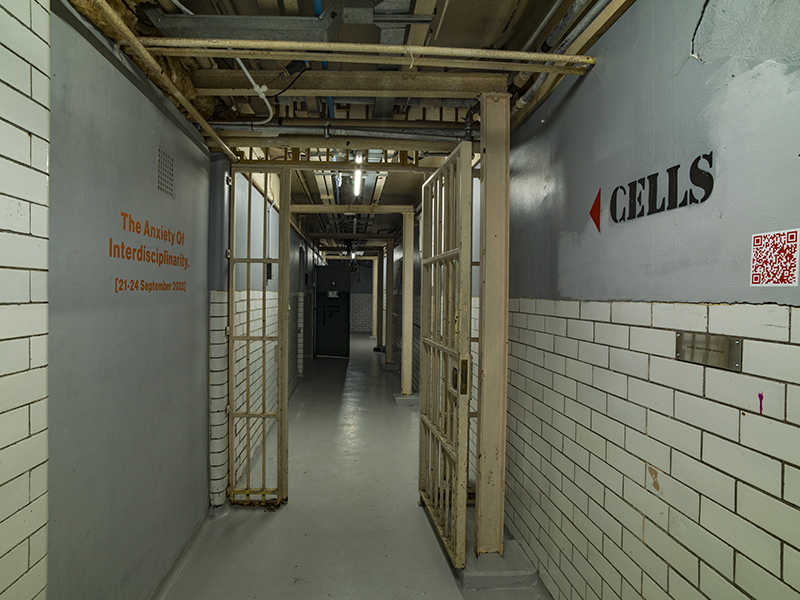
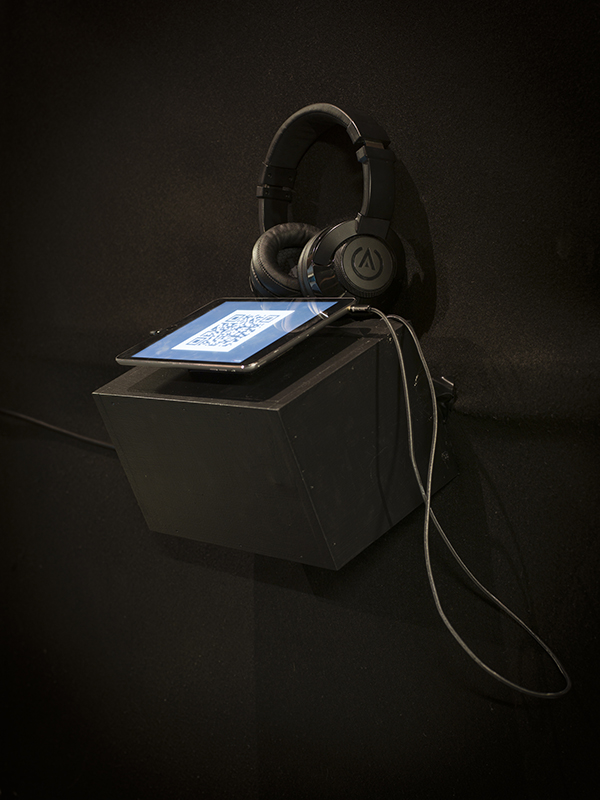
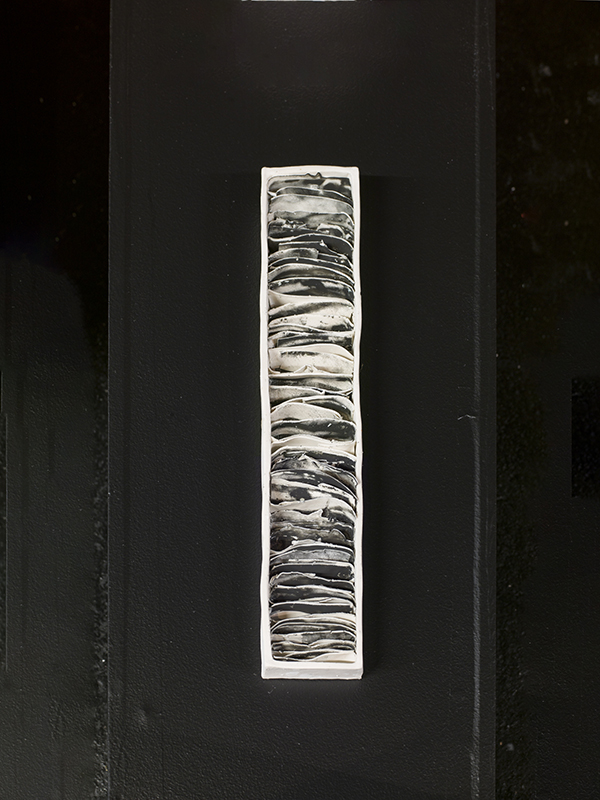
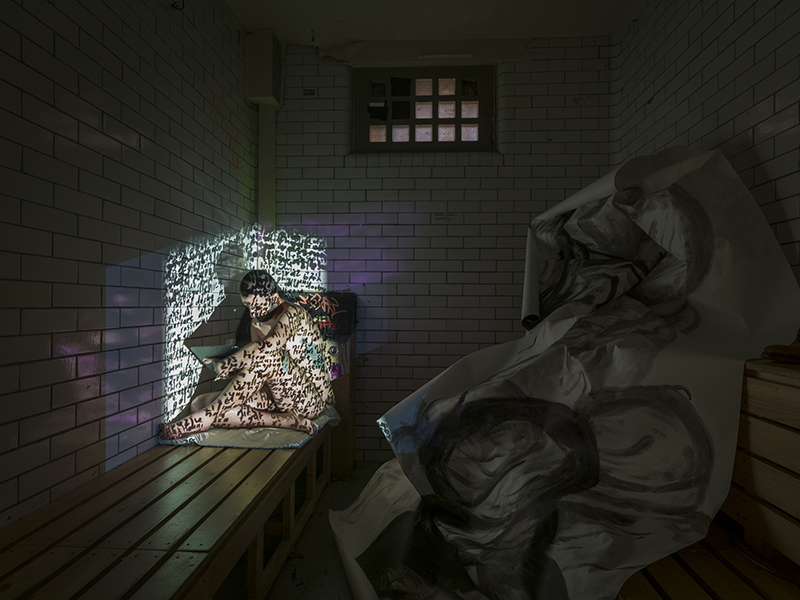
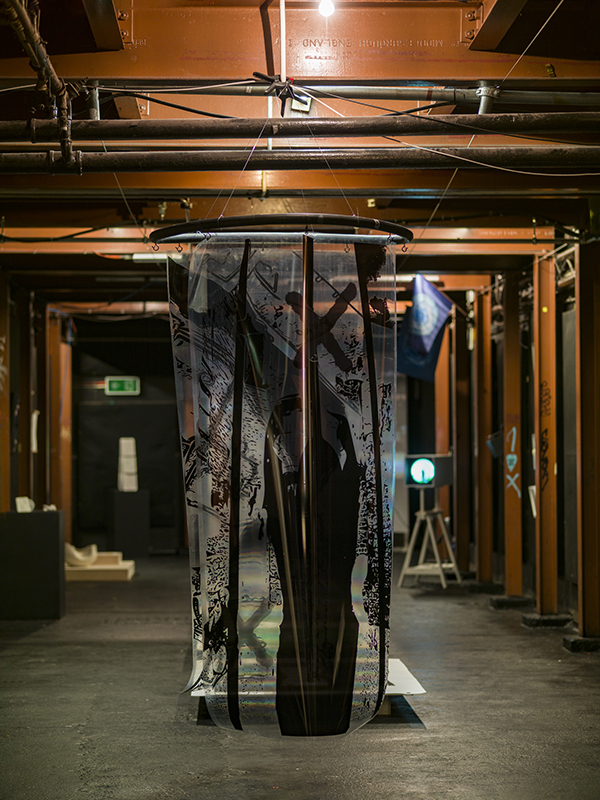
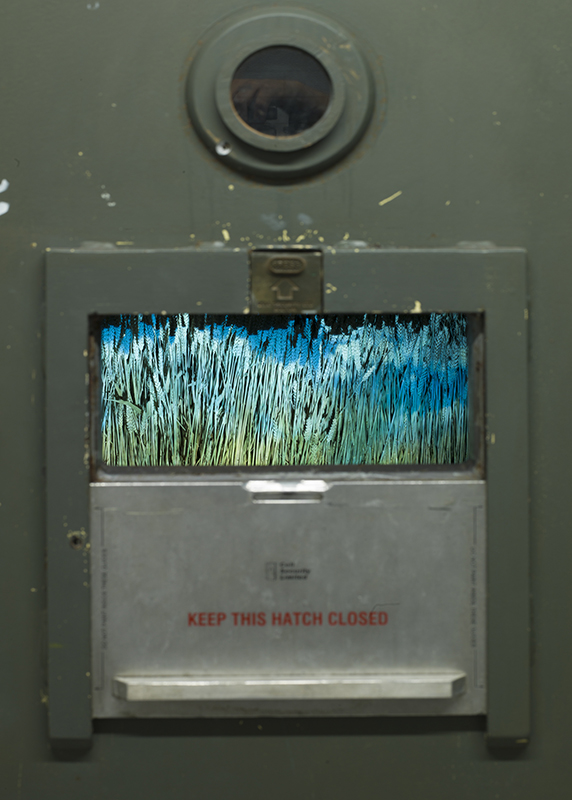
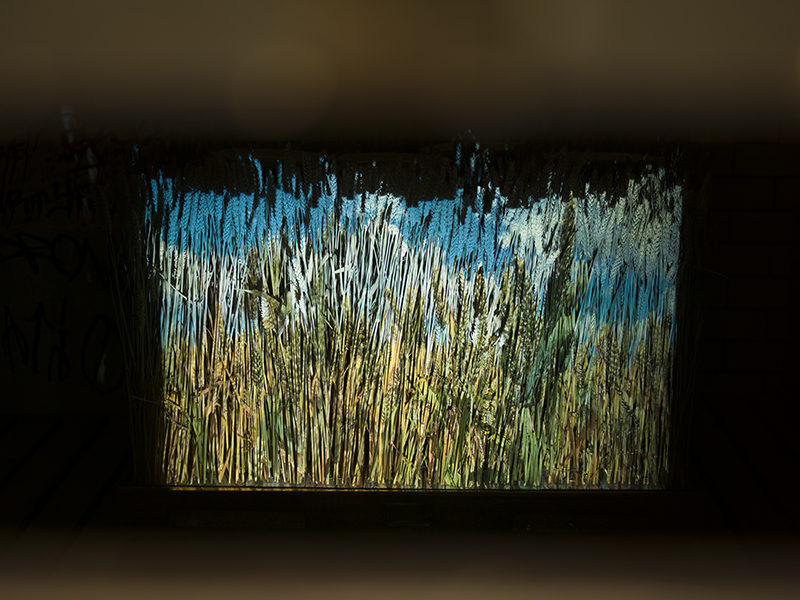
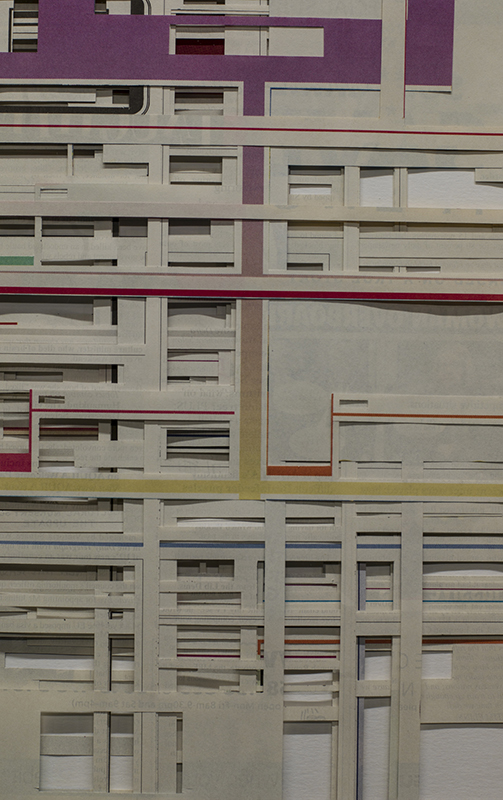
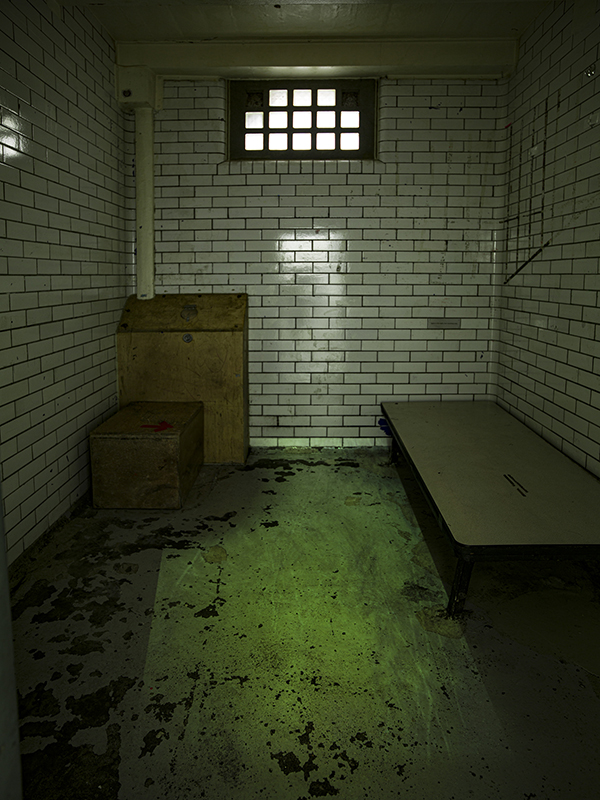
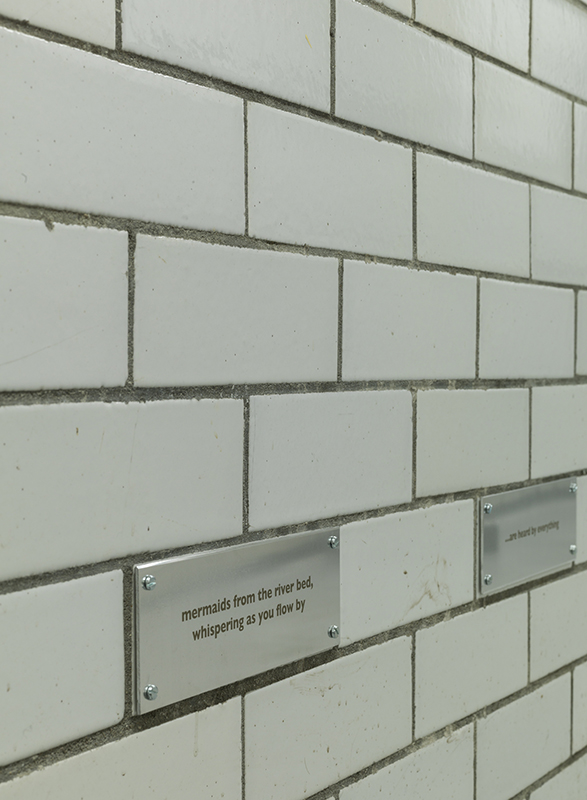
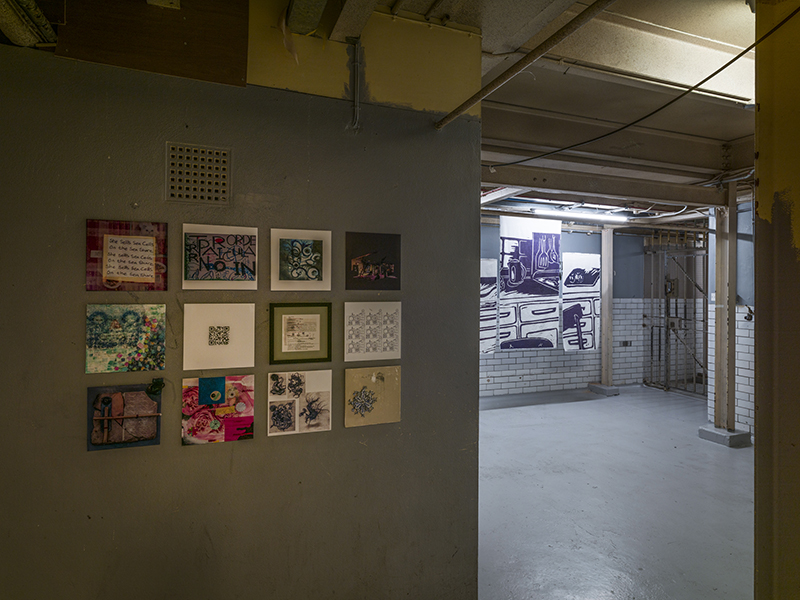
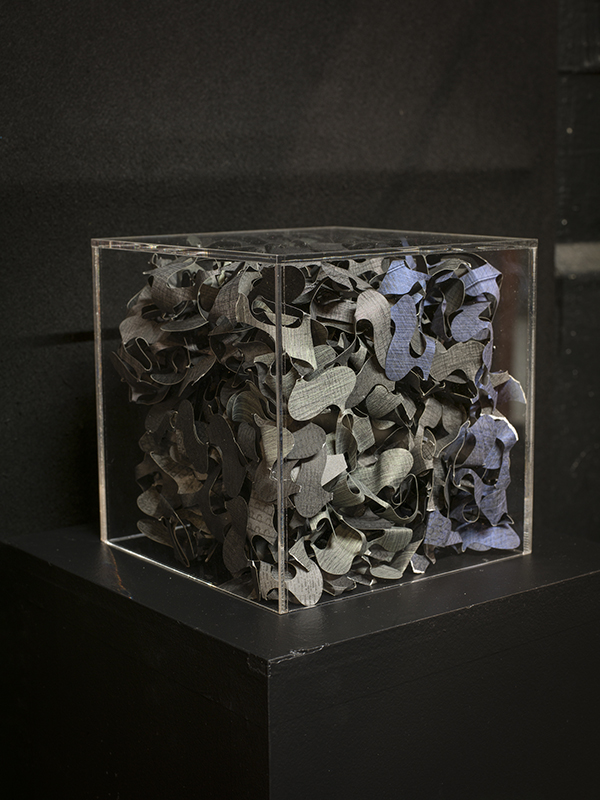
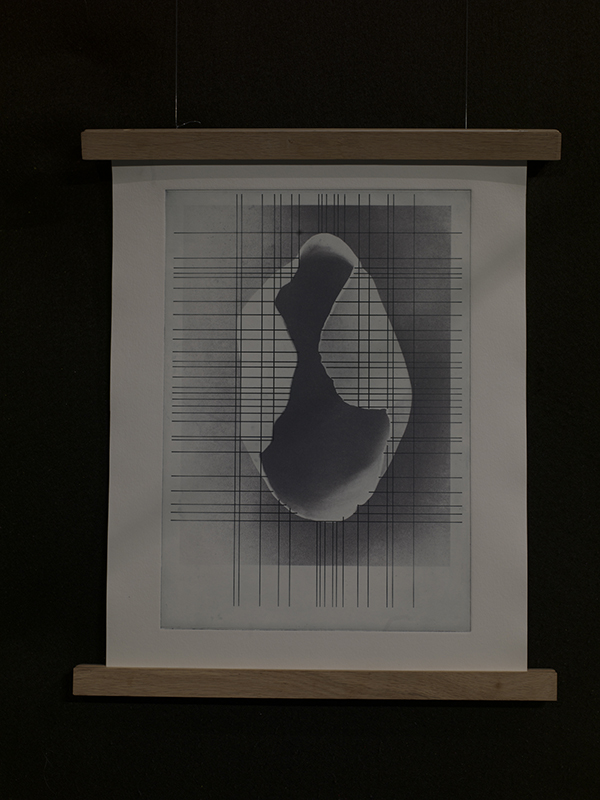
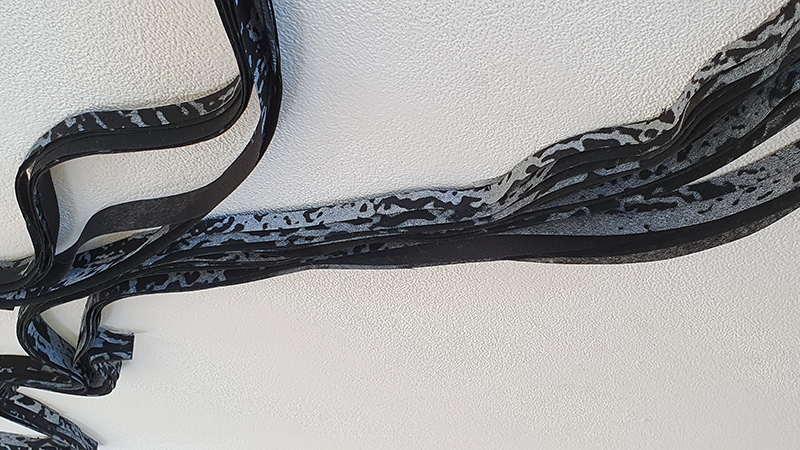
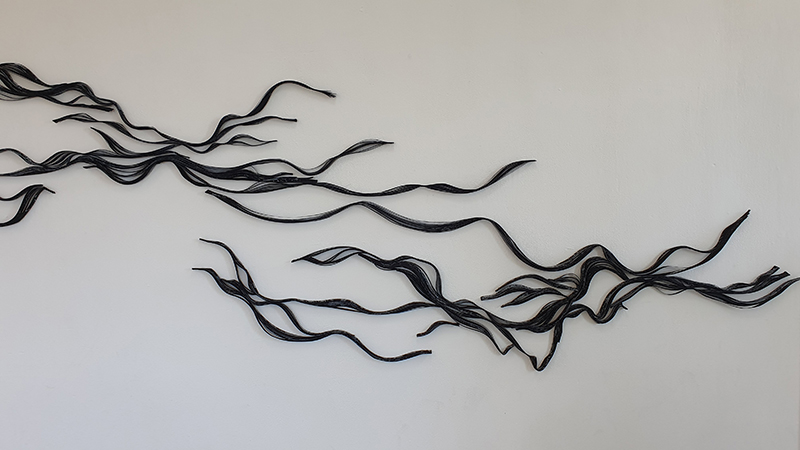
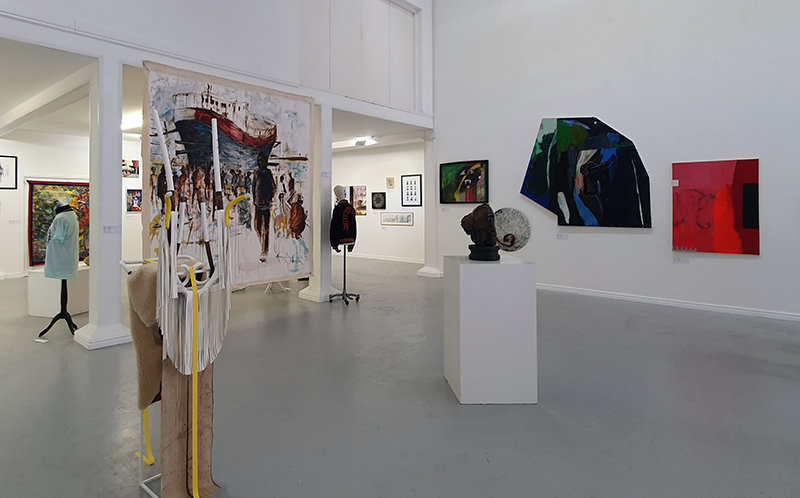
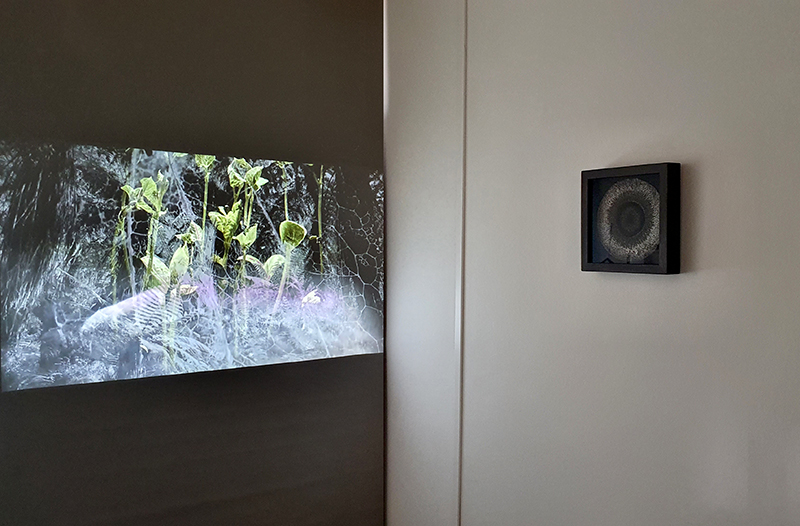
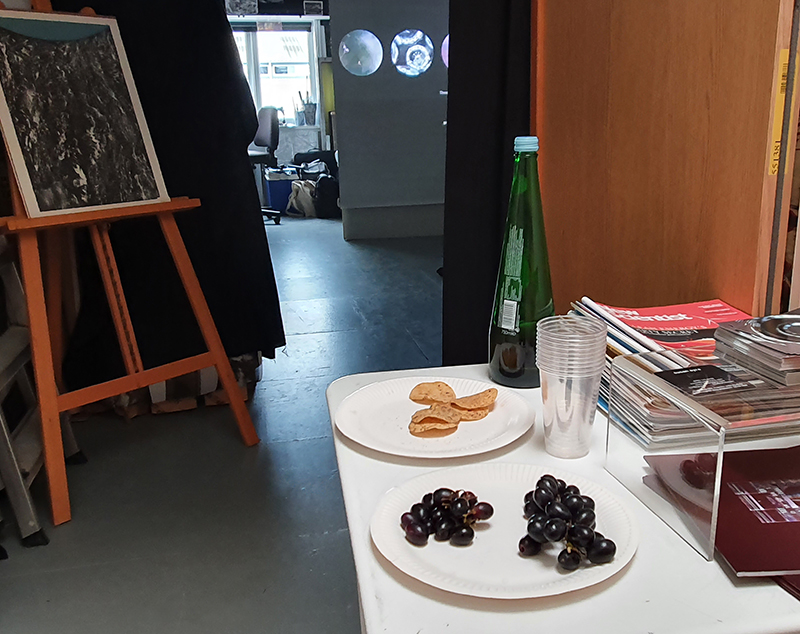
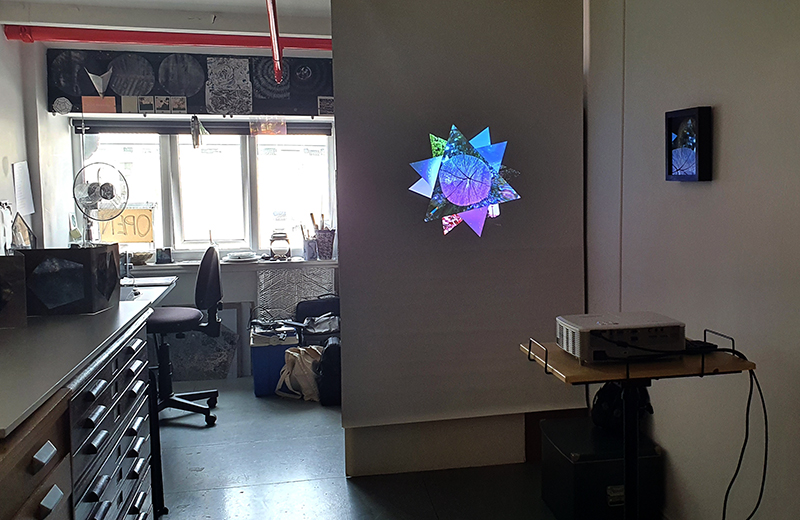
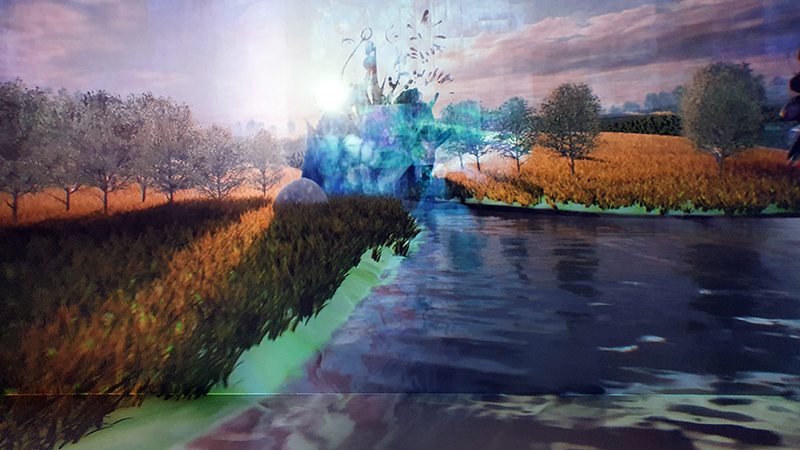
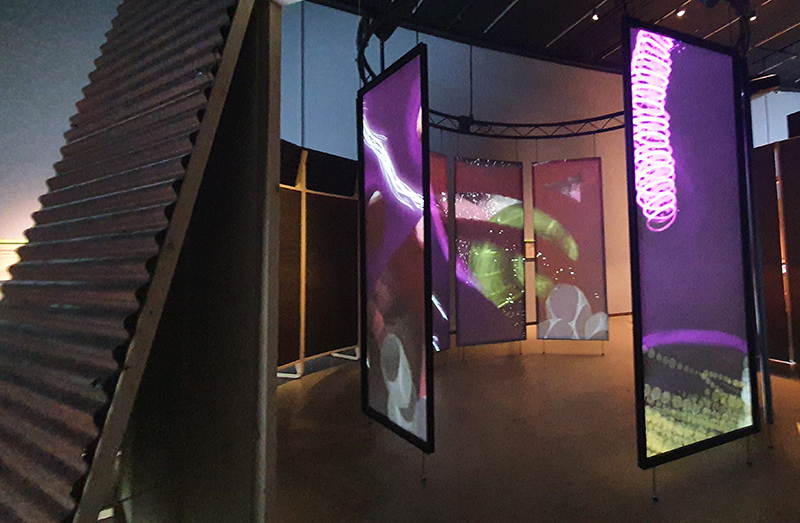
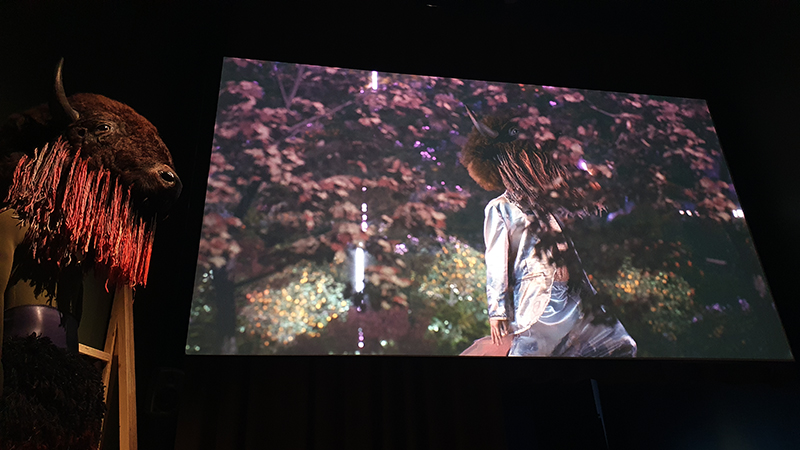
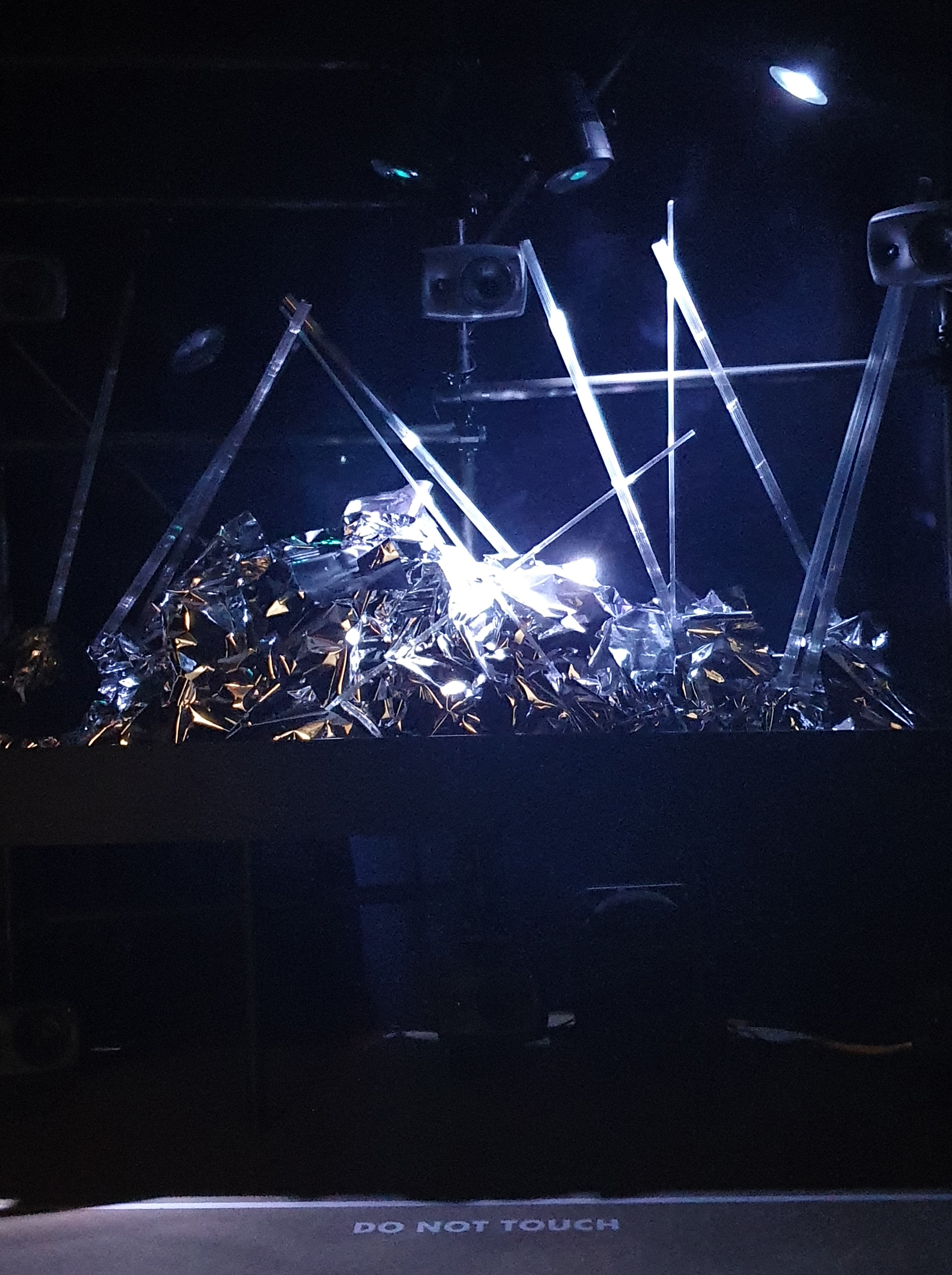
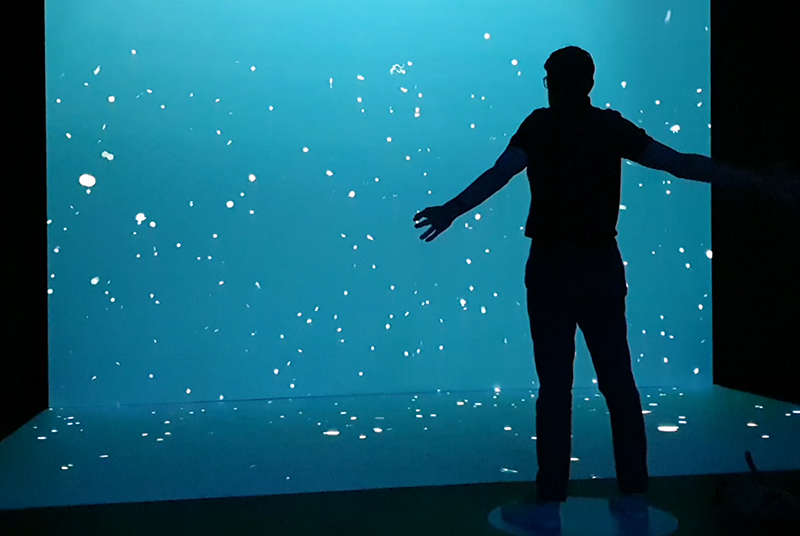
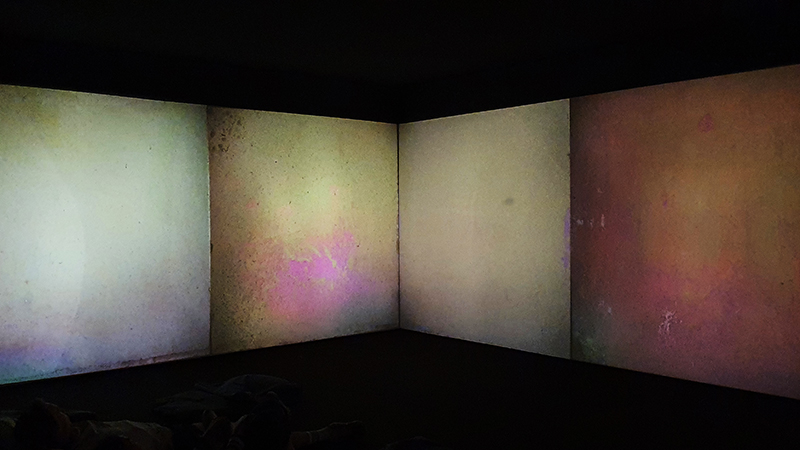
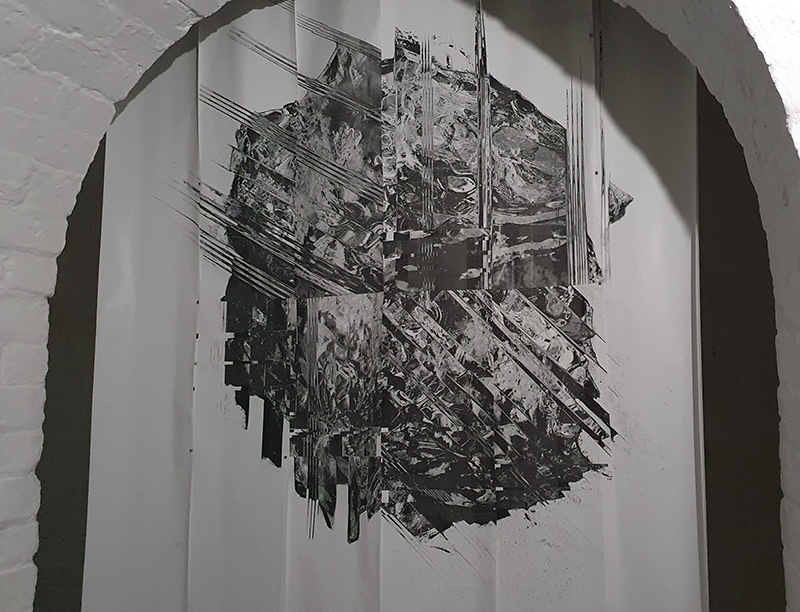
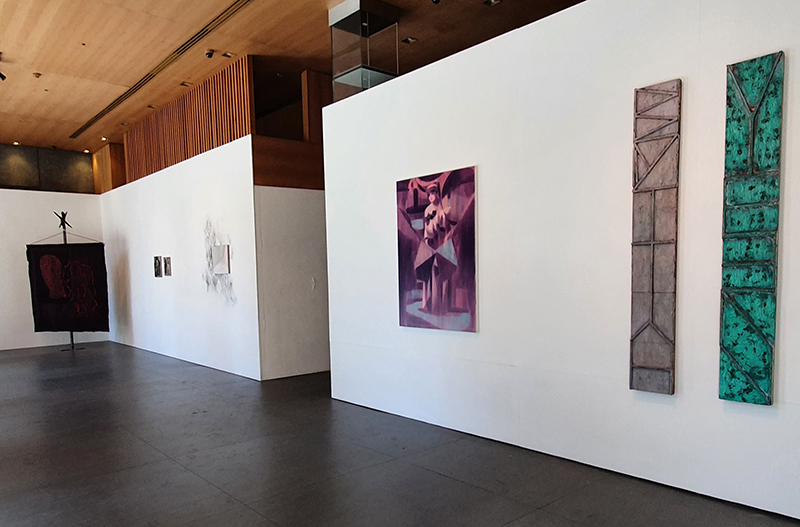
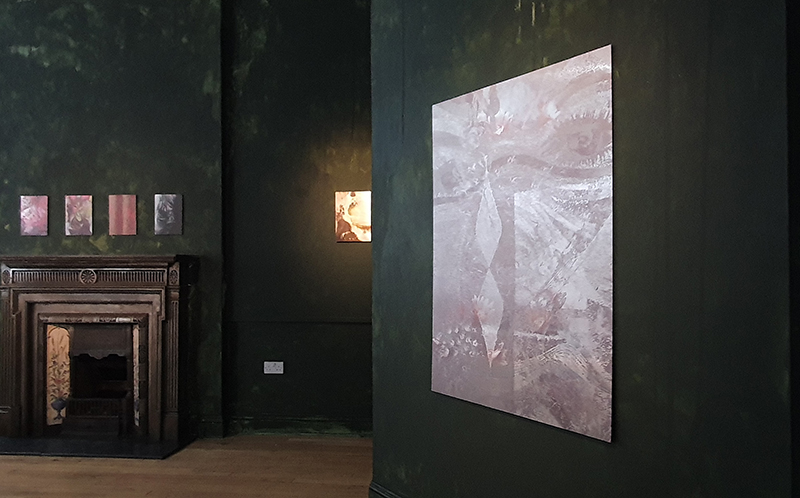
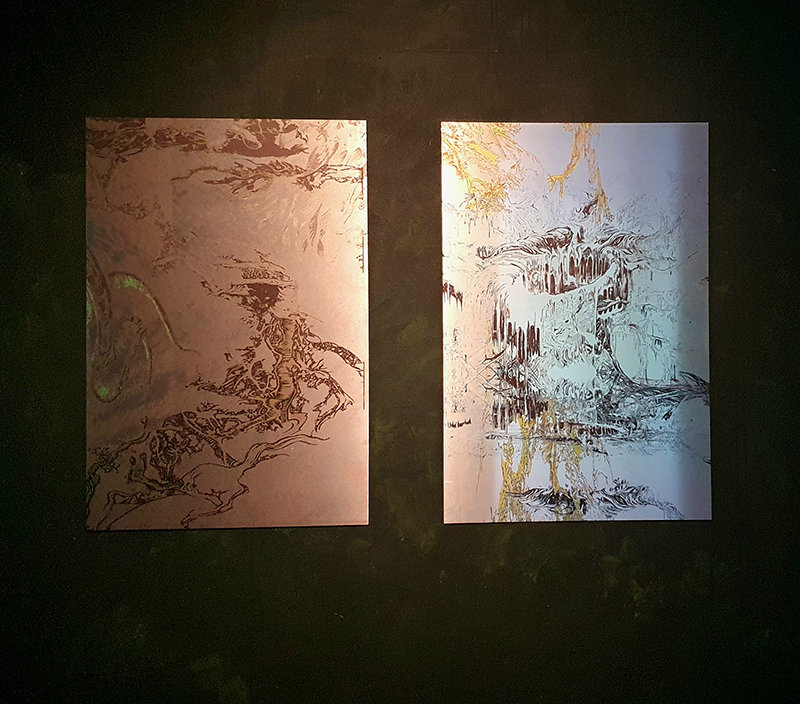
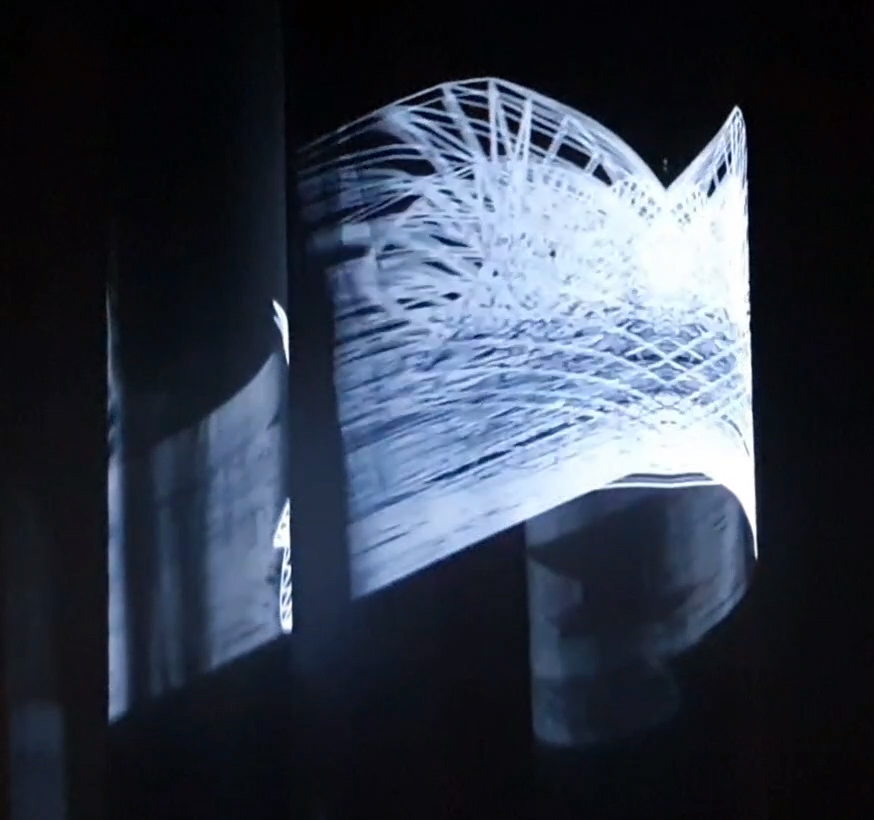
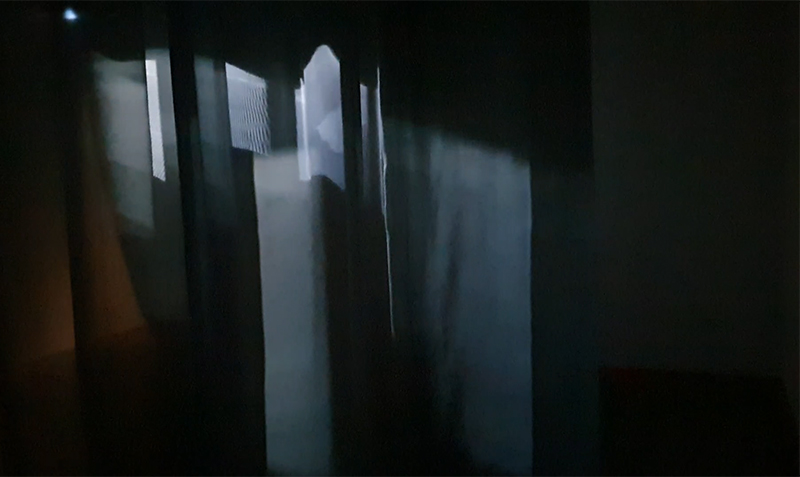
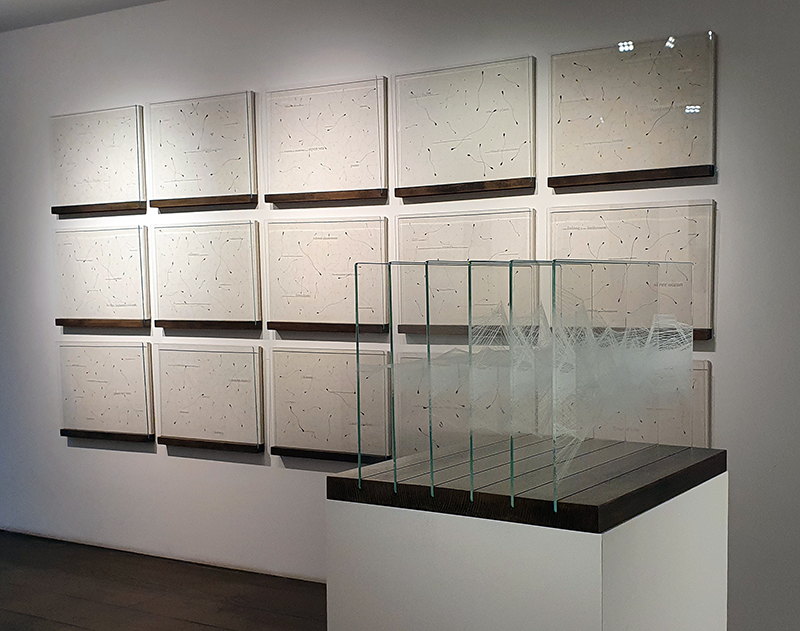
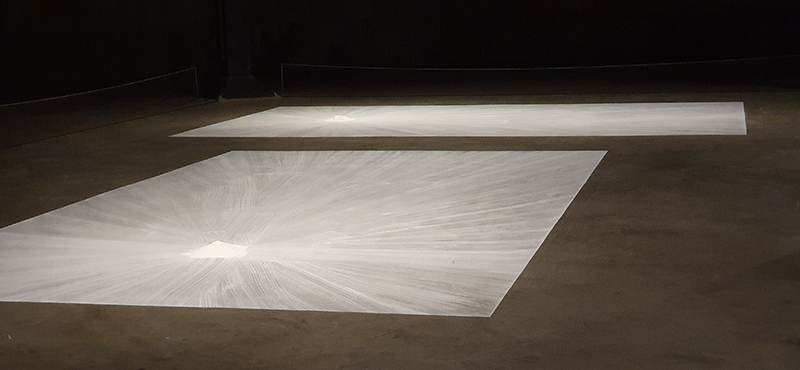
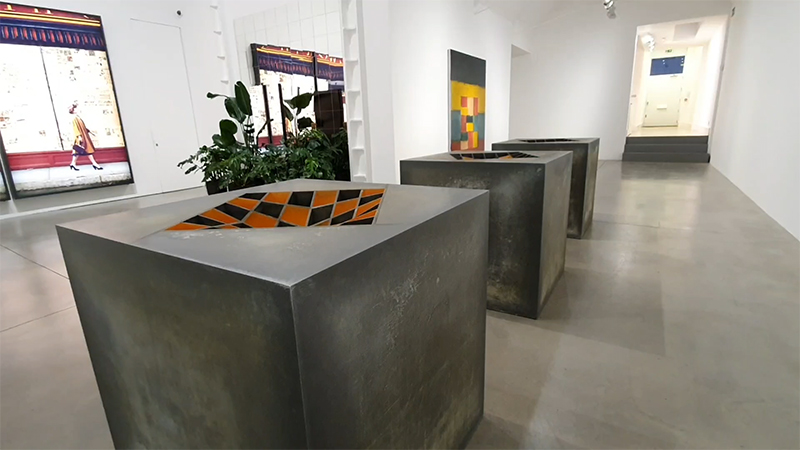
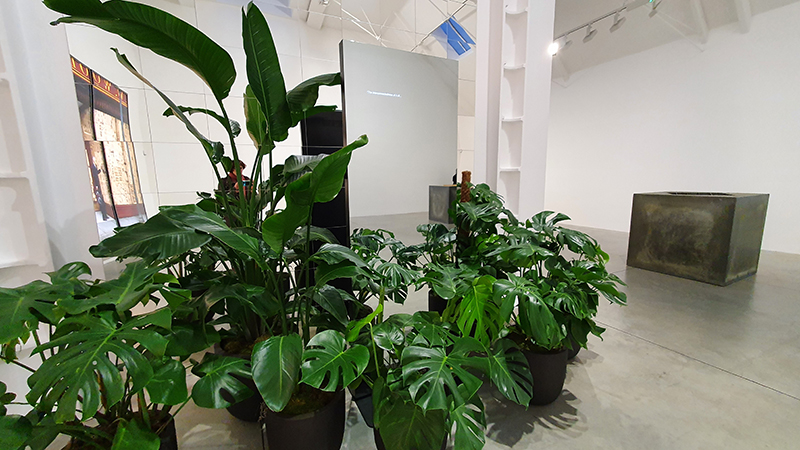
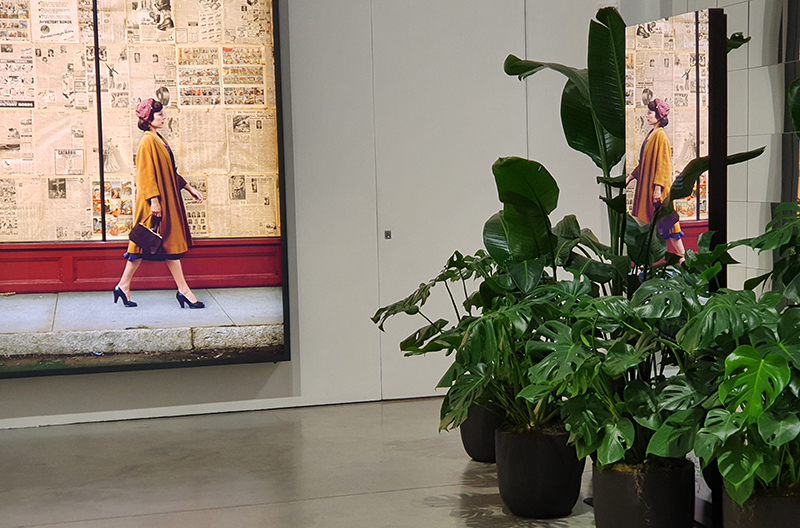
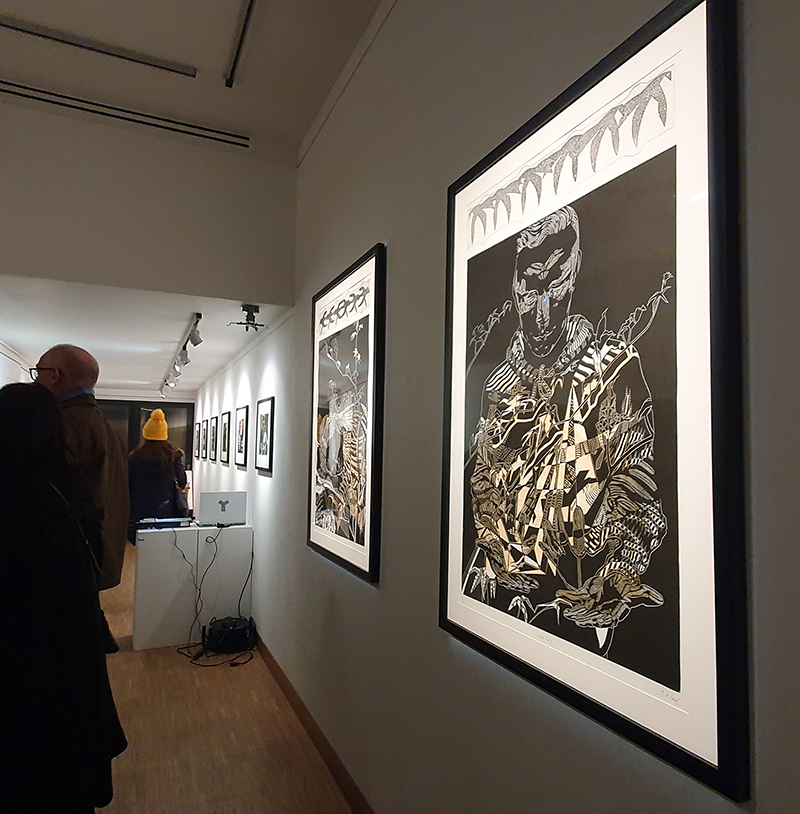
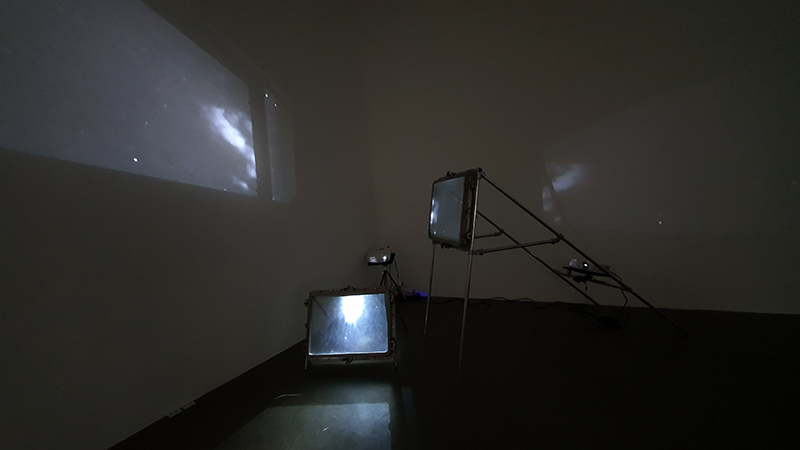
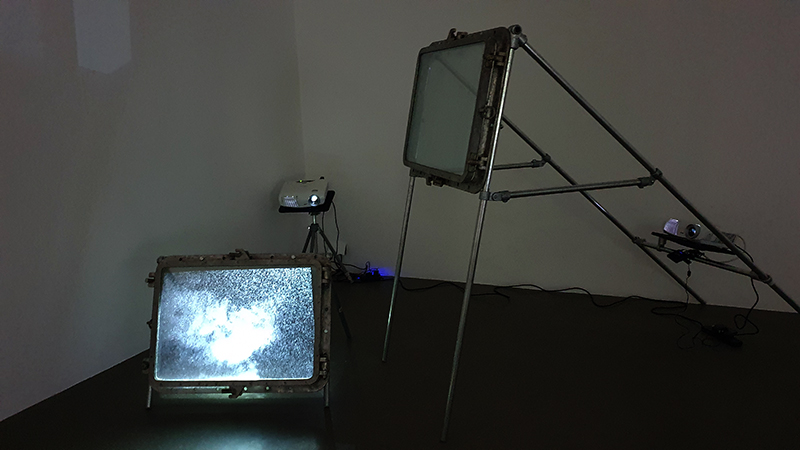
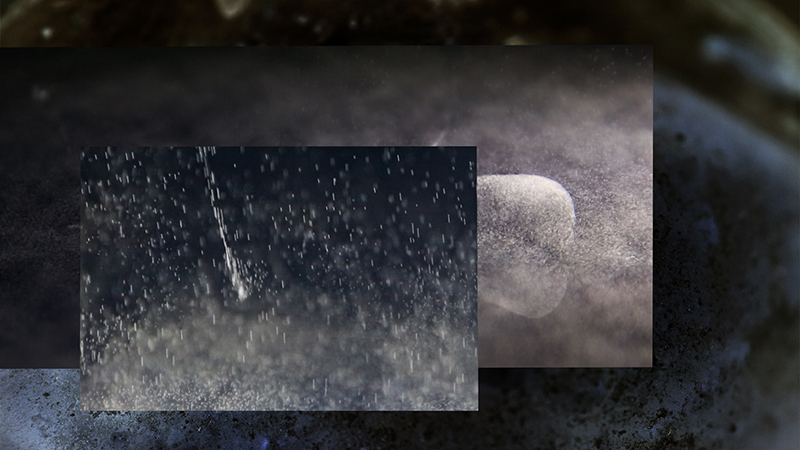
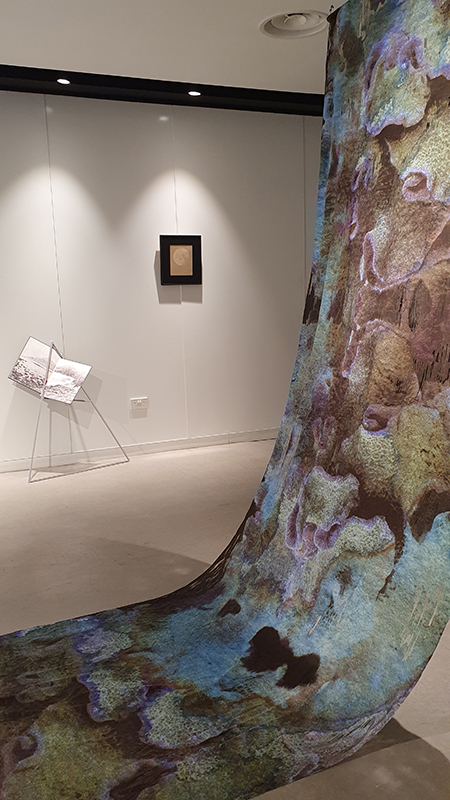
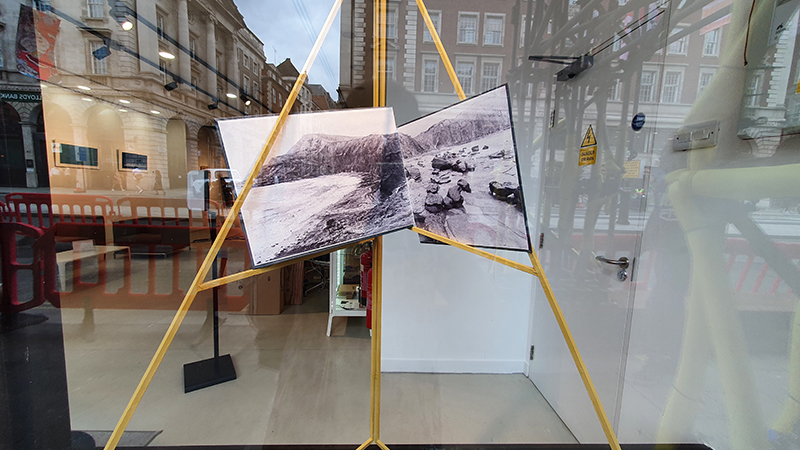
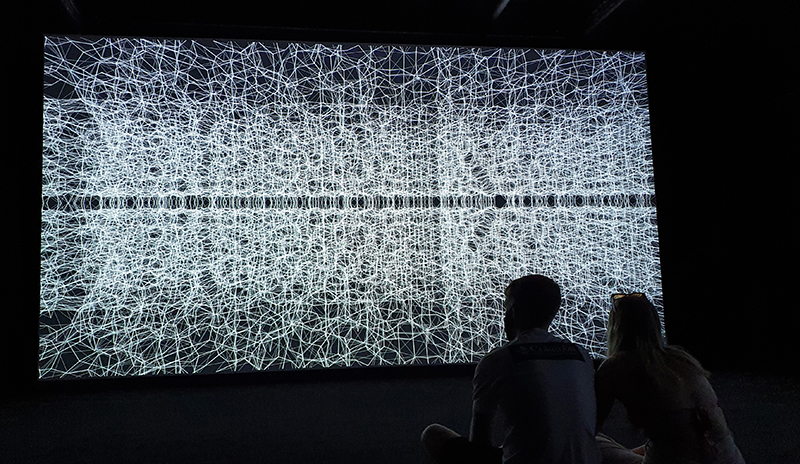
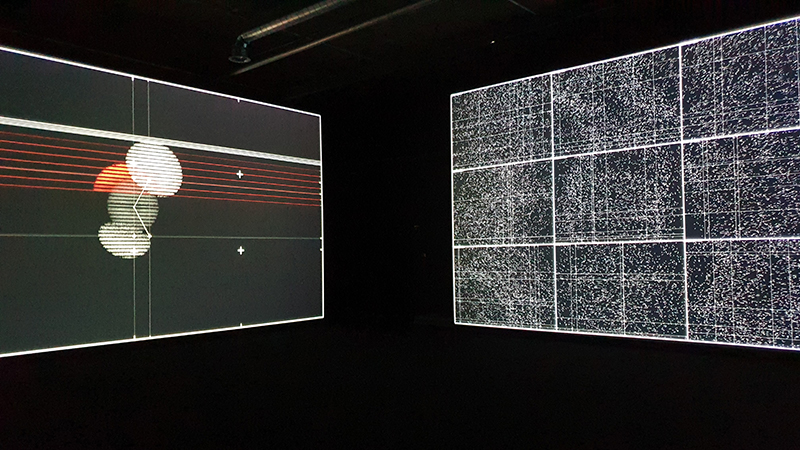
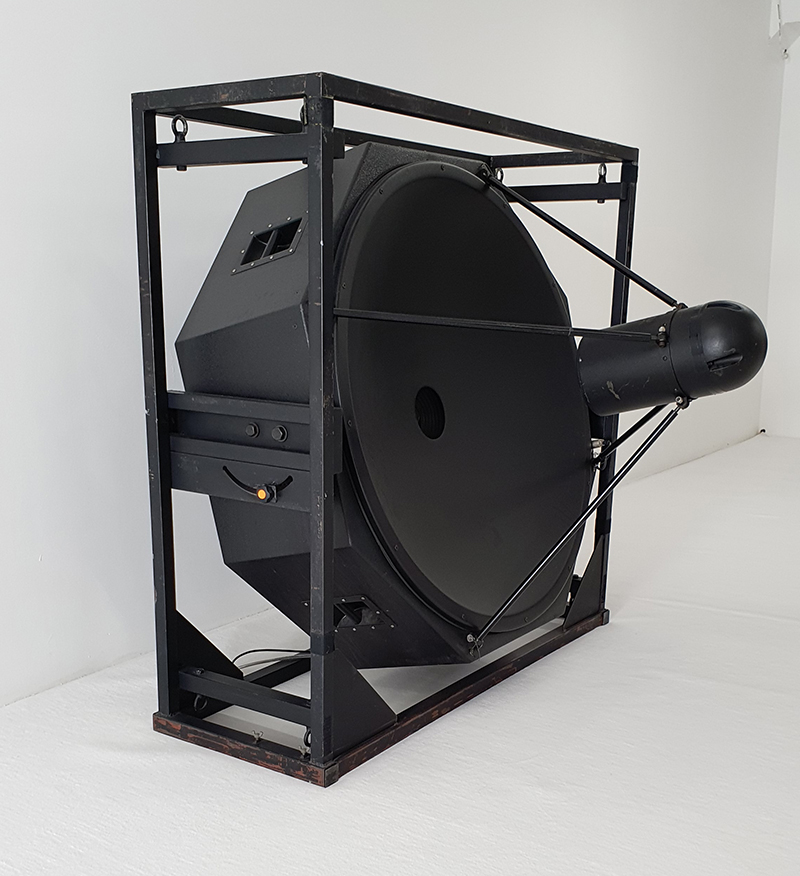
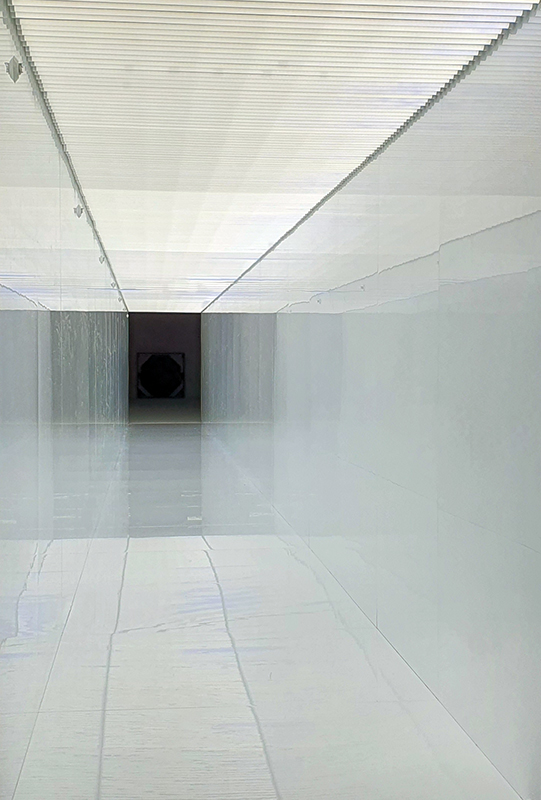
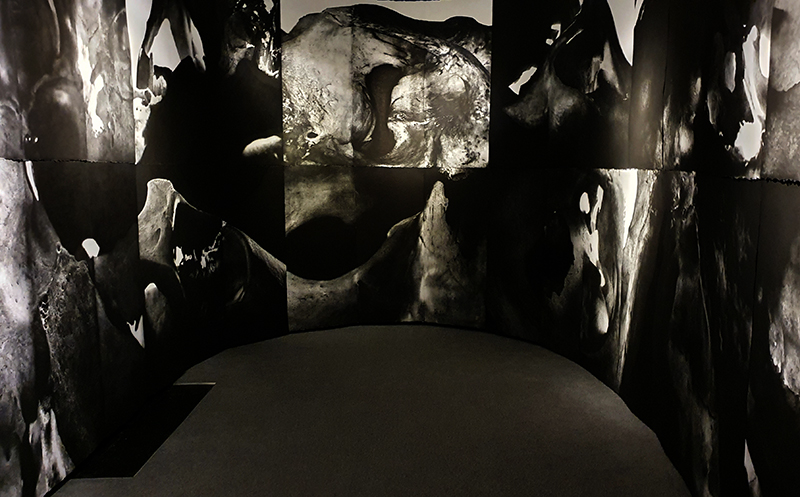
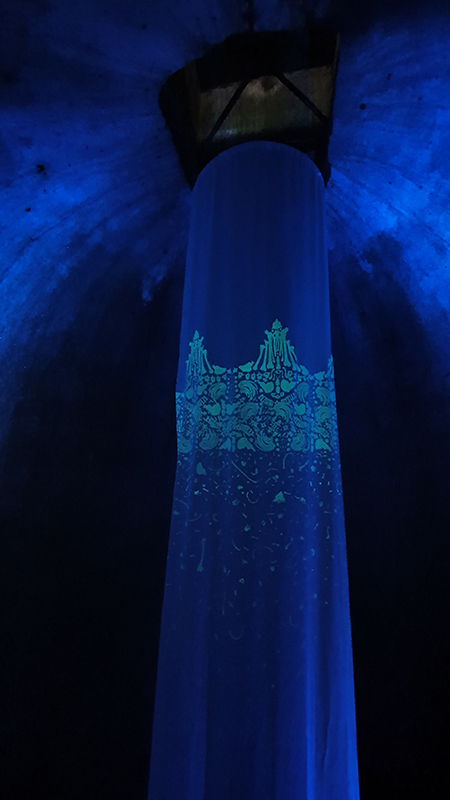
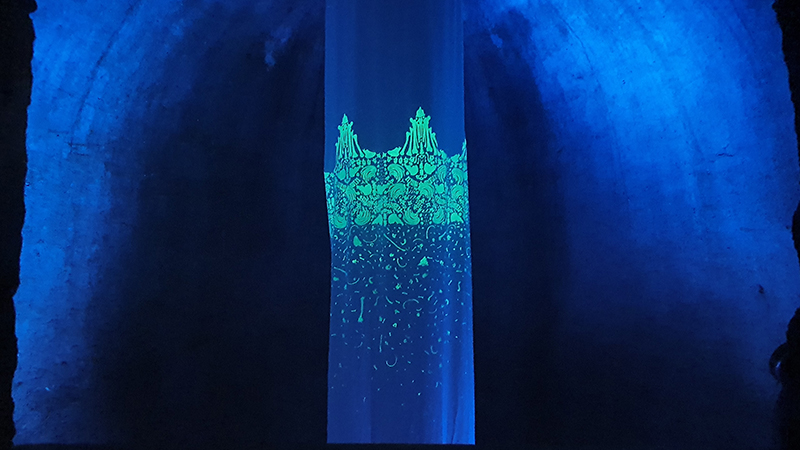
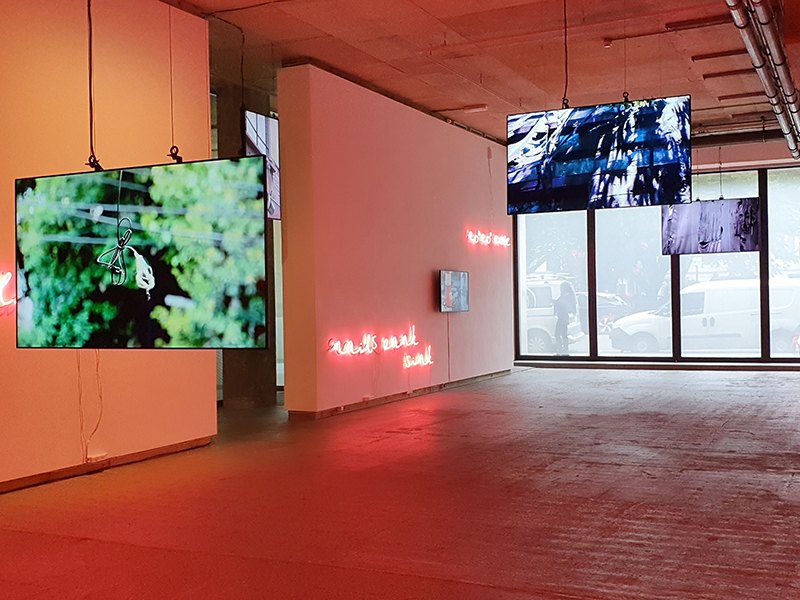
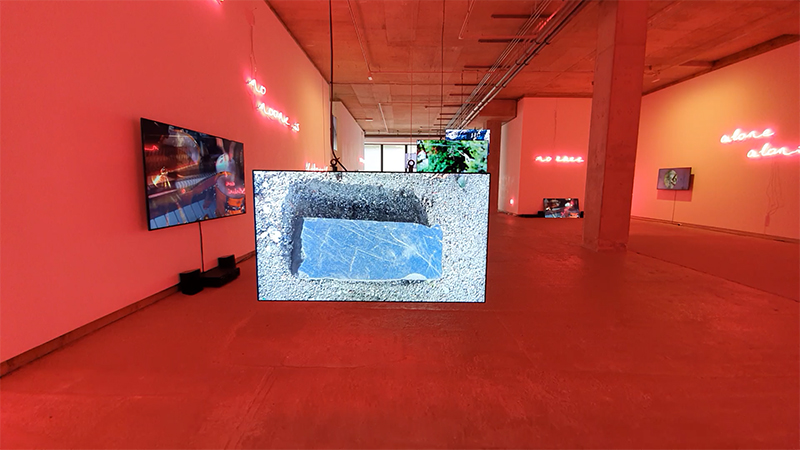
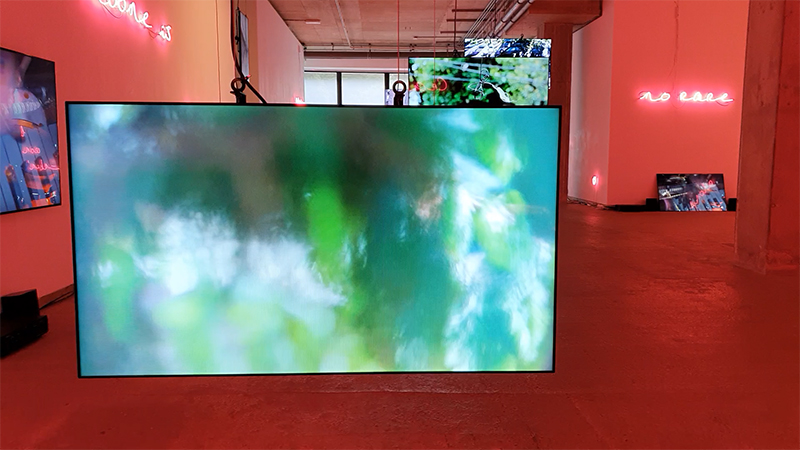
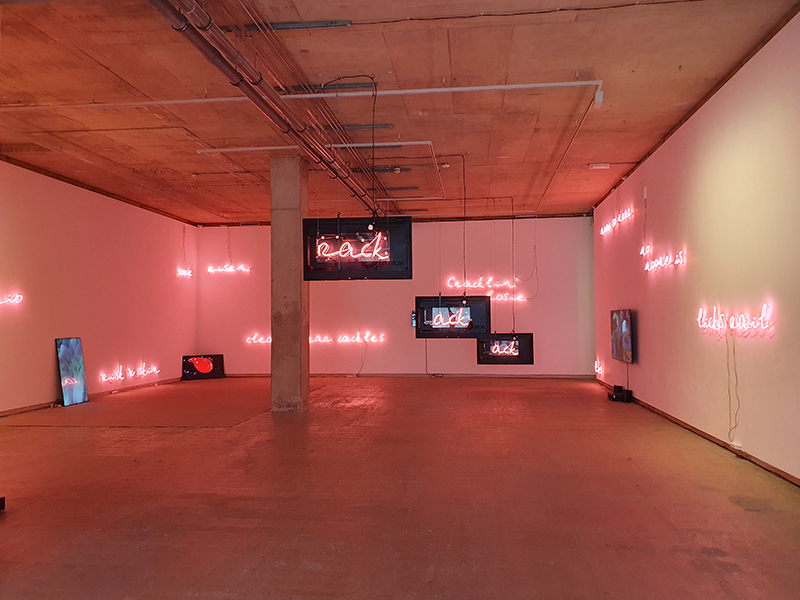
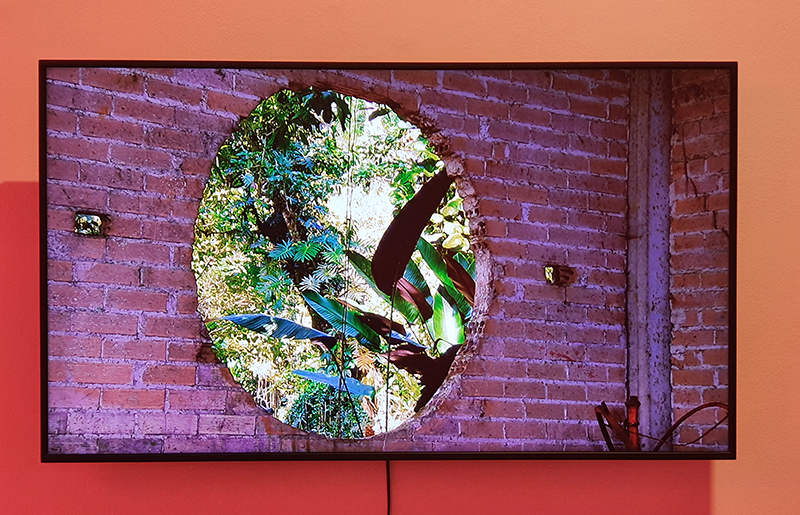
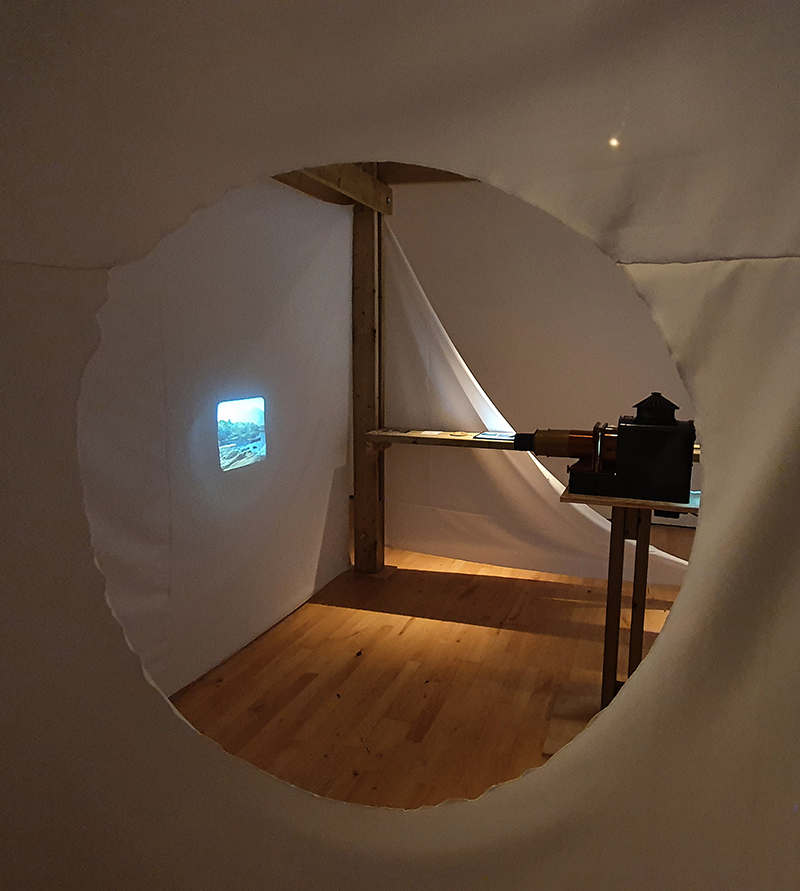
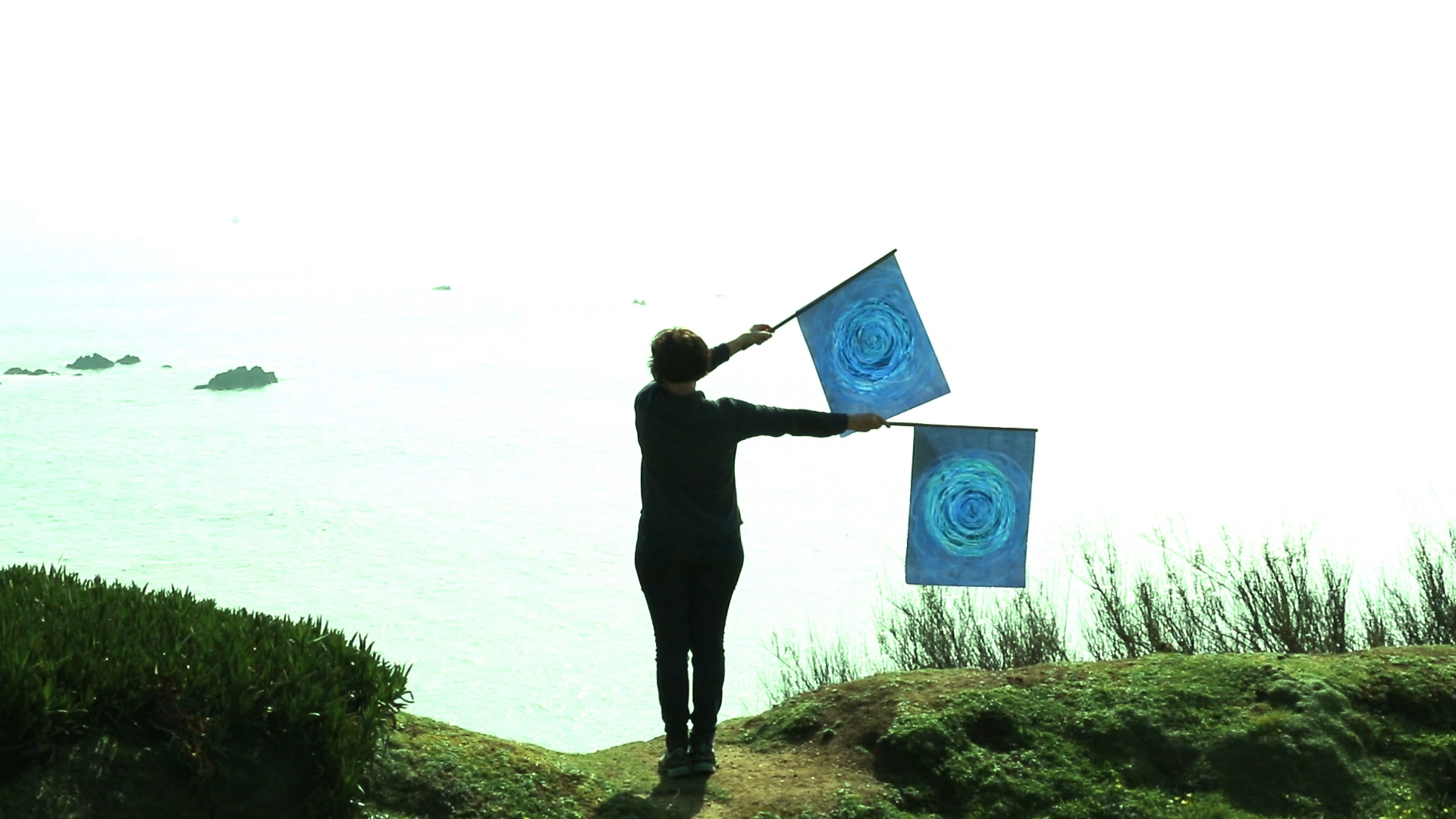
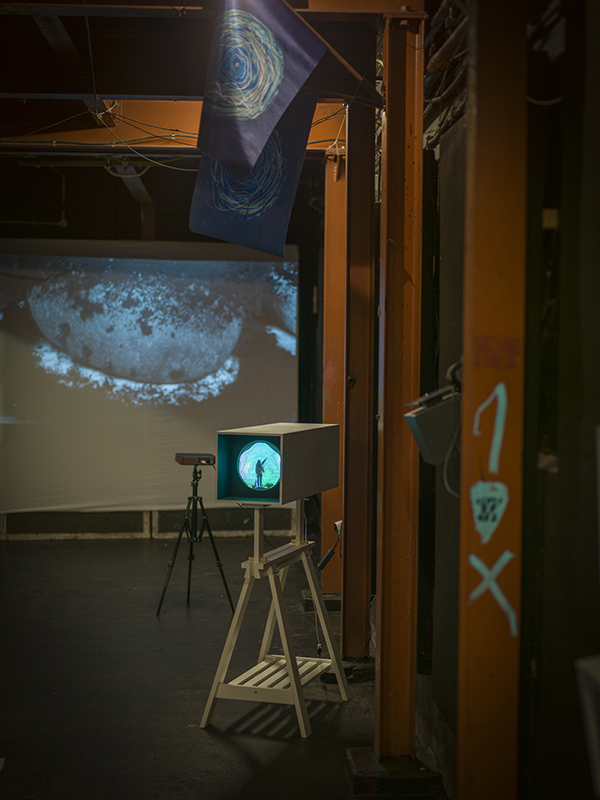
Delighted to have my video installation At a Distance included in The Anxiety of Interdisciplinarity  exhibition in the subterranean labyrinth of former police cells that is The Island Venue in Bristol. Curated by Sarah Strachan and Ayeshah Zolghadr. Exhibition Images by Steve Russell Studios.
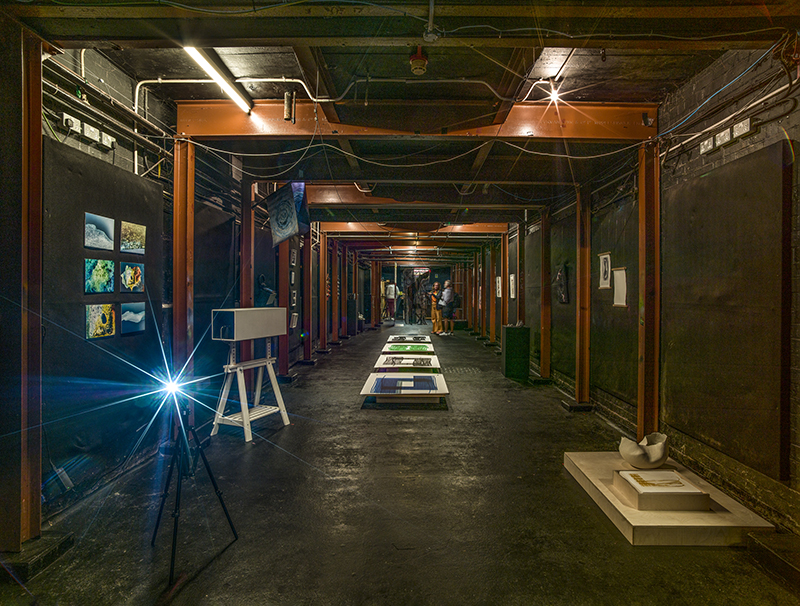
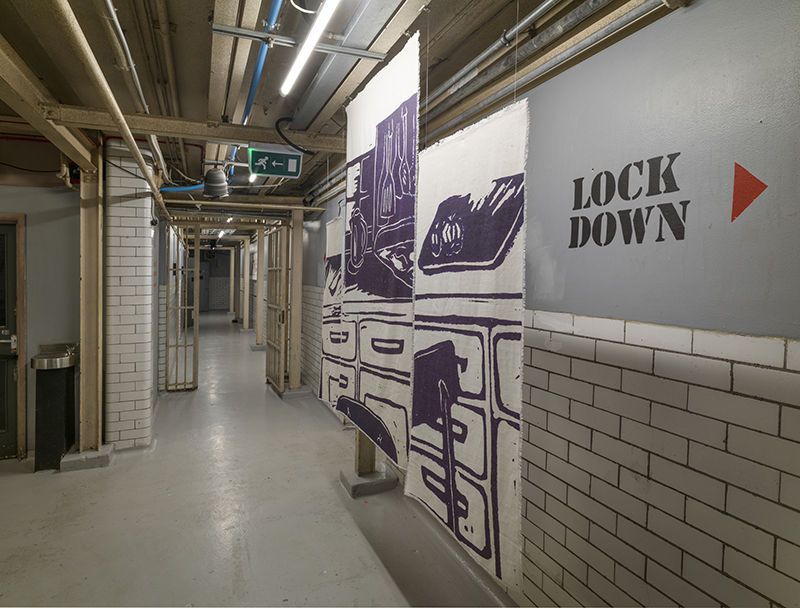
This is a satellite exhibition of the International Printmaking Conference taking place at The Centre for Print Research, University of the West of England, Bristol. Motivated by the International Multidisciplinary Printmaking Conference IMPACT 12’s theme ‘Merging and Metamorphosis’, the exhibition aims to trace the metamorphosis of conversations between disciplines, seeking to reframe printmaking practice as a ‘site of interdisciplinarity’ and consider contemporary approaches to print as ‘a site of ambivalence, tension or a fertile ground for exploration and experimentation.’

Works include:

Valerie O’Regan, Vertical Landscape  Nicky Harwood Parachute  Åse Vikse The Sixteen  Hannah Robin Baker “In Conversation With…”  Heather Burwell Nostalgia Erika Cann Feldspar Score  Katy Drake Expose  Pauline Scott-Garrett An Almost Invisible Wound  Debby Lauder Fair, Fine, Brisk  Sarah Strachan The Security Dilemma  Lon Kirkop Ċella ta’ Wieħed  Rana Al Ogayyel Visual Sound and Hear the Print Judy Dibiase Trace  Laura Greenway Never Enough  Mick Paulusma Being There  A. Rosemary Watson line_space_form III.VII.I   Katherine Van Uytrecht Cellular Sound  Ayeshah Zolghadr Individuated Copy Series  Nicole Pietrantoni Still Life: Darwin’s Barberry  Simon Leahy-Clark Untitled  Cameron Lings Drawing: The Expanded Field  Mary Rouncefield Escape To Infinity  Jon Michaelides 16 x 64  Susan Eyre At a Distance  Corinna Reynolds Traces of Pathways Strachan + Zolghadr Boundary Objects  Heather Burwell Playing Games  Alexandra Sivov “Listen To Me!”  Joe Dean Southern Trains Loop  Corinna Reynolds Traces of Pathways  Daniel Bell Growing Blackness
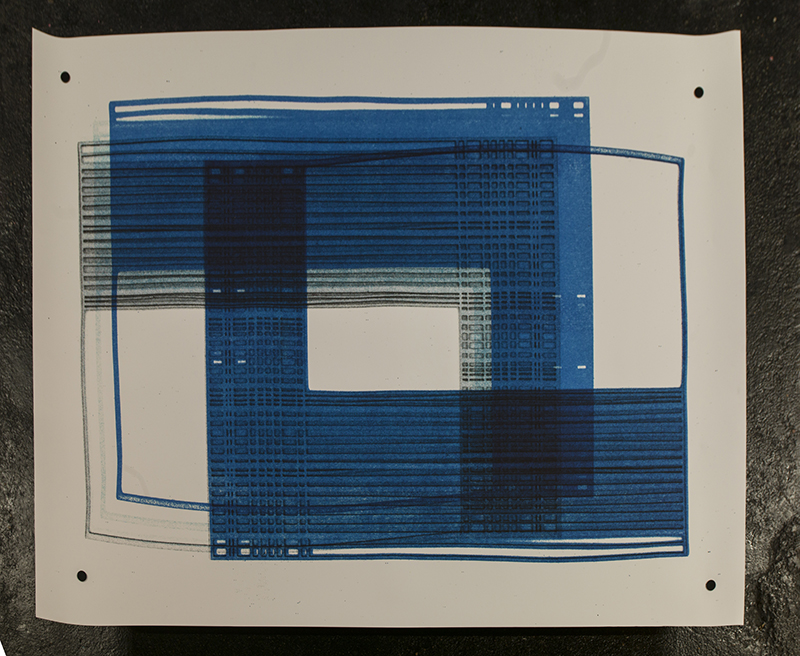
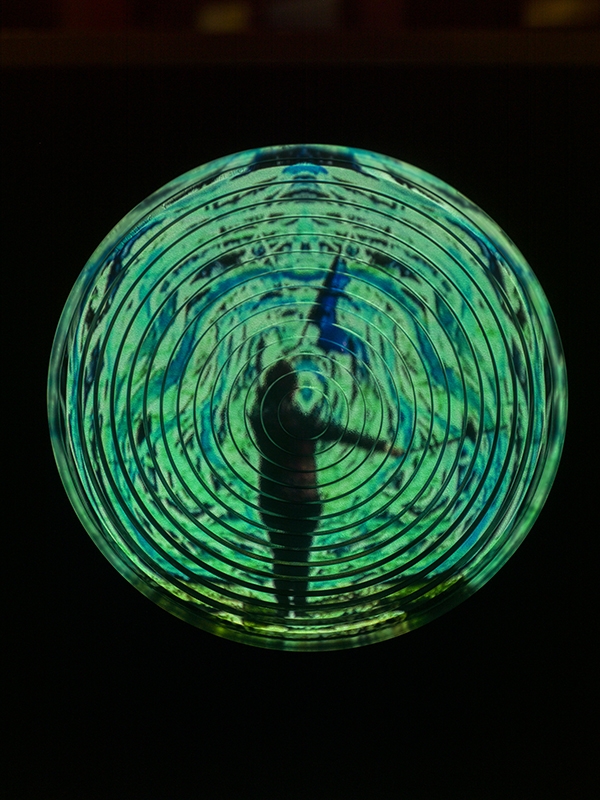
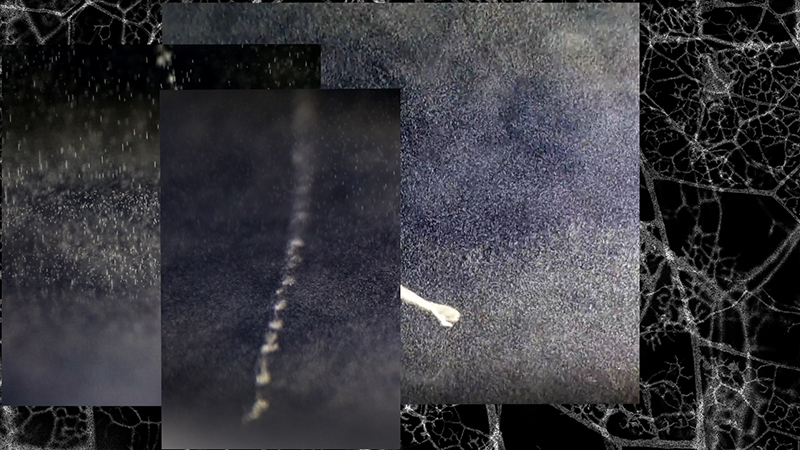
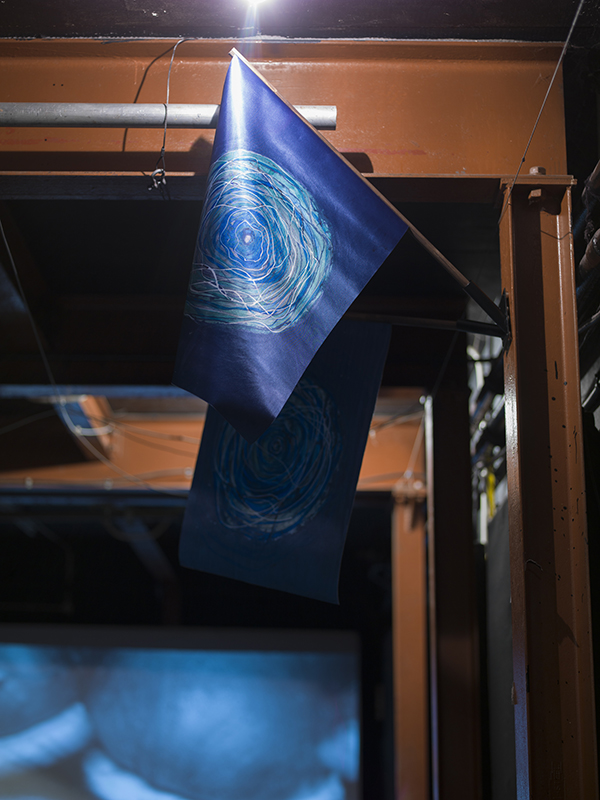
At a Distance looks at remote methods of communication and relates this to the mysterious twinning of electrons in quantum entanglement where particles link in a way that they instantly affect each other, even over vast expanses. Einstein famously called this phenomenon ‘spooky action at a distance’. Filmed on 29th March 2019 in Cornwall as the iconic Lizard Lighthouse powers up its lamp, solitary figures using semaphore flags sign ‘We Are One’ out across the ocean in the hope the message will be echoed back. Drawing on the physical language of print that embodies touch, separation and mirroring the flags have been printed using hand painted dye sublimation inks applied via a heat press. This process transfers the ink from a paper matrix onto the substrate textile. The image passes momentarily across space in a dematerialized state as vapour before being reformed as its mirror opposite.
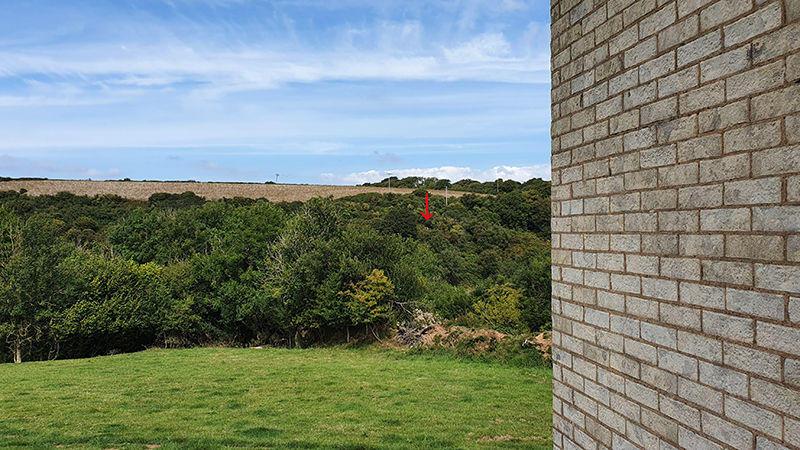
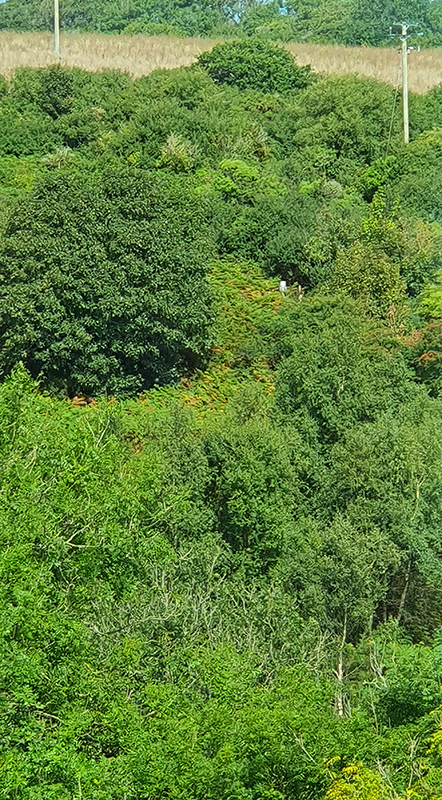
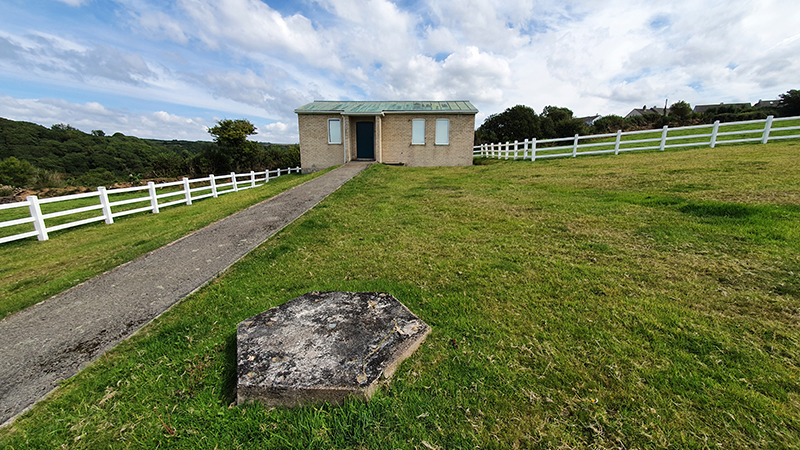
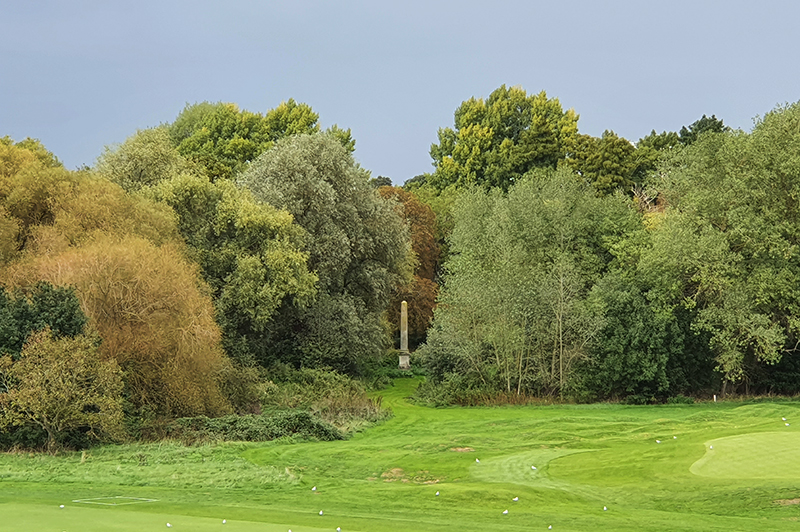
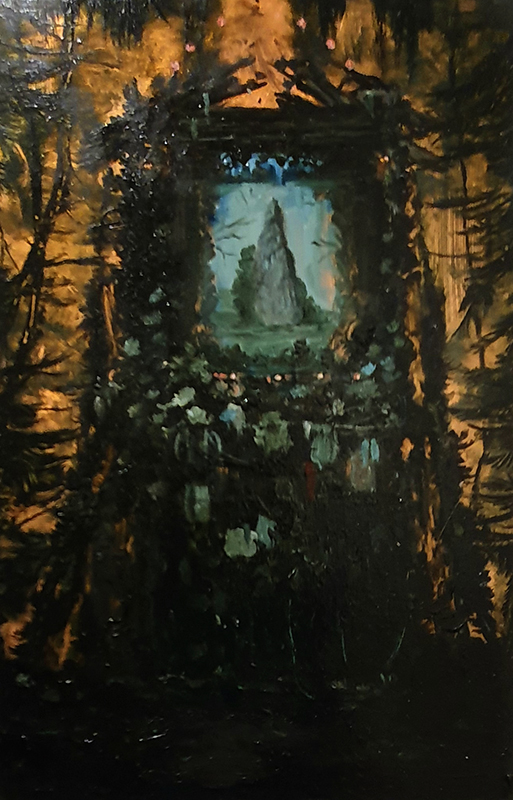
Research visit to Hartland Magnetic Observatory. I am very grateful to The British Geological Survey for allowing me access to the site and particularly to Tom who shared his knowledge and gave a fascinating tour of the observatory. He was a little perplexed by my request to see the obelisk with the azimuth mark determined by observations of Polaris as he thought this description was a slight exaggeration of what was actually present. The ‘obelisk’ is almost hidden in thick undergrowth and impenetrable woodland so this object, just glimpsed amongst the trees remains an enigma.

Hartland was established in 1955 and is part of a network of international observatories sharing information with governments and industry, the charts of the shifting magnetic field are also publicly available. The buildings are made of lime bricks and timber, with concrete flooring and roofing of copper.

The Earth’s magnetic field acts as a shield against potentially harmful charged particles from outer space. It is also holds clues to the planet’s deep interior and geological history which are inaccessible to direct observations.

Magnetic declination is the angular difference between magnetic north and geographical or true north for any point on the earth’s surface. The British astronomer Sir Edmund Halley was interested in the magnetic field and knew about declination based on the observations of sea captains and explorers in various parts of the world. He made two scientific voyages in the Atlantic Ocean as captain of the HMS Paramore between 1698 and 1700 when he charted declination in the Atlantic and from his observations published the first geomagnetic field map in 1701. His observations involved recording the position of celestial objects and the angular distance of the sun on the horizon.

I am intrigued to know what the middle species he encountered between a bird and a fish might be. Penguins with long swan necks?

Alexander von Humboldt determined that the magnetic field increased in intensity with distance from the equator based on magnetic field observations during his scientific journeys 250 years ago. He initiated coordinated observations across the globe and thus laid the foundation for international data exchange and collaboration.

Observation is essential to gain insight into the complexities of the geomagnetic field which is created by a combination of three separate fields. The main field is generated in the earth’s core, the second from electrical currents caused by solar weather as cosmic particles bounce off the Earth’s main field charging the surrounding ionosphere and thirdly from the magnetisation of the surrounding geology of the rocky mantle and crust.

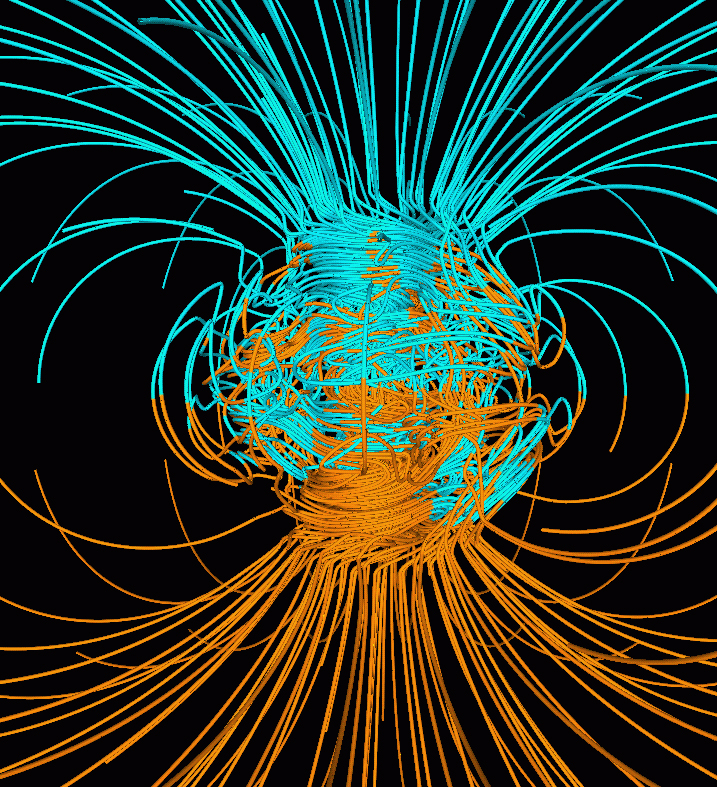
The purpose of a magnetic observatory is to measure the size, direction and changes to the natural magnetic field at the surface of the earth. There is no clear separation between north and south currents at the equator as many diagrams suggest, everything just gets a bit muddled with tangled currents.

The fluctuations in the geomagnetic component fields occur over hugely different timescales, changing by the second as we orbit the sun, to the yearly drifting of magnetic poles and the millennia of deep geological time. To study these changes an observatory must make measurements at exactly the same point over a long period of time.

Activity in the ionosphere causes a compass needle to shift slightly throughout the day but these changes, although rapid, are very small, so the instruments measuring these fluctuations must be very sensitive and operate in an environment free from man made magnetic contamination which is why I was advised to park some way from the observatory.

Rapid changes in the geomagnetic field due to magnetic storms can impact navigation data which is particularly important for the oil industry that uses this data for accurate drilling references. Data monitoring solar variability can also help studies into the mechanisms of climate change. It has been noticed that the Sun’s coronal magnetic field has doubled over the last century and this may have an effect on cloud formation which has an impact on warming the planet.

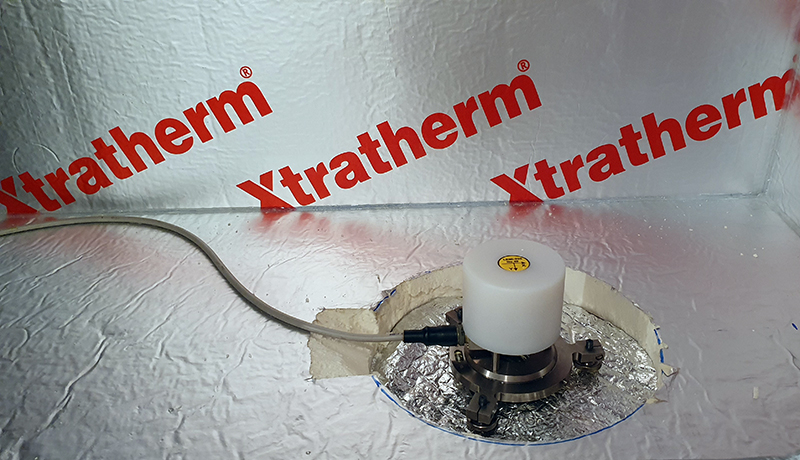
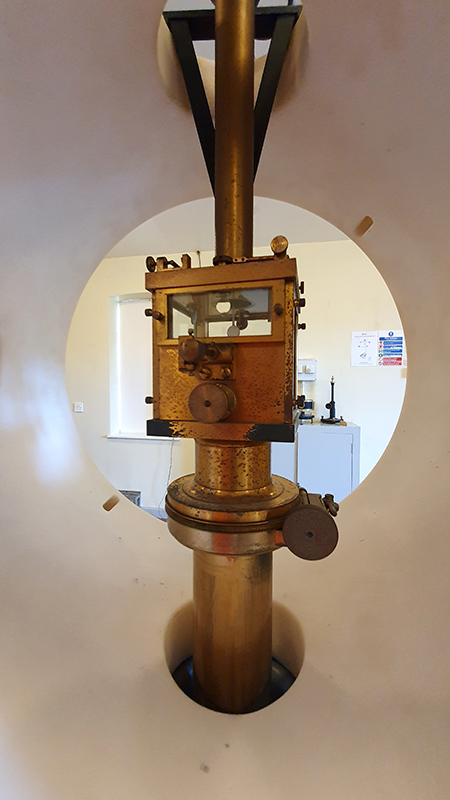
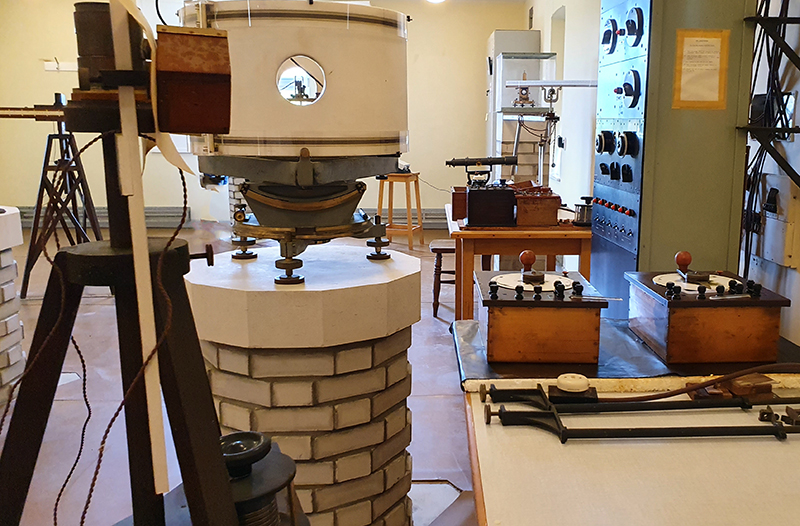
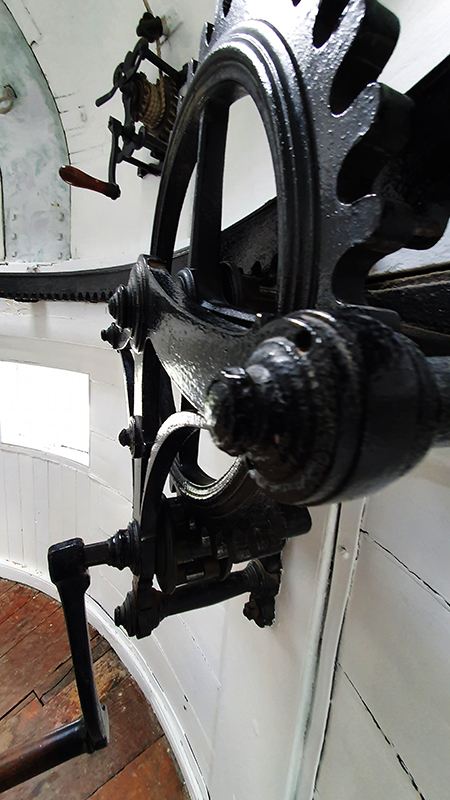
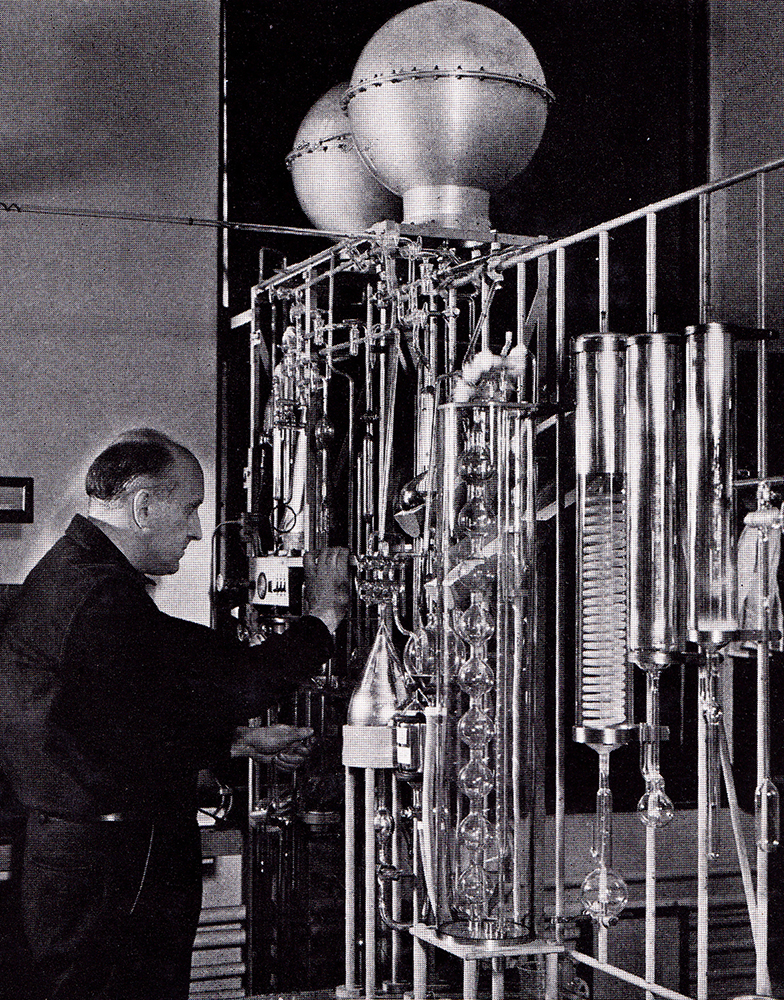
Today at Hartland, the intensity and direction of the magnetic field is sampled using one manual and two automated instruments. A fluxgate magnetometer (variometer) is used to measure variations in the direction of the field every second. It has copper coils and three orthogonal sensors (measuring north, east and vertical). This instrument is extremely sensitive, mounted on a marble block on a pillar set into the bedrock to avoid tilting, it must be kept at a constant 23C temperature. It is housed in a special building with thermally insulated inner chambers within inner chambers, isolated in the dark, it is only visited once a year. We didn’t even walk too close to the building which appeared to have no door.

The second automated instrument is a proton precession magnetometer to measure the strength of the field. This also has its own building and new equipment is being tested here. As new instruments are introduced previously unseen minute fluctuations are revealed.

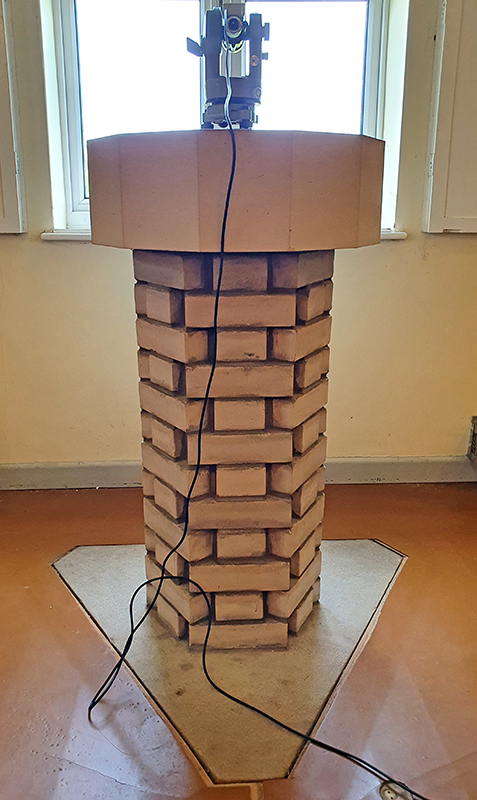
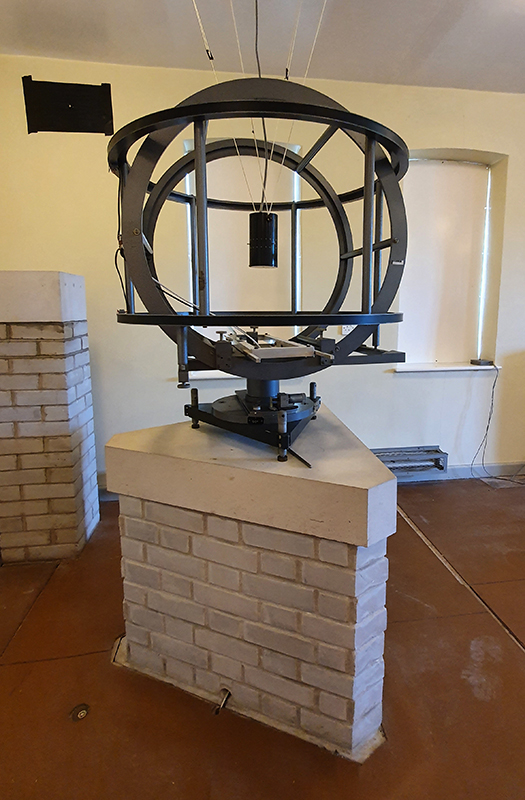
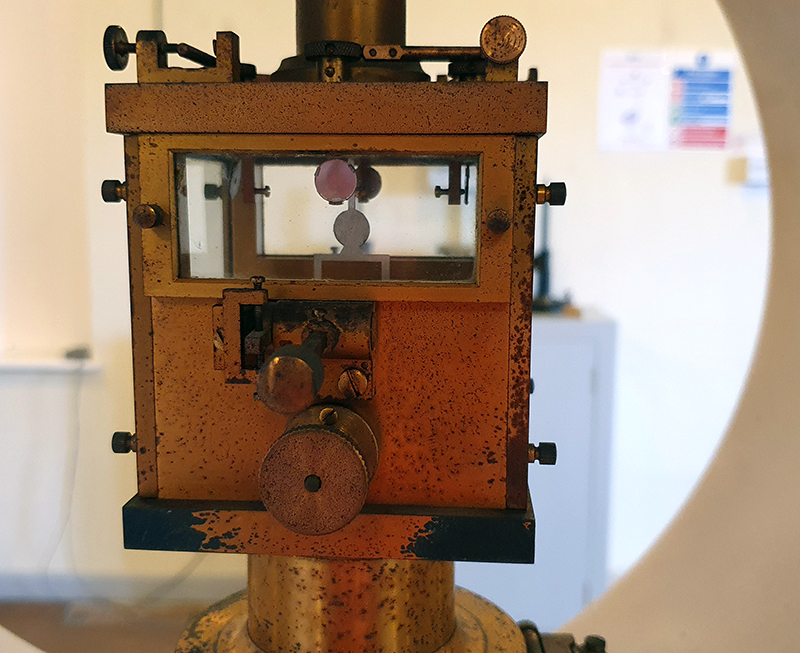
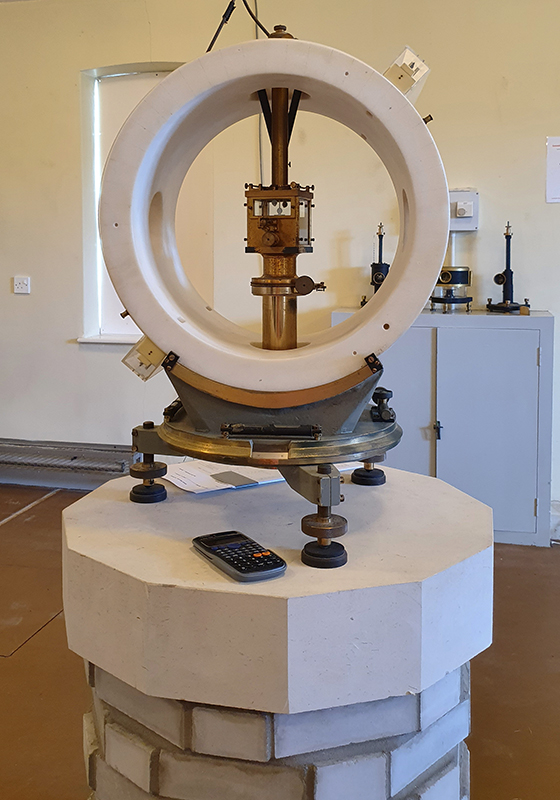
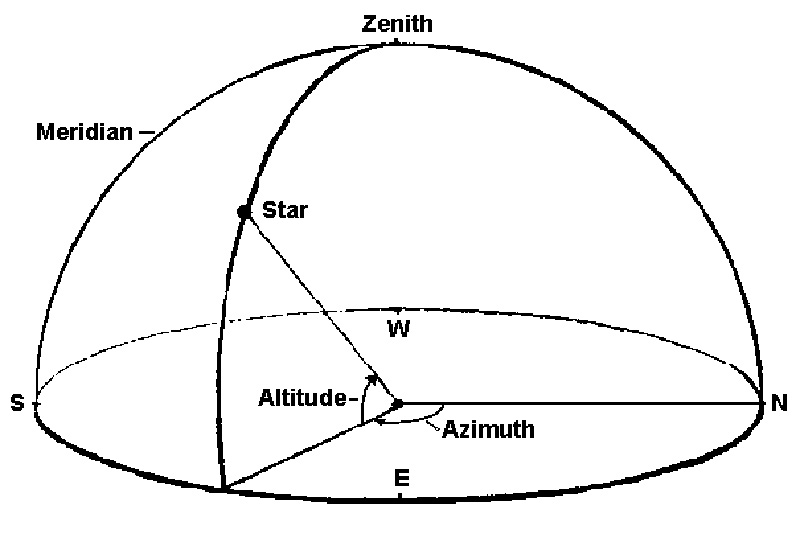
The manual instrument is a fluxgate theodolite housed in the Absolute Hut looking out of the North facing window. It sits on a lime brick and concrete pillar. This instrument has a magnetic sensor mounted on the non-magnetic telescope of the theodolite to detect when it is perpendicular to the magnetic field vector. True north is determined by reference to a fixed mark of known azimuth. This was the obelisk though today it is determined by GPS.

Absolute and variable measurements are combined to give a full record of the field.

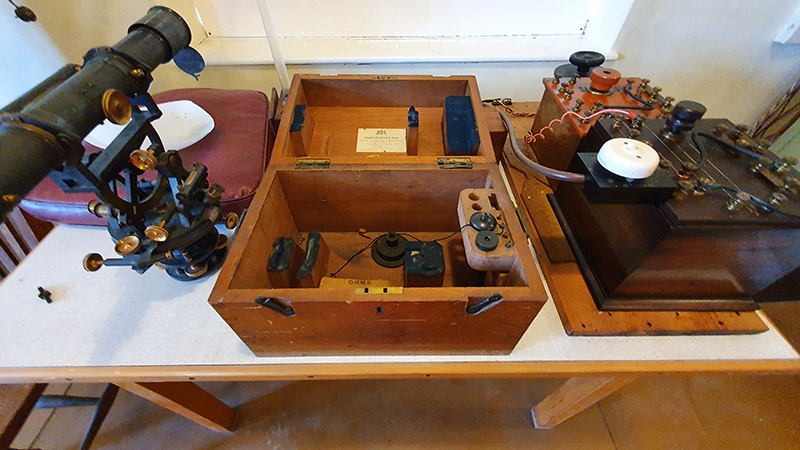
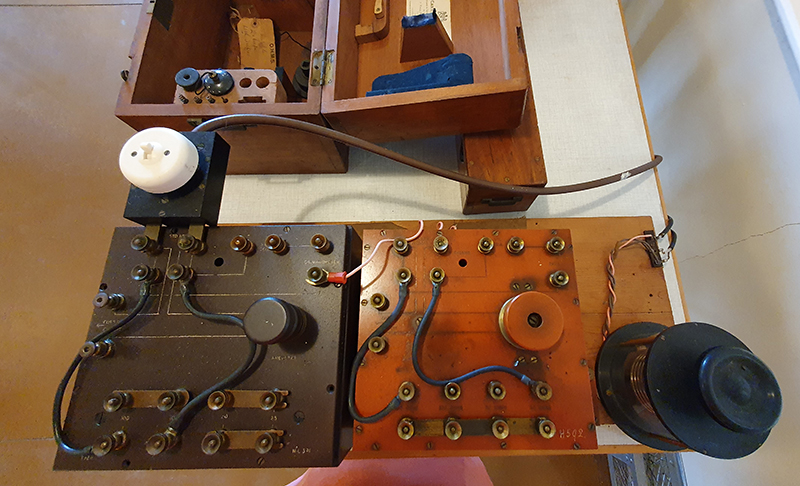
It used to be that all the measurements were made by hand and this took time and skill to produce accurate results. The beautiful old instruments used still sit in the buildings at Hartland.

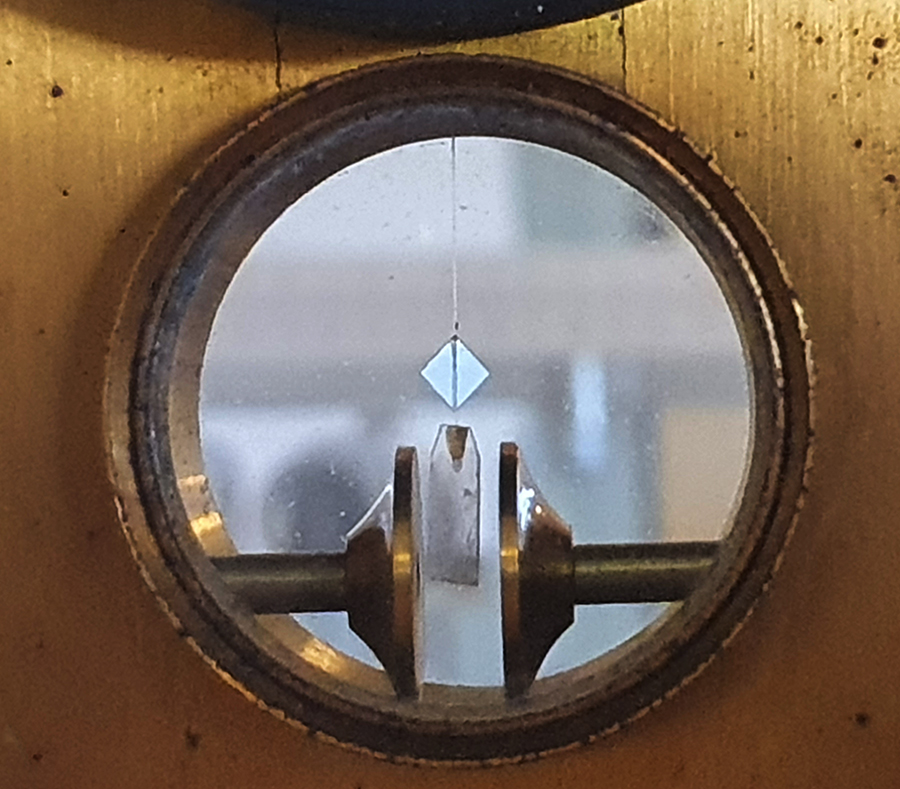
The Dye Coil measured the strength of the field in the vertical direction, using a coil that vibrates in the presence of a magnetic field as the sensing element. The Schuster-Smith magnetometer measured the strength of the field in the horizontal direction, using a magnet, a mirror and a light source to make a sensitive detector. The decinometer measured the angle between true and magnetic north using a freely suspended magnet and a theodolite to measure the angles. Three Danish LaCour variometers were kept in the recording house, each measuring the strength of the field, one for the north-south component, another for east-west and one for the vertical component of the field. All three used magnets attached to mirrors, which were free to rotate in the Earth’s magnetic field. A thin beam of light shone onto each mirror was reflected back onto a rotating drum covered in photographic paper. The drum driven by clockwork rotated once a day.

There are also three satellites which monitor the magnetic field from space (though these may only have about three more years of useful life). ESA’s ‘Swarm’ mission is dedicated to the study of the mysteries of the magnetic field which although invisible, together with electric currents in and around Earth, generates complex forces that have immeasurable impact on everyday life. 

Using measurements from ESA’s Earth Explorer Swarm mission, scientists have developed a new tool that links the strength and direction of the magnetic field to the flight paths of migrating birds. This new research means that the study of animal movement can now combine tracking data with geophysical information and lead to new insights on migration behaviour.

Hartland Observatory is situated on the dramatic North Devon Coast with stunning local geology. When the Earth formed about 4.5 billion years ago from the collision, accretion and compression of matter it was rock all the way through. Heat from the massive violence of formation along with radioactive decay caused Earth to get hotter and hotter. After about 500 million years as a rocky lump it reached the melting point of iron. Known as the iron catastrophe this liquifying caused planetary differentiation to occur as lighter material rose to the surface becoming the mantle and crust while heavy metals sank to the core becoming the churning dynamo powering the magnetic field.

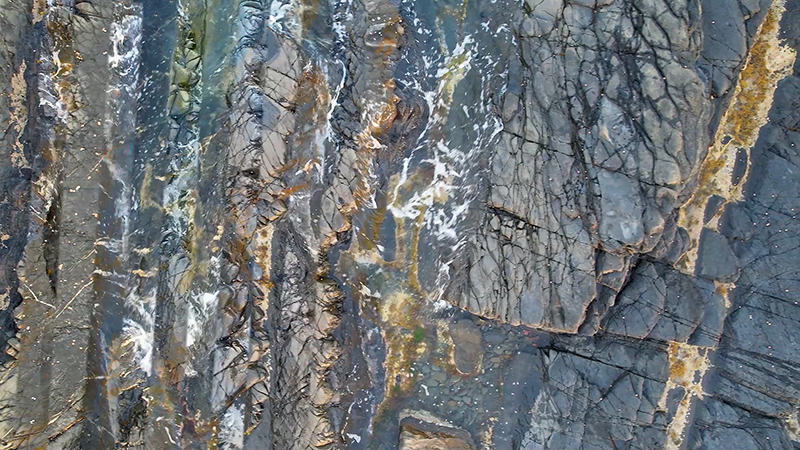
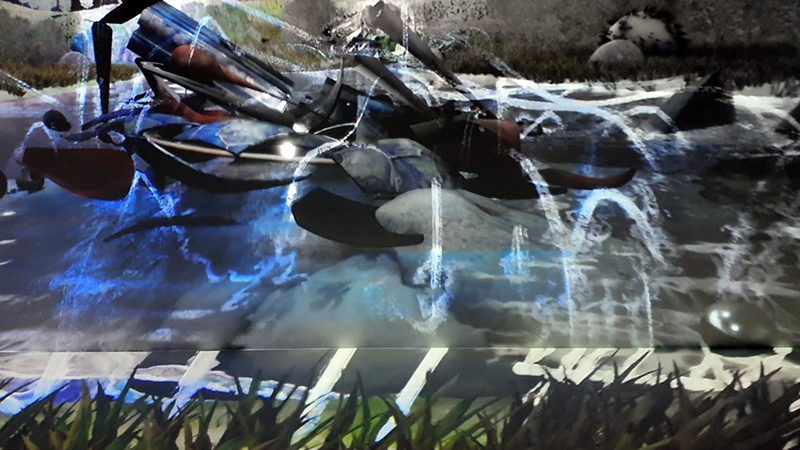
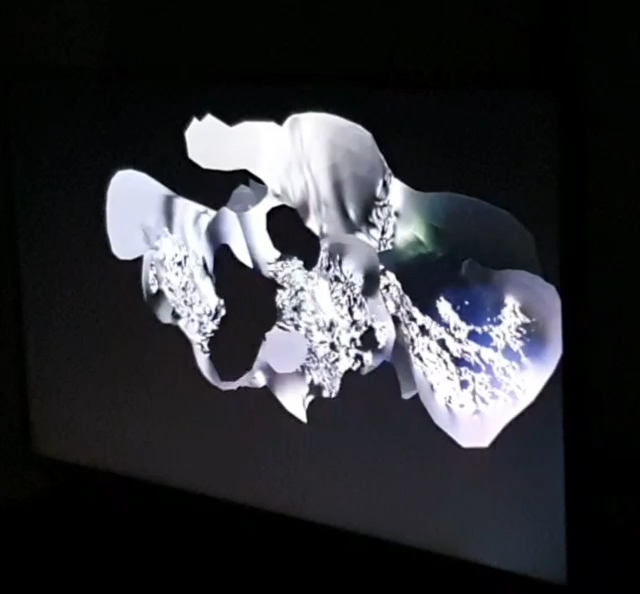
During my visit the weather was kind and so I was able to fly my drone around the cliffs and rocky bays. I am still terrified of disaster every time I take it out, compounded by almost getting caught out by the incoming tide but I did get some useful footage for my ‘Belly of a Rock’ video sculpture I am working on.

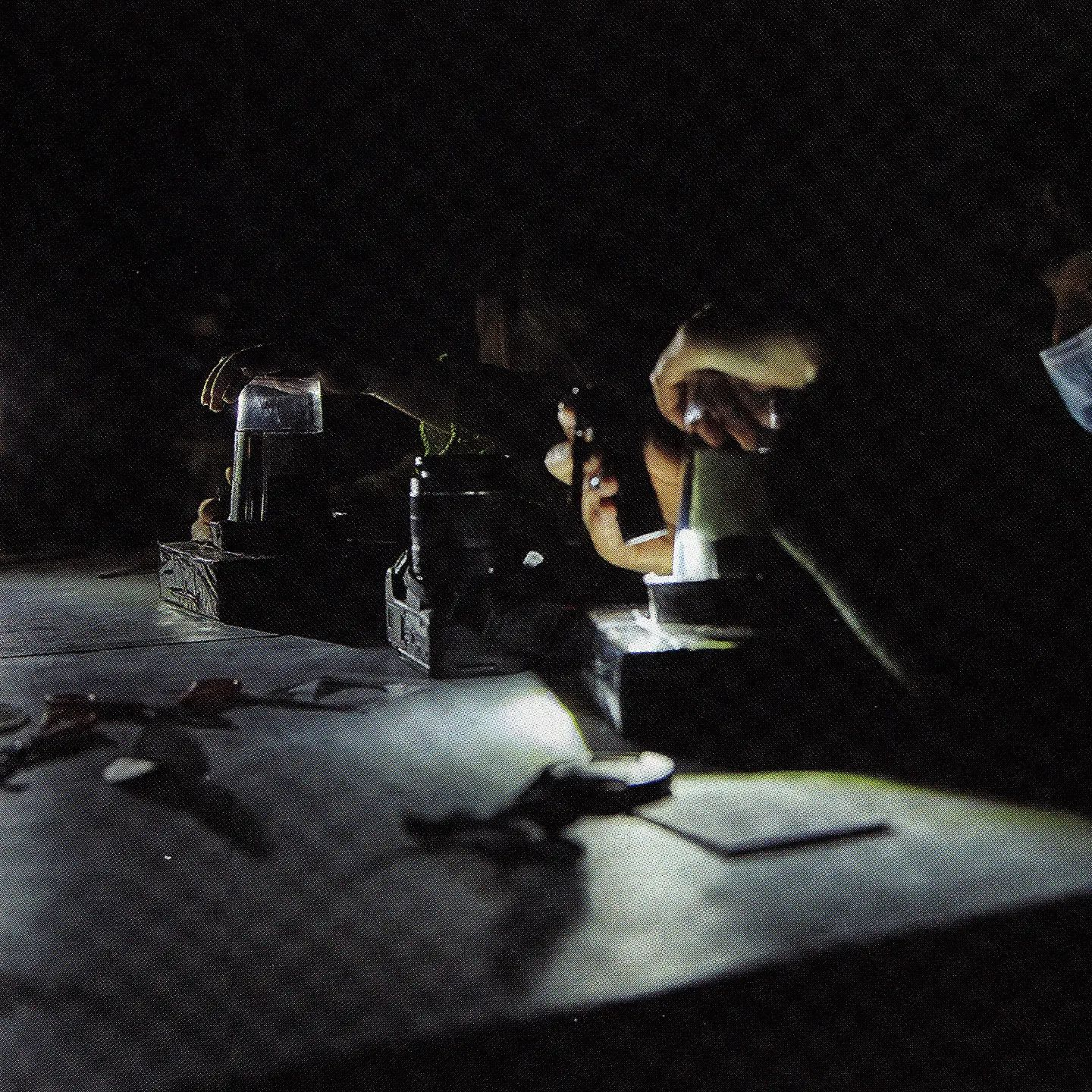
When night falls after a warm day at certain times of year bioluminescence can be experienced at high tide in Hartland Quay. A young woman, and her mother (who swims across the bay at night here regularly) invited us into the pitch darkness to see the green sparks fly as we splashed in the rising water. It was incredible to witness. Swimming in the water limbs are coated in a luminescent glow. I tried to film the flashes on my phone and thought I had been unsuccessful as what I captured appeared totally dark. However, back at home I tried pulling out what information there was on each frame and managed to get a film sequence that might not show exactly what I saw but has an essence of the experience.

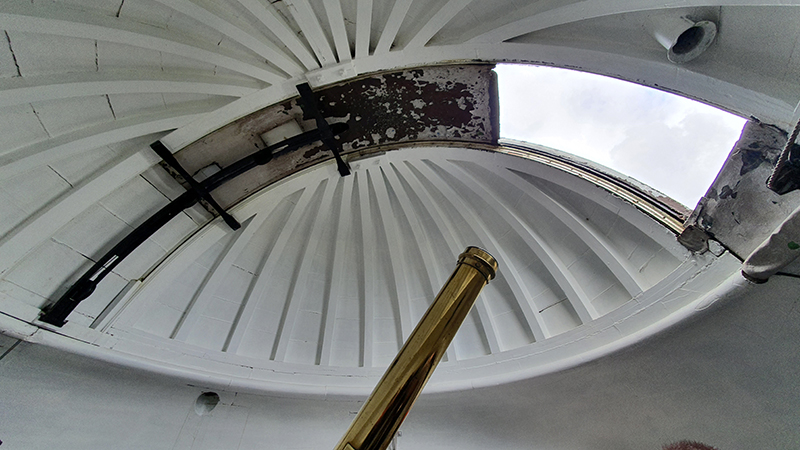
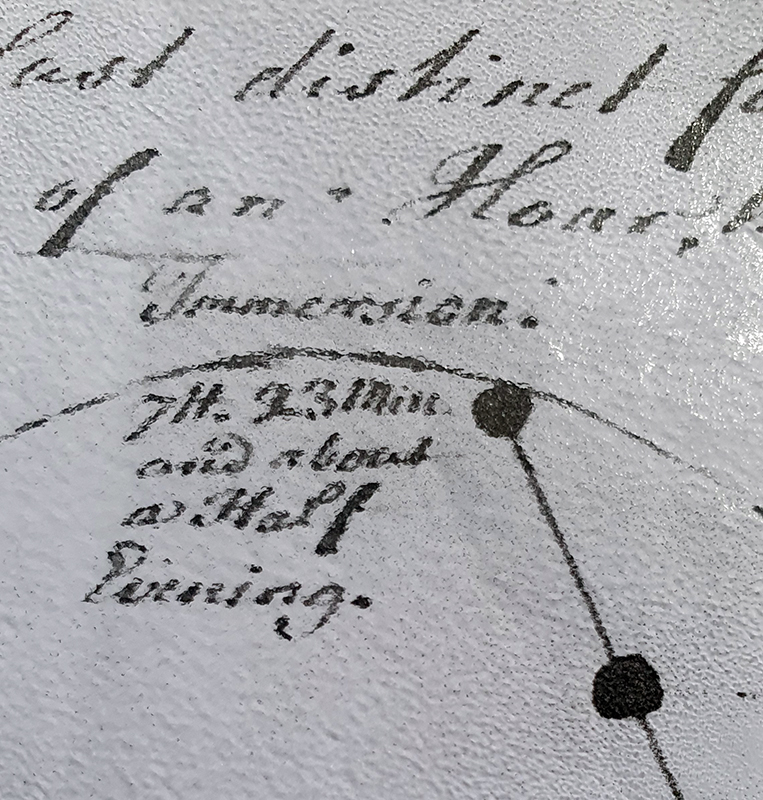
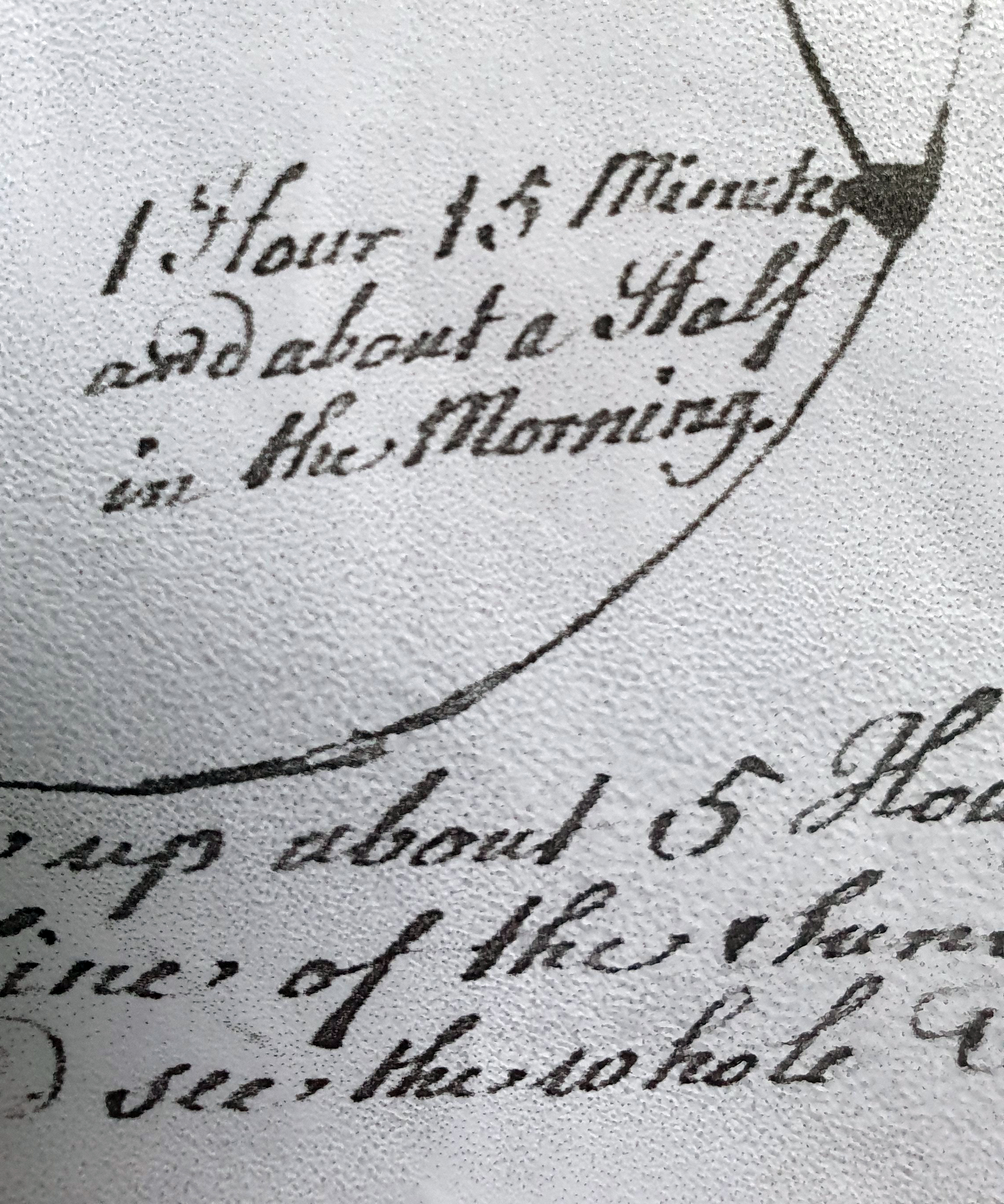
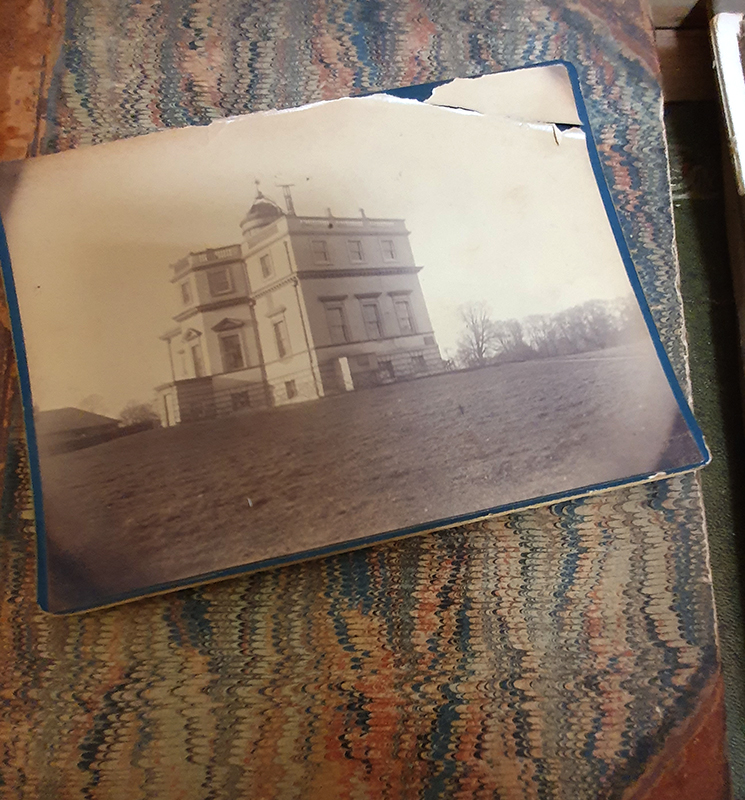
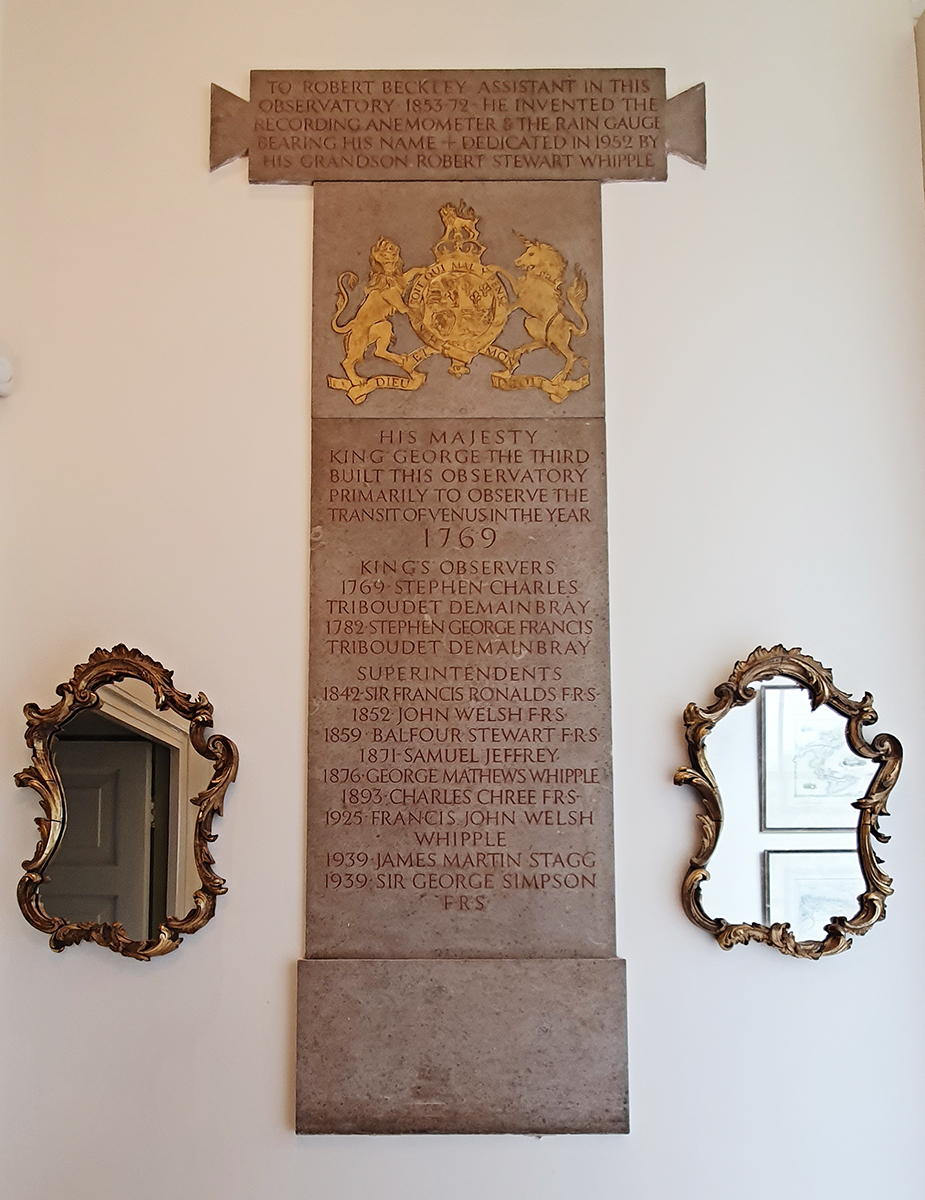
Visit to The King’s Observatory built by George III for the purpose of observing the transit of Venus across the sun in 1769. This observation allowed measurement of the distance from Earth to the sun, later named as the astronomical unit at around 150 million kilometres (8.3 light minutes).

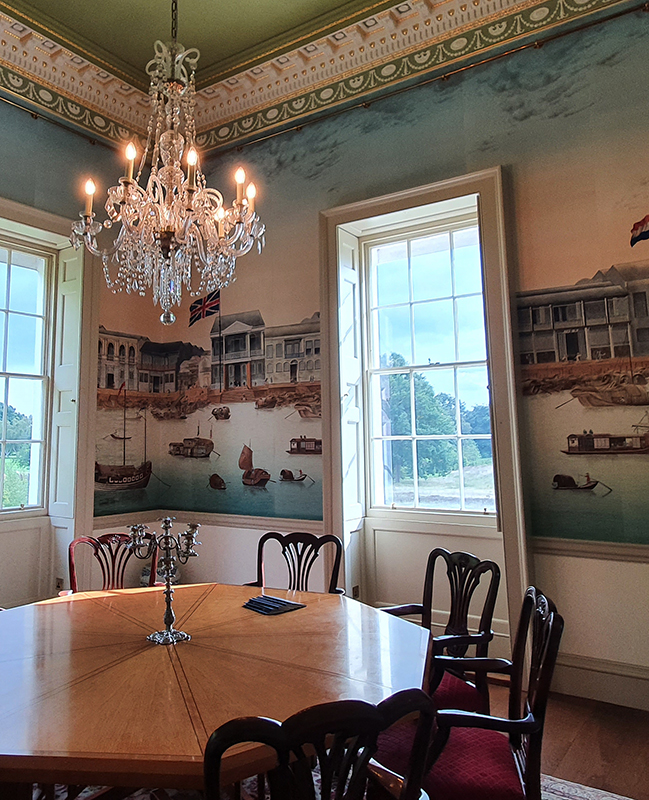
It is now a family home and so the decor although representative of Georgian taste does not reflect the working laboratory that it once was.

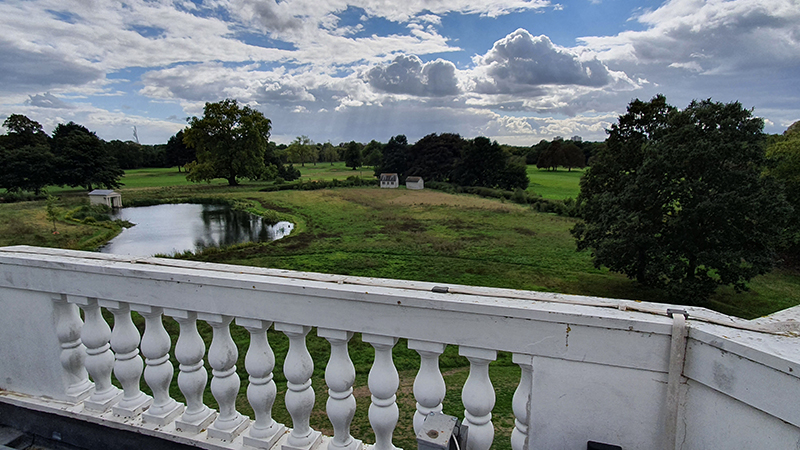
Fascinating to discover it was also the site of the meridian line marked true north-south by two obelisks either side of the west room which housed a tracking telescope. There is a third obelisk due south from the east room which housed a mural quadrant used to measure angles. It wasn’t possible to walk over to the obelisks as the Observatory is in the middle of a golf course now, but there is a path to them via the Old Deer Park which I will walk another day. An accurate clock here provided standard time to the government before the task was transferred to Greenwich Observatory.

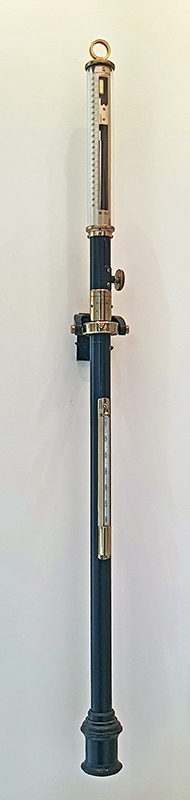
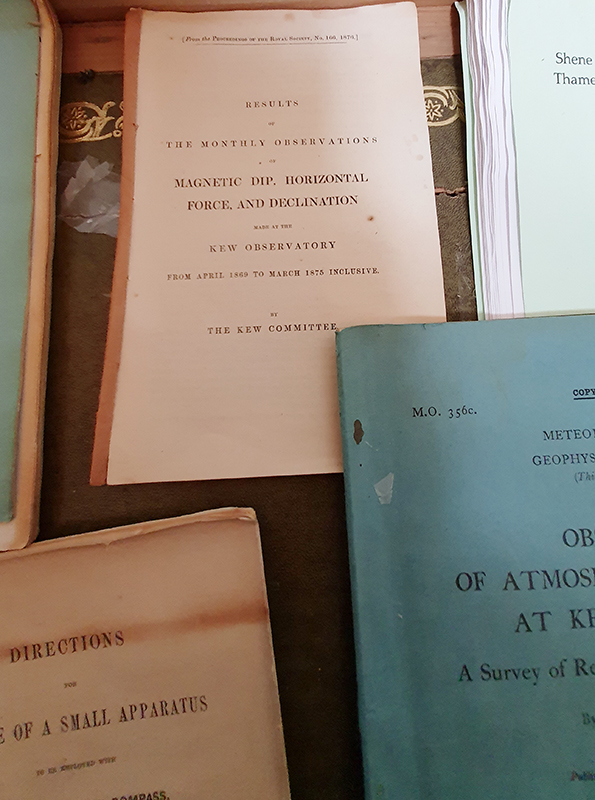
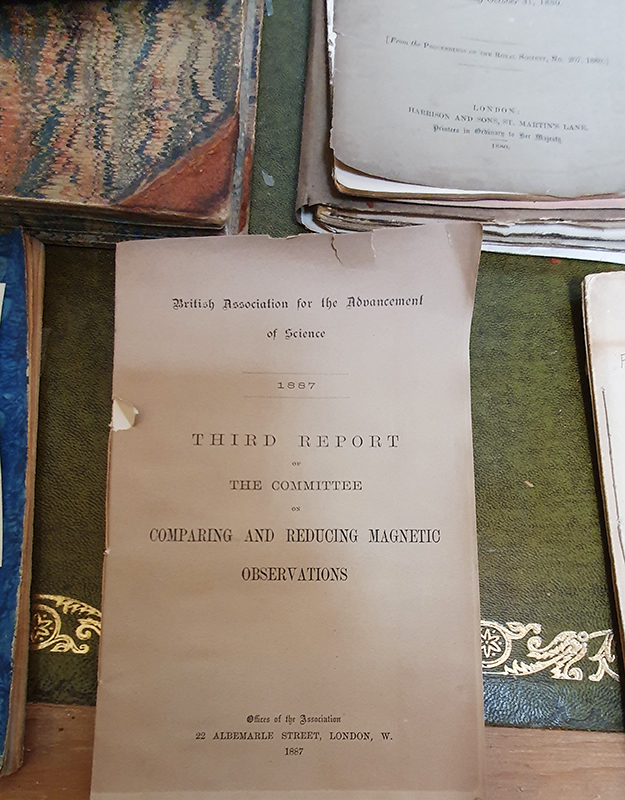
In 1842 it was renamed Kew Observatory and taken over by The British Association for the Advancement of Science. The Meteorological Office was based here, making regular records of the weather from 1773 until 1980. It was also home to the National Physical Laboratory between 1900 and 1914 when scientific instruments were checked for accuracy and stamped with KO, a hallmark of excellence if they passed.

The two huts remaining in the grounds were used for meteorological and magnetic observations and are built with no nails which might interfere with the instruments used within.

Francis Ronalds, director at Kew Observatory from 1842, invented several camera designs subsequently used in both weather forecasting and in understanding the perennial perturbations in terrestrial magnetism. Photography was used early on in its development for use in scientific investigations. Ronalds’ first instrument captured observations from his atmospheric electricity apparatus. He went on to record atmospheric pressure and temperature using the same method and had soon extended his approach to geomagnetism. His magnetographs “established the standard technique employed for magnetic observatory recording worldwide for more than a century” – Encyclopedia of Geomagnetism and Paleomagnetism.

In 1908 the geomagnetic instruments were relocated to the magnetic observatory established at Eskdalemuir in Scotland to undertake magnetic work for which Kew was no longer suitable after the advent of electrification in London led to interference with their operations.

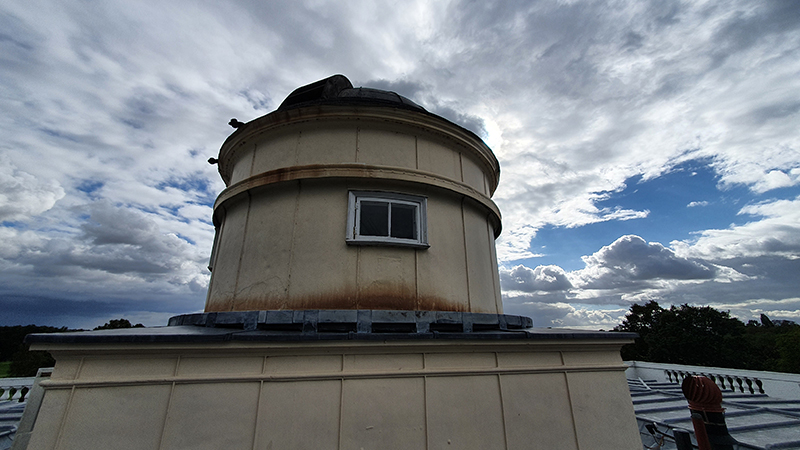
Ronalds had also established an atmospheric electricity observing system at Kew with a long copper rod protruding through the cupola dome of the observatory connected to electrometers and electrographs to manually record the data.

Lord Kelvin later installed an updated electrical observation system and CTR Wilson (the inventor of the cloud chamber) set up a secondary system using different principles which has been useful in historical air pollution research.

I am extremely grateful to Professor of Chemistry at the University of Oxford Peter Hore for spending time chatting on zoom with me about his fascinating research into the ability of birds to navigate using the Earth’s magnetic field.  There is a link to a YouTube lecture by Peter on Radical pair mechanism of magnetoreception here.

Research confirms there is a chemical reaction in the bird’s eye sensitive to magnetic fields as weak as that of the Earth. This happens in an array of reactant molecules which can be changed into extremely short lived radical pairs which are magnetically sensitive. The reaction in the molecules to produce radical pairs is triggered by light from the sun or stars. It is thought that this chemical compass is sensitive to direction not intensity of the field and may use the energy from blue/green photons to power this reaction. During this reaction, as the bird changes direction, some radical pairs perform one way and others another creating difference across the array of molecules which is detected by the bird.

My question to Peter was to ask for his thoughts on whether a bird’s ability to ‘see’ the magnetic field manifests itself visually and if he has any understanding of what the bird experiences. He had to confess that how this sense is experienced by birds is not known but he had done some speculative modelling with a PhD student representing the field as fluctuating visual contour lines mapped over the landscape.

The birds eye is very complex and so there is still a lot to be learned about how this ability functions. Bird’s retinas have rods that are sensitive to light intensity and cones sensitive to red, blue and green wavelengths of light like us but they are also sensitive to ultra violet light. There are also double cones in the bird’s eye and their function is not clear, it could be that these are seconded for magnetic reception at night when they are not active.

Often birds fly high above the clouds when migrating and starlight appears to be enough to trigger the reaction in the molecules. In normal sight chemical messages are sent from the retina to visual processing centres within the central nervous system via ganglion cells. There are many of these ganglion cells in the birds eye and it may be they send the information bypassing any rods or cones. Studies on the retina show a reaction to the magnetic field when blue light is present but the activity has not been traced from the retina to a specific part of the brain yet which might determine if this sensitivity does manifest itself visually.

It is very difficult to imagine a sense we do not have.

Learning the migratory route and destination is vital to birds survival in many cases. Often the young bird will have to undertake the first migratory journey on its own, its parents having left earlier. These instinctive instructions for the journey are passed on from one generation to the next. The genetic instructions are quite broad, leading to a large designated destination zone which could be within a 200 mile radius. However, when returning, along with the hereditary instinct using the stars and sun to navigate the birds also have learnt the magnetic map and can return to the exact spot they left as a fledgling. Young birds in a planetarium will follow the stars if they are rotating correctly.

Peter is a chemist so his interest is in the chemical reactions of the radical pairs but he is part of a wider research group that also looks at this behaviour in bats and fish.

I also asked his thoughts on the human capacity to sense the magnetic field. Unfortunately, although we have cryptochromes in many of our cells we do not have the particular molecule Riboflavin which is the one activated by blue light to become magnetically sensitive. Whether we once had this molecule and lost it or birds evolved this molecule separate to our evolution is not understood but he did believe current research on human brain alpha wave activity in response to the magnetic field might throw up some interesting ideas to look at. A speculative approach to gaining sensitivity to the magnetic field may be by transplanting a tiny compass as used in a mobile phone onto the body, setting it to vibrate when pointing north. The body may ‘learn’ to recognise north in this way.

Listening to The Life Scientific with guest David Eagleman has shed further light on what might be possible as his research shows the human brain can be trained to receive input from alternative sources, for example learning to hear through the skin. He believes it will be perfectly possible for us to experience new senses in the future, including magnetoreception.

Work in Progress

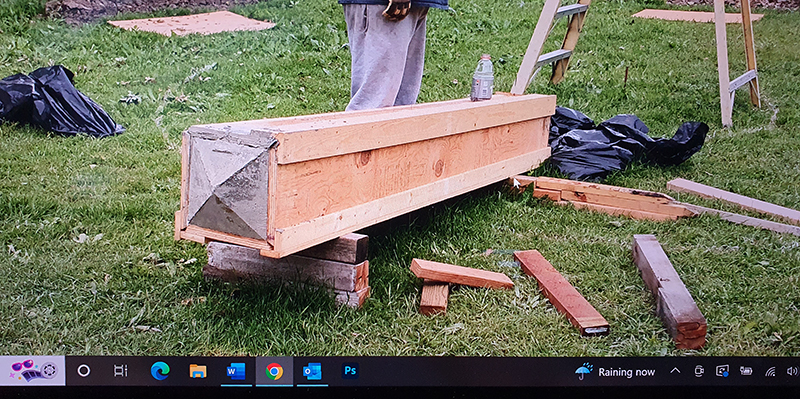
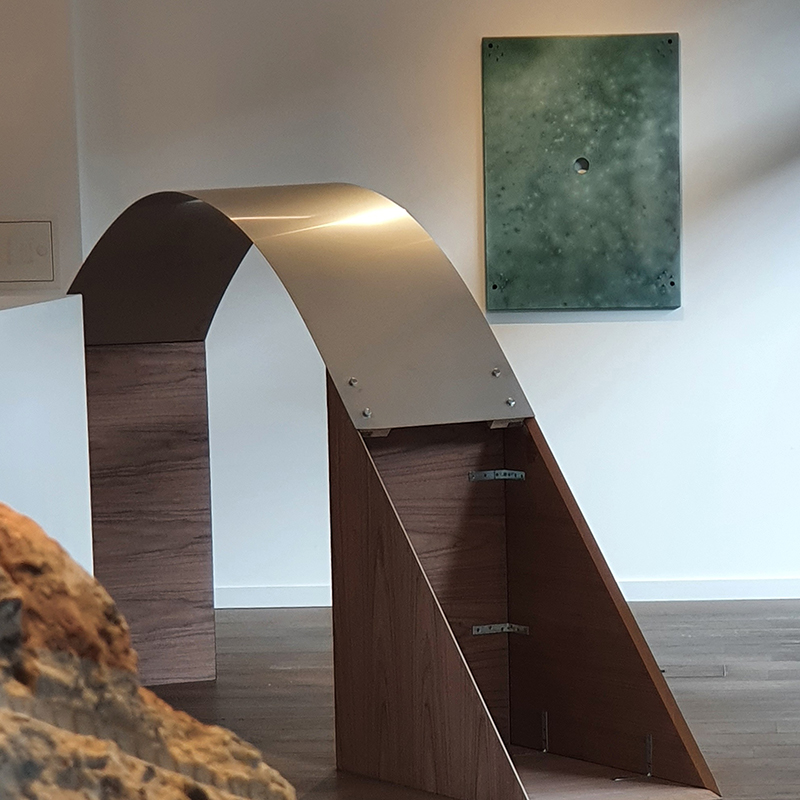
I have been scouring the internet for tips on casting a concrete obelisk and getting an idea of the dimensions. I am thinking about using aerated concrete, for lightness but also to give an appearance of the texture of volcanic rock.

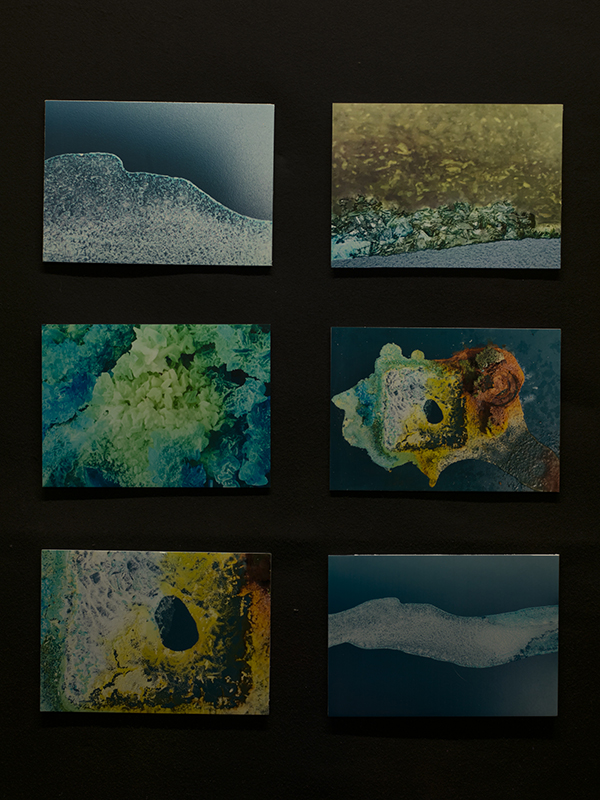
Chemical conversation tests for the video sculpture Belly of a Rock inspired by Italo Calvino The Spiral in The Complete Cosmicomics. “The water was a source of information, reliable and precise [ ] full of substances and sensations and stimuli”

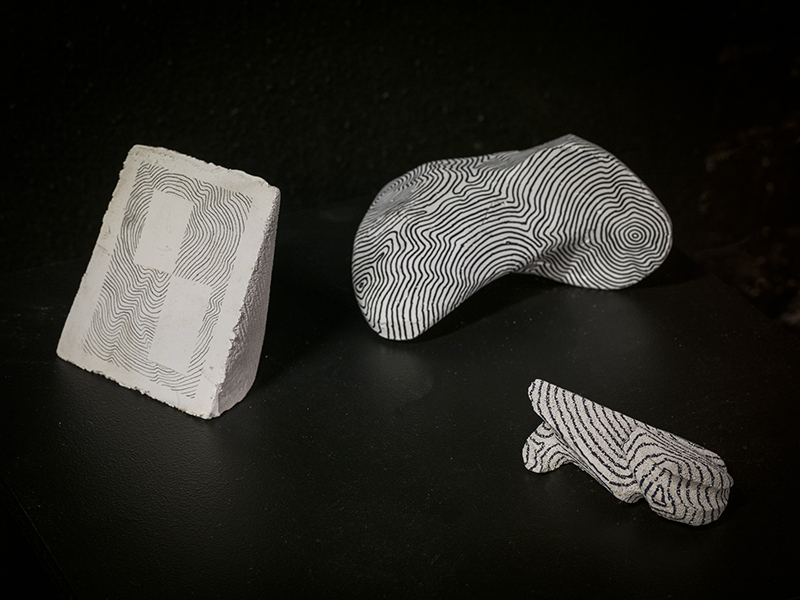
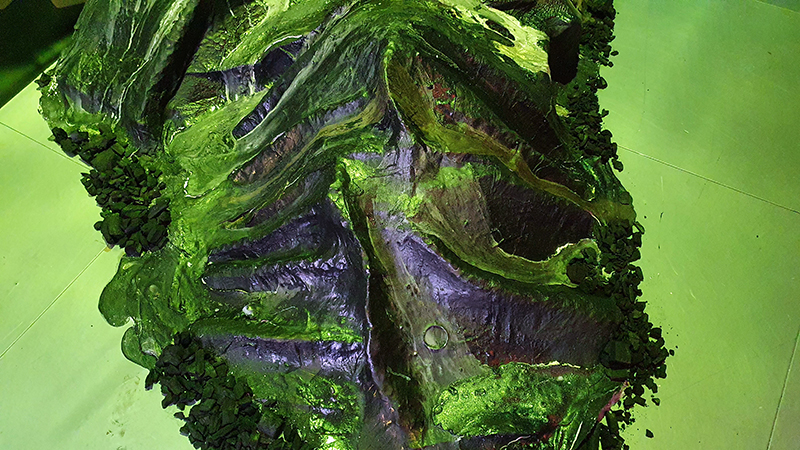
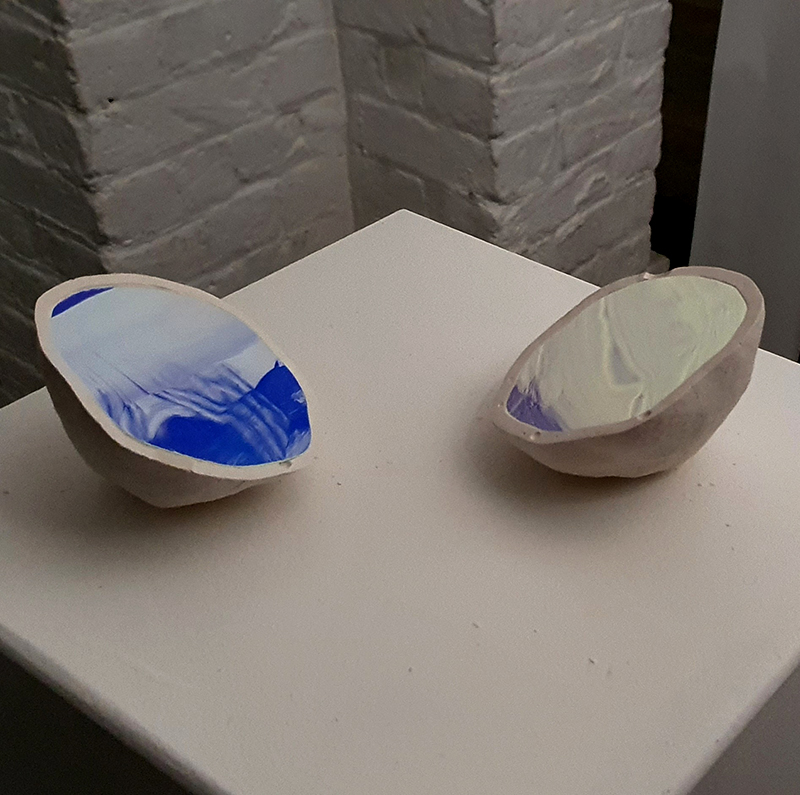
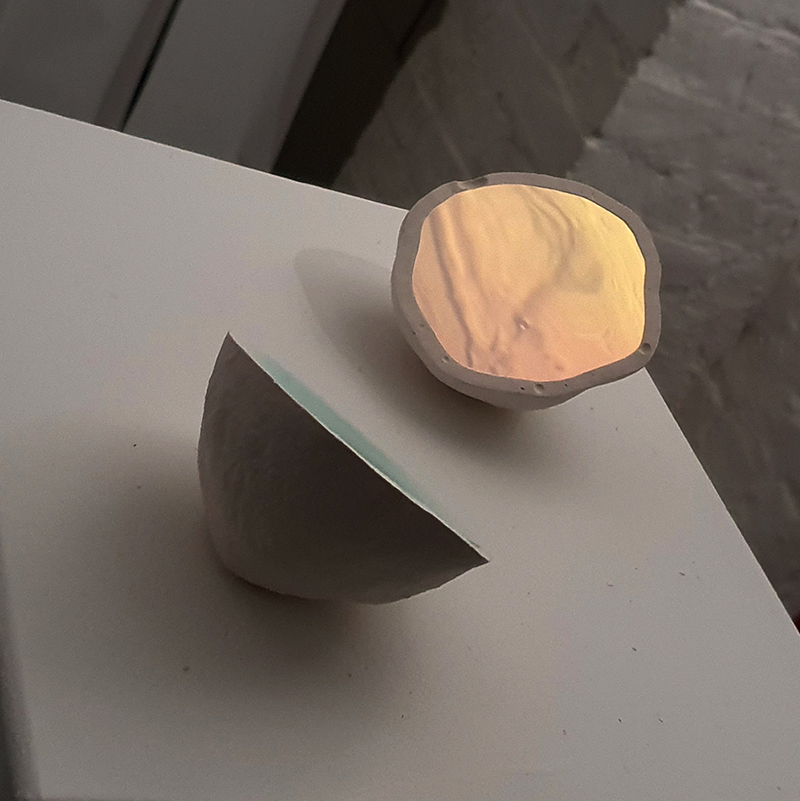
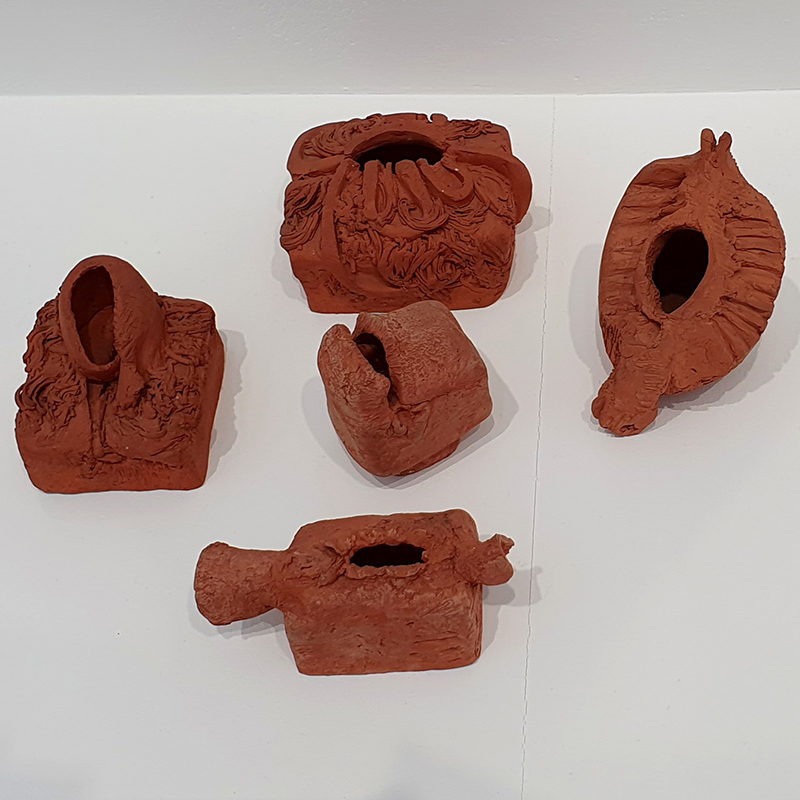
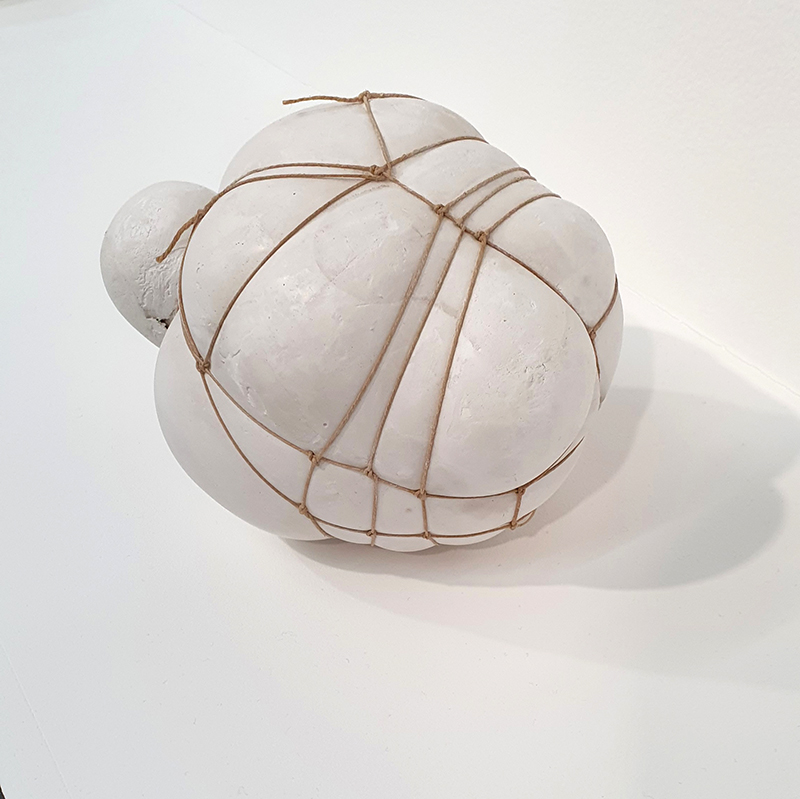
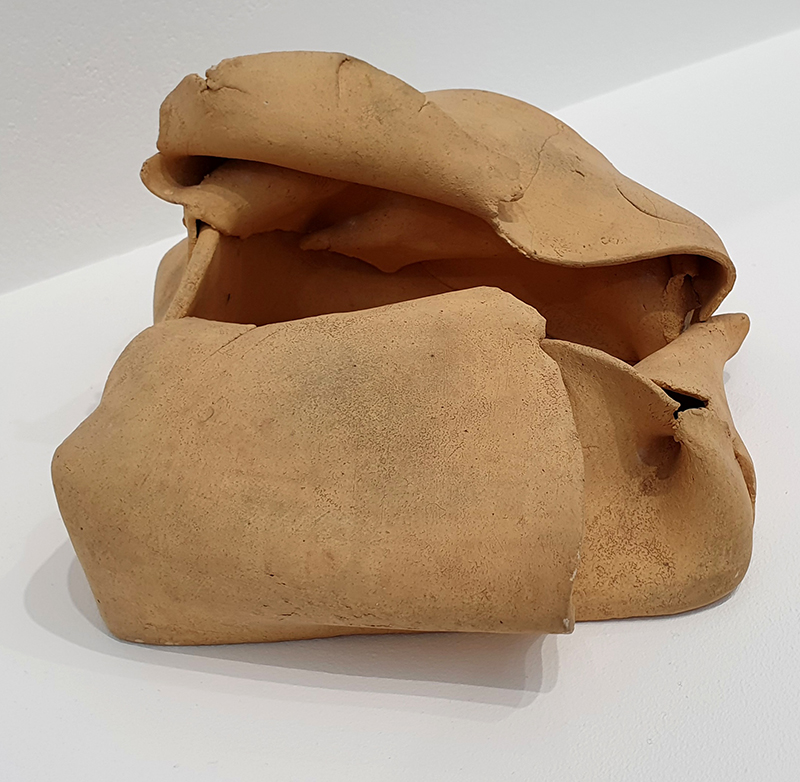
I have been testing paper clay recipes and shapes for the video sculpture Belly of a Rock which will be somewhere between a rock and a mollusc.

Out of Studio

Visit to Richard Saltoun Gallery to see Haptic Vision a retrospective of artists Jo Bruton and Rosa Lee working in the 1980’s and 90’s creating paintings that encourage the eye to wander across a richly textured surface of optical illusions. “The necessity of ‘making’, of being within that space as a primary concern, where the Subject is nearby and woven into the repetitions and patterns of everyday life.” – Jo Bruton, 2022

Eternally Yours at Somerset House reflects upon the hope and healing which can be found in the memories and stories that everyday objects hold in our lives. The repair becomes a shared experience expanding the idea of bonding to include the emotional connection.

I really liked the DIY sensors and data gathering device created by Superflux. Re-imagining technology as a useful tool for communities to gather and share information on the environment, monitor local air pollution and be active in creating a just and equitable society.

New River Folk is the outcome of an Engine House Residency by Laura Copsey and Philip Crewe at the new Quentin Blake Centre for Illustration about to be developed at New River Head, Clerkenwell. This site was part of an artificial watercourse opened in 1613 to supply water to London at first through overground wooden pipes. When more pressure was needed a six-sail windmill pumped water from the site. After storm damage to the windmill in 1720 horses were harnessed to turn the wheel and power the pump. The round base of the windmill remains, and is the oldest construction of its kind in central London. The artists drew on local history around the site, creating an archeology expanding on the lives of Mole Catcher William ‘Mollitrappe’ Smythe, Well-Keeper Black Mary Woolaston and Tankard-Bearer Joan Starkey. They also collaborated with the river itself to create 16mm film imagery and recordings.

I was fascinated by the crystals that had formed on the bricks in the old windmill. The salt crystal growing experiment I set up while planning an exhibition proposal is still sitting in my studio – if it is still growing it is doing so very slowly, the initial growth was surprisingly fast.

Reimagining Joya is an exhibition at Thames-side Gallery inspired by the experiences and artistic responses of a group of artists who have all participated in Joya: Art + Ecology / AiR residency. The curators, Olga Suchanova, Tere Chad and Barbara Slavikova, have selected a body of works which explore the way we inhabit, survey, feel, and relate to the natural landscape and its living creatures.

Cornelia Parker at Tate Britain. Simple materials, deconstructed and presented immaculately. I was in awe of the invisible framing of her linen squares and wire grids where the objects appear held against the glass as if by magic. Many works are born in violence, condense violence into form or render it impotent. These include Bullet Drawings using lead from bullets melted down and drawn into wire; shotgun sawn off by criminals sawn up by police; handgun used by criminals precipitated to rust by science engineers. Gentler work included the back of button cards appearing as coded messages or star charts – something I was very familiar with as a child growing up in a village drapers shop.

Forest: Wake this Ground at The Arnolfini, Bristol showing works by Rodrigo Arteaga, Mark Garry, Alma Heikkilä, Eva Jospin, Jumana Manna, Zakiya Mckenzie, David Nash, Maria Nepomuceno, John Newling, Rose Nguyen, Ben Rivers, Ai Weiwei, and Hildegard Westerkamp.

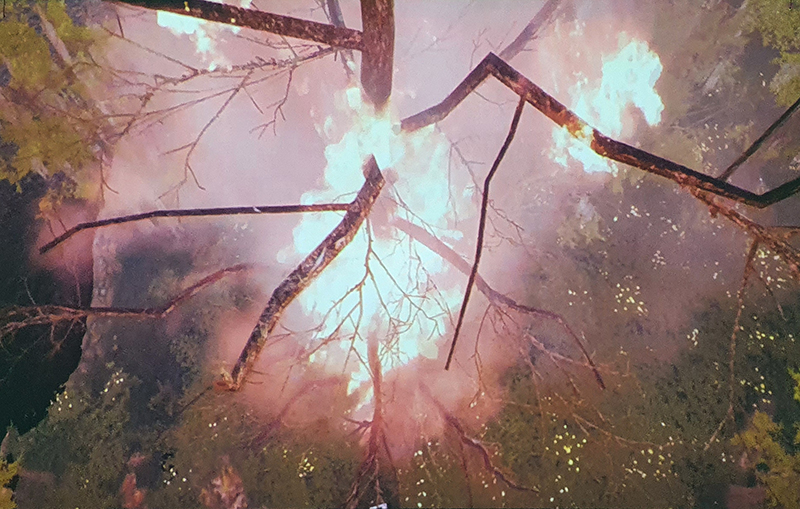
Rodrigo Arteaga burned drawing series Monocultures and Fallen Tree documenting the radical change in the forest floor and threatened indigenous species.

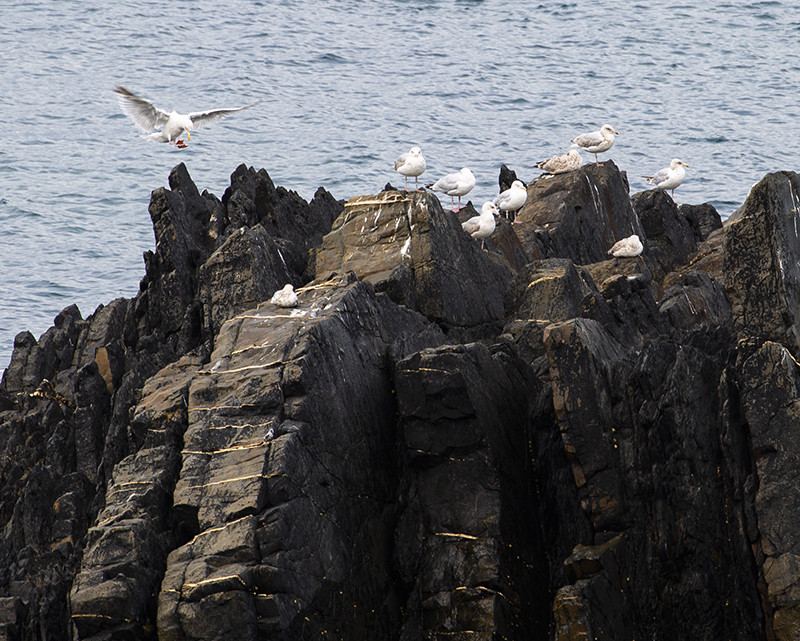
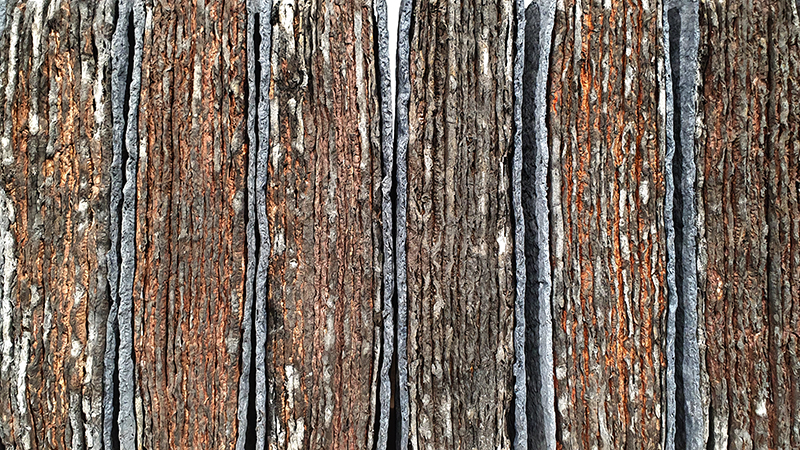
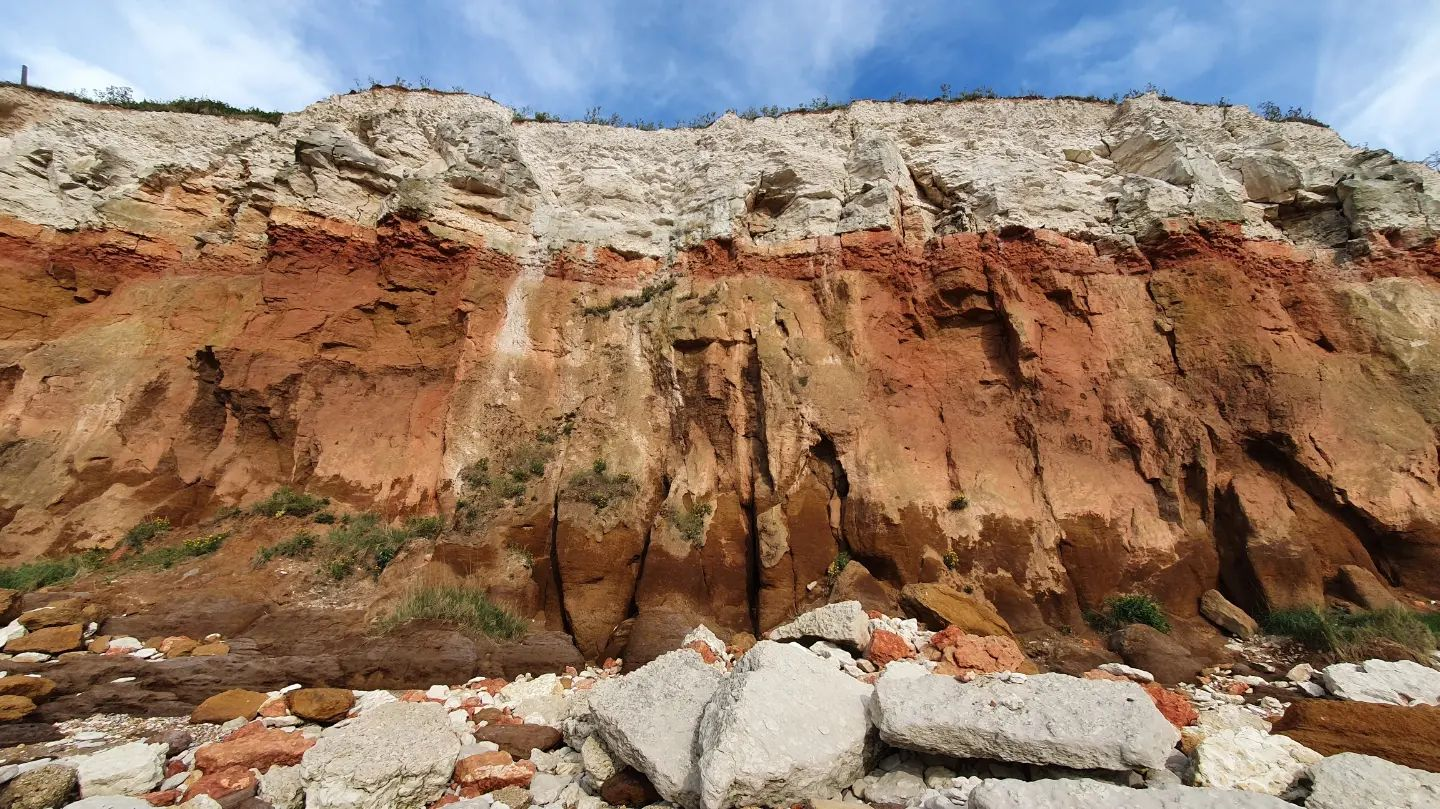
John Newling extracts of soil form his own garden reveals a surprising diversity of minerals in the many colours of the balls and cores. The Night Books burning forests, made from pulped textscoal dust and crushed charcoal worryingly notes that the work physically released carbon through the process of making. The vertical strata reminds me of the cliffs at Hartland Bay.

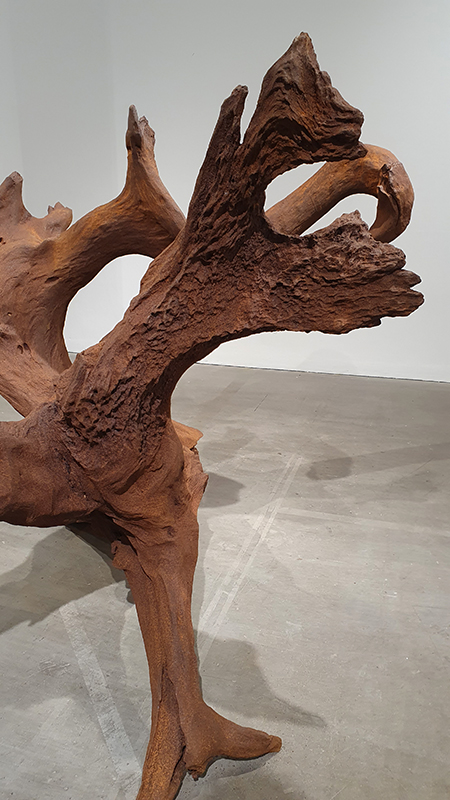
Ai Weiwei cast from the ancient and endangered Pequi Vinagreiro tree (found in the Bahian rainforest), reflect both the uprootedness of arboreal species and the displacement of people.

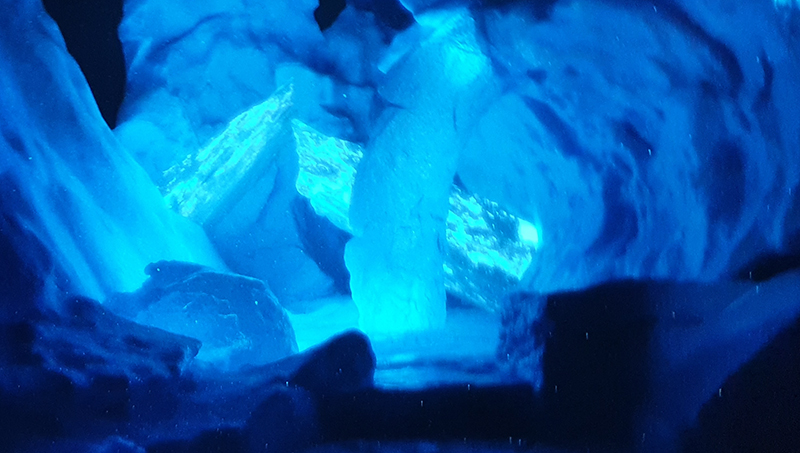
Ben Rivers film Look Then Below shot beneath the Mendip hills and ancient woodland in Somerset, imagines a dystopian but seductive future.

Eva Jospin Forêt Palatine, made from recycled cardboard, at once evokes folklore and decay. I liked the surface texture which in parts almost looked volcanic.

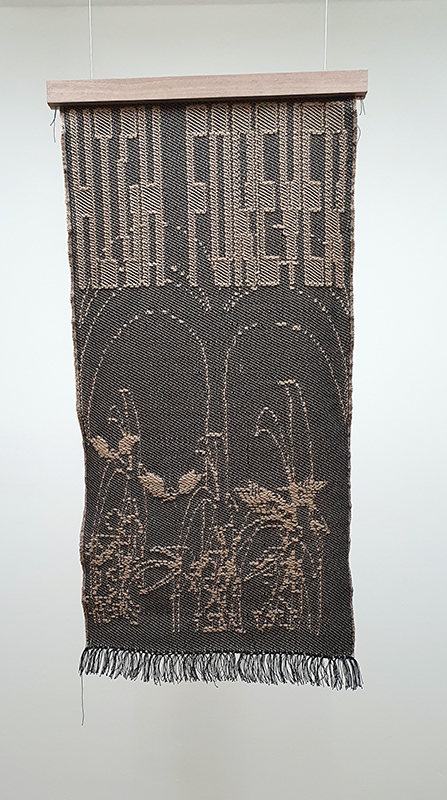
Paths of Resistance by Tracy Hill is a site-specific fabric installation in response to magnetic fields measured in the space at Arnolfini as part of the IMPACT 12 programme of events. The work explores the hidden energies that shape our experience of the world.

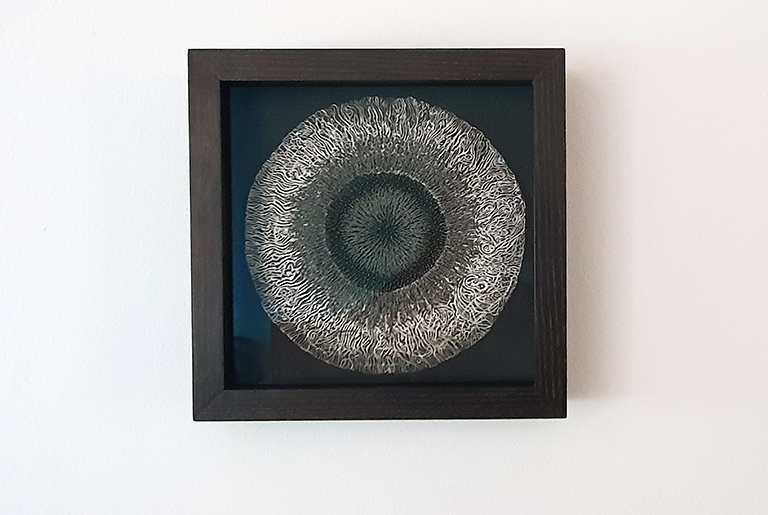
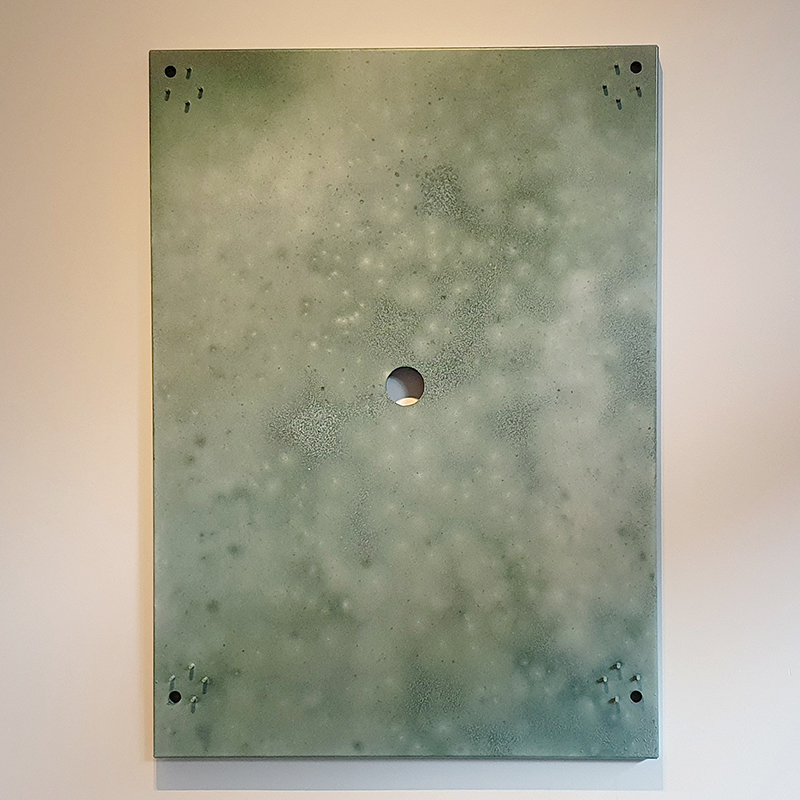
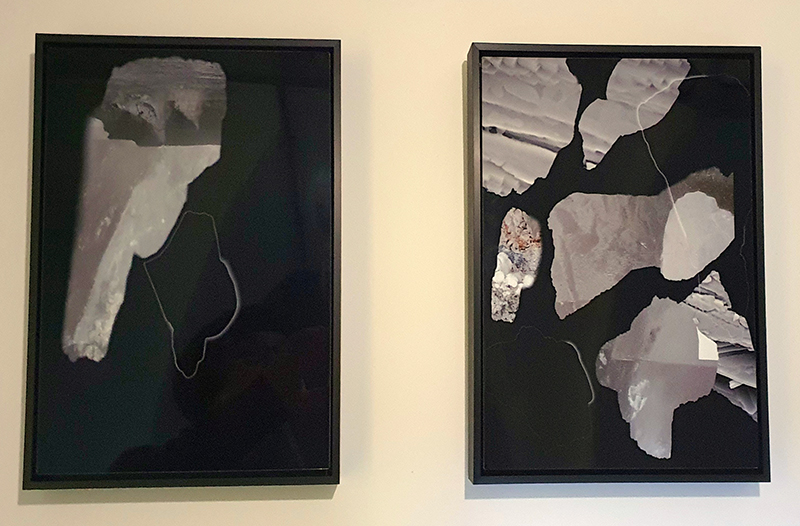
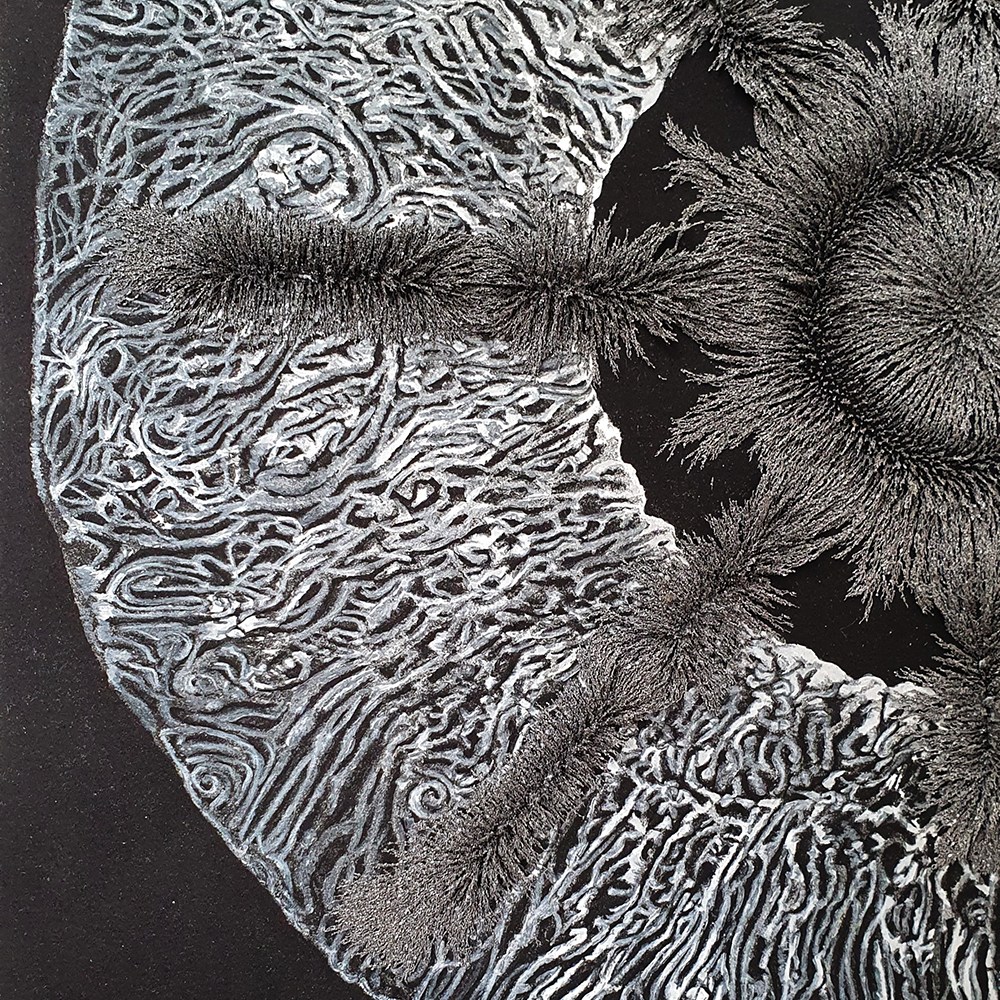
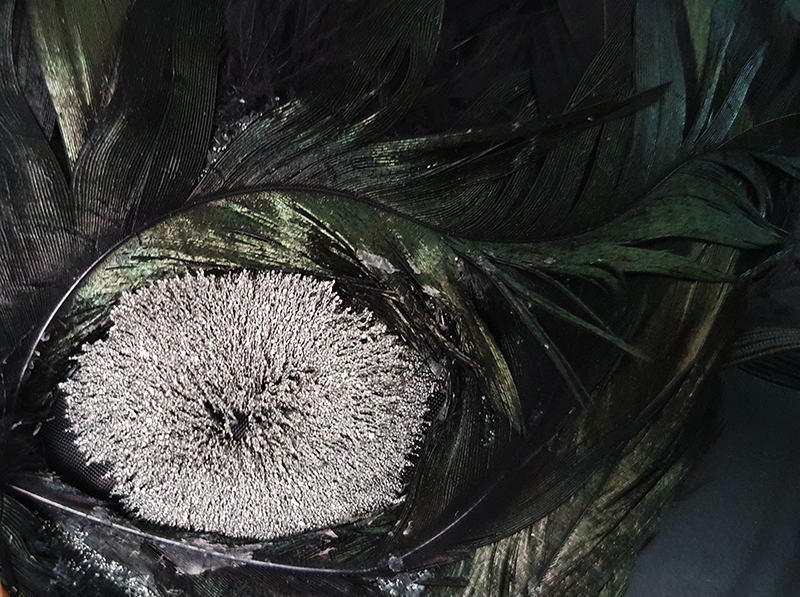
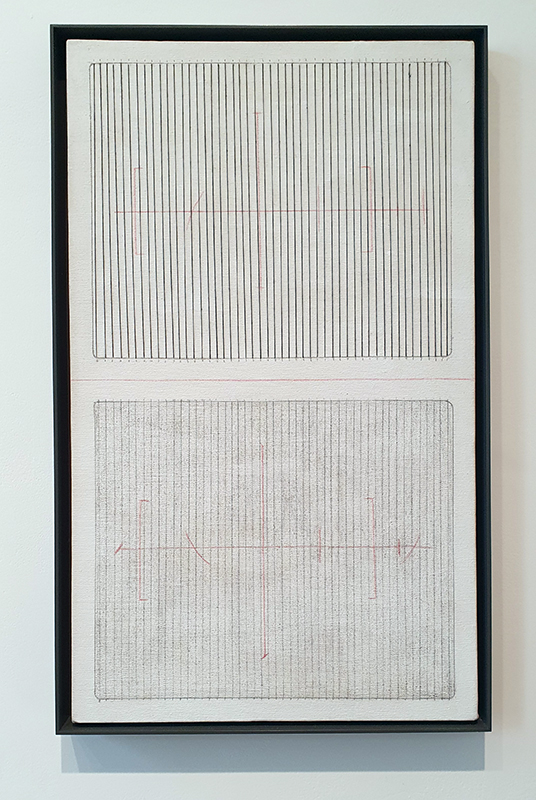
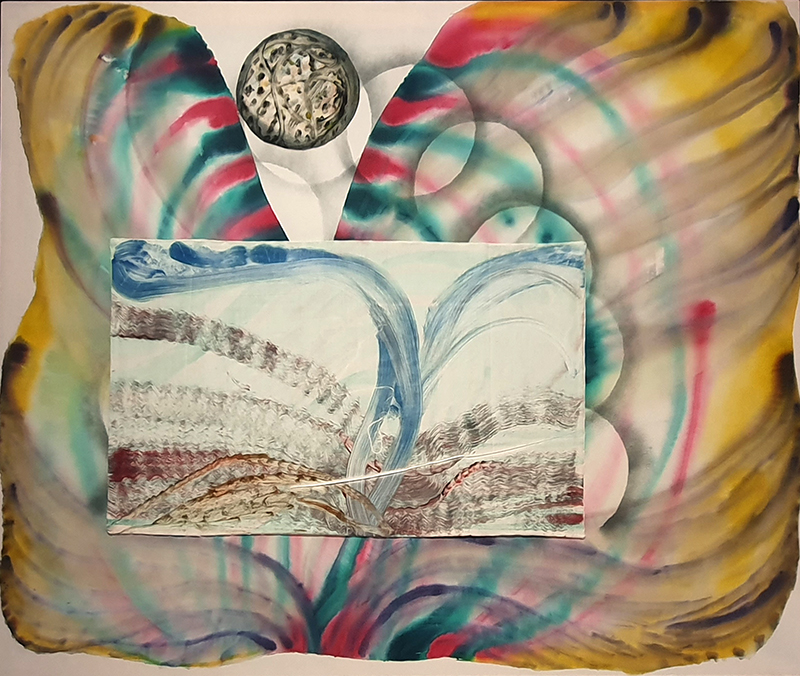
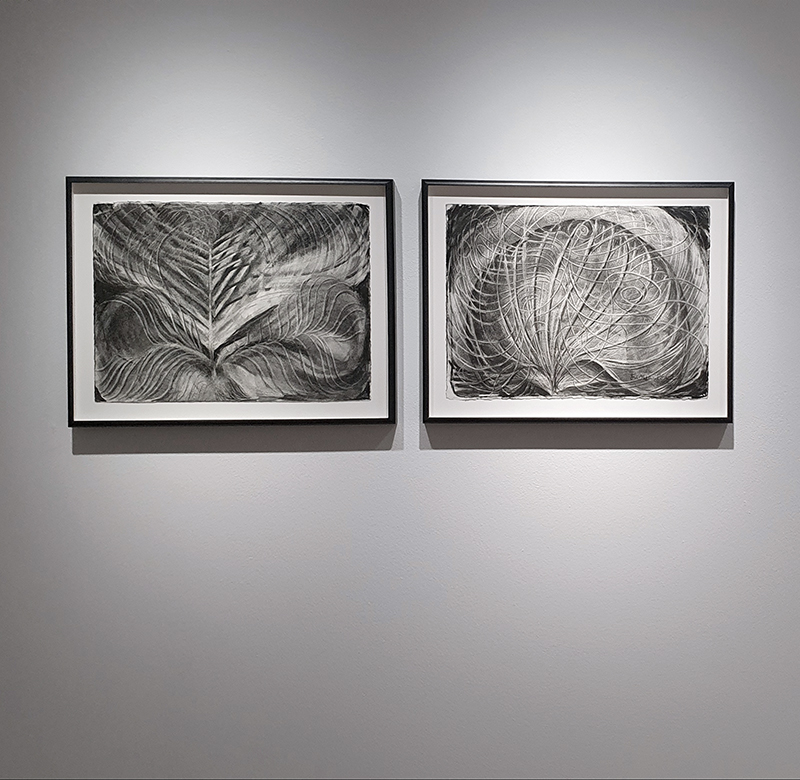
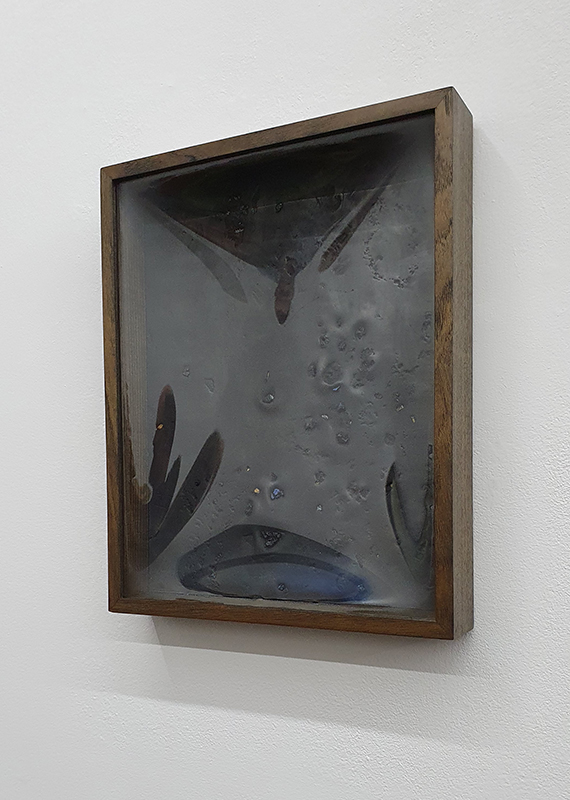
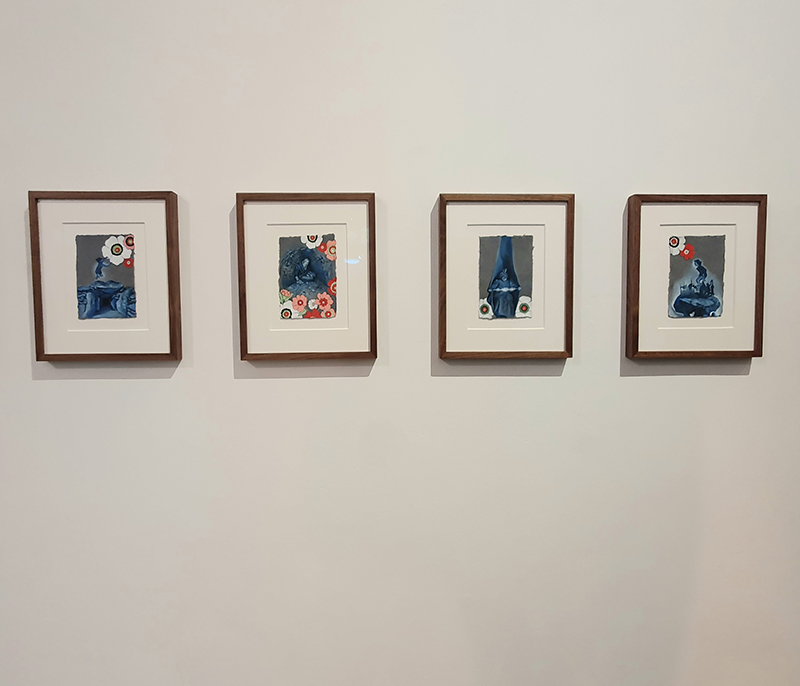
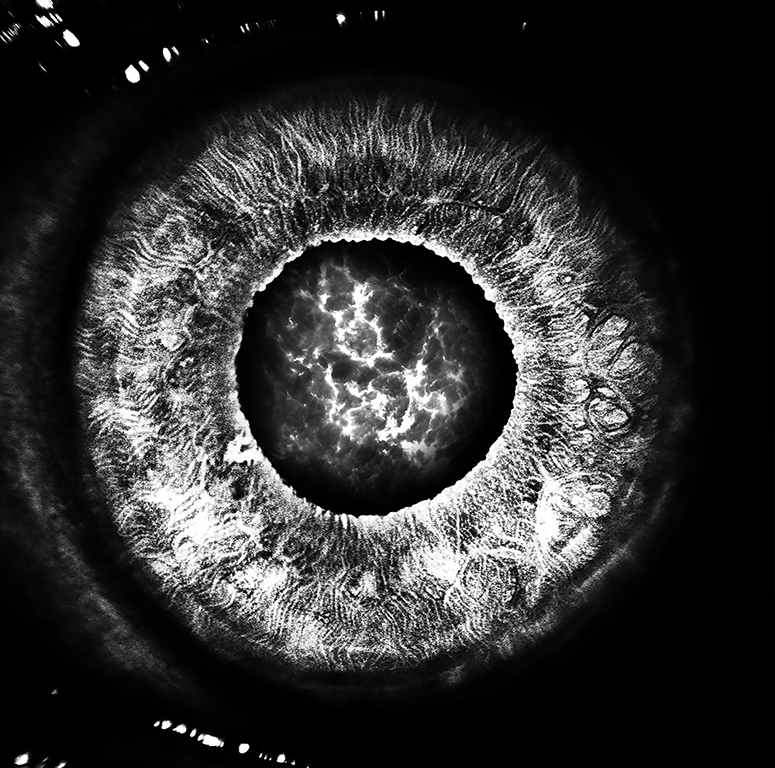
New work has been framed – these pieces consider the potential for the human eye to perceive the Earth’s magnetic field. Research shows birds have this capability activated by molecules in the retina of the eye when excited by blue light. The molecules produce radical pair electrons sensitive to the magnetic field and as these molecules are found within the photoreceptor cells it is possible birds may visualise the magnetic field lines to aid navigation. A similar molecule is also found in the human eye and I am speculating that this is a sense we may once have experienced and could tap into again. It is of course the brain that must receive a signal from the eye by which we see. Independently of the cryptochrome molecule, research monitoring alpha wave activity shows the human brain does appear to be sensitive to a magnetic field albeit unconsciously.

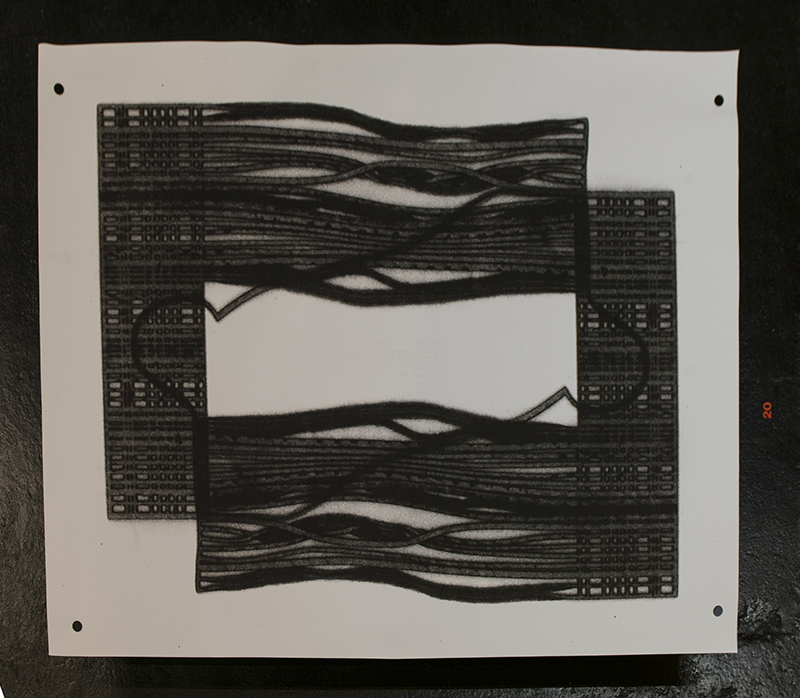
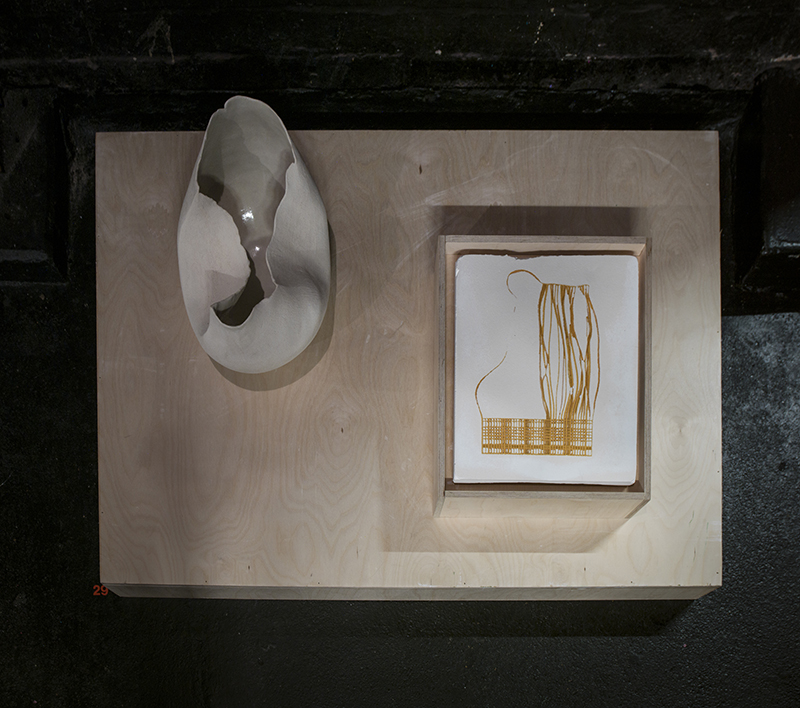
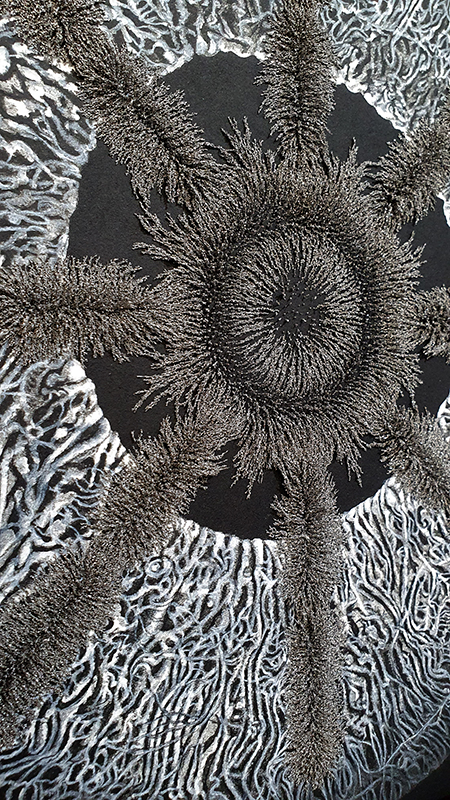
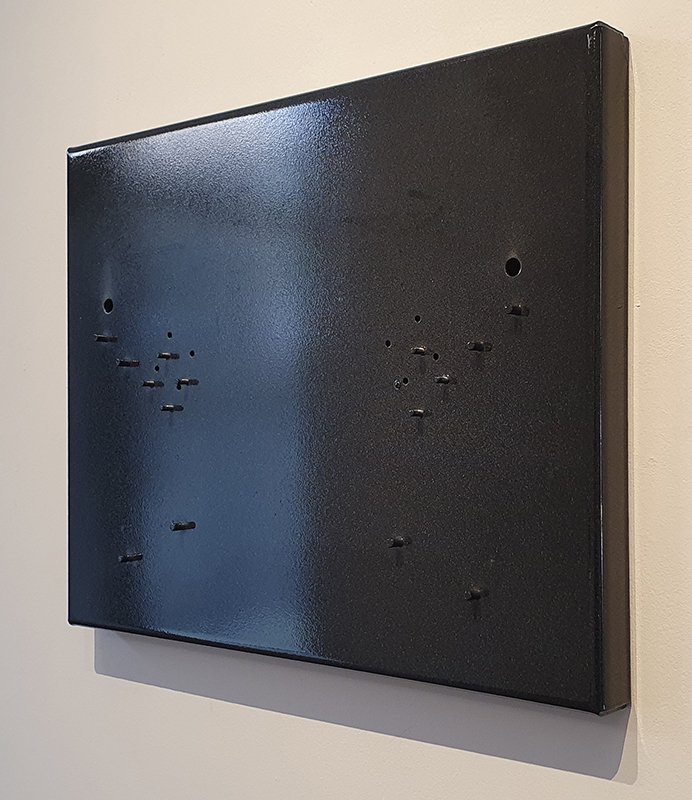
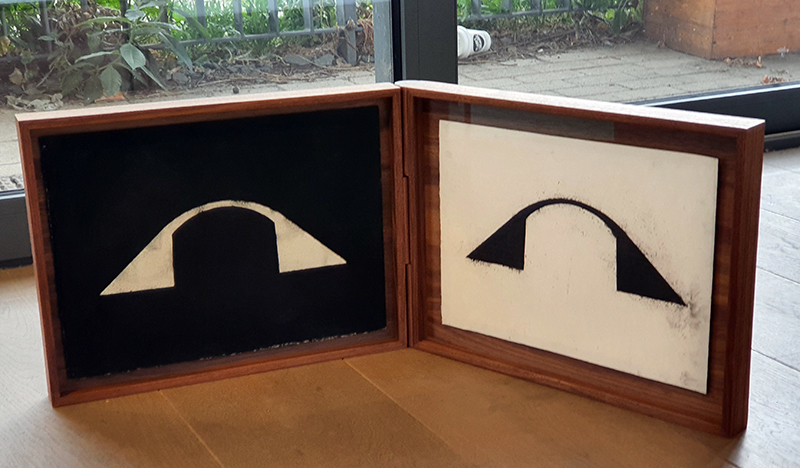
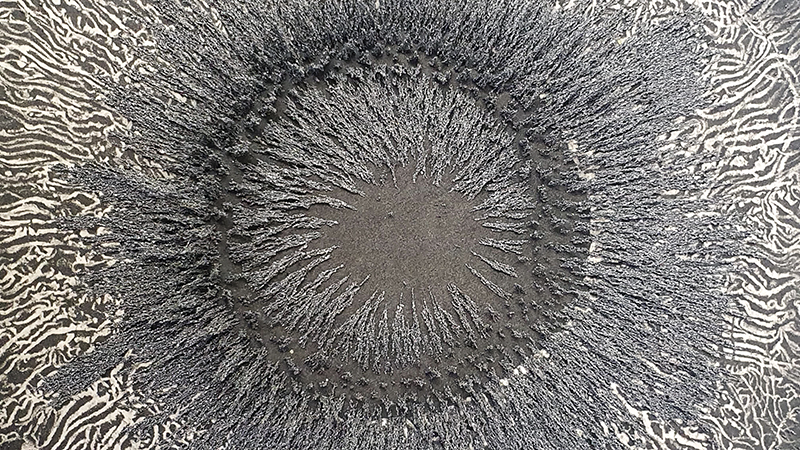
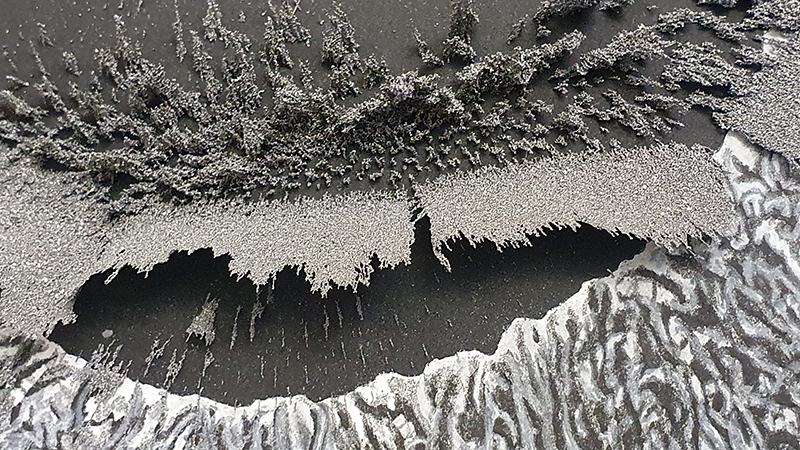
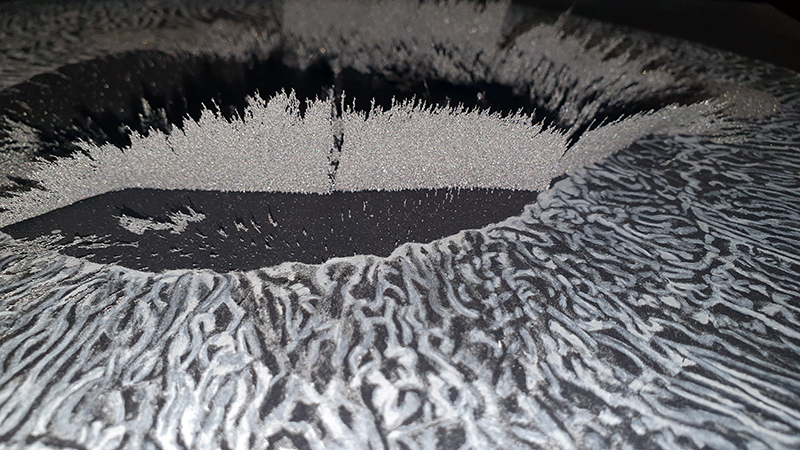
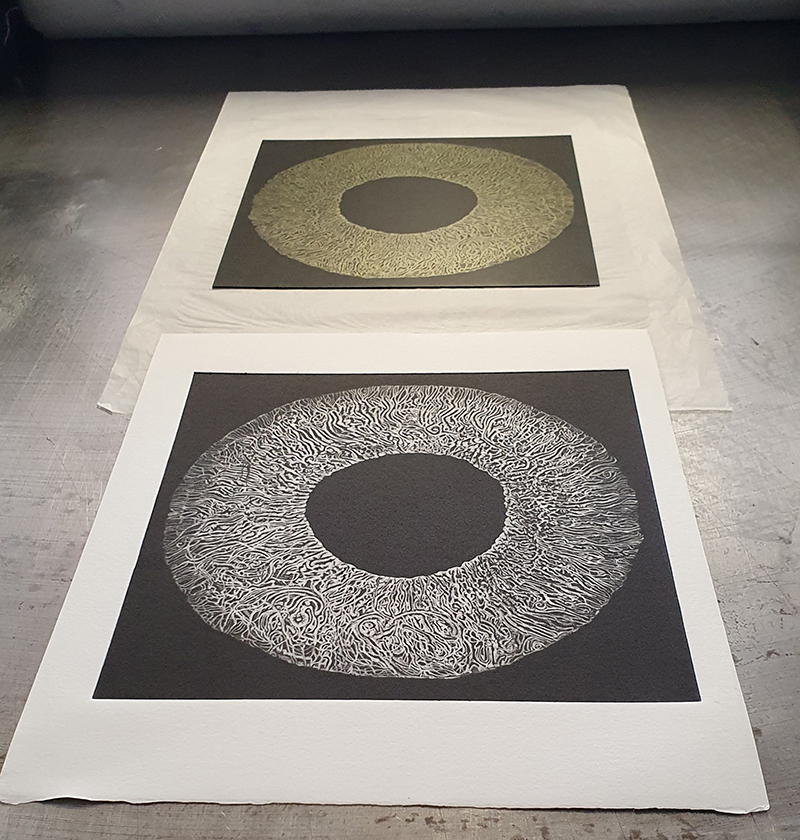
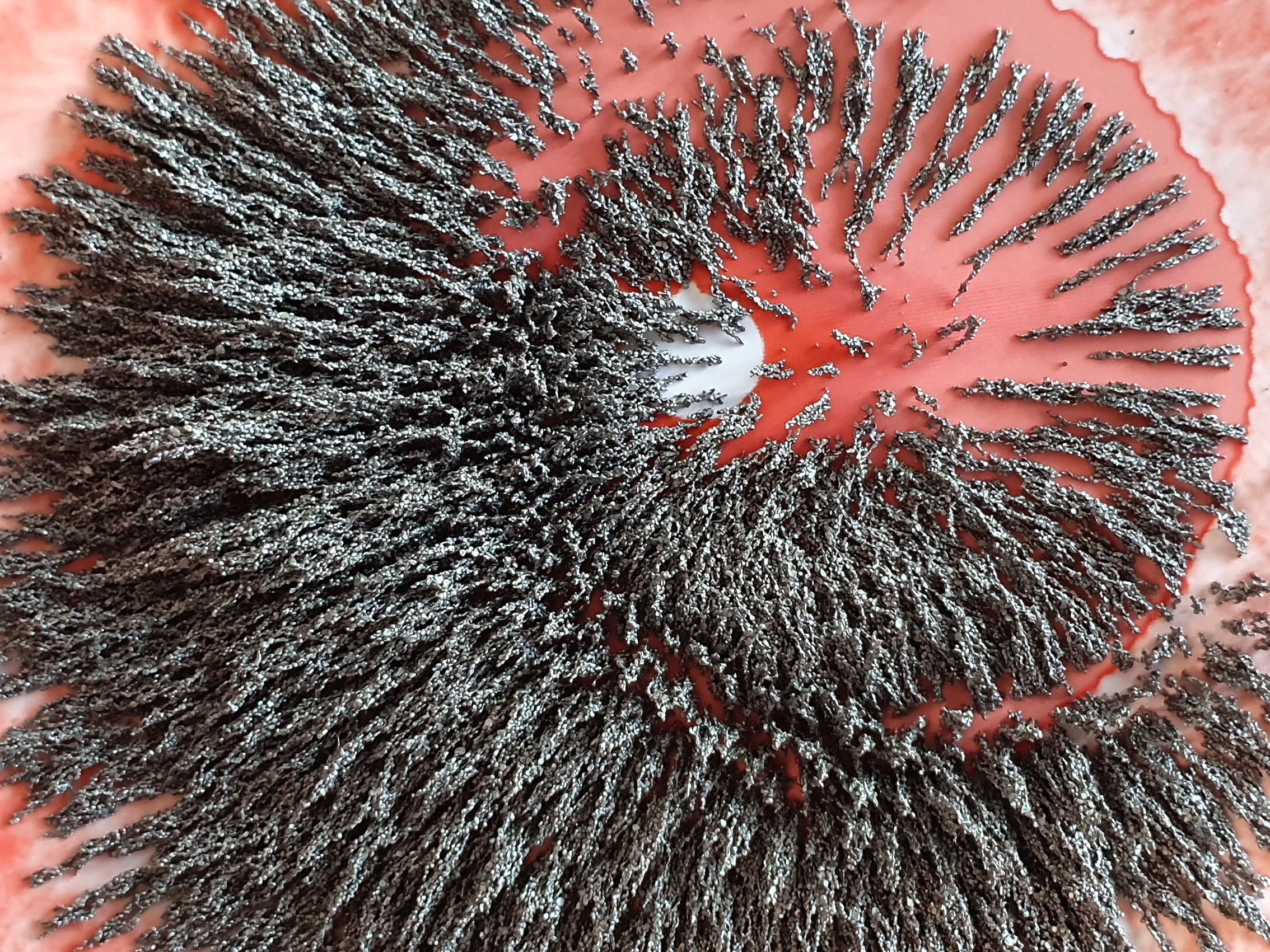
The Compass Eye Etching with chinagraph pencil, magnets, iron filings

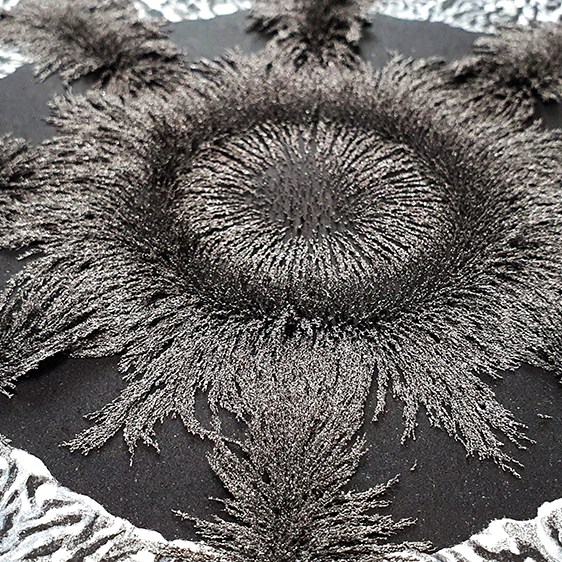
Pole Receptor 2022 27 x 27 x 3 cm Etching, magnet and iron filings

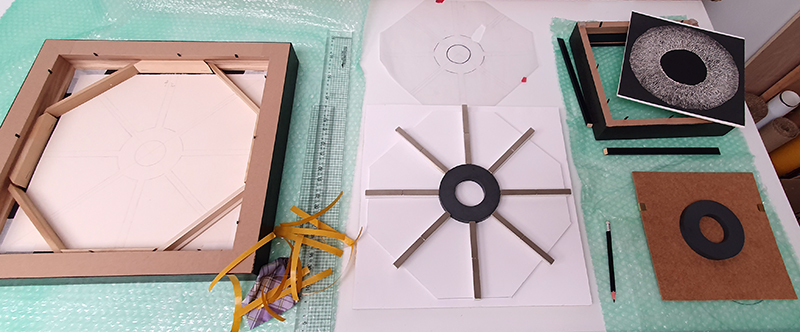
Framework made a neat job of the frames enabling the magnets to be released to reset the iron filings if necessary. The Compass Eye doesn’t have glass and maybe that was a mistake but I prefer the thin frame.

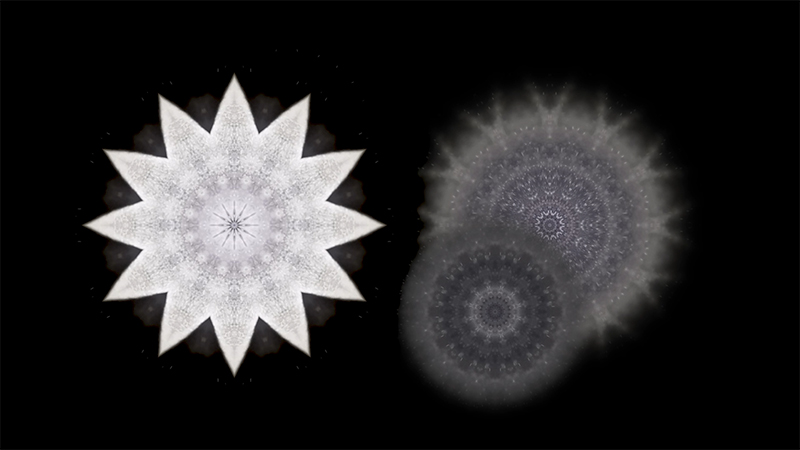
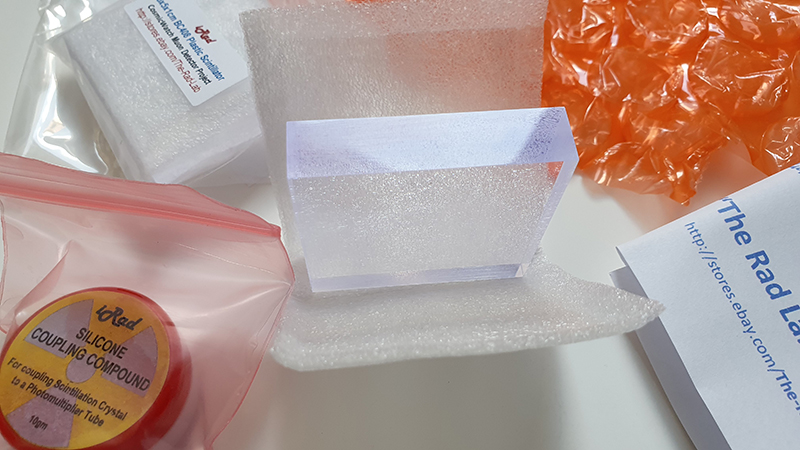
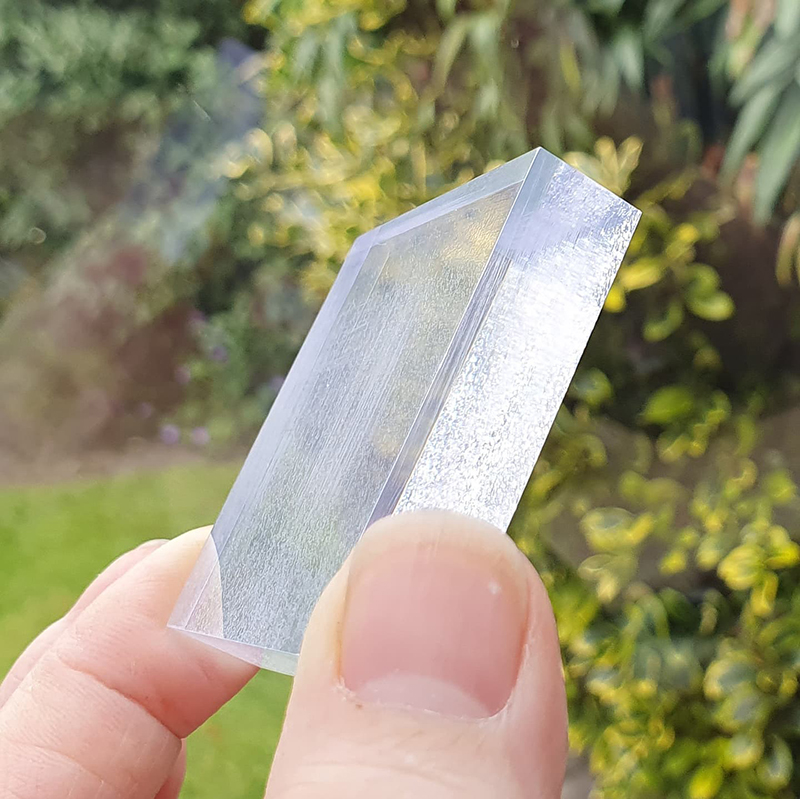
Progress is being made on new work Breath of Stars. This will be a screen based work triggered by cosmic ray activity. Every time an event is registered by a photomultiplier attached to a 5cm square piece of plastic scintillator, a star burst video image will flash up on the screen. The size of the starburst will correspond to the energy of the particle that has just arrived from space. The starburst videos are made in Adobe After Effects using footage from my cloud chamber experiments.

I have got some help with coding from gaming programmer Jamie Howard so am not feeling so out of my depth in the python maze. One problem we may have though is the shortage of Raspberry Pi processors. It could be months before we are able to get one with a high enough spec to process the video layering. In the meantime I am testing ideas and creating video clips.

It was wonderful to see so many people visiting the first Open Studios at Thames-side since 2019 despite the rail strike difficulties that weekend. The Compass Eye was hanging in the Thames-side Gallery Studio Holders Showcase exhibition. Thank you to everyone who came to visit and found their way to my studio, it was great to discuss everything from Plato to Planck.

Super happy to have my video Cosmic Chiasmus: crossing the universe included in the May Fair Showreel screening at the very smart May Fair Theatre as part of Mayfair Art Weekend. The departure point for the curated selection was the word ‘PROCESS’, which was inspired by the video work by Wolf Vostell, Auto-Faber (1973). It was a great experience to see all the amazing nominated films and meet the selectors -Elisa Tosoni, Angel Leung and Eugene Macki and art weekend project manager Cheri Silver.

What a lovely write up in the Winchester School of Art Yearbook 2022 from one of the Fine Art students on the Images In The Making sessions that I ran.

I am delighted that my installation The Forms has been selected for exhibition in the splendid Wells Cathedral as part of Wells Art Contemporary 2022.

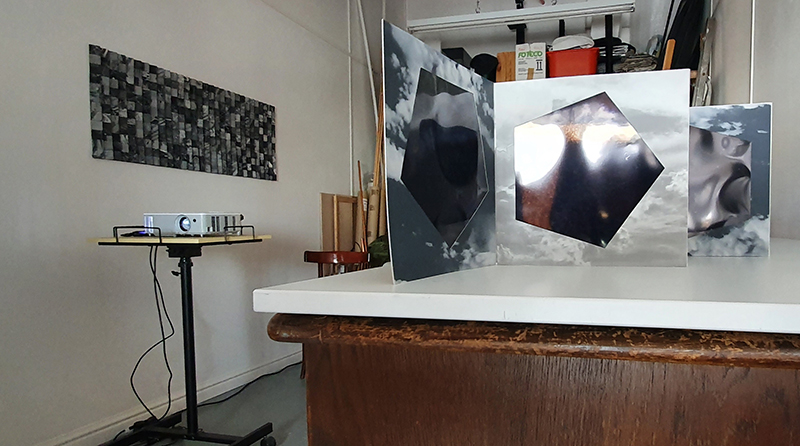
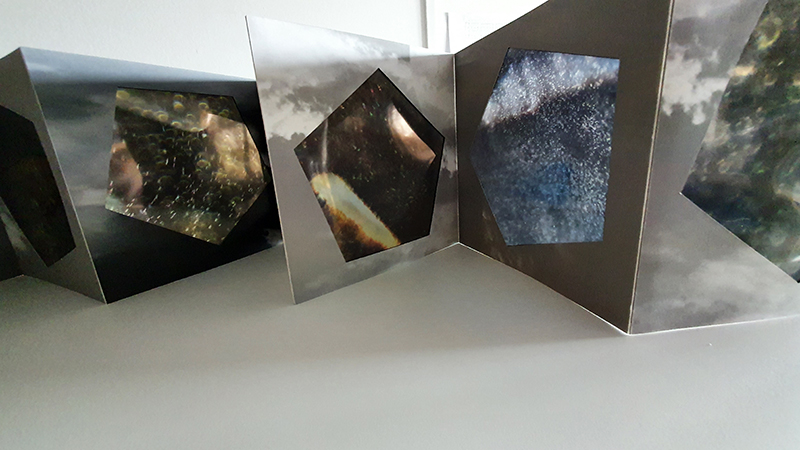
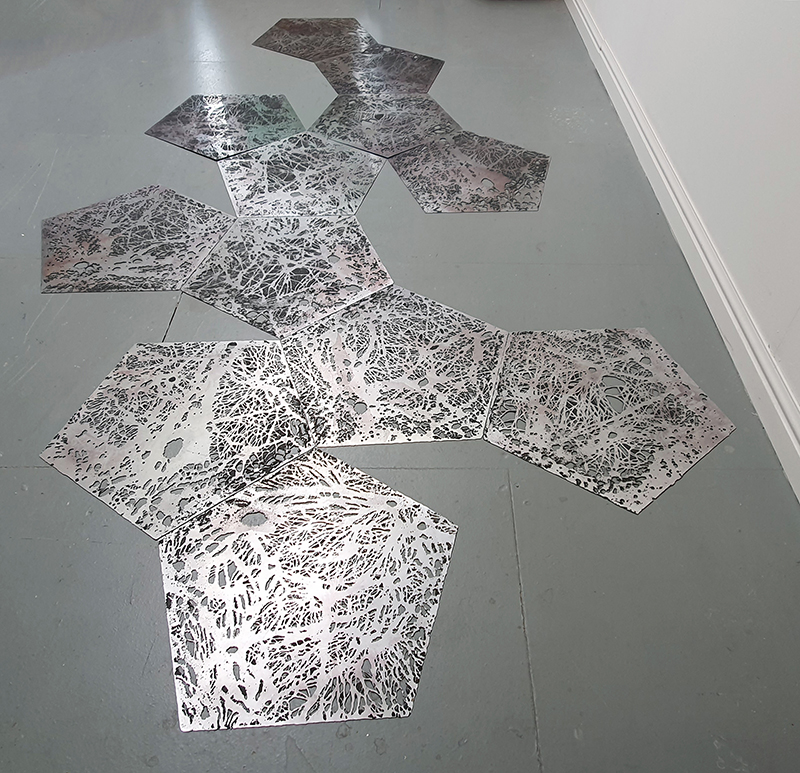
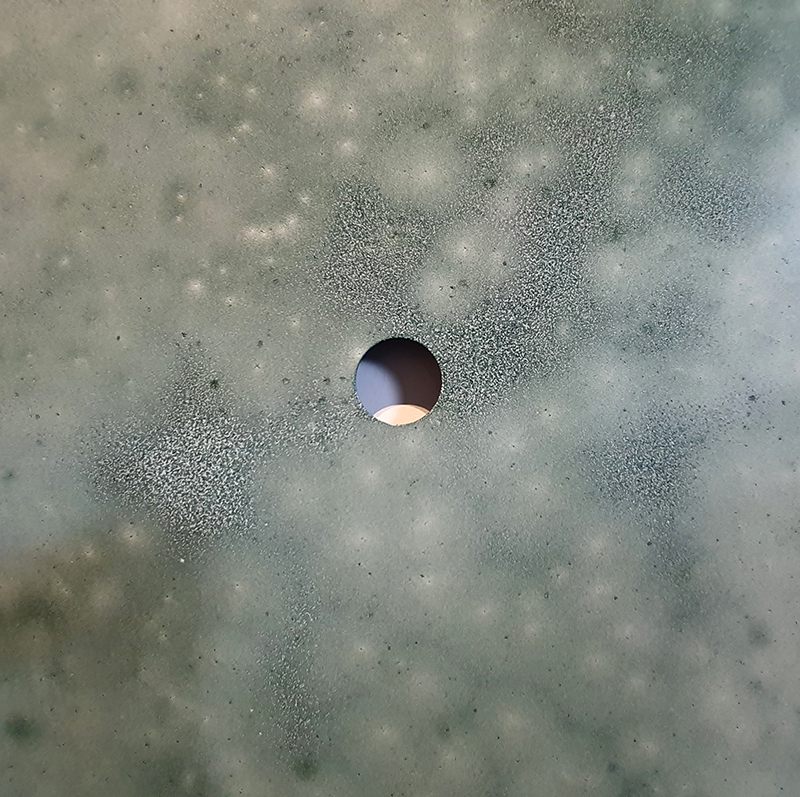
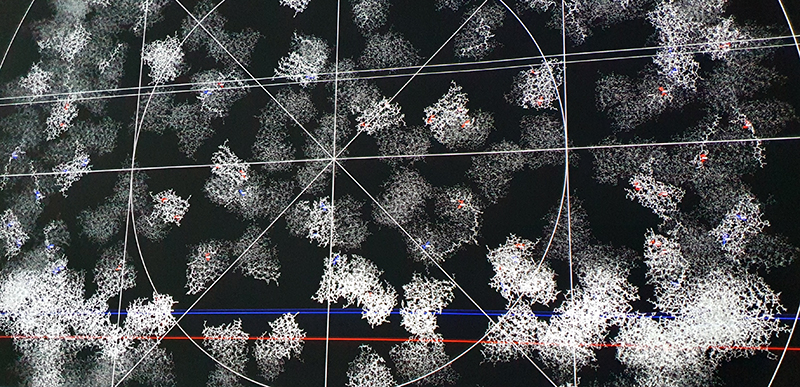
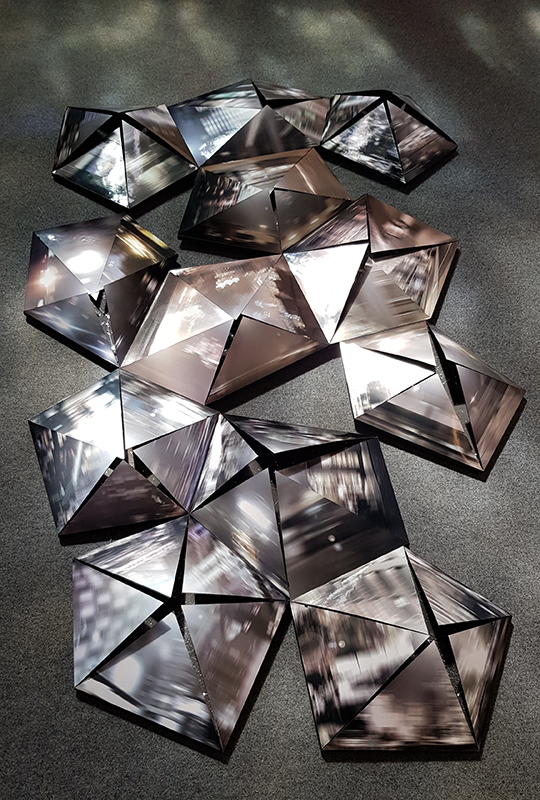
Twelve aluminium plates in the shape of pentagons that together make up the net of a dodecahedron have been deep etched with imagery taken from data visualisation of dark matter provided to me by KIPAC, Stanford University. The etching process used a screen printed sugar lift technique where the bite was allowed to penetrate completely through the plate leaving holes in some areas.

Excited to be selected for a satellite exhibition at the international print conference IMPACT12 to be installed at a former police station in Bristol. At a distance will be shown in The Anxiety of Interdisciplinarity, an exhibition which seeks to reframe printmaking as a site of interdisciplinarity – a testing ground for ‘The important work…done at the surfaces between adjacent disciplines’ (Carter, 1998).

Drawing on the physical language of print that embodies touch, separation and mirroring the semaphore flags in this work have been printed using hand painted dye sublimation inks applied via a heat press. This process transfers the ink from a paper matrix onto the substrate textile. The image passes momentarily across space in a dematerialized state as vapour before being reformed as its mirror opposite.
Out of Studio

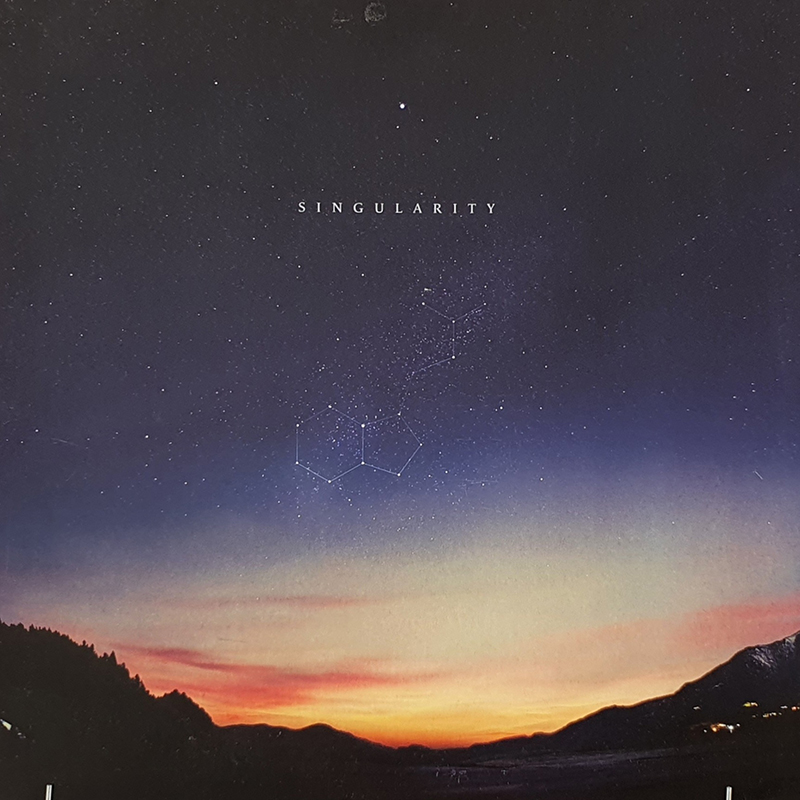
Billed as an immersive experience like no other Dreamachine offers a unique journey into the potential of your mind. Stimulated by strobe lighting playing rhythms on your eyelids and spatial sound fed directly into your ears, your mind creates its own images behind closed eyes. Inspired by a 1959 invention from artist–inventor Brion Gysin it has been reimagined by Collective Act, in collaboration with Turner Prize-winning artists Assemble, Grammy and Mercury nominated composer Jon Hopkins, and a team of leading technologists, scientists and philosophers.

It was pretty amazing. From a deep orange glow of swirling matter kaleidoscopic shapes emerge with geometric patterns that form and explode into vibrant pulsating honeycomb structures. Felt sure I was seeing some of my recent work in there. Swept away on a tide of colour with a big smile it was like a roller coaster ride through the forming of a technicolour universe. Wonderful.

Interesting to read that the frequency range of light emitted by Brion Gysin’s Dream Machine corresponds to alpha waves, electrical oscillations normally present in the human brain while relaxing. The pulsating light stimulates the optical nerve and alters the brain’s electrical oscillations. I have been looking at scientific research that explores a connection between the Earth’s magnetic field and human vision when stimulated by blue or polarised light depending on the orientation of the viewer. The human brain’s alpha waves can be seen to react to the local geomagnetic field. Some research correlates the nature of our dreams to magnetic field activity with calmer dreams resulting from high activity and more bizarre dreams when activity is low.

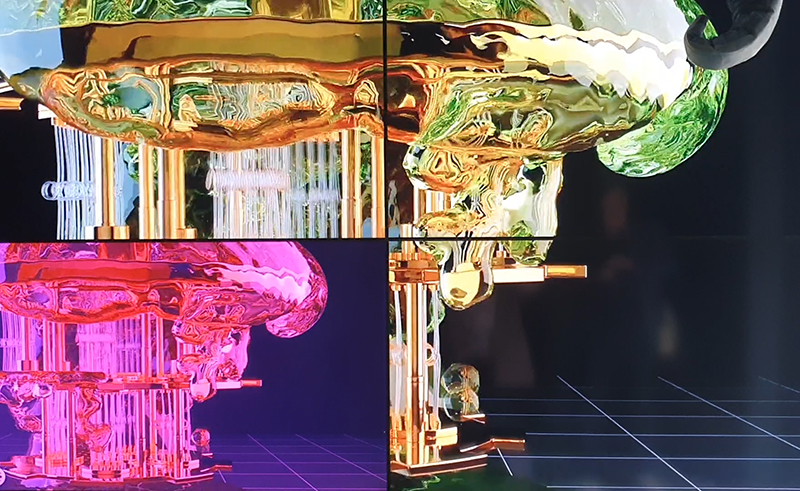
Going from Dreamachine to Libby Heaney’s quantum world of morphing fluid shapeshifting worlds The Evolution of Ent @Arebyte was a nice continuation of mind bending immersion.

Ent-er. Ent-anglements. Ent-ropy. Ent-wining. Ent- hralling. Ent-icing.

Looking at the potential futures created by quantum computing where the digital mode of binary gives way to superposition and quantum entanglement. Daniel Cavalcanti has provided a useful quantum glossary in the exhibition catalogue. Explaining superposition as like looking through a window and seeing outside and yourself reflected simultaneously, two configurations happening at the same time.

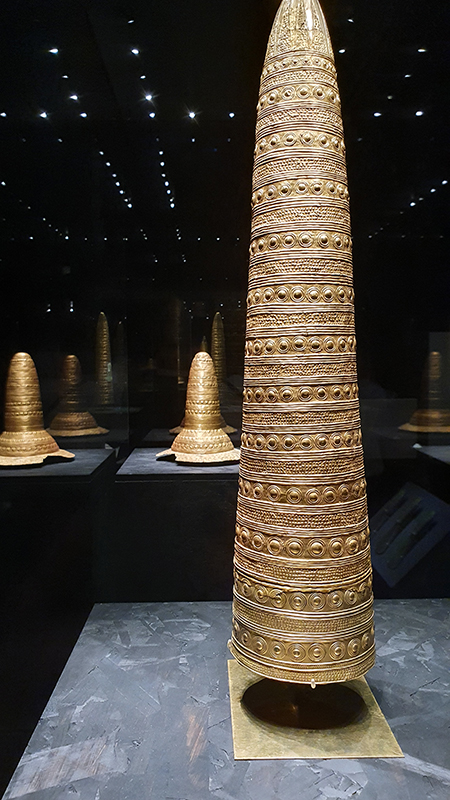
I was very excited to visit The World of Stonehenge at The British Museum to see the Nebra Sky Disc, having been introduced to the existence of this amazing object by archaeoastronomer Carolyn Kennett while on the Lizard Point Residency in 2019. Found by metal detectorists in Germany the gold used in this ancient map of the cosmos can be traced to Cornwall.

Carolyn explaining the history of this most ancient of cosmological objects.

The actual disc was much larger than I expected and almost translucently thin.

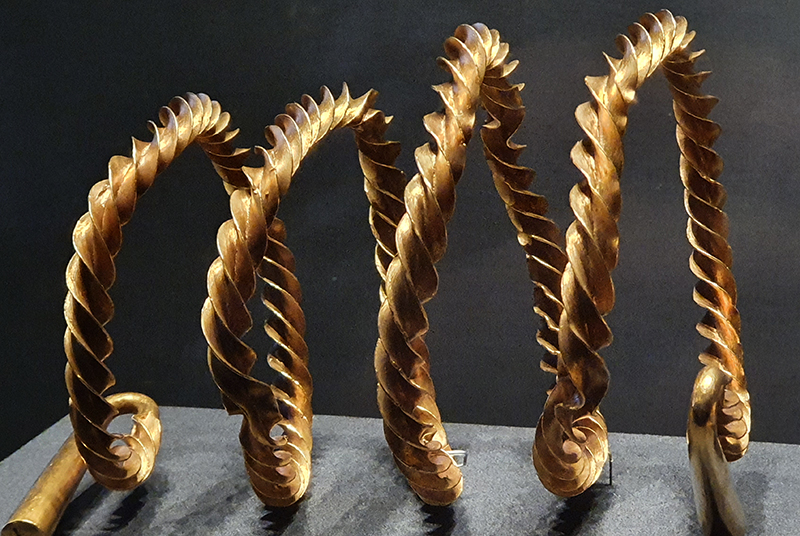
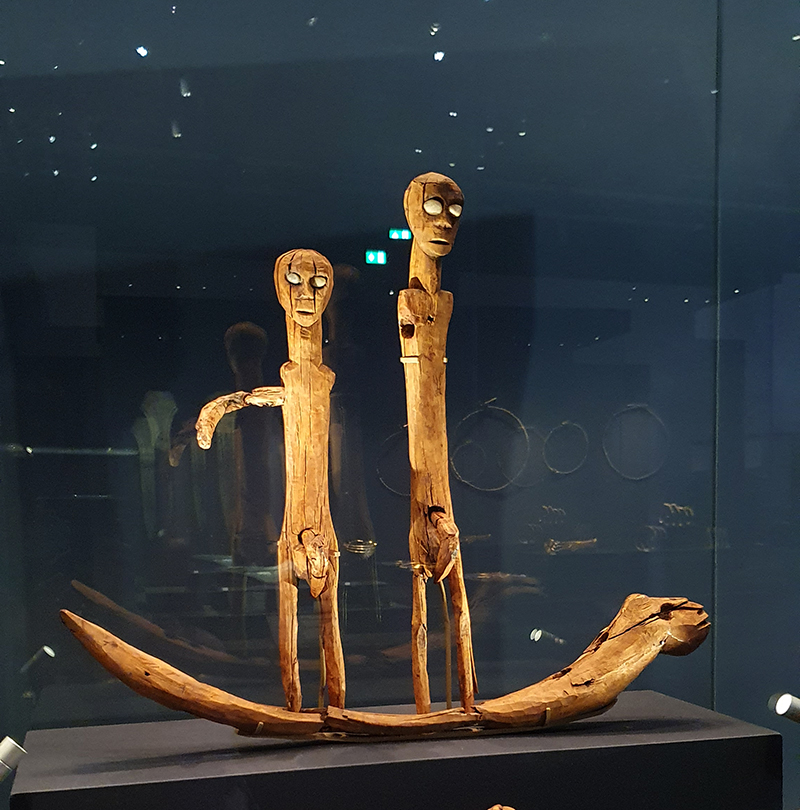
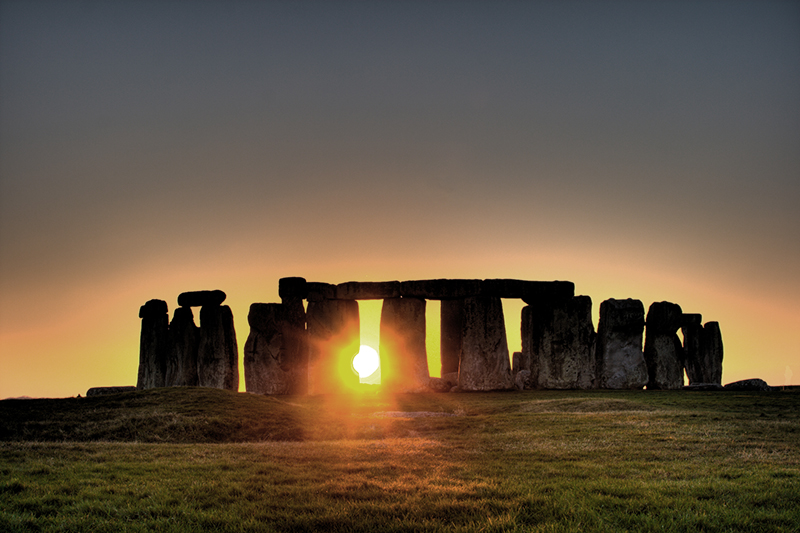
Six thousand years ago in the final 1,500 years of the stone age was the British Neolithic period. A time of stone axes for chopping. Woodlands cleared for farming. Stone held meaning. Offerings were made to spirits. Hundreds of stone and wooden circles were raised across the land. A cosmic inversion, connecting earth to sky. The first stones were brought to Stonehenge about 5000 years ago to create a burial ground which was transformed 500 years later into the symbolic site where the large sarsen stones were placed in alignment with the sun as it rises at midsummer solstice and sets in midwinter. Some astonishing objects in the exhibition, the power of the sun celebrated and reflected in gold.

I had high hopes for Our Time on Earth exhibition in the Barbican Curve – the aim was for technology to bring us closer to nature and highlight our place as one species among millions of others, striving to live together in a delicate balance. There was some enticing imagery and interesting ideas but as an experience it was tech overload, information overload all crammed into quite a tight space. Too much to take in and too removed from a lived time on Earth for me to engage and absorb anything meaningful.

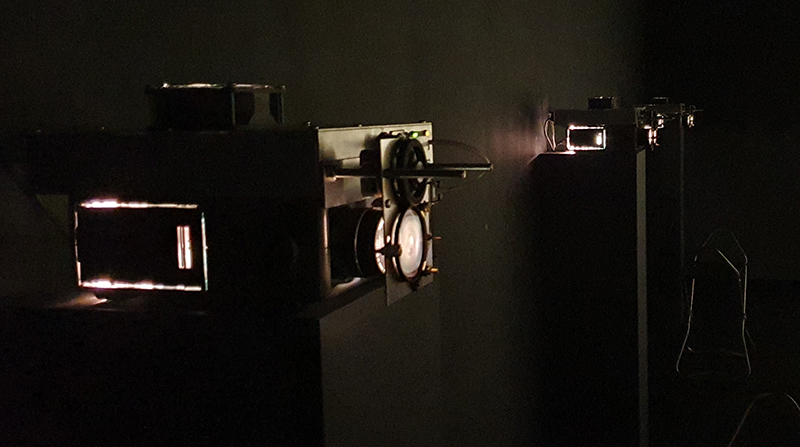
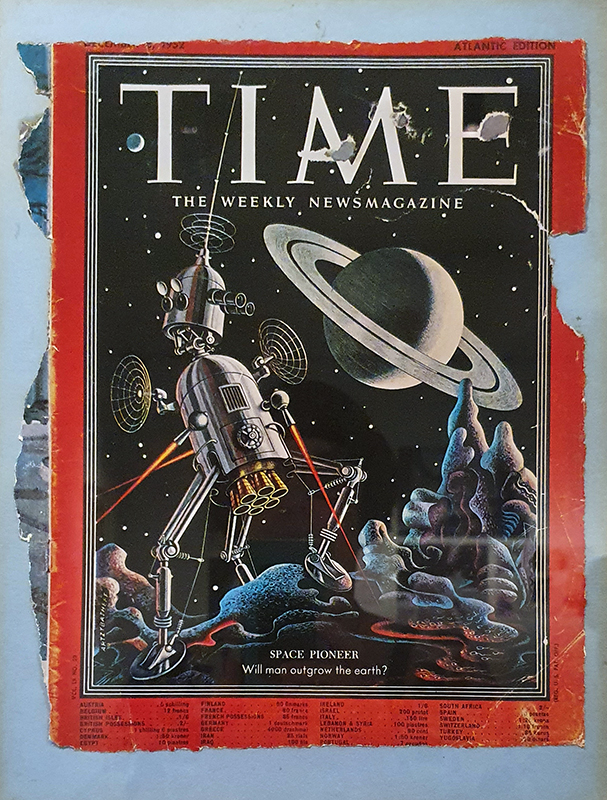
Postwar Modern at the Barbican Gallery explores the art produced in Britain between 1945 and 1965 in the wake of a cataclysmic war. Including; Denis Williams Painting in Six Related Rhythms 1954; Eduardo Paolozzi Will Man Outgrow The Earth? collage form the series Bunk 1952/1971; the lovely Aphra Shemza’s grandfather Anwar Jalal Shemza painting fusing Western ideas of abstraction with Eastern influence and Gustav Metzger Liquid Crystal Environment  made using heat-sensitive liquid crystals that are placed between glass slides and inserted into projectors where they are are rotated to create movement within the liquid causing the crystals to change colour as they are heated and cooled.

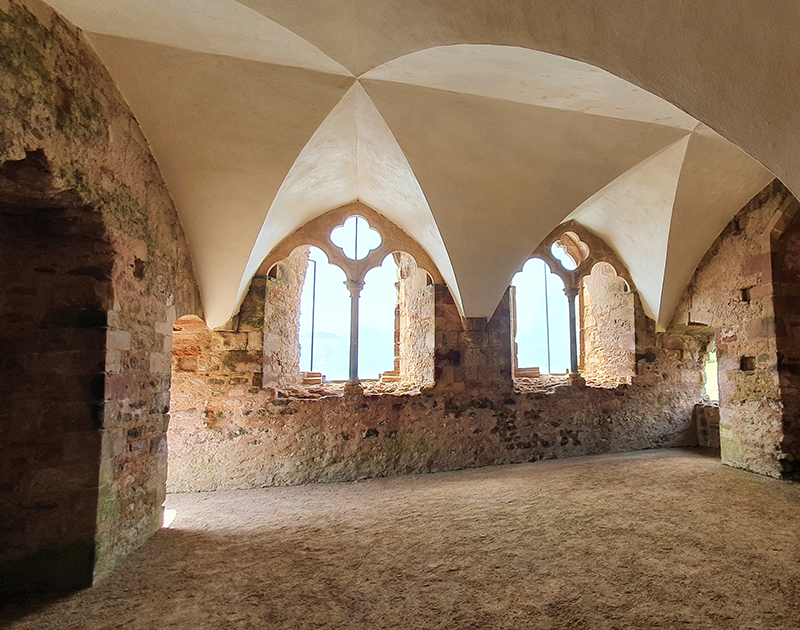
I was fascinated to learn about the numbering system used by Cistercian Monks while visiting the impressive ruins of 12th century Cleeve Abbey in Somerset. A single cypher can represent numbers up to 9999.

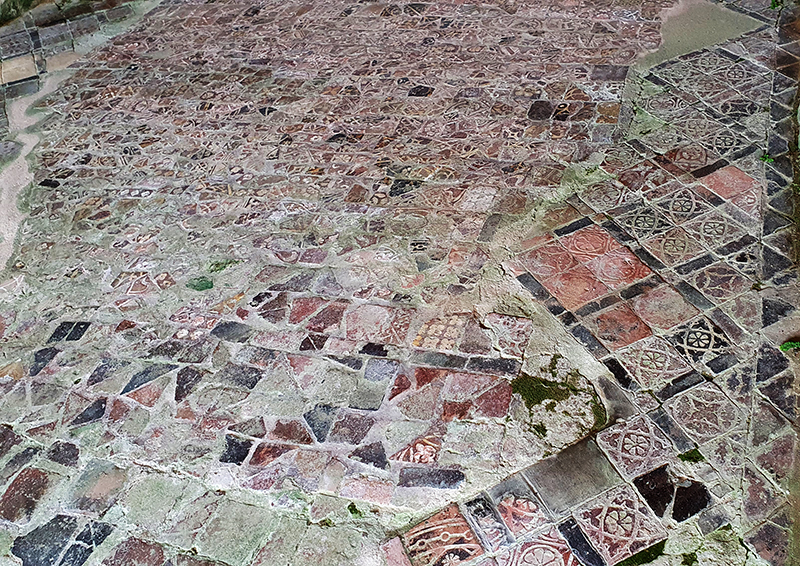
The abbey church was destroyed by Henry VIII during the dissolution in 1536 but the cloister buildings, gatehouse, 15th century refectory and 13th century heraldic tiles survived destruction as they were being used as farm buildings at the time and it’s ancient tiled floor was protected from the elements by a cabbage field.

Lode – a way or path, a watercourse, a vein of metallic ore.

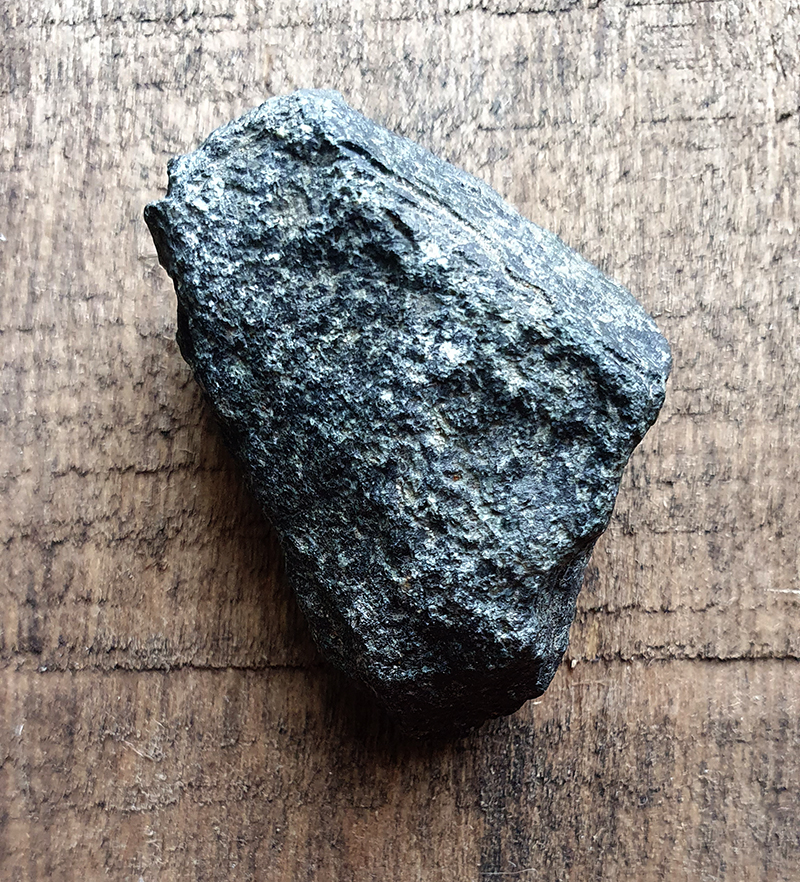
A lodestone is a naturally occurring magnet possibly created by a lightning strike. Early compasses were made of lodestone suspended on a cord.

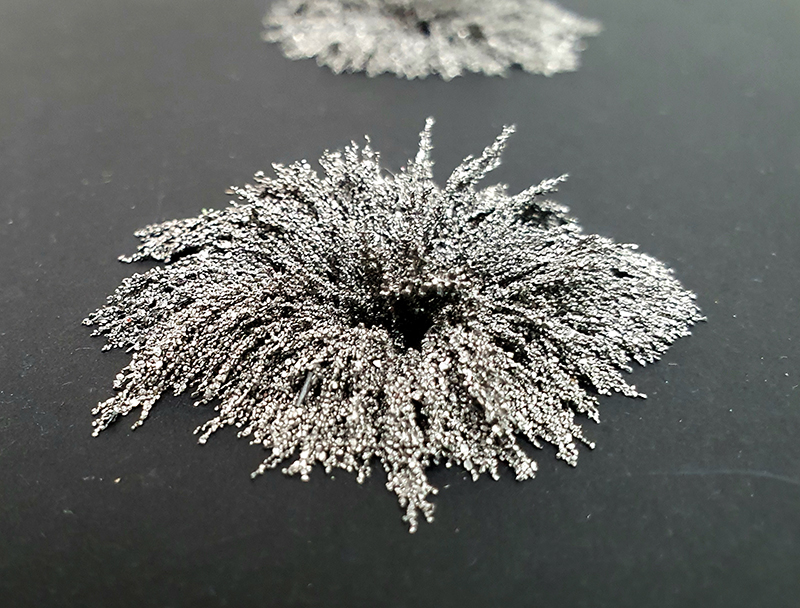
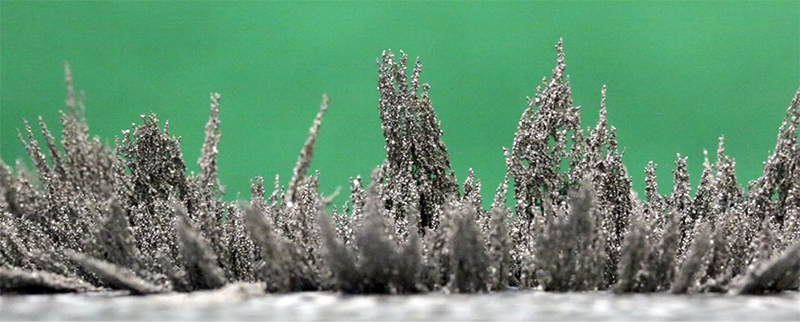
Magnetite is a common mineral that has an attraction to a magnet but is not magnetic in itself.

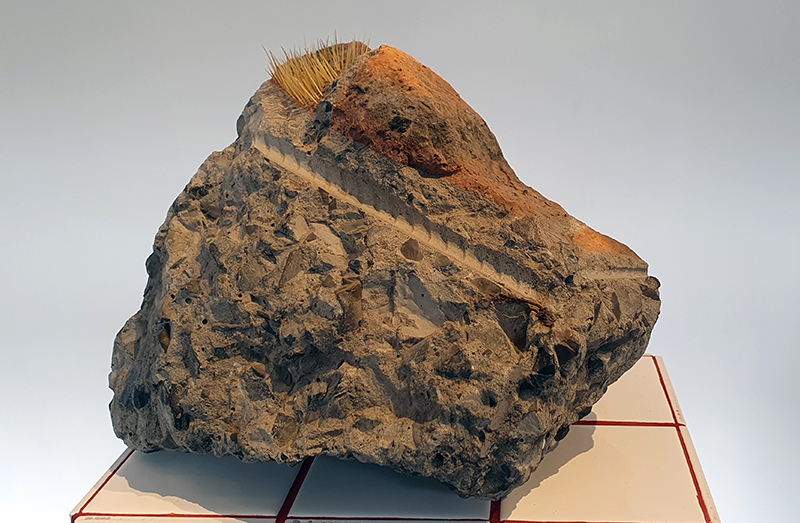
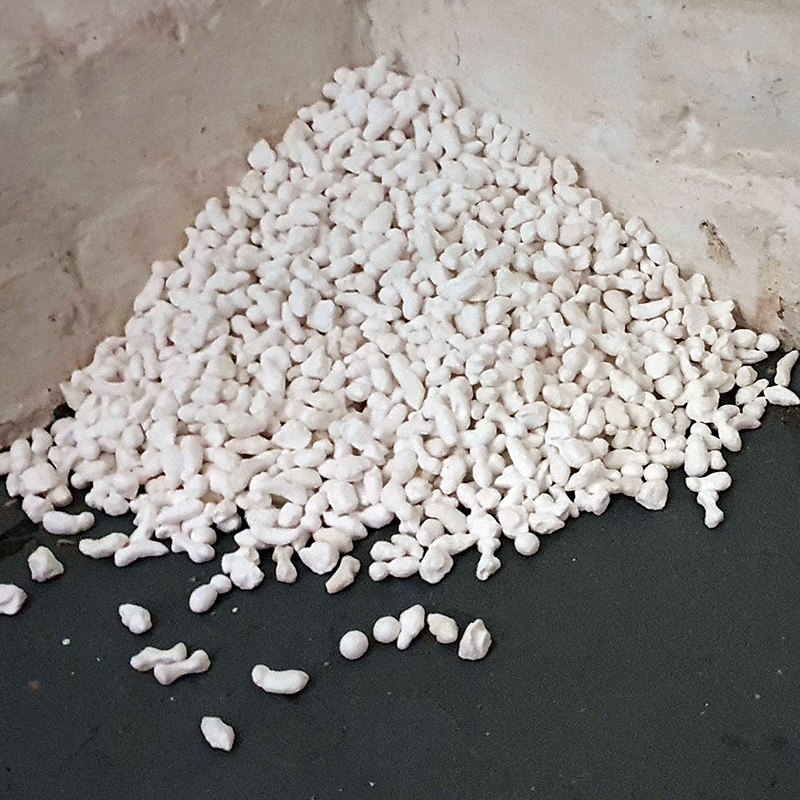
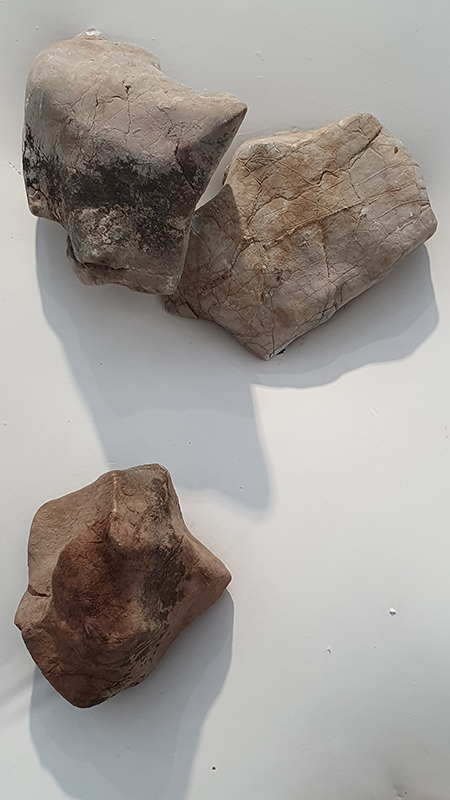
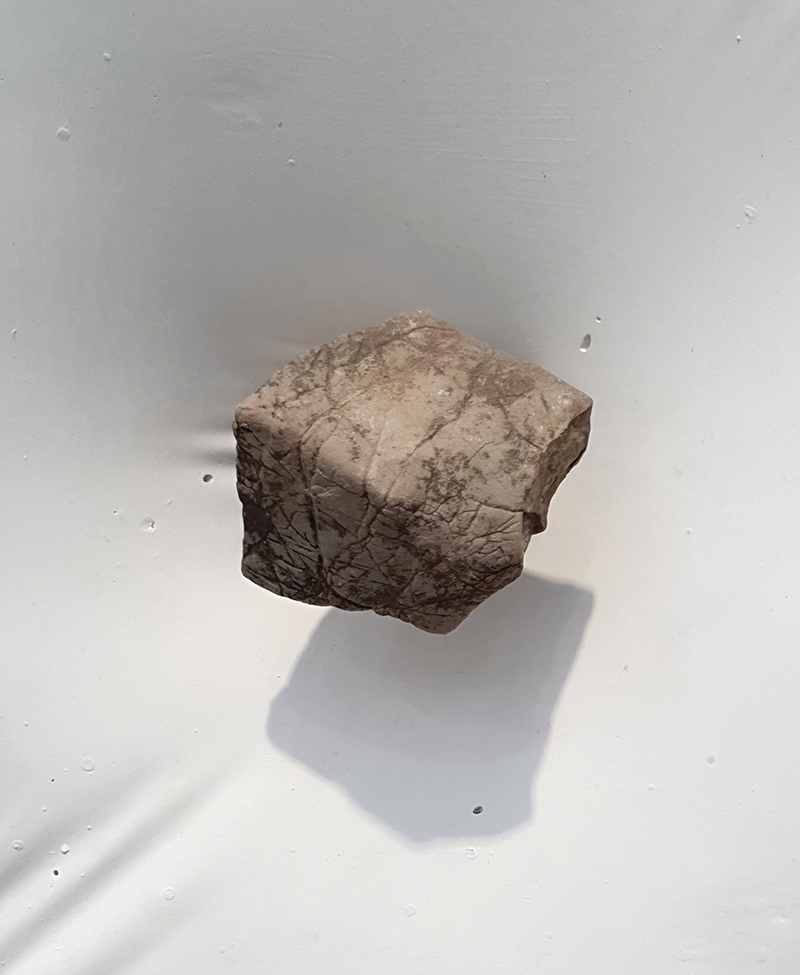
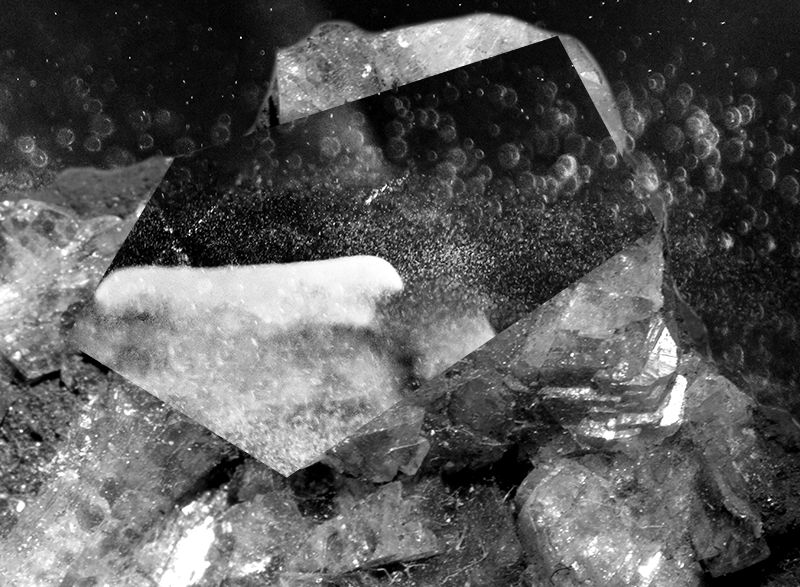
The image shows magnetite, sold on eBay as a Lodestone though at £2 what did I expect.

Fluid activity hidden deep in the Earth’s interior can be visualised through plotting the magnetic field and its fluctuations.

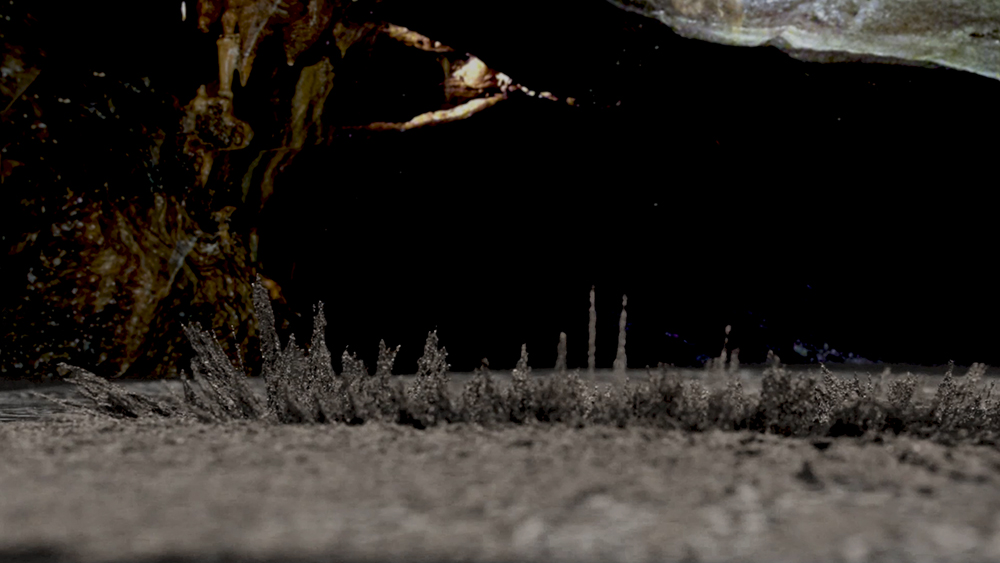
The geomagnetic field, generated by the Earth’s molten core, varies through time; the magnetic poles migrate, go on excursions or reverse polarity. During these periods of flux the strength of the magnetic field changes and this phenomenon is recorded in archaeological artifacts, volcanic rocks, and sediments. The mineral deposits of stalactites store a paleomagnetic history of declination (the deviation of magnetic from geographic north).

Thinking about how magnetic pole reversals are stored in geology. I am modelling some paper clay rocks for future filming visualising the magnetic field using iron filings.

Early navigators using the compass around the 15th century became aware that geomagnetic north would roam position. In 1701 the first map charting the magnetic field declination was produced by British astronomer Edmund Halley.

In the 19th century the study of geomagnetism became one of many passions for explorer polymath Alexander von Humboldt who studied

“what keeps the innermost of the world together, how all is woven together”

and was the first to connect climate with interactions between atmosphere, oceans, land and plant ecology. From meticulous observations he noticed the Earth’s magnetic field intensity increases from the equator to the pole, and that it was also influenced by auroras and solar activity causing magnetic storms.

Magnetic observatories to monitor the Earth’s magnetic field were set up around the globe including one at Greenwich which had to relocate twice due to infrastructure interference (electric railways) and is now based in Devon with a permanent azimuth mark on a concrete obelisk viewed from the north window of the Absolute Hut. I wonder if it is possible to visit.

Magnetotactic bacteria align themselves with the Earth’s magnetic field to navigate using nanoparticles of magnetite crystals covered in biological material called magnetosomes. Each nanoparticle is about 100,000 times smaller than a grain of rice. They are mostly found in water and sediment with little or no oxygen. It has been found that magnetosomes can be biodegraded (dissolved) in human stem cells losing magnetism at first but then reforming into human cells with magnetic sensitive qualities.

There is a daily variation in the magnetosphere caused by sunlight hitting the ionosphere, a layer of the atmosphere about 1000km up. The electrical conductivity of this layer is affected by the solar wind which pressures and squashes the field on the sunlit side while creating a magnetotail pluming from the dark side of the Earth.

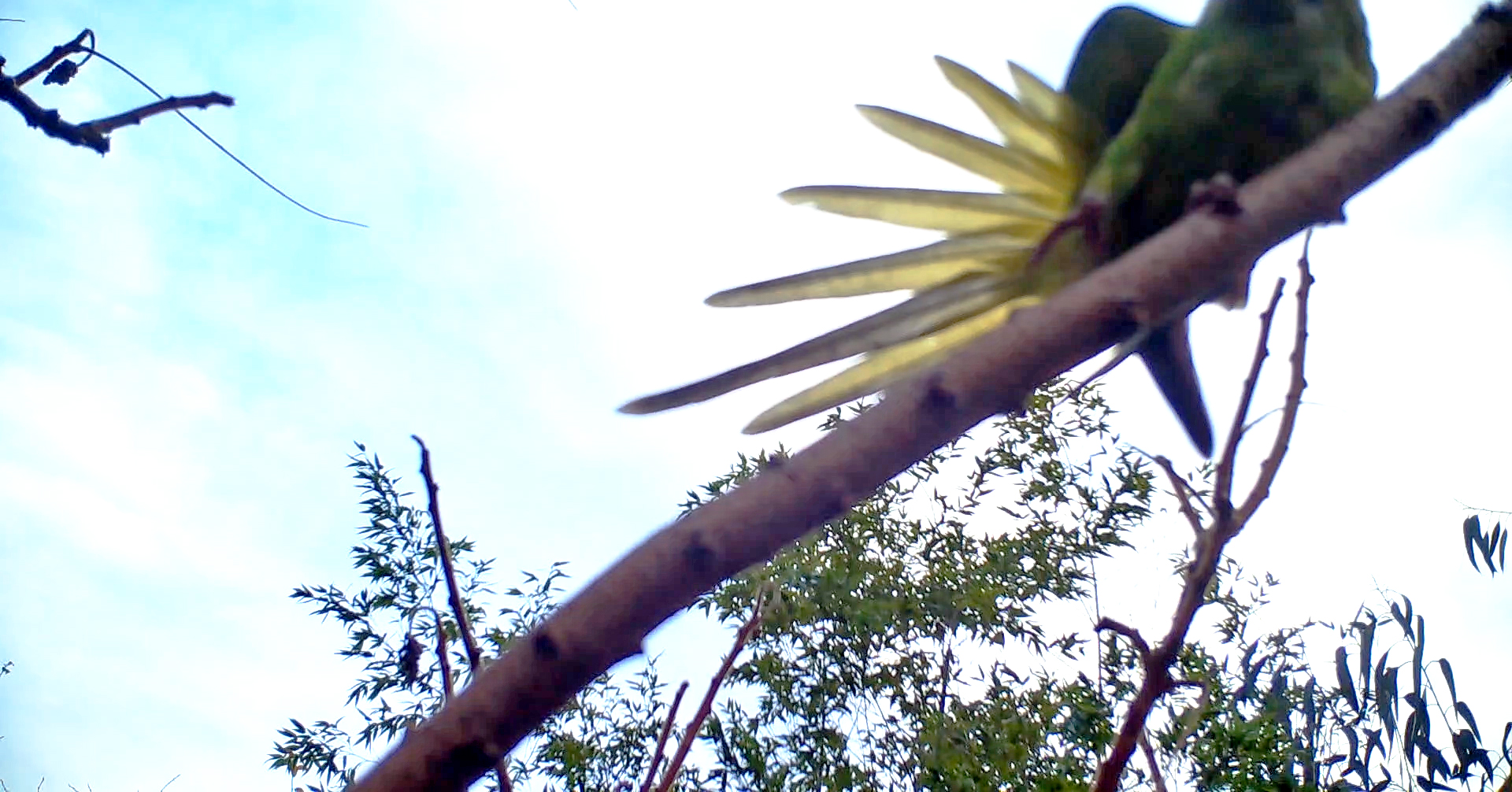
Capturing garden activity through the solar cycle with a spycam.

The rotation of the Earth around its axis results in a molecular clock evolved by organisms in alignment with the solar cycle. The Earth’s magnetic field can influence animals’ circadian clocks, through the photoreceptor cryptochrome, which is activated by blue light.

I have recently acquired a drone and have been for a couple of practice flights in Richmond Park’s designated area taking along a few pentagon mirrors. Excited by the possibilities.

Up at 5am to see the tiny points of light that are Venus and Jupiter approaching their conjunction which they performed the following morning hidden by clouds

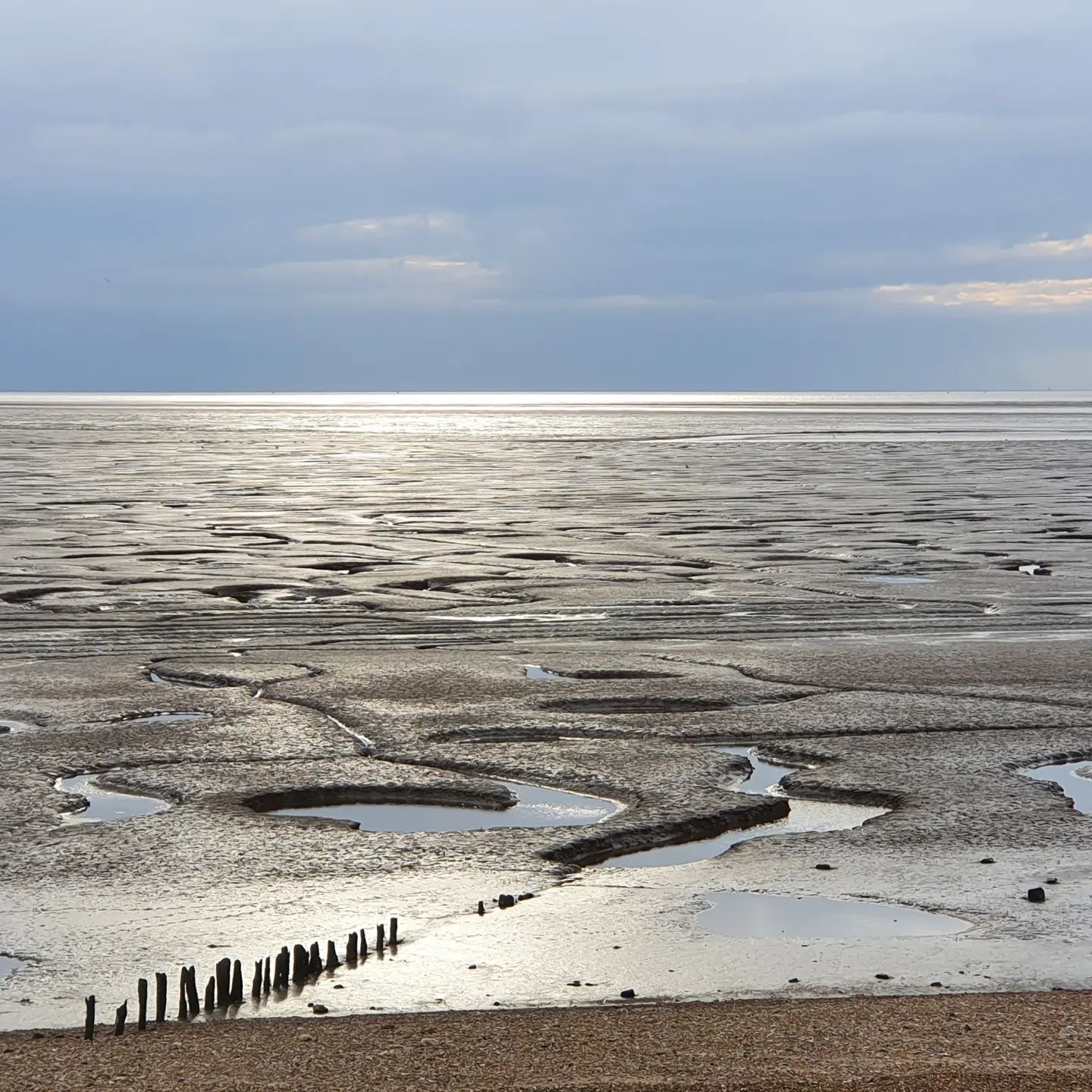
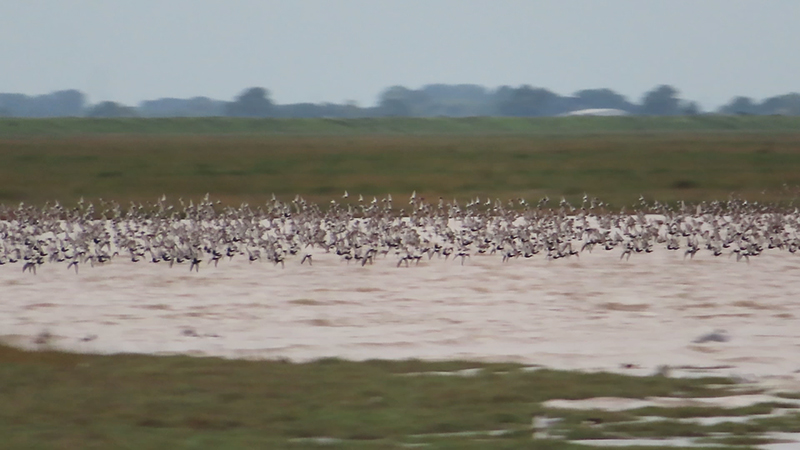
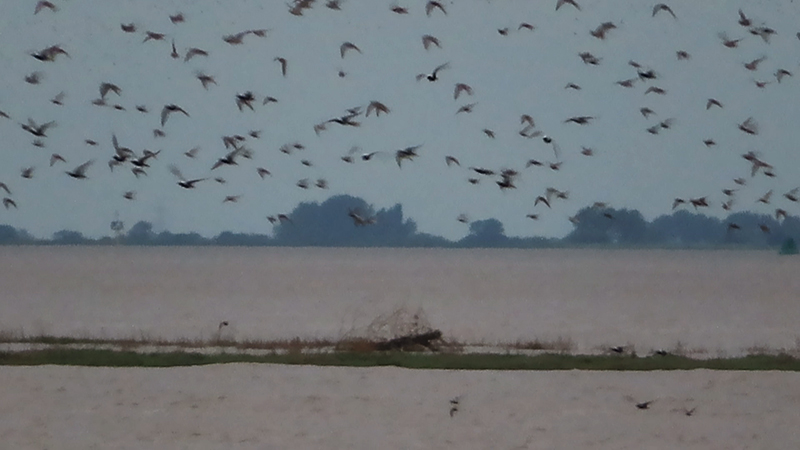
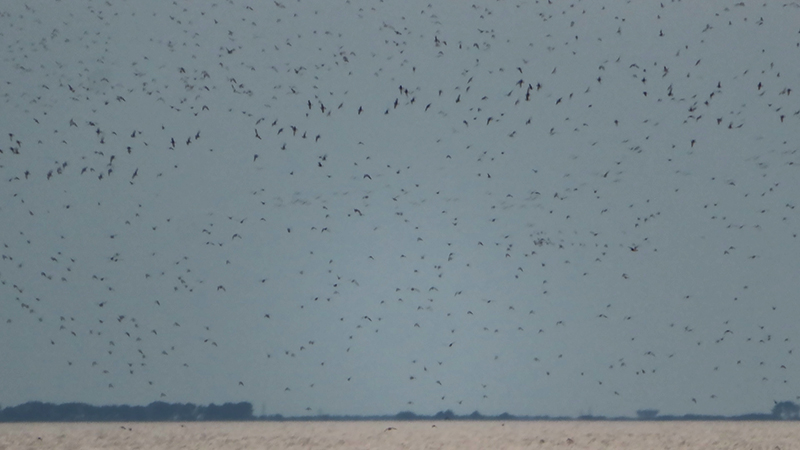
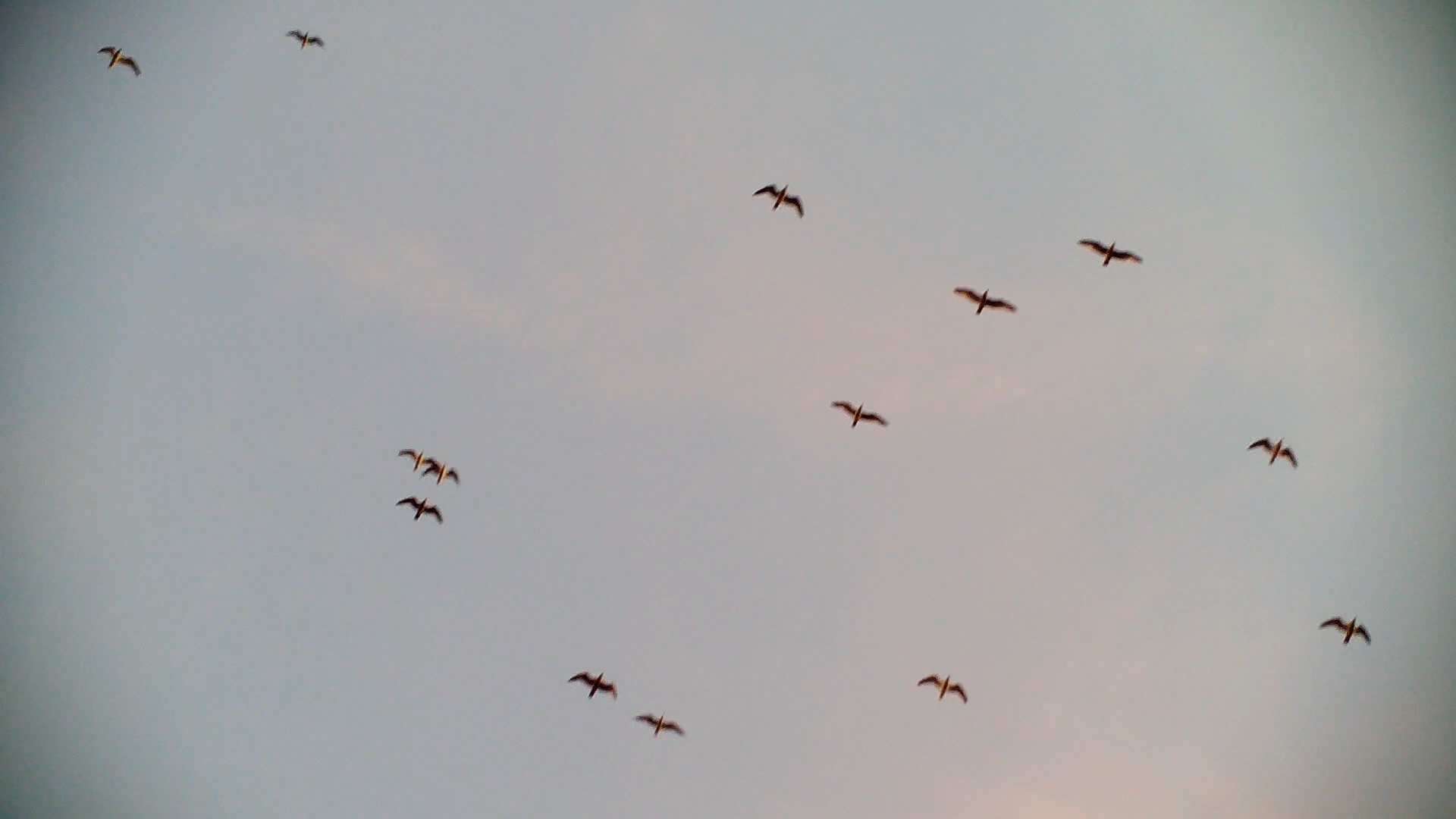
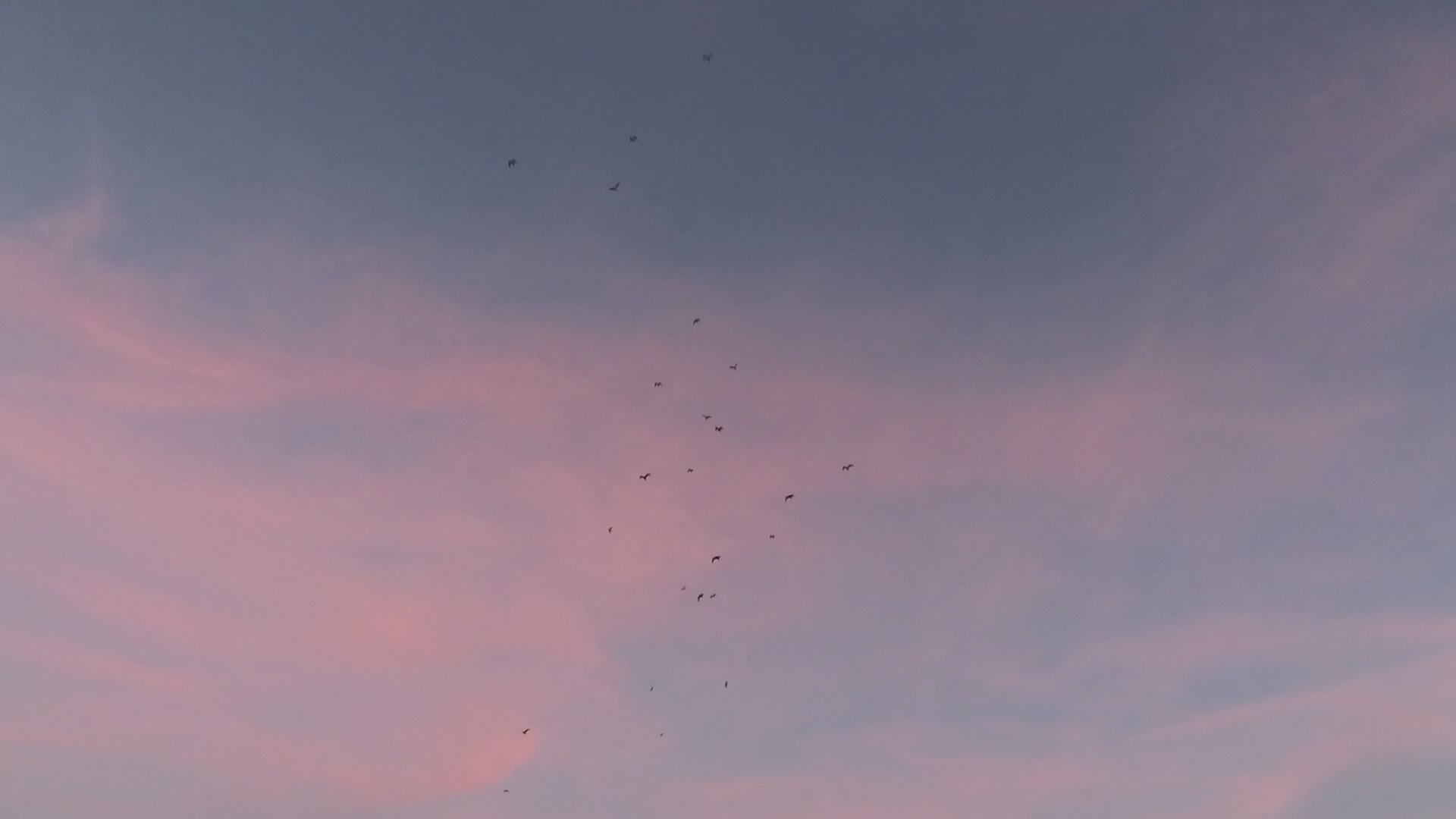
Research trip to RSPB Snettisham in North Norfolk to see the Whirling Wader Spectacle. The high spring tides push the birds from their feeding grounds on the mudflats of The Wash onto the lagoons of the reserve. The spectacle occurs when the tide is super high during daylight hours in early spring or late autumn when the birds are migrating to and from this site. It is surprising how fast the tide comes in. On arrival in the early evening the sea is a distant strip of light.

Suddenly the gullies are filling and the first murmurations of knots are forming low over the incoming water. The speed of the birds is extraordinary. I was totally ill equipped to capture the spectacle on video.

Fascinating research discussed in the webinar Scientific American live: Bird Migration and Song featuring Professor of Chemistry University of Oxford, Peter Hore, an expert on magnetoreception.

Radicals are molecules that contain an odd number of electrons and are therefore unstable. For most molecules the electrons are paired which cancels out the magnetic force. Birds use three different compasses to navigate across the globe; the sun, the stars and the magnetic field. The Artic tern makes the longest migratory journey, a staggering 25,000 miles.

The theory that birds may use the Earth’s magnetic field to navigate began in the middle of the 19th century, but experiments in Germany with European Robins in the 1960s were the first to prove the connection. The Earth’s magnetic field is extremely weak so the mechanism that can detect this weak force must be very sensitive. Because free radicals are very unstable it doesn’t take much energy to have big effects. The particular cryptochrome molecule used is found in the retina of the eye with the photoreceptor cells. Blue light shined onto Cryptochrome 4 produces radical pairs which are sensitive to the magnetic field. It is excited by blue light but does not respond to red light. The molecules work like a pendant compass, distinguishing the direction of the magnetic field towards pole or equator. This feature arises from the spin direction of the free radical pairs. Both radicals may spin in the same direction or one may spin one way and the other the opposite. There is a lot of processing in the eye before a signal is sent to the brain to act upon.

It is possible birds form a visual perception of the magnetic field. The cone cells in the eye are used by day but may be taken over at night for navigation as this is when birds migrate. Light pollution and electromagnetic noise pollution such as AM radio masts can cause disorientation.

I still have questions about how the birds know where to head for. They may have a map but they still need a destination.

Stunning North Norfolk coastline. It’s so flat here that cliffs are unexpected. Hunstanton Beach was once under a tropical sea 108 million years ago when sea levels were 200m higher. Somewhere in these strata evidence of magnetic pole reversals will be stored.

So much to explore at the National Physical Laboratory Open Day but my favourite room was Magnetic Materials and Sensors. They don’t allow any photography so I can’t share some of the amazing experiments I saw but I have been able to recreate my favourite as it was also the simplest; a magnet dropped into a copper pipe creates an electric current as it falls which gently slows its progress through the tube. So cool. I will be filming this.

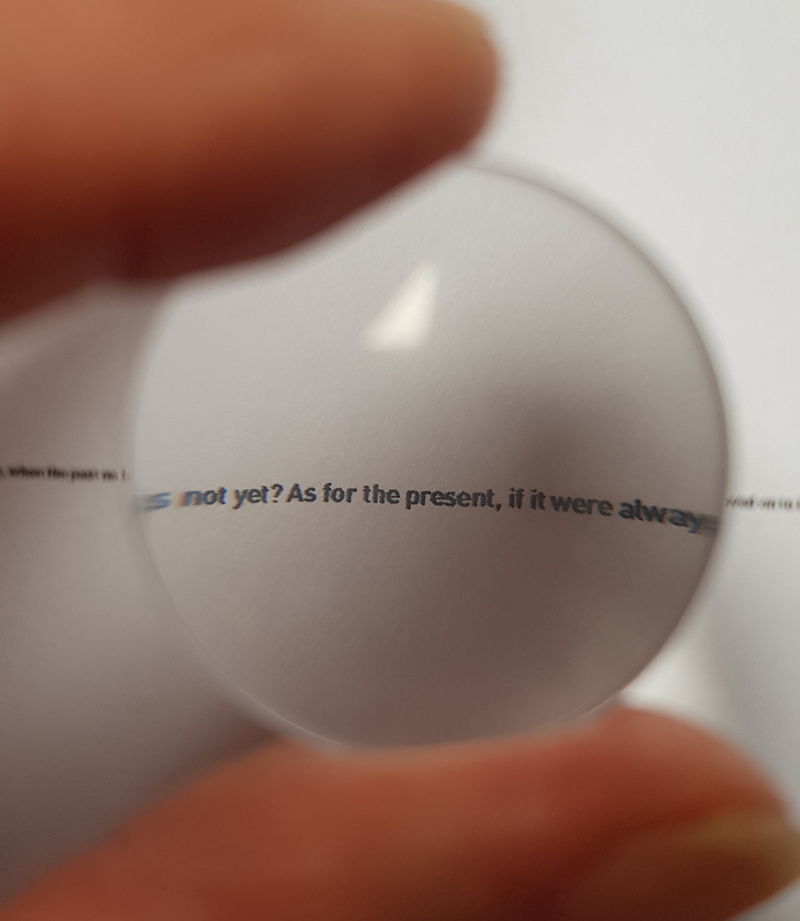
Experiments with lenses. It’s often the way that having spent time on a proposal that doesn’t get accepted those ideas do not get wasted but ultimately feed into new work.

Testing ‘The Forms’ as a floor piece.

The immutable truths Plato discovered in geometry belong to the realm of abstract thought and ideals he called The Forms. Twelve pentagons form a dodecahedron which Plato defined as ‘a fifth construction, which the god used for embroidering the constellations on the whole heaven.’ Today it is dark matter that science believes holds the stars in the heavens. In visualisations of dark matter created from cosmological data we see familiar organic patterns emerge; the fronds of dark matter spanning between galaxies could be the spreading branches of trees or the veins under our skin.

Thanks to KIPAC Stanford University for the data visualisations.

Enjoyed a one day 3D Geometry class with Leila Dear at the Princes School of Traditional Arts. I gained so much from the RCA exchange week here that fed into my work for the past several years that I thought a refresher would be useful – and that was before I knew we would be making geometric bubbles. Irresistible.

Out of Studio

Reflections at Workplace Gallery

Sculpture by women artists Nicola Ellis, Hsi-Nong Huang, Patricia Ayres and Olivia Bax.

All works offer up a satisfying conjunction of materiality and form but especially loving Nicola’s ‘Quite a Structure’ which is like a slice of the Earth’s molten core.

HEAVEN NEITHER BURNING FARTHER at The Crypt, St. John on Bethnal Green

Erika Blumenfeld writes “The material comprising our bodies shares cosmic origins with the material comprising the planets, asteroids and comets in our solar system. Scientifically, this material, having derived from distant stars across time, threads back to the primordial material that emerged moments after our universe burst into being. Culturally, our star gazing has filled us with wonder across all civilizations, sparking art and architecture, philosophy and science, mythology, folklore as well as navigation and place-making”.

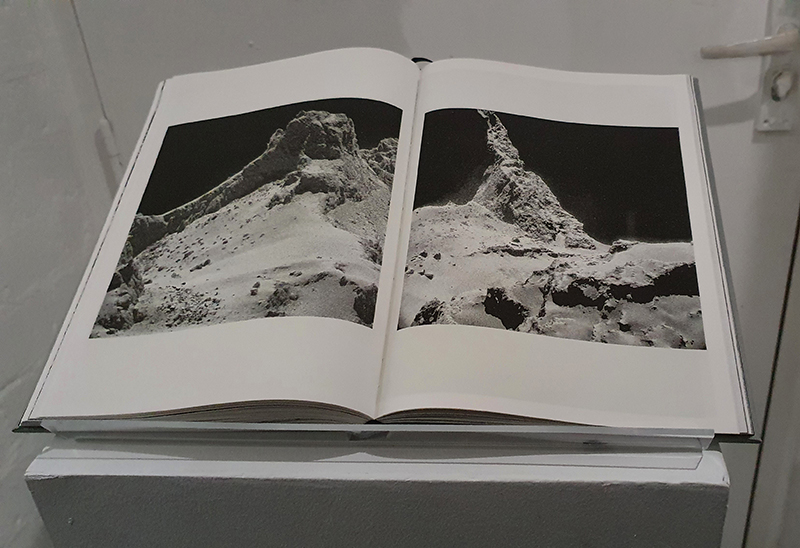
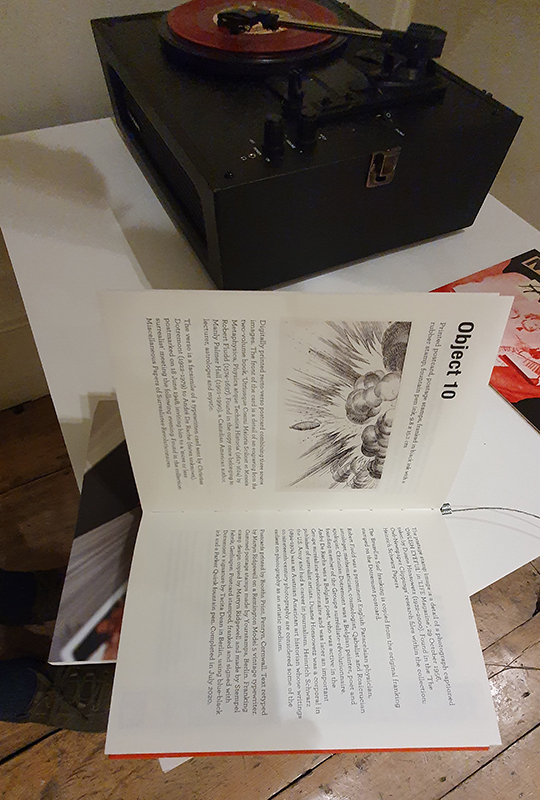
Visual journeys have been created using the archive, modern science, performative poetry, scanned glacier-ice sent by image transmission, laser-based mapping originally sourced from the Rosetta space mission, the use of historic adaptations, the layering of earthly minerals, and a hunt for asteroid fragments. Held in a crypt under-ground the exhibition takes a poignant look at the myth and science that surround comets, which in theory brought life to Earth but could also end it.

Artists: Julie F Hill, Leah Beeferman, Barry Stone, Pedro Torres, Fryd Frydendahl, Ports Bishop, Claudio Pogo & Magdalena Wysocka Curated by Lucy Helton

Fascinating and beautiful work in this subterranean gateway to the cosmos which rewards following up each artist’s research.

POST TOTEM at OHSH Projects pop up on Oxford Street, curated by Adam Dix and Dale Adcock.
I found the concept of this exhibition very appealing. Reaching back to what connects us. Some innate sense of the sacred.

‘Imagine an artist holding the metaphorical hand of an artist from the previous generation and that artist, doing the same, and so on, back through time, back 30 to 40 thousand years into the unimaginably distant past, when we made the great cave paintings of Lascaux and Maros-Pangkep karst. This imaginative exercise creates an image of an unbroken woven human connection, stretching back through time uniting, individuals into a group, linked by imagination, action and materials.’

Artists showing: Dale Adcock, Simon Burton, Adam Dix, Tim Ellis, Lisa Ivory, Simon Burton, Rachel Howard, Henry Hussey, Dean Melbourne, Yelena Popova, Chantal Powell, Joanna Rajkowska, Alexis Soul Gray, Suzanne Treister.

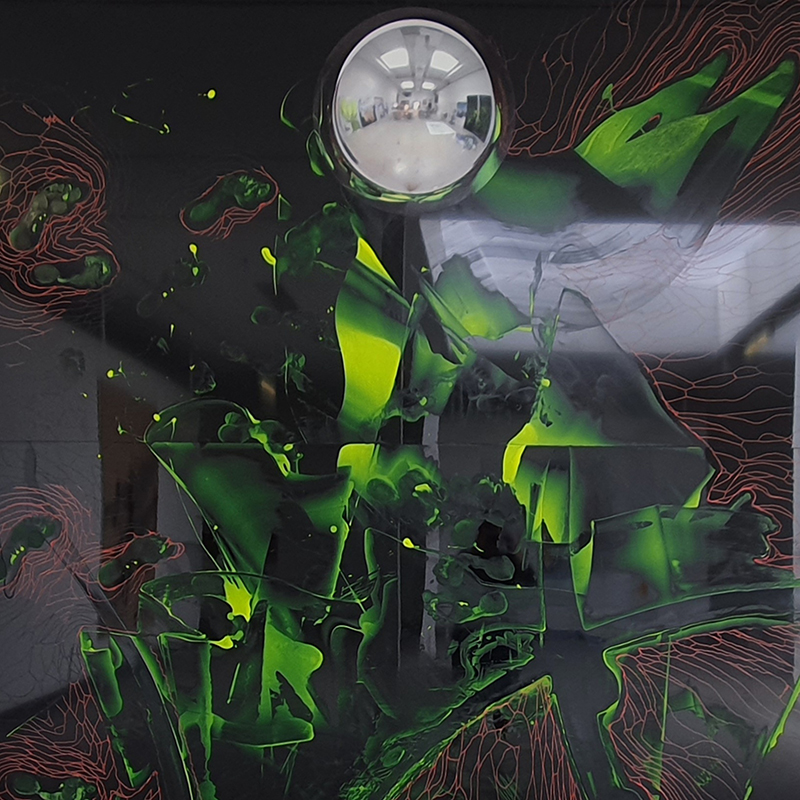
Seth Price – Art Is Not Human at Sadie Coles

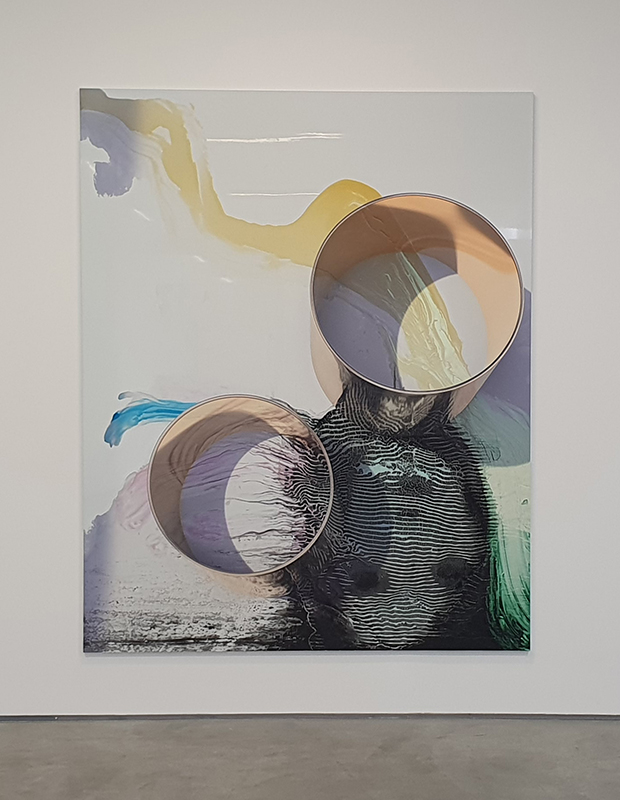
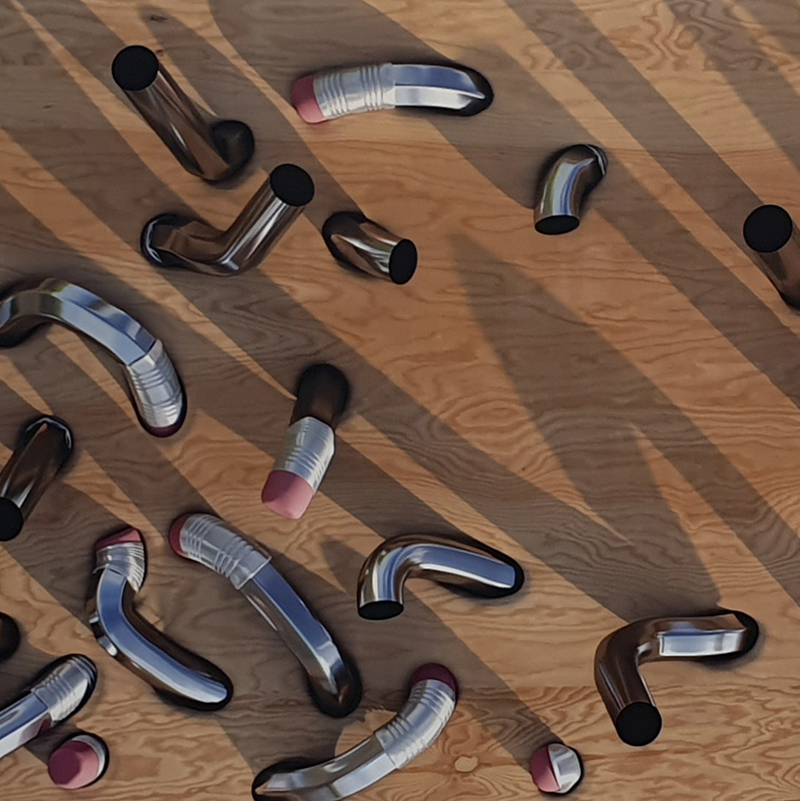
An interesting entanglement of hand and digital process. Raw paintings are photographed and imported to a 3D digital space of geometric shapes, tubes and directional lighting. The effects are then exported and printed onto the original painting.

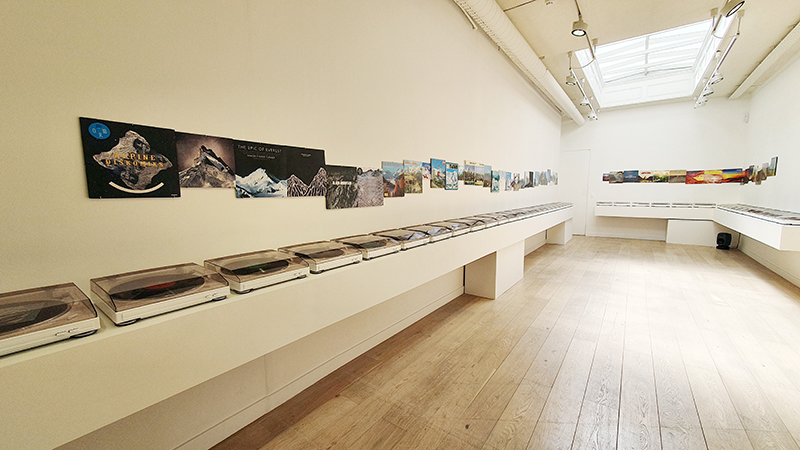
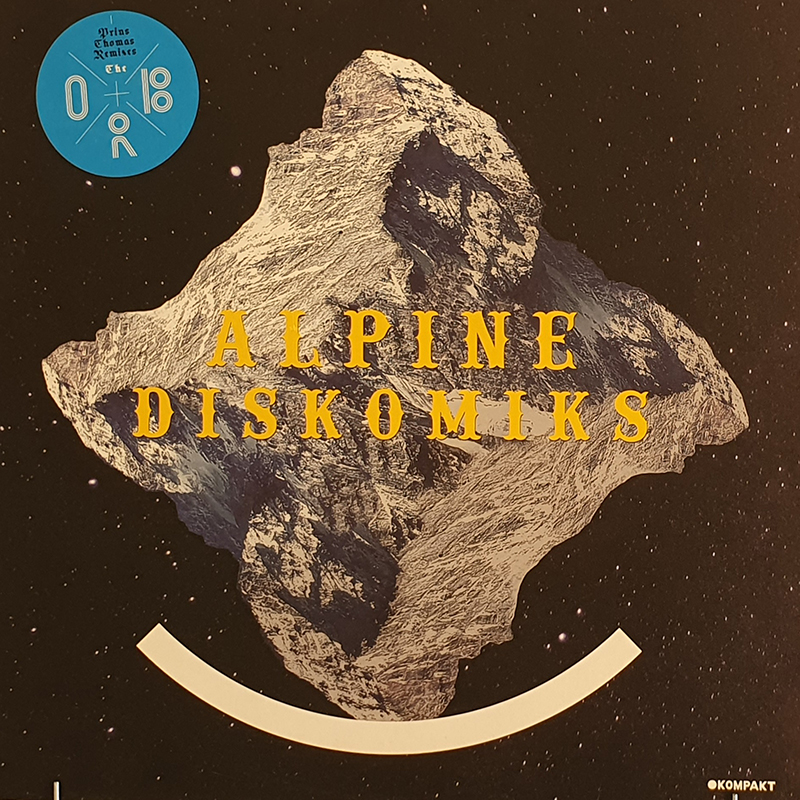
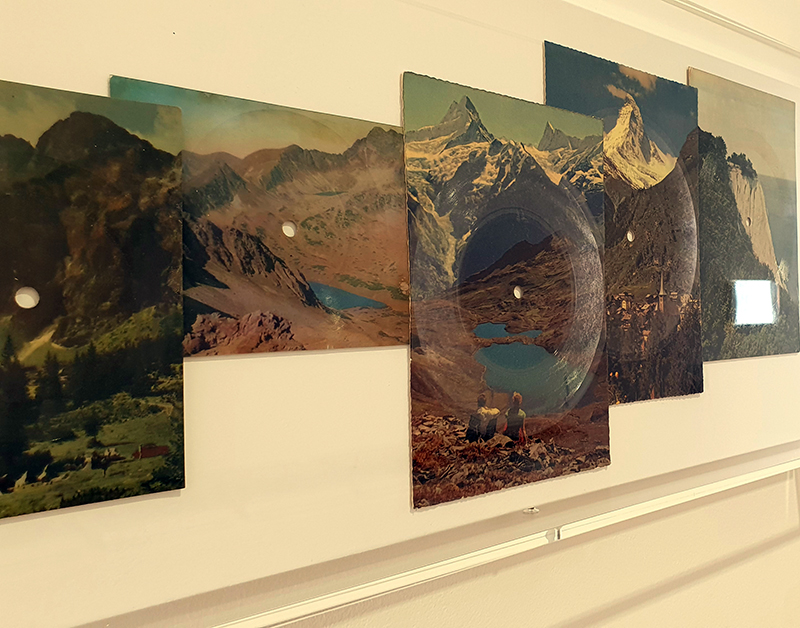
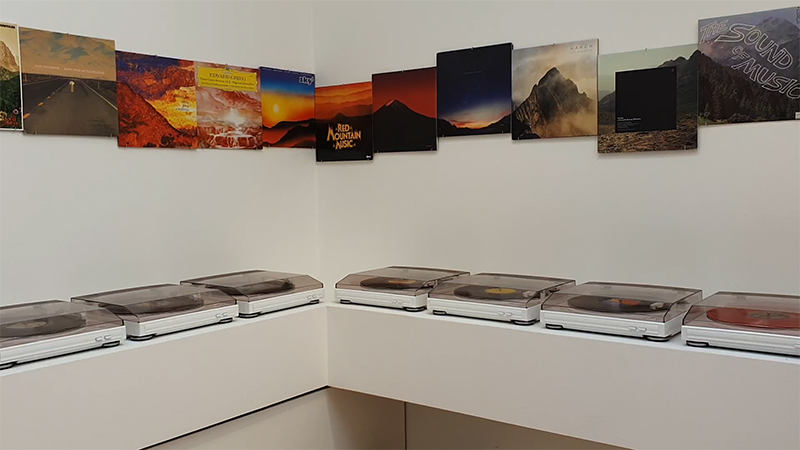
Melanie Manchot Alpine Diskomiks at Parafin.

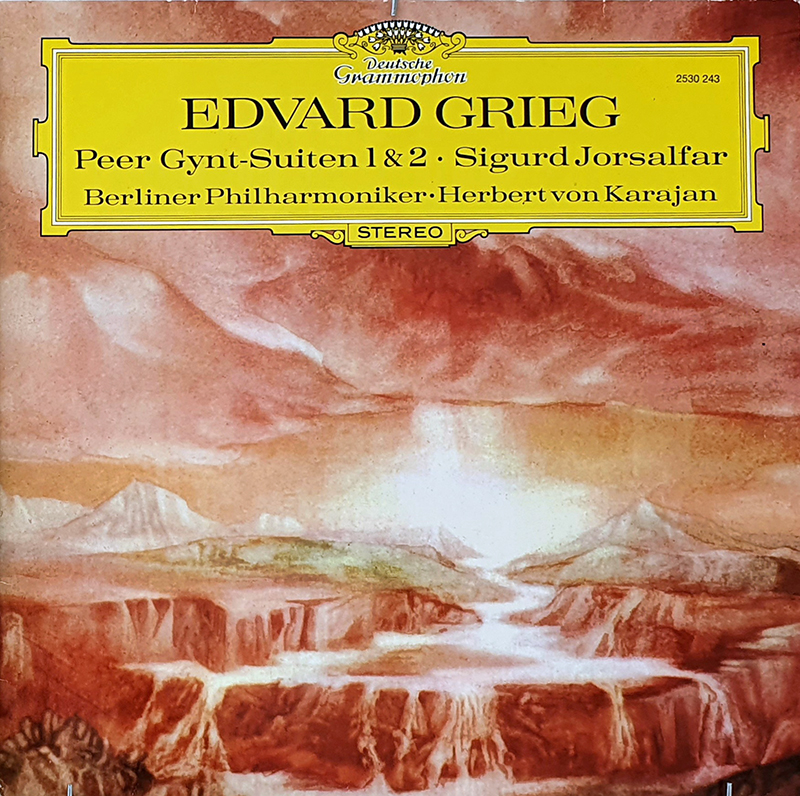
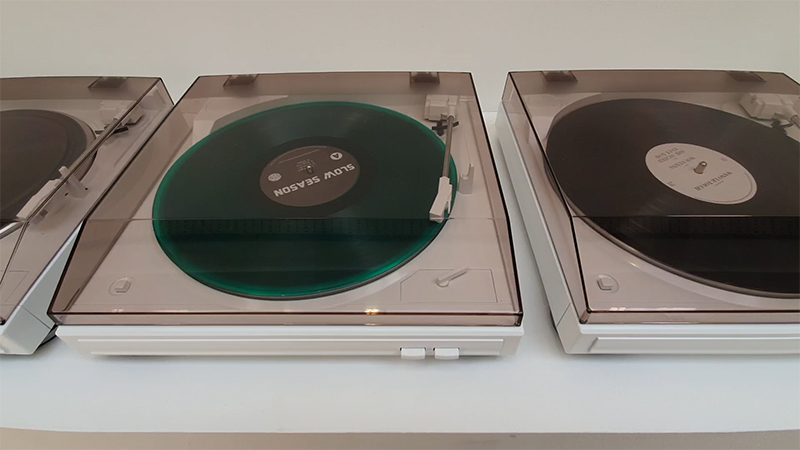
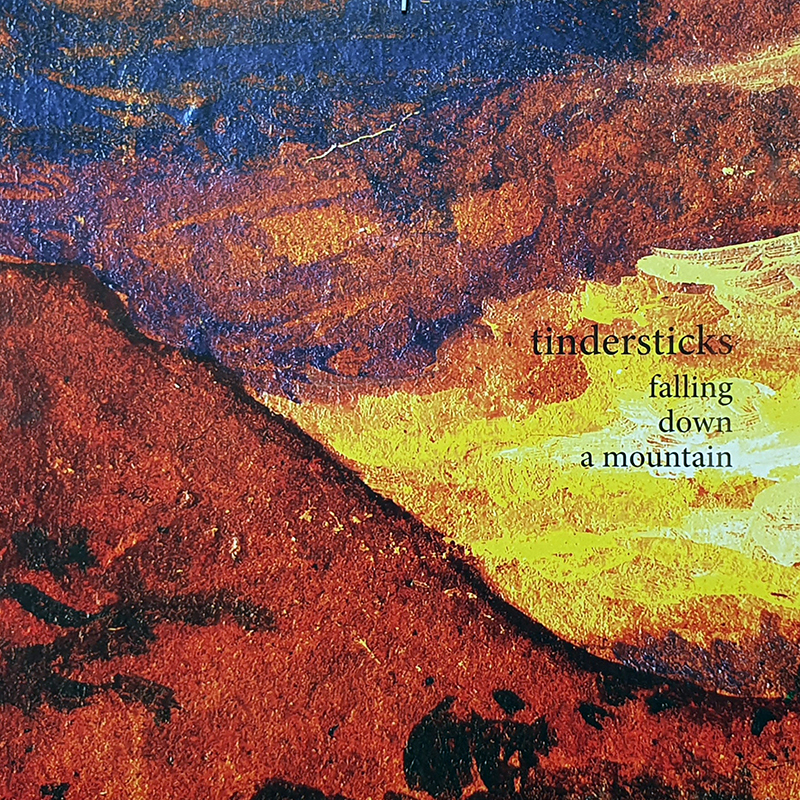
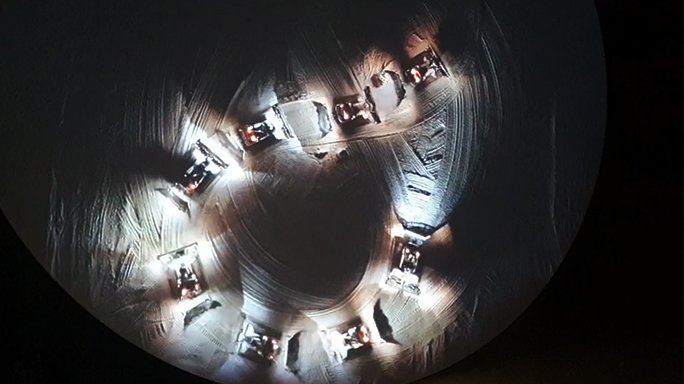
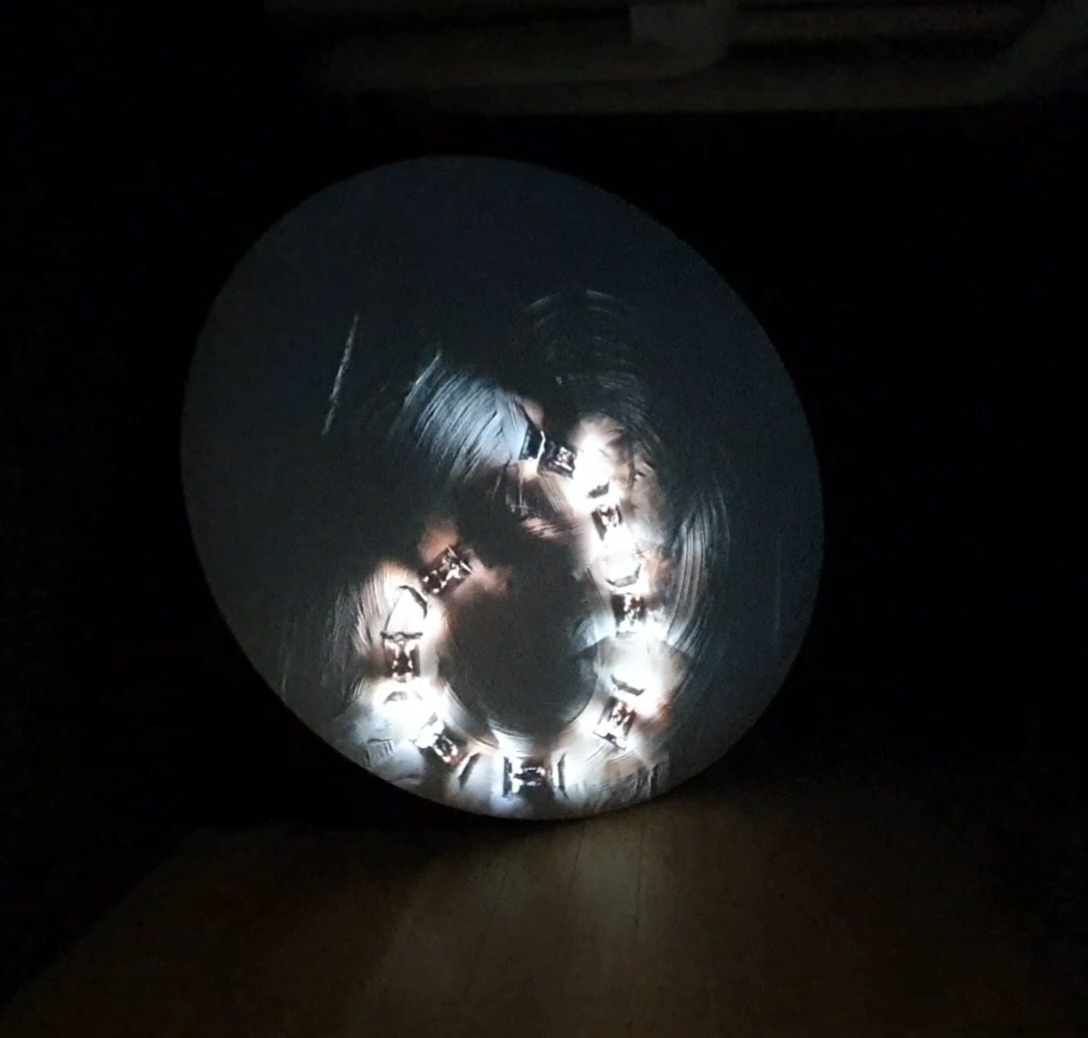
Questioning the mediation of the mountain experience. A mountain skyline created from album covers and soundscape from the combined mix of recorded content. Imagine a steady build of music to accompany the climb to a dramatic mountain peak and the overwhelming crescendo as you reach that majestic summit of the sublime. Downstairs choreographed snowploughs score grooves in looping folkdance sequence.

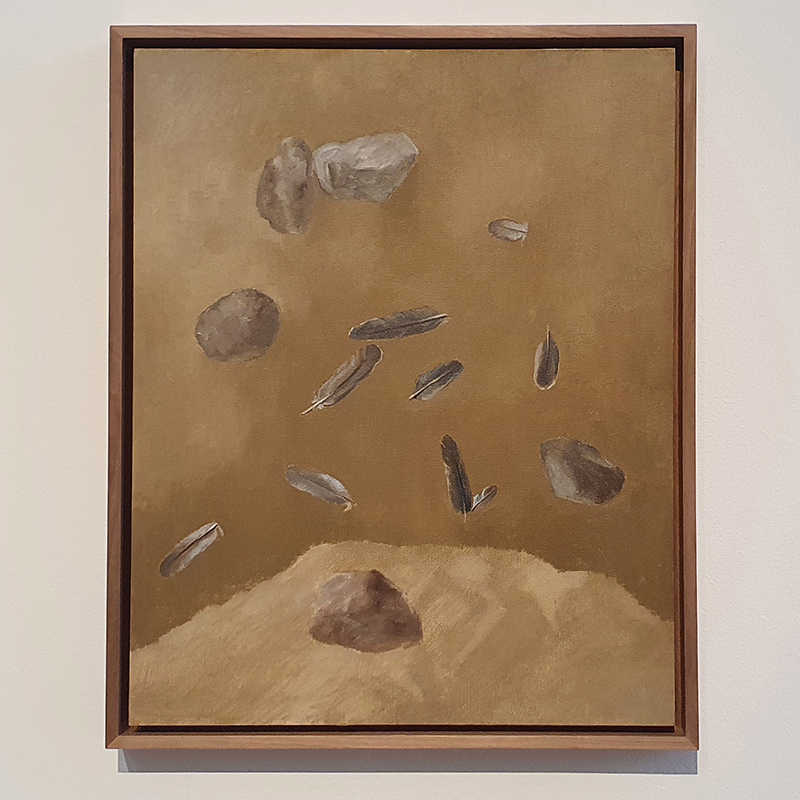
This painting by Luchita Hurtado at Hauser and Wirth made me think of the practical demonstration by Brian Cox showing that in a vacuum a feather and a rock (bowling ball) would fall at the same speed.

 “The reason the bowling ball and the feather fall together is because they’re not falling. They are standing still. There is no force acting on them at all.”

“(Einstein) reasoned that if you couldn’t see the background, there would be no way of knowing that the ball and the feathers were accelerating toward the Earth.”

Larry Bell at Hauser and Wirth

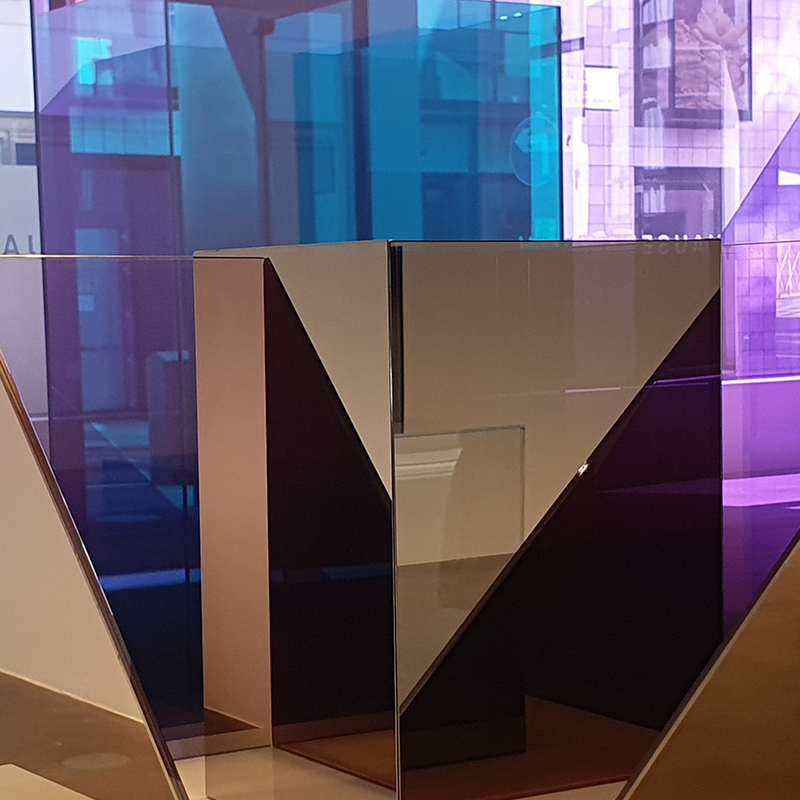
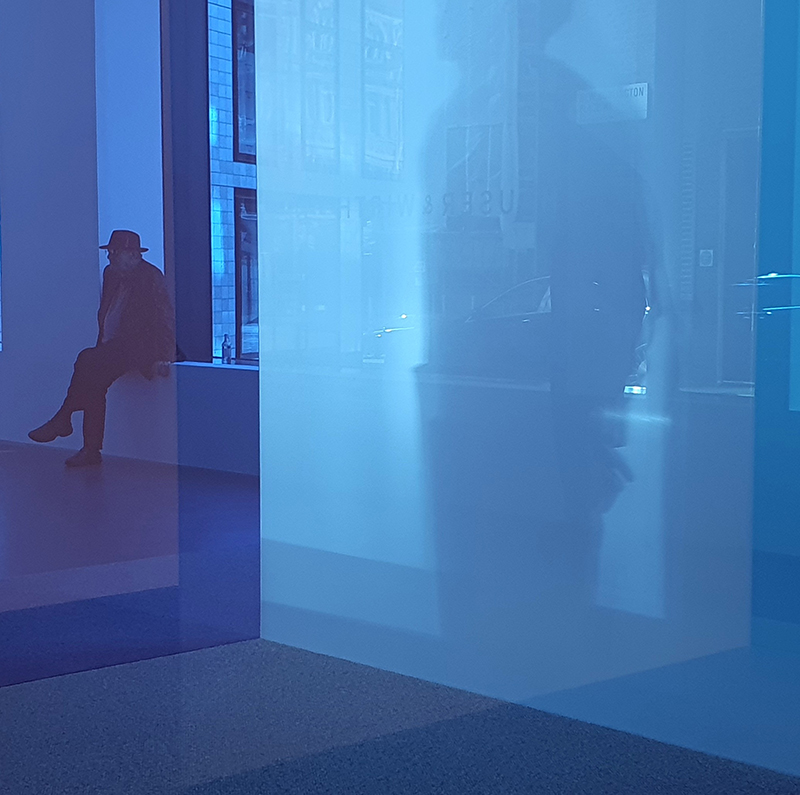
‘Although we tend to think of glass as a window, it is a solid liquid that has at once three distinctive qualities: it reflects light, it absorbs light, and it transmits light all at the same time.’ Larry Bell

Everything is Made of Light at Bermondsey Project Space. The artists refer to Jacques Rancière, in his essay, Are Some Things Unrepresentable?, who scrutinizes the challenges faced by images in depicting the world around us.

Mark Kasumovic tackles the problem of trying to represent the invisible through a juxtaposition of images of spaces of discovery and text listing scientific non sequiturs. Mary O’Neill presents us with a world of fragments from which personal narratives must be assembled. Isabella Streffen’s work explores perception and the spaces between digital and emotional communication. Matthew Pell stretches time through capturing light in otherwise transient momentary events.

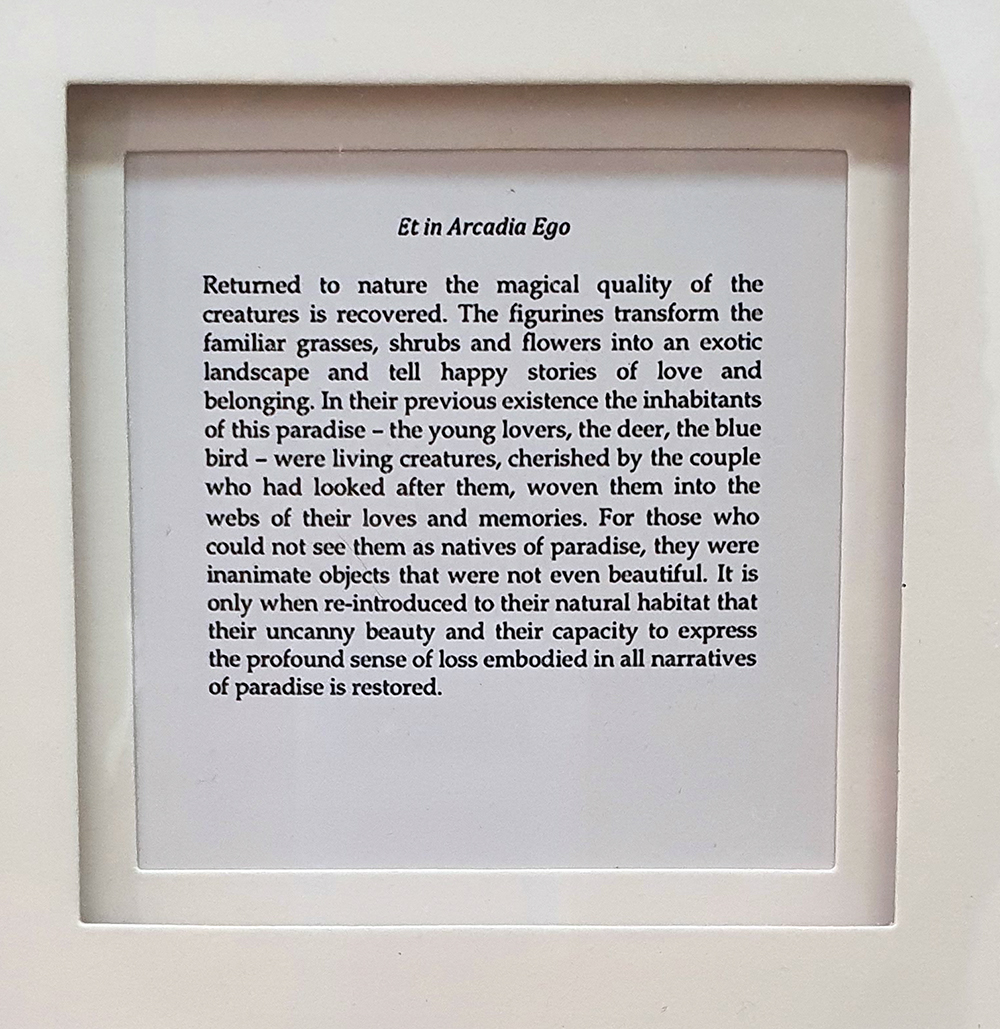
I felt very in tune with intent of the work here. Particularly Mark Kasumovic’s texts that felt like a snapshot of a research artist’s notebook. All those tantalising lines of enquiry. I liked the premise from Mary O’Neill of the introduction of creatures from the mundanity of an overlooked life, that when situated in a new context, conceive paradise.

Marcus Cope Silver Linings at Peer

Fabulous potent paintings of those vivid memories that are seared into the synapses from times of heightened emotions.

Beautiful and terrible.

Alice Bucknell Swamp City at Hoxton 253 Project Space

Like a dollop of dream topping on a large turd the work offers up a speculative future of luxury ecotourism as investment opportunity in the face of a climate crisis that feels almost inevitable.

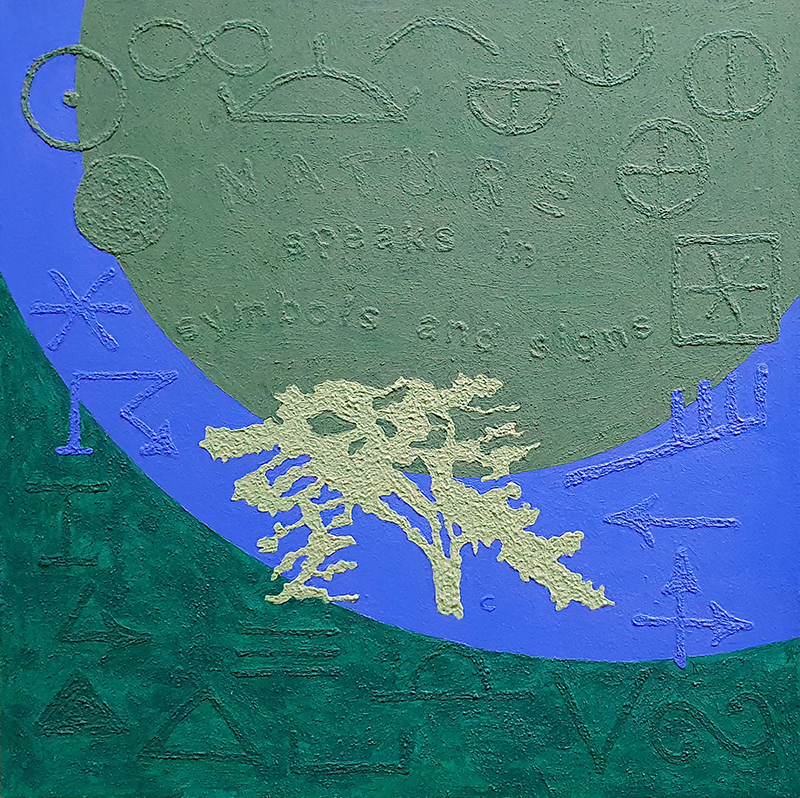
Charlotte Johannesson Circuit at Hollybush Gardens.

“Nature speaks in symbols and signs.”

Evolution from weave to code and back again. Beautiful works full of metaphor and shared history.

Reading – Braiding Sweetgrass Robin Wall Kimmerer; reciprocity – don’t take more than you need and always give something back.

Mercurius Patrick Harpur; no easy route to the conjunction of soul, spirit and matter.

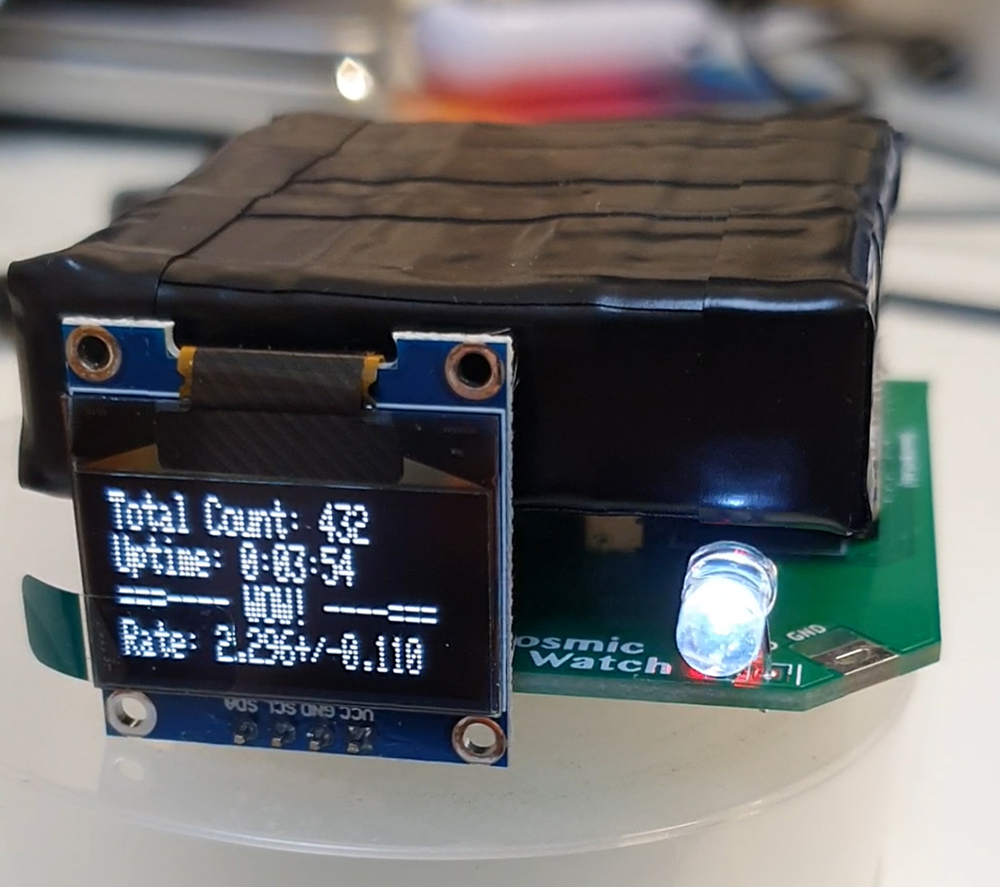
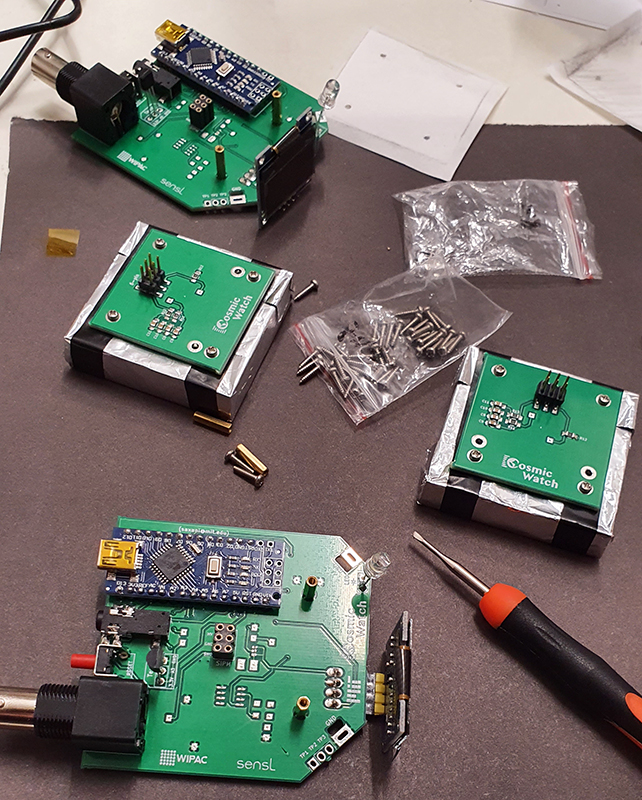
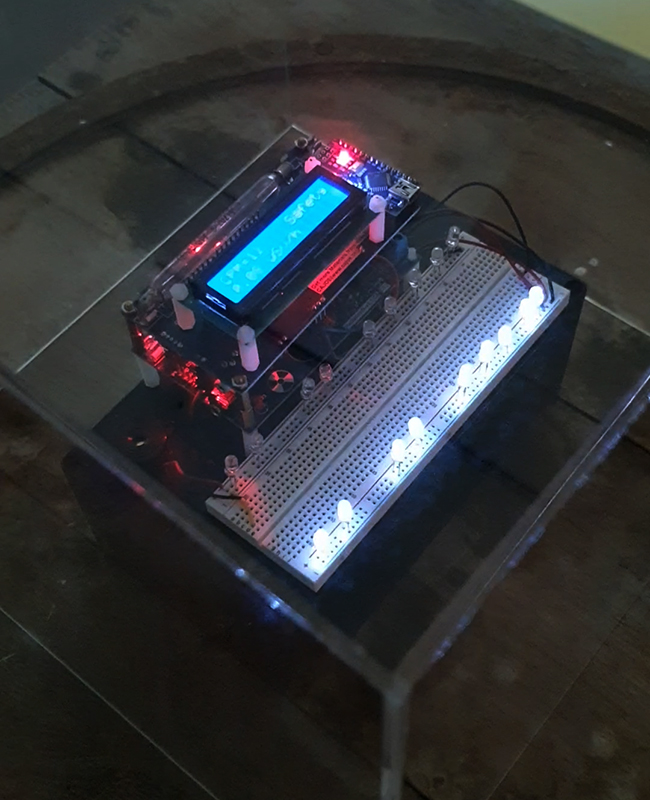
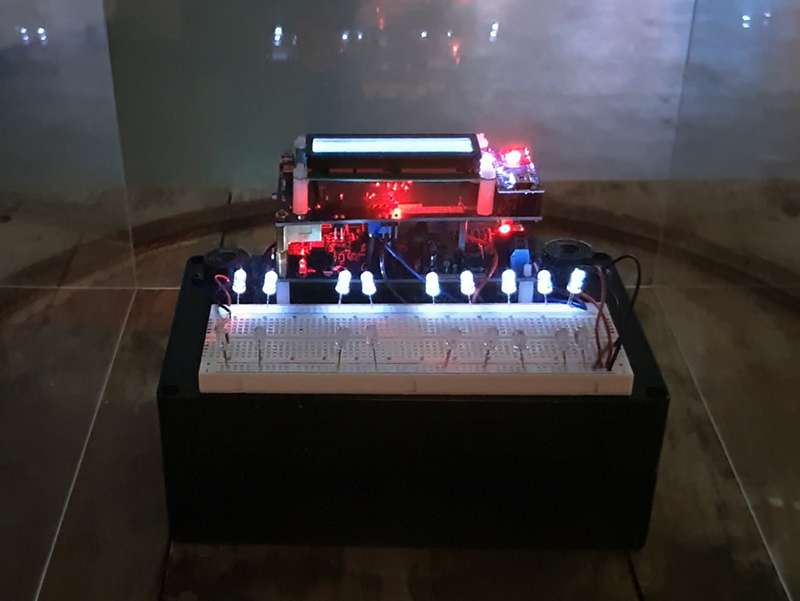
The big excitement this month was to get the cosmic ray detector assembled and working. It may not look very exciting to see an LED flash but knowing it was caused by a tiny traveller from outer space I do find quite something to acknowledge.

The detector uses a small slab of plastic scintillator as a detection medium and a silicon photomultiplier (SiPM) for light collection from charged particles as they pass through the scintillator. Flashing the plastic block with light from a UV torch causes a big scintillation burst.

The signal from the photomultiplier is sent to an Arduino microprocessor which measures the amplitude of the signal. The small OLED screen updates every second and an LED flashes every time an event is registered.

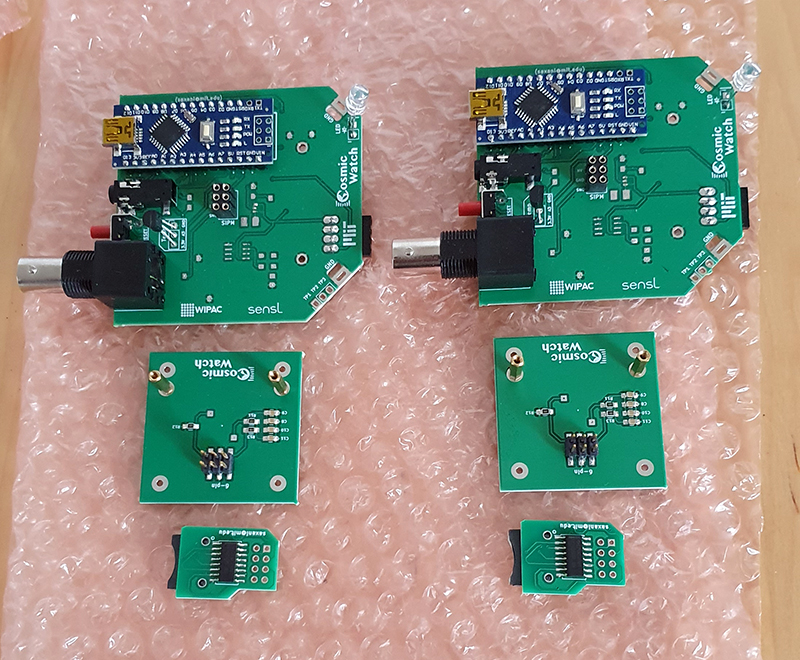
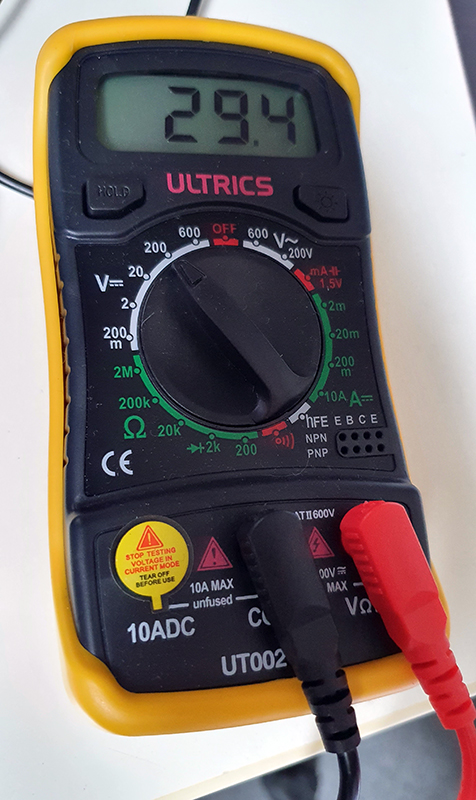
I have the skills and patience of ABL Circuits to thank for soldering the tiny SMT components to the PCB boards and then working out which part had the fault and replacing it so that the correct voltage was supplied to the SiPM PCB. It needed to read approximately +29.5 V as anything over 30 might damage the SiPM so it was a big relief when this was achieved.

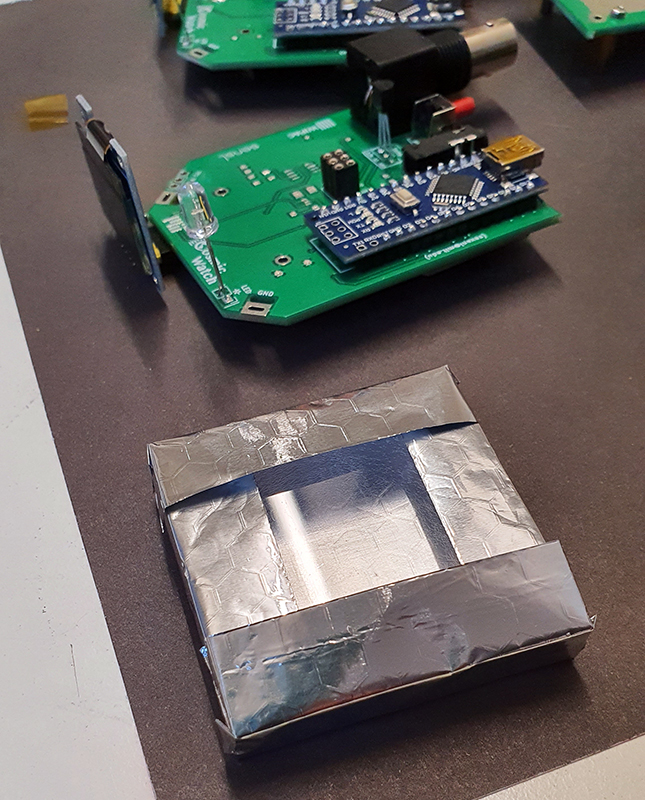
Once I had the printed circuit boards assembled I could wrap the scintillator plastic in foil, apply optical gel and attach it to the SiPM and then wrap this in electrical tape to make it light tight. I had a little bit of soldering left to do myself and then it could be slotted together.

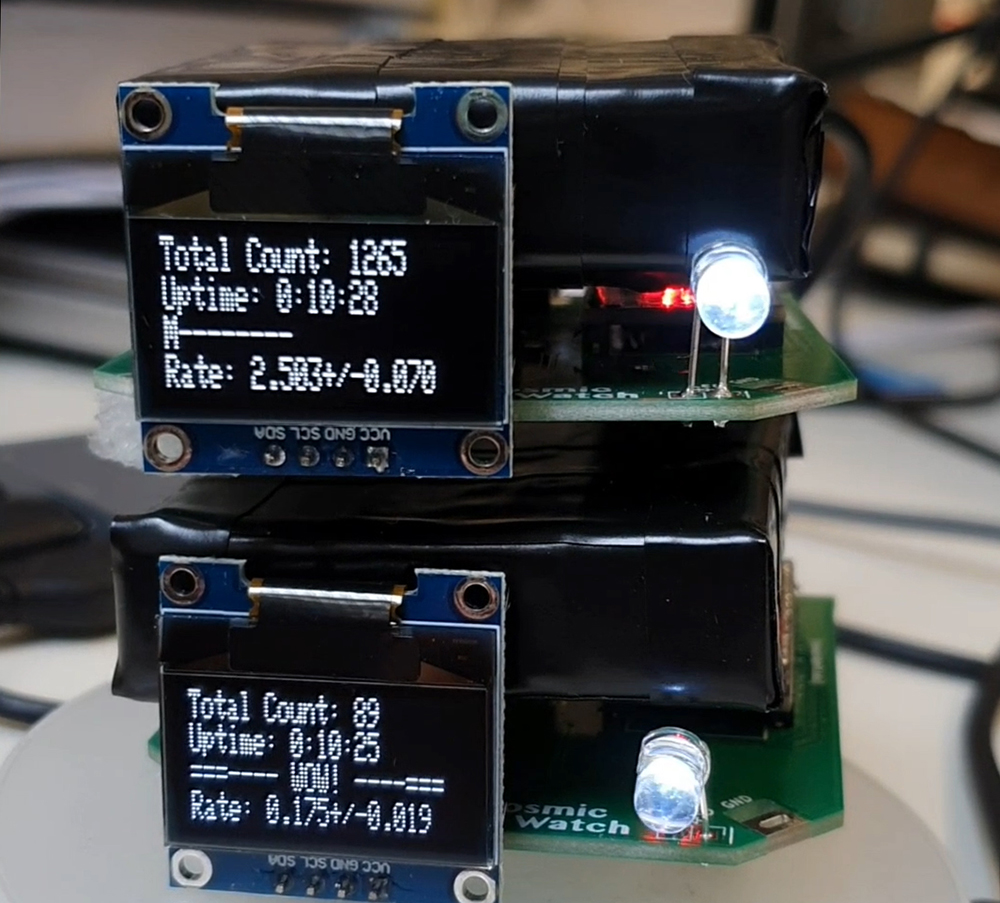
When I had both detectors working independently I could set them up in coincidence mode to differentiate cosmic rays from background radiation particles.

The top detector is reading all local background radiation and the bottom one is just recording cosmic rays. The lights flash in unison when a particle travels through the top and bottom detector at the same time. The top detector labelled ‘M’ I will call mother and the bottom ‘S’ I will call son, (not the historical terminology suggested).

The horizontal lines record the energy of that particle – look out for the WOW particles!

So happy to have got this far with the project, now for the difficult bit translating that signal into an action triggering an interactive artwork.

Not only can cosmic rays be observed using a cloud chamber but they also trigger the formation of everyday clouds.

The Solar Wind is made up mainly of hydrogen and helium ions (ions are the nucleus of atoms separated from their accompanying electrons) known as solar protons. Travelling at up to 5 million miles per hour, the solar wind carries a million tons of matter from the sun into space every second. When massive amounts of energy stored in the magnetic fields of the sun are suddenly released in a solar flare explosion the particles are accelerated to even greater speeds.

Coronal mass ejections fire off great clouds of hot gas and the explosions are so powerful that they also rip away knots of magnetism from the surface of the sun which are sent sweeping past Earth deflecting the path of cosmic rays that would otherwise strike our planet. This effect is called the Forbush Decrease where increased solar activity results in a reduction of cosmic rays coming from outside our solar system.

Cosmic rays are super-charged subatomic particles produced by exploding stars, black holes and other phenomena many times more violent than any solar flare explosion but one coronal mass ejection can reduce cosmic rays for a few weeks and continued solar activity can keep cosmic ray counts low for sustained periods of time.

The Sun’s magnetic field goes through a cycle where north and south poles switch places about every 11 years. It then takes another 11 years for the poles to flip back again. Sunspot activity caused by the magnetic field are affected by the solar cycle but it is hard to predict how active a cycle might be. Usually at the beginning of the cycle there are fewer sunspots causing eruptions which then increase over time reaching solar maximum in the middle of the solar cycle before gradually retuning to solar minimum before the cycle begins again. The first solar cycle to be recorded was in 1751 and we are currently in cycle 25 with peak activity expected in 2025.

Research at the Technical University of Denmark has shown that the number of comic rays reaching the Earth has a significant impact on the warming of the oceans. When solar explosions deflect the number of cosmic rays hitting our planet there is a shortage of small aerosols – the chemical specks in the air that grow until water vapour can condense on them to become the water droplets of low-level clouds. The aerosol robotic network AERONETT also noticed a slight change in the colour of sunlight during times of low cosmic ray activity and found that violet light from the Sun looked brighter than usual. They put this down to the shortage of small aerosols usually provided by the cosmic rays which scatter violet light as it passes through the air. Without the growing aerosols, low-altitude clouds begin disappearing about a week after a Forbush Decrease minimum of cosmic rays. The water remains in the atmosphere in vapour form, but unlike cloud droplets it does not get in the way of sunlight warming the ocean. During solar maximum events the decline in cosmic radiation and the loss of low cloud cover persists for long enough to warm the planet.

“The effect of the solar explosions on the Earth’s cloudiness is huge. A loss of clouds of 4 or 5 per cent may not sound very much, but it briefly increases the sunlight reaching the oceans by about 2 watt per square metre, and that’s equivalent to all the global warming during the 20th Century.” Henrik Svensmark DTU

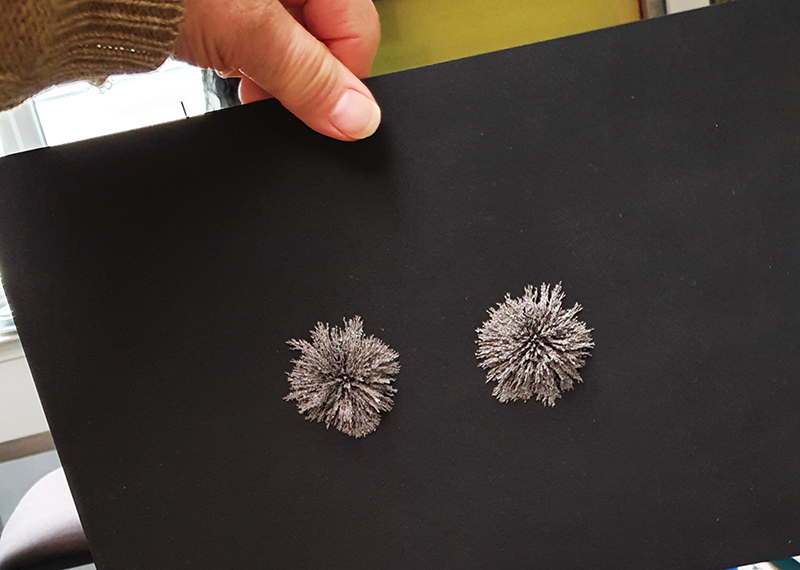
I have been testing new configurations of magnets for a large etching/drawing work looking at magnetoreception.

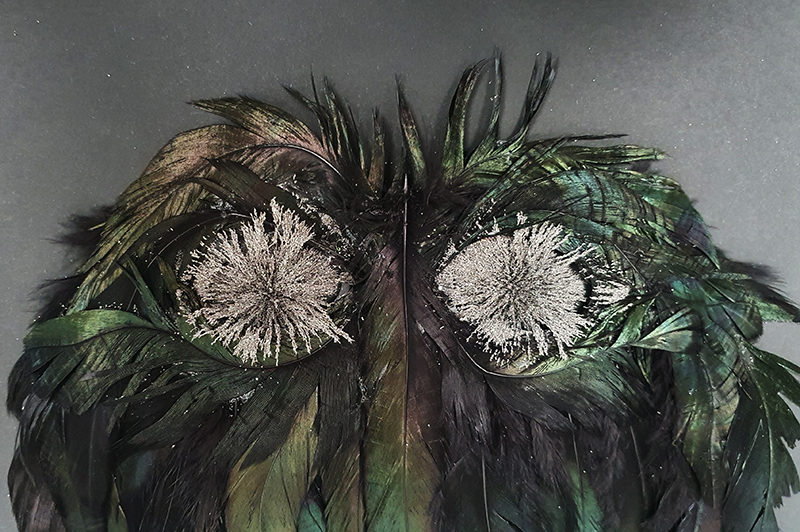
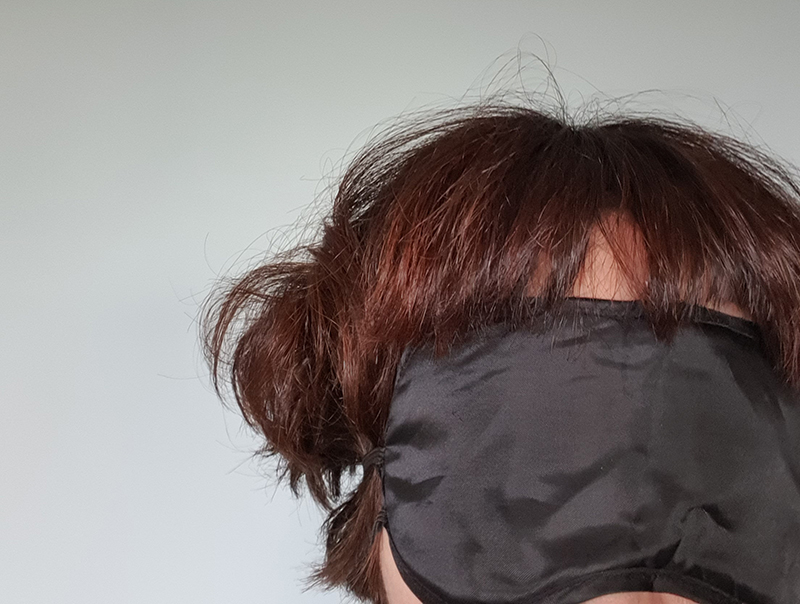
Also testing ideas for a magnetoreception performance mask. It became clear I will have to be careful with the iron filings around the eyes.

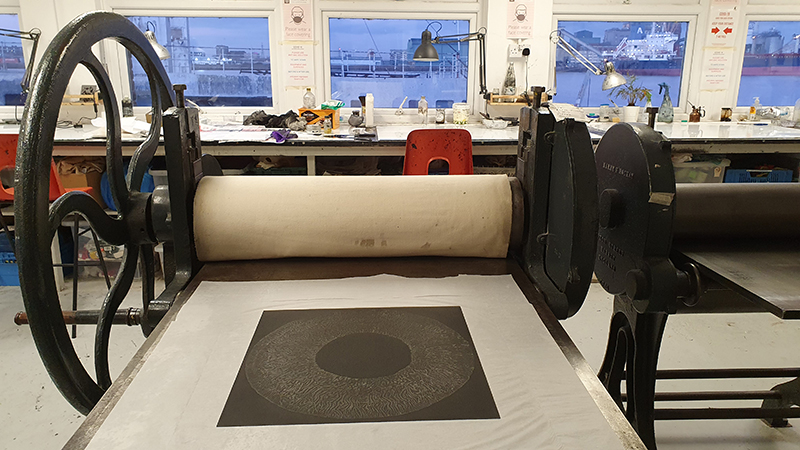
I was excited by the results of testing chine collé under black etching ink. It’s very subtle but I didn’t think it would show at all so was surprised and plan to try this with other ideas.

Great to see the launch of Yinka Shonibare’s new project Guest Artist Space in Lagos – this will be an international space for knowledge exchange between established and emerging artists, it will have urban and rural elements and involve local people as well as visiting artists for a true cultural exchange.

A video which I was invited to contribute to along with many artists Guest Projects has supported in the past is currently being shown as part of The Whitechapel Gallery exhibition programme A Century of the Artist’s Studio – Link to video here.

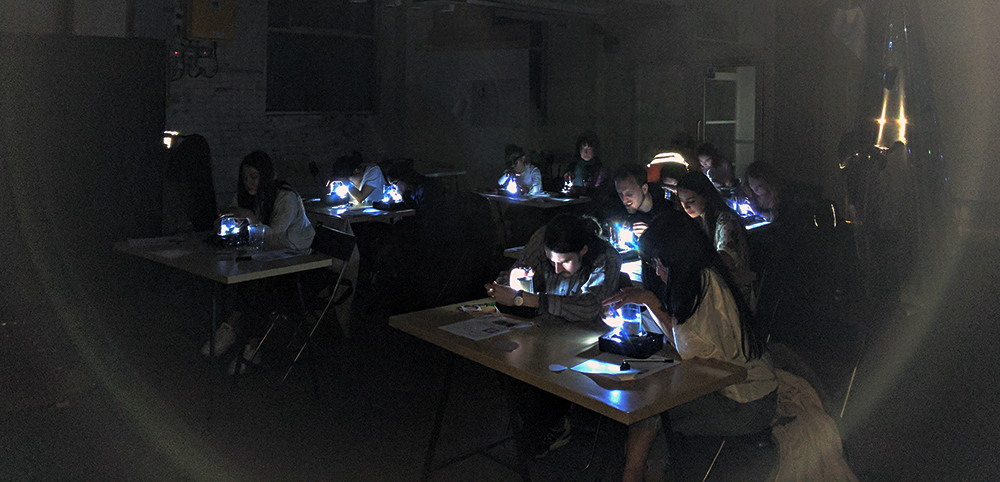
I am so grateful to Yinka Shonibare for his generosity and genuine interest in emerging and early career artists and awarding Laboratory of Dark Matters a month long residency that enabled us to achieve so much in 2017 including developing and running my first Cloud Chamber Workshops.

Exhibition Visits –

Gala Porras-Kim at Gasworks Out of an instance of expiration comes a perennial showing.

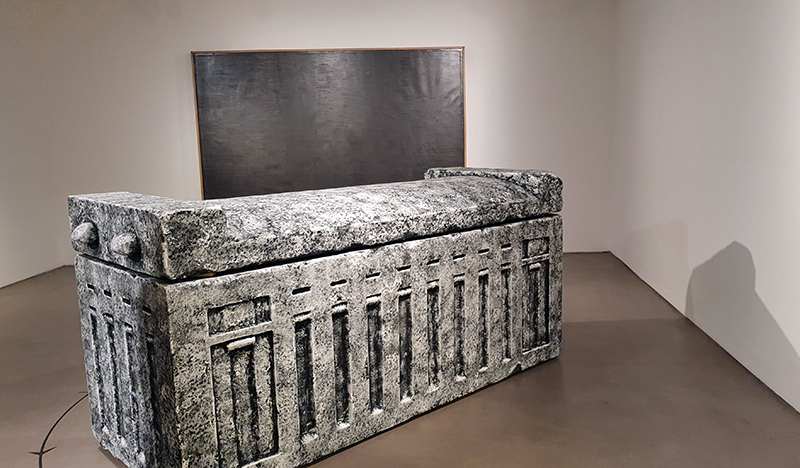
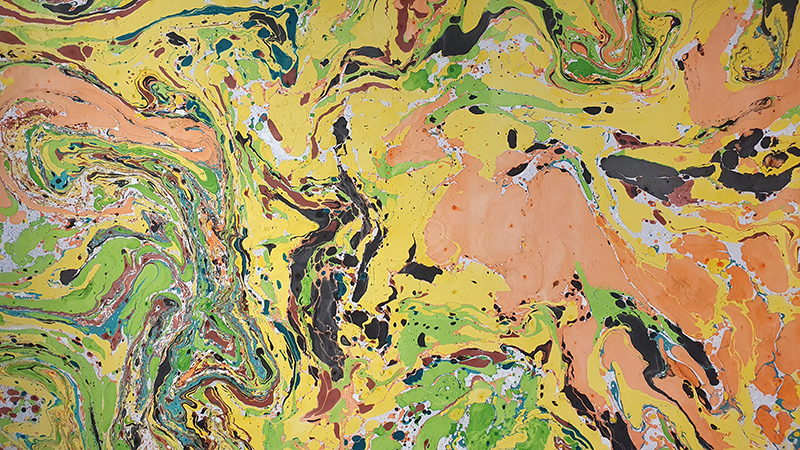
This wonderful exhibition is playful yet thoughtful, giving voice to the spirits of displaced, forgotten or overlooked fragments of history that have been institutionalised. The artworks suggest ways improve the material and spiritual conditions of artefacts stored in archaeological collections around the world such as re-aligning the sarcophagus or offering an awakening deity a more familiar prospect than the modern museum room in which it finds itself. Porras-Kim gives equal value to the dust gathering from artefacts stored in the back rooms of institutions and invites the spirits to communicate in the swirling patterns of marbling inks.

San Mei Gallery showing Laila Majid and Louis Blue Newby – not yet

Walls smeared with slime green are hung with prints on aluminium that shimmer in the low light setting with video morphing of a bubbling concoction of swamp things.

Noémie Goudal –  Post Atlantica at Edel Assanti

Luscious imagery dissecting the impact of deep time on landscape and climate.  

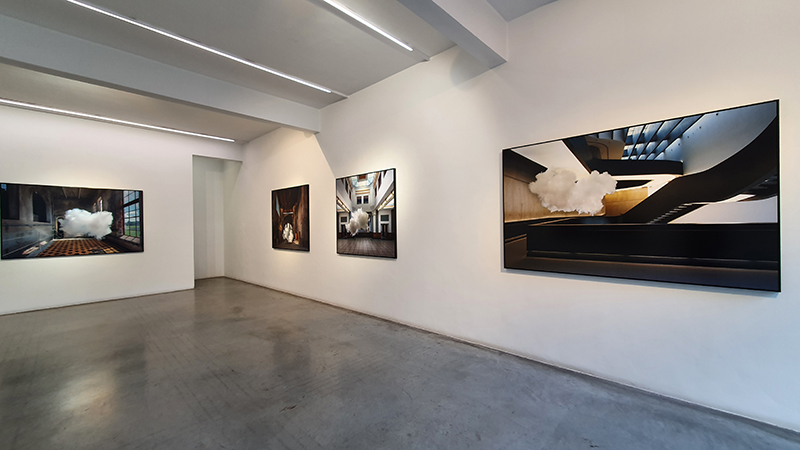
Berndnaut Smilde – Momentum at Ronchini Gallery

I was hoping to see a cloud produced in the gallery but had to settle for the documentation of previous clouds created in various locations presented in the Nimbus photography series. Apparently the artist very rarely makes this work as performance.

Shuster + Moseley – do not be afraid of the brilliant lights at Gallery Rosenfeld

Light bling of refraction and reflection when photons travel through a glass medium splitting and bouncing in reminder of its own physical presence

Also at Gallery Rosenfeld, Bongsu Park – in dreams we gather

Dreamscapes undulating through the darkness, echoing active brainwaves producing light within our sleeping skulls.

Rivane Neuenschwander Commonplace 1999 in Tate Tanks

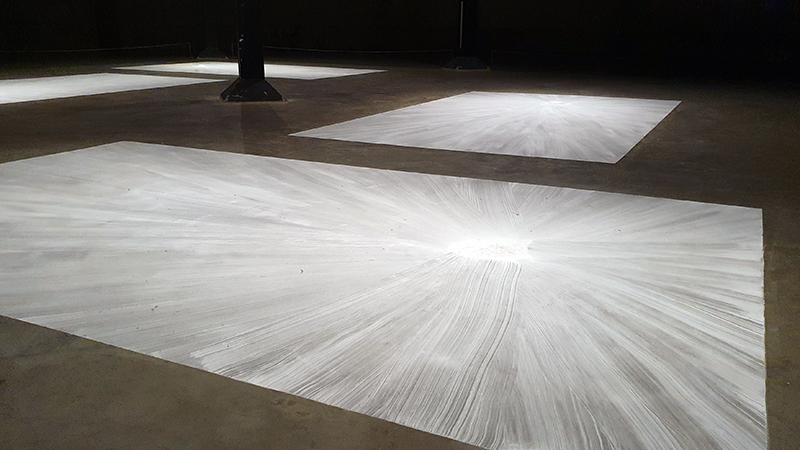
Talcum powder is brushed into rectangular shapes on the floor, being remade every time it is exhibited. Simple gestures turn the stuff of everyday life into something unfamiliar and poetic.

James Freeman Gallery – Juliette Losq and Stuart Sandford in Elysian Fields

Interesting pairing of decay and perceived perfection.

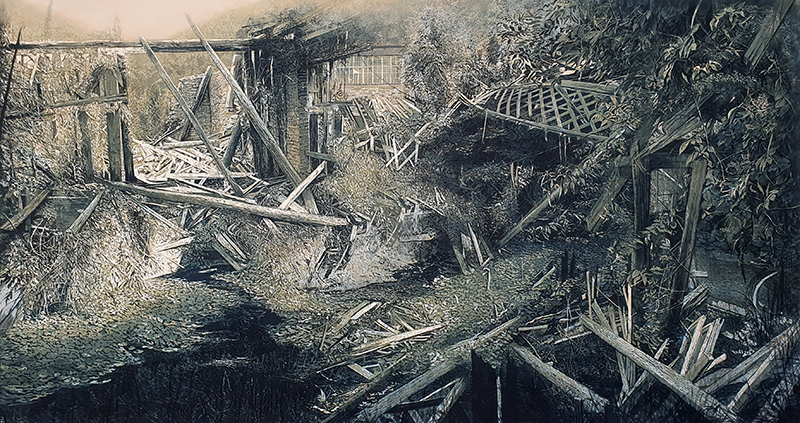
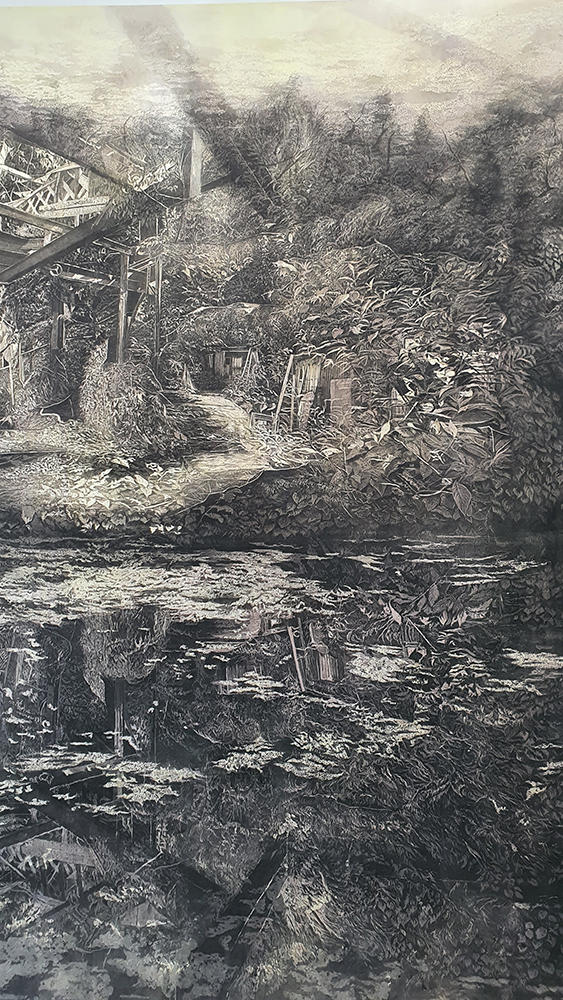
Paintings rather than the layered installations I admire from Juliette Losq here. Delicate pale light seeping through these landscapes caught in the haze of a slow and gentle decomposition.

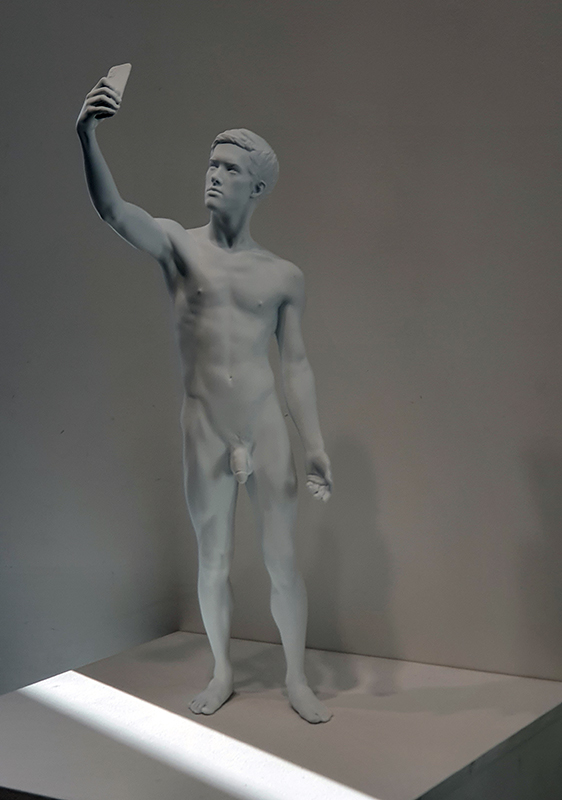
A close encounter with a full size Narcissus is only available through scanning a QR code to be experienced via the screen. Only his small pornworld counterparts were present, cast from the idealism of the digital realm into bronze.

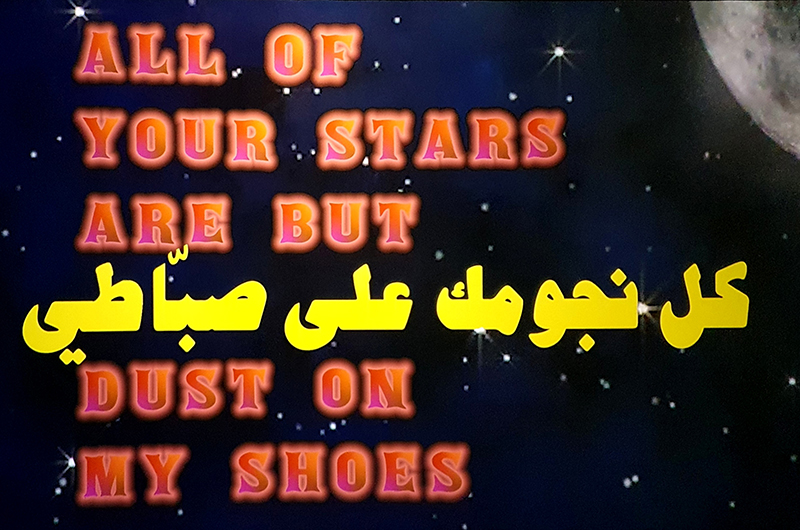
Haig Aivazian All of your stars are but dust on my shoes at The Showroom

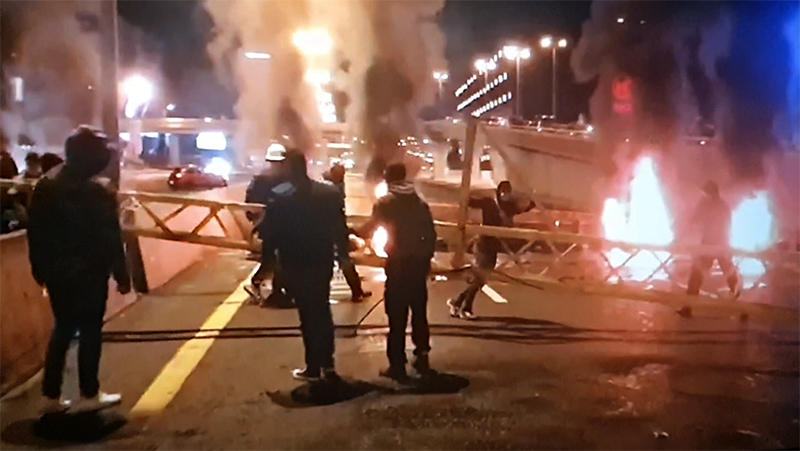
Two very moving films looking at light and fire, primordial gifts and how they are used for power and control.

Geo-poetic is a great description of how these films traverse history and borders exposing who decides what is seen and what is not and who holds the flaming torch over the touch paper.

Portals at Lisson Gallery curated by Ossian Ward

Images include Susan Hiller, Ryan Gander, Rodney Graham, Shirazeh Houshiary, John Latham, Mary Corse and Sean Scully.

A mixed offering of thresholds to alternative spaces, visible, conceptual, mythical or speculative.

Richenda Court Glass Town at The Muse at 269

Luminous work reflecting a fragile crystalline world

Good to see Lisa Pettibone’s suspended sculpture Instrument of Thought – A meditation on Matter and Light. The physics of the cosmos held in delicate balance as mirrored surfaces, crystals and rocks interplay hinting at ideas such as gravity, dark matter and the speed of light.

On Hannah Arendt: The Conquest of Space at Richard Saltoun with works by Sylvia Plimack Mangold, Elaine Reichek and Carey Young considering the question Has man’s conquest of space increased or diminished his stature?

The question is central to Arendt’s essay written in 1963 which rings alarm bells on the direction science and technology may be leading the human experience. The possible future Arendt foresaw of a world remade by the curiosity of the human race but transformed into somewhere unrecognisable to the humanist where even the scientist loses some essence of human nature as the world is described in a mathematical language that cannot be experienced with human senses may be bearing down upon us.

Lots to think about from this encounter. I think writing when she did, when the first man in space was quite recent history and before the internet, her concerns about a loss of what it is to be human, driven by technology effecting every part of our lives until there is no part left that hasn’t or isn’t in some way remade by humans was very prescient. I wonder how she would feel today as we rush into space like never before and not so much for exploration as exploitation. Arendt described herself as “a kind of phenomenologist” which I understand as looking at things purely as they appear to us without trying to explain why or how and accept meaning that comes from direct sensory experience. Works of art can act as mediators between the consciousnesses of the author and the reader as a direct attempt to communicate the experience of being human and the world around. Phenomenologists are interested in the way we come to share similar understanding of the world a collective subconscious or implicit agreement about how the world looks, sometimes referred to as the life-world.

An introduction to the essay link here presented by Roger Berkowitz, director of the Hannah Arendt Center at Bard College. Science transforms what it means to be human although we are still bound to our earthly bodies and subject to fate and fortune. Science does not give a human experience of the world, it confounds common sense. If our growth in understanding can only be expressed in mathematical terms then we have lost rather than gained a way of describing our world experience. Human thinking comes from metaphors and our thoughts are earthly, if we are taken off planet then the Earth becomes an object not our home.

Secret of Lightness at Parafin

Aimée Parrott, Andrew Pierre Hart, Tim Head, Andrea Heller, Laurence Kavanagh

Beautiful selection of works curated by Louisa Hunt that reflect the premise of Calvino’s text to pull against what holds us down and make a creative leap opening onto a new perspective.

‘Whenever humanity seems condemned to heaviness, I think I should fly like Perseus into a different space. I don’t mean escaping into dreams or into the irrational. I mean that I have to change my approach, look at the world from a different perspective, with a different logic and with fresh methods of cognition and verification. The images of lightness that I seek should not fade away like dreams dissolved by the realities of the present and future…’

Italo Calvino, Six Memos for the Next Millennium: Lightness (1985)

Of the Surface of Things at Alison Jacques showing works by Maria Bartuszová, Sheila Hicks, Hannah Wilke, Erika Verzutti.

Spending so much time thinking about the intangible it was refreshing to be exposed to some raw materials.

The curator refers to the 1919 poem ‘Of the Surface of Things’ of Wallace Stevens and the untethering of the imagination when exposed to the particularities of reality in simplified raw form.

In my room, the world is beyond my understanding;
But when I walk I see that it consists of three or four
        hills and a cloud. 

The fascinating and perilous journeys made by migrating birds has been a natural wonder for centuries with the first records of this phenomena made more than 3,000 years ago. The innate knowledge of migratory birds is mentioned in Job and Jeremiah and the ancient Greek writers Homer, Hesiod and Aristotle noted their passage.

Sensing the Earth’s magnetic field allows birds and other animals to determine their approximate position on the Earth. Research looking at how birds navigate over vast distances has shown many species are able to sense the compass direction of the Earth’s magnetic field and process this information. Non-migratory birds also have this ability using magnetoreception to orientate themselves in a local sense to map habitat.

There are two basic mechanisms involving magnetism used by animals; one method uses the iron based mineral magnetite found in the body’s cells and the other involves a protein found in the eye which is sensitive to light of different colours and intensities.

In plants and some animals, the light sensitive cryptochrome molecules are also involved in the control of the body’s circadian rhythms by tracking the difference between night and day. They can be found in cell nuclei of mammals and in the retina of several bird species. Ilia Solov’yov from the University of Southern Denmark has found the particular structure of cryptochrome Cry4 is unique and when light hits Cry4 cryptochromes in the eye of a migrating bird, they undergo chemical reactions that are influenced by the direction of Earth’s magnetic field, providing a signal of the bird’s orientation.

This light sensitive magnetic compass used by birds is affected by the polarisation direction of light. This was discovered by Rachel Muheim in a study where zebra finches were set the task of finding food in a maze. The birds were only able to use their magnetic compass when the direction of the polarised light was parallel to the magnetic field, when the polarised light was perpendicular to the magnetic field the birds became completely disorientated.

Researchers have put forward a theory that polarised light at sunrise and sunset accentuates the magnetic field at times when birds are ready to migrate or roost but in the middle of the day when the polarised light is approximately perpendicular to the magnetic field and less visible to them they can rely on sight to hunt and spot predators.

Magnetite is the most magnetic of Earth’s naturally-occurring minerals and microscopic particles are found in the cells of animals. Unlike the cryptochrome protein found in the eye and used by birds to perceive the Earth’s magnetic field, a magnetite-based magnetic sense does not need light to function.

Mole rats navigate their tunnels using this method which works like an internal compass. Birds also use this mechanism based on magnetite as an additional method to determine their position.

Sensing Earth’s geomagnetism is a functional ability seen in many creatures from bacteria and birds to turtles and bats. It is an evolutionary advantage to be able to orientate and navigate. Joseph Kirschvink and researchers at Caltech have completed experiments testing the human capacity to sense the magnetic field. Volunteers inside a chamber shielded from electromagnetic interference were subjected to an altered magnetic field while their brainwaves were monitored. The team found clear evidence that the subjects’ alpha brain waves were effected suggesting a rudimentary magnetic “sense”. The scientists believe that cells containing crystals of magnetite could register changes in magnetic fields and report this information to the brain. It is already known that magnetotactic bacteria have structures containing nanoscale magnetite crystals called magnetosomes that act as biological compasses, allowing the bacteria to navigate.

This research suggests that human alpha brainwaves react to a changing magnetic field. Alpha waves are always present, but are more prominent when in a relaxed and idle state of mind. Noticing a dip in the amplitude of the alpha waves would indicate the neurons in the brain becoming engaged in a task. The experiment was conducted to mimic how the Earth’s magnetic field would be experienced by the brain. The laboratory field was similar in strength to the Earth’s and the researchers moved it slowly to simulate how the field would change when turning one’s head. 

More experiments with iron filings, etchings and magnets.

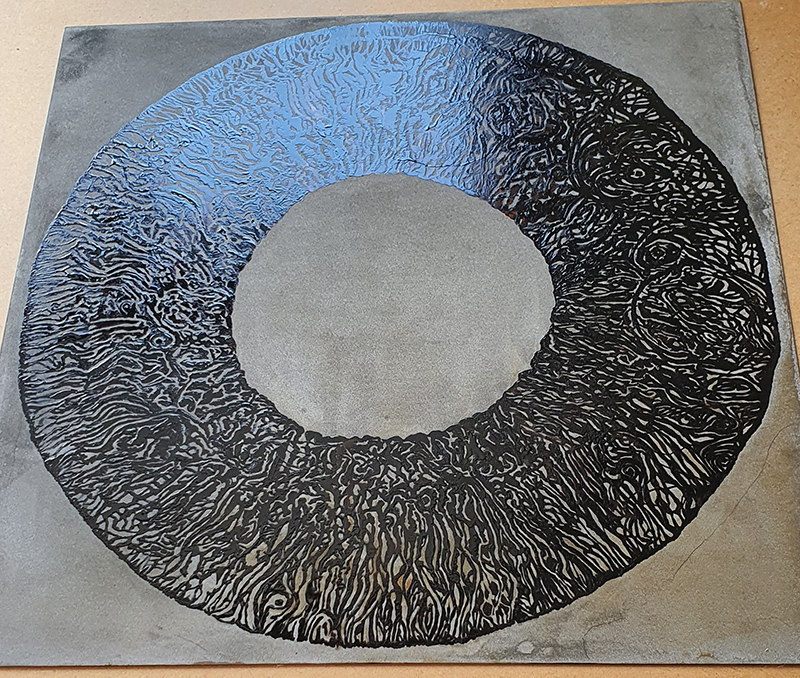
Large etching on steel plate and small polymer etching.

Also some green screen filming towards the video work I am creating on this subject.

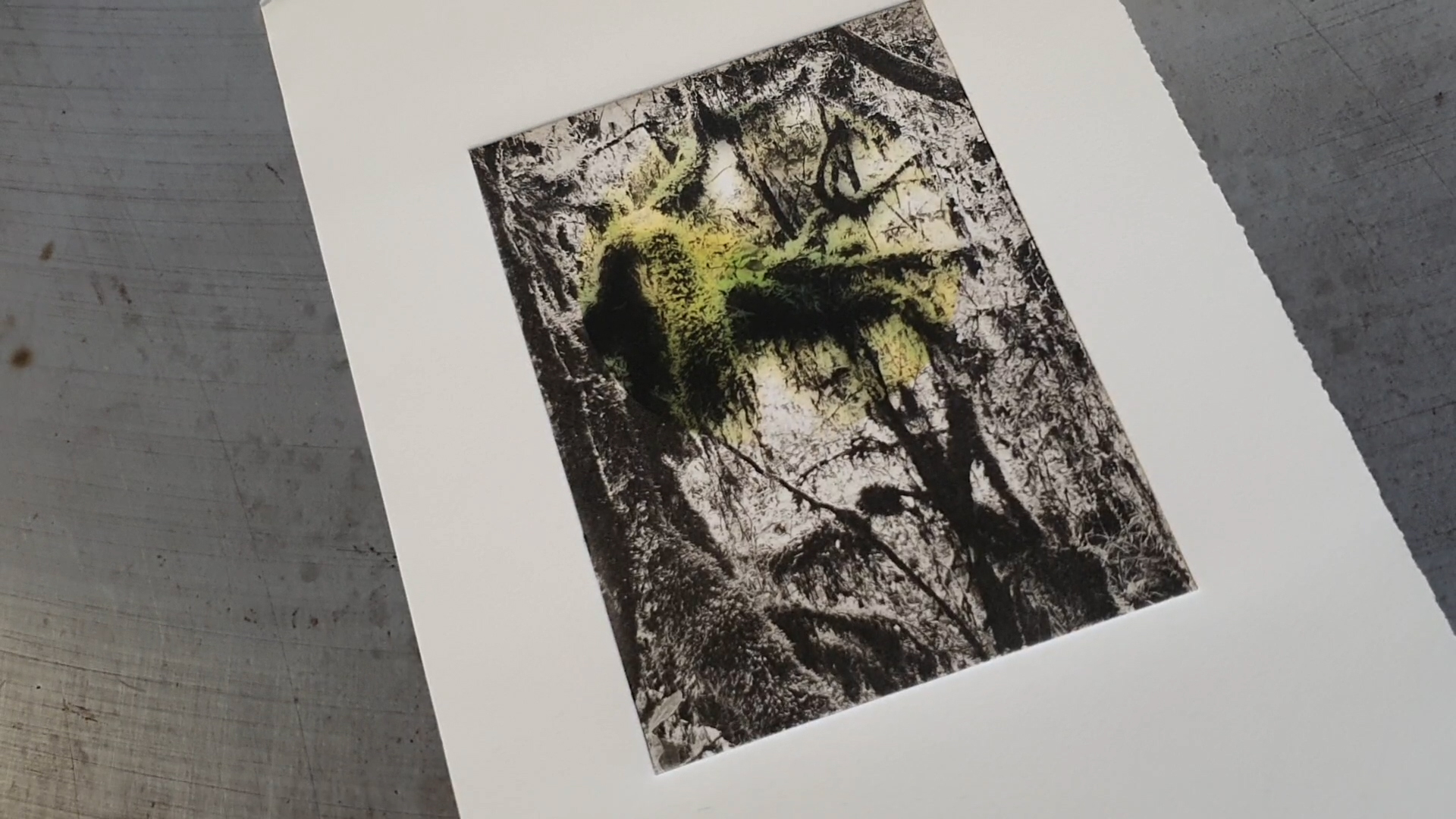
While back in the print studio I made some more prints of the mossy forest and added a little burst of colour.

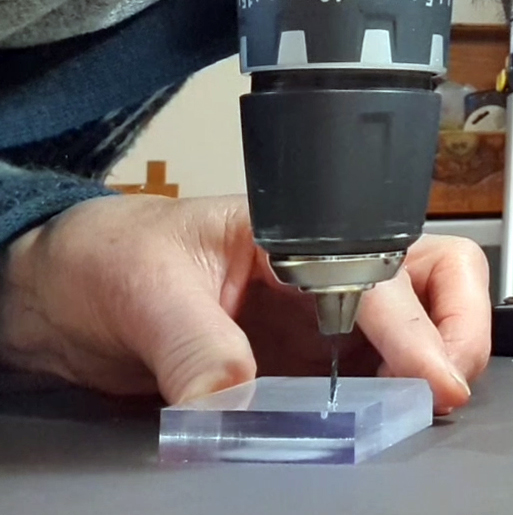
A little progress with building the cosmic ray detector. I have drilled the holes in the plastic scintillator which was quite stressful as the project notes say it is easy to break. I did a test first in acrylic to gauge the size of the drill bit needed. The scintillator turned out to be much softer though and so I am hoping the holes are not too big now. I sent the Printed Circuit Board off to get the components soldered. I really wanted to do the soldering myself but am glad I went for help as there have been some issues with getting the voltage correct for the connection to the SiPM PCB.

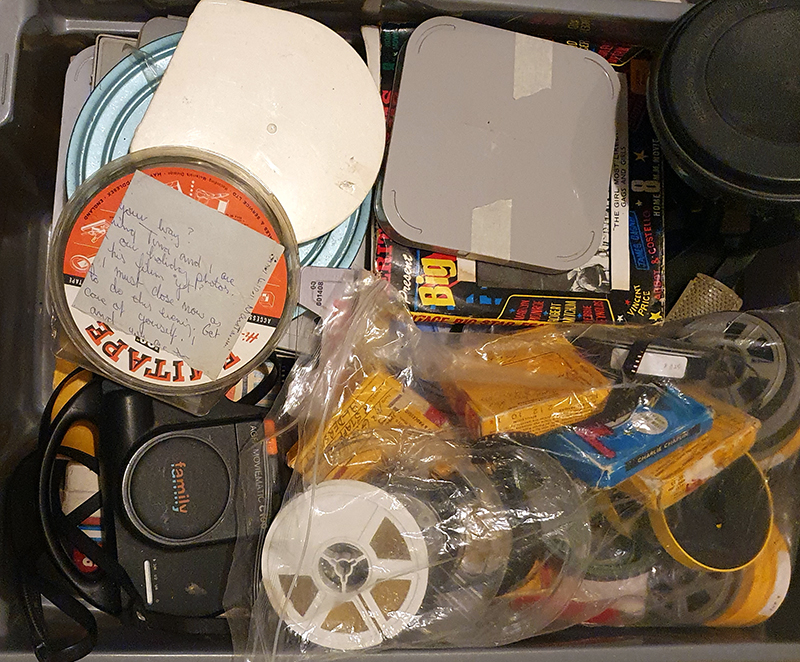
I was lucky to grab a bargain box of Super 8 filming kit though haven’t had time yet to explore this fully and see if I can work out how to operate everything.

Out of studio

A visit to APT Gallery to see Periastra curated by Paul Malone looking at methodologies of curiosity within the fields of art and astrophysics.

I really like the presentation by Nicola Rae of a collection of fireball videos collected by the meteor watch group UKMON

I was excited to meet John Berman who was showing a muon detector he had built. He has used a Geiger Müller (GM) tube, for his detector which can be bought as a kit . A GM tube will detect alpha particles, beta particles, gamma rays and Cosmic Muons. It can be adapted to run in coincidence mode – this is when two or more tubes are connected and only when all tubes register a particle passing through at the same time can it be certain it is a cosmic particle and not background radiation. There is some downtime in a GM tube after each ionisation is recorded so it is possible not all particles are registered. When a particle passes through the tube the LED’s will flash.

I am continuing to look at research showing it may be possible that humans retain some residual magnetoreceptor in our eyes that once allowed us to navigate using the Earth’s magnetic field. We know animals and birds have this ability and current studies suggest that some people do indeed perceive magnetic fields, albeit unconsciously.

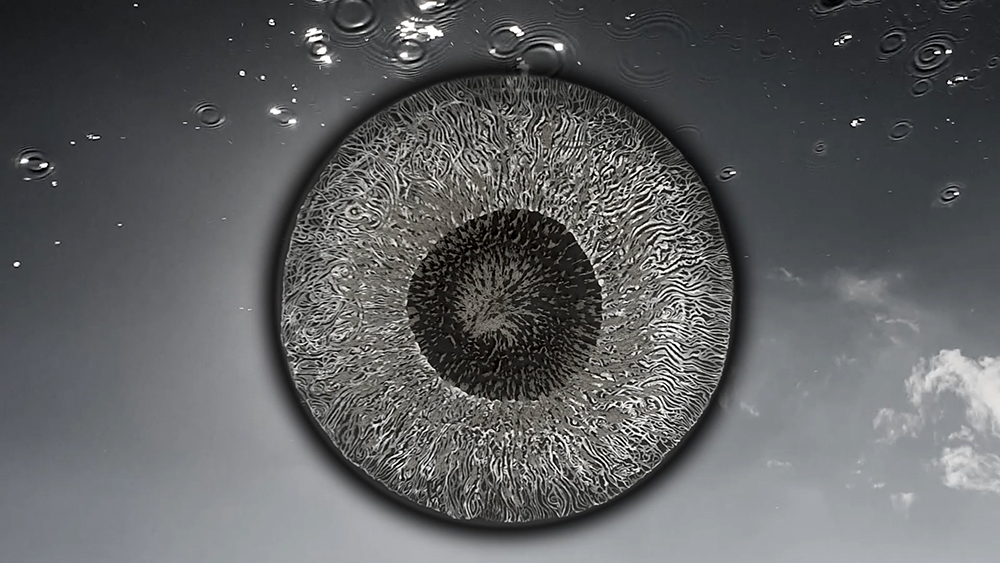
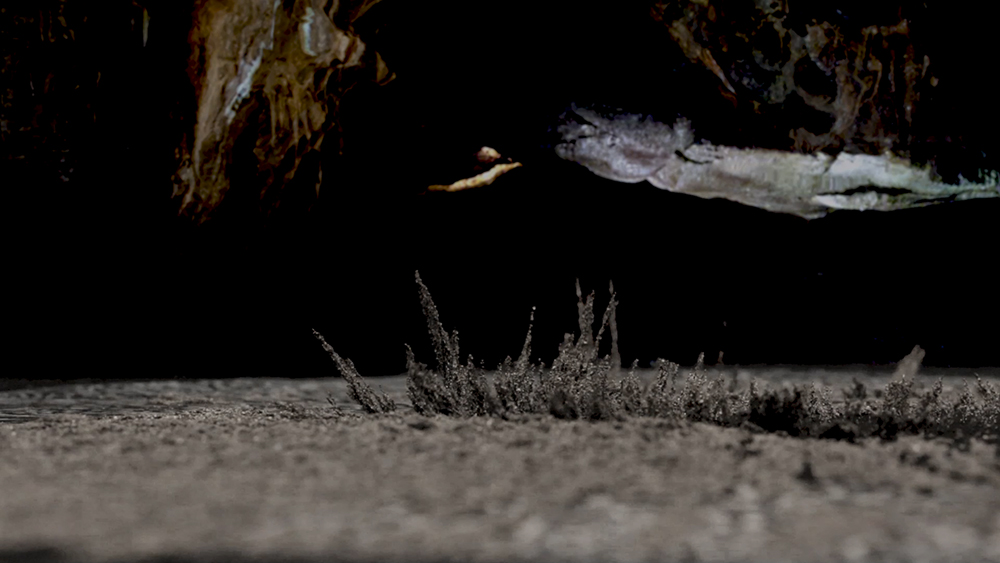
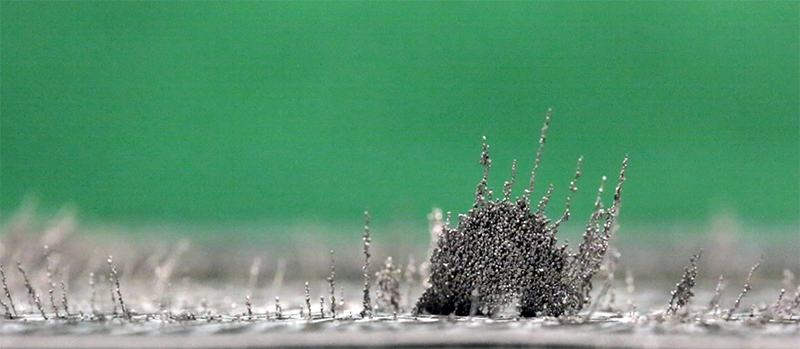
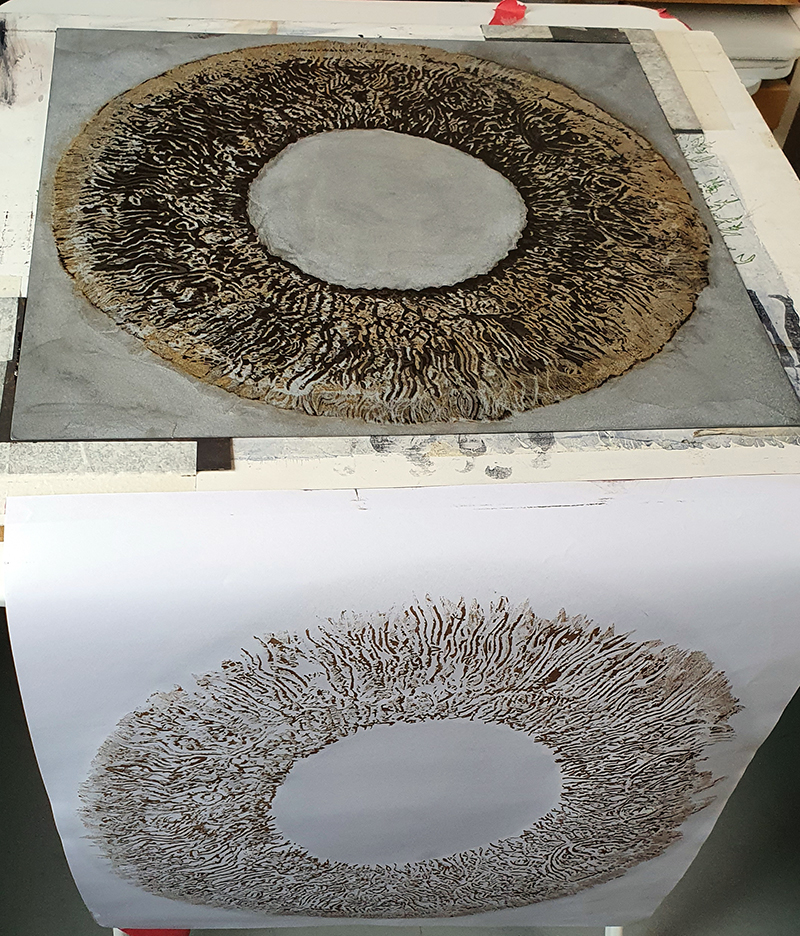
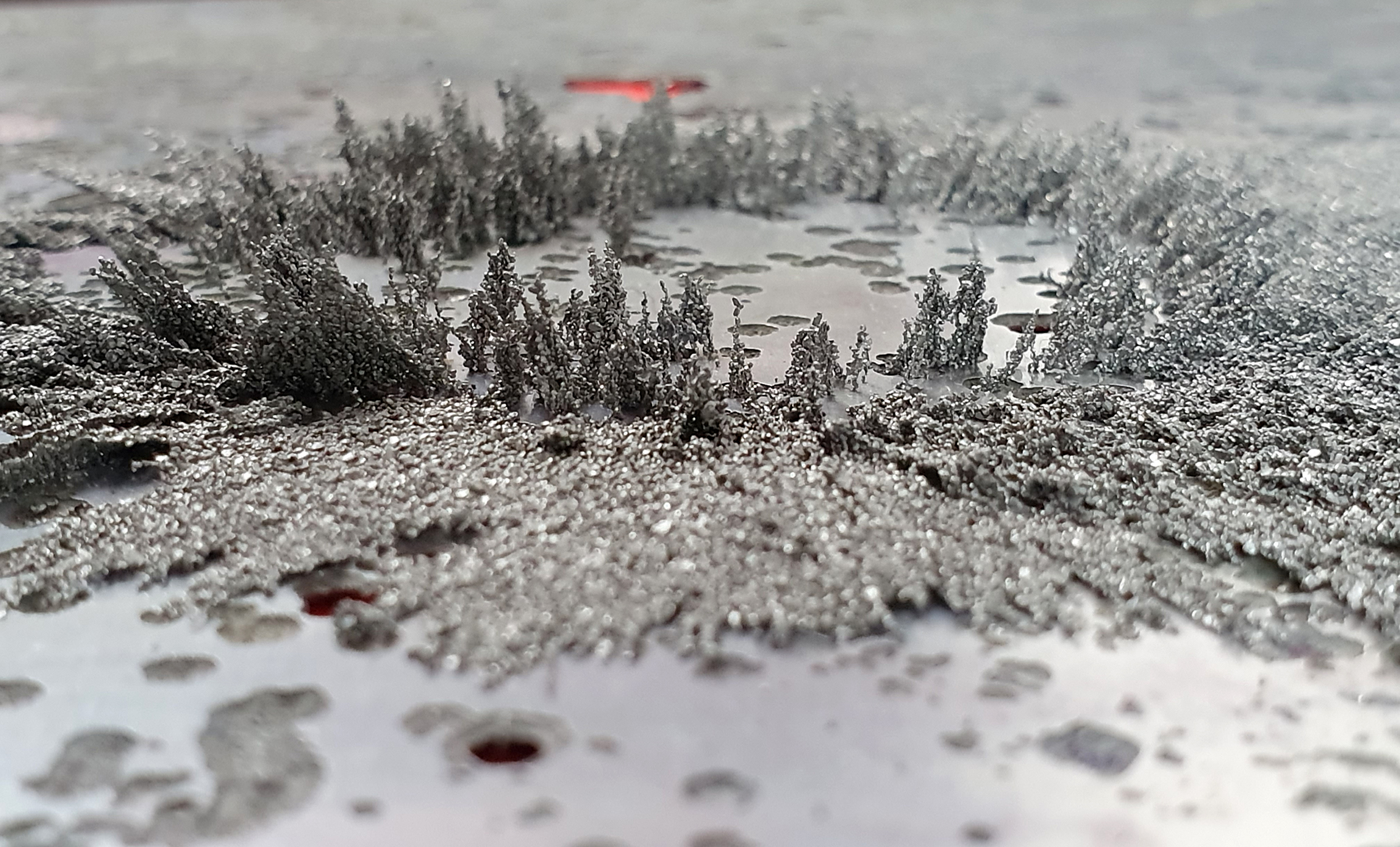
I dropped some iron filings into a little water which evaporated leaving a pleasing deposit. I wanted to see if the filings lose their magnetism once oxidized and how the rusted filings would sit on the iris image.

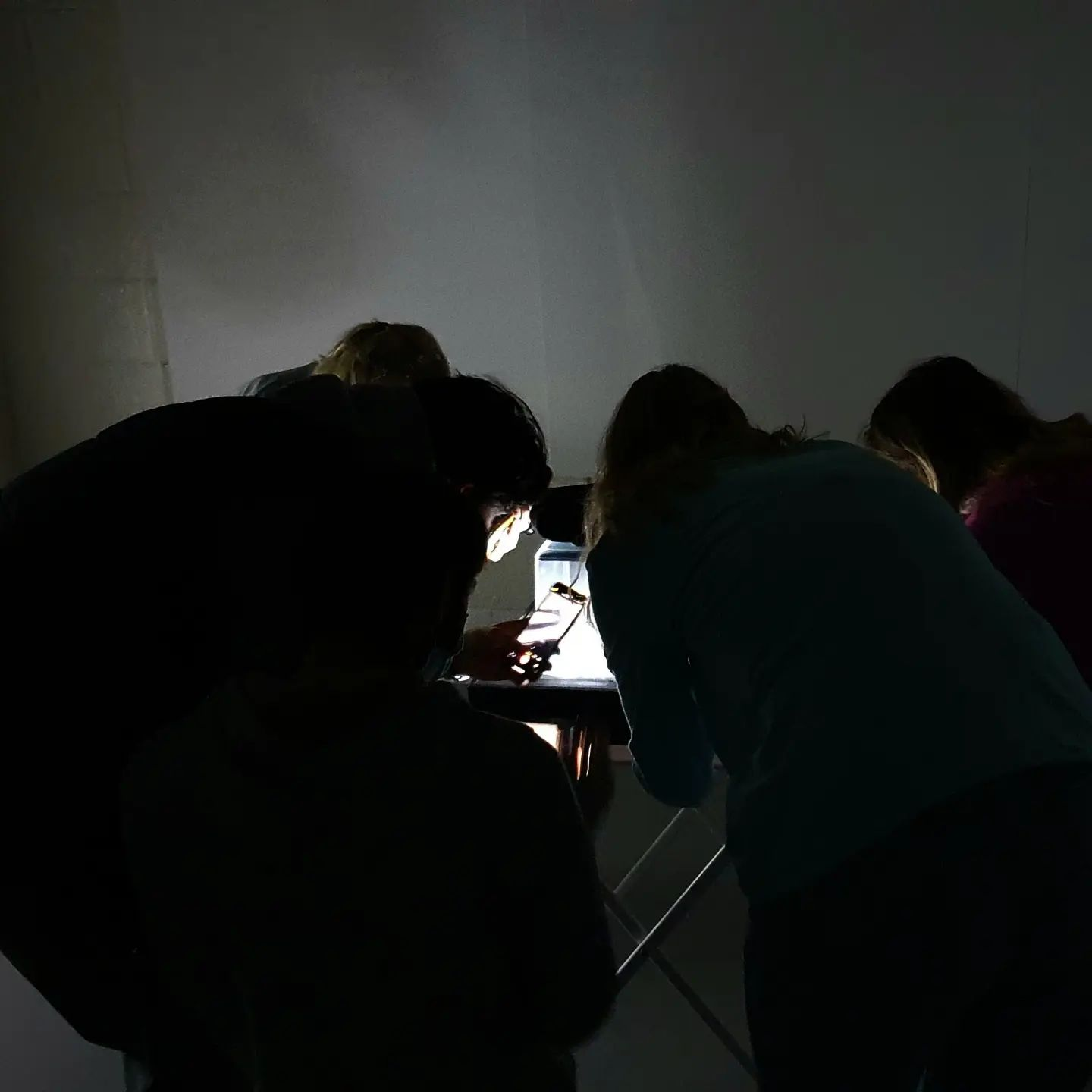
I was invited by Luci Eldridge and Ian Dawson to present a talk and run a Cloud Chamber Workshop as part of the Images In The Making series, a Communities of Practice cross-years project at Winchester School of Art.

Images in the Making considers images in an expanded sense in terms of process, materiality, interaction, exploring how artworks evolve and come into being.

Images – be they human or machine – are entities that are made. They are drawn, sculpted, painted, mapped out, captured, rendered, visualised, spliced, amalgamated. Images in the Making considers images in the broadest sense, exploring them as fluid, dynamic entities that emerge and transform through making, unmaking, and remaking. Process is at the core of this project and we will think about ‘imaging’ as an unfolding activity, investigating how artworks change as they are made and circulated.

Writing the presentation allowed me to revisit and consider how I use process in a practice broadly to do with visualising the unseen.

As my starting point is often an unseen or maybe even an imagined object this might mean visualising a close approximation of something to open up the imagination to phenomena that is beyond our capability to visualise. This would include things like dark matter, higher dimensions in spacetime, or the aura of an object. Or it may be using technology to make visible something otherwise outside the limitations of our senses. Or a conflation of real and imagined such as seeing a galaxy in a frozen puddle.

In Patrick Harpur’s book The Philosophers’ Secret Fire – A History of the Imagination he talks about those inbetween spaces where things are not quite ‘there’ and not quite ‘not there’ which I think is an interesting space to look at when trying to bring the unseen out of the shadows. The book relates how myths have long been used to make sense of the world. For most of our evolution humans have believed in an otherworld of spirits – a metaphysical realm governed by archetypes. Daimons are given context in the book as elusive, contradictory, both material and immaterial concepts that still reside in our culture but are now so far removed from their personified shapes that we fail to recognise them.
All human experience is an edited account of full reality as neuroscientist Anil Seth tells us

“You’re locked inside a bony skull trying to figure what’s out there in the world. There’s no light inside the skull, there’s no sound either, all you’ve got to go on are streams of electrical impulses which are only indirectly related to things in the world, whatever they may be. Perception, figuring out what’s there has to be a process of informed guesswork”

 and then tangled with our reality according to Harpur

“…daimons inhabit another, often subterranean world which fleetingly interacts with ours. They are both material and immaterial, both there and not-there – often small, always elusive shape-shifters whose world is characterized by distortions of time and space and, above all, by an intrinsic uncertainty.

– the subatomic realm, like the unconscious, is where the daimons took refuge once they were outcast from their natural habitat.”

A few years ago when I was visiting and photographing streets and roads called Paradise trying to capture the aura of such a place I stopped to wonder what everything was made of. Did I need to look closer to find hidden patterns or clues in the everyday which might point to something sublime. This is when I turned to particle physics. I found the language to be quite like that of mythology, full of mysterious characters; the quarks, the muons, neutrinos. Characters governed by fundamental forces like the strong force and the weak force that are defined by their characteristics, just like the mythical gods. I also found the theories of particle physics to be as fantastical as the ancient tales where the laws of classical physics do not apply. I was amazed at the time to discover that most of the universe is hidden from us as mysterious dark matter and dark energy. 

To provide a relevant backdrop for the online presentation I set my dodecahedron sculpture Diazôgraphô by the window to light up the images of cosmic particle trails within. The dodecahedron is used here as a motif for the universe. The title translates from Greek as ‘to embroider’. Plato described the dodecahedron as ‘a fifth construction, which the god used for embroidering the constellations on the whole heaven.’

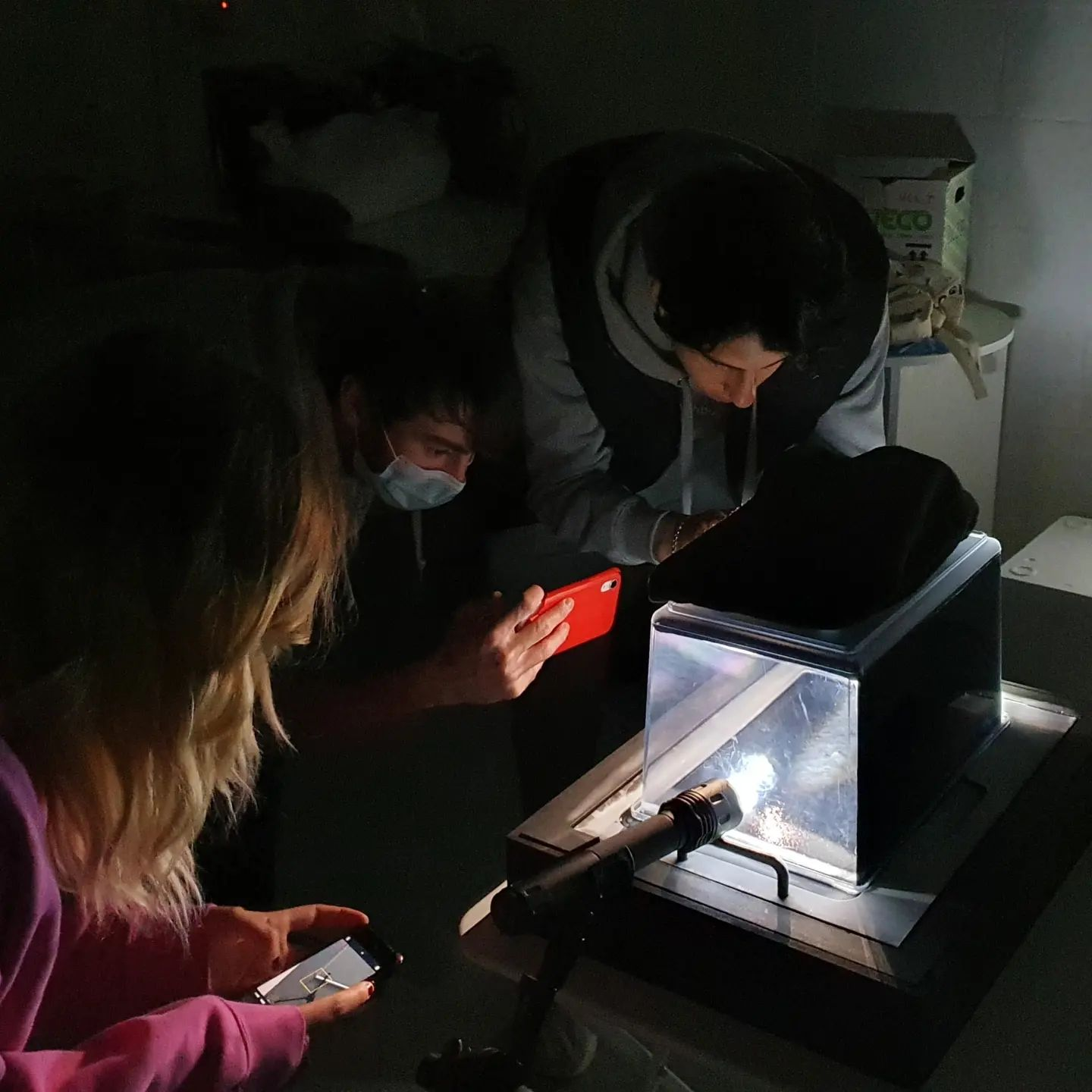
The cloud chamber workshop gave students a chance to experience the otherworld of subatomic particles. Dark matter might be inaccessible to us but cosmic particles offer a more tangible contact  – although too small to see we can witness their effects through quite simple processes. In the chamber we see trails from naturally occurring background radiation as well as particles from outer space.

Out of the Studio

Not Painting at Copperfield

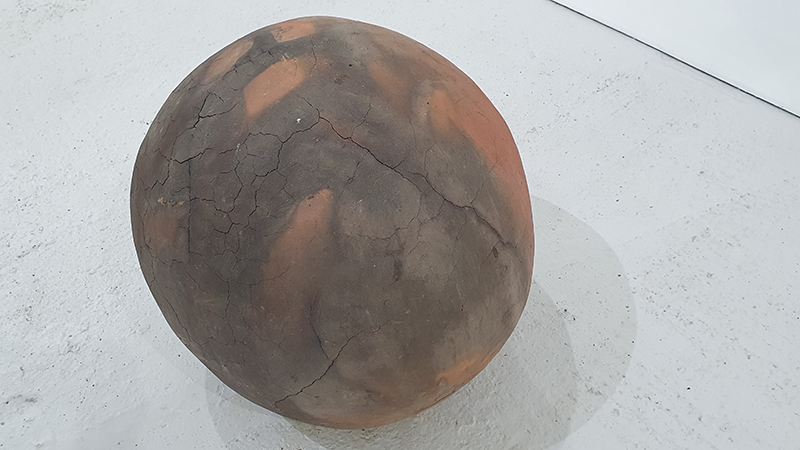
Inspired work by Nicola Ellis from Dead Powder series (first pic) in a show hitting the zeitgeist of rethink, repurpose the materials around us. Some beautiful and thoughtful work here much of which will confound you as to its material origins.

Darkness At Noon: Nigredo of a Pandemic at APT curated by Ruth Calland for Contemporary British Painting

Great to see some of Sarah Sparkes exquisite ghost painting series along with Chantal Powell’s alchemical totems and other works from 27 artists.

Alchemy is all about transformation from one state to another, the pursuit of a deeper truth as precious treasure. Alchemists were engaged in the Middle Ages with a physical process, trying to turn base materials into gold through a series of chemical processes, a metaphor for the transformation of the soul. There had to be a Nigredo, a dark night of the soul in order to purify it. Death and decay, destruction of the old to make way for the new, are both real and symbolic in these precarious times of ours. 

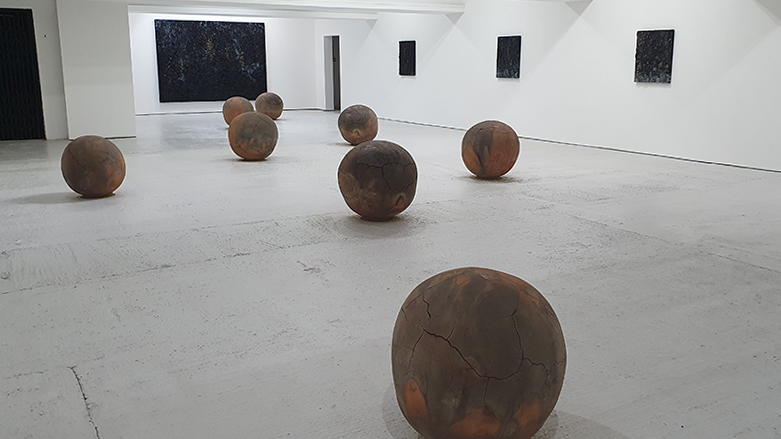
Bosco Sodi Totality at König London presents a grounded solar system we are able to walk amongst, surveying the raw materials of our creation. Heat, minerals and time. Very satisfying.

Tacita Dean – The Dante Project at Frith Street Gallery, Golden Square

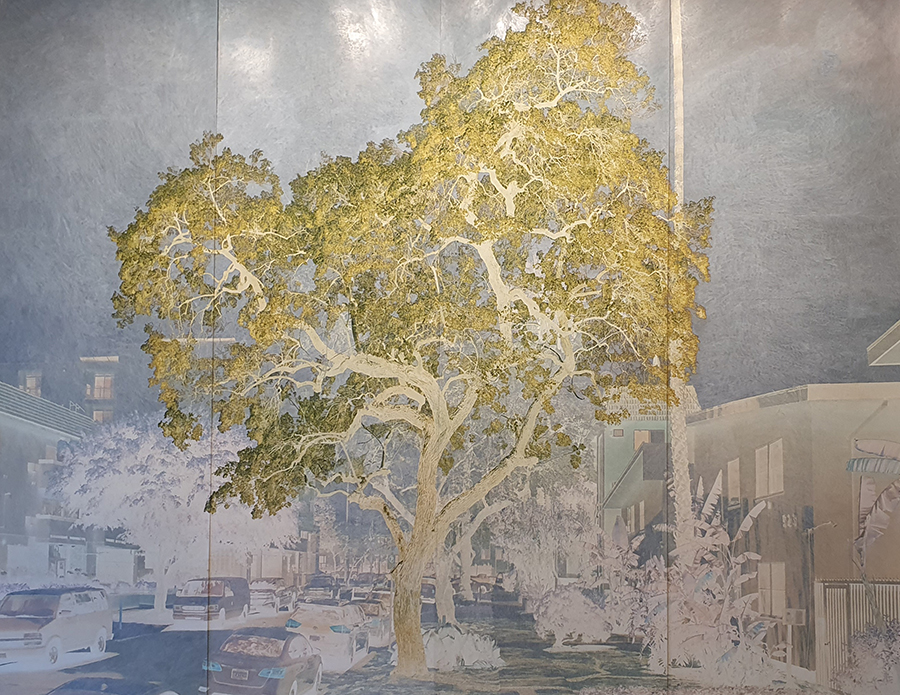
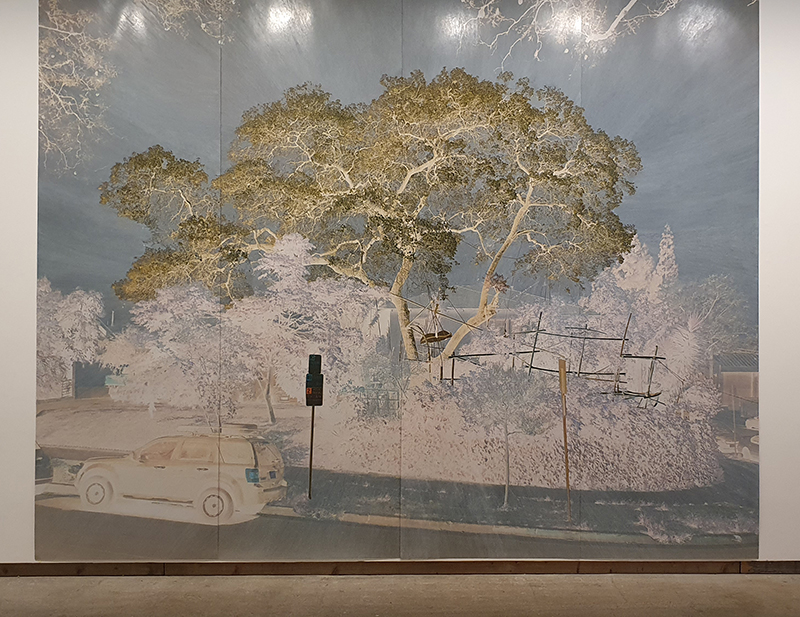
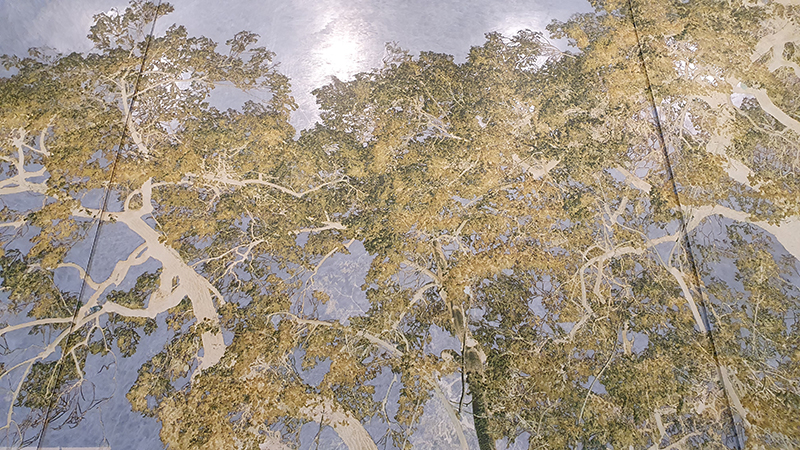
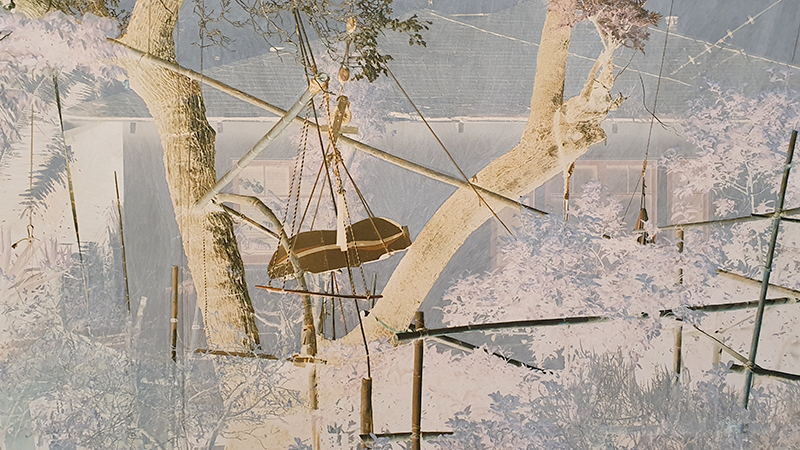
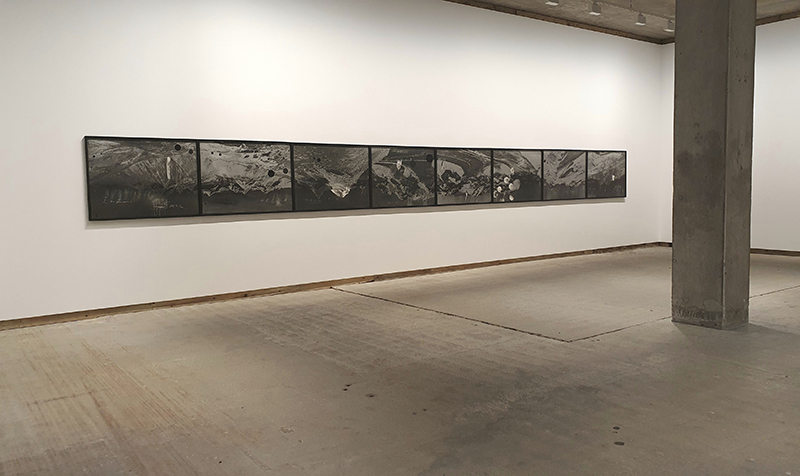
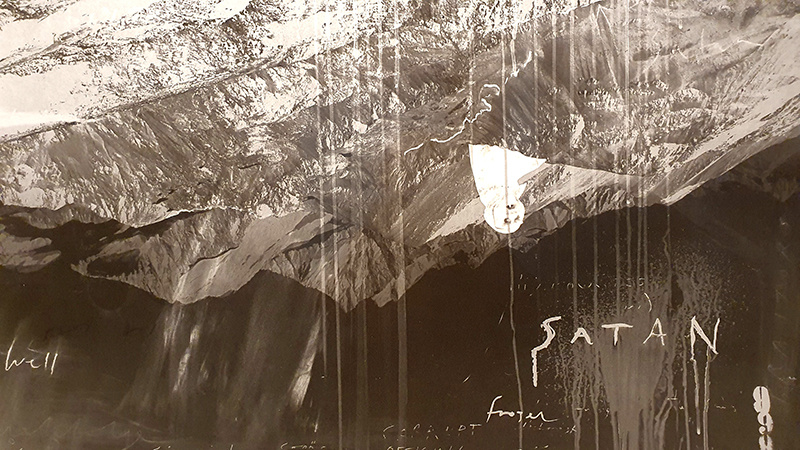
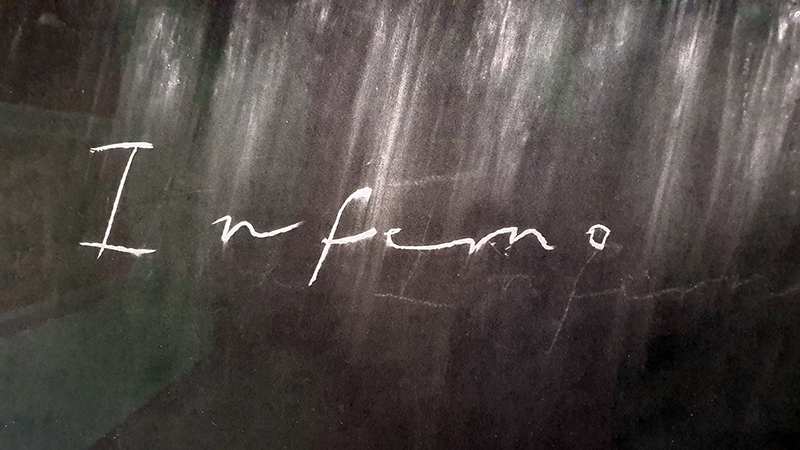
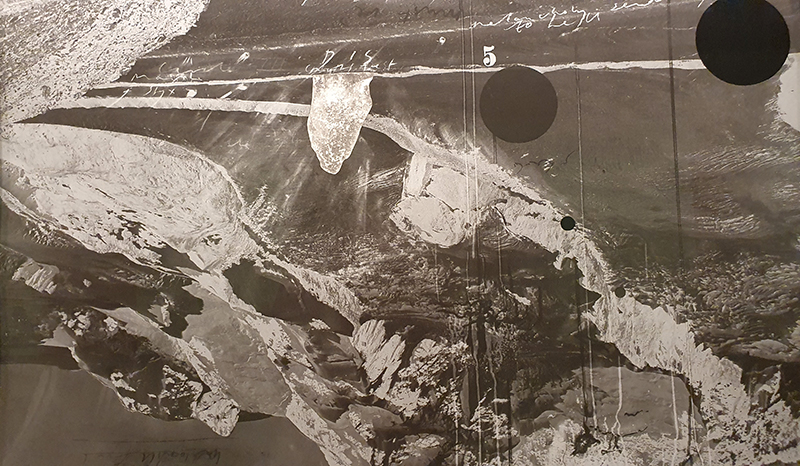
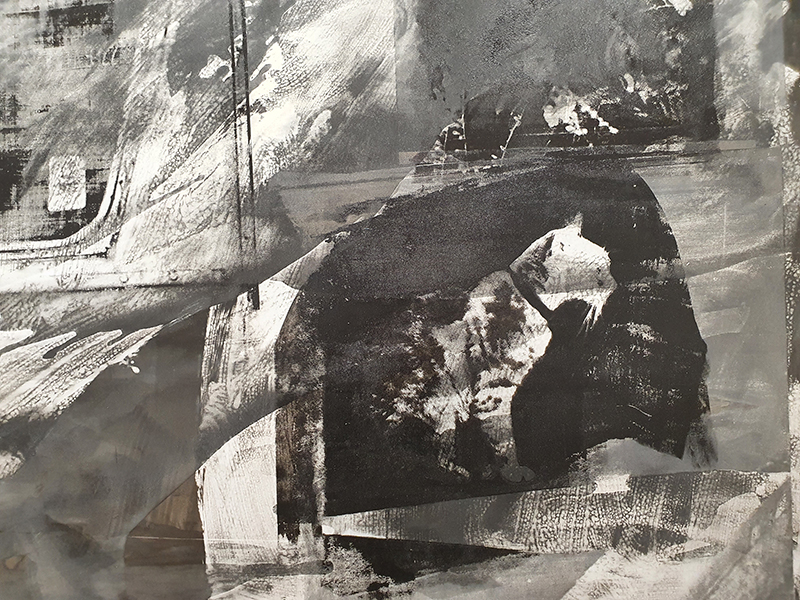
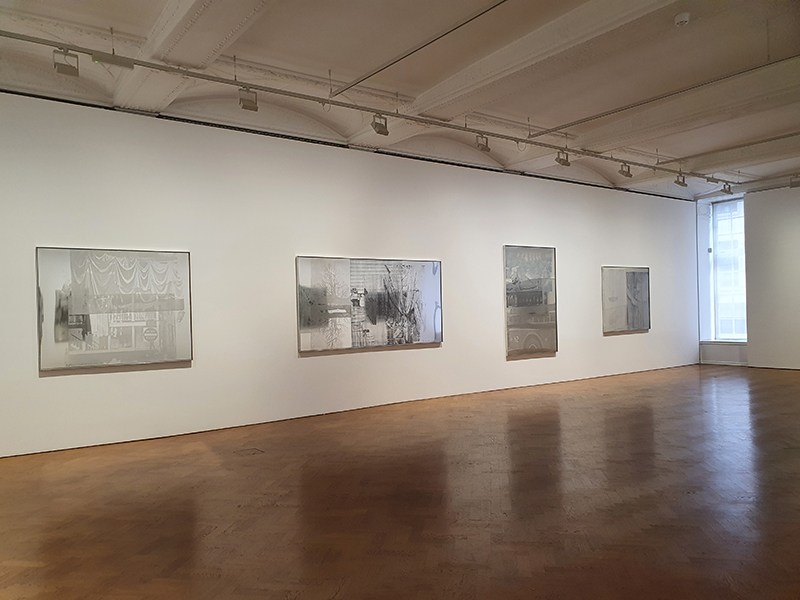
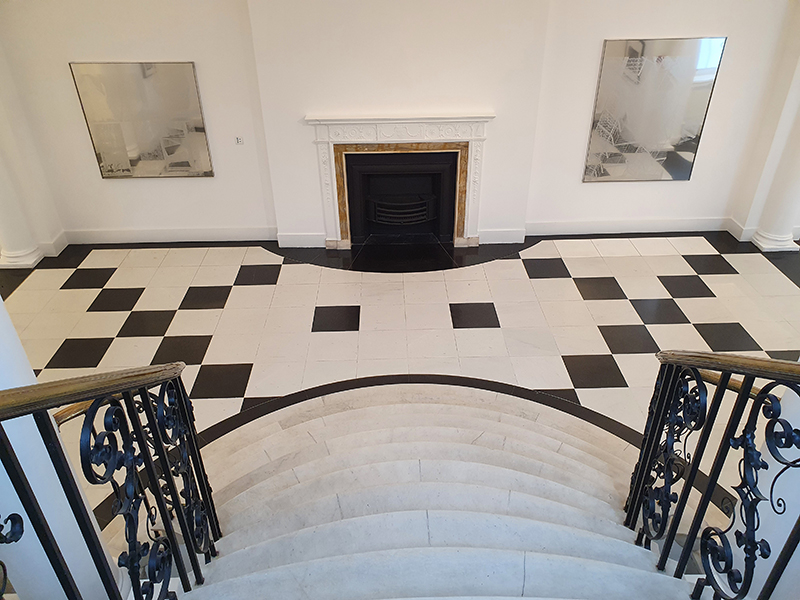
Hell made heavenly in silvery surfaces, paradise emerges glimmering from the streets of LA.

Magical otherworlds. These stunning backdrops were created for the ballet based on Dante Alighieri’s 1320 narrative poem The Divine Comedy choreographed by Wayne McGregor at The Royal Opera House but can also transport you in their own right. I was lucky to also see them on stage. The sets progress from the monochrome backdrop of Inferno, through the luminous transitional state of Purgatorio into a circling colourfields of Paradiso.

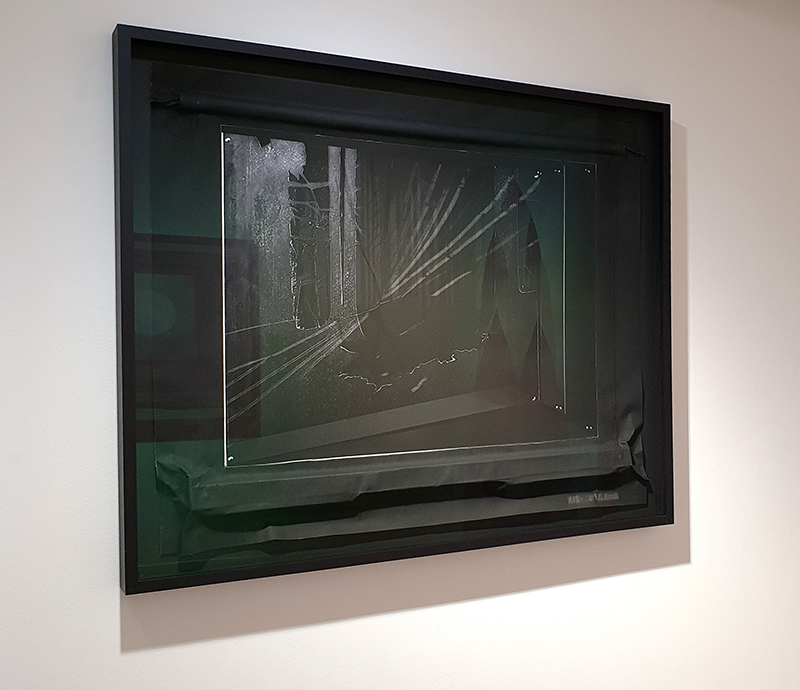
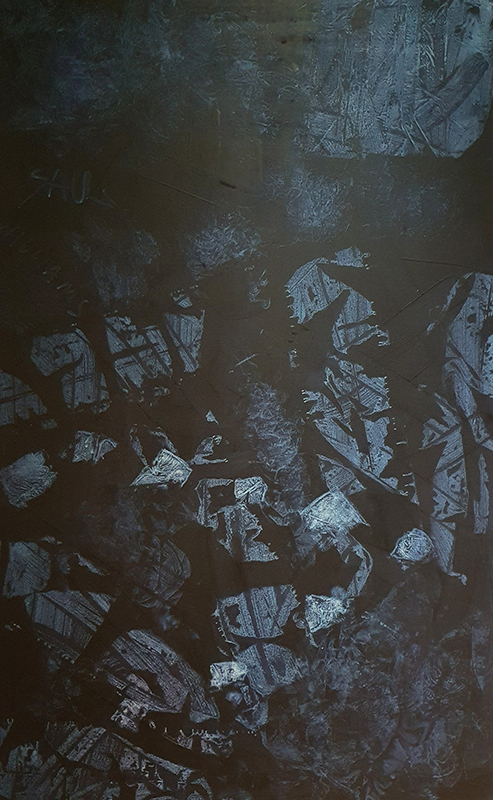
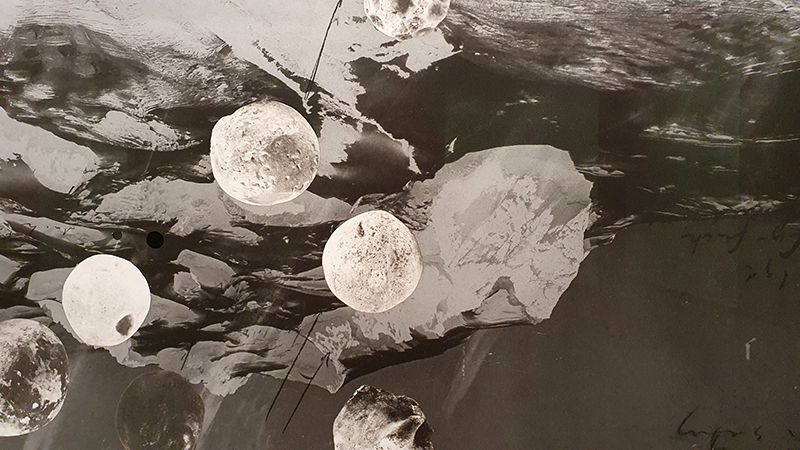
The large-scale photographs printed as negatives are of Jacaranda Trees which bloom in hot climates when the entire foliage turns into purple blossoms. In negative the purple becomes an otherworldly green and the background streetscape is muted with white pencil. The monochrome photogravures of an inverted mountainous terrain in negative using silver ink reference Botticelli’s drawings which signify Dante and Virgil’s descent through the nine circles of hell.

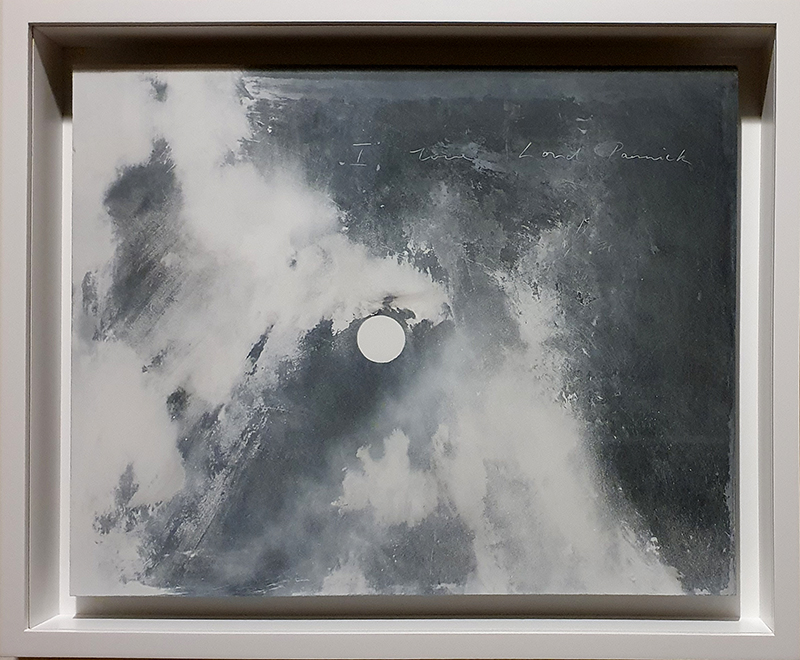
Tacita Dean Monet Hates Me at Frith Street Gallery, Soho Square

The importance of objective chance as a tool of research used as the basis to craft 50 objects inspired by the random choice of a box of artefacts at The Getty Research Centre, Los Angeles. The objects pertaining to ‘an exhibition in a box’ include ‘the forged signature of Christian Dotremont, a long-dead Belgian surrealist, on a postcard; a letterpress copy of Piet Mondrian’s carte de visite, hand-corrected by Dean to match a pencilled correction on the original; Fluxus artist George Brecht’s Stamp Out Stamping stamped on vintage index cards; a vinyl record of Dean reading a montage of text fragments collated from her working photocopies; and ‘a foot of feet’ – a foot-long strip of film made of sixteen frames of found images of feet. Object 1, is a small book which also acts as the key to the provenance and manufacture of the other 49 objects.’

The enigmatic painting I love Lord Pannick sits outside the viewing area for Pan Amicus, filmed in 16mm on the Getty Estate but transporting the viewer to a golden classical Arcadia littered with Greek and Roman objects and imbued with the spirit of Pan “The Piper at the Gates of Dawn” from Kenneth Grahame’s The Wind in the Willows (1908).

Mixing It Up; Painting Today an exhibition of painting at the Hayward Gallery.

Charmaine Watkiss showing with Tiwani Contemporary at Cromwell Place.

Meet The Seed Keepers in Charmaine’s magical collection of works on paper. Powerful images brought to life with a luminous delicacy full of hidden symbolism waiting to be discovered.

Researching the medicinal and psychical capabilities of plants, Watkiss has personified a matrilineal pantheon of plant warriors safeguarding and facilitating cross-generational knowledge and empowerment.

We are made of carbon, it is the basic building block in virtually every cell in our body. Most of the carbon in the world is carbon-12 which contains six neutrons and six protons. However about 15 km above our heads radioactive carbon-14 is formed as neutrons from cosmic rays interact with the atmosphere.

Protons and atomic nuclei created by events such as exploding stars speed across space and collide violently with the Earth’s atmosphere creating a chain reaction of cascading particles. Some of these tiny travellers may come from distant galaxies or be created by phenomena that we are yet to discover. Our body is continuously permeated at a subatomic scale by these particles fired into our world – an almost tangible contact with outer space.

Carbon-14 has six protons and eight neutrons and has a half-life of 5,730 years. This means that after 5,730 years dead matter which absorbed Carbon-14 when alive will contain half the amount it had when it died and after another 5,730 years that amount will have halved again. Radioactive decay is random but in a sample there are enough atoms to work out an average time it will take for the nucleus to lose the extra neutrons.

This radioactive carbon-dioxide in the atmosphere is absorbed by plants which are eaten by animals and humans.

Cosmic ray activity gives us carbon dating techniques.

I am working on a video, Cosmic Chiasmus, meaning crossing.

Plant time lapse filming is fascinating to see how plants are so animated just at a different time scale to us. Also I have recently finished reading Richard Powers Overstory, a very powerful sobering read, which celebrates the slow yet socially active time of trees.

Carbon dating is performed by measuring Carbon-14 in organic matter. Radiocarbon decays slowly while an organism is alive but is continually replenished as long as the organism takes in air or food.

When an organism dies no more Carbon-14 is absorbed and that which is present starts to decay at a constant rate.

By measuring the radioactivity of dead organic matter, the current carbon-14 content can be determined and the time of death established.

The oldest matter that can reliably be carbon dated is about 50,000 years old. Currently techniques are being refined as they have often relied on the assumption that Carbon-14 levels in the atmosphere are constant but they are not.

The burning of fossil fuels which have lost all their radiocarbon dilutes the amount of Carbon-14 with carbon dioxide and nuclear explosions add huge amounts of ‘bomb carbon’ to the atmosphere. During planetary magnetic field reversals more solar radiation cosmic rays enter the atmosphere producing more Carbon-14. Also the oceans suck up carbon circulating it for centuries.

There are a number of uncertainties for dating shell.

On the surface of the earth two to three Muons pass through your hand every second, underground this is reduced to about once a month.

I came across some articles about balloon voyages made in the 1930’s to the stratosphere to record cosmic ray activity in old National Geographic magazines .

Intrepid explorers. These early explorations were innovative but also dangerous. In July 1934 a flight developed tears in the balloon fabric at about 57,000 feet and began to break apart, as it did so the hydrogen in the balloon exploded and the crew had to parachute to safety.

Physicist Victor Hess had already made a series of daring ascents in a balloon to take measurements of radiation in the atmosphere. In 1912 he made an ascent to 17,000 feet during a near-total eclipse of the Sun to determine if the source of the radiation was coming from the Sun and made the discovery that it had to be coming from further out in space.

The stratosphere balloon Explorer II was designed to carry heavy instruments for cosmic ray measurements to a height of 13 miles and more above sea level.

Scientists designed a system of cosmic ray telescopes to record the numbers of cosmic rays coming in from several angles above the horizon. Most of the cosmic rays counted are secondary particles shot out from the atoms of the air by the primary rays entering and colliding from space. During this flight the height at which most secondary cosmic rays are produced was determined and the first records of bursts of energy from atom disruption by cosmic rays was made.

Also, the first track ever made directly in the emulsion of a photographic plate by an alpha-particle cosmic ray with enormous energy of 100,000,000 electron volts was achieved. Two boxes of photographic plates coated with special emulsion were wrapped in light tight paper and attached to the balloon gondola. When the plates were developed there were no visible images but when put under a microscope tracks could be seen where the particles had ploughed through the emulsion.
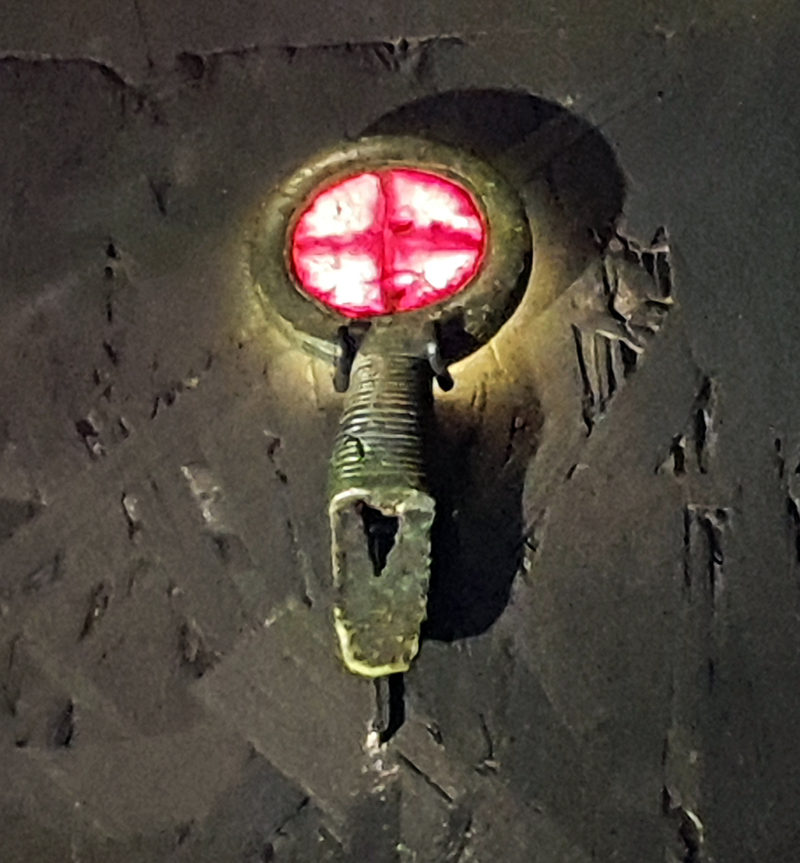
Early google earth. They also took the highest altitude photographs of the Earth ever made.

To record data they had a series of cameras set to take automatic photographs of the dials on the different apparatus.

Analysing air captured from the stratosphere.

On Earth we are protected from most radioactive particles by the atmosphere and the magnetic field.
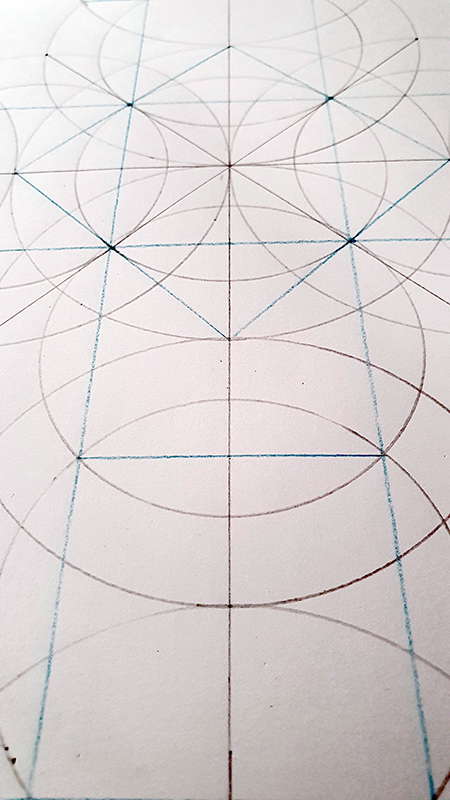
It has been clearly demonstrated that birds are able to sense the direction of the Earth’s magnetic field and that they can use this information as part of a compass sense. It may be possible humans retain some residual magnetoreceptor in our eyes that once allowed us to navigate using the Earth’s magnetic field. Current research suggests that some people do indeed perceive magnetic fields, albeit unconsciously.
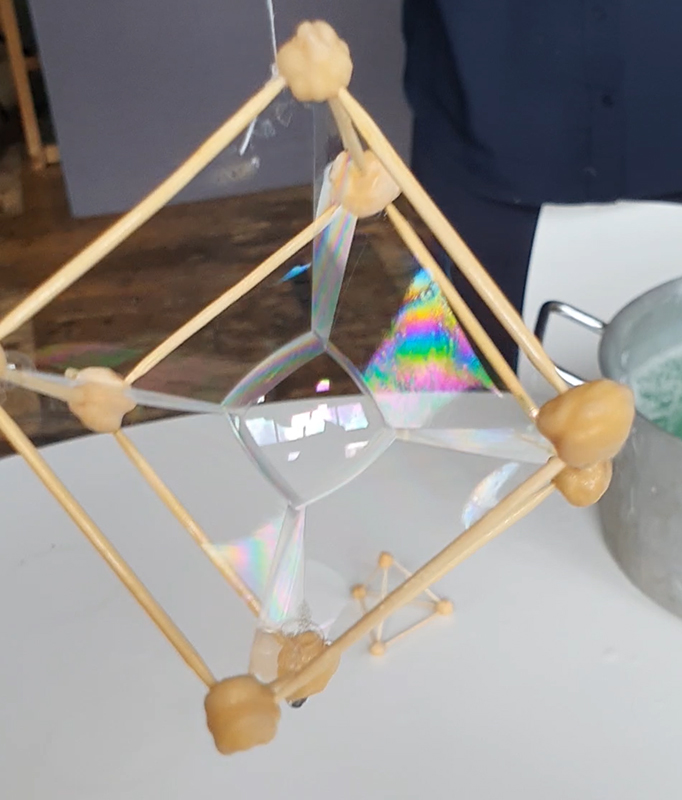
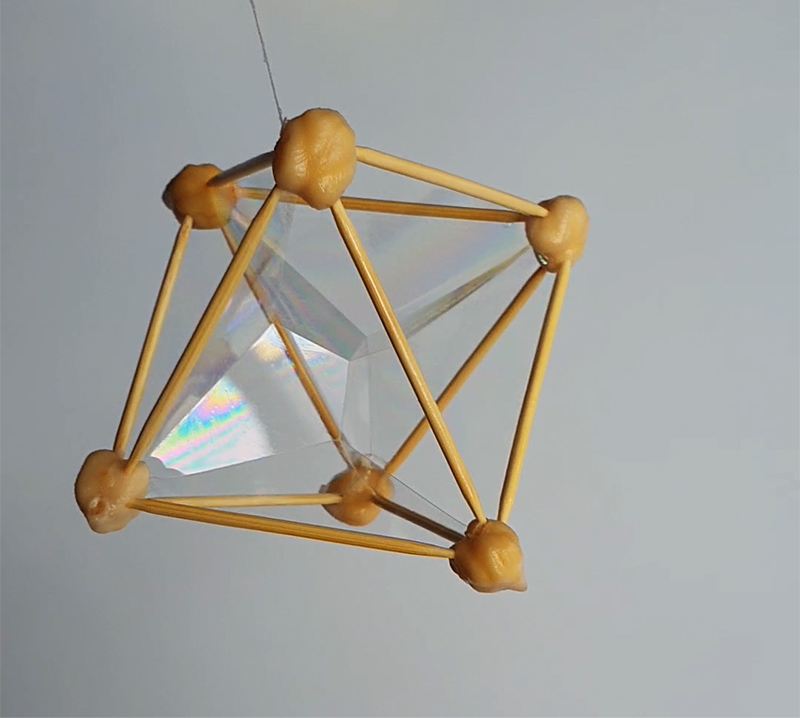
Work in progress on navigation by magnetic receptors. Working on a soft ground etching of my iris with aquatint. Not sure yet if I will use the plate or the print in the final work which will have iron filings activated across the surface.

First components have arrived from America for my attempt to build my own cosmic ray detector to create an interactive artwork. The plastic block converts the energy of the charged particle passing through to a photon which can be read by a silicon photo-multiplier and the information fed to an Arduino processor. Daunting and exciting.

New work in progress – I collected a selection of images from the 1930’s including some from family, including my Mum aged 3, which I have tinted blue and had printed on sublimation dye paper for transfer to the tiles making up the raster pattern based on early television signals. FM radio and television signals can pierce the ionosphere and travel through space at the speed of light. The first signals will have travelled about 90 lightyears now to arrive at a solar system very similar to our own. Fragments travelling through space for light years with the potential for alien life to decipher.

Visit to Sutton Hoo where the ever increasing accuracy of radio carbon dating has provided astonishing clues to the past history of this intriguing site. Archaeologists can determine the age of objects in decades as opposed to centuries.

Sutton Hoo is the site of two early medieval cemeteries dating from the 6th to 7th centuries near Woodbridge, in Suffolk, England. In 1939 landowner Mrs Edith Pretty asked local archaeologist Basil Brown to investigate the largest of several Anglo-Saxon burial mounds on her property. Inside, he made one of the most spectacular archaeological discoveries of all time.

Past, present and future finds. Ancient trees. Burials of Kings. Amazing sword of beaten twisted wrought iron and steel. Basil Brown’s star charts.

The agency and aura of objects was investigated with the intent to generate new relations between objects and their associations with the world around them in the beautiful group show Can We Ever Know The Meaning Of These Objects curated by Sarah Sparkes and Kevin Quigley at Gallery 46.

Eileen Agar Angel of Anarchy at Whitechapel Gallery exposing the subconscious entwined with the material of nature. Enjoyed the decomposition of space into lines like foliations and contour lines. Which angel would you choose? Anarchy or Mercy?

I joined a zoom presentation from Sophie Williamson on her current project undead matter which dips into the deep time entanglement of geological ancestry. Leaving a mark in the past as a way of communicating with the future and creating a lineage for ourselves. Eras mingle with each other as ancient footprints resurface, ice melts, secreted narratives emerge. The permafrost holds vast amounts of carbon. Whole forests.

Zircon crystal contains radioactive uranium with a half-life of 4.5 billion years, which makes it useful for dating extremely old materials much much older than those containing Carbon-14. These crystals may hold clues to the origin of life. The carbon necessary for life may have arrived here in space dust from outer space via asteroids or comets.

WHAT ON EARTH group show from artists including Victoria Ahrens, Melanie King and Diego Valente using photographic processes with an emphasis on the material environment, tactility and sustainability.

Michael Armitage – Paradise Edict at the Royal Academy. Digital images do not do justice to the glow and vibrancy of these paintings. Can feel the heat pulsating with unsettling shape-shifting undercurrents.

180 The Strand with Ryoji Ikeda’s digital showcase was an intense assault on the senses using light and sound as medium to create immersive experiences. Brightness is the number of photons per second hitting your eye. Pushing the limits of what our senses can tolerate.

Took a trip to the Lake District to visit Brantwood, John Ruskin’s beautiful home to see Carol Wyss The Mind Has Mountains and Crown of Creation installations. Having seen the work that went into the printing of the large etchings at Thames-side Print Studio it was wonderful to be able to see the work finally installed and step inside the mysterious depths of the human skull; a space echoed by the surrounding mountains. The light installation is suspended in the dark chill of the Ice House vault, viewed from the top of rugged steps carved into the rock. Here the fragility of the human skeleton fades and glows accompanied by an evocative soundscape made by Natasha Lohan capturing the echoing chamber and the water that courses through everything.

HD 70642 is a star about 95 light years away. It has roughly the same mass and radius as our sun. It has a companion planet that orbits in a circular motion very similar to how the planets orbit in our solar system. Waves like FM radio or television signals can pierce the ionosphere and travel through space at the speed of light. The first radio and TV signals from Earth will be reaching this solar system about now.

Family photo 1930 Kessingland Beach. It has taken almost the equivalent of my Mother’s lifetime for the early transmissions to reach this potential home from home.

Work in progress.

The work is based on the raster patterns of the first TV signals when images were transmitted in a series of lines. It is a systematic process of covering an area progressively, one line at a time. It is similar to how one’s gaze travels when one reads lines of text. The word raster comes from the Latin rastrum, meaning rake. Patterns of line. The signal is sent in fragments and must be interpreted on arrival to make sense of the message.

Also working on a short video – Cosmic Chiasmus, looking at the journey of cosmic rays from distant galaxies to our planet. Chiasmus comes from Greek meaning crossing, like in the letter X.

Cosmic rays, some travelling from other galaxies, pass through us and our world continuously, creating an almost tangible contact with outer space.

Some super high energy cosmic ray particles that arrive on Earth have 20 million times more energy than particle colliders can generate. They may come from distant galaxies or be created by phenomena that we are yet to discover.

They may come from other dimensions.

First line of defence on Earth against the ionising radiation of high energy cosmic rays is our magnetic field which deflects many charged particles before they reach our atmosphere. Second line of defence against cosmic rays is Earth’s atmosphere. Most high energy particles that make it past the magnetic field collide with atoms in the upper atmosphere and break apart to create a cascade of secondary particles that shower down upon us. In losing some of their energy as they smash apart they are less dangerous.

I have a very short film Big Bang to be featured in the 2021 Birkenhead International Film Festival of films 30 seconds or less.

The scales of the universe are hard to comprehend and this 12 second video is an attempt to relate this unfathomability to the human experience. Each second of the video is comprised of 24 single frame extracts from 24 separate videos of the moment a soap film membrane burst. Too fast for our eyes to see, we cannot register the individual frame or the instant the bubble bursts. This is nothing compared to the speed at which the Big Bang exploded matter across the universe or the magnitude of time that has passed since that event. As scientists use ever more sensitive instruments of measurement we must try and grapple with concepts that our limited senses have no hope of experiencing directly.

According to theoretical physics higher dimensions exist where space acts very like a soap film membrane in trying to minimize surface area. String theory, which attempts to combine quantum mechanics with general relativity potentially allows for many universes each with different physical laws.. It may be possible for our universe to suddenly transform into a universe with completely different properties. If this did happen, it would thankfully be so fast we would be oblivious to the moment of transition.

Out of the studio. Wonderful to be able to visit exhibitions again.

Matthew Barney Redoubt at Hayward Gallery

Incredible, stunningly beautiful and riveting film full of mythology ritual and alchemy that spills over into the gallery.

Igshaan Adams Kicking Dust also at Hayward Gallery

Dust clouds and desire lines. Leaving the dark and snow laden forest in the upper gallery for hazy sandy plains.

A rather lovely lump of creamy smooth marble from Not Vital at Thaddaeus Ropac Gallery.

Robert Rauschenberg Night Shades and Phantoms also at Thaddaeus Ropac Gallery. Slippery surfaces. We are the phantoms.

Rachel Whiteread Internal Objects at Gagosian. A different sort of negative. All in the detail.

Stephen Friedman Gallery at the London House of Modernity Quite splendid.

Jaki Irvine Ack Ro’ installation at Frith Street Gallery Bathing in pink neon song and sounds, gentle breezes and dappled light.

Tuned in to the webinar Art in Flux: The Invisible In collaboration with National Gallery X | Curated by Olive Gingrich

In a time, when there are nearly as many pieces of digital information as there are stars in the universe, contemporary artists explore new forms of making this vast amount of information accessible – be it through visual interpretations or new forms of interactivity. While museums around the globe including The National Gallery revisit their collections through the prism of data, contemporary artists such as Refik Anadol, Marshmallow Laser Feast and the Analema Group develop new processes for audiences to experience invisible phenomena in all new ways.

Ben Judd ‘The Origin‘ beautiful exhibition at Stanley Picker Gallery looking at island communities.

2002 St Augustine's Tower

In the studio I have been experimenting with magnets and iron filings while thinking about magnetoreception, methods of navigation and finding the way in the dark.

2002 magnetoreceptor wip 1

Some interesting research at the Max Planck Institute headed by Dr Christine Nießner has been looking at the light-sensitive molecules that exist in bacteria, plants and animals which are used for perception of the Earth’s magnetic field to aid orientation and navigation.  In birds the cryptochrome molecule is located in photoreceptors in the eyes and is activated by the magnetic field but only reacts to the magnetic field if it is simultaneously excited by light.

An additional meaning to birds eye view.

In animals, these molecules are also involved in the control of the body’s circadian rhythms. The researchers think that some mammals may also use this cryptochrome to perceive the Earth’s magnetic field. In evolutionary terms, the blue cones in mammals correspond to the blue- to UV-sensitive cones in birds. It is therefore entirely possible that this cryptochrome in mammals has a comparable function.

2002 magnetoreceptor wip 2Observations of foxes, dogs and even humans indicate that they can perceive the Earth’s magnetic field, but may perceive it in a different way, for example with microscopic ferrous particles in cells known as magnetite. A magnetite-based magnetic sense functions like a pocket compass and does not require any light.

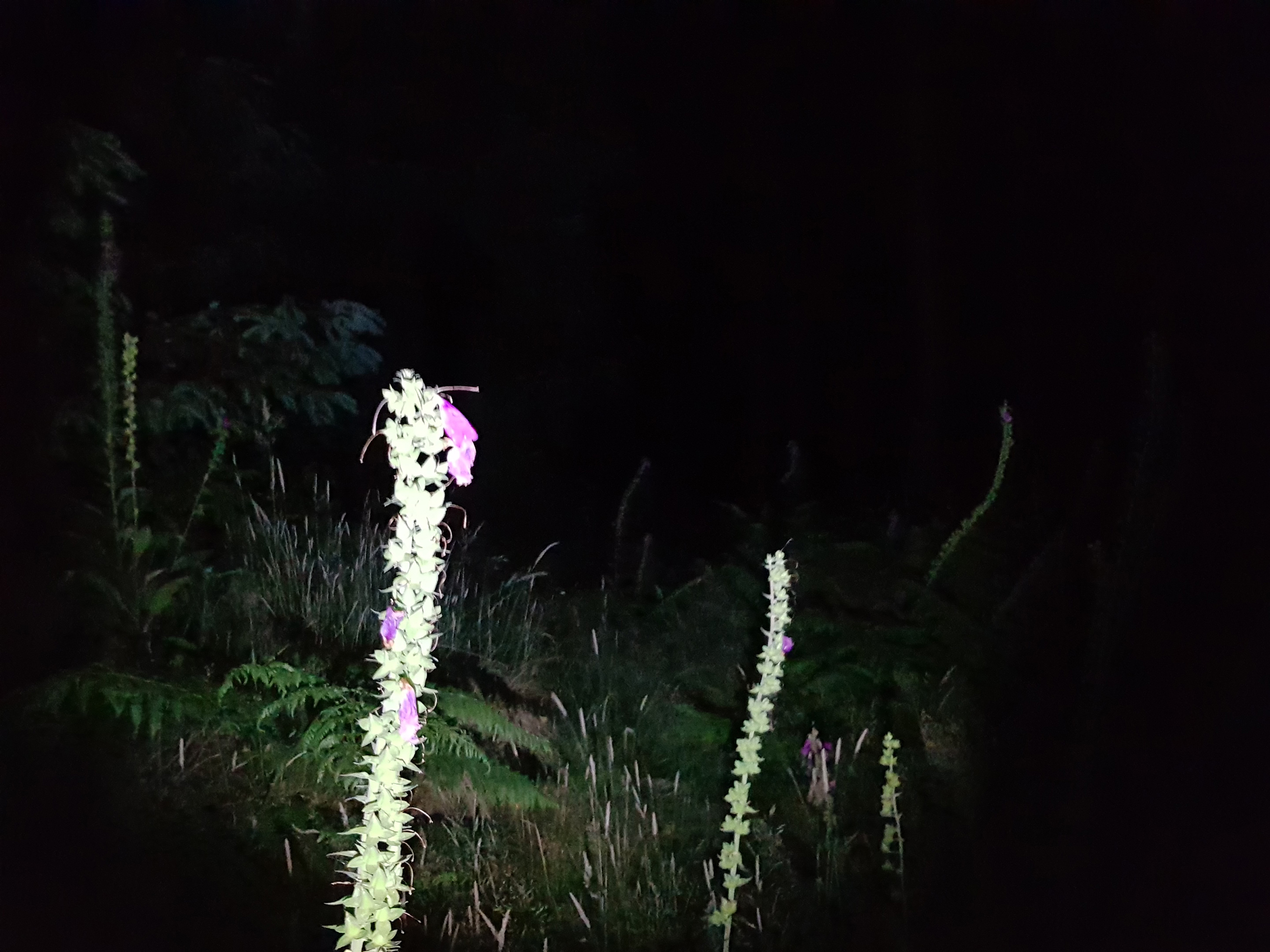
2002 naked mole rat

Mole rats navigate their dark tunnels using this kind of compass. Birds also have an additional orientation mechanism based on magnetite, which they use to determine their position.


2002 dark skies forest


Continuing research for a collaborative event with UCLO looking at the planetary system most similar to our own Solar System which contains the bright star HD70642. It is visible with binoculars from the southern hemisphere toward the constellation of Puppis.  “The Stern”  (poop deck) was once part of the constellation Argo Navis. Argo was the ship that Jason and the Argonauts sailed on their quest for the Golden Fleece2002 star map Argo Navis

A planet with twice the mass of Jupiter has been discovered orbiting HD70642 in an almost circular orbit. This means it is possible that Earth-type planets may be orbiting further in. In all other planetary systems discovered with massive planets they usually have disruptive closer elliptical orbits which would destroy any smaller planets on a circular orbit.

At 90 light years away, extremely faint early radio broadcasts from Earth are now passing this planetary system. It was around 90 years ago when University College London Observatory first began exploring the night sky. It was also around then when my mother was born which gives a human scale to the journey time. The constellation of Puppis is only visible from the southern hemisphere but should there have been a radio broadcast about the opening of UCLO then this information would now have travelled to this potential alternative home.

2002 UCL Observatory


British Pathé produced a short but sadly silent (sound was not introduced until 1930) newsreel of the opening of the observatory at UCL in 1929. View here


There may be a chance to discover Earth like planets using the new high precision spectrometer technology developed by Macquarie astrophysicist Christian Schwab which collects starlight from  unimaginably distant stars and measures the subtle effect orbiting planets have on their parent stars.

2002 spectograph Kitt Peak Observatory

Further research for a future video work The Seeker, The Seer, The Scientist. Looking to the horizon, the line that separates earth and sky.  The optical horizon is what we see but is not at the same as the geometric horizon which allows for the curvature of light due to atmospheric refraction. If the surface of the Earth is colder than the air above it, light is refracted downward as it travels around the curvature of the Earth and if the ground is hotter than the air above it light is refracted upwards causing a mirage.

2002 horizon

The true horizon is usually hidden.

2002 horizon sea

We each have a personal distance to the horizon based on our specific height of eye from the ground and the local elevation from sea level at which we stand. It is a distance we can never reach as it always recedes.  The seeker must send a seer to visit their horizon and report back on what it is they see, they may also send a scientist. The seer can see beyond, but is what they see real or imagined, the scientist can explain what is beyond but this is just abstract space.

My height of eye = 1.5m + local elevation

Distance to horizon = √(13 x height of eye)

2002 iris for etching

Some interesting ideas in The Rosicrucian Cosmo-Conception, a 1909 text by Max Heindel which seem relevant to my meanderings intersecting cosmic particle trails with matter. This text, setting out a theory of seven Worlds and seven Cosmic Planes, supposes an intermingling of spirit with matter where the intersection of the material and metaphysical world are not one above another in space, but inter-penetrate each with the other.2001 cosmic planes

Beginning the process of disposing of old work and bits and pieces. Storage is a big problem for artists I think.

2002 plastic

Also reworking old prints. It’s taken a couple of years to percolate but am working on a suspended paradise.

2002 paradise suspended

Out of studio.

A brief look at what is current in Bloomberg New Contemporaries 2019 at South London Gallery

200219 new contemporaries

The Missing Day discussion on 29/02 as part of the The Habitat of Time programme at Arts Catalyst curated by Julie Louise Bacon was a cross discipline interrogation of the social, political and personal impact of how we order time.

  • Once every four years, here in the collective habitat of Earth time, 365 becomes 366 as the missing day of the leap year makes another appearance in the now-global calendar. This quadrennial occurrence foregrounds the essentially malleable nature of time. From the earliest lunisolar calendar developed in Babylon during the Bronze Age, to the invention of atomic clocks in the mid 20th century, and speculations on the quantum realm in the laboratories of today, time’s parameters have taken on new guises, shaping and regulating life in the process.

The Missing Day roundtable explores the development of human modes of measuring and understanding time, and their impact on the ways we order time as societies, individuals and a species. The discussion will bring together perspectives on observing, keeping and speculating on time from the fields of the history of science and physics. It will consider the emergence of the modern regimes of time that dominate social life, their limits and the possibilities beyond.

Chaired by the curator Emily Akkermans ‘Curator of Time’ at National Maritime Museum Greenwich spoke about the mechanics of horology and the trade and empire building that led to time keeping for navigation, transport systems, industry and financial markets. Artist Ted Hunt whose work is featured in the 24/7 Somerset House exhibition spoke about his attempts to deconstruct the clock and find alternative methods of recording time. Artist Ami Clarke from Banner Repeater had a stark message about capitalism driving our relationship to time, taking control away from the human as algorithms respond to twitter announcements and fluctuate markets faster than humans can intervene to prevent malfunction. Particle astrophysicist Cham Ghag was present to give insight into how time does not exist in physics apart from in the law of thermodynamics. All other processes are reversible but heat can only travel in one direction. He also spoke about the importance of good quality sleep and disengaging from the demands of 24/7 ordered time.

2002 habitat of time

24/7 – A WAKE-UP CALL FOR OUR NON-STOP WORLD at Somerset House. With over 50 works it was a bit of a sensory overload in itself but thankfully interspersed with meditative works that gave some respite. An urgent analysis of sleep deprivation, disrupted circadian rhythms and non-stop culture.

The current new materialisms reading group book is Posthuman Knowledge by Rosi Brandotti who writes about complex multiplicity and a global exhaustion from having to negotiate new technologies, the political landscape and climate urgencies, like surfers riding an ever increasing number and magnitude of waves. How do we position ourselves (we who are in this together but are not the same)  in a world where we must distinguish ourselves from non-human (I am not  ROBOT) yet embrace and include the non-human; confer rights to nature; dismantle dualisms?

The question of what is it to be human is wonderfully scrutinised in Caryl Churchill’s play A Number which looks at human cloning and identity, particularly nature versus nurture in making us who we are. The story, set in the near future, is structured around the conflict between a father and his sons – two of whom are clones of the first one. The original son feeling loss of self, the second son feeling a poor copy, and subsequent sons freed of guilt or jealousy or lacking in introspection and depth.

2002 mirrors

Research Network: Ecological Sci-fi – Artist talk with Stephanie Moran and Keiken at Inniva.

Scientists have been incorporating more and more attributes based on animal perception and behaviour into media, a process that has been intensifying since the beginnings of Modernism, from steam engines to AI (Lippit, 2000; Parikka, 2010). If we are already cyborg, we are also already interspecies cyborgs, albeit in anthropocentrically instrumentalised, alienated form. As artist Jennet Thomas’ dystopian sci-fi film proposes, “The category ‘human’ is falling apart…” (Animal Condensed>>Animal Expanded#2

Stephanie Moran’s PhD research considers how to think about ourselves as part of a shared ecosystem and to consider the embodied experiences of other species that share our world but inhabit very different experience-worlds. Unfortunately I found it hard to hear and follow her talk, and keep pace with the slides. I’m sure there was a lot of interesting information that escaped me. I did pick up the mention of magnetoreception though.

2002 Stephanie Moran

Astrobiology researcher Professor Lewis Dartnell gave an interesting talk at Conway Hall Origins – How the Earth Made Us

Geological forces drove our evolution in East Africa; mountainous terrain led to the development of democracy in Greece; and today voting behaviour in the United States follows the bed of an ancient sea. The human story is the story of these forces, from plate tectonics and climate change, to atmospheric circulation and ocean currents.

2002 Cutty Sark

Slow time. Norwegian choreographer Ingri Fiksdal presented Diorama at Greenwich on a thankfully bright February lunchtime.

These performances reflect on the passing of time, on the slow change in landscape, and scenography as an ecological practice of bodies both human and non-human.

The word “diorama” often refers to a three-dimentional model of a landscape, such as displayed in museums of natural history. Another use of the word is for the French diorama theatre, invented by Louis Daguerre in 1822, where the audience were sat watching big landscape paintings transform through skillfully manipulated light, sound effects and live performers.


ONE FOLD, TWO FOLD, TEN FOLD, MANIFOLD at Exposed Arts Projects.

2002 manifold library

Manifold has varied meanings across context and research discipline with use in mathematics, topology and geometry.  It describes .

2002 manifold Gina DeCagna


Artist Gina DeCagna presented her explorations with discarded cardboard built into installations looking at layering and hierarchy. These assemblages work as symbolic means to arouse social questions around empowerment and inequality.


In mathematics, topology compares shapes to see if they have the same number of holes and handles and can therefore be moulded from one into the other by stretching, twisting, crumpling and bending, but not tearing or gluing.

Topologist Dr Mehdi Yazdi gave an introduction to mathematical concepts in topology, manifolds and foliations from abstract space to the expanding rings of trees found in nature. Foliation is the decomposition of shape into lines and circles. We gained visual inspiration from hands on participation with marbleised paper.

2002 marbling

Mushrooms: The art, design and future of fungi – an exhibition at Somerset House celebrating the remarkable mushroom, and all the progressive, poetic and psychedelic wonder it evokes.

2002 mushrooms (3)

Michael Pollen’s excellent book How To Change Your Mind  sets out a fascinating history of psychedelics bringing us up to date with current research and future potentials for treating addictive behaviour as well as offering well adults access to an alternative consciousness. Told through his own experiences using LSD and psilocybin under guidance and his many interviews which researchers, practitioners, therapists and volunteers one overarching theme that comes out is a feeling of transcendence to another plane of consciousness which many interpret as becoming one with the universe or feeling the presence of god and an overwhelming sense of love. Could this chemical be the catalyst to opening receptors in our brain enabling us to access a consciousness present in the universe outside our body or are the emotions, visions and dissolution of ego experienced by those taking psychedelics all taking place within the brain?

Pollen quotes from Aldous Huxley’s experiences documented in his 1954 book The Doors of Perception where he describes an unmediated access to realms of existence which is always present but kept from our awareness by a “reducing valve” of everyday waking consciousness a kind of mental filter that admits only a “measly trickle of the kind of consciousness” we need in order to survive. A bit like us only seeing certain wavelengths of the electromagnetic spectrum.

The title comes from William Blake’s 1793 book The Marriage of Heaven and Hell which expresses a unified vision of the cosmos in which the material world and physical desire are equally part of the divine order. It would not be hard to imagine Blake’s visions rooted in a psychedelic experience.

2002 William Blake

Over 250 years after the young William Blake saw a vision of an angel in a tree on Peckham Rye, Flat Time House has commissioned six poets to bring their words and visions to Peckham. Each of the poets has been commissioned to write in response to the life and work of William Blake and/or in response to that other creator of cosmologies, John Latham.

Poets in Response to Blake is part of the exhibition programme The Bard – William Blake at Flat Time House. The evening I attended we gathered to hear Chris McCabe, Niall McDevitt, Karen Sandhu and Iain Sinclair read from their commissioned works. It was such a treat to hear the spoken word live. A time to listen and reflect. Each of the contributions was evocative and insightful. I like that Iain Sinclair suggested John Latham was of such an expansive mind that he spanned time and consequently predated Blake.

“Spectral Latham pre-deceases William Blake,

      while both magicians,

burning like thermal lances, are numbered among

     the chain of stars.

Curved light reaches through infinitely extended

   quantum crumbs,

Planck time, to a black metal box that flattens,

   swept by paper waves,

into a cemetery suburb on the hill. Angelic incidents

   are reported”       Iain Sinclair


1907 prints of 35mm at 35km 0.jpg

Great excitement at the Gate Darkroom as I was helped to develop and print the 35mm film that had reached over 35km altitude as stowaway in the payload of a high altitude balloon.

1907 35mm at 35km

New to film processing; my first job was to insert arms into a light tight bag and get the film out of the cannister and wind it onto a large spool while not being able to see what I was doing. I learnt about the Digital Truth App and followed instructions in order to develop, stop and fix the negatives, then put them under the darkroom viewer to see the results.

If any record was made of the cosmic ray activity at high altitude I expected it to be just tiny white specks of light where the high energy particle hit the sensitive film emulsion.

At first it looked like there was nothing on the film but on closer inspection there are quite a lot of specks of light.

1907 negative scan 35mm at 35km

Are these faint white dots evidence of cosmic particle activity or just general noise in the large crystals of the photosensitive emulsion?


There is a link here to a short video of the preparations, launch and outcome of sending a cloud chamber up in the payload of a high altitude balloon which fed into the work Aóratos.

1907 Aoratos clip 11907 Aoratos clip 5

Insatiable Mind Exhibition at Salisbury Arts Centre came to a close1905 Insatiable Mind Wonderful technicians ensured Pentacoronae smooth taken down

1907 pentacoronae.jpg

Editing video of semaphore performance filmed on 29th March (the first date the UK was supposed to leave the EU) for At A Distance to be back projected onto a Fresnel lens for the upcoming exhibition in Cornwall and London looking at ways of communication across distance inspired by the heritage or the Cornish coastal area.

1907 semaphore

Playing with ideas for an etching of my iris and using magnetism to explore magnetoreception, something evident in birds and some mammals that we may once have had access to as a way of navigating.

ImageJ=1.46i

Plans are also underway for new work for Reading Stones exhibition at St. Augustine’s Tower, the oldest building in Hackney.
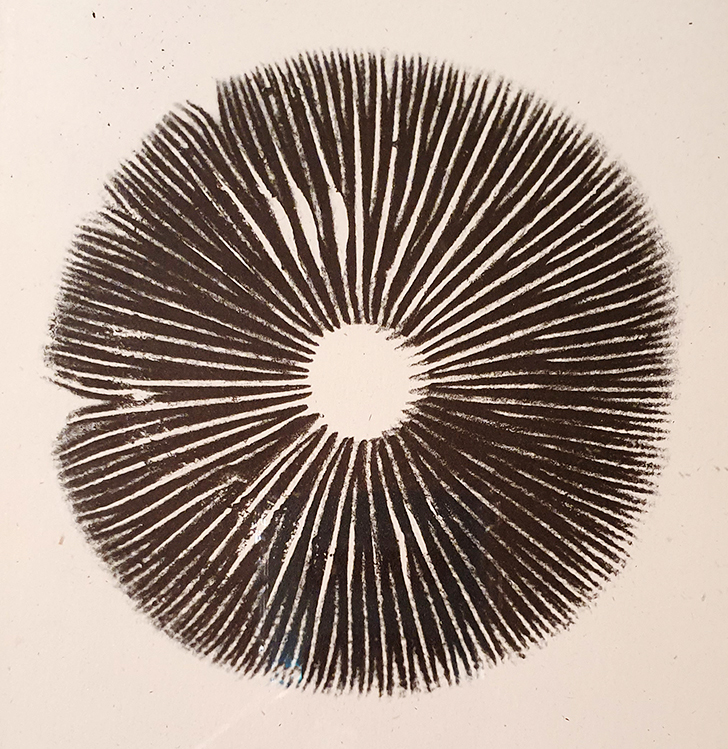
Reading Stones could be considered as the first instruments used to create an enhanced sensory experience. Originally made from ground and polished rock crystal or beryl they were placed over texts for the purposes of magnification. This early optical technology paved the way towards the observation of the furthest reaches of the universe and its minutest components.

1907 reading stones WIP 11907 reading stones WIP 2

Testing some lens options for visitors to use to read tiny hidden texts.

The act of “reading stones” can refer to both the scientific practice of geological investigation and the acroamatic ritual of lithomancy which seeks to interpret the patterns of stones cast by those wishing to divine the future.

1907 beryl structure scale

Looking at the molecular crystal structure of beryl to map out the structure for a video. The word brilliance is probably derived from the ancient Greek word for beryl, berullos.

The tower is defined by a magnificent 16th century clock whose mechanisms still strike the hours and occupy three floors connected by narrow stone spiral stairs.

1907 St. Augustine's clock.jpg

The nature of time itself was a concept that St Augustine of Hippo grappled with in his philosophical texts sixteen centuries ago and is still perplexing us today; namely, how to equate the subjective experience of time with an objective understanding.

The New Materialism Reading Group has meandered to the conclusion of Geoffrey West’s book Scale to discover an open ended question.  Can we avoid the mother of all singularities and the stagnation and collapse of civilisation with another paradigm shift through innovation or deurbanization?

“The time between the ‘Computer Age’ and the ‘Information and Digital Age’ was no more than about thirty years – to be compared with the thousands of years between the Stone, Bronze and Iron ages.

The clock by which we measure time on our watches and digital devices is very misleading; it is determined by the daily rotation of the Earth around its axis and its annual rotation around the sun. This astronomical time is linear and regular. But the actual clock by which we live our socioeconomic lives is an emergent phenomenon determined by the collective forces of social interaction: it is continually and systematically speeding up relative to objective astronomical time.”    Geoffrey West

1907 stonehenge.jpg

We also looked at an article from the Guardian questioning Donna Haraway on her position relative to a post-truth society.

1907 Donna Haraway

Referring back decades to what seems a golden age of freedom and creativity she was clear that she never advocated truth as just a perspective; that reality is not a question of belief but of worlding, inhabiting and testing if things hold. She stresses the importance of not shying away from ‘strategic essentialism’ which is using the same language as those you wish to engage and make progress with and opening up to what is possible through play and creativity. There are huge problems to address. But don’t be negative.

1907 fireball.jpg

I have also been reading Antimatter by Frank Close. Fascinating to read about the dazzling explosive fireball witnessed in a remote Tunguska river valley in 1908, a thousand miles east of Moscow, which left a charred circle of devastation; threw so much dust and smoke into the atmosphere around the globe that in London the midnight sky was lit up by photons scattering off the dense air pollution; but left no crater.

1907 Tunguska event

Antimatter is found on Earth in the form of the positron. These positively charged electron are produced by some radioactive elements. They are used in PET scanners – positron emission topography where the flash of gamma ray produced as the positron immediately bumps into an electron and annihilates is recorded to map out an image.
In the extreme temperatures at the centre of the sun where atoms are unstable, positrons emerge, annihilate into gamma rays and begin a hundred thousand year journey of transformation to the surface of the sun eventually emerging as daylight to nurture life on Earth.

1907 sunlight.jpg

Energy is stored in matter. Whatever antimatter touches it will destroy, releasing more energy more explosively than anything else we know.

The difference between bodily warmth and a chemical explosion is just a question of timescale. If time were compressed and the energy delivered to the body from a meal were given out in a millisecond the results would be explosive!

1907 Lee Krasner 1

Lee Krasner 

Lee Krasner (1908 -1984) led a commission for the War Service in 1933 to design public information window displays. She included photographs from classes she attended as part of her research – the class on explosives she described as ‘an alchemist’s dream’. Showing in Living Colour at the Barbican.

1907 Lee Krasner 2

Lee Krasner Imperative 1976 Future Indicative 1977

Exciting use of projectors and collaged film with much poignant material particularly a shocking ever increasing list of those who have died in search of a better life in Lis Rhodes Dissident Lines at Nottingham Contemporary.

Incredible night at The Royal Albert Hall with Public Service Broadcasting performing Race For Space Late Night Prom.

1907 race for space prom1907 race for space prom 2

It was a unique coming together of technological and geopolitical events that inspired an explosive burst of development for the human race. It also touches deeply on our spiritual side as a species, making us ask bigger questions about the universe and our role within it, as well as drawing attention to the bravery of so many of those involved on both sides.

J. Willgoose, Esq., of Public Service Broadcasting