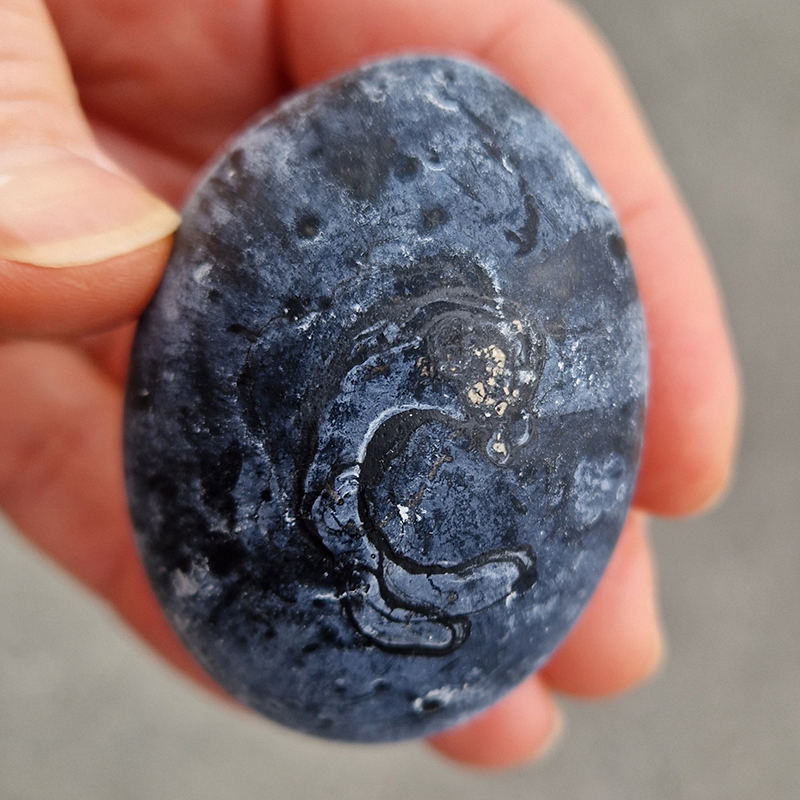
Archives for posts with tag: directional magnetic steel

In classical antiquity, a time stretching from Homer to the early middle ages, geographic orientation usually referred to landmarks or astral phenomena to determine direction. Eos, meaning dawn, and Hesperus, meaning evening, were named for sunrise and sunset with north (arctos) being marked by the constellation Ursa Major and later the Pole Star. The winds also became associated with direction and named in accordance with their qualities such as hot and humid or cold and dry.

The number of points on a wind rose began with the four cardinal points that were added to and refined over time. Aristotle designed an asymmetrical 10 point wind rose for “the study of things high in the air” (meteorology) which was later refigured by Timosthenes, a 3rd century BCE Admiral and geographer, naming a system of twelve winds and using this as a tool for navigation. The contemporary compass has its roots in the ancient classification of winds.

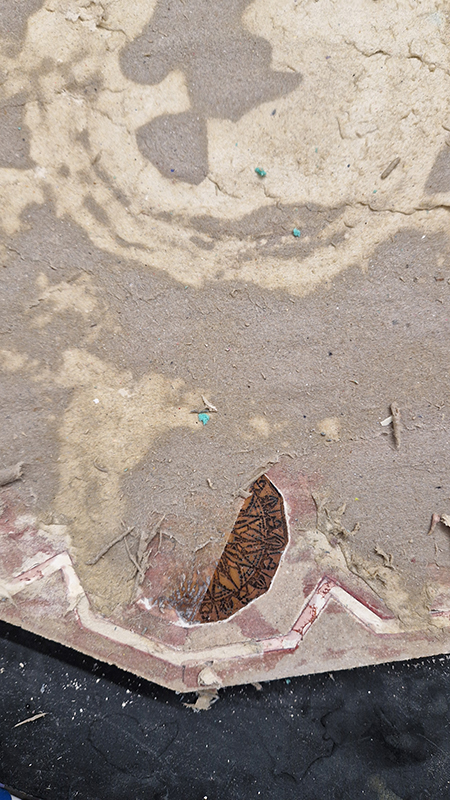
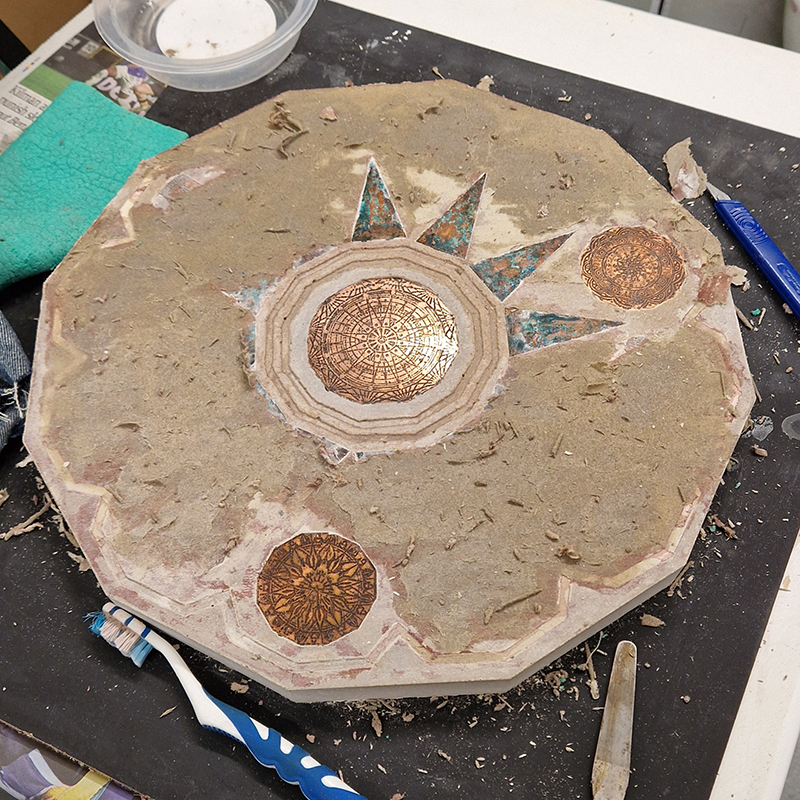
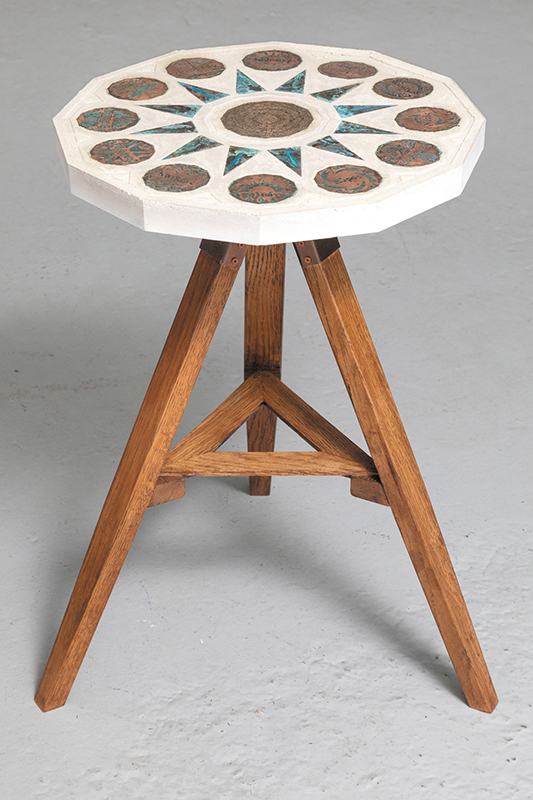
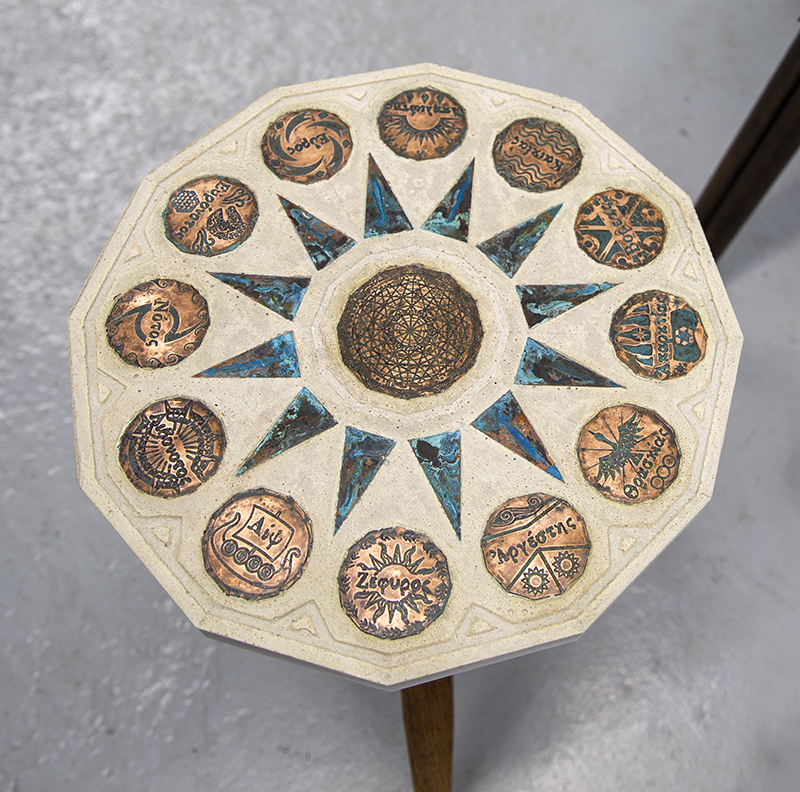
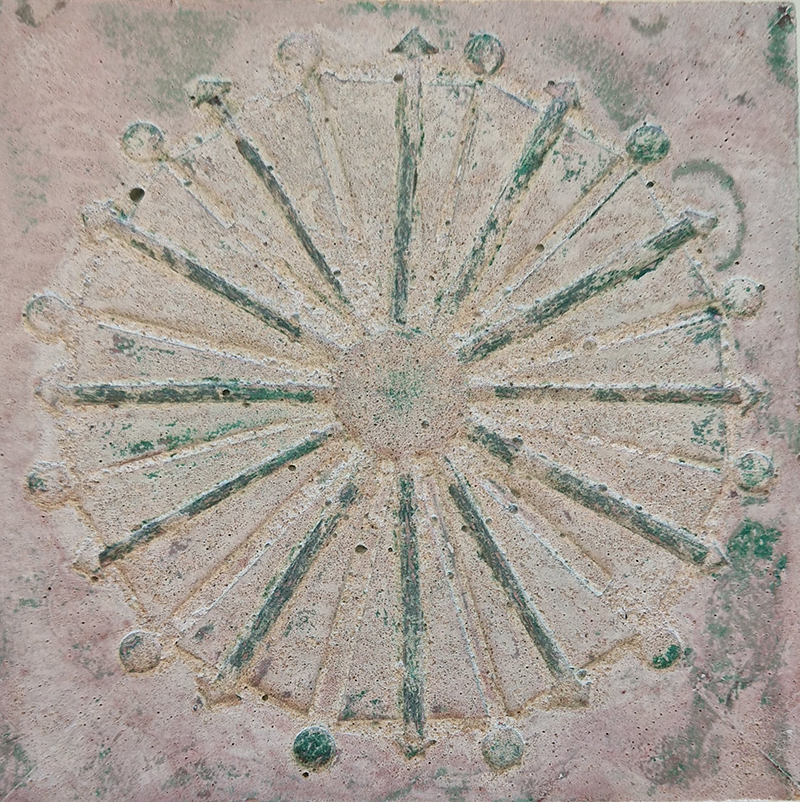
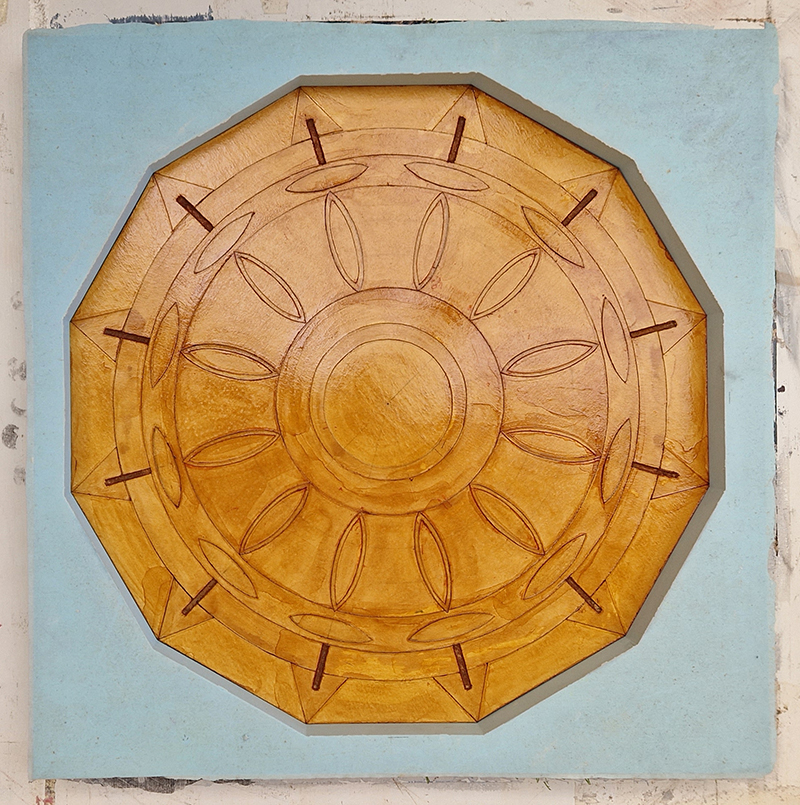
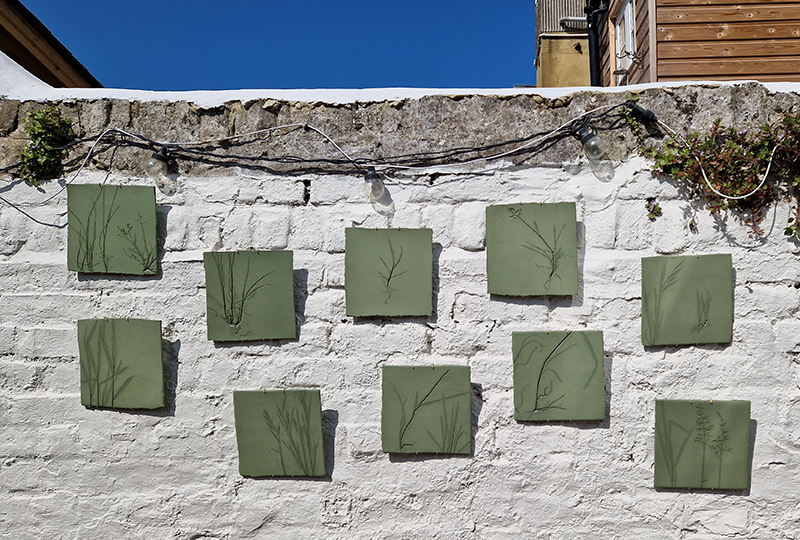
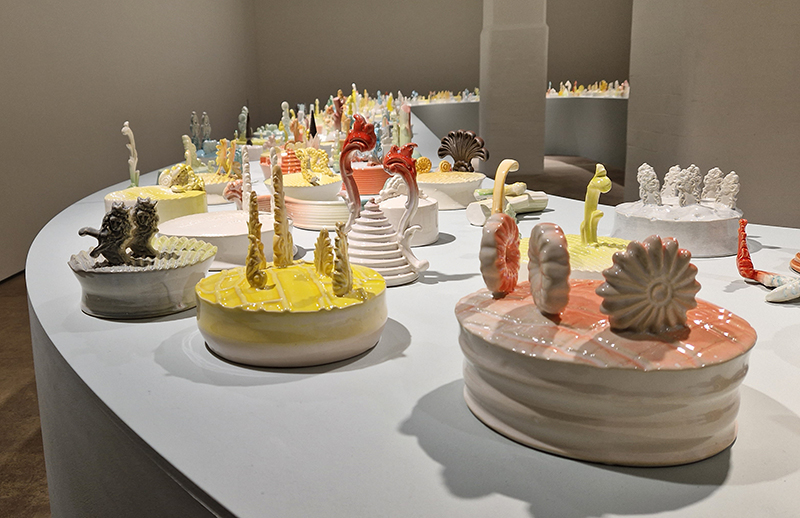
Freshly excavated. A new tablet for the series Instruments of the Anemoi, replacing a previous one based on the idea of a wind rose and set with etched copper markers, the designs of which are influenced by characteristics of the gods (anemoi) represented by each of the twelve winds.
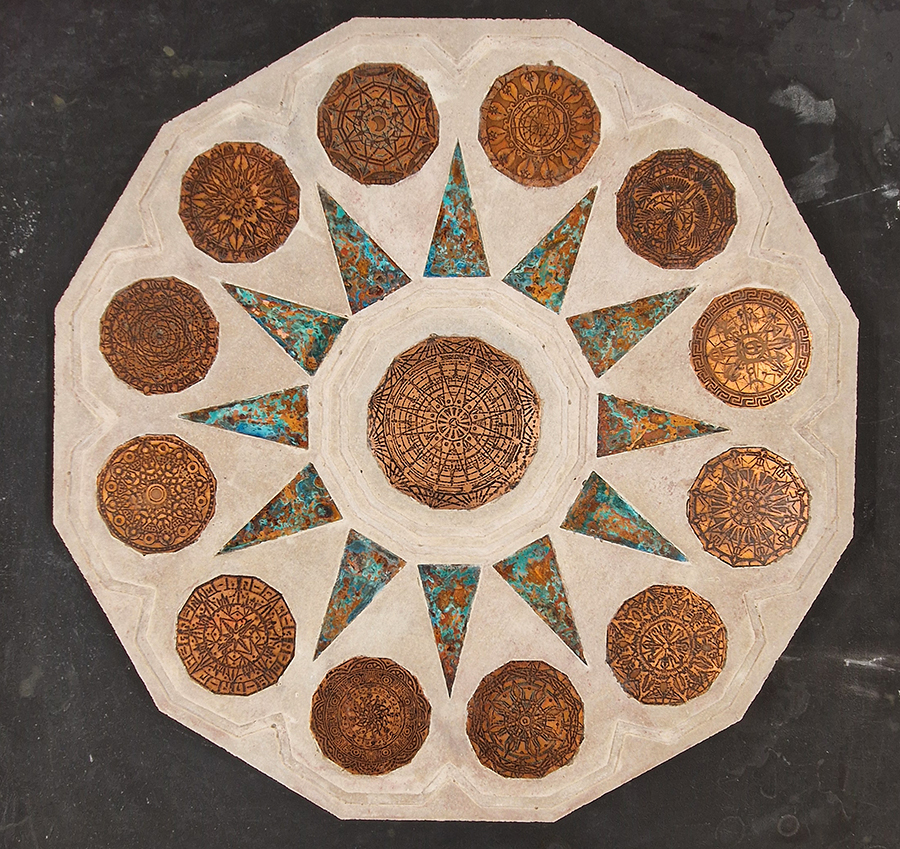
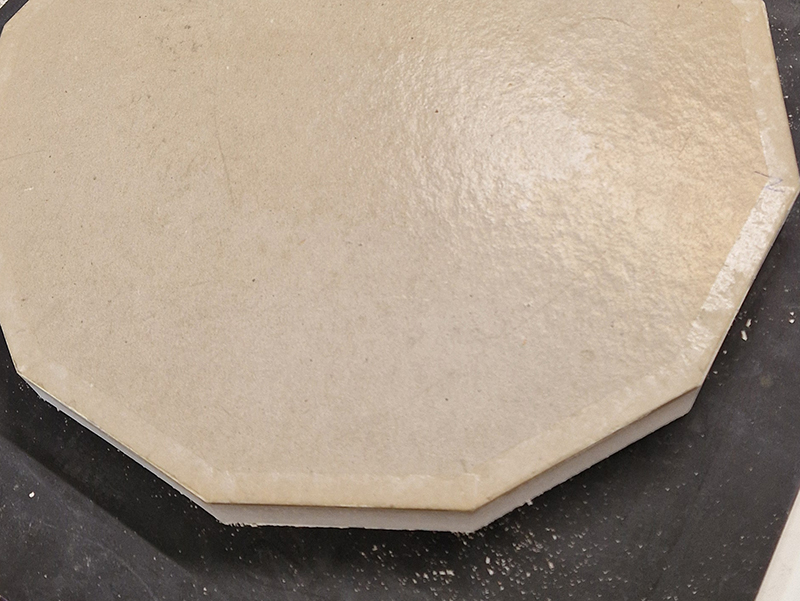
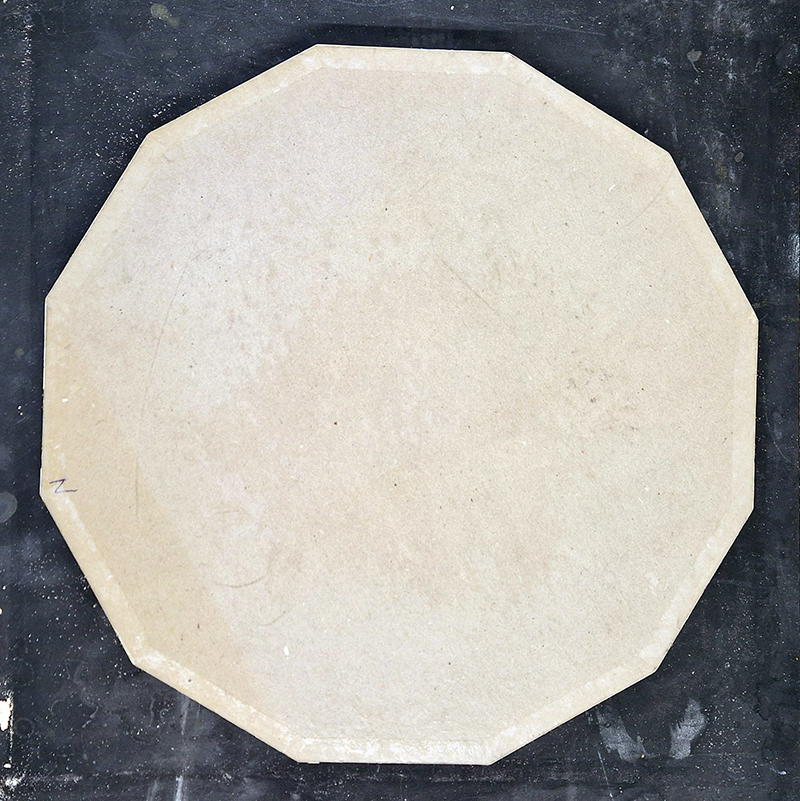
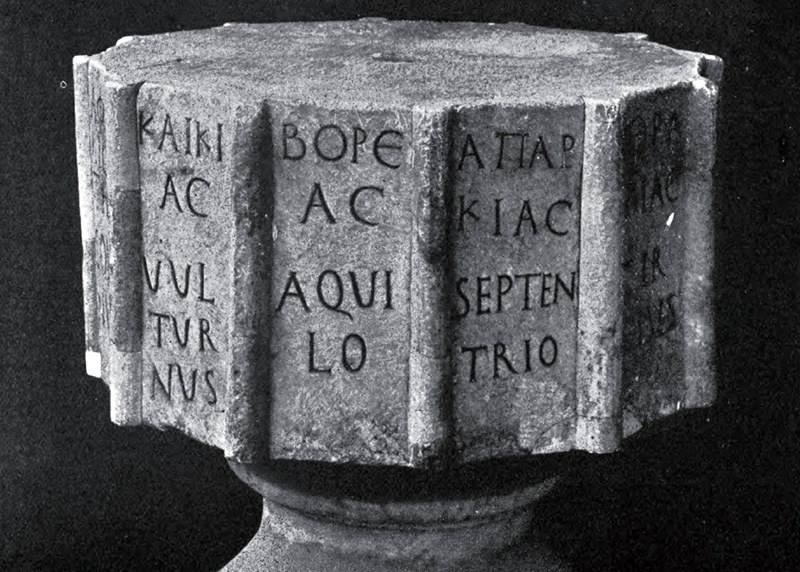
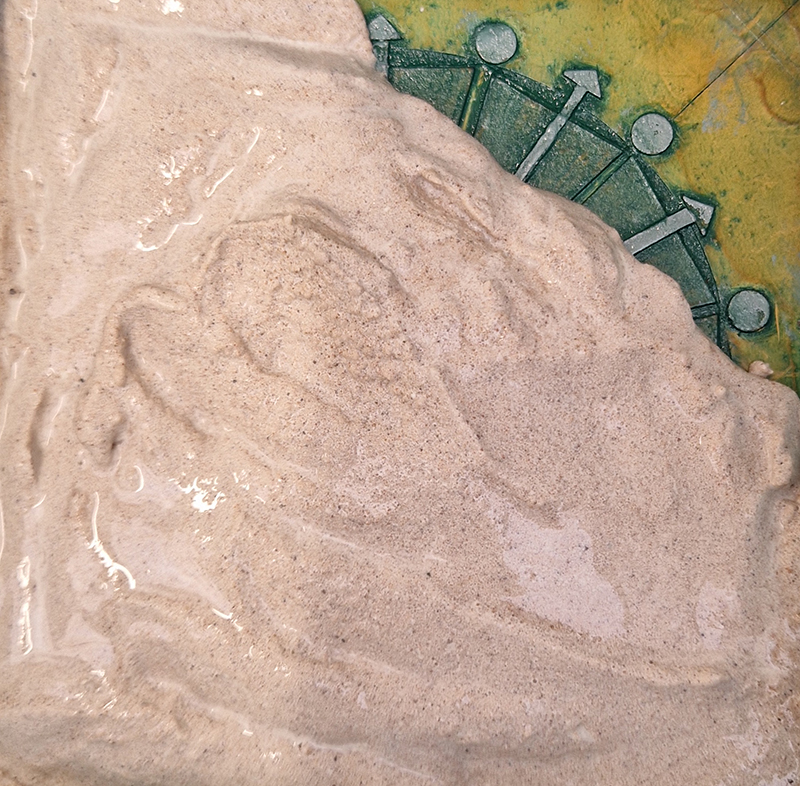
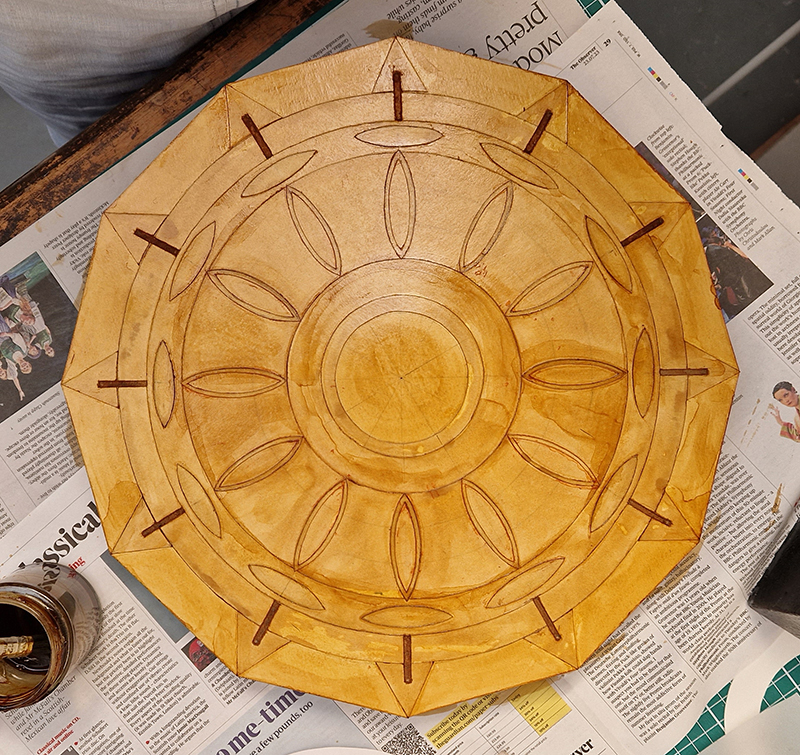
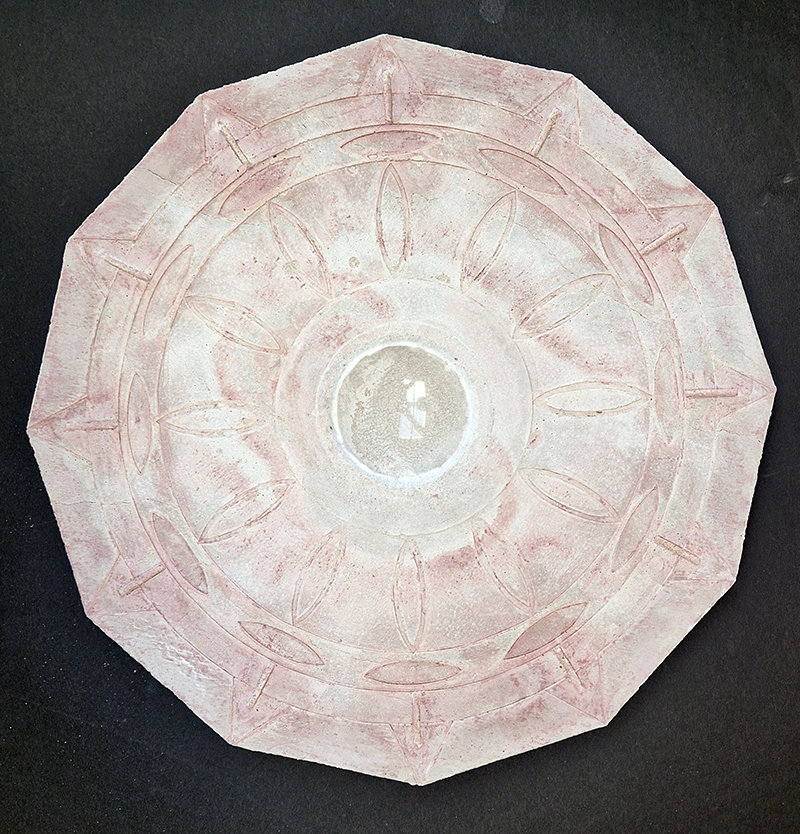
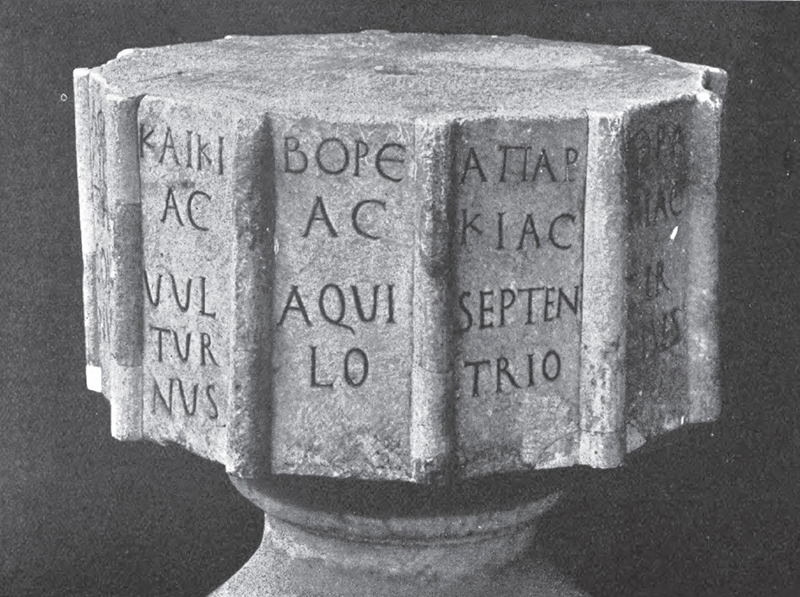
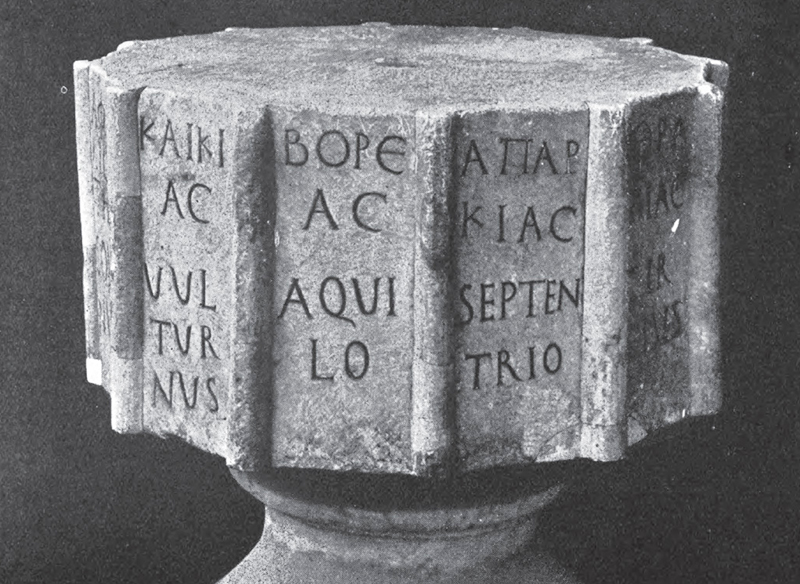
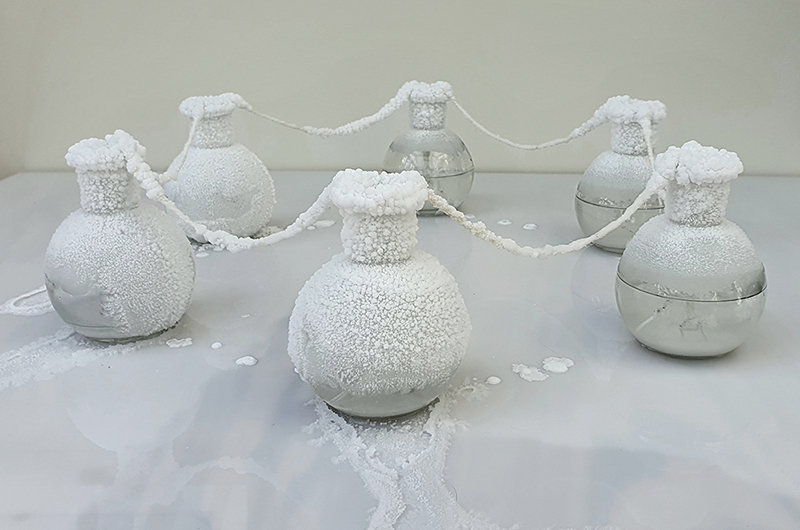
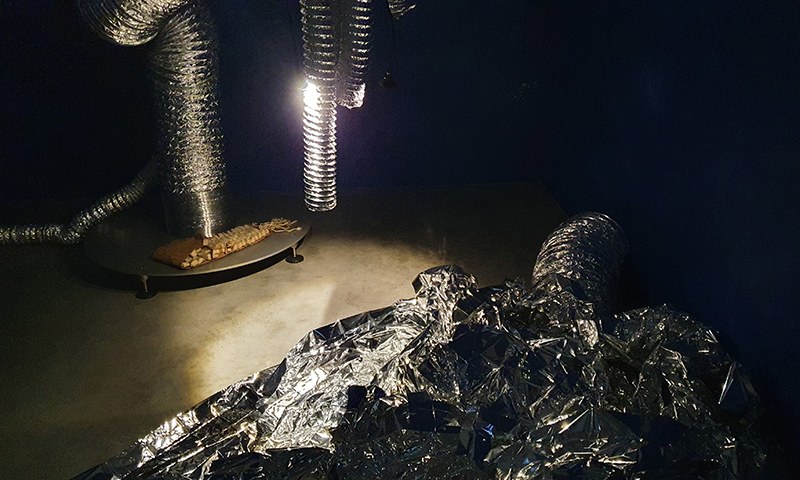
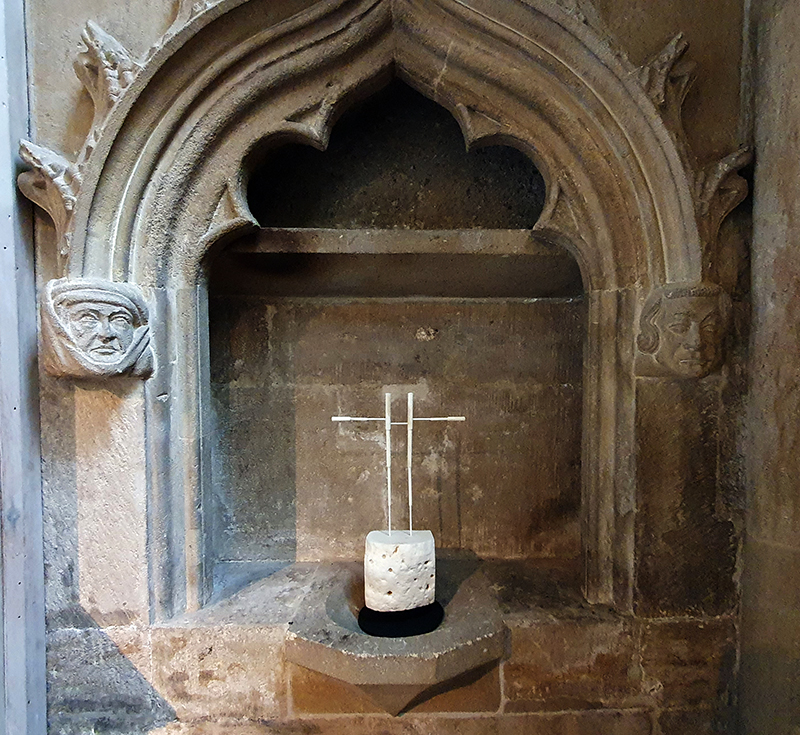
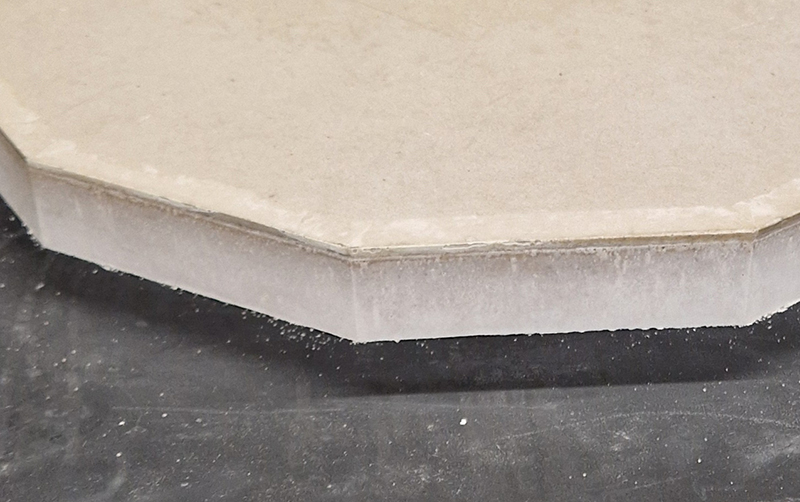
Instruments of the Anemoi are a set of dodecagon tablets cast in Snowcrete, a cement with no magnetic minerals, as is used for instrument pedestals at a magnetic observatory. They also respond to a twelve sided anemoscope “table of the winds” carved in marble around eighteen hundred years ago and held at the Vatican Museums. Releasing the cast from the mould and collagraph is a rewarding process – if all the pieces have held their position during the concrete pour and vibrating to release trapped air bubbles. Luckily this time was a success.

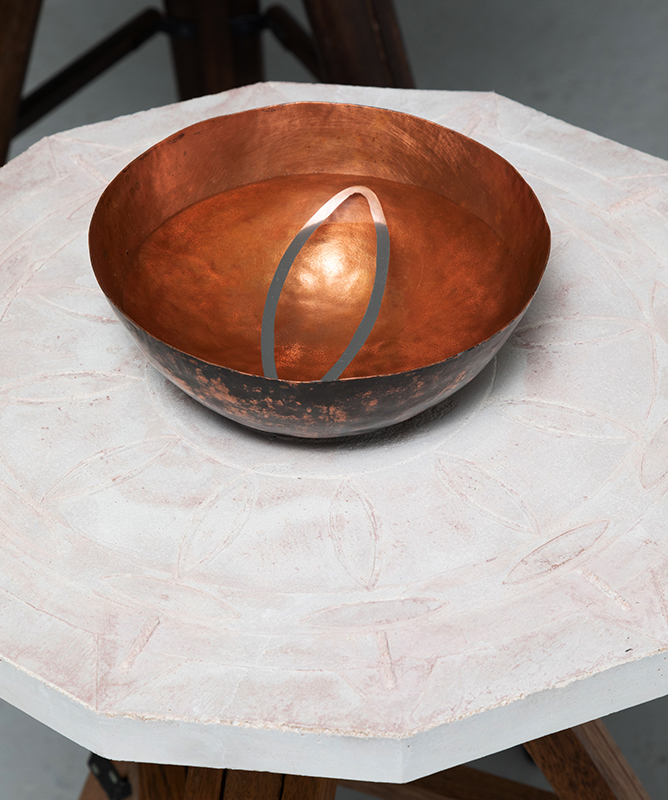
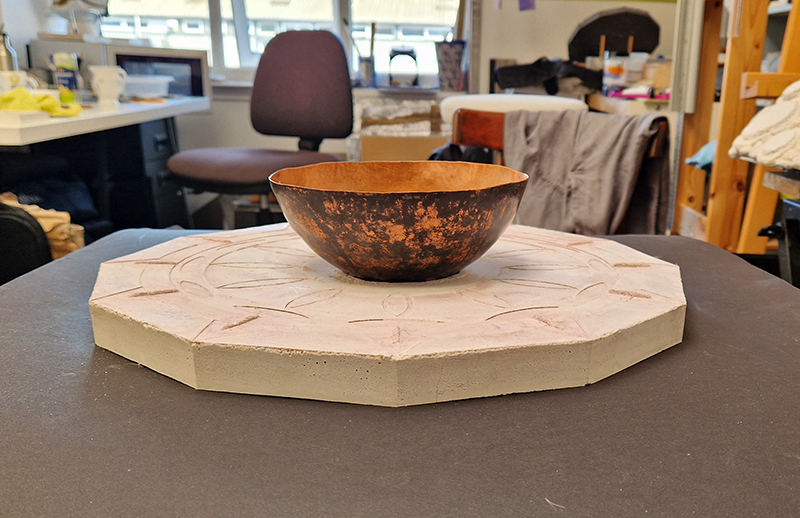
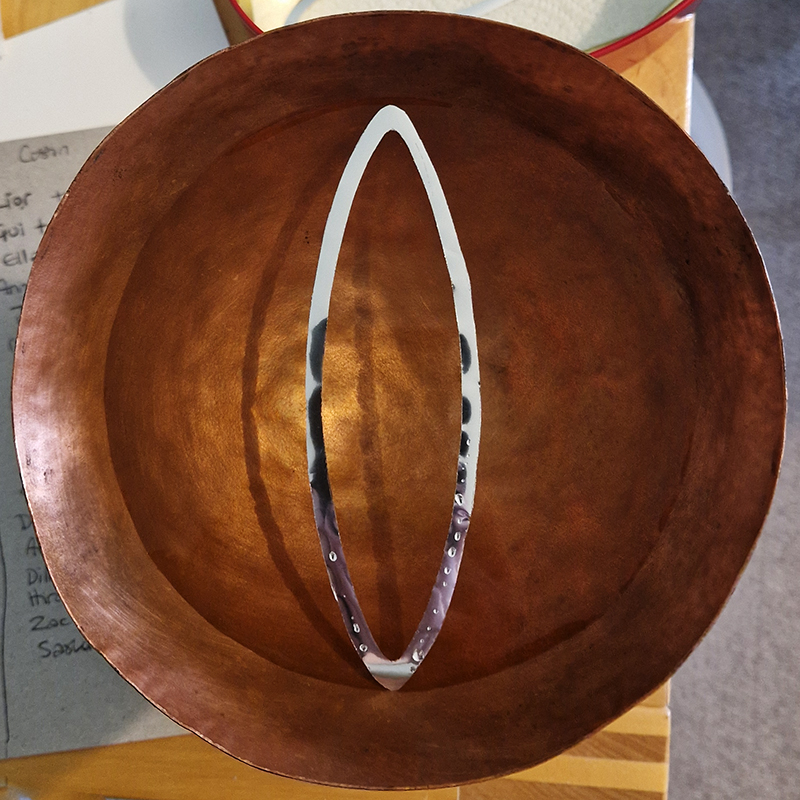
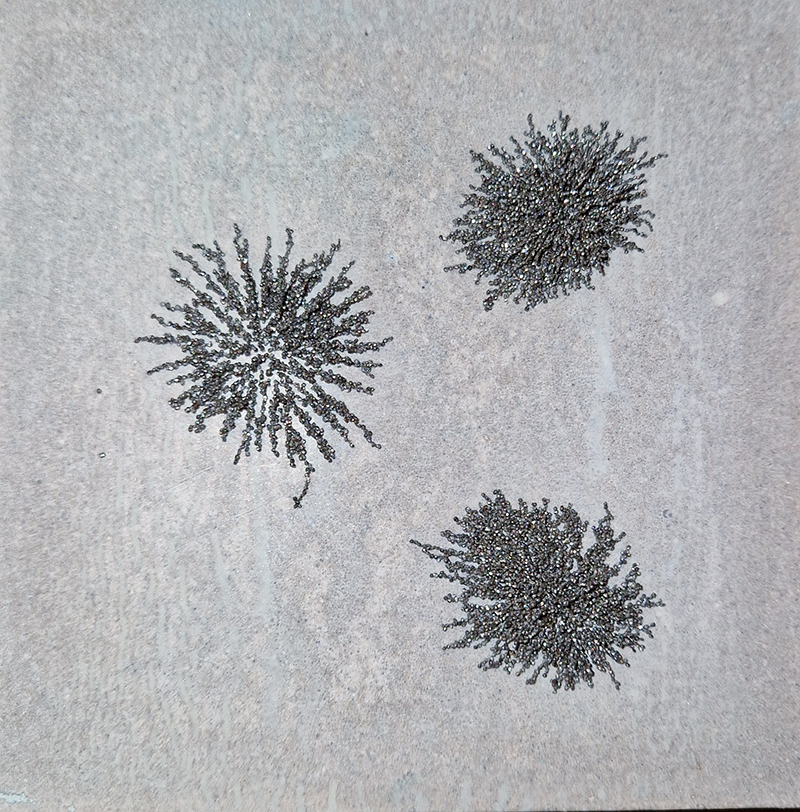
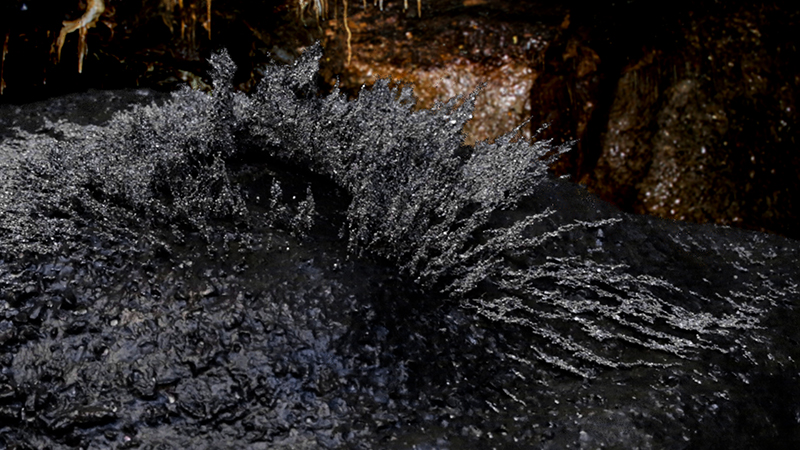
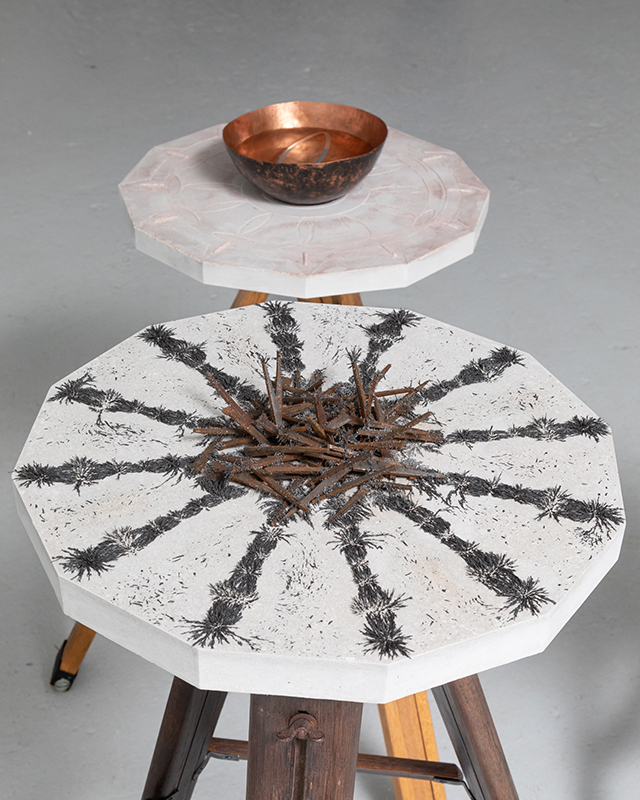
The other two sculptures in the series. A hand beaten copper bowl with a ‘silver fish’ floating in water based on the oval shaped compass needle illustrated in Breve Compendio de la Sphera de la arte Navegar by Martin Cortes 155. Wafer thin fish shaped iron leaves were also used by 11th century Chinese geomancers. Nails and iron filings reveal an embedded magnetic field and hark back to a legend on the discovery of the lodestone, a naturally magnetic mineral, which recalls a Greek shepherd who noticed the nails in his boots were attracted to the rock beneath his feet.
Unsettling to find it is already one year on since A Stone Sky duo exhibition with Julie F Hill opened at Thames-side Studios Gallery and this work was first shown.

Around 95% of the universe is ‘dark’ to us, formed of unknown and possibly unknowable matter which may be inaccessible to us, but cosmic rays offer a tangible contact with outer space.   

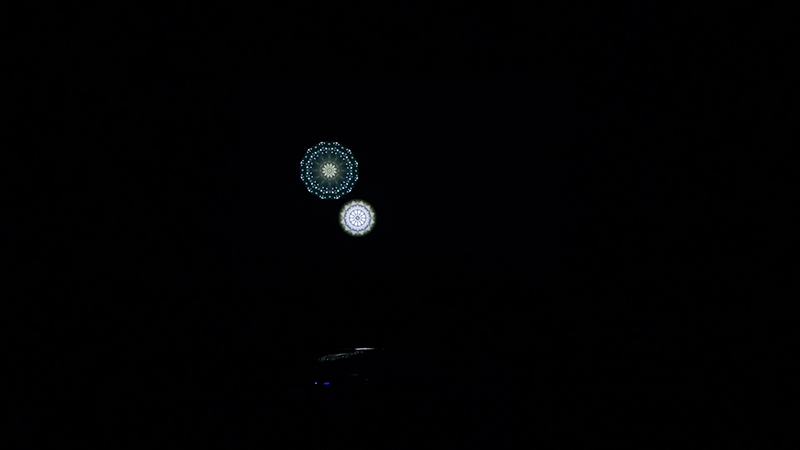
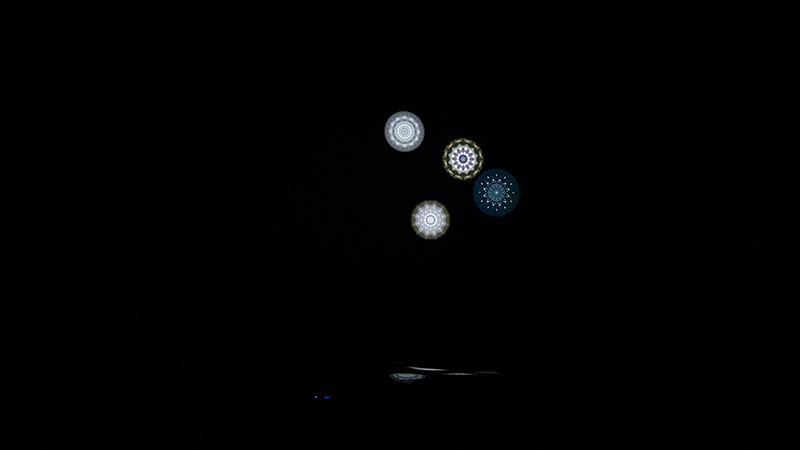
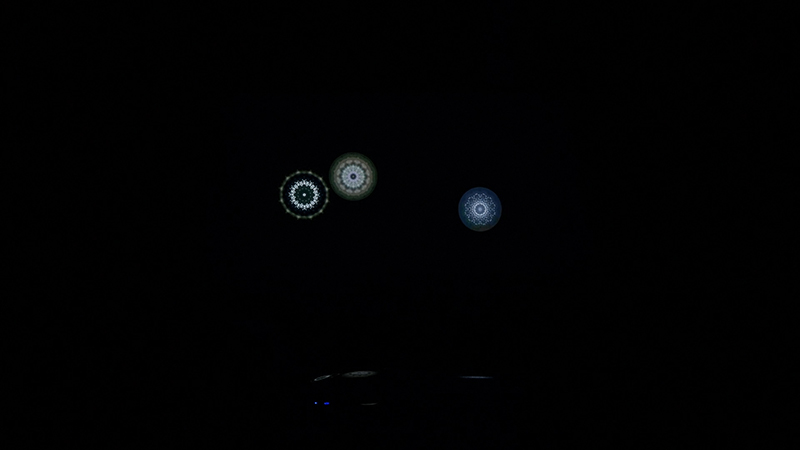
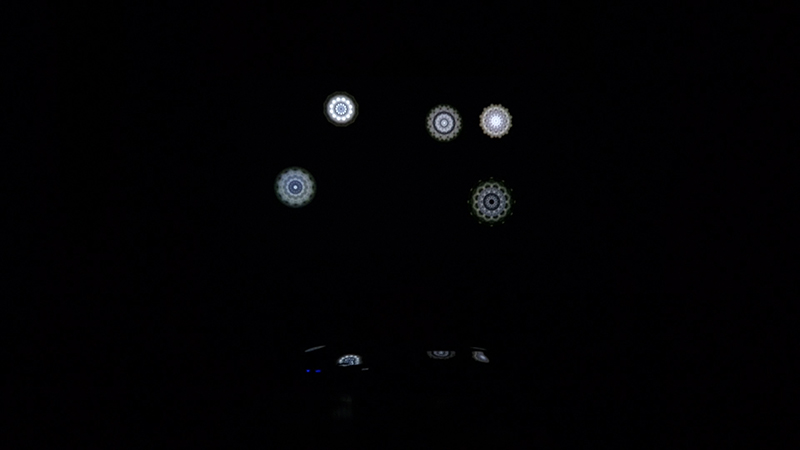
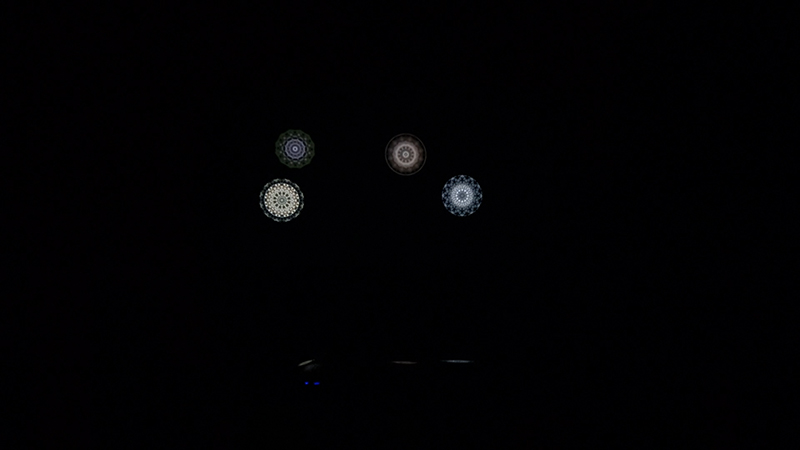
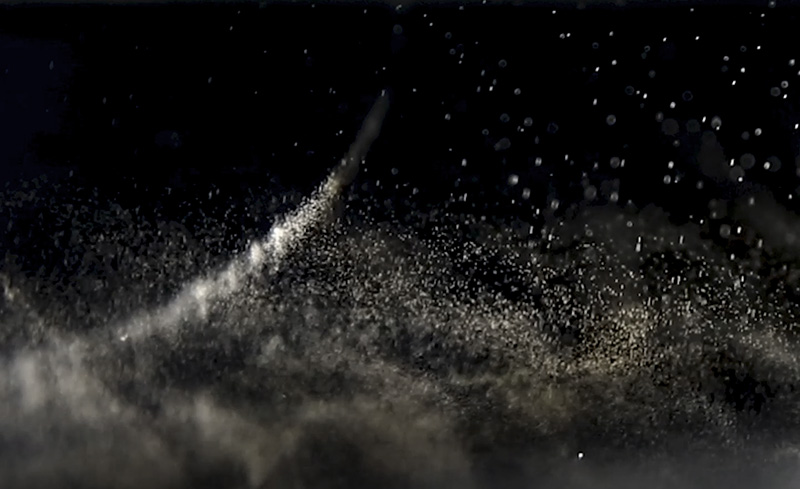
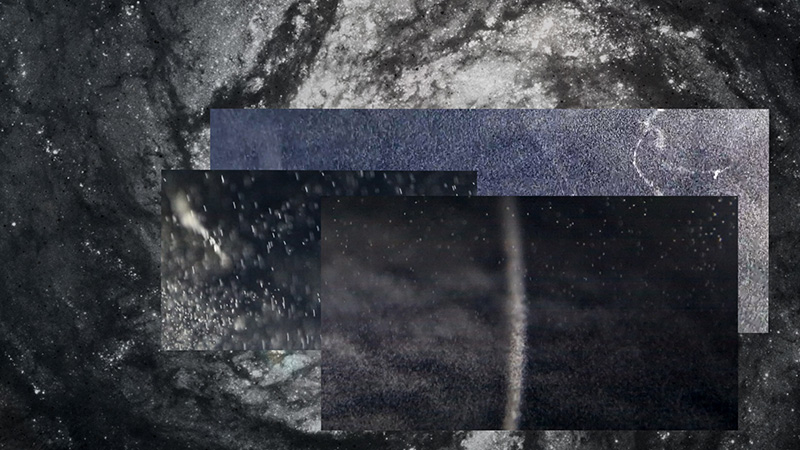
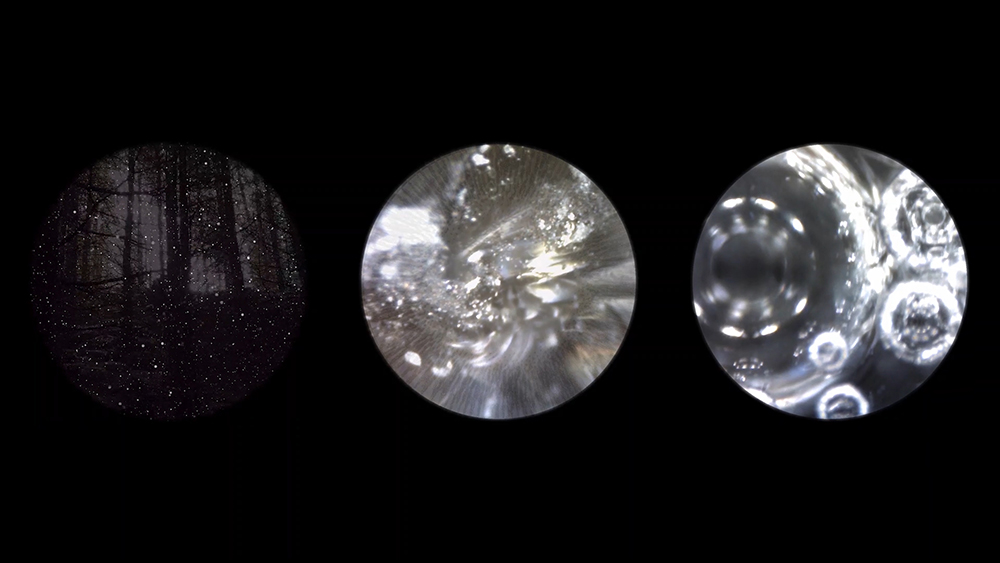
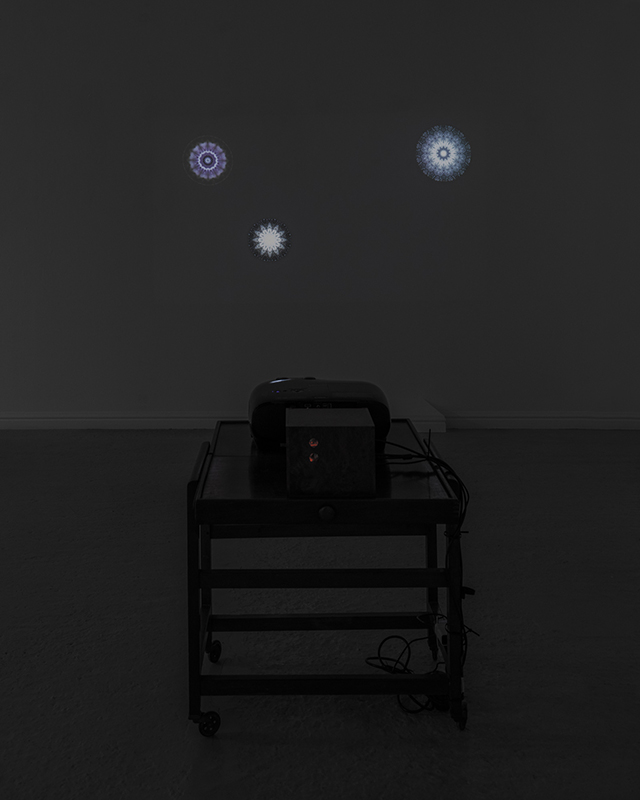
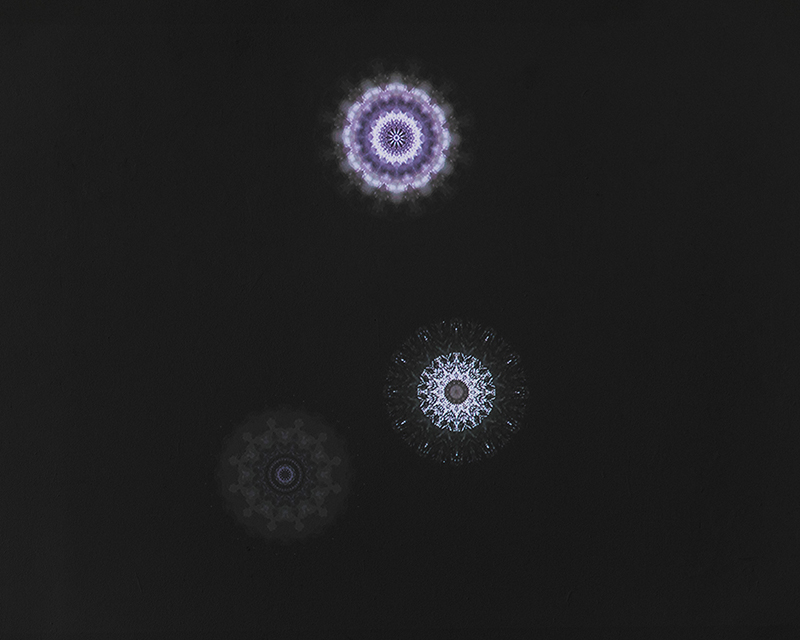
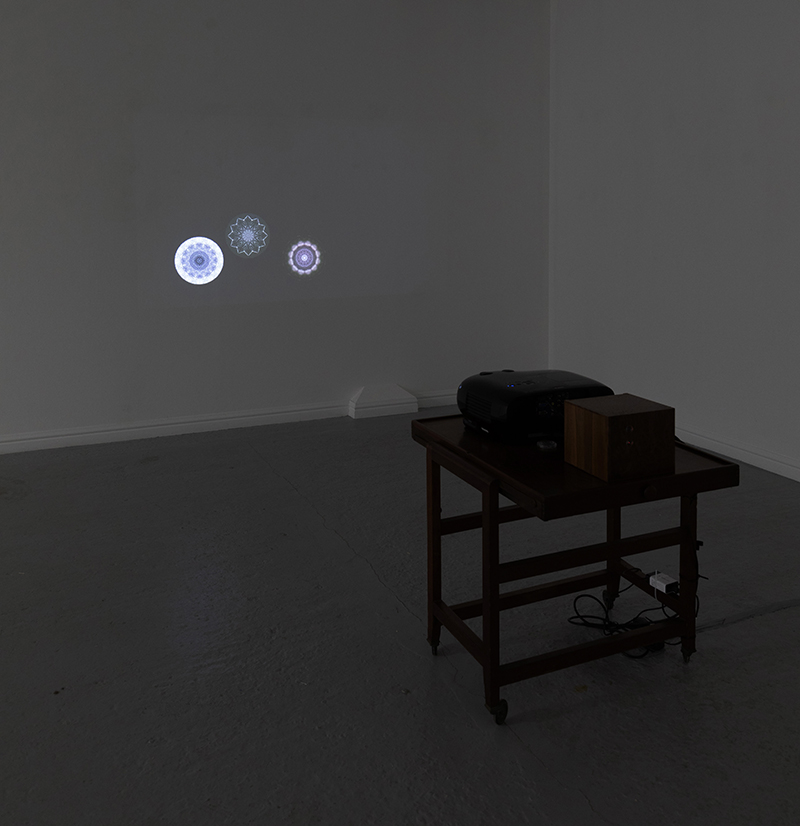
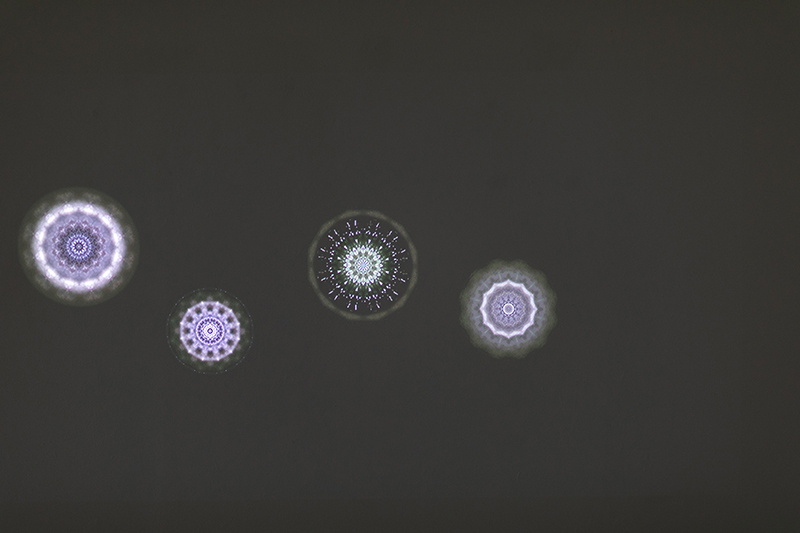
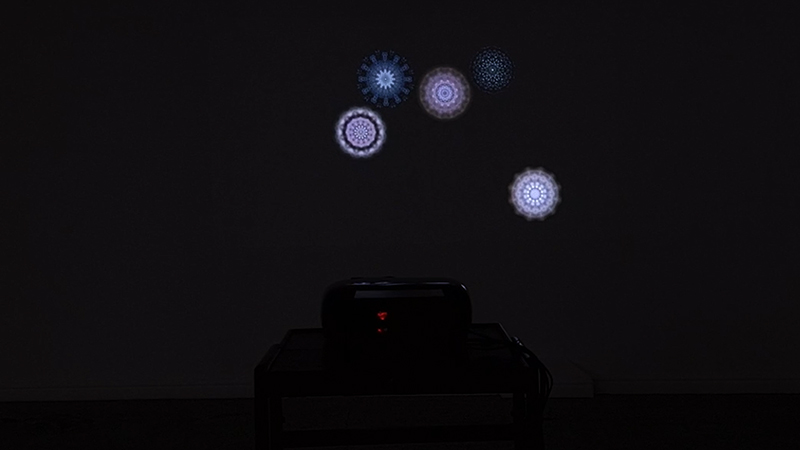
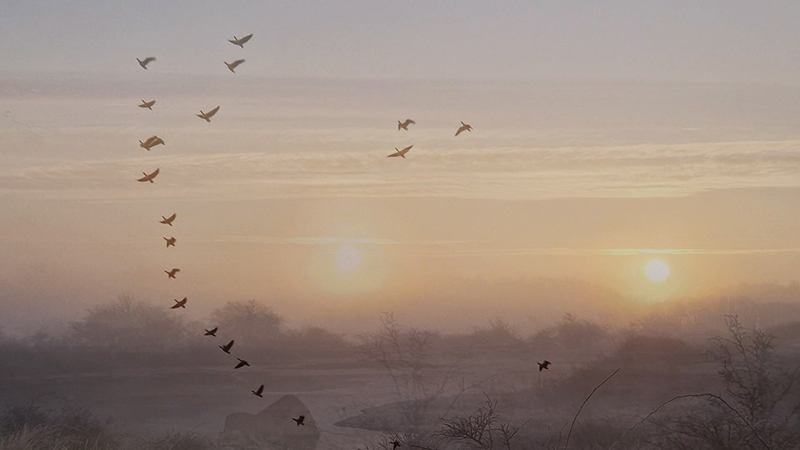
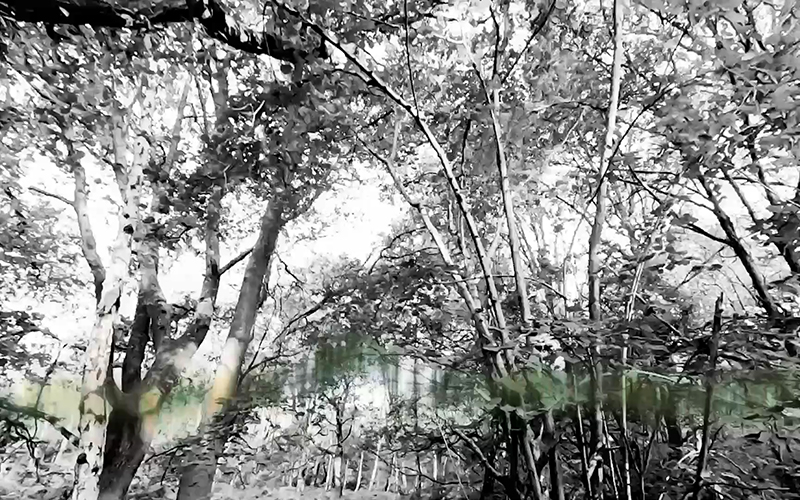
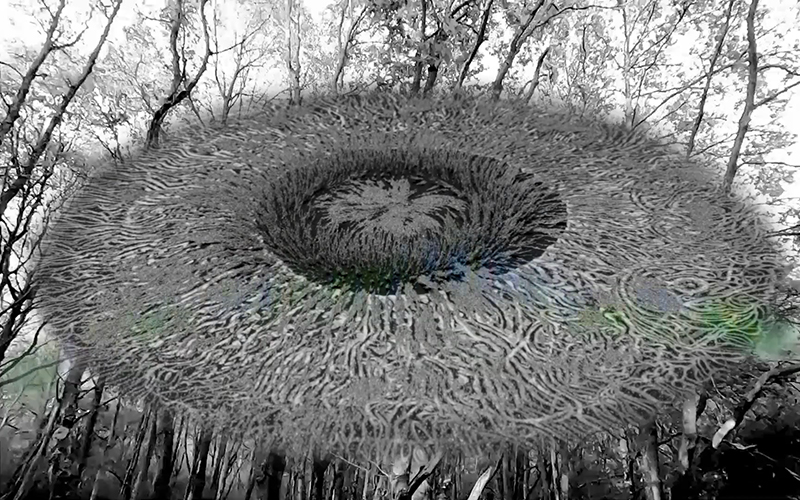
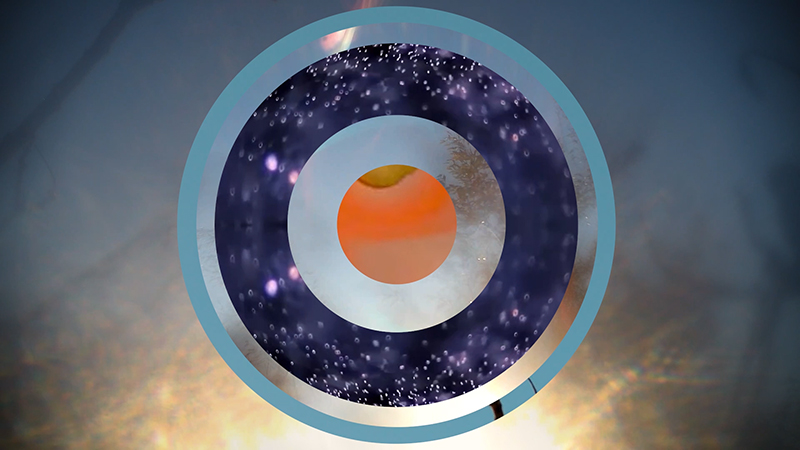
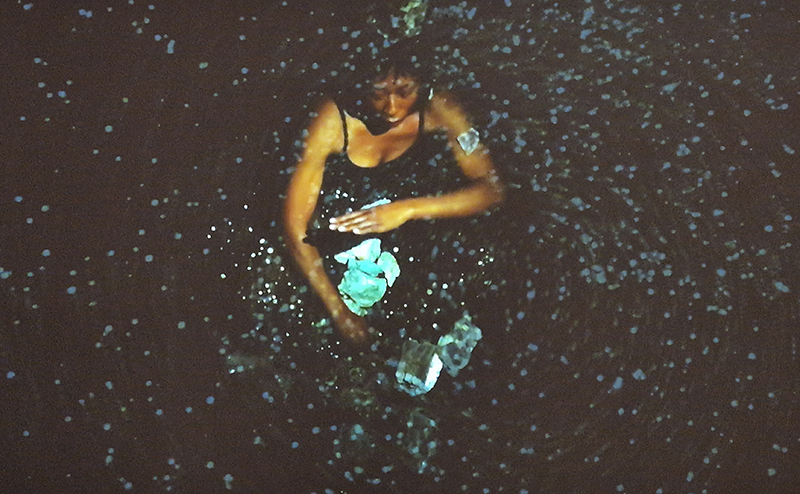
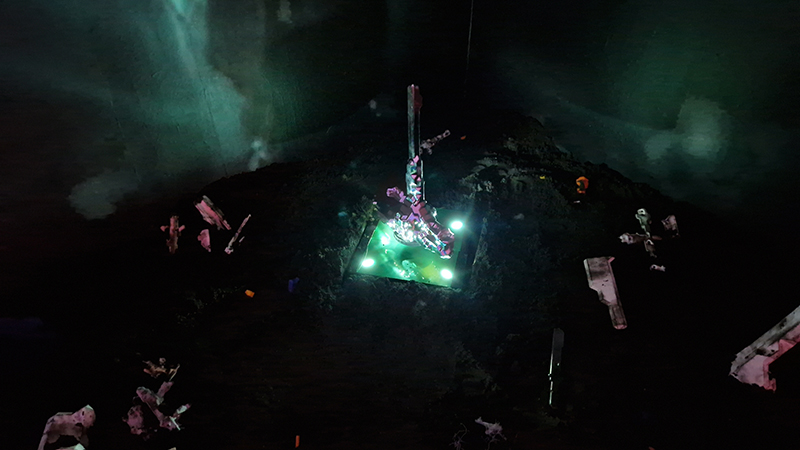
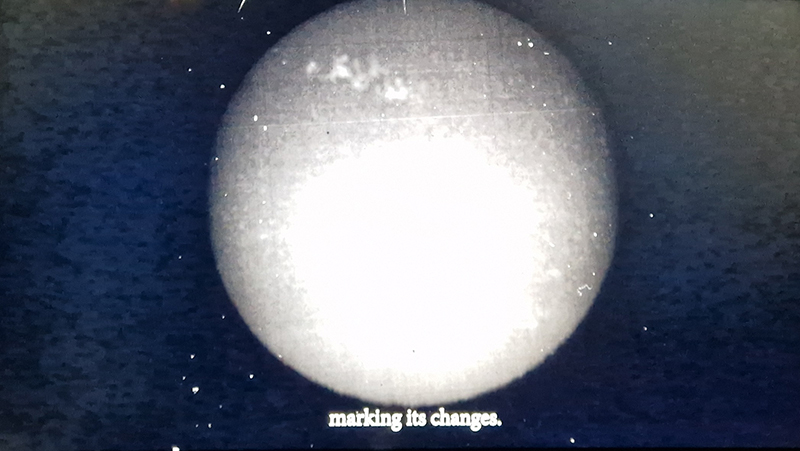
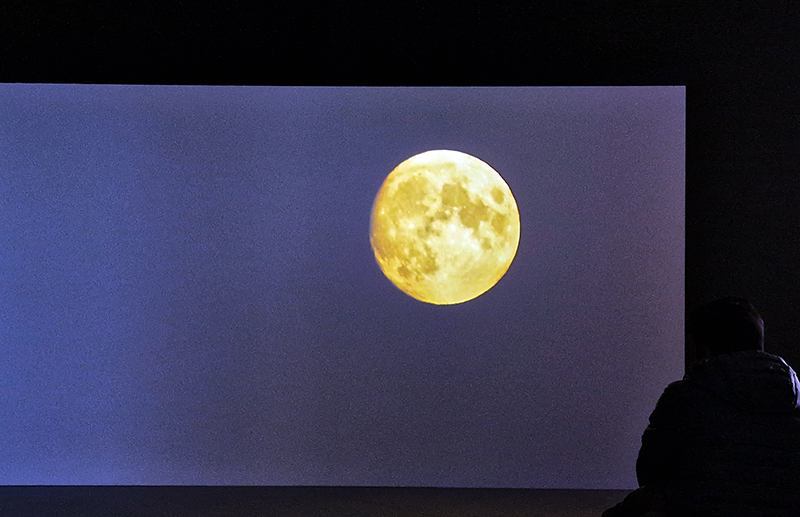
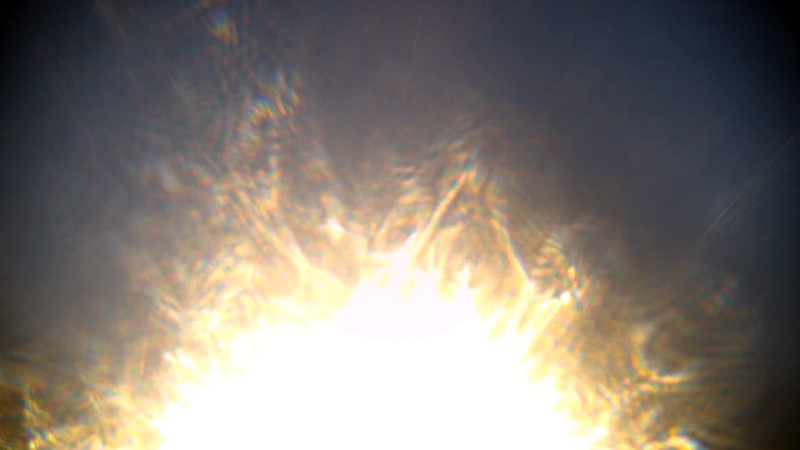
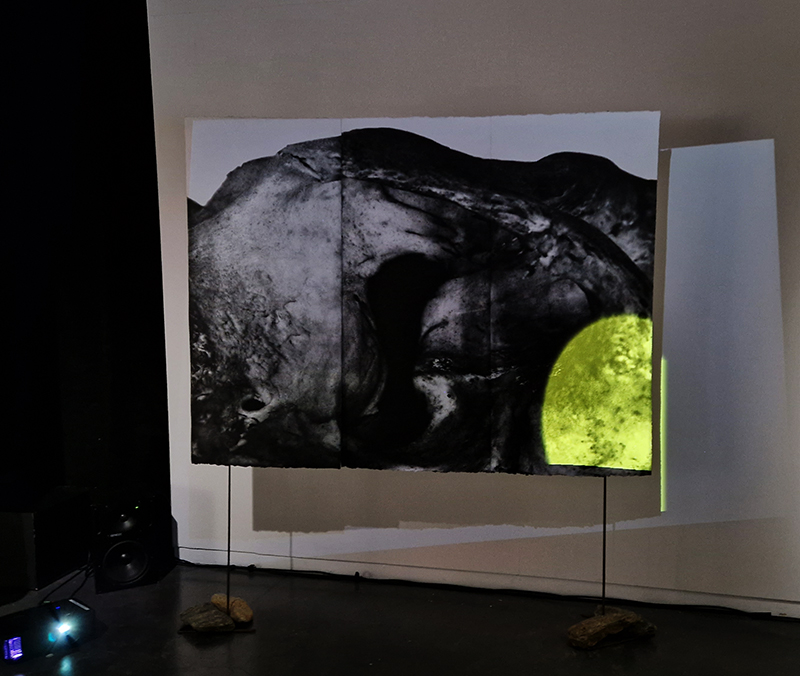
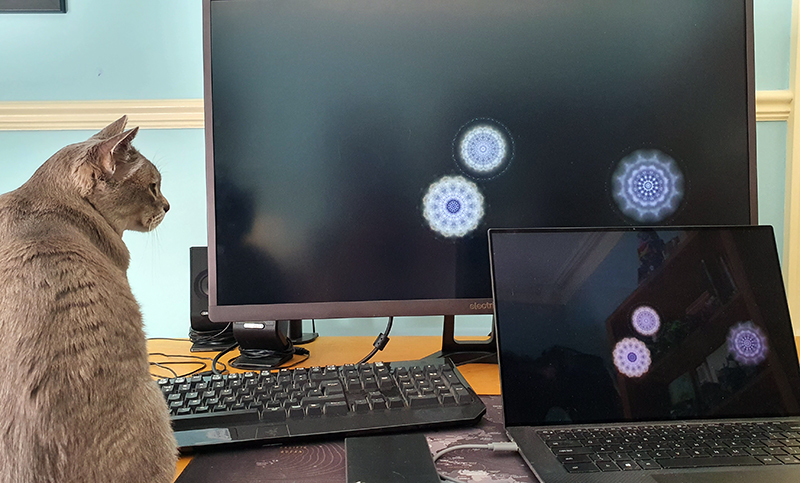
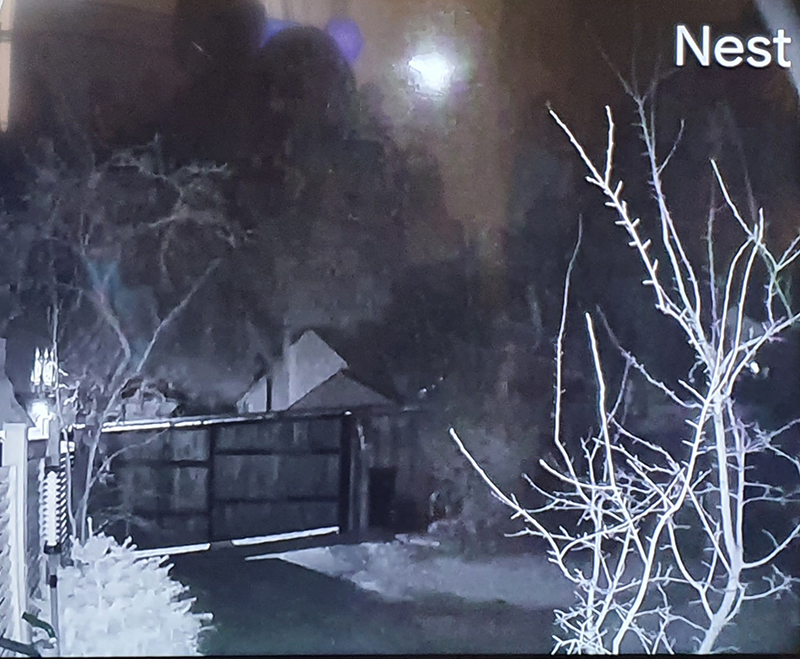
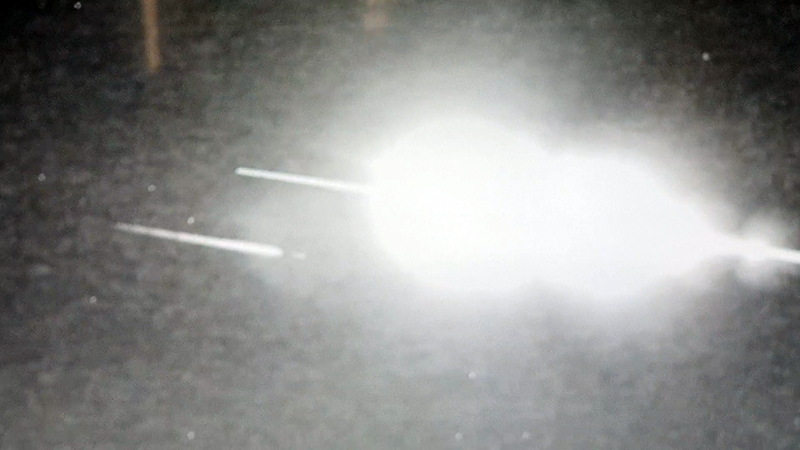
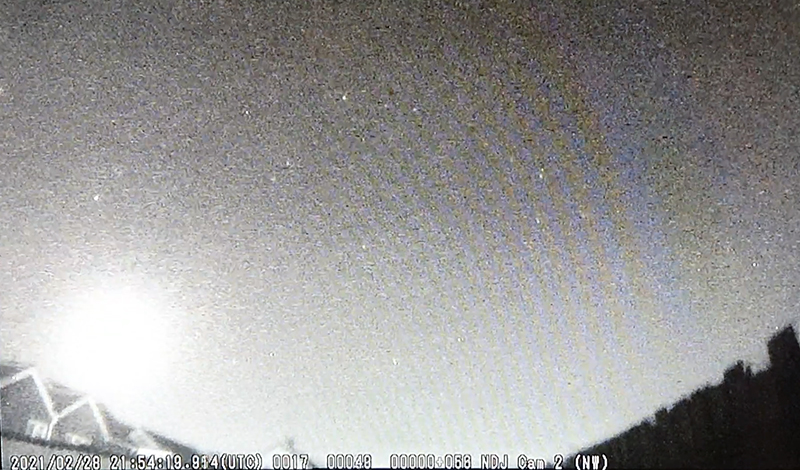
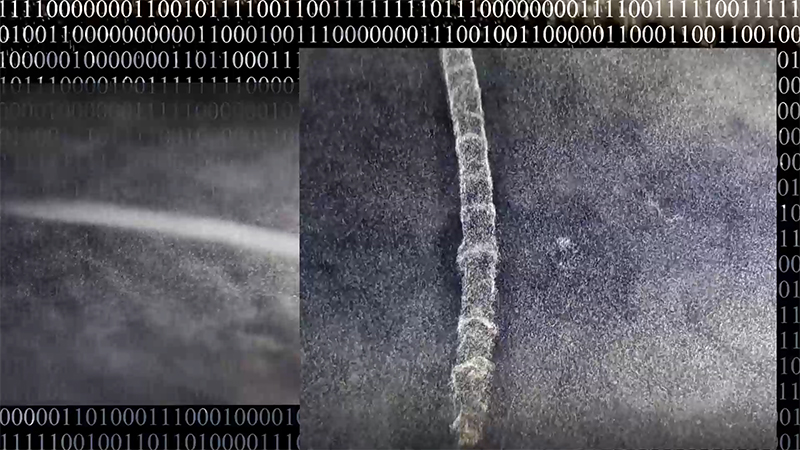
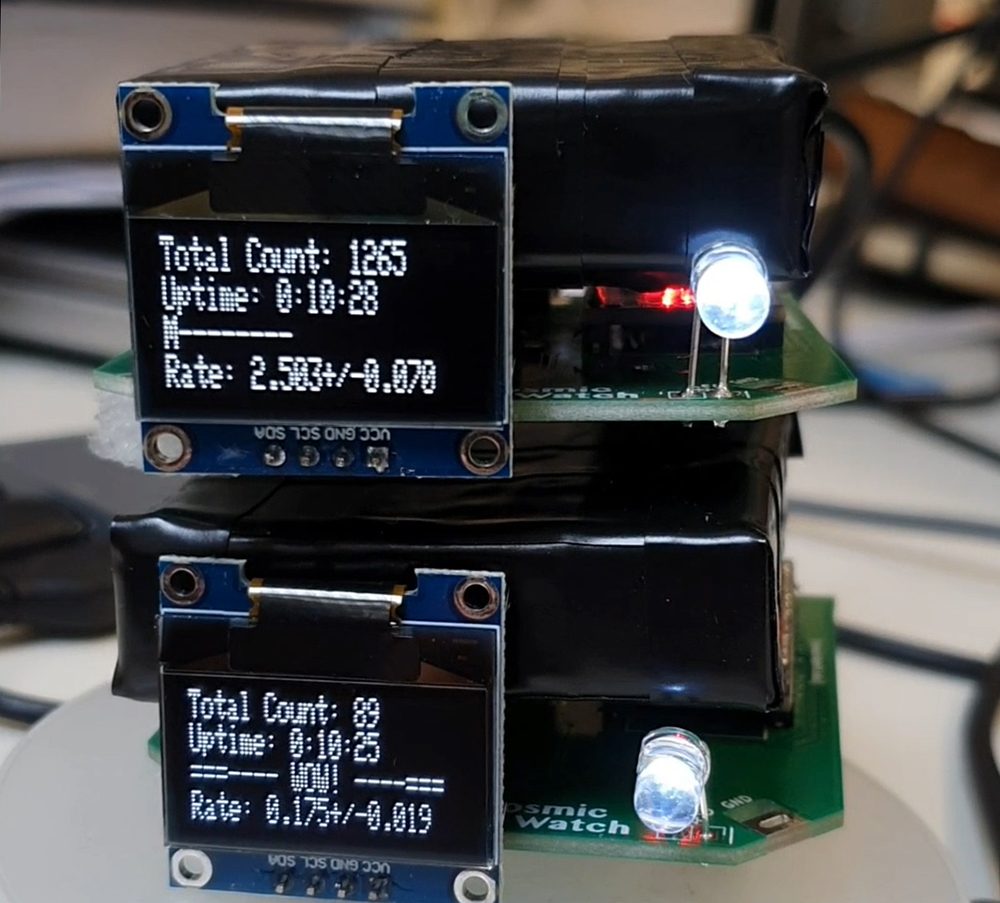
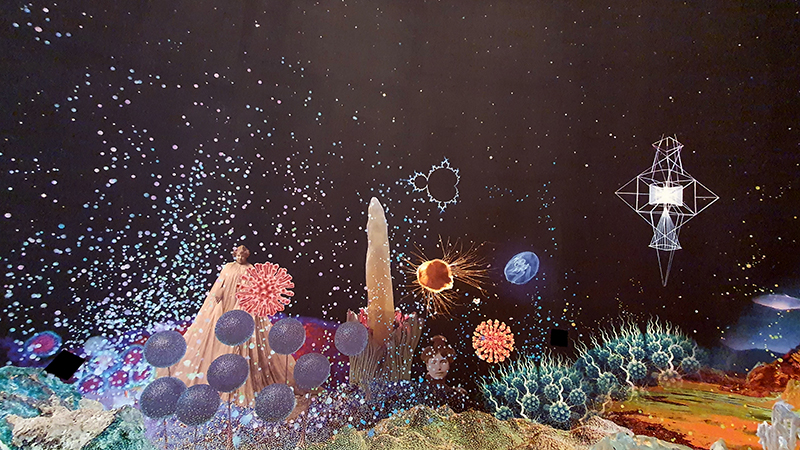
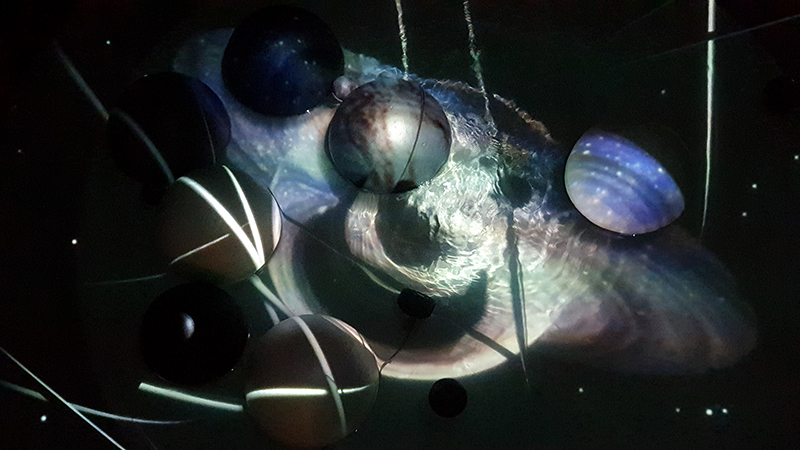
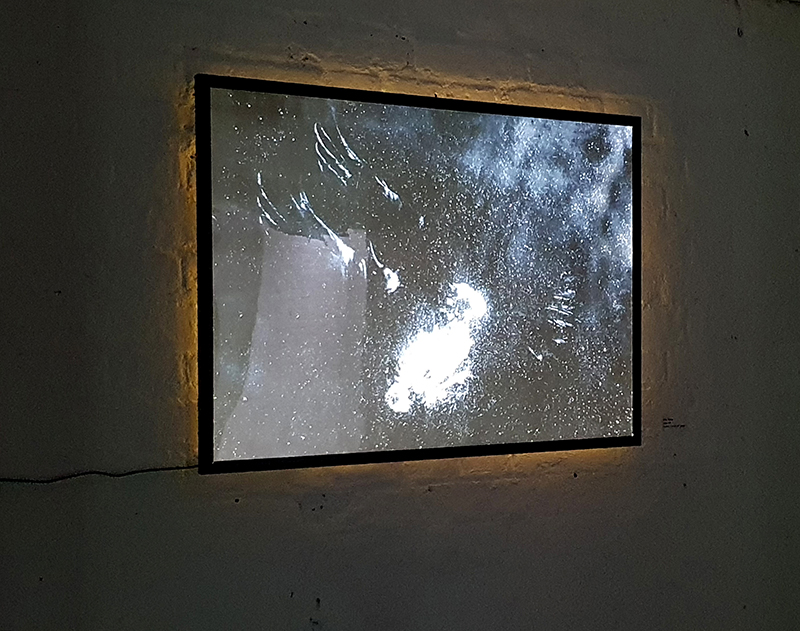
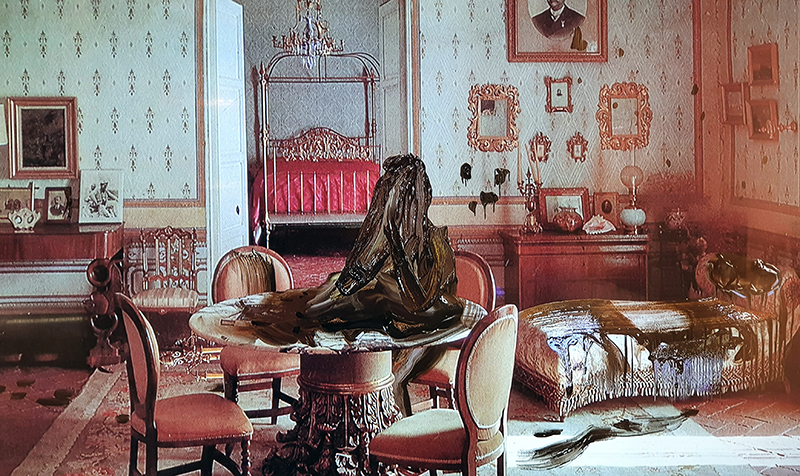
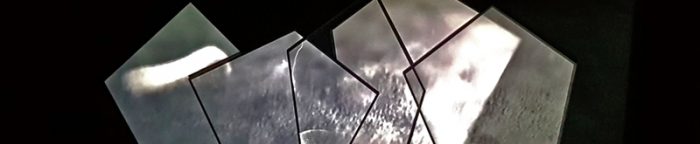
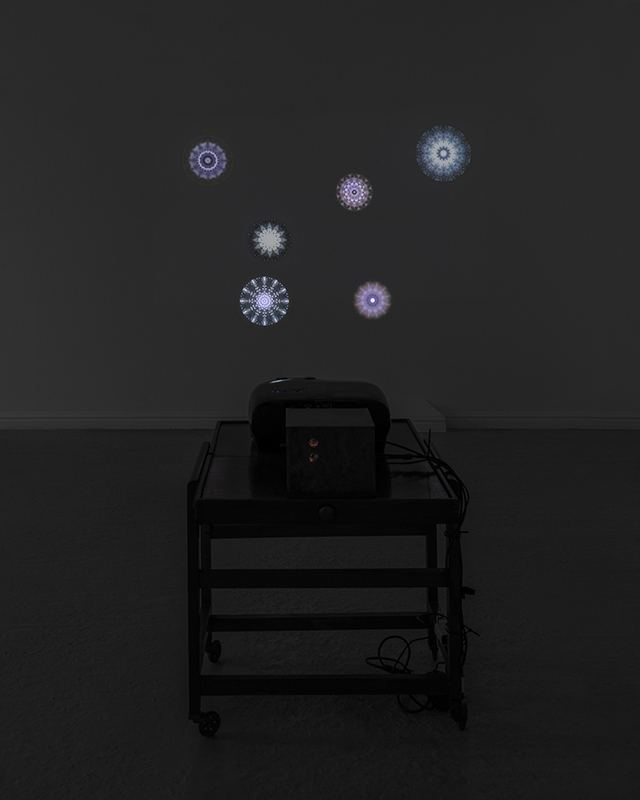
Giving The Breath of Stars a run to see if the cosmic rays are still there 😉 These images are stills of live action.
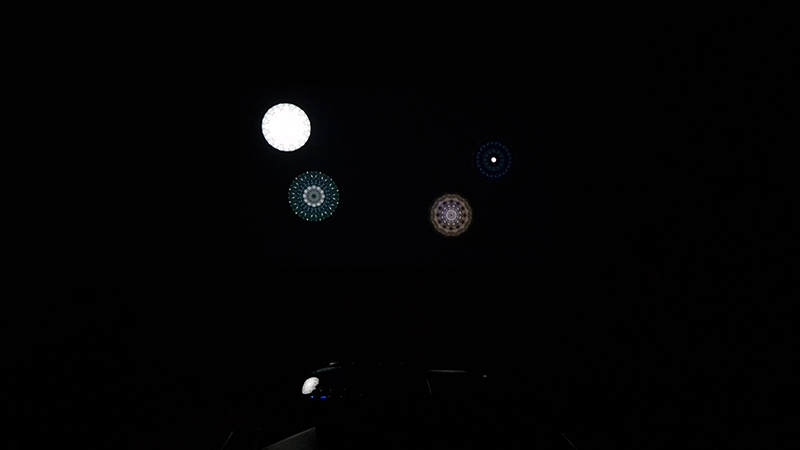
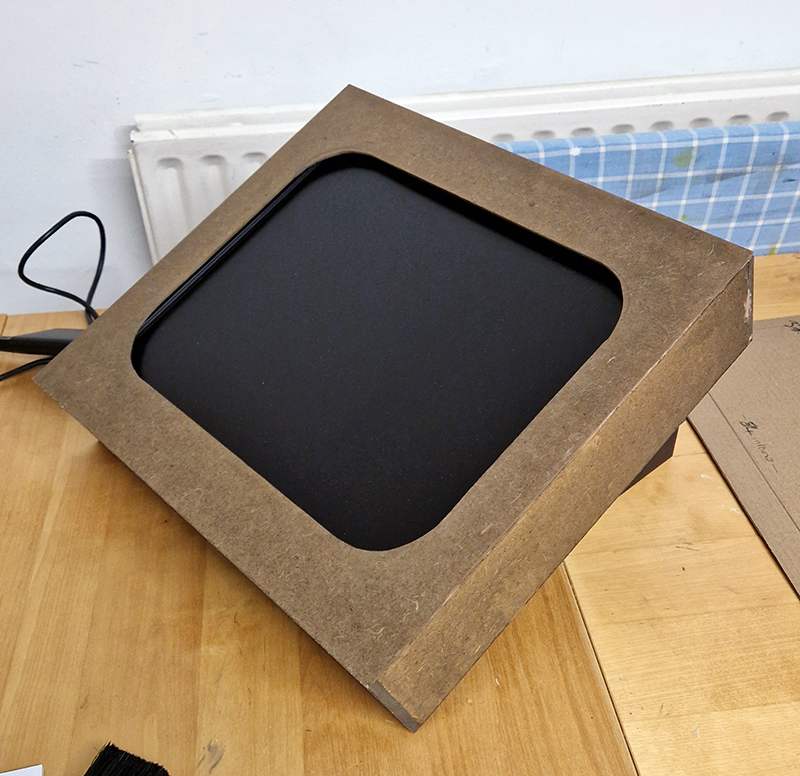
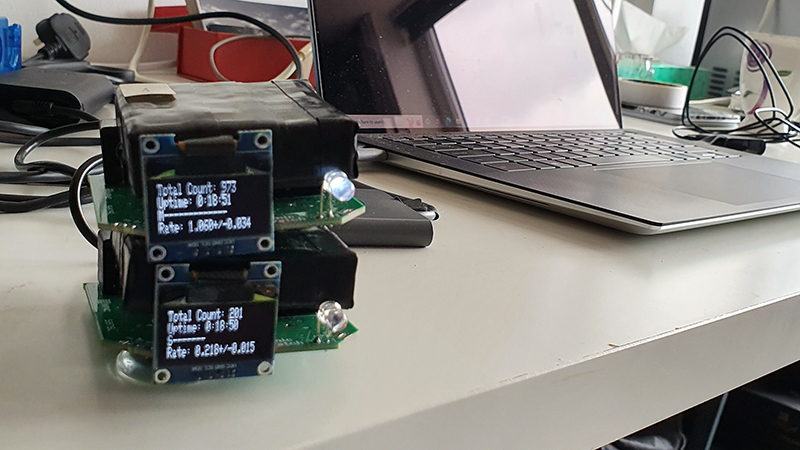
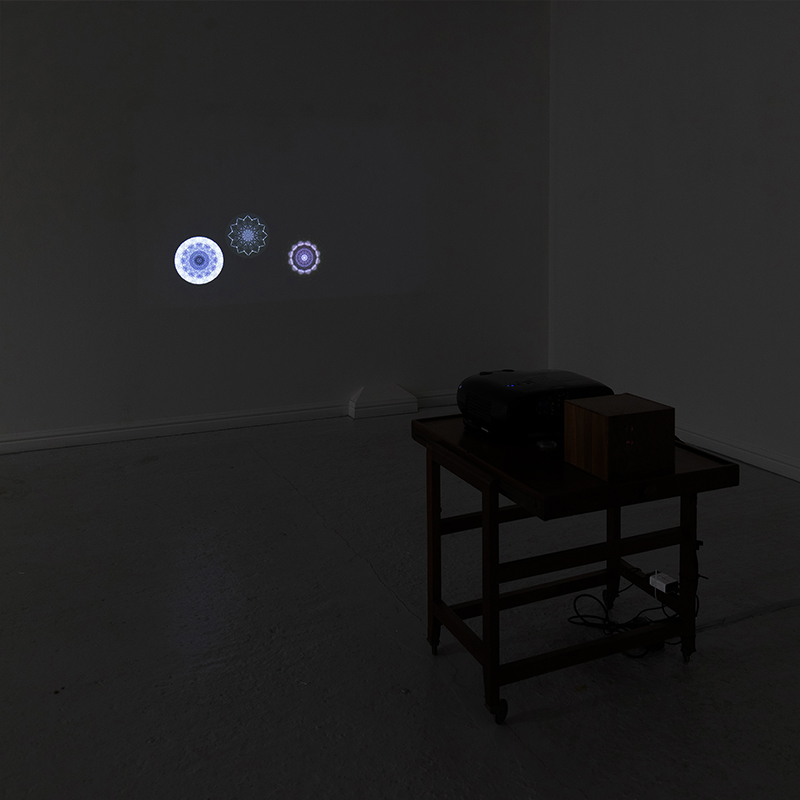
Cosmic ray detectors, mini computers, wooden box (20 x20 cm), video projection; live duration.

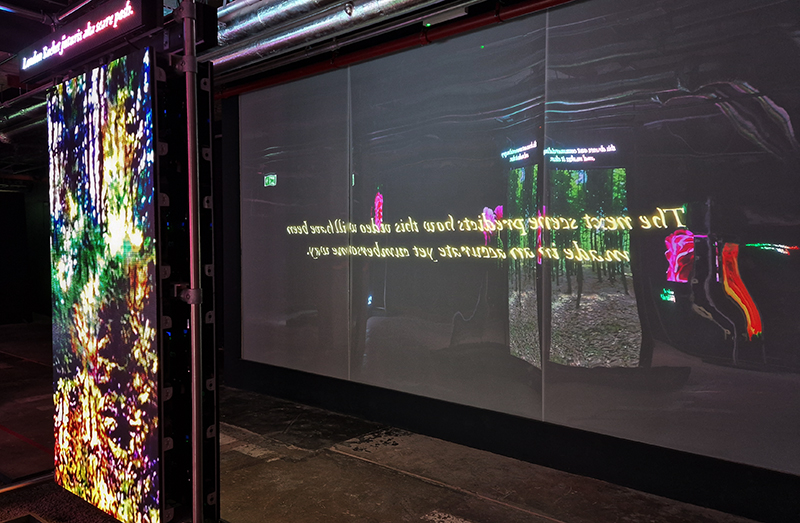
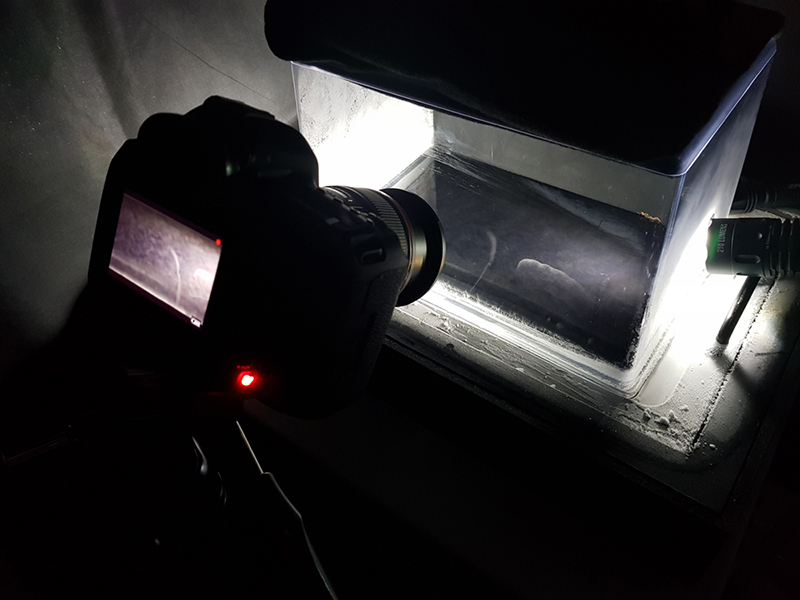
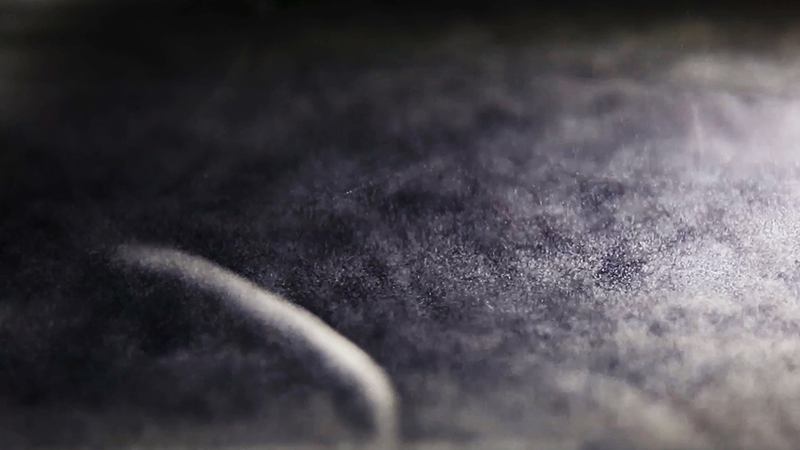
The Breath of Stars is a digital video work activated in real time by cosmic rays. These high energy particles arrive from outer space, interacting with life and technology on Earth. Coming from the heart of exploding stars or the depths of black holes, cosmic rays power across the universe with unimaginable energy. Some may come from phenomena yet to be discovered or even from other dimensions. A kaleidoscopic animation is projected every time a cosmic ray is recorded passing through the detectors. The animations are created from footage of cosmic ray trails filmed in my cloud chamber.
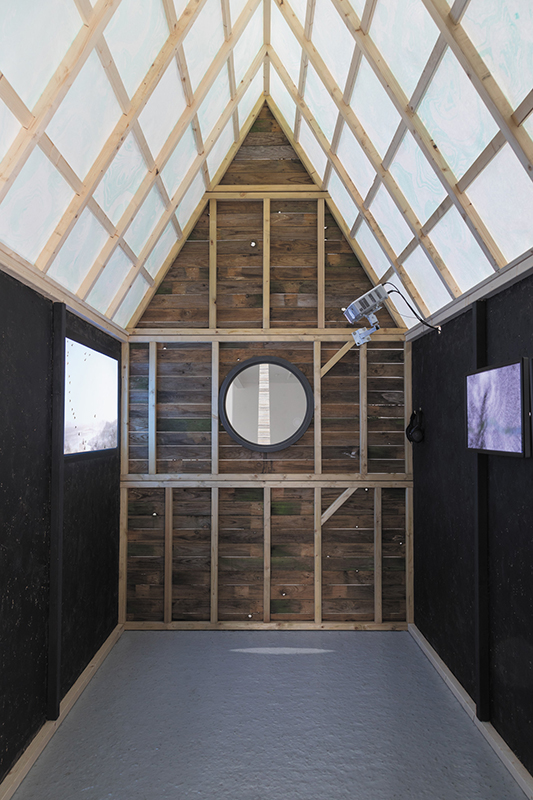
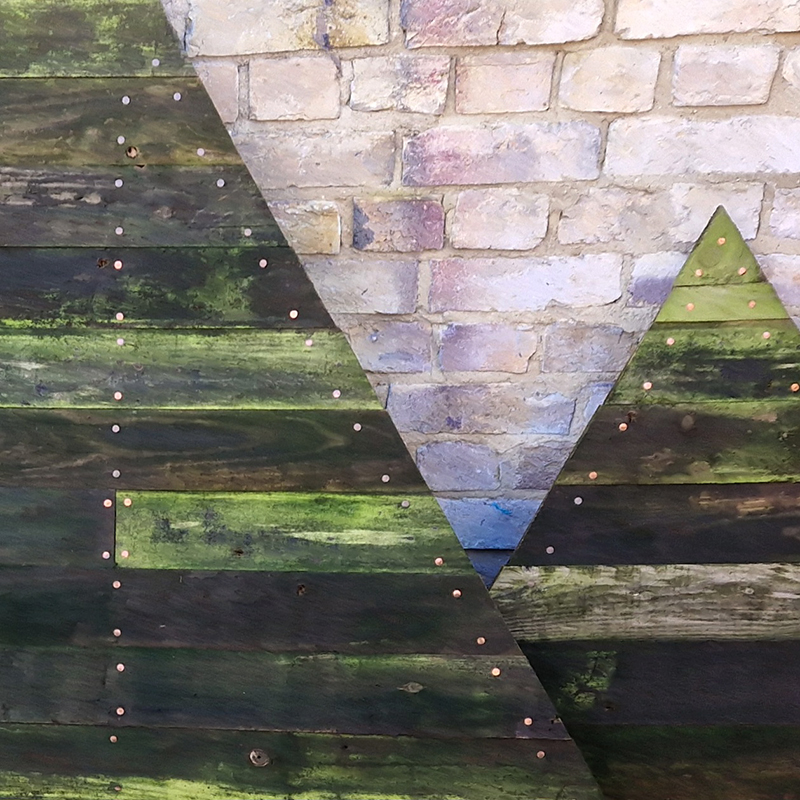
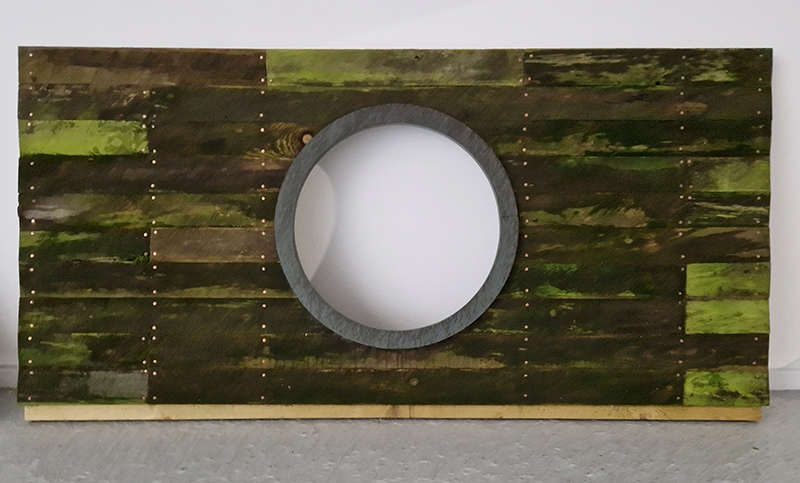
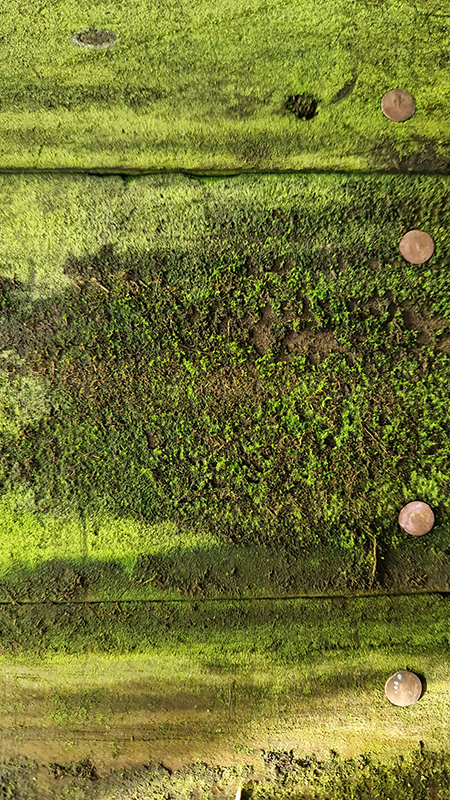
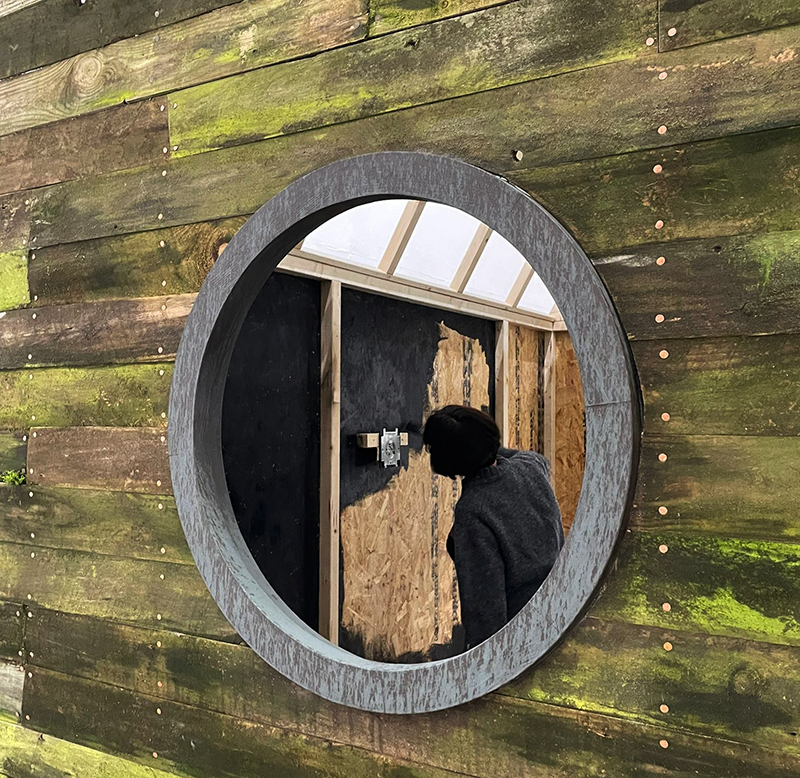
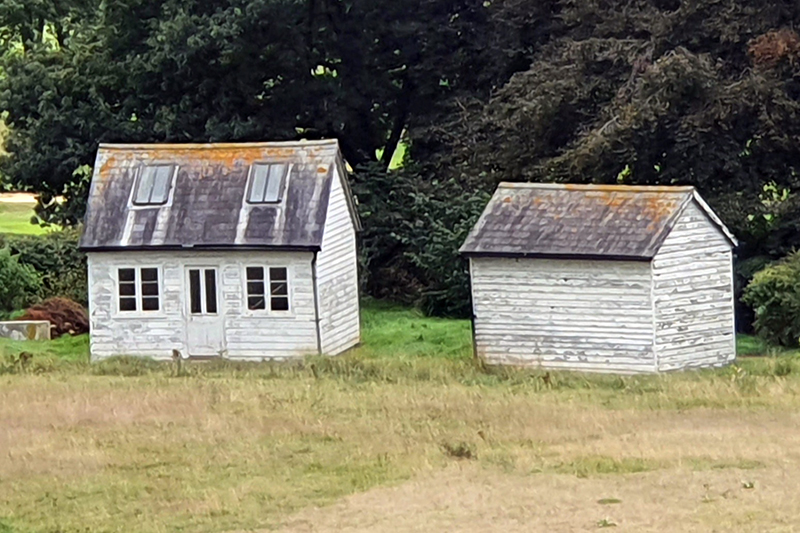
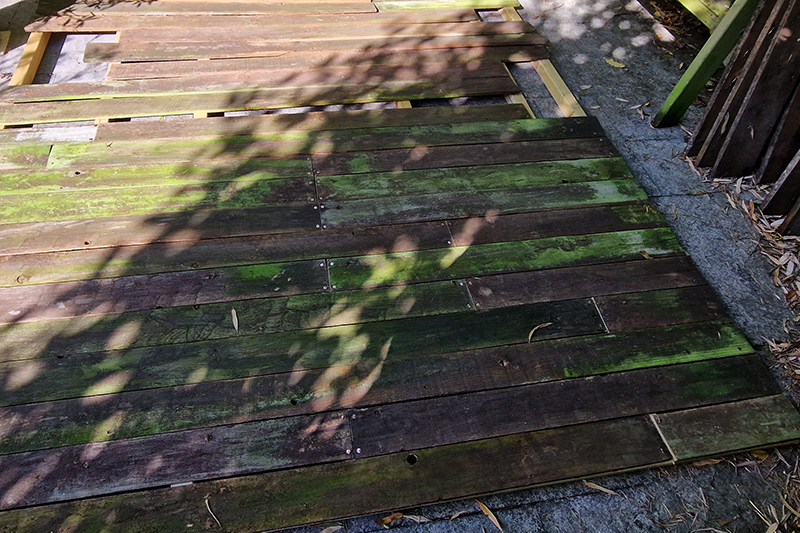
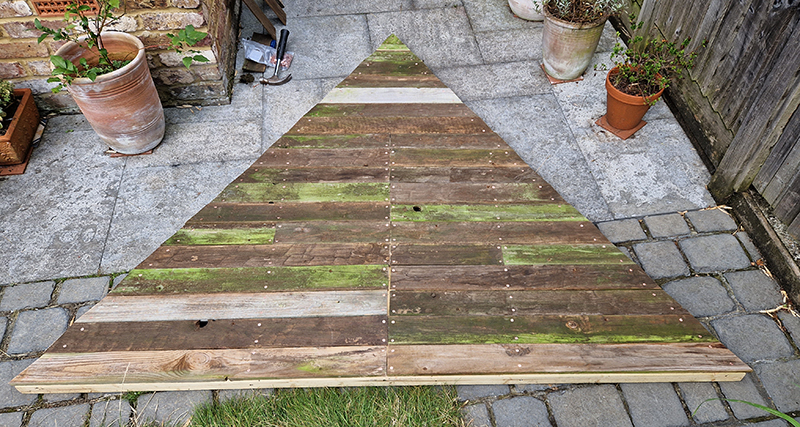
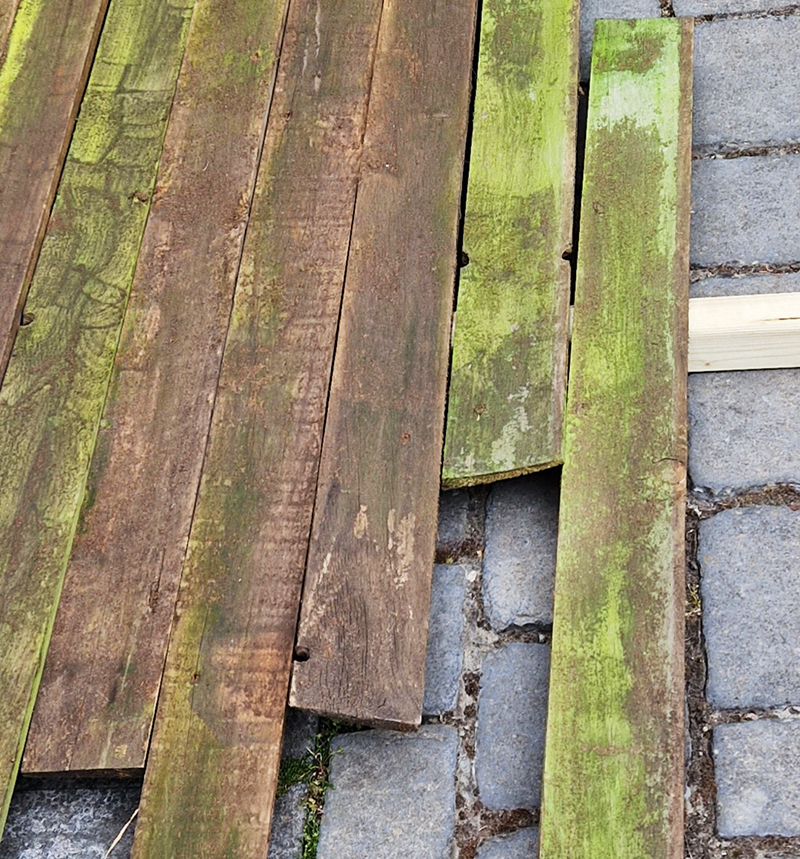
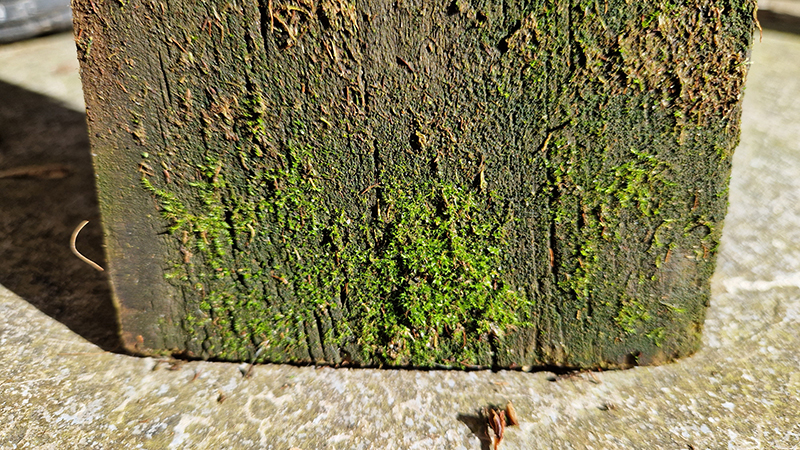
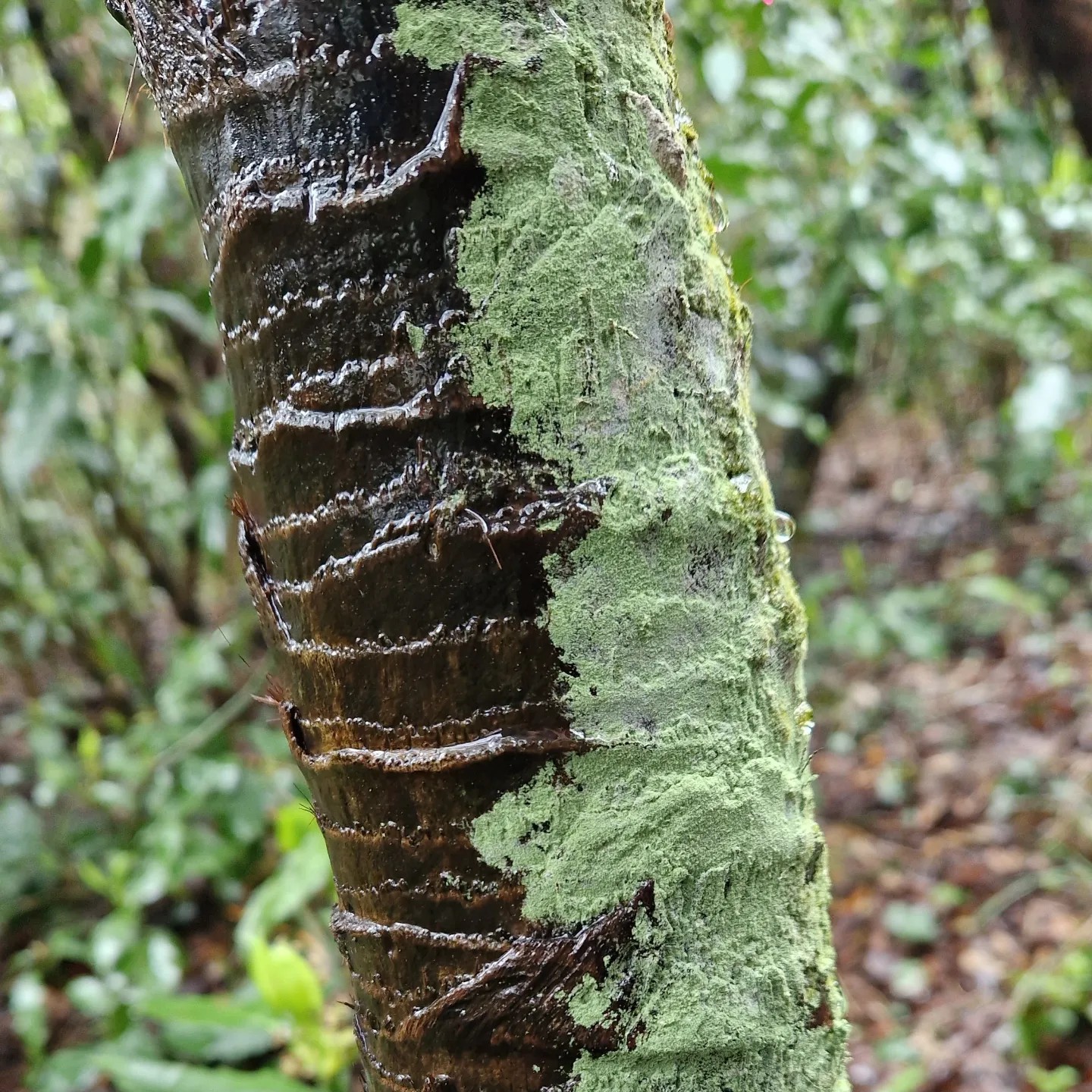
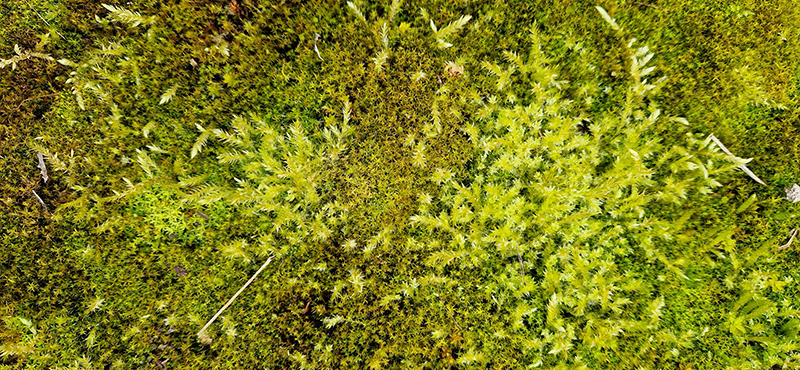
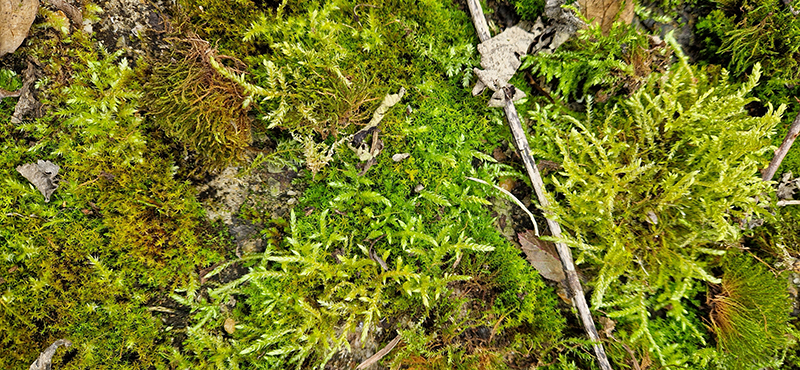
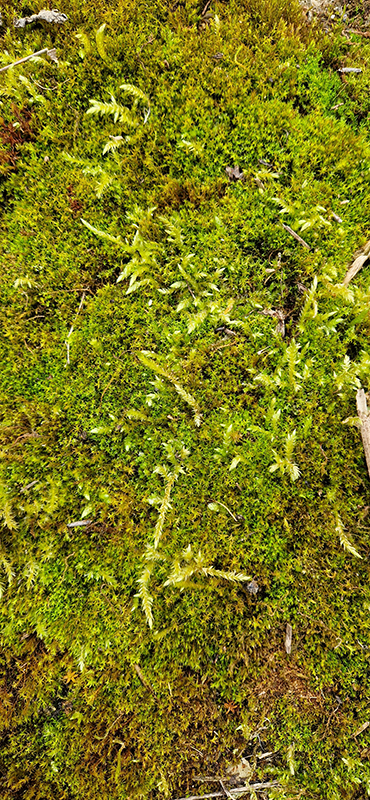
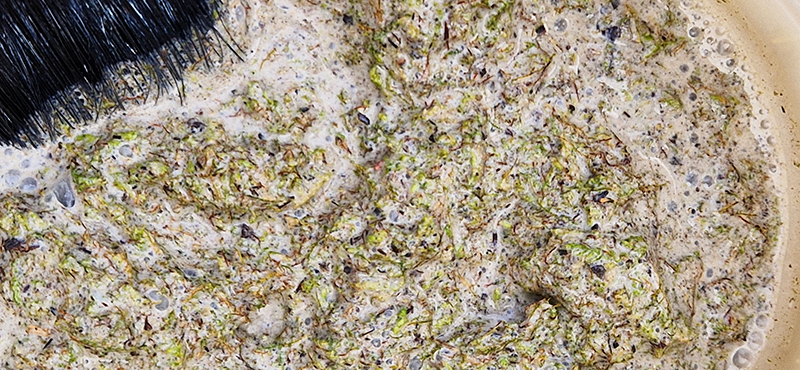
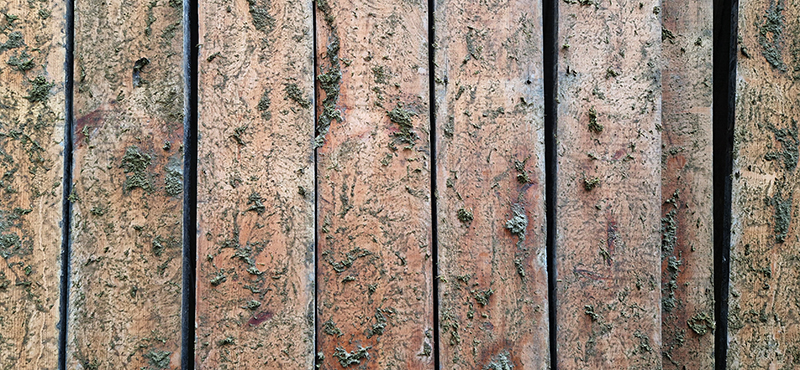
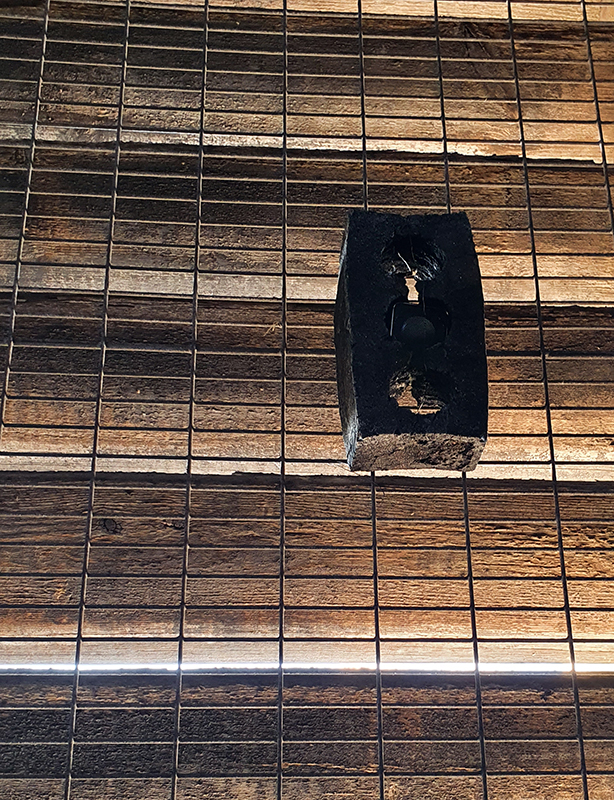
This cold damp weather is stimulating the moss regrowth on the apex pinnacle of The Absolute Hut (of action potential) that found a space in my garden after The Stone Sky exhibition this time last year. I had spent weeks preparing the recycled fence boards to make the North facing wall of the hut, painting them with various mixtures of buttermilk and yogurt blended with moss and was so excited when it began to grow. During the exhibition I would mist it every day. The beginning of my fascination with huts!
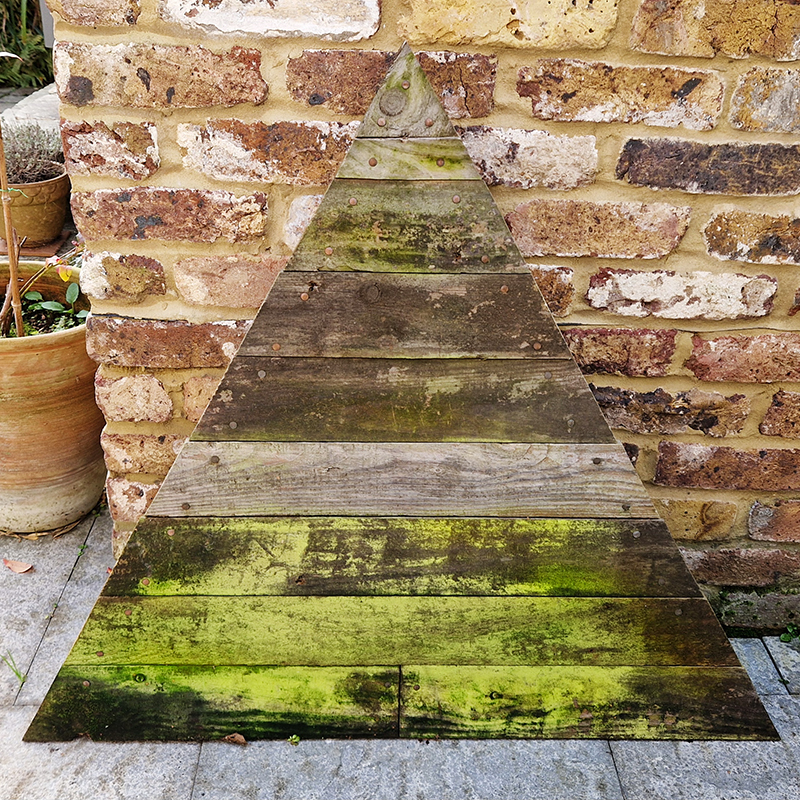
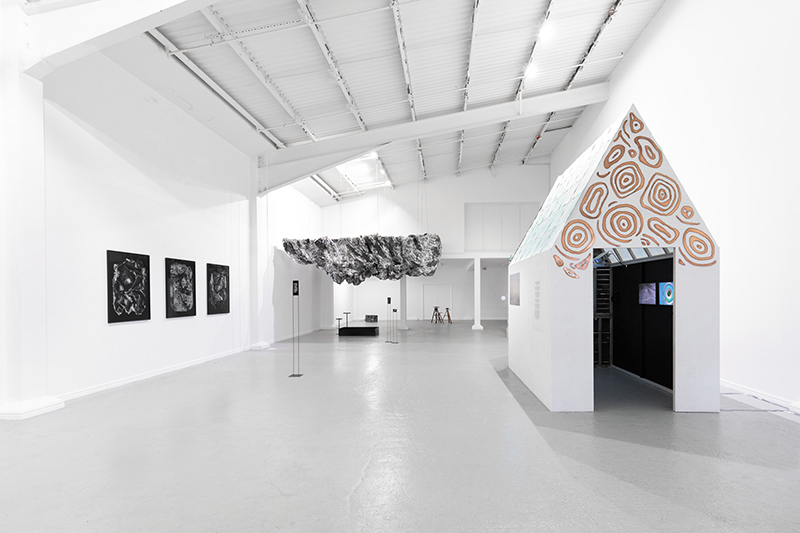
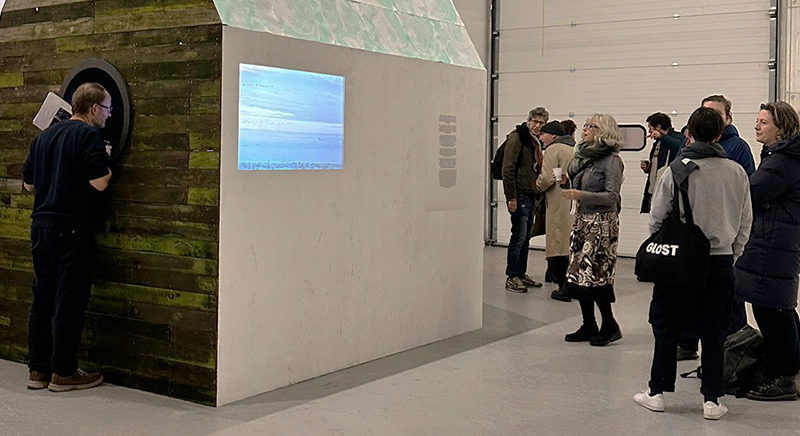
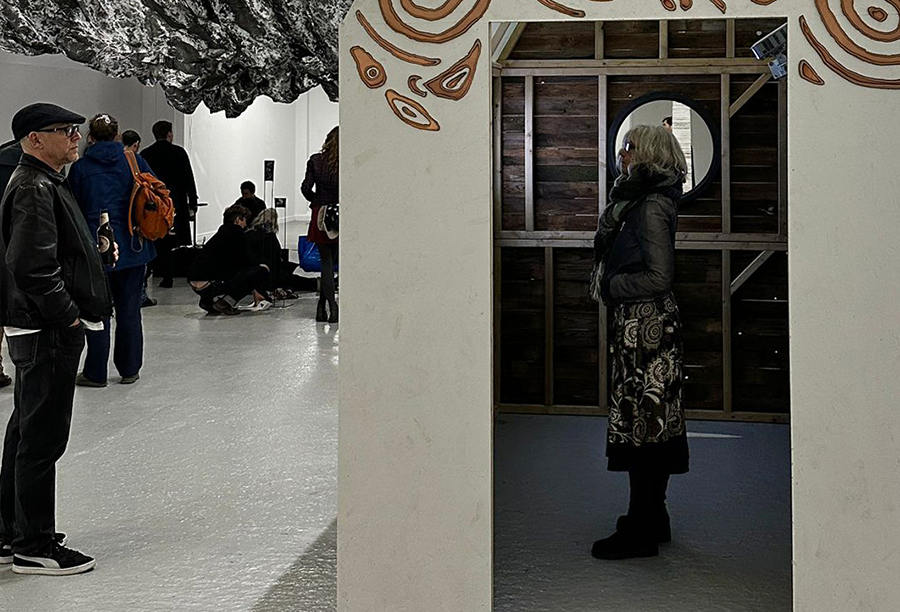
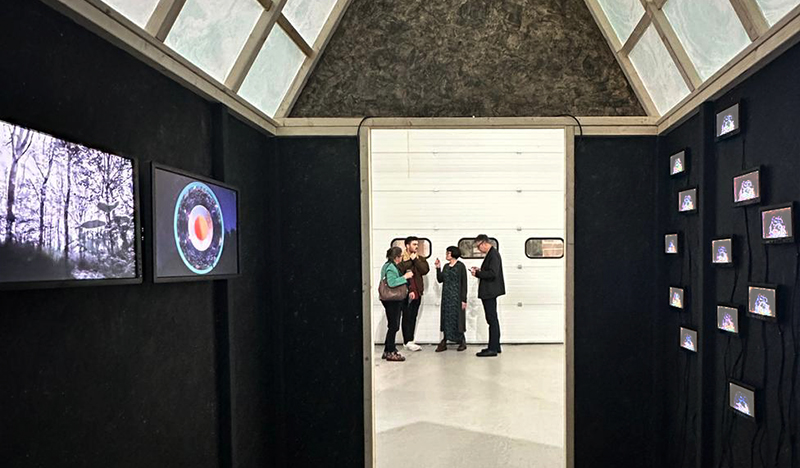
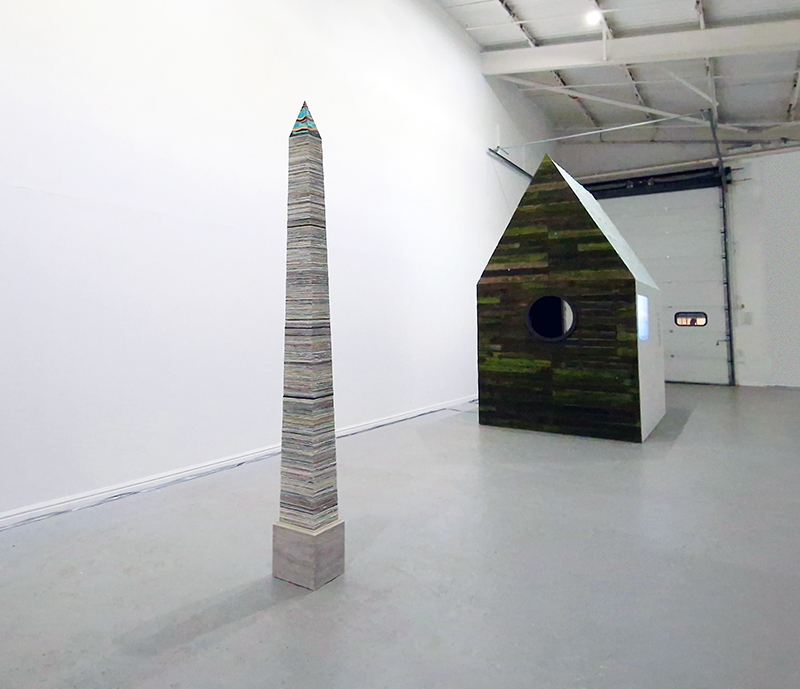
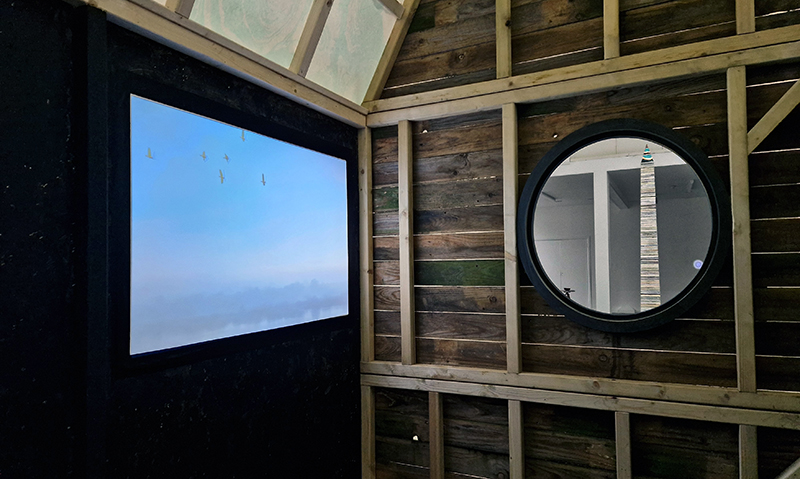
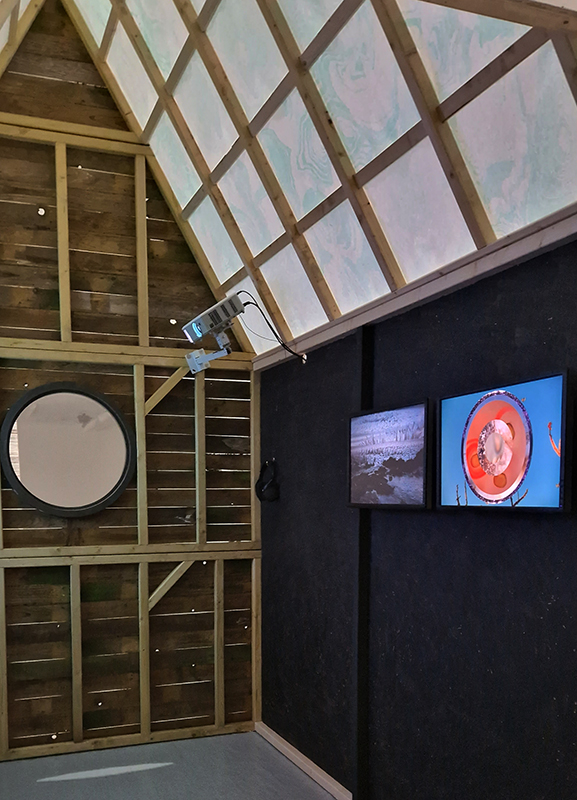
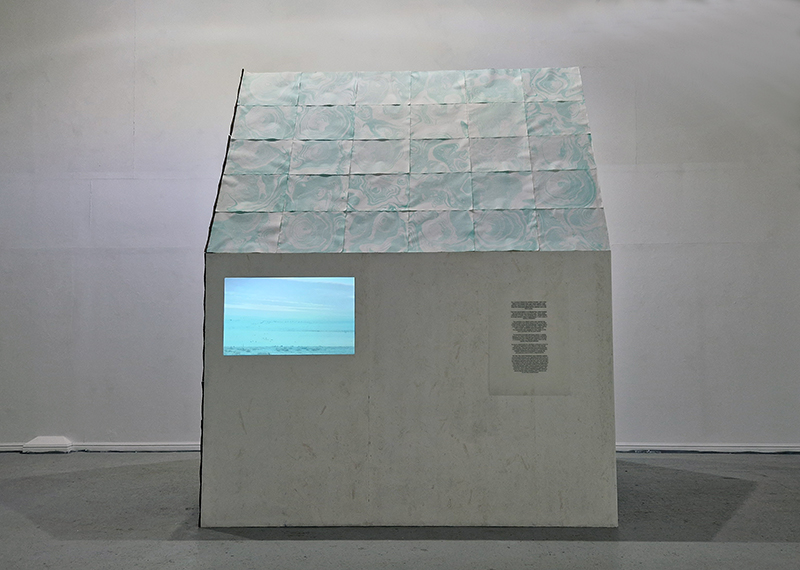
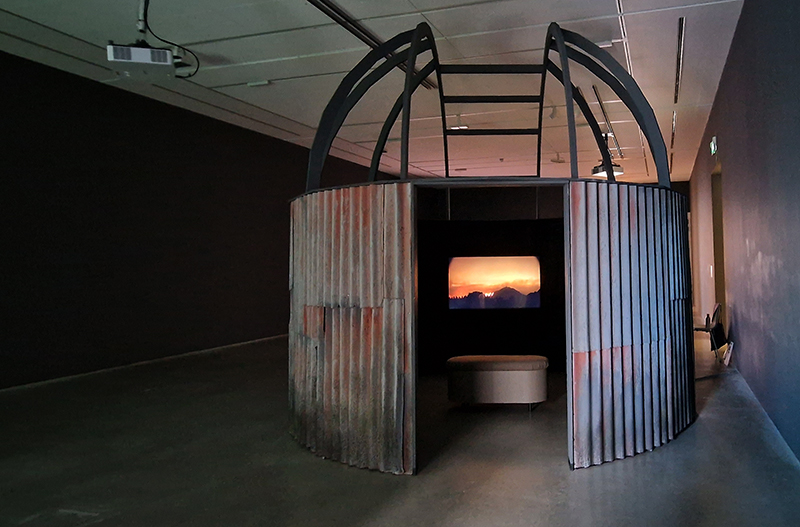
The Absolute Hut (of action potential) Wood, moss, paper, copper, video projection, video monitors ; 200 x 300 x 375 cm

Operating as a sensory hub where a range of actions and processes are running concurrently reflecting on the dynamics between the Earth’s geologic structure and navigation using the magnetic field. Neurons in the brain and nervous system send information electrochemically around the body. The signals they send are called action potentials, which is a temporary shift from negative to positive within the cell caused by certain ions entering the cell. Action potentials can be triggered by an interaction with the magnetic field, causing a reaction in the body.

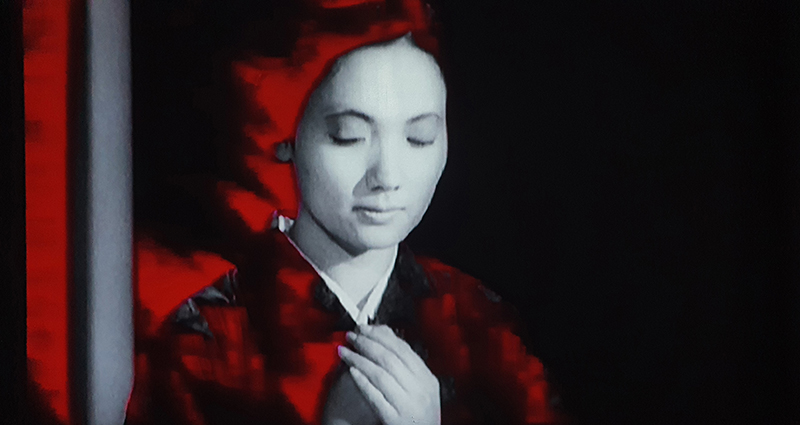
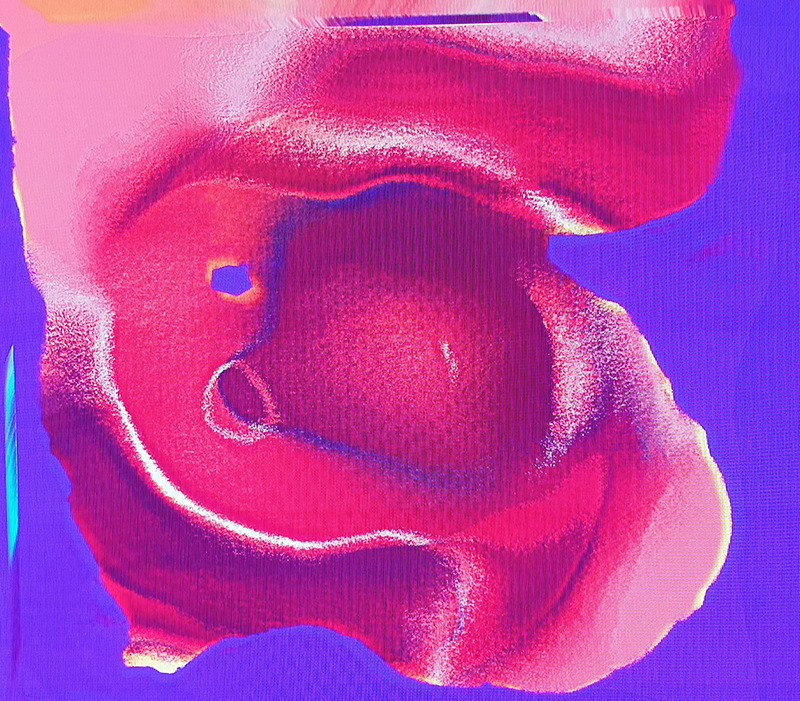
Interference 2023 (video still)

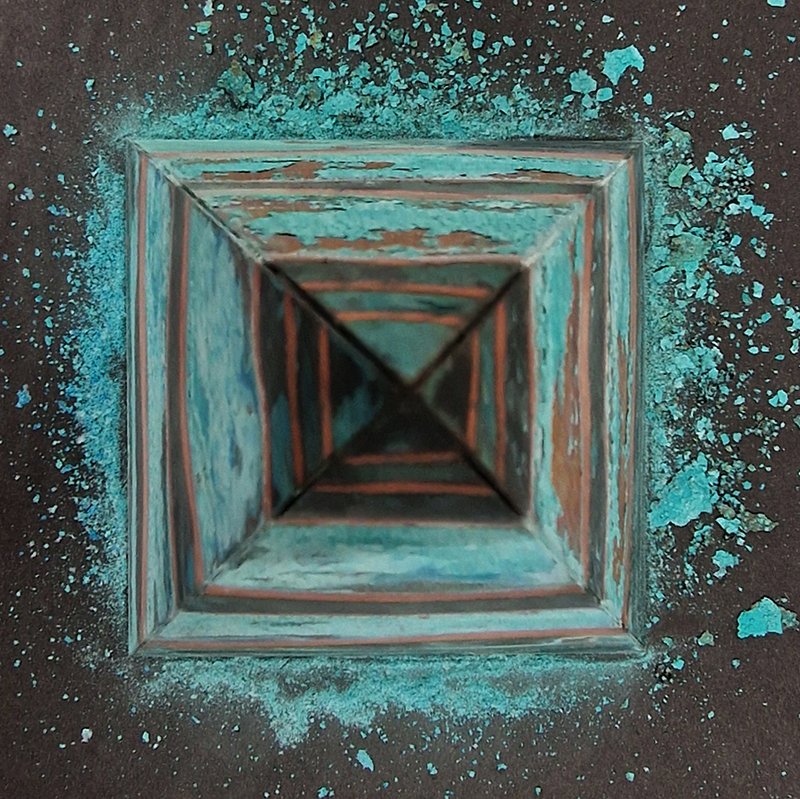
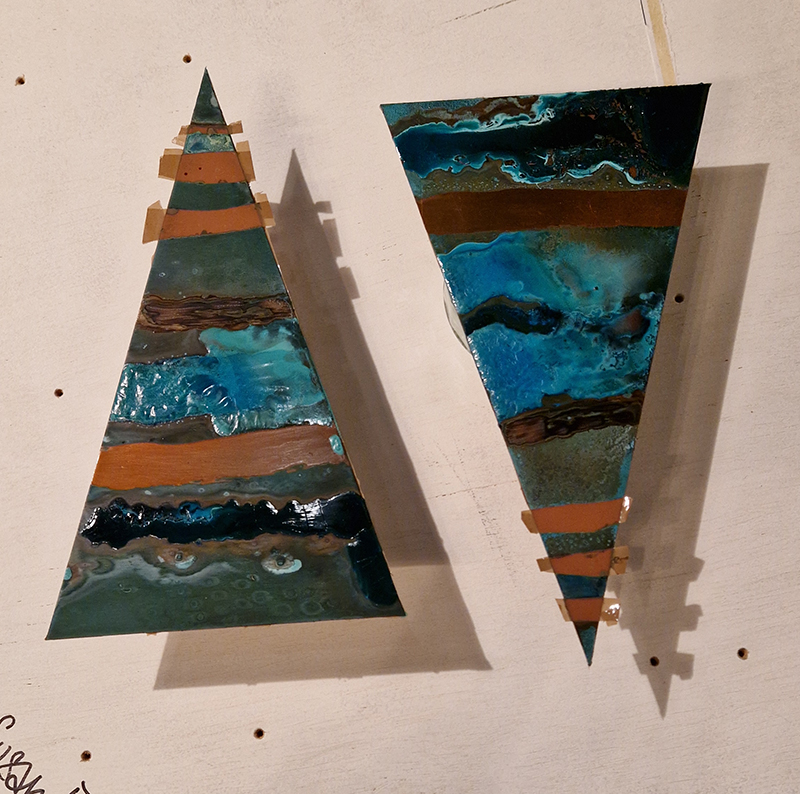
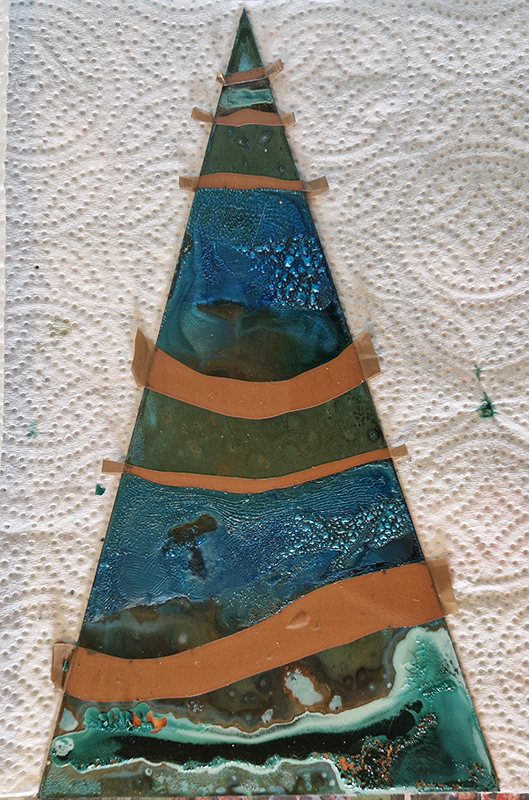
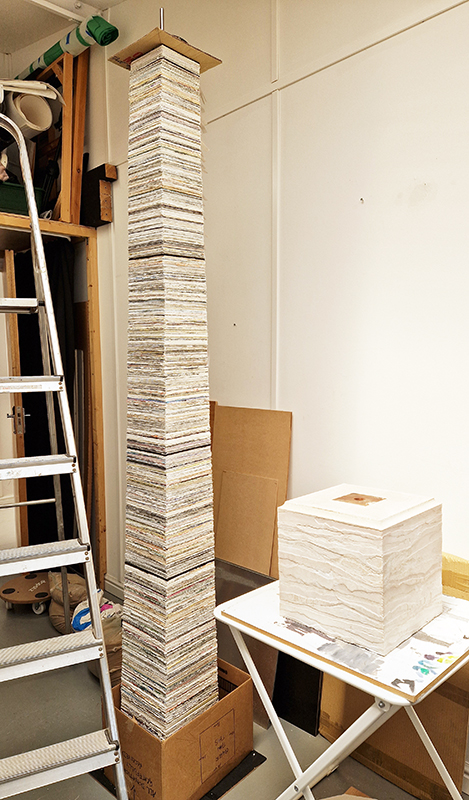
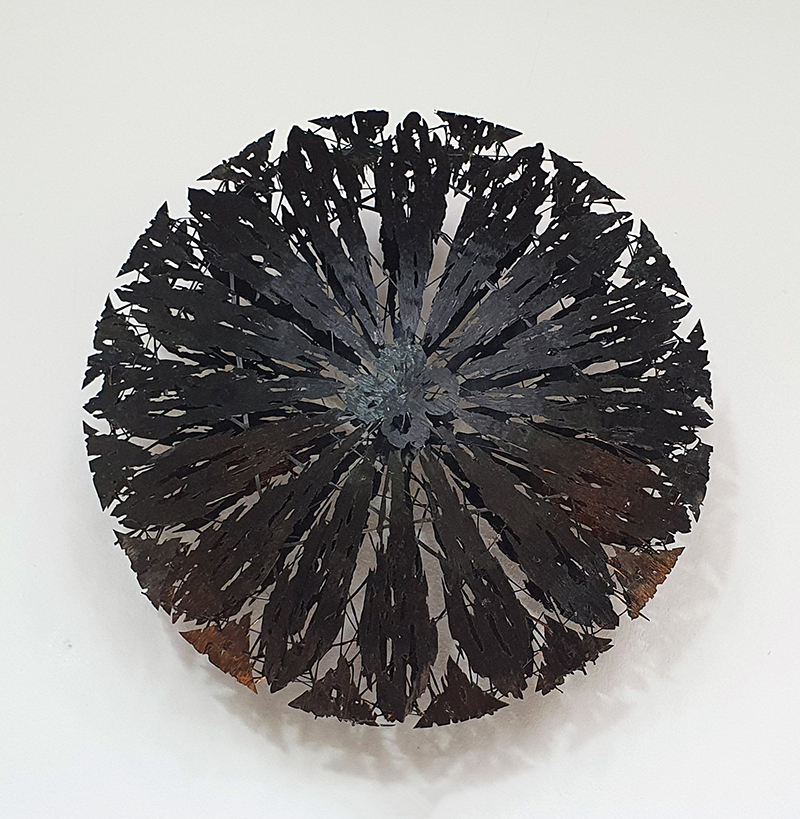
A year on and the pyramidion that sits on top of The Azimuth Obelisk (of sedimentary knowledge) is evolving. The patination, which involved a variety of chemicals being applied to the copper in layers, is an ongoing process.
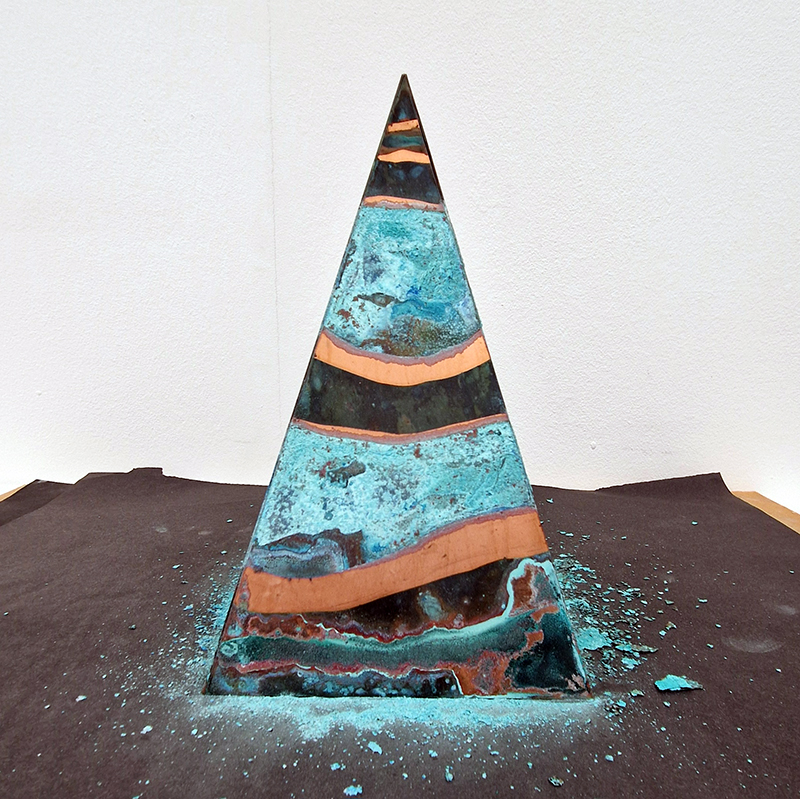
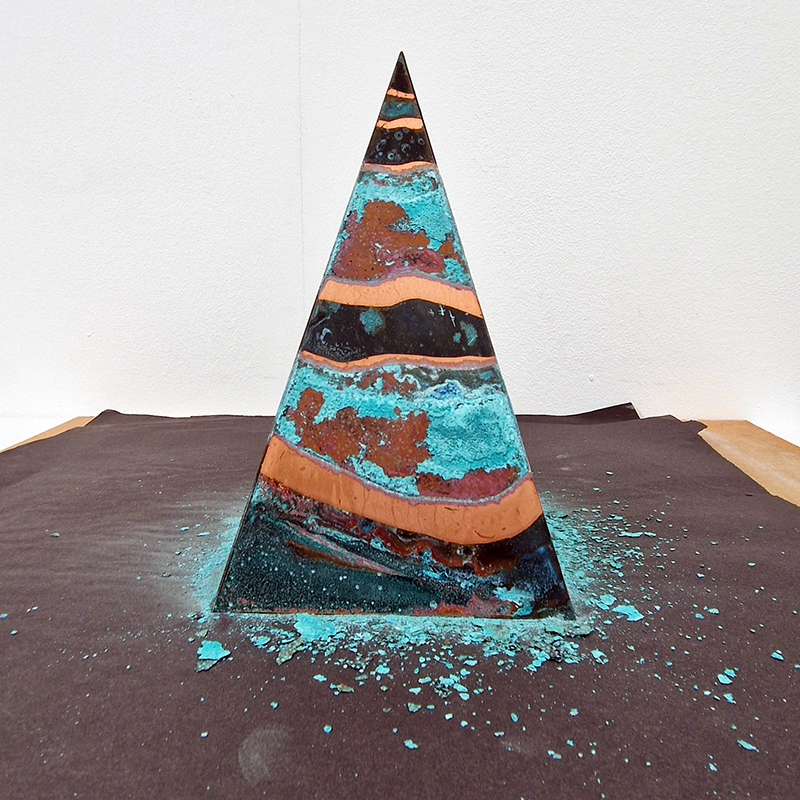
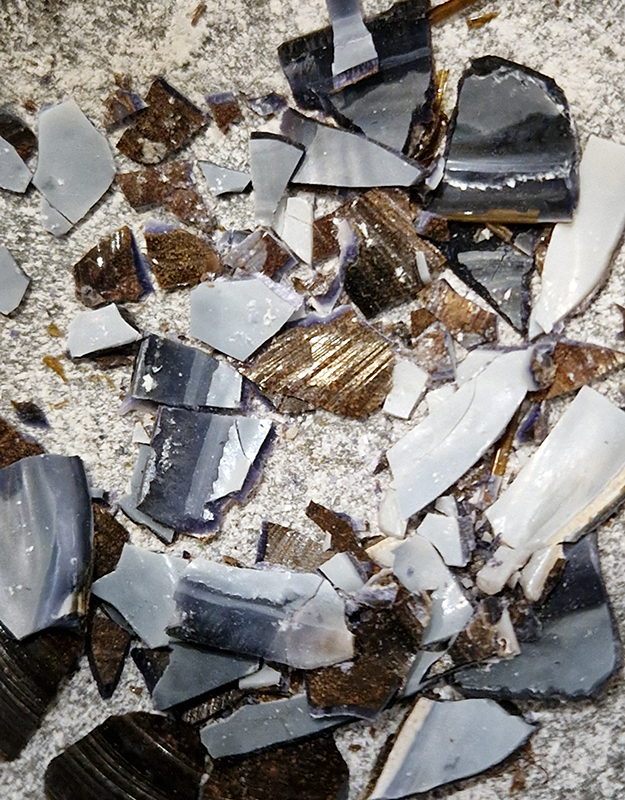
Sedimentary rock holds a geological history of the Earth’s magnetic field within its mineral components. The geomagnetic field, generated by the Earth’s molten core, varies through time; the magnetic poles migrate, go on excursions, or reverse polarity. During these periods of flux, the strength of the magnetic field changes, and this phenomenon is recorded in archaeological artefacts, volcanic rocks, and sediments. Limestone, a sedimentary rock, is often formed from crushed seashells, compressed over aeons. Crushed oyster shells were added to the obelisk base cast in Snowcrete.
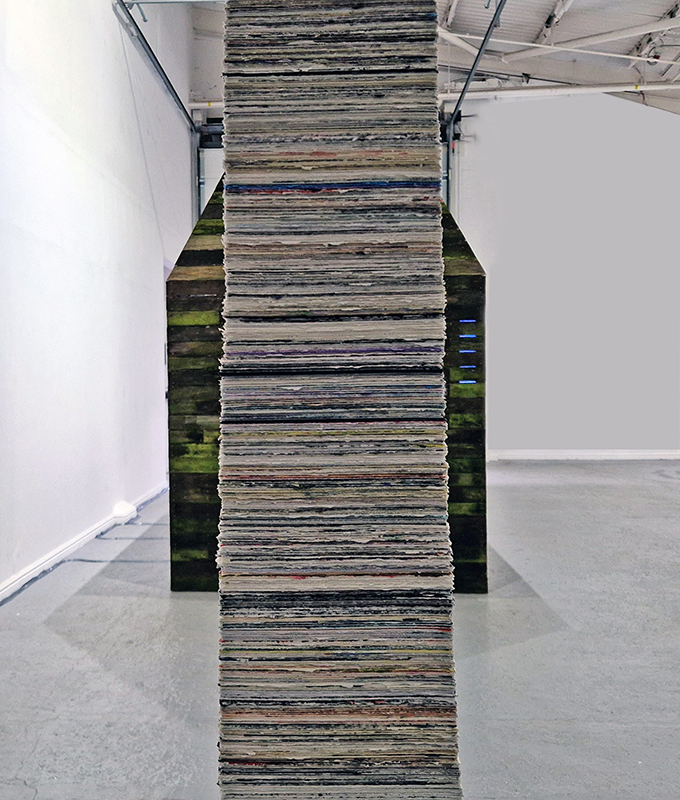
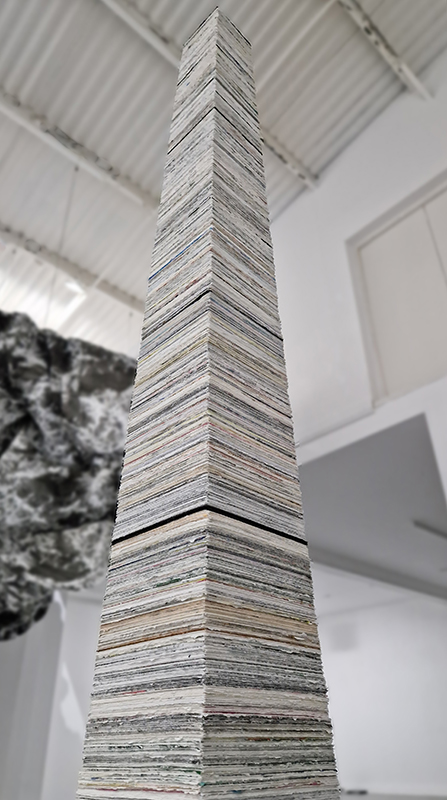
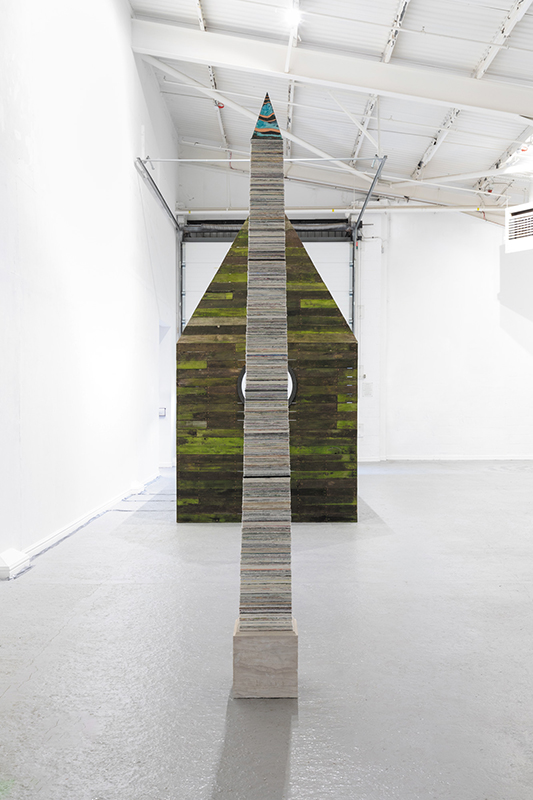
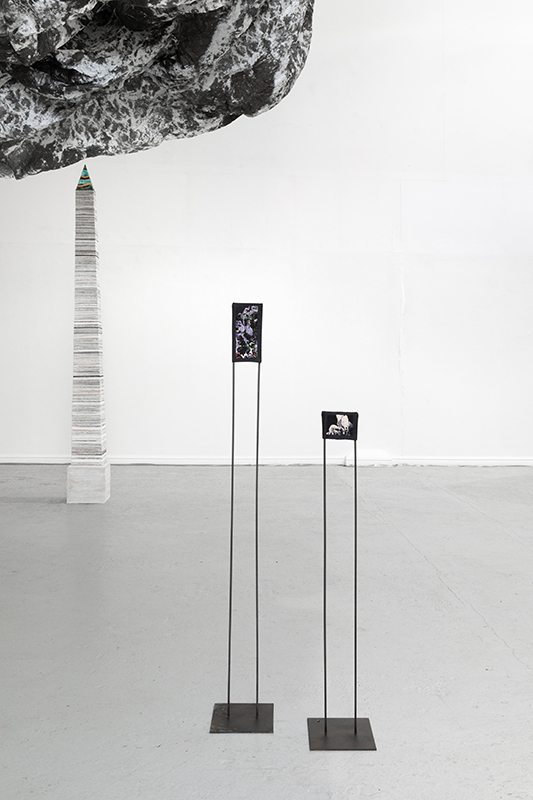
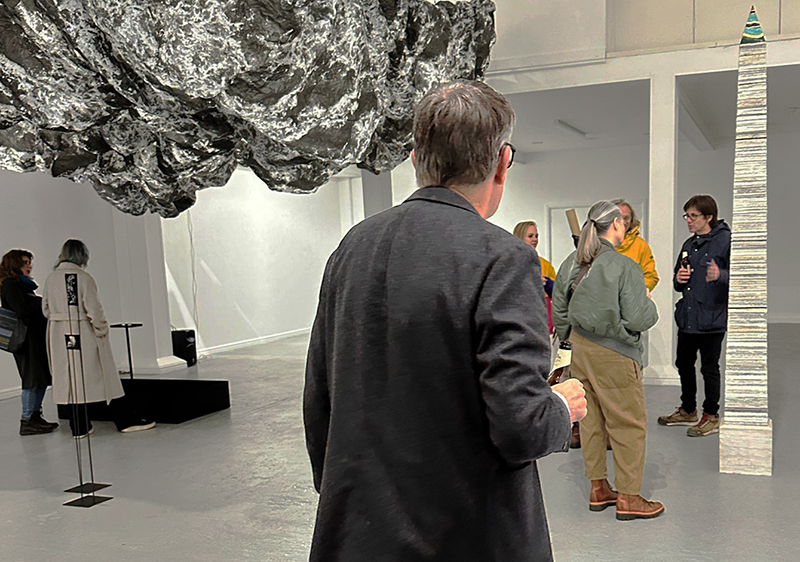
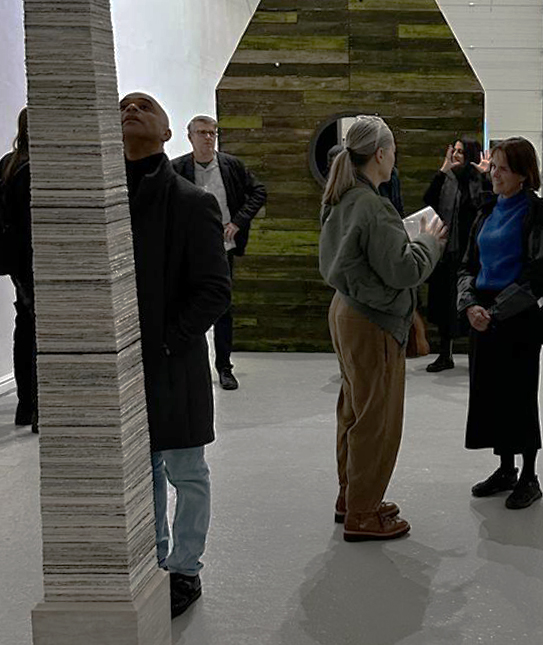
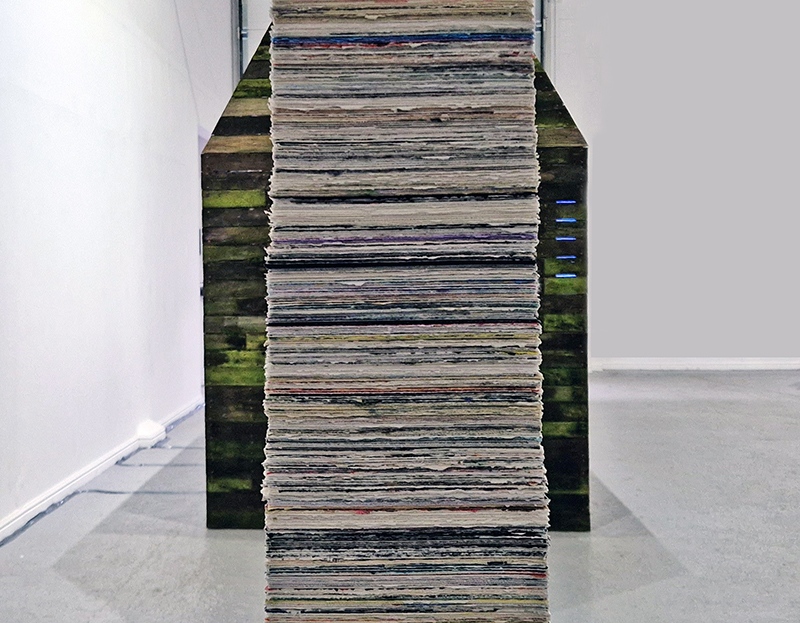
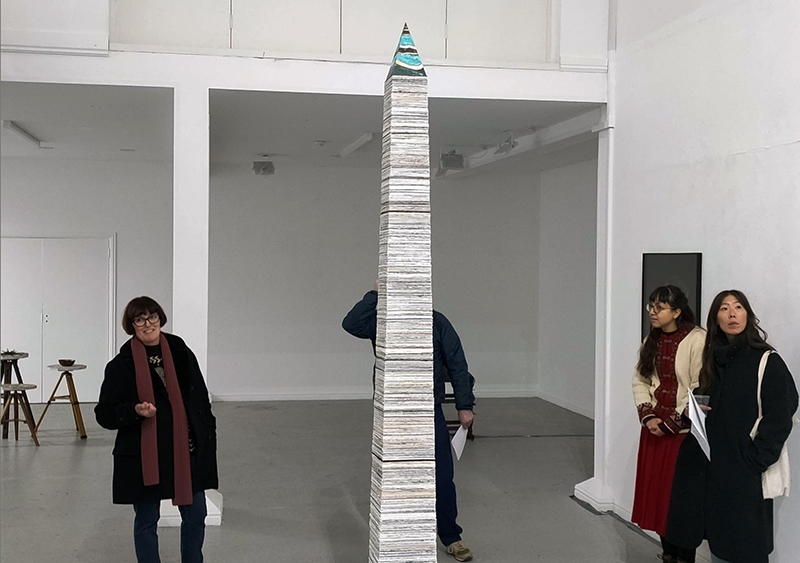
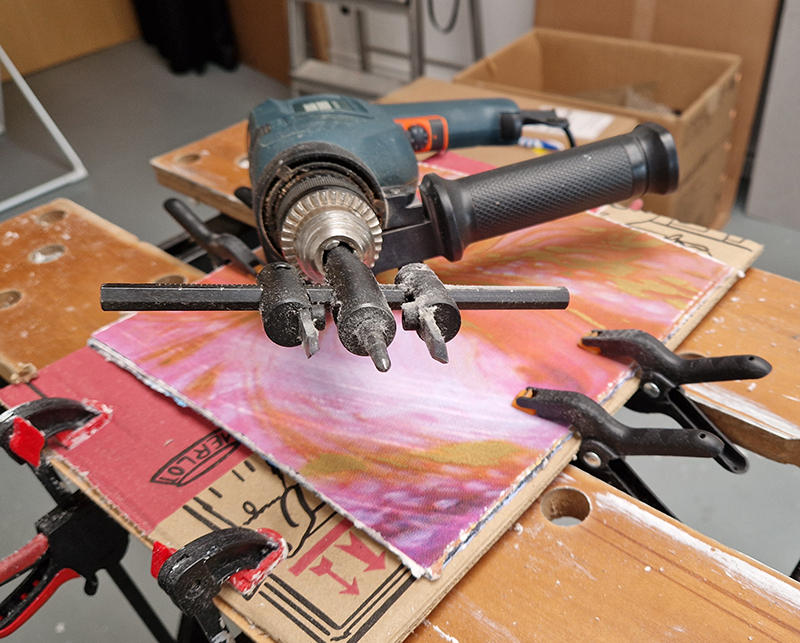
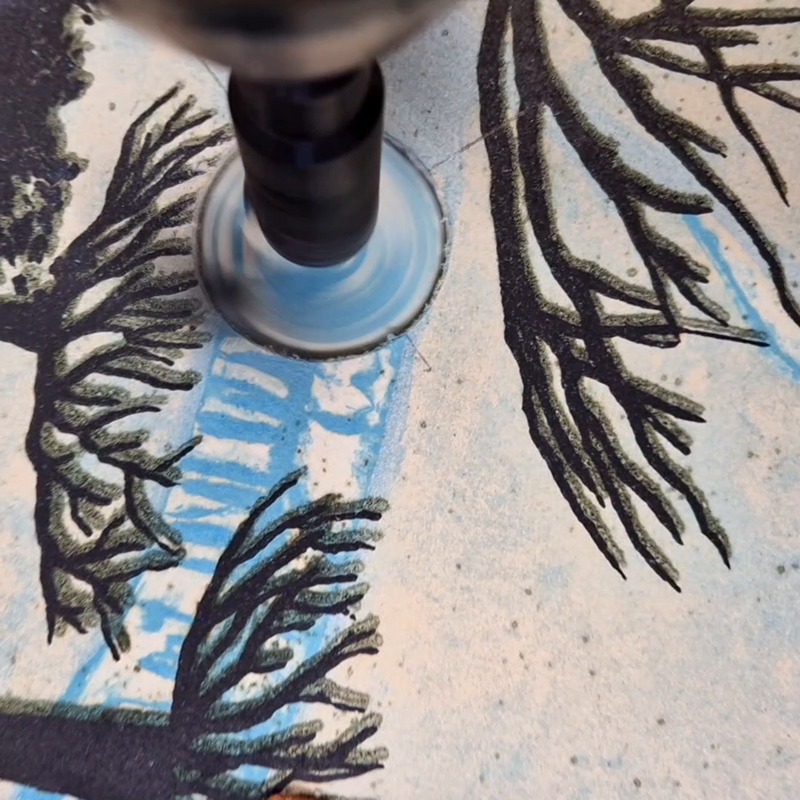
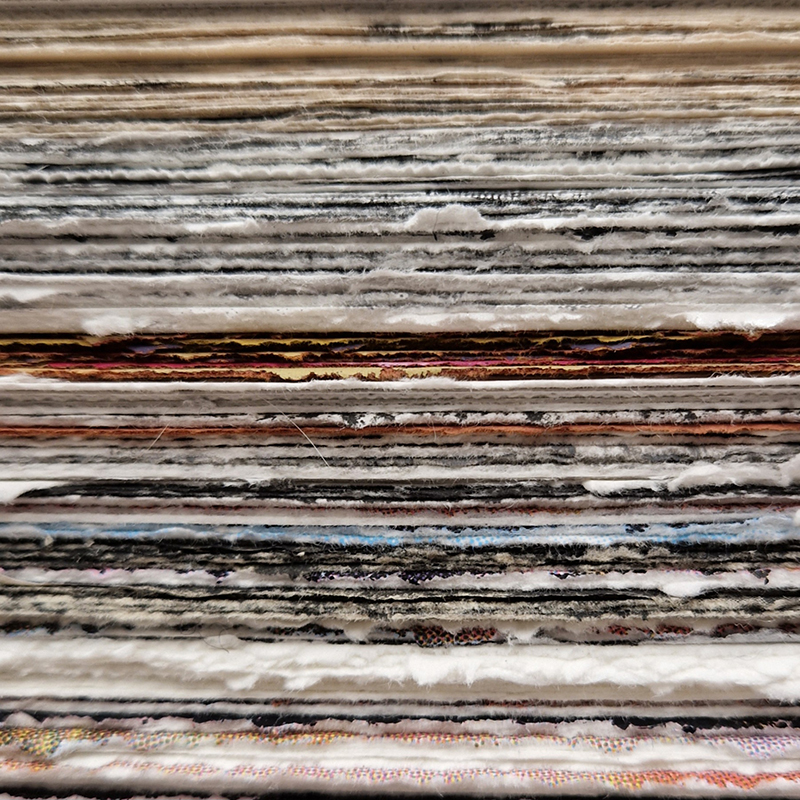
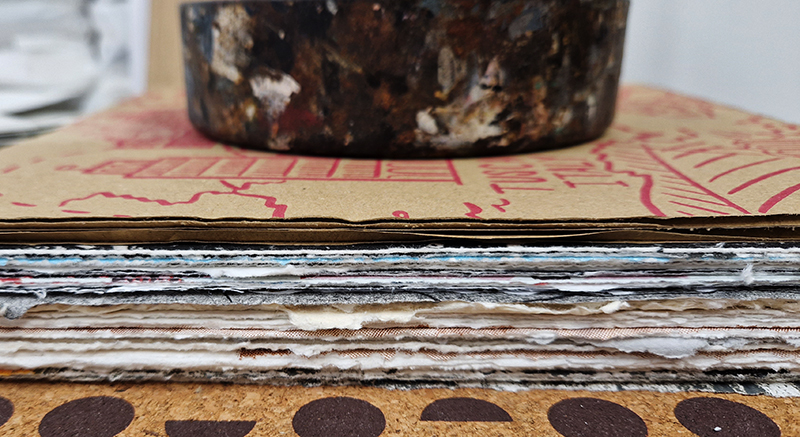
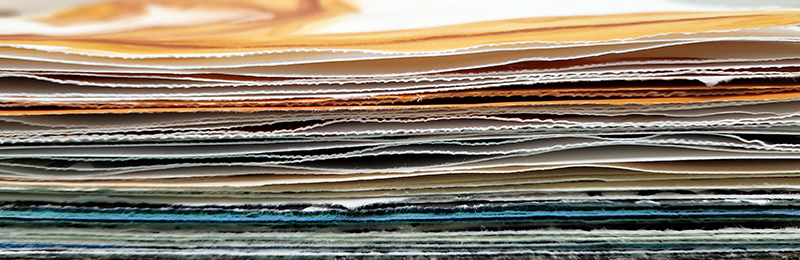
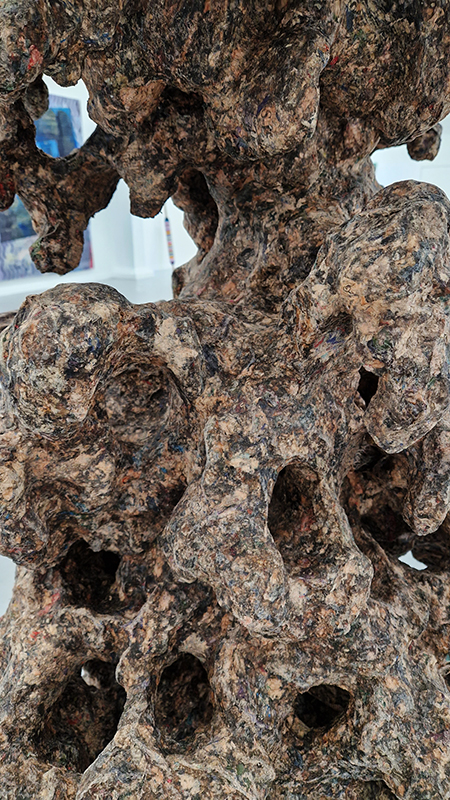
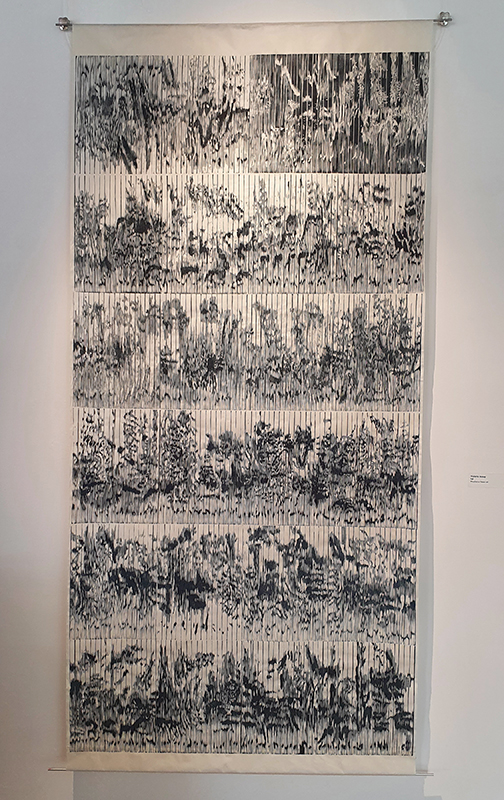
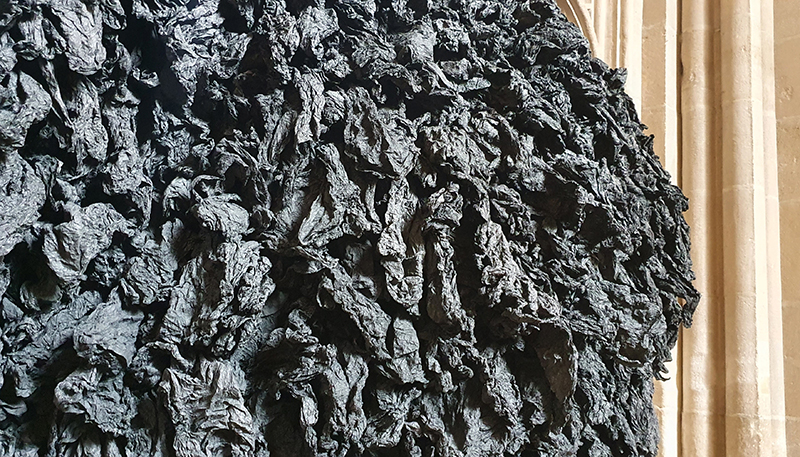
This sculpture also embodies the passage of time, and a layering of information, in the months of collecting paper donations or scavenging the recycling bins, weeks tearing down the hundreds of prints and drawings into squares decreasing by 1mm every 50 sheets, drilling holes through the centre and hours to build the almost 3m stack. I’m very grateful to everyone who donated some of their work archive. These images are now secreted within the layers of the sculpture, hinted at where edges are exposed, echoing the Earth’s sedimentary knowledge.

The Azimuth Obelisk (of sedimentary knowledge) Paper, steel, Snowcrete, oyster shells, patinated copper; 30 x 30 x 270 cm

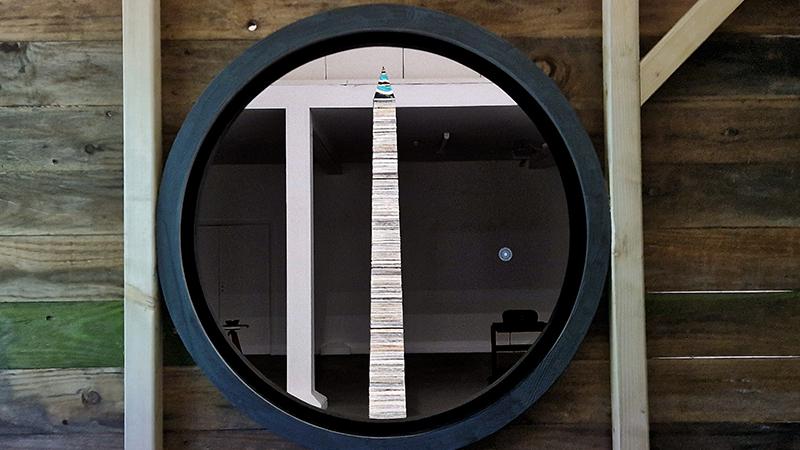
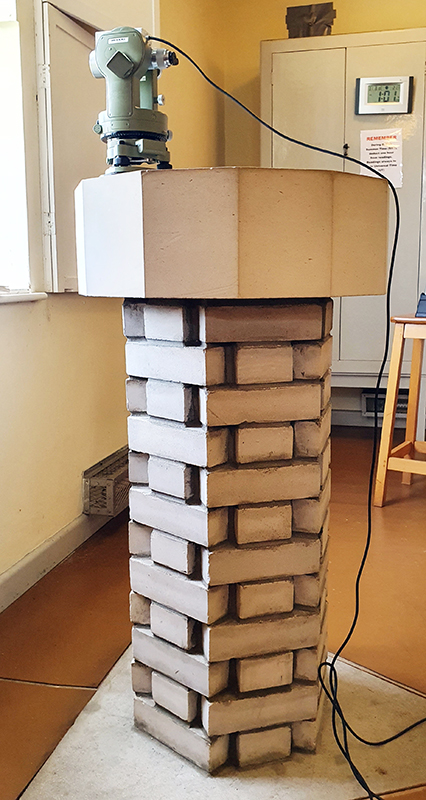
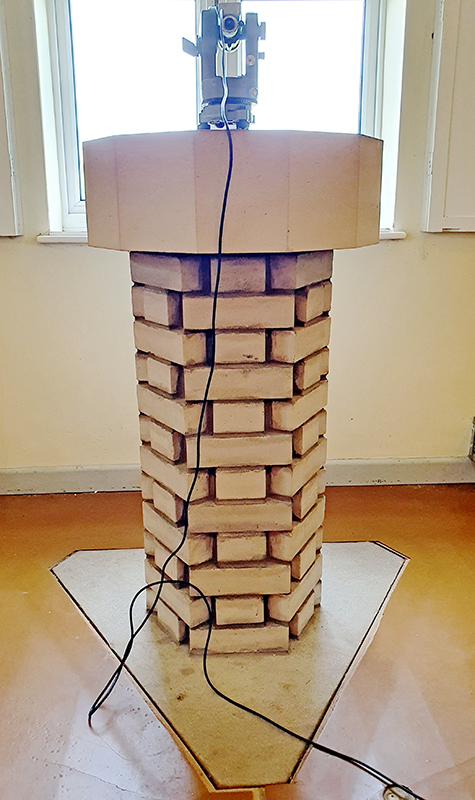
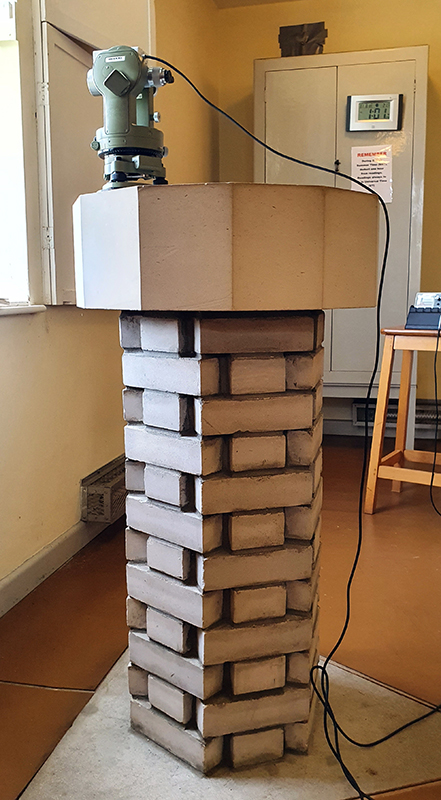
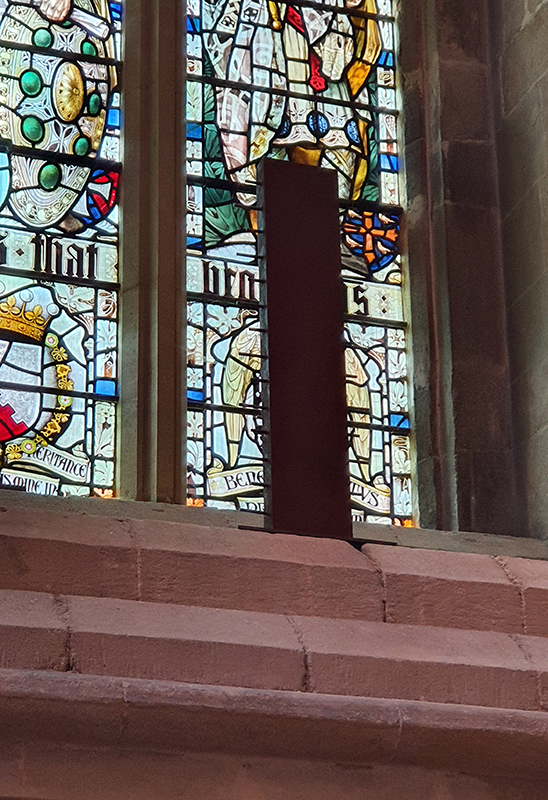
 This work is a reimagining of an ‘obelisk’ erected at Hartland Magnetic Observatory in the late 1950’s to be viewed through the north facing window of The Absolute Hut, it acts as a permanent azimuth mark from which the drift of the magnetic north pole is monitored. I am excited that this sculpture is being considered for exhibition in 2026 at the Royal West of England Academy in Cosmos: The Art of Observing Space curated by Ione Parkin with some amazing artists in the line up whose work I admire.

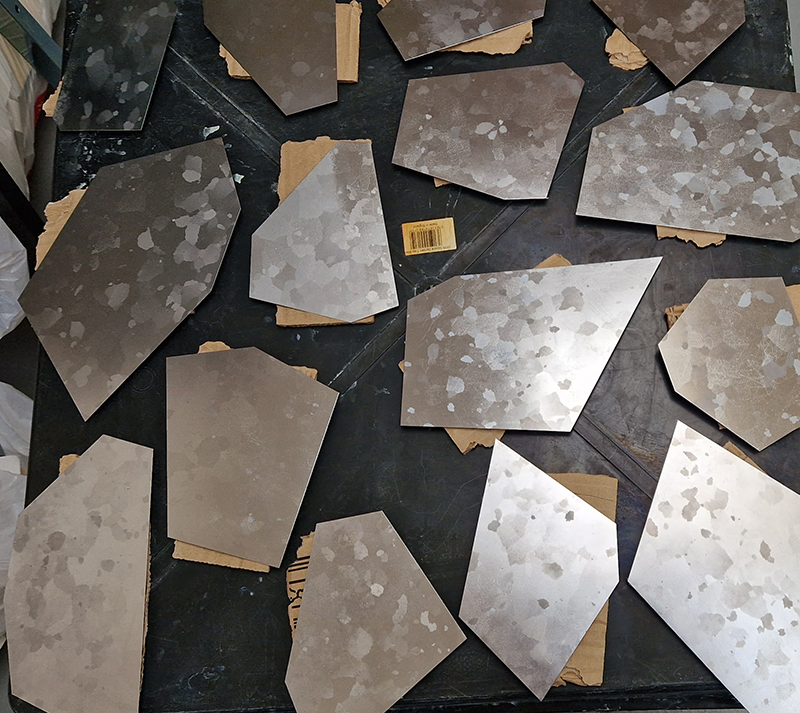
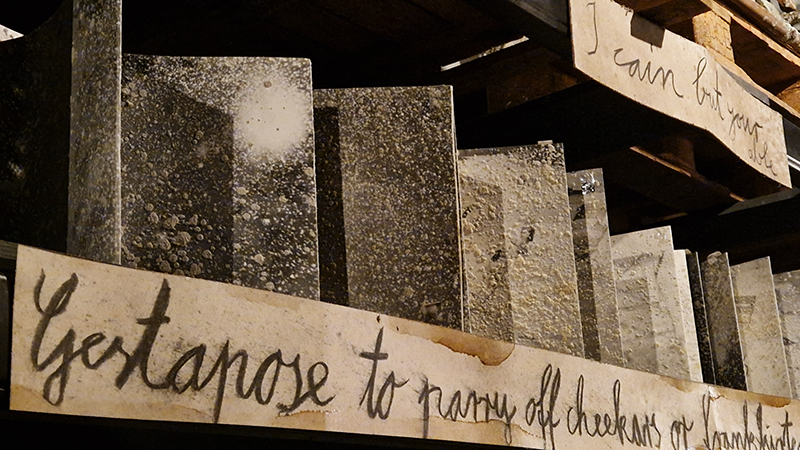
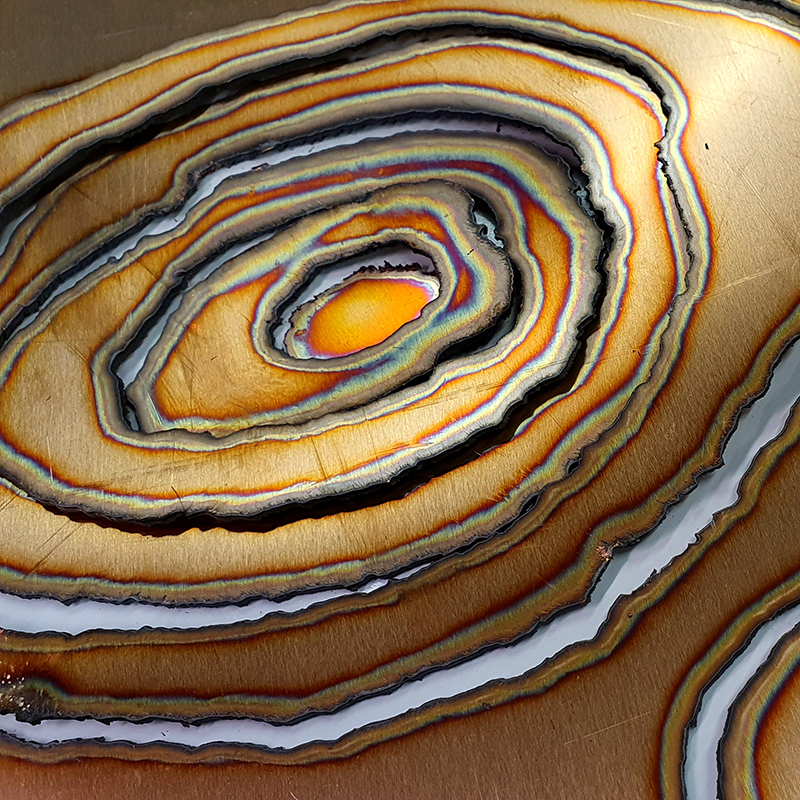
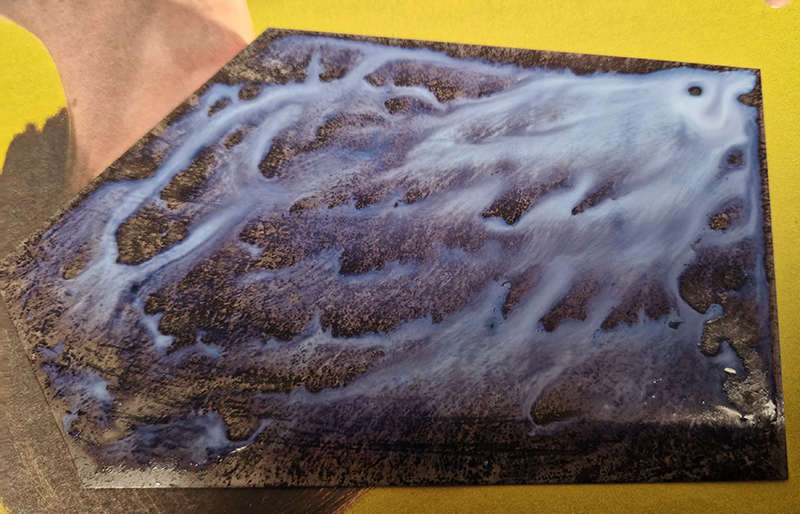
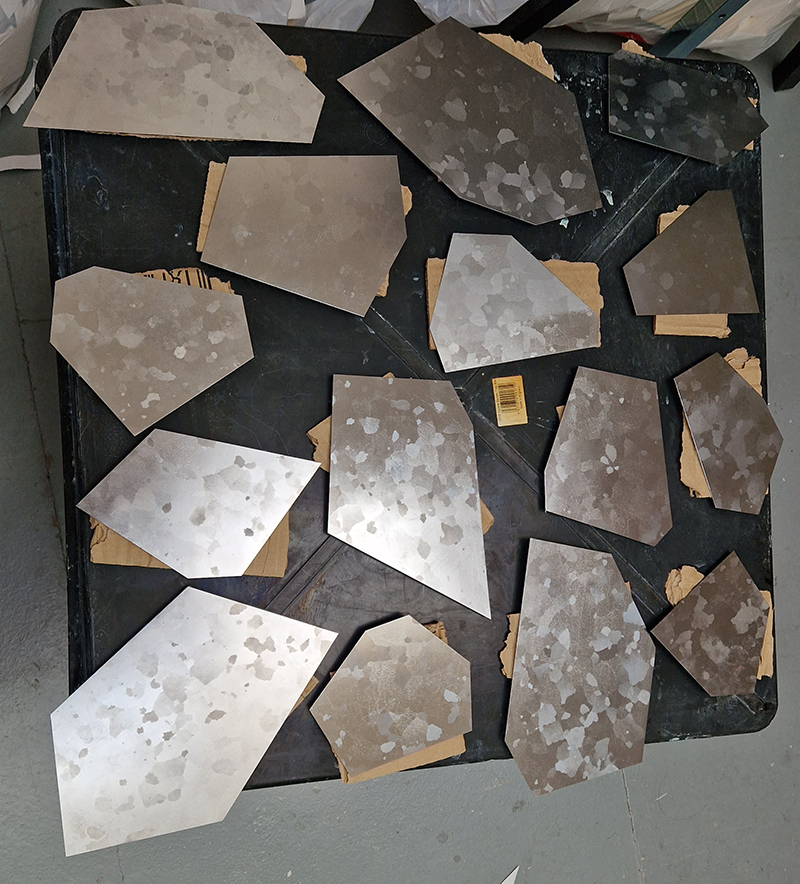
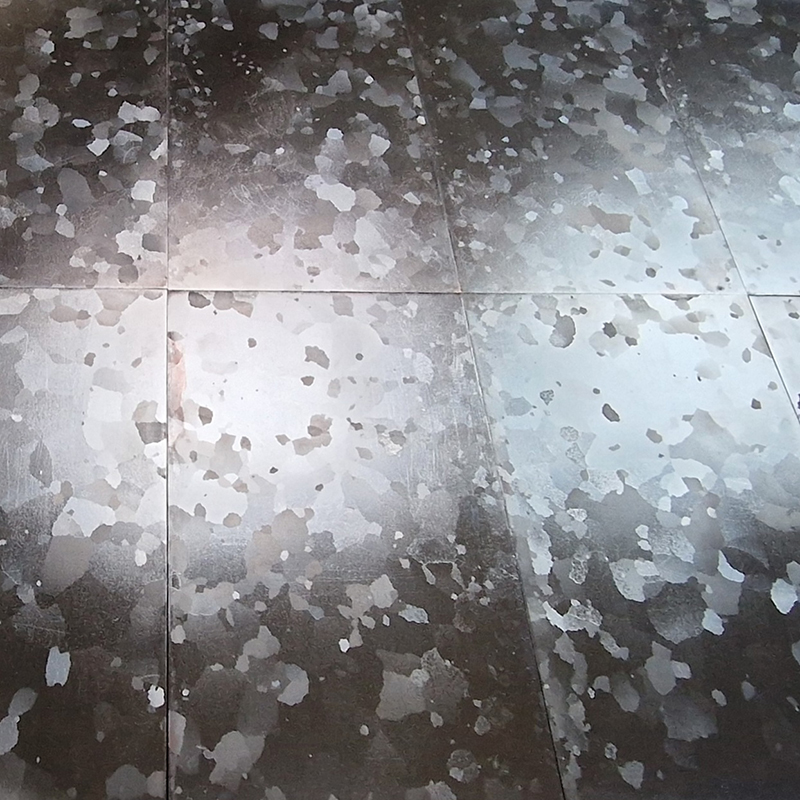
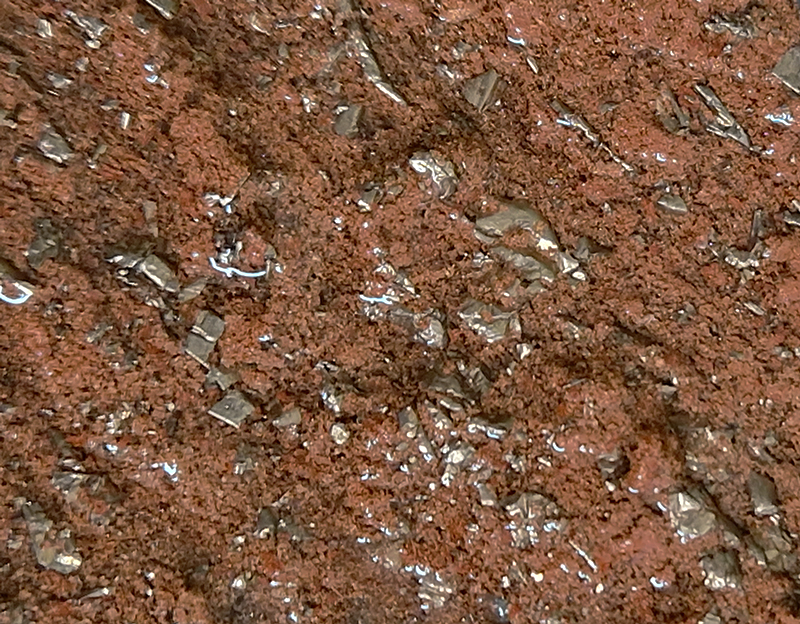
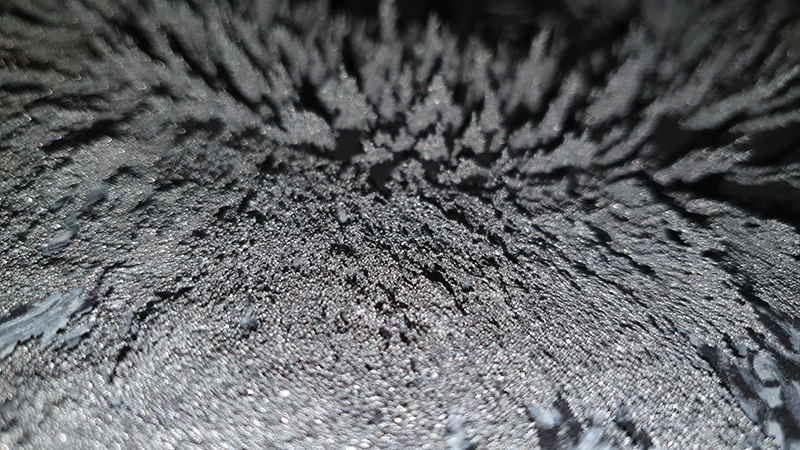
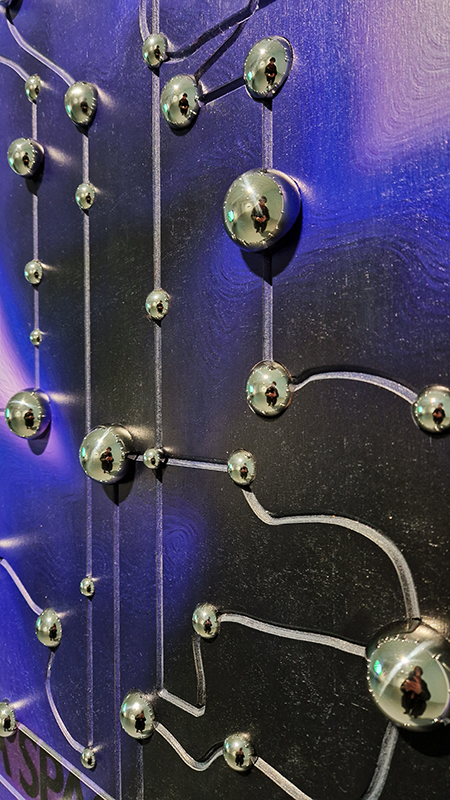
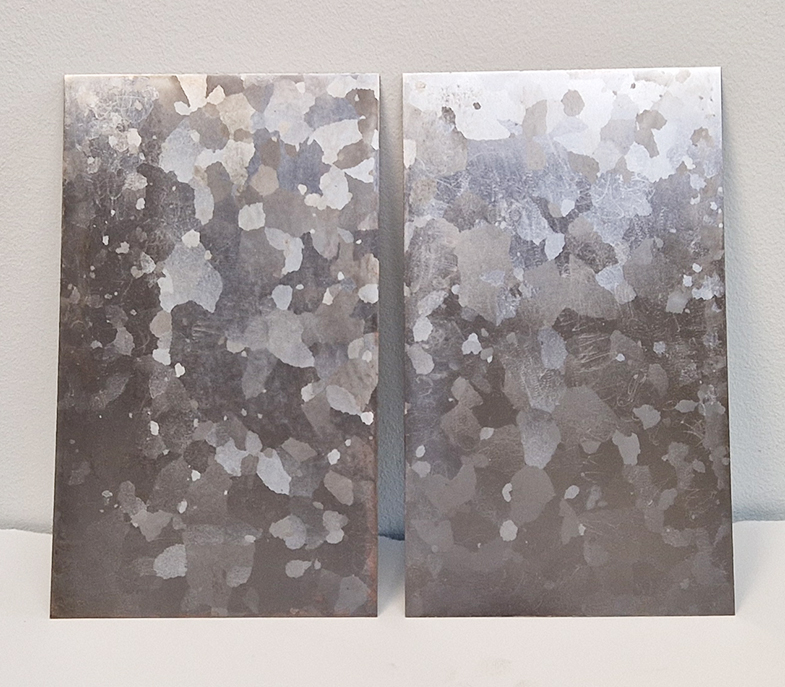
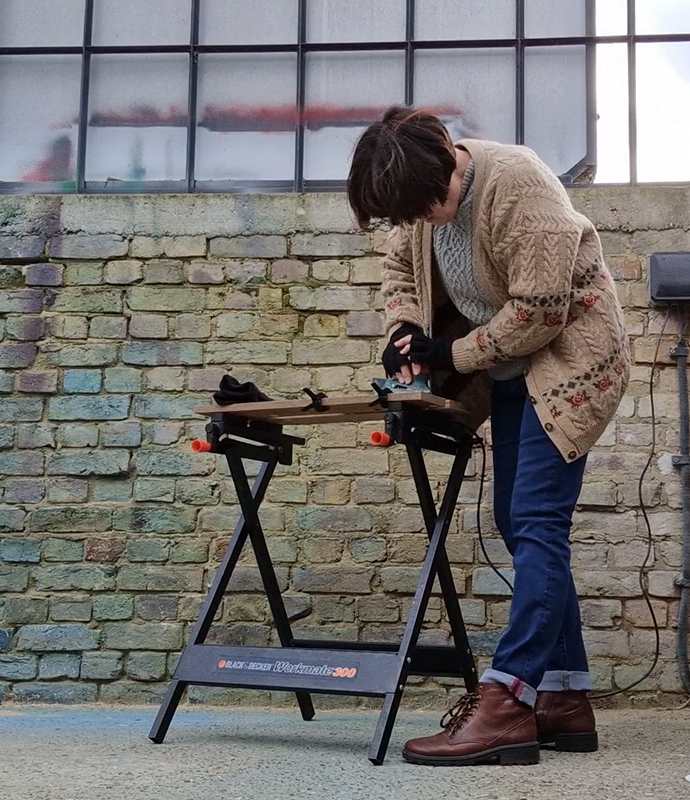
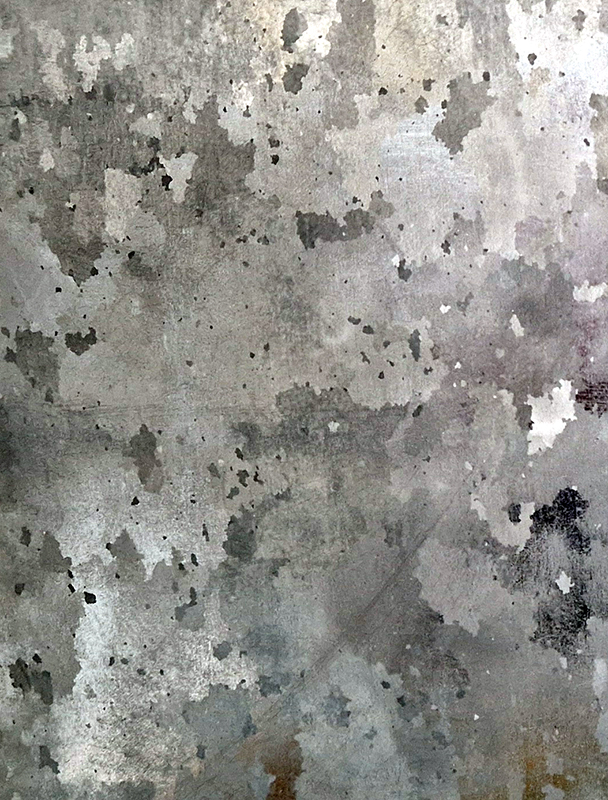
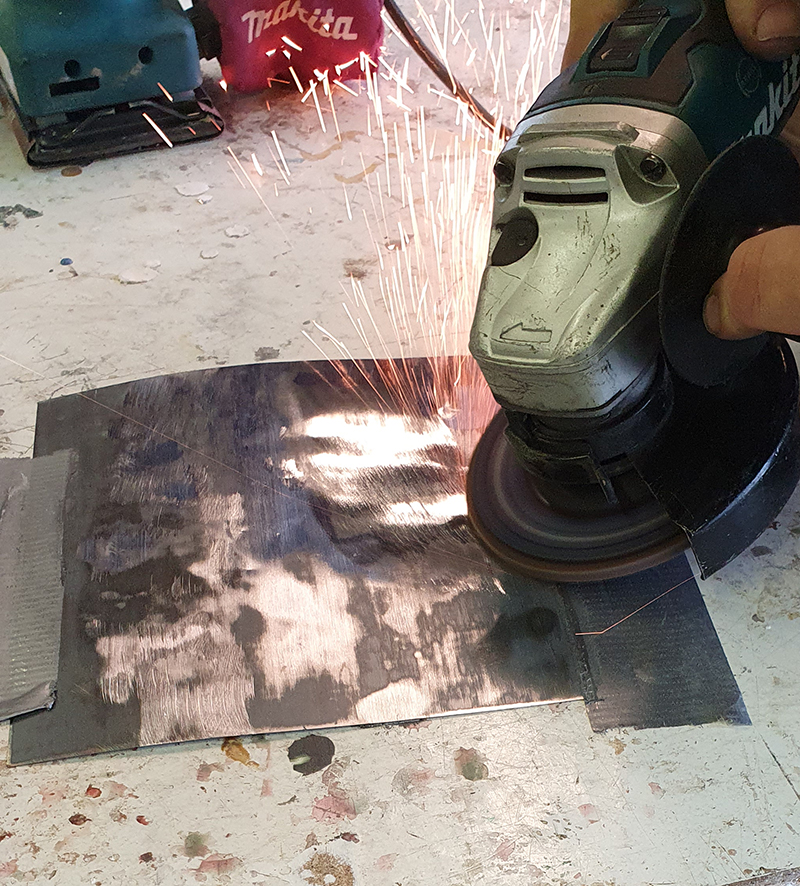
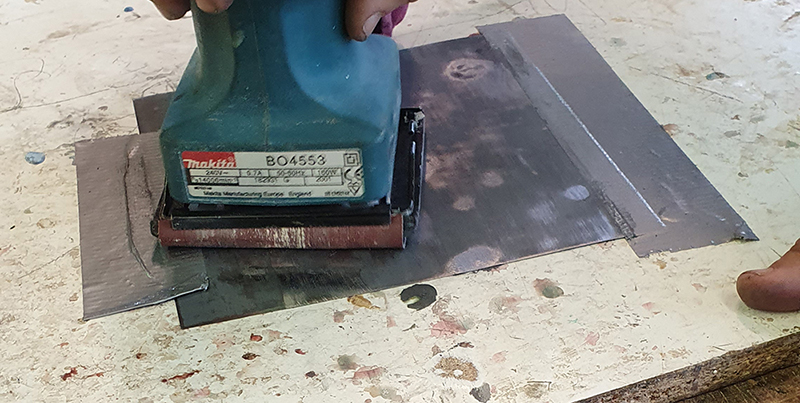
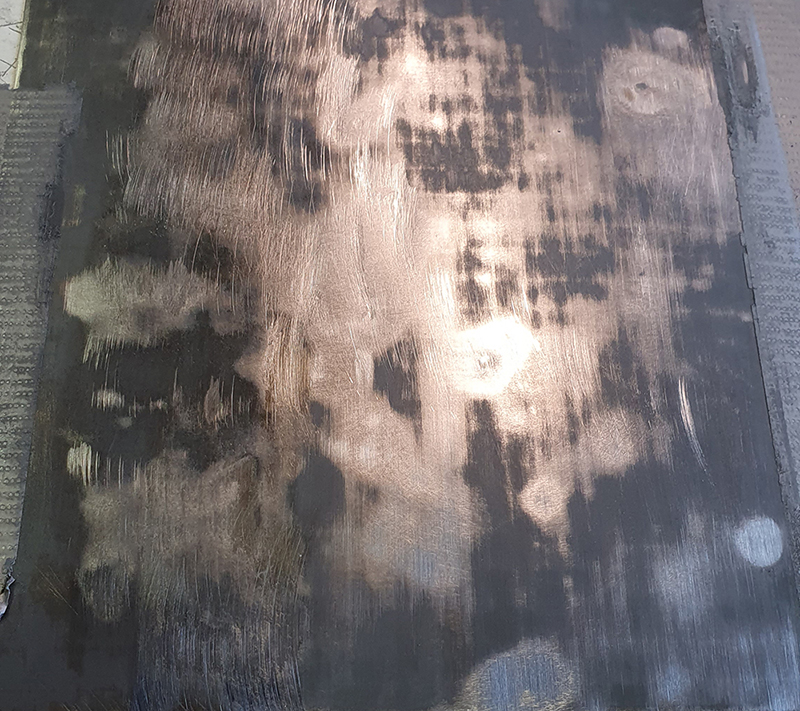
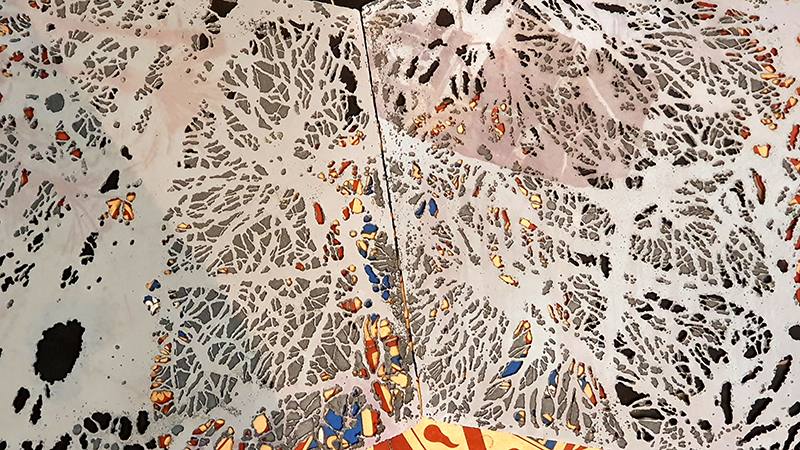
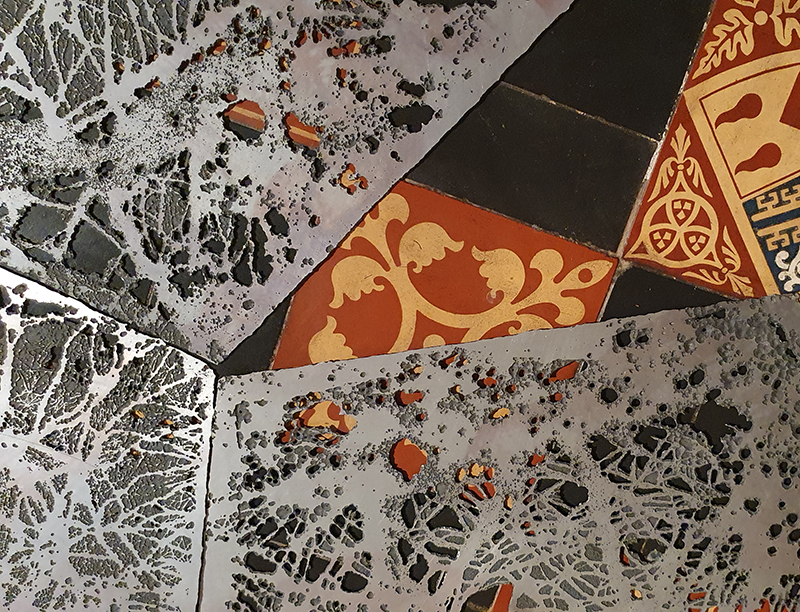
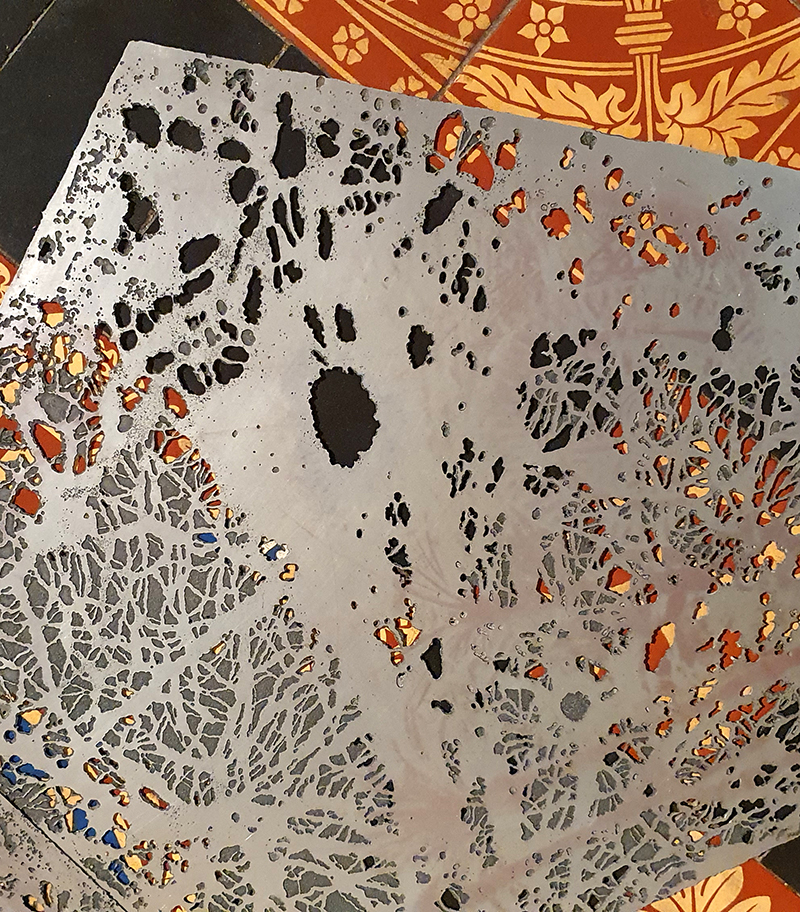
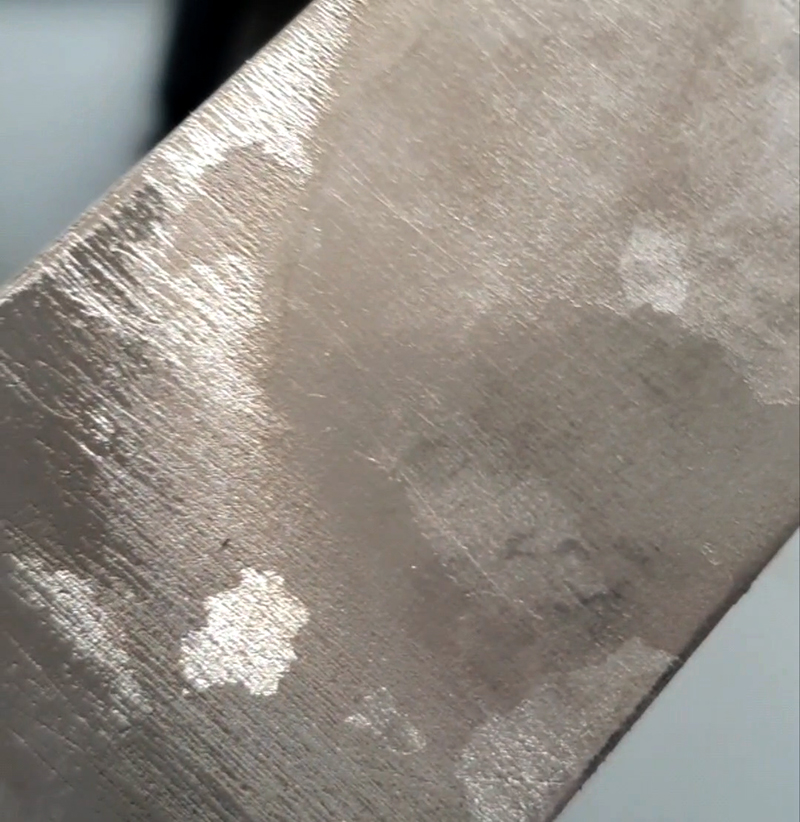
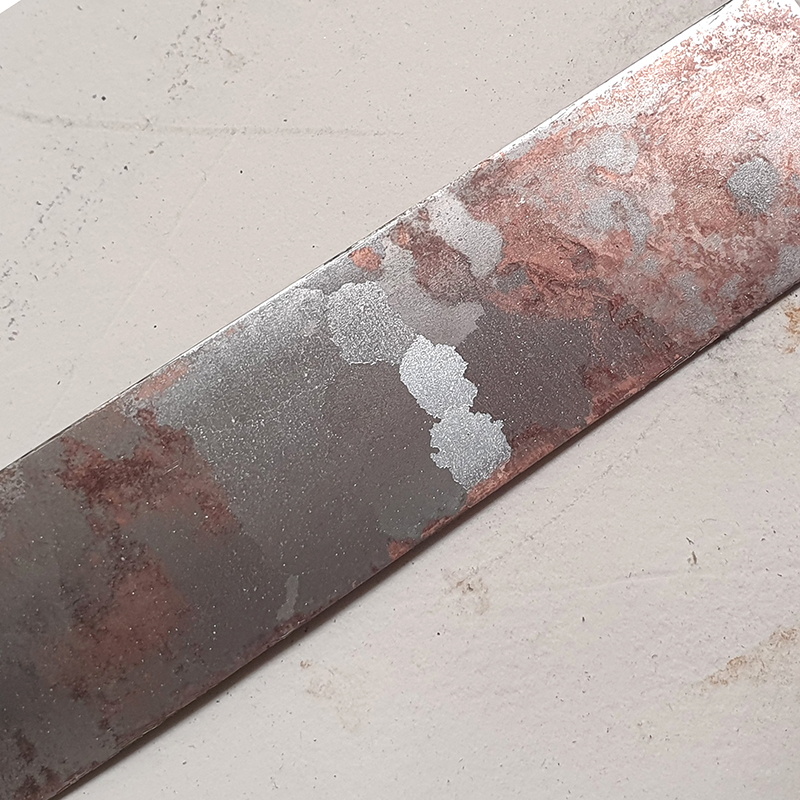
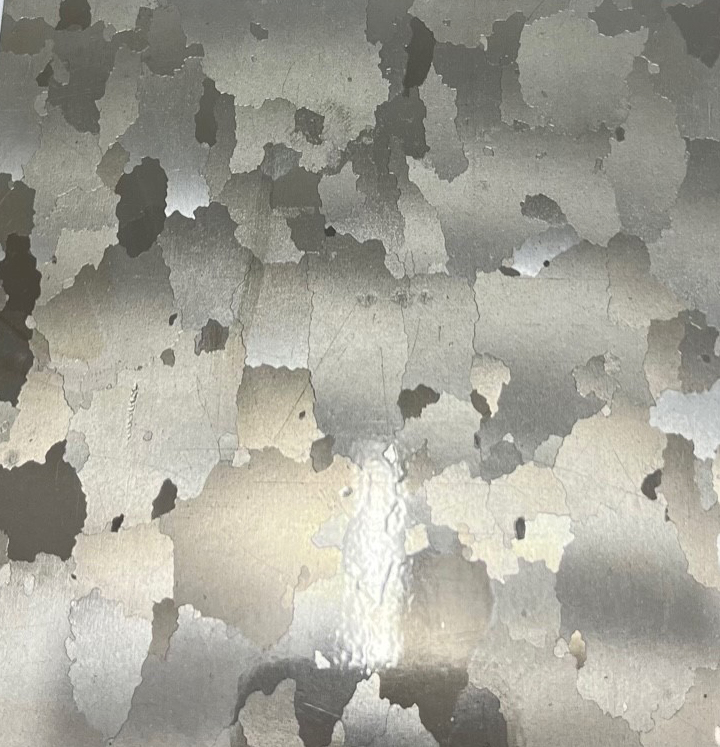
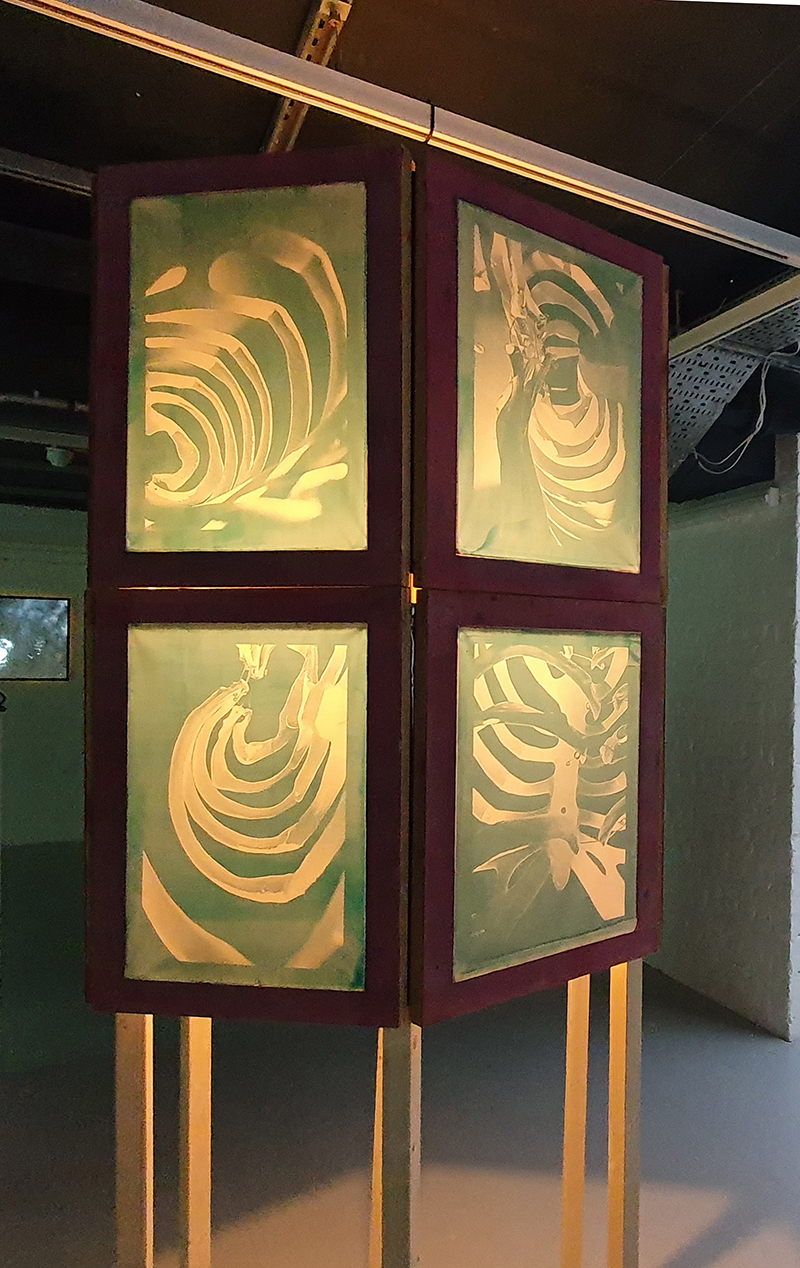
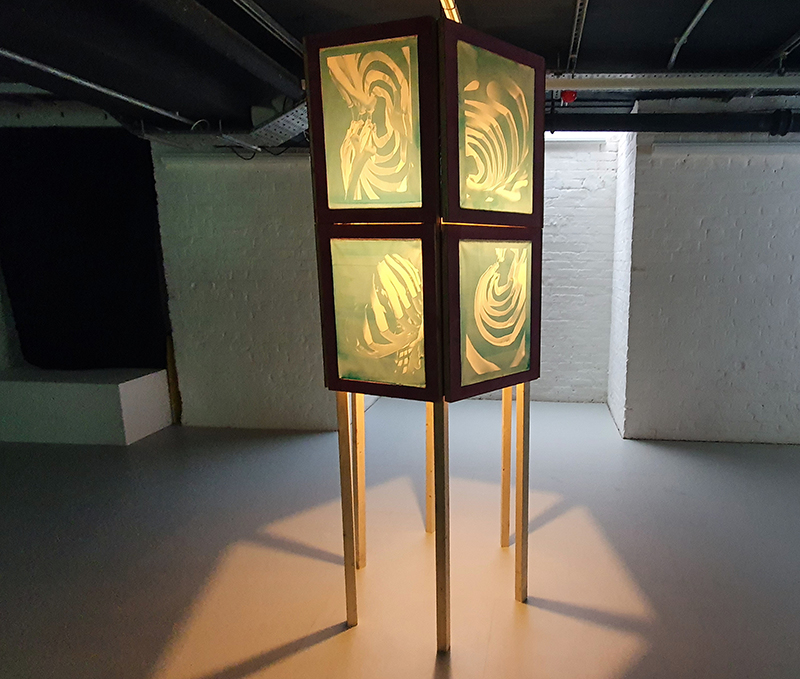
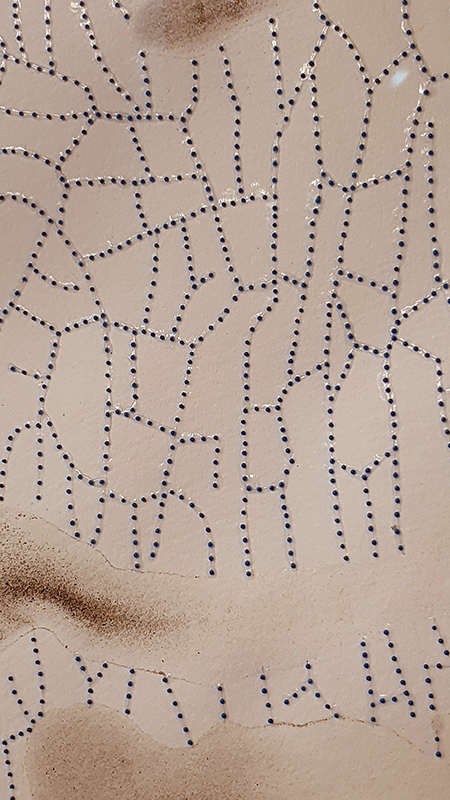
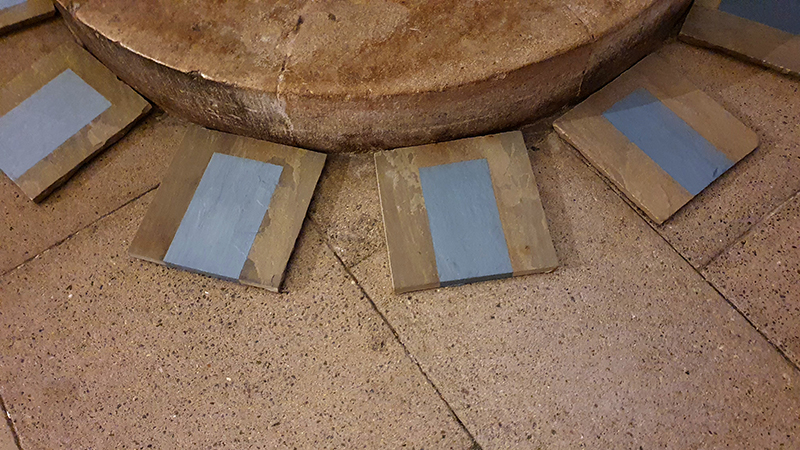
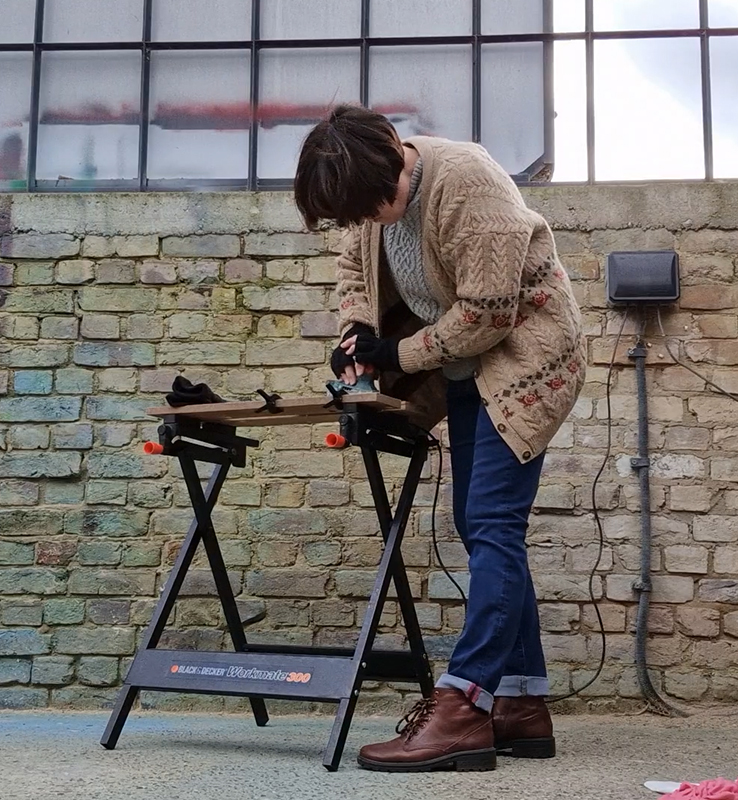
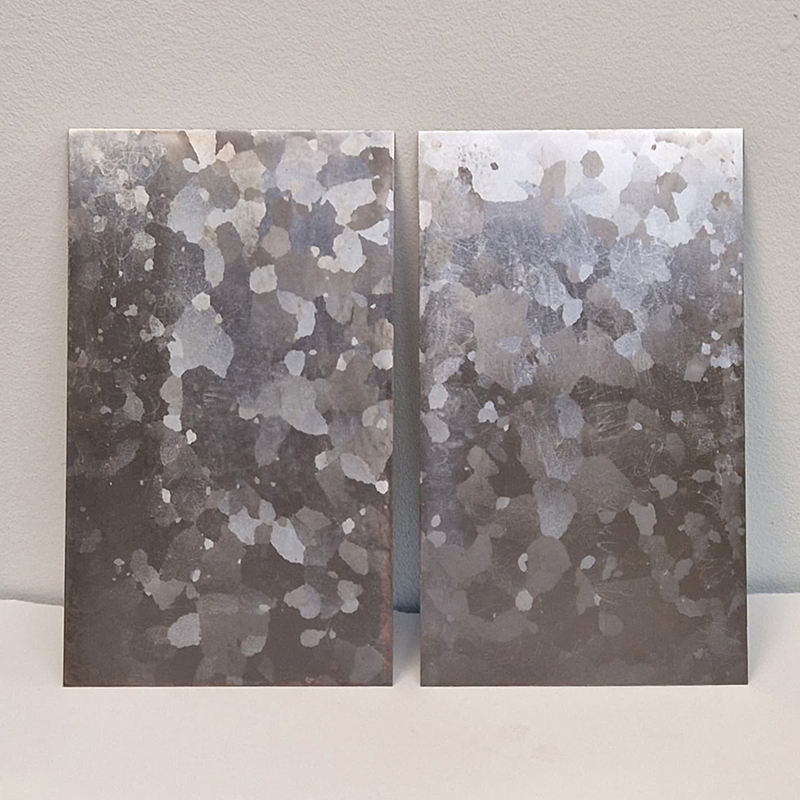
I first came across directional magnetic steel in the Electronic & Magnetic Materials Group open day at the National Physical Laboratory. Intrigued, I wanted to know if I could get hold of some to work with. I was put in touch with Union Steel Products who were very helpful in supplying a small amount (to them) of the material, but they import the product, and it arrives with an indeterminate protective matt grey coating. This was my challenge. It took many days of sanding and gently etching each sheet to reveal the pattern. It was a very temperamental material to work with, the pattern might appear but quickly tarnish and muddy over. So much of the work in the resulting sculpture was about the process of exposing an internal mechanism.
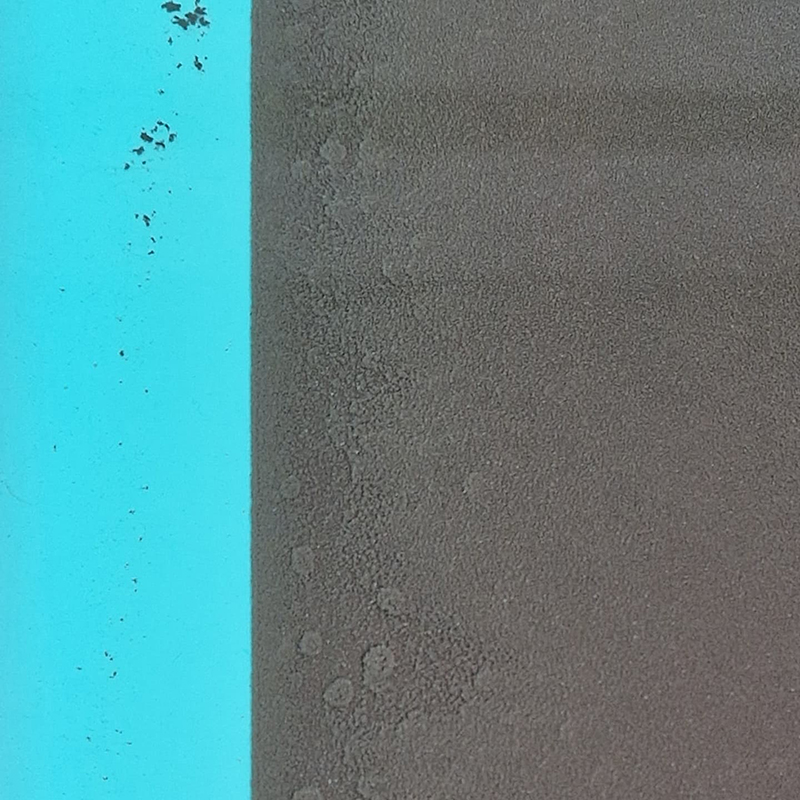
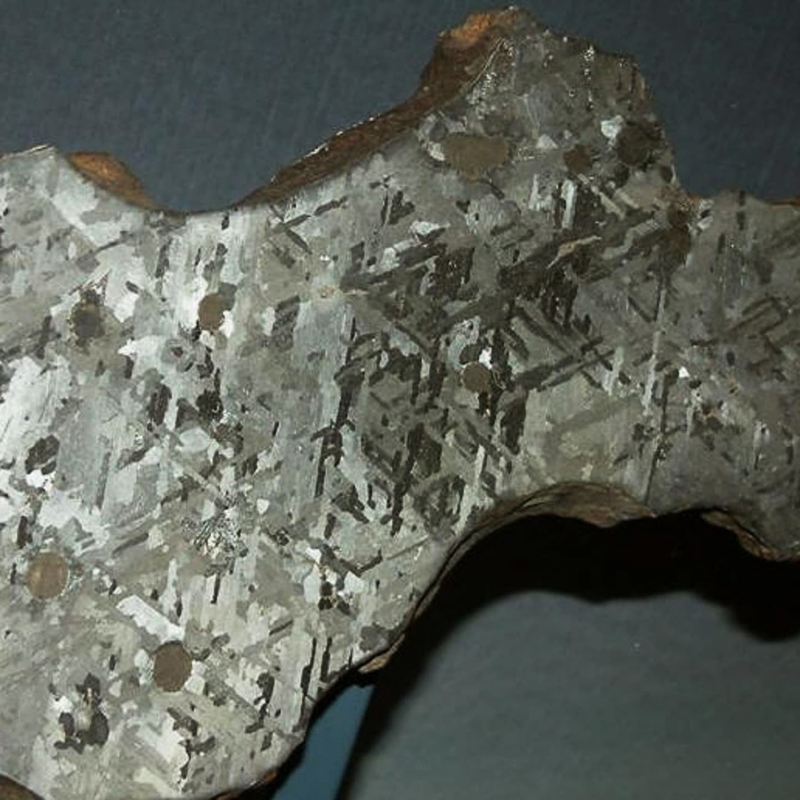
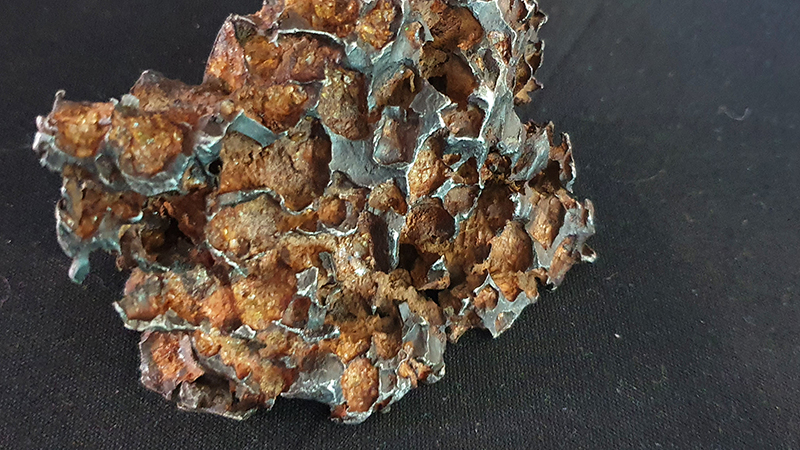
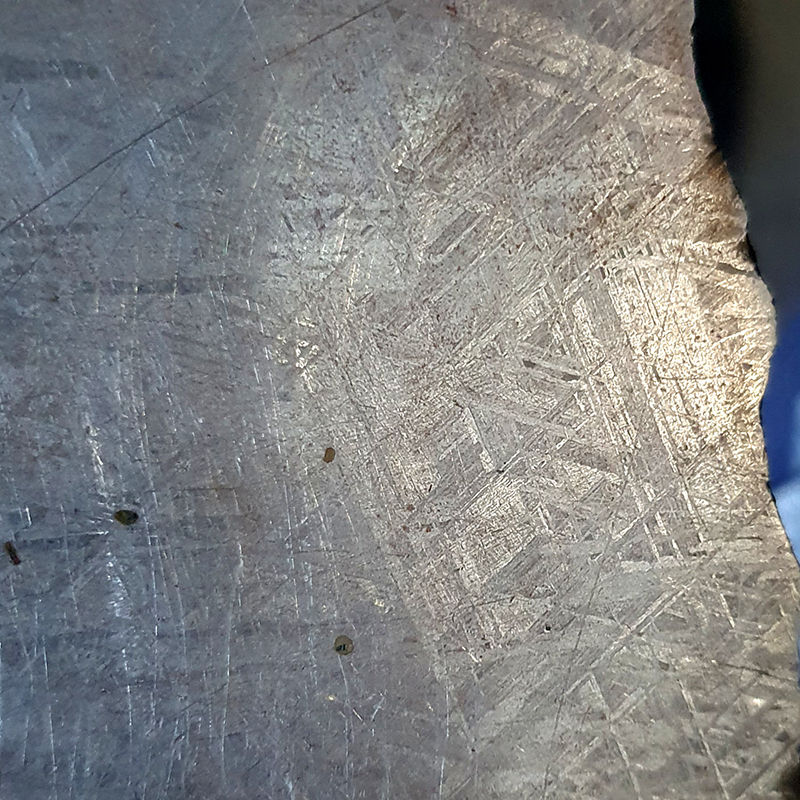
The dramatic Widmannstätten patterns found in meteorites due to their slow evolution through heat and pressure are also revealed through being cut, polished, and etched.

These secrets are not revealed lightly.
Domain of the Devil Valley Master

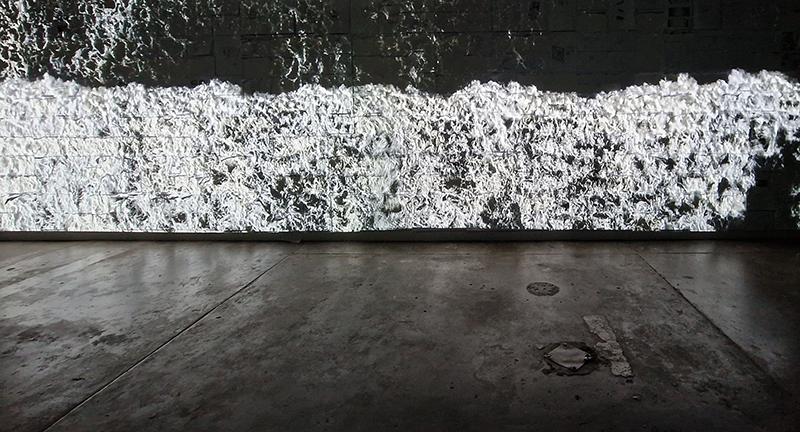
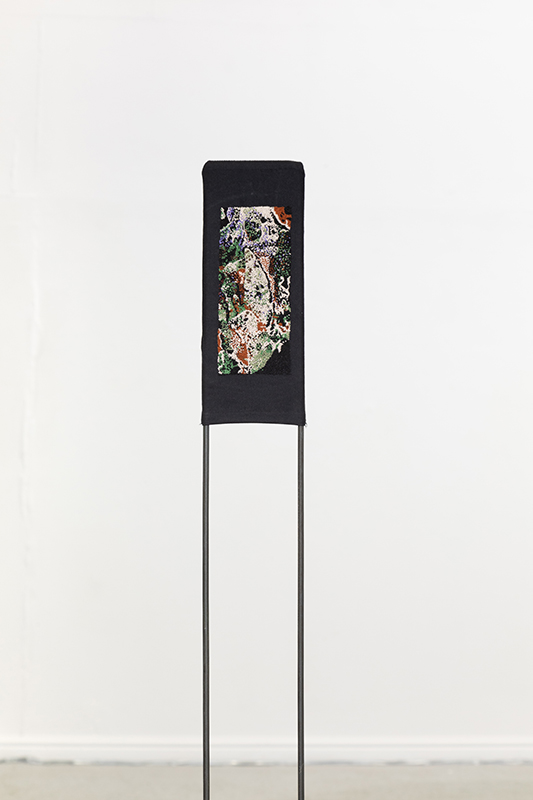
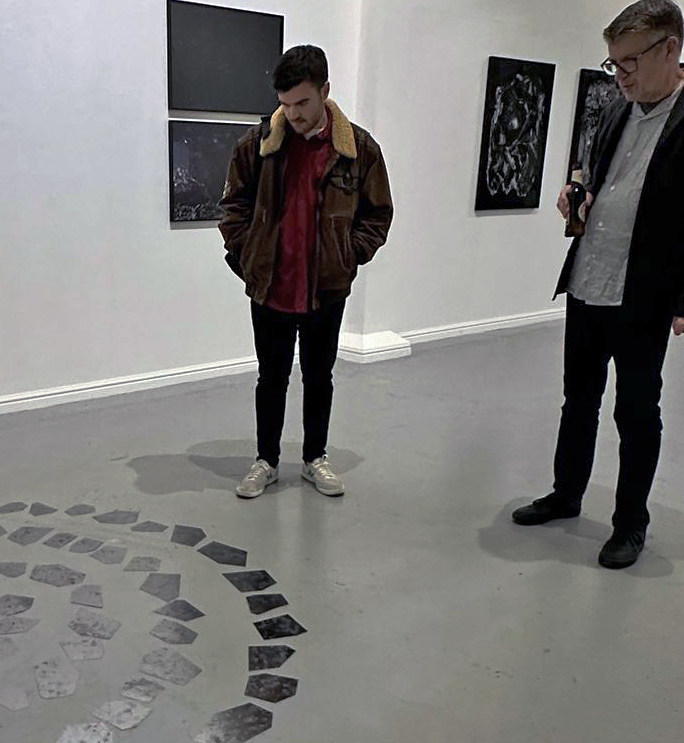
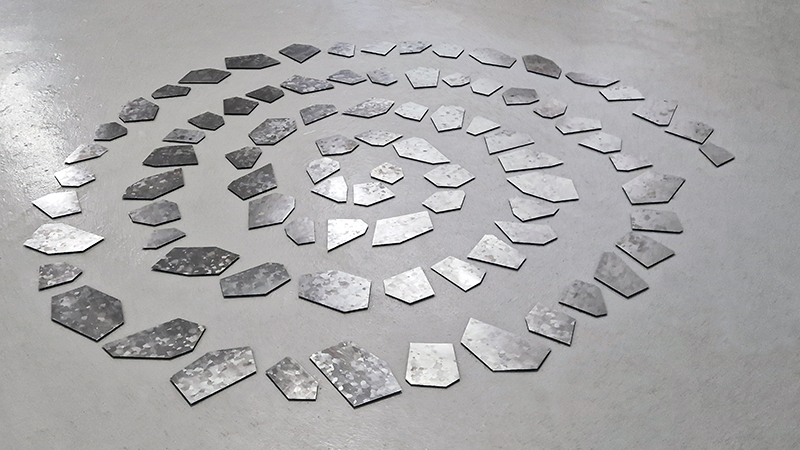
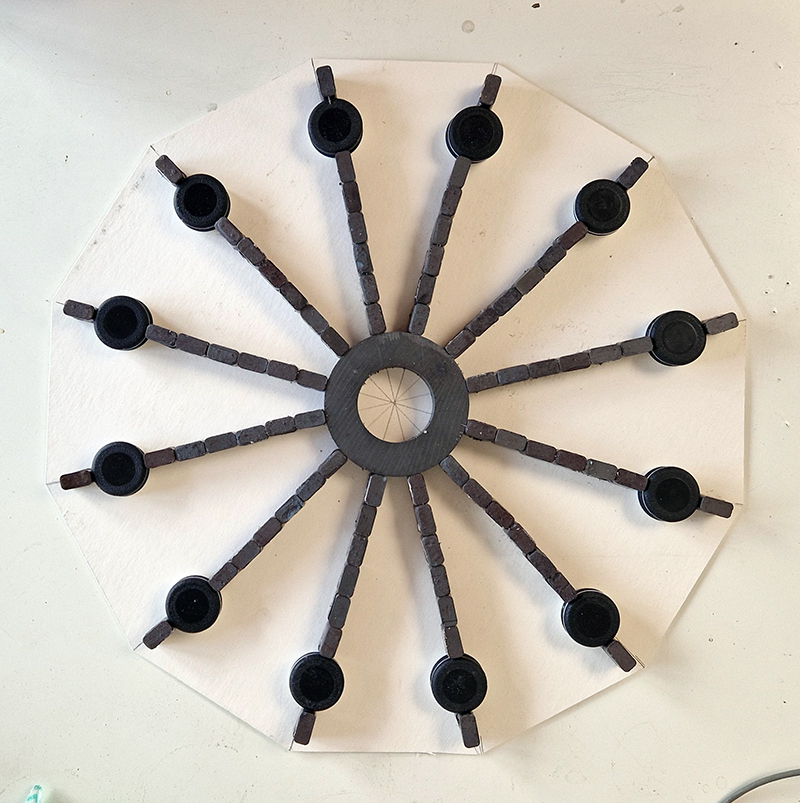
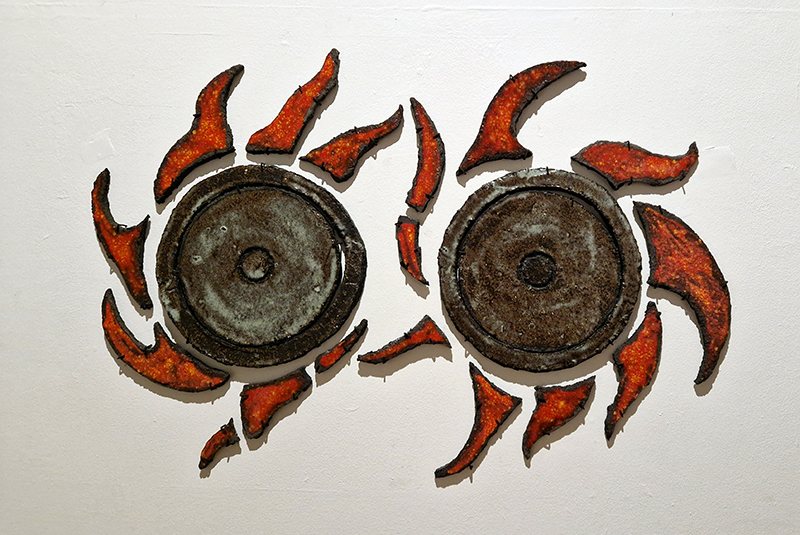
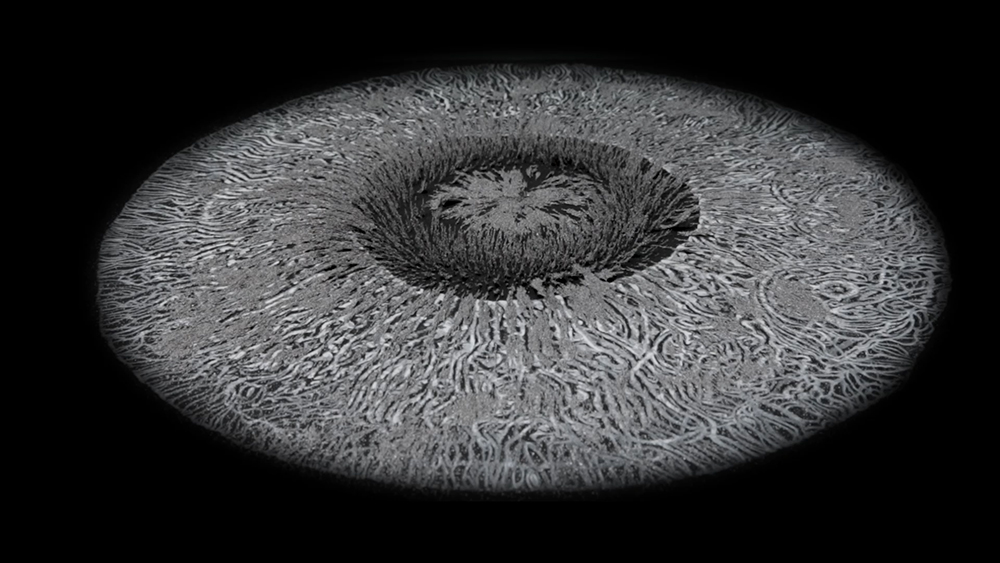
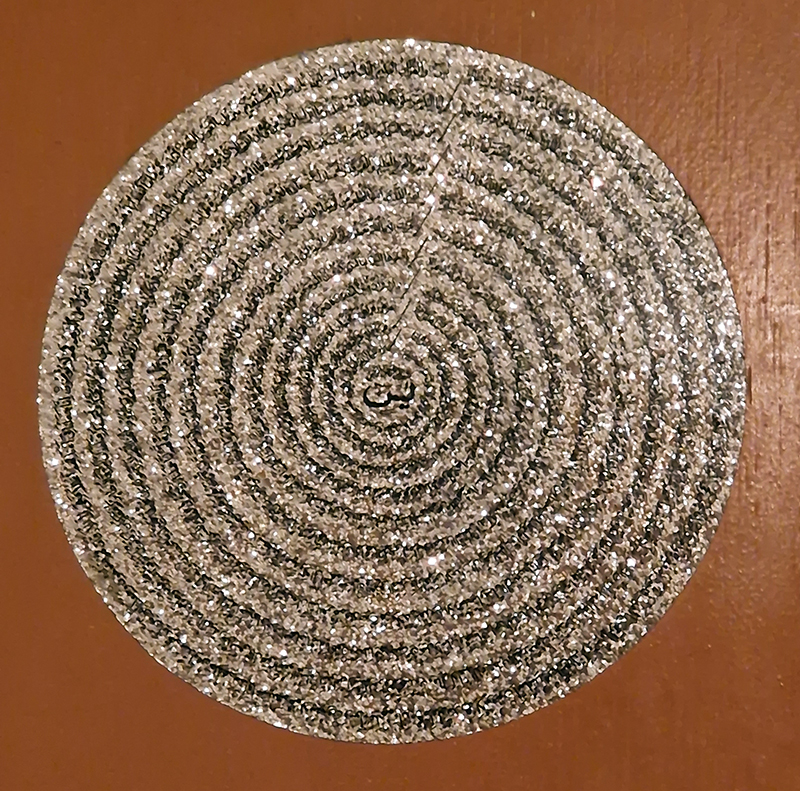
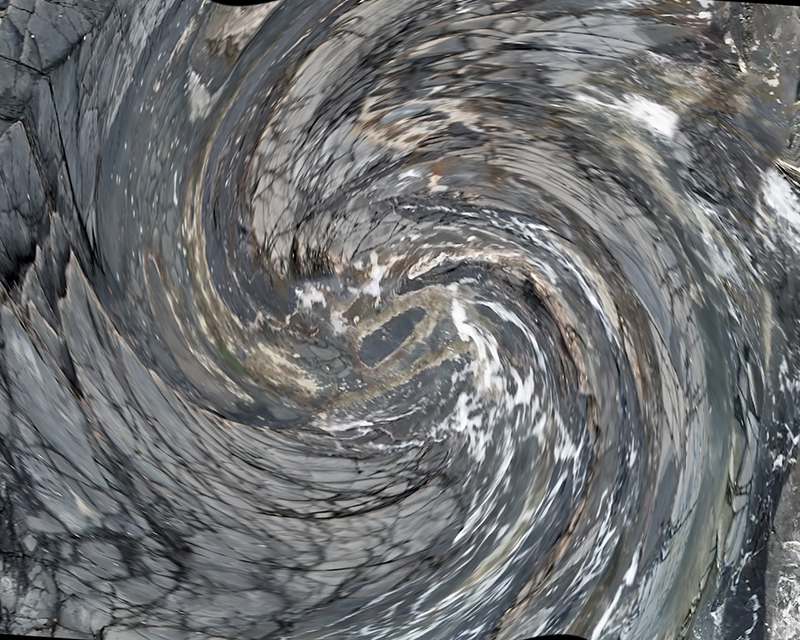
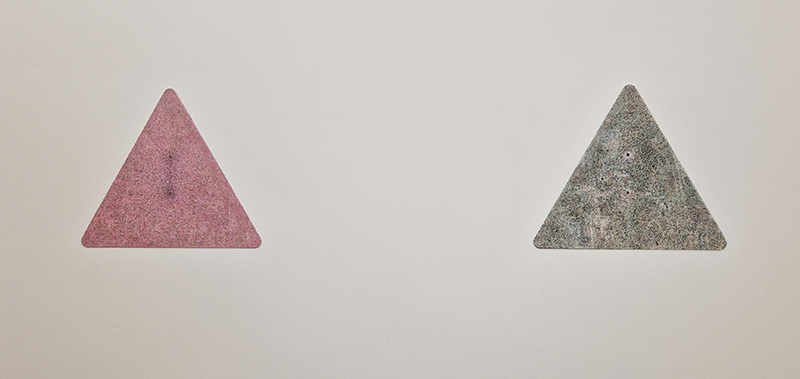
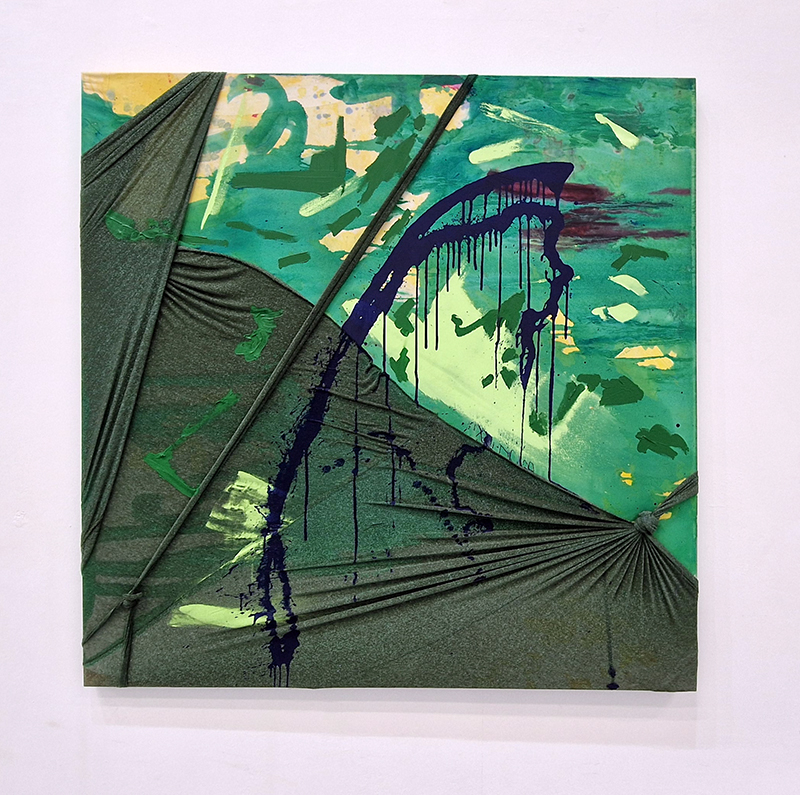
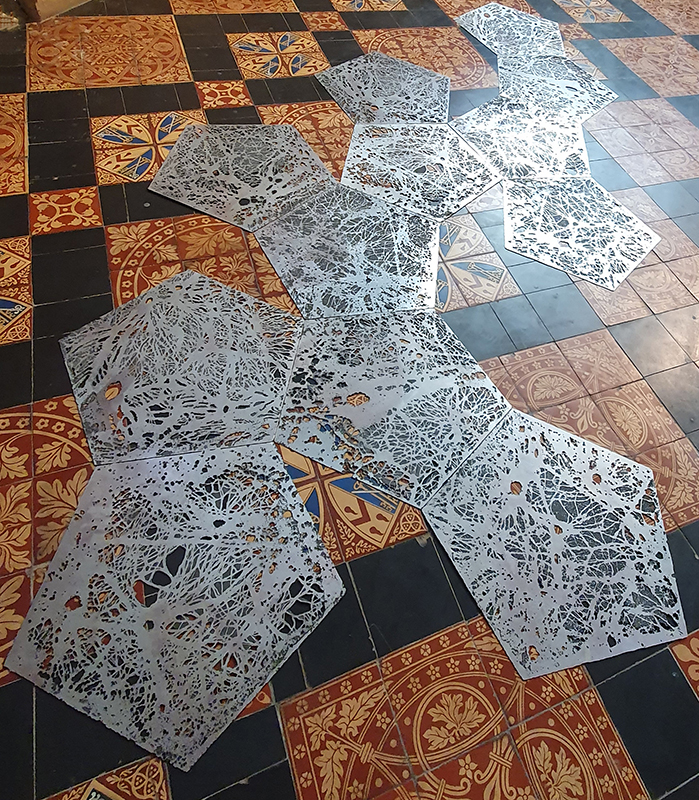
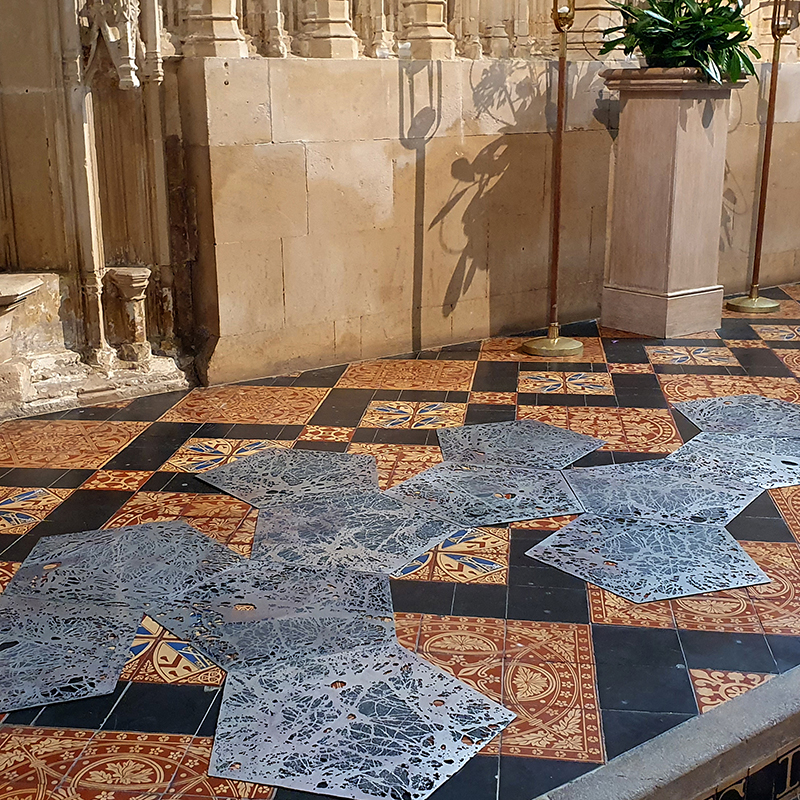
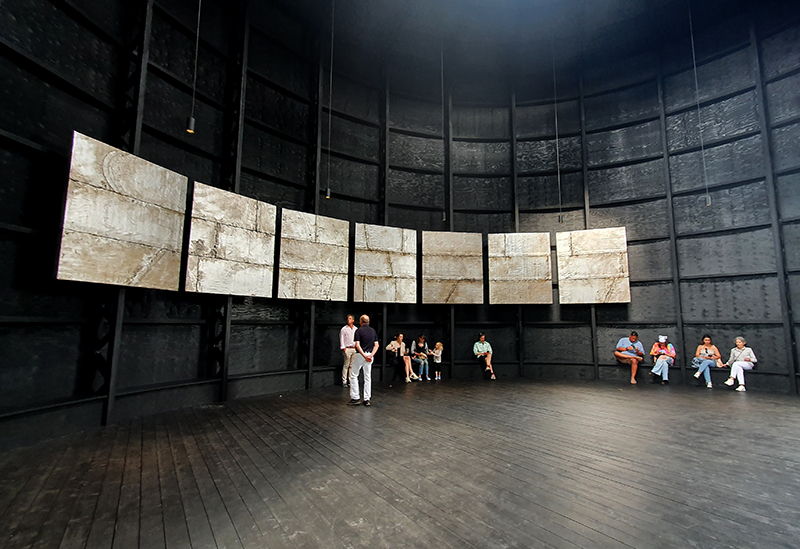
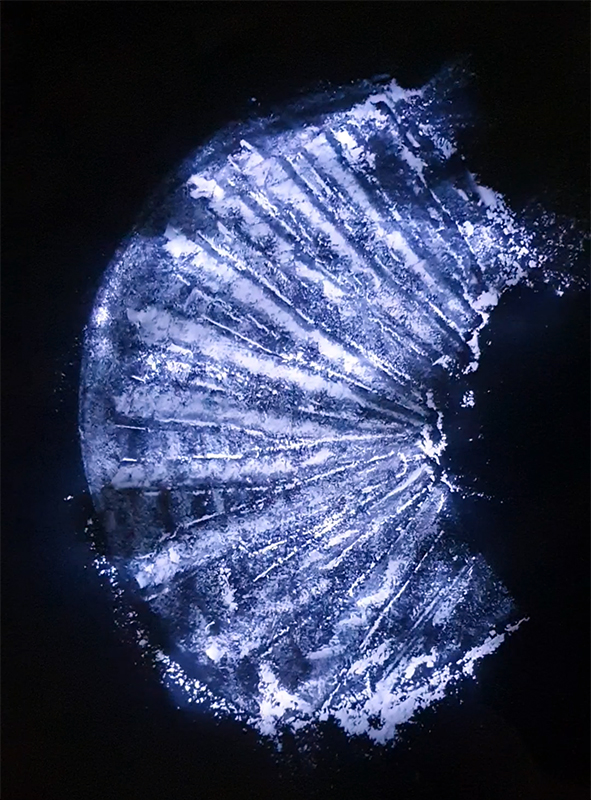
This work uses industrial directional magnetic steel, sanded and etched to reveal the Goss texture of rolled iron silicon alloy crystals. The jigsaw pattern of magnetic domains give this material exceptional magnetic properties. The simple evocation of a spiral described in geologically informed polygons draws upon many references, from the shape of our own Milky Way Galaxy sculpted by vast cosmological magnetic fields and the spiralling molten dynamo generating Earth’s magnetic field, to the inner pathway of spiritual growth and the route to the symbolic omphalos (navel) at the centre of the world where the sky entrance and the underworld meet. The title of this work originates from an ancient Chinese manual on the skills of persuasion, The Book of the Devil Valley Master, containing the first known mention of a compass, known at the time as a south-pointer. 

Work in progress. Mapping a response to the crystal structure of magnetite. Magnetite is the most magnetic of all the naturally occurring minerals on Earth found in igneous, metamorphic, and sedimentary rocks. Nano-particles are also found in the human brain, heart, liver, and spleen and the cells of many other organisms, with some creatures using this for navigation techniques.

Magnetite crystals from road traffic pollution caused predominantly by vehicle frictional braking systems can outnumber natural magnetite in the human brain by 100:1 – this is a worrying trend as these crystals could be involved in our perception, transduction, and long-term storage of information in the brain.

Returning to my conversation with Alan Watson on the history of Haverah Park Extensive Air Shower Array.

The motivation for the Haverah Park project getting off the ground came largely from the British physicist Patrick Blackett, who won the Nobel prize in 1948 for his discoveries in the field of cosmic rays. The director of The Rutherford Lab (where the British atomic bomb was being developed in the 50’s), John Cockcroft (known for splitting the atom), decided there should be fundamental science going on as well as bomb building, so outside the security wire they built an air shower array to monitor cosmic rays. When this experiment was shut down, Blackett was keen to see work with shower arrays continue, and to be within reach of a university so that scientists could combine research with teaching. Blackett was working at Cavendish Laboratory with Ernest Rutherford, but moved to Birkbeck which did all the teaching in the evening so he could do research work through the day and teach in the evening. Here he met J G Wilson, also with an interest in cosmic rays, so when J G Wilson later moved to Leeds, Blackett suggested he set up an air shower array there, which was how the Haverah Park Project came about. Land was rented from local sheep farmers to install the observation huts.

Alan Watson took a lectureship job at Leeds in 1964 and began working for J G Wilson, becoming a leading member of the UK Extensive Air Shower project until its closure in the early 1990s.

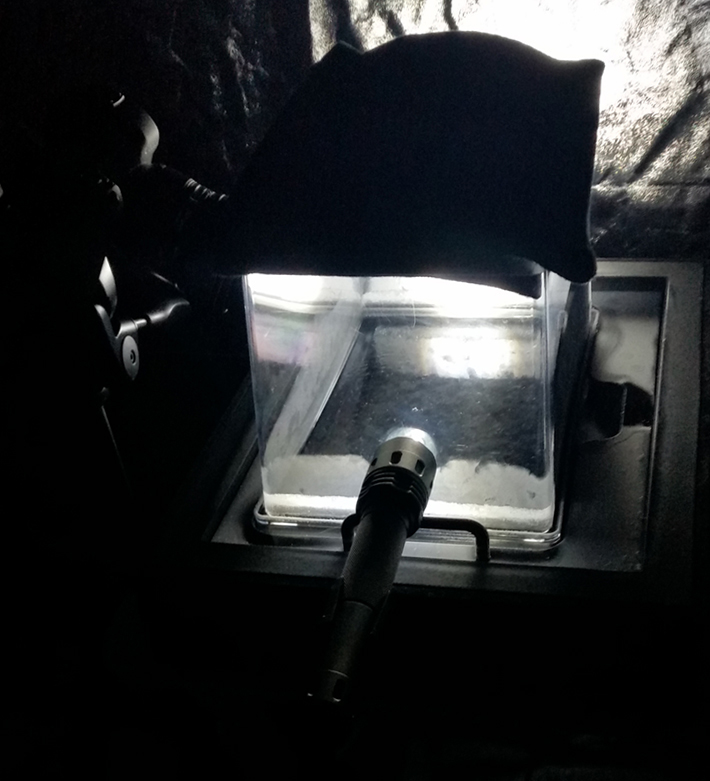
We also talked about the mesmerizing power of a cloud chamber. As well as it being considered one of the most important developments for progression in the understanding of particle physics it is also emotionally and aesthetically captivating. Alan reminisced about a time at the Royal Society Summer Exhibition when a large commercial diffusion cloud chamber drew so much attention they were asked to turn it off, as mesmerised visitors blocked the entrance to the exhibition. It’s been a few years since I visited the Institute of Physics to see the large cloud chamber in the foyer, I wonder if it’s still there. I love the fact that I can build my own cloud chamber to see these cosmic visitors.

J G Wilson writing on the study of cosmic rays from his book About Cosmic Rays published in 1948, of which I have a copy:

‘It has its spectacular side, for the only laboratory which has been found big enough for its investigations is the whole of the universe to which men can win access. Most refined measurements have been made under conditions of difficulty and hazard, deep in mines and on icebound mountains, in the watses of western Greenland and cramped in the tiny gondola of a stratosphere balloon. These exploits, which are outstanding even in one of the most brilliant phases of experimental physics, are an unambiguous indication of the importance which is attached to the problems which are being studied.’

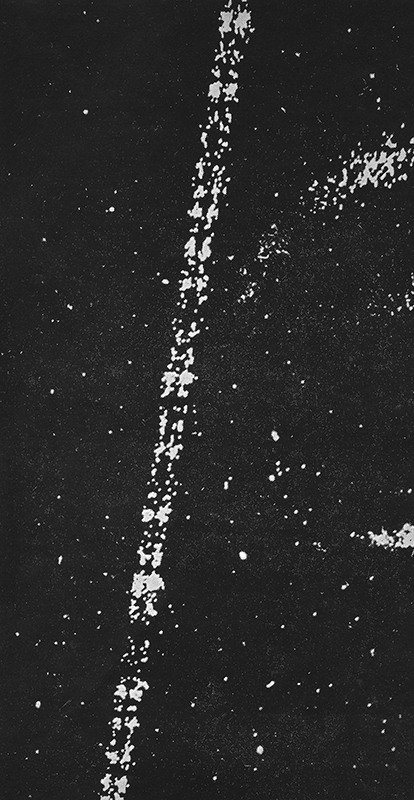
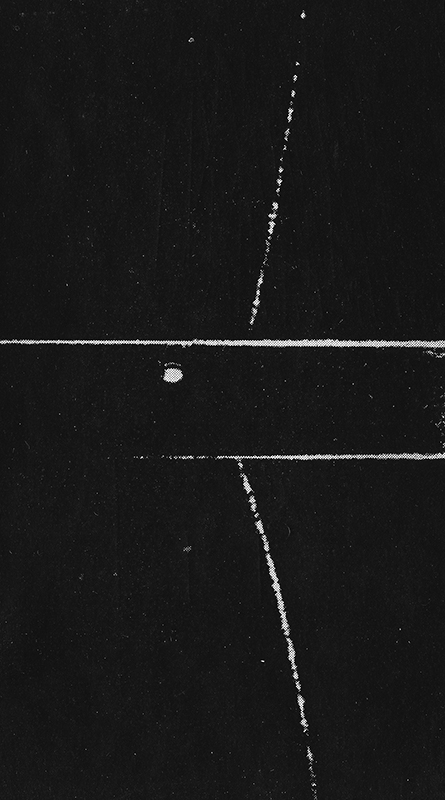
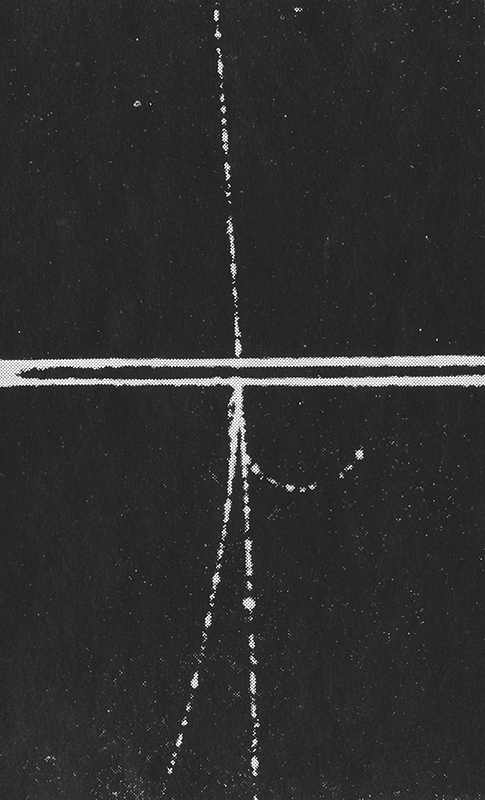
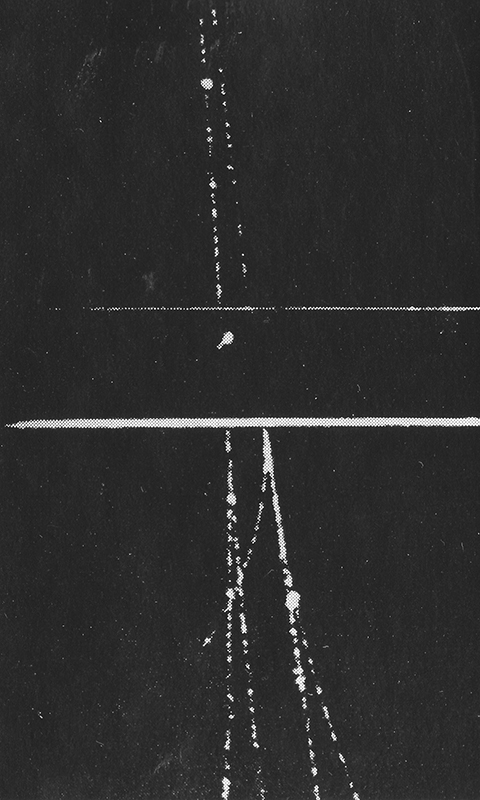
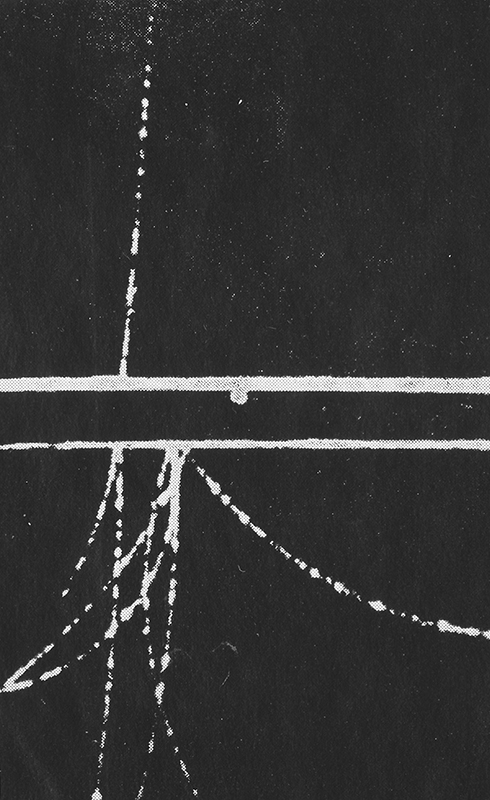
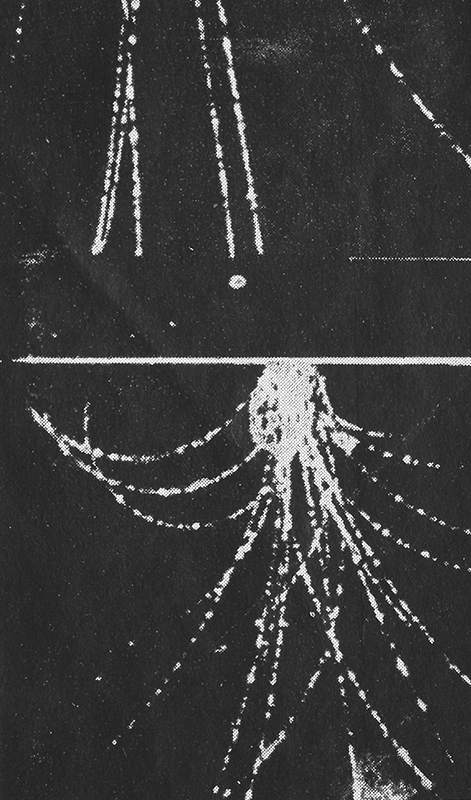
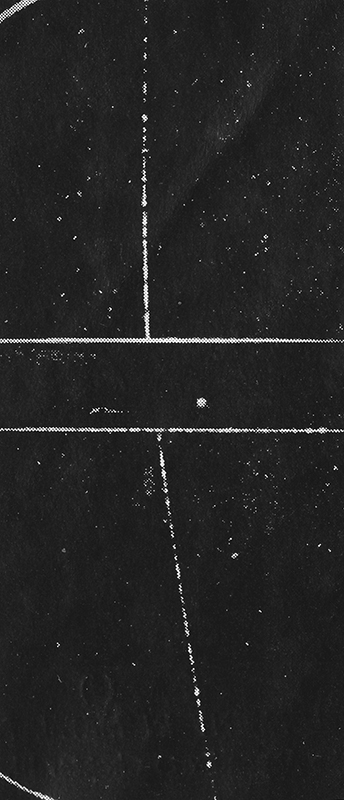
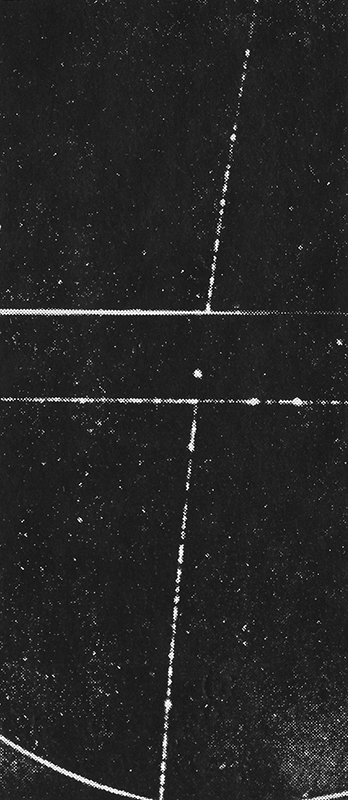
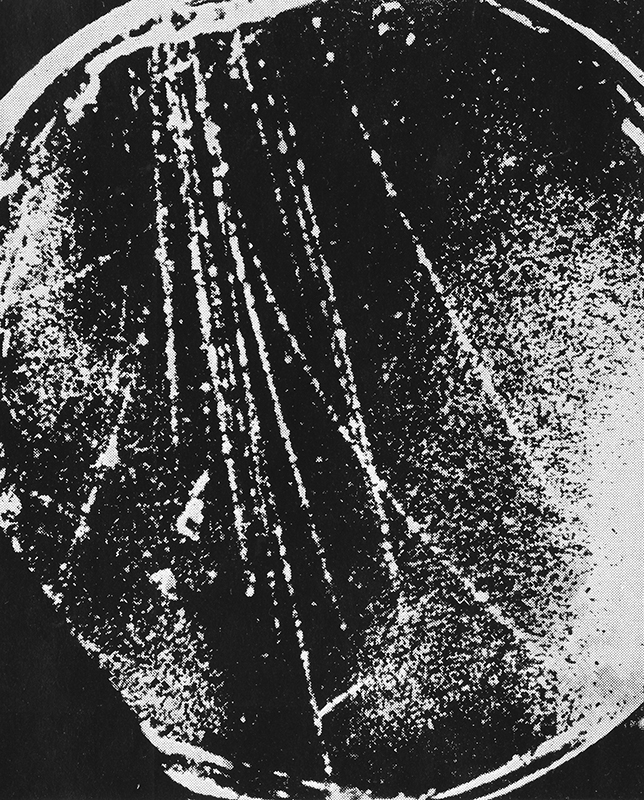
The following images from the same book show particle trails photographed in a cloud chamber -showing extensive showers and particles passing unhindered through metal plates.

J G Wilson writes about cosmic rays ‘…it is interesting to speculate on their previous history, for before it is overtaken by the catastrophe of hitting the earth, each particle is likely to have had a placid life for years, even millions of years, cruising through the wide open spaces of the universe’.

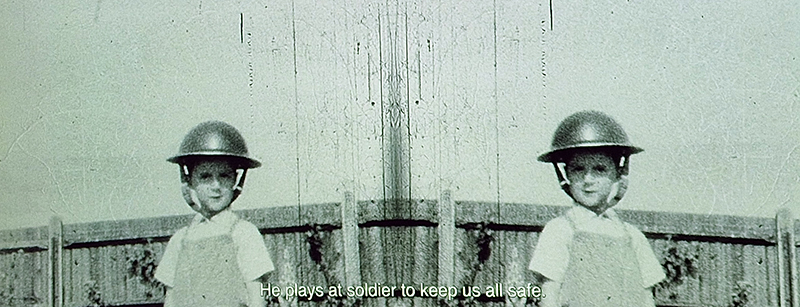
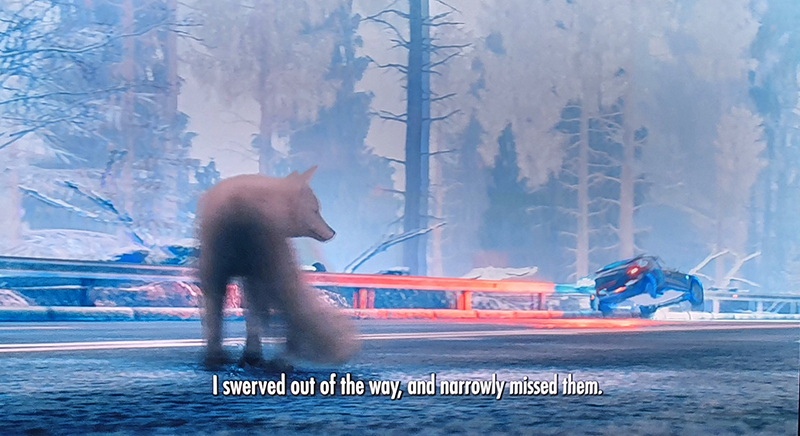
Cosmic Chiasmus: crossing the universe 2021 (video still)

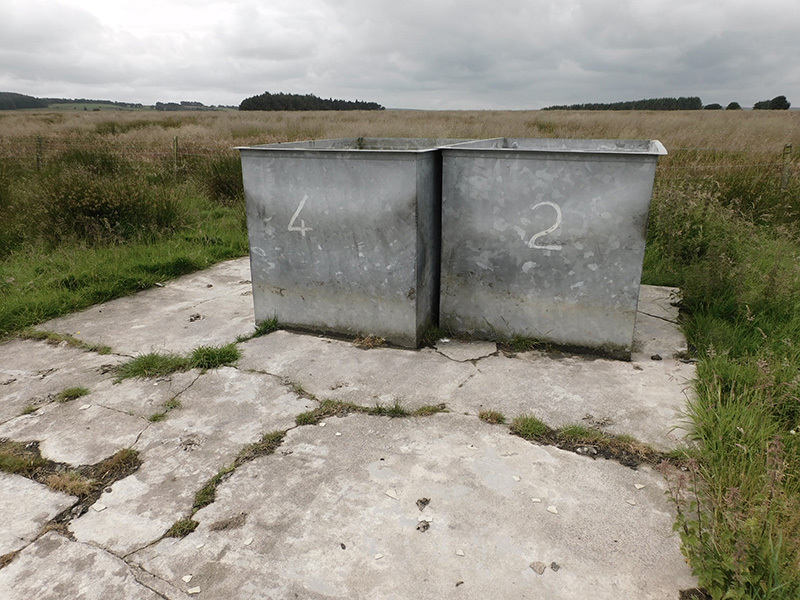
The primary detectors used at Haverah Park were water Cherenkov detectors. These are large water filled tanks filled with a photomultiplier suspended in the water to capture flashes of Cherenkov light emitted by high energy cosmic rays as they pass through. The light is emitted because the cosmic rays pass through water faster than photons of light are able to, and as they do so they lose electrons thereby emitting light. The speed of light is only a constant within a vacuum, when it passes through other materials it get slowed down.

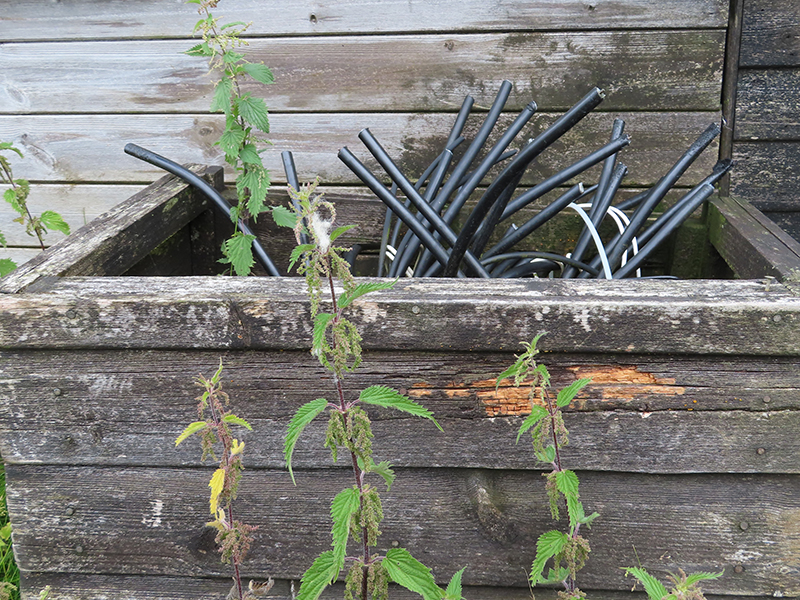
There were four 34 m2 detectors at the centre of the array in the main hut, with three detectors located 500m from the central detector. Signals from the three distant detectors were sent along buried cables to the central hut, with the signal from the central detector passing down 500 m of cable buried underground so that all signals arrived at about the same time.  When signals from the central one and two of the others arrived within ~2 x 10⁻⁶ s (called a coincidence), the signals from the photomultipliers in the 34 m2 detectors were displayed on four oscilloscope screens and photographed by one camera which had its shutter permanently open. About 20 feet of film could record around 150 events. Developed and manually scanned by Alan, or a senior colleague, the film was checked for quality and to look for any large events (ultra high energy particles arriving) which were always exciting to find. The developed film was then sent to Leeds University Physics dept for measurements.

When there was a coincidence event at the centre of the array, a signal was sent by microwave to the distant detectors set across the moorlands (on average about 2km from the central hut), the signals from these distant groups of 4 x 13.5 m2 were recorded digitally with the data going onto paper tape which was collected once each week. 

Along with the oscilloscope traces being photographed, the number on a counter was included which gave the time of each event to the nearest half minute.  In the 1960’s when this project began the time counter was advanced by a pendulum clock.  Counting time in half minutes the team found that there are roughly one million half-minutes in a year, which gave a good excuse for an annual party.

There were some brief periods in the early 1980s when a small number of scintillator detectors were also used to make cross-checks of the results from the water Cherenkov detectors against those from projects in the USA (Volcano Ranch) and Yakutsk (Siberia).  The scintillators retrieved from Imperial College’s Holborn project were brought to Haverah Park for an experiment to look at much lower energy showers.

Both types of detectors register flashes of light.  

Blackett was the first person to work out the details of Cherenkov light produced in the atmosphere. According to a memoir on Blackett, written by astronomer Bernard Lovell, who knew him very well, Blackett attempted to see Cherenkov light from cosmic ray showers with the naked eye but there is no mention of whether he succeeded. In 1962, physicist Neil Porter who built the first water Cherenkov tank in the UK at Harwell in the 50’s, did an experiment with some volunteers who were asked to recline on a coach in a dark room with a small Geiger telescope attached to a pair of darkened goggles and acknowledge if they saw a flash of light when a cosmic ray was known to pass through the googles. The observers did seem to experience a flash of light but results were ambiguous as to whether this was Cherenkov light being emitted as the particle passed though the crystalline lens or vitreous humour of the eye or a direct excitation of the retina. The experiment was a collaboration with the Psychology dept at the University of Dublin and published in Nature under the Psychology heading giving an impression that the lights were perhaps a figment of the imagination.

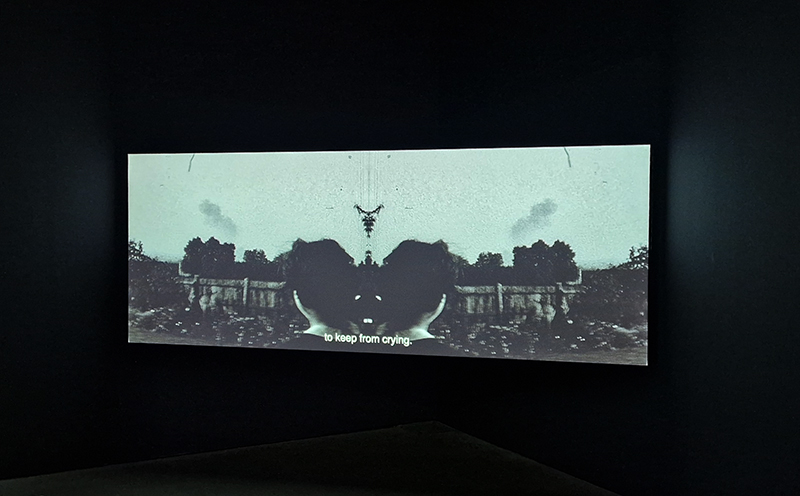
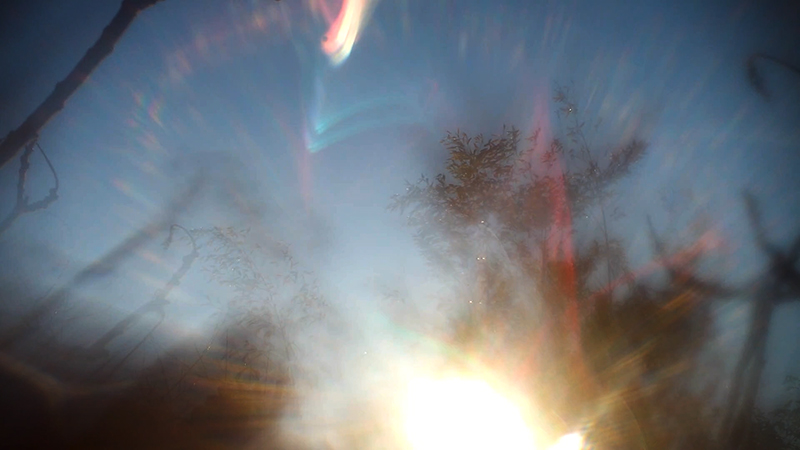
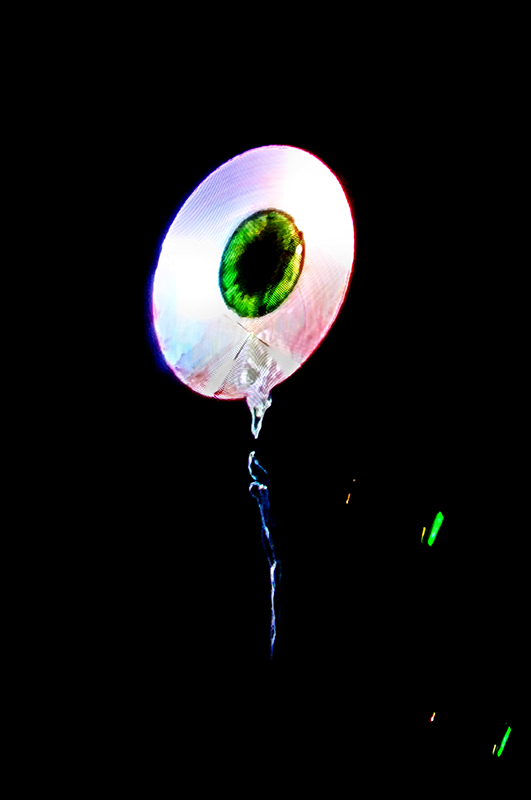
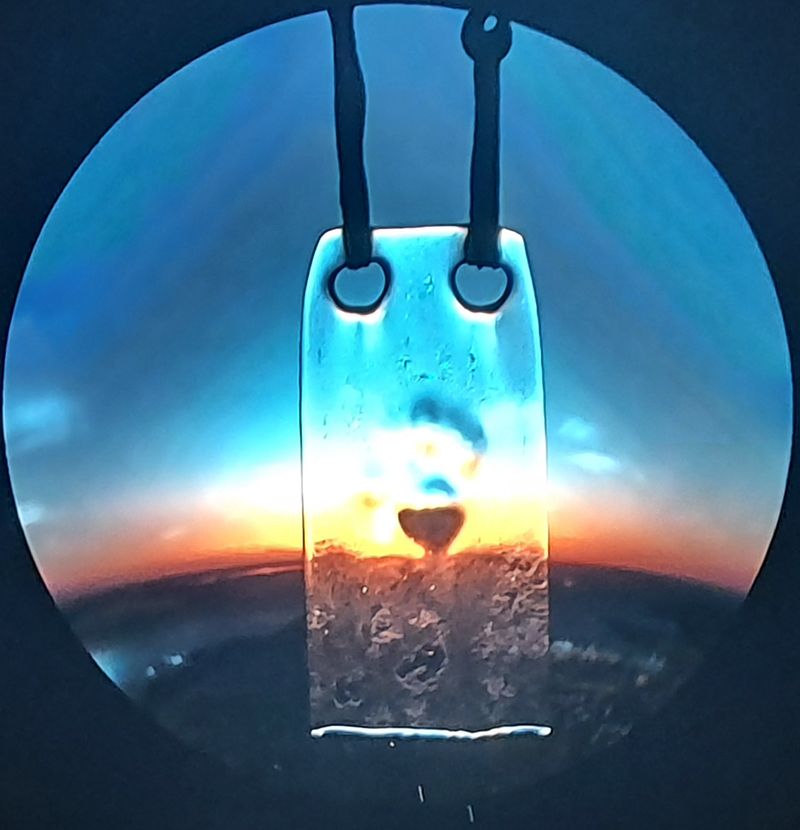
Aóratos 2019 video still

Astronauts are very aware of this phenomenon. During the 1970 Apollo 13 mission to the moon the power supply was damaged and the astronauts sat in the dark for several days waiting to return to Earth. They experienced flashes in their eyes and realized that some of this was Cherenkov light. Some flashes were caused by particles directly hitting the retina but Cherenkov light caused by high energy particles travelling through the matter of the eye faster than light, is much brighter. The energy is proportional to the square of the charge of the particle that comes through, so if you have an iron nucleus which has a charge 26 x the charge of a proton, you get 26 squared or 600 times as much light emitted. Out in space there are many more of these high energy particles and so the astronauts would become very familiar with these flashes, even using them to line up accelerator beams by putting their head in the particle beam to see the flashes.

An astronaut once told Alan that he was convinced that the very first people fired into space probably saw these flashes, but didn’t like to tell NASA in case it turned out to be a physiological defect of theirs and they would be taken off the space programme.

Recently, a professor friend of Alan’s who is aware of this phenomenon, has unfortunately had to begin radiation treatment for a brain tumour. He has found due to the position of the tumour and angle of treatment he can see Cherenkov light flashing in his eyes as the electrons bombard the tumour.

Aóratos 2019 cropped video still

When we met, Alan was just back from a conference in Italy discussing a paper titled ‘Ultra high energy cosmic rays: The Disappointing model’. They called it the disappointing model because they believed that the Auger results with particles at the highest energy were heavy not protons. I’m not sure I understood why it was disappointing although Alan did his best to explain: ‘It’s difficult to measure the mass of the particles of a certain energy. A deduction had been made that they have a mean mass, probably the same as nitrogen but mass changes in quite a complicated way as a function of energy. It’s to do with how deep the showers develop in the atmosphere.

Cosmic Chiasmus: crossing the universe 2021 video still

The techniques aren’t good enough to separate the particle’s mass on a one by one basis, we can only do averages. It looks like the average mass is much heavier than protons, which everybody had believed for a long, long time. Protons would be at a much lower energy. As the nucleus is travelling through space, it sees photons from the microwave background radiation and the photon will chip off a neutron or a proton, if it chips off a neutron, the neutron decays into a proton, so you can get protons this way, but they will be of lower energy. The energy reduces roughly by the mass of the particle, so an iron nucleus has a mass of 56, if you chip off a neutron or a proton that proton will have an energy, which a 56th of the energy that the nucleus has – so it goes down in energy.

Some particles could come from Centaurus A, which is a relatively close radio galaxy, it is thought that the jets from radio galaxies provide conditions to accelerate the particles, but the problem is, because the cosmic rays are charged, they get deflected in the magnetic field of the Galaxy so you can’t track them straight back to where they came from.  In terms of heavy particles that’s more of a problem because being charged means they bend even more. So one of the disappointing things is that cosmic ray astronomy is not going to be very easy. The Pierre Auger observatory has really been very successful in changing the picture quite a bit but because there are so few ultra high energy particles recorded it is slow progress. There are hopes to expand the observatory even more and also a plan to launch a satellite with detectors to pick up fluorescence light in the shower as it passes through the atmosphere, a similar phenomenon to aurora light.

Cosmic Chiasmus: crossing the universe 2021 video still

Exhibitions

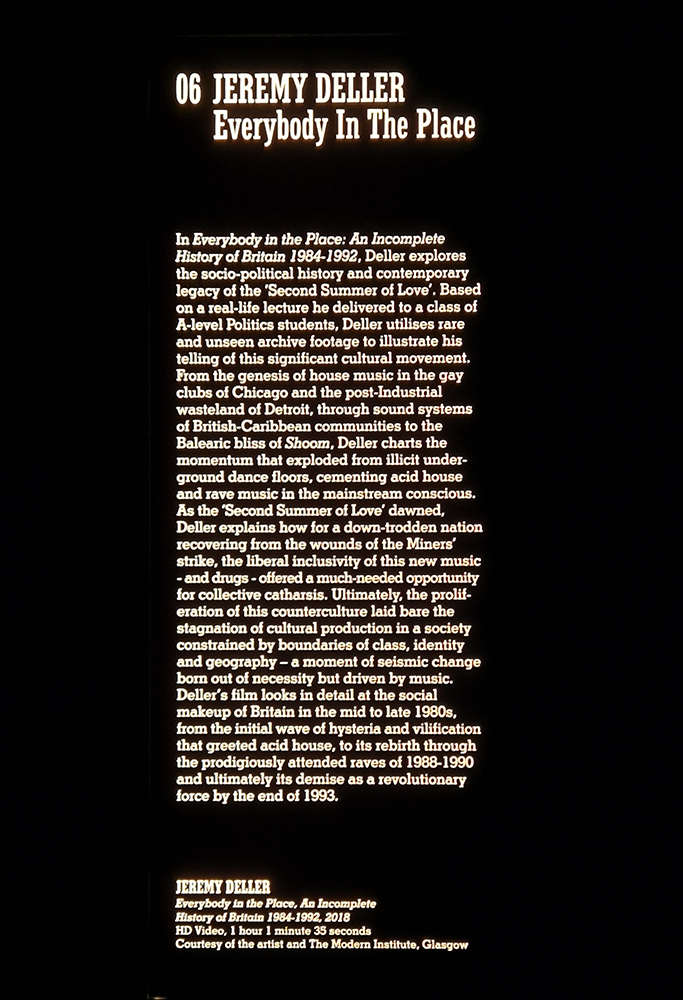
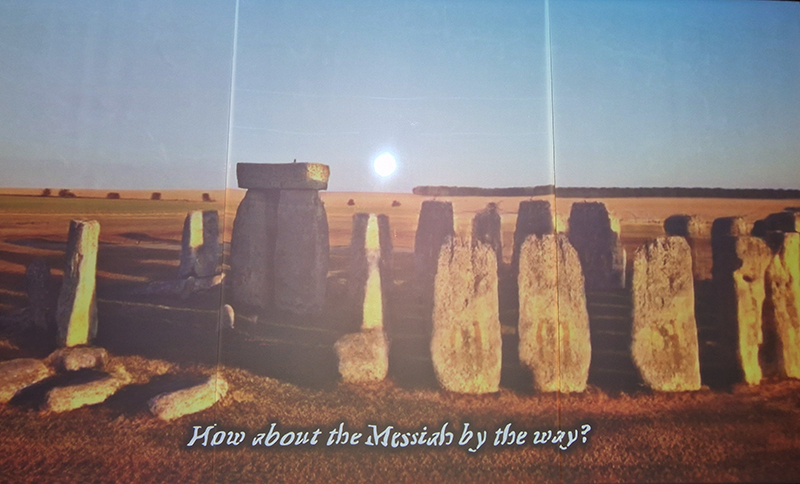
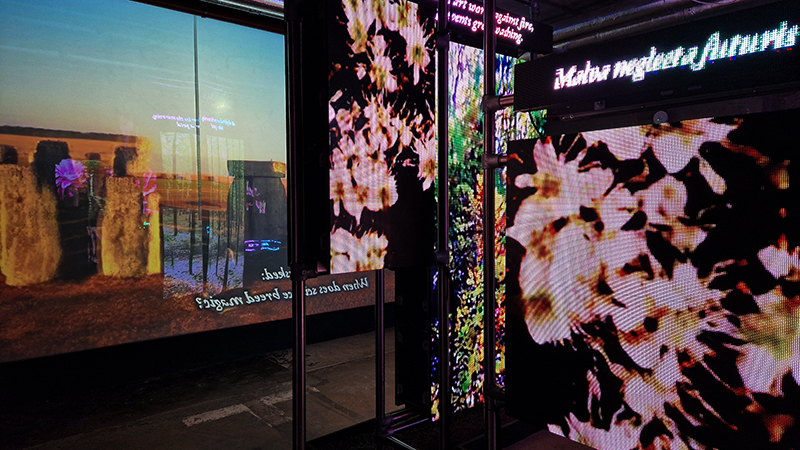
The Vinyl Factory: Reverb at 180 The Strand, a multimedia exhibition exploring the intersection of art and sound with artists including Theaster Gates, Es Devlin, Julianknxx, Kahlil Joseph, Caterina Barbieri, Stan Douglas, Virgil Abloh, Cecilia Bengolea, Jeremy Deller, William Kentridge, Jenn Nkiru, Hito Steyerl, Carsten Nicolai and Gabriel Moses. Fabulous show, shame I can’t share the sounds here. Loved Jeremy Deller’s takeover of a sixth form politics class. Some of the works I had seen before but that was fine as they are worth extra viewings.

Reading

I am beginning research reading for The Geological Unconscious exhibition Julie F Hill and I are co-curating at Hypha HQ Euston opening in May 2025.

Ursula Le Guin The Winds Twelve Quarters, a collection of profound short stories each introduced by the author reflecting on the intention within.

Long after I wrote the story (The Stars Below) I came on a passage in Jung’s On the Nature of the Psyche: ‘We would do well to think of ego-consciousness as being surrounded by a multitude of little luminosities…Introspective intuitions…capture the state of the unconscious: The star-strewn heavens, stars reflected in dark water, nuggets of gold or golden sand scattered in black earth.’ And he quotes from an alchemist, ‘Seminate aurum in terrain albam foliatam’ – the precious metal strewn in the layers of white clay. Perhaps the story is not about science, or about art, but about the mind, my mind, any mind, that turns inward to itself.

Roger Caillois The Writing of Stones 1970 is a tribute to the collection of extraordinary stones Caillois acquired and which now resides in The National Museum of Natural History Paris. In these poetic chapters he describes in detail each of the stones and his fascination with the images and associations they conjure in his imagination. Questioning and celebrating the allure of the mineral and the stories hidden and revealed over millennia.

I can scarcely refrain from suspecting some ancient, diffused magnetism; a call from the centre of things; a dim, almost lost memory. or perhaps a presentiment, pointless in so puny a being, of a universal syntax.

‘A stone sky rotated above our heads’ – Italo Calvino, Cosmicomics

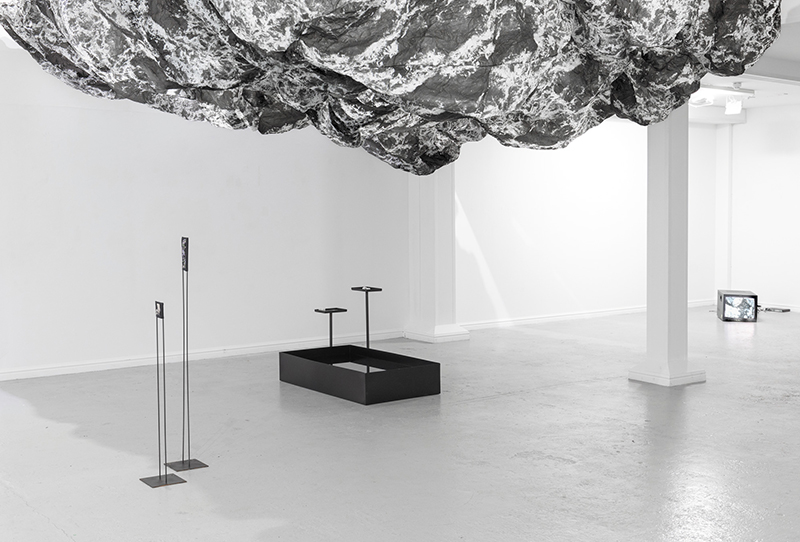
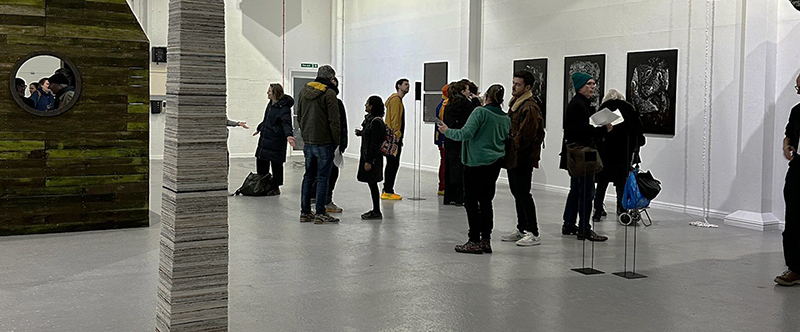
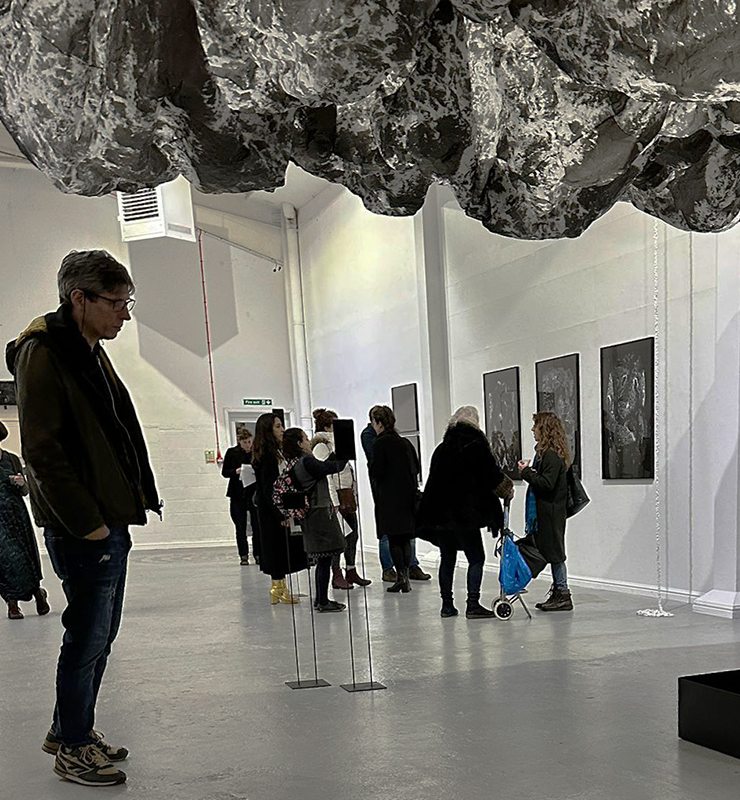
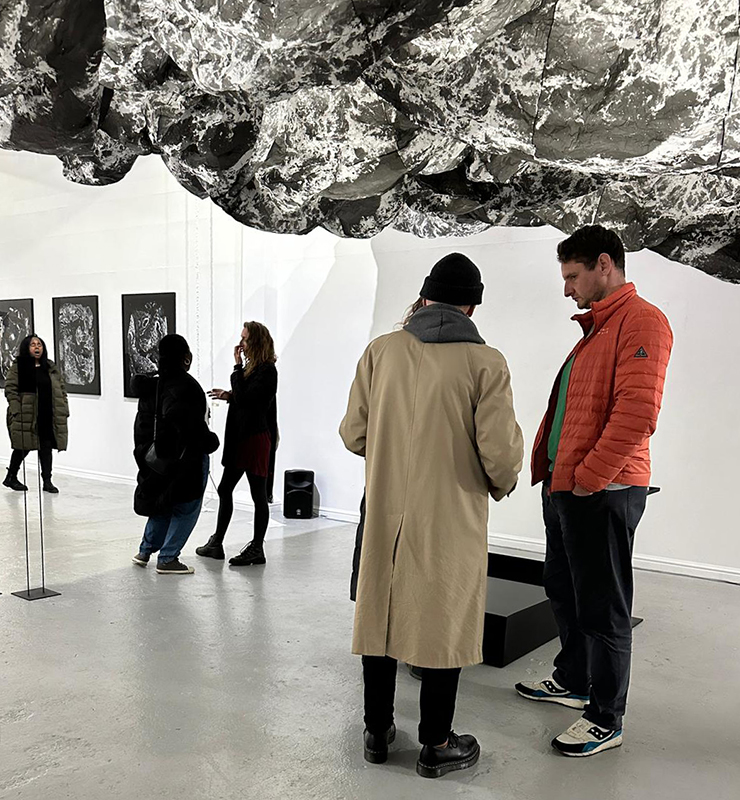
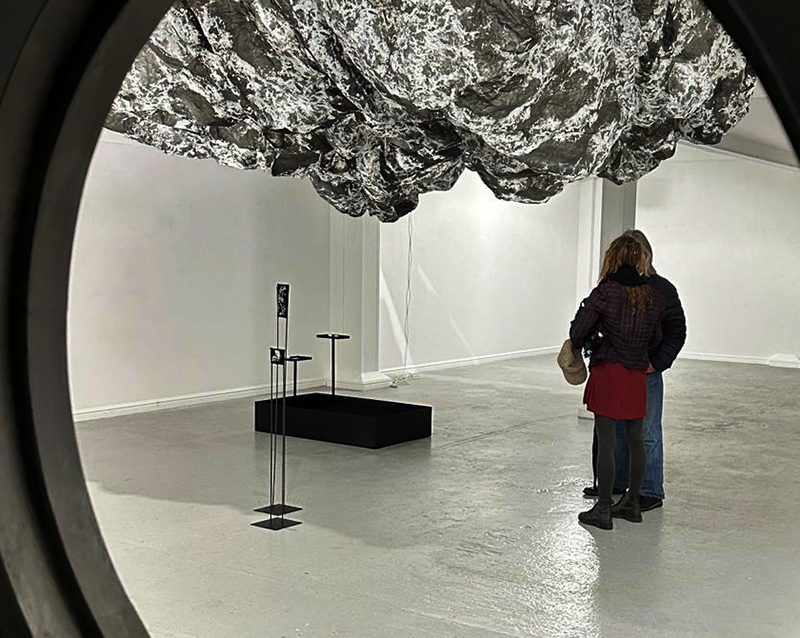
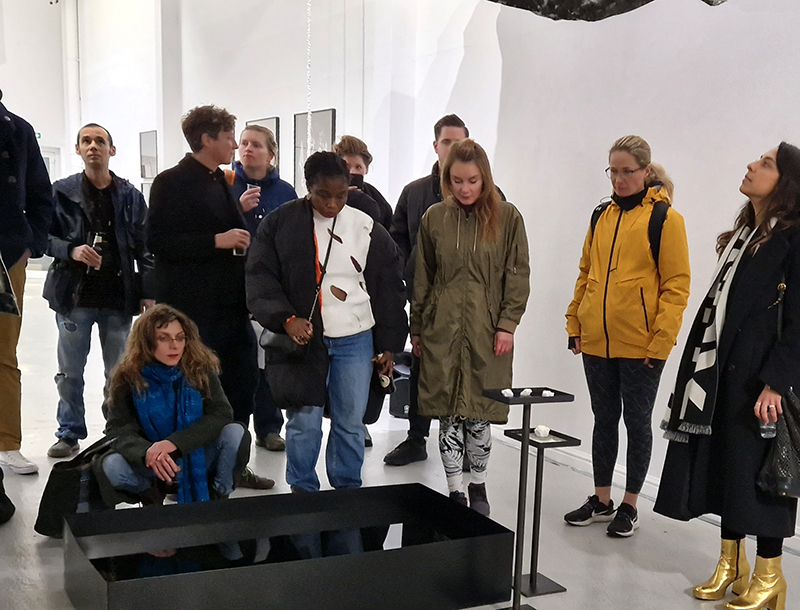
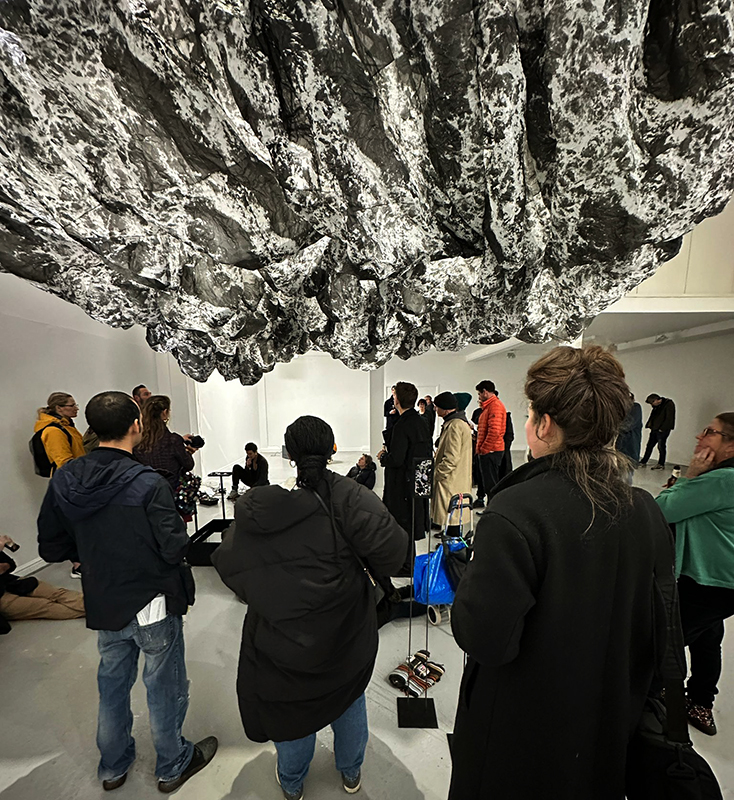
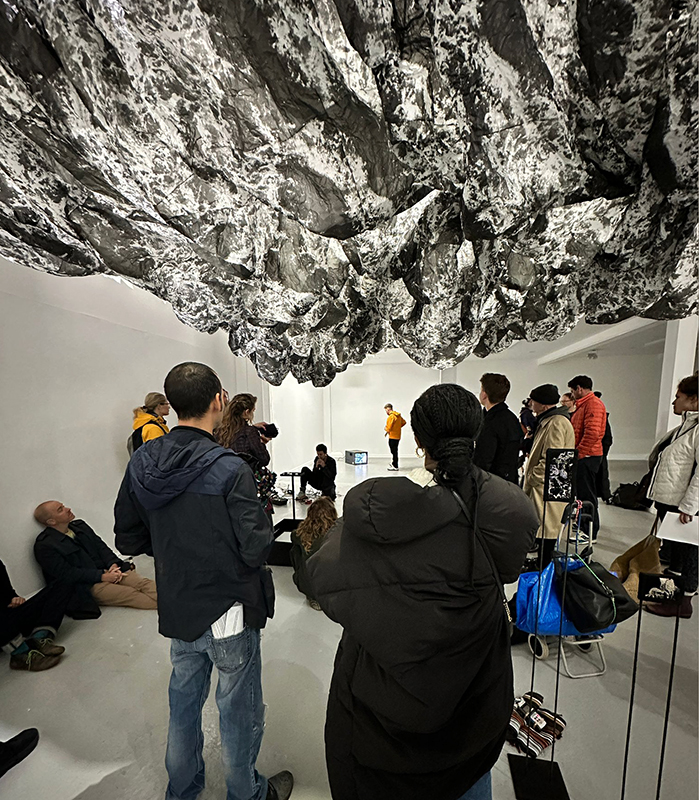
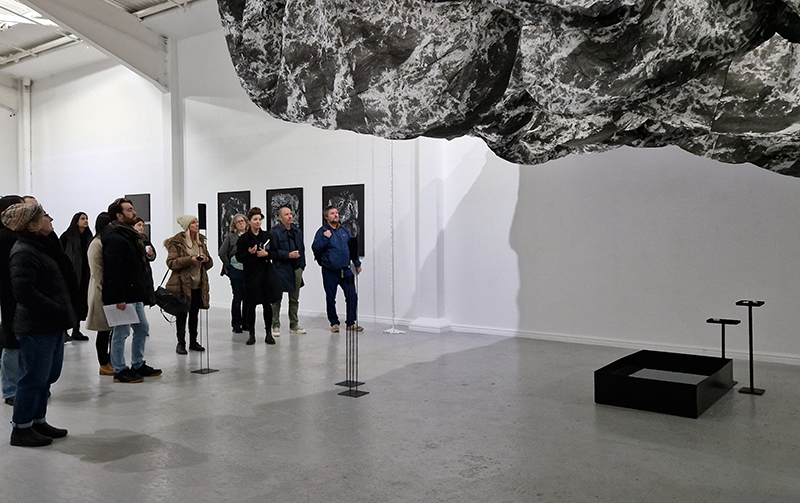
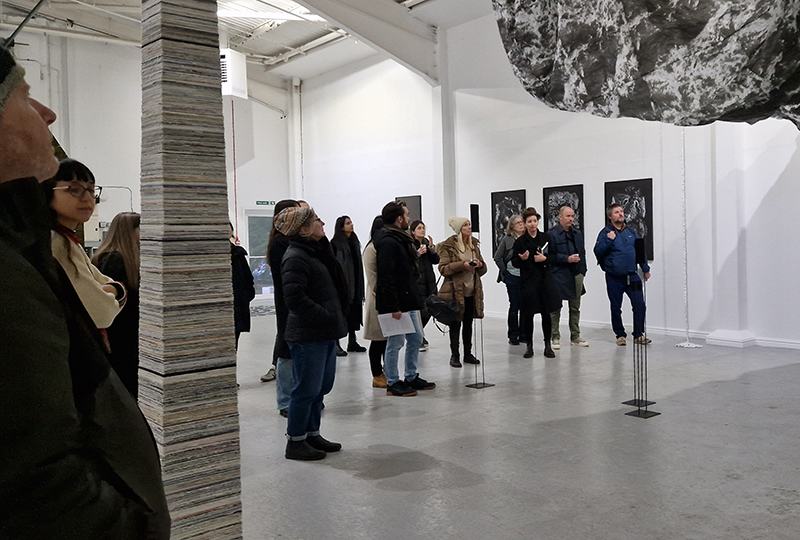
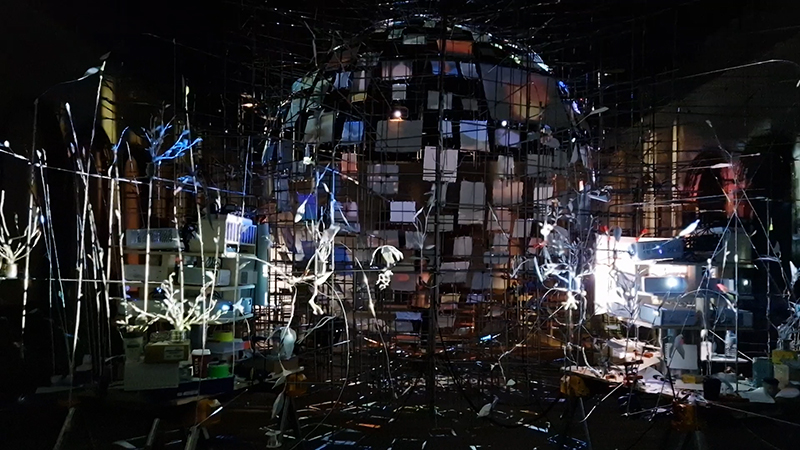
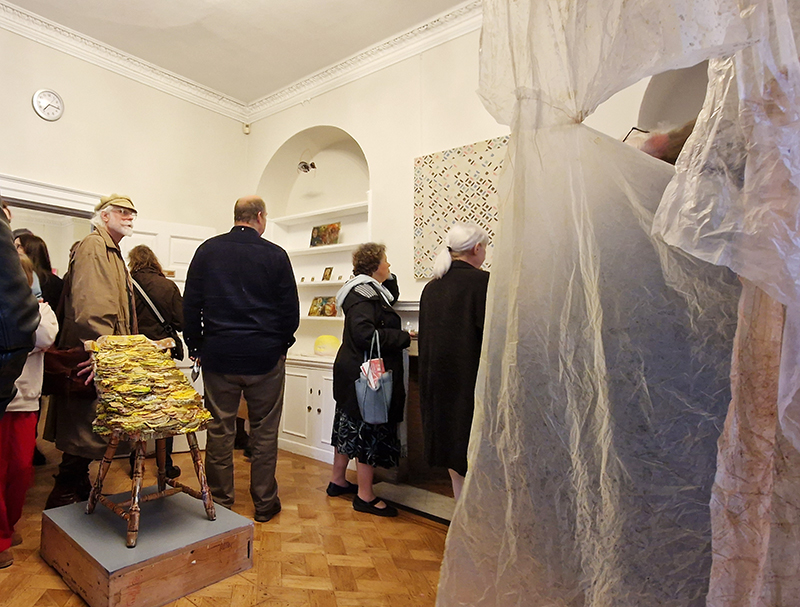
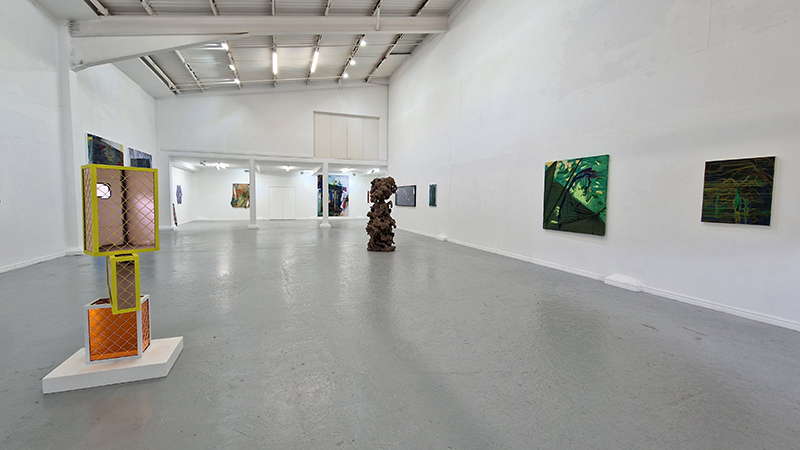
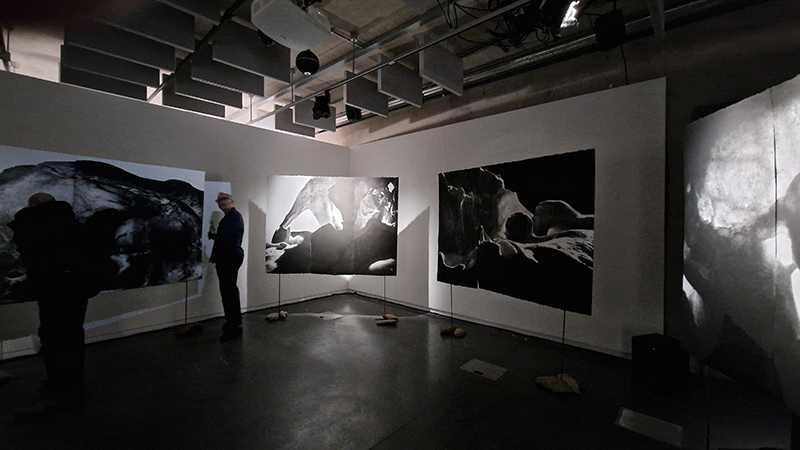
The culmination of two years work – A STONE SKY duo exhibition with Julie F Hill opened at Thames-side Studios GalleryReimagining the idea of an observatory – the exhibition proposes a cavernous realm of real and speculative possibilities that arise from beyond the limits of human perception. Engaging with the extended sensory range offered by technologies such as orbiting space telescopes through to the ability of birds to ‘see’ the Earth’s magnetic field, the artists’ reveal intimate connections between earth and space.

Installation shot by Ben Deakin Photography.

Susan Eyre seeks to navigate a path across time from the first human encounter with the magical qualities of the lodestone to current understanding of the interaction of the magnetic field with terrestrial life. Her works respond to the architecture, instruments and materials, found at a magnetic observatory while scientific objectives are expanded to include natural navigation techniques and extra-sensory methods used by the non-human realm, to form the basis of speculation as to the ability for humans to perceive the Earth’s magnetic field. Installation, sculpture and moving image works include a reimagined observation hut operating as a sensory hub with video screens suggesting portals into a web of neural pathways; an obelisk of layered recycled paper echoing Earth’s geological and magnetic history secreted in sedimentary strata of rock and a digital video work activated in real time by the passage of cosmic rays through a scintillator detector.

Images by Ben Deakin Photography

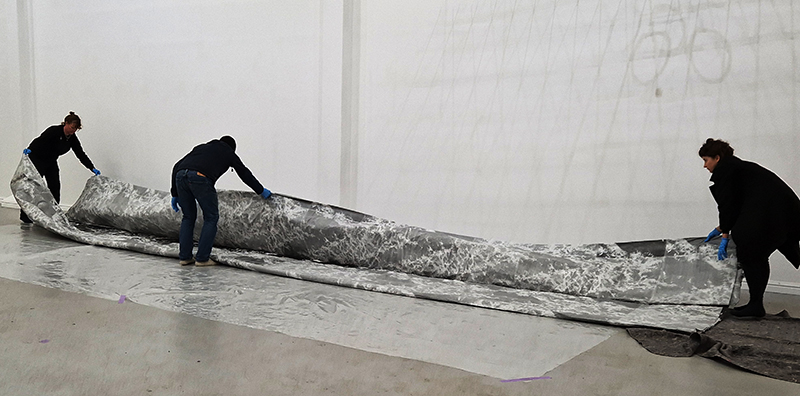
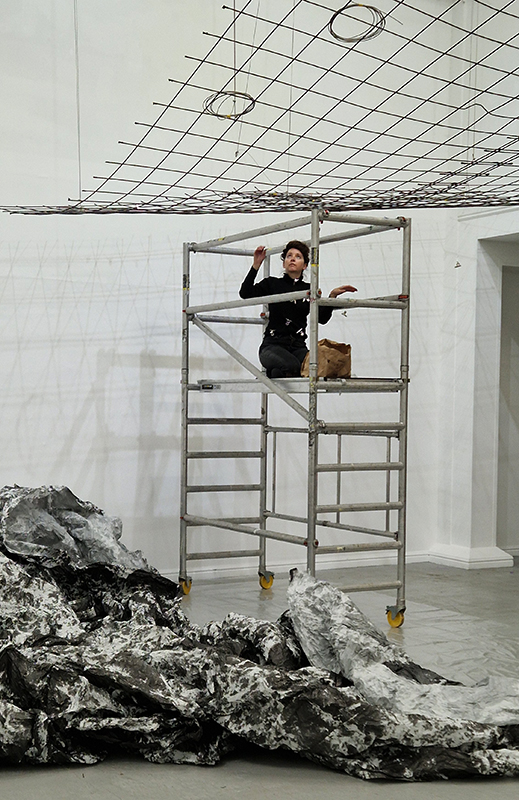
Julie F Hill explores the entwined darknesses of earth and cosmos. Crystalline and mineral substances from the deep earth fuse with astronomical data to suggest the deep-earth as an instrument for coming to know the cosmos. Crystalline and mineral substances formed in the continuum of deep earth and deep space allow us to peer back into cosmic time, both through the technologies created with them and the geological record they hold. Whilst darkness often indicates uncertainty and lack of knowledge, Hill asserts that it’s through darkness when we can be most perceptive to the interconnectedness between earth and cosmos. Through it we are able to extend our kinship with the inorganic and expand consciousness of what constitutes nature. Works include a large-scale sculptural print installation made from James Webb Space Telescope data that is reworked into a cavernous space, providing an experience of intimate immensity alongside more smaller sculptural and photographic works.

Images by Ben Deakin Photography

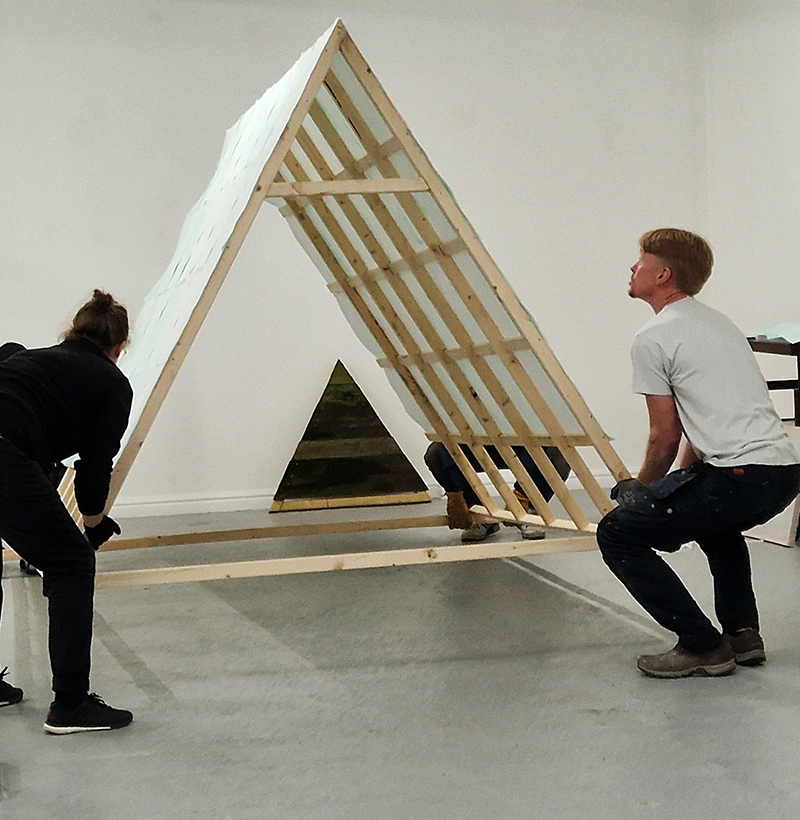
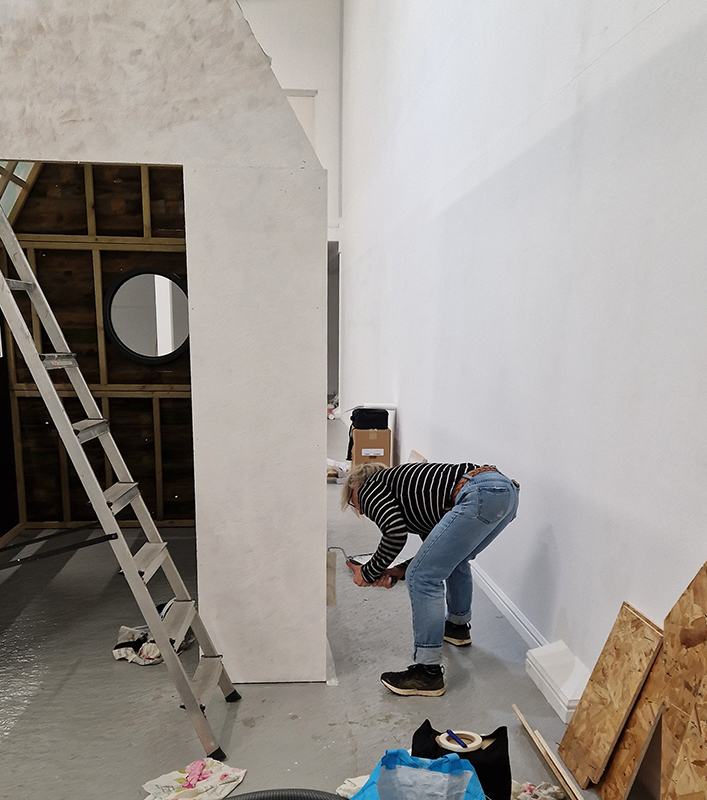
We both had ambitious large scale works to install and were grateful for the help we received from our partners (both Kevins), friends and technicians. Trevor Neale was magnificent in constructing The Absolute Hut. Anne Krinsky patiently helped apply double sided tape to the roof structure ready for the Suminagashi paper tiles and Caroline AreskogJones energetically painted the hut white and neatly edged the two way projection window. I was thrilled that, as a result of a wet few weeks, moss had started to grow on the wooden boards of the north facing wall in time for installation.

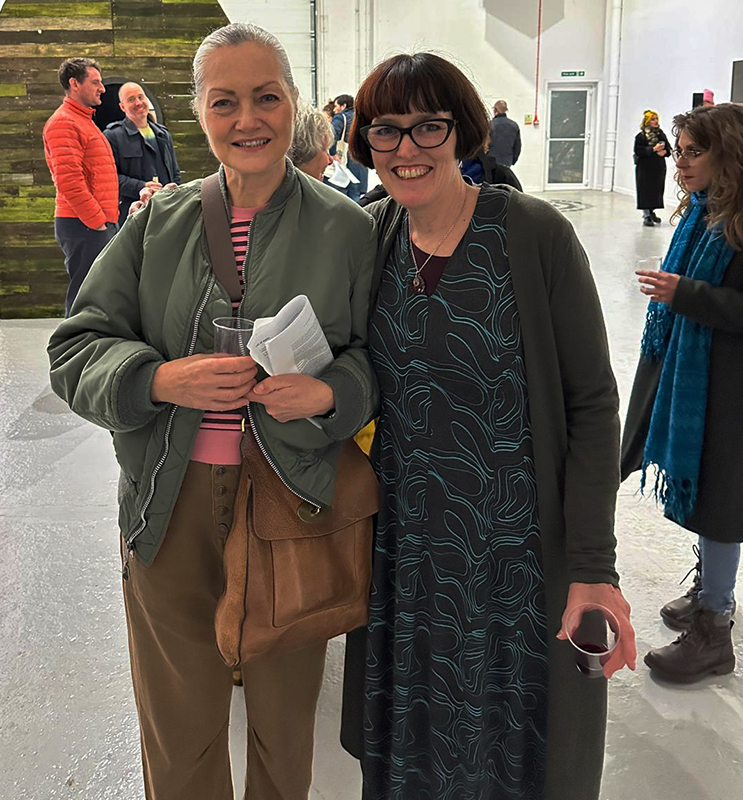
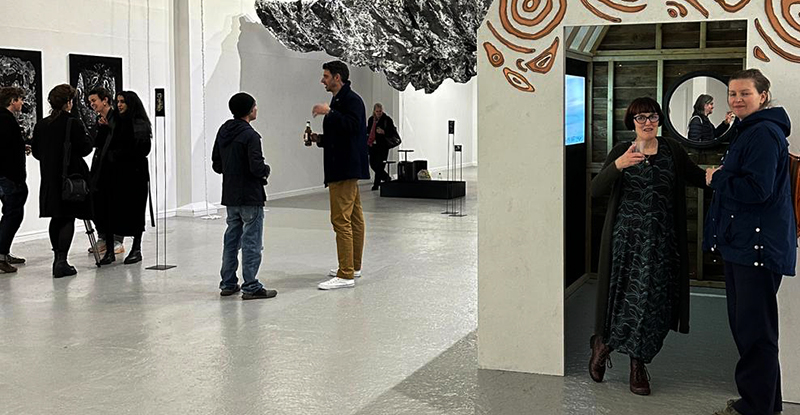
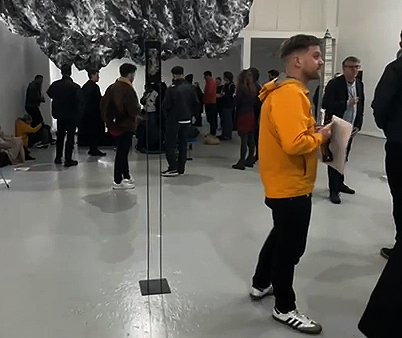
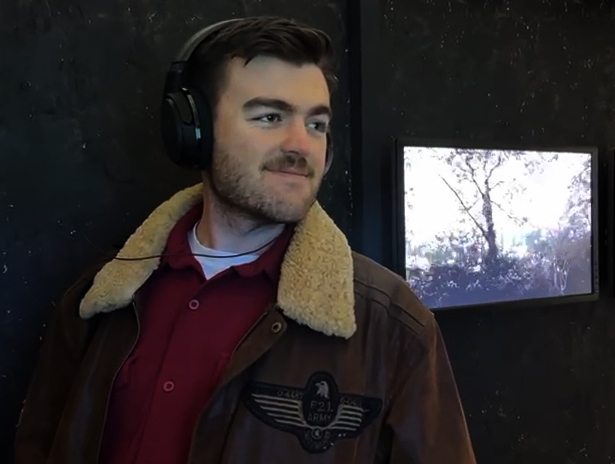
A big thank you to everyone that made it to the opening night, we were super chuffed with the positive responses.

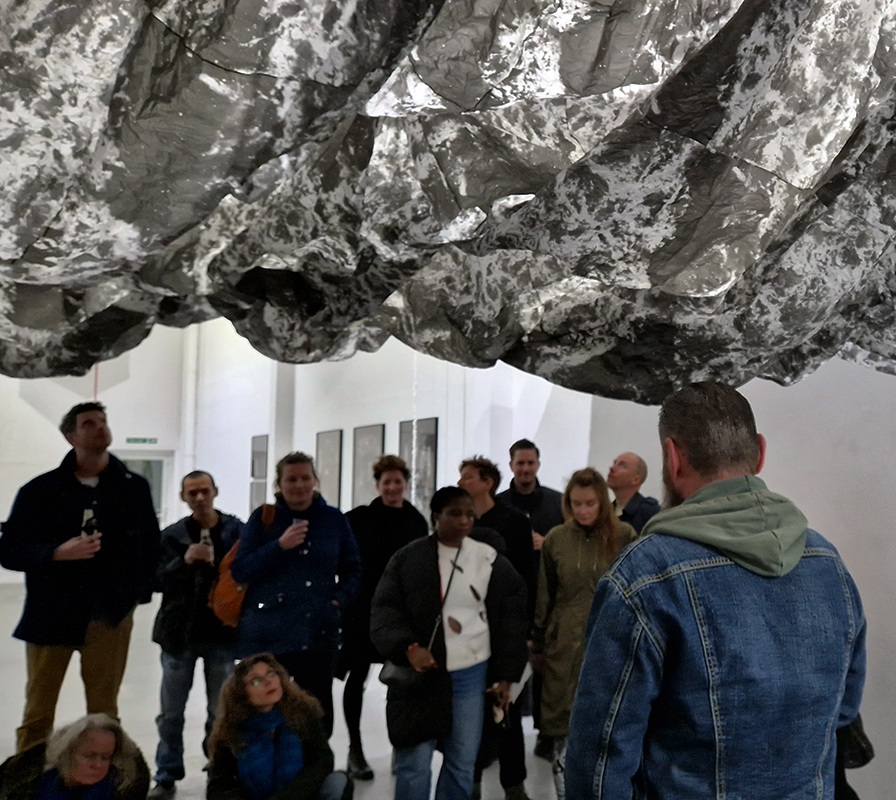
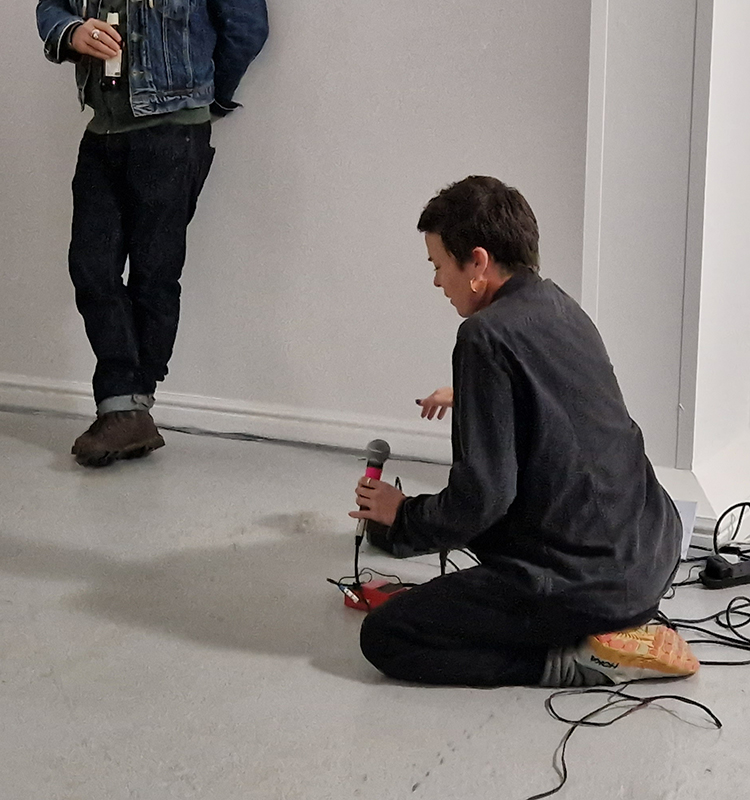
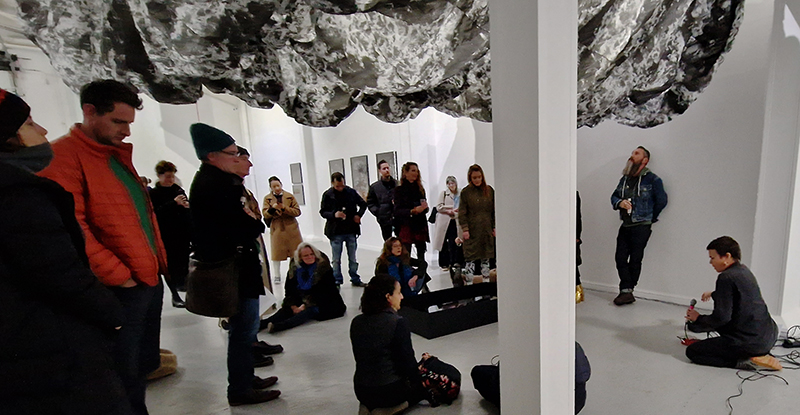
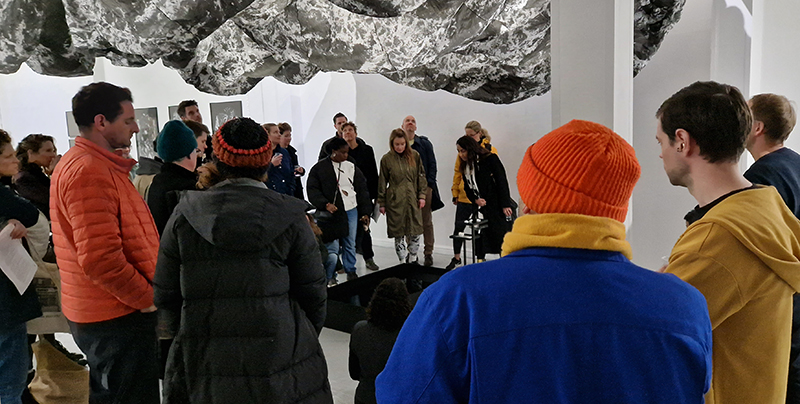
At the private view Julie’s large scale print installation was activated by a vocal performance conjuring abyssal voices of deep, cosmic time, performed and devised with Eleanor Westbrook whose voice produces incredible hauntingly beautiful sound.

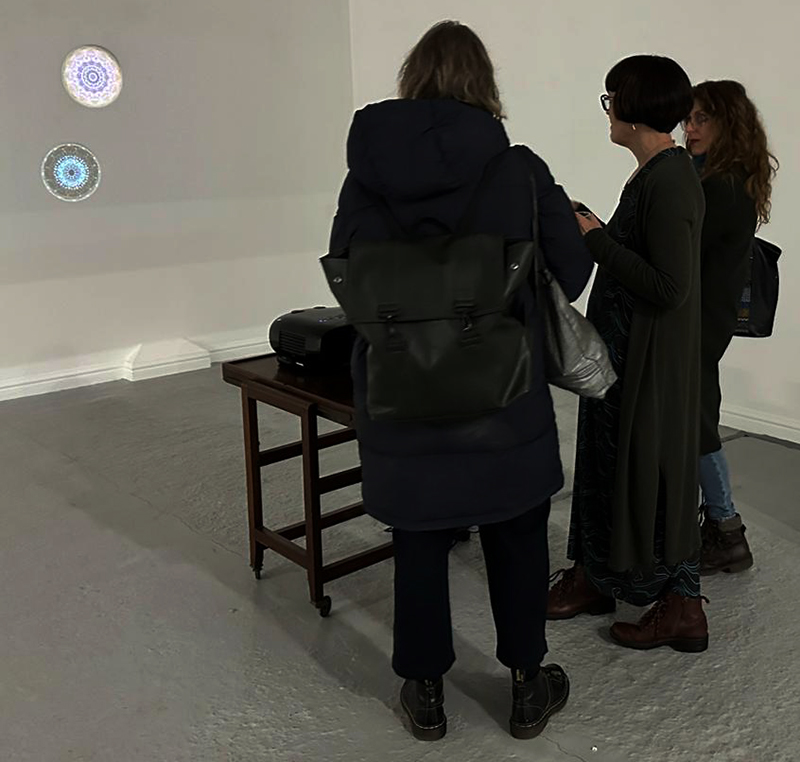
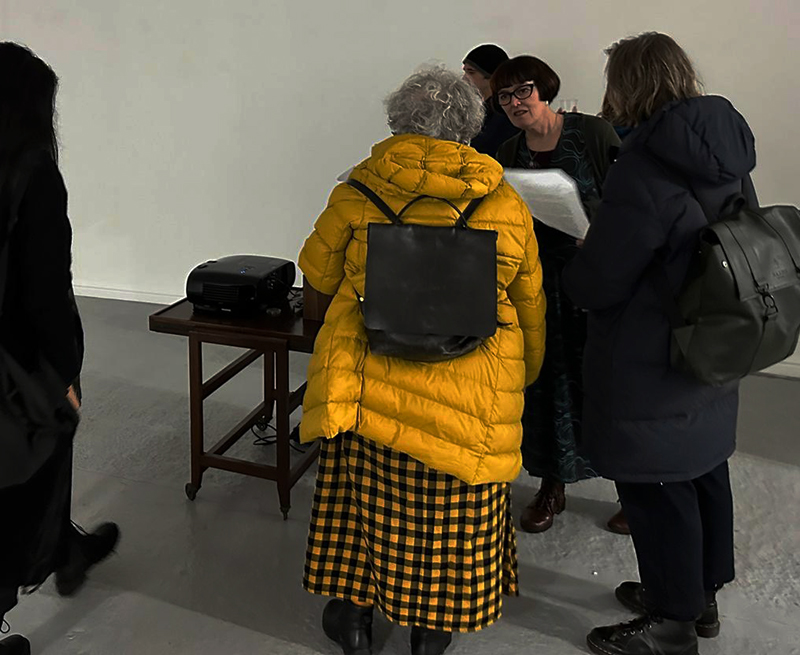
I was particularly excited to share The Breath of Stars, digital video work activated in real time by the passage of cosmic rays through a scintillator detector. After two years in development it was so exciting to watch the random starbursts appear in real time as witness to the unseen activity of cosmic rays passing through the gallery.

The kaleidoscopic video images that appear for every particle recorded by the detector, are created from footage of cosmic ray trails filmed in a cloud chamber.

The interaction of cosmic rays with atmospheric electrical fields influences the unpredictability of the magnetosphere and this random activity can be witnessed by the sudden flurries and silent gaps of the live video imagery.

These subatomic visitors from outer space power across the universe with unimaginable energy, coming from the heart of exploding stars or the depths of black holes; some may come from phenomena yet to be discovered or even from other dimensions. Travelling at close to the speed of light cosmic rays spiral along magnetic field lines, strike the edge of the Earth’s atmosphere, break apart and shower down upon us. Some particles collide and silently interact with atoms and technology on Earth. Most cosmic rays heading for Earth are deflected by the planet’s magnetic field and without this protection life on Earth could not survive this bombardment of radioactive matter. The interaction of cosmic rays and the solar wind with atmospheric electrical fields combines to influence the unpredictability of Earth’s magnetosphere, impacting the functioning of GPS satellite technology and computer processors on which humans have come to rely in daily life.

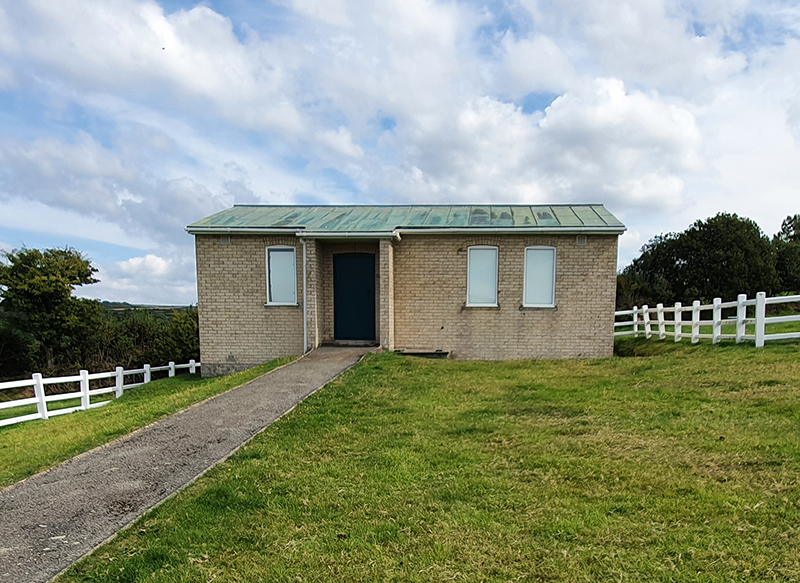
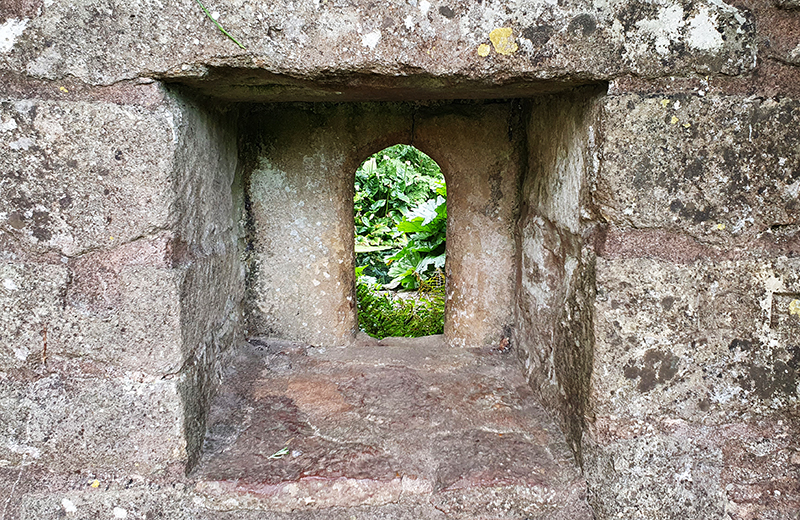
My research trip to Hartland Magnetic Observatory in North Devon was a catalyst for this body of work centring around a north facing observation hut aligned with an obelisk as a fixed azimuth mark. I am very grateful to The British Geological Survey for allowing me access to the site and particularly to Tom Martyn who shared his knowledge and gave a fascinating tour of the observatory.

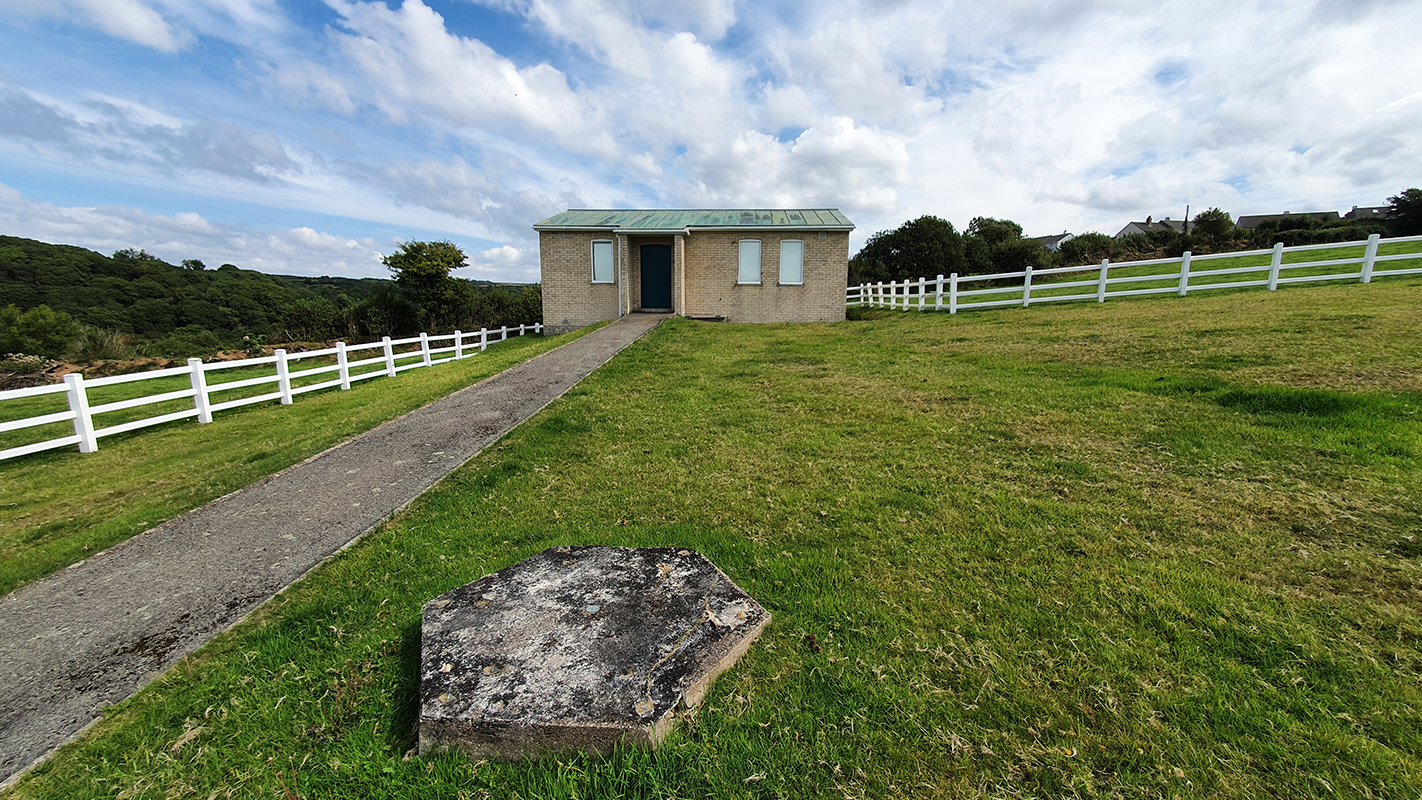
The Azimuth Obelisk (of sedimentary knowledge) is a reimagining of an obelisk erected at Hartland Magnetic Observatory in the late 1950’s near the site’s northern boundary. Viewed through the window in the north wall of The Observing Building (also known as the Absolute Hut) it acts as a permanent azimuth mark from which the drift of the magnetic north pole is monitored. Currently almost hidden by undergrowth, the observatory’s concrete azimuth mark has been replaced by a digital GPS position. Much as the Earth’s geological and magnetic history is secreted into the strata of sedimentary rock, this sculpture also expresses the passage of time through the layering of recycled paper prints and drawings whose history becomes embedded within the stacked layers.

The Absolute Hut (of action potential) operates as a sensory hub with video screens suggesting portals into a web of neural pathways where a range of actions and processes are running concurrently reflecting on the dynamics between the Earth’s geologic structure and navigation using the magnetic field.

The title refers to the way neurons send information electrochemically around the body. The signals they send are called action potentials which is a temporary shift from negative to positive within the cell caused by certain ions entering the cell. Action potentials can be triggered by an interaction with the magnetic field causing a reaction in the body.

The installation is conceived from a combination of features, impressions and functions of the observing building and instruments at Hartland Magnetic Observatory in North Devon and the observation huts built in the 18th century at The Kings Observatory in Kew for meteorological and magnetic observations.

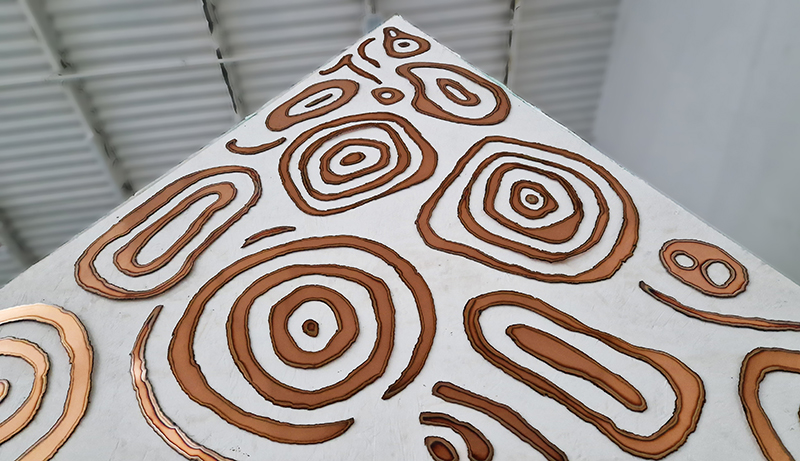
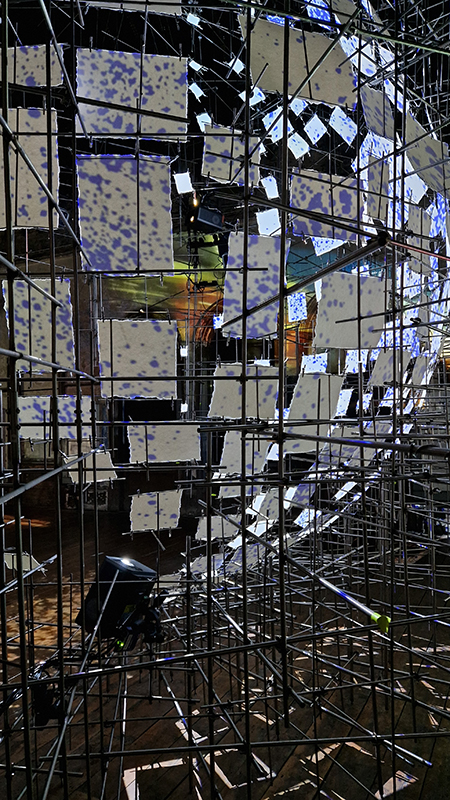
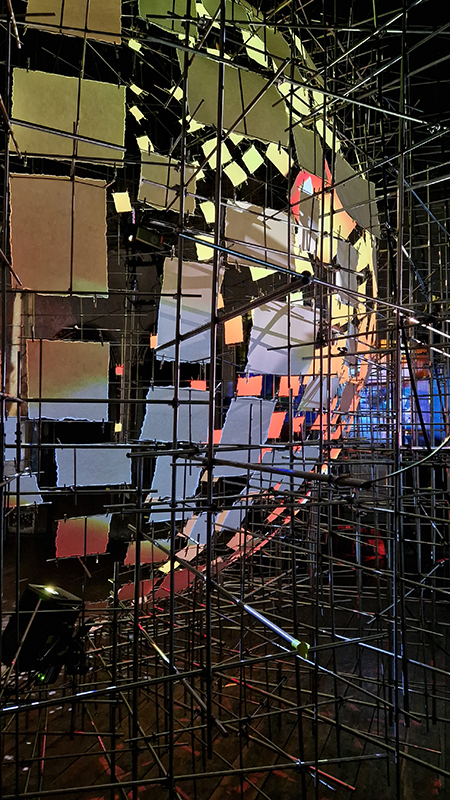
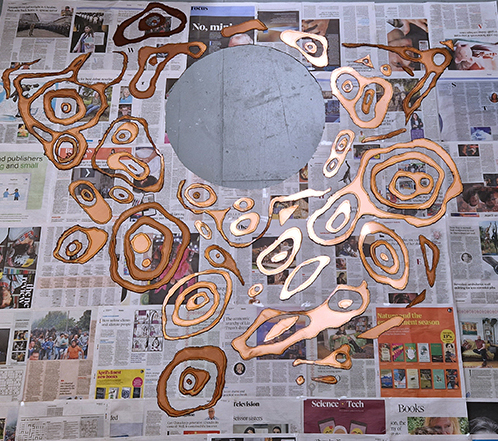
Topological contours of suminagashi marbling and plasma cut copper reflect the fluid motion of the Earth’s molten iron core and the pulsating alpha waves of the human brain when subjected to magnetic fields.

‘the internal skies have their own birds’ Italo Calvino Cosmicomics

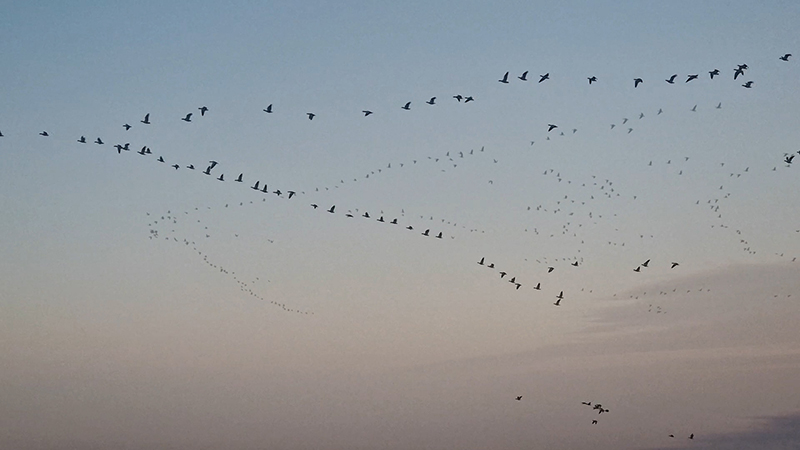
The fascinating and perilous journeys made by migrating birds has been a natural wonder for centuries with the first records of this phenomena made more than 3,000 years ago. The innate knowledge of migratory birds is mentioned in Job and Jeremiah and the ancient Greek writers Homer, Hesiod and Aristotle noted their passage.

Job 39:26 Doth the hawk fly by thy wisdom and stretch her wings towards the south?

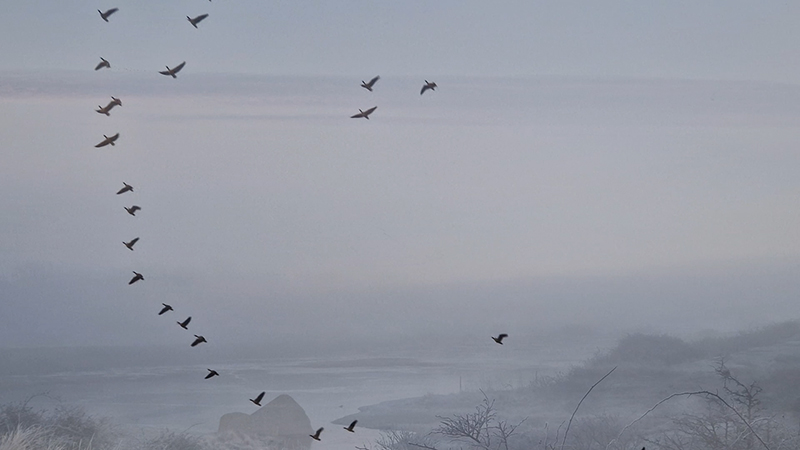
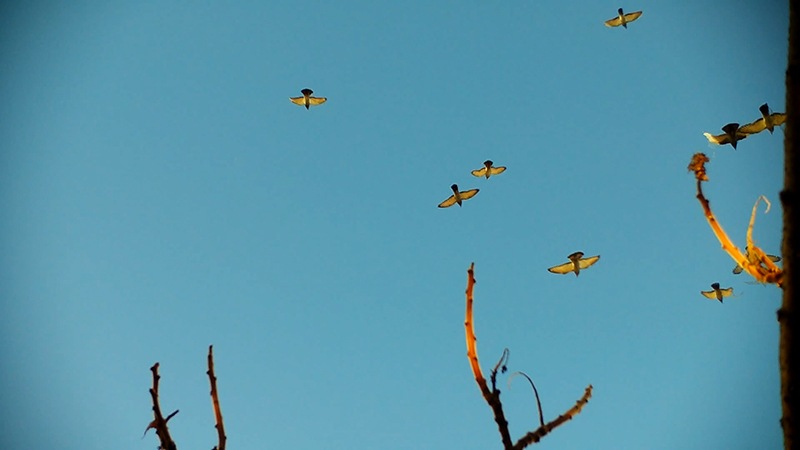
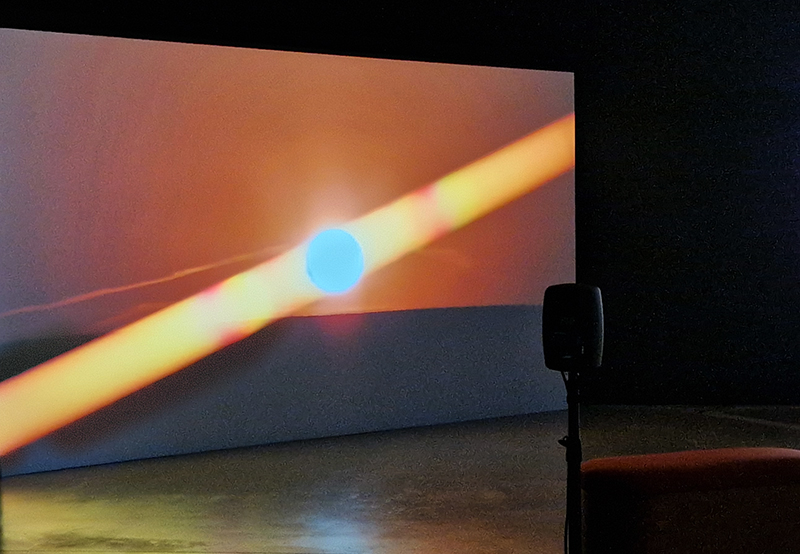
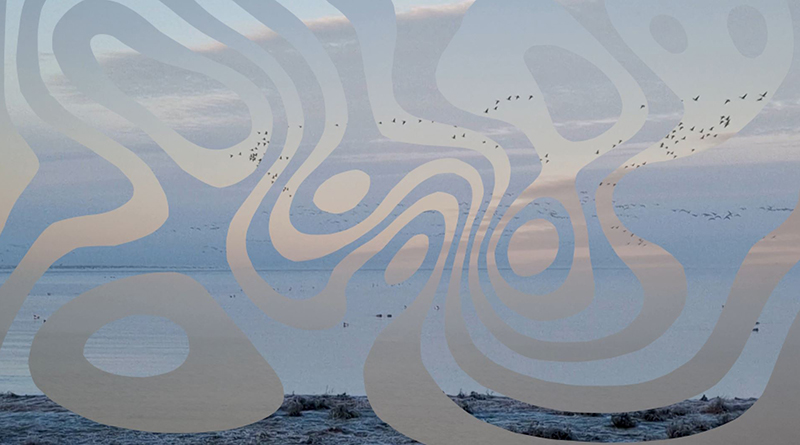
Wintering light two way video projection of migratory pink footed geese filmed at RSPB Snettisham on the North Norfolk coast.

Research has proven that birds and many other animals can use the earth’s magnetic field for navigation. There are two ways this happens. In birds there is a protein in the retina of the eye – (cryptochrome molecules) which trigger action potentials enabling them to visualise the magnetic field. In other animals and magnetotactic bacteria tiny crystals of magnetite respond to the field. This may also be true of humans as we do have these crystals in our brain cells.

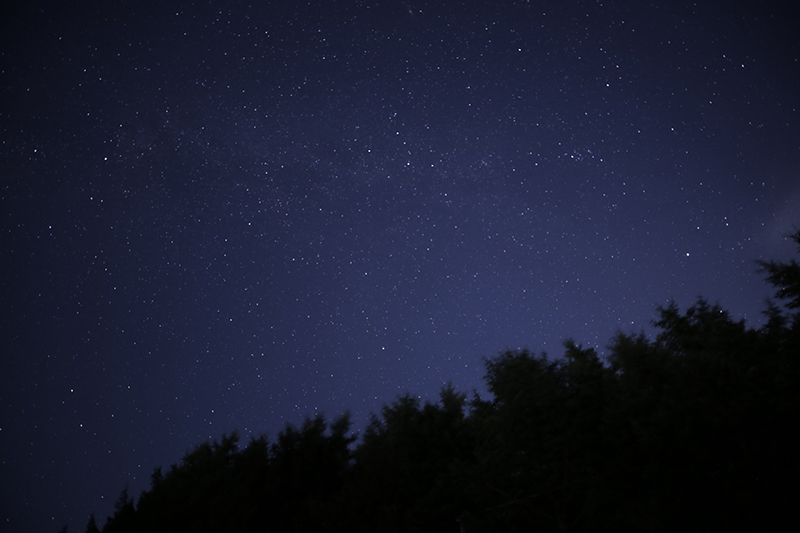
Birds use three different compasses to navigate across the globe; the sun, the stars and the magnetic field.

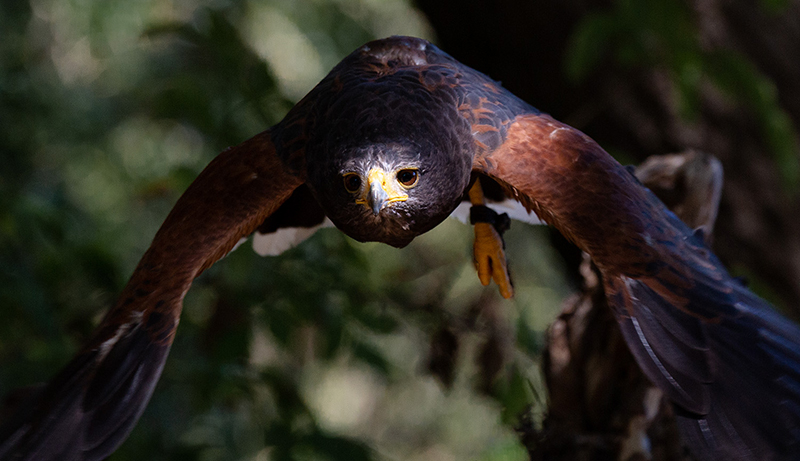
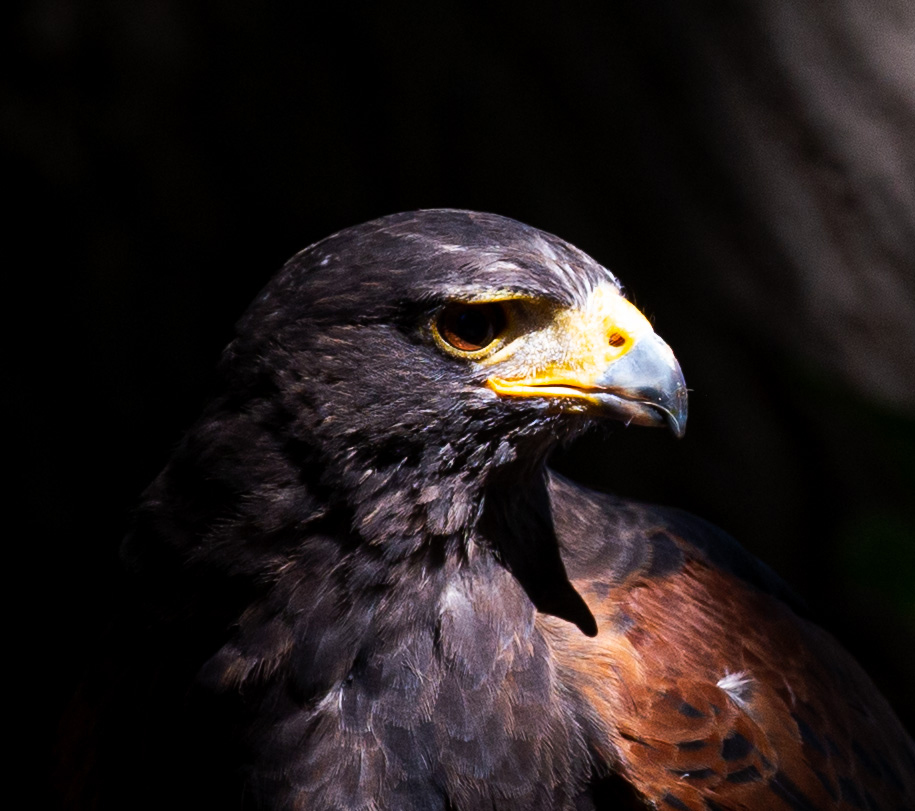
Birds are also able to detect rapid movement such as individual flashes or flickering of a fluorescent light which humans see as a continuous light. Hawks which pursue other birds through dense forests at high speeds, follow the movement of their prey while avoiding branches and other obstacles. To humans travelling at this speed, the fleeing prey, branches and obstacles would just be a blur.

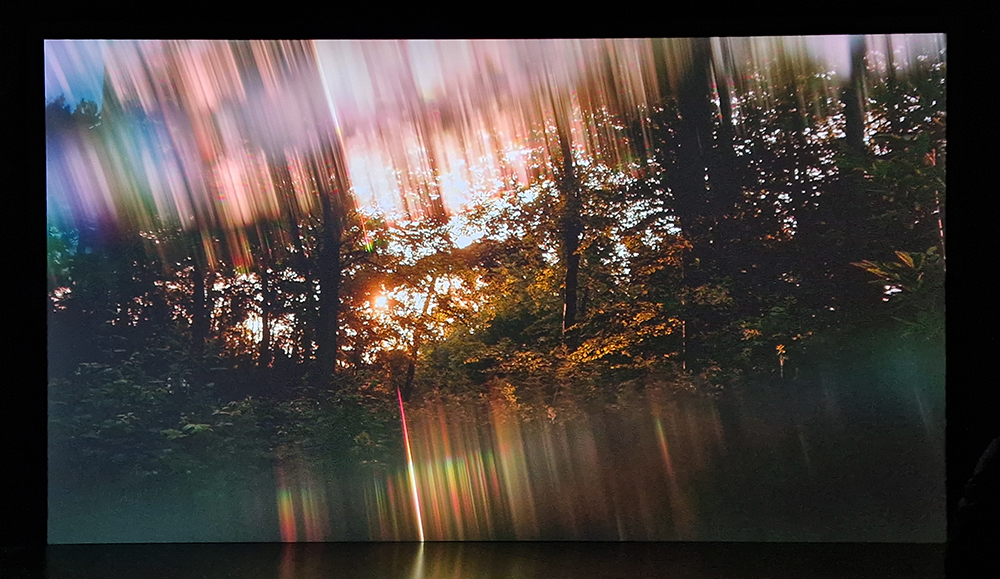
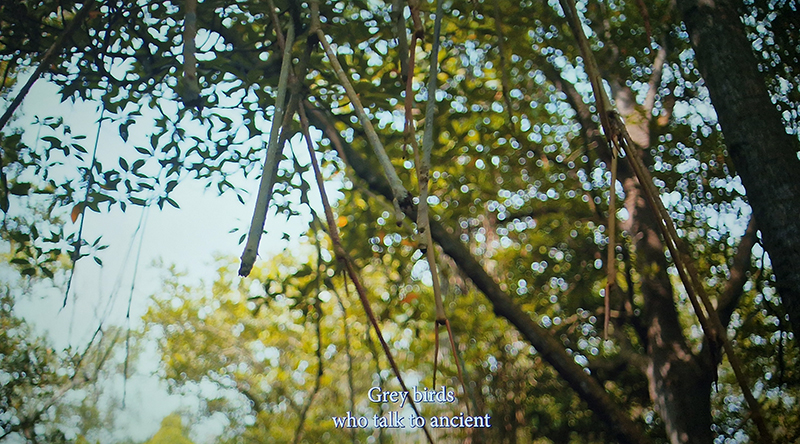
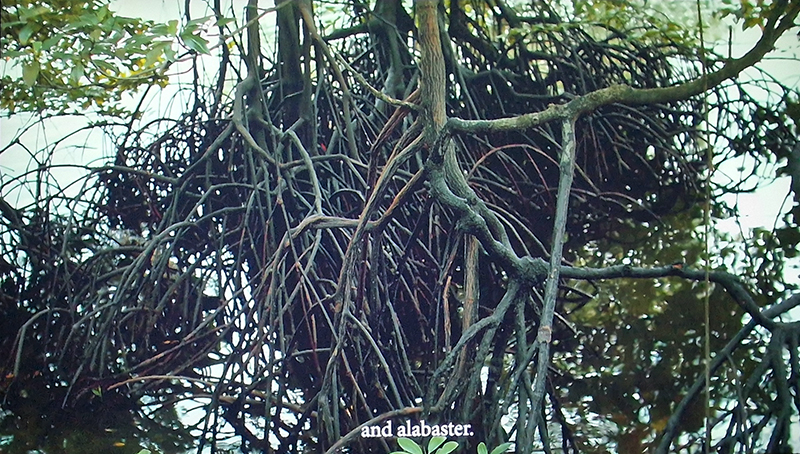
Degrees of Variation considers what it might be like to have the sensory powers of a bird where a protein in the eye is excited by polarised light making it possible to see the magnetic field and follow a visual navigatory cue in an accelerated world. The video imagines flight over water and through woods while being guided by the force of a magnetic field.

Calvino’s story The Stone Sky is wonderfully descriptive of the volatile geological structure of the Earth. This fluidity is what makes life on Earth possible. Only planets with fluid cores have magnetic fields. The geological interior generates a field that reaches into outer space offering a protective shield.

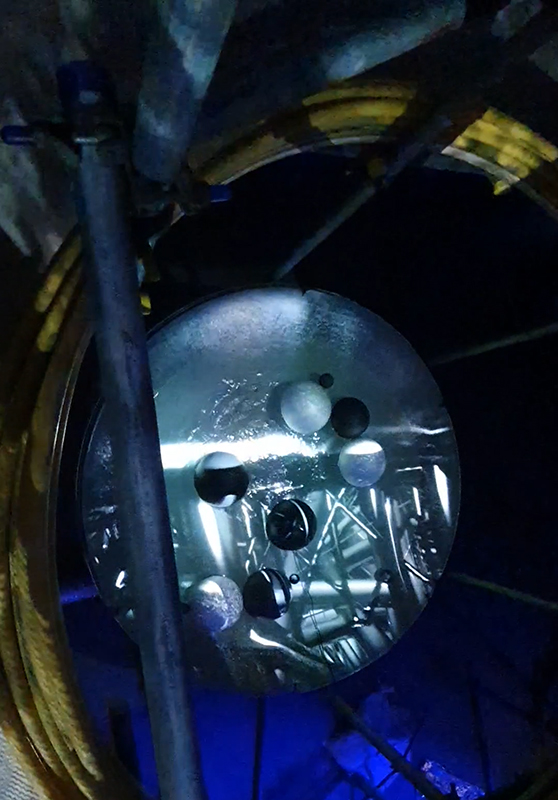
internal skies : external spheres video sequences within concentric circles mimic the geological structure of the Earth to explore the relationship between Earth’s magnetic field and various methods of navigation including via magnetoreception and celestial observation. Sequences include star trails around Polaris (the current north star), birds and bees that use the magnetic field for navigation, magnetotactic bacteria, magnetised iron filings, aerial views of the coastline around Hartland and early morning polarised light which excites the cryptochrome protein in a birds eye.

The Earth’s geomagnetic field is created by a combination of three separate fields and timescales. The main field is generated in the earth’s molten iron core.  Observing the field gives clues to the planet’s deep interior which is inaccessible to direct observations. Changes are measured in the annual drifting of magnetic poles. Secondly electrical currents caused by solar weather and cosmic rays bouncing off the Earth’s main  field charge the surrounding ionosphere causing fluctuations in the field. This field changes by the micro second as we orbit the sun. The Earth’s magnetic field also acts as a shield against most potentially harmful charged particles from outer space. Finally the residual magnetisation of the geology of the rocky mantle and crust, measured in deep geological time also offers clues to the geological history of Earth.

The understanding of the world surrounding us forms in the darkness of our skulls. 

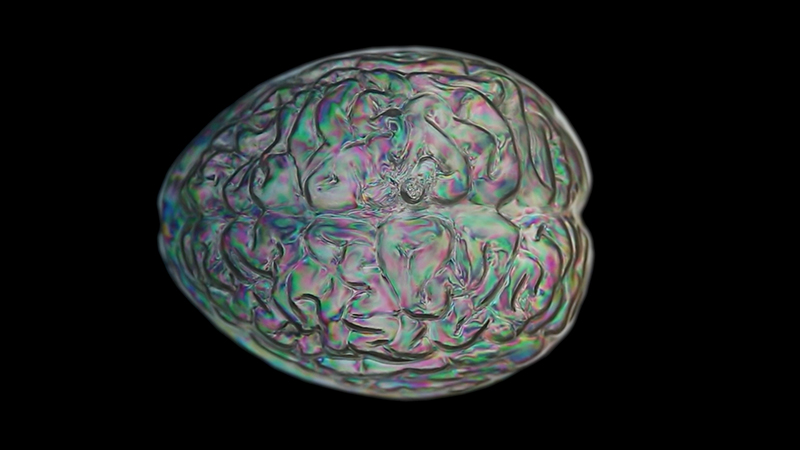
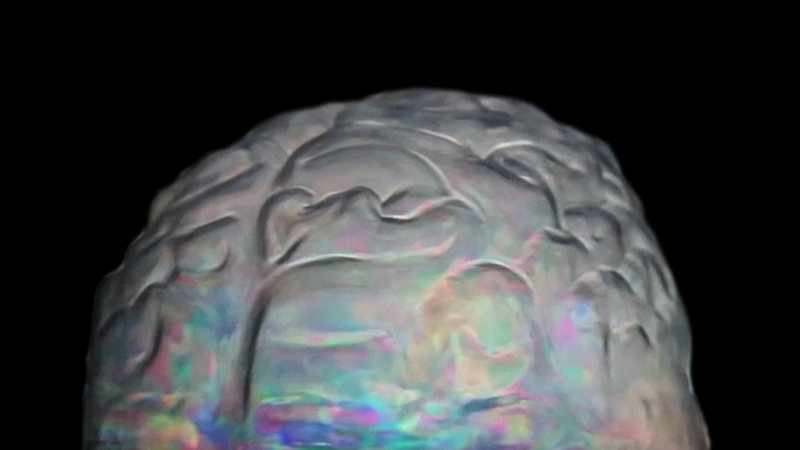
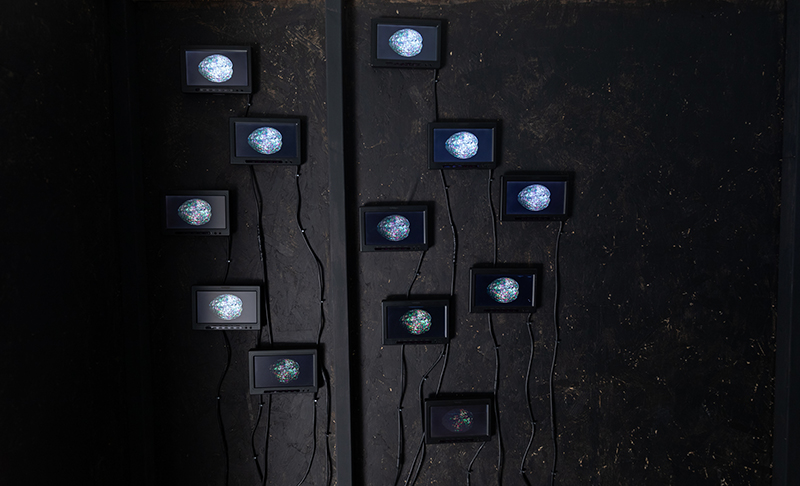
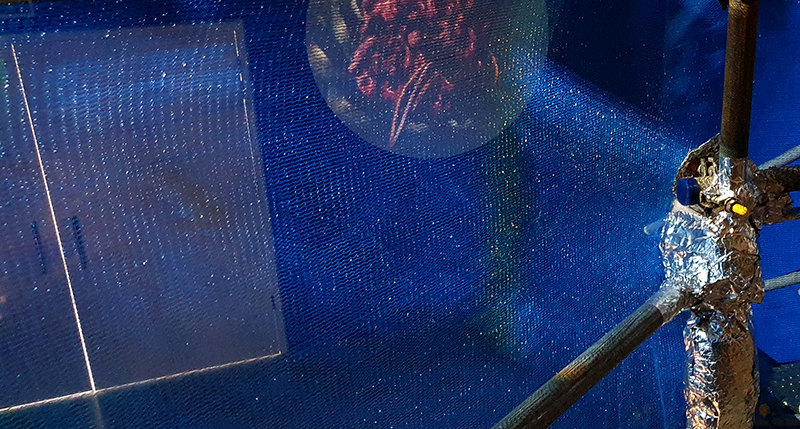
interference – a panel of 12 small video screens inside The Absolute Hut (of action potential), showing images of the human brain filmed by using polarizing filters to create pulsating birefringence colours, relate to the narrative pinned to the outside of the hut.

The narrative is a mix of fact and fiction based on a real experiment carried out at Caltech where scientists found Alpha waves in the human brain do respond to Earth’s magnetic field and other research suggesting that it could be possible for the magnetic field in one animal’s brain to transmit information to another animal’s brain by triggering action potentials creating the same thoughts and emotions.

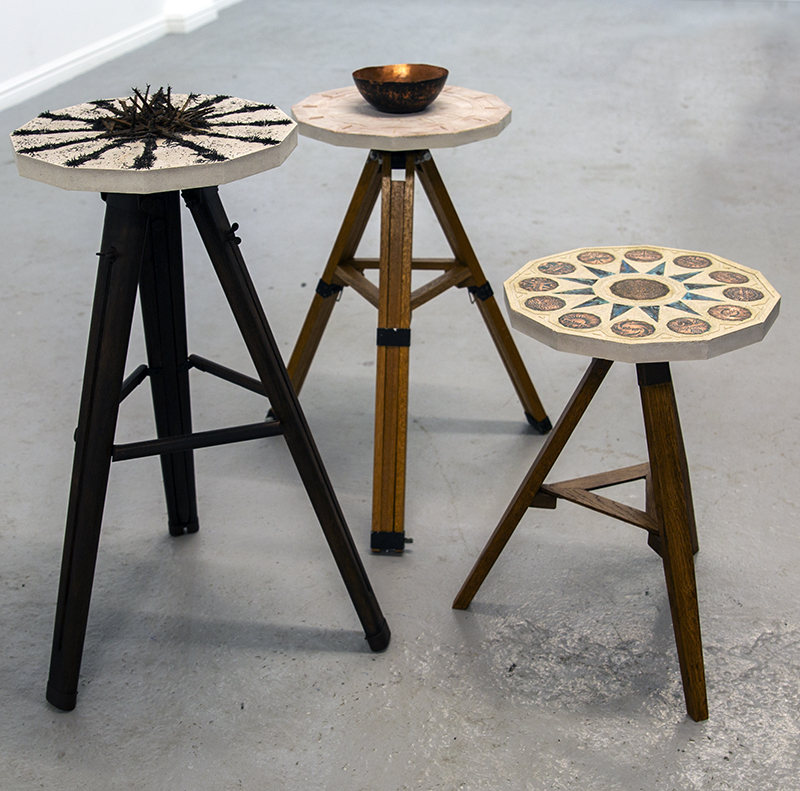
Instruments of the Anemoi are a set of dodecagon tablets cast in Snowcrete, a non-magnetic cement, as used in a magnetic observatory. Suggestive of the pedestals that support various instruments used in monitoring the Earths’ magnetic field they also respond to an ancient anemoscope “table of the winds” carved in marble around eighteen hundred years ago and inscribed with the Greek and Latin names of classical winds on each of its twelve sides. Envisaged here as speculative objects, instruments and schematics wrought by the wind gods, the first emissaries of navigation and orientation.

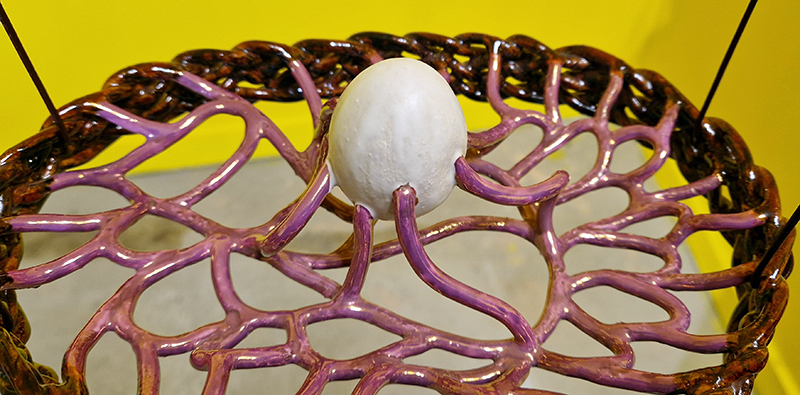
One tablet holds a copper bowl with a ‘silver fish’ floating in water. The shape of the ‘silver fish’ is based on the oval shaped compass needle (illustrated in Breve Compendio de la Sphera de la arte Navegar by Martin Cortes 1551)  and refers back to wafer thin fish shaped iron leaves used by 11th century Chinese geomancers.

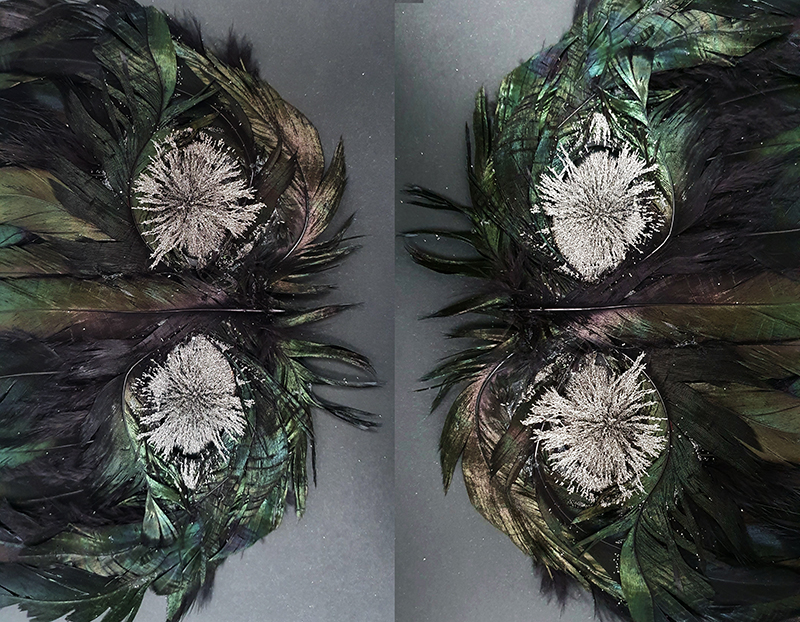
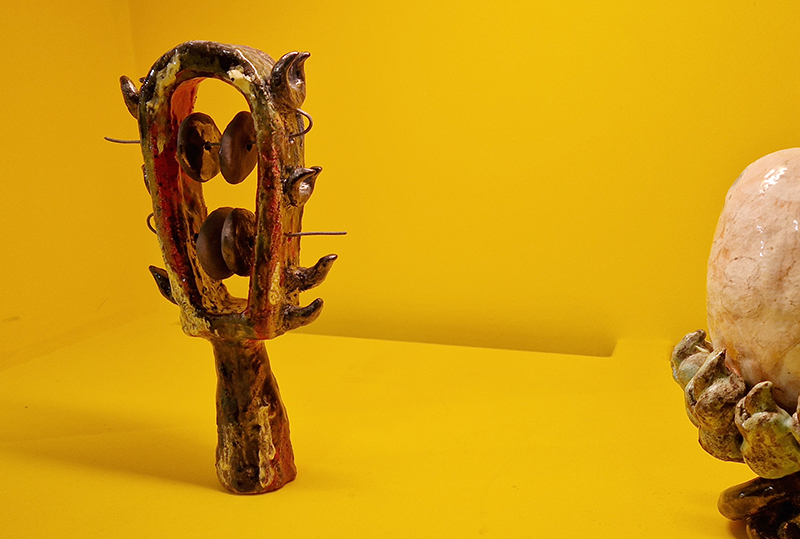
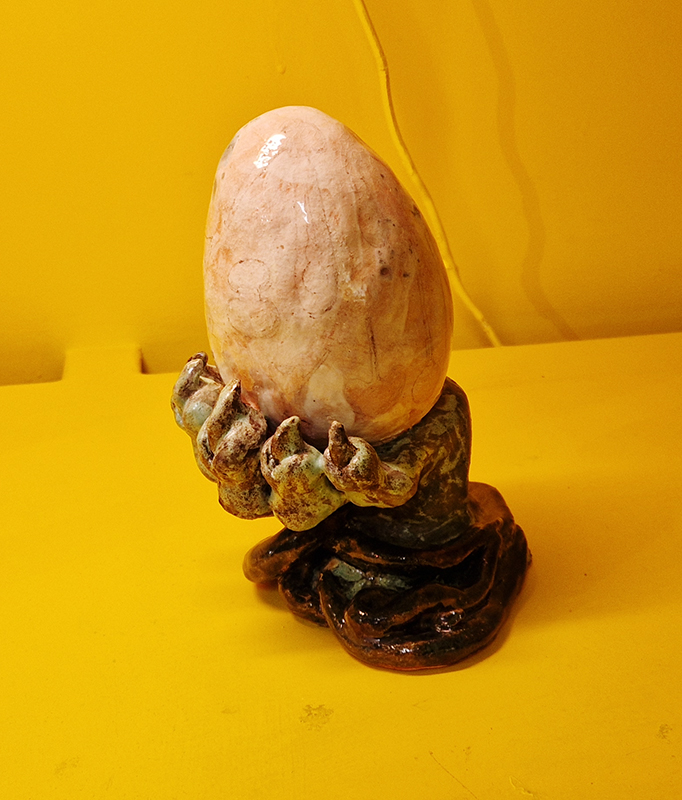
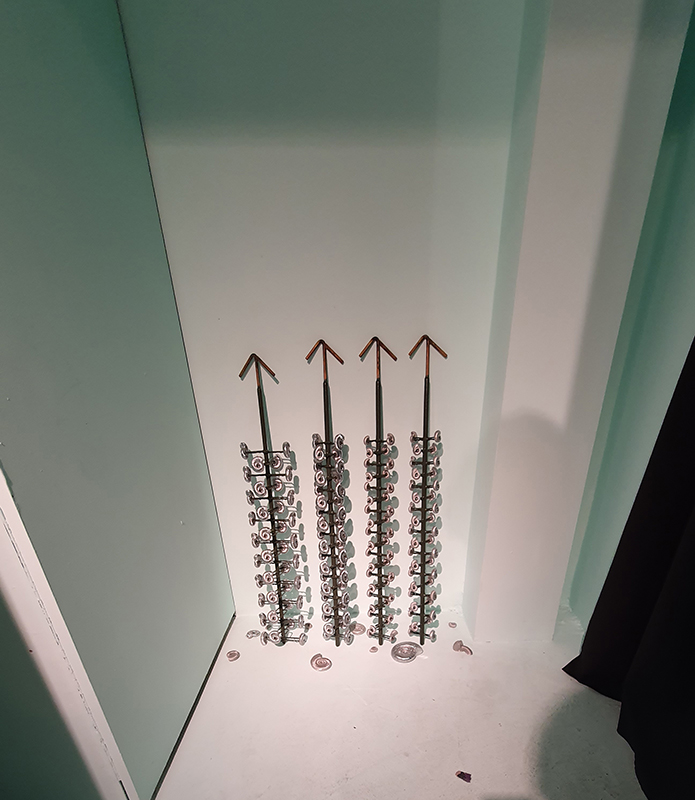
Nails and iron filings on the second tablet reveal an embedded magnetic field recalling a legend that the discovery of the lodestone was made by a Greek shepherd who noticed the nails in his boots were attracted to the rock (magnetite) beneath his feet.

The third tablet is embedded with copper etched with images and names based on associations and attributes of the twelve Greek wind gods set in a traditional compass rose.

Domain of the Devil Valley Master uses industrial directional magnetic steel, sanded and etched to reveal the Goss texture of rolled iron silicon alloy crystals. The jigsaw pattern of magnetic domains give this material exceptional magnetic properties. The simple evocation of a spiral described in geologically informed polygons draws upon many references, from the shape of our own Milky Way Galaxy sculpted by vast cosmological magnetic fields and the spiralling molten dynamo generating Earth’s magnetic field, to the inner pathway of spiritual growth and the route to the symbolic omphalos (navel) at the centre of the world where the sky entrance and the underworld meet. The title of this work originates from an ancient Chinese manual on the skills of persuasion, The Book of the Devil Valley Master, containing the first known mention of a compass, known at the time as a south-pointer.
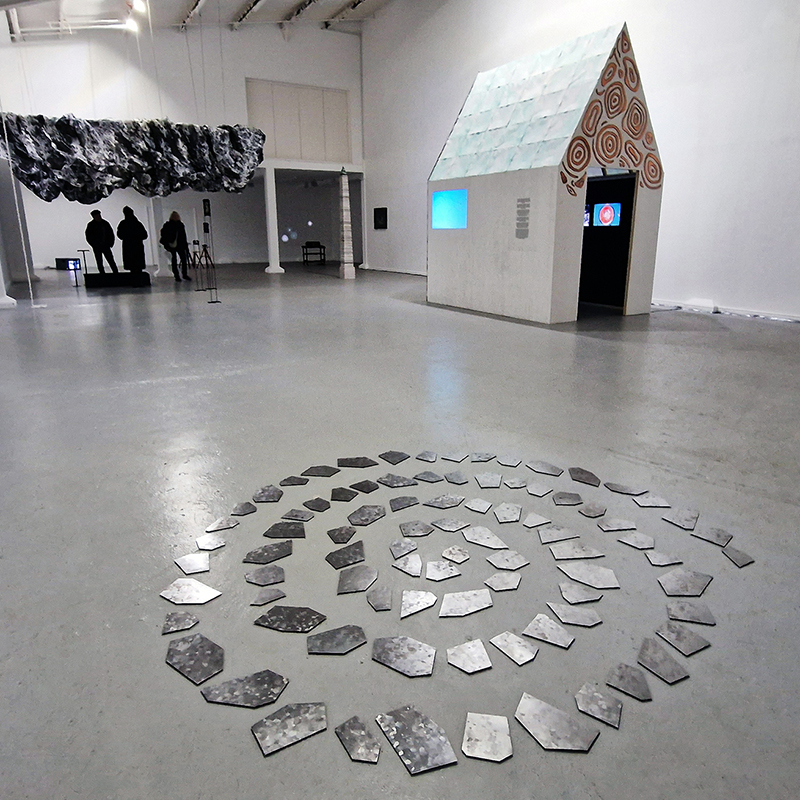
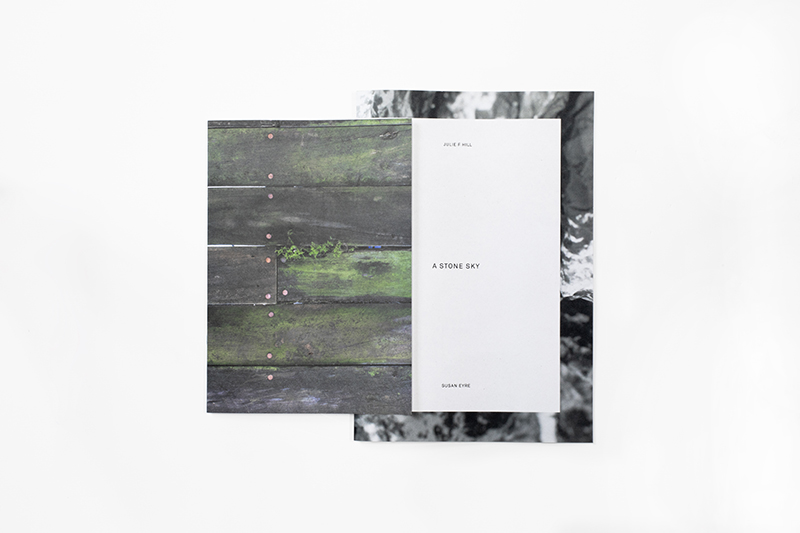
The exhibition closed with an afternoon event launching our publication which includes the essay Dark Nights and Signs of Unseen Things by Anjana Janardhan. There was also a live cloud chamber demonstration of mesmerising cosmic ray trails, artist tours and informal readings.

Publication available – DM via blog comments box for more details or visit Julie’s shop

Over the centuries many wind roses have been designed with varying numbers of wind directions from four to thirty-two cardinal points. The contemporary compass rose has its roots in the ancient classification of the winds.

Working on the sculpture series of tablets titled Instruments of the Anemoi after the gods of the winds. Twelve sided non-magnetic concrete tablets suggestive of the plinths that support various instruments used in monitoring the Earths’ magnetic field and the ancient anemoscope “table of the winds” carved in marble around eighteen hundred years ago and inscribed with the Greek and Latin names of classical winds on each of its twelve sides.

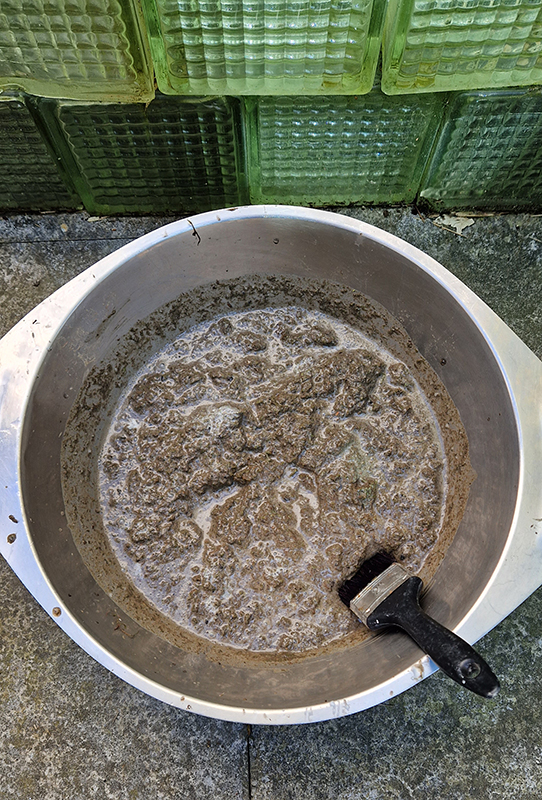
Testing an inked collagraph for concrete casting.

The first tablet in the series is cast with a collagraph which takes the commonly used oval shaped compass needle (illustrated in Breve Compendio de la Sphera de la arte Navegar by Martin Cortes 1551) as symbol of the silver fish – wafer thin fish shaped iron leaves used by 11th century Chinese geomancers.

The weather made the casting process a little precarious with the heat drying the concrete faster than ideal. The result has some fine cracks but overall I am pleased with the result. I used a convex glass lens to create a dip for a copper bowl to sit in. The glass had to be dremelled out after unmoulding. It left a very shiny surface. I made the copper bowl by hand at the London Sculpture Workshop. The ‘silver fish’ is cut from a silver gilding sheet.

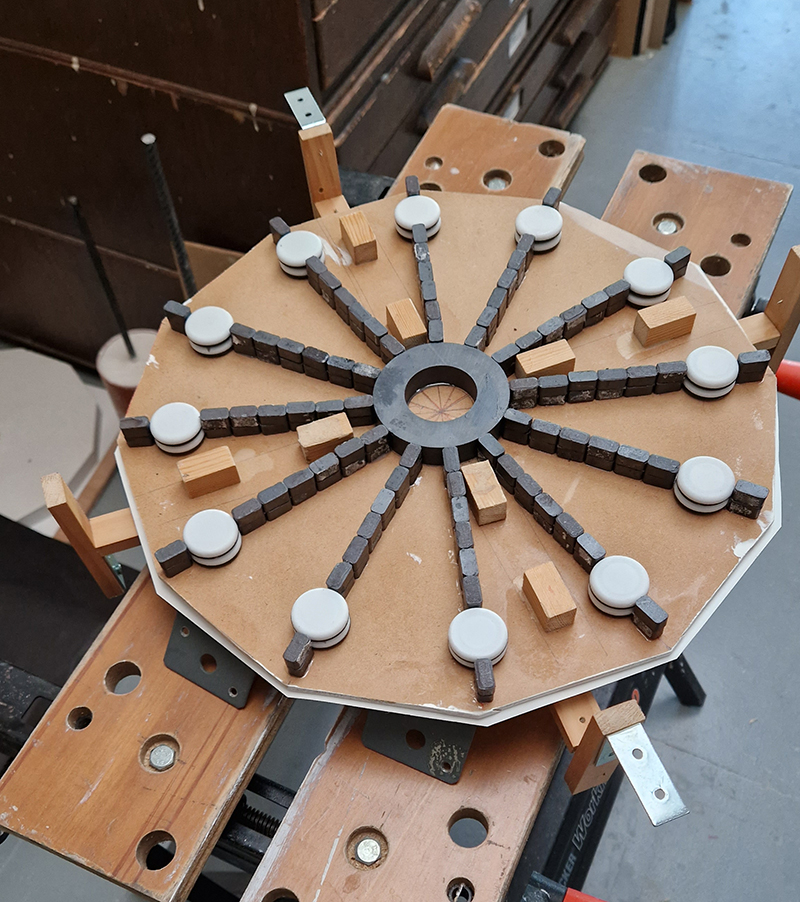
The next tablet I am working on will contain embedded magnets. An elaborate frame is in construction to suspend the magnets in the concrete while it sets.

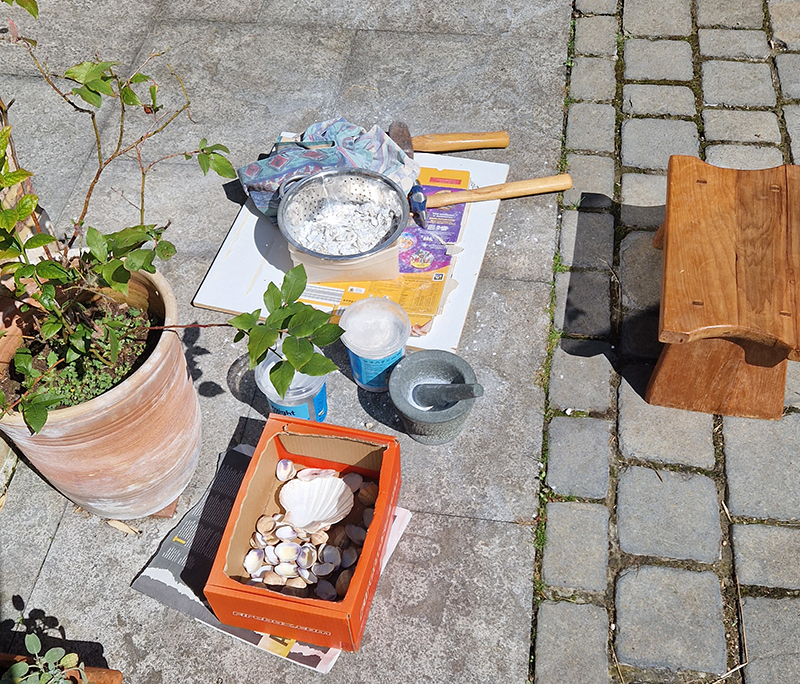
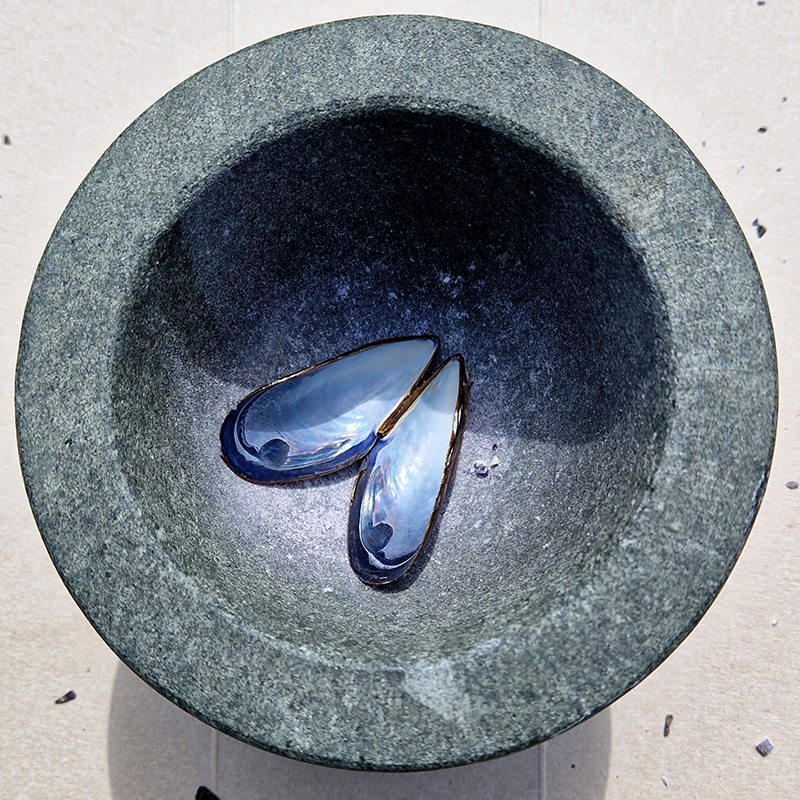
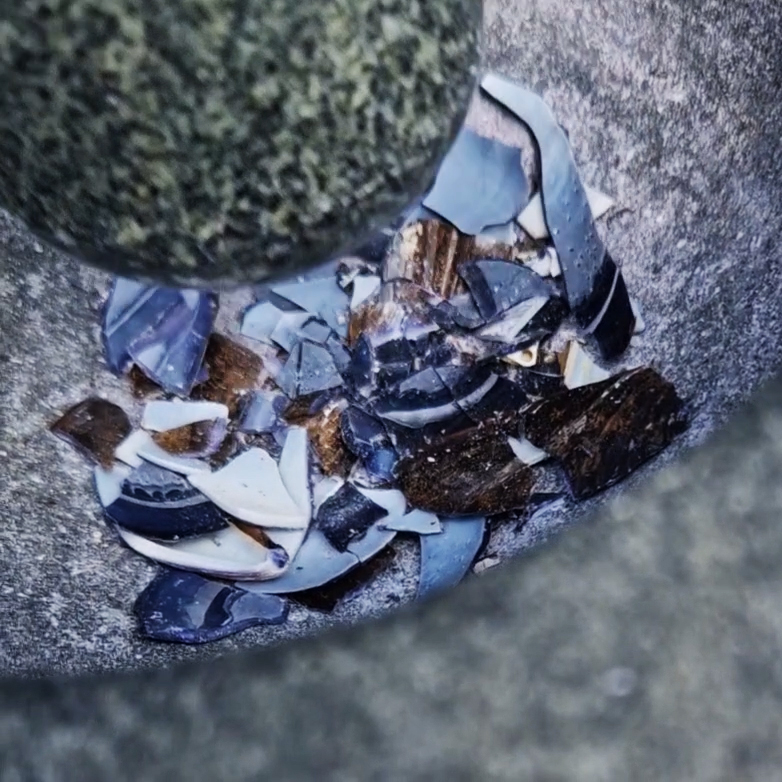
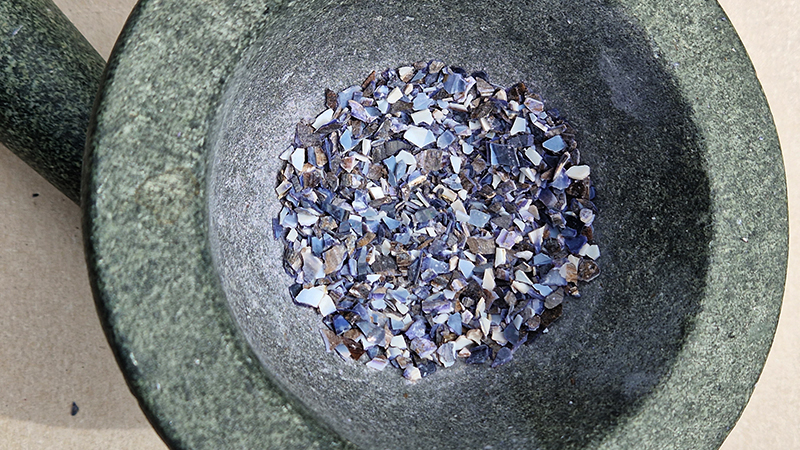
I will also add crushed shells as aggregate, so more pounding shells in the garden is necessary.

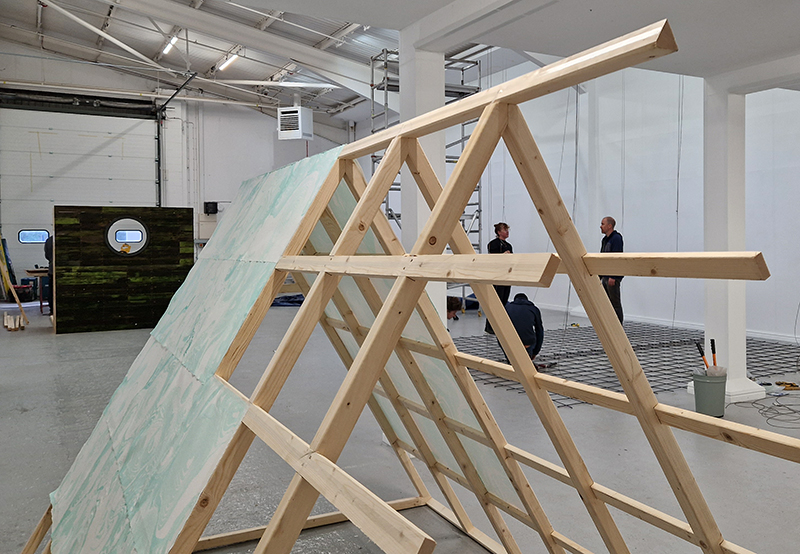
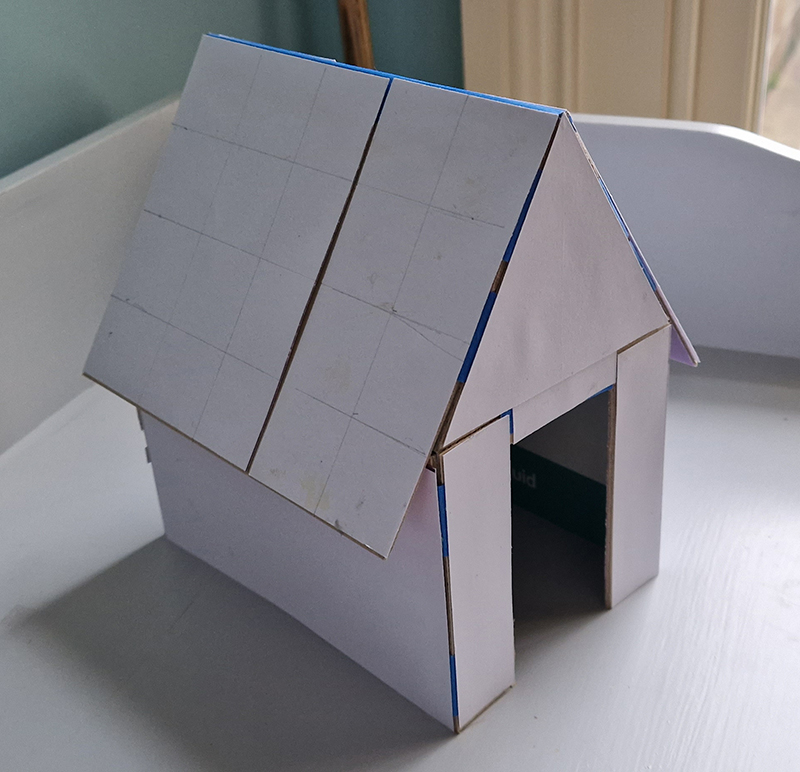
Continuing work on The Absolute Hut (of action potential). The Absolute Hut is structurally conceived from an amalgamation of features, impressions and functions of the Observing Building and instruments at Hartland Magnetic Observatory in North Devon and the observation huts built in the 18th century at The Kings Observatory in Kew for meteorological and magnetic observations.

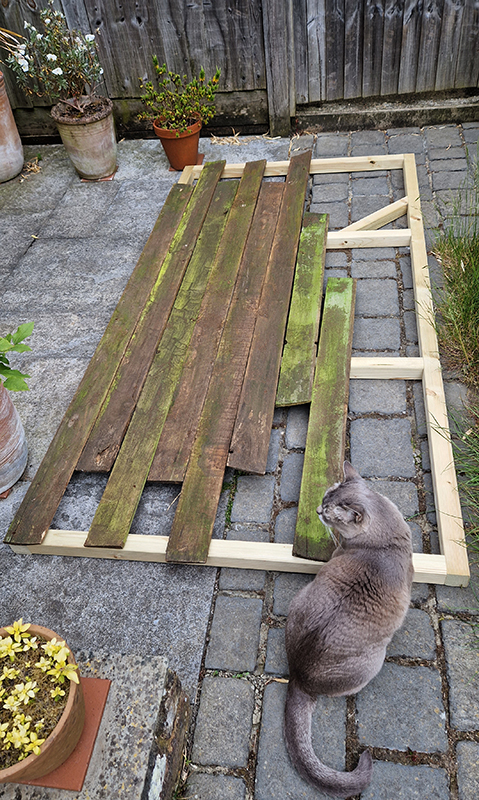
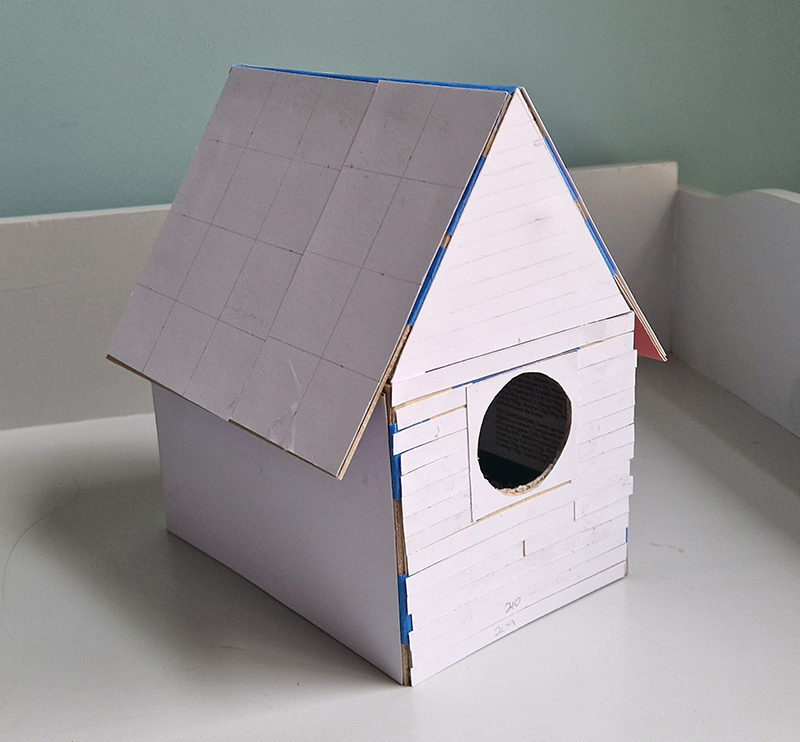
Cutting old featherboard planks to length and hammering them to the frame of the north facing wall with copper nails. These panel sections are now left facing north to gather some moss before the exhibition.

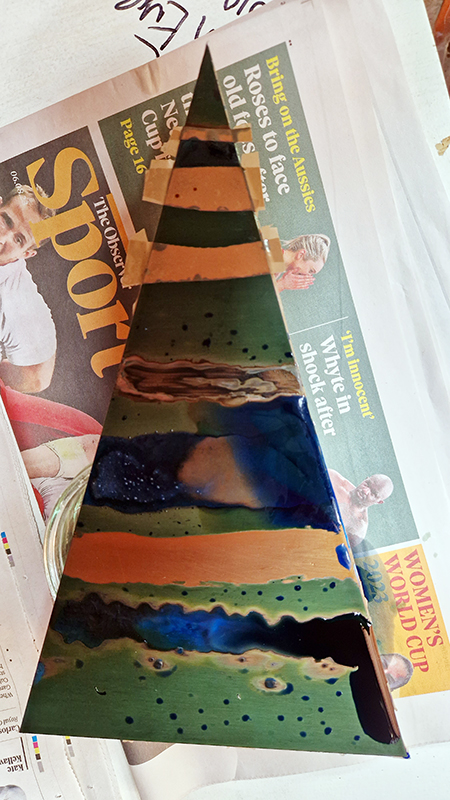
Exciting copper patination tests for the pyramidion to sit on top of The Azimuth Obelisk (of sedimentary knowledge) sculpture. The sculpture expresses the passage of time; made from recycled paper prints and drawings whose history is embedded in the stacked layers, much as the Earth’s geological and magnetic history is secreted into sedimentary strata of rock.

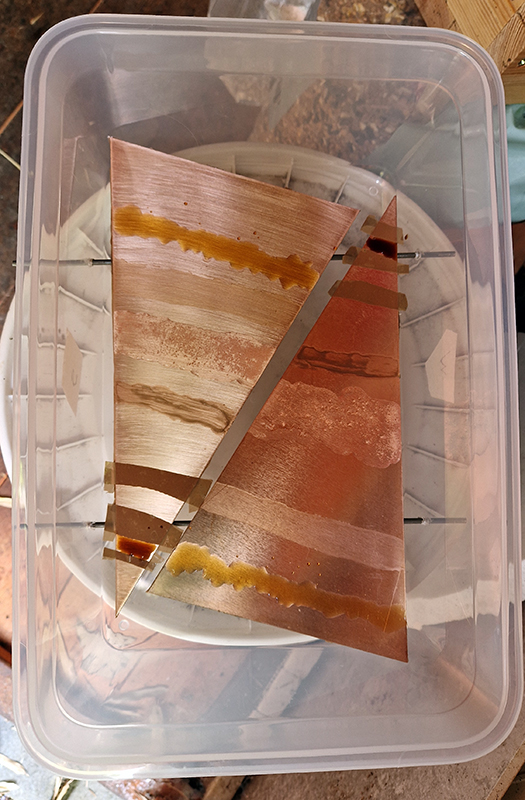
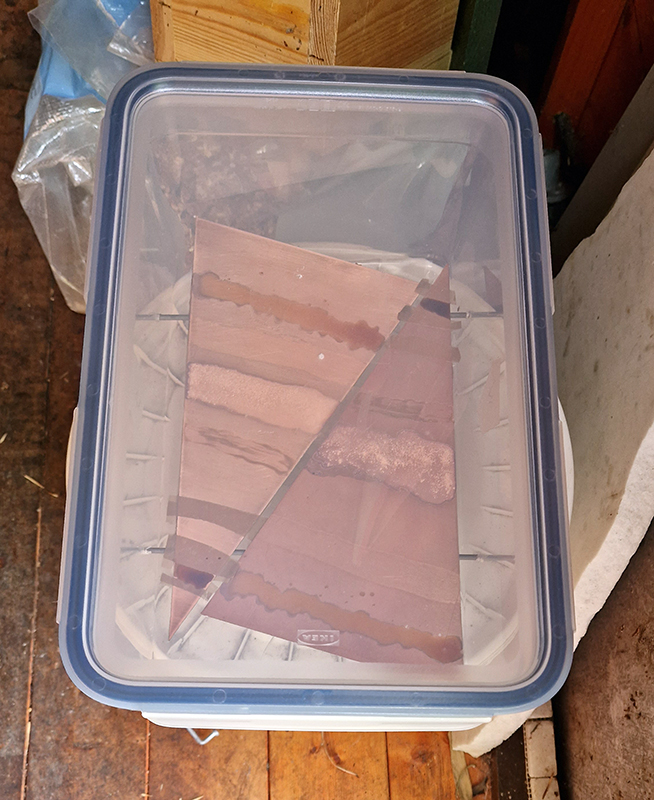
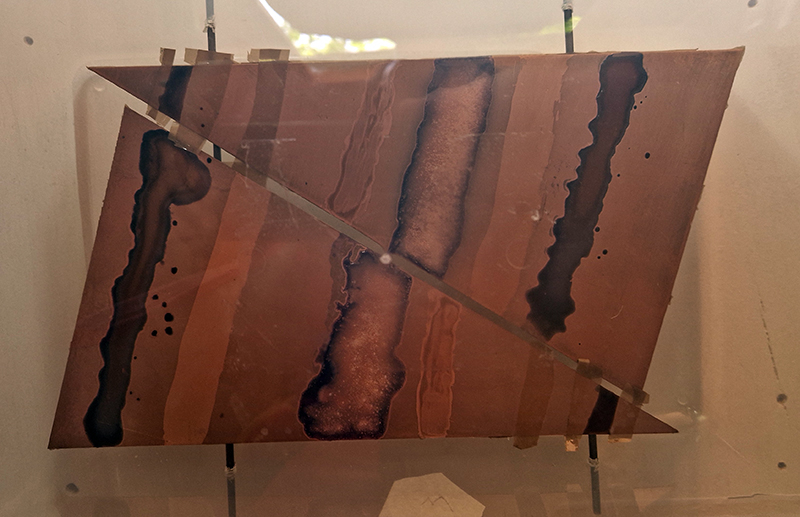
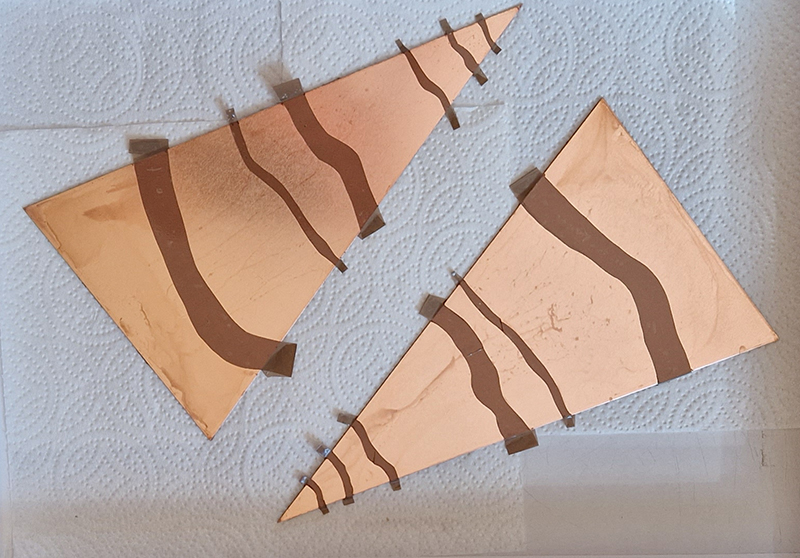
The copper is cleaned first with whiting and ammonia solution. For the test strips I used parcel tape, water based and spirit based varnish, salt and vinegar solution, soy sauce and seaweed plant food. These are applied to the copper which is then placed suspended in a sealed container with a little ammonia. Effects are immediate but I left this overnight.

The next day they are taken from the tank and left to dry.

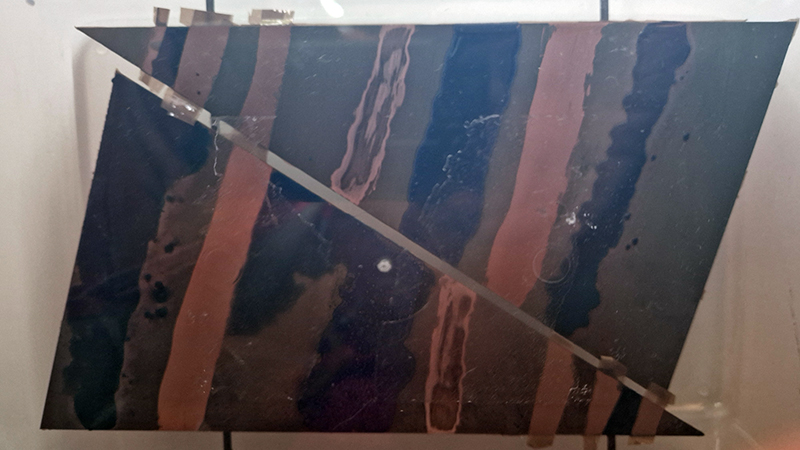
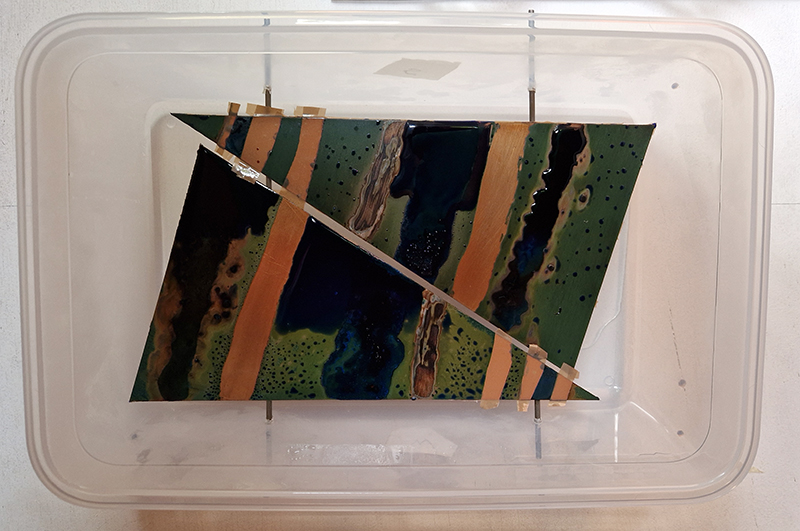
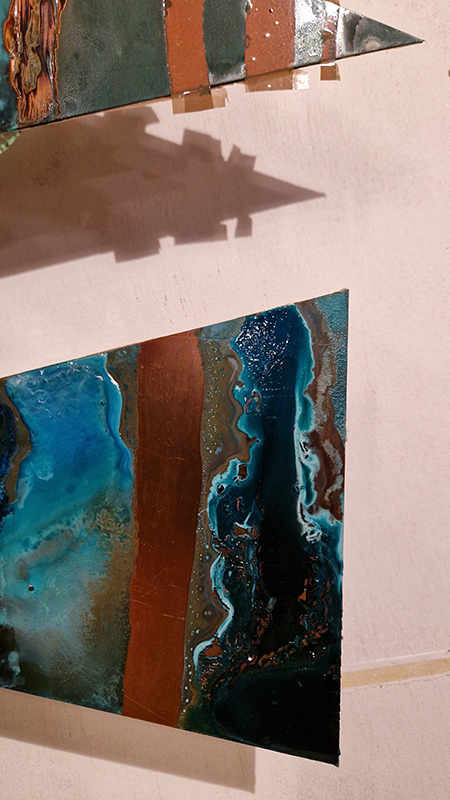
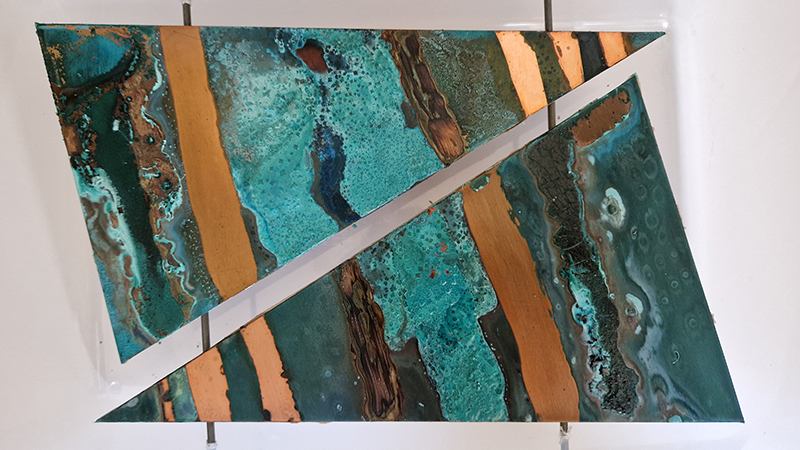
Both types of varnish interacted with the ammonia fumes, either going dark or puckering and crazing. The parcel tape left a clear band of copper when removed. The salt and vinegar mix gave a light blue patination and the soy sauce and plant food varying greens as copper where it was left raw. The colours continue to develop.

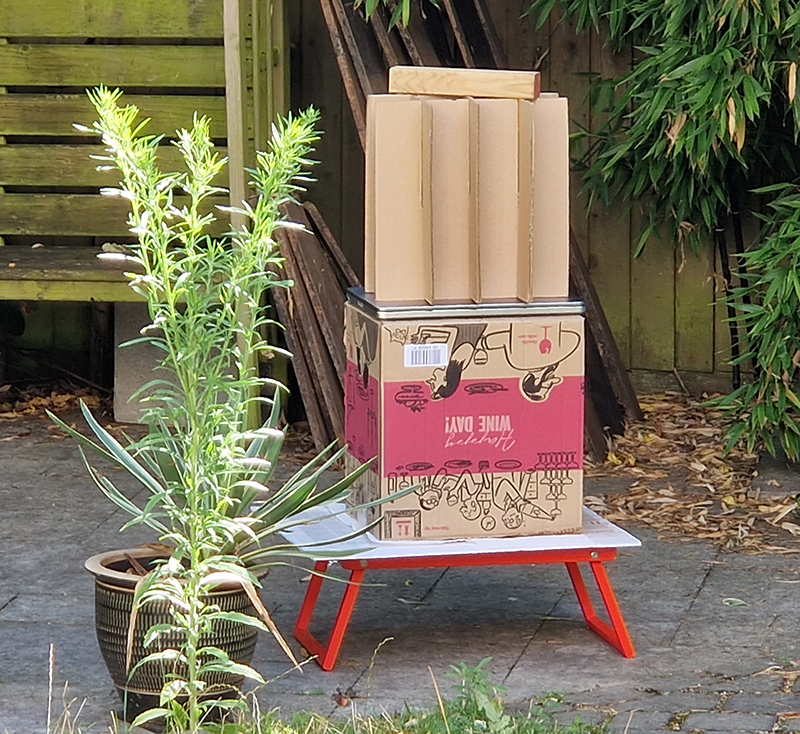
Preparing and patinating the copper triangles I had laser cut to size for the pyramidion. Applying strips of parcel tape to match up at the corners. Setting up a cat defence for drying the plates outside.

Once dry the colours continue to develop. I wanted to spray the surface with Golden archival acrylic spray but it was out of stock everywhere so I got Lascaux archival varnish with UV protection and gave it four light coats. It still continues to change though and flake off a bit adding to the effect of geological, topographical transformation.

I used Sugru, mouldable glue, building it up in stages to fix the sides while the pyramidion is supported in a frame.

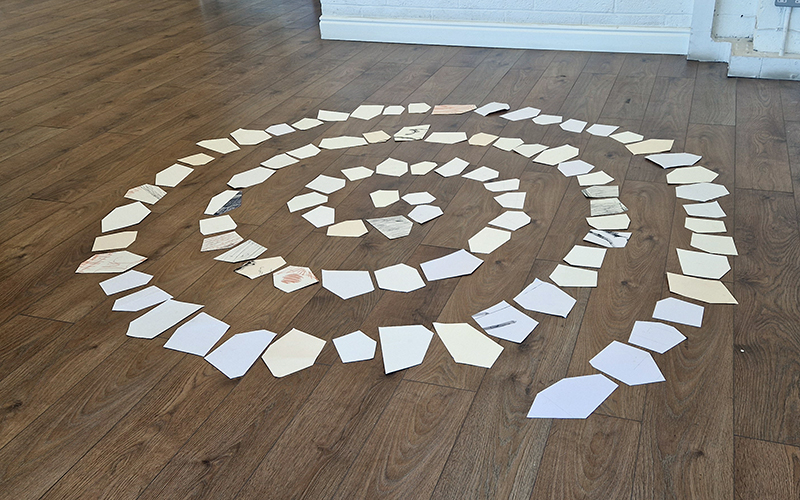
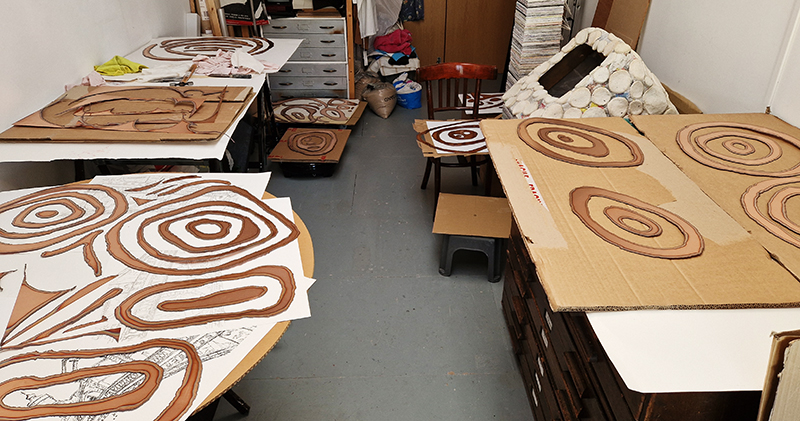
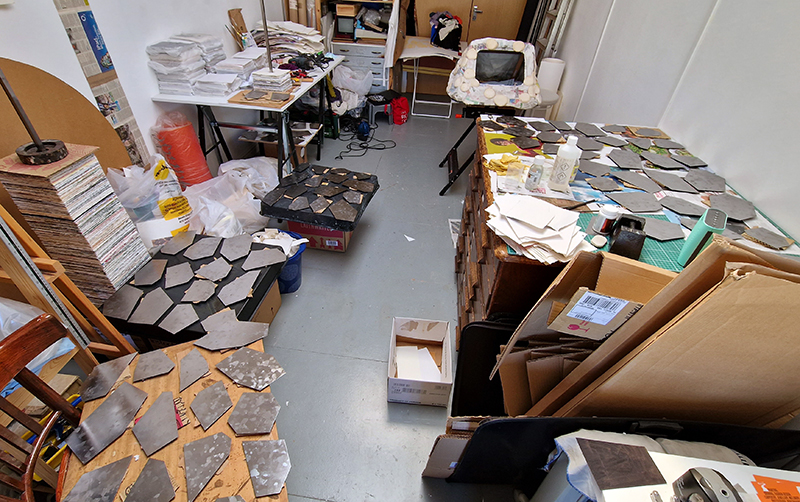
Making use of the communal lounge at Thames-side Studios to test some paper template layouts for Domain of the Devil Valley Master. A sculpture using directional magnetic steel laid in a simple spiral which draws upon many references, from the shape of our own Milky Way Galaxy sculpted by vast cosmological magnetic fields, the spiralling molten dynamo generating Earth’s magnetic field, to the inner pathway of spiritual growth and the route to the symbolic omphalos (navel) at the centre of the world where the sky entrance and the underworld meet.

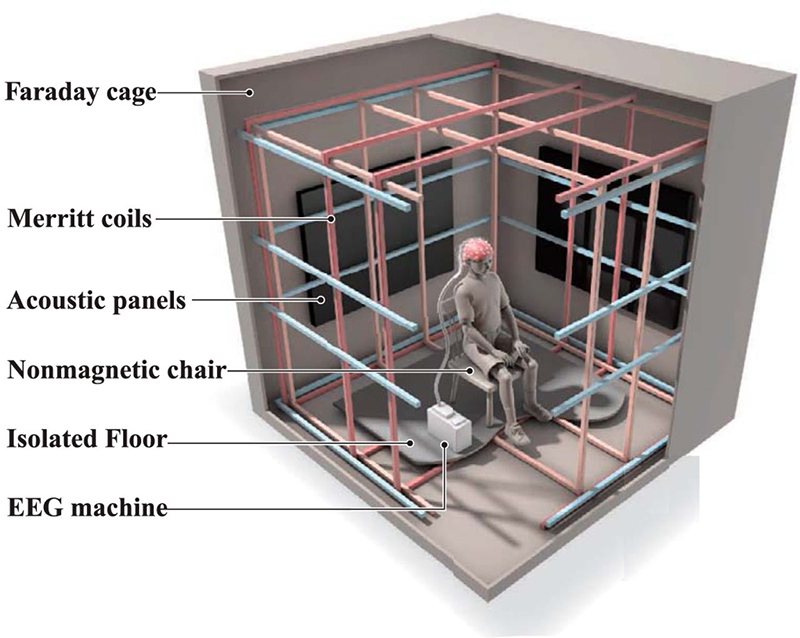
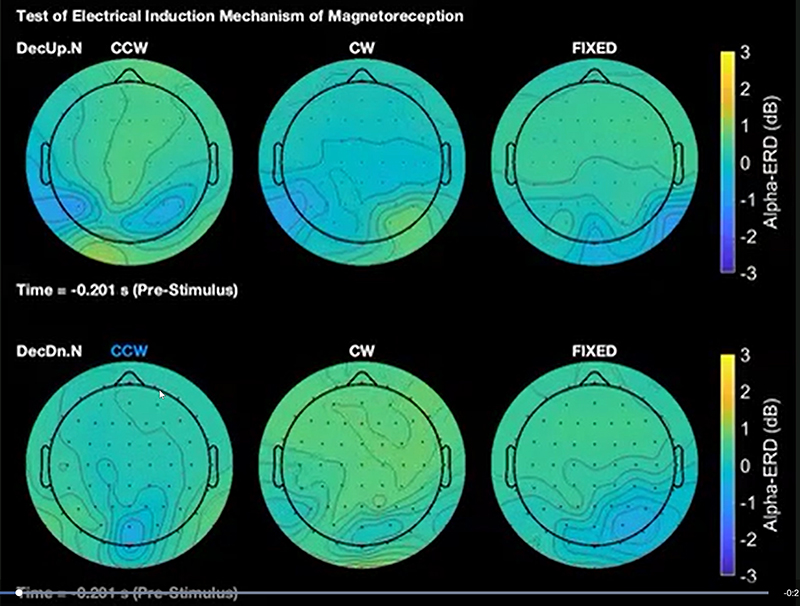
As research for new video work I am looking at experiments performed by Caltech geobiologist Joseph Kirschvink and colleagues investigating human magnetoreception. They found evidence that rotations of Earth-strength magnetic fields produce strong, specific and repeatable effects on human brainwave activity in the alpha-wave band. Alpha waves are always present, but are more prominent when at rest. The experiment, carried out at Caltech, mimicked how a person might experience the Earth’s magnetic field when turning their head. Although many migrating and homing animals are sensitive to Earth’s magnetic field, most humans are not consciously aware of the geomagnetic stimuli that we encounter in everyday life. Either we have lost a shared, ancestral magnetosensory system, or the system lacks a conscious component with detectable neural activity but no apparent perceptual awareness by us.

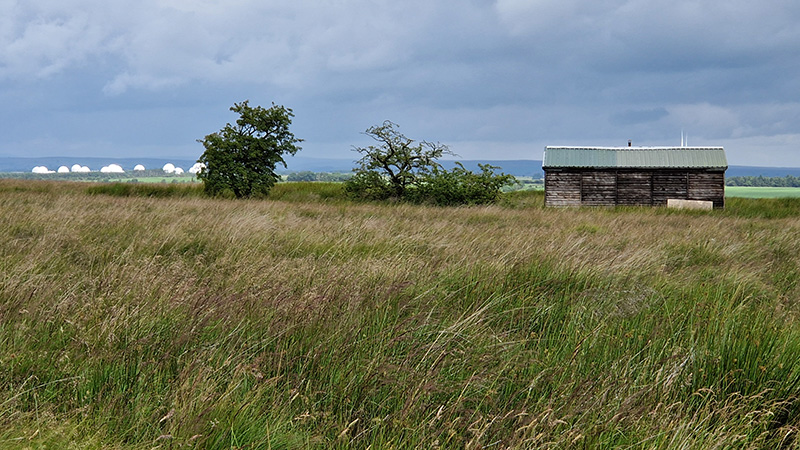
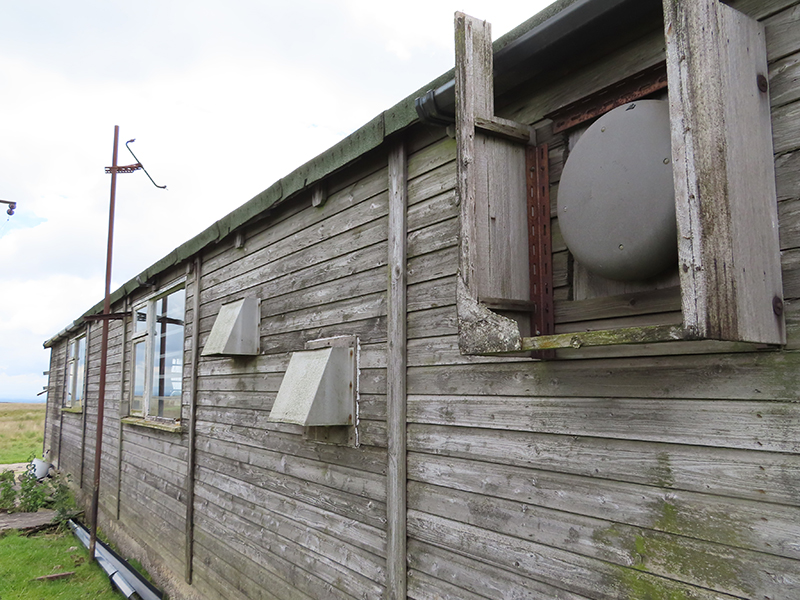
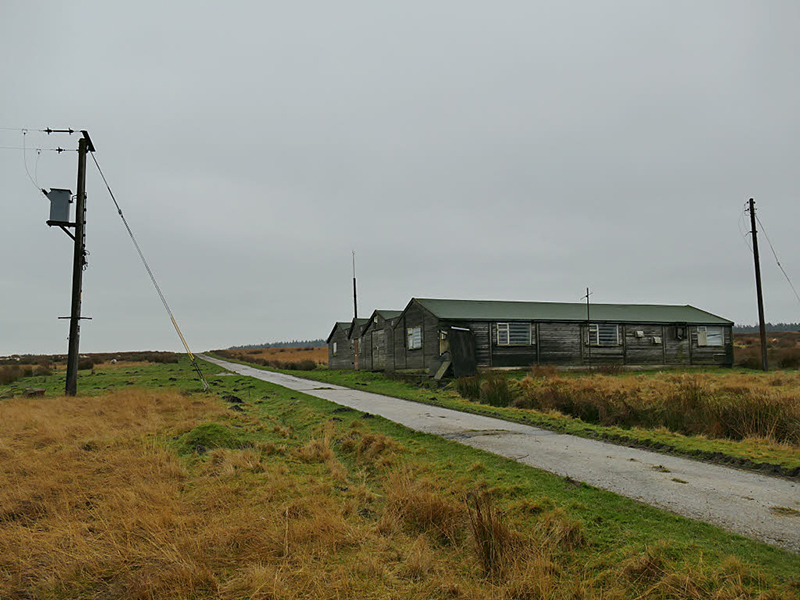
Friends from the north visiting London, told me about Haverah Park which is just up the road from where they live in North Yorkshire. The Haverah Park experiment was a cosmic ray air shower detection array consisting of water Cherenkov detectors distributed over an area of 12 km2 . The experiment began in 1967 and was operated by University of Leeds for 20 years before closing. During its operation, many thousands of cosmic ray events were recorded including four exceptional events with energies over 1020 eV. The abandoned huts remain and I am very excited about visiting the site to investigate further.

Gallery visits

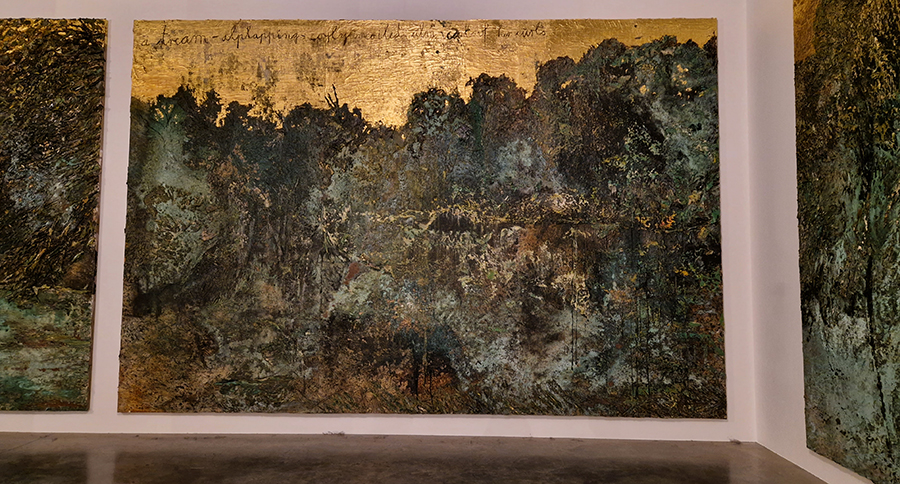
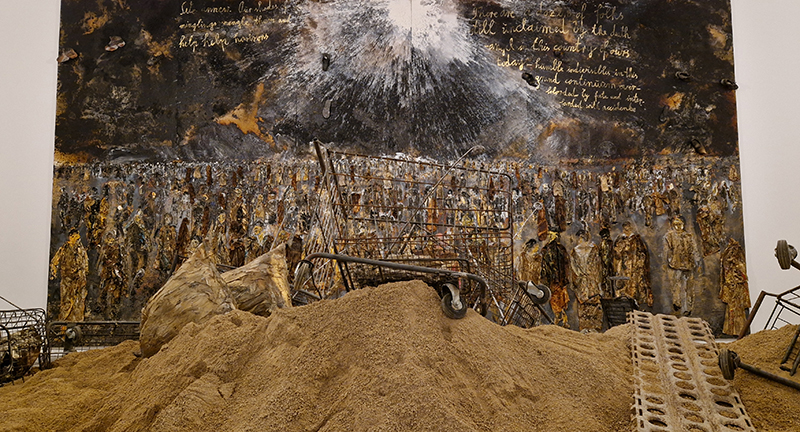
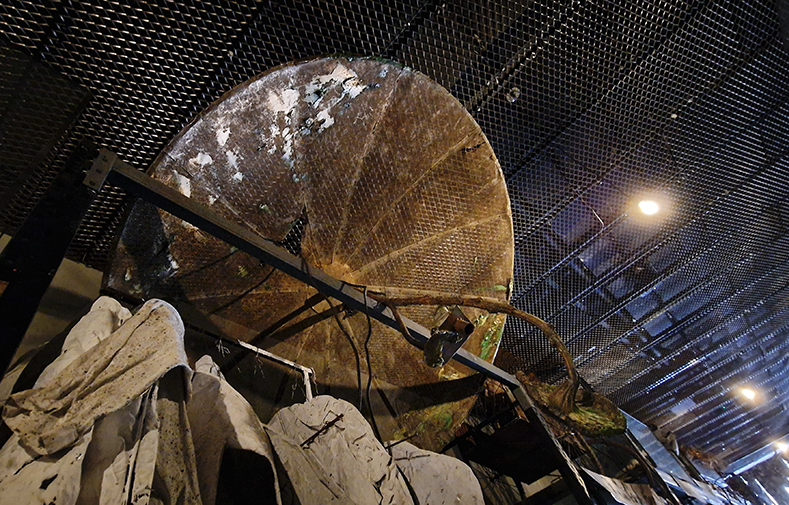
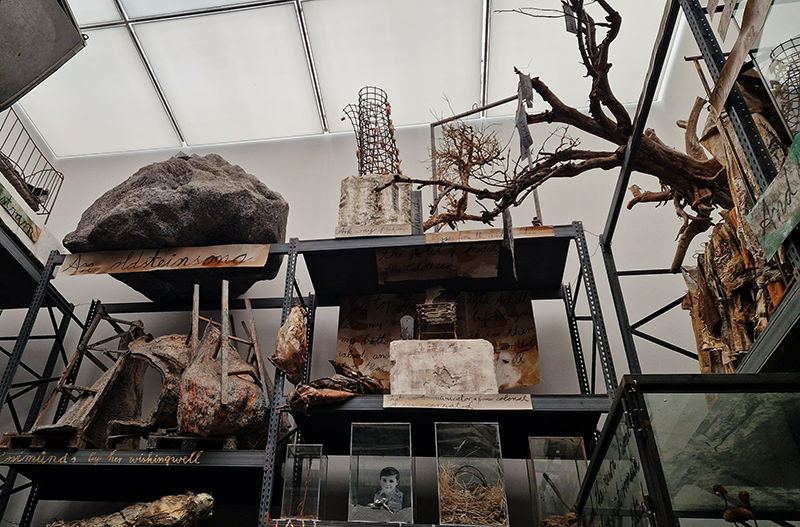
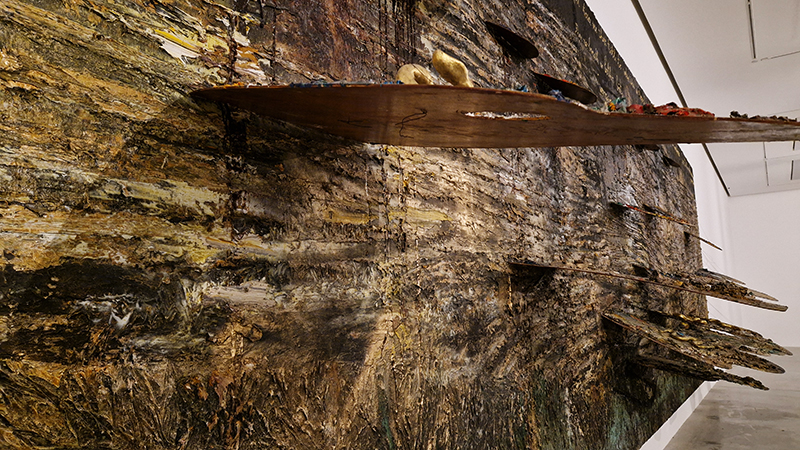
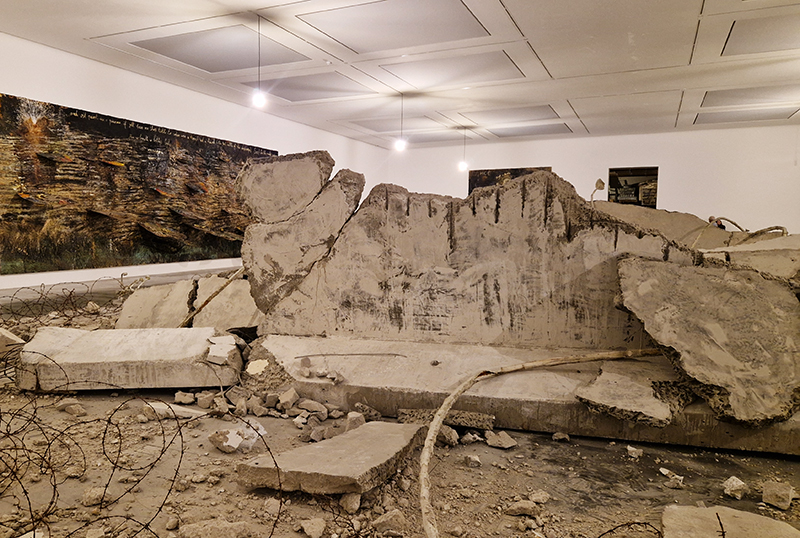
Anselm Kiefer Finnegans Wake at White Cube Bermondsey – “the artist’s new paintings, sculptures and installations respond to (that is, struggle with and transform) James Joyce’s novel of 1939. Kiefer first read the Irish writer as a young man, devouring Ulysses (1922) and embarking on a slow and spiralling relationship with the later, more exacting, Finnegans Wake. It is a book of circles and echoes, more or less overt or secret; its riverine movement begins in the midst of things, and turns back on itself on the final page.”

The weight and the scale of his work as always is overwhelming.

In my early research wondering what the building blocks of the universe looked like I found myself reading about Quarks and Leptons. I found the language of particle physics to be quite like that of mythology – inhabited with mysterious characters like the charm quark and strange quark, the muon and the tau governed by fundamental forces that cannot be seen or explained other than by their attributes – like the mythical gods. The name “quarks“ was chosen for the three fundamental particles of all matter from a nonsense word used by James Joyce in the novel Finnegan’s Wake:

“Three quarks for Muster Mark!“

Finnegans Wake seeks to inhabit a commonplace but elusive realm of human experience – the language is more like poetry than prose and should be read intuitively – the first sentence of Finnegans Wake completes the end of the last sentence – the book’s circular structure embodies the theories of the 18th Century philosopher Giambattista Vico, who viewed human history as cyclical along with the natural cycles of the earth such as night and day, life and death, rise and fall. Vico believed that there was a poetic wisdom in legends which gave an insight  into the relationship between the divine, the natural and the human worlds. He was interested in how myths began from common primordial experiences of the forces of nature.

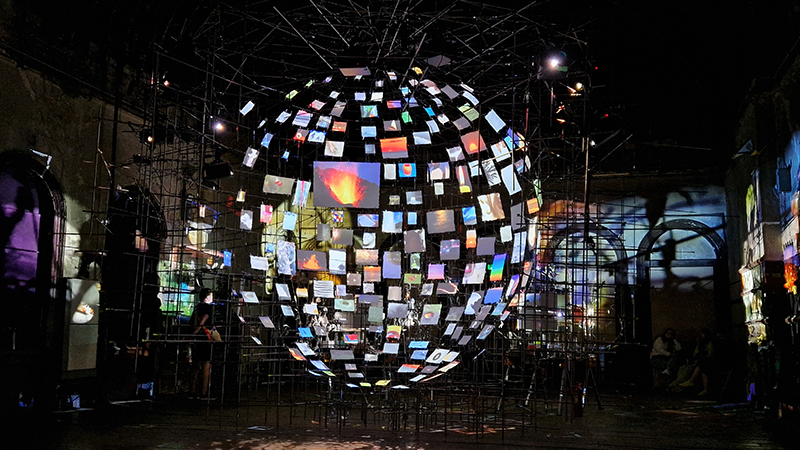
A different kind of immersion – made from light rather than lead. Sarah Sze The Waiting Room at Peckham Rye Station, an Artangel project, is a captivating spectacle of colour and movement. It might be a lesson in attention spans and ubiquitous digital media but it still holds all the joy of being at the centre of a rotating fairground carousel.

“I’ve always been interested in certain times throughout history where our relationship to the way we experience time and space in the world speeds up radically. The invention of the aeroplane, the invention of the train, you see really interesting work coming out of that time, in film, visual arts and writing. We are in the middle of an extreme hurricane where we are learning to speak through images at an exponential pace.” Sarah Sze

Dear Earth at The Hayward Gallery is inspired by artist Otobong Nkanga’s suggestion that ‘caring is a form of resistance’. Bringing together 15 artists from around the world, the exhibition explores the interdependence of ecologies and ecosystems, as well as our emotional connection with nature.  

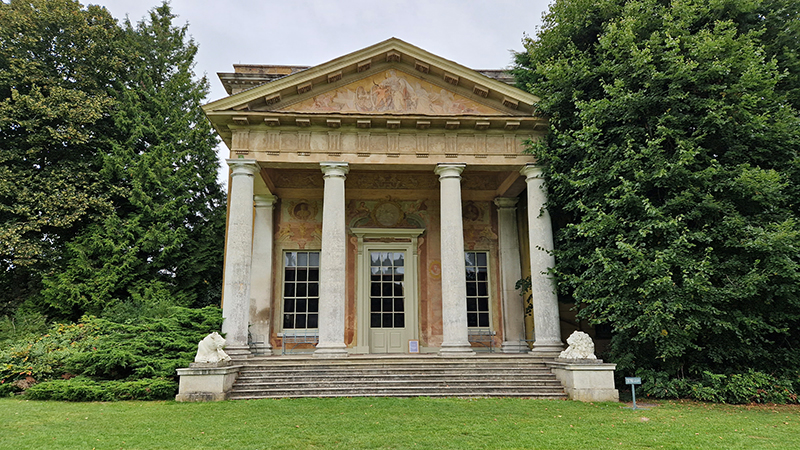
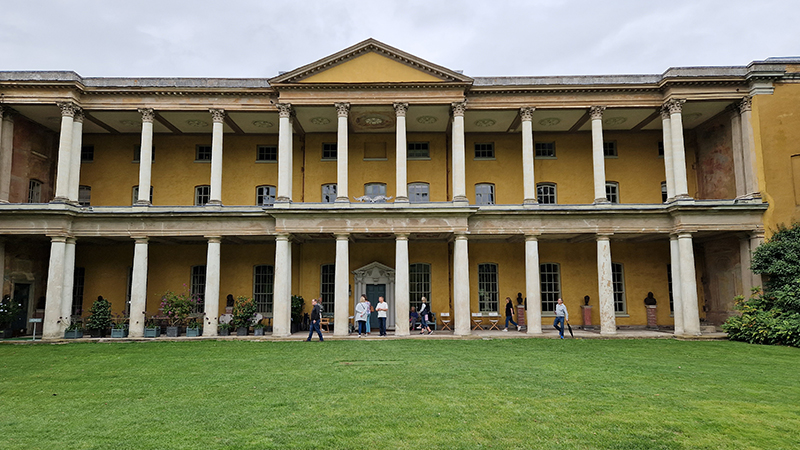
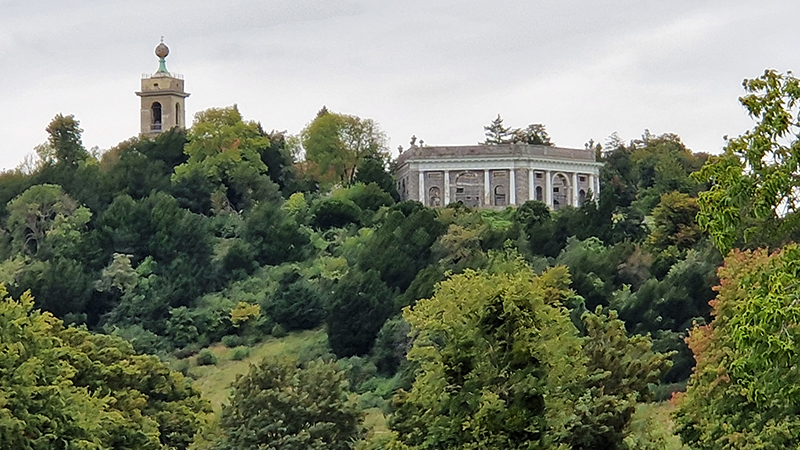
Day trip to West Wycombe Park; “one of the most theatrical and Italianate mid-18th century buildings in England” surrounded by “the most idiosyncratic 18th century gardens surviving in England”. Sir Francis Dashwood built West Wycombe to entertain, and there has been much speculation on the kind of entertainment he provided for his guests at the house and the nearby hellfire caves.

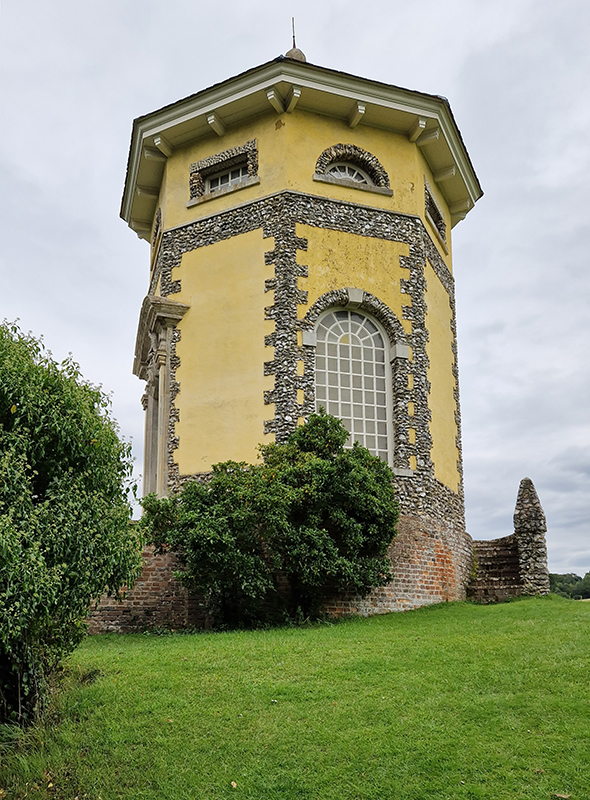
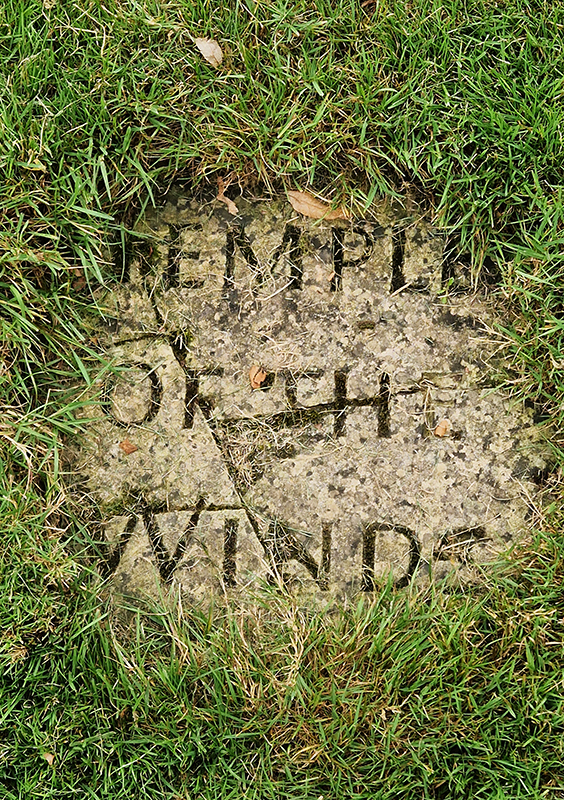
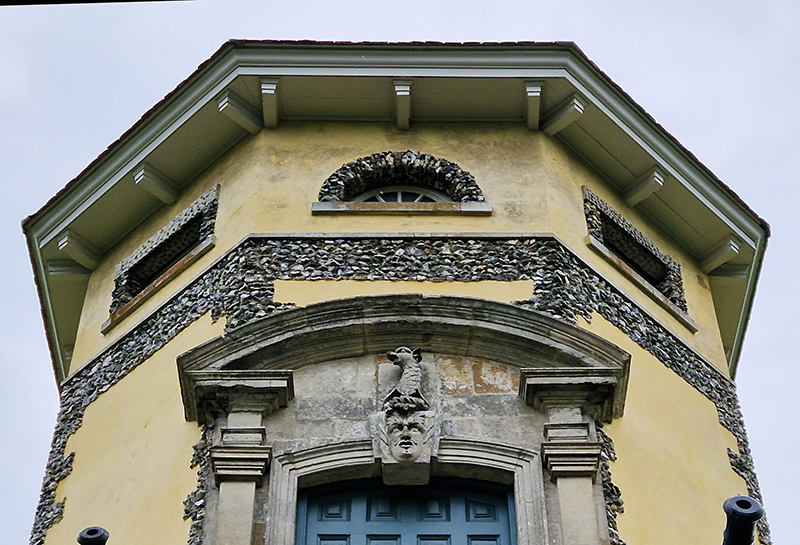
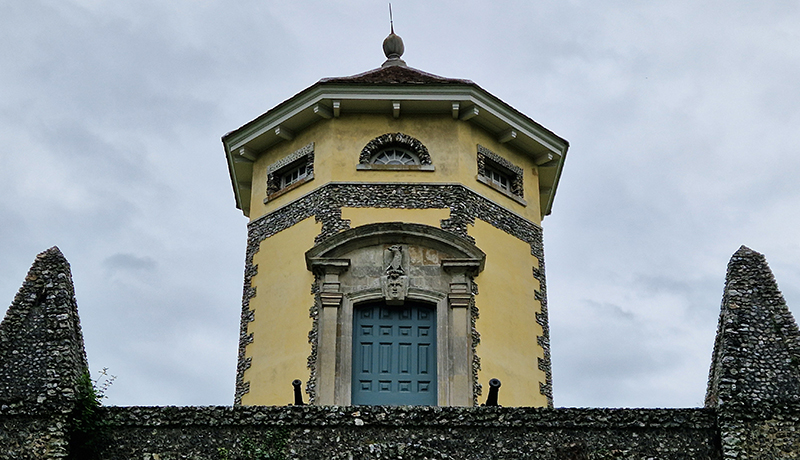
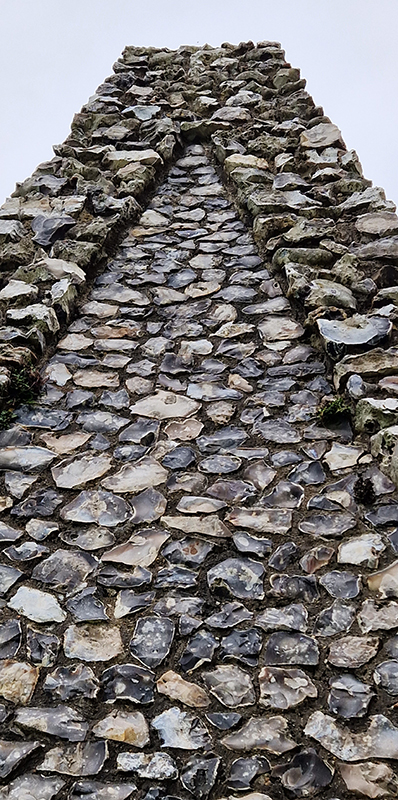
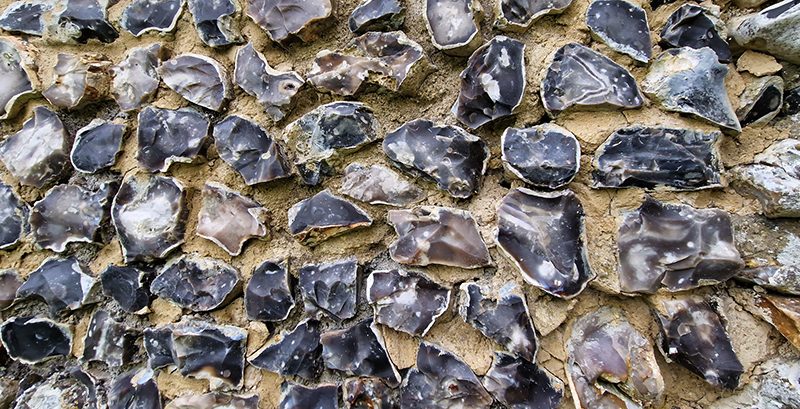
A surprise discovery in the gardens was The Temple of the Winds, a stucco and flint faced octagonal tower, aligned with its main walls facing north, south, east and west. Erected in 1759 and used as an ice house, its design was inspired by the ancient Tower of the Winds in the Roman Agora in Athens of which Vitruvius wrote

Some have chosen to reckon only four winds; the East, blowing from the equinoctial sunrise; the South, from the noon-day sun; the West; from the equinoctial sun-setting; and the North, from the Polar stars. But those who are more exact, have reckoned eight winds, particularly Andronicus Cyrrhestes, who on this system erected an octagon marble tower at Athens, and on every side of the octagon, he wrought a figure in relieve, representing the wind which blows against that side: the top of this tower he finished with a conical marble, on which he placed a brazen Triton, holding a wand in his right hand; this Triton is so contrived that he turns round with the wind and always stops when he directly faces it; pointing with his wand over the figure of the wind at that time blowing.

Reading

Ursula Le Guin The Winds Twelve Quarters (volume ii) – a collection of short stories, chosen for the title’s relevance to the sculpture series – Instruments of the Anemoi (wind gods).

The story The Stars Below is particularly interesting, written to interrogate the question – what happens to the creative mind when it is driven underground? Le Guin found that ‘you don’t go exploring the places underground all that easily’ as simple symbols took on unexpected divergent meanings and rather than the repression of science or art it was the abyss of the psyche she was fathoming. Le Guin later came across a passage in Jung likening the depths of ego-consciousness to ‘being surrounded by a multitude of little luminosities..[ ].. The star strewn heavens, stars reflected in dark water, nuggets of gold or golden sand scattered in black earth’

It is within my mind then, that I measure time. I must not allow my mind to insist that time is something objective.  When I measure time, I am measuring something in the present of my mind. St. Augustine of Hippo, 397

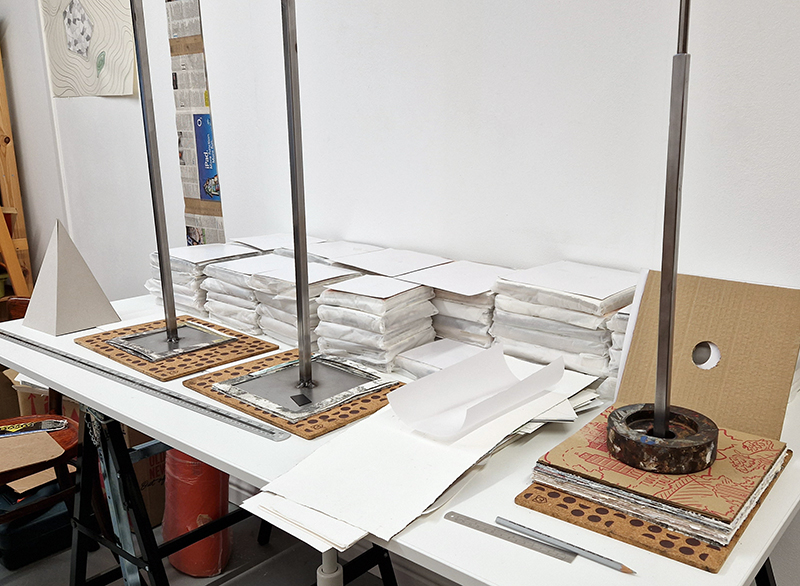
The many layers of paper comprising The Azimuth Obelisk (of sedimentary knowledge) sculpture have been prepared ready for final assembly. The next step will be patinating and assembling the copper pyramidion. This sculpture is a reimagining of the obelisk erected at Hartland Magnetic Observatory in 1955 which is now almost hidden by undergrowth. Although manual readings via a theodolite are still taken from the Observing Building north facing window, this concrete permanent azimuth mark has been replaced by a GPS position. The sculpture expresses the passage of time, made from recycled paper prints and drawings whose history is embedded in the stacked layers, much as the Earth’s geological and magnetic history is secreted into sedimentary strata of rock.

What is below our feet can be as much of a mystery as what is above our heads. The furthest humans have drilled below the surface of the Earth is just over 12 km but it is 6,370 km to the centre of the Earth. One way of exploring the Earth’s core is by studying geoneutrinos. Geoneutrinos are neutrinos, the lightest subatomic particle, released by the natural radioactive decay of potassium, thorium, and uranium in Earth’s interior. By studying geoneutrinos, scientists can better understand the composition and spatial distribution of materials in the mantle and core. Neutrinos can pass through matter uninhibited and are not affected by magnetism. Geoneutrinos are low-energy electron antineutrinos, and scientists need to use large detectors to record them but because they  are so elusive, they don’t capture very many events each year. Some of the heat emanating from the interior of our planet comes from this radioactive decay and is responsible for everything from creating the molten iron core that generates Earth’s magnetic field to the spread of the sea floor and motion of the continents.

At the centre of the Earth is a hot sphere of solid iron which has its own ocean of molten iron, surging and churning with hurricanes and whirlpools powered by the Coriolis forces of Earth’s rotation. These complex motions generate our planet’s magnetosphere. The turbulent dynamo process also means the magnetic field is in a constant state of change and the poles are always on the move. From James Clark Ross first locating the magnetic north pole in 1831 to when Roald Amundsen found the pole again almost a century later it had moved at least 50 km since the days of Ross. Both poles continue to wander as varying speeds. Magnetic stripes around mid-ocean ridges reveal the history of Earth’s magnetic field for millions of years and record magnetic field reversals in the magnetism of ancient rocks. Field reversals come at irregular intervals averaging about 300,000 years with the last one 780,000 years ago. Reversals take a few thousand years to complete, and during that time the magnetic field does not vanish but becomes twisted and tangled with magnetic poles appearing in unaccustomed places. Although in a state of turmoil with possible weak areas it can still protect us from space radiation and solar storms.

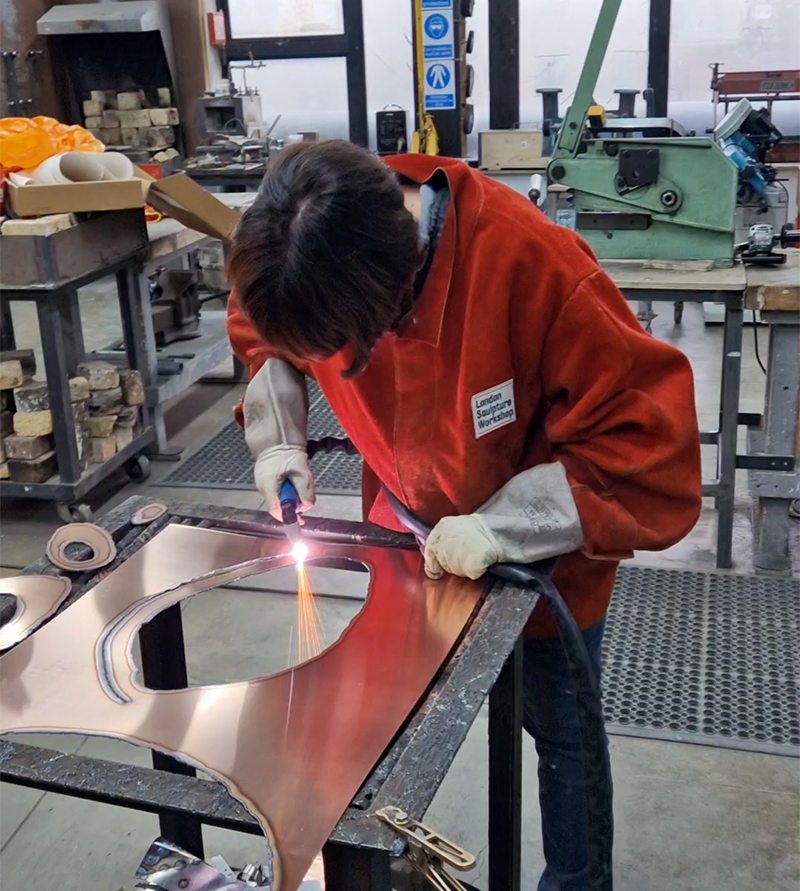
I took up membership of London Sculpture Workshop supported by a professional practice and creative development bursary from The Artists Information Company. Great to have access to the facilities here to work on sculptures responding to research visits to magnetic observatories. I had a couple of sessions cutting copper with a plasma gun. The intense heat colours the edges of the metal with blues, yellows and crimsons. Unfortunately some of the colour gets lost when they are lacquered so I have left some without coating this time to see if they lose the colour anyway. These topographical contours which are destined for the installation The Absolute Hut (of action potential), reflect the fluid motion of the Earth’s interior and also the pulsating alpha waves emanating from the human brain subjected to magnetic fields.

I have started editing and gathering together video footage for The Absolute Hut installation. Inside the hut I am planning to have video screens suggesting portals into a modulated web of neural pathways and one larger window with a two way projection film of the migratory pink footed geese at Snettisham in Norfolk. Natural navigation techniques and extra-sensory methods used by the non-human realm will form the basis for speculation as to the ability for humans to perceive the Earth’s magnetic field. 

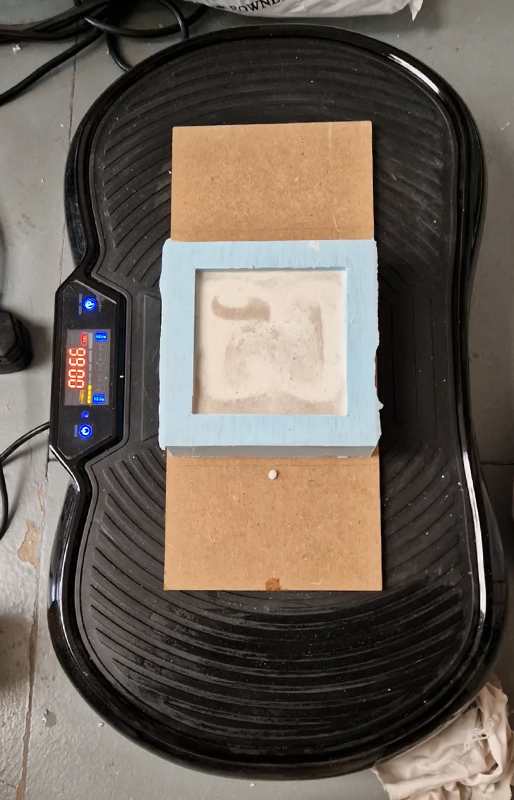
Following on from concrete casting tuition with Anna Hughes as part of my a-n creative development bursary I have been testing casting concrete with embedded magnets. I had an idea to try removing bubbles from the concrete by putting it on an exercise vibrating plate. The motion is quite violent and undulating and my mix was quite loose so it had an effect like a small wave machine sloshing side to side – there were no bubbles in the results though. These tests are towards making a series of dodecagon tablets cast in Snowcrete, a non-magnetic cement, as used in a magnetic observatory. Suggestive of the pedestals that support various instruments used in monitoring the Earths’ magnetic field they also respond to an ancient anemoscope “table of the winds” carved in marble around eighteen hundred years ago and inscribed with the Greek and Latin names of classical winds on each of its twelve sides.

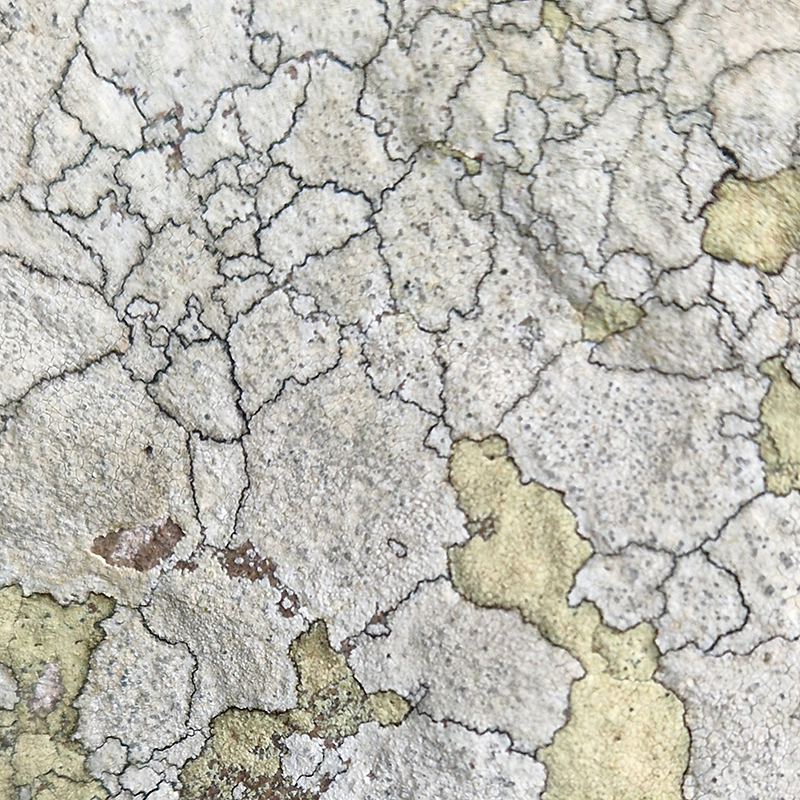
Lichen boundaries seen on a trip to Somerset reminded me of the magnetic domains of the directional magnetic steel when sanded and etched to reveal the Goss texture of rolled iron silicon alloy crystals. The jigsaw pattern of magnetic domains give this material exceptional magnetic properties.

I had a great time interacting via zoom with volunteer mediators who will serve as conversationalists for visitors who come to the Carbon exhibition at Science Gallery Bengaluru where my video Cosmic Chiasmus: crossing the universe will be shown later in the year. Mediators are an integral part of each exhibition-season at Science Gallery Bengaluru (SGB). By providing each visitor the unique opportunity to deeply engage with the exhibits, events, and programmes, the mediators are at the backbone of our commitment to public engagement at SGB.

The session was designed to gain an understanding of the work to be shown, the process behind its creation, and the key concepts explored in it. Cosmic Chiasmus: crossing the universe offers a glimpse into a subatomic world where cosmic rays travel from distant galaxies to collide and silently interact with atoms and technology on Earth. Not only is all life physically permeated by cosmic rays with the potential for nuclei collisions but some cascading particles smash into atoms of nitrogen to create carbon-14. Carbon-14 then combines with oxygen in the atmosphere to create radioactive carbon-dioxide  – this is ingested by plants and animals through the food cycle. In making the film I was interested in exploring the interconnectedness of ourselves to our wider environment, even outer space and the influence intangible phenomena such as cosmic rays can have on everyday life and human technology.  It is an incredible journey that cosmic rays make, blasted across space, spiralling along magnetic field lines to end up entangled with carbon in our bodies.

Most years have twelve full moons, but as our calendar is not perfectly synchronized with astronomical events, every now and then there is more than one full moon in a month which can be known as a blue moon. It takes the moon 27.3 days to orbit the Earth but about 29.5 days to go through all of its eight phases waxing from new to full and waning back again. We can hope to see a super blue moon next month.

Carey Young’s Plato Contract – only gains status as an artwork once it has been installed, following explicit instructions, in the impact crater, Plato, on the moon.

Royal Society Summer Lates – Interesting new research in the search for dark matter from UCL High Energy Physics team using quantum sensors. Tiny glass spheres levitated in a vacuum and super cooled means these are extremely sensitive to any slight gravitational interaction should dark matter be made of very light particles. Instead of a vast tank of Xenon installed in a disused goldmine this new search for dark matter is quite a contrast in scale.

Also got to cause gravitational lensing with my own body mass and enjoy some splendid cocktails with surreal smoke bubble topping. Love Royal Society events.

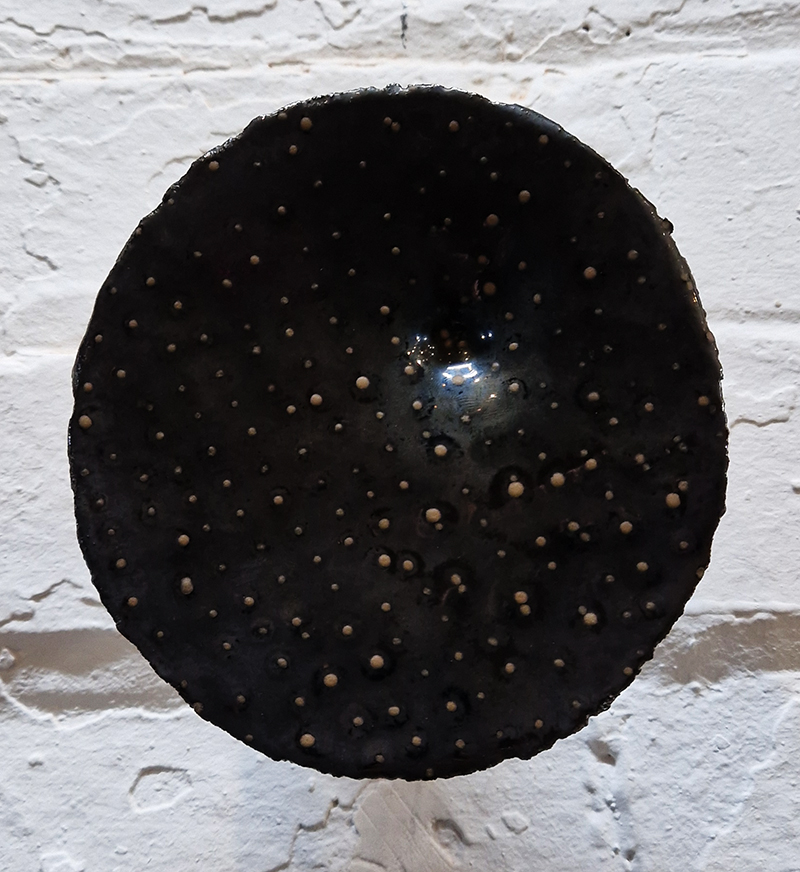
Melanie Jackson Rouge Flambé at San Mei Gallery with a fascinating accompanying essay by Esther Leslie. Rouge flambé is a red oxide ceramic glaze with a long history of use, spreading across the globe from its origins in China. Together these works celebrate forces that hold a primordial fascination – fire, colour, alchemy which bridge the scientific with the mythological.

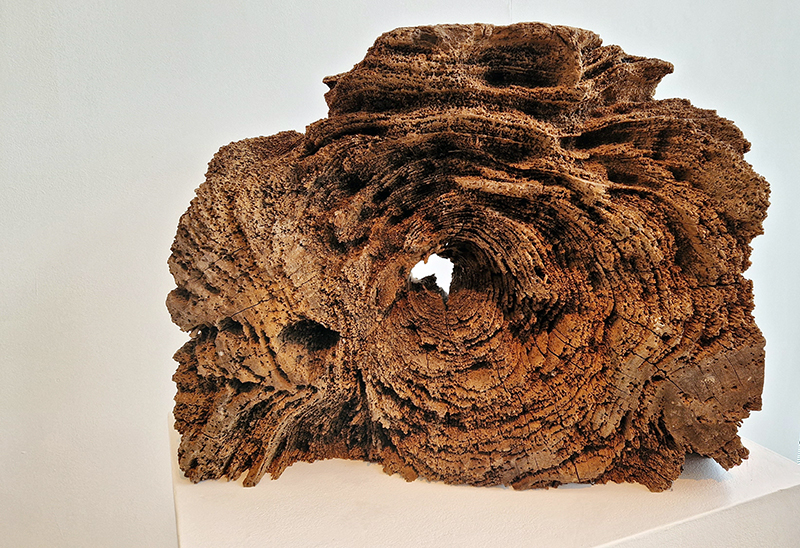
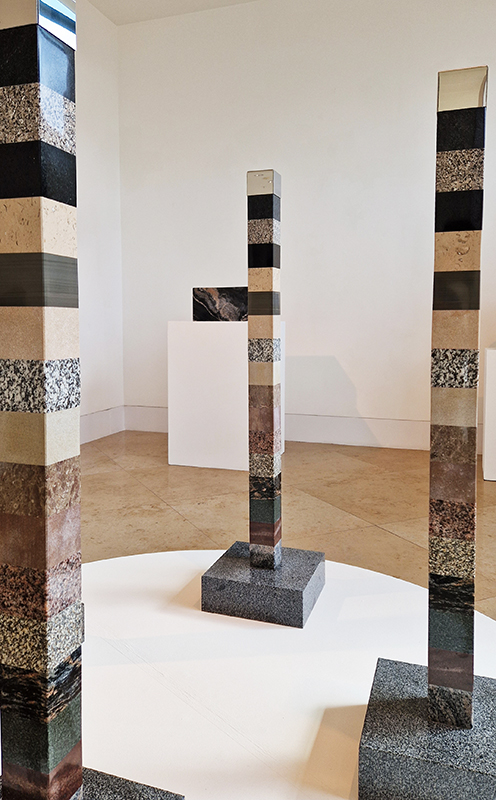
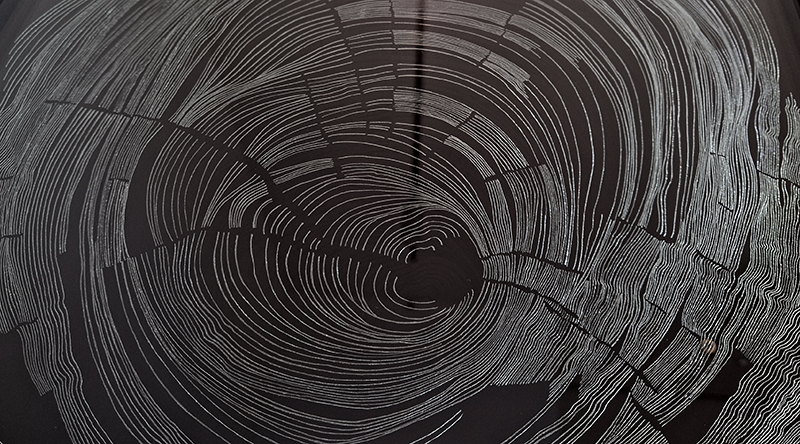
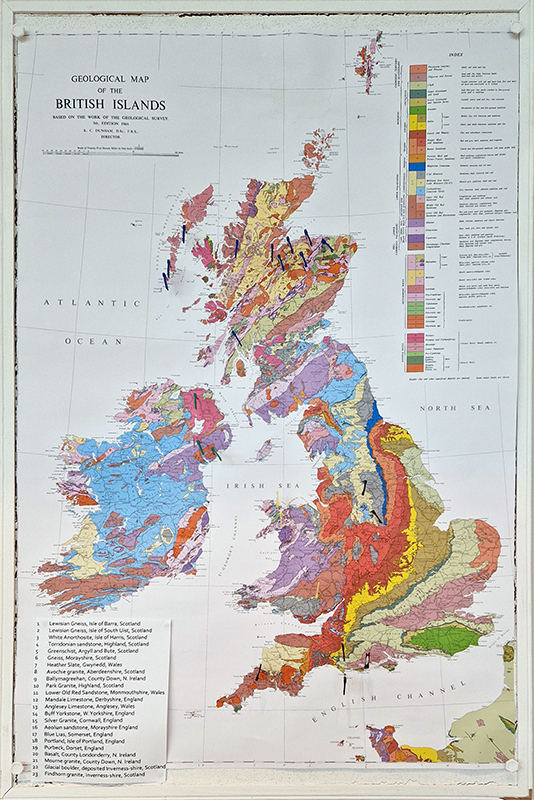
Angela Palmer Deep Time: uncovering our hidden past at Pangolin London. The exhibition explores time through the material history of Great Britain – charting its 3-billion-year lithic timeline to arrive in our current age of the Anthropocene. Featuring the UK’s 16 geological periods, starting with one of the world’s most ancient rocks, the 3-billion-year-old Lewisian Gneiss from the Outer Hebrides. Further stones include 2.5-billion-year-old White Anorthosite sourced in the Outer Hebrides that was also found on the Moon by the astronauts of Apollo 15 in 1971, as well as 66-milion-year-old Northern Irish Black Basalt marking the extinction of the dinosaur. The exhibition also includes teak sculptures salvaged from the ocean where it lay for a century while marine boring insects carved into its surfaces. Many of these works have minimal intervention from the artist in their presentation. The work has been done in the sourcing and extraction.

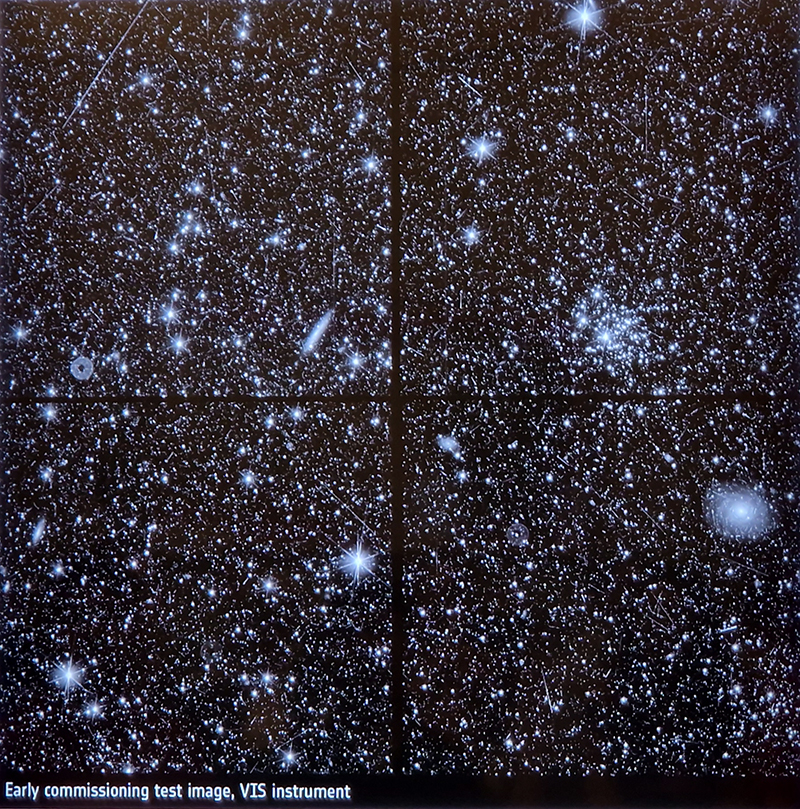
I attended the UCL Space Domain Summer Celebration. The event was introduced by Victor Buchli – Co-Chair of the UCL Space Domain which draws in researchers from across disciplines whose work touches on space exploration in some way. Guest speakers, artist Lisa Pettibone and poet Simon Barraclough, gave presentations on their work and involvement with the Mullard Space Science Laboratory and subsequent inclusion of work on the Euclid Spacecraft (launched on 1st July 2023) in the form of a plaque depicting ‘The Fingertip Galaxy’ a collaborative project created with hundreds of mission scientists and engineers’ painted fingertips, along with specially commissioned lines from Simon’s poetry. We were privileged to see the very first image sent back from the Euclid Space Telescope whose mission is to map out the dark side of our universe by analyzing billions of galaxies that reside up to about 10 billion light-years away. Every point of light is a galaxy.

Reading

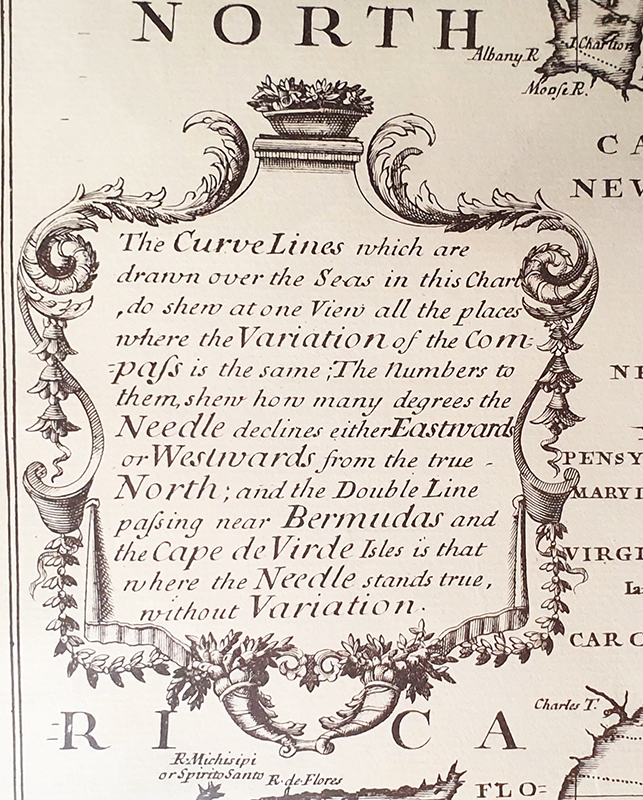
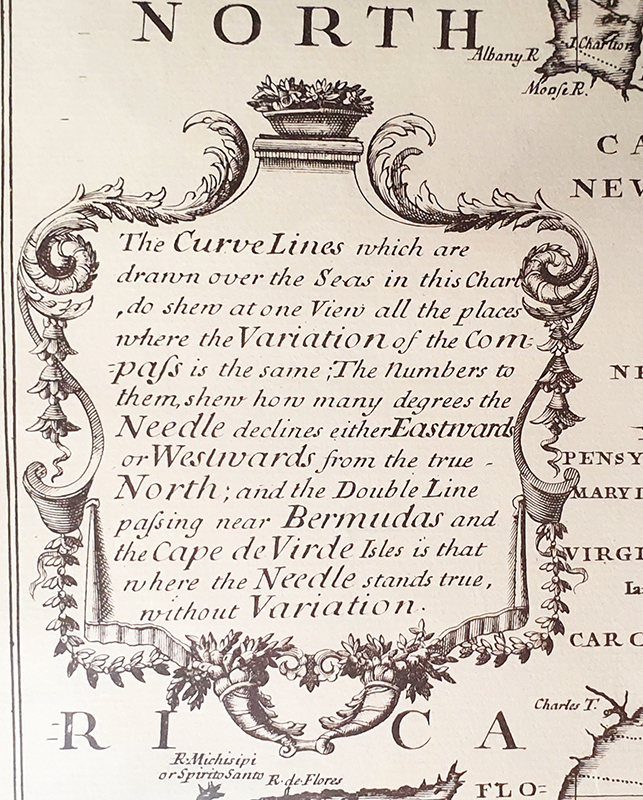
Compass – a story of exploration and innovation by Alan Gurney. Full of fascinating historical anecdotes charting the invention of the magnetic compass for navigation at sea from lodestone floating in a bowl of water to the precision marine liquid compass, gyrocompass and fluxgate compass used today. Although early experiments came under the auspices of scientific expeditions the compass cannot be untangled from its commercial propagation and employment in colonialism and the slave trade. The first ship charted solely for a scientific expedition, The Paramore, launched from The Royal Dockyard at Deptford in 1694, to compass the globe and measure magnetic variation. It was however approved for funding by The Royal Society, Queen Mary and The Admiralty based on the benefits it would bring for navigation and trade. One of the many delays in launching the Paramore was the novel decision of how many guns should be fitted in a ship bound for scientific research. Pirates were at large and nation wars would flare up while ships were out at sea so a friend at launch might be a hostile force at the next harbour without the means for the crew to receive this news before it was too late. Many many lives were lost at sea during these turbulent times through aggression but also shipwrecks from the poor quality, misuse or misinterpretation of the ship’s compass. Magnetic variation, deviation and iron introduced onto the ships meant the compass needle could not be relied upon to show true north. It took centuries to comprehend the unpredictable power of magnetism and the Earth’s magnetic field.

Listening

The End of the Universe Gresham Lecture from Professor Katherine Blundell. The relocation of matter. Spacetime is expanding ever faster due to dark energy. Galaxies do not expand as they are held together by gravity. It is the space between galaxies that is getting bigger and will continue until in some distant future astronomers in one galaxy will not be able to see any other galaxies. Black holes eventually evaporate.

Also from Professor Katherine Blundell Cosmic Vision: Fast & Furious.

Cosmic rays are particles that move extremely fast. They are raining down on planet earth all the time. Although they are called rays they are not like photons, as light is made of, as they have mass but they do travel at nearly the speed of light. The kinetic energy in just one particle can be equivalent to the energy of a cricket ball bowled by the fastest bowler on the planet  – so much energy squeezed into one tiny particle gives it a huge velocity. Light travels a thousand billion kilometres in one year – a light year – no object with mass can travel at the speed of light but an ultra-high energy cosmic ray would only lag behind the photon by 100th of the diameter of human hair. Some ultra high energy cosmic ray particles that arrive on Earth have 1000 billion times more energy than particle colliders on earth can generate. These ultra high energy particles are very rare – with only about 1 per square metre per century. We know many cosmic rays come from supernova explosions in distant galaxies especially from what are called starburst galaxies where lots of supernovae are happening. Supernovae expand very very fast into the interstellar medium of their galaxy – this causes shocks as the plasma expands and where there are compressed magnetic fields particles can be accelerated to very high speeds. There is a formula called the Hillas Criterion which states – the maximum velocity a particle can be accelerated to depends on three things –  the strength of the magnetic field  – the speed of the plasma –  and the size of the region over which the acceleration can take place. New research shows that ancient Radio Galaxies such as Centaurus A – which is over 1 million light years across or the smaller Fornax A Galaxy are good candidates for the propagation of the ultra high energy particles as these galaxies have the huge size necessary to allow the particles to gather speed in the giant regions of radio emission which extend well beyond the galaxies visible structure.

I am very grateful to a-n The Artists Information Co for awarding me a professional practice and creative development bursary to expand on my research and respond to the many ways Earth’s magnetic field impacts life on earth. The award will be used for a research trip to the remote location of Eskdalemuir Magnetic Observatory and Kielder Dark Skies Observatory. Fingers crossed for an Aurora experience. I will also gain expert tuition in concrete casting and mould making from Anna Hughes and make use of the facilities at The London Sculpture Workshop.

Domain of the Devil Valley Master – work in progress. It is likely that compasses were first used in China to divine an alignment of order and harmony for important sites and rituals. Jade hunters discovered they could also help to keep them from getting lost long before Europeans used them for navigation. The first mention of a south-pointer is in a fourth-century BCE text – The Book of the Devil Valley Master, and it is this that I am referencing in the title of this sculpture. Other references in the work are the rotation of the Earth’s core and geological formations of polygonal prisms. A magnetic domain is a region within a magnetic material in which the individual magnetic strength and orientation of the atoms are aligned with one another and they point in the same direction. The work uses directional magnetic steel stripped of its industrial coating to reveal the jigsaw pattern which comes from rolling single crystals of an iron silicon alloy into thin sheets to minimise magnetic losses for use in industry. The sheets have been sanded, etched, guillotined, treated for rust and sealed.

The Earth’s core is made almost entirely of iron and nickel. Siderophiles are elements that form alloys easily with iron and are concentrated in the Earth’s core. When the Earth formed about 4.5 billion years ago from the collision, accretion and compression of matter it was rock all the way through. Heat from the massive violence of formation and radioactive decay caused the planet to get hotter and hotter. After about 500 million years of heating up it finally reached the melting point of iron. As the iron liquified lighter material rose to the surface becoming the mantle and crust and the heavy metals like iron and nickel fell towards the centre becoming the core. The siderophiles that descended into the core are gold, platinum, and cobalt along with around 90% of the Earth’s sulphur. Hence the smelly sulphur vents around the volcanic regions.

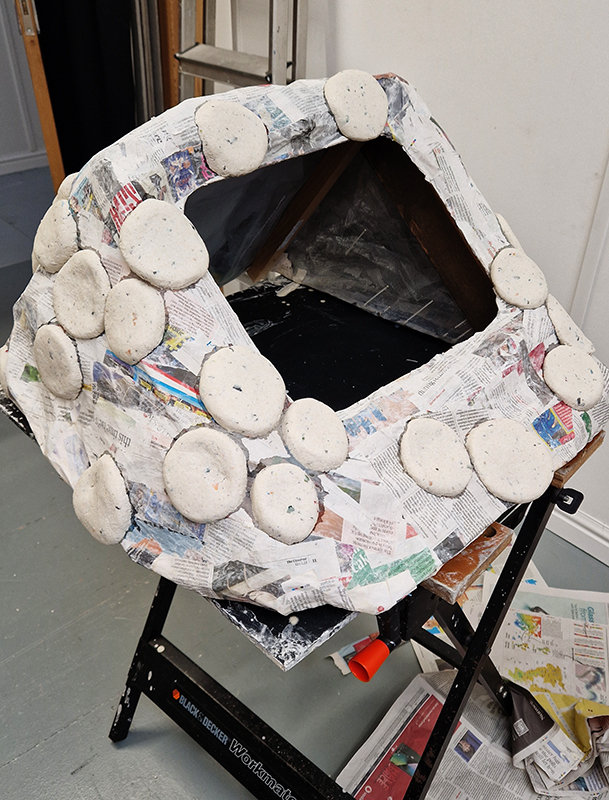
Belly of a Rock – work in progress. Making paper clay discs to build the surface of this hybrid sculpture and crushing mussel and oyster shells to use as texture.

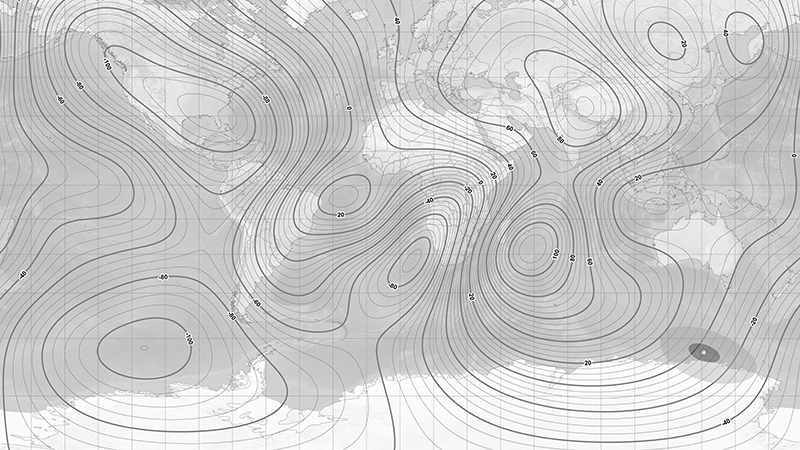
The geographic north pole lies in the middle of the Arctic Ocean, covered in shifting sea ice, where the sun rises and sets only once per year. All lines of longitude converge here and hence all time zones. It is known as true north to distinguish it from the magnetic north pole. However, as the Earth’s axis of rotation wobbles slightly in an irregular circle, even this pole is not fixed. The magnetic north pole, also called the magnetic dip pole, is where the planet’s magnetic field is vertical and a compass needle here would dip and try to point straight down. The north and south dip poles are not found directly opposite each other. These dip poles are located by experiment in the field but as they are found in the most remote and harsh regions of the planet they are not easy to track. Also they can move around over considerable distances during each day, tracing out oval shapes as they are acted upon by dynamic electrical current systems of the magnetosphere, which are in turn defined by the activity of the solar wind. There is an equivalent (but fictional) magnetic dipole at the centre of the Earth assigned from global modelling of the geomagnetic field. These geomagnetic poles are an approximation arrived at by reducing Earth’s complex and varied magnetic field to that of a simple bar magnet. The north dip pole lies in Northern Canada, the northern dipole is roughly off the northwest coast of Greenland.

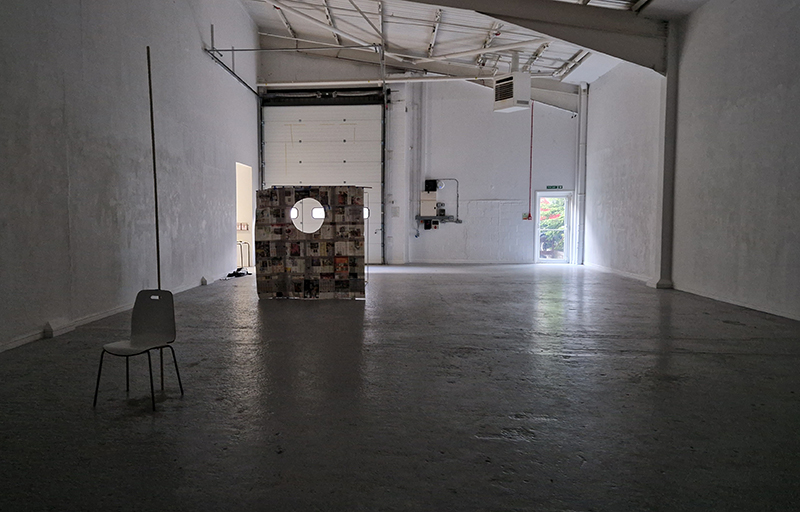
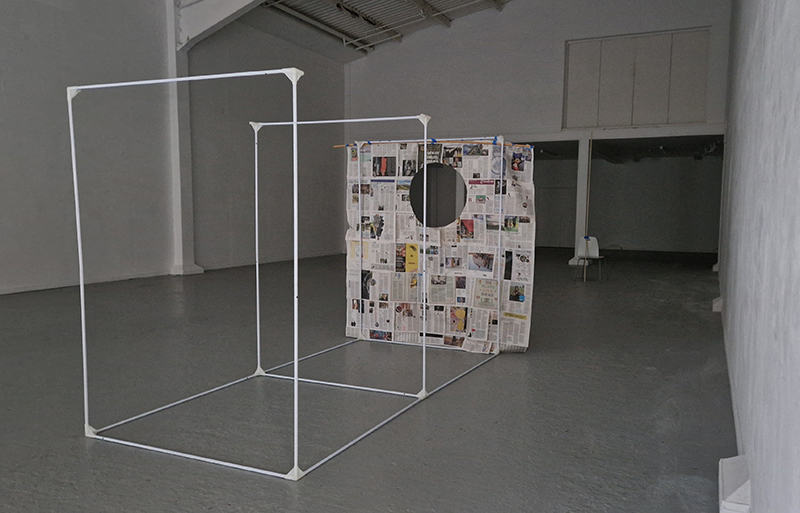
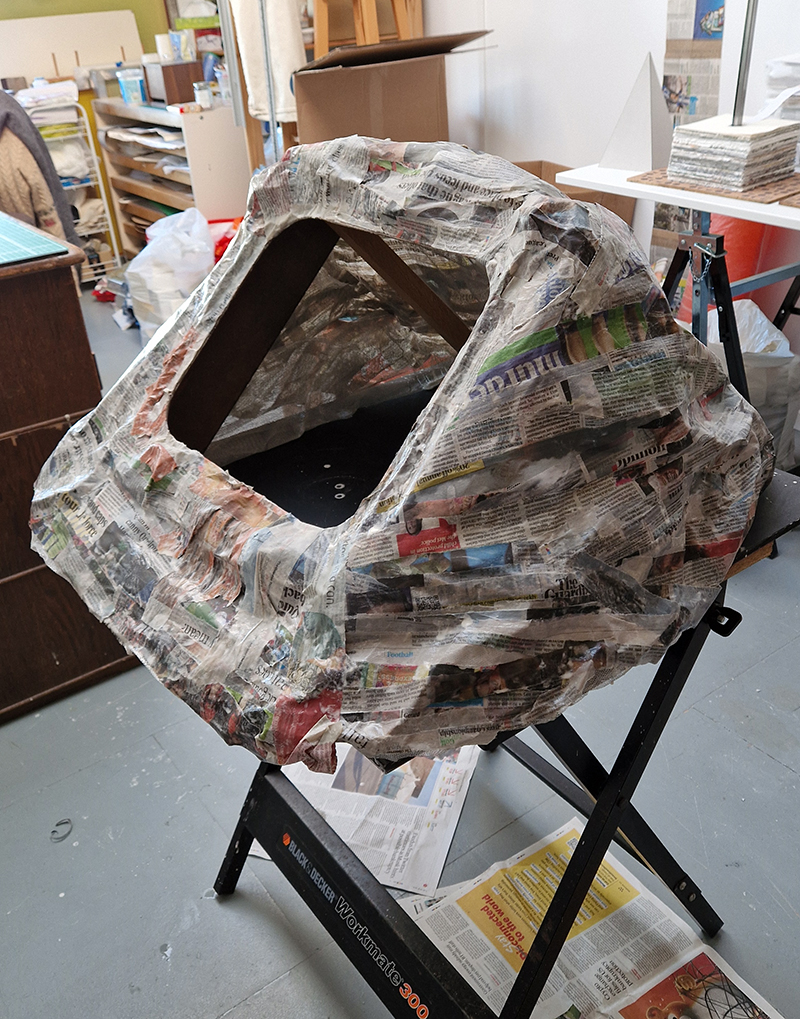
The Absolute Hut – work in progress. This installation is a reimagining of the Absolute Hut at Hartland Magnetic Observatory where monitoring of the Earth’s magnetic field takes place. Topological contours of suminagashi marbling also echo fluid magnetic field lines. Testing scale and alignment in the gallery space. Collecting planks for the north facing wall. Prepping the round window. Suminagashi experiments on different Japanese papers. I want to consider the hut as a sensory hub.

Other exciting news is that APT Gallery have selected a proposal for an exhibition which will take place in March 2024. The exhibition will consider the lifeboat as a metaphor in relation to uncertain times, ecological and social change and shifting landscapes as viewed from the land and the sea. The artists in this group show share an interest in exploring precarity as a site of dynamic transition. I am so happy to be working with these wonderful artists – Rachael Allain, Caroline AreskogJones, Beverley Duckworth, Liz Elton, Kathleen Herbert, Kaori Homma, Anne Krinsky.          

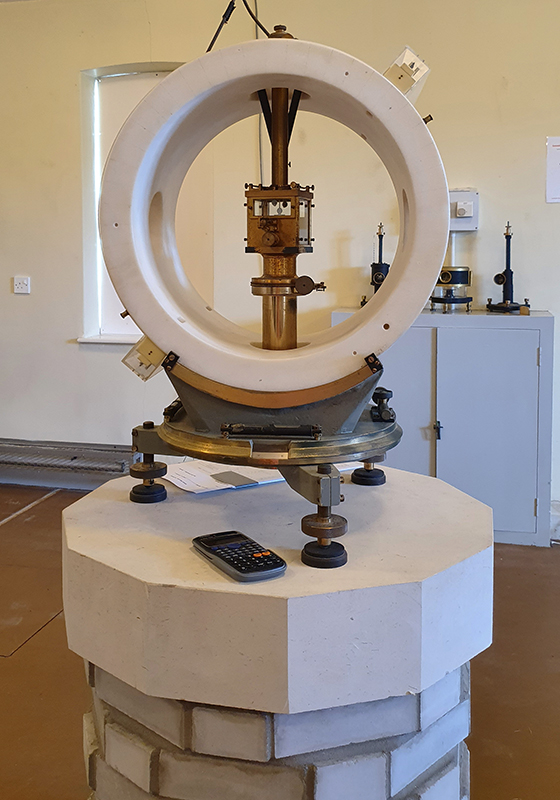
In celebration of World Metrology Day, NPL opened Bushy House and gardens to the public. A chance to see and hear about ever more accurate ways of measuring the physical world. Bushy House was the residence of William, Duke of Clarence (William IV) and his mistress Dora Jordan from 1797, and was offered to the Royal Society by Queen Victoria in 1900 as a location to establish The National Physical Laboratory. The impressive apple tree is from an offcut of one from Newton’s home estate. The magnetic laboratory here is concerned with devising and standardising the instruments used by magnetic observatories such as the one at Hartland that I visited last summer. I saw the 1kg sphere of single crystal silicon, with the smoothest polished surface of any made object and notoriously hard to photograph. The application of a strong magnetic field during the crystal growth process reduces contaminants giving a purer silicon crystal. Developments in technology bring new units and definitions of measurements.

From early concepts of number, patterns in nature (symmetry, branching, spirals, cracks, spots, stripes, chaos, flows, meanders, waves, dunes, bubbles, foam, arrays, crystals, and tilings) magnitude, and form came mathematics, meaning subject of instruction. This has evolved into complex theory from an understanding of negative numbers to imaginary numbers which combined with real numbers have been found necessary to describe quantum mechanics.

The colour coding of Saturn’s rings according to particle size used radio occultation to determine the different regions. Radio signals were sent from the Cassini spacecraft during orbits which placed Earth and Cassini on opposite sides of Saturn’s rings. This remote sensing technique measures how the radio waves bend around the matter they encounter to assess the physical properties of a planetary atmosphere or ring system. The purple colour indicates regions where most particles are larger than 5 centimeters. Green and blue shades indicate regions where there are mostly particles smaller than 5 centimeters and 1 centimeter. The white band is the densest region where radio signals were blocked preventing accurate representation in this area. The radio observations showed that all rings appear to have a mix of particle size distribution right up to boulder sizes, with several many meters across.

Gallery Visits

It’s Coming From Inside at Bell House, Dulwich. Curated by Sarah Sparkes and Jane Millar. In their thinking about the Impressionist Berthe Morisot, and the exhibitions broader theme of ‘Windows and Thresholds’, the curators see the two different domestic spaces, and the liminal corridors between them, as places expressive of dialogues in both Morisot’s and their invited artists’ works: of confines, dreams of escape, of external inscrutability and internal passion. Exhibiting artists: Fran Burden | Ruth Calland | Helen Carr | Mikey Cuddihy | Janet Currier | Robert Dawson | Andrew Ekins | Liz Elton | Lisa Fielding-Smith | Deborah Gardner | Caroline Gregory | Birgitta Hosea | Mindy Lee | Wayne Lucas | Julia Maddison | Jane Millar | Darren O’Brien | Kim Pace | Sarah Sparkes | Geraldine Swayne

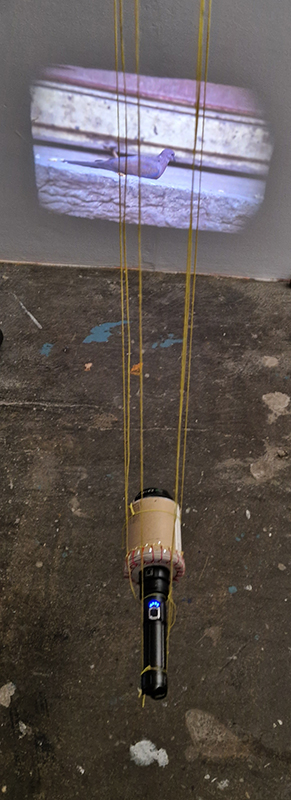
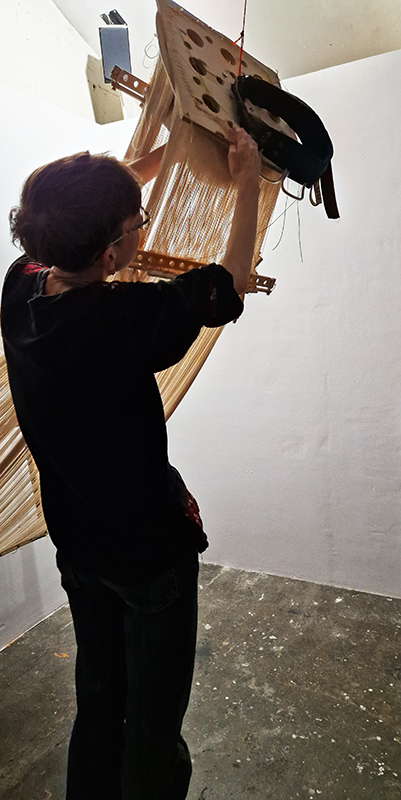
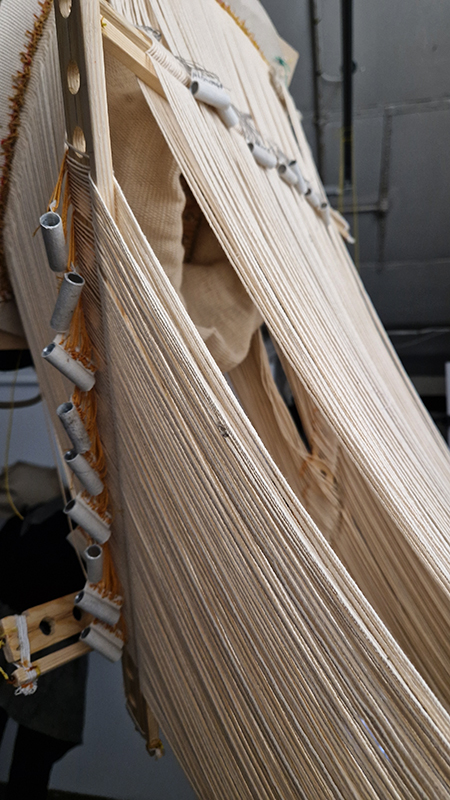
Georgina Sleap Now and here and there together at Cable Depot. A residency undertaken in collaboration with Neil Cheshire, Olive Hardy, Mercedes Melchor, Agnieszka Szczotka, Derek Horton, Farida Youssef and Niamh Riordan. A wonderful installation conjured from simple materials and experimental technology, both analogue and digital that blur the here and there of time and space. Sounds of everyday street noise live from the artist’s Cairo balcony are streamed into the gallery where suspended torches project still slide images onto the wall or inside elongated sculptural forms. A loom for weaving a plain coffin shaped carpet hangs like a hammock next to CCTV recordings of yogic performance while a camera obscura style intervention casts shadows, bringing the local outside in.

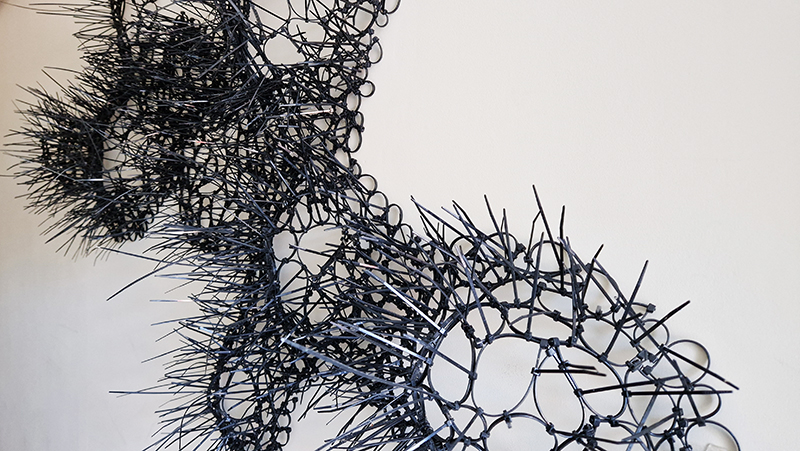
The Shape of Things by Clan, a collective of multidisciplinary artists – Caroline Penn, Liz Lowe, Ashley Goldman, Nicky O’Donnell at Gallery 3, a delightful Georgian property in Margate. The artists examine issues of loss, both personal and environmental, that are balanced by ideas of hope and regeneration. A nice use of recycled and sustainable materials including netting from fruit and cable ties.

Beatriz Milhazes at Turner Contemporary. Perfect for a summer’s day at the seaside. Exuberant.

Opening event for the new photography centre at the Victoria and Albert Museum. Interesting to hear about the process Noémie Goudal undertakes to create her ambitious illusionist photographic sculptures such as Giant Phoenix VI from the series ‘Post Atlantica’ which has been acquired by the Victoria and Albert Museum for their photography collection, housed in a new dedicated gallery. This work was inspired by her interest in shifting landscapes, the movement of tectonic plates and how landmasses join and separate over millennia. There was also the chance to see her video Inhale Exhale along with behind the scenes footage of her technical team and the scale of the resources involved. Tarrah Krajnak has also had work acquired by the museum and read some of her poetry at the event. Her interests are also in discontinuity, severance and cataclysmic events but on a human scale. Being born from an act of violence she puts her own identity forward to explore power relationships.


Reading

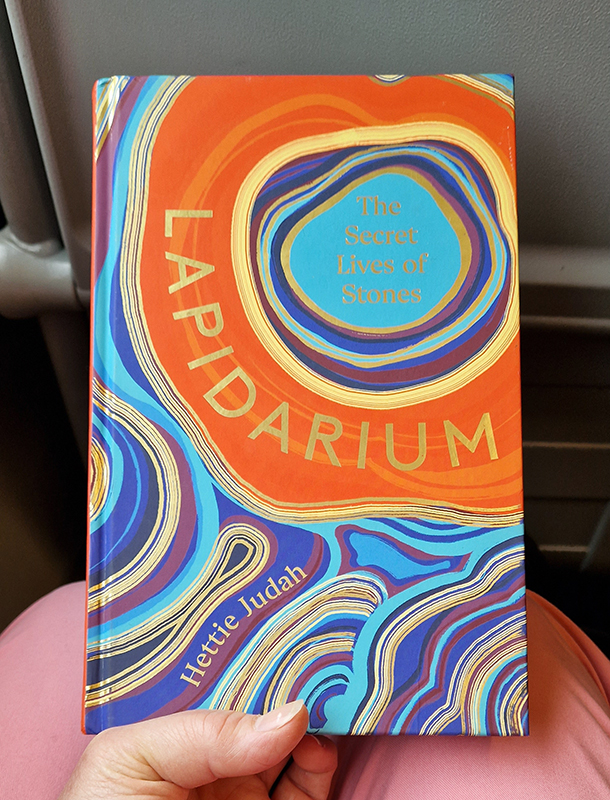
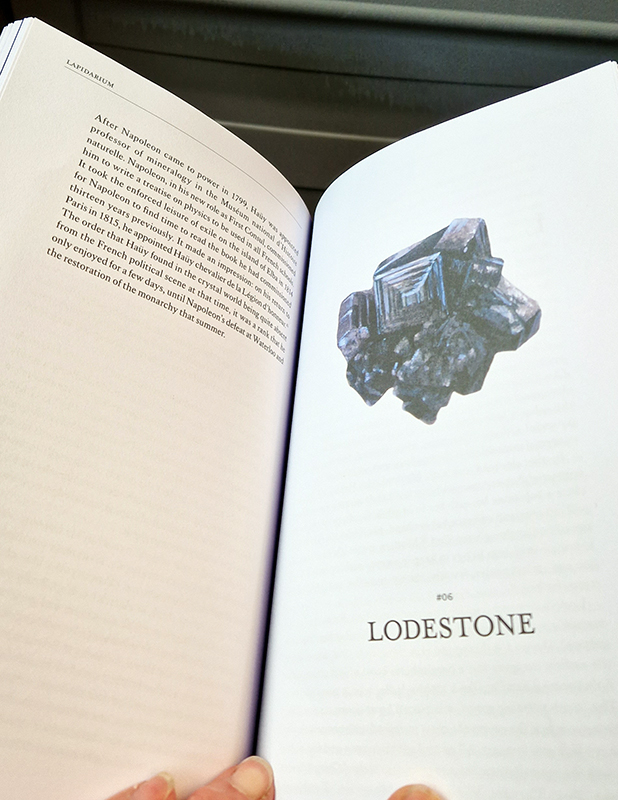
I have really enjoyed the breadth of information delivered so beautifully by Hettie Judah in her book Lapidarium – The Secret Lives of Stones. The character described and stories told of each geological layer, formation, rock and gem brings to life a world often perceived as static, perpetual and dry. This book is a great resource and has been particularly appropriate for me in the run up to the exhibition A Stone Sky with Julie F. Hill as we explore the intimate connections between the rocky planet earth and space.

 “How do you calculate upon the unforeseen? It seems to be an art of recognizing the role of the unforeseen, of keeping your balance amid surprises, of collaborating with chance, of recognizing that there are some essential mysteries in the world and thereby a limit to calculation, to plan, to control.”  Rebecca Solnit, A Field Guide to Getting Lost

At Hartland Magnetic Observatory and other magnetic observatories around the world solar activity is examined daily and forecasts are given if this is likely to have any geomagnetic effect on Earth. The main geomagnetic field is also constantly changing due to convection flows and waves in the Earth’s core. As this change cannot be predicted, uncertainty slowly increases over time.

Most of my work at the moment is towards the exhibition A Stone Sky, with Julie F. Hill at Thames-side Studios Gallery later in the year. Very excited to be working alongside Julie and to have space to be ambitious in scale.

The Absolute Hut installation, reimagining the magnetic observatory room, will be a combination of planning to build the structure and unpredictability through processes used for the surfaces. Measuring for the north facing wall to be built in sections for easier transportation. Testing scale and coverage of field contour shapes cut in copper with a plasma gun.

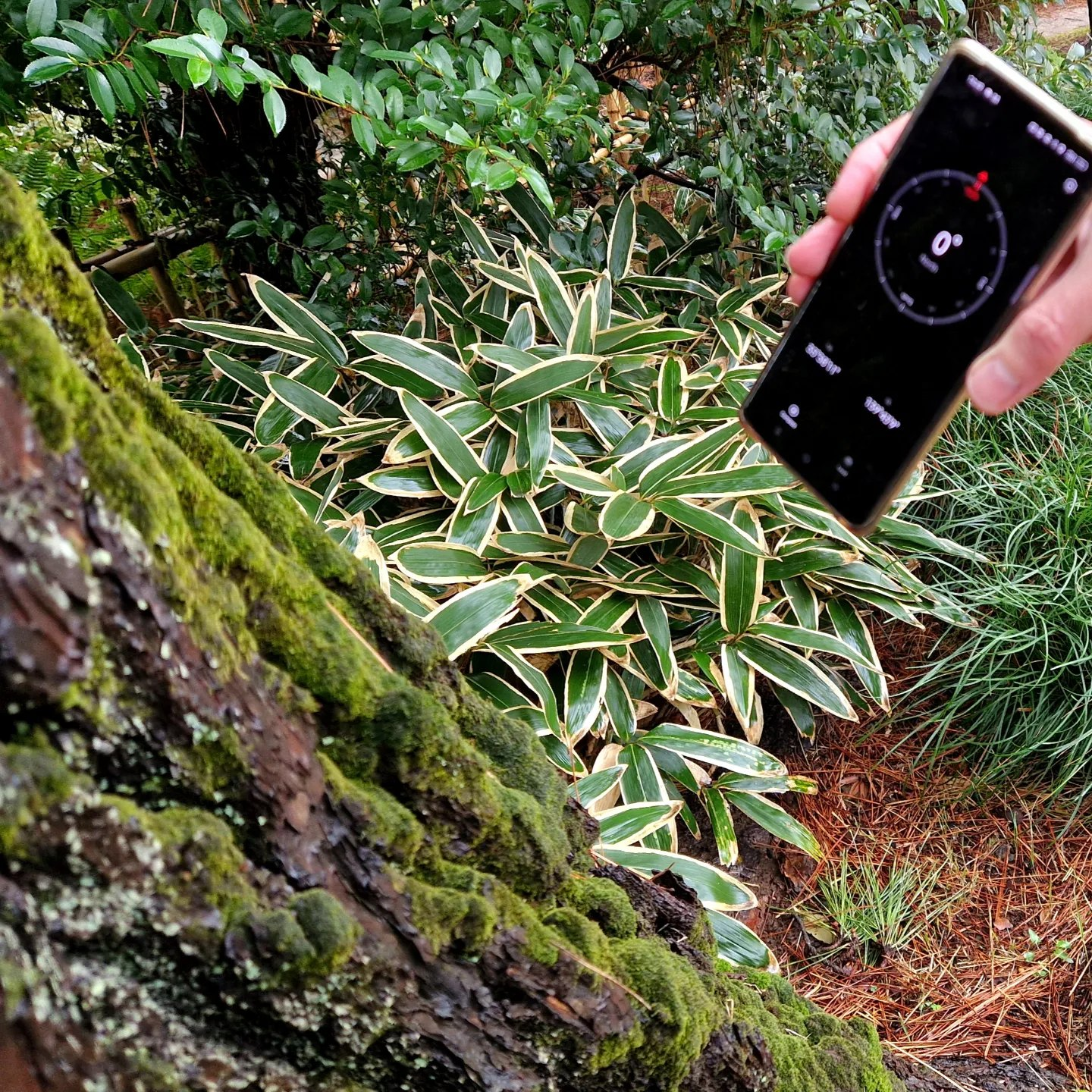
I am hoping the north wall structure can be made up soon and the boards attached. I will then keep it outside facing north until the exhibition in an attempt to grow some moss on its surface. I have only had some very small success so far growing moss, despite trying a new culture recipe and being very diligent misting every morning and evening.

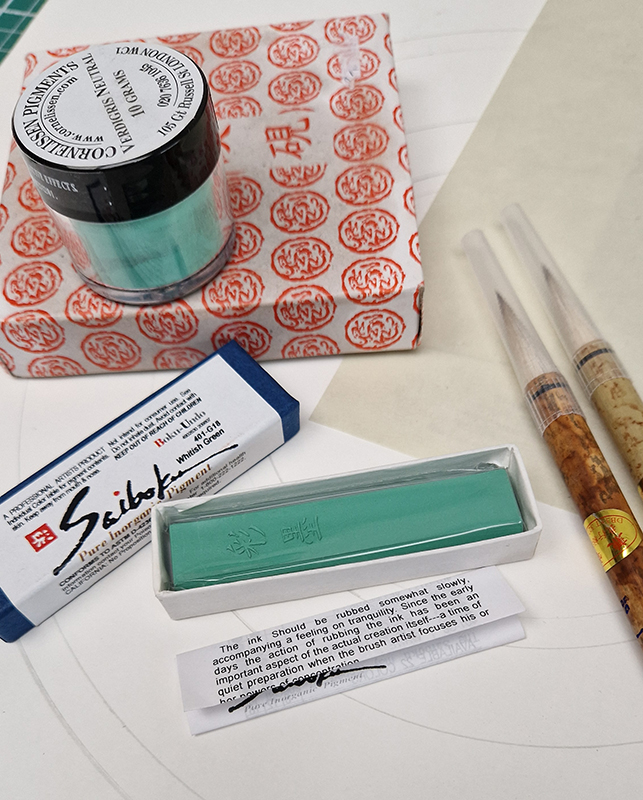
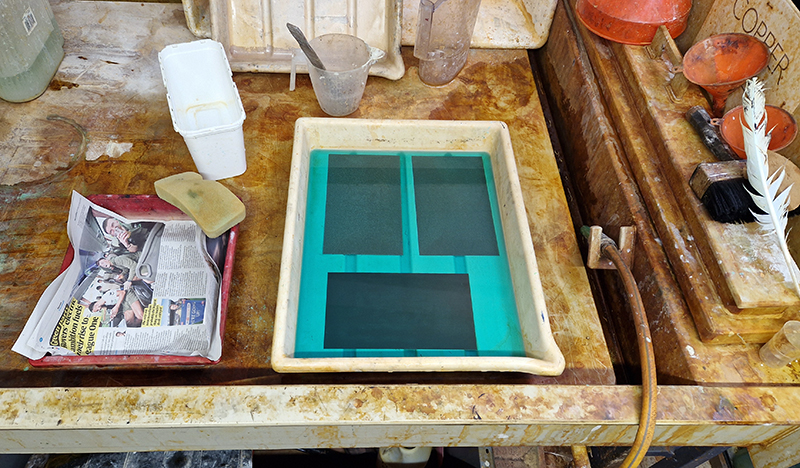
The topological contours of suminagashi marbling, which also echo fluid magnetic field lines, have inspired me to experiment with this idea for The Absolute Hut roofing. I have bought a sumi ink stick in whiteish green, an ink grinding stone and some verdigris pigment from Cornelissen in preparation to try this idea out. In this process the magnetic field lines appear embedded into the fabric of the hut that monitors (senses) the emanations from the Earth’s core.

Through the north facing window of The Absolute Hut, The Azimuth Obelisk (Obelisk of sedimentary knowledge) will be viewed. The sculpture is formed by tearing, drilling and layering sheets of paper. As sedimentary rocks build over time, so the obelisk has a lot of time invested in its making and conceals the history of past events in the hidden layers of the recycled prints and drawings.

I am still working on etching the Directional Magnetic Steel pieces. It can be a frustrating process as some batches work well and some do not etch well at all but come out dull and patchy and I’m not sure why. My idea was to use these pieces to draw a line across the gallery floor signifying the westward drift of the magnetic field from geographical north but now I am thinking more about mapping out a spiral shape in shaped pieces to echo the rotation of the Earth’s molten core.

All information about the Earth’s core has come from studying seismic data, analysis of meteorites, lab experiments with temperature and pressure, and computer modelling. Seismometers convert vibrations due to seismic waves into electrical signals. The velocity and frequency of seismic waves changes with pressure, temperature, and rock composition. The discovery that Earth has a liquid layer beneath the crust and a solid inner core has come from detailed analysis of the different types of waves that pass through the body of the Earth. Looking at the composition of meteorites, fragments of asteroids, formed about the same time, and from about the same material, as Earth provides clues to what minerals the core might contain. Diamond anvil cells are instruments used to recreate the pressure existing deep inside the planet by squeezing materials between two diamonds surfaces. A combination of this data is used to in complex computer modelling programs resulting in detailed animations of the geodynamo, a process powered by the convection of heat in the outer core along with the rotation of the planet.

Also a few more layers of papier mâché have been applied to the sculpture that will house a screen with video for the work Belly of a Rock.

Other work in the research stage looks at the first use of a magnetic compass, the cardinal points of navigation and the compass predecessor the wind rose.

In classical antiquity, a time stretching from Homer to the early middle ages, geographic orientation usually referred to landmarks or astral phenomena to determine direction. Eos meaning dawn, and Hesperus, evening were named for sunrise and sunset with north (arctos) being marked by the constellation Ursa Major and later the Pole Star. The winds also became associated with direction, and named in accordance with their qualities such as hot and humid or cold and dry. In Greek mythology Astraeus, the god of dusk, and Eos, the goddess of dawn, gave birth to many sons of the twilight including the Anemoi, the four gods of the winds, each ascribed a cardinal direction. Boreas being the god of the cold north wind,  Notus the god of the hot south wind, Eurus from the east and gentle Zephyrus from the west.

The number of points on a wind rose began with the four cardinal points which were added to and refined over time. The winds were often given names that referred to a particular locality from where they seem to blow, so different places came up with various local names. Aristotle designed an asymmetrical 10 point wind rose which was later refigured by Timosthenes who is credited with inventing the system of twelve winds and using this more for navigation than for “the study of things high in the air.

Classical wind roses were eventually replaced by the modern compass rose during the middle ages.

The “Vatican table” is a marble Roman anemoscope dating from the 2nd or 3rd Century CE, held by the Vatican Museums. Usually an anemoscope would be topped with a weather vane. Divided into twelve equal sides, each one is inscribed with the names of the classical winds, both in Greek and in Latin. 

At a quantum scale, all matter is underpinned by uncertainty. My fascination with particle physics began from simply wondering what everything was made of when you looked really closely. I looked up ‘fundamental building blocks of the universe’ and was blown away by this mysterious other world, so far away in terms of scale I can comprehend, yet a part of me and everything I interact with.

Quanta is a discrete unit that cannot be divided. Quantum physics is the study of energy and matter at the most fundamental level. The chemical reactions in a birds eye that allow it to ‘see’ Earth’s magnetic field involves the quantum entanglement of radical pairs of electrons. These electrons are excited by light, particularly the blue of twilight.

Photography was the first available demonstration that light could indeed exert an action sufficient to cause changes in material bodies. William Henry Fox Talbot 

The subject of the photograph (the sun) has transcended the idea that a photograph is simple a representation of reality,  and has physically come through the lens and put it’s hand onto the final piece. Sunburn Chris McCaw

This month NASA announced a new planetary defence strategy to protect Earth from an asteroid impact. NASA’s Double Asteroid Redirection Test (DART) on 11th October 2022, changed the orbit of the Dimorphos Asteroid in the first full-scale demonstration of asteroid deflection technology.

This marks humanity’s first time purposely changing the motion of a celestial object.

“An asteroid impact with Earth has potential for catastrophic devastation, and it is also the only natural disaster humanity now has sufficient technology to completely prevent,” Lindley Johnson, NASA’s planetary defense officer. First any potential collision objects must be identified. This will be the job of the Near Earth Object Surveyor, along with ground-based optical telescope capabilities, to find the still undiscovered population of asteroids and comets that could impact our planet.

A magnetometer is being sent on an eight year journey to Jupiter. It was launched this month from Europe’s Spaceport in French Guiana.

ESA’s Jupiter Icy Moons Explorer (Juice) has magnetic and electric field sensors on the end of the magnetometer boom. The boom is folded in three parts and packed against the side of the spacecraft for launch. Once unfolded in space, the sensors will extend clear of the main body of the spacecraft, allowing very accurate measurements without magnetic interference from the spacecraft itself.

The boom’s instruments will measure Jupiter’s magnetic field, its interaction with the internal magnetic field of Ganymede, and will help study the subsurface oceans of the icy moons.

Ganymede is the only moon in the solar system known to have its own magnetic field. The magnetic field causes auroras, which are ribbons of glowing, hot, electrified gas, in regions circling the north and south poles of the moon. Because Ganymede is close to Jupiter, its magnetic field is embedded in, or lies within, Jupiter’s magnetic field.

The discovery of the moons orbiting Jupiter by Galileo Galilei in 1610 was the first time a moon was discovered orbiting a planet other than Earth. The discovery eventually led to the understanding that planets in our solar system orbit the Sun, instead of our solar system revolving around Earth.

Gallery Visits

Peter Doig at The Courtauld. My highlights were the luminous moons, moon bathing and an etching of a cave.

Jitish Kallat Whorled (Here After Here After Here) at Somerset House had a romantic premise with a prosaic aesthetic. I love the concept and the theory and it’s certainly a jarring juxtaposition to be directed to celestial destinations by motorway signage. Routes through the work map circular movements through space and time. Is this the Hitchhiker’s guide to the galaxy?

Mike Nelson Extinction Beckons at Hayward Gallery.

The impact is in the SCALE. Punchdrunk meets abandoned engineering.

Nothing truly exists – except in relation to other things. Carlo Rovelli

Work in progress.

Building the azimuth obelisk made from layered re-cycled paper. This sculpture is a response to the concrete obelisk erected in 1955 at Hartland Magnetic Observatory as a permanent azimuth mark from which to measure the drift of Earth’s magnetic field. Deep time geology holds the sedimentary knowledge of magnetic activity, from the degrees of variation between the magnetic and geographic north pole to the cataclysmic impact of pole reversals.

Etching Directional Magnetic Steel to reveal the jigsaw pattern which comes from rolling single crystals of an iron silicon alloy into thin sheets to minimise magnetic losses for use in industry.

The copper sulphate etching process creates a very thin, fragile layer of shiny copper under the red residue

Magnetism embodies magical qualities which have fascinated humans since the first encounter with a lodestone. These rare and enigmatic fragments found scattered across the surface of the Earth are created when lightning chances to strike the mineral magnetite.

The Lodestone, from Plato to Kircher by D. W. Emerson lists various historical references to the lodestone. The writer concludes – Lodestone, being very unusual, greatly impressed previous generations. Despite its unattractive appearance it was an admired mineral type more precious than pearls, it was celebrated in persuasive Latin hexameters, it was an analogue for the power of deities, it took a witch to subdue it, it was deemed explicable by Epicurean atomic theory, it was involved in a rather tenuous argument for eternal punishment of wicked persons, it meant doom for unwary mariners, it furnished fodder for folk lore, it resided in the arsenal of the apothecary, it helped to demonstrate the earth’s magnetism, and it assisted navigation. What other mineral has such a record? The lodestone was quite a remarkable rock; it still is, and oddly, yet to be completely studied and documented.

Pliny the Elder (AD 23/24 – 79) :

What is more amazing (than this stone) or at least where
has nature shown greater devilry? She gave rocks a voice
answering, or rather answering back, to man. What is more
indolent than the inert character of stone? Yet nature has
endowed it with awareness and hooking hands. What is
more unyielding than the harshness of iron? On it nature
has bestowed feet and a mode of behaviour. For it is drawn
by the lodestone, and the all-subduing substance hastens to
something like a vacuum, and on its approach it leaps
towards the stone, is held and kept there by its embrace.

Claudius Claudianus (AD fl. 395):

There exists a stone called lodestone; discoloured, dingy,
nondescript. It does not lend distinction to the combed
locks of kings, nor to the fair necks of girls, nor does it
gleam on the showy clasps of sword belts. But in fact if
you pay due regard to the strange marvels of this dark rock
then it outshines elegant adornments and anything, on far
eastern shores, that the Indian looks for in the weed of the
Red Sea (i.e. pearls).

Augustine of Hippo (AD 354-430):

We recognise in the lodestone an extraordinary ability to
seize iron; I was much perturbed when I first saw it. The
reason is that I clearly saw an iron ring grabbed and held
up by the stone. … Who would not be amazed at this power
of the stone?

Generating a magnetic field.

The dynamo theory states that to generate a magnetic field, a body must rotate and have a fluid core with an internal energy supply that is able to conduct electricity and drive convection.  Earth fulfils all of these requirements. It rotates faster at the Equator than it does at the poles causing spiral convection currents in the liquid iron outer core which is an excellent electrical conductor, powered by the energy released as droplets of liquid iron in the outer core freeze onto the solid inner core.

Any variations in rotation, conductivity, and heat impact the magnetic field created.

Mars has a weak magnetic field as it has a totally solid core. Venus also has a weak magnetic field for although it has a liquid core it rotates too slowly to create convection currents.  Jupiter has the strongest magnetic field in the solar system, with a metallic liquid hydrogen core and fast rotation, it has a magnetosphere so large it begins to deflect the solar wind almost 3 million kilometres from its surface.

Highlights from a trip to Japan which offered many poetic and spiritual experiences.

Active sulphur vents of the North South Hakone volcano arc boundary dividing Japan into East and West….also used to cook eggs. The beautiful markings on the eggshell were gone the next day.

As Tristan Gooley says in The Natural Navigator, ‘There is a commonly held belief that “Moss grows on the north side of trees and buildings.” It does, sometimes, but will also grow on every other side. However, lots of satisfyingly north facing moss growth on the trees in this Tokyo park.

Moss tending in the rain, some splendid moss in the gardens of Kanazawa.

Inspiration for an absolute hut. The “Gassho-zukuri Village”, a World Heritage Site set in stunning mountain scenery, has more than 100 gassho-zukuri thatched rural buildings with wonderful steep pitched A-frame roofs.

To Discover the Meaning of Being Born as Human Beings. Higashi Honganji Temple

Moss heaven.

To visit Saihoji Kakedora Temple (the Moss Temple), you must send a postcard by mail to request a visit. On arrival, you spend time in the temple at a low table quietly copying sutras with a calligraphy pen to calm the mind before entering the garden.

The garden is built around the Ogonchi Pond shaped like the Chinese character, meaning heart and blanketed in over 120 species of moss.

master of persimmons

treetops are close to

Stormy Mountain

The poem stone tells the story of Kayori who had 40 persimmon trees in the garden laden with fruit which he intended to sell, but the night before they were to be picked a huge storm arose and in the morning not one persimmon was left on the trees. Kyorai was enlightened by this experience and called the hut Rakushisha – the cottage of the fallen persimmon.

Many famous haiku poets, disciples of Basho and including Basho himself, stayed here.

Home of the cloud dragon. Zen garden at Tenryu-Ji Temple, Kyoto.

The tour through the womb of the Zuigu-bosatsu. The darkness of the journey through the womb was absolute. The stone floor ice cold on bare feet. Rosary beads the size of grapefruits led a winding path to the softly lit zuigu stone and on to the light to be reborn. Kiyomizu Temple, Kyoto

Kaname-ishi, keystone at Seikanji Temple, overlooking the city of Kyoto, spread like a fan before it, is believed to grant wishes if touched.

Rivers in the sky. Theories about crown shyness range from being caused by friction as new shoots are eroded in a windy forest to sensing the shadow or warmth of a neighbour.

Binzuru (Pindola Bharadvaja) was one of the sixteen arahats and is said to have excelled in the mastery of occult powers.

In Japanese mythology, the god of thunder arrived in Nara riding a white deer. The deer have lived here for centuries and are revered as emissaries of the gods of the Kasugataisha Shrine.

They have learnt to bow to be rewarded with special deer biscuits, which you can buy to feed them.

Discovering the works of Rafael Lozano-Hemmer, a Mexican media artist exhibiting internationally with a background in physical chemistry who creates large scale interactive work exploring and exploiting human interaction with technology to create an impressive catalogue of works from tethering a blazing sun to a face briefly echoed in a wisp of cloud. I was drawn to his work Atmospheric Memory inspired by Charles Babbage’s philosophy.

Whilst the atmosphere we breathe is the ever-living witness of the sentiments we have uttered, the waters, and the more solid materials of the globe, bear equally enduring testimony of the acts we have committed. Charles Babbage

Gallery Visits

Undertow at Unit 1 Gallery a group show with a subtle and astute use of material, quietly smoldering with agency.

Artists: Alex Simpson, Alison Rees, Isobel Church, Lauren Ilsley, Nicholas Middleton, Sarah Wishart and Tana West.

‘Hope locates itself in the premises that we don’t know what will happen and that in the spaciousness of uncertainty is room to act.’ – Rebecca Solnit, Hope in the Dark, 2004/2016

Michael Taylor The Last Man at Standpoint Gallery. I really loved this luminous body of work.

Richard Slee Sunlit Uplands at Hales Gallery was a wonderful conveyor belt parade of glistening mini utopias.

We can see no detail, we can see nothing definable and it is, I know, simply the sanguine necessity of our minds that makes us believe those uplands of the future are still more gracious and splendid than we can either hope or imagine.” 

The Discovery of the Future, H.G. Wells 1902

The quote “sunlit uplands” has been used as political ideology, as an assurance for better days to come most recently the phrase has been linked to the promises of Brexit, with politicians leaning on this rallying rhetoric.

George Henry Longly Microgravities at Nicoletti. I found the slick production values, very shiny like outsize circuit boards of these works exposing sci-fi cliché and subverting popular space movie tropes sat very close to the ideas they are parodying. Microgravity – ‘the condition in which people or objects appear to be weightless’, according to NASA’s website – is responsible for metabolic and behavioural changes for space travelers. Some interesting theory behind this show about the human cost of living in space as our gut microbiome reacts to a weightless environment. I liked the reflection cast on the floor from the mirrored circle left exposed as a planet on the widescreen landscape.

On Failure group show at Soft Opening with Olivia Erlanger, Cash Frances, Jordan/Martin Hell, Kelsey Isaacs, Maren Karlson, Sam Lipp, Chris Lloyd and Narumi Nekpenekpen. While certain works function as indexes of failed attempts at control, others recognise the perceived failure of the human body, positing that from a spiritual perspective: if perfection is nonexistent, then failure is all we have, all that is real. One or two of the hanging pieces are reminiscent of the votive offerings at holy wells or the love lock bridges festooned with padlocks.

Bridget Smith Field Recordings at Frith Street Gallery. Natural material processes, simply presented. The weathering of bulrushes, the materiality of analogue photographic techniques such as ambrotypes and tintypes, the simplicity of a moon rising over the sea.

Daniel Shanken The Cascades at Stanley Picker Gallery. I was excited to see this show as the randomness within the work is derived from radioactive decay and I thought the title may refer to cascades of comic particles but perhaps it refers to cascades of data. The aesthetic was very game based and the randomness not explicit in origin. I liked the set up though with the projection onto the floor creating an abyss to gaze down into from an industrial style walkway.

David Blandy Atomic Light at John Hansard Gallery Southampton. Four films circumnavigating the fallout from the atomic bomb massacre at Hiroshima. The body of work is inspired by a family history, a grandfather, a prisoner of war in Singapore – held by the Japanese but felt himself saved by the detonation at Hiroshima. The golden hour light is so perfectly captured and reflected in The Edge of Forever which gives voice to the children, accusing, watchful and alone. This was filmed by his partner and features his own children. Soil, Sinew and Bone is a collaged documentary of archival material, mirrored so that the central area of the film takes on the shape of an a atomic bomb. In Sunspot two scientists, one in Japan, one at Mount Wilson Observatory are monitoring the activity of sunspots, the flares that can erupt and disrupt radio signals as the particle filled solar wind and magnetic turbulence blasts across the magnetosphere. The film Empire of the Swamp has a wonderful rich narration embodied in the voice of an ancient crocodile who remembers the mangrove swamps before the war and the arrival of the white man.

I enjoyed the Art Fictions podcast with guest Jennifer Higgie discussing her writing practice via the 2009 novel Drive Your Plow Over the Bones of the Dead by Olga Tokarczuk. I was then lucky to see Complicitie’s excellent interpretation of this novel on stage at the Barbican directed by Simon McBurney.

this is a tale about the cosmos, poetry, and the limitations and possibilities of activism.

Complicitie’s production employed the same blinding flash technique as Alfredo Jaar used in his work The Sound of Silence which I saw in 2006 and still remember vividly. Sitting in a dark space a story of one photograph, taken in Sudan 1993, is told in simple sentences on a large black screen. The photograph is shown momentarily before a blinding flash of light scores the retina. You are left blinking in the afterglow. The image won a Pulitzer Prize, but the South African photographer Kevin Carter committed suicide at 33 after struggling to come to terms with what he witnessed, and the public response for not having intervened to save the child’s life. In the novel Drive Your Plow Over the Bones of the Dead, Janina, the eccentric ‘older woman’ does not hold back from intervening when she sees injustice to any living thing. She is also vilified, but for showing compassion for the animals.

Alfredo Jaar 'The Sound of Silence'

I also dredged up the memory of having seen the film Spoor at the 2017 BFI LLF also based on this novel. Finally I have bought a copy of the novel. A circuitous route to the original text.

I am very much enjoying reading Rebecca Solnit A Field Guide to Getting Lost. Her writing is like a torchlight illuminating one idea after another, sweeping across a multitude of topics with an infectious energy to explore and experience the unknown.

How will you go about finding that thing, the nature of which is totally unknown to you? – Meno

Really pleased with the results I am getting from the new batch of directional magnetic steel sent from Union Steel Products. These are coming out better than in previous tests.

Norman P. Goss invented grain-orientated steel in 1934. It was produced through a two-stage cold rolling process with intermediate annealing between the cold rolling stages. Grain-oriented electrical steel enabled the development of highly efficient electrical machines, especially transformers. Today, the magnetic cores of all high-voltage high-power transformers are made of grain-oriented electrical steel. The strong preferred crystallographic orientation is known as a Goss texture.

When I receive the electrical steel it has a grey insulation coating which has been applied to both sides of the sheet to avoid eddy currents between the stacked sheets when used in a transformer core. I am removing this coating by sanding. I then etch the sheets in copper sulphate solution for 20 minutes. The plate must be dried very quickly when it is taken out of the etching bath. I then lightly polish and wax the surface. Some detail is lost quite quickly and areas can become muddy after etching so I still need to experiment a little more with alternative cleaning and sealing methods.

A previous batch had a different coating that proved impossible to remove cleanly even with the most extreme methods. This new batch has two different types of sheet which have a slightly different pattern to reveal. It is quite hard work but a fascinating material to experiment with.

I have been considering using the Directional Magnetic Steel Pieces in some form of suspended sculpture as movement causes the surface to catch the light revealing the patterned surface of this material. I might use it to mark the line of declination across the gallery floor from True North to Magnetic North at the time of installation.

Thinking about moving sculptures –

Imagine holding Einstein’s attention for the forty minutes it takes your work to revolve. A Universe by Alexander Calder 1934, painted iron pipe, steel wire, motor, and wood with string. One of the first artists to explore kinetic and motor driven sculpture, expanding drawing into 3D and painting into motion. A nice intro to Calder from 2016 – The Universe of Alexander Calder with Dara Ó Briain.

Work continues on the Azimuth Obelisk with the construction of the metal frame to support the structure and hold the layered paper sheets. Thanks to Giles Corby of the London Sculpture Workshop for getting to grips with my diagrams and welding the frame. The frame is made in three interlocking parts to distribute the weight and make for easier storage and transportation. This sculpture is a response to the concrete obelisk erected in 1955 at Hartland Magnetic Observatory, near the site’s northern boundary as a permanent azimuth mark. It is viewed via a theodolite through a window in the north wall of the Absolute Hut, its azimuth being 11º27’54” E of N and marks the point from which the magnetic north pole is tracked as it drifts westwards.

The British Bryological Society celebrates its centenary this year, promoting the study of mosses and liverworts. I have been searching their website for clues on growing moss. Most of the information is on the identification of mosses but I did find a useful downloadable pdf of The Moss Growers Handbook by Michael Fletcher. No mention of liquidising moss with yoghurt as a starter culture though.

Gathering moss, liquidising with yoghurt and painting on to reclaimed old boards.

I made a rough model of The Absolute Hut to work out how many boards I will need for the north facing wall to try and grow moss on. I like that it turned out looking like a bird house as inside will be video exploring the magnetoreception of birds. This work is a reimagining of the Absolute Hut at Hartland Magnetic Observatory where monitoring of the Earth’s magnetic field takes place.

Some speculation on human magnetoreception:

Neurons send information electrochemically around the body. The signals they send are called action potentials which is a temporary shift from negative to positive within the cell caused by certain ions entering the cell. Research has proven that some animals can sense the magnetic field via cryptochrome molecules in the retina which trigger action potentials. New studies have been carried out looking at iron particles (Fe3O4) found in the brain using supersensitive magnetic sensors to read the brain’s magnetic field. Receptor cells containing crystals of magnetite could register changes in magnetic fields and report this information to the brain.  

One study suggests that it could be possible for the magnetic field in one animal’s brain to transmit information to another animal’s brain by triggering action potentials creating the same thoughts and emotions. There have been experiments with rats and fruit bats which claim brain to brain communication has occurred. Alpha waves in the human brain have been shown to respond to magnetic fields. Alpha waves are always present, but are more prominent when at rest. The experiment, carried out at Caltech, mimicked how a person might experience the Earth’s magnetic field when turning their head. 

Maybe putting our heads together can exchange thoughts telepathically.

I have taken the contour lines from a publicly available World Magnetic Model Field Map as a framework for layering in the video work on bird magnetoreception.

An early frosty morning captured the sun melting the ice on the lens of the spy cam in the garden.

I have built the protective box frame for the monitor that will be inside the mollusc/rock sculpture Belly of a Rock. Thanks to Pete next door for cutting the wood for me. I plan to build the shape up with mesh covered in paper clay. I have had the idea to make small circular paper clay clumps with swirls of crushed shell on each one and build the form up from these. I have been given a lot of oyster shells and have collected mussel shells which I have tested crushing with a pestle and mortar.

The drift of the magnetic North pole was first recorded in 1831 and historically would wander between 0–15 km a year but since the 1990’s it has sped up to drift 50–60 km a year. Tracking changes in the magnetic field can tell researchers how the iron in Earth’s core moves.

Earth’s magnetic field is created in the swirling outer core. Magnetism in the outer core is about fifty times stronger than it is on the rocky surface of the Earth. At the centre of the Earth is the inner core which is divided into eastern and western hemispheres. In the inner core, the temperature is so high, materials lose their permanent magnetic properties as the atoms are so thermally excited they can no longer align to a magnetic point. This is known as the Curie temperature.

The hemispheres of the inner core have distinct crystalline structures and the western hemisphere seems to be crystallizing rapidly whereas the eastern hemisphere may actually be melting.  Geoscientists have also recently discovered that the inner core has an inner core. A radical geologic change about 500 million years ago may have caused this inner inner core to develop. Here the crystals are oriented east-west instead of north-south and are not aligned with either Earth’s rotational axis or magnetic field. The inner inner core crystals may have a completely different structure to the hexagonal close-packed (HCP) phase of iron that is stable only at extremely high pressure and so may exist at a different phase.

ESA’s three-satellite Swarm mission was launched in 2013 to monitor Earth’s magnetic field by measuring magnetic signals from Earth’s core, the crust, oceans, ionosphere and magnetosphere. Using data from the Swarm mission, scientists have discovered energy generated by electrically-charged particles in the solar wind, which can be disruptive to communication systems, flows asymmetrically into Earth’s atmosphere towards the magnetic north pole more than towards the magnetic south pole. They have also discovered a completely new type of magnetic wave that sweeps across the outermost part of Earth’s outer core every seven years. These magnetic waves are likely to be triggered by disturbances deep within the Earth’s fluid core. Research suggests that other such waves are likely to exist, probably with longer periods.

Geomagnetic jerks are sudden powerful waves that occur about every three to 12 years and are not consistent across the globe. It seems these jerks originate from rising blobs of molten matter that form in the planet’s core up to twenty five years before the related jerk takes place. The current findings from Swarm are part of a long-term project to predict the evolution of the geomagnetic field over the coming decades.

Polarised light is when the waves of electric and magnetic fields vibrate preferentially in certain directions. This can happen when light bounces off a reflective surface like a mirror or the sea. It can also happen in space as starlight travels through gas and dust clouds. Polarisation carries a wealth of information about what happened along a light ray’s path and astronomers can study the physical processes that caused the polarisation.

The Milky Way is filled with a mixture of gas and dust from which stars are born. Cosmic dust grains are almost always spinning rapidly, tens of millions of times per second, due to collisions with photons and rapidly moving atoms. The spinning dust grains become aligned to the direction of the magnetic field. They emit light at very long wavelengths from the infrared to the microwave domain which comes out vibrating parallel to the longest axis of the grain, making the light polarised.

Visualisation of data from ESA’s Planck satellite shows the interaction between interstellar dust in the Milky Way and the structure of our Galaxy’s magnetic field. Polarisation-sensitive detectors were able to capture the data as interstellar dust grains tend to align their longest axis at right angles to the direction of the magnetic field resulting in light emitted by clouds of gas and dust being partly ‘polarised’. Researchers are using the polarised light from interstellar dust to reconstruct the Galaxy’s magnetic field and study its role in galaxy evolution and star formation. From this data it can be seen that across the galactic plane there is a strong regular pattern but in some areas there are tangled features where the local magnetic field is particularly disorganised.

New images from NASA’s James Webb Space Telescope show star formation, gas, and dust in nearby galaxies with unprecedented resolution at infrared wavelengths. NGC 1433 is a barred spiral galaxy with a particularly bright core surrounded by double star forming rings. For the first time, in Webb’s infrared images, scientists can see cavernous bubbles of gas where forming stars have released energy into their surrounding environment.

The Observable Universe 2018 by Pablo Carlos Budasi. The furthest we can see is the faint glow from the cosmic microwave background emitted 13.8 billion years ago.

From Earth we become the centre of the eye that gazes out but we have no idea of the full size of the universe or if we are embedded in a multiverse.

The unobservable universe makes up the vast majority, around 95% of the universe. Zero, a symbol to mark nothing, sits on the boundary between absence and presence indicating what might have been or might come to be. Where we thought there was nothing we have found so much.

Gallery Visits

Preconscious Landscape at Exposed Arts Projects – an interesting space for arts based research projects. Artists: Lynne Abrahamson, Gabriele Beveridge, Matilde Cerruti Quara, Konstantinos Giotis, Sotiris Gonis, Ramona Güntert, Raksha Patel, Hamish Pearch, Anna Perach, Chantal Powell, Candida Powell-Williams, Paloma Proudfoot, Aziza Shadenova, Holly Stevenson, Maro Theodorou, Adia Wahid & Meng Zhou all grapple with an unresolvable psychoanalytic question: what does it mean for the conscious mind to try to understand its own preconsciousness?

Richard Mosse Broken Spectre at 180 The Strand. Seventy minutes of emotionally uncomfortable yet beautifully riveting viewing. Endless overwhelming destruction. Burnt forest. Subterranean fires. Intensive cattle farming. Aggressive gold mining. Wide wide screen images that slip between dreamlike garish colour and chilling monochrome with a soundtrack that sounds like the forest itself crying. The brutal disrespect for the land, the non-human and the people of the Amazon rainforest captured in heartbreaking detail as it slips through our fingers. Having been looking at moss recently the large photographic works at the entrance to the film come across very moss like and emphasises the micro and macro nature of the world.

Cable Depot presents Insert Coin, a project by Bob Bicknell-Knight exploring predatory monetisation practices within video games, specifically loot boxes, and the ongoing insertion of gambling mechanics into virtual experiences. Tapping into our desires and the addictive thrill of winning Bob Bicknell-Knight invites us across the digital divide into a luminous world of pixels and 3D printing. I was delighted to win an island. Here everything is free so there is no uncertainty and debt to mar the experience.

As our physical lives are becoming increasingly gamified the game industry has, for almost twenty years, been inserting ways of gambling real world money into video games. From purchasing extra lives to play another level in Candy Crush to buying new cosmetic options for your guns in Call of Duty, spending money within video games has become increasingly prevalent.

One of the most prevalent and destructive forms of monetization are loot boxes, consumable virtual items that are bought within video games which can be redeemed to receive a randomised selection of further virtual items, ranging from simple customization options for a player’s avatar or character to game-changing equipment such as weapons and armour. As the items are randomised players have previously spent thousands of pounds attempting to gain specific products in different games. As these gambling mechanics have become more prevalent, with considerable harm being done to young people and players with gambling addictions, loot boxes are now illegal in several countries, whereas recently the UK government decided that loot boxes will not be regulated under betting laws.

Champs Noir curated by Simon Leahy-Clark at Terrace Gallery. A carefully chosen collection of works in black from a great catalogue of artists. Featuring: Michael Ashcroft, Bensley and Dipre, Diane Bielik, Andy Black, Cedric Christie, Gemma Cosse, Graham Crowley, A Ee, Nicky Hodge, Mandy Hudson, Michael Kaul, Sarah Ken, Sharon Leahy-Clark, Simon Leahy-Clark, Graham Lister, Brendan Lyons, Alistair MacKillop, Mutalib Man, Enzo Marr, Donna Mclean, Neil Metzner, Jane Millar, Josh Mitchell, Jost Munster, Stephen Palmer, Kasper Pincis, Andrew Seto, Peter Suchi, Sally Taylor, Chris Tosic, Mark Wainwright & Tom Wilmott. Selected image: Jane Millar: Test Bed, ceramic media, 12cm diameter, 2019.

Julie F Hill Earth, Water, Night at The Stone Space

We so often look out at the night sky forgetting it is gazing back at us.

‘… The [pool] is the very eye of the landscape, the reflection in water the first view that the universe has of itself …’ —Gaston Bachelard,

Holding the poetic and alchemical in contrast to the objective and scientific, astronomical data of deep space folds into Earth’s deep time. Light and shadow gather in pools of water, forming images that suggest consciousness is a fundamental property of all matter.

Beautiful and contemplative works capturing the milkyness of the Milky Way caught in the folds of the night sky; distorted reflections rippling across dark pools; illusory depths oscillating between dimensions.

Sam Williams Deep in The Eye and The Belly (Part One) at San Mei Gallery. It was a busy night at the opening and I didn’t take any photos. There was a large projection on one wall and two other films showing on monitors with headphones. The work describes stories of cetacean bodies, interlacing actual historical events with speculative narratives. The camp narration of the main film deliberately jars with the emotive subject matter, but is given context through the supporting films as the protagonist who features across each film is seen reclining wearing feathers and glittery regalia speaking in long drawn and world weary sentences or lamenting the loss of the whale in absurd song from the vantage of a lighthouse.

Reverse Parking at Thames-side Gallery curated by Peter Lamb and Katie Pratt.

Reverse Parking presents seven artists (Gordon Cheung, Will Cruickshank, Cristallina Fischetti, Oona Grimes, Paul Hosking, Peter Lamb and Katie Pratt) whose work explores the duality of reality and the technological sublime. A bold and vibrant show. Good to see some large work from Oona Grimes and to chat with her in the gallery; her battle scenes encompassing battles down the ages coincidentally emerged at the onset of war in Ukraine. Also interesting to hear Katy Pratt discuss her language of abstract painting on the excellent Art Fictions podcast.

…not necessarily in the right order at Stephen Lawrence Gallery takes a playful cue from the Morecambe and Wise sketch with special guest Andre Previn which is embedded in British cultural history. Work from the featured artists (Carol Wyss, Dominic Murcott, Graeme Miller, Dirty Electronics and Dushume) overlaps and layers through still image, sound and projection. Exhibited is the third iteration of Carol Wyss’s giant etchings that expose the inner recesses of the human skull. Here they are made luminous and their sculpted landscapes all the more surreal by the animated light sequences traversing their surfaces.

Reading

Not observant enough to realise I bought the pocket guide version of The Natural Navigator by Tristan Gooley I ended up with an unembellished rather prosaic read with lots of facts and charts and possibly useful information that requires a large investment of dedication to the cause to learn many of these techniques. What was amusing though was finding the section headed Mosses and Lichens opens with the paragraph –

‘There is a commonly held belief that “Moss grows on the north side of trees and buildings.” It does, sometimes, but will also grow on every other side.

He goes on to say that moss doesn’t care about direction, but it does care about moisture. So in the northern hemisphere the side away from the sun is preferred by moss as it retains moisture for longer. Gradient is also important to prevent run off of water. I have tried to prop my planks at as low an angle as possible in the side passage but may need to find somewhere I can lie them down more.

I am enjoying dipping in to Florian Freistetter’s A History of the Universe in 100 Stars. No longer a swathe of uniform twinkling points of light but each star has its own character and story. It starts with 100 stories but we can extrapolate that to consider each of the many billion stars as individuals.

Listening

In Our Time – Superconductivity Excellent guest speakers (Nigel Hussey, Professor of Experimental Condensed Matter Physics at the University of Bristol; Suchitra Sebastian, Professor of Physics at the Cavendish Laboratory at the University of Cambridge; Stephen Blundell, Professor of Physics at the University of Oxford) on this podcast. Superconductivity was a surprising discovery in 1911 by the Dutch physicist Heike Kamerlingh Onnes who found that when he lowered the temperature of mercury close to absolute zero and ran an electrical current through it, there was no resistance to the current. Many other materials have also been found to share this property when cooled to a pivotal temperature when the material suddenly enters a different phase and behaves in a completely different way. As water moves from solid to liquid to gas at different temperatures so metals can move between solid, liquid and superconductor. Further research found that a superconductor also expels magnetic fields and this has been exploited in the making of MRI scanners and to speed particles through the Large Hadron Collider.

I also enjoyed hearing how, what were once impossible numbers, called imaginary numbers by Descartes, have turned out to be fundamental and integral to explaining oscillations and the sort of wave like structures in the universe that we encounter when diving into a quantum world.

The Curious cases of Rutherford and Fry – The impossible number

Delighted to announce At a Distance has been selected for The Anxiety of Interdisciplinarity exhibition at the Island Venue, Bridewell St, Bristol.

The Anxiety of Interdisciplinarity is an exhibition which seeks to reframe printmaking as a site of interdisciplinarity – a testing ground for ‘The important work…done at the surfaces between adjacent disciplines’ (Carter, 1998). Motivated by the International Multidisciplinary Printmaking Conference IMPACT 12’s theme ‘Merging and Metamorphosis’, the exhibition aims to trace the metamorphosis of conversations between disciplines. Installed at a former police station in Bristol, the Island Venue hosts art works in an outdoor courtyard, police cells and subterranean motor vehicle storage area.  The hybrid exhibition includes works of differing materials, scale and dimensions across installation, sculpture, sound, moving image, digital and post-digital media.  Curated by Sarah Strachan and Ayeshah Zolghadr.

At a Distance looks at remote methods of communication and relates this to the mysterious twinning of electrons in quantum entanglement where particles link in a way that they instantly affect each other, even over vast expanses. Einstein famously called this phenomenon ‘spooky action at a distance’. Filmed in Cornwall on 29th March 2019 (the first date when Brexit was supposed to happen) as the iconic Lizard Lighthouse powers up its lamp, solitary figures using semaphore flags sign ‘We Are One’ out across the ocean in the hope the message will be echoed back. Drawing on the physical language of print that embodies touch, separation and mirroring the flags have been printed using hand painted dye sublimation inks applied via a heat press. This process transfers the ink from a paper matrix onto the substrate textile. The image passes momentarily across space in a dematerialized state as vapour before being reformed as its mirror opposite.

In the studio I have been performing some more test etchings of the directional magnetic steel samples. Copper sulphate seems to give a better result than Nitric Acid. I have managed to gently polish the surface with Brasso without losing the crystal pattern and I gave it a coat of clear lacquer as it seems to rust easily. I am enjoying the excavation process.

The pattern comes from rolling single crystals of an iron silicon alloy into thin sheets to minimise magnetic losses for use in transformers.

There is a link here to quite a cool video showing magnetic wall domain movement with a magneto-optical sensor.

Back in the belly of a rock video editing the footage of iron filings movement over rock like surfaces.

Magnetic field reversals are stored in ancient volcanic and sedimentary rocks. The North and South Pole flip at irregular intervals but average about every 300,000 years. The last one was around 780,000 years ago. During a magnetic field reversal, which can take thousands of years, the magnetic field becomes twisted and tangled, and magnetic poles may appear in unexpected places.

Today the Earth is divided into the super hot inner core, the molten outer core, the mantle, and the thin crust.

When the Earth formed about 4.5 billion years ago from the collision, accretion and compression of matter it was rock all the way through. Heat from the massive violence of formation and radioactive decay caused the planet to get hotter and hotter. After about 500 million years of heating up it finally reached the melting point of iron. Known as the iron catastrophe this liquifying caused planetary differentiation to occur as lighter material rose to the surface becoming the mantle and crust whereas the heavy metals like iron and nickel fell towards the centre becoming the core. This molten mass also contains elements that dissolve in iron such as gold, platinum, and cobalt along with around 90% of the Earth’s sulphur.

Earth’s main geomagnetic field is constantly changing due to convection flows and waves in the Earth’s core. As this change cannot entirely be predicted, uncertainty slowly increases over time. This fluctuation is monitored using The World Magnetic Model jointly developed by the National Centres for Environmental Information and the British Geological Survey. This is the standard model used by the U.S. and U.K. governments and international organizations for navigation, attitude and heading referencing systems using the geomagnetic field.

Took an early morning drive out to Wilder’s Folly. Built in 1769 by Reverend Henry Wilder as a love token for his fiancée Joan Thoyts – it could be seen from both their residencies. First drone flight over a building and over trees. White doves are now resident and thankfully didn’t seem bothered by the drone.

Such a brilliant day meeting and trying to photograph the beautiful birds of prey at Coda Falconry under the expert guidance of Elliot. Lots of advice on hand just need faster reflexes and possibly a mirrorless camera.

Birds appear to be able to “see” Earth’s magnetic field lines and use that information for navigation. Their compass ability comes from a quantum effect in radical pairs, formed photochemically in the eyes.

Gallery Visits

The extraordinary Joe Banks Disinformation The Rapture Live optokinetic video and sound installation at Cable Depot. A special experience to witness this work which has a heady mix of spirituality and mortality. The human voice stretched to primordial sounds as the flesh transcends its halo of fire.

Wellcome Collection Rooted Beings

A look at the symbiotic relationship between plants, fungi and humans. The exhibition takes on the entanglement of colonial violence, indigenous knowledge and wildness. How different the world would be if we were also autotrophic. Patricia Domínguez holographic sculptures were fascinating – these are four blades of programmable LED lights spinning at speed to create an image. It was very effective. I was also intrigued by the material construction of the Vegetal Matrix exhibition stands which did look a bit like volcanic stone in the low light though they were listed as MDF with acrylic, so a sort of textured paint.

Wellcome Collection Being Human

Yinka Shonibare’s Refugee Astronaut“The refugee astronaut is the reverse of the colonial instinct of the astronaut – someone who is going out to conquer the world. What you have here is a nomadic astronaut just trying to find somewhere that’s still habitable.” 

Wellcome Collection In the Air

The exhibition explores the relationship between the air and earth, from 3.5-billion-year-old fossilised bacteria that first introduced oxygen into the atmosphere to delicate porcelain sculptures of the glaciers that provide a record of the air and our impact on it. 

Stromatolites 350m years old – these are fossilised microbial reefs formed in shallow waters from blue-green algae. These cyanobacteria were some of the earliest life forms and their photosynthesis helped produce the oxygen to support the development of other life forms.

International Airspace David Rickard 2019

This work marks the 100 year anniversary of the signing of the Paris Convention which extended land rights upwards to create international airspaces. The vessel contains air collected from the 27 participating countries alongside photographs of where the air was captured.

Panoramic film installation Air Morphologies investigates the materiality and composition of air pollution particles, their causes, effects and morphological agency. The project addresses how art and aesthetics interact with toxic materials; what kind of stories might be deployed through digital technologies; and how geopolitics are located in atmospheric thinking and being. Air Morphologies was initiated during Matterlurgy’s residency on the Science Technology Society program at Delfina Foundation, London funded by Gaia Art Foundation.

Rachael Allain introduced me to the work of Perla Krauze at Cadogan Contemporary. Earthy work presented simply allowing the natural materials to resonate with their own history and materiality. Real volcanic rock rather than a simulation.

“Using graphite frottages from stones and pavements and engraved volcanic rocks from El Pedregal, her paintings are abstract topographies and mappings. Stone is a fundamental material in her practice; linked to memory and durability, it can also be transformed and eroded. The crosshatch patterns in her paintings derive from the lines made in stone cutting, emphasising the transformation of stone from raw material to art object. Described as ‘grayscale tone poems’, Krauze alters and arranges stones to make miniature landscapes, complete in themselves but still referencing their origins.”

Future shock reimagining our near future at 180 The Strand. An immersive dive into a fairground world of light and motion, entertaining with one or two that stood out beyond technical prowess.

My favourite has its roots in the fashion world. Ib Kamara’s stylish film The Queen is Coming, a collaboration with Abdel El Tayeb grabs attention with its sense of transfixing unease created by the film’s characters via their direct expressions and heightened breathing. Anxiety levels are high. Fantastic.

In Neo Surf a collaborative project between filmmaker Romain Gavras and music producer Surkin the sheer scale of the marble quarry landscape emphasised by lanky teens dancing on the cut blocks is extraordinary and brings home a kind of wild abandonment.

Vigil is an installation collaboration between Ruben Spini and musician Caterina Barbieri. A sunset projected onto suspended melting ice creates a fragmented mirror image across the floor while videos with slow-motion footage of levitating bodies, transcendent synths and haunting vocals add to the sense of a slow death drugged on beauty.

Vortex puffs out a smoke ring every so often which is quite fun. Created by Pablo Barquin and Anna Diaz.

Row by Tundra uses the same holographic projectors as I recently saw used by Patricia Domínguez in Rooted Beings. Here they are interpreting generative data from the 12 notes of the chromatic scale.

Other work at Future Shock includes Weirdcore’s lucid dreaming colourscape Subconscious, Lawrence Lek’s self-driving car animation Theta, Actual Objects mildly interactive installation Vicky, NonoTak’s Daydream V6, Ibby Njoya’s colour box experience named after his influential father Mustafa, Vanishing Point from UVA, Object Blue and Natalia Podgorska’s installation of a future where astrologically predicted personality traits are true in What Melissa Said, Ryoichi Kurokawa and the shifting planes of light Topologies by UVA,

In The Black Fantastic at the Hayward Gallery. New narratives of Black possibility embracing the fantastical not as escapism but as bursting from the constraints of a restrictive society.

The Soundsuits of Nick Cave made as a response to racist violence confer anonymity along with a shamanic power. What a great use of the lace doily. Inspiration for the many doilies I have inherited from my Mum.

Wangechi Mutu collages, Sentinel sculptures and film The End of Eating Everything (featuring Santigold) are drawn from folklore steeped in the grotesque and spectacular. Time to turn from gluttony to restoration.

Lina Iris Viktor sumptuous paintings and Diviner sculptures heavy with gold acting as a conduit between heaven and earth inspired by ancient Egyptian funerary traditions. Her dramatic use of rich glossy black signifies the ‘materia prima’ – from which all creation was formed. Fabulous to see The Watcher, The Listener, The Orator sculptures are hewn from volcanic rock. Black gold of the sun.

Hew Locke’s The Ambassadors, a procession in search of future lands carrying their precious history with them echoing down the ages to Hans Holbein the Younger’s painting of the same name made in times when colonial foundations were being laid.

Cauleen Smith created an intriguing installation Epistrophy which refers to a phrase in literature or music repeated for emphasis. Her archive of associations are elevated into cinematic stardom by a series of live feed CCTV cameras which relay the objects onto the big screens becoming larger than life.

Other vibrant works include those of Rashaad Newsome, Tabita Rezaire and Chris Offili.

Directed to The Swimmers Limb by an attendant who said rather harshly ‘there’s not much to see’ I visited Gallery 31 dedicated to the Somerset House Studio artists where Mani Kambo has designed a ‘psychedelic’ wallpaper on which hang prints by Tai Shani from her feminist mythology series. Pattern, symbols and ritual. Plenty to see.

Carol Wyss The Mind Has Mountains at The Swiss Church. Having seen this powerful work at Ruskin’s House on Coniston Water last year in a very different space – very like the inside of a skull, it was rewarding to be able to see it in a larger space with a little distance which brought alive the mountainscapes within us. A film of the very physical etching, printing and installation process made by Peter Bromley entitled  Carol Wyss – In Situ was screened to an amazed captivated audience.

Honoured to have The Forms installed in the magnificent Wells Cathedral as part of Wells Art Contemporary

The immutable truths Plato discovered in geometry belong to the realm of abstract thought and ideals he called The Forms. Twelve pentagons form a dodecahedron which Plato defined as ‘a fifth construction, which the god used for embroidering the constellations on the whole heaven.’

Today it is dark matter that science believes holds the stars in the heavens. In visualisations of dark matter created from cosmological data provided to me by KIPAC Stanford University, we see familiar organic patterns emerge; the fronds of dark matter spanning between galaxies could be the spreading branches of trees or the veins under our skin.

In Plato’s the allegory of the cave, those in the cave mistake shadows thrown by the fire onto the cave wall as reality; in a similar way we are guessing what dark matter is from the shadows we see, such as gravitational lensing and galaxy rotation curves.

Thrilled with the location of my work in the Lady Chapel, interacting with the patterns and geometry of the Minton tiled floor.

Working on Breath of Stars – making a data base of video clips which will be accessed and play for 12 seconds every time a cosmic ray event is recorded by the detectors. The star bursts are made from cloud chamber footage. The size of the star burst will relate to the amplitude of the cosmic ray that hits the scintillator plastic. More energy = bigger starburst.

Testing testing. Running the cosmic ray detectors at my studio to see if I get similar results to at home and yes, seems fairly consistent. Maybe slightly more hits. Thinner roof!

Exciting developments in the acid room etching the directional magnetic steel sample I have been given. Trying to uncover the grain structure like a jigsaw pattern of this magical matter hidden under a grey coating. I had no luck trying to reveal the pattern just by sanding. I then tried sanding the coating away quite aggressively and etching in 1:4 nitric acid for 10 minutes. This did reveal the hidden structure but not very cleanly and weirdly sanding or polishing after etching made the pattern disappear again.

Then I tried finer sanding plus 10 minutes in a copper sulphate solution with just a careful wipe with a sponge to clean the plate and was quite happy how things were progressing. I quite like the coppery tinge.

I discovered the pattern comes from rolling single crystals of an iron silicon alloy into thin sheets to minimise magnetic losses for use in transformers. I decided to have another try with nitric acid on a larger piece just to compare but had very poor results.

An attempt with copper sulphate again on a larger piece this time wasn’t quite so clean as before although the structure is visible. I am wondering if there is a better side to etch – both sides look the same but maybe there is a difference in how deep the structure is hidden.

Working through some ideas for a proposal has helped with focus for video work using iron filings over a boulder (made from paper clay) set in a cave. Working title Belly of a Rock which will be a video sculpture.

The same with some experiments with vessels and salt crystals. Exploring possibilites.

Out of Studio

The Royal Society Summer Science Exhibition

Favourite stands were obviously those with a connection to magnets or cosmic rays.

Exciting research from a collaboration between the University of Birmingham, Keele University and
MICA Biosystems on remote controlled healing to treat spinal injuries and tissue regeneration using ground-breaking advances in nanotechnology and magnetics.

Magnetic nanoparticles exhibit superparamagnetism, meaning that these tiny magnetic particles flip magnetic orientation between north and south rapidly at random appearing to be non-magnetic unless subjected to a magnetic field. When a magnetic field is applied, the particles’ ‘north’ and ‘south’ align with the field direction, turning the nanoparticles’ magnetic properties ‘on’. By binding these nanoparticles to stem cells and injecting them into the body they can be directed to the target injury site using a controlled magnetic field outside the body. Once at the injury site the magnetic force can be turned on and off to stimulate the cells controlling cell behaviour and biological pathways speeding up the healing process.

When a meteoroid survives a trip through the atmosphere and hits the ground, it’s called a meteorite.

The Natural History Museum were displaying meteorite samples including a large fragment of the Winchcombe meteorite, an extremely rare carbonaceous chondrite observed entering the Earth’s atmosphere as a fireball over Gloucestershire at 21:54 hours on 28 February 2021 and landing in a family home driveway. It was the first time in 30 years, a meteorite has been recovered in the UK. It’s unexpected arrival from the asteroid belt near Jupiter was captured on a system of UK Fireball Alliance cameras as well as local CCTV and doorbell cameras.

Most iron meteorites are thought to be the cores of asteroids that melted early in their history. The crystal structure (image left) known as Widmanstätten patterns in iron meteors forms from criss-cross plates of an iron-nickel alloy. Slicing the meteor at various angles reveals different patterns.

I was informed that this texture was made visible by etching the meteorite in hydrofluoric acid though it may also need polishing. This made me hopeful to reveal the hidden structure of the directional magnetic steel sample (image right) provided to me by Union Steel Products which is currently hidden by an opaque grey coating over a thin layer of smooth steel. I first saw this type of extra magnetic steel at the National Physical Laboratory open day. It is no longer manufactured in the UK and so am grateful for the sample.

Very excited to talk to Lancaster University about their new Extreme Space Weather Monitoring research. The first international network of ground-level neutron detectors to measure the number of high-energy charged particles striking the Earth’s atmosphere from outer space was established in 1957 but these used toxic materials and are costly to run so many were decommissioned. There are only 50 left worldwide and none in the UK. Lancaster are developing a new-generation radiation detector intended to help protect safety-critical systems and national infrastructure against the effects of severe space weather. Space radiation can affect aircraft systems, communications, and cause current surges in power grids and other ground-level systems. There are significant risks to the infrastructures we rely on in daily life so predicting solar storms could provide a warning to shut down or move vulnerable systems before they get hit.

I asked Professor of Space Physics Jim Wild and his colleague Andrew Parker from the school of engineering radiation protection dept. about the event count for my own cosmic ray detector and they thought it sounded about right. As I cannot be sure of the quality of my plastic scintillator the count may not be scientifically accurate in measuring all events but I can feel confident that events I do record and will use to trigger code to display video starbursts are from direct contact with a particle that has travelled from outer space.

Alienarium 5 Dominique Gonzalez-Foerster at Serpentine Gallery. Managed to miss the seductive glimpse of The Closed Planet and any holograms but did experience the VR though connections promised with other alien beings failed to materialize – there were other forms floating in the distance but no way to communicate. I suppose this reinforced the difficulty of cross being communication. The reading list turned to cushions had become a toddler soft play area and while the 360 panorama was impressive in scale and content included it felt ‘educational’ as opposed to enlightening.

Theaster Gates, the Serpentine Pavilion 2022 Black Chapel draws inspiration from many of the architectural typologies that ground the artist’s practice. It is impressive in scale and simplicity.

I am a big fan of Lindsay Seers work and loved the Artangel commission Nowhere Less Now at The Tin Tabernacle, Kilburn in 2012.

This was my post at the time;

Lindsay Seers work is narrative but is not a linear story. The past present and future entwine with the thoughts of multiple characters. Everything is connected but like in a dream those connections are just beyond grasp as they shift and change and merge. I wasn’t sure if I fell asleep or not, my eyes seemed to be open but I had those moments of falling from consciousness being tucked up in a warm blanket can induce. The haunting sea shanty played in the headphones ‘ the sea will take her slender body..’ over and over, a narrative from one side in Seers soft tone then someone speaks abruptly from behind, another voice is heard at a a distance, some music starts up and all the while the dual projections onto giant convex and concave spheres in the disorienting location of an upside down ships hull sweeps through history into a CGI future and back to the present. We were given a free book on exit, it is another layer to the whole experience and I have no idea what is true and what is fiction, this means the fantastical can appear to be reality and I like that. There are many things to wonder about in Lindsay Seers work. In Seers work the explanation about the work is part of the work and so may be just a fiction as much as the work itself.

Jump ten years to Cold Light a collaboration with Keith Sargent at Matt’s Gallery in their new swanky location at Nine Elms. Subtle intervention has been sacrificed for the installation which is engaging on a different more immediate sensory level of flashing lights on shiny objects. The work is inspired by the futurist Nikola Tesla and his experiments with electricity in the early part of the 20th century. Cold light refers to light produced electrically rather than by fire. The use of low-fi silver foil and extractor vent tubing, along with scaffolding and clunky robotics give an impression of the home inventor. This would have looked futuristic in Tesla’s lifetime. I experienced the VR CGI environment, it was cold place emotionally despite the pigeons which were apparently Tesla’s true love. Is this the CGI future alluded to in past work?

Fabulous work from Grace Ndiritu An Absolute River at Lux. An Absolute River’s title derives from Borges’ theories on the fluidity of time. Borges features as a fictional protagonist in Ndiritu’s Black Beauty, and his notion of “An Absolute River” was inspired by Heraclitus’ “No Man ever Steps in the Same River Twice”. Her films blur the lines between different time frames and explore themes of media, authorship and historical narratives, whilst expanding on notions of temporality. Her work is so good.
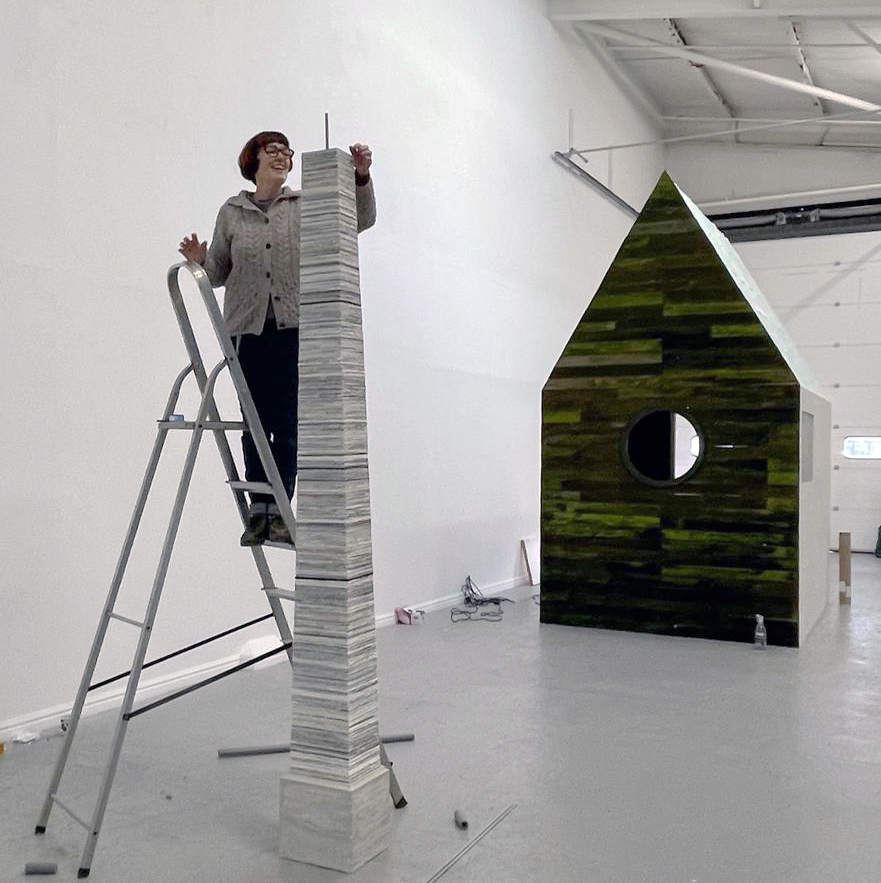
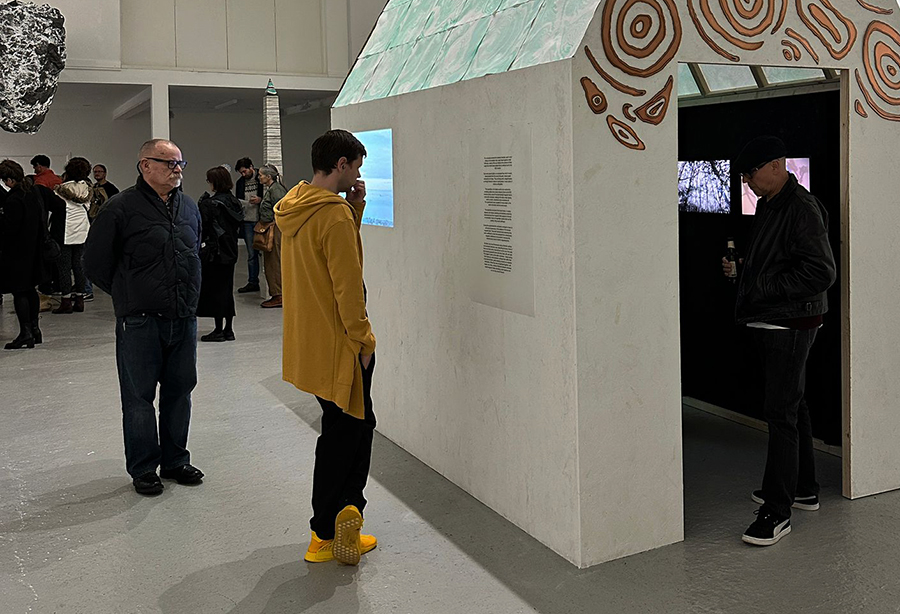
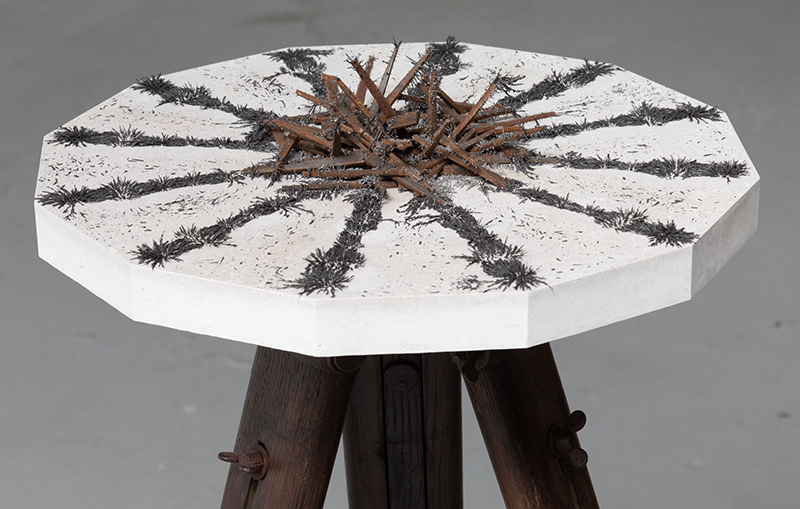
SPACE IS THE PLACE

What a joy to experience The Sun Ra Arkestra

In some far off place
Many light years in space
I’ll wait for you
Where human feet have never trod
Where human eyes have never seen
I’ll build a world of abstract dreams
And wait for you

The Ruins of Time at St. Augustine’s Tower, Hackney. “Tower” is part four of the “Ruins of Time” project, organized by LME (London – Munich Exchange) exploring the passage of time and its specific expression in the place, space and architecture of the site. Curated by Eleonora Bourmistrov and Milena Michalski who are exhibiting alongside Myra Brooklyn, Risha Gorig, Angelika Hofmann, Monika Kita, Brigitte C. Reichl, and Marcia Teusink. Many thoughtful works and a marvellous installation from Eleonora Bourmistrov.

The London Group exhibition including work from Victoria Arney (birdsong translated into woodcuts), Carol Wyss (examining the ribcage as protective enfolding), Sandra Crisp (blender generated molecules with embedded culture – a culture with culture) and Beverley Duckworth (Dust from the Sahara) in Catch Your Breath at Morley Gallery.

‘Catching one’s breath can happen if surprised, impressed or even shocked by something, such as an extraordinary object or image stumbled upon that instantaneously changes a familiar viewpoint. It can also be a time to pause or reflect and take stock.’

Working on The Breath of Stars I have been thinking about the breath and its active nature and inter-actions so it was interesting to see the many interpretations here.

Cloud Point at Paradise Row curated by Nicolas Bourriaud in collaboration with Radicants.

Text from the Gallery:

The artists (Nicolas Aguirre, Hicham Berrada, Marieke Bernard Berkel, Alice Channer, Pakui Hardware, My-Lan Hoang-Thuy, Zarah Landes, Estrid Lutz, Tala Madani, Pamela Rosenkranz) in this exhibition belong to a generation for whom no material is natural anymore. Matter, in its totality, is both form and content, subject and object, nature and culture. In other words, there is no neutral background in today’s images, but streams and active forces.

Cloud Point gathers artists who don’t consider objects, products or masses in their work, but rather the atomic structure of our surroundings, and theirs. They are particularly interested in the in-betweens — processes of liquefaction, moments of coagulation, condensation points… The emergence of this molecular gaze in contemporary art also reflects in theory and politics.

Politics goes molecular as Felix Guattari had already stated, in the 1970’s, talking about a necessary ‘molecular revolution’. We see how gas, oil, bacterias, viruses or chemicals become the new agents of History. Zygmunt Bauman analysed postmodern capitalism as a process of liquefaction of our institutions. Today Karen Barad describes matter, at its molecular stage, as pure ‘queerness’. And according to Rosa Braidotti, ‘Capital seeks and reduces body fluids to merchandise: the sweat and cheap blood of the labor force available throughout the Third World; but also the fluids of the desire of First World consumers who reduce their existence to a commodity by transforming it into a hyper-saturated state of confusion.’

I have returned to my BA dissertation from 2007 The Communication of Ecological Concerns Through Contemporary Artistic Practice to look at excerpts where I discussed the theories of Nicolas Bourriaud.

‘The intertwining of ecological and political processes with artistic practises is explored in conjunction with the particular theories of Bruno Latour, Nicolas Bourriaud and Zygmunt Bauman. These writers all speak of a need to establish new ways of communicating about the complexities of our relationships to our environments as we move through different spaces to those of the past. In light of this necessity, the precarious balance an artist must achieve to engage a contemporary urban audience with an environmental message, without losing sight of their aesthetic, or becoming embroiled in the nullifying production of commodity, is debated.’

‘Bourriaud documents the shift in focus from the visual to the relational during the 1990’s when new forms of communication  available through modern technologies coincided with an economic depression. For the artist there was a lack of funding for the spectacular but also the opportunity to experiment with spaces previously given over to exchange and barter. The artists took as their medium something they found lacking in  other areas of daily life; social relations which did not involve supplier-customer exchanges. The loss of personal interactions from daily life as more and more functions were performed by or through machines and computers were reborn in the processes of participatory practises where the audience was invited to experience rather than behold.’

‘An artwork’s short life span is not necessarily a reflection of the insatiable appetite of the gallery going public to consume and discard art as any other commodity. In using relational aesthetics the artist deliberately steps outside of this cycle. Artists who base their practises on exchanges of experience and communication through tangible means which have no value as art outside a temporal set of circumstances give the public a chance to experience a different type of social bond. From the ethos of relational aesthetics is born the possibility of art infecting the collective subjectivity. Artists whose work sidesteps the rules of the market place create a ‘social interstice,’ a small space in which to explore relations with the world. An interstice does not operate in the same way as a message, which is akin to advertising and belongs in the world of marketing. The space created must be inviting or intriguing to draw the audience into a realm of possibility, to start a conversation not give a lecture.’


I selected seven works alongside my own for an informal tour at Wells Art Contemporary to promote conversations inspired by the works. Shield – Peter Newell-Price, Chronologer (chalk and bone) – Paul Tuppeny, Screw Up Repeat – Kate McDonnell, Beneath the Heavens III – Kaori Homma, Route 339 – John Ball, Everyone was a bird – Caro Williams, Two-Sided I & II – Aliceson Carter.

Out of thousands of submissions, this year’s judging panel, Matthew Burrows MBE, Dale Lewis and Nana Shiomi, selected a shortlist of 120 artworks by 111 artists for the 2022 exhibition.

29 site-specific installations have also been selected by Clare Burnett and Jacquiline Creswell to stand as interventional responses to the architectural, spatial and spiritual aspects of Wells Cathedral.