Archives for posts with tag: Lord Martin Rees

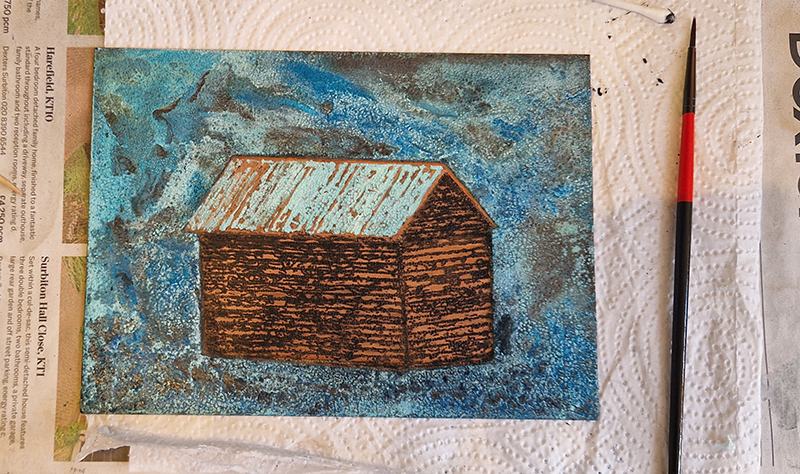
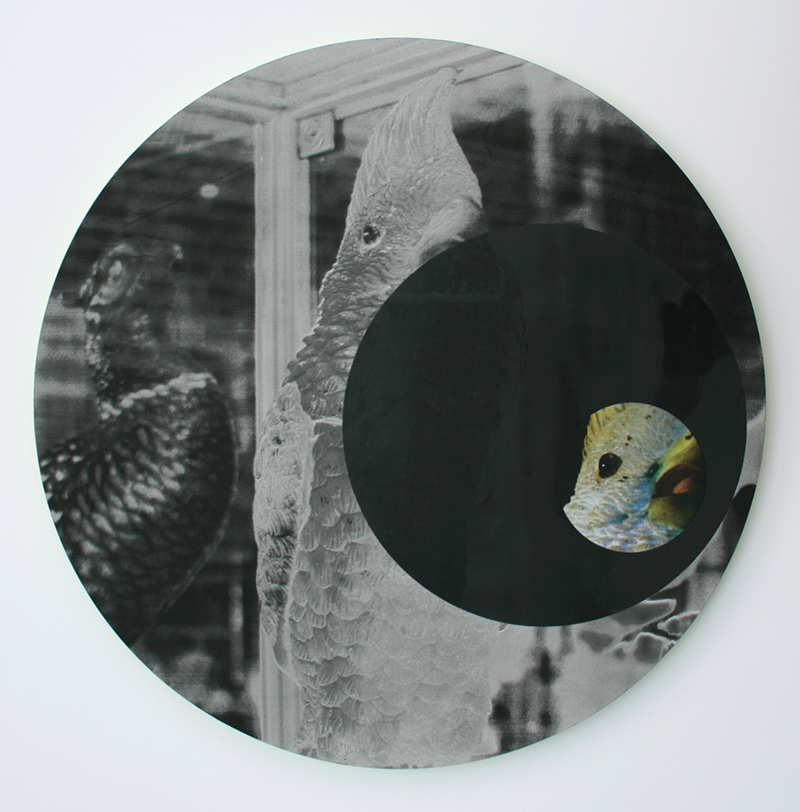
Now that the RWA secret postcard auction is over, I am able to reveal which of the postcards in the RWA secret auction was my contribution to this annual fundraiser. I was delighted that it received so many bids and amazed at the final offer. I hope the recipient is pleased with their purchase of Cosmic Hut.
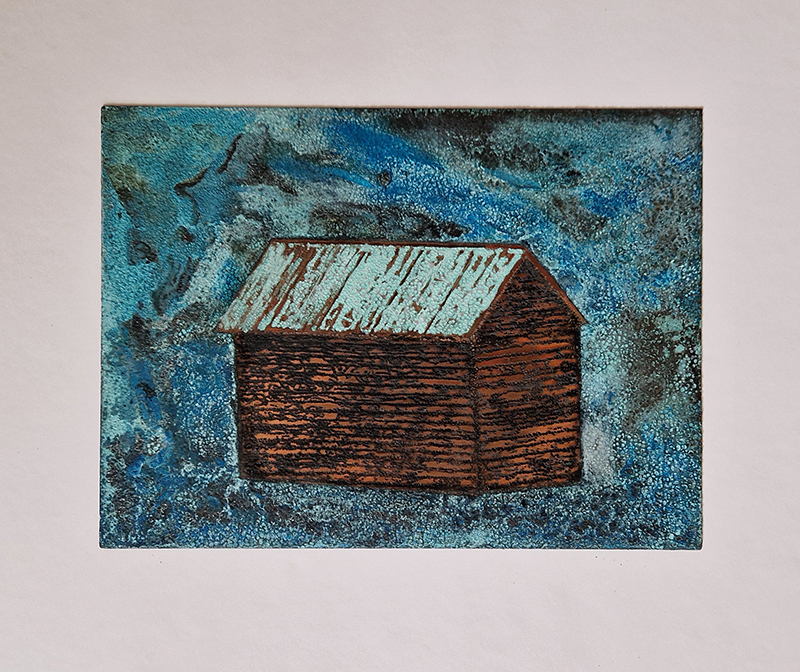
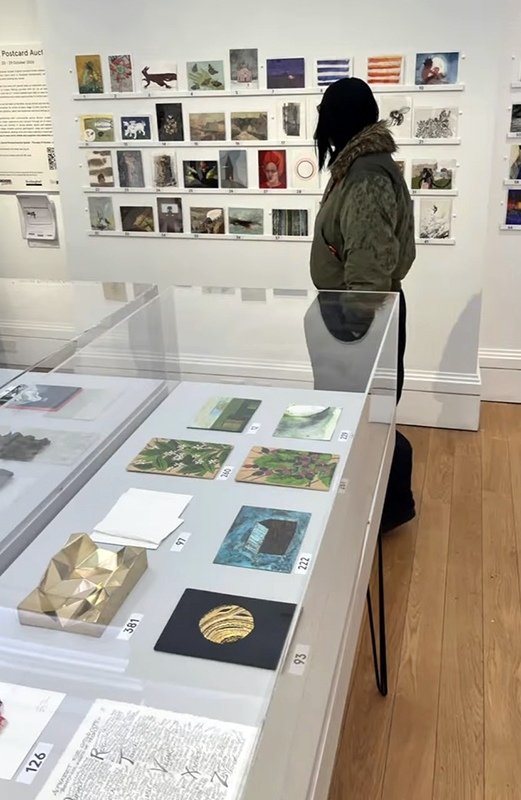
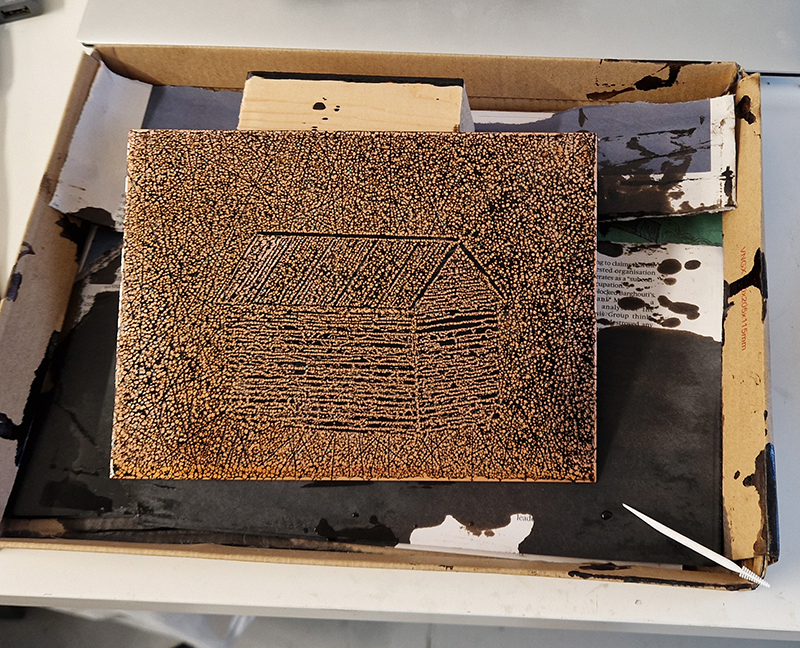
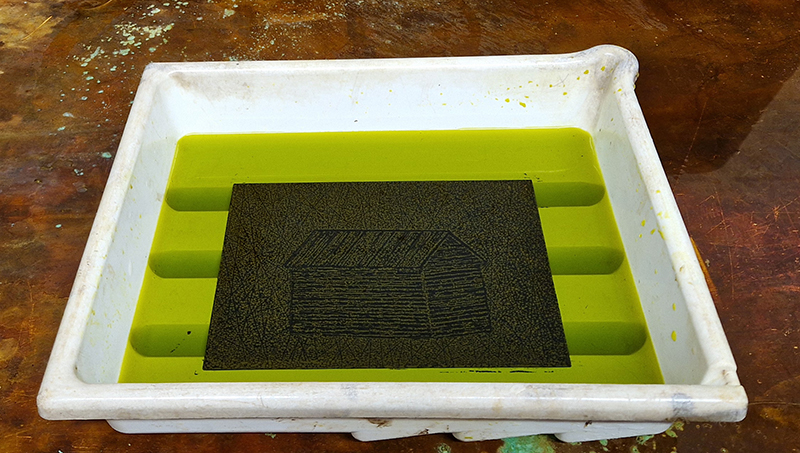
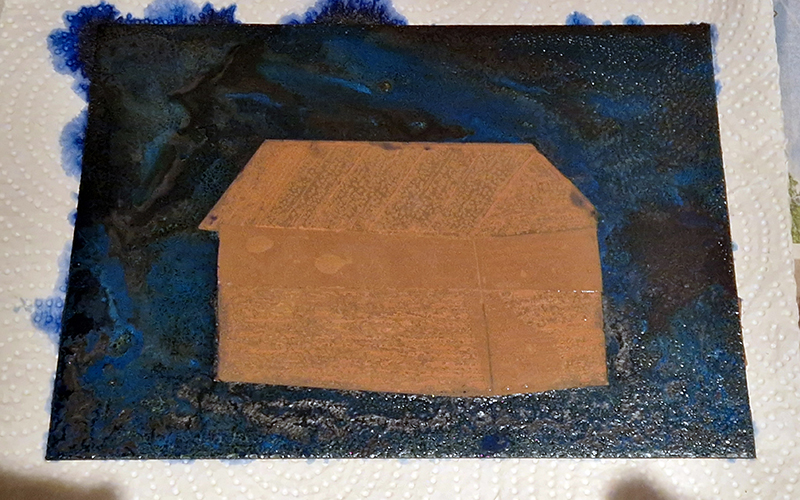
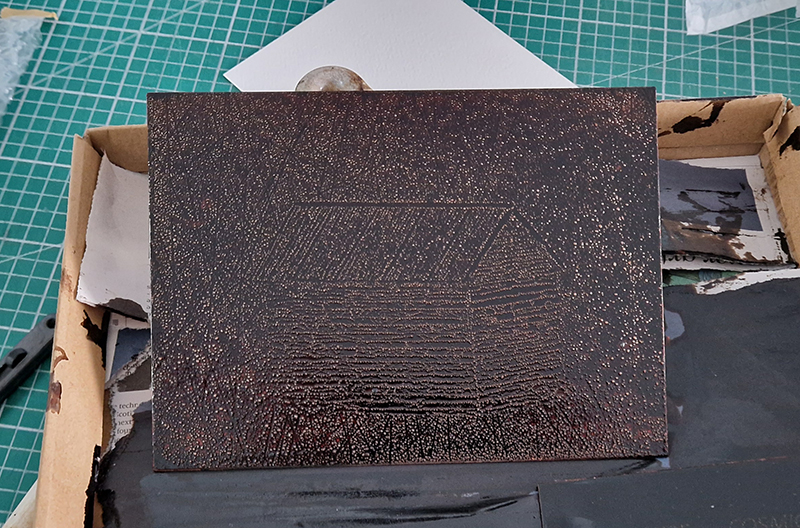
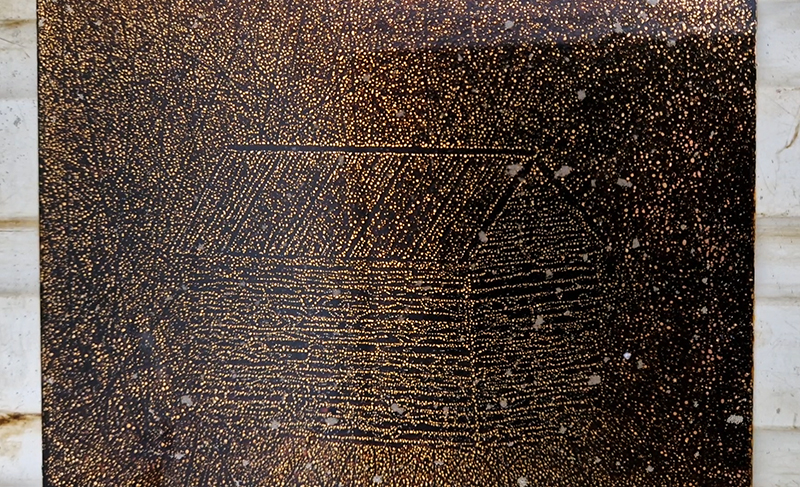
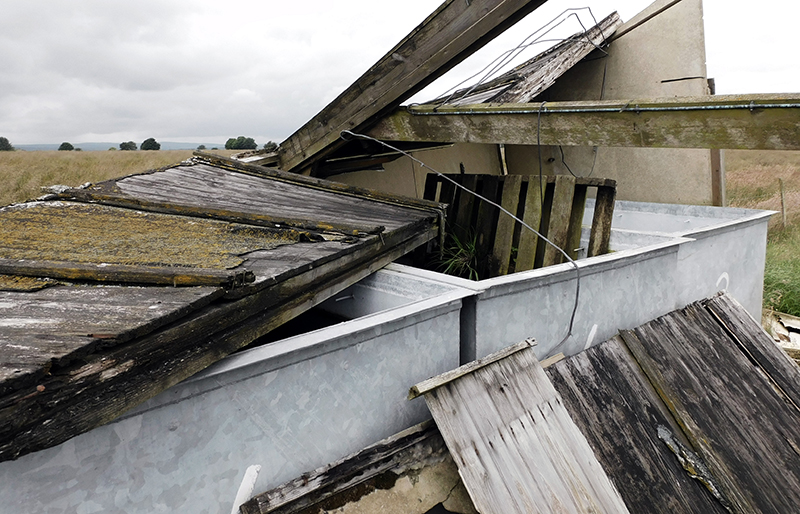
Cosmic Hut etched and patinated copper. First the image is screen printed onto the copper with a sugar based solution. It then goes through a sugar lift process of being coated with bitumen and submerged in warm water to dissolve the sugar and reveal the image before being etched. Once etched, parts of the image are blocked out as it is patinated with different chemical solutions that produce different colours. The image is based on the many cosmic ray detector huts abandoned across the North Yorkshire moors when the Haverah Park experiment stopped operating in the late 1980’s. These humble huts were once home to one of the largest extensive cosmic ray air shower detector arrays in the world, studying the highest-energy cosmic-rays arriving from space.
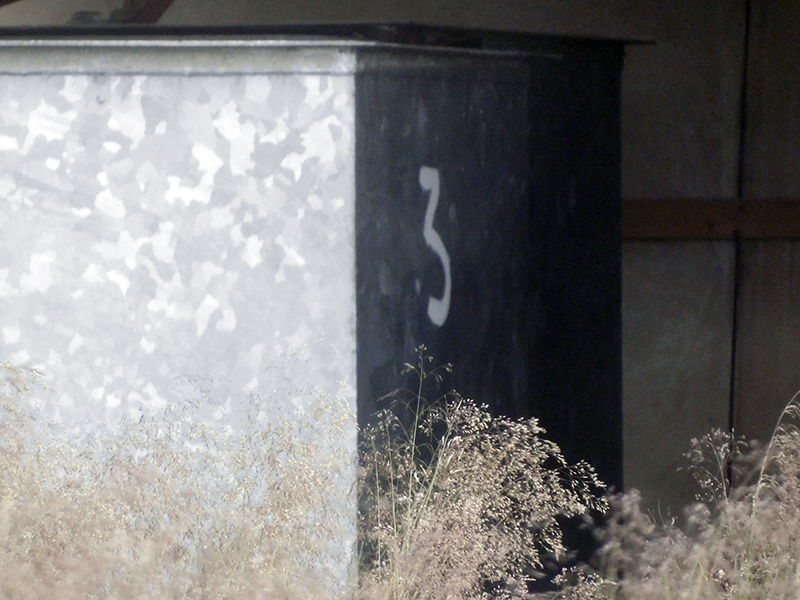
Moving forward with new work thinking about the Haverah Park experiment and the water tanks which were used to record cosmic rays as they arrive in sweeping disc like formations by registering the scintillating light of Cherenkov radiation caused by the particles, I am working towards making a series of small ‘tanks’. I am planning to use directional magnetic steel sheets for the outside of the tanks. I still have a couple of batches of this material provided to me by Union Steel Products a while back. I had first seen this material during the magnetic laboratory open day at The National Physical Laboratory and was fascinated by the jigsaw pattern surface. Norman P. Goss invented grain-orientated steel in 1934, it is a specialized iron-silicon alloy engineered to have exceptional magnetic properties in one specific direction, dramatically reducing energy loss. The jigsaw pattern of crystallographic orientation is known as a Goss texture. The very thin sheet of steel is coated in a specialized, multi-layer inorganic insulation chemically bonded to the steel surface during manufacture. It is very difficult to remove.

I used the first batch of Grain-Oriented Electrical Steel to create the work Domain of the Devil Valley Master which was shown in A Stone Sky at Thames-side Studios Gallery in 2023.
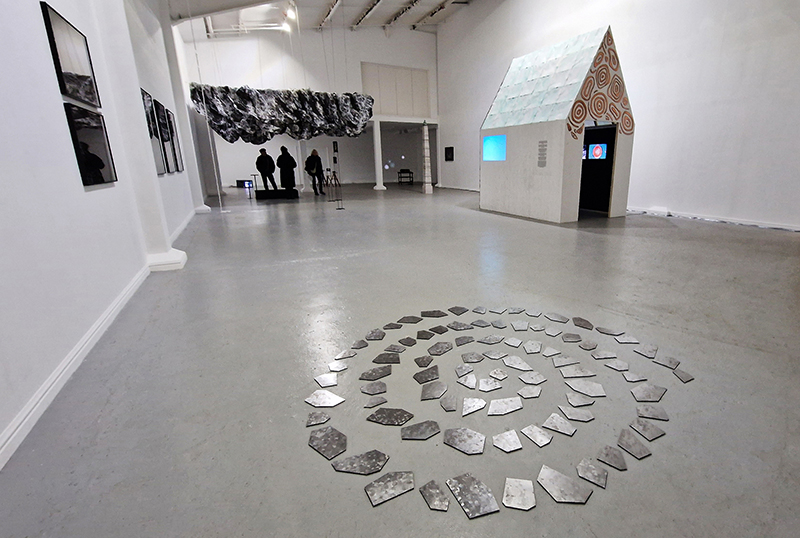
For this spiral sculpture I experimented with various ways of removing the grey coating, eventually finding sanding before etching in copper sulphate could achieve good results if through an arduous and messy process. It was still a bit hit and miss and I could end up with a muddy surface or a silvery one without really knowing why. The surface will flash rust extremely quickly when it comes out of the etching bath, or it suddenly becomes dull and patchy. For this new work I thought I would ask google AI if it could find any tips on removing the insulating surface and it actually came up with a plan that has worked. Much as I don’t like to use AI in a creative process, it was really useful in identifying the composition of the grey coating and suggesting the best removal agent and method. I have adapted the advice slightly after testing the results, but in the end it has saved me many hours of sanding and copper sulphate residue to dispose of. The process giving best results, is to just wipe clean the surface before etching in Ferric Chloride, then soak briefly in a neutralizing bath of bicarbonate of soda, followed by a quick dip in isopropyl alcohol to dispel the water before rapid drying. This batch has a slightly different crystallographic pattern to the batch used for the spiral.

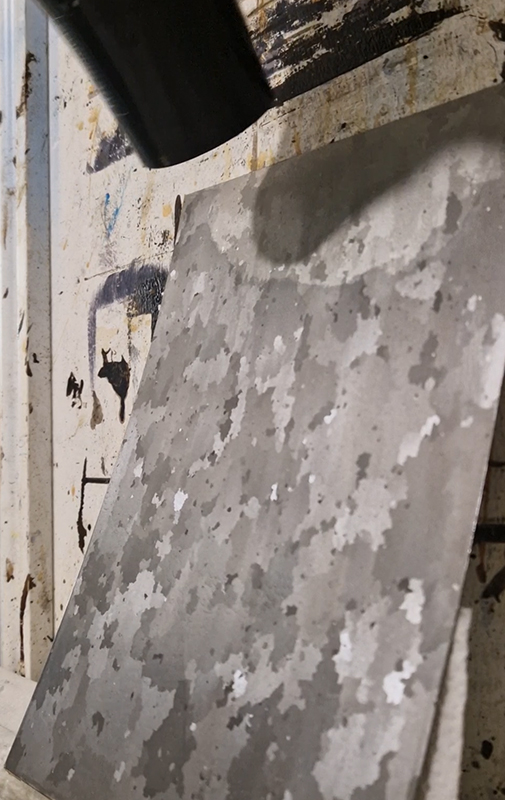
The original water Cherenkov detector tanks at Haverah Park are made of galvanised steel which also has a patterned surface known as a spangle. This is caused during manufacture when the steel is hot dipped in zinc and the individual zinc crystals spread as they cool. Using the directional magnetic steel echoes the pattern and also references the interaction of cosmic rays with magnetic fields which can accelerate them across space but also deflect them from reaching Earth’s surface.
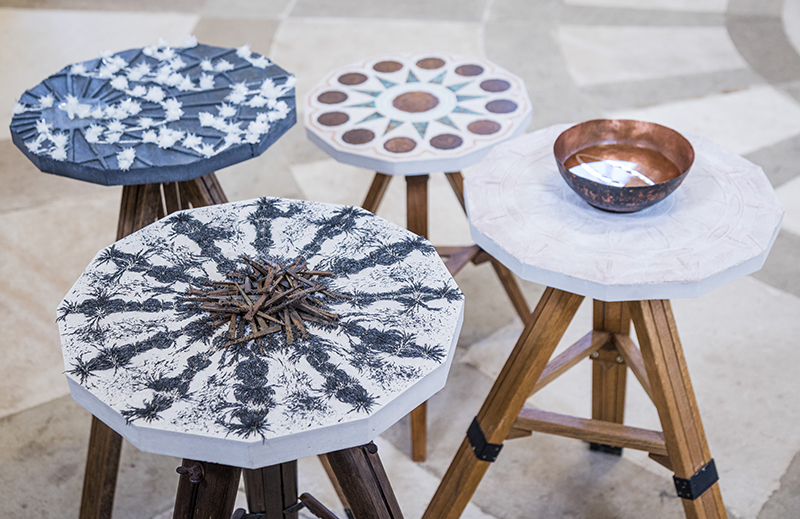
Working on ideas for a 5th tablet as part of The Instruments of the Anemoi series of sculptures that reference methods of natural navigation. Currently I have included magnetism in the form of the compass and the lodestone, the winds and the north star.
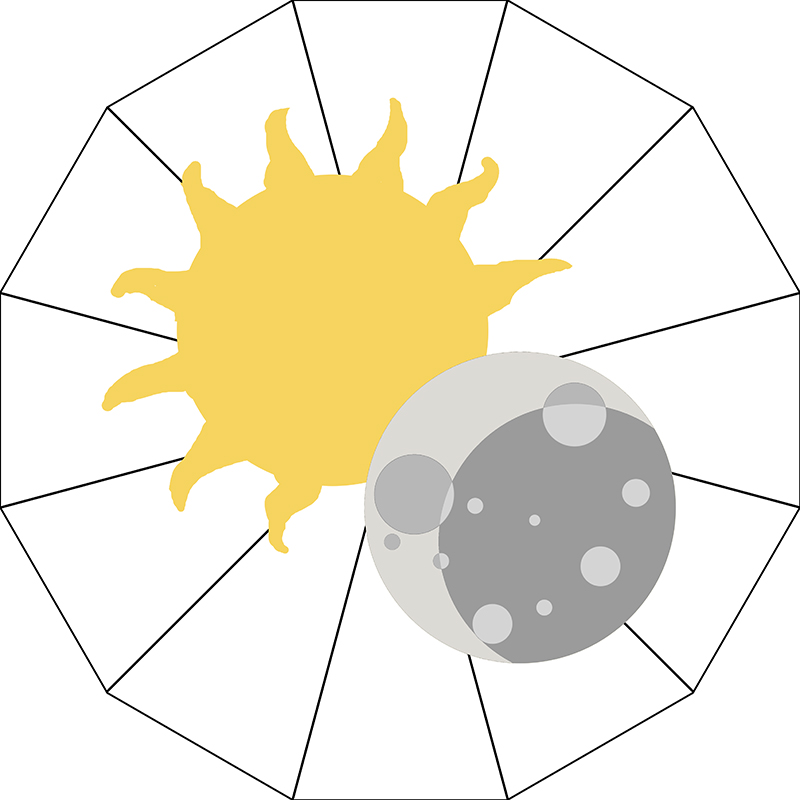
Perhaps influenced by seeing the total eclipse of the sun this year I am thinking of making one referencing the sun and the moon as beacons of navigation. The sun being the most obvious and easiest to work out cardinal direction at least, with the moon needing more knowledge of its lunar cycles. I also like the idea of using copper for the sun and aluminium for the moon.
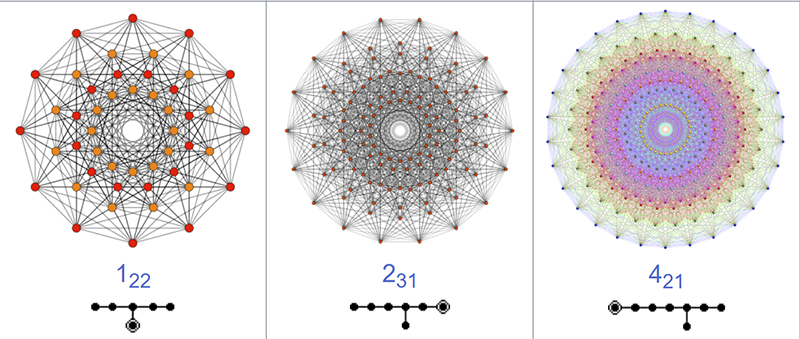
I have been looking at what might be useful to help visualise a fifth dimension and came across Coxeter elements and planes which deal with geometric reflections. The maths is beyond me but the shapes and patterns involved are wonderful.
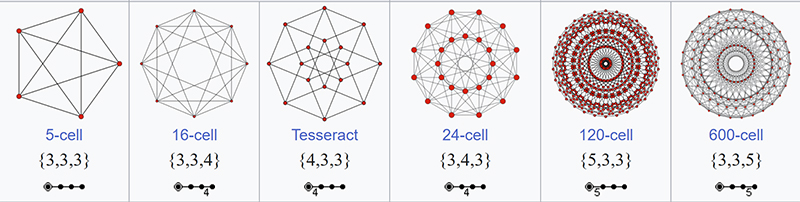
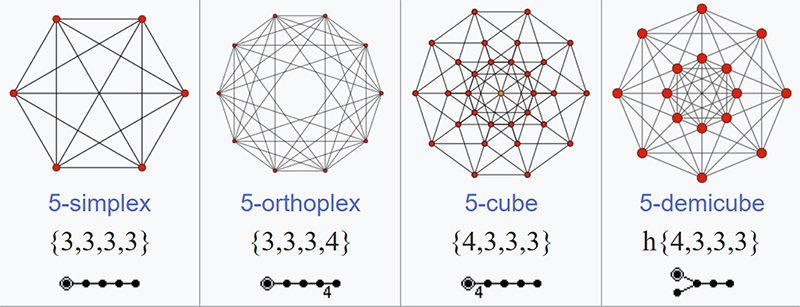
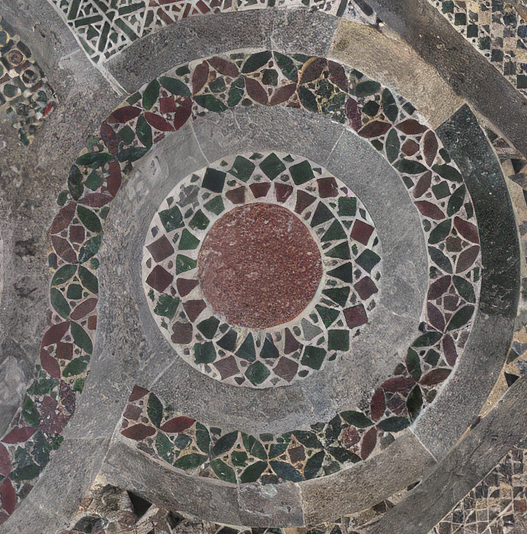
These could be useful for my work reinterpreting the Cosmati Pavement in Westminster Abbey that purports to offer clues to determine the end of the Universe, as different symmetries are used within the mosaic design to signify the different complexities between the earthly and the heavenly spheres. In the symbolism of the Cosmati Pavement, the journey from earthly materialism to spirituality is seen as a progression from multiplicity and diversity towards unity and uniformity.

Through this work I will look at changing human relationships to Fire, Earth, Air, Water and the Aether since the time the Cosmati Pavement was installed in Westminster Abbey in 1268. The pavement uses number, patterns and geometry to articulate the medieval understanding of the cosmos and the end of time. I am using Richard Foster’s book Patterns of Thought: the hidden meaning of the Great Pavement of Westminster Abbey, for reference and Martin Rees book Just Six Numbers: the deep forces that shape the Universe, as reference for symbolic contemporary numbers that are used to describe the cosmos.

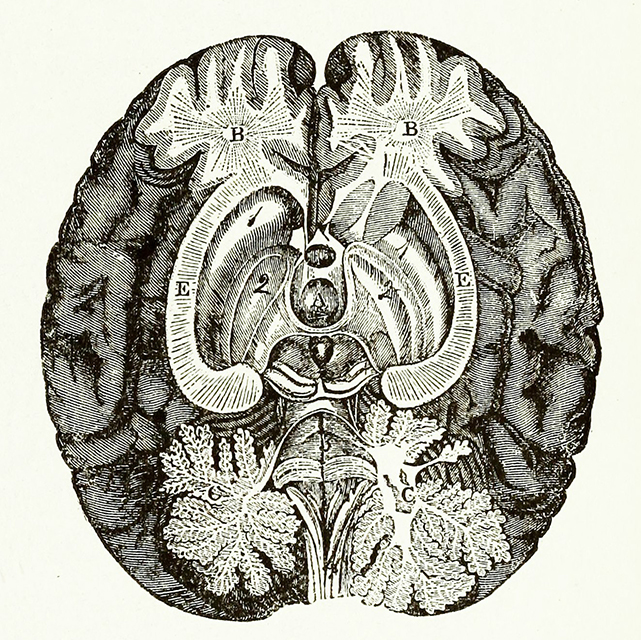
The end of the world was imagined as a reversal of creation when all matter will return into the primordial chaos of elements that are reabsorbed into the divine mind. The centre sphere of the pavement relates to the primordial chaos from which the four elements of earth, water, air and fire separated at creation and will return to at the end of time. Swirling eddies of unformed matter at the threshold of eternity are transformed by a breath across the turbulent waters bringing light to the darkness. I have chosen what is known as the Density Parameter represented by the Omega symbol, to relate to the Aether – this is a number that has not been determined by physics and its value describes the possible fate of the universe. The 61 lozenge shapes circling the Silva, unformed matter, are given to represent the idea of eternity. I like the illustration of the interior radiations of the brain from The Principles of Light and Color, 1878, by Edwin Dwight Babbitt that explores the physical, metaphysical, and therapeutic properties of light and colour. It has a similar relation of a radiating mind of creation.
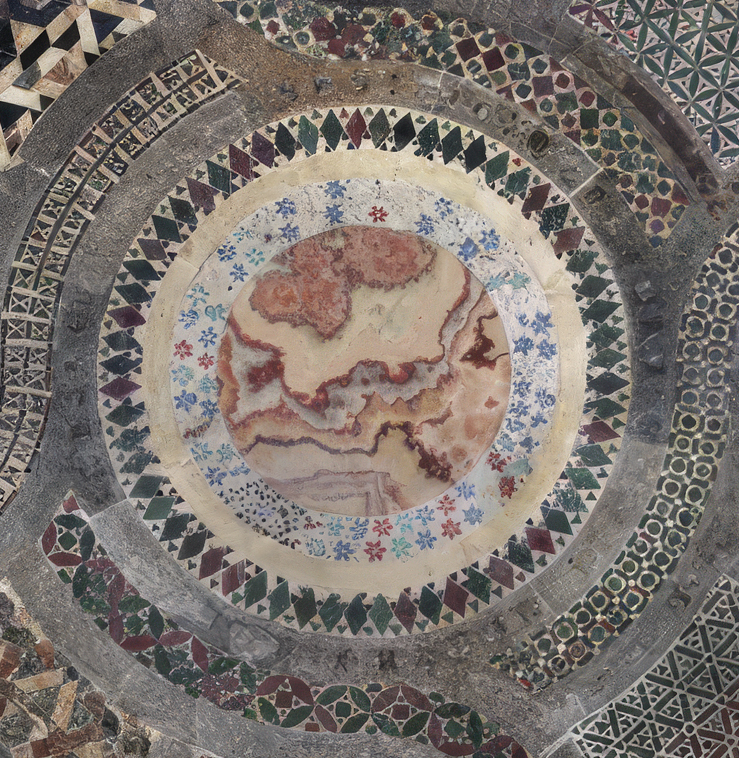
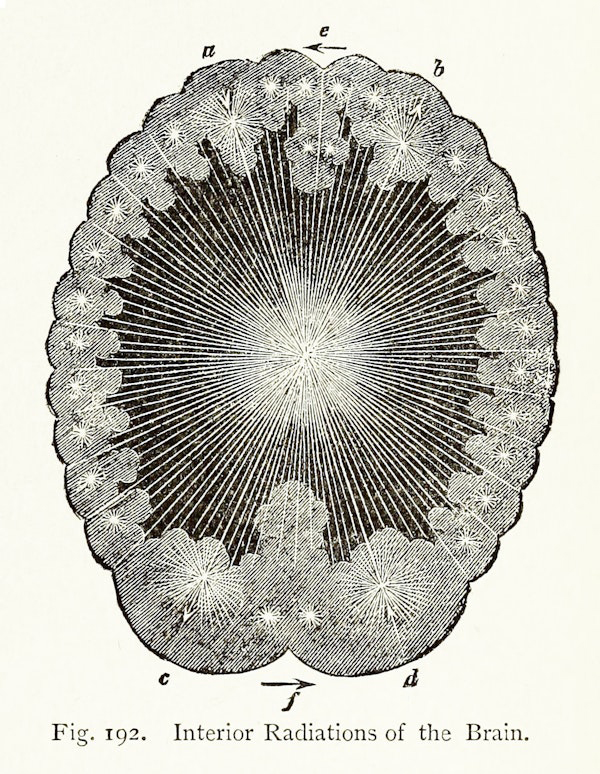
The inner square of the pavement contains four other spheres which represent the elements in their archetypal form before they transition from the metaphysical or the intellect, to the material sensible world. The pavement mosaics show a transition from a variety of patterns at the outer edge through to simplified regular polygons, the archetypes of form representing a perfection that we only experience as a shadow on Earth. Six-fold symmetry patterns signify astronomical time and the perfection of the material elements and four-fold symmetry patterns describe mundane time and compound bodies full of diversity when the elements mix and entangle.

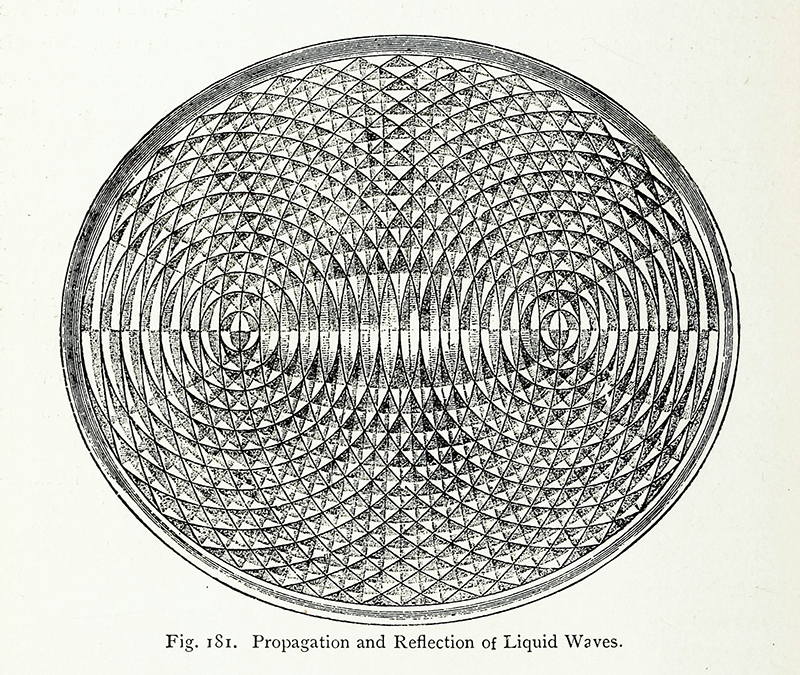
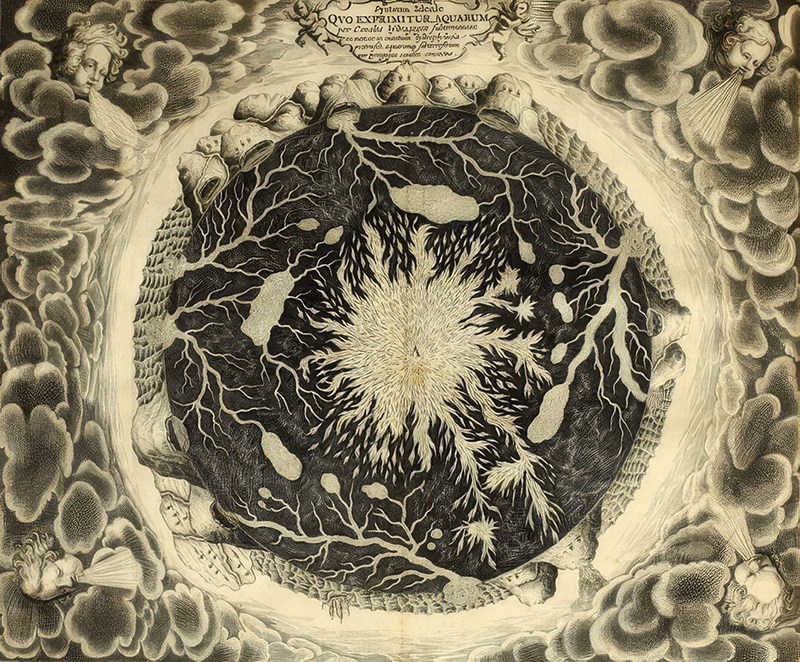
To the north is the sphere representing water containing a seven sided polygon which symbolises the moon. I have chosen to relate the number Q ( 1/100,000 (or 10⁻⁵)) to this sphere. Q represents the texture of the universe through which we can observe such phenomena as gravitational ripples. Other references I am looking at are Mundus Subterraneus, by Athanasius Kircher published in 1665 which has delicious illustrations of the underground world and all its riches and a great illustration of liquid waves from The Principles of Light and Color.
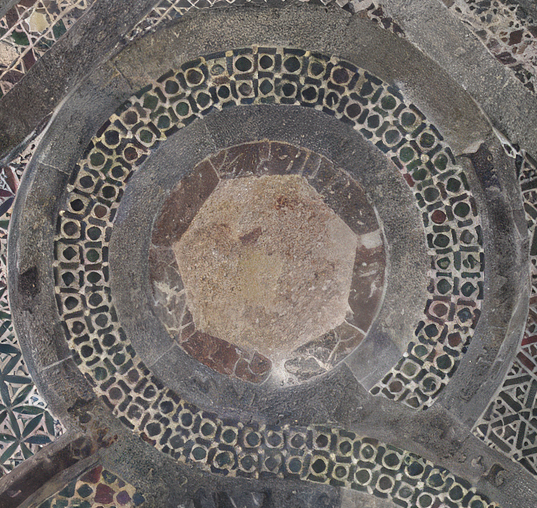
To the south is Fire, represented in the pavement by the symbol of the Sun set in an octahedron which heralds the start (or the end) of astronomical time. I have chosen the nuclear efficiency number for this sphere, represented by the epsilon symbol (ε = 0.007), it is the process which allows for stars to burn steadily for billions of years.
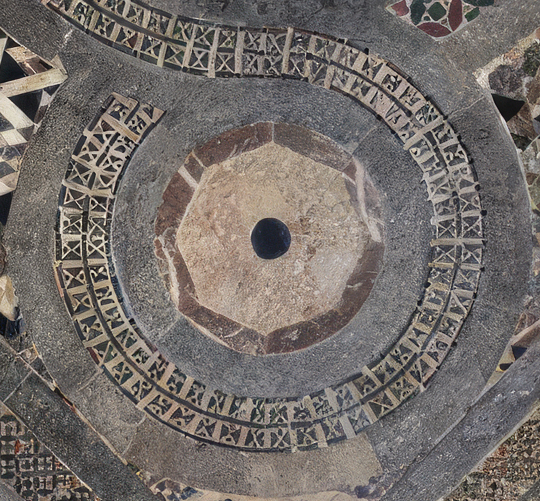
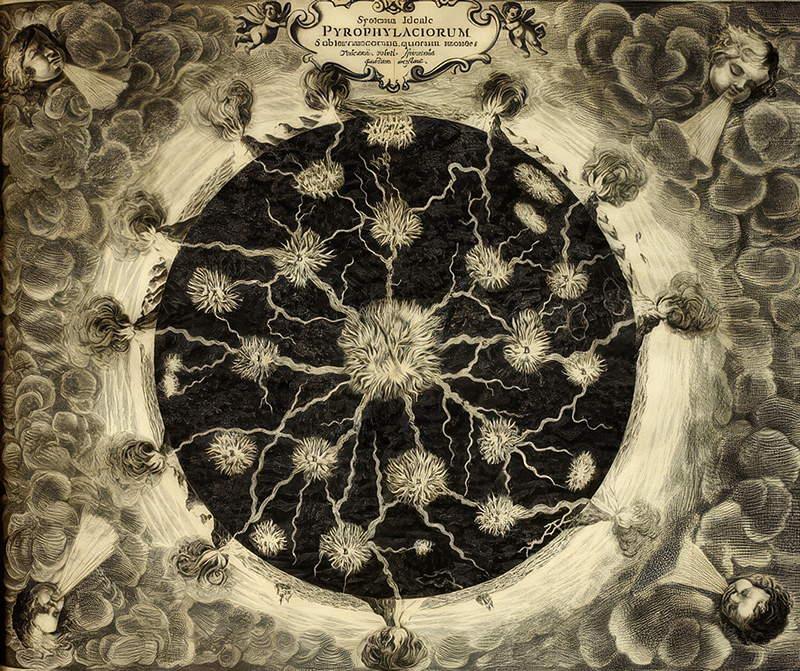
To the West is Earth, represented by a hexagon. I have chosen the large number N 10³⁶ for this sphere, representing the relative weakness of gravity compared to other forces which act on the solid matter of Earth. Also referencing Kepler’s 1619 work Harmonice Mundi (Harmonies of the World) where he linked the five regular Platonic solids to the classical Greek elements. The illustration of the brain laid bare from The Principles of Light and Color has an Earth like quality.
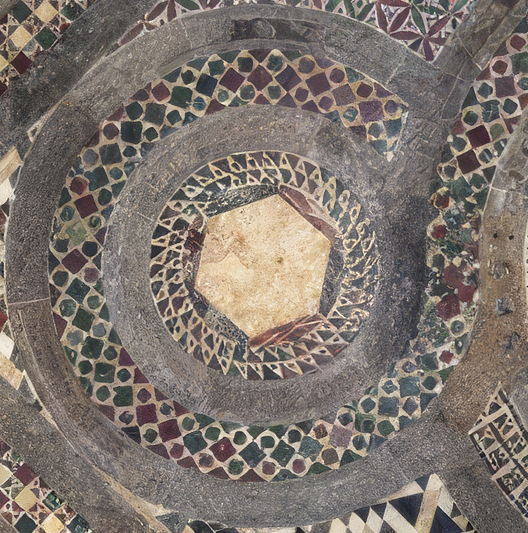
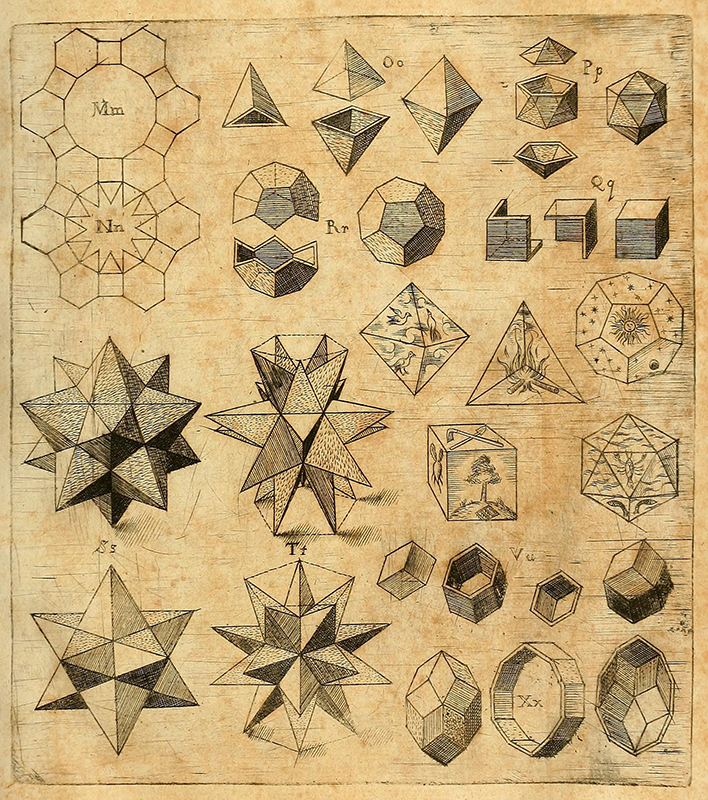
To the East is AIR represented by a circle signifying the logos from where the breath came that stirred the waters. I have chosen the number Λ (Lambda) which describes the expansion of the universe and ties in with things that move through the air.
Looking at things that move through the air in other contexts, I am planning to attempt some Schlieren photography. Curator Maria Hinel’s husband first told me about this process and I have finally had a look at how it works. It is an optical technique used to visualize the flow of fluid and density variations in transparent media (such as air, water, or gas) that are invisible to the naked eye. It sounds quite a tricky process requiring absolute precision. First thing I need is a Newtonian Telescope Primary Mirror.

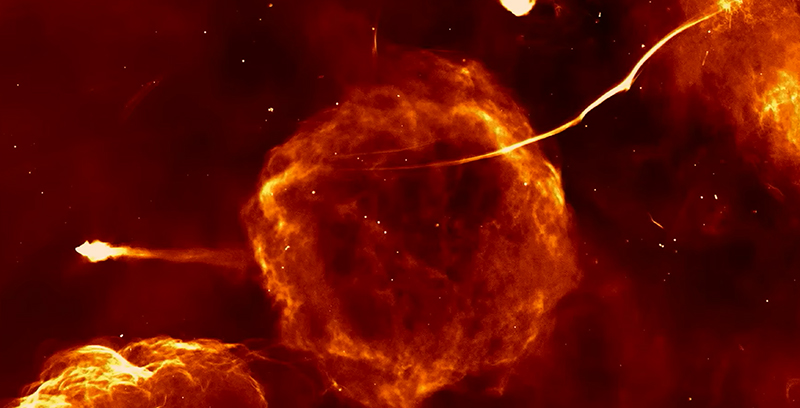
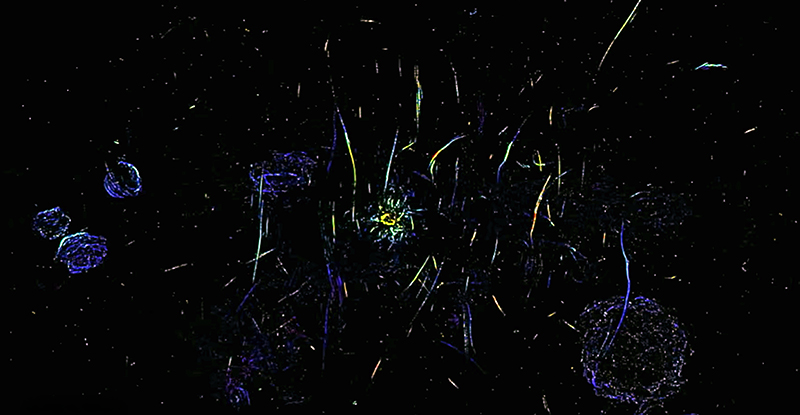
The Magnetic Universe Gresham lecture by Professor Katherine Blundell OBE gives a very thorough overview of magnetic fields from the bar magnet to magnetars and the most recent discoveries by the MeerKat radio telescopes imaging the heart of the milky way that are yet to be explained.
Wrinkled Time by Marcia Bjornerud this essay is from a couple of years ago but I still love to read it every so often. Or you can lay back, listen to Marcia read it and contemplate how unique and precious the Earth is.

Gallery Visits

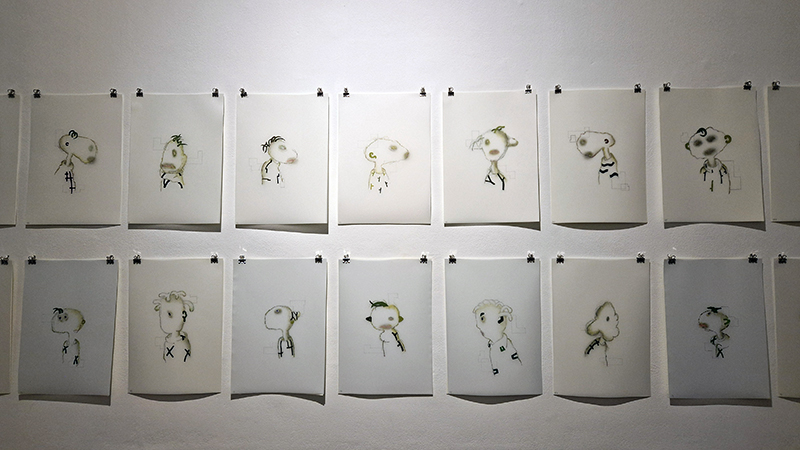
Oona Grimes Weed Killer at Danielle Arnaud Gallery. I has quite an emotional response to the works in this show which present perspectives on cruelty, loss, responsibility and power. I had listened to Natalie Haynes ‘Stands up for Euripides’ episode on the play Medea, a woman notoriously vilified for killing her children to spite her husband who is abandoning her. Oona’s collaged drawings of colourful cartoonlike characters emerging from velvety black surfaces intent on inflicting pain are hard hitting despite the comedic nuances. The works dig deeper than purely physical assaults into psychological damage and family relationships also explored through a tender film. What I think I found especially hard was the ‘chorus’ of bruised ghostly children, so sad and enigmatic. Looking so isolated and vulnerable, they speak for the children of Palestine and Gaza where adults should be protecting and nurturing but instead they are warring and damaging.
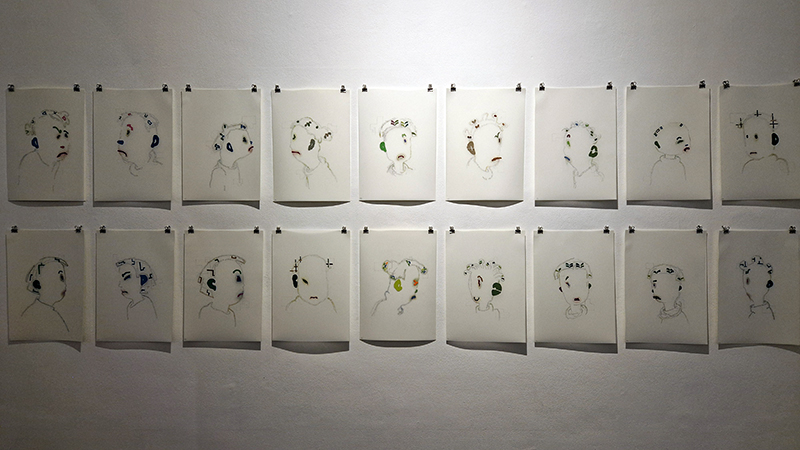
Salon for a Speculative Future presents: How to be in the Future: A Future Sensorium curated by Monika Oechsler at Chisenhale Studios. A beautiful show sensitively curated to bring together works that speak to sensory awareness and physicality. The exhibition features sound sculpture, sonic voicing, rhythmic movement, body scan sculptures and moving image works. Artists include Adonia Bouchehri, Kate Fahey, Alice Sheppard Fidler, Lisa Chang Lee, Anna Mays, Kirti Virmani, Nicola Woodham.
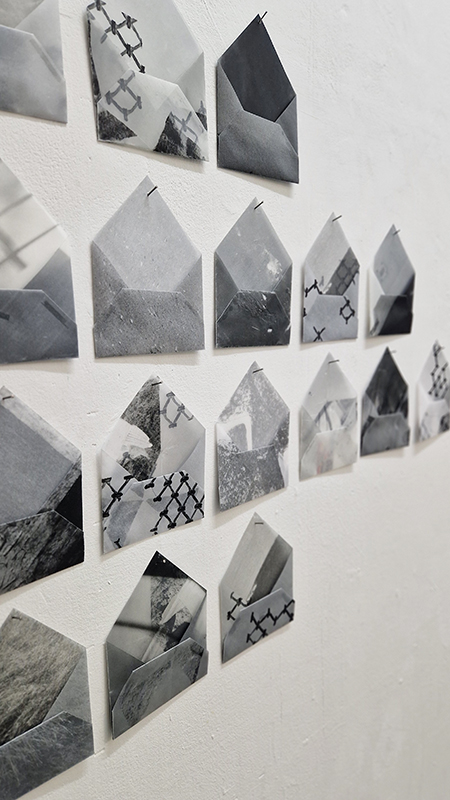
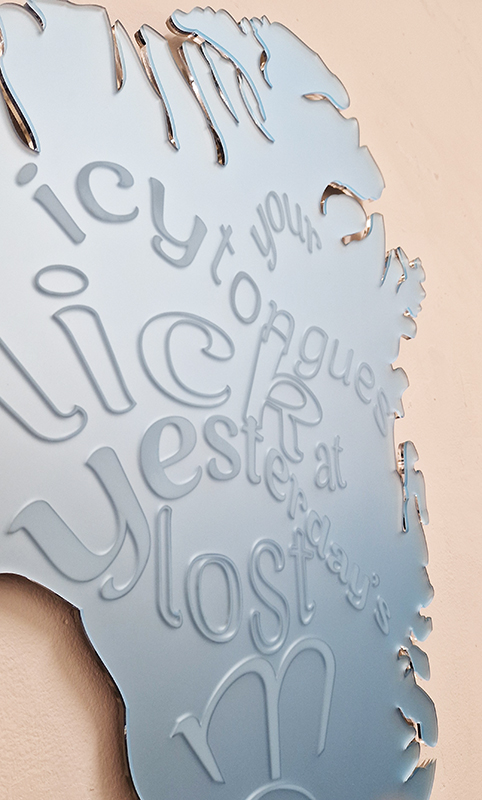
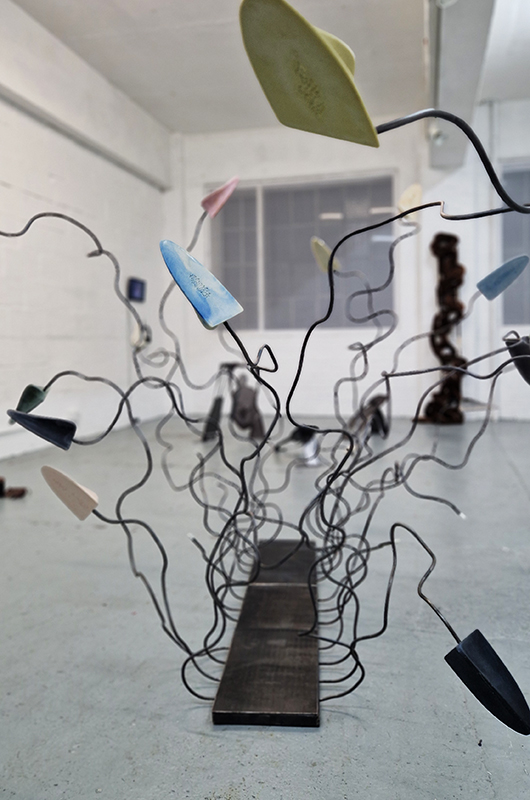
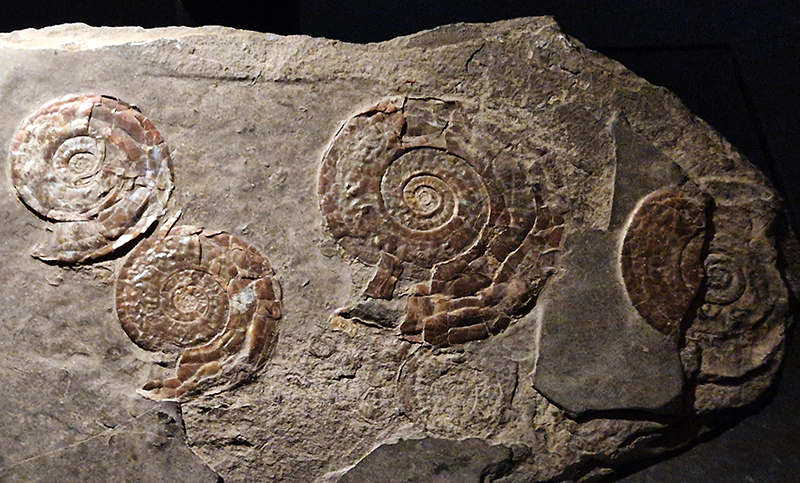
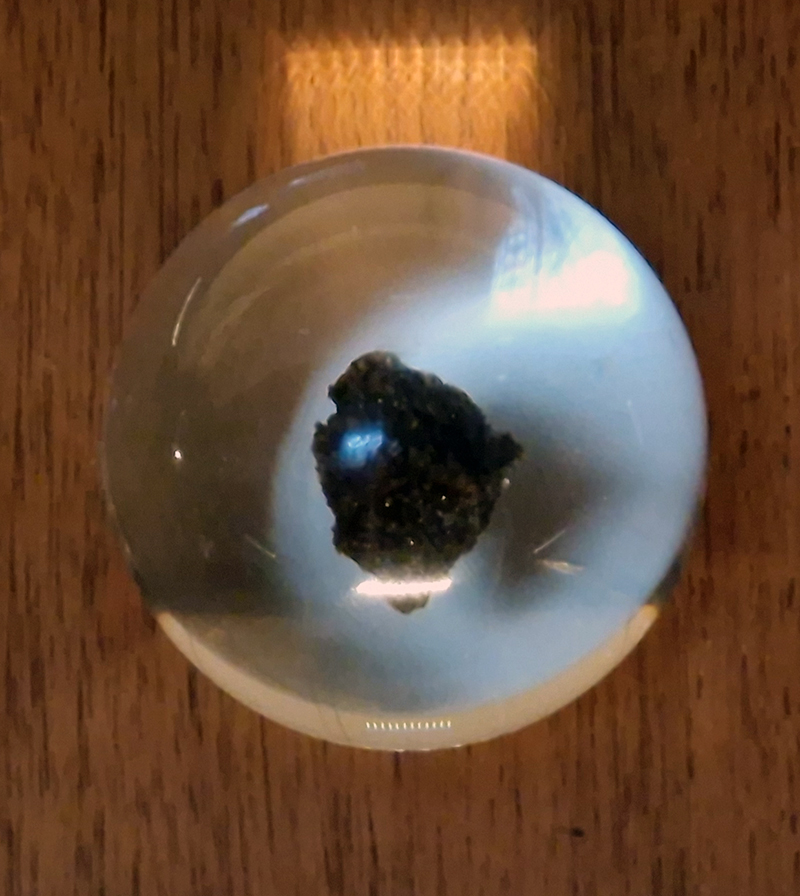
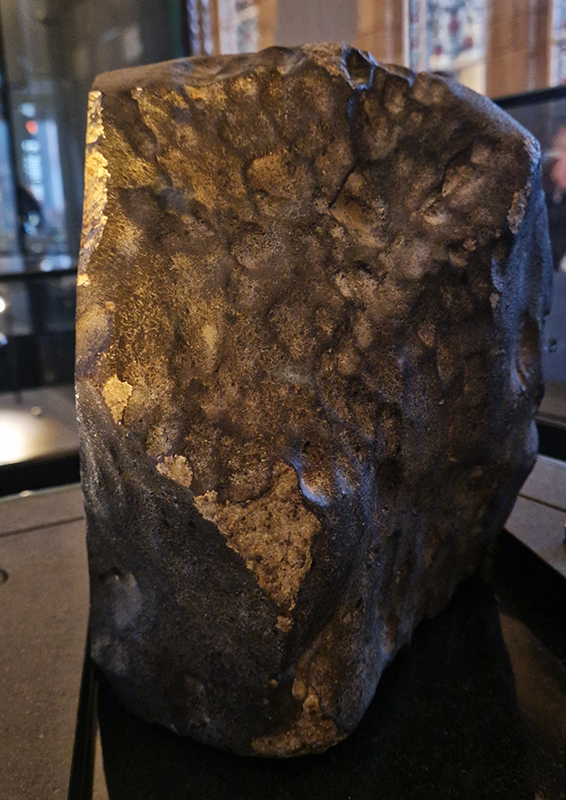
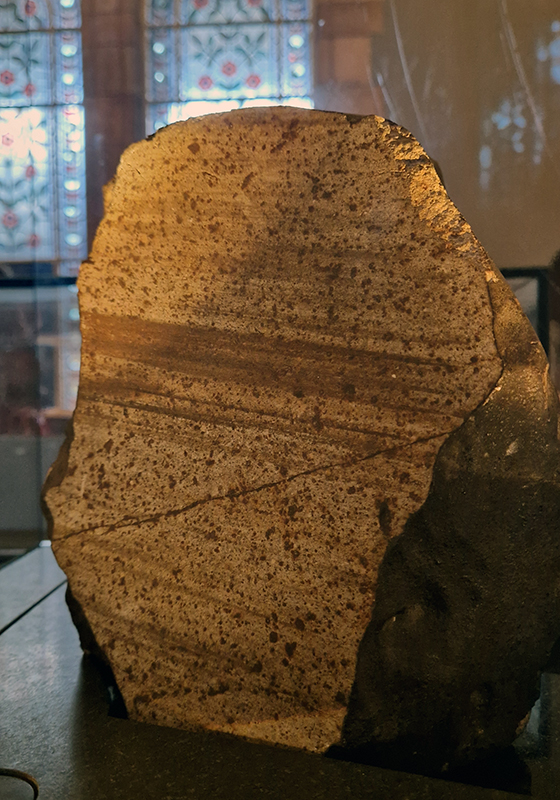
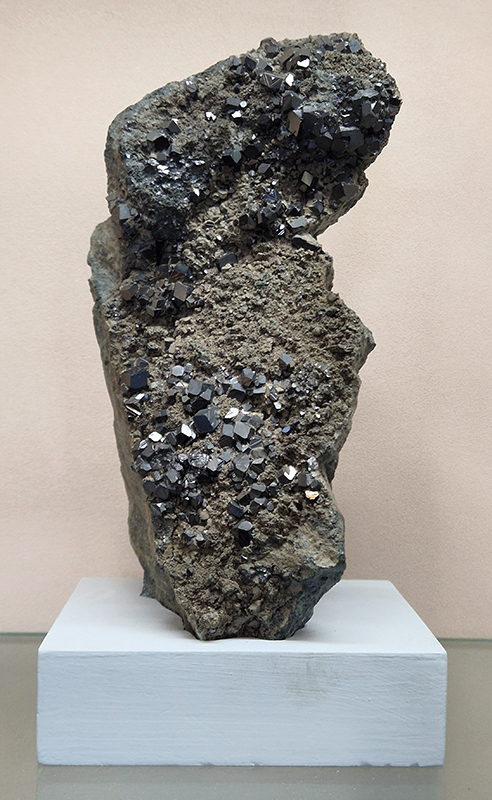
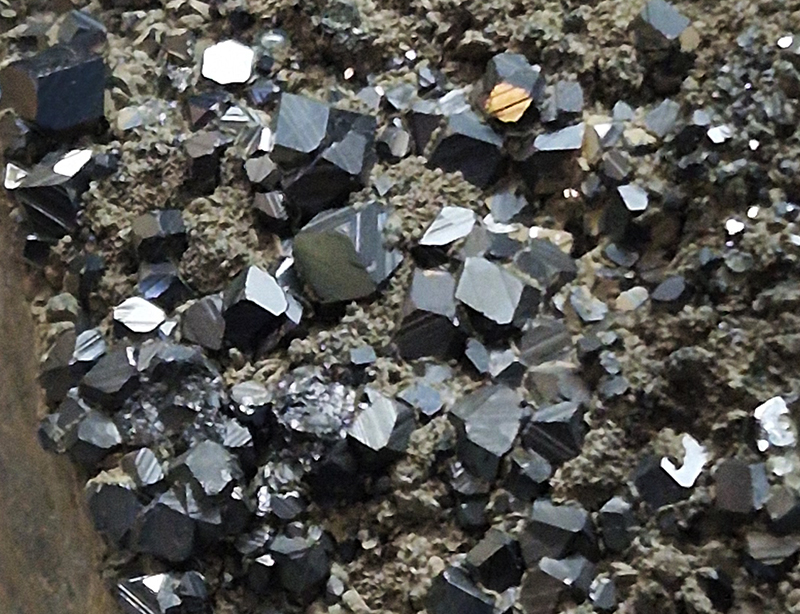
The Natural History Museum is somewhere I should go more often. Popped in to see the new temporary gallery called Nature and Us which was a bit chaotic so ended up looking at the thrilling black dodecahedra on chlorite example of magnetite, a tiny moon rock in a glass sphere, William Smith’s ammonites and the Wold Cottage Meteorite which was sent hurtling to Earth when two asteroids collided in December 1795, surprising ploughman John Shipley who was working nearby when the 25kg rock crashed to Earth. It became key evidence that rocks could have extra terrestrial origins and was duly commemorated with an obelisk at the landing site.
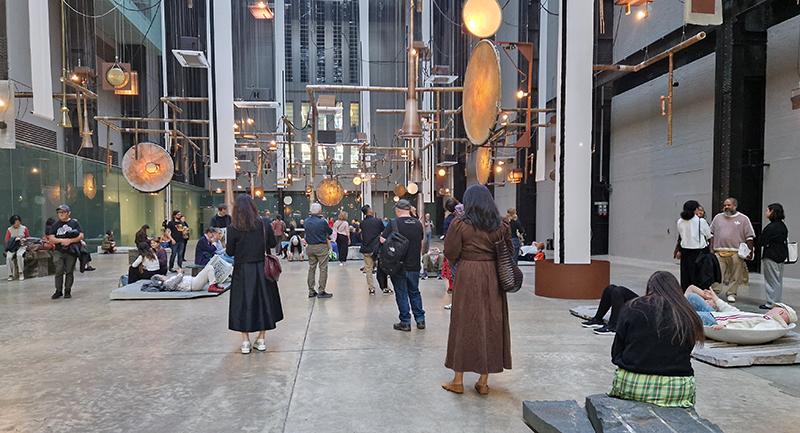
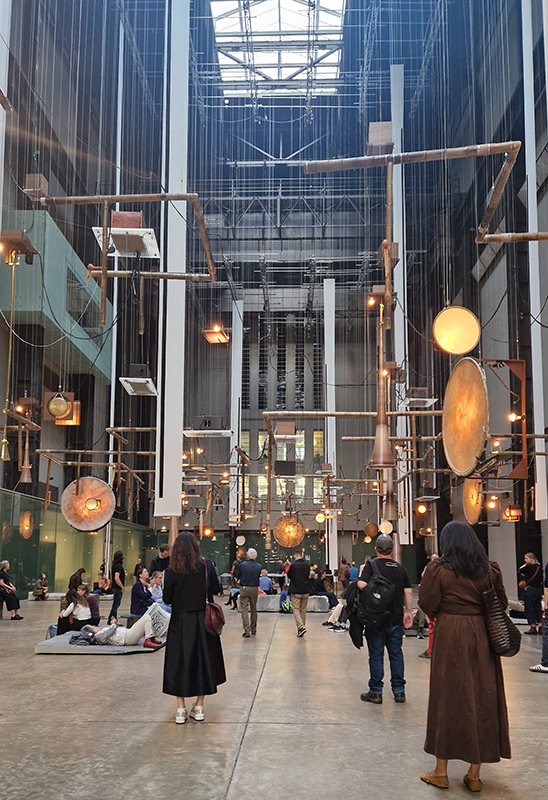
Engaging new commission at Tate Modern Turbine hall, sonic installation by Tarek Atoui: Hold.
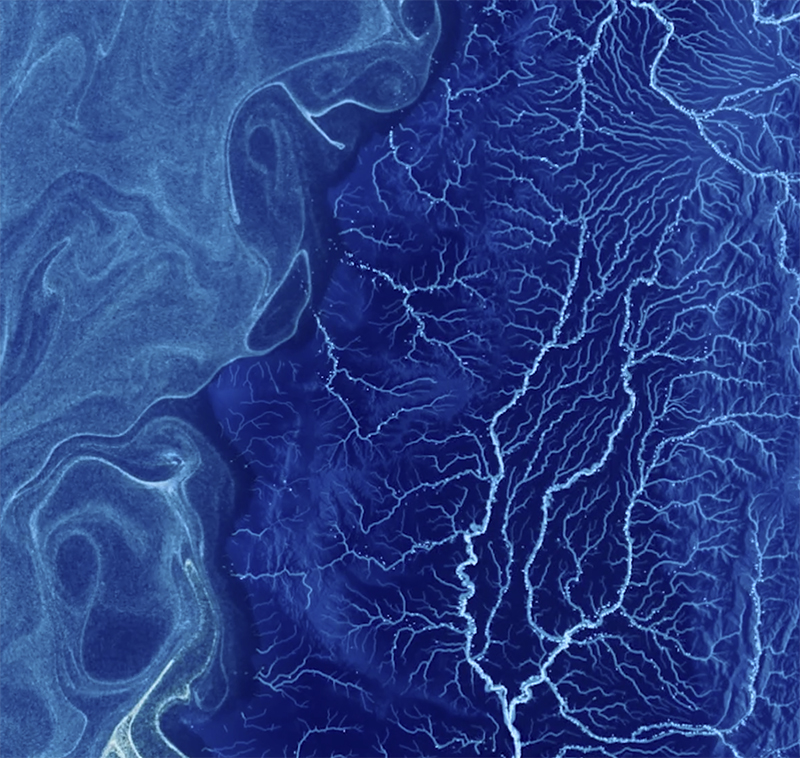
Water Body by the art collective Marshmallow Laser Feast and author Robert Macfarlane, featured as part of the 70th BFI London Film Festival (LFF Expanded). I think it was the price of the ticket and the fact that is wasn’t as immersive as we hoped that left us a bit flat despite being impressed by the visualisations of planetary water circulation. It felt lacking some kind of emotion or element to connect with the audience.
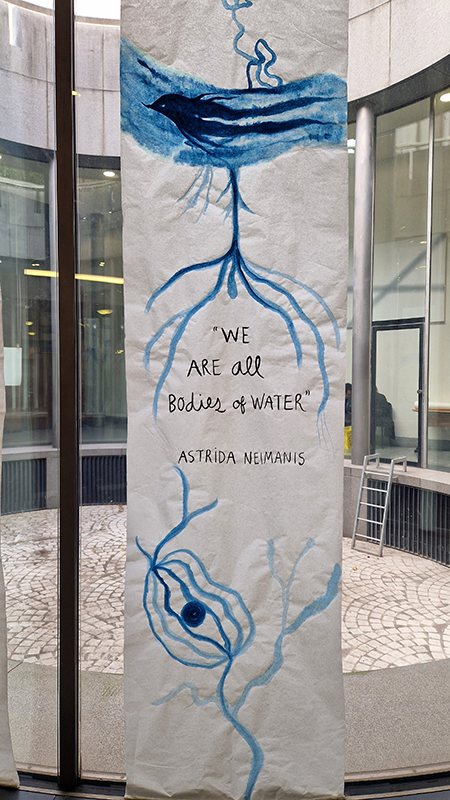
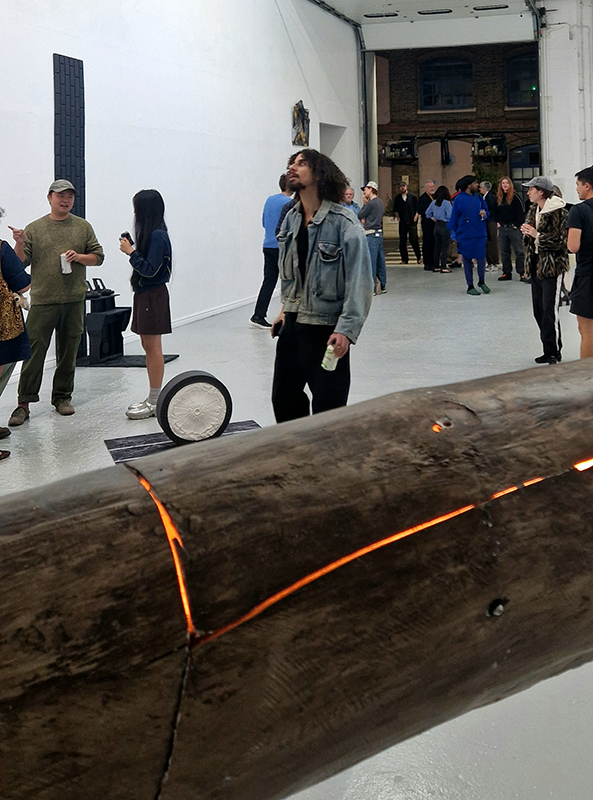
Falsework curated by Catherine Li at Thames-side Studios Gallery. Featuring works by Molly Grad, Steven He, Amélie McKee, Robin Finch Pickering, Ana Teles, and Chris Thompson, the exhibition traces a shared interest in forms that resist being reduced either to function or to representation. Structures may initially appear legible but their meanings shift through material, scale, position and perception.
My thoughts have been directed to change, counting time and mapping data, the aura of place and sacred sites, and the lure of the apocalypse.

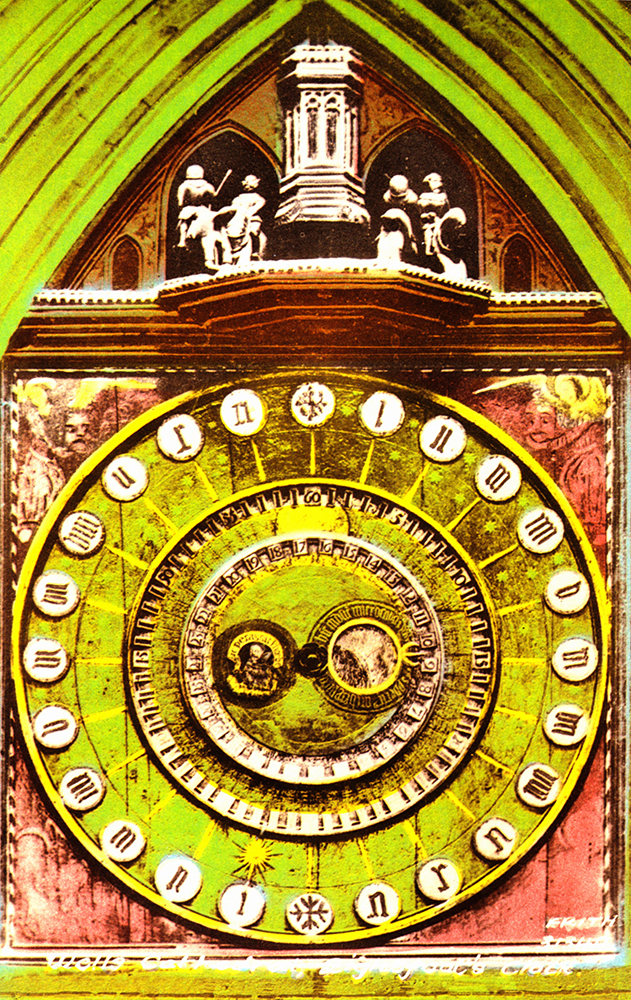
1510 wells clock

As Utopia is no place so Uchronia is no time.

Helga Schmid gave a very interesting presentation on Uchronia at the Material Environments Symposium, University of Greenwich. First used by Charles Renouvier in the title of his 1876 novel which translates as Uchronia (Utopia in History), an Apocryphal Sketch of the Development of European Civilization Not as It Was But as It Might Have Been.

Uchronia suggests an alternative history, a what if scenario. Helga is interested in the possibility of changing the time constraints society forces upon us to allow us a more natural experience of time in tune with circadian rhythms and our natural sleep patterns. Her research looks at the transition from agricultural to urban society, the temporal fragmentation from punctuality to flexibility and the ongoing pressures of speed and acceleration which conflict with the human biological clock. She conducts experiments with groups of people removed from clocks and natural light to explore biological and societal constraints with a view to advocating a new lived experience of time which does not conform to the temporal structure of contemporary technology driven life.

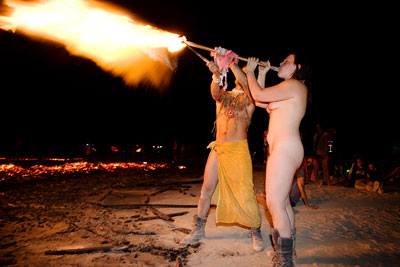
1510 burning man

Creative group Uchronia at Burning Man 2006 http://www.uchronians.org

Another speaker at the symposium, Laura Kurgan uses new technologies to chronicle social change with a view to influencing political ideologies. She has written on the subject of mapping data in Close Up at a Distance.

1510 Laura Kurgan

Satellite data images are built from pixels radioed from outer space. These statistics often record situations of intense conflict and can express fundamental transformations in our ways of seeing and of experiencing space. This data was intended for military and governmental uses but Laura Kurgan repurposed it to open up new spaces and present new views.  Technology has brought about a revolutionary shift in our ability to navigate, inhabit, and define the spatial realm. The traces of interactions, both physical and virtual, charted by the maps in Close Up at a Distance define this shift.

Laura Kurgan presents two of her projects which map the movement of people in this link: Human Geographies

1510 Laura Kurgan 2

Native Land looks at economical migration and money transfers, migration due to natural disasters exacerbated by climate change, loss of forests and loss of native language. Through a series of animated maps and graphs she shows major social change happening on a global scale in an easy to grasp visual format.

What we’ve traditionally called “the universe” — the aftermath of “our” big bang — may be just one island, just one patch of space, in a perhaps-infinite archipelago. There may have been an infinity of big bangs, not just one. Each constituent of this “multiverse” cooled down differently, ending up governed by different laws. – Lord Martin Rees

Current theories in physics that debate the possibility of us living in a multiverse challenge our perceptions of space and time.

1510 multiverse

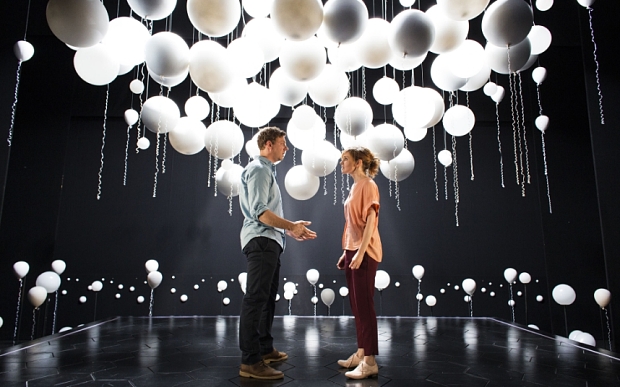
This subject was tackled in Constellations a play by Nick Payne.  It was superb theatre acted impeccably by Louise Brealey and Joe Armstrong and powerfully directed by Michael Longhurst.

Constellations by Nick Payne

Constellations by Nick Payne

Constellations takes one relationship and looks at alternative scenarios and the possible outcomes of infinite possibilities. What if we live in a multiverse and every decision we make is somewhere else happening just slightly different? The twists and turns and subtleties that these actors brought to life in funny and heart rending moments was astonishing in itself and then the ideas that this play throws up about the big questions of our place in the universe and our relationship to death added depth and resonance to a play that stays in your heart. It helped to analyse the concept of a multiverse in very human terms.

We are fascinated by the disaster. The allure of the sublime always contains some element of death.

Shown by curators Coates and Scarry in Complicit Kate MccGwire’s sleek feathered sculptures and Juliette Losq’s muted watercolour landscapes take you to the edge where beauty slides into a sort of dissonance.

Kate MccGwire Taunt

Kate MccGwire Taunt

MccGwire’s amorphous shapes that gleam and curl in upon themselves sit well with the lost spaces Losq creates in both 2D and 3D where she physically tears through the paper landscape drawing you further in to a world falling apart around you.

Juliette Losq Covert

Juliette Losq Covert

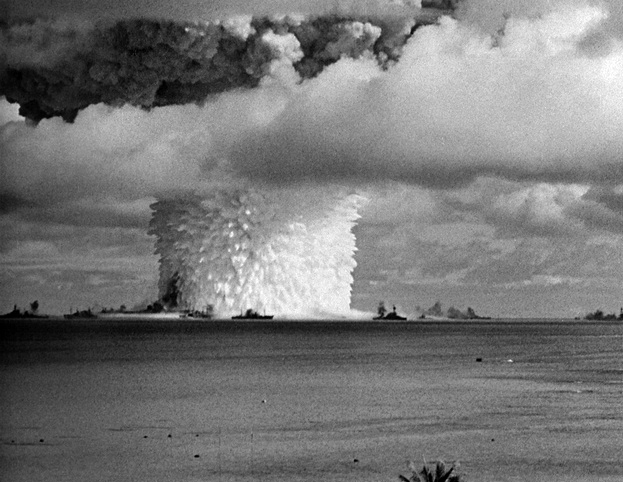
The beauty of destruction on an epic scale was showing at Thomas Dane in a screening of Bruce Conner’s thirty-seven-minute film CROSSROADS produced in 1976 from archival footage of the first nuclear tests conducted in 1946 at Bikini Atoll.

Bruce Conner Crossroads

Bruce Conner Crossroads

As terrifying as it is beautiful, CROSSROADS plays witness to the detonation of a nuclear weapon as powerful as the atomic bomb dropped on Nagasaki, ninety feet below the surface of the ocean, under a fleet of decommissioned naval ships as test subjects for the bomb’s destructive powers.

Sixty-four aircraft with 328 cameras (some of which were radio-controlled drones) circled the detonation site using high speed film and equipment that would take a million pictures in the first few seconds of the explosion. This event was to be the most comprehensively photographed moment in history.

Conner was able to draw upon this extensive footage allowing the viewer to experience the detonation repeatedly in a constant succession of waves, overwhelming in its beauty and tragedy creating an unbearable ecstasy.

Bikini Atoll caught in the crossfire symbolises the dawn of the nuclear age, despite its paradoxical image of an earthly paradise.

Bikini children leaving the island 1946

Bikini children leaving the island 1946

The terrible legacy of the nuclear tests lives on through the forced displacement of the indigenous people of these islands whose homes and health were sacrificed.

Peter Kennard

Peter Kennard

The politics of Peter Kennard are blatantly siphoned into his art with no apologies.

I visited his major retrospective at the Imperial War Museum which I found moving in its directness.

Peter Kennard

Peter Kennard

I was interested in Matt Gee’s exhibition Nutri-Artifice at  Gallery 286 for his use of crystals and human intervention in landscape. He shows us an unreal beauty. Chemical colours and textures mingle in an unclear divide between the artificial and the organic.

Matt Gee Mountain Bend

Matt Gee Mountain Bend

Marc Quinn was also exploring desire and the artificial in The Toxic Sublime at White Cube, Bermondsey. In his Toxic Sublime series the use of sugary colours echoes the formulaic image of the sun rising over the ocean that he takes as his starting point and then the sickly sweet is attacked, frottaged with municipal street architecture, blasted to aluminium before finally being bent and geometrically distorted.

Marc Quinn The Toxic Sublime

Marc Quinn The Toxic Sublime

If it was the vulgar Quinn wanted to expose with this process then it works and the repetition in the gallery adds to this toxic overload. The sculptures in the same show vary dramatically from a similar overdone crudeness to the sublime.

Marc Quinn Frozen Wave

Marc Quinn at White Cube

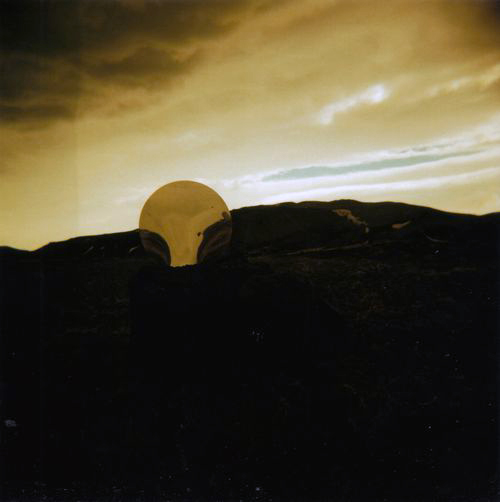
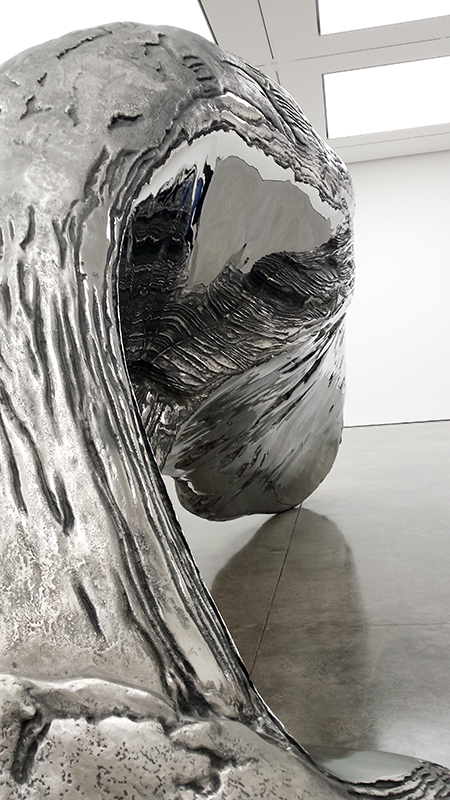
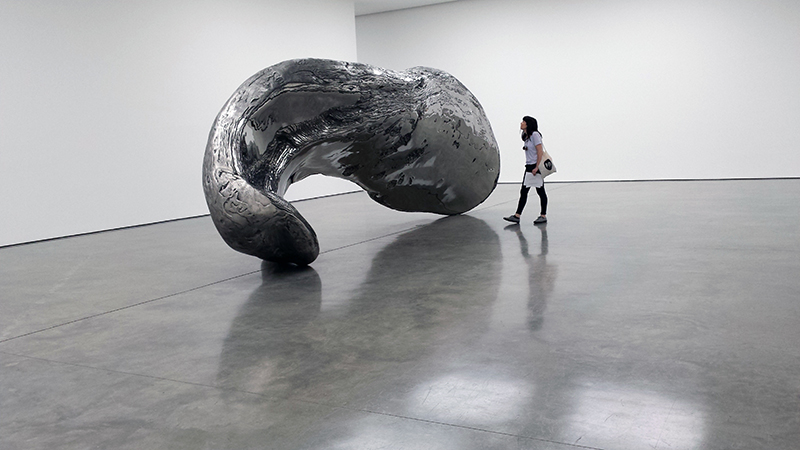
Frozen Wave, in highly polished stainless steel, has all the magnificence of a weight of water about to crash. It embodies the frisson of disaster that holds you in awe of its power and beauty. Vast and primordial Frozen Wave (The Conservation of Energy) makes connections between nature and humanity that resonate deep within us.

Marc Quinn

Marc Quinn Frozen Wave (The conservation of energy)

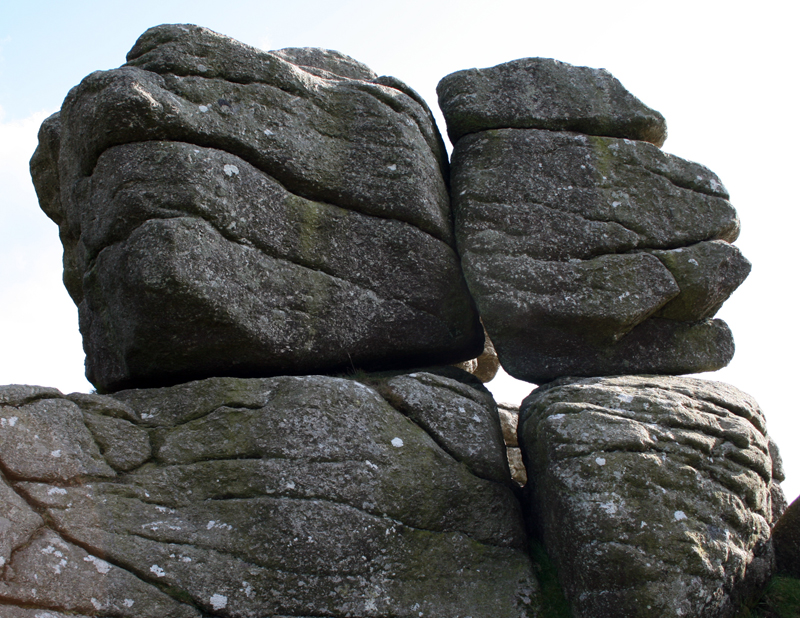
1510 Dartmoor

I was pleased to be invited to take part in the Rising Stars exhibition at Coombe Gallery, Dartmouth, Devon.

Coombe Gallery

Coombe Gallery

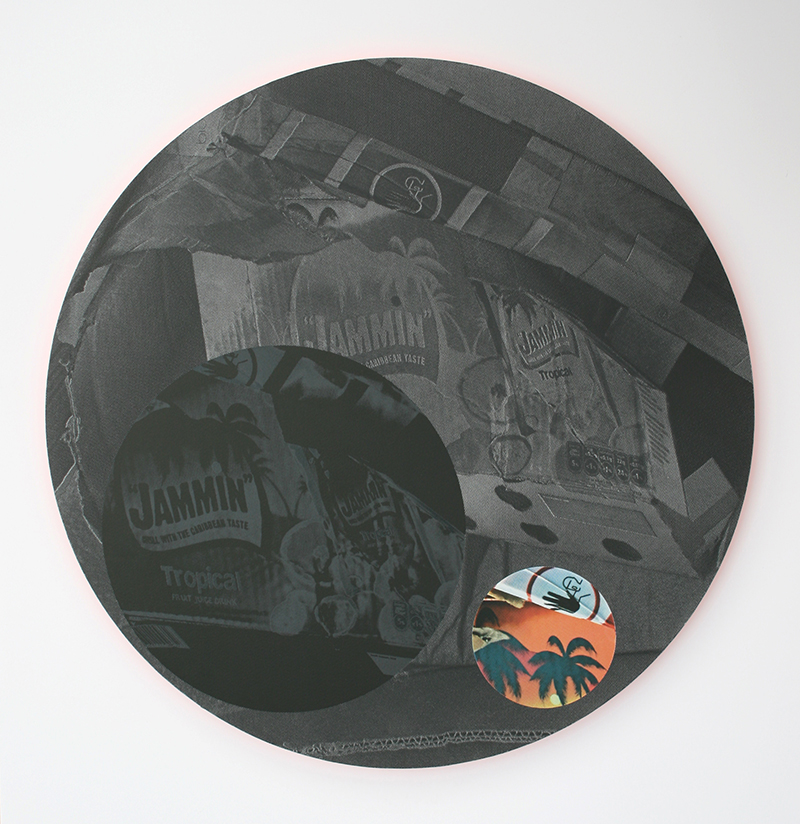
For this show I mounted some of the screenprints I had made on paper from the everydaymatters series.

Susan Eyre everydaymatters (tropical SE16)

Susan Eyre everydaymatters (tropical SE16)

I used laser cut mdf circles and painted the backs with fluorescent paint so they radiate a glow on the wall behind.

1510 fluorescent

One step to my independence has been the purchase of a power saw to cut mitre joints for sub-frames to hang work. Not very exciting but I was able to make my own subframes for this work so they can sit a little out from the wall.

Susan Eyre everydaymatters(tropicalia SW3)

Susan Eyre everydaymatters (tropicalia SW3)

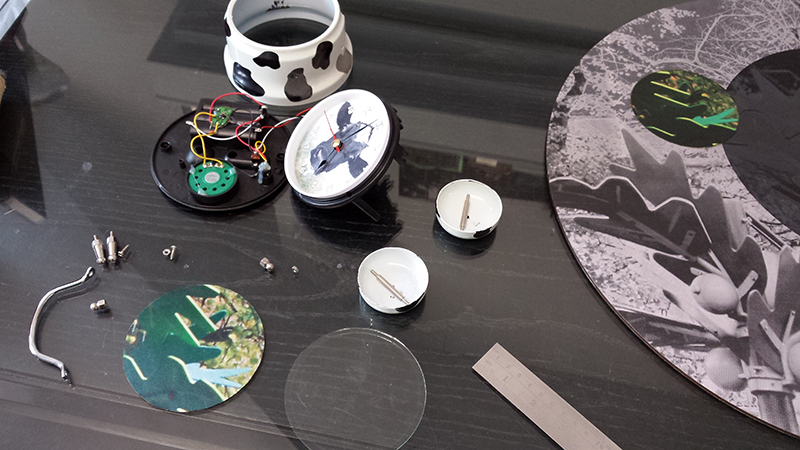
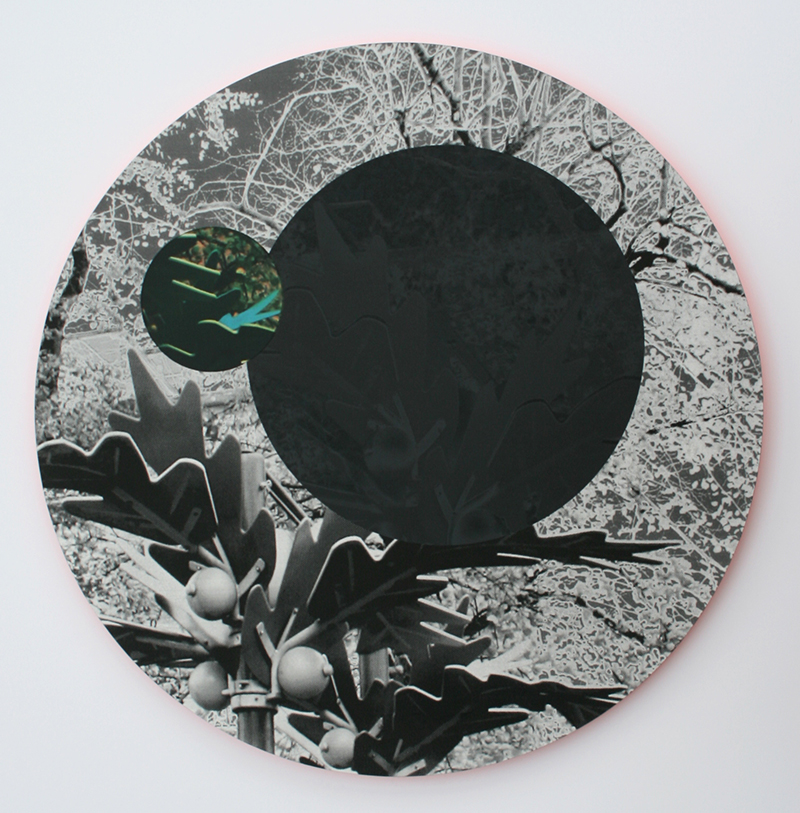
I have been pleased that I was able to transfer the screenprints I had made on fabric onto mdf too. I have been able to collage these with new sublimation prints and am quite pleased with the outcome.

1510 clock

A lot of my time since leaving the RCA seems to have been taken up by admin, submitting proposals, writing statements, framing up or mounting work, delivering and picking up.

Susan Eyre everydaymatters (palm SW4)

Susan Eyre everydaymatters (palm SW4)

I used the trip delivering work to Dartmouth to stop off and look at some Neolithic landscape as part of my research looking at ancient rituals and then considering their modern equivalent.

1510 Wood Henge grave

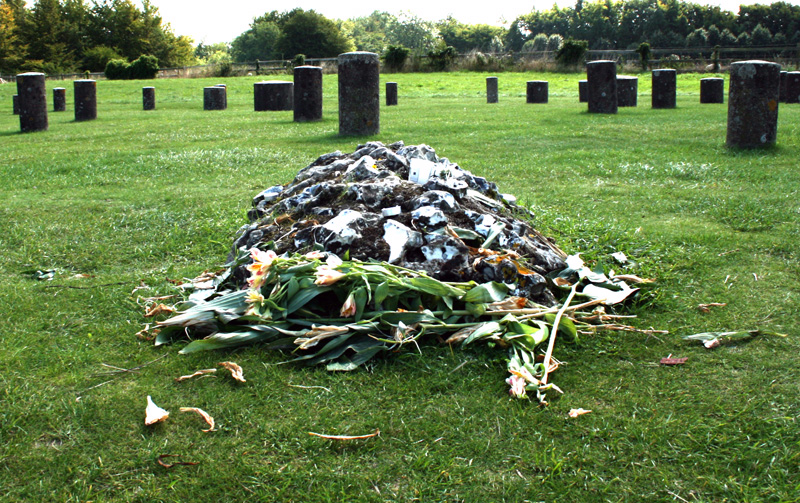
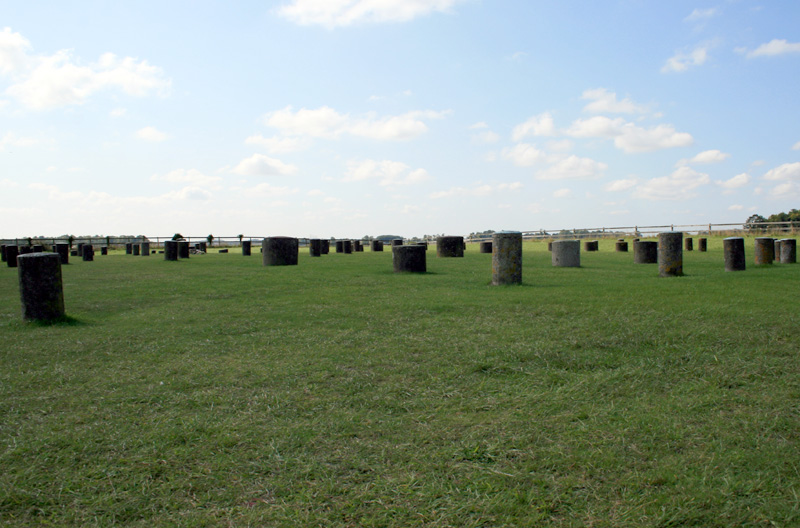
Dating from 2300 BC, Woodhenge is thought to have marked a particular stage in the evolution of human religious belief and community organisation. Originally believed to be the remains of a large burial mound the concrete markers that stand there today replace the six concentric rings of timber posts which are believed to have once supported a ring-shaped building. The small grave in the centre believed to be of a child is still paid homage to with candles and flowers today.

1510 Wood Henge

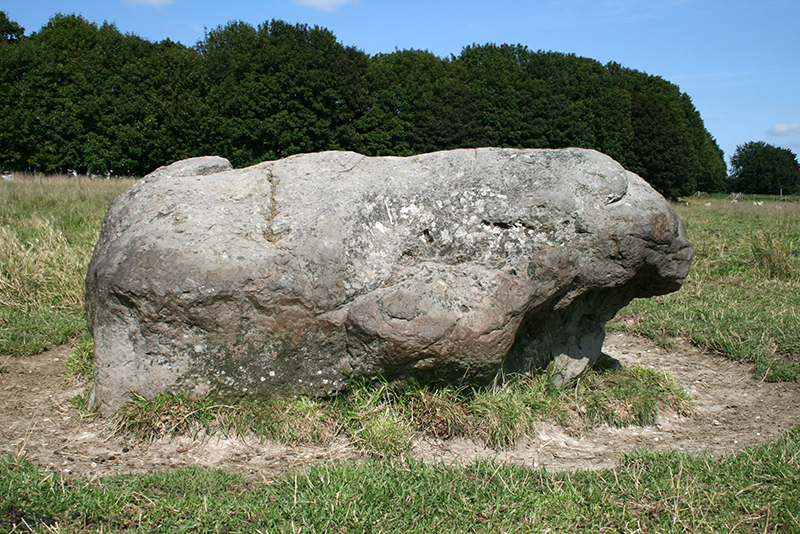
On the day I visited there were TV cameras and helicopters overhead as news was broadcast that archeologists have discovered evidence of the hidden remains of  a massive Neolithic stone monument, thought to have been hauled into position more than 4,500 years ago completely rewriting the history of Stonehenge and the surrounding area.

1510 Cuckoo Stone

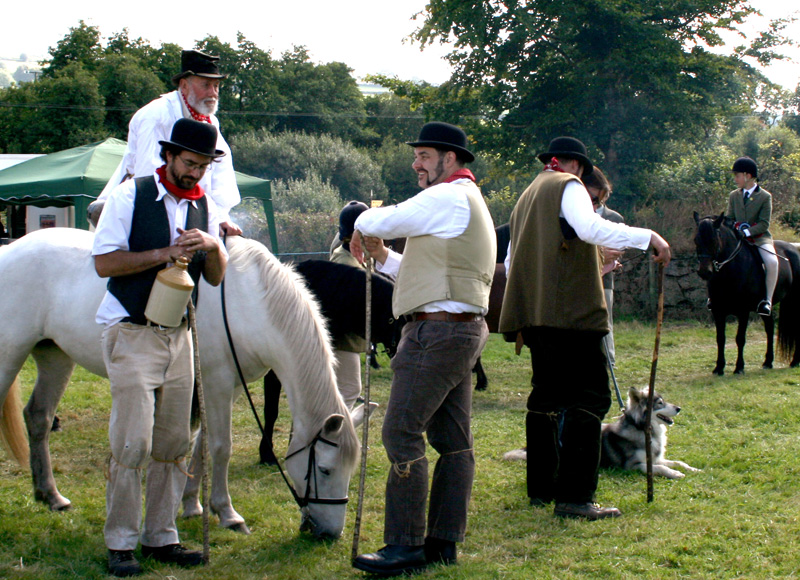
While I was in Devon I was also able to visit Widecombe Fair famed for the ditty from which this verse is taken…

When the wind whistles cold on the moor of the night.
All along, down along, out along lea.
Tom Pearce’s old mare doth appear ghastly white,
With Bill Brewer, Jan Stewer, Peter Gurney,
Peter Davy, Dan’l Whiddon, Harry Hawke,
Old Uncle Tom Cobley and all,
Old Uncle Tom Cobley and all.

Widecombe Fair

Widecombe Fair

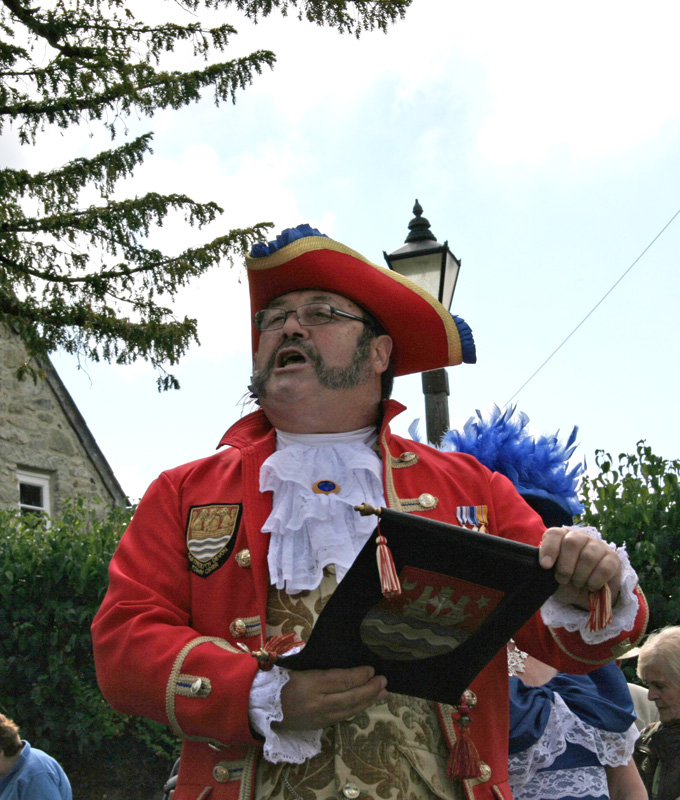
I was interested to see if I could identify any ancient rituals being passed on and adapted

Widecombe Fair Town Cryer competition

Widecombe Fair Town Cryer competition

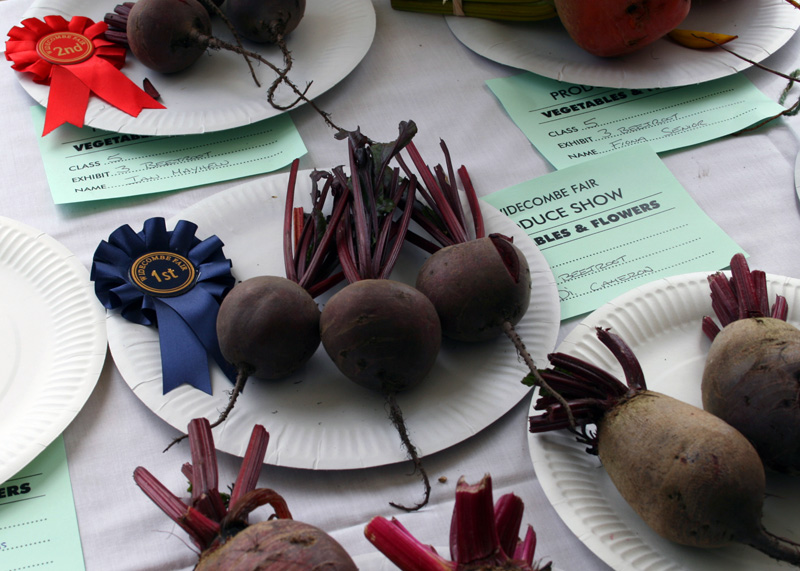
Widecombe Fair Prize Vegetables

Widecombe Fair Prize Vegetables

1510 Widecombe Fair beetroot

Widecombe Fair Viking

Viking re-enactment with mystic raven

Widecombe Fair

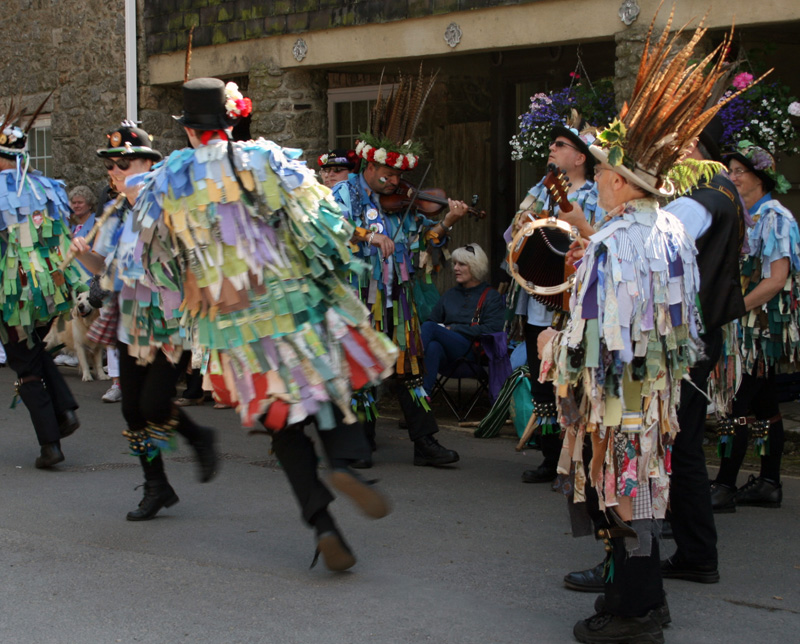
Widecombe Fair Morris Dancers

In another excursion west I was pleased to have my sculptures everydaymatters selected for the Wells Art Contemporary by judges Richard Wentworth, Mariele Neudecker and Donald Smith.

Susan Eyre everydaymatters

Susan Eyre everydaymatters

Susan Eyre everydaymatters

Susan Eyre everydaymatters

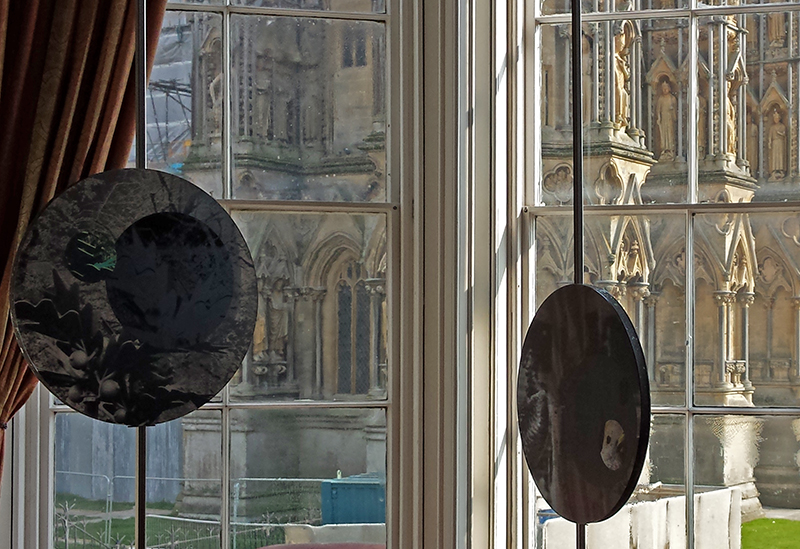
As space was tight in the Wells and Mendip Museum where the exhibition takes place it was only possible to show three of the seven but I did have a great backdrop in Wells Cathedral.

Susan Eyre everydaymatters

Susan Eyre everydaymatters

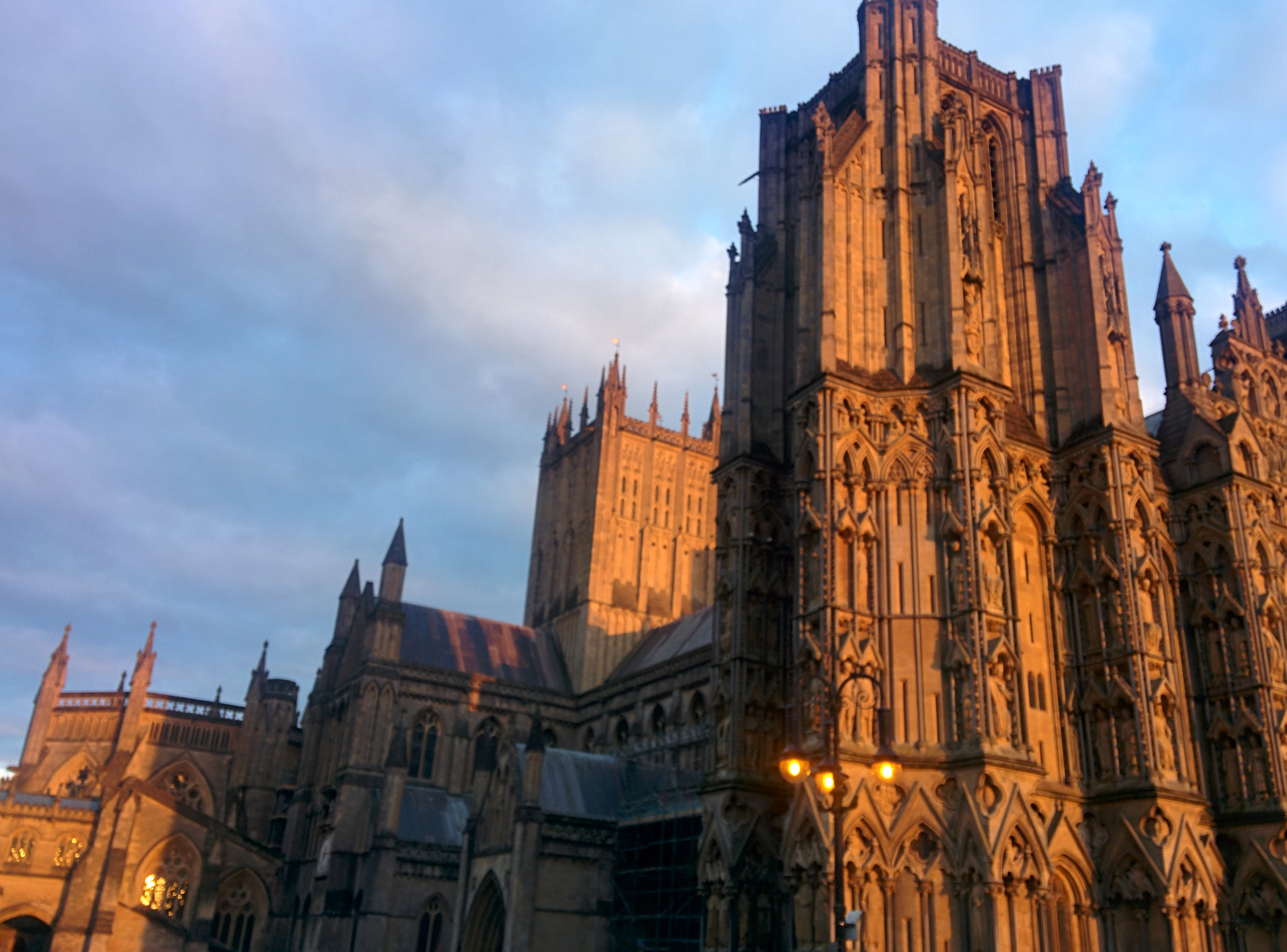
While in Wells I took the opportunity to visit their impressive Cathedral. Set upon the source of ancient springs (or wells) there has been a sacred site here since the first human settlements.

1510 Wells Cathedral

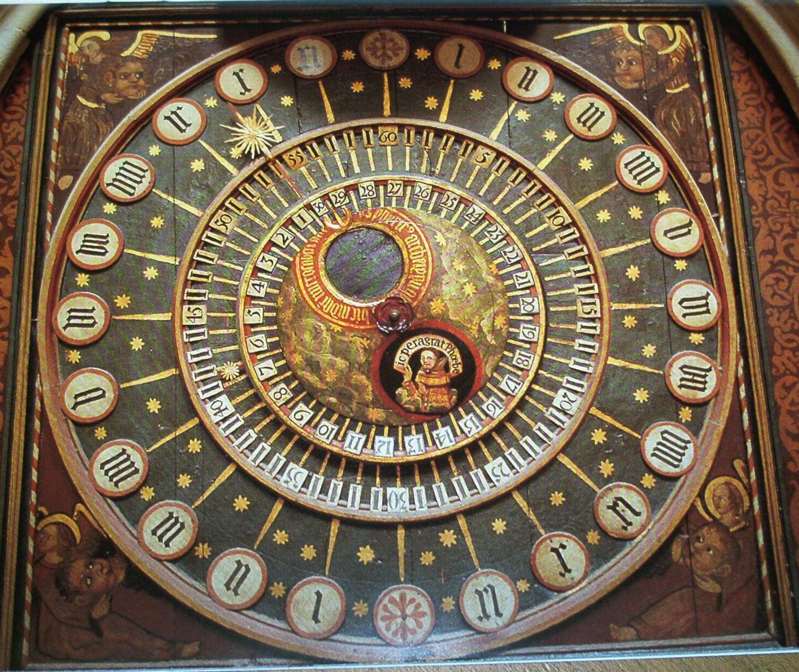
This most ancient Cathedral is also famous for its astronomical clock and it was a real treat to see it theatrically strike the hour.

The clock is inspiring not only for its immense age but the intricacies of its design and mechanisms. The ornamental dial depicts the pre Copernican geocentric view of the universe, with the sun and moon revolving around earth at the centre.

1510 Wells_cathedral_clock_dial

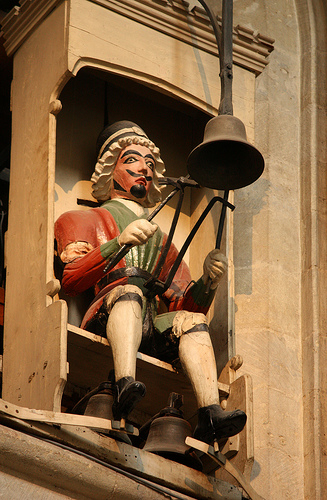
Above the clock sitting in the corner is a figure, known as Jack Blandifers, who has been counting time for over 600 years. Every 15 minutes he hits a bell with a hammer and two bells with his heels while above the clock a troupe of jousting knights hurtle around a podium.

1510 Jack Blandifer

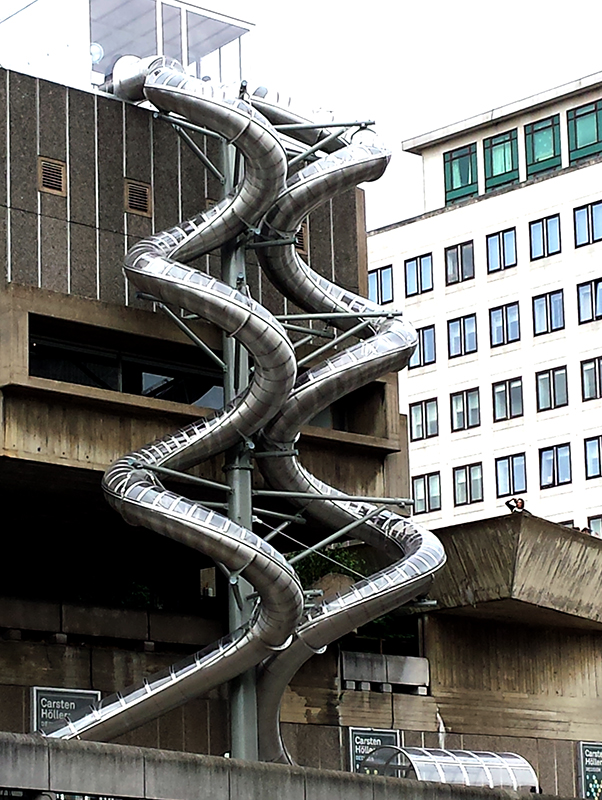
Carsten Höller intends for his work to bring about ‘moments of not knowing.’ For his exhibition at the Hayward Gallery Decision you enter through Decision Corridors a dark tunnel which twists and turns and divides. It is a hesitant journey made by feeling along the walls and punctuated by screaming teenagers careering though at speed.

Carsten Holler Flying Mushrooms

Carsten Höller Flying Mushrooms

I liked the Flying Mushrooms mechanisms of interconnecting cogs and rotating orbs which seemed to represent an alternative solar system. There was the opportunity to push a bar which in turn moved the cogs.

Haywood Gallery

Haywood Gallery

BBC Drama Block

BBC Drama Block

Most of the exhibits in this show were participative in some way and the decisions were much about whether to push the bar, take the pill, or ride the slide but some did interfere with perception in an uncomfortable squeaky chalkboard sort of way.

Carsten Holler The Forests

Carsten Höller The Forests

I found I couldn’t cope with The Forests a dual screen video shown on a headset that splits your vision in two as one eye takes a route in the forest one way and the other eye another. This made me squirm as I felt my brain trying to cope and reconnect to one single image made from both eyes.

1510 Ben Rivers 3

The mysterious title of Ben Rivers cinematic installation The Two Eyes Are Not Brothers  originates from a whispered warning overheard in a Tangiers café by Paul Bowles.

Ben Rivers

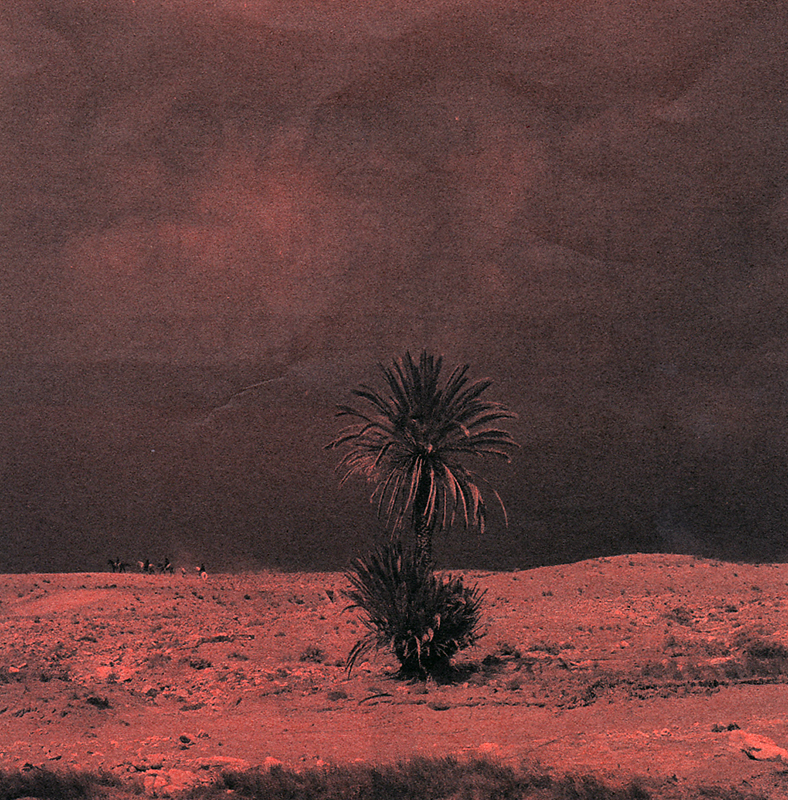
Composer and novelist Bowles and his wife Jane settled in Morocco in the forties. In turn inspired by this landscape Ben Rivers films weave in and out of fiction and reality layering the violent narrative from Bowles short story A Distant Episode of a European abducted by bandits though re-enactment by non actors using the abandoned film sets that litter the Atlas Mountains.  By chance while in Tangier, Rivers meets and subsequently films Mohammed Mrabet now 79 who once inspired the Bowles couple with his stories of local folklore.

Ben Rivers The Two Eyes Are Not Brothers

Ben Rivers The Two Eyes Are Not Brothers

Another serendipitous opportunity  for Rivers to add yet another layer was meeting artist Shezad Dawood on location independently filming for his own work.

1510 ben rivers 1

This palimpsest of stories, real and fictional, is then appositely presented in the former BBC Drama Block at White City currently due for demolition.

Ben Rivers installation at BBC White City

Ben Rivers installation at BBC White City

Led into a world that has moved on there is the chance to explore the vast BBC studios before they are erased.

1510 bbc centre 5

1510 bbc centre

In an interview in the Paris Review 1981 Paul Bowles responds to the question of violence in his work

“Yes, I suppose the violence served a therapeutic purpose. It’s unsettling to think that at any moment life can flare up into senseless violence. But it can and does, and people need to be ready for it. What you make for others is first of all what you make for yourself. If I’m persuaded that our life is predicated upon violence, that the entire structure of what we call civilization, the scaffolding that we’ve built up over the millennia, can collapse at any moment, then whatever I write is going to be affected by that assumption. The process of life presupposes violence, in the plant world the same as the animal world. But among the animals only man can conceptualize violence. Only man can enjoy the idea of destruction.”

1510 bbc centre 6

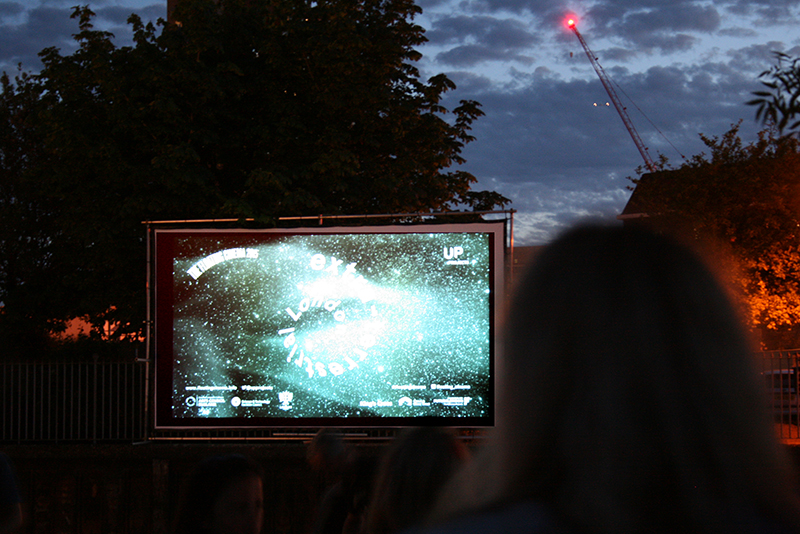
Up Projects with The Floating Cinema presented a series of events for Extra-Terrestrial London a highlight of which was the screening of Shezad Dawood’s Piercing Brightness.

1510 up projects

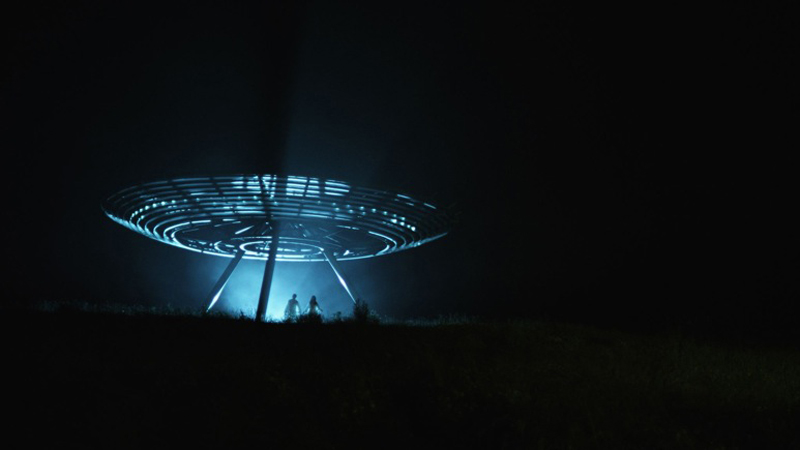
Before the screening Shezad gave an informal talk aboard a canal boat to explain how the film had come about and how he found Preston to be the perfect setting for a film about what it means to be alien.

Shezad Dawood Piercing Brightness

Shezad Dawood Piercing Brightness

There is a loose narrative to the film. Two alien youths land in a spaceship outside Preston. Their mission is to re-establish contact with the ‘Glorious 100’ sent to earth millennia ago in human form to study and observe the development of another race.

Shezad Dawood Piercing Brightness

Shezad Dawood Piercing Brightness

After making contact with one of the 100,  they discover that many of their kind have forgotten their original purpose and have slowly become integrated into their adopted home and no longer want to return to their home planet.

Chudamani Clowes White City

Chudamani Clowes White City

Migration and integration both current and historical were addressed by Chudamani Clowes in her solo show at the Griffin Gallery White City.

1510 Franco-British_Exhibition

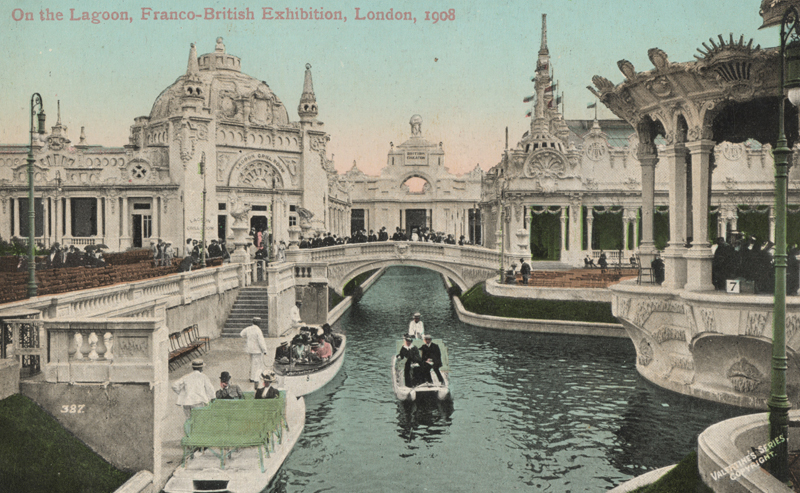
White City is the area local to the Griffin Gallery and gained its name from the white painted buildings of the Franco-British exhibition of 1908. At the time it was the largest exhibition of its kind in Britain and presented a number of model villages reconstructed to celebrate imperial achievements. This included Ballymaclinton, a ‘genuine’ Irish village. At the French Senegalese village, complete with imported ‘natives’, visitors could watch traditional dance performances. And at the Indian Arena,  Bollywood-style spectaculars were performed.

Chudamani Clowes White City

Chudamani Clowes White City

Chud, moved by news of the current migrant crisis uses the analogy of the jellyfish as migrant without borders caught in the ebb and flow of life to offer us the chance to rethink what it means to be other.

Chudamina Clowes Jellyfish dance

Chudamani Clowes Jellyfish Dance

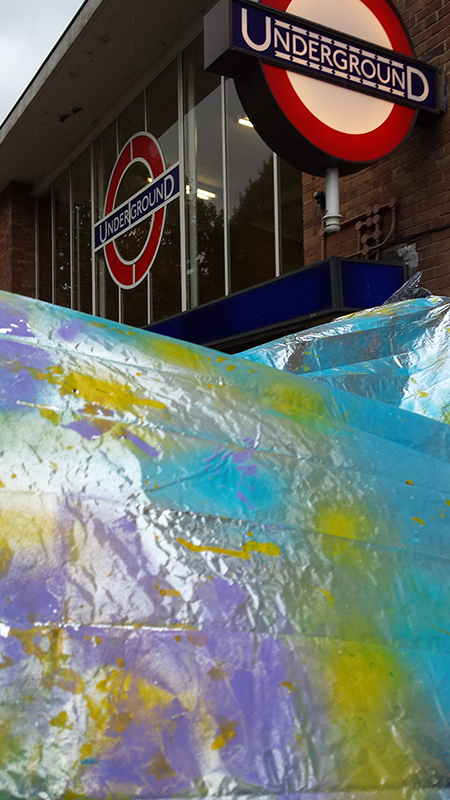
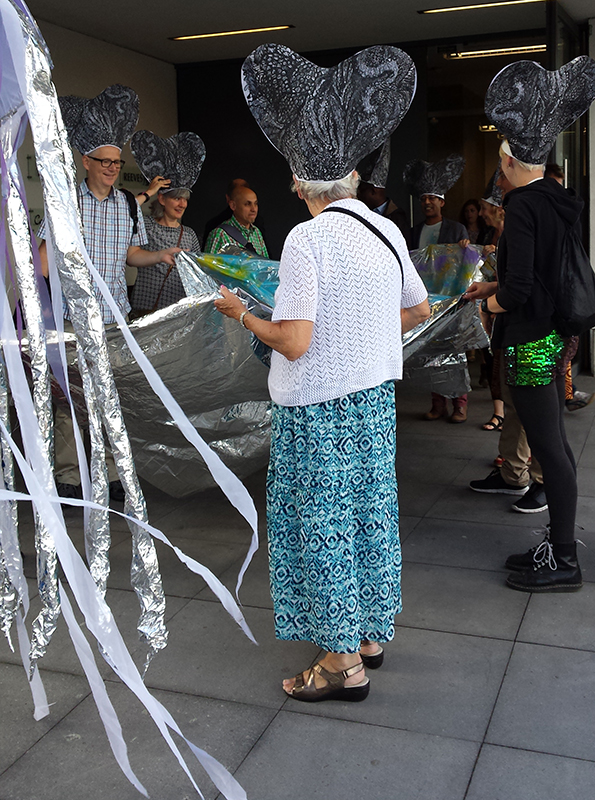
For the opening event the audience took part in a jellyfish procession from Griffin Gallery to White City tube station via the modern monolith of Westfields shopping centre and the current redevelopment of the BBC studios.

1510 Chud White City 4

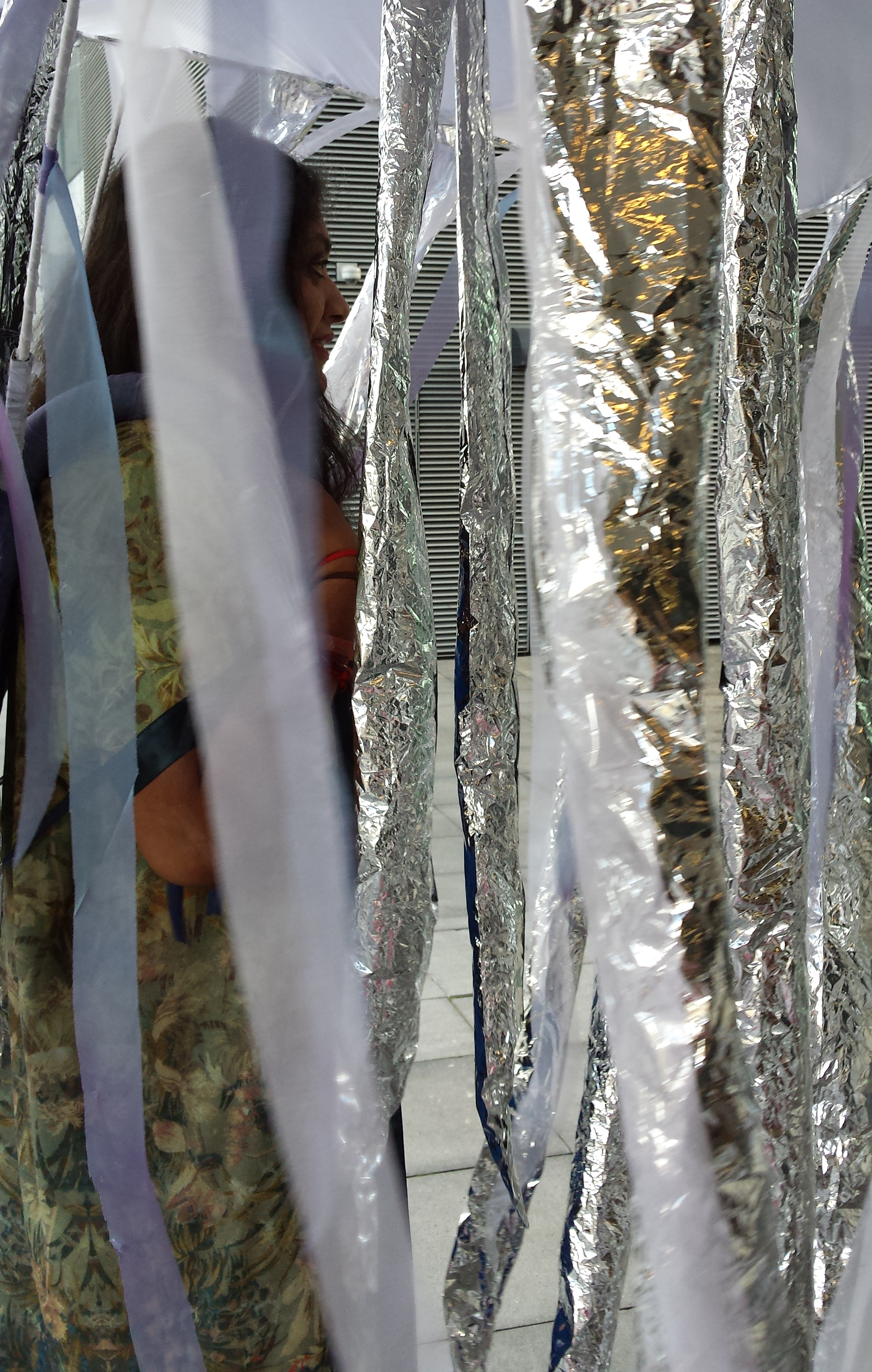
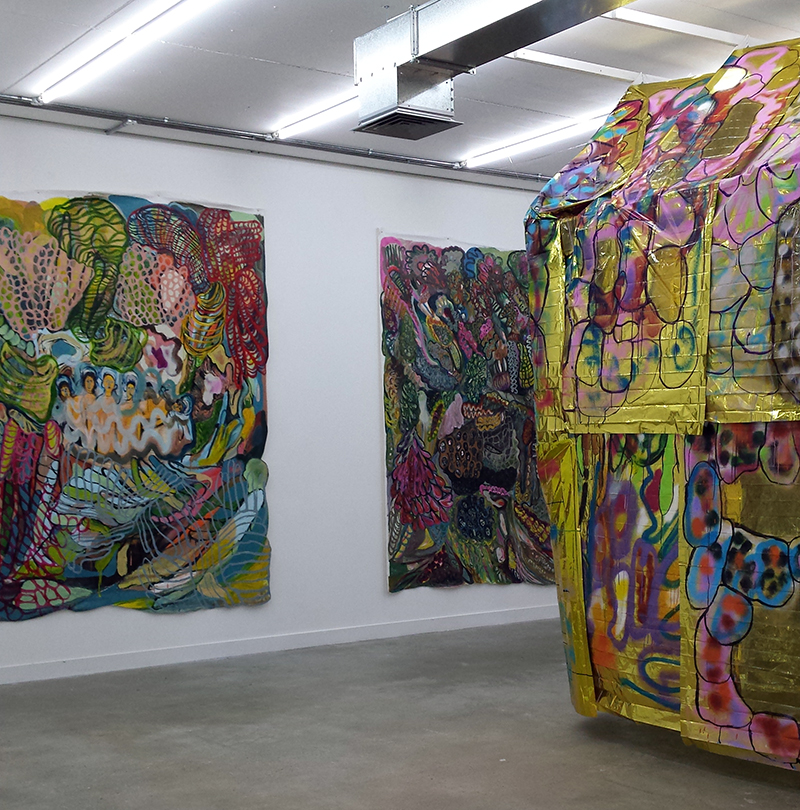
As colourful and spirited as her work Chud led the procession majestically trailing silver tentacles as we followed wearing Chud’s trademark bonnets creating the sparkling seas from undulating survival blankets in unison.

1510 Chud White City 7

In an Interview. about her work she talks of how she saw desperate migrants on the news having nothing yet looking almost regal wrapped in gold rescue blankets.

Chudamani Clowes White City

Chudamani Clowes White City

Her work aims to highlight perception and distortion and so she used these blankets to make a shelter in which see yourself reflected and distorted, you become other.

Chudamani Clowes White City

Chudamani Clowes White City

Chud talks about how important it is to tell our stories and keep our memories alive. To look at local history and appreciate that the oasis’ of culture we enjoy today are the hubs where migrants settled in the past.

Whenever you go down the roads in Britain, you travel not in three dimensions but in four. The fourth dimension is the past. And as we move to and fro in this fourth dimension, we see not only landscape but the economic, political and social forces at work behind the landscape, shaping it, forever changing it…

Travis Elborough and Bob Stanley

1510 st etienne

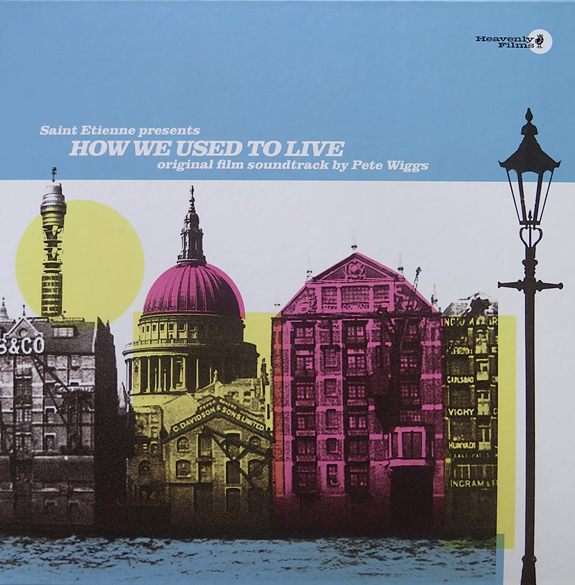
My second viewing of the film How We Used to Live was further enhanced by the live accompaniment of Saint Etienne playing the beautifully beguiling soundtrack.

1510 how we used to live

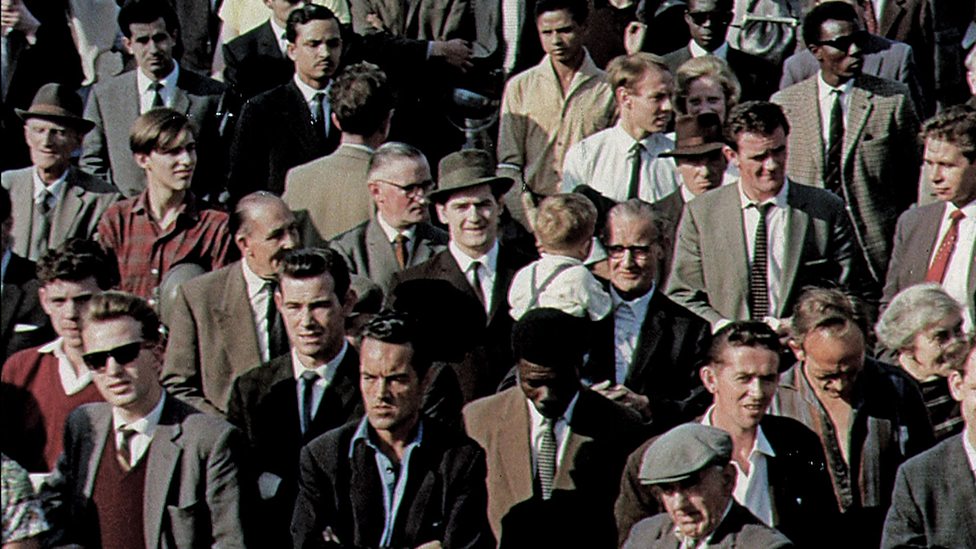
Splicing old BFI colour film footage of a lost London we are transported back to a pre digital world to witness the change from capital of industry to financial hub.

1510 light

I am interested in the aura of place and how this is defined.  I joined The London Occult Walk led by practising witch Delianne Forget who promised to point out the haunts and meeting places of magicians, witches and secret societies. Following a route from Embankment to Covent Garden we were encouraged to speculate on what might have occurred at certain sites along the way. We were asked to imagine the grand houses that once lined the embankment where nobility of the 16th and 17th centuries lived and the beliefs they held regarding the supernatural.

We began the walk on Villiers Road. I have had lots to research from this walk as many historical names and events were mentioned along the way.

There were stories of George Villiers  (1592-1628) who became the favourite of James I and then Charles I and who was a big influence on the royals but not popular with the government due to some of the other company he kept such as John Lamb who was accused of performing black magic. Both George Villiers who became The Duke of Buckingham and John Lamb were murdered, the first ambushed by a peeved army officer and the second stoned to death by a mob angry that due to his noble friends influence he had escaped justice for the violent rape of a young girl.

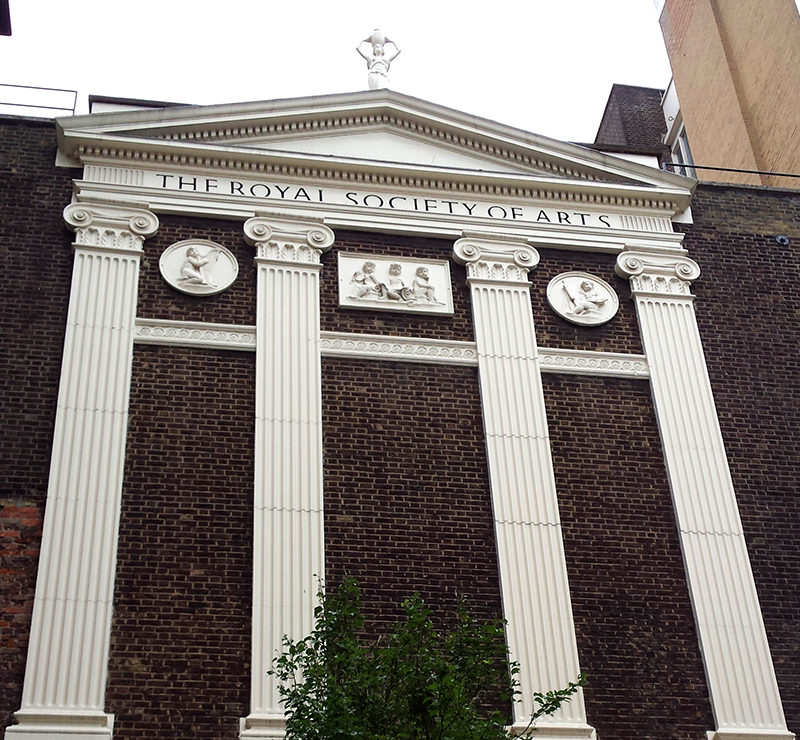
1510 Occult Walk RSA

We stopped at the grand Royal Society of Artists building.  Founded in a Covent Garden coffee house in 1755 the RSA moved in 1774 to this purpose built home set on the ancient site where the episcopal palace of Durham House once stood.  Durham House dated from 1345 and was home to Sir Walter Raleigh while he was a favourite of Elizabeth I.

Around 1592 Sir Walter Raleigh led the esoteric group The School of Atheism later nicknamed The School of Night  where alchemists, astronomers, astrologers, mathematicians and poets met and mingled their philosophies. This sort of debate was disapproved of by the church who wished to stamp out any interest in the sciences and preserve a geocentric view of the world.

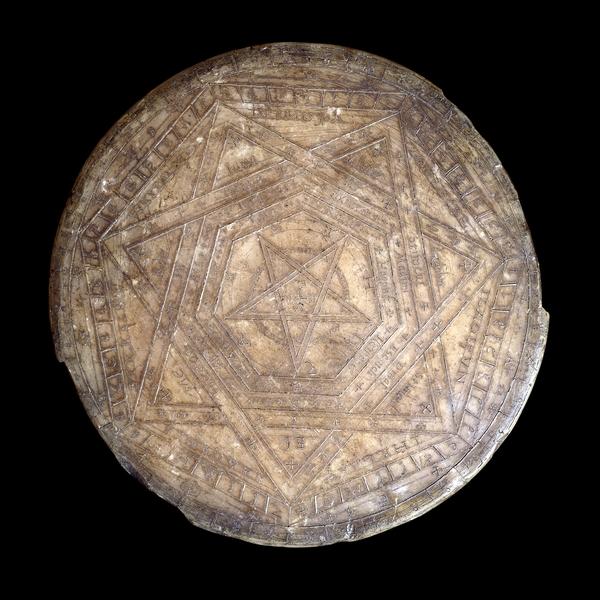
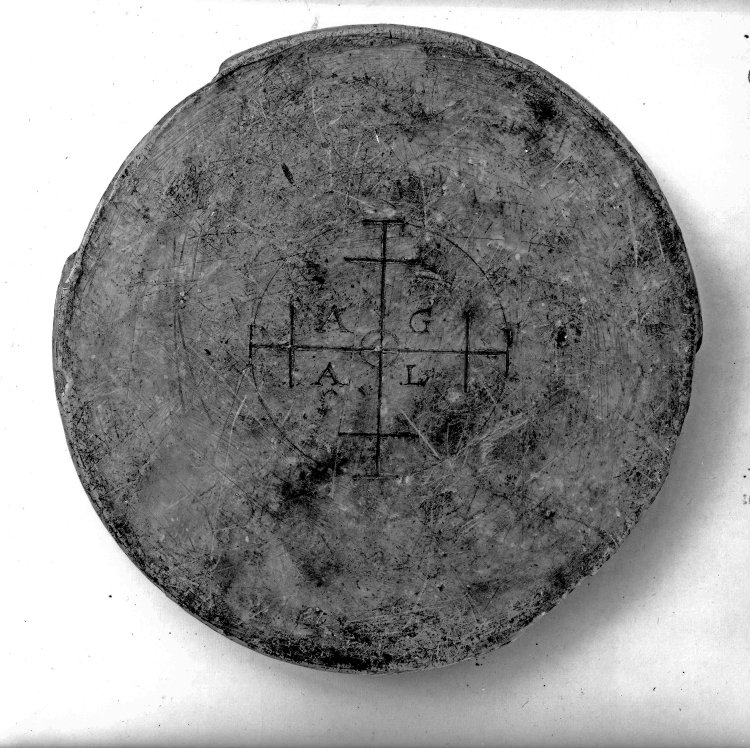
1510 Dee wax disc

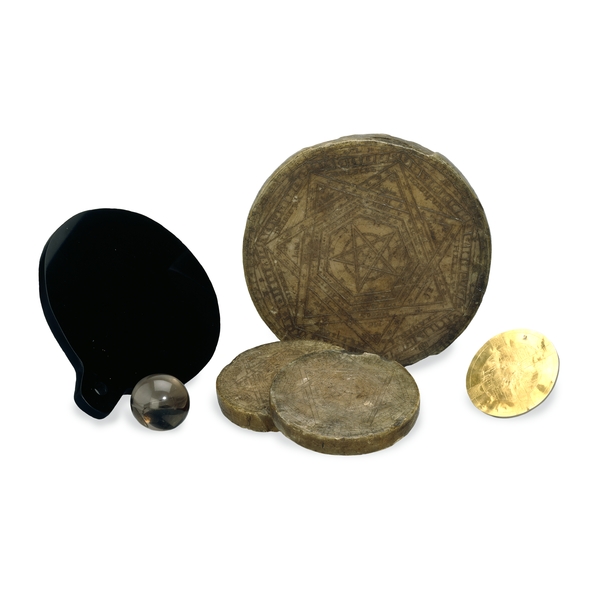
This trace from the past led us from Sir Walter Raleigh and Elizabeth I to the famed astrologer and occult philosopher John Dee who was the Queen’s trusted advisor and interpreter of the heavenly auspices. He would be summoned to Windsor for his opinion at the sudden appearance of a comet. There was no delineation between science and magic at the time. John Dee believed contact could be made with the spirit world via his crystal ball and obsidian scrying mirror.

John Dee's magical artefatcs held at The British Museum

John Dee’s magical items held at The British Museum

He was keen to work alongside other mediums who could contact the dead and thought he had found the ideal partner in Edward Kelly. There is a tale of the pair visiting Preston to raise a body dug up in St. Leonards graveyard from the dead with incantations. Relations with Kelly didn’t go so well after he forced Dee into a wife sharing co-op and the once famed alchemist pair split. Kelly ended up falling to his death from a window in an attempt to escape prison and Dee returned to his home at Mortlake out of favour now the Queen was dead, never quite having made his fortune and dying penniless in 1608.

1510 Dee disc

Stopping to look at the 1512 building of Queens Chapel of the Savoy, a tiny church owned by the crown we were told this was the ideal place for an Elizabethan grave robber’s work. What went on and who visited where was much speculated upon and the stories encompassed the past and spread to other figures who are remembered in history for their occultist interests.

Simon Forman was another Elizabethan astrologer who gained fame and notoriety studying the occult arts and practising as a physician until he was banned for not having a license. Despite his creepy and lecherous reputation he was able to get a license from Cambridge university and continue his practise and many of his fascinating case studies are held at the Bodlein Library on Oxford. William Lilly followed in this line of astrology publishing the Christian Astrology in 1647 and even gaining the approval of Oliver Cromwell.

1510 Thames high tide

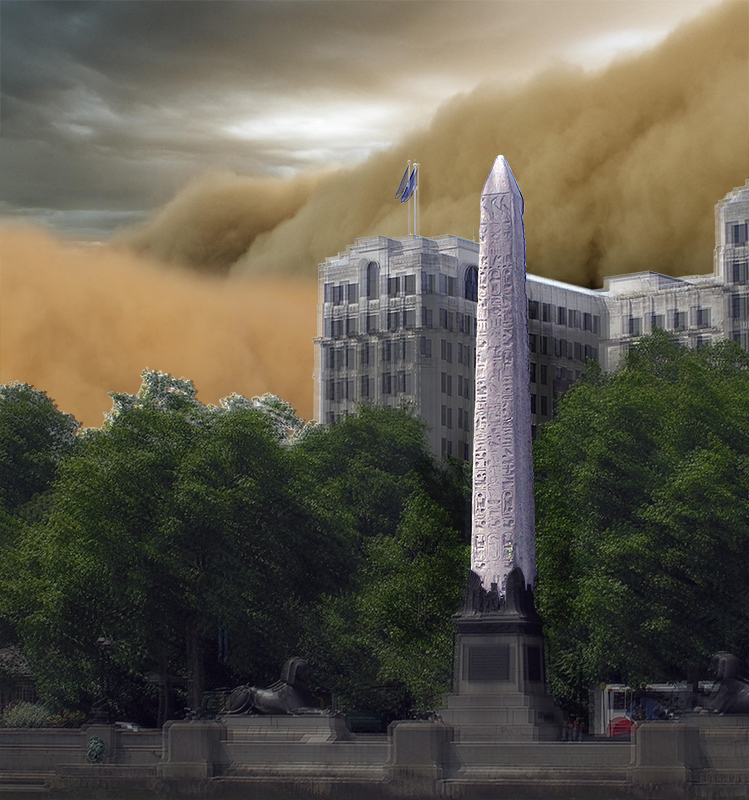
We walked along the Thames to the incongruously sited ancient Egyptian obelisk known as Cleopatra’s Needle.

1510 obelisk

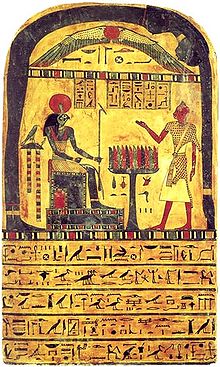
Here early on a December morning in 1937 as the sun entered Capricorn  Aleister Crowley gathered a small crowd representative of each race of mankind and gave each one a copy of his book The Equinox of the Gods. He gave a short speech including his mantra – Do what thou wilt shall be the whole of the law.  The book contains an image of the Stele of Revealing held in the Egyptian Museum in Cairo whose significance for Crowley is the depiction of the three chief deities of Thelema.

1510 stele of revealing

The origins of the Lyceum Theatre date to 1765 and we stopped to gaze up at a window where Bram Stoker worked as assistant to actor manager Henry Irving at the end of the 1800’s. Dracula was published in 1897. Stoker had an interest in the study of the occult and knew members of the Hermetic Order of the Golden Dawn but there is some dispute as to whether he was a member himself.

Our walk ended in Covent Garden where the original Hell Fire Club was founded by the Duke of Wharton to engage in the popular new pastimes of satire and blasphemy. These clubs were banned in 1721 by George I in a  Bill “against ‘horrid impieties”.  The most notorious Hell Fire Club set up by Sir Francis Dashwood in 1746 was known at the time as The Order of the Friars of St. Francis of Wycombe. I am reading a history of this club written by Donald McCormick published in 1958 which seems to seek to defend the ‘amorous knights of Wycombe’ as mere sensualists perfectly able to hold respected public office despite their recourse to excessive drinking and ‘wenching’. The sexist and homophobic 1950’s views in this book are just as repugnant as the 1750’s behaviour they defend.

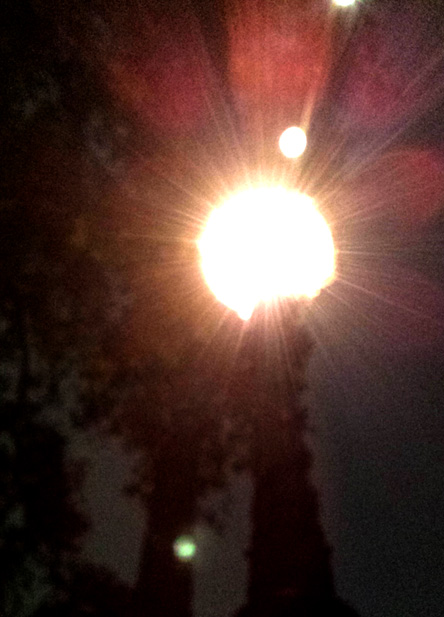
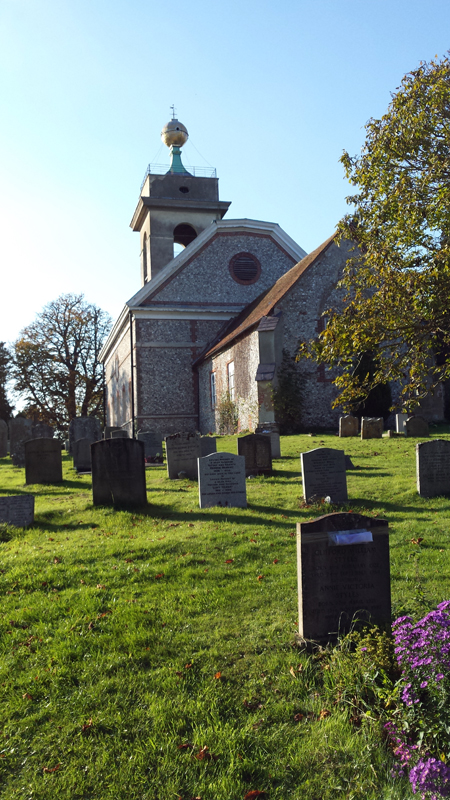
Rich and powerful these men created their own playground and their own rules. The striking golden globe on top of the tower of St. Lawrence’s Church built by Dashwood in 1761 can comfortably seat 4 men and was according to John Wilkes ‘the best Globe Tavern I was ever in.”

St. Lawrence's Church West Wycombe

St. Lawrence’s Church West Wycombe

Recently passing West Wycombe I stopped off to have a look at the Church.

St. Lawrence's Church West Wycombe

St. Lawrence’s Church West Wycombe

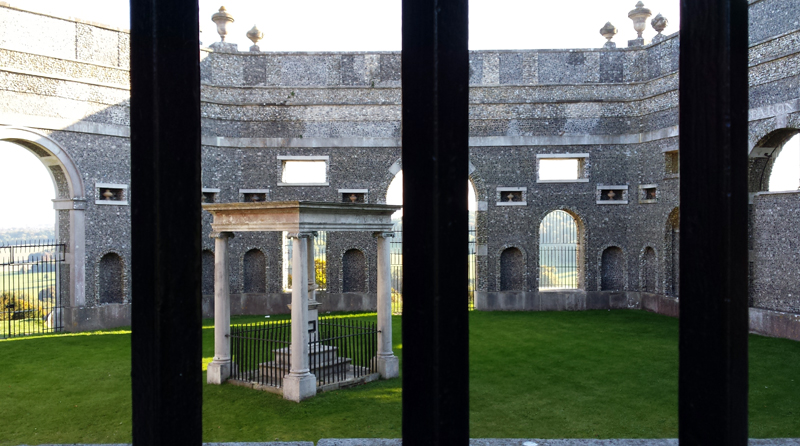
The Dashwood family mausoleum also on the hill overlooking West Wycombe Park is another flamboyant statement.

Dashwood Mausoleum

Dashwood Mausoleum

A visit to the caves where the brotherhood met will have to wait for another day.

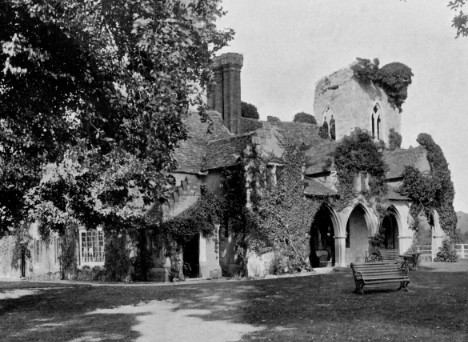
Medmenham Abbey was the headquarters for the Knights of Saint Francis of Wycombe before the caves which became their home were dug out and Dashwood based its refurbishment to his purposes on the Abbey of Thélème inspired by his love of the works of Rabelais and embracing the Thélème motto “FAY CE QUE VOUDRAS” (Do as you please)

Medmenham Abbey

Medmenham Abbey

I was interested to note that the Abbey of Thélème has no clocks as Gargantua believed  ” the greatest loss of time that I know is to count the hours.”

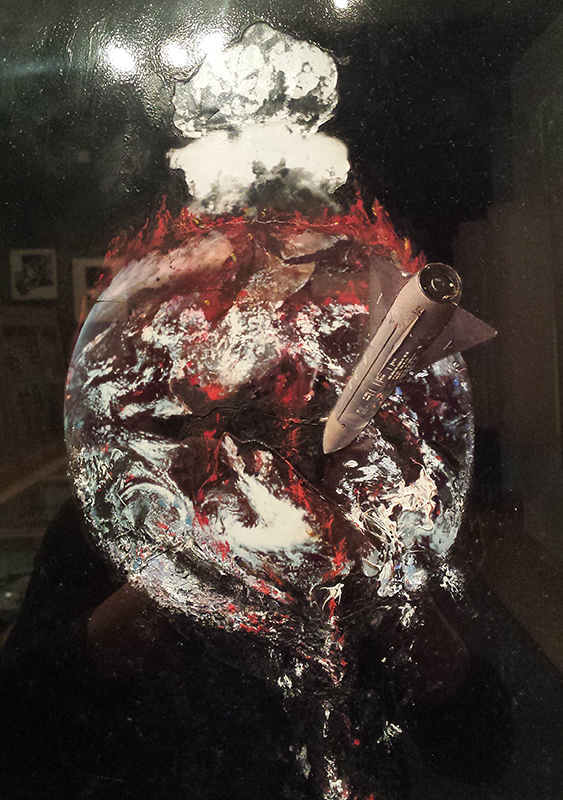
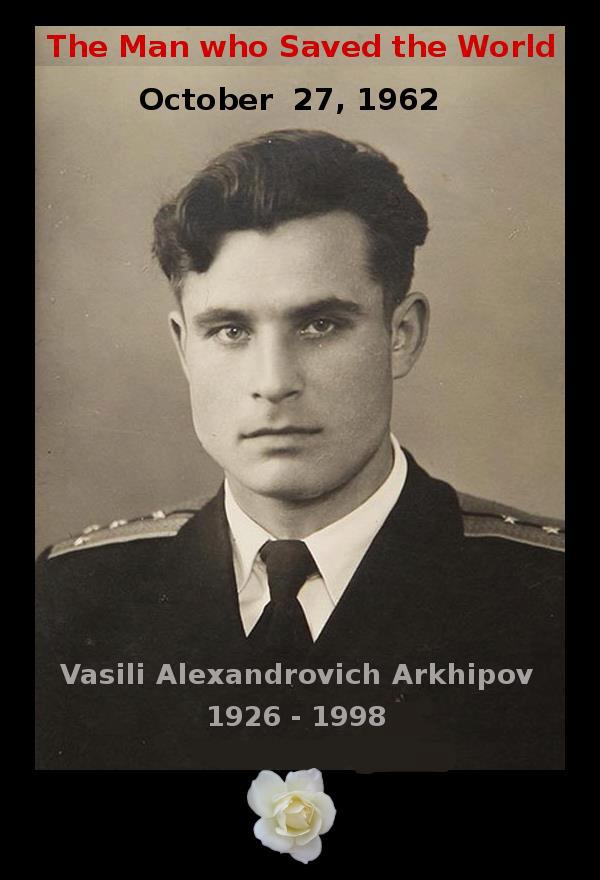
Going through my old sketchbooks I came across a cutting from the Sunday Times Culture Section dated 22/10/2006 written by Bryan Appleyard who quotes royal astronomer Martin Rees as predicting that we have no better than a 50/50 chance of surviving the 21st century.

1510 Archipov

It has always been the case that every culture and age sees the End of the World as imminent as though it were hard wired into our species to live in anticipation of destruction. The article Headlong into the Flames is actually a scathing book review of James Martin’s The Meaning of the 21st Century. Appleyard’s own analysis is that there is absolutely no prospect of people ever overcoming enough of their differences even to start to save the planet.
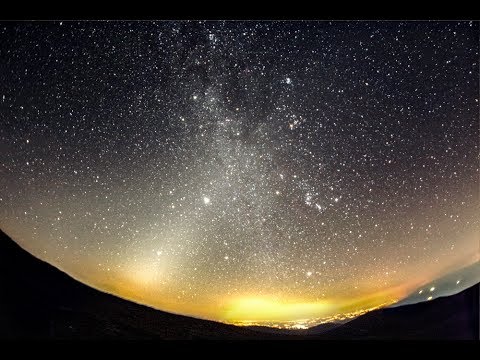
1510 mars to the multiverse

Hearing Lord Martin Rees recently speak at Second Home his analysis of our odds to survive might not have changed but if we do survive he thinks “Evolution will not follow the Darwinian timeline, but instead a new, technological trajectory…..Those who witness the explosion of the sun in four billion years time will be as different to us now as we are to insects”