Archives for posts with tag: Lisa Chang Lee

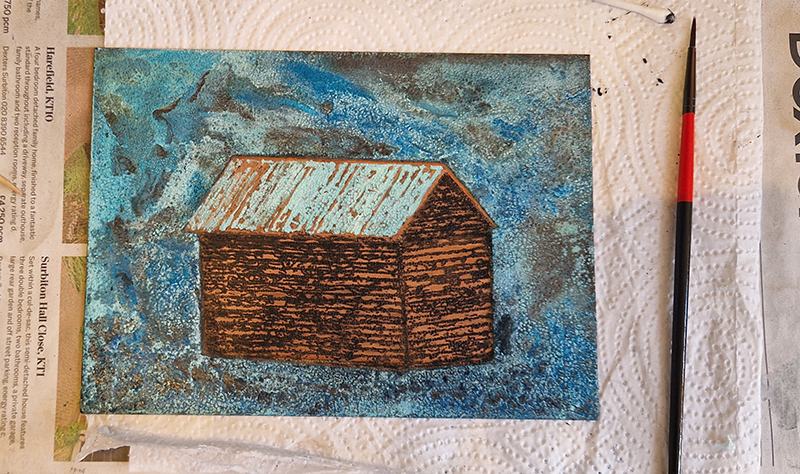
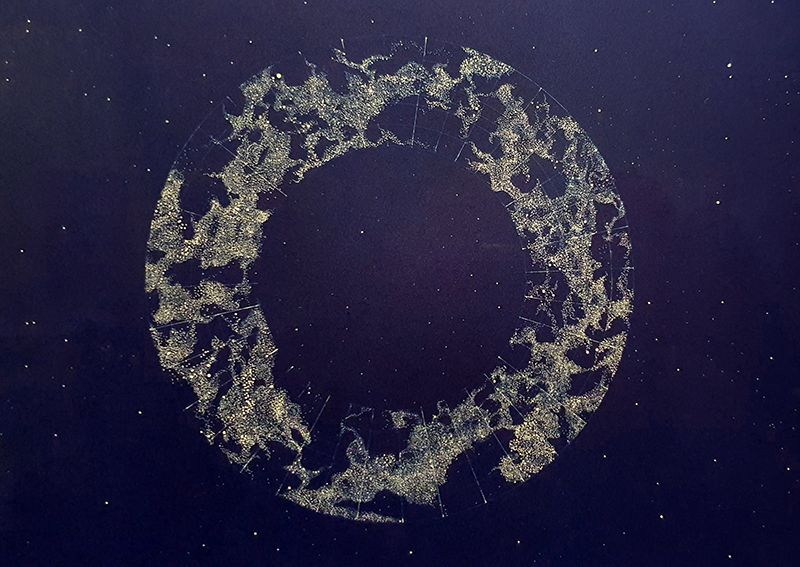
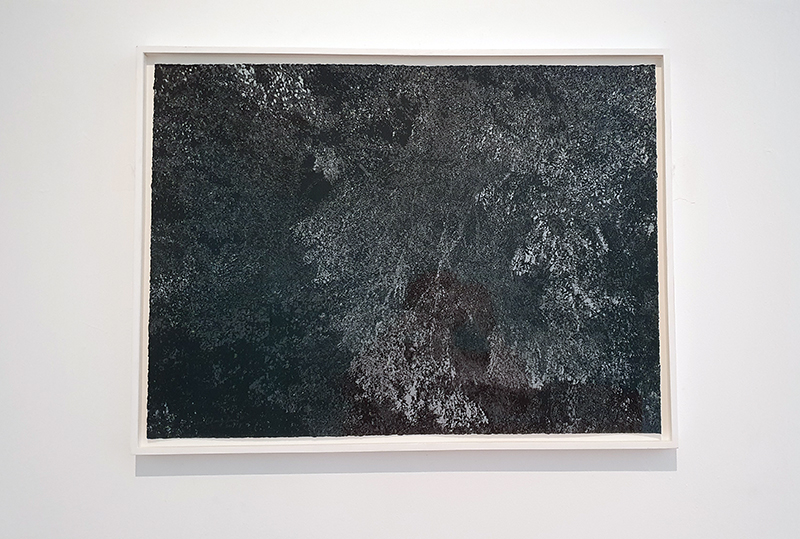
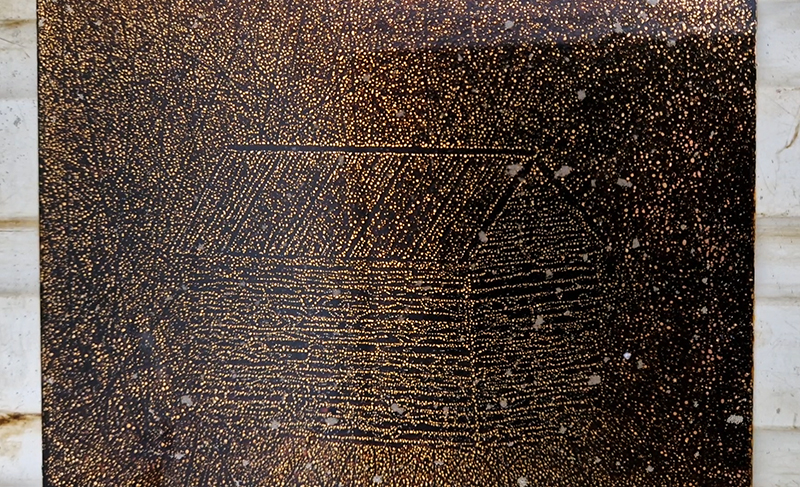
Now that the RWA secret postcard auction is over, I am able to reveal which of the postcards in the RWA secret auction was my contribution to this annual fundraiser. I was delighted that it received so many bids and amazed at the final offer. I hope the recipient is pleased with their purchase of Cosmic Hut.
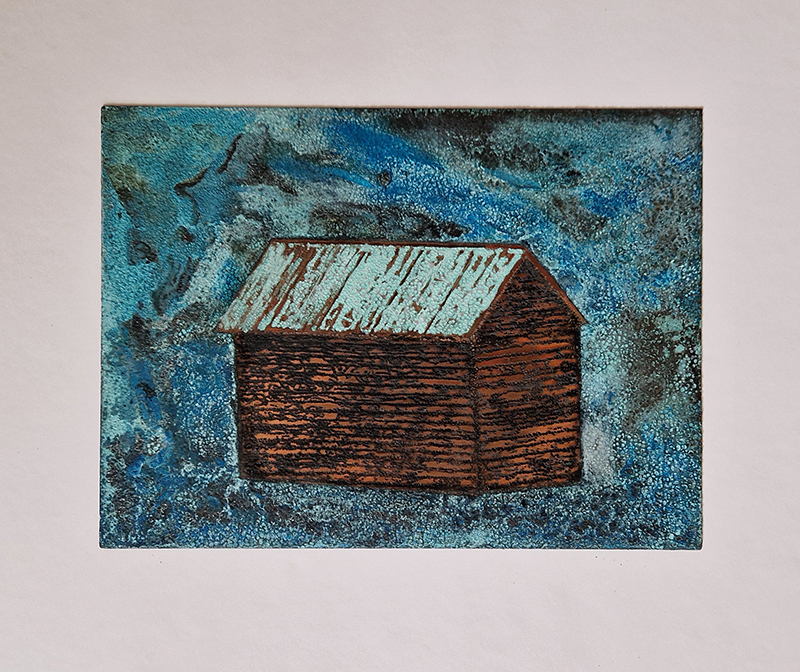
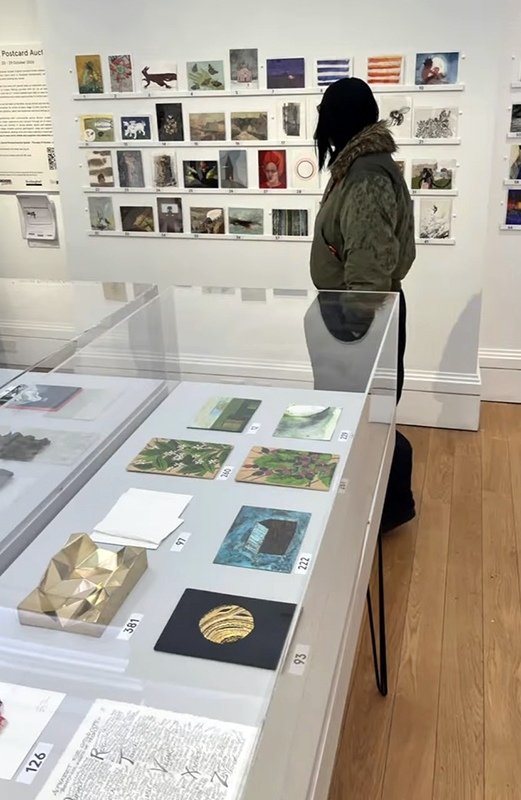
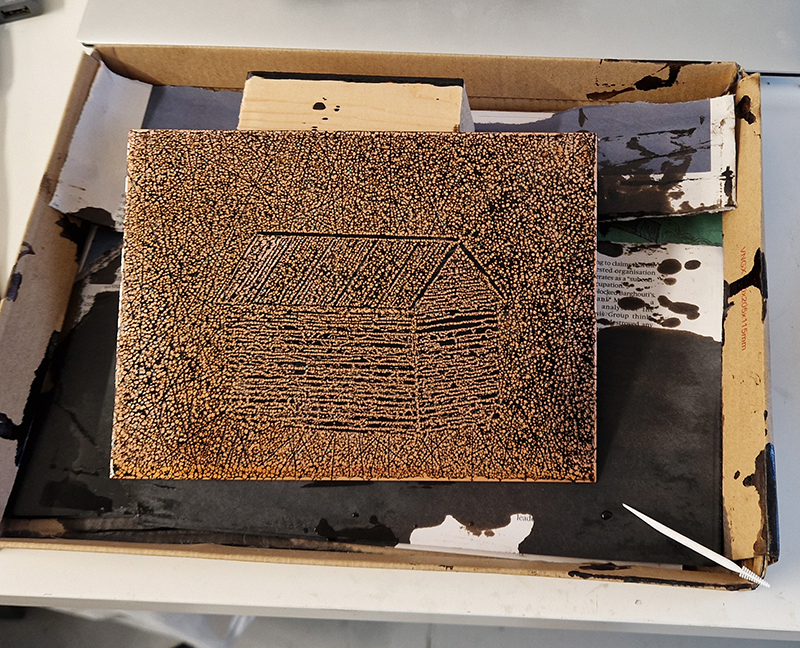
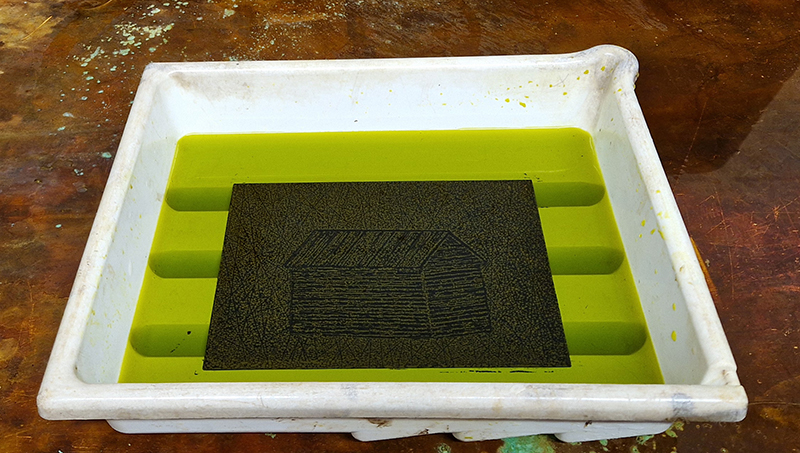
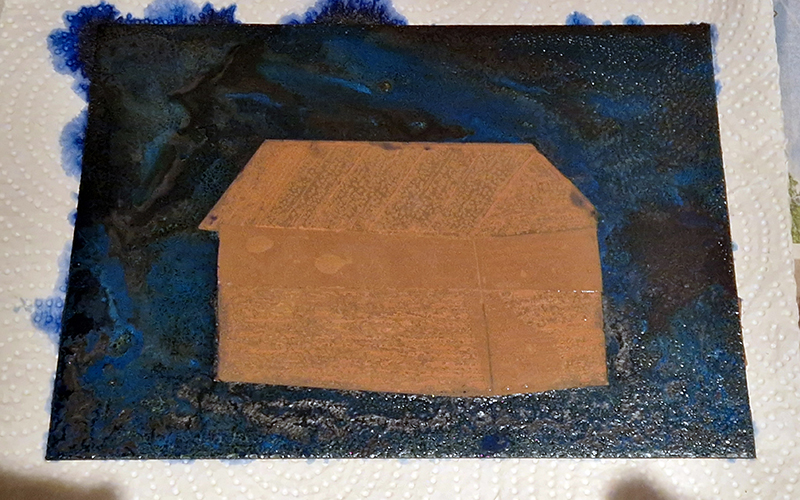
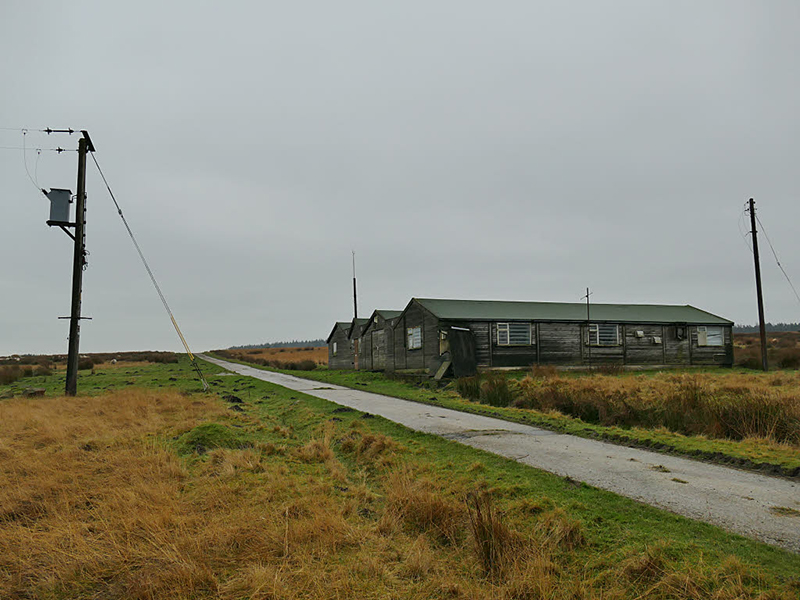
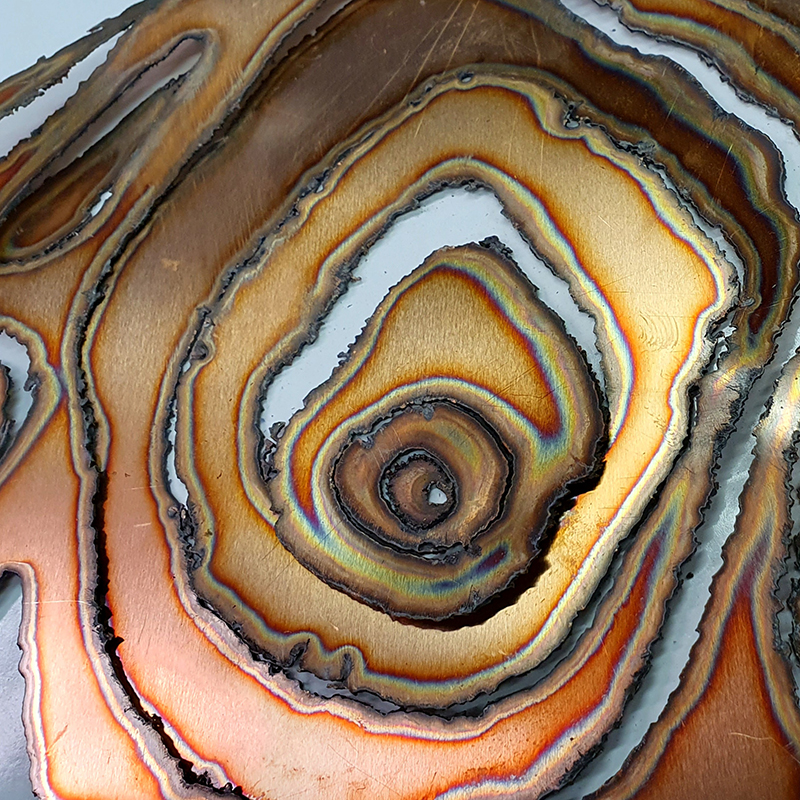
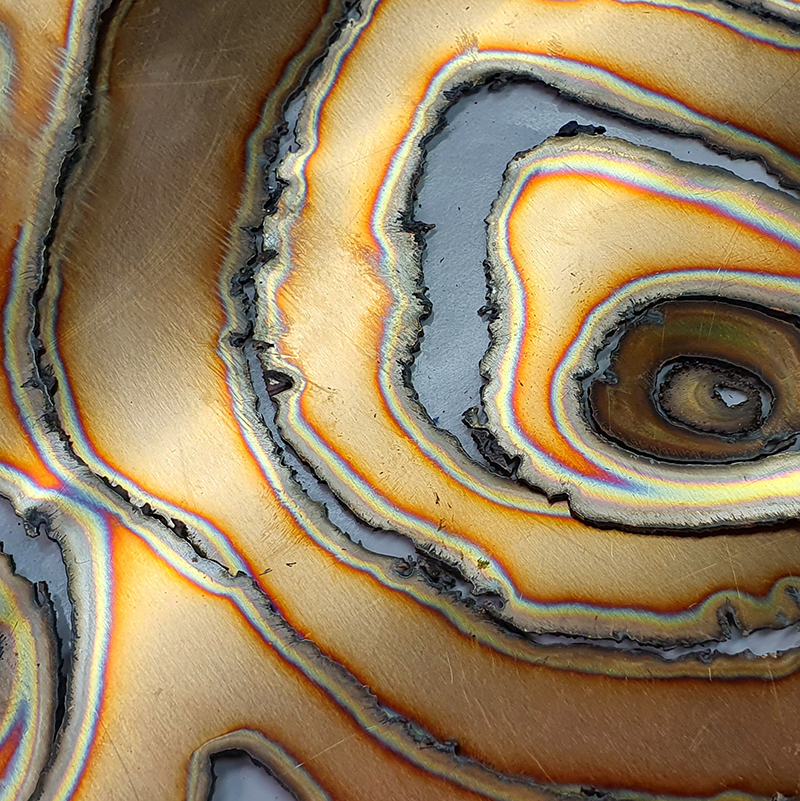
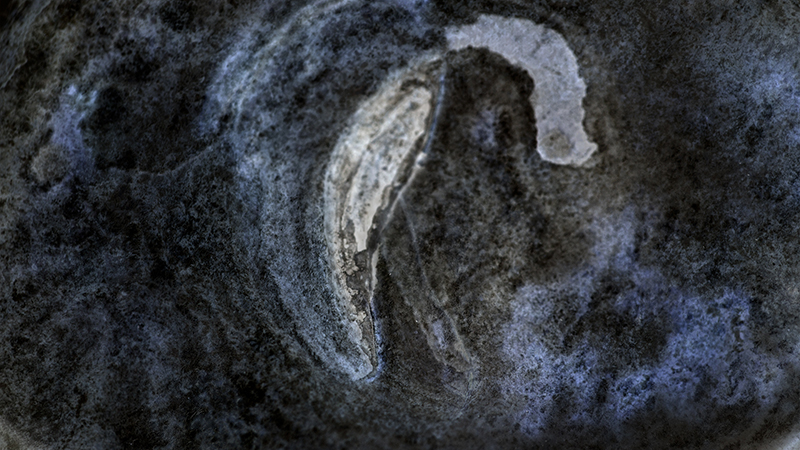
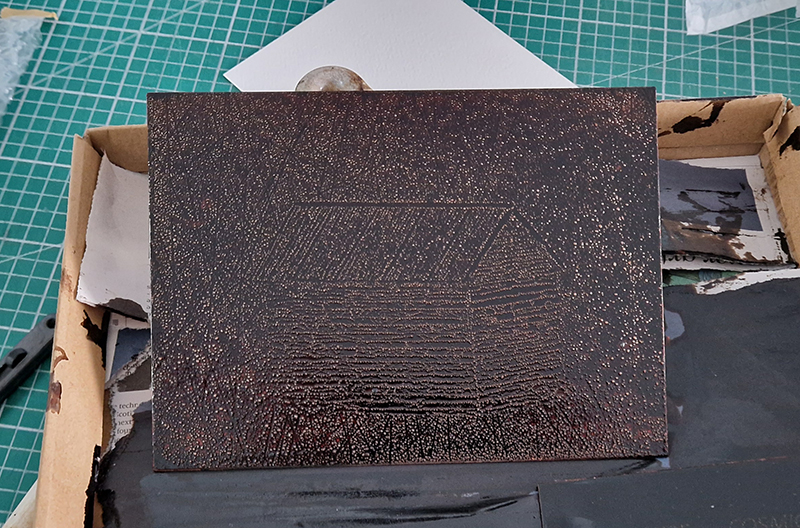
Cosmic Hut etched and patinated copper. First the image is screen printed onto the copper with a sugar based solution. It then goes through a sugar lift process of being coated with bitumen and submerged in warm water to dissolve the sugar and reveal the image before being etched. Once etched, parts of the image are blocked out as it is patinated with different chemical solutions that produce different colours. The image is based on the many cosmic ray detector huts abandoned across the North Yorkshire moors when the Haverah Park experiment stopped operating in the late 1980’s. These humble huts were once home to one of the largest extensive cosmic ray air shower detector arrays in the world, studying the highest-energy cosmic-rays arriving from space.
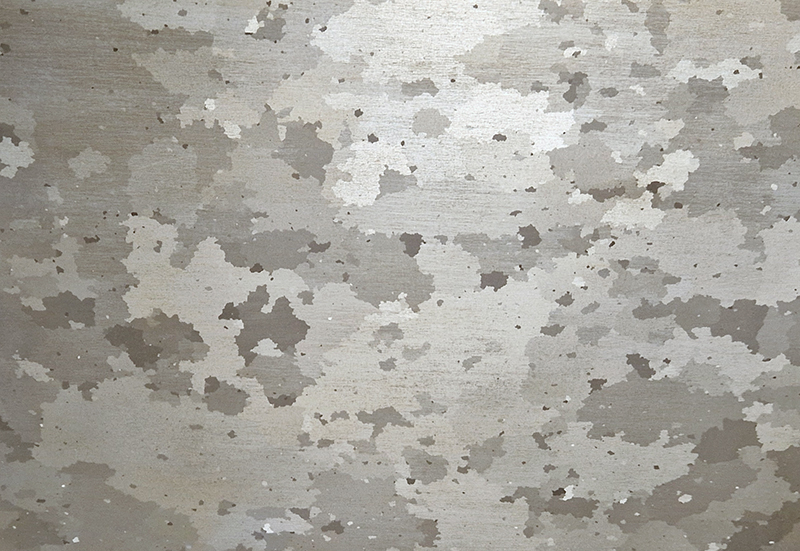
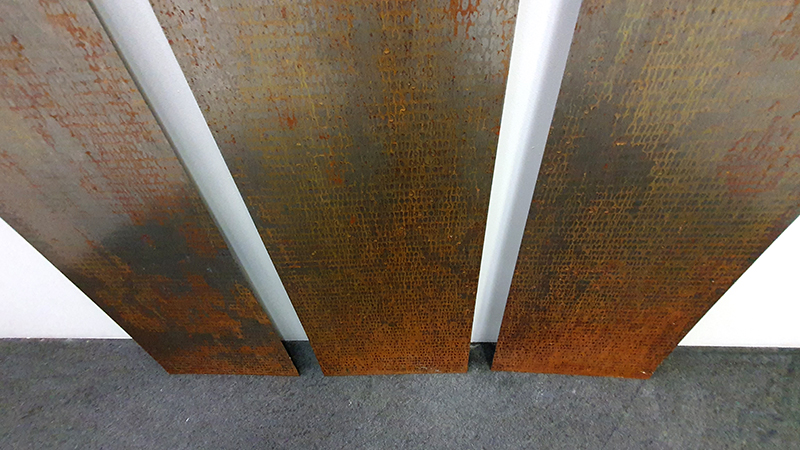
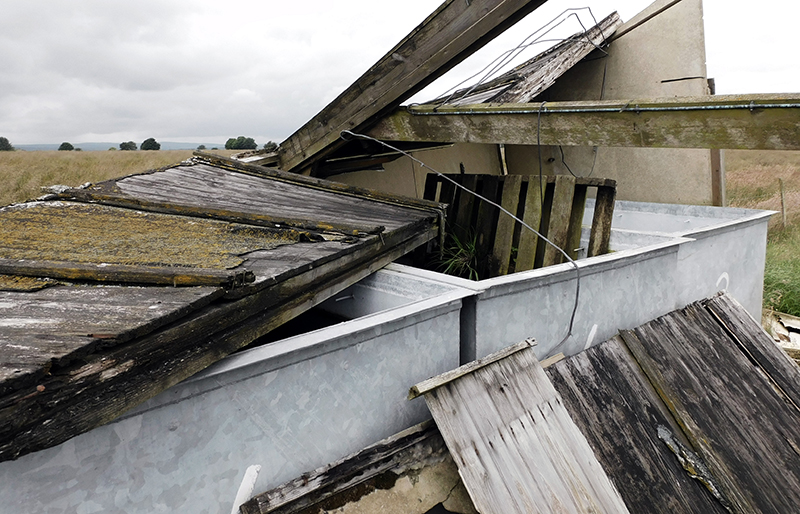
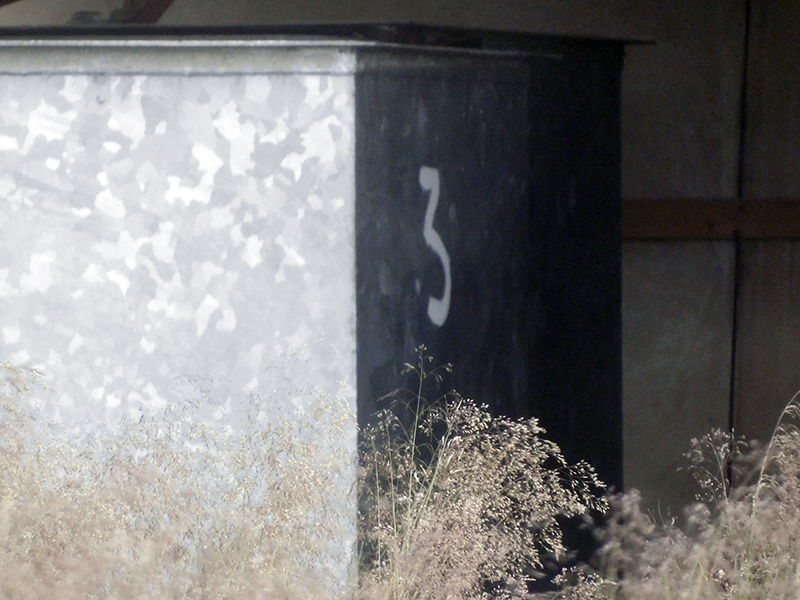
Moving forward with new work thinking about the Haverah Park experiment and the water tanks which were used to record cosmic rays as they arrive in sweeping disc like formations by registering the scintillating light of Cherenkov radiation caused by the particles, I am working towards making a series of small ‘tanks’. I am planning to use directional magnetic steel sheets for the outside of the tanks. I still have a couple of batches of this material provided to me by Union Steel Products a while back. I had first seen this material during the magnetic laboratory open day at The National Physical Laboratory and was fascinated by the jigsaw pattern surface. Norman P. Goss invented grain-orientated steel in 1934, it is a specialized iron-silicon alloy engineered to have exceptional magnetic properties in one specific direction, dramatically reducing energy loss. The jigsaw pattern of crystallographic orientation is known as a Goss texture. The very thin sheet of steel is coated in a specialized, multi-layer inorganic insulation chemically bonded to the steel surface during manufacture. It is very difficult to remove.

I used the first batch of Grain-Oriented Electrical Steel to create the work Domain of the Devil Valley Master which was shown in A Stone Sky at Thames-side Studios Gallery in 2023.
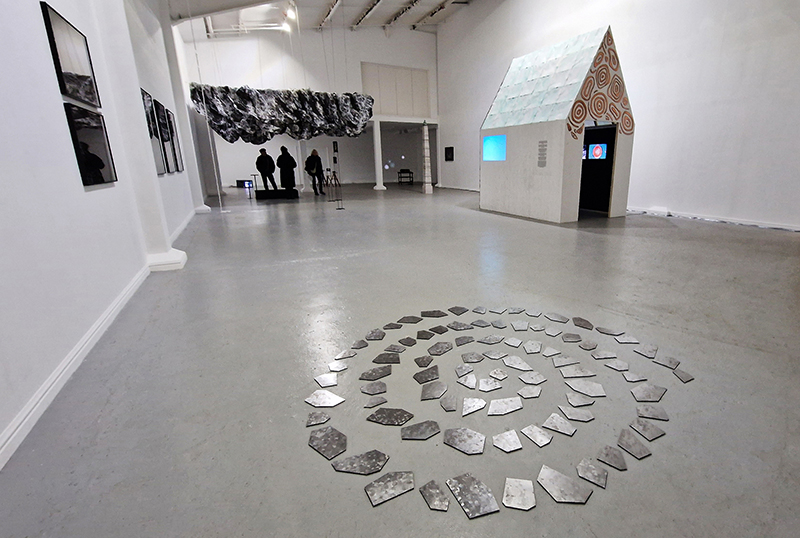
For this spiral sculpture I experimented with various ways of removing the grey coating, eventually finding sanding before etching in copper sulphate could achieve good results if through an arduous and messy process. It was still a bit hit and miss and I could end up with a muddy surface or a silvery one without really knowing why. The surface will flash rust extremely quickly when it comes out of the etching bath, or it suddenly becomes dull and patchy. For this new work I thought I would ask google AI if it could find any tips on removing the insulating surface and it actually came up with a plan that has worked. Much as I don’t like to use AI in a creative process, it was really useful in identifying the composition of the grey coating and suggesting the best removal agent and method. I have adapted the advice slightly after testing the results, but in the end it has saved me many hours of sanding and copper sulphate residue to dispose of. The process giving best results, is to just wipe clean the surface before etching in Ferric Chloride, then soak briefly in a neutralizing bath of bicarbonate of soda, followed by a quick dip in isopropyl alcohol to dispel the water before rapid drying. This batch has a slightly different crystallographic pattern to the batch used for the spiral.
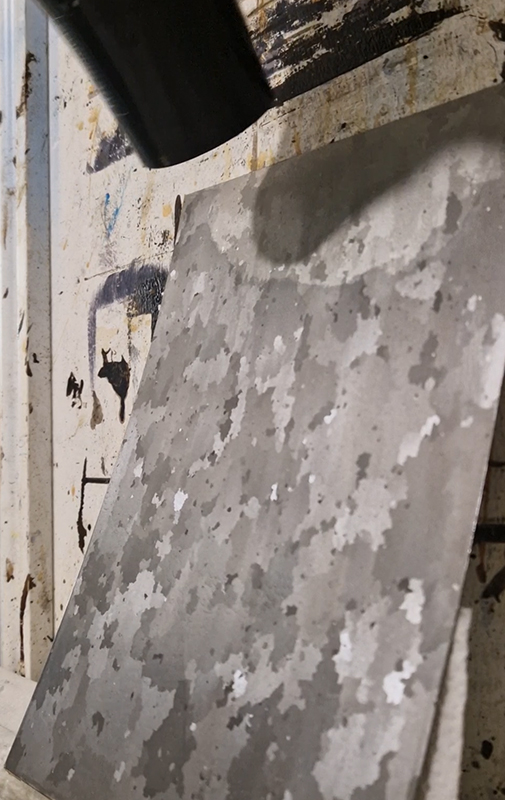
The original water Cherenkov detector tanks at Haverah Park are made of galvanised steel which also has a patterned surface known as a spangle. This is caused during manufacture when the steel is hot dipped in zinc and the individual zinc crystals spread as they cool. Using the directional magnetic steel echoes the pattern and also references the interaction of cosmic rays with magnetic fields which can accelerate them across space but also deflect them from reaching Earth’s surface.
Working on ideas for a 5th tablet as part of The Instruments of the Anemoi series of sculptures that reference methods of natural navigation. Currently I have included magnetism in the form of the compass and the lodestone, the winds and the north star.
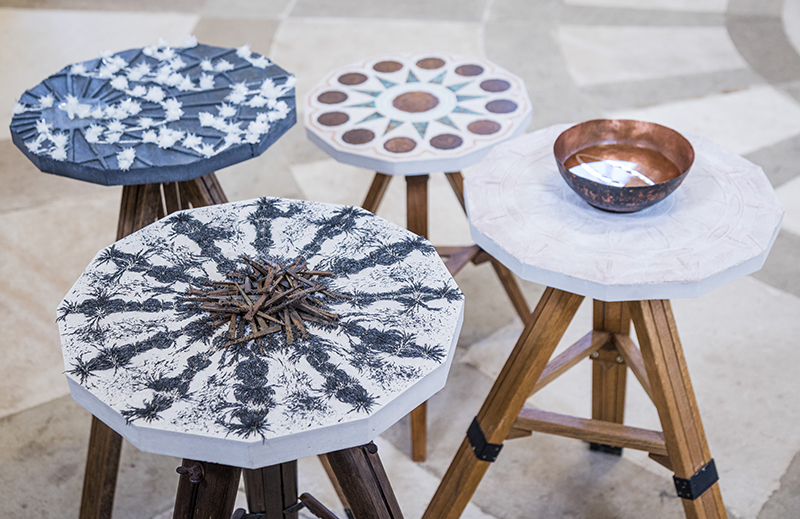
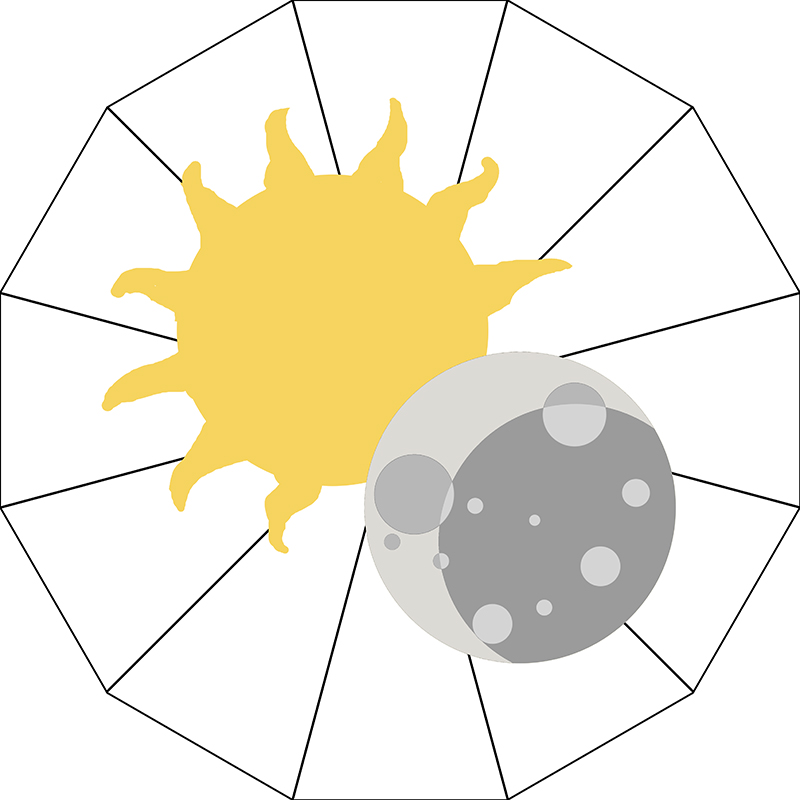
Perhaps influenced by seeing the total eclipse of the sun this year I am thinking of making one referencing the sun and the moon as beacons of navigation. The sun being the most obvious and easiest to work out cardinal direction at least, with the moon needing more knowledge of its lunar cycles. I also like the idea of using copper for the sun and aluminium for the moon.
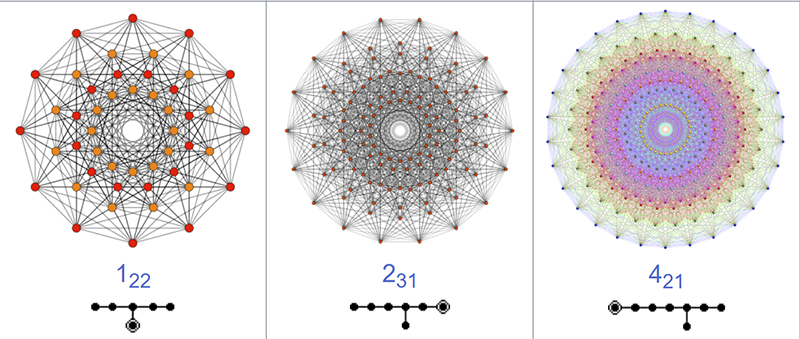
I have been looking at what might be useful to help visualise a fifth dimension and came across Coxeter elements and planes which deal with geometric reflections. The maths is beyond me but the shapes and patterns involved are wonderful.
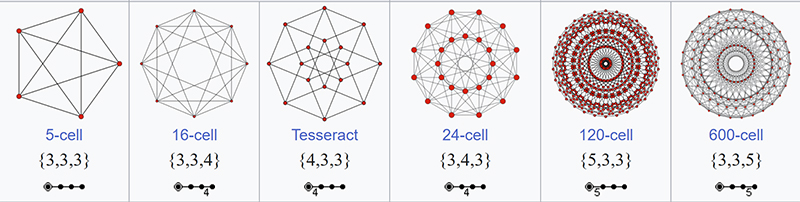
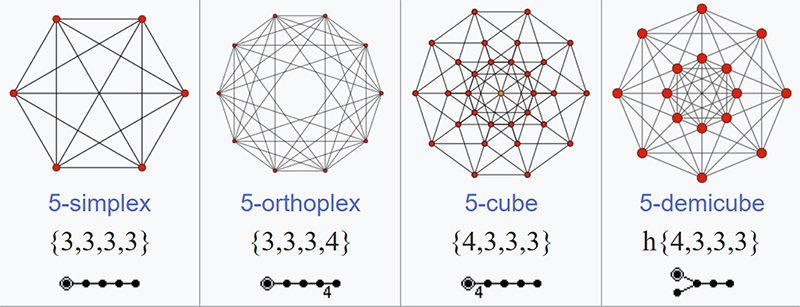
These could be useful for my work reinterpreting the Cosmati Pavement in Westminster Abbey that purports to offer clues to determine the end of the Universe, as different symmetries are used within the mosaic design to signify the different complexities between the earthly and the heavenly spheres. In the symbolism of the Cosmati Pavement, the journey from earthly materialism to spirituality is seen as a progression from multiplicity and diversity towards unity and uniformity.

Through this work I will look at changing human relationships to Fire, Earth, Air, Water and the Aether since the time the Cosmati Pavement was installed in Westminster Abbey in 1268. The pavement uses number, patterns and geometry to articulate the medieval understanding of the cosmos and the end of time. I am using Richard Foster’s book Patterns of Thought: the hidden meaning of the Great Pavement of Westminster Abbey, for reference and Martin Rees book Just Six Numbers: the deep forces that shape the Universe, as reference for symbolic contemporary numbers that are used to describe the cosmos.

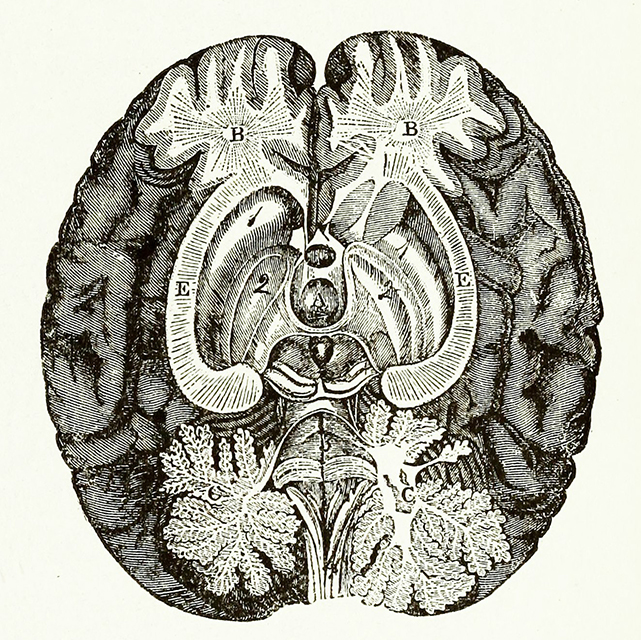
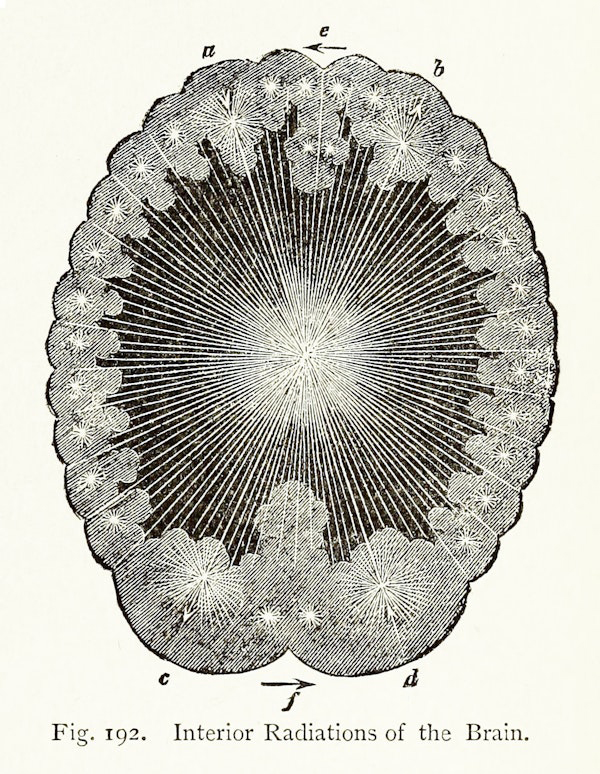
The end of the world was imagined as a reversal of creation when all matter will return into the primordial chaos of elements that are reabsorbed into the divine mind. The centre sphere of the pavement relates to the primordial chaos from which the four elements of earth, water, air and fire separated at creation and will return to at the end of time. Swirling eddies of unformed matter at the threshold of eternity are transformed by a breath across the turbulent waters bringing light to the darkness. I have chosen what is known as the Density Parameter represented by the Omega symbol, to relate to the Aether – this is a number that has not been determined by physics and its value describes the possible fate of the universe. The 61 lozenge shapes circling the Silva, unformed matter, are given to represent the idea of eternity. I like the illustration of the interior radiations of the brain from The Principles of Light and Color, 1878, by Edwin Dwight Babbitt that explores the physical, metaphysical, and therapeutic properties of light and colour. It has a similar relation of a radiating mind of creation.
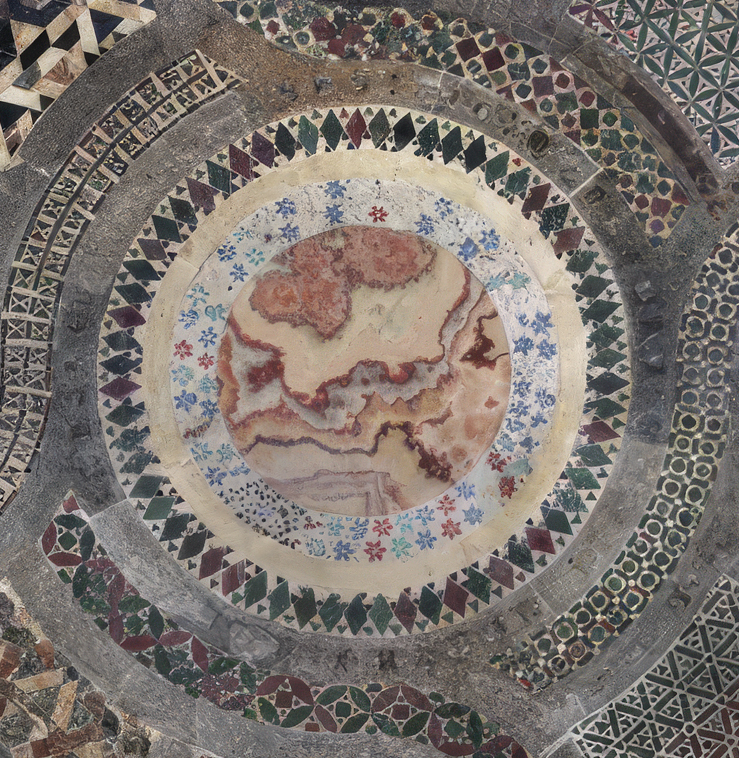
The inner square of the pavement contains four other spheres which represent the elements in their archetypal form before they transition from the metaphysical or the intellect, to the material sensible world. The pavement mosaics show a transition from a variety of patterns at the outer edge through to simplified regular polygons, the archetypes of form representing a perfection that we only experience as a shadow on Earth. Six-fold symmetry patterns signify astronomical time and the perfection of the material elements and four-fold symmetry patterns describe mundane time and compound bodies full of diversity when the elements mix and entangle.

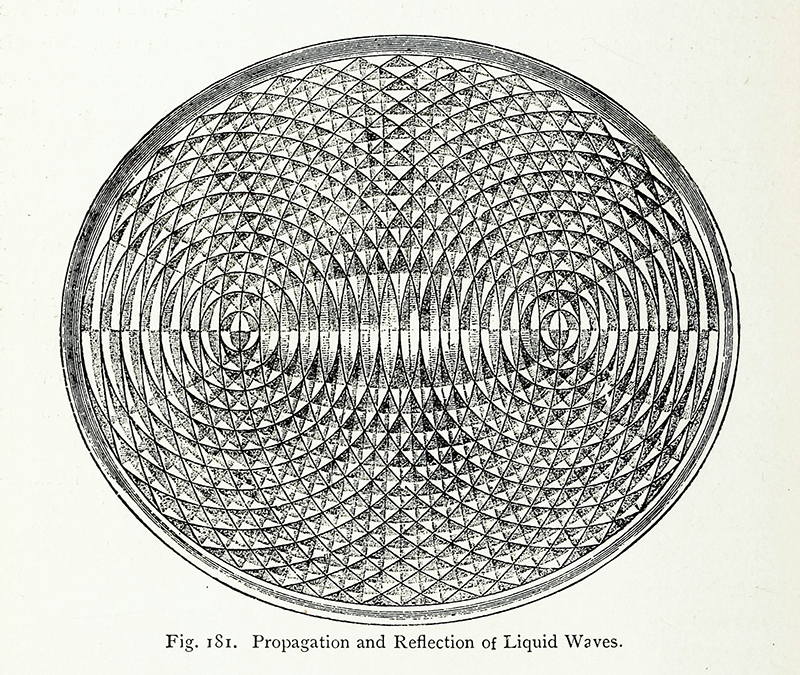
To the north is the sphere representing water containing a seven sided polygon which symbolises the moon. I have chosen to relate the number Q ( 1/100,000 (or 10⁻⁵)) to this sphere. Q represents the texture of the universe through which we can observe such phenomena as gravitational ripples. Other references I am looking at are Mundus Subterraneus, by Athanasius Kircher published in 1665 which has delicious illustrations of the underground world and all its riches and a great illustration of liquid waves from The Principles of Light and Color.
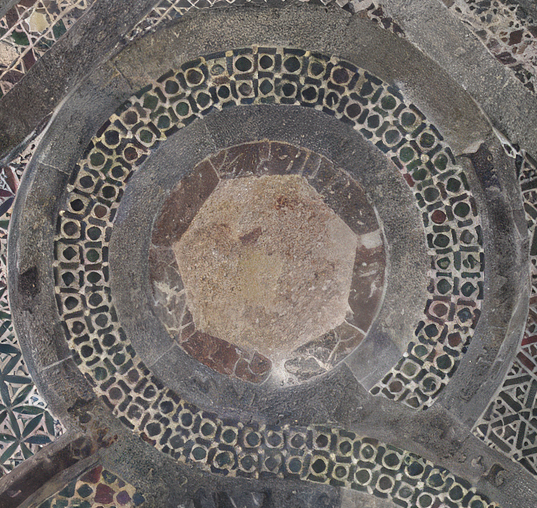
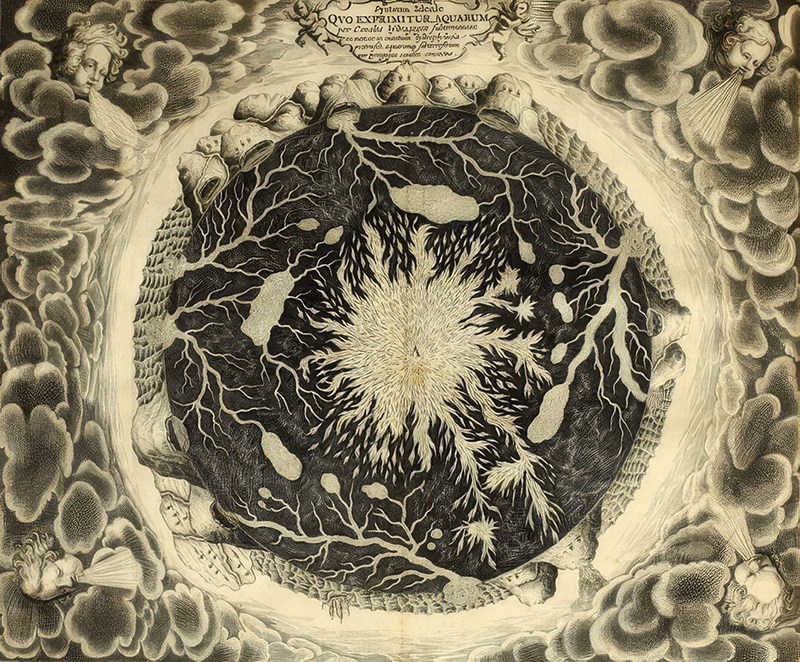
To the south is Fire, represented in the pavement by the symbol of the Sun set in an octahedron which heralds the start (or the end) of astronomical time. I have chosen the nuclear efficiency number for this sphere, represented by the epsilon symbol (ε = 0.007), it is the process which allows for stars to burn steadily for billions of years.
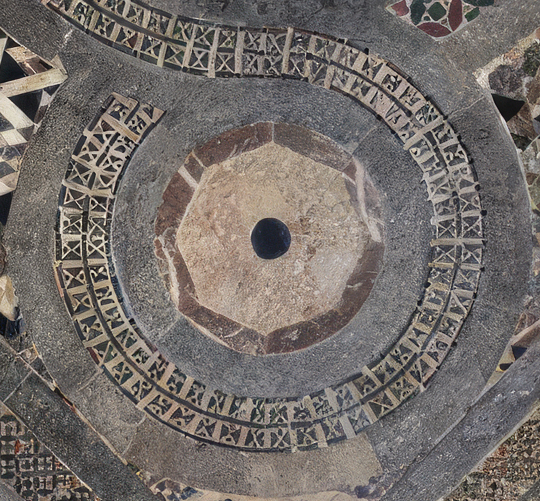
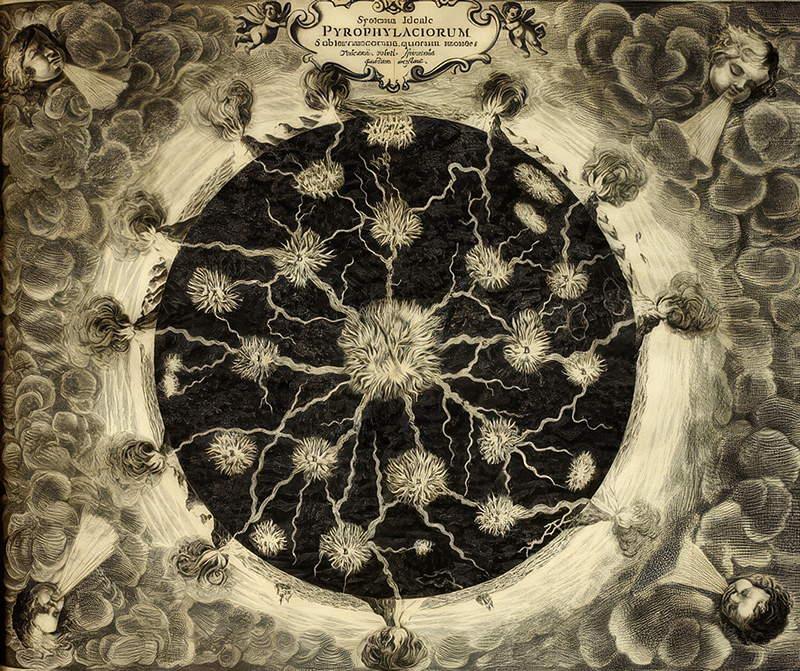
To the West is Earth, represented by a hexagon. I have chosen the large number N 10³⁶ for this sphere, representing the relative weakness of gravity compared to other forces which act on the solid matter of Earth. Also referencing Kepler’s 1619 work Harmonice Mundi (Harmonies of the World) where he linked the five regular Platonic solids to the classical Greek elements. The illustration of the brain laid bare from The Principles of Light and Color has an Earth like quality.
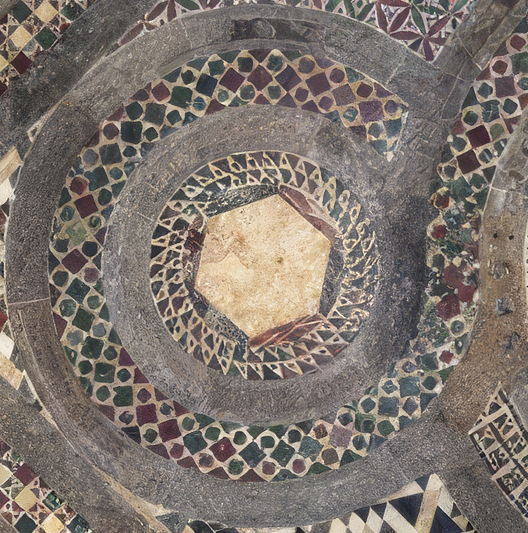
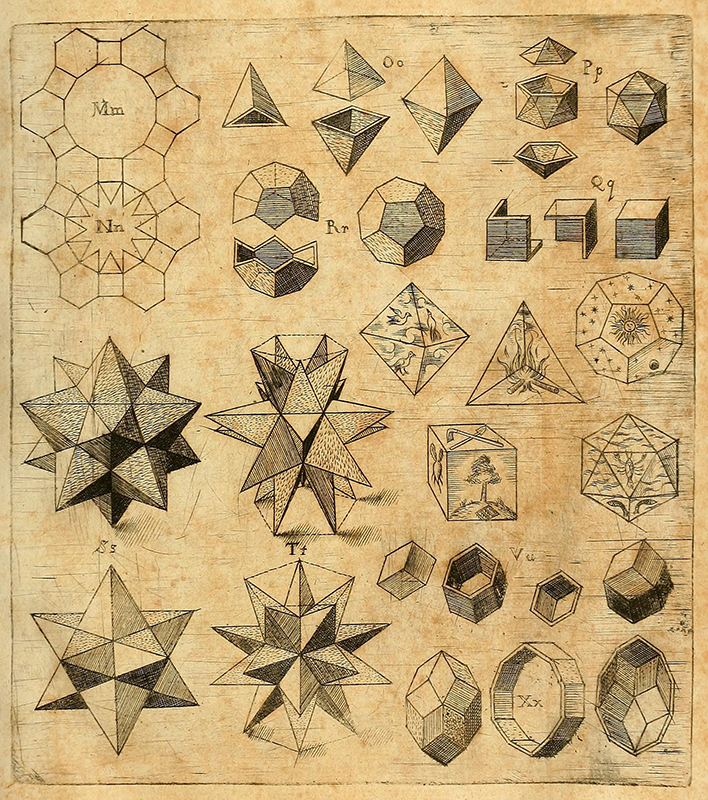
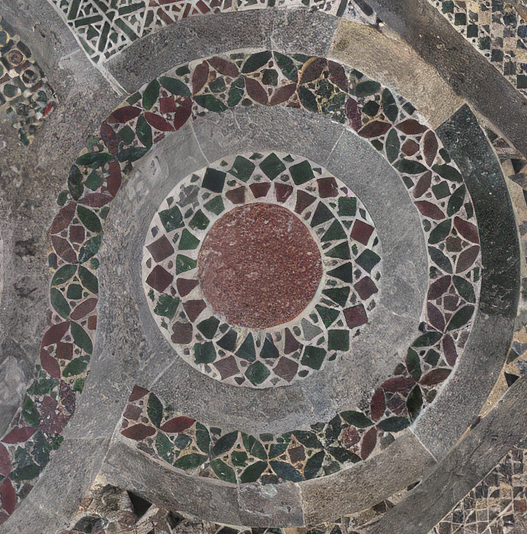
To the East is AIR represented by a circle signifying the logos from where the breath came that stirred the waters. I have chosen the number Λ (Lambda) which describes the expansion of the universe and ties in with things that move through the air.
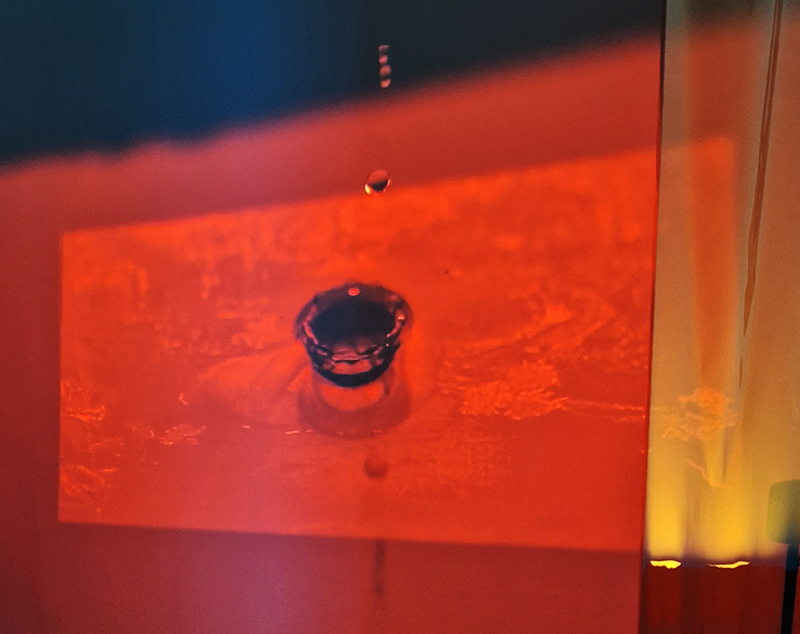
Looking at things that move through the air in other contexts, I am planning to attempt some Schlieren photography. Curator Maria Hinel’s husband first told me about this process and I have finally had a look at how it works. It is an optical technique used to visualize the flow of fluid and density variations in transparent media (such as air, water, or gas) that are invisible to the naked eye. It sounds quite a tricky process requiring absolute precision. First thing I need is a Newtonian Telescope Primary Mirror.

The Magnetic Universe Gresham lecture by Professor Katherine Blundell OBE gives a very thorough overview of magnetic fields from the bar magnet to magnetars and the most recent discoveries by the MeerKat radio telescopes imaging the heart of the milky way that are yet to be explained.
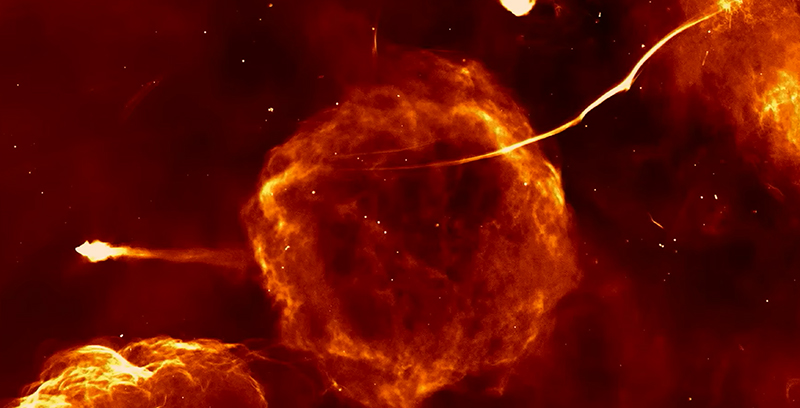
Wrinkled Time by Marcia Bjornerud this essay is from a couple of years ago but I still love to read it every so often. Or you can lay back, listen to Marcia read it and contemplate how unique and precious the Earth is.

Gallery Visits

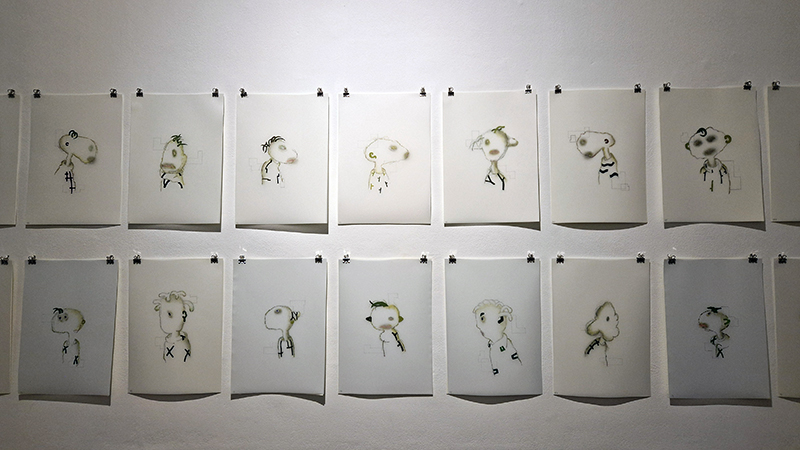
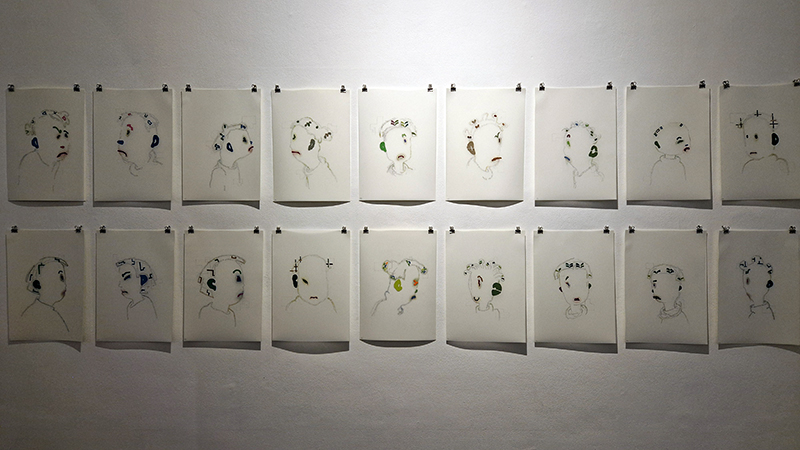
Oona Grimes Weed Killer at Danielle Arnaud Gallery. I has quite an emotional response to the works in this show which present perspectives on cruelty, loss, responsibility and power. I had listened to Natalie Haynes ‘Stands up for Euripides’ episode on the play Medea, a woman notoriously vilified for killing her children to spite her husband who is abandoning her. Oona’s collaged drawings of colourful cartoonlike characters emerging from velvety black surfaces intent on inflicting pain are hard hitting despite the comedic nuances. The works dig deeper than purely physical assaults into psychological damage and family relationships also explored through a tender film. What I think I found especially hard was the ‘chorus’ of bruised ghostly children, so sad and enigmatic. Looking so isolated and vulnerable, they speak for the children of Palestine and Gaza where adults should be protecting and nurturing but instead they are warring and damaging.
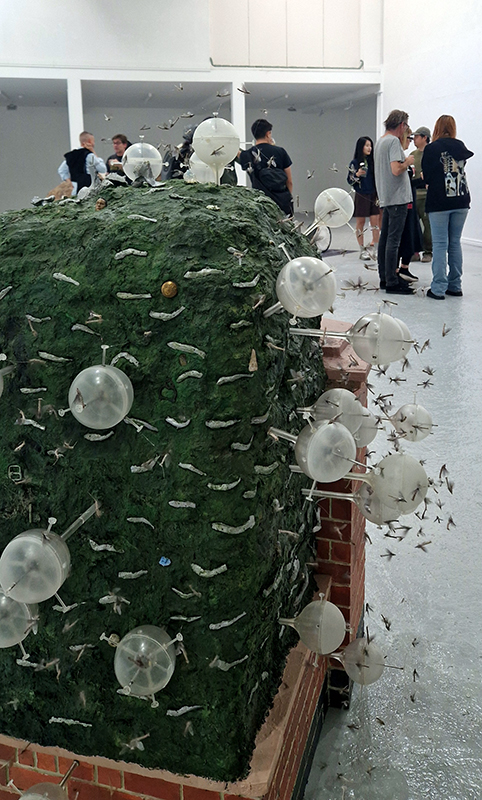
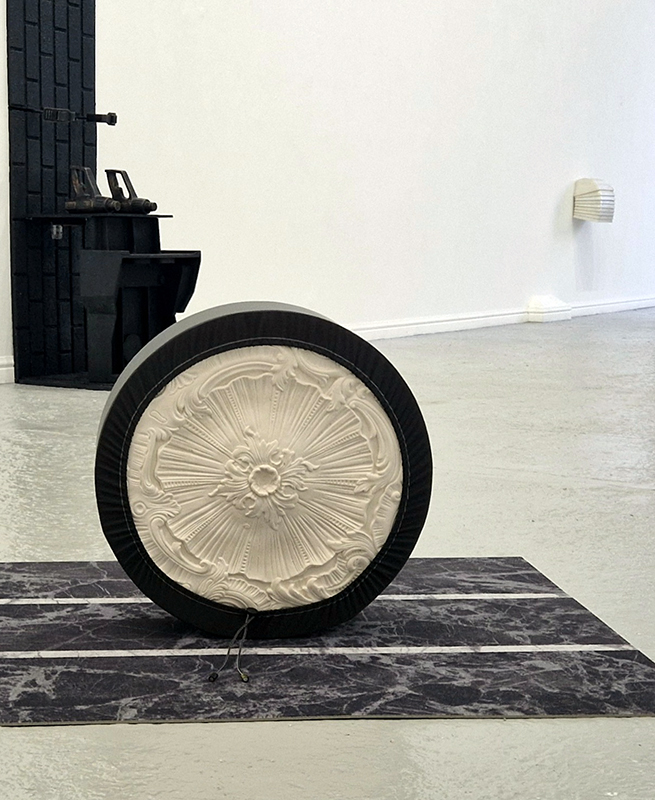
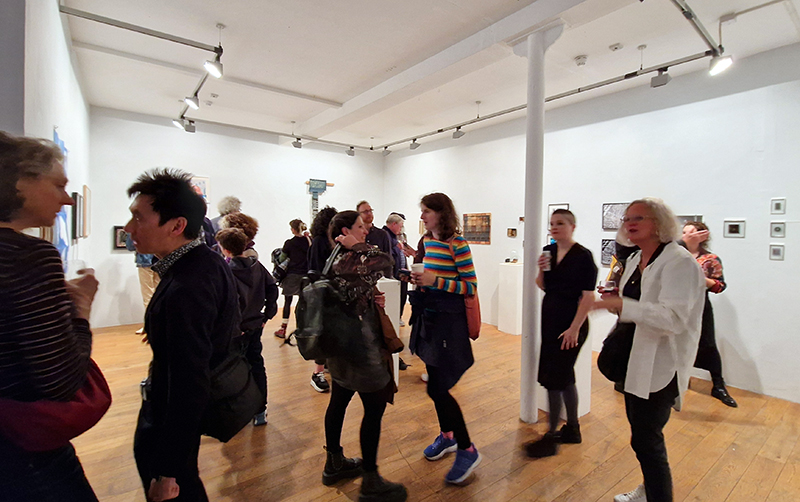
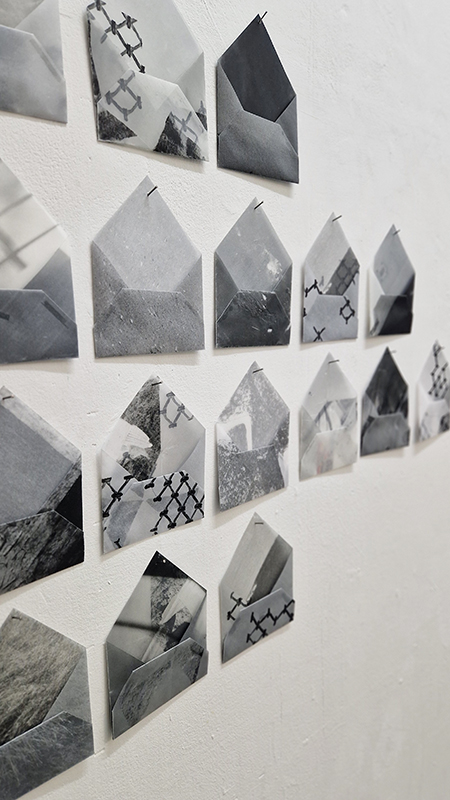
Salon for a Speculative Future presents: How to be in the Future: A Future Sensorium curated by Monika Oechsler at Chisenhale Studios. A beautiful show sensitively curated to bring together works that speak to sensory awareness and physicality. The exhibition features sound sculpture, sonic voicing, rhythmic movement, body scan sculptures and moving image works. Artists include Adonia Bouchehri, Kate Fahey, Alice Sheppard Fidler, Lisa Chang Lee, Anna Mays, Kirti Virmani, Nicola Woodham.
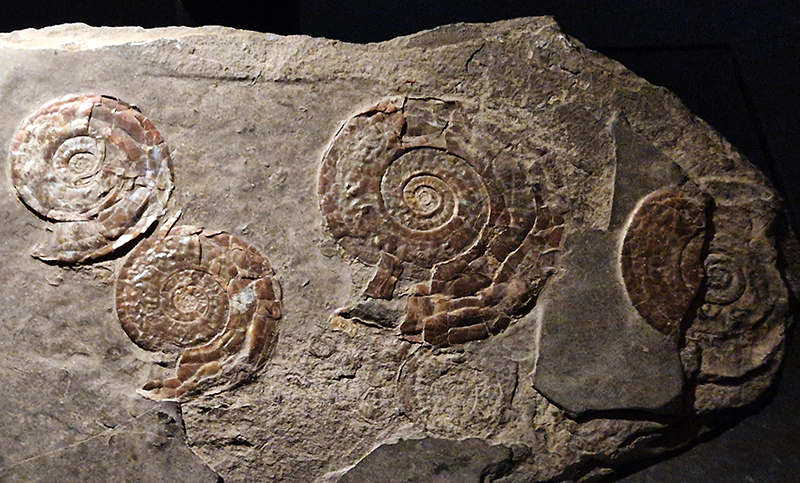
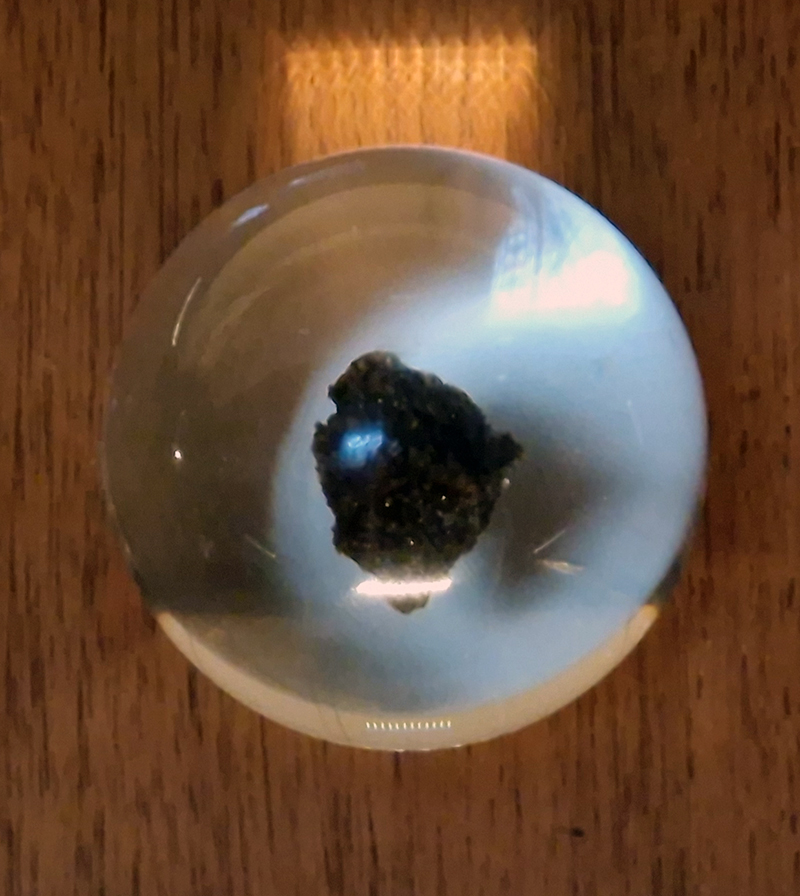
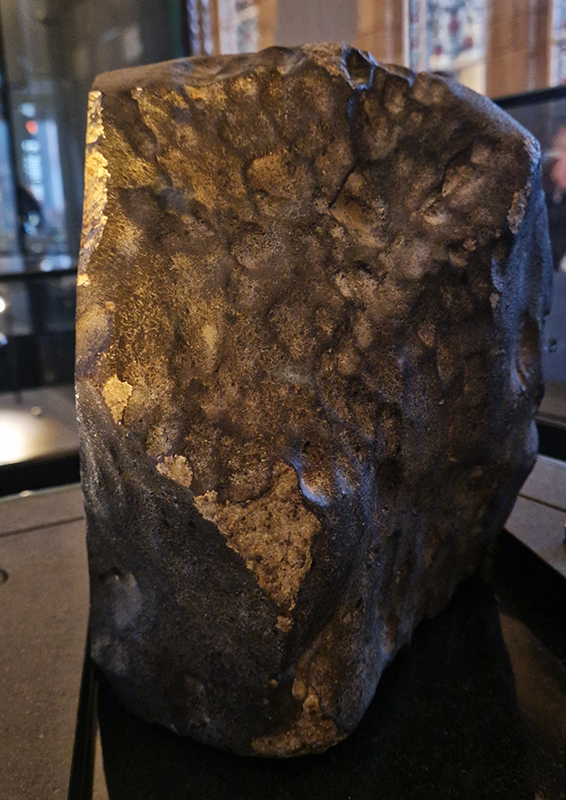
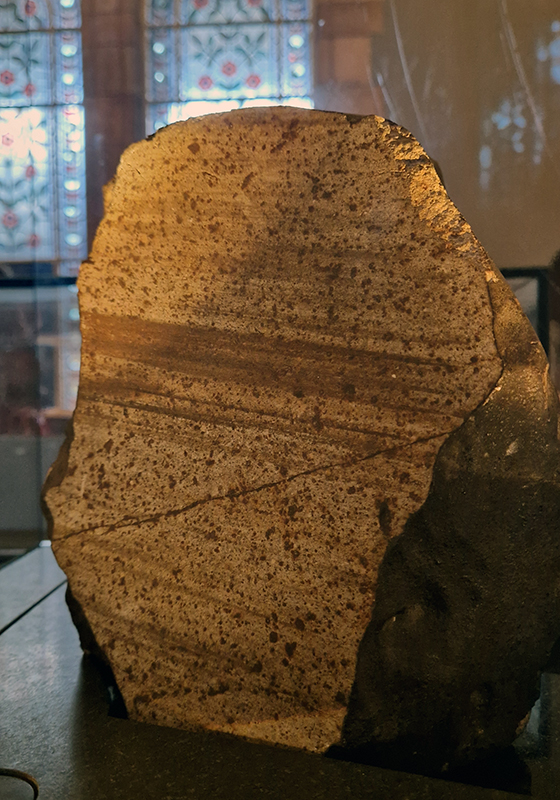
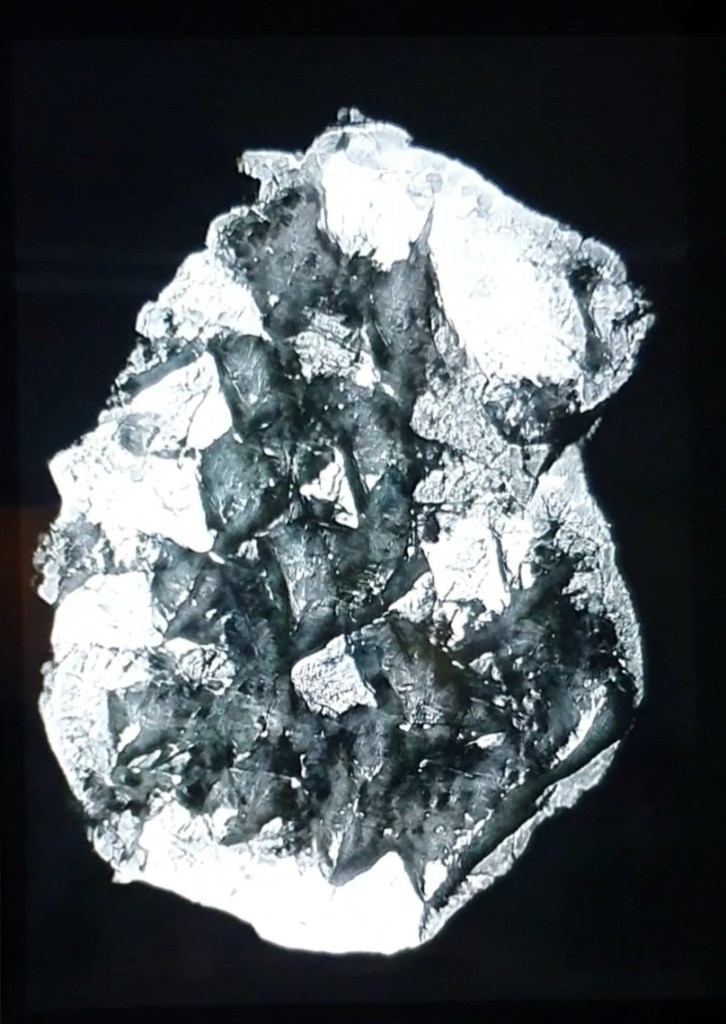
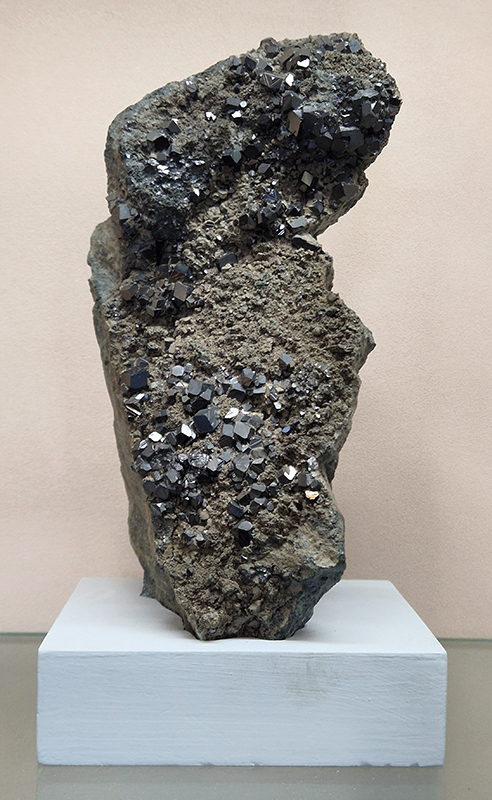
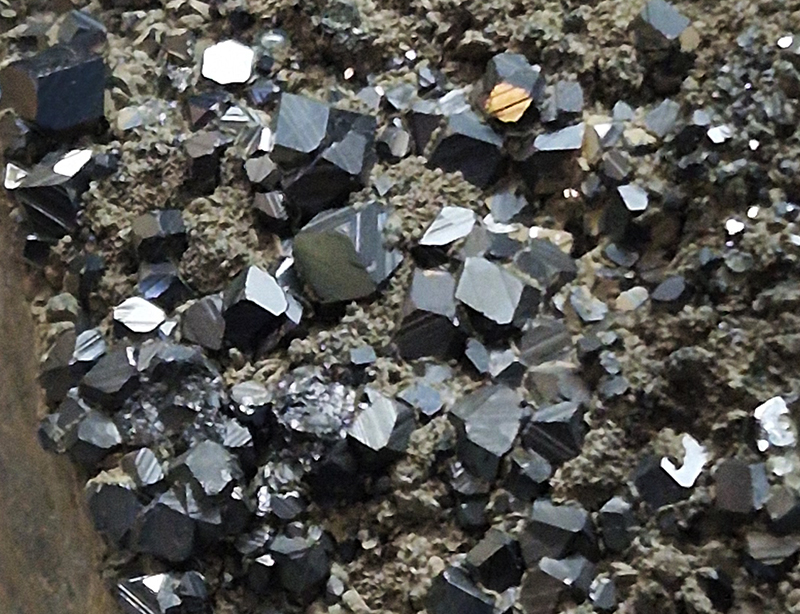
The Natural History Museum is somewhere I should go more often. Popped in to see the new temporary gallery called Nature and Us which was a bit chaotic so ended up looking at the thrilling black dodecahedra on chlorite example of magnetite, a tiny moon rock in a glass sphere, William Smith’s ammonites and the Wold Cottage Meteorite which was sent hurtling to Earth when two asteroids collided in December 1795, surprising ploughman John Shipley who was working nearby when the 25kg rock crashed to Earth. It became key evidence that rocks could have extra terrestrial origins and was duly commemorated with an obelisk at the landing site.
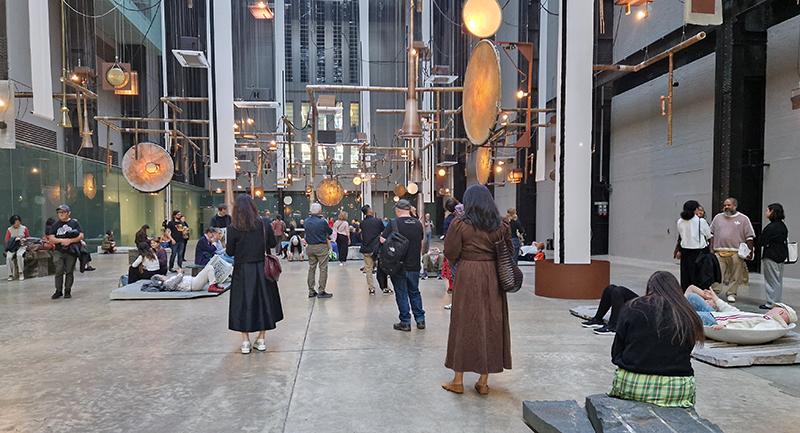
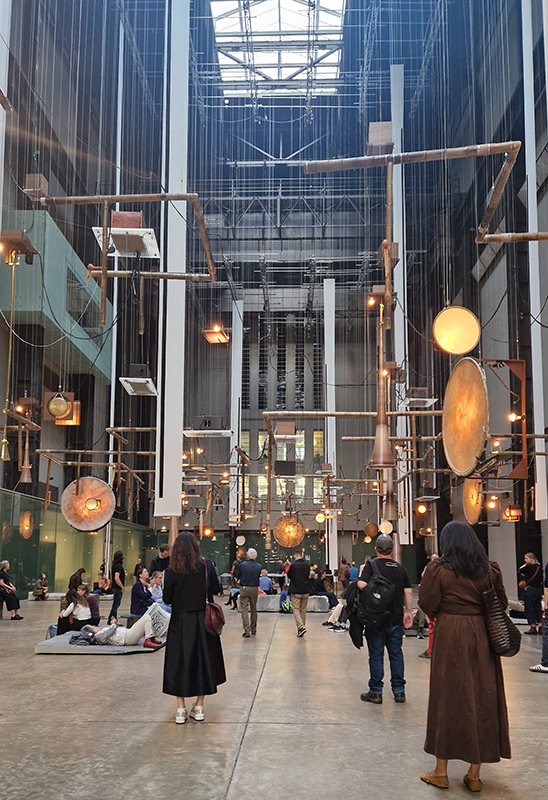
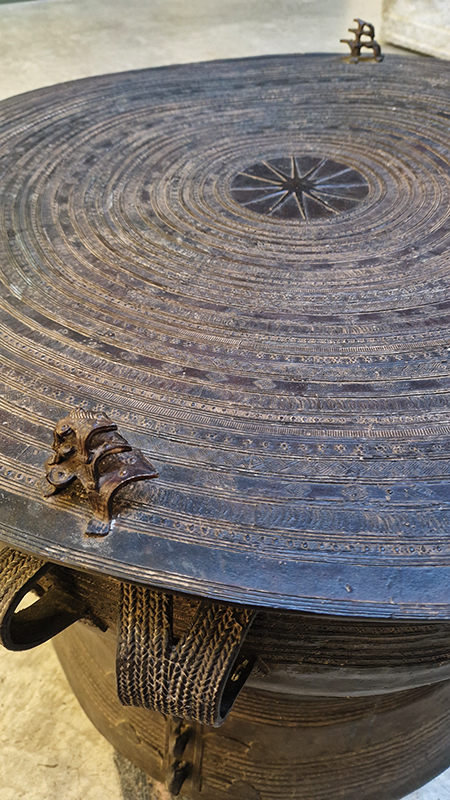
Engaging new commission at Tate Modern Turbine hall, sonic installation by Tarek Atoui: Hold.
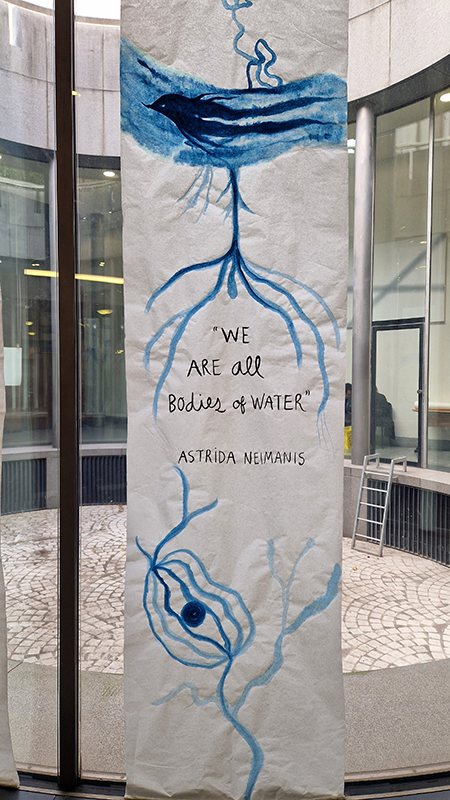
Water Body by the art collective Marshmallow Laser Feast and author Robert Macfarlane, featured as part of the 70th BFI London Film Festival (LFF Expanded). I think it was the price of the ticket and the fact that is wasn’t as immersive as we hoped that left us a bit flat despite being impressed by the visualisations of planetary water circulation. It felt lacking some kind of emotion or element to connect with the audience.
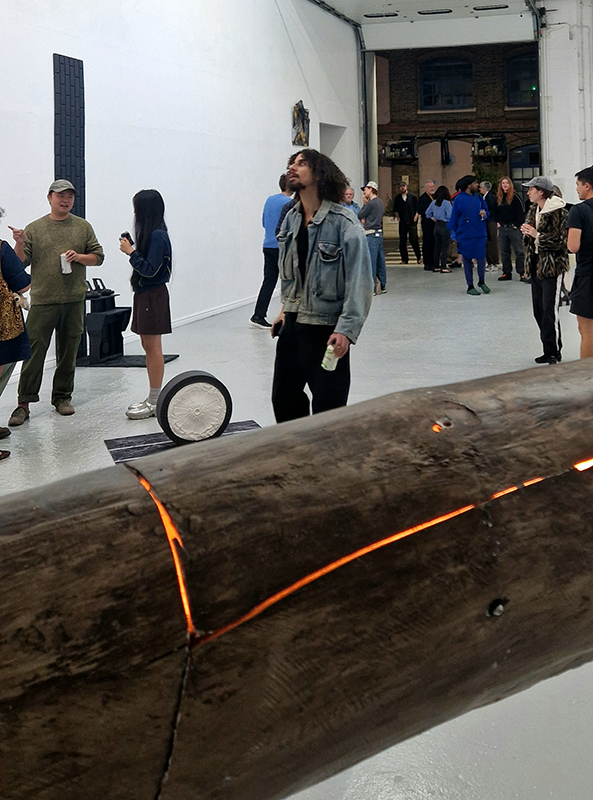
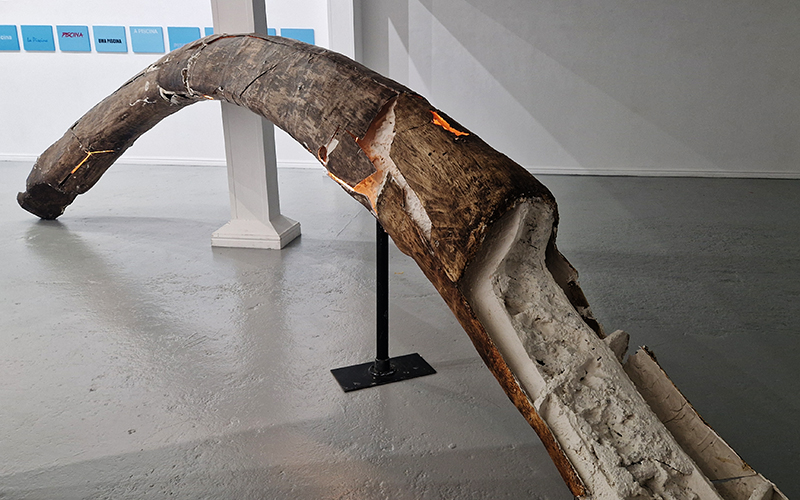
Falsework curated by Catherine Li at Thames-side Studios Gallery. Featuring works by Molly Grad, Steven He, Amélie McKee, Robin Finch Pickering, Ana Teles, and Chris Thompson, the exhibition traces a shared interest in forms that resist being reduced either to function or to representation. Structures may initially appear legible but their meanings shift through material, scale, position and perception.
I am excited to be planning a visit to Haverah Park, the site of a cosmic ray air shower detection array consisting of water Cherenkov detectors distributed over an area of 12 km2 on the Pennine moorland, North Yorkshire. The experiment was operated by University of Leeds for 20 years, and was switched off in 1987. During its lifetime many 1000’s of extensive air showers were recorded including four exceptional ones of such size that the cosmic rays that generated them must have had energies greater than 10eV. These particles are the highest energy form of radiation known to exist anywhere in the universe and their origin is one of science’s greatest mysteries. Having reimagined The Absolute Hut seen at Hartland Magnetic Observatory for the exhibition A Stone Sky I am hoping a future project may be the reimagining of the huts from Haverah Park.

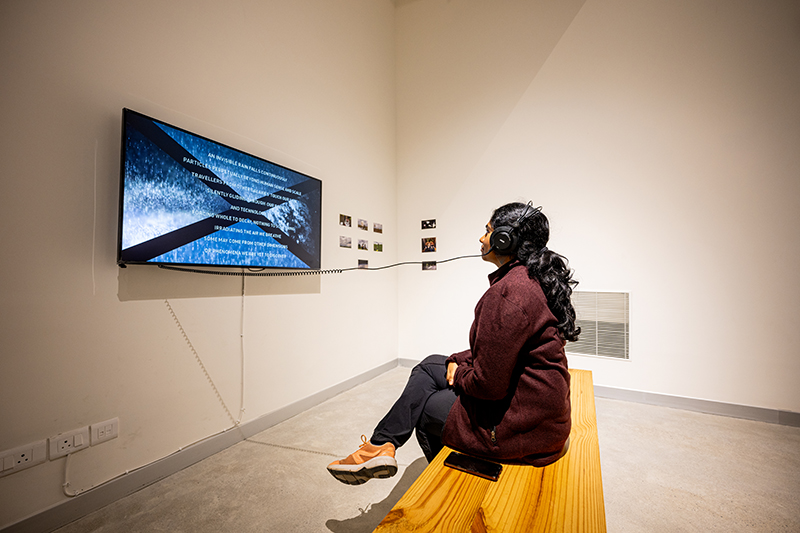
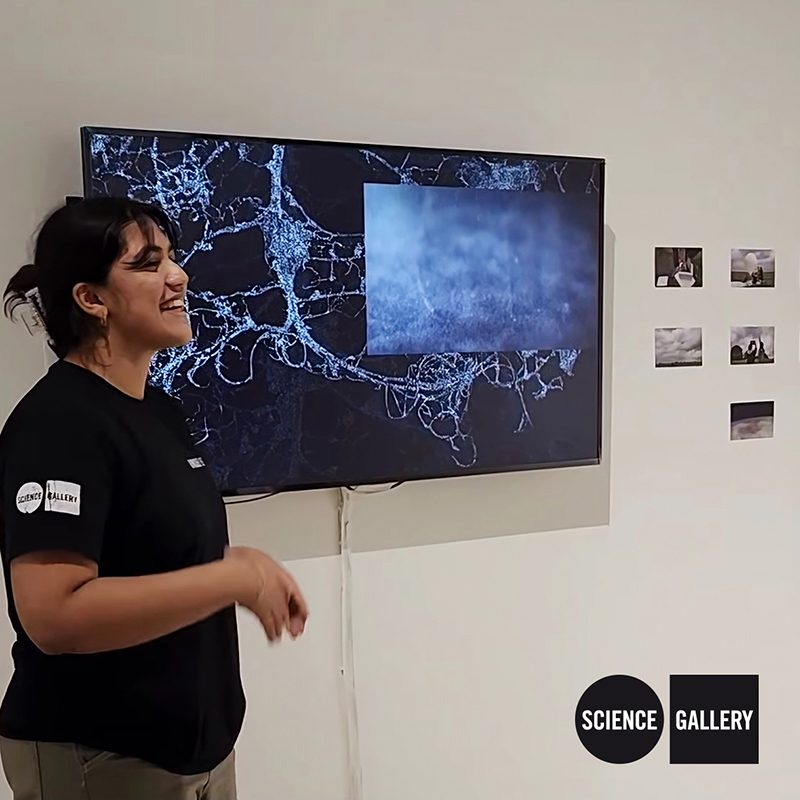
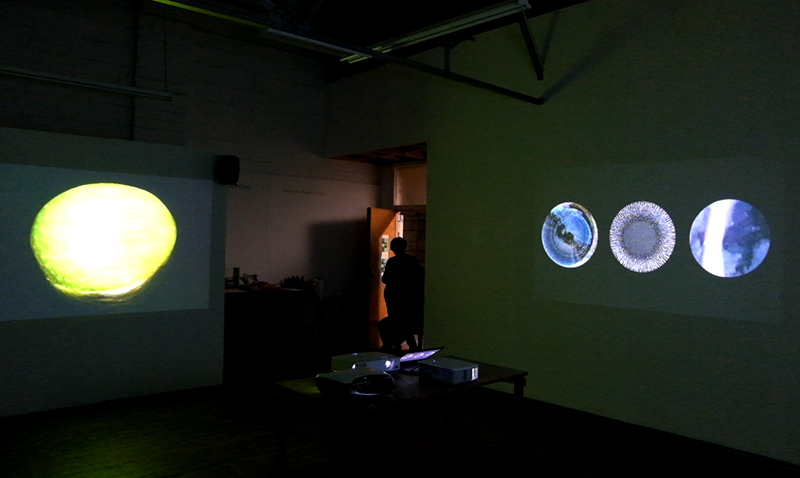
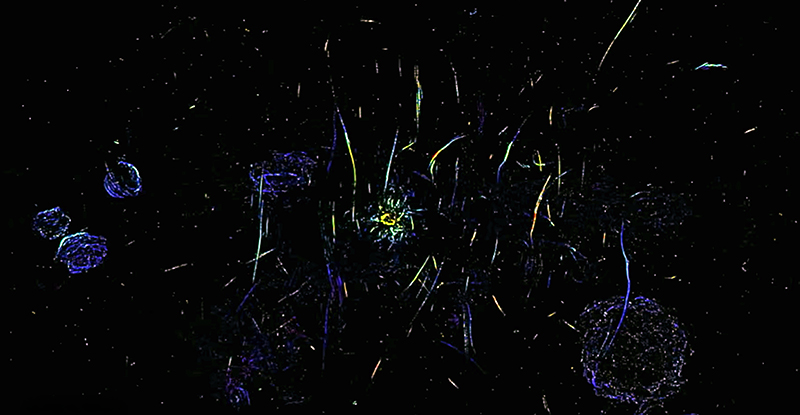
The exhibition Carbon: under pressure at Science Gallery Bengaluru is still running and I am so proud to have my work Cosmic Chiasmus: crossing the universe included in this amazing show. This video offers a glimpse into a subatomic world where cosmic rays travel from distant galaxies to collide and silently interact with atoms and technology on Earth. Cosmic rays go through a violent process of creation, transformation and decay. From the heart of stars or the depths of black holes these particles power across the universe with unimaginable energy colliding with life on Earth and triggering other processes such as cell mutation, computer data corruption and carbon-14 formation.

I am fascinated to learn more about cosmic magnetism and its influence on the development of early life.

The Universe is magnetic. From stars to galaxies to intergalactic space, magnetic fields thread the cosmos. Yet the origin of cosmic magnetism is still unknown, so astronomers are attempting to make maps of the magnetic fields inside massive galaxy clusters to determine if cosmic magnetism came from the early origin of the universe or developed over time. If it is discovered that there is an alignment of fields across the universe this would point to a primordial source of the cosmic magnetic structure rather than a slow emergence from seed magnetic fields. Understanding the origin of cosmic magnetism may give clues to the development of life on Earth and the possibility of life elsewhere in the universe. Only planets with a magnetic field have an atmosphere and offer protection from most radioactive cosmic rays.

Those cosmic rays that do penetrate the atmosphere may have influenced the development of early life. Chirality, also known as handedness, is the existence of mirror-image versions of molecules. Like the left and right hand, two chiral forms of a single molecule reflect each other in shape but don’t line up if stacked. All known life-forms show specific chiral properties in chemical structures as well as macroscopic anatomy, development and behaviour. The sugars that make up DNA, for example, are all right-handed. The amino acids that make up proteins are all left-handed. It is not clear how this asymmetry evolved but one theory suggests that magnetic surfaces on minerals in bodies of water on the primordial Earth, charged by the planet’s magnetic field, could have served as “chiral agents” that attracted some forms of molecules more than others, kicking off a process that amplified the chirality of biological molecules.

Another theory proposes that the influence of cosmic rays on early life may explain nature’s preference for a uniform “handedness” among biology’s critical molecules. Before life emerged on Earth, self-replicating molecules were slowly evolving beneath a constant shower of energetic particles from space. Researchers believe that cosmic rays with the ability to penetrate matter were potentially colliding with chiral molecules on Earth and everywhere else in the universe. These tiny differences in the mutation rate would have been most significant when life was beginning and the molecules involved were very simple and more fragile. Under these circumstances, the small but persistent chiral influence from cosmic rays could have, over billions of generations of evolution, produced the single biological handedness we see today.

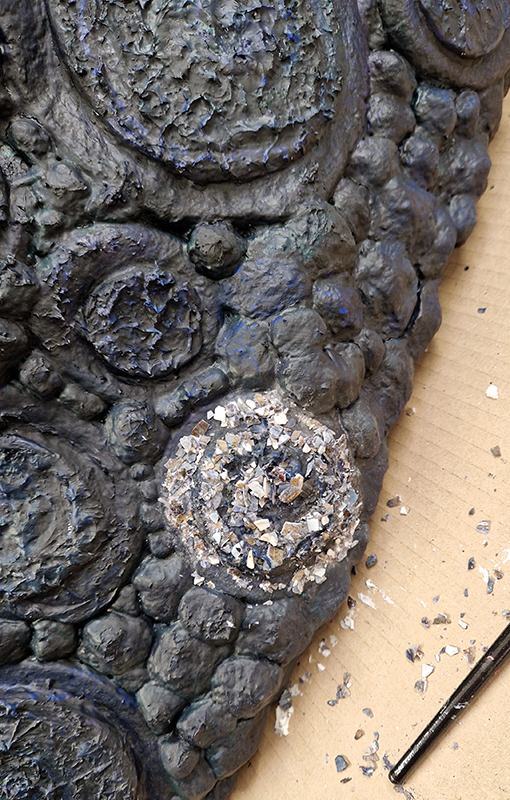
Chirality is also seen in the spiral of a mollusc shell. I am in the process of finishing the sculpture shell for belly of a rock a hybrid work of chemical conversations at the intersection of the animate and inanimate, inspired by Italo Calvino’s Cosmicomics story The Spiral. Paper clay with crushed mussel shells.

My most recent video installation Orbital shown in Life Boat at APT Gallery focused on the potential risks to technology and life on Earth from extreme solar storms.

The following month, a barrage of large solar flares and coronal mass ejections jettisoning clouds of charged particles and magnetic fields, travelling at speeds up to 3 million mph toward Earth, created the strongest solar storm to reach Earth in two decades, and possibly one of the strongest displays of auroras on record in the past 500 years. There were even perfectly clear skies to view this extraordinary event, yet I missed it. So envious of all those who did get to see the displays of Aurora at such low latitudes. I am hoping there will be another chance to see the Aurora in the UK during this current year of peak solar activity, but not so dramatic a storm as to cause an ‘internet apocalypse’.

Gallery Visits

Andrea V. Wright Eyes of Skin at Thames-side Studios Gallery curated by Thorp Stavri. This exhibition explores the permeability and interactions between the body and architecture and the tensions arising from the ever-changing precariousness of our external and internal constructed environments. It was good to be able to chat with Andrea about her influences from fashion tribes and processes such as casting skins from buildings tumbling into ruins and tactics to avoid being vulnerable working in remote locations.

Holly Birtles and Charly Blackburn in Bog Bodies at APT Gallery. interrogate the complexities of wetland mysteries in the Thames Estuary and the Fenland Marshes exploring life, death, and metamorphosis through ceramics and photography. The Bog preserves the body in death enabling us to travel back in time as far as the Mesolithic period. Conditions inside the bog are acidic. They are perpetually wet, entangled with plants and peat, muddy and monstrous. A dense soup inhabited by complex ecologies that thrive in the anaerobic surroundings, creating a unique biochemical and physical occurrence that facilitates the mummification of prehistoric humans. This exhibition however, confounds expectations of oozing mud and swampy detritus. These ‘artefacts’ are presented in a pristine white cube setting, there maybe a slight whiff of smoke lingering from the ceramics but all is clean and orderly and the framing is thoughtful with a nice use of colour contrasts between image and frame. Good to be surprised.

SALON FOR A SPECULATIVE FUTURE: HOW TO BE IN THE FUTURE? at Vestry St – Cross Lane Projects with works from Aideen Barry, Quilla Constance, Lisa Chang Lee, Kate Fahey, Young In Hong, Evy Jokhova, Huma Mulji, Koushna Navabi, Monika Oechsler, Rebecca Scott, Jo Stockham. Postulating hope for a better future Rebecca Solnit (in an article in the Guardian, 2016): wrote “Hope is an embrace of the unknown”. Living in times of unprecedented change, uncertainty, she says, has “the power to influence the future”. Taking inspiration from the ‘future thinking’ of speculative fiction and looking at a wide range of fields from science and technology to spiritual, ecological and socio-economic issues, the exhibition highlights multiplicities and the complex interplay at work in global dynamics. The works, individually and collectively, draw on associations from different  subjectivities and contested /histories facilitating a space for contemplation and the discussion of positive futures. Strong shift shaping work here that gets under the skin, fake facades, hairy hissing and an AI doctored doctrine, make for an unsettling present from which to speculate on the future.

The Tipping Point at Bell House. The tipping point may arrive seemingly out of the blue as a slight change heralding a new way forward.  It can be magical or malevolent.  More than 40 artists in six individually curated spaces will examine different kinds of tipping points, both minor and major, literal and metaphorical. Sarah Sparkes and Jane Millar curate The Gowan Room using Octavia Butler’s dystopian novel, ‘Parable of the Sower’, as a point of reference. Jonathan Callan, Chudamani Clowes, Sarah Doyle, Lydia Julien, Marq Kearey, David Leapman, Yair Meshoulam, Jane Millar, Stephen Nelson, Victoria Rance, Alke Schmidt, Lex Shute, Ania Tomaszewska-Nelson, Sarah Sparkes, Sara Trillo, Marianne Walker and Alice Wilson explore a new awareness of change and exchange, a constant shifting of strange identities, the malleability of being, interspecies communication and the strength and vulnerability of community. Imagining new ways to merge; ways to intelligently and sensually live in the flux of a perpetual tipping point. Léonie Cronin curates the Lutyens room as a procession through objects of different artistic beliefs, pointing to new myths, a point of Syncretism where ideas become merged and the old symbols get incorporated into new systems.

Thomas Pausz in Haunted Ecologies at Stanley Picker Gallery. A very interesting show drawing threads of local history together with current urgencies such as sewage pollution of the local endangered chalk stream Hogsmill River. From spirit photography and the dark room experiments of Kingston’s Eadweard Muybridge, to digital manipulation, rendering and 3D scanning – Our perception of contemporary environment and culture is always haunted by spectres of the past and by hopes and visions of the future.

Symbiosis II group exhibition exploring the relationship between image makers, the more-than-human, and alternative photographic processes at Four Corners Gallery organised by London Alternative Photography Collective  curated by Hayley Harrison, Melanie King, and Ky Lewis. This exhibition considers the connections between symbiosis and alternative photography, and asks if nature is a collaborator or a commodity in alternative photography processes.

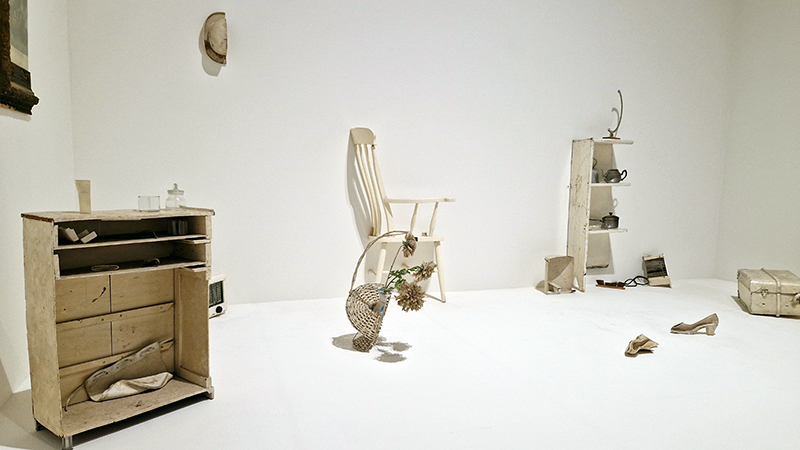
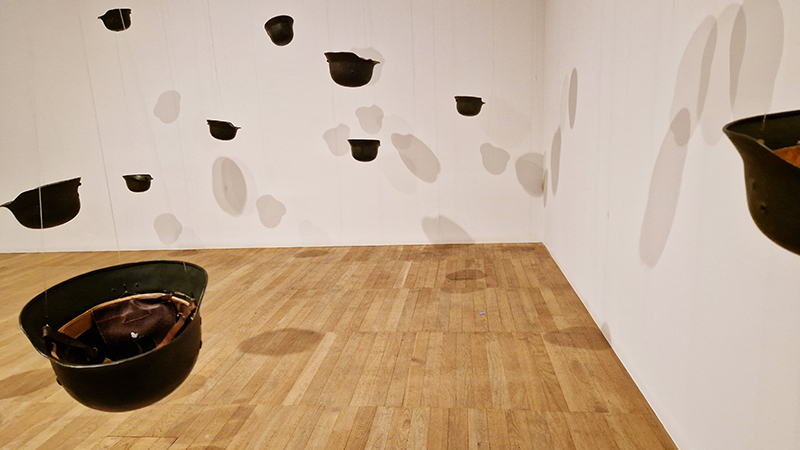
YOKO ONO: MUSIC OF THE MIND at Tate Modern. The main takeaway from this extensive overview of her pioneering work is the sadness that peace hasn’t been given a chance. The works are very direct, may appear simple in content or execution but cut deep into the human psyche. I particularly liked Half a Room, first presented in 1967, this is a room of objects cut in half and painted white. Ono said of this work “Molecules are always at the verge of half disappearing and half emerging…somebody said I should put half a person in the show. But we are halves already.” Another piece, Helmets (pieces of sky) from 2001 invites the audience to take a piece of the sky, which she sees as a hopeful symbol of limitless imagination. Jigsaw pieces of the sky are suspended in German army helmets, and although dispersed, offer the possibility of hope that they can be put back together through collective healing. Many works are participatory. A wall for drawing around your own shadow to create an entanglement of bodies. A boat to add your own wish to an ocean of wishes for the future.

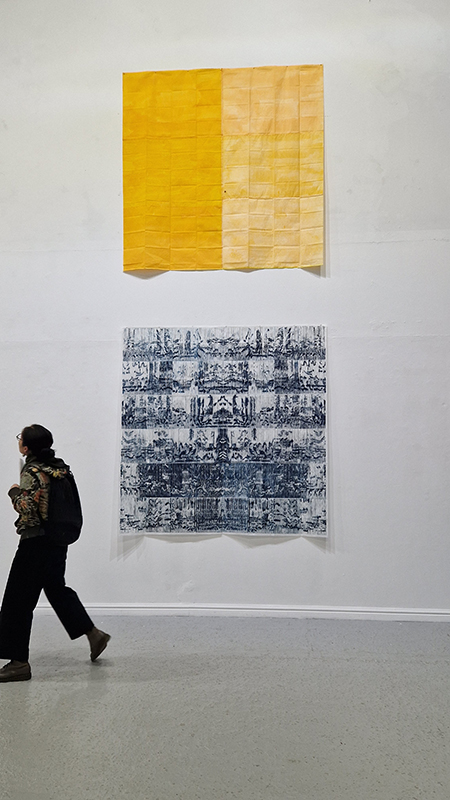
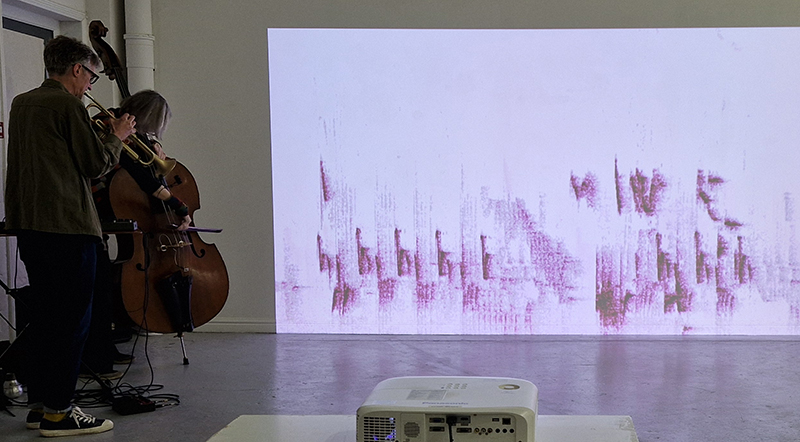
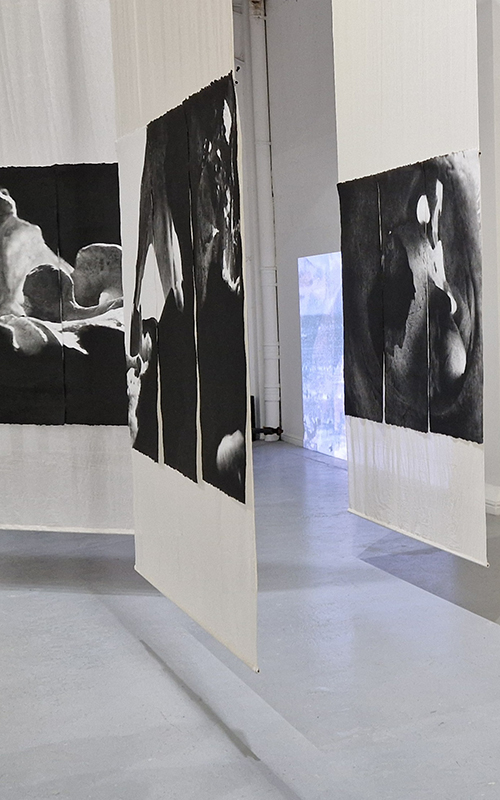
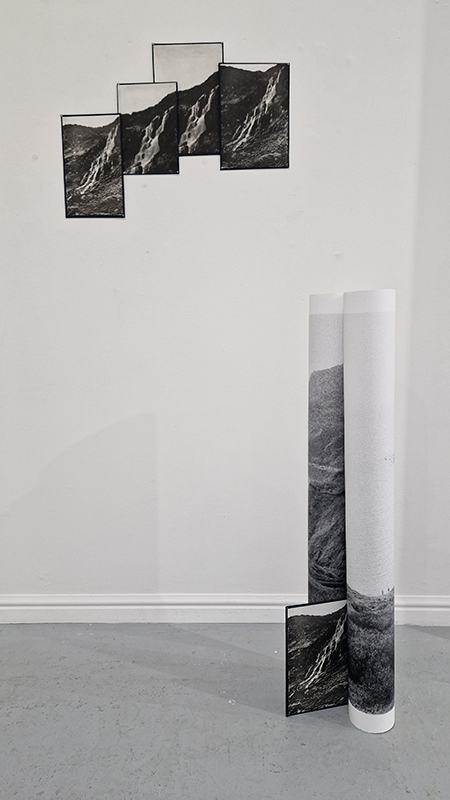
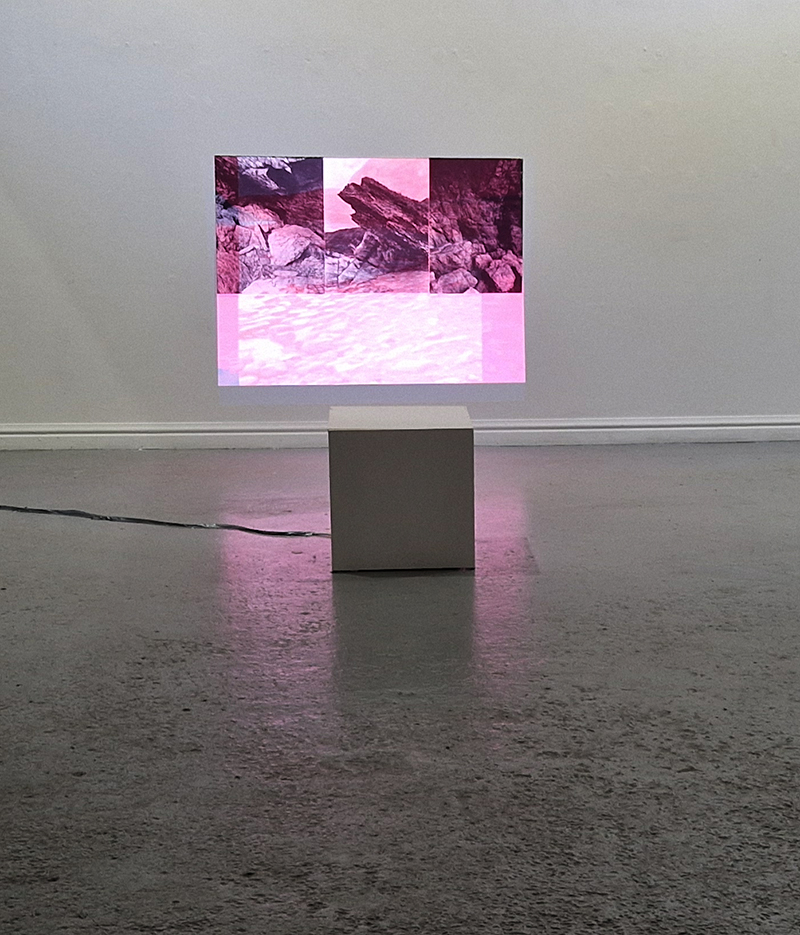
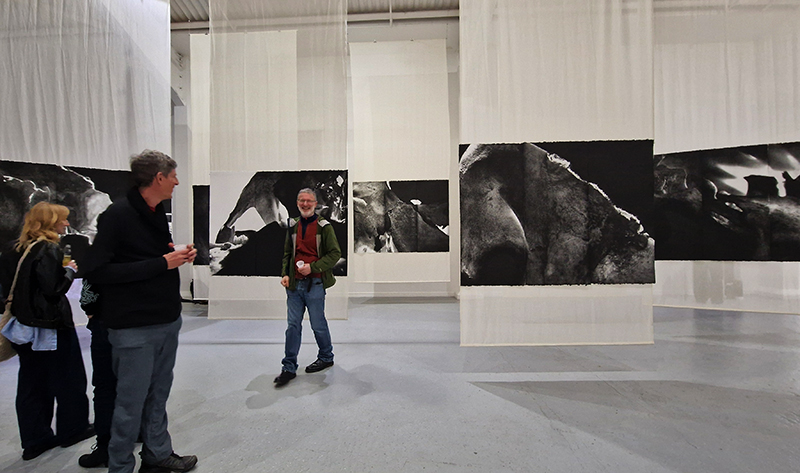
Geographies of Print final iteration of Without Horizon, Without Shore at Thames-side Studios Gallery. Geographies of Print is a collective group created by artists Victoria Ahrens, Carol Wyss and Victoria Arney in 2020. This collective looks to explore and challenge notions of print within wider contemporary discourse and practice. The artists fully inhabit the given space with dramatic large scale pieces, that interact and collaborate to create an exciting and cohesive exhibition. Blocks of colour flash between a maze of hanging muslin panels where etchings of impenetrable blacks and misleading undulations recall both mountain paths and the shadowy mazes of ancient cities. Emotive live music improvisation by Jim Howard (trumpet and electronics) and Julie Walkington (bass) accompanied Victoria Arney’s film reflecting on the epic journey of migrating birds. Landscapes of the mind and the body, a birds eye view and the internal geology of the Earth are beautifully explored.

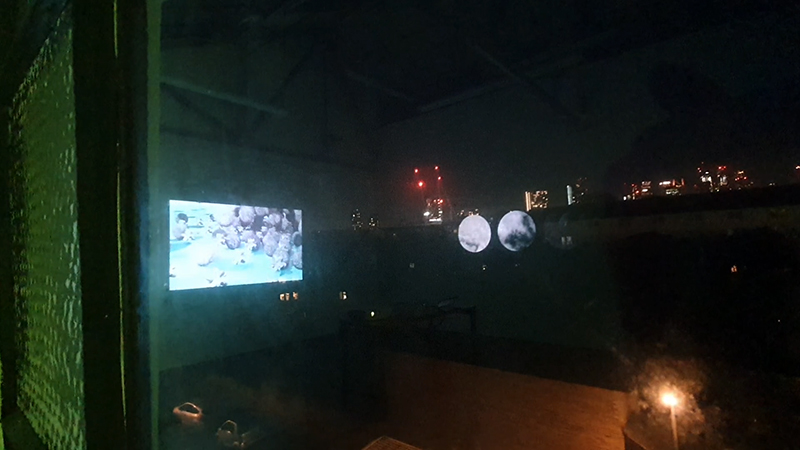
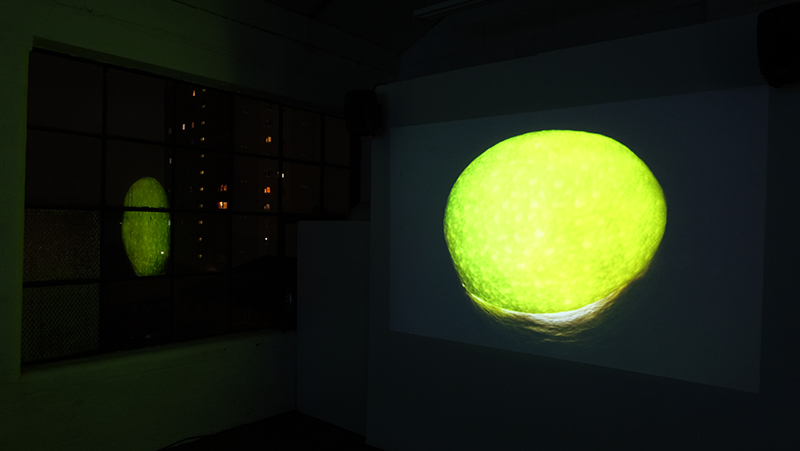
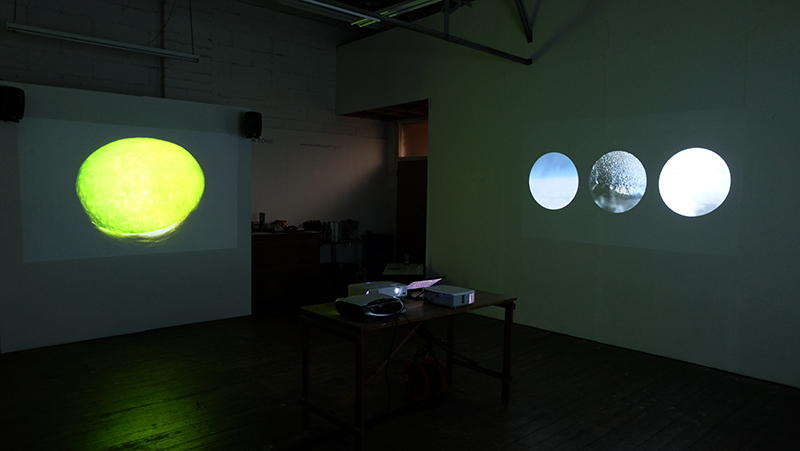
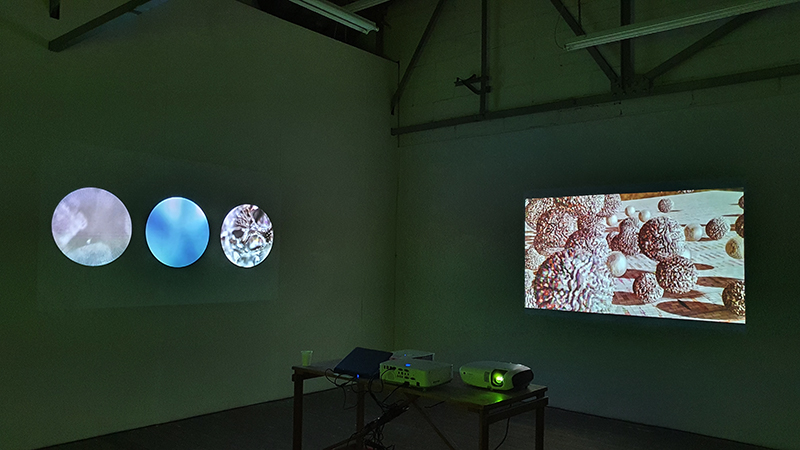
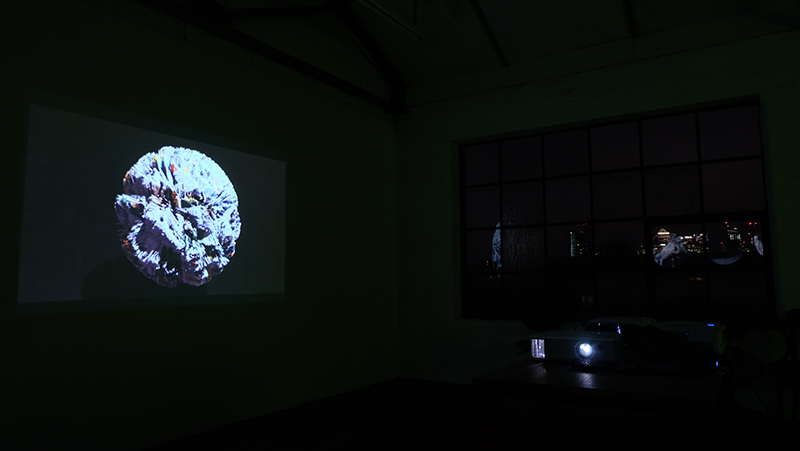
It was such a pleasure to show with Sandra Crisp and Jockel Liess at Saturation Point. We were very pleased with how our films worked together in Projected Topographies and reflected out into the night skies of London.

Sandra Crisp: E_Life uses 3D generated animation, presenting intensely textured and dynamic geometry sequenced over time.

Multiple constantly transforming organic forms, each originating from a simple 3D sphere are mapped with eclectic visuals such as emojis, fragmented images borrowed from 24-hour online rolling-news media and others downloaded via a search engine. Particle systems generate repeated, yet varied objects throughout the film which appear to have a life of their own. Overall suggesting the possibility of a simulated future/ nature.

Jockel Liess: Variations on a theme is a generative audiovisual system which starts from a point of fascination with the aesthetics of irregular organic patterns.

Visually as well as sonically the aesthetic of natural patterns thrives on their intrinsic imperfection which are never distributed even or orderly, are never replications of themselves. They are rather reoccurring variations that form a recognisable tapestry of familiarity across an otherwise chaotic and unpredictable structure. Prospering from the tension that arises between repetition and asymmetry, and playfully inhabit the border region between order and randomness.

Susan Eyre: Aóratos transports the viewer between everyday locations and terrains visually transformed via use of an endoscope, a microscope,and cameras launched in a high altitude balloon.

It is not impossible that wormholes exist in our universe.

Aóratos imagines journeying through hidden landscapes, distorted spacetime and alternative perspectives. Envisaging potential encounters with cosmic strings, space foam, primordial chemistry, radioactive particles and escaping gravity the work conjectures on the enduring allure of traversing a wormhole.

Black holes were once thought to be pure science fiction but in recent decades scientists have discovered that these extraordinary objects exist throughout our universe in all shapes and sizes and  astoundingly have even produced images of them.

Einstein’s theory of general relativity written in 1915 predicted the existence of black holes and is also consistent with the possibility of gravitational tunnels known as wormholes. It could be that there is a hidden web of planck scale wormholes linking all points in space. Theoretically, threaded through these tiny holes would be filaments of cosmic strings created in the primitive goo of early matter and flung across space when the universe burst into existence.

To traverse space by means of a wormhole would require vast amounts of negative energy, not something usually found on Earth yet in the current political climate in no short supply.

The risks and obstacles of entering a wormhole include creating enough negative energy to open the wormhole mouth wide enough to weaken the gravitational tidal forces which would rip travellers apart; keeping it from collapsing so travellers are not indefinitely trapped inside; exceeding the speed of light and avoiding incineration from deadly high radiation.

The video work explores hidden landscapes, the distortion of space and the permeability of barriers such as force fields and human skin to the unseen particles that constantly teem at near light speed across the universe.

Edge of atmosphere footage was achieved with the help of Sena Harayama, Romain Clement De Givry and Medad Newman from Imperial College Space Society supervised by senior lecturer in spacecraft engineering Dr Aaron Knoll. We also had help from the UK High Altitude Society. My ambition was to film cosmic particles at the point where most of the activity of collisions takes place, about 15km up and so we launched a cloud chamber in the payload of a high-altitude balloon. Unfortunately the prepared chamber was broken the night before the launch and the replacement was not really adequate. Also due to a turbulent launch the camera inside the payload was knocked to one side so we were unable to film this cosmic activity but did get amazing footage above the clouds, gained a height of 35km and successfully retrieved the payload from a field of horses.

Space travellers can ‘see’ cosmic rays as they pass through the retina and cause the rods and cones to fire, triggering a flash of light that is really not there. The retina functions as a mini cloud chamber where the recording of a cosmic ray is displayed by a trail left in its wake.

Aóratos translates as ‘unseen’.

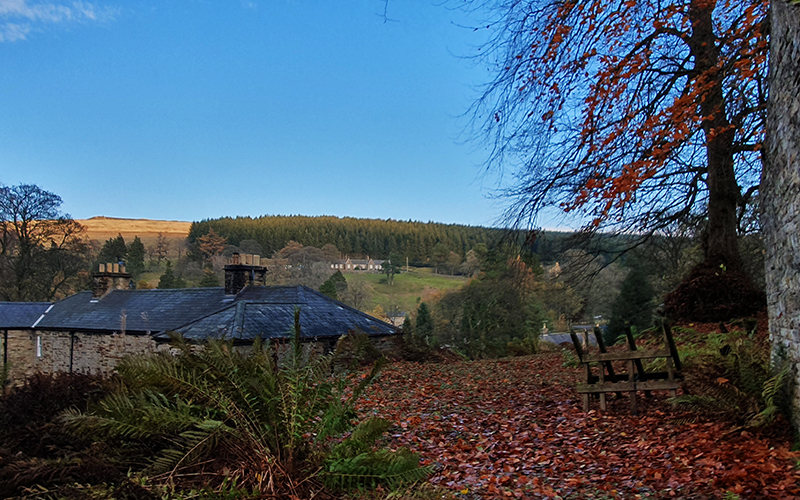
It was a real treat to be invited by Alan Smith and Helen Ratcliff for a short residency at Allenheads Contemporary Arts in Northumberland as part of the Being Human Festival – a celebration of humanities research through public engagement with North Pennines Observatory at Allenheads Contemporary Arts partnering with Durham University to present an evening of discussion and potential stargazing. After a few days of conversations, preparing presentations and meeting the other speakers we were looking forward to the event but unfortunately this was cancelled at the last minute due to flood warnings in the area. We are hoping it can be rescheduled.

While the weather was clear I headed to Allenheads village for a walk and called in at the Blacksmith’s forge where I had previously shown Aóratos as a site specific participatory installation.

I am appreciative of the dark skies in this location which feels like it is on top of the planet and therefore closer to the sky. I live in south west London so it is a real treat to be away from light pollution. While there, I was keen to make some time lapse film of the stars circling Polaris as research for work about the earth’s magnetic field and magnetoreception. Birds can see the magnetic field and use this extra sense as well as the sun, the moon and the stars to navigate on their migration routes. I am also speculating about the possibility for humans to sense the magnetic field
As the centuries go by, the North Celestial Pole shifts and different stars become the North Star. It takes about 25,800 years for the Earth’s axis to complete a single wobble. Polaris became the north star in about the fifth century and will get closer to straight above the Earth’s north pole until sometime in 2102. Before Polaris was the North Star it was Thuban and next up is Vega.

The skies were clear for a few hours when I first arrived at ACA so I was able to build a short star trail sequence but after that the fog and then the rain settled in.

When reading about the history of Hartland Magnetic Observatory, established in 1955, it mentions ‘A permanent distant mark or azimuth mark was erected on a concrete obelisk 7 or 8 feet high near the site’s northern boundary. Viewed through the window in the north wall of the Absolute Hut, its azimuth is 11º27’54” E of N. It is still in use today.’ I was intrigued that an obelisk should be used for the azimuth mark. I had hoped to see it on my research trip to Hartland but found it is currently inaccessible with just the tip protruding from dense undergrowth.

I am reimagining this object as a sculpture made from stacked recycled paper to appear stratified like the sedimentary rock that holds clues to the Earth’s magnetic field reversals and am working to the dimension ratios recommended to avoid emotional unrest.

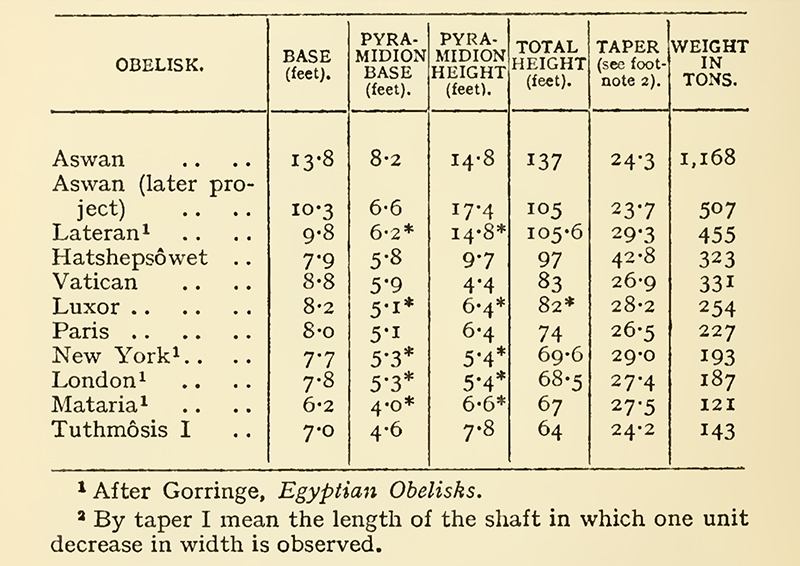
Obelisk dimensions from “The Problem of Obelisks” catalogued by Egyptologist with the Cairo Museum Reginald Engelbach, 1923.

Before the Meridian Line was moved to Greenwich, London time was calculated from the King’s Observatory at Kew.
There are three obelisks in the Old Deer Park used as meridian marks to adjust the instruments at the Observatory built by George III to observe the transit of Venus in 1769.

As I plan to make the obelisk pyramidion in copper I signed up for the Sheet Copper Sculpture Worksop taught by Robert Worley at The London Sculpture Workshop. To begin we were shown how to beat out a bowl shape and apply a dark patina using chemicals and heat.

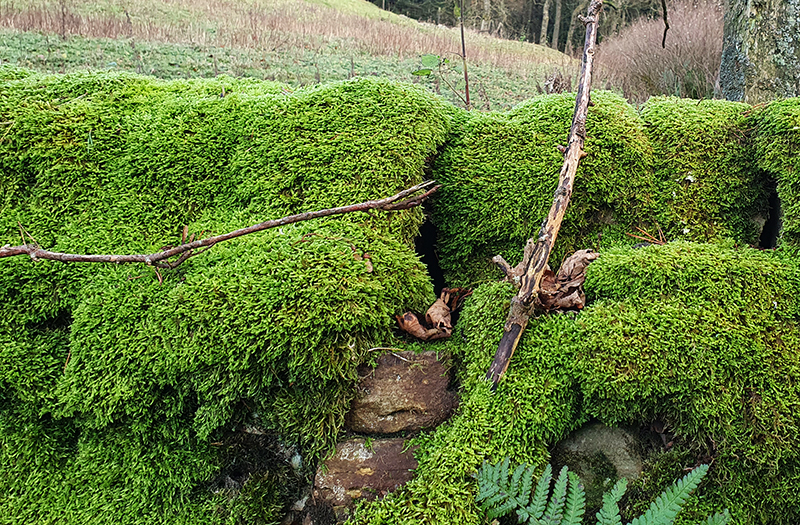
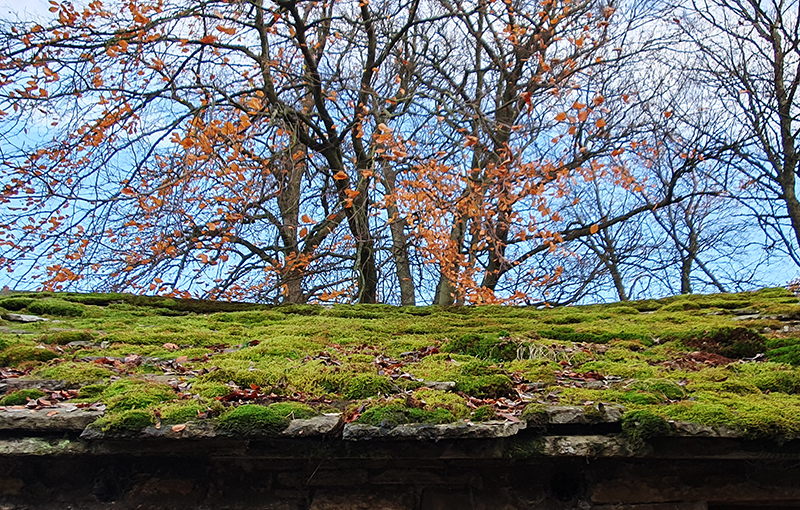
I was introduced to the plasma gun. Very satisfying cutting with the fourth state of matter. These shapes are based on the fluid fluctuations of the Earth’s geomagnetic field and I plan to use these on the north wall of The Absolute Hut sculpture in my show next year, tacked over moss with copper pins.

Magnetism is caused by the motion of electric charges. Electrons spinning around the nucleus in atoms generate an electric current and cause each electron to act like a tiny magnet. In most substances, equal numbers of electrons spin in opposite directions, which cancels out their magnetism. In iron, cobalt, and nickel, most of the electrons spin in the same direction which makes the atoms in these substances strongly magnetic. By rubbing a piece of iron along a magnet, the north-seeking poles of the atoms in the iron line up in the same direction creating a magnetic field and turning the iron into a magnet. A magnetic field can also be created by running electricity through a coil of wire, but the field will disappear when the electric current is turned off.

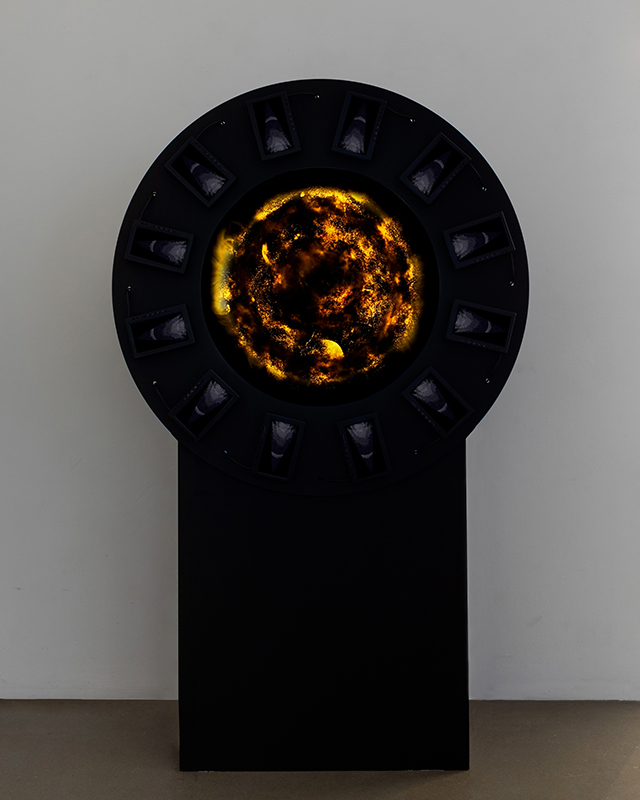
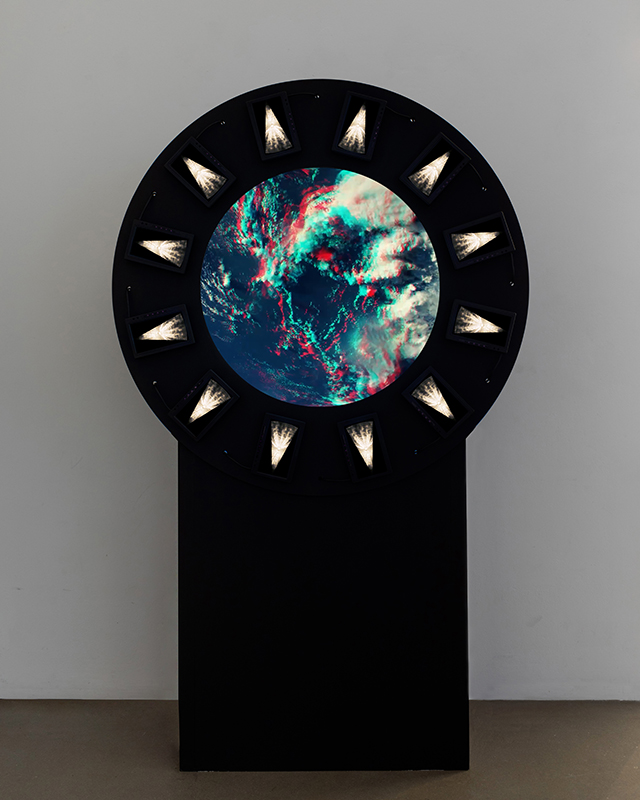
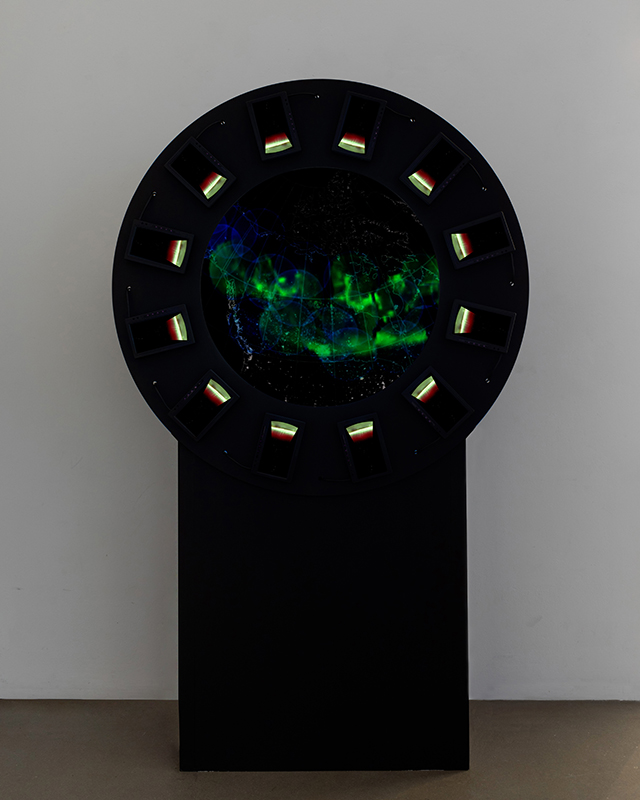
Work in progress on Breath of Stars (the cosmic ray detector interactive video) has been to convert all the .avi star burst video files to VP8.webm using Shutter Encoder software. Jamie, the programmer, has code working now to display video files with transparency so they can be layered.

Gallery Visits

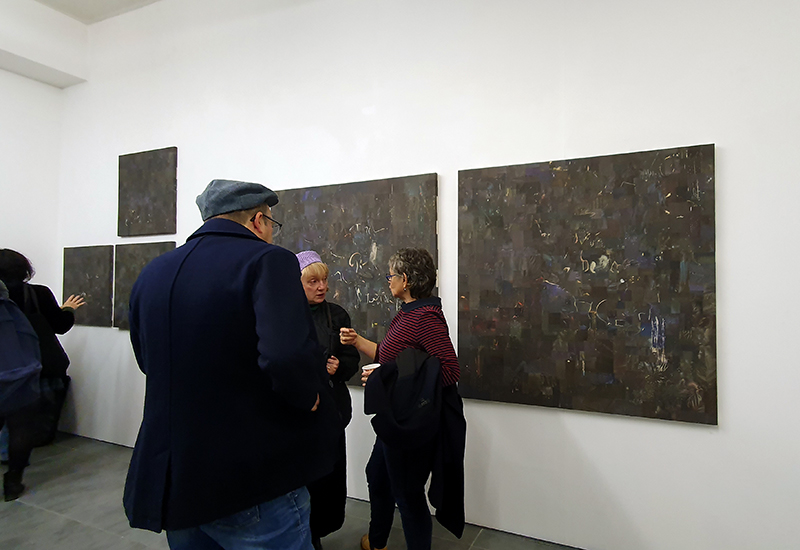
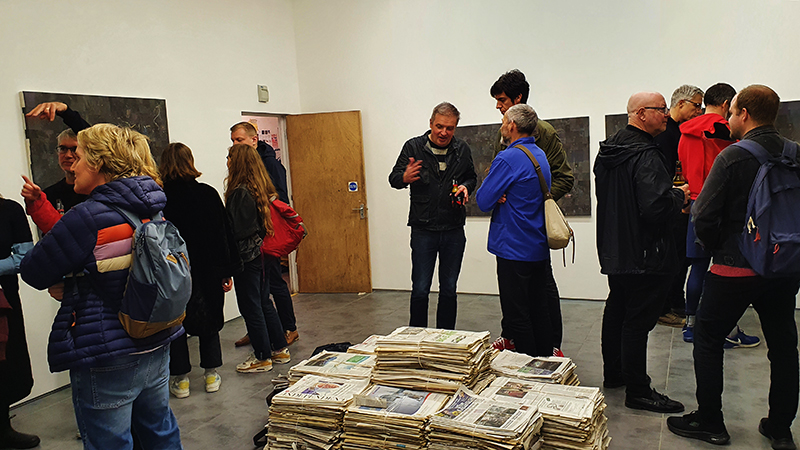
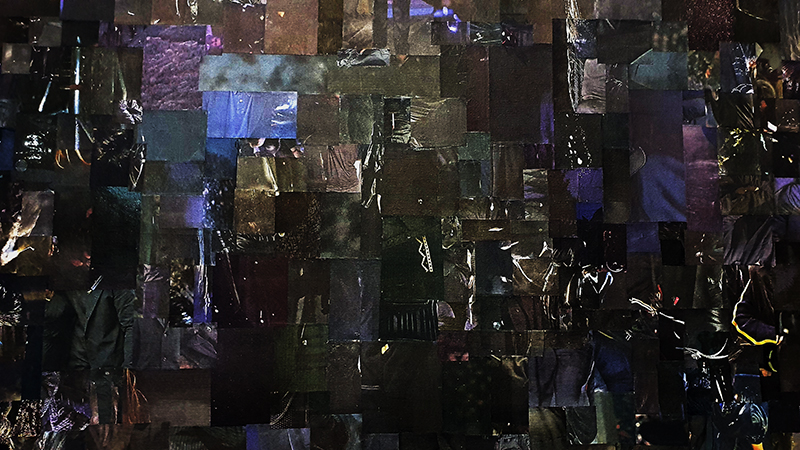
Simon Leahy-Clark solo show FEED at Artworks Project Space. Painterly surfaces made from newspaper clippings have unexpected depth in palette, flow and cosmic imagery, considering the origin of each segment. Mesmerizing to study the forms like spotting patterns in the constellations. Really liked this work.

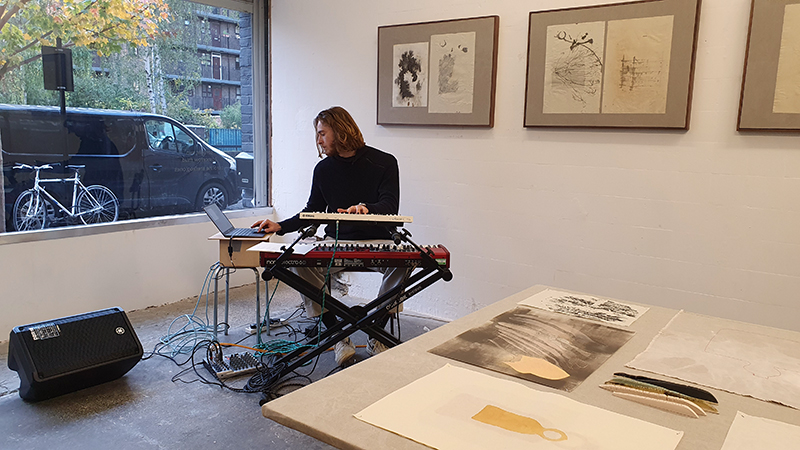
Caroline AreskogJones Tonight Rain, Tomorrow Mud at Filet Space with live sonic response from Oskar Jones incorporating field recordings gathered whilst walking in Andalucía and captured acoustics whilst making the drawings.

A thoughtfully crafted exhibition capturing the fragile landscape that turns to dust without water and mud when the rains come. The beautiful audio accompaniment from Oskar added to the meditative experience of being transported elsewhere while having time to focus of the works installed with a resonant delicacy.

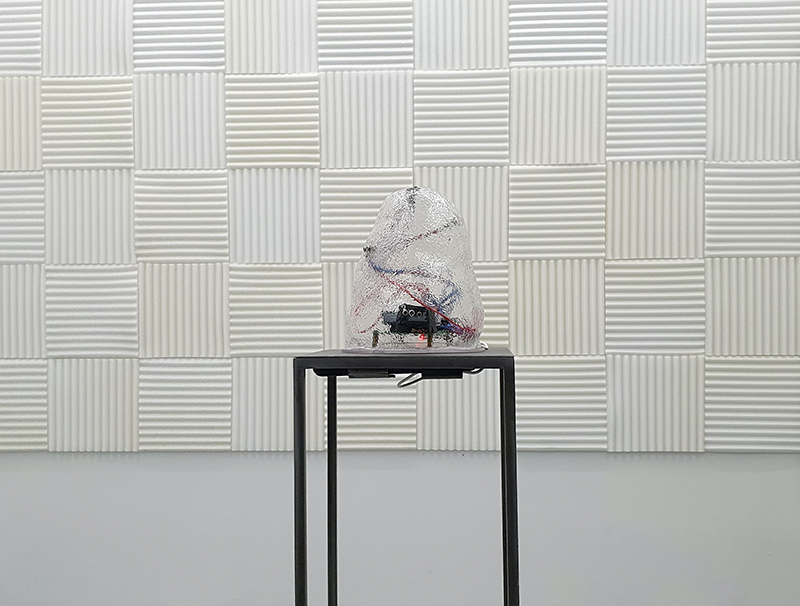
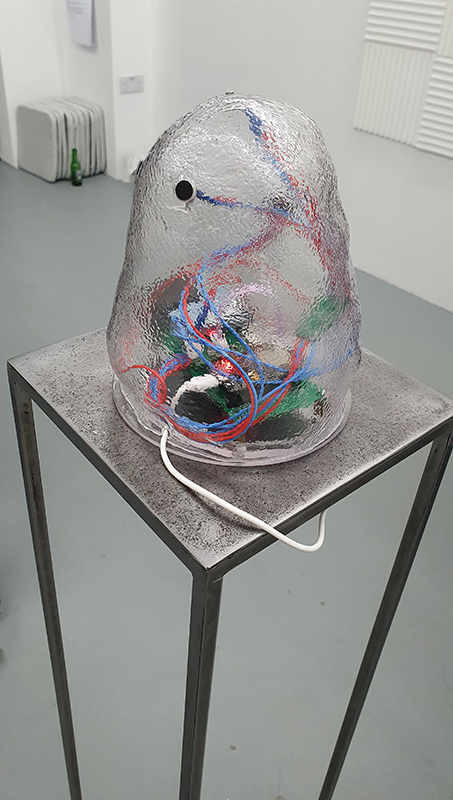
Lisa Chang Lee showing HZ-0 at Enclave Projects Lake, a sensory device created in collaboration with James Wilkie that creates soundscapes responding to the void around it. Equipped with seven sensors measuring temperature, light, air pollution, sound etc data is fed into an algorithmic software based on the Lydian scale. I hadn’t heard of this scale but am interested to discover it’s connections to gravity and magnetism. The Lydian Chromatic Scale is the most complete expression of the total self-organized tonal gravity field with which all tones relate on the basis of their close to distant magnetism to a Lydian tonic. Tonal gravity is the heart of the Lydian Chromatic Concept. Simply put, the basic building block of tonal gravity is the interval of the perfect fifth. Every tone within Western music’s equal tempered tuning relates to every other tone by either being close to – or distant from – the center of gravity, which is the tonic (or “DO”) of the Lydian Scale. There are 3 states of tonal gravity: Vertical, Horizontal, and Supra-Vertical.

This is a fascinating work thinking about other ways to experience a space.

Hollow Earth: Art, Caves & The Subterranean Imaginary at Nottingham Contemporary.

Inspired by the hundreds of caves hand carved into the rock beneath the city of Nottingham this exhibition explores questions of thresholds, darkness and prehistory. ‘Every culture and religion has told stories about what lies beneath. Caves are where extraordinary events come to pass, the domain of gods and monsters, of births, burial and rebirth. Dark, dangerous and unstable, caves are places of visions and experiences both sacred and profane. More recently, they have become home to data farms, seed vaults and doomsday bunkers.’

Artists include: Hamed Abdalla, Lee Bontecou, Sofia Borges, Brassaï, The Center for Land Use Interpretation, Steven Claydon, Matt Copson, Juan Downey, Chioma Ebinama, Mary Beth Edelson, Laura Emsley, Barry Flanagan, Ilana Halperin, Frank Heath, Ed Herring, Michael Ho, Hans Hollein, Peter Hujar, Athanasius Kircher, Alison Knowles, Antti Lovag, Goshka Macuga, René Magritte, Gordon Matta-Clark, Emma McCormick-Goodhart, Santu Mofokeng, Henry Moore, Nadar, Ailbhe Ní Bhriain, Pauline Oliveros, Lydia Ourahmane, Gordon Parks, Flora Parrott, Walter Pichler, Giuseppe Pinot-Gallizio, Liv Preston, Ben Rivers, Robert Smithson, Michelle Stuart, N.H. Stubbing, Caragh Thuring, Kaari Upson, Jeff Wall, Aubrey Williams, Joseph Wright of Derby.

This was a research trip with Julie Hill towards our joint show next year. The geological resonates through both our work, for Julie through the deep chasms of geology echoing those occurring cosmologically and for myself in the generation of the geomagnetic field deep in the earth which emanates out, reaching into space.

EVERY CLOUD at Bruce Castle Museum.

Nine artists celebrate the life and work of the Namer of Clouds and Tottenham resident, Luke Howard (1772 – 1864) to mark the 250th Anniversary of his birth.

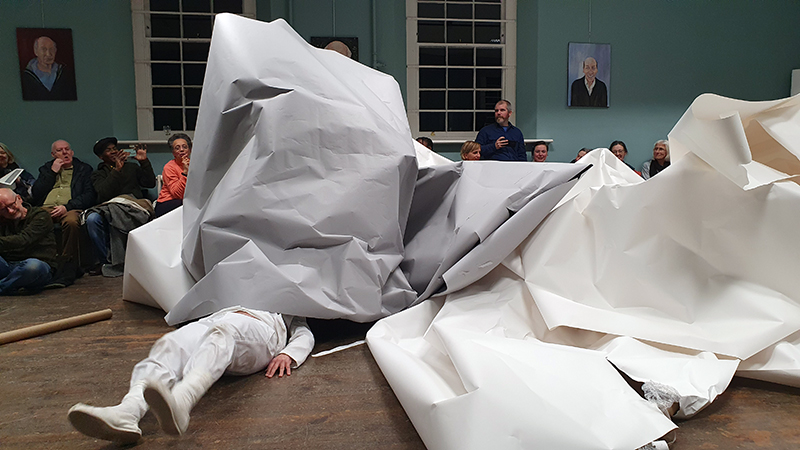
Artists include Tam Joseph, Andrew Miller, Doodleganger, Gabriela Schutz, Helen Currie, Kerry Duggan, Lisa-Marie Price, Mary Yacoob, Siân Dorman with a live cloud sculpture performance from Alexander Costello.

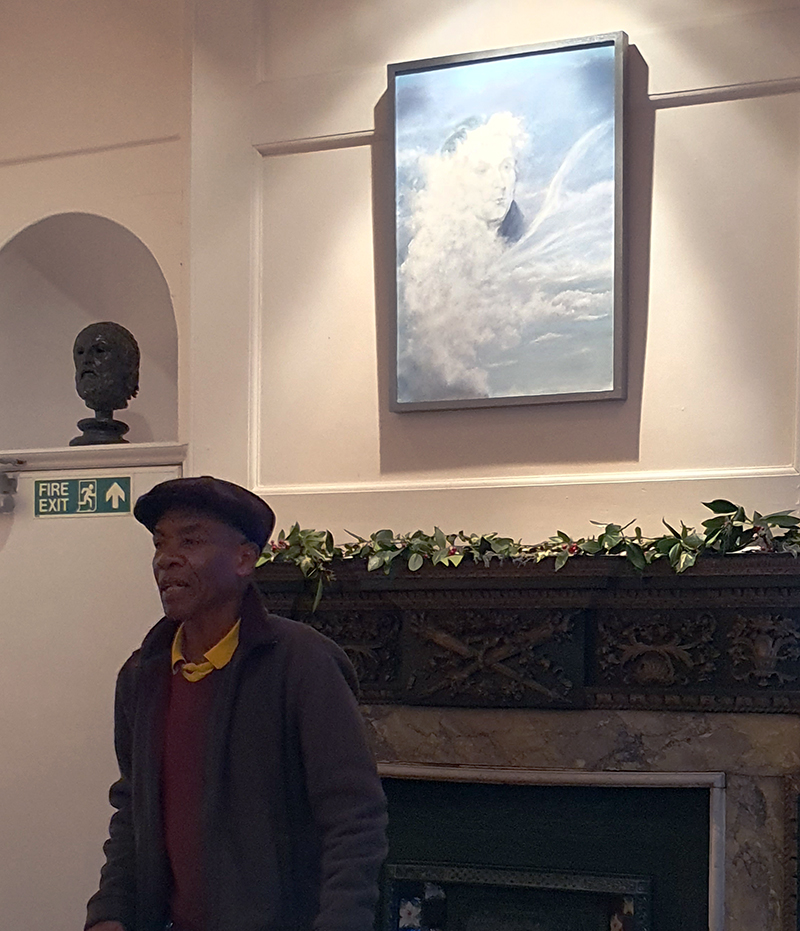
Tam Joseph gave a heartfelt speech about his discovery of Luke Howard from seeing a blue plaque with the citation ‘Namer of Clouds’ which to him spoke of first nation peoples connection to nature and piqued his curiosity to learn more about this poetic origin; the difficulty of painting clouds – never from a photograph – a cloud is never still and a photograph loses the inherent transience; and the shared passion for the shapes and patterns found in the ocean of air above our heads.

Reading

Some history of early speculation, experiments and discoveries of three men who respectively broke new ground in understanding the Earth’s magnetic field, measuring time mechanically and mapping the hidden strata of the Earth.

Latitude and The Magnetic Earth by Stephen Pumfrey. The story of William Gilbert (1544 – 1603), a radical new thinker who questioned the perceived Aristotelian philosophy of the day, developing his own theory of magnetic philosophy of the Earth. His book On the Magnet and Magnetic Bodies, and on the Great Magnet the Earth was published in 1600 in which he concluded that the Earth was itself magnetic.

The lines of latitude and longitude remain fixed as the world flexes and shifts beneath them. Extraordinary to think these lines were drawn centuries BCC and mapped by Ptolemy in the second century on his many atlases.

The zero degree line of latitude is fixed by nature whereas that of longitude is a political decision. The founding philosophy of the Greenwich Observatory viewed astronomy as a means to an end – all the stars needed to be catalogued to chart a course for sailors to cross the globe. Ptolemy first set the meridian off the northwest coast of Africa and many countries set their own starting point for 0 longitude. Eventually, after publication of a series of star charts beginning in 1767, made by the then Royal Astronomer, that became used world wide for nautical navigation, Greenwich was declared prime meridian of the world in 1884 (except by France who took another 27 years to accept the decision).

Longitude by Dava Sobel tells the story of the battle between proponents of the lunar distance method and the mechanical clock to solve the problem of determining longitude at sea. Astronomers and engineers became adversaries spurred by a financial reward offered to the one who came up the most accurate and reliable method. John Harrison (1693 – 1776) carpenter turned clockmaker spent his life perfecting the marine chronometer.

The Map That Changed The World by Simon Winchester might have some historical merit in telling the story of William ‘Strata’ Smith (1769 – 1839) but I found it over perambulatory in the telling.

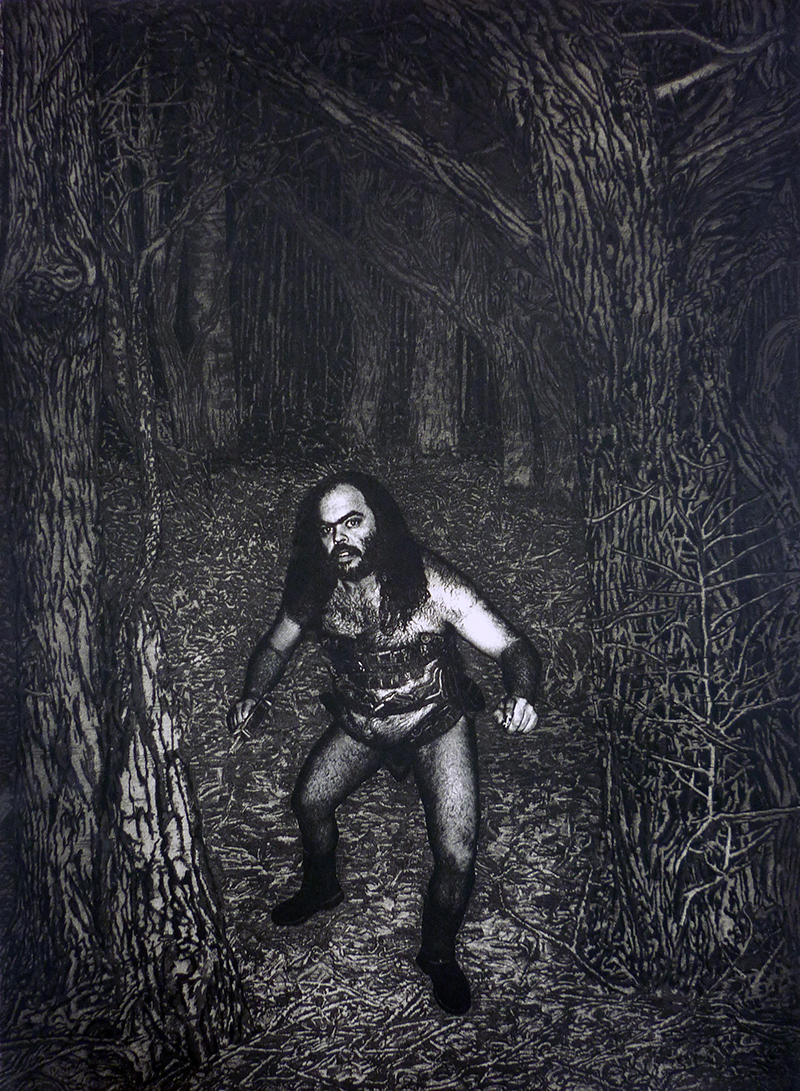
Delighted that my etching Forest of Eden has been selected for exhibition at AIR Gallery on the theme of the macabre with the exhibition renamed Memento Mori. What happens when we are confronted with the uncomfortable or visually grotesque? What makes the unappealing difficult to digest but impossible to turn away from?

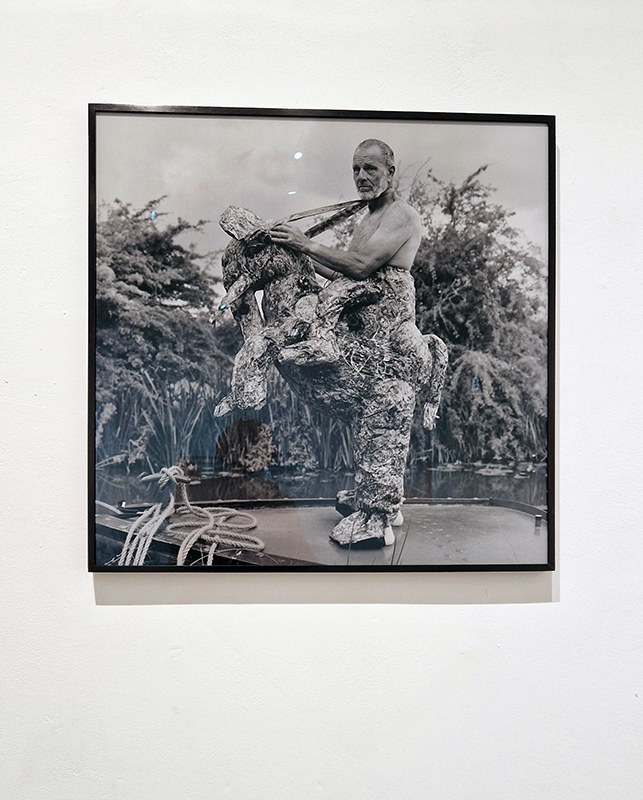
The myth of the wild man stretches back to the tale of Gilgamesh’s quest for immortality.  In history the wild man’s characteristics oscillate between horror and fantasy. They reflect fear of the other as well as aspirations to be at one with nature often violating the taboos of civilization and symbolizing the repressed desires of society. This person who posts photos of himself in charged poses has become an internet meme shared with equal disgust and fascination. In this etching he is placed back in the ancient forest of all our origins.
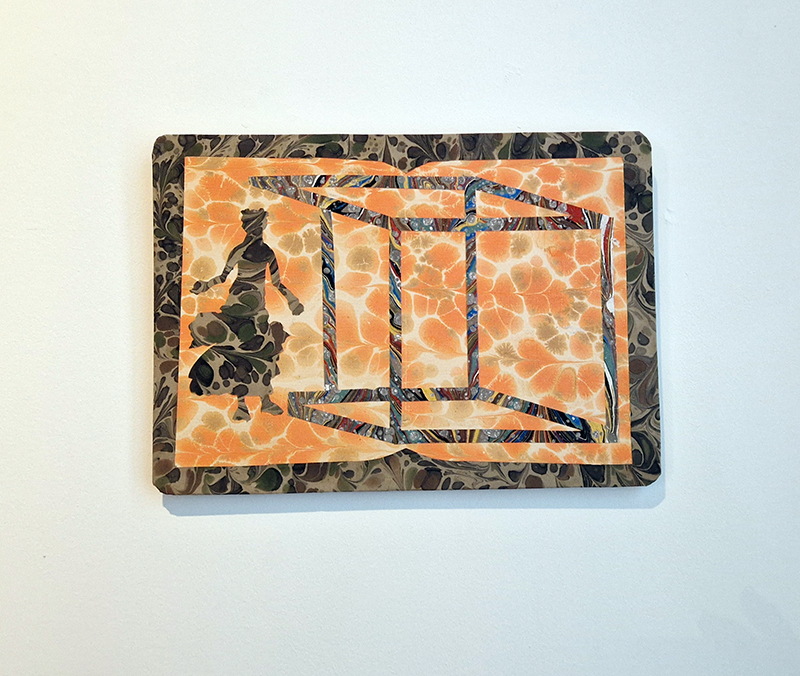
I have completed the video commission Cosmic Chiasmus (crossing the universe) for Queen’s Hall Digital but am continuing research into cosmic rays. Around 10,000 muons rain down on each square metre of Earth’s surface every minute.

Muon tomography can be used to remotely explore dense matter for hidden voids. High energy cosmic rays such as muons pass through objects, but in doing so, some will be absorbed by the object and so fewer particles will arrive on the other side. This means sensitive muon detectors can be used like x-rays to determine the structure of extremely large and dense objects. This method has been used to reveal a mysterious, 30-metre-long hidden chamber in the 4,500-year-old great pyramid of Giza, to determine the inner structures of volcanoes and to study the damaged nuclear reactor at Fukushima, Japan.

The Robot, The Dentist and The Pyramid is a 45-minute Documentary (2020) from Ancient Architects

I have discovered an audio manipulation in Adobe Audition that makes my own voice acceptable to me as voiceover for my video work. So I have returned to the video Contingent Horizons, rewritten and recorded new dialogue.

This dialogue is based on the excerpts from popular online lectures that I had used before but I have reimagined some of these quotes and included ideas from ancient descriptions of the cosmos.

the nature of the world emerges from shifting patterns

between matter and myth

to the darkest North with moon on water

to the South with sunlit crystal

to the West with Earthbound cubic alter

to the East with circling zephyrs

walking

to know the land as a plotted dimension

as abstract space

as imagined space

Out of the studio:

Lisa Chang Lee Symphony Zero at San Mei Gallery. Beautiful work creating a fragile connection between humans and the natural world as rhythms coincide to create collaborative music. Plants swaying in the breeze are each represented by a musical instrument sympathetic to its form and its movement is transposed using algorithms applied using modes of symmetry and interval into musical scores which in turn are played by humans.

Less a building: Interactions with the London Zoo Aviary book launch hosted by Passengers at The Brunswick Centre. Transported by readings from the book of this iconic flight of fancy in architecture for avian captives at the zoo. A many layered and collaborative research project by Michaela Nettell with Marcela Araguez, Tim Dee, Polly Gould, Alex Hartley, Julie F Hill, Helen Jukes, Milena Michalski, Colin Priest, Ana Ruepp and Matthew Turner. Excellent writing and gorgeous artworks. Now I wish I’d visited the aviary more often.

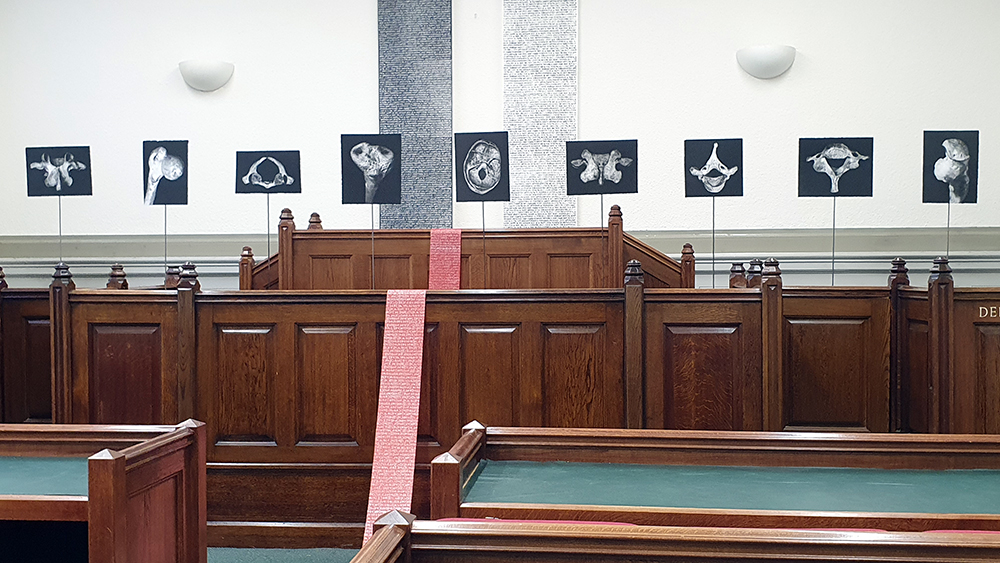
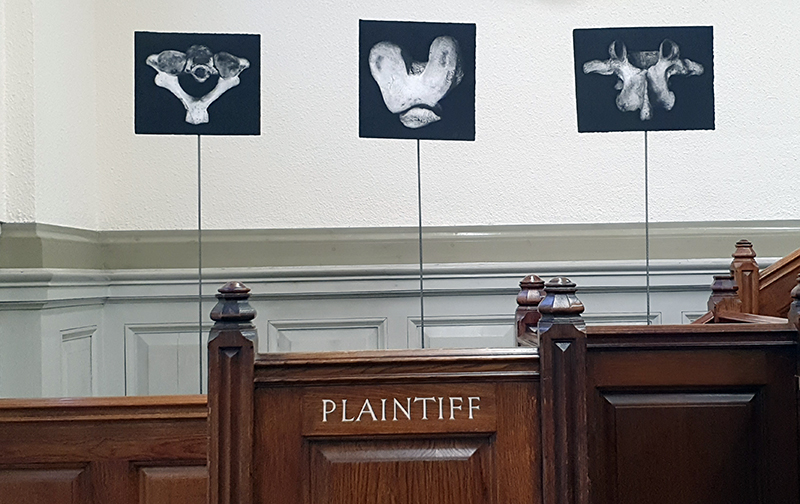
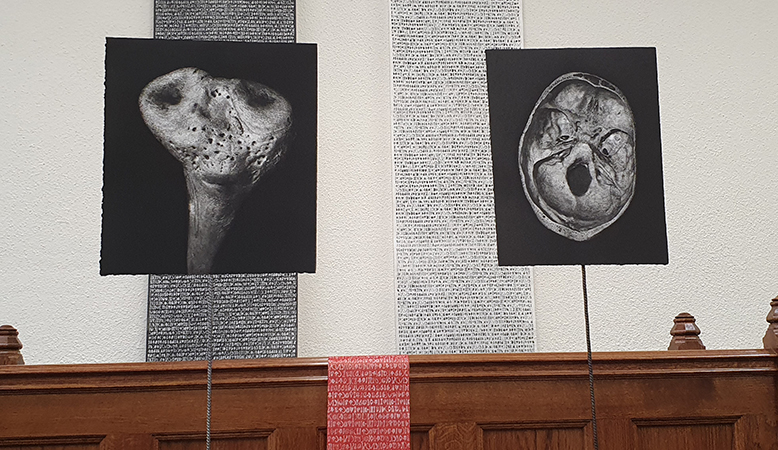
Geographies of Print collective Without Horizon, Without Shore. Stunning installations set against the civic backdrop of the Old Lambeth County Court, an apt setting for work looking at passage of time, capturing the transient and the human condition.

Victoria Arney has used the sonograms of bird song to create sculptural woodcuts. Capturing fleeting moments within landscape.

Victoria Ahrens looks at erosion and disappearance, creating work in situ using the minerals present in the landscape to hand colour her prints. We think of colour as light bouncing off matter, some absorbed, some reflected, but this work really brings home how integral colour is to substance.

Carol Wyss uncovers the structures that shape us physically and bear witness human frailty.

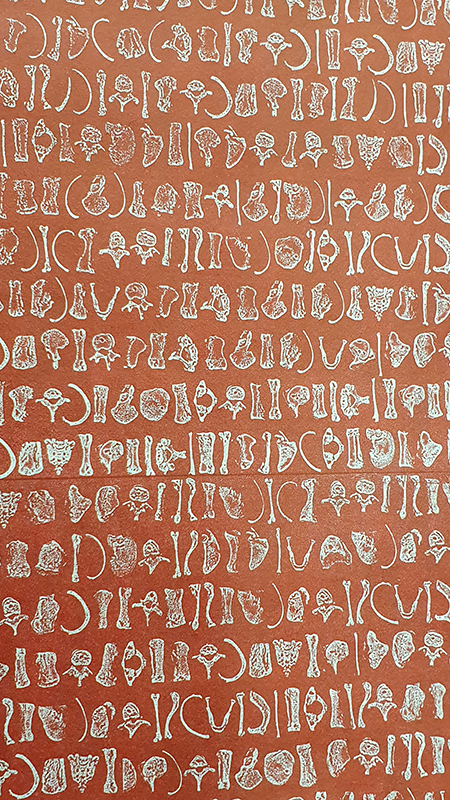
Symbols made from bones connect us to the earth as origin and destiny.

Thom Bridge Only Similar or Equivalent at Best solo show at Staffordshire Street Studios. Incredible work with light taking the image into realms of physics and geology.

“The degree to which an image is like the world is a question not of fidelity- as a narrative of documentation or technological development would have it – but of equivalence, the role that an image plays in showing in showing, or demonstrating, representing or bringing into view. Equivalence takes priority over resemblance, because the task of the image is not to repeat the world, but to inform it, and by informing it, subtly alter it in turn.” Duncan Wooldridge

Chudamani Clowes in Figure It Out with the Neulinge Collective. Wonderful immediacy as always from Chud that cuts right through to expose the lived experience of those who migrate. Epic journeys bring stories and transformation. The coral is on the move.
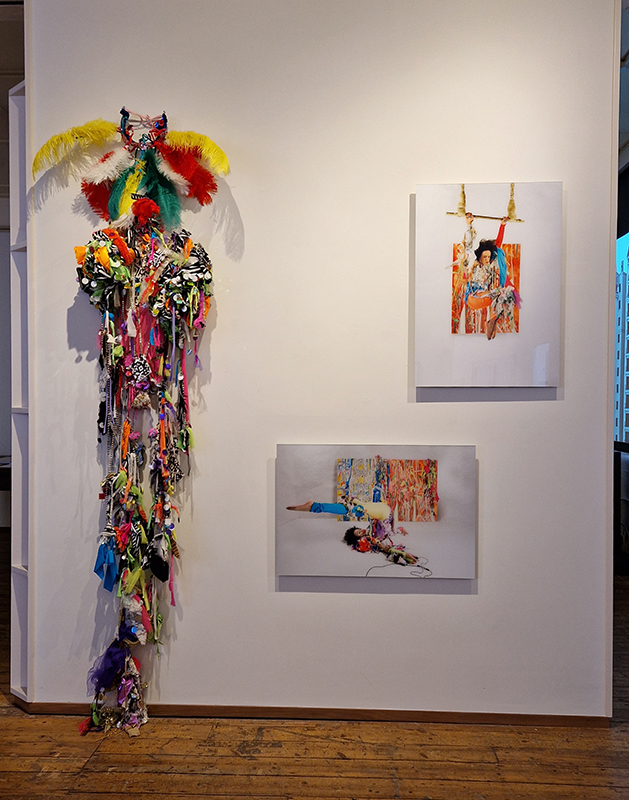
Robert Good in Osmosis: experiments in permeability at Espacio Gallery with work that forces an examination of an addiction to media updates, digital clickbait and daily data news dumps. Assaulted by a tsunami of inane questions and disconnected headlines into a brain numbing torpor the need for space to think is made apparent.

A captivating telling of how magic is vital for our well being and should be sought not shunned. Mythosphere is a multi-media theatre production created by Inna Dulerayn presented by Bacchae productions in partnership with Stone Nest at the atmospherically derelict Old Welsh Chapel on Shaftesbury Avenue. Inspired by the life experiences and creativity of Leonora Carrington and the writings of Diana Wynne.

This is a story about magic. The magic that we lost. The magic that is a forgotten part of our nature. The magic that is our right to be divine. But we still sense it. We dream of it. We feel abandoned without it. We keep looking for it all our lives.

Reading:

I am still dipping into The Waves by Virginia Woolf which I was inspired to read after listening to the Art Fictions Podcast with guest artist Hannah Hughes speaking to Fiona Fullerton. I particularly love the interludes as the sun rises over the ocean and begins its journey across the sky. Like too rich chocolate cake the intensity of Woolf’s writing is delicious but can only be taken in small bites.
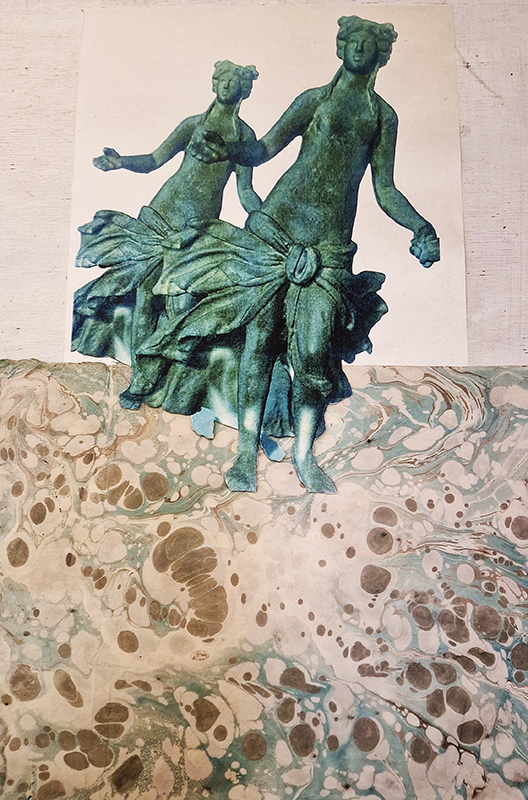
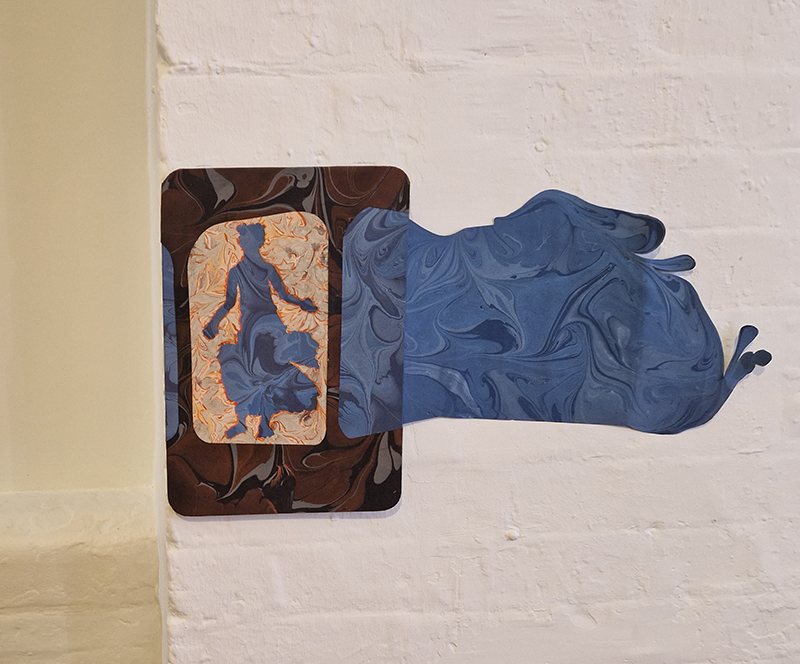
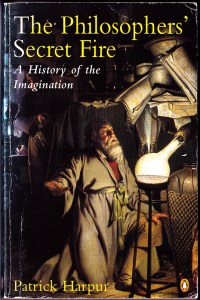
I have Chantall Powell to thank for flagging up the book The Philosophers’ Secret Fire: A History of the Imagination by Patrick Harpur. A fascinating book taking the view that just because something is not literally so doesn’t mean it isn’t ‘real’. As in Mythosphere the book seeks to rediscover the Otherworld of spirits, gods and daimons which the west has banished to the unconscious mind.

I was so excited to read the following:

“…daimons inhabit another, often subterranean world which fleetingly interacts with ours. They are both material and immaterial, both there and not-there – often small, always elusive shape-shifters whose world is characterized by distortions of time and space and, above all, by an intrinsic uncertainty.

The point is: the words ‘subatomic particles’ could be substituted for ‘daimons’ in the paragraph above without any loss of accuracy. This is not a coincidence – the subatomic realm, like the unconscious, is where the daimons took refuge once they were outcast from their natural habitat.”

As part of The Matter of Objects; Medieval and Renaissance Materiality in Contemporary Conversation project initiated by Queen Mary’s University  I have been paired with a research historian who has provided me with an image of an object that I will then respond to by making a piece of work.

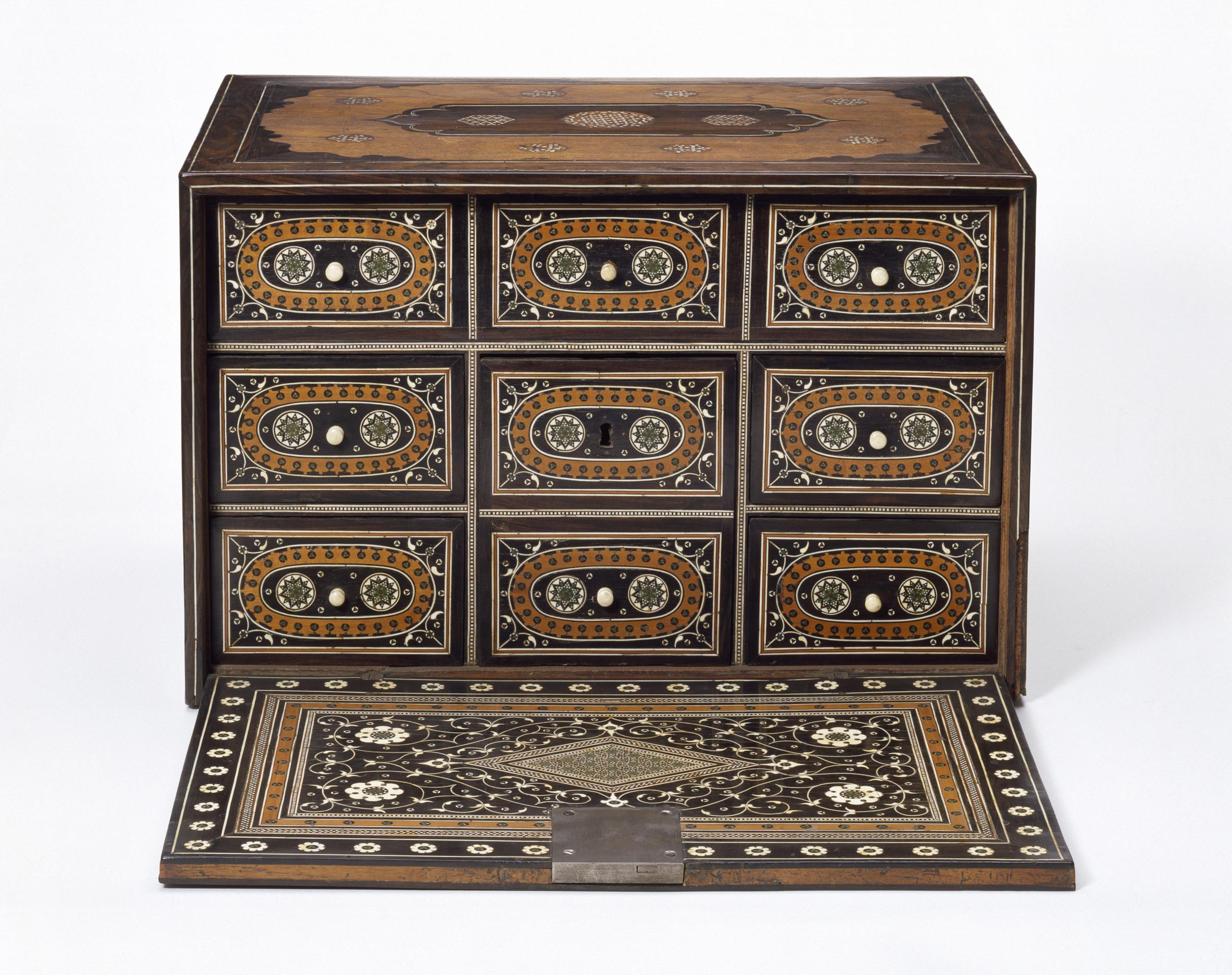
2006AN0914_2500.jpg

The object I have been given is a 16th century fall-front cabinet probably made in India for a Portuguese merchant. I wanted to participate in this project because  I am interested in the physical matter of our surroundings and objects and also more intangible things such as aura of place and agency of object. I thought the period would also be interesting as a time when science and religion clashed as being the source of truth.

The project aims to bring together humanities researchers, artists and creative practitioners in discussions around these objects, their historical narratives, and their relevance to our world today. There is going to be an exhibition and launch event where artists and researchers will come together to discuss their processes of deconstruction, interpretation and creation.

It feels a bit like trying to discover an identity beginning just via the purely visual information from a digital image. I had no idea what a fall fronted cabinet would be so before I opened the image I had in my mind something much larger with perhaps some kind of carving that would reflect waterfalls or falling folds of fabric. Recent visits to Sutton House influencing me here with the linenfold wood panels perhaps.

1604 Linen fold panel.jpg

It was a lovely surprise to open the image and see something so intricate, ornate and compact. I am also influenced in my response by recent exposure to the Elizabethan polymath John Dee and his alchemical interests so all the little secret drawers made me think of what someone like him might have kept locked away.

1604 Last Tuesday Society.jpg

The patterns are complex with lots of triangles and geometric shapes mixed with other more organic patterns from nature. The stars and almost elliptical shapes seem to relate the heavens with the flower like patterns of earth.

1604 object drawer

It is an intriguing object  with its secret drawers hidden behind a front panel – it would involve a small ritual to lock away and then open up and lay out the front ‘carpet’ to retrieve the precious items from within.

I came across what may be considered another fall front cabinet in the form of a shrine containing samples of metal placed in beeswax, its provenance even more mysterious.

1604 Stine Nielsen Ljungdalh Shrine

1604 The-Hunters-of-the-Invisble-installation

Charlotte Bergson: The Hunters of the Invisible


Losing sense of what or who is real Charlotte Bergson: The Hunters of the Invisible curated by Stine Nielsen Ljungdahl at Stanley Picker Gallery presents a carefully crafted mythology that has such a coherence of intent it is hard to determine fact from fiction.
1604 Stine Nielsen Ljungdalh -Charlotte Bergson

Charlotte Bergson: The Hunters of the Invisible


The hexagon is a recurrent motif as is the duality of twins.

Photographs and artefacts are presented as documentation accompanied by an in depth publication The Zone – A Journey Towards the Centre which further bolsters the world of  Charlotte Bergson’s research into The Hunting Society. We are drawn into an illusory world where borders  blur and it is not clear whose identity is real, be it artist, archivist, or a society that once held secrets to an alternative origin of the universe, where alchemy and ritual were practised as heady truths.

This is about origins.

1604 ink in water

Trying to work out what is real. Sam Burford’s paper Searching for Traces of the Indexical within Synthetically Rendered Imagery presented at the Shadow Without Object symposium considers ways to understand the relationship in a simulated image between its genesis and its being made visible. The rendering equation introduced into computer graphics in 1986 created a breakthrough by enabling illumination in an image to be made by using the Monte Carlo method of geometric probability borrowed from particle physics theory.

Monte Carlo simulation is a statistical approach which is concerned with experiments employing random numbers. The light playing around generated objects in the image could be made to behave more like real light in its random scattering. These images still did not look real enough but everything changed in 2004 with the release of the Maxwell Render product which claims to render the perfect image. This new product could apply randomness in rendering to an image through an algorithm to add some noise and create what looks like in effect a low res image – this actually appeared more real.

1604 joep swagemakers

Photo realistic rendered images are almost impossible to identify as simulated and so to claim credit the author will often attach a proof rendering image. A bit like a birth certificate.

Stan Douglas in The Secret Agent at Victoria Miro uses digital rendering to create a series of large scale urban landscapes.

1603 Stan Douglas The Second Hotel Vancouver

Stan Douglas The Second Hotel Vancouver

Unsettling in their clarity of detail and targeted lighting they create a confusion, a bit like having a word on the tip of your tongue, they are almost something. Almost a photograph of something almost like a film set; too sharp to be a memory. Borrowing from film noir tropes we are segued into a similarly stereotypical digital underworld. The six screen feature length installation The Secret Agent operates in the same world of noir subterfuge but instead of digital fakery it is the over dramatic acting, simplistic plot line and raw characterisation where we must suspend our disbelief.

1603 Stan Dougls Secret Agent

Stan Douglas The Secret Agent (film still)

Graham Fagan explores the constructed nature of history through the stories myths and fictions that build a contemporary identity.

1601 Venice Graham Fagan

Graham Fagan

Pulling at threads of cultural difference but tying them together in a personal experience to engage emotion that doesn’t shy away from acknowledging conflict and injustice.

1601 Venice Scotland Graham Fagan (1)

Graham Fagan

Drawn through the faded splendour of Palazzo Fontana in Venice by the haunting mix of sea shanty and classical string arrangement of The Slaves Lament we are immersed in a melancholic beauty.  The words attributed to Robert Burns convey the debilitating heartache of being wrenched from home for cold cruelty.

Torn from that lovely shore, and must never see it more; And Alas! I am weary, weary O.

Colonialism is also referenced by C.T. Jasper and Joanna Malinowska in their video production ‘Halka/Haiti 18 48’05″N 72 23’01″w’ taking opera to the tropics.

1601 Venice Poland

C.T. Jasper and Joanna Malinowska Halka/Haiti 18 48’05″N 72 23’01″W

Inspired by Werner Herzog’s character Fitzcarraldo in the 1982 film of that name the artists expose the absurdities and examine the agenda of one culture imposing itself on another. In Herzog’s film, after many great struggles to achieve his goal, European Fitzcarraldo manages to drag a ship over the impeding mountains so he can export rubber, make his fortune and build an opera house in the Amazon basin. He only succeeds in this physical challenge with the help of the local natives. His undoing is in ignoring local culture. When his crew falls asleep, the native chief cuts the rope securing the ship and it floats away down the river. The chief’s actions are to appease the river gods who would be angry to see their waters circumnavigated and their power not respected.
Where do we begin to unravel our origins?  The location of the artists film found at the coordinates of the title ‘Halka/Haiti 18 48’05″N 72 23’01″w’ reflects the complexity and amorphous nature of national identity. It is a Haitian village inhabited by the descendants of Polish soldiers who fought for Haitian independence. Originally sent to put down the slave rebellion in 1802 these soldiers found themselves sympathetic to a local culture under oppression much as had happened in their own homeland and so joined forces with the locals in the Haitian revolution and subsequently made their home here.

Ivan Grubanov’s installation in the Serbian Pavilion United Dead Nations provokes questions about how national identity is created and the symbolism of the flag in that process. In scattered piles across the floor are the discarded flags of states that are no longer in existence since 1895 when the Venice Biennale began.

1601 Serbia

Ivan Grubanov United Dead Nations

The list is an obituary of creation, rule and disappearance. Austro-Hungarian Empire (1867-1918),the Ottoman Empire (1299- 1922), Gran Columbia (1819-1930), Tibet (1913-1951), the United Arab Republic (1958- 1971), South Vietnam (1955-1975), the German Democratic Republic (1949-1990), the USSR (1922-1991), Czechoslovakia (1918-1992), and Yugoslavia (1918-2003).

Romanian artist Adrian Ghenie paints emotional images exploring notions of survival and the fictions that define nations by questioning the truth of a collective memory.

1601 Venice Romania

Adrian Ghenie

Far And Few [Between] curated by RCA printmaking alumni Lisa Chang Lee at No Format gallery explores identity from the perspective of Chinese expats now living in the UK.

1603 Few and Far BetweenObserving the projection of the self creates a self consciousness that, like observing the path of an electron, is surely impossible to do without interfering with its trajectory.

1603 Few and Far Between Lisa Chang Lee

Lisa Chang Lee Habitat-1


1603 Few and Far Between Halli Sun

Haili Sun Curled Fugue

To question consciousness the works have a strong material presence linking identity to the land and the body and the interactions with the environment that build us.

1603 Few and Far Between Le Guo

Le Guo Koan

How we forge our path and face our own nature is a universal theme. The Mark Bruce Company tackled this through dance in a reworked telling of The Odyssey.

1603 Mark Bruce comapny.png

Mark Bruce Company The Odyssey

Like Pandora’s box it was an explosion of chaos as passions and demons were unleashed on stage leading and tormenting the wayward King on his epic journey, crossing lands beset with monsters and temptations to return home to face a Queen savage from years of despair.  In a vortex of kitsch high drama and inventive to the point of surrealism the story may have been obscured but the message that mortality is beset by challenges, and we must be cautious who we trust – least of all ourselves, remained.

Szilard Cseke’s installation Sustainable Identities is a sterile plastic environment.

1601 Venice Hungary (2)

Szilard Cseke Sustainable Identities

Large white balls move silently along plastic tunnels above our heads on predetermined pathways.

1601 Venice Hungary (3)

Szilard Cseke Sustainable Identities

Perhaps this is a warning of what our identity might become if we never leave the path to take that epic journey.  Or worse, we have our identity taken from us.

1603 the prisoner.jpg

Patrick McGoohan in The Prisoner 1967