Archives for posts with tag: solar storm

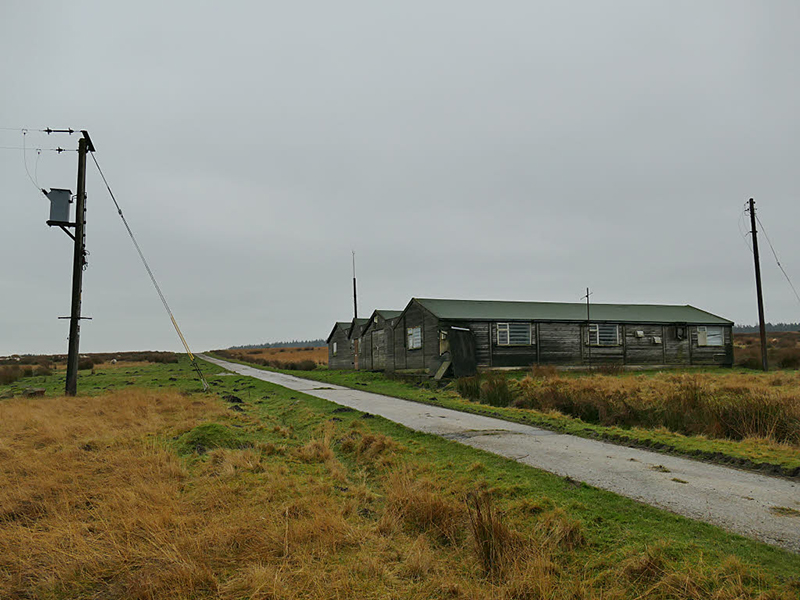
I am excited to be planning a visit to Haverah Park, the site of a cosmic ray air shower detection array consisting of water Cherenkov detectors distributed over an area of 12 km2 on the Pennine moorland, North Yorkshire. The experiment was operated by University of Leeds for 20 years, and was switched off in 1987. During its lifetime many 1000’s of extensive air showers were recorded including four exceptional ones of such size that the cosmic rays that generated them must have had energies greater than 10eV. These particles are the highest energy form of radiation known to exist anywhere in the universe and their origin is one of science’s greatest mysteries. Having reimagined The Absolute Hut seen at Hartland Magnetic Observatory for the exhibition A Stone Sky I am hoping a future project may be the reimagining of the huts from Haverah Park.
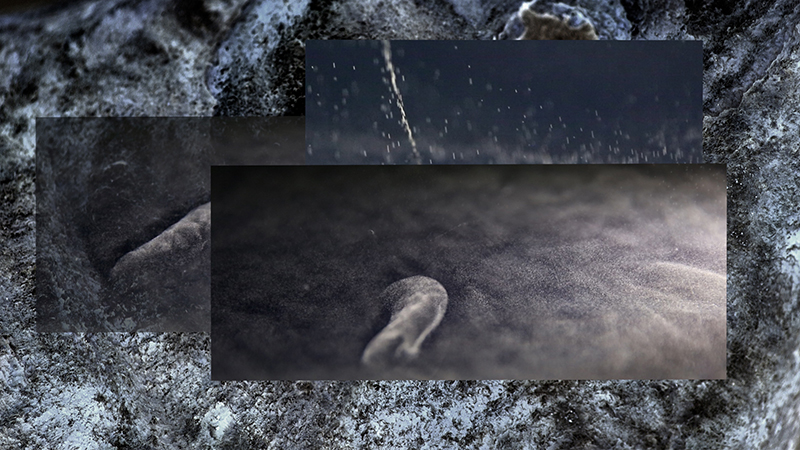
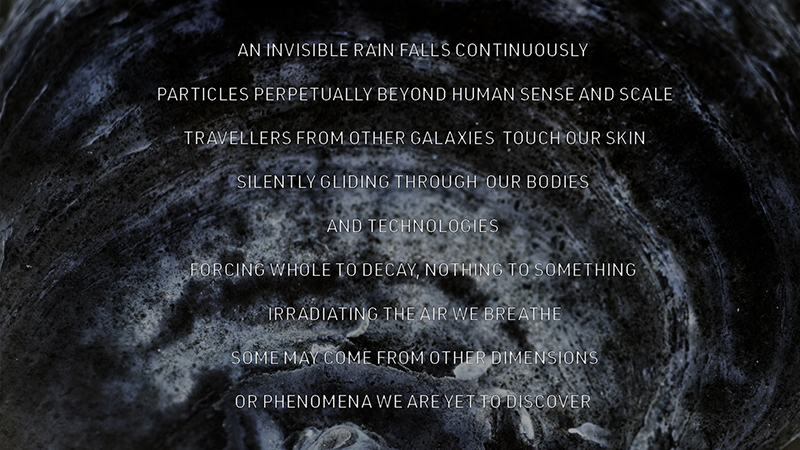
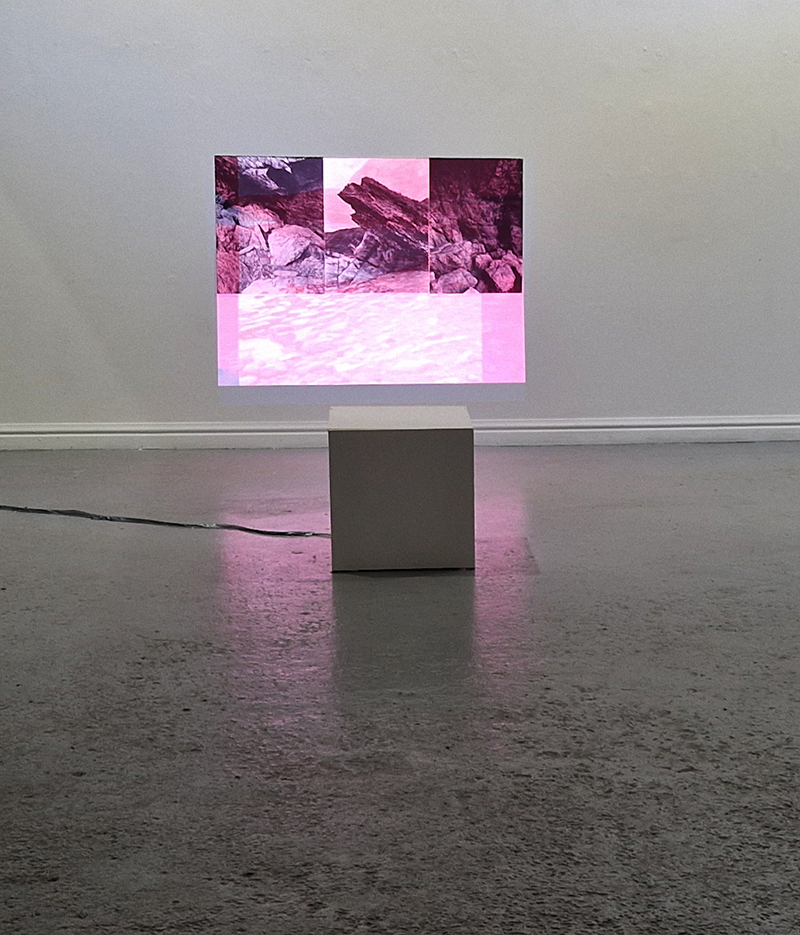
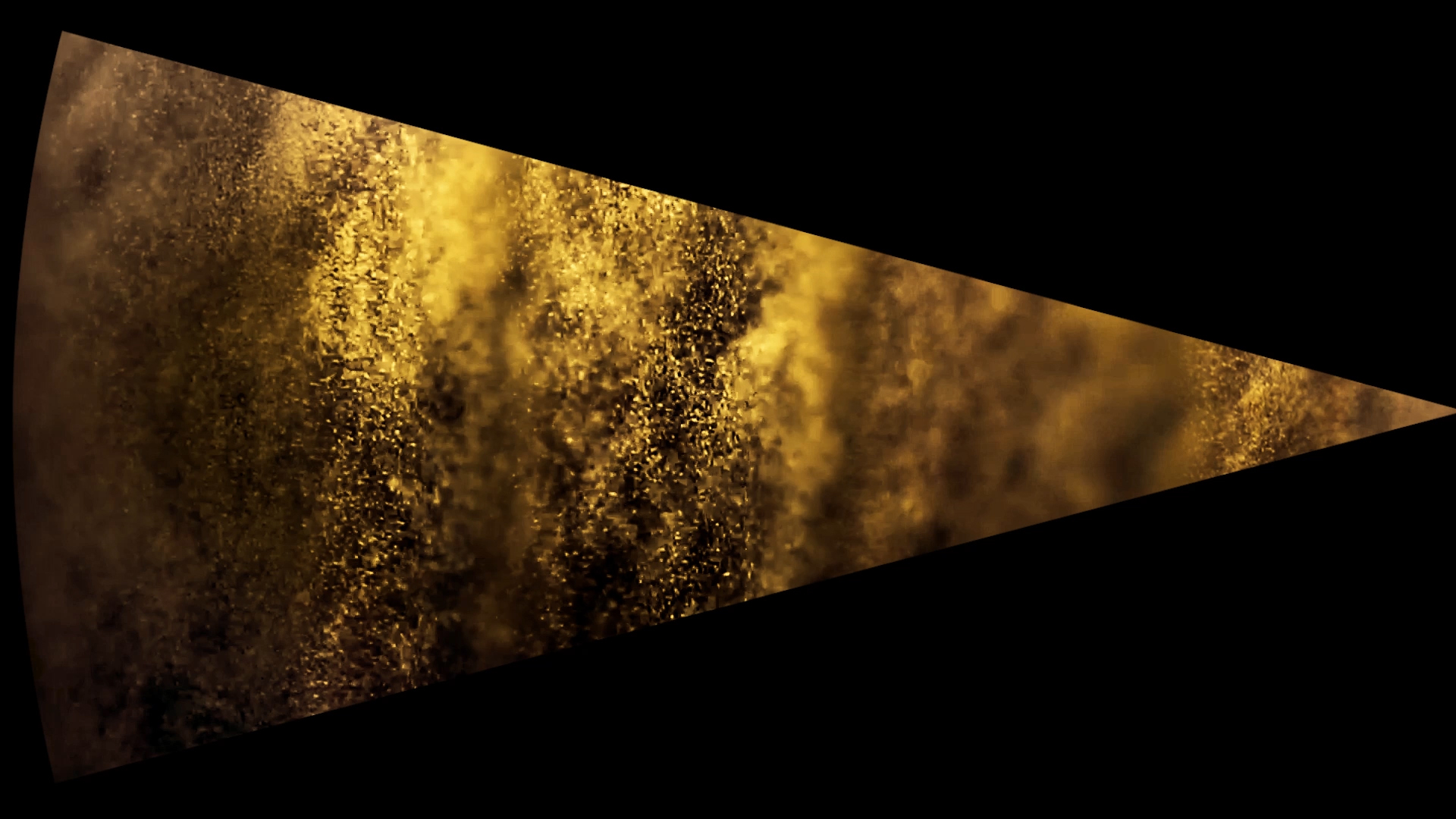
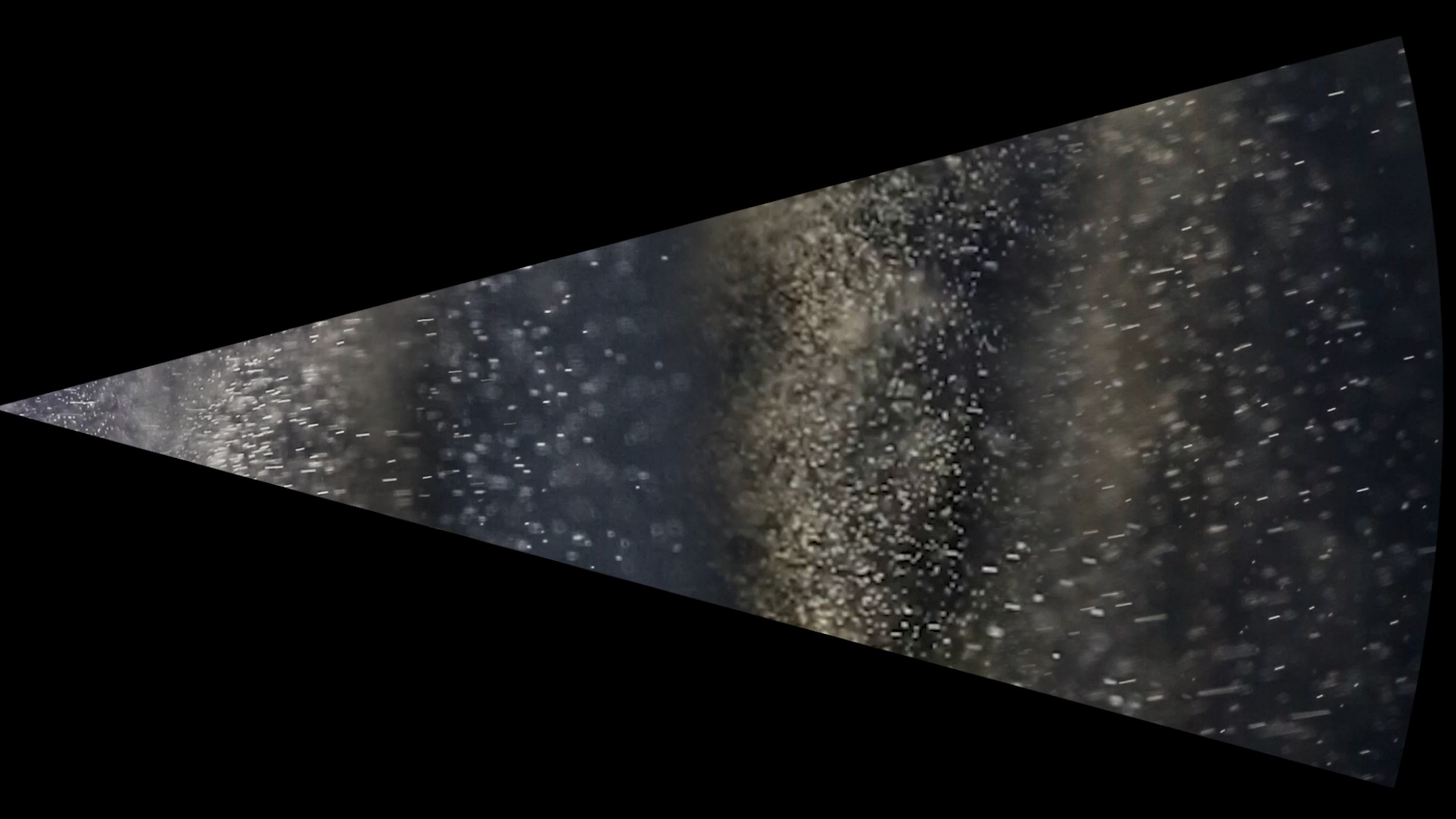
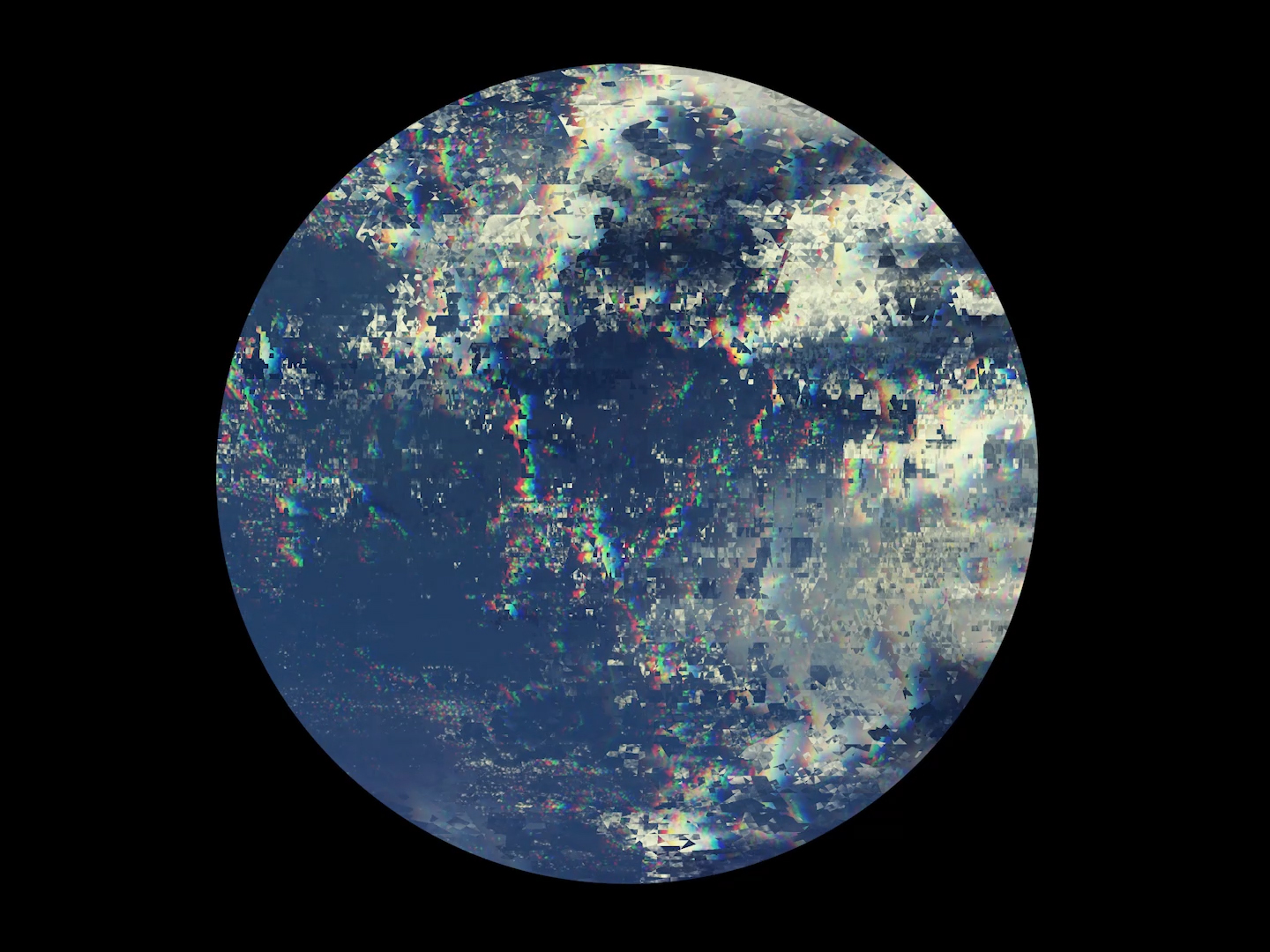
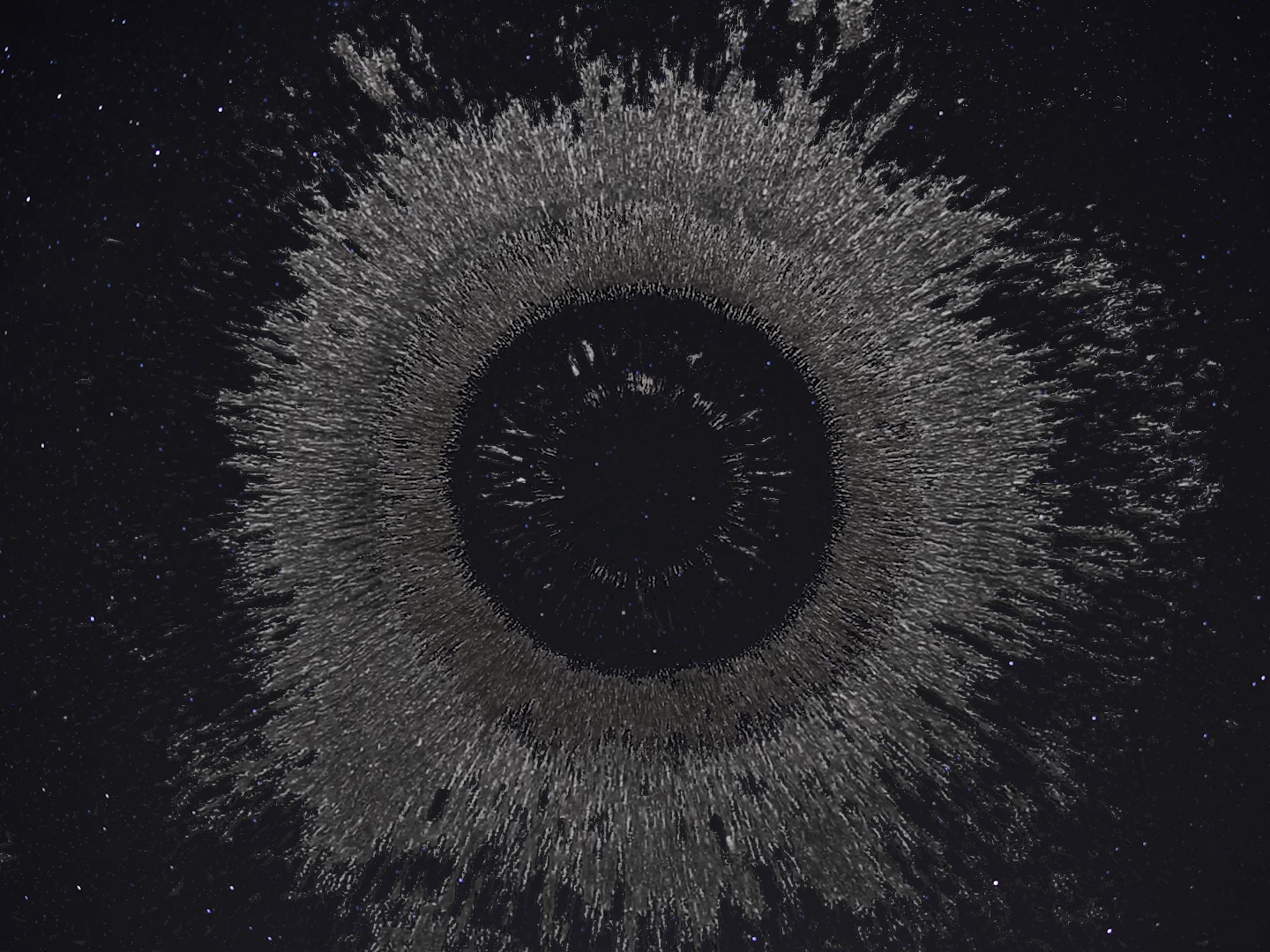
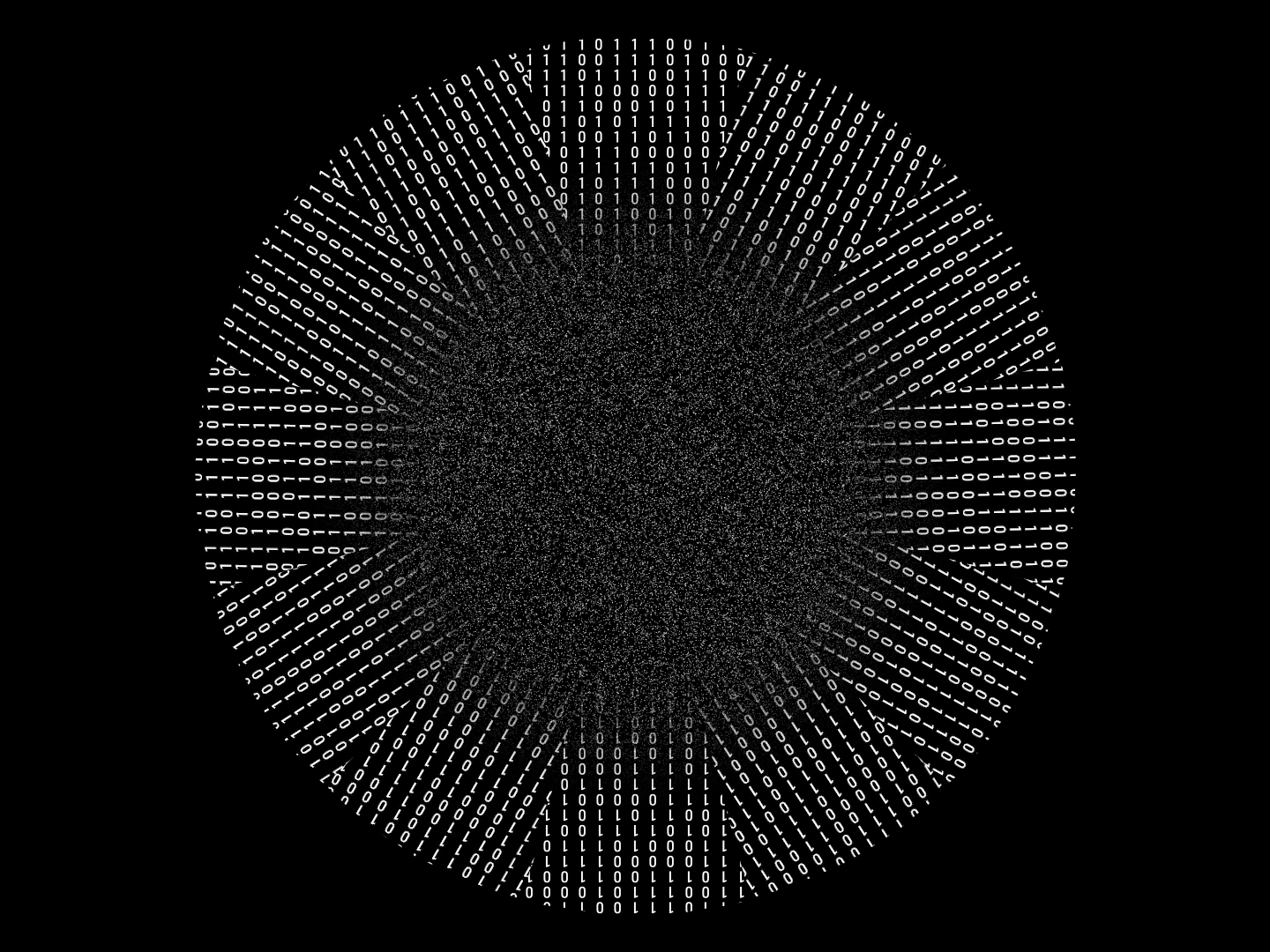
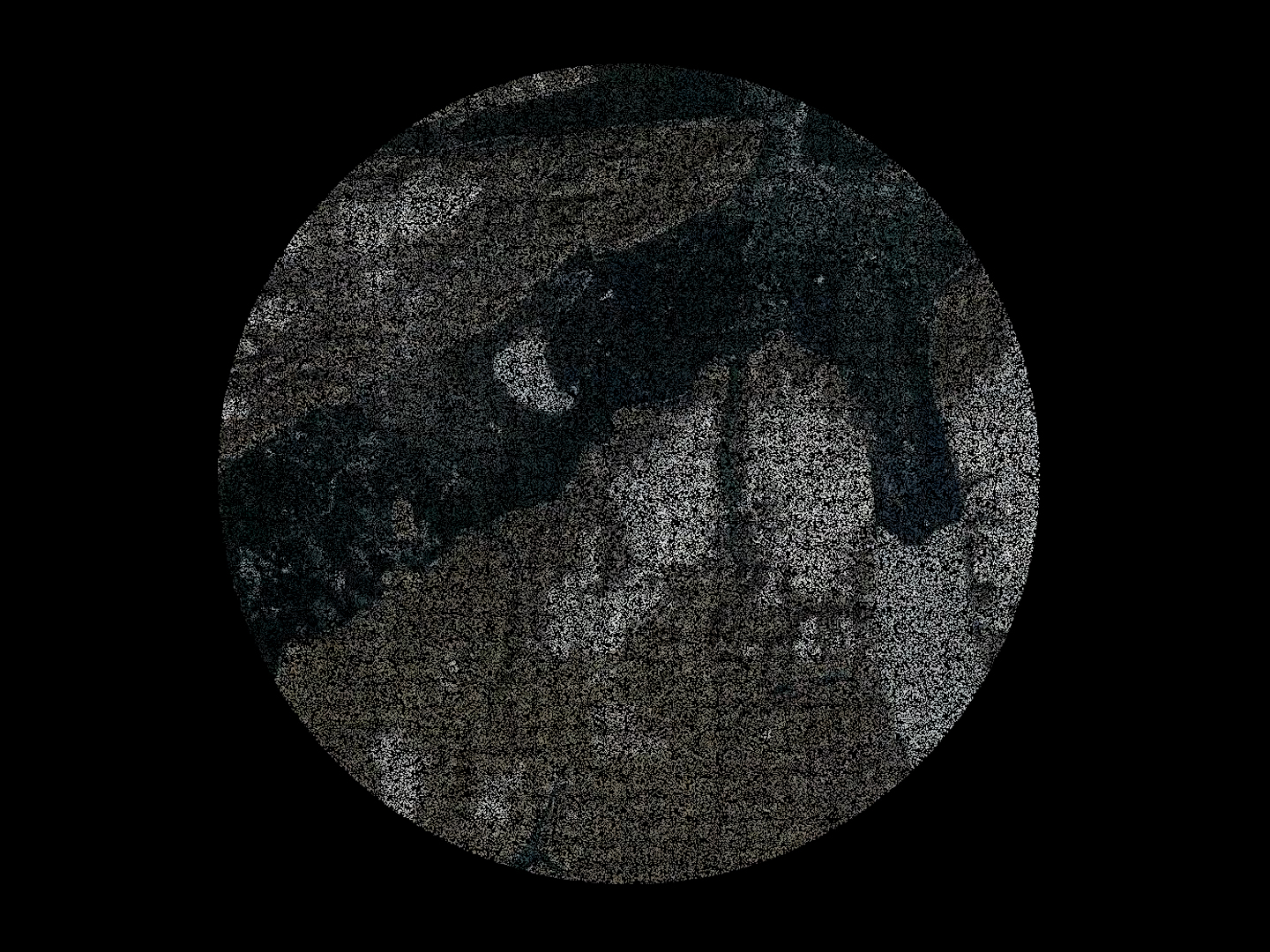
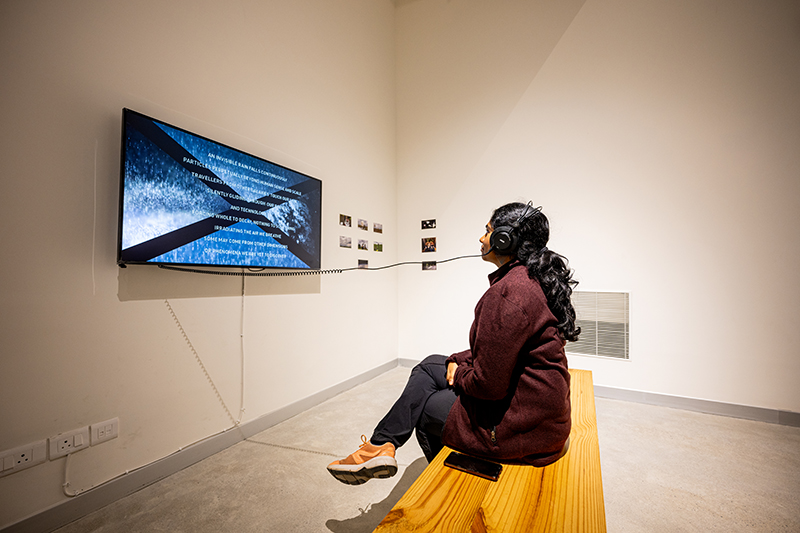
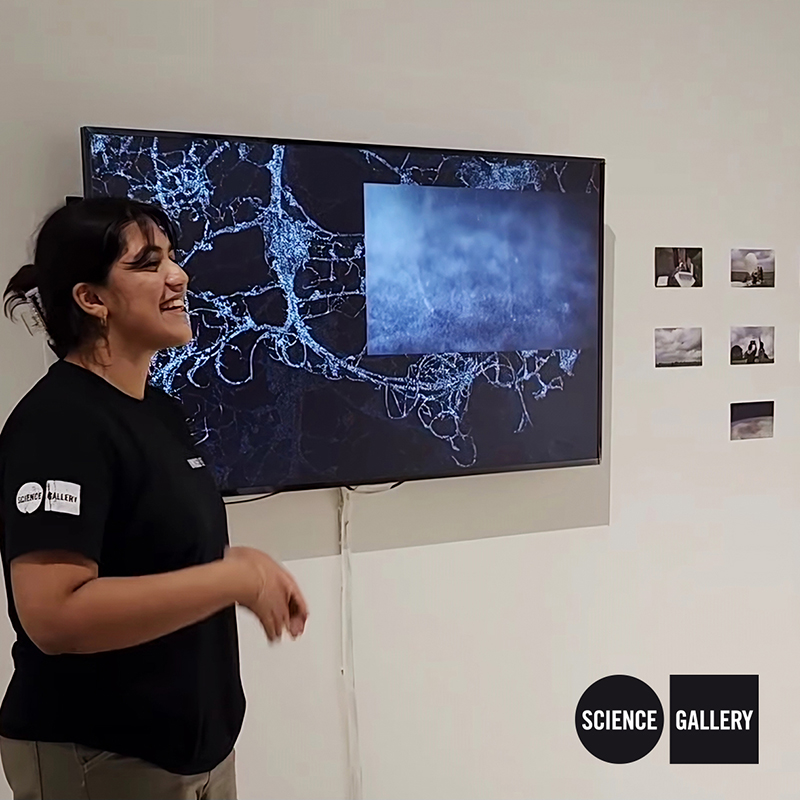
The exhibition Carbon: under pressure at Science Gallery Bengaluru is still running and I am so proud to have my work Cosmic Chiasmus: crossing the universe included in this amazing show. This video offers a glimpse into a subatomic world where cosmic rays travel from distant galaxies to collide and silently interact with atoms and technology on Earth. Cosmic rays go through a violent process of creation, transformation and decay. From the heart of stars or the depths of black holes these particles power across the universe with unimaginable energy colliding with life on Earth and triggering other processes such as cell mutation, computer data corruption and carbon-14 formation.
I am fascinated to learn more about cosmic magnetism and its influence on the development of early life.

The Universe is magnetic. From stars to galaxies to intergalactic space, magnetic fields thread the cosmos. Yet the origin of cosmic magnetism is still unknown, so astronomers are attempting to make maps of the magnetic fields inside massive galaxy clusters to determine if cosmic magnetism came from the early origin of the universe or developed over time. If it is discovered that there is an alignment of fields across the universe this would point to a primordial source of the cosmic magnetic structure rather than a slow emergence from seed magnetic fields. Understanding the origin of cosmic magnetism may give clues to the development of life on Earth and the possibility of life elsewhere in the universe. Only planets with a magnetic field have an atmosphere and offer protection from most radioactive cosmic rays.

Those cosmic rays that do penetrate the atmosphere may have influenced the development of early life. Chirality, also known as handedness, is the existence of mirror-image versions of molecules. Like the left and right hand, two chiral forms of a single molecule reflect each other in shape but don’t line up if stacked. All known life-forms show specific chiral properties in chemical structures as well as macroscopic anatomy, development and behaviour. The sugars that make up DNA, for example, are all right-handed. The amino acids that make up proteins are all left-handed. It is not clear how this asymmetry evolved but one theory suggests that magnetic surfaces on minerals in bodies of water on the primordial Earth, charged by the planet’s magnetic field, could have served as “chiral agents” that attracted some forms of molecules more than others, kicking off a process that amplified the chirality of biological molecules.

Another theory proposes that the influence of cosmic rays on early life may explain nature’s preference for a uniform “handedness” among biology’s critical molecules. Before life emerged on Earth, self-replicating molecules were slowly evolving beneath a constant shower of energetic particles from space. Researchers believe that cosmic rays with the ability to penetrate matter were potentially colliding with chiral molecules on Earth and everywhere else in the universe. These tiny differences in the mutation rate would have been most significant when life was beginning and the molecules involved were very simple and more fragile. Under these circumstances, the small but persistent chiral influence from cosmic rays could have, over billions of generations of evolution, produced the single biological handedness we see today.

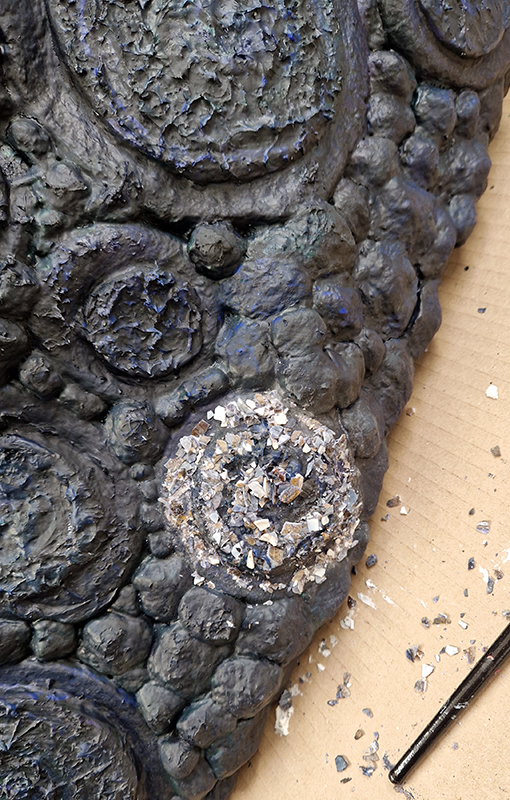
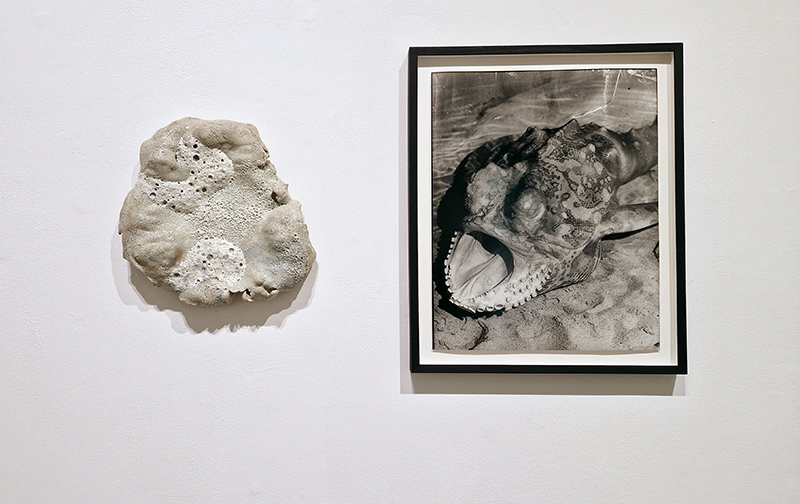
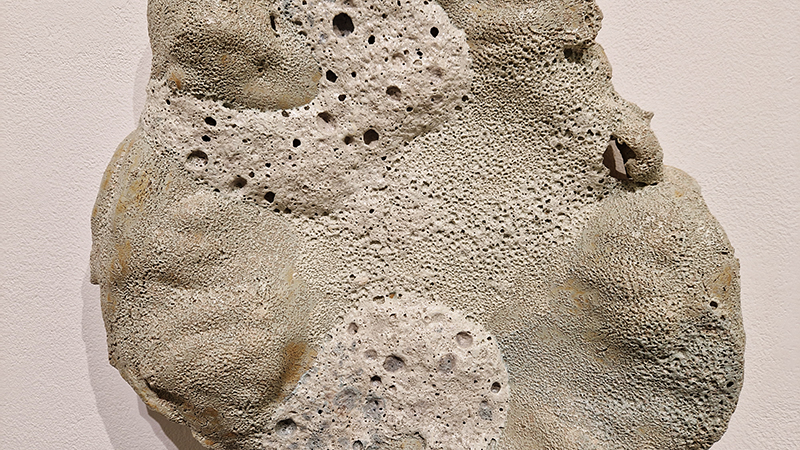
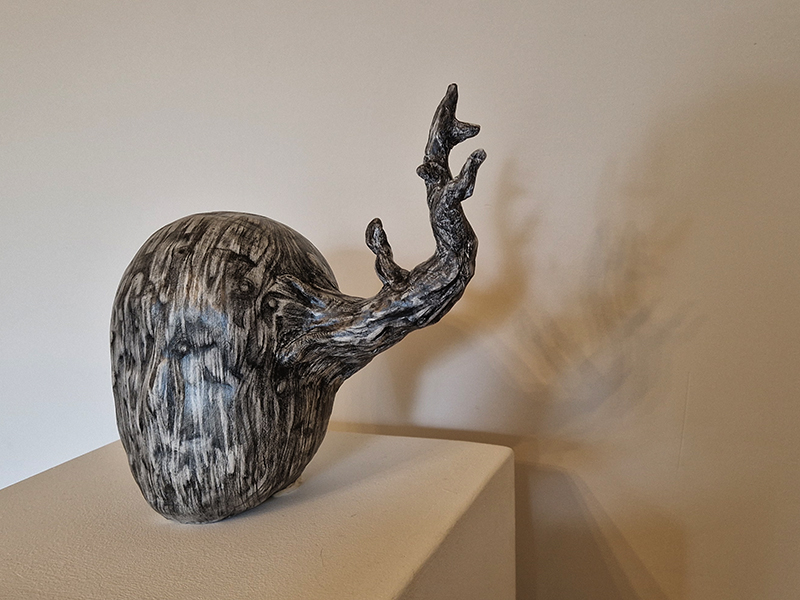
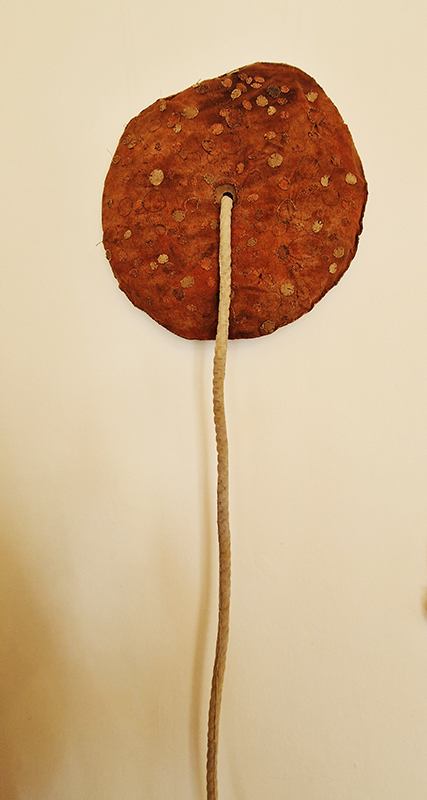
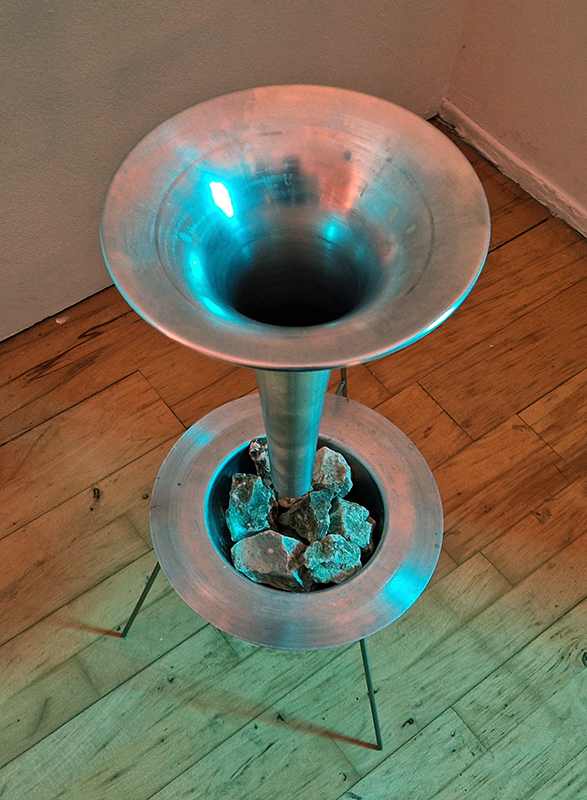
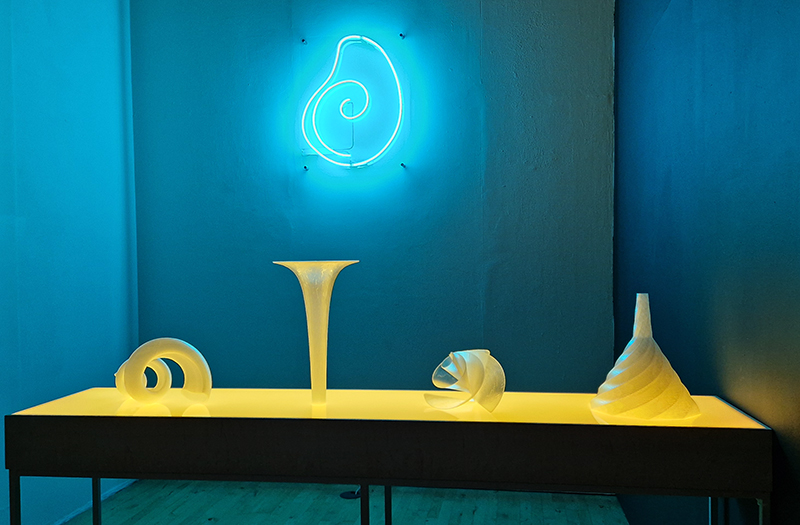
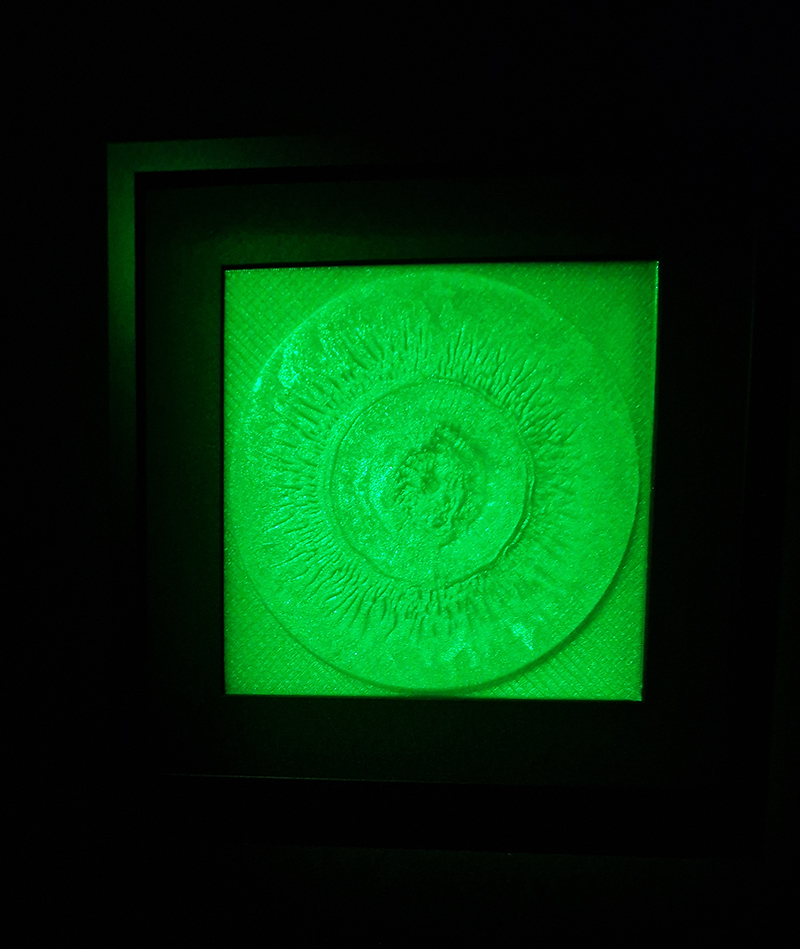
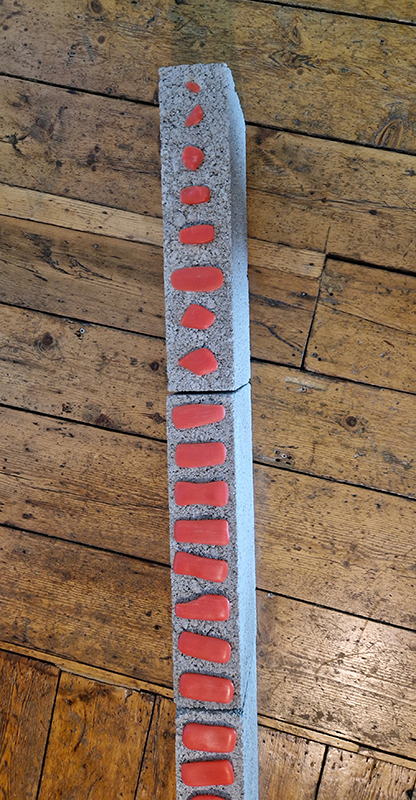
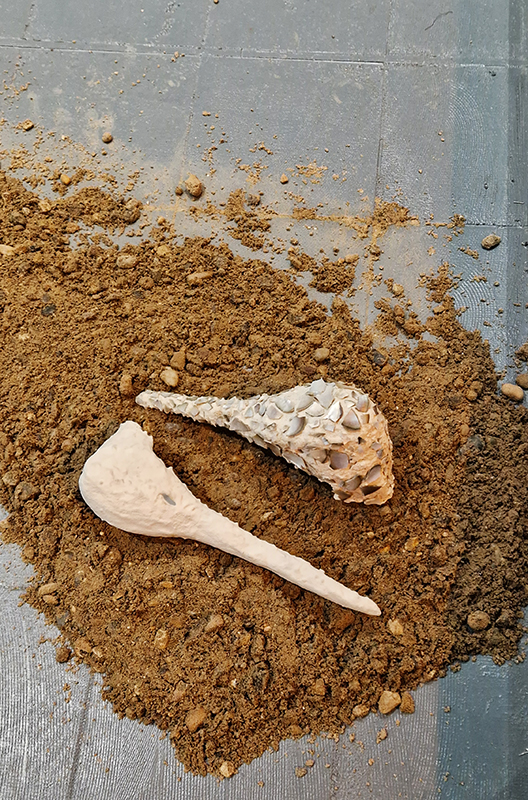
Chirality is also seen in the spiral of a mollusc shell. I am in the process of finishing the sculpture shell for belly of a rock a hybrid work of chemical conversations at the intersection of the animate and inanimate, inspired by Italo Calvino’s Cosmicomics story The Spiral. Paper clay with crushed mussel shells.
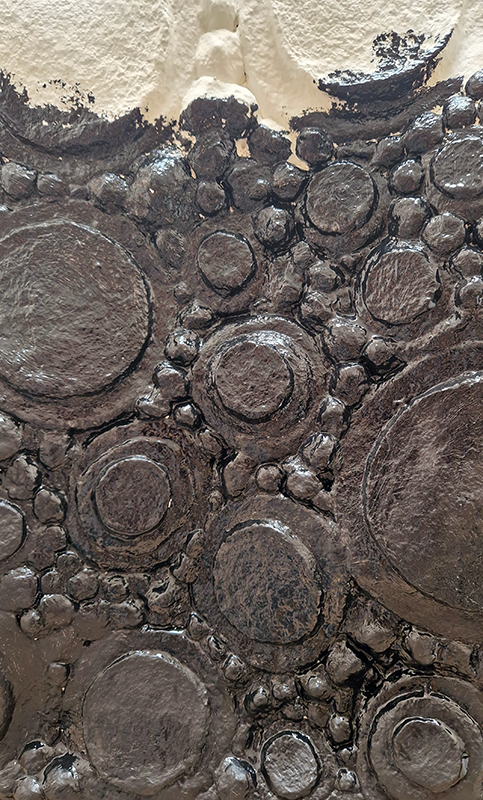
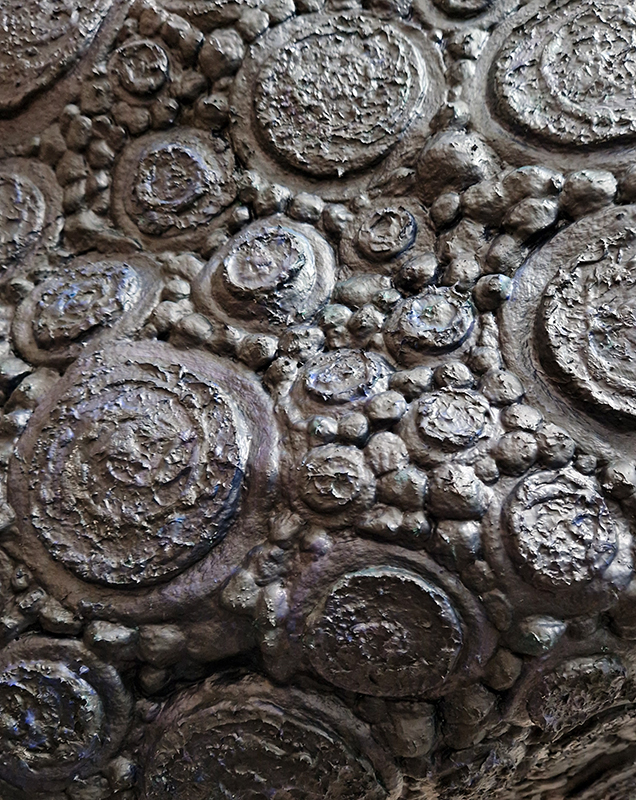
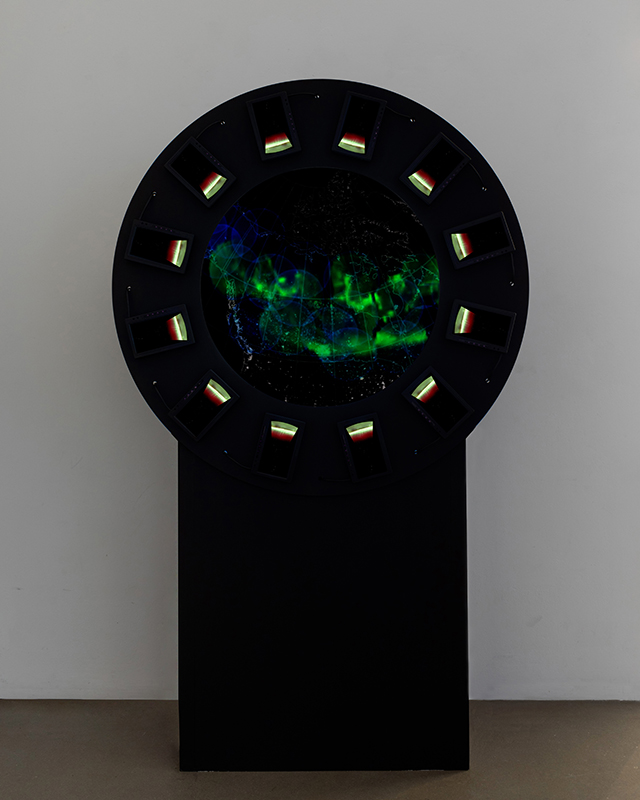
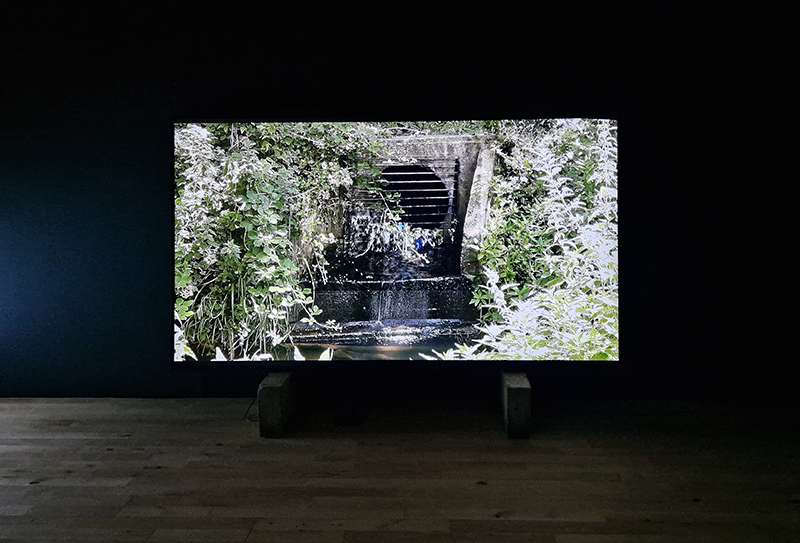
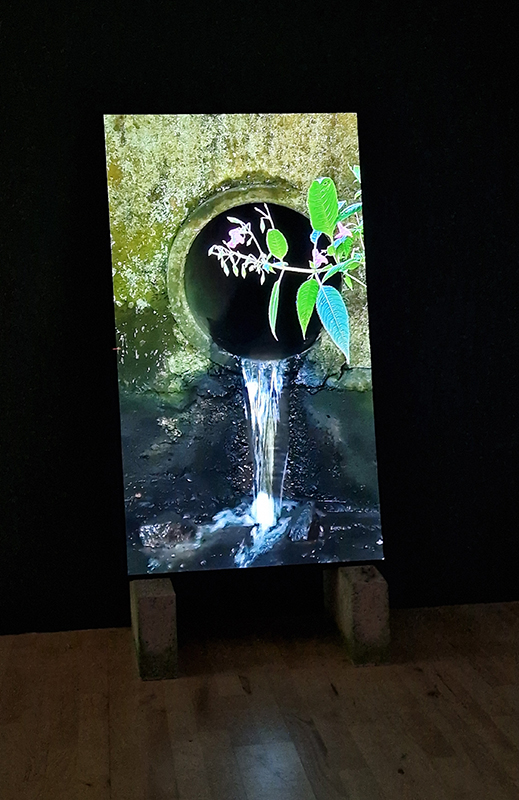
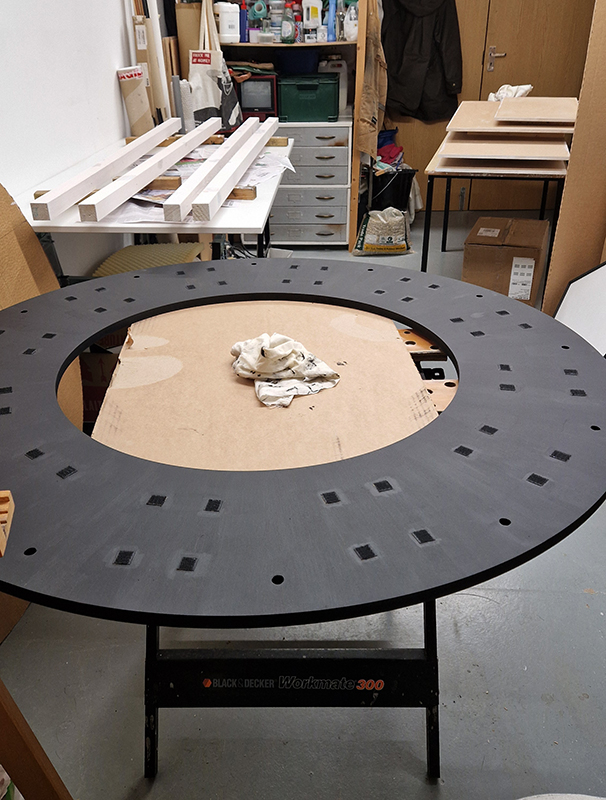
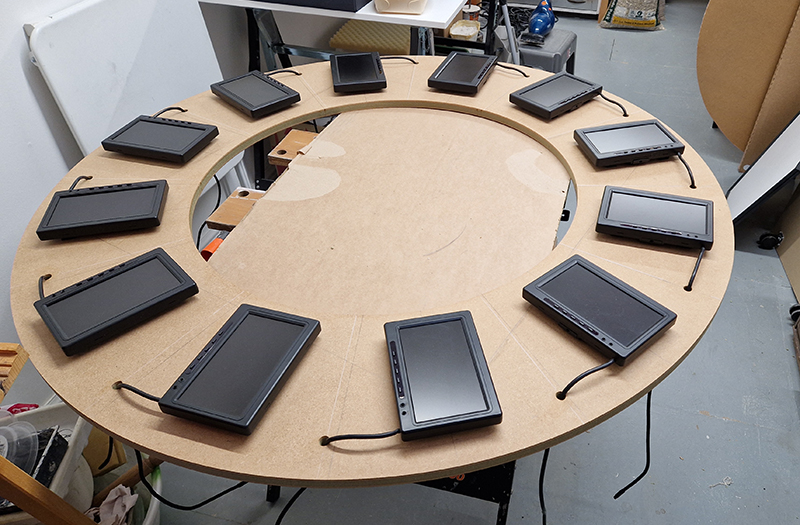
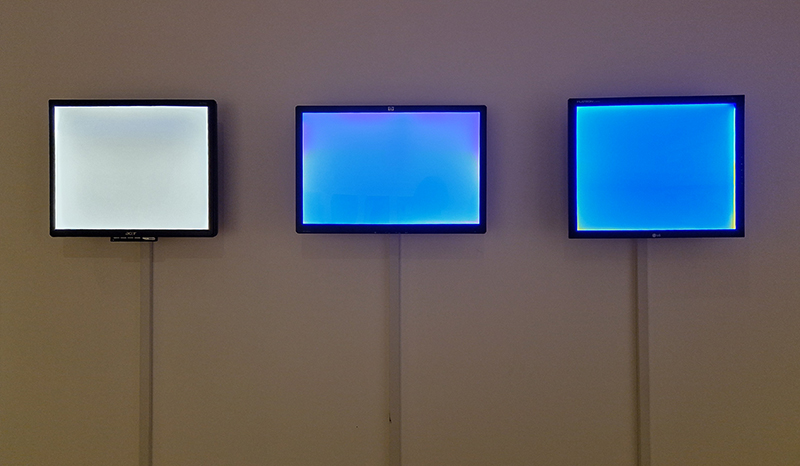
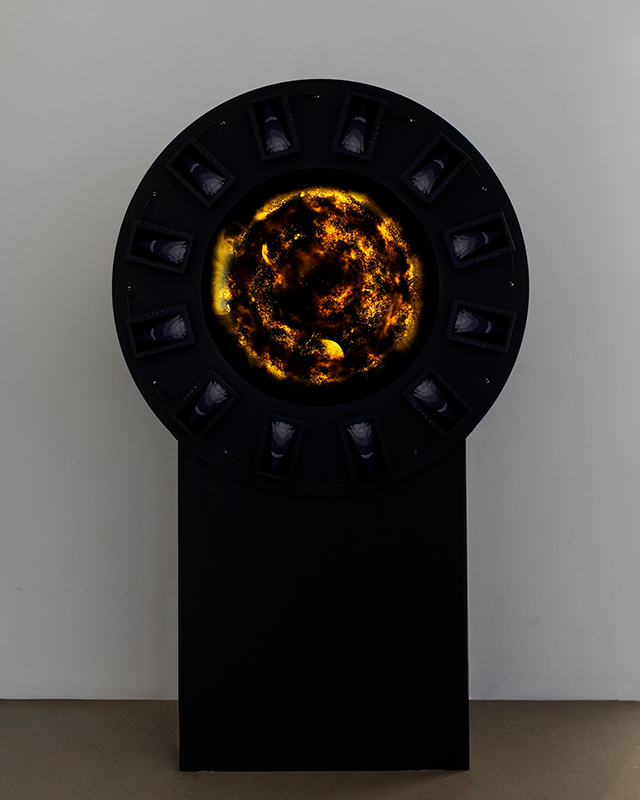
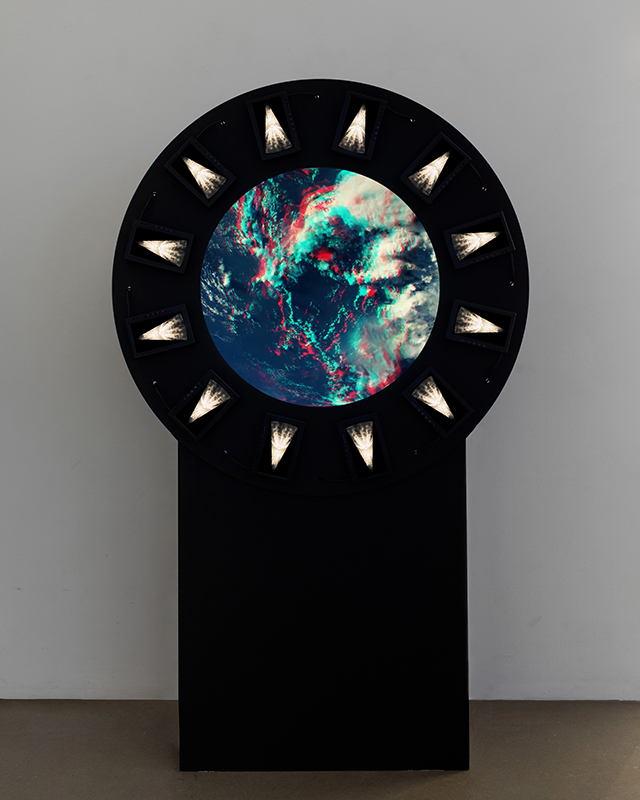
My most recent video installation Orbital shown in Life Boat at APT Gallery focused on the potential risks to technology and life on Earth from extreme solar storms.
The following month, a barrage of large solar flares and coronal mass ejections jettisoning clouds of charged particles and magnetic fields, travelling at speeds up to 3 million mph toward Earth, created the strongest solar storm to reach Earth in two decades, and possibly one of the strongest displays of auroras on record in the past 500 years. There were even perfectly clear skies to view this extraordinary event, yet I missed it. So envious of all those who did get to see the displays of Aurora at such low latitudes. I am hoping there will be another chance to see the Aurora in the UK during this current year of peak solar activity, but not so dramatic a storm as to cause an ‘internet apocalypse’.

Gallery Visits

Andrea V. Wright Eyes of Skin at Thames-side Studios Gallery curated by Thorp Stavri. This exhibition explores the permeability and interactions between the body and architecture and the tensions arising from the ever-changing precariousness of our external and internal constructed environments. It was good to be able to chat with Andrea about her influences from fashion tribes and processes such as casting skins from buildings tumbling into ruins and tactics to avoid being vulnerable working in remote locations.
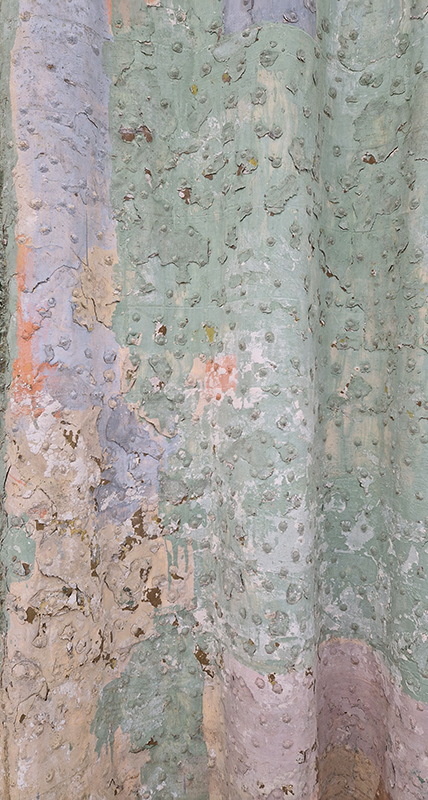
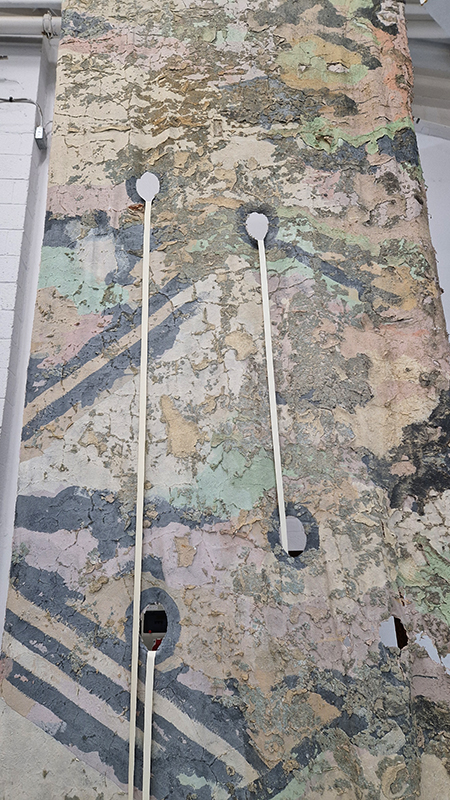
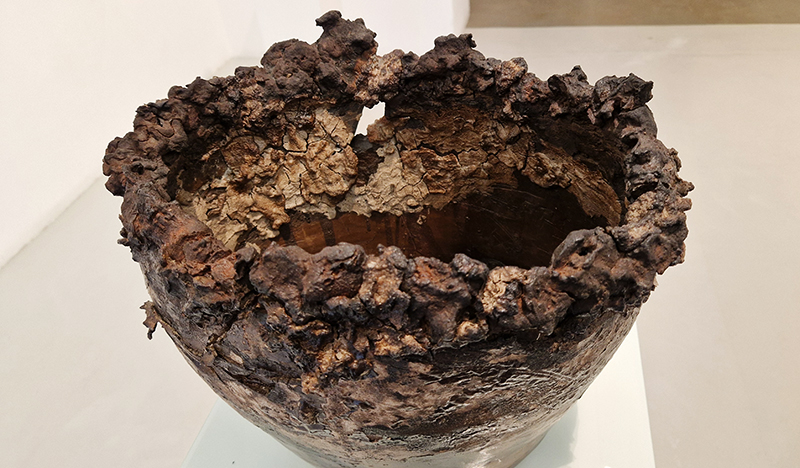
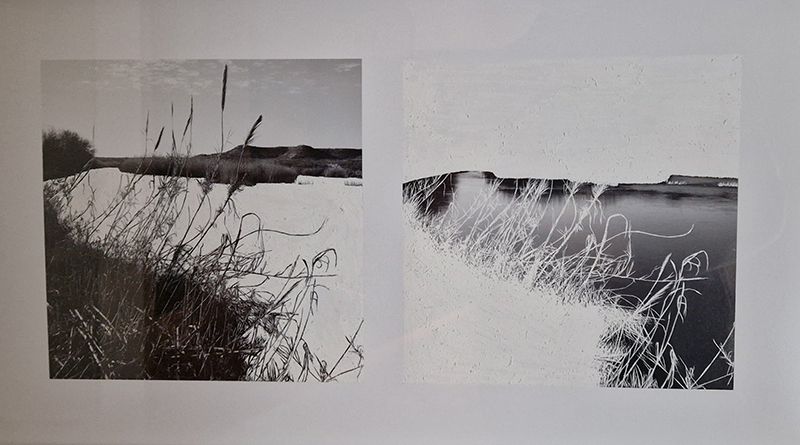
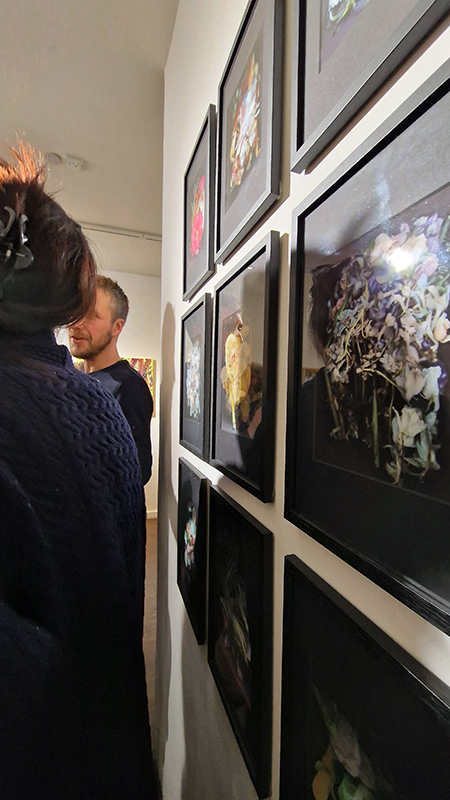
Holly Birtles and Charly Blackburn in Bog Bodies at APT Gallery. interrogate the complexities of wetland mysteries in the Thames Estuary and the Fenland Marshes exploring life, death, and metamorphosis through ceramics and photography. The Bog preserves the body in death enabling us to travel back in time as far as the Mesolithic period. Conditions inside the bog are acidic. They are perpetually wet, entangled with plants and peat, muddy and monstrous. A dense soup inhabited by complex ecologies that thrive in the anaerobic surroundings, creating a unique biochemical and physical occurrence that facilitates the mummification of prehistoric humans. This exhibition however, confounds expectations of oozing mud and swampy detritus. These ‘artefacts’ are presented in a pristine white cube setting, there maybe a slight whiff of smoke lingering from the ceramics but all is clean and orderly and the framing is thoughtful with a nice use of colour contrasts between image and frame. Good to be surprised.

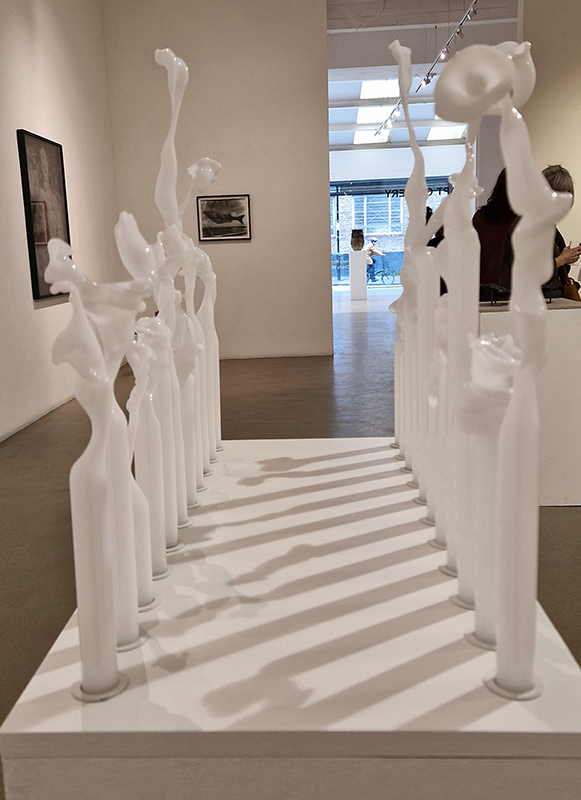
SALON FOR A SPECULATIVE FUTURE: HOW TO BE IN THE FUTURE? at Vestry St – Cross Lane Projects with works from Aideen Barry, Quilla Constance, Lisa Chang Lee, Kate Fahey, Young In Hong, Evy Jokhova, Huma Mulji, Koushna Navabi, Monika Oechsler, Rebecca Scott, Jo Stockham. Postulating hope for a better future Rebecca Solnit (in an article in the Guardian, 2016): wrote “Hope is an embrace of the unknown”. Living in times of unprecedented change, uncertainty, she says, has “the power to influence the future”. Taking inspiration from the ‘future thinking’ of speculative fiction and looking at a wide range of fields from science and technology to spiritual, ecological and socio-economic issues, the exhibition highlights multiplicities and the complex interplay at work in global dynamics. The works, individually and collectively, draw on associations from different  subjectivities and contested /histories facilitating a space for contemplation and the discussion of positive futures. Strong shift shaping work here that gets under the skin, fake facades, hairy hissing and an AI doctored doctrine, make for an unsettling present from which to speculate on the future.
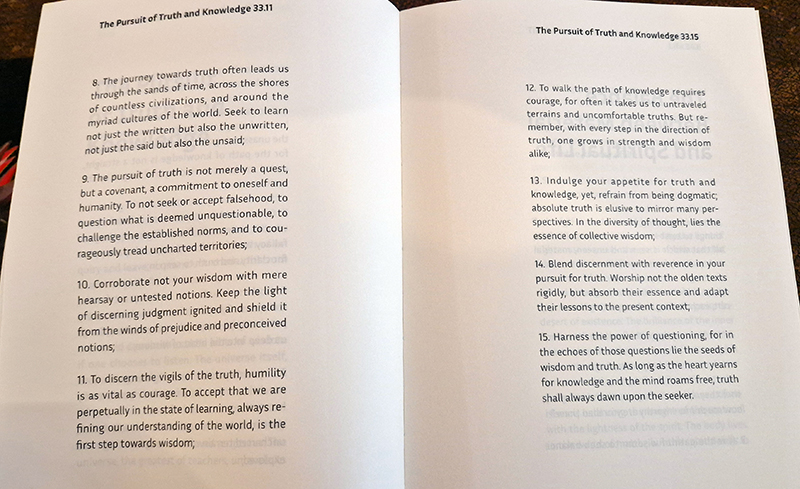
The Tipping Point at Bell House. The tipping point may arrive seemingly out of the blue as a slight change heralding a new way forward.  It can be magical or malevolent.  More than 40 artists in six individually curated spaces will examine different kinds of tipping points, both minor and major, literal and metaphorical. Sarah Sparkes and Jane Millar curate The Gowan Room using Octavia Butler’s dystopian novel, ‘Parable of the Sower’, as a point of reference. Jonathan Callan, Chudamani Clowes, Sarah Doyle, Lydia Julien, Marq Kearey, David Leapman, Yair Meshoulam, Jane Millar, Stephen Nelson, Victoria Rance, Alke Schmidt, Lex Shute, Ania Tomaszewska-Nelson, Sarah Sparkes, Sara Trillo, Marianne Walker and Alice Wilson explore a new awareness of change and exchange, a constant shifting of strange identities, the malleability of being, interspecies communication and the strength and vulnerability of community. Imagining new ways to merge; ways to intelligently and sensually live in the flux of a perpetual tipping point. Léonie Cronin curates the Lutyens room as a procession through objects of different artistic beliefs, pointing to new myths, a point of Syncretism where ideas become merged and the old symbols get incorporated into new systems.
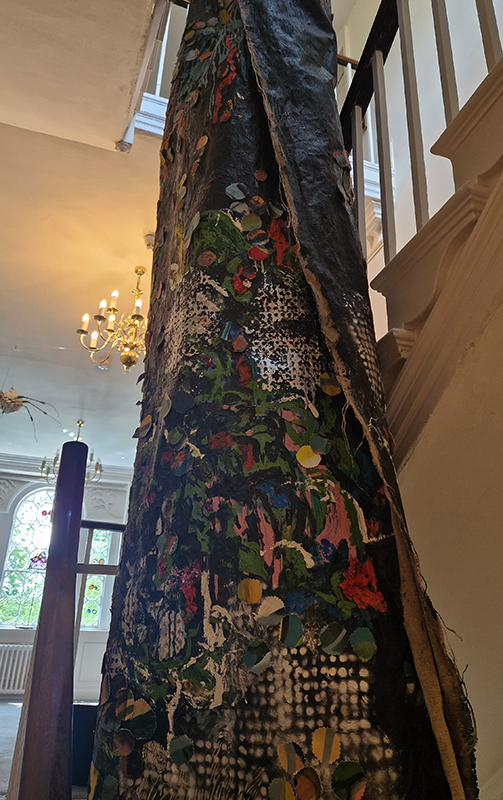
Thomas Pausz in Haunted Ecologies at Stanley Picker Gallery. A very interesting show drawing threads of local history together with current urgencies such as sewage pollution of the local endangered chalk stream Hogsmill River. From spirit photography and the dark room experiments of Kingston’s Eadweard Muybridge, to digital manipulation, rendering and 3D scanning – Our perception of contemporary environment and culture is always haunted by spectres of the past and by hopes and visions of the future.

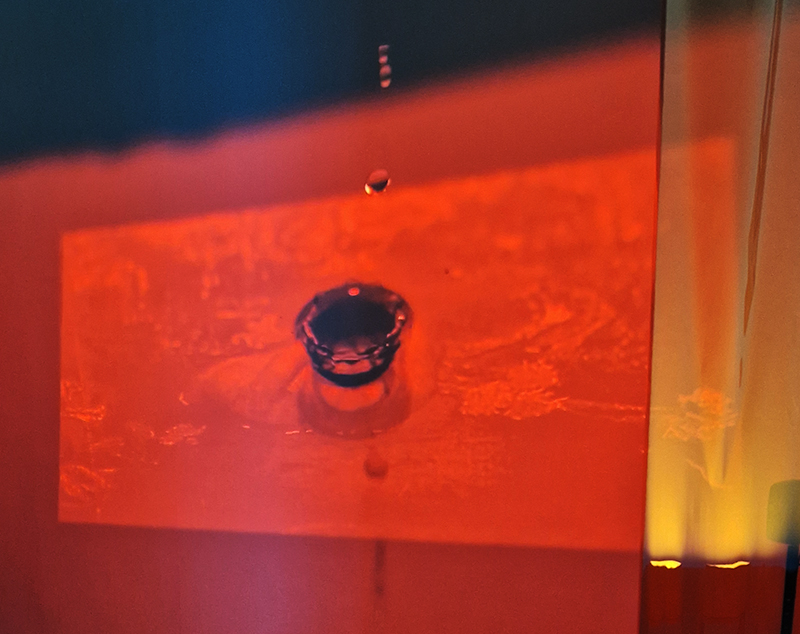
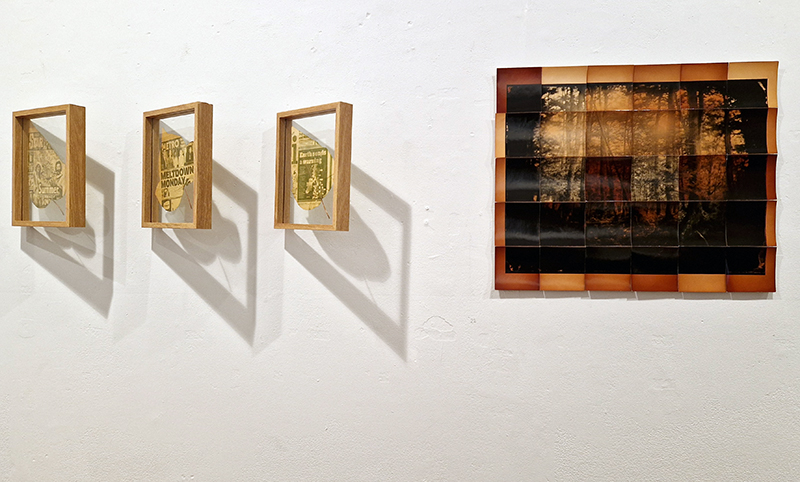
Symbiosis II group exhibition exploring the relationship between image makers, the more-than-human, and alternative photographic processes at Four Corners Gallery organised by London Alternative Photography Collective  curated by Hayley Harrison, Melanie King, and Ky Lewis. This exhibition considers the connections between symbiosis and alternative photography, and asks if nature is a collaborator or a commodity in alternative photography processes.

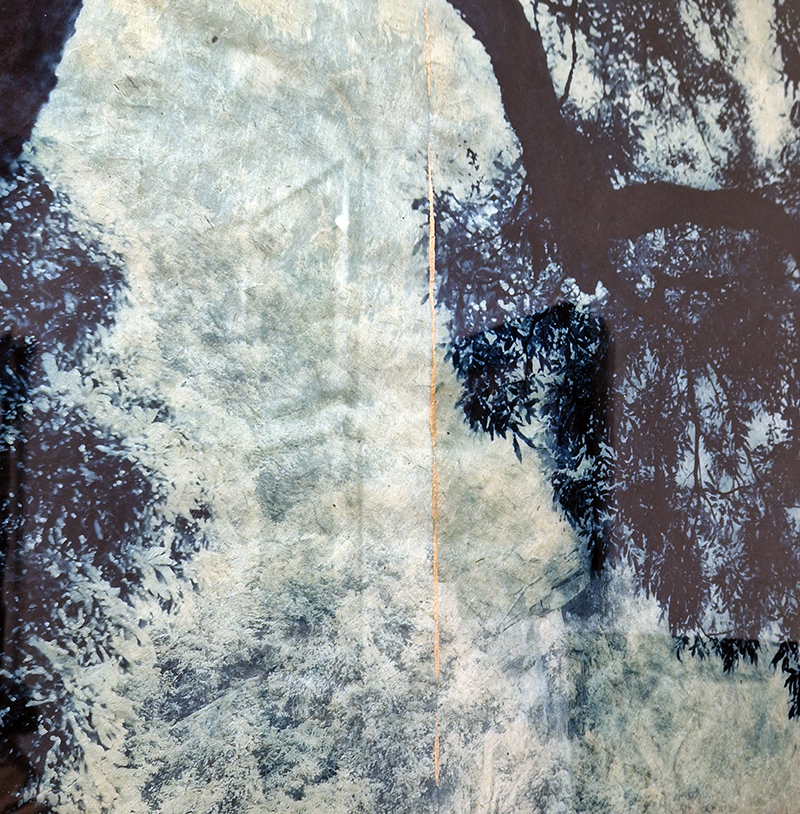
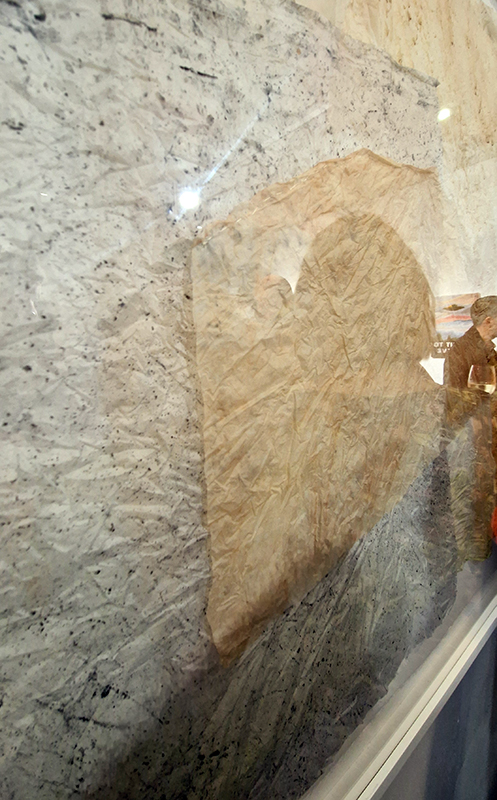
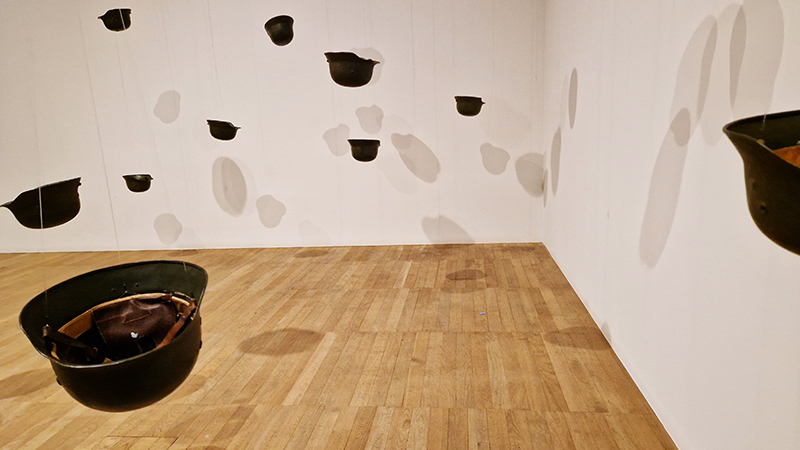
YOKO ONO: MUSIC OF THE MIND at Tate Modern. The main takeaway from this extensive overview of her pioneering work is the sadness that peace hasn’t been given a chance. The works are very direct, may appear simple in content or execution but cut deep into the human psyche. I particularly liked Half a Room, first presented in 1967, this is a room of objects cut in half and painted white. Ono said of this work “Molecules are always at the verge of half disappearing and half emerging…somebody said I should put half a person in the show. But we are halves already.” Another piece, Helmets (pieces of sky) from 2001 invites the audience to take a piece of the sky, which she sees as a hopeful symbol of limitless imagination. Jigsaw pieces of the sky are suspended in German army helmets, and although dispersed, offer the possibility of hope that they can be put back together through collective healing. Many works are participatory. A wall for drawing around your own shadow to create an entanglement of bodies. A boat to add your own wish to an ocean of wishes for the future.
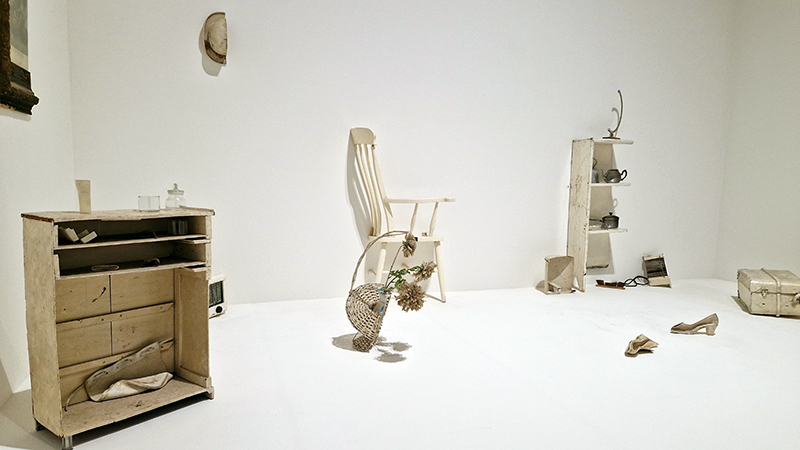
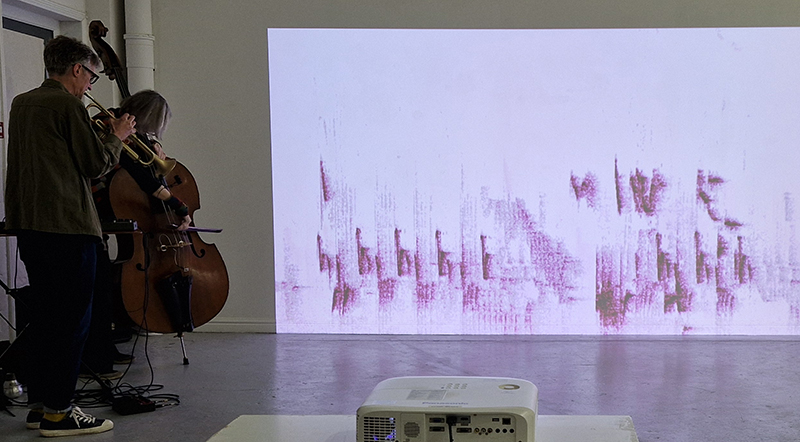
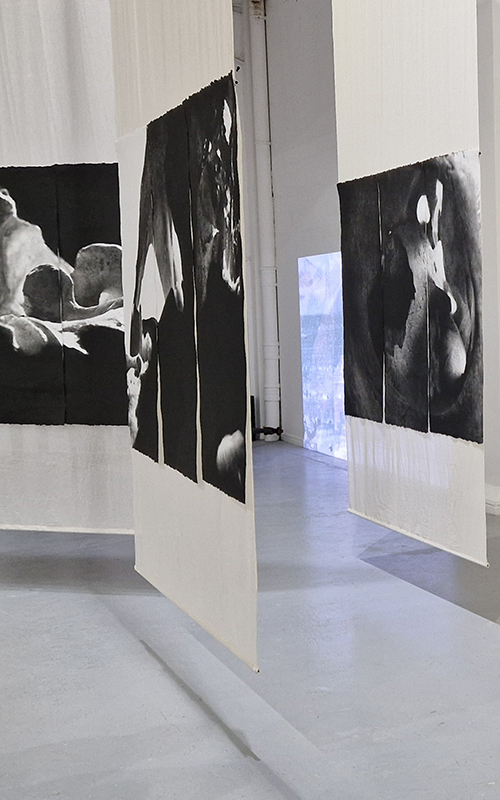
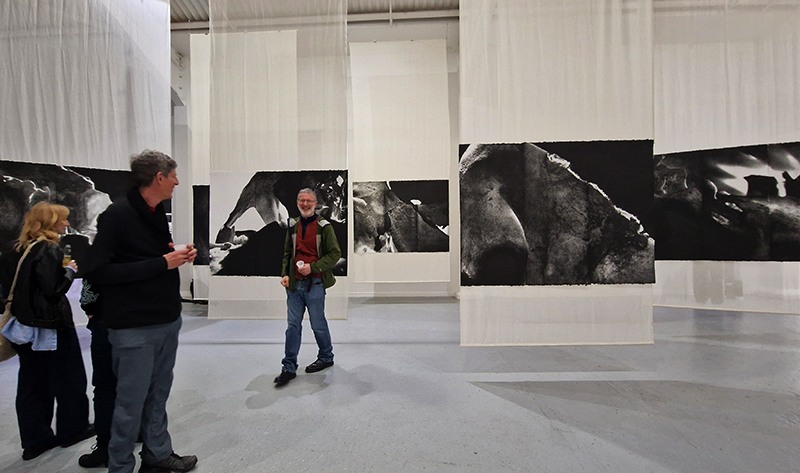
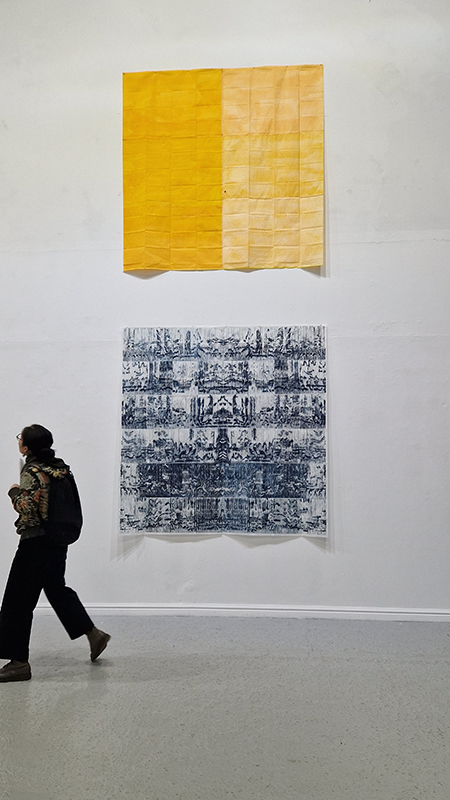
Geographies of Print final iteration of Without Horizon, Without Shore at Thames-side Studios Gallery. Geographies of Print is a collective group created by artists Victoria Ahrens, Carol Wyss and Victoria Arney in 2020. This collective looks to explore and challenge notions of print within wider contemporary discourse and practice. The artists fully inhabit the given space with dramatic large scale pieces, that interact and collaborate to create an exciting and cohesive exhibition. Blocks of colour flash between a maze of hanging muslin panels where etchings of impenetrable blacks and misleading undulations recall both mountain paths and the shadowy mazes of ancient cities. Emotive live music improvisation by Jim Howard (trumpet and electronics) and Julie Walkington (bass) accompanied Victoria Arney’s film reflecting on the epic journey of migrating birds. Landscapes of the mind and the body, a birds eye view and the internal geology of the Earth are beautifully explored.
“A powerful solar flare hitting Earth is entirely plausible, and in the Internet Age would have a massive immediate effect that would go on to wreck the world economy. Satellites in low Earth orbit as well as communication devices on Earth would be destroyed – the ‘Internet Apocalypse’, causing blackouts, riots and supply-chain disruption, as well as ruining your last-second eBay bid”. Tim Marshall The Future of Geography

The dramatic increase in the number of satellites being launched into low Earth orbit unfortunately coincides with the current Solar Cycle 25, which is predicted to peak between January and October of 2024, with more solar storms of greater intensity and therefore a larger hazard for critical technologies and services. A growing risk awareness is evident as three new geomagnetic observatories have been installed across the UK in the last year to monitor space weather. They hope to predict solar storms and alert operatives to manage situations such as that in February 2022 when a Coronal Mass Ejection led to 38 commercial satellites being lost. Solar plasma from a geomagnetic storm heated the atmosphere, causing denser gases to expand into the satellites’ orbit, which increased atmospheric drag on the satellites and caused them to de-orbit.

Despite the unpredictability of our star’s activity, national space agencies and an increasing number of private companies are forging ahead with space based technology. There is a joint plan between space agencies (not including China or Russia) to construct a Lunar Gateway Space Station near to the moon where astronauts will live and conduct experiments for up to 90 days between visits to the moon. Gateway will be exposed to much higher levels of radiation than the ISS which is in low Earth orbit and so must be built to shield against higher levels of cosmic ray bombardment.

As of January 3rd 2024, the satellite tracking website “Orbiting Now” lists 8,377 active satellites in various Earth orbits. Communication and Earth observation make up the majority. The USA still outstrips all other operators but other nations are eager to catch up and within the past two decades, satellites from 91 new space-faring countries reached orbit.

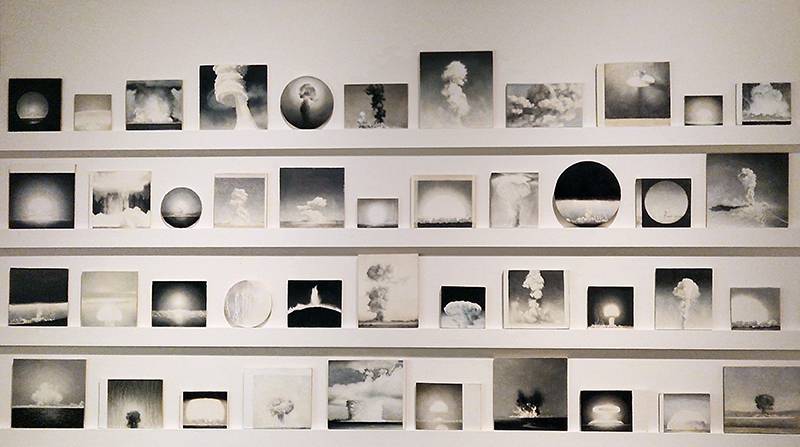
It is not only radiation from space weather that is a threat to satellite dependent infrastructure. As witnessed following the largest nuclear test conducted in outer space by the USA in 1962, which lit up the sky with Auroras, knocked out electricity in Hawaii 900 miles away, created significant magnetic field disturbances and an artificial radiation belt which damaged or destroyed several satellites and persisted for a decade. Nuclear detonations in space could make space unusable for satellites.

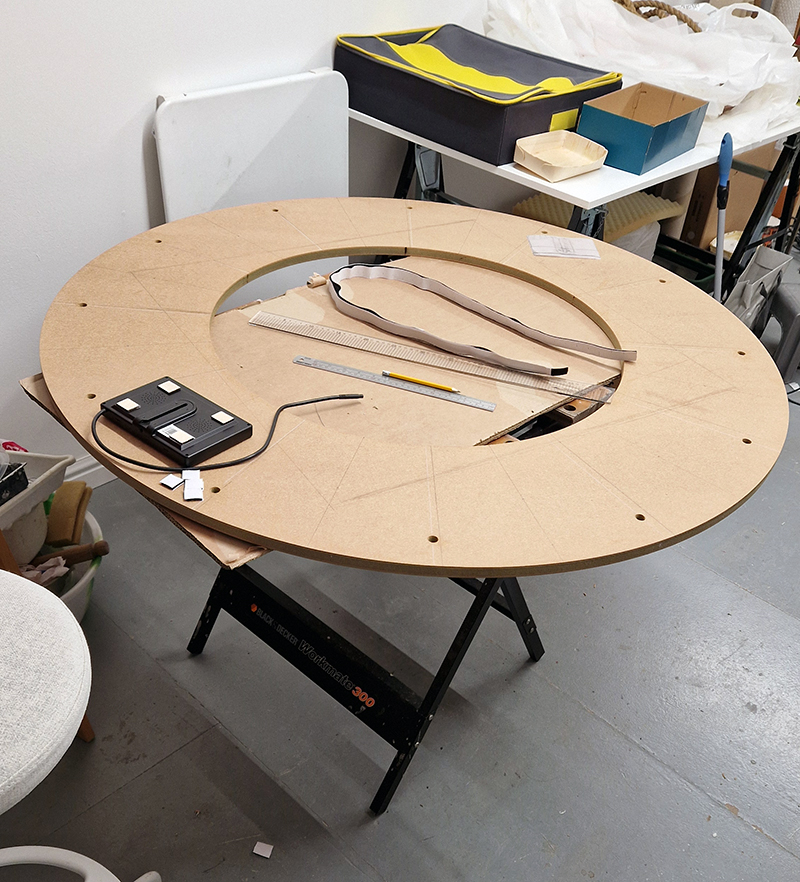
Work in progress on a new video installation for upcoming exhibition Life Boat at APT Gallery. Taking the lifeboat as a metaphor for precarity, eight artists respond to current uncertain times of ecological and social change and shifting landscapes from both local and global perspectives.

The video looks at the interaction between space weather and Earth’s magnetic field and the risk solar storms pose to satellites and related infrastructure.

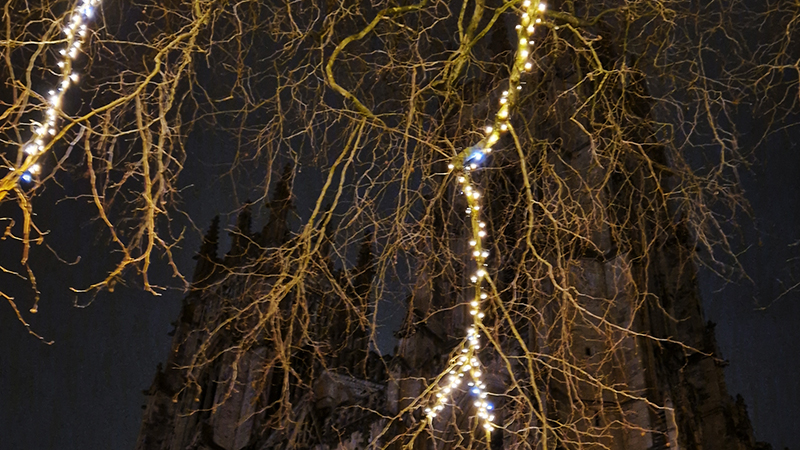
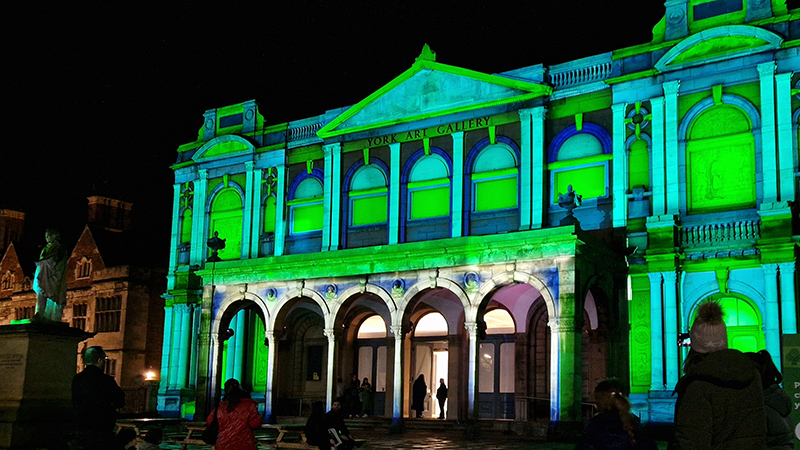
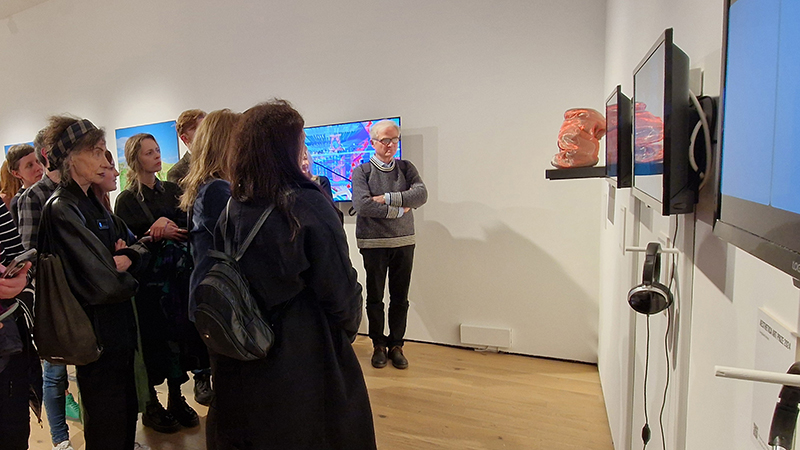
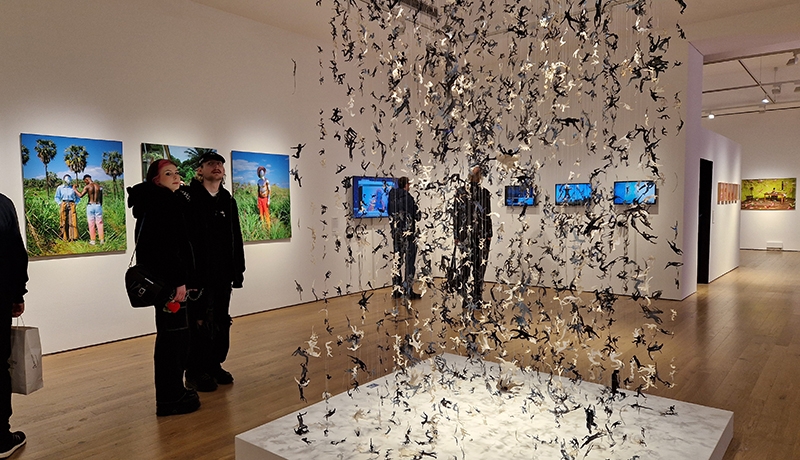
The ancient walled city of York was a great host venue for the Aesthetica Art Prize 2024 exhibition and the Future Now Symposium. Grey February is dispelled by the inspired decision of the local council and shops to keep the Christmas lights on.

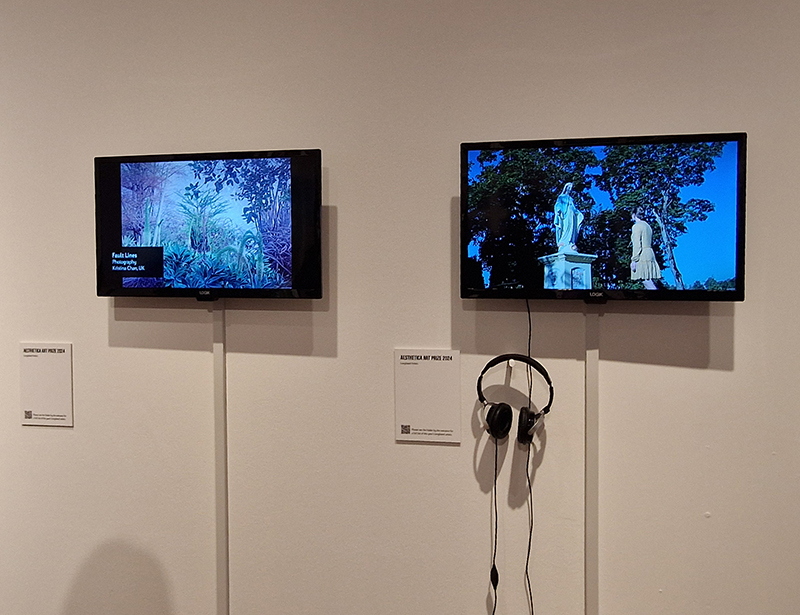
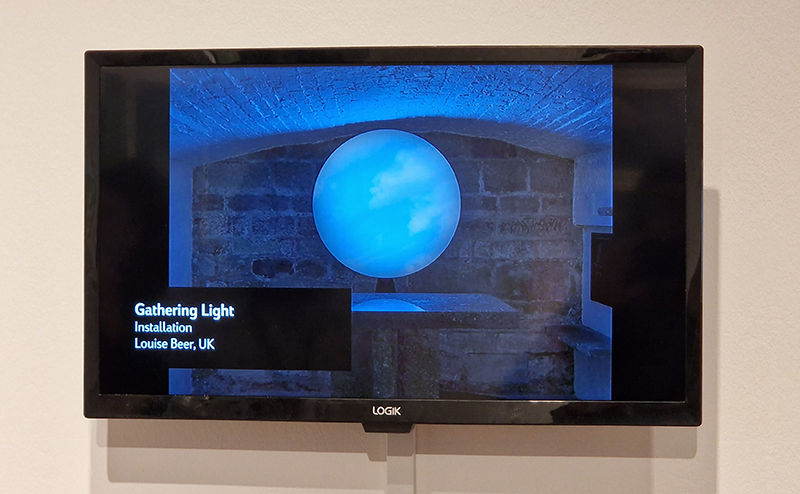
There are many artists alongside myself in the Aesthetica Art Prize longlist, and it was great to meet up with familiar faces as well as make new contacts at this event. With so many artists, the digital showcase of our work in York Gallery was on quite a long loop, but I felt happy to be in such good company.

A link to my Aesthetica 2024 longlisted artist online profile is here

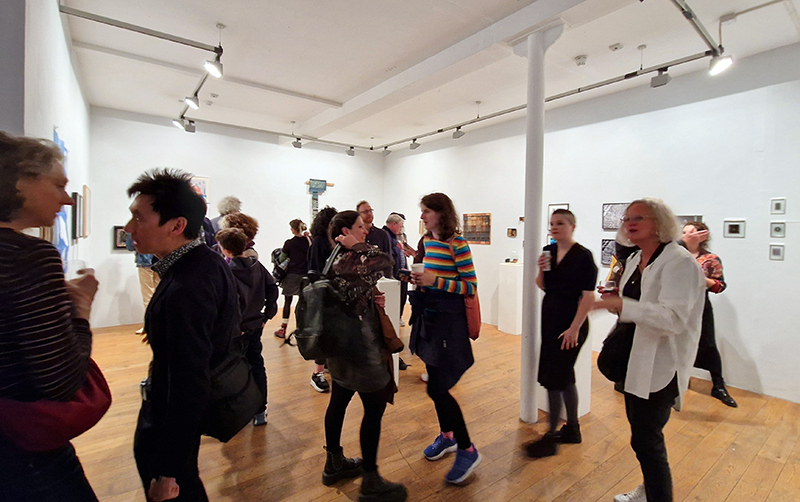
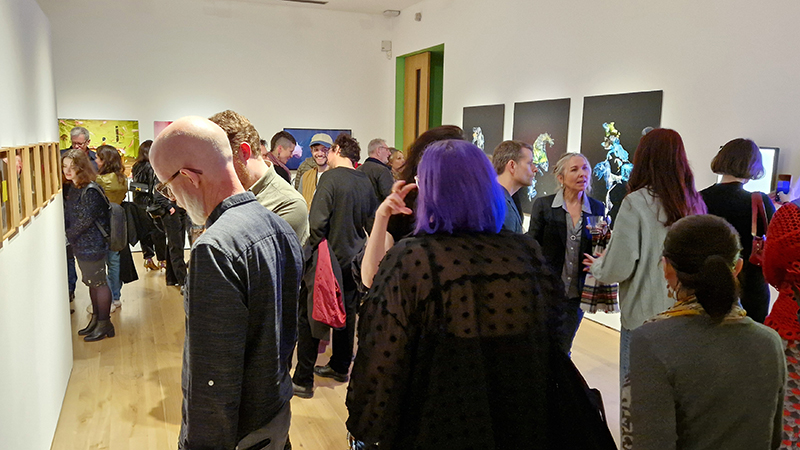
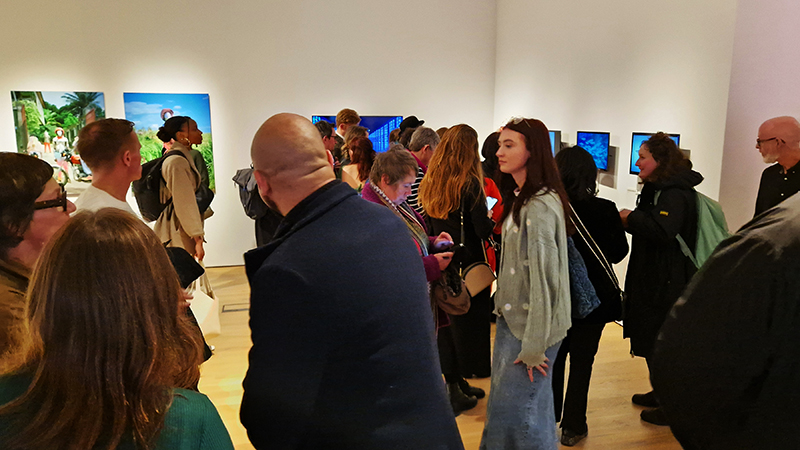
Private view of finalists work. Shortlist here

The winners of the main prizes, Maryam Tafakory for Nazarbazi [the play of glances]which explores love and desire in Iranian cinema, where depictions of intimacy between women and men are prohibited. and  Emerging Prize-winner Gala Hernández López, were well deserved with powerful, timely work.

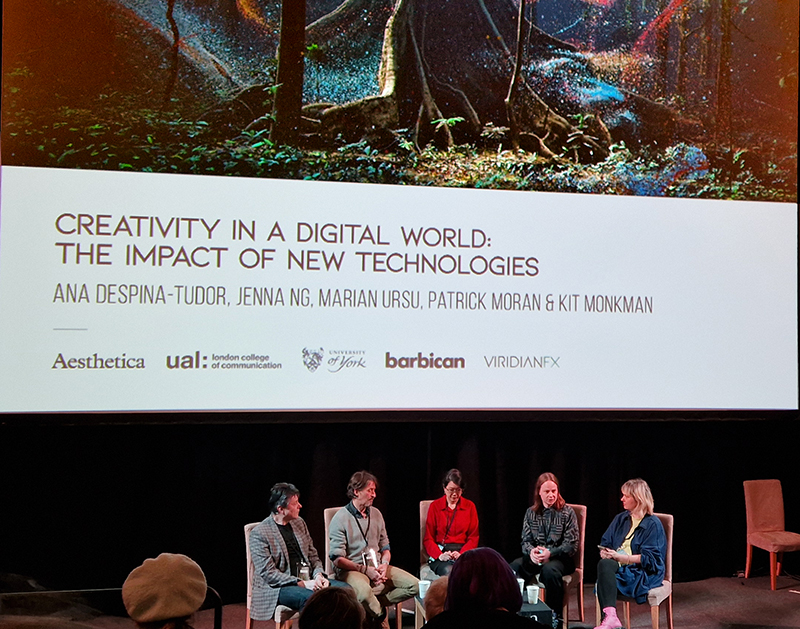
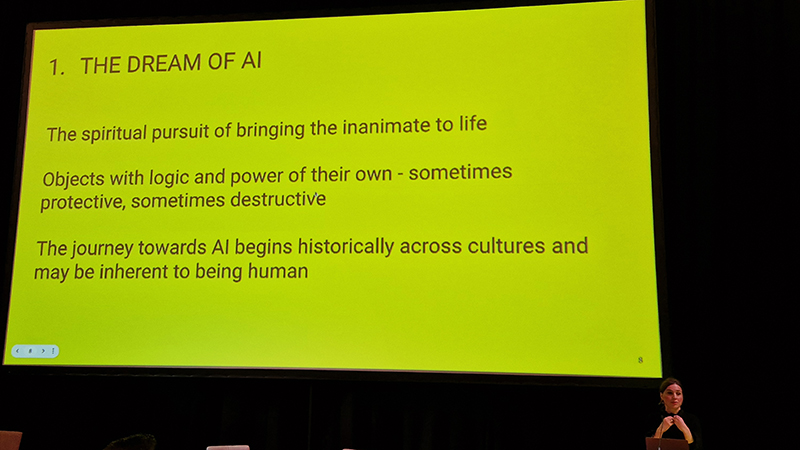
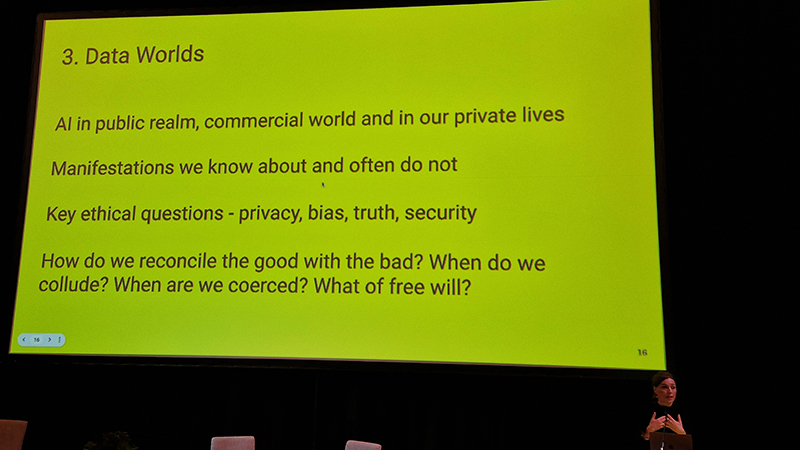
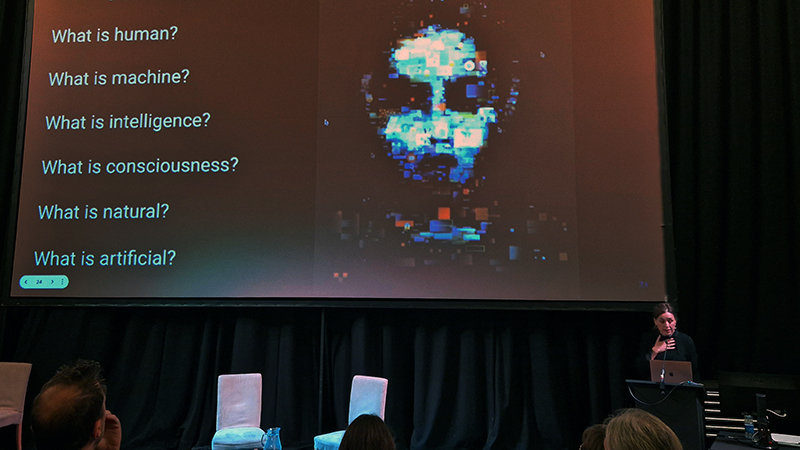
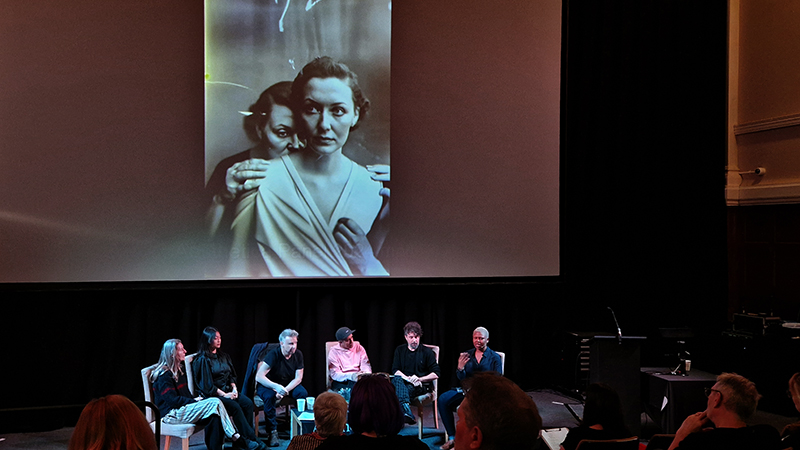
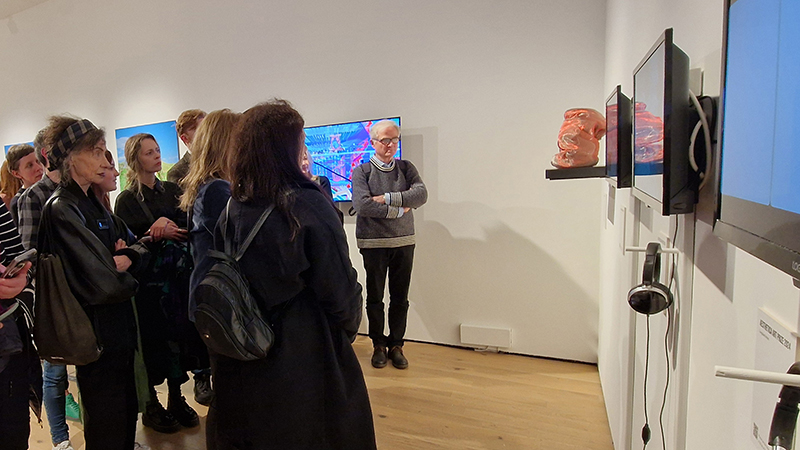
The Future Now Symposium threw up some interesting and potentially disturbing questions about AI despite some speakers such as Dr Suzanne Livingston and Marian Ursu, positive spin that AI could herald a new utopia of knowledge production and collaboration to solve the world’s problems. The panel discussing ‘The Impact of New Technologies’ were all in agreement that it is already too late to change or avert the learning bias of AI systems reflecting and perpetuating human biases, as the early modelling is embedded too deep in systems that no one really understands or can control. There was encouragement to welcome the new technologies such as chatGTP and text prompt generative fill software as new tools to be used to expand on what we can create rather than seeing these as taking over the creative thought process.

The myth surrounding the deception of the judges by Boris Eldagsen’s now-infamous AI-generated piece, The Electrician, which won a Sony World Photography Award in 2023, was laid to rest by Edgar Martins on the ‘Photography in Focus’ panel. The winning image had been entered to the competition as an AI generated image and was judged on that basis, there was no cover up but certain media sources sparked heated debates around our trust in images, giving the impression that the judges had been misled. This doesn’t mean to say that there isn’t a problem with image authenticity in the news and especially on social media as AI generated images are shared ubiquitously without the relevant acknowledgement.

I very much enjoyed Sarah Perks in conversation with Heather Phillipson who describes her works as “quantum thought experiments,” which unfold in absurd and complex ways. Interesting to hear how her ideas develop from 2D sketchbook/collages, straight to full large scale 3D installation with no small scale models in between. Making such large work is a problem when it comes to storage, so some pieces have to be relinquished and then recreated if necessary, as it was for her Turner Prize nomination.

Margaret Salmon was another fascinating speaker with her quietly moving films that expose and elevate the minutiae of human experience. She showed a short film zooming in on the invasive ravaging nature of trawling the sea bed, indiscriminately gathering up everything in the haul, interspersed with a Whitstable trawlerman speaking about his life on the boats where this was just seen in terms of hard or easy work and how the day played out. It reminded me of the taped interview I have of Aunt Millie, a close elderly neighbour from my Suffolk childhood, who talked about mending the fishing nets piecemeal as a young woman when the village still had an active fishing industry. Fragile histories to be remembered.
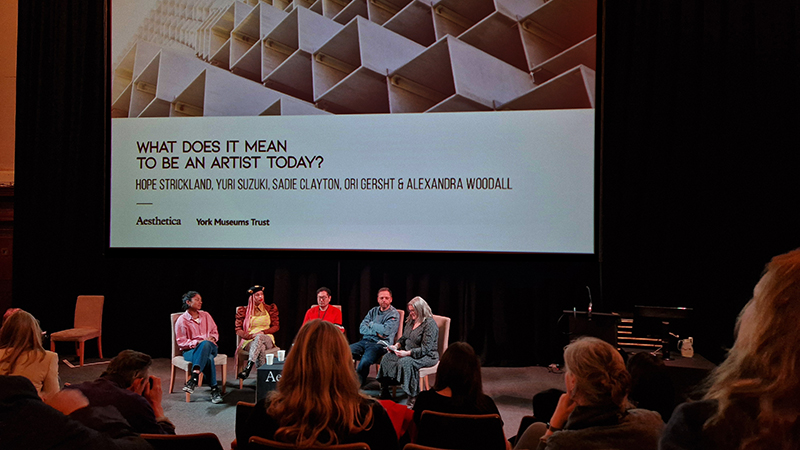
The panel discussion ‘What does it mean to be an artist today?’ was tempered by Ori Gersht accounts of his personal experience as a jew during the current conflict, both here and as witness to atrocities in Israel. How to respond.

Gallery Visits

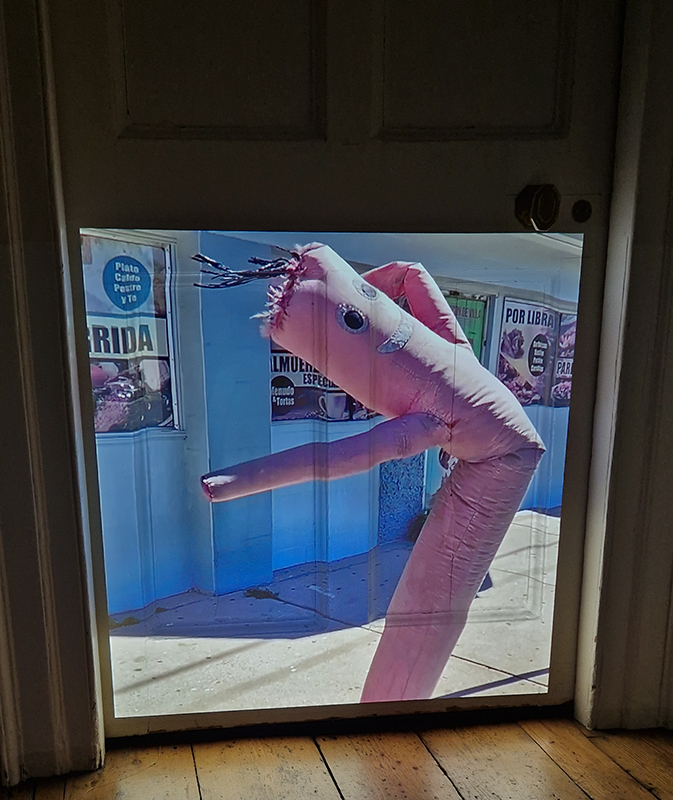
Freya Gabie Duet at Danielle Arnaud. Great to hear Freya’s own account of her time spent as artist in residence on the Mexican/U.S border at one of the teatime talks hosted at the gallery. The shocking inequalities and water poverty that she witnessed are sensitively explored through her work. The ease with which she could cross back and forth was denied those indigenous to the Mexican side who live in the shadow of a shiny wealthy city that they would never visit.
The exhibition explores the landscape of El Paso and Ciudad Juarez as a repository of shared connections and experience. Giving the land voice to both remember and carry the complications, contradictions, and beauty of the place; the way these nuances act in harmony, and the notes of discord they strike. For this exhibition, Freya Gabie draws out threads that weave the two cities of Ciudad Juarez and El Paso together. Approaching the intricate back and forth of economic, social, and medical journeys that take place between the people and objects of the border, and examining how the border both generates the flow of goods, services, and people and dams it, revealing the ways the resulting impacts are felt.

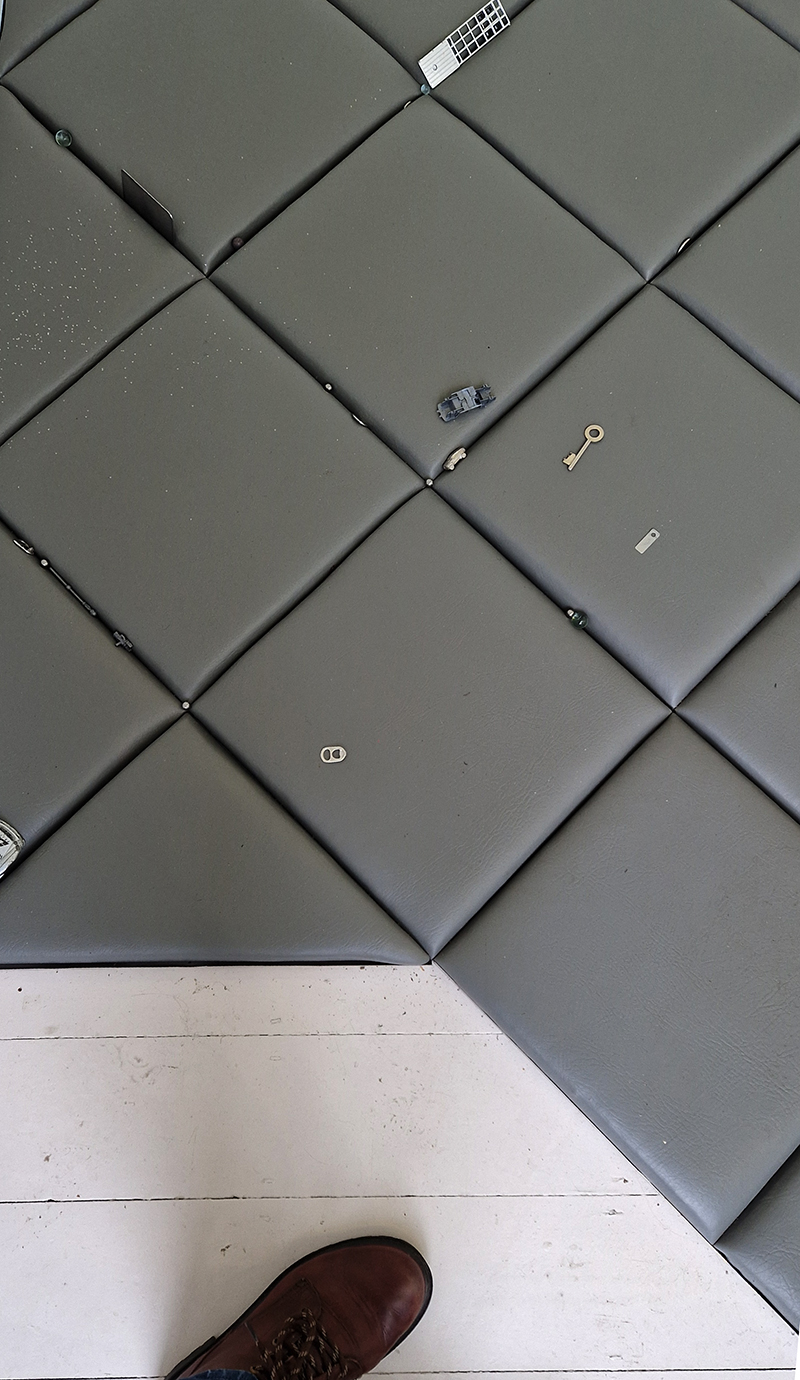
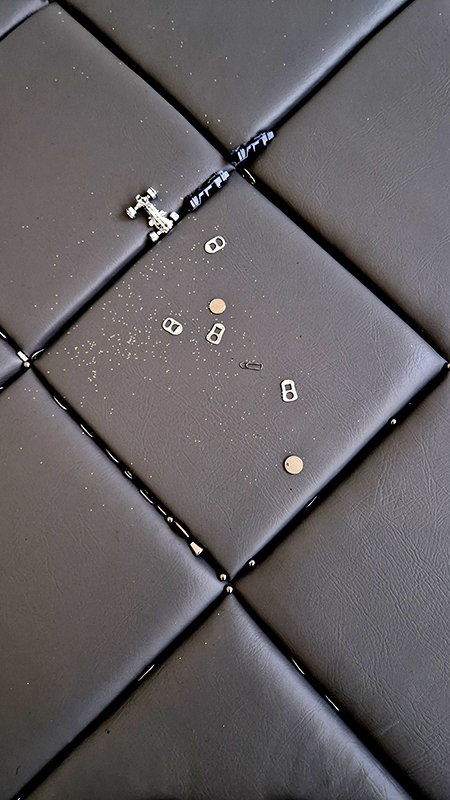
Agata Madejska Grand Habitat Horror Vacui at Flat Time House. The works evoke the personal intimacy and mess of domestic life lived at odds with prevalent power structures. They embody feelings of fragility, and exposure when a home must be constructed from fragments as seen in the small personal objects secreted in pockets or spilling across the floor, an accumulation of detritus that together makes a life, chafing against the world like grit in Vaseline. Due to my own current preoccupations, the dark padded grid of the entry room floor, that gave under the weight of mass and was strewn with discarded silver objects, read as low earth orbit littered with space junk, but was in fact a reference to the Chanel brand handbag.

DISSONANT BLOOM a group show with works by Nancy Allen, Mauro Bonacina and Héloïse Chassepot at Sundy. Enjoyable tactile sculptures with interesting materials and painting to get lost in with no point of focus.

As a concept ‘Dissonant Bloom’ refers to our vexed relationship with nature but it also suggests that growth and flourishing are possible amidst unfavourable conditions. In the same way that the coexistence of competing species ultimately fosters biodiversity and ecological resilience. In the same way every work in this exhibition embodies aspects of blooming, either aesthetically or conceptually, but they do not necessarily do so in harmony with each other.

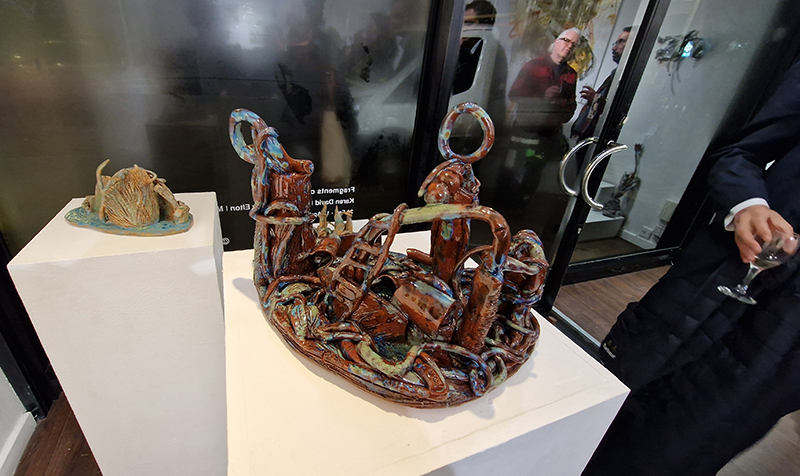
Fragments of a Lost Future with Karen David, Lana Locke, Liz Elton, Mimei Thompson, Susie Olczac at White Conduit Projects. In a time of climate crisis the works question hope for the future as a fantasy, or only for the non-human.

The Planet’s mineral, energy and agriculture resources have been efficiently, and even ruthlessly, exploited… They have harnessed energy of the atom, deciphered the molecular codes that oversee their own reproduction… Despite these achievements the people of this planet have in other respects scarcely raised themselves above the lowest level of barbarism. The enjoyment of pain and violence is as natural to them as the air they breathe. J.G. Ballard [“Report From an Obscure Planet”, 1992]

The fears of the near future described in J.G. Ballard’s science fiction novels are now our reality.

When corporations and politicians are busy monopolising airspace and arguing amongst themselves, whose voice will communicate this urgent crisis. We go about our daily lives with our heads partly buried in the sand, often too busy to fully engage with our current polycrisis. Activists rightly convey outrage, but can we embed these urgencies into our everyday lives? In ‘Report from an Obscure Planet’, Ballard describes the critical state of the Earth as viewed from another place. White Conduit Projects brings together these five artists who bravely and playfully incorporate this sense of crisis into the core and surface of their work. Starting with their everyday surroundings, they attempt new ways of communication, quietly bringing a Ballardian nuance to artworks that inhabit our domestic space.

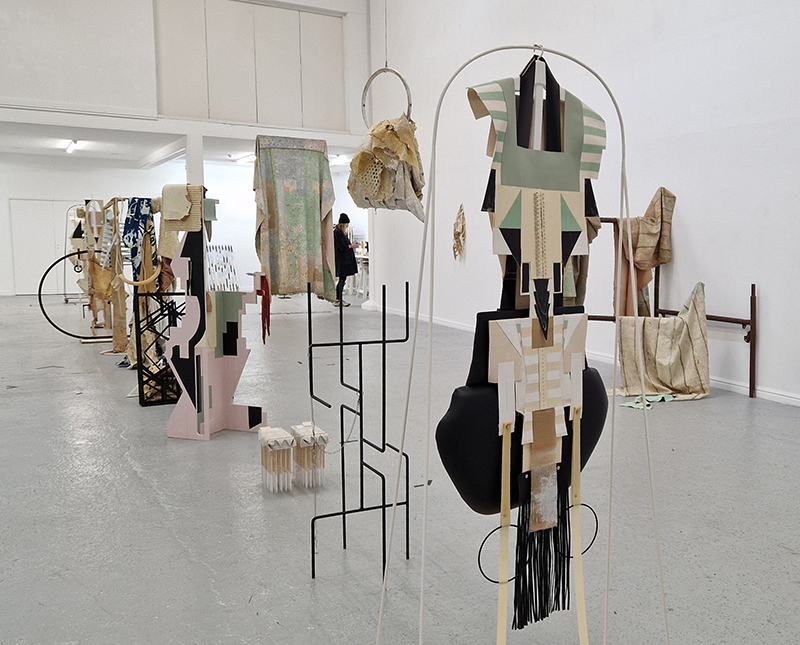
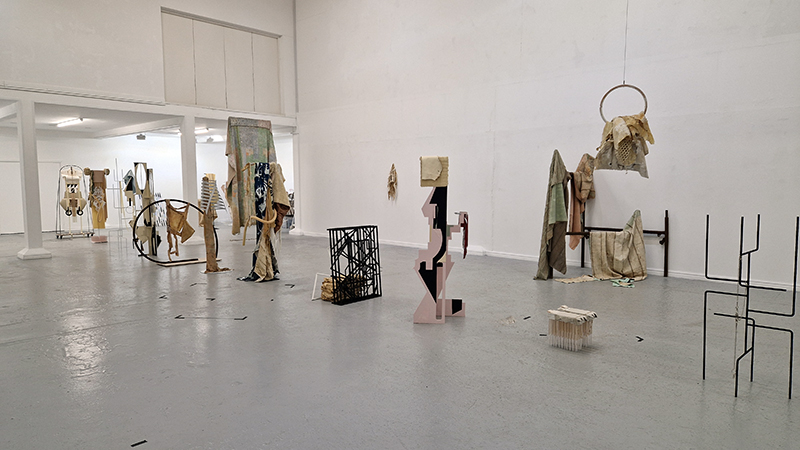
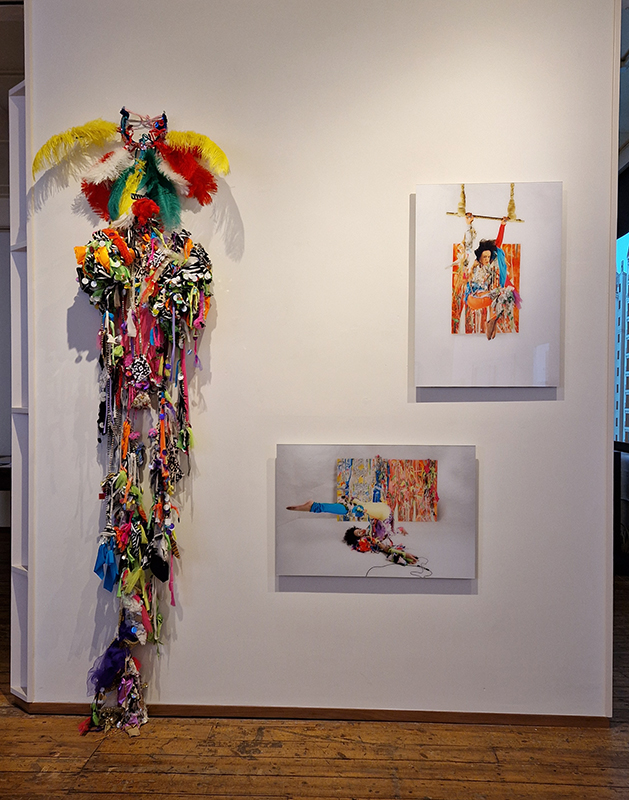
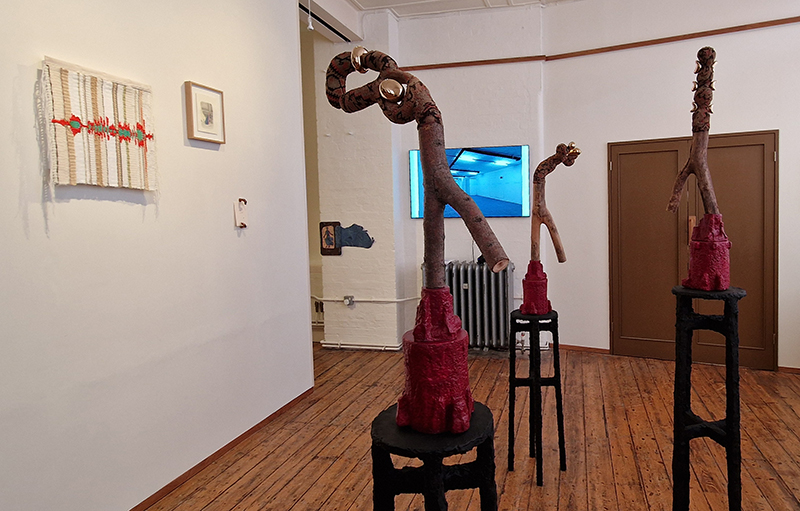
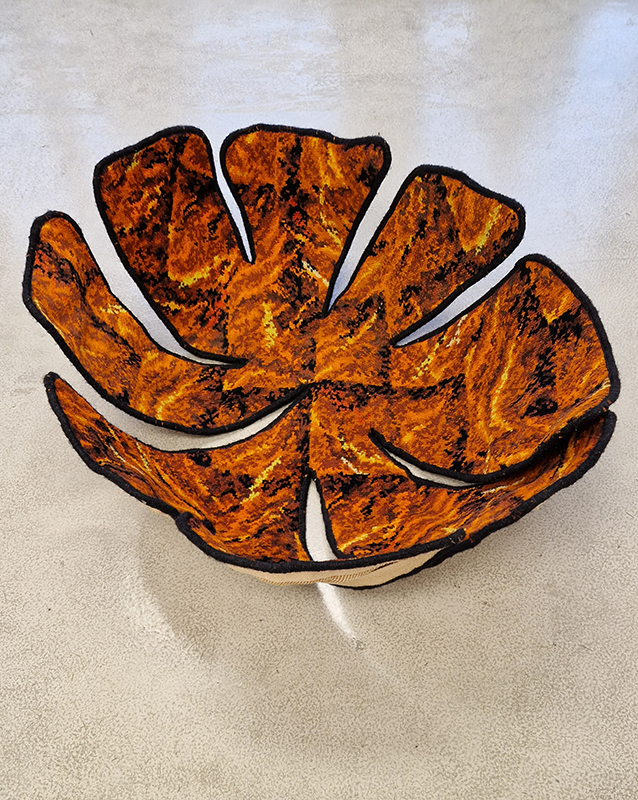
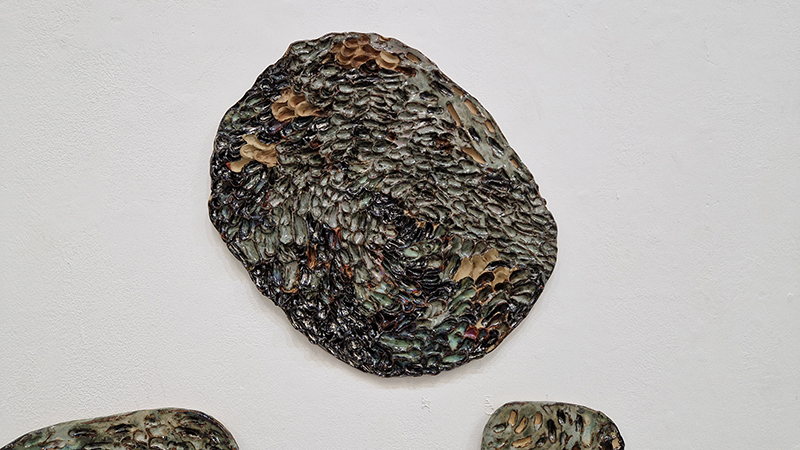
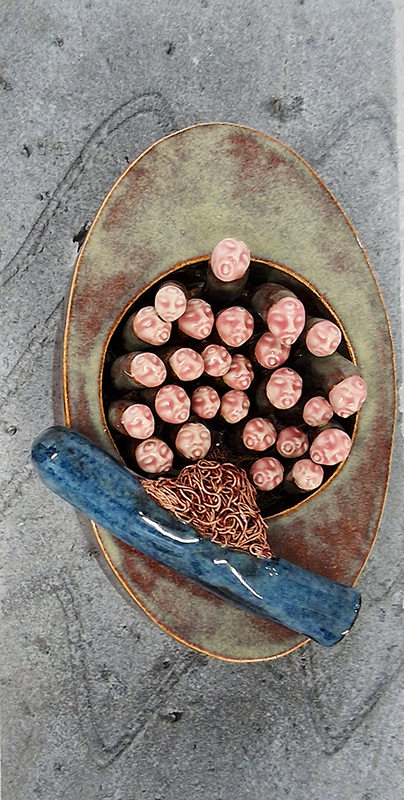
Loose Ends is a group exhibition at Thames-side Studios Gallery exploring connections and the interwoven poetics of material and the body by ten artists working across ceramics, textiles and performance.

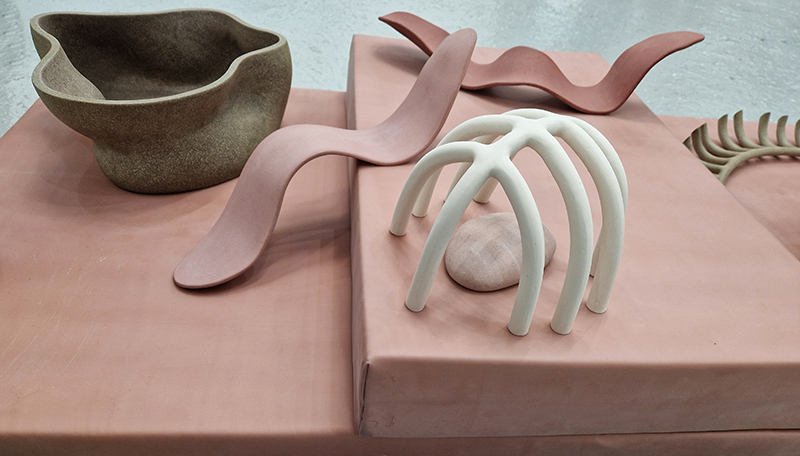
Blown away by the sheer elegant beauty of  Alex Simpson‘s impressive new ceramic work traversing across latex covered foam blocks.

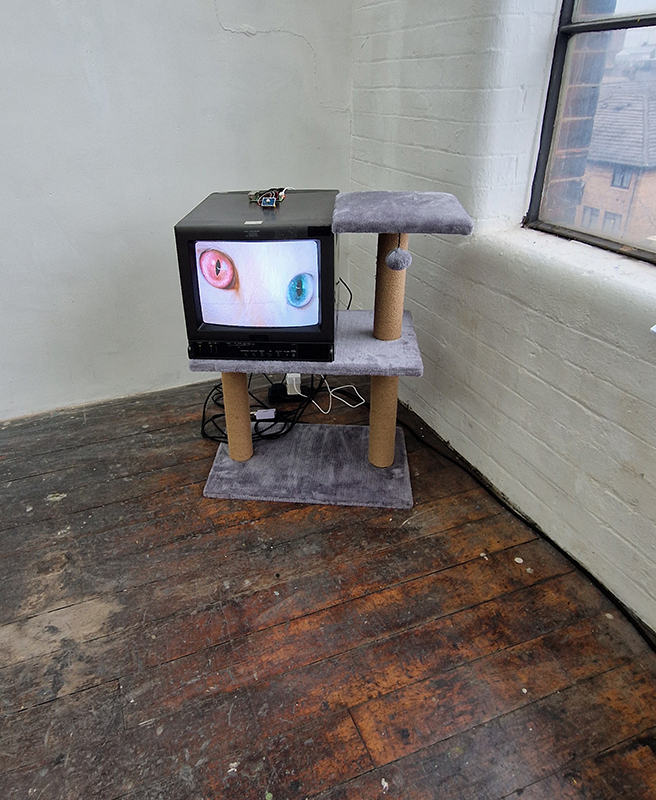
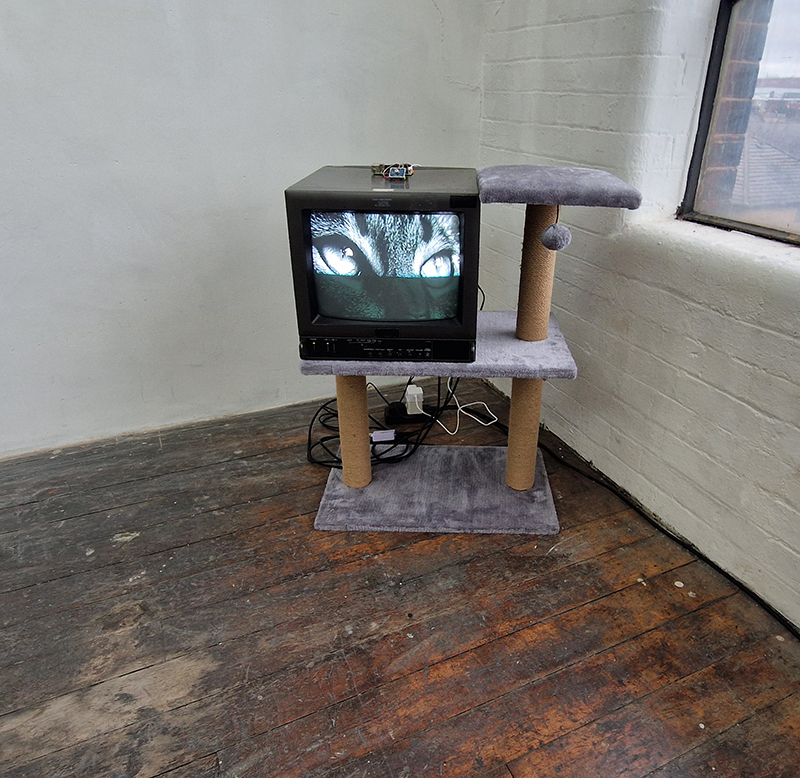
Robert Good Saturation Point Sunday Salon 29. Responding to Richard Brautigan’s 1967 ode to a coming technological utopia ‘All Watched Over by Machines of Loving Grace’ Robert explores what a cybernetic meadow might look like. Here he presents six digital artworks that hum, whirr, click and miaow with the first stirrings of a new digital landscape – one of computer vision, compromised identity and permanent connectivity. This meadow is not brought about by the unfathomable AI but is hand sown and nurtured with the level of technology we can still engage with; it is a human scale materialization of the inner workings of the digital world.

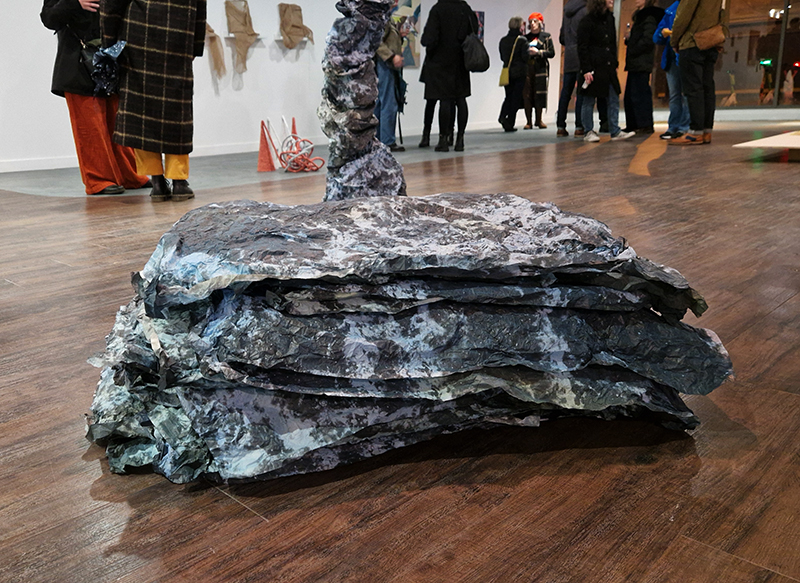
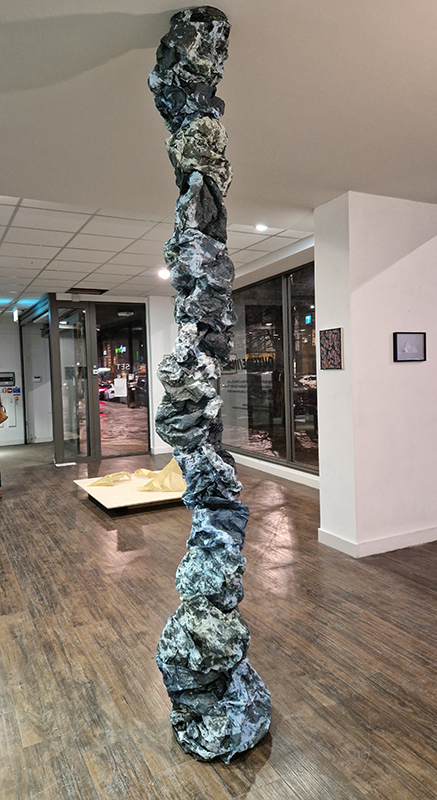
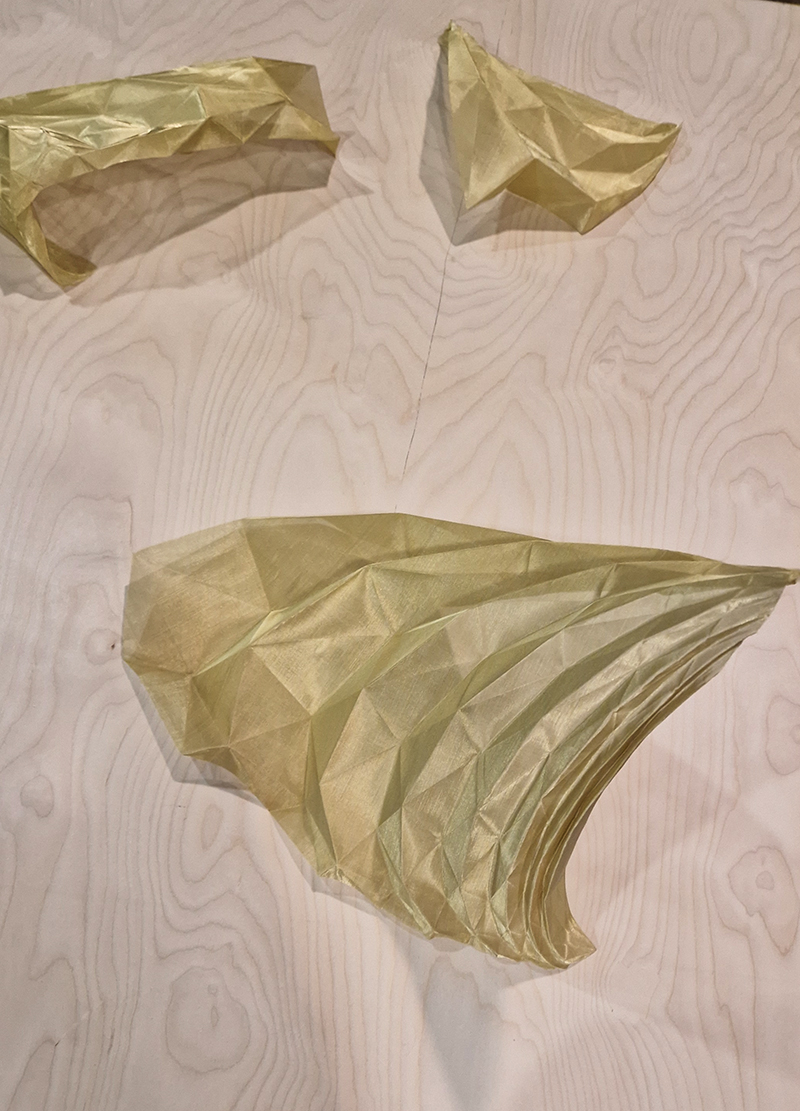
OUTSIDE IN at SET Ealing, a dynamic group show curated and including beautiful, stitched painting by Anna Lytridou, with works by Anja Aichinger, coloured paper clay forms by Eleanor Bedlow, fossil like forms by Anna Joy Reading, delicate folded brass mesh geometric forms by Brigitte Parusel, paintings of collapsed breasts by Jennifer Nieuwland, explorations of genealogy through painting by Jillian Knipe, abstract and evocative paintings by Linda Hemmersbach and Stacie McCormick and subtly coloured sculpted paper forms oscillating between stone and the night sky by Julie F Hill contemplating interconnections between the organic and the inorganic.

Listening

In Our Time Panpsychism – Melvyn Bragg and guests discuss the idea that some kind of consciousness is present not just in our human brains but throughout the universe, right down to cells or even electrons. This is panpsychism and its proponents argue it offers a compelling alternative to those who say we are nothing but matter, like machines, and to those who say we are both matter and something else we might call soul. It is a third way. Critics argue panpsychism is implausible, an example of how not to approach this problem, yet interest has been growing widely in recent decades partly for the idea itself and partly in the broader context of understanding how consciousness arises.

The Life Scientific – Professor of Computer Science at the University of Oxford, and the Director of Foundational AI Research at the Alan Turing Institute Michael Wooldridge on AI and sentient robots – Humans have a long-held fascination with animating an inanimate object, but the idea of Artificial Intelligence (AI) is often perceived as a dystopian threat: from Mary Shelley’s Frankenstein, through to the Terminator movies. We still often think of this technology as ‘futuristic’: whereas in fact, it’s already woven into the fabric of our daily lives, from facial recognition software to translator apps. He believes this will be a watershed year for AI development.

It might be interesting to consider if and how AI and technology might impact human evolution. Medical advances may already have influence. A 300,000-Year History of Human Evolution – Robin May The species we recognise as our own – anatomically modern humans – has existed for only 300,000 years, a blink of an eye in evolutionary terms. And yet during that time our species has been shaped by strong evolutionary forces, often unwittingly as an indirect result of human activities.