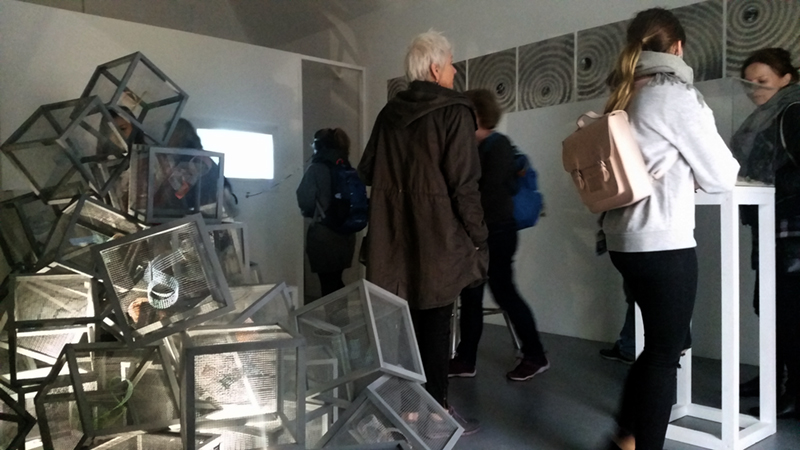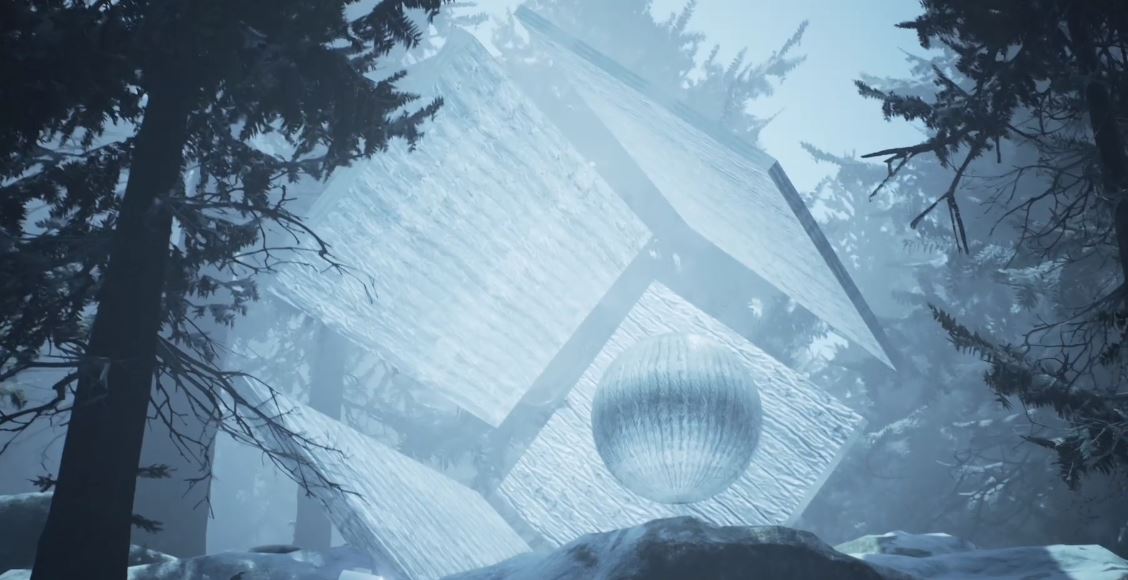
Archives for posts with tag: Laboratory of Dark Matters

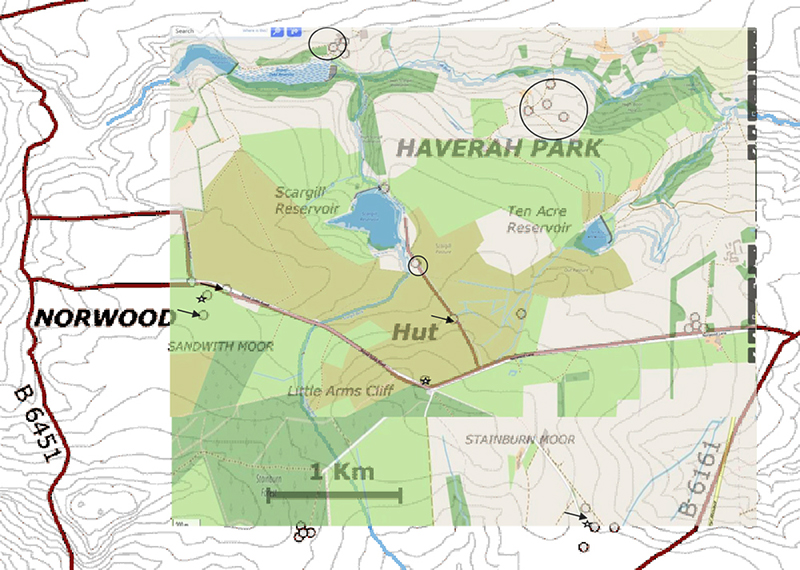
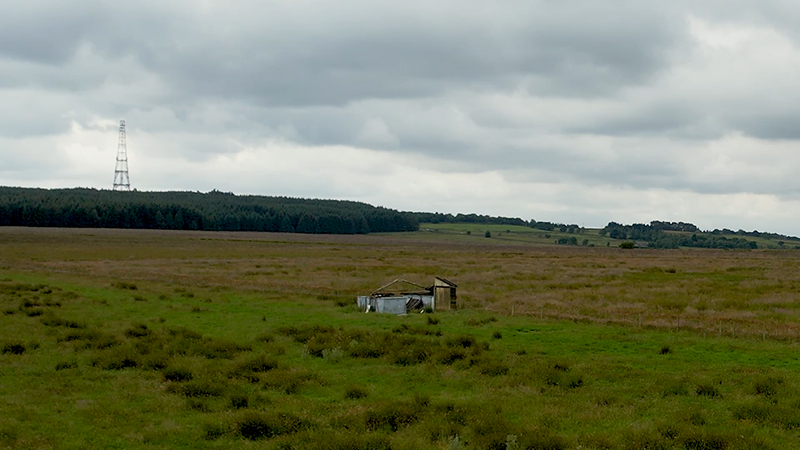
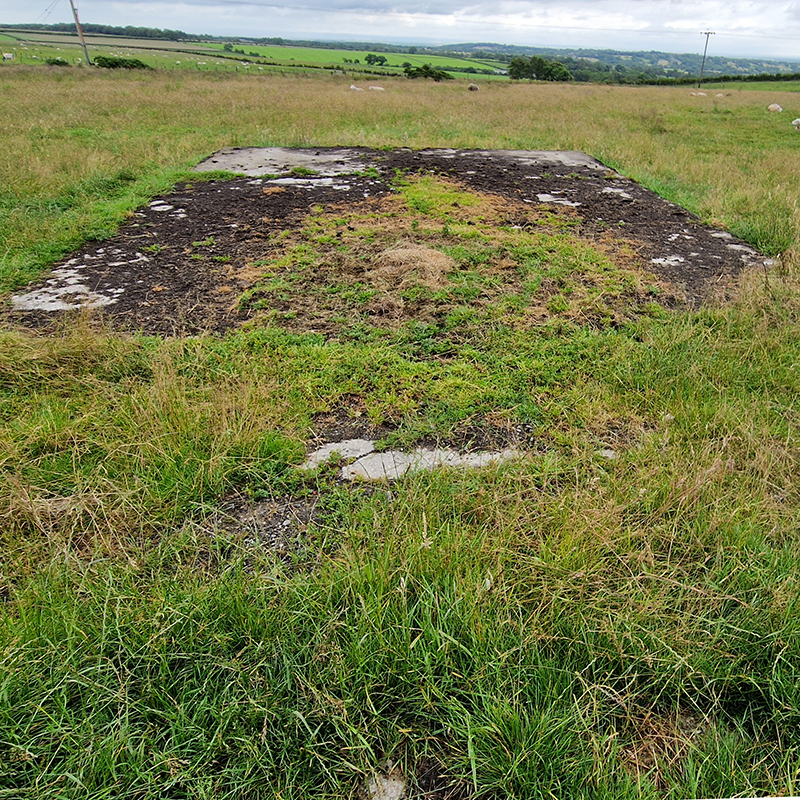
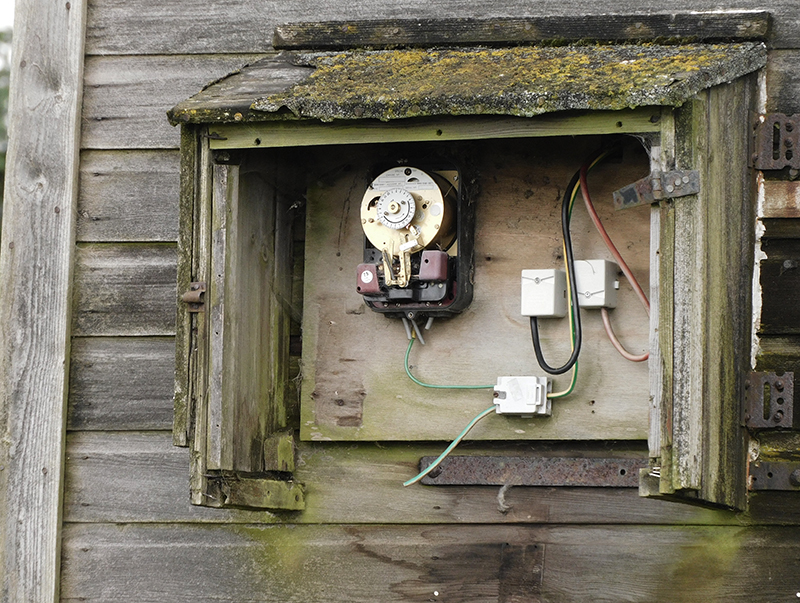
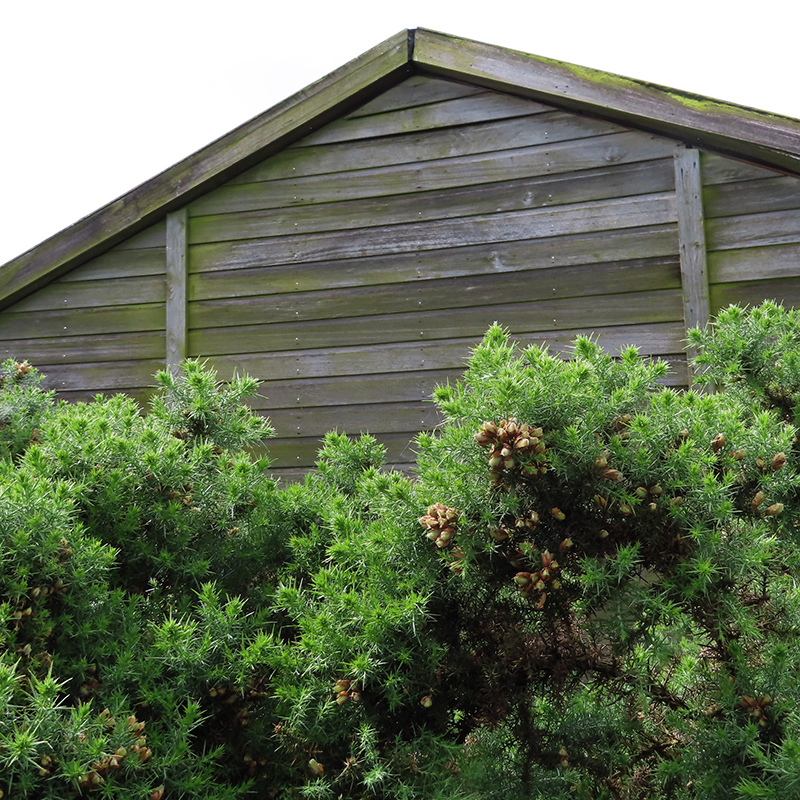
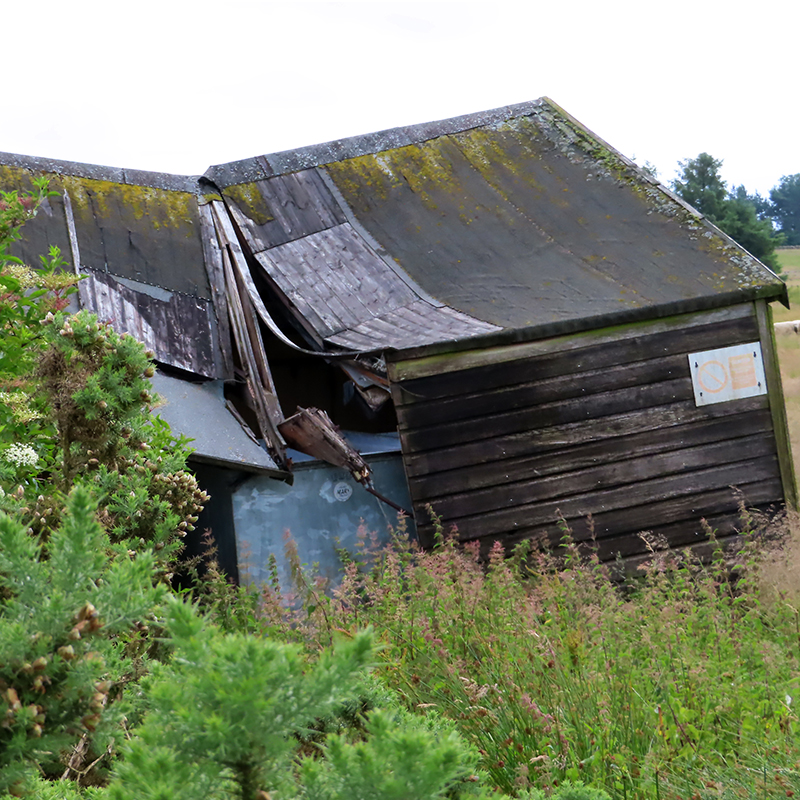
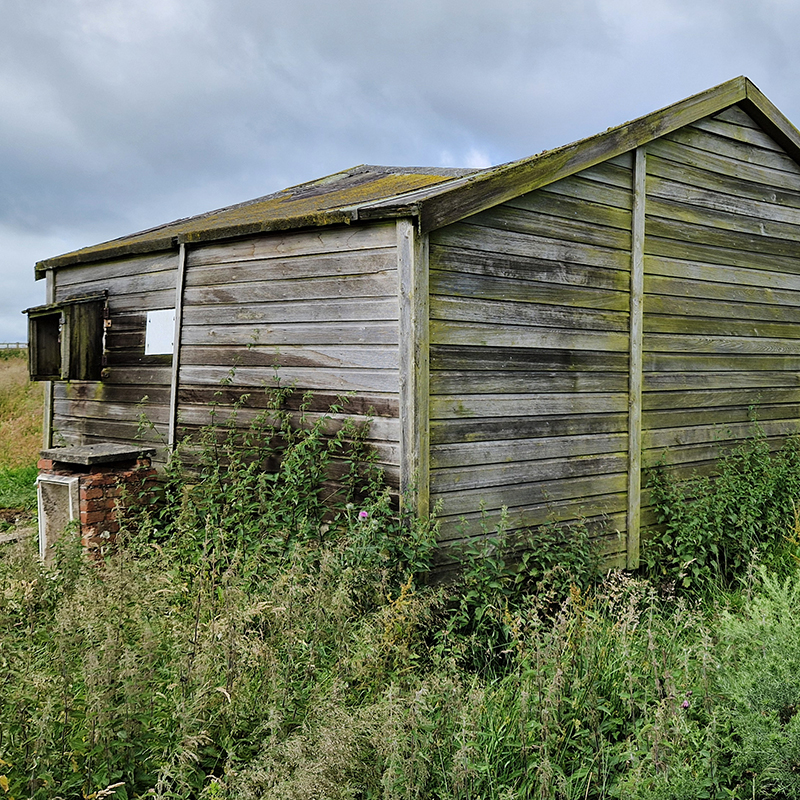
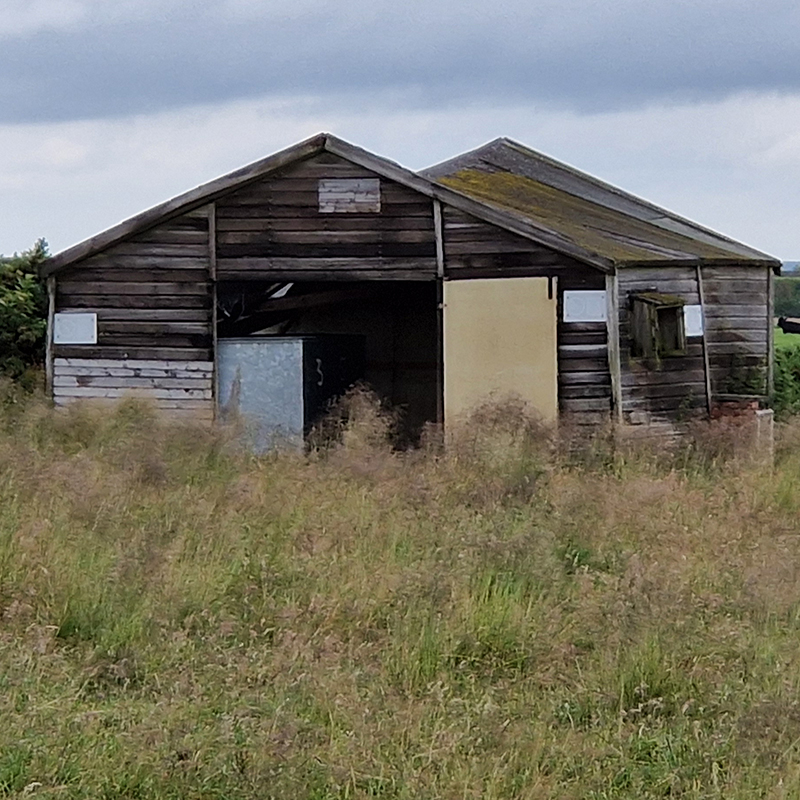
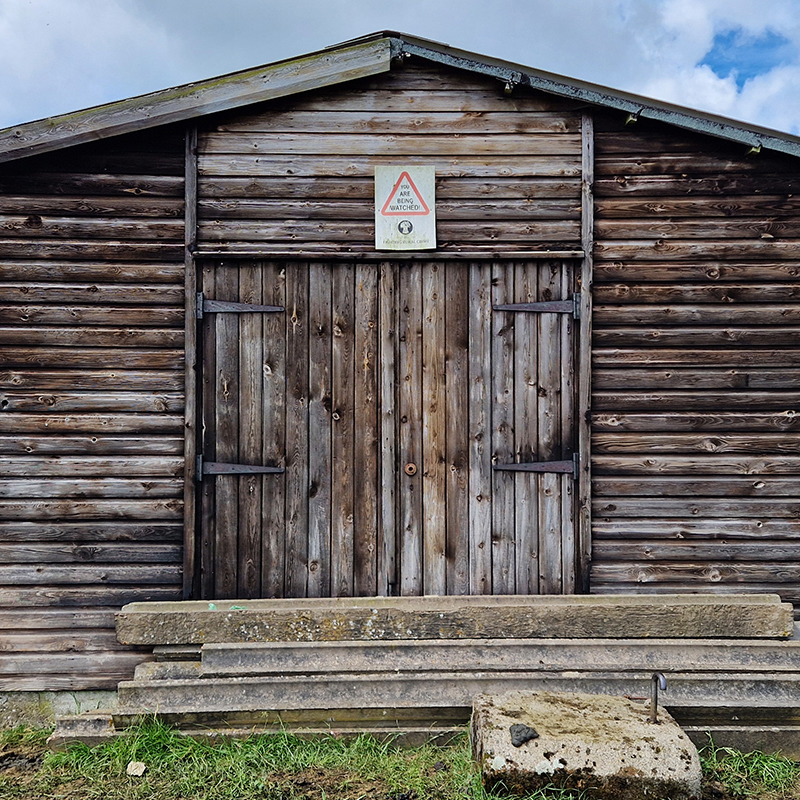
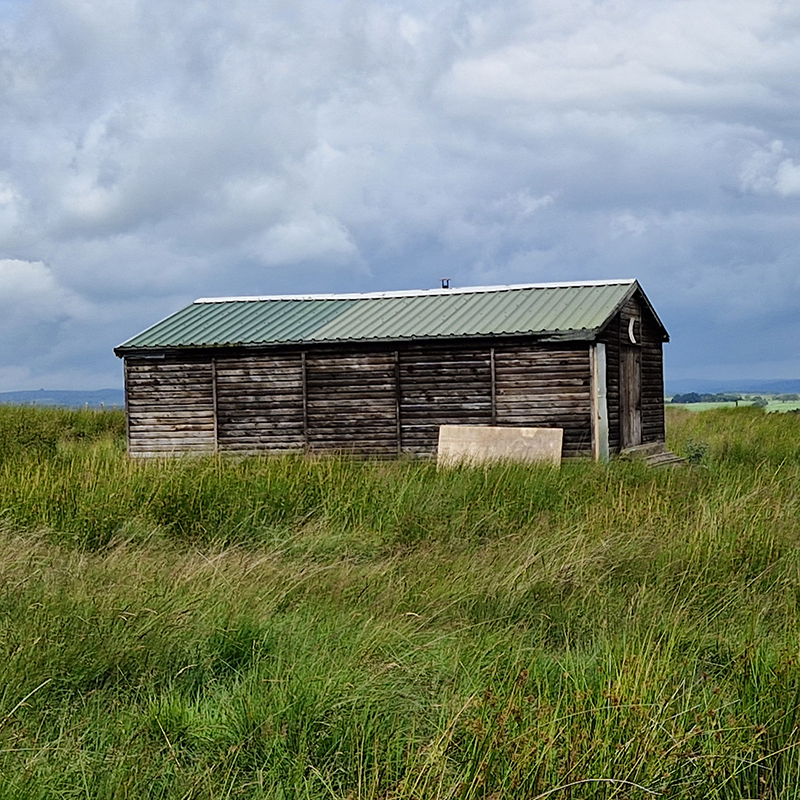
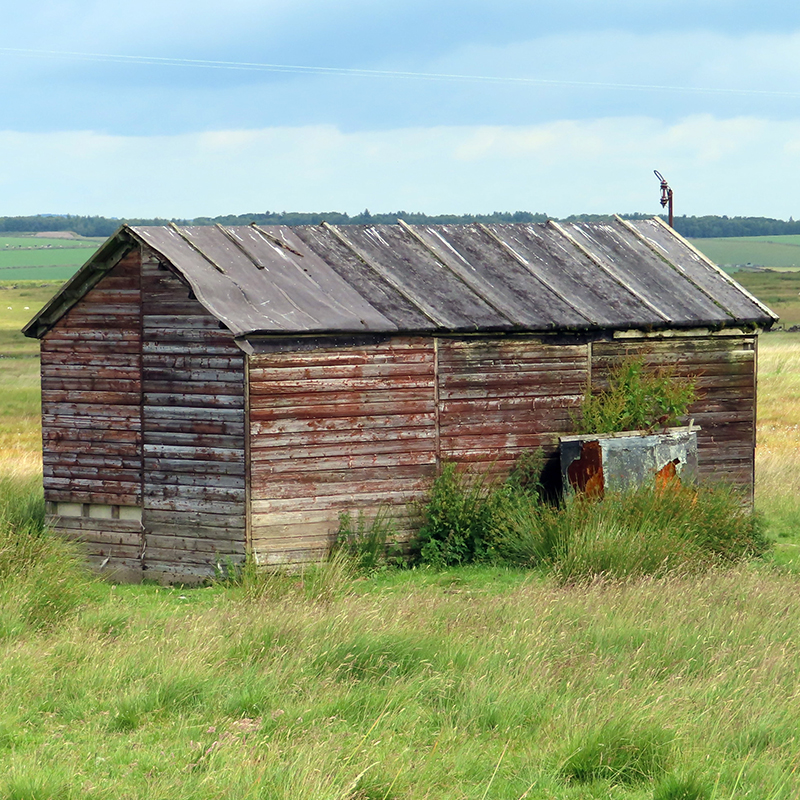
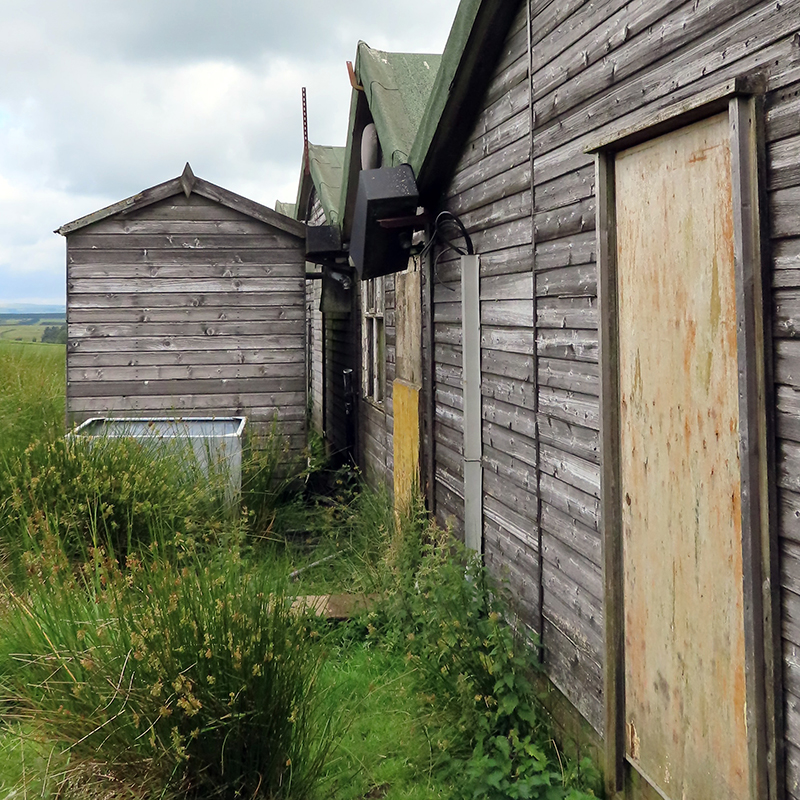
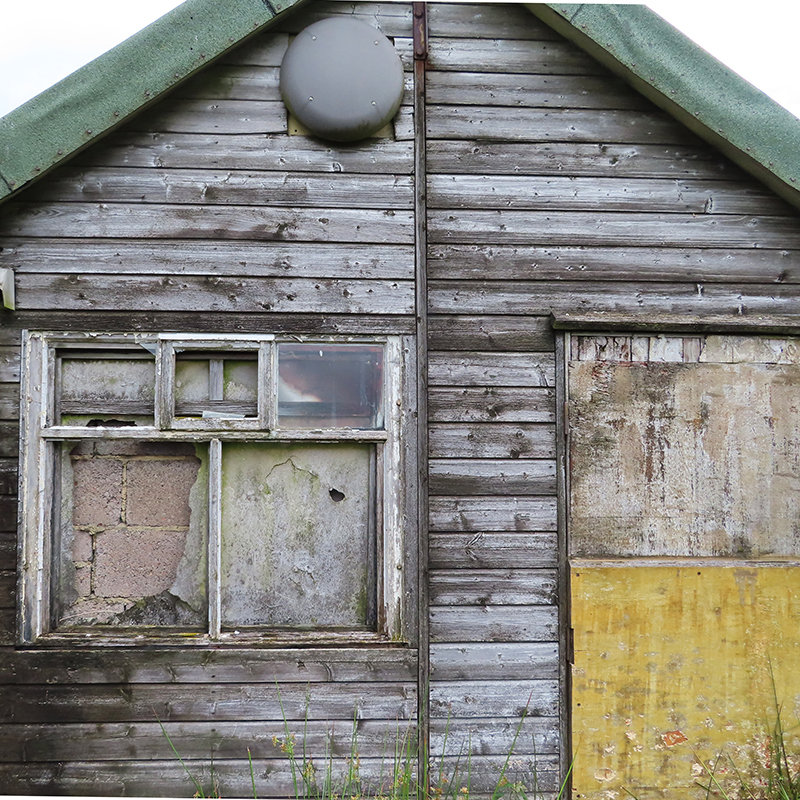
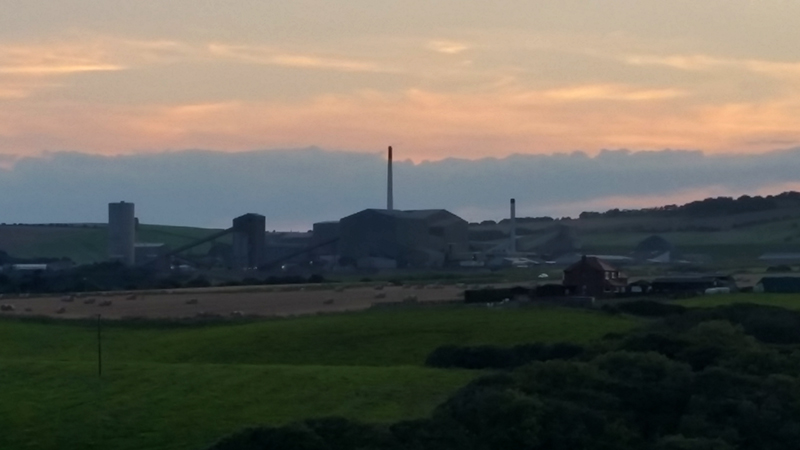
In search of huts. I have been on a mission to locate and document the remaining huts from a cosmic ray detection experiment at Haverah Park on the Pennine moorland in North Yorkshire.

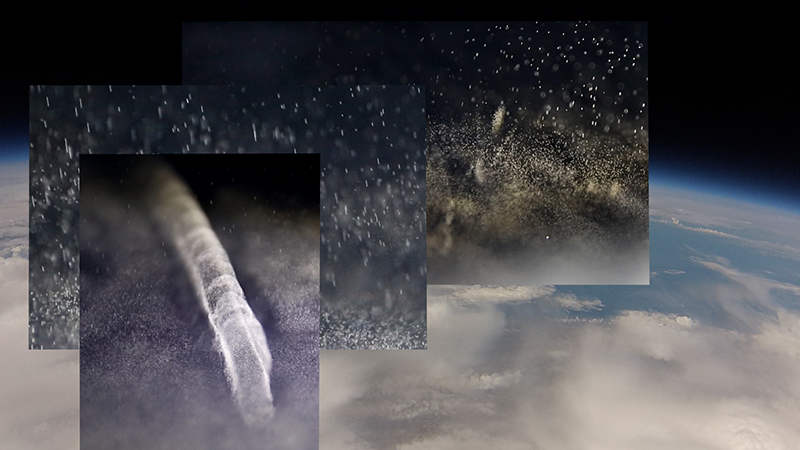
When high-energy cosmic rays enter the atmosphere, they set off a chain-reaction particle cascade known as an extensive air shower. The Haverah Park experiment was home to one of the largest extensive cosmic ray air shower arrays in the world.

It was operated by the Physics Department of the University of Leeds for 20 years, closing in 1987. An array of over 200 water-Cherenkov detectors covering 12 km2 were active during its operation and many 1000’s of extensive air showers were recorded, including ones of such size that the cosmic rays that generated them had energies previously unthought of, adding to the mystery of where they come from.

The large energy density of cosmic rays is close to that of starlight, adding their own glow to the sky as they blast across the universe. Cosmic rays are the atomic nuclei of elements ranging from hydrogen to uranium accelerated to high energies, with half being protons and most positively charged.

Much of the technology used to observe cosmic rays has changed little over the decades since first inventions and still plays a role within newer technologies.

It appeals to me that the excitement of observing particles from other galaxies happened at these unassuming structures.

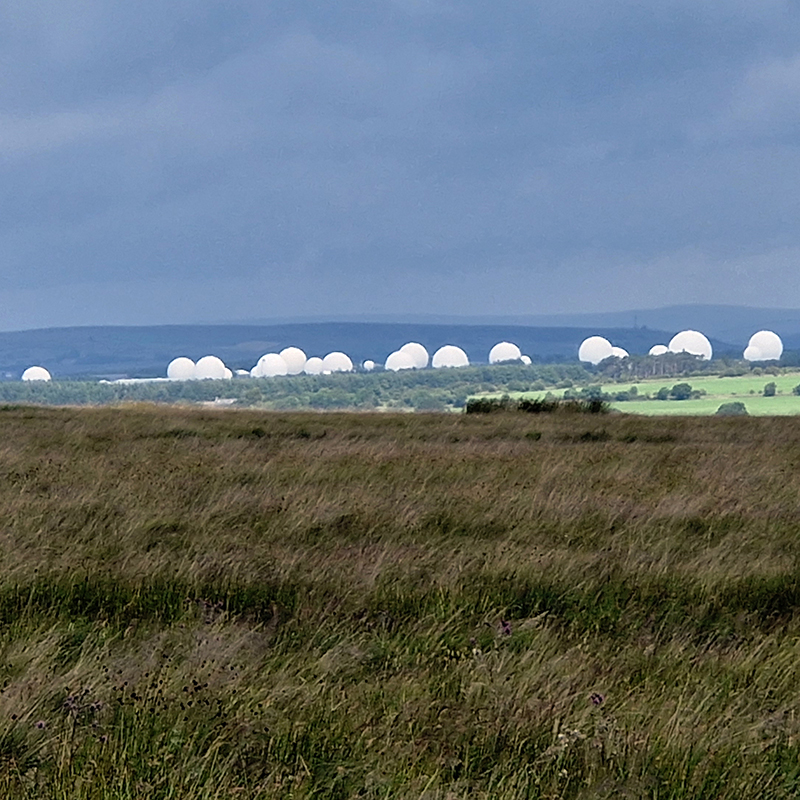
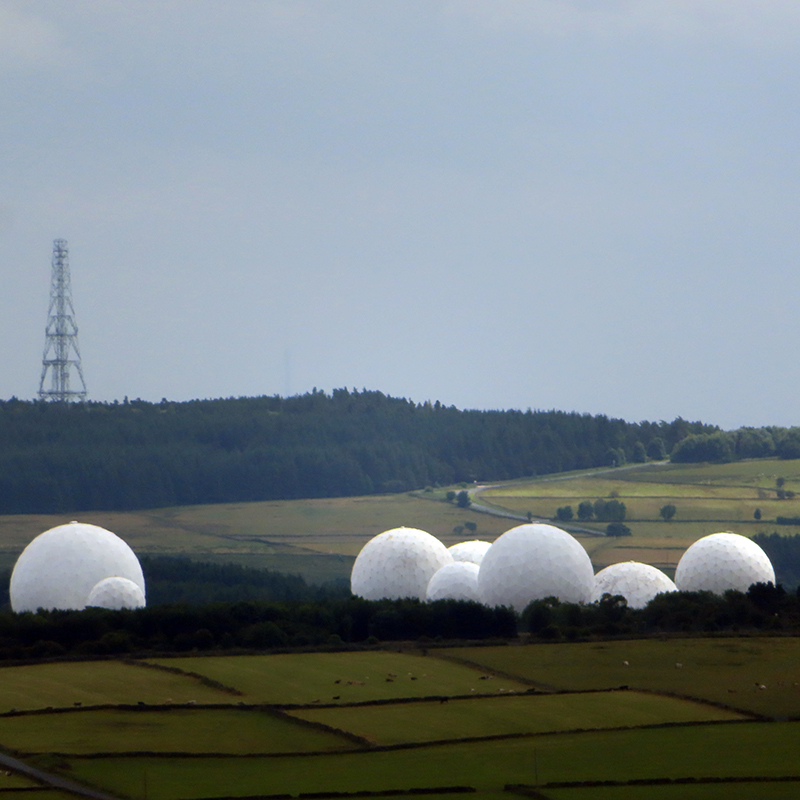
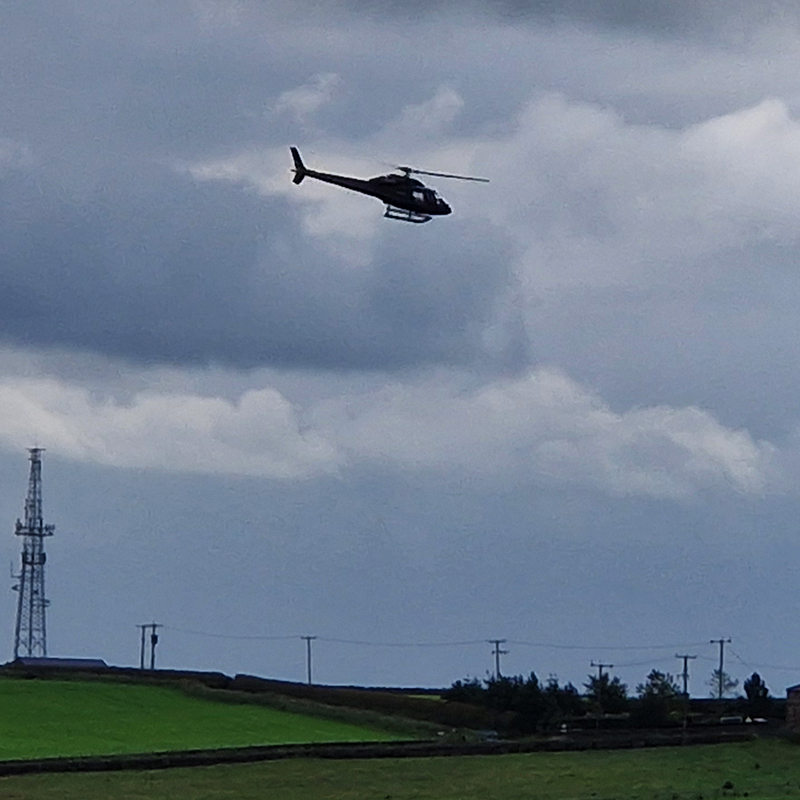
Sharing the landscape of Haverah Park cosmic ray air shower detector array huts are the striking white radomes that shield secret radar equipment at RAF Menwith Hill. The spy station has been there since the cold war space race began in the mid-fifties. Little is known about what goes on here but broadly it is said to gather electronic intelligence and is operated by US National Security Agency (NSA) and UK Government Communications Headquarters (GCHQ). As satellite technology has increased so has the number of radomes which now number 37 at the site. It is worth noting that satellites are vulnerable to unpredictable space weather and cosmic ray interference.

The total number of particles detected in a shower can be used to estimate the energy of the primary cosmic ray. Some particles contain the highest energy form of radiation known to exist anywhere in the universe and their origin is one of science’s greatest mysteries. Air showers of secondary particles generated from a primary cosmic ray hitting the Earth’s atmosphere are spread over many kilometres when they hit the ground so it is useful to have detectors spread over a large area. The difference in the time of arrival of recorded particles at multiple detectors can be used to estimate the arrival direction of the primary cosmic ray. However, this does not necessarily reveal the origin of the particle as magnetic fields within the galaxies bend their trajectories so that the memory of their original direction is obfuscated.

The cosmic ray detectors I made for the The Breath of Stars use a block of plastic scintillator which emits a short burst of UV light when a charged particle passes through it which is picked up by a single-photon-sensitive device. The detectors used at Haverah Park are water Cherenkov detectors. These are large steel tanks of purified water with photon sensitive detectors in the water.

While the speed of light in a vacuum is a universal constant its speed through a material may be significantly reduced as it is slowed by the medium. A particle passing through a material faster than that at which light can travel through the material loses electrons thereby emitting light. When cosmic rays pass through the water tanks, they emit Cherenkov radiation because they travel faster than the speed of light in water. Cherenkov light is similar to the production of a sonic boom when an airplane is traveling through the air faster than sound waves can move through the air. Pavel Cherenkov along with Ilya Frank and Igor Tamm discovered and demonstrated this phenomenon in 1934, astonishingly, it had been predicted in 1888 by Oliver Heaviside, and in 1910 Marie Curie had noticed a strange blue glow from her radium experiments.

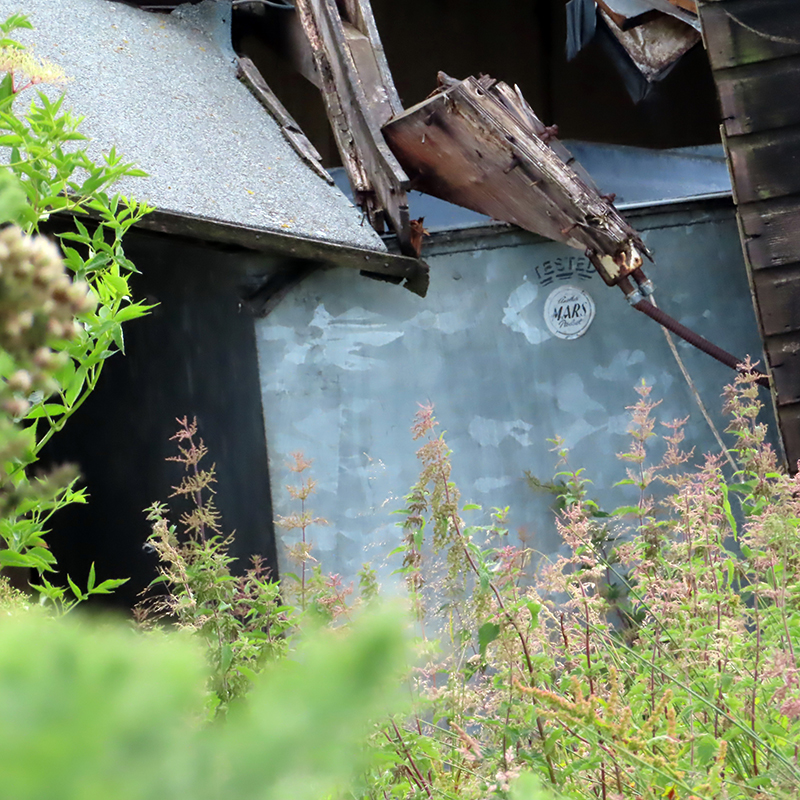
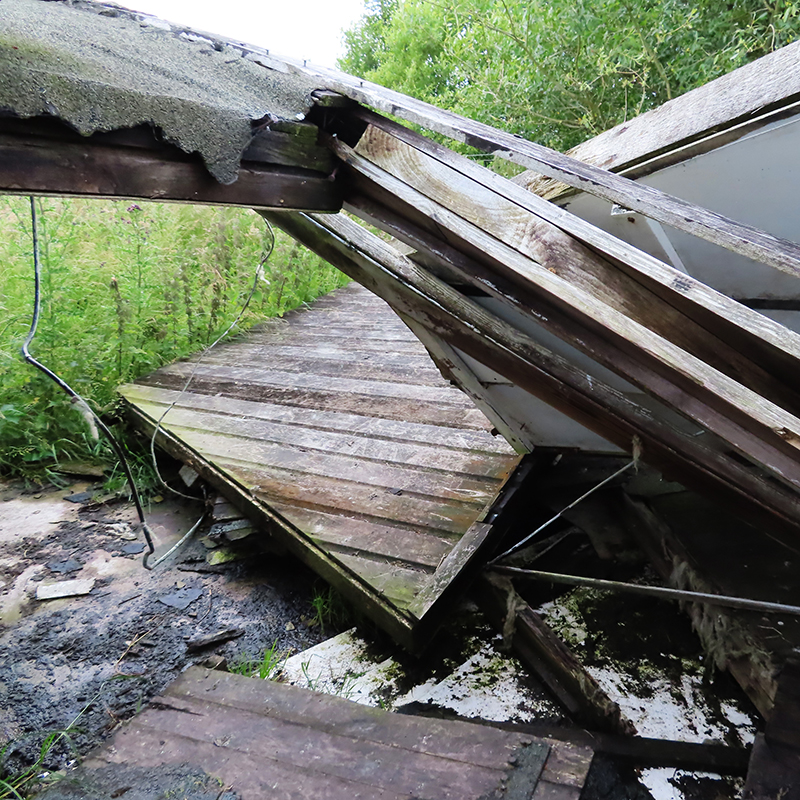
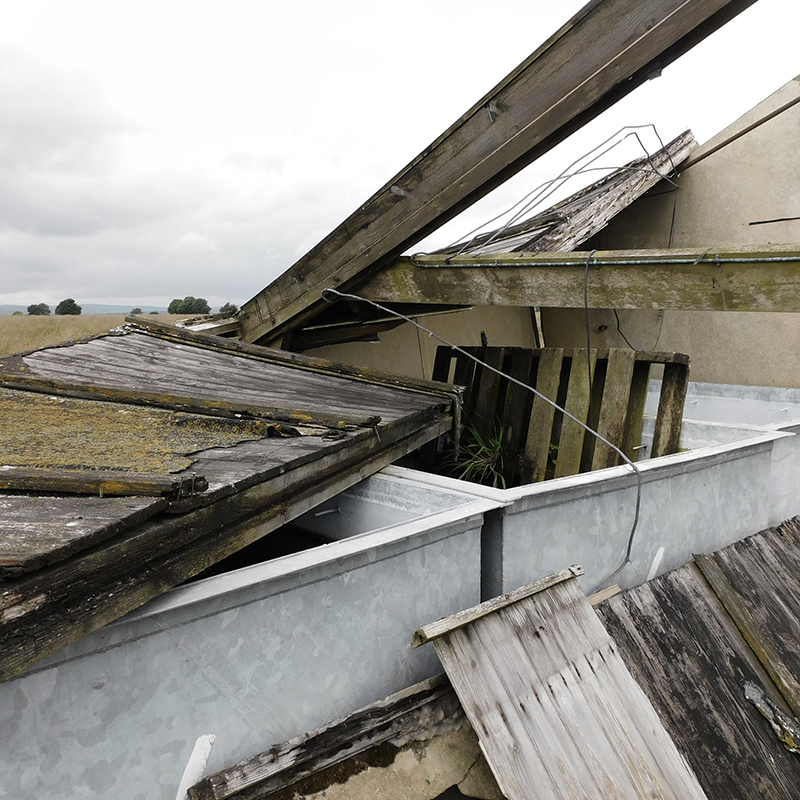
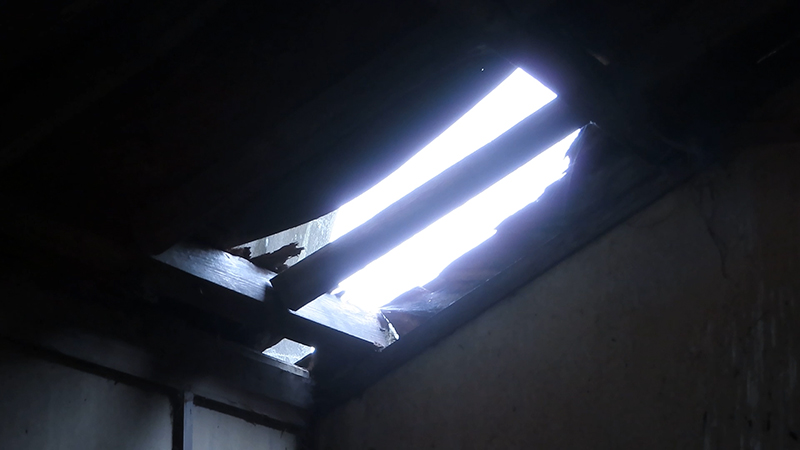
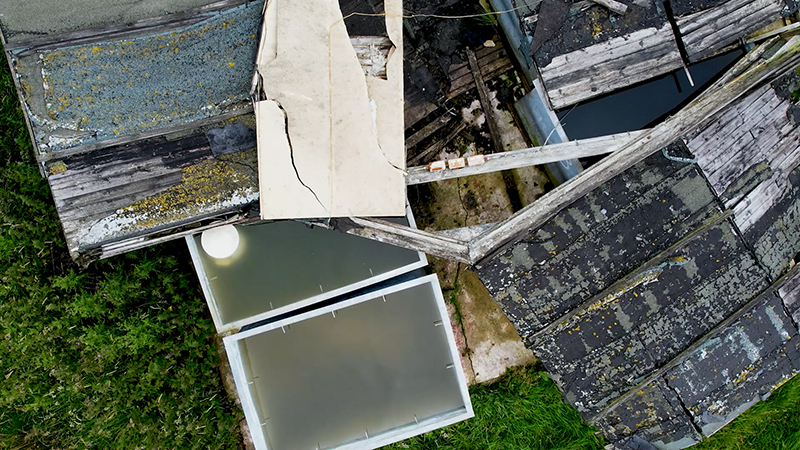
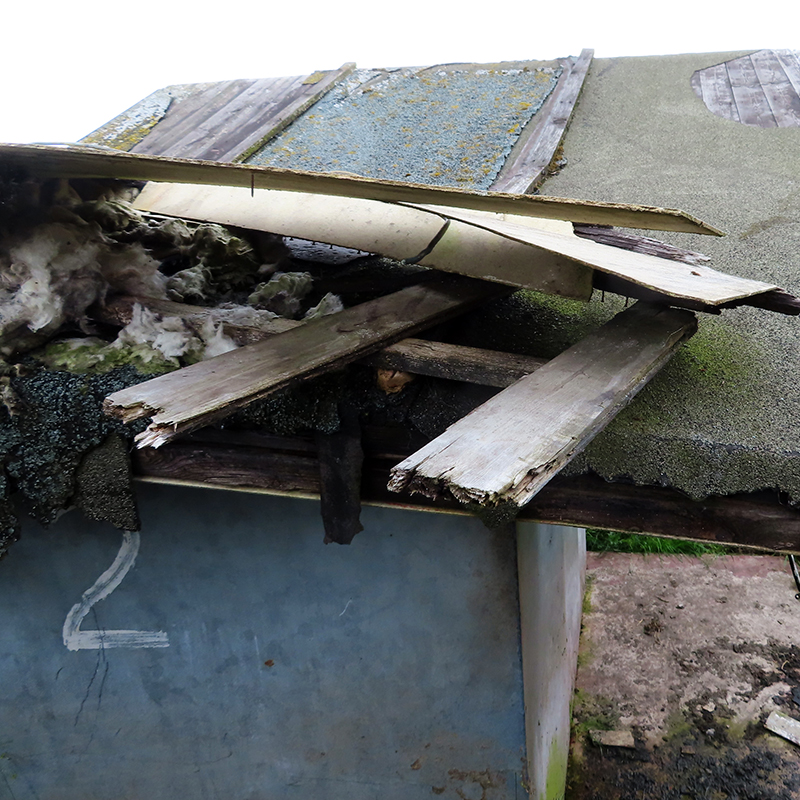
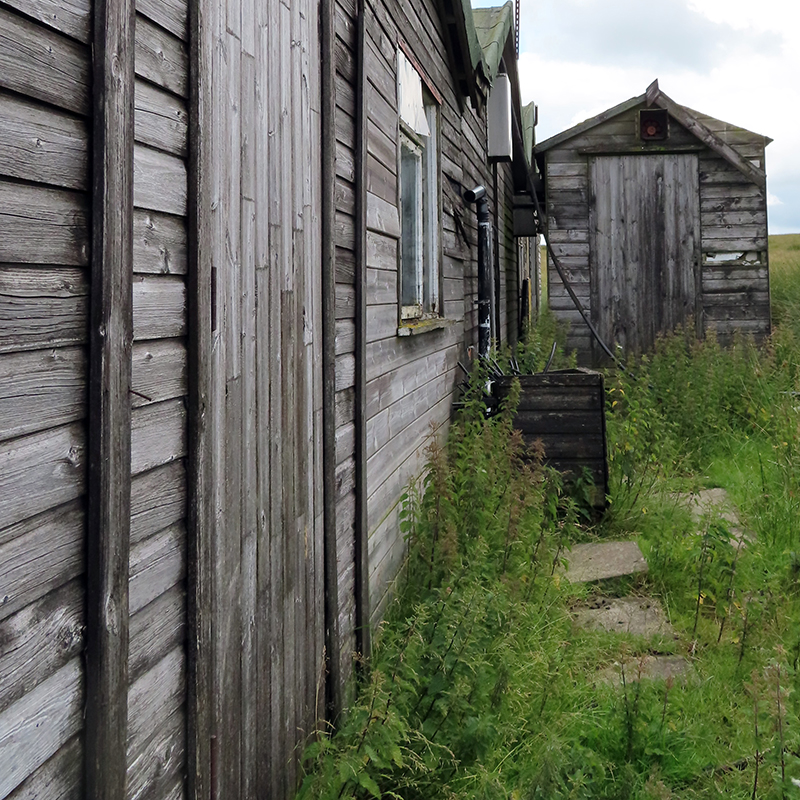
Other huts from the Haverah Park experiment are in a state of collapse.

There are so many high energy particles hurtling around the universe that they almost equal starlight in energy density. Cosmic rays travel at almost the speed of light and because they are charged particles most cosmic rays are confined, spiralling within our galaxy for a million years or more, by the magnetic fields which permeate it.

Five million cosmic rays pass through your body each day. Some will collide with atomic nuclei. A particle passing through a material at a velocity greater than that at which light can travel through the material emits light. Maybe we glow a little.

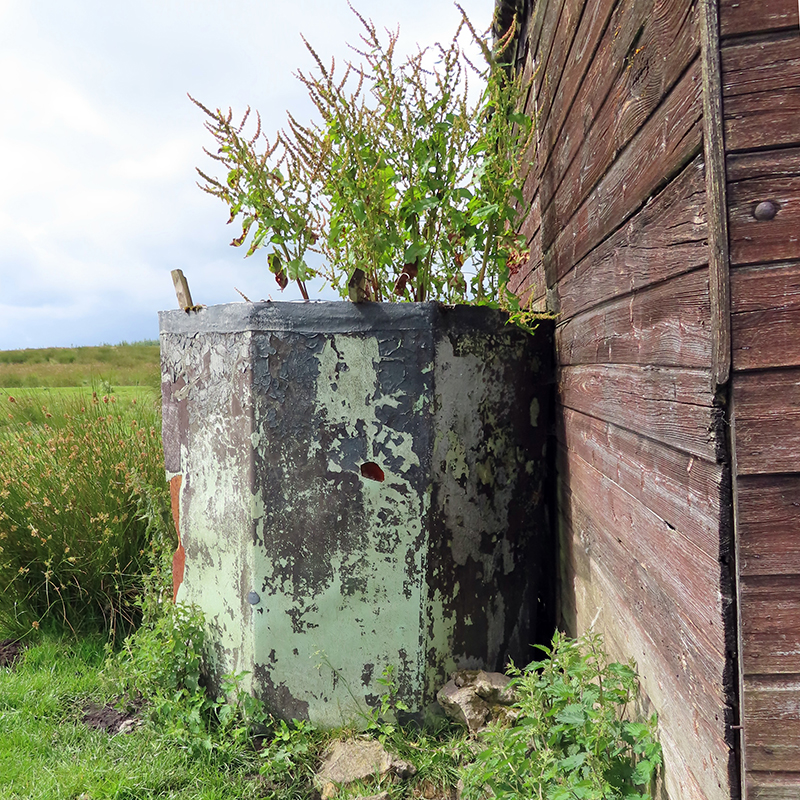
Following the disappearing trail. Haverah Park hut with an intriguing hexagon tank.

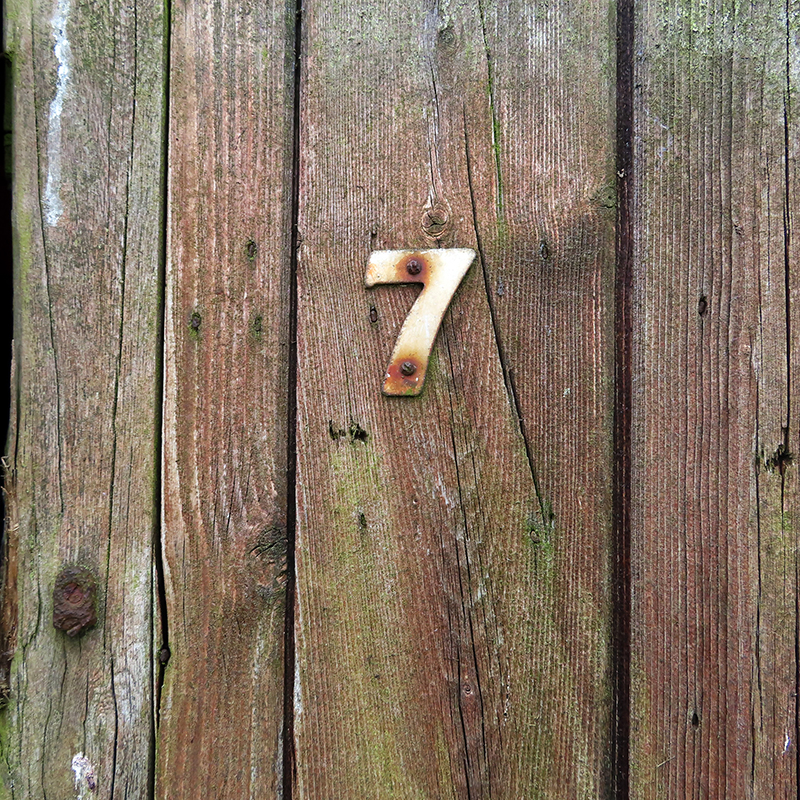
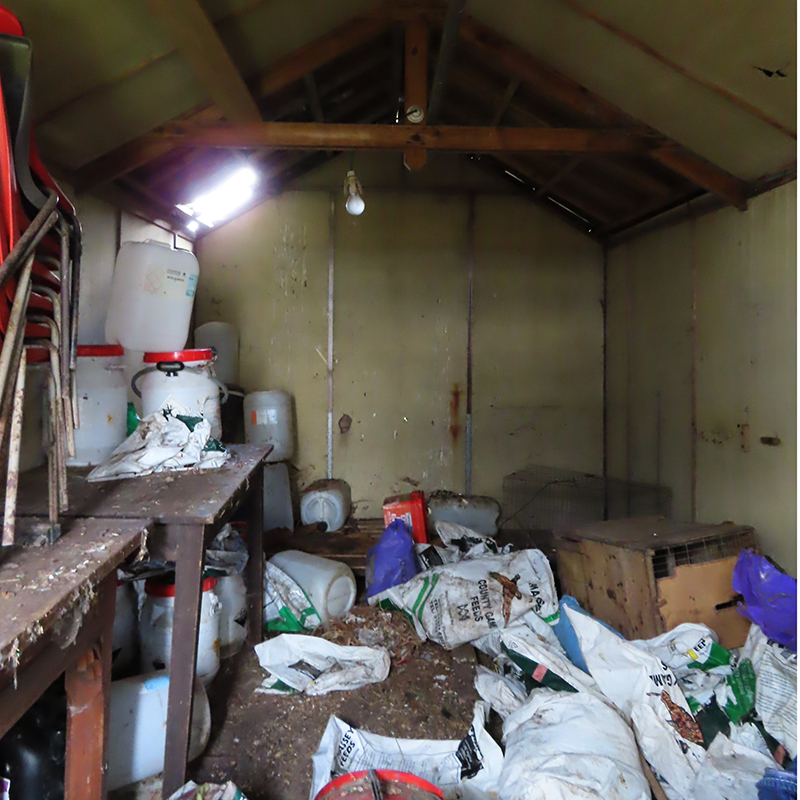
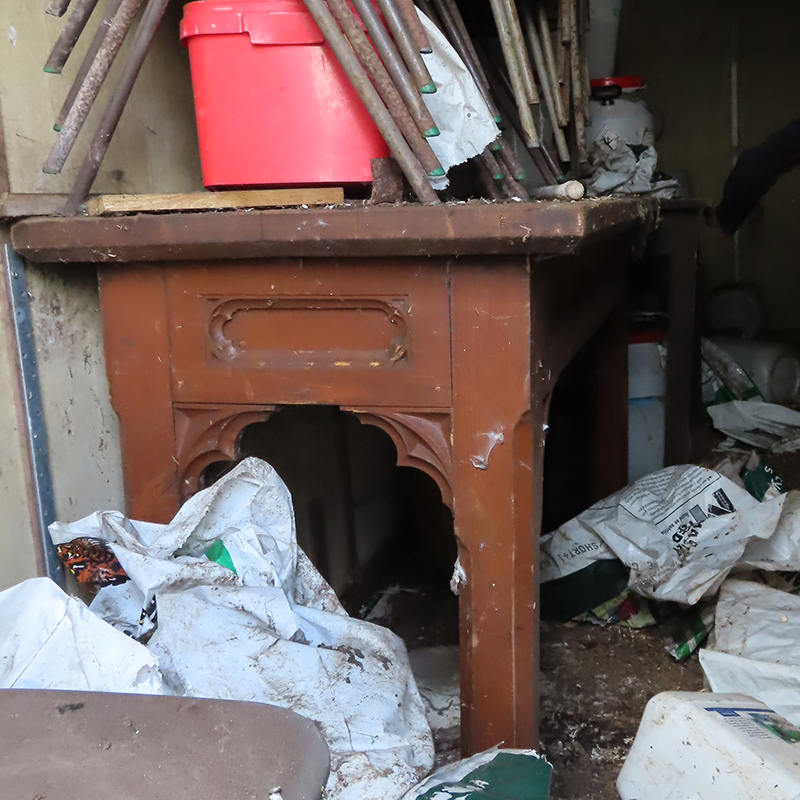
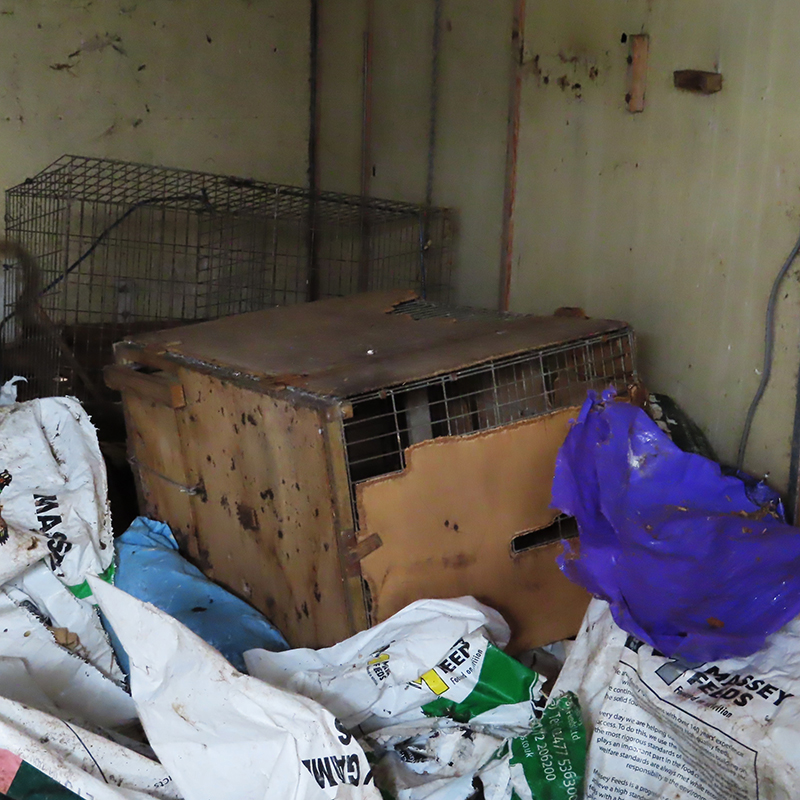
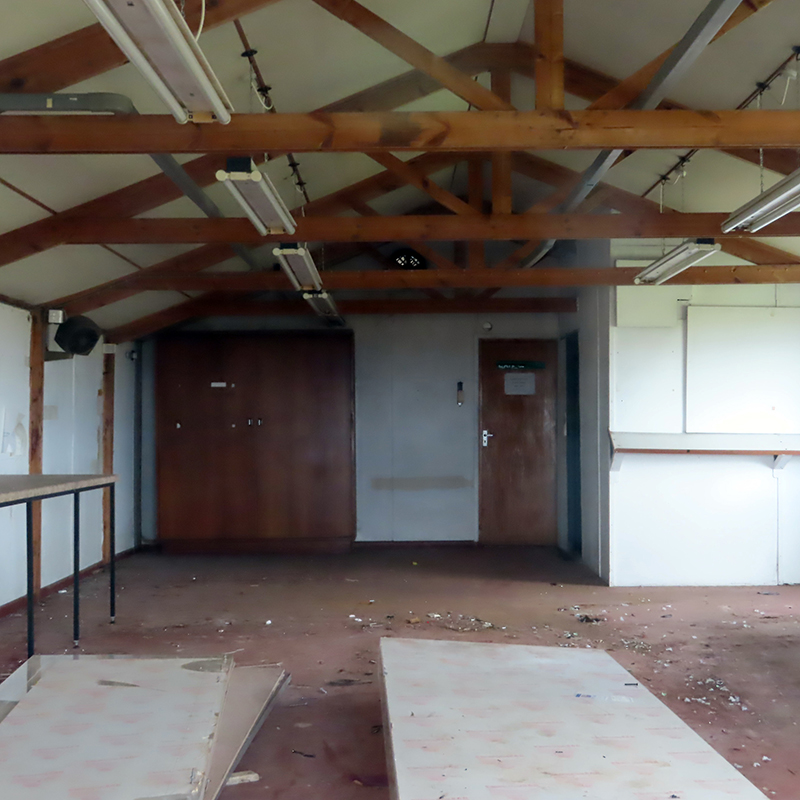
Inside Hut no. 7 is a dumping ground. Waste is a big problem in space as well as on Earth. The thickening shell of space junk in low Earth orbit, if left to accumulate, could cause a conductive shield to form, weakening the effectiveness of the magnetosphere, which protects life on earth from most cosmic radiation.

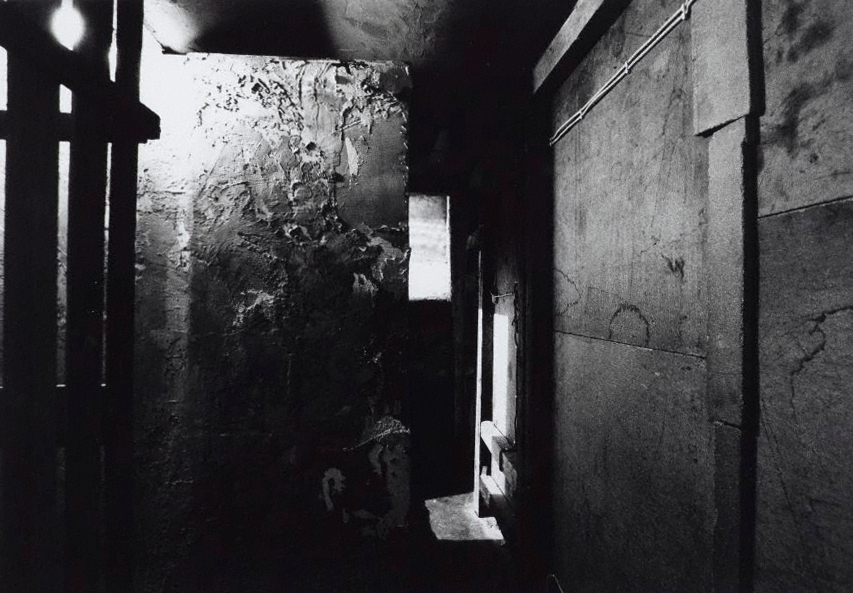
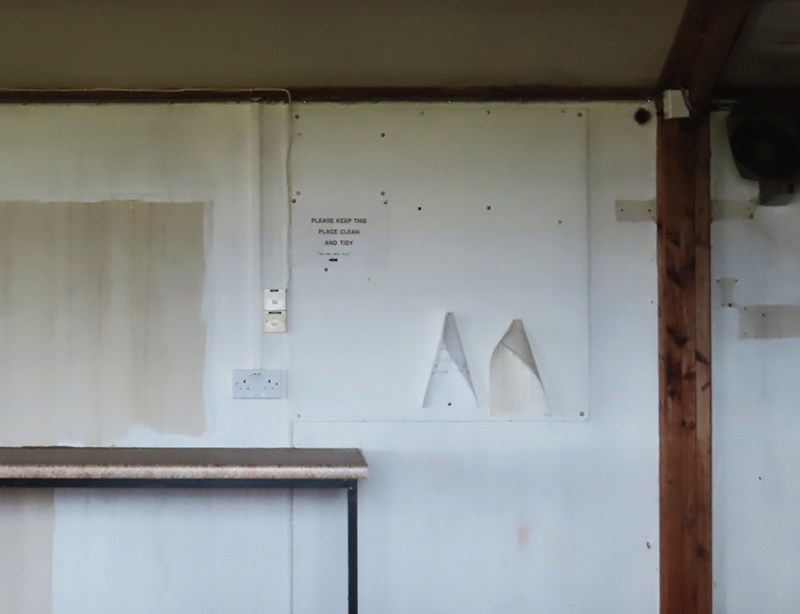
A decaying wall map of the entire Haverah Park experiment is just visible through a window of one of the huts in the central hub, but not much else remains inside.

It looks like these huts have been recently emptied into a skip which, by chance, was collected while I was there. Unfortunately, the driver had no enlightening information for me about the future of the huts.

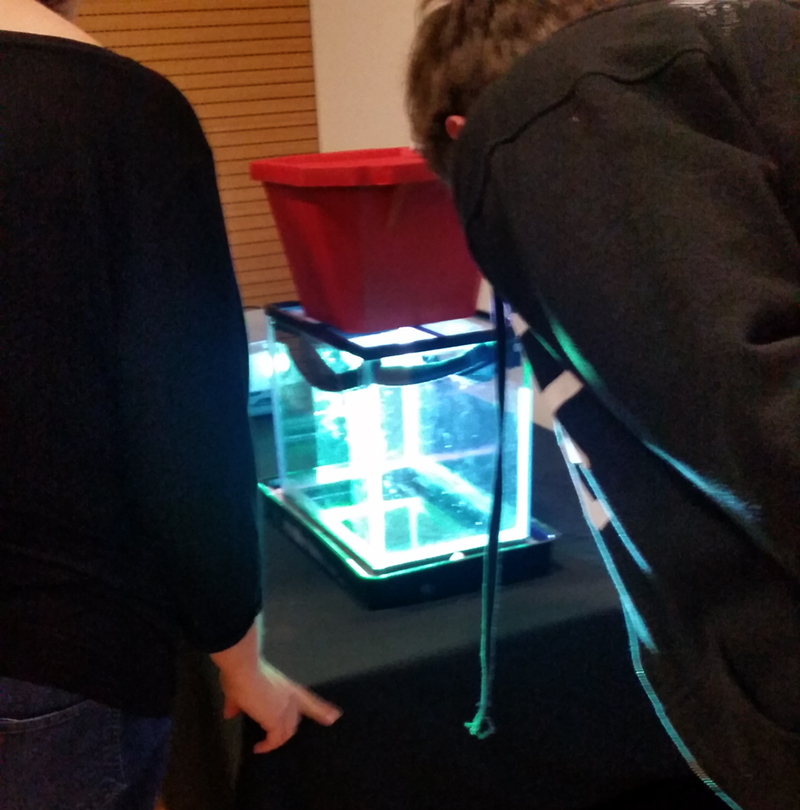
Cherenkov radiation is a form of energy that gives off a blue glow when electrically charged particles are moving at speeds faster than light is able to travel through the same medium. The experimental physicist Blackett, who received the 1948 Nobel Prize in Physics for his investigations into cosmic rays, believed that extensive air showers should produce flashes of light that could be perceived by the human eye when lying down and looking upwards under dark skies. Whether he achieved seeing this phenomena himself is not known, but he inspired colleagues Galbraith and Jelley, in 1952, to devise an experiment to detect light from air showers using a rubbish bin painted black on the inside, a recycled searchlight mirror and a small phototube. With these simple items, they made the first observation of Cherenkov light produced by cosmic rays passing through the atmosphere. Not all the twinkling in the night sky is starlight.

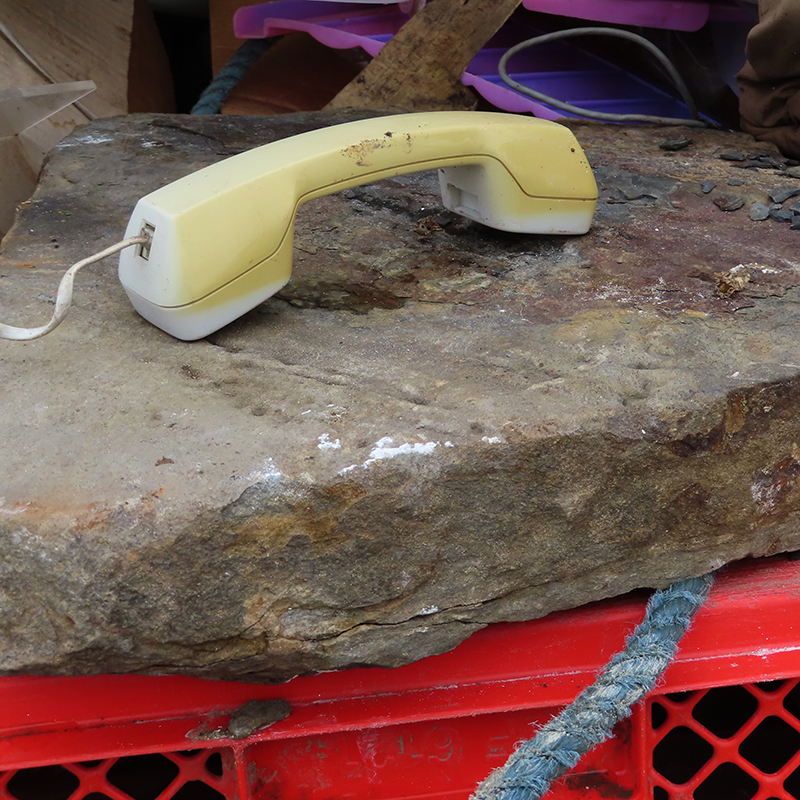
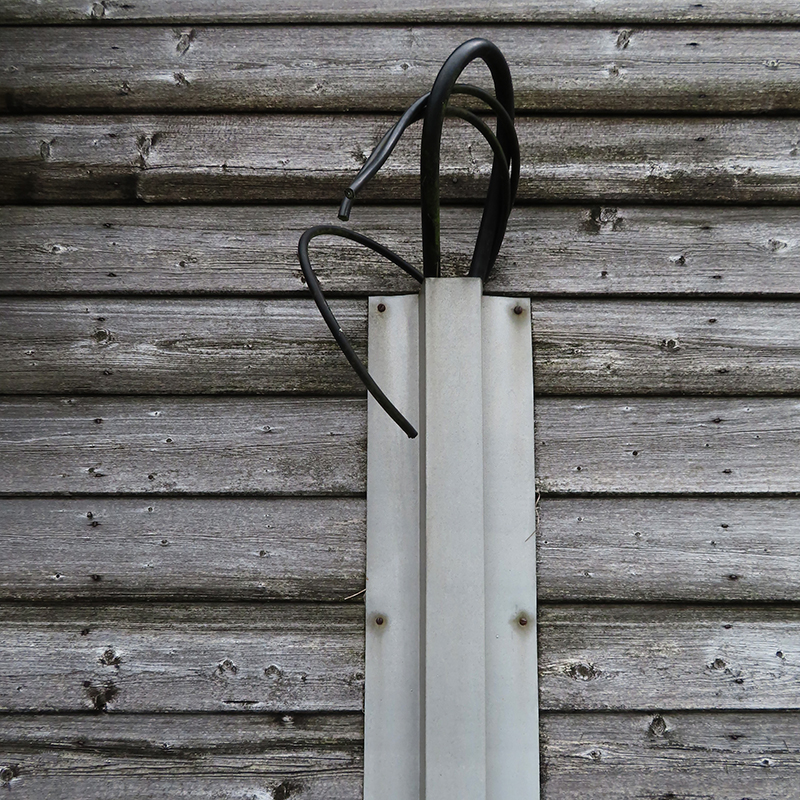
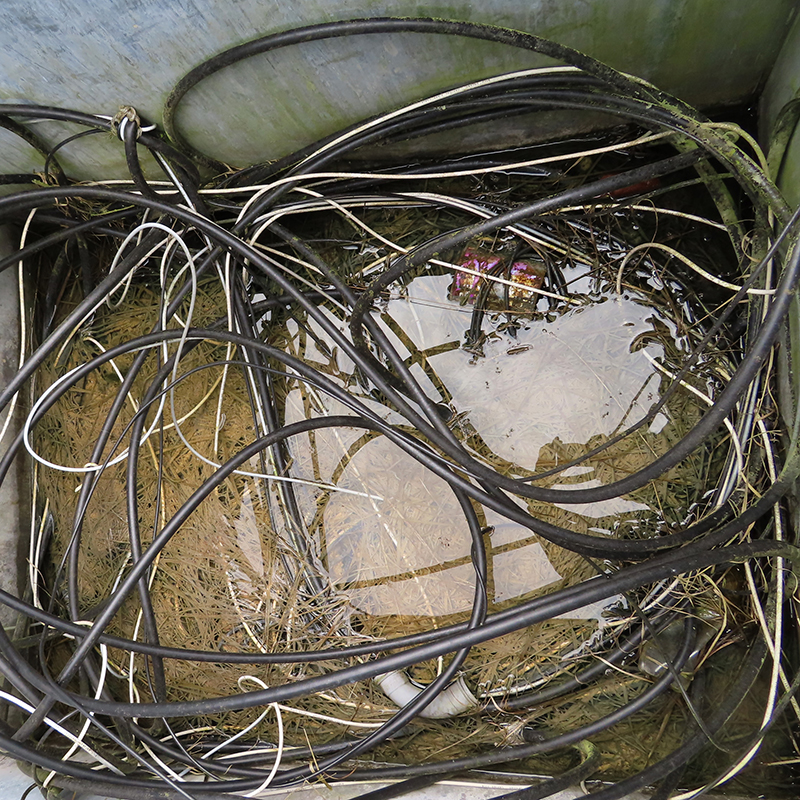
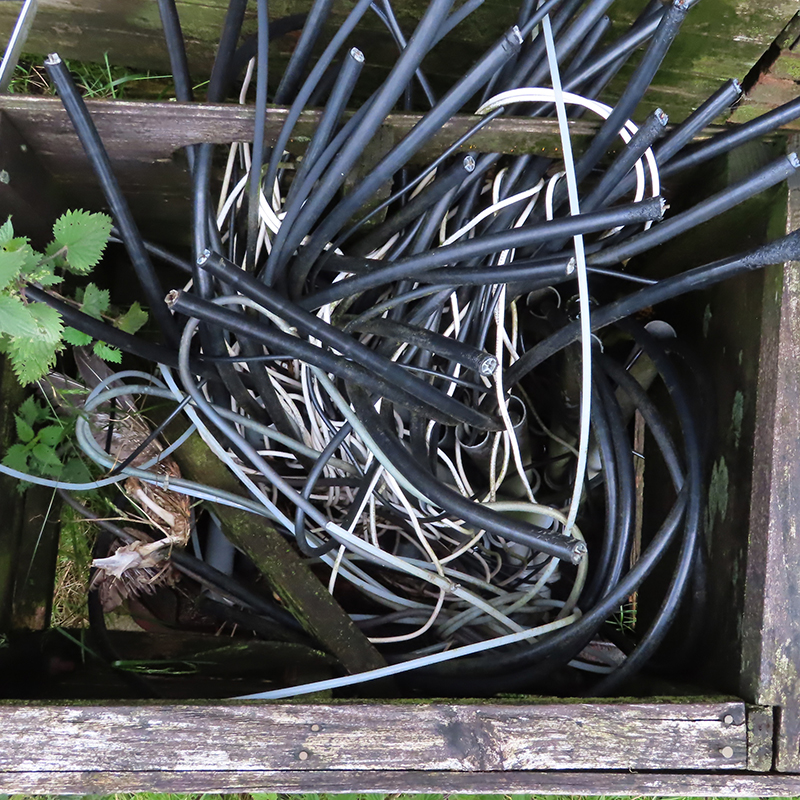
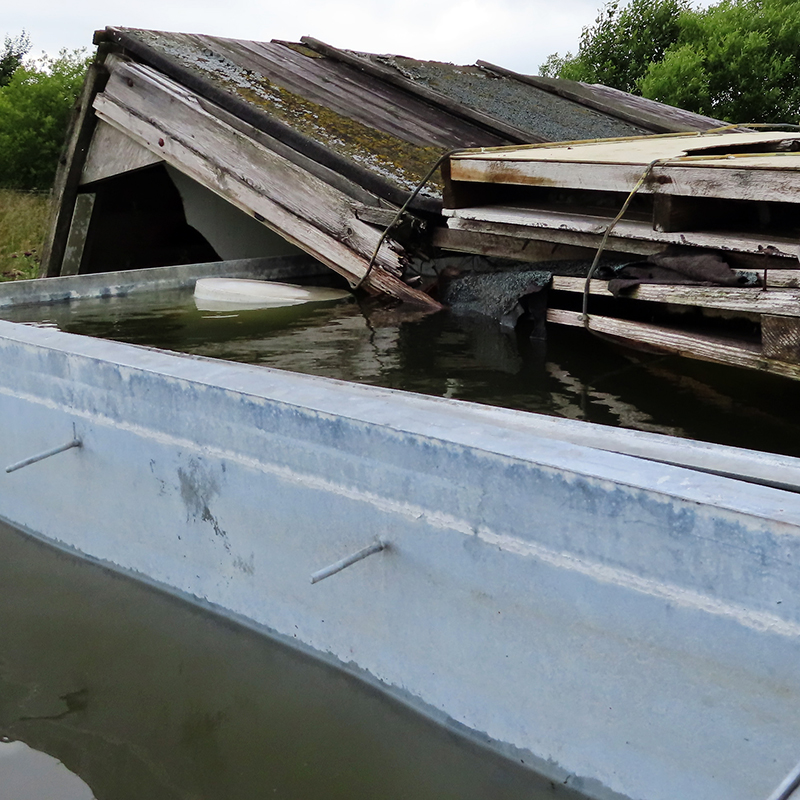
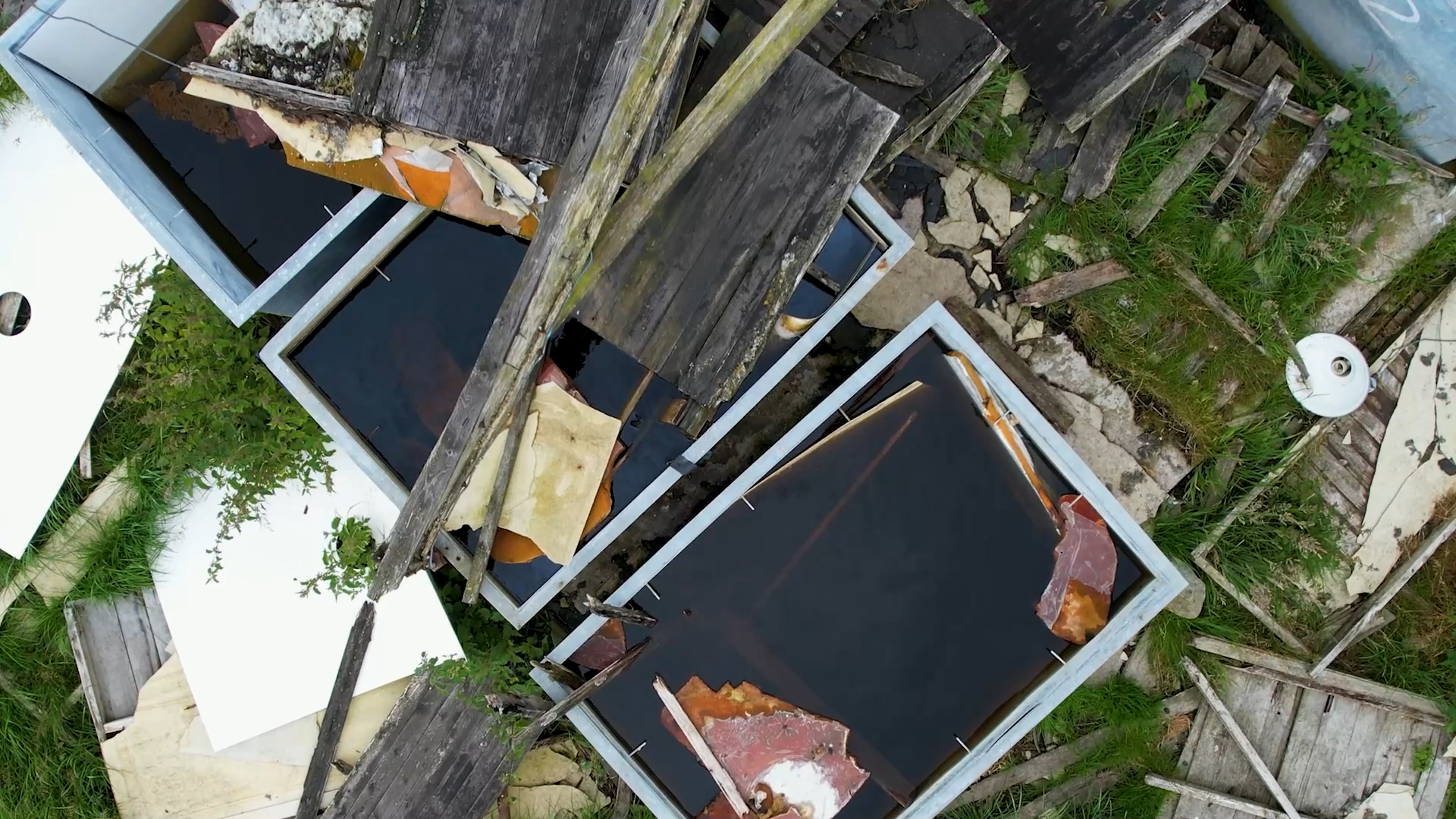
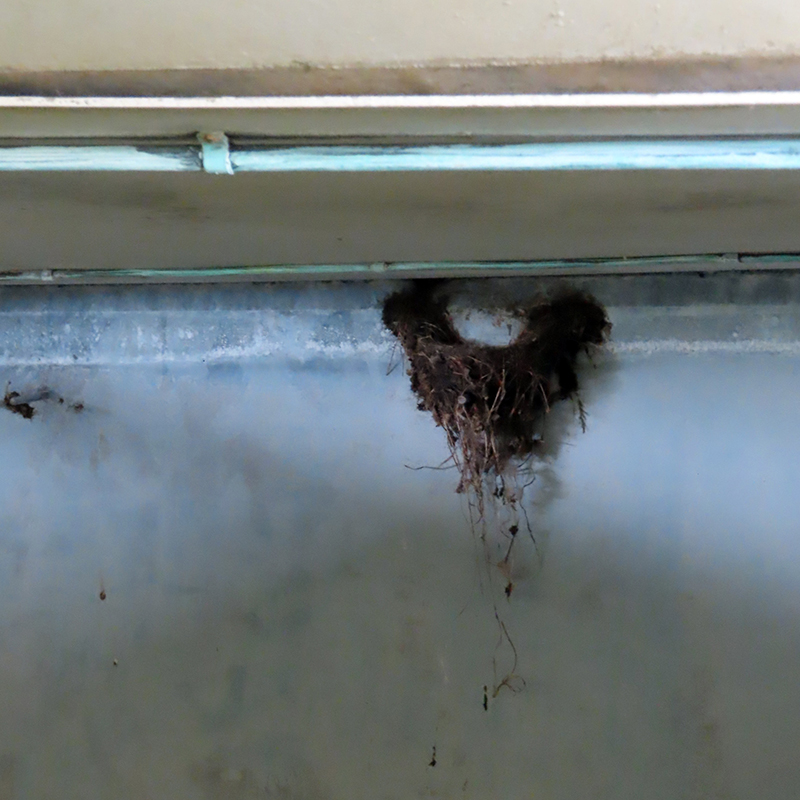
During the Haverah Park experiment, the water Cherenkov detectors deployed across the moors were connected by underground cables and transmitted information to the control huts via radio signals in the microwave frequency range. All communication is now severed. Cut cables coil in rain filled tanks. The cosmic rays are still pounding down upon these new unwatched ecosystems but the detectors have moved elsewhere.

I am looking forward to meeting Professor Alan Watson FRS here in the autumn. He is eminent in the field of cosmic rays and helped initiate the extensive air shower project, working at Haverah Park for 25 years. He has kindly agreed to meet and share his insider knowledge of the history and operations at the site.

The idea to build a truly giant shower array was launched by Alan Watson and Jim Cronin shortly after Haverah Park was decommissioned and thanks to the ground breaking work undertaken in these huts, it evolved to become the vast Pierre Auger Observatory in Argentina, named in honour of the man who first discovered extensive air showers.

Peering into the darkness, trying to fathom the structures of the universe or what’s inside the hut, and the nature of that relationship.

The ultra high energy particles detected at Havarah Park and new arrays across the globe are very rare, possibly less than one per square kilometre per century, so it is big news when one arrives. Because they have such high energy, it is thought they shouldn’t be affected by galactic magnetic fields, and therefore, the direction of the particle could be determined and the source located. The Amaterasu particle, named after the sun goddess in Japanese mythology, the second most powerful particle to be recorded, appears to have emerged from the Local Void, ana area with no astronomical objects that might produce such a particle. There is no explanation of where these particles come from, just hints of bigger mysteries to unfold.

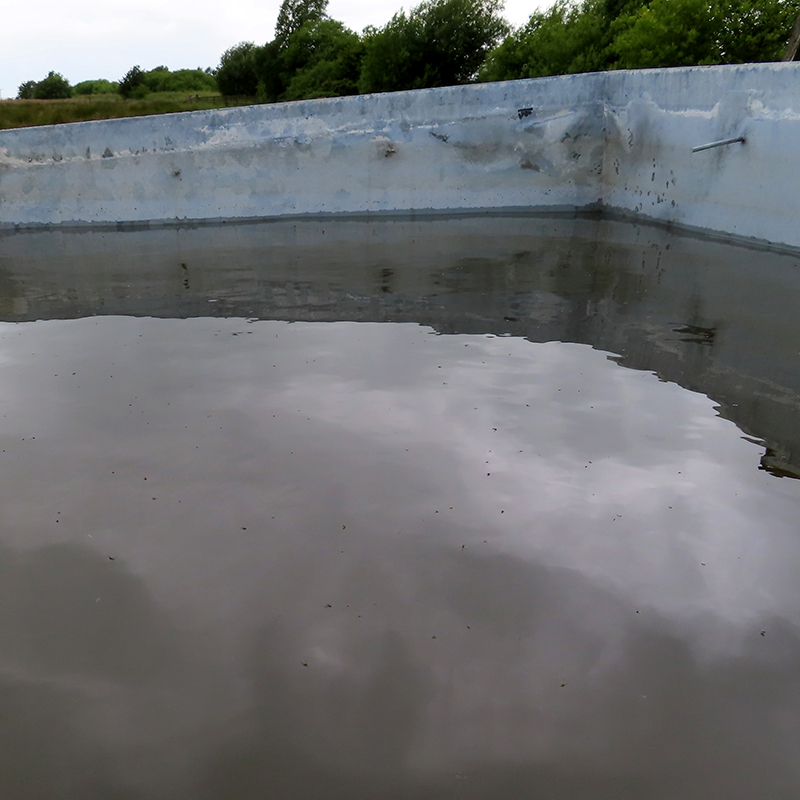
Many water tanks remain around Haverah Park, stripped of their purpose as water Cherenkov detectors they now reflect the sky in the rainfall they collect rather than record showers of particles from space.

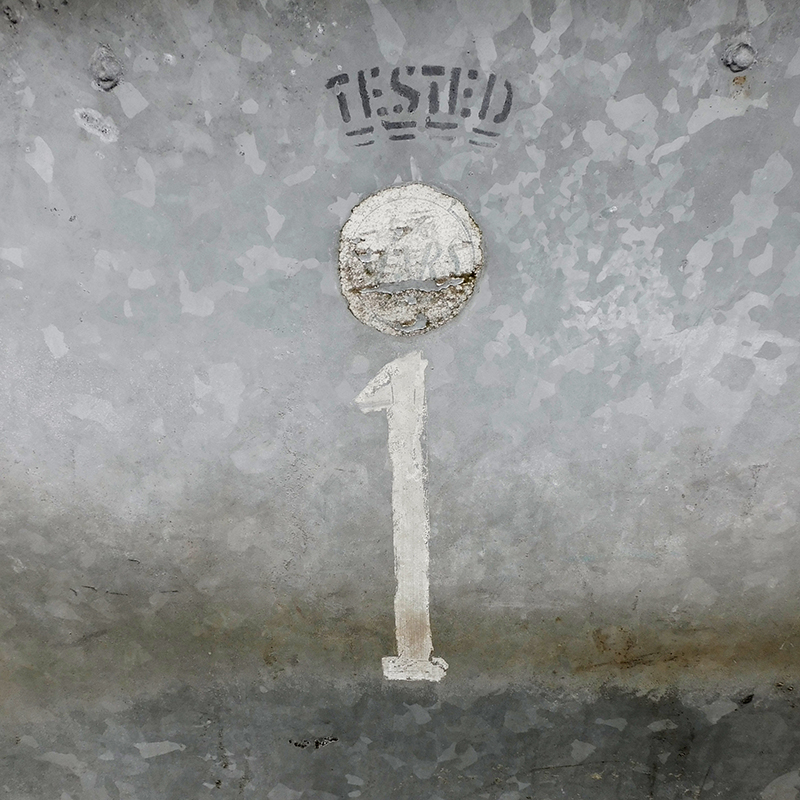
During operation, huts were built in groups of three, each with six large galvanised steel tanks lined with white plastic to diffuse the light and filled with local purified water. Each tank was monitored by extremely sensitive photon detectors which recorded the Cherenkov light emitted as particles passed through the water. At the end of the large array experiment, one of the detectors was opened, and the water was found to be crystal clear and good enough to drink. The proof that water could be kept bacteria-free in a sealed container for over 25 years gave confidence in using the same technology for a future larger cosmic ray detector array to be developed.

Haverah Park was once one of the largest extensive air shower arrays in the world, with an area of 12 km2, but in the end, it just wasn’t big enough.

When Alan Watson and Jim Cronin proposed building a new 3000 km2 shower array, the question from funders was, ‘why do you want to make the array so large?’. The answer is, of course, to discover those known and unknown unknowns, but funders don’t usually like unpredictable outcomes. Luckily their plea was bolstered by the Fly’s Eye Cosmic Ray Detector Array out in the Utah Desert recording the Oh-My-God particle in 1991, it’s energy was 40 million times greater than that of any particles ever produced in any terrestrial particle accelerator. This and other evidence of extremely high energy particles sparked interest in the field of astrophysics and validated the discovery of similar particles at Haverah Park, which had not been taken seriously at the time. This ambitious proposal gained momentum during the 1990s to become the Pierre Auger Observatory in Argentina, with the detector design developed from the water Cherenkov tanks so successfully operated at Haverah Park. The huts here may be in ruins, but their legacy lives on at the world’s largest extensive air shower detector array, which is edging closer to answer the question ‘Where do ultra-high-energy cosmic rays come from?’

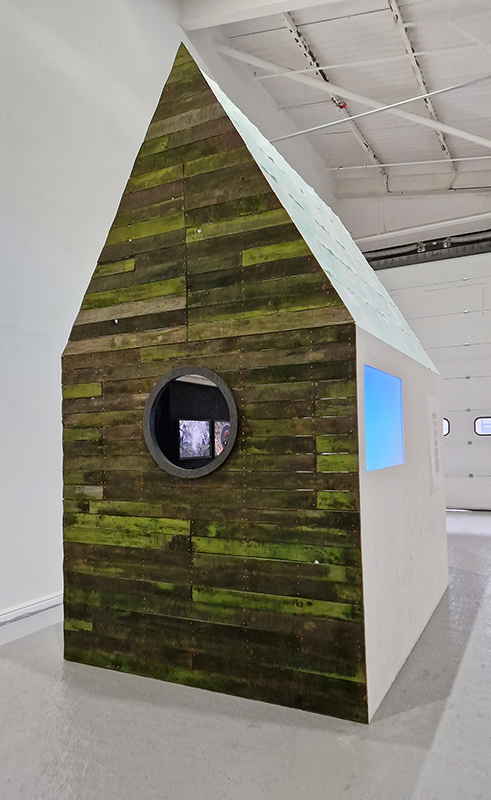
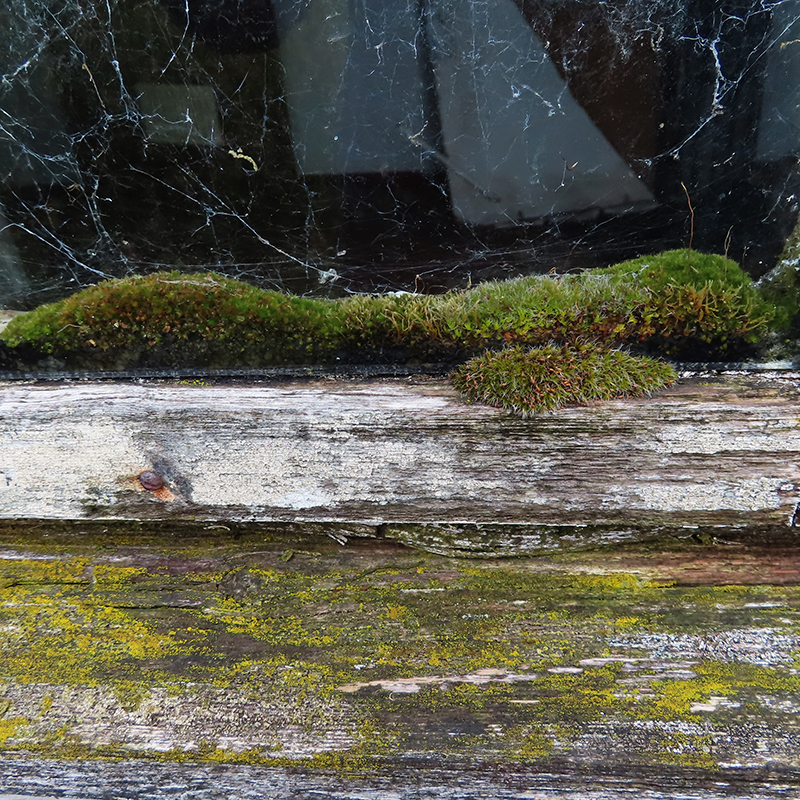
I am looking forward to developing work responding to the legacy of the Haverah Park experiment and building on my experience of creating The Absolute Hut (of absolute potential) New surfaces to explore, more moss, and also lichens here.

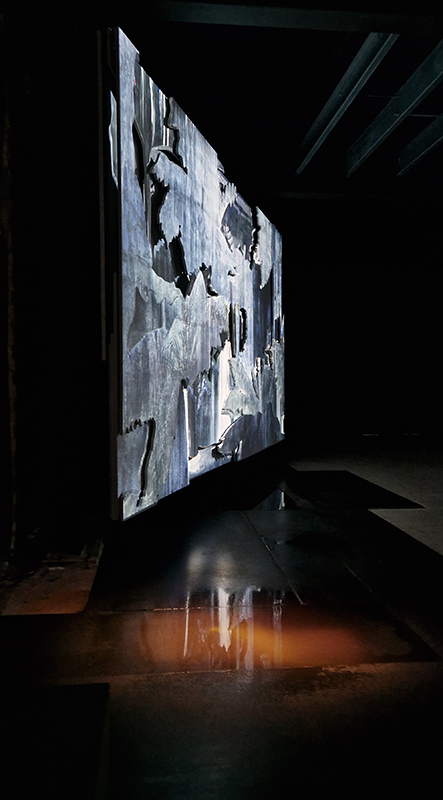
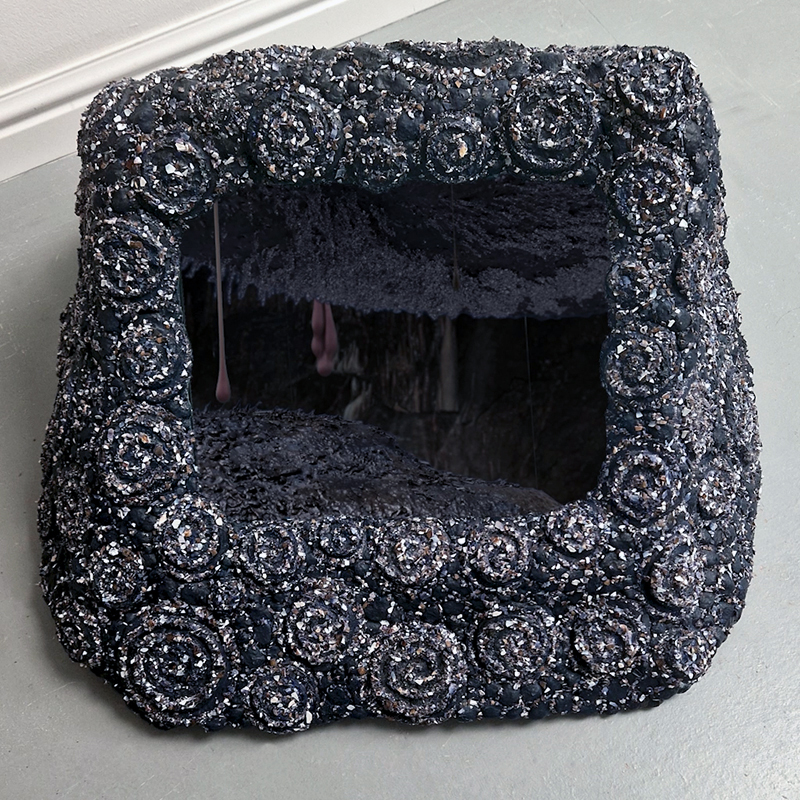
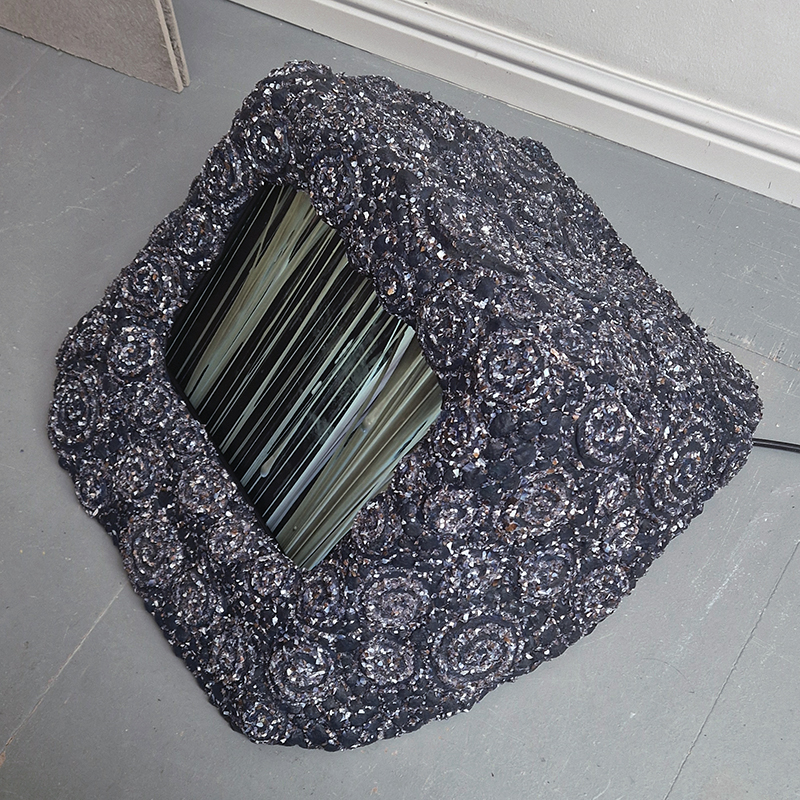
‘The Belly of a Rock’ video has waited a long time for its crusted shell. A hybrid between rock, mollusc, and technology inspired by the chemical conversations and urge to create described by Italo Calvino in his story ‘The Spiral’. We don’t always know what we are creating. Within ‘the belly’ surfaces slide and scrape along lines of fissure, distended innards ooze and rocks moan as they are distorted by untold pressure. The turbulent spiralling of the core births rock and lifeforms acted upon by the drag of the oscillating magnetic field.  

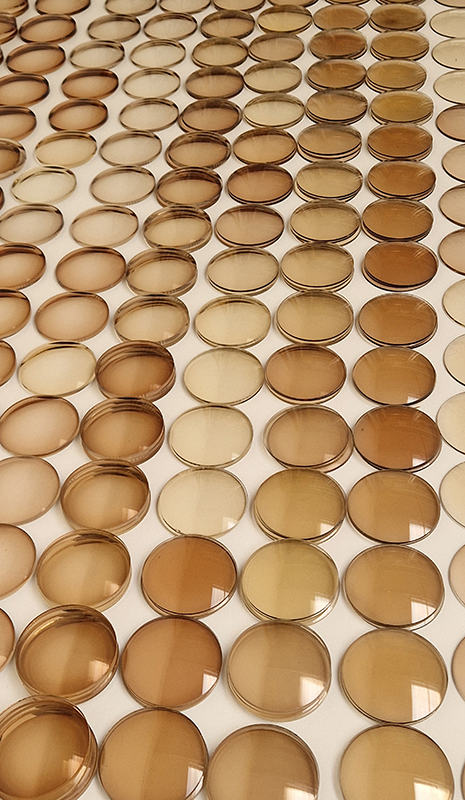
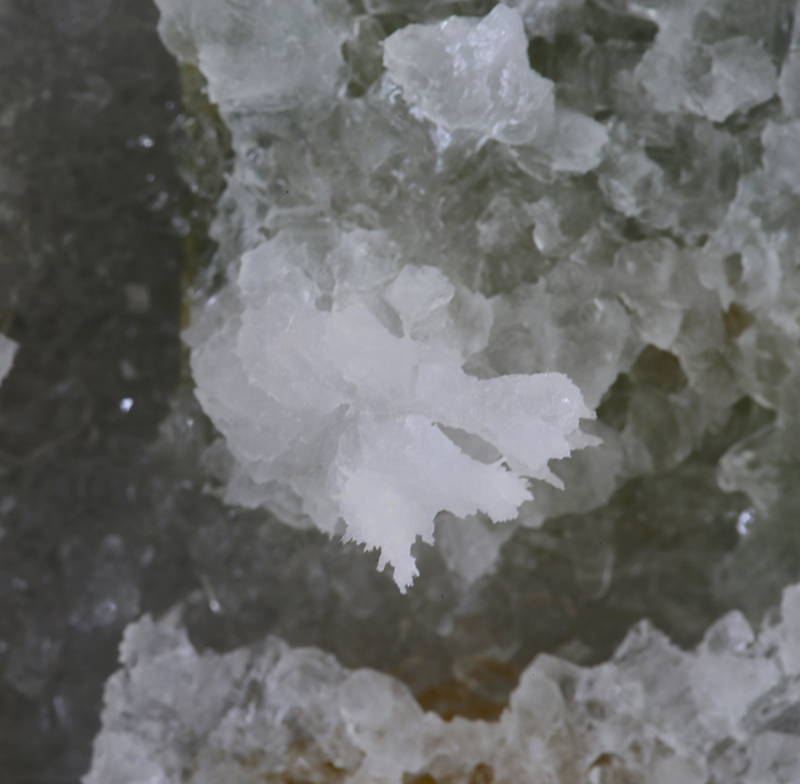
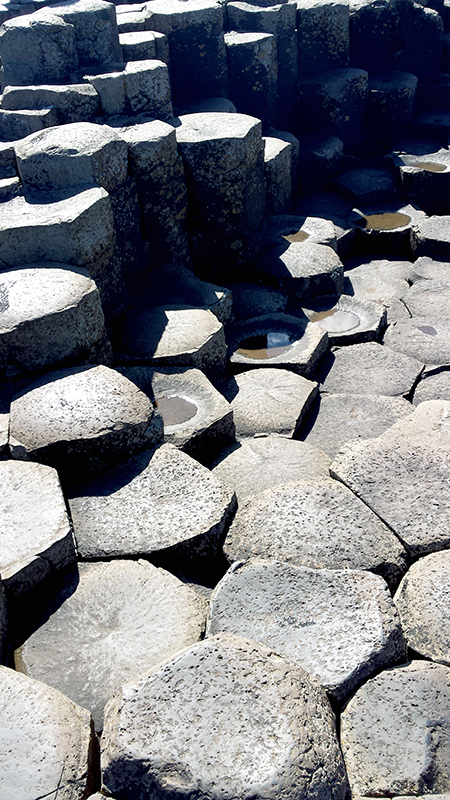
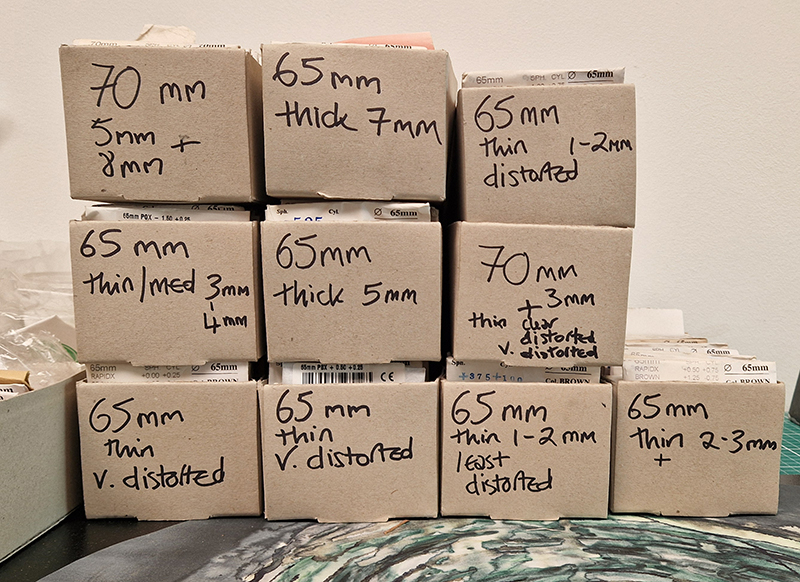
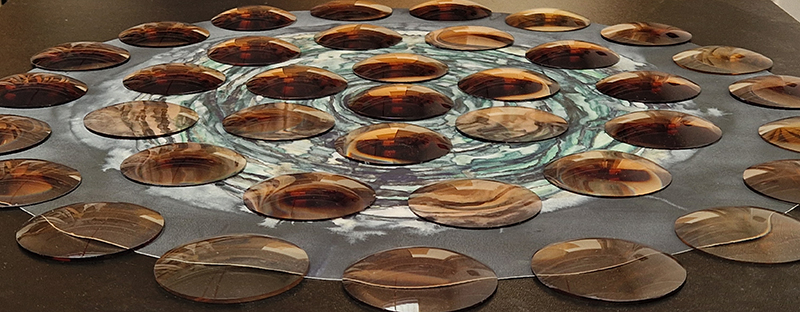
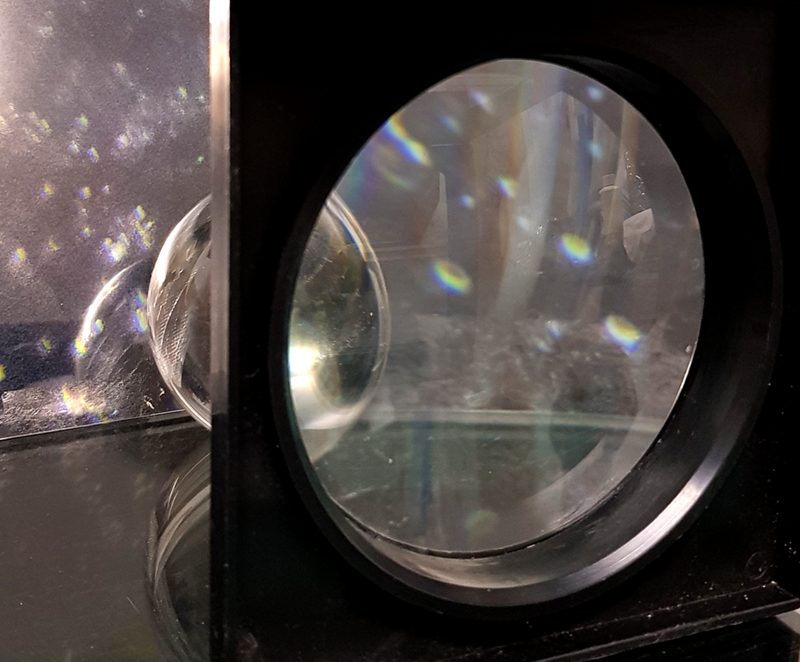
I have acquired a large number of photochromic optical lenses. These I have sorted by diameter, thickness and distortion. Initial thoughts about their use include using them as petri dishes to grow crystals which are embedded into small concrete hexagonal pillars of differing heights with reference to the geology of giants causeway. Using them to create composite windows into a new hut structure filled with video projections referencing the fly’s eye cosmic detector array.

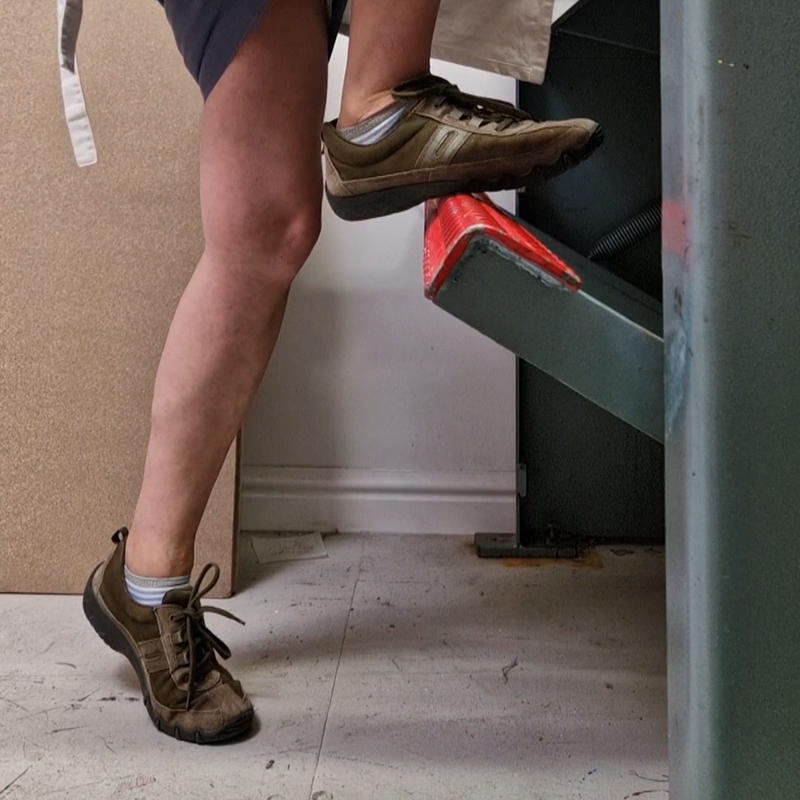
A good workout on the guillotine making 201 cuts in copper sheet in preparation for a new concrete tablet in the Instruments of the Anemoi sculpture series.

Gallery and other outings:

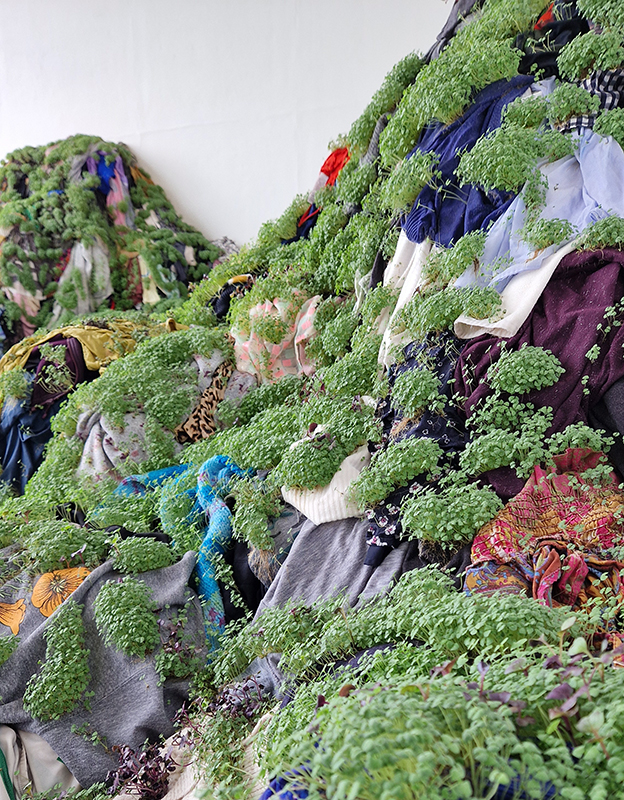
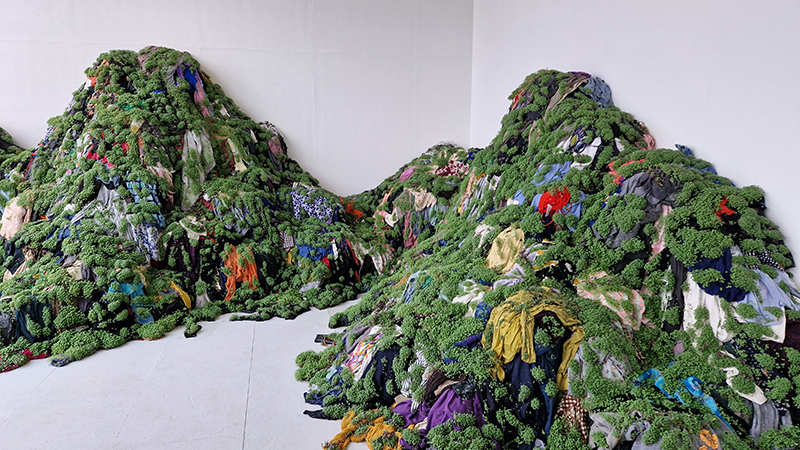
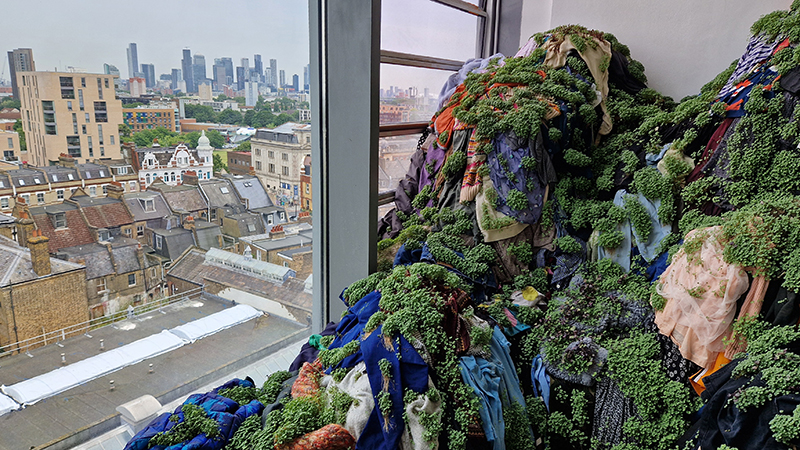
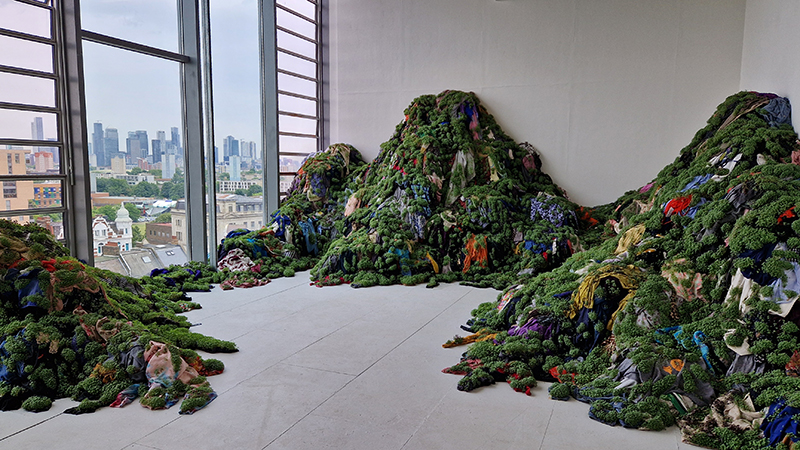
Beverley Duckworth’s installation Surplus at Goldsmiths MFA final show. Beverley’s work is grown through a diligent process of care. Found materials are literally given new life in the seeds which are embedded into them, which then transform and colour them. The installation includes an intermittent sound element of recordings of the melody played by waste trucks in Taiwan to call people to bring out their rubbish.

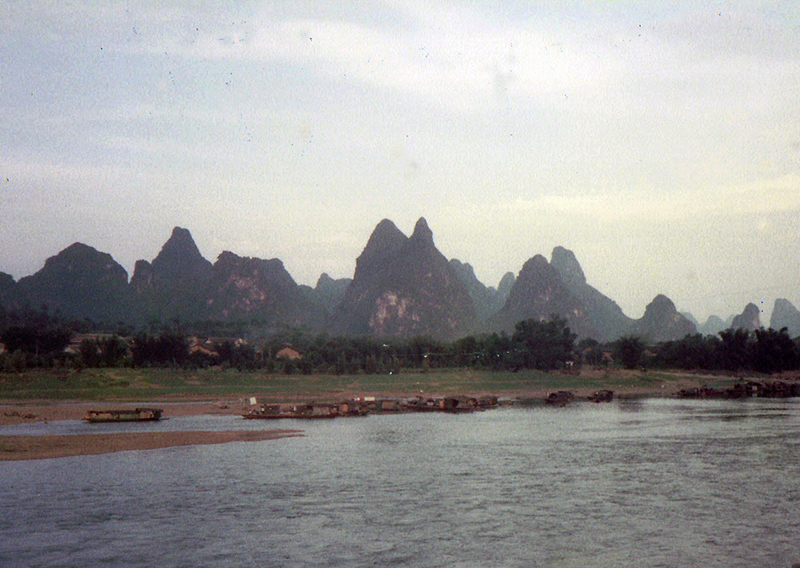
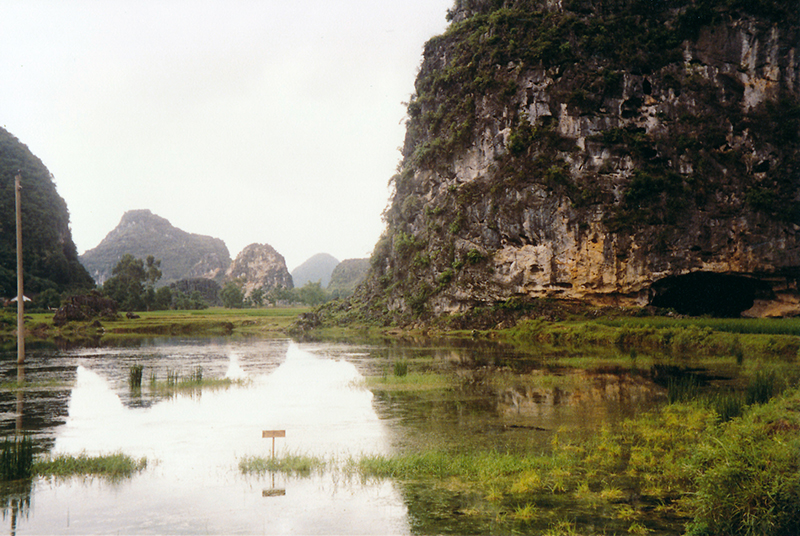
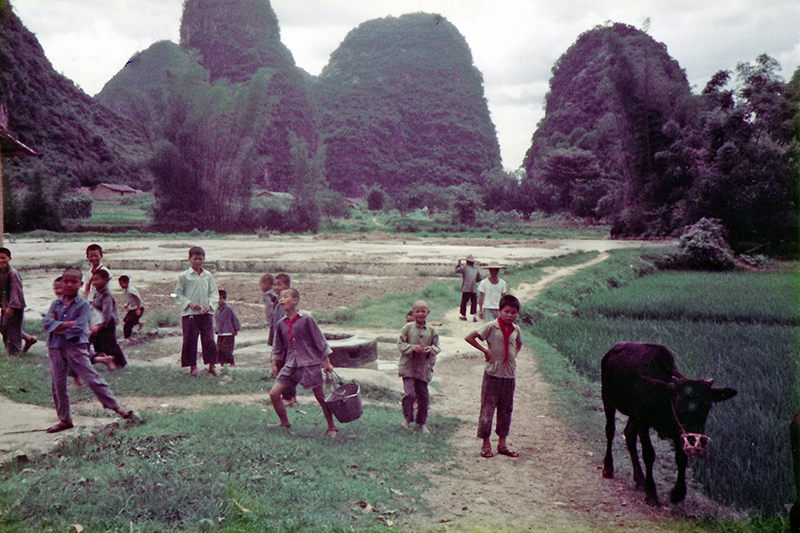
Apparently I wasn’t the first person to be struck by similarities to the landscape of Yangshuo near Guilin China. I visited in 1984 and think it is no longer a quiet little village.

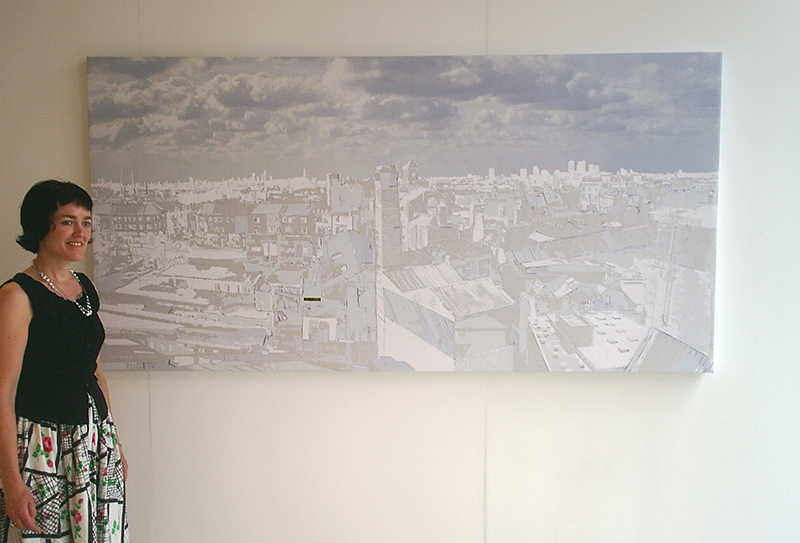
It was the first time I had been back inside the Ben Pimlott building at Goldsmiths since by own graduation, a scary twenty years ago. The building was brand new then and the views with little visible green fed into my installation Re:construction – a large screen print with tiny viewing hole to a tiny oasis amidst the grey, albeit a synthetic one.

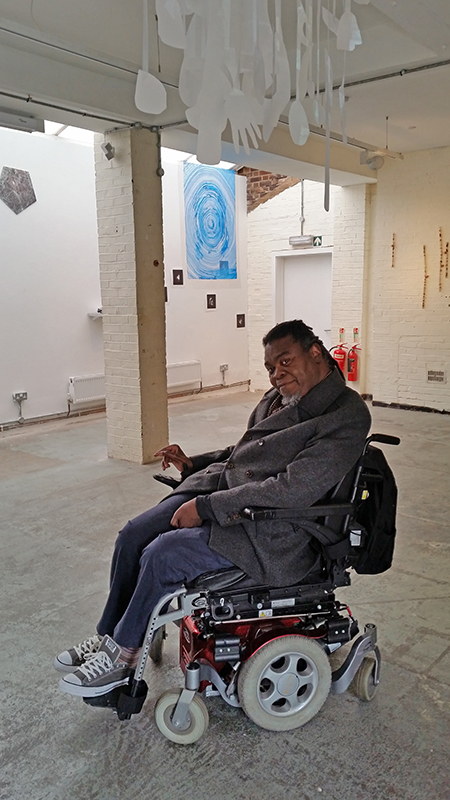
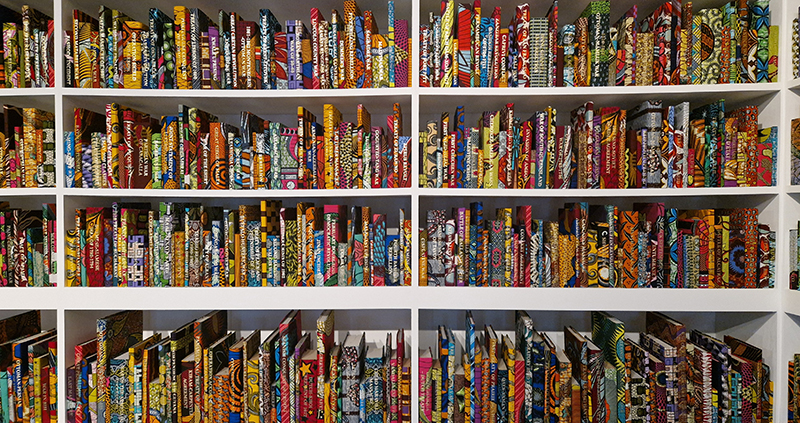
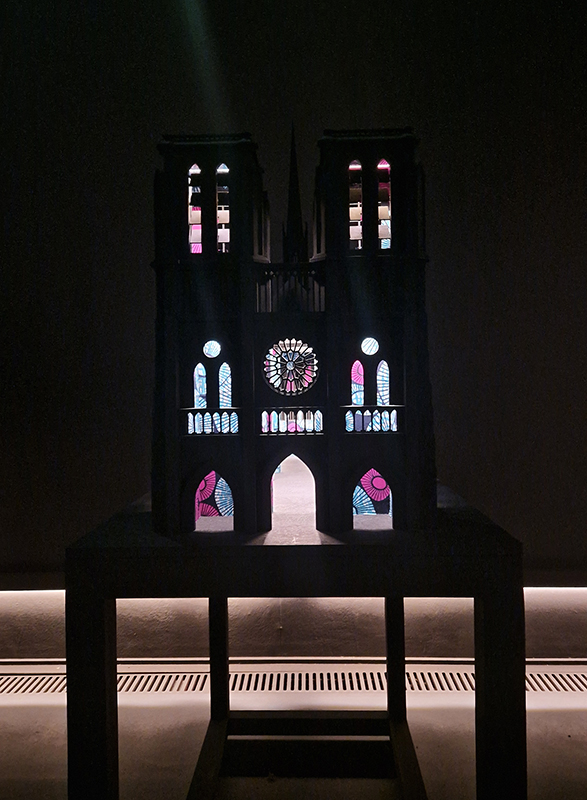
Yinka Shonibare Suspended States at Serpentine South. Horrors of war and colonialism are filed under dazzling colour, birds on the brink of extinction stare in plea or accusation, beacons of light in the darkness come from miniature replicas of sanctuaries.

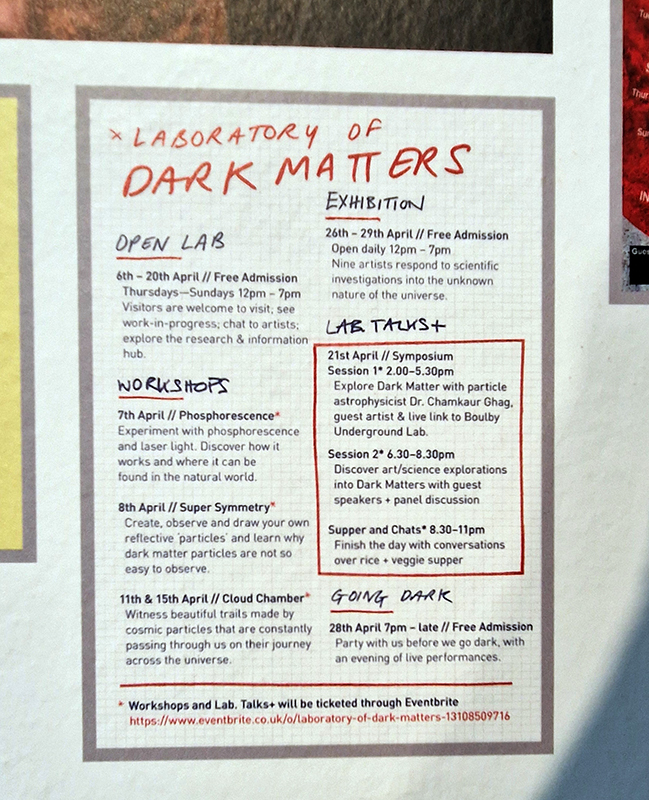
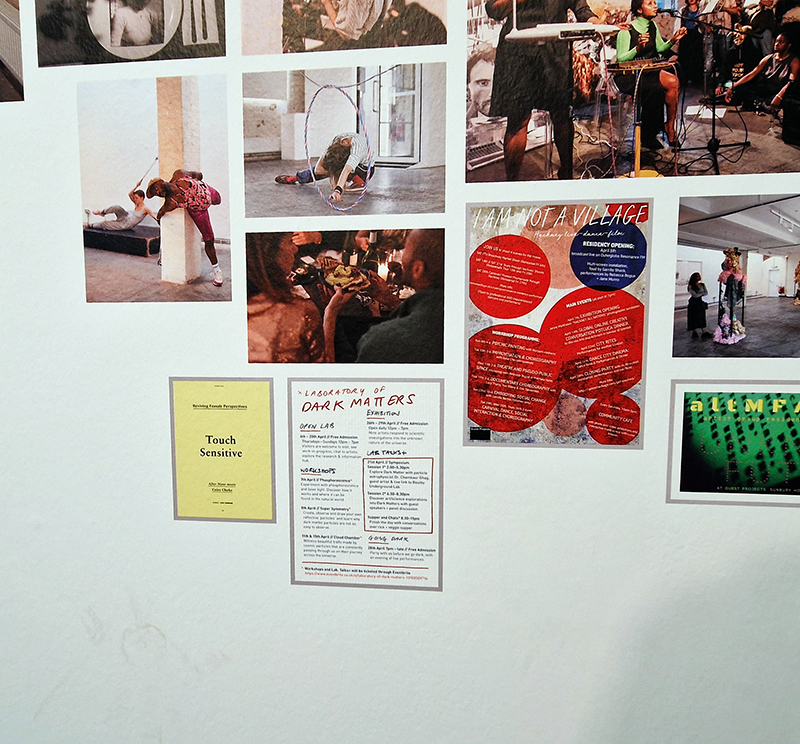
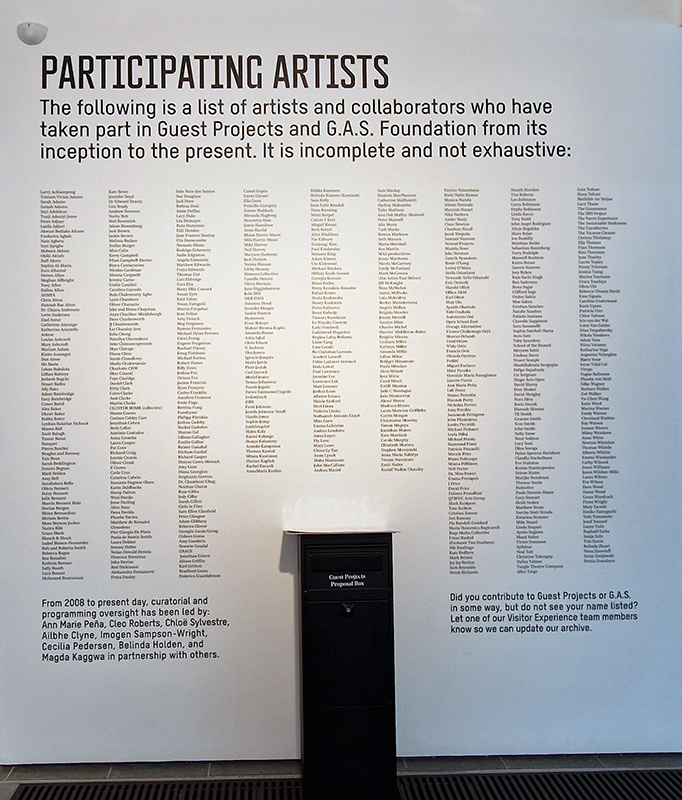
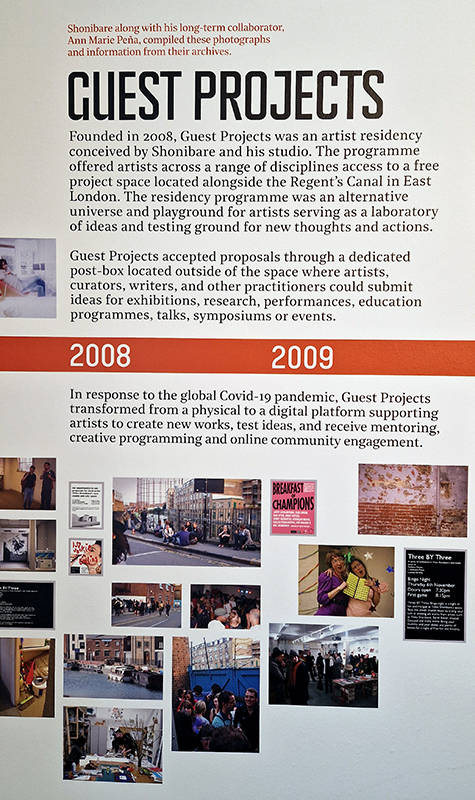
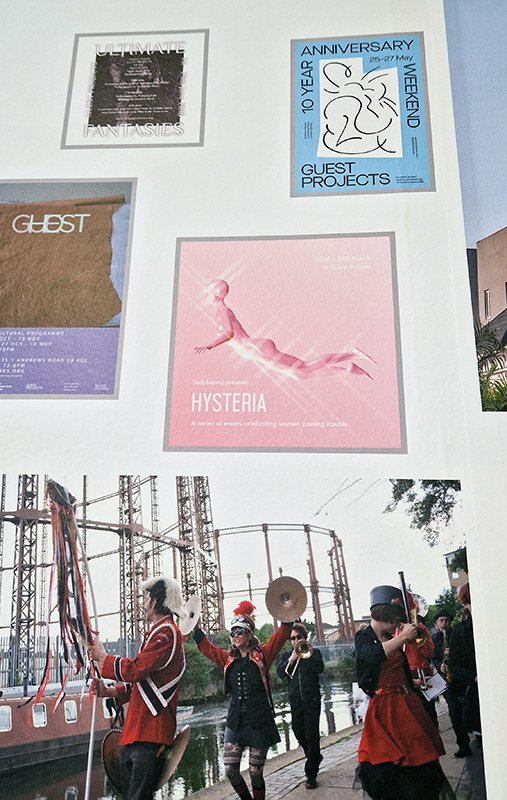
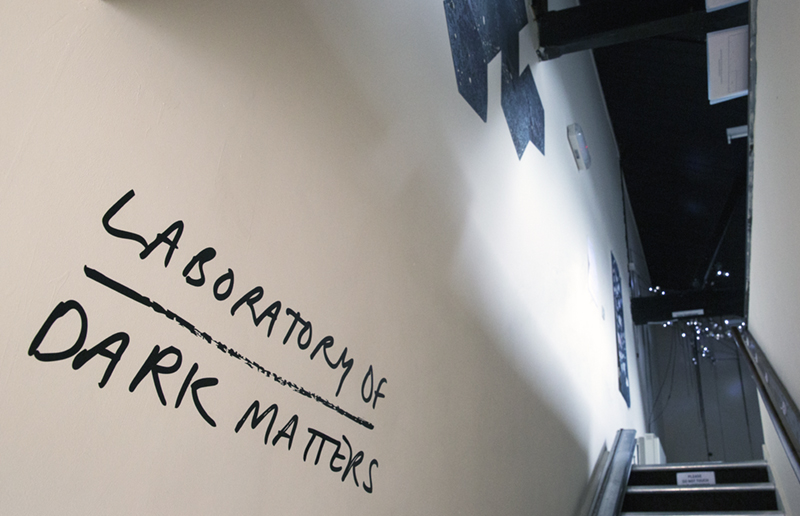
Yinka’s socially engaged inclusive practice spills over into real help for artists and communities. The exhibition celebrates Guest Projects and G.A.S. Foundation in Lagos. Guest Projects is such a generous idea and I have been so lucky to benefit from it with the project Laboratory of Dark Matters

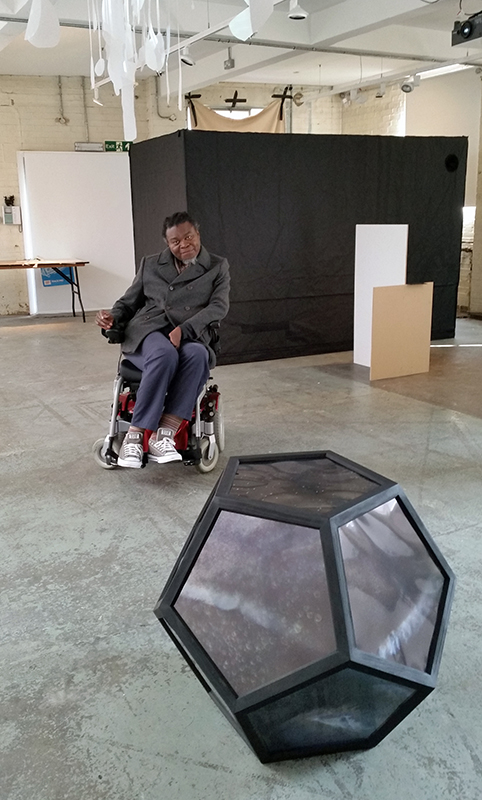
Being awarded a month’s residency at Guest Projects was crucial to the success of Laboratory of Dark Matters as a site for developing ideas and subsequently touring the project. Wonderful to meet Yinka and also to be part of the selection committee for the next round of projects.

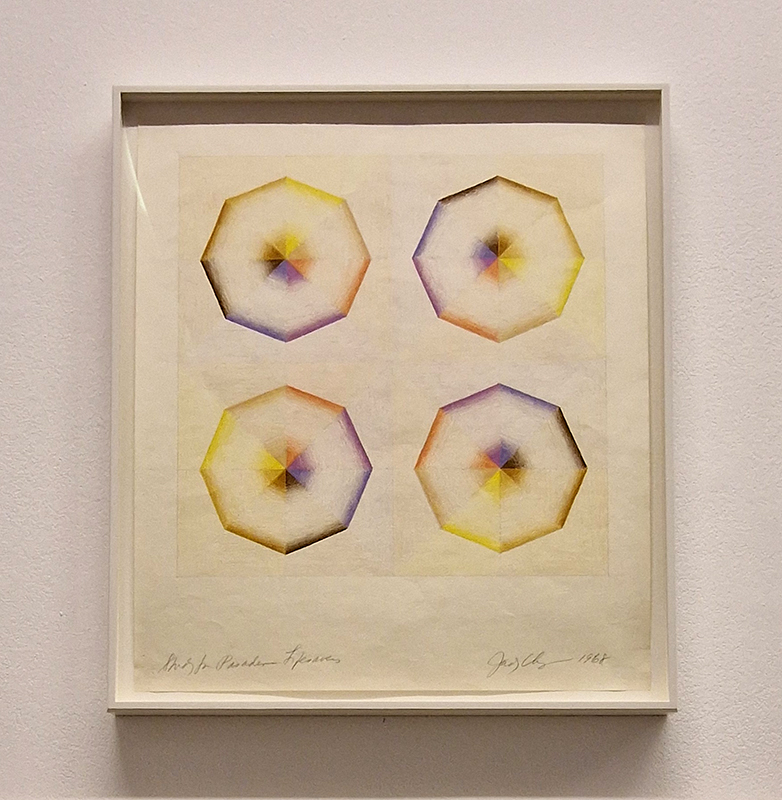
Judy Chicago Revelations at Serpentine North. The highlight of this show is the video documenting The Dinner Party (1974-79) installation and the preparatory drawings and sample plate. What a shame the actual installation wasn’t here, I will have to visit the Brooklyn Museum, New York sometime to see it. The research, collaborations, crafts and designs that went into creating it was phenomenal.

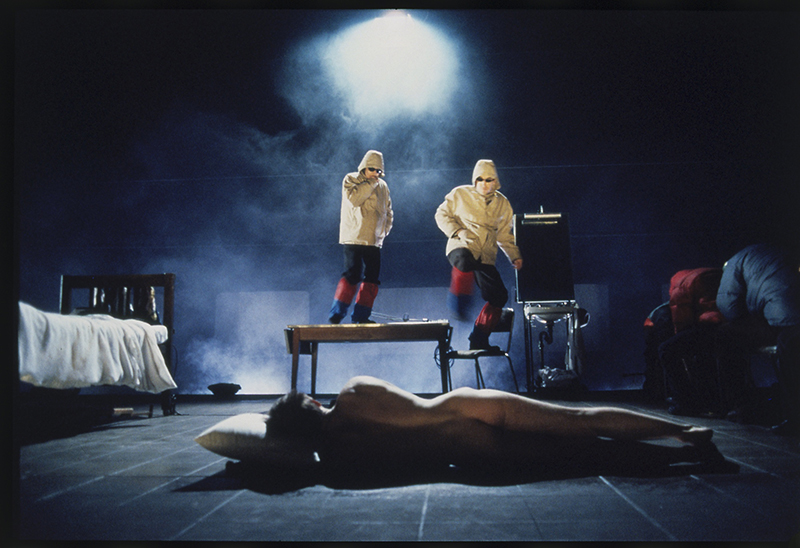
Saw Complicité’s excellent Mnemonic at The National Theatre, 25 years after first seeing it at Riverside Studios. ‘A body is found in the ice, and a woman is looking for her father while a man searches for his lost lover. Mnemonic is as much about origins as it is about memory, and remembering what is lost. Mnemonic asks us: what is our place in the natural world? How have human relationships with the environment shaped patterns of migration? Who are we, and where do we come from? ‘

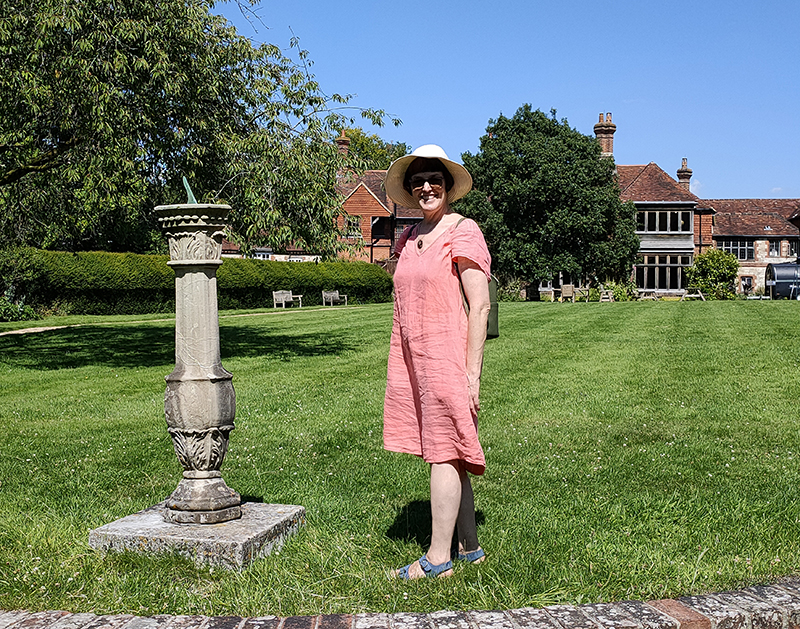
Visited the delightful mellow brick country home and extensive gardens of pioneering naturalist Gilbert White at Selborne. His book ‘The Natural History of Selborne’ (1789) has never been out of print since it was published more than 230 years ago. He was brought to many people’s attention, including mine, during the pandemic and lockdowns of 2020 when writer Melissa Harrison included his diary readings in her podcast The Stubborn Light of Things.

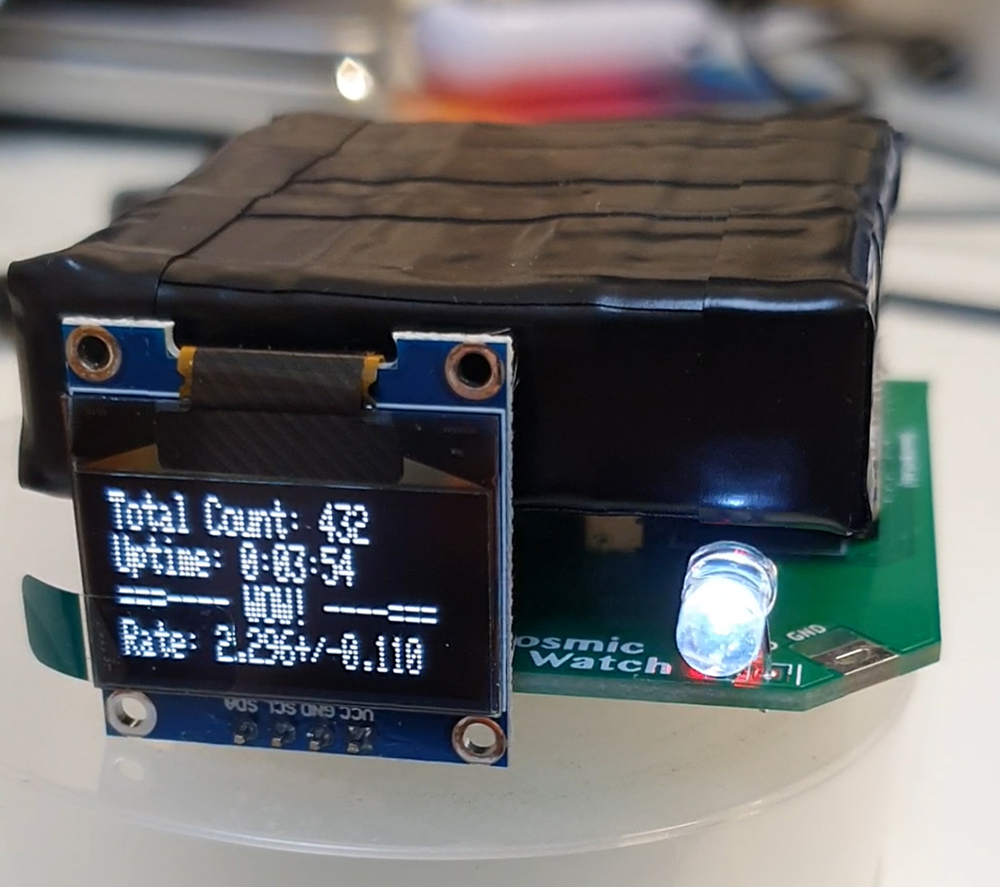
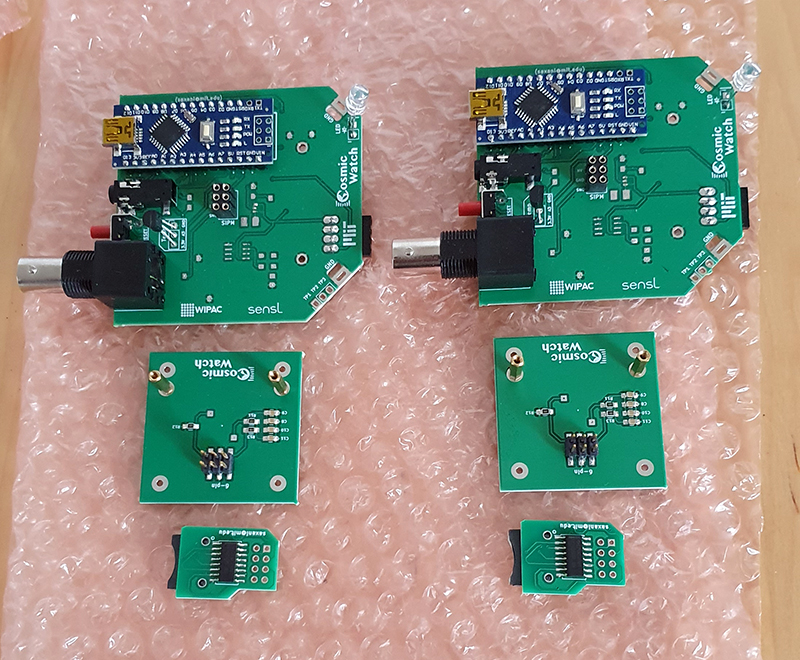
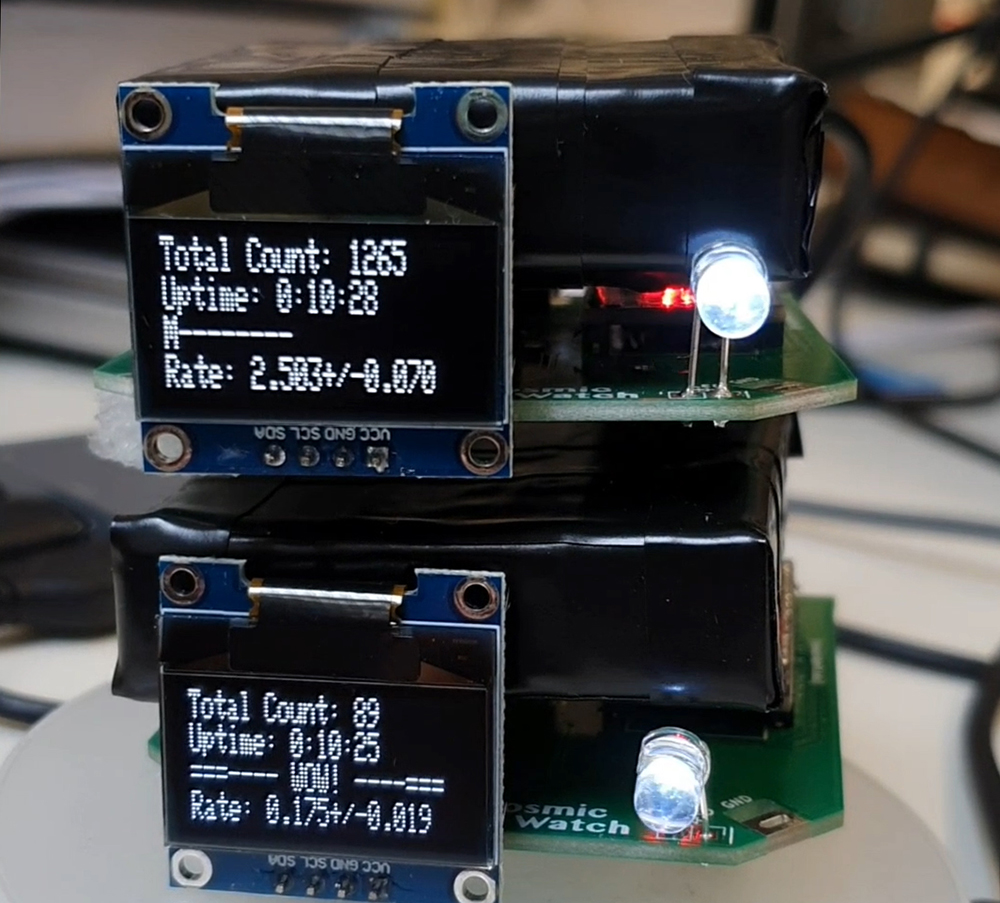
The big excitement this month was to get the cosmic ray detector assembled and working. It may not look very exciting to see an LED flash but knowing it was caused by a tiny traveller from outer space I do find quite something to acknowledge.

The detector uses a small slab of plastic scintillator as a detection medium and a silicon photomultiplier (SiPM) for light collection from charged particles as they pass through the scintillator. Flashing the plastic block with light from a UV torch causes a big scintillation burst.

The signal from the photomultiplier is sent to an Arduino microprocessor which measures the amplitude of the signal. The small OLED screen updates every second and an LED flashes every time an event is registered.

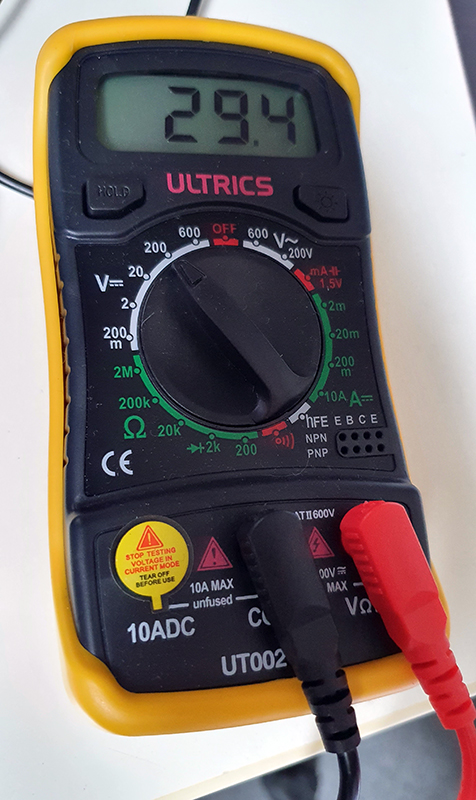
I have the skills and patience of ABL Circuits to thank for soldering the tiny SMT components to the PCB boards and then working out which part had the fault and replacing it so that the correct voltage was supplied to the SiPM PCB. It needed to read approximately +29.5 V as anything over 30 might damage the SiPM so it was a big relief when this was achieved.

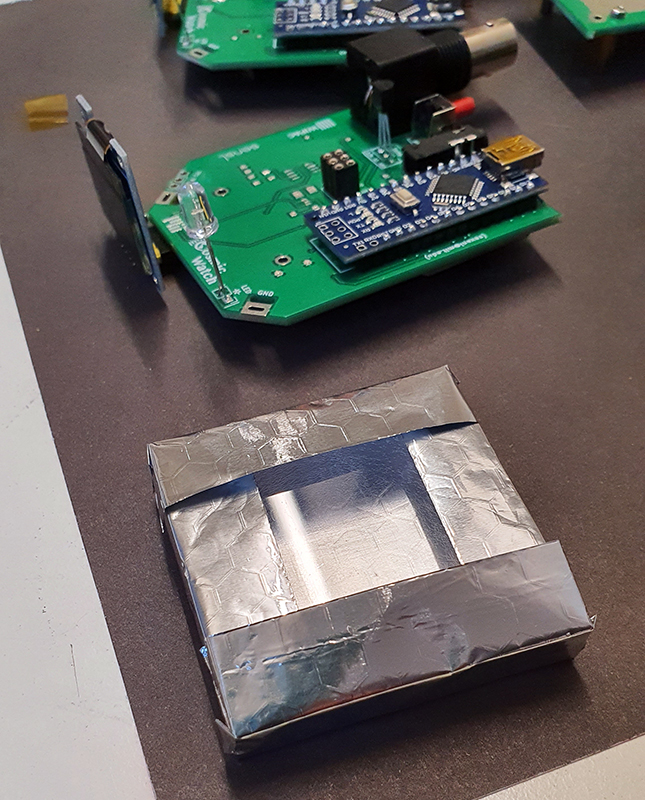
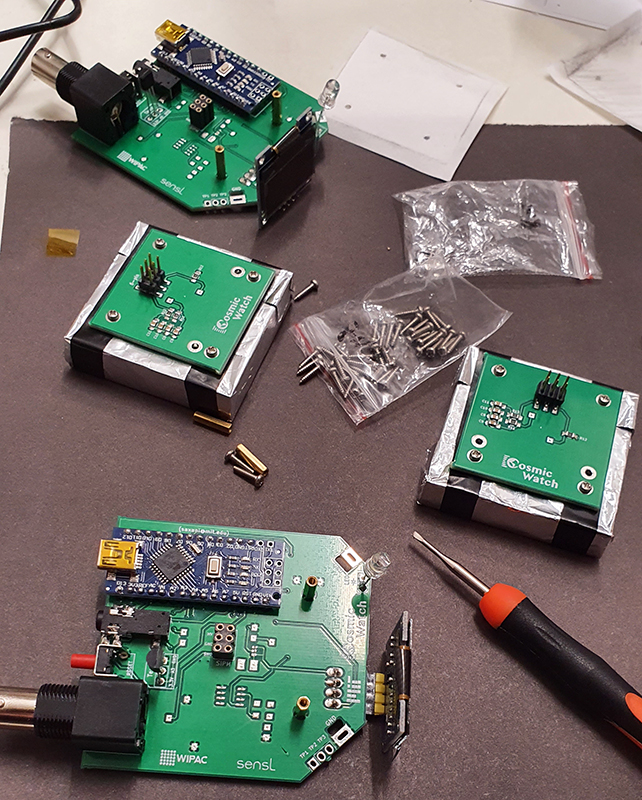
Once I had the printed circuit boards assembled I could wrap the scintillator plastic in foil, apply optical gel and attach it to the SiPM and then wrap this in electrical tape to make it light tight. I had a little bit of soldering left to do myself and then it could be slotted together.

When I had both detectors working independently I could set them up in coincidence mode to differentiate cosmic rays from background radiation particles.

The top detector is reading all local background radiation and the bottom one is just recording cosmic rays. The lights flash in unison when a particle travels through the top and bottom detector at the same time. The top detector labelled ‘M’ I will call mother and the bottom ‘S’ I will call son, (not the historical terminology suggested).

The horizontal lines record the energy of that particle – look out for the WOW particles!

So happy to have got this far with the project, now for the difficult bit translating that signal into an action triggering an interactive artwork.

Not only can cosmic rays be observed using a cloud chamber but they also trigger the formation of everyday clouds.

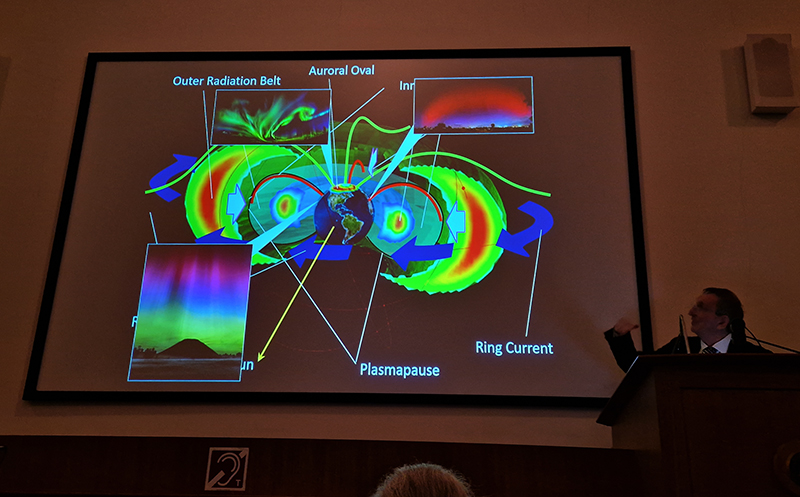
The Solar Wind is made up mainly of hydrogen and helium ions (ions are the nucleus of atoms separated from their accompanying electrons) known as solar protons. Travelling at up to 5 million miles per hour, the solar wind carries a million tons of matter from the sun into space every second. When massive amounts of energy stored in the magnetic fields of the sun are suddenly released in a solar flare explosion the particles are accelerated to even greater speeds.

Coronal mass ejections fire off great clouds of hot gas and the explosions are so powerful that they also rip away knots of magnetism from the surface of the sun which are sent sweeping past Earth deflecting the path of cosmic rays that would otherwise strike our planet. This effect is called the Forbush Decrease where increased solar activity results in a reduction of cosmic rays coming from outside our solar system.

Cosmic rays are super-charged subatomic particles produced by exploding stars, black holes and other phenomena many times more violent than any solar flare explosion but one coronal mass ejection can reduce cosmic rays for a few weeks and continued solar activity can keep cosmic ray counts low for sustained periods of time.

The Sun’s magnetic field goes through a cycle where north and south poles switch places about every 11 years. It then takes another 11 years for the poles to flip back again. Sunspot activity caused by the magnetic field are affected by the solar cycle but it is hard to predict how active a cycle might be. Usually at the beginning of the cycle there are fewer sunspots causing eruptions which then increase over time reaching solar maximum in the middle of the solar cycle before gradually retuning to solar minimum before the cycle begins again. The first solar cycle to be recorded was in 1751 and we are currently in cycle 25 with peak activity expected in 2025.

Research at the Technical University of Denmark has shown that the number of comic rays reaching the Earth has a significant impact on the warming of the oceans. When solar explosions deflect the number of cosmic rays hitting our planet there is a shortage of small aerosols – the chemical specks in the air that grow until water vapour can condense on them to become the water droplets of low-level clouds. The aerosol robotic network AERONETT also noticed a slight change in the colour of sunlight during times of low cosmic ray activity and found that violet light from the Sun looked brighter than usual. They put this down to the shortage of small aerosols usually provided by the cosmic rays which scatter violet light as it passes through the air. Without the growing aerosols, low-altitude clouds begin disappearing about a week after a Forbush Decrease minimum of cosmic rays. The water remains in the atmosphere in vapour form, but unlike cloud droplets it does not get in the way of sunlight warming the ocean. During solar maximum events the decline in cosmic radiation and the loss of low cloud cover persists for long enough to warm the planet.

“The effect of the solar explosions on the Earth’s cloudiness is huge. A loss of clouds of 4 or 5 per cent may not sound very much, but it briefly increases the sunlight reaching the oceans by about 2 watt per square metre, and that’s equivalent to all the global warming during the 20th Century.” Henrik Svensmark DTU

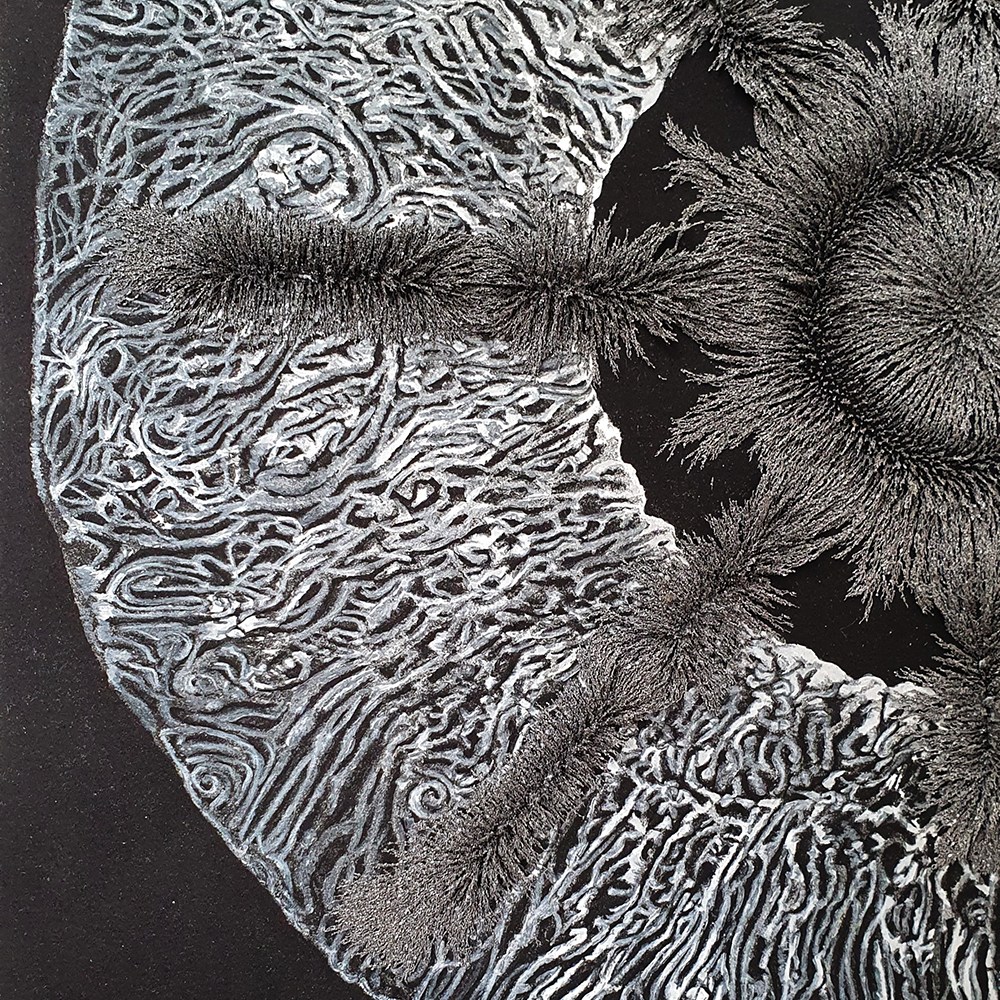
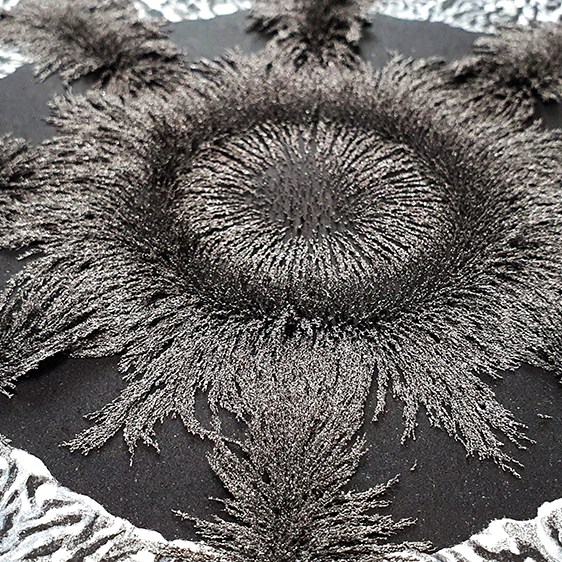
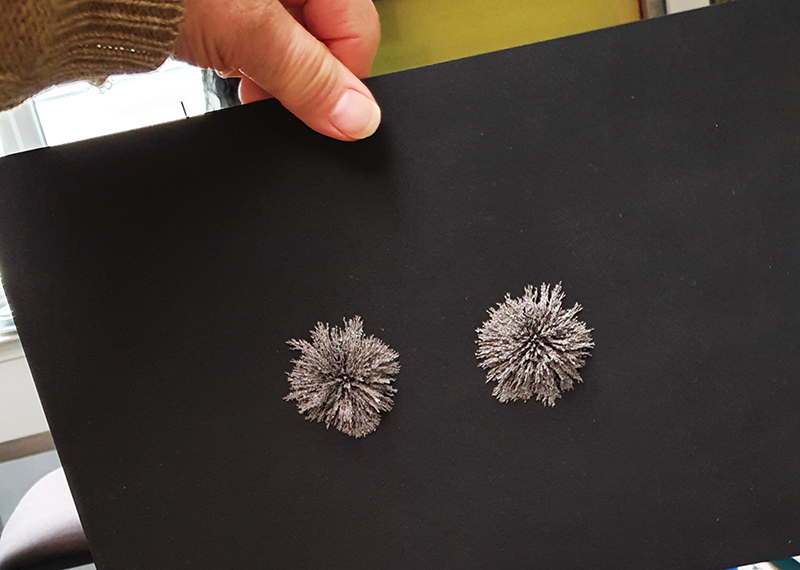
I have been testing new configurations of magnets for a large etching/drawing work looking at magnetoreception.

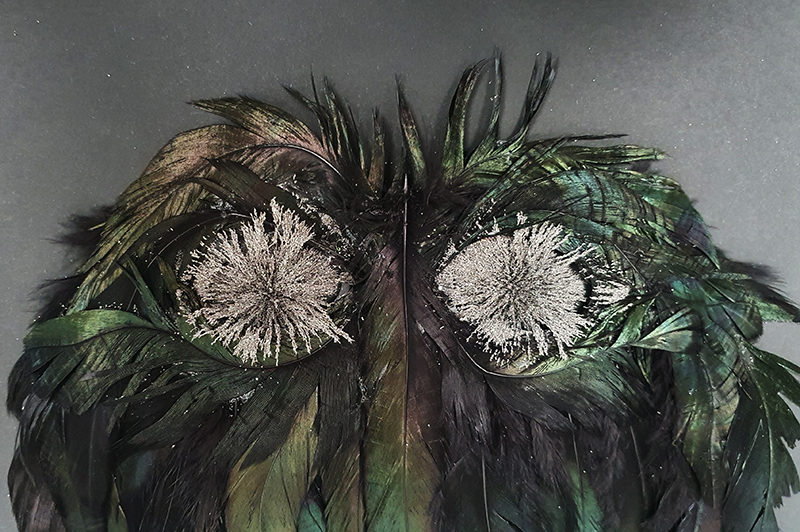
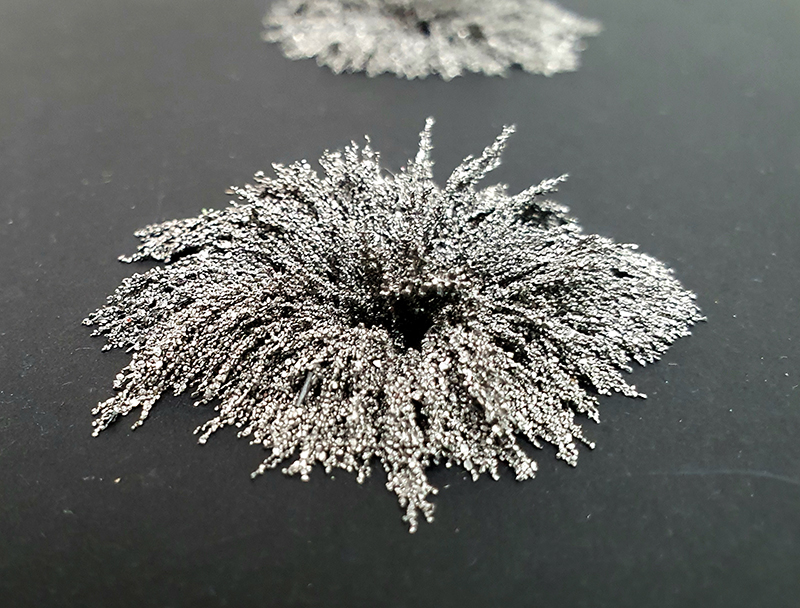
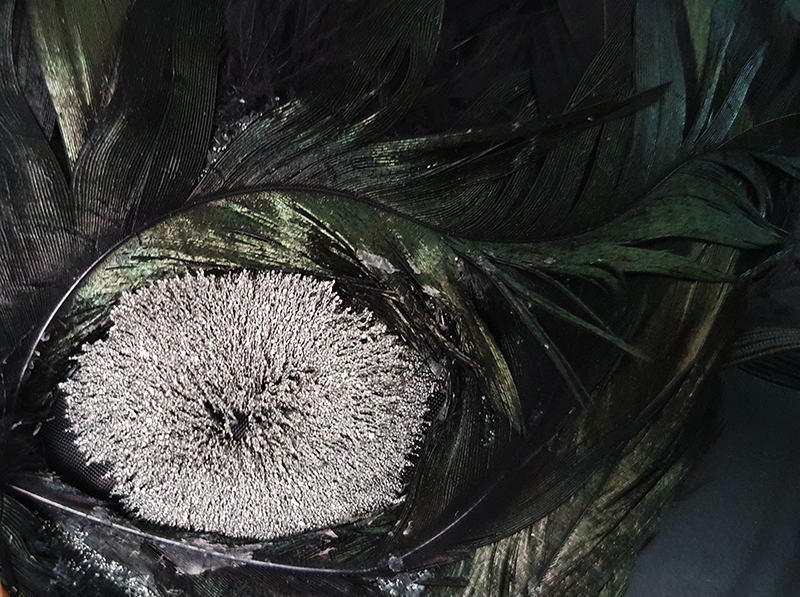
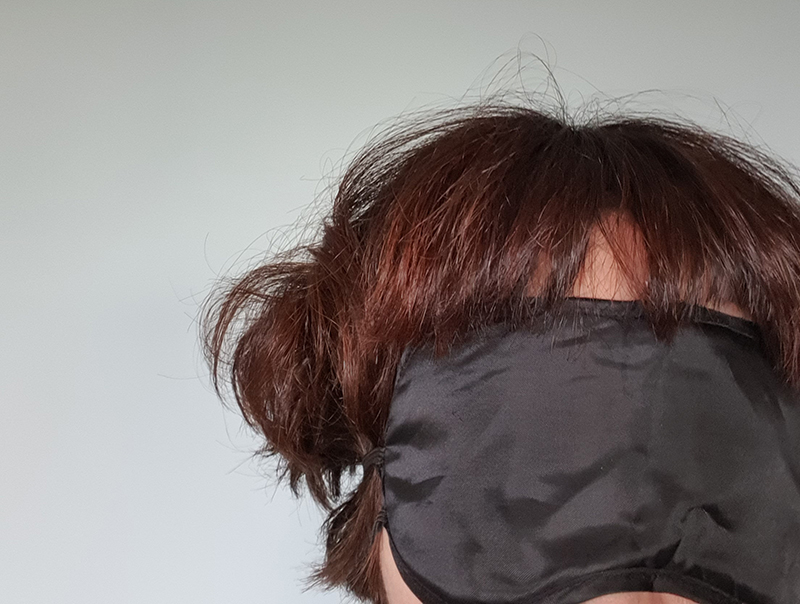
Also testing ideas for a magnetoreception performance mask. It became clear I will have to be careful with the iron filings around the eyes.

I was excited by the results of testing chine collé under black etching ink. It’s very subtle but I didn’t think it would show at all so was surprised and plan to try this with other ideas.

Great to see the launch of Yinka Shonibare’s new project Guest Artist Space in Lagos – this will be an international space for knowledge exchange between established and emerging artists, it will have urban and rural elements and involve local people as well as visiting artists for a true cultural exchange.

A video which I was invited to contribute to along with many artists Guest Projects has supported in the past is currently being shown as part of The Whitechapel Gallery exhibition programme A Century of the Artist’s Studio – Link to video here.
I am so grateful to Yinka Shonibare for his generosity and genuine interest in emerging and early career artists and awarding Laboratory of Dark Matters a month long residency that enabled us to achieve so much in 2017 including developing and running my first Cloud Chamber Workshops.

Exhibition Visits –

Gala Porras-Kim at Gasworks Out of an instance of expiration comes a perennial showing.

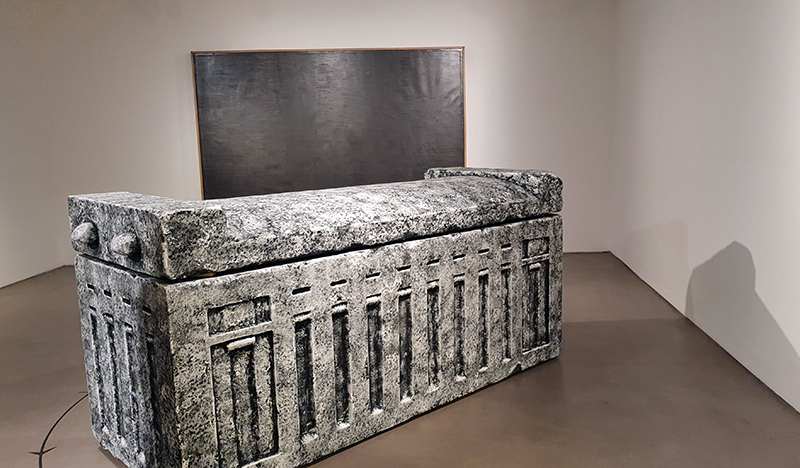
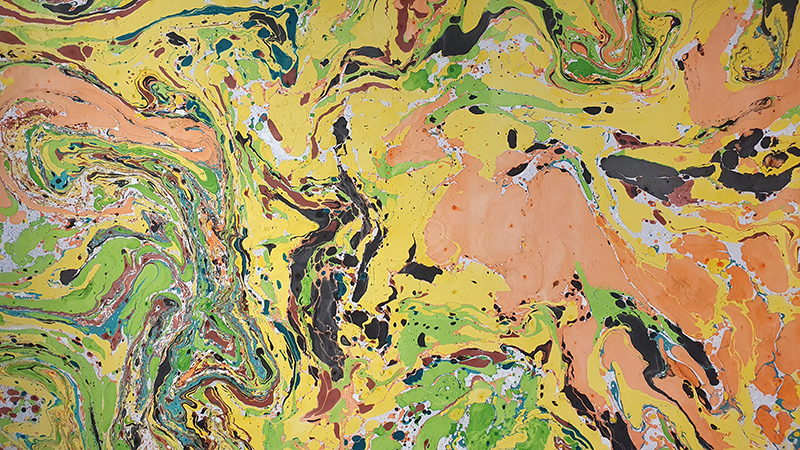
This wonderful exhibition is playful yet thoughtful, giving voice to the spirits of displaced, forgotten or overlooked fragments of history that have been institutionalised. The artworks suggest ways improve the material and spiritual conditions of artefacts stored in archaeological collections around the world such as re-aligning the sarcophagus or offering an awakening deity a more familiar prospect than the modern museum room in which it finds itself. Porras-Kim gives equal value to the dust gathering from artefacts stored in the back rooms of institutions and invites the spirits to communicate in the swirling patterns of marbling inks.

San Mei Gallery showing Laila Majid and Louis Blue Newby – not yet

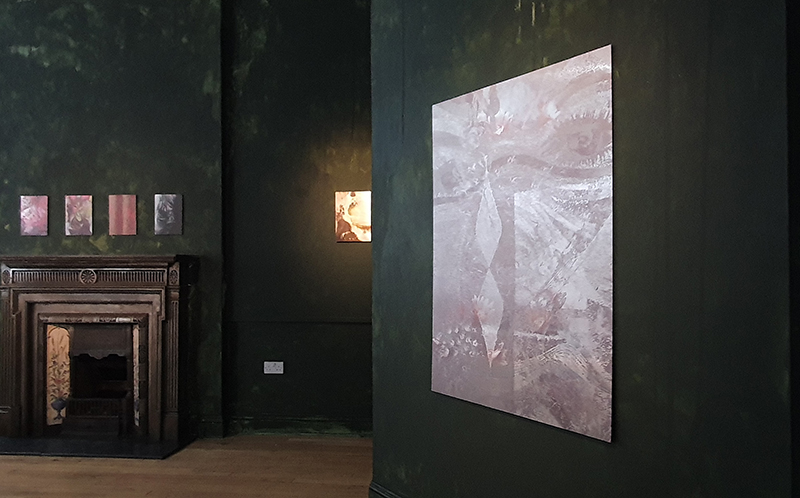
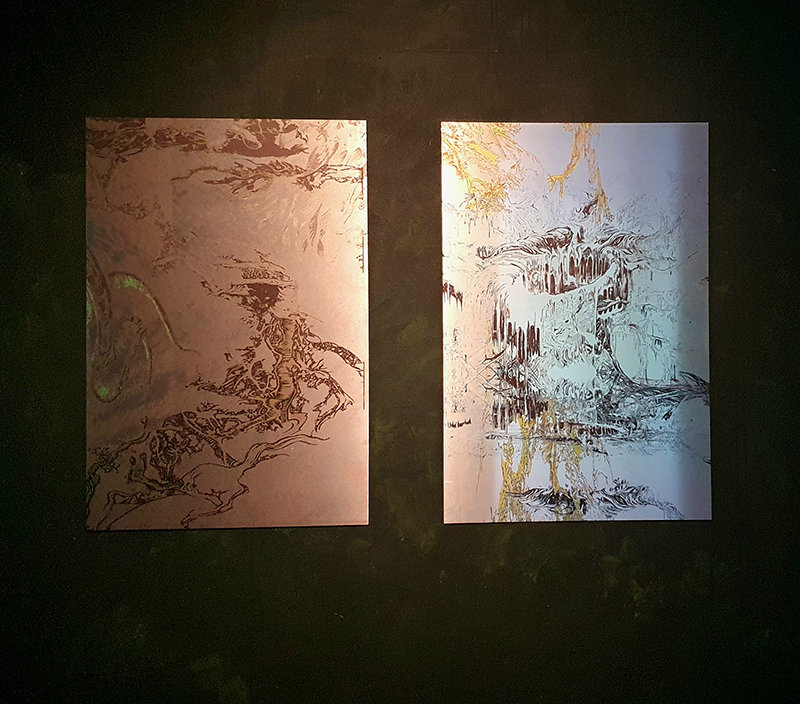
Walls smeared with slime green are hung with prints on aluminium that shimmer in the low light setting with video morphing of a bubbling concoction of swamp things.

Noémie Goudal –  Post Atlantica at Edel Assanti

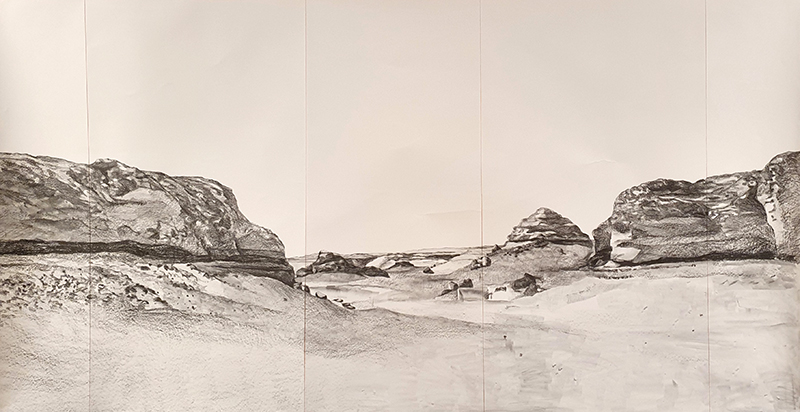
Luscious imagery dissecting the impact of deep time on landscape and climate.  

Berndnaut Smilde – Momentum at Ronchini Gallery

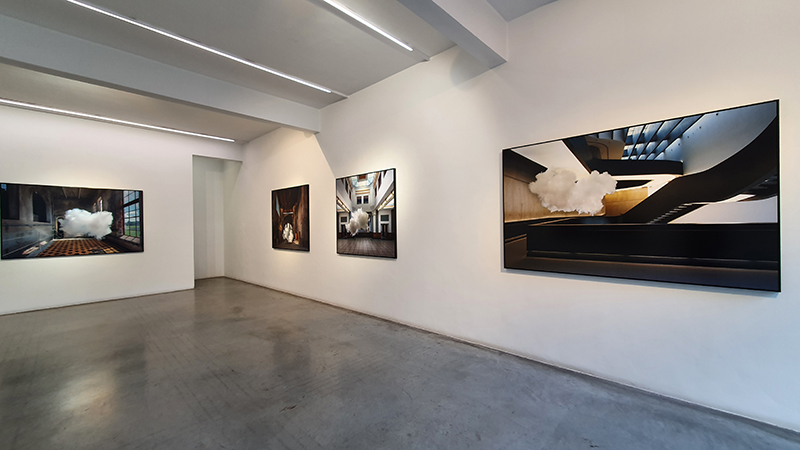
I was hoping to see a cloud produced in the gallery but had to settle for the documentation of previous clouds created in various locations presented in the Nimbus photography series. Apparently the artist very rarely makes this work as performance.
Shuster + Moseley – do not be afraid of the brilliant lights at Gallery Rosenfeld

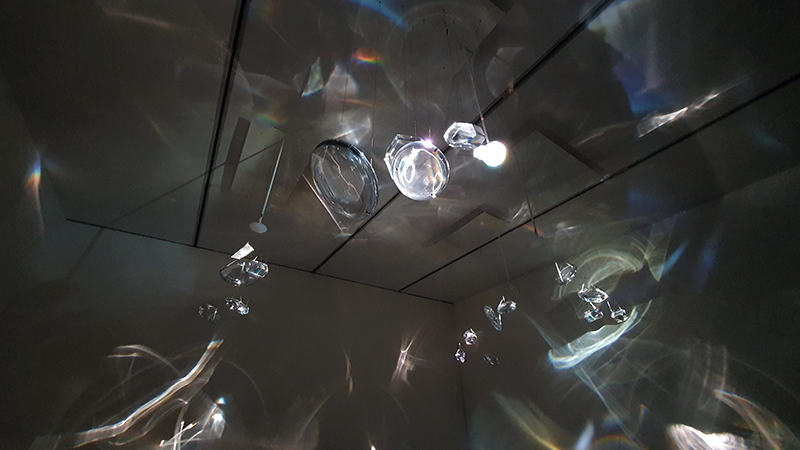
Light bling of refraction and reflection when photons travel through a glass medium splitting and bouncing in reminder of its own physical presence

Also at Gallery Rosenfeld, Bongsu Park – in dreams we gather

Dreamscapes undulating through the darkness, echoing active brainwaves producing light within our sleeping skulls.

Rivane Neuenschwander Commonplace 1999 in Tate Tanks

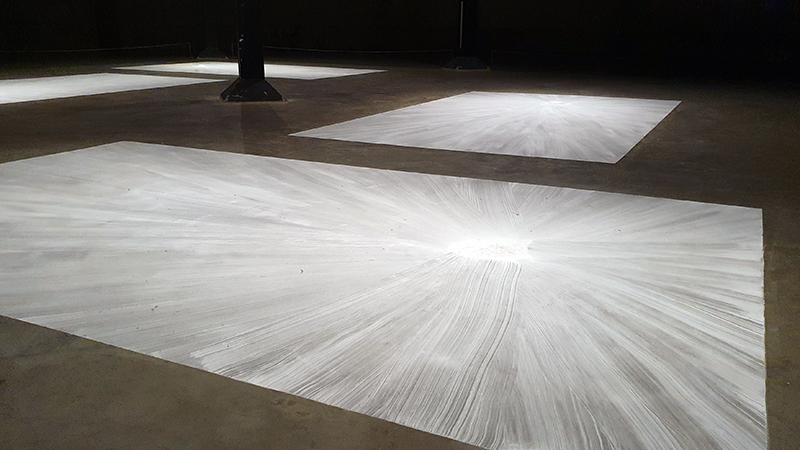
Talcum powder is brushed into rectangular shapes on the floor, being remade every time it is exhibited. Simple gestures turn the stuff of everyday life into something unfamiliar and poetic.

James Freeman Gallery – Juliette Losq and Stuart Sandford in Elysian Fields

Interesting pairing of decay and perceived perfection.

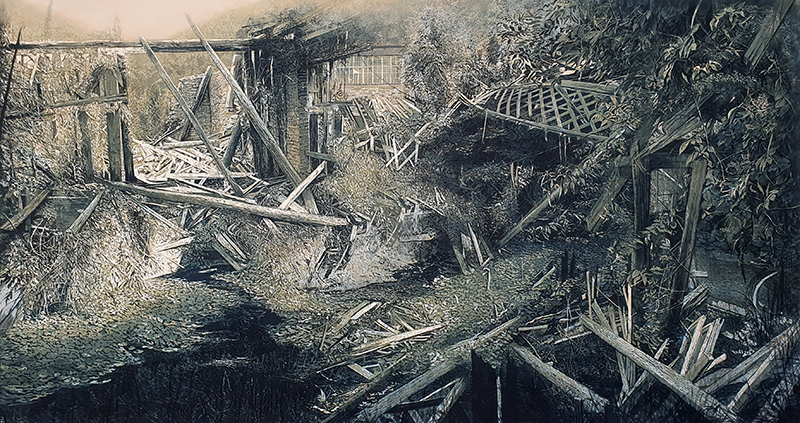
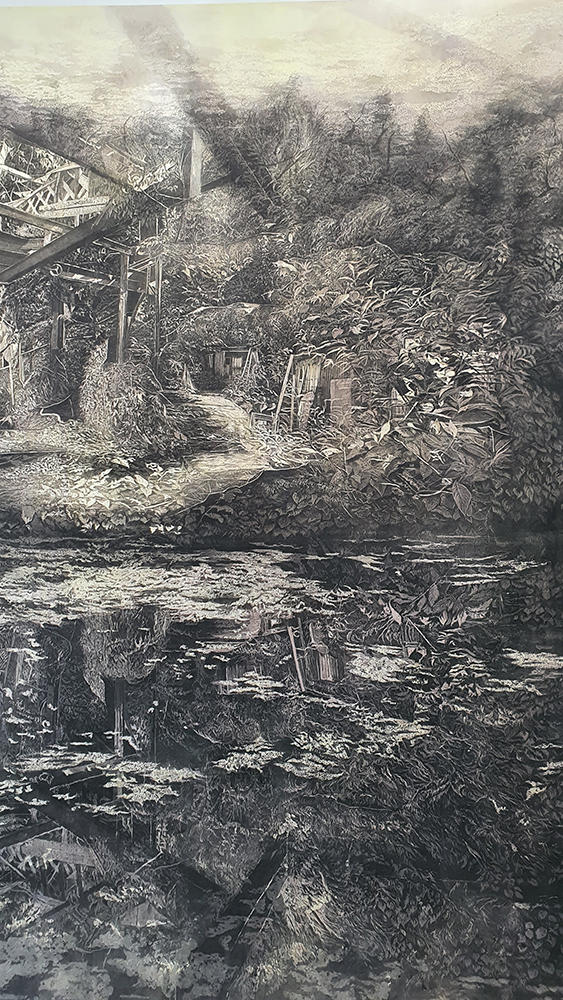
Paintings rather than the layered installations I admire from Juliette Losq here. Delicate pale light seeping through these landscapes caught in the haze of a slow and gentle decomposition.
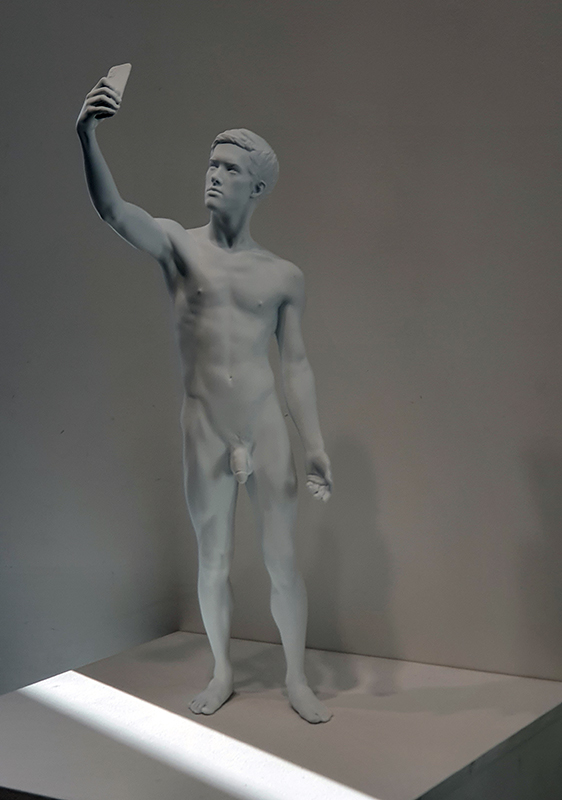
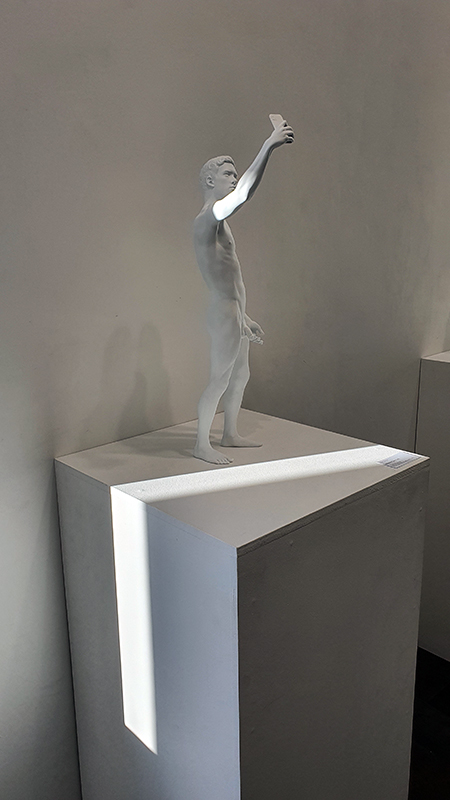
A close encounter with a full size Narcissus is only available through scanning a QR code to be experienced via the screen. Only his small pornworld counterparts were present, cast from the idealism of the digital realm into bronze.
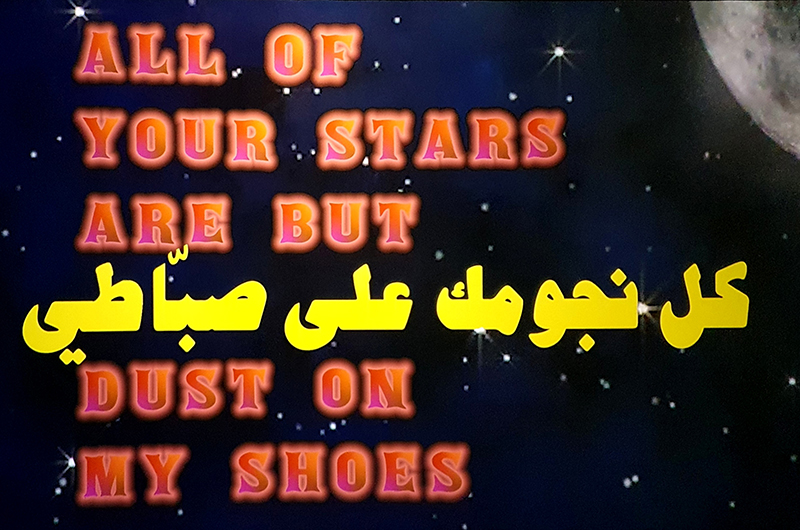
Haig Aivazian All of your stars are but dust on my shoes at The Showroom

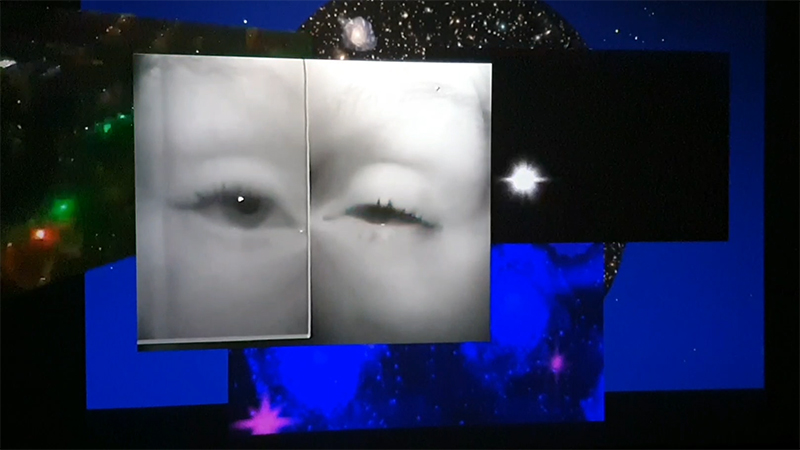
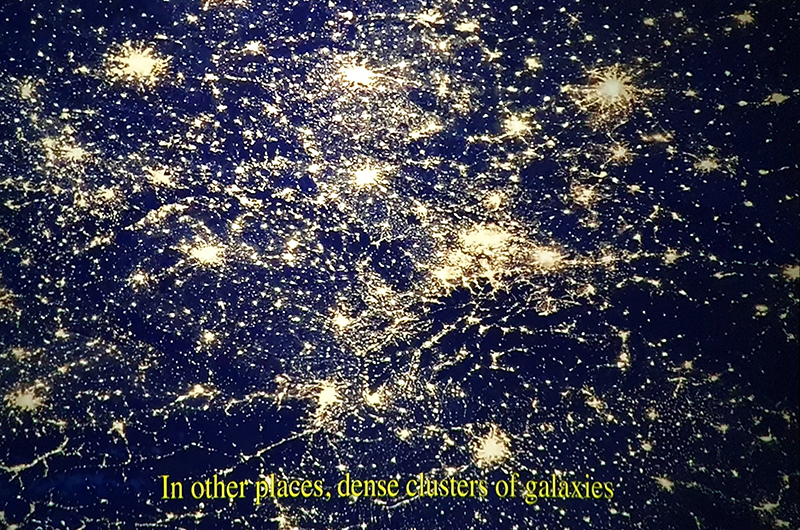
Two very moving films looking at light and fire, primordial gifts and how they are used for power and control.
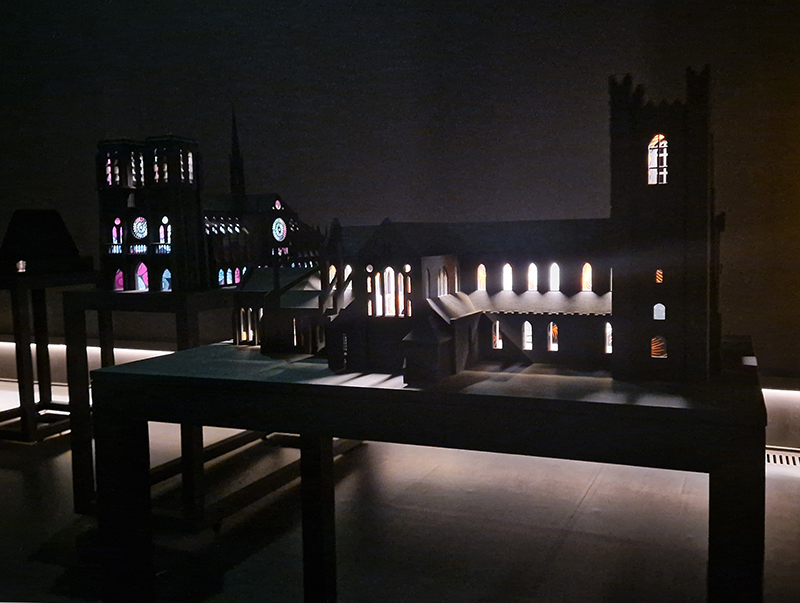
Geo-poetic is a great description of how these films traverse history and borders exposing who decides what is seen and what is not and who holds the flaming torch over the touch paper.

Portals at Lisson Gallery curated by Ossian Ward

Images include Susan Hiller, Ryan Gander, Rodney Graham, Shirazeh Houshiary, John Latham, Mary Corse and Sean Scully.

A mixed offering of thresholds to alternative spaces, visible, conceptual, mythical or speculative.

Richenda Court Glass Town at The Muse at 269

Luminous work reflecting a fragile crystalline world

Good to see Lisa Pettibone’s suspended sculpture Instrument of Thought – A meditation on Matter and Light. The physics of the cosmos held in delicate balance as mirrored surfaces, crystals and rocks interplay hinting at ideas such as gravity, dark matter and the speed of light.

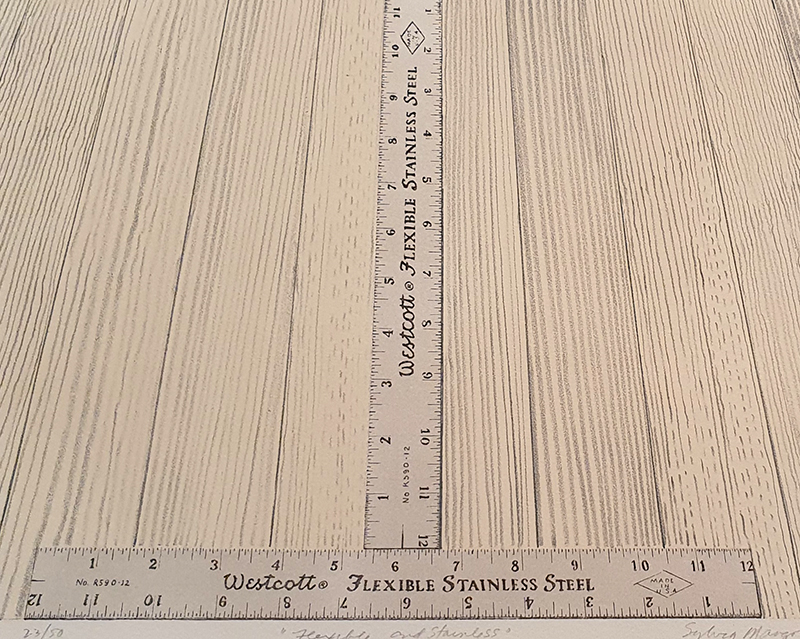
On Hannah Arendt: The Conquest of Space at Richard Saltoun with works by Sylvia Plimack Mangold, Elaine Reichek and Carey Young considering the question Has man’s conquest of space increased or diminished his stature?

The question is central to Arendt’s essay written in 1963 which rings alarm bells on the direction science and technology may be leading the human experience. The possible future Arendt foresaw of a world remade by the curiosity of the human race but transformed into somewhere unrecognisable to the humanist where even the scientist loses some essence of human nature as the world is described in a mathematical language that cannot be experienced with human senses may be bearing down upon us.

Lots to think about from this encounter. I think writing when she did, when the first man in space was quite recent history and before the internet, her concerns about a loss of what it is to be human, driven by technology effecting every part of our lives until there is no part left that hasn’t or isn’t in some way remade by humans was very prescient. I wonder how she would feel today as we rush into space like never before and not so much for exploration as exploitation. Arendt described herself as “a kind of phenomenologist” which I understand as looking at things purely as they appear to us without trying to explain why or how and accept meaning that comes from direct sensory experience. Works of art can act as mediators between the consciousnesses of the author and the reader as a direct attempt to communicate the experience of being human and the world around. Phenomenologists are interested in the way we come to share similar understanding of the world a collective subconscious or implicit agreement about how the world looks, sometimes referred to as the life-world.

An introduction to the essay link here presented by Roger Berkowitz, director of the Hannah Arendt Center at Bard College. Science transforms what it means to be human although we are still bound to our earthly bodies and subject to fate and fortune. Science does not give a human experience of the world, it confounds common sense. If our growth in understanding can only be expressed in mathematical terms then we have lost rather than gained a way of describing our world experience. Human thinking comes from metaphors and our thoughts are earthly, if we are taken off planet then the Earth becomes an object not our home.

Secret of Lightness at Parafin

Aimée Parrott, Andrew Pierre Hart, Tim Head, Andrea Heller, Laurence Kavanagh

Beautiful selection of works curated by Louisa Hunt that reflect the premise of Calvino’s text to pull against what holds us down and make a creative leap opening onto a new perspective.

‘Whenever humanity seems condemned to heaviness, I think I should fly like Perseus into a different space. I don’t mean escaping into dreams or into the irrational. I mean that I have to change my approach, look at the world from a different perspective, with a different logic and with fresh methods of cognition and verification. The images of lightness that I seek should not fade away like dreams dissolved by the realities of the present and future…’

Italo Calvino, Six Memos for the Next Millennium: Lightness (1985)

Of the Surface of Things at Alison Jacques showing works by Maria Bartuszová, Sheila Hicks, Hannah Wilke, Erika Verzutti.

Spending so much time thinking about the intangible it was refreshing to be exposed to some raw materials.

The curator refers to the 1919 poem ‘Of the Surface of Things’ of Wallace Stevens and the untethering of the imagination when exposed to the particularities of reality in simplified raw form.

In my room, the world is beyond my understanding;
But when I walk I see that it consists of three or four
        hills and a cloud. 

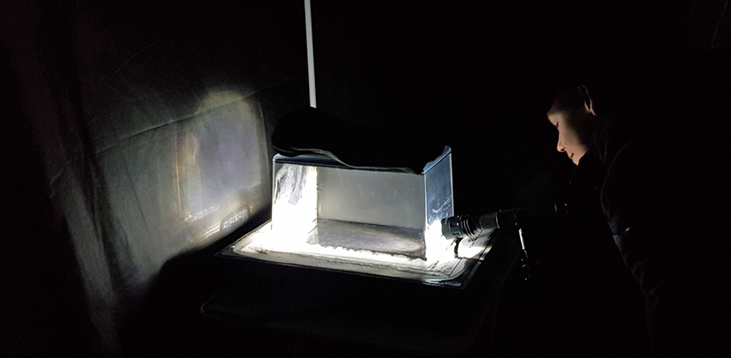
New year fresh start. Laboratory of Dark Matters evaluation reports submitted. Now to build on my research from the last year. Time to put up the dark tent again and get the cloud chamber running to take some more controlled footage for use in an immersive installation. Excited to be experimenting with video projections, lenses and different media to project onto to ‘capture’ the particles.

1712 Lens layer.jpg

Sun Factor jostling for space at a busy Atom Gallery private view of Tomorrow’s World where most visions of the future appear dystopian or apocalyptic.

1712 Atom Gallery PV.jpg

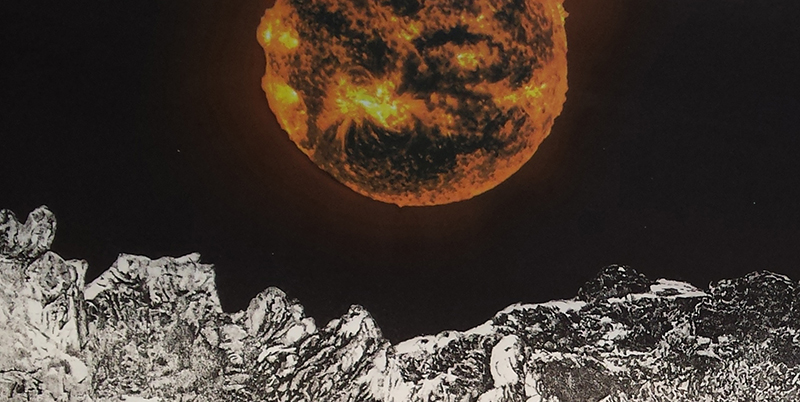
The backstory to this work begins with a holiday to Sardinia and the day trip salesman’s  insistence the island bay he proposes taking us to – it’s paradise, it’s paradise … well how could we refuse. It turned out we were to be cast ashore for hours on a tiny strip of sand with no shade, no escape and a sea swarming with tiny stinging jellyfish. A concrete obelisk stood over the blistering bodies; once ancient sun worshippers built these capped with gold to shine like beacons celebrating the power of Ra the sun god. Modern sun worshippers have their own rituals, laying under a hot ball of gas so massive and so hot it has been active for 4.5 billion years yet it will be another 4.5 billion years before it will expand into a red giant, vaporize the earth and explode.

On a rather grander scale was ( my past RCA tutor) David Blandy’s The End of the World at Seventeen Gallery.

1712 David Blandy 2

Designed for solo viewing, a single seat faces the enormity of space. You become the lonely astronaut gazing down on a faraway world, at once familiar and distant. The voiceover poignantly recounts what is being lost; spanning perspectives, the micro and macrocosm of life, imagined, virtual and real. When the end is in sight senses are heightened.

1712 David Blandy 4

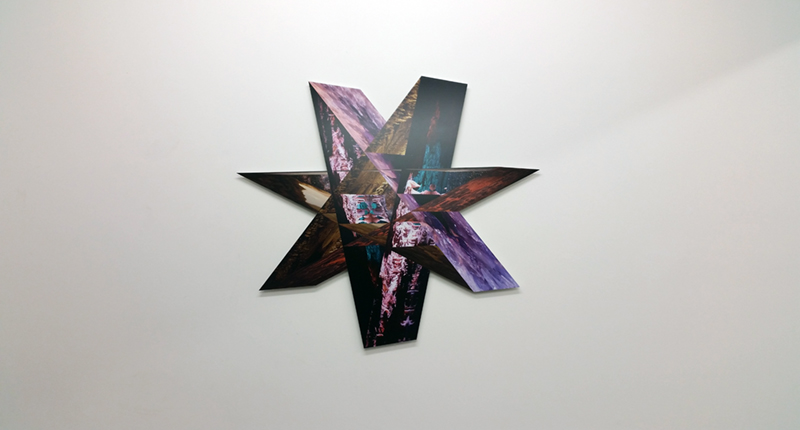
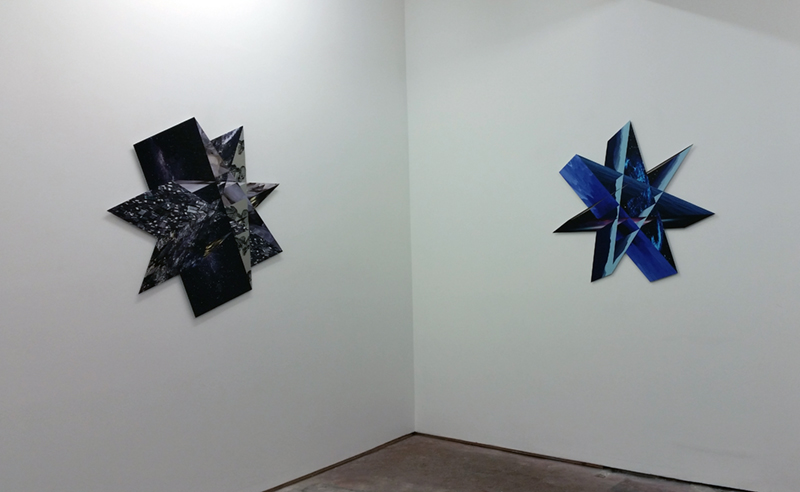
Touched to hear that David thought of me when making the High Definition series splicing microchips, crystals, nebulae and rock formations into stars which appear 3D until you approach more closely and then they flatten. Heptagrams (seven point stars)share Christian and pagan symbolism, they can represent the seven days of creation, the perfection of god and the seven planets which were known to ancient alchemists.

1712 David Blandy 3

The installation HD LIfestyle also plays with the illusion of surface and the material cost of being able to pass through the screen to an ever more real and immersive experience on the other side. The wares are on display. The images sweep us forward. It would be hard to stop.

1712 David Blandy 1

Thomas Ruff at Whitechapel Gallery. He is big on scale, control and appropriation.  I was struck by the regularity and precision of the white dot of light reflection in each of the portrait models eyes.1712 Thomas RuffThe Mars Reconnaissance Orbiter launched 2005 recorded topography, water related minerals and climate using an imaging spectrometer, context camera and mars colour imager transmitted as radio signals to be translated into images.
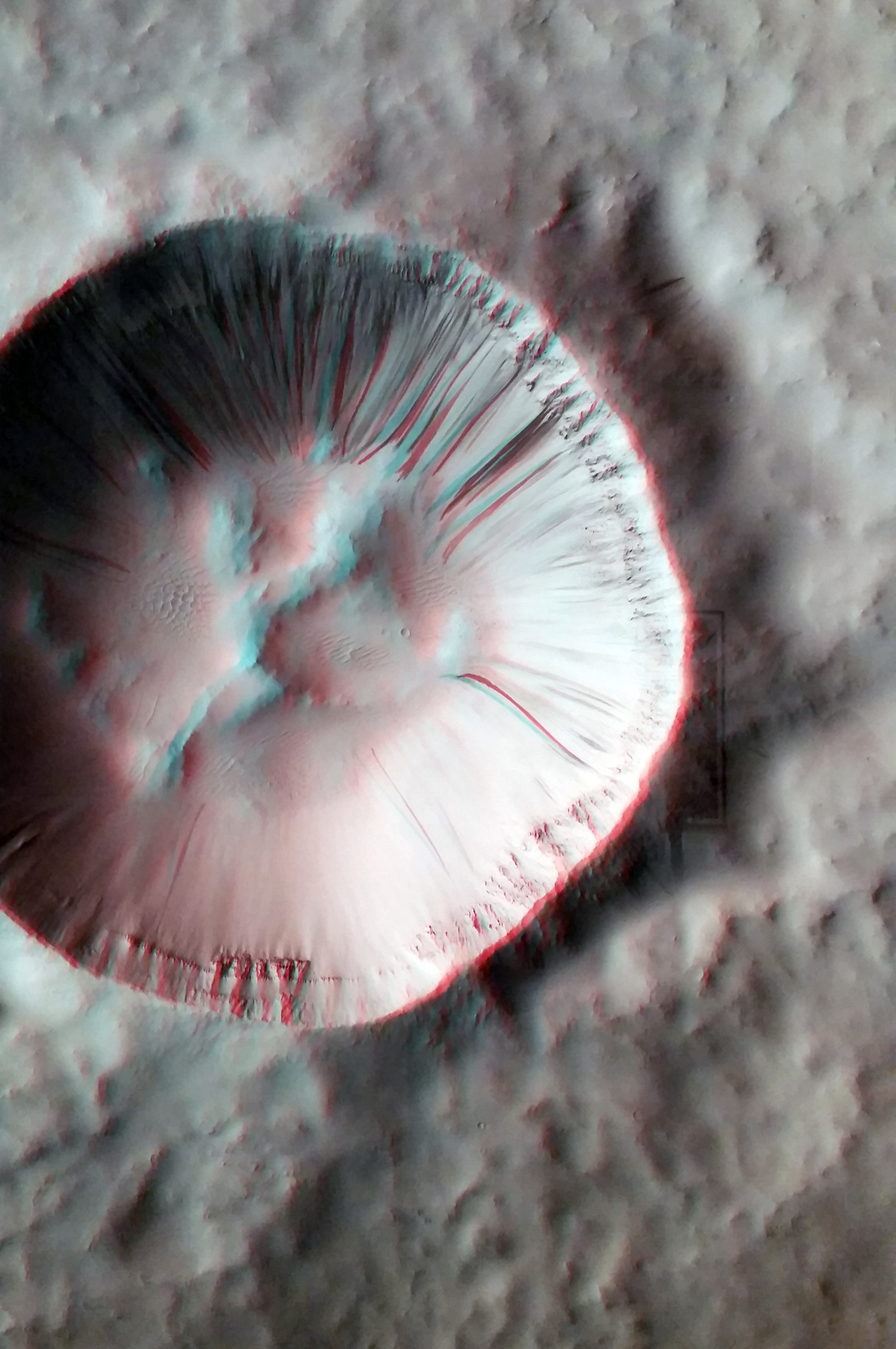
1712 Thomas Ruff 3D

Thomas Ruff ma.r.s. 

SPACE/London Creative Network Showcase – showing works in progress as part of an ongoing exploration of new technologies employed within art practice.

Catriona Leahy uses laser-cutting technology to etch delicate capillaries onto marble to articulate a sense of fragmentation and the scarring of  manmade intervention in the form of land drainage found in Dutch and Belgian post industrial landscapes.

171124 space LCN Catriona Leahy

Catriona Leahy Percolation Test

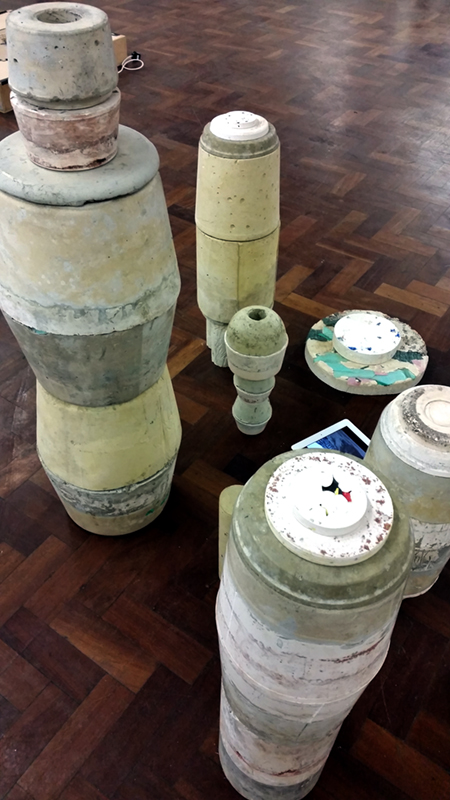
Always drawn to the perpendicular – the standing stones. I enjoyed Ben Branagan’s legacy of the built environment captured in totems made from building site aggregates.

1712 space LCN Ben Branagan

Ben Branagan Hardcore Colonnade

Next door was the satisfyingly ritual space of BearMotherhouse a collaboration of Fourthland, an artist collective, with Xenia a group that brings geographically displaced women together with local communities for friendship and integration through creativity. A quote from the accompanying essay by Alberto Duman addressing the cosmological connections and mythologies of the objects that ‘ speak of the degrees of interconnectedness beyond human knowing and the evocation of powerful figures such as the Bear and the Mother that oversee and mesmerise this house’s proceedings

1712 Fouthland with Xenia

Cryptic exhibition at The Crypt Gallery, St Pancras Church examines the relationship between art, science and technology. Lisa Pettibone explores matter and form through the manipulation of one template and the forces applied to alter its appearance.

1712 cryptic lisa pettiborne

Lisa Pettibone Apeiron 01_02_03

Pentagon envy.

1712 Cryptic Bekk Wells

Bekk Wells Elements

Imagining CERN event at CSM presented the results of creative collisions between interdisciplinary art and particle physics.  MA Art and Science students got to visit CERN, collaborate with scientists and make work in response.

1712 CSM imagining CERN exhibition

Gavin Hesketh was here to talk about his work at CERN searching for new particles

1712 Gavin Hesketh

He had brought his cloud chamber along. First time I had seen someone else’s cloud chamber other than online. No dark tent here.

1712 CSM imagining CERN cloud chamber

In particle physics the closer you look the more similar things become,

when you get right down to the elementary particles there is no colour at this scale


The end of summer. Time for Laboratory of Dark Matters take down at Cleveland Ironstone Mining Museum.

1710 The Forms

During the six week exhibition and many trips to the north east where we were made so welcome I became very fond of all those involved at the museum and the dramatic backdrop of the North Yorkshire coastline. Sad to pack the work away and leave.

1710 Diazôgraphô

Boulby Mine became a familiar sight and distinct reminder of the surreal journey underground and project conception over a year ago.

1710 Boulby Mine

It was a genuine coming together of disciplines and communities which I think we all gained from. Pinning my hopes for the future on similar undertakings.

1710 CIMM and EU nostalgia


We are better together.


Straight onto making new work for Deptford X Fringe show Supposedly Predictable Phenomena with [ALLOY] artists.

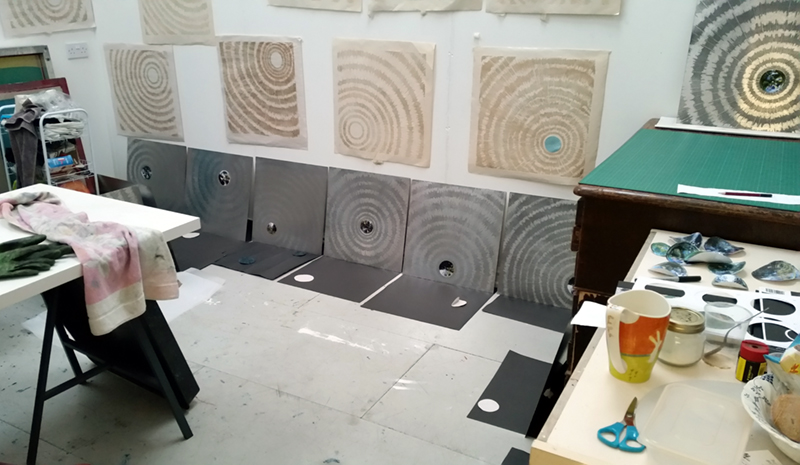
1710 etching plates

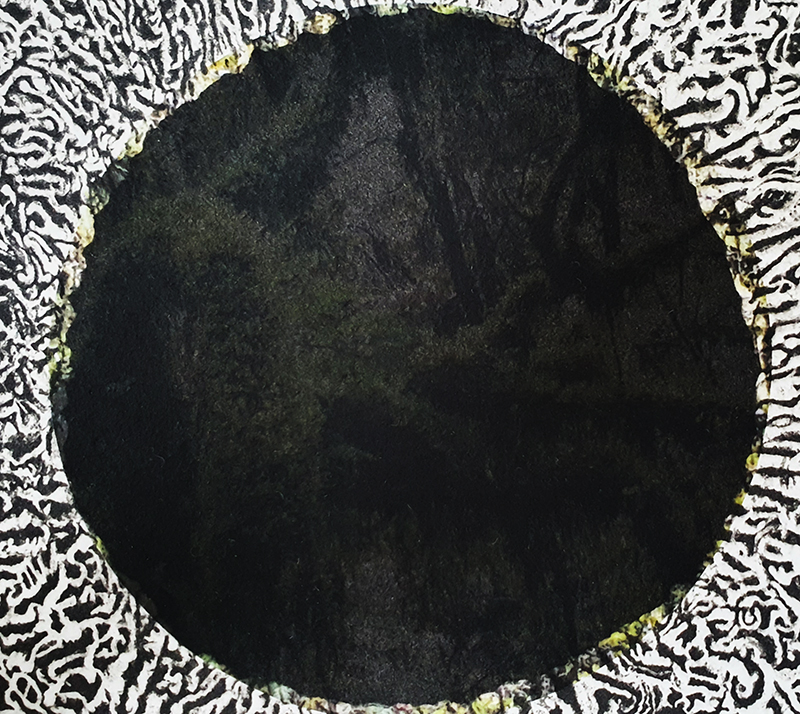
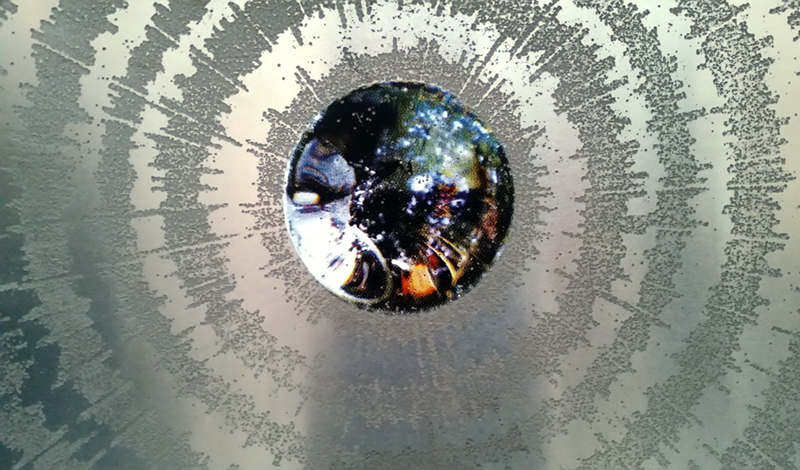
Etching 12 plates, then screen printing the centre circles as 4 colour separations. The printed images are from crystal ball photographs taken out in the woods.

1710 screenprint over etch

A portal for the imagination as well as a folding in of space.

1710 screenprint on aluminium

Meanwhile I was invited by The Institute of Physics to speak at the INTERACT conference in Birmingham. I was able to participate in some interesting workshops alongside the physicists  and listen to Jim Al-Khalili and Alice Roberts in conversation about the shifting perspective of the academic world in relation to public outreach and the role of women in the sciences.

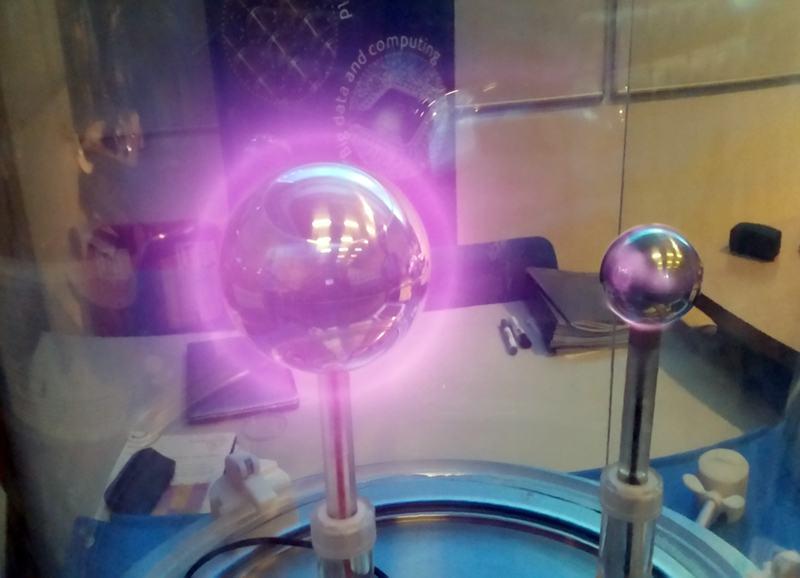
I was introduced to The Planeterrella, an incredible artificial demonstration of the Northern Lights. The aurorae are created by charged particles from the Sun travelling along the Earth’s magnetic field lines and exciting our atmosphere.

1710 Planeterrella

In this experiment most of the air is sucked out of a glass chamber to recreate the conditions about 100km up in the Earth’s atmosphere. The large sphere represents the sun and the small sphere the Earth which contains a very strong magnet to represent its magnetic field. A voltage is sent from the Sun to the Earth to recreate the solar wind which excites the electrons in the field enough to give off light at characteristic frequencies.

1710 Planeterrella 2

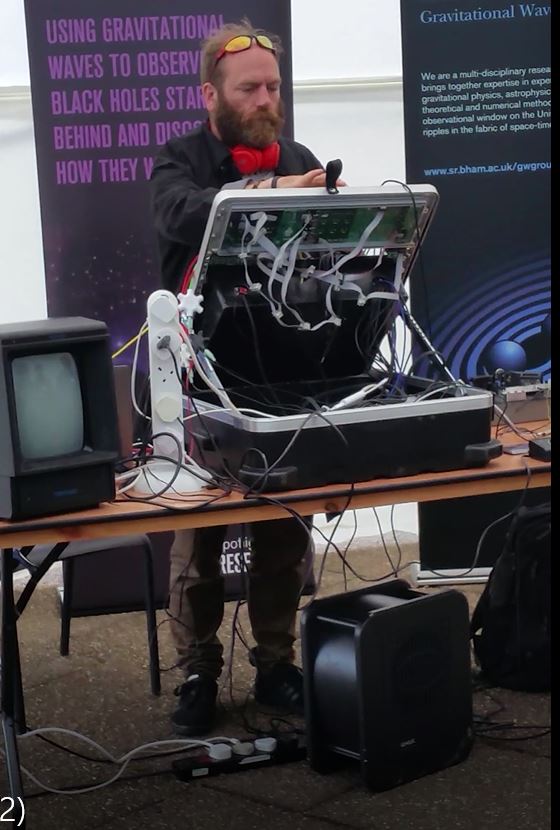
Listened to Gravitational Waves

1710 Gravitational Waves

and picked up a useful leaflet on cosmic rays which were first discovered by Victor Hess in 1912 using an electroscope to measure ionising radiation in the atmosphere 5300 metres up in a hot air balloon. The higher up the higher the radiation therefore the effect must be caused by something extra-terrestrial.

1710 Victor Hess

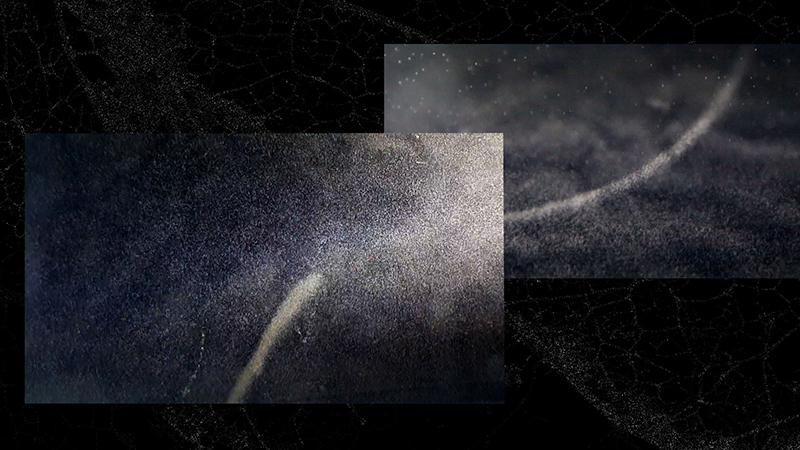
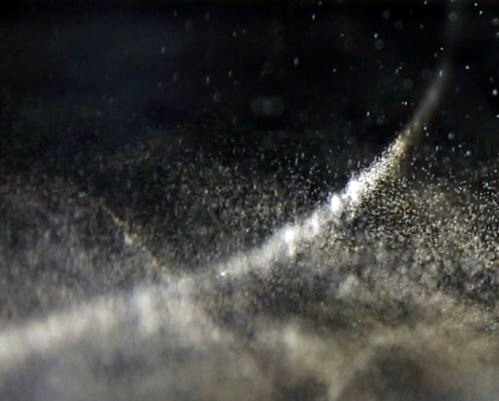
One high energy primary cosmic ray gives rise to a cascading shower of secondary particles that scatter across the earth, colliding and decaying in a constant stream. Mostly passing straight through us and the matter around us but sometimes there will be a direct hit at a subatomic level from a particle having travelled from outside our galaxy.  1704 Cosmic Trail 3

Lizzie Cannon ‘Liminal Matter’ at The University of Greenwich explored the constantly shifting dynamic of the shore and its material.  Through the process of art-making, critical reflection and dialogue; this exhibition continues Lizzie’s research to address questions around human and nonhuman agency, temporal and spatial flows of matter and meaning, and an ontological fluidity that allows for an understanding of materiality as a reciprocal and generative relationship between humans and environment.

1710 Lizzie Cannon In Transition Detail 1

Lizzie Cannon detail of the mighty In transition

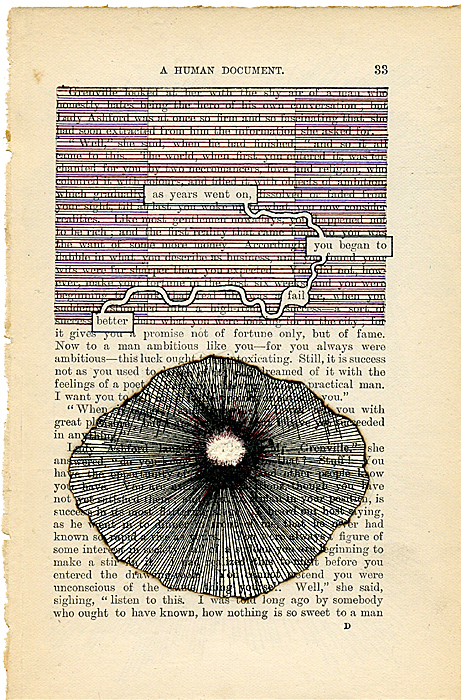
Wandered the set at South London Gallery of Tom Phillips IRMA: An Opera Opus XIIB. This 1969 mini opera was drawn from Tom Phillips magnum opus which was in turn born from an idea that he would alter every page of the first book he came across for 3d. W H Mallock’s 1892 novel A Human Document thus became A Humument. 

1710 Tom Phillips

1710 Tom Philips Humument.jpg

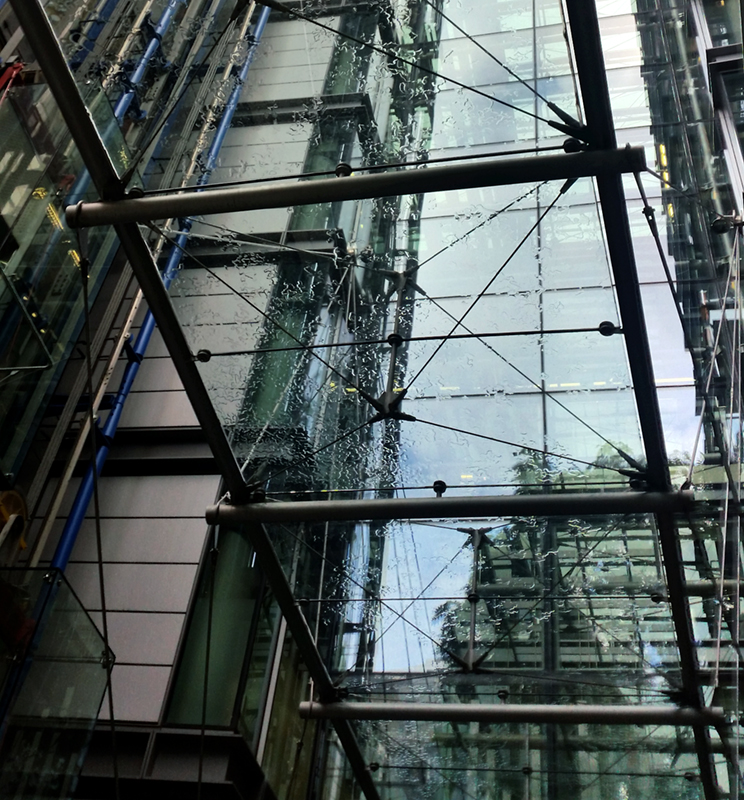
Further wanderings during London Open House weekend led to the architectural hybrid of Lloyd’s Register.

1710 Lloyds Register Open House

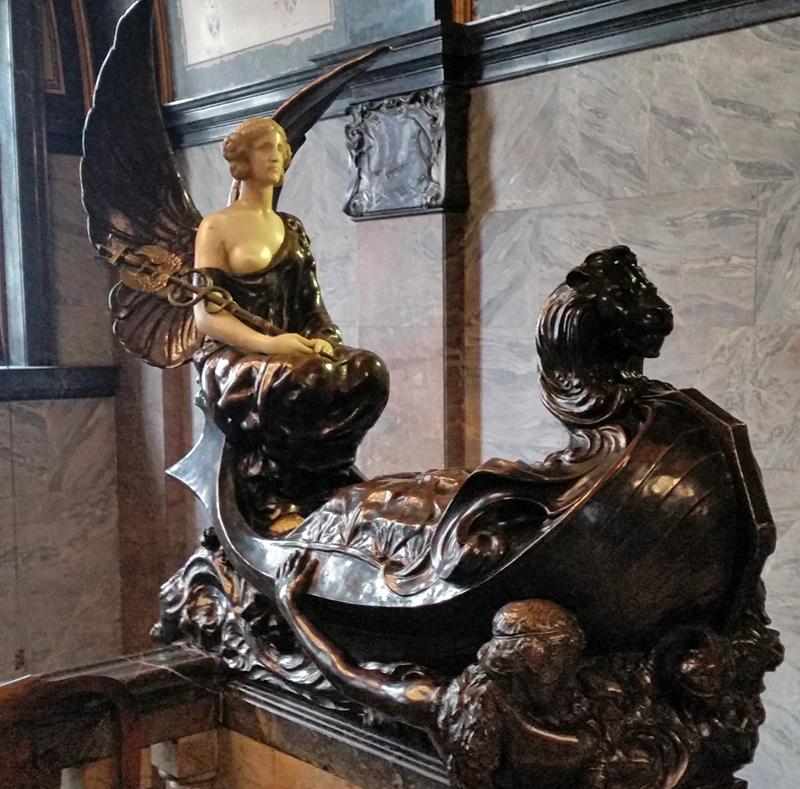
Hidden within the Richard Rogers glass and steel is Collcutt’s palazzo with grand marble staircase leading to the ornate General Committee Landing dominated by The Spirit of Maritime Commerce 

1710 Spirit of Maritime Commerce

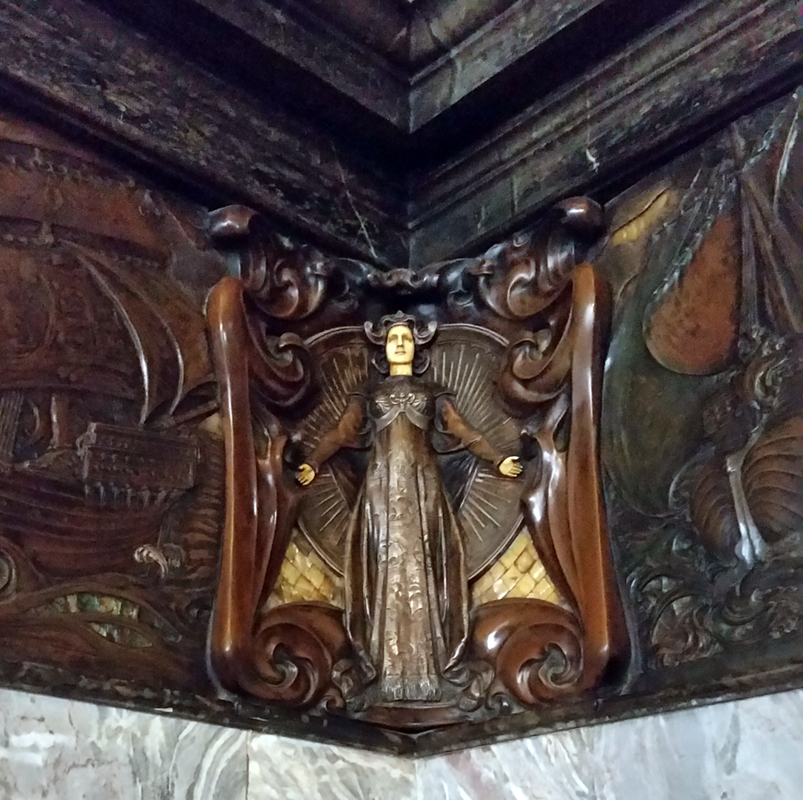
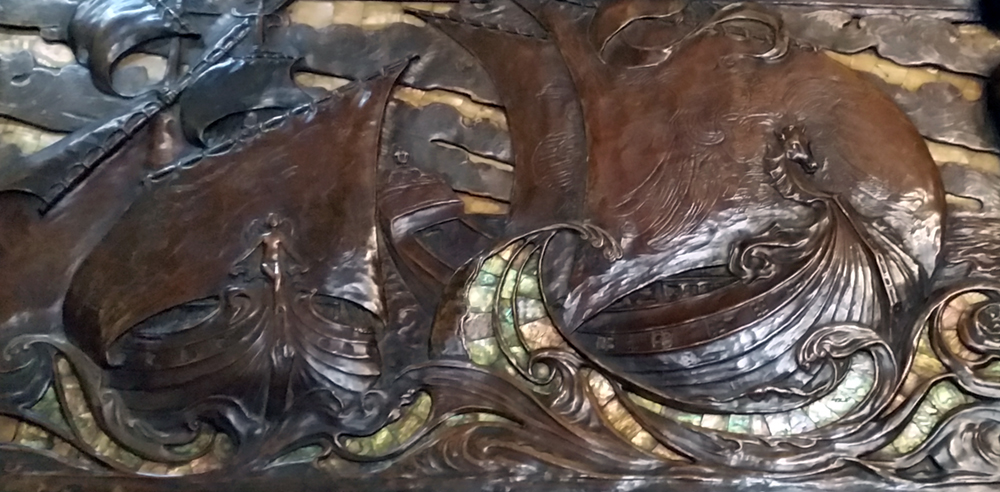
and the bronze frieze sculpted by Frank Lynn Jenkins, inlaid with silver, mother of pearl, turquoise, coral and pearl.

1710 Lloyds Register Bronze Frieze 2

1710 Lloyds Register bronze Frieze

The landing opens onto the Italianate opulence of general committee room with its barrel vaulted ceiling and more exposed left breasts of various symbolic maidens

1710 Night

Lloyd’s Register was founded in 1760 in Lloyd’s Coffee House as a means of registering the seaworthiness of wooden commercial ships sailing from British ports. An attempt to plan and predict.

A tight turnaround from ideas, to making work, to installation of Supposedly Predictable Phenomena at no format Gallery in time for Deptford X.

Very happy to be showing alongside Jessie Sheffield and Lauren Ilsley. 1710 SPP 8

This was new work that investigates the themes of sequence and consequence

1710 SPP

Contained Nascent
Acrylic, wood, water, powdered minerals.
Lauren Ilsley, 2017

Apparently linear processes, psychological and physical, are rendered unpredictable and essentially chaotic due to their inherent and entangled sensitivity.

‘Supposedly predictable phenomena’ relates to the concept that if all contributing factors could be mapped and understood, then the outcome, theoretically, should be predictable.

1710 Jessie Sheffield

FixPoint 36
Steel mesh, wood, acrylic.
Jessie Sheffield, 2017

The results of this is a calculable universe and suggests a trajectory that is not only logical but also predetermined.

1710 SPP 2

Tools for Transition
Ceramic, aluminium, wood.
Lauren Ilsley, 2017

This raises the question of the alternative – Chaos Theory, and in turn free will.

1710 SPP 7

Duodecimēns
Etched aluminium, screen print. 12 pieces.
Susan Eyre, 2017

Duodeci – 12    mēns – minds……or Twelve thoughts, one from each multiverse

1710 ssp exhibition

no format gallery space worked well for us, if slightly on the edge of the festival bounds. It faces onto Propeller Foundry with 4 floors of artist studios many of which invoke studio envy with their big windows and vast spaces. Found a few old friends in here. There was some opportunity to head out to see some of the other work on show around Deptford.

Ambient Occlusion was another excellent curation at Gossamer Fog. Muted as the first step towards the synthesis of human and computer, the attraction of virtual reality evident by the queues to experience Jakob Kudsk Steensen’s Terractic Animism. It was terrific. Hyper-real. Which cannot be conveyed in this image or the Vimeo link demo.

1710 Jakob Kudsk Steensen

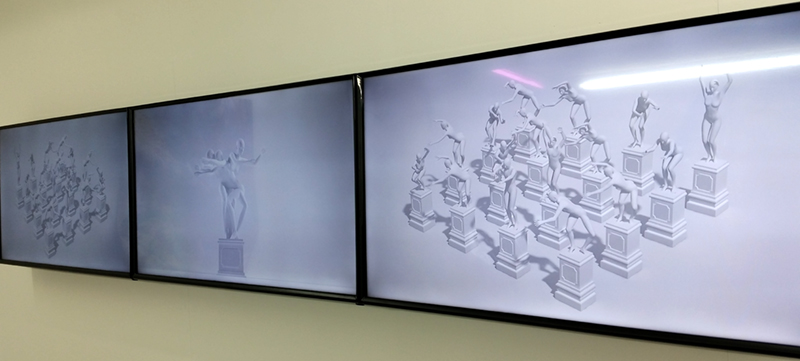
Other mesmerising work was Alan Warburton’s 3 channel video Primitives

1710 Alan Warburton primitives

and Katriona Beales video with mixed media Working Table II

1710 Katriona Beales (1)

Bearspace was showing Bella Easton Breath

1710 Bella Easton

colours slipping from muted to monochrome, an enveloping tangle pieced from oil painted linen still scented with the mediums of its construction.

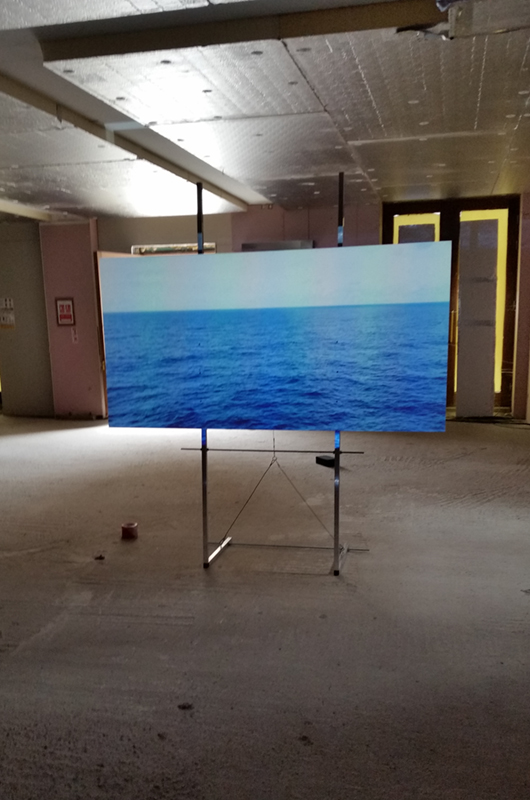
In the bare bones of St Paul’s House Tom Ireland placed three screens showing voyages across the sea or the galaxies. The Heavens (Deptford Observatory) places the local dockyards and observatory at the centre of the universe from which we embark.

1710 tom Ireland.jpg

New Scientist Live 2017

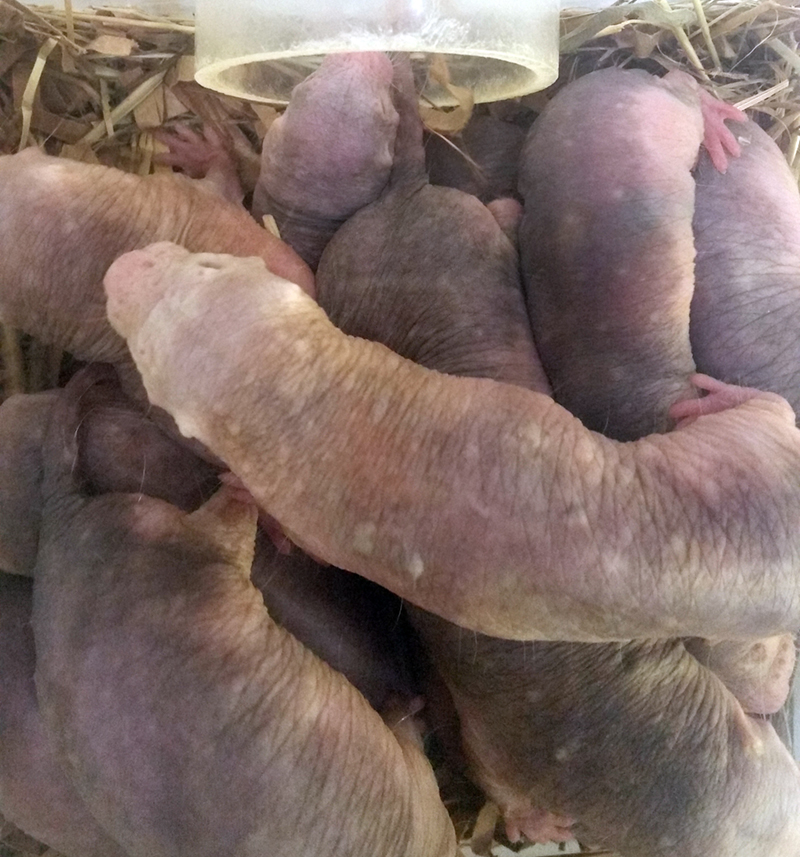
1710 naked molerats.jpg

Best thing I saw in some ways was these extraordinary fanged tubes of flesh that hold the clues to longevity but I did feel for them being thrust under the spotlight. Exposed. Naked indeed.


1709 CIMM exhibition 1Cleveland Ironstone Mining Museum exhibition brought work created for Guest Projects residency into a very different space, reinventing and presenting it in new ways.

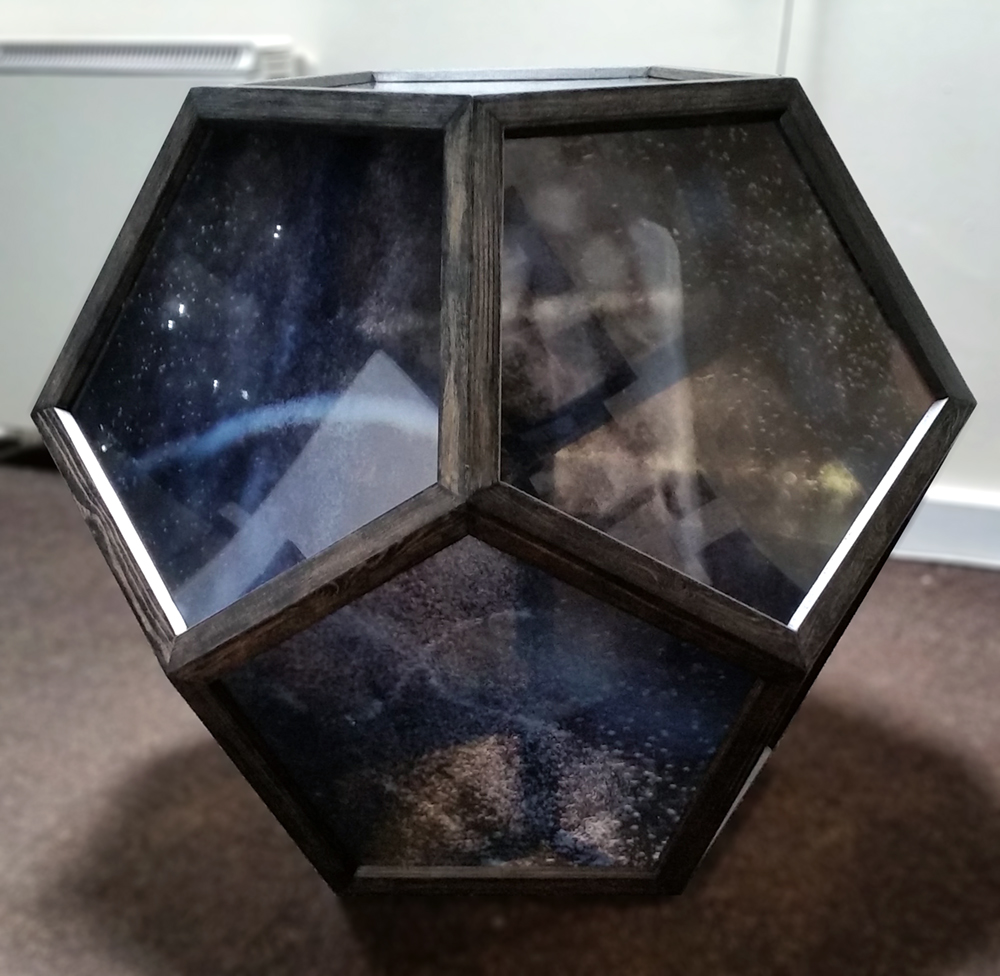
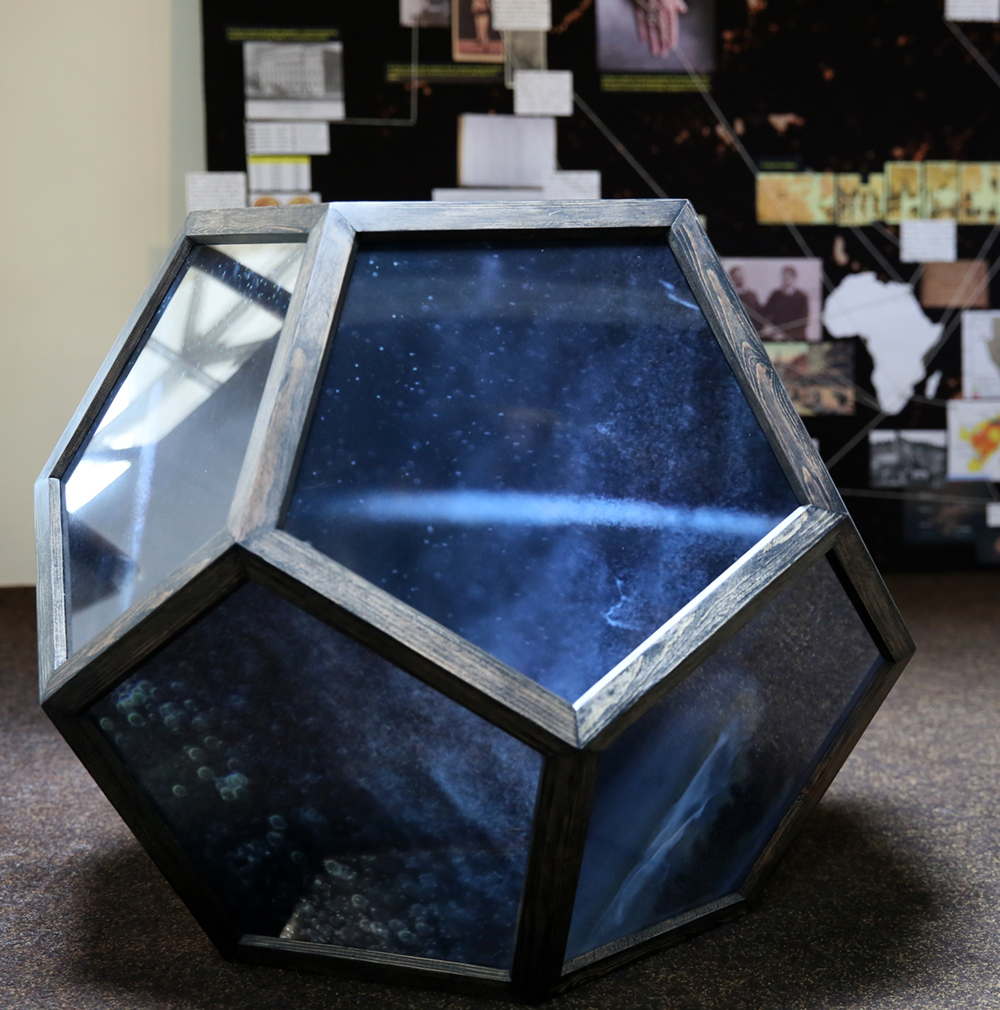
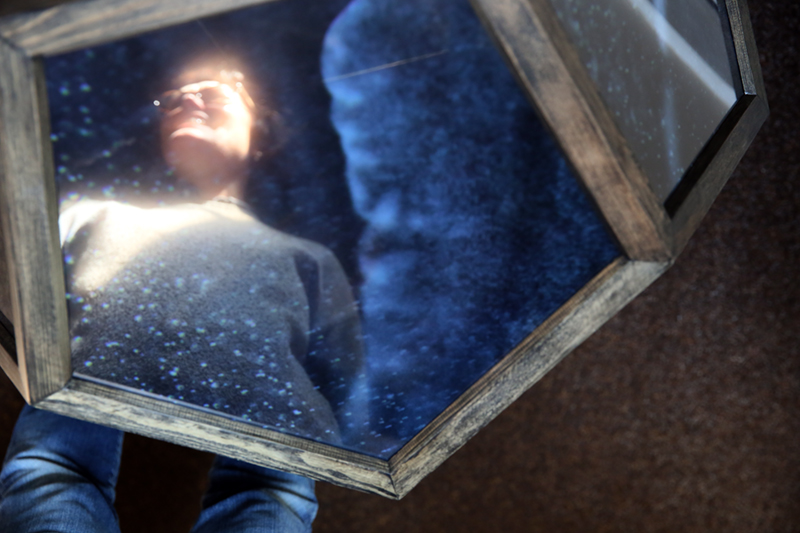
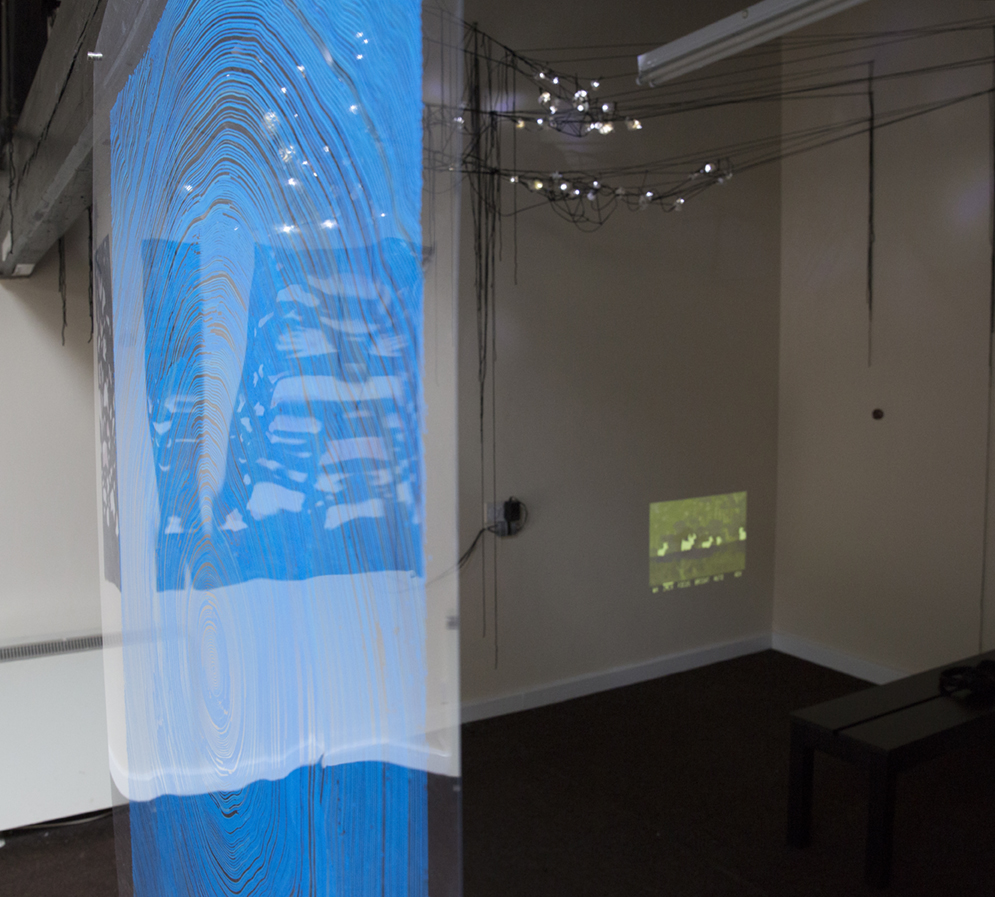
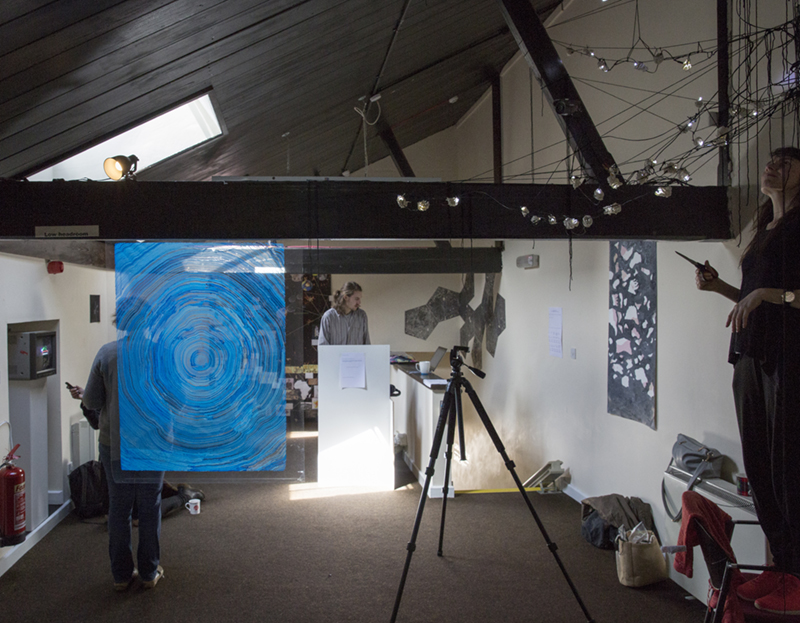
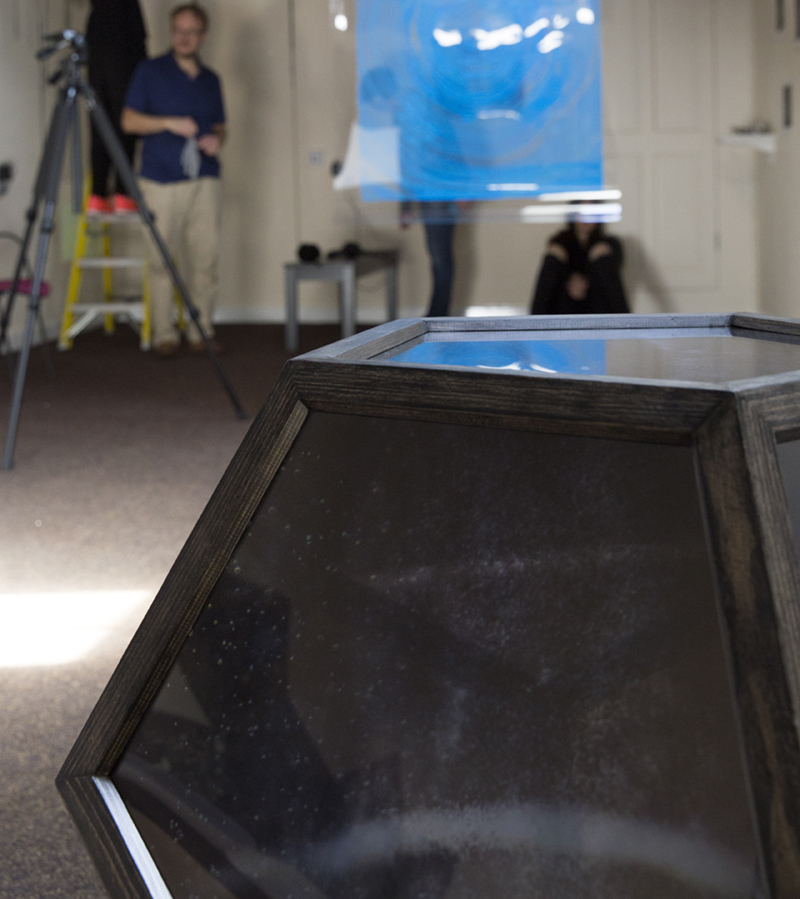
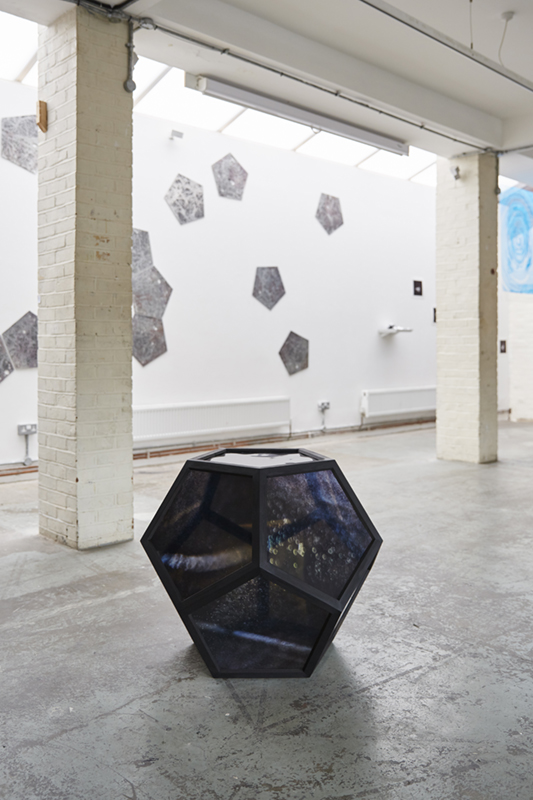
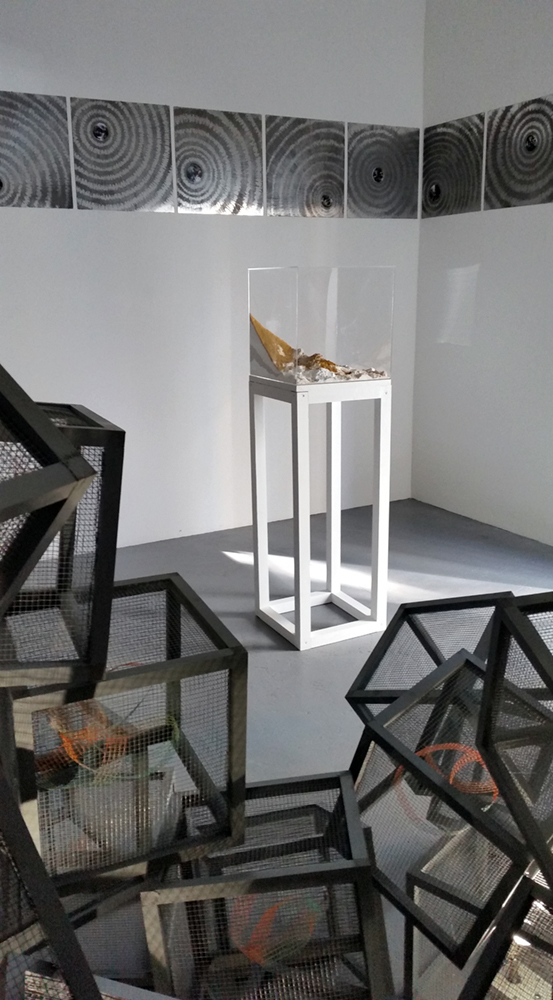
1709 diazographoDiazôgraphô – (Wood, acrylic, digital print) has been reworked since Guest Projects. You can still see through it, but it is more reflecting; you and your surroundings are echoed in it and so it appears you are both surrounded by and surrounding the same space.


1709 diazographo 1

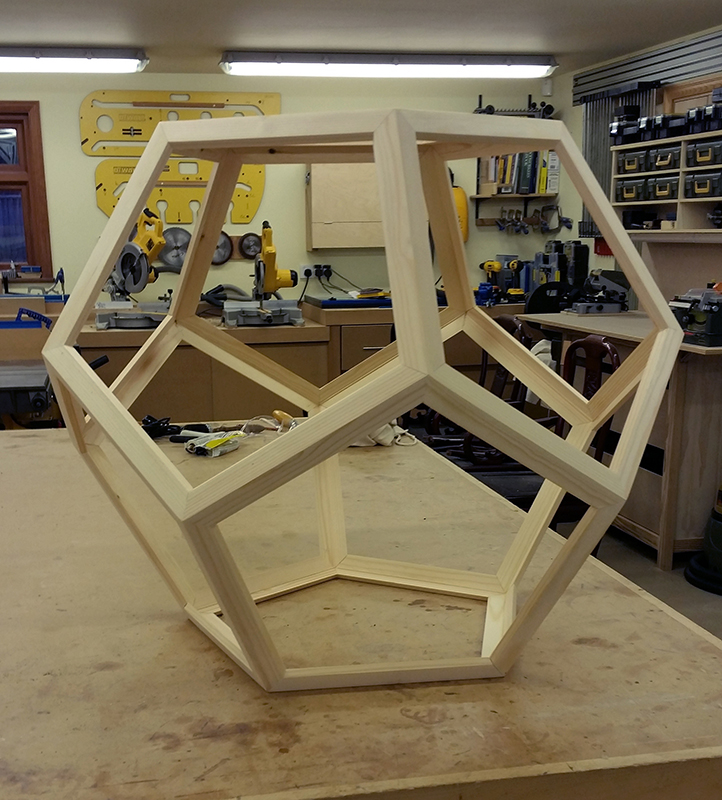
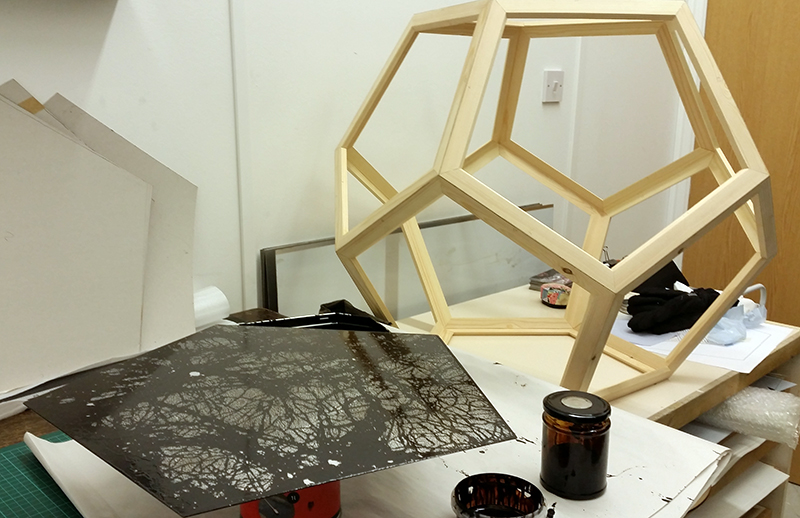
Using the dodecahedron as a motif for the universe I like this quality that draws on Dante’s description of the universe as concentric circles; that the very outer circles also appear to be enclosed by the inner circles and the relationship that this enfolding space has to a 3-sphere and Poincaré dodecahedral space. Plato described the dodecahedron as ‘a fifth construction, which the god used for embroidering the constellations on the whole heaven ’  so it works as a metaphor for dark matter too – a phenomena that binds the galaxies together.

1709 The Forms
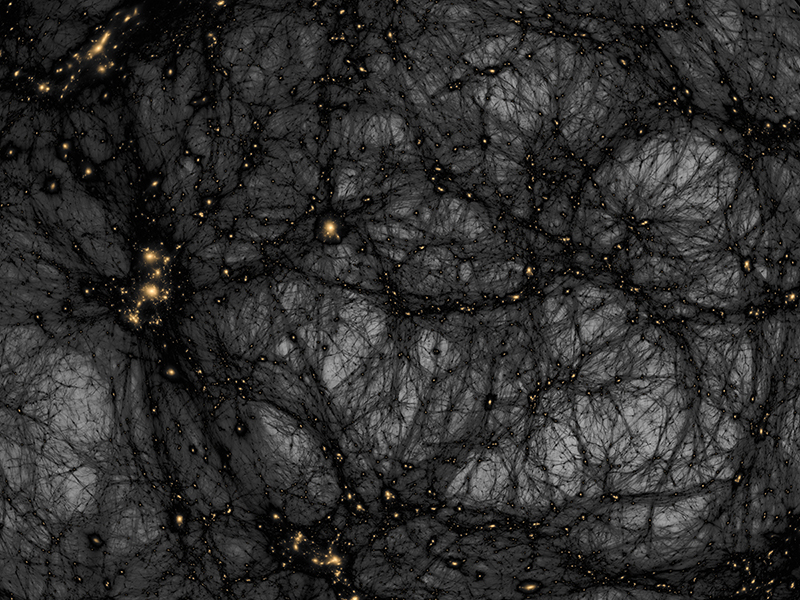
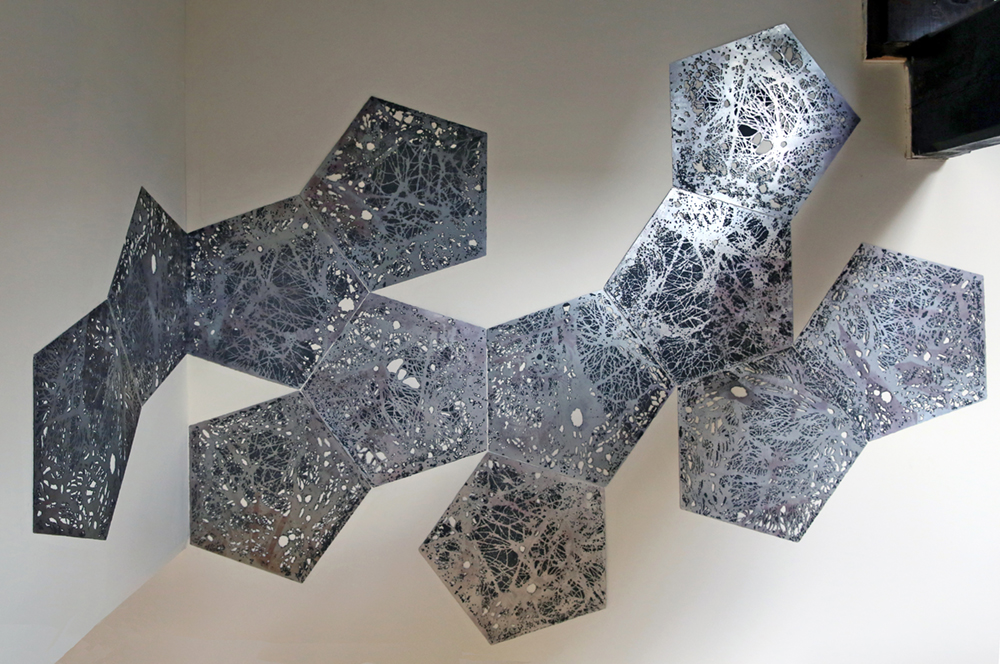
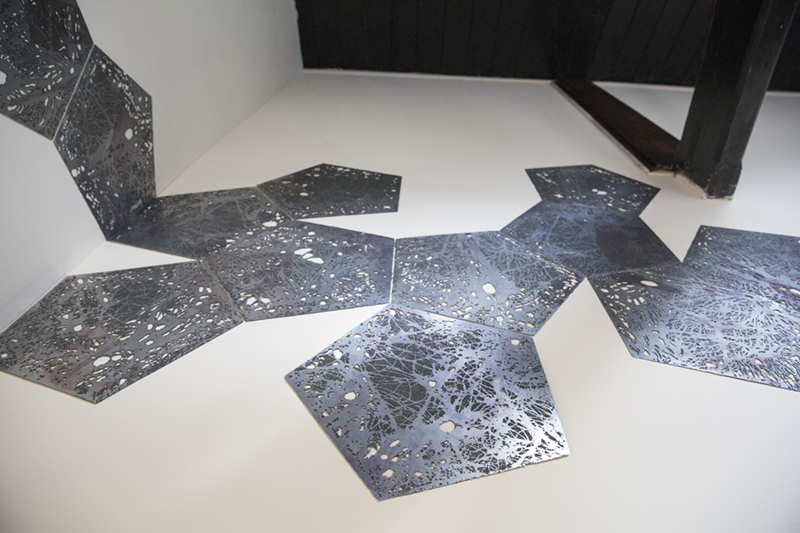
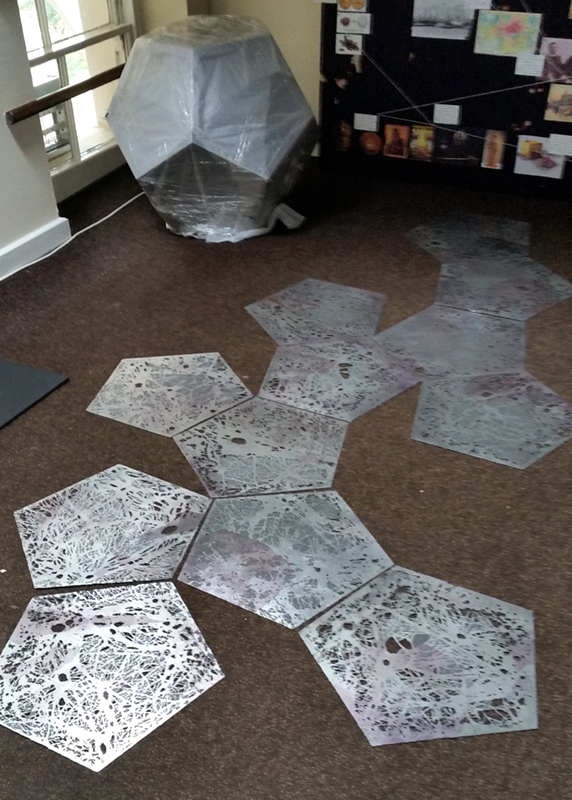
The Forms – (Etched aluminium) Installed in a new configuration here as a net that together would build a dodecahedron. In scientific visualisations of dark matter we see familiar organic patterns emerge; the fronds of dark matter spanning galaxies could be the spreading branches of trees or the veins under our skin. The realm of abstract thought Plato called The Forms is where ideals reside, outside the limitations of the physical world and where, if anywhere, paradise might be found.

Some work by the other Laboratory of Dark Matter artists was new, some reworked or given new context

1709 CIMM exhibition 2

Amy Gear Nudge – (Painting on unstretched canvas)  Reflecting on video footage from a Women’s Self Defence and Green Screen Workshop run in collaboration with martial arts expert Jiff Higman, the work employs the body as a tool to help describe the incomprehensible notion that only 5% of the universe is visible to us; the bodily contact through self-defence actions related to the contact scientists are hoping for when a dark matter particle ‘nudges’ the nucleus of the target element (Xenon) and causes a recoil that can be recorded.

1709 Elizabeth Murton

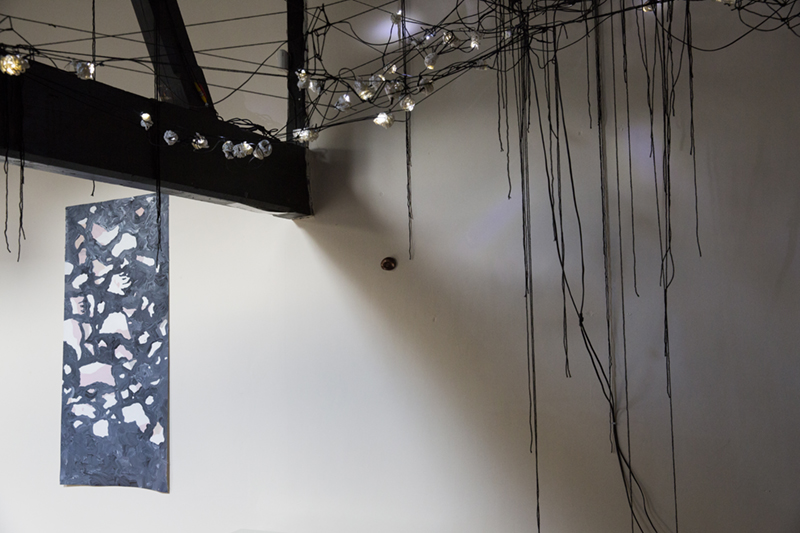
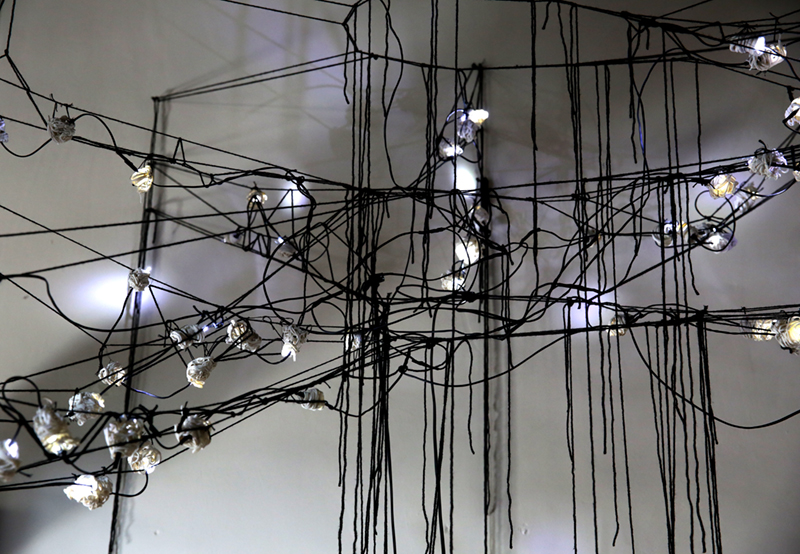
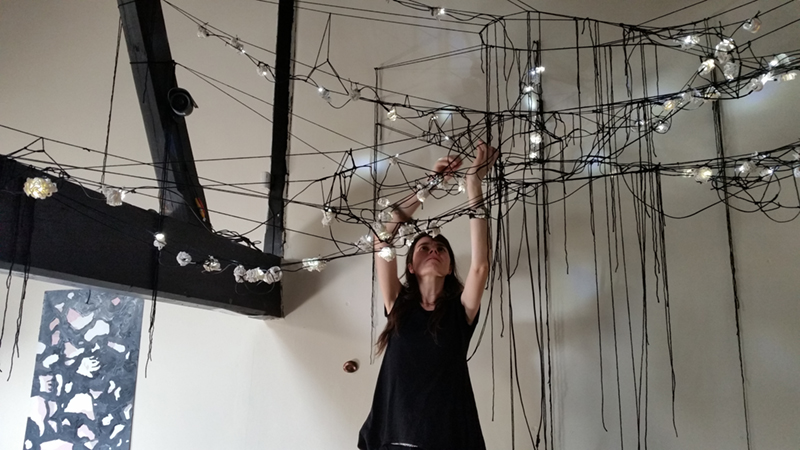
Elizabeth Murton Connective Matter #3 – (Porcelain paper clay, LED lights, wire, yarn), a new site specific iteration in a series creating a connective web of black yarn and illuminated ceramic objects made by spinning clay, like the spinning which forms planets, stars and galaxies from the matter of the universe. We cannot see dark matter directly, only infer it indirectly from observations such as the spin of the galaxies and gravitational lensing and so must speculate its structure and role in the universe.

1709 CIMM exhibition 3

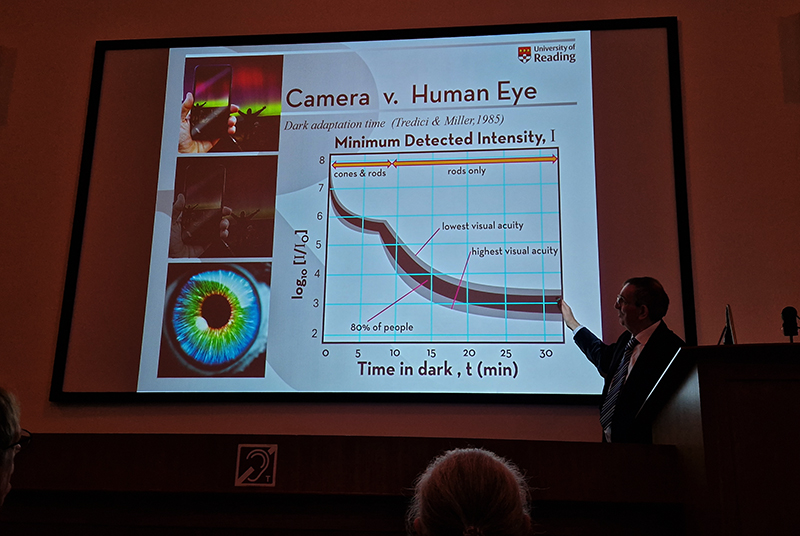
KATE FAHEY Optimistic – (Copper and resin); Dark Adaptation – (Digital video with two channel audio) calling on lost lore and old forms of knowledge to negotiate technology and scientific advancement, the work seeks to establish a speculative relationship between dark matter, dark adaptation, the lectures of Rudolf Steiner on the practice of divining and John Carpenter’s film They Live, where the main character discovers sunglasses that reveal an alternative reality.  Dark adaptation refers to the ability of the eye to adjust to various levels of darkness and light.

1709 Daniel Clark.jpg

Daniel Clark Projected Chamber – (Giclée print) describes a potential space, a chamber that exists only through a distortion of light captured at the moment of creation.

1709 CIMM EXH.

Veil – (Pigment on archival polyester) examines ways of visualising or mapping the invisible and the transference of imagery from intriguing and unexplained sources. A vinyl cutting machine was programmed to draw with a marker pen instead of to cut, reimagining the single line engraving of the Face of Christ, known as the Sudarium of Saint Veronica, by Claude Mellan from 1649.

1709 Luci Eldridge

Luci Eldridge Untitled (Dark Matter, Reconstructed) – (3D print with silver leaf, privacy screen filter) In 2007, a group of NASA and ESA scientists led by Richard Massey constructed a three-dimensional map offering the first look at the web-like distribution of dark matter in the universe. This 3D model reassembles this data to present the invisible as a cluster of abstract forms. The intangible is objectified as a collection of shiny entities reminiscent of early sci-fi aesthetics.
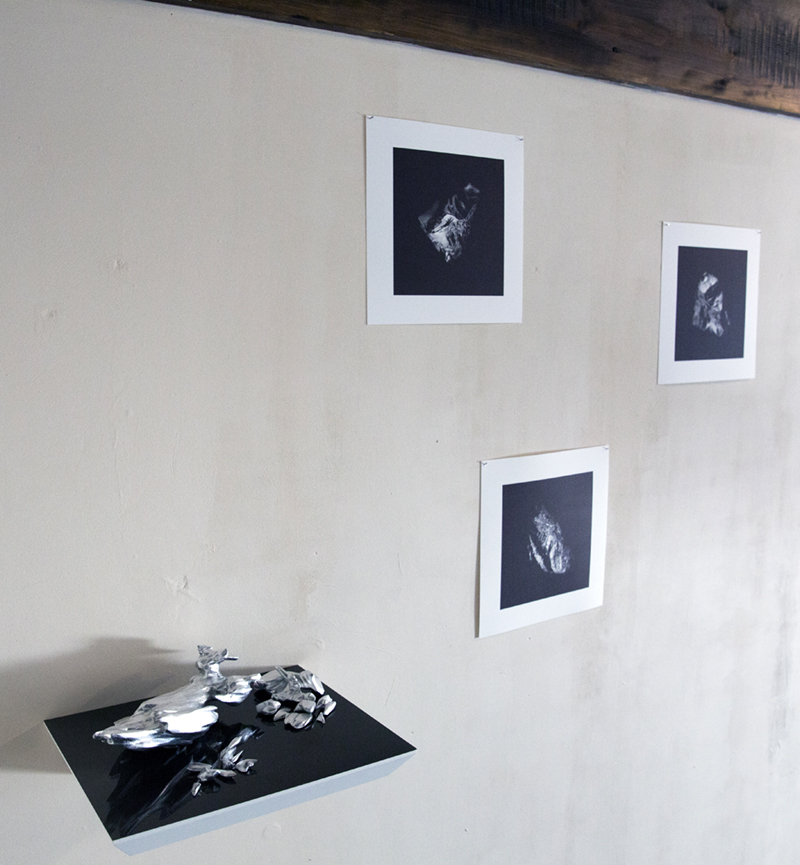
Germanium Fragments I-VI – (Duotone photo-lithographs) Germanium is one of the elements often used in the detection of dark matter. The lithographs depict tiny fragments of this lustrous grey metalloid, the surfaces reflecting the dazzling lights of the scanner bed on which they were imaged. Combined, the prints and 3D model play with limits of visibility, the boundaries between surface and depth and the loss of any kind of sense of scale.

1709 Melanie King

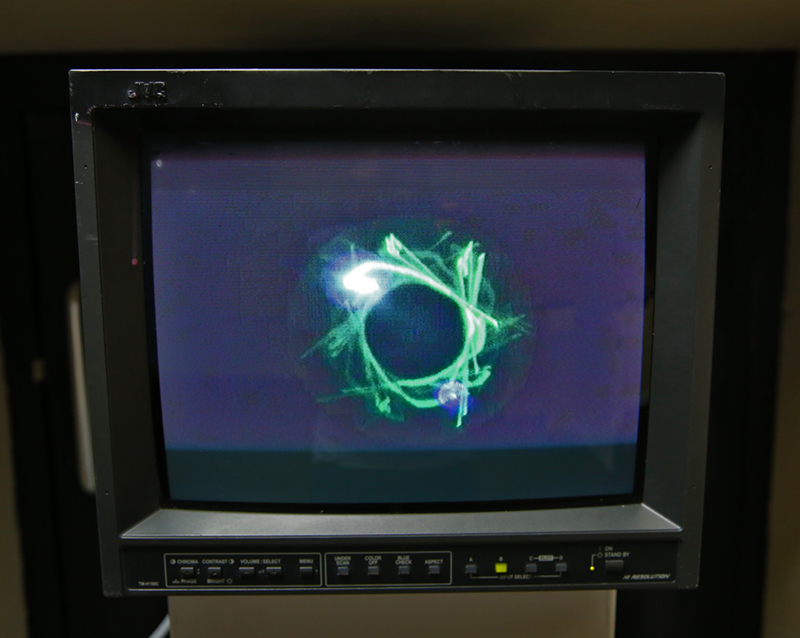
Melanie King Cosmic Ray Oscillograph – (Phosphorescent spinning disc, solenoid, laser, data from LUX video credit: Euan James-Richards) A laser light is sporadically jolted across a rotating disc coated in phosphorescence by a solenoid translating wave form data captured from the Large Underground Xenon Dark Matter detector. The data is transformed to an audio signal using computer coding techniques and represents cosmic rays which have been detected along the way towards finding elusive dark matter. Cosmic Ray Oscillograph, Cameraless Photograph uses direct laser light onto Ilford Multigrade Resin Coated Paper Pearl.

1709 Sarah Gillett

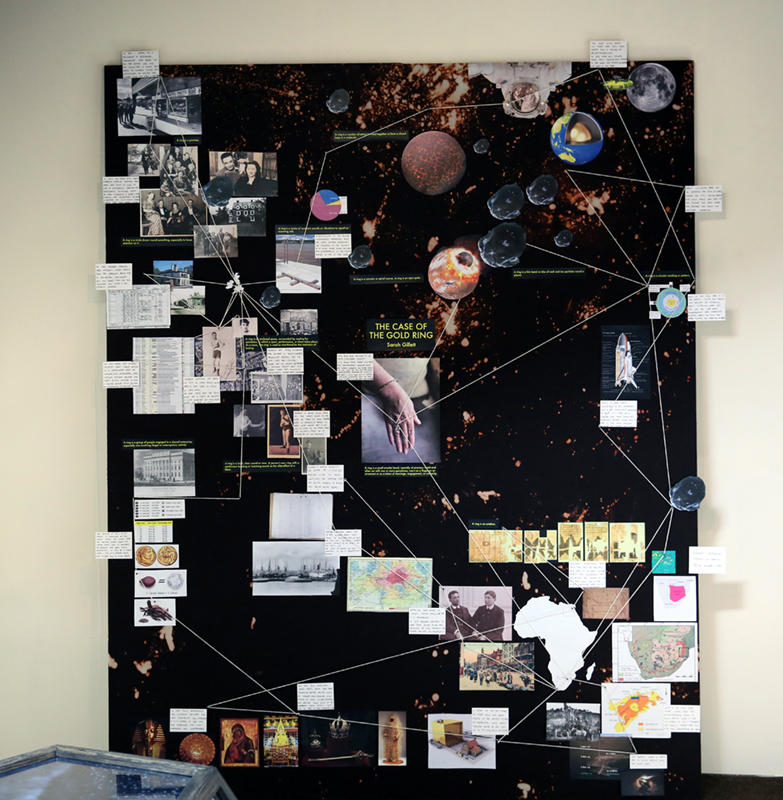
Sarah Gillett The Case of the Gold Ring (research mapping wall) plots the discoveries made while tracing the history of her Mother’s gold ring; it’s unique personal journey as well as it’s cosmic origins. The ring becomes much more than a circle of gold as connections are made across space and time, from the boxing ring to the financial bullring and the asteroid belt.

1709 Peter Glasgow

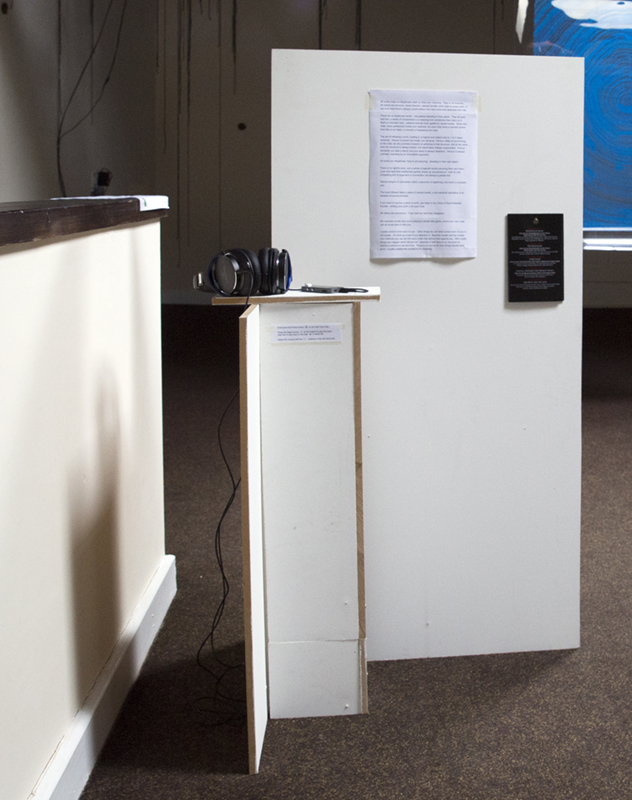
Peter Glasgow The Indicators of Illusive Ideas – (Audio and text) frames itself as an attempted commentary, and plays with the notion of producing a commentary on something in the world. It’s about language, and format, and ways of stringing ideas together. It finds a narrative about art practice within another narrative from popular culture, speculating on making in terms of loyalty and legitimacy. It is a contemplation on the commentaries that run alongside a process; the attempts to get close to something but failing.

1709 Robert Good

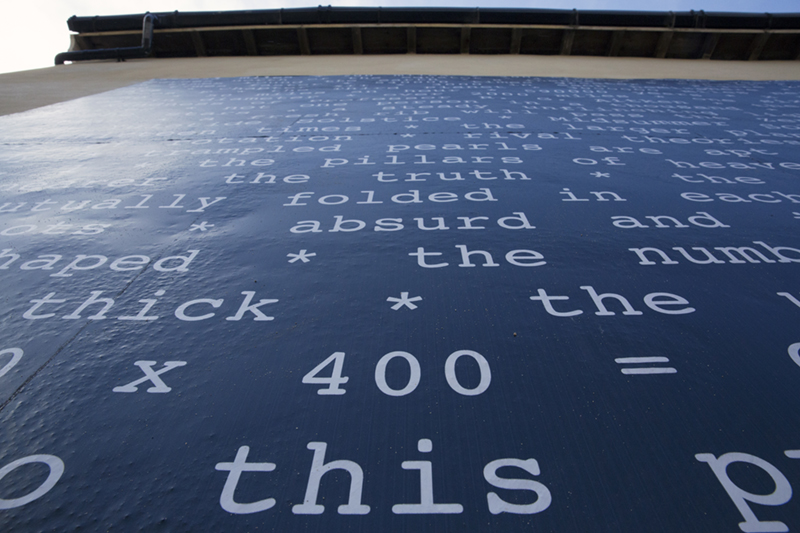
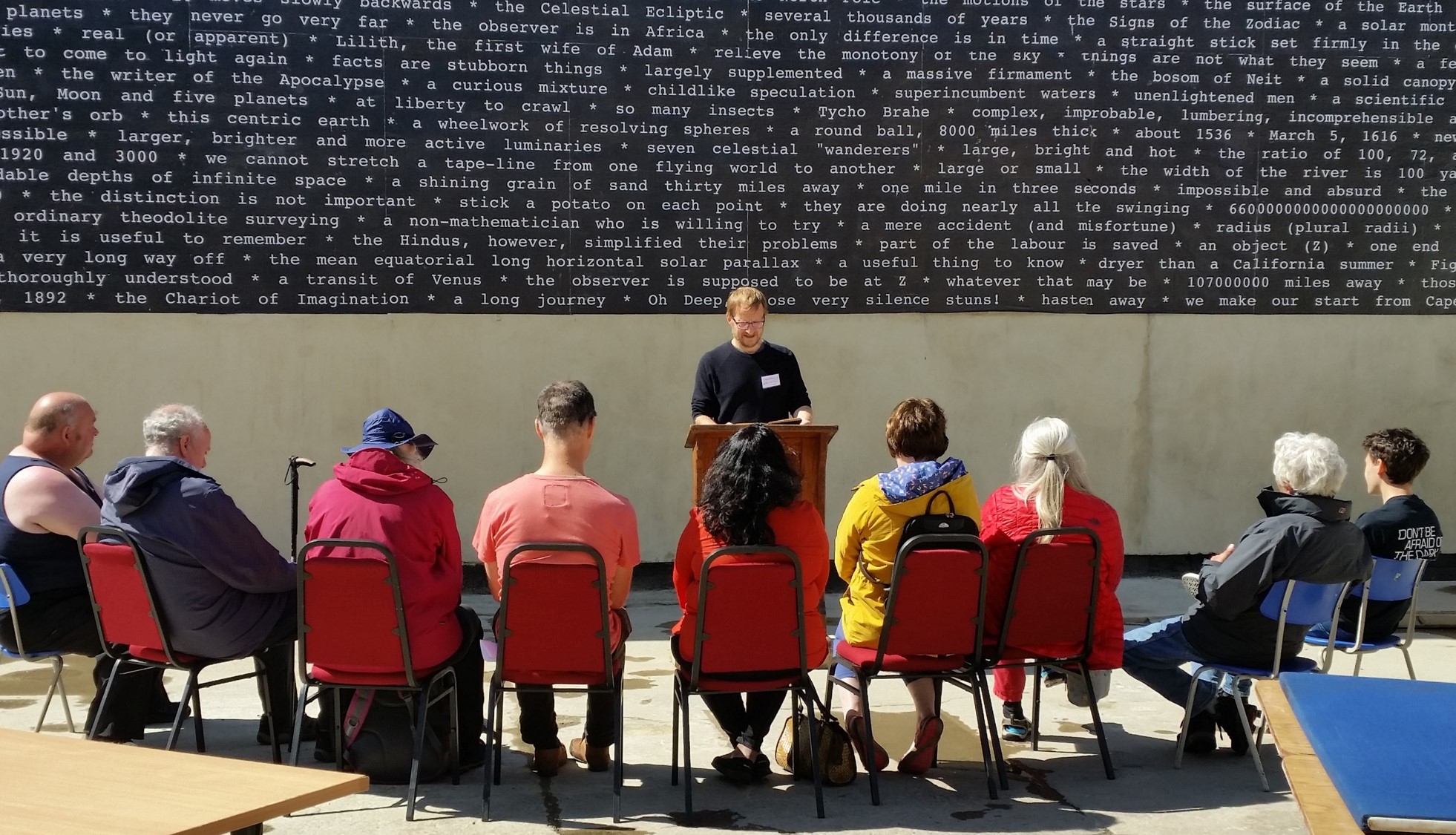
Robert Good How To Know The Starry Heavens – (Text fragments) Selected text snippets from Edward Irving’s book of the same name are set on a vast dark backdrop to appear from a distance like a sparkling galaxy of stars but close up to spark our imagination with language full of wonder.1709 Cimm diazographo light

I was invited by the Institute of Physics to write a blog about Laboratory of Dark Matters  read it here –  IOP BLOG   …. The visit to Boulby Mine was a catalyst for us to develop new artworks reflecting our personal responses to dark matter research and the broader issues it touches upon…

1709 talks promo

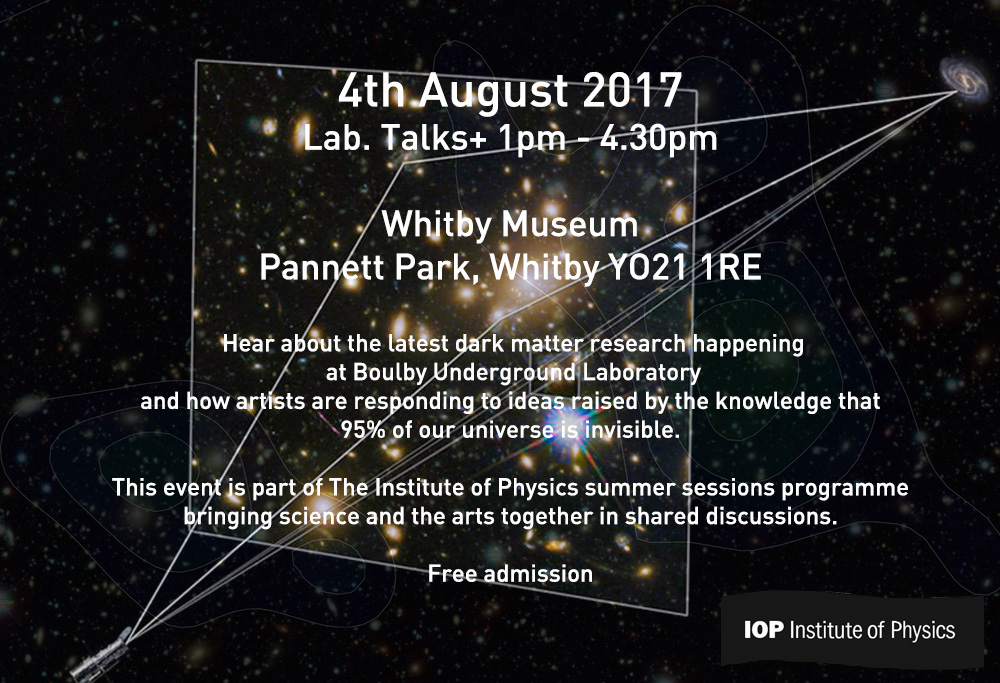
As a satellite event to the exhibition at Cleveland Ironstone Mining Museum we had additional sponsorship from the Institute of Physics to host an afternoon of talks at Whitby Museum as part of their summer sessions initiative to bring the arts and science together in a public forum. Emma Meehan from Boulby Underground Laboratory introduced a video tour of the facility led by Chris Toth who gave an entertaining and informative account of life 1100m below ground and the experiments that take place there.

Sara Gillett delivered her performative lecture ‘The Case of the Gold Ring’ that animates and coalesces her research presented in the exhibition and Dr Cham Ghag gave another of his incredible accessible lectures on what dark matter is not, what it might be and how it might be detected.

We were also joined by Dr Sarah Casey, artist collaborator in the brilliant project Dark Matters – Interrogating thresholds of (Im)perceptibility through Theoretical Cosmology, Fine Art & Anthropology of science,  an exciting study into radical imperceptibility or more specifically, the provocations and challenges presented to theoretical cosmology, fine art and anthropology of science, by entities, forces and dimensions that currently (or perhaps will always) exceed human and technological modes of sensing and comprehension.

1709 dark matters video

Encounters at the thresholds of human understanding, sensing, knowing, or the possibilities of relationship with the nonhuman – and the vulnerability and exhilaration that these cause – are intrinsic to the project’s methodology. On the one hand, claims from cosmology that 95% of the universe is made up of invisible dark matter and dark energy, or that it is possible to mathematically predict the existence of many more dimensions than we are aware of in our known and knowable universe, presents immediate challenges for all three disciplines as they play at the limits of sensibility and relationality with regards to human to nonhuman encounter. How to think and practice with these provocations? On the other hand a different set of challenges are inevitably posed by the complexities and endless possibilities for (mis)understandings by interdisciplinary conversation.

1709 Sarah Casey 1

Sarah Casey

For the theoretical cosmologist, when faced with the imperceptible, the imperative is to produce and contest evidence – to ultimately reveal the imperceptible or negotiate the status of the role of speculation. For the artist, the interest lies in interrogating thresholds between the seen and unseen, known, unknown and unknowable, through art practice to enable critical and poetic reflection. For the anthropologist, the category of the imperceptible provokes a questioning and further pushing of the limits of human subjectivity, experience and sensibility in relation to the inhumanly (un)manifest.

The excellent accompanying Dark Matters  video is deservedly shortlisted for the AHRC research film of the year.

A sensual treat while back in London was Wayne McGregor and Random International’s collaboration +/- Human at the Roundhouse. Extraordinary dancers and extraordinary machines. Uplifting. Disquieting.

1709 plus minus human

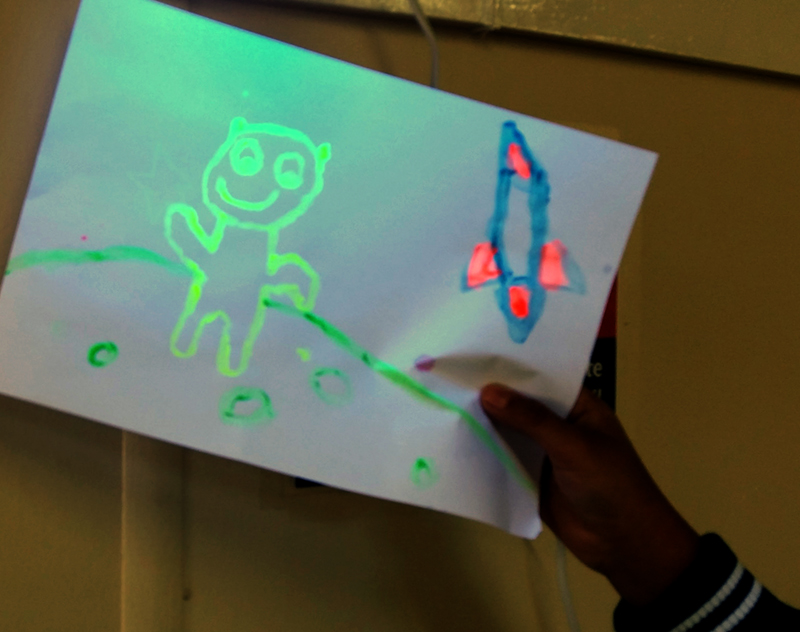
Laboratory of Dark Matters final event at Cleveland Ironstone Mining Museum was the dark matters themed open day with dark matter life drawing in invisible ink…

1709 CIMM Open Day dark matter life drawing

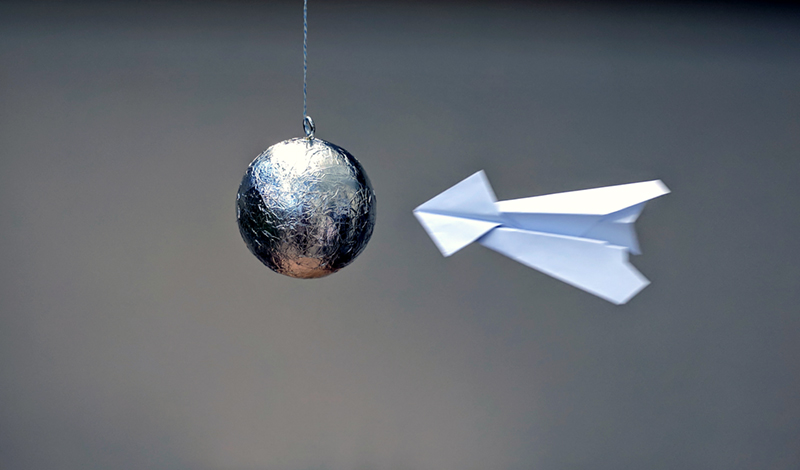
…make a dark matter particle plane and fly it to hit the xenon nucleus target……

1709 xenon nucleus target

…tours of the exhibition…..

1709 CIMM Open Day gallery tour (2)

…Robert Good reading from Edward Irving’s 1905 book How To Know the Starry Heavens. He was also encouraging visitors on the day to write their own snippets for a group collage in reply to – What do you think about when you look up at the sky at night?

1709 Robert Good 2

Lots of other activities like Hunt the WIMPS where small shapes denoting particles that were not WIMPS were hidden around the museum site  –  these could be found because they were not WIMPS…

1709 CIMM Open Day Activitiy tent

….Chris Toth and Emma Meehan from Boulby Underground Laboratory were on hand to answer the science questions and help out with a dark matter quiz…

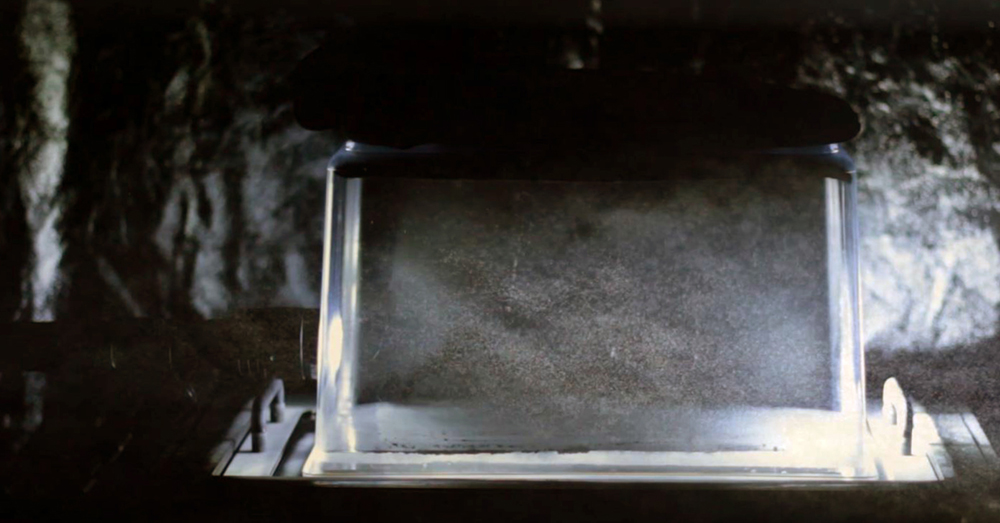
and a final chance to see cosmic particle trails in the cloud chamber.

1709 cloud chamber1709 cosmic trail

I met Jessie Sheffield and Lauren Ilsley during a cloud chamber workshop at Guest Projects. We subsequently found we shared interests in how we perceive the world around us and I was invited to join [ALLOY] in presenting new work for the exhibition Supposedly Predictable Phenomenon at no format Gallery as part of Deptford X.

Planning new work my first thoughts were naturally Heisenberg’s uncertainty principle and thinking about natural phenomena. The shape of a raindrop, bacteria, magnets, wind, water, electricity, bending light, bouncing photons, dark photons, optic boom, special relativity. I get fixated on the 12 sides of the universe and start mapping out a sequence of 12.

1708 studio test

My studio is too small. I think about decisions, prisms, scattered light. If I use steel I could use magnets. I don’t have time to etch plates and print them. I think about quantum leaps, band widths and atoms. Electrons appearing and disappearing. Moving between possible multiverses. Transforming in new configurations. Circling the nucleus. A portal. A panorama. A dopler shift. How to be random?  I throw ink soaked kitchen roll and mark the spot on twelve targets.

1709 random start points

I decide to use softground on aluminium – an unpredictable process

1709 applying softground

Charbonnel softground smells of woodsmoke. It feels right for autumn. I draw concentric circles into the wax

A satisfying peel

Nature echoing art again.

The etching process is full of rich colours and smells. Softground on aluminium in copper sulphate is a violent etch. The heat is palpable before I reach in to pull out the plate, the wax bubbles and the blue solution darkens and smokes; I pull the plate out when it feels that any longer, it might ignite

1709 etch process

it already feels cosmic

1709 removing stopout

Each plate takes a long day to prepare; sanding and degreasing, painstakingly rolling on the softground for an even coating , fixing the paper taught and drawing with enough pressure to imprint into the wax, peeling away the image with the paper and finally etching.

1709 peel and etch (1)

Aluminium has a grain that grabs any direct light and powers it into a bright band.  It seems to absorb and glow with any colour in the room. I really like this metal.

1709 test light on etch.jpg


1708 Boulby Mine

Time to return to the North East.

Amidst the preparations to take Laboratory of Dark Matters to Cleveland Ironstone Mining Museum was the honour of being invited to sit on the judging panel for the Guest Projects residency proposals for next year. It was a big responsibility and involved quite a lot of hours reading through proposals but was also incredibly useful in understanding how to put together a successful proposal. In the end there just isn’t time to follow every link and read every nuance – it has to be clear and succinct. Was a real treat to have dinner with Yinka Shonibare and chat about why he decided to set up the residency program (- to give back and remain engaged, remembering why he became an artist in the first place) and to hear how he can cut through any nonsense in the proposals, he is looking for commitment, effort and originality and he has no truck with ‘men’s issues’. Was great fun and dinner was delicious.

1708 Yinka Shonibare

Another pleasure was receipt of the commissioned essay responding to the ideas that surfaced during Laboratory of Dark Matters from Chantal Faust. It is a text that can be read over and over and keep giving. It will be published to coincide with international Dark Matter Day on 31st October in an original layout by Daniel Clark.

1708 publication

Having secured funding from the IOP and STFC we were able to install the exhibition at Cleveland Ironstone Mining Museum in July just in time for the tourists visiting over the summer holidays. This is where the funding we received really helped,  covering our transport and accommodation costs, artwork materials, printing and general installation. It was also good to be able to pay artist fees, enabling artists who work freelance and do not have regular salaried income or research grants to be able to participate.

Cleveland Ironstone Mining Museum were excited by the prospect of hosting an exhibition on dark matter and the local connections to Boulby Mine just 8 miles up the road.

1708 CIMM

We were met by real warmth and a can do attitude from everyone at the museum. This was the first time they had hosted an exhibition of contemporary art and we were away from our usual networks of support and infrastructure so it was a learning curve for us all.

One of the main challenges for us working in a remote location was travelling and forward planning to have everything we needed when we got there. We had to rely heavily on the museum for marketing and preparations for our visit. We were very lucky to be hosted by a venue that offered us so much support – they totally transformed this room ready for us to install our artworks

1708 CIMM before

We rented a cottage in the local village of Hinderwell, which coincided with their scarecrow festival, while we were spending time at the museum installing work.

1708 Hinderwell Scarecrow

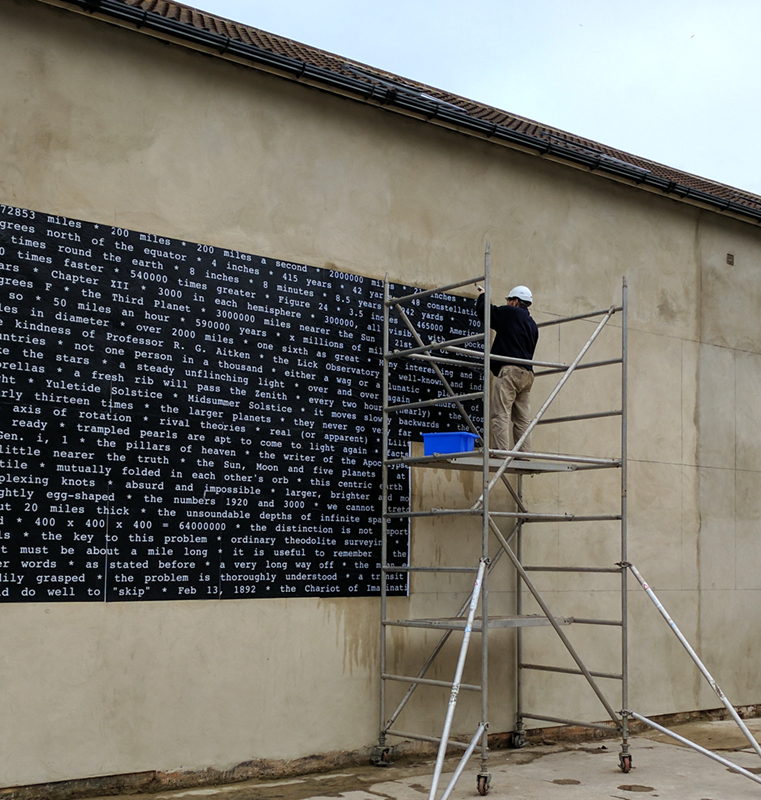
Artist Robert Good joined us at the mining museum to present an ambitious installation – How To Know The Starry Heavens  – a billboard sized collage of text snippets selected from Edward Irving’s book of the same name written in 1905.1708 Robert Good Installing

Elizabeth Murton installed a new site specific iteration of Connective Matter #3, a web of black yarn and illuminated ceramic objects made by spinning clay, like the spinning which forms planets, stars and galaxies from the matter of the universe.

1708 Elizabeth Murton installing

I tried a new configuration of The Forms in a dodecahedron net formation over the stairwell.

1708 CIMM install The Forms plan

Mapping out the universe/

1708 CIMM install The Forms

/mapping out the exhibition space

1708 CIMM installation in progress

1708 CIMM installation in progress 2

We made a visit to meet the excellent team at Whitby Museum in preparation for the afternoon of talks we were planning as part of the Institute of Physics Summer Sessions initiative.

1708 Whitby Museum

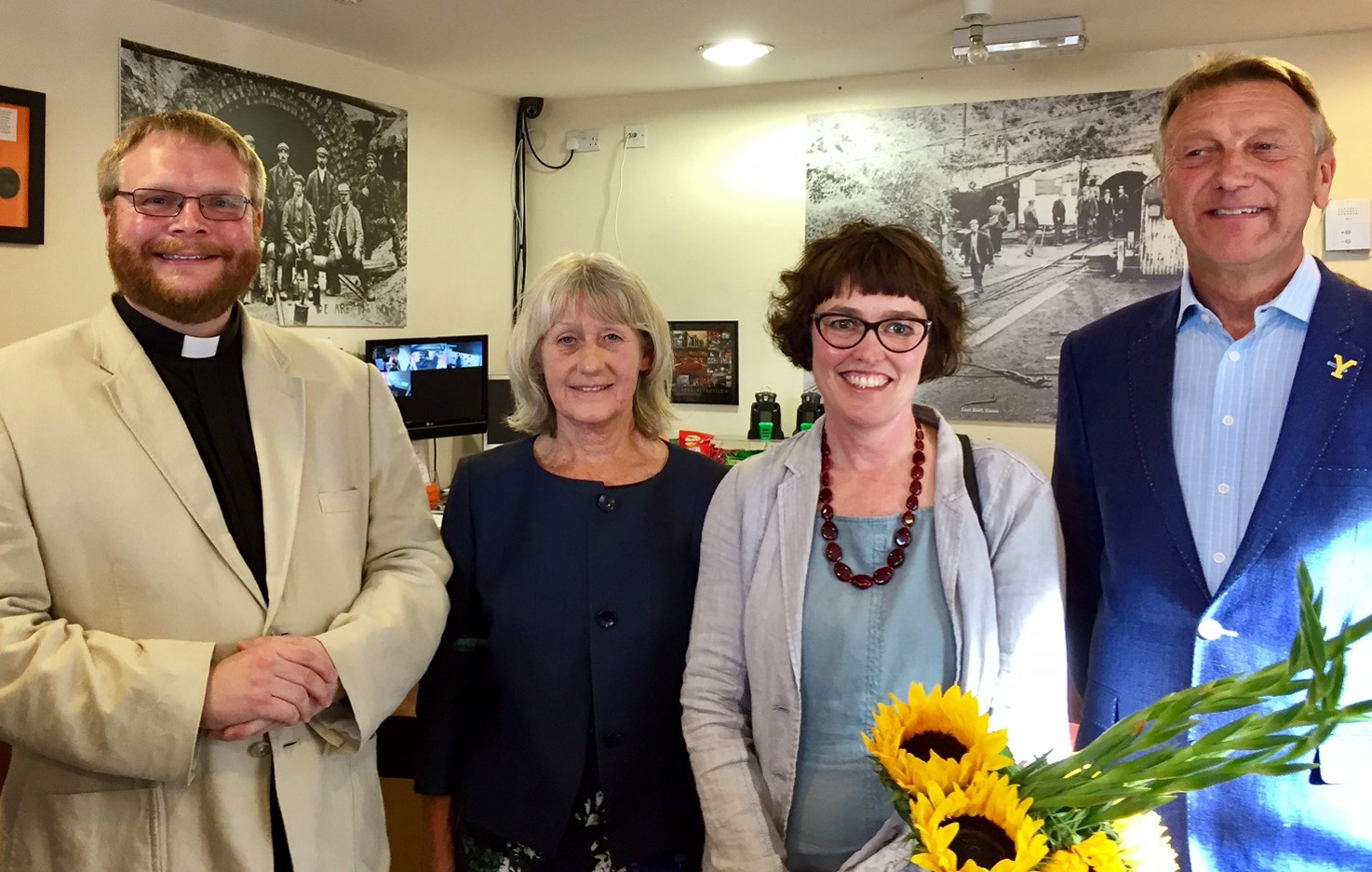
Our Private View was very well attended by people local to the mining museum, the Board of  Trustees including Vice-Chair Fr. Adam Gaunt and even Mr Barry Dodd CBE Lord-Lieutenant of North Yorkshire who gave a speech commending the museum on their enterprise and promising to mention his visit in his report to the Queen.

1708 Private View

Boulby Underground Laboratory was well represented by scientists Chris Toth and Emma Meehan. The last time we met was over a year ago and 1100m underground.

1708 CIMM PV

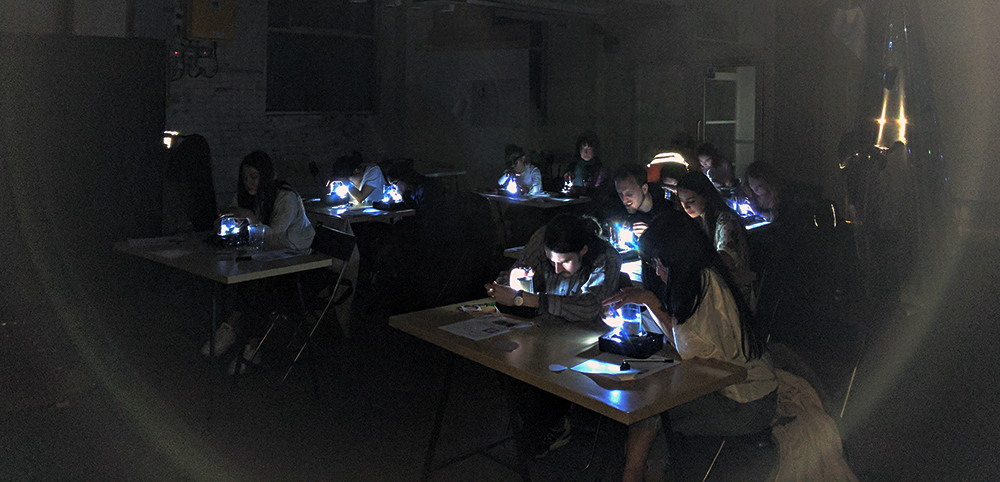
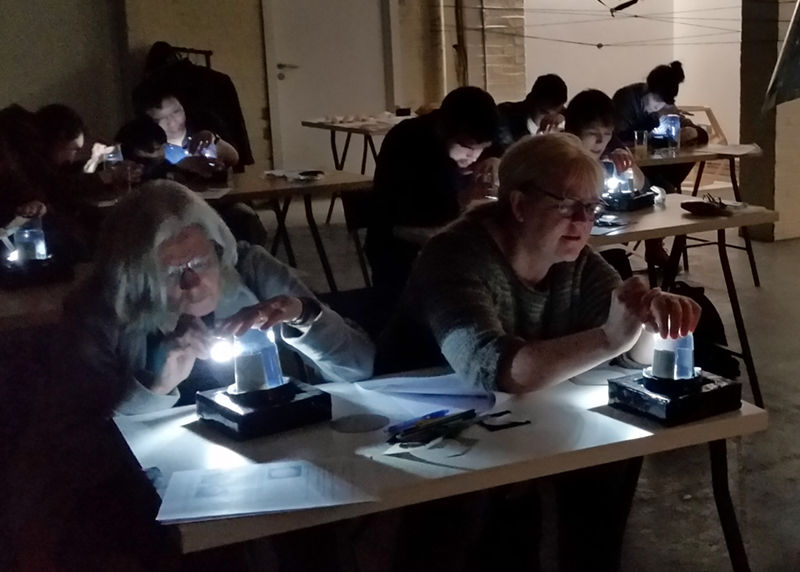
We ran a series of workshops developed from those at Guest Projects. We wanted our workshops to be grounded in science and to also have a creative element. Thinking about different ways of making the invisible visible, the cloud chamber workshop was a good way of showing the activity of particles around us that we are unaware of until we see the trails they leave as they pass through and around us as they hurtle across our world.

1708 CIMM Cloud Chamber

I don’t think we experienced the same level of  particle activity as we did in London and I’m not sure why that was. The cloud chamber gives us a glimpse into the invisible world of particles produced in the radioactive decay of naturally occurring elements and those generated when cosmic rays strike the top of the Earth’s atmosphere.

1708 cosmic trail

Melanie King ran more of her illuminating workshops expanding on her Cosmic Ray Oscillograph ideas explored in the exhibition, allowing participants to experiment with phosphorescent powder and laser lights.

Events were underway….

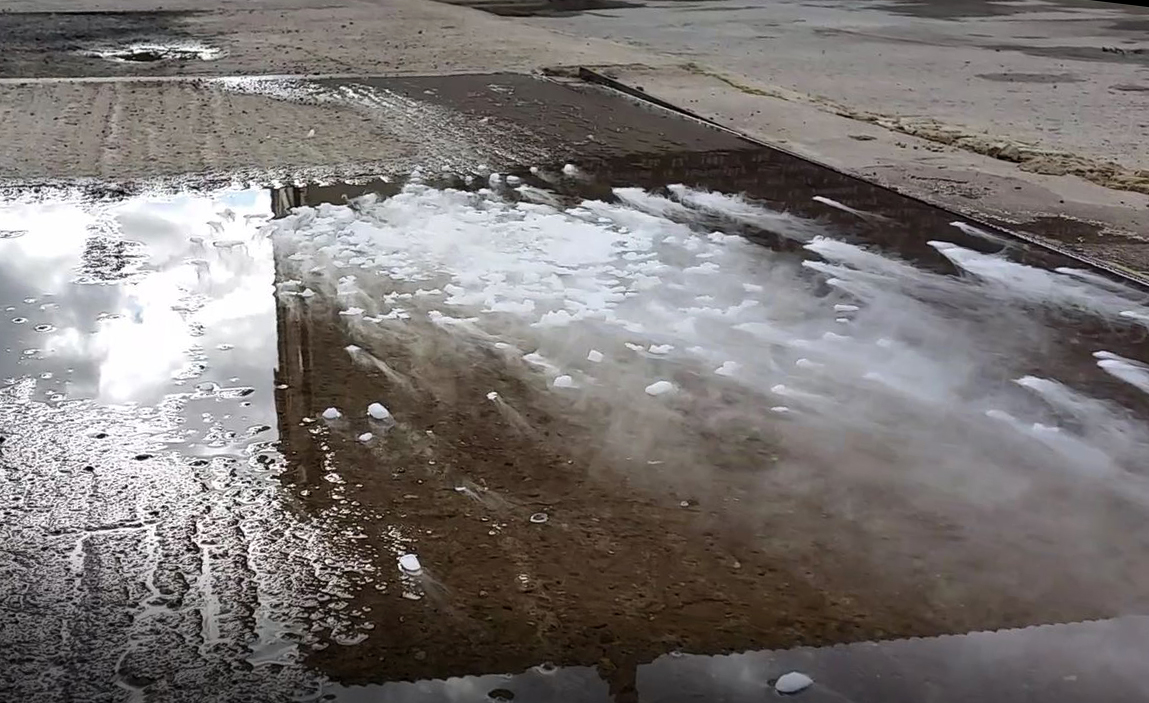
1708 dry ice


An occasion on which one is reminded of the state of things in the real world.

Carlo Rovelli was at Second Home discussing his book Reality Is Not What It Seems: The Journey To Quantum Gravity which presents the story of the human imagination and reveals how the atomic world view first proposed by Democritus nearly 2,500 years ago can be found interwoven through history into our cultural life. It tells the story of what we know about our universe and how we came to know it, from the early atomic intuitions of Greek and Roman thinkers who observed the world about them and came to the conclusion that objects could not be a continuous whole but must be made up of lots of tiny parts.

1706 Susan Eyre Diazographo photo Sara Lynd

Susan Eyre Diazôgraphô photo Sara Lynd

The book goes on to show evidence of the ancient ideas now emerging from the Planck satellite and CERN, to the genuinely new knowledge being offered by Loop Quantum Gravity, of which Rovelli is a founding theorist. He was a generous and thoughtful speaker. When I started his book  I was a little upset to find Plato to be considered obtuse and an obstacle to the progression of physics for ignoring the atomic theories of Democritus and questioning the benefits to itself of why an object should take a particular form, but then in chapter two Plato is absolved of criticism for his pioneering understanding that mathematics is at the root of all scientific truths that ‘Number governs forms and ideas’

1706 Susan Eyre Diazographo 2 photo Sara Lynd

Susan Eyre Diazôgraphô photo Sara Lynd

The talk moved on to discuss the nature of time and how we experience it. Someone quoted Nelson Goodman from 1951 in The Structure of Appearance. ‘A thing is a monotonous event; an event is an unstable thing’.


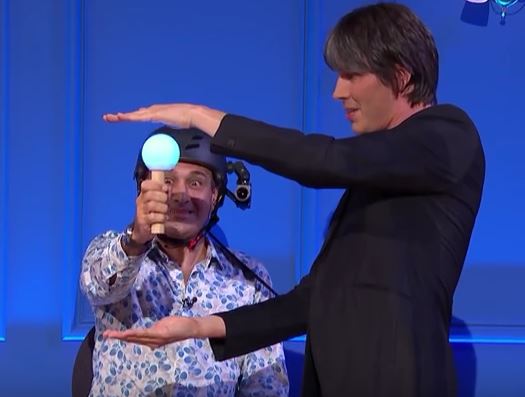
I found this clip of Brian Cox explaining time travel  sort of helpful in that I can follow his explanation but it still leaves me confounded.

1706 Brian Cox

In his book Rovelli equally values the thoughts of poets and physicists who contemplate the same questions about the structures of the universe.

1706 Baptistry Florence

Marvelling at correlations between Dante’s plan of paradise, possibly inspired by the cupola ceiling of the Baptistery in Florence, that speaks of a spherical universe made of ever increasing circles that reach a point where the outer circle appears to be enclosed by those that enclose it – a poetic description of a 3-sphere.

Rovelli believes the universe cannot be infinite – ‘that’s too big ‘ – and he seems aligned with the 3 sphere universe theory that the universe is not infinite but has no boundaries.  I found myself thinking – surely this must still sit within something? Still it was gratifying to find that this in line with Jean-Pierre Luminet and the Poincaré dodecahedral space  which I have been fascinated by –

A positively curved universe is described by elliptic geometry, and can be thought of as a three-dimensional hypersphere, or some other spherical 3-manifold (such as the Poincaré dodecahedral space), all of which are quotients of the 3-sphere.

Another name for the Poincaré dodecahedral space is the soccer ball universe…..

1705 Yinka Shonibare at York Museum

Yinka Shonibare’s work at York Art Gallery as part of Doug Fishbone’s Leisure Land Golf

We are still waiting for any definitive answers about the shape of the universe, whether it is infinite or finite, whether it is flat, positively curved or negatively curved, whether it is simply connected as in Euclidean geometry or like a torus which is flat, multiply connected, finite and compact among many other contributing possibilities. I have been doing some research on the Poincaré conjecture, mostly looking at the diagrams of the mathematical theories.

1706 Poincare's homology sphere

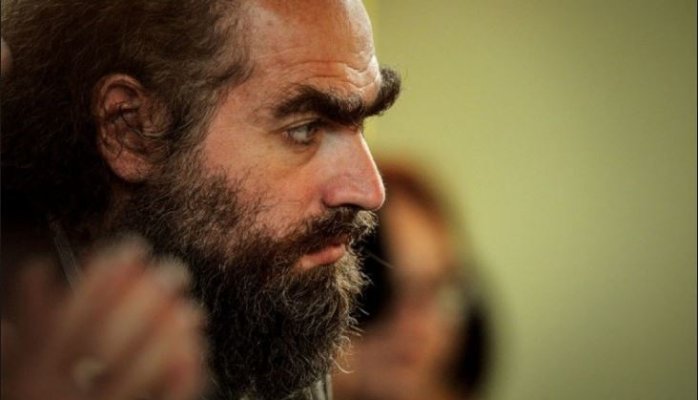
I came across the story of Russian mathematician Grigori Perelman whose theories ultimately  proved the Poincaré conjecture and he was awarded the Fields medal. He declined the award saying he wasn’t interested in fame. Other quotes have him saying if he can control the universe why would he want to claim a million dollars prize money. Perhaps some myths have been built around him, as seems to happen with a person who doesn’t conform to expectations.

1706 Grigori Perelman

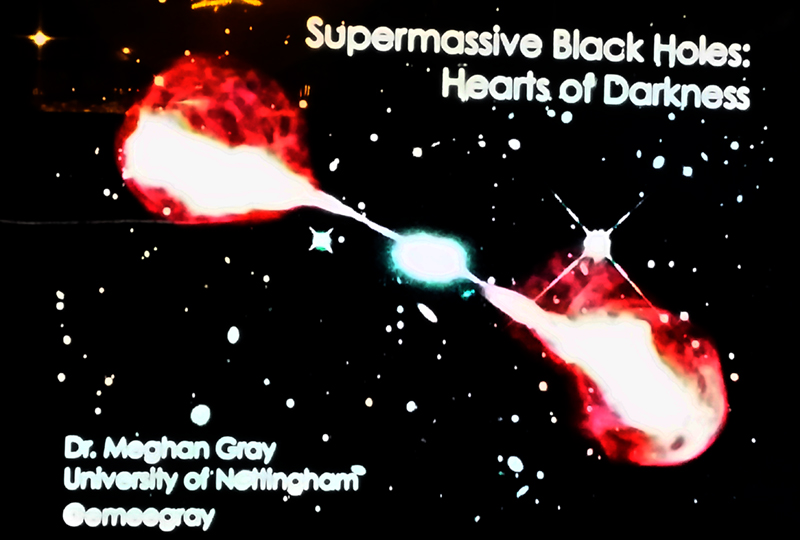
An earlier visit to Second Home was for a talk on Super Massive Black Holes by Dr. Meghan Gray.

1705 Supermassive black holes

I found her description of what a black hole is really helpful to try and visualise what is happening. The idea that space curves around matter. That really dense and heavy matter condensed into a small object makes a deeper pocket in spacetime.

1705 black hole

The largest black holes are called “supermassive.” These black holes have masses greater than 1 million suns combined and would fit inside a ball with a diameter about the size of the solar system. Scientific evidence suggests that every large galaxy contains a supermassive black hole at its centre. The supermassive black hole at the centre of the Milky Way is Sagittarius A*, it is 4 million times as massive as the sun and 27,000 light years from Earth. The smallest ones are known as primordial black holes. Scientists believe this type of black hole is as small as a single atom but with the mass of a large mountain.

The most common type of medium-sized black holes is called “stellar.” The mass of a stellar black hole can be up to 20 times greater than the mass of the sun and can fit inside a ball with a diameter of about 10 miles. Dozens of stellar mass black holes may exist within the Milky Way galaxy.

Information overload awaits you at sixtysymbols

1706 sixty symbols

Made a trip to Whitby for a site visit to Cleveland Ironstone Mining Museum ahead of our Laboratory of Dark Matters exhibition opening this summer.

1705 CIMM tunnel

We were given a very warm welcome and are looking forward to bringing our work to the North East. We are delighted that along with Arts Council England funding we have now received the support of The Institute of Physics and The Science and Technology Facilities Council to take our project to the mining museum.

1706 LODM exhibition supporters

I will be running some more cloud chamber workshops.

1706 Cloud Chamber workshopMy second Open Studios and the first with the new management Thames-side studios who did an excellent job promoting the event, running activities and guiding visitors around what is quite a big site now.

1705 Open Studios Pairi Daeza

Susan Eyre Pairi Daêza

The word Paradise originates from ancient Iranian pairi daêza meaning around and wall.

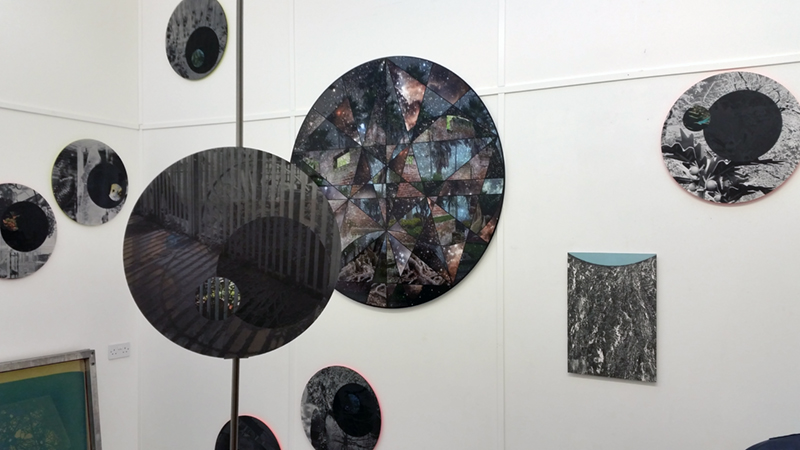
The work everydaymatters is informed by the discovery that the matter we know, that which is visible to us and includes all the stars and galaxies is only about 5% of the content of the universe, dark matter making up about 25% and the remaining 70% being dark energy, it dissects landscapes to discover the hidden structures of the universe.

170519 Open Studios (2)

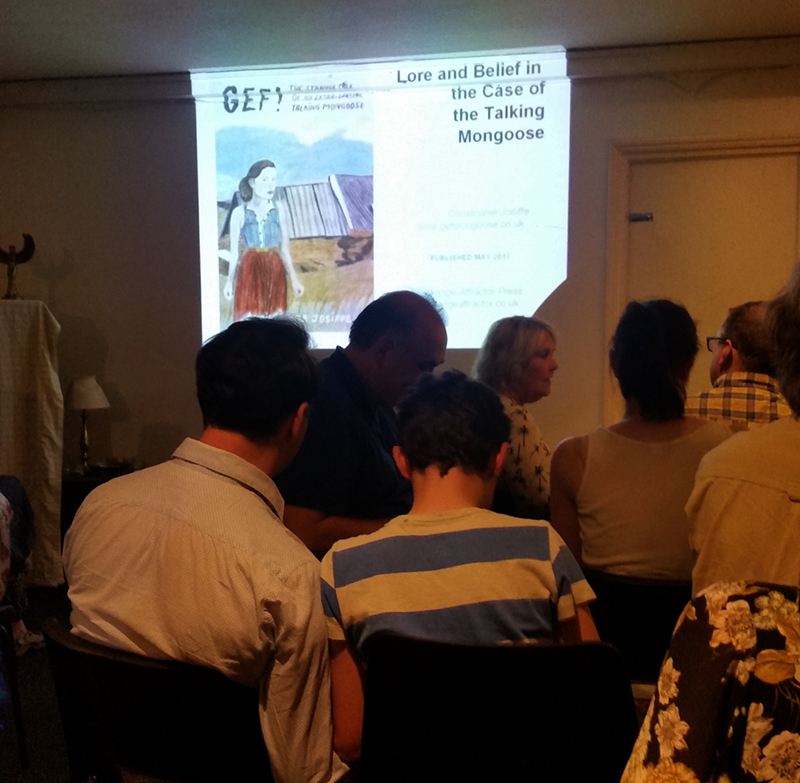
Spent an interesting evening at Treadwell’s listening to Lore and Belief in the Case of the Talking Mongoose, a lecture by Chris Josiffe.

1705 treadwells talking mongoose

In the early 1930s, an isolated Manx farm family became international celebrities after claiming their home was inhabited by a weasel-like animal. Gef the Talking Mongoose could speak coherently, shape-shift and perform telepathy. Investigators came in their multitudes, and improbable though it may sound, many were convinced. It was a time when spiritualism was strong, and psychic investigation popular.  Gef was purported to live between the walls of the house. This made me think of Gregor Schneider and his double walled rooms, lead lined, claustrophobic passages.

1706 Totes Haus u r Keller Venedig Gregor Schneider

I made a trip to Brockley to see In Conversation with (7): Beyond Controls; a drawing and print collaboration between Neil Ferguson & Carol Wyss.

From an initial line, each drawing was scanned, emailed and printed out to be developed further by hand. The repetitive nature of these procedures regularly exposed the limitations and idiosyncratic qualities of the scanners and printers. The structure of “Beyond Controls …” would always be infinite, sequences without final drawings, but rather statements held in digitalized time. Cycles of series that cannot be closed, circles that cannot be joined.

1706 InCon-BeyondControl-NeilFerguson-CarolWyss2

The result was 10 sets of 32 drawings, 10 inkjet monoprints and a captivating video of  each set of drawings digitally layered and edited with Photoshop making the decision on visibility of content through its own algorithms. Wonderful.

Another visit was to  a new project space HEWING WITTARE in Walthamstow to see Shapeshifting – tactics to combat drowning featuring works by Chudamani Clowes, Rebecca Glover and Anna Liber Lewis.

1706 Chud Clowes rescue blanket sea

The artists use the watery world as a metaphor for our current political climate in which the fight for survival, shelter and equality is growing tougher by the day….

Chud Clowes engaged in a perambulative performance dressed as an Urchin to highlight the journeys made across the globe by thousands of migrants often at the mercy of the oceans and elements as well as political currents that sweep them from place to place

1706 Chud Clowes Urchin performance

We were led to Lloyd Park, site of  the William Morris Gallery, for some squid and fish printing on one of the hottest days of the year.

Later the same day entering Edel Assanti gallery to see new work from Jodie Carey – Earthcasts the visual and the physical collided. In this white space 50 gnarled and towering sculptures created a landscape hinting at the cool depths of a silver birch tree glade or the snowy trunks of an alpine forest while the heat of the day still pulsated in my body and hung heavy in the atmosphere.

1706 Jodie Carey

It was a rich experience oscillating between ancient responses to the multiple upright monument, the rituals of the standing stone yet could also be the concrete posts from some deconstructed enclosure, the high wire fencing removed. Jodie Carey’s painstaking process of burying old timbers in the earth to create casts that are then filled with plaster and subsequently excavated echo the temporal and material nature of our lives lived on soil and imprinted with our own encounters.

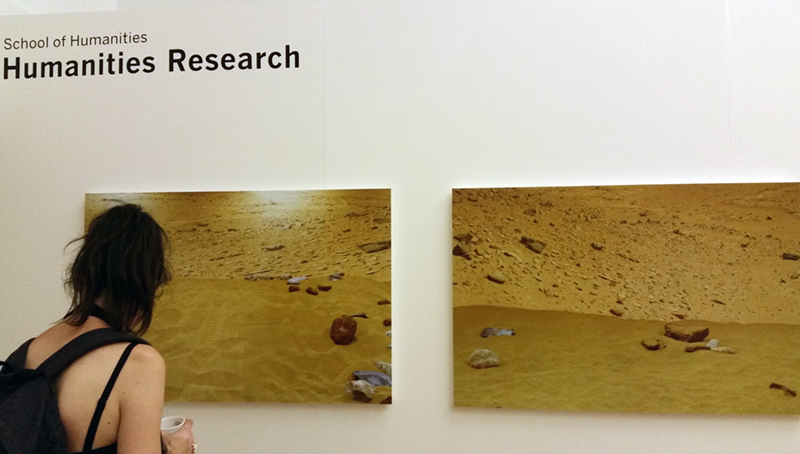
Along to SHOW 2017 at the RCA to be swept even further away. The heat more in keeping with the surface of Mars images presented as part of the final research of Luci Eldridge’s PhD by thesis; Mars, Invisible Vision and the Virtual Landscape: Immersive Encounters with Contemporary Rover Images 2017

1706 Luci Eldridge Phd PV RCA

Luci Eldridge ‘Stepping into the Image of Mars’

Images captured at the Mars Yard being used to test the European Space Agency’s ExoMars rover, due to launch in 2020. Courtesy of Airbus Defence and Space.

‘ The eyes of the Mars rovers provide viewpoints through which we regard an alien terrain: windows upon unknown worlds. Rover images bridge a gap between what is known and unknown, between what is visible and invisible. The rover is our surrogate, an extension of our vision that portrays an intuitively comprehensible landscape. Yet this landscape remains totally out of reach, millions of miles away. This distance is an impenetrable boundary – both physically and metaphorically – that new technologies are trying to break.’ Luci Eldridge

1705 reworking dodecahedron

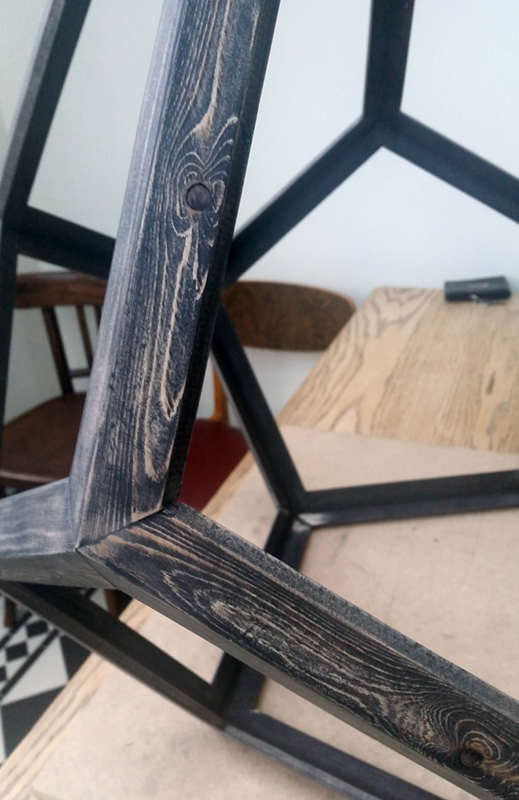
I am reworking the dodecahedron frame for the mining museum. Sanding, then darkening with my favourite black Stabilo pencil.

1706 dodecahedron

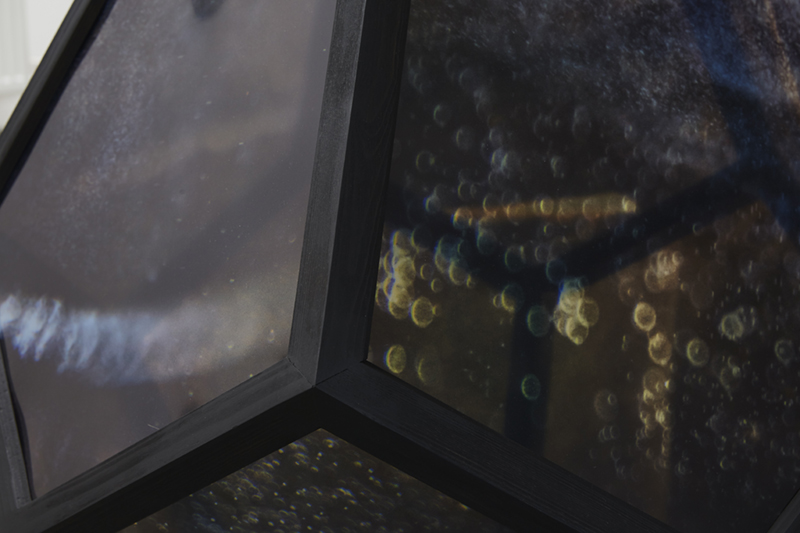
The images of cosmic trails now sit behind Perspex facets which has added another layer of reflection, the outer world, the universe surrounding and surrounded by itself

Diazôgraphô = Greek for to embroider. As to embroider the stars on the heavens…


So I entered that tunnel where everything blurs and I shoot through the ether at uncontrollable speeds slammed rigid as I am blasted forward barely able to make any alterations to my predestined trajectory. Those faraway deadlines have arrived. I am writing from the middle. Trying to recall events that have passed unrecorded as the avalanche of admin hits home. Yet more funding applications, press releases, ticketing sites, contracts and applying emotional balm to frayed nerves.

Laboratory of Dark Matters ACE.jpg

And now I am slung out the other side. Limp and disorientated, I will try to make sense of what just happened.

I got myself an orange boiler suit in preparation.

1703 Boulby boiler suit.jpg

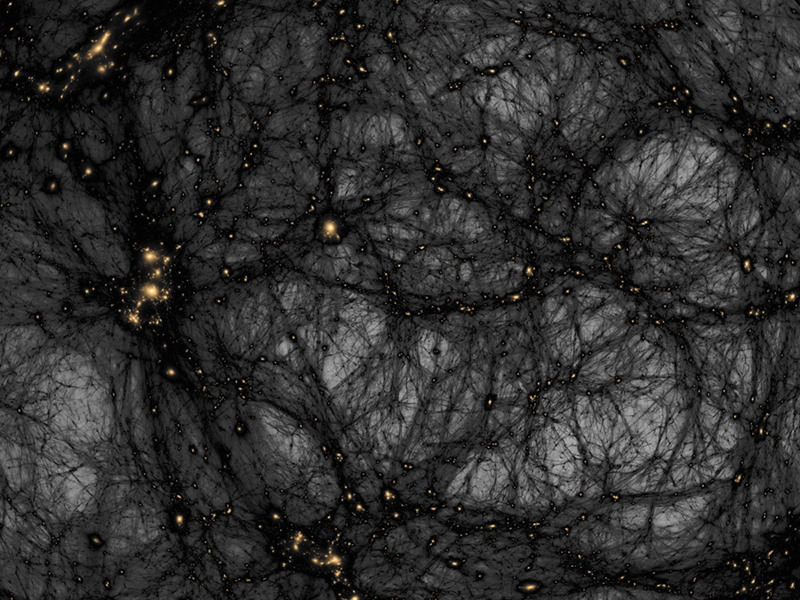
I was generously given dark matter visualisation images by Ralf Kaehler and astrophysicist Tom Abel from the Kavli Institute for Particle Astrophysics and Cosmology (KIPAC), a joint institute of Stanford University and the Department of Energy’s SLAC National Accelerator Laboratory who worked on Terrence Malick’s IMAX documentary  “Voyage of time”.

1703 dark-universe-dark-matter

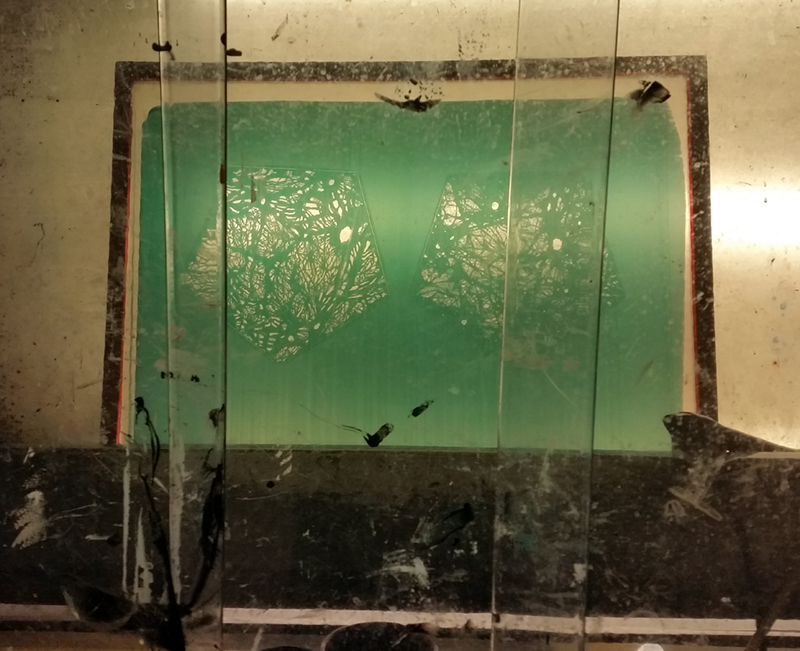
From these images I created my own interpretations for screen printing sugar lift

1703 screen

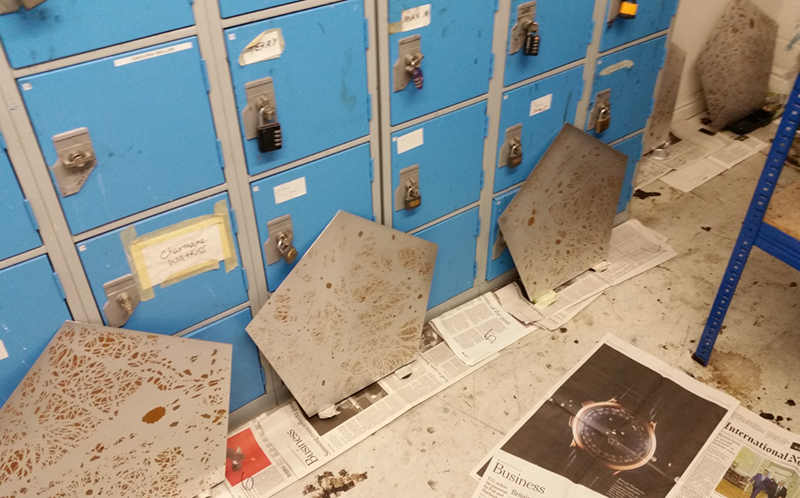
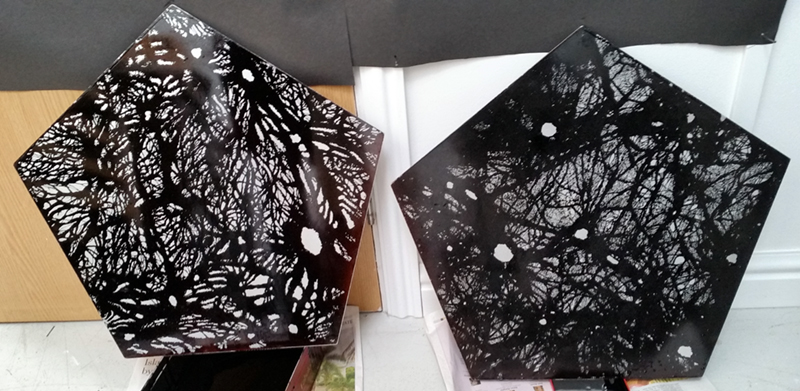
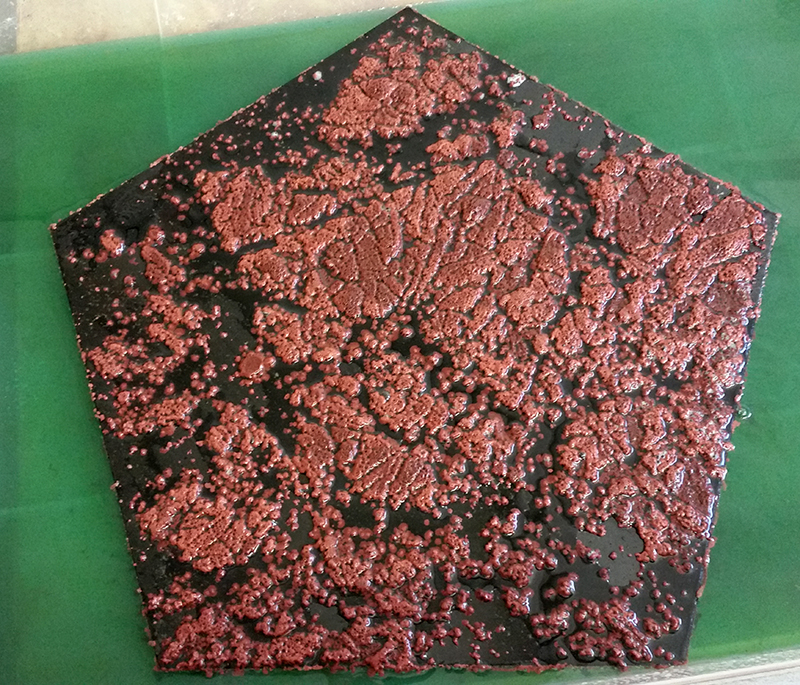
The image was screen-printed on both sides of an aluminium pentagon

1703 screen detail

using a sugar lift solution of camp coffee and Indalca paste, really sticky sweet and two coats are good, allowing the first to dry before applying the second

1703 sugar lift drying

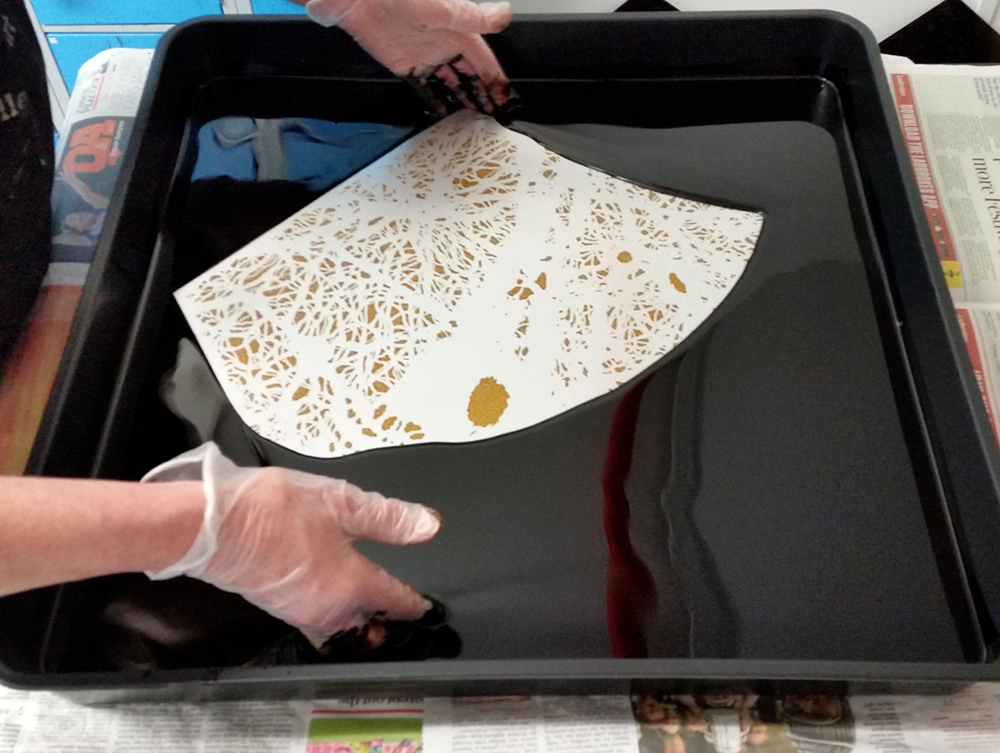
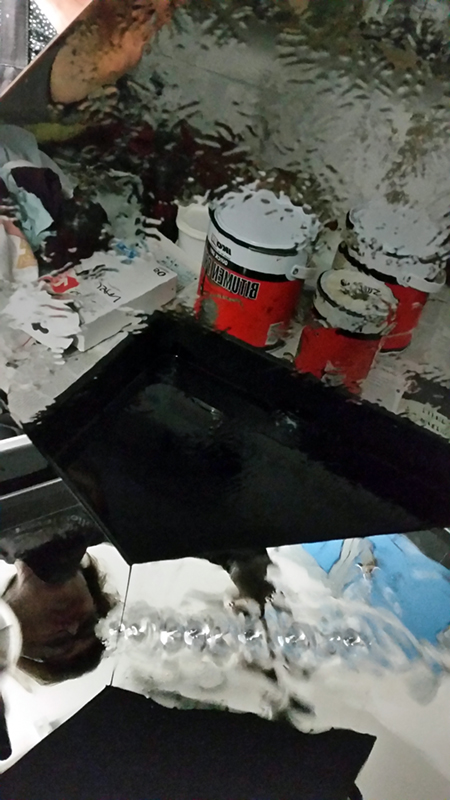
The plates are then immersed in a bitumen bath

1703 bitumen bath.jpg

the pooling of dark matter

1703 bitumen bath 2

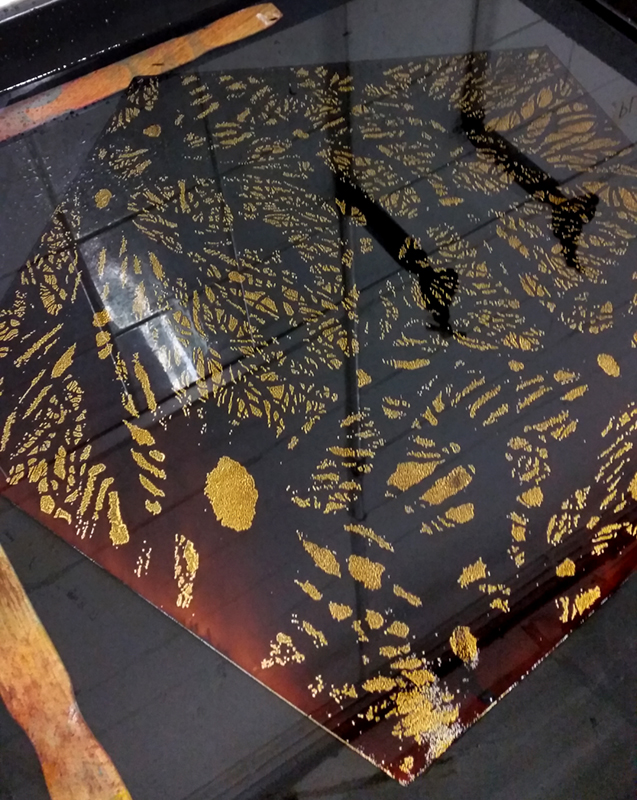
Once dried they are put in hot water, bubbles gather and the image emerges

1703 sugarlift

ready to etch (a dodecahedron has 12 sides)

1703 ready to etch.jpg

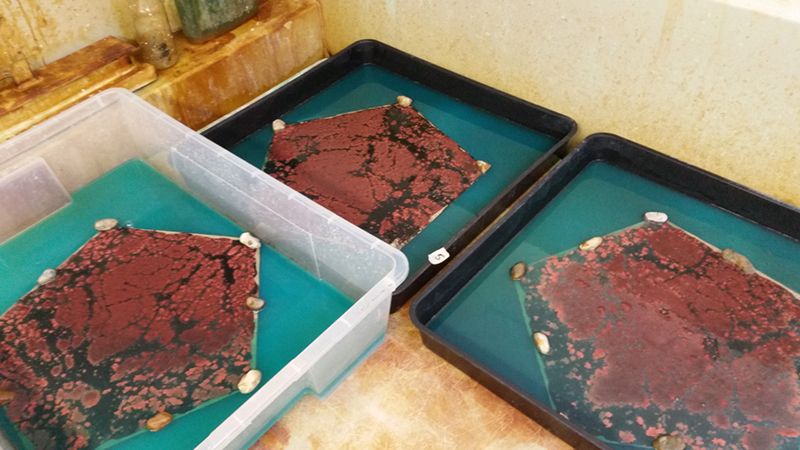
copper sulphate that catches in the throat, salt on the lips + hot water (500g+ 500g +3l )

a light froth and a pink blush quickly spreads

1703 etching (2).jpg

fizzing and belching so that the plates must be weighted down, the copper separates out to appear as a thick red lichen to be scooped out, bath refreshed four times and after eight hours the metal erodes and restoration can begin

1703 clean up

galaxies appear as light breaks through

1703 clean up 2

In the meantime I did the first cloud chamber test to see the trails of cosmic particles.
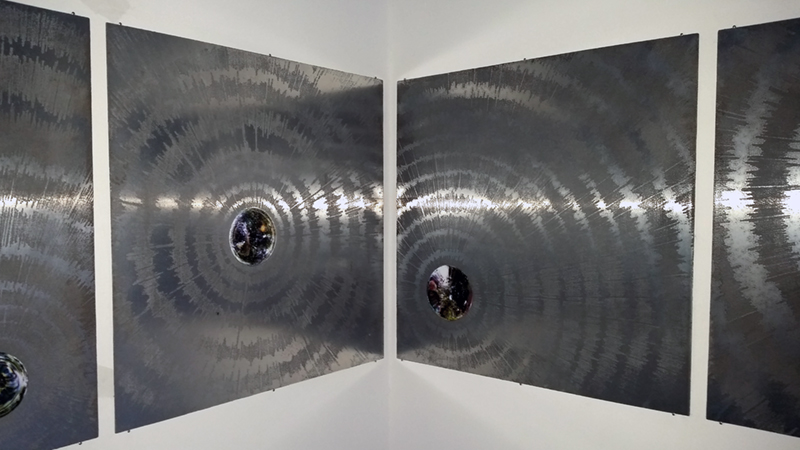
1703 cloud chamber test

It was incredible. Mesmerizing. Captivating. So much activity going on all the time that we are unaware of.
cosmic trail 1 e

It all happens on such a small scale but draws you in to this strange landscape

cosmic trail 3 e

I have Alan Walker of The University of Edinburgh to thank for all his advice on building the chamber and for providing the anodised aluminium plate that really helps ensure a good result.

I learnt some interesting things from Paul Hill of Awesome Astronomy in his talk Dark Side of the Moon. That all the metal we use on earth has been deposited here by asteroid and other collisions from outer space – any metal that was part of the original lump of matter that became earth is trapped molten at the core. That the moon doesn’t pull but push – I am still trying to come to terms with it being me moving not the sea when the tides turn. This needs further research.

1703 intertidal.jpg

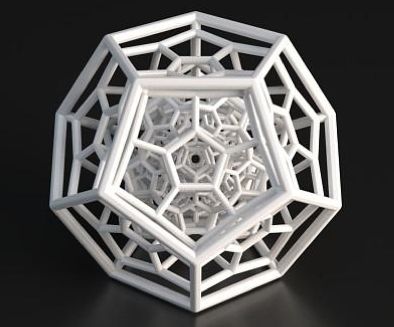
Another mind bending talk was Adventures in the 7th Dimension a UCL lunchtime talk from Dr Jason Lotay. I knew I was at the right lecture when he said one of his favourite shapes was the dodecahedron. In the 4th dimension it becomes a hyperdodecahedron made up of 120 dodecahedra. We can never really see it – it is always a projection back into 3D.

1703 hyperdodecahedron

I thought I was following, then suddenly from the 4th dimension we are in the 7th and I don’t know how I got there. Then I remembered it’s all maths. I can’t visualise this.

As you go up in dimensions there can be more symmetries. There are special symmetries that happen only in the 7th dimension. This is Holonomy G2. We don’t know how to combine quantum theory with gravity. String theory says you replace dots with lines – instead of having zero dimensions they are one dimensional. Lines can be curved, geometry can start to appear. M-theory combines all the different string theories together into one but you have to have 11 dimensions in the universe for this to work.

11 = 4 (3D + time) +7 (G2)    =  serendipity

1703 tree of codes 3

Then a different experience that was purely sensual, Tree of Codes had me in tears for sheer pleasure. Taking inspiration from Jonathan Safran Foer’s book of the same name, which was physically carved out of the pages of another novel,

1703 tree of codes

Wayne McGregor,  Jamie xx and Olafur Eliasson collaborate seamlessly

Tree of Codes

a successful cross discipline collaboration is not about sharing knowledge but about tolerating each others ignorance…in this way gaps open for others to enter

1703 hackney today.jpg

Hackney Today

Then it was time to move into Guest Projects….


Big news is that Laboratory of Dark Matters has been awarded Arts Council England funding. I am still struggling to believe. We are also getting some support from the Institute of Physics for when we take the exhibition to the North East. This news is such a boost for our project and has unleashed a rush of activity, but also a torrent of admin. I had been making some progress with the sculpture.1702 Dodecahedron.jpg

Results of a day at Woodhall Barn Workshop under the steady supervision of wood wizard Christopher Hall and I am very chuffed with my dodecahedron frame.  The angles have to be cut so very accurately using a table saw and digital level to achieve the precision needed for it to fit together. It’s basically 30 identical pieces ripped from 2 x 4 pine at 31.7° and mitred at 36° and glued together. We got these top tips ‘How to make a dodecahedron the easy way’ from YouTube. It was not easy.

Reading Plato’s Timaeus and Critias I was hoping to find some more information on the relationship drawn between the dodecahedron and the cosmos but have found no further explanations. Plato describes a primitive chaos where the four elements of fire, earth, water and air formed from a turbulent mix of ‘being’, ‘space’ and ‘becoming’ to be assigned by their solid or fluid characteristics to the tetrahedron, cube, icosahedron and octahedron respectively then adds .. ‘There still remained a fifth construction, which the god used for embroidering the constellations on the whole heaven’…it’s almost an afterthought or maybe just too illusive to elaborate on.

1702-studio

I have started the experiment with sugar lift and etching aluminium to see if I can bite right through the plate and keep the structure of the image. I screenprinted a sugar lift mixture onto the plate on both sides. The image was adapted from data visualisation of dark matter kindly supplied by Ralf Kaehler of the Kavli Institute for Particle Astrophysics and Cosmology.

I drenched the plate in stop-out and left it to dry before immersing in hot water which dissolves the sugar and reveals the image. It was surprising how much fine detail came through. Though one side of the plate was always better than the other – this could be due to lots of things that are hard to control accurately like concentration of sugar, thickness of stop-out, temperature of water. A primitive chaos.

1702-detail-stopoutI am etching in saline sulphate as it gives quite a deep etch into aluminium.

great colours and quite mesmerising to watch as thick red deposits appear

1702-etching-process

Chemistry at work, lot of bubbles and heat. Several hours later after lots of dips, touch up of stop-out and fresh saline sulphate baths, light begins to appear through the plate

Cleaned up to see the results and decide where to go from here

The cloud chamber is also coming along. With the help of next door cutting my wood I have assembled the box. Even the insulation for the dry ice is cosmic.

1702-cloud-chamber-box

Had an interesting day listening to panel discussions and talks at Belief and Beyond Belief on the South Bank. Topics covered were Science versus Religion: Do We Need to Choose? ; Quantum Theology: When Faith Meets Science; The Big Bang and Beyond; God of the Gaps. Religion and science ask the same questions but have different mechanisms to answer those questions.

1701-shadows

These were some of the points discussed – When we look to understand the human condition and question the meaning of life, what truth are we seeking? The scientists present seemed more content to live in doubt but appreciated aspects that religion offered such as community, emotional beliefs and quiet reflection. The difficulty for scientists was in accepting that religions think they are based on truth. This religious truth comes from faith and cannot be tested as the argument is that God is beyond definition and therefore transcends understanding. It may be that searching for answers to resolve uncertainty is a survival trigger that persists as a craving in the human condition. .

1608 Paradise Row 7

The methodology of science is devised to look at facts unbiased, it has no moral or ethical framework. A theory in science is not a hypothesis. The scientists said they get frustrated by people saying they don’t ‘believe’ in their theory when they are based on facts. A theory may begin with a lot of intuition and wondering and develop like an artistic process of discovery within parameters; but then there is lots of testing, running the ideas through a sieve to filter out possible truths. A theory may start in mathematics but then is brought into the realm of language and the visual to express what we don’t understand. Georges Lemaitre in 1931 chose to explain his theory of the origin of the universe as “the Cosmic Egg exploding at the moment of the creation”; this became known as the Big Bang Theory. Pervasive metaphors colour our perceptions.

1701-seance

Science is perfectly happy to interrogate contradictory theories at the same time unlike religious belief which involves accepting one truth. All religions can’t all be right but their own belief in one truth makes it hard for them to accept a non-exclusivity of truths. Science cannot offer us all the answers. There cannot be a theory of everything, there must always be a gap in our understanding because to understand everything we would have to be omniscient – to look in from the outside. Or step outside of our own subjectivity. Thinking about this I went back to look at Schrödinger’s Mind and Matter, particularly his chapter Science and Religion which asks if science can help answer the questions of a possible eternity. Plato was the first to frame the idea of a timeless existence, more real than our actual existence which he saw as a shadow from some realm of ideas. He looked at the patterns in mathematics and geometry embedded in the structures around him that were determined by reason and logic and concluded that mathematical truth is timeless; discovery of it does not bring it into existence, it never changes and goes on forever. Schrödinger opens up further ideas on the indestructibly of the mind using the theories of space/time from Einstein and world view from Kant. This moves into more mind bending ideas, that theoretically time can be reversed. Here I struggle. The theories when pulled from mathematics into language sound fantastical, yet I am asked to believe mathematics is a truth. Then we come to the quantum world where observation and measurement do not apply. And so on.

1701 Soul Searching ve 1.jpg

Conclusions were: Our consciousness is the intrinsic unknown. We have to seek paradise even if it is unachievable and live our lives in a precarious state of doubt.

Analogies can be made, replacing religion with art. Making in Transit hosted an evening at Cube exploring art and science in collaborative situations to discuss the strengths and challenges in bringing them together. ‘Both physics and art thrive on the premise that there is structure as well as genuine ambiguity and mystery in the universe and although  very different in terms of practice, they both depend on an ability to visualise or conceptualise abstract notions and patterns.

There was an introduction to the world of Jiggling Atoms, a collaboration of scientists and artists who bring fun to workshops and experiments in arts and physics. Named after the visual interpretations of maths formula from Richard Feynman they display the same constant energy.

1702-feynman-diagram

Dr Daniel Glaser the director of the new Science Gallery London made the point that a successful collaboration is not so much about sharing knowledge but about tolerating each others ignorance, in this way a gap can be opened up for those who know nothing about either field to enter. The role of each party isn’t always clear or equal. He suggested the platonic ideal of ‘the essence’ was something artists could extract and Dr Chiara Ambrosio  suggested art should question the boundaries of science. Her interests are in the use of images to produce knowledge such as when high speed photography or microscopes revealed the secrets of the natural world. It was not as symmetrical as we supposed.

I returned the next day for an evening Imaging the Invisible to explore how we observe what we can’t see. Scientists and artists gave their perspectives on the invisible and how it operates in their own spheres. Bernard Siow and Yolanda Ohene from the Centre for Biomedical Imaging at UCL were passionate about the body imaging technologies they are developing, enabling extraordinary visualisations such as the muscle fibres of the heart.
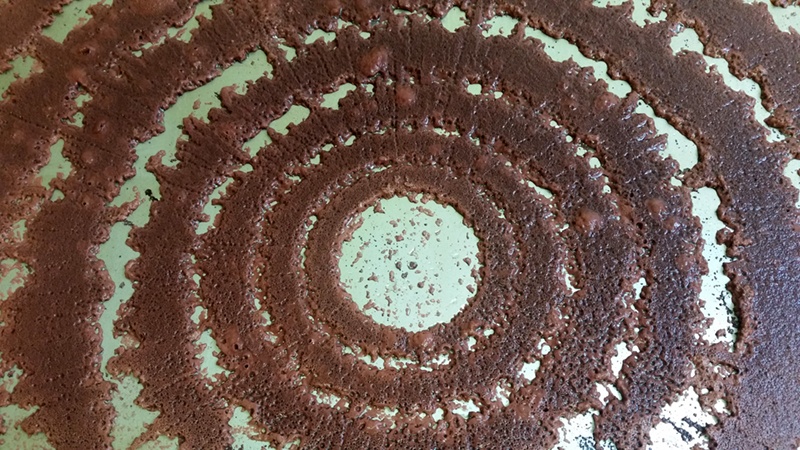
Artist Dave Farnham has created sculptures through 3D print technologies that replicated internal structures from his friends who were going through medical scanning procedures due to illness.

Particle physicist Dr Ben Still introduced us to the world’s largest cosmic particle observation device The Super Kamiokande, set 1,000m underground in Japan.

1702 credit Kamioka observatory, ICRR.jpg

Using 50,000 tons of ultra-pure water as a target to detect neutrinos. The quantity is to increase the chances of a collision.  A neutrino interaction with the electrons or nuclei of water can produce a charged particle that moves faster than the speed of light in water. This creates a cone of light known as Cherenkov radiation, which is the optical equivalent to a sonic boom. The neutrino is a subatomic particle able to travel through matter without interacting, they have no electric charge and almost zero mass.

Lead is what we think of as most impenetrable. A lead lined coffin for Alexander Litvinenko. However it would take a light-year of lead, to stop just half of the neutrinos flying through it.

Anselm Kiefer Walhalla at White Cube Bermondsey weights the air with lead. We are in the lead coffin.

1702-anselm-keifer

Alternative materiality at Chain by 15 an artist led exhibition in Peckham presented an Itchy and Scratchy world brought together by the Pokémon generation.

1702-hadas-auerbach

The Head Must Go cross stitch on linen by the uncompromising talent Hadas Auerbach was a delicate and poignant highlight.

1702-venus-anadyomene

Enjoyed the beautifully staged performance  –Venus Anadyomene -a collaborative 3 channel video and performance by Verity Birt, Holly Graham and Richard Forbes Hamilton; part of ongoing research around de-colonising histories, feminist narrative and collective voice.

The layering of voices, looping narrative and rhythmic pulse hooked into lost voices of history transporting the audience into a dreamlike territory.

I was invited by Lumen:School of Light to show everydaymatters at Ugly Duck for a weekend showcase of artists who explore the relationship between astronomy and light.

1702-everydaymatters

everydaymatters dissects landscapes to discover the hidden structures of the universe.

1702-everydaymatters-holloway-n7

Images taken from everyday prosaic paradises such as Paradise Road, Stockwell and Paradise Row Bethnal Green, are divided into constituent proportions of dark energy, dark matter and the visible world opening the spaces between what is seen and unseen.

1702 Anna Gray.jpg

Anna Gray’s water filled glass sculpture gave endless pleasure

1702 Anna Gray 2.jpg

the mini planetarium experience from Sylvana Lautier, Rose Leahy and Kim Yip Tong was blissful immersion

1702-sylvana-lautier-rose-leahy-kim-yip-tong

Spaceheads & Rucksack Cinema multi media performance was funky

1702-spaceheads-with-rucksack-cinema

Was quite energising to set up and take down over one weekend with lots going on

1702 School of Light PV.jpg


Progress is slowly underway on my dodecahedron sculpture. Beginning with a rough mock up in card to gauge the size.

1701 maquette.jpg

I was relieved to finally finish screen printing the curse of the obelisk. Never had so many setbacks in a piece of work.

1701 Cloud Obelisk.jpg

Made of one single stone, dedicated to the solar gods, an obelisk is a fusion of the earthly and the divine. A symbol of power, piercing entry to the fickle world of the gods beyond the clouds, cursed and desired. Over 3,500 years old, the London Obelisk, raised on The Embankment for convenience sake, snubbed by a state embarrassed to revere a shady political gift made by a country they were about to undermine, fought its removal from the soil it was hewn from stands alone, separated from its twin. The gift to state made in 1811 lay fallen and uncollected in Alexandria until an eccentric Victorian adventurer (Sir James Edward Alexander, Knt.,C.B., K.C.L.S, F.R.C.E.) saw the twin in Paris and discovered that Britain’s prize had never been brought home. He found a fellow enthusiast with money and the pair designed a special vessel to contain the obelisk that could be towed behind a ship. The Olga set sail in 1877 but met a violent storm that broke the tow ropes and cast the obelisk adrift. Six men struck out in the storm to rescue the vessel but were never seen again. The obelisk however did not sink and was later discovered, recaptured and finally towed up the Thames to be set incongruously upon a plinth under the unblinking guardianship of Victorian repro Sphinx’s who traditionally would be outward facing to ward off evil, but spend their days eyeing the needle.

1701 sphinx.jpg

I had an intriguing parcel arrive from the incredibly helpful Alan Walker from the School of Physics and Astronomy at The University of Edinburgh who is giving me loads of advice on building my cloud chamber. He has very kindly had an anodised aluminium plate made for me in his workshops. The plate is the one crucial component that has to be specially made so it was wonderful to find that he had done this for me.

1701-cloud-chamber-parcel

The black metal plate will sit on dry ice, it will be the viewing backdrop for all the cosmic particle trails and I can now get on with the next stage – making the insulated box.

1701-cloud-chamber-1

I have set up a hydroponics tent in my studio to create a dark space ready for filming once the cloud chamber is fully assembled and ready to test.

1701-dark-room

On a very crisp bright day I took the crystal ball a short walk along the banks of the River Wey to the ruins of  Waverley Abbey.

1701-waverley

This was the very first Cistercian monastery founded in Britain 900 years ago by an Abbot and 12 monks from France.

1701 waverley abbey 1.jpg

These images of the crystal ball set in different locations are part of research with a view to making a work about portals in time, space and imagination.

The first work you see at Bloomberg New Contemporaries, ICA is Kate Fahey’s delicate plumes from a multitude of explosions billowing into one giant cloud – Cumulative Loss.

1701 Kate Fahey.jpg

Through scale and fragility we sense the dust caught momentarily before it settles over devastation upon devastation. It sets a thoughtful tone to enter the lower gallery.

Lisa Porter’s glazed stoneware Connection X (Thank Finch for That) and Rodrigo Red Sandoval’s installation Satellite reflections were two works I was drawn to.

1612-kate-fahey-superficie-ii

Kate Fahey Superficie I

Kate Fahey’s Superficie images developed during a residency on the remote Isle of Coll were included in Reference Mollusk, a beautifully curated exhibition  with some timely concerns at new gallery space Gossamer Fog in Deptford.

1612-solveig-settemsdal

Solveig Settemsdal Singularity (video still)

“We are the goo that slipped out of the oceans 430 million years ago, the goo that changed the earth beyond repair, the goo that will fossilise, leaving only future archaeological relics”

1612-justyna-kabala

Justyna Kabala Feel Better

Helen Maurer re Composing at Danielle Arnaud had a delicate touch.

1612-helen-maurer-1

Transferring from the forsaken voids of the Church of The Holy Trinity in York it brought with it the quiet sense of unease that comes when entering a darkened space on a summers day.

1612-helen-maurer-3

The gentle chimes sounding from hidden spaces under cabinets added to the undercurrent of something slightly sinister

by exposing the construction of this fairy tale landscape Maurer adds rather than depletes mystery

1612-helen-maurer-2

This was a captivating transformation of space at the House of St. Barnabus Chapel. Staccato is an audio-visual installation by Evy Jokhova

1612-evy-jokhova-2

exploring the interconnection between music, movement and ceremonial architecture

1612-evy-jokhova-3

featuring three sculptural works and a soundtrack made in collaboration with James Metcalfe.

1612-evy-jokhova-1

In similar vein, I was struck by Dr Rupert Till’s comment ‘architecture and acoustics are the same thing.’ He was speaking on the Radio 4 programme Did Stonehenge Sing? explaining the mysterious hum that emanates from the stones and how much more powerful the sounds would have been 3,000 years ago when all the stones were still standing. Thanks to Dr Till the lost sounds of Stonehenge have been reimagined for us to experience today.
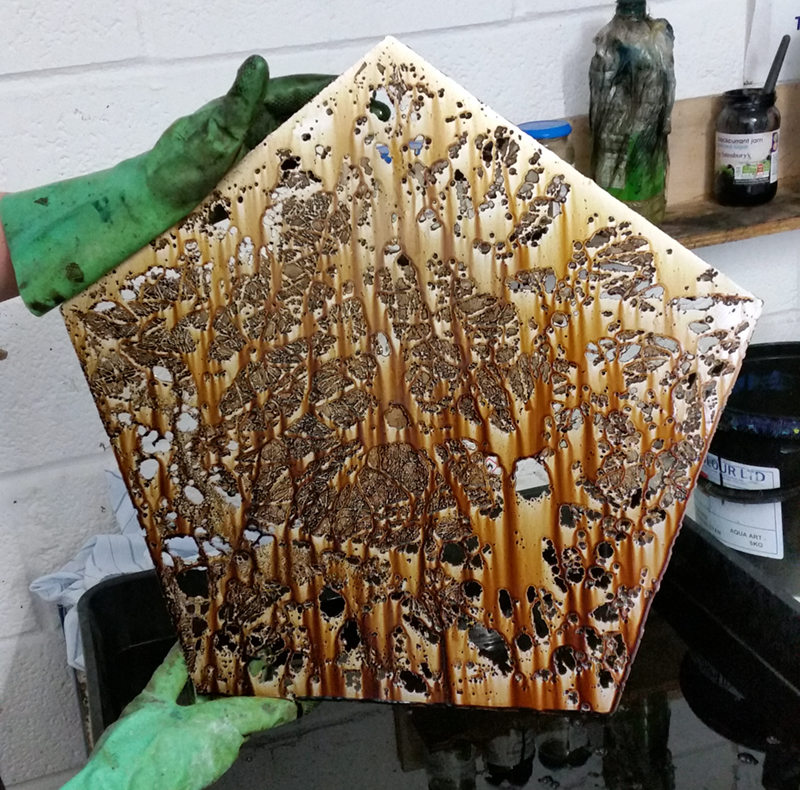
1612-stonehenge-credit-ap

Finally made it to a meeting of the New Materialism reading group. The text was Veronica Strang Fluid Consistencies: Materiality and meaning in human engagements with water http://dro.dur.ac.uk/19432/1/19432.pdf  Points that struck me were the observation from Tilley that ‘knowledge of a thing is grounded in our bodily experience of it’ and it made me think of Plato’s debate on true belief and knowledge, although a different kind of knowledge it does come back to the idea of being there, of engaging on a physical level. We think of flowing rivers, water carried in clouds but not always of the movement of water around the globe held in a juicy pineapple or mango or even our own bodies. I was introduced  to the work of Samara Scott and her liquid painting Developer created with bio-degradable dyes in the Pleasure Garden Fountains in Battersea Park.
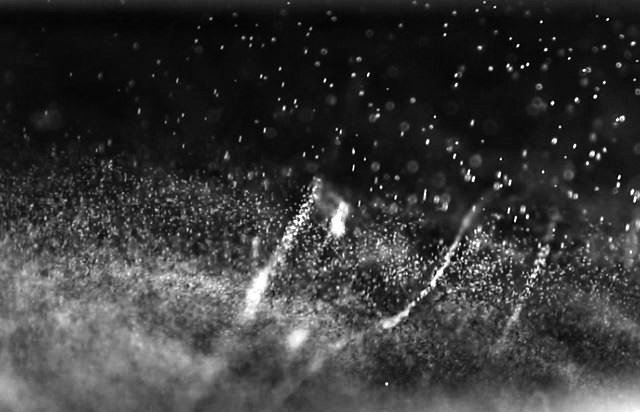
1612 Samara-Scott-Developer.jpg

The reading group meets at the Wellcome Trust Reading Room. On the same evening, another group was meeting to discuss materials as part of an collaborative programme between artists and scientists. I didn’t get to note down the names of participants, but a magician and an expert from the Institute of Materials had each brought along objects to spark debate. 1612 Wellcome Trust debate materials.jpg I liked the relationship struck between that of the magician as performer and the idea that the materials themselves are performing.

Turner Prize visit. Materials were performing here.

I found the materials of Helen Marten (left) difficult – though there were some I could enjoy like this wonderful ceramic disc I felt more of a connection to the materials of Michael Dean (right). It is something very basic about a reaction to the surface and the connotations it brings with it.

1612-helen-marten

Marten’s sculptures are very busy visually. Like a car boot sale, unexpected juxtapositions and mostly cheap and nasty material. (though I do appreciate the thought in her designs). Anthea Turner offered more open space, albeit surrounded by brick walls and facing giant theme park style buttocks, moving on to the next room offers open blue skies but also disturbing chastity belts. Heaven/Hell.

1612-anthea-hamilton

Josephine Pryde brought us homely goods; thick kitchen worktops bleached by the sun leaving hazy shadows of random objects. Also painted fingernails. A sit on size train tastefully graffitied encountering leaves on the track.1612-josephine-pryde

Finally entering the space of Michael Dean; smoothly curved walls morph into the floor, a strange unworldly lighting (as in James Turrell light works – the walls disappear)  and you are in a void or maybe underwater.

1612-michael-dean-3

The work (United Kingdom poverty line for two adults and two children: twenty thousand four hundred and thirty six pounds sterling as published on 1st September 2016) consists of £20,436 in pennies. This is the amount of money the government states is the minimum that two adults and two children need to survive for a year in the UK.

1612-michael-dean

One penny has been removed. A family on the shore line/breadline, trying to keep their heads above water.

1612 Michael Dean 1.jpg

This landscape has similarities to the war blasted landscapes of Paul Nash showing concurrently at Tate Britain.

1612-paul-nash

He too acknowledges the primitive power of single vertical forms.

Enjoyed the playful narrative of Bedwyr Williams’ The Gulch in the Barbican Curve.

1612-bedwyr-williams-2

Always intriguing and despite ominous undertones uplifting through the sheer joy of following the surreal twists and turns of his stories.

1612-bedwyr-williams-1

The simplicity of his constructions are part of the exuberance in his work, they provide the outlines for the journey.

1612-mealnie-king-pulsar002

Went to see Melanie King’s installation Pulsar Oscillograph as part of SPACE/LCN showcase of projects that have been developed by artists with the support of the LCN programme over the course of 6 months.  

1701 Melanie King.PNG

Transforming audio pulsar data (supplied by artist and former astronomer Steve Aishman), Melanie uses laser beams and mirrors to draw these “sounds” captured from outer space onto phosphorescent paper. The images layering, building and fading to the frenetic beat of the spinning collapsed star. As part of The Laboratory of Dark Matters experimental residency at Guest Projects Melanie will develop an Oscillograph  to visualise data obtained from dark matter research scientists in their search for the missing 85% of matter.